EP3597751A1 - Rna-bindendes protein - Google Patents
Rna-bindendes protein Download PDFInfo
- Publication number
- EP3597751A1 EP3597751A1 EP18767056.7A EP18767056A EP3597751A1 EP 3597751 A1 EP3597751 A1 EP 3597751A1 EP 18767056 A EP18767056 A EP 18767056A EP 3597751 A1 EP3597751 A1 EP 3597751A1
- Authority
- EP
- European Patent Office
- Prior art keywords
- amino acid
- hpuf
- rna
- shows
- alexa680
- Prior art date
- Legal status (The legal status is an assumption and is not a legal conclusion. Google has not performed a legal analysis and makes no representation as to the accuracy of the status listed.)
- Pending
Links
Images






































Classifications
-
- C—CHEMISTRY; METALLURGY
- C07—ORGANIC CHEMISTRY
- C07K—PEPTIDES
- C07K14/00—Peptides having more than 20 amino acids; Gastrins; Somatostatins; Melanotropins; Derivatives thereof
- C07K14/435—Peptides having more than 20 amino acids; Gastrins; Somatostatins; Melanotropins; Derivatives thereof from animals; from humans
- C07K14/46—Peptides having more than 20 amino acids; Gastrins; Somatostatins; Melanotropins; Derivatives thereof from animals; from humans from vertebrates
- C07K14/47—Peptides having more than 20 amino acids; Gastrins; Somatostatins; Melanotropins; Derivatives thereof from animals; from humans from vertebrates from mammals
-
- C—CHEMISTRY; METALLURGY
- C07—ORGANIC CHEMISTRY
- C07K—PEPTIDES
- C07K14/00—Peptides having more than 20 amino acids; Gastrins; Somatostatins; Melanotropins; Derivatives thereof
- C07K14/435—Peptides having more than 20 amino acids; Gastrins; Somatostatins; Melanotropins; Derivatives thereof from animals; from humans
-
- C—CHEMISTRY; METALLURGY
- C12—BIOCHEMISTRY; BEER; SPIRITS; WINE; VINEGAR; MICROBIOLOGY; ENZYMOLOGY; MUTATION OR GENETIC ENGINEERING
- C12N—MICROORGANISMS OR ENZYMES; COMPOSITIONS THEREOF; PROPAGATING, PRESERVING, OR MAINTAINING MICROORGANISMS; MUTATION OR GENETIC ENGINEERING; CULTURE MEDIA
- C12N5/00—Undifferentiated human, animal or plant cells, e.g. cell lines; Tissues; Cultivation or maintenance thereof; Culture media therefor
- C12N5/10—Cells modified by introduction of foreign genetic material
Definitions
- the present invention relates to an RNA-binding protein.
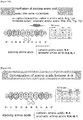
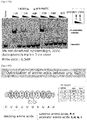
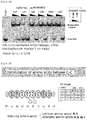
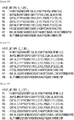
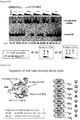
- a human Pumilio and FBF homology (hPUF) protein is known as an RNA-binding protein having high binding ability and selectivity (see, for example, Non-Patent Document 1). It is known that the hPUF protein has eight repeat motifs that are different in amino acid sequence and length, and three amino acid residues in a single repeat recognize one base. The eight repeat motifs are herein referred to as R1, R2, R3, R4, R5, R6, R7, and R8 from the N-terminal side. The amino acid sequences of the respective repeat motifs are as follows. Fig. 163 shows the regularity of wild-type stacking amino acids by the molecular model.
- Non-Patent Document 1 X. Wang, et. al. Cell, Vol. 110, 501-512, August 23, 2002
- An object of the present invention is to provide a soluble RNA-binding protein having high binding ability.
- a soluble RNA-binding protein having high binding ability can be designed in accordance with a target RNA sequence by modifying the configuration of eight repeat motifs R1 to R8 or amino acid residues of the motifs. This has led to the completion of the present invention. According to the present invention, the following inventions are provided.
- a soluble RNA-binding protein having high binding ability can be provided.
- the RNA-binding protein of the present invention is an RNA-binding protein comprising a plurality of repeat motifs, which has an N-terminal domain bound to the N terminus of the plurality of repeat motifs and a C-terminal domain bound to the C terminus thereof.
- the N-terminal domain is referred to as "R1' domain” and the C-terminal domain is referred to as "R8' domain.”
- the amino acid sequence of the R1' domain and the amino acid sequence of the R8' domain are as follows.
- Example 1 It was found in Example 1 that when Phe, the 5th or 14th amino acid residue of R1, is substituted with Ala, the binding force decreases, and even when Phe, the 18th amino acid residue of R2, is substituted with Ala does not affect the binding force. In other words, it was suggested that Phe, the 5th or 14th amino acid residue of R1, is involved in the interaction between RNA and a protein.
- an RNA-binding protein having a substitution of R3 with R5 was soluble, and an RNA-binding protein having a substitution of R4 with R6 was also soluble, both of which had binding ability comparable to that of the wild-type protein.
- RNA-binding protein having a substitution of R3 with R5 and a substitution of R4 with R5 was soluble and had binding ability.
- RNA-binding protein having a substitution of R3 with R5 and a substitution of R4 with R6 was soluble and had binding ability comparable to that of the wild-type protein.
- the terminal sequence of R7 is preferably ILQ or IRG, and more preferably ILQ.
- RNA-binding protein having extended recognition repeat(s) was examined in Example 3. As a result, it was suggested that high binding ability can be achieved with a plurality of R5-R6 repeats.
- RNA-binding protein with modified recognition specificity for R5 was prepared and the binding ability was examined in Example 4.
- degree of the binding ability is in the following order: C12N (recognition of U (hereinafter "U recognition")) > C12S, Q16E (recognition of G (hereinafter "G recognition")) > C12S, Q16R (recognition of C (hereinafter "C recognition”)) > MT (R3 ⁇ R5, R4 ⁇ R5) (recognition of A (hereinafter "A recognition”)).
- RNA-binding protein with modified recognition specificity for R6 was prepared and the binding ability was examined. As a result, it was indicated that in the cases of G recognition and C recognition, the protein has binding ability comparable to that of the wild-type protein in the case of U recognition.
- Tyr is suitable as an aromatic amino acid between G and A (G-A)
- Arg is suitable as a cationic amino acid between A and G (A-G).
- Arg is suitable as a cationic amino acid between U and G (U-G), and Arg is suitable as a cationic amino acid between G and U (G-U).
- Example 7 The binding ability of an RNA-binding protein with further extended recognition repeats was examined in Example 7. Considering the superiority and inferiority of the binding ability together with the results of Example 3, it was found that the binding force decreases in the following order from (1) to (4).
- each RNA-binding protein was examined by changing recognition specificity in Example 8 in the same manner as in Example 4.
- the recognition specificity was changed for R1, R2, R7, and R8, and the effects were confirmed by experiments.
- the RNA recognition specificity of each protein having the corresponding amino acid sequence was clarified, and the order of binding strength was elucidated.
- Example 9 the optimal amino acid was confirmed by modifying each stacking amino acid as in Example 5.
- Table 2 shows the results together with the results obtained in Example 5.
- a method for preparing a gene encoding the RNA-binding protein of the present invention is not particularly limited.
- the gene can be prepared by chemical synthesis of a nucleic acid based on the amino acid sequences disclosed herein.
- RNA-binding protein In order to improve solubilization of an RNA-binding protein, it is possible to fuse a tag protein that is known to promote solubilization.
- a maltose-binding protein (MBP) or the like can be used as a tag protein.
- a recombinant expression vector can be prepared by incorporating a nucleic acid encoding an MBP-tagged RNA-binding protein into an expression vector.
- a recombinant expression vector can be introduced into a host for expression, thereby allowing each protein to be expressed in the host.
- a vector into which the nucleic acid encoding the RNA-binding protein of the present invention is inserted is not particularly limited as long as it can be replicated in a host. Examples thereof include plasmid DNA and phage DNA.
- plasmid DNA examples include Escherichia coli -derived plasmids (e.g., pET System, pRSET, pBR322, pBR325, pUC118, pUC119, pUC18, and pUC19), Bacillus subtilis-derived plasmids (e.g., pUB110 and pTP5), yeast-derived plasmids (e.g., YEp13, YEp24, and YCp50).
- phage DNA examples include ⁇ phages (e.g., Charon4A, Charon21A, EMBL3, EMBL4, ⁇ gt10, ⁇ gt11, and ⁇ ZAP).
- animal viruses such as retrovirus and vaccinia virus, and insect virus vectors such as baculovirus can be used.
- the nucleic acid (DNA) encoding the RNA binding protein can be inserted into a vector by cleaving the nucleic acid encoding the RNA-binding protein with an appropriate restriction enzyme and inserting it into the restriction enzyme site or multicloning site in the vector.
- the nucleic acid encoding the RNA-binding protein must be incorporated into a vector so that the function of the gene can be exerted.
- the vector of the present invention may optionally include a cis-element such as an enhancer, a splicing signal, a poly A addition signal, a selection marker, a ribosome-binding sequence (SD sequence), and the like, in addition to a promoter and the nucleic acid encoding the RNA-binding protein.
- a selection marker include a dihydrofolate reductase gene, an ampicillin resistance gene, and a neomycin resistance gene.
- the present invention also relates to a host cell (transformant) including the above-described expression vector.
- a transformant can be obtained by introducing a recombinant expression vector into a host such that a desired gene (i.e., a nucleic acid encoding an RNA-binding protein) can be expressed.
- the host is not particularly limited as long as the nucleic acid of the present invention can be expressed.
- Examples of the host include bacteria belonging to the genus Escherichia (e.g., Escherichia coli ) , the Genus Bacillus ( Bacillus subtilis ) , the genus Pseudomonas (e.g., Pseudomonas putida ) , and the genus Rhizobium (e.g., Rhizobium meliloti ) .
- the host may be a yeast such as Saccharomyces cerevisiae or Schizosaccharomyces pombe. Further, the host may be an animal cell such as a COS cell or CHO cell or an insect cell of Sf9, Sf21, or the like.
- the recombinant expression vector of the present invention can replicate autonomously in a bacterium, and at the same time, it is composed of a promoter, a ribosome-binding sequence, a nucleic acid encoding an RNA-binding protein, and a transcription termination sequence.
- the vector may also include a gene regulating a promoter.
- Escherichia coli examples include Escherichia coli K12 and DH1, and Bacillus subtilis or the like can be exemplified. Any promoter may be used as long as it can be expressed in a host such as Escherichia coli.
- Escherichia coli -derived promoters and phage-derived promoters such as a trp promoter, a lac promoter, a PL promoter, and a PR promoter can be used.
- An artificially designed and modified promoter such as a tac promoter may be used.
- a method for introducing the recombinant vector into a bacterium is not particularly limited as long as it is a method for introducing DNA into a bacterium. For example, a method using calcium ions, an electroporation method, and the like can be mentioned.
- a promoter is not particularly limited as long as it can be expressed in a yeast. Examples thereof include a gall promoter, a gal10 promoter, a heat-shock protein promoter, an MF ⁇ 1 promoter, a PHO5 promoter, a PGK promoter, a GAP promoter, a ADH promoter, and an AOX1 promoter.
- a method for introducing the recombinant vector into a yeast is not particularly limited as long as it is a method for introducing DNA into a yeast. For example, an electroporation method, a spheroplast method, a lithium acetate method, and the like can be mentioned.
- monkey cells such as COS-7 cells and Vero cells
- Chinese hamster ovary cells CHO cells
- mouse L cells mouse L cells
- rat GH3 cells human FL cells
- An SR ⁇ promoter, SV40 promoter, LTR promoter, CMV promoter, or the like may be used as a promoter.
- an early gene promoter of human cytomegalovirus or the like may also be used. Examples of a method for introducing the recombinant vector into animal cells include an electroporation method, a calcium phosphate method, and a lipofection method.
- insect cells are used as a host
- Sf9 cells, Sf21 cells, and the like are used.
- Examples of a method for introducing the recombinant vector into insect cells include a calcium phosphate method, a lipofection method, and an electroporation method.
- the RNA-binding protein of the present invention can be obtained by culturing the above-described transformant and collecting the protein from the culture product.
- culture product means any of cultured cells/cultured bacterial cells or disrupted cells/bacterial cells, in addition to a culture supernatant.
- a method for culturing the transformant is carried out in accordance with an ordinary method applied for culturing a host.
- Each of a natural medium and a synthetic medium may be used as a medium for culturing a transformant obtained using a microorganism such as E. coli or yeast as a host as long as it is a medium which contains a carbon source, a nitrogen source, an inorganic salt, and the like that can be assimilated by the microorganism such that the transformant can be cultured efficiently.
- Carbohydrates such as glucose, fructose, sucrose, and starch, organic acids such as acetic acid and propionic acid, and alcohols such as ethanol and propanol are used as carbon sources.
- Ammonium salts of inorganic acids or organic acids such as ammonia, ammonium chloride, ammonium sulfate, ammonium acetate, and ammonium phosphate or other nitrogen-containing compounds, peptone, meat extract, corn steep liquor, and the like are used as nitrogen sources.
- Potassium phosphate, dipotassium phosphate, magnesium phosphate, magnesium sulfate, sodium chloride, ferrous sulfate, manganese sulfate, copper sulfate, and calcium carbonate are used as inorganic substances.
- Culture is usually carried out at 37°C for 6 to 24 hours under aerobic conditions such as shake culture or aeration and agitation culture.
- the pH is maintained at 7.0 to 7.5 during the culture period.
- the pH is adjusted using an inorganic or organic acid, an alkaline solution, or the like.
- Antibiotics such as ampicillin and tetracycline may be added to the medium as necessary during culture.
- an inducer may be added to the medium as necessary.
- an inducer may be added to the medium as necessary.
- IPTG isopropyl- ⁇ -D-thiogalactopyranoside
- IAA indoleacrylic acid
- a generally used RPMI 1640 medium or DMEM medium, a medium obtained by adding fetal bovine serum or the like to any of these media, or the like is used as a medium for culturing a transformant obtained using animal cells as a host. Culture is usually performed at 37°C for 1 to 30 days in the presence of 5% CO 2 . Antibiotics such as kanamycin and penicillin may be added to the medium as necessary during culture.
- the RNA-binding protein of the present invention After culture, in a case in which the RNA-binding protein of the present invention is produced inside of cells or bacterial cells, the RNA-binding protein is extracted by disrupting the cells or bacterial cells. In addition, in a case in which the RNA-binding protein of the present invention is produced outside of cells or bacterial cells, the culture solution is directly used or the cells or bacterial cells are removed therefrom by centrifugation or the like. Thereafter, the RNA-binding protein of the present invention can be isolated and purified from the culture product by using any one of or an appropriate combination of general biochemical methods used for protein isolation and purification, such as ammonium sulfate precipitation, gel chromatography, ion exchange chromatography, and affinity chromatography.
- general biochemical methods used for protein isolation and purification such as ammonium sulfate precipitation, gel chromatography, ion exchange chromatography, and affinity chromatography.
- RNA-binding protein of the present invention binds to a target sequence by gel shift assay.
- a target RNA probe labeled with Alexa680 with absorption at 680 nm in the far infrared range (final concentration: 0.5 nM) and the RNA-binding protein (final concentration: 10 to 1000 nM) are mixed at 4°C for 1 hour in a reaction buffer (10 mM Tris-HCl, pH 7.5, 100 mM NaCl, 1 mM EDTA, 1 mM DTT, 10% Glycerol, 0.05% BSA, 0.2 U RNase inhibitor) and then applied to 6% non-denaturing polyacrylamide gel equilibrated with 0.5 ⁇ TBE buffer (size: 16 ⁇ 16 cm; thickness: 1 mm), followed by electrophoresis in a cold room (4°C).
- Each band of RNA can be visualized by terminating electrophoresis when the dye marker flows 3 cm and detecting the fluorescence in the gel taken out from the device while scanning with a far-infrared detector.
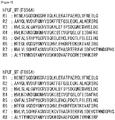
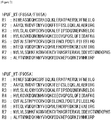
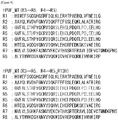
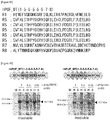
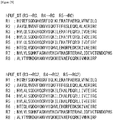
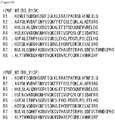
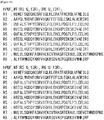
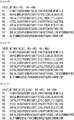
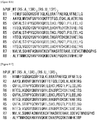
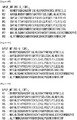
- Figs. 1 and 2 show the amino acid sequences of hPUF_MT(F856A), MT(F865A), MT(F856A/F865A), and MT(905A).
- Total synthesis of genes encoding hPUF_MT(F856A), MT(F865A), MT(F856A/F865A), and MT(905A) was carried out.
- Synthesized genes were cleaved with BsaI and ligated with pET24-MBP(-B)-R1'-MSC-R8' which was also cleaved with BsaI, thereby constructing expression vectors.
- pET24-MBP(-B)-R1'-MSC-R8' is a vector composed of a pET24 vector including a gene encoding a maltose-binding protein (MBP), a gene encoding R1', a multicloning site, and a gene encoding R8'.
- MBP maltose-binding protein
- Each obtained expression vector was transduced into E. coli BL21 (DE3). Protein expression was induced by performing shake culture in an LB-Kan medium containing 2% glucose until OD 600 reached a level of about 0.6 to 0.75, followed by shake culture in a 1 mM IPTG-containing LB-Kan medium at 37°C for 3 h. E. coli was pelleted and suspended in a lysis buffer (25 mM Tris-HCl (pH 8.0), 500 mM NaCl). Each desired protein was adsorbed by performing freeze-thawing and sonication, mixing the centrifuged supernatant with ProfinityTM IMAC Ni-Charged Resin (Biorad), followed by rotoring at 4°C for 10 h.
- a lysis buffer 25 mM Tris-HCl (pH 8.0), 500 mM NaCl
- the concentrate was mixed with 99.5% glycerol and 1M DTT such that the mixture had a composition of 25 mM Tris-HCl (pH 7.5), 150 mM NaCl, 50% glycerol, and 5 mM DTT, and then, stored at -20°C.
- RNA probe containing a target sequence fluorescence-labeled with Alexa680 at both ends thereof was synthesized.
- OTS-1511 5'-Alexa680-CCAGAAU UGUAUAUA UUCG-Alexa680-3' (19 mer)
- Each purified protein was diluted to a desired concentration with Binding Buffer, mixed with a binding buffer and Ribonuclease Inhibitor, Cloned (Invitrogen), and then, mixed with the RNA probe at a final concentration of 0.5 nM.
- a buffer in a binding reaction had a composition of 10% glycerol, 100 mM NaCl, 10 mM Tris-HCl (pH 7.5), 0.05% BSA, Ribonuclease Inhibitor (0.2 U), 1 mM DTT, and 1 mM EDTA.
- a binding reaction was performed at 4°C for 30 min. Subsequently, the solution was gently mixed by pipetting. A binding reaction was performed again at 4°C for 30 min.
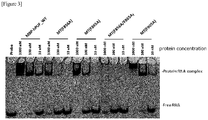
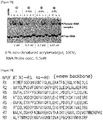
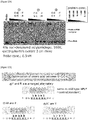
- Fig. 3 shows the results.
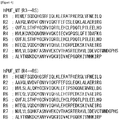
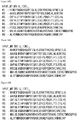
- Fig. 4 shows the amino acid sequences of hPUF_MT(R3 ⁇ R5) and MT(R4 ⁇ R6).
- Protein expression and purification were performed by the same procedures as in (2) of Example 1. Note that protein expression was induced in a 0.01 mM IPTG-containing LB-Kan medium at 25°C for 16 h. Rotoring for absorption to the resin was carried out for 8 h. Figs. 5 and 6 show the results of examining solubility.
- RNA probe 5'-Alexa680-CCAGAAU UGUAUAUA UUCG-Alexa680-3' (19 mer)
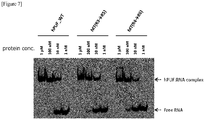
- Fig. 7 shows the results. Both MT(R3 ⁇ R5) and MT(R4 ⁇ R6) were found to have binding force comparable to that of the wild type.
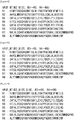
- Figs. 8 and 9 show the amino acid sequences of hPUF_MT(R3 ⁇ R5, R4 ⁇ R5), hPUF_MT(R3 ⁇ R5, R4 ⁇ R5_R13H), hPUF_MT(R4 ⁇ R6, R5 ⁇ R6), and hPUF_MT(R4 ⁇ R6, R5 ⁇ R6_Y13R).
- Protein expression and purification were performed by the same procedures as in Example 1. Note that protein expression was induced in a 0.01 mM IPTG-containing LB-Kan medium at 30°C for 7 h. Rotoring for absorption to the resin was carried out for 10 h.
- Fig. 10 shows the results of examining solubility.
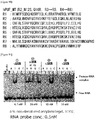
- Fig. 11 shows the results.
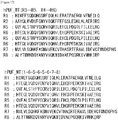
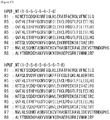
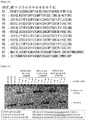
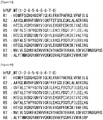
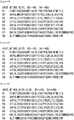
- Fig. 12 shows the amino acid sequences of hPUF_MT(R3 ⁇ R5, R4 ⁇ R6) and hPUF_MT(1-6-5-6-5-6-7-8).
- Vector cloning was performed by the same procedures as in Example 2-1.
- hPUF_MT(R3 ⁇ R5, R4 ⁇ R6) and hPUF_MT(1-6-5-6-5-6-7-8) were performed by the same procedures as in Example 1. Note that protein expression induction was carried out under the following conditions. hPUF_MT(R3 ⁇ R5, R4 ⁇ R6): 25°C for 16 h in a 0.01 mM IPTG-containing LB-Kan medium hPUF_MT(1-6-5-6-5-6-7-8): 37°C for 3h in a 1 mM IPTG-containing LB-Kan medium
- Rotoring for absorption to the resin was carried out for 10 h for hPUF_MT(R3 ⁇ R5, R4 ⁇ R6) and for 14 h for hPUF_MT(1-6-5-6-5-6-7-8).
- hPUF_MT(R4 ⁇ R6, R5 ⁇ R6) and hPUF_MT(R4 ⁇ R6, R5 ⁇ R6_Y13R) were performed by the following procedures. Each obtained expression vector was transduced into E. coli BL21(DE3)/pKJE7. Protein expression was induced by performing shake culture in an LB-Cm-Kan medium containing 0.5 mg/mL arabinose until OD 600 reached a level of about 0.4 to 0.8, and IPTG was added to the medium so as to yield a final concentration of 0.1 mM, followed by shake culture the medium at 30°C for 7 h. E.
- coli was pelleted and suspended in a lysis buffer (25 mM Tris-HCl (pH 8.0), 500 mM NaCl). Each desired protein was adsorbed by performing freeze-thawing and sonication, mixing the centrifuged supernatant with ProfinityTM IMAC Ni-Charged Resin (Biorad), followed by rotoring at 4°C for 14 h.
- a lysis buffer 25 mM Tris-HCl (pH 8.0), 500 mM NaCl.
- Each desired protein was adsorbed by performing freeze-thawing and sonication, mixing the centrifuged supernatant with ProfinityTM IMAC Ni-Charged Resin (Biorad), followed by rotoring at 4°C for 14 h.
- the concentrate was mixed with 99.5% glycerol and 1M DTT such that the mixture had a composition of 25 mM Tris-HCl (pH 7.5), 150 mM NaCl, 50% glycerol, and 5 mM DTT, and then, stored at -20°C.
- Fig. 13 shows the results of examining solubility.
- OTS-1511 5'-Alexa680-CCAGAAU UGUAUAUA UUCG-Alexa680-3' (19 mer) (probe for the wild type, hPUF_MT(R3 ⁇ R5, R4 ⁇ R6), MT(1-6-5-6-5-6-7-8))
- OTS-1760 5'-Alexa680-CCAGAAU UGUUUAUA UUCG-Alexa680-3' (19 mer) (probe for hPUF_MT(R4 ⁇ R6, R5 ⁇ R6), MT(R4 ⁇ R6, R5 ⁇ R6_Y13R))
- Fig. 14 shows the results.
- the binding force of hPUF_MT(1-6-5-6-5-6-7-8) was about one-tenth of that of the wild type (Kd: 50 to 10 nM). Electrophoresis of the R6 ⁇ 3 mutant was unsuccessful because of clogging of wells.
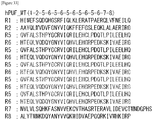
- Fig. 15 shows the amino acid sequences of hPUF_MT(1-2-5-6-5-6-5_ILQ-8) and hPUF_MT(1-6-5-6-5-6-5-6_IRP).
- Protein expression and purification were performed by the same procedures as in Example 1. Note that protein expression induction was carried out under the following conditions. hPUF_MT(1-2-5-6-5-6-5_ILQ-8): 37°C for 3 h in a 0.1 mM IPTG-containing LB-Kan medium hPUF_MT(1-2-5-6-5-6-5-6_IRP): 37°C for 3h in a 0.1 mM IPTG-containing LB-Kan medium Rotoring for absorption to the resin was carried out for 14 h.
- Fig. 16 shows the results.
- MT(1-2-5-6-5-6-5_ILQ-8) and MT(1-2-5-6-5-6-5-6_IRP) are thought to have binding force weaker than that of the wild type (WT).
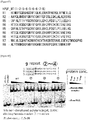
- Figs. 17 and 18h show the amino acid sequences of PUF_MT(1-5-5-5-5-6-7-8), hPUF_MT(1-2-5-6-5-6-5-6-7-8), and hPUF_MT(1-5-5-5-5-5-7-8).
- Protein expression and purification were performed by the same procedures as in Example 1. Note that protein expression induction was carried out under the following conditions. hPUF_MT(1-5-5-5-5-6-7-8): 20°C for 24 h in a 1 mM IPTG-containing LB-Kan medium hPUF_MT(1-2-5-6-5-6-5-6-7-8): 37°C for 3h in a 1 mM IPTG-containing LB-Kan medium Rotoring for absorption to the resin was carried out for 10 h.
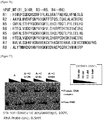
- Figs. 19 and 20 show the results of examining solubility.
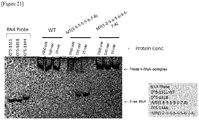
- Fig. 21 shows the results. It was found that MT(1-5-5-5-5-6-7-8) has binding force weaker than that of WT, and MT(1-2-5-6-5-6-5-6-7-8) has binding ability almost comparable to that of WT.
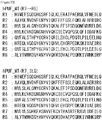
- Figs. 22 and 23 show the amino acid sequences of hPUF_MT(R7 ⁇ R5), hPUF_MT(R7_ILQ), and hPUF_MT(R7_IRG).
- Protein expression and purification were performed by the same procedures as in Example 1. Note that protein expression induction was carried out under the following conditions. hPUF_MT(R7 ⁇ R5): 25°C for 16 h in a 0.01 mM IPTG-containing LB-Kan medium hPUF_MT(R7_IRG): 25°C for 16 h in a 0.01 mM IPTG-containing LB-Kan medium hPUF_MT(R7_ILQ): 25°C for 13 h in a 1 mM IPTG-containing LB-Kan medium Rotoring for absorption to the resin was carried out for 13 h.
- Fig. 24 shows the results.
- MT(R7 ⁇ R5) has binding force weaker than that of WT, and the position of the shifted band is higher than expected.
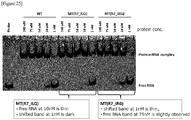
- MT(R7_ILQ) and MT(R7_IRG) had binding force almost comparable to that of WT.
- Protein expression and purification were performed by the same procedures as in Example 2-6.
- Fig. 25 shows the results. It is understood that ILQ is a terminal sequence suitable for R7-R8 ligation.
- Fig. 26 shows the amino acid sequences of hPUF_MT(R7 ⁇ R5) and hPUF_MT(R8 ⁇ R5).
- RNA probes were used.
- OTS-1511 5'-Alexa680-CCAGAAU UGUAUAUA UUCG-Alexa680-3' (19 mer) (probe for the wild type, hPUF_MT(R7_ILQ), MT(R7_IRG))
- OTS-1754 5'-Alexa680-CCAGAAU UAUAUAUA UUCG-Alexa680-3' (19 mer) (probe for hPUF_MT(R7 ⁇ R5))
- OTS-1825 5'-Alexa680-CCAGAAU AGUAUAUA UUCG-Alexa680-3' (19 mer) (probe for hPUF_MT(R8 ⁇ R5))
- Fig. 27 shows the results.
- MT(R7 ⁇ R5) has binding force that is significantly weaker than that of WT, and MT(R8 ⁇ R5) is thought to have substantially no binding ability.
- Fig. 28 shows the amino acid sequences of hPUF_MT(R3 ⁇ RC, R4 ⁇ RC, R5 ⁇ RC) and hPUF_MT(R3 ⁇ RC2, R4 ⁇ RC2, R5 ⁇ RC2).
- hPUF_MT(R3 ⁇ RC,R4 ⁇ RC, R5 ⁇ RC) 37°C for 3 h in a 1 mM IPTG-containing LB-Kan medium
- hPUF_MT(R3 ⁇ RC2,R4 ⁇ RC2,R5 ⁇ RC2) 37°C for 3 h in a 1 mM IPTG-containing LB-Kan medium
- Rotoring for absorption to the resin was carried out for 9 h.
- RNA probe was used.
- OTS-1759 5'-Alexa680-CCAGAAU UGUAAAUA UUCG-Alexa680-3' (19 mer)
- Fig. 29 shows the results.
- MT(R3 ⁇ RC,R4 ⁇ RC, R5 ⁇ RC) and MT(R3 ⁇ RC2,R4 ⁇ RC2,R5 ⁇ RC2) may have binding force weaker than that of MT(R3 ⁇ R5, R4 ⁇ R5).
- RNA probes were used.
- OTS-1511 5'-Alexa680-CCAGAAU UGUAUAUA UUCG-Alexa680-3' (19 mer) (probe for the wild type)
- OTS-1844 5'-Alexa680-CCAGAAU UGUAUAUAUA UUCG-Alexa680-3' (21 mer) (probe for hPUF_MT(1-2-5-6-5-6-5-6-7-8))
- Fig. 30 shows the results. It is understood that MT(1-2-5-6-5-6-5-6-7-8) has binding force about 10 times greater than that of WT.
- Fig. 31 shows the amino acid sequence of hPUF_MT(1-2-5-6-5-6-5-6-5-6-7-8).
- Fig. 32 shows the results. It is understood that MT(1-2-5-6-5-6-5-6-5-6-7-8) and MT(1-2-5-6-5-6-5-6-7-8) have binding ability greater than that of MT(R3 ⁇ R5, R4 ⁇ R6).
- Figs. 33 and 34 show the amino acid sequences of hPUF_MT(1-2-5-6-5-6-5-6-5-6-5-6-7-8) and hPUF_MT(1-2-5-6-5-6-5-6-5-6-5-6-5-6-7-8).
- hPUF_MT(1-2-5-6-5-6-5-6-5-6-5-6-7-8) 37°C for 3 h in a 1 mM IPTG-containing LB-Kan medium
- hPUF_MT(1-2-5-6-5-6-5-6-5-6-5-6-5-6-7-8) 37°C for 3 h in a 1 mM IPTG-containing LB-Kan medium
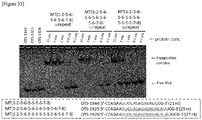
- Fig. 35 shows the results.
- Figs. 36 and 37 show the amino acid sequences of hPUF_MT(R3 ⁇ R5, R4 ⁇ R5), hPUF_MT(R3 ⁇ R5_C12N, R4 ⁇ R5_C12N, R5_C12N), hPUF_MT(R3 ⁇ R5_C12S, Q16E, R4 ⁇ R5_C12S, Q16E, R5_C12S, Q16E), and hPUF_MT(R3 ⁇ R5_C12S, Q16R, R4 ⁇ R5_C12S, Q16R, R5_C12S, Q16R).
- hPUF_MT(R3 ⁇ R5, R4 ⁇ R5) is as described above.
- hPUF _MT Protein expression and purification of hPUF _MT(R3 ⁇ R5_C12N, R4 ⁇ R5_C12N, R5_C12N), hPUF_MT(R3 ⁇ R5_C12S, Q16E, R4 ⁇ R5_C12S, Q16E, R5_C12S, Q16E), and hPUF_MT(R3 ⁇ R5_C12S, Q16R, R4 ⁇ R5_C12S, Q16R, R5_C12S, Q16R) were performed by the same procedures as in Example 1. Note that protein expression induction was carried out under the following conditions.
- hPUF_MT(R3 ⁇ R5_C12N, R4 ⁇ R5_C12N, R5_C12N) 37°C for 3 h in a 1 mM IPTG-containing LB-Kan medium
- hPUF_MT(R3 ⁇ R5_C12S, Q16E, R4 ⁇ R5_C12N, Q16E, R5_C12S, Q16E) 37°C for 3 h in a 0.01 mM IPTG-containing LB-Kan medium
- RNA probe was used.
- OTS-1511 5'-Alexa680-CCAGAAU UGUAUAUA UUCG-Alexa680-3' (19 mer) (wild-type sequence)
- OTS-1841 5'-Alexa680-CCAGAAU UGUUUUUA UUCG-Alexa680-3' (19 mer) (A ⁇ U sequence)
- OTS-1842 5'-Alexa680-CCAGAAU UGUGGGUA UUCG-Alexa680-3' (19 mer) (A ⁇ G sequence)
- OTS-1843 5'-Alexa680-CCAGAAU UGUCCCUA UUCG-Alexa680-3' (19 mer) (A ⁇ C sequence)
- Fig. 38 shows the results.
- C12N ⁇ C12S, Q16E ⁇ C12S, and Q16R were found to have binding ability greater than that of W(R3 ⁇ R5, R4 ⁇ R5). It is understood that the degree of the binding force is in the following order: C12N (U recognition) > C12S, Q16E (G recognition) > C12S, Q16R (C recognition) > MT (R3 ⁇ R5, R4 ⁇ R5) (Arecognition).
- Example 4-1 The same protein as in Example 4-1 was used.
- Fig. 39 shows the results. Each protein binds only to its target sequence and may have specificity.
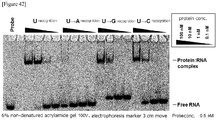
- Figs. 40 and 41 show the amino acid sequences of hPUF_MT(R4 ⁇ R6), hPUF_MT(R4 ⁇ R6 N12C, R6 N12C), hPUF_MT(R4 ⁇ R6 N12S, Q16E, R6 N12S, Q16E), and hPUF_MT(R4 ⁇ R6 N12S, Q16R, R6 N12S, Q16R).
- hPUF_MT(R4 ⁇ R6) is as described above.
- hPUF_MT Protein expression and purification of hPUF_MT(R4 ⁇ R6_N12C, R6_N12C), hPUF_MT(R4 ⁇ R6 N12S, Q16E, R6_N12S, Q16E), and hPUF_MT(R4 ⁇ R6_N12S, Q16R, R6_N12S, Q16R) were performed by the same procedures as in Example 1. Note that protein expression induction was carried out under the following conditions.
- hPUF_MT(R4 ⁇ R6 N12C, R6_N12C) 30°C for 7 h in a 0.1 mM IPTG-containing LB-Kan medium
- hPUF_MT(R4 ⁇ R6 N12S, Q16E, R6 N12S, Q16E) 25°C for 22 h in a 0.1 mM IPTG-containing LB-Kan medium
- Fig. 42 shows the results.
- binding force was almost comparable to or relatively weaker than that of the wild type in the case of U recognition.
- binding force significantly declined (to about 1/100).
- Fig. 43 shows the results. The results were the same as in Example 4-3 (reproducibility was confirmed).
- Figs. 44 and 45 show the amino acid sequences of hPUF_MT(R5_R13K), hPUF_MT(R6_Y13F), hPUF_MT(R6_Y13H), and hPUF_MT(R6_Y13W).
- Vector cloning was performed by the same procedures as in Example 2-1.
- Protein expression and purification were performed by the same procedures as in Example 1. Note that protein expression induction was carried out under the following conditions. hPUF_MT(R5_13K): 37°C for 3 h in a 0.1 mM IPTG-containing LB-Kan medium hPUF_MT(R6_13F): 37°C for 3 h in a 0.1 mM IPTG-containing LB-Kan medium hPUF_MT(R6_13H): 37°C for 3 h in a 0.1 mM IPTG-containing LB-Kan medium hPUF_MT(R6_13W): 37°C for 3 h in a 0.1 mM IPTG-containing LB-Kan medium Rotoring for absorption to the resin was carried out for 8 h.
- Fig. 46 shows the results. Arg was the optimal amino acid as a cationic amino acid between A and U (A-U), and Tyr was the optimal amino acid as an aromatic amino acid between U and A(U-A).
- Figs. 47 to 49 show the amino acid sequences of hPUF_MT(R3 ⁇ R5, R4 ⁇ R5), hPUF_MT(R3 ⁇ R5, R4 ⁇ R5_R13H, R5_R13H), hPUF_MT(R3 ⁇ R5, R4 ⁇ R5_R13Y, R5_R13Y), hPUF_MT(R3 ⁇ R5, R4 ⁇ R5_R13Y, R5_R13Y), and hPUF_MT(R3 ⁇ R5, R4 ⁇ R5_R13W, R5_R13W).
- hPUF_MT(R3 ⁇ R5, R4 ⁇ R5) is as described above. Protein expression and purification of hPUF_MT(R3 ⁇ R5, R4 ⁇ R5_R13H, R5_R13H), hPUF_MT(R3 ⁇ R5, R4 ⁇ R5_R13Y, R5 R13Y), hPUF_MT(R3 ⁇ R5, R4 ⁇ R5_R13Y, R5_R13Y), and hPUF_MT(R3 ⁇ R5, R4 ⁇ R5_R13W, R5_R13W) were performed by the same procedures as in Example 1. Note that protein expression was induced in a 1 mM IPTG-containing LB-Kan medium at 37°C for 3 h.
- Fig. 50 shows the results.
- the degree of binding force of a stacking amino acid between A and A (A-A) appears to be Trp > Tyr >> Phe > His.
- Fig. 51 shows the amino acid sequence of hPUF_MT(R3 ⁇ R5, R4 ⁇ R5_R13K, R5_R13K).
- Fig. 52 shows the results.
- aromatic amino acids have stronger binding force than cationic amino acids.
- His and Tyr have high levels of binding force.
- Figs. 53 and 54 show the amino acid sequences of hPUF_MT(R5:A_13R) 3 (R6:C_13Y) 3 , hPUF_MT(R5A_13R) 3 (R6:C_13R) 3 , and hPUF_MT(R5A_13R)(R5:A_13Y) 2 (R6:C_13Y) 3 .
- Fig. 55 shows the results.
- circled number 1 When comparing circled numbers 1 and 2, the circled number 1 has about three times greater binding force (Tyr > Arg).
- circled number 1 When comparing circled numbers 1 and 3, the circled number 1 has about ten times greater binding force (Arg > Tyr).
- Tyr is an appropriate aromatic amino acid between C and A (C-A)
- Arg is an appropriate cationic amino acid between A and C (A-C).
- Figs. 56 and 57 show the amino acid sequences of hPUF_MT(R5:A_13R) 3 (R6:G_13Y) 3 , hPUF_MT(R5:A_13R) 3 (R6:G_13R) 3 , and hPUF_MT(R5:A_13R)(R5:A_13Y) 2 (R6:G_13Y) 3 .
- Protein expression and purification were performed by the same procedures as in Example 1. Rotoring for absorption to the resin was carried out for 11 h.
- Fig. 58 shows the results.
- circled number 1 When comparing circled numbers 1 and 2, the circled number 1 has at least 30 times greater binding force (Tyr > Arg). Tyr is an appropriate aromatic amino acid between G and A (G-A).
- circled number 1 When comparing circled numbers 1 and 3, the circled number 1 has slightly greater binding force (Arg > Tyr). Arg is an appropriate cationic amino acid between A and G (A-G).
- Figs. 59 and 60 show the amino acid sequences of hPUF_MT(R5:G_13R) 3 (R6:U_13Y) 3 , hPUF_MT(R5:G_13R) 3 (R6:U_13R) 3 , and hPUF_MT(R5:A_13R)(R5:A_13Y) 2 (R6:G_13Y) 3 .
- Fig. 61 shows the results.
- the circled number 2 has about 3 times greater binding force (Tyr > Arg).
- the circled number 1 has about 30 times greater binding force (Arg > Tyr).
- Arg is an appropriate cationic amino acid between U and G (U-G), and Arg is also an appropriate cationic amino acid between G and U (G-U).
- Figs. 62 and 63 show the amino acid sequences of hPUF_MT(5_(6)8), MT(6_(56)4), and MT(4_(56)4).
- RNA probe 5'-Alexa680-CCAGAAU UGUAUAUA UUCG-Alexa680-3' (19 mer)
- Fig. 64 shows the results.
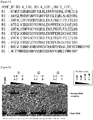
- Figs. 65 to 67 show the amino acid sequences of hPUF_MT(1-2-6-5-6-5-6-7-8), hPUF_MT(1-2-5-5-6-5-6-7-8), and hPUF_MT(1-2-5-6-5-6-6-7-8).
- Fig. 68 shows the results.
- the proteins having extended recognition repeats were found to have binding ability about three times greater than that of WT.
- the proteins having extended recognition repeats (circled numbers 2 to 4 of 9 repeats in Fig. 67 ) each had almost the same binding ability.
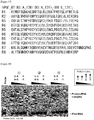
- Figs. 69 to 71 show the amino acid sequences of hPUF_MT(1-2-6-5-6-5-6-7-8), hPUF_MT(1-2-5-5-6-5-6-7-8), and hPUF_MT(1-2-5-6-5-6-6-7-8).
- protein expression of hPUF_MT(1-2-6-5-6-5-6-7-8) was induced in a 0.1 mM IPTG-containing LB-Kan medium at 37°C for 3 h. Rotoring for absorption to the resin was carried out for 10 h. Protein expression of hPUF_MT(1-2-5-5-6-5-6-7-8) was induced in a 1 mM IPTG-containing LB-Kan medium at 37°C for 3 h. Rotoring for absorption to the resin was carried out for 10 h. Protein expression of hPUF_MT(1-2-5-6-5-6-6-7-8) was induced in a 0.1 mM IPTG-containing LB-Kan medium at 37°C for 3 h. Rotoring for absorption to the resin was carried out for 10 h.
- RNA probes were used.
- OTS-1511 5'-Alexa680-CCAGAAU UGUAUAUA UUCG-Alexa680-3' (19 mer) (wild-type sequence)
- OTS-2080 5'-Alexa680-CCAGAAU UGUAUAUUA UUCG-Alexa680-3' (20 mer) (9 repeats (2))
- OTS-2081 5'-Alexa680-CCAGAAU UGUAUAAUA UUCG-Alexa680-3' (20 mer) (9 repeats (3)
- OTS-2082 5'-Alexa680-CCAGAAU UGUUAUAUA UUCG-Alexa680-3' (20 mer) (9 repeats (4))
- Fig. 72 shows the results.
- the protein having 13 repeats was found to have the highest binding ability.
- the protein having 11 repeats was found to have the second highest binding ability, which was about three times greater than that of WT.
- the protein having 15 repeats was found to have binding ability slightly greater than that of WT.
- Figs. 73 to 76 show the amino acid sequences of hPUF_MT(R3 ⁇ R5, R4 ⁇ R5), hPUF_MT(R1_S12N, R3 ⁇ R5, R4 ⁇ R6), hPUF_MT(R1_Q16E, R3 ⁇ R5, R4 ⁇ R6), and hPUF_MT(R1_Q16R, R3 ⁇ R5, R4 ⁇ R6).
- hPUF_MT(R1_S12N, R3 ⁇ R5, R4 ⁇ R6) 30°C for 7 h in a 0.001 mM IPTG-containing LB-Kan medium
- hPUF_MT(R1_Q16E, R3 ⁇ R5, R4 ⁇ R6) 30°C for 7 h in a 0.1 mM IPTG-containing LB-Kan medium
- hPUF_MT(R1_Q16R, R3 ⁇ R5, R4 ⁇ R6) 30°C for 7 h in a 0.1 mM IPTG-containing LB-Kan medium
- RNA probes were used.
- OTS-1511 5'-Alexa680-CCAGAAU UGUAUAUA UUCG-Alexa680-3' (19 mer) (wild-type sequence)
- OTS-2022 5'-Alexa680-CCAGAAU UGUAUAUU UUCG-Alexa680-3' (19 mer) (A ⁇ U sequence)
- OTS-2020 5'-Alexa680-CCAGAAU UGUAUAUG UUCG-Alexa680-3' (19 mer) (A ⁇ G sequence)
- OTS-2021 5'-Alexa680-CCAGAAU UGUAUAUC UUCG-Alexa680-3' (19 mer) (A ⁇ C sequence)
- RNA probes were used.
- OTS-1511 5'-Alexa680-CCAGAAU UGUAUAUA UUCG-Alexa680-3' (19 mer) (wild-type sequence)
- OTS-2022 5'-Alexa680-CCAGAAU UGUAUAUU UUCG-Alexa680-3' (19 mer) (A ⁇ U sequence)
- OTS-2020 5'-Alexa680-CCAGAAU UGUAUAUG UUCG-Alexa680-3' (19 mer) (A ⁇ G sequence)
- OTS-2021 5'-Alexa680-CCAGAAU UGUAUAUC UUCG-Alexa680-3' (19 mer) (A ⁇ C sequence)
- Figs. 81 to 85 show the amino acid sequences of hPUF_MT(R3 ⁇ R5, R4 ⁇ R5), hPUF_MT(R2_N12C, R3 ⁇ R5, R4 ⁇ R6), hPUF_MT(R2_N12S, R3 ⁇ R5, R4 ⁇ R6), hPUF_MT(R2_N12S, Q16E, R3 ⁇ R5, R4 ⁇ R6), and hPUF_MT(R2_N12S, Q16R, R3 ⁇ R5, R4 ⁇ R6).
- hPUF_MT(R2_N12C, R3 ⁇ R5, R4 ⁇ R6) 30°C for 7 h in a 0.1 mM IPTG-containing LB-Kan medium
- hPUF_MT(R2_N12S, R3 ⁇ R5, R4 ⁇ R6) 30°C for 7 h in a 0.1 mM IPTG-containing LB-Kan medium
- hPUF_MT(R2_N12S, Q16E, R3 ⁇ R5, R4 ⁇ R6) 30°C for 7 h in a 0.1 mM IPTG-containing LB-Kan medium
- hPUF_MT(R2_N12S, Q16R, R3 ⁇ R5, R4 ⁇ R6) 30°C for 7 h in a 0.1 mM IPTG-containing LB-Kan medium
- RNA probes were used.
- OTS-1511 5'-Alexa680-CCAGAAU UGUAUAUA UUCG-Alexa680-3' (19 mer) (wild-type sequence)
- OTS-2023 5'-Alexa680-CCAGAAU UGUAUAAA UUCG-Alexa680-3' (19 mer) (U ⁇ A sequence)
- OTS-2024 5'-Alexa680-CCAGAAU UGUAUAGA UUCG-Alexa680-3' (19 mer) (U ⁇ G sequence)
- OTS-2025 5'-Alexa680-CCAGAAU UGUAUACA UUCG-Alexa680-3' (19 mer) (U ⁇ C sequence)
- Figs. 87 to 90 show the amino acid sequences of hPUF_MT(R3 ⁇ R5, R4 ⁇ R6), hPUF_MT(R2 N12C, R3 ⁇ R5, R4 ⁇ R6), hPUF_MT(R2_N12S, Q16E, R3 ⁇ R5, R4 ⁇ R6), and hPUF_MT(R2 N12S, Q16R, R3 ⁇ R5, R4 ⁇ R6).
- hPUF_MT(R2_N12C, R3 ⁇ R5, R4 ⁇ R6) 30°C for 7 h in a 0.1 mM IPTG-containing LB-Kan medium
- hPUF_MT(R2_N12S, Q16E, R3 ⁇ R5, R4 ⁇ R6) 30°C for 7 h in a 0.1 mM IPTG-containing LB-Kan medium
- hPUF_MT(R2_N12S, Q16R, R3 ⁇ R5, R4 ⁇ R6) 30°C for 7 h in a 0.1 mM IPTG-containing LB-Kan medium
- RNA probes were used.
- OTS-1511 5'-Alexa680-CCAGAAU UGUAUAUA UUCG-Alexa680-3' (19 mer) (wild-type sequence)
- OTS-2023 5'-Alexa680-CCAGAAU UGUAUAAA UUCG-Alexa680-3' (19 mer) (U ⁇ A sequence)
- OTS-2024 5'-Alexa680-CCAGAAU UGUAUAGA UUCG-Alexa680-3' (19 mer) (U ⁇ G sequence)
- OTS-2025 5'-Alexa680-CCAGAAU UGUAUACA UUCG-Alexa680-3' (19 mer) (U ⁇ C sequence)
- Circle numbers 1 to 4 in the figure correspond to (1) to (4) above.
- Figs. 92 to 96 show the amino acid sequences of hPUF_MT(R3 ⁇ R5, R4 ⁇ R6), hPUF_MT(R7_S12C,E16Q, R3 ⁇ R5, R4 ⁇ R6), hPUF_MT(R7_E16Q, R3 ⁇ R5, R4 ⁇ R6), hPUF_MT(R7_S12N,E16Q, R3 ⁇ R5, R4 ⁇ R6), and hPUF MT(R7_E16R, R3 ⁇ R5, R4 ⁇ R6).
- hPUF_MT(R7_S12N, E16Q, R3 ⁇ R5, R4 ⁇ R6) 37°C for 3 h in a 1 mM IPTG-containing LB-Kan medium
- RNA probes were used.
- OTS-1511 5'-Alexa680-CCAGAAU UGUAUAUA UUCG-Alexa680-3' (19 mer) (wild-type sequence)
- OTS-1754 5'-Alexa680-CCAGAAU UAUAUAUA UUCG-Alexa680-3' (19 mer) (G ⁇ A sequence)
- OTS-2032 5'-Alcxa680-CCAGAAU UUUAUAUA UUCG-Alexa680-3' (19 mer) (G ⁇ U sequence)
- OTS-2033 5'-Alexa680-CCAGAAU UCUAUAUA UUCG-Alexa680-3' (19 mer) (G ⁇ C sequence)
- binding proteins having the above amino acid sequences which were prepared as above did not have binding ability greater than that of MT(R3 ⁇ R5, R4 ⁇ R5).
- the degree of the binding force is in the following order: MT(R3 ⁇ R5, R4 ⁇ R5 (G recognition) > MT(R3 ⁇ R5, R4 ⁇ R5, R7S12N, E16Q) (U recognition) > MT(R3 ⁇ R5, R4 ⁇ R5, R7 E16R) (C recognition) > MT(R3 ⁇ R5, R4 ⁇ R5, R7_S12C, E16Q (A E16Q) > MT(R3 ⁇ R5, R4 ⁇ R5, R7_S12C, E16Q) (A S12C, E16Q).
- Figs. 98 to 101 show the amino acid sequences of hPUF_MT(R3 ⁇ R5, R4 ⁇ R6), hPUF_MT(R7_S12C,E16Q, R3 ⁇ R5, R4 ⁇ R6), hPUF_MT(R7_S12N,E16Q, R3 ⁇ R5, R4 ⁇ R6), and hPUF_MT(R7_E16R, R3 ⁇ R5, R4 ⁇ R6).
- hPUF_MT(R7_S12C, E16Q, R3 ⁇ R5, R4 ⁇ R6) 37°C for 3 h in a 1 mM IPTG-containing LB-Kan medium
- hPUF_MT(R7_S12N, E16Q, R3 ⁇ R5, R4 ⁇ R6) 37°C for 3 h in a 1 mM IPTG-containing LB-Kan medium
- hPUF_MT(R7_E16R, R3 ⁇ R5, R4 ⁇ R6) 37°C for 3 h in a 1 mM IPTG-containing LB-Kan medium
- RNA probes were used.
- OTS-1511 5'-Alexa680-CCAGAAU UGUAUAUA UUCG-Alexa680-3' (19 mer) (wild-type sequence)
- OTS-1754 5'-Alexa680-CCAGAAU UAUAUAUA UUCG-Alexa680-3' (19 mer) (G ⁇ A sequence)
- OTS-2032 5'-Alcxa680-CCAGAAU UUUAUAUA UUCG-Alexa680-3' (19 mer) (G ⁇ U sequence)
- OTS-2033 5'-Alexa680-CCAGAAU UCUAUAUA UUCG-Alexa680-3' (19 mer) (G ⁇ C sequence)
- Figs. 103 to 107 show the amino acid sequences of hPUF_MT(R3 ⁇ R5, R4 ⁇ R6), hPUF_MT(R8_N12C, R3 ⁇ R5, R4 ⁇ R6), hPUF_MT(R8_N12S, R3 ⁇ R5, R4 ⁇ R6), hPUF_MT(R8_N12S, Q16E, R3 ⁇ R5, R4 ⁇ R6), and hPUF_MT(R8_N12S, Q16R, R3 ⁇ R5, R4 ⁇ R6).
- hPUF_MT(R8_N12C, R3 ⁇ R5, R4 ⁇ R6) 37°C for 3 h in a 0.01 mM IPTG-containing LB-Kan medium
- hPUF_MT(R8_N12S, R3 ⁇ R5, R4 ⁇ R6) 37°C for 3 h in a 1 mM IPTG-containing LB-Kan medium
- hPUF_MT(R8_N12S, Q16E, R3 ⁇ R5, R4 ⁇ R6) 37°C for 3 h in a 0.01 mM IPTG-containing LB-Kan medium
- hPUF_MT(R8_N12S, Q16R, R3 ⁇ R5, R4 ⁇ R6) 37°C for 3 h in a 0.01 mM IPTG-containing LB-Kan medium
- RNA probes were used.
- OTS-1511 5'-Alexa680-CCAGAAU UGUAUAUA UUCG-Alexa680-3' (19 mer) (wild-type sequence)
- OTS-1825 5'-Alexa680-CCAGAA UAGUAUAUA UUCG-Alexa680-3' (19 mer) (U ⁇ Asequence)
- OTS-2034 5'-Alexa680-CCAGAA UGGUAUAUA UUCG-Alexa680-3' (19 mer) (U ⁇ G sequence)
- OTS-2035 5'-Alexa680-CCAGA AUCGUAUAUA UUCG-Alexa680-3' (19 mer) (U ⁇ C sequence)
- the binding proteins having the above amino acid sequences which were prepared as above did not have binding ability greater than that of MT(R3 ⁇ R5, R4 ⁇ R5).
- the results confirmed that the degree of the binding force is in the following order: MT(R3 ⁇ R5, R4 ⁇ R5) (U recognition) > N12S, Q16R (C recognition) > N12S, Q16E (G recognition). No binding was confirmed for S12C (Arecognition) N12S (Arecognition).
- Figs. 109 to 112 show the amino acid sequences of hPUF_MT(R3 ⁇ R5, R4 ⁇ R6), hPUF_MT(R8_N12C, R3 ⁇ R5, R4 ⁇ R6), hPUF MT(R8_N12S, Q16E, R3 ⁇ R5, R4 ⁇ R6), and hPUF_MT(R8_N12S, Q16R, R3 ⁇ R5, R4 ⁇ R6).
- hPUF_MT(R8_N12C, R3 ⁇ R5, R4 ⁇ R6) 37°C for 3 h in a 0.01 mM IPTG-containing LB-Kan medium
- hPUF_MT(R8_N12S, Q16E, R3 ⁇ R5, R4 ⁇ R6) 37°C for 3 h in a 0.01 mM IPTG-containing LB-Kan medium
- hPUF_MT(R8_N12S, Q16R, R3 ⁇ R5, R4 ⁇ R6) 37°C, 3 h in a 0.01 mM IPTG-containing LB-Kan medium
- RNA probes were used.
- OTS-1511 5'-Alexa680-CCAGAAU UGUAUAUA UUCG-Alexa680-3' (19 mer) (wild-type sequence)
- OTS-1825 5'-Alexa680-CCAGAAU AGUAUAUA UUCG-Alexa680-3' (19 mer) (U ⁇ Asequence)
- OTS-2034 5'-Alexa680-CCAGAAU GGUAUAUA UUCG-Alexa680-3' (19 mer) (U ⁇ G sequence)
- OTS-2035 5'-Alexa680-CCAGAAU CGUAUAUA UUCG-Alexa680-3' (19 mer) (U ⁇ C sequence)
- Figs. 116 to 118 show the amino acid sequences of hPUF_MT(R5:A_13R) 3 (R6:U_13Y) 3 , hPUF_MT(R5:A_13R) 3 (R6:U_13R) 3 , and hPUF_MT(R5A_13R)(R5:A_13Y) 2 (R6:U_13Y) 3 .
- hPUF_MT(R5 A_13R) 3 (R6:U_13Y) 3 37°C for 3 h in a 1 mM IPTG-containing LB-Kan medium
- Fig. 119 shows the results.
- a comparison of circled numbers 1 and 2 showed that the circled number 1 has at least 30 times greater binding force (Tyr > Arg).
- Figs. 121 to 123 show the amino acid sequences of hPUF_MT(R5:G_13R) 3 (R6:C_13Y) 3 , hPUF_MT(R5:G_13R) 3 (R6:C_13R) 3 , and hPUF_MT(R5:G_13R)(R5:G 13Y) 2 (R6:C_13Y) 3 .
- hPUF_MT(R5:G_13R) 3 (R6:C_13Y) 3 37°C for 3 h in a 1 mM IPTG-containing LB-Kan medium
- hPUF_MT(R5:G_13R) 3 (R6:C_13R) 3 37°C for 3 h in a 1 mM IPTG-containing LB-Kan medium
- Fig. 124 shows the results.
- a comparison of circled numbers 1 and 2 showed that the circled number 2 has slightly greater binding force (Tyr ⁇ Arg).
- a comparison of circled numbers 1 and 3 showed that the circled number 1 has slightly greater binding force (Arg > Tyr). It was found that Arg was a suitable cationic amino acid between C-G, and Arg was also a suitable cationic amino acid between G-C.
- Figs. 126 to 128 show the amino acid sequences of hPUF_MT(R5:C_13R) 3 (R6:U_13Y) 3 , hPUF_MT(R5:C_13R) 3 (R6:U_13R) 3 , and hPUF_MT(R5:C_13R)(R5:C_13Y) 2 (R6:U_13Y) 3 .
- hPUF_MT(R5:C_13R) 3 (R6:U_13Y) 3 37°C for 3 h in a 0.1 mM IPTG-containing LB-Kan medium
- hPUF_MT(R5:C_13R) 3 (R6:U_13R) 3 37°C for 3 h in a 0.1 mM IPTG-containing LB-Kan medium
- Fig. 129 shows the results.
- a comparison of circled numbers 1 and 2 showed that the circled number 1 has about 10 times greater binding force (Tyr > Arg).
- a comparison of circled numbers 1 and 3 showed that the circled number 3 has slightly greater binding force (Arg ⁇ Tyr).
- Tyr was an appropriate aromatic amino acid between U-C, and Tyr is was also an appropriate aromatic amino acid between C-U.
- Figs. 132 to 137 show the amino acid sequences of hPUF_MT(R3 ⁇ R5, R4 ⁇ R5), hPUF_MT(R3 ⁇ R5, R4 ⁇ R5_R13K, R5 R13K), hPUF MT(R3 ⁇ R5, R4 ⁇ R5_R13F, R5 R13F), hPUF_MT(R3 ⁇ R5, R4 ⁇ R5R13H, R5_R13H), hPUF_MT(R3 ⁇ R5, R4 ⁇ R5_R13W, R5_R13W), and hPUF_MT(R3 ⁇ R5, R4 ⁇ R5_R13Y, R5 R13Y).
- hPUF_MT(R3 ⁇ R5, R4 ⁇ R5) 30°C for 7 h in a 0.01 mM IPTG-containing LB-Kan medium
- Figs. 140 to 145 show the amino acid sequences of hPUF_MT(R5:G_13R) 3 , hPUF_MT(R5:G_13K) 3 , hPUF_MT(R5:G_13F) 3 , hPUF_MT(R5:G_13H) 3 , hPUF_MT(R5:G_13W) 3 , and hPUF_MT(R5:G_13Y) 3 .
- hPUF_MT(R5:G_13R) 3 37°C for 3 h in a 0.01 mM IPTG-containing LB-Kan medium
- hPUF_MT(R5:G_13K) 3 37°C for 7 h in a 1 mM IPTG-containing LB-Kan medium
- hPUF_MT(R5:G_13F) 3 37°C for 7 h in a 1 mM IPTG-containing LB-Kan medium
- hPUF_MT(R5:G_13H) 3 37°C for 7 h in a 1 mM IPTG-containing LB-Kan medium
- hPUF_MT(R5:G_13W) 3 37°C for 7 h in a 1 mM IPTG-containing LB-Kan medium
- hPUF_MT(R5:G_13Y) 3 37°C for 7 h in a 1 mM IPTG-containing LB-Kan medium
- Figs. 148 to 153 show the amino acid sequences of hPUF_MT(R5:U_13R) 3 , hPUF_MT(R5:U_13K) 3 , hPUF_MT(R5:U_13F) 3 , hPUF_MT(R5:U_13H) 3 , hPUF_MT(R5:U_13W) 3 , and hPUF_MT(R5:U_13Y) 3 .
- hPUF_MT(R5:U_13R) 3 37°C for 3 h in a 1 mM IPTG-containing LB-Kan medium
- hPUF_MT(R5:U_13K) 3 37°C for 3 h in a 0.1 mM IPTG-containing LB-Kan medium
- hPUF_MT(R5:U_13F) 3 37°C for 3 h in a 1 mM IPTG-containing LB-Kan medium
- hPUF_MT(R5:U_13H) 3 37°C for 3 h in a 0.1 mM IPTG-containing LB-Kan medium
- hPUF_MT(R5:U_13W) 3 37°C for 3 h in a 1 mM IPTG-containing LB-Kan medium
- hPUF_MT(R5:U_13Y) 3 37°C for 3 h in a 1 mM IPTG-containing LB-Kan medium
- OTS-1841 5'-Alexa680-CCAGAAU UGUUUUUA UUCG-Alexa680-3' (19 mer)
- Figs. 156 to 161 show the amino acid sequences of hPUF_MT(R5:C_13R) 3 , hPUF_MT(R5:C_13K) 3 , hPUF_MT(R5:C_13F) 3 , hPUF_MT(R5:C_13H) 3 , hPUF_MT(R5 :C_13W) 3 , and hPUF_MT(RS:C_13Y) 3 .
- hPUF_MT(R5:C_13R) 3 20°C for 24 h in a 1 mM IPTG-containing LB-Kan medium
- hPUF_MT(R5:C_13K)3 30°C for 7 h in a 0.1 mM IPTG-containing LB-Kan medium
- hPUF_MT(R5:C_13F) 3 30°C for 7 h in a 0.1 mM IPTG-containing LB-Kan medium
- hPUF_MT(R5:C_13H) 3 30°C for 7 h in a 0.1 mM IPTG-containing LB-Kan medium
- hPUF_MT(R5:C_13W) 3 30°C for 7 h in a 0.1 mM IPTG-containing LB-Kan medium
- hPUF_MT(R5:C_13Y) 3 30°C for 7 h in a 0.1 mM IPTG-containing LB-Kan medium
Landscapes
- Health & Medical Sciences (AREA)
- Chemical & Material Sciences (AREA)
- Life Sciences & Earth Sciences (AREA)
- Organic Chemistry (AREA)
- Genetics & Genomics (AREA)
- Zoology (AREA)
- General Health & Medical Sciences (AREA)
- Biochemistry (AREA)
- Proteomics, Peptides & Aminoacids (AREA)
- Medicinal Chemistry (AREA)
- Molecular Biology (AREA)
- Gastroenterology & Hepatology (AREA)
- Toxicology (AREA)
- Biophysics (AREA)
- Engineering & Computer Science (AREA)
- Wood Science & Technology (AREA)
- Biomedical Technology (AREA)
- Biotechnology (AREA)
- Bioinformatics & Cheminformatics (AREA)
- Cell Biology (AREA)
- Microbiology (AREA)
- General Engineering & Computer Science (AREA)
- Peptides Or Proteins (AREA)
- Preparation Of Compounds By Using Micro-Organisms (AREA)
- Micro-Organisms Or Cultivation Processes Thereof (AREA)
Applications Claiming Priority (2)
| Application Number | Priority Date | Filing Date | Title |
|---|---|---|---|
| JP2017053093 | 2017-03-17 | ||
| PCT/JP2018/010489 WO2018169058A1 (ja) | 2017-03-17 | 2018-03-16 | Rna結合タンパク質 |
Publications (2)
| Publication Number | Publication Date |
|---|---|
| EP3597751A1 true EP3597751A1 (de) | 2020-01-22 |
| EP3597751A4 EP3597751A4 (de) | 2021-01-13 |
Family
ID=63523465
Family Applications (1)
| Application Number | Title | Priority Date | Filing Date |
|---|---|---|---|
| EP18767056.7A Pending EP3597751A4 (de) | 2017-03-17 | 2018-03-16 | Rna-bindendes protein |
Country Status (4)
| Country | Link |
|---|---|
| US (2) | US11472855B2 (de) |
| EP (1) | EP3597751A4 (de) |
| JP (1) | JP7334962B2 (de) |
| WO (1) | WO2018169058A1 (de) |
Family Cites Families (2)
| Publication number | Priority date | Publication date | Assignee | Title |
|---|---|---|---|---|
| JP2013128413A (ja) | 2010-03-11 | 2013-07-04 | Kyushu Univ | Pprモチーフを利用したrna結合性蛋白質の改変方法 |
| WO2012068627A1 (en) * | 2010-11-24 | 2012-05-31 | The University Of Western Australia | Peptides for the specific binding of rna targets |
-
2018
- 2018-03-16 WO PCT/JP2018/010489 patent/WO2018169058A1/ja not_active Ceased
- 2018-03-16 JP JP2019506304A patent/JP7334962B2/ja active Active
- 2018-03-16 US US16/494,796 patent/US11472855B2/en active Active
- 2018-03-16 EP EP18767056.7A patent/EP3597751A4/de active Pending
-
2022
- 2022-06-02 US US17/830,822 patent/US20220340624A1/en not_active Abandoned
Also Published As
| Publication number | Publication date |
|---|---|
| JP7334962B2 (ja) | 2023-08-29 |
| US20200095294A1 (en) | 2020-03-26 |
| WO2018169058A1 (ja) | 2018-09-20 |
| US20220340624A1 (en) | 2022-10-27 |
| JPWO2018169058A1 (ja) | 2020-01-16 |
| EP3597751A4 (de) | 2021-01-13 |
| US11472855B2 (en) | 2022-10-18 |
Similar Documents
| Publication | Publication Date | Title |
|---|---|---|
| Ayers et al. | Introduction of unnatural amino acids into proteins using expressed protein ligation | |
| KR102390390B1 (ko) | 헤모글로빈 A1c의 측정 방법 및 측정 키트 | |
| Smith et al. | R plasmid dihydrofolate reductase with subunit structure. | |
| US10851141B2 (en) | Mutant beetle luciferase, gene, recombinant vector, transformant, and method for preparing mutant beetle luciferase | |
| CN118222536A (zh) | phi29 DNA聚合酶突变体及其制备方法与应用 | |
| Herbaud et al. | Escherichia coli is able to produce heterologous tetraheme cytochrome c3 when the ccm genes are co-expressed | |
| US9150897B2 (en) | Expression and purification of fusion protein with multiple MBP tags | |
| Matsumura et al. | In vitro evolution of thermostable p53 variants | |
| Singh et al. | Solubilization at high pH results in improved recovery of proteins from inclusion bodies of E. coli | |
| Gyurcsik et al. | Binding modes of the precursor of adenovirus major core protein VII to DNA and template activating factor I: implication for the mechanism of remodeling of the adenovirus chromatin | |
| EP3597751A1 (de) | Rna-bindendes protein | |
| CN119082075B (zh) | 性能提升的phi29 DNA聚合酶突变体及其制备方法与应用 | |
| Higashiya et al. | Design and preparation of β-sheet forming repetitive and block-copolymerized polypeptides | |
| CN118853626A (zh) | phi29 DNA聚合酶突变体及其制备方法与应用 | |
| CN118185902B (zh) | 热稳定性增强的Bst DNA聚合酶突变体及其制备方法与应用 | |
| CN110698557B (zh) | Acth突变体、重组蛋白及其应用,以及含有该acth重组蛋白的试剂盒 | |
| CN120210151A (zh) | 一种突变的MuA转座酶及其应用 | |
| CN114127271A (zh) | 用于生产不含基因组修饰的修饰的噬菌体的方法 | |
| EP4455279A1 (de) | Dna-polymerasemutant und verwendung davon | |
| Zubay et al. | The mechanism of activation of catabolite-sensitive genes | |
| AU2019230713B2 (en) | Fusion protein of flavin adenine dinucleotide-glucose dehydrogenase and cytochrome molecule | |
| EP2085473A1 (de) | Hilfsreagens für gentransfer | |
| Zhao et al. | Stoichiometry and inter-subunit interaction of the wedge initiation complex, gp10-gp11, of bacteriophage T4 | |
| Jung et al. | Carassius auratus‐originated recombinant histone H1 C‐terminal peptide as gene delivery material | |
| Ikeda et al. | A fusion protein library: an improved method for rapid screening and characterization of DNA binding or interacting proteins |
Legal Events
| Date | Code | Title | Description |
|---|---|---|---|
| STAA | Information on the status of an ep patent application or granted ep patent |
Free format text: STATUS: THE INTERNATIONAL PUBLICATION HAS BEEN MADE |
|
| PUAI | Public reference made under article 153(3) epc to a published international application that has entered the european phase |
Free format text: ORIGINAL CODE: 0009012 |
|
| STAA | Information on the status of an ep patent application or granted ep patent |
Free format text: STATUS: REQUEST FOR EXAMINATION WAS MADE |
|
| 17P | Request for examination filed |
Effective date: 20191016 |
|
| AK | Designated contracting states |
Kind code of ref document: A1 Designated state(s): AL AT BE BG CH CY CZ DE DK EE ES FI FR GB GR HR HU IE IS IT LI LT LU LV MC MK MT NL NO PL PT RO RS SE SI SK SM TR |
|
| AX | Request for extension of the european patent |
Extension state: BA ME |
|
| RAP1 | Party data changed (applicant data changed or rights of an application transferred) |
Owner name: SERA, TAKASHI |
|
| RIN1 | Information on inventor provided before grant (corrected) |
Inventor name: SERA, TAKASHI |
|
| DAV | Request for validation of the european patent (deleted) | ||
| DAX | Request for extension of the european patent (deleted) | ||
| A4 | Supplementary search report drawn up and despatched |
Effective date: 20201210 |
|
| RIC1 | Information provided on ipc code assigned before grant |
Ipc: C12N 1/19 20060101ALI20201204BHEP Ipc: C07K 14/47 20060101ALI20201204BHEP Ipc: C12N 15/12 20060101AFI20201204BHEP Ipc: C12N 1/15 20060101ALI20201204BHEP Ipc: C12N 5/10 20060101ALI20201204BHEP Ipc: C07K 14/435 20060101ALI20201204BHEP Ipc: C12N 1/21 20060101ALI20201204BHEP |
|
| STAA | Information on the status of an ep patent application or granted ep patent |
Free format text: STATUS: EXAMINATION IS IN PROGRESS |
|
| 17Q | First examination report despatched |
Effective date: 20260316 |