EP3590936B1 - Verfahren zur herstellung einer heterocyclischen verbindung - Google Patents
Verfahren zur herstellung einer heterocyclischen verbindung Download PDFInfo
- Publication number
- EP3590936B1 EP3590936B1 EP18761137.1A EP18761137A EP3590936B1 EP 3590936 B1 EP3590936 B1 EP 3590936B1 EP 18761137 A EP18761137 A EP 18761137A EP 3590936 B1 EP3590936 B1 EP 3590936B1
- Authority
- EP
- European Patent Office
- Prior art keywords
- salt
- reaction
- mixture
- compound
- pyrazol
- Prior art date
- Legal status (The legal status is an assumption and is not a legal conclusion. Google has not performed a legal analysis and makes no representation as to the accuracy of the status listed.)
- Active
Links
- 0 Cc(c(I)cc(C(O*)=O)c1)c1F Chemical compound Cc(c(I)cc(C(O*)=O)c1)c1F 0.000 description 16
- PPGRDLZPSDHBIC-UHFFFAOYSA-N O=Cc(cc1)ccc1-[n]1nccc1 Chemical compound O=Cc(cc1)ccc1-[n]1nccc1 PPGRDLZPSDHBIC-UHFFFAOYSA-N 0.000 description 1
Images

Classifications
-
- C—CHEMISTRY; METALLURGY
- C07—ORGANIC CHEMISTRY
- C07D—HETEROCYCLIC COMPOUNDS
- C07D405/00—Heterocyclic compounds containing both one or more hetero rings having oxygen atoms as the only ring hetero atoms, and one or more rings having nitrogen as the only ring hetero atom
- C07D405/14—Heterocyclic compounds containing both one or more hetero rings having oxygen atoms as the only ring hetero atoms, and one or more rings having nitrogen as the only ring hetero atom containing three or more hetero rings
-
- A—HUMAN NECESSITIES
- A61—MEDICAL OR VETERINARY SCIENCE; HYGIENE
- A61P—SPECIFIC THERAPEUTIC ACTIVITY OF CHEMICAL COMPOUNDS OR MEDICINAL PREPARATIONS
- A61P25/00—Drugs for disorders of the nervous system
- A61P25/28—Drugs for disorders of the nervous system for treating neurodegenerative disorders of the central nervous system, e.g. nootropic agents, cognition enhancers, drugs for treating Alzheimer's disease or other forms of dementia
-
- C—CHEMISTRY; METALLURGY
- C07—ORGANIC CHEMISTRY
- C07D—HETEROCYCLIC COMPOUNDS
- C07D231/00—Heterocyclic compounds containing 1,2-diazole or hydrogenated 1,2-diazole rings
- C07D231/02—Heterocyclic compounds containing 1,2-diazole or hydrogenated 1,2-diazole rings not condensed with other rings
- C07D231/10—Heterocyclic compounds containing 1,2-diazole or hydrogenated 1,2-diazole rings not condensed with other rings having two or three double bonds between ring members or between ring members and non-ring members
- C07D231/12—Heterocyclic compounds containing 1,2-diazole or hydrogenated 1,2-diazole rings not condensed with other rings having two or three double bonds between ring members or between ring members and non-ring members with only hydrogen atoms, hydrocarbon or substituted hydrocarbon radicals, directly attached to ring carbon atoms
-
- C—CHEMISTRY; METALLURGY
- C07—ORGANIC CHEMISTRY
- C07D—HETEROCYCLIC COMPOUNDS
- C07D405/00—Heterocyclic compounds containing both one or more hetero rings having oxygen atoms as the only ring hetero atoms, and one or more rings having nitrogen as the only ring hetero atom
- C07D405/02—Heterocyclic compounds containing both one or more hetero rings having oxygen atoms as the only ring hetero atoms, and one or more rings having nitrogen as the only ring hetero atom containing two hetero rings
- C07D405/10—Heterocyclic compounds containing both one or more hetero rings having oxygen atoms as the only ring hetero atoms, and one or more rings having nitrogen as the only ring hetero atom containing two hetero rings linked by a carbon chain containing aromatic rings
-
- A—HUMAN NECESSITIES
- A61—MEDICAL OR VETERINARY SCIENCE; HYGIENE
- A61K—PREPARATIONS FOR MEDICAL, DENTAL OR TOILETRY PURPOSES
- A61K31/00—Medicinal preparations containing organic active ingredients
- A61K31/33—Heterocyclic compounds
- A61K31/395—Heterocyclic compounds having nitrogen as a ring hetero atom, e.g. guanethidine or rifamycins
- A61K31/41—Heterocyclic compounds having nitrogen as a ring hetero atom, e.g. guanethidine or rifamycins having five-membered rings with two or more ring hetero atoms, at least one of which being nitrogen, e.g. tetrazole
- A61K31/415—1,2-Diazoles
- A61K31/4155—1,2-Diazoles non condensed and containing further heterocyclic rings
Definitions
- the present invention relates to a method of producing a heterocyclic compound useful for the prophylaxis and/or treatment of Alzheimer's disease and the like.
- Patent Document 1 WO 2015/163485
- the aim of the present invention is to provide a method of producing 1,5-anhydro-2,4-dideoxy-2-(4-fluoro-5-methyl-1-oxo-6-(4-(1H-pyrazol-1-yl)benzyl)-1,3-dihydro-2H-isoindol-2-yl)-L-threo-pentitol, without using a highly poisonous reagent, in an efficient way (e.g., in short steps, in high-yield, in a highly selective manner).
- the present inventors have conducted intensive studies in an attempt to solve the above-mentioned problems and found that 1,5-anhydro-2,4-dideoxy-2-(4-fluoro-5-methyl-1-oxo-6-(4-(1H-pyrazol-1-yl)benzyl)-1,3-dihydro-2H-isoindol-2-yl)-L-threo-pentitol can produced without using a highly poisonous reagent, in an efficient way (e.g., in short steps, in high-yield, in a highly selective manner), which resulted in the completion of the present invention.
- the present invention provides the following.
- 1,5-anhydro-2,4-dideoxy-2-(4-fluoro-5-methyl-1-oxo-6-(4-(1H-pyrazol-1-yl)benzyl)-1,3-dihydro-2H-isoindol-2-yl)-L-threo-pentitol which is useful for the prophylaxis and/or treatment of Alzheimer's disease and the like, can produced without using a highly poisonous reagent, in an efficient way (e.g., in short steps, in high-yield, in a highly selective manner).
- Examples of the highly poisonous reagent include stannum and osmium.
- the risk associated with the use of these reagents e.g., exposure risk of manufacturer of objective product, contamination risk of objective product
- halogen atom examples include fluorine, chlorine, bromine and iodine.
- examples of the "C 1-6 alkyl group” include methyl, ethyl, propyl, isopropyl, butyl, isobutyl, sec-butyl, tert-butyl, pentyl, isopentyl, neopentyl, 1-ethylpropyl, hexyl, isohexyl, 1,1-dimethylbutyl, 2,2-dimethylbutyl, 3,3-dimethylbutyl and 2-ethylbutyl.
- examples of the "optionally halogenated C 1-6 alkyl group” include a C 1-6 alkyl group optionally having 1 to 7, preferably 1 to 5, halogen atoms. Specific examples thereof include methyl, chloromethyl, difluoromethyl, trichloromethyl, trifluoromethyl, ethyl, 2-bromoethyl, 2,2,2-trifluoroethyl, tetrafluoroethyl, pentafluoroethyl, propyl, 2,2-difluoropropyl, 3,3,3-trifluoropropyl, isopropyl, butyl, 4,4,4-trifluorobutyl, isobutyl, sec-butyl, tert-butyl, pentyl, isopentyl, neopentyl, 5,5,5-trifluoropentyl, hexyl and 6,6,6-trifluorohexyl.
- examples of the "C 2-6 alkenyl group” include ethenyl, 1-propenyl, 2-propenyl, 2-methyl-1-propenyl, 1-butenyl, 2-butenyl, 3-butenyl, 3-methyl-2-butenyl, 1-pentenyl, 2-pentenyl, 3-pentenyl, 4-pentenyl, 4-methyl-3-pentenyl, 1-hexenyl, 3-hexenyl and 5-hexenyl.
- examples of the "C 2-6 alkynyl group” include ethynyl, 1-propynyl, 2-propynyl, 1-butynyl, 2-butynyl, 3-butynyl, 1-pentynyl, 2-pentynyl, 3-pentynyl, 4-pentynyl, 1-hexynyl, 2-hexynyl, 3-hexynyl, 4-hexynyl, 5-hexynyl and 4-methyl-2-pentynyl.
- examples of the "C 3-10 cycloalkyl group” include cyclopropyl, cyclobutyl, cyclopentyl, cyclohexyl, cycloheptyl, cyclooctyl, bicyclo[2.2.1]heptyl, bicyclo[2.2.2]octyl, bicyclo[3.2.1]octyl and adamantyl.
- examples of the "optionally halogenated C 3-10 cycloalkyl group” include a C 3-10 cycloalkyl group optionally having 1 to 7, preferably 1 to 5, halogen atoms. Specific examples thereof include cyclopropyl, 2,2-difluorocyclopropyl, 2,3-difluorocyclopropyl, cyclobutyl, difluorocyclobutyl, cyclopentyl, cyclohexyl, cycloheptyl and cyclooctyl.
- examples of the "C 3-10 cycloalkenyl group” include cyclopropenyl, cyclobutenyl, cyclopentenyl, cyclohexenyl, cycloheptenyl and cyclooctenyl.
- examples of the "C 6-14 aryl group” include phenyl, 1-naphthyl, 2-naphthyl, 1-anthryl, 2-anthryl and 9-anthryl.
- examples of the "C 7-16 aralkyl group” include benzyl, phenethyl, naphthylmethyl and phenylpropyl.
- examples of the "C 1-6 alkoxy group” include methoxy, ethoxy, propoxy, isopropoxy, butoxy, isobutoxy, sec-butoxy, tert-butoxy, pentyloxy and hexyloxy.
- examples of the "optionally halogenated C 1-6 alkoxy group” include a C 1-6 alkoxy group optionally having 1 to 7, preferably 1 to 5, halogen atoms. Specific examples thereof include methoxy, difluoromethoxy, trifluoromethoxy, ethoxy, 2,2,2-trifluoroethoxy, propoxy, isopropoxy, butoxy, 4,4,4-trifluorobutoxy, isobutoxy, sec-butoxy, pentyloxy and hexyloxy.
- examples of the "C 3-10 cycloalkyloxy group” include cyclopropyloxy, cyclobutyloxy, cyclopentyloxy, cyclohexyloxy, cycloheptyloxy and cyclooctyloxy.
- C 1-6 alkylthio group examples include methylthio, ethylthio, propylthio, isopropylthio, butylthio, sec-butylthio, tert-butylthio, pentylthio and hexylthio.
- examples of the "optionally halogenated C 1-6 alkylthio group” include a C 1-6 alkylthio group optionally having 1 to 7, preferably 1 to 5, halogen atoms. Specific examples thereof include methylthio, difluoromethylthio, trifluoromethylthio, ethylthio, propylthio, isopropylthio, butylthio, 4,4,4-trifluorobutylthio, pentylthio and hexylthio.
- examples of the "C 1-6 alkyl-carbonyl group” include acetyl, propanoyl, butanoyl, 2-methylpropanoyl, pentanoyl, 3-methylbutanoyl, 2-methylbutanoyl, 2,2-dimethylpropanoyl, hexanoyl and heptanoyl.
- examples of the "optionally halogenated C 1-6 alkyl-carbonyl group” include a C 1-6 alkyl-carbonyl group optionally having 1 to 7, preferably 1 to 5, halogen atoms. Specific examples thereof include acetyl, chloroacetyl, trifluoroacetyl, trichloroacetyl, propanoyl, butanoyl, pentanoyl and hexanoyl.
- examples of the "C 1-6 alkoxy-carbonyl group” include methoxycarbonyl, ethoxycarbonyl, propoxycarbonyl, isopropoxycarbonyl, butoxycarbonyl, isobutoxycarbonyl, sec-butoxycarbonyl, tert-butoxycarbonyl, pentyloxycarbonyl and hexyloxycarbonyl.
- examples of the "C 6-14 aryl-carbonyl group” include benzoyl, 1-naphthoyl and 2-naphthoyl.
- examples of the "C 7-16 aralkyl-carbonyl group” include phenylacetyl and phenylpropionyl.
- examples of the "5- to 14-membered aromatic heterocyclylcarbonyl group” include nicotinoyl, isonicotinoyl, thenoyl and furoyl.
- examples of the "3- to 14-membered non-aromatic heterocyclylcarbonyl group” include morpholinylcarbonyl, piperidinylcarbonyl and pyrrolidinylcarbonyl.
- examples of the "mono- or di-C 1-6 alkyl-carbamoyl group” include methylcarbamoyl, ethylcarbamoyl, dimethylcarbamoyl, diethylcarbamoyl and N-ethyl-N-methylcarbamoyl.
- examples of the "mono- or di-C 7-16 aralkyl-carbamoyl group” include benzylcarbamoyl and phenethylcarbamoyl.
- examples of the "C 1-6 alkylsulfonyl group” include methylsulfonyl, ethylsulfonyl, propylsulfonyl, isopropylsulfonyl, butylsulfonyl, sec-butylsulfonyl and tert-butylsulfonyl.
- examples of the "optionally halogenated C 1-6 alkylsulfonyl group” include a C 1-6 alkylsulfonyl group optionally having 1 to 7, preferably 1 to 5, halogen atoms. Specific examples thereof include methylsulfonyl, difluoromethylsulfonyl, trifluoromethylsulfonyl, ethylsulfonyl, propylsulfonyl, isopropylsulfonyl, butylsulfonyl, 4,4,4-trifluorobutylsulfonyl, pentylsulfonyl and hexylsulfonyl.
- examples of the "C 6-14 arylsulfonyl group” include phenylsulfonyl, 1-naphthylsulfonyl and 2-naphthylsulfonyl.
- examples of the "hydrocarbon group” include a C 1-6 alkyl group, a C 2-6 alkenyl group, a C 2-6 alkynyl group, a C 3-10 cycloalkyl group, a C 3-10 cycloalkenyl group, a C 6-14 aryl group and a C 7-16 aralkyl group.
- examples of the "optionally substituted hydrocarbon group” include a hydrocarbon group optionally having substituent(s) selected from the following Substituent group A.
- the number of the above-mentioned substituents in the "optionally substituted hydrocarbon group” is, for example, 1 to 5, preferably 1 to 3.
- the respective substituents may be the same or different.
- examples of the "aromatic heterocyclic group” include a 5- to 14-membered (preferably 5-to 10-membered) aromatic heterocyclic group containing, as a ring-constituting atom besides carbon atom, 1 to 4 heteroatoms selected from a nitrogen atom, a sulfur atom and an oxygen atom.
- aromatic heterocyclic group examples include 5- or 6-membered monocyclic aromatic heterocyclic groups such as thienyl, furyl, pyrrolyl, imidazolyl, pyrazolyl, thiazolyl, isothiazolyl, oxazolyl, isoxazolyl, pyridyl, pyrazinyl, pyrimidinyl, pyridazinyl, 1,2,4-oxadiazolyl, 1,3,4-oxadiazolyl, 1,2,4-thiadiazolyl, 1,3,4-thiadiazolyl, triazolyl, tetrazolyl, triazinyl and the like; and 8- to 14-membered fused polycyclic (preferably bi- or tricyclic) aromatic heterocyclic groups such as benzothiophenyl, benzofuranyl, benzimidazolyl, benzoxazolyl, benzisoxazolyl, benzothiazolyl,
- non-aromatic heterocyclic group examples include a 3- to 14-membered (preferably 4- to 10-membered) non-aromatic heterocyclic group containing, as a ring-constituting atom besides carbon atom, 1 to 4 heteroatoms selected from a nitrogen atom, a sulfur atom and an oxygen atom.
- non-aromatic heterocyclic group examples include 3- to 8-membered monocyclic non-aromatic heterocyclic groups such as aziridinyl, oxiranyl, thiiranyl, azetidinyl, oxetanyl, thietanyl, tetrahydrothienyl, tetrahydrofuranyl, pyrrolinyl, pyrrolidinyl, imidazolinyl, imidazolidinyl, oxazolinyl, oxazolidinyl, pyrazolinyl, pyrazolidinyl, thiazolinyl, thiazolidinyl, tetrahydroisothiazolyl, tetrahydrooxazolyl, tetrahydroisooxazolyl, piperidinyl, piperazinyl, tetrahydropyridinyl, dihydropyridiny
- examples of the "optionally substituted hydroxy group” include a hydroxy group optionally having "a substituent selected from a C 1-6 alkyl group, a C 2-6 alkenyl group, a C 3-10 cycloalkyl group, a C 6-14 aryl group, a C 7-16 aralkyl group, a C 1-6 alkyl-carbonyl group, a C 6-14 aryl-carbonyl group, a C 7-16 aralkyl-carbonyl group, a 5- to 14-membered aromatic heterocyclylcarbonyl group, a 3- to 14-membered non-aromatic heterocyclylcarbonyl group, a C 1-6 alkoxy-carbonyl group, a 5- to 14-membered aromatic heterocyclic group, a carbamoyl group, a mono- or di-C 1-6 alkyl-carbamoyl group, a mono- or di-C 7-16 aralkyl-carbamoy
- the optionally substituted hydroxy group include a hydroxy group, a C 1-6 alkoxy group, a C 2-6 alkenyloxy group (e.g., allyloxy, 2-butenyloxy, 2-pentenyloxy, 3-hexenyloxy), a C 3-10 cycloalkyloxy group (e.g., cyclohexyloxy), a C 6-14 aryloxy group (e.g., phenoxy, naphthyloxy), a C 7-16 aralkyloxy group (e.g., benzyloxy, phenethyloxy), a C 1-6 alkyl-carbonyloxy group (e.g., acetyloxy, propionyloxy, butyryloxy, isobutyryloxy, pivaloyloxy), a C 6-14 aryl-carbonyloxy group (e.g., benzoyloxy), a C 7-16 aralkyl-carbonyloxy group
- R 1 and R 2 are each independently a hydrogen atom or an optionally substituted hydrocarbon group, or R 1 and R 2 form, together with the adjacent nitrogen atom, a 3- to 8-membered monocyclic nitrogen-containing non-aromatic heterocycle.
- the "optionally substituted hydrocarbon group" represented by R 1 or R 2 is preferably a C 1-6 alkyl group (e.g., methyl, ethyl, isopropyl, tert-butyl), a C 3-10 cycloalkyl group, a C 6-14 aryl group (e.g., phenyl) or a C 7-16 aralkyl group, more preferably a C 1-6 alkyl group, still more preferably isopropyl.
- a C 1-6 alkyl group e.g., methyl, ethyl, isopropyl, tert-butyl
- C 3-10 cycloalkyl group e.g., methyl, ethyl, isopropyl, tert-butyl
- C 6-14 aryl group e.g., phenyl
- C 7-16 aralkyl group more preferably a C 1-6 alkyl group, still more preferably is
- Preferable examples of the "3- to 8-membered monocyclic nitrogen-containing non-aromatic heterocycle" formed by R 1 and R 2 together with the adjacent nitrogen atom include a pyrrolidine ring, a piperidine ring, a morpholine ring and the like.
- R 1 and R 2 are preferably each independently a hydrogen atom, a C 1-6 alkyl group (preferably methyl, ethyl, isopropyl, tert-butyl) or a C 6-14 aryl group (preferably phenyl), or R 1 and R 2 form, together with the adjacent nitrogen atom, a 3- to 8-membered monocyclic nitrogen-containing non-aromatic heterocycle (preferably a pyrrolidine ring).
- R 1 and R 2 are more preferably each independently a C 1-6 alkyl group (preferably methyl, ethyl, isopropyl, tert-butyl), still more preferably both isopropyl.
- compound (I) when one of R 1 and R 2 is a hydrogen atom, as shown below, the formyl group and the amido group can be bonded to each other to form a closed ring structure.
- a compound having such a closed ring structure is also encompassed in compound (I). wherein the symbols are as defined above.
- compound (I) is 3-fluoro-2-formyl-4-methyl-N,N-di(propan-2-yl)-5-[4-(1H-pyrazol-1-yl)benzyl]benzamide or a salt thereof, preferably 3-fluoro-2-formyl-4-methyl-N,N-di(propan-2-yl)-5-[4-(1H-pyrazol-1-yl)benzyl]benzamide, and compound (II) is 3-fluoro-4-methyl-N,N-di(propan-2-yl)-5-[4-(1H-pyrazol-1-yl)benzyl]benzamide or a salt thereof, preferably 3-fluoro-4-methyl-N,N-di(propan-2-yl)-5-[4-(1H-pyrazol-1-yl)benzyl]benzamide.
- R 6 is a hydrogen atom or an optionally substituted C 1-6 alkyl group.
- the "optionally substituted C 1-6 alkyl group" represented by R 6 is preferably a C 1-6 alkyl group (e.g., ethyl, tert-butyl), more preferably tert-butyl.
- R 7 is a protecting group.
- protecting group represented by R 7 examples include those employed generally as a protecting of group hydroxy group in the field.
- the “protecting group” represented by R 7 is preferably a C 1-6 alkyl-carbonyl group (e.g., methylcarbonyl), more preferably methylcarbonyl.
- salt examples include metal salts, an ammonium salt, salts with organic base, salts with inorganic acid, salts with organic acid, and salts with basic or acidic amino acid.
- the metal salt include alkali metal salts such as sodium salt, potassium salt and the like; alkaline-earth metal salts such as calcium salt, magnesium salt, barium salt and the like; an aluminium salt and the like.
- salt with organic base examples include salts with trimethylamine, triethylamine, pyridine, picoline, 2,6-lutidine, ethanolamine, diethanolamine, triethanolamine, cyclohexylamine, dicyclohexylamine, N,N'-dibenzyl ethylene diamine and the like.
- the salt with inorganic acid include salts with hydrofluoric acid, hydrochloric acid, hydrobromic acid, hydroiodic acid, nitric acid, sulfuric acid, sulfurous acid, phosphoric acid, phosphorus acid, carbonic acid, bicarbonic acid and the like.
- the salt with organic acid include salts with carboxylic acids (i.e., organic compounds having 1 or more carboxy groups; the specific examples thereof include formic acid, acetic acid, benzoic acid, trifluoroacetic acid, phthalic acid, fumaric acid, oxalic acid, tartaric acid, maleic acid, citric acid, succinic acid, malic acid and the like); and sulfonic acids (i.e., organic compounds having 1 or more sulfo groups; the specific examples thereof include methanesulfonic acid, trifluoromethanesulfonic acid, benzenesulfonic acid, p-toluenesulfonic acid, camphorsulfonic acid and the like).
- carboxylic acids i.e., organic compounds having 1 or more carboxy groups; the specific examples thereof include formic acid, acetic acid, benzoic acid, trifluoroacetic acid, phthalic acid, fumaric acid, oxalic acid, tartaric
- Preferable examples of the salt with basic amino acid include salts with arginine, lysine, ornithine and the like.
- Preferable examples of the salt with acidic amino acid include salts with aspartic acid, glutamic acid and the like.
- Compound (I), compound (II) and compounds (VIII)-(XI) may contain isomers such as enantiomer or diastereomer and the like. All of such isomers and mixtures thereof are also encompassed in compounds (I), (II) and (VIII)-(XI). In addition, when compound (I), compound (II) and compounds (VIII)-(XI) may contain isomers due to conformation or tautomerism, such isomers and mixtures thereof are also encompassed in compounds (I), (II) and (VIII)-(XI).
- Compound (I), compound (II) and compounds (VIII)-(XI) may be each a solvate (e.g., a hydrate, an ethanolate, etc.) or a non-solvate (e.g., a non-hydrate, etc.), and both are encompassed in compounds (I), (II) and (VIII)-(XI).
- a solvate e.g., a hydrate, an ethanolate, etc.
- a non-solvate e.g., a non-hydrate, etc.
- the present invention is a method of producing compound A, which comprises reacting PHBO with ATHP.
- Step (iii) The scheme of the above-mentioned reaction is shown below (hereinafter to be referred to as Step (iii)).
- Step (iii) corresponds to Step 06 in the below-mentioned production method.
- PHBO is preferably 3-fluoro-2-formyl-4-methyl-5-[4-(1H-pyrazol-1-yl)benzyl]benzoic acid or a salt thereof, more preferably 3-fluoro-2-formyl-4-methyl-5-[4-(1H-pyrazol-1-yl)benzyl]benzoic acid 1,4-diazabicyclo[2.2.2]octane salt.
- Examples of the salt of compound A include pharmaceutically acceptable salts, from among those exemplified as the salt of compound (I) and the like.
- Compound A is preferably 1,5-anhydro-2,4-dideoxy-2-(4-fluoro-5-methyl-1-oxo-6-(4-(1H-pyrazol-1-yl)benzyl)-1,3-dihydro-2H-isoindol-2-yl)-L-threo-pentitol.
- the present invention also relates to a method of producing PHBO, which comprises subjecting compound (I) to a hydrolysis reaction.
- Step (ii) The scheme of the above-mentioned reaction is shown below (hereinafter to be referred to as Step (ii)). wherein the symbols are as defined above.
- Step (ii) corresponds to Step 05 in the below-mentioned production method.
- the present invention also relates to a method of producing compound (I), which comprises subjecting compound (II) to a formylation reaction.
- Step (i) The scheme of the above-mentioned reaction is shown below (hereinafter to be referred to as Step (i)). wherein the symbols are as defined above.
- Step (i) corresponds to Step 04 (including Step 04-1) in the below-mentioned production method.
- Step (i) is a continuous production method, which comprises subjecting compound (II) to a formylation reaction in a flow reactor.
- the present invention also relates to a method of producing PHBO, which comprises Step (i): a step of subjecting compound (II) to a formylation reaction to obtain compound (I) and Step (ii): a step of subjecting compound (I) to a hydrolysis reaction.
- Step (i) and Step (ii) correspond to Steps 04 (including Step 04-1) and 05 in the below-mentioned production method, respectively.
- the present invention also relates to a method of producing compound A, which comprises Step (i): a step of subjecting compound (II) to a formylation reaction to obtain compound (I), Step (ii): a step of subjecting compound (I) to a hydrolysis reaction to obtain PHBO, and Step (iii): a step of reacting PHBO with ATHP.
- Step (i), Step (ii) and Step (iii) correspond to Steps 04 (including Step 04-1), 05 and 06 in the below-mentioned production method, respectively.
- Compound A can be produced according to the production method shown in the following scheme.
- room temperature means generally about 10°C to about 35°C.
- the optionally substituted hydrocarbon group represented by R 3 or R 4 is preferably a C 1-6 alkyl group (preferably isopropyl).
- Examples of the optionally substituted C 1-6 alkoxy group represented by R 5 include a C 1-6 alkoxy group optionally having 1 to 3 substituents selected from the above-mentioned Substituent Group A. Among them, preferred is a C 1-6 alkoxy group (preferably isopropoxy).
- Examples of the above-mentioned 3- to 8-membered monocyclic boron-containing non-aromatic heterocycle include a 3- to 8-membered monocyclic non-aromatic heterocycle containing at least one boron atom (preferably one) as ring constituting atoms.
- the 3- to 8-membered monocyclic boron-containing non-aromatic heterocycle optionally contains a nitrogen atom, a sulfur atom and/or an oxygen atom, preferably an oxygen atom, as ring constituting atoms, in addition to a boron atom.
- Examples of the above-mentioned 9- to 14-membered fused bicyclic boron-containing non-aromatic heterocycle include a 9-to 14-membered fused bicyclic non-aromatic heterocycle containing at least one boron atom (preferably one) as ring constituting atoms.
- the 9- to 14-membered fused bicyclic boron-containing non-aromatic heterocycle optionally contains a nitrogen atom, a sulfur atom and/or an oxygen atom, preferably an oxygen atom, as ring constituting atoms, in addition to a boron atom.
- X is preferably halogen atom (preferably a chlorine atom).
- a compound represented by the formula (III) or a salt thereof (herein sometimes to be referred to as “compound (III)") is produced by reacting 3-fluoro-5-iodo-4-methylbenzoic acid or a salt thereof (herein sometimes to be referred to as "FIMA”) with a compound represented by the formula (V) or a salt thereof (herein sometimes to be referred to as “compound (V)").
- Step 01 includes, for example, the following Steps 01-1, 01-2, 01-3 and 01-4.
- Step 01 can be carried out by converting FIMA to the acid chloride, and then reacting the obtained acid chloride with compound (V).
- the conversion to the acid chloride in Step 01-1 is carried out using a chlorinating agent.
- the reaction may be carried out in the presence of a catalyst, if desired.
- chlorinating agent examples include phosphorus oxychloride, oxalyl chloride, thionyl chloride, sulfuryl chloride, phosphorus trichloride, phosphorus pentachloride and the like.
- Examples of the catalyst include N,N-dimethylformamide, pyridine, N,N-dimethyl-4-aminopyridine and the like.
- the amount of the chlorinating agent to be used varies depending on the kind of the solvent, and the other reaction condition, it is generally 0.1 to 10 mol, preferably 1 to 5 mol, per 1 mol of the substrate FIMA.
- the chlorinating agent may be used as a solvent.
- the amount of the catalyst to be used varies depending on the kind of the solvent, and the other reaction condition, it is generally 0.001 to 1 mol, preferably 0.01 to 0.5 mol, per 1 mol of the substrate FIMA.
- the conversion to the acid chloride is carried out in the absence of a solvent, or in the presence of a solvent inert to the reaction.
- the solvent inert to the reaction is not particularly limited as long as the reaction proceeds, and examples thereof include ethers such as diethyl ether, diisopropyl ether, tert-butyl methyl ether, diphenyl ether, tetrahydrofuran, 1,4-dioxane, methyltetrahydrofuran, 1,2-dimethoxyethane, 1,1-diethoxypropane, 1,1-dimethoxymethane, 2,2-dimethoxypropane, anisole and the like; aromatic hydrocarbons such as benzene, toluene, xylene, cumene, chlorobenzene and the like; saturated hydrocarbons such as hexane, heptane, pentane, cyclohexane, methylcyclohexane, isooctane, petroleum ether and the like; amides such as N,N-dimethylformamide, N,N-dimethylacetamide
- the conversion to the acid chloride is carried out at generally -20°C - 150°C, preferably 0°C - 100°C.
- reaction time varies depending on the kinds of the chlorinating agent, catalyst and solvent, and the reaction temperature, it is generally 1 min - 24 hr, preferably 1 min - 5 hr.
- the reaction of the acid chloride and compound (V) in Step 01-1 can be carried out in the presence of a base.
- Examples of the base include inorganic bases and organic bases.
- Examples of the inorganic base include alkali metal hydroxides such as lithium hydroxide, potassium hydroxide, sodium hydroxide, cesium hydroxide and the like; alkali metal C 1-6 alkoxides such as lithium methoxide, sodium methoxide, potassium methoxide, lithium ethoxide, sodium ethoxide, potassium ethoxide, lithium propoxide, sodium propoxide, potassium propoxide, lithium isopropoxide, sodium isopropoxide, potassium isopropoxide, sodium tert-butoxide, potassium tert-butoxide and the like; alkali metal thio C 1-6 alkoxides such as sodium thiomethoxide and the like; carbonates such as sodium carbonate, potassium carbonate, cesium carbonate and the like; hydrogencarbonate such as sodium hydrogencarbonate, potassium hydrogencarbonate and the like; acetates such as sodium acetate, potassium acetate and the like; phosphorates such as tripotassium phosphate, sodium phosphat
- organic base examples include aliphatic amines such as trimethylamine, triethylamine, N-methylmorpholine, N,N-diisopropylethylamine, diethylamine, diisopropylamine, cyclohexylamine, ethylene diamine, 1,8-diazabicyclo[5.4.0]undecene and the like; aromatic amines such as pyridine, picoline, N,N-dimethylaniline and the like, and basic amino acids such as arginine, lysine, ornithine and the like.
- aromatic amines such as pyridine, picoline, N,N-dimethylaniline and the like
- basic amino acids such as arginine, lysine, ornithine and the like.
- the base to be used in this step is preferably a tertiary amine, for example, triethylamine, N-methylmorpholine, N,N-diisopropylethylamine or the like.
- the amount of compound (V) to be used varies depending on the kind of the solvent, and the other reaction condition, it is generally 0.1 to 10 mol, preferably 1 to 5 mol, per 1 mol of the substrate acid chloride.
- the amount of the base to be used varies depending on the kind of the solvent, and the other reaction condition, it is generally 0.1 to 10 mol, preferably 1 to 5 mol, per 1 mol of the substrate acid chloride.
- the organic base may be used as a solvent.
- the reaction of the acid chloride and compound (V) is carried out in the absence of a solvent, or in the presence of a solvent inert to the reaction.
- the solvent inert to the reaction is not particularly limited as long as the reaction proceeds, and examples thereof include ethers such as diethyl ether, diisopropyl ether, tert-butyl methyl ether, diphenyl ether, tetrahydrofuran, 1,4-dioxane, methyltetrahydrofuran, 1,2-dimethoxyethane, 1,1-diethoxypropane, 1,1-dimethoxymethane, 2,2-dimethoxypropane, anisole and the like; alcohols such as methanol, ethanol, n-propanol, isopropanol, n-butanol, 2-butanol, tert-butanol, 3-methyl-1-butanol, 2-methyl-1-propanol, 1-pentanol,
- reaction of the acid chloride and compound (V) is carried out at generally -20°C - 150°C, preferably 0°C - 100°C.
- reaction time varies depending on the kinds of the base, compound (V) and solvent, and the reaction temperature, it is generally 1 min - 24 hr, preferably 1 min - 5 hr.
- Step 01 can also be carried out by converting FIMA to an active acid anhydride, and then reacting the obtained active acid anhydride with compound (V).
- the conversion to the active acid anhydride in Step 01-2 may be carried out using an active acid anhydride-forming agent, in the presence of a base.
- Examples of the base include those exemplified in the above-mentioned Step 01-1-2.
- active acid anhydride-forming agent examples include acid chlorides such as ethyl chloroformate, isopropyl chloroformate, pivaloyl chloride and the like; carbonyldiimidazole and the like.
- the amount of the base to be used varies depending on the kind of the solvent, and the other reaction condition, it is generally 0.1 to 10 mol, preferably 1 to 5 mol, per 1 mol of the substrate FIMA.
- the organic base may be used as a solvent.
- the amount of the active acid anhydride-forming agent to be used varies depending on the kind of the solvent, and the other reaction condition, it is generally 0.1 to 10 mol, preferably 1 to 5 mol, per 1 mol of the substrate FIMA.
- the conversion to the active acid anhydride is carried out in the absence of a solvent, or in the presence of a solvent inert to the reaction.
- Examples of the solvent inert to the reaction include those exemplified in the above-mentioned Step 01-1-2.
- the conversion to the active acid anhydride is carried out at generally -20°C-150°C, preferably 0°C-100°C.
- reaction time varies depending on the kinds of the base, active acid anhydride-forming agent and solvent, and the reaction temperature, it is generally 1 min - 24 hr, preferably 1 min - 5 hr.
- reaction of the active acid anhydride and compound (V) in Step 01-2 may be carried out in the presence of a base.
- Examples of the base include those exemplified in the above-mentioned Step 01-1-2.
- the base to be used in this step is preferably a tertiary amine, for example, triethylamine, N-methylmorpholine, N,N-diisopropylethylamine or the like.
- the amount of the base to be used varies depending on the kind of the solvent, and the other reaction condition, it is generally 0.1 to 10 mol, preferably 1 to 5 mol, per 1 mol of the substrate active acid anhydride.
- the organic base may be used as a solvent.
- the amount of compound (V) to be used varies depending on the kind of the solvent, and the other reaction condition, it is generally 0.1 to 10 mol, preferably 1 to 5 mol, per 1 mol of the substrate active acid anhydride.
- reaction of the active acid anhydride and compound (V) is carried out in the absence of a solvent, or in the presence of a solvent inert to the reaction.
- Examples of the solvent inert to the reaction include those exemplified in the above-mentioned Step 01-1-2.
- reaction of the active acid anhydride and compound (V) is carried out at generally -20°C - 150°C, preferably 0°C - 100°C.
- reaction time varies depending on the kinds of the base, compound (V) and solvent, and the reaction temperature, it is generally 1 min - 24 hr, preferably 1 min - 5 hr.
- the reaction of Step 01 can also be carried out by reacting FIMA and compound (V) using a condensing agent.
- the reaction using a condensing agent may be carried out in the presence of a base and an additive.
- Examples of the base include those exemplified in the above-mentioned Step 01-1-2.
- the base to be used in this step is preferably a tertiary amine, for example, triethylamine, N-methylmorpholine, N,N-diisopropylethylamine or the like.
- additives examples include 1-hydroxybenzotriazole, 1-hydroxy-7-azabenzotriazole, N-hydroxysuccinimide, N,N'-disuccinimidyl carbonate and the like.
- the amount of the condensing agent to be used varies depending on the kind of the solvent, and the other reaction condition, it is generally 0.1 to 10 mol, preferably 1 to 5 mol, per 1 mol of the substrate FIMA.
- the amount of the base to be used varies depending on the kind of the solvent, and the other reaction condition, it is generally 0.1 to 10 mol, preferably 1 to 5 mol, per 1 mol of the substrate FIMA.
- the organic base may be used as a solvent.
- the amount of the additive to be used varies depending on the kind of the solvent, and the other reaction condition, it is generally 0.1 to 10 mol, preferably 1 to 5 mol, per 1 mol of the substrate FIMA.
- the amount of compound (V) to be used varies depending on the kind of the solvent, and the other reaction condition, it is generally 0.1 to 10 mol, preferably 1 to 5 mol, per 1 mol of the substrate FIMA.
- reaction with compound (V) using a condensing agent is carried out in the absence of a solvent, or in the presence of a solvent inert to the reaction.
- Examples of the solvent inert to the reaction include those exemplified in the above-mentioned Step 01-1-2.
- reaction with compound (V) using a condensing agent is carried out at generally -20°C - 150°C, preferably 0°C - 100°C.
- reaction time varies depending on the kinds of the condensing agent, base, additive, compound (V) and solvent, and the reaction temperature, it is generally 1 min - 24 hr, preferably 1 min - 5 hr.
- Step 01 can also be carried out by reacting FIMA and compound (V) using an acid.
- Examples of the acid include boranes such as catecholborane, borane-trimethylamine complex, boranetetrahydrofuran complex and the like, trialkyl borates such as trimethyl borate, isopropyl borate, tris(2,2,2-trifluoroethyl) borate and the like; borontrifluoride-ethyl ether complex, 2,4,6-tris(3,4,5-trifluorophenyl)boroxine and boric acid.
- boranes such as catecholborane, borane-trimethylamine complex, boranetetrahydrofuran complex and the like
- trialkyl borates such as trimethyl borate, isopropyl borate, tris(2,2,2-trifluoroethyl) borate and the like
- borontrifluoride-ethyl ether complex 2,4,6-tris(3,4,5-trifluorophenyl)boroxine and boric acid.
- the amount of the acid to be used varies depending on the kind of the solvent, and the other reaction condition, it is generally 0.1 to 10 mol, preferably 1 to 5 mol, per 1 mol of the substrate FIMA.
- the acid may be used as a solvent.
- the amount of compound (V) to be used varies depending on the kind of the solvent, and the other reaction condition, it is generally 0.1 to 10 mol, preferably 1 to 5 mol, per 1 mol of the substrate FIMA.
- reaction with compound (V) using an acid is carried out in the absence of a solvent, or in the presence of a solvent inert to the reaction.
- Examples of the solvent inert to the reaction include those exemplified in the above-mentioned Step 01-1-2.
- reaction with compound (V) using an acid is carried out at generally -20°C - 150°C, preferably 0°C - 100°C.
- reaction time varies depending on the kinds of the acid, compound (V) and solvent, and the reaction temperature, it is generally 1 min - 24 hr, preferably 1 min - 5 hr.
- a compound represented by the formula (IV) or a salt thereof (herein sometimes to be referred to as "compound (IV)" is produced by reacting compound (III) with a boronating agent (VI).
- Step 02 includes, for example, the following Steps 02-1, 02-2, 02-3 and 02-4.
- Step 02 can be carried out by activating compound (III) with a metal, and then reacting the resulting compound with boronating agent (VI).
- the reaction may be carried out in the presence of an additive, if desired.
- the metal examples include alkali metals such as lithium, sodium, potassium and the like; and alkaline-earth metals such as magnesium and the like.
- boronating agent (VI) include tri-C 1-6 alkyl borates such as trimethyl borate, triethyl borate, triisopropyl borate and the like; and pinacol isopropoxyborate.
- additives examples include iodine, 1,2-dibromoethane, diisobutylaluminium hydride, sodium bis(2-methoxyethoxy)aluminium hydride and the like.
- the amount of the metal to be used varies depending on the kind of the solvent, and the other reaction condition, it is generally 0.1 to 10 mol, preferably 1 to 5 mol, per 1 mol of the substrate compound (III).
- the amount of the boronating agent to be used varies depending on the kind of the solvent, and the other reaction condition, it is generally 0.1 to 10 mol, preferably 1 to 5 mol, per 1 mol of the substrate compound (III).
- the amount of the additive to be used varies depending on the kind of the solvent, and the other reaction condition, it is generally 0.001 to 10 mol, preferably 0.01 to 1 mol, per 1 mol of the substrate compound (III).
- This reaction is advantageously carried out in the absence of a solvent, or in the presence of a solvent inert to the reaction.
- the solvent inert to the reaction is not particularly limited as long as the reaction proceeds, and examples thereof include ethers such as diethyl ether, diisopropyl ether, tert-butyl methyl ether, diphenyl ether, tetrahydrofuran, 1,4-dioxane, methyltetrahydrofuran, 1,2-dimethoxyethane, 1,1-diethoxypropane, 1,1-dimethoxymethane, 2,2-dimethoxypropane, anisole and the like; aromatic hydrocarbons such as benzene, toluene, xylene, cumene, chlorobenzene and the like; saturated hydrocarbons such as hexane, heptane, pentane, cyclohexane, methylcyclohexane, isooctane, petroleum ether and the like, and the like. These solvents may be used as a mixture at an appropriate ratio.
- the reaction is carried out generally at a low temperature or a high temperature, preferably -100°C-200°C, more preferably -80°C-150°C.
- reaction time varies depending on the kinds of the compound (III), metal, boronating agent, additive and solvent, and the reaction temperature, it is generally 1 min - 24 hr, preferably 1 min - 5 hr.
- Step 02 can also be carried out by reacting compound (III) with an organic metal reagent, and then reacting the resulting compound with boronating agent (VI).
- organic metal reagent examples include alkyl lithiums such as methyllithium, n-butyllithium, cyclohexyllithium and the like, aryl lithiums such as phenyllithium and the like, lithium amides such as lithium diisopropylamide, lithium dicyclohexylamide, lithium 2,2,6,6-tetramethylpiperidide and the like, alkyl magnesiums such as isopropylmagnesium chloride, isopropylmagnesium bromide, isopropylmagnesium chloride-lithium chloride complex and the like, and magnesium amides such as diisopropylaminomagnesium chloride, diisopropylaminomagnesium bromide, bis(isopropylamino)magnesium, 2,2,6,6-tetramethylpiperidinomagnesium chloride, 2,2,6,6-tetramethylpiperidinomagnesium bromide, 2,2,6,6-tetramethylpiperidinomagnes
- the amount of the organic metal reagent to be used varies depending on the kind of the solvent, and the other reaction condition, it is generally 0.1 to 10 mol, preferably 1 to 5 mol, per 1 mol of the substrate compound (III).
- the amount of the boronating agent to be used varies depending on the kind of the solvent, and the other reaction condition, it is generally 0.1 to 10 mol, preferably 1 to 5 mol, per 1 mol of the substrate compound (III).
- This reaction is advantageously carried out in the absence of a solvent, or in the presence of a solvent inert to the reaction.
- Examples of the solvent inert to the reaction include those exemplified in the above-mentioned Step 02-1.
- the reaction is carried out at generally -100°C-200°C, preferably -80°C-150°C.
- reaction time varies depending on the kinds of the compound (III), organic metal reagent, boronating agent and solvent, and the reaction temperature, it is generally 1 min - 24 hr, preferably 1 min - 5 hr.
- the reaction of Step 02 can also be carried out by reacting compound (III) with boronating agent (VI) using a metal catalyst in the presence of a base.
- the reaction may be carried out by addition of an additive, if desired.
- Examples of the base include those exemplified in the above-mentioned Step 01-1-2.
- the metal catalyst examples include palladium catalysts such as tetrakis(triphenylphosphine)palladium, [1,1'-bis(diphenylphosphino)ferrocene]palladium(II) dichloride, tris(dibenzylideneacetone)dipalladium and the like; nickel catalysts such as nickel bromide, bis(triphenylphosphine)nickel(II) dichloride, [1,3-bis(diphenylphosphino)propane]nickel(II) dichloride, bis(1,5-cyclooctadiene)nickel(0) and the like; copper catalysts such as copper chloride, copper iodide, copper oxide, copper acetate and the like; and iron catalysts such as iron bromide, [1,2-bis(diphenylphosphino)ethane]dichloroiron(II), [1,2-bis(dicyclohexylphosphino)ethane]dich
- BINAP 2,2'-bis(diphenylphosphino)-1,1'-binaphthyl
- boronating agent (VI) include diborons such as bis(pinacolato)diboron, tetrahydroxydiboron, bis(neo-pentylglycolato)diboron, bis(hexylene glycolato)diboron, bis(catecholato)diboron and the like, tri-C 1-6 alkyl borates such as trimethyl borate, triethyl borate, triisopropyl borate and the like; silylborons such as 2-(dimethylphenylsilyl)-4,4,5,5-tetramethyl-1,3,2-dioxaborolane and the like; and boranes such as pinacolborane and the like.
- diborons such as bis(pinacolato)diboron, tetrahydroxydiboron, bis(neo-pentylglycolato)diboron, bis(hexylene glycolato)diboron, bis(
- the amount of the base to be used varies depending on the kind of the solvent, and the other reaction condition, it is generally 0.1 to 10 mol, preferably 1 to 5 mol, per 1 mol of the substrate compound (III).
- the amount of the metal catalyst to be used varies depending on the kind of the solvent, and the other reaction condition, it is generally 0.0001 to 1 mol, preferably 0.01 to 0.1 mol, per 1 mol of the substrate compound (III).
- the amount of the additive to be used varies depending on the kind of the solvent, and the other reaction condition, it is generally 0.0001 to 1 mol, preferably 0.01 to 0.1 mol, per 1 mol of the substrate compound (III).
- the amount of boronating agent (VI) to be used varies depending on the kind of the solvent, and the other reaction condition, it is generally 0.1 to 10 mol, preferably 1 to 5 mol, per 1 mol of the substrate compound (III).
- This reaction is advantageously carried out in the absence of a solvent, or in the presence of a solvent inert to the reaction.
- Examples of the solvent inert to the reaction include those exemplified in the above-mentioned Step 01-1-2.
- the reaction is carried out at generally -100°C-200°C, preferably -80°C-150°C.
- reaction time varies depending on the kinds of the compound (III), base, metal catalyst, additive, boronating agent and solvent, and the reaction temperature, it is generally 1 min - 24 hr, preferably 1 min - 10 hr.
- the reaction of Step 02 can also be carried out by reacting compound (III) with boronating agent (VI) under light irradiation.
- the method by light irradiation can be carried out according to the method described in Journal of the American Chemical Society 2016, 138, 2985-2988 , or Organic Letters 2016, 18, 5248-5251 , or a method analogous thereto.
- compound (II) is produced by reacting compound (IV) with a compound represented by the formula (VII) or a salt thereof (herein sometimes to be referred to as "compound (VII)").
- reaction of compound (IV) with compound (VII) may be carried out in the presence of a metal catalyst and a base, if desired.
- the reaction may be carried out by addition of an additive, if desired.
- the metal catalyst is not used, the reaction can be carried out according to the method described in Tetrahedron Letters 2016, 57, 4142-4144 , or a method analogous thereto.
- the metal catalyst examples include palladium catalysts such as palladium chloride, palladium acetate, tetrakis(triphenylphosphine)palladium, dichlorobis(triphenylphosphine)palladium, [1,1'-bis(diphenylphosphino)ferrocene]palladium(II) dichloride, tris(dibenzylideneacetone)dipalladium and the like, copper catalysts such as copper chloride, copper iodide and the like, iron catalysts such as tris(2,4-pentanedionato)iron, 1,2-phenylene bis[diphenyl]phosphine iron complex and the like, and the like.
- palladium catalysts such as palladium chloride, palladium acetate, tetrakis(triphenylphosphine)palladium, dichlorobis(triphenylphosphine)palladium, [1,1'-bis(diphenylpho
- Examples of the base include those exemplified in the above-mentioned Step 01-1-2.
- Examples of the additive include those exemplified in the above-mentioned Step 02-3.
- the amount of the metal catalyst to be used varies depending on the kind of the solvent, and the other reaction condition, it is generally 0.0001 to 1 mol, preferably 0.01 to 0.1 mol, per 1 mol of the substrate compound (IV).
- the amount of the base to be used varies depending on the kind of the solvent, and the other reaction condition, it is generally 0.1 to 10 mol, preferably 1 to 5 mol, per 1 mol of the substrate compound (IV).
- the amount of the additive to be used varies depending on the kind of the solvent, and the other reaction condition, it is generally 0.0001 to 1 mol, preferably 0.01 to 0.1 mol, per 1 mol of the substrate compound (IV).
- the amount of compound (VII) to be used varies depending on the kind of the solvent, and the other reaction condition, it is generally 0.1 to 10 mol, preferably 1 to 5 mol, per 1 mol of the substrate compound (IV).
- This reaction is advantageously carried out in the absence of a solvent, or in the presence of a solvent inert to the reaction.
- Examples of the solvent inert to the reaction include those exemplified in the above-mentioned Step 01-1-2.
- the reaction is carried out at generally -20°C - 150°C, preferably 0°C - 100°C.
- reaction time varies depending on the kinds of the compound (IV), compound (VII), metal catalyst, base, additive and solvent, and the reaction temperature, it is generally 1 min - 24 hr, preferably 1 min - 5 hr.
- compound (I) is produced by subjecting compound (II) to a formylation reaction.
- the reaction is generally carried out using a formylating agent.
- the reaction is preferably carried out in the presence of an organic metal reagent.
- organic metal reagent examples include those exemplified in the above-mentioned Step 02-2.
- organic metal reagent examples include n-butyllithium, lithium diisopropylamide, lithium dicyclohexylamide, lithium 2,2,6,6-tetramethylpiperidide, diisopropylaminomagnesium chloride, diisopropylaminomagnesium bromide, 2,2,6,6-tetramethylpiperidinomagnesium chloride, and 2,2,6,6-tetramethylpiperidinomagnesium chloride-lithium chloride complex.
- n-butyllithium lithium diisopropylamide, 2,2,6,6-tetramethylpiperidinomagnesium chloride, and 2,2,6,6-tetramethylpiperidinomagnesium chloride-lithium chloride complex. More preferred are n-butyllithium, lithium diisopropylamide, and 2,2,6,6-tetramethylpiperidinomagnesium chloride-lithium chloride complex.
- Examples of the formylating agent include N,N-disubstituted formylamides such as dimethylformamide, N-formylmorpholine, N-formylpiperidine and the like; formate esters such as methyl formate, ethyl formate and the like; orthoformate esters such as orthomethyl formate, orthoethyl formate and the like; and N-ethoxymethyleneaniline and the like. Among them, preferred is dimethylformamide.
- the amount of the organic metal reagent to be used varies depending on the kind of the solvent, and the other reaction condition, it is generally 0.1 to 100 mol, preferably 1 to 10 mol, per 1 mol of the substrate compound (II).
- the amount of the formylating agent to be used varies depending on the kind of the solvent, and the other reaction condition, it is generally 0.1 to 40 mol, preferably 1 to 10 mol, per 1 mol of the substrate compound (II).
- the organic metal reagent and formylating agent may be each added in one batch or in several batches.
- the formylating agent may be added in the presence of the organic metal reagent, or the organic metal reagent may be added in the presence of the formylating agent.
- This reaction is advantageously carried out in the absence of a solvent, or in the presence of a solvent inert to the reaction.
- the solvent inert to the reaction is not particularly limited as long as the reaction proceeds, and examples thereof include ethers such as diethyl ether, diisopropyl ether, tert-butyl methyl ether, diphenyl ether, tetrahydrofuran, 1,4-dioxane, methyltetrahydrofuran, 1,2-dimethoxyethane, 1,1-diethoxypropane, 1,1-dimethoxymethane, 2,2-dimethoxypropane, anisole and the like; aromatic hydrocarbons such as benzene, toluene, xylene, cumene, chlorobenzene and the like; saturated hydrocarbons such as hexane, heptane, pentane, cyclohexane, methylcyclohexane, isooctane, petroleum ether and the like, and the like. These solvents may be used as a mixture at an appropriate ratio.
- the solvent is
- the reaction is carried out at generally -100°C-150°C, preferably -20°C-50°C.
- reaction time varies depending on the kinds of the compound (II), organic metal reagent, formylating agent and solvent, and the reaction temperature, it is generally 1 min - 24 hr, preferably 1 min - 5 hr.
- compound (II) is dissolved in the above-mentioned solvent inert to the reaction, the obtained solution is supplied to a tube reactor, and an organic metal reagent and formylating agent are added successively to the solution flowing through the reactor, and thereby, the formylation reaction of compound (II), which is explained in detail in Step 04, can be carried out in an extremely short time.
- the organic metal reagent include n-butyllithium, lithium diisopropylamide, lithium dicyclohexylamide, lithium 2,2,6,6-tetramethylpiperidide, diisopropylaminomagnesium chloride, diisopropylaminomagnesium bromide, 2,2,6,6-tetramethylpiperidinomagnesium chloride, and 2,2,6,6-tetramethylpiperidinomagnesium chloride-lithium chloride complex.
- n-butyllithium preferred is preferred is n-butyllithium.
- the amount of the organic metal reagent to be used varies depending on the kind of the solvent, and the other reaction condition, it is generally 0.1 to 20 mol, preferably 1.0 to 3.0 mol, per 1 mol of the substrate compound (II).
- the amount of the formylating agent to be used varies depending on the kind of the solvent, and the other reaction condition, it is generally 0.1 to 40 mol, preferably 1 to 33 mol, per 1 mol of the substrate compound (II).
- reaction is carried out at generally -100°C-30°C, preferably -60°C-0°C.
- reaction time varies depending on the kinds of the compound (II), organic metal reagent, formylating agent and solvent, and the reaction temperature, it is generally 0.01 sec - 1 min, preferably 0.01 sec - 1 sec.
- PHBO is produced by subjecting compound (I) to a hydrolysis reaction.
- the reaction may be carried out in the presence of an acid or base, if desired.
- the reaction may be carried out by addition of an additive, if desired.
- the acid examples include mineral acids such as hydrofluoric acid, hydrochloric acid, hydrobromic acid, hydroiodic acid, nitric acid, sulfuric acid, sulfurous acid and the like; phosphoric acid, phosphorus acid, carbonic acid, bicarbonic acid; carboxylic acids such as formic acid, acetic acid, trifluoroacetic acid, phthalic acid, fumaric acid, oxalic acid, tartaric acid, maleic acid, citric acid, succinic acid, malic acid and the like; acidic amino acids such as aspartic acid, glutamic acid and the like; and sulfonic acids such as methanesulfonic acid, trifluoromethanesulfonic acid, benzenesulfonic acid, p-toluenesulfonic acid, camphorsulfonic acid and the like.
- the acid may be used as a mixture of two or more kinds thereof, if desired.
- Examples of the base include those exemplified in the above-mentioned Step 01-1-2.
- the additive examples include sodium salts such as sodium chloride, sodium bromide, sodium iodide and the like, and potassium salts such as potassium chloride, potassium bromide, potassium iodide and the like. Among them, preferred is sodium bromide.
- the amount of the acid to be used varies depending on the kind of the solvent, and the other reaction condition, it is generally 0.1 to 10000 mol, preferably 1 to 10 mol, per 1 mol of the substrate compound (I).
- the acid may be used as a solvent.
- the amount of the base to be used varies depending on the kind of the solvent, and the other reaction condition, it is generally 0.1 to 10000 mol, preferably 1 to 10 mol, per 1 mol of the substrate compound (I).
- the organic base may be used as a solvent.
- the amount of the additive to be used varies depending on the kind of the solvent, and the other reaction condition, it is generally 0.1 to 10 mol, preferably 1 to 5 mol, per 1 mol of the substrate compound (I).
- This reaction is preferably carried out in the presence of an acid.
- the acid is preferably hydrobromic acid, sulfuric acid or p-toluenesulfonic acid.
- the reaction in the presence of sulfuric acid and sodium bromide enables suppression of impurity generation, and thereby, PHBO with high purity can be produced.
- This reaction is advantageously carried out in the absence of a solvent, or in the presence of a solvent inert to the reaction.
- Examples of the solvent inert to the reaction include those exemplified in the above-mentioned Step 01-1-2.
- the reaction is carried out at generally -20°C-200°C, preferably 0°C-150°C.
- reaction time varies depending on the kinds of the compound (I), acid, base, additive, solvent, and the reaction temperature, it is generally 1 min - 24 hr, preferably 1 min - 12 hr.
- compound A is produced by reacting PHBO with ATHP.
- the reaction is preferably carried out in the presence of a reducing agent.
- the reducing agent examples include metal borohydrides such as sodium borohydride, lithium borohydride, calcium borohydride, sodium cyanoborohydride, sodium triacetoxyborohydride and the like, boranes such as borane-pyridine complex, 2-picoline-borane complex, 5-ethyl-2-methylpyridine-borane complex and the like, and the like.
- the reducing agent may be used as a mixture of two or more kinds thereof, if desired.
- hydrogen can be used together with a metal catalyst such as palladium carbon, platinum carbon, Raney nickel and the like.
- the reducing agent is preferably sodium triacetoxyborohydride.
- the amount of the reducing agent to be used varies depending on the kind of the solvent, and the other reaction condition, it is generally 0.1 to 10 mol, preferably 1 to 5 mol, per 1 mol of the substrate PHBO.
- ATHP amount of ATHP to be used varies depending on the kind of the solvent, and the other reaction condition, it is generally 0.1 to 10 mol, preferably 1 to 5 mol, per 1 mol of the substrate PHBO.
- This reaction is advantageously carried out in the absence of a solvent, or in the presence of a solvent inert to the reaction.
- the solvent inert to the reaction is not particularly limited as long as the reaction proceeds, and examples thereof include ethers such as diethyl ether, diisopropyl ether, tert-butyl methyl ether, diphenyl ether, tetrahydrofuran, 1,4-dioxane, methyltetrahydrofuran, 1,2-dimethoxyethane, 1,1-diethoxypropane, 1,1-dimethoxymethane, 2,2-dimethoxypropane, anisole and the like; alcohols such as methanol, ethanol, n-propanol, isopropanol, n-butanol, 2-butanol, tert-butanol, 3-methyl-1-butanol, 2-methyl-1-propanol, 1-pentanol, benzyl alcohol, 2-methoxyethanol, 2-ethoxyethanol, ethylene glycol and the like; aromatic hydrocarbons such as benzene, toluen
- the reaction is carried out at generally -20°C - 150°C, preferably 0°C - 100°C.
- reaction time varies depending on the kinds of the reducing agent and solvent, and the reaction temperature, it is generally 1 min - 24 hr, preferably 1 min - 3 hr.
- the present invention also relates to a method of producing PHBO, which comprises subjecting compound (VIII) to a formylation reaction, and then a hydrolysis reaction, if desired.
- Step (iv-1) The scheme of the above-mentioned reaction is shown below (hereinafter to be referred to as Step (iv-1)).
- R 6 is a hydrogen atom or an optionally substituted C 1-6 alkyl group.
- Step (iv-1) corresponds to Step 10 in the below-mentioned production method.
- the present invention also relates to a method of producing compound (VIII), which comprises subjecting compound (IX) to a reduction reaction.
- Step (iii-1) The scheme of the above-mentioned reaction is shown below (hereinafter to be referred to as Step (iii-1)). wherein R 6 is as defined above, and R 7 is a protecting group.
- Step (iii-1) corresponds to Step 09 (including Step 09-1) in the below-mentioned production method.
- the present invention also relates to a method of producing compound (IX), which comprises subjecting compound (X) to a protection reaction of the hydroxy group.
- Step (ii-1) The scheme of the above-mentioned reaction is shown below (hereinafter to be referred to as Step (ii-1)). wherein the symbols are as defined above.
- Step (ii-1) corresponds to Step 08 (including Step 08-1, Step 08-2, Step 08-3, Step 08-4, Step 08-5 and Step 08-6) in the below-mentioned production method.
- the present invention also relates to a method of producing compound (X), which comprises reacting compound (XI) with 4-(1H-pyrazol-1-yl)benzaldehyde.
- Step (i-1) The scheme of the above-mentioned reaction is shown below (hereinafter to be referred to as Step (i-1)). wherein the symbol is as defined above.
- Step (i-1) corresponds to Step 07 (including Step 07-1 and Step 07-2) in the below-mentioned production method.
- the present invention also relates to a method of producing compound (IX), which comprises Step (i-1): a step of reacting compound (XI) with 4-(1H-pyrazol-1-yl)benzaldehyde to obtain compound (X), and Step (ii-1): a step of subjecting compound (X) to a protection reaction of the hydroxy group.
- Step (i-1) and Step (ii-1) correspond to Step 07 (including Step 07-1 and Step 07-2) and Step 08 (including Step 08-1, Step 08-2, Step 08-3, Step 08-4, Step 08-5 and Step 08-6) in the below-mentioned production method, respectively.
- the present invention also relates to a method of producing compound (VIII), which comprises Step (i-1): a step of reacting compound (XI) with 4-(1H-pyrazol-1-yl)benzaldehyde to obtain compound (X), Step (ii-1): a step of subjecting compound (X) to a protection reaction of the hydroxy group to obtain compound (IX), and Step (iii-1): a step of subjecting compound (IX) to a reduction reaction.
- Step (i-1), Step (ii-1) and Step (iii-1) correspond to Step 07 (including Step 07-1 and Step 07-2), Step 08 (including Step 08-1, Step 08-2, Step 08-3, Step 08-4, Step 08-5 and Step 08-6) and Step 09 (including Step 09-1) in the below-mentioned production method, respectively.
- the present invention also relates to a method of producing PHBO, which comprises Step (i-1): a step of reacting compound (XI) with 4-(1H-pyrazol-1-yl)benzaldehyde to obtain compound (X), Step (ii-1): a step of subjecting compound (X) to a protection reaction of the hydroxy group to obtain compound (IX), Step (iii-1): a step of subjecting compound (IX) to a reduction reaction to obtain compound (VIII), and Step (iv-1): a step of subjecting compound (VIII) to a formylation reaction, and then a hydrolysis reaction, if desired.
- Step (i-1) a step of reacting compound (XI) with 4-(1H-pyrazol-1-yl)benzaldehyde to obtain compound (X)
- Step (ii-1) a step of subjecting compound (X) to a protection reaction of the hydroxy group to obtain compound (IX)
- Step (iii-1)
- Step (i-1), Step (ii-1), Step (iii-1) and Step (iv-1) correspond to Step 07 (including Step 07-1 and Step 07-2), Step 08 (including Step 08-1, Step 08-2, Step 08-3, Step 08-4, Step 08-5 and Step 08-6), Step 09 (including Step 09-1) and Step 10 in the below-mentioned production method, respectively.
- the present invention also relates to a method of producing compound A, which comprises Step (i-1): a step of reacting compound (XI) with 4-(1H-pyrazol-1-yl)benzaldehyde to obtain compound (X), Step (ii-1): a step of subjecting compound (X) to a protection reaction of the hydroxy group to obtain compound (IX), Step (iii-1): a step of subjecting compound (IX) to a reduction reaction to obtain compound (VIII), Step (iv-1): a step of subjecting compound (VIII) to a formylation reaction, and then a hydrolysis reaction, if desired, to obtain PHBO, and Step (v-1): reacting a step of PHBO with ATHP.
- Step (i-1), Step (ii-1), Step (iii-1) and Step (iv-1) correspond to Step 07 (including Step 07-1 and Step 07-2), Step 08 (including Step 08-1, Step 08-2, Step 08-3, Step 08-4, Step 08-5 and Step 08-6), Step 09 (including Step 09-1) and Step 10 in the below-mentioned production method, respectively.
- Step (v-1) corresponds to Step 06 in the below-mentioned production method.
- Compound A can be produced according to the production method shown in the following scheme.
- room temperature means generally about 10°C to about 35°C.
- compound (X) is produced by reacting compound (XI) with 4-(1H-pyrazol-1-yl)benzaldehyde.
- Step 07 includes, for example, the following Step 07-1 and Step 07-2.
- Step 07 can be carried out by activating compound (XI) with a metal, and then reacting the resulting compound with 4-(1H-pyrazol-1-yl)benzaldehyde.
- the reaction may be carried out in the presence of an additive, if desired.
- the metal examples include alkali metals such as lithium, sodium, potassium and the like; and alkaline-earth metals such as magnesium and the like.
- additives examples include iodine, 1,2-dibromoethane, diisobutylaluminium hydride, sodium bis(2-methoxyethoxy)aluminium hydride and the like.
- the amount of the metal to be used varies depending on the kind of the solvent, and the other reaction condition, it is generally 0.1 to 10 mol, preferably 1 to 5 mol, per 1 mol of compound (XI).
- the amount of the additive to be used varies depending on the kind of the solvent, and the other reaction condition, it is generally 0.001 to 10 mol, preferably 0.01 to 1 mol, per 1 mol of compound (XI).
- This reaction is advantageously carried out in the absence of a solvent, or in the presence of a solvent inert to the reaction.
- the solvent inert to the reaction is not particularly limited as long as the reaction proceeds, and examples thereof include ethers such as diethyl ether, diisopropyl ether, tert-butyl methyl ether, diphenyl ether, tetrahydrofuran, 1,4-dioxane, methyltetrahydrofuran, 1,2-dimethoxyethane, 1,1-diethoxypropane, 1,1-dimethoxymethane, 2,2-dimethoxypropane, anisole and the like; aromatic hydrocarbons such as benzene, toluene, xylene, cumene, chlorobenzene and the like; saturated hydrocarbons such as hexane, heptane, pentane, cyclohexane, methylcyclohexane, isooctane, petroleum ether and the like, and the like. These solvents may be used as a mixture at an appropriate ratio.
- the reaction is carried out generally at a low temperature or a high temperature, preferably -100°C-200°C, more preferably -80°C-150°C.
- reaction time varies depending on the kinds of the compound (XI), metal, additive and solvent, and the reaction temperature, it is generally 1 min - 24 hr, preferably 1 min - 5 hr.
- Step 07 can also be carried out by reacting compound (XI) with an organic metal reagent, and then reacting the resulting compound with 4-(1H-pyrazol-1-yl)benzaldehyde.
- organic metal reagent examples include alkyl lithiums such as methyllithium, n-butyllithium, cyclohexyllithium and the like, aryl lithiums such as phenyllithium and the like, lithium amides such as lithium diisopropylamide, lithium dicyclohexylamide, lithium 2,2,6,6-tetramethylpiperidide and the like, alkyl magnesiums such as isopropylmagnesium chloride, isopropylmagnesium bromide, isopropylmagnesium chloride-lithium chloride complex and the like, and magnesium amides such as diisopropylaminomagnesium chloride, diisopropylaminomagnesium bromide, bis(isopropylamino)magnesium, 2,2,6,6-tetramethylpiperidinomagnesium chloride, 2,2,6,6-tetramethylpiperidinomagnesium bromide, 2,2,6,6-tetramethylpiperidinomagnes
- the amount of the organic metal reagent to be used varies depending on the kind of the solvent, and the other reaction condition, it is generally 0.1 to 10 mol, preferably 1 to 5 mol, per 1 mol of compound (XI).
- This reaction is advantageously carried out in the absence of a solvent, or in the presence of a solvent inert to the reaction.
- Examples of the solvent inert to the reaction include those exemplified in the above-mentioned Step 07-1. Among them, preferred is tetrahydrofuran.
- the reaction is carried out at generally -100°C-200°C, preferably -80°C-150°C.
- reaction time varies depending on the kinds of the compound (XI), organic metal reagent and solvent, and the reaction temperature, it is generally 1 min - 24 hr, preferably 1 min - 5 hr.
- compound (IX) is produced, for example, by subjecting compound (X) to a protection reaction of the hydroxy group.
- Step 08 includes, for example, the following Step 08-1, Step 08-2, Step 08-3, Step 08-4, Step 08-5 and Step 08-6.
- Step 08 can be carried out, for example, by reacting compound (X) with an anhydride in the presence of a base.
- the reaction may be carried out in the presence of a catalyst, if desired.
- Examples of the base include inorganic bases and organic bases.
- Examples of the inorganic base include alkali metal hydroxides such as lithium hydroxide, potassium hydroxide, sodium hydroxide, cesium hydroxide and the like; alkali metal C 1-6 alkoxides such as lithium methoxide, sodium methoxide, potassium methoxide, lithium ethoxide, sodium ethoxide, potassium ethoxide, lithium propoxide, sodium propoxide, potassium propoxide, lithium isopropoxide, sodium isopropoxide, potassium isopropoxide, sodium tert-butoxide, potassium tert-butoxide and the like; alkali metal thio C 1-6 alkoxides such as sodium thiomethoxide and the like; carbonates such as sodium carbonate, potassium carbonate, cesium carbonate and the like; hydrogencarbonates such as sodium hydrogencarbonate, potassium hydrogencarbonate and the like; acetates such as sodium acetate, potassium acetate and the like; phosphorates such as tripotassium phosphate, sodium phosphat
- organic base examples include aliphatic amines such as trimethylamine, triethylamine, N-methylmorpholine, N,N-diisopropylethylamine, diethylamine, diisopropylamine, cyclohexylamine, ethylene diamine, 1,8-diazabicyclo[5.4.0]undecene and the like; aromatic amines such as pyridine, picoline, N,N-dimethylaniline and the like, and basic amino acids such as arginine, lysine, ornithine and the like.
- aromatic amines such as pyridine, picoline, N,N-dimethylaniline and the like
- basic amino acids such as arginine, lysine, ornithine and the like.
- the base to be used in this step is preferably a tertiary amine, for example, triethylamine, N-methylmorpholine, N,N-diisopropylethylamine or the like.
- anhydride examples include carboxylic anhydrides such as acetic anhydride, propionic anhydride, butyric anhydride, pivalic anhydride, trifluoroacetic anhydride, benzoic anhydride and the like, sulfonic anhydrides such as methanesulfonic anhydride, p-toluenesulfonic anhydride, trifluoromethanesulfonic anhydride and the like, and di-tert-butyl dicarbonate.
- carboxylic anhydrides such as acetic anhydride, propionic anhydride, butyric anhydride, pivalic anhydride, trifluoroacetic anhydride, benzoic anhydride and the like
- sulfonic anhydrides such as methanesulfonic anhydride, p-toluenesulfonic anhydride, trifluoromethanesulfonic anhydride and the like
- di-tert-butyl dicarbonate examples
- Examples of the catalyst include N,N-dimethyl-4-aminopyridine, pyridine, 4-pyrrolidinopyridine and the like.
- the amount of the base to be used varies depending on the kind of the solvent, and the other reaction condition, it is generally 0.1 to 10 mol, preferably 1 to 5 mol, per 1 mol of compound (X).
- the organic base may be used as a solvent.
- the amount of the anhydride to be used varies depending on the kind of the solvent, and the other reaction condition, it is generally 0.1 to 10 mol, preferably 1 to 5 mol, per 1 mol of compound (X).
- the amount of the catalyst to be used varies depending on the kind of the solvent, and the other reaction condition, it is generally 0.001 to 1 mol, preferably 0.01 to 0.5 mol, per 1 mol of compound (X).
- This reaction is carried out in the absence of a solvent, or in the presence of a solvent inert to the reaction.
- the solvent inert to the reaction is not particularly limited as long as the reaction proceeds, and examples thereof include ethers such as diethyl ether, diisopropyl ether, tert-butyl methyl ether, diphenyl ether, tetrahydrofuran, 1,4-dioxane, methyltetrahydrofuran, 1,2-dimethoxyethane, 1,1-diethoxypropane, 1,1-dimethoxymethane, 2,2-dimethoxypropane, anisole and the like; alcohols such as methanol, ethanol, n-propanol, isopropanol, n-butanol, 2-butanol, tert-butanol, 3-methyl-1-butanol, 2-methyl-1-propanol, 1-pentanol, benzyl alcohol, 2-methoxyethanol, 2-ethoxyethanol, ethylene glycol and the like; aromatic hydrocarbons such as benzene, toluen
- the reaction is carried out at generally -20°C - 150°C, preferably 0°C - 100°C.
- reaction time varies depending on the kinds of the compound (X), anhydride, base, catalyst and solvent, and the reaction temperature, it is generally 1 min - 24 hr, preferably 1 min - 5 hr.
- Step 08 can also be carried out by reacting compound (X) with an acid chloride in the presence of a base.
- Examples of the base include those exemplified in the above-mentioned Step 08-1.
- the base to be used in this step is preferably a tertiary amine, for example, triethylamine, N-methylmorpholine, N,N-diisopropylethylamine or the like.
- Examples of the acid chloride include carboxyl chlorides such as acetyl chloride, propionyl chloride, butyryl chloride, pivaloyl chloride, benzoyl chloride and the like, sulfonyl chlorides such as methanesulfonyl chloride, p-toluenesulfonyl chloride, trifluoromethanesulfonyl chloride and the like, and acid chlorides such as ethyl chloroformate, isopropyl chloroformate, isobutyl chloroformate and the like.
- carboxyl chlorides such as acetyl chloride, propionyl chloride, butyryl chloride, pivaloyl chloride, benzoyl chloride and the like
- sulfonyl chlorides such as methanesulfonyl chloride, p-toluenesulfonyl chloride, trifluoromethanesulfonyl chloride and
- the amount of the base to be used varies depending on the kind of the solvent, and the other reaction condition, it is generally 0.1 to 10 mol, preferably 1 to 5 mol, per 1 mol of compound (X).
- the organic base may be used as a solvent.
- the amount of the acid chloride to be used varies depending on the kind of the solvent, and the other reaction condition, it is generally 0.1 to 10 mol, preferably 1 to 5 mol, per 1 mol of compound (X).
- This reaction is carried out in the absence of a solvent, or in the presence of a solvent inert to the reaction.
- Examples of the solvent inert to the reaction include those exemplified in the above-mentioned Step 08-1.
- the reaction is carried out at generally -20°C - 150°C, preferably C°C - 100°C.
- reaction time varies depending on the kinds of the compound (X), acid chloride, base and solvent, and the reaction temperature, it is generally 1 min - 24 hr, preferably 1 min - 5 hr.
- Step 08 can also be carried out by converting an acid to the acid chloride, and the reacting the obtained acid chloride with compound (X).
- the conversion of an acid to the acid chloride in Step 08-3 is carried out using a chlorinating agent.
- the reaction may be carried out in the presence of a catalyst, if desired.
- the acid examples include carboxylic acids such as acetic acid, propionic acid, butyric acid, pivalic acid, trifluoroacetic acid, benzoic acid and the like; sulfonic acids such as methanesulfonic acid, p-toluenesulfonic acid, trifluoromethanesulfonic acid and the like, and the like.
- chlorinating agent examples include phosphorus oxychloride, oxalyl chloride, thionyl chloride, sulfuryl chloride, phosphorus trichloride, phosphorus pentachloride and the like.
- Examples of the catalyst include N,N-dimethylformamide, pyridine, N,N-dimethyl-4-aminopyridine and the like.
- the amount of the chlorinating agent to be used varies depending on the kind of the solvent, and the other reaction condition, it is generally 0.1 to 10 mol, preferably 1 to 5 mol, per 1 mol of the acid.
- the chlorinating agent may be used as a solvent.
- the amount of the catalyst to be used varies depending on the kind of the solvent, and the other reaction condition, it is generally 0.001 to 1 mol, preferably 0.01 to 0.5 mol, per 1 mol of the acid.
- the conversion to the acid chloride is carried out in the absence of a solvent, or in the presence of a solvent inert to the reaction.
- Examples of the solvent inert to the reaction include those exemplified in the above-mentioned Step 08-1.
- the conversion to the acid chloride is carried out at generally -20°C-150°C, preferably 0°C-100°C.
- reaction time varies depending on the kinds of the acid, chlorinating agent, catalyst and solvent, and the reaction temperature, it is generally 1 min - 24 hr, preferably 1 min - 5 hr.
- reaction of the acid chloride and compound (X) in Step 08-3 can be carried out in the presence of a base.
- Examples of the base include those exemplified in the above-mentioned Step 08-1.
- the base to be used in this step is preferably a tertiary amine, for example, triethylamine, N-methylmorpholine, N,N-diisopropylethylamine or the like.
- the amount of the acid chloride to be used varies depending on the kind of the solvent, and the other reaction condition, it is generally 0.1 to 10 mol, preferably 1 to 5 mol, per 1 mol of compound (X).
- the amount of the base to be used varies depending on the kind of the solvent, and the other reaction condition, it is generally 0.1 to 10 mol, preferably 1 to 5 mol, per 1 mol of compound (X).
- the organic base may be used as a solvent.
- reaction of the acid chloride and compound (X) is carried out in the absence of a solvent, or in the presence of a solvent inert to the reaction.
- Examples of the solvent inert to the reaction include those exemplified in the above-mentioned Step 08-1.
- reaction of the acid chloride and compound (X) is carried out at generally -20°C - 150°C, preferably 0°C - 100°C.
- reaction time varies depending on the kinds of the compound (X), acid chloride, base and solvent, and the reaction temperature, it is generally 1 min - 24 hr, preferably 1 min - 5 hr.
- Step 08 can also be carried out by converting an acid to the active acid anhydride, and then reacting the obtained active acid anhydride with compound (X).
- the conversion of an acid to the active acid anhydride in Step 08-4 can be carried out using an active acid anhydride-forming agent, in the presence of a base.
- Examples of the acid include those exemplified in the above-mentioned Step 08-3-1.
- Examples of the base include those exemplified in the above-mentioned Step 08-1.
- active acid anhydride-forming agent examples include acid chlorides such as ethyl chloroformate, isopropyl chloroformate, pivaloyl chloride and the like, di-tert-butyl dicarbonate, carbonyldiimidazole and the like.
- the amount of the base to be used varies depending on the kind of the solvent, and the other reaction condition, it is generally 0.1 to 10 mol, preferably 1 to 5 mol, per 1 mol of the acid.
- the organic base may be used as a solvent.
- the amount of the active acid anhydride-forming agent to be used varies depending on the kind of the solvent, and the other reaction condition, it is generally 0.1 to 10 mol, preferably 1 to 5 mol, per 1 mol of the acid.
- the conversion to the active acid anhydride is carried out in the absence of a solvent, or in the presence of a solvent inert to the reaction.
- Examples of the solvent inert to the reaction include those exemplified in the above-mentioned Step 08-1.
- the conversion to the active acid anhydride is carried out at generally -20°C-150°C, preferably 0°C-100°C.
- reaction time varies depending on the kinds of the acid, base, the active acid anhydride-forming agent and solvent, and the reaction temperature, it is generally 1 min - 24 hr, preferably 1 min - 5 hr.
- the reaction of the active acid anhydride and compound (X) in Step 08-4 can be carried out in the presence of a base.
- the reaction may be carried out in the presence of a catalyst, if desired.
- Examples of the base include those exemplified in the above-mentioned Step 08-1.
- the base is preferably a tertiary amine such as triethylamine, N-methylmorpholine, N,N-diisopropylethylamine and the like.
- Examples of the catalyst include those exemplified in the above-mentioned Step 08-1.
- the amount of the base to be used varies depending on the kind of the solvent, and the other reaction condition, it is generally 0.1 to 10 mol, preferably 1 to 5 mol, per 1 mol of the active acid anhydride.
- the organic base may be used as a solvent.
- the amount of the active acid anhydride to be used varies depending on the kind of the solvent, and the other reaction condition, it is generally 0.1 to 10 mol, preferably 1 to 5 mol, per 1 mol of compound (X).
- the amount of the catalyst to be used varies depending on the kind of the solvent, and the other reaction condition, it is generally 0.001 to 1 mol, preferably 0.01 to 0.5 mol, per 1 mol of compound (X).
- reaction of the active acid anhydride and compound (X) is carried out in the absence of a solvent, or in the presence of a solvent inert to the reaction.
- Examples of the solvent inert to the reaction include those exemplified in the above-mentioned Step 08-1.
- reaction of the active acid anhydride and compound (X) is carried out at generally -20°C - 150°C, preferably 0°C - 100°C.
- reaction time varies depending on the kinds of the compound (X), active acid anhydride, base, catalyst and solvent, and the reaction temperature, it is generally 1 min - 24 hr, preferably 1 min - 5 hr.
- the reaction of Step 08 can also be carried out by reacting compound (X) with an acid using a condensing agent.
- reaction using a condensing agent can also be carried out in the presence of a base and an additive.
- Examples of the acid include those exemplified in the above-mentioned Step 08-3-1.
- Examples of the base include those exemplified in the above-mentioned Step 08-1.
- the base is preferably a tertiary amine such as triethylamine, N-methylmorpholine, N,N-diisopropylethylamine and the like.
- additives examples include 1-hydroxybenzotriazole, 1-hydroxy-7-azabenzotriazole, N-hydroxysuccinimide, N,N'-disuccinimidyl carbonate and the like.
- the amount of the acid to be used varies depending on the kind of the solvent, and the other reaction condition, it is generally 0.1 to 10 mol, preferably 1 to 5 mol, per 1 mol of compound (X).
- the amount of the condensing agent to be used varies depending on the kind of the solvent, and the other reaction condition, it is generally 0.1 to 10 mol, preferably 1 to 5 mol, per 1 mol of compound (X).
- the amount of the base to be used varies depending on the kind of the solvent, and the other reaction condition, it is generally 0.1 to 10 mol, preferably 1 to 5 mol, per 1 mol of compound (X).
- the organic base may be used as a solvent.
- the amount of the additive to be used varies depending on the kind of the solvent, and the other reaction condition, it is generally 0.1 to 10 mol, preferably 1 to 5 mol, per 1 mol of compound (X).
- the reaction using a condensing agent is carried out in the absence of a solvent, or in the presence of a solvent inert to the reaction.
- the solvent inert to the reaction is not particularly limited as long as the reaction proceeds, and examples thereof include ethers such as diethyl ether, diisopropyl ether, tert-butyl methyl ether, diphenyl ether, tetrahydrofuran, 1,4-dioxane, methyltetrahydrofuran, 1,2-dimethoxyethane, 1,1-diethoxypropane, 1,1-dimethoxymethane, 2,2-dimethoxypropane, anisole and the like; aromatic hydrocarbons such as benzene, toluene, xylene, cumene, chlorobenzene and the like; saturated hydrocarbons such as hexane, heptane, pentane, cyclohexane, methylcyclohexane, isooctane, petroleum ether and the like; amides such as N,N-dimethylformamide, N,N-dimethylacetamide
- the reaction using a condensing agent is carried out at generally -20°C - 150°C, preferably 0°C - 100°C.
- reaction time varies depending on the kinds of the compound (X), acid, condensing agent, base, additive and solvent, and the reaction temperature, it is generally 1 min - 24 hr, preferably 1 min - 5 hr.
- the reaction of Step 08 can also be carried out by reacting compound (X) with an acid using a boric acid.
- Examples of the acid include those exemplified in the above-mentioned Step 08-3-1.
- boric acid examples include tri-C 1-6 alkyl borates such as trimethyl borate, isopropyl borate, tris(2,2,2-trifluoroethyl) borate and the like; borontrifluoride-ethyl ether complex, 2,4,6-tris(3,4,5-trifluorophenyl)boroxine and boric acid.
- the amount of the acid to be used varies depending on the kind of the solvent, and the other reaction condition, it is generally 0.1 to 10 mol, preferably 1 to 5 mol, per 1 mol of compound (X).
- the amount of the boric acid to be used varies depending on the kind of the solvent, and the other reaction condition, it is generally 0.1 to 10 mol, preferably 1 to 5 mol s, per 1 mol of compound (X).
- the acid may be used as a solvent.
- the reaction using a boric acid is carried out in the absence of a solvent, or in the presence of a solvent inert to the reaction.
- Examples of the solvent inert to the reaction include those exemplified in the above-mentioned Step 08-5.
- the reaction using a boric acid is carried out at generally -20°C - 150°C, preferably 0°C - 100°C.
- reaction time varies depending on the kinds of the compound (X), acid, boric acid and solvent, and the reaction temperature, it is generally 1 min - 24 hr, preferably 1 min - 5 hr.
- compound (VIII) is produced by subjecting compound (IX) to a reduction reaction.
- the reaction is preferably carried out in the presence of a reducing agent.
- the reducing agent examples include metal borohydrides such as sodium borohydride, lithium borohydride, calcium borohydride, sodium cyanoborohydride, sodium triacetoxyborohydride and the like, triethylsilane and the like.
- the reducing agent may be used in the presence of an acid such as trifluoroborane-ether complex, aluminium chloride, trifluoroacetic acid and the like, if desired.
- hydrogen can be used together with a metal catalyst such as palladium carbon, platinum carbon, Raney nickel and the like. Among them, hydrogen is preferably used together with palladium carbon, as a reducing agent.
- the amount of the reducing agent to be used varies depending on the kind of the solvent, and the other reaction condition, it is generally 0.01 to 10 mol, preferably 1 to 5 mol, per 1 mol of compound (IX).
- This reaction is advantageously carried out in the absence of a solvent, or in the presence of a solvent inert to the reaction.
- the solvent inert to the reaction is not particularly limited as long as the reaction proceeds, and examples thereof include ethers such as diethyl ether, diisopropyl ether, tert-butyl methyl ether, diphenyl ether, tetrahydrofuran, 1,4-dioxane, methyltetrahydrofuran, 1,2-dimethoxyethane, 1,1-diethoxypropane, 1,1-dimethoxymethane, 2,2-dimethoxypropane, anisole and the like; alcohols such as methanol, ethanol, n-propanol, isopropanol, n-butanol, 2-butanol, tert-butanol, 3-methyl-1-butanol, 2-methyl-1-propanol, 1-pentanol, benzyl alcohol, 2-methoxyethanol, 2-ethoxyethanol, ethylene glycol and the like; aromatic hydrocarbons such as benzene, toluen
- the reaction is carried out at generally -20°C - 150°C, preferably 0°C - 100°C.
- reaction time varies depending on the kinds of the reducing agent and solvent, and the reaction temperature, it is generally 1 min - 24 hr, preferably 1 min - 3 hr.
- Step 08 and Step 09 Step 08 and Step 09 can be carried out in one step by subjecting compound (X) to a reduction reaction in the same manner as in Step 09, and thereby compound (VIII) can be produced.
- the reduction reaction is generally carried out using a reducing agent.
- the reducing agent include those exemplified in the above-mentioned Step 09.
- the amount of the reducing agent to be used varies depending on the kind of the solvent, and the other reaction condition, it is generally 0.01 to 10 mol, preferably 1 to 5 mol, per 1 mol of the substrate compound (X).
- the reduction reaction is advantageously carried out in the absence of a solvent, or in the presence of a solvent inert to the reaction.
- Examples of the solvent inert to the reaction include those exemplified in the above-mentioned Step 09.
- the reaction reduction is carried out at generally -20°C - 150°C, preferably 0°C - 100°C.
- reaction time varies depending on the kinds of the reducing agent and solvent, and the reaction temperature, it is generally 1 min - 48 hr, preferably 1 min - 24 hr.
- PHBO is produced by subjecting compound (VIII) to a formylation reaction, and then a hydrolysis reaction, if desired.
- the formylation reaction is generally carried out using a formylating agent.
- the formylation reaction is preferably carried out in the presence of an organic metal reagent.
- the hydrolysis reaction is generally carried out using an acid.
- organic metal reagent examples include those exemplified in the above-mentioned Step 07-2.
- the organic metal reagent include n-butyllithium, lithium diisopropylamide, lithium dicyclohexylamide, lithium 2,2,6,6-tetramethylpiperidide, diisopropylaminomagnesium chloride, diisopropylaminomagnesium bromide, 2,2,6,6-tetramethylpiperidinomagnesium chloride, and 2,2,6,6-tetramethylpiperidinomagnesium chloride-lithium chloride complex.
- more preferred are 2,2,6,6-tetramethylpiperidinomagnesium chloride, and 2,2,6,6-tetramethylpiperidinomagnesium chloride-lithium chloride complex.
- Examples of the formylating agent include N,N-disubstituted formylamides such as dimethylformamide, N-formylmorpholine, N-formylpiperidine and the like; formate esters such as methyl formate, ethyl formate and the like; orthoformate esters such as orthomethyl formate, orthoethyl formate and the like; N-ethoxymethyleneaniline and the like.
- the acid examples include mineral acids such as hydrofluoric acid, hydrochloric acid, hydrobromic acid, hydroiodic acid, nitric acid, sulfuric acid, sulfurous acid and the like; phosphoric acid, phosphorus acid, carbonic acid, bicarbonic acid; carboxylic acids such as formic acid, acetic acid, trifluoroacetic acid, phthalic acid, fumaric acid, oxalic acid, tartaric acid, maleic acid, citric acid, succinic acid, malic acid and the like; acidic amino acids such as aspartic acid, glutamic acid and the like; and sulfonic acids such as methanesulfonic acid, trifluoromethanesulfonic acid, benzenesulfonic acid, p-toluenesulfonic acid, camphorsulfonic acid and the like.
- the acid may be used as a mixture of two or more kinds thereof, if desired.
- the amount of the organic metal reagent to be used varies depending on the kind of the solvent, and the other reaction condition, it is generally 0.1 to 100 mol, preferably 1 to 10 mol, per 1 mol of compound (VIII).
- the amount of the formylating agent to be used varies depending on the kind of the solvent, and the other reaction condition, it is generally 0.1 to 40 mol, preferably 1 to 10 mol, per 1 mol of compound (VIII).
- the amount of the acid to be used varies depending on the kind of the solvent, and the other reaction condition, it is generally 0.1 to 10000 mol, preferably 1 to 100 mol, per 1 mol of compound (VIII).
- This reaction is advantageously carried out in the absence of a solvent, or in the presence of a solvent inert to the reaction.
- the solvent inert to the reaction is not particularly limited as long as the reaction proceeds, and examples thereof include ethers such as diethyl ether, diisopropyl ether, tert-butyl methyl ether, diphenyl ether, tetrahydrofuran, 1,4-dioxane, methyltetrahydrofuran, 1,2-dimethoxyethane, 1,1-diethoxypropane, 1,1-dimethoxymethane, 2,2-dimethoxypropane, anisole and the like; aromatic hydrocarbons such as benzene, toluene, xylene, cumene, chlorobenzene and the like; saturated hydrocarbons such as hexane, heptane, pentane, cyclohexane, methylcyclohexane, isooctane, petroleum ether and the like, and the like. These solvents may be used as a mixture at an appropriate ratio.
- the solvent is
- the reaction is carried out at generally -100°C-150°C, preferably -20°C-50°C.
- reaction time varies depending on the kinds of the compound (VIII), organic metal reagent, formylating agent, acid and solvent, and the reaction temperature, it is generally 1 min - 24 hr, preferably 1 min - 5 hr.
- Compound A can be produced by subjecting PHBO produced in Step 10 to the reaction of the above-mentioned Step 06.
- the present invention also provides a method of producing compound (II), which comprises (1) a step of reacting compound (XIII) with 4-(1H-pyrazol-1-yl)benzaldehyde to obtain compound (XII), and (2) a step of subjecting compound (XII) to a protection reaction of the hydroxy group, if desired, and then a reduction reaction.
- Step (a) a step of reacting compound (XIII) with 4-(1H-pyrazol-1-yl)benzaldehyde to obtain compound (XII)
- Step (b) a step of subjecting compound (XII) to a protection reaction of the hydroxy group, if desired, and then a reduction reaction
- the symbols are as defined above.
- Step (a) is carried out in the same manner as in the above-mentioned Step 07 (including Step 07-1 and Step 07-2).
- Step (b) is carried out in the same manners as in the above-mentioned Step 08 (including Step 08-1, Step 08-2, Step 08-3, Step 08-4, Step 08-5 and Step 08-6) and the above-mentioned Step 09 (including Step 09-1).
- Compound (II) in obtained Production Method N can be subjected to a step of Production Method C, Production Method D or Production Method E, if desired.
- the raw material compound and reagent used and the compound obtained in each step may be each in the form of a salt, and examples of such salt include those similar to the salts of the above-mentioned compound (I) or (II), and the like.
- the compound obtained in each step When the compound obtained in each step is a free form, it can be converted to the objective salt according to a method known per se. When the compound obtained in each step is a salt, it can be converted to the free form or the objective other kind of salt according to a method known per se.
- the compound obtained in each step can be used directly as the reaction solution or as a crude product for the next reaction.
- the compound obtained in each step can be isolated and purified from a reaction mixture according to a method known per se, for example, a separation means such as concentration, crystallization, recrystallization, distillation, solvent extraction, fractional distillation, chromatography and the like.
- the commercially available product can also be used directly.
- room temperature generally means about 10°C to about 35°C.
- the ratios indicated for mixed solvents are volume mixing ratios, unless otherwise specified.
- % means wt%, unless otherwise specified.
- NH means use of aminopropylsilane-bonded silica gel.
- HPLC high performance liquid chromatography
- C18 means use of octadecyl-bonded silica gel.
- the ratios of elution solvents are volume mixing ratios, unless otherwise specified.
- MS was measured by LC/MS. As ionization method, ESI method or APCI method was used. The data indicates actual measured value (found).
- molecular ion peaks ([M+H] + , [M-H] - and the like) are observed.
- a peak after elimination of a tert-butoxycarbonyl group or a tert-butyl group may be observed as a fragment ion.
- a peak after elimination of H 2 O may be observed as a fragment ion.
- a molecular ion peak or fragment ion peak of free form is generally observed.
- the unit of sample concentration (c) for optical rotation ([ ⁇ ] D ) is g/100 mL.
- Elemental analysis value was described as calculated value (Calcd) and actual measured value (Found).
- 2-Methoxy-2-methylpropane 1.5 L was added thereto, and the mixture was subjected to liquid separation.
- the aqueous layer was subjected to re-extraction with 2-methoxy-2-methylpropane (1.2 L), and the organic layers were combined.
- the pH of the aqueous layer was adjusted to 5.5 by addition of water (750 mL) and 2M aqueous sodium hydroxide solution (120 mL). To the aqueous layer was added sodium sulfite (75 g), and the mixture was stirred at room temperature for 30 min.
- the pH of the aqueous layer was adjusted to 3.5 by addition of 3M hydrochloric acid (200 mL) and a small amount of 8M aqueous sodium hydroxide solution, and the mixture was subjected to liquid separation.
- the organic layer was washed with 10% brine (750 mL), and concentrated.
- To the mixture was added acetonitrile to adjust the volume to 600 mL, and water (675 mL) was added slowly dropwise thereto at room temperature. The mixture was stirred at room temperature for 2.5 hr, and the crystals were collected by filtration. The crystals were washed twice with acetonitrile/water (1:3, 300 mL) to give the title compound (200 g) as white crystals.
- the mixture was reacted at the same temperature for 1 hr, ethyl acetate (200 mL) and water (500 mL) were added thereto, and the mixture was subjected to liquid separation.
- the organic layer was washed successively with 10% brine (500 mL), 1M hydrochloric acid (500 mL) and 10% brine (500 mL), and concentrated.
- the volume of the concentrate was adjusted to 500 mL by addition of acetonitrile, and water (750 mL) was added slowly dropwise to the obtained solution at room temperature.
- the mixture was stirred at room temperature for 3 hr, and the crystals were collected by filtration.
- the crystals were washed twice with acetonitrile/water (1:3, 200 mL) to give the title compound (121 g) as white crystals.
- the reaction solution was allowed to cool to room temperature, and activated carbon (1.25 g) was added thereto.
- the mixture was stirred, and the insoluble substance and activated carbon were removed by filtration.
- the insoluble substance and activated carbon were washed with ethyl acetate (250 mL), and the washing and the filtrate was combined.
- 10% Brine (125 mL) was added thereto, and the mixture was subjected to liquid separation.
- To the aqueous layer were added water (125 mL) and ethyl acetate (250 mL), and the mixture was subjected to re-extraction.
- the organic layers were combined, and washed three times with water (125 mL).
- the mixture was concentrated, and the residue was purified by silica gel column chromatography (ethyl acetate/n-hexane 1:15).
- the purified product was suspended in ethyl acetate/n-hexane (1:9, 56 mL). The suspension was stirred under ice bath, and the crystals were collected by filtration to give the title compound (22.2 g) as white crystals.
- the insoluble substance was removed by filtration from the reaction solution, and the mixture was washed with ethyl acetate (200 mL). The filtrate and washing were combined, and subjected to liquid separation. The aqueous layer was subjected to re-extraction with ethyl acetate (200 mL), and the organic layers were combined, and washed three times with 10% brine (100 mL). To the organic layer was added activated carbon (2 g), the mixture was stirred at room temperature, and the activated carbon was removed by filtration. The filtrate was concentrated, and the concentrated residue was purified by silica gel column chromatography (ethyl acetate/n-hexane 1:4 to 1:3). The concentrated residue was stirred while suspended in n-heptane, and collected by filtration to give the title compound (7.82 g) as white crystals.
- the reaction solution was cooled to 50°C, ethyl acetate (1.4 L) and 20% brine (1.4 L) were added thereto, and the mixture was subjected to liquid separation.
- activated carbon 14 g
- the mixture was stirred, and the activated carbon was removed by filtration.
- the activated carbon was washed with ethyl acetate (280 mL), and the filtrate and washing were combined, and washed twice with 10% brine (700 mL).
- the organic layer was concentrated, dimethoxyethane was added thereto to adjust the volume to 700 mL.
- the activated carbon was washed with ethanol (280 mL), and the filtrate and washing were combined, and concentrated. Ethanol was added thereto to adjust the volume to 1.4 L, and water (700 mL) was added slowly dropwise thereto at 40°C-50°C. The mixture was cooled to room temperature, and stirred for 3 hr, and the crystals were collected by filtration. The crystals were washed twice with ethanol/water (1:2, 280 mL), the obtained wet crystals were added to ethyl acetate (420 mL), and n-heptane (840 mL) was added slowly dropwise thereto at 40°C.
- the organic layers were combined, 0.5M aqueous sodium hydroxide solution (500 mL) and 8M aqueous sodium hydroxide solution (50 mL) were added thereto to adjust the pH of the aqueous layer to 12.5 or more, and the mixture was subjected to liquid separation.
- the mixture was stirred at 15°C-35°C for 30 min, and warmed to 50°C-60°C.
- the mixture was reacted at the same temperature for 2 hr, and cooled to 15°C-35°C, and ethyl acetate (50 mL) was added thereto.
- To the mixture was added 2M hydrochloric acid (50 mL), and the mixture was subjected to liquid separation.
- To the aqueous layer was added ethyl acetate (25 mL), and the mixture was subjected to re-extraction.
- n-heptane (30 mL) at 60°C-70°C, and the mixture was stirred at the same temperature for 2 hr or more, which resulted in crystallization.
- n-heptane (30 mL) at 60°C-70°C, and the mixture was stirred at the same temperature for 4 hr or more.
- the mixture was cooled to 0°C-10°C, and the crystals were collected by filtration, and washed twice with 2-butanone/n-heptane (1:3, 9 mL) to give the recrystallized product (2.71 g) of the title compound as white crystals.
- the activated carbon was removed by filtration, and washed three times with ethyl acetate (90 mL), and the filtrate and washing were concentrated. To the concentrated residue were added ethyl acetate (150 mL), acetonitrile (30 mL) and tetrahydrofuran (60 mL), and 1,4-diazabicyclo[2.2.2]octane (7.19 g) was added thereto at 45°C-55°C. The mixture was cooled to 0°C-10°C, and the crystals were collected by filtration, and washed twice with ethyl acetate (90 mL) to give the title compound (21.9 g) as pale-yellow crystals.
- the aqueous layers were combined, toluene (150 mL) and tetrahydrofuran (150 mL) were added thereto, and 6M hydrochloric acid (55 mL) was added dropwise thereto at 20°C-30°C to adjust the pH of the aqueous layer to 2 to 3.
- the mixture was subjected to re-extraction, and the organic layer was washed twice with water (150 mL).
- activated carbon (3.0 g), and the mixture was stirred at room temperature for 30 min. The activated carbon was removed by filtration, and washed three times with tetrahydrofuran (90 mL), and the filtrate and washing were concentrated.
- the mixture was stirred at 15°C-35°C for 30 min, and warmed to 50°C-60°C.
- the mixture was reacted at the same temperature for 2 hr, and cooled to 15°C-35°C, and ethyl acetate (150 mL) was added thereto.
- To the mixture was added 2M hydrochloric acid (150 mL), and the mixture was subjected to liquid separation.
- ethyl acetate 75 mL
- the mixture was subjected to re-extraction.
- Three tube reactors for precooling (P1, P2, P3; manufactured by GL Sciences, stainless tube, outside diameter 1/16 inch (1.58 mm), inside diameter 1.0 mm, length 500 mm) were connected to a flow reactor consisting of two T-shaped micromixers (M1, M2; manufactured by GL Sciences, stainless SUS Tee) and a tube reactor (R1; manufactured by GL Sciences, stainless tube, outside diameter 1/16 inch (1.58 mm), inside diameter 1.0 mm, length 30 mm) to construct a flow system for reaction. This was put into a thermostat bath set at minus 50°C.
- a solution (0.2M) prepared by diluting 3-(4-(1H-pyrazol-1-yl)benzy1)-5-fluoro-N,N-diisopropyl-4-methylbenzamide with THF, from tube reactor P1, and (2) commercially available 1.6M n-butyllithium from tube reactor P2 were each supplied to T-shaped mixer M1 (inside diameter 500 ⁇ m) at a flow rate of 32 mL/min (6.4 mmol/min) for (1) and 4.8 mL/min (7.68 mmol/min) for (2).
- dimethylformamide (neat) was supplied from tube reactor P3 to T-shaped mixer M2 (inside diameter 1000 ⁇ m) at a flow rate of 16 mL/min, and thereby, the dimethylformamide was reacted with the aryl lithium intermediate generated in tube type reactor R1 via T-shaped mixer M1 in the first reaction.
- the residence time in tube type reactor R1 was 0.038 min. After the start of the syringe pumping, for several seconds until the flow became stable, the reaction solution from the flow reactor was not collected. For 10 sec after the flow became stable, the reaction solution from the flow reactor was collected.
- Three tube reactors for precooling (P1, P2, P3; manufactured by GL Sciences, stainless tube, outside diameter 1/16 inch (1.58 mm), inside diameter 1.0 mm, length 500 mm) were connected to a flow reactor consisting of two T-shaped micromixers (M1, M2; manufactured by GL Sciences, stainless SUS Tee) and a tube reactor (R1; manufactured by GL Sciences, stainless tube, outside diameter 1/16 inch (1.58 mm), inside diameter 1.0 mm, length 30 mm) to construct a flow system for reaction. This was put into a thermostat bath set at minus 50°C.
- a solution (0.2M) prepared by diluting 3-(4-(1H-pyrazol-1-yl)benzyl)-5-fluoro-N,N-diisopropyl-4-methylbenzamide with THF, from tube reactor P1, and (2) commercially available 1.6M n-butyllithium from tube reactor P2 were each supplied to T-shaped mixer M1 (inside diameter 500 ⁇ m) at a flow rate of 32 mL/min (6.4 mmol/min) for (1) and 12 mL/min (19.2 mmol/min) for (2).
- dimethylformamide (neat) was supplied from tube reactor P3 to T-shaped mixer M2 (inside diameter 1000 ⁇ m) at a flow rate of 16 mL/min, and thereby, the dimethylformamide was reacted with the aryl lithium intermediate generated in tube type reactor R1 via T-shaped mixer M1 in the first reaction.
- the residence time in tube type reactor R1 was 0.032 sec. After the start of the syringe pumping, for several seconds until the flow became stable, the reaction solution from the flow reactor was not collected. For 10 sec after the flow became stable, the reaction solution from the flow reactor was collected. The obtained reaction solution was quenched with 1M hydrochloric acid (67.5 mL), ethyl acetate (45 mL) was added thereto, and the mixture was subjected to liquid separation.
- the mixture was cooled to 0°C-10°C, stirred for 3 hr for aging, and filtered with glass filter to isolate crystals.
- tert-Butyl-3-fluoro-5- ⁇ hydroxy[4-(1H-pyrazol-1-yl)phenyl]methyl ⁇ -4-methylbenzoate 200 mg was added to tetrahydrofuran/methanol (1:1, 6 mL), and the mixture was subjected to decompression and nitrogen substitution three times. To the mixture was added 20wt% palladium hydroxide (20 mg), and the mixture was subjected to decompression and hydrogen substitution three times. The reaction was carried out under hydrogen atmosphere at 40°C for 8 hr. The mixture was cooled to room temperature, the catalyst was removed by filtration, and the filtrate was concentrated.
- tert-Butyl 3-fluoro-5-iodo-4-methylbenzoate (10 g) was dissolved in tetrahydrofuran (100 mL), and the solution was cooled to -12°C--4°C.
- Isopropylmagnesium chloride-lithium chloride tetrahydrofuran solution (1.34 M, 34.4 mL) was added dropwise thereto over 30 min at -5°C--15°C.
- the mixture was reacted at -5°C--15°C for 2 hr, and isopropylmagnesium chloride-lithium chloride tetrahydrofuran solution (1.34 M, 5.5 mL) was again added thereto.
- the mixture was stirred at -5°C-15°C for 30 min, and a solution prepared by dissolving 4-(1H-pyrazol-1-yl)benzaldehyde (5.25 g) in tetrahydrofuran (30 mL) was added dropwise thereto over 30 min.
- the mixture was stirred at -5°C--15°C for 30 min, ethyl acetate (200 mL) and 1M hydrochloric acid (100 mL) were added thereto, and the mixture was subjected to liquid separation.
- the organic layer was washed twice with 10% brine (50 mL), and subjected to liquid separation.
- the reaction was carried out under hydrogen atmosphere at 40°C for 3 hr.
- the mixture was cooled to room temperature, the catalyst was removed by filtration, and the filtrate was concentrated.
- To the concentrated residue was added methanol (1 mL), and water (1 mL) was added slowly dropwise thereto.
- the crystals were collected by filtration, and washed with methanol/water (1:3) to give the title compound (178 mg) as white crystals.
- the aqueous layer was subjected to extraction with toluene/tetrahydrofuran (15 mL/15mL).
- the combined organic layer was washed successively with (1) 2M hydrochloric acid (15 mL), (2) 10% brine (15 mL, twice) and (3) water (15 mL).
- activated carbon 300 mg
- the activated carbon was removed by filtration, and washed with tetrahydrofuran (9 mL ⁇ 3).
- the filtrate was concentrated, and to the concentrated residue were added ethyl acetate (15 mL) and tetrahydrofuran (6 mL).
- Tetrahydrofuran (10 mL) was added thereto, and the insoluble substance was removed by filtration.
- the mixture was washed three times with ethanol (15 mL), and concentrated.
- ethanol 40 mL
- water 50 mL
- the mixture was cooled to 20°C-30°C, and the crystals were collected by filtration, and washed twice with ethanol/water (2:3, 15 mL).
- ethyl acetate 15 mL
- n-heptane (30 mL) was added slowly dropwise thereto at 45°C-55°C.
- 1,5-anhydro-2,4-dideoxy-2-(4-fluoro-5-methyl-1-oxo-6-(4-(1H-pyrazol-1-yl)benzyl)-1,3-dihydro-2H-isoindol-2-yl)-L-threo-pentitol which is useful for the prophylaxis and/or treatment of Alzheimer's disease and the like, can produced without using a highly poisonous reagent, in an efficient way (e.g., in short steps, in high-yield, in a highly selective manner).
Landscapes
- Organic Chemistry (AREA)
- Chemical & Material Sciences (AREA)
- Health & Medical Sciences (AREA)
- Neurosurgery (AREA)
- Engineering & Computer Science (AREA)
- Bioinformatics & Cheminformatics (AREA)
- Biomedical Technology (AREA)
- Neurology (AREA)
- Chemical Kinetics & Catalysis (AREA)
- Life Sciences & Earth Sciences (AREA)
- Hospice & Palliative Care (AREA)
- General Chemical & Material Sciences (AREA)
- Medicinal Chemistry (AREA)
- Nuclear Medicine, Radiotherapy & Molecular Imaging (AREA)
- Pharmacology & Pharmacy (AREA)
- Psychiatry (AREA)
- Animal Behavior & Ethology (AREA)
- General Health & Medical Sciences (AREA)
- Public Health (AREA)
- Veterinary Medicine (AREA)
- Plural Heterocyclic Compounds (AREA)
- Pharmaceuticals Containing Other Organic And Inorganic Compounds (AREA)
Claims (14)
- Verfahren zur Herstellung von 1,5-Anhydro-2,4-dideoxy-2-(4-fluor-5-methyl-1-oxo-6-(4-(1H-pyrazol-1-yl)benzyl)-1,3-dihydro-2H-isoindol-2-yl)-L-threo-pentitol oder einem Salz davon, welches das Umsetzen von 4-Fluor-3-hydroxy-5-methyl-6-[4-(1H-pyrazol-1-yl)benzyl]-2-benzofuran-1(3H)-on oder einem Salz davon, 3-Fluor-2-formyl-4-methyl-5-[4-(1H-pyrazol-1-yl)benzyl]benzoesäure oder einem Salz davon oder einer Mischung davon mit 2-Amino-1,5-anhydro-2,4-dideoxy-L-threo-pentitol umfasst.
- Verfahren zur Herstellung von 4-Fluor-3-hydroxy-5-methyl-6-[4-(1H-pyrazol-1-yl)benzyl]-2-benzofuran-1(3H)-on oder einem Salz davon, 3-Fluor-2-formyl-4-methyl-5-[4-(1H-pyrazol-1-yl)benzyl]benzoesäure oder einem Salz davon oder einer Mischung davon, welches das Unterwerfen einer durch die Formel (I) dargestellten Verbindung
 R1 und R2 jeweils unabhängig ein Wasserstoffatom oder eine gegebenenfalls substituierte Kohlenwasserstoffgruppe sind oder R1 und R2 zusammen mit dem benachbarten Stickstoffatom einen 3-bis 8-gliedrigen, monocyclischen, Stickstoff enthaltenden, nichtaromatischen Heterocyclus bilden,oder eines Salzes davon einer Hydrolysereaktion umfasst.
 - Verfahren zur Herstellung einer durch die Formel (I) dargestellten Verbindung

R1 und R2 jeweils unabhängig ein Wasserstoffatom oder eine gegebenenfalls substituierte Kohlenwasserstoffgruppe sind oder R1 und R2 zusammen mit dem benachbarten Stickstoffatom einen 3-bis 8-gliedrigen, monocyclischen, Stickstoff enthaltenden, nichtaromatischen Heterocyclus bilden,
oder eines Salzes davon, umfassend das Unterwerfen einer durch die Formel (II) dargestellten Verbindung
oder eines Salzes davon einer Formylierungsreaktion. - Verfahren zur Herstellung von 4-Fluor-3-hydroxy-5-methyl-6-[4-(1H-pyrazol-1-yl)benzyl]-2-benzofuran-1(3H)-on oder einem Salz davon, 3-Fluor-2-formyl-4-methyl-5-[4-(1H-pyrazol-1-yl)benzyl]benzoesäure oder einem Salz davon oder einer Mischung davon, welches umfasst
Schritt (i): ein Schritt des Unterwerfens einer Verbindung, dargestellt durch die Formel (II) R1 und R2 jeweils unabhängig ein Wasserstoffatom oder eine gegebenenfalls substituierte Kohlenwasserstoffgruppe sind oder R1 und R2 zusammen mit dem benachbarten Stickstoffatom einen 3-bis 8-gliedrigen, monocyclischen, Stickstoff enthaltenden, nichtaromatischen Heterocyclus bilden,
oder eines Salzes davon einer Formylierungsreaktion, um eine durch die Formel (I) dargestellte Verbindung
oder ein Salz davon zu erhalten, und
Schritt (ii): ein Schritt des Unterwerfens der Verbindung, die durch die Formel (I) dargestellt ist, oder eines Salzes davon einer Hydrolysereaktion. - Verfahren zur Herstellung von 1,5-Anhydro-2,4-dideoxy-2-(4-fluor-5-methyl-1-oxo-6-(4-(1H-pyrazol-1-yl)benzyl)-1,3-dihydro-2H-isoindol-2-yl)-L-threo-pentitol oder einem Salz davon, welches umfasst
Schritt (i): ein Schritt des Unterwerfens einer Verbindung, dargestellt durch die Formel (II) R1 und R2 jeweils unabhängig ein Wasserstoffatom oder eine gegebenenfalls substituierte Kohlenwasserstoffgruppe sind oder R1 und R2 zusammen mit dem benachbarten Stickstoffatom einen 3-bis 8-gliedrigen, monocyclischen, Stickstoff enthaltenden, nichtaromatischen Heterocyclus bilden,
oder eines Salzes davon einer Formylierungsreaktion, um eine durch die Formel (I) dargestellte Verbindung
oder ein Salz davon zu erhalten,
Schritt (ii): ein Schritt des Unterwerfens der durch die Formel (I) dargestellten Verbindung oder eines Salzes davon einer Hydrolysereaktion, um 4-Fluor-3-hydroxy-5-methyl-6-[4-(1H-pyrazol-1-yl)benzyl]-2-benzofuran-1(3H)-on oder ein Salz davon, 3-Fluor-2-formyl-4-methyl-5-[4-(1H-pyrazol-1-yl)benzyl]benzoesäure oder ein Salz davon oder eine Mischung davon zu erhalten, und
Schritt (iii): ein Schritt des Umsetzens des erhaltenen 4-Fluor-3-hydroxy-5-methyl-6-[4-(1H-pyrazol-1-yl)benzyl]-2-benzofuran-1(3H)-ons oder eines Salzes davon, 3-Fluor-2-formyl-4-methyl-5-[4-(1H-pyrazol-1-yl)benzyl]benzoesäure oder eines Salzes davon oder einer Mischung davon mit 2-Amino-1,5-anhydro-2,4-dideoxy-L-threo-pentitol. - Verbindung, die ausgewählt ist aus der Gruppe bestehend aus 4-Fluor-3-hydroxy-5-methyl-6-[4-(1H-pyrazol-1-yl)benzyl]-2-benzofuran-1(3H)-on; 3-Fluor-2-formyl-4-methyl-5-[4-(1H-pyrazol-1-yl)benzyl]benzoesäure; 3-Fluor-2-formyl-4-methyl-N,N-di(propan-2-yl)-5-[4-(1H-pyrazol-1-yl)benzyl]benzamid; und 3-Fluor-4-methyl-N,N-di(propan-2-yl)-5-[4-(1H-pyrazol-1-yl)benzyl]benzamid;
oder ein Salz davon. - Verfahren zur Herstellung von 4-Fluor-3-hydroxy-5-methyl-6-[4-(1H-pyrazol-1-yl)benzyl]-2-benzofuran-1(3H)-on oder einem Salz davon, 3-Fluor-2-formyl-4-methyl-5-[4-(1H-pyrazol-1-yl)benzyl]benzoesäure oder einem Salz davon oder einer Mischung davon, welches umfasst das Unterwerfen einer durch die Formel (VIII) dargestellten Verbindung

oder eines Salzes davon einer Formylierungsreaktion und dann einer Hydrolysereaktion, falls gewünscht. - Verfahren zur Herstellung einer Verbindung, dargestellt durch die Formel (VIII)
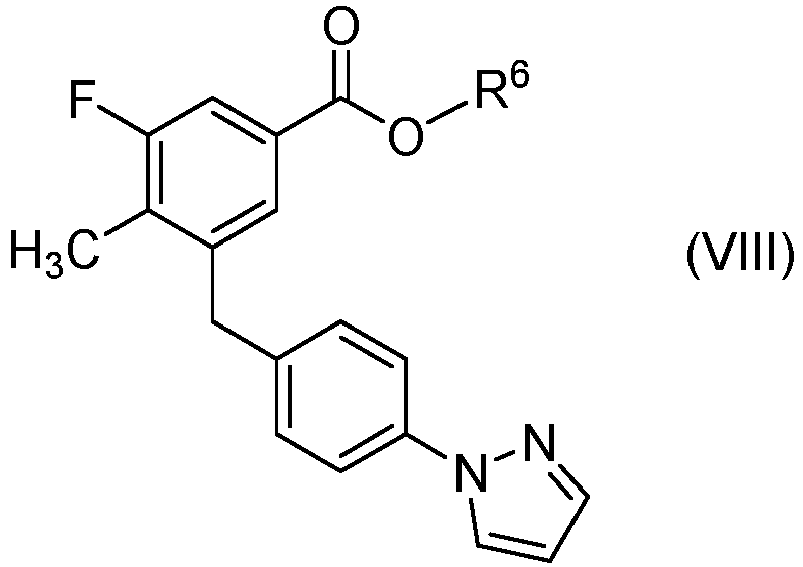
oder eines Salzes davon, umfassend das Unterwerfen einer Verbindung, die durch die Formel (IX) dargestellt ist, R6 wie vorstehend definiert ist undR7 eine Schutzgruppe ist,oder eines Salzes davon einer Reduktionsreaktion.
 - Verfahren zur Herstellung einer Verbindung, dargestellt durch die Formel (IX)
 R6 ein Wasserstoffatom oder eine gegebenenfalls substituierte C1-6-Alkylgruppe ist undR7 eine Schutzgruppe ist,
oder eines Salzes davon, umfassend das Unterwerfen einer Verbindung, die durch die Formel (X) dargestellt ist,
oder eines Salzes davon einer Schutzreaktion für die Hydroxygruppe. - Verfahren zur Herstellung einer Verbindung, dargestellt durch die Formel (X)

oder eines Salzes davon, welches die Umsetzung einer durch die Formel (XI) dargestellten Verbindung
oder eines Salzes davon mit 4-(1H-Pyrazol-1-yl)benzaldehyd umfasst. - Verfahren zur Herstellung einer Verbindung, dargestellt durch die Formel (IX)
 R6 ein Wasserstoffatom oder eine gegebenenfalls substituierte C1-6-Alkylgruppe ist undR7 eine Schutzgruppe ist,Schritt (i): ein Schritt, der das Umsetzen einer durch die Formel (XI) dargestellten Verbindung
oder eines Salzes davon, welches umfasst
oder eines Salzes davon mit 4-(1H-Pyrazol-1-yl)benzaldehyd umfasst, um eine durch die Formel (X) dargestellte Verbindung
oder ein Salz davon zu erhalten, und
Schritt (ii): ein Schritt des Unterwerfens der Verbindung, die durch die Formel (X) dargestellt ist, oder eines Salzes davon einer Schutzreaktion für die Hydroxygruppe. - Verfahren zur Herstellung einer Verbindung, dargestellt durch die Formel (VIII)

oder eines Salzes davon, welches umfasst
Schritt (i): ein Schritt des Umsetzens einer durch die Formel (XI) dargestellten Verbindung
oder eines Salzes davon mit 4-(1H-Pyrazol-1-yl)benzaldehyd, um eine durch die Formel (X) dargestellte Verbindung
oder ein Salz davon zu erhalten,
Schritt (ii): ein Schritt des Unterwerfens der durch die Formel (X) dargestellten Verbindung oder eines Salzes davon einer Schutzreaktion für die Hydroxygruppe, um eine durch die Formel (IX) dargestellte Verbindung R6 wie vorstehend definiert ist undR7 eine Schutzgruppe ist,Schritt (iii): ein Schritt des Unterwerfens der Verbindung, die durch die Formel (IX) dargestellt ist, oder eines Salzes davon einer Reduktionsreaktion.
oder ein Salz davon zu erhalten, und - Verfahren zur Herstellung von 4-Fluor-3-hydroxy-5-methyl-6-[4-(1H-pyrazol-1-yl)benzyl]-2-benzofuran-1(3H)-on oder einem Salz davon, 3-Fluor-2-formyl-4-methyl-5-[4-(1H-pyrazol-1-yl)benzyl]benzoesäure oder einem Salz davon oder einer Mischung davon, welches umfasst
Schritt (i): ein Schritt des Umsetzens einer Verbindung, dargestellt durch die Formel (XI)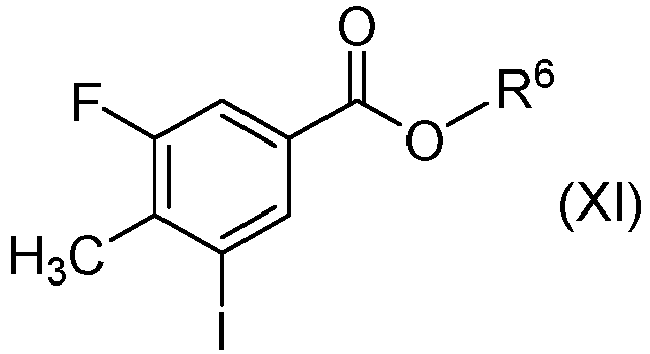
oder eines Salzes davon mit 4-(1H-Pyrazol-1-yl)benzaldehyd, um eine durch die Formel (X) dargestellte Verbindung
oder ein Salz davon zu erhalten,
Schritt (ii): ein Schritt des Unterwerfens der durch die Formel (X) dargestellten Verbindung oder eines Salzes davon einer Schutzreaktion für die Hydroxygruppe, um eine durch die Formel (IX) dargestellte Verbindung R6 wie vorstehend definiert ist undR7 eine Schutzgruppe ist,Schritt (iii): ein Schritt des Unterwerfens der durch die Formel (IX) dargestellten Verbindung oder eines Salzes davon einer Reduktionsreaktion, um eine durch die Formel (VIII) dargestellte Verbindung
oder ein Salz davon zu erhalten,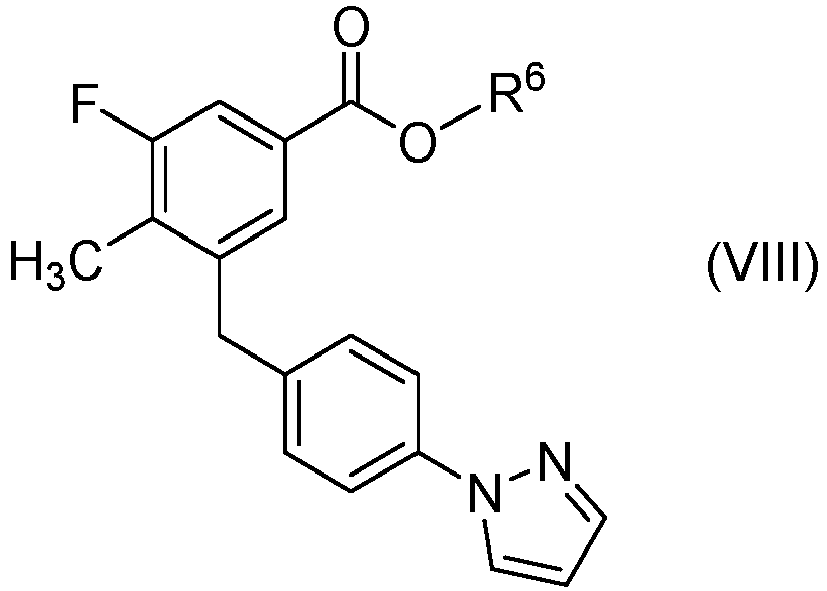
oder ein Salz davon zu erhalten, und
Schritt (iv): ein Schritt des Unterwerfens der durch die Formel (VIII) dargestellten Verbindung oder eines Salzes davon einer Formylierungsreaktion und dann einer Hydrolysereaktion, falls gewünscht. - Verfahren zur Herstellung von 1,5-Anhydro-2,4-dideoxy-2-(4-fluor-5-methyl-1-oxo-6-(4-(1H-pyrazol-1-yl)benzyl)-1,3-dihydro-2H-isoindol-2-yl)-L-threo-pentitol oder einem Salz davon, welches umfasst
Schritt (i): ein Schritt, umfassend das Umsetzen einer durch die Formel (XI) dargestellten Verbindung
oder eines Salzes davon mit 4-(1H-Pyrazol-1-yl)benzaldehyd, um eine durch die Formel (X) dargestellte Verbindung
oder ein Salz davon zu erhalten,
Schritt (ii): ein Schritt des Unterwerfens der durch die Formel (X) dargestellten Verbindung oder eines Salzes davon einer Schutzreaktion für die Hydroxygruppe, um eine durch die Formel (IX) dargestellte Verbindung R6 wie vorstehend definiert ist undR7 eine Schutzgruppe ist,oder ein Salz davon zu erhalten,Schritt (iii): ein Schritt des Unterwerfens der durch die Formel (IX) dargestellten Verbindung oder eines Salzes davon einer Reduktionsreaktion, um eine durch die Formel (VIII) dargestellte Verbindung
oder ein Salz davon zu erhalten,
Schritt (iv): ein Schritt des Unterwerfens der durch die Formel (VIII) dargestellten Verbindung oder eines Salzes davon einer Formylierungsreaktion und dann einer Hydrolysereaktion, falls gewünscht, um 4-Fluor-3-hydroxy-5-methyl-6-[4-(1H-pyrazol-1-yl)benzyl]-2-benzofuran-1(3H)-on oder ein Salz davon, 3-Fluor-2-formyl-4-methyl-5-[4-(1H-pyrazol-1-yl)benzyl]benzoesäure oder ein Salz davon oder eine Mischung davon zu erhalten, und Schritt (v): ein Schritt der Umsetzung von 4-Fluor-3-hydroxy-5-methyl-6-[4-(1H-pyrazol-1-yl)benzyl]-2-benzofuran-1(3H)-on oder einem Salz davon, 3-Fluor-2-formyl-4-methyl-5-[4-(1H-pyrazol-1-yl)benzyl]benzoesäure oder einem Salz davon oder einer Mischung davon mit 2-Amino-1,5-anhydro-2,4-dideoxy-L-threo-pentitol.
Applications Claiming Priority (2)
| Application Number | Priority Date | Filing Date | Title |
|---|---|---|---|
| JP2017036898 | 2017-02-28 | ||
| PCT/JP2018/007349 WO2018159639A1 (ja) | 2017-02-28 | 2018-02-27 | 複素環化合物の製造方法 |
Publications (3)
| Publication Number | Publication Date |
|---|---|
| EP3590936A1 EP3590936A1 (de) | 2020-01-08 |
| EP3590936A4 EP3590936A4 (de) | 2020-10-07 |
| EP3590936B1 true EP3590936B1 (de) | 2021-09-01 |
Family
ID=63370870
Family Applications (1)
| Application Number | Title | Priority Date | Filing Date |
|---|---|---|---|
| EP18761137.1A Active EP3590936B1 (de) | 2017-02-28 | 2018-02-27 | Verfahren zur herstellung einer heterocyclischen verbindung |
Country Status (5)
| Country | Link |
|---|---|
| US (1) | US10710989B2 (de) |
| EP (1) | EP3590936B1 (de) |
| JP (1) | JP7069109B2 (de) |
| CN (2) | CN118005619A (de) |
| WO (1) | WO2018159639A1 (de) |
Families Citing this family (1)
| Publication number | Priority date | Publication date | Assignee | Title |
|---|---|---|---|---|
| CN118878810B (zh) * | 2024-09-24 | 2024-12-17 | 安徽协合新材料有限公司 | 一种非离子型水性聚酰胺蜡流变助剂及其制备方法 |
Family Cites Families (8)
| Publication number | Priority date | Publication date | Assignee | Title |
|---|---|---|---|---|
| JPS55141457A (en) * | 1979-04-19 | 1980-11-05 | Hisamitsu Pharmaceut Co Inc | Novel benzylidene derivative |
| SU1502568A1 (ru) * | 1987-08-17 | 1989-08-23 | Предприятие П/Я В-2343 | Способ получени 6,7-диметокси-N-алкилфталимидинов |
| WO2015137496A1 (ja) * | 2014-03-14 | 2015-09-17 | 武田薬品工業株式会社 | 複素環化合物の製造法 |
| DK3134386T3 (da) | 2014-04-23 | 2020-08-17 | Takeda Pharmaceuticals Co | Isoindolin-1-on-derivater med kolinerg muscarin-m1-receptor-positiv allosterisk modulatoraktivitet til behandling af alzheimers sygdom |
| JP6571077B2 (ja) * | 2014-06-13 | 2019-09-04 | 武田薬品工業株式会社 | 含窒素複素環化合物 |
| CA2988572A1 (en) * | 2015-06-26 | 2016-12-29 | Takeda Pharmaceutical Company Limited | 2,3-dihydro-4h-1,3-benzoxazin-4-one derivatives as modulators of cholinergic muscarinic m1 receptor |
| JP7032033B2 (ja) | 2015-08-13 | 2022-03-08 | パンパシフィック・カッパー株式会社 | 酸素製造装置の稼動方法 |
| JP6860551B2 (ja) | 2016-03-11 | 2021-04-14 | 武田薬品工業株式会社 | 芳香環化合物 |
-
2018
- 2018-02-27 EP EP18761137.1A patent/EP3590936B1/de active Active
- 2018-02-27 CN CN202410006479.3A patent/CN118005619A/zh active Pending
- 2018-02-27 CN CN201880014672.4A patent/CN110753689B/zh active Active
- 2018-02-27 JP JP2019503035A patent/JP7069109B2/ja active Active
- 2018-02-27 US US16/488,770 patent/US10710989B2/en active Active
- 2018-02-27 WO PCT/JP2018/007349 patent/WO2018159639A1/ja not_active Ceased
Also Published As
| Publication number | Publication date |
|---|---|
| JP7069109B2 (ja) | 2022-05-17 |
| CN118005619A (zh) | 2024-05-10 |
| WO2018159639A1 (ja) | 2018-09-07 |
| CN110753689B (zh) | 2024-01-26 |
| CN110753689A (zh) | 2020-02-04 |
| EP3590936A4 (de) | 2020-10-07 |
| EP3590936A1 (de) | 2020-01-08 |
| US20190375736A1 (en) | 2019-12-12 |
| US10710989B2 (en) | 2020-07-14 |
| JPWO2018159639A1 (ja) | 2019-12-26 |
| CA3054773A1 (en) | 2018-09-07 |
Similar Documents
| Publication | Publication Date | Title |
|---|---|---|
| JP7420865B2 (ja) | 光学活性化合物の製造法 | |
| CA3019298A1 (en) | Heterocyclic compound | |
| JP2020097526A (ja) | 複素環化合物 | |
| CA3071491A1 (en) | Crystalline forms of hydroxynorketamine | |
| EP3590936B1 (de) | Verfahren zur herstellung einer heterocyclischen verbindung | |
| JP7748736B2 (ja) | 安定な新規芳香族ボロン酸エステル | |
| CA3054773C (en) | Method for producing heterocyclic compound | |
| Gruzdev et al. | Synthesis of enantiomers of 6-nitro-and 6-amino-2-methyl-1, 2, 3, 4-tetrahydroquinolines | |
| US20180079741A1 (en) | Process for producing heterocyclic compound | |
| CN110709401B (zh) | 杂环化合物 | |
| JP7821946B1 (ja) | マクロ環状複素環化合物及びその用途 | |
| Claverie et al. | The revisited synthesis of tert-butyl pyroglutamate derivatives | |
| EP3130581A1 (de) | Verfahren zur herstellung einer heterocyclischen verbindung | |
| HK40114634A (en) | Method for producing optically active compound | |
| WO2017026538A1 (en) | Production method of pyrazine | |
| HK40022701B (en) | Method for producing optically active compound | |
| BR122025003245A2 (pt) | Processo para preparar composto intermediário de 1-[(3r,4s)-4- cianotetrahidropiran-3-il]-3-[(2-fluoro-6-metoxi-4-piridil)amino]pirazol-4- carboxamida | |
| BR112021011084B1 (pt) | Processos para preparar 1-[(3r,4s)-4-cianotetrahidropiran-3-il]-3-[(2- fluoro-6-metoxi-4-piridil)amino]pirazol-4-carboxamida e seu intermediário, bem como compostos intermediários do referido composto | |
| HK40022701A (en) | Method for producing optically active compound | |
| BR122025003253A2 (pt) | Processo para preparar composto intermediário de 1-[(3r,4s)-4- cianotetrahidropiran-3-il]-3-[(2-fluoro-6-metoxi-4-piridil)amino]pirazol-4- carboxamida | |
| BR122025003253B1 (pt) | Processo para preparar composto intermediário de 1-[(3r,4s)-4- cianotetrahidropiran-3-il]-3-[(2-fluoro-6-metoxi-4-piridil)amino]pirazol-4- carboxamida | |
| BR122025003245B1 (pt) | Processo para preparar composto intermediário de 1-[(3r,4s)-4- cianotetrahidropiran-3-il]-3-[(2-fluoro-6-metoxi-4-piridil)amino]pirazol-4- carboxamida | |
| Medeiros | Practical synthesis of fingolimod from diethyl acetamidomalonate |
Legal Events
| Date | Code | Title | Description |
|---|---|---|---|
| STAA | Information on the status of an ep patent application or granted ep patent |
Free format text: STATUS: THE INTERNATIONAL PUBLICATION HAS BEEN MADE |
|
| PUAI | Public reference made under article 153(3) epc to a published international application that has entered the european phase |
Free format text: ORIGINAL CODE: 0009012 |
|
| STAA | Information on the status of an ep patent application or granted ep patent |
Free format text: STATUS: REQUEST FOR EXAMINATION WAS MADE |
|
| 17P | Request for examination filed |
Effective date: 20190828 |
|
| AK | Designated contracting states |
Kind code of ref document: A1 Designated state(s): AL AT BE BG CH CY CZ DE DK EE ES FI FR GB GR HR HU IE IS IT LI LT LU LV MC MK MT NL NO PL PT RO RS SE SI SK SM TR |
|
| AX | Request for extension of the european patent |
Extension state: BA ME |
|
| DAV | Request for validation of the european patent (deleted) | ||
| DAX | Request for extension of the european patent (deleted) | ||
| A4 | Supplementary search report drawn up and despatched |
Effective date: 20200908 |
|
| RIC1 | Information provided on ipc code assigned before grant |
Ipc: A61K 31/4155 20060101ALI20200902BHEP Ipc: C07D 405/10 20060101ALI20200902BHEP Ipc: C07D 231/12 20060101ALI20200902BHEP Ipc: A61P 25/28 20060101ALI20200902BHEP Ipc: C07D 405/14 20060101AFI20200902BHEP |
|
| GRAP | Despatch of communication of intention to grant a patent |
Free format text: ORIGINAL CODE: EPIDOSNIGR1 |
|
| STAA | Information on the status of an ep patent application or granted ep patent |
Free format text: STATUS: GRANT OF PATENT IS INTENDED |
|
| INTG | Intention to grant announced |
Effective date: 20210322 |
|
| GRAS | Grant fee paid |
Free format text: ORIGINAL CODE: EPIDOSNIGR3 |
|
| GRAA | (expected) grant |
Free format text: ORIGINAL CODE: 0009210 |
|
| STAA | Information on the status of an ep patent application or granted ep patent |
Free format text: STATUS: THE PATENT HAS BEEN GRANTED |
|
| AK | Designated contracting states |
Kind code of ref document: B1 Designated state(s): AL AT BE BG CH CY CZ DE DK EE ES FI FR GB GR HR HU IE IS IT LI LT LU LV MC MK MT NL NO PL PT RO RS SE SI SK SM TR |
|
| REG | Reference to a national code |
Ref country code: GB Ref legal event code: FG4D |
|
| REG | Reference to a national code |
Ref country code: CH Ref legal event code: EP Ref country code: AT Ref legal event code: REF Ref document number: 1426153 Country of ref document: AT Kind code of ref document: T Effective date: 20210915 |
|
| REG | Reference to a national code |
Ref country code: DE Ref legal event code: R096 Ref document number: 602018022946 Country of ref document: DE |
|
| REG | Reference to a national code |
Ref country code: IE Ref legal event code: FG4D |
|
| REG | Reference to a national code |
Ref country code: LT Ref legal event code: MG9D |
|
| REG | Reference to a national code |
Ref country code: NL Ref legal event code: MP Effective date: 20210901 |
|
| PG25 | Lapsed in a contracting state [announced via postgrant information from national office to epo] |
Ref country code: ES Free format text: LAPSE BECAUSE OF FAILURE TO SUBMIT A TRANSLATION OF THE DESCRIPTION OR TO PAY THE FEE WITHIN THE PRESCRIBED TIME-LIMIT Effective date: 20210901 Ref country code: FI Free format text: LAPSE BECAUSE OF FAILURE TO SUBMIT A TRANSLATION OF THE DESCRIPTION OR TO PAY THE FEE WITHIN THE PRESCRIBED TIME-LIMIT Effective date: 20210901 Ref country code: HR Free format text: LAPSE BECAUSE OF FAILURE TO SUBMIT A TRANSLATION OF THE DESCRIPTION OR TO PAY THE FEE WITHIN THE PRESCRIBED TIME-LIMIT Effective date: 20210901 Ref country code: SE Free format text: LAPSE BECAUSE OF FAILURE TO SUBMIT A TRANSLATION OF THE DESCRIPTION OR TO PAY THE FEE WITHIN THE PRESCRIBED TIME-LIMIT Effective date: 20210901 Ref country code: RS Free format text: LAPSE BECAUSE OF FAILURE TO SUBMIT A TRANSLATION OF THE DESCRIPTION OR TO PAY THE FEE WITHIN THE PRESCRIBED TIME-LIMIT Effective date: 20210901 Ref country code: BG Free format text: LAPSE BECAUSE OF FAILURE TO SUBMIT A TRANSLATION OF THE DESCRIPTION OR TO PAY THE FEE WITHIN THE PRESCRIBED TIME-LIMIT Effective date: 20211201 Ref country code: LT Free format text: LAPSE BECAUSE OF FAILURE TO SUBMIT A TRANSLATION OF THE DESCRIPTION OR TO PAY THE FEE WITHIN THE PRESCRIBED TIME-LIMIT Effective date: 20210901 Ref country code: NO Free format text: LAPSE BECAUSE OF FAILURE TO SUBMIT A TRANSLATION OF THE DESCRIPTION OR TO PAY THE FEE WITHIN THE PRESCRIBED TIME-LIMIT Effective date: 20211201 |
|
| REG | Reference to a national code |
Ref country code: AT Ref legal event code: MK05 Ref document number: 1426153 Country of ref document: AT Kind code of ref document: T Effective date: 20210901 |
|
| PG25 | Lapsed in a contracting state [announced via postgrant information from national office to epo] |
Ref country code: PL Free format text: LAPSE BECAUSE OF FAILURE TO SUBMIT A TRANSLATION OF THE DESCRIPTION OR TO PAY THE FEE WITHIN THE PRESCRIBED TIME-LIMIT Effective date: 20210901 Ref country code: LV Free format text: LAPSE BECAUSE OF FAILURE TO SUBMIT A TRANSLATION OF THE DESCRIPTION OR TO PAY THE FEE WITHIN THE PRESCRIBED TIME-LIMIT Effective date: 20210901 Ref country code: GR Free format text: LAPSE BECAUSE OF FAILURE TO SUBMIT A TRANSLATION OF THE DESCRIPTION OR TO PAY THE FEE WITHIN THE PRESCRIBED TIME-LIMIT Effective date: 20211202 |
|
| PG25 | Lapsed in a contracting state [announced via postgrant information from national office to epo] |
Ref country code: AT Free format text: LAPSE BECAUSE OF FAILURE TO SUBMIT A TRANSLATION OF THE DESCRIPTION OR TO PAY THE FEE WITHIN THE PRESCRIBED TIME-LIMIT Effective date: 20210901 |
|
| PG25 | Lapsed in a contracting state [announced via postgrant information from national office to epo] |
Ref country code: IS Free format text: LAPSE BECAUSE OF FAILURE TO SUBMIT A TRANSLATION OF THE DESCRIPTION OR TO PAY THE FEE WITHIN THE PRESCRIBED TIME-LIMIT Effective date: 20220101 Ref country code: SM Free format text: LAPSE BECAUSE OF FAILURE TO SUBMIT A TRANSLATION OF THE DESCRIPTION OR TO PAY THE FEE WITHIN THE PRESCRIBED TIME-LIMIT Effective date: 20210901 Ref country code: SK Free format text: LAPSE BECAUSE OF FAILURE TO SUBMIT A TRANSLATION OF THE DESCRIPTION OR TO PAY THE FEE WITHIN THE PRESCRIBED TIME-LIMIT Effective date: 20210901 Ref country code: RO Free format text: LAPSE BECAUSE OF FAILURE TO SUBMIT A TRANSLATION OF THE DESCRIPTION OR TO PAY THE FEE WITHIN THE PRESCRIBED TIME-LIMIT Effective date: 20210901 Ref country code: PT Free format text: LAPSE BECAUSE OF FAILURE TO SUBMIT A TRANSLATION OF THE DESCRIPTION OR TO PAY THE FEE WITHIN THE PRESCRIBED TIME-LIMIT Effective date: 20220103 Ref country code: NL Free format text: LAPSE BECAUSE OF FAILURE TO SUBMIT A TRANSLATION OF THE DESCRIPTION OR TO PAY THE FEE WITHIN THE PRESCRIBED TIME-LIMIT Effective date: 20210901 Ref country code: EE Free format text: LAPSE BECAUSE OF FAILURE TO SUBMIT A TRANSLATION OF THE DESCRIPTION OR TO PAY THE FEE WITHIN THE PRESCRIBED TIME-LIMIT Effective date: 20210901 Ref country code: CZ Free format text: LAPSE BECAUSE OF FAILURE TO SUBMIT A TRANSLATION OF THE DESCRIPTION OR TO PAY THE FEE WITHIN THE PRESCRIBED TIME-LIMIT Effective date: 20210901 Ref country code: AL Free format text: LAPSE BECAUSE OF FAILURE TO SUBMIT A TRANSLATION OF THE DESCRIPTION OR TO PAY THE FEE WITHIN THE PRESCRIBED TIME-LIMIT Effective date: 20210901 |
|
| REG | Reference to a national code |
Ref country code: DE Ref legal event code: R097 Ref document number: 602018022946 Country of ref document: DE |
|
| PLBE | No opposition filed within time limit |
Free format text: ORIGINAL CODE: 0009261 |
|
| STAA | Information on the status of an ep patent application or granted ep patent |
Free format text: STATUS: NO OPPOSITION FILED WITHIN TIME LIMIT |
|
| PG25 | Lapsed in a contracting state [announced via postgrant information from national office to epo] |
Ref country code: DK Free format text: LAPSE BECAUSE OF FAILURE TO SUBMIT A TRANSLATION OF THE DESCRIPTION OR TO PAY THE FEE WITHIN THE PRESCRIBED TIME-LIMIT Effective date: 20210901 |
|
| 26N | No opposition filed |
Effective date: 20220602 |
|
| PG25 | Lapsed in a contracting state [announced via postgrant information from national office to epo] |
Ref country code: SI Free format text: LAPSE BECAUSE OF FAILURE TO SUBMIT A TRANSLATION OF THE DESCRIPTION OR TO PAY THE FEE WITHIN THE PRESCRIBED TIME-LIMIT Effective date: 20210901 |
|
| PG25 | Lapsed in a contracting state [announced via postgrant information from national office to epo] |
Ref country code: MC Free format text: LAPSE BECAUSE OF FAILURE TO SUBMIT A TRANSLATION OF THE DESCRIPTION OR TO PAY THE FEE WITHIN THE PRESCRIBED TIME-LIMIT Effective date: 20210901 |
|
| REG | Reference to a national code |
Ref country code: CH Ref legal event code: PL |
|
| REG | Reference to a national code |
Ref country code: BE Ref legal event code: MM Effective date: 20220228 |
|
| PG25 | Lapsed in a contracting state [announced via postgrant information from national office to epo] |
Ref country code: LU Free format text: LAPSE BECAUSE OF NON-PAYMENT OF DUE FEES Effective date: 20220227 |
|
| PG25 | Lapsed in a contracting state [announced via postgrant information from national office to epo] |
Ref country code: LI Free format text: LAPSE BECAUSE OF NON-PAYMENT OF DUE FEES Effective date: 20220228 Ref country code: IE Free format text: LAPSE BECAUSE OF NON-PAYMENT OF DUE FEES Effective date: 20220227 Ref country code: CH Free format text: LAPSE BECAUSE OF NON-PAYMENT OF DUE FEES Effective date: 20220228 |
|
| PG25 | Lapsed in a contracting state [announced via postgrant information from national office to epo] |
Ref country code: BE Free format text: LAPSE BECAUSE OF NON-PAYMENT OF DUE FEES Effective date: 20220228 |
|
| PG25 | Lapsed in a contracting state [announced via postgrant information from national office to epo] |
Ref country code: MK Free format text: LAPSE BECAUSE OF FAILURE TO SUBMIT A TRANSLATION OF THE DESCRIPTION OR TO PAY THE FEE WITHIN THE PRESCRIBED TIME-LIMIT Effective date: 20210901 Ref country code: CY Free format text: LAPSE BECAUSE OF FAILURE TO SUBMIT A TRANSLATION OF THE DESCRIPTION OR TO PAY THE FEE WITHIN THE PRESCRIBED TIME-LIMIT Effective date: 20210901 |
|
| PG25 | Lapsed in a contracting state [announced via postgrant information from national office to epo] |
Ref country code: HU Free format text: LAPSE BECAUSE OF FAILURE TO SUBMIT A TRANSLATION OF THE DESCRIPTION OR TO PAY THE FEE WITHIN THE PRESCRIBED TIME-LIMIT; INVALID AB INITIO Effective date: 20180227 |
|
| PG25 | Lapsed in a contracting state [announced via postgrant information from national office to epo] |
Ref country code: MT Free format text: LAPSE BECAUSE OF FAILURE TO SUBMIT A TRANSLATION OF THE DESCRIPTION OR TO PAY THE FEE WITHIN THE PRESCRIBED TIME-LIMIT Effective date: 20210901 |
|
| PG25 | Lapsed in a contracting state [announced via postgrant information from national office to epo] |
Ref country code: TR Free format text: LAPSE BECAUSE OF FAILURE TO SUBMIT A TRANSLATION OF THE DESCRIPTION OR TO PAY THE FEE WITHIN THE PRESCRIBED TIME-LIMIT Effective date: 20210901 |
|
| PGFP | Annual fee paid to national office [announced via postgrant information from national office to epo] |
Ref country code: GB Payment date: 20260121 Year of fee payment: 9 |
|
| PGFP | Annual fee paid to national office [announced via postgrant information from national office to epo] |
Ref country code: DE Payment date: 20260121 Year of fee payment: 9 |
|
| PGFP | Annual fee paid to national office [announced via postgrant information from national office to epo] |
Ref country code: IT Payment date: 20260127 Year of fee payment: 9 |
|
| PGFP | Annual fee paid to national office [announced via postgrant information from national office to epo] |
Ref country code: FR Payment date: 20260121 Year of fee payment: 9 |