EP3590902A1 - Hoch beständige und chemisch vorspannbare gläser - Google Patents
Hoch beständige und chemisch vorspannbare gläser Download PDFInfo
- Publication number
- EP3590902A1 EP3590902A1 EP19183173.4A EP19183173A EP3590902A1 EP 3590902 A1 EP3590902 A1 EP 3590902A1 EP 19183173 A EP19183173 A EP 19183173A EP 3590902 A1 EP3590902 A1 EP 3590902A1
- Authority
- EP
- European Patent Office
- Prior art keywords
- glass
- mol
- glasses
- sio
- wollastonite
- Prior art date
- Legal status (The legal status is an assumption and is not a legal conclusion. Google has not performed a legal analysis and makes no representation as to the accuracy of the status listed.)
- Granted
Links
Classifications
-
- C—CHEMISTRY; METALLURGY
- C03—GLASS; MINERAL OR SLAG WOOL
- C03C—CHEMICAL COMPOSITION OF GLASSES, GLAZES OR VITREOUS ENAMELS; SURFACE TREATMENT OF GLASS; SURFACE TREATMENT OF FIBRES OR FILAMENTS MADE FROM GLASS, MINERALS OR SLAGS; JOINING GLASS TO GLASS OR OTHER MATERIALS
- C03C3/00—Glass compositions
- C03C3/04—Glass compositions containing silica
- C03C3/076—Glass compositions containing silica with 40% to 90% silica, by weight
- C03C3/083—Glass compositions containing silica with 40% to 90% silica, by weight containing aluminium oxide or an iron compound
- C03C3/085—Glass compositions containing silica with 40% to 90% silica, by weight containing aluminium oxide or an iron compound containing an oxide of a divalent metal
-
- C—CHEMISTRY; METALLURGY
- C03—GLASS; MINERAL OR SLAG WOOL
- C03C—CHEMICAL COMPOSITION OF GLASSES, GLAZES OR VITREOUS ENAMELS; SURFACE TREATMENT OF GLASS; SURFACE TREATMENT OF FIBRES OR FILAMENTS MADE FROM GLASS, MINERALS OR SLAGS; JOINING GLASS TO GLASS OR OTHER MATERIALS
- C03C3/00—Glass compositions
- C03C3/04—Glass compositions containing silica
- C03C3/062—Glass compositions containing silica with less than 40% silica by weight
-
- C—CHEMISTRY; METALLURGY
- C03—GLASS; MINERAL OR SLAG WOOL
- C03C—CHEMICAL COMPOSITION OF GLASSES, GLAZES OR VITREOUS ENAMELS; SURFACE TREATMENT OF GLASS; SURFACE TREATMENT OF FIBRES OR FILAMENTS MADE FROM GLASS, MINERALS OR SLAGS; JOINING GLASS TO GLASS OR OTHER MATERIALS
- C03C3/00—Glass compositions
- C03C3/04—Glass compositions containing silica
- C03C3/076—Glass compositions containing silica with 40% to 90% silica, by weight
- C03C3/083—Glass compositions containing silica with 40% to 90% silica, by weight containing aluminium oxide or an iron compound
- C03C3/085—Glass compositions containing silica with 40% to 90% silica, by weight containing aluminium oxide or an iron compound containing an oxide of a divalent metal
- C03C3/087—Glass compositions containing silica with 40% to 90% silica, by weight containing aluminium oxide or an iron compound containing an oxide of a divalent metal containing calcium oxide, e.g. common sheet or container glass
-
- B—PERFORMING OPERATIONS; TRANSPORTING
- B65—CONVEYING; PACKING; STORING; HANDLING THIN OR FILAMENTARY MATERIAL
- B65D—CONTAINERS FOR STORAGE OR TRANSPORT OF ARTICLES OR MATERIALS, e.g. BAGS, BARRELS, BOTTLES, BOXES, CANS, CARTONS, CRATES, DRUMS, JARS, TANKS, HOPPERS, FORWARDING CONTAINERS; ACCESSORIES, CLOSURES, OR FITTINGS THEREFOR; PACKAGING ELEMENTS; PACKAGES
- B65D13/00—Containers having bodies formed by interconnecting two or more rigid, or substantially rigid, components made wholly or mainly of the same material, other than metal, plastics, wood or substitutes therefor
- B65D13/02—Containers having bodies formed by interconnecting two or more rigid, or substantially rigid, components made wholly or mainly of the same material, other than metal, plastics, wood or substitutes therefor of glass, pottery, or other ceramic material
-
- C—CHEMISTRY; METALLURGY
- C03—GLASS; MINERAL OR SLAG WOOL
- C03B—MANUFACTURE, SHAPING, OR SUPPLEMENTARY PROCESSES
- C03B17/00—Forming molten glass by flowing-out, pushing-out, extruding or drawing downwardly or laterally from forming slits or by overflowing over lips
-
- C—CHEMISTRY; METALLURGY
- C03—GLASS; MINERAL OR SLAG WOOL
- C03B—MANUFACTURE, SHAPING, OR SUPPLEMENTARY PROCESSES
- C03B17/00—Forming molten glass by flowing-out, pushing-out, extruding or drawing downwardly or laterally from forming slits or by overflowing over lips
- C03B17/06—Forming glass sheets
- C03B17/064—Forming glass sheets by the overflow downdraw fusion process; Isopipes therefor
-
- C—CHEMISTRY; METALLURGY
- C03—GLASS; MINERAL OR SLAG WOOL
- C03B—MANUFACTURE, SHAPING, OR SUPPLEMENTARY PROCESSES
- C03B18/00—Shaping glass in contact with the surface of a liquid
-
- C—CHEMISTRY; METALLURGY
- C03—GLASS; MINERAL OR SLAG WOOL
- C03B—MANUFACTURE, SHAPING, OR SUPPLEMENTARY PROCESSES
- C03B18/00—Shaping glass in contact with the surface of a liquid
- C03B18/02—Forming sheets
-
- C—CHEMISTRY; METALLURGY
- C03—GLASS; MINERAL OR SLAG WOOL
- C03B—MANUFACTURE, SHAPING, OR SUPPLEMENTARY PROCESSES
- C03B23/00—Re-forming shaped glass
- C03B23/02—Re-forming glass sheets
-
- C—CHEMISTRY; METALLURGY
- C03—GLASS; MINERAL OR SLAG WOOL
- C03B—MANUFACTURE, SHAPING, OR SUPPLEMENTARY PROCESSES
- C03B23/00—Re-forming shaped glass
- C03B23/04—Re-forming tubes or rods
- C03B23/047—Re-forming tubes or rods by drawing
-
- C—CHEMISTRY; METALLURGY
- C03—GLASS; MINERAL OR SLAG WOOL
- C03C—CHEMICAL COMPOSITION OF GLASSES, GLAZES OR VITREOUS ENAMELS; SURFACE TREATMENT OF GLASS; SURFACE TREATMENT OF FIBRES OR FILAMENTS MADE FROM GLASS, MINERALS OR SLAGS; JOINING GLASS TO GLASS OR OTHER MATERIALS
- C03C4/00—Compositions for glass with special properties
- C03C4/18—Compositions for glass with special properties for ion-sensitive glass
-
- C—CHEMISTRY; METALLURGY
- C03—GLASS; MINERAL OR SLAG WOOL
- C03C—CHEMICAL COMPOSITION OF GLASSES, GLAZES OR VITREOUS ENAMELS; SURFACE TREATMENT OF GLASS; SURFACE TREATMENT OF FIBRES OR FILAMENTS MADE FROM GLASS, MINERALS OR SLAGS; JOINING GLASS TO GLASS OR OTHER MATERIALS
- C03C4/00—Compositions for glass with special properties
- C03C4/20—Compositions for glass with special properties for chemical resistant glass
-
- C—CHEMISTRY; METALLURGY
- C03—GLASS; MINERAL OR SLAG WOOL
- C03C—CHEMICAL COMPOSITION OF GLASSES, GLAZES OR VITREOUS ENAMELS; SURFACE TREATMENT OF GLASS; SURFACE TREATMENT OF FIBRES OR FILAMENTS MADE FROM GLASS, MINERALS OR SLAGS; JOINING GLASS TO GLASS OR OTHER MATERIALS
- C03C2204/00—Glasses, glazes or enamels with special properties
Definitions
- the invention relates to glasses and glass products which combine chemical temperability with very good resistance to alkali and acid, hydrolytic resistance and a desired coefficient of thermal expansion. Manufacturing methods of such glasses and their uses are also according to the invention.
- Chemically toughened glasses are required for many applications, in particular for applications in the areas of pharmaceutical packaging or touch-sensitive displays (“touch panel”).
- touch panel touch-sensitive displays
- a certain coefficient of thermal expansion is still required, and despite the in large numbers of sodium ions present no compromise with regard to alkali, hydrolytic and acid resistance.
- There is a wealth of regulations and standards for the characterization of chemical resistance in particular ISO 695 for alkali resistance, ISO 719/720 for hydrolytic as well as ISO 1776 and DIN 12116 for acid resistance.
- the glasses described there mainly relate to a large proportion of vitreous albite (12.5 mol% Na 2 O, 12.5 mol% Al 2 O 3 , 75 mol% SiO 2 ) as a constituent phase with regard to the chemical temperability leave little room for other phases, which can have a favorable influence on the chemical prestressability.
- glassy albite as the main component was made due to the high mobility of sodium ions in this glass system, which allows a great exchange depth (typically 30-50 ⁇ m) to be achieved with the chemical prestressing by exchanging sodium for potassium.
- the mineral albite also shows a high mobility of the sodium ions.
- the level of the prestress in the layer near the surface does not depend on this mobility, but on the sodium concentration in the starting glass.
- the prior art lacks glasses which combine chemical toughness with good chemical resistance.
- these glasses should have the desired thermal expansion properties.
- the glasses should also be able to be manufactured using modern tube drawing processes or flat glass drawing processes.
- stoichiometric glasses i.e. glasses that also exist as crystals in the same stoichiometry and whose properties are due to the fact that - as in the literature - with many examples by NMR measurements or the like. checked - identical topology of the assemblies for glass and crystal can be assumed to be very similar, solved.
- stoichiometric glasses are selected, the mixture of which makes it possible to achieve behavior in the sense of solving the problem according to the invention.
- these stoichiometric glasses are also referred to as "constituent phases”.
- the present invention relates to a glass with a composition which is characterized by the following phases constituting the glass, this basic system defined by the constituent phases being limited according to the invention by the specified composition ranges: ⁇ b> Table 1 ⁇ /b> constituent phase Min (mol%) Max (mol%) albite 20 60 silica 0 40 orthoclase 0 20 wollastonite 0 10 enstatite 0 20 Parakeldyshit 0 20 Narsarsukit 0 20 Dinatriumzinksilicat 0 40 cordierite 0 20 strontium 0 10 barium 0 10
- the basic systems expressly refer to the constituent phases mentioned and not to the simple oxides. However, it follows from the task and the choice of the constituent phases that the glasses preferably contain at most 12.5 mol% of Al 2 O 3 in order to allow an advantageous solution in the space of these constituent phases. Glasses which, after conversion into the oxide composition, have more than 12.5 mol% of aluminum oxide are therefore preferably not part of this invention.
- the glass according to the invention is intended to meet further conditions which are in the form of relationships with the composition of constituent phases or the composition of simple oxides, which are shown below.
- composition of constituent phases is given in a standardized form, which reads: ⁇ b> Table 2 ⁇ /b> constituent phase Formula (standardized to a simple oxide) albite (Na 2 O ⁇ Al 2 O 3 ⁇ 6SiO 2 ) / 8 silica SiO 2 orthoclase (K 2 O ⁇ Al 2 O 3 ⁇ 6SiO 2 ) / 8 wollastonite (CaO.SiO 2 ) / 2 enstatite (MgO.SiO 2 ) / 2 Parakeldyshit (Na 2 O ⁇ ZrO 2 ⁇ 2SiO 2 ) / 4 Narsarsukit (Na 2 O ⁇ TiO 2 ⁇ 4SiO 2 ) / 6 Dinatriumzinksilicat (Na 2 O ⁇ ZnO ⁇ 3SiO 2 ) / 5 cordierite (2MgO ⁇ 2Al 2 O 3 5SiO 2 ⁇ ) / 9 str
- the result of the multiplication of the column vector on the matrix is the composition of the glass in mole percent.
- composition in molar percentages can easily be converted into a base glass composition via the respective inverse matrix.
- base glass compositions which do not result in negative values for the base glasses when converted are considered to be according to the invention.
- the composition is chosen with regard to the phases constituting the glass within the limits described herein.
- the phases constituting the glass are of course not crystalline, but amorphous in the glass product.
- this does not mean that the constituent phases in the amorphous state have completely different assemblies than in the crystalline state.
- the topology of the assemblies is comparable, for example the coordination of the cations involved with surrounding oxygen atoms or the interatomic distance resulting from the coordination and the strength of the bond between these cations and surrounding oxygen atoms. Therefore, many properties of the glass of the invention can be described well on the basis of the constituent phases, in particular in order to illustrate the inventive performance and the problems overcome with the invention (cf. Conradt R., loc. Cit.).
- the glass can of course not only be used with the appropriate Crystals are produced, but also using the usual glass raw materials, as long as only the stoichiometric conditions allow the formation of the corresponding assemblies of the basic glasses.
- the phases are selected with a view to suitability for ion transport or a beneficial influence on ion transport and their influence on hydrolytic stability and thermal expansion.
- calculation methods are given as to how these variables can be calculated from a given composition of constituent phases. These calculation methods are decisive both in the selection of the constituent phases and in the very composition of a glass according to the invention from these constituent phases.
- Both the hydrolytic resistance according to ISO 719/720 and the alkali resistance according to ISO 695 essentially include a resistance of the glass to attack by hydroxyl ions.
- concentration of the hydroxyl ions in the lye is determined by using a buffer solution with 0.5 mol / l sodium hydroxide and 0.25 mol / l sodium carbonate.
- the glass is placed in neutral water, the pH value of which is initially set to 5.5 (check using a methyl red indicator solution), but moves very quickly into the alkaline range due to the dissolution of the glass.
- a buffer solution is created from the weak acids (or acid anhydrides) contained in the glass, especially silica, and strong alkalis (such as sodium hydroxide), whose pH is in the range 9 to 10, see Susanne Fagerlund, Paul Ek, Mikko Hupa and Leena Hupa: On determining chemical durability of glasses, Glass Technol .: Eur. J. Glass Sci. Technol. A, December 2010, 51 (6), 235-240 , The pKs values of the weak acid (s) are decisive for the pH of a buffer solution.
- the concentration of the hydroxyl ions is determined by the pH of the resulting buffer solution, which depends both on the type of glass and increases with the progress of dissolution. The dissolution by these hydroxyl ions then takes place according to the same mechanism as in the alkali resistance measurement.
- the removal rate during the test according to ISO 695 must first be set to a low value.
- the pH value that results during a test according to ISO 719/720 and the resulting dissolution of a certain amount of glass in the aqueous test solution must be limited. The higher this pH value increases in the course of the test, the greater the risk of a positive feedback effect: with increasing pH, the removal rate increases, with increasing amount of removal in the aqueous solution, its pH value increases, etc.
- Chemically resistant glasses typically experience an erosion during the test, which leads to 100 ⁇ mol glass in the aqueous solution or less, the removal being generally the less congruent the less it is.
- the removal rate according to ISO 695 is preferably at most 105 mg / (dm 2 3h), preferably at most 100 mg / (dm 2 3h), particularly preferably at most 95 mg / (dm 2 3h), very particularly preferably at most 90 mg / (dm 2 3h), most preferably a maximum of 85 mg / (dm 2 3h).
- the removal rate which can be calculated using the formulas (2) and (3) for glasses of this invention.
- the coefficient of thermal expansion is preferably between 4 and 8 ppm / K, preferably between 4.5 and 7ppm / K, particularly preferably between 4.8 and 6.5ppm / K.
- CTE which can be calculated using the formula (8) for glasses of this invention.
- the calculation of the pH value in aqueous solution is based on the composition information in simple oxides.
- the corresponding cations pass into the highly oxidized hydroxides, see Table 5.
- the release of an H + or OH - these hydroxides is described in each case by a corresponding pKs or pKb value.
- the pH value follows by solving the system of equations for the different concentrations vein (the values listed above must be used for pKs and pKb):
- Equations 1-31 are equilibrium conditions, and equation 32 is the electroneutrality condition.
- MATHEMATICA provides a list of solutions, only one of which fulfills the additional condition that all concentrations must have positive values.
- the pH value follows as a negative decimal logarithm of [H + ].
- pks + pkb 14 applies at room temperature.
- the invention is based on a surprisingly found connection between a quantity constructed with the aid of topological considerations and the removal rate measured during the test according to ISO 695.
- Quartz glass therefore has a number of "3" constraints per atom, which exactly corresponds to the number of degrees of freedom per atom. Quartz glass should therefore have no (or more real: a very small) number of degrees of freedom per atom, which corresponds to the small c p jump of quartz glass in the glass transition measured by differential calorimetry, see R. Brüning, "On the glass transition in vitreous silica by differential thermal analysis measurements", Journal of Non-Crystalline Solids 330 (2003) 13-22 ,
- the values for the numbers of the distance and angle conditions per atom are generally lower than (rounded) 1.333333333 (4/3) and 1.666666667 (5/3).
- the differences are the numbers of degrees of freedom or angular degrees of freedom per atom. With the degrees of angular freedom, one can still differentiate whether the associated angular conditions relate to angles that are all in one plane (trigonal coordination) or not (tetrahedral or higher coordination). The latter are referred to here as 3D angle conditions; the difference to (rounded) 1.666666667 (4/3) accordingly as 3D degrees of freedom.
- N is the number of atoms per mole.
- N SiO2 is the number of atoms per mole of silica (namely, 3N A, N A Avogadro's number) and is used the normalization of this expression. You can set this factor equal to a constant without a big error and pull this constant into the pre-factor "c" if you only move within a narrowly defined glass family.
- the factor M / M SiO2 is used to convert the above atomic view to a mass view. M is the mass of a mole.
- M SiO2 is the mass of a mole of quartz glass (namely 60.08 g) and serves to standardize this expression. You can also set this factor equal to a constant without a major error and drag this constant into the pre-factor "c" if you only move within a narrowly defined glass family.
- the numerical values are after the in DE 10 2014 119 594 A1 specified method have been calculated, here the number of degrees of freedom for all cations has been calculated as in DE 10 2014 119 594 A1 (but only for boron and aluminum there); in addition, the degree of ionization of a cation-oxygen compound is not from the formula (8) DE 10 2014 119 594 A1 , but from the formula (3) Alberto Garcia, Marvon Cohen, First Principles Lonicity Scales, Phys. Rev. B 1993 been calculated.
- c i is the molar fraction of the i-th constituent phase in the glass composition under consideration
- z i the number of atoms per unit in the i-th constituent phase (or number of atoms per mole in the i-th constituent phase; then in Units of N A , N A Avogadro number
- f i the number of degrees of angular freedom per atom in the i-th constituent phase.
- "n" is the number of constituent phases.
- c i the molar fraction of the i th constituent phase in the glass composition under consideration and M i is the corresponding molar mass, "n" is the number of constituent phases.
- c i the molar fraction of the i-th constituent phase in the glass composition under consideration
- z i the number of atoms per unit in the i-th constituent phase (or number of atoms per mole in the i-th constituent phase; then in units of N A, N A Avogadro's number)
- "n" is the number of constituent phases.
- the factor (0.9483333- ⁇ ) is associated with the driving force of the resolution by the following consideration.
- This driving force is higher the more "acidic" the glass is, ie the higher the proportion of acid anhydrides and the lower the proportion of base anhydrides.
- a quantitative measure of this is the optical basicity, see CP Rodriguez, JS McCloy, MJ Schweiger, JV Crum, A, Winschell, Optical Basicity and Nepheline Crystallization in High Alumina Glasses, Pacific Northwest National Laboratories, PNNL 20184, EMSP-RPT 003 , prepared for the US Department of Energy under contract DE-AC05-76RL01830.
- the acid resistance can also be estimated with the help of an easily calculable indicator.
- the starting point for the considerations behind this is the theory by Anderson and Stuart on ion mobility in silicate glasses, see OL Anderson, DA Stuart, Calculation of Activation Energy of lonic Conductivity in Silica Glasses by Classical Methods, Journal of the American Ceramic Society, Vol. 37, No. 12 (1954), 573-580 , According to this, the activation energy of the movement of a cation in a silicate and thus oxidic glass depends on the one hand on the electrostatic interaction with the surrounding oxygen ions to be overcome and on the other hand on the mechanical resistance to be overcome when changing from one mesh of the silicate network to the next.
- the first-mentioned contribution is proportional to the charge number of the cation in question and inversely proportional to the dielectric constant
- the second-mentioned contribution is proportional to the shear modulus and the square of the amount by which the diameter of the cation under consideration exceeds the mesh size of the network. Because of the first-mentioned contribution, only single-charged cations are generally mobile and multiply-charged cations such as aluminum are stationary.
- the tendency of a cation to leave the glass composite can be determined by the degree of ionization of the corresponding cation-oxygen compound, which is determined according to formula (3) Alberto Garcia, Marvon Cohen, First Principles Lonicity Scales, Phys. Rev. B 1993 calculated.
- key figures for the glasses are determined, which are produced from a constituent phase. If the glass is broken down into constituent phases, the proportion of the respective constituent phase specified in mol percent is multiplied by the last-mentioned key figure phase, and it is then summed up over all constituent phases)
- N is the number of constituent phases
- c i is the molar fraction (mol percent / 100).
- Table 7 ⁇ /b> albite (Na 2 O ⁇ Al 2 O 3 ⁇ 6SiO 2 ) / 8 208.797171 silica SiO 2 178.9111743 orthoclase (K 2 O ⁇ Al 2 O 3 ⁇ 6SiO 2 ) / 8 209.3328332 wollastonite (CaO.SiO 2 ) / 2 181.9311358 enstatite (MgO.SiO 2 ) / 2 178.7332098 Parakeldyshit (Na 2 O ⁇ ZrO 2 ⁇ 2SiO 2 ) / 4 220.9573858 Narsarsukit (Na 2 O ⁇ TiO 2 ⁇ 4SiO 2 ) / 6 200.2637459 Dinatriumzinksilicat (Na 2 O ⁇ ZnO ⁇ 3SiO 2 )
- the position of the coefficient of thermal expansion in the desired range can also be represented using a very simple calculation rule. This results from the average bond strength.
- the cations are placed in a potential well formed by the surrounding oxygen atoms and the depth is taken to be the sum of the bond strengths of the various single bonds to the surrounding oxygen atoms, i.e. the entire interaction energy is concentrated in potential wells with the cations in the center and the oxygen atoms in the periphery.
- the reverse case no longer needs to be considered; it would also be more difficult to analyze, since an oxygen atom can be located between several different types of cations, which, conversely, cannot occur in purely oxidic glasses.
- m is the number of cation types occurring, E pot, j is the potential well depth tabulated above for the j th cation type and z j, i is the number of cations of the j th type in the i th constituent phase.
- the bond strength is inversely proportional to the melting point, an inverse proportionality also applies between the melting point and the coefficient of expansion, see again H. Föll, loc. cit. Since the melting point of non-stoichiometric glasses is not precisely defined, there is only a tendency relationship between the temperature, generally referred to as the melting point, at which the viscosity is 100 dPas, and the coefficient of expansion. However, this ensures that the glasses according to the invention can be melted.
- the sodium oxide content of the glasses according to the invention is preferably 3 mol% to 12 mol%. What is meant is the molar proportion of this oxide after converting the composition into the corresponding oxide composition.
- ISO 695 is at least 7.75, preferably at least 8, preferably at least 8.25, particularly preferably at least 8.5, very particularly preferably at least 8.75, even more preferably at least 9, most preferably at least 9.25.
- a basic glass represented as the constituent phase in the glass of this invention is albite glass.
- the ideal albite NaAlSi 3 O 8
- the ideal albite is known to be high due to its structure consisting of a framework made of SiO 4 and AlO 4 tetrahedra with sodium ions that can move in the framework Sodium diffusivity, see Geochimica et Cosmochimica Acta, 1963, Vol. 27, pages 107-120 .
- a proportion of albite glass therefore contributes to high sodium mobility, which has a beneficial effect on the ion exchange and thus the chemical toughness of the glasses.
- the albite Compared to nepheline, which has an even higher sodium diffusivity (artificial variant without potassium: NaAlSiO 4 ), the albite has the advantage of a significantly lower melting point (1100-1120 ° C), which improves the meltability of the glass.
- albite glass Optimal chemical prestressability would, however, not be expedient with regard to the required chemical resistance, especially the acid resistance.
- a mole albite one mole (Na 2 O ⁇ Al 2 O 3 ⁇ 6SiO 2) is understood to / 8 according to the invention.
- the proportion of albite in the glass according to the invention is at least 20 mol% and at most 60 mol%. Preferred proportions in the glass according to the invention are at least 25 mol%, at least 30 mol%, at least 35 mol% or particularly preferably at least 40 mol%.
- the albite content is preferably at most 56 mol% or up to 50 mol%.
- the potassium analog of the albite is added as a second phase.
- the orthoclase is added as a second phase.
- one mole of (K 2 O ⁇ Al 2 O 3 ⁇ 6SiO 2) is understood to /. 8
- the proportion of orthoclase in the glass according to the invention is from 0 mol% to at most 20 mol%. Preferred proportions in the glass according to the invention are at most 15 mol%, at most 10 mol% or preferably at most 5 mol%. In certain embodiments, the proportion of orthoclase is at least 1 mol%, preferably at least 2 mol%. In other preferred embodiments, the glass is free of orthoclase. In particular, the orthoclase content in some preferred embodiments does not exceed the entatite content.
- Parakeldyshite is added as a further sodium-conducting phase.
- paracel dyshite is a three-dimensional network of silicon tetrahedra and zirconium octahedra, with 8-coordinate sodium atoms in the cavities in between.
- This zeolite-like, loose (very high coordination number for sodium) structure supports ion mobility.
- potassium analogue the Khibinskit, so that an exchange of sodium for potassium is also possible.
- G. Raabe, MH Mladeck Parakeldyshit from Norway, Canadian Mineralogist Vol. 15, pp. tO2-IO7 (1977 ).
- the zirconium contained is important for the measurement of hydrolytic resistance. Zirconium hydroxide precipitates in aqueous solution and weak alkalis, but only from a certain concentration that cannot be achieved with hydrolytic resistance measurements. Because of its pks values, it has a pH-lowering effect.
- One mole of paracel dyshite is understood to mean one mole (Na 2 O ⁇ ZrO 2 ⁇ 2SiO 2 ) / 4.
- the proportion of paracel dyshite in the glass according to the invention is 0 to 20 mol%; the upper limit is chosen with regard to the devitrification problem associated with zirconium.
- the proportion of paracel dyshite in the glass according to the invention is preferably at most 15 mol%, at most 10 mol% or particularly preferably at most 5 mol%.
- the proportion of paracel dyshite is at least 1 mol%, preferably at least 2 mol%.
- the glass is free of paracel dyshite.
- the paracel dyshite content in some preferred embodiments does not exceed the entatite content.
- narsarsukite is a three-dimensional network of silicon tetrahedra and titanium octahedra, with 7-coordinate sodium atoms in the cavities in between.
- This structure supports ion mobility.
- DRPeacor MJ Buerger, The Determination and Refinement of the Structure of Narsarsukite, Na2TiOSi4O10, American Mineralogist Vol. 67, 5-6 pp. 539-556 (1962 ).
- nasar sukite is understood to mean one mole (Na 2 O ⁇ TiO 2 ⁇ 4SiO 2 ) / 6.
- the nasar succit content in the glass according to the invention is 0 to 20 mol%.
- Preferred proportions in the glass according to the invention are at most 10 mol%, at most 5 mol%, at most 3 mol%, at most 2 mol% or at most 1 mol%.
- the glass may be free of narsarsukite, in particular the narsarsukite content may be less than the wollastonite and / or entstatite content.
- disodium zinc silicate is a three-dimensional network of silicon and zinc tetrahedra, with at least 7-coordinate sodium atoms in the cavities in between. This structure supports ion mobility. Please refer K.-F. Hesse, F. Liebau, H. Böhm, Disodiumzincosilicate, Na2ZnSi3O8, Acta. Cryst.
- the zinc contained as amphoteric zinc hydride has hardly any influence on the pH when measuring the hydrolytic stability. It is sparingly soluble in neutral aqueous solution; however, the solubility limit is significantly higher than the concentrations that occur in the measurements of the hydrolytic stability.
- One mole of disodium zinc silicate is understood to mean one mole (Na 2 O ⁇ ZnO ⁇ 3SiO 2 ) / 5.
- the content of disodium zinc silicate in the glass according to the invention is 0% to 40%.
- Preferred proportions in the glass according to the invention are at least 0.1 mol%, at least 1 mol%, at least 2 mol%, at least 5 mol% or particularly preferably at least 10 mol%. In preferred embodiments, the content is at most 19 mol%, at most 18 mol%, at most 17 mol% or at most 15 mol%.
- Cordierite is alkaline-free in and of itself, but because of its structure and low packing density it has a high sodium mobility, which is known from the degradation of cordierite glass ceramics, see Ceramics International 22 (1996) 73-77 ,
- cordierite - in contrast to the previous phases - does not contribute to a large expansion coefficient, which is undesirable due to the associated reduced thermal load capacity.
- cordierite content in the glass according to the invention is 0% to 20%.
- Preferred proportions in the glass according to the invention are at most 15 mol% or preferably at most 10 mol%.
- the proportion of cordierite is at least 1 mol%, preferably at least 2 mol%.
- the glass free of cordierite in some preferred embodiments does not exceed the disodium zinc silicate content.
- alkaline earth silicates are selected, namely enstatite, where one mole of enstatite means one mole (MgO ⁇ SiO 2 ) / 2, wollastonite, one mole wollastonite means one mole (CaO ⁇ SiO 2 ) / 2, strontium silicate, under one mole of strontium silicate means one mole (SrO ⁇ SiO 2 ) / 2, and barium silicate, one mole of barium silicate being understood as one mole (BaO ⁇ SiO 2 ) / 2.
- the proportions in the glass according to the invention are 0% to 20% for entstatite and 0% to 10% for strontium silicate, barium silicate and wollastonite.
- Preferred proportions of enstatite are 1 to 15 mol%, 2 to 10 mol% or particularly preferably 4 to 8 mol%.
- the proportion of entstatite is preferably at least as high as the proportion of wollastonite and / or at least as high as the proportion of paracel dyshite.
- Preferred proportions of wollastonite are at most 8 mol%, at most 6 mol%, at most 5 mol% or particularly preferably at most 4 mol%.
- the proportion of wollastonite is at least 1 mol%, preferably at least 2 mol%.
- the glass is free of wollastonite.
- the wollastonite content does not exceed the entatite content.
- the sum of the proportions of wollastonite and cordierite is preferably in a range from 1 to 20 mol%, 2 to 15 mol% or particularly preferably 3 to 12 mol%.
- the ratio of the proportion of albite to the sum of the proportions of wollastonite and cordierite is preferably in a range from 1 to 30, 2 to 20 or particularly preferably 3 to 16.
- Preferred proportions of strontium silicate are at most 8 mol%, at most 5 mol% or preferably at most 2 mol%. In certain embodiments, the proportion of strontium silicate is at least 1 mol%, preferably at least 1.5 mol%. In other embodiments, the glass is free of strontium silicate. In particular, the strontium silicate content does not exceed the wollastonite content in some preferred embodiments.
- barium silicate are at most 5 mol%, at most 2 mol% or particularly preferably at most 1 mol%.
- the glass may be free of Barium silicate, in particular the barium silicate content can be less than the wollastonite and / or entatite content.
- the glass is particularly preferably free of narsarsucite and / or barium silicate.
- Pure silicon dioxide is added with a view to lowering the coefficient of expansion and the advantageous effect with regard to all three types of chemical resistance.
- the proportions in the glass according to the invention are 0% to 40%.
- Preferred proportions of silicon dioxide are 10 to 35 mol% or particularly preferably 15 to 30 mol%.
- the sum of the proportions of albite, silicon dioxide and disodium zinc silicate is preferably at least 50 mol%, at least 60 mol% or at least 70 mol%.
- the ratio of the proportion of disodium zinc silicate to the proportion of silicon dioxide is in a range from 0.1 to 2.0 or from 0.2 to 1.5 or preferably from 0.3 to 1.0.
- the glass can contain further constituents, which are referred to herein as the “remainder”.
- the proportion of the rest of the glass according to the invention is preferably at most 3 mol%, so as not to disturb the glass properties set by careful selection of suitable basic glasses.
- the content of individual oxides, in particular lithium dioxide is preferably limited to ⁇ 1 mol%.
- the proportion of residue in the glass is at most 2 mol%, more preferably at most 1 mol% or at most 0.5 mol%.
- the rest contains in particular oxides that are not contained in the basic glasses mentioned here.
- the rest contains in particular no SiO 2 , Al 2 O 3 , ZrO 2 , TiO 2 , ZnO, MgO, CaO, SrO, BaO, Na 2 O or K 2 O.
- the glasses are free of a component or a constituent phase or do not contain a certain component or constituent phase, this means that this component or constituent phase may at best be present as an impurity in the glasses , This means that it is not added in significant quantities.
- Not essential amounts according to the invention are amounts of less than 300 ppm (molar), preferably less than 100 ppm (molar), particularly preferably less than 50 ppm (molar) and most preferably less than 10 ppm (molar).
- the glasses of this invention are especially free of lead, arsenic, antimony, bismuth and / or cadmium.
- the proportion of B 2 O 3 in the glasses of the invention is preferably less than 4 mol%, more preferably less than 3 mol%, more preferably less than 2 mol%, more preferably less than 1 mol% preferably less than 0.5 mol%.
- the glasses are particularly preferably free of B 2 O 3 .
- the proportion of P 2 O 5 in the glasses of the invention is preferably less than 4 mol%, more preferably less than 3 mol%, more preferably less than 2 mol%, more preferably less than 1 mol% preferably less than 0.5 mol%.
- the glasses are particularly preferably free of P 2 O 5 .
- the ratio of the molar fraction of Al 2 O 3 to the molar fraction of K 2 O in the glasses of the invention is preferably at least 1, more preferably at least 1.1.
- the proportion of Li 2 O in the glasses of the invention is preferably at most 4 mol%, more preferably at most 3 mol%, more preferably at most 2 mol%, more preferably at most 1 mol%, more preferably at most 0.5 mol%.
- the glasses are particularly preferably free of Li 2 O.
- the proportion of fluorine in the glasses of the invention is preferably at most 4 mol%, more preferably at most 3 mol%, more preferably at most 2 mol%, more preferably at most 1 mol%, more preferably at most 0.5 mol% ,
- the glasses are particularly preferably free of fluorine.
- the solution to the problem according to the invention then consists in achieving a combination of a low removal rate in an alkaline environment (cf. ISO 695 above), a low pH value and high acid resistance, while observing the specifications. This is done with the help of the above formulas (1) - (6). If reference is made in this description to the key figure for the acid resistance, the removal rate according to ISO 695, the CTE and / or the pH value, this means the calculated value, unless otherwise stated.
- a preferred composition is characterized by the following phases constituting the glass: ⁇ b> Table 10 ⁇ /b> constituent phase Min (mol%) Max (mol%) albite 30 60 silica 10 30 orthoclase 0 5 wollastonite 0 5 enstatite 1 10 Parakeldyshit 0 5 Narsarsukit 0 1 Dinatriumzinksilicat 5 20 cordierite 0 10 strontium 0 5
- the shaping of the glass can include a drawing process, in particular a pipe drawing process or a drawing process for flat glass.
- Cooling can be an active cooling using a coolant, e.g. a cooling fluid, or by passive cooling.
- the invention also includes glass articles formed from the glass, such as glass tubes and containers (such as bottles, ampoules, cartridges, syringes) and the use of the glass for chemical tempering and use for the manufacture of glass tubes and pharmaceutical containers, especially primary packaging.
- the glass articles are preferably intended for use as packaging for pharmaceutical products, in particular as containers for liquids. In the context of these uses, the hydrolytic and alkali resistance are of particular interest.
- Comparative Examples 1-31 are the examples of Glass A - EE US 9,718,721 B2 , US 9,718,721 B2 teaches alkaline earth aluminum silicate glasses with improved chemical and mechanical resistance.
- G, I, J, Q - V, X, DD, EE contain ⁇ 1% Li 2 O and are not according to the invention.
- the other examples have the composition: ⁇ b> Table 11 ⁇ /b> A B C D F H K L M N O P W AA BB CC # oxide mol% 1.
- the conversion into constituent phases shows that none of the compositions AC, H, N-P, W, AA-CC belongs to the basic system according to the invention.
- the conversion into constituent phases further shows that the in US 9,718,721 B2 Examples denoted by D, F, K - M belong to the basic system according to the invention, but do not fall within the composition range according to the invention, since the proportion of wollastonite is too high.
- E is identical to D.
- Comparative Examples 32-55 are the examples of Glasses A-O, 1-9 designated there US 8,753,994 B2 , US 8,753,994 B2 teaches glasses with good chemical and mechanical resistance.
- Examples 7-9 contain ⁇ 1% B 2 O 3 and are not according to the invention.
- the other examples have the composition: ⁇ b> Table 14 ⁇ /b> A B C D e F G H I 1 2 3 # oxide mol% 1.
- the comparative examples 56-95 are the examples of FIGS EP 2 876 092 A1 , Examples 1-30, 32, 35-40 contain ⁇ 1% B 2 O 3 and are not according to the invention.
- the other examples have the composition: ⁇ b> Table 18 ⁇ /b> 31 33 34 # oxide mol% 1. SiO 2 73.6 74.7 68.2 Second TiO 2 0 0 0 Third ZrO 2 0 0 0 4th Al 2 O 3 6.8 6.8 10.9 5th ZnO 0 0 0 6th MgO 4.9 4.9 0 7th CaO 0 0 1.2 8th. SrO 0 0 0 9th BaO 0 0 0 10th Na 2 O 12.8 12.2 12.8 11th K 2 O 0.7 0.7 2 12th rest 1.2 0.7 4.9 4.9
- the conversion into constituent phases shows that none of the compositions 31, 33 belongs to the basic system according to the invention.
- the composition 34 is stated only to 95.1%; the remaining 4.9% are not specified.
- the comparative examples 96-137 are the examples of FIGS WO 2014/196655 A1 , Examples 1-34, 38-42 contain ⁇ 1% Li 2 O and are not according to the invention.
- Example 35 contains ⁇ 1% B 2 O 3 and is not according to the invention.
- the other examples have the composition: ⁇ b> Table 19 ⁇ /b> 36 37 # oxide mol% 1.
- SiO 2 76.3 77.9 Second TiO 2 0 0 0 Third ZrO 2 0 0 4th Al 2 O 3 6 6.1 5th ZnO 0 0 6th MgO 5 5.1 7th CaO 0.6 0.6 8th.
- the conversion into constituent phases shows that none of the compositions 36, 37 belongs to the basic system according to the invention.
- Comparative examples 138-141 are the exemplary embodiments of FIG DE 10 2013 114 225 A1 , A2 - A3 contain ⁇ 1% F and are not according to the invention.
- the other examples have the composition: ⁇ b> Table 20 ⁇ /b> A1 A4 # oxide mol% 1. SiO 2 69.5 68.86 Second TiO 2 0 0 Third ZrO 2 0 0 4th Al 2 O 3 10.5 12 5th ZnO 0 0 6th MgO 3 2.58 7th CaO 0 0 8th. SrO 0 0 9th BaO 0 0 10th Na 2 O 15 14.6 11th K 2 O 2 1.05 12th rest 0 0.912 (F, B 2 O 3 )
- the comparative examples 142-167 are the examples of those referred to there as glass B1-B5, V1-V4, G1-G17 DE 10 2009 051 852 A1 , B4 contains> 1% F and is not according to the invention.
- V1-V4, G1, G3, G6, G7, G9, G12, G14 contain no sodium and are not according to the invention.
- the other examples have the composition: ⁇ b> Table 21 ⁇ /b> B1 B2 B3 B5 G2 G4 G5 G8 G10 G11 G13 G15 G16 G17 # oxide mol% 1.
- the conversion into constituent phases shows that none of the compositions B3, G2, G4, G5, G11, G17 belongs to the basic system according to the invention.
- the conversion into constituent phases further shows that the in DE 10 2009 051 852 A1 Examples designated B1, B2, B5, G10, G13, G15, G17 belong to the basic system according to the invention, but do not fall within the composition range according to the invention since the proportion of wollastonite is too high.
- the comparative examples 168-183 are the examples of the DE 10 2015 116 097 A1 , The examples given have the following composition: ⁇ b> Table 24 ⁇ /b> 1 2 3 4 5 6 7 8th V1 V2 V3 V4 V5 V6 V7 V8 # oxide mol% 1.
- the conversion into constituent phases shows that none of the compositions 3, 5 - 7, V2 - V5, V7 belongs to the basic system according to the invention.
- the conversion into constituent phases further shows that the in DE 10 2015 116 097 A1 Examples designated B1, 2, 4, 8, V1, V6, V8 belong to the basic system according to the invention, but do not fall within the composition range according to the invention, since the proportion of albite or wollastonite is too high.
- the glasses of the present invention are particularly distinguished in terms of their chemical resistance in that they have both very good alkali and acid resistance and very good hydrolytic resistance.
Landscapes
- Chemical & Material Sciences (AREA)
- Engineering & Computer Science (AREA)
- Materials Engineering (AREA)
- Organic Chemistry (AREA)
- General Chemical & Material Sciences (AREA)
- Life Sciences & Earth Sciences (AREA)
- Chemical Kinetics & Catalysis (AREA)
- Geochemistry & Mineralogy (AREA)
- Ceramic Engineering (AREA)
- Wood Science & Technology (AREA)
- Mechanical Engineering (AREA)
- Glass Compositions (AREA)
Abstract
Description
- Die Erfindung betrifft Gläser und Glasprodukte, die chemische Vorspannbarkeit mit sehr guter Lauge- und Säurebeständigkeit, hydrolytischer Beständigkeit sowie einem gewünschten thermischen Ausdehnungskoeffizienten vereinen. Erfindungsgemäß sind auch Herstellungsverfahren solcher Gläser und ihre Verwendungen.
- Chemisch vorspannbare Gläser werden für viele Anwendungen benötigt, insbesondere für Anwendungen in den Bereichen pharmazeutischer Packmittel oder berührungsempfindlicher Displays ("touch panel"). Dabei wird im Allgemeinen noch ein bestimmter thermischer Ausdehnungskoeffizient verlangt und es darf trotz der wegen der Vorspannbarkeit i.a. in großer Zahl vorhandenen Natriumionen kein Kompromiß bzgl. der Alkali-, der hydrolytischen und der Säurebeständigkeit eingegangen werden. Für die Charakterisierung der chemischen Beständigkeit gibt es eine Fülle von Vorschriften und Normen, insbesondere ISO 695 für die Laugenbeständigkeit, ISO 719/720 für die hydrolytische sowie ISO 1776 und DIN 12116 für die Säurebeständigkeit.
-
DE 10 2015 116 097 A1 ,US 9,783,453 B2 US 2015/030827 A1 ,US 9,701,580 B2 US 9,156,725 B2 US 9,517,967 B2 US 2014/050911 A1 ,US 9,822,032 B2 US 2015/147575 A1 ,US 2015/140299 A1 ,WO 15/031427 A2 US 2017/320769 A1 ,WO 17/151771 A1 US 2016/251255 A1 ,DE 10 2013 114 225 A1 lehren Gläser, die für die Verwendung im Bereich "touch panel" bestimmt sind. Die dort beschriebenen Gläser heben bzgl. der chemischen Vorspannbarkeit allerdings hauptsächlich auf einen großen Anteil an glasartigem Albit (12,5 Mol% Na2O, 12,5 Mol% Al2O3, 75 Mol% SiO2) als konstituierender Phase ab und lassen anderen Phasen, die auf die chemische Vorspannbarkeit einen günstigen Einfluß nehmen können, wenig Spielraum. - Die Auswahl von glasartigem Albit als Hauptbestandteil ist aufgrund der hohen Beweglichkeit von Natriumionen in diesem Glassystem erfolgt, die eine große Austauschtiefe (typisch 30-50µm) bei der chemischen Vorspannung durch den Austausch Natrium gegen Kalium erreichen läßt. (Auch das Mineral Albit weist übrigens eine hohe Beweglichkeit der Natriumionen auf.) Die Höhe der Vorspannung in der oberflächennahen Schicht hängt nicht von dieser Beweglichkeit ab, sondern von der Natriumkonzentration im Ausgangsglas.
- Da die große Beweglichkeit der Natriumionen im Albitglas mit dem hohen Anteil an Aluminium verknüpft ist und ein hoher Aluminiumanteil die Säurebeständigkeit dramatisch senkt, ist es sinnvoll, neben Albitglas auch andere Natriumquellen heranzuziehen, die eine große Natriumbeweglichkeit versprechen, z.B. Dinatriumzinksilicat.
- Im Stand der Technik fehlt es an Gläsern, die chemische Vorspannbarkeit mit einer guten chemischen Beständigkeit verbinden. Zusätzlich sollen diese Gläser über gewünschte thermische Ausdehnungseigenschaften verfügen. Die Gläser sollten zudem in modernen Rohrzugfertigungsverfahren oder Flachglasziehverfahren herstellbar sein.
- Die Aufgabe wird durch die Gegenstände der Patentansprüche gelöst.
- Die Aufgabe wird durch eine gezielte Kombination von stöchiometrischen Gläsern, also Gläsern, die in derselben Stöchiometrie auch als Kristalle existieren und deren Eigenschaft wegen der - wie in der Literatur an vielen Beispielen durch NMR-Messungen o.ä. überprüft - identischen Topologie der Baugruppen jeweils für Glas und Kristall als sehr ähnlich angenommen werden können, gelöst. Hierfür werden solche stöchiometrischen Gläser ausgewählt, deren Mischung ein Verhalten im Sinne einer Lösung der erfindungsgemäßen Aufgabe erzielbar macht. In dieser Anmeldung werden diese stöchiometrischen Gläser auch als "konstituierende Phasen" bezeichnet.
- Es ist kein neues Konzept, Gläser anhand der ihnen zuzuordnenden konstituierenden Phasen zu beschreiben. Durch die Angabe der Grundgläser lassen sich Rückschlüsse auf die chemische Struktur eines Glases ziehen (vgl. Conradt R: "Chemical structure, medium range order, and crystalline reference state of multicomponent oxide liquids and glasses", in Journal of Non-Crystalline Solids, Volumes 345-346, 15 October 2004, Pages 16-23).
- Die vorliegende Erfindung betrifft in einer ersten Ausführungsform ein Glas mit einer Zusammensetzung, die durch die folgenden das Glas konstituierenden Phasen gekennzeichnet ist, dabei wird dieses durch die konstituierenden Phasen definierte Grundsystem erfindungsgemäß durch die angegebenen Zusammensetzungsbereiche eingeschränkt:
Tabelle 1 konstituierende Phase Min (Mol%) Max (Mol%) Albit 20 60 Siliziumdioxid 0 40 Orthoklas 0 20 Wollastonit 0 10 Enstatit 0 20 Parakeldyshit 0 20 Narsarsukit 0 20 Dinatriumzinksilicat 0 40 Cordierit 0 20 Strontiumsilicat 0 10 Bariumsilicat 0 10 - Die Grundsysteme beziehen sich ausdrücklich auf die jeweils genannten konstituierenden Phasen und nicht auf die einfachen Oxide. Jedoch folgt aus der Aufgabenstellung und der Wahl der konstituierenden Phasen, dass die Gläser bevorzugt höchstens 12,5 Mol % Al2O3 enthalten, um eine vorteilhafte Lösung im Raum dieser konstituierenden Phasen zu erlauben. Gläser, die nach Umrechnung in die Oxidzusammensetzung mehr als 12,5 Mol% Aluminiumoxid aufweisen, sind somit vorzugsweise nicht Teil dieser Erfindung.
- Ferner soll das erfindungsgemäße Glas weitere Bedingungen erfüllen, die mit der Zusammensetzung aus konstituierenden Phasen bzw. der Zusammensetzung aus einfachen Oxiden in formelmäßigen Zusammenhängen stehen, die weiter unten aufgezeigt werden.
- Da beide Sorten Zusammenhänge - solche zur in konstituierenden Phasen angegebenen Zusammensetzung und solche zur in einfachen Oxide angegebenen Zusammensetzung - nebeneinander verwendet werden, geben wir zunächst Umrechnungsmatrizen für die gegenseitige Umrechnung beider Zusammensetzungsangaben an.
- Die Zusammensetzung aus konstituierenden Phasen wird zum Zweck der Umrechnung in einer normierten Form angegeben, die da lautet:
Tabelle 2 konstituierende Phase Formel (auf ein einfaches Oxid normiert) Albit (Na2O·Al2O3·6SiO2)/8 Siliziumdioxid SiO2 Orthoklas (K2O·Al2O3·6SiO2)/8 Wollastonit (CaO·SiO2)/2 Enstatit (MgO·SiO2)/2 Parakeldyshit (Na2O·ZrO2·2SiO2)/4 Narsarsukit (Na2O·TiO2·4SiO2)/6 Dinatriumzinksilicat (Na2O·ZnO·3SiO2)/5 Cordierit (2MgO·2Al2O3·5SiO2)/9 Strontiumsilicat (SrO·SiO2)/2 Bariumsilicat (BaO·SiO2)/2 - Die Umrechnung dieser Zusammensetzungen in eine Zusammensetzungsangabe in Mol-% bezüglich der folgenden einfachen Oxide ...
Tabelle 3 # Oxid 1. SiO2 2. TiO2 3. ZrO2 4. Al2O3 5. ZnO 6. MgO 7. CaO 8. SrO 9. BaO 10. Na2O 11. K2O 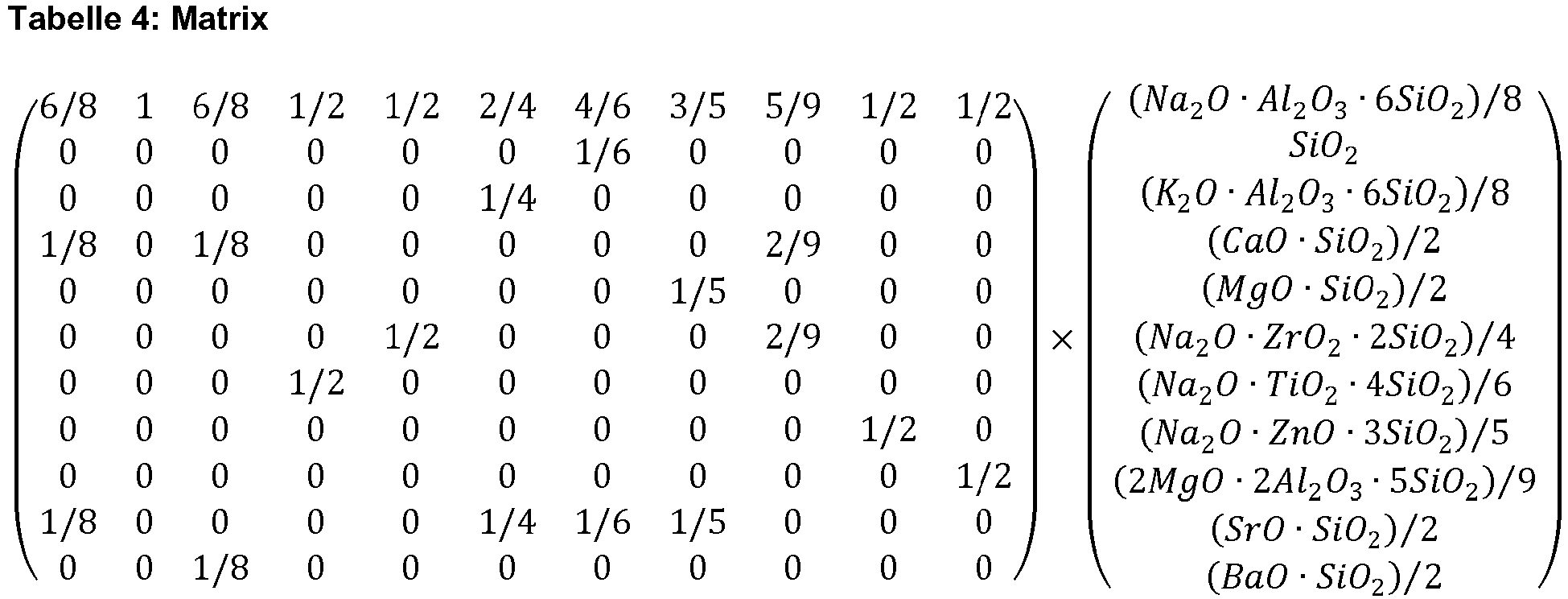
- Als Ergebnis der Multiplikation des Spaltenvektors an die Matrix erhält man die Zusammensetzung des Glases in Molprozenten.
- Umgekehrt lässt sich eine Zusammensetzung in Molprozenten einfach über die jeweilige inverse Matrix in eine Grundglaszusammensetzung überführen. Dabei gelten natürlich nur solche Grundglaszusammensetzungen als erfindungsgemäß, die bei Umrechnung keine negativen Werte für die Grundgläser ergeben.
- Die Zusammensetzung ist im Hinblick auf die das Glas konstituierenden Phasen innerhalb der hierin beschriebenen Grenzen gewählt. Die das Glas konstituierenden Phasen liegen als solche im Glasprodukt selbstverständlich nicht kristallin, sondern amorph vor. Das heißt aber nicht, dass die konstituierenden Phasen im amorphen Zustand völlig andere Baugruppen als im kristallinen Zustand haben. Wie oben gesagt, ist die Topologie der Baugruppen vergleichbar, also z.B. die Koordination der beteiligten Kationen mit umgebenden Sauerstoffatomen oder der sich aus der Koordination und der Stärke der Bindung zwischen diesen Kationen und umgebenden Sauerstoffatomen ergebende interatomare Abstand. Daher lassen sich viele Eigenschaften des Glases der Erfindung gut anhand der konstituierenden Phasen beschreiben, insbesondere um die erfinderische Leistung und die mit der Erfindung überwundenen Probleme darzustellen (vgl. dazu Conradt R., loc. cit.). Dabei kann das Glas natürlich nicht nur unter Verwendung der entsprechenden Kristalle hergestellt werden, sondern auch unter Verwendung der üblichen Glasrohstoffe, solange nur die stöchiometrischen Verhältnisse die Ausbildung der entsprechenden Baugruppen der Grundgläser ermöglichen.
- Die Auswahl der Phasen erfolgt im Hinblick auf Eignung zum lonentransport oder einen förderlichen Einfluß auf den lonentransport sowie ihren Einfluss auf die hydrolytische Beständigkeit sowie die thermische Ausdehnung. Im folgenden werden Berechnungsverfahren angegeben, wie sich diese Größen aus einer vorgegebenen Zusammensetzung aus konstituierenden Phasen berechnen lassen. Diese Berechnungsverfahren sind maßgeblich sowohl bei der Auswahl der konstituierenden Phasen als auch bei eben jener Zusammensetzung eines erfindungsgemäßen Glases aus diesen konstituierenden Phasen.
- Sowohl die hydrolytische Beständigkeit nach ISO 719/720 als auch die Laugenbeständigkeit nach ISO 695 beinhalten im wesentlichen eine Resistenz des Glases gegen den Angriff von Hydroxylionen. Dabei ist im Falle der ISO 695 die Konzentration der Hydroxylionen in der Lauge dadurch festgelegt, daß eine Pufferlösung mit 0,5 mol/l Natriumhydroxid und 0,25 mol/l Natriumcarbonat verwendet wird. Im Falle der ISO 719/720 wird das Glas in Neutralwasser gegeben, dessen pH-Wert zunächst auf 5,5 eingestellt wird (Überprüfung durch Methylrotindikatorlösung), sich aber durch die Auflösung des Glases sehr rasch in den alkalischen Bereich bewegt. Es entsteht eine Pufferlösung aus den im Glas enthaltenen schwachen Säuren (bzw. Säureanhydriden), v.a. Kieselsäure, und starken Laugen (wie Natriumhydroxid), deren pH im Bereich 9 bis 10 liegt, siehe Susanne Fagerlund, Paul Ek, Mikko Hupa und Leena Hupa: On determining chemical durability of glasses, Glass Technol.: Eur. J. Glass Sci. Technol. A, December 2010, 51 (6), 235-240. Maßgeblich für den pH einer Pufferlösung sind die pKs-Werte der schwachen Säure(n). Durch den pH-Wert der entstehenden Pufferlösung, der sowohl vom Glastyp abhängt als auch mit dem Auflösungsfortschritt steigt, wird die Konzentration der Hydroxylionen festgelegt. Die durch diese Hydroxylionen erfolgende Auflösung erfolgt dann nach demselben Mechanismus wie bei der Laugenbeständigkeitsmessung.
- Um ein Glas sowohl laugen- als auch hydrolytisch resistent zu machen, muss damit erstens die Abtragrate beim Test nach ISO 695 auf einen niedrigen Wert festgelegt werden. Zweitens muss der pH-Wert begrenzt werden, der sich während eines Tests nach ISO 719/720 und der dabei erfolgenden Auflösung einer gewissen Glasmenge in der wässrigen Testlösung ergibt. Je höher dieser pH-Wert im Verlaufe des Testes steigt, desto größer ist die Gefahr eines positiven Rücckopplungseffektes: mit steigendem pH steigt die Abtragrate, mit steigender Menge Abtrag in der wässrigen Lösung steigt wiederum deren pH-Wert an usw.
- Chemisch beständige Gläser (hydrolytische Klasse HGB I gemäß ISO 719 bzw. hydrolytische Klasse HGA I gemäß ISO 720) erfahren während des Testes typischerweise einen Abtrag, der zu 100 µmol Glas in der wässrigen Lösung oder weniger führt, wobei der Abtrag im Allgemeinen umso weniger kongruent ist, je geringer er ist.
- Da sich ein Vergleich von Gläsern auf feste Verhältnisse beziehen muss, definieren wir jetzt als maßgeblichen pH denjenigen pH, der sich nach als kongruent angenommener Auflösung von 50 µmol Glas in Neutralwasser ergibt.
- Erfindungsgemäß bevorzugt sind Gläser, bei denen dieser pH weniger als 9,1 bzw. bevorzugt weniger als 9,05 bzw. besonders bevorzugt weniger als 9,0 beträgt.
- Die Abtragrate entsprechend ISO 695 beträgt erfindungsgemäß bevorzugt maximal 105 mg/(dm23h), bevorzugt maximal 100 mg/(dm23h), besonders bevorzugt maximal 95 mg/(dm23h), ganz besonders bevorzugt maximal 90 mg/(dm23h), am meisten bevorzugt maximal 85 mg/(dm23h). Gemeint ist die Abtragrate, die sich anhand der Formeln (2) und (3) für Gläser dieser Erfindung berechnen lässt.
- Schon der erste o.a. genannte Wert liegt um mehr als eine halbe Klassenbreite unterhalb der Grenze zwischen den Laugenklassen 2 und 3 gemäß der ISO 695. Dieser Abstand wird bewußt so groß gewählt, um auch bei eventuellen Toleranzen bei der Vorhersagegenauigkeit der Formeln (2) und (3) noch einen großen Sicherheitsabstand zur Klasse 3 zu haben.
- Der thermische Ausdehnungskoeffizient liegt erfindungsgemäß bevorzugt zwischen 4 und 8 ppm/K, bevorzugt zwischen 4,5 und 7ppm/K, besonders bevorzugt zwischen 4,8 und 6,5ppm/K. Gemeint ist der Wert CTE, der sich anhand der Formel (8) für Gläser dieser Erfindung berechnen lässt.
- Bezüglich der Abtragrate in Säure gemäß DIN12116 läßt sich sagen, daß diese bei den erfindungsgemäßen Gläsern einer wie unten definierten Kennzahl < 200 einer Säureklasse 3 und weniger entspricht und dass sie bei einer Kennzahl > 215 rasch ansteigt, mit z.T. um mehrere Zehnerpotenzen über der Grenze zwischen den Klassen 3 und 4 liegenden Abtragwerten. Dazwischen ist ein Übergangsbereich. Erfindungsgemäß bevorzugt sind Gläser mit einer Kennzahl < 200, bevorzugt < 199, besonders bevorzugt < 198, ganz besonders bevorzugt < 197, noch weiter bevorzugt < 196, am meisten bevorzugt < 195.
- Die Berechnung des pH-Wertes in wässriger Lösung geht von der Zusammensetzungsangabe in einfachen Oxiden aus. In der verdünnten Lösung der Glasbestandteile gehen die entsprechenden Kationen in die höchstoxidierten Hydroxide über, siehe die Tabelle 5. Die Abgabe eines H+ bzw. OH- dieser Hydroxide wird jeweils durch einen entsprechenden pKs- bzw. pKb-Wert beschrieben.
- Wir beziehen uns beim pH-Wert auf den Wert, der nach Auflösung von 50 µmol in einem Liter der wässrigen Lösung nach Abkühlung auf Raumtemperatur (25°C) vorliegt.
Tabelle 5 # Oxid bzw. Anhydrid Säure bzw. Hydroxid 1. SiO2 H4SiO4 H4SiO4→ H3SiO4 - + H+ pKs = 9,7 1) H3SiO4 - → H2SiO4 -2 + H+ pKs = 11,9 1) 2. ZrO2 Zr(OH)4 Zr(OH)4 + H2O → Zr(OH)5 - + H+ pKs = 5,99 2) Zr(OH)3 + + H2O → Zr(OH)4 + H+ pKs = 4,6 2) 3. Al2O3 Al(OH)3 Al(OH)3 + H2O → Al(OH)4 - + H+ pKs = 12,3 3) Al(OH)2 ++H2O→ Al(OH)3 + H+ pKs = 5,7 3) 4. ZnO Zn(OH)2 Zn+2+H2O→ ZnOH+ + H+ pKs = 9,05 4) ZnOH++H2O→ Zn(OH)2 + H+ pKs = 9,75 4) Zn(OH)2 +H2O→ Zn(OH)3 - + H+ pKs = 10,1 4) Zn(OH)3 - +H2O→ Zn(OH)4 - + H+ pKs = 10,05 4) 5. MgO Mg(OH)2 Mg(OH)2→ Mg(OH)+ + OH- pKb = -2 5) Mg(OH)+ → Mg++ + OH- pKb = 2,58 6) 6. CaO Ca(OH)2 Ca(OH)2→ Ca(OH)+ + OH- pKb = -2 5) Ca(OH)+ → Ca++ + OH- pKb = 1,3 7) 7. Na2O NaOH NaOH → Na+ + OH- pKb = -0,77 10) 8. K2O KOH KOH → K+ + OH- pKb = -2 11) 10. SrO Sr(OH)2 Sr(OH)2→ Sr(OH)+ + OH- pKb = -2 5) Sr(OH)+ → Sr++ + OH- pKb = 0,82 12) 11. BaO Ba(OH)2 Ba(OH)2→ Ba(OH)+ + OH- pKb = -2 5) Ba(OH)+ → Ba++ + OH- pKb = 0,64 13) 1) Pure Appl. Chem., 1969, Vol. 20, No. 2, pp. 133-236, Ziffer 176; Wert von der dort mit "G40" bezeichneten Quelle.
2) R.H. Byrne, Inorganic speciation of dissolved elements in seawater: the influence of pH on concentration ratios, Geochem. Trans. 3 (2) (2002) 11-16.
3) David W. Hendricks, Water Treatment Unit Processes: Physical and Chemical, CRC Taylor and Francis, Boca Raton, London, New York, 2006, S. 307; Werte von den dort mit "4", "5", "11", "12" bezeichneten Quellen.
4) Artur Krezel, Wolfgang Maret, The biological inorganic chemistry of zinc ions, Archives of Biochemistry and Biophysics (2016), S. 1-17
5) Wie bei Bariumhydroxid, siehe Pure Appl. Chem., 1969, Vol. 20, No. 2, pp. 133-236, Ziffer 12, gehen wir davon aus, dass die M(OH)2→ M(OH)+ + OH- für alle Erdalkali M in jedem Fall vollständig abläuft; wir setzen für diese erste Dissoziation als pKb-Wert den höchsten in dieser Tabelle auftretenden pKb-Wert, nämlich den von Kalilauge, an.
6) Pure Appl. Chem., 1969, Vol. 20, No. 2, pp. 133-236, Ziffer 115; Wert von der dort mit "S74" bezeichneten Quelle.
7) Pure Appl. Chem., 1969, Vol. 20, No. 2, pp. 133-236, Ziffer 18; Wert von der dort mit "D9" bezeichneten Quelle.
10) Pure Appl. Chem., 1969, Vol. 20, No. 2, pp. 133-236, Ziffer 178; Wert von der dort mit "G26" bezeichneten Quelle.
11) Pure Appl. Chem., 1969, Vol. 20, No. 2, pp. 133-236, Ziffer 164; Wert von der dort mit "K2" bezeichneten Quelle.
12) Pure Appl. Chem., 1969, Vol. 20, No. 2, pp. 133-236, Ziffer 180; Wert von der dort mit "G26" bezeichneten Quelle.
13) Pure Appl. Chem., 1969, Vol. 20, No. 2, pp. 133-236, Ziffer 12; Wert von der dort mit "D7" bezeichneten Quelle. - Der pH-Wert folgt bei gegebener Zusammensetzung durch Lösen des Gleichungssystems für die verschiedenen Konzentrationen [...] (für pKs und pKb sind die oben gelisteten Werte einzusetzen):
-
- 1. [H2SiO4 --] [H+] / [H3SiO4 -] = 10-pks,
- 2. [H3SiO4 -] [H+] / [H4SiO4] = 10-pks,
- 3. [H2SiO4 --] + [H3SiO4 -] + [H4SiO4] = 50 (µmol/l) ∗ cSiO2,
- 4. [Zr(OH)5 -] [H+] / [Zr(OH)4] = 10-pks,
- 5. [Zr(OH)4] [H+] / [Zr(OH)3 +] = 10-pks,
- 6. [Zr(OH)5 -] + [Zr(OH)4]+ [Zr(OH)3 +] = 50 (µmol/l) ∗ cZrO2,
- 7. [Al(OH)4 -] [H+] / [Al(OH)3] = 10-pks
- 8. [Al(OH)3] [H+] / [Al(OH)2 +] = 10-pks,
- 9. [Al(OH)4 -] + [Al(OH)3] + [Al(OH)2 +] = 50 (µmol/l) ∗ 2 ∗ cAl2O3,
- 10. [ZnOH+] [H+] / [Zn++] = 10-pks,
- 11. [Zn(OH)2] [H+] / [ZnOH+] = 10-pks,
- 12. [Zn(OH)3] [H+] / [Zn(OH)2] = 10-pks,
- 13. [Zn(OH)4 --] [H+] / [Zn(OH)3 -] = 10-pks,
- 14. [ZnOH+] + [Zn++] + [Zn(OH)2] + [Zn(OH)3 -] + [Zn(OH)4 --] = 50 (µmol/l) ∗ cZnO,
- 15. [MgOH+] [OH-] / [Mg(OH)2] = 10-pkb
- 16. [Mg++] [OH-] / [MgOH+] = 10-pkb,
- 17. [MgOH+] + [Mg(OH)2] + [Mg++] = 50 (µmol/l) ∗ cMgO,
- 18. [CaOH+] [OH-] / [Ca(OH)2] = 10-pkb
- 19. [Ca++][OH-] / [CaOH+] = 10-pkb,
- 20. [CaOH+] + [Ca(OH)2] + [Ca++] = 50 (µmol/l) ∗ cCaO,
- 21. [SrOH+] [OH-] / [Sr(OH)2] = 10-pkb
- 22. [Sr++][OH-] / [SrOH+] = 10-pkb,
- 23. [SrOH+] + [Sr(OH)2] + [Sr++] = 50 (µmol/l) ∗ cSrO,
- 24. [BaOH+] [OH-] / [Ba(OH)2] = 10-pkb
- 25. [Ba++][OH-] / [BaOH+] = 10-pkb,
- 26. [BaOH+] + [Ba(OH)2] + [Ba++] = 50 (µmol/l) ∗ cBaO,
- 27. [Na+][OH-] / [NaOH] = 10-pkb,
- 28. [Na+] + [NaOH] = 50 (µmol/l) ∗ 2 ∗ CNa2O,
- 29. [K+][OH-] / [KOH] = 10-pkb,
- 30. [K+] + [KOH] = 50 (µmol/l) ∗ 2 ∗ cK2O,
- 31. [OH-] [H+] = 10-14,
- 32. 2∗[H2SiO4 --] + [H3SiO4 -]+ [Zr(OH)5 -] + [Al(OH)4 -] + 2∗[Zn(OH)4 --] + [Zn(OH)3 -] + [OH-] = [Zr(OH)3 +] + [Al(OH)2 +] + 2∗[Zn++] + [ZnOH+] + 2∗[Ba++] + [BaOH+] + 2∗[Sr++] + [SrOH+] + 2∗[Ca++] + [CaOH+] + 2∗[Mg++] + [MgOH+] + [Na+] + [K+] + [H+]
- Die Gleichungen 1 - 31 sind Gleichgewichtsbedingungen, und Gleichung 32 ist die Elektroneutralitätsbedingung.
- Das Gleichungssystem ist mit einem der gängigen mathematischen Codes wie z.B. MATHEMATICA von Wolfram Research Inc. eindeutig lösbar. MATHEMATICA liefert eine Liste von Lösungen, von denen jedoch nur eine die notwendige Zusatzbedingung erfüllt, dass alle Konzentrationen positive Werte haben müssen.
- Der pH-Wert folgt definitionsgemäß als negativer dekadischer Logarithmus von [H+]. Wir nehmen noch zur Kenntnis, daß bei Raumtemperatur pks + pkb = 14 gilt.
- Der Erfindung liegt an dieser Stelle ein überraschenderweise gefundener Zusammenhang zwischen einer mit Hilfe von topologischen Betrachtungen konstruierten Größe und der beim Test nach der ISO 695 gemessenen Abtragrate zugrunde.
- Wesen topologischer Betrachtungen ist, wie beispielsweise in
DE 10 2014 119 594 A1 ausführlich dargelegt, die den Atomen durch die Bindung zu den Nachbaratomen auferlegten Zwangsbedingungen abzuzählen. Diese Zwangsbedingungen betreffen zum einen Teil den interatomaren Abstand ("Abstandsbedingungen"), zum anderen die Bindungswinkel ("Winkelbedingungen"). Hat ein Atom r Nachbarn (r = Koordinationszahl), so folgen aus den r Abstandsbedingungen zu diesen Nachbarn r/2 diesem Atom zuzuordnende Abstandsbedingungen, wenn man die Abstandsbedingungen gleich unter beiden Bindungspartnern verteilt. Aus den Bindungswinkeln zwischen diesen Nachbarn, mit dem betrachteten Atom an der Spitze des jeweiligen Winkels, folgen weitere 2r-3 Winkelbedingungen, die diesem Atom zuzuordnen sind. - In
DE 10 2014 119 594 A1 ist ein Verfahren beschrieben, das bei der Berechnung der Abstands- und Winkelbedingungen eine Wichtung aller Bedingungen mit der Einzelbindungsstärke und noch einmal eine zusätzliche Wichtung der Winkelbedingungen (nur die von den Sauerstoff-Kation-Sauerstoff-Winkeln herrührenden; die zu den Kation-Sauerstoff-Kation-Winkeln gehörenden Bedingungen werden vernachlässigt) mit dem Kovalenzgrad der jeweiligen Bindung vorsieht. Dabei sind die Wichtungsfaktoren normiert, indem jeweils durch die Einzelbindungsstärke bzw. den Kovalenzgrad der Silicium-Sauerstoffbindung geteilt wird, so dass sich für Quarzglas eine Zahl von (gerundet) 1,333333333 (d.h. 4/3) Abstandsbedingungen und (gerundet) 1,666666667 (d.h. 5/3) Winkelbedingungen pro Atom ergibt. Das entspricht, wie inDE 10 2014 119 594 A1 dargelegt, der direkten Analyse der Topologie von Quarzglas, wenn man alle Abstands- und Winkelbedingungen einfach zählt und die Winkelbedingungen der Silicium-Sauerstoff-Silicium-Winkel vernachlässigt. - Damit hat Quarzglas eine Zahl von "3" Zwangsbedingungen pro Atom, was genau der Zahl der Freiheitsgrade pro Atom entspricht. Quarzglas sollte also keine (oder realiter: eine sehr geringe) Zahl von Freiheitsgraden pro Atom haben, was dem geringen cp-Sprung von Quarzglas beim differenzkalorimetrisch gemessenen Glasübergang entspricht, siehe R. Brüning, "On the glass transition in vitreous silica by differential thermal analysis measurements", Journal of Non-Crystalline Solids 330 (2003) 13-22.
- Für andere oxidische Gläser ergeben sich im Allgemeinen niedrigere Werte für die Zahlen der Abstands- und Winkelbedingungen pro Atom als (gerundet) 1,333333333 (4/3) bzw. 1,666666667 (5/3). Die Differenzen sind entsprechend die Anzahlen der Abstands- bzw. Winkelfreiheitsgrade pro Atom. Bei den Winkelfreiheitsgraden kann man noch unterscheiden, ob die zugehörigen Winkelbedingungen sich auf Winkel beziehen, die alle in einer Ebene liegen (trigonale Koordination) oder nicht (tetraedrische oder höhere Koordination). Letztere werden hier als 3D-Winkel-bedingungen bezeichnet; die Differenz zu (gerundet) 1,666666667 (4/3) entsprechend als 3D-Winkelfreiheitsgrade.
- Überraschenderweise findet man einen Zusammenhang zwischen der Zahl der 3D-Winkelfreiheitsgrade pro Atom und der Abtragrate r beim ISO 695 Test, mit dem man die Lage eines Glases bezüglich der Laugenbeständigkeitsklassen einschätzen kann. Dieser speziell für die Anwendbarkeit auch auf hoch alkalihaltige Gläser optimierte und an einer Vielzahl von Gläsern ausgetestete Zusammenhang ist gegeben durch:

- Der Faktor N/NSiO
2 dient der Umrechnung von einer Atomgruppe, an der die obige Wahrscheinlichkeitsüberlegung gemacht worden ist, auf ein Mol. N ist die Zahl der Atome pro Mol. NSiO2 ist die Zahl der Atome pro Mol Quarzglas (nämlich 3NA, NA Avogadrozahl) und dient der Normierung dieses Ausdruckes. Man kann diesen Faktor ohne großen Fehler gleich einer Konstanten setzen und diese Konstante in den Vorfaktor "c" hineinziehen, wenn man sich nur innerhalb einer eng umschriebenen Glasfamilie bewegt. Der Faktor M/MSiO2 dient der Umrechnung der obigen atomaren Betrachtung auf eine Massenbetrachtung. M ist die Masse eines Mols. MSiO2 ist die Masse eines Mols Quarzglas (nämlich 60,08g) und dient der Normierung dieses Ausdruckes. Man kann auch diesen Faktor ohne großen Fehler gleich einer Konstanten setzen und diese Konstante in den Vorfaktor "c" hineinziehen, wenn man sich nur innerhalb einer eng umschriebenen Glasfamilie bewegt. - Der Zusammenhang zwischen Abtragrate und Zahl der 3D-Winkelfreiheitsgrade ist, wie gesagt, empirisch gefunden worden, erscheint aber im Hinblick darauf, daß die Kinetik des Eindringens von OH--Ionen in das Glas von der Entropie des Glases abhängt, plausibel. Der Faktor (0,9483333-A) wird nicht mit der Kinetik des Prozesses in Verbindung gebracht, sondern mit der Triebkraft der im Rahmen der Auflösung des Glases in der Lauge stattfindenden Säure-Base-Reaktion.
- Da die erfindungsgemäßen Gläser eine Kombination der oben angegebenen konstituierenden Phasen aufweisen, ist es für die Berechnung der Zahl der 3D-Winkelfreiheitsgrade pro Atom zweckmäßig, diese zunächst für jede konstituierende Phase numerisch anzugeben. Es gilt:
Tabelle 6 Konstituierende Phase Stöchiometrie Molmasse/ g Zahl der Atome pro Baueinheit Zahl der 3D-Winkelfreiheitsgrade pro Atom Albit (Na2O·Al2O3·6SiO2)/8 65,5558 3,2500 0,318898019 Siliziumdioxid SiO2 60,08 3,0000 0 Orthoklas (K2O·Al2O3·6SiO2)/8 69,5829 3,2500 0,322595955 Wollastonit (CaO·SiO2)/2 58,08 2,5000 0,573505131 Enstatit (MgO·SiO2)/2 50,19 2,5000 0,541903867 Parakeldyshit (Na2O·ZrO2·2SiO2)/4 76,3416 3,0000 0,5871628 Narsarsukit (Na2O·TiO2·4SiO2)/6 63,7025 3,0000 0,379385407 Dinatriumzinksilicat (Na2O·ZnO·3SiO2)/5 64,7222 2,8000 0,52778666 Cordierit (2MgO·2Al2O3·5SiO2)/9 64,9948 3,2222 0,427525472 Strontiumsilicat (SrO·SiO2)/2 81,437 2,5000 0,599379939 Bariumsilicat (BaO·SiO2)/2 106,7065 2,5000 0,60607952 - Die Zahlenwerte sind nach dem in
DE 10 2014 119 594 A1 angegebenen Verfahren berechnet worden, wobei hier die Zahl der Winkelfreiheitsgrade für alle Kationen berechnet worden ist und zwar so wie inDE 10 2014 119 594 A1 (aber dort nur für Bor und Aluminium); außerdem ist der lonisationsgrad einer Kation-Sauerstoff-Verbindung nicht nach der Formel (8) aus derDE 10 2014 119 594 A1 , sondern nach der Formel (3) aus Alberto Garcia, Marvon Cohen, First Principles lonicity Scales, Phys. Rev. B 1993 berechnet worden. Dazu benötigt man noch eine Information über die Koordinationszahl des jeweiligen Kations, für die man nach Conradt, loc.cit., die Koordinationszahl in der jeweiligen konstituierenden Phase heranzieht (wenn ein Kation in mehreren Koordinationszahlen vorkommt, wird entsprechend den Anteilen in den verschiedenen Koordinationszahlen gemittelt). Die genannten Koordinationszahlen entnimmt man der Literatur, für Albit: American Mineralogist, Volume 61, pages 1213-1225, 1976, American Mineralogist, Volume 62, pages 921-931, 1977, American Mineralogist , Volume 64, pages 409-423 , I979, American Mineralogist, Volume 81, pages 1344-1349, 1996, im Hinblick auf welche Quellen Si und Al als 4-fach und Na als 5-fach koordiniert angenommen werden; für SiO2 wird die 4-fache Kordination von Silizium als allgemein bekannt angenommen; für Orthoklas: Canadian Mineralogist, Volume 17 pages 515-525, 1979, im Hinblick auf welche Quelle Aluminium als 4-fach koordiniert, Kalium als 9-fach koordiniert und Silizium als 4-fach koordiniert angenommen werden; für Wollastonit: Mineralogical Society of America, Special Paper 1, pages 293 - 302, 1963, im Hinblick auf welche Quelle Silizium als 4-fach und Kalzium als 6-fach koordiniert angenommen werden; für Enstatit: Canadian Mineralogist Vol. 37, pp 199-206, 1999, im Hinblick auf welche Quelle Silizium als 4-fach und Magnesium als 6-fach koordiniert angenommen werden; für Parakeldyshit: Acta Chemica Scandinavia, 1997, 51, 259-263, im Hinblick auf welche Quelle Silizium als 4-fach, Zirkon als 6-fach und Natrium als 8-fach koordiniert angenommen werden; für Narsarsukit: American Mineralogist 47 (1962), 539, im Hinblick auf welche Quelle Silizium als 4-fach, Titan als 6-fach und Natrium als 7-fach koordiniert angenommen werden; Dinatriumzinksilicat: Acta Cryst. (1977), B33, 1333-1337, im Hinblick auf welche Quelle Silizium und Zink als 4-fach und Natrium als 7-fach koordiniert angenommen werden; für Cordierit: American Mineralogist, Volume 77, pages 407-411, 1992, im Hinblick auf welche Quelle Silizium und Aluminium als 4-fach und Magnesium als 6-fach koordiniert angenommen werden; für Strontiumsilicat: Acta Cryst. C53, pages 534-536, 1997, im Hinblick auf welche Quelle Silizium als 4-fach und Strontium als 8-fach koordiniert angenommen werden; für Bariumsilicat: Wolfram Hempel: Struktureigenschaftsbeziehungen in Erdalkalisilikat basierenden Leuchtstoffen, Dissertation, Physik, Universität Augsburg, 2007, im Hinblick auf welche Quelle Silizium als 4-fach und Barium als 8-fach koordiniert angenommen werden. - Die Rechenvorschrift zur Bestimmung der 3D-Winkelfreiheitsgrade f pro Atom am fertigen Glas lautet damit:

- Die Rechenvorschrift zur Bestimmung von M/MSiO2 lautet:

- Die Rechenvorschrift zur Bestimmung von N/NSiO2 lautet:

- Der Faktor (0,9483333-Λ) wird durch folgende Überlegung mit der Triebkraft der Auflösung in Verbindung gebracht. Diese Triebkraft ist umso höher, je "saurer" das Glas ist, d.h. je höher der Anteil von Säureanhydriden und je geringer der Anteil von Baseanhydriden ist. Ein quantitatives Maß hierfür ist die optische Basizität, siehe C.P. Rodriguez, J.S. McCloy, M.J. Schweiger, J.V. Crum, A, Winschell, Optical Basicity and Nepheline Crystallization in High Alumina Glasses, Pacific Northwest National Laboratories, PNNL 20184, EMSP-RPT 003, prepared for the US Department of Energy under contract DE-AC05-76RL01830. Je niedriger die optische Basizität ist, desto höher ist die Triebkraft. Der Fall "Triebkraft gleich Null" liegt vor, wenn es sich um ein Material handelt, in dem die Säure-Base-Reaktion vollständig durchgelaufen ist. Den letztgenannten Fall nehmen wir insbesondere an, wenn das Glas die Stöchiometrie von Natriummetasilikat hat, also unter allen als Feststoff vorkommenden Natriumsilikaten demjenigen, das den höchsten Natriumanteil hat. (Natriumorthosilikat kommt nur in wäßriger Lösung vor.) Dessen optische Basizität ist nach der im folgenden beschriebenen Methode zur Berechnung derselben gerade 0,9483333, also der Wert, bei dem per constructionem der o.a. Faktor (0,9483333-A) gleich Null wird.
- Wir berechnen die optische Basizität A nach Formel B.1 mit den Koeffizienten Λχav (optische Basizität nach Li und Xue) gemäß Abschnitt B.1.6 und Tabelle B.1 aus C.P. Rodriguez, J.S. McCloy, M.J. Schweiger, J.V. Crum, A, Winschell, Optical Basicity and Nepheline Crystallization in High Alumina Glasses, Pacific Northwest National Laboratories, PNNL 20184, EMSP-RPT 003, prepared for the US Department of Energy under contract DE-AC05-76RL01830. Wo in der Tabelle für ein einfaches Oxid nur ein Koeffizient angegeben wird, wird dieser verwendet. Wo in der Tabelle für ein einfaches Oxid mehrere Koeffizienten angegeben werden, wird derjenige verwendet, der zu den Koordinationszahlen des jeweiligen Kations in den konstituierenden Phasen paßt. Für das oben beschriebene Grundsystem ist das nur bei Aluminiumoxid und Magnesiumoxid notwendig. Da Aluminium in allen konstituierenden Phasen des Grundsystems 4-fach koordiniert vorliegt und wir das entsprechend Conradt, loc. cit., auch annehmen, wird der in Tabelle B.1 bei Aluminiumoxid für die Koordinationszahl 4 angegebene Wert für den Koeffizienten ΛICP verwendet. Da Magnesium in der einzigen Magnesium enthaltenden konstituierenden Phase des Grundsystems 6-fach koordiniert vorliegt, wird der in Tabelle B.1 bei Magnesiumoxid für die Koordinationszahl 6 angegebene Wert für den Koeffizienten Λχav verwendet.
- Überraschenderweise lässt sich auch die Säurebeständigkeit mit Hilfe einer einfach zu berechnenden Kennzahl abschätzen. Ausgangspunkt der dahinterstehenden Überlegungen ist die Theorie von Anderson und Stuart über die lonenbeweglichkeit in silicatischen Gläsern, siehe O.L. Anderson, D.A. Stuart, Calculation of Activation Energy of lonic Conductivity in Silica Glasses by Classical Methods, Journal of the American Ceramic Society, Vol. 37, No. 12 (1954), 573 - 580. Danach hängt die Aktivierungsenergie der Bewegung eines Kations in einem silicatischen und damit oxidischen Glas zum einen von der zu überwindenden elektrostatischen Wechselwirkung mit den umgebenden Sauerstoffionen und zum anderen von dem zu überwindenden mechanischen Widerstand beim Wechsel von einer Masche des silicatischen Netzwerks in die nächste ab. Der erstgenannte Beitrag ist nach dem Coulombschen Gesetz proportional zur Ladungszahl des betrachteten Kations und umgekehrt proportional zur Dielektrizitätskonstanten, der zweitgenannte Beitrag ist proportional zum Schermodul und zum Quadrat des Maßes, um das der Durchmesser des betrachteten Kations die Maschenweite des Netzwerkes überschreitet. Wegen des erstgenannten Beitrages sind i.a. nur einfach geladene Kationen beweglich und mehrfach geladene Kationen wie Aluminium ortsfest.
- Im Kontakt zu einer hochkonzentrierten Säure, nach ISO 1776 bzw. DIN 12116 ist das 6N Salzsäure, ist das anders. In diesem Fall diffundieren Protonen bzw. Hydroniumionen in das Glas ein und bilden an der Oberfläche mit den im Säurebad zurückgebliebenden Choridionen eine elektrische Doppelschicht. Bei der Analyse des Eluates von nach ISO 1776 vorgenommenen Messungen hat sich gezeigt, daß diese elektrische Doppelschicht sich so weit ausbildet, daß das daher rührende elektrische Feld in der Lage ist, die elektrostatische Wechselwirkung des jeweiligen Kations mit den umgebenden Sauerstoffionen zu kompensieren, so daß auch Ionen hoher Ladungszahl beweglich werden. (Die Kraftwirkung des elektrischen Feldes der genannten Doppelschicht hängt genauso wie die elektrostatische Wechselwirkung des betrachteten Kations von dessen Ladungszahl ab; erstere kann von daher in der Lage sein, letztere zu kompensieren.)
- Das kann so weit führen, daß unter gleichen Versuchsbedingungen (denen der ISO 1776) erheblich mehr Aluminiumionen ein alkalifreies Displayglas verlassen als Natriumionen ein Kalk-Natron-Glas. Auf der anderen Seite verlassen wiederum unter gleichen Versuchsbedingungen weniger Boratome ein Borosilicatglas als Aluminiumatome ein Aluminosilicatglas. Man kann das verstehen, wenn man die entsprechend der anderen Elektronegativitätswerte deutlich geringere Neigung von Bor oder auch Silizium berücksichtigt, mit Salzsäure zu reagieren, als das bei Aluminium oder Natrium der Fall ist. Die Reaktion Natriumoxid mit Salzsäure ist die einer starken Base bzw. eines starken Baseanhydrids mit einer starken Säure, Aluminium steht als Amphoter in der Mitte und bei Boroxid bzw. Siliziumoxid handelt es sich um die Anhydride schwacher Säuren.
- Man kann die Neigung eines Kations, den Glasverbund zu verlassen, am lonisationsgrad der entsprechenden Kation-Sauerstoff-Verbindung festmachen, die man nach der Formel (3) aus Alberto Garcia, Marvon Cohen, First Principles lonicity Scales, Phys. Rev. B 1993 berechnet.
- Dazu benötigt man noch eine Information über die Koordinationszahl des jeweiligen Kations, für die man nach Conradt, loc.cit., die Koordinationszahl in der jeweiligen konstituierenden Phase heranzieht (wenn ein Kation in mehreren Koordinationszahlen vorkommt, wird entsprechend den Anteilen in den verschiedenen Koordinationszahlen gemittelt). Die genannten Koordinationszahlen entnimmt man der Literatur, für Albit: American Mineralogist, Volume 61, pages 1213-1225, 1976, American Mineralogist, Volume 62, pages 921-931, 1977, American Mineralogist , Volume 64, pages 409-423 , I979, American Mineralogist, Volume 81, pages 1344-1349, 1996, im Hinblick auf welche Quellen Si und Al als 4-fach und Na als 5-fach koordiniert angenommen werden; für SiO2 wird die 4-fache Kordination von Silizium als allgemein bekannt angenommen; für Orthoklas: Canadian Mineralogist, Volume 17 pages 515-525, 1979, im Hinblick auf welche Quelle Aluminium als 4-fach koordiniert, Kalium als 9-fach koordiniert und Silizium als 4-fach koordiniert angenommen werden; für Wollastonit: Mineralogical Society of America, Special Paper 1, pages 293 - 302, 1963, im Hinblick auf welche Quelle Silizium als 4-fach und Kalzium als 6-fach koordiniert angenommen werden; für Enstatit: Canadian Mineralogist Vol. 37, pp 199-206, 1999, im Hinblick auf welche Quelle Silizium als 4-fach und Magnesium als 6-fach koordiniert angenommen werden; für Parakeldyshit: Acta Chemica Scandinavia, 1997, 51, 259-263, im Hinblick auf welche Quelle Silizium als 4-fach, Zirkon als 6-fach und Natrium als 8-fach koordiniert angenommen werden; für Narsarsukit: American Mineralogist 47 (1962), 539, im Hinblick auf welche Quelle Silizium als 4-fach, Titan als 6-fach und Natrium als 7-fach koordiniert angenommen werden; Dinatriumzinksilicat: Acta Cryst. (1977), B33, 1333-1337, im Hinblick auf welche Quelle Silizium und Zink als 4-fach und Natrium als 7-fach koordiniert angenommen werden; für Cordierit: American Mineralogist, Volume 77, pages 407-411, 1992, im Hinblick auf welche Quelle Silizium und Aluminium als 4-fach und Magnesium als 6-fach koordiniert angenommen werden; für Strontiumsilicat: Acta Cryst. C53, pages 534-536, 1997, im Hinblick auf welche Quelle Silizium als 4-fach und Strontium als 8-fach koordiniert angenommen werden; für Bariumsilicat: Wolfram Hempel: Struktureigenschaftsbeziehungen in Erdalkalisilikat basierenden Leuchtstoffen, Dissertation, Physik, Universität Augsburg, 2007, im Hinblick auf welche Quelle Silizium als 4-fach und Barium als 8-fach koordiniert angenommen werden.
- Multipliziert man den lonisationsgrad der Verbindung (lonisationsgrad nach Pauling, nach der Formel (3) aus Alberto Garcia, Marvon Cohen, First Principles lonicity Scales, Phys. Rev. B 1993 berechnet, s.o.) mit der Valenzzahl oder Wertigkeit des Kations, kommt man zu einer Kennzahl, die die dadurch, daß das Kation das Netzwerk verläßt, bewirkte Netzwerk-Zerstörung beschreibt. Die Wertigkeit des Kations gibt die Zahl der Hydroniumionen an, die aus Elektroneutralitätsgründen das Kation ersetzen müssen. Jedes Hydroniumion zerstört anderthalb Sauerstoffbrücken im Glas, was dann zu der beobachteten Gelbildung bei saurem Angriff führt, siehe z.B. T. Geisler, A. Janssen, D. Scheiter, T. Stephan, J. Berndt, A. Putnis, Aqueous corrosion of borosilicate glass under acidic conditions: A new corrosion mechanism, Journal of Non-Crystalline Solids 356 (2010) 1458-1465.
- Multiplikation der jeweiligen Kennzahl mit der Zahl der Mole des betrachteten Kations in einem Mol Glas und Summation über alle Kationen führt zu einer Kennzahl des Maßes an Netzwerk-zerstörung, den ein saurer Angriff auf das Glas initial bewirkt. Insbesondere ermittelt man so Kennzahlen für die Gläser, die man aus jeweils einer konstituierenden Phase herstellt. Liegt die Zerlegung des Glases in konstituierende Phasen vor, so wird der in Molprozenten angegebene Anteil der jeweiligen konstituierenden Phase mit der letztgenannten Kennzahl Phase multipliziert, und es wird anschließend über alle konstituierenden Phasen summiert)
- Bemerkenswerterweise findet sich, wie bereits oben dargelegt, ein klarer Zusammenhang zu den Säureklassen nach DIN 12116; im Kennzahlenbereich 190-210 steigt die Säureklasse rasch von 1 auf 4 an. Demzufolge ist eine möglichst kleine Kennzahl erstrebenswert.
- Für die konstituierenden Phasen des erfindungsgemäßen Grundglassystems sind die Kennzahlen ki nachfolgend tabelliert, so daß die Kennzahl eines erfindungsgemäßen Glases nach der folgenden Formel berechnet werden kann:

- Dabei ist n die Zahl der konstituierenden Phasen, ci der jeweilige molare Anteil (Molprozent/100).
Tabelle 7 Albit (Na2O·Al2O3·6SiO2)/8 208,797171 Siliziumdioxid SiO2 178,9111743 Orthoklas (K2O·Al2O3·6SiO2)/8 209,3328332 Wollastonit (CaO·SiO2)/2 181,9311358 Enstatit (MgO·SiO2)/2 178,7332098 Parakeldyshit (Na2O·ZrO2·2SiO2)/4 220,9573858 Narsarsukit (Na2O·TiO2·4SiO2)/6 200,2637459 Dinatriumzinksilicat (Na2O·ZnO·3SiO2)/5 176,7133128 Cordierit (2MgO·2Al2O3·5SiO2)/9 229,1163552 Strontiumsilicat (SrO·SiO2)/2 184,1495204 Bariumsilicat (BaO·SiO2)/2 184,535871 - Überraschenderweise lässt sich auch die Lage des thermischen Ausdehnungskoeffizienten im angestrebten Bereich mit Hilfe einer sehr einfachen Rechenvorschrift darstellen. Diese ergibt sich über die mittlere Bindungsstärke.
- Aus der Literatur ist bekannt, dass der thermische Ausdehnungskoeffizient z.B. für Metalle umgekehrt proportional zur Bindungsenergie (oder zur "Tiefe der interatomaren Potentialtöpfe") ist, siehe z.B. H. Föll, Skript zur Vorlesung "Einführung in die Materialwissenschaft I", Christian Albrechts-Universität Kiel, S. 79 - 83.
- In einem einfachen Bild oxidischer Gläser setzt man die Kationen in jeweils einen von den umgebenden Sauerstoffatomen gebildeten Potentialtopf und nimmt als dessen Tiefe die Summe der Bindungsstärken der verschiedenen Einfachbindungen zu den umgebenden Sauerstoffatomen an, konzentriert also die gesamte Wechselwirkungsenergie in Potentialtöpfe mit den Kationen im Zentrum und den Sauerstoffatomen in der Peripherie. Damit muss der umgekehrte Fall nicht mehr betrachtet werden; er wäre auch schwerer zu analysieren, da sich ein Sauerstoffatom zwischen mehreren verschiedenartigen Kationen befindet kann, was umgekehrt in rein oxidischen Gläsern nicht vorkommen kann. Diese Werte sind tabelliert, z.B. in
DE 10 2014 119 594 A1 :Tabelle 8 Kation Potentialtopftiefe / (kJ/mol) Si 1864 Ti 1913 Zr 2204 Al 1537 Zn 728 Mg 999 Ca 1063 Sr 1005 Ba 976 Na 440,5 K 395 - Die Werte für Ti, Zr, Sr, Ba und Zn stammen nicht aus
DE 10 2014 119 594 A1 , sind aber nach genau derselben, dort beschriebenen Methode mit den dort zitierten Quellen berechnet worden. - Aus der Zusammensetzung eines Glases aus den oben angegebenen konstituierenden Phasen, den in den jeweiligen Phasen enthaltenen Anzahlen verschiedener Kationen und der oben tabellierten Potentialtopftiefen pro Kation lässt sich eine mittlere Potentialtopftiefe errechnen:

- Dabei ist m die Zahl der auftretenden Kationentypen, Epot,j die oben tabellierte Potentialtopftiefe für den j-ten Kationentyp und zj,i die Anzahl der Kationen des j-ten Typs in der i-ten konstituierenden Phase. Die Summen über j sind im Folgenden tabelliert:
Tabelle 9 konstituierende Phase Formel (auf ein einfaches Oxid normiert) 

Albit (Na2O·Al2O3·6SiO2)/8 1,25 1892,375 Siliziumdioxid SiO2 1 1864 Orthoklas (K2O·Al2O3·6SiO2)/8 1,25 1881 Wollastonit (CaO·SiO2)/2 1 1463,5 Enstatit (MgO·SiO2)/2 1 1431,5 Parakeldyshit (Na2O·ZrO2·2SiO2)/4 1,25 1703 Narsarsukit (Na2O·TiO2·4SiO2)/6 1,166666667 1708,33 Dinatriumzinksilicat (Na2O·ZnO·3SiO2)/5 1,2 1440,2 Cordierit (2MgO·2Al2O3·5SiO2)/9 1,222222222 1940,666667 Strontiumsilicat (SrO·SiO2)/2 1 1434,5 Bariumsilicat (BaO·SiO2)/2 1 1420 - Diese mittlere Bindungsstärke hängt, wie z.B. auch bei Metallen, siehe H. Föll, loc. cit., umgekehrt proportional mit dem thermischen Ausdehnungskoeffizienten zusammen. Die Auswertung einer Reihe einschlägiger Gläser führt zu folgender Formel:

- Da die Bindungsstärke umgekehrt proportional zum Schmelzpunkt ist, gilt eine umgekehrte Proportionalität auch zwischen Schmelzpunkt und Ausdehnungskoeffizient, siehe wiederum H. Föll, loc. cit. Da der Schmelzpunkt bei nicht-stöchiometrischen Gläsern nicht genau definiert ist, gilt zwischen der im Allgemeinen als Schmelzpunkt bezeichneten Temperatur, bei der die Viskosität 100 dPas beträgt, und dem Ausdehnungskoeffizienten nur ein tendenzieller Zusammenhang. Über diesen ist aber sichergestellt, dass die erfindungsgemäßen Gläser schmelzbar sind.
- Während die Forderung nach einer guten Schmelzbarkeit einen möglichst großen thermischen Ausdehnungskoeffizienten nahelegt, legt umgekehrt die Forderung nach möglichst geringen thermischen Spannungen bei einer eventuellen thermischen Nachprozessierung einen möglichst geringen thermischen Ausdehnungskoeffizienten nahe. Die Kombination beider Forderungen führt auf den hier bevorzugten mittleren Bereich für den Ausdehnungskoeffizienten bzw. die mittlere Potentialtopftiefe.
- Um eine optimale Austauschbarkeit zu gewährleisten, beträgt der Natriumoxidgehalt der erfindungsgemäßen Gläser bevorzugt 3 Mol% bis 12 Mol%. Gemeint ist der molare Anteil an diesem Oxid nach Umrechnung der Zusammensetzung in die entsprechende Oxidzusammensetzung.
- Des weiteren wird zur Sicherstellung einer hohen Austauschbarkeit wegen des Zusammenhanges zum thermischen Ausdehnungskoeffizienten ein hoher Wert desselben angestrebt, siehe Journal of Non-Crystalline Solids 455 (2017) 70-74. Wie aus den o.a. Darlegungen zum thermischen Ausdehnungskoeffizienten abzulesen ist, wird dieser insbesondere durch Zugabe von Alkali- oder Erdalkaliionen erhöht. Dies führt, wie wiederum den o.a. Darlegungen zur Alkalibeständigkeit abzulesen ist, wegen des Zusammenhangs mit der Triebkraft bei der Auflösung im alkalischen Medium auch zu einer hohen Alkaliresistenz. Allerdings führt dies auch zu einer Erhöhung des nach den o.a. Regeln bestimmten pH-Wertes, was wiederum die hydrolytische Beständigkeit senkt.
- Erfindungsgemäß bevorzugt sind daher Gläser, bei denen der Quotient aus dem mit 1000 multiplizierten thermischen Ausdehnungskoeffizienten (in ppm/K) einerseits und dem Produkt aus dem pH-Wert und der berechneten Abtragrate im alkalischen Milieu (in mg/(dm23h)) entsprechend ISO 695 andererseits mindestens 7,75, bevorzugt mindestens 8, bevorzugt mindestens 8,25, besonders bevorzugt mindestens 8,5, ganz besonders bevorzugt mindestens 8,75, noch weiter bevorzugt mindestens 9, am meisten bevorzugt mindestens 9,25 beträgt. Gemeint sind jeweils die berechneten Werte für den thermischen Ausdehnungskoeffizienten, den pH-Wert und die Abtragrate nach ISO 695.
- Ein in dem Glas dieser Erfindung als konstituierende Phase vertretenes Grundglas ist Albit-Glas. Vom idealen Albit (NaAlSi3O8) ist bekannt, dass er aufgrund seines Aufbaus aus einem Gerüst aus SiO4- und AlO4-Tetraedern mit im Gerüst beweglichen Natriumionen eine hohe Natrium-Diffusivität aufweist, siehe Geochimica et Cosmochimica Acta, 1963, Vol. 27, Seiten 107-120. Daher trägt ein Anteil an Albit-Glas zu einer hohen Natrium-Mobilität bei, die sich förderlich auf den Ionenaustausch und damit die chemische Vorspannbarkeit der Gläser auswirkt. Gegenüber dem eine noch höhere Natriumdiffusivität aufweisenden Nephelin (künstliche Variante ohne Kalium: NaAlSiO4) hat der Albit den Vorteil eines bedeutend niedrigeren Schmelzpunktes (1100-1120°C), was die Schmelzbarkeit des Glases verbessert.
- Eine zu geringe Menge an Albit beeinträchtigt die lonenaustauschbarkeit bzw. chemische Vorspannbarkeit im Hinblick auf den Austausch von Natrium gegen Kalium. Reines Albit-Glas hätte wohl eine optimale chemische Vorspannbarkeit, wäre allerdings im Hinblick auf die geforderte chemische Beständigkeit, speziell die Säurebeständigkeit, nicht zielführend. Unter einem Mol Albit wird erfindungsgemäß ein Mol (Na2O·Al2O3·6SiO2)/8 verstanden.
- Der Anteil an Albit in dem erfindungsgemäßen Glas ist wenigstens 20 Mol% und höchstens 60 Mol%. Bevorzugte Anteile in dem erfindungsgemäßen Glas sind mindestens 25 Mol%, mindestens 30 Mol%, mindestens 35 Mol% oder besonders bevorzugt mindestens 40 Mol%. Vorzugsweise beträgt der Gehalt an Albit maximal 56 Mol% oder bis zu 50 Mol%.
- Alle Komponenten nehmen als Hydroxide einen Einfluß auf den pH-Wert bei der Messung der hydrolytischen Beständigkeit. Aluminiumhydroxid ist zwar in neutraler wäßriger Lösung und schwachen Laugen schwer löslich; die Löslichkeitsgrenze liegt aber deutlich über den bei den Messungen der hydrolytischen Beständigkeit auftretenden Konzentrationen.
- Zur Unterdrückung einer möglichen Entmischungsneigung wird als zweite Phase das Kalium-Analogon des Albit beigegeben, der Orthoklas. Unter einem Mol Orthoklas wird ein Mol (K2O·Al2O3·6SiO2)/8 verstanden.
- Der Anteil an Orthoklas in dem erfindungsgemäßen Glas beträgt von 0 Mol% bis höchstens 20 Mol%. Bevorzugte Anteile in dem erfindungsgemäßen Glas sind höchstens 15 Mol%, höchstens 10 Mol% oder bevorzugt höchstens 5 Mol%. In bestimmten Ausführungsformen beträgt der Anteil an Orthoklas mindestens 1 Mol%, bevorzugt mindestens 2 Mol%. In anderen bevorzugten Ausführungsformen ist das Glas frei von Orthoklas. Insbesondere übersteigt der Gehalt an Orthoklas in einigen bevorzugten Ausführungsformen den Gehalt an Enstatit nicht.
- Alle Komponenten nehmen als Hydroxyde einen Einfluß auf den pH-Wert bei der Messung der hydrolytischen Beständigkeit.
- Als weitere Natrium-leitende Phase wird Parakeldyshit hinzugegeben. Als Kristall ist Parakeldyshit ein dreidimensionales Netzwerk aus Siliziumtetraedern und Zirkoniumoktaedern, mit 8-fach koordinierten Natriumatomen in den Hohlräumen dazwischen. Diese zeolitartige, lockere (sehr hohe Koordinationszahl für Natrium) Struktur unterstützt die lonenbeweglichkeit. Es gibt ein strukturell verwandtes Kalium-Analogon, den Khibinskit, so daß auch ein Austausch Natrium gegen Kalium möglich ist. Siehe G. Raabe, M.H. Mladeck, Parakeldyshit from Norway, Canadian Mineralogist Vol. 15, pp. tO2-IO7 (1977).
- Dies ist von Vorteil, um eine schnelle Bewegung der Ionen Natrium und Kalium beim Ionenaustausch zu ermöglichen. Der Spannungsaufbau beim Austausch Natrium gegen Kalium ist wegen des lockeren Netzwerkes eher gering; es ist aber für die oben genannten Anwendungen wichtiger, eine große Austauschtiefe als eine hohe Vorspannung zu erreichen (die Vorspannung erfüllt nur dann ihren Zweck, wenn die Austauschtiefe beim Ionenaustausch größer als die Tiefe möglicher Oberflächenbeschädigungen wie Kratzern ist).
- Das enthaltene Zirkonium hat eine Bedeutung für die Messung der hydrolytischen Beständigkeit. Zirkoniumhydroxid fällt zwar in wäßriger Lösung und schwachen Laugen aus, aber erst ab einer gewissen Konzentration, die bei hydrolytischen Beständigkeitsmessungen nicht erreicht wird. Wegen seiner pks-Werte hat es bei dieser einen pH-senkenden Einfluß.
- Unter einem Mol Parakeldyshit wird ein Mol (Na2O·ZrO2·2SiO2)/4 verstanden. Der Anteil an Parakeldyshit in dem erfindungsgemäßen Glas beträgt 0 bis 20 Mol%; die Obergrenze ist im Hinblick auf die mit Zirkonium verbundene Entglasungsproblematik gewählt. Bevorzugt beträgt der Anteil an Parakeldyshit im erfindungsgemäßen Glas höchstens 15 Mol%, höchstens 10 Mol% oder besonders bevorzugt höchstens 5 Mol%. In bestimmten Ausführungsformen beträgt der Anteil an Parakeldyshit mindestens 1 Mol%, bevorzugt mindestens 2 Mol%. In anderen bevorzugten Ausführungsformen ist das Glas frei von Parakeldyshit. Insbesondere übersteigt der Gehalt an Parakeldyshit in einigen bevorzugten Ausführungsformen den Gehalt an Enstatit nicht.
- Als Kristall ist Narsarsukit ein dreidimensionales Netzwerk aus Siliziumtetraedern und Titanoktaedern, mit 7-fach koordinierten Natriumatomen in den Hohlräumen dazwischen. Diese Struktur unterstützt die lonenbeweglichkeit. Siehe D.R.Peacor, M.J. Buerger, The Determination and Refinement of the Structure of Narsarsukite, Na2TiOSi4O10, American Mineralogist Vol. 67, 5-6 pp. 539 - 556 (1962). Es gibt ein Kalium-Analogon, siehe K. Abraham, O. W. Flörke, and K. Krumbholz, Hydrothermaldarstellung und Kristalldaten von K2TiSi3O9, K2TiSi4O11, K2TiSi6O15, K2ZrSi3O9 und K2O·4SiO2·H2O, Fortschr. Mineral 49 (1971), 5-7, so daß auch ein Austausch Natrium gegen Kalium möglich ist.
- Das enthaltene Titan fällt in wäßriger Lösung und Laugen als Titandioxid aus und nimmt keinen Einfluß auf die Messung der hydrolytischen Beständigkeit.
- Unter einem Mol Nasarsukit wird ein Mol (Na2O·TiO2·4SiO2)/6 verstanden. Der Gehalt an Nasarsukit in dem erfindungsgemäßen Glas beträgt 0 bis 20 Mol%. Bevorzugte Anteile in dem erfindungsgemäßen Glas sind höchstens 10 Mol%, höchstens 5 Mol%, höchstens 3 Mol%, höchstens 2 Mol% oder höchstens 1 Mol%. In bestimmten Ausführungsformen kann das Glas frei sein von Narsarsukit, insbesondere kann der Gehalt an Narsarsukit geringer sein als der Gehalt an Wollastonit und/oder Enstatit.
- Als Kristall ist Dinatriumzinksilicat ein dreidimensionales Netzwerk aus Silizium- und Zinktetraedern, mit mindestens 7-fach koordinierten Natriumatomen in den Hohlräumen dazwischen. Diese Struktur unterstützt die lonenbeweglichkeit. Siehe K.-F. Hesse, F. Liebau, H. Böhm, Disodiumzincosilicate, Na2ZnSi3O8, Acta. Cryst. B33 (1977), 1333-1337. Es gibt ein Kalium-Analogon, siehe W.A. Dollase, C.R. Ross II, Crystal Structure, of K2ZnSi3O8, Zeitschrift für Kristallographie 206 (1993), 25-32, so daß ein Austausch Natrium gegen Kalium ohne weiteres möglich ist, allerdings lassen die großen Hohlräume kein großes "Aufquellen" der Struktur bei Ionenaustausch erwarten, so daß der Anteil an Dinatriumzinksilikat begrenzt sein muß, wenn eine hohe Druckvorspannung an der Oberfläche angestrebt wird.
- Das enthaltene Zink nimmt als amphoteres Zinkhydoxid kaum keinen Einfluß auf den pH-Wert bei der Messung der hydrolytischen Beständigkeit. Es ist in neutraler wäßriger Lösung schwer löslich; die Löslichkeitsgrenze liegt aber deutlich über den bei den Messungen der hydrolytischen Beständigkeit auftretenden Konzentrationen.
- Unter einem Mol Dinatriumzinksilicat wird ein Mol (Na2O·ZnO·3SiO2)/5 verstanden. Der Gehalt an Dinatriumzinksilicat in dem erfindungsgemäßen Glas beträgt 0% bis 40%.
- Bevorzugte Anteile in dem erfindungsgemäßen Glas sind mindestens 0,1 Mol%, mindestens 1 Mol%, mindestens 2 Mol%, mindestens 5 Mol% oder besonders bevorzugt mindestens 10 Mol%. In bevorzugten Ausführungsformen beträgt der Gehalt maximal 19 Mol%, maximal 18 Mol%, maximal 17 Mol% oder maximal 15 Mol%.
- Cordierit ist zwar an und für sich alkalifrei, weist aber trotzdem wegen seiner Struktur und geringen Packungsdichte eine hohe Natriumbeweglichkeit auf, was von Degradationserscheinungen von Cordieritglaskeramiken her bekannt ist, siehe Ceramics International 22 (1996) 73-77.
- Gerade wegen der Alkalifreiheit trägt Cordierit - im Gegensatz zu den bisherigen Phasen - nicht zu einem großen Ausdehnungskoeffizienten bei, der wegen der damit verbundenen verminderten thermischen Belastbarkeit nicht erwünscht ist.
- Wegen dieser vorteilhaften Eigenschaften wird auch Cordierit in die konstituierenden Phasen aufgenommen, wobei unter einem Mol Cordierit ein Mol (2MgO·2Al2O3·5SiO2)/9 verstanden wird. Der Gehalt an Cordierit in dem erfindungsgemäßen Glas beträgt 0% bis 20%.
- Bevorzugte Anteile in dem erfindungsgemäßen Glas sind höchstens 15 Mol% oder bevorzugt höchstens 10 Mol%. In bestimmten Ausführungsformen beträgt der Anteil an Cordierit mindestens 1 Mol%, bevorzugt mindestens 2 Mol%. In anderen bevorzugten Ausführungsformen ist das Glas frei von Cordierit. Insbesondere übersteigt der Gehalt an Cordierit in einigen bevorzugten Ausführungsformen den Gehalt an Dinatriumzinksilicat nicht.
- Das im Cordierit enthaltene Aluminium hat zwar den Vorteil, sich fördernd auf die Natriumbeweglichkeit auszuwirken, gleichzeitig aber wiederum den Nachteil, die Säureempfindlichkeit zu erhöhen. Deshalb werden auch Phasen beigemischt, deren Beitrag den Ausdehnungskoeffizienten zu mittleren Werten verschiebt, die aber kein Aluminium enthalten. Dafür werden Erdalkalisilicate ausgewählt, nämlich Enstatit, wobei unter einem Mol Enstatit ein Mol (MgO·SiO2)/2 verstanden wird, Wollastonit, wobei unter einem Mol Wollastonit ein Mol (CaO·SiO2)/2 verstanden wird, Strontiumsilicat, wobei unter einem Mol Strontiumsilicat ein Mol (SrO·SiO2)/2 verstanden wird, und Bariumsilicat, wobei unter einem Mol Bariumsilicat ein Mol (BaO·SiO2)/2 verstanden wird.
- Die Anteile in dem erfindungsgemäßen Glas sind 0% bis 20% für Enstatit sowie 0% bis 10% für Strontiumsilicat, Bariumsilicat und Wollastonit.
- Bevorzugte Anteile an Enstatit sind 1 bis 15 Mol%, 2 bis 10 Mol% oder besonders bevorzugt 4 bis 8 Mol%. Bevorzugt ist der Anteil an Enstatit mindestens genauso hoch ist wie der Anteil an Wollastonit und/oder mindestens genauso hoch wie der Anteil an Parakeldyshit.
- Bevorzugte Anteile an Wollastonit sind höchstens 8 Mol%, höchstens 6 Mol%, höchstens 5 Mol% oder besonders bevorzugt höchstens 4 Mol%. In bestimmten Ausführungsformen beträgt der Anteil an Wollastonit mindestens 1 Mol%, bevorzugt mindestens 2 Mol%. In anderen Ausführungsformen ist das Glas frei von Wollastonit. Insbesondere übersteigt der Gehalt an Wollastonit in einigen bevorzugten Ausführungsformen den Gehalt an Enstatit nicht. Bevorzugt liegt die Summe der Anteile an Wollastonit und Cordierit in einem Bereich von 1 bis 20 Mol%, 2 bis 15 Mol% oder besonders bevorzugt 3 bis 12 Mol%. Bevorzugt liegt das Verhältnis des Anteils an Albit zur Summe der Anteile an Wollastonit und Cordierit in einem Bereich von 1 bis 30, 2 bis 20 oder besonders bevorzugt 3 bis 16.
- Bevorzugte Anteile an Strontiumsilicat sind höchstens 8 Mol%, höchstens 5 Mol% oder bevorzugt höchstens 2 Mol%. In bestimmten Ausführungsformen beträgt der Anteil an Strontiumsilicat mindestens 1 Mol%, bevorzugt mindestens 1,5 Mol%. In anderen Ausführungsformen ist das Glas frei von Strontiumsilicat. Insbesondere übersteigt der Gehalt an Strontiumsilicat in einigen bevorzugten Ausführungsformen den Gehalt an Wollastonit nicht.
- Bevorzugte Anteile an Bariumsilicat sind höchstens 5 Mol%, höchstens 2 Mol% oder besonders bevorzugt höchstens 1 Mol%. In bestimmten Ausführungsformen kann das Glas frei sein von Bariumsilicat, insbesondere kann der Gehalt an Bariumsilicat geringer sein als der Gehalt an Wollastonit und/oder Enstatit.
- Besonders bevorzugt ist das Glas frei von Narsarsukit und/oder Bariumsilicat.
- Reines Siliziumdioxid wird im Hinblick auf die Absenkung des Ausdehnungskoeffizienten und die vorteilhafte Wirkung bezüglich aller drei Spielarten der chemischen Beständigkeit beigegeben. Die Anteile in dem erfindungsgemäßen Glas sind 0% bis 40%.
- Bevorzugte Anteile an Siliziumdioxid sind 10 bis 35 Mol% oder besonders bevorzugt von 15 bis 30 Mol%.
- Bevorzugt beträgt die Summe der Anteile an Albit, Siliziumdioxid und Dinatriumzinksilicat mindestens 50 Mol%, mindestens 60 Mol% oder mindestens 70 Mol%.
- Bevorzugt liegt das Verhältnis des Anteils an Dinatriumzinksilicat zum Anteil an Siliziumdioxid in einem Bereich von 0,1 bis 2,0 oder von 0,2 bis 1,5 oder bevorzugt von 0,3 bis 1,0.
- Zusätzlich zu den bereits genannten Komponenten kann das Glas weitere Bestandteile enthalten, die hierin als "Rest" bezeichnet werden. Der Anteil des Restes an dem erfindungsgemäßen Glas beträgt vorzugsweise höchstens 3 Mol-%, um die durch sorgsame Auswahl geeigneter Grundgläser eingestellten Glaseigenschaften nicht zu stören. Insbesondere ist der Gehalt an einzelnen Oxiden, insbesondere Lithiumdioxid, vorzugsweise auf <1Mol% beschränkt. In besonders bevorzugten Ausführungsformen beträgt der Anteil an Rest in dem Glas höchstens 2 Mol-%, mehr bevorzugt höchstens 1 Mol-% oder höchstens 0,5 Mol%. Der Rest enthält insbesondere Oxide, die nicht in den hierin genannten Grundgläsern enthalten sind. Somit enthält der Rest insbesondere kein SiO2, Al2O3, ZrO2, TiO2, ZnO, MgO, CaO, SrO, BaO, Na2O oder K2O.
- Wenn es in dieser Beschreibung heißt, die Gläser seien frei von einer Komponente bzw. einer konstituierenden Phase oder enthalten eine gewisse Komponente bzw. konstituierende Phase nicht, so ist damit gemeint, dass diese Komponente bzw. konstituierende Phase allenfalls als Verunreinigung in den Gläsern vorliegen darf. Das bedeutet, dass sie nicht in wesentlichen Mengen zugesetzt wird. Nicht wesentliche Mengen sind erfindungsgemäß Mengen von weniger als 300 ppm (molar), bevorzugt weniger als 100 ppm (molar), besonders bevorzugt weniger als 50 ppm (molar) und am meisten bevorzugt weniger als 10 ppm (molar). Die Gläser dieser Erfindung sind insbesondere frei von Blei, Arsen, Antimon, Wismut und/oder Cadmium.
- In den Formeln kommt der Rest nicht vor. Bis auf die Formeln für den pH-Wert sind alle Formeln so gestaltet, als ob der aus den konstituierenden Phasen bestehende Anteil 100% ausmachen würde. In den Formeln für den pH-Wert wird der Rest vernachlässigt.
- Nach Umrechnung in die Oxidzusammensetzung beträgt der Anteil an B2O3 in den Gläsern der Erfindung bevorzugt weniger als 4 Mol%, weiter bevorzugt weniger als 3 Mol%, weiter bevorzugt weniger als 2 Mol%, weiter bevorzugt weniger als 1 Mol%, weiter bevorzugt weniger als 0,5 Mol%. Besonders bevorzugt sind die Gläser frei von B2O3.
- Nach Umrechnung in die Oxidzusammensetzung beträgt der Anteil an P2O5 in den Gläsern der Erfindung bevorzugt weniger als 4 Mol%, weiter bevorzugt weniger als 3 Mol%, weiter bevorzugt weniger als 2 Mol%, weiter bevorzugt weniger als 1 Mol%, weiter bevorzugt weniger als 0,5 Mol%. Besonders bevorzugt sind die Gläser frei von P2O5.
- Nach Umrechnung in die Oxidzusammensetzung beträgt das Verhältnis des molaren Anteils an Al2O3 zum molaren Anteil an K2O in den Gläsern der Erfindung bevorzugt mindestens 1, weiter bevorzugt mindestens 1,1.
- Nach Umrechnung in die Oxidzusammensetzung beträgt der Anteil an Li2O in den Gläsern der Erfindung bevorzugt höchstens 4 Mol%, weiter bevorzugt höchstens 3 Mol%, weiter bevorzugt höchstens 2 Mol%, weiter bevorzugt höchstens 1 Mol%, weiter bevorzugt höchstens 0,5 Mol%. Besonders bevorzugt sind die Gläser frei von Li2O.
- Nach Umrechnung in die Oxidzusammensetzung beträgt der Anteil an Fluor in den Gläsern der Erfindung bevorzugt höchstens 4 Mol%, weiter bevorzugt höchstens 3 Mol%, weiter bevorzugt höchstens 2 Mol%, weiter bevorzugt höchstens 1 Mol%, weiter bevorzugt höchstens 0,5 Mol%. Besonders bevorzugt sind die Gläser frei von Fluor.
- Die bevorzugten Ausführungsformen ergeben sich im Rahmen des o.a. Grundsystems aus der Vorgabe einer gewünschten thermischen Ausdehnung und einer gewünschten Natriumkonzentration.
- Die Lösung der erfindungsgemäßen Aufgabe besteht dann darin, unter Einhaltung der Vorgaben eine Kombination einer geringen Abtragrate im alkalischen Milieu (vgl. oben ISO 695), eines geringen pH-Wertes und einer hohen Säurebeständigkeit zu erreichen. Dies geschieht mit Hilfe der o.a. Formeln (1) - (6). Wenn in dieser Beschreibung auf die Kennzahl für die Säurebeständigkeit, die Abtragrate nach ISO 695, den CTE und/oder den pH-Wert Bezug genommen wird, so ist damit stets der berechnete Wert gemeint, falls nichts anderes angegeben ist.
- Eine bevorzugte Zusammensetzung ist durch folgende das Glas konstituierende Phasen gekennzeichnet:
Tabelle 10 konstituierende Phase Min (Mol%) Max (Mol%) Albit 30 60 Siliziumdioxid 10 30 Orthoklas 0 5 Wollastonit 0 5 Enstatit 1 10 Parakeldyshit 0 5 Narsarsukit 0 1 Dinatriumzinksilicat 5 20 Cordierit 0 10 Strontiumsilicat 0 5 - Erfindungsgemäß ist auch ein Verfahren zur Herstellung eines Glases dieser Erfindung, mit den Schritten:
- Schmelzen der Glasrohstoffe,
- optional Formen eines Glasartikels, insbesondere eines Glasrohres, aus der Glasschmelze
- Abkühlen des Glases.
- Das Formen des Glases kann ein Ziehverfahren umfassen, insbesondere ein Rohrzugverfahren oder ein Ziehverfahren für Flachglas. Das Abkühlen kann ein aktives Abkühlen unter Einsatz eines Kühlmittels, z.B. eines Kühlfluids, oder durch passives Abkühlen-lassen durchgeführt werden.
- Erfindungsgemäß sind neben dem Glas auch aus dem Glas geformte Glasartikel wie Glasrohre und Behälter (wie Flaschen, Ampullen, Karpulen, Spritzen) sowie die Verwendung des Glases für das chemische Vorspannen und die Verwendung für die Herstellung von Glasrohren und pharmazeutischen Behältnissen, insbesondere Primärpackmitteln. Bevorzugt sind die Glasartikel zur Verwendung als Packmittel für pharmazeutische Erzeugnisse, insbesondere als Behälter für Flüssigkeiten, bestimmt. In Rahmen dieser Verwendungen sind die hydrolytische und die Laugenbeständigkeit von besonderem Interesse.
- Die Vergleichsbeispiele 1-31 sind die dort als Glas A - EE bezeichneten Beispiele der
US 9,718,721 B2 US 9,718,721 B2 Tabelle 11 A B C D F H K L M N O P W AA BB CC # Oxid Mol% 1. SiO2 68,3 68,6 67,7 70,8 71,7 71,7 72,3 72,3 72,3 72,3 71,7 72,2 72,4 72,4 72,4 72,5 2. TiO2 0 0 0 0 0 0 0 0 0 0 0 0 0 0 0 0 3. ZrO2 1,5 1,5 1,5 1,5 0 0 0 0 0 0 0 0 0 0 0 0 4. Al2O3 9 9,3 10,2 7,1 7,4 7,4 7,1 7,1 7,1 7,4 7,4 7,4 7,4 7,4 7,4 7,6 5. ZnO 0 0 0 0 0 0 0 0 0 0 0 0 0 0 0 1,5 6. MgO 5,1 5,1 5,1 5,1 5,1 5,1 5,1 5,1 5,1 6,8 6,5 5,1 2,6 2,6 2,6 2,6 7. CaO 5,3 5,3 5,3 5,3 5,3 4,3 5,3 5,3 5,3 4,3 5,5 4,3 5,3 4,3 3,3 2,5 8. SrO 3,8 3,8 3,8 3,8 3,8 0,5 3,8 3,8 3,8 0,5 1 0,5 3,8 4,8 5,8 3,8 9. BaO 1,4 1,4 1,4 1,4 1,4 0,5 1,4 1,4 0 0,5 0 0 0 0 0 0 10. Na2O 2,5 2,5 2,5 2,5 2,5 10 2,5 4,5 5,9 7,7 7,4 10 8 8 8 9 11. K2O 2,5 2,5 2,5 2,5 2,5 0,5 2,5 0,5 0,5 0,5 0,5 0,5 0,5 0,5 0,5 0,5 12. Rest 0,6 (B2O3) 0 0 0 0,3 0 0 0 0 0 0 0 0 0 0 0 - Die Umrechnung in konstituierende Phasen ergibt, daß keine der Zusammensetzungen A-C, H, N - P, W, AA - CC zum erfindungsgemäßen Grundsystem gehört. Die Umrechnung in konstituierende Phasen ergibt weiter, daß die in
US 9,718,721 B2 Tabelle 12 D F K L M konstituierende Phase Mol% Albit 8,00 20,00 20,00 36,00 47,20 Siliziumdioxid 25,80 22,50 23,55 23,55 18,65 Orthoklas 20,00 20,00 20,00 4,00 4,00 Wollastonit 10,60 10,60 10,60 10,60 10,60 Enstatit 3,00 5,40 6,00 6,00 8,80 Parakeldyshit 6,00 0,00 0,00 0,00 0,00 Narsarsukit 0,00 0,00 0,00 0,00 0,00 Dinatriumzinksilicat 0,00 0,00 0,00 0,00 0,00 Cordierit 16,20 10,80 9,45 9,45 3,15 Strontiumsilicat 7,60 7,60 7,60 7,60 7,60 Bariumsilicat 2,80 2,80 2,80 2,80 0,00 - Die berechneten Eigenschaften sind:
Tabelle 13 Lfd. Nr. ISO 695: berechnete Abtragrate/mg/( dm23h) Kennzahl für Säurebeständigkeit: Berechneter CTE pH D 96,34 198,90 6,26 9,10 F 93,06 197,30 6,39 9,11 K 92,15 196,56 6,35 9,11 L 88,28 196,49 6,32 9,11 M 87,24 196,51 6,01 9,11 - Die Vergleichsbeispiele 32-55 sind die dort als Glas A - O, 1 - 9 bezeichneten Beispiele der
US 8,753,994 B2 .US 8,753,994 B2 lehrt Gläser mit guter chemischer und mechanischer Beständigkeit. Die Beispiele 7 - 9 enthalten ≥1 % B2O3 und sind nicht erfindungsgemäß. Die anderen Beispiele haben die Zusammensetzung:Tabelle 14 A B C D E F G H I 1 2 3 # Oxid Mol% 1. SiO2 70,8 72,8 74,8 76,8 76,8 77,4 76,965 76,852 76,962 76,919 76,96 77,156 2. TiO2 0 0 0 0 0 0 0 0 0 0 0 0 3. ZrO2 0 0 0 0 0 0 0 0 0 0 0 0 4. Al2O3 7,5 7 6,5 6 6 7 5,943 6,974 7,958 8,95 4,977 3,997 5. ZnO 0 0 0 0 0 0 0 0 0 0 0 0 6. MgO 6,3 5,8 5,3 4,8 4,8 4,8 4,842 4,878 4,802 4,836 4,852 4,757 7. CaO 0,5 0,5 0,5 0,5 0,5 0,5 0,474 0,478 0,481 0,48 0,468 0,462 8. SrO 0 0 0 0 0 0 0 0 0 0 0 0 9. BaO 0 0 0 0 0 0 0 0 0 0 0 0 10. Na2O 13,7 12,7 11,7 10,7 11,6 10 11,427 10,473 9,451 8,468 12,393 13,277 11. K2O 1 1 1 1 0,1 0,1 0,101 0,1 0,102 0,105 0,1 0,1 12. Rest 0,2 (SnO2) 0,2 0,2 0,2 0,2 0,2 0,248 0,245 0,244 0,242 0,25 0,251 Tabelle 15 J K L 4 5 6 M N O # Oxid Mol% 1. SiO2 76,99 77,1 77,1 77,1 76,97 77,12 76,86 76,778 76,396 2. TiO2 0 0 0 0 0 0 0 0 0 3. ZrO2 0 0 0 0 0 0 0 0 0 4. Al2O3 5,98 5,97 5,96 5,96 5,97 5,98 5,964 5,948 5,919 5. ZnO 0 0 0 0 0 0 0 0 0 6. MgO 5,23 4,79 3,78 2,83 1,84 0,09 4,849 4,827 4,754 7. CaO 0,07 0,45 1,45 2,46 3,47 5,12 0,492 0,48 0,475 8. SrO 0 0 0 0 0 0 0 0 0 9. BaO 0 0 0 0 0 0 0 0 0 10. Na2O 11,38 11,33 11,37 11,38 11,4 11,34 11,486 11,408 11,294 11. K2O 0,1 0,1 0,1 0,1 0,1 0,1 0,101 0,1 0,1 12. Rest 0,25 (SnO2) 0,26 0,24 0,25 0,25 0,25 0,25 0,449 (SnO2+B2O3) 0,062 - Umrechnung in konstituierende Phasen ergibt, daß keine der Zusammensetzungen A-O, 2-6 zum erfindungsgemäßen Grundsystem gehört. Die Umrechnung in konstituierende Phasen ergibt weiter, daß das in
US 8,753,994 B2 mit 1 bezeichnete Beispiel zum erfindungsgemäßen Grundsystem gehört, allerdings nicht in den erfindungsgemäßen Zusammensetzungsbereich fällt, da der Anteil an Albit zu hoch ist.Tabelle 16 1 konstituierende Phase Mol% Albit 67,74 Siliziumdioxid 19,60 Orthoklas 0,84 Wollastonit 0,96 Enstatit 8,92 Parakeldyshit 0,00 Narsarsukit 0,00 Dinatriumzinksilicat 0,00 Cordierit 1,70 Strontiumsilicat 0,00 Bariumsilicat 0,00 - Die berechneten Eigenschaften sind:
Tabelle 17 Lfd. Nr. ISO 695: berechnete Abtragrate/mg/( dm23h) Kennzahl für Säurebeständigkeit: Berechneter CTE pH 1 82,84 200,32 5,81 8,92 - Die Vergleichsbeispiele 56 - 95 sind die dort als Glas 1 - 40 bezeichneten Beispiele der
EP 2 876 092 A1 . Die Beispiele 1 - 30, 32, 35 - 40 enthalten ≥1% B2O3 und sind nicht erfindungsgemäß. Die anderen Beispiele haben die Zusammensetzung:Tabelle 18 31 33 34 # Oxid Mol% 1. SiO2 73,6 74,7 68,2 2. TiO2 0 0 0 3. ZrO2 0 0 0 4. Al2O3 6,8 6,8 10,9 5. ZnO 0 0 0 6. MgO 4,9 4,9 0 7. CaO 0 0 1,2 8. SrO 0 0 0 9. BaO 0 0 0 10. Na2O 12,8 12,2 12,8 11. K2O 0,7 0,7 2 12. Rest 1,2 0,7 4,9 - Die Umrechnung in konstituierende Phasen ergibt, daß keine der Zusammensetzungen 31, 33 zum erfindungsgemäßen Grundsystem gehört. Die Zusammensetzung 34 ist nur zu 95,1% angegeben; die restlichen 4,9% sind nicht spezifiziert.
- Die Vergleichsbeispiele 96-137 sind die dort als Glas 1 - 42 bezeichneten Beispiele der
WO 2014/196655 A1 . Die Beispiele 1 - 34, 38 - 42 enthalten ≥1% Li2O und sind nicht erfindungsgemäß. Das Beispiel 35 enthält ≥1% B2O3 und ist nicht erfindungsgemäß. Die anderen Beispiele haben die Zusammensetzung:Tabelle 19 36 37 # Oxid Mol% 1. SiO2 76,3 77,9 2. TiO2 0 0 3. ZrO2 0 0 4. Al2O3 6 6,1 5. ZnO 0 0 6. MgO 5 5,1 7. CaO 0,6 0,6 8. SrO 0 0 9. BaO 0 0 10. Na2O 11,8 6,1 11. K2O 0,1 4 12. Rest 0,2 0,2 - Die Umrechnung in konstituierende Phasen ergibt, daß keine der Zusammensetzungen 36, 37 zum erfindungsgemäßen Grundsystem gehört.
- Die Vergleichsbeispiele 138-141 sind die dort als Glas A1 - A4 bezeichneten Ausführungsbeispiele der
DE 10 2013 114 225 A1 . A2 - A3 enthalten ≥1% F und sind nicht erfindungsgemäß. Die anderen Beispiele haben die Zusammensetzung:Tabelle 20 A1 A4 # Oxid Mol% 1. SiO2 69,5 68,86 2. TiO2 0 0 3. ZrO2 0 0 4. Al2O3 10,5 12 5. ZnO 0 0 6. MgO 3 2,58 7. CaO 0 0 8. SrO 0 0 9. BaO 0 0 10. Na2O 15 14,6 11. K2O 2 1,05 12. Rest 0 0,912 (F, B2O3) - Die Umrechnung in konstituierende Phasen ergibt, daß keine der Zusammensetzungen A1, A4 zum erfindungsgemäßen Grundsystem gehört.
- Die Vergleichsbeispiele 142-167 sind die dort als Glas B1 - B5, V1 - V4, G1 - G17 bezeichneten Beispiele der
DE 10 2009 051 852 A1 . B4 enthält >1% F und ist nicht erfindungsgemäß. V1 - V4, G1, G3, G6, G7, G9, G12, G14 enthalten kein Natrium und sind nicht erfindungsgemäß. Die anderen Beispiele haben die Zusammensetzung:Tabelle 21 B1 B2 B3 B5 G2 G4 G5 G8 G10 G11 G13 G15 G16 G17 # Oxid Mol% 1. SiO2 67,5 72,5 74,3 67,5 63,42 64,15 63,17 67,54 67,9 67,96 64,47 63,02 73,93 65,9 2. TiO2 0 0 0 0 3,22 0 0 1,51 0 1,52 0 0 0 0 3. ZrO2 0 0 0 0 0 2,11 2,08 0,98 1,97 0,98 3,56 4,66 0 0 4. Al2O3 8,7 9,9 7,4 8,7 11,99 12,13 11,95 10,88 10,94 10,95 10,45 10,56 3,03 11,71 5. ZnO 0 0 3,1 0 0 0 0 0 0 0 0 0 0 0 6. MgO 9,9 5 5 9,9 4,47 4,52 9,86 9,91 9,96 7,76 10,09 10,2 5,66 10,14 7. CaO 9,9 5,2 5,1 9,9 13,77 13,93 9,83 6,11 6,14 7,74 6,22 6,29 5,83 6,16 8. SrO 0 0 0 0 0 0 0 0 0 0 0 0 0 0 9. BaO 0 0 0 0 0 0 0 0 0 0 0 0 0 0 10. Na2O 4 7,3 5,1 4 3,12 3,15 3,1 3,07 3,09 3,09 5,21 5,27 6,97 6,08 11. K2O 0 0 0 0 0 0 0 0 0 0 0 0 4,58 0 12. Rest 0,6 (B2O3) 0,1 0 0 0,01 0,01 0,01 0 0 0 0 0 0 0,01 - Die Umrechnung in konstituierende Phasen ergibt, daß keine der Zusammensetzungen B3, G2, G4, G5, G11, G17 zum erfindungsgemäßen Grundsystem gehört. Die Umrechnung in konstituierende Phasen ergibt weiter, daß die in
DE 10 2009 051 852 A1 mit B1, B2, B5, G10, G13, G15, G17 bezeichneten Beispiele zum erfindungsgemäßen Grundsystem gehören, allerdings nicht in den erfindungsgemäßen Zusammensetzungsbereich fallen, da der Anteil an Wollastonit zu hoch ist.Tabelle 22 B1 B2 B5 G10 G13 G15 G17 konstituierende Phase Mol% Albit 32,00 58,40 32,00 8,96 13,20 4,88 48,64 Siliziumdioxid 16,65 14,60 16,65 26,41 17,94 18,63 4,68 Orthoklas 0,00 0,00 0,00 0,00 0,00 0,00 0,00 Wollastonit 19,80 10,40 19,80 12,28 12,44 12,58 12,32 Enstatit 10,40 4,80 10,40 0,28 2,58 0,50 9,02 Parakeldyshit 0,00 0,00 0,00 7,88 14,24 18,64 0,00 Narsarsukit 0,00 0,00 0,00 0,00 0,00 0,00 0,00 Dinatriumzinksilicat 0,00 0,00 0,00 0,00 0,00 0,00 0,00 Cordierit 21,15 11,70 21,15 44,19 39,60 44,78 25,34 Strontiumsilicat 0,00 0,00 0,00 0,00 0,00 0,00 0,00 Bariumsilicat 0,00 0,00 0,00 0,00 0,00 0,00 0,00 - Die berechneten Eigenschaften sind:
Tabelle 23 Lfd. Nr. ISO 695: berechnete Abtragrate/mg/( dm23h) Kennzahl für Säurebeständigkeit: Berechneter CTE pH B1 87,60 199,67 5,82 9,19 B2 87,28 202,56 5,98 9,04 B5 87,60 199,67 5,82 9,19 G10 92,71 207,45 4,93 9,06 G13 99,91 209,09 5,77 9,11 G15 103,70 211,06 5,77 9,11 G17 94,12 206,52 6,46 9,11 - Die Vergleichsbeispiele 168-183 sind die dort als Glas 1-8, V1 - V8 bezeichneten Beispiele der
DE 10 2015 116 097 A1 . Die genannten Beispiele haben die Zusammensetzung:Tabelle 24 1 2 3 4 5 6 7 8 V1 V2 V3 V4 V5 V6 V7 V8 # Oxid Mol% 1. SiO2 65,9 70,2 68,8 72,5 68,2 68 68,2 64 71 76 60,9 75,6 70 71 74,1 67,5 2. TiO2 0 0 0 0 0 1,5 3,1 0 0 0 0 0 0 0 0 0 3. ZrO2 0 0 0 0 1,1 0 0 0 1 1 3,7 0 0 0 0 0 4. Al2O3 11,7 10,4 11,3 9,1 11,8 12 11,8 12 11 7 16,5 6 6 5 10,5 8,7 5. ZnO 0 0 0 0 0 0 0 0 0 0 0 0 0 0 0 0 6. MgO 10,1 8 7 7 3,2 0 1,2 12 5 4 2,1 6,8 8 10 7,8 9,9 7. CaO 6,2 2 3 3 5,2 5 5,2 8 1 1 1,7 0,4 8 10 5,6 9,9 8. SrO 0 0 0 0 0 0 0 0 0 0 0 0 0 0 0 0 9. BaO 0 0 0 0 0 0 0 0 0 0 0 0 0 0 0 0 10. Na2O 6,1 9 10 8,5 10,5 12 10,5 4 10 10 12,2 11,2 8 4 2 4 11. K2O 0 0,5 0 0 0 0,5 0 0 1 1 2,9 0,1 0 0 0 0 12. Rest - Die Umrechnung in konstituierende Phasen ergibt, daß keine der Zusammensetzungen 3, 5 - 7, V2 - V5, V7 zum erfindungsgemäßen Grundsystem gehört. Die Umrechnung in konstituierende Phasen ergibt weiter, daß die in
DE 10 2015 116 097 A1 mit B1, 2, 4, 8, V1, V6, V8 bezeichneten Beispiele zum erfindungsgemäßen Grundsystem gehören, allerdings nicht in den erfindungsgemäßen Zusammensetzungsbereich fallen, da der Anteil an Albit oder Wollastonit zu hoch ist.Tabelle 25 1 2 4 8 V1 V6 V8 konstituierende Phase Mol% Albit 48,80 72,00 68,00 32,00 72,00 32,00 32,00 Siliziumdioxid 4,60 1,85 10,60 8,00 1,50 25,50 16,65 Orthoklas 0,00 4,00 0,00 0,00 8,00 0,00 0,00 Wollastonit 12,40 4,00 6,00 16,00 2,00 20,00 19,80 Enstatit 9,00 14,20 12,80 8,00 8,00 18,00 10,40 Parakeldyshit 0,00 0,00 0,00 0,00 4,00 0,00 0,00 Narsarsukit 0,00 0,00 0,00 0,00 0,00 0,00 0,00 Dinatriumzinksilicat 0,00 0,00 0,00 0,00 0,00 0,00 0,00 Cordierit 25,20 4,05 2,70 36,00 4,50 4,50 21,15 Strontiumsilicat 0,00 0,00 0,00 0,00 0,00 0,00 0,00 Bariumsilicat 0,00 0,00 0,00 0,00 0,00 0,00 0,00 - Die berechneten Eigenschaften sind:
Tabelle 26 Lfd. Nr. ISO 695: berechnete Abtragrate/mg/( dm23h) Kennzahl für Säurebeständigkeit: Berechneter CTE pH 1 94,14 206,50 6,47 9,17 2 91,86 203,74 7,00 9,09 4 86,67 200,72 6,45 9,06 8 94,76 207,01 6,09 9,20 V1 96,19 206,84 7,05 9,01 V6 79,63 191,30 5,61 9,19 V8 87,60 199,67 5,82 9,19 -
Tabelle 27 A1 A2 A3 A4 A5 A6 A7 A8 A9 konstituierende Phase Mol% Albit 56,00 56,00 48,00 48,00 48,00 40,00 40,00 56,00 40,00 Siliziumdioxid 20,00 16,50 15,50 20,00 20,50 24,00 28,00 17,50 29,50 Orthoklas 0,00 0,00 4,00 4,00 4,00 4,00 4,00 4,00 4,00 Wollastonit 4,00 3,00 3,00 3,00 3,00 3,00 0,00 2,00 2,00 Enstatit 4,00 4,00 4,00 4,00 4,00 4,00 4,00 4,00 8,00 Parakeldyshit 4,00 4,00 4,00 4,00 4,00 4,00 0,00 0,00 0,00 Narsarsukit 0,00 0,00 0,00 0,00 0,00 0,00 0,00 0,00 0,00 Dinatriumzinksilicat 10,00 10,00 15,00 15,00 10,00 10,00 15,00 10,00 10,00 Cordierit 0,00 4,50 4,50 0,00 4,50 9,00 9,00 4,50 4,50 Strontiumsilicat 2,00 2,00 2,00 2,00 2,00 2,00 0,00 2,00 2,00 Bariumsilicat 0,00 0,00 0,00 0,00 0,00 0,00 0,00 0,00 0,00 - Die berechneten Eigenschaften sind:
Tabelle 28 Lfd. Nr. ISO 695: berechnete Abtragrate /(mg/ (dm23h)) Kennzahl für Säurebeständigkeit: Berechneter CTE /(ppm/K) pH A1 87,26 197,32 6,60 8,98 A2 89,80 199,55 6,74 9,00 A3 92,18 198,27 7,16 9,04 A4 89,06 196,01 6,94 9,01 A5 88,79 198,38 6,49 8,99 A6 87,89 198,24 6,19 8,99 A7 83,77 196,26 6,08 8,94 A8 87,98 199,05 6,54 8,98 A9 81,75 194,27 5,82 8,98 - Gegenüber dem Stand der Technik zeichnen sich die Gläser der vorliegenden Erfindung hinsichtlich ihrer chemischen Beständigkeit insbesondere dadurch aus, dass sie sowohl eine sehr gute Laugen- und Säurebeständigkeit als auch eine sehr gute hydrolytische Beständigkeit aufweisen.
Claims (10)
- Glas, mit einer Zusammensetzung, die durch die folgenden das Glas konstituierenden Phasen gekennzeichnet ist:
konstituierende Phase Min (Mol%) Max (Mol%) Albit 20 60 Siliziumdioxid 0 40 Orthoklas 0 20 Wollastonit 0 10 Enstatit 0 20 Parakeldyshit 0 20 Narsarsukit 0 20 Dinatriumzinksilicat 0 40 Cordierit 0 20 Strontiumsilicat 0 10 Bariumsilicat 0 10 - Glas nach Anspruch 1 mit einem Wollastonit-Anteil von höchstens 8 Mol%.
- Glas nach mindestens einem der vorhergehenden Ansprüche mit einem Dinatriumzinksilicat-Anteil von mindestens 0,1 Mol%.
- Glas nach mindestens einem der vorhergehenden Ansprüche, wobei der Anteil weiterer Komponenten an dem Glas höchstens 3 Mol-% beträgt.
- Glas nach mindestens einem der vorhergehenden Ansprüche, mit einer Zusammensetzung, die durch die folgenden das Glas konstituierenden Phasen gekennzeichnet ist:
konstituierende Phase Min (Mol%) Max (Mol%) Albit 30 60 Siliziumdioxid 10 30 Orthoklas 0 5 Wollastonit 0 5 Enstatit 1 10 Parakeldyshit 0 5 Narsarsukit 0 1 Dinatriumzinksilicat 5 20 Cordierit 0 10 Strontiumsilicat 0 5 Bariumsilicat 0 1 - Glas nach mindestens einem der vorhergehenden Ansprüche, mit einer Kennzahl für die Säurebeständigkeit von weniger als 215, einer Abtragrate nach ISO 695 von maximal 105 mg/(dm23h) und/oder einem CTE von 4 bis 8 ppm/K.
- Glas nach mindestens einem der vorhergehenden Ansprüche, wobei sich nach Auflösung von 50 µmol des Glases in Neutralwasser ein pH-Wert von höchstens 9,1 ergibt.
- Verwendung eines Glases nach mindestens einem der vorhergehenden Ansprüche zur Herstellung von Behältnissen, insbesondere pharmazeutischen Behältnissen, oder von Flachglas, insbesondere Dünnglas mit einer Dicke von weniger als 2 mm, insbesondere weniger als 1 mm.
- Verfahren zur Herstellung eines Glases nach mindestens einem der Ansprüche 1 bis 7, mit den Schritten:- Schmelzen von Glasrohstoffen,- Abkühlen des erhaltenen Glases.
- Verfahren nach Anspruch 9 mit dem Schritt- Herstellung eines geformten Glasartikels, insbesondere mittels Down Draw, Overflow Fusion, Wiederziehen, Floaten oder einem Rohrzugverfahren.
Applications Claiming Priority (1)
| Application Number | Priority Date | Filing Date | Title |
|---|---|---|---|
| DE102018116460.2A DE102018116460A1 (de) | 2018-07-06 | 2018-07-06 | Hoch beständige und chemisch vorspannbare Gläser |
Publications (2)
| Publication Number | Publication Date |
|---|---|
| EP3590902A1 true EP3590902A1 (de) | 2020-01-08 |
| EP3590902B1 EP3590902B1 (de) | 2021-03-03 |
Family
ID=67137587
Family Applications (1)
| Application Number | Title | Priority Date | Filing Date |
|---|---|---|---|
| EP19183173.4A Not-in-force EP3590902B1 (de) | 2018-07-06 | 2019-06-28 | Hoch beständige und chemisch vorspannbare gläser |
Country Status (5)
| Country | Link |
|---|---|
| US (1) | US20200010354A1 (de) |
| EP (1) | EP3590902B1 (de) |
| JP (1) | JP6851433B2 (de) |
| CN (1) | CN110683755B (de) |
| DE (1) | DE102018116460A1 (de) |
Cited By (1)
| Publication number | Priority date | Publication date | Assignee | Title |
|---|---|---|---|---|
| CN118495934A (zh) * | 2024-05-14 | 2024-08-16 | 华中科技大学温州先进制造技术研究院 | 一种硅酸盐基低介微波介质陶瓷材料、其制备方法及应用 |
Families Citing this family (2)
| Publication number | Priority date | Publication date | Assignee | Title |
|---|---|---|---|---|
| WO2025124729A1 (en) * | 2023-12-15 | 2025-06-19 | Schott Ag | Glasses combining high chemical resistance, advantageous thermal expansion properties and good melting properties |
| WO2025131403A1 (en) * | 2023-12-21 | 2025-06-26 | Schott Ag | Glasses for local index modification by ion exchange and devices comprising the same |
Citations (23)
| Publication number | Priority date | Publication date | Assignee | Title |
|---|---|---|---|---|
| US20100035745A1 (en) * | 2006-10-10 | 2010-02-11 | Takashi Murata | Tempered glass substrate |
| DE102009051852A1 (de) | 2009-10-28 | 2011-05-05 | Schott Ag | Borfreies Glas |
| US20140050911A1 (en) | 2012-08-17 | 2014-02-20 | Corning Incorporated | Ultra-thin strengthened glasses |
| US8753994B2 (en) | 2011-10-25 | 2014-06-17 | Corning Incorporated | Glass compositions with improved chemical and mechanical durability |
| WO2014196655A1 (en) | 2013-06-06 | 2014-12-11 | Nippon Electric Glass Co., Ltd. | Glass for pharmaceutical containers |
| US20150030827A1 (en) | 2012-02-29 | 2015-01-29 | One Incorporated | Low cte, ion-exchangeable glass compositions and glass articles comprising the same |
| WO2015031427A2 (en) | 2013-08-30 | 2015-03-05 | Corning Incorporated | Ion exchangeable glass, glass-ceramics and methods for making the same |
| US20150140299A1 (en) | 2013-11-20 | 2015-05-21 | Corning Incorporated | Scratch-resistant boroaluminosilicate glass |
| EP2876092A1 (de) | 2012-07-18 | 2015-05-27 | Nippon Electric Glass Co., Ltd. | Glas für pharmazeutischen produktbehälter, glasrohr eines pharmazeutischen produktbehälters damit, verfahren zur herstellung eines pharmazeutischen produktbehälters und pharmazeutischer produktbehälter |
| US20150147575A1 (en) | 2013-11-26 | 2015-05-28 | Corning Incorporated | Fast ion exchangeable glasses with high indentation threshold |
| DE102013114225A1 (de) | 2013-12-17 | 2015-06-18 | Schott Ag | Chemisch vorspannbares Glas und daraus hergestelltes Glaselement |
| US9156725B2 (en) | 2012-05-30 | 2015-10-13 | Corning Incorporated | Down-drawable chemically strengthened glass for information storage devices |
| DE102014119594A1 (de) | 2014-12-23 | 2016-06-23 | Schott Ag | Borosilikatglas mit niedriger Sprödigkeit und hoher intrinsischer Festigkeit, seine Herstellung und seine Verwendung |
| US20160251255A1 (en) | 2015-02-26 | 2016-09-01 | Corning Incorporated | Fast ion-exchangeable boron-free glasses with low softening point |
| US9517967B2 (en) | 2012-05-31 | 2016-12-13 | Corning Incorporated | Ion exchangeable glass with high damage resistance |
| DE102015116097A1 (de) | 2015-09-23 | 2017-03-23 | Schott Ag | Chemisch beständiges Glas und dessen Verwendung |
| US9701580B2 (en) | 2012-02-29 | 2017-07-11 | Corning Incorporated | Aluminosilicate glasses for ion exchange |
| US9718721B2 (en) | 2011-10-25 | 2017-08-01 | Corning Incorporated | Alkaline earth alumino-silicate glass compositions with improved chemical and mechanical durability |
| WO2017151771A1 (en) | 2016-03-04 | 2017-09-08 | Corning Incorporated | Ion-exchangeable glass with high surface compressive stress |
| US9783453B2 (en) | 2011-11-16 | 2017-10-10 | Corning Incorporated | Ion exchangeable glass with high crack initiation threshold |
| US20170320769A1 (en) | 2016-05-06 | 2017-11-09 | Corning Incorporated | Glass compositions that retain high compressive stress after post-ion exchange heat treatment |
| US9822032B2 (en) | 2012-05-31 | 2017-11-21 | Corning Incorporated | Zirconia compatible, ion exchangeable glass with high damage resistance |
| EP3360852A1 (de) * | 2017-02-08 | 2018-08-15 | Schott AG | Gläser mit verbesserter hydrolytischer und laugenbeständigkeit |
Family Cites Families (1)
| Publication number | Priority date | Publication date | Assignee | Title |
|---|---|---|---|---|
| CN106458682A (zh) * | 2014-05-07 | 2017-02-22 | 康宁股份有限公司 | 层压玻璃制品及其形成方法 |
-
2018
- 2018-07-06 DE DE102018116460.2A patent/DE102018116460A1/de not_active Withdrawn
-
2019
- 2019-06-28 EP EP19183173.4A patent/EP3590902B1/de not_active Not-in-force
- 2019-07-02 US US16/460,061 patent/US20200010354A1/en not_active Abandoned
- 2019-07-05 JP JP2019126143A patent/JP6851433B2/ja active Active
- 2019-07-08 CN CN201910610892.XA patent/CN110683755B/zh active Active
Patent Citations (23)
| Publication number | Priority date | Publication date | Assignee | Title |
|---|---|---|---|---|
| US20100035745A1 (en) * | 2006-10-10 | 2010-02-11 | Takashi Murata | Tempered glass substrate |
| DE102009051852A1 (de) | 2009-10-28 | 2011-05-05 | Schott Ag | Borfreies Glas |
| US9718721B2 (en) | 2011-10-25 | 2017-08-01 | Corning Incorporated | Alkaline earth alumino-silicate glass compositions with improved chemical and mechanical durability |
| US8753994B2 (en) | 2011-10-25 | 2014-06-17 | Corning Incorporated | Glass compositions with improved chemical and mechanical durability |
| US9783453B2 (en) | 2011-11-16 | 2017-10-10 | Corning Incorporated | Ion exchangeable glass with high crack initiation threshold |
| US20150030827A1 (en) | 2012-02-29 | 2015-01-29 | One Incorporated | Low cte, ion-exchangeable glass compositions and glass articles comprising the same |
| US9701580B2 (en) | 2012-02-29 | 2017-07-11 | Corning Incorporated | Aluminosilicate glasses for ion exchange |
| US9156725B2 (en) | 2012-05-30 | 2015-10-13 | Corning Incorporated | Down-drawable chemically strengthened glass for information storage devices |
| US9517967B2 (en) | 2012-05-31 | 2016-12-13 | Corning Incorporated | Ion exchangeable glass with high damage resistance |
| US9822032B2 (en) | 2012-05-31 | 2017-11-21 | Corning Incorporated | Zirconia compatible, ion exchangeable glass with high damage resistance |
| EP2876092A1 (de) | 2012-07-18 | 2015-05-27 | Nippon Electric Glass Co., Ltd. | Glas für pharmazeutischen produktbehälter, glasrohr eines pharmazeutischen produktbehälters damit, verfahren zur herstellung eines pharmazeutischen produktbehälters und pharmazeutischer produktbehälter |
| US20140050911A1 (en) | 2012-08-17 | 2014-02-20 | Corning Incorporated | Ultra-thin strengthened glasses |
| WO2014196655A1 (en) | 2013-06-06 | 2014-12-11 | Nippon Electric Glass Co., Ltd. | Glass for pharmaceutical containers |
| WO2015031427A2 (en) | 2013-08-30 | 2015-03-05 | Corning Incorporated | Ion exchangeable glass, glass-ceramics and methods for making the same |
| US20150140299A1 (en) | 2013-11-20 | 2015-05-21 | Corning Incorporated | Scratch-resistant boroaluminosilicate glass |
| US20150147575A1 (en) | 2013-11-26 | 2015-05-28 | Corning Incorporated | Fast ion exchangeable glasses with high indentation threshold |
| DE102013114225A1 (de) | 2013-12-17 | 2015-06-18 | Schott Ag | Chemisch vorspannbares Glas und daraus hergestelltes Glaselement |
| DE102014119594A1 (de) | 2014-12-23 | 2016-06-23 | Schott Ag | Borosilikatglas mit niedriger Sprödigkeit und hoher intrinsischer Festigkeit, seine Herstellung und seine Verwendung |
| US20160251255A1 (en) | 2015-02-26 | 2016-09-01 | Corning Incorporated | Fast ion-exchangeable boron-free glasses with low softening point |
| DE102015116097A1 (de) | 2015-09-23 | 2017-03-23 | Schott Ag | Chemisch beständiges Glas und dessen Verwendung |
| WO2017151771A1 (en) | 2016-03-04 | 2017-09-08 | Corning Incorporated | Ion-exchangeable glass with high surface compressive stress |
| US20170320769A1 (en) | 2016-05-06 | 2017-11-09 | Corning Incorporated | Glass compositions that retain high compressive stress after post-ion exchange heat treatment |
| EP3360852A1 (de) * | 2017-02-08 | 2018-08-15 | Schott AG | Gläser mit verbesserter hydrolytischer und laugenbeständigkeit |
Non-Patent Citations (29)
| Title |
|---|
| ACTA CHEMICA SCANDINAVIA, vol. 51, 1997, pages 259 - 263 |
| ACTA CRYST. C53, 1997, pages 534 - 536 |
| ACTA CRYST., vol. B33, 1977, pages 1333 - 1337 |
| ACTA CRYST., vol. C53, 1997, pages 534 - 536 |
| ALBERTO GARCIAMARVON COHEN: "First Principles lonicity Scales", PHYS. REV. B, 1993 |
| AMERICAN MINERALOGIST, vol. 61, 1976, pages 1213 - 1225 |
| AMERICAN MINERALOGIST, vol. 62, 1977, pages 921 - 931 |
| AMERICAN MINERALOGIST, vol. 64, 1979, pages 409 - 423 |
| AMERICAN MINERALOGIST, vol. 77, 1992, pages 407 - 411 |
| AMERICAN MINERALOGIST, vol. 81, 1996, pages 1344 - 1349 |
| C.P. RODRIGUEZJ.S. MCCLOYM.J. SCHWEIGERJ.V. CRUMA, WINSCHELL: "Optical Basicity and Nepheline Crystallization in High Alumina Glasses", PACIFIC NORTHWEST NATIONAL LABORATORIES, PNNL 20184, EMSP-RPT 003 |
| CANADIAN MINERALOGIST, vol. 17, 1979, pages 515 - 525 |
| CANADIAN MINERALOGIST, vol. 37, 1999, pages 199 - 206 |
| CERAMICS INTERNATIONAL, vol. 22, 1996, pages 73 - 77 |
| CONRADT R: "Chemical structure, medium range order, and crystalline reference state of multicomponent oxide liquids and glasses", JOURNAL OF NON-CRYSTALLINE SOLIDS, vol. 345-346, 15 October 2004 (2004-10-15), pages 16 - 23, XP055485551, DOI: doi:10.1016/j.jnoncrysol.2004.07.038 |
| D.R.PEACORM.J. BUERGER: "The Determination and Refinement of the Structure of Narsarsukite, Na TiOSi 0i", AMERICAN MINERALOGIST, vol. 67, no. 5-6, 1962, pages 539 - 556 |
| G. RAABEM.H. MLADECK, PARAKELDYSHIT FROM NORWAY, CANADIAN MINERALOGIST, vol. 15, 1977, pages t02 - 107 |
| GEOCHIMICA ET COSMOCHIMICA ACTA, vol. 27, 1963, pages 107 - 120 |
| H. FÖLL: "Einführung in die Materialwissenschaft I", CHRISTIAN ALBRECHTS-UNIVERSITÄT KIEL, article "Skript zur Vorlesung", pages: 79 - 83 |
| JOURNAL OF NON-CRYSTALLINE SOLIDS, vol. 455, 2017, pages 70 - 74 |
| K. ABRAHAMO. W. FLÖRKEK. KRUMBHOLZ: "Hydrothermaldarstellung und Kristalldaten von K2TiSi309, K2TiSi4011, K TiSi 0 , ^ZrSi Og und K 0-4Si0 -H 0, Fortschr", MINERAL, vol. 49, 1971, pages 5 - 7 |
| K.-F. HESSEF. LIEBAUH. BÖHM, DISODIUMZINCOSILICATE, NA ZNSI O , ACTA. CRYST., vol. B33, 1977, pages 1333 - 1337 |
| MINERALOGICAL SOCIETY OF AMERICA, SPECIAL PAPER, vol. 1, 1963, pages 293 - 302 |
| O.L. ANDERSOND.A. STUART: "Calculation of Activation Energy of lonic Conductivity in Silica Glasses by Classical Methods", JOURNAL OF THE AMERICAN CERAMIC SOCIETY, vol. 37, no. 12, 1954, pages 573 - 580 |
| R. BRÜNING: "On the glass transition in vitreous silica by differential thermal analysis measurements", JOURNAL OF NON-CRYSTALLINE SOLIDS, vol. 330, 2003, pages 13 - 22, XP004471709, DOI: doi:10.1016/j.jnoncrysol.2003.08.051 |
| STRUKTUREIGENSCHAFTSBEZIEHUNGEN IN ERDALKALISILIKAT BASIERENDEN LEUCHTSTOFFEN, DISSERTATION, PHYSIK, 2007 |
| SUSANNE FAGERLUNDPAUL EKMIKKO HUPALEENA HUPA: "On determining chemical durability of glasses, Glass Technol.", EUR. J. GLASS SCI. TECHNOL. A, vol. 51, no. 6, December 2010 (2010-12-01), pages 235 - 240 |
| T. GEISLERA. JANSSEND. SCHEITERT. STEPHANJ. BERNDTA. PUTNIS: "Aqueous corrosion of borosilicate glass under acidic conditions: A new corrosion mechanism", JOURNAL OF NON-CRYSTALLINE SOLIDS, vol. 356, 2010, pages 1458 - 1465, XP027121707 |
| W.A. DOLLASEC.R. ROSS II, CRYSTAL STRUCTURE, OF K2ZNSISO , ZEITSCHRIFT FÜR KRISTALLOGRAPHIE, vol. 206, 1993, pages 25 - 32 |
Cited By (1)
| Publication number | Priority date | Publication date | Assignee | Title |
|---|---|---|---|---|
| CN118495934A (zh) * | 2024-05-14 | 2024-08-16 | 华中科技大学温州先进制造技术研究院 | 一种硅酸盐基低介微波介质陶瓷材料、其制备方法及应用 |
Also Published As
| Publication number | Publication date |
|---|---|
| US20200010354A1 (en) | 2020-01-09 |
| JP2020007216A (ja) | 2020-01-16 |
| DE102018116460A1 (de) | 2020-01-09 |
| CN110683755A (zh) | 2020-01-14 |
| CN110683755B (zh) | 2022-05-17 |
| JP6851433B2 (ja) | 2021-03-31 |
| EP3590902B1 (de) | 2021-03-03 |
Similar Documents
| Publication | Publication Date | Title |
|---|---|---|
| EP3473604B1 (de) | Gläser mit verbesserter hydrolytischer und laugenbeständigkeit | |
| DE112006002185B4 (de) | Glaszusammensetzung und Verfahren zum Herstellen einer Glaszusammensetzung | |
| Mahmoud et al. | Research on the effects of yttrium on bismuth titanate borosilicate glass system | |
| DE202017007276U1 (de) | Chemisch gehärtetes Glas und Glas zum chemischen Härten | |
| DE102010054967B4 (de) | Borfreies Universalglas und dessen Verwendung | |
| EP3590902B1 (de) | Hoch beständige und chemisch vorspannbare gläser | |
| DE112017007131T5 (de) | Lithiumhaltiges Aluminiumsilicatglas mit niedriger Ausdehnung nach chemischem Vorspannen | |
| DE102015116097B4 (de) | Chemisch beständiges Glas und dessen Verwendung | |
| DE112006002184T5 (de) | Glaszusammensetzung M | |
| DE102018116483A1 (de) | Chemisch vorspannbare Gläser mit hoher chemischer Resistenz und Rißbeständigkeit | |
| DE202013012919U1 (de) | Zirkon-kompatibles, ionenaustauschbares Glas mit hoher Schadensresistenz | |
| EP2796431A1 (de) | Borosilikatglas mit verbesserter hydrolytischer Beständigkeit zur bevorzugten Verwendung im Pharmabereich | |
| DE112014003344T5 (de) | Chemisch Gehärtetes Glas | |
| DE102014119594A1 (de) | Borosilikatglas mit niedriger Sprödigkeit und hoher intrinsischer Festigkeit, seine Herstellung und seine Verwendung | |
| DE102014116798A1 (de) | Chemisch vorspannbares oder vorgespanntes Glas und Verfahren zu dessen Herstellung | |
| DE102015214431B3 (de) | Bor-armes Zirkonium-freies Neutralglas mit optimiertem Alkaliverhältnis | |
| DE102018116464A1 (de) | Chemisch vorspannbare, korrosionsstabile Gläser | |
| CH654562A5 (de) | Szintillationsglas. | |
| DE102017102482A1 (de) | Gläser mit verbesserter Ionenaustauschbarkeit und thermischer Ausdehnung | |
| EP4194414B1 (de) | Deckscheibe mit anomalem spannungsprofil, verfahren zu deren herstellung sowie deren verwendung | |
| DE102019117498B4 (de) | Gläser mit verbesserter Ionenaustauschbarkeit | |
| EP3670460A1 (de) | Chemisch beständige, bor- und alkali-freie gläser | |
| DE102021132738A1 (de) | Glaskeramische Deckscheibe, Verfahren zu deren Herstellung sowie deren Verwendung und digitales Anzeigegerät umfassend eine solche Deckscheibe | |
| DE69905803T2 (de) | Trichterförmiges Glas für eine Kathodenstrahlröhre | |
| WO2021063834A1 (de) | Glasartikel, verfahren zu deren herstellung und verwendungen |
Legal Events
| Date | Code | Title | Description |
|---|---|---|---|
| PUAI | Public reference made under article 153(3) epc to a published international application that has entered the european phase |
Free format text: ORIGINAL CODE: 0009012 |
|
| STAA | Information on the status of an ep patent application or granted ep patent |
Free format text: STATUS: REQUEST FOR EXAMINATION WAS MADE |
|
| 17P | Request for examination filed |
Effective date: 20190628 |
|
| AK | Designated contracting states |
Kind code of ref document: A1 Designated state(s): AL AT BE BG CH CY CZ DE DK EE ES FI FR GB GR HR HU IE IS IT LI LT LU LV MC MK MT NL NO PL PT RO RS SE SI SK SM TR |
|
| AX | Request for extension of the european patent |
Extension state: BA ME |
|
| STAA | Information on the status of an ep patent application or granted ep patent |
Free format text: STATUS: EXAMINATION IS IN PROGRESS |
|
| 17Q | First examination report despatched |
Effective date: 20200114 |
|
| GRAP | Despatch of communication of intention to grant a patent |
Free format text: ORIGINAL CODE: EPIDOSNIGR1 |
|
| STAA | Information on the status of an ep patent application or granted ep patent |
Free format text: STATUS: GRANT OF PATENT IS INTENDED |
|
| RIC1 | Information provided on ipc code assigned before grant |
Ipc: C03C 3/085 20060101AFI20201030BHEP Ipc: C03C 3/087 20060101ALI20201030BHEP Ipc: C03C 4/20 20060101ALI20201030BHEP |
|
| INTG | Intention to grant announced |
Effective date: 20201119 |
|
| GRAS | Grant fee paid |
Free format text: ORIGINAL CODE: EPIDOSNIGR3 |
|
| GRAA | (expected) grant |
Free format text: ORIGINAL CODE: 0009210 |
|
| STAA | Information on the status of an ep patent application or granted ep patent |
Free format text: STATUS: THE PATENT HAS BEEN GRANTED |
|
| AK | Designated contracting states |
Kind code of ref document: B1 Designated state(s): AL AT BE BG CH CY CZ DE DK EE ES FI FR GB GR HR HU IE IS IT LI LT LU LV MC MK MT NL NO PL PT RO RS SE SI SK SM TR |
|
| REG | Reference to a national code |
Ref country code: GB Ref legal event code: FG4D Free format text: NOT ENGLISH |
|
| REG | Reference to a national code |
Ref country code: CH Ref legal event code: EP Ref country code: AT Ref legal event code: REF Ref document number: 1367029 Country of ref document: AT Kind code of ref document: T Effective date: 20210315 |
|
| REG | Reference to a national code |
Ref country code: DE Ref legal event code: R096 Ref document number: 502019000900 Country of ref document: DE |
|
| REG | Reference to a national code |
Ref country code: IE Ref legal event code: FG4D Free format text: LANGUAGE OF EP DOCUMENT: GERMAN |
|
| REG | Reference to a national code |
Ref country code: LT Ref legal event code: MG9D |
|
| PG25 | Lapsed in a contracting state [announced via postgrant information from national office to epo] |
Ref country code: BG Free format text: LAPSE BECAUSE OF FAILURE TO SUBMIT A TRANSLATION OF THE DESCRIPTION OR TO PAY THE FEE WITHIN THE PRESCRIBED TIME-LIMIT Effective date: 20210603 Ref country code: HR Free format text: LAPSE BECAUSE OF FAILURE TO SUBMIT A TRANSLATION OF THE DESCRIPTION OR TO PAY THE FEE WITHIN THE PRESCRIBED TIME-LIMIT Effective date: 20210303 Ref country code: GR Free format text: LAPSE BECAUSE OF FAILURE TO SUBMIT A TRANSLATION OF THE DESCRIPTION OR TO PAY THE FEE WITHIN THE PRESCRIBED TIME-LIMIT Effective date: 20210604 Ref country code: FI Free format text: LAPSE BECAUSE OF FAILURE TO SUBMIT A TRANSLATION OF THE DESCRIPTION OR TO PAY THE FEE WITHIN THE PRESCRIBED TIME-LIMIT Effective date: 20210303 Ref country code: NO Free format text: LAPSE BECAUSE OF FAILURE TO SUBMIT A TRANSLATION OF THE DESCRIPTION OR TO PAY THE FEE WITHIN THE PRESCRIBED TIME-LIMIT Effective date: 20210603 Ref country code: LT Free format text: LAPSE BECAUSE OF FAILURE TO SUBMIT A TRANSLATION OF THE DESCRIPTION OR TO PAY THE FEE WITHIN THE PRESCRIBED TIME-LIMIT Effective date: 20210303 |
|
| REG | Reference to a national code |
Ref country code: NL Ref legal event code: MP Effective date: 20210303 |
|
| PG25 | Lapsed in a contracting state [announced via postgrant information from national office to epo] |
Ref country code: RS Free format text: LAPSE BECAUSE OF FAILURE TO SUBMIT A TRANSLATION OF THE DESCRIPTION OR TO PAY THE FEE WITHIN THE PRESCRIBED TIME-LIMIT Effective date: 20210303 Ref country code: SE Free format text: LAPSE BECAUSE OF FAILURE TO SUBMIT A TRANSLATION OF THE DESCRIPTION OR TO PAY THE FEE WITHIN THE PRESCRIBED TIME-LIMIT Effective date: 20210303 Ref country code: PL Free format text: LAPSE BECAUSE OF FAILURE TO SUBMIT A TRANSLATION OF THE DESCRIPTION OR TO PAY THE FEE WITHIN THE PRESCRIBED TIME-LIMIT Effective date: 20210303 Ref country code: LV Free format text: LAPSE BECAUSE OF FAILURE TO SUBMIT A TRANSLATION OF THE DESCRIPTION OR TO PAY THE FEE WITHIN THE PRESCRIBED TIME-LIMIT Effective date: 20210303 |
|
| PG25 | Lapsed in a contracting state [announced via postgrant information from national office to epo] |
Ref country code: NL Free format text: LAPSE BECAUSE OF FAILURE TO SUBMIT A TRANSLATION OF THE DESCRIPTION OR TO PAY THE FEE WITHIN THE PRESCRIBED TIME-LIMIT Effective date: 20210303 |
|
| PG25 | Lapsed in a contracting state [announced via postgrant information from national office to epo] |
Ref country code: EE Free format text: LAPSE BECAUSE OF FAILURE TO SUBMIT A TRANSLATION OF THE DESCRIPTION OR TO PAY THE FEE WITHIN THE PRESCRIBED TIME-LIMIT Effective date: 20210303 Ref country code: CZ Free format text: LAPSE BECAUSE OF FAILURE TO SUBMIT A TRANSLATION OF THE DESCRIPTION OR TO PAY THE FEE WITHIN THE PRESCRIBED TIME-LIMIT Effective date: 20210303 Ref country code: SM Free format text: LAPSE BECAUSE OF FAILURE TO SUBMIT A TRANSLATION OF THE DESCRIPTION OR TO PAY THE FEE WITHIN THE PRESCRIBED TIME-LIMIT Effective date: 20210303 |
|
| PG25 | Lapsed in a contracting state [announced via postgrant information from national office to epo] |
Ref country code: IS Free format text: LAPSE BECAUSE OF FAILURE TO SUBMIT A TRANSLATION OF THE DESCRIPTION OR TO PAY THE FEE WITHIN THE PRESCRIBED TIME-LIMIT Effective date: 20210703 Ref country code: SK Free format text: LAPSE BECAUSE OF FAILURE TO SUBMIT A TRANSLATION OF THE DESCRIPTION OR TO PAY THE FEE WITHIN THE PRESCRIBED TIME-LIMIT Effective date: 20210303 Ref country code: RO Free format text: LAPSE BECAUSE OF FAILURE TO SUBMIT A TRANSLATION OF THE DESCRIPTION OR TO PAY THE FEE WITHIN THE PRESCRIBED TIME-LIMIT Effective date: 20210303 Ref country code: PT Free format text: LAPSE BECAUSE OF FAILURE TO SUBMIT A TRANSLATION OF THE DESCRIPTION OR TO PAY THE FEE WITHIN THE PRESCRIBED TIME-LIMIT Effective date: 20210705 |
|
| REG | Reference to a national code |
Ref country code: DE Ref legal event code: R097 Ref document number: 502019000900 Country of ref document: DE |
|
| PLBE | No opposition filed within time limit |
Free format text: ORIGINAL CODE: 0009261 |
|
| STAA | Information on the status of an ep patent application or granted ep patent |
Free format text: STATUS: NO OPPOSITION FILED WITHIN TIME LIMIT |
|
| PG25 | Lapsed in a contracting state [announced via postgrant information from national office to epo] |
Ref country code: ES Free format text: LAPSE BECAUSE OF FAILURE TO SUBMIT A TRANSLATION OF THE DESCRIPTION OR TO PAY THE FEE WITHIN THE PRESCRIBED TIME-LIMIT Effective date: 20210303 Ref country code: MC Free format text: LAPSE BECAUSE OF FAILURE TO SUBMIT A TRANSLATION OF THE DESCRIPTION OR TO PAY THE FEE WITHIN THE PRESCRIBED TIME-LIMIT Effective date: 20210303 Ref country code: DK Free format text: LAPSE BECAUSE OF FAILURE TO SUBMIT A TRANSLATION OF THE DESCRIPTION OR TO PAY THE FEE WITHIN THE PRESCRIBED TIME-LIMIT Effective date: 20210303 Ref country code: AL Free format text: LAPSE BECAUSE OF FAILURE TO SUBMIT A TRANSLATION OF THE DESCRIPTION OR TO PAY THE FEE WITHIN THE PRESCRIBED TIME-LIMIT Effective date: 20210303 |
|
| 26N | No opposition filed |
Effective date: 20211206 |
|
| PG25 | Lapsed in a contracting state [announced via postgrant information from national office to epo] |
Ref country code: SI Free format text: LAPSE BECAUSE OF FAILURE TO SUBMIT A TRANSLATION OF THE DESCRIPTION OR TO PAY THE FEE WITHIN THE PRESCRIBED TIME-LIMIT Effective date: 20210303 |
|
| PG25 | Lapsed in a contracting state [announced via postgrant information from national office to epo] |
Ref country code: LU Free format text: LAPSE BECAUSE OF NON-PAYMENT OF DUE FEES Effective date: 20210628 |
|
| PG25 | Lapsed in a contracting state [announced via postgrant information from national office to epo] |
Ref country code: IE Free format text: LAPSE BECAUSE OF NON-PAYMENT OF DUE FEES Effective date: 20210628 |
|
| PG25 | Lapsed in a contracting state [announced via postgrant information from national office to epo] |
Ref country code: IS Free format text: LAPSE BECAUSE OF FAILURE TO SUBMIT A TRANSLATION OF THE DESCRIPTION OR TO PAY THE FEE WITHIN THE PRESCRIBED TIME-LIMIT Effective date: 20210703 |
|
| REG | Reference to a national code |
Ref country code: CH Ref legal event code: PL |
|
| PG25 | Lapsed in a contracting state [announced via postgrant information from national office to epo] |
Ref country code: LI Free format text: LAPSE BECAUSE OF NON-PAYMENT OF DUE FEES Effective date: 20220630 Ref country code: CH Free format text: LAPSE BECAUSE OF NON-PAYMENT OF DUE FEES Effective date: 20220630 |
|
| P01 | Opt-out of the competence of the unified patent court (upc) registered |
Effective date: 20230516 |
|
| PG25 | Lapsed in a contracting state [announced via postgrant information from national office to epo] |
Ref country code: CY Free format text: LAPSE BECAUSE OF FAILURE TO SUBMIT A TRANSLATION OF THE DESCRIPTION OR TO PAY THE FEE WITHIN THE PRESCRIBED TIME-LIMIT Effective date: 20210303 |
|
| PG25 | Lapsed in a contracting state [announced via postgrant information from national office to epo] |
Ref country code: HU Free format text: LAPSE BECAUSE OF FAILURE TO SUBMIT A TRANSLATION OF THE DESCRIPTION OR TO PAY THE FEE WITHIN THE PRESCRIBED TIME-LIMIT; INVALID AB INITIO Effective date: 20190628 |
|
| PG25 | Lapsed in a contracting state [announced via postgrant information from national office to epo] |
Ref country code: MK Free format text: LAPSE BECAUSE OF FAILURE TO SUBMIT A TRANSLATION OF THE DESCRIPTION OR TO PAY THE FEE WITHIN THE PRESCRIBED TIME-LIMIT Effective date: 20210303 |
|
| PGFP | Annual fee paid to national office [announced via postgrant information from national office to epo] |
Ref country code: GB Payment date: 20240621 Year of fee payment: 6 |
|
| PGFP | Annual fee paid to national office [announced via postgrant information from national office to epo] |
Ref country code: DE Payment date: 20240619 Year of fee payment: 6 |
|
| PGFP | Annual fee paid to national office [announced via postgrant information from national office to epo] |
Ref country code: FR Payment date: 20240628 Year of fee payment: 6 |
|
| PGFP | Annual fee paid to national office [announced via postgrant information from national office to epo] |
Ref country code: BE Payment date: 20240619 Year of fee payment: 6 |
|
| PG25 | Lapsed in a contracting state [announced via postgrant information from national office to epo] |
Ref country code: MT Free format text: LAPSE BECAUSE OF FAILURE TO SUBMIT A TRANSLATION OF THE DESCRIPTION OR TO PAY THE FEE WITHIN THE PRESCRIBED TIME-LIMIT Effective date: 20210303 |
|
| PGFP | Annual fee paid to national office [announced via postgrant information from national office to epo] |
Ref country code: IT Payment date: 20240625 Year of fee payment: 6 |
|
| REG | Reference to a national code |
Ref country code: AT Ref legal event code: MM01 Ref document number: 1367029 Country of ref document: AT Kind code of ref document: T Effective date: 20240628 |
|
| PG25 | Lapsed in a contracting state [announced via postgrant information from national office to epo] |
Ref country code: AT Free format text: LAPSE BECAUSE OF NON-PAYMENT OF DUE FEES Effective date: 20240628 |
|
| PG25 | Lapsed in a contracting state [announced via postgrant information from national office to epo] |
Ref country code: TR Free format text: LAPSE BECAUSE OF FAILURE TO SUBMIT A TRANSLATION OF THE DESCRIPTION OR TO PAY THE FEE WITHIN THE PRESCRIBED TIME-LIMIT Effective date: 20210303 |
|
| REG | Reference to a national code |
Ref country code: DE Ref legal event code: R119 Ref document number: 502019000900 Country of ref document: DE |
|
| GBPC | Gb: european patent ceased through non-payment of renewal fee |
Effective date: 20250628 |
|
| REG | Reference to a national code |
Ref country code: BE Ref legal event code: MM Effective date: 20250630 |
|
| PG25 | Lapsed in a contracting state [announced via postgrant information from national office to epo] |
Ref country code: GB Free format text: LAPSE BECAUSE OF NON-PAYMENT OF DUE FEES Effective date: 20250628 |
|
| PG25 | Lapsed in a contracting state [announced via postgrant information from national office to epo] |
Ref country code: DE Free format text: LAPSE BECAUSE OF NON-PAYMENT OF DUE FEES Effective date: 20260101 |
|
| PGFP | Annual fee paid to national office [announced via postgrant information from national office to epo] |
Ref country code: AT Payment date: 20260410 Year of fee payment: 5 |
|
| PG25 | Lapsed in a contracting state [announced via postgrant information from national office to epo] |
Ref country code: BE Free format text: LAPSE BECAUSE OF NON-PAYMENT OF DUE FEES Effective date: 20250630 Ref country code: IT Free format text: LAPSE BECAUSE OF NON-PAYMENT OF DUE FEES Effective date: 20250628 |
|
| PG25 | Lapsed in a contracting state [announced via postgrant information from national office to epo] |
Ref country code: FR Free format text: LAPSE BECAUSE OF NON-PAYMENT OF DUE FEES Effective date: 20250630 |