EP3589350B1 - Medizinische vorrichtung und verfahren zur herstellung davon - Google Patents
Medizinische vorrichtung und verfahren zur herstellung davon Download PDFInfo
- Publication number
- EP3589350B1 EP3589350B1 EP17898438.1A EP17898438A EP3589350B1 EP 3589350 B1 EP3589350 B1 EP 3589350B1 EP 17898438 A EP17898438 A EP 17898438A EP 3589350 B1 EP3589350 B1 EP 3589350B1
- Authority
- EP
- European Patent Office
- Prior art keywords
- tubing
- medical device
- thermoplastic elastomer
- coils
- diisocyanate
- Prior art date
- Legal status (The legal status is an assumption and is not a legal conclusion. Google has not performed a legal analysis and makes no representation as to the accuracy of the status listed.)
- Active
Links
Images


Classifications
-
- A—HUMAN NECESSITIES
- A61—MEDICAL OR VETERINARY SCIENCE; HYGIENE
- A61L—METHODS OR APPARATUS FOR STERILISING MATERIALS OR OBJECTS IN GENERAL; DISINFECTION, STERILISATION OR DEODORISATION OF AIR; CHEMICAL ASPECTS OF BANDAGES, DRESSINGS, ABSORBENT PADS OR SURGICAL ARTICLES; MATERIALS FOR BANDAGES, DRESSINGS, ABSORBENT PADS OR SURGICAL ARTICLES
- A61L29/00—Materials for catheters, medical tubing, cannulae, or endoscopes or for coating catheters
- A61L29/04—Macromolecular materials
- A61L29/049—Mixtures of macromolecular compounds
-
- C—CHEMISTRY; METALLURGY
- C08—ORGANIC MACROMOLECULAR COMPOUNDS; THEIR PREPARATION OR CHEMICAL WORKING-UP; COMPOSITIONS BASED THEREON
- C08G—MACROMOLECULAR COMPOUNDS OBTAINED OTHERWISE THAN BY REACTIONS ONLY INVOLVING UNSATURATED CARBON-TO-CARBON BONDS
- C08G18/00—Polymeric products of isocyanates or isothiocyanates
- C08G18/06—Polymeric products of isocyanates or isothiocyanates with compounds having active hydrogen
- C08G18/08—Processes
- C08G18/16—Catalysts
- C08G18/22—Catalysts containing metal compounds
- C08G18/24—Catalysts containing metal compounds of tin
- C08G18/244—Catalysts containing metal compounds of tin tin salts of carboxylic acids
- C08G18/246—Catalysts containing metal compounds of tin tin salts of carboxylic acids containing also tin-carbon bonds
-
- A—HUMAN NECESSITIES
- A61—MEDICAL OR VETERINARY SCIENCE; HYGIENE
- A61L—METHODS OR APPARATUS FOR STERILISING MATERIALS OR OBJECTS IN GENERAL; DISINFECTION, STERILISATION OR DEODORISATION OF AIR; CHEMICAL ASPECTS OF BANDAGES, DRESSINGS, ABSORBENT PADS OR SURGICAL ARTICLES; MATERIALS FOR BANDAGES, DRESSINGS, ABSORBENT PADS OR SURGICAL ARTICLES
- A61L29/00—Materials for catheters, medical tubing, cannulae, or endoscopes or for coating catheters
- A61L29/14—Materials characterised by their function or physical properties, e.g. lubricating compositions
-
- A—HUMAN NECESSITIES
- A61—MEDICAL OR VETERINARY SCIENCE; HYGIENE
- A61M—DEVICES FOR INTRODUCING MEDIA INTO, OR ONTO, THE BODY; DEVICES FOR TRANSDUCING BODY MEDIA OR FOR TAKING MEDIA FROM THE BODY; DEVICES FOR PRODUCING OR ENDING SLEEP OR STUPOR
- A61M25/00—Catheters; Hollow probes
- A61M25/0043—Catheters; Hollow probes characterised by structural features
- A61M25/0045—Catheters; Hollow probes characterised by structural features multi-layered, e.g. coated
-
- A—HUMAN NECESSITIES
- A61—MEDICAL OR VETERINARY SCIENCE; HYGIENE
- A61N—ELECTROTHERAPY; MAGNETOTHERAPY; RADIATION THERAPY; ULTRASOUND THERAPY
- A61N1/00—Electrotherapy; Circuits therefor
- A61N1/02—Details
- A61N1/04—Electrodes
- A61N1/05—Electrodes for implantation or insertion into the body, e.g. heart electrode
-
- C—CHEMISTRY; METALLURGY
- C08—ORGANIC MACROMOLECULAR COMPOUNDS; THEIR PREPARATION OR CHEMICAL WORKING-UP; COMPOSITIONS BASED THEREON
- C08G—MACROMOLECULAR COMPOUNDS OBTAINED OTHERWISE THAN BY REACTIONS ONLY INVOLVING UNSATURATED CARBON-TO-CARBON BONDS
- C08G18/00—Polymeric products of isocyanates or isothiocyanates
- C08G18/06—Polymeric products of isocyanates or isothiocyanates with compounds having active hydrogen
- C08G18/28—Polymeric products of isocyanates or isothiocyanates with compounds having active hydrogen characterised by the compounds used containing active hydrogen
- C08G18/30—Low-molecular-weight compounds
- C08G18/32—Polyhydroxy compounds; Polyamines; Hydroxyamines
- C08G18/3203—Polyhydroxy compounds
- C08G18/3206—Polyhydroxy compounds aliphatic
-
- C—CHEMISTRY; METALLURGY
- C08—ORGANIC MACROMOLECULAR COMPOUNDS; THEIR PREPARATION OR CHEMICAL WORKING-UP; COMPOSITIONS BASED THEREON
- C08G—MACROMOLECULAR COMPOUNDS OBTAINED OTHERWISE THAN BY REACTIONS ONLY INVOLVING UNSATURATED CARBON-TO-CARBON BONDS
- C08G18/00—Polymeric products of isocyanates or isothiocyanates
- C08G18/06—Polymeric products of isocyanates or isothiocyanates with compounds having active hydrogen
- C08G18/28—Polymeric products of isocyanates or isothiocyanates with compounds having active hydrogen characterised by the compounds used containing active hydrogen
- C08G18/40—High-molecular-weight compounds
- C08G18/62—Polymers of compounds having carbon-to-carbon double bonds
- C08G18/6204—Polymers of olefins
- C08G18/6208—Hydrogenated polymers of conjugated dienes
-
- C—CHEMISTRY; METALLURGY
- C08—ORGANIC MACROMOLECULAR COMPOUNDS; THEIR PREPARATION OR CHEMICAL WORKING-UP; COMPOSITIONS BASED THEREON
- C08G—MACROMOLECULAR COMPOUNDS OBTAINED OTHERWISE THAN BY REACTIONS ONLY INVOLVING UNSATURATED CARBON-TO-CARBON BONDS
- C08G18/00—Polymeric products of isocyanates or isothiocyanates
- C08G18/06—Polymeric products of isocyanates or isothiocyanates with compounds having active hydrogen
- C08G18/70—Polymeric products of isocyanates or isothiocyanates with compounds having active hydrogen characterised by the isocyanates or isothiocyanates used
- C08G18/72—Polyisocyanates or polyisothiocyanates
- C08G18/74—Polyisocyanates or polyisothiocyanates cyclic
- C08G18/76—Polyisocyanates or polyisothiocyanates cyclic aromatic
- C08G18/7657—Polyisocyanates or polyisothiocyanates cyclic aromatic containing two or more aromatic rings
- C08G18/7664—Polyisocyanates or polyisothiocyanates cyclic aromatic containing two or more aromatic rings containing alkylene polyphenyl groups
- C08G18/7671—Polyisocyanates or polyisothiocyanates cyclic aromatic containing two or more aromatic rings containing alkylene polyphenyl groups containing only one alkylene bisphenyl group
-
- C—CHEMISTRY; METALLURGY
- C08—ORGANIC MACROMOLECULAR COMPOUNDS; THEIR PREPARATION OR CHEMICAL WORKING-UP; COMPOSITIONS BASED THEREON
- C08L—COMPOSITIONS OF MACROMOLECULAR COMPOUNDS
- C08L75/00—Compositions of polyureas or polyurethanes; Compositions of derivatives of such polymers
- C08L75/04—Polyurethanes
-
- A—HUMAN NECESSITIES
- A61—MEDICAL OR VETERINARY SCIENCE; HYGIENE
- A61N—ELECTROTHERAPY; MAGNETOTHERAPY; RADIATION THERAPY; ULTRASOUND THERAPY
- A61N1/00—Electrotherapy; Circuits therefor
- A61N1/02—Details
- A61N1/04—Electrodes
- A61N1/05—Electrodes for implantation or insertion into the body, e.g. heart electrode
- A61N1/0507—Electrodes for the digestive system
-
- A—HUMAN NECESSITIES
- A61—MEDICAL OR VETERINARY SCIENCE; HYGIENE
- A61N—ELECTROTHERAPY; MAGNETOTHERAPY; RADIATION THERAPY; ULTRASOUND THERAPY
- A61N1/00—Electrotherapy; Circuits therefor
- A61N1/02—Details
- A61N1/04—Electrodes
- A61N1/05—Electrodes for implantation or insertion into the body, e.g. heart electrode
- A61N1/0551—Spinal or peripheral nerve electrodes
-
- A—HUMAN NECESSITIES
- A61—MEDICAL OR VETERINARY SCIENCE; HYGIENE
- A61N—ELECTROTHERAPY; MAGNETOTHERAPY; RADIATION THERAPY; ULTRASOUND THERAPY
- A61N1/00—Electrotherapy; Circuits therefor
- A61N1/02—Details
- A61N1/04—Electrodes
- A61N1/05—Electrodes for implantation or insertion into the body, e.g. heart electrode
- A61N1/056—Transvascular endocardial electrode systems
- A61N1/0563—Transvascular endocardial electrode systems specially adapted for defibrillation or cardioversion
-
- C—CHEMISTRY; METALLURGY
- C08—ORGANIC MACROMOLECULAR COMPOUNDS; THEIR PREPARATION OR CHEMICAL WORKING-UP; COMPOSITIONS BASED THEREON
- C08L—COMPOSITIONS OF MACROMOLECULAR COMPOUNDS
- C08L2203/00—Applications
- C08L2203/02—Applications for biomedical use
Definitions
- the present application falls within the field of medical device comprising macromolecular material, relating to a medical device formed from a polyurethane comprising polyolefin soft segments. More particularly, the present application relates to a medical device, and a method for preparation thereof.
- a polyurethane is a family of polymeric materials whose chains have soft and hard segments. Because of this unique structure, polyurethane materials have many excellent properties, for example, resistance to low temperature, abrasion resistance, and high stability in biological environment, thus widely used in airspace products, medical devices, coatings, textile and leather.
- Polyurethanes can be tailored to produce a range of products from soft and flexible to hard and rigid. They can be extruded, injection molded, compression molded, and solution spun, for example. Thus, polyurethanes are important biomedical polymers, and are used in implantable devices such as artificial hearts, cardiovascular catheters, pacemaker lead insulation, etc.
- polyurethanes used for implantable applications include BIOSPAN segmented polyurethanes available from Polymer Technology Group of Berkeley, Calif, PELLETHANE segmented polyurethanes available from Dow Chemical, Midland, Mich., and TECOFLEX segmented polyurethanes available from Thermedics, Inc., Woburn, Mass. These polyurethanes and others are described in the article " Biomedical Uses of Polyurethanes,” by Coury et al., in Advances in Urethane Science and Technology, 9, 130-168, edited by Kurt C. Frisch and Daniel Klempner, Technomic Publishing Co., Lancaster, Pa. (1984 ). Typically, polyether polyurethanes exhibit more biostability than polyester polyurethanes, and are therefore generally preferred polymers for use in biological applications,
- WO 2016/098073 A3 describes polyurethanes.
- WO 2010/081132 A1 describes polyisobutylene-based polyurethanes.
- EP 0 833 854 B1 describes the use of polydiene diols in thermoplastic polyurethanes.
- Polyether polyurethane elastomers such as PELLETHANE 2363-80A (P80A) and 2363-55D (P55D), which are believed to be prepared from polytetramethylene ether glycol (PTMEG) and 4,4'-diphenylmethane diisocyanate (MDI) extended with 1,4-butanediol (BDO), are widely used for implantable cardiac pacing leads.
- Pacing leads are insulated wires with electrodes that carry stimuli to tissues and biologic signals back to implanted pulse generators.
- the use of polyether polyurethane elastomers as insulation on such leads has provided significant advantage over silicone rubber, primarily because of the higher tensile strength and elastic modulus of the polyurethanes.
- polyurethane materials used in medical devices often have the following structures: the soft segments are formed by oligomer polyols such as polytetramethyleneoxide (PTMO), polydimethylsiloxane (PDMS), or aliphatic polycarbonate, while the hard segments are formed by diisocyanate such as 4,4'-diphenylmethane diisocyanate (MDI) or hydrogenated MDI (HMDI), and chain extender such as 1,4-butanediol (BDO).
- PTMO polytetramethyleneoxide
- PDMS polydimethylsiloxane
- aliphatic polycarbonate aliphatic polycarbonate
- the hard segments are formed by diisocyanate such as 4,4'-diphenylmethane diisocyanate (MDI) or hydrogenated MDI (HMDI), and chain extender such as 1,4-butanediol (BDO).
- PTMO polytetramethyleneoxide
- polyether polyurethane materials when used in long term implants, can be oxidized.
- the oxidation caused by the inflammatory reactions often occurs at the device surface contacting the tissues. It is known as environmental stress cracking.
- the oxidation reaction that occurs at the device surface contacting certain metallic surface is known as metal ion induced oxidization.
- ether bonds are susceptible to oxidation degradation.
- oxidative chemicals are present in the patients' biology. Therefore, the key for solving such a problem is to develop a polyurethane material which is composed of soft segments that are more resistant to oxidation reactions than polyether.
- a number of polyurethanes with new soft segments have been developed in the past, for example, polycarbonate polyurethane (Carbothane TM by Lubrizol, Bionate TM by DSM, etc.), PDMS polyurethane (ElastEon TM by Biomerics, Pursil TM by DSM, etc.), etc. Those new materials have demonstrated improved resistance to oxidation degradation. However, there are concerns of hydrolysis degradation with them.
- the present disclosure is an effective method for preparing polyolefin polyurethane.
- the method consists of two parts.
- the first part is making polyolefin diols by polymerizing dienes followed by hydrogenation.
- a second part is making polyurethane materials by using microwave heating.
- the polyolefin polyurethane made in the present way is expected to have the excellent properties for long term biomedical implant applications.
- the present application provides a production method that provides a feasible path to make saturated polyethylene diol and other polyolefin diols. It is simple and highly efficient. Specifically, it can be realized with lower equipment cost, shorter reaction time, higher yield, fewer byproducts, and lower energy consumption than that with traditional methods. It is suitable for continuous production at large scale.
- Products made with this method can be used for medical devices, particularly for implantable medical devices such as a medical device electrical lead.
- the present application designs and makes cardiac electrical therapy delivery leads with the polyethylene and branched polyethylene polyurethane materials via hydrogenation followed by microwave polymerization methods.
- the leads resist to oxidation degradation failure and have same mechanical performance as the leads made of polyether polyurethane.
- Polymerization is a chemical reaction between many monomers of one or more types. The reaction results in formation of a long chain molecule.
- the reactive groups of the monomers are chemically linked together and become different groups. For example, a hydroxyl of one monomer and an isocyanate of another monomer can react and form a urethane group.
- the urethane groups present in the polymer chain and function as linkages.
- Diol is an organic compound that has two hydroxyl groups that can react with isocyanate groups of other compounds.
- Diisocyanate is an organic compound that has two isocyanate groups that can react with hydroxyl groups to form urethane groups.
- Chain extender is a compound that has a molecular weight of less than 200D and two hydroxyl groups that can react with isocyanates. Chain extender can also be diamine or compound with amine at one end and hydroxyl group at the other end, such as 4-amino-1-butanol.
- Catalyst is a compound that can accelerate reactions, but is not a part of reaction products.
- the reaction usually needs hydrogen gas and catalysts.
- Polyurethane prepolymer is a polymer that has a molecular weight of 50D to 10,000D and has two isocyanate groups at the ends of each molecule that can react with chain extender to form urethane groups.
- Polyurethane is a polymer that is formed through reactions between diol and diisocyanate compounds. Urethane groups formed are the linkages between the monomers.
- Chain branch is a chemical group chemically linked to the main chain structure as a side group.
- a polymer chain can have one or more than one chain branch. Chain braches can be same or different. Some chain branch examples as methyl, ethyl, propyl, butyl, isobutyl, etc.
- a “biomaterial” may be defined as a material that is substantially insoluble in body fluids and tissues and that is designed and constructed to be placed in or onto the body or to contact fluid or tissue of the body. Ideally, a biomaterial will not induce undesirable reactions in the body such as blood clotting, tissue death, tumor formation, allergic reaction, foreign body reaction (rejection) or inflammatory reaction; will have the physical properties such as strength, elasticity, permeability and flexibility required to function for the intended purpose; can be purified, fabricated and sterilized easily; and will substantially maintain its physical properties and function during the time that it remains implanted in or in contact with the body.
- An “elastomer” is a polymer that is typically capable of being stretched to approximately twice its original length and retracting to approximately its original length upon release.
- a “medical device” may be defined as a device that has surfaces that contact blood or other bodily fluids in the course of their operation, which fluids are subsequently used in patients.
- This can include, for example, extracorporeal devices for use in surgery such as blood oxygenators, blood pumps, blood sensors, tubing used to carry blood and the like which contact blood which is then returned to the patient.
- This can also include endoprostheses implanted in blood contact in a human or animal body such as vascular grafts, stents, stent grafts, medical electrical leads, indwelling catheters, heart valves, and the like, that are implanted in blood vessels or in the heart.
- This can also include devices for temporary intravascular use such as catheters, guide wires, balloons, and the like which are placed into the blood vessels or the heart for purposes of monitoring or repair.
- the polyurethane cited above can be made in the following way in two steps.
- a proper diene monomer or a group of proper diene monomers are selected.
- the diene monomers polymerize alone or copolymerize with other alkene monomers using hydrogen peroxide as catalyst for both cases.
- the dienes include, but not limited to, butadiene, isoprene, etc.
- the alkene monomers include, but not limited to, ethylene, propylene, butylene, isobutylene and combination thereof.
- the molecular weight of polydiene can be controlled by adjusting the ratio of the total double bonds and hydrogen peroxide.
- the polydienes can also be made by anionic polymerization, living free radical polymerization, and/or other polymerization reactions followed by terminating the two chain ends with hydroxyl groups to form diol structures.
- the structure (I) made in the first step is hydrogenated into the following saturated diols (II): wherein n is an integer of 1-1000; R 3 and R 4 are independently H, C 1-30 alkyl, or C 3-30 cycloalkyl.
- the diols according to the structure (II) is hydrogenated polyethylene diol, hydrogenated polypropylene diol, hydrogenated polybutylene diol, hydrogenated polybutadiene diol, hydrogenated polypentylene diol, hydrogenated poly(4-methyl-1-pentene) diol, hydrogenated polyhexene diol, hydrogenated poly(ethylene-propylene) copolymer diol, or hydrogenated polyisobutylene diol.
- water and /or other impurities are removed before conducting hydrogenation to avoid poisoning the hydrogenation catalysts.
- An expert in the field should know methods of removing impurities. One method can be heating the mixtures while applying vacuum for proper duration.
- the present invention provides a medical device comprising a biomaterial formed from a polyurethane, polyurea, or polyurethane-urea elastomer being made of a soft segment diols or diamines including, but not limited to, saturated hydrogenated polyolefin diols, hydrogenated polyolefin diamines, or a mixture of hydrogenated polyolefin diols, hydrogenated polyolefin diamines, polyether diols, and/or polycarbonate diols.
- the polyolefin diols or polyolefin diamine that may have 0 to 1000 carbon atoms in the main chain, wherein each carbon atom in the main chain may have 0 to 2 side chains and each side chain can have 0 to 30 carbon atoms.
- the number-average molecular weight of the elastomer is 5 ⁇ 10 3 -1,000 ⁇ 10 3 g/mol, preferably 100 ⁇ 10 3 -600 ⁇ 10 3 g/mol; the ultimate elongation of the elastomer is 100-1000%; the Young's modulus of the elastomer is 1 to 3,000MPa; and the ultimate tensile strength of the elastomer is 10-100MPa.
- the medical device may have the following structure, comprising:
- the medical device may have the following structure, comprising:
- the medical device may have the following structure, comprising:
- the medical device may have the following structure, comprising:
- the metal wire may include, but not limited to: MP35N, Ag cored MP35N, Ta, and low Ti MP35N; and, the polymeric insulation material may include, but not limited to: fluoropolymer, silicone and polyimide.
- the medical device is an electrical stimulation device, including but not limited to: neurological stimulation device, cardiac stimulation device, heart assist device, gastrointestinal stimulation device, skeletomuscular stimulation devices, sensing devices, etc.
- the medical device is an implantable cardia pacing lead, including but not limited to: coaxial lead, multilumen lead, etc.
- the medical device is an implantable cardioverter defibrillation lead, including but not limited to: coaxial lead, multilumen lead, etc.
- the medical device is a sensing device, including but not limited to: electrical sensing, mechanical sensing, chemical sensing, etc.
- the medical device is a combined stimulation lead with sensors.
- the elastomer is an insulation layer.
- the elastomer is an outside sheath.
- the elastomer is a structural component.
- the elastomer is a spatial filling component.
- the elastomer is a component for jointing other components.
- the medical device is an implantable cardioverter defibrillation lead, wherein
- the medical device is an implantable cardiac pacing lead, wherein
- the medical device is an implantable cardioverter defibrillation lead, wherein
- the medical device is is an implantable cardioverter defibrillation lead, wherein
- the present invention provides a method for preparing a medical device, comprising:
- step (i) adding diols and a solvent into a reactor, for example, a hydrogenating reactor; after diol is dissolved, adding a noble metal hydrogenating catalyst and hydrogen gas into the reactor; controlling the temperature and pressure to be within pre-planned ranges and letting the reaction continue until completion; and, separating the hydrogenating diols, purifying, and drying them.
- a reactor for example, a hydrogenating reactor
- the volume of the hydrogenating reactor is 1-3L
- the reaction temperature is 0-200°C, preferably 50-150°C
- the reaction pressure is 0.1-100MPa
- the reaction time is 1-24h
- the noble metal hydrogenating catalyst is one of the Pt group metals (i.e. Ru, Rh, Pd, Os, Ir and Pt) carrier catalysts.
- step (ii) before conducting pre-polymerization, heating and dehydrating the hydrogenated soft segment obtained in step (i) in vacuum, wherein the temperature of heating and dehydrating is 80-120°C, and the time of heating and dehydrating is 1-6h.
- the diisocyanate is selected from toluene-2,4-diisocyanate (TDI), its isomer or a mixture thereof; 4,4'-diphenylmethane diisocyanate (MDI), hexamethylene diisocyanate, isophorone diisocyanate, methylene bis(cyclohexyl) diisocyante (HMDI), trans-cyclohexane,1,4-diisocyante (CHDI), p-phenyl diisocyanate, lysine diisocyanate, p-phenyl dimethylene diisocyanate, 1,5-cyclopentane diisocyanate, p-tetramethyl ditoluene diisocyanate, m-tetramethyl ditoluene diisocyanate, and mixtures thereof.
- TDI toluene-2,4-diisocyanate
- MDI 4,4'-diphenylmethane di
- the polymerization catalyst is selected from the group consisting of triethylene diamine, dibutyldilaurate tin, stannous octoate, and mixtures thereof.
- the pre-polymerization temperature is 50-200°C, preferably from 65 to 95°C, and the pre-polymerization time is 1-5h.
- the microwave radiation power is 100-800W for 10 mL to 2L of reactant mixture.
- the chain extender is selected from ethylene glycol, 1,3-propylenediol, 1,4-butanediol, 1,4-hexandiol, 1,4-cyclohexanediol, 1,6-henxanediol, 1,8-octanediol, 1,9-nondadiol, 1,10-decanediol, p-diphenyl ethylene diol, colophony dimethol, ethylenediamine, propylenediamine, butylenediamine, hexanediamine, cyclohexanediamine, and mixture thereof;
- the polymerization temperature is 50-250°C, and the polymerization time is 1-5h, preferably 2-3h.
- the steps (i)-(iii) are conducted in the presence of a solvent, wherein the solvent is selected from the group consisting of toluene, xylene, tetrahydrofuran, trichloromethane, N,N-dimethyl formamid, ethyl acetate, N,N-dimethylacetamide, dimethyl sulfoxide and mixtures thereof.
- a solvent selected from the group consisting of toluene, xylene, tetrahydrofuran, trichloromethane, N,N-dimethyl formamid, ethyl acetate, N,N-dimethylacetamide, dimethyl sulfoxide and mixtures thereof.
- the method comprises:
- the method comprises:
- the present invention provides a medical device electrical lead, comprising:
- the present invention provides a method of using a medical device electrical lead, the method comprising:
- the present invention provides use of the medical device for correcting cardiac rhythm, defibrillating, assisting hearts, sensing, stimulating neurological systems, gastrointestinal system, skeletomuscular tissues or organs, etc.
- the cable design is generalized as the reference sign 1, which comprises: cable of metal wires 110 at the core; a layer of polymeric insulation materials 210 surrounding the cable of metal wires 110; another layer of polymeric insulation materials 310 surrounding the layer of polymeric insulation materials 210; coil of metal wires 410 surrounding the layer of polymeric insulation materials 310; and a layer of the biomaterial 510 surrounding the coil of metal wires 410.
- the coin design is generalized as the reference sign 2, which comprises: coil of metal wires 410 at the core; a layer of polymeric insulation materials 210 surrounding the coil of metal wires 410; another layer of polymeric insulation materials 310 surrounding the layer of polymeric insulation materials 210; coil of metal wires 410 surrounding the layer of polymeric insulation materials 310; and a layer of the biomaterial 510 surrounding the coil of metal wires 410.
- This tubing may have OD of 0.8-2mm, nominal 1.4mm; wall thickness of 0.08-0.2mm, nominal 0.1mm; and material rigidity (Shore Durometer) of 50A-75D, preferably 80A-55D, nominal 55D. This tubing can be made with extrusion process.
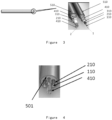
- FIG. 4 shows another design of lead body according to the embodiment of the present application, comprising: a multi-lumen tubing 501 having a plurality of conductor lumens each containing a plurality of coil of metal wires 410 and cable of metal wires 110, wherein the multi-lumen tubing 501 is made from the biomaterial; and layers of polymeric insulation materials 210 surrounding the coil of metal wires 410 and cable of metal wires 110.
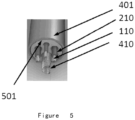
- FIG. 5 it shows another design of lead body according to the embodiment of the present application, comprising: a multi-lumen tubing 501 having a plurality of conductor lumens each containing a plurality of coil of metal wires 410 and cable of metal wires 110, wherein the multi-lumen tubing 501 is made from the biomaterial; an overlay tubing 401 surrounding the multi-lumen tubing 501; and layers of polymeric insulation materials 210 surrounding the coil of metal wires 410 and cable of metal wires 110.
- the pacing lead 10 includes a connector assembly at its proximal end, including a first conductive surface 12, a second conductive surface 14, and two insulative segments 16 and 18; insulative segments 16 and 18 are each provided with a plurality of sealing rings 20; extending from the connector assembly is an elongated lead body, including an outer insulative sheath 22, which is formed from the polymers described above; within insulative sheath 22 is located an elongated conductor (not shown), such as a quadrifilar, multiconductor coil, which is described in U.S. Pat. No.
- H-HTPB hydrogenated polybutadiene diol
- the yield of the reaction was 75%.
- Figure 1 shows UV absorbance spectrum of polybutylene glycol before hydrogenating vs. after hydrogenating.
- Figure 2 shows IR spectrum of the resulting polyurethane.
- the peaks at 3,327 cm -1 and 1,538 cm -1 were assigned to -NH- of the urethane group and the peak at 1,710 cm -1 was assigned to -C O of urethane group.
- H-HTPB hydrogenated polybutadiene diol
- the mechanical properties of polyurethane include follows:
- the time for synthesizing the polyolefin polyurethane under microwave radiation is no more than 5h, while the reaction time of the traditional heating manner is around 10h.
- the microwave radiation greatly shortens the reaction time, and lowers energy consumption, providing a high-efficient and environment friendly route for synthesizing the polyolefin polyurethane.
- the industrial applicability covers almost all potential use of the polyolefin polyurethane, particularly for implantable medical devices such as a medical device electrical lead.
Landscapes
- Health & Medical Sciences (AREA)
- Chemical & Material Sciences (AREA)
- Life Sciences & Earth Sciences (AREA)
- Veterinary Medicine (AREA)
- General Health & Medical Sciences (AREA)
- Public Health (AREA)
- Animal Behavior & Ethology (AREA)
- Chemical Kinetics & Catalysis (AREA)
- Medicinal Chemistry (AREA)
- Polymers & Plastics (AREA)
- Organic Chemistry (AREA)
- Biomedical Technology (AREA)
- Heart & Thoracic Surgery (AREA)
- Engineering & Computer Science (AREA)
- Epidemiology (AREA)
- Cardiology (AREA)
- Nuclear Medicine, Radiotherapy & Molecular Imaging (AREA)
- Radiology & Medical Imaging (AREA)
- Biophysics (AREA)
- Pulmonology (AREA)
- Anesthesiology (AREA)
- Hematology (AREA)
- Materials For Medical Uses (AREA)
- Electrotherapy Devices (AREA)
Claims (15)
- Medizinische Vorrichtung, umfassend ein thermoplastisches Elastomer, das aus weichen Segmenten und harten Segmenten zusammengesetzt ist, wobeidie weichen Segmente aus gesättigten Polyolefindiolen oder Polyolefindiamin gemacht sind, das bis zu 1000 Kohlenstoffatome in der Hauptkette aufweist, wobei jedes Kohlenstoffatom in der Hauptkette 0 bis 2 Seitenketten aufweist und jede Seitenkette 0 bis 30 Kohlenstoffatome aufweist,das harte Segment aus einem Diisocyanat und einem Kettenverlängerer gemacht ist,die harten Segmente 10-60 % des Elastomers stellen, und die weichen Segmente den Rest stellen,das zahlengemittelte Molekulargewicht des Elastomers 5×10³-1000×103 g/mol ist; die Bruchdehnung des Elastomers 100-1000 % ist; der Elastizitätsmodul des Elastomers 1 bis 3.000 MPa ist; und die Bruchfestigkeit des Elastomers 10-100 MPa ist, unddadurch gekennzeichnet, dass das thermoplastische Elastomer aus einer Mischung, die das gesättigte Polyolefindiol oder Polyolefindiamin, das Diisocyanat und den Kettenverlängerer einschließt, unter Verwendung von Mikrowellenstrahlung erhalten wird.
- Medizinische Vorrichtung, umfassend ein thermoplastisches Elastomer nach Anspruch 1, wobei das zahlengemittelte Molekulargewicht des Elastomers 10 × 103 - 300 × 103 g/mol ist; die Bruchdehnung des Elastomers 200-700 % ist; der Elastizitätsmodul des Elastomers 10 bis 2.000 MPa ist; und die Bruchfestigkeit des Elastomers 10-100 MPa ist.
- Medizinische Vorrichtung, umfassend ein thermoplastisches Elastomer nach Anspruch 1, wobei das weiche Segment aus gesättigtem Polybutadiendiol, gesättigtem Polyisoprendiol, Polybutylendiol, Polyethylendiol, Polypropylendiol, Poly(ethylenpropylen)-Copolymerdiol, Polyisobutylendiol, verzweigtem Polyethylendiol, Polybutylendiamin, Polyethylendiamin, Polypropylendiamin, Poly(ethylen-propylen)-Copolymerdiamin, gesättigtem Polybutadien, gesättigtem Polyisoprendiamin, gesättigtem Polyisobutylendiamin, verzweigtem Polyethylendiamin oder Mischungen davon gebildet ist.
- Medizinische Vorrichtung, umfassend ein thermoplastisches Elastomer nach Anspruch 1, wobei das Diisocyanat ausgewählt ist aus Toluol-2,4-diisocyanat, seinem Isomer oder einer Mischung davon; 4,4'-Diphenylmethandiisocyanat, Hexamethylendiisocyanat, Isophorondiisocyanat, 4,4'-Dicyclohexylmethandiisocyanat, Methylenbis(cyclohexyl)diisocyanat, trans-Cyclohexan-1,4-diisocyanat, p-Phenyldiisocyanat, Lysindiisocyanat, p-Phenyldimethylendiisocyanat, 1,5-Cyclopentandiisocyanat, p-Tetramethylditoluoldiisocyanat und m-Tetramethylditoluoldiisocyanat, hydrierten Formen der obigen Diisocyanatverbindungen oder Mischungen davon.
- Medizinische Vorrichtung, umfassend ein thermoplastisches Elastomer nach Anspruch 1, wobei der Kettenverlängerer ausgewählt ist aus Ethylenglykol, 1,3-Propylendiol, 1,4-Butandiol, 1,4-Hexandiol, 1,4-Cyclohexandiol, 1,6-Hexandiol, 1,8-Octandiol, 1,9-Nonadiol, 1,10-Decandiol, Ethylendiamin, Propylendiamin, Butylendiamin, Hexandiamin, Cyclohexandiamin oder Mischungen davon.
- Medizinische Vorrichtung, umfassend ein thermoplastisches Elastomer nach Anspruch 1, wobei das weiche Segment hydriertes Polybutadiendiol ist oder wobei das weiche Segment hydriertes Polyisoprendiol ist.
- Medizinische Vorrichtung, umfassend ein thermoplastisches Elastomer nach einem der Ansprüche 1-6, wobei die medizinische Vorrichtung eine elektrische Stimulationsvorrichtung ist, die einschließt:neurologische Stimulationsvorrichtung, Herzstimulationsvorrichtung,Herzunterstützungsvorrichtung, gastrointestinale Stimulationsvorrichtung,Skelettmuskelstimulationsvorrichtungen, oder Abfühlvorrichtungen, oder wobei die medizinische Vorrichtung eine Abfühlvorrichtung ist, die einschließt: elektrisches Abfühlen, mechanisches Abfühlen oder chemisches Abfühlen, oder wobei die medizinische Vorrichtung eine kombinierte Stimulationszuleitung mit Sensoren ist.
- Medizinische Vorrichtung, umfassend ein thermoplastisches Elastomer nach einem der Ansprüche 1-6, wobei die medizinische Vorrichtung eine implantierbare Herzschrittmacherzuleitung ist, die einschließt: Koaxialzuleitung oder Multilumenzuleitung, oder wobei die medizinische Vorrichtung eine implantierbare Kardioverter-Defibrillationszuleitung ist, die einschließlt: Koaxialzuleitung oder Multilumenzuleitung.
- Medizinische Vorrichtung, umfassend ein thermoplastisches Elastomer nach einem der Ansprüche 1-8, wobei das thermoplastische Elastomer eine Isolationsschicht ist, oder wobei das thermoplastische Elastomer eine Außenhülle ist, oder wobei das thermoplastische Elastomer eine Strukturkomponente ist, oder wobei das thermoplastische Elastomer eine Raumfüllkomponente ist, oder wobei das thermoplastische Elastomer eine Komponente zum Verbinden anderer Komponenten ist.
- Medizinische Vorrichtung, umfassend ein thermoplastisches Elastomer nach einem der Ansprüche 1-6, wobei die medizinische Vorrichtung eine implantierbare Kardioverter-Defibrillationszuleitung ist, wobei(1) das thermoplastische Elastomer in Form eines Schlauchs mit einer Wanddicke von 0,001 Zoll (0,0254 mm) bis 0,030 Zoll (0,762 mm) vorliegt,(2) eine oder mehr als eine Leiterspule in den in (1) definierten Schlauch eingesetzt ist/sind, wobei die Spulen gegebenenfalls mit einer zusätzlichen Isolationsschicht, einer chemischen Barriere, einer mechanischen Gleitschicht oder der Kombination davon beschichtet sind,(3) anderes Isolationsmaterial in Schlauchform innerhalb der in (2) definierten Leiterspulen eingesetzt ist, wobei die Wanddicke 0,001 Zoll (0,0254 mm) bis 0,010 Zoll (0,254 mm) ist,(4) die Innendurchmesseroberfläche des in (3) definierten Schlauchs gegebenenfalls eine elektrische Isolationsauskleidung, eine chemische Barriere, eine mechanische Gleitauskleidung oder die Kombination davon aufweist, und(5) elektrische Leiter in den in (4) definierten Schlauch eingesetzt sind, wobei die Leiter Kabel oder Spulen sein können, die mit einer elektrischen Isolationsschicht, einer chemischen Barriereschicht, einer mechanischen Gleitschicht oder der Kombination davon beschichtet sein können.
- Medizinische Vorrichtung, umfassend ein thermoplastisches Elastomer nach einem der Ansprüche 1-6, wobei die medizinische Vorrichtung eine implantierbare Herzschrittmacherzuleitung ist, wobei(1) das thermoplastische Elastomer in Form eines Schlauchs mit einer Wanddicke von 0,001 Zoll (0,0254 mm) bis 0,030 Zoll (0,762 mm) vorliegt,(2) eine oder mehr als eine Leiterspulen in den in (1) definierten Schlauch eingesetzt ist/sind, wobei die Spulen gegebenenfalls mit einer Isolationsschicht, einer chemischen Barriere, einer mechanischen Gleitschicht oder der Kombination davon beschichtet sind,(3) anderes Isolationsmaterial in Schlauchform innerhalb der in (2) definierten Leiterspulen eingesetzt ist, wobei die Wanddicke 0,001 Zoll (0,0254 mm) bis 0,010 Zoll (0,254 mm) ist,(4) die Innendurchmesseroberfläche des in (3) definierten Schlauchs gegebenenfalls eine Isolationsauskleidung, eine chemische Barriere, eine mechanische Gleitauskleidung oder die Kombination davon aufweist, und(5) elektrische Leiter in den in (4) definierten Schlauch eingesetzt sind, wobei die Leiter Kabel oder Spulen sein können, die mit einer Isolationsschicht, einer chemischen Barriereschicht, einer mechanischen Gleitschicht oder der Kombination davon beschichtet sein können.
- Medizinische Vorrichtung, umfassend ein thermoplastisches Elastomer nach einem der Ansprüche 1-6, wobei die medizinische Vorrichtung eine implantierbare Kardioverter-Defibrillationszuleitung ist, wobei(1) das thermoplastische Elastomer in Form eines Schlauchs mit einer Wanddicke von 0,001 Zoll (0,0254 mm) bis 0,030 Zoll (0,762 mm) vorliegt,(2) ein polymerer Mehrlumenschlauch in den in (1) definierten Schlauch eingeführt ist, wobei die mehreren Lumina gegebenenfalls denselben Durchmesser aufweisen und sich in dem Schlauch befinden, so dass die Wanddicke zwischen Lumen und Lumen und zwischen Lumen und dem Außendurchmesser des Schlauchs 0,001 Zoll (0,0254 mm) bis 0,020 Zoll (0,508 mm) ist,(3) jedwedes der Lumina gegebenenfalls eine innere Isolationsauskleidung, eine chemische Barriere, eine mechanische Gleitauskleidung oder die Kombination davon aufweist, und(4) in einige oder alle der Lumina Leiterkabel, Drähte oder Spulen eingesetzt sind, wobei die Kabel, Drähte oder Spulen gegebenenfalls eine Isolationsauskleidung, eine chemische Barriere, eine mechanische Gleitauskleidung oder die Kombination davon aufweisen.
- Medizinische Vorrichtung, umfassend ein thermoplastisches Elastomer nach einem der Ansprüche 1-6, wobei die medizinische Vorrichtung eine implantierbare Kardioverter-Defibrillationszuleitung ist, wobei(1) das thermoplastische Elastomer in einer Form eines Mehrlumenschlauchs vorliegt, wobei die mehreren Lumina gegebenenfalls denselben Durchmesser aufweisen und sich in dem Schlauch befinden, so dass die Wanddicke zwischen Lumen und Lumen und zwischen Lumen und dem Außendurchmesser des Schlauchs 0,001 Zoll (0,0254 mm) bis 0,020 Zoll (0,508 mm) ist,(3) jedwedes der Lumina gegebenenfalls eine innere Isolationsauskleidung, eine chemische Barriere, eine mechanische Gleitauskleidung oder die Kombination davon aufweist, und(4) Leiterkabel, Drähte oder Spulen in einige oder alle der Lumina eingesetzt sind, wobei die Kabel, Drähte oder Spulen gegebenenfalls eine Isolationsauskleidung, eine chemische Barriere, eine mechanische Gleitauskleidung oder die Kombination davon aufweisen.
- Verfahren zur Herstellung einer medizinischen Vorrichtung, umfassend ein thermoplastisches Elastomer nach einem der Ansprüche 1-6, wobei das Verfahren umfasst:(1) Bilden des thermoplastischen Elastomers zu Schläuchen oder anderen Formen mittels Extrusion, Nutzung von Formwerkzeugen oder Beschichten,(2) Montieren der Schläuche oder anderen Formen mit anderen Teilen, die einschließen: Kabeln, Spulen, beschichtete Kabel oder beschichtete Spulen, und(3) Bonden der Schläuche, Kabel oder Spulen mit anderen Komponenten, die einschließen: andere Schlauchkomponenten, Kabel, Spulen, Manschetten, elektrischen Impulsgenerator, Defibrillationsschockgenerator, Elektroden, Sensoren oder Arzneimittelfreisetzungskomponenten.
- Verfahren nach Anspruch 14, ferner umfassend:(1) Vormontieren von Leitern und/oder anderen Komponenten, und(2) Bilden des thermoplastischen Elastomers zu Schläuchen oder anderen Formen über den vormontierten Leitern und/oder anderen Komponenten.
Applications Claiming Priority (1)
| Application Number | Priority Date | Filing Date | Title |
|---|---|---|---|
| PCT/CN2017/075377 WO2018157342A1 (en) | 2017-03-02 | 2017-03-02 | Medical device, method for preparation thereof, and use thereof |
Publications (3)
| Publication Number | Publication Date |
|---|---|
| EP3589350A1 EP3589350A1 (de) | 2020-01-08 |
| EP3589350A4 EP3589350A4 (de) | 2020-12-09 |
| EP3589350B1 true EP3589350B1 (de) | 2025-02-19 |
Family
ID=63369635
Family Applications (1)
| Application Number | Title | Priority Date | Filing Date |
|---|---|---|---|
| EP17898438.1A Active EP3589350B1 (de) | 2017-03-02 | 2017-03-02 | Medizinische vorrichtung und verfahren zur herstellung davon |
Country Status (4)
| Country | Link |
|---|---|
| US (1) | US11160907B2 (de) |
| EP (1) | EP3589350B1 (de) |
| CN (1) | CN110418660B (de) |
| WO (1) | WO2018157342A1 (de) |
Families Citing this family (3)
| Publication number | Priority date | Publication date | Assignee | Title |
|---|---|---|---|---|
| US10995298B2 (en) | 2014-07-23 | 2021-05-04 | Becton, Dickinson And Company | Self-lubricating polymer composition |
| US10882945B2 (en) | 2018-03-26 | 2021-01-05 | Medtronic, Inc. | Modified polyisobutylene-based polymers, methods of making, and medical devices |
| US11613719B2 (en) | 2018-09-24 | 2023-03-28 | Becton, Dickinson And Company | Self-lubricating medical articles |
Citations (1)
| Publication number | Priority date | Publication date | Assignee | Title |
|---|---|---|---|---|
| EP0833854B1 (de) * | 1995-06-23 | 2000-08-30 | Shell Internationale Researchmaatschappij B.V. | Verwendung von polydien-diolen in thermoplastischen polyurethanen |
Family Cites Families (26)
| Publication number | Priority date | Publication date | Assignee | Title |
|---|---|---|---|---|
| US5040544A (en) | 1988-02-16 | 1991-08-20 | Medtronic, Inc. | Medical electrical lead and method of manufacture |
| US5589563A (en) | 1992-04-24 | 1996-12-31 | The Polymer Technology Group | Surface-modifying endgroups for biomedical polymers |
| US5864001A (en) | 1996-10-16 | 1999-01-26 | Shell Oil Company | Polyurethanes made with polydiene diols, diisocyanates, and dimer diol chain extender |
| US6915168B1 (en) | 1997-05-08 | 2005-07-05 | Michael D. Benz | Medical devices containing segmented polyurethane biomaterials |
| US6537661B1 (en) | 1999-07-02 | 2003-03-25 | Kraton Polymers U.S. Llc | Melt processable, bleach resistant, durable fibers having high elastic recovery and low stress relaxation from polyurethane elastomers |
| US6836687B2 (en) * | 2000-03-31 | 2004-12-28 | Medtronic, Inc. | Method and system for delivery of a medical electrical lead within a venous system |
| US7497844B2 (en) * | 2000-03-31 | 2009-03-03 | Medtronic, Inc. | System and method for positioning implantable medical devices within coronary veins |
| WO2005049105A2 (en) * | 2003-11-10 | 2005-06-02 | Angiotech International Ag | Medical implants and anti-scarring agents |
| CN1272356C (zh) | 2004-07-13 | 2006-08-30 | 清华大学 | 单模微波辐照下制备医用聚氨酯及其塑型产品的方法 |
| US20070264303A1 (en) * | 2006-05-12 | 2007-11-15 | Liliana Atanasoska | Coating for medical devices comprising an inorganic or ceramic oxide and a therapeutic agent |
| KR20110082517A (ko) * | 2008-10-04 | 2011-07-19 | 보스톤 싸이엔티픽 싸이메드 인코포레이티드 | 조직과 접촉하는 진단 및/또는 치료 요소를 지지하는 루프 구조체 |
| WO2010081132A1 (en) * | 2009-01-12 | 2010-07-15 | University Of Massachusetts Lowell | Polyisobutylene-based polyurethanes |
| US8155759B2 (en) | 2009-03-20 | 2012-04-10 | Innovia, Llc | Pacemaker lead and method of making same |
| CN101538358B (zh) | 2009-04-29 | 2011-08-31 | 福建兴宇树脂有限公司 | 一种用于聚氨酯鞋底聚酯多元醇的微波合成方法 |
| US8644952B2 (en) * | 2009-09-02 | 2014-02-04 | Cardiac Pacemakers, Inc. | Medical devices including polyisobutylene based polymers and derivatives thereof |
| US20110152989A1 (en) * | 2009-12-23 | 2011-06-23 | Pacesetter, Inc. | Soft abrasion-resistant polyisobutylene urethane copolymers |
| EP3998030B1 (de) * | 2010-08-05 | 2025-09-24 | Medtronic Ireland Manufacturing Unlimited Company | Kryoablationsvorrichtung für nierennervenmodulation |
| US8831749B2 (en) | 2012-10-31 | 2014-09-09 | Medtronic, Inc. | Implantable medical electrical lead conductors and construction methods |
| WO2014081916A2 (en) | 2012-11-21 | 2014-05-30 | University Of Massachusetts | High strength polyisobutylene polyurethanes |
| EP2931790B1 (de) * | 2012-12-14 | 2017-02-15 | Novartis AG | Aktinisch vernetzbare amphiphile präpolymere |
| WO2014160744A1 (en) * | 2013-03-26 | 2014-10-02 | Innovia Llc | Pacemaker lead and other medical implant devices |
| US10004458B2 (en) * | 2013-03-27 | 2018-06-26 | Autonomix Medical, Inc. | Systems and methods for neurological traffic and/or receptor functional evaluation and/or modification |
| CN105263557B (zh) | 2013-06-07 | 2018-07-06 | 导管治疗有限公司 | 用于导管的电引线以及制造方法 |
| CN105315424A (zh) | 2014-08-01 | 2016-02-10 | 中国科学院宁波材料技术与工程研究所 | 低永久形变聚氨酯-脲弹性体、其制备方法及应用 |
| WO2016098073A2 (en) * | 2014-12-19 | 2016-06-23 | Strait Access Technologies Holdings (Pty) Ltd | Polyurethanes |
| CN105111404A (zh) | 2015-08-27 | 2015-12-02 | 厦门明睐科技有限公司 | 一种聚氨酯弹性体的制备方法 |
-
2017
- 2017-03-02 EP EP17898438.1A patent/EP3589350B1/de active Active
- 2017-03-02 CN CN201780087220.4A patent/CN110418660B/zh active Active
- 2017-03-02 US US16/091,040 patent/US11160907B2/en active Active
- 2017-03-02 WO PCT/CN2017/075377 patent/WO2018157342A1/en not_active Ceased
Patent Citations (1)
| Publication number | Priority date | Publication date | Assignee | Title |
|---|---|---|---|---|
| EP0833854B1 (de) * | 1995-06-23 | 2000-08-30 | Shell Internationale Researchmaatschappij B.V. | Verwendung von polydien-diolen in thermoplastischen polyurethanen |
Also Published As
| Publication number | Publication date |
|---|---|
| US11160907B2 (en) | 2021-11-02 |
| EP3589350A1 (de) | 2020-01-08 |
| CN110418660B (zh) | 2023-05-30 |
| US20190111186A1 (en) | 2019-04-18 |
| WO2018157342A1 (en) | 2018-09-07 |
| CN110418660A (zh) | 2019-11-05 |
| EP3589350A4 (de) | 2020-12-09 |
Similar Documents
| Publication | Publication Date | Title |
|---|---|---|
| JP5657003B2 (ja) | ポリイソブチレンウレタン共重合体、ポリイソブチレン尿素共重合体、及びポリイソブチレンウレタン/尿素共重合体、ならびにこれらを含んだ医療用リード及びその形成方法 | |
| US8644952B2 (en) | Medical devices including polyisobutylene based polymers and derivatives thereof | |
| US11548974B2 (en) | Modified polyisobutylene-based polymers, methods of making, and medical devices | |
| EP3589350B1 (de) | Medizinische vorrichtung und verfahren zur herstellung davon | |
| US20110152989A1 (en) | Soft abrasion-resistant polyisobutylene urethane copolymers | |
| EP3390482A1 (de) | Polyisobutylen-polyurethane und medizinprodukte damit | |
| US9220888B2 (en) | Medical leads | |
| EP3774975B1 (de) | Polymere auf basis von poly(ethercarbonat) und medizinische vorrichtungen | |
| WO2015053934A1 (en) | Implantable medical devices including a polyether-polyurethane substrate with improved biostability, and methods | |
| EP0988068B1 (de) | Segmentierte polyurethan biomaterialien enthaltende medizinische geräte | |
| CN107913462A (zh) | 一种抗降解亲水润滑植入电极导线及其制备工艺 |
Legal Events
| Date | Code | Title | Description |
|---|---|---|---|
| STAA | Information on the status of an ep patent application or granted ep patent |
Free format text: STATUS: THE INTERNATIONAL PUBLICATION HAS BEEN MADE |
|
| PUAI | Public reference made under article 153(3) epc to a published international application that has entered the european phase |
Free format text: ORIGINAL CODE: 0009012 |
|
| STAA | Information on the status of an ep patent application or granted ep patent |
Free format text: STATUS: REQUEST FOR EXAMINATION WAS MADE |
|
| 17P | Request for examination filed |
Effective date: 20190930 |
|
| AK | Designated contracting states |
Kind code of ref document: A1 Designated state(s): AL AT BE BG CH CY CZ DE DK EE ES FI FR GB GR HR HU IE IS IT LI LT LU LV MC MK MT NL NO PL PT RO RS SE SI SK SM TR |
|
| AX | Request for extension of the european patent |
Extension state: BA ME |
|
| RIN1 | Information on inventor provided before grant (corrected) |
Inventor name: CHEN, XIANGJI Inventor name: NA, HAINING Inventor name: ZHU, JIN Inventor name: LYU, SUPING Inventor name: CHEN, JING |
|
| DAV | Request for validation of the european patent (deleted) | ||
| DAX | Request for extension of the european patent (deleted) | ||
| A4 | Supplementary search report drawn up and despatched |
Effective date: 20201105 |
|
| RIC1 | Information provided on ipc code assigned before grant |
Ipc: C08G 18/48 20060101ALI20201030BHEP Ipc: C08L 75/04 20060101ALI20201030BHEP Ipc: A61N 1/05 20060101AFI20201030BHEP |
|
| STAA | Information on the status of an ep patent application or granted ep patent |
Free format text: STATUS: EXAMINATION IS IN PROGRESS |
|
| 17Q | First examination report despatched |
Effective date: 20230717 |
|
| REG | Reference to a national code |
Ref country code: DE Free format text: PREVIOUS MAIN CLASS: A61N0001050000 Ref country code: DE Ref legal event code: R079 Ref document number: 602017087934 Country of ref document: DE Free format text: PREVIOUS MAIN CLASS: A61N0001050000 Ipc: C08G0018240000 |
|
| GRAP | Despatch of communication of intention to grant a patent |
Free format text: ORIGINAL CODE: EPIDOSNIGR1 |
|
| STAA | Information on the status of an ep patent application or granted ep patent |
Free format text: STATUS: GRANT OF PATENT IS INTENDED |
|
| RIC1 | Information provided on ipc code assigned before grant |
Ipc: A61N 1/05 20060101ALI20240516BHEP Ipc: C08G 18/76 20060101ALI20240516BHEP Ipc: C08G 18/62 20060101ALI20240516BHEP Ipc: C08G 18/32 20060101ALI20240516BHEP Ipc: C08G 18/24 20060101AFI20240516BHEP |
|
| INTG | Intention to grant announced |
Effective date: 20240605 |
|
| GRAJ | Information related to disapproval of communication of intention to grant by the applicant or resumption of examination proceedings by the epo deleted |
Free format text: ORIGINAL CODE: EPIDOSDIGR1 |
|
| STAA | Information on the status of an ep patent application or granted ep patent |
Free format text: STATUS: EXAMINATION IS IN PROGRESS |
|
| GRAP | Despatch of communication of intention to grant a patent |
Free format text: ORIGINAL CODE: EPIDOSNIGR1 |
|
| STAA | Information on the status of an ep patent application or granted ep patent |
Free format text: STATUS: GRANT OF PATENT IS INTENDED |
|
| INTC | Intention to grant announced (deleted) | ||
| INTG | Intention to grant announced |
Effective date: 20241001 |
|
| RIN1 | Information on inventor provided before grant (corrected) |
Inventor name: ZHU, JIN Inventor name: NA, HAINING Inventor name: CHEN, JING Inventor name: CHEN, XIANGJI Inventor name: LYU, SUPING |
|
| GRAS | Grant fee paid |
Free format text: ORIGINAL CODE: EPIDOSNIGR3 |
|
| GRAA | (expected) grant |
Free format text: ORIGINAL CODE: 0009210 |
|
| STAA | Information on the status of an ep patent application or granted ep patent |
Free format text: STATUS: THE PATENT HAS BEEN GRANTED |
|
| AK | Designated contracting states |
Kind code of ref document: B1 Designated state(s): AL AT BE BG CH CY CZ DE DK EE ES FI FR GB GR HR HU IE IS IT LI LT LU LV MC MK MT NL NO PL PT RO RS SE SI SK SM TR |
|
| REG | Reference to a national code |
Ref country code: GB Ref legal event code: FG4D |
|
| REG | Reference to a national code |
Ref country code: CH Ref legal event code: EP |
|
| REG | Reference to a national code |
Ref country code: IE Ref legal event code: FG4D |
|
| REG | Reference to a national code |
Ref country code: DE Ref legal event code: R096 Ref document number: 602017087934 Country of ref document: DE |
|
| PGFP | Annual fee paid to national office [announced via postgrant information from national office to epo] |
Ref country code: DE Payment date: 20250218 Year of fee payment: 9 |
|
| PGFP | Annual fee paid to national office [announced via postgrant information from national office to epo] |
Ref country code: FR Payment date: 20250319 Year of fee payment: 9 |
|
| REG | Reference to a national code |
Ref country code: NL Ref legal event code: MP Effective date: 20250219 |
|
| PG25 | Lapsed in a contracting state [announced via postgrant information from national office to epo] |
Ref country code: RS Free format text: LAPSE BECAUSE OF FAILURE TO SUBMIT A TRANSLATION OF THE DESCRIPTION OR TO PAY THE FEE WITHIN THE PRESCRIBED TIME-LIMIT Effective date: 20250519 |
|
| PG25 | Lapsed in a contracting state [announced via postgrant information from national office to epo] |
Ref country code: FI Free format text: LAPSE BECAUSE OF FAILURE TO SUBMIT A TRANSLATION OF THE DESCRIPTION OR TO PAY THE FEE WITHIN THE PRESCRIBED TIME-LIMIT Effective date: 20250219 |
|
| PG25 | Lapsed in a contracting state [announced via postgrant information from national office to epo] |
Ref country code: PL Free format text: LAPSE BECAUSE OF FAILURE TO SUBMIT A TRANSLATION OF THE DESCRIPTION OR TO PAY THE FEE WITHIN THE PRESCRIBED TIME-LIMIT Effective date: 20250219 |
|
| PG25 | Lapsed in a contracting state [announced via postgrant information from national office to epo] |
Ref country code: ES Free format text: LAPSE BECAUSE OF FAILURE TO SUBMIT A TRANSLATION OF THE DESCRIPTION OR TO PAY THE FEE WITHIN THE PRESCRIBED TIME-LIMIT Effective date: 20250219 |
|
| REG | Reference to a national code |
Ref country code: LT Ref legal event code: MG9D |
|
| PG25 | Lapsed in a contracting state [announced via postgrant information from national office to epo] |
Ref country code: IS Free format text: LAPSE BECAUSE OF FAILURE TO SUBMIT A TRANSLATION OF THE DESCRIPTION OR TO PAY THE FEE WITHIN THE PRESCRIBED TIME-LIMIT Effective date: 20250619 Ref country code: NO Free format text: LAPSE BECAUSE OF FAILURE TO SUBMIT A TRANSLATION OF THE DESCRIPTION OR TO PAY THE FEE WITHIN THE PRESCRIBED TIME-LIMIT Effective date: 20250519 |
|
| PG25 | Lapsed in a contracting state [announced via postgrant information from national office to epo] |
Ref country code: NL Free format text: LAPSE BECAUSE OF FAILURE TO SUBMIT A TRANSLATION OF THE DESCRIPTION OR TO PAY THE FEE WITHIN THE PRESCRIBED TIME-LIMIT Effective date: 20250219 |
|
| PG25 | Lapsed in a contracting state [announced via postgrant information from national office to epo] |
Ref country code: HR Free format text: LAPSE BECAUSE OF FAILURE TO SUBMIT A TRANSLATION OF THE DESCRIPTION OR TO PAY THE FEE WITHIN THE PRESCRIBED TIME-LIMIT Effective date: 20250219 |
|
| PG25 | Lapsed in a contracting state [announced via postgrant information from national office to epo] |
Ref country code: LV Free format text: LAPSE BECAUSE OF FAILURE TO SUBMIT A TRANSLATION OF THE DESCRIPTION OR TO PAY THE FEE WITHIN THE PRESCRIBED TIME-LIMIT Effective date: 20250219 Ref country code: PT Free format text: LAPSE BECAUSE OF FAILURE TO SUBMIT A TRANSLATION OF THE DESCRIPTION OR TO PAY THE FEE WITHIN THE PRESCRIBED TIME-LIMIT Effective date: 20250620 |
|
| PG25 | Lapsed in a contracting state [announced via postgrant information from national office to epo] |
Ref country code: GR Free format text: LAPSE BECAUSE OF FAILURE TO SUBMIT A TRANSLATION OF THE DESCRIPTION OR TO PAY THE FEE WITHIN THE PRESCRIBED TIME-LIMIT Effective date: 20250520 Ref country code: BG Free format text: LAPSE BECAUSE OF FAILURE TO SUBMIT A TRANSLATION OF THE DESCRIPTION OR TO PAY THE FEE WITHIN THE PRESCRIBED TIME-LIMIT Effective date: 20250219 |
|
| REG | Reference to a national code |
Ref country code: AT Ref legal event code: MK05 Ref document number: 1768228 Country of ref document: AT Kind code of ref document: T Effective date: 20250219 |
|
| PG25 | Lapsed in a contracting state [announced via postgrant information from national office to epo] |
Ref country code: SE Free format text: LAPSE BECAUSE OF FAILURE TO SUBMIT A TRANSLATION OF THE DESCRIPTION OR TO PAY THE FEE WITHIN THE PRESCRIBED TIME-LIMIT Effective date: 20250219 |
|
| PG25 | Lapsed in a contracting state [announced via postgrant information from national office to epo] |
Ref country code: SM Free format text: LAPSE BECAUSE OF FAILURE TO SUBMIT A TRANSLATION OF THE DESCRIPTION OR TO PAY THE FEE WITHIN THE PRESCRIBED TIME-LIMIT Effective date: 20250219 |
|
| PG25 | Lapsed in a contracting state [announced via postgrant information from national office to epo] |
Ref country code: DK Free format text: LAPSE BECAUSE OF FAILURE TO SUBMIT A TRANSLATION OF THE DESCRIPTION OR TO PAY THE FEE WITHIN THE PRESCRIBED TIME-LIMIT Effective date: 20250219 |
|
| PG25 | Lapsed in a contracting state [announced via postgrant information from national office to epo] |
Ref country code: IT Free format text: LAPSE BECAUSE OF FAILURE TO SUBMIT A TRANSLATION OF THE DESCRIPTION OR TO PAY THE FEE WITHIN THE PRESCRIBED TIME-LIMIT Effective date: 20250219 |
|
| PG25 | Lapsed in a contracting state [announced via postgrant information from national office to epo] |
Ref country code: AT Free format text: LAPSE BECAUSE OF FAILURE TO SUBMIT A TRANSLATION OF THE DESCRIPTION OR TO PAY THE FEE WITHIN THE PRESCRIBED TIME-LIMIT Effective date: 20250219 |
|
| PG25 | Lapsed in a contracting state [announced via postgrant information from national office to epo] |
Ref country code: EE Free format text: LAPSE BECAUSE OF FAILURE TO SUBMIT A TRANSLATION OF THE DESCRIPTION OR TO PAY THE FEE WITHIN THE PRESCRIBED TIME-LIMIT Effective date: 20250219 Ref country code: CZ Free format text: LAPSE BECAUSE OF FAILURE TO SUBMIT A TRANSLATION OF THE DESCRIPTION OR TO PAY THE FEE WITHIN THE PRESCRIBED TIME-LIMIT Effective date: 20250219 |
|
| REG | Reference to a national code |
Ref country code: CH Ref legal event code: H13 Free format text: ST27 STATUS EVENT CODE: U-0-0-H10-H13 (AS PROVIDED BY THE NATIONAL OFFICE) Effective date: 20251023 |
|
| PG25 | Lapsed in a contracting state [announced via postgrant information from national office to epo] |
Ref country code: RO Free format text: LAPSE BECAUSE OF FAILURE TO SUBMIT A TRANSLATION OF THE DESCRIPTION OR TO PAY THE FEE WITHIN THE PRESCRIBED TIME-LIMIT Effective date: 20250219 |
|
| PG25 | Lapsed in a contracting state [announced via postgrant information from national office to epo] |
Ref country code: SK Free format text: LAPSE BECAUSE OF FAILURE TO SUBMIT A TRANSLATION OF THE DESCRIPTION OR TO PAY THE FEE WITHIN THE PRESCRIBED TIME-LIMIT Effective date: 20250219 |
|
| PG25 | Lapsed in a contracting state [announced via postgrant information from national office to epo] |
Ref country code: LU Free format text: LAPSE BECAUSE OF NON-PAYMENT OF DUE FEES Effective date: 20250302 |
|
| REG | Reference to a national code |
Ref country code: DE Ref legal event code: R097 Ref document number: 602017087934 Country of ref document: DE |
|
| REG | Reference to a national code |
Ref country code: BE Ref legal event code: MM Effective date: 20250331 |
|
| PG25 | Lapsed in a contracting state [announced via postgrant information from national office to epo] |
Ref country code: MC Free format text: LAPSE BECAUSE OF FAILURE TO SUBMIT A TRANSLATION OF THE DESCRIPTION OR TO PAY THE FEE WITHIN THE PRESCRIBED TIME-LIMIT Effective date: 20250219 |
|
| PLBE | No opposition filed within time limit |
Free format text: ORIGINAL CODE: 0009261 |
|
| STAA | Information on the status of an ep patent application or granted ep patent |
Free format text: STATUS: NO OPPOSITION FILED WITHIN TIME LIMIT |
|
| PG25 | Lapsed in a contracting state [announced via postgrant information from national office to epo] |
Ref country code: BE Free format text: LAPSE BECAUSE OF NON-PAYMENT OF DUE FEES Effective date: 20250331 |
|
| PG25 | Lapsed in a contracting state [announced via postgrant information from national office to epo] |
Ref country code: CH Free format text: LAPSE BECAUSE OF NON-PAYMENT OF DUE FEES Effective date: 20250331 |
|
| PG25 | Lapsed in a contracting state [announced via postgrant information from national office to epo] |
Ref country code: IE Free format text: LAPSE BECAUSE OF NON-PAYMENT OF DUE FEES Effective date: 20250302 |
|
| 26N | No opposition filed |
Effective date: 20251120 |
|
| GBPC | Gb: european patent ceased through non-payment of renewal fee |
Effective date: 20250519 |