EP2931790B1 - Aktinisch vernetzbare amphiphile präpolymere - Google Patents
Aktinisch vernetzbare amphiphile präpolymere Download PDFInfo
- Publication number
- EP2931790B1 EP2931790B1 EP13818079.9A EP13818079A EP2931790B1 EP 2931790 B1 EP2931790 B1 EP 2931790B1 EP 13818079 A EP13818079 A EP 13818079A EP 2931790 B1 EP2931790 B1 EP 2931790B1
- Authority
- EP
- European Patent Office
- Prior art keywords
- group
- defined above
- divalent radical
- independent
- alkyl
- Prior art date
- Legal status (The legal status is an assumption and is not a legal conclusion. Google has not performed a legal analysis and makes no representation as to the accuracy of the status listed.)
- Active
Links
Classifications
-
- G—PHYSICS
- G02—OPTICS
- G02B—OPTICAL ELEMENTS, SYSTEMS OR APPARATUS
- G02B1/00—Optical elements characterised by the material of which they are made; Optical coatings for optical elements
- G02B1/04—Optical elements characterised by the material of which they are made; Optical coatings for optical elements made of organic materials, e.g. plastics
- G02B1/041—Lenses
- G02B1/043—Contact lenses
-
- B—PERFORMING OPERATIONS; TRANSPORTING
- B29—WORKING OF PLASTICS; WORKING OF SUBSTANCES IN A PLASTIC STATE IN GENERAL
- B29C—SHAPING OR JOINING OF PLASTICS; SHAPING OF MATERIAL IN A PLASTIC STATE, NOT OTHERWISE PROVIDED FOR; AFTER-TREATMENT OF THE SHAPED PRODUCTS, e.g. REPAIRING
- B29C35/00—Heating, cooling or curing, e.g. crosslinking or vulcanising; Apparatus therefor
- B29C35/02—Heating or curing, e.g. crosslinking or vulcanizing during moulding, e.g. in a mould
- B29C35/08—Heating or curing, e.g. crosslinking or vulcanizing during moulding, e.g. in a mould by wave energy or particle radiation
-
- B—PERFORMING OPERATIONS; TRANSPORTING
- B29—WORKING OF PLASTICS; WORKING OF SUBSTANCES IN A PLASTIC STATE IN GENERAL
- B29C—SHAPING OR JOINING OF PLASTICS; SHAPING OF MATERIAL IN A PLASTIC STATE, NOT OTHERWISE PROVIDED FOR; AFTER-TREATMENT OF THE SHAPED PRODUCTS, e.g. REPAIRING
- B29C39/00—Shaping by casting, i.e. introducing the moulding material into a mould or between confining surfaces without significant moulding pressure; Apparatus therefor
- B29C39/003—Shaping by casting, i.e. introducing the moulding material into a mould or between confining surfaces without significant moulding pressure; Apparatus therefor characterised by the choice of material
- B29C39/006—Monomers or prepolymers
-
- B—PERFORMING OPERATIONS; TRANSPORTING
- B29—WORKING OF PLASTICS; WORKING OF SUBSTANCES IN A PLASTIC STATE IN GENERAL
- B29C—SHAPING OR JOINING OF PLASTICS; SHAPING OF MATERIAL IN A PLASTIC STATE, NOT OTHERWISE PROVIDED FOR; AFTER-TREATMENT OF THE SHAPED PRODUCTS, e.g. REPAIRING
- B29C39/00—Shaping by casting, i.e. introducing the moulding material into a mould or between confining surfaces without significant moulding pressure; Apparatus therefor
- B29C39/02—Shaping by casting, i.e. introducing the moulding material into a mould or between confining surfaces without significant moulding pressure; Apparatus therefor for making articles of definite length, i.e. discrete articles
- B29C39/026—Shaping by casting, i.e. introducing the moulding material into a mould or between confining surfaces without significant moulding pressure; Apparatus therefor for making articles of definite length, i.e. discrete articles characterised by the shape of the surface
-
- C—CHEMISTRY; METALLURGY
- C08—ORGANIC MACROMOLECULAR COMPOUNDS; THEIR PREPARATION OR CHEMICAL WORKING-UP; COMPOSITIONS BASED THEREON
- C08G—MACROMOLECULAR COMPOUNDS OBTAINED OTHERWISE THAN BY REACTIONS ONLY INVOLVING UNSATURATED CARBON-TO-CARBON BONDS
- C08G18/00—Polymeric products of isocyanates or isothiocyanates
- C08G18/06—Polymeric products of isocyanates or isothiocyanates with compounds having active hydrogen
- C08G18/28—Polymeric products of isocyanates or isothiocyanates with compounds having active hydrogen characterised by the compounds used containing active hydrogen
- C08G18/40—High-molecular-weight compounds
- C08G18/61—Polysiloxanes
-
- C—CHEMISTRY; METALLURGY
- C08—ORGANIC MACROMOLECULAR COMPOUNDS; THEIR PREPARATION OR CHEMICAL WORKING-UP; COMPOSITIONS BASED THEREON
- C08G—MACROMOLECULAR COMPOUNDS OBTAINED OTHERWISE THAN BY REACTIONS ONLY INVOLVING UNSATURATED CARBON-TO-CARBON BONDS
- C08G18/00—Polymeric products of isocyanates or isothiocyanates
- C08G18/06—Polymeric products of isocyanates or isothiocyanates with compounds having active hydrogen
- C08G18/70—Polymeric products of isocyanates or isothiocyanates with compounds having active hydrogen characterised by the isocyanates or isothiocyanates used
- C08G18/72—Polyisocyanates or polyisothiocyanates
- C08G18/74—Polyisocyanates or polyisothiocyanates cyclic
- C08G18/75—Polyisocyanates or polyisothiocyanates cyclic cycloaliphatic
- C08G18/751—Polyisocyanates or polyisothiocyanates cyclic cycloaliphatic containing only one cycloaliphatic ring
- C08G18/752—Polyisocyanates or polyisothiocyanates cyclic cycloaliphatic containing only one cycloaliphatic ring containing at least one isocyanate or isothiocyanate group linked to the cycloaliphatic ring by means of an aliphatic group
- C08G18/753—Polyisocyanates or polyisothiocyanates cyclic cycloaliphatic containing only one cycloaliphatic ring containing at least one isocyanate or isothiocyanate group linked to the cycloaliphatic ring by means of an aliphatic group containing one isocyanate or isothiocyanate group linked to the cycloaliphatic ring by means of an aliphatic group having a primary carbon atom next to the isocyanate or isothiocyanate group
- C08G18/755—Polyisocyanates or polyisothiocyanates cyclic cycloaliphatic containing only one cycloaliphatic ring containing at least one isocyanate or isothiocyanate group linked to the cycloaliphatic ring by means of an aliphatic group containing one isocyanate or isothiocyanate group linked to the cycloaliphatic ring by means of an aliphatic group having a primary carbon atom next to the isocyanate or isothiocyanate group and at least one isocyanate or isothiocyanate group linked to a secondary carbon atom of the cycloaliphatic ring, e.g. isophorone diisocyanate
-
- C—CHEMISTRY; METALLURGY
- C08—ORGANIC MACROMOLECULAR COMPOUNDS; THEIR PREPARATION OR CHEMICAL WORKING-UP; COMPOSITIONS BASED THEREON
- C08G—MACROMOLECULAR COMPOUNDS OBTAINED OTHERWISE THAN BY REACTIONS ONLY INVOLVING UNSATURATED CARBON-TO-CARBON BONDS
- C08G73/00—Macromolecular compounds obtained by reactions forming a linkage containing nitrogen with or without oxygen or carbon in the main chain of the macromolecule, not provided for in groups C08G12/00 - C08G71/00
- C08G73/02—Polyamines
- C08G73/0233—Polyamines derived from (poly)oxazolines, (poly)oxazines or having pendant acyl groups
-
- C—CHEMISTRY; METALLURGY
- C08—ORGANIC MACROMOLECULAR COMPOUNDS; THEIR PREPARATION OR CHEMICAL WORKING-UP; COMPOSITIONS BASED THEREON
- C08G—MACROMOLECULAR COMPOUNDS OBTAINED OTHERWISE THAN BY REACTIONS ONLY INVOLVING UNSATURATED CARBON-TO-CARBON BONDS
- C08G73/00—Macromolecular compounds obtained by reactions forming a linkage containing nitrogen with or without oxygen or carbon in the main chain of the macromolecule, not provided for in groups C08G12/00 - C08G71/00
- C08G73/02—Polyamines
- C08G73/0246—Polyamines containing other atoms than carbon, hydrogen, nitrogen or oxygen in the main chain
-
- C—CHEMISTRY; METALLURGY
- C08—ORGANIC MACROMOLECULAR COMPOUNDS; THEIR PREPARATION OR CHEMICAL WORKING-UP; COMPOSITIONS BASED THEREON
- C08G—MACROMOLECULAR COMPOUNDS OBTAINED OTHERWISE THAN BY REACTIONS ONLY INVOLVING UNSATURATED CARBON-TO-CARBON BONDS
- C08G77/00—Macromolecular compounds obtained by reactions forming a linkage containing silicon with or without sulfur, nitrogen, oxygen or carbon in the main chain of the macromolecule
- C08G77/42—Block-or graft-polymers containing polysiloxane sequences
- C08G77/452—Block-or graft-polymers containing polysiloxane sequences containing nitrogen-containing sequences
-
- G—PHYSICS
- G02—OPTICS
- G02C—SPECTACLES; SUNGLASSES OR GOGGLES INSOFAR AS THEY HAVE THE SAME FEATURES AS SPECTACLES; CONTACT LENSES
- G02C7/00—Optical parts
- G02C7/02—Lenses; Lens systems ; Methods of designing lenses
- G02C7/04—Contact lenses for the eyes
- G02C7/049—Contact lenses having special fitting or structural features achieved by special materials or material structures
-
- B—PERFORMING OPERATIONS; TRANSPORTING
- B29—WORKING OF PLASTICS; WORKING OF SUBSTANCES IN A PLASTIC STATE IN GENERAL
- B29K—INDEXING SCHEME ASSOCIATED WITH SUBCLASSES B29B, B29C OR B29D, RELATING TO MOULDING MATERIALS OR TO MATERIALS FOR MOULDS, REINFORCEMENTS, FILLERS OR PREFORMED PARTS, e.g. INSERTS
- B29K2083/00—Use of polymers having silicon, with or without sulfur, nitrogen, oxygen, or carbon only, in the main chain, as moulding material
-
- B—PERFORMING OPERATIONS; TRANSPORTING
- B29—WORKING OF PLASTICS; WORKING OF SUBSTANCES IN A PLASTIC STATE IN GENERAL
- B29L—INDEXING SCHEME ASSOCIATED WITH SUBCLASS B29C, RELATING TO PARTICULAR ARTICLES
- B29L2011/00—Optical elements, e.g. lenses, prisms
- B29L2011/0016—Lenses
- B29L2011/0041—Contact lenses
Definitions
- the present invention is related to a class of silicone-containing amphiphilic prepolymers capable of undergoing thiol-ene step-growth polymerization and to methods for making the same.
- the present invention is related to medical devices, such as ophthalmic devices, preferably silicone hydrogel contact lenses, made from this class of silicone-containing amphiphilic prepolymers.
- silicone hydrogel contact lenses become more and more popular because of their high oxygen permeability and comfort.
- Most commercially available silicone hydrogel contact lenses are produced according to a conventional cast molding technique involving use of disposable plastic molds and a mixture of monomers in the presence or absence of macromers.
- disposable plastic molds inherently have unavoidable dimensional variations, because, during injection-molding of plastic molds, fluctuations in the dimensions of molds can occur as a result of fluctuations in the production process (temperatures, pressures, material properties), and also because the resultant molds may undergo non-uniformly shrinking after the injection molding.
- These dimensional changes in the mold may lead to fluctuations in the parameters of contact lenses to be produced (peak refractive index, diameter, basic curve, central thickness etc.) and to a low fidelity in duplicating complex lens design.
- the Lightstream TechnologyTM involves (1) a lens-forming composition which is preferably a solution of one or more substantially purified prepolymer with ethylenically unsaturated groups and which generally is substantially free of monomers and crosslinking agents with a small molecular weight, (2) reusable molds produced in high precision, and (3) curing under a spatial limitation of actinic radiation (e.g., UV).
- actinic radiation e.g., UV
- Lenses produced according to the Lightstream TechnologyTM can have high consistency and high fidelity to the original lens design, because of use of reusable, high precision molds.
- contact lenses with high quality can be produced at relatively lower cost due to the short curing time, a high production yield, and elimination of lens extraction with an organic solvent.
- U.S. Patent Nos. 8,003,710 , US 8,071,703 and 8,283,429 disclose an improved Lightstream TechnologyTM based on thiol-ene step-growth polymerization. It is believed that polymeric materials obtained based on step-growth polymerization possesses a network constructed solely by a clean one-on-one chain extension reaction and having relatively large molecular mass between crosslinks. With high molecular mass between crosslinks, the polymeric material can have higher mechanical strength, such as, e.g., tear resistance.
- the invention provides an actinically crosslinkable amphiphilic prepolymer.
- the prepolymer of the invention comprises, along its copolymer chain, at least one polysiloxane segment, at least one polyoxazoline segment, and two terminal ene groups.
- the invention provides a medical device, an ophthalmic device, or preferably a soft contact lens made from a polymerizable material including an actinically-crosslinkable amphiphilic prepolymer of the invention.
- the invention provides a method for producing medical device, ophthalmic devices, or preferably soft contact lenses from an actinically-crosslinkable amphiphilic prepolymer of the invention.
- the invention also provides a method for preparing an actinically-crosslinkable amphiphilic prepolymer of the invention.
- an “ophthalmic device” refers to a contact lens (hard or soft), an intraocular lens, a corneal onlay, other ophthalmic devices (e.g., stents, glaucoma shunt, or the like) used on or about the eye or ocular vicinity.
- Contact Lens refers to a structure that can be placed on or within a wearer's eye.
- a contact lens can correct, improve, or alter a user's eyesight, but that need not be the case.
- a contact lens can be of any appropriate material known in the art or later developed, and can be a soft lens, a hard lens, or a hybrid lens.
- a "silicone hydrogel contact lens” refers to a soft contact lens comprising a silicone hydrogel material.
- hydrogel or “hydrogel material” refers to a polymeric material which can absorb at least 10 percent by weight of water when it is fully hydrated.
- a “silicone hydrogel” refers to a silicone-containing hydrogel obtained by copolymerization of a polymerizable composition comprising at least one silicone-containing monomer or at least one silicone-containing macromer or at least one crosslinkable silicone-containing prepolymer.
- Hydrophilic as used herein, describes a material or portion thereof that will more readily associate with water than with lipids.
- a "vinylic monomer” refers to a compound that has one sole ethylenically unsaturated group and is soluble in a solvent.
- soluble in reference to a compound or material in a solvent, means that the compound or material can be dissolved in the solvent to give a solution with a concentration of at least about 1% by weight at room temperature (i.e., a temperature of about 20°C to about 30°C).
- insoluble in reference to a compound or material in a solvent, means that the compound or material can be dissolved in the solvent to give a solution with a concentration of less than 0.005% by weight at room temperature (as defined above).
- (meth)acrylamide refers to methacrylamide and/or acrylamide and the term “(meth)acrylate” refers to methacrylate and/or acrylate.
- actinically in reference to curing, crosslinking or polymerizing of a polymerizable composition, a prepolymer or a material means that the curing (e.g., crosslinked and/or polymerized) is performed by actinic irradiation, such as, for example, UV irradiation, ionizing radiation (e.g. gamma ray or X-ray irradiation), microwave irradiation, and the like.
- actinic irradiation such as, for example, UV irradiation, ionizing radiation (e.g. gamma ray or X-ray irradiation), microwave irradiation, and the like.
- hydrophilic vinylic monomer refers to a vinylic monomer capable of forming a homopolymer that is water-soluble or can absorb at least 10 percent by weight water at room temperature.
- hydrophobic vinylic monomer refers to a vinylic monomer which as a homopolymer typically yields a polymer that is insoluble in water and can absorb less than 10 percent by weight water at room temperature.
- prepolymer refers to a polymer that has a weight average molecular weight of greater than 700 Daltons, is soluble in a solvent at room temperature, and contains two or more actinically crosslinkable groups (e.g., ethylenically unsaturated groups or ene groups).
- crosslinker refers to a compound having at least two actinically crosslinkable groups (e.g., ethylenically unsaturated groups or ene groups) and being soluble in a solvent at room temperature.
- a “crosslinking agent” refers to a crosslinker having a molecular weight of about 700 Daltons or less.
- polysiloxane refers to a compound containing one sole polysiloxane segment.
- polysiloxane segment refers to a divalent radical of in which R 1 , R 2 , R 3 , R 4 , R 5 , R 6 , R 7 , and R 8 , independently of one another, are C 1 -C 10 alkyl, C 1 -C 4 alkyl- or C 1 -C 4 - alkoxy-substituted phenyl, C 1 -C 10 fluoroalkyl, C 1 -C 10 fluoroether, C 6 -C 18 aryl radical, -alk-(OCH 2 CH 2 ) n -OR 9 in which alk is C 1 -C 6 -alkylene divalent radical, R 9 is hydrogen or C 1 -C 5 alkyl and n is an integer from 1 to 10, m and p independently of each other are an integer of from 0 to 100 and (m+p) is from 1 to 100.
- polymer means a material formed by polymerizing/crosslinking one or more monomers or prepolymers.
- molecular weight of a polymeric material refers to the weight-average molecular weight unless otherwise specifically noted or unless testing conditions indicate otherwise.
- alkyl refers to a monovalent radical obtained by removing a hydrogen atom from a linear or branched alkane compound.
- An alkyl group (radical) forms one bond with one other group in an organic compound.
- alkylene refers to a divalent radical obtained by removing one hydrogen atom from an alkyl.
- An alkylene group (or radical) forms two bonds with other groups in an organic compound.
- substituted in reference to an alkylene divalent radical or an alkyl radical means that the alkylene divalent radical or the alkyl radical comprises at least one substituent which replaces one hydrogen atom of the alkylene or alkyl radical and is selected from the group consisting of hydroxyl, carboxyl, -NH 2 , sulfhydryl, C 1 -C 4 alkyl, C 1 -C 4 alkoxy, C 1 -C 4 alkylthio (alkyl sulfide), C 1 -C 4 acylamino, C 1 -C 4 alkylamino, di-C 1 -C 4 alkylamino, halogen atom (Br or Cl), and combinations thereof.
- fluid indicates that a material is capable of flowing like a liquid.
- the term “multiple” refers to three or more.
- a free radical initiator can be either a photoinitiator or a thermal initiator.
- a "photoinitiator” refers to a chemical that initiates free radical crosslinking/polymerizing reaction by the use of light.
- Suitable photoinitiators include, without limitation, benzoin methyl ether, diethoxyacetophenone, a benzoylphosphine oxide, 1-hydroxycyclohexyl phenyl ketone, Darocure® types of photoinitiators, and Irgacure® types of photoinitiators, preferably Darocure® 1173, and Irgacure® 2959.
- benzoylphosphine oxide initiators include 2,4,6-trimethylbenzoyldiphenylophosphine oxide (TPO); bis-(2,6-dichlorobenzoyl)-4-N-propylphenylphosphine oxide; and bis-(2,6-dichlorobenzoyl)-4-N-butylphenylphosphine oxide.
- Reactive photoinitiators which can be incorporated, for example, into a prepolymer or can be used as a special monomer are also suitable. Examples of reactive photoinitiators are those disclosed in EP 632 329 .
- the polymerization can then be triggered off by actinic radiation, for example light, in particular UV light of a suitable wavelength.
- the spectral requirements can be controlled accordingly, if appropriate, by addition of suitable photosensitizers.
- thermal initiator refers to a chemical that initiates radical crosslinking/polymerizing reaction by the use of heat energy.
- suitable thermal initiators include, but are not limited to, 2,2'-azobis (2,4-dimethylpentanenitrile), 2,2'-azobis (2-methylpropanenitrile), 2,2'-azobis (2-methylbutanenitrile), peroxides such as benzoyl peroxide, and the like.
- the thermal initiator is 2,2'-azobis(isobutyronitrile) (AIBN).
- a "polymerizable UV-absorbing agent” refers to a compound comprising an ethylenically-unsaturated group and a UV-absorbing moiety which can absorb or screen out UV radiation in the range from 200 nm to 400 nm as understood by a person skilled in the art.
- a "spatial limitation of actinic radiation” refers to an act or process in which energy radiation in the form of rays is directed by, for example, a mask or screen or combinations thereof, to impinge, in a spatially restricted manner, onto an area having a well defined peripheral boundary.
- a spatial limitation of UV radiation is obtained by using a mask or screen having a radiation (e.g.,UV) permeable region, a radiation (e.g., UV) impermeable region surrounding the radiation-permeable region, and a projection contour which is the boundary between the radiation-impermeable and radiation-permeable regions, as schematically illustrated in the drawings of U.S. Patent Nos. 6,800,225 (Figs. 1-11), and 6,627,124 (Figs.
- the mask or screen allows to spatially projects a beam of radiation (e.g., UV radiation) having a cross-sectional profile defined by the projection contour of the mask or screen.
- the projected beam of radiation e.g., UV radiation
- limits radiation e.g., UV radiation
- the resultant contact lens comprises an anterior surface defined by the first molding surface, an opposite posterior surface defined by the second molding surface, and a lens edge defined by the sectional profile of the projected UV beam (i.e., a spatial limitation of radiation).
- the radiation used for the crosslinking is radiation energy, especially UV radiation, gamma radiation, electron radiation or thermal radiation, the radiation energy preferably being in the form of a substantially parallel beam in order on the one hand to achieve good restriction and on the other hand efficient use of the energy.
- Dyes means a substance that is soluble in a lens-forming fluid material and that is used to impart color. Dyes are typically translucent and absorb but do not scatter light.
- a “pigment” means a powdered substance (particles) that is suspended in a lens-forming composition in which it is insoluble.
- antimicrobial agent refers to a chemical that is capable of decreasing or eliminating or inhibiting the growth of microorganisms such as that term is known in the art.
- Preferred examples of antimicrobial agent include without limitation silver salts, silver complexes, silver nanoparticles, silver-containing zeolites, and the likes
- Silicon nanoparticles refer to particles which are made essentially of silver metal and have a size of less than 1 micrometer.
- an "oxazoline” refers to a compound of in which 1 R is hydrogen, methyl or ethyl group.
- polyoxazoline segment refers to a divalent radical of in which 1 R is hydrogen, methyl or ethyl group, and q is an integer from 3 to 200.
- the intrinsic "oxygen permeability", Dk, of a material is the rate at which oxygen will pass through a material.
- oxygen permeability (Dk) in reference to a hydrogel (silicone or non-silicone) or a contact lens means a measured oxygen permeability (Dk) which is corrected for the surface resistance to oxygen flux caused by the boundary layer effect according to the procedures shown in Examples hereinafter.
- Oxygen permeability is conventionally expressed in units of barrers, where “barrer” is defined as [(cm 3 oxygen)(mm) / (cm 2 )(sec)(mm Hg)] x 10 -10 .
- the "oxygen transmissibility", Dk/t, of a lens or material is the rate at which oxygen will pass through a specific lens or material with an average thickness of t [in units of mm] over the area being measured.
- Oxygen transmissibility is conventionally expressed in units of barrers/mm, where "barrers/mm” is defined as [(cm 3 oxygen) / (cm 2 )(sec)(mm Hg)] x 10 -9 .
- water soluble or processable in reference to a prepolymer of the invention means that the prepolymer has a water solubility and/or dispersity of from about 1% to about 40% by weight at room temperature (about 22°C to about 28°C).
- water solubility and/or dispersity in reference to a prepolymer of the invention means the concentration (weight percentage) of the prepolymer dissolved and/or dispersed in water at room temperature (about 22°C to about 28°C) to form a transparent aqueous solution or a slightly hazy aqueous solution having a light transmissibility of 85% or greater in the range between 400 to 700 nm.
- ophthalmically compatible solvent refers to a solvent which may be in intimate contact with the ocular environment for an extended period of time without significantly damaging the ocular environment and without significant user discomfort.
- "Ocular environment”, as used herein, refers to ocular fluids (e.g., tear fluid) and ocular tissue (e.g., the cornea) which may come into intimate contact with a contact lens used for vision correction, drug delivery, wound healing, eye color modification, or other ophthalmic applications.
- Preferred examples of ophthalmically compatible solvents include without limitation water, 1,2-propylene glycol, a polyethyleneglycol having amolecular weight of about 400 Daltons or less, and combinations thereof.
- a “coupling reaction” in this patent application is intended to describe any reaction between a pair of matching functional groups in the presence or absence of a coupling agent to form covalent bonds or linkages under various reaction conditions well known to a person skilled in the art, such as, for example, oxidation-reduction conditions, dehydration condensation conditions, addition conditions, substitution (or displacement) conditions, Diels-Alder reaction conditions, cationic crosslinking conditions, ring-opening conditions, epoxy hardening conditions, and combinations thereof.
- Non-limiting examples of coupling reactions under various reaction conditions between a pair of matching co-reactive functional groups selected from the group preferably consisting of amino group (-NHR' in which R' is H or C 1 -C 4 alkyl), hydroxyl group, carboxyl group, acid halide group (-COX, X Cl, Br, or I), acid anhydrate group, aldehyde group, azlactone group, isocyanate group, epoxy group, aziridine group, and thiol group, are given below for illustrative purposes.
- an amino group reacts with aldehyde group to form a Schiff base which may further be reduced; an amino group - NHR' reacts with an acid chloride or bromide group or with an acid anhydride group to form an amide linkage (-CO-NR'- with R' as defined above); an amino group -NHR' reacts with an isocyanate group to form a urea linkage (-NR'-C(O)-NH- with R' as defined above); an amino group -NHR' reacts with an epoxy or aziridine group to form an amine bond (-C-NR'- with R' as defined above); an amino group -NHR' reacts (ring-opening) with an azlactone group to form an alkylene-diamido linkage (-C(O)NH-alkylene-C(O)NR'- with R' as defined above); an amino group -NHR' reacts with a carboxylic acid group in the presence of a coupling agent - carbodiimide
- a thiol group reacts with a vinyl group based on thiol-ene reaction under thiol-ene reaction conditions to form a thioether linakge (-S-).
- a thiol group reacts with an acryloyl or methacryloyl group based on Michael Addition under appropriate reaction conditions to form a thioether linkage.
- a coupling agent having two reactive functional groups can be a diisocyanate, a di-acid halide, a di-carboxylic acid compound, a di-acid halide compound, a di-azlactone compound, a di-epoxy compound, a diamine, or a diol.
- a person skilled in the art knows well to select a coupling reaction (e.g., anyone described above in this application) and conditions thereof to prepare a polysiloxane terminated with one or more ethylenically unsaturated groups.
- a diisocyanate, di-acid halide, di-carboxylic acid, di-azlactone, or di-epoxy compound can be used in the coupling of two hydroxyl, two amino groups, two carboxyl groups, two epoxy groups, or combination thereof;
- a diamine or dihydroxyl compound can be used in the coupling of two isocyanate, epoxy, aziridine, carboxylic acid, acid halide or azlactone groups or combinations thereof.
- C 4 -C 24 diisocyanates can be used in the invention.
- preferred diisocyanates include without limitation isophorone diisocyanate, hexamethyl-1,6-diisocyanate, 4,4'-dicyclohexylmethane diisocyanate, toluene diisocyanate, 4,4'-diphenyl diisocyanate, 4,4'-diphenylmethane diisocyanate, p-phenylene diisocyanate, 1,4-phenylene 4,4'-diphenyl diisocyanate, 1,3-bis-(4,4'-isocyanto methyl) cyclohexane, cyclohexane diisocyanate, and combinations thereof.
- An organic diamine can be a linear or branched C 2 -C 24 aliphatic diamine, a C 5 -C 24 cycloaliphatic or aliphatic-cycloaliphatic diamine, or a C 6 -C 24 aromatic or alkyl-aromatic diamine.
- a preferred organic diamine is N,N'-bis(hydroxyethyl)ethylenediamine, N,N'-dimethylethylenediamine, ethylenediamine, N,N'-dimethyl-1,3-propanediamine, N,N'-diethyl-1,3-propanediamine, propane-1,3-diamine, butane-1,4-diamine, pentane-1,5-diamine, hexamethylenediamine, and isophorone diamine.
- diacid halides can be used in the invention.
- suitable diacid halide include without limitations fumaryl chloride, suberoyl chloride, succinyl chloride, phthaloyl chloride, isophthaloyl chloride, terephthaloyl chloride, sebacoyl chloride, adipoyl chloride, trimethyladipoyl chloride, azelaoyl chloride, dodecanedioic acid chloride, succinic chloride, glutaric chloride, oxalyl chloride, dimer acid chloride, and combinations thereof.
- di-epoxy compounds can be used in the invention.
- preferred di-epoxy compounds are neopentyl glycol diglycidyl ether, 1,4-butanediol diglycidyl ether, 1,6-hexanediol diglycidyl ether, glycerol diglycidyl ether, ethylene glycol diglycidyl ether, diethylene glycol diglycidyl ether, polyethylene glycol diglycidyl ether, propylene glycol diglycidyl ether, dipropylene glycol diglycidyl ether, and combinations thereof.
- Such di-epoxy compounds are available commercially (e.g., those DENACOL series di-epoxy compounds from Nagase ChemteX Corporation).
- Any suitable C 2 -C 24 diols can be used in the invention.
- Examples of preferred diols include without limitation ethylene glycol, diethylene glycol, triethylene glycol, tetraethylene glycol, polyethylene glycol, propylene glycol, 1,4-butanediol, various pentanediols, various hexanediols, various cyclohexanediols, and combination thereof.
- any suitable C 3 -C 24 di-carboxylic acid compounds can be used in the invention.
- preferred di-carboxylic acid compounds include without limitation a linear or branched C 3 -C 24 aliphatic dicarboxylic acid, a C 5 -C 24 cycloaliphatic or aliphatic-cycloaliphatic dicarboxylic acid, a C 6 -C 24 aromatic or araliphatic dicarboxylic acid, a dicarboxylic acid which contains amino or imido groups or N-heterocyclic rings, and combinations thereof.
- Suitable aliphatic dicarboxylic acids are: oxalic acid, malonic acid, succinic acid, glutaric acid, adipic acid, pimelic acid, suberic acid, azelaic acid, sebacic acid, undecanedioic acid, dodecanedioic acid, dimethylmalonic acid, octadecylsuccinic acid, trimethyladipic acid, and dimeric acids (dimerisation products of unsaturated aliphatic carboxylic acids, such as oleic acid).
- Suitable cycloaliphatic dicarboxylic acids are: 1,3-cyclobutanedicarboxylic acid, 1,3-cyclopentanedicarboxylic acid, 1,3- and 1,4-cyclohexanedicarboxylic acid, 1,3- and 1,4-dicarboxylmethylcyclohexane, 4,4'-dicyclohexyldicarboxylic acid.
- aromatic dicarboxylic acids examples include: terephthalic acid, isophthalic acid, o-phthalic acid, 1,3-, 1,4-, 2,6- or 2,7-naphthalenedicarboxylic acids, 4,4'-diphenyldicarboxylic acid, 4,4'-diphenylsulphone-dicarboxylic acid, 1,1,3-trimethyl-5-carboxyl-3-(p-carboxyphenyl)-indane, 4,4'-diphenyl ether-dicarboxylic acid, bis-p-(carboxylphenyl)-methane.
- Any suitable C 10 -C 24 di-azlactone compounds can be used in the invention.
- Examples of such diazlactone compounds are those described in U.S. Patent No. 4,485,236 .
- ethylenically functionalize or ethylenically functionalization in reference to a compound or polymer or copolymer having one or more reactive functional groups (e.g., amine, hydroxyl, carboxyl, isocyanate, anhydride, aziridine, azlactone, and/or epoxy groups) means a process or product thereof in which one or more ethylenically unsaturated groups are covalently attached to the functional groups of the compound or polymer or copolymer by reacting an ethylenically functionalizing vinylic monomer with the compound or polymer or copolymer under coupling reaction conditions.
- reactive functional groups e.g., amine, hydroxyl, carboxyl, isocyanate, anhydride, aziridine, azlactone, and/or epoxy groups
- an "ethylenically functionalizing vinylic monomer” throughout of this patent application refers to a vinylic monomer having one reactive functional group capable of participating in a coupling (or crosslinking) reaction known to a person skilled in the art.
- Any vinylic monomer having a hydroxy, amino, carboxyl, epoxy, aziridine, acid-chloride, isocyanate group, which is coreactive with isocyanate, amine, hydroxyl, carboxy, or epoxy groups of a polysiloxane in the absence or presence of a coupling agent (those described above), can be used in ethylenically functionalizing the polysiloxane.
- Examples of ethylenically-functionalizing vinylic monomers include without limitation C 2 to C 6 hydroxylalkyl (meth)acrylate, C 2 to C 6 hydroxyalkyl (meth)acrylamide, allylalcohol, allylamine, amino-C 2 -C 6 alkyl (meth)acrylate, C 1 -C 6 alkylamino-C 2 -C 6 alkyl (meth)acrylate, vinylamine, amino-C 2 -C 6 alkyl (meth)acrylamide, C 1 -C 6 alkylamino-C 2 -C 6 alkyl (meth)acrylamide, acrylic acid, C 1 -C 4 alkylacrylic acid (e.g., methacrylic ethylacrylic acid, propylacrylic acid, butylacrylic acid), N -[tris(hydroxymethyl)-methyl]acrylamide, N,N-2-acrylamidoglycolic acid, beta methyl-acrylic acid (crotonic acid), alpha-
- an “ene-containing group” refers to a mono-valent or divalent radical contains a carbon-carbon double which is not directly linked to a carbonyl group (-CO-), a benzene ring, nitrogen atom, or oxygen atom.
- the invention is directed to a class of actinically crosslinkable silicone-containing prepolymers comprising at least one polysiloxane segment, at least one polyoxazoline segment, and two terminal ene groups.
- Such prepolymers can be used to prepare medical devices, ophthalmic devices, or preferably silicone hydrogel contact lenses, in particularly according to the Lightstream TechnologyTM (CIBA Vision).
- an actinically crosslinkable prepolymer comprising at least one polysiloxane segment, at least one polyoxazoline segment, and two terminal ene groups (preferably in the copolymer chain of the prepolymer), wherein the prepolymer is defined by formula (1) in which
- the prepolymer is defined by formula (4) in which Q, D 1 , D 2 , X 1 to X 6 , Z 1 to Z 8 , 1 R, q, Y 1 , and Y 10 are as defined above, and d1 is an integer from 1 to 20.
- the prepolymer of the invention is defined by formula (5) in which Q, D 1 , D 2 , L 1 , T 2 , 1 R, q, Y 1 , Y 3 , Y 4 , and Y 10 are as defined above, e2 is an integer from 1 to 3, d1 is an integer from 1 to 20, and A' is C 1 -C 4 alkoxy.
- the prepolymer is defined by formula (6) in which Q, D 1 to D 4 , X 1 to X 6 , e2, e4, d1, d3, Z 1 to Z 8 , 1 R, q, L 2 , L 4 , T 2 , T 4 , B 2 , B 4 , Y 1 , Y 3 , Y 4 , Y 7 , Y 8 , and Y 10 are as defined above, and d2 is an integer from 1 to 20.
- d2 is an integer from 1 to 20
- B 2 and B 4 independent of each other are a linear hydrophilic polymer chain having a molecular weight of about 10000 Daltons or less (preferably about 7500 daltons or less, more preferably about 5000 daltons or less, even more preferably about 2500 Daltons or less, most preferably about 1000 Daltons or less) and comprising at least about 90%, preferably at least about 95%, more preferably at least about 98% by weight of hydrophilic monomeric units selected from the group consisting of oxazoline units (i.e., N-C 1 -C 3 acylethylenimine units), ethyleneoxide units, (meth)acrylamide units, N,N-dimethyl (meth)acrylamide units, N-vinylpyrrolidone, N,N-dimethyl (meth)acrylamide, N-vinyl formamide, N-vinyl acetamide, N-vinyl isopropylamide, N-vinyl-N-
- a prepolymer of the invention can be obtained by (a) polymerizing a reactive mixture comprising at least one polysiloxane compound terminated with two first reactive functional groups, a polyoxazoline terminated with two second reactive functional groups and/or a polyoxazoline with one sole first reactive terminal group having two third reactive functional groups, and optionally a hydrophilic polymer with one sole second reactive terminal group having two fourth reactive functional groups, in the presence or absence of a coupling agent under coupling reaction conditions to form an intermediary copolymer terminated with two reactive functional groups which independently of each other are one of the first, second, third and fourth functional group, and (b) covalently attaching an ene-containing compound with a fifth reactive functional group correactive with one of the two reactive functional groups of the intermediary copolymer in the presence of absence of a coupling agent to form a covalent linkage, wherein the first to fifth reactive functional groups independently of one another are selected from the group consisting of hydroxyl group (-OH), amino group (-NHR
- Various polysiloxane compounds terminated with two reactive functional groups selected from the group consisting of hydroxyl groups (-OH), amino groups (-NHR'), carboxyl groups (-COOH), epoxy groups, isocyanate groups, thiol groups, and combinations thereof can be obtained from commercial suppliers (e.g., from Shin Etsu, Gelest, Inc, or Fluorochem). Otherwise, one skilled in the art will know how to prepare such difunctional group-terminated polysiloxanes according to procedures known in the art and described in Journal of Polymer Science - Chemistry, 33, 1773 (1995 ).
- di-functional polysiloxane examples include without limitation, di-epoxypropoxypropyl-terminated polysiloxane, di-hydroxyethoxypropyl-terminated polysiloxane, di-hydroxyl(polyethyleneoxy)propyl-terminated polysiloxane, dicarboxydecyl-terminated polysiloxane, dicarboxypropyl-terminated polysiloxane, di-caprolactone terminated polysiloxane, di-N-ethylaminopropyl terminated polysiloxane, and combinations thereof (e.g., from Shin Etsu, Gelest, etc.).
- a terminal reactive functional group into another desired terminal reactive functional group (e.g., hydroxyl or isocyanate group).
- a terminal thiol group can be converted into a terminal hydroxyl group by reacting it with C 2 -C 4 hydroxyalkyl (meth)acrylate, C 2 -C 4 hydroxyalkyl (meth)acrylamide or allyl alcohol under Michael Addition or thiol-ene reaction conditions;
- a terminal amino group can be converted into a terminal hydroxyl group by reacting with glycolic acid;
- a terminal amino group can be converted into a terminal isocyanate group by reacting with a diisocyanate in the presence of EDC (1-ethyl-3-(3-dimethylaminopropyl) carbodiimide);
- a terminal carboxyl group can be converted into a terminal hydroxyl group by reacting with 2-aminoethanol in the presence of EDC.
- a polyoxazoline with two second functional terminal groups can be prepared according to any known ring-opening polymerization of oxazoline.
- a polyoxazoline with two terminal hydroxyl groups can be obtained by ring-opening polymerization of oxazoline in the presence of a di-halogen substituted hydrocarbon (e.g., trans-1,4-dichloro-2-butene, trans-1,4-dibromo-2-butene, 1,4-bis(bromomethyl)benzene, etc.) as an initiator and subsequent hydrolysis in water (see Scheme I).
- a di-halogen substituted hydrocarbon e.g., trans-1,4-dichloro-2-butene, trans-1,4-dibromo-2-butene, 1,4-bis(bromomethyl)benzene, etc.
- a polyoxazoline with two terminal hydroxyl groups can be obtained by (1) ring-opening polymerization of oxazoline in the presence of allyl bromide, (2) hydrolysis to form a polyoxazoline with one hydroxyl group and one allyl group, and (3) reacting the allyl group with a mercaptoethanol under thiol-ene reaction conditions (see Scheme II). It is understood that if desired, hydroxyl group can be converted into another reactive functional as discussed above.
- a polyoxazoline with one sole bisfunctional terminal group can be prepared according to any known ring-opening polymerization of oxazoline.
- a polyoxazoline with one sole bishydroxyl terminal group can be obtained by (1) ring-opening polymerization of oxazoline in the presence of allyl bromide as an initiator, (2) hydrolysis to form a polyoxazoline with one hydroxyl group and one allyl group, (3) converting the hydroxyl group into alkoxy group by reacting the hydroxy group with a C 1 -C 4 alkyl bromide under strong base conditions, and (4) reacting the allyl group with thiolglycerin under thiol-ene reaction conditions (see Scheme III).
- Mono bishydroxyalkyl or bishydroxyalkyloxyalkyl-terminated PEGs are available from commercial source (e.g., YmerTM N120, a linear difunctional polyethylene glycol monomethyl ether, from Perstorp).
- Hydrophilic polymers with one sole reactive terminal group having two reactive functional groups can be prepared according to procedures similar to those described in U.S. Patent No. 6,218,508 .
- ethylenically-unsaturated group i.e., primary or secondary amino group, hydroxyl group, isocyanate group, carboxyl group, or epoxy group
- a chain transfer agent having two reactive functional groups e.g., thio
- the molar ratio of chain transfer agent to that of one or more hydrophilic vinylic monomers is from about 1:5 to about 1:100.
- the molar ratio of chain transfer agent to the hydrophilic vinylic monomer without functional group is selected to obtain a polymer or copolymer with a molecular weight of from about 500 to about 500,000, preferably from about 1000 to about 100,000, more preferably from about 1500 to about 100,000 Daltons.
- the formed hydrophilic polymer is composed of at least about 80% (preferably at least about 90%, more preferably at least about 95%, even more preferably at least about 98%) by weight of hydrophilic monomeric units derived from one or more hydrophilic monomers listed above. It is understood that such a hydrophilic polymer may optionally contain other vinylic monomers, such as a hydrophobic vinylic monomer or a siloxane-containing vinylic monomer known to a person skilled in the art.
- Any mercaptans having 2 to 24 carbon atoms and two reactive functional groups selected from the group consisting of amino (-NHR' with R' as defined above), hydroxyl, carboxyl, and combinations thereof can be used in the invention to prepare a hydrophilic polymer with one sole reactive terminal group having two reactive functional groups.
- Examples of such mercaptans include without limitation mercaptoglycerol, 2-Mercapto-pyrimidine-4,6-diol; cysteine; 4-amino-5-mercapto-pentanoic acid, 2-mercapto-4-amino-6-hydroxypyrimidine, 2-mercapto-succinic acid, 3-mercapto-2-(methylamino)propanoic acid, 2-mercapto-4,5-dihydro-1 h-imidazole-4,5-diol, 3-mercaptotyramine, mercaptopropanediol, 2-mercaptomethylglutaric acid, 3-mercapto-DL-valine hydrochloride, and combinations thereof.
- Hydrophilic polymers with one sole reactive terminal group having two reactive functional groups can also be prepared from any linear hydrophilic polymers having one sole ethylenically unsaturated group or one sole reactive functional group.
- a hydrophilic polymer with sole ethylenically unsaturated group can be reacted with a mercaptan with two reactive functional groups other than thiol group (e.g., thiolglycerin, or any one described above) under Michael Addition or thiol-ene reaction conditions to prepare a hydrophilic polymer with one sole reactive terminal group having two reactive functional groups.
- a mercaptan with two reactive functional groups other than thiol group e.g., thiolglycerin, or any one described above
- a hydrophilic polymer with sole ethylenically unsaturated group can be reacted with a C 2 -C 20 compounds having three reactive functional groups (at least two different types of reactive functional groups) under a coupling reaction conditions in the presence of absence of a coupling agent.
- C 2 -C 20 compounds having three reactive functional groups include without limitation 3-amino-1,2-propanediol, 2-amino-1,3-propanediol, 2-amino-2-methylpropane-1,3-diol, ⁇ -aminoadipic acid, 2,3-dihydroxy-3-methylpentanoic acid, glyceric acid, 4-amino-2-hydroxybutanoic acid, 3-amino-2-hydroxypropionic acid, serine, threonine, lysine, aspartate, glutamate, 3-hydroxy-3-methylglutaric acid, malic acid, 2-hydroxyglutaric acid.
- the amine group of 3-amino-1,2-propanediol can react with the sole carboxylic group of a monofunctionalized linear or 3-arm hydrophilic polymer in the presence of a carbodiimide (i.e., 1-ethyl-3-(3-dimethylaminopropyl)carbodiimide (EDC), N,N'-dicyclohexylcarbodiimide (DCC), 1-cylcohexyl-3-(2-morpholinoethyl)carbodiimide, diisopropyl carbodiimide) according to well-known carbodiimide-assisted coupling reaction, so as to form a hydrophilic polymer with one sole reactive terminal group having two hydroxyl groups.
- a carbodiimide i.e., 1-ethyl-3-(3-dimethylaminopropyl)carbodiimide (EDC), N,N'-dicyclohexylcarbodiimide (D
- a monoethylenically unsaturated group-terminated hydrophilic polymer can be prepared by ethylenically functionalizing of a hydrophilic polymer having one sole reactive functional group selected from the group consisting of amino group, hydroxyl group, acid chloride group, carboxyl group, isocyanate group, anhydride, and epoxy group.
- ethylenically functionalizing of a mono-functional group-terminated hydrophilic polymer can be carried out by covalently attaching ethylenically unsaturated groups to the functional groups (e.g., amine, hydroxyl, carboxyl, isocyanate, anhydride, and/or epoxy groups) of the mono-functional group terminated hydrophilic polymer by using an ethylenically functionalizing vinylic monomer (any one of those described above).
- the functional groups e.g., amine, hydroxyl, carboxyl, isocyanate, anhydride, and/or epoxy groups
- Various monofunctional terminated PEGs can be obtained from commercial sources, e.g., Shearwater Polymers, Inc. and Polymer SourcesTM.
- Preferred monofunctional-terminated PEGs are those PEGs with one amino, hydroxyl, acid chloride, or epoxy group at one terminus and a methoxy or ethoxy group at the other terminus.
- Various monofunctional polyvinylpyrrolidones (PVPs) with one terminal hydroxy, carboxyl or thiol group can be obtained from commercial sources, e.g., Polymer SourcesTM.
- Monofunctional group-terminated linear hydrophilic polymers of one or more hydrophilic vinylic monomers free of any reactive functional group (other than ethylenically unsaturated group) can be prepared according to procedures similar to those described in U.S. Patent No. 6,218,508 .
- hydrophilic vinylic monomers without functional group i.e., primary amino group, hydroxyl group, isocyanate group, carboxyl group, or epoxy group
- a chain transfer agent e.g., 2-mercaptoethanol, 2-aminoethanethiol, 2-mercaptopropinic acid, thioglycolic acid, thiolactic acid, or other hydroxymercaptanes, aminomercaptans, or carboxyl-containing mercaptanes
- a chain transfer agent e.g., 2-mercaptoethanol, 2-aminoethanethiol, 2-mercaptopropinic acid, thioglycolic acid, thiolactic acid, or other hydroxymercaptanes, aminomercaptans, or carboxyl-containing mercaptanes
- the molar ratio of chain transfer agent to that of one or more hydrophilic vinylic monomers is from about 1:5 to about 1:100.
- the molar ratio of chain transfer agent to the hydrophilic vinylic monomer without functional group is selected to obtain a polymer or copolymer with a molecular weight of from about 500 to about 10,000, preferably from about 1000 to about 7,500 Daltons.
- monofunctional group-terminated hydrophilic polymers can be prepared by polymerizing the one or more hydrophilic monomers (free of reactive functional group other than ethylenically unsaturasted group) in the presence of a hydroxyl-, amine-, or carboxyl-containing free radical initiator at a molar ratio of intiator to the hydrophilic monomers of from about 1:30 to about 1:700.
- initiators with amine, hydroxyl, or carboxy group are azo initiators, such as, e.g., 2,2'-Azobis ⁇ 2-[1-(2-hydroxyethyl)-2-imidazolin-2-yl]propane ⁇ dihydrochloride, 2,2'-Azobis ⁇ 2-methyl-N-[1,1-bis(hydroxymethyl)-2-hydroxyethyl]propionamide, 2,2'-Azobis[2-methyl-N-(2-hydroxyethyl)propionamide], or 2,2'-Azobis ⁇ 2-methyl-N-[2-(1-hydroxybutyl)]propionamide ⁇ , 2,2'-Azobis(2-methylpropionamide)dihydrochloride, 2,2'-Azobis[N-(2-carboxyethyl)-2-methylpropionamidine]tetrahydrate, or the likes.
- azo initiators such as, e.g., 2,2'-Azobis ⁇ 2-[1
- Resultant intermediary copolymers terminated with two reactive functional groups can be reacted with an ene-containing compound having one reactive functional group correactive with the reactive functional groups of the intermediary copolymer in the presence or absence of a coupling agent under coupling reaction conditions.
- Examples of ene-containing compounds having one reactive functional group include without limitation, allyl alcohol, allylamine, norbonyl alcohol, 5-norbornene-2-methanol, 5-norbornene-2-carboxylic acid, 5-norbornene-2-methylamine, (2-methyl-1-cyclopentenyl)methanol, 2-cyclopenten-1-ol, 2-cyclopentene-1-acetic acid, 1-amino-3-cyclopentene, 3-cyclopentene-1-carboxylic acid, 3-cyclohexenylmethanol, 1-cyclohexene-1-ethylamine, 1-cyclohexene-1-acetic acid, 3-cyclohexene-1-carboxylic acid, and 1-cyclobutene-1-ethanol.
- Schemes IV and V illustrate examples for preparing two preferred amphiphilic prepolymers of formula (1).
- step of polymerizing a reactive mixture for making an intermediary copolymer terminated with two reactive functional groups may be carried out in a one-pot reaction or in series of step-wise reactions.
- the second, third and fourth reactive functional groups of the polyoxazolines and the hydrophilic polymer can be the same type of reactive functional groups (e.g., either hydroxyl groups or isocyanate groups) but are different from and directly reactive with the two first reactive functional groups of the polysiloxane in the absence of a coupling agent under coupling reaction conditions.
- reactive functional groups e.g., either hydroxyl groups or isocyanate groups
- resultant prepolymers of the invention is substantially purified in a manner known to a person skilled in the art, for example, by precipitation with organic solvents, such as acetone, filtration and washing, extraction in a suitable solvent, dialysis or ultrafiltration, ultrafiltration being especially preferred.
- the prepolymers is preferably purified to be in an extremely pure form, for example in the form of concentrated solutions that are free, or at least substantially free, from reaction products, such as salts, and from starting materials, such as, for example, non-polymeric constituents.
- the preferred purification process for the prepolymers used in the process according to the invention, ultrafiltration can be carried out in a manner known to a person skilled in the art.
- the ultrafiltration can be carried out repeatedly, for example from two to ten times.
- the ultrafiltration can be carried out continuously until the selected degree of purity is attained.
- the selected degree of purity can in principle be as high as desired.
- An actinicall-crosslinkable amphiphilic prepolymer of the invention can find particular use in preparing medical devices, ophthalmic devices, in particular contact lenses, with desirable mechanical and physical properties, according to unconventional curing mechanism based on step-growth polymerization.
- Such uncoventional curing mechanism can overcome shortcomings of conventional lens-curing mechanism based on free radical chain-growth polymerization.
- free radical chain-growth polymerization is rapid, molecular mass between crosslinks may be quite low and the resultant polymer may have undesirably high E-modulus, low tearing resistance, and/or other non-optimal mechanical or physical properties. It is believed that molecular mass between crosslinks is generally dictated by the molecular mass of starting macromer or prepolymer.
- prepolymers with high molecular mass have to be used in compositions for making contact lenses based on free radical chain-growth polymerization.
- prepolymers with high molecular mass will inevitably increase greatly the viscosity of the polymerizable composition and thereby the processing ability (e.g., dosing in molds) of the polymerizable composition is greatly hindered.
- resultant polymers form at near-zero monomer conversion because of the chain-growth nature of the polymerization, leading very high viscosity at low conversion and inducing stress in the formed network of a hydrogel.
- the invention provides a medical device, preferably an ophthalmic device, more preferably a soft contact lens.
- the medical device preferably the ophthalmic device, more preferably the soft contact lens
- the medical device comprises: a silicone hydrogel material that is obtained by actinically crosslinking a polymerizable material, wherein the polymerizable material comprises an actinically crosslinkable prepolymer of formula (1) as defined above and at least one crosslinking/branching agents having multiple thiol groups, based on step-growth polymerization mechanism.
- a contact lens of the invention has an oxygen permeability of preferably at least about 40 barrers, more preferably at least about 60 barrers, even more preferably at least about 80 barrers.
- a contact lens of the invention has an elastic modulus of from 0.1 MPa to about 2.0 MPa, preferably from about 0.2 MPa to about 1.5 MPa, more preferably from about 0.3 MPa to about 1.2 MPa, even more preferably from about 0.4 MPa to about 1.0 MPa.
- a contact lens of the invention further has a water content of from about 15% to about 70%, preferably from about 20% to about 65%, more preferably from about 25% to about 60% by weight when fully hydrated.
- the invention provides a method for producing soft contact lenses.
- the method comprises the steps of: providing a mold for making a soft contact lens, wherein the mold has a first mold half with a first molding surface defining the anterior surface of a contact lens and a second mold half with a second molding surface defining the posterior surface of the contact lens, wherein said first and second mold halves are configured to receive each other such that a cavity is formed between said first and second molding surfaces; introduce a lens-forming material into the cavity, wherein the lens-forming material comprises at least one actinically crosslinkable amphiphilic prepolymer of formula (1) as defined above and at least one crosslinking/branching agents having multiple thiol groups; and actinically irradiating the lens forming material in the cavity to form a contact lens.
- a lens-forming is a fluid composition, which can be a solution or a melt at a temperature from about 20°C to about 85°C.
- a lens-forming material is a solution of at least one prepolymer of formula (1) as defined above, at least one crosslinking/branching agents having multiple thiol groups, and other desirable components in water, or an organic solvent, or a mixture of water and one or more organic solvents.
- a solution of at least one prepolymer can be prepared by dissolving the prepolymer and other components in any suitable solvent known to a person skilled in the art.
- a lens-forming material is a solution of all the desirable components in water, 1,2-propylene glycol, a polyethyleneglycol having a molecular weight of about 400 Daltons or less, or a mixture thereof.
- Example of suitable solvents includes without limitation, water, tetrahydrofuran, tripropylene glycol methyl ether, dipropylene glycol methyl ether, ethylene glycol n-butyl ether, ketones (e.g., acetone, methyl ethyl ketone, etc.), diethylene glycol n-butyl ether, diethylene glycol methyl ether, ethylene glycol phenyl ether, propylene glycol methyl ether, propylene glycol methyl ether acetate, dipropylene glycol methyl ether acetate, propylene glycol n-propyl ether, dipropylene glycol n-propyl ether, tripropylene glycol n-butyl ether, propylene glycol n-butyl ether, dipropylene glycol n-butyl ether, tripropylene glycol n-butyl ether, propylene glycol n-butyl ether, di
- the lens-forming material further comprises a prepolymer having multiple acryloyl or methacryloyl groups.
- a prepolymer having multiple acryloyl or methacryloyl groups By having both ene-containing groups and acryloyl (or methacryloyl) groups in the fluid composition, one can have two types of polymerization during the curing process: thiol-ene step-growth radical polymerization and free radical chain-growth polymerization. By adjusting these two types of polymerization, one may be able to tail a fluid composition for making contact lenses with a wide range of mechanical and physical properties.
- prepolymers with multiple acryloyl or methacryloyl groups include, but are not limited to, a water-soluble crosslinkable poly(vinyl alcohol) prepolymer described in U.S. Patent Nos. 5,583,163 and 6,303,687 ; a water-soluble vinyl group-terminated polyurethane prepolymer described in U.S. Patent Application Publication No. 2004/0082680 ; derivatives of a polyvinyl alcohol, polyethyleneimine or polyvinylamine, which are disclosed in U.S. Patent No. 5,849,841 ; a water-soluble crosslinkable polyurea prepolymer described in U.S. Patent No. 6,479,587 and in U.S. Published Application No.
- the lens-forming material can optionally but preferably does not comprise one or more vinylic monomer and/or one or more vinylic crosslinking agents (i.e., compounds with two or more ethylenically unsaturated groups and with molecular weight less than 700 Daltons).
- vinylic monomer and/or one or more vinylic crosslinking agents i.e., compounds with two or more ethylenically unsaturated groups and with molecular weight less than 700 Daltons.
- the amount of those components should be low such that the final ophthalmic device does not contain unacceptable levels of unpolymerized monomers and/or vinylic crosslinking agents.
- the presence of unacceptable levels of unpolymerized monomers and/or vinylic crosslinking agents will require extraction to remove them, which requires additional steps that are costly and inefficient.
- the lens-forming material is substantially free of vinylic monomer and vinylic crosslinking agent (i.e., preferably about 2% or less, more preferably about 1% or less, even more preferably about 0.5% or less by weight of combination of vinylic monomer and vinylic crosslinking agent).
- a lens-forming material can also comprise various components, such as, for example, polymerization initiators (e.g., photoinitiator or thermal initiator), a polymerizable UV-absorbing agent, a visibility tinting agent (e.g., dyes, pigments, or mixtures thereof), antimicrobial agents (e.g., preferably silver nanoparticles), a bioactive agent, leachable lubricants, leachable tear-stabilizing agents, and mixtures thereof, as known to a person skilled in the art.
- polymerization initiators e.g., photoinitiator or thermal initiator
- a polymerizable UV-absorbing agent e.g., a visibility tinting agent (e.g., dyes, pigments, or mixtures thereof)
- antimicrobial agents e.g., preferably silver nanoparticles
- bioactive agent e.g., leachable lubricants, leachable tear-stabilizing agents, and mixtures thereof, as known to a person skilled in the
- Initiators for example, selected from materials well known for such use in the polymerization art, may be included in the lens-forming material in order to promote, and/or increase the rate of, the polymerization reaction.
- An initiator is a chemical agent capable of initiating polymerization reactions.
- the initiator can be a photoinitiator or a thermal initiator.
- a photoinitiator can initiate free radical polymerization and/or crosslinking by the use of light.
- Suitable photoinitiators are benzoin methyl ether, diethoxyacetophenone, a benzoylphosphine oxide, 1-hydroxycyclohexyl phenyl ketone and Darocur and Irgacur types, preferably Darocur 1173® and Darocur 2959®.
- benzoylphosphine initiators include 2,4,6-trimethylbenzoyldiphenylophosphine oxide; bis-(2,6-dichlorobenzoyl)-4-N-propylphenylphosphine oxide; and bis-(2,6-dichlorobenzoyl)-4-N-butylphenylphosphine oxide.
- Reactive photoinitiators which can be incorporated, for example, into a macromer or can be used as a special monomer are also suitable. Examples of reactive photoinitiators are those disclosed in EP 632 329 .
- the polymerization can then be triggered off by actinic radiation, for example light, in particular UV light of a suitable wavelength.
- the spectral requirements can be controlled accordingly, if appropriate, by addition of suitable photosensitizers
- pigments examples include any colorant permitted in medical devices and approved by the FDA, such as D&C Blue No. 6, D&C Green No. 6, D&C Violet No. 2, carbazole violet, certain copper complexes, certain chromium oxides, various iron oxides, phthalocyanine green, phthalocyanine blue, titanium dioxides, etc. See Marmiom DM Handbook of U.S. Colorants for a list of colorants that may be used with the present invention.
- a more preferred embodiment of a pigment include (C.I. is the color index no.), without limitation, for a blue color, phthalocyanine blue (pigment blue 15:3, C.I. 74160), cobalt blue (pigment blue 36, C.I.
- Toner cyan BG (Clariant), Permajet blue B2G (Clariant); for a green color, phthalocyanine green (Pigment green 7, C.I. 74260) and chromium sesquioxide; for yellow, red, brown and black colors, various iron oxides; PR122, PY154, for violet, carbazole violet; for black, Monolith black C-K (CIBA Specialty Chemicals).
- the bioactive agent incorporated in the polymeric matrix is any compound that can prevent a malady in the eye or reduce the symptoms of an eye malady.
- the bioactive agent can be a drug, an amino acid (e.g., taurine, glycine, etc.), a polypeptide, a protein, a nucleic acid, or any combination thereof.
- amino acid e.g., taurine, glycine, etc.
- drugs useful herein include, but are not limited to, rebamipide, ketotifen, olaptidine, cromoglycolate, cyclosporine, nedocromil, levocabastine, lodoxamide, ketotifen, or the pharmaceutically acceptable salt or ester thereof.
- bioactive agents include 2-pyrrolidone-5-carboxylic acid (PCA), alpha hydroxyl acids (e.g., glycolic, lactic, malic, tartaric, mandelic and citric acids and salts thereof, etc.), linoleic and gamma linoleic acids, and vitamins (e.g., B5, A, B6, etc.).
- PCA 2-pyrrolidone-5-carboxylic acid
- alpha hydroxyl acids e.g., glycolic, lactic, malic, tartaric, mandelic and citric acids and salts thereof, etc.
- linoleic and gamma linoleic acids e.g., B5, A, B6, etc.
- leachable lubricants include without limitation mucin-like materials (e.g., polyglycolic acid) and non-crosllinkable hydrophilic polymers (i.e., without ethylenically unsaturated groups). Any hydrophilic polymers or copolymers without any ethylenically unsaturated groups can be used as leachable lubricants.
- non-crosslinkable hydrophilic polymers include, but are not limited to, polyvinyl alcohols (PVAs), polyamides, polyimides, polylactone, a homopolymer of a vinyl lactam, a copolymer of at least one vinyl lactam in the presence or in the absence of one or more hydrophilic vinylic comonomers, a homopolymer of acrylamide or methacrylamide, a copolymer of acrylamide or methacrylamide with one or more hydrophilic vinylic monomers, polyethylene oxide (i.e., polyethylene glycol (PEG)), a polyoxyethylene derivative, poly-N-N-dimethylacrylamide, polyacrylic acid, poly 2 ethyl oxazoline, heparin polysaccharides, polysaccharides, and mixtures thereof.
- the weight-average molecular weight M w of the non-crosslinkable hydrophilic polymer is preferably from 5,000 to 500,000, more preferably from 10,000 to 300,
- leachable tear-stabilizing agents include, without limitation, phospholipids, monoglycerides, diglycerides, triglycerides, glycolipids, glyceroglycolipids, sphingolipids, sphingo-glycolipids, fatty alcohols, fatty acids, mineral oils, and mixtures thereof.
- a tear stabilizing agent is a phospholipid, a monoglyceride, a diglyceride, a triglyceride, a glycolipid, a glyceroglycolipid, a sphingolipid, a sphingoglycolipid, a fatty acid having 8 to 36 carbon atoms, a fatty alcohol having 8 to 36 carbon atoms, or a mixture thereof.
- a mold for cast molding
- a mold generally comprises at least two mold sections (or portions) or mold halves, i.e. first and second mold halves.
- the first mold half defines a first molding (or optical) surface and the second mold half defines a second molding (or optical) surface.
- the first and second mold halves are configured to receive each other such that a lens forming cavity is formed between the first molding surface and the second molding surface.
- the molding surface of a mold half is the cavity-forming surface of the mold and in direct contact with lens-forming material.
- Methods of manufacturing mold sections for cast-molding a contact lens are generally well known to those of ordinary skill in the art.
- the process of the present invention is not limited to any particular method of forming a mold. In fact, any method of forming a mold can be used in the present invention.
- the first and second mold halves can be formed through various techniques, such as injection molding or lathing. Examples of suitable processes for forming the mold halves are disclosed in U.S. Patent Nos. 4,444,711 to Schad ; 4,460,534 to Boehm et al. ; 5,843,346 to Morrill ; and 5,894,002 to Boneberger et al .
- Virtually all materials known in the art for making molds can be used to make molds for making contact lenses.
- polymeric materials such as polyethylene, polypropylene, polystyrene, PMMA, Topas ® COC grade 8007-S10 (clear amorphous copolymer of ethylene and norbornene, from Ticona GmbH of Frankfurt, Germany and Summit, New Jersey), or the like can be used.
- Other materials that allow UV light transmission could be used, such as quartz glass and sapphire.
- the mold is a reusable mold and the lens-forming material is cured (i.e., polymerized) actinically under a spatial limitation of actinic radiation to form a silicone hydrogel contact lens.
- cured i.e., polymerized
- Examples of preferred reusable molds are those disclosed in U.S. patent Nos. 6,627,124 , 6,800,225 , 7,384,590 , and 7,387,759 .
- Reusable molds can be made of quartz, glass, sapphire, CaF 2 , a cyclic olefin copolymer (such as for example, Topas ® COC grade 8007-S10 (clear amorphous copolymer of ethylene and norbornene) from Ticona GmbH of Frankfurt, Germany and Summit, New Jersey, Zeonex® and Zeonor® from Zeon Chemicals LP, Louisville, KY), polymethylmethacrylate (PMMA), polyoxymethylene from DuPont (Delrin), Ultem® (polyetherimide) from G.E. Plastics, PrimoSpire®, and combinations thereof.
- a cyclic olefin copolymer such as for example, Topas ® COC grade 8007-S10 (clear amorphous copolymer of ethylene and norbornene) from Ticona GmbH of Frankfurt, Germany and Summit, New Jersey, Zeonex® and Zeonor® from Zeon Chemicals LP, Louisville, KY
- the lens-forming formulation (or composition) can be introduced (dispensed) into a cavity formed by a mold according to any known methods.
- the lens-forming material is dispensed into the mold, it is polymerized to produce a contact lens.
- Crosslinking may be initiated in the mold e.g. by means of actinic radiation, such as UV irradiation, ionizing radiation (e.g., gamma or X-ray irradiation), preferably by exposing the lens-forming material in the mold to a spatial limitation of actinic radiation to crosslink the lens-forming material.
- actinic radiation such as UV irradiation, ionizing radiation (e.g., gamma or X-ray irradiation)
- the crosslinking according to the invention may be carried out in a very short time, e.g. in ⁇ 90 seconds, advantageously in ⁇ 60 seconds, preferably in ⁇ 45 second, more preferably in ⁇ 30 seconds, even more preferably in 5 to 25 seconds.
- a benzoylphosphine oxide photoinitiator is preferably used as the photoinitiator in the invention.
- Preferred benzoylphosphine oxide photoinitiators include without limitation 2,4,6-trimethylbenzoyldiphenylophosphine oxide; bis-(2,6-dichlorobenzoyl)-4-N-propylphenylphosphine oxide; and bis-(2,6-dichlorobenzoyl)-4-N-butylphenylphosphine oxide. It is understood that any photoinitiators other than benzoylphosphine oxide initiators can be used in the invention.
- Opening of the mold so that the molded article can be removed from the mold may take place in a manner known per se.
- the molded contact lens can be subject to lens extraction to remove unpolymerized polymerizable components.
- the extraction solvent can be any solvent known to a person skilled in the art. Examples of suitable extraction solvent are those described above.
- water or an aqueous solution is used as extraction solvent.
- lenses can be hydrated in water or an aqueous solution of a wetting agent (e.g., a hydrophilic polymer).
- the molded contact lenses can further subject to further processes, such as, for example, surface treatment, packaging in lens packages with a packaging solution which can contain about 0.005% to about 5% by weight of a wetting agent (e.g., a hydrophilic polymer described above or the like known to a person skilled in the art) and/or a viscosity-enhancing agent (e.g., methyl cellulose (MC), ethyl cellulose, hydroxymethylcellulose, hydroxyethyl cellulose (HEC), hydroxypropylcellulose (HPC), hydroxypropylmethyl cellulose (HPMC), or a mixture thereof); sterilization such as autoclave at from 118 to 124°C for at least about 30 minutes; and the like.
- a wetting agent e.g., a hydrophilic polymer described above or the like known to a person skilled in the art
- a viscosity-enhancing agent e.g., methyl cellulose (MC), ethyl cellulose, hydroxymethylcellulose,
Landscapes
- Chemical & Material Sciences (AREA)
- Health & Medical Sciences (AREA)
- Chemical Kinetics & Catalysis (AREA)
- Medicinal Chemistry (AREA)
- Polymers & Plastics (AREA)
- Organic Chemistry (AREA)
- Physics & Mathematics (AREA)
- Optics & Photonics (AREA)
- General Physics & Mathematics (AREA)
- Ophthalmology & Optometry (AREA)
- Toxicology (AREA)
- Oral & Maxillofacial Surgery (AREA)
- Thermal Sciences (AREA)
- General Health & Medical Sciences (AREA)
- Eyeglasses (AREA)
- Other Resins Obtained By Reactions Not Involving Carbon-To-Carbon Unsaturated Bonds (AREA)
- Macromolecular Compounds Obtained By Forming Nitrogen-Containing Linkages In General (AREA)
- Dispersion Chemistry (AREA)
- Materials For Medical Uses (AREA)
Claims (12)
- Aktinisch vernetzbares Prepolymer der Formel (5)
 1R für Wasserstoff oder eine Methyl- oder Ethylgruppe steht;A' für C1-C4-Alkoxy steht;q für eine ganze Zahl von 3 bis 200 steht;d1 für eine ganze Zahl von 1 bis 20 steht;D1 und D2 unabhängig voneinander für eine zweiwertige Gruppe der Formel (2)
 wobei A1 und A2 unabhängig voneinander für eine direkte Bindung, einen linearen oder verzweigten C1-C10-Alkylenrest, -(CH2CH2O)r1-CH2CH2, wobei r1 für eine ganze Zahl von 1 bis 20 steht, oder einen zweiwertigen C1-C7-Alkylenoxy-C1-C7-alkylenrest stehen, R1, R2, R3, R4, R5, R6, R7 und R8 unabhängig voneinander für C1-C10-Alkyl, C1-C4-alkyl- oder C1-C4-alkoxy- substituiertes Phenyl, C1-C10-Fluoralkyl, C1-C10-Fluorether, einen C6-C18-Arylrest oder -alk-(OCH2CH2)n-OR9, wobei alk für einen zweiwertigen C1-C6-Alkylenrest steht, R9 für Wasserstoff oder C1-C5-Alkyl steht und n für eine ganze Zahl von 1 bis 10 steht, stehen, m und p unabhängig voneinander für eine ganze Zahl von 0 bis 100 stehen und (m+p) gleich 1 bis 100 ist;stehen;e2 für eine ganze Zahl von 1 bis 3 steht;L1 für eine direkte Bindung oder einen zweiwertigen Rest -Z1-X1-Z2-X2-Z3-X3-Z4- steht,
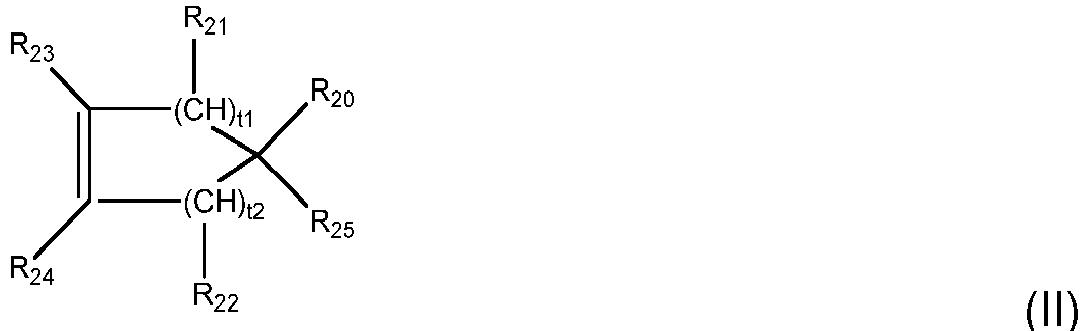
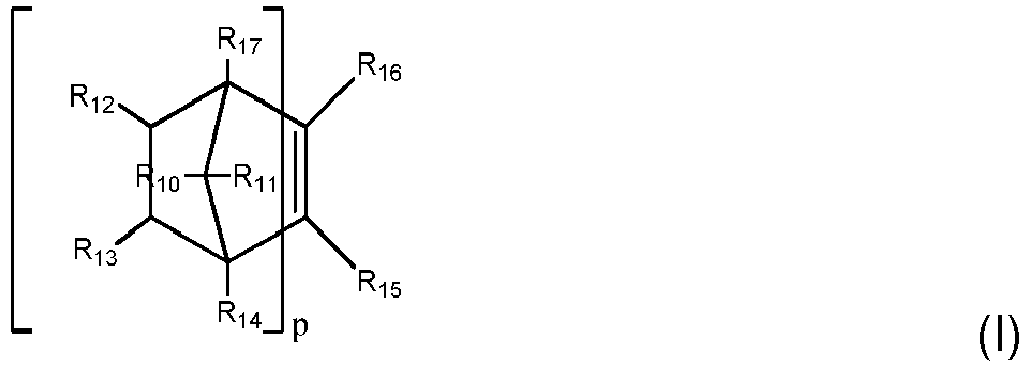
wobeiX1, X2 und X3 unabhängig voneinander für eine Verknüpfung aus der Gruppe bestehend aus einer direkten Bindung, -O-, -NR'-, wobei R' für H oder C1-C4-Alkyl steht, -C(0)-NH-,-NH-C(O)-, -NH-C(O)-NH-, -O-C(O)-NH-, -S-, -NH-C(O)-O-, -C(O)-O-, -O-C(O)-, -NH-C(O)-NH-Z0-NH-C(O)-NH-, -O-C(O)-NH-Z0-NH-C(O)-O-, -O-C(O)-NH-Z0-NH-C(O)-NH- und -NH-C(O)-NH-Z0-NH-C(0)-0- stehen, Z0 für einen linearen oder verzweigten zweiwertigen C2-C12-Alkylenrest oder einen cycloaliphatischen oder aliphatisch-cycloaliphatischen zweiwertigen C5-C45-Rest, der gegebenenfalls eine oder mehrere Verknüpfungen -0-, -NR'-, wobei R' wie oben definiert ist, -S- und -C(0)- enthält, steht, Z1, Z2, Z3 und Z4 unabhängig voneinander für eine direkte Bindung, einen linearen oder verzweigten zweiwertigen C1-C12-Alkylenrest, der gegebenenfalls eine oder mehrere Verknüpfungen -0-, -NR'-, -S- und -C(0)-enthält, - (CH2CH2O)r1-CH2CH2-, wobei r1 wie oben definiert ist, oder einen cycloaliphatischen oder aliphatischcycloaliphatischen zweiwertigen C5-C45-Rest, der gegebenenfalls eine oder mehrere Verknüpfungen -O-, -NR'-, wobei R' wie oben definiert ist, -S- und -C(0)- enthält, stehen;Y1, Y3, Y4 und Y10 jeweils mindestens eine Urethan-Verknüpfung (-O-C(O)-NH-) umfassen und unabhängig voneinander für einen zweiwertigen Rest -Z1-X1-Z2-X2-Z3-X3-Z4- gemäß obiger Definition oder einen zweiwertigen Rest der Formel (3) Z1 bis Z4 und X1 bis X3 wie oben definiert sind,X4, X5 und X6 unabhängig voneinander für eine Verknüpfung aus der Gruppe bestehend aus einer direkten Bindung, -O-, -NR'-, wobei R' wie oben definiert ist, -C(O)-NH-,-NH-C(O)-, -NH-C(O)-NH-, -O-C(O)-NH-, -S-, -NH-C(O)-O-, -C(O)-O-, -O-C(O)-, -NH-C(O)-NH-Z0-NH-C(O)-NH-, wobei Z0 wie oben definiert ist, -O-C(O)-NH-Z0-NH-C(O)-O-, wobei Z0 wie oben definiert ist, -O-C(O)-NH-Z0-NH-C(O)-NH-, wobei Z0 wie oben definiert ist, und -NH-C(O)-NH-Z0-NH-C(0)-0-, wobei Z0 wie oben definiert ist, stehen,Z5, Z6, Z7 und Z8 unabhängig voneinander für eine direkte Bindung, einen linearen oder verzweigten zweiwertigen C1-C12-Alkylenrest, der gegebenenfalls eine oder mehrere Verknüpfungen -0-, -NR'-, wobei R' wie oben definiert ist, -S- und -C(O)- enthält, - (CH2CH2O)r1-CH2CH2-, wobei r1 wie oben definiert ist, oder einen cycloaliphatischen oder aliphatisch-cycloaliphatischen zweiwertigen C5-C45-Rest, der gegebenenfalls eine oder mehrere Verknüpfungen -0-, -NR'-, wobei R' wie oben definiert ist, -S- und -C(0)-enthält, stehen;1R für Wasserstoff oder eine Methyl- oder Ethylgruppe steht undq für eine ganze Zahl von 3 bis 200 steht;stehen;T2 für einen aliphatischen oder cycloaliphatischen oder aliphatisch-cycloaliphatischen dreiwertigen Rest, der bis zu 15 Kohlenstoffatome aufweist und durch -0-, -NR'-, wobei R' oben definiert ist, -C(0)- und/oder -S- unterbrochen sein kann, steht undQ durch eine der Formeln (I)-(III) definiert ist:

- Prepolymer nach Anspruch 1, wobei das erfindungsgemäße Prepolymer erhalten wird durch:(a) Polymerisieren einer reaktiven Mischung, die mindestens eine mit zwei ersten reaktiven funktionellen Gruppen terminierte Polysiloxanverbindung und ein Polyoxazolin mit einer einzigen ersten reaktiven Endgruppe mit zwei dritten reaktiven funktionellen Gruppen umfasst, in Gegenwart oder Abwesenheit eines Kupplungsmittels unter Kupplungsreaktionsbedingungen zur Bildung eines intermediären Copolymers, das mit zwei reaktiven funktionellen Gruppen, bei denen es sich unabhängig voneinander um eine der ersten und dritten reaktiven funktionellen Gruppen handelt, terminiert ist; und(b) kovalentes Verknüpfen einer en-haltigen Verbindung mit einer fünften reaktiven funktionellen Gruppe, die mit einer der zwei reaktiven funktionellen Gruppen des intermediären Copolymers coreaktiv ist, in Gegenwart oder Abwesenheit eines Kupplungsmittels zur Bildung einer kovalenten Verknüpfung, wobei die ersten, dritten und fünften reaktiven funktionellen Gruppen unabhängig voneinander aus der Gruppe bestehend aus einer Hydroxylgruppe, einer Aminogruppe (-NHR'), einer Carboxylgruppe (-COOH), einer Epoxidgruppe, einer Isocyanatgruppe und Kombinationen davon, vorzugsweise aus der Gruppe bestehend aus Hydroxyl, Isocyanat und einer Kombination davon, ausgewählt sind.
- Prepolymer nach Anspruch 2, wobei die ersten, dritten und fünften reaktiven funktionellen Gruppen unabhängig voneinander aus der Gruppe bestehend aus Hydroxyl, Isocyanat und einer Kombination davon ausgewählt sind.
- Prepolymer nach einem der Ansprüche 1 bis 3, wobei Q durch Formel (I) definiert ist:
- Prepolymer nach einem der Ansprüche 1 bis 3, wobei Q durch Formel II definiert ist:

- Medizinische Vorrichtung, umfassend ein Silikonhydrogelmaterial, das durch aktinische Vernetzung eines polymerisierbaren Materials, das ein aktinisch vernetzbares Prepolymer nach einem der Ansprüche 1 bis 5 und mindestens ein Vernetzungs-/Verzweigungsmittel mit mehreren Thiolgruppen umfasst, auf der Basis eines Stufenwachstumspolymerisationsmechanismus erhalten wird.
- Medizinische Vorrichtung nach Anspruch 6, wobei es sich bei der medizinischen Vorrichtung um eine weiche Kontaktlinse handelt, die mindestens eine Eigenschaft aus der Gruppe bestehend aus einer Sauerstoffdurchlässigkeit von mindestens 40 Barrer, einem Elastizitätsmodul von 0,1 MPa bis 2,0 MPa, einem Wassergehalt von 15 bis 70 Gew.-% in vollständig hydratisiertem Zustand und Kombinationen davon aufweist.
- Verfahren zur Herstellung von weichen Kontaktlinsen, das folgende Schritte umfasst:(1) Bereitstellen einer Form zur Herstellung einer weichen Kontaktlinse, wobei die Form eine erste Formhälfte mit einer ersten Formungsoberfläche, die die Vorderfläche einer Kontaktlinse definiert, und eine zweite Formhälfte mit einer zweiten Formungsoberfläche, die die Rückfläche der Kontaktlinse definiert, aufweist, wobei die erste und die zweite Formhälfte so ausgestaltet sind, dass sie einander unter Bildung eines Hohlraums zwischen der ersten und der zweiten Formungsoberfläche aufnehmen;(2) Eintragen eines linsenbildenden Materials in den Hohlraum, wobei das linsenbildende Material mindestens ein aktinisch vernetzbares amphiphiles Prepolymer nach einem der Ansprüche 1 bis 5 und mindestens ein Vernetzungs-/Verzweigungsmittel mit mehreren Thiolgruppen umfasst; und(3) aktinisches Bestrahlen des linsenbildenden Materials in dem Hohlraum zur Bildung einer Kontaktlinse.
- Verfahren nach Anspruch 8, bei dem das linsenbildende Material ferner ein Prepolymer mit mehreren Acryloyl- oder Methacryloylgruppen umfasst.
- Verfahren nach Anspruch 8 oder 9, bei dem das linsenbildende Material mindestens eine Komponente aus der Gruppe bestehend aus einem Photoinitiator, einem polymerisierbaren UV-absorbierenden Mittel, einem Sichttönungsmittel, antimikrobiellen Mitteln, einem bioaktiven Mittel, auslaugbaren Gleitmitteln, auslaugbaren tränenstabilisierenden Mitteln und Mischungen davon umfasst.
- Verfahren nach Anspruch 8, 9 oder 10, bei dem es sich bei der Form um eine wiederverwendbare Form handelt und das linsenbildende Material unter räumlicher Beschränkung von aktinischer Strahlung zur Bildung einer weichen Kontaktlinse aktinisch gehärtet (d.h. polymerisiert) wird.
- Verfahren nach Anspruch 11, bei dem die Vernetzung des linsenbildenden Materials in der Form in einem Zeitraum von 60 Sekunden oder weniger erfolgt.
Applications Claiming Priority (2)
| Application Number | Priority Date | Filing Date | Title |
|---|---|---|---|
| US201261737187P | 2012-12-14 | 2012-12-14 | |
| PCT/US2013/074895 WO2014093756A1 (en) | 2012-12-14 | 2013-12-13 | Actinically-crosslinkable amphiphilic prepolymers |
Publications (2)
| Publication Number | Publication Date |
|---|---|
| EP2931790A1 EP2931790A1 (de) | 2015-10-21 |
| EP2931790B1 true EP2931790B1 (de) | 2017-02-15 |
Family
ID=49918847
Family Applications (1)
| Application Number | Title | Priority Date | Filing Date |
|---|---|---|---|
| EP13818079.9A Active EP2931790B1 (de) | 2012-12-14 | 2013-12-13 | Aktinisch vernetzbare amphiphile präpolymere |
Country Status (5)
| Country | Link |
|---|---|
| US (2) | US9151873B2 (de) |
| EP (1) | EP2931790B1 (de) |
| JP (1) | JP6034982B2 (de) |
| CA (1) | CA2889894C (de) |
| WO (1) | WO2014093756A1 (de) |
Cited By (1)
| Publication number | Priority date | Publication date | Assignee | Title |
|---|---|---|---|---|
| US11702500B2 (en) | 2021-03-15 | 2023-07-18 | Bausch + Lomb Ireland Limited | Biomedical devices |
Families Citing this family (15)
| Publication number | Priority date | Publication date | Assignee | Title |
|---|---|---|---|---|
| NZ606787A (en) * | 2010-10-06 | 2014-11-28 | Novartis Ag | Water-processable silicone-containing prepolymers and uses thereof |
| EP3062979B1 (de) | 2013-10-31 | 2018-08-29 | Novartis AG | Verfahren zur herstellung von ophthalmischen linsen |
| EP3079888B1 (de) | 2013-12-13 | 2018-01-31 | Novartis AG | Verfahren zur herstellung von kontaktlinsen |
| KR102397773B1 (ko) * | 2014-09-26 | 2022-05-13 | 알콘 인코포레이티드 | 친수성 치환기를 갖는 중합성 폴리실록산 |
| WO2016145204A1 (en) | 2015-03-11 | 2016-09-15 | University Of Florida Research Foundation, Inc. | Mesh size control of lubrication in gemini hydrogels |
| MY184638A (en) * | 2015-12-15 | 2021-04-13 | Alcon Inc | Method for applying stable coating on silicone hydrogel contact lenses |
| MY192377A (en) | 2015-12-15 | 2022-08-17 | Novartis Ag | Method for producing contact lenses with a lubricious surface |
| EP3589350B1 (de) | 2017-03-02 | 2025-02-19 | Medtronic, Inc. | Medizinische vorrichtung und verfahren zur herstellung davon |
| EP3589670A4 (de) | 2017-03-02 | 2020-11-25 | Chinese Academy of Sciences, Ningbo Institute of Material Technology & Engineering | Elastomer, verfahren zur herstellung davon und verwendung davon |
| EP3447475B1 (de) | 2017-08-24 | 2020-06-17 | Alcon Inc. | Verfahren und vorrichtung zur bestimmung eines reibungskoeffizienten an einer probestelle auf einer oberfläche einer kontaktlinse |
| EP3676082A1 (de) | 2017-08-29 | 2020-07-08 | Alcon Inc. | Giessverfahren zur herstellung von kontaktlinsen |
| KR102198214B1 (ko) * | 2017-11-03 | 2021-01-04 | 주식회사 엘지화학 | 액정 배향제 조성물, 이를 이용한 액정 배향막의 제조 방법, 이를 이용한 액정 배향막 및 액정표시소자 |
| SG11202004722WA (en) | 2018-01-22 | 2020-08-28 | Alcon Inc | Cast-molding process for producing uv-absorbing contact lenses |
| AU2020335669B2 (en) * | 2019-08-23 | 2026-03-26 | Beijing Research Institute Of Chemical Industry, China Petroleum & Chemical Corporation | Super-wet surface and preparation method therefor and application thereof |
| CN112661961B (zh) * | 2020-12-28 | 2022-05-06 | 中国科学院长春应用化学研究所 | 两亲性聚噁唑啉共聚物、其制备方法及应用 |
Family Cites Families (45)
| Publication number | Priority date | Publication date | Assignee | Title |
|---|---|---|---|---|
| US4444711A (en) | 1981-12-21 | 1984-04-24 | Husky Injection Molding Systems Ltd. | Method of operating a two-shot injection-molding machine |
| US4460534A (en) | 1982-09-07 | 1984-07-17 | International Business Machines Corporation | Two-shot injection molding |
| US4485236A (en) | 1982-09-27 | 1984-11-27 | Minnesota Mining And Manufacturing Company | Azlactone-functional compounds |
| TW328535B (en) | 1993-07-02 | 1998-03-21 | Novartis Ag | Functional photoinitiators and their manufacture |
| US6800225B1 (en) | 1994-07-14 | 2004-10-05 | Novartis Ag | Process and device for the manufacture of mouldings and mouldings manufactured in accordance with that process |
| TW272976B (de) | 1993-08-06 | 1996-03-21 | Ciba Geigy Ag | |
| GB9321714D0 (en) | 1993-10-21 | 1993-12-15 | Sandoz Ltd | Improvements in or relating to organic compounds |
| US5712356A (en) | 1993-11-26 | 1998-01-27 | Ciba Vision Corporation | Cross-linkable copolymers and hydrogels |
| EP0655470B1 (de) | 1993-11-26 | 1999-05-12 | Novartis AG | Vernetzbare Copolymere und Hydrogele |
| US5894002A (en) | 1993-12-13 | 1999-04-13 | Ciba Vision Corporation | Process and apparatus for the manufacture of a contact lens |
| US5843346A (en) | 1994-06-30 | 1998-12-01 | Polymer Technology Corporation | Method of cast molding contact lenses |
| US6342570B1 (en) | 1994-11-14 | 2002-01-29 | Novartis Ag | Cross-linkable copolymers and hydrogels |
| EP0712867B1 (de) | 1994-11-18 | 1999-07-14 | Novartis AG | Polymere Netzwerke aus wasserlöslichen Präpolymeren |
| US5665840A (en) | 1994-11-18 | 1997-09-09 | Novartis Corporation | Polymeric networks from water-soluble prepolymers |
| WO1996024075A1 (en) | 1995-02-03 | 1996-08-08 | Novartis Ag | Crosslinked polymers containing ester or amide groups |
| TW349967B (en) | 1995-02-03 | 1999-01-11 | Novartis Ag | Process for producing contact lenses and a cross-linkable polyvinylalcohol used therefor |
| US5807944A (en) * | 1996-06-27 | 1998-09-15 | Ciba Vision Corporation | Amphiphilic, segmented copolymer of controlled morphology and ophthalmic devices including contact lenses made therefrom |
| EP0932635B1 (de) | 1996-10-21 | 2001-07-11 | Novartis AG | Vernetzbare polymere |
| EP0867456A1 (de) | 1997-02-04 | 1998-09-30 | Novartis AG | Ophthalmischer Formkörper |
| TW425403B (en) | 1997-02-04 | 2001-03-11 | Novartis Ag | Branched polyurethane (meth)acrylate prepolymers, opthal-mic mouldings derived therefrom and processes for their manufacture |
| JP4144902B2 (ja) | 1997-02-21 | 2008-09-03 | ノバルティス アクチエンゲゼルシャフト | 眼用成形品 |
| AU9743298A (en) | 1997-09-16 | 1999-04-05 | Novartis Ag | Crosslinkable polyurea polymers |
| TW429327B (en) | 1997-10-21 | 2001-04-11 | Novartis Ag | Single mould alignment |
| US6039913A (en) | 1998-08-27 | 2000-03-21 | Novartis Ag | Process for the manufacture of an ophthalmic molding |
| EP1002807A1 (de) | 1998-11-20 | 2000-05-24 | Novartis AG | Funktionalisiertes Harz aus Polyallylamin |
| US7521519B1 (en) | 2000-03-14 | 2009-04-21 | Novartis Ag | Organic compounds |
| CA2682118A1 (en) | 2000-03-24 | 2001-09-27 | Novartis Ag | Crosslinkable or polymerizable prepolymers |
| US6995192B2 (en) | 2002-08-14 | 2006-02-07 | Novartis Ag | Radiation-curable prepolymers |
| US7387759B2 (en) | 2002-12-17 | 2008-06-17 | Novartis Ag | System and method for curing polymeric moldings having a masking collar |
| US7384590B2 (en) | 2002-12-17 | 2008-06-10 | Novartis Ag | System and method for curing polymeric moldings |
| US7977430B2 (en) | 2003-11-25 | 2011-07-12 | Novartis Ag | Crosslinkable polyurea prepolymers |
| BRPI0714430A2 (pt) | 2006-07-12 | 2013-03-12 | Novartis Ag | prepolÍmero actinicamente reticulÁvel, processo para a manufatura do mesmo e lente de contato macia |
| AR064286A1 (es) | 2006-12-13 | 2009-03-25 | Quiceno Gomez Alexandra Lorena | Produccion de dispositivos oftalmicos basados en la polimerizacion por crecimiento escalonado fotoinducida |
| EP2126614B1 (de) | 2007-03-22 | 2019-04-24 | Novartis AG | Silikon-enthaltende präpolymere mit hydrophilischen polymerketten |
| CN101641206B (zh) | 2007-03-22 | 2013-03-20 | 诺瓦提斯公司 | 具有含悬挂的聚硅氧烷的聚合物链的预聚物 |
| US8044111B2 (en) | 2007-11-30 | 2011-10-25 | Novartis Ag | Actinically-crosslinkable silicone-containing block copolymers |
| NZ591769A (en) | 2008-11-13 | 2012-06-29 | Novartis Ag | Polysiloxane copolymers with terminal hydrophilic polymer chains |
| EP3598181B1 (de) | 2008-11-13 | 2021-06-23 | Alcon Inc. | Vinylmonomer und prepolymer der ein solches vinylmonomer enthaltet |
| CA2761218C (en) | 2009-05-22 | 2016-06-28 | Novartis Ag | Actinically-crosslinkable siloxane-containing copolymers |
| US8383744B2 (en) | 2009-05-22 | 2013-02-26 | Novartis Ag | Actinically-crosslinkable siloxane-containing copolymers |
| MY158359A (en) | 2009-09-15 | 2016-09-30 | Novartis Ag | Prepolymers suitable for making ultra-violet absorbing contact lenses |
| NZ621745A (en) | 2010-07-30 | 2015-01-30 | Novartis Ag | Amphiphilic polysiloxane prepolymers and uses thereof |
| NZ606787A (en) | 2010-10-06 | 2014-11-28 | Novartis Ag | Water-processable silicone-containing prepolymers and uses thereof |
| HUE044765T2 (hu) | 2010-10-06 | 2019-11-28 | Novartis Ag | Polimerizálható hosszabbított láncú polisziloxánok hidrofil oldalcsoportokkal |
| EP2625217B1 (de) | 2010-10-06 | 2018-07-04 | Novartis AG | Kettenverlängerte polysiloxanvernetzer mit hängenden hydrophilen polymerketten |
-
2013
- 2013-12-13 EP EP13818079.9A patent/EP2931790B1/de active Active
- 2013-12-13 JP JP2015547971A patent/JP6034982B2/ja active Active
- 2013-12-13 US US14/105,295 patent/US9151873B2/en active Active
- 2013-12-13 CA CA2889894A patent/CA2889894C/en active Active
- 2013-12-13 WO PCT/US2013/074895 patent/WO2014093756A1/en not_active Ceased
-
2015
- 2015-08-31 US US14/840,169 patent/US9500775B2/en active Active
Non-Patent Citations (1)
| Title |
|---|
| None * |
Cited By (1)
| Publication number | Priority date | Publication date | Assignee | Title |
|---|---|---|---|---|
| US11702500B2 (en) | 2021-03-15 | 2023-07-18 | Bausch + Lomb Ireland Limited | Biomedical devices |
Also Published As
| Publication number | Publication date |
|---|---|
| EP2931790A1 (de) | 2015-10-21 |
| US20150369962A1 (en) | 2015-12-24 |
| WO2014093756A1 (en) | 2014-06-19 |
| CA2889894C (en) | 2017-09-12 |
| JP6034982B2 (ja) | 2016-11-30 |
| CA2889894A1 (en) | 2014-06-19 |
| US9500775B2 (en) | 2016-11-22 |
| JP2016501947A (ja) | 2016-01-21 |
| US20140171543A1 (en) | 2014-06-19 |
| US9151873B2 (en) | 2015-10-06 |
Similar Documents
| Publication | Publication Date | Title |
|---|---|---|
| EP2931790B1 (de) | Aktinisch vernetzbare amphiphile präpolymere | |
| US9921340B2 (en) | Water-processable silicone-containing prepolymers and uses thereof | |
| US9720139B2 (en) | Polymerizable polysiloxanes with hydrophilic substituents | |
| EP2625216B1 (de) | Polymerisierbare kettenverlängerte polysiloxane mit seitenständigen hydrophilen gruppen | |
| US9541676B2 (en) | Amphiphilic siloxane-containing vinylic monomers and uses thereof | |
| CA2889925C (en) | Tris(trimethyl siloxy)silane vinylic monomers and uses thereof | |
| EP2931767B1 (de) | (meth)acrylamide mit amphiphilem siloxan und verwendungen davon | |
| HK1182404A (en) | Water-processable silicone-containing prepolymers and uses thereof | |
| HK1182404B (en) | Water-processable silicone-containing prepolymers and uses thereof |
Legal Events
| Date | Code | Title | Description |
|---|---|---|---|
| PUAI | Public reference made under article 153(3) epc to a published international application that has entered the european phase |
Free format text: ORIGINAL CODE: 0009012 |
|
| 17P | Request for examination filed |
Effective date: 20150707 |
|
| AK | Designated contracting states |
Kind code of ref document: A1 Designated state(s): AL AT BE BG CH CY CZ DE DK EE ES FI FR GB GR HR HU IE IS IT LI LT LU LV MC MK MT NL NO PL PT RO RS SE SI SK SM TR |
|
| AX | Request for extension of the european patent |
Extension state: BA ME |
|
| DAX | Request for extension of the european patent (deleted) | ||
| GRAP | Despatch of communication of intention to grant a patent |
Free format text: ORIGINAL CODE: EPIDOSNIGR1 |
|
| INTG | Intention to grant announced |
Effective date: 20160908 |
|
| GRAS | Grant fee paid |
Free format text: ORIGINAL CODE: EPIDOSNIGR3 |
|
| GRAA | (expected) grant |
Free format text: ORIGINAL CODE: 0009210 |
|
| AK | Designated contracting states |
Kind code of ref document: B1 Designated state(s): AL AT BE BG CH CY CZ DE DK EE ES FI FR GB GR HR HU IE IS IT LI LT LU LV MC MK MT NL NO PL PT RO RS SE SI SK SM TR |
|
| REG | Reference to a national code |
Ref country code: CH Ref legal event code: EP Ref country code: GB Ref legal event code: FG4D |
|
| REG | Reference to a national code |
Ref country code: IE Ref legal event code: FG4D |
|
| REG | Reference to a national code |
Ref country code: AT Ref legal event code: REF Ref document number: 867858 Country of ref document: AT Kind code of ref document: T Effective date: 20170315 |
|
| REG | Reference to a national code |
Ref country code: DE Ref legal event code: R096 Ref document number: 602013017552 Country of ref document: DE |
|
| REG | Reference to a national code |
Ref country code: NL Ref legal event code: MP Effective date: 20170215 |
|
| REG | Reference to a national code |
Ref country code: LT Ref legal event code: MG4D |
|
| REG | Reference to a national code |
Ref country code: AT Ref legal event code: MK05 Ref document number: 867858 Country of ref document: AT Kind code of ref document: T Effective date: 20170215 |
|
| PG25 | Lapsed in a contracting state [announced via postgrant information from national office to epo] |
Ref country code: HR Free format text: LAPSE BECAUSE OF FAILURE TO SUBMIT A TRANSLATION OF THE DESCRIPTION OR TO PAY THE FEE WITHIN THE PRESCRIBED TIME-LIMIT Effective date: 20170215 Ref country code: FI Free format text: LAPSE BECAUSE OF FAILURE TO SUBMIT A TRANSLATION OF THE DESCRIPTION OR TO PAY THE FEE WITHIN THE PRESCRIBED TIME-LIMIT Effective date: 20170215 Ref country code: GR Free format text: LAPSE BECAUSE OF FAILURE TO SUBMIT A TRANSLATION OF THE DESCRIPTION OR TO PAY THE FEE WITHIN THE PRESCRIBED TIME-LIMIT Effective date: 20170516 Ref country code: LT Free format text: LAPSE BECAUSE OF FAILURE TO SUBMIT A TRANSLATION OF THE DESCRIPTION OR TO PAY THE FEE WITHIN THE PRESCRIBED TIME-LIMIT Effective date: 20170215 Ref country code: NO Free format text: LAPSE BECAUSE OF FAILURE TO SUBMIT A TRANSLATION OF THE DESCRIPTION OR TO PAY THE FEE WITHIN THE PRESCRIBED TIME-LIMIT Effective date: 20170515 |
|
| PG25 | Lapsed in a contracting state [announced via postgrant information from national office to epo] |
Ref country code: AT Free format text: LAPSE BECAUSE OF FAILURE TO SUBMIT A TRANSLATION OF THE DESCRIPTION OR TO PAY THE FEE WITHIN THE PRESCRIBED TIME-LIMIT Effective date: 20170215 Ref country code: RS Free format text: LAPSE BECAUSE OF FAILURE TO SUBMIT A TRANSLATION OF THE DESCRIPTION OR TO PAY THE FEE WITHIN THE PRESCRIBED TIME-LIMIT Effective date: 20170215 Ref country code: ES Free format text: LAPSE BECAUSE OF FAILURE TO SUBMIT A TRANSLATION OF THE DESCRIPTION OR TO PAY THE FEE WITHIN THE PRESCRIBED TIME-LIMIT Effective date: 20170215 Ref country code: NL Free format text: LAPSE BECAUSE OF NON-PAYMENT OF DUE FEES Effective date: 20170215 Ref country code: PT Free format text: LAPSE BECAUSE OF FAILURE TO SUBMIT A TRANSLATION OF THE DESCRIPTION OR TO PAY THE FEE WITHIN THE PRESCRIBED TIME-LIMIT Effective date: 20170615 Ref country code: BG Free format text: LAPSE BECAUSE OF FAILURE TO SUBMIT A TRANSLATION OF THE DESCRIPTION OR TO PAY THE FEE WITHIN THE PRESCRIBED TIME-LIMIT Effective date: 20170515 Ref country code: LV Free format text: LAPSE BECAUSE OF FAILURE TO SUBMIT A TRANSLATION OF THE DESCRIPTION OR TO PAY THE FEE WITHIN THE PRESCRIBED TIME-LIMIT Effective date: 20170215 Ref country code: SE Free format text: LAPSE BECAUSE OF FAILURE TO SUBMIT A TRANSLATION OF THE DESCRIPTION OR TO PAY THE FEE WITHIN THE PRESCRIBED TIME-LIMIT Effective date: 20170215 |
|
| PG25 | Lapsed in a contracting state [announced via postgrant information from national office to epo] |
Ref country code: EE Free format text: LAPSE BECAUSE OF FAILURE TO SUBMIT A TRANSLATION OF THE DESCRIPTION OR TO PAY THE FEE WITHIN THE PRESCRIBED TIME-LIMIT Effective date: 20170215 Ref country code: CZ Free format text: LAPSE BECAUSE OF FAILURE TO SUBMIT A TRANSLATION OF THE DESCRIPTION OR TO PAY THE FEE WITHIN THE PRESCRIBED TIME-LIMIT Effective date: 20170215 Ref country code: RO Free format text: LAPSE BECAUSE OF FAILURE TO SUBMIT A TRANSLATION OF THE DESCRIPTION OR TO PAY THE FEE WITHIN THE PRESCRIBED TIME-LIMIT Effective date: 20170215 Ref country code: SK Free format text: LAPSE BECAUSE OF FAILURE TO SUBMIT A TRANSLATION OF THE DESCRIPTION OR TO PAY THE FEE WITHIN THE PRESCRIBED TIME-LIMIT Effective date: 20170215 |
|
| REG | Reference to a national code |
Ref country code: DE Ref legal event code: R097 Ref document number: 602013017552 Country of ref document: DE |
|
| REG | Reference to a national code |
Ref country code: FR Ref legal event code: PLFP Year of fee payment: 5 |
|
| PG25 | Lapsed in a contracting state [announced via postgrant information from national office to epo] |
Ref country code: PL Free format text: LAPSE BECAUSE OF FAILURE TO SUBMIT A TRANSLATION OF THE DESCRIPTION OR TO PAY THE FEE WITHIN THE PRESCRIBED TIME-LIMIT Effective date: 20170215 Ref country code: DK Free format text: LAPSE BECAUSE OF FAILURE TO SUBMIT A TRANSLATION OF THE DESCRIPTION OR TO PAY THE FEE WITHIN THE PRESCRIBED TIME-LIMIT Effective date: 20170215 Ref country code: SM Free format text: LAPSE BECAUSE OF FAILURE TO SUBMIT A TRANSLATION OF THE DESCRIPTION OR TO PAY THE FEE WITHIN THE PRESCRIBED TIME-LIMIT Effective date: 20170215 |
|
| PLBE | No opposition filed within time limit |
Free format text: ORIGINAL CODE: 0009261 |
|
| STAA | Information on the status of an ep patent application or granted ep patent |
Free format text: STATUS: NO OPPOSITION FILED WITHIN TIME LIMIT |
|
| 26N | No opposition filed |
Effective date: 20171116 |
|
| PG25 | Lapsed in a contracting state [announced via postgrant information from national office to epo] |
Ref country code: SI Free format text: LAPSE BECAUSE OF FAILURE TO SUBMIT A TRANSLATION OF THE DESCRIPTION OR TO PAY THE FEE WITHIN THE PRESCRIBED TIME-LIMIT Effective date: 20170215 |
|
| REG | Reference to a national code |
Ref country code: CH Ref legal event code: PL |
|
| PG25 | Lapsed in a contracting state [announced via postgrant information from national office to epo] |
Ref country code: MT Free format text: LAPSE BECAUSE OF NON-PAYMENT OF DUE FEES Effective date: 20171213 Ref country code: LU Free format text: LAPSE BECAUSE OF NON-PAYMENT OF DUE FEES Effective date: 20171213 |
|
| REG | Reference to a national code |
Ref country code: BE Ref legal event code: MM Effective date: 20171231 |
|
| PG25 | Lapsed in a contracting state [announced via postgrant information from national office to epo] |
Ref country code: BE Free format text: LAPSE BECAUSE OF NON-PAYMENT OF DUE FEES Effective date: 20171231 Ref country code: CH Free format text: LAPSE BECAUSE OF NON-PAYMENT OF DUE FEES Effective date: 20171231 Ref country code: LI Free format text: LAPSE BECAUSE OF NON-PAYMENT OF DUE FEES Effective date: 20171231 |
|
| PG25 | Lapsed in a contracting state [announced via postgrant information from national office to epo] |
Ref country code: MC Free format text: LAPSE BECAUSE OF FAILURE TO SUBMIT A TRANSLATION OF THE DESCRIPTION OR TO PAY THE FEE WITHIN THE PRESCRIBED TIME-LIMIT Effective date: 20170215 Ref country code: HU Free format text: LAPSE BECAUSE OF FAILURE TO SUBMIT A TRANSLATION OF THE DESCRIPTION OR TO PAY THE FEE WITHIN THE PRESCRIBED TIME-LIMIT; INVALID AB INITIO Effective date: 20131213 |
|
| PG25 | Lapsed in a contracting state [announced via postgrant information from national office to epo] |
Ref country code: CY Free format text: LAPSE BECAUSE OF FAILURE TO SUBMIT A TRANSLATION OF THE DESCRIPTION OR TO PAY THE FEE WITHIN THE PRESCRIBED TIME-LIMIT Effective date: 20170215 |
|
| PG25 | Lapsed in a contracting state [announced via postgrant information from national office to epo] |
Ref country code: MK Free format text: LAPSE BECAUSE OF FAILURE TO SUBMIT A TRANSLATION OF THE DESCRIPTION OR TO PAY THE FEE WITHIN THE PRESCRIBED TIME-LIMIT Effective date: 20170215 |
|
| REG | Reference to a national code |
Ref country code: DE Ref legal event code: R081 Ref document number: 602013017552 Country of ref document: DE Owner name: ALCON INC., CH Free format text: FORMER OWNER: NOVARTIS AG, 4056 BASEL, CH |
|
| REG | Reference to a national code |
Ref country code: GB Ref legal event code: 732E Free format text: REGISTERED BETWEEN 20200123 AND 20200129 |
|
| PG25 | Lapsed in a contracting state [announced via postgrant information from national office to epo] |
Ref country code: TR Free format text: LAPSE BECAUSE OF FAILURE TO SUBMIT A TRANSLATION OF THE DESCRIPTION OR TO PAY THE FEE WITHIN THE PRESCRIBED TIME-LIMIT Effective date: 20170215 |
|
| PG25 | Lapsed in a contracting state [announced via postgrant information from national office to epo] |
Ref country code: AL Free format text: LAPSE BECAUSE OF FAILURE TO SUBMIT A TRANSLATION OF THE DESCRIPTION OR TO PAY THE FEE WITHIN THE PRESCRIBED TIME-LIMIT Effective date: 20170215 Ref country code: IS Free format text: LAPSE BECAUSE OF FAILURE TO SUBMIT A TRANSLATION OF THE DESCRIPTION OR TO PAY THE FEE WITHIN THE PRESCRIBED TIME-LIMIT Effective date: 20170615 |
|
| P01 | Opt-out of the competence of the unified patent court (upc) registered |
Effective date: 20230504 |
|
| PGFP | Annual fee paid to national office [announced via postgrant information from national office to epo] |
Ref country code: DE Payment date: 20251119 Year of fee payment: 13 |
|
| PGFP | Annual fee paid to national office [announced via postgrant information from national office to epo] |
Ref country code: GB Payment date: 20251120 Year of fee payment: 13 |
|
| PGFP | Annual fee paid to national office [announced via postgrant information from national office to epo] |
Ref country code: IT Payment date: 20251126 Year of fee payment: 13 |
|
| PGFP | Annual fee paid to national office [announced via postgrant information from national office to epo] |
Ref country code: FR Payment date: 20251124 Year of fee payment: 13 |
|
| PGFP | Annual fee paid to national office [announced via postgrant information from national office to epo] |
Ref country code: IE Payment date: 20251126 Year of fee payment: 13 |