EP3587403A1 - N-substituierte imidazol-carboxylat-verbindung, herstellungsverfahren und verwendung - Google Patents
N-substituierte imidazol-carboxylat-verbindung, herstellungsverfahren und verwendung Download PDFInfo
- Publication number
- EP3587403A1 EP3587403A1 EP18757664.0A EP18757664A EP3587403A1 EP 3587403 A1 EP3587403 A1 EP 3587403A1 EP 18757664 A EP18757664 A EP 18757664A EP 3587403 A1 EP3587403 A1 EP 3587403A1
- Authority
- EP
- European Patent Office
- Prior art keywords
- formula
- added
- methyl
- reaction
- sub
- Prior art date
- Legal status (The legal status is an assumption and is not a legal conclusion. Google has not performed a legal analysis and makes no representation as to the accuracy of the status listed.)
- Granted
Links
- 0 C[C@](C1=CC=CCC1)[n]1c(C(OC(*)(*)OC(O*)=O)=*)cnc1 Chemical compound C[C@](C1=CC=CCC1)[n]1c(C(OC(*)(*)OC(O*)=O)=*)cnc1 0.000 description 5
- PRMGRHROXWGZJG-FWJOYPJLSA-N CC(C)C(OC(c1cnc[n]1[C@H](C)c1ccccc1)=O)OC(OC)=O Chemical compound CC(C)C(OC(c1cnc[n]1[C@H](C)c1ccccc1)=O)OC(OC)=O PRMGRHROXWGZJG-FWJOYPJLSA-N 0.000 description 1
- BHXGNDSTPJTFLH-CQSZACIVSA-N CC(C)OC(OC1(CC1)OC(c1cnc[n]1[C@H](C)c1ccccc1)=O)=O Chemical compound CC(C)OC(OC1(CC1)OC(c1cnc[n]1[C@H](C)c1ccccc1)=O)=O BHXGNDSTPJTFLH-CQSZACIVSA-N 0.000 description 1
- XWTFCXVQCRHPMB-JHJMLUEUSA-N C[C@H](c1ccccc1)[n]1c(C(OC(C)OC(OC)=O)=O)cnc1 Chemical compound C[C@H](c1ccccc1)[n]1c(C(OC(C)OC(OC)=O)=O)cnc1 XWTFCXVQCRHPMB-JHJMLUEUSA-N 0.000 description 1
- YVXPVPGUBJPZPA-CYBMUJFWSA-N C[C@H](c1ccccc1)[n]1c(C(OCOC(OC(C)(C)C)=O)=O)cnc1 Chemical compound C[C@H](c1ccccc1)[n]1c(C(OCOC(OC(C)(C)C)=O)=O)cnc1 YVXPVPGUBJPZPA-CYBMUJFWSA-N 0.000 description 1
- PUAIEKPAMUAENZ-CYBMUJFWSA-N C[C@H](c1ccccc1)[n]1c(C(OCOC(OC2CCC2)=O)=O)cnc1 Chemical compound C[C@H](c1ccccc1)[n]1c(C(OCOC(OC2CCC2)=O)=O)cnc1 PUAIEKPAMUAENZ-CYBMUJFWSA-N 0.000 description 1
- VTJSGALFADIKJZ-OAHLLOKOSA-N C[C@H](c1ccccc1)[n]1c(C(OCOC(Oc2ccccc2)=O)=O)cnc1 Chemical compound C[C@H](c1ccccc1)[n]1c(C(OCOC(Oc2ccccc2)=O)=O)cnc1 VTJSGALFADIKJZ-OAHLLOKOSA-N 0.000 description 1
Images
Classifications
-
- A—HUMAN NECESSITIES
- A61—MEDICAL OR VETERINARY SCIENCE; HYGIENE
- A61P—SPECIFIC THERAPEUTIC ACTIVITY OF CHEMICAL COMPOUNDS OR MEDICINAL PREPARATIONS
- A61P23/00—Anaesthetics
-
- C—CHEMISTRY; METALLURGY
- C07—ORGANIC CHEMISTRY
- C07D—HETEROCYCLIC COMPOUNDS
- C07D233/00—Heterocyclic compounds containing 1,3-diazole or hydrogenated 1,3-diazole rings, not condensed with other rings
- C07D233/54—Heterocyclic compounds containing 1,3-diazole or hydrogenated 1,3-diazole rings, not condensed with other rings having two double bonds between ring members or between ring members and non-ring members
- C07D233/66—Heterocyclic compounds containing 1,3-diazole or hydrogenated 1,3-diazole rings, not condensed with other rings having two double bonds between ring members or between ring members and non-ring members with hetero atoms or with carbon atoms having three bonds to hetero atoms with at the most one bond to halogen, e.g. ester or nitrile radicals, directly attached to ring carbon atoms
- C07D233/90—Carbon atoms having three bonds to hetero atoms with at the most one bond to halogen, e.g. ester or nitrile radicals
Definitions
- the present invention relates to a N-substituted imidazole carboxylate compound characterized by producing short-acting anaesthetic effects and rapid recovery after drug withdraw, the preparative method and the uses thereof.
- Etomidate is a general intravenous anesthesia drug marketed for a long time. Since it shows a rapid effect and the hold time is short, etomidate is an ideal drug inducing the general intravenous anesthesia. Meanwhile, due to the specific pharmacologic feature of having a good cardiovascular stability, and during anesthesia, the inhibition on body's circulation is the minimum in general anesthetics used in clinical now, thus it especially suitable for the patients with cardiac dysfunction and the aged patients undergoing a surgery (Bovill JG. 2006; Passot S et al. 2005).
- the inhibition of etomidate on cortical hormones is realized by suppressing the activity of 11- ⁇ hydroxylase, and this enzyme is a key enzyme for the synthesis of cortical hormones.
- This adverse effect of etomidate is related to the imidazole structure in the drug molecule, and one N atom in the imidazole ring can complex with the topological iron atom in 11- ⁇ hydroxylase, thus strengthen the combination of drug molecules and enzyme molecules, producing the inhibitory effect on 11- ⁇ hydroxylase.
- the combining capacity of etomidate and 11- ⁇ hydroxylase is 100 times stronger than that of it and GABA A receptor (J. F. Cotton et al. 2009), and thus resolving the problem by improving the selectivity of receptors is very hard.
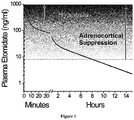
- Etomidate is mainly metablized in liver, and as the progress of drug metabolism research, the time/effect curve of therapeutic effect and adverse effect for etomidate has already been drawn (Stuart A. Forman. 2011), as shown in Figure 1 .
- Figure 1 it can be shown that after single injection of 3 mg/kg etomidate, the minimum effective concentration producing anaesthetic effect in plasma is 200 ng/mL, and the time of maintaining the drug concentration of > 200 ng/mL in plama is only 8 minutes. While the minimum effective concentration for etomidate to inhibit the synthesis of cortical hormones is 8 ng/mL, and the time of maintaining the drug concentration of > 8 ng/mL in plama is 8 hours. These data indicate that after anesthetic dosage of etomidate is administrated to the patients, the anaesthetic effect is rapidly lost, but the inhibition on the synthesis of cortical hormones would remain for a longer time.
- MOC-ET is the represent (Chinese patent CN 102046607A ), and although this drug can be rapidly metabolized, its metabolite MOC-ECA itself has certain inhibitory activity against cortical hormones and the nerve center, that lead to the poor wake quality after drug withdrawal, and the inhibition on cortical hormones is not obviously relieved (Ge RL et al.
- the potency of MOC-ET is low, only 1/5 of etomidate (J. F. Cotton et al. 2009).
- the druggability of MOC-ET is poorer.
- the second generation soft drug of etomidate such as CPMM is designed and synthesized, with a potency close to etomidate, and its metabolic rate is fast, and the recovery rate is rapid after drug withdrawal, but the inhibitory action on body's cortical hormones is still obvious during continuous administration, that can be fully restored 3 hours after discontinuation of CPMM (Campagna JA et al. 2014).
- CPMM-ECA The metabolite of CPMM is CPMM-ECA, that has a very weak inhibitory effect on the nerve center (Ervin Pejo et al. 2016), but there is no direct research result showing whether it has inhibitory effect on cortical hormones. Continual infusion of CPMM can still affect the wake quality, and especially after administration of CPMM, the incidence rate of muscle tremor is even much higher than that of etomidate.
- etomidate, MOC-ET, CPMM together with their decompostion products, are as follows:
- the present invention provides a new soft drugs of etomidate, i.e. N-substituted imidazole carboxylate compounds that can be able to have short-acting anesthetic action and rapid recovery, and comparing with CPMM or etomidate, after single injection or continous infusion, recovery is more rapid, and the wake quality is better, the function of body's cortical hormones can be quickly recovered, and once administrated to the animals, the incidence rate of muscle tremor is low during anesthesia or postanesthesia.
- the present invention also provides the preparative method of said compounds, and the uses of this type of compounds in the preparation of central inhibitory drugs that exert sedative, hypnotic and/or anaesthetic effects on humans or animals.
- N-substituted imidazole carboxylate compounds of the present invention with short-acting anaesthetic effects and rapid recovery having the structure of formula (I):
- C* is an R-type chiral carbon atom
- R 1 and R 2 can be independently selected from H, methyl, ethyl, cyclopropyl, cyclobutyl or isopropyl, or R 1 and R 2 form a C 2 ⁇ 5 alkylenyl group
- R 3 is a substituted or unsubstituted C 1 ⁇ 18 saturated or unsaturated aliphatic hydrocarbon or aromatic hydrocarbon, and said aliphatic hydrocarbon comprises a straight chain, branched chain or cyclic aliphatic hydrocarbyl
- the substituents in R 3 include but not limited to halogen, nitro or aryl.
- N-substituted imidazole carboxylate compounds according to the present invention can include but not limited to the following detailed compounds:
- R 1 is hydrogen
- R 2 is hydrogen
- R 3 can be methyl, ethyl, n-propyl, isopropyl, isobutyl, sec-butyl, tert-butyl, neopentyl, cyclobutyl, 3-methyl-2-butyl, phenyl or p-bromophenyl; or
- R 1 and R 2 form ethylene, R 3 is methyl, ethyl, isopropyl; or
- R 1 is methyl
- R 2 is hydrogen
- R 3 is methyl, ethyl, isopropyl or sec-butyl; or
- R 1 is ethyl
- N-substituted imidazole carboxylate compounds according to the present invention with short-acting anaesthetic effects and rapid recovery further include pharmaceutically acceptable salts of compounds of formula (I).
- sulfonates or hydrochlorates and so on formed from compounds of formula (I) can be preferable.
- N-substituted imidazole carboxylate compounds of formula (I) For the basic preparative method of N-substituted imidazole carboxylate compounds of formula (I) according to the present invention, using N-substituted imidazole carboxylic compounds of formula (II) and halogenated compounds of formula (III) as starting materials, the substitution reaction is carried out at the presence of inorganic bases including potassium carbonate, cesium carbonate,or organic bases including triethylamine, 1,8-diazabicycloundec-7-ene (DBU).
- inorganic bases including potassium carbonate, cesium carbonate,or organic bases including triethylamine, 1,8-diazabicycloundec-7-ene (DBU).
- R 1 , R 2 , and R 3 are same as those mentioned above, respectively; X is halogen substituents, and generally chlorine can be preferable.
- base represents the word "base”.
- the preparative method can also use the reaction of N-substituted imidazole carboxylate compounds of formula (IV) and chloroformate compounds of formula (V) to obtain the target compounds of formula (I).
- the reaction procedures are as follows:
- reaction it is more beneficial for said reaction to be carried out in polar aprotic solvents.
- said reaction can be carried out in the polar aprotic solvents that include but not limited to common-used N,N-dimethylformamide (DMF), dimethylsulfoxide (DMSO) or acetonitrile, etc.
- polar aprotic solvents include but not limited to common-used N,N-dimethylformamide (DMF), dimethylsulfoxide (DMSO) or acetonitrile, etc.
- Said pharmaceutically acceptable salts of compounds of formula (I) can be obtained after removal of solvents by routine ways, such as after compound of formula (I) is dissolved in alcohol or ester solvents, to which is then added the calculated amount of acid and mixed to form salts.
- the salts include but not limited to corresponding sulfonates or hydrochlorides formed by sulfonic acid or hydrochloric acid, etc., via routine ways.
- Figure 1 is the curve of blood drug level of etomidate and the related pharmacodynamic graph after single administration.
- Chloromethyl chloroformate (CAS: 22128-62-7 , 1.29 g) was added to anhydrous dichloromethane (30 mL), to which 0.36 g absolute methanol was added, and under cold water cooling, 1.6 g pyridine was drop added, and the mixture was stirred for 2 hours.
- Dichloromethane (50 mL) was added, and the organic layer was washed with 2N hydrochloric acid twice, then washed with water once. The organic layer was separated and dried over anhydrous Na 2 SO 4 . After filtration, the filtrate was evaporated to obtain crude methyl chloromethyl carbonate (1.15 g), that was directly used in the next step of reaction.
- Etomidate acid (CAS: 56649-48-0 ) was dissolved in 20 mL DMF, to which was successively added methyl chloromethyl carbonate (136 mg) and potassium carbonate (275 mg), and the mixture was stirred at room temperature for 3 hours. After the reaction solution was filtered, the reaction was poured to 150 mL water, and extracted with 100 mL dichloromethane. The organic layer was separated and dried over anhydrous Na 2 SO 4 overnight. On the second day, the reaction was filtered to obtain the filtrate, that was concentrated under reduced pressure to provide yellow oils. Colorless oils (234 mg) were obtained by column chromatography, with a yield of 77.0%.
- the structure is as follows:
- Chloromethyl chloroformate (CAS: 22128-62-7 , 1.29 g) was added to anhydrous dichloromethane (30 mL), to which 0.48 g absolute ethanol was added, and under cold water cooling, 1.6 g pyridine was drop added, and the mixture was stirred for 2 hours.
- Dichloromethane 50 mL was added, and the organic layer was washed with 2N hydrochloric acid twice, then washed with water once. The organic layer was separated and dried over anhydrous Na 2 SO 4 . After filtration, the filtrate was evaporated to obtain crude ethyl chloromethyl carbonate (1.19 g), that was directly used in the next step of reaction.
- Etomidate acid (CAS: 56649-48-0 ) was dissolved in 20 mL DMF, to which was successively added ethyl chloromethyl carbonate (165 mg) and potassium carbonate (275 mg), and the mixture was stirred at room temperature for 3 hours. After the reaction solution was filtered, the reaction was poured to 150 mL water, and extracted with 100 mL dichloromethane. The organic layer was separated and dried over anhydrous Na 2 SO 4 overnight. On the second day, the reaction was filtered to obtain the filtrate, that was concentrated under reduced pressure to provide yellow oils. Colorless oils (260 mg) were obtained by column chromatography, with a yield of 81.7%.
- the structure is as follows:
- Chloromethyl chloroformate (CAS: 22128-62-7 , 1.29 g) was added to anhydrous dichloromethane (30 mL), to which 0.66 g isopropanol was added, and under cold water cooling, 1.6 g pyridine was drop added, and the mixture was stirred for 2 hours.
- Dichloromethane 50 mL was added, and the organic layer was washed with 2N hydrochloric acid twice, then washed with water once. The organic layer was separated and dried over anhydrous Na 2 SO 4 . After filtration, the filtrate was evaporated to obtain crude isopropyl chloromethyl carbonate (1.28 g), that was directly used in the next step of reaction.
- Etomidate acid (216 mg) was dissolved in 20 mL DMF, to which was successively added isopropyl chloromethyl carbonate (155 mg) and potassium carbonate (275 mg), and the mixture was stirred at room temperature for 3 hours, then subjected to TLC detection. The starting material was almost completely reacted. After the reaction solution was filtered, the reaction was poured to 150 mL water, and extracted with 100 mL dichloromethane. The organic layer was separated and dried over anhydrous Na 2 SO 4 overnight. On the second day, the reaction was filtered to obtain the filtrate, that was concentrated under reduced pressure to provide yellow oils. Colorless oils (266 mg) were obtained by column chromatography, with a yield of 80.1%.
- the structure is:
- Chloromethyl chloroformate (CAS: 22128-62-7 , 1.29 g) was added to anhydrous dichloromethane (30 mL), to which 0.81 g tert-butanol was added, and under cold water cooling, 1.6 g pyridine was drop added, and the mixture was stirred for 2 hours.
- Dichloromethane 50 mL was added, and the organic layer was washed with 2N hydrochloric acid twice, then washed with water once. The organic layer was separated and dried over anhydrous Na 2 SO 4 . After filtration, the filtrate was evaporated to obtain crude tert-butyl chloromethyl carbonate (1.28 g), that was directly used in the next step of reaction.
- Etomidate acid (216 mg) was dissolved in 20 mL DMF, to which was successively added tert-butyl chloromethyl carbonate (182 mg) and potassium carbonate (275 mg), and the mixture was stirred at room temperature for 3 hours, then subjected to TLC detection. The starting material was almost completely reacted. After the reaction solution was filtered, the reaction was poured to 150 mL water, and extracted with 100 mL dichloromethane. The organic layer was separated and dried over anhydrous Na 2 SO 4 overnight. On the second day, the reaction was filtered to obtain the filtrate, that was concentrated under reduced pressure to provide yellow oils. Colorless oils (266 mg) were obtained by column chromatography, with a yield of 84.1%.
- the structure is:
- Chloromethyl chloroformate (CAS: 22128-62-7 , 1.29 g) was added to anhydrous dichloromethane (30 mL), to which 0.81 g iso-butanol was added, and under cold water cooling, 1.6 g pyridine was drop added, and the mixture was stirred for 2 hours.
- Dichloromethane 50 mL was added, and the organic layer was washed with 2N hydrochloric acid twice, then washed with water once. The organic layer was separated and dried over anhydrous Na 2 SO 4 . After filtration, the filtrate was evaporated to obtain crude iso-butyl chloromethyl carbonate (1.35 g), that was directly used in the next step of reaction.
- Etomidate acid (216 mg) was dissolved in 20 mL DMF, to which was successively added iso-butyl chloromethyl carbonate (182 mg) and potassium carbonate (275 mg), and the mixture was stirred at room temperature for 3 hours, then subjected to TLC detection. The starting material was almost completely reacted. After the reaction solution was filtered, the reaction was poured to 150 mL water, and extracted with 100 mL dichloromethane. The organic layer was separated and dried over anhydrous Na 2 SO 4 overnight. On the second day, the reaction was filtered to obtain the filtrate, that was concentrated under reduced pressure to provide yellow oils. Colorless oils (275 mg) were obtained by column chromatography, with a yield of 79.5%.
- the structure is:
- Chloromethyl chloroformate (CAS: 22128-62-7 , 1.29 g) was added to anhydrous dichloromethane (30 mL), to which 0.81 g sec-butanol was added, and under cold water cooling, 1.6 g pyridine was drop added, and the mixture was stirred for 2 hours.
- Dichloromethane 50 mL was added, and the organic layer was washed with 2N hydrochloric acid twice, then washed with water once. The organic layer was separated and dried over anhydrous Na 2 SO 4 . After filtration, the filtrate was evaporated to obtain crude sec-butyl chloromethyl carbonate (1.30 g), that was directly used in the next step of reaction.
- Etomidate acid (216 mg) was dissolved in 20 mL DMF, to which was successively added sec-butyl chloromethyl carbonate (182 mg) and potassium carbonate (275 mg), and the mixture was stirred at room temperature for 3 hours, then subjected to TLC detection. The starting material was almost completely reacted. After the reaction solution was filtered, the reaction was poured to 150 mL water, and extracted with 100 mL dichloromethane. The organic layer was separated and dried over anhydrous Na 2 SO 4 overnight. On the second day, the reaction was filtered to obtain the filtrate, that was concentrated under reduced pressure to provide yellow oils. Colorless oils (271 mg) were obtained by column chromatography, with a yield of 78.3%.
- the structure is:
- Etomidate acid (216 mg) was dissolved in 20 mL DMF, to which was successively added cyclobutyl chloromethyl carbonate (182 mg) and potassium carbonate (275 mg), and the mixture was stirred at room temperature for 3 hours, then subjected to TLC detection. The starting material was almost completely reacted. After the reaction solution was filtered, the reaction was poured to 150 mL water, and extracted with 100 mL dichloromethane. The organic layer was separated and dried over anhydrous Na 2 SO 4 overnight. On the second day, the reaction was filtered to obtain the filtrate, that was concentrated under reduced pressure to provide yellow oils. Yellow oils (271 mg) were obtained by column chromatography, with a yield of 78.3%.
- the structure is:
- Etomidate acid (216 mg) was dissolved in 20 mL DMF, to which was successively added 1-chloroethyl chloromethyl carbonate (157 mg) and potassium carbonate (275 mg), and the mixture was stirred at room temperature for 3 hours, then subjected to TLC detection. The starting material was almost completely reacted. After the reaction solution was filtered, the reaction was poured to 150 mL water, and extracted with 100 mL dichloromethane. The organic layer was separated and dried over anhydrous Na 2 SO 4 overnight. On the second day, the reaction was filtered to obtain the filtrate, that was concentrated under reduced pressure to provide yellow oils. Yellow oils (269 mg) were obtained by column chromatography, with a yield of 76.3%.
- the structure is:
- Chloromethyl chloroformate (CAS: 22128-62-7 , 1.29 g) was added to anhydrous dichloromethane (30 mL), to which hexafluoro-isopropanol (1.68 g) was added, and under cold water cooling, 1.6 g pyridine was drop added, and the mixture was stirred for 2 hours.
- Dichloromethane 50 mL was added, and the organic layer was washed with 2N hydrochloric acid twice, then washed with water once. The organic layer was separated and dried over anhydrous Na 2 SO 4 . After filtration, the filtrate was evaporated to obtain crude hexafluoroisopropyl chloromethyl carbonate (2.02 g), that was directly used in the next step of reaction.
- Etomidate acid (216 mg) was dissolved in 20 mL DMF, to which was successively added hexafluoroisopropyl chloromethyl carbonate (282 mg) and potassium carbonate (275 mg), and the mixture was stirred at room temperature for 3 hours, then subjected to TLC detection. The starting material was almost completely reacted. After the reaction solution was filtered, the reaction was poured to 150 mL water, and extracted with 100 mL dichloromethane. The organic layer was separated and dried over anhydrous Na 2 SO 4 overnight. On the second day, the reaction was filtered to obtain the filtrate, that was concentrated under reduced pressure to provide yellow oils. Yellow oils (297 mg) were obtained by column chromatography, with a yield of 67.5%.
- the structure is:
- the etomidate derivative (500 mg) according to example 6 was dissolved in absolute methanol (10 mL), to which was drop added 20% hydrogen chloride methanol solution, and pH value of the solution was adjusted to 2 ⁇ 3. The solvent was evaporated under reduced pressure, and the corresponding hydrochlorate (310 mg) was obtained as white powder by column chromatography.
- the structure is:
- the etomidate derivative (500 mg) according to example 6 was dissolved in absolute methanol (10 mL), to which was added p-toluenesulfonic acid (252 mg). After stirring for 10 min, the solvent was evaporated under reduced pressure, and the transparent semisolid (480 mg) was obtained by column chromatography, i.e. the sulfate of said compound.
- the structure is:
- the etomidate derivative (500 mg) according to example 3 was dissolved in absolute methanol (10 mL), to which was added methanesulfonic acid (145 mg). After stirring for 10 min, the solvent was evaporated under reduced pressure, and the transparent semisolid (307 mg) was obtained by column chromatography, i.e. the methanesulfonate of said compound.
- the structure is:
- Chloromethyl chloroformate (CAS: 22128-62-7 , 1.29 g) was added to anhydrous dichloromethane (30 mL), to which 1-phenethanol (1.22 g) was added, and under cold water cooling, 1.6 g pyridine was drop added, and the mixture was stirred for 2 hours.
- Dichloromethane (50 mL) was added, and the organic layer was washed with 2N hydrochloric acid twice, then washed with water once. The organic layer was separated and dried over anhydrous Na 2 SO 4 . After filtration, the filtrate was evaporated to obtain crude 1-phenethyl chloromethyl carbonate (1.99 g), that was directly used in the next step of reaction.
- Etomidate acid (216 mg) was dissolved in 20 mL DMF, to which was successively added 1-phenethyl chloromethyl carbonate (235 mg) and potassium carbonate (275 mg), and the mixture was stirred at room temperature for 3 hours, then subjected to TLC detection. The starting material was almost completely reacted. After the reaction solution was filtered, the reaction was poured to 150 mL water, and extracted with 100 mL dichloromethane. The organic layer was separated and dried over anhydrous Na 2 SO 4 overnight. On the second day, the reaction was filtered to obtain the filtrate, that was concentrated under reduced pressure to provide yellow oils. Yellow oils (201 mg) were obtained by column chromatography, with a yield of 50.1%.
- the structure is:
- Chloromethyl chloroformate (CAS: 22128-62-7 , 1.29 g) was added to anhydrous dichloromethane (30 mL), to which p-bromophenol (1.73 g) was added, and under cold water cooling, 1.6 g pyridine was drop added, and the mixture was stirred for 2 hours.
- Dichloromethane 50 mL was added, and the organic layer was washed with 2N hydrochloric acid twice, then washed with water once. The organic layer was separated and dried over anhydrous Na 2 SO 4 overnight. After filtration, the filtrate was evaporated to obtain crude p-bromophenyl chloromethyl carbonate (2.19 g), that was directly used in the next step of reaction.
- Etomidate acid (216 mg) was dissolved in 20 mL DMF, to which was successively added p-bromophenyl chloromethyl carbonate (292 mg) and potassium carbonate (275 mg), and the mixture was stirred at room temperature for 3 hours. After the reaction solution was filtered, the reaction was poured to 150 mL water, and extracted with 100 mL dichloromethane. The organic layer was separated and dried over anhydrous Na 2 SO 4 overnight. On the second day, the reaction was filtered to obtain the filtrate, that was concentrated under reduced pressure to provide yellow oils. Yellow oils (288 mg) were obtained by column chromatography, with a yield of 64.7%.
- the structure is:
- Chloromethyl chloroformate (CAS: 22128-62-7 , 1.29 g) was added to anhydrous dichloromethane (30 mL), to which phenol (0.94 g) was added, and under cold water cooling, 1.6 g pyridine was drop added, and the mixture was stirred for 2 hours.
- Dichloromethane (50 mL) was added, and the organic layer was washed with 2N hydrochloric acid twice, then washed with water once. The organic layer was separated and dried over anhydrous Na 2 SO 4 overnight. After filtration, the filtrate was evaporated to obtain crude phenyl chloromethyl carbonate (1.79 g), that was directly used in the next step of reaction.
- Etomidate acid (216 mg) was dissolved in 20 mL DMF, to which was successively added phenyl chloromethyl carbonate (205 mg) and potassium carbonate (275 mg), and the mixture was stirred at room temperature for 3 hours. After the reaction solution was filtered, the reaction was poured to 150 mL water, and extracted with 100 mL dichloromethane. The organic layer was separated and dried over anhydrous Na 2 SO 4 overnight. On the second day, the reaction was filtered to obtain the filtrate, that was concentrated under reduced pressure to provide yellow oils. Pale yellow oils (221 mg) were obtained by column chromatography, with a yield of 60.4%.
- the structure is:
- Chloromethyl chloroformate (CAS: 22128-62-7 , 1.29 g) was added to anhydrous dichloromethane (30 mL), to which R-(-)-2-butanol (0.74 g) was added, and under cold water cooling, 1.6 g pyridine was drop added, and the mixture was stirred for 2 hours.
- Dichloromethane 50 mL was added, and the organic layer was washed with 2N hydrochloric acid twice, then washed with water once. The organic layer was separated and dried over anhydrous Na 2 SO 4 overnight. After filtration, the filtrate was evaporated to obtain crude R-(-)-2-butyl chloromethyl carbonate (1.79 g), that was directly used in the next step of reaction.
- Etomidate acid (216 mg) was dissolved in 20 mL DMF, to which was successively added R-(-)-2-butyl chloromethyl carbonate (172 mg) and potassium carbonate (275 mg), and the mixture was stirred at room temperature for 3 hours, then subjected to TLC detection. The starting material was almost completely reacted. After the reaction solution was filtered, the reaction was poured to 150 mL water, and extracted with 100 mL dichloromethane. The organic layer was separated and dried over anhydrous Na 2 SO 4 overnight. On the second day, the reaction was filtered to obtain the filtrate, that was concentrated under reduced pressure to provide yellow oils. Pale yellow oils (301 mg) were obtained by column chromatography, with a yield of 87.0%.
- the structure is:
- Chloromethyl chloroformate (CAS: 22128-62-7 , 1.29 g) was added to anhydrous dichloromethane (30 mL), to which S-(+)-2-butanol (0.74 g) was added, and under cold water cooling, 1.6 g pyridine was drop added, and the mixture was stirred for 2 hours.
- Dichloromethane 50 mL was added, and the organic layer was washed with 2N hydrochloric acid twice, then washed with water once. The organic layer was separated and dried over anhydrous Na 2 SO 4 overnight. After filtration, the filtrate was evaporated to obtain crude S-2-butyl chloromethyl carbonate (1.79 g), that was directly used in the next step of reaction.
- Etomidate acid (216 mg) was dissolved in 20 mL DMF, to which was successively added (S)-2-butyl chloromethyl carbonate (172 mg) and potassium carbonate (275 mg), and the mixture was stirred at room temperature for 3 hours, then subjected to TLC detection. The starting material was almost completely reacted. After the reaction solution was filtered, the reaction was poured to 150 mL water, and extracted with 100 mL dichloromethane. The organic layer was separated and dried over anhydrous Na 2 SO 4 overnight. On the second day, the reaction was filtered to obtain the filtrate, that was concentrated under reduced pressure to provide yellow oils. Pale yellow oils (288 mg) were obtained by column chromatography, with a yield of 83.2%.
- the structure is:
- Etomidate acid (216 mg) was dissolved in 20 mL absolute ethanol, to which was successively added iso-chlorobutyl chloromethyl carbonate (200 mg) and potassium carbonate (275 mg), and the mixture was stirred at room temperature for 10 hours. After the reaction solution was filtered, the reaction was poured to 150 mL water, and extracted with 100 mL dichloromethane. The organic layer was separated and dried over anhydrous Na 2 SO 4 overnight. On the second day, the reaction was filtered to obtain the filtrate, that was concentrated under reduced pressure to provide yellow oils. Pale yellow oils (107 mg) were obtained by column chromatography, with a yield of 29.7%.
- the structure is:
- Chloromethyl chloroformate (CAS: 22128-62-7 , 1.29 g) was added to anhydrous dichloromethane (30 mL), to which octadecanol (2.70 g) was added, and under cold water cooling, 1.6 g pyridine was drop added, and the mixture was stirred for 2 hours.
- Dichloromethane 50 mL was added, and the organic layer was washed with 2N hydrochloric acid twice, then washed with water once. The organic layer was separated and dried over anhydrous Na 2 SO 4 overnight. After filtration, the filtrate was evaporated to obtain crude octadecanyl chloromethyl carbonate (2.79 g), that was directly used in the next step of reaction.
- Etomidate acid (216 mg) was dissolved in 20 mL DMF, to which was successively added octadecanyl chloromethyl carbonate (350 mg) and potassium carbonate (275 mg), and the mixture was stirred at room temperature for 7 hours. After the reaction solution was filtered, the reaction was poured to 150 mL water, and extracted with 100 mL dichloromethane. The organic layer was separated and dried over anhydrous Na 2 SO 4 overnight. On the second day, the reaction was filtered to obtain the filtrate, that was concentrated under reduced pressure to provide yellow oils. Pale yellow oils (401 mg) were obtained by column chromatography, with a yield of 75.7%.
- the structure is:
- Chloromethyl chloromethyl carbonate (CAS: 22128-62-7 , 1.29 g) was added to anhydrous dichloromethane (30 mL), to which nitroethanol (1 g) was added, and under cold water cooling, 1.6 g pyridine was drop added, and the mixture was stirred for 2 hours.
- Dichloromethane (50 mL) was added, and the organic layer was washed with 2N hydrochloric acid twice, then washed with water once. The organic layer was separated and dried over anhydrous Na 2 SO 4 overnight. After filtration, the filtrate was evaporated to obtain crude nitroethyl chloromethyl carbonate (1.49 g), that was directly used in the next step of reaction.
- Etomidate acid (CAS: 56649-48-0 , 216 mg) was dissolved in 20 mL DMF, to which was successively added nitroethyl chloromethyl carbonate (195 mg) and potassium carbonate (275 mg), and the mixture was stirred at room temperature for 3 hours. After the reaction solution was filtered, the reaction was poured to 150 mL water, and extracted with 100 mL dichloromethane. The organic layer was separated and dried over anhydrous Na 2 SO 4 overnight. On the second day, the reaction was filtered to obtain the filtrate, that was concentrated under reduced pressure to provide yellow oils. Pale yellow oils (280 mg) were obtained by column chromatography, with a yield of 77.1%.
- the structure is:
- Chloromethyl chloroformate (CAS: 22128-62-7 , 1.29 g) was added to anhydrous dichloromethane (30 mL), to which trichloroethanol (1.5 g) was added, and under cold water cooling, 1.6 g pyridine was drop added, and the mixture was stirred for 2 hours.
- Dichloromethane 50 mL was added, and the organic layer was washed with 2N hydrochloric acid twice, then washed with water once. The organic layer was separated and dried over anhydrous Na 2 SO 4 overnight. After filtration, the filtrate was evaporated to obtain crude trichloroethyl chloromethyl carbonate (2.09 g), that was directly used in the next step of reaction.
- Etomidate acid (CAS: 56649-48-0 , 216 mg) was dissolved in 20 mL DMF, to which was successively added trichloroethyl chloromethyl carbonate (255 mg) and potassium carbonate (275 mg), and the mixture was stirred at room temperature for 3 hours. After the reaction solution was filtered, the reaction was poured to 150 mL water, and extracted with 100 mL dichloromethane. The organic layer was separated and dried over anhydrous Na 2 SO 4 overnight. On the second day, the reaction was filtered to obtain the filtrate, that was concentrated under reduced pressure to provide yellow oils. Pale yellow oils (211 mg) were obtained by column chromatography, with a yield of 50.0%.
- the structure is:
- Etomidate acid (216 mg) was dissolved in 5 mL H 2 O and 20 mL acetonitrile, to which was successively added 1-chloroethyl methyl carbonate (160 mg) and potassium carbonate (275 mg), and the mixture was stirred at the temperature of -10 °C for 20 hours. After the reaction solution was filtered, the reaction was poured to 150 mL water, and extracted with 100 mL dichloromethane. The organic layer was separated and dried over anhydrous Na 2 SO 4 overnight. On the second day, the reaction was filtered to obtain the filtrate, that was concentrated under reduced pressure to provide yellow oils. Pale yellow oils (189 mg) were obtained by column chromatography, with a yield of 59.4%.
- the structure is:
- Etomidate acid (216 mg) was dissolved in 5 mL H 2 O and 20 mL acetonitrile, to which was successively added 1-chloroethyl ethyl carbonate (160 mg) and potassium carbonate (275 mg), and the mixture was stirred at the temperature of -10 °C for 20 hours. After the reaction solution was filtered, the reaction was poured to 150 mL water, and extracted with 100 mL dichloromethane. The organic layer was separated and dried over anhydrous Na 2 SO 4 overnight. On the second day, the reaction was filtered to obtain the filtrate, that was concentrated under reduced pressure to provide yellow oils. Pale yellow oils (195 mg) were obtained by column chromatography, with a yield of 58.7%.
- the structure is:
- Etomidate acid (216 mg) was dissolved in 5 mL H 2 O and 20 mL acetonitrile, to which was successively added 1-chloropropyl methyl carbonate (170 mg) and potassium carbonate (275 mg), and the mixture was stirred at the temperature of -10 °C for 20 hours. After the reaction solution was filtered, the reaction was poured to 150 mL water, and extracted with 100 mL dichloromethane. The organic layer was separated and dried over anhydrous Na 2 SO 4 overnight. On the second day, the reaction was filtered to obtain the filtrate, that was concentrated under reduced pressure to provide yellow oils. Pale yellow oils (115 mg) were obtained by column chromatography, with a yield of 34.6%.
- the structure is:
- Etomidate acid (216 mg) was dissolved in 5 mL H 2 O and 20 mL acetonitrile, to which was successively added 1-chloropropyl ethyl carbonate (180 mg) and potassium carbonate (275 mg), and the mixture was stirred at the temperature of -10 °C for 20 hours. After the reaction solution was filtered, the reaction was poured to 150 mL water, and extracted with 100 mL dichloromethane. The organic layer was separated and dried over anhydrous Na 2 SO 4 overnight. On the second day, the reaction was filtered to obtain the filtrate, that was concentrated under reduced pressure to provide yellow oils. Pale yellow oils (121 mg) were obtained by column chromatography, with a yield of 35.0%.
- the structure is:
- Etomidate acid (216 mg) was dissolved in 5 mL H 2 O and 20 mL acetonitrile, to which was successively added 1-chloropropyl isopropyl carbonate (180 mg) and potassium carbonate (275 mg), and the mixture was stirred at the temperature of -10 °C for 52 hours. After the reaction solution was filtered, the reaction was poured to 150 mL water, and extracted with 100 mL dichloromethane. The organic layer was separated and dried over anhydrous Na 2 SO 4 overnight. On the second day, the reaction was filtered to obtain the filtrate, that was concentrated under reduced pressure to provide yellow oils. Pale yellow oils (120 mg) were obtained by column chromatography, with a yield of 30.0%.
- the structure is:
- Chloroisobutyl chloroformate (CAS: 92600-11-8 , 1.71 g) was added to anhydrous dichloromethane (30 mL), to which methanol (0.50 g) was added, and under cold water cooling, 1.6 g pyridine was drop added, and the mixture was stirred for 2 hours.
- Dichloromethane (50 mL) was added, and the organic layer was washed with 2N hydrochloric acid twice, then washed with water once. The organic layer was separated and dried over anhydrous Na 2 SO 4 . After filtration, the filtrate was evaporated to obtain crude methyl chloroisobutyl carbonate (1.21 g), that was directly used in the next step of reaction.
- Etomidate acid (216 mg) was dissolved in 5 mL H 2 O and 20 mL acetonitrile, to which was successively added methyl chloroisobutyl carbonate (180 mg) and potassium carbonate (275 mg), and the mixture was stirred at the temperature of -10 °C for 60 hours. After the reaction solution was filtered, the reaction was poured to 150 mL water, and extracted with 100 mL dichloromethane. The organic layer was separated and dried over anhydrous Na 2 SO 4 overnight. On the second day, the reaction was filtered to obtain the filtrate, that was concentrated under reduced pressure to provide yellow oils. Pale yellow oils (117 mg) were obtained by column chromatography, with a yield of 33.8%.
- the structure is:
- Chloroisobutyl chloroformate (CAS: 92600-11-8 , 1.71 g) was added to anhydrous dichloromethane (30 mL), to which isopropyl (0.65 g) was added, and under cold water cooling, 1.6 g pyridine was drop added, and the mixture was stirred for 2 hours.
- Dichloromethane 50 mL was added, and the organic layer was washed with 2N hydrochloric acid twice, then washed with water once. The organic layer was separated and dried over anhydrous Na 2 SO 4 . After filtration, the filtrate was evaporated to obtain crude isopropyl chloroisobutyl carbonate (1.21 g), that was directly used in the next step of reaction.
- Etomidate acid (216 mg) was dissolved in 5 mL H 2 O and 20 mL acetonitrile, to which was successively added isopropyl chloroisobutyl carbonate (230 mg) and potassium carbonate (275 mg), and the mixture was stirred at the temperature of -10 °C for 60 hours. After the reaction solution was filtered, the reaction was poured to 150 mL water, and extracted with 100 mL dichloromethane. The organic layer was separated and dried over anhydrous Na 2 SO 4 overnight. On the second day, the reaction was filtered to obtain the filtrate, that was concentrated under reduced pressure to provide yellow oils. Pale yellow oils (127 mg) were obtained by column chromatography, with a yield of 34.0%.
- the structure is:
- Etomidate acid (216 mg) was dissolved in 5 mL H 2 O and 20 mL acetonitrile, to which was successively added methyl 1,1-dimethylchloromethyl carbonate (160 mg) and potassium carbonate (275 mg), and the mixture was stirred at the temperature of -10 °C for 60 hours. After the reaction solution was filtered, the reaction was poured to 150 mL water, and extracted with 100 mL dichloromethane. The organic layer was separated and dried over anhydrous Na 2 SO 4 overnight. On the second day, the reaction was filtered to obtain the filtrate, that was concentrated under reduced pressure to provide yellow oils. Pale yellow oils (87 mg) were obtained by column chromatography, with a yield of 26.2%.
- the structure is:
- Etomidate acid (216 mg) was dissolved in 5 mL H 2 O and 20 mL acetonitrile, to which was successively added ethyl 1,1-dimethylchloromethyl carbonate (175 mg) and potassium carbonate (275 mg), and the mixture was stirred at the temperature of -10 °C for 60 hours. After the reaction solution was filtered, the reaction was poured to 150 mL water, and extracted with 100 mL dichloromethane. The organic layer was separated and dried over anhydrous Na 2 SO 4 overnight. On the second day, the reaction was filtered to obtain the filtrate, that was concentrated under reduced pressure to provide yellow oils. Pale yellow oils (97 mg) were obtained by column chromatography, with a yield of 28.0%.
- the structure is:
- Etomidate acid (216 mg) was dissolved in 5 mL H 2 O and 20 mL acetonitrile, to which was successively added isopropyl 1,1-dimethylchloromethyl carbonate (200 mg) and potassium carbonate (275 mg), and the mixture was stirred at the temperature of -10 °C for 60 hours. After the reaction solution was filtered, the reaction was poured to 150 mL water, and extracted with 100 mL dichloromethane. The organic layer was separated and dried over anhydrous Na 2 SO 4 overnight. On the second day, the reaction was filtered to obtain the filtrate, that was concentrated under reduced pressure to provide yellow oils. Pale yellow oils (112 mg) were obtained by column chromatography, with a yield of 31.1%.
- the structure is:
- pH value of the solution was adjusted to 2 by drop adding hydrochloric acid, and the mixture was stirred at room termperature for 30 min. Most of methanol was removed under reduced pressure, and the solution was extracted with ethyl acetate. The organic layer was separated and dried over anhydrous Na 2 SO 4 overnight. On the second day, the reaction was filtered to obtain the filtrate, that was evaporated under reduced pressure to provide 1-hydroxycyclopropyl etomidate (306 mg), with a yield of 56.3%.
- the structure is:
- 1-hydroxycyclopropyl etomidate was prepared.
- 1-Hydroxycyclopropyl etomidate (273 mg) and ethyl chloroformate ( CAS: 541-41-3 , 120 mg) were dissolved in dichloromethane (30 mL), to which was added pyridine (320 mg) on ice bath, and after removal of ice bath, the mixture was stirred at room temperature for 3 h.
- the organic layer was washed with water once, separated, and dried over anhydrous Na 2 SO 4 overnight.
- the reaction was filtered to obtain the filtrate, that was evaporated under reduced pressure to provide the target compound (216 mg) by column chromatography, with a yield of 62.8%.
- the structure is:
- 1-hydroxycyclopropyl etomidate was prepared.
- 1-Hydroxycyclopropyl etomidate (273 mg) and isopropyl chloroformate ( CAS: 541-41-3 , 140 mg) were dissolved in dichloromethane (30 mL), to which was added pyridine (320 mg) on ice bath, and after removal of ice bath, the mixture was stirred at room temperature for 3 h.
- the organic layer was washed with water once, separated, and dried over anhydrous Na 2 SO 4 overnight.
- the reaction was filtered to obtain the filtrate, that was evaporated under reduced pressure to provide the target compound (251 mg) by column chromatography, with a yield of 70.1%.
- the structure is:
- pH value of the solution was adjusted to 2 by drop adding hydrochloric acid, and the mixture was stirred at room termperature for 30 min. Most of methanol was removed under reduced pressure, and the solution was extracted with ethyl acetate. The organic layer was separated and dried over anhydrous Na 2 SO 4 overnight. On the second day, the reaction was filtered to obtain the filtrate, that was evaporated under reduced pressure to provide 1-hydroxycyclobutyl etomidate (298 mg), with a yield of 52.1%.
- the structure is:
- Chloromethyl chloroformate ( CAS: 22128-62-7 , 1.29 g) was added to anhydrous dichloromethane (30 mL), to which difluoroethanol (0.9 g) was added, and under cold water cooling, 1.6 g pyridine was drop added, and the mixture was stirred for 2 hours.
- Dichloromethane 50 mL was added, and the organic layer was washed with 2N hydrochloric acid twice, then washed with water once. The organic layer was separated and dried over anhydrous Na 2 SO 4 overnight. After filtration, the filtrate was evaporated to obtain crude ethyl chloromethyl carbonate (1.37 g), that was directly used in the next step of reaction.
- Etomidate acid ( CAS: 56649-48-0 ,216 mg) was dissolved in 20 mL DMF, to which was successively added diethyl chloromethyl carbonate (180 mg) and potassium carbonate (275 mg), and the mixture was stirred at room temperature for 3 hours. After the reaction solution was filtered, the reaction was poured to 150 mL water, and extracted with 100 mL dichloromethane. The organic layer was separated and dried over anhydrous Na 2 SO 4 overnight. On the second day, the reaction was filtered to obtain the filtrate, that was concentrated under reduced pressure to provide yellow oils. Pale yellow oils (215 mg) were obtained by column chromatography, with a yield of 60.7%.
- the structure is:
- Etomidate acid ( CAS: 56649-48-0 ,216 mg) was dissolved in 20 mL DMF, to which was successively added 2-methyl-3-buten-2-yl chloromethyl carbonate (180 mg) and potassium carbonate (275 mg), and the mixture was stirred at room temperature for 3 hours. After the reaction solution was filtered, the reaction was poured to 150 mL water, and extracted with 100 mL dichloromethane. The organic layer was separated and dried over anhydrous Na 2 SO 4 overnight. On the second day, the reaction was filtered to obtain the filtrate, that was concentrated under reduced pressure to provide yellow oils. Colorless oils (215 mg) were obtained by column chromatography, with a yield of 85.2%.
- the structure is:
- Etomidate acid (CAS: 56649-48-0 ,216 mg) was dissolved in 20 mL DMF, to which was successively added 3-methyl-2-buten-1-yl chloromethyl carbonate (180 mg) and potassium carbonate (275 mg), and the mixture was stirred at room temperature for 3 hours. After the reaction solution was filtered, the reaction was poured to 150 mL water, and extracted with 100 mL dichloromethane. The organic layer was separated and dried over anhydrous Na 2 SO 4 overnight. On the second day, the reaction was filtered to obtain the filtrate, that was concentrated under reduced pressure to provide yellow oils. Colorless oils (301 mg) were obtained by column chromatography, with a yield of 84.1%.
- Apparatus Agilent 1100 Series.
- Chromatographic column Aglent Eclipse Plus C 18 column, 5 ⁇ m 4.6 ⁇ 150 nm. The linear range is 1-50 ⁇ g/mL.
- liver homogenate was centrifugated at 10000 g for 20 min at the temperature of 4 °C. The supernatant solution was collected, and 14 samples (2 mL) of liver homogenate were taken out and warmed to 37 °C in water bath. Each compound (content 10 mg/ mL, 10 ⁇ l) was added, respectively, to make a concentration of 50 ⁇ g/mL in liver homogenate.
- mice Male rats (250 ⁇ 300 g) were chosen as test animals, and the content of corticosterone in serum of rats was measured using ELISA kit and ELISA reader. 65 SD rats were randomly divided into 13 groups, five rats for each group. After dexamethasone (0.2 mg/kg) was administrated respectively, the level of adrenal cortex in body of animal was reduced to the baseline. Subsequently, rats received the equivalent dose of anesthesia induction (2ED 50 ) of compounds in examples 1 ⁇ 10, as well as etomidate, MOC-ET, CPMM, and the same volume of solvent DMSO. After 15 min, ACTH (adrenocorticotropic hormone) stimulation was given and made the cortex hormone level in animal body improve.
- anesthesia induction 2ED 50
- ACTH asdrenocorticotropic hormone
Landscapes
- Chemical & Material Sciences (AREA)
- Organic Chemistry (AREA)
- Health & Medical Sciences (AREA)
- Anesthesiology (AREA)
- Chemical Kinetics & Catalysis (AREA)
- General Chemical & Material Sciences (AREA)
- Medicinal Chemistry (AREA)
- Nuclear Medicine, Radiotherapy & Molecular Imaging (AREA)
- Pharmacology & Pharmacy (AREA)
- Life Sciences & Earth Sciences (AREA)
- Animal Behavior & Ethology (AREA)
- General Health & Medical Sciences (AREA)
- Public Health (AREA)
- Veterinary Medicine (AREA)
- Pharmaceuticals Containing Other Organic And Inorganic Compounds (AREA)
Applications Claiming Priority (2)
| Application Number | Priority Date | Filing Date | Title |
|---|---|---|---|
| CN201710101619 | 2017-02-24 | ||
| PCT/CN2018/074715 WO2018153228A1 (zh) | 2017-02-24 | 2018-01-31 | N-取代咪唑羧酸酯类化合物、制备方法及用途 |
Publications (3)
| Publication Number | Publication Date |
|---|---|
| EP3587403A1 true EP3587403A1 (de) | 2020-01-01 |
| EP3587403A4 EP3587403A4 (de) | 2020-12-09 |
| EP3587403B1 EP3587403B1 (de) | 2023-08-23 |
Family
ID=61117519
Family Applications (1)
| Application Number | Title | Priority Date | Filing Date |
|---|---|---|---|
| EP18757664.0A Active EP3587403B1 (de) | 2017-02-24 | 2018-01-31 | N-substituierte imidazol-carboxylat-verbindung, herstellungsverfahren und verwendung |
Country Status (5)
| Country | Link |
|---|---|
| US (1) | US11208385B2 (de) |
| EP (1) | EP3587403B1 (de) |
| JP (1) | JP6905597B2 (de) |
| CN (1) | CN107652239B (de) |
| WO (1) | WO2018153228A1 (de) |
Families Citing this family (7)
| Publication number | Priority date | Publication date | Assignee | Title |
|---|---|---|---|---|
| CN107652239B (zh) | 2017-02-24 | 2020-08-04 | 四川大学华西医院 | N-取代咪唑羧酸酯类化合物、制备方法及用途 |
| CN109776509B (zh) * | 2018-01-30 | 2023-07-07 | 成都麻沸散医药科技有限公司 | 一种n-取代咪唑甲酸酯类衍生物及其用途 |
| CN112142746B (zh) * | 2019-06-28 | 2021-09-24 | 四川大学华西医院 | 苯二氮卓类化合物及其制备方法和在医药上的作用 |
| CN112174890B (zh) * | 2020-10-09 | 2022-05-27 | 成都麻沸散医药科技有限公司 | 酮取代杂环化合物及其麻醉作用 |
| KR102670655B1 (ko) * | 2020-08-13 | 2024-05-29 | 난징 헤론 파마슈티컬 사이언스 앤 테크놀로지 컴퍼니 리미티드 | 이부프로펜 에스테르계 전구약물, 약학적 조성물 및 제조방법과 응용 |
| CN114728882B (zh) * | 2021-06-29 | 2024-08-23 | 南京海融医药科技股份有限公司 | 一种布洛芬酯衍生物及其乳状制剂 |
| WO2025195260A1 (zh) * | 2024-03-22 | 2025-09-25 | 四川科伦药物研究院有限公司 | 羧酸酯类化合物及其制备方法和用途 |
Family Cites Families (7)
| Publication number | Priority date | Publication date | Assignee | Title |
|---|---|---|---|---|
| BRPI0910072A2 (pt) * | 2008-03-31 | 2017-05-30 | Massachusetts Gen Hospital | composto, composição farmaceutic, e, método para prover anestesia a um mamífero. |
| WO2011005969A2 (en) * | 2009-07-10 | 2011-01-13 | The General Hospital Corporation | Etomidate analogues that do not inhibit adrenocortical steroid synthesis |
| CA2861071C (en) * | 2012-01-13 | 2017-09-12 | The General Hospital Corporation | Etomidate and metomidate derivatives and their use as anesthetics |
| CN103588757B (zh) * | 2013-01-04 | 2014-11-12 | 四川大学华西医院 | 超短效麻醉效应的n-取代咪唑羧酸酯类化合物、制备方法和用途 |
| CN107382870A (zh) * | 2016-05-17 | 2017-11-24 | 四川海思科制药有限公司 | N‑取代咪唑羧酸酯类化合物及其制备方法和在医药上的用途 |
| CN107652239B (zh) | 2017-02-24 | 2020-08-04 | 四川大学华西医院 | N-取代咪唑羧酸酯类化合物、制备方法及用途 |
| CN107382820B (zh) * | 2017-06-29 | 2019-12-06 | 常州大学 | 一种3-芳基异吲哚衍生物的合成方法 |
-
2017
- 2017-09-28 CN CN201710901853.6A patent/CN107652239B/zh active Active
-
2018
- 2018-01-31 EP EP18757664.0A patent/EP3587403B1/de active Active
- 2018-01-31 US US16/488,484 patent/US11208385B2/en active Active
- 2018-01-31 WO PCT/CN2018/074715 patent/WO2018153228A1/zh not_active Ceased
- 2018-01-31 JP JP2019546136A patent/JP6905597B2/ja active Active
Also Published As
| Publication number | Publication date |
|---|---|
| CN107652239A (zh) | 2018-02-02 |
| EP3587403A4 (de) | 2020-12-09 |
| JP2020509005A (ja) | 2020-03-26 |
| US20200231546A1 (en) | 2020-07-23 |
| US11208385B2 (en) | 2021-12-28 |
| CN107652239B (zh) | 2020-08-04 |
| WO2018153228A1 (zh) | 2018-08-30 |
| JP6905597B2 (ja) | 2021-07-21 |
| EP3587403B1 (de) | 2023-08-23 |
Similar Documents
| Publication | Publication Date | Title |
|---|---|---|
| EP3587403B1 (de) | N-substituierte imidazol-carboxylat-verbindung, herstellungsverfahren und verwendung | |
| EP4212527B1 (de) | Glp-1r-rezeptoragonistenverbindung und verwendung davon | |
| EP4467538A1 (de) | Benzimidazol- oder azabenzimidazolverbindung, herstellungsverfahren dafür und verwendung davon | |
| EP3360863B1 (de) | Etomidatderivat und zwischenprodukt, herstellungsverfahren und verwendung davon | |
| EP3088394B1 (de) | Chirales methoxyetyl etomidate, herstellungsverfahren und deren anwendung als betäubungsmittel | |
| KR20150038226A (ko) | 디글리시드 에테르 유도체 치료법 및 이의 사용 방법 | |
| CN109776512A (zh) | 一种n-取代咪唑甲酸酯类衍生物及其用途 | |
| CN107382870A (zh) | N‑取代咪唑羧酸酯类化合物及其制备方法和在医药上的用途 | |
| JP2024524765A (ja) | アミド化合物とその応用 | |
| CN110669017B (zh) | 多取代三唑甲酸酯类衍生物及其用途 | |
| CN110724106B (zh) | 取代吡唑甲酸酯类衍生物及其用途 | |
| CN110655490A (zh) | 一类卤代咪唑类化合物、制备方法及用途 | |
| CN111718350B (zh) | 吡唑取代的吡唑并嘧啶化合物和药物组合物及其应用 | |
| EP4650356A1 (de) | Pyranopyridinverbindung, herstellungsverfahren dafür, pharmazeutische zusammensetzung davon und verwendung davon | |
| CN117279911B (zh) | 一种杂环化合物及其应用 | |
| US11731952B2 (en) | Indene derivatives and uses thereof | |
| CN108137614A (zh) | 一种稠合嘧啶化合物及包含该化合物的组合物及其用途 | |
| CN108290868B (zh) | 1,4-二-(4-甲硫基苯基)-3-邻苯二甲酰氮杂环丁烷-2-酮及其衍生物 | |
| CN121108234B (zh) | 一种5α-还原酶长效衍生物及其制备方法与用途 | |
| EP3932923B1 (de) | Pyrazolopyrimidinverbindung, pharmazeutische zusammensetzung und deren anwendung | |
| EP4245365B1 (de) | Ein kleinmoleküliger fxr-agonist, dessen herstellung und verwendung | |
| EP4541803A1 (de) | Cyclopentyladenosinderivat und pharmazeutische verwendung davon | |
| WO2024124043A1 (en) | Multicyclic compounds | |
| EP4382515A1 (de) | Benzoringhaltiges derivat und herstellungsverfahren dafür und verwendung davon | |
| HK40090214A (en) | Glp-1r receptor agonist compound and use thereof |
Legal Events
| Date | Code | Title | Description |
|---|---|---|---|
| STAA | Information on the status of an ep patent application or granted ep patent |
Free format text: STATUS: THE INTERNATIONAL PUBLICATION HAS BEEN MADE |
|
| PUAI | Public reference made under article 153(3) epc to a published international application that has entered the european phase |
Free format text: ORIGINAL CODE: 0009012 |
|
| STAA | Information on the status of an ep patent application or granted ep patent |
Free format text: STATUS: REQUEST FOR EXAMINATION WAS MADE |
|
| 17P | Request for examination filed |
Effective date: 20190924 |
|
| AK | Designated contracting states |
Kind code of ref document: A1 Designated state(s): AL AT BE BG CH CY CZ DE DK EE ES FI FR GB GR HR HU IE IS IT LI LT LU LV MC MK MT NL NO PL PT RO RS SE SI SK SM TR |
|
| AX | Request for extension of the european patent |
Extension state: BA ME |
|
| DAV | Request for validation of the european patent (deleted) | ||
| DAX | Request for extension of the european patent (deleted) | ||
| A4 | Supplementary search report drawn up and despatched |
Effective date: 20201110 |
|
| RIC1 | Information provided on ipc code assigned before grant |
Ipc: C07D 233/90 20060101AFI20201104BHEP Ipc: A61P 23/00 20060101ALI20201104BHEP Ipc: A61P 25/20 20060101ALI20201104BHEP |
|
| STAA | Information on the status of an ep patent application or granted ep patent |
Free format text: STATUS: EXAMINATION IS IN PROGRESS |
|
| 17Q | First examination report despatched |
Effective date: 20211222 |
|
| GRAP | Despatch of communication of intention to grant a patent |
Free format text: ORIGINAL CODE: EPIDOSNIGR1 |
|
| STAA | Information on the status of an ep patent application or granted ep patent |
Free format text: STATUS: GRANT OF PATENT IS INTENDED |
|
| INTG | Intention to grant announced |
Effective date: 20230324 |
|
| GRAS | Grant fee paid |
Free format text: ORIGINAL CODE: EPIDOSNIGR3 |
|
| GRAA | (expected) grant |
Free format text: ORIGINAL CODE: 0009210 |
|
| STAA | Information on the status of an ep patent application or granted ep patent |
Free format text: STATUS: THE PATENT HAS BEEN GRANTED |
|
| AK | Designated contracting states |
Kind code of ref document: B1 Designated state(s): AL AT BE BG CH CY CZ DE DK EE ES FI FR GB GR HR HU IE IS IT LI LT LU LV MC MK MT NL NO PL PT RO RS SE SI SK SM TR |
|
| REG | Reference to a national code |
Ref country code: GB Ref legal event code: FG4D |
|
| REG | Reference to a national code |
Ref country code: CH Ref legal event code: EP |
|
| REG | Reference to a national code |
Ref country code: IE Ref legal event code: FG4D |
|
| REG | Reference to a national code |
Ref country code: DE Ref legal event code: R096 Ref document number: 602018055961 Country of ref document: DE |
|
| REG | Reference to a national code |
Ref country code: LT Ref legal event code: MG9D |
|
| REG | Reference to a national code |
Ref country code: NL Ref legal event code: MP Effective date: 20230823 |
|
| REG | Reference to a national code |
Ref country code: AT Ref legal event code: MK05 Ref document number: 1602469 Country of ref document: AT Kind code of ref document: T Effective date: 20230823 |
|
| PG25 | Lapsed in a contracting state [announced via postgrant information from national office to epo] |
Ref country code: GR Free format text: LAPSE BECAUSE OF FAILURE TO SUBMIT A TRANSLATION OF THE DESCRIPTION OR TO PAY THE FEE WITHIN THE PRESCRIBED TIME-LIMIT Effective date: 20231124 |
|
| PG25 | Lapsed in a contracting state [announced via postgrant information from national office to epo] |
Ref country code: IS Free format text: LAPSE BECAUSE OF FAILURE TO SUBMIT A TRANSLATION OF THE DESCRIPTION OR TO PAY THE FEE WITHIN THE PRESCRIBED TIME-LIMIT Effective date: 20231223 |
|
| PG25 | Lapsed in a contracting state [announced via postgrant information from national office to epo] |
Ref country code: SE Free format text: LAPSE BECAUSE OF FAILURE TO SUBMIT A TRANSLATION OF THE DESCRIPTION OR TO PAY THE FEE WITHIN THE PRESCRIBED TIME-LIMIT Effective date: 20230823 Ref country code: RS Free format text: LAPSE BECAUSE OF FAILURE TO SUBMIT A TRANSLATION OF THE DESCRIPTION OR TO PAY THE FEE WITHIN THE PRESCRIBED TIME-LIMIT Effective date: 20230823 Ref country code: PT Free format text: LAPSE BECAUSE OF FAILURE TO SUBMIT A TRANSLATION OF THE DESCRIPTION OR TO PAY THE FEE WITHIN THE PRESCRIBED TIME-LIMIT Effective date: 20231226 Ref country code: NO Free format text: LAPSE BECAUSE OF FAILURE TO SUBMIT A TRANSLATION OF THE DESCRIPTION OR TO PAY THE FEE WITHIN THE PRESCRIBED TIME-LIMIT Effective date: 20231123 Ref country code: NL Free format text: LAPSE BECAUSE OF FAILURE TO SUBMIT A TRANSLATION OF THE DESCRIPTION OR TO PAY THE FEE WITHIN THE PRESCRIBED TIME-LIMIT Effective date: 20230823 Ref country code: LV Free format text: LAPSE BECAUSE OF FAILURE TO SUBMIT A TRANSLATION OF THE DESCRIPTION OR TO PAY THE FEE WITHIN THE PRESCRIBED TIME-LIMIT Effective date: 20230823 Ref country code: LT Free format text: LAPSE BECAUSE OF FAILURE TO SUBMIT A TRANSLATION OF THE DESCRIPTION OR TO PAY THE FEE WITHIN THE PRESCRIBED TIME-LIMIT Effective date: 20230823 Ref country code: IS Free format text: LAPSE BECAUSE OF FAILURE TO SUBMIT A TRANSLATION OF THE DESCRIPTION OR TO PAY THE FEE WITHIN THE PRESCRIBED TIME-LIMIT Effective date: 20231223 Ref country code: HR Free format text: LAPSE BECAUSE OF FAILURE TO SUBMIT A TRANSLATION OF THE DESCRIPTION OR TO PAY THE FEE WITHIN THE PRESCRIBED TIME-LIMIT Effective date: 20230823 Ref country code: GR Free format text: LAPSE BECAUSE OF FAILURE TO SUBMIT A TRANSLATION OF THE DESCRIPTION OR TO PAY THE FEE WITHIN THE PRESCRIBED TIME-LIMIT Effective date: 20231124 Ref country code: FI Free format text: LAPSE BECAUSE OF FAILURE TO SUBMIT A TRANSLATION OF THE DESCRIPTION OR TO PAY THE FEE WITHIN THE PRESCRIBED TIME-LIMIT Effective date: 20230823 Ref country code: AT Free format text: LAPSE BECAUSE OF FAILURE TO SUBMIT A TRANSLATION OF THE DESCRIPTION OR TO PAY THE FEE WITHIN THE PRESCRIBED TIME-LIMIT Effective date: 20230823 |
|
| PG25 | Lapsed in a contracting state [announced via postgrant information from national office to epo] |
Ref country code: PL Free format text: LAPSE BECAUSE OF FAILURE TO SUBMIT A TRANSLATION OF THE DESCRIPTION OR TO PAY THE FEE WITHIN THE PRESCRIBED TIME-LIMIT Effective date: 20230823 |
|
| PG25 | Lapsed in a contracting state [announced via postgrant information from national office to epo] |
Ref country code: ES Free format text: LAPSE BECAUSE OF FAILURE TO SUBMIT A TRANSLATION OF THE DESCRIPTION OR TO PAY THE FEE WITHIN THE PRESCRIBED TIME-LIMIT Effective date: 20230823 |
|
| PG25 | Lapsed in a contracting state [announced via postgrant information from national office to epo] |
Ref country code: SM Free format text: LAPSE BECAUSE OF FAILURE TO SUBMIT A TRANSLATION OF THE DESCRIPTION OR TO PAY THE FEE WITHIN THE PRESCRIBED TIME-LIMIT Effective date: 20230823 Ref country code: RO Free format text: LAPSE BECAUSE OF FAILURE TO SUBMIT A TRANSLATION OF THE DESCRIPTION OR TO PAY THE FEE WITHIN THE PRESCRIBED TIME-LIMIT Effective date: 20230823 Ref country code: ES Free format text: LAPSE BECAUSE OF FAILURE TO SUBMIT A TRANSLATION OF THE DESCRIPTION OR TO PAY THE FEE WITHIN THE PRESCRIBED TIME-LIMIT Effective date: 20230823 Ref country code: EE Free format text: LAPSE BECAUSE OF FAILURE TO SUBMIT A TRANSLATION OF THE DESCRIPTION OR TO PAY THE FEE WITHIN THE PRESCRIBED TIME-LIMIT Effective date: 20230823 Ref country code: DK Free format text: LAPSE BECAUSE OF FAILURE TO SUBMIT A TRANSLATION OF THE DESCRIPTION OR TO PAY THE FEE WITHIN THE PRESCRIBED TIME-LIMIT Effective date: 20230823 Ref country code: CZ Free format text: LAPSE BECAUSE OF FAILURE TO SUBMIT A TRANSLATION OF THE DESCRIPTION OR TO PAY THE FEE WITHIN THE PRESCRIBED TIME-LIMIT Effective date: 20230823 Ref country code: SK Free format text: LAPSE BECAUSE OF FAILURE TO SUBMIT A TRANSLATION OF THE DESCRIPTION OR TO PAY THE FEE WITHIN THE PRESCRIBED TIME-LIMIT Effective date: 20230823 |
|
| REG | Reference to a national code |
Ref country code: DE Ref legal event code: R097 Ref document number: 602018055961 Country of ref document: DE |
|
| PG25 | Lapsed in a contracting state [announced via postgrant information from national office to epo] |
Ref country code: IT Free format text: LAPSE BECAUSE OF FAILURE TO SUBMIT A TRANSLATION OF THE DESCRIPTION OR TO PAY THE FEE WITHIN THE PRESCRIBED TIME-LIMIT Effective date: 20230823 |
|
| PLBE | No opposition filed within time limit |
Free format text: ORIGINAL CODE: 0009261 |
|
| STAA | Information on the status of an ep patent application or granted ep patent |
Free format text: STATUS: NO OPPOSITION FILED WITHIN TIME LIMIT |
|
| 26N | No opposition filed |
Effective date: 20240524 |
|
| PG25 | Lapsed in a contracting state [announced via postgrant information from national office to epo] |
Ref country code: SI Free format text: LAPSE BECAUSE OF FAILURE TO SUBMIT A TRANSLATION OF THE DESCRIPTION OR TO PAY THE FEE WITHIN THE PRESCRIBED TIME-LIMIT Effective date: 20230823 |
|
| PG25 | Lapsed in a contracting state [announced via postgrant information from national office to epo] |
Ref country code: MC Free format text: LAPSE BECAUSE OF FAILURE TO SUBMIT A TRANSLATION OF THE DESCRIPTION OR TO PAY THE FEE WITHIN THE PRESCRIBED TIME-LIMIT Effective date: 20230823 |
|
| PG25 | Lapsed in a contracting state [announced via postgrant information from national office to epo] |
Ref country code: MC Free format text: LAPSE BECAUSE OF FAILURE TO SUBMIT A TRANSLATION OF THE DESCRIPTION OR TO PAY THE FEE WITHIN THE PRESCRIBED TIME-LIMIT Effective date: 20230823 |
|
| REG | Reference to a national code |
Ref country code: CH Ref legal event code: PL |
|
| PG25 | Lapsed in a contracting state [announced via postgrant information from national office to epo] |
Ref country code: LU Free format text: LAPSE BECAUSE OF NON-PAYMENT OF DUE FEES Effective date: 20240131 |
|
| PG25 | Lapsed in a contracting state [announced via postgrant information from national office to epo] |
Ref country code: LU Free format text: LAPSE BECAUSE OF NON-PAYMENT OF DUE FEES Effective date: 20240131 |
|
| PG25 | Lapsed in a contracting state [announced via postgrant information from national office to epo] |
Ref country code: BE Free format text: LAPSE BECAUSE OF NON-PAYMENT OF DUE FEES Effective date: 20240131 |
|
| PG25 | Lapsed in a contracting state [announced via postgrant information from national office to epo] |
Ref country code: CH Free format text: LAPSE BECAUSE OF NON-PAYMENT OF DUE FEES Effective date: 20240131 |
|
| PG25 | Lapsed in a contracting state [announced via postgrant information from national office to epo] |
Ref country code: CH Free format text: LAPSE BECAUSE OF NON-PAYMENT OF DUE FEES Effective date: 20240131 Ref country code: BE Free format text: LAPSE BECAUSE OF NON-PAYMENT OF DUE FEES Effective date: 20240131 |
|
| REG | Reference to a national code |
Ref country code: BE Ref legal event code: MM Effective date: 20240131 |
|
| PG25 | Lapsed in a contracting state [announced via postgrant information from national office to epo] |
Ref country code: BG Free format text: LAPSE BECAUSE OF FAILURE TO SUBMIT A TRANSLATION OF THE DESCRIPTION OR TO PAY THE FEE WITHIN THE PRESCRIBED TIME-LIMIT Effective date: 20230823 |
|
| PG25 | Lapsed in a contracting state [announced via postgrant information from national office to epo] |
Ref country code: BG Free format text: LAPSE BECAUSE OF FAILURE TO SUBMIT A TRANSLATION OF THE DESCRIPTION OR TO PAY THE FEE WITHIN THE PRESCRIBED TIME-LIMIT Effective date: 20230823 |
|
| PG25 | Lapsed in a contracting state [announced via postgrant information from national office to epo] |
Ref country code: IE Free format text: LAPSE BECAUSE OF NON-PAYMENT OF DUE FEES Effective date: 20240131 |
|
| PG25 | Lapsed in a contracting state [announced via postgrant information from national office to epo] |
Ref country code: IE Free format text: LAPSE BECAUSE OF NON-PAYMENT OF DUE FEES Effective date: 20240131 |
|
| PG25 | Lapsed in a contracting state [announced via postgrant information from national office to epo] |
Ref country code: CY Free format text: LAPSE BECAUSE OF FAILURE TO SUBMIT A TRANSLATION OF THE DESCRIPTION OR TO PAY THE FEE WITHIN THE PRESCRIBED TIME-LIMIT; INVALID AB INITIO Effective date: 20180131 |
|
| PG25 | Lapsed in a contracting state [announced via postgrant information from national office to epo] |
Ref country code: HU Free format text: LAPSE BECAUSE OF FAILURE TO SUBMIT A TRANSLATION OF THE DESCRIPTION OR TO PAY THE FEE WITHIN THE PRESCRIBED TIME-LIMIT; INVALID AB INITIO Effective date: 20180131 |
|
| PG25 | Lapsed in a contracting state [announced via postgrant information from national office to epo] |
Ref country code: TR Free format text: LAPSE BECAUSE OF FAILURE TO SUBMIT A TRANSLATION OF THE DESCRIPTION OR TO PAY THE FEE WITHIN THE PRESCRIBED TIME-LIMIT Effective date: 20230823 |
|
| PGFP | Annual fee paid to national office [announced via postgrant information from national office to epo] |
Ref country code: GB Payment date: 20260121 Year of fee payment: 9 |
|
| PGFP | Annual fee paid to national office [announced via postgrant information from national office to epo] |
Ref country code: DE Payment date: 20260203 Year of fee payment: 9 |
|
| PGFP | Annual fee paid to national office [announced via postgrant information from national office to epo] |
Ref country code: FR Payment date: 20260125 Year of fee payment: 9 |