EP3587385A1 - Compound, resin, composition, pattern forming method and purification method - Google Patents
Compound, resin, composition, pattern forming method and purification method Download PDFInfo
- Publication number
- EP3587385A1 EP3587385A1 EP18758063.4A EP18758063A EP3587385A1 EP 3587385 A1 EP3587385 A1 EP 3587385A1 EP 18758063 A EP18758063 A EP 18758063A EP 3587385 A1 EP3587385 A1 EP 3587385A1
- Authority
- EP
- European Patent Office
- Prior art keywords
- group
- acid
- carbon atoms
- compound
- forming
- Prior art date
- Legal status (The legal status is an assumption and is not a legal conclusion. Google has not performed a legal analysis and makes no representation as to the accuracy of the status listed.)
- Withdrawn
Links
- 150000001875 compounds Chemical class 0.000 title claims abstract description 258
- 239000000203 mixture Substances 0.000 title claims abstract description 236
- 229920005989 resin Polymers 0.000 title claims abstract description 157
- 239000011347 resin Substances 0.000 title claims abstract description 157
- 238000000034 method Methods 0.000 title claims abstract description 140
- 238000000746 purification Methods 0.000 title claims description 22
- 239000002904 solvent Substances 0.000 claims abstract description 120
- 238000001459 lithography Methods 0.000 claims abstract description 83
- 238000005530 etching Methods 0.000 claims abstract description 72
- 239000000470 constituent Substances 0.000 claims abstract description 17
- -1 diazonaphthoquinone compound Chemical class 0.000 claims description 179
- 125000004432 carbon atom Chemical group C* 0.000 claims description 166
- 239000000463 material Substances 0.000 claims description 149
- 239000002253 acid Substances 0.000 claims description 131
- 125000001424 substituent group Chemical group 0.000 claims description 129
- 239000000243 solution Substances 0.000 claims description 125
- 239000003795 chemical substances by application Substances 0.000 claims description 109
- 230000005855 radiation Effects 0.000 claims description 90
- 125000002887 hydroxy group Chemical group [H]O* 0.000 claims description 69
- LLHKCFNBLRBOGN-UHFFFAOYSA-N propylene glycol methyl ether acetate Chemical compound COCC(C)OC(C)=O LLHKCFNBLRBOGN-UHFFFAOYSA-N 0.000 claims description 68
- 125000000217 alkyl group Chemical group 0.000 claims description 67
- 125000003118 aryl group Chemical group 0.000 claims description 67
- XLYOFNOQVPJJNP-UHFFFAOYSA-N water Substances O XLYOFNOQVPJJNP-UHFFFAOYSA-N 0.000 claims description 47
- 125000004435 hydrogen atom Chemical group [H]* 0.000 claims description 46
- 238000010494 dissociation reaction Methods 0.000 claims description 36
- 230000005593 dissociations Effects 0.000 claims description 36
- 239000007787 solid Substances 0.000 claims description 35
- 239000003431 cross linking reagent Substances 0.000 claims description 33
- 238000011161 development Methods 0.000 claims description 33
- 125000006165 cyclic alkyl group Chemical group 0.000 claims description 31
- JHIVVAPYMSGYDF-UHFFFAOYSA-N cyclohexanone Chemical compound O=C1CCCCC1 JHIVVAPYMSGYDF-UHFFFAOYSA-N 0.000 claims description 30
- 229910052710 silicon Inorganic materials 0.000 claims description 30
- 239000007864 aqueous solution Substances 0.000 claims description 28
- MUBZPKHOEPUJKR-UHFFFAOYSA-N Oxalic acid Chemical compound OC(=O)C(O)=O MUBZPKHOEPUJKR-UHFFFAOYSA-N 0.000 claims description 27
- XUIMIQQOPSSXEZ-UHFFFAOYSA-N Silicon Chemical group [Si] XUIMIQQOPSSXEZ-UHFFFAOYSA-N 0.000 claims description 27
- KRKNYBCHXYNGOX-UHFFFAOYSA-N citric acid Chemical compound OC(=O)CC(O)(C(O)=O)CC(O)=O KRKNYBCHXYNGOX-UHFFFAOYSA-N 0.000 claims description 27
- 229920002120 photoresistant polymer Polymers 0.000 claims description 25
- XEKOWRVHYACXOJ-UHFFFAOYSA-N Ethyl acetate Chemical compound CCOC(C)=O XEKOWRVHYACXOJ-UHFFFAOYSA-N 0.000 claims description 24
- 238000004519 manufacturing process Methods 0.000 claims description 23
- 238000004528 spin coating Methods 0.000 claims description 23
- QAOWNCQODCNURD-UHFFFAOYSA-N Sulfuric acid Chemical compound OS(O)(=O)=O QAOWNCQODCNURD-UHFFFAOYSA-N 0.000 claims description 22
- 238000009792 diffusion process Methods 0.000 claims description 20
- 238000000605 extraction Methods 0.000 claims description 20
- 230000002378 acidificating effect Effects 0.000 claims description 18
- BGTOWKSIORTVQH-UHFFFAOYSA-N cyclopentanone Chemical compound O=C1CCCC1 BGTOWKSIORTVQH-UHFFFAOYSA-N 0.000 claims description 18
- OFOBLEOULBTSOW-UHFFFAOYSA-N Malonic acid Chemical compound OC(=O)CC(O)=O OFOBLEOULBTSOW-UHFFFAOYSA-N 0.000 claims description 17
- 125000003342 alkenyl group Chemical group 0.000 claims description 17
- YXFVVABEGXRONW-UHFFFAOYSA-N Toluene Chemical compound CC1=CC=CC=C1 YXFVVABEGXRONW-UHFFFAOYSA-N 0.000 claims description 15
- RTZKZFJDLAIYFH-UHFFFAOYSA-N ether Substances CCOCC RTZKZFJDLAIYFH-UHFFFAOYSA-N 0.000 claims description 15
- VEXZGXHMUGYJMC-UHFFFAOYSA-N Hydrochloric acid Chemical compound Cl VEXZGXHMUGYJMC-UHFFFAOYSA-N 0.000 claims description 14
- NBIIXXVUZAFLBC-UHFFFAOYSA-N Phosphoric acid Chemical compound OP(O)(O)=O NBIIXXVUZAFLBC-UHFFFAOYSA-N 0.000 claims description 14
- 125000003545 alkoxy group Chemical group 0.000 claims description 14
- 125000003178 carboxy group Chemical group [H]OC(*)=O 0.000 claims description 14
- CATSNJVOTSVZJV-UHFFFAOYSA-N heptan-2-one Chemical compound CCCCCC(C)=O CATSNJVOTSVZJV-UHFFFAOYSA-N 0.000 claims description 14
- JOXIMZWYDAKGHI-UHFFFAOYSA-N toluene-4-sulfonic acid Chemical compound CC1=CC=C(S(O)(=O)=O)C=C1 JOXIMZWYDAKGHI-UHFFFAOYSA-N 0.000 claims description 14
- 150000007524 organic acids Chemical class 0.000 claims description 13
- QTBSBXVTEAMEQO-UHFFFAOYSA-N Acetic acid Chemical compound CC(O)=O QTBSBXVTEAMEQO-UHFFFAOYSA-N 0.000 claims description 12
- 125000003277 amino group Chemical group 0.000 claims description 11
- VZCYOOQTPOCHFL-OWOJBTEDSA-N Fumaric acid Chemical compound OC(=O)\C=C\C(O)=O VZCYOOQTPOCHFL-OWOJBTEDSA-N 0.000 claims description 10
- AFVFQIVMOAPDHO-UHFFFAOYSA-N Methanesulfonic acid Chemical compound CS(O)(=O)=O AFVFQIVMOAPDHO-UHFFFAOYSA-N 0.000 claims description 10
- DTQVDTLACAAQTR-UHFFFAOYSA-N Trifluoroacetic acid Chemical compound OC(=O)C(F)(F)F DTQVDTLACAAQTR-UHFFFAOYSA-N 0.000 claims description 10
- 125000005843 halogen group Chemical group 0.000 claims description 10
- 125000000449 nitro group Chemical group [O-][N+](*)=O 0.000 claims description 10
- 230000003287 optical effect Effects 0.000 claims description 10
- 125000003396 thiol group Chemical group [H]S* 0.000 claims description 10
- VZCYOOQTPOCHFL-UHFFFAOYSA-N trans-butenedioic acid Natural products OC(=O)C=CC(O)=O VZCYOOQTPOCHFL-UHFFFAOYSA-N 0.000 claims description 10
- 235000006408 oxalic acid Nutrition 0.000 claims description 9
- NTIZESTWPVYFNL-UHFFFAOYSA-N Methyl isobutyl ketone Chemical compound CC(C)CC(C)=O NTIZESTWPVYFNL-UHFFFAOYSA-N 0.000 claims description 7
- UIHCLUNTQKBZGK-UHFFFAOYSA-N Methyl isobutyl ketone Natural products CCC(C)C(C)=O UIHCLUNTQKBZGK-UHFFFAOYSA-N 0.000 claims description 7
- 229910000147 aluminium phosphate Inorganic materials 0.000 claims description 7
- 239000012535 impurity Substances 0.000 claims description 7
- 229910052500 inorganic mineral Inorganic materials 0.000 claims description 7
- 239000011707 mineral Substances 0.000 claims description 7
- FEWJPZIEWOKRBE-JCYAYHJZSA-N Dextrotartaric acid Chemical compound OC(=O)[C@H](O)[C@@H](O)C(O)=O FEWJPZIEWOKRBE-JCYAYHJZSA-N 0.000 claims description 6
- KDYFGRWQOYBRFD-UHFFFAOYSA-N Succinic acid Natural products OC(=O)CCC(O)=O KDYFGRWQOYBRFD-UHFFFAOYSA-N 0.000 claims description 6
- FEWJPZIEWOKRBE-UHFFFAOYSA-N Tartaric acid Natural products [H+].[H+].[O-]C(=O)C(O)C(O)C([O-])=O FEWJPZIEWOKRBE-UHFFFAOYSA-N 0.000 claims description 6
- KDYFGRWQOYBRFD-NUQCWPJISA-N butanedioic acid Chemical compound O[14C](=O)CC[14C](O)=O KDYFGRWQOYBRFD-NUQCWPJISA-N 0.000 claims description 6
- XBDQKXXYIPTUBI-UHFFFAOYSA-N dimethylselenoniopropionate Natural products CCC(O)=O XBDQKXXYIPTUBI-UHFFFAOYSA-N 0.000 claims description 6
- 230000001678 irradiating effect Effects 0.000 claims description 6
- 239000011975 tartaric acid Substances 0.000 claims description 6
- 235000002906 tartaric acid Nutrition 0.000 claims description 6
- 239000001530 fumaric acid Substances 0.000 claims description 5
- VZCYOOQTPOCHFL-UPHRSURJSA-N maleic acid Chemical compound OC(=O)\C=C/C(O)=O VZCYOOQTPOCHFL-UPHRSURJSA-N 0.000 claims description 5
- 239000011976 maleic acid Substances 0.000 claims description 5
- 229940098779 methanesulfonic acid Drugs 0.000 claims description 5
- GRYLNZFGIOXLOG-UHFFFAOYSA-N Nitric acid Chemical compound O[N+]([O-])=O GRYLNZFGIOXLOG-UHFFFAOYSA-N 0.000 claims description 4
- 235000011054 acetic acid Nutrition 0.000 claims description 4
- 229910017604 nitric acid Inorganic materials 0.000 claims description 4
- WHOZNOZYMBRCBL-OUKQBFOZSA-N (2E)-2-Tetradecenal Chemical compound CCCCCCCCCCC\C=C\C=O WHOZNOZYMBRCBL-OUKQBFOZSA-N 0.000 claims description 3
- 229940044654 phenolsulfonic acid Drugs 0.000 claims description 3
- 235000019260 propionic acid Nutrition 0.000 claims description 3
- IUVKMZGDUIUOCP-BTNSXGMBSA-N quinbolone Chemical compound O([C@H]1CC[C@H]2[C@H]3[C@@H]([C@]4(C=CC(=O)C=C4CC3)C)CC[C@@]21C)C1=CCCC1 IUVKMZGDUIUOCP-BTNSXGMBSA-N 0.000 claims description 3
- 230000008569 process Effects 0.000 abstract description 35
- 230000007261 regionalization Effects 0.000 abstract description 13
- 239000010408 film Substances 0.000 description 306
- 239000010410 layer Substances 0.000 description 83
- 238000004090 dissolution Methods 0.000 description 49
- 238000006243 chemical reaction Methods 0.000 description 48
- ISWSIDIOOBJBQZ-UHFFFAOYSA-N phenol group Chemical group C1(=CC=CC=C1)O ISWSIDIOOBJBQZ-UHFFFAOYSA-N 0.000 description 48
- 239000007789 gas Substances 0.000 description 42
- 239000003960 organic solvent Substances 0.000 description 34
- VYPSYNLAJGMNEJ-UHFFFAOYSA-N Silicium dioxide Chemical compound O=[Si]=O VYPSYNLAJGMNEJ-UHFFFAOYSA-N 0.000 description 31
- 230000001276 controlling effect Effects 0.000 description 31
- 230000018109 developmental process Effects 0.000 description 31
- 238000004132 cross linking Methods 0.000 description 26
- ARXJGSRGQADJSQ-UHFFFAOYSA-N 1-methoxypropan-2-ol Chemical compound COCC(C)O ARXJGSRGQADJSQ-UHFFFAOYSA-N 0.000 description 25
- 230000015572 biosynthetic process Effects 0.000 description 24
- 230000000052 comparative effect Effects 0.000 description 22
- 238000011156 evaluation Methods 0.000 description 22
- 229920003986 novolac Polymers 0.000 description 22
- 239000004094 surface-active agent Substances 0.000 description 22
- 239000002994 raw material Substances 0.000 description 21
- 239000012487 rinsing solution Substances 0.000 description 21
- 239000010703 silicon Substances 0.000 description 21
- 239000000126 substance Substances 0.000 description 21
- UHOVQNZJYSORNB-UHFFFAOYSA-N Benzene Chemical compound C1=CC=CC=C1 UHOVQNZJYSORNB-UHFFFAOYSA-N 0.000 description 19
- 230000000694 effects Effects 0.000 description 19
- LZCLXQDLBQLTDK-UHFFFAOYSA-N ethyl 2-hydroxypropanoate Chemical compound CCOC(=O)C(C)O LZCLXQDLBQLTDK-UHFFFAOYSA-N 0.000 description 18
- 230000001737 promoting effect Effects 0.000 description 18
- 150000001299 aldehydes Chemical class 0.000 description 17
- OKKJLVBELUTLKV-UHFFFAOYSA-N Methanol Chemical compound OC OKKJLVBELUTLKV-UHFFFAOYSA-N 0.000 description 16
- 238000003786 synthesis reaction Methods 0.000 description 16
- 239000003377 acid catalyst Substances 0.000 description 15
- 229910052681 coesite Inorganic materials 0.000 description 15
- 229910052906 cristobalite Inorganic materials 0.000 description 15
- 238000010894 electron beam technology Methods 0.000 description 15
- 239000000377 silicon dioxide Substances 0.000 description 15
- 229910052682 stishovite Inorganic materials 0.000 description 15
- 229910052905 tridymite Inorganic materials 0.000 description 15
- LFQSCWFLJHTTHZ-UHFFFAOYSA-N Ethanol Chemical compound CCO LFQSCWFLJHTTHZ-UHFFFAOYSA-N 0.000 description 14
- 239000012071 phase Substances 0.000 description 14
- 150000002989 phenols Chemical class 0.000 description 14
- IJGRMHOSHXDMSA-UHFFFAOYSA-N Atomic nitrogen Chemical compound N#N IJGRMHOSHXDMSA-UHFFFAOYSA-N 0.000 description 13
- WSFSSNUMVMOOMR-UHFFFAOYSA-N Formaldehyde Chemical compound O=C WSFSSNUMVMOOMR-UHFFFAOYSA-N 0.000 description 13
- 230000007547 defect Effects 0.000 description 13
- ZUOUZKKEUPVFJK-UHFFFAOYSA-N diphenyl Chemical compound C1=CC=CC=C1C1=CC=CC=C1 ZUOUZKKEUPVFJK-UHFFFAOYSA-N 0.000 description 13
- 230000002829 reductive effect Effects 0.000 description 13
- RDOXTESZEPMUJZ-UHFFFAOYSA-N anisole Chemical compound COC1=CC=CC=C1 RDOXTESZEPMUJZ-UHFFFAOYSA-N 0.000 description 12
- 150000002576 ketones Chemical class 0.000 description 12
- 239000007870 radical polymerization initiator Substances 0.000 description 12
- 230000035945 sensitivity Effects 0.000 description 12
- 230000001235 sensitizing effect Effects 0.000 description 12
- WGTYBPLFGIVFAS-UHFFFAOYSA-M tetramethylammonium hydroxide Chemical compound [OH-].C[N+](C)(C)C WGTYBPLFGIVFAS-UHFFFAOYSA-M 0.000 description 12
- 238000011282 treatment Methods 0.000 description 12
- OAICVXFJPJFONN-UHFFFAOYSA-N Phosphorus Chemical compound [P] OAICVXFJPJFONN-UHFFFAOYSA-N 0.000 description 11
- 239000000654 additive Substances 0.000 description 11
- 230000000996 additive effect Effects 0.000 description 11
- 150000007514 bases Chemical class 0.000 description 11
- IISBACLAFKSPIT-UHFFFAOYSA-N bisphenol A Chemical compound C=1C=C(O)C=CC=1C(C)(C)C1=CC=C(O)C=C1 IISBACLAFKSPIT-UHFFFAOYSA-N 0.000 description 11
- 229910052751 metal Inorganic materials 0.000 description 11
- 239000002184 metal Substances 0.000 description 11
- 238000002156 mixing Methods 0.000 description 11
- 239000008346 aqueous phase Substances 0.000 description 10
- 150000001732 carboxylic acid derivatives Chemical class 0.000 description 10
- 150000004715 keto acids Chemical class 0.000 description 10
- 229920000642 polymer Polymers 0.000 description 10
- 239000004065 semiconductor Substances 0.000 description 10
- CTQNGGLPUBDAKN-UHFFFAOYSA-N O-Xylene Chemical compound CC1=CC=CC=C1C CTQNGGLPUBDAKN-UHFFFAOYSA-N 0.000 description 9
- 239000004305 biphenyl Substances 0.000 description 9
- 235000010290 biphenyl Nutrition 0.000 description 9
- 239000003054 catalyst Substances 0.000 description 9
- 229940116333 ethyl lactate Drugs 0.000 description 9
- 230000001965 increasing effect Effects 0.000 description 9
- 125000001449 isopropyl group Chemical group [H]C([H])([H])C([H])(*)C([H])([H])[H] 0.000 description 9
- 230000008859 change Effects 0.000 description 8
- 235000015165 citric acid Nutrition 0.000 description 8
- 238000000576 coating method Methods 0.000 description 8
- 238000002425 crystallisation Methods 0.000 description 8
- 230000008025 crystallization Effects 0.000 description 8
- FKRCODPIKNYEAC-UHFFFAOYSA-N ethyl propionate Chemical compound CCOC(=O)CC FKRCODPIKNYEAC-UHFFFAOYSA-N 0.000 description 8
- 230000009477 glass transition Effects 0.000 description 8
- 125000002496 methyl group Chemical group [H]C([H])([H])* 0.000 description 8
- VLKZOEOYAKHREP-UHFFFAOYSA-N n-Hexane Chemical compound CCCCCC VLKZOEOYAKHREP-UHFFFAOYSA-N 0.000 description 8
- 239000000047 product Substances 0.000 description 8
- 229910052782 aluminium Inorganic materials 0.000 description 7
- 238000013459 approach Methods 0.000 description 7
- 238000005229 chemical vapour deposition Methods 0.000 description 7
- 239000011248 coating agent Substances 0.000 description 7
- 238000001312 dry etching Methods 0.000 description 7
- 239000011259 mixed solution Substances 0.000 description 7
- 239000002736 nonionic surfactant Substances 0.000 description 7
- 235000005985 organic acids Nutrition 0.000 description 7
- 238000007747 plating Methods 0.000 description 7
- 238000012545 processing Methods 0.000 description 7
- 238000003756 stirring Methods 0.000 description 7
- 238000005979 thermal decomposition reaction Methods 0.000 description 7
- 125000004169 (C1-C6) alkyl group Chemical group 0.000 description 6
- YBYIRNPNPLQARY-UHFFFAOYSA-N 1H-indene Chemical compound C1=CC=C2CC=CC2=C1 YBYIRNPNPLQARY-UHFFFAOYSA-N 0.000 description 6
- WYURNTSHIVDZCO-UHFFFAOYSA-N Tetrahydrofuran Chemical compound C1CCOC1 WYURNTSHIVDZCO-UHFFFAOYSA-N 0.000 description 6
- 239000005456 alcohol based solvent Substances 0.000 description 6
- 150000001408 amides Chemical class 0.000 description 6
- 239000002585 base Substances 0.000 description 6
- PXKLMJQFEQBVLD-UHFFFAOYSA-N bisphenol F Chemical compound C1=CC(O)=CC=C1CC1=CC=C(O)C=C1 PXKLMJQFEQBVLD-UHFFFAOYSA-N 0.000 description 6
- DKPFZGUDAPQIHT-UHFFFAOYSA-N butyl acetate Chemical compound CCCCOC(C)=O DKPFZGUDAPQIHT-UHFFFAOYSA-N 0.000 description 6
- 239000007810 chemical reaction solvent Substances 0.000 description 6
- 238000006735 epoxidation reaction Methods 0.000 description 6
- 239000003759 ester based solvent Substances 0.000 description 6
- 150000002148 esters Chemical class 0.000 description 6
- 238000001914 filtration Methods 0.000 description 6
- RAXXELZNTBOGNW-UHFFFAOYSA-N imidazole Natural products C1=CNC=N1 RAXXELZNTBOGNW-UHFFFAOYSA-N 0.000 description 6
- 230000006872 improvement Effects 0.000 description 6
- 150000002739 metals Chemical class 0.000 description 6
- UZKWTJUDCOPSNM-UHFFFAOYSA-N methoxybenzene Substances CCCCOC=C UZKWTJUDCOPSNM-UHFFFAOYSA-N 0.000 description 6
- 239000000178 monomer Substances 0.000 description 6
- QJGQUHMNIGDVPM-UHFFFAOYSA-N nitrogen group Chemical group [N] QJGQUHMNIGDVPM-UHFFFAOYSA-N 0.000 description 6
- 239000003505 polymerization initiator Substances 0.000 description 6
- 239000011973 solid acid Substances 0.000 description 6
- 238000003860 storage Methods 0.000 description 6
- 238000012360 testing method Methods 0.000 description 6
- HECLRDQVFMWTQS-RGOKHQFPSA-N 1755-01-7 Chemical compound C1[C@H]2[C@@H]3CC=C[C@@H]3[C@@H]1C=C2 HECLRDQVFMWTQS-RGOKHQFPSA-N 0.000 description 5
- BTBUEUYNUDRHOZ-UHFFFAOYSA-N Borate Chemical compound [O-]B([O-])[O-] BTBUEUYNUDRHOZ-UHFFFAOYSA-N 0.000 description 5
- MYMOFIZGZYHOMD-UHFFFAOYSA-N Dioxygen Chemical compound O=O MYMOFIZGZYHOMD-UHFFFAOYSA-N 0.000 description 5
- 239000002841 Lewis acid Substances 0.000 description 5
- UCKMPCXJQFINFW-UHFFFAOYSA-N Sulphide Chemical compound [S-2] UCKMPCXJQFINFW-UHFFFAOYSA-N 0.000 description 5
- XAGFODPZIPBFFR-UHFFFAOYSA-N aluminium Chemical compound [Al] XAGFODPZIPBFFR-UHFFFAOYSA-N 0.000 description 5
- 229920001577 copolymer Polymers 0.000 description 5
- 229910001873 dinitrogen Inorganic materials 0.000 description 5
- 229910001882 dioxygen Inorganic materials 0.000 description 5
- 238000007598 dipping method Methods 0.000 description 5
- 238000010438 heat treatment Methods 0.000 description 5
- 239000005453 ketone based solvent Substances 0.000 description 5
- 150000007517 lewis acids Chemical class 0.000 description 5
- JESXATFQYMPTNL-UHFFFAOYSA-N mono-hydroxyphenyl-ethylene Natural products OC1=CC=CC=C1C=C JESXATFQYMPTNL-UHFFFAOYSA-N 0.000 description 5
- 229910052757 nitrogen Inorganic materials 0.000 description 5
- 229920000734 polysilsesquioxane polymer Polymers 0.000 description 5
- 238000007650 screen-printing Methods 0.000 description 5
- 229910052814 silicon oxide Inorganic materials 0.000 description 5
- 238000005507 spraying Methods 0.000 description 5
- 125000000999 tert-butyl group Chemical group [H]C([H])([H])C(*)(C([H])([H])[H])C([H])([H])[H] 0.000 description 5
- 125000003944 tolyl group Chemical group 0.000 description 5
- SDDBCEWUYXVGCQ-UHFFFAOYSA-N 1,5-dimethylnaphthalene Chemical compound C1=CC=C2C(C)=CC=CC2=C1C SDDBCEWUYXVGCQ-UHFFFAOYSA-N 0.000 description 4
- KJCVRFUGPWSIIH-UHFFFAOYSA-N 1-naphthol Chemical compound C1=CC=C2C(O)=CC=CC2=C1 KJCVRFUGPWSIIH-UHFFFAOYSA-N 0.000 description 4
- 238000005160 1H NMR spectroscopy Methods 0.000 description 4
- OZAIFHULBGXAKX-UHFFFAOYSA-N 2-(2-cyanopropan-2-yldiazenyl)-2-methylpropanenitrile Chemical compound N#CC(C)(C)N=NC(C)(C)C#N OZAIFHULBGXAKX-UHFFFAOYSA-N 0.000 description 4
- 229930185605 Bisphenol Natural products 0.000 description 4
- LSNNMFCWUKXFEE-UHFFFAOYSA-M Bisulfite Chemical compound OS([O-])=O LSNNMFCWUKXFEE-UHFFFAOYSA-M 0.000 description 4
- YNQLUTRBYVCPMQ-UHFFFAOYSA-N Ethylbenzene Chemical compound CCC1=CC=CC=C1 YNQLUTRBYVCPMQ-UHFFFAOYSA-N 0.000 description 4
- KRHYYFGTRYWZRS-UHFFFAOYSA-N Fluorane Chemical compound F KRHYYFGTRYWZRS-UHFFFAOYSA-N 0.000 description 4
- QIGBRXMKCJKVMJ-UHFFFAOYSA-N Hydroquinone Chemical compound OC1=CC=C(O)C=C1 QIGBRXMKCJKVMJ-UHFFFAOYSA-N 0.000 description 4
- LRHPLDYGYMQRHN-UHFFFAOYSA-N N-Butanol Chemical compound CCCCO LRHPLDYGYMQRHN-UHFFFAOYSA-N 0.000 description 4
- UFWIBTONFRDIAS-UHFFFAOYSA-N Naphthalene Chemical compound C1=CC=CC2=CC=CC=C21 UFWIBTONFRDIAS-UHFFFAOYSA-N 0.000 description 4
- PXHVJJICTQNCMI-UHFFFAOYSA-N Nickel Chemical compound [Ni] PXHVJJICTQNCMI-UHFFFAOYSA-N 0.000 description 4
- HXGDTGSAIMULJN-UHFFFAOYSA-N acetnaphthylene Natural products C1=CC(C=C2)=C3C2=CC=CC3=C1 HXGDTGSAIMULJN-UHFFFAOYSA-N 0.000 description 4
- WNLRTRBMVRJNCN-UHFFFAOYSA-N adipic acid Chemical compound OC(=O)CCCCC(O)=O WNLRTRBMVRJNCN-UHFFFAOYSA-N 0.000 description 4
- 125000002723 alicyclic group Chemical group 0.000 description 4
- VSCWAEJMTAWNJL-UHFFFAOYSA-K aluminium trichloride Chemical compound Cl[Al](Cl)Cl VSCWAEJMTAWNJL-UHFFFAOYSA-K 0.000 description 4
- IMHDGJOMLMDPJN-UHFFFAOYSA-N biphenyl-2,2'-diol Chemical compound OC1=CC=CC=C1C1=CC=CC=C1O IMHDGJOMLMDPJN-UHFFFAOYSA-N 0.000 description 4
- WTEOIRVLGSZEPR-UHFFFAOYSA-N boron trifluoride Chemical compound FB(F)F WTEOIRVLGSZEPR-UHFFFAOYSA-N 0.000 description 4
- 125000000484 butyl group Chemical group [H]C([*])([H])C([H])([H])C([H])([H])C([H])([H])[H] 0.000 description 4
- 239000003153 chemical reaction reagent Substances 0.000 description 4
- KYKAJFCTULSVSH-UHFFFAOYSA-N chloro(fluoro)methane Chemical compound F[C]Cl KYKAJFCTULSVSH-UHFFFAOYSA-N 0.000 description 4
- 238000007796 conventional method Methods 0.000 description 4
- 238000007334 copolymerization reaction Methods 0.000 description 4
- 229910052802 copper Inorganic materials 0.000 description 4
- 239000010949 copper Substances 0.000 description 4
- XLJMAIOERFSOGZ-UHFFFAOYSA-M cyanate group Chemical group [O-]C#N XLJMAIOERFSOGZ-UHFFFAOYSA-M 0.000 description 4
- 150000001913 cyanates Chemical class 0.000 description 4
- JXTHNDFMNIQAHM-UHFFFAOYSA-N dichloroacetic acid Chemical compound OC(=O)C(Cl)Cl JXTHNDFMNIQAHM-UHFFFAOYSA-N 0.000 description 4
- LYCAIKOWRPUZTN-UHFFFAOYSA-N ethylene glycol Natural products OCCO LYCAIKOWRPUZTN-UHFFFAOYSA-N 0.000 description 4
- 229910052731 fluorine Inorganic materials 0.000 description 4
- FUZZWVXGSFPDMH-UHFFFAOYSA-M hexanoate Chemical compound CCCCCC([O-])=O FUZZWVXGSFPDMH-UHFFFAOYSA-M 0.000 description 4
- 150000002430 hydrocarbons Chemical group 0.000 description 4
- XMGQYMWWDOXHJM-UHFFFAOYSA-N limonene Chemical compound CC(=C)C1CCC(C)=CC1 XMGQYMWWDOXHJM-UHFFFAOYSA-N 0.000 description 4
- BDAGIHXWWSANSR-UHFFFAOYSA-N methanoic acid Natural products OC=O BDAGIHXWWSANSR-UHFFFAOYSA-N 0.000 description 4
- 235000010755 mineral Nutrition 0.000 description 4
- 150000007522 mineralic acids Chemical class 0.000 description 4
- DNIAPMSPPWPWGF-UHFFFAOYSA-N monopropylene glycol Natural products CC(O)CO DNIAPMSPPWPWGF-UHFFFAOYSA-N 0.000 description 4
- 238000006386 neutralization reaction Methods 0.000 description 4
- FXLOVSHXALFLKQ-UHFFFAOYSA-N p-tolualdehyde Chemical compound CC1=CC=C(C=O)C=C1 FXLOVSHXALFLKQ-UHFFFAOYSA-N 0.000 description 4
- UEZVMMHDMIWARA-UHFFFAOYSA-M phosphonate Chemical compound [O-]P(=O)=O UEZVMMHDMIWARA-UHFFFAOYSA-M 0.000 description 4
- 238000006068 polycondensation reaction Methods 0.000 description 4
- 125000001436 propyl group Chemical group [H]C([*])([H])C([H])([H])C([H])([H])[H] 0.000 description 4
- GHMLBKRAJCXXBS-UHFFFAOYSA-N resorcinol Chemical compound OC1=CC=CC(O)=C1 GHMLBKRAJCXXBS-UHFFFAOYSA-N 0.000 description 4
- CXMXRPHRNRROMY-UHFFFAOYSA-N sebacic acid Chemical compound OC(=O)CCCCCCCCC(O)=O CXMXRPHRNRROMY-UHFFFAOYSA-N 0.000 description 4
- 239000002356 single layer Substances 0.000 description 4
- 239000000758 substrate Substances 0.000 description 4
- RPZOPDOUASNMNP-UHFFFAOYSA-N trimethylbenzaldehyde Natural products CC1=CC=C(C=O)C(C)=C1C RPZOPDOUASNMNP-UHFFFAOYSA-N 0.000 description 4
- 238000005406 washing Methods 0.000 description 4
- JIAARYAFYJHUJI-UHFFFAOYSA-L zinc dichloride Chemical compound [Cl-].[Cl-].[Zn+2] JIAARYAFYJHUJI-UHFFFAOYSA-L 0.000 description 4
- UUGLSEIATNSHRI-UHFFFAOYSA-N 1,3,4,6-tetrakis(hydroxymethyl)-3a,6a-dihydroimidazo[4,5-d]imidazole-2,5-dione Chemical compound OCN1C(=O)N(CO)C2C1N(CO)C(=O)N2CO UUGLSEIATNSHRI-UHFFFAOYSA-N 0.000 description 3
- RYHBNJHYFVUHQT-UHFFFAOYSA-N 1,4-Dioxane Chemical compound C1COCCO1 RYHBNJHYFVUHQT-UHFFFAOYSA-N 0.000 description 3
- ZWEHNKRNPOVVGH-UHFFFAOYSA-N 2-Butanone Chemical compound CCC(C)=O ZWEHNKRNPOVVGH-UHFFFAOYSA-N 0.000 description 3
- NTWBHJYRDKBGBR-UHFFFAOYSA-N 2-ethylbenzaldehyde Chemical compound CCC1=CC=CC=C1C=O NTWBHJYRDKBGBR-UHFFFAOYSA-N 0.000 description 3
- 125000003903 2-propenyl group Chemical group [H]C([*])([H])C([H])=C([H])[H] 0.000 description 3
- VPWNQTHUCYMVMZ-UHFFFAOYSA-N 4,4'-sulfonyldiphenol Chemical class C1=CC(O)=CC=C1S(=O)(=O)C1=CC=C(O)C=C1 VPWNQTHUCYMVMZ-UHFFFAOYSA-N 0.000 description 3
- ARIREUPIXAKDAY-UHFFFAOYSA-N 4-butylbenzaldehyde Chemical compound CCCCC1=CC=C(C=O)C=C1 ARIREUPIXAKDAY-UHFFFAOYSA-N 0.000 description 3
- CSCPPACGZOOCGX-UHFFFAOYSA-N Acetone Chemical compound CC(C)=O CSCPPACGZOOCGX-UHFFFAOYSA-N 0.000 description 3
- 239000004215 Carbon black (E152) Substances 0.000 description 3
- RYGMFSIKBFXOCR-UHFFFAOYSA-N Copper Chemical compound [Cu] RYGMFSIKBFXOCR-UHFFFAOYSA-N 0.000 description 3
- 239000004593 Epoxy Chemical class 0.000 description 3
- YCKRFDGAMUMZLT-UHFFFAOYSA-N Fluorine atom Chemical compound [F] YCKRFDGAMUMZLT-UHFFFAOYSA-N 0.000 description 3
- ZMXDDKWLCZADIW-UHFFFAOYSA-N N,N-Dimethylformamide Chemical compound CN(C)C=O ZMXDDKWLCZADIW-UHFFFAOYSA-N 0.000 description 3
- SECXISVLQFMRJM-UHFFFAOYSA-N N-Methylpyrrolidone Chemical compound CN1CCCC1=O SECXISVLQFMRJM-UHFFFAOYSA-N 0.000 description 3
- 229910052581 Si3N4 Inorganic materials 0.000 description 3
- YGCOKJWKWLYHTG-UHFFFAOYSA-N [[4,6-bis[bis(hydroxymethyl)amino]-1,3,5-triazin-2-yl]-(hydroxymethyl)amino]methanol Chemical compound OCN(CO)C1=NC(N(CO)CO)=NC(N(CO)CO)=N1 YGCOKJWKWLYHTG-UHFFFAOYSA-N 0.000 description 3
- 125000004054 acenaphthylenyl group Chemical group C1(=CC2=CC=CC3=CC=CC1=C23)* 0.000 description 3
- 150000004945 aromatic hydrocarbons Chemical class 0.000 description 3
- 150000005130 benzoxazines Chemical class 0.000 description 3
- VCCBEIPGXKNHFW-UHFFFAOYSA-N biphenyl-4,4'-diol Chemical compound C1=CC(O)=CC=C1C1=CC=C(O)C=C1 VCCBEIPGXKNHFW-UHFFFAOYSA-N 0.000 description 3
- 150000001735 carboxylic acids Chemical class 0.000 description 3
- 150000001805 chlorine compounds Chemical class 0.000 description 3
- 238000006482 condensation reaction Methods 0.000 description 3
- 125000001995 cyclobutyl group Chemical group [H]C1([H])C([H])([H])C([H])(*)C1([H])[H] 0.000 description 3
- 125000000113 cyclohexyl group Chemical group [H]C1([H])C([H])([H])C([H])([H])C([H])(*)C([H])([H])C1([H])[H] 0.000 description 3
- 125000001559 cyclopropyl group Chemical group [H]C1([H])C([H])([H])C1([H])* 0.000 description 3
- 230000006866 deterioration Effects 0.000 description 3
- 230000002542 deteriorative effect Effects 0.000 description 3
- 238000007865 diluting Methods 0.000 description 3
- 238000001035 drying Methods 0.000 description 3
- 238000000609 electron-beam lithography Methods 0.000 description 3
- 239000003822 epoxy resin Substances 0.000 description 3
- 239000004210 ether based solvent Substances 0.000 description 3
- 125000001495 ethyl group Chemical group [H]C([H])([H])C([H])([H])* 0.000 description 3
- 239000011737 fluorine Substances 0.000 description 3
- 229930195733 hydrocarbon Natural products 0.000 description 3
- 125000004464 hydroxyphenyl group Chemical group 0.000 description 3
- 239000003999 initiator Substances 0.000 description 3
- 238000010884 ion-beam technique Methods 0.000 description 3
- 125000000959 isobutyl group Chemical group [H]C([H])([H])C([H])(C([H])([H])[H])C([H])([H])* 0.000 description 3
- NXPPAOGUKPJVDI-UHFFFAOYSA-N naphthalene-1,2-diol Chemical compound C1=CC=CC2=C(O)C(O)=CC=C21 NXPPAOGUKPJVDI-UHFFFAOYSA-N 0.000 description 3
- QVEIBLDXZNGPHR-UHFFFAOYSA-N naphthalene-1,4-dione;diazide Chemical compound [N-]=[N+]=[N-].[N-]=[N+]=[N-].C1=CC=C2C(=O)C=CC(=O)C2=C1 QVEIBLDXZNGPHR-UHFFFAOYSA-N 0.000 description 3
- BTFQKIATRPGRBS-UHFFFAOYSA-N o-tolualdehyde Chemical compound CC1=CC=CC=C1C=O BTFQKIATRPGRBS-UHFFFAOYSA-N 0.000 description 3
- 229940078552 o-xylene Drugs 0.000 description 3
- 125000001997 phenyl group Chemical group [H]C1=C([H])C([H])=C(*)C([H])=C1[H] 0.000 description 3
- 239000000049 pigment Substances 0.000 description 3
- 229920000647 polyepoxide Polymers 0.000 description 3
- 239000011148 porous material Substances 0.000 description 3
- 238000002360 preparation method Methods 0.000 description 3
- 229910002059 quaternary alloy Inorganic materials 0.000 description 3
- 230000009257 reactivity Effects 0.000 description 3
- 229960001755 resorcinol Drugs 0.000 description 3
- HQVNEWCFYHHQES-UHFFFAOYSA-N silicon nitride Chemical compound N12[Si]34N5[Si]62N3[Si]51N64 HQVNEWCFYHHQES-UHFFFAOYSA-N 0.000 description 3
- 229910000679 solder Inorganic materials 0.000 description 3
- 150000003457 sulfones Chemical class 0.000 description 3
- YLQBMQCUIZJEEH-UHFFFAOYSA-N tetrahydrofuran Natural products C=1C=COC=1 YLQBMQCUIZJEEH-UHFFFAOYSA-N 0.000 description 3
- 239000008096 xylene Substances 0.000 description 3
- GRWFGVWFFZKLTI-IUCAKERBSA-N (-)-α-pinene Chemical compound CC1=CC[C@@H]2C(C)(C)[C@H]1C2 GRWFGVWFFZKLTI-IUCAKERBSA-N 0.000 description 2
- AKTDWFLTNDPLCH-UHFFFAOYSA-N 1,1,3,3-tetrakis(hydroxymethyl)urea Chemical compound OCN(CO)C(=O)N(CO)CO AKTDWFLTNDPLCH-UHFFFAOYSA-N 0.000 description 2
- BEQKKZICTDFVMG-UHFFFAOYSA-N 1,2,3,4,6-pentaoxepane-5,7-dione Chemical compound O=C1OOOOC(=O)O1 BEQKKZICTDFVMG-UHFFFAOYSA-N 0.000 description 2
- VZXTWGWHSMCWGA-UHFFFAOYSA-N 1,3,5-triazine-2,4-diamine Chemical class NC1=NC=NC(N)=N1 VZXTWGWHSMCWGA-UHFFFAOYSA-N 0.000 description 2
- RVPPPQUJELLLDP-UHFFFAOYSA-N 1-(2,3,4-trimethylphenyl)ethanone Chemical compound CC(=O)C1=CC=C(C)C(C)=C1C RVPPPQUJELLLDP-UHFFFAOYSA-N 0.000 description 2
- YXJIYJZHAPHBHG-UHFFFAOYSA-N 1-(2,3-dimethylphenyl)ethanone Chemical compound CC(=O)C1=CC=CC(C)=C1C YXJIYJZHAPHBHG-UHFFFAOYSA-N 0.000 description 2
- MUVQKFGNPGZBII-UHFFFAOYSA-N 1-anthrol Chemical compound C1=CC=C2C=C3C(O)=CC=CC3=CC2=C1 MUVQKFGNPGZBII-UHFFFAOYSA-N 0.000 description 2
- JOLQKTGDSGKSKJ-UHFFFAOYSA-N 1-ethoxypropan-2-ol Chemical compound CCOCC(C)O JOLQKTGDSGKSKJ-UHFFFAOYSA-N 0.000 description 2
- KWRSKZMCJVFUGU-UHFFFAOYSA-N 1h-inden-1-ol Chemical compound C1=CC=C2C(O)C=CC2=C1 KWRSKZMCJVFUGU-UHFFFAOYSA-N 0.000 description 2
- UIFVCPMLQXKEEU-UHFFFAOYSA-N 2,3-dimethylbenzaldehyde Chemical compound CC1=CC=CC(C=O)=C1C UIFVCPMLQXKEEU-UHFFFAOYSA-N 0.000 description 2
- KCKAGGPNSPNAOR-UHFFFAOYSA-N 2,3-dimethylnaphthalene-1-carbaldehyde Chemical compound C1=CC=C2C(C=O)=C(C)C(C)=CC2=C1 KCKAGGPNSPNAOR-UHFFFAOYSA-N 0.000 description 2
- CPEXFJVZFNYXGU-UHFFFAOYSA-N 2,4,6-trihydroxybenzophenone Chemical compound OC1=CC(O)=CC(O)=C1C(=O)C1=CC=CC=C1 CPEXFJVZFNYXGU-UHFFFAOYSA-N 0.000 description 2
- SMZOUWXMTYCWNB-UHFFFAOYSA-N 2-(2-methoxy-5-methylphenyl)ethanamine Chemical compound COC1=CC=C(C)C=C1CCN SMZOUWXMTYCWNB-UHFFFAOYSA-N 0.000 description 2
- NIXOWILDQLNWCW-UHFFFAOYSA-N 2-Propenoic acid Natural products OC(=O)C=C NIXOWILDQLNWCW-UHFFFAOYSA-N 0.000 description 2
- GJYCVCVHRSWLNY-UHFFFAOYSA-N 2-butylphenol Chemical compound CCCCC1=CC=CC=C1O GJYCVCVHRSWLNY-UHFFFAOYSA-N 0.000 description 2
- OAOSKQNYDDTBDP-UHFFFAOYSA-N 2-cyclodecylbenzaldehyde Chemical compound C1(CCCCCCCCC1)C1=C(C=O)C=CC=C1 OAOSKQNYDDTBDP-UHFFFAOYSA-N 0.000 description 2
- SFNWXOPQLKYXHN-UHFFFAOYSA-N 2-cyclohexylbenzaldehyde Chemical compound O=CC1=CC=CC=C1C1CCCCC1 SFNWXOPQLKYXHN-UHFFFAOYSA-N 0.000 description 2
- XESUGIYTILKFNB-UHFFFAOYSA-N 2-cycloundecylbenzaldehyde Chemical compound C1(CCCCCCCCCC1)C1=C(C=O)C=CC=C1 XESUGIYTILKFNB-UHFFFAOYSA-N 0.000 description 2
- ZNQVEEAIQZEUHB-UHFFFAOYSA-N 2-ethoxyethanol Chemical compound CCOCCO ZNQVEEAIQZEUHB-UHFFFAOYSA-N 0.000 description 2
- 239000001431 2-methylbenzaldehyde Substances 0.000 description 2
- 125000004493 2-methylbut-1-yl group Chemical group CC(C*)CC 0.000 description 2
- 125000005916 2-methylpentyl group Chemical group 0.000 description 2
- QTWJRLJHJPIABL-UHFFFAOYSA-N 2-methylphenol;3-methylphenol;4-methylphenol Chemical compound CC1=CC=C(O)C=C1.CC1=CC=CC(O)=C1.CC1=CC=CC=C1O QTWJRLJHJPIABL-UHFFFAOYSA-N 0.000 description 2
- MWZLEHUCHYHXOV-UHFFFAOYSA-N 2-propylbenzaldehyde Chemical compound CCCC1=CC=CC=C1C=O MWZLEHUCHYHXOV-UHFFFAOYSA-N 0.000 description 2
- PYSRRFNXTXNWCD-UHFFFAOYSA-N 3-(2-phenylethenyl)furan-2,5-dione Chemical compound O=C1OC(=O)C(C=CC=2C=CC=CC=2)=C1 PYSRRFNXTXNWCD-UHFFFAOYSA-N 0.000 description 2
- LXJLFVRAWOOQDR-UHFFFAOYSA-N 3-(3-aminophenoxy)aniline Chemical compound NC1=CC=CC(OC=2C=C(N)C=CC=2)=C1 LXJLFVRAWOOQDR-UHFFFAOYSA-N 0.000 description 2
- LJGHYPLBDBRCRZ-UHFFFAOYSA-N 3-(3-aminophenyl)sulfonylaniline Chemical compound NC1=CC=CC(S(=O)(=O)C=2C=C(N)C=CC=2)=C1 LJGHYPLBDBRCRZ-UHFFFAOYSA-N 0.000 description 2
- ZBMISJGHVWNWTE-UHFFFAOYSA-N 3-(4-aminophenoxy)aniline Chemical compound C1=CC(N)=CC=C1OC1=CC=CC(N)=C1 ZBMISJGHVWNWTE-UHFFFAOYSA-N 0.000 description 2
- DKKYOQYISDAQER-UHFFFAOYSA-N 3-[3-(3-aminophenoxy)phenoxy]aniline Chemical compound NC1=CC=CC(OC=2C=C(OC=3C=C(N)C=CC=3)C=CC=2)=C1 DKKYOQYISDAQER-UHFFFAOYSA-N 0.000 description 2
- LBPVOEHZEWAJKQ-UHFFFAOYSA-N 3-[4-(3-aminophenoxy)phenoxy]aniline Chemical compound NC1=CC=CC(OC=2C=CC(OC=3C=C(N)C=CC=3)=CC=2)=C1 LBPVOEHZEWAJKQ-UHFFFAOYSA-N 0.000 description 2
- NYRFBMFAUFUULG-UHFFFAOYSA-N 3-[4-[2-[4-(3-aminophenoxy)phenyl]propan-2-yl]phenoxy]aniline Chemical compound C=1C=C(OC=2C=C(N)C=CC=2)C=CC=1C(C)(C)C(C=C1)=CC=C1OC1=CC=CC(N)=C1 NYRFBMFAUFUULG-UHFFFAOYSA-N 0.000 description 2
- NQZOFDAHZVLQJO-UHFFFAOYSA-N 3-[4-[4-(3-aminophenoxy)phenoxy]phenoxy]aniline Chemical compound NC1=CC=CC(OC=2C=CC(OC=3C=CC(OC=4C=C(N)C=CC=4)=CC=3)=CC=2)=C1 NQZOFDAHZVLQJO-UHFFFAOYSA-N 0.000 description 2
- UCQABCHSIIXVOY-UHFFFAOYSA-N 3-[4-[4-(3-aminophenoxy)phenyl]phenoxy]aniline Chemical group NC1=CC=CC(OC=2C=CC(=CC=2)C=2C=CC(OC=3C=C(N)C=CC=3)=CC=2)=C1 UCQABCHSIIXVOY-UHFFFAOYSA-N 0.000 description 2
- BMYNFMYTOJXKLE-UHFFFAOYSA-N 3-azaniumyl-2-hydroxypropanoate Chemical compound NCC(O)C(O)=O BMYNFMYTOJXKLE-UHFFFAOYSA-N 0.000 description 2
- ALLZTBUPOIAVHC-UHFFFAOYSA-N 3-butyl-2-methylbenzaldehyde Chemical compound CCCCC1=CC=CC(C=O)=C1C ALLZTBUPOIAVHC-UHFFFAOYSA-N 0.000 description 2
- UFERIGCCDYCZLN-UHFFFAOYSA-N 3a,4,7,7a-tetrahydro-1h-indene Chemical compound C1C=CCC2CC=CC21 UFERIGCCDYCZLN-UHFFFAOYSA-N 0.000 description 2
- YBRVSVVVWCFQMG-UHFFFAOYSA-N 4,4'-diaminodiphenylmethane Chemical compound C1=CC(N)=CC=C1CC1=CC=C(N)C=C1 YBRVSVVVWCFQMG-UHFFFAOYSA-N 0.000 description 2
- MTMKZABGIQJAEX-UHFFFAOYSA-N 4,4'-sulfonylbis[2-(prop-2-en-1-yl)phenol] Chemical compound C1=C(CC=C)C(O)=CC=C1S(=O)(=O)C1=CC=C(O)C(CC=C)=C1 MTMKZABGIQJAEX-UHFFFAOYSA-N 0.000 description 2
- OSWFIVFLDKOXQC-UHFFFAOYSA-N 4-(3-methoxyphenyl)aniline Chemical compound COC1=CC=CC(C=2C=CC(N)=CC=2)=C1 OSWFIVFLDKOXQC-UHFFFAOYSA-N 0.000 description 2
- HLBLWEWZXPIGSM-UHFFFAOYSA-N 4-Aminophenyl ether Chemical compound C1=CC(N)=CC=C1OC1=CC=C(N)C=C1 HLBLWEWZXPIGSM-UHFFFAOYSA-N 0.000 description 2
- BBDKZWKEPDTENS-UHFFFAOYSA-N 4-Vinylcyclohexene Chemical compound C=CC1CCC=CC1 BBDKZWKEPDTENS-UHFFFAOYSA-N 0.000 description 2
- WOCGGVRGNIEDSZ-UHFFFAOYSA-N 4-[2-(4-hydroxy-3-prop-2-enylphenyl)propan-2-yl]-2-prop-2-enylphenol Chemical compound C=1C=C(O)C(CC=C)=CC=1C(C)(C)C1=CC=C(O)C(CC=C)=C1 WOCGGVRGNIEDSZ-UHFFFAOYSA-N 0.000 description 2
- WUPRYUDHUFLKFL-UHFFFAOYSA-N 4-[3-(4-aminophenoxy)phenoxy]aniline Chemical compound C1=CC(N)=CC=C1OC1=CC=CC(OC=2C=CC(N)=CC=2)=C1 WUPRYUDHUFLKFL-UHFFFAOYSA-N 0.000 description 2
- JCRRFJIVUPSNTA-UHFFFAOYSA-N 4-[4-(4-aminophenoxy)phenoxy]aniline Chemical compound C1=CC(N)=CC=C1OC(C=C1)=CC=C1OC1=CC=C(N)C=C1 JCRRFJIVUPSNTA-UHFFFAOYSA-N 0.000 description 2
- KMKWGXGSGPYISJ-UHFFFAOYSA-N 4-[4-[2-[4-(4-aminophenoxy)phenyl]propan-2-yl]phenoxy]aniline Chemical compound C=1C=C(OC=2C=CC(N)=CC=2)C=CC=1C(C)(C)C(C=C1)=CC=C1OC1=CC=C(N)C=C1 KMKWGXGSGPYISJ-UHFFFAOYSA-N 0.000 description 2
- LDFYRFKAYFZVNH-UHFFFAOYSA-N 4-[4-[4-(4-aminophenoxy)phenoxy]phenoxy]aniline Chemical compound C1=CC(N)=CC=C1OC(C=C1)=CC=C1OC(C=C1)=CC=C1OC1=CC=C(N)C=C1 LDFYRFKAYFZVNH-UHFFFAOYSA-N 0.000 description 2
- HYDATEKARGDBKU-UHFFFAOYSA-N 4-[4-[4-(4-aminophenoxy)phenyl]phenoxy]aniline Chemical group C1=CC(N)=CC=C1OC1=CC=C(C=2C=CC(OC=3C=CC(N)=CC=3)=CC=2)C=C1 HYDATEKARGDBKU-UHFFFAOYSA-N 0.000 description 2
- UTDAGHZGKXPRQI-UHFFFAOYSA-N 4-[4-[4-(4-aminophenoxy)phenyl]sulfonylphenoxy]aniline Chemical compound C1=CC(N)=CC=C1OC1=CC=C(S(=O)(=O)C=2C=CC(OC=3C=CC(N)=CC=3)=CC=2)C=C1 UTDAGHZGKXPRQI-UHFFFAOYSA-N 0.000 description 2
- HCFAJYNVAYBARA-UHFFFAOYSA-N 4-heptanone Chemical compound CCCC(=O)CCC HCFAJYNVAYBARA-UHFFFAOYSA-N 0.000 description 2
- RGHHSNMVTDWUBI-UHFFFAOYSA-N 4-hydroxybenzaldehyde Chemical compound OC1=CC=C(C=O)C=C1 RGHHSNMVTDWUBI-UHFFFAOYSA-N 0.000 description 2
- ISDBWOPVZKNQDW-UHFFFAOYSA-N 4-phenylbenzaldehyde Chemical compound C1=CC(C=O)=CC=C1C1=CC=CC=C1 ISDBWOPVZKNQDW-UHFFFAOYSA-N 0.000 description 2
- INYHZQLKOKTDAI-UHFFFAOYSA-N 5-ethenylbicyclo[2.2.1]hept-2-ene Chemical compound C1C2C(C=C)CC1C=C2 INYHZQLKOKTDAI-UHFFFAOYSA-N 0.000 description 2
- DGMYRPFYNFQCHM-UHFFFAOYSA-N 5-phenylpentan-2-one Chemical compound CC(=O)CCCC1=CC=CC=C1 DGMYRPFYNFQCHM-UHFFFAOYSA-N 0.000 description 2
- SCTQIHUGOVLTIY-UHFFFAOYSA-N 6-(2-methylphenyl)hexan-2-one Chemical compound CC(=O)CCCCC1=CC=CC=C1C SCTQIHUGOVLTIY-UHFFFAOYSA-N 0.000 description 2
- RVHCOKLJDUVNOR-UHFFFAOYSA-N 6-phenylhexan-2-one Chemical compound CC(=O)CCCCC1=CC=CC=C1 RVHCOKLJDUVNOR-UHFFFAOYSA-N 0.000 description 2
- KWOLFJPFCHCOCG-UHFFFAOYSA-N Acetophenone Chemical compound CC(=O)C1=CC=CC=C1 KWOLFJPFCHCOCG-UHFFFAOYSA-N 0.000 description 2
- 102100033806 Alpha-protein kinase 3 Human genes 0.000 description 2
- 101710082399 Alpha-protein kinase 3 Proteins 0.000 description 2
- 229910015900 BF3 Inorganic materials 0.000 description 2
- WKBOTKDWSSQWDR-UHFFFAOYSA-N Bromine atom Chemical compound [Br] WKBOTKDWSSQWDR-UHFFFAOYSA-N 0.000 description 2
- FFPAPAPJHRIWPS-UHFFFAOYSA-N COC1=C(C(=C2C=CC=CC2=C1)C1=CC=CC2=CC=CC=C12)O Chemical compound COC1=C(C(=C2C=CC=CC2=C1)C1=CC=CC2=CC=CC=C12)O FFPAPAPJHRIWPS-UHFFFAOYSA-N 0.000 description 2
- IAZDPXIOMUYVGZ-UHFFFAOYSA-N DMSO Substances CS(C)=O IAZDPXIOMUYVGZ-UHFFFAOYSA-N 0.000 description 2
- MQJKPEGWNLWLTK-UHFFFAOYSA-N Dapsone Chemical compound C1=CC(N)=CC=C1S(=O)(=O)C1=CC=C(N)C=C1 MQJKPEGWNLWLTK-UHFFFAOYSA-N 0.000 description 2
- XTHFKEDIFFGKHM-UHFFFAOYSA-N Dimethoxyethane Chemical compound COCCOC XTHFKEDIFFGKHM-UHFFFAOYSA-N 0.000 description 2
- IMROMDMJAWUWLK-UHFFFAOYSA-N Ethenol Chemical compound OC=C IMROMDMJAWUWLK-UHFFFAOYSA-N 0.000 description 2
- XEEYBQQBJWHFJM-UHFFFAOYSA-N Iron Chemical compound [Fe] XEEYBQQBJWHFJM-UHFFFAOYSA-N 0.000 description 2
- KFZMGEQAYNKOFK-UHFFFAOYSA-N Isopropanol Chemical compound CC(C)O KFZMGEQAYNKOFK-UHFFFAOYSA-N 0.000 description 2
- XYVQFUJDGOBPQI-UHFFFAOYSA-N Methyl-2-hydoxyisobutyric acid Chemical compound COC(=O)C(C)(C)O XYVQFUJDGOBPQI-UHFFFAOYSA-N 0.000 description 2
- AMQJEAYHLZJPGS-UHFFFAOYSA-N N-Pentanol Chemical compound CCCCCO AMQJEAYHLZJPGS-UHFFFAOYSA-N 0.000 description 2
- 229910019142 PO4 Inorganic materials 0.000 description 2
- XYFCBTPGUUZFHI-UHFFFAOYSA-N Phosphine Chemical compound P XYFCBTPGUUZFHI-UHFFFAOYSA-N 0.000 description 2
- ABLZXFCXXLZCGV-UHFFFAOYSA-N Phosphorous acid Chemical compound OP(O)=O ABLZXFCXXLZCGV-UHFFFAOYSA-N 0.000 description 2
- 229920003171 Poly (ethylene oxide) Polymers 0.000 description 2
- 229920001665 Poly-4-vinylphenol Polymers 0.000 description 2
- 239000004793 Polystyrene Substances 0.000 description 2
- 239000004372 Polyvinyl alcohol Substances 0.000 description 2
- ATUOYWHBWRKTHZ-UHFFFAOYSA-N Propane Chemical compound CCC ATUOYWHBWRKTHZ-UHFFFAOYSA-N 0.000 description 2
- XBDQKXXYIPTUBI-UHFFFAOYSA-M Propionate Chemical compound CCC([O-])=O XBDQKXXYIPTUBI-UHFFFAOYSA-M 0.000 description 2
- 102100038277 Prostaglandin G/H synthase 1 Human genes 0.000 description 2
- 108050003243 Prostaglandin G/H synthase 1 Proteins 0.000 description 2
- 229910004541 SiN Inorganic materials 0.000 description 2
- 229920002125 Sokalan® Polymers 0.000 description 2
- 229920000147 Styrene maleic anhydride Polymers 0.000 description 2
- YTPLMLYBLZKORZ-UHFFFAOYSA-N Thiophene Chemical compound C=1C=CSC=1 YTPLMLYBLZKORZ-UHFFFAOYSA-N 0.000 description 2
- LEEBETSNAGEFCY-UHFFFAOYSA-N [N-]=[N+]=[N-].[N-]=[N+]=[N-].O=C1C=CC(=O)C=C1 Chemical compound [N-]=[N+]=[N-].[N-]=[N+]=[N-].O=C1C=CC(=O)C=C1 LEEBETSNAGEFCY-UHFFFAOYSA-N 0.000 description 2
- CWRYPZZKDGJXCA-UHFFFAOYSA-N acenaphthene Chemical compound C1=CC(CC2)=C3C2=CC=CC3=C1 CWRYPZZKDGJXCA-UHFFFAOYSA-N 0.000 description 2
- KXKVLQRXCPHEJC-UHFFFAOYSA-N acetic acid trimethyl ester Natural products COC(C)=O KXKVLQRXCPHEJC-UHFFFAOYSA-N 0.000 description 2
- 150000007513 acids Chemical class 0.000 description 2
- 239000012790 adhesive layer Substances 0.000 description 2
- 239000001361 adipic acid Substances 0.000 description 2
- 235000011037 adipic acid Nutrition 0.000 description 2
- 239000003513 alkali Substances 0.000 description 2
- 125000002947 alkylene group Chemical group 0.000 description 2
- 150000001412 amines Chemical class 0.000 description 2
- MWPLVEDNUUSJAV-UHFFFAOYSA-N anthracene Chemical compound C1=CC=CC2=CC3=CC=CC=C3C=C21 MWPLVEDNUUSJAV-UHFFFAOYSA-N 0.000 description 2
- 150000004982 aromatic amines Chemical class 0.000 description 2
- HUMNYLRZRPPJDN-UHFFFAOYSA-N benzaldehyde Chemical compound O=CC1=CC=CC=C1 HUMNYLRZRPPJDN-UHFFFAOYSA-N 0.000 description 2
- RFRXIWQYSOIBDI-UHFFFAOYSA-N benzarone Chemical compound CCC=1OC2=CC=CC=C2C=1C(=O)C1=CC=C(O)C=C1 RFRXIWQYSOIBDI-UHFFFAOYSA-N 0.000 description 2
- SRSXLGNVWSONIS-UHFFFAOYSA-N benzenesulfonic acid Chemical compound OS(=O)(=O)C1=CC=CC=C1 SRSXLGNVWSONIS-UHFFFAOYSA-N 0.000 description 2
- 229940092714 benzenesulfonic acid Drugs 0.000 description 2
- WPYMKLBDIGXBTP-UHFFFAOYSA-N benzoic acid Chemical compound OC(=O)C1=CC=CC=C1 WPYMKLBDIGXBTP-UHFFFAOYSA-N 0.000 description 2
- 239000012965 benzophenone Substances 0.000 description 2
- AKGGYBADQZYZPD-UHFFFAOYSA-N benzylacetone Chemical compound CC(=O)CCC1=CC=CC=C1 AKGGYBADQZYZPD-UHFFFAOYSA-N 0.000 description 2
- 125000006267 biphenyl group Chemical group 0.000 description 2
- GDTBXPJZTBHREO-UHFFFAOYSA-N bromine Substances BrBr GDTBXPJZTBHREO-UHFFFAOYSA-N 0.000 description 2
- 229910052794 bromium Inorganic materials 0.000 description 2
- YCIMNLLNPGFGHC-UHFFFAOYSA-N catechol Chemical compound OC1=CC=CC=C1O YCIMNLLNPGFGHC-UHFFFAOYSA-N 0.000 description 2
- 239000007795 chemical reaction product Substances 0.000 description 2
- 238000004440 column chromatography Methods 0.000 description 2
- 238000013329 compounding Methods 0.000 description 2
- 238000011109 contamination Methods 0.000 description 2
- 238000001816 cooling Methods 0.000 description 2
- ORTQZVOHEJQUHG-UHFFFAOYSA-L copper(II) chloride Chemical compound Cl[Cu]Cl ORTQZVOHEJQUHG-UHFFFAOYSA-L 0.000 description 2
- 229930003836 cresol Natural products 0.000 description 2
- 125000001511 cyclopentyl group Chemical group [H]C1([H])C([H])([H])C([H])([H])C([H])(*)C1([H])[H] 0.000 description 2
- 238000010908 decantation Methods 0.000 description 2
- 150000004985 diamines Chemical class 0.000 description 2
- 229960005215 dichloroacetic acid Drugs 0.000 description 2
- 238000000113 differential scanning calorimetry Methods 0.000 description 2
- KZTYYGOKRVBIMI-UHFFFAOYSA-N diphenyl sulfone Chemical compound C=1C=CC=CC=1S(=O)(=O)C1=CC=CC=C1 KZTYYGOKRVBIMI-UHFFFAOYSA-N 0.000 description 2
- 239000006185 dispersion Substances 0.000 description 2
- 238000005516 engineering process Methods 0.000 description 2
- 230000002708 enhancing effect Effects 0.000 description 2
- XLLIQLLCWZCATF-UHFFFAOYSA-N ethylene glycol monomethyl ether acetate Natural products COCCOC(C)=O XLLIQLLCWZCATF-UHFFFAOYSA-N 0.000 description 2
- 239000000945 filler Substances 0.000 description 2
- 239000012530 fluid Substances 0.000 description 2
- NIHNNTQXNPWCJQ-UHFFFAOYSA-N fluorene Chemical compound C1=CC=C2CC3=CC=CC=C3C2=C1 NIHNNTQXNPWCJQ-UHFFFAOYSA-N 0.000 description 2
- 235000019253 formic acid Nutrition 0.000 description 2
- 125000000524 functional group Chemical group 0.000 description 2
- HYBBIBNJHNGZAN-UHFFFAOYSA-N furfural Chemical compound O=CC1=CC=CO1 HYBBIBNJHNGZAN-UHFFFAOYSA-N 0.000 description 2
- 125000003055 glycidyl group Chemical group C(C1CO1)* 0.000 description 2
- VPVSTMAPERLKKM-UHFFFAOYSA-N glycoluril Chemical class N1C(=O)NC2NC(=O)NC21 VPVSTMAPERLKKM-UHFFFAOYSA-N 0.000 description 2
- PCHJSUWPFVWCPO-UHFFFAOYSA-N gold Chemical compound [Au] PCHJSUWPFVWCPO-UHFFFAOYSA-N 0.000 description 2
- 229910052737 gold Inorganic materials 0.000 description 2
- 239000010931 gold Substances 0.000 description 2
- LHGVFZTZFXWLCP-UHFFFAOYSA-N guaiacol Chemical compound COC1=CC=CC=C1O LHGVFZTZFXWLCP-UHFFFAOYSA-N 0.000 description 2
- NGAZZOYFWWSOGK-UHFFFAOYSA-N heptan-3-one Chemical compound CCCCC(=O)CC NGAZZOYFWWSOGK-UHFFFAOYSA-N 0.000 description 2
- 125000005842 heteroatom Chemical group 0.000 description 2
- ZSIAUFGUXNUGDI-UHFFFAOYSA-N hexan-1-ol Chemical compound CCCCCCO ZSIAUFGUXNUGDI-UHFFFAOYSA-N 0.000 description 2
- QNVRIHYSUZMSGM-UHFFFAOYSA-N hexan-2-ol Chemical compound CCCCC(C)O QNVRIHYSUZMSGM-UHFFFAOYSA-N 0.000 description 2
- NAQMVNRVTILPCV-UHFFFAOYSA-N hexane-1,6-diamine Chemical compound NCCCCCCN NAQMVNRVTILPCV-UHFFFAOYSA-N 0.000 description 2
- AOGQPLXWSUTHQB-UHFFFAOYSA-N hexyl acetate Chemical compound CCCCCCOC(C)=O AOGQPLXWSUTHQB-UHFFFAOYSA-N 0.000 description 2
- 239000012456 homogeneous solution Substances 0.000 description 2
- 125000002768 hydroxyalkyl group Chemical group 0.000 description 2
- 150000002460 imidazoles Chemical class 0.000 description 2
- 238000007654 immersion Methods 0.000 description 2
- 150000002500 ions Chemical group 0.000 description 2
- FBAFATDZDUQKNH-UHFFFAOYSA-M iron chloride Chemical compound [Cl-].[Fe] FBAFATDZDUQKNH-UHFFFAOYSA-M 0.000 description 2
- MLFHJEHSLIIPHL-UHFFFAOYSA-N isoamyl acetate Chemical compound CC(C)CCOC(C)=O MLFHJEHSLIIPHL-UHFFFAOYSA-N 0.000 description 2
- PHTQWCKDNZKARW-UHFFFAOYSA-N isoamylol Chemical compound CC(C)CCO PHTQWCKDNZKARW-UHFFFAOYSA-N 0.000 description 2
- 239000012948 isocyanate Chemical group 0.000 description 2
- 238000002955 isolation Methods 0.000 description 2
- 229940087305 limonene Drugs 0.000 description 2
- 235000001510 limonene Nutrition 0.000 description 2
- 150000007974 melamines Chemical class 0.000 description 2
- 238000002844 melting Methods 0.000 description 2
- 230000008018 melting Effects 0.000 description 2
- VNWKTOKETHGBQD-UHFFFAOYSA-N methane Chemical compound C VNWKTOKETHGBQD-UHFFFAOYSA-N 0.000 description 2
- BDJSOPWXYLFTNW-UHFFFAOYSA-N methyl 3-methoxypropanoate Chemical compound COCCC(=O)OC BDJSOPWXYLFTNW-UHFFFAOYSA-N 0.000 description 2
- 239000012046 mixed solvent Substances 0.000 description 2
- YZMHQCWXYHARLS-UHFFFAOYSA-N naphthalene-1,2-disulfonic acid Chemical compound C1=CC=CC2=C(S(O)(=O)=O)C(S(=O)(=O)O)=CC=C21 YZMHQCWXYHARLS-UHFFFAOYSA-N 0.000 description 2
- PSZYNBSKGUBXEH-UHFFFAOYSA-N naphthalene-1-sulfonic acid Chemical compound C1=CC=C2C(S(=O)(=O)O)=CC=CC2=C1 PSZYNBSKGUBXEH-UHFFFAOYSA-N 0.000 description 2
- 150000004780 naphthols Chemical class 0.000 description 2
- 229910052759 nickel Inorganic materials 0.000 description 2
- SJYNFBVQFBRSIB-UHFFFAOYSA-N norbornadiene Chemical compound C1=CC2C=CC1C2 SJYNFBVQFBRSIB-UHFFFAOYSA-N 0.000 description 2
- QWVGKYWNOKOFNN-UHFFFAOYSA-N o-cresol Chemical compound CC1=CC=CC=C1O QWVGKYWNOKOFNN-UHFFFAOYSA-N 0.000 description 2
- 150000001451 organic peroxides Chemical class 0.000 description 2
- 239000012074 organic phase Substances 0.000 description 2
- JQQSUOJIMKJQHS-UHFFFAOYSA-N pentaphenyl group Chemical group C1=CC=CC2=CC3=CC=C4C=C5C=CC=CC5=CC4=C3C=C12 JQQSUOJIMKJQHS-UHFFFAOYSA-N 0.000 description 2
- PGMYKACGEOXYJE-UHFFFAOYSA-N pentyl acetate Chemical compound CCCCCOC(C)=O PGMYKACGEOXYJE-UHFFFAOYSA-N 0.000 description 2
- YNPNZTXNASCQKK-UHFFFAOYSA-N phenanthrene Chemical compound C1=CC=C2C3=CC=CC=C3C=CC2=C1 YNPNZTXNASCQKK-UHFFFAOYSA-N 0.000 description 2
- 239000005011 phenolic resin Substances 0.000 description 2
- DTUQWGWMVIHBKE-UHFFFAOYSA-N phenylacetaldehyde Chemical compound O=CCC1=CC=CC=C1 DTUQWGWMVIHBKE-UHFFFAOYSA-N 0.000 description 2
- QCCDLTOVEPVEJK-UHFFFAOYSA-N phenylacetone Chemical compound CC(=O)CC1=CC=CC=C1 QCCDLTOVEPVEJK-UHFFFAOYSA-N 0.000 description 2
- 239000010452 phosphate Substances 0.000 description 2
- NBIIXXVUZAFLBC-UHFFFAOYSA-K phosphate Chemical compound [O-]P([O-])([O-])=O NBIIXXVUZAFLBC-UHFFFAOYSA-K 0.000 description 2
- 150000003003 phosphines Chemical class 0.000 description 2
- ACVYVLVWPXVTIT-UHFFFAOYSA-N phosphinic acid Chemical compound O[PH2]=O ACVYVLVWPXVTIT-UHFFFAOYSA-N 0.000 description 2
- DHRLEVQXOMLTIM-UHFFFAOYSA-N phosphoric acid;trioxomolybdenum Chemical compound O=[Mo](=O)=O.O=[Mo](=O)=O.O=[Mo](=O)=O.O=[Mo](=O)=O.O=[Mo](=O)=O.O=[Mo](=O)=O.O=[Mo](=O)=O.O=[Mo](=O)=O.O=[Mo](=O)=O.O=[Mo](=O)=O.O=[Mo](=O)=O.O=[Mo](=O)=O.OP(O)(O)=O DHRLEVQXOMLTIM-UHFFFAOYSA-N 0.000 description 2
- AVFBYUADVDVJQL-UHFFFAOYSA-N phosphoric acid;trioxotungsten;hydrate Chemical compound O.O=[W](=O)=O.O=[W](=O)=O.O=[W](=O)=O.O=[W](=O)=O.O=[W](=O)=O.O=[W](=O)=O.O=[W](=O)=O.O=[W](=O)=O.O=[W](=O)=O.O=[W](=O)=O.O=[W](=O)=O.O=[W](=O)=O.OP(O)(O)=O AVFBYUADVDVJQL-UHFFFAOYSA-N 0.000 description 2
- 239000004584 polyacrylic acid Substances 0.000 description 2
- 229920002223 polystyrene Polymers 0.000 description 2
- 229920002451 polyvinyl alcohol Polymers 0.000 description 2
- 125000002924 primary amino group Chemical group [H]N([H])* 0.000 description 2
- BDERNNFJNOPAEC-UHFFFAOYSA-N propan-1-ol Chemical compound CCCO BDERNNFJNOPAEC-UHFFFAOYSA-N 0.000 description 2
- YKYONYBAUNKHLG-UHFFFAOYSA-N propyl acetate Chemical compound CCCOC(C)=O YKYONYBAUNKHLG-UHFFFAOYSA-N 0.000 description 2
- WQGWDDDVZFFDIG-UHFFFAOYSA-N pyrogallol Chemical compound OC1=CC=CC(O)=C1O WQGWDDDVZFFDIG-UHFFFAOYSA-N 0.000 description 2
- 238000010791 quenching Methods 0.000 description 2
- 230000000171 quenching effect Effects 0.000 description 2
- 238000010526 radical polymerization reaction Methods 0.000 description 2
- YGSDEFSMJLZEOE-UHFFFAOYSA-N salicylic acid Chemical compound OC(=O)C1=CC=CC=C1O YGSDEFSMJLZEOE-UHFFFAOYSA-N 0.000 description 2
- 238000000926 separation method Methods 0.000 description 2
- 150000003384 small molecules Chemical class 0.000 description 2
- 239000003381 stabilizer Substances 0.000 description 2
- 125000000542 sulfonic acid group Chemical group 0.000 description 2
- 230000008961 swelling Effects 0.000 description 2
- MGSRCZKZVOBKFT-UHFFFAOYSA-N thymol Chemical compound CC(C)C1=CC=C(C)C=C1O MGSRCZKZVOBKFT-UHFFFAOYSA-N 0.000 description 2
- YNJBWRMUSHSURL-UHFFFAOYSA-N trichloroacetic acid Chemical compound OC(=O)C(Cl)(Cl)Cl YNJBWRMUSHSURL-UHFFFAOYSA-N 0.000 description 2
- IMNIMPAHZVJRPE-UHFFFAOYSA-N triethylenediamine Chemical compound C1CN2CCN1CC2 IMNIMPAHZVJRPE-UHFFFAOYSA-N 0.000 description 2
- ITMCEJHCFYSIIV-UHFFFAOYSA-N triflic acid Chemical compound OS(=O)(=O)C(F)(F)F ITMCEJHCFYSIIV-UHFFFAOYSA-N 0.000 description 2
- RIOQSEWOXXDEQQ-UHFFFAOYSA-N triphenylphosphine Chemical compound C1=CC=CC=C1P(C=1C=CC=CC=1)C1=CC=CC=C1 RIOQSEWOXXDEQQ-UHFFFAOYSA-N 0.000 description 2
- 229910021642 ultra pure water Inorganic materials 0.000 description 2
- 239000012498 ultrapure water Substances 0.000 description 2
- 150000003672 ureas Chemical class 0.000 description 2
- 125000000391 vinyl group Chemical group [H]C([*])=C([H])[H] 0.000 description 2
- 230000000007 visual effect Effects 0.000 description 2
- 239000011592 zinc chloride Substances 0.000 description 2
- 235000005074 zinc chloride Nutrition 0.000 description 2
- WTARULDDTDQWMU-RKDXNWHRSA-N (+)-β-pinene Chemical compound C1[C@H]2C(C)(C)[C@@H]1CCC2=C WTARULDDTDQWMU-RKDXNWHRSA-N 0.000 description 1
- WTARULDDTDQWMU-IUCAKERBSA-N (-)-Nopinene Natural products C1[C@@H]2C(C)(C)[C@H]1CCC2=C WTARULDDTDQWMU-IUCAKERBSA-N 0.000 description 1
- HGTUJZTUQFXBIH-UHFFFAOYSA-N (2,3-dimethyl-3-phenylbutan-2-yl)benzene Chemical compound C=1C=CC=CC=1C(C)(C)C(C)(C)C1=CC=CC=C1 HGTUJZTUQFXBIH-UHFFFAOYSA-N 0.000 description 1
- HFFPLWNOVAYJQN-UHFFFAOYSA-N (2,3-ditert-butylphenyl)-phenyliodanium Chemical compound C(C)(C)(C)C=1C(=C(C=CC=1)[I+]C1=CC=CC=C1)C(C)(C)C HFFPLWNOVAYJQN-UHFFFAOYSA-N 0.000 description 1
- OKJFKPFBSPZTAH-UHFFFAOYSA-N (2,4-dihydroxyphenyl)-(4-hydroxyphenyl)methanone Chemical compound C1=CC(O)=CC=C1C(=O)C1=CC=C(O)C=C1O OKJFKPFBSPZTAH-UHFFFAOYSA-N 0.000 description 1
- ZDROXNKXVHPNBJ-UHFFFAOYSA-N (2,6-dihydroxyphenyl)-(2,3,4-trihydroxyphenyl)methanone Chemical compound OC1=C(O)C(O)=CC=C1C(=O)C1=C(O)C=CC=C1O ZDROXNKXVHPNBJ-UHFFFAOYSA-N 0.000 description 1
- HJIAMFHSAAEUKR-UHFFFAOYSA-N (2-hydroxyphenyl)-phenylmethanone Chemical class OC1=CC=CC=C1C(=O)C1=CC=CC=C1 HJIAMFHSAAEUKR-UHFFFAOYSA-N 0.000 description 1
- FDYDISGSYGFRJM-UHFFFAOYSA-N (2-methyl-2-adamantyl) 2-methylprop-2-enoate Chemical compound C1C(C2)CC3CC1C(OC(=O)C(=C)C)(C)C2C3 FDYDISGSYGFRJM-UHFFFAOYSA-N 0.000 description 1
- FVQMJJQUGGVLEP-UHFFFAOYSA-N (2-methylpropan-2-yl)oxy 2-ethylhexaneperoxoate Chemical compound CCCCC(CC)C(=O)OOOC(C)(C)C FVQMJJQUGGVLEP-UHFFFAOYSA-N 0.000 description 1
- HCXVPNKIBYLBIT-UHFFFAOYSA-N (2-methylpropan-2-yl)oxy 3,5,5-trimethylhexaneperoxoate Chemical compound CC(C)(C)CC(C)CC(=O)OOOC(C)(C)C HCXVPNKIBYLBIT-UHFFFAOYSA-N 0.000 description 1
- QEQBMZQFDDDTPN-UHFFFAOYSA-N (2-methylpropan-2-yl)oxy benzenecarboperoxoate Chemical compound CC(C)(C)OOOC(=O)C1=CC=CC=C1 QEQBMZQFDDDTPN-UHFFFAOYSA-N 0.000 description 1
- QSUJHKWXLIQKEY-UHFFFAOYSA-N (2-oxooxolan-3-yl) 2-methylprop-2-enoate Chemical compound CC(=C)C(=O)OC1CCOC1=O QSUJHKWXLIQKEY-UHFFFAOYSA-N 0.000 description 1
- OOIBFPKQHULHSQ-UHFFFAOYSA-N (3-hydroxy-1-adamantyl) 2-methylprop-2-enoate Chemical compound C1C(C2)CC3CC2(O)CC1(OC(=O)C(=C)C)C3 OOIBFPKQHULHSQ-UHFFFAOYSA-N 0.000 description 1
- ZORJPNCZZRLEDF-UHFFFAOYSA-N (3-methoxy-3-methylbutoxy)carbonyloxy (3-methoxy-3-methylbutyl) carbonate Chemical compound COC(C)(C)CCOC(=O)OOC(=O)OCCC(C)(C)OC ZORJPNCZZRLEDF-UHFFFAOYSA-N 0.000 description 1
- RYNQKSJRFHJZTK-UHFFFAOYSA-N (3-methoxy-3-methylbutyl) acetate Chemical compound COC(C)(C)CCOC(C)=O RYNQKSJRFHJZTK-UHFFFAOYSA-N 0.000 description 1
- LOCTYHIHNCOYJZ-UHFFFAOYSA-N (4-aminophenyl) 4-aminobenzoate Chemical compound C1=CC(N)=CC=C1OC(=O)C1=CC=C(N)C=C1 LOCTYHIHNCOYJZ-UHFFFAOYSA-N 0.000 description 1
- ZRDYULMDEGRWRC-UHFFFAOYSA-N (4-hydroxyphenyl)-(2,3,4-trihydroxyphenyl)methanone Chemical compound C1=CC(O)=CC=C1C(=O)C1=CC=C(O)C(O)=C1O ZRDYULMDEGRWRC-UHFFFAOYSA-N 0.000 description 1
- NOBYOEQUFMGXBP-UHFFFAOYSA-N (4-tert-butylcyclohexyl) (4-tert-butylcyclohexyl)oxycarbonyloxy carbonate Chemical compound C1CC(C(C)(C)C)CCC1OC(=O)OOC(=O)OC1CCC(C(C)(C)C)CC1 NOBYOEQUFMGXBP-UHFFFAOYSA-N 0.000 description 1
- RIPYNJLMMFGZSX-UHFFFAOYSA-N (5-benzoylperoxy-2,5-dimethylhexan-2-yl) benzenecarboperoxoate Chemical compound C=1C=CC=CC=1C(=O)OOC(C)(C)CCC(C)(C)OOC(=O)C1=CC=CC=C1 RIPYNJLMMFGZSX-UHFFFAOYSA-N 0.000 description 1
- 125000004191 (C1-C6) alkoxy group Chemical group 0.000 description 1
- BJEPYKJPYRNKOW-REOHCLBHSA-N (S)-malic acid Chemical compound OC(=O)[C@@H](O)CC(O)=O BJEPYKJPYRNKOW-REOHCLBHSA-N 0.000 description 1
- BYEAHWXPCBROCE-UHFFFAOYSA-N 1,1,1,3,3,3-hexafluoropropan-2-ol Chemical group FC(F)(F)C(O)C(F)(F)F BYEAHWXPCBROCE-UHFFFAOYSA-N 0.000 description 1
- FYRCDEARNUVZRG-UHFFFAOYSA-N 1,1,5-trimethyl-3,3-bis(2-methylpentan-2-ylperoxy)cyclohexane Chemical compound CCCC(C)(C)OOC1(OOC(C)(C)CCC)CC(C)CC(C)(C)C1 FYRCDEARNUVZRG-UHFFFAOYSA-N 0.000 description 1
- HCNHNBLSNVSJTJ-UHFFFAOYSA-N 1,1-Bis(4-hydroxyphenyl)ethane Chemical compound C=1C=C(O)C=CC=1C(C)C1=CC=C(O)C=C1 HCNHNBLSNVSJTJ-UHFFFAOYSA-N 0.000 description 1
- VBQCFYPTKHCPGI-UHFFFAOYSA-N 1,1-bis(2-methylpentan-2-ylperoxy)cyclohexane Chemical compound CCCC(C)(C)OOC1(OOC(C)(C)CCC)CCCCC1 VBQCFYPTKHCPGI-UHFFFAOYSA-N 0.000 description 1
- VTEYUPDBOLSXCD-UHFFFAOYSA-N 1,1-bis(tert-butylperoxy)-2-methylcyclohexane Chemical compound CC1CCCCC1(OOC(C)(C)C)OOC(C)(C)C VTEYUPDBOLSXCD-UHFFFAOYSA-N 0.000 description 1
- NALFRYPTRXKZPN-UHFFFAOYSA-N 1,1-bis(tert-butylperoxy)-3,3,5-trimethylcyclohexane Chemical compound CC1CC(C)(C)CC(OOC(C)(C)C)(OOC(C)(C)C)C1 NALFRYPTRXKZPN-UHFFFAOYSA-N 0.000 description 1
- BEGHWJKOEXHMAZ-UHFFFAOYSA-N 1,1-bis(tert-butylperoxy)butane Chemical compound CC(C)(C)OOC(CCC)OOC(C)(C)C BEGHWJKOEXHMAZ-UHFFFAOYSA-N 0.000 description 1
- OTMBZPVYOQYPBE-UHFFFAOYSA-N 1,1-bis(tert-butylperoxy)cyclododecane Chemical compound CC(C)(C)OOC1(OOC(C)(C)C)CCCCCCCCCCC1 OTMBZPVYOQYPBE-UHFFFAOYSA-N 0.000 description 1
- HSLFISVKRDQEBY-UHFFFAOYSA-N 1,1-bis(tert-butylperoxy)cyclohexane Chemical compound CC(C)(C)OOC1(OOC(C)(C)C)CCCCC1 HSLFISVKRDQEBY-UHFFFAOYSA-N 0.000 description 1
- ROLAGNYPWIVYTG-UHFFFAOYSA-N 1,2-bis(4-methoxyphenyl)ethanamine;hydrochloride Chemical compound Cl.C1=CC(OC)=CC=C1CC(N)C1=CC=C(OC)C=C1 ROLAGNYPWIVYTG-UHFFFAOYSA-N 0.000 description 1
- OKIRBHVFJGXOIS-UHFFFAOYSA-N 1,2-di(propan-2-yl)benzene Chemical compound CC(C)C1=CC=CC=C1C(C)C OKIRBHVFJGXOIS-UHFFFAOYSA-N 0.000 description 1
- LZDKZFUFMNSQCJ-UHFFFAOYSA-N 1,2-diethoxyethane Chemical compound CCOCCOCC LZDKZFUFMNSQCJ-UHFFFAOYSA-N 0.000 description 1
- XGQJGMGAMHFMAO-UHFFFAOYSA-N 1,3,4,6-tetrakis(methoxymethyl)-3a,6a-dihydroimidazo[4,5-d]imidazole-2,5-dione Chemical compound COCN1C(=O)N(COC)C2C1N(COC)C(=O)N2COC XGQJGMGAMHFMAO-UHFFFAOYSA-N 0.000 description 1
- OUPZKGBUJRBPGC-UHFFFAOYSA-N 1,3,5-tris(oxiran-2-ylmethyl)-1,3,5-triazinane-2,4,6-trione Chemical compound O=C1N(CC2OC2)C(=O)N(CC2OC2)C(=O)N1CC1CO1 OUPZKGBUJRBPGC-UHFFFAOYSA-N 0.000 description 1
- KOMNUTZXSVSERR-UHFFFAOYSA-N 1,3,5-tris(prop-2-enyl)-1,3,5-triazinane-2,4,6-trione Chemical compound C=CCN1C(=O)N(CC=C)C(=O)N(CC=C)C1=O KOMNUTZXSVSERR-UHFFFAOYSA-N 0.000 description 1
- WZCQRUWWHSTZEM-UHFFFAOYSA-N 1,3-phenylenediamine Chemical compound NC1=CC=CC(N)=C1 WZCQRUWWHSTZEM-UHFFFAOYSA-N 0.000 description 1
- CBCKQZAAMUWICA-UHFFFAOYSA-N 1,4-phenylenediamine Chemical compound NC1=CC=C(N)C=C1 CBCKQZAAMUWICA-UHFFFAOYSA-N 0.000 description 1
- PWGJDPKCLMLPJW-UHFFFAOYSA-N 1,8-diaminooctane Chemical compound NCCCCCCCCN PWGJDPKCLMLPJW-UHFFFAOYSA-N 0.000 description 1
- UICXTANXZJJIBC-UHFFFAOYSA-N 1-(1-hydroperoxycyclohexyl)peroxycyclohexan-1-ol Chemical compound C1CCCCC1(O)OOC1(OO)CCCCC1 UICXTANXZJJIBC-UHFFFAOYSA-N 0.000 description 1
- AYMDJPGTQFHDSA-UHFFFAOYSA-N 1-(2-ethenoxyethoxy)-2-ethoxyethane Chemical compound CCOCCOCCOC=C AYMDJPGTQFHDSA-UHFFFAOYSA-N 0.000 description 1
- XSZYESUNPWGWFQ-UHFFFAOYSA-N 1-(2-hydroperoxypropan-2-yl)-4-methylcyclohexane Chemical compound CC1CCC(C(C)(C)OO)CC1 XSZYESUNPWGWFQ-UHFFFAOYSA-N 0.000 description 1
- GKENVXBVOLNPDO-UHFFFAOYSA-N 1-[2,5-dimethyl-5-(3-methylphenyl)peroxyhexan-2-yl]peroxy-3-methylbenzene Chemical compound CC1=CC=CC(OOC(C)(C)CCC(C)(C)OOC=2C=C(C)C=CC=2)=C1 GKENVXBVOLNPDO-UHFFFAOYSA-N 0.000 description 1
- JBMLKOVTOWFXTN-UHFFFAOYSA-N 1-[2-(fluoromethyl)phenyl]ethanone Chemical compound CC(=O)C1=CC=CC=C1CF JBMLKOVTOWFXTN-UHFFFAOYSA-N 0.000 description 1
- FUWDFGKRNIDKAE-UHFFFAOYSA-N 1-butoxypropan-2-yl acetate Chemical compound CCCCOCC(C)OC(C)=O FUWDFGKRNIDKAE-UHFFFAOYSA-N 0.000 description 1
- LIPRQQHINVWJCH-UHFFFAOYSA-N 1-ethoxypropan-2-yl acetate Chemical compound CCOCC(C)OC(C)=O LIPRQQHINVWJCH-UHFFFAOYSA-N 0.000 description 1
- 239000012956 1-hydroxycyclohexylphenyl-ketone Substances 0.000 description 1
- DVWQNBIUTWDZMW-UHFFFAOYSA-N 1-naphthalen-1-ylnaphthalen-2-ol Chemical compound C1=CC=C2C(C3=C4C=CC=CC4=CC=C3O)=CC=CC2=C1 DVWQNBIUTWDZMW-UHFFFAOYSA-N 0.000 description 1
- DMFAHCVITRDZQB-UHFFFAOYSA-N 1-propoxypropan-2-yl acetate Chemical compound CCCOCC(C)OC(C)=O DMFAHCVITRDZQB-UHFFFAOYSA-N 0.000 description 1
- IGGDKDTUCAWDAN-UHFFFAOYSA-N 1-vinylnaphthalene Chemical compound C1=CC=C2C(C=C)=CC=CC2=C1 IGGDKDTUCAWDAN-UHFFFAOYSA-N 0.000 description 1
- HEJLFBLJYFSKCE-UHFFFAOYSA-N 2',3'-Dihydroxyacetophenone Chemical compound CC(=O)C1=CC=CC(O)=C1O HEJLFBLJYFSKCE-UHFFFAOYSA-N 0.000 description 1
- VILCJCGEZXAXTO-UHFFFAOYSA-N 2,2,2-tetramine Chemical compound NCCNCCNCCN VILCJCGEZXAXTO-UHFFFAOYSA-N 0.000 description 1
- HTQNYBBTZSBWKL-UHFFFAOYSA-N 2,3,4-trihydroxbenzophenone Chemical compound OC1=C(O)C(O)=CC=C1C(=O)C1=CC=CC=C1 HTQNYBBTZSBWKL-UHFFFAOYSA-N 0.000 description 1
- XRUGBBIQLIVCSI-UHFFFAOYSA-N 2,3,4-trimethylphenol Chemical compound CC1=CC=C(O)C(C)=C1C XRUGBBIQLIVCSI-UHFFFAOYSA-N 0.000 description 1
- IXWOUPGDGMCKGT-UHFFFAOYSA-N 2,3-dihydroxybenzaldehyde Chemical compound OC1=CC=CC(C=O)=C1O IXWOUPGDGMCKGT-UHFFFAOYSA-N 0.000 description 1
- QWBBPBRQALCEIZ-UHFFFAOYSA-N 2,3-dimethylphenol Chemical compound CC1=CC=CC(O)=C1C QWBBPBRQALCEIZ-UHFFFAOYSA-N 0.000 description 1
- XXKHDSGLCLCFSC-UHFFFAOYSA-N 2,3-diphenylphenol Chemical compound C=1C=CC=CC=1C=1C(O)=CC=CC=1C1=CC=CC=C1 XXKHDSGLCLCFSC-UHFFFAOYSA-N 0.000 description 1
- CRJIYMRJTJWVLU-UHFFFAOYSA-N 2,4,4-trimethylpentan-2-yl 3-(5,5-dimethylhexyl)dioxirane-3-carboxylate Chemical compound CC(C)(C)CCCCC1(C(=O)OC(C)(C)CC(C)(C)C)OO1 CRJIYMRJTJWVLU-UHFFFAOYSA-N 0.000 description 1
- DPGYCJUCJYUHTM-UHFFFAOYSA-N 2,4,4-trimethylpentan-2-yloxy 2-ethylhexaneperoxoate Chemical compound CCCCC(CC)C(=O)OOOC(C)(C)CC(C)(C)C DPGYCJUCJYUHTM-UHFFFAOYSA-N 0.000 description 1
- RNIPJYFZGXJSDD-UHFFFAOYSA-N 2,4,5-triphenyl-1h-imidazole Chemical compound C1=CC=CC=C1C1=NC(C=2C=CC=CC=2)=C(C=2C=CC=CC=2)N1 RNIPJYFZGXJSDD-UHFFFAOYSA-N 0.000 description 1
- AHDSRXYHVZECER-UHFFFAOYSA-N 2,4,6-tris[(dimethylamino)methyl]phenol Chemical compound CN(C)CC1=CC(CN(C)C)=C(O)C(CN(C)C)=C1 AHDSRXYHVZECER-UHFFFAOYSA-N 0.000 description 1
- ZXDDPOHVAMWLBH-UHFFFAOYSA-N 2,4-Dihydroxybenzophenone Chemical compound OC1=CC(O)=CC=C1C(=O)C1=CC=CC=C1 ZXDDPOHVAMWLBH-UHFFFAOYSA-N 0.000 description 1
- VALFRTTWMRCMPQ-UHFFFAOYSA-N 2,5-bis(2-ethylhexanoylperoxy)-2,5-dimethylhexanoic acid Chemical compound CCCCC(CC)C(=O)OOC(C)(C)CCC(C)(C(O)=O)OOC(=O)C(CC)CCCC VALFRTTWMRCMPQ-UHFFFAOYSA-N 0.000 description 1
- DMWVYCCGCQPJEA-UHFFFAOYSA-N 2,5-bis(tert-butylperoxy)-2,5-dimethylhexane Chemical compound CC(C)(C)OOC(C)(C)CCC(C)(C)OOC(C)(C)C DMWVYCCGCQPJEA-UHFFFAOYSA-N 0.000 description 1
- FJHJOVGQNYWWMU-UHFFFAOYSA-N 2-(1-hydroxyanthracen-2-yl)oxyanthracen-1-ol Chemical compound O(C1=C(C2=CC3=CC=CC=C3C=C2C=C1)O)C1=C(C2=CC3=CC=CC=C3C=C2C=C1)O FJHJOVGQNYWWMU-UHFFFAOYSA-N 0.000 description 1
- MCOCRTYHHSGYDS-UHFFFAOYSA-N 2-(1-hydroxynaphthalen-2-yl)oxynaphthalen-1-ol Chemical compound OC1=C(C=CC2=CC=CC=C12)OC1=C(C2=CC=CC=C2C=C1)O MCOCRTYHHSGYDS-UHFFFAOYSA-N 0.000 description 1
- AVTLBBWTUPQRAY-UHFFFAOYSA-N 2-(2-cyanobutan-2-yldiazenyl)-2-methylbutanenitrile Chemical compound CCC(C)(C#N)N=NC(C)(CC)C#N AVTLBBWTUPQRAY-UHFFFAOYSA-N 0.000 description 1
- VXHYVVAUHMGCEX-UHFFFAOYSA-N 2-(2-hydroxyphenoxy)phenol Chemical compound OC1=CC=CC=C1OC1=CC=CC=C1O VXHYVVAUHMGCEX-UHFFFAOYSA-N 0.000 description 1
- LUHXJGDSMBXRAH-UHFFFAOYSA-N 2-(2-hydroxyphenyl)-3-methylphenol Chemical compound CC1=CC=CC(O)=C1C1=CC=CC=C1O LUHXJGDSMBXRAH-UHFFFAOYSA-N 0.000 description 1
- BLDLRWQLBOJPEB-UHFFFAOYSA-N 2-(2-hydroxyphenyl)sulfanylphenol Chemical compound OC1=CC=CC=C1SC1=CC=CC=C1O BLDLRWQLBOJPEB-UHFFFAOYSA-N 0.000 description 1
- XMNIXWIUMCBBBL-UHFFFAOYSA-N 2-(2-phenylpropan-2-ylperoxy)propan-2-ylbenzene Chemical compound C=1C=CC=CC=1C(C)(C)OOC(C)(C)C1=CC=CC=C1 XMNIXWIUMCBBBL-UHFFFAOYSA-N 0.000 description 1
- RDNJCMOXCKTBNX-UHFFFAOYSA-N 2-(3,6-dihydroxy-2,4-dimethylphenyl)-3,5-dimethylbenzene-1,4-diol Chemical compound CC1=C(O)C(C)=CC(O)=C1C1=C(C)C(O)=C(C)C=C1O RDNJCMOXCKTBNX-UHFFFAOYSA-N 0.000 description 1
- IBKFNGCWUPNUHY-UHFFFAOYSA-N 2-(4-aminophenyl)-1,3-benzoxazol-6-amine Chemical compound C1=CC(N)=CC=C1C1=NC2=CC=C(N)C=C2O1 IBKFNGCWUPNUHY-UHFFFAOYSA-N 0.000 description 1
- ICHYJYHEPOAXNU-UHFFFAOYSA-N 2-(fluoromethyl)benzaldehyde Chemical compound FCC1=CC=CC=C1C=O ICHYJYHEPOAXNU-UHFFFAOYSA-N 0.000 description 1
- RFIMISVNSAUMBU-UHFFFAOYSA-N 2-(hydroxymethyl)-2-(prop-2-enoxymethyl)propane-1,3-diol Chemical compound OCC(CO)(CO)COCC=C RFIMISVNSAUMBU-UHFFFAOYSA-N 0.000 description 1
- SFRDXVJWXWOTEW-UHFFFAOYSA-N 2-(hydroxymethyl)propane-1,3-diol Chemical compound OCC(CO)CO SFRDXVJWXWOTEW-UHFFFAOYSA-N 0.000 description 1
- QNVRIHYSUZMSGM-LURJTMIESA-N 2-Hexanol Natural products CCCC[C@H](C)O QNVRIHYSUZMSGM-LURJTMIESA-N 0.000 description 1
- GJKGAPPUXSSCFI-UHFFFAOYSA-N 2-Hydroxy-4'-(2-hydroxyethoxy)-2-methylpropiophenone Chemical compound CC(C)(O)C(=O)C1=CC=C(OCCO)C=C1 GJKGAPPUXSSCFI-UHFFFAOYSA-N 0.000 description 1
- XNWFRZJHXBZDAG-UHFFFAOYSA-N 2-METHOXYETHANOL Chemical compound COCCO XNWFRZJHXBZDAG-UHFFFAOYSA-N 0.000 description 1
- XMJBDTDLTXVBRA-UHFFFAOYSA-N 2-[(1-amino-1-benzylimino-2-methylpropan-2-yl)diazenyl]-n'-benzyl-2-methylpropanimidamide;dihydrochloride Chemical compound Cl.Cl.C=1C=CC=CC=1CNC(=N)C(C)(C)N=NC(C)(C)C(=N)NCC1=CC=CC=C1 XMJBDTDLTXVBRA-UHFFFAOYSA-N 0.000 description 1
- OALMZWNBNXQUAL-UHFFFAOYSA-N 2-[(1-amino-2-methyl-1-oxopropan-2-yl)diazenyl]-2-methylpropanamide Chemical compound NC(=O)C(C)(C)N=NC(C)(C)C(N)=O OALMZWNBNXQUAL-UHFFFAOYSA-N 0.000 description 1
- MYECVPCGFLCGQX-UHFFFAOYSA-N 2-[(1-amino-2-methyl-1-phenyliminopropan-2-yl)diazenyl]-2-methyl-n'-phenylpropanimidamide;dihydrochloride Chemical compound Cl.Cl.C=1C=CC=CC=1NC(=N)C(C)(C)N=NC(C)(C)C(=N)NC1=CC=CC=C1 MYECVPCGFLCGQX-UHFFFAOYSA-N 0.000 description 1
- JSXJQCUORJYVDN-UHFFFAOYSA-N 2-[(1-amino-2-methyl-1-prop-2-enyliminopropan-2-yl)diazenyl]-2-methyl-n'-prop-2-enylpropanimidamide;dihydrochloride Chemical compound Cl.Cl.C=CCNC(=N)C(C)(C)N=NC(C)(C)C(=N)NCC=C JSXJQCUORJYVDN-UHFFFAOYSA-N 0.000 description 1
- VUDVPVOIALASLB-UHFFFAOYSA-N 2-[(2-cyano-1-hydroxypropan-2-yl)diazenyl]-3-hydroxy-2-methylpropanenitrile Chemical compound OCC(C)(C#N)N=NC(C)(CO)C#N VUDVPVOIALASLB-UHFFFAOYSA-N 0.000 description 1
- WYGWHHGCAGTUCH-UHFFFAOYSA-N 2-[(2-cyano-4-methylpentan-2-yl)diazenyl]-2,4-dimethylpentanenitrile Chemical compound CC(C)CC(C)(C#N)N=NC(C)(C#N)CC(C)C WYGWHHGCAGTUCH-UHFFFAOYSA-N 0.000 description 1
- NGNBDVOYPDDBFK-UHFFFAOYSA-N 2-[2,4-di(pentan-2-yl)phenoxy]acetyl chloride Chemical compound CCCC(C)C1=CC=C(OCC(Cl)=O)C(C(C)CCC)=C1 NGNBDVOYPDDBFK-UHFFFAOYSA-N 0.000 description 1
- QRGNGVOBMOHGED-UHFFFAOYSA-N 2-[2-[2-(5-hydroxy-1,4,5,6-tetrahydropyrimidin-2-yl)propan-2-yldiazenyl]propan-2-yl]-1,4,5,6-tetrahydropyrimidin-5-ol;dihydrochloride Chemical compound Cl.Cl.N=1CC(O)CNC=1C(C)(C)N=NC(C)(C)C1=NCC(O)CN1 QRGNGVOBMOHGED-UHFFFAOYSA-N 0.000 description 1
- FLKBKUFGKQPPRY-UHFFFAOYSA-N 2-[2-[2-[2-[1-(2-hydroxyethyl)-4,5-dihydroimidazol-2-yl]propan-2-yldiazenyl]propan-2-yl]-4,5-dihydroimidazol-1-yl]ethanol;dihydrochloride Chemical compound Cl.Cl.N=1CCN(CCO)C=1C(C)(C)N=NC(C)(C)C1=NCCN1CCO FLKBKUFGKQPPRY-UHFFFAOYSA-N 0.000 description 1
- DKESBEUCKHTHLQ-UHFFFAOYSA-N 2-[[1-amino-1-(2-hydroxyethylimino)-2-methylpropan-2-yl]diazenyl]-n'-(2-hydroxyethyl)-2-methylpropanimidamide;dihydrochloride Chemical compound Cl.Cl.OCCNC(=N)C(C)(C)N=NC(C)(C)C(=N)NCCO DKESBEUCKHTHLQ-UHFFFAOYSA-N 0.000 description 1
- LJBWJFWNFUKAGS-UHFFFAOYSA-N 2-[bis(2-hydroxyphenyl)methyl]phenol Chemical compound OC1=CC=CC=C1C(C=1C(=CC=CC=1)O)C1=CC=CC=C1O LJBWJFWNFUKAGS-UHFFFAOYSA-N 0.000 description 1
- JECYUBVRTQDVAT-UHFFFAOYSA-N 2-acetylphenol Chemical compound CC(=O)C1=CC=CC=C1O JECYUBVRTQDVAT-UHFFFAOYSA-N 0.000 description 1
- QIRNGVVZBINFMX-UHFFFAOYSA-N 2-allylphenol Chemical compound OC1=CC=CC=C1CC=C QIRNGVVZBINFMX-UHFFFAOYSA-N 0.000 description 1
- XKBHBVFIWWDGQX-UHFFFAOYSA-N 2-bromo-3,3,4,4,5,5,5-heptafluoropent-1-ene Chemical compound FC(F)(F)C(F)(F)C(F)(F)C(Br)=C XKBHBVFIWWDGQX-UHFFFAOYSA-N 0.000 description 1
- NQBXSWAWVZHKBZ-UHFFFAOYSA-N 2-butoxyethyl acetate Chemical compound CCCCOCCOC(C)=O NQBXSWAWVZHKBZ-UHFFFAOYSA-N 0.000 description 1
- FPYUJUBAXZAQNL-UHFFFAOYSA-N 2-chlorobenzaldehyde Chemical compound ClC1=CC=CC=C1C=O FPYUJUBAXZAQNL-UHFFFAOYSA-N 0.000 description 1
- CKSAKVMRQYOFBC-UHFFFAOYSA-N 2-cyanopropan-2-yliminourea Chemical compound N#CC(C)(C)N=NC(N)=O CKSAKVMRQYOFBC-UHFFFAOYSA-N 0.000 description 1
- OXJFDUURJXWYBN-UHFFFAOYSA-N 2-cyclobutylbenzaldehyde Chemical compound O=CC1=CC=CC=C1C1CCC1 OXJFDUURJXWYBN-UHFFFAOYSA-N 0.000 description 1
- VSXHKKXYCVWKFG-UHFFFAOYSA-N 2-cyclohexylpropan-2-yl 7,7-dimethyloctaneperoxoate Chemical compound CC(C)(C)CCCCCC(=O)OOC(C)(C)C1CCCCC1 VSXHKKXYCVWKFG-UHFFFAOYSA-N 0.000 description 1
- ZVDXHSUCDWVQEY-UHFFFAOYSA-N 2-cyclopropylbenzaldehyde Chemical compound O=CC1=CC=CC=C1C1CC1 ZVDXHSUCDWVQEY-UHFFFAOYSA-N 0.000 description 1
- VGZZAZYCLRYTNQ-UHFFFAOYSA-N 2-ethoxyethoxycarbonyloxy 2-ethoxyethyl carbonate Chemical compound CCOCCOC(=O)OOC(=O)OCCOCC VGZZAZYCLRYTNQ-UHFFFAOYSA-N 0.000 description 1
- SVONRAPFKPVNKG-UHFFFAOYSA-N 2-ethoxyethyl acetate Chemical compound CCOCCOC(C)=O SVONRAPFKPVNKG-UHFFFAOYSA-N 0.000 description 1
- YTWBFUCJVWKCCK-UHFFFAOYSA-N 2-heptadecyl-1h-imidazole Chemical compound CCCCCCCCCCCCCCCCCC1=NC=CN1 YTWBFUCJVWKCCK-UHFFFAOYSA-N 0.000 description 1
- MIRQGKQPLPBZQM-UHFFFAOYSA-N 2-hydroperoxy-2,4,4-trimethylpentane Chemical compound CC(C)(C)CC(C)(C)OO MIRQGKQPLPBZQM-UHFFFAOYSA-N 0.000 description 1
- WFUGQJXVXHBTEM-UHFFFAOYSA-N 2-hydroperoxy-2-(2-hydroperoxybutan-2-ylperoxy)butane Chemical compound CCC(C)(OO)OOC(C)(CC)OO WFUGQJXVXHBTEM-UHFFFAOYSA-N 0.000 description 1
- BZGMEGUFFDTCNP-UHFFFAOYSA-N 2-hydroperoxy-2-methylpentane Chemical compound CCCC(C)(C)OO BZGMEGUFFDTCNP-UHFFFAOYSA-N 0.000 description 1
- PCKZAVNWRLEHIP-UHFFFAOYSA-N 2-hydroxy-1-[4-[[4-(2-hydroxy-2-methylpropanoyl)phenyl]methyl]phenyl]-2-methylpropan-1-one Chemical compound C1=CC(C(=O)C(C)(O)C)=CC=C1CC1=CC=C(C(=O)C(C)(C)O)C=C1 PCKZAVNWRLEHIP-UHFFFAOYSA-N 0.000 description 1
- XMLYCEVDHLAQEL-UHFFFAOYSA-N 2-hydroxy-2-methyl-1-phenylpropan-1-one Chemical compound CC(C)(O)C(=O)C1=CC=CC=C1 XMLYCEVDHLAQEL-UHFFFAOYSA-N 0.000 description 1
- QVIKUAVXSRNDPS-UHFFFAOYSA-N 2-methoxynaphthalen-1-ol Chemical compound C1=CC=CC2=C(O)C(OC)=CC=C21 QVIKUAVXSRNDPS-UHFFFAOYSA-N 0.000 description 1
- LXBGSDVWAMZHDD-UHFFFAOYSA-N 2-methyl-1h-imidazole Chemical compound CC1=NC=CN1 LXBGSDVWAMZHDD-UHFFFAOYSA-N 0.000 description 1
- ZTMADXFOCUXMJE-UHFFFAOYSA-N 2-methylbenzene-1,3-diol Chemical compound CC1=C(O)C=CC=C1O ZTMADXFOCUXMJE-UHFFFAOYSA-N 0.000 description 1
- 125000003229 2-methylhexyl group Chemical group [H]C([H])([H])C([H])([H])C([H])([H])C([H])([H])C([H])(C([H])([H])[H])C([H])([H])* 0.000 description 1
- SRJCJJKWVSSELL-UHFFFAOYSA-N 2-methylnaphthalen-1-ol Chemical compound C1=CC=CC2=C(O)C(C)=CC=C21 SRJCJJKWVSSELL-UHFFFAOYSA-N 0.000 description 1
- RTEZVHMDMFEURJ-UHFFFAOYSA-N 2-methylpentan-2-yl 2,2-dimethylpropaneperoxoate Chemical compound CCCC(C)(C)OOC(=O)C(C)(C)C RTEZVHMDMFEURJ-UHFFFAOYSA-N 0.000 description 1
- YMMLZUQDXYPNOG-UHFFFAOYSA-N 2-methylpentan-2-yl 7,7-dimethyloctaneperoxoate Chemical compound CCCC(C)(C)OOC(=O)CCCCCC(C)(C)C YMMLZUQDXYPNOG-UHFFFAOYSA-N 0.000 description 1
- WXDJDZIIPSOZAH-UHFFFAOYSA-N 2-methylpentan-2-yl benzenecarboperoxoate Chemical compound CCCC(C)(C)OOC(=O)C1=CC=CC=C1 WXDJDZIIPSOZAH-UHFFFAOYSA-N 0.000 description 1
- RPBWMJBZQXCSFW-UHFFFAOYSA-N 2-methylpropanoyl 2-methylpropaneperoxoate Chemical compound CC(C)C(=O)OOC(=O)C(C)C RPBWMJBZQXCSFW-UHFFFAOYSA-N 0.000 description 1
- BNCADMBVWNPPIZ-UHFFFAOYSA-N 2-n,2-n,4-n,4-n,6-n,6-n-hexakis(methoxymethyl)-1,3,5-triazine-2,4,6-triamine Chemical compound COCN(COC)C1=NC(N(COC)COC)=NC(N(COC)COC)=N1 BNCADMBVWNPPIZ-UHFFFAOYSA-N 0.000 description 1
- CMWKITSNTDAEDT-UHFFFAOYSA-N 2-nitrobenzaldehyde Chemical compound [O-][N+](=O)C1=CC=CC=C1C=O CMWKITSNTDAEDT-UHFFFAOYSA-N 0.000 description 1
- ZCUJYXPAKHMBAZ-UHFFFAOYSA-N 2-phenyl-1h-imidazole Chemical compound C1=CNC(C=2C=CC=CC=2)=N1 ZCUJYXPAKHMBAZ-UHFFFAOYSA-N 0.000 description 1
- LCRCBXLHWTVPEQ-UHFFFAOYSA-N 2-phenylbenzaldehyde Chemical compound O=CC1=CC=CC=C1C1=CC=CC=C1 LCRCBXLHWTVPEQ-UHFFFAOYSA-N 0.000 description 1
- XLLXMBCBJGATSP-UHFFFAOYSA-N 2-phenylethenol Chemical compound OC=CC1=CC=CC=C1 XLLXMBCBJGATSP-UHFFFAOYSA-N 0.000 description 1
- QMAQLCVJIYANPZ-UHFFFAOYSA-N 2-propoxyethyl acetate Chemical compound CCCOCCOC(C)=O QMAQLCVJIYANPZ-UHFFFAOYSA-N 0.000 description 1
- LCHYEKKJCUJAKN-UHFFFAOYSA-N 2-propylphenol Chemical compound CCCC1=CC=CC=C1O LCHYEKKJCUJAKN-UHFFFAOYSA-N 0.000 description 1
- BIISIZOQPWZPPS-UHFFFAOYSA-N 2-tert-butylperoxypropan-2-ylbenzene Chemical compound CC(C)(C)OOC(C)(C)C1=CC=CC=C1 BIISIZOQPWZPPS-UHFFFAOYSA-N 0.000 description 1
- NUIURNJTPRWVAP-UHFFFAOYSA-N 3,3'-Dimethylbenzidine Chemical compound C1=C(N)C(C)=CC(C=2C=C(C)C(N)=CC=2)=C1 NUIURNJTPRWVAP-UHFFFAOYSA-N 0.000 description 1
- KFGFVPMRLOQXNB-UHFFFAOYSA-N 3,5,5-trimethylhexanoyl 3,5,5-trimethylhexaneperoxoate Chemical compound CC(C)(C)CC(C)CC(=O)OOC(=O)CC(C)CC(C)(C)C KFGFVPMRLOQXNB-UHFFFAOYSA-N 0.000 description 1
- FRIBMENBGGCKPD-UHFFFAOYSA-N 3-(2,3-dimethoxyphenyl)prop-2-enal Chemical compound COC1=CC=CC(C=CC=O)=C1OC FRIBMENBGGCKPD-UHFFFAOYSA-N 0.000 description 1
- ZMPZWXKBGSQATE-UHFFFAOYSA-N 3-(4-aminophenyl)sulfonylaniline Chemical compound C1=CC(N)=CC=C1S(=O)(=O)C1=CC=CC(N)=C1 ZMPZWXKBGSQATE-UHFFFAOYSA-N 0.000 description 1
- RNLHGQLZWXBQNY-UHFFFAOYSA-N 3-(aminomethyl)-3,5,5-trimethylcyclohexan-1-amine Chemical compound CC1(C)CC(N)CC(C)(CN)C1 RNLHGQLZWXBQNY-UHFFFAOYSA-N 0.000 description 1
- BJEMXPVDXFSROA-UHFFFAOYSA-N 3-butylbenzene-1,2-diol Chemical compound CCCCC1=CC=CC(O)=C1O BJEMXPVDXFSROA-UHFFFAOYSA-N 0.000 description 1
- QMYGFTJCQFEDST-UHFFFAOYSA-N 3-methoxybutyl acetate Chemical compound COC(C)CCOC(C)=O QMYGFTJCQFEDST-UHFFFAOYSA-N 0.000 description 1
- YGCZTXZTJXYWCO-UHFFFAOYSA-N 3-phenylpropanal Chemical compound O=CCCC1=CC=CC=C1 YGCZTXZTJXYWCO-UHFFFAOYSA-N 0.000 description 1
- MECNWXGGNCJFQJ-UHFFFAOYSA-N 3-piperidin-1-ylpropane-1,2-diol Chemical compound OCC(O)CN1CCCCC1 MECNWXGGNCJFQJ-UHFFFAOYSA-N 0.000 description 1
- ATVJXMYDOSMEPO-UHFFFAOYSA-N 3-prop-2-enoxyprop-1-ene Chemical group C=CCOCC=C ATVJXMYDOSMEPO-UHFFFAOYSA-N 0.000 description 1
- ICNFHJVPAJKPHW-UHFFFAOYSA-N 4,4'-Thiodianiline Chemical compound C1=CC(N)=CC=C1SC1=CC=C(N)C=C1 ICNFHJVPAJKPHW-UHFFFAOYSA-N 0.000 description 1
- VFXXTYGQYWRHJP-UHFFFAOYSA-N 4,4'-azobis(4-cyanopentanoic acid) Chemical compound OC(=O)CCC(C)(C#N)N=NC(C)(CCC(O)=O)C#N VFXXTYGQYWRHJP-UHFFFAOYSA-N 0.000 description 1
- MKTOIPPVFPJEQO-UHFFFAOYSA-N 4-(3-carboxypropanoylperoxy)-4-oxobutanoic acid Chemical compound OC(=O)CCC(=O)OOC(=O)CCC(O)=O MKTOIPPVFPJEQO-UHFFFAOYSA-N 0.000 description 1
- QYIMZXITLDTULQ-UHFFFAOYSA-N 4-(4-amino-2-methylphenyl)-3-methylaniline Chemical compound CC1=CC(N)=CC=C1C1=CC=C(N)C=C1C QYIMZXITLDTULQ-UHFFFAOYSA-N 0.000 description 1
- NBLFJUWXERDUEN-UHFFFAOYSA-N 4-[(2,3,4-trihydroxyphenyl)methyl]benzene-1,2,3-triol Chemical compound OC1=C(O)C(O)=CC=C1CC1=CC=C(O)C(O)=C1O NBLFJUWXERDUEN-UHFFFAOYSA-N 0.000 description 1
- FNFYXIMJKWENNK-UHFFFAOYSA-N 4-[(2,4-dihydroxyphenyl)methyl]benzene-1,3-diol Chemical compound OC1=CC(O)=CC=C1CC1=CC=C(O)C=C1O FNFYXIMJKWENNK-UHFFFAOYSA-N 0.000 description 1
- HDPBBNNDDQOWPJ-UHFFFAOYSA-N 4-[1,2,2-tris(4-hydroxyphenyl)ethyl]phenol Chemical compound C1=CC(O)=CC=C1C(C=1C=CC(O)=CC=1)C(C=1C=CC(O)=CC=1)C1=CC=C(O)C=C1 HDPBBNNDDQOWPJ-UHFFFAOYSA-N 0.000 description 1
- YMSALPCDWZMQQG-UHFFFAOYSA-N 4-[2-(2,4-dihydroxyphenyl)propan-2-yl]benzene-1,3-diol Chemical compound C=1C=C(O)C=C(O)C=1C(C)(C)C1=CC=C(O)C=C1O YMSALPCDWZMQQG-UHFFFAOYSA-N 0.000 description 1
- PVFQHGDIOXNKIC-UHFFFAOYSA-N 4-[2-[3-[2-(4-hydroxyphenyl)propan-2-yl]phenyl]propan-2-yl]phenol Chemical compound C=1C=CC(C(C)(C)C=2C=CC(O)=CC=2)=CC=1C(C)(C)C1=CC=C(O)C=C1 PVFQHGDIOXNKIC-UHFFFAOYSA-N 0.000 description 1
- NVKGJHAQGWCWDI-UHFFFAOYSA-N 4-[4-amino-2-(trifluoromethyl)phenyl]-3-(trifluoromethyl)aniline Chemical group FC(F)(F)C1=CC(N)=CC=C1C1=CC=C(N)C=C1C(F)(F)F NVKGJHAQGWCWDI-UHFFFAOYSA-N 0.000 description 1
- CIZUMWWHWPJAAK-UHFFFAOYSA-N 4-[9-(4-amino-3-chlorophenyl)fluoren-9-yl]-2-chloroaniline Chemical compound C1=C(Cl)C(N)=CC=C1C1(C=2C=C(Cl)C(N)=CC=2)C2=CC=CC=C2C2=CC=CC=C21 CIZUMWWHWPJAAK-UHFFFAOYSA-N 0.000 description 1
- RXNKCIBVUNMMAD-UHFFFAOYSA-N 4-[9-(4-amino-3-fluorophenyl)fluoren-9-yl]-2-fluoroaniline Chemical compound C1=C(F)C(N)=CC=C1C1(C=2C=C(F)C(N)=CC=2)C2=CC=CC=C2C2=CC=CC=C21 RXNKCIBVUNMMAD-UHFFFAOYSA-N 0.000 description 1
- KIFDSGGWDIVQGN-UHFFFAOYSA-N 4-[9-(4-aminophenyl)fluoren-9-yl]aniline Chemical compound C1=CC(N)=CC=C1C1(C=2C=CC(N)=CC=2)C2=CC=CC=C2C2=CC=CC=C21 KIFDSGGWDIVQGN-UHFFFAOYSA-N 0.000 description 1
- WFCQTAXSWSWIHS-UHFFFAOYSA-N 4-[bis(4-hydroxyphenyl)methyl]phenol Chemical compound C1=CC(O)=CC=C1C(C=1C=CC(O)=CC=1)C1=CC=C(O)C=C1 WFCQTAXSWSWIHS-UHFFFAOYSA-N 0.000 description 1
- XPAQFJJCWGSXGJ-UHFFFAOYSA-N 4-amino-n-(4-aminophenyl)benzamide Chemical compound C1=CC(N)=CC=C1NC(=O)C1=CC=C(N)C=C1 XPAQFJJCWGSXGJ-UHFFFAOYSA-N 0.000 description 1
- OPPHXULEHGYZRW-UHFFFAOYSA-N 4-methoxy-2,4-dimethyl-2-phenyldiazenylpentanenitrile Chemical compound COC(C)(C)CC(C)(C#N)N=NC1=CC=CC=C1 OPPHXULEHGYZRW-UHFFFAOYSA-N 0.000 description 1
- NFWPZNNZUCPLAX-UHFFFAOYSA-N 4-methoxy-3-methylaniline Chemical compound COC1=CC=C(N)C=C1C NFWPZNNZUCPLAX-UHFFFAOYSA-N 0.000 description 1
- WVYWICLMDOOCFB-UHFFFAOYSA-N 4-methyl-2-pentanol Chemical compound CC(C)CC(C)O WVYWICLMDOOCFB-UHFFFAOYSA-N 0.000 description 1
- JSCKLKXCIXPMJK-UHFFFAOYSA-N 4-tert-butylperoxy-3-hydroxy-4-oxobutanoic acid Chemical compound CC(C)(C)OOC(=O)C(CC(=O)O)O JSCKLKXCIXPMJK-UHFFFAOYSA-N 0.000 description 1
- TYOXIFXYEIILLY-UHFFFAOYSA-N 5-methyl-2-phenyl-1h-imidazole Chemical compound N1C(C)=CN=C1C1=CC=CC=C1 TYOXIFXYEIILLY-UHFFFAOYSA-N 0.000 description 1
- ULKLGIFJWFIQFF-UHFFFAOYSA-N 5K8XI641G3 Chemical compound CCC1=NC=C(C)N1 ULKLGIFJWFIQFF-UHFFFAOYSA-N 0.000 description 1
- LPEKGGXMPWTOCB-UHFFFAOYSA-N 8beta-(2,3-epoxy-2-methylbutyryloxy)-14-acetoxytithifolin Natural products COC(=O)C(C)O LPEKGGXMPWTOCB-UHFFFAOYSA-N 0.000 description 1
- YYVYAPXYZVYDHN-UHFFFAOYSA-N 9,10-phenanthroquinone Chemical compound C1=CC=C2C(=O)C(=O)C3=CC=CC=C3C2=C1 YYVYAPXYZVYDHN-UHFFFAOYSA-N 0.000 description 1
- PQJUJGAVDBINPI-UHFFFAOYSA-N 9H-thioxanthene Chemical group C1=CC=C2CC3=CC=CC=C3SC2=C1 PQJUJGAVDBINPI-UHFFFAOYSA-N 0.000 description 1
- IXCOKTMGCRJMDR-UHFFFAOYSA-N 9h-fluorene;phenol Chemical compound OC1=CC=CC=C1.OC1=CC=CC=C1.C1=CC=C2CC3=CC=CC=C3C2=C1 IXCOKTMGCRJMDR-UHFFFAOYSA-N 0.000 description 1
- RSWGJHLUYNHPMX-UHFFFAOYSA-N Abietic-Saeure Natural products C12CCC(C(C)C)=CC2=CCC2C1(C)CCCC2(C)C(O)=O RSWGJHLUYNHPMX-UHFFFAOYSA-N 0.000 description 1
- NIXOWILDQLNWCW-UHFFFAOYSA-M Acrylate Chemical compound [O-]C(=O)C=C NIXOWILDQLNWCW-UHFFFAOYSA-M 0.000 description 1
- 239000004925 Acrylic resin Substances 0.000 description 1
- 229920000178 Acrylic resin Polymers 0.000 description 1
- 229910018125 Al-Si Inorganic materials 0.000 description 1
- 229910018520 Al—Si Inorganic materials 0.000 description 1
- 239000005711 Benzoic acid Substances 0.000 description 1
- 239000004342 Benzoyl peroxide Substances 0.000 description 1
- OMPJBNCRMGITSC-UHFFFAOYSA-N Benzoylperoxide Chemical compound C=1C=CC=CC=1C(=O)OOC(=O)C1=CC=CC=C1 OMPJBNCRMGITSC-UHFFFAOYSA-N 0.000 description 1
- GIXXQTYGFOHYPT-UHFFFAOYSA-N Bisphenol P Chemical compound C=1C=C(C(C)(C)C=2C=CC(O)=CC=2)C=CC=1C(C)(C)C1=CC=C(O)C=C1 GIXXQTYGFOHYPT-UHFFFAOYSA-N 0.000 description 1
- MRABAEUHTLLEML-UHFFFAOYSA-N Butyl lactate Chemical compound CCCCOC(=O)C(C)O MRABAEUHTLLEML-UHFFFAOYSA-N 0.000 description 1
- CRYCPHGJZHFOQX-UHFFFAOYSA-N CC(C)Cc1ccc(C(c(cc2-c(cccc3)c3O)ccc2O)c(cc2-c(ccc(Oc(cc3)ccc3-c(cc3C(c4ccc(CC(C)C)cc4)c(cc(-c(cc4)ccc4O)cc4)c4O)ccc3O)c3)c3O)ccc2O)cc1 Chemical compound CC(C)Cc1ccc(C(c(cc2-c(cccc3)c3O)ccc2O)c(cc2-c(ccc(Oc(cc3)ccc3-c(cc3C(c4ccc(CC(C)C)cc4)c(cc(-c(cc4)ccc4O)cc4)c4O)ccc3O)c3)c3O)ccc2O)cc1 CRYCPHGJZHFOQX-UHFFFAOYSA-N 0.000 description 1
- XDNPKNHOXORZMR-UHFFFAOYSA-N CC1=C(C(=C2C=C3C=CC=CC3=CC2=C1)C1=CC=CC2=CC3=CC=CC=C3C=C12)O Chemical compound CC1=C(C(=C2C=C3C=CC=CC3=CC2=C1)C1=CC=CC2=CC3=CC=CC=C3C=C12)O XDNPKNHOXORZMR-UHFFFAOYSA-N 0.000 description 1
- ZSMCNMYWXAEHGP-UHFFFAOYSA-N CC1=C(C(=C2C=CC=CC2=C1)C1=CC=CC2=CC=CC=C12)O Chemical compound CC1=C(C(=C2C=CC=CC2=C1)C1=CC=CC2=CC=CC=C12)O ZSMCNMYWXAEHGP-UHFFFAOYSA-N 0.000 description 1
- AHKXJTIYZPEMHB-UHFFFAOYSA-N CCCc1ccc(C(c(cc(cc2)-c(cc3)ccc3O)c2O)c2cc(-c(cc3)ccc3O)ccc2O)cc1 Chemical compound CCCc1ccc(C(c(cc(cc2)-c(cc3)ccc3O)c2O)c2cc(-c(cc3)ccc3O)ccc2O)cc1 AHKXJTIYZPEMHB-UHFFFAOYSA-N 0.000 description 1
- LEWHPIVJURLHTF-UHFFFAOYSA-N CCCc1ccc(C(c(cc2)cc(C3=CC=CCC3(C)O)c2O)c(cc2-c3ccccc3O)ccc2O)cc1 Chemical compound CCCc1ccc(C(c(cc2)cc(C3=CC=CCC3(C)O)c2O)c(cc2-c3ccccc3O)ccc2O)cc1 LEWHPIVJURLHTF-UHFFFAOYSA-N 0.000 description 1
- YMACTRZPMUZDFV-UHFFFAOYSA-N CCc1ccc(C(c(cc(cc2)-c(cc3)ccc3O)c2O)c2cc(-c(cc3)ccc3O)ccc2O)cc1 Chemical compound CCc1ccc(C(c(cc(cc2)-c(cc3)ccc3O)c2O)c2cc(-c(cc3)ccc3O)ccc2O)cc1 YMACTRZPMUZDFV-UHFFFAOYSA-N 0.000 description 1
- FZNQYCGNGRXBQR-UHFFFAOYSA-N CCc1ccc(C(c(cc2-c3ccccc3O)ccc2O)c(cc2)cc(-c(cccc3)c3O)c2O)cc1 Chemical compound CCc1ccc(C(c(cc2-c3ccccc3O)ccc2O)c(cc2)cc(-c(cccc3)c3O)c2O)cc1 FZNQYCGNGRXBQR-UHFFFAOYSA-N 0.000 description 1
- ZDWZFRZFVLBZTP-UHFFFAOYSA-N COC1=C(C(=C2C=C3C=CC=CC3=CC2=C1)C1=CC=CC2=CC3=CC=CC=C3C=C12)O Chemical compound COC1=C(C(=C2C=C3C=CC=CC3=CC2=C1)C1=CC=CC2=CC3=CC=CC=C3C=C12)O ZDWZFRZFVLBZTP-UHFFFAOYSA-N 0.000 description 1
- ZGERXKHNNLWNQX-UHFFFAOYSA-N Cc1ccc(C(c(cc(cc2)-c(cc3)ccc3O)c2O)c(cc(cc2)-c(cc3)ccc3O)c2O)c(C)c1 Chemical compound Cc1ccc(C(c(cc(cc2)-c(cc3)ccc3O)c2O)c(cc(cc2)-c(cc3)ccc3O)c2O)c(C)c1 ZGERXKHNNLWNQX-UHFFFAOYSA-N 0.000 description 1
- 0 Cc1ccc(C(c(cc2-c(cccc3)c3O)ccc2O)c(cc2-c(cccc3)*3O)ccc2O)cc1 Chemical compound Cc1ccc(C(c(cc2-c(cccc3)c3O)ccc2O)c(cc2-c(cccc3)*3O)ccc2O)cc1 0.000 description 1
- HWQVOISFPOSGBR-UHFFFAOYSA-N Cc1ccc(C(c(cc2-c3ccccc3O)ccc2O)c(cc2)cc(-c(cccc3)c3O)c2O)c(C)c1 Chemical compound Cc1ccc(C(c(cc2-c3ccccc3O)ccc2O)c(cc2)cc(-c(cccc3)c3O)c2O)c(C)c1 HWQVOISFPOSGBR-UHFFFAOYSA-N 0.000 description 1
- VYZAMTAEIAYCRO-UHFFFAOYSA-N Chromium Chemical compound [Cr] VYZAMTAEIAYCRO-UHFFFAOYSA-N 0.000 description 1
- 229920000858 Cyclodextrin Polymers 0.000 description 1
- 239000004641 Diallyl-phthalate Substances 0.000 description 1
- RPNUMPOLZDHAAY-UHFFFAOYSA-N Diethylenetriamine Chemical compound NCCNCCN RPNUMPOLZDHAAY-UHFFFAOYSA-N 0.000 description 1
- OTMSDBZUPAUEDD-UHFFFAOYSA-N Ethane Chemical compound CC OTMSDBZUPAUEDD-UHFFFAOYSA-N 0.000 description 1
- XXRCUYVCPSWGCC-UHFFFAOYSA-N Ethyl pyruvate Chemical compound CCOC(=O)C(C)=O XXRCUYVCPSWGCC-UHFFFAOYSA-N 0.000 description 1
- PIICEJLVQHRZGT-UHFFFAOYSA-N Ethylenediamine Chemical compound NCCN PIICEJLVQHRZGT-UHFFFAOYSA-N 0.000 description 1
- 229910021578 Iron(III) chloride Inorganic materials 0.000 description 1
- YIVJZNGAASQVEM-UHFFFAOYSA-N Lauroyl peroxide Chemical compound CCCCCCCCCCCC(=O)OOC(=O)CCCCCCCCCCC YIVJZNGAASQVEM-UHFFFAOYSA-N 0.000 description 1
- CERQOIWHTDAKMF-UHFFFAOYSA-N Methacrylic acid Chemical compound CC(=C)C(O)=O CERQOIWHTDAKMF-UHFFFAOYSA-N 0.000 description 1
- RJUFJBKOKNCXHH-UHFFFAOYSA-N Methyl propionate Chemical compound CCC(=O)OC RJUFJBKOKNCXHH-UHFFFAOYSA-N 0.000 description 1
- WRQNANDWMGAFTP-UHFFFAOYSA-N Methylacetoacetic acid Chemical compound COC(=O)CC(C)=O WRQNANDWMGAFTP-UHFFFAOYSA-N 0.000 description 1
- FXHOOIRPVKKKFG-UHFFFAOYSA-N N,N-Dimethylacetamide Chemical compound CN(C)C(C)=O FXHOOIRPVKKKFG-UHFFFAOYSA-N 0.000 description 1
- UEEJHVSXFDXPFK-UHFFFAOYSA-N N-dimethylaminoethanol Chemical compound CN(C)CCO UEEJHVSXFDXPFK-UHFFFAOYSA-N 0.000 description 1
- OHLUUHNLEMFGTQ-UHFFFAOYSA-N N-methylacetamide Chemical compound CNC(C)=O OHLUUHNLEMFGTQ-UHFFFAOYSA-N 0.000 description 1
- HNBNCTSBZBISGN-UHFFFAOYSA-N NC(C(C)(C1CCCCC1)C1CCCCC1)N Chemical compound NC(C(C)(C1CCCCC1)C1CCCCC1)N HNBNCTSBZBISGN-UHFFFAOYSA-N 0.000 description 1
- 229930040373 Paraformaldehyde Natural products 0.000 description 1
- QLZHNIAADXEJJP-UHFFFAOYSA-N Phenylphosphonic acid Chemical compound OP(O)(=O)C1=CC=CC=C1 QLZHNIAADXEJJP-UHFFFAOYSA-N 0.000 description 1
- 239000002202 Polyethylene glycol Substances 0.000 description 1
- NBBJYMSMWIIQGU-UHFFFAOYSA-N Propionic aldehyde Chemical compound CCC=O NBBJYMSMWIIQGU-UHFFFAOYSA-N 0.000 description 1
- WTARULDDTDQWMU-UHFFFAOYSA-N Pseudopinene Natural products C1C2C(C)(C)C1CCC2=C WTARULDDTDQWMU-UHFFFAOYSA-N 0.000 description 1
- KHPCPRHQVVSZAH-HUOMCSJISA-N Rosin Natural products O(C/C=C/c1ccccc1)[C@H]1[C@H](O)[C@@H](O)[C@@H](O)[C@@H](CO)O1 KHPCPRHQVVSZAH-HUOMCSJISA-N 0.000 description 1
- 229920006362 Teflon® Polymers 0.000 description 1
- 239000005844 Thymol Substances 0.000 description 1
- ATJFFYVFTNAWJD-UHFFFAOYSA-N Tin Chemical compound [Sn] ATJFFYVFTNAWJD-UHFFFAOYSA-N 0.000 description 1
- GSEJCLTVZPLZKY-UHFFFAOYSA-N Triethanolamine Chemical compound OCCN(CCO)CCO GSEJCLTVZPLZKY-UHFFFAOYSA-N 0.000 description 1
- 229910008938 W—Si Inorganic materials 0.000 description 1
- LXEKPEMOWBOYRF-UHFFFAOYSA-N [2-[(1-azaniumyl-1-imino-2-methylpropan-2-yl)diazenyl]-2-methylpropanimidoyl]azanium;dichloride Chemical compound Cl.Cl.NC(=N)C(C)(C)N=NC(C)(C)C(N)=N LXEKPEMOWBOYRF-UHFFFAOYSA-N 0.000 description 1
- QLBRROYTTDFLDX-UHFFFAOYSA-N [3-(aminomethyl)cyclohexyl]methanamine Chemical compound NCC1CCCC(CN)C1 QLBRROYTTDFLDX-UHFFFAOYSA-N 0.000 description 1
- ABPUBUORTRHHDZ-UHFFFAOYSA-N [4-(aminomethyl)-3-bicyclo[2.2.1]heptanyl]methanamine Chemical compound C1CC2(CN)C(CN)CC1C2 ABPUBUORTRHHDZ-UHFFFAOYSA-N 0.000 description 1
- WYMHMWAMZJVUTC-UHFFFAOYSA-N [4-[2-(4-cyanato-3-prop-2-enylphenyl)propan-2-yl]-2-prop-2-enylphenyl] cyanate Chemical compound C=1C=C(OC#N)C(CC=C)=CC=1C(C)(C)C1=CC=C(OC#N)C(CC=C)=C1 WYMHMWAMZJVUTC-UHFFFAOYSA-N 0.000 description 1
- GUCYFKSBFREPBC-UHFFFAOYSA-N [phenyl-(2,4,6-trimethylbenzoyl)phosphoryl]-(2,4,6-trimethylphenyl)methanone Chemical compound CC1=CC(C)=CC(C)=C1C(=O)P(=O)(C=1C=CC=CC=1)C(=O)C1=C(C)C=C(C)C=C1C GUCYFKSBFREPBC-UHFFFAOYSA-N 0.000 description 1
- KYIKRXIYLAGAKQ-UHFFFAOYSA-N abcn Chemical compound C1CCCCC1(C#N)N=NC1(C#N)CCCCC1 KYIKRXIYLAGAKQ-UHFFFAOYSA-N 0.000 description 1
- 238000002835 absorbance Methods 0.000 description 1
- 239000006096 absorbing agent Substances 0.000 description 1
- IKHGUXGNUITLKF-XPULMUKRSA-N acetaldehyde Chemical compound [14CH]([14CH3])=O IKHGUXGNUITLKF-XPULMUKRSA-N 0.000 description 1
- DHKHKXVYLBGOIT-UHFFFAOYSA-N acetaldehyde Diethyl Acetal Natural products CCOC(C)OCC DHKHKXVYLBGOIT-UHFFFAOYSA-N 0.000 description 1
- 150000001241 acetals Chemical class 0.000 description 1
- WFDIJRYMOXRFFG-UHFFFAOYSA-N acetic anhydride Substances CC(=O)OC(C)=O WFDIJRYMOXRFFG-UHFFFAOYSA-N 0.000 description 1
- 125000003668 acetyloxy group Chemical group [H]C([H])([H])C(=O)O[*] 0.000 description 1
- 150000001252 acrylic acid derivatives Chemical class 0.000 description 1
- ORILYTVJVMAKLC-UHFFFAOYSA-N adamantane Chemical compound C1C(C2)CC3CC1CC2C3 ORILYTVJVMAKLC-UHFFFAOYSA-N 0.000 description 1
- 229910001573 adamantine Inorganic materials 0.000 description 1
- 125000005073 adamantyl group Chemical group C12(CC3CC(CC(C1)C3)C2)* 0.000 description 1
- 125000005074 adamantylmethyl group Chemical group 0.000 description 1
- 230000001476 alcoholic effect Effects 0.000 description 1
- 150000007933 aliphatic carboxylic acids Chemical class 0.000 description 1
- 239000012670 alkaline solution Substances 0.000 description 1
- 125000004183 alkoxy alkyl group Chemical group 0.000 description 1
- 125000004849 alkoxymethyl group Chemical group 0.000 description 1
- 150000005215 alkyl ethers Chemical class 0.000 description 1
- 125000005037 alkyl phenyl group Chemical group 0.000 description 1
- 125000005336 allyloxy group Chemical group 0.000 description 1
- XCPQUQHBVVXMRQ-UHFFFAOYSA-N alpha-Fenchene Natural products C1CC2C(=C)CC1C2(C)C XCPQUQHBVVXMRQ-UHFFFAOYSA-N 0.000 description 1
- HSFWRNGVRCDJHI-UHFFFAOYSA-N alpha-acetylene Natural products C#C HSFWRNGVRCDJHI-UHFFFAOYSA-N 0.000 description 1
- BJEPYKJPYRNKOW-UHFFFAOYSA-N alpha-hydroxysuccinic acid Natural products OC(=O)C(O)CC(O)=O BJEPYKJPYRNKOW-UHFFFAOYSA-N 0.000 description 1
- MVNCAPSFBDBCGF-UHFFFAOYSA-N alpha-pinene Natural products CC1=CCC23C1CC2C3(C)C MVNCAPSFBDBCGF-UHFFFAOYSA-N 0.000 description 1
- 229910003481 amorphous carbon Inorganic materials 0.000 description 1
- 239000002280 amphoteric surfactant Substances 0.000 description 1
- 238000004458 analytical method Methods 0.000 description 1
- 125000000129 anionic group Chemical group 0.000 description 1
- 239000003945 anionic surfactant Substances 0.000 description 1
- XJDFBLQCLSBCGQ-UHFFFAOYSA-N anthracene-1-carbaldehyde Chemical compound C1=CC=C2C=C3C(C=O)=CC=CC3=CC2=C1 XJDFBLQCLSBCGQ-UHFFFAOYSA-N 0.000 description 1
- 239000002518 antifoaming agent Substances 0.000 description 1
- 125000001204 arachidyl group Chemical group [H]C([*])([H])C([H])([H])C([H])([H])C([H])([H])C([H])([H])C([H])([H])C([H])([H])C([H])([H])C([H])([H])C([H])([H])C([H])([H])C([H])([H])C([H])([H])C([H])([H])C([H])([H])C([H])([H])C([H])([H])C([H])([H])C([H])([H])C([H])([H])[H] 0.000 description 1
- 125000003710 aryl alkyl group Chemical group 0.000 description 1
- 125000002102 aryl alkyloxo group Chemical group 0.000 description 1
- QVGXLLKOCUKJST-UHFFFAOYSA-N atomic oxygen Chemical compound [O] QVGXLLKOCUKJST-UHFFFAOYSA-N 0.000 description 1
- 229920005601 base polymer Polymers 0.000 description 1
- 230000008901 benefit Effects 0.000 description 1
- 235000010233 benzoic acid Nutrition 0.000 description 1
- RWCCWEUUXYIKHB-UHFFFAOYSA-N benzophenone Chemical compound C=1C=CC=CC=1C(=O)C1=CC=CC=C1 RWCCWEUUXYIKHB-UHFFFAOYSA-N 0.000 description 1
- 150000008366 benzophenones Chemical class 0.000 description 1
- RJNQAWYDOFQOFG-UHFFFAOYSA-N benzoyl 3-methylbenzenecarboperoxoate Chemical compound CC1=CC=CC(C(=O)OOC(=O)C=2C=CC=CC=2)=C1 RJNQAWYDOFQOFG-UHFFFAOYSA-N 0.000 description 1
- 235000019400 benzoyl peroxide Nutrition 0.000 description 1
- 229930006722 beta-pinene Natural products 0.000 description 1
- XMSVKICKONKVNM-UHFFFAOYSA-N bicyclo[2.2.1]heptane-3,4-diamine Chemical compound C1CC2(N)C(N)CC1C2 XMSVKICKONKVNM-UHFFFAOYSA-N 0.000 description 1
- LLEMOWNGBBNAJR-UHFFFAOYSA-N biphenyl-2-ol Chemical compound OC1=CC=CC=C1C1=CC=CC=C1 LLEMOWNGBBNAJR-UHFFFAOYSA-N 0.000 description 1
- JQRRFDWXQOQICD-UHFFFAOYSA-N biphenylen-1-ylboronic acid Chemical compound C12=CC=CC=C2C2=C1C=CC=C2B(O)O JQRRFDWXQOQICD-UHFFFAOYSA-N 0.000 description 1
- WPKWPKDNOPEODE-UHFFFAOYSA-N bis(2,4,4-trimethylpentan-2-yl)diazene Chemical compound CC(C)(C)CC(C)(C)N=NC(C)(C)CC(C)(C)C WPKWPKDNOPEODE-UHFFFAOYSA-N 0.000 description 1
- WXNRYSGJLQFHBR-UHFFFAOYSA-N bis(2,4-dihydroxyphenyl)methanone Chemical compound OC1=CC(O)=CC=C1C(=O)C1=CC=C(O)C=C1O WXNRYSGJLQFHBR-UHFFFAOYSA-N 0.000 description 1
- ZDNFTNPFYCKVTB-UHFFFAOYSA-N bis(prop-2-enyl) benzene-1,4-dicarboxylate Chemical compound C=CCOC(=O)C1=CC=C(C(=O)OCC=C)C=C1 ZDNFTNPFYCKVTB-UHFFFAOYSA-N 0.000 description 1
- AJTNUOLFTQRAKF-UHFFFAOYSA-N bis[(2-methylpropan-2-yl)oxy] benzene-1,3-dicarboperoxoate Chemical compound CC(C)(C)OOOC(=O)C1=CC=CC(C(=O)OOOC(C)(C)C)=C1 AJTNUOLFTQRAKF-UHFFFAOYSA-N 0.000 description 1
- NBXSIUSZCHNKCZ-UHFFFAOYSA-N bis[2-(1,4,5,6-tetrahydropyrimidin-2-yl)propan-2-yl]diazene;dihydrochloride Chemical compound Cl.Cl.N=1CCCNC=1C(C)(C)N=NC(C)(C)C1=NCCCN1 NBXSIUSZCHNKCZ-UHFFFAOYSA-N 0.000 description 1
- MQDJYUACMFCOFT-UHFFFAOYSA-N bis[2-(1-hydroxycyclohexyl)phenyl]methanone Chemical compound C=1C=CC=C(C(=O)C=2C(=CC=CC=2)C2(O)CCCCC2)C=1C1(O)CCCCC1 MQDJYUACMFCOFT-UHFFFAOYSA-N 0.000 description 1
- GSZJXKXRHCJVCI-UHFFFAOYSA-N bis[2-(4,5,6,7-tetrahydro-1h-1,3-diazepin-2-yl)propan-2-yl]diazene;dihydrochloride Chemical compound Cl.Cl.N=1CCCCNC=1C(C)(C)N=NC(C)(C)C1=NCCCCN1 GSZJXKXRHCJVCI-UHFFFAOYSA-N 0.000 description 1
- LWMFAFLIWMPZSX-UHFFFAOYSA-N bis[2-(4,5-dihydro-1h-imidazol-2-yl)propan-2-yl]diazene Chemical compound N=1CCNC=1C(C)(C)N=NC(C)(C)C1=NCCN1 LWMFAFLIWMPZSX-UHFFFAOYSA-N 0.000 description 1
- LBSPZZSGTIBOFG-UHFFFAOYSA-N bis[2-(4,5-dihydro-1h-imidazol-2-yl)propan-2-yl]diazene;dihydrochloride Chemical compound Cl.Cl.N=1CCNC=1C(C)(C)N=NC(C)(C)C1=NCCN1 LBSPZZSGTIBOFG-UHFFFAOYSA-N 0.000 description 1
- PZXSLFQJOZPCJG-UHFFFAOYSA-N bis[2-(5-methyl-4,5-dihydro-1h-imidazol-2-yl)propan-2-yl]diazene;dihydrochloride Chemical compound Cl.Cl.N1C(C)CN=C1C(C)(C)N=NC(C)(C)C1=NCC(C)N1 PZXSLFQJOZPCJG-UHFFFAOYSA-N 0.000 description 1
- 229920001400 block copolymer Polymers 0.000 description 1
- 238000009835 boiling Methods 0.000 description 1
- 150000001642 boronic acid derivatives Chemical class 0.000 description 1
- NSGQRLUGQNBHLD-UHFFFAOYSA-N butan-2-yl butan-2-yloxycarbonyloxy carbonate Chemical compound CCC(C)OC(=O)OOC(=O)OC(C)CC NSGQRLUGQNBHLD-UHFFFAOYSA-N 0.000 description 1
- 125000004369 butenyl group Chemical group C(=CCC)* 0.000 description 1
- GDLKDGFIUWNVSJ-UHFFFAOYSA-N butyl 3-methoxy-3-methylbutanoate Chemical compound CCCCOC(=O)CC(C)(C)OC GDLKDGFIUWNVSJ-UHFFFAOYSA-N 0.000 description 1
- XYKQGLNAVREJFA-UHFFFAOYSA-N butyl 3-methoxybutanoate Chemical compound CCCCOC(=O)CC(C)OC XYKQGLNAVREJFA-UHFFFAOYSA-N 0.000 description 1
- 229940043232 butyl acetate Drugs 0.000 description 1
- 239000006227 byproduct Substances 0.000 description 1
- 238000001354 calcination Methods 0.000 description 1
- 150000001728 carbonyl compounds Chemical class 0.000 description 1
- 125000002915 carbonyl group Chemical group [*:2]C([*:1])=O 0.000 description 1
- 238000005266 casting Methods 0.000 description 1
- 230000015556 catabolic process Effects 0.000 description 1
- 125000002091 cationic group Chemical group 0.000 description 1
- 239000003093 cationic surfactant Substances 0.000 description 1
- 238000005119 centrifugation Methods 0.000 description 1
- 229910052804 chromium Inorganic materials 0.000 description 1
- 239000011651 chromium Substances 0.000 description 1
- 239000003086 colorant Substances 0.000 description 1
- 150000001896 cresols Chemical class 0.000 description 1
- SPTHWAJJMLCAQF-UHFFFAOYSA-M ctk4f8481 Chemical compound [O-]O.CC(C)C1=CC=CC=C1C(C)C SPTHWAJJMLCAQF-UHFFFAOYSA-M 0.000 description 1
- 229960003280 cupric chloride Drugs 0.000 description 1
- 125000000582 cycloheptyl group Chemical group [H]C1([H])C([H])([H])C([H])([H])C([H])([H])C([H])(*)C([H])([H])C1([H])[H] 0.000 description 1
- YMHQVDAATAEZLO-UHFFFAOYSA-N cyclohexane-1,1-diamine Chemical compound NC1(N)CCCCC1 YMHQVDAATAEZLO-UHFFFAOYSA-N 0.000 description 1
- BSSKIRRGLQWEBU-UHFFFAOYSA-N cyclohexyl-(1,2,2,3-tetramethylcyclohexyl)methanediamine Chemical compound CC1C(C(CCC1)(C(C1CCCCC1)(N)N)C)(C)C BSSKIRRGLQWEBU-UHFFFAOYSA-N 0.000 description 1
- GMAYNBHUHYFCPZ-UHFFFAOYSA-N cyclohexyl-(4,4-dimethylcyclohexyl)methanediamine Chemical compound C1CC(C)(C)CCC1C(N)(N)C1CCCCC1 GMAYNBHUHYFCPZ-UHFFFAOYSA-N 0.000 description 1
- 125000004210 cyclohexylmethyl group Chemical group [H]C([H])(*)C1([H])C([H])([H])C([H])([H])C([H])([H])C([H])([H])C1([H])[H] 0.000 description 1
- 125000006547 cyclononyl group Chemical group [H]C1([H])C([H])([H])C([H])([H])C([H])([H])C([H])([H])C([H])(*)C([H])([H])C([H])([H])C1([H])[H] 0.000 description 1
- 125000000640 cyclooctyl group Chemical group [H]C1([H])C([H])([H])C([H])([H])C([H])([H])C([H])(*)C([H])([H])C([H])([H])C1([H])[H] 0.000 description 1
- 125000004186 cyclopropylmethyl group Chemical group [H]C([H])(*)C1([H])C([H])([H])C1([H])[H] 0.000 description 1
- 229960002887 deanol Drugs 0.000 description 1
- YQLZOAVZWJBZSY-UHFFFAOYSA-N decane-1,10-diamine Chemical compound NCCCCCCCCCCN YQLZOAVZWJBZSY-UHFFFAOYSA-N 0.000 description 1
- 125000003493 decenyl group Chemical group [H]C([*])=C([H])C([H])([H])C([H])([H])C([H])([H])C([H])([H])C([H])([H])C([H])([H])C([H])([H])C([H])([H])[H] 0.000 description 1
- 230000003247 decreasing effect Effects 0.000 description 1
- 125000002704 decyl group Chemical group [H]C([H])([H])C([H])([H])C([H])([H])C([H])([H])C([H])([H])C([H])([H])C([H])([H])C([H])([H])C([H])([H])C([H])([H])* 0.000 description 1
- 238000006731 degradation reaction Methods 0.000 description 1
- 238000000151 deposition Methods 0.000 description 1
- 238000010511 deprotection reaction Methods 0.000 description 1
- LSXWFXONGKSEMY-UHFFFAOYSA-N di-tert-butyl peroxide Chemical compound CC(C)(C)OOC(C)(C)C LSXWFXONGKSEMY-UHFFFAOYSA-N 0.000 description 1
- URQUNWYOBNUYJQ-UHFFFAOYSA-N diazonaphthoquinone Chemical group C1=CC=C2C(=O)C(=[N]=[N])C=CC2=C1 URQUNWYOBNUYJQ-UHFFFAOYSA-N 0.000 description 1
- MHDVGSVTJDSBDK-UHFFFAOYSA-N dibenzyl ether Chemical compound C=1C=CC=CC=1COCC1=CC=CC=C1 MHDVGSVTJDSBDK-UHFFFAOYSA-N 0.000 description 1
- KEIQPMUPONZJJH-UHFFFAOYSA-N dicyclohexylmethanediamine Chemical compound C1CCCCC1C(N)(N)C1CCCCC1 KEIQPMUPONZJJH-UHFFFAOYSA-N 0.000 description 1
- 235000014113 dietary fatty acids Nutrition 0.000 description 1
- 125000006264 diethylaminomethyl group Chemical group [H]C([H])([H])C([H])([H])N(C([H])([H])*)C([H])([H])C([H])([H])[H] 0.000 description 1
- GYZLOYUZLJXAJU-UHFFFAOYSA-N diglycidyl ether Chemical group C1OC1COCC1CO1 GYZLOYUZLJXAJU-UHFFFAOYSA-N 0.000 description 1
- 125000002644 dihydroxyphenylene group Chemical group OC1=C(C(=C(C=C1)*)*)O 0.000 description 1
- 238000010790 dilution Methods 0.000 description 1
- 239000012895 dilution Substances 0.000 description 1
- YLFBFPXKTIQSSY-UHFFFAOYSA-N dimethoxy(oxo)phosphanium Chemical compound CO[P+](=O)OC YLFBFPXKTIQSSY-UHFFFAOYSA-N 0.000 description 1
- 125000006222 dimethylaminomethyl group Chemical group [H]C([H])([H])N(C([H])([H])[H])C([H])([H])* 0.000 description 1
- XXBDWLFCJWSEKW-UHFFFAOYSA-N dimethylbenzylamine Chemical compound CN(C)CC1=CC=CC=C1 XXBDWLFCJWSEKW-UHFFFAOYSA-N 0.000 description 1
- GPAYUJZHTULNBE-UHFFFAOYSA-N diphenylphosphine Chemical compound C=1C=CC=CC=1PC1=CC=CC=C1 GPAYUJZHTULNBE-UHFFFAOYSA-N 0.000 description 1
- VFHVQBAGLAREND-UHFFFAOYSA-N diphenylphosphoryl-(2,4,6-trimethylphenyl)methanone Chemical compound CC1=CC(C)=CC(C)=C1C(=O)P(=O)(C=1C=CC=CC=1)C1=CC=CC=C1 VFHVQBAGLAREND-UHFFFAOYSA-N 0.000 description 1
- 239000012769 display material Substances 0.000 description 1
- KGGOIDKBHYYNIC-UHFFFAOYSA-N ditert-butyl 4-[3,4-bis(tert-butylperoxycarbonyl)benzoyl]benzene-1,2-dicarboperoxoate Chemical compound C1=C(C(=O)OOC(C)(C)C)C(C(=O)OOC(C)(C)C)=CC=C1C(=O)C1=CC=C(C(=O)OOC(C)(C)C)C(C(=O)OOC(C)(C)C)=C1 KGGOIDKBHYYNIC-UHFFFAOYSA-N 0.000 description 1
- GKCPCPKXFGQXGS-UHFFFAOYSA-N ditert-butyldiazene Chemical compound CC(C)(C)N=NC(C)(C)C GKCPCPKXFGQXGS-UHFFFAOYSA-N 0.000 description 1
- ODQWQRRAPPTVAG-GZTJUZNOSA-N doxepin Chemical compound C1OC2=CC=CC=C2C(=C/CCN(C)C)/C2=CC=CC=C21 ODQWQRRAPPTVAG-GZTJUZNOSA-N 0.000 description 1
- 238000010981 drying operation Methods 0.000 description 1
- 125000003700 epoxy group Chemical group 0.000 description 1
- 125000004185 ester group Chemical group 0.000 description 1
- 125000005677 ethinylene group Chemical group [*:2]C#C[*:1] 0.000 description 1
- 125000001301 ethoxy group Chemical group [H]C([H])([H])C([H])([H])O* 0.000 description 1
- BHXIWUJLHYHGSJ-UHFFFAOYSA-N ethyl 3-ethoxypropanoate Chemical compound CCOCCC(=O)OCC BHXIWUJLHYHGSJ-UHFFFAOYSA-N 0.000 description 1
- IJUHLFUALMUWOM-UHFFFAOYSA-N ethyl 3-methoxypropanoate Chemical compound CCOC(=O)CCOC IJUHLFUALMUWOM-UHFFFAOYSA-N 0.000 description 1
- 229940093499 ethyl acetate Drugs 0.000 description 1
- 229940117360 ethyl pyruvate Drugs 0.000 description 1
- 238000001704 evaporation Methods 0.000 description 1
- 230000008020 evaporation Effects 0.000 description 1
- 229930195729 fatty acid Natural products 0.000 description 1
- 239000000194 fatty acid Substances 0.000 description 1
- 239000012467 final product Substances 0.000 description 1
- 150000002220 fluorenes Chemical class 0.000 description 1
- 125000001153 fluoro group Chemical group F* 0.000 description 1
- 125000002485 formyl group Chemical group [H]C(*)=O 0.000 description 1
- LCWMKIHBLJLORW-UHFFFAOYSA-N gamma-carene Natural products C1CC(=C)CC2C(C)(C)C21 LCWMKIHBLJLORW-UHFFFAOYSA-N 0.000 description 1
- 125000000457 gamma-lactone group Chemical group 0.000 description 1
- 239000011521 glass Substances 0.000 description 1
- 229910052736 halogen Inorganic materials 0.000 description 1
- 150000002367 halogens Chemical class 0.000 description 1
- LNEPOXFFQSENCJ-UHFFFAOYSA-N haloperidol Chemical compound C1CC(O)(C=2C=CC(Cl)=CC=2)CCN1CCCC(=O)C1=CC=C(F)C=C1 LNEPOXFFQSENCJ-UHFFFAOYSA-N 0.000 description 1
- 125000003187 heptyl group Chemical group [H]C([*])([H])C([H])([H])C([H])([H])C([H])([H])C([H])([H])C([H])([H])C([H])([H])[H] 0.000 description 1
- 125000000623 heterocyclic group Chemical group 0.000 description 1
- 125000004836 hexamethylene group Chemical group [H]C([H])([*:2])C([H])([H])C([H])([H])C([H])([H])C([H])([H])C([H])([H])[*:1] 0.000 description 1
- 125000006038 hexenyl group Chemical group 0.000 description 1
- 125000004051 hexyl group Chemical group [H]C([H])([H])C([H])([H])C([H])([H])C([H])([H])C([H])([H])C([H])([H])* 0.000 description 1
- 229920001519 homopolymer Polymers 0.000 description 1
- 125000004356 hydroxy functional group Chemical group O* 0.000 description 1
- 150000003949 imides Chemical class 0.000 description 1
- 125000001841 imino group Chemical group [H]N=* 0.000 description 1
- 230000001771 impaired effect Effects 0.000 description 1
- 239000011261 inert gas Substances 0.000 description 1
- 230000002401 inhibitory effect Effects 0.000 description 1
- 230000010354 integration Effects 0.000 description 1
- 239000011229 interlayer Substances 0.000 description 1
- 229910052742 iron Inorganic materials 0.000 description 1
- RBTARNINKXHZNM-UHFFFAOYSA-K iron trichloride Chemical compound Cl[Fe](Cl)Cl RBTARNINKXHZNM-UHFFFAOYSA-K 0.000 description 1
- 229940117955 isoamyl acetate Drugs 0.000 description 1
- 125000002510 isobutoxy group Chemical group [H]C([H])([H])C([H])(C([H])([H])[H])C([H])([H])O* 0.000 description 1
- 150000002513 isocyanates Chemical group 0.000 description 1
- 125000000555 isopropenyl group Chemical group [H]\C([H])=C(\*)C([H])([H])[H] 0.000 description 1
- 125000003253 isopropoxy group Chemical group [H]C([H])([H])C([H])(O*)C([H])([H])[H] 0.000 description 1
- 150000002596 lactones Chemical class 0.000 description 1
- 150000002605 large molecules Chemical class 0.000 description 1
- 238000004895 liquid chromatography mass spectrometry Methods 0.000 description 1
- 239000004973 liquid crystal related substance Substances 0.000 description 1
- 230000007774 longterm Effects 0.000 description 1
- 229940018564 m-phenylenediamine Drugs 0.000 description 1
- 239000001630 malic acid Substances 0.000 description 1
- 235000011090 malic acid Nutrition 0.000 description 1
- 238000005259 measurement Methods 0.000 description 1
- 239000012528 membrane Substances 0.000 description 1
- QSHDDOUJBYECFT-UHFFFAOYSA-N mercury Chemical compound [Hg] QSHDDOUJBYECFT-UHFFFAOYSA-N 0.000 description 1
- 229910052753 mercury Inorganic materials 0.000 description 1
- 229910021645 metal ion Inorganic materials 0.000 description 1
- WSFSSNUMVMOOMR-NJFSPNSNSA-N methanone Chemical compound O=[14CH2] WSFSSNUMVMOOMR-NJFSPNSNSA-N 0.000 description 1
- 125000000956 methoxy group Chemical group [H]C([H])([H])O* 0.000 description 1
- ZQMHJBXHRFJKOT-UHFFFAOYSA-N methyl 2-[(1-methoxy-2-methyl-1-oxopropan-2-yl)diazenyl]-2-methylpropanoate Chemical compound COC(=O)C(C)(C)N=NC(C)(C)C(=O)OC ZQMHJBXHRFJKOT-UHFFFAOYSA-N 0.000 description 1
- HSDFKDZBJMDHFF-UHFFFAOYSA-N methyl 3-ethoxypropanoate Chemical compound CCOCCC(=O)OC HSDFKDZBJMDHFF-UHFFFAOYSA-N 0.000 description 1
- LYLUAHKXJUQFDG-UHFFFAOYSA-N methyl 3-methoxy-2-methylpropanoate Chemical compound COCC(C)C(=O)OC LYLUAHKXJUQFDG-UHFFFAOYSA-N 0.000 description 1
- 229940057867 methyl lactate Drugs 0.000 description 1
- 229940017219 methyl propionate Drugs 0.000 description 1
- CWKLZLBVOJRSOM-UHFFFAOYSA-N methyl pyruvate Chemical compound COC(=O)C(C)=O CWKLZLBVOJRSOM-UHFFFAOYSA-N 0.000 description 1
- ASHGTJPOSUFTGB-UHFFFAOYSA-N methyl resorcinol Natural products COC1=CC=CC(O)=C1 ASHGTJPOSUFTGB-UHFFFAOYSA-N 0.000 description 1
- UJNZOIKQAUQOCN-UHFFFAOYSA-N methyl(diphenyl)phosphane Chemical compound C=1C=CC=CC=1P(C)C1=CC=CC=C1 UJNZOIKQAUQOCN-UHFFFAOYSA-N 0.000 description 1
- JCDWETOKTFWTHA-UHFFFAOYSA-N methylsulfonylbenzene Chemical compound CS(=O)(=O)C1=CC=CC=C1 JCDWETOKTFWTHA-UHFFFAOYSA-N 0.000 description 1
- 125000001064 morpholinomethyl group Chemical group [H]C([H])(*)N1C([H])([H])C([H])([H])OC([H])([H])C1([H])[H] 0.000 description 1
- 125000001802 myricyl group Chemical group [H]C([*])([H])C([H])([H])C([H])([H])C([H])([H])C([H])([H])C([H])([H])C([H])([H])C([H])([H])C([H])([H])C([H])([H])C([H])([H])C([H])([H])C([H])([H])C([H])([H])C([H])([H])C([H])([H])C([H])([H])C([H])([H])C([H])([H])C([H])([H])C([H])([H])C([H])([H])C([H])([H])C([H])([H])C([H])([H])C([H])([H])C([H])([H])C([H])([H])C([H])([H])C([H])([H])[H] 0.000 description 1
- XTAZYLNFDRKIHJ-UHFFFAOYSA-N n,n-dioctyloctan-1-amine Chemical compound CCCCCCCCN(CCCCCCCC)CCCCCCCC XTAZYLNFDRKIHJ-UHFFFAOYSA-N 0.000 description 1
- VXRNYQMFDGOGSI-UHFFFAOYSA-N n-(1,3-dihydroxy-2-methylpropan-2-yl)-2-[[1-[(1,3-dihydroxy-2-methylpropan-2-yl)amino]-2-methyl-1-oxopropan-2-yl]diazenyl]-2-methylpropanamide Chemical compound OCC(C)(CO)NC(=O)C(C)(C)N=NC(C)(C)C(=O)NC(C)(CO)CO VXRNYQMFDGOGSI-UHFFFAOYSA-N 0.000 description 1
- WVFLGSMUPMVNTQ-UHFFFAOYSA-N n-(2-hydroxyethyl)-2-[[1-(2-hydroxyethylamino)-2-methyl-1-oxopropan-2-yl]diazenyl]-2-methylpropanamide Chemical compound OCCNC(=O)C(C)(C)N=NC(C)(C)C(=O)NCCO WVFLGSMUPMVNTQ-UHFFFAOYSA-N 0.000 description 1
- BUGISVZCMXHOHO-UHFFFAOYSA-N n-[1,3-dihydroxy-2-(hydroxymethyl)propan-2-yl]-2-[[1-[[1,3-dihydroxy-2-(hydroxymethyl)propan-2-yl]amino]-2-methyl-1-oxopropan-2-yl]diazenyl]-2-methylpropanamide Chemical compound OCC(CO)(CO)NC(=O)C(C)(C)N=NC(C)(C)C(=O)NC(CO)(CO)CO BUGISVZCMXHOHO-UHFFFAOYSA-N 0.000 description 1
- QYZFTMMPKCOTAN-UHFFFAOYSA-N n-[2-(2-hydroxyethylamino)ethyl]-2-[[1-[2-(2-hydroxyethylamino)ethylamino]-2-methyl-1-oxopropan-2-yl]diazenyl]-2-methylpropanamide Chemical compound OCCNCCNC(=O)C(C)(C)N=NC(C)(C)C(=O)NCCNCCO QYZFTMMPKCOTAN-UHFFFAOYSA-N 0.000 description 1
- 125000006606 n-butoxy group Chemical group 0.000 description 1
- 125000004108 n-butyl group Chemical group [H]C([H])([H])C([H])([H])C([H])([H])C([H])([H])* 0.000 description 1
- 229940017144 n-butyl lactate Drugs 0.000 description 1
- QQZOPKMRPOGIEB-UHFFFAOYSA-N n-butyl methyl ketone Natural products CCCCC(C)=O QQZOPKMRPOGIEB-UHFFFAOYSA-N 0.000 description 1
- 125000003506 n-propoxy group Chemical group [H]C([H])([H])C([H])([H])C([H])([H])O* 0.000 description 1
- 125000004123 n-propyl group Chemical group [H]C([H])([H])C([H])([H])C([H])([H])* 0.000 description 1
- 150000004002 naphthaldehydes Chemical class 0.000 description 1
- CXAYOCVHDCXPAI-UHFFFAOYSA-N naphthalen-1-yl(phenyl)methanone Chemical compound C=1C=CC2=CC=CC=C2C=1C(=O)C1=CC=CC=C1 CXAYOCVHDCXPAI-UHFFFAOYSA-N 0.000 description 1
- 125000001624 naphthyl group Chemical group 0.000 description 1
- 150000004767 nitrides Chemical class 0.000 description 1
- 239000012299 nitrogen atmosphere Substances 0.000 description 1
- 125000004433 nitrogen atom Chemical group N* 0.000 description 1
- 125000005187 nonenyl group Chemical group C(=CCCCCCCC)* 0.000 description 1
- 125000001400 nonyl group Chemical group [H]C([*])([H])C([H])([H])C([H])([H])C([H])([H])C([H])([H])C([H])([H])C([H])([H])C([H])([H])C([H])([H])[H] 0.000 description 1
- XNTUJOTWIMFEQS-UHFFFAOYSA-N octadecanoyl octadecaneperoxoate Chemical compound CCCCCCCCCCCCCCCCCC(=O)OOC(=O)CCCCCCCCCCCCCCCCC XNTUJOTWIMFEQS-UHFFFAOYSA-N 0.000 description 1
- SRSFOMHQIATOFV-UHFFFAOYSA-N octanoyl octaneperoxoate Chemical compound CCCCCCCC(=O)OOC(=O)CCCCCCC SRSFOMHQIATOFV-UHFFFAOYSA-N 0.000 description 1
- 125000004365 octenyl group Chemical group C(=CCCCCCC)* 0.000 description 1
- 125000002347 octyl group Chemical group [H]C([*])([H])C([H])([H])C([H])([H])C([H])([H])C([H])([H])C([H])([H])C([H])([H])C([H])([H])[H] 0.000 description 1
- 238000010943 off-gassing Methods 0.000 description 1
- 239000013307 optical fiber Substances 0.000 description 1
- GEVPUGOOGXGPIO-UHFFFAOYSA-N oxalic acid;dihydrate Chemical compound O.O.OC(=O)C(O)=O GEVPUGOOGXGPIO-UHFFFAOYSA-N 0.000 description 1
- 239000001301 oxygen Substances 0.000 description 1
- 229910052760 oxygen Inorganic materials 0.000 description 1
- FJKROLUGYXJWQN-UHFFFAOYSA-N papa-hydroxy-benzoic acid Natural products OC(=O)C1=CC=C(O)C=C1 FJKROLUGYXJWQN-UHFFFAOYSA-N 0.000 description 1
- QNGNSVIICDLXHT-UHFFFAOYSA-N para-ethylbenzaldehyde Natural products CCC1=CC=C(C=O)C=C1 QNGNSVIICDLXHT-UHFFFAOYSA-N 0.000 description 1
- 229920002866 paraformaldehyde Polymers 0.000 description 1
- MHAUGLFOVCQYNR-UHFFFAOYSA-N pentaphenylene Chemical group C1=CC=C2C3=CC=CC=C3C3=CC=CC=C3C3=CC=CC=C3C3=CC=CC=C3C2=C1 MHAUGLFOVCQYNR-UHFFFAOYSA-N 0.000 description 1
- 125000002255 pentenyl group Chemical group C(=CCCC)* 0.000 description 1
- GXOHBWLPQHTYPF-UHFFFAOYSA-N pentyl 2-hydroxypropanoate Chemical compound CCCCCOC(=O)C(C)O GXOHBWLPQHTYPF-UHFFFAOYSA-N 0.000 description 1
- 125000001147 pentyl group Chemical group C(CCCC)* 0.000 description 1
- RGHWXPPXQQVOKA-UHFFFAOYSA-N phenanthrene-1-carbaldehyde Chemical compound C1=CC2=CC=CC=C2C2=C1C(C=O)=CC=C2 RGHWXPPXQQVOKA-UHFFFAOYSA-N 0.000 description 1
- 125000001484 phenothiazinyl group Chemical class C1(=CC=CC=2SC3=CC=CC=C3NC12)* 0.000 description 1
- 125000000951 phenoxy group Chemical group [H]C1=C([H])C([H])=C(O*)C([H])=C1[H] 0.000 description 1
- 229940100595 phenylacetaldehyde Drugs 0.000 description 1
- RPGWZZNNEUHDAQ-UHFFFAOYSA-N phenylphosphine Chemical compound PC1=CC=CC=C1 RPGWZZNNEUHDAQ-UHFFFAOYSA-N 0.000 description 1
- MLCHBQKMVKNBOV-UHFFFAOYSA-N phenylphosphinic acid Chemical compound OP(=O)C1=CC=CC=C1 MLCHBQKMVKNBOV-UHFFFAOYSA-N 0.000 description 1
- 229910052698 phosphorus Inorganic materials 0.000 description 1
- 239000011574 phosphorus Substances 0.000 description 1
- 229910000073 phosphorus hydride Inorganic materials 0.000 description 1
- 230000000704 physical effect Effects 0.000 description 1
- 238000001020 plasma etching Methods 0.000 description 1
- 229920003023 plastic Polymers 0.000 description 1
- 239000004033 plastic Substances 0.000 description 1
- 239000002798 polar solvent Substances 0.000 description 1
- 229920001223 polyethylene glycol Polymers 0.000 description 1
- 150000008442 polyphenolic compounds Chemical class 0.000 description 1
- 235000013824 polyphenols Nutrition 0.000 description 1
- 239000000843 powder Substances 0.000 description 1
- 239000002244 precipitate Substances 0.000 description 1
- 230000001376 precipitating effect Effects 0.000 description 1
- 230000002265 prevention Effects 0.000 description 1
- 150000003139 primary aliphatic amines Chemical class 0.000 description 1
- 238000007639 printing Methods 0.000 description 1
- BWJUFXUULUEGMA-UHFFFAOYSA-N propan-2-yl propan-2-yloxycarbonyloxy carbonate Chemical compound CC(C)OC(=O)OOC(=O)OC(C)C BWJUFXUULUEGMA-UHFFFAOYSA-N 0.000 description 1
- 239000001294 propane Substances 0.000 description 1
- 125000004368 propenyl group Chemical group C(=CC)* 0.000 description 1
- YPVDWEHVCUBACK-UHFFFAOYSA-N propoxycarbonyloxy propyl carbonate Chemical compound CCCOC(=O)OOC(=O)OCCC YPVDWEHVCUBACK-UHFFFAOYSA-N 0.000 description 1
- ILVGAIQLOCKNQA-UHFFFAOYSA-N propyl 2-hydroxypropanoate Chemical compound CCCOC(=O)C(C)O ILVGAIQLOCKNQA-UHFFFAOYSA-N 0.000 description 1
- 125000006239 protecting group Chemical group 0.000 description 1
- RCYFOPUXRMOLQM-UHFFFAOYSA-N pyrene-1-carbaldehyde Chemical compound C1=C2C(C=O)=CC=C(C=C3)C2=C2C3=CC=CC2=C1 RCYFOPUXRMOLQM-UHFFFAOYSA-N 0.000 description 1
- 150000003220 pyrenes Chemical class 0.000 description 1
- 229940079877 pyrogallol Drugs 0.000 description 1
- GRWFGVWFFZKLTI-UHFFFAOYSA-N rac-alpha-Pinene Natural products CC1=CCC2C(C)(C)C1C2 GRWFGVWFFZKLTI-UHFFFAOYSA-N 0.000 description 1
- 230000001105 regulatory effect Effects 0.000 description 1
- 238000001226 reprecipitation Methods 0.000 description 1
- 230000004044 response Effects 0.000 description 1
- 230000000717 retained effect Effects 0.000 description 1
- 229960004889 salicylic acid Drugs 0.000 description 1
- 150000003839 salts Chemical class 0.000 description 1
- HFHDHCJBZVLPGP-UHFFFAOYSA-N schardinger α-dextrin Chemical compound O1C(C(C2O)O)C(CO)OC2OC(C(C2O)O)C(CO)OC2OC(C(C2O)O)C(CO)OC2OC(C(O)C2O)C(CO)OC2OC(C(C2O)O)C(CO)OC2OC2C(O)C(O)C1OC2CO HFHDHCJBZVLPGP-UHFFFAOYSA-N 0.000 description 1
- 125000002914 sec-butyl group Chemical group [H]C([H])([H])C([H])([H])C([H])(*)C([H])([H])[H] 0.000 description 1
- 150000005619 secondary aliphatic amines Chemical class 0.000 description 1
- 150000003377 silicon compounds Chemical class 0.000 description 1
- 125000006850 spacer group Chemical group 0.000 description 1
- 238000009987 spinning Methods 0.000 description 1
- 125000000472 sulfonyl group Chemical group *S(*)(=O)=O 0.000 description 1
- 230000001629 suppression Effects 0.000 description 1
- 238000004381 surface treatment Methods 0.000 description 1
- OPQYOFWUFGEMRZ-UHFFFAOYSA-N tert-butyl 2,2-dimethylpropaneperoxoate Chemical compound CC(C)(C)OOC(=O)C(C)(C)C OPQYOFWUFGEMRZ-UHFFFAOYSA-N 0.000 description 1
- NMOALOSNPWTWRH-UHFFFAOYSA-N tert-butyl 7,7-dimethyloctaneperoxoate Chemical compound CC(C)(C)CCCCCC(=O)OOC(C)(C)C NMOALOSNPWTWRH-UHFFFAOYSA-N 0.000 description 1
- SWAXTRYEYUTSAP-UHFFFAOYSA-N tert-butyl ethaneperoxoate Chemical compound CC(=O)OOC(C)(C)C SWAXTRYEYUTSAP-UHFFFAOYSA-N 0.000 description 1
- XTXFUQOLBKQKJU-UHFFFAOYSA-N tert-butylperoxy(trimethyl)silane Chemical compound CC(C)(C)OO[Si](C)(C)C XTXFUQOLBKQKJU-UHFFFAOYSA-N 0.000 description 1
- 150000003510 tertiary aliphatic amines Chemical class 0.000 description 1
- 150000003512 tertiary amines Chemical class 0.000 description 1
- CIHOLLKRGTVIJN-UHFFFAOYSA-N tert‐butyl hydroperoxide Chemical compound CC(C)(C)OO CIHOLLKRGTVIJN-UHFFFAOYSA-N 0.000 description 1
- LPSXSORODABQKT-UHFFFAOYSA-N tetrahydrodicyclopentadiene Chemical compound C1C2CCC1C1C2CCC1 LPSXSORODABQKT-UHFFFAOYSA-N 0.000 description 1
- 238000012719 thermal polymerization Methods 0.000 description 1
- 238000002411 thermogravimetry Methods 0.000 description 1
- 229920001187 thermosetting polymer Polymers 0.000 description 1
- 239000010409 thin film Substances 0.000 description 1
- 229930192474 thiophene Natural products 0.000 description 1
- 229960000790 thymol Drugs 0.000 description 1
- KHPCPRHQVVSZAH-UHFFFAOYSA-N trans-cinnamyl beta-D-glucopyranoside Natural products OC1C(O)C(O)C(CO)OC1OCC=CC1=CC=CC=C1 KHPCPRHQVVSZAH-UHFFFAOYSA-N 0.000 description 1
- IMFACGCPASFAPR-UHFFFAOYSA-N tributylamine Chemical compound CCCCN(CCCC)CCCC IMFACGCPASFAPR-UHFFFAOYSA-N 0.000 description 1
- TUQOTMZNTHZOKS-UHFFFAOYSA-N tributylphosphine Chemical compound CCCCP(CCCC)CCCC TUQOTMZNTHZOKS-UHFFFAOYSA-N 0.000 description 1
- ITMCEJHCFYSIIV-UHFFFAOYSA-M triflate Chemical compound [O-]S(=O)(=O)C(F)(F)F ITMCEJHCFYSIIV-UHFFFAOYSA-M 0.000 description 1
- KQBSGRWMSNFIPG-UHFFFAOYSA-N trioxane Chemical compound C1COOOC1 KQBSGRWMSNFIPG-UHFFFAOYSA-N 0.000 description 1
- LZTRCELOJRDYMQ-UHFFFAOYSA-N triphenylmethanol Chemical class C=1C=CC=CC=1C(C=1C=CC=CC=1)(O)C1=CC=CC=C1 LZTRCELOJRDYMQ-UHFFFAOYSA-N 0.000 description 1
- WLOQLWBIJZDHET-UHFFFAOYSA-N triphenylsulfonium Chemical compound C1=CC=CC=C1[S+](C=1C=CC=CC=1)C1=CC=CC=C1 WLOQLWBIJZDHET-UHFFFAOYSA-N 0.000 description 1
- 239000012953 triphenylsulfonium Substances 0.000 description 1
- 229910052721 tungsten Inorganic materials 0.000 description 1
- 238000004704 ultra performance liquid chromatography Methods 0.000 description 1
- 229930195735 unsaturated hydrocarbon Chemical group 0.000 description 1
- 238000005292 vacuum distillation Methods 0.000 description 1
- UKRDPEFKFJNXQM-UHFFFAOYSA-N vinylsilane Chemical class [SiH3]C=C UKRDPEFKFJNXQM-UHFFFAOYSA-N 0.000 description 1
- 239000003643 water by type Substances 0.000 description 1
- 239000013585 weight reducing agent Substances 0.000 description 1
- 238000001039 wet etching Methods 0.000 description 1
- 125000001834 xanthenyl group Chemical group C1=CC=CC=2OC3=CC=CC=C3C(C12)* 0.000 description 1
- 150000003739 xylenols Chemical class 0.000 description 1
Classifications
-
- C—CHEMISTRY; METALLURGY
- C09—DYES; PAINTS; POLISHES; NATURAL RESINS; ADHESIVES; COMPOSITIONS NOT OTHERWISE PROVIDED FOR; APPLICATIONS OF MATERIALS NOT OTHERWISE PROVIDED FOR
- C09B—ORGANIC DYES OR CLOSELY-RELATED COMPOUNDS FOR PRODUCING DYES, e.g. PIGMENTS; MORDANTS; LAKES
- C09B11/00—Diaryl- or thriarylmethane dyes
- C09B11/04—Diaryl- or thriarylmethane dyes derived from triarylmethanes, i.e. central C-atom is substituted by amino, cyano, alkyl
- C09B11/06—Hydroxy derivatives of triarylmethanes in which at least one OH group is bound to an aryl nucleus and their ethers or esters
-
- C—CHEMISTRY; METALLURGY
- C07—ORGANIC CHEMISTRY
- C07C—ACYCLIC OR CARBOCYCLIC COMPOUNDS
- C07C39/00—Compounds having at least one hydroxy or O-metal group bound to a carbon atom of a six-membered aromatic ring
- C07C39/12—Compounds having at least one hydroxy or O-metal group bound to a carbon atom of a six-membered aromatic ring polycyclic with no unsaturation outside the aromatic rings
- C07C39/15—Compounds having at least one hydroxy or O-metal group bound to a carbon atom of a six-membered aromatic ring polycyclic with no unsaturation outside the aromatic rings with all hydroxy groups on non-condensed rings, e.g. phenylphenol
-
- C—CHEMISTRY; METALLURGY
- C07—ORGANIC CHEMISTRY
- C07C—ACYCLIC OR CARBOCYCLIC COMPOUNDS
- C07C39/00—Compounds having at least one hydroxy or O-metal group bound to a carbon atom of a six-membered aromatic ring
- C07C39/12—Compounds having at least one hydroxy or O-metal group bound to a carbon atom of a six-membered aromatic ring polycyclic with no unsaturation outside the aromatic rings
- C07C39/17—Compounds having at least one hydroxy or O-metal group bound to a carbon atom of a six-membered aromatic ring polycyclic with no unsaturation outside the aromatic rings containing other rings in addition to the six-membered aromatic rings, e.g. cyclohexylphenol
-
- G—PHYSICS
- G03—PHOTOGRAPHY; CINEMATOGRAPHY; ANALOGOUS TECHNIQUES USING WAVES OTHER THAN OPTICAL WAVES; ELECTROGRAPHY; HOLOGRAPHY
- G03F—PHOTOMECHANICAL PRODUCTION OF TEXTURED OR PATTERNED SURFACES, e.g. FOR PRINTING, FOR PROCESSING OF SEMICONDUCTOR DEVICES; MATERIALS THEREFOR; ORIGINALS THEREFOR; APPARATUS SPECIALLY ADAPTED THEREFOR
- G03F7/00—Photomechanical, e.g. photolithographic, production of textured or patterned surfaces, e.g. printing surfaces; Materials therefor, e.g. comprising photoresists; Apparatus specially adapted therefor
- G03F7/0005—Production of optical devices or components in so far as characterised by the lithographic processes or materials used therefor
- G03F7/0007—Filters, e.g. additive colour filters; Components for display devices
-
- G—PHYSICS
- G03—PHOTOGRAPHY; CINEMATOGRAPHY; ANALOGOUS TECHNIQUES USING WAVES OTHER THAN OPTICAL WAVES; ELECTROGRAPHY; HOLOGRAPHY
- G03F—PHOTOMECHANICAL PRODUCTION OF TEXTURED OR PATTERNED SURFACES, e.g. FOR PRINTING, FOR PROCESSING OF SEMICONDUCTOR DEVICES; MATERIALS THEREFOR; ORIGINALS THEREFOR; APPARATUS SPECIALLY ADAPTED THEREFOR
- G03F7/00—Photomechanical, e.g. photolithographic, production of textured or patterned surfaces, e.g. printing surfaces; Materials therefor, e.g. comprising photoresists; Apparatus specially adapted therefor
- G03F7/004—Photosensitive materials
- G03F7/0045—Photosensitive materials with organic non-macromolecular light-sensitive compounds not otherwise provided for, e.g. dissolution inhibitors
-
- G—PHYSICS
- G03—PHOTOGRAPHY; CINEMATOGRAPHY; ANALOGOUS TECHNIQUES USING WAVES OTHER THAN OPTICAL WAVES; ELECTROGRAPHY; HOLOGRAPHY
- G03F—PHOTOMECHANICAL PRODUCTION OF TEXTURED OR PATTERNED SURFACES, e.g. FOR PRINTING, FOR PROCESSING OF SEMICONDUCTOR DEVICES; MATERIALS THEREFOR; ORIGINALS THEREFOR; APPARATUS SPECIALLY ADAPTED THEREFOR
- G03F7/00—Photomechanical, e.g. photolithographic, production of textured or patterned surfaces, e.g. printing surfaces; Materials therefor, e.g. comprising photoresists; Apparatus specially adapted therefor
- G03F7/004—Photosensitive materials
- G03F7/022—Quinonediazides
- G03F7/0226—Quinonediazides characterised by the non-macromolecular additives
-
- G—PHYSICS
- G03—PHOTOGRAPHY; CINEMATOGRAPHY; ANALOGOUS TECHNIQUES USING WAVES OTHER THAN OPTICAL WAVES; ELECTROGRAPHY; HOLOGRAPHY
- G03F—PHOTOMECHANICAL PRODUCTION OF TEXTURED OR PATTERNED SURFACES, e.g. FOR PRINTING, FOR PROCESSING OF SEMICONDUCTOR DEVICES; MATERIALS THEREFOR; ORIGINALS THEREFOR; APPARATUS SPECIALLY ADAPTED THEREFOR
- G03F7/00—Photomechanical, e.g. photolithographic, production of textured or patterned surfaces, e.g. printing surfaces; Materials therefor, e.g. comprising photoresists; Apparatus specially adapted therefor
- G03F7/004—Photosensitive materials
- G03F7/075—Silicon-containing compounds
- G03F7/0752—Silicon-containing compounds in non photosensitive layers or as additives, e.g. for dry lithography
-
- G—PHYSICS
- G03—PHOTOGRAPHY; CINEMATOGRAPHY; ANALOGOUS TECHNIQUES USING WAVES OTHER THAN OPTICAL WAVES; ELECTROGRAPHY; HOLOGRAPHY
- G03F—PHOTOMECHANICAL PRODUCTION OF TEXTURED OR PATTERNED SURFACES, e.g. FOR PRINTING, FOR PROCESSING OF SEMICONDUCTOR DEVICES; MATERIALS THEREFOR; ORIGINALS THEREFOR; APPARATUS SPECIALLY ADAPTED THEREFOR
- G03F7/00—Photomechanical, e.g. photolithographic, production of textured or patterned surfaces, e.g. printing surfaces; Materials therefor, e.g. comprising photoresists; Apparatus specially adapted therefor
- G03F7/004—Photosensitive materials
- G03F7/09—Photosensitive materials characterised by structural details, e.g. supports, auxiliary layers
- G03F7/094—Multilayer resist systems, e.g. planarising layers
-
- G—PHYSICS
- G03—PHOTOGRAPHY; CINEMATOGRAPHY; ANALOGOUS TECHNIQUES USING WAVES OTHER THAN OPTICAL WAVES; ELECTROGRAPHY; HOLOGRAPHY
- G03F—PHOTOMECHANICAL PRODUCTION OF TEXTURED OR PATTERNED SURFACES, e.g. FOR PRINTING, FOR PROCESSING OF SEMICONDUCTOR DEVICES; MATERIALS THEREFOR; ORIGINALS THEREFOR; APPARATUS SPECIALLY ADAPTED THEREFOR
- G03F7/00—Photomechanical, e.g. photolithographic, production of textured or patterned surfaces, e.g. printing surfaces; Materials therefor, e.g. comprising photoresists; Apparatus specially adapted therefor
- G03F7/16—Coating processes; Apparatus therefor
- G03F7/162—Coating on a rotating support, e.g. using a whirler or a spinner
Definitions
- the present invention relates to a compound and a resin having a specific structure, a composition comprising the compound and/or the resin, and pattern formation methods using the composition, and a method for purifying a substance.
- the light source for lithography used upon forming resist patterns has been shifted to ArF excimer laser (193 nm) having a shorter wavelength from KrF excimer laser (248 nm).
- ArF excimer laser (193 nm) having a shorter wavelength from KrF excimer laser (248 nm).
- resists have been desired to have a thinner film. If resists merely have a thinner film in response to such a demand, it is difficult to obtain the film thicknesses of resist patterns sufficient for substrate processing. Therefore, there is a need for a process of preparing a resist underlayer film between a resist and a semiconductor substrate to be processed, and imparting functions as a mask for substrate processing to this resist underlayer film in addition to a resist pattern.
- resist underlayer films for such a process are currently known. Examples thereof can include resist underlayer films for lithography having the selectivity of a dry etching rate close to that of resists, unlike conventional resist underlayer films having a fast etching rate.
- resist underlayer films for lithography As a material for forming such resist underlayer films for lithography, an underlayer film forming material for a multilayer resist process containing a resin component having at least a substituent that generates a sulfonic acid residue by eliminating a terminal group under application of predetermined energy, and a solvent has been suggested (see, for example, Patent Literature 1).
- Another example thereof can include resist underlayer films for lithography having the selectivity of a dry etching rate smaller than that of resists.
- a resist underlayer film material comprising a polymer having a specific repeat unit
- Further examples thereof can include resist underlayer films for lithography having the selectivity of a dry etching rate smaller than that of semiconductor substrates.
- a resist underlayer film material comprising a polymer prepared by copolymerizing a repeat unit of an acenaphthylene and a repeat unit having a substituted or unsubstituted hydroxy group has been suggested (see, for example, Patent Literature 3).
- amorphous carbon underlayer films formed by CVD using methane gas, ethane gas, acetylene gas, or the like as a raw material are well known.
- resist underlayer film materials that can form resist underlayer films by a wet process such as spin coating or screen printing have been demanded from the viewpoint of a process.
- a method for forming a silicon nitride film see, for example, Patent Literature 4
- a CVD formation method for a silicon nitride film see, for example, Patent Literature 5
- intermediate layer materials for a three-layer process materials comprising a silsesquioxane-based silicon compound are known (see, for example, Patent Literature 6 and Patent Literature 7).
- the present inventors have suggested an underlayer film forming composition for lithography comprising a specific compound or resin (see, for example, Patent Literature 8).
- underlayer film forming materials for lithography have heretofore been suggested.
- none of these materials not only have high solvent solubility that permits application of a wet process such as spin coating or screen printing but achieve both of heat resistance and etching resistance at high dimensions.
- the development of novel materials is required.
- compositions intended for optical members have heretofore been suggested.
- none of these compositions achieve all of heat resistance, transparency and an index of refraction at high dimensions.
- novel materials is required.
- an object of the present invention is to provide a compound, a resin and a composition that are excellent in solvent solubility, are applicable to a wet process, are excellent in heat resistance and etching resistance, and are useful for forming a film for lithography.
- Another object of the present invention is to provide pattern formation methods using the composition.
- the inventors have, as a result of devoted examinations to solve the above problems, found out that use of a compound having a specific structure can solve the above problems, and reached the present invention.
- the present invention is as follows.
- the present invention can provide a compound, a resin and a composition that are excellent in solvent solubility, are applicable to a wet process, are excellent in heat resistance and etching resistance, and are useful for forming a film for lithography.
- each C is meant to be bonded to any one or both of the ring A and the ring B.
- the following structure represents the following structure: when b is 0, and the following structure: when b is 1.
- At least one of R Y and R Z preferably has a hydroxy group or a group in which a hydrogen atom of a hydroxy group is replaced with an acid dissociation group, from the viewpoint of curability.
- R Y in the above formula (A) is a hydrogen atom, a linear alkyl group having 1 to 30 carbon atoms optionally having a substituent, a branched alkyl group having 3 to 30 carbon atoms optionally having a substituent, a cyclic alkyl group having 3 to 30 carbon atoms optionally having a substituent or an aryl group having 6 to 30 carbon atoms optionally having a substituent.
- the alkyl group and the aryl group may each have an ether bond, a ketone bond or an ester bond.
- the above cyclic alkyl group also includes bridged alicyclic alkyl groups.
- examples of the linear alkyl group of 1 to 30 carbon atoms optionally having a substituent include a methyl group, an ethyl group, a propyl group, a butyl group, a pentyl group, a hexyl group, a heptyl group, an octyl group, a nonyl group, a decyl group, an icosyl group, a triacontyl group, a cyclopropylmethyl group, a cyclohexylmethyl group, and an adamantylmethyl group.
- Examples of the branched alkyl group of 3 to 30 carbon atoms optionally having a substituent include a 1-methylethyl group, a 2-methylpropyl group, a 2-methylbutyl group, a 2-methylpentyl group, a 2-methylhexyl group, a 2-methylheptyl group, a 2-methyloctyl group, a 2-methylnonyl group, a 2-methyldecyl group, a 2-methylicosyl group, and a 2-methylnonacosyl group.
- Examples of the cyclic alkyl group having 3 to 30 carbon atoms optionally having a substituent include a cyclopropyl group, a cyclobutyl group, a cyclopentyl group, a cyclohexyl group, a cycloheptyl group, a cyclooctyl group, a cyclononyl group, a cyclodecyl group, a cyclooctadecylene group, and an adamantyl group.
- Examples of the aryl group having 6 to 30 carbon atoms optionally having a substituent include a methylphenyl group, an ethylphenyl group, a propylphenyl group, a butylphenyl group, a pentylphenyl group, a hexylphenyl group, a heptylphenyl group, an octylphenyl group, a nonylphenyl group, a decylphenyl group, an icosylphenyl group, a pentacosylphenyl group, a dimethylphenyl group, a diethylphenyl group, a dipropylphenyl group, a dibutylphenyl group, a dipentylphenyl group, a dihexylphenyl group, a diheptylphenyl group, a dioctylphenyl group, a dinonylphenyl group,
- R Y is preferably a hydrogen atom, a methyl group, an ethyl group, a propyl group, a butyl group, a 1-methylethyl group, a 2-methylpropyl group, a 2-methylbutyl group, a 2-methylpentyl group, a cyclopropyl group, a cyclobutyl group, a cyclopentyl group, a cyclohexyl group, a methylphenyl group, an ethylphenyl group, a propylphenyl group, or a butylphenyl group, and more preferably a hydrogen atom, a methyl group, an ethyl group, a propyl group, a butyl group, or a cyclohexyl group, from the viewpoint of solvent solubility and heat resistance.
- a hydrogen atom is particularly preferable from the viewpoint of solvent solubility.
- R Z in the above formula (A) is a no-valent group having 6 to 60 carbon atoms containing an aryl group having 6 to 30 carbon atoms, wherein the aryl group is substituted at least with a substituent selected from the group consisting of a linear alkyl group having 1 to 30 carbon atoms optionally having a substituent, a branched alkyl group having 3 to 30 carbon atoms optionally having a substituent, a cyclic alkyl group having 3 to 30 carbon atoms optionally having a substituent, a hydroxy group and a group in which a hydrogen atom of a hydroxy group is replaced with an acid dissociation group.
- a substituent selected from the group consisting of a linear alkyl group having 1 to 30 carbon atoms optionally having a substituent, a branched alkyl group having 3 to 30 carbon atoms optionally having a substituent, a cyclic alkyl group having 3 to 30 carbon atoms optionally having a substituent
- the above no-valent group refers to an alkyl group having 6 to 60 carbon atoms containing an aryl group having 6 to 30 carbon atoms having a substituent, an alkylene group having 6 to 60 carbon atoms containing an aryl group having 6 to 30 carbon atoms having a substituent, an alkanetriyl group having 6 to 60 carbon atoms containing an aryl group having 6 to 30 carbon atoms having a substituent, an alkanetetrayl group having 6 to 60 carbon atoms containing an aryl group having 6 to 30 carbon atoms having a substituent, a monovalent aromatic group having 6 to 60 carbon atoms containing an aryl group having 6 to 30 carbon atoms having a substituent, a divalent aromatic group having 6 to 60 carbon atoms containing an aryl group having 6 to 30 carbon atoms having a substituent, a trivalent aromatic group having 6 to 60 carbon atoms containing an aryl group having 6 to 30 carbon atoms having a
- the above aryl group has at least one linear alkyl group having 1 to 30 carbon atoms optionally having a substituent, branched alkyl group having 3 to 30 carbon atoms optionally having a substituent, cyclic alkyl group having 3 to 30 carbon atoms optionally having a substituent, hydroxy group, or group in which a hydrogen atom of a hydroxy group is replaced with an acid dissociation group.
- the above no-valent group may have a double bond or a heteroatom and may further have an aromatic group having 6 to 30 carbon atoms.
- the above cyclic alkyl group also includes bridged alicyclic alkyl groups.
- the above no-valent group is preferably an alkyl group having 6 to 60 carbon atoms containing an aryl group having 6 to 30 carbon atoms having a substituent, an alkylene group having 6 to 60 carbon atoms containing an aryl group having 6 to 30 carbon atoms having a substituent, a monovalent aromatic group having 6 to 60 carbon atoms containing an aryl group having 6 to 30 carbon atoms having a substituent, or a divalent aromatic group having 6 to 60 carbon atoms containing an aryl group having 6 to 30 carbon atoms having a substituent, from the viewpoint of heat resistance and flatness.
- Examples of the 1-valent group having 6 to 60 carbon atoms containing an aryl group having 6 to 30 carbon atoms, wherein the aryl group is substituted at least with a substituent selected from the group consisting of a linear alkyl group having 1 to 30 carbon atoms optionally having a substituent, a branched alkyl group having 3 to 30 carbon atoms optionally having a substituent, a cyclic alkyl group having 3 to 30 carbon atoms optionally having a substituent, a hydroxy group and a group in which a hydrogen atom of a hydroxy group is replaced with an acid dissociation group include, but not particularly limited to, a methylphenyl group, a dimethylphenyl group, a trimethylphenyl group, an ethylphenyl group, a propylphenyl group, a butylphenyl group, a pentaphenyl group, a butylmethylphenyl group, a hydroxyphenyl group,
- the propyl group includes a n-propyl group, an i-propyl group, a cyclopropyl group, and the like
- the butyl group includes a n-butyl group, a t-butyl group, an i-butyl group, a s-butyl group, a cyclobutyl group, and the like.
- Examples of the 2-valent group having 6 to 60 carbon atoms containing an aryl group having 6 to 30 carbon atoms, wherein the aryl group is substituted at least with a substituent selected from the group consisting of a linear alkyl group having 1 to 30 carbon atoms optionally having a substituent, a branched alkyl group having 3 to 30 carbon atoms, a cyclic alkyl group having 3 to 30 carbon atoms, a hydroxy group and a group in which a hydrogen atom of a hydroxy group is replaced with an acid dissociation group include, but not particularly limited to, a methylphenylene group, a dimethylphenylene group, a trimethylphenylene group, an ethylphenylene group, a propylphenylene group, a butylphenylene group, a pentaphenylene group, a butylmethylphenylene group, a hydroxyphenylene group, dihydroxyphenylene, and a fluoromethylphen
- Examples of the 3-valent group having 6 to 60 carbon atoms containing an aryl group having 6 to 30 carbon atoms, wherein the aryl group is substituted at least with a substituent selected from the group consisting of a linear alkyl group having 1 to 30 carbon atoms optionally having a substituent, a branched alkyl group having 3 to 30 carbon atoms, a cyclic alkyl group having 3 to 30 carbon atoms, a hydroxy group and a group in which a hydrogen atom of a hydroxy group is replaced with an acid dissociation group include, but not particularly limited to a methylbenzenetriyl group, a dimethylbenzenetriyl group, a trimethylbenzenetriyl group, an ethylbenzenetriyl group, a propylbenzenetriyl group, a butylbenzenetriyl group, a pentabenzenetriyl group, a butylmethylbenzenetriyl group,
- Examples of the 4-valent group having 6 to 60 carbon atoms containing an aryl group having 6 to 30 carbon atoms, wherein the aryl group is substituted at least with a substituent selected from the group consisting of a linear alkyl group having 1 to 30 carbon atoms optionally having a substituent, a branched alkyl group having 3 to 30 carbon atoms, a cyclic alkyl group having 3 to 30 carbon atoms, a hydroxy group and a group in which a hydrogen atom of a hydroxy group is replaced with an acid dissociation group include, but not particularly limited to, a methylbenzenetetrayl group, a dimethylbenzenetetrayl group, an ethylbenzenetetrayl group, a propylbenzenetetrayl group, a butylbenzenetetrayl group, a pentabenzenetetrayl group, a butylmethylbenzenetetrayl group, a hydroxy
- a methylphenyl group, a dimethylphenyl group, a trimethylphenyl group, an ethylphenyl group, a propylphenyl group, a butylphenyl group, a pentaphenyl group, and a butylmethylphenyl group are preferable from the viewpoint of heat resistance.
- a methylphenyl group, a dimethylphenyl group, an ethylphenyl group, a propylphenyl group, and a butylphenyl group are particularly preferable from the viewpoint of the availability of raw materials.
- Each R T in the above formula (A) is independently a group selected from the group consisting of a linear alkyl group having 1 to 30 carbon atoms optionally having a substituent, a branched alkyl group having 3 to 30 carbon atoms optionally having a substituent, a cyclic alkyl group having 3 to 30 carbon atoms optionally having a substituent, an aryl group having 6 to 30 carbon atoms optionally having a substituent, an alkenyl group having 2 to 30 carbon atoms optionally having a substituent, an alkoxy group having 1 to 30 carbon atoms optionally having a substituent, a halogen atom, a nitro group, an amino group, a carboxyl group, a thiol group, a hydroxy group and a group in which a hydrogen atom of a hydroxy group is replaced with an acid dissociation group.
- At least one R T is a hydroxy group or a group in which a hydrogen atom of a hydroxy group is replaced with an acid dissociation group.
- Each m is independently an integer of 0 to 9.
- at least one m is an integer of 1 to 9.
- n 0 is an integer of 1 to 4, and each k is independently an integer of 0 to 2.
- linear alkyl group having 1 to 30 carbon atoms optionally having a substituent examples include the same as those described above.
- Examples of the branched alkyl group having 3 to 30 carbon atoms optionally having a substituent include the same as those described above.
- Examples of the cyclic alkyl group having 3 to 30 carbon atoms optionally having a substituent include the same as those described above.
- Examples of the aryl group having 6 to 30 carbon atoms optionally having a substituent include the same as those described above.
- alkenyl group having 2 to 30 carbon atoms optionally having a substituent examples include an ethenyl group, a propenyl group, a butenyl group, a pentenyl group, a hexenyl group, a heptenyl group, an octenyl group, a nonenyl group, a decenyl group, an icosenyl group, and a triacontenyl group.
- alkoxy group having 1 to 30 carbon atoms optionally having a substituent examples include a methoxy group, an ethoxy group, a n-propoxy group, an isopropoxy group, a n-butoxy group, an isobutoxy group, a t-butoxy group, a phenoxy group, a 1-naphthoxy group, and a 2-naphthoxy group.
- the acid dissociation group refers to a characteristic group that is cleaved in the presence of an acid to cause a change such as an alkali soluble group.
- alkali soluble group examples include a phenolic hydroxy group, a carboxyl group, a sulfonic acid group, and a hexafluoroisopropanol group.
- a phenolic hydroxy group and a carboxyl group are preferable, and a phenolic hydroxy group is particularly preferable.
- the acid dissociation group can be arbitrarily selected and used from among those proposed in hydroxystyrene-based resins, (meth)acrylic acid-based resins, and the like for use in chemically amplified resist compositions for KrF or ArF.
- an acid dissociation group described in Japanese Patent Application Laid-Open No. 2012-136520 is used, though the acid dissociation group is not limited thereto.
- the compound of the present embodiment has the structure as described above and therefore has both high heat resistance and high solvent solubility.
- the compound of the present embodiment is preferably a compound represented by the following formula (1) from the viewpoint of solubility in a solvent and heat resistance.
- At least one of R 0 and R 1 preferably has a hydroxy group or a group in which a hydrogen atom of a hydroxy group is replaced with an acid dissociation group, from the viewpoint of solubility in a solvent and curability.
- the compound of the present embodiment is also preferably a compound represented by the following formula (1-1) from the viewpoint of solubility in a solvent and heat resistance.
- the compound of the present embodiment is also preferably a compound represented by the following formula (1-2) from the viewpoint of solubility in a solvent and heat resistance.
- R 0 is a hydrogen atom
- R 1 is a phenyl group substituted at least with a substituent selected from the group consisting of a linear alkyl group of 1 to 6 carbon atoms, a branched alkyl group having 3 to 6 carbon atoms, a cyclic alkyl group having 3 to 6 carbon atoms and a hydroxy group, and optionally further substituted with a substituent selected from the group consisting of an aryl group having 6 to 10 carbon atoms and a fluorine atom (wherein the cyclic alkyl group having 3 to 6 carbon atoms and the aryl group having 6 to 10 carbon atoms are each optionally substituted with a substituent selected from the group consisting of a linear alkyl group having 1 to 6 carbon atoms, a branched alkyl group having 3 to 6 carbon atoms, a cyclic alkyl group having 3 to 6 carbon atoms, and an aryl group having 6 to 10
- R 0 is a hydrogen atom
- R 1 is a phenyl group substituted with a substituent selected from the group consisting of a linear alkyl group having 1 to 6 carbon atoms, a branched alkyl group having 3 to 6 carbon atoms, a cyclic alkyl group having 3 to 6 carbon atoms and a hydroxy group
- each of R 10 to R 13 is a hydrogen atom
- n is 1
- each of p 2 to p 5 is 0
- each of m 6 to m 9 is 0.
- specific examples of the compound represented by the above formula (1-2) include, but not limited to, those described below, from the viewpoint of heat resistance and solubility in an organic solvent.
- a compound selected from the group consisting of compounds represented by the following formulae (2-1) to (2-19) and the formulae (2-21) to (2-24) is preferable.
- a compound selected from the group consisting of compounds represented by the following formula (2-12) and the formula (2-22) to the formula (2-24) is preferable from the viewpoint of curability.
- the compound represented by the formula (A) of the present embodiment can be arbitrarily synthesized by the application of a publicly known approach, and the synthesis approach is not particularly limited.
- the compound represented by the general formula (A) can be obtained, for example, by subjecting a biphenol and an aldehyde or a ketone corresponding to the structure of the desired compound to polycondensation reaction in the presence of an acid catalyst at normal pressure. If necessary, this reaction can also be carried out under increased pressure.
- the target compound can also be obtained by introducing a publicly known protective group to a phenolic hydroxy group, and reacting the phenolic hydroxy group, followed by deprotection.
- An acetal or ketal form of a carbonyl compound can also be used as a raw material.
- biphenol examples include, but not particularly limited to, biphenol, thiodiphenol, oxydiphenol, methylbiphenol, methoxybinaphthol, binaphthol, thiodinaphthol, oxydinaphthol, methylbinaphthol, methoxybinaphthol, bianthracenol, thiodianthracenol, oxydianthracenol, methylbianthracenol, and methoxybianthracenol.
- the position of a hydroxy group is arbitrary.
- These biphenols can be used alone as one kind or can be used in combination of two or more kinds. Among them, 4,4'-biphenol is more preferably used from the viewpoint of heat resistance. Also, 2,2'-biphenol is more preferably used from the viewpoint of easy production.
- aldehyde examples include, but not particularly limited to, methylbenzaldehyde, dimethylbenzaldehyde, trimethylbenzaldehyde, ethylbenzaldehyde, propylbenzaldehyde, butylbenzaldehyde, pentabenzaldehyde, butylmethylbenzaldehyde, hydroxybenzaldehyde, dihydroxybenzaldehyde, fluoromethylbenzaldehyde, cyclopropylaldehyde, cyclobutylaldehyde, cyclohexylaldehyde, cyclodecylaldehyde, cycloundecylaldehyde, cyclopropylbenzaldehyde, cyclobutylbenzaldehyde, cyclohexylbenzaldehyde, cyclodecylbenzaldehyde, and cycloundecylbenzalde
- aldehydes can be used alone as one kind or can be used in combination of two or more kinds.
- methylbenzaldehyde, dimethylbenzaldehyde, trimethylbenzaldehyde, ethylbenzaldehyde, propylbenzaldehyde, butylbenzaldehyde, pentabenzaldehyde, butylmethylbenzaldehyde, cyclohexylbenzaldehyde, cyclodecylbenzaldehyde, cycloundecylbenzaldehyde, or the like is preferably used from the viewpoint of imparting high heat resistance.
- ketone examples include, but not particularly limited to, acetylmethylbenzene, acetyldimethylbenzene, acetyltrimethylbenzene, acetylethylbenzene, acetylpropylbenzene, acetylbutylbenzene, acetylpentabenzene, acetylbutylmethylbenzene, acetylhydroxybenzene, acetyldihydroxybenzene, and acetylfluoromethylbenzene.
- ketones can be used alone as one kind or can be used in combination of two or more kinds.
- acetylmethylbenzene acetylmethylbenzene, acetyldimethylbenzene, acetyltrimethylbenzene, acetylethylbenzene, acetylpropylbenzene, acetylbutylbenzene, acetylpentabenzene, or acetylbutylmethylbenzene is preferably used from the viewpoint of imparting high heat resistance.
- the acid catalyst used in the reaction can be arbitrarily selected and used from publicly known catalysts and is not particularly limited. Inorganic acids, organic acids, Lewis acids, solid acids, and the like are widely known as such acid catalysts. Specific examples of the above acid catalyst include, but not particularly limited to, inorganic acids such as hydrochloric acid, sulfuric acid, phosphoric acid, hydrobromic acid, and hydrofluoric acid; organic acids such as oxalic acid, malonic acid, succinic acid, adipic acid, sebacic acid, citric acid, fumaric acid, maleic acid, formic acid, p-toluenesulfonic acid, methanesulfonic acid, trifluoroacetic acid, dichloroacetic acid, trichloroacetic acid, trifluoromethanesulfonic acid, benzenesulfonic acid, naphthalenesulfonic acid, and naphthalenedisulfonic acid; Lewis acids such as zinc chloride, aluminum chloride, iron
- organic acids and solid acids are preferable from the viewpoint of production, and hydrochloric acid or sulfuric acid is preferably used from the viewpoint of production such as easy availability and handleability.
- the acid catalysts can be used alone as one kind or can be used in combination of two or more kinds.
- the amount of the acid catalyst used can be arbitrarily set according to, for example, the kind of the raw materials used and the catalyst used and moreover the reaction conditions and is not particularly limited, but is preferably 0.01 to 100 parts by mass based on 100 parts by mass of the reaction raw materials.
- a reaction solvent may be used.
- the reaction solvent is not particularly limited as long as the reaction of the aldehyde or the ketone used with the phenol proceeds, and can be arbitrarily selected and used from publicly known solvents. Examples include water, methanol, ethanol, propanol, butanol, tetrahydrofuran, dioxane, ethylene glycol dimethyl ether, ethylene glycol diethyl ether, and a mixed solvent thereof.
- the solvents can be used alone as one kind or can be used in combination of two or more kinds. Also, the amount of these solvents used can be arbitrarily set according to, for example, the kind of the raw materials used and the acid catalyst used and moreover the reaction conditions.
- the amount of the above solvent used is not particularly limited, but is preferably in the range of 0 to 2000 parts by mass based on 100 parts by mass of the reaction raw materials.
- the reaction temperature in the above reaction can be arbitrarily selected according to the reactivity of the reaction raw materials.
- the above reaction temperature is not particularly limited, but is usually preferably within the range of 10 to 200°C.
- a higher reaction temperature is more preferable. Specifically, the range of 60 to 200°C is preferable.
- the reaction method can be arbitrarily selected and used from publicly known approaches and is not particularly limited, and there are a method of charging the phenol, the aldehyde or the ketone, and the acid catalyst in one portion, and a method of dropping the phenol and the aldehyde or the ketone in the presence of the acid catalyst.
- isolation of the obtained compound can be carried out according to a conventional method, and is not particularly limited. For example, by adopting a commonly used approach in which the temperature of the reaction vessel is elevated to 130 to 230°C in order to remove unreacted raw materials, catalyst, etc. present in the system, and volatile portions are removed at about 1 to 50 mmHg, the compound which is the target compound can be obtained.
- the reaction proceeds by using 1 mol to an excess of the phenol and 0.001 to 1 mol of the acid catalyst based on 1 mol of the aldehyde or the ketone, and reacting them at 50 to 200°C at normal pressure for about 20 minutes to 100 hours.
- the target compound can be isolated by a publicly known method after the reaction terminates.
- the compound having the structure represented by the above general formula (A) which is the target compound can be obtained, for example, by concentrating the reaction solution, precipitating the reaction product by the addition of pure water, cooling the reaction solution to room temperature, then separating the precipitates by filtration, drying the solid matter obtained by filtration, then separating and purifying the solid matter from by-products by column chromatography, and distilling off the solvent, followed by filtration and drying.
- the molecular weight of the compound having the structure represented by the above general formula (A) is not particularly limited, and the weight average molecular weight (Mw) in terms of polystyrene is preferably 350 to 30,000 and more preferably 500 to 20,000.
- the compound having the structure represented by the above general formula (A) preferably has dispersibility (weight average molecular weight Mw/number average molecular weight Mn) within the range of 1.1 to 7 from the viewpoint of enhancing crosslinking efficiency while suppressing volatile components during baking.
- the above Mw and Mn can be measured by a method described in Examples mentioned later.
- the compound having the structure represented by the above general formula (A) preferably has high solubility in a solvent from the viewpoint of easier application to a wet process, etc. More specifically, in the case of using 1-methoxy-2-propanol (PGME) and/or propylene glycol monomethyl ether acetate (PGMEA) as a solvent, the compound and/or a resin preferably has a solubility of 10% by mass or more in the solvent.
- the solubility in PGME and/or PGMEA is defined as "mass of the resin / (mass of the resin + mass of the solvent) ⁇ 100 (% by mass)".
- 10 g of the compound represented by the above general formula (A) is evaluated as being dissolved in 90 g of PGMEA when the solubility of the compound represented by the general formula (A) in PGMEA is "10% by mass or more"; 10 g of the compound is evaluated as being not dissolved in 90 g of PGMEA when the solubility is "less than 10% by mass”.
- the underlayer film forming material for lithography of the present embodiment comprises an organic solvent which is an optional component mentioned later
- the content of the compound having the structure represented by the above general formula (A) is not particularly limited, but is preferably 1 to 33 parts by mass based on 100 parts by mass in total including the organic solvent, more preferably 2 to 25 parts by mass, and further preferably 3 to 20 parts by mass.
- the resin of the present embodiment is a resin having a constituent unit derived from the compound represented by the above formula (A) (hereinafter, also referred to as "compound of the present embodiment").
- the compound represented by the above formula (A) can be used directly as a film forming composition for lithography or the like.
- the resin having a constituent unit derived from the compound represented by the above formula (A) can also be used as a film forming composition for lithography or the like.
- the resin having a structural unit derived from the compound represented by the formula (A) includes a resin having a constituent unit derived from the compound represented by the formula (1), a resin having a constituent unit derived from the compound represented by the formula (1-1), and a resin having a constituent unit derived from the compound represented by the formula (1-2).
- the "compound represented by the formula (A)” can be used interchangeably with the “compound represented by the formula (1)", the “compound represented by the formula (1-1)", or the "compound represented by the formula (1-2)”.
- the resin of the present embodiment is obtained by, for example, reacting the compound represented by the above formula (A) with a crosslinking compound.
- crosslinking compound a publicly known monomer can be used without particular limitations as long as it can oligomerize or polymerize the compound represented by the above formula (A). Specific examples thereof include, but not particularly limited to, aldehydes, ketones, carboxylic acids, carboxylic acid halides, halogen-containing compounds, amino compounds, imino compounds, isocyanates, and unsaturated hydrocarbon group-containing compounds.
- resins that are made novolac by, for example, a condensation reaction between the compound represented by the above formula (A) with an aldehyde that is a crosslinking compound.
- examples of the aldehyde used when making the compound represented by the above formula (A) novolac include, but not particularly limited to, formaldehyde, trioxane, paraformaldehyde, benzaldehyde, acetaldehyde, propylaldehyde, phenylacetaldehyde, phenylpropylaldehyde, hydroxybenzaldehyde, chlorobenzaldehyde, nitrobenzaldehyde, methylbenzaldehyde, ethylbenzaldehyde, butylbenzaldehyde, biphenylaldehyde, naphthaldehyde, anthracenecarboaldehyde, phenanthrenecarboaldehyde, pyrenecarboaldehyde, and furfural.
- aldehydes can be used alone as one kind or may be used in combination of two or more kinds.
- the amount of the above aldehydes used is not particularly limited, but is preferably 0.2 to 5 mol and more preferably 0.5 to 2 mol based on 1 mol of the compound represented by the above formula (A).
- An acid catalyst can also be used in the condensation reaction between the compound represented by the above formula (A) and the aldehyde.
- the acid catalyst used herein can be arbitrarily selected and used from publicly known catalysts and is not particularly limited.
- Inorganic acids, organic acids, Lewis acids, and solid acids are widely known as such acid catalysts, and examples include, but not particularly limited to, inorganic acids such as hydrochloric acid, sulfuric acid, phosphoric acid, hydrobromic acid, and hydrofluoric acid; organic acids such as oxalic acid, malonic acid, succinic acid, adipic acid, sebacic acid, citric acid, fumaric acid, maleic acid, formic acid, p-toluenesulfonic acid, methanesulfonic acid, trifluoroacetic acid, dichloroacetic acid, trichloroacetic acid, trifluoromethanesulfonic acid, benzenesulfonic acid, naphthalenesulfonic acid,
- organic acids and solid acids are preferable from the viewpoint of production, and hydrochloric acid or sulfuric acid is preferable from the viewpoint of production such as easy availability and handleability.
- the acid catalysts can be used alone as one kind, or can be used in combination of two or more kinds.
- the amount of the acid catalyst used can be arbitrarily set according to, for example, the kind of the raw materials used and the catalyst used and moreover the reaction conditions and is not particularly limited, but is preferably 0.01 to 100 parts by mass based on 100 parts by mass of the reaction raw materials.
- the aldehyde is not necessarily needed in the case of a copolymerization reaction with a compound having a non-conjugated double bond, such as indene, hydroxyindene, benzofuran, hydroxyanthracene, acenaphthylene, biphenyl, bisphenol, trisphenol, dicyclopentadiene, tetrahydroindene, 4-vinylcyclohexene, norbornadiene, 5-vinylnorborn-2-ene, ⁇ -pinene, ⁇ -pinene, and limonene, as the crosslinking compound.
- a compound having a non-conjugated double bond such as indene, hydroxyindene, benzofuran, hydroxyanthracene, acenaphthylene, biphenyl, bisphenol, trisphenol, dicyclopentadiene, tetrahydroindene, 4-vinylcyclohexene, norborn
- a reaction solvent can also be used in the condensation reaction between the compound represented by the above formula (A) and the aldehyde.
- the reaction solvent in the polycondensation can be arbitrarily selected and used from publicly known solvents and is not particularly limited, and examples include water, methanol, ethanol, propanol, butanol, tetrahydrofuran, dioxane, or a mixed solvent thereof.
- the reaction solvents can be used alone as one kind, or can be used in combination of two or more kinds.
- the amount of these reaction solvents used can be arbitrarily set according to, for example, the kind of the raw materials used and the catalyst used and moreover the reaction conditions and is not particularly limited, but is preferably in the range of 0 to 2000 parts by mass based on 100 parts by mass of the reaction raw materials.
- the reaction temperature can be arbitrarily selected according to the reactivity of the reaction raw materials and is not particularly limited, but is usually within the range of 10 to 200°C.
- the reaction method can be arbitrarily selected and used from publicly known approaches and is not particularly limited, and there are a method of charging the compound represented by the above formula (A), the aldehyde, and the catalyst in one portion, and a method of dropping the compound represented by the above formula (A) and the aldehyde in the presence of the catalyst.
- isolation of the obtained resin can be carried out according to a conventional method, and is not particularly limited.
- a conventional method for example, by adopting a commonly used approach in which the temperature of the reaction vessel is elevated to 130 to 230°C in order to remove unreacted raw materials, catalyst, etc. present in the system, and volatile portions are removed at about 1 to 50 mmHg, a novolac resin that is the target compound can be obtained.
- the resin according to the present embodiment may be a homopolymer of a compound represented by the above formula (A), or may be a copolymer with a further phenol.
- the copolymerizable phenol include, but not particularly limited to, phenol, cresol, dimethylphenol, trimethylphenol, butylphenol, phenylphenol, diphenylphenol, naphthylphenol, resorcinol, methylresorcinol, catechol, butylcatechol, methoxyphenol, methoxyphenol, propylphenol, pyrogallol, and thymol.
- the resin according to the present embodiment may be a copolymer with a polymerizable monomer other than the above-described further phenols.
- a copolymerization monomer include, but not particularly limited to, naphthol, methylnaphthol, methoxynaphthol, dihydroxynaphthalene, indene, hydroxyindene, benzofuran, hydroxyanthracene, acenaphthylene, biphenyl, bisphenol, trisphenol, dicyclopentadiene, tetrahydroindene, 4-vinylcyclohexene, norbornadiene, vinylnorbornene, pinene, and limonene.
- the resin according to the present embodiment may be a copolymer of two or more components (for example, a binary to quaternary system) composed of the compound represented by the above formula (A) and the above-described phenol, may be a copolymer of two or more components (for example, a binary to quaternary system) composed of the compound represented by the above formula (A) and the above-described copolymerization monomer, or may be a copolymer of three or more components (for example, a tertiary to quaternary system) composed of the compound represented by the above formula (A), the above-described phenol, and the above-described copolymerization monomer.
- a copolymer of two or more components for example, a binary to quaternary system
- a binary to quaternary system composed of the compound represented by the above formula (A) and the above-described copolymerization monomer
- three or more components for example, a tertiary to qua
- the molecular weight of the resin according to the present embodiment is not particularly limited, and the weight average molecular weight (Mw) in terms of polystyrene is preferably 500 to 30,000 and more preferably 750 to 20,000.
- the resin according to the present embodiment preferably has dispersibility (weight average molecular weight Mw/number average molecular weight Mn) within the range of 1.2 to 7 from the viewpoint of enhancing crosslinking efficiency while suppressing volatile components during baking.
- the above Mw and Mn can be measured by a method described in Examples mentioned later.
- composition of the present embodiment comprises one or more substances selected from the group consisting of the compound represented by the above formula (A) and the resin having a constituent unit derived from the compound. Also, the composition of the present embodiment may comprise both of the compound of the present embodiment and the resin of the present embodiment.
- the "one or more selected from the group consisting of the compound represented by the above formula (A) and the resin having a constituent unit derived from the compound” is also referred to as “compound and/or resin of the present embodiment” or "component (A)".
- composition for forming a optical component [Composition for forming a optical component]
- composition for forming a optical component of the present embodiment comprises one or more substances selected from the group consisting of the compound represented by the above formula (A) and the resin having a constituent unit derived from the compound. Also, the composition for forming a optical component of the present embodiment may comprise both of the compound of the present embodiment and the resin of the present embodiment.
- the "optical component” refers to a component in the form of a film or a sheet as well as a plastic lens (a prism lens, a lenticular lens, a microlens, a Fresnel lens, a viewing angle control lens, a contrast improving lens, etc.), a phase difference film, a film for electromagnetic wave shielding, a prism, an optical fiber, a solder resist for flexible printed wiring, a plating resist, an interlayer insulating film for multilayer printed circuit boards, or a photosensitive optical waveguide.
- a plastic lens a prism lens, a lenticular lens, a microlens, a Fresnel lens, a viewing angle control lens, a contrast improving lens, etc.
- a phase difference film a film for electromagnetic wave shielding
- a prism an optical fiber
- solder resist for flexible printed wiring
- plating resist an interlayer insulating film for multilayer printed circuit boards
- a photosensitive optical waveguide a photosensitive
- the film forming composition for lithography of the present embodiment comprises one or more substances selected from the group consisting of the compound represented by the above formula (A) and the resin having a constituent unit derived from the compound. Also, the film forming composition for lithography of the present embodiment may comprise both of the compound of the present embodiment and the resin of the present embodiment.
- the resist composition of the present embodiment comprises one or more substances selected from the group consisting of the compound represented by the above formula (A) and the resin having a constituent unit derived from the compound. Also, the resist composition of the present embodiment may comprise both of the compound of the present embodiment and the resin of the present embodiment.
- the resist composition of the present embodiment should comprise a solvent.
- the solvent can include, but not particularly limited to, ethylene glycol monoalkyl ether acetates such as ethylene glycol monomethyl ether acetate, ethylene glycol monoethyl ether acetate, ethylene glycol mono-n-propyl ether acetate, and ethylene glycol mono-n-butyl ether acetate; ethylene glycol monoalkyl ethers such as ethylene glycol monomethyl ether and ethylene glycol monoethyl ether; propylene glycol monoalkyl ether acetates such as propylene glycol monomethyl ether acetate (PGMEA), propylene glycol monoethyl ether acetate, propylene glycol mono-n-propyl ether acetate, and propylene glycol mono-n-butyl ether acetate; propylene glycol monoalkyl ethers such as propylene glycol monomethyl ether (PGMEA), prop
- the solvent used in the present embodiment is preferably a safe solvent, more preferably at least one selected from PGMEA, PGME, CHN, CPN, 2-heptanone, anisole, butyl acetate, ethyl propionate, and ethyl lactate, and still more preferably at least one selected from PGMEA, PGME, and CHN.
- the amount of the solid component and the amount of the solvent are not particularly limited, but preferably the solid component is 1 to 80% by mass and the solvent is 20 to 99% by mass, more preferably the solid component is 1 to 50% by mass and the solvent is 50 to 99% by mass, still more preferably the solid component is 2 to 40% by mass and the solvent is 60 to 98% by mass, and particularly preferably the solid component is 2 to 10% by mass and the solvent is 90 to 98% by mass, based on 100% by mass of the total mass of the amount of the solid component and the solvent.
- the resist composition of the present embodiment may contain other components such as a crosslinking agent, an acid generating agent, and an acid diffusion controlling agent, in addition to the compound and/or the resin of the present embodiment, if required.
- these optional components will be described.
- the resist composition of the present embodiment preferably comprises one or more acid generating agents (C) generating an acid directly or indirectly by irradiation of any radiation selected from visible light, ultraviolet, excimer laser, electron beam, extreme ultraviolet (EUV), X-ray, and ion beam.
- the acid generating agent (C) is not particularly limited, and, for example, an acid generating agent described in International Publication No. WO2013/024778 can be used.
- the acid generating agent (C) can be used alone or in combination of two or more kinds.
- the amount of the acid generating agent (C) used is preferably 0.001 to 49% by mass of the total weight of the solid components, more preferably 1 to 40% by mass, still more preferably 3 to 30% by mass, and particularly preferably 10 to 25% by mass.
- the acid generation method is not limited as long as an acid is generated in the system.
- excimer laser instead of ultraviolet such as g-ray and i-ray, finer processing is possible, and also by using electron beam, extreme ultraviolet, X-ray or ion beam as a high energy ray, further finer processing is possible.
- the resist composition of the present embodiment preferably comprises one or more acid crosslinking agents (G).
- the acid crosslinking agent (G) is a compound capable of intramolecular or intermolecular crosslinking the component (A) in the presence of the acid generated from the acid generating agent (C).
- Examples of such an acid crosslinking agent (G) can include a compound having one or more groups (hereinafter, referred to as "crosslinkable group") capable of crosslinking the component (A).
- Examples of such a crosslinkable group can include (i) a hydroxyalkyl group such as a hydroxy (C1-C6 alkyl group), a C1-C6 alkoxy (C1-C6 alkyl group), and an acetoxy (C1-C6 alkyl group), or a group derived therefrom; (ii) a carbonyl group such as a formyl group and a carboxy (C1-C6 alkyl group), or a group derived therefrom; (iii) a nitrogenous group-containing group such as a dimethylaminomethyl group, a diethylaminomethyl group, a dimethylolaminomethyl group, a diethylolaminomethyl group, and a morpholinomethyl group; (iv) a glycidyl group-containing group such as a glycidyl ether group, a glycidyl ester group, and a glycidylamino group;
- the acid crosslinking agent (G) having the above crosslinkable group is not particularly limited, and, for example, an acid crosslinking agent described in International Publication No. WO2013/024778 can be used.
- the acid crosslinking agent (G) can be used alone or in combination of two or more kinds.
- the amount of the acid crosslinking agent (G) used is preferably 0.5 to 49% by mass of the total weight of the solid components, more preferably 0.5 to 40% by mass, still more preferably 1 to 30% by mass, and particularly preferably 2 to 20% by mass.
- the content ratio of the above acid crosslinking agent (G) is 0.5% by mass or more, the inhibiting effect of the solubility of a resist film in an alkaline developing solution is improved, and a decrease in the film remaining rate, and occurrence of swelling and meandering of a pattern can be inhibited.
- the content is 50% by mass or less, a decrease in heat resistance as a resist can be inhibited.
- the resist composition may comprise an acid diffusion controlling agent (E) having a function of controlling diffusion of an acid generated from an acid generating agent by radiation irradiation in a resist film to inhibit any unpreferable chemical reaction in an unexposed region or the like.
- an acid diffusion controlling agent (E) By using such an acid diffusion controlling agent (E), the storage stability of a resist composition is improved. Also, along with the improvement of the resolution, the line width change of a resist pattern due to variation in the post exposure delay time before radiation irradiation and the post exposure delay time after radiation irradiation can be inhibited, and the composition has extremely excellent process stability.
- Such an acid diffusion controlling agent (E) is not particularly limited, and examples include a radiation degradable basic compound such as a nitrogen atom-containing basic compound, a basic sulfonium compound, and a basic iodonium compound.
- the above acid diffusion controlling agent (E) is not particularly limited, and, for example, an acid diffusion controlling agent described in International Publication No. WO2013/024778 can be used.
- the acid diffusion controlling agent (E) can be used alone or in combination of two or more kinds.
- the content of the acid diffusion controlling agent (E) is preferably 0.001 to 49% by mass of the total weight of the solid component, more preferably 0.01 to 10% by mass, still more preferably 0.01 to 5% by mass, and particularly preferably 0.01 to 3% by mass.
- the content of the acid diffusion controlling agent (E) is preferably 0.001 to 49% by mass of the total weight of the solid component, more preferably 0.01 to 10% by mass, still more preferably 0.01 to 5% by mass, and particularly preferably 0.01 to 3% by mass.
- the storage stability of a resist composition improves, also along with improvement of the resolution, the line width change of a resist pattern due to variation in the post exposure delay time before radiation irradiation and the post exposure delay time after radiation irradiation can be inhibited, and the composition is extremely excellent process stability.
- one kind or two kinds or more of various additive agents such as a dissolution promoting agent, a dissolution controlling agent, a sensitizing agent, a surfactant, and an organic carboxylic acid or an oxo acid of phosphor or derivative thereof can be added.
- a low molecular weight dissolution promoting agent is a component having a function of increasing the solubility of a compound represented by the formula (A) in a developing solution to moderately increase the dissolution rate of the compound upon developing, when the solubility of the compound is too low.
- the low molecular weight dissolution promoting agent can be used, if required.
- Examples of the above dissolution promoting agent can include low molecular weight phenolic compounds, such as bisphenols and tris(hydroxyphenyl)methane. These dissolution promoting agents can be used alone or in mixture of two or more kinds.
- the content of the dissolution promoting agent which is arbitrarily adjusted according to the kind of the compound to be used, is preferably 0 to 49% by mass of the total weight of the solid component, more preferably 0 to 5% by mass, still more preferably 0 to 1% by mass, and particularly preferably 0% by mass.
- the dissolution controlling agent is a component having a function of controlling the solubility of the compound represented by the formula (A) in a developing solution to moderately decrease the dissolution rate upon developing, when the solubility of the compound is too high.
- a dissolution controlling agent the one which does not chemically change in steps such as calcination of resist coating, radiation irradiation, and development is preferable.
- the dissolution controlling agent is not particularly limited, and examples can include aromatic hydrocarbons such as phenanthrene, anthracene, and acenaphthene; ketones such as acetophenone, benzophenone, and phenyl naphthyl ketone; and sulfones such as methyl phenyl sulfone, diphenyl sulfone, and dinaphthyl sulfone.
- aromatic hydrocarbons such as phenanthrene, anthracene, and acenaphthene
- ketones such as acetophenone, benzophenone, and phenyl naphthyl ketone
- sulfones such as methyl phenyl sulfone, diphenyl sulfone, and dinaphthyl sulfone.
- the content of the dissolution controlling agent which is arbitrarily adjusted according to the kind of the compound to be used, is preferably 0 to 49% by mass of the total weight of the solid component, more preferably 0 to 5% by mass, still more preferably 0 to 1% by mass, and particularly preferably 0% by mass.
- the sensitizing agent is a component having a function of absorbing irradiated radiation energy, transmitting the energy to the acid generating agent (C), and thereby increasing the acid production amount, and improving the apparent sensitivity of a resist.
- a sensitizing agent is not particularly limited, and examples can include benzophenones, biacetyls, pyrenes, phenothiazines, and fluorenes. These sensitizing agents can be used alone or in combination of two or more kinds.
- the content of the sensitizing agent is preferably 0 to 49% by mass of the total weight of the solid component, more preferably 0 to 5% by mass, still more preferably 0 to 1% by mass, and particularly preferably 0% by mass.
- the surfactant is a component having a function of improving coatability and striation of the resist composition of the present embodiment, and developability of a resist or the like.
- a surfactant may be any of anionic, cationic, nonionic, and amphoteric surfactants.
- a preferable surfactant is a nonionic surfactant.
- the nonionic surfactant has a good affinity with a solvent used in production of resist compositions and more effects. Examples of the nonionic surfactant include, but not particularly limited to, a polyoxyethylene higher alkyl ethers, polyoxyethylene higher alkyl phenyl ethers, and higher fatty acid diesters of polyethylene glycol.
- Examples of commercially available products include, hereinafter by trade name, EFTOP (manufactured by Jemco Inc.), MEGAFAC (manufactured by DIC Corporation), Fluorad (manufactured by Sumitomo 3M Limited), AsahiGuard, Surflon (hereinbefore, manufactured by Asahi Glass Co., Ltd.), Pepole (manufactured by Toho Chemical Industry Co., Ltd.), KP (manufactured by Shin-Etsu Chemical Co., Ltd.), and Polyflow (manufactured by Kyoeisha Chemical Co., Ltd.).
- EFTOP manufactured by Jemco Inc.
- MEGAFAC manufactured by DIC Corporation
- Fluorad manufactured by Sumitomo 3M Limited
- AsahiGuard manufactured by Asahi Glass Co., Ltd.
- Pepole manufactured by Toho Chemical Industry Co., Ltd.
- KP manufactured by Shin-Etsu Chemical Co., Ltd.
- Polyflow manufactured
- the content of the surfactant which is arbitrarily adjusted according to the kind of the compound to be used, is preferably 0 to 49% by mass of the total weight of the solid component, more preferably 0 to 5% by mass, still more preferably 0 to 1% by mass, and particularly preferably 0% by mass.
- the resist composition of the present embodiment can contain an organic carboxylic acid or an oxo acid of phosphor or derivative thereof.
- the organic carboxylic acid or the oxo acid of phosphor or derivative thereof can be used in combination with the acid diffusion controlling agent, or may be used alone.
- the organic carboxylic acid is, for example, suitably malonic acid, citric acid, malic acid, succinic acid, benzoic acid, salicylic acid, or the like.
- Examples of the oxo acid of phosphor or derivative thereof include phosphoric acid or derivative thereof such as ester including phosphoric acid, di-n-butyl ester phosphate, and diphenyl ester phosphate; phosphonic acid or derivative thereof such as ester including phosphonic acid, dimethyl ester phosphonate, di-n-butyl ester phosphonate, phenylphosphonic acid, diphenyl ester phosphonate, and dibenzyl ester phosphonate; and phosphinic acid and derivative thereof such as ester including phosphinic acid and phenylphosphinic acid.
- phosphonic acid is particularly preferable.
- the organic carboxylic acid or the oxo acid of phosphor or derivative thereof can be used alone or in combination of two or more kinds.
- the content of the organic carboxylic acid or the oxo acid of phosphor or derivative thereof, which is arbitrarily adjusted according to the kind of the compound to be used, is preferably 0 to 49% by mass of the total weight of the solid component, more preferably 0 to 5% by mass, still more preferably 0 to 1% by mass, and particularly preferably 0% by mass.
- the resist composition of the present embodiment can contain one kind or two kinds or more of additive agents other than the above dissolution promoting agent, dissolution controlling agent, sensitizing agent, surfactant, and organic carboxylic acid or oxo acid of phosphor or derivative thereof if required.
- additive agents include a dye, a pigment, and an adhesion aid.
- the composition contains the dye or the pigment, and thereby a latent image of the exposed portion is visualized and influence of halation upon exposure can be alleviated, which is preferable.
- the composition contains the adhesion aid, and thereby adhesiveness to a supporting material can be improved, which is preferable.
- examples of other additive agent can include a halation preventing agent, a storage stabilizing agent, a defoaming agent, and a shape improving agent. Specific examples thereof can include 4-hydroxy-4'-methylchalkone.
- the total content of the optional component (F) is preferably 0 to 99% by mass of the total weight of the solid component, more preferably 0 to 49% by mass, still more preferably 0 to 10% by mass, further preferably 0 to 5% by mass, still further preferably 0 to 1% by mass, and particularly preferably 0% by mass.
- the content of the compound and/or the resin of the present embodiment is not particularly limited, but is preferably 50 to 99.4% by mass of the total mass of the solid components (summation of solid components including the compound represented by the formula (A), the resin having the compound represented by the formula (A) as a constituent, and optionally used components such as acid generating agent (C), acid crosslinking agent (G), acid diffusion controlling agent (E), and further component (F) (also referred to as "optional component (F)”), hereinafter the same), more preferably 55 to 90% by mass, still more preferably 60 to 80% by mass, and particularly preferably 60 to 70% by mass.
- the above content refers to the total amount of the compound and the resin of the present embodiment.
- the content ratio of the compound and/or the resin of the present embodiment (component (A)), the acid generating agent (C), the acid crosslinking agent (G), the acid diffusion controlling agent (E), and the optional component (F) is preferably 50 to 99.4% by mass/0.001 to 49% by mass/0.5 to 49% by mass/0.001 to 49% by mass/0 to 49% by mass based on 100% by mass of the solid components of the resist composition, more preferably 55 to 90% by mass/1 to 40% by mass/0.5 to 40% by mass/0.01 to 10% by mass/0 to 5% by mass, still more preferably 60 to 80% by mass/3 to 30% by mass/1 to 30% by mass/0.01 to 5% by mass/0 to 1% by mass, and particularly preferably 60 to 70% by mass/10 to 25% by mass/2 to 20% by mass/0.01 to 3%
- the content ratio of each component is selected from each range so that the summation thereof is 100% by mass. By the above content ratio, performance such as sensitivity, resolution, and developability is excellent.
- the “solid components” refer to components except for the solvent. "100% by mass of the solid components” refer to 100% by mass of the components except for the solvent.
- the resist composition of the present embodiment is generally prepared by dissolving each component in a solvent upon use into a homogeneous solution, and then if required, filtering through a filter or the like with a pore diameter of about 0.2 ⁇ m, for example.
- the resist composition of the present embodiment can comprise an additional resin other than the resin of the present embodiment, if required.
- the resin include, but not particularly limited to, a novolac resin, polyvinyl phenols, polyacrylic acid, polyvinyl alcohol, a styrene-maleic anhydride resin, and polymers containing an acrylic acid, vinyl alcohol or vinylphenol as a monomeric unit, and derivatives thereof.
- the content of the above resin is not particularly limited and is arbitrarily adjusted according to the kind of the component (A) to be used, and is preferably 30 parts by mass or less per 100 parts by mass of the component (A), more preferably 10 parts by mass or less, still more preferably 5 parts by mass or less, and particularly preferably 0 parts by mass.
- the resist composition of the present embodiment can form an amorphous film by spin coating. Also, the resist composition of the present embodiment can be applied to a general semiconductor production process. Any of positive type and negative type resist patterns can be individually prepared depending on the kind of a developing solution to be used.
- the dissolution rate of the amorphous film formed by spin coating with the resist composition of the present embodiment in a developing solution at 23°C is preferably 5 angstrom/sec or less, more preferably 0.0005 to 5 angstrom/sec, and still more preferably 0.05 to 5 angstrom/sec.
- the dissolution rate is 5 angstrom/sec or less, the above portion is insoluble in a developing solution, and thus the amorphous film can form a resist.
- the amorphous film has a dissolution rate of 0.0005 angstrom/sec or more, the resolution may improve.
- the dissolution rate of the amorphous film formed by spin coating with the resist composition of the present embodiment in a developing solution at 23°C is preferably 10 angstrom/sec or more.
- the dissolution rate is 10 angstrom/sec or more, the amorphous film more easily dissolves in a developing solution, and is more suitable for a resist.
- the amorphous film has a dissolution rate of 10 angstrom/sec or more, the resolution may improve. It is presumed that this is because the micro surface portion of the component (A) dissolves, and LER is reduced. Also, there are effects of reducing defects.
- the dissolution rate can be determined by immersing the amorphous film in a developing solution for a predetermined period of time at 23°C and then measuring the film thickness before and after immersion by a publicly known method such as visual, ellipsometric, or QCM method.
- the dissolution rate of the portion exposed by radiation such as KrF excimer laser, extreme ultraviolet, electron beam or X-ray, of the amorphous film formed by spin coating with the resist composition of the present embodiment, in a developing solution at 23°C is preferably 10 angstrom/sec or more.
- the dissolution rate is 10 angstrom/sec or more, the amorphous film more easily dissolves in a developing solution, and is more suitable for a resist.
- the amorphous film has a dissolution rate of 10 angstrom/sec or more, the resolution may improve. It is presumed that this is because the micro surface portion of the component (A) dissolves, and LER is reduced. Also, there are effects of reducing defects.
- the dissolution rate of the portion exposed by radiation such as KrF excimer laser, extreme ultraviolet, electron beam or X-ray, of the amorphous film formed by spin coating with the resist composition of the present embodiment, in a developing solution at 23°C is preferably 5 angstrom/sec or less, more preferably 0.0005 to 5 angstrom/sec, and still more preferably 0.05 to 5 angstrom/sec.
- the dissolution rate is 5 angstrom/sec or less, the above portion is insoluble in a developing solution, and thus the amorphous film can form a resist.
- the amorphous film has a dissolution rate of 0.0005 angstrom/sec or more, the resolution may improve.
- the radiation-sensitive composition of the present embodiment is preferably a radiation-sensitive composition comprising the compound of the present embodiment and/or the resin of the present embodiment (A), an optically active diazonaphthoquinone compound (B), and a solvent, wherein the content of the solvent is 20 to 99% by mass based on 100% by mass in total of the radiation-sensitive composition; and the content of components except for the solvent is 1 to 80% by mass based on 100% by mass in total of the radiation-sensitive composition.
- the component (A) to be contained in the radiation-sensitive composition of the present embodiment is used in combination with the optically active diazonaphthoquinone compound (B) mentioned later and is useful as a base material for positive type resists that becomes a compound easily soluble in a developing solution by irradiation with g-ray, h-ray, i-ray, KrF excimer laser, ArF excimer laser, extreme ultraviolet, electron beam, or X-ray.
- the optically active diazonaphthoquinone compound (B) poorly soluble in a developing solution is converted to an easily soluble compound so that a resist pattern can be formed in a development step.
- the component (A) to be contained in the radiation-sensitive composition of the present embodiment is a relatively low molecular weight compound as shown in the above formula (A), the obtained resist pattern has very small roughness.
- the glass transition temperature of the component (A) to be contained in the radiation-sensitive composition of the present embodiment is preferably 100°C or higher, more preferably 120°C or higher, still more preferably 140°C or higher, and particularly preferably 150°C or higher.
- the upper limit of the glass transition temperature of the component (A) is not particularly limited and is, for example, 400°C.
- the resulting radiation-sensitive composition has heat resistance capable of maintaining a pattern shape in a semiconductor lithography process, and improves performance such as high resolution.
- the heat of crystallization determined by the differential scanning calorimetry of the glass transition temperature of the component (A) to be contained in the radiation-sensitive composition of the present embodiment is preferably less than 20 J/g.
- (Crystallization temperature) - (Glass transition temperature) is preferably 70°C or more, more preferably 80°C or more, still more preferably 100°C or more, and particularly preferably 130°C or more.
- the heat of crystallization is less than 20 J/g or (Crystallization temperature) - (Glass transition temperature) falls within the above range, the radiation-sensitive composition easily forms an amorphous film by spin coating, can maintain film formability necessary for a resist over a long period, and can improve resolution.
- the above heat of crystallization, crystallization temperature, and glass transition temperature can be determined by differential scanning calorimetry using "DSC/TA-50WS" manufactured by Shimadzu Corp.
- DSC/TA-50WS manufactured by Shimadzu Corp.
- about 10 mg of a sample is placed in an unsealed container made of aluminum, and the temperature is raised to the melting point or more at a temperature increase rate of 20°C/min in a nitrogen gas stream (50 mL/min). After quenching, again the temperature is raised to the melting point or more at a temperature increase rate of 20°C/min in a nitrogen gas stream (30 mL/min). After further quenching, again the temperature is raised to 400°C at a temperature increase rate of 20°C/min in a nitrogen gas stream (30 mL/min).
- the temperature at the middle point (where the specific heat is changed into the half) of steps in the baseline shifted in a step-like pattern is defined as the glass transition temperature (Tg).
- the temperature of the subsequently appearing exothermic peak is defined as the crystallization temperature.
- the heat is determined from the area of a region surrounded by the exothermic peak and the baseline and defined as the heat of crystallization.
- the component (A) to be contained in the radiation-sensitive composition of the present embodiment is preferably low sublimable at 100°C or lower, preferably 120°C or lower, more preferably 130°C or lower, still more preferably 140°C or lower, and particularly preferably 150°C or lower at normal pressure.
- the low sublimability means that in thermogravimetry, weight reduction when the resist base material is kept at a predetermined temperature for 10 minutes is 10% or less, preferably 5% or less, more preferably 3% or less, still more preferably 1% or less, and particularly preferably 0.1% or less.
- the low sublimability can prevent an exposure apparatus from being contaminated by outgassing upon exposure. In addition, a good pattern shape with low roughness can be obtained.
- the component (A) to be contained in the radiation-sensitive composition of the present embodiment dissolves at preferably 1% by mass or more, more preferably 5% by mass or more, and still more preferably 10% by mass or more at 23°C in a solvent that is selected from propylene glycol monomethyl ether acetate (PGMEA), propylene glycol monomethyl ether (PGME), cyclohexanone (CHN), cyclopentanone (CPN), 2-heptanone, anisole, butyl acetate, ethyl propionate, and ethyl lactate and exhibits the highest ability to dissolve the component (A).
- a solvent that is selected from propylene glycol monomethyl ether acetate (PGMEA), propylene glycol monomethyl ether (PGME), cyclohexanone (CHN), cyclopentanone (CPN), 2-heptanone, anisole, butyl acetate, ethyl propionate, and ethyl lactate and exhibit
- the component (A) dissolves at 20% by mass or more at 23°C in a solvent that is selected from PGMEA, PGME, and CHN and exhibits the highest ability to dissolve the resist base material (A).
- the component (A) dissolves at 20% by mass or more at 23°C in PGMEA.
- the optically active diazonaphthoquinone compound (B) to be contained in the radiation-sensitive composition of the present embodiment is a diazonaphthoquinone substance including a polymer or non-polymer optically active diazonaphthoquinone compound and is not particularly limited as long as it is generally used as a photosensitive component (sensitizing agent) in positive type resist compositions.
- a photosensitive component sensitizing agent
- One kind or two or more kinds can be optionally selected and used.
- Such a sensitizing agent is preferably a compound obtained by reacting naphthoquinonediazide sulfonic acid chloride, benzoquinonediazide sulfonic acid chloride, or the like with a low molecular weight compound or a high molecular weight compound having a functional group condensable with these acid chlorides.
- examples of the above functional group condensable with the acid chlorides include, but not particularly limited to, a hydroxyl group and an amino group. Particularly, a hydroxyl group is preferable.
- Examples of the compound containing a hydroxyl group condensable with the acid chlorides can include, but not particularly limited to, hydroquinone, resorcin, hydroxybenzophenones such as 2,4-dihydroxybenzophenone, 2,3,4-trihydroxybenzophenone, 2,4,6-trihydroxybenzophenone, 2,4,4'-trihydroxybenzophenone, 2,3,4,4'-tetrahydroxybenzophenone, 2,2',4,4'-tetrahydroxybenzophenone, and 2,2',3,4,6'-pentahydroxybenzophenone, hydroxyphenylalkanes such as bis(2,4-dihydroxyphenyl)methane, bis(2,3,4-trihydroxyphenyl)methane, and bis(2,4-dihydroxyphenyl)propane, and hydroxytriphenylmethanes such as 4,4',3",4"-tetrahydroxy-3,5,3',5'-tetramethyltriphenylmethane and 4,
- Preferable examples of the acid chloride such as naphthoquinonediazide sulfonic acid chloride or benzoquinonediazide sulfonic acid chloride include 1,2-naphthoquinonediazide-5-sulfonyl chloride and 1,2-naphthoquinonediazide-4-sulfonyl chloride.
- the radiation-sensitive composition of the present embodiment is preferably prepared by, for example, dissolving each component in a solvent upon use into a homogeneous solution, and then if required, filtering through a filter or the like with a pore diameter of about 0.2 ⁇ m, for example.
- Examples of the solvent that can be used in the radiation-sensitive composition of the present embodiment include, but not particularly limited to, propylene glycol monomethyl ether acetate, propylene glycol monomethyl ether, cyclohexanone, cyclopentanone, 2-heptanone, anisole, butyl acetate, ethyl propionate, and ethyl lactate. Among them, propylene glycol monomethyl ether acetate, propylene glycol monomethyl ether, or cyclohexanone is preferable.
- the solvent may be used alone as one kind or may be used in combination of two or more kinds.
- the content of the solvent is, for example, 20 to 99% by mass based on 100% by mass in total of the radiation-sensitive composition, preferably 50 to 99% by mass, more preferably 60 to 98% by mass, and particularly preferably 90 to 98% by mass.
- the content of components except for the solvent (solid components) is, for example, 1 to 80% by mass based on 100% by mass in total of the radiation-sensitive composition, preferably 1 to 50% by mass, more preferably 2 to 40% by mass, particularly preferably 2 to 10% by mass.
- the radiation-sensitive composition of the present embodiment can form an amorphous film by spin coating. Also, the radiation-sensitive composition of the present embodiment can be applied to a general semiconductor production process. Any of positive type and negative type resist patterns can be individually prepared depending on the kind of a developing solution to be used.
- the dissolution rate of the amorphous film formed by spin coating with the radiation-sensitive composition of the present embodiment in a developing solution at 23°C is preferably 5 angstrom/sec or less, more preferably 0.05 to 5 angstrom/sec, and still more preferably 0.0005 to 5 angstrom/sec.
- the dissolution rate is 5 angstrom/sec or less, the above portion is insoluble in a developing solution, and thus the amorphous film can form a resist.
- the amorphous film has a dissolution rate of 0.0005 angstrom/sec or more, the resolution may improve.
- the dissolution rate of the amorphous film formed by spin coating with the radiation-sensitive composition of the present embodiment in a developing solution at 23°C is preferably 10 angstrom/sec or more.
- the dissolution rate is 10 angstrom/sec or more, the amorphous film more easily dissolves in a developing solution, and is more suitable for a resist.
- the amorphous film has a dissolution rate of 10 angstrom/sec or more, the resolution may improve. It is presumed that this is because the micro surface portion of the component (A) dissolves, and LER is reduced. Also, there are effects of reducing defects.
- the dissolution rate can be determined by immersing the amorphous film in a developing solution for a predetermined period of time at 23°C and then measuring the film thickness before and after immersion by a publicly known method such as visual, ellipsometric, or QCM method.
- the dissolution rate of the exposed portion after irradiation with radiation such as KrF excimer laser, extreme ultraviolet, electron beam or X-ray, or after heating at 20 to 500°C, of the amorphous film formed by spin coating with the radiation-sensitive composition of the present embodiment, in a developing solution at 23°C is preferably 10 angstrom/sec or more, more preferably 10 to 10000 angstrom/sec, and still more preferably 100 to 1000 angstrom/sec.
- the dissolution rate is 10 angstrom/sec or more, the amorphous film more easily dissolves in a developing solution, and is more suitable for a resist.
- the resolution may improve. It is presumed that this is because the micro surface portion of the component (A) dissolves, and LER is reduced. Also, there are effects of reducing defects.
- the dissolution rate of the exposed portion after irradiation with radiation such as KrF excimer laser, extreme ultraviolet, electron beam or X-ray, or after heating at 20 to 500°C, of the amorphous film formed by spin coating with the radiation-sensitive composition of the present embodiment, in a developing solution at 23°C is preferably 5 angstrom/sec or less, more preferably 0.05 to 5 angstrom/sec, and still more preferably 0.0005 to 5 angstrom/sec.
- the dissolution rate is 5 angstrom/sec or less, the above portion is insoluble in a developing solution, and thus the amorphous film can form a resist.
- the resolution may improve. It is presumed that this is because due to the change in the solubility before and after exposure of the component (A), contrast at the interface between the unexposed portion being dissolved in a developing solution and the exposed portion not being dissolved in a developing solution is increased. Also, there are effects of reducing LER and defects.
- the content of the component (A) is preferably 1 to 99% by mass of the total weight of the solid components (summation of the component (A), the optically active diazonaphthoquinone compound (B), and optionally used solid components such as further component (D), hereinafter the same), more preferably 5 to 95% by mass, still more preferably 10 to 90% by mass, and particularly preferably 25 to 75% by mass.
- the radiation-sensitive composition of the present embodiment can produce a pattern with high sensitivity and low roughness.
- the content of the optically active diazonaphthoquinone compound (B) is preferably 1 to 99% by mass of the total weight of the solid components (summation of the component (A), the optically active diazonaphthoquinone compound (B), and optionally used solid components such as further component (D), hereinafter the same), more preferably 5 to 95% by mass, still more preferably 10 to 90% by mass, and particularly preferably 25 to 75% by mass.
- the radiation-sensitive composition of the present embodiment can produce a pattern with high sensitivity and low roughness.
- the radiation-sensitive composition of the present embodiment if required, as a component other than the component (A) and the optically active diazonaphthoquinone compound (B), one kind or two kinds or more of various additive agents such as the above acid generating agent, acid crosslinking agent, acid diffusion controlling agent, dissolution promoting agent, dissolution controlling agent, sensitizing agent, surfactant, and organic carboxylic acid or oxo acid of phosphor or derivative thereof can be added.
- the further component (D) is also referred to as an optional component (D).
- the content ratio of the component (A), the optically active diazonaphthoquinone compound (B), and the further optional component (D) that may be optionally contained in the radiation-sensitive composition ((A)/(B)/(D)) is preferably 1 to 99% by mass/99 to 1% by mass/0 to 98% by mass based on 100% by mass of the solid components of the radiation-sensitive composition, more preferably 5 to 95% by mass/95 to 5% by mass/0 to 49% by mass, still more preferably 10 to 90% by mass/90 to 10% by mass/0 to 10% by mass, particularly preferably 20 to 80% by mass/80 to 20% by mass/0 to 5% by mass, and most preferably 25 to 75% by mass/75 to 25% by mass/0% by mass.
- the content ratio of each component is selected from each range so that the summation thereof is 100% by mass.
- the radiation-sensitive composition of the present embodiment is excellent in performance such as sensitivity and resolution, in addition to roughness.
- the radiation-sensitive composition of the present embodiment may comprise a further resin in addition to the compound and/or the resin of the present embodiment.
- a further resin examples include a novolac resin, polyvinyl phenols, polyacrylic acid, polyvinyl alcohol, a styrene-maleic anhydride resin, and polymers containing an acrylic acid, vinyl alcohol or vinylphenol as a monomeric unit, and derivatives thereof.
- the content of these resins which is arbitrarily adjusted according to the kind of the component (A) to be used, is preferably 30 parts by mass or less per 100 parts by mass of the component (A), more preferably 10 parts by mass or less, still more preferably 5 parts by mass or less, and particularly preferably 0 parts by mass.
- the method for producing an amorphous film according to the present embodiment comprises the step of forming an amorphous film on a supporting material using the above radiation-sensitive composition.
- a resist pattern formation method using the radiation-sensitive composition of the present embodiment includes the steps of: forming a resist film on a supporting material using the above radiation-sensitive composition; exposing at least a portion of the formed resist film; and developing the exposed resist film, thereby forming a resist pattern. Specifically, the same operation as in the following resist pattern formation method using the resist composition can be performed.
- a resist pattern formation method using the resist composition of the present embodiment includes the steps of: forming a resist film on a supporting material using the above resist composition of the present embodiment; exposing at least a portion of the formed resist film; and developing the exposed resist film, thereby forming a resist pattern.
- the resist pattern according to the present embodiment can also be formed as an upper layer resist in a multilayer process.
- a resist film is formed by coating a conventionally publicly known supporting material with the above resist composition of the present embodiment using a coating means such as spin coating, flow casting coating, and roll coating.
- the conventionally publicly known supporting material is not particularly limited.
- a supporting material for electronic components, and the one having a predetermined wiring pattern formed thereon, or the like can be exemplified. More specific examples include a supporting material made of a metal such as a silicon wafer, copper, chromium, iron and aluminum, and a glass supporting material.
- Examples of a wiring pattern material include copper, aluminum, nickel, and gold.
- the supporting material may be a supporting material having an inorganic and/or organic film provided thereon.
- the inorganic film include an inorganic antireflection film (inorganic BARC).
- the organic film include an organic antireflection film (organic BARC). Surface treatment with hexamethylene disilazane or the like may be conducted.
- the coated supporting material is heated if required.
- the heating conditions vary according to the compounding composition of the resist composition, or the like, but are preferably 20 to 250°C, and more preferably 20 to 150°C. By heating, the adhesiveness of a resist to a supporting material may improve, which is preferable.
- the resist film is exposed to a desired pattern by any radiation selected from the group consisting of visible light, ultraviolet, excimer laser, electron beam, extreme ultraviolet (EUV), X-ray, and ion beam.
- the exposure conditions or the like are arbitrarily selected according to the compounding composition of the resist composition, or the like. In the present embodiment, in order to stably form a fine pattern with a high degree of accuracy in exposure, the resist film is preferably heated after radiation irradiation.
- a solvent having a solubility parameter (SP value) close to that of the component (A) to be used is preferably selected.
- SP value solubility parameter
- a polar solvent such as a ketone-based solvent, an ester-based solvent, an alcohol-based solvent, an amide-based solvent, and an ether-based solvent described in International Publication No. WO2013/024778 ; and a hydrocarbon-based solvent, or an alkaline aqueous solution can be used.
- a plurality of above solvents may be mixed, or the solvent may be used by mixing the solvent with a solvent other than those described above or water within the range having performance.
- the water content ratio as the whole developing solution is preferably less than 70% by mass and less than 50% by mass, more preferably less than 30% by mass, and further preferably less than 10% by mass.
- the developing solution is substantially moisture free.
- the content of the organic solvent in the developing solution is not particularly limited, and is preferably 30% by mass or more and 100% by mass or less based on the total amount of the developing solution, preferably 50% by mass or more and 100% by mass or less, more preferably 70% by mass or more and 100% by mass or less, still more preferably 90% by mass or more and 100% by mass or less, and particularly preferably 95% by mass or more and 100% by mass or less.
- the developing solution containing at least one kind of solvent selected from a ketone-based solvent, an ester-based solvent, an alcohol-based solvent, an amide-based solvent, and an ether-based solvent improves resist performance such as resolution and roughness of the resist pattern, which is preferable.
- the vapor pressure of the developing solution is preferably 5 kPa or less at 20°C, more preferably 3 kPa or less, and particularly preferably 2 kPa or less.
- the evaporation of the developing solution on the supporting material or in a developing cup is inhibited by setting the vapor pressure of the developing solution to 5 kPa or less, to improve temperature uniformity within a wafer surface, thereby resulting in improvement in size uniformity within the wafer surface.
- Examples of the developing solution having a vapor pressure of 5 kPa or less include those described in International Publication NO. WO2013/024778 .
- Examples of the developing solution having a vapor pressure of 2 kPa or less which is a particularly preferable range include those described in International Publication NO. WO2013/024778 .
- a surfactant can be added in an appropriate amount, if required.
- the surfactant is not particularly limited but, for example, an ionic or nonionic fluorine-based and/or silicon-based surfactant can be used.
- fluorine-based and/or silicon-based surfactant can include the surfactants described in Japanese Patent Application Laid-Open Nos. 62-36663 , 61-226746 , 61-226745 , 62-170950 , 63-34540 , 7-230165 , 8-62834 , 9-54432 , and 9-5988 , and U.S. Pat. Nos.
- the surfactant is preferably a nonionic surfactant.
- the nonionic surfactant is not particularly limited, but a fluorine-based surfactant or a silicon-based surfactant is further preferably used.
- the amount of the surfactant used is usually 0.001 to 5% by mass based on the total amount of the developing solution, preferably 0.005 to 2% by mass, and further preferably 0.01 to 0.5% by mass.
- the development method is, for example, a method for dipping a supporting material in a bath filled with a developing solution for a fixed time (dipping method), a method for raising a developing solution on a supporting material surface by the effect of a surface tension and keeping it still for a fixed time, thereby conducting the development (puddle method), a method for spraying a developing solution on a supporting material surface (spraying method), and a method for continuously ejecting a developing solution on a supporting material rotating at a constant speed while scanning a developing solution ejecting nozzle at a constant rate (dynamic dispense method), or the like may be applied.
- the time for conducting the pattern development is not particularly limited, but is preferably 10 seconds to 90 seconds.
- a step of stopping the development by the replacement with another solvent may be practiced.
- a step of rinsing the resist film with a rinsing solution containing an organic solvent is preferably provided after the development.
- the rinsing solution used in the rinsing step after development is not particularly limited as long as the rinsing solution does not dissolve the resist pattern cured by crosslinking.
- a solution containing a general organic solvent or water may be used as the rinsing solution.
- a rinsing solution containing at least one kind of organic solvent selected from a hydrocarbon-based solvent, a ketone-based solvent, an ester-based solvent, an alcohol-based solvent, an amide-based solvent, and an ether-based solvent is preferably used.
- a step of rinsing the film by using a rinsing solution containing at least one kind of organic solvent selected from the group consisting of a ketone-based solvent, an ester-based solvent, an alcohol-based solvent and an amide-based solvent is conducted. Still more preferably, after development, a step of rinsing the film by using a rinsing solution containing an alcohol-based solvent or an ester-based solvent is conducted. Still more preferably, after development, a step of rinsing the film by using a rinsing solution containing a monohydric alcohol is conducted.
- a step of rinsing the film by using a rinsing solution containing a monohydric alcohol having 5 or more carbon atoms is conducted.
- the time for rinsing the pattern is not particularly limited, but is preferably 10 seconds to 90 seconds.
- the monohydric alcohol used in the rinsing step after development for example, a monohydric alcohol described in International Publication No. WO2013/024778 can be used.
- a monohydric alcohol described in International Publication No. WO2013/024778 can be used.
- a particularly preferable monohydric alcohol of 5 or more carbon atoms 1-hexanol, 2-hexanol, 4-methyl-2-pentanol, 1-pentanol, 3-methyl-1-butanol or the like can be used.
- a plurality of these components may be mixed, or the component may be used by mixing the component with an organic solvent other than those described above.
- the water content ratio in the rinsing solution is preferably 10% by mass or less, more preferably 5% by mass or less, and particularly preferably 3% by mass or less. By setting the water content ratio to 10% by mass or less, better development characteristics can be obtained.
- the vapor pressure at 20°C of the rinsing solution used after development is preferably 0.05 kPa or more and 5 kPa or less, more preferably 0.1 kPa or more and 5 kPa or less, and most preferably 0.12 kPa or more and 3 kPa or less.
- the rinsing solution may also be used after adding an appropriate amount of a surfactant to the rinsing solution.
- the wafer after development is rinsed using the organic solvent-containing rinsing solution.
- the method for rinsing treatment is not particularly limited. However, for example, a method for continuously ejecting a rinsing solution on a supporting material spinning at a constant speed (spin coating method), a method for dipping a supporting material in a bath filled with a rinsing solution for a fixed time (dipping method), and a method for spraying a rinsing solution on a supporting material surface (spraying method), or the like can be applied.
- a pattern wiring supporting material is obtained by etching.
- the etching method include publicly known methods such as dry etching using plasma gas, and wet etching with an alkaline solution, a cupric chloride solution, and a ferric chloride solution or the like.
- plating After forming the resist pattern, plating can also be conducted.
- Examples of the above plating method include copper plating, solder plating, nickel plating, and gold plating.
- the remaining resist pattern after etching can be peeled by an organic solvent.
- organic solvent examples include PGMEA (propylene glycol monomethyl ether acetate), PGME (propylene glycol monomethyl ether), and EL (ethyl lactate).
- Examples of the above peeling method include a dipping method and a spraying method.
- a wiring supporting material having a resist pattern formed thereon may be a multilayer wiring supporting material, and may have a small diameter through hole.
- the wiring supporting material can also be formed by a method for forming a resist pattern, then depositing a metal in vacuum, and subsequently dissolving the resist pattern in a solution, i.e., a liftoff method.
- the underlayer film forming material for lithography of the present embodiment comprises the compound of the present embodiment and/or the resin of the present embodiment.
- the content of the compound of the present embodiment and/or the resin of the present embodiment in the underlayer film forming material for lithography is preferably 1 to 100% by mass, more preferably 10 to 100% by mass, still more preferably 50 to 100% by mass, particularly preferably 100% by mass, from the viewpoint of coatability and quality stability.
- the underlayer film forming material for lithography of the present embodiment is applicable to a wet process and is excellent in heat resistance and etching resistance. Furthermore, the underlayer film forming material for lithography of the present embodiment employs the above substances and can therefore form an underlayer film that is prevented from deteriorating during high temperature baking and is also excellent in etching resistance against oxygen plasma etching or the like. Moreover, the underlayer film forming material for lithography of the present embodiment is also excellent in adhesiveness to a resist layer and can therefore produce an excellent resist pattern.
- the underlayer film forming material for lithography of the present embodiment may contain an already known underlayer film forming material for lithography or the like, within the range not deteriorating the effect of the present invention.
- composition for forming an underlayer film for lithography of the present embodiment comprises the above underlayer film forming material for lithography and a solvent.
- a publicly known solvent can be arbitrarily used as the solvent in the composition for forming an underlayer film for lithography of the present embodiment as long as at least the above component (A) dissolves.
- the solvent include, but not particularly limited to: ketone-based solvents such as acetone, methyl ethyl ketone, methyl isobutyl ketone, and cyclohexanone; cellosolve-based solvents such as propylene glycol monomethyl ether and propylene glycol monomethyl ether acetate; ester-based solvents such as ethyl lactate, methyl acetate, ethyl acetate, butyl acetate, isoamyl acetate, ethyl lactate, methyl methoxypropionate, and methyl hydroxyisobutyrate; alcohol-based solvents such as methanol, ethanol, isopropanol, and 1-ethoxy-2-propanol; and aromatic hydrocarbons such as toluene, xylene, and anisole.
- ketone-based solvents such as acetone, methyl ethyl ketone, methyl isobutyl ketone,
- cyclohexanone propylene glycol monomethyl ether, propylene glycol monomethyl ether acetate, ethyl lactate, methyl hydroxyisobutyrate, or anisole is particularly preferable from the viewpoint of safety.
- the content of the solvent is not particularly limited and is preferably 100 to 10,000 parts by mass per 100 parts by mass of the above underlayer film forming material, more preferably 200 to 5,000 parts by mass, and still more preferably 200 to 1,000 parts by mass, from the viewpoint of solubility and film formation.
- the composition for forming an underlayer film for lithography of the present embodiment may contain a crosslinking agent, if required, from the viewpoint of, for example, suppressing intermixing.
- the crosslinking agent that may be used in the present embodiment is not particularly limited, but a crosslinking agent described in, for example, International Publication No. WO 2013/024779 can be used.
- the crosslinking agent can be used alone or in combination of two or more kinds.
- crosslinking agent examples include, but not particularly limited to, phenol compounds, epoxy compounds, cyanate compounds, amino compounds, benzoxazine compounds, acrylate compounds, melamine compounds, guanamine compounds, glycoluril compounds, urea compounds, isocyanate compounds, and azide compounds.
- crosslinking agents can be used alone as one kind or can be used in combination of two or more kinds.
- a benzoxazine compound, an epoxy compound or a cyanate compound is preferable, and a benzoxazine compound is more preferable from the viewpoint of improvement in etching resistance.
- phenol compound a publicly known compound can be used.
- examples of phenols include phenol as well as alkylphenols such as cresols and xylenols, polyhydric phenols such as hydroquinone, polycyclic phenols such as naphthols and naphthalenediols, bisphenols such as bisphenol A and bisphenol F, and polyfunctional phenol compounds such as phenol novolac and phenol aralkyl resins.
- an aralkyl-based phenol resin is preferred from the viewpoint of heat resistance and solubility.
- epoxy compound a publicly known compound can be used and is selected from among compounds having two or more epoxy groups in one molecule.
- examples thereof include, but not particularly limited to, epoxidation products of dihydric phenols such as bisphenol A, bisphenol F, 3,3',5,5'-tetramethyl-bisphenol F, bisphenol S, fluorene bisphenol, 2,2'-biphenol, 3,3',5,5'-tetramethyl-4,4'-dihydroxybiphenol, resorcin, and naphthalenediols, epoxidation products of trihydric or higher phenols such as tris-(4-hydroxyphenyl)methane, 1,1,2,2-tetrakis(4-hydroxyphenyl)ethane, tris(2,3-epoxypropyl) isocyanurate, trimethylolmethane triglycidyl ether, trimethylolpropane triglycidyl ether, triethylole
- epoxy resins may be used alone or in combination of two or more kinds.
- An epoxy resin that is in a solid state at normal temperature such as an epoxy resin obtained from a phenol aralkyl resin or a biphenyl aralkyl resin is preferable from the viewpoint of heat resistance and solubility.
- the above cyanate compound is not particularly limited as long as the compound has two or more cyanate groups in one molecule, and a publicly known compound can be used.
- preferable examples of the cyanate compound include cyanate compounds having a structure where hydroxy groups of a compound having two or more hydroxy groups in one molecule are replaced with cyanate groups.
- the cyanate compound preferably has an aromatic group, and a structure where a cyanate group is directly bonded to an aromatic group can be preferably used.
- cyanate compounds having a structure where hydroxy groups of bisphenol A, bisphenol F, bisphenol M, bisphenol P, bisphenol E, a phenol novolac resin, a cresol novolac resin, a dicyclopentadiene novolac resin, tetramethylbisphenol F, a bisphenol A novolac resin, brominated bisphenol A, a brominated phenol novolac resin, trifunctional phenol, tetrafunctional phenol, naphthalene-based phenol, biphenyl-based phenol, a phenol aralkyl resin, a biphenyl aralkyl resin, a naphthol aralkyl resin, a dicyclopentadiene aralkyl resin, alicyclic phenol, phosphorus-containing phenol, or the like are replaced with cyanate groups.
- These cyanate compounds may be used alone or in arbitrary combination of two or more kinds. Also, the above cyanate compound may be
- Examples of the above amino compound include m-phenylenediamine, p-phenylenediamine, 4,4'-diaminodiphenylmethane, 4,4'-diaminodiphenylpropane, 4,4'-diaminodiphenyl ether, 3,4'-diaminodiphenyl ether, 3,3'-diaminodiphenyl ether, 4,4'-diaminodiphenylsulfone, 3,4'-diaminodiphenylsulfone, 3,3'-diaminodiphenylsulfone, 4,4'-diaminodiphenyl sulfide, 3,4'-diaminodiphenyl sulfide, 3,3'-diaminodiphenyl sulfide, 1,4-bis(4-aminophenoxy)benzene, 1,3-bis(4-aminophenoxy)benzene,
- aromatic amines such as 4,4'-diaminodiphenylmethane, 4,4'-diaminodiphenylpropane, 4,4'-diaminodiphenyl ether, 3,4'-diaminodiphenyl ether, 3,3'-diaminodiphenyl ether, 4,4'-diaminodiphenylsulfone, 3,3'-diaminodiphenylsulfone, 1,4-bis(4-aminophenoxy)benzene, 1,3-bis(4-aminophenoxy)benzene, 1,4-bis(3-aminophenoxy)benzene, 1,3-bis(3-aminophenoxy)benzene, bis[4-(4-aminophenoxy)phenyl]sulfone, 2,2-bis[4-(4-aminophenoxy)phenyl]propane, 2,2-bis[4-(3-aminophenoxy
- benzoxazine compound examples include P-d-based benzoxazines obtained from difunctional diamines and monofunctional phenols, and F-a-based benzoxazines obtained from monofunctional diamines and difunctional phenols.
- the melamine compounds include hexamethylolmelamine, hexamethoxymethylmelamine, a compound in which 1 to 6 methylol groups of hexamethylolmelamine are methoxymethylated or a mixture thereof, hexamethoxyethylmelamine, hexaacyloxymethylmelamine, and a compound in which 1 to 6 methylol groups of hexamethylolmelamine are acyloxymethylated or a mixture thereof.
- guanamine compounds include tetramethylolguanamine, tetramethoxymethylguanamine, a compound in which 1 to 4 methylol groups of tetramethylolguanamine are methoxymethylated or a mixture thereof, tetramethoxyethylguanamine, tetraacyloxyguanamine, and a compound in which 1 to 4 methylol groups of tetramethylolguanamine are acyloxymethylated or a mixture thereof.
- glycoluril compounds include tetramethylolglycoluril, tetramethoxyglycoluril, tetramethoxymethylglycoluril, a compound in which 1 to 4 methylol groups of tetramethylolglycoluril are methoxymethylated or a mixture thereof, and a compound in which 1 to 4 methylol groups of tetramethylolglycoluril are acyloxymethylated or a mixture thereof.
- urea compounds include tetramethylolurea, tetramethoxymethylurea, a compound in which 1 to 4 methylol groups of tetramethylolurea are methoxymethylated or a mixture thereof, and tetramethoxyethylurea.
- a crosslinking agent having at least one allyl group may be used from the viewpoint of improvement in crosslinkability.
- the crosslinking agent having at least one allyl group include, but not limited to, allylphenols such as 2,2-bis(3-allyl-4-hydroxyphenyl)propane, 1,1,1,3,3,3-hexafluoro-2,2-bis(3-allyl-4-hydroxyphenyl)propane, bis(3-allyl-4-hydroxyphenyl)sulfone, bis(3-allyl-4-hydroxyphenyl) sulfide, and bis(3-allyl-4-hydroxyphenyl) ether, allyl cyanates such as 2,2-bis(3-allyl-4-cyanatophenyl)propane, 1,1,1,3,3,3-hexafluoro-2,2-bis(3-allyl-4-cyanatophenyl)propane, bis(3-allyl-4-cyanatophenyl)sulfone, bis(3-allyl-4-
- crosslinking agents may be alone, or may be a mixture of two or more kinds.
- an allylphenol such as 2,2-bis(3-allyl-4-hydroxyphenyl)propane, 1,1,1,3,3,3-hexafluoro-2,2-bis(3-allyl-4-hydroxyphenyl)propane, bis(3-allyl-4-hydroxyphenyl)sulfone, bis(3-allyl-4-hydroxyphenyl) sulfide, or bis(3-allyl-4-hydroxyphenyl) ether is preferable.
- the content of the crosslinking agent is not particularly limited and is preferably 5 to 50 parts by mass per 100 parts by mass of the underlayer film forming material, and more preferably 10 to 40 parts by mass.
- a mixing event with a resist layer tends to be prevented.
- an antireflection effect is enhanced, and film formability after crosslinking tends to be enhanced.
- a crosslinking promoting agent for accelerating crosslinking and curing reaction can be used.
- the crosslinking promoting agent is not particularly limited as long as the crosslinking promoting agent accelerates crosslinking or curing reaction, and examples thereof include amines, imidazoles, organic phosphines, and Lewis acids. These crosslinking promoting agents can be used alone as one kind or can be used in combination of two or more kinds. Among them, an imidazole or an organic phosphine is preferable, and an imidazole is more preferable from the viewpoint of decrease in crosslinking temperature.
- crosslinking promoting agent examples include, but not limited to, tertiary amines such as 1,8-diazabicyclo(5,4,0)undecene-7, triethylenediamine, benzyldimethylamine, triethanolamine, dimethylaminoethanol, and tris(dimethylaminomethyl)phenol; imidazoles such as 2-methylimidazole, 2-phenylimidazole, 2-ethyl-4-methylimidazole, 2-phenyl-4-methylimidazole, 2-heptadecylimidazole, and 2,4,5-triphenylimidazole; organic phosphines such as tributylphosphine, methyldiphenylphosphine, triphenylphosphine, diphenylphosphine, and phenylphosphine; tetra substituted phosphonium-tetra substituted borates such as tetraphenylphosphonium-tetraphenyl
- the content of the crosslinking promoting agent is usually preferably 0.1 to 10 parts by mass based on 100 parts by mass of the total mass of the composition, and is more preferably 0.1 to 5 parts by mass, and still more preferably 0.1 to 3 parts by mass, from the viewpoint of easy control and cost efficiency.
- the underlayer film forming material of the present embodiment can comprise, if required, a radical polymerization initiator.
- the radical polymerization initiator may be a photopolymerization initiator that initiates radical polymerization by light, or may be a thermal polymerization initiator that initiates radical polymerization by heat.
- the radical polymerization initiator can be at least one selected from the group consisting of a ketone-based photopolymerization initiator, an organic peroxide-based polymerization initiator and an azo-based polymerization initiator.
- Such a radical polymerization initiator is not particularly limited, and a radical polymerization initiator conventionally used can be arbitrarily adopted.
- a radical polymerization initiator conventionally used can be arbitrarily adopted.
- examples thereof include ketone-based photopolymerization initiators such as 1-hydroxy cyclohexyl phenyl ketone, benzyl dimethyl ketal, 2-hydroxy-2-methyl-1-phenylpropan-1-one, 1-[4-(2-hydroxyethoxy)-phenyl]-2-hydroxy-2-methyl-1-propan-1-one, 2-hydroxy-1- ⁇ 4-[4-(2-hydroxy-2-methylpropionyl)-benzyl]phenyl ⁇ -2-methylpropan-1-one, 2,4,6-trimethylbenzoyl-diphenyl-phosphine oxide, and bis(2,4,6-trimethylbenzoyl)-phenylphosphine oxide, and organic peroxide-based polymerization initiators such as methyl ethyl ketone
- radical polymerization initiator examples include azo-based polymerization initiators such as 2-phenylazo-4-methoxy-2,4-dimethylvaleronitrile, 1-[(1-cyano-1-methylethyl)azo]formamide, 1,1'-azobis(cyclohexane-1-carbonitrile), 2,2'-azobis(2-methylbutyronitrile), 2,2'-azobisisobutyronitrile, 2,2'-azobis(2,4-dimethylvaleronitrile), 2,2'-azobis(2-methylpropionamidine) dihydrochloride, 2,2'-azobis(2-methyl-N-phenylpropionamidine) dihydrochloride, 2,2'-azobis[N-(4-chlorophenyl)-2-methylpropionamidine]dihydride chloride, 2,2'-azobis[N-(4-hydrophenyl)-2-methylpropionamidine] dihydrochloride, 2,2'-azobis[2-methyl-N-N
- the content of the radical polymerization initiator can be a stoichiometrically necessary amount and is preferably 0.05 to 25 parts by mass, and more preferably 0.1 to 10 parts by mass, based on 100 parts by mass of the total mass of the composition containing the above compound or resin.
- the content of the radical polymerization initiator is 0.05% parts by mass or more, there is a tendency that curing can be prevented from being insufficient.
- the content of the radical polymerization initiator is 25% parts by mass or less, there is a tendency that the long term storage stability of the underlayer film forming material at room temperature can be prevented from being impaired.
- the composition for forming an underlayer film for lithography of the present embodiment may contain an acid generating agent, if required, from the viewpoint of, for example, further accelerating crosslinking reaction by heat.
- An acid generating agent that generates an acid by thermal decomposition, an acid generating agent that generates an acid by light irradiation, and the like are known, any of which can be used.
- the acid generating agent is not particularly limited, and, for example, an acid generating agent described in International Publication No. WO2013/024779 can be used.
- the acid generating agent can be used alone or in combination of two or more kinds.
- the content of the acid generating agent is not particularly limited and is preferably 0.1 to 50 parts by mass per 100 parts by mass of the underlayer film forming material, and more preferably 0.5 to 40 parts by mass.
- crosslinking reaction tends to be enhanced by an increased amount of an acid generated.
- a mixing event with a resist layer tends to be prevented.
- composition for forming an underlayer film for lithography of the present embodiment may further comprise a basic compound from the viewpoint of, for example, improving storage stability.
- the basic compound plays a role as a quencher against acids in order to prevent crosslinking reaction from proceeding due to a trace amount of an acid generated by the acid generating agent.
- Examples of such a basic compound include, but not particularly limited to, primary, secondary or tertiary aliphatic amines, amine blends, aromatic amines, heterocyclic amines, nitrogen-containing compounds having a carboxy group, nitrogen-containing compounds having a sulfonyl group, nitrogen-containing compounds having a hydroxy group, nitrogen-containing compounds having a hydroxyphenyl group, alcoholic nitrogen-containing compounds, amide derivatives, and imide derivatives.
- the basic compound used in the present embodiment is not particularly limited, and, for example, a basic compound described in International Publication No. WO2013/024779 can be used.
- the basic compound can be used alone or in combination of two or more kinds.
- the content of the basic compound is not particularly limited and is preferably 0.001 to 2 parts by mass per 100 parts by mass of the underlayer film forming material, and more preferably 0.01 to 1 parts by mass.
- storage stability tends to be enhanced without excessively deteriorating crosslinking reaction.
- the composition for forming an underlayer film for lithography of the present embodiment may also comprises an additional resin and/or compound for the purpose of conferring thermosetting properties or controlling absorbance.
- additional resin and/or compound include, but not particularly limited to, naphthol resin, xylene resin naphthol-modified resin, phenol-modified resin of naphthalene resin, polyhydroxystyrene, dicyclopentadiene resin, resins containing (meth)acrylate, dimethacrylate, trimethacrylate, tetramethacrylate, a naphthalene ring such as vinylnaphthalene or polyacenaphthylene, a biphenyl ring such as phenanthrenequinone or fluorene, or a heterocyclic ring having a heteroatom such as thiophene or indene, and resins containing no aromatic ring; and resins or compounds containing an alicyclic structure, such as rosin-based resin,
- the method for forming an underlayer film for lithography according to the present embodiment includes the step of forming an underlayer film on a supporting material using the composition for forming an underlayer film for lithography of the present embodiment.
- a resist pattern formation method using the composition for forming an underlayer film for lithography of the present embodiment has the steps of: forming an underlayer film on a supporting material using the composition for forming an underlayer film for lithography of the present embodiment (step (A-1)); forming at least one photoresist layer on the underlayer film (step (A-2)); and irradiating a predetermined region of the photoresist layer with radiation for development, thereby forming a resist pattern (step (A-3)).
- Circuit pattern formation method using composition for forming an underlayer film for lithography [Circuit pattern formation method using composition for forming an underlayer film for lithography]
- a circuit pattern formation method using the composition for forming an underlayer film for lithography of the present embodiment has the steps of: forming an underlayer film on a supporting material using the composition for forming an underlayer film for lithography of the present embodiment (step (B-1)); forming an intermediate layer film on the underlayer film using a resist intermediate layer film material containing a silicon atom (step (B-2)); forming at least one photoresist layer on the intermediate layer film (step (B-3)); after the step (B-3), irradiating a predetermined region of the photoresist layer with radiation for development, thereby forming a resist pattern (step (B-4)); after the step (B-4), etching the intermediate layer film with the resist pattern as a mask, thereby forming an intermediate layer film pattern (step (B-5)); etching the underlayer film with the obtained intermediate layer film pattern as an etching mask, thereby forming an underlayer film pattern (step (B-6)); and etching the supporting material with the obtained underlayer film pattern as
- the underlayer film for lithography of the present embodiment is not particularly limited by its formation method as long as it is formed from the composition for forming an underlayer film for lithography of the present embodiment.
- a publicly known approach can be applied thereto.
- the underlayer film can be formed by, for example, applying the composition for forming an underlayer film for lithography of the present embodiment onto a supporting material by a publicly known coating method or printing method such as spin coating or screen printing, and then removing an organic solvent by volatilization or the like.
- the baking temperature is not particularly limited and is preferably in the range of 80 to 450°C, and more preferably 200 to 400°C.
- the baking time is not particularly limited and is preferably in the range of 10 to 300 seconds.
- the thickness of the underlayer film can be arbitrarily selected according to required performance and is not particularly limited, but is preferably 30 to 20,000 nm, and more preferably 50 to 15,000 nm.
- a silicon-containing resist layer or a usual single-layer resist made of hydrocarbon thereon can be prepared on the underlayer film in the case of a two-layer process.
- a silicon-containing intermediate layer can be prepared on the underlayer film, and a silicon-free single-layer resist layer can be further prepared on the silicon-containing intermediate layer.
- a publicly known photoresist material can be arbitrarily selected and used for forming the resist layer, without particular limitations.
- a silicon atom-containing polymer such as a polysilsesquioxane derivative or a vinylsilane derivative is used as a base polymer, and a positive type photoresist material further containing an organic solvent, an acid generating agent, and if required, a basic compound or the like is preferably used, from the viewpoint of oxygen gas etching resistance.
- a publicly known polymer that is used in this kind of resist material can be used as the silicon atom-containing polymer.
- a polysilsesquioxane-based intermediate layer is preferably used as the silicon-containing intermediate layer for a three-layer process.
- By imparting effects as an antireflection film to the intermediate layer there is a tendency that reflection can be effectively suppressed.
- use of a material containing a large amount of an aromatic group and having high supporting material etching resistance as the underlayer film in a process for exposure at 193 nm tends to increase a k value and enhance supporting material reflection.
- the intermediate layer suppresses the reflection so that the supporting material reflection can be 0.5% or less.
- the intermediate layer having such an antireflection effect is not limited, and polysilsesquioxane that crosslinks by an acid or heat in which a light absorbing group having a phenyl group or a silicon-silicon bond is introduced is preferably used for exposure at 193 nm.
- an intermediate layer formed by chemical vapour deposition may be used.
- the intermediate layer highly effective as an antireflection film prepared by CVD is not limited, and, for example, a SiON film is known.
- the formation of an intermediate layer by a wet process such as spin coating or screen printing is more convenient and more advantageous in cost, as compared with CVD.
- the upper layer resist for a three-layer process may be positive type or negative type, and the same as a single-layer resist generally used can be used.
- the underlayer film according to the present embodiment can also be used as an antireflection film for usual single-layer resists or an underlying material for suppression of pattern collapse.
- the underlayer film of the present embodiment is excellent in etching resistance for an underlying process and can be expected to also function as a hard mask for an underlying process.
- a wet process such as spin coating or screen printing is preferably used, as in the case of forming the above underlayer film.
- prebaking is generally performed. This prebaking is preferably performed at 80 to 180°C in the range of 10 to 300 seconds.
- exposure, post-exposure baking (PEB), and development can be performed according to a conventional method to obtain a resist pattern.
- the thickness of the resist film is not particularly limited and is preferably 30 to 500 nm, and more preferably 50 to 400 nm.
- the exposure light can be arbitrarily selected and used according to the photoresist material to be used.
- General examples thereof can include a high energy ray having a wavelength of 300 nm or less, specifically, excimer laser of 248 nm, 193 nm, or 157 nm, soft x-ray of 3 to 20 nm, electron beam, and X-ray.
- gas etching is preferably used as the etching of the underlayer film in a two-layer process.
- the gas etching is preferably etching using oxygen gas.
- an inert gas such as He or Ar, or CO, CO 2 , NH 3 , SO 2 , N 2 , NO 2 , or H 2 gas may be added.
- the gas etching may be performed with CO, CO 2 , NH 3 , N 2 , NO 2 , or H 2 gas without the use of oxygen gas.
- the latter gas is preferably used for side wall protection in order to prevent the undercut of pattern side walls.
- gas etching is also preferably used as the etching of the intermediate layer in a three-layer process.
- the same gas etching as described in the above two-layer process is applicable.
- the underlayer film can be processed by oxygen gas etching with the intermediate layer pattern as a mask.
- a silicon oxide film, a silicon nitride film, or a silicon oxynitride film is formed by CVD, ALD, or the like.
- a method for forming the nitride film is not limited, and, for example, a method described in Japanese Patent Laid-Open No. 2002-334869 or WO2004/066377 can be used.
- a photoresist film can be formed directly on such an intermediate layer film, an organic antireflection film (BARC) may be formed on the intermediate layer film by spin coating and a photoresist film may be formed thereon.
- BARC organic antireflection film
- a polysilsesquioxane-based intermediate layer is preferably used as the intermediate layer. By imparting effects as an antireflection film to the resist intermediate layer film, there is a tendency that reflection can be effectively suppressed.
- a specific material for the polysilsesquioxane-based intermediate layer is not limited, and, for example, a material described in Japanese Patent Laid-Open No. 2007-226170 or Japanese Patent Laid-Open No. 2007-226204 can be used.
- the subsequent etching of the supporting material can also be performed by a conventional method.
- the supporting material made of SiO 2 or SiN can be etched mainly using chlorofluorocarbon-based gas
- the supporting material made of p-Si, Al, or W can be etched mainly using chlorine- or bromine-based gas.
- the silicon-containing resist of the two-layer resist process or the silicon-containing intermediate layer of the three-layer process is peeled at the same time with supporting material processing.
- the silicon-containing resist layer or the silicon-containing intermediate layer is separately peeled and in general, peeled by dry etching using chlorofluorocarbon-based gas after supporting material processing.
- the supporting material can be arbitrarily selected from publicly known ones and used and is not particularly limited. Examples thereof include Si, ⁇ -Si, p-Si, SiO 2 , SiN, SiON, W, TiN, and Al.
- the supporting material may be a laminate having a film to be processed (supporting material to be processed) on a base material (support). Examples of such a film to be processed include various low-k films such as Si, SiO 2 , SiON, SiN, p-Si, ⁇ -Si, W, W-Si, Al, Cu, and Al-Si, and stopper films thereof.
- a material different from that for the base material (support) is generally used.
- the thickness of the supporting material to be processed or the film to be processed is not particularly limited and is preferably 50 to 1,000,000 nm, and more preferably 75 to 500,000 nm.
- the above composition can also be used to prepare a resist permanent film.
- the resist permanent film prepared by coating with the above composition is suitable as a permanent film that also remains in a final product, if required, after formation of a resist pattern.
- Specific examples of the permanent film include in relation to semiconductor devices, solder resists, package materials, underfill materials, package adhesive layers for circuit elements and the like, and adhesive layers between integrated circuit elements and circuit supporting materials, and in relation to thin displays, thin film transistor protecting films, liquid crystal color filter protecting films, black matrixes, and spacers.
- the permanent film made of the above composition is excellent in heat resistance and humidity resistance and furthermore, also has the excellent advantage that contamination by sublimable components is reduced.
- a material that achieves all of high sensitivity, high heat resistance, and hygroscopic reliability with reduced deterioration in image quality due to significant contamination can be obtained.
- a curing agent as well as, if required, various additive agents such as other resins, a surfactant, a dye, a filler, a crosslinking agent, and a dissolution promoting agent can be added and dissolved in an organic solvent to prepare a composition for resist permanent films.
- the above film forming composition for lithography or composition for resist permanent films can be prepared by adding each of the above components and mixing them using a stirrer or the like.
- the above composition for resist underlayer films or composition for resist permanent films contains a filler or a pigment, it can be prepared by dispersion or mixing using a dispersion apparatus such as a dissolver, a homogenizer, and a three-roll mill.
- the method for purifying the compound and/or the resin of the present embodiment comprises the steps of: obtaining a solution (S) by dissolving the compound of the present embodiment and/or the resin of the present embodiment in a solvent; and extracting impurities in the compound and/or the resin by bringing the obtained solution (S) into contact with an acidic aqueous solution (a first extraction step), wherein the solvent used in the step of obtaining the solution (S) contains an organic solvent that does not mix with water.
- the resin is preferably a resin obtained by a reaction between the compound represented by the above formula (A) and a crosslinking compound. According to the purification method of the present embodiment, the contents of various metals that may be contained as impurities in the compound or the resin having a specific structure described above can be reduced.
- the compound and/or the resin is dissolved in an organic solvent that does not mix with water to obtain the solution (S), and further, extraction treatment can be carried out by bringing the solution (S) into contact with an acidic aqueous solution.
- extraction treatment can be carried out by bringing the solution (S) into contact with an acidic aqueous solution.
- metals contained in the solution (S) containing the compound and/or the resin of the present embodiment are transferred to the aqueous phase, then the organic phase and the aqueous phase are separated, and thus the compound and/or the resin of the present embodiment having a reduced metal content can be obtained.
- the compound and/or the resin of the present embodiment used in the purification method of the present embodiment may be alone, or may be a mixture of two or more kinds. Also, the compound and/or the resin of the present embodiment may contain various surfactants, various crosslinking agents, various acid generating agents, various stabilizers, and the like.
- the solvent that does not mix with water used in the present embodiment is not particularly limited, but is preferably an organic solvent that is safely applicable to semiconductor manufacturing processes, and specifically it is an organic solvent having a solubility in water at room temperature of less than 30%, and more preferably is an organic solvent having a solubility of less than 20% and particularly preferably less than 10%.
- the amount of the organic solvent used is preferably 1 to 100 times the mass of the compound and/or the resin of the present embodiment to be used.
- solvent that does not mix with water include, but not limited to, those described in International Publication No. WO2015/080240 .
- toluene, 2-heptanone, cyclohexanone, cyclopentanone, methyl isobutyl ketone, propylene glycol monomethyl ether acetate, ethyl acetate, and the like are preferable, methyl isobutyl ketone, ethyl acetate, cyclohexanone, and propylene glycol monomethyl ether acetate are more preferable, and methyl isobutyl ketone and ethyl acetate are still more preferable.
- Methyl isobutyl ketone, ethyl acetate, and the like have relatively high saturation solubility for the compound and the resin of the present embodiment and a relatively low boiling point, and it is thus possible to reduce the load in the case of industrially distilling off the solvent and in the step of removing the solvent by drying.
- These solvents can be each used alone, and can be used as a mixture of two or more kinds.
- Examples of the acidic aqueous solution used in the purification method of the present embodiment include, but not particularly limited to, those described in International Publication No. WO2015/080240 . These acidic aqueous solutions can be each used alone, and can be also used as a combination of two or more kinds.
- aqueous solutions of one or more mineral acids selected from the group consisting of hydrochloric acid, sulfuric acid, nitric acid, and phosphoric acid or aqueous solutions of one or more organic acids selected from the group consisting of acetic acid, propionic acid, oxalic acid, malonic acid, succinic acid, fumaric acid, maleic acid, tartaric acid, citric acid, methanesulfonic acid, phenolsulfonic acid, p-toluenesulfonic acid, and trifluoroacetic acid
- aqueous solutions of sulfuric acid, nitric acid, and carboxylic acids such as acetic acid, oxalic acid, tartaric acid, and citric acid are more preferable
- aqueous solutions of sulfuric acid, oxalic acid, tartaric acid, and citric acid are still more preferable
- an aqueous solution of oxalic acid is further preferable
- polyvalent carboxylic acids such as oxalic acid, tartaric acid, and citric acid coordinate with metal ions and provide a chelating effect, and thus tend to be capable of more effectively removing metals.
- water used herein it is preferable to use water, the metal content of which is small, such as ion exchanged water, according to the purpose of the purification method of the present embodiment.
- the pH of the acidic aqueous solution used in the purification method of the present embodiment is not particularly limited, but it is preferable to regulate the acidity of the aqueous solution in consideration of an influence on the compound and/or the resin of the present embodiment.
- the pH range is about 0 to 5, and is preferably about pH 0 to 3.
- the amount of the acidic aqueous solution used in the purification method of the present embodiment is not particularly limited, but it is preferable to regulate the amount from the viewpoint of reducing the number of extraction operations for removing metals and from the viewpoint of ensuring operability in consideration of the overall amount of fluid. From the above viewpoints, the amount of the acidic aqueous solution used is preferably 10 to 200 parts by mass, and more preferably 20 to 100 parts by mass, based on 100 parts by mass of the solution (S) .
- the solution (S) further contains an organic solvent that inadvertently mixes with water.
- an organic solvent that mixes with water there is a tendency that the amount of the compound and/or the resin of the present embodiment charged can be increased, also the fluid separability is improved, and purification can be carried out at a high reaction vessel efficiency.
- the method for adding the organic solvent that mixes with water is not particularly limited. For example, any of a method involving adding it to the organic solvent-containing solution in advance, a method involving adding it to water or the acidic aqueous solution in advance, and a method involving adding it after bringing the organic solvent-containing solution into contact with water or the acidic aqueous solution. Among these, the method involving adding it to the organic solvent-containing solution in advance is preferable in terms of the workability of operations and the ease of managing the amount.
- the organic solvent that mixes with water used in the purification method of the present embodiment is not particularly limited, but is preferably an organic solvent that is safely applicable to semiconductor manufacturing processes.
- the amount of the organic solvent used that mixes with water is not particularly limited as long as the solution phase and the aqueous phase separate, but is preferably 0.1 to 100 times, more preferably 0.1 to 50 times, and further preferably 0.1 to 20 times the mass of the compound and/or the resin of the present embodiment.
- organic solvent used in the purification method of the present embodiment that mixes with water include those described in International Publication No. WO2015/080240 .
- N-methylpyrrolidone, propylene glycol monomethyl ether, and the like are preferable, and N-methylpyrrolidone and propylene glycol monomethyl ether are more preferable.
- These solvents can be each used alone, and can be used as a mixture of two or more kinds.
- the temperature when extraction treatment is carried out is generally in the range of 20 to 90°C, and preferably 30 to 80°C.
- the extraction operation is carried out, for example, by thoroughly mixing the solution (S) and the acidic aqueous solution by stirring or the like and then leaving the obtained mixed solution to stand still. Thereby, metals contained in the solution containing the compound and/or the resin of the present embodiment and the organic solvents are transferred to the aqueous phase. Also, by this operation, the acidity of the solution is lowered, and the degradation of the compound and/or the resin of the present embodiment can be suppressed.
- the mixed solution is separated into an aqueous phase and a solution phase containing the compound and/or the resin of the present embodiment and the solvents, and thus the solution phase containing the compound and/or the resin of the present embodiment and the solvents is recovered by decantation.
- the time for leaving the mixed solution to stand still is not particularly limited, but it is preferable to regulate the time for leaving the mixed solution to stand still from the viewpoint of attaining good separation of the solution phase containing the solvents and the aqueous phase. Normally, the time for leaving the mixed solution to stand still is 1 minute or longer, preferably 10 minutes or longer, and more preferably 30 minutes or longer. While the extraction treatment may be carried out once, it is effective to repeat mixing, leaving-to-stand-still, and separating operations multiple times.
- the purification method of the present embodiment includes the step of extracting impurities in the compound or the resin by further bringing the solution phase containing the compound or the resin into contact with water after the first extraction step (the second extraction step).
- the solution phase that is extracted and recovered from the aqueous solution and that contains the compound and/or the resin of the present embodiment and the solvents is further subjected to extraction treatment with water.
- the above extraction treatment with water is not particularly limited, and can be carried out, for example, by thoroughly mixing the solution phase and water by stirring or the like and then leaving the obtained mixed solution to stand still.
- the mixed solution after being left to stand still is separated into an aqueous phase and a solution phase containing the compound and/or the resin of the present embodiment and the solvents, and thus the solution phase containing the compound and/or the resin of the present embodiment and the solvents can be recovered by decantation.
- Water used herein is preferably water, the metal content of which is small, such as ion exchanged water, according to the purpose of the present embodiment. While the extraction treatment may be carried out once, it is effective to repeat mixing, leaving-to-stand-still, and separating operations multiple times. The proportions of both used in the extraction treatment and temperature, time, and other conditions are not particularly limited, and may be the same as those of the previous contact treatment with the acidic aqueous solution.
- Water that is possibly present in the thus-obtained solution containing the compound and/or the resin of the present embodiment and the solvents can be easily removed by performing vacuum distillation or a like operation.
- the concentration of the compound and/or the resin of the present embodiment can be regulated to be any concentration by adding a solvent to the above solution.
- the method for isolating the compound and/or the resin of the present embodiment from the obtained solution containing the compound and/or the resin of the present embodiment and the solvents is not particularly limited, and publicly known methods can be carried out, such as reduced-pressure removal, separation by reprecipitation, and a combination thereof. Publicly known treatments such as concentration operation, filtration operation, centrifugation operation, and drying operation can be carried out if required.
- Methods for analyzing and evaluating a compound are as follows.
- the molecular weight of the compound was measured by LC-MS analysis using Acquity UPLC/MALDI-Synapt HDMS manufactured by Waters Corp.
- EXSTAR 6000 DSC apparatus manufactured by SII NanoTechnology Inc. was used. About 5 mg of a sample was placed in an unsealed container made of aluminum, and the temperature was raised to 500°C at a temperature increase rate of 10°C/min in a nitrogen gas stream (30 ml/min). The temperature at which a decrease in baseline appeared was defined as the thermal decomposition temperature.
- EXSTAR 6000 DSC apparatus manufactured by SII NanoTechnology Inc. was used. About 5 mg of a sample was placed in an unsealed container made of aluminum, and the temperature was raised to 500°C at a temperature increase rate of 10°C/min in a nitrogen gas stream (30 ml/min). The temperature at which a decrease in baseline appeared was defined as the thermal decomposition temperature (Tg). The heat resistance was evaluated according to the following criteria.
- the compound was added to a 50 ml screw bottle and stirred at 23°C for 1 hour using a magnetic stirrer. Then, the amount of the compound dissolved in propylene glycol monomethyl ether (PGME) was evaluated according to the following criteria.
- PGME propylene glycol monomethyl ether
- a container (internal capacity: 100 ml) equipped with a stirrer, a condenser tube, and a burette was prepared.
- 1.52 g (8.1 mmol) of 4,4'-biphenol (a reagent manufactured by Sigma-Aldrich), 0.56 g (4.7 mmol) of 4-methylbenzaldehyde (manufactured by Mitsubishi Gas Chemical Company Inc.), and 30 ml of 1,4-dioxane were added, and 0.4 g (2.3 mmol) of p-toluenesulfonic acid was added to prepare a reaction solution.
- the reaction solution was stirred at 90°C for 3.5 hours and reacted.
- reaction solution was cooled to 40°C, and 10 ml of hexane was dropped thereto.
- the reaction product was precipitated by cooling to 10°C, filtered, then washed with hexane, and then separated and purified by column chromatography to obtain 0.5 g of the objective compound (BisP-1) represented by the following formula.
- the objective compounds BisP-2 to BisP-18 were obtained in the same way as in Synthesis Working Example 1 except that the raw materials 4,4'-biphenol and 4-methylbenzaldehyde were changed as shown in Table 1.
- a four necked flask (internal capacity: 1 L) equipped with a Dimroth condenser tube, a thermometer, and a stirring blade and having a detachable bottom was prepared.
- 37.7 g (70 mmol, manufactured by Mitsubishi Gas Chemical Company, Inc.) of the compound (BisP-1) obtained in Synthesis Example 1 37.7 g (70 mmol, manufactured by Mitsubishi Gas Chemical Company, Inc.) of the compound (BisP-1) obtained in Synthesis Example 1, 21.0 g (280 mmol as formaldehyde) of 40% by mass of an aqueous formalin solution (manufactured by Mitsubishi Gas Chemical Company, Inc.), and 0.97 mL of 98% by mass of sulfuric acid (manufactured by Kanto Chemical Co., Inc.) were added in a nitrogen stream, and the mixture was reacted for 7 hours while refluxed at 100°C at normal pressure.
- the obtained resin (R1-BisP-1) had Mn: 2012, Mw: 3510, and Mw/Mn: 1.74.
- a four necked flask (internal capacity: 1 L) equipped with a Dimroth condenser tube, a thermometer, and a stirring blade and having a detachable bottom was prepared.
- 3.7 g 70 mmol, manufactured by Mitsubishi Gas Chemical Company, Inc.
- compound (BisP-1) obtained in Synthesis Example 1
- 50.9 g (280 mmol) of 4-biphenylaldehyde manufactured by Mitsubishi Gas Chemical Company, Inc.
- anisole manufactured by Kanto Chemical Co., Inc.
- 10 mL of oxalic acid dihydrate manufactured by Kanto Chemical Co., Inc.
- the obtained resin (R2-BisP-1) had Mn: 1630, Mw: 2665, and Mw/Mn: 1.63.
- a four necked flask (internal capacity: 10 L) equipped with a Dimroth condenser tube, a thermometer, and a stirring blade and having a detachable bottom was prepared.
- a Dimroth condenser tube (manufactured by Mitsubishi Gas Chemical Company, Inc.)
- 2.1 kg 28 mol as formaldehyde
- 40% by mass of an aqueous formalin solution (manufactured by Mitsubishi Gas Chemical Company, Inc.)
- 0.97 mL of 98% by mass of sulfuric acid (manufactured by Kanto Chemical Co., Inc.) were added in a nitrogen stream, and the mixture was reacted for 7 hours while refluxed at 100°C at normal pressure.
- ethylbenzene (special grade reagent manufactured by Wako Pure Chemical Industries, Ltd.) was added as a diluting solvent to the reaction solution, and the mixture was left to stand still, followed by removal of an aqueous phase as a lower phase. Neutralization and washing with water were further performed, and ethylbenzene and unreacted 1,5-dimethylnaphthalene were distilled off under reduced pressure to obtain 1.25 kg of a light brown solid dimethylnaphthalene formaldehyde resin.
- a four necked flask (internal capacity: 0.5 L) equipped with a Dimroth condenser tube, a thermometer, and a stirring blade was prepared.
- 100 g (0.51 mol) of the dimethylnaphthalene formaldehyde resin thus obtained, and 0.05 g of p-toluenesulfonic acid were added in a nitrogen stream, and the temperature was raised to 190°C at which the mixture was then heated for 2 hours, followed by stirring.
- 52.0 g (0.36 mol) of 1-naphthol was added thereto, and the temperature was further raised to 220°C at which the mixture was reacted for 2 hours.
- solvent dilution, neutralization and washing with water were performed, and the solvent was removed under reduced pressure to obtain 126.1 g of a black-brown solid modified resin (CR-1).
- Example 1 to Example 20 As is evident from Table 3, all the compounds used in Example 1 to Example 20 were able to be confirmed to be excellent in solubility in a solvent.
- a resist composition was prepared according to the recipe shown in Table 4 using each compound synthesized as described above. Among the components of the resist composition in Table 4, the following acid generating agent (C), acid diffusion controlling agent (E), and solvent were used. Acid generating agent(C)
- a clean silicon wafer was spin coated with the homogeneous resist composition, and then prebaked (PB) before exposure in an oven of 110°C to form a resist film with a thickness of 60 nm.
- the obtained resist film was irradiated with electron beams of 1:1 line and space setting with a 50 nm interval using an electron beam lithography system (ELS-7500 manufactured by ELIONIX INC.). After irradiation, the resist film was heated at each predetermined temperature for 90 seconds, and immersed in 2.38% by mass TMAH alkaline developing solution for 60 seconds for development. Subsequently, the resist film was washed with ultrapure water for 30 seconds, and dried to form a positive type resist pattern. Concerning the formed resist pattern, the line and space were observed by a scanning electron microscope (S-4800 manufactured by Hitachi High-Technologies Corporation) to evaluate the reactivity by electron beam irradiation of the resist composition.
- the compound that satisfies the requirements of the present invention has high heat resistance and can impart a good shape to a resist pattern, as compared with the comparative compound (CR-1).
- CR-1 comparative compound
- the components set forth in Table 5 were prepared and formed into homogeneous solutions, and the obtained homogeneous solutions were filtered through a Teflon (R) membrane filter with a pore diameter of 0.1 ⁇ m to prepare radiation-sensitive compositions. Each prepared radiation-sensitive composition was evaluated as described below.
- B-1 naphthoquinonediazide-based sensitizing agent of the chemical structural formula (G) (4NT-300, Toyo Gosei Co., Ltd.)
- a clean silicon wafer was spin coated with the radiation-sensitive composition obtained as described above, and then prebaked (PB) before exposure in an oven of 110°C to form a resist film with a thickness of 200 nm.
- the resist film was exposed to ultraviolet using an ultraviolet exposure apparatus (mask aligner MA-10 manufactured by Mikasa Co., Ltd.).
- the resist film was heated at 110°C for 90 seconds, and immersed in 2.38% by mass TMAH alkaline developing solution for 60 seconds for development. Subsequently, the resist film was washed with ultrapure water for 30 seconds, and dried to form a 5 ⁇ m positive type resist pattern.
- the obtained line and space were observed in the formed resist pattern by a scanning electron microscope (S-4800 manufactured by Hitachi High-Technologies Corporation).
- S-4800 manufactured by Hitachi High-Technologies Corporation
- As for the line edge roughness a pattern having asperities of less than 50 nm was evaluated as goodness.
- the compounds obtained in Synthesis Working Examples 1 to 18 have a relatively low molecular weight and a low viscosity.
- the embedding properties and film surface flatness of underlayer film forming materials for lithography containing these compounds can be relatively advantageously enhanced. Furthermore, all of their thermal decomposition temperatures are 150°C or higher (evaluation A), and high heat resistance is retained. Therefore, the materials can be used even under high temperature baking conditions.
- compositions for forming an underlayer film for lithography were prepared according to the composition shown in Table 6. Next, a silicon supporting material was spin coated with each of these compositions for forming an underlayer film for lithography, and then baked at 240°C for 60 seconds and further at 400°C for 120 seconds to prepare each underlayer film with a film thickness of 200 nm.
- the following acid generating agent, crosslinking agent, and organic solvent were used.
- etching resistance was conducted by the following procedures. First, an underlayer film of novolac was prepared under the above conditions except that novolac (PSM4357 manufactured by Gunei Chemical Industry Co., Ltd.) was used. Then, this underlayer film of novolac was subjected to the above etching test, and the etching rate was measured.
- novolac PSM4357 manufactured by Gunei Chemical Industry Co., Ltd.
- the etching resistance was evaluated according to the following evaluation criteria on the basis of the etching rate of the underlayer film of novolac.
- a SiO 2 supporting material having a film thickness of 80 nm and a line and space pattern of 60 nm was coated with each of the compositions for forming an underlayer film for lithography used in Example 57-1 to Example 76-2, and baked at 240°C for 60 seconds to form a 90 nm underlayer film.
- the embedding properties were evaluated by the following procedures.
- the cross section of the film obtained under the above conditions was cut out and observed under an electron microscope to evaluate the embedding properties.
- a SiO 2 supporting material having a film thickness of 300 nm was coated with the composition for forming an underlayer film for lithography used in Example 57-1, and baked at 240°C for 60 seconds and further at 400°C for 120 seconds to form an underlayer film having a film thickness of 85 nm.
- This underlayer film was coated with a resist solution for ArF and baked at 130°C for 60 seconds to form a photoresist layer with a film thickness of 140 nm.
- the ArF resist solution used was prepared by containing 5 parts by mass of a compound of the formula (16) given below, 1 part by mass of triphenylsulfonium nonafluoromethanesulfonate, 2 parts by mass of tributylamine, and 92 parts by mass of PGMEA.
- the compound of the formula (16) was prepared as follows. 4.15 g of 2-methyl-2-methacryloyloxyadamantane, 3.00 g of methacryloyloxy- ⁇ -butyrolactone, 2.08 g of 3-hydroxy-1-adamantyl methacrylate, and 0.38 g of azobisisobutyronitrile were dissolved in 80 mL of tetrahydrofuran to prepare a reaction solution. This reaction solution was polymerized for 22 hours with the reaction temperature kept at 63°C in a nitrogen atmosphere. Then, the reaction solution was added dropwise into 400 mL of n-hexane.
- the product resin thus obtained was solidified and purified, and the resulting white powder was filtered and dried overnight at 40°C under reduced pressure to obtain a compound represented by the following formula. wherein 40, 40, and 20 represent the ratio of each constituent unit and do not represent a block copolymer.
- the photoresist layer was exposed using an electron beam lithography system (manufactured by ELIONIX INC.; ELS-7500, 50 keV), baked (PEB) at 115°C for 90 seconds, and developed for 60 seconds in 2.38% by mass tetramethylammonium hydroxide (TMAH) aqueous solution to obtain a positive type resist pattern.
- ELS-7500 electron beam lithography system
- PEB baked
- TMAH mass tetramethylammonium hydroxide
- Example 97 The same operations as in Example 97 were performed except that no underlayer film was formed so that a photoresist layer was formed directly on a SiO 2 supporting material to obtain a positive type resist pattern.
- Example 97 and Comparative Example 5 the shapes of the obtained 45 nm L/S (1:1) and 80 nm L/S (1:1) resist patterns were observed under an electron microscope manufactured by Hitachi, Ltd. (S-4800). The shapes of the resist patterns after development were evaluated as goodness when having good rectangularity without pattern collapse, and as poorness if this was not the case. The smallest line width having good rectangularity without pattern collapse as a result of this observation was used as an index for resolution evaluation. The smallest electron beam energy quantity capable of lithographing good pattern shapes was used as an index for sensitivity evaluation. The results are shown in Table 8.
- Example 97 As is evident from Table 8, the underlayer film of Example 97 was confirmed to be significantly superior in both resolution and sensitivity to Comparative Example 5. Also, the resist pattern shapes after development were confirmed to have good rectangularity without pattern collapse. The difference in the resist pattern shapes after development indicated that the underlayer film forming material for lithography of Example 97 has good adhesiveness to a resist material.
- a SiO 2 supporting material with a film thickness of 300 nm was coated with the composition for forming an underlayer film for lithography used in Example 57-1, and baked at 240°C for 60 seconds and further at 400°C for 120 seconds to form an underlayer film with a film thickness of 90 nm.
- This underlayer film was coated with a silicon-containing intermediate layer material and baked at 200°C for 60 seconds to form an intermediate layer film with a film thickness of 35 nm.
- This intermediate layer film was further coated with the above resist solution for ArF and baked at 130°C for 60 seconds to form a photoresist layer with a film thickness of 150 nm.
- the silicon-containing intermediate layer material used was the silicon atom-containing polymer described in ⁇ Synthesis Example 1> of Japanese Patent Laid-Open No. 2007-226170 .
- the photoresist layer was mask exposed using an electron beam lithography system (manufactured by ELIONIX INC.; ELS-7500, 50 keV), baked (PEB) at 115°C for 90 seconds, and developed for 60 seconds in 2.38% by mass tetramethylammonium hydroxide (TMAH) aqueous solution to obtain a 45 nm L/S (1:1) positive type resist pattern.
- ELS-7500 electron beam lithography system
- PEB baked
- TMAH mass tetramethylammonium hydroxide
- the silicon-containing intermediate layer film (SOG) was dry etched with the obtained resist pattern as a mask using RIE-10NR manufactured by Samco International, Inc. Subsequently, dry etching of the underlayer film with the obtained silicon-containing intermediate layer film pattern as a mask and dry etching of the SiO 2 film with the obtained underlayer film pattern as a mask were performed in order.
- Respective etching conditions are as shown below.
- Example 98 The pattern cross section (the shape of the SiO 2 film after etching) of Example 98 obtained as described above was observed under an electron microscope manufactured by Hitachi, Ltd. (S-4800). As a result, it was confirmed that the shape of the SiO 2 film after etching in a multilayer resist process is a rectangular shape in Examples using the underlayer film of the present invention and is good without defects.
- the present invention has industrial applicability as a compound that can be used in photoresist components, resin raw materials for materials for electric or electronic components, raw materials for curable resins such as photocurable resins, resin raw materials for structural materials, or resin curing agents, etc.
Landscapes
- Physics & Mathematics (AREA)
- Chemical & Material Sciences (AREA)
- Organic Chemistry (AREA)
- General Physics & Mathematics (AREA)
- Spectroscopy & Molecular Physics (AREA)
- Engineering & Computer Science (AREA)
- Architecture (AREA)
- Structural Engineering (AREA)
- Materials For Photolithography (AREA)
- Exposure And Positioning Against Photoresist Photosensitive Materials (AREA)
- Organic Low-Molecular-Weight Compounds And Preparation Thereof (AREA)
- Exposure Of Semiconductors, Excluding Electron Or Ion Beam Exposure (AREA)
Abstract
Description
- The present invention relates to a compound and a resin having a specific structure, a composition comprising the compound and/or the resin, and pattern formation methods using the composition, and a method for purifying a substance.
- In the production of semiconductor devices, fine processing is practiced by lithography using photoresist materials. In recent years, further miniaturization based on pattern rules has been demanded along with increase in the integration and speed of LSI. Lithography using light exposure, which is currently used as a general purpose technique, is approaching the limit of essential resolution derived from the wavelength of a light source.
- The light source for lithography used upon forming resist patterns has been shifted to ArF excimer laser (193 nm) having a shorter wavelength from KrF excimer laser (248 nm). However, as the miniaturization of resist patterns proceeds, the problem of resolution or the problem of collapse of resist patterns after development arises. Therefore, resists have been desired to have a thinner film. If resists merely have a thinner film in response to such a demand, it is difficult to obtain the film thicknesses of resist patterns sufficient for substrate processing. Therefore, there is a need for a process of preparing a resist underlayer film between a resist and a semiconductor substrate to be processed, and imparting functions as a mask for substrate processing to this resist underlayer film in addition to a resist pattern.
- Various resist underlayer films for such a process are currently known. Examples thereof can include resist underlayer films for lithography having the selectivity of a dry etching rate close to that of resists, unlike conventional resist underlayer films having a fast etching rate. As a material for forming such resist underlayer films for lithography, an underlayer film forming material for a multilayer resist process containing a resin component having at least a substituent that generates a sulfonic acid residue by eliminating a terminal group under application of predetermined energy, and a solvent has been suggested (see, for example, Patent Literature 1). Another example thereof can include resist underlayer films for lithography having the selectivity of a dry etching rate smaller than that of resists. As a material for forming such resist underlayer films for lithography, a resist underlayer film material comprising a polymer having a specific repeat unit has been suggested (see, for example, Patent Literature 2). Further examples thereof can include resist underlayer films for lithography having the selectivity of a dry etching rate smaller than that of semiconductor substrates. As a material for forming such resist underlayer films for lithography, a resist underlayer film material comprising a polymer prepared by copolymerizing a repeat unit of an acenaphthylene and a repeat unit having a substituted or unsubstituted hydroxy group has been suggested (see, for example, Patent Literature 3).
- Meanwhile, as materials having high etching resistance for this kind of resist underlayer film, amorphous carbon underlayer films formed by CVD using methane gas, ethane gas, acetylene gas, or the like as a raw material are well known. However, resist underlayer film materials that can form resist underlayer films by a wet process such as spin coating or screen printing have been demanded from the viewpoint of a process.
- Recently, layers to be processed having a complicated shape have been desired to form a resist underlayer film for lithography. Thus, there is a demand for a resist underlayer film material that can form an underlayer film excellent in embedding properties or film surface flattening properties.
- As for methods for forming an intermediate layer used in the formation of a resist underlayer film in a three-layer process, for example, a method for forming a silicon nitride film (see, for example, Patent Literature 4) and a CVD formation method for a silicon nitride film (see, for example, Patent Literature 5) are known. Also, as intermediate layer materials for a three-layer process, materials comprising a silsesquioxane-based silicon compound are known (see, for example, Patent Literature 6 and Patent Literature 7).
- The present inventors have suggested an underlayer film forming composition for lithography comprising a specific compound or resin (see, for example, Patent Literature 8).
- Various optical component-forming compositions have been suggested, and, for example, an acrylic resin (see, for example, Patent Literatures 9 and 10) and polyphenol having a specific structure derived from an allyl group (see, for example, Patent Literature 11) have been suggested.
-
- Patent Literature 1: Japanese Patent Application Laid-Open No.
2004-177668 - Patent Literature 2: Japanese Patent Application Laid-Open No.
2004-271838 - Patent Literature 3: Japanese Patent Application Laid-Open No.
2005-250434 - Patent Literature 4: Japanese Patent Application Laid-Open No.
2002-334869 - Patent Literature 5: International Publication No.
WO 2004/066377 - Patent Literature 6: Japanese Patent Application Laid-Open No.
2007-226170 - Patent Literature 7: Japanese Patent Application Laid-Open No.
2007-226204 - Patent Literature 8: International Publication No.
WO 2013/024779 - Patent Literature 9: Japanese Patent Application Laid-Open No.
2010-138393 - Patent Literature 10: Japanese Patent Application Laid-Open No.
2015-174877 - Patent Literature 11: International Publication No.
WO 2014/123005 - As mentioned above, a large number of underlayer film forming materials for lithography have heretofore been suggested. However, none of these materials not only have high solvent solubility that permits application of a wet process such as spin coating or screen printing but achieve both of heat resistance and etching resistance at high dimensions. Thus, the development of novel materials is required.
- Also, a large number of compositions intended for optical members have heretofore been suggested. However, none of these compositions achieve all of heat resistance, transparency and an index of refraction at high dimensions. Thus, the development of novel materials is required.
- The present invention has been made in light of the problems described above. Specifically, an object of the present invention is to provide a compound, a resin and a composition that are excellent in solvent solubility, are applicable to a wet process, are excellent in heat resistance and etching resistance, and are useful for forming a film for lithography. Another object of the present invention is to provide pattern formation methods using the composition.
- The inventors have, as a result of devoted examinations to solve the above problems, found out that use of a compound having a specific structure can solve the above problems, and reached the present invention.
- More specifically, the present invention is as follows.
- [1] A compound represented by the following formula (A):

- RY is a hydrogen atom, a linear alkyl group having 1 to 30 carbon atoms optionally having a substituent, a branched alkyl group having 3 to 30 carbon atoms optionally having a substituent, a cyclic alkyl group having 3 to 30 carbon atoms optionally having a substituent or an aryl group having 6 to 30 carbon atoms optionally having a substituent;
- RZ is a no-valent group having 6 to 60 carbon atoms containing an aryl group having 6 to 30 carbon atoms, wherein the aryl group is substituted at least with a substituent selected from the group consisting of a linear alkyl group having 1 to 30 carbon atoms optionally having a substituent, a branched alkyl group having 3 to 30 carbon atoms optionally having a substituent, a cyclic alkyl group having 3 to 30 carbon atoms optionally having a substituent, a hydroxy group and a group in which a hydrogen atom of a hydroxy group is replaced with an acid dissociation group;
- each RT is independently a linear alkyl group having 1 to 30 carbon atoms optionally having a substituent, a branched alkyl group having 3 to 30 carbon atoms optionally having a substituent, a cyclic alkyl group having 3 to 30 carbon atoms optionally having a substituent, an aryl group having 6 to 30 carbon atoms optionally having a substituent, an alkenyl group having 2 to 30 carbon atoms optionally having a substituent, an alkoxy group having 1 to 30 carbon atoms optionally having a substituent, a halogen atom, a nitro group, an amino group, a carboxyl group, a thiol group, a hydroxy group or a group in which a hydrogen atom of a hydroxy group is replaced with an acid dissociation group, wherein the alkyl group, the aryl group, the alkenyl group, and the alkoxy group each optionally have an ether bond, a ketone bond or an ester bond, wherein at least one RT is a hydroxy group or a group in which a hydrogen atom of a hydroxy group is replaced with an acid dissociation group;
- each m is independently an integer of 0 to 9, wherein at least one m is an integer of 1 to 9;
- n0 is an integer of 1 to 4, wherein when n0 is an integer of 2 or larger, n0 structural formulae within the parentheses [ ] are the same or different; and
- each k is independently an integer of 0 to 2.
- [2] The compound according to the above [1], wherein at least one of RY and RZ has a hydroxy group or a group in which a hydrogen atom of a hydroxy group is replaced with an acid dissociation group.
- [3] The compound according to the above [1] or [2], wherein the compound represented by the above formula (A) is a compound represented by the following formula (1):

- R0 is as defined in the above RY;
- R1 is as defined in the above RZ;
- R2 to R5 are each independently a linear alkyl group having 1 to 30 carbon atoms optionally having a substituent, a branched alkyl group having 3 to 30 carbon atoms optionally having a substituent, a cyclic alkyl group having 3 to 30 carbon atoms optionally having a substituent, an aryl group having 6 to 30 carbon atoms optionally having a substituent, an alkenyl group having 2 to 30 carbon atoms optionally having a substituent, an alkoxy group having 1 to 30 carbon atoms optionally having a substituent, a halogen atom, a nitro group, an amino group, a carboxyl group, a thiol group, a hydroxy group or a group in which a hydrogen atom of a hydroxy group is replaced with an acid dissociation group, wherein the alkyl group, the aryl group, the alkenyl group, and the alkoxy group each optionally have an ether bond, a ketone bond or an ester bond, wherein
- at least one of R2 to R5 is a hydroxy group or a group in which a hydrogen atom of a hydroxy group is replaced with an acid dissociation group;
- m2 and m3 are each independently an integer of 0 to 8;
- m4 and m5 are each independently an integer of 0 to 9,
- provided that m2, m3, m4 and m5 are not 0 at the same time;
- n is as defined in the above n0, wherein when n is an integer of 2 or larger, n structural formulae within the parentheses [ ] are the same or different; and
- p2 to p5 are each independently an integer of 0 to 2.
- [4] The compound according to the above [3], wherein at least one of R0 and R1 has a hydroxy group or a group in which a hydrogen atom of a hydroxy group is replaced with an acid dissociation group.
- [5] The compound according to the above [3] or [4], wherein the compound represented by the above formula (1) is a compound represented by the following formula (1-1):

- R0, R1 , R4, R5, n, p2 to p5, m4 and m5 are as defined above;
- R6 and R7 are each independently a linear alkyl group having 1 to 30 carbon atoms optionally having a substituent, a branched alkyl group having 3 to 30 carbon atoms optionally having a substituent, a cyclic alkyl group having 3 to 30 carbon atoms optionally having a substituent, an aryl group having 6 to 30 carbon atoms optionally having a substituent, an alkenyl group having 2 to 30 carbon atoms optionally having a substituent, a halogen atom, a nitro group, an amino group, a carboxyl group, or a thiol group;
- R10 and R11 are each independently an acid dissociation group or a hydrogen atom, wherein at least one of R10 and R11 is a hydrogen atom; and
- m6 and m7 are each independently an integer of 0 to 7.
- [6] The compound according to the above [5], wherein the compound represented by the above formula (1-1) is a compound represented by the following formula (1-2):

- R0, R1, R6, R7, R10, R11, n, p2 to p5, m6 and m7 are as defined above;
- R8 and R9 are as defined in the above R6 and R7;
- R12 and R13 are as defined in the above R10 and R11; and
- m8 and m9 are each independently an integer of 0 to 8.
- [7] The compound according to the above [6], wherein the compound represented by the above formula (1-2) is a compound selected from the group consisting of compounds represented by the following formulae:


- [8] A resin having a constituent unit derived from the compound according to any one of the above [1] to [7].
- [9] A composition comprising one or more selected from the group consisting of the compound according to any one of the above [1] to [7] and the resin according to the above [8].
- [10] A composition for forming a optical component comprising one or more selected from the group consisting of the compound according to any one of the above [1] to [7] and the resin according to [8].
- [11] A film forming composition for lithography comprising one or more selected from the group consisting of the compound according to any one of the above [1] to [7] and the resin according to the above [8].
- [12] A resist composition comprising one or more selected from the group consisting of the compound according to any one of the above [1] to [7] and the resin according to the above [8].
- [13] The resist composition according to the above [12], further comprising a solvent.
- [14] The resist composition according to the above [12] or [13], further comprising an acid generating agent.
- [15] The resist composition according to any one of the above [12] to [14], further comprising an acid diffusion controlling agent.
- [16] A method for forming a resist pattern, comprising the steps of:
- forming a resist film on a supporting material using the resist composition according to any one of the above [12] to [15];
- exposing at least a portion of the formed resist film; and
- developing the exposed resist film, thereby forming a resist pattern.
- [17] A radiation-sensitive composition comprising
a component (A) which is one or more selected from the group consisting of the compound according to any one of the above [1] to [7] and the resin according to the above [8],
an optically active diazonaphthoquinone compound (B), and
a solvent, wherein
the content of the solvent is 20 to 99% by mass based on 100% by mass in total of the radiation-sensitive composition, and
the content of components except for the solvent is 1 to 80% by mass based on 100% by mass in total of the radiation-sensitive composition. - [18] The radiation-sensitive composition according to the above [17], wherein the content ratio among the component (A), the optically active diazonaphthoquinone compound (B), and a further optional component (D) optionally comprised in the radiation-sensitive composition ((A)/(B)/(D)) is 1 to 99% by mass/99 to 1% by mass/0 to 98% by mass based on 100% by mass of solid components of the radiation-sensitive composition.
- [19] The radiation-sensitive composition according to the above [17] or [18], wherein the radiation-sensitive composition is capable of forming an amorphous film by spin coating.
- [20] A method for producing an amorphous film, comprising the step of forming an amorphous film on a supporting material using the radiation-sensitive composition according to any one of the above [17] to [19].
- [21] A method for forming a resist pattern, comprising the steps of:
- forming a resist film on a supporting material using the radiation-sensitive composition according to any one of the above [17] to [19];
- exposing at least a portion of the formed resist film; and
- developing the exposed resist film, thereby forming a resist pattern.
- [22] An underlayer film forming material for lithography comprising one or more selected from the group consisting of the compound according to any one of the above [1] to [7] and the resin according to the above [8].
- [23] A composition for forming an underlayer film for lithography comprising the underlayer film forming material for lithography according to the above [22], and a solvent.
- [24] The composition for forming an underlayer film for lithography according to the above [23], further comprising an acid generating agent.
- [25] The composition for forming an underlayer film for lithography according to the above [23] or [24], further comprising a crosslinking agent.
- [26] A method for producing an underlayer film for lithography, comprising the step of forming an underlayer film on a supporting material using the composition for forming an underlayer film for lithography according to any one of the above [23] to [25].
- [27] A method for forming a resist pattern, comprising the steps of:
- forming an underlayer film on a supporting material using the composition for forming an underlayer film for lithography according to any one of the above [23] to [25] ;
- forming at least one photoresist layer on the underlayer film; and
- irradiating a predetermined region of the photoresist layer with radiation for development, thereby forming a resist pattern.
- [28] A method for forming a circuit pattern, comprising the steps of:
- forming an underlayer film on a supporting material using the composition for forming an underlayer film for lithography according to any one of the above [23] to [25] ;
- forming an intermediate layer film on the underlayer film using a resist intermediate layer film material comprising a silicon atom;
- forming at least one photoresist layer on the intermediate layer film;
- irradiating a predetermined region of the photoresist layer with radiation for development, thereby forming a resist pattern;
- etching the intermediate layer film with the resist pattern as a mask, thereby forming an intermediate layer film pattern;
- etching the underlayer film with the intermediate layer film pattern as an etching mask, thereby forming an underlayer film pattern; and
- etching the supporting material with the underlayer film pattern as an etching mask, thereby forming a pattern on the supporting material.
- [29] A purification method comprising the steps of:
- obtaining a solution (S) by dissolving one or more selected from the group consisting of the compound according to any one of the above [1] to [7] and the resin according to the above [8] in a solvent; and
- extracting impurities in the compound and/or the resin by bringing the obtained solution (S) into contact with an acidic aqueous solution (a first extraction step), wherein
- the solvent used in the step of obtaining the solution (S) comprises a solvent that is incompatible with water.
- [30] The purification method according to the above [29], wherein
the acidic aqueous solution is an aqueous mineral acid solution or an aqueous organic acid solution;
the aqueous mineral acid solution is an aqueous mineral acid solution in which one or more selected from the group consisting of hydrochloric acid, sulfuric acid, nitric acid, and phosphoric acid is dissolved in water; and
the aqueous organic acid solution is an aqueous organic acid solution in which one or more selected from the group consisting of acetic acid, propionic acid, oxalic acid, malonic acid, succinic acid, fumaric acid, maleic acid, tartaric acid, citric acid, methanesulfonic acid, phenolsulfonic acid, p-toluenesulfonic acid, and trifluoroacetic acid is dissolved in water. - [31] The purification method according to [29] or [30], wherein the solvent that is incompatible with water is one or more solvents selected from the group consisting of toluene, 2-heptanone, cyclohexanone, cyclopentanone, methyl isobutyl ketone, propylene glycol monomethyl ether acetate, and ethyl acetate.
- [32] The purification method according to any one of the above [29] to [31], comprising the step of extracting impurities in the compound and/or the resin by further bringing a solution phase comprising the compound and/or the resin into contact with water after the first extraction step (a second extraction step).
- The present invention can provide a compound, a resin and a composition that are excellent in solvent solubility, are applicable to a wet process, are excellent in heat resistance and etching resistance, and are useful for forming a film for lithography.
- Hereinafter, embodiments of the present invention (hereinafter, also simply referred to as the "present embodiment") will be described. The embodiments described below are given merely for illustrating the present invention. The present invention is not limited only by these embodiments.
- As for structural formulae described in the present specification, for example, when a line indicating a bond to C is in contact with ring A and ring B as described below, each C is meant to be bonded to any one or both of the ring A and the ring B.

- As for structural formulae described in the present specification, for example, the following structure:


-
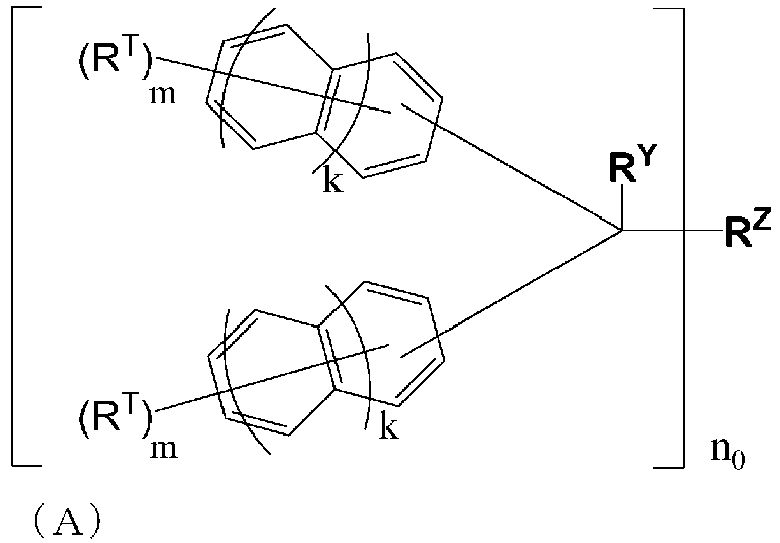
- RY is a hydrogen atom, a linear alkyl group having 1 to 30 carbon atoms optionally having a substituent, a branched alkyl group having 3 to 30 carbon atoms optionally having a substituent, a cyclic alkyl group having 3 to 30 carbon atoms optionally having a substituent or an aryl group having 6 to 30 carbon atoms optionally having a substituent;
- RZ is a m-valent group having 6 to 60 carbon atoms containing an aryl group having 6 to 30 carbon atoms, wherein the aryl group is substituted at least with a substituent selected from the group consisting of a linear alkyl group having 1 to 30 carbon atoms optionally having a substituent, a branched alkyl group having 3 to 30 carbon atoms optionally having a substituent, a cyclic alkyl group having 3 to 30 carbon atoms optionally having a substituent, a hydroxy group and a group in which a hydrogen atom of a hydroxy group is replaced with an acid dissociation group;
- each RT is independently a linear alkyl group having 1 to 30 carbon atoms optionally having a substituent, a branched alkyl group having 3 to 30 carbon atoms optionally having a substituent, a cyclic alkyl group having 3 to 30 carbon atoms optionally having a substituent, an aryl group having 6 to 30 carbon atoms optionally having a substituent, an alkenyl group having 2 to 30 carbon atoms optionally having a substituent, an alkoxy group having 1 to 30 carbon atoms optionally having a substituent, a halogen atom, a nitro group, an amino group, a carboxyl group, a thiol group, a hydroxy group or a group in which a hydrogen atom of a hydroxy group is replaced with an acid dissociation group, wherein the alkyl group, the aryl group, the alkenyl group, and the alkoxy group each optionally have an ether bond, a ketone bond or an ester bond, wherein at least one RT is a hydroxy group or a group in which a hydrogen atom of a hydroxy group is replaced with an acid dissociation group;
- each m is independently an integer of 0 to 9, wherein at least one m is an integer of 1 to 9;
- n0 is an integer of 1 to 4, wherein when n0 is an integer of 2 or larger, n0 structural formulae within the parentheses [ ] are the same or different; and
- each k is independently an integer of 0 to 2.
- At least one of RY and RZ preferably has a hydroxy group or a group in which a hydrogen atom of a hydroxy group is replaced with an acid dissociation group, from the viewpoint of curability.
- RY in the above formula (A) is a hydrogen atom, a linear alkyl group having 1 to 30 carbon atoms optionally having a substituent, a branched alkyl group having 3 to 30 carbon atoms optionally having a substituent, a cyclic alkyl group having 3 to 30 carbon atoms optionally having a substituent or an aryl group having 6 to 30 carbon atoms optionally having a substituent. The alkyl group and the aryl group may each have an ether bond, a ketone bond or an ester bond. The above cyclic alkyl group also includes bridged alicyclic alkyl groups.
- Herein, examples of the linear alkyl group of 1 to 30 carbon atoms optionally having a substituent include a methyl group, an ethyl group, a propyl group, a butyl group, a pentyl group, a hexyl group, a heptyl group, an octyl group, a nonyl group, a decyl group, an icosyl group, a triacontyl group, a cyclopropylmethyl group, a cyclohexylmethyl group, and an adamantylmethyl group.
- Examples of the branched alkyl group of 3 to 30 carbon atoms optionally having a substituent include a 1-methylethyl group, a 2-methylpropyl group, a 2-methylbutyl group, a 2-methylpentyl group, a 2-methylhexyl group, a 2-methylheptyl group, a 2-methyloctyl group, a 2-methylnonyl group, a 2-methyldecyl group, a 2-methylicosyl group, and a 2-methylnonacosyl group.
- Examples of the cyclic alkyl group having 3 to 30 carbon atoms optionally having a substituent include a cyclopropyl group, a cyclobutyl group, a cyclopentyl group, a cyclohexyl group, a cycloheptyl group, a cyclooctyl group, a cyclononyl group, a cyclodecyl group, a cyclooctadecylene group, and an adamantyl group.
- Examples of the aryl group having 6 to 30 carbon atoms optionally having a substituent include a methylphenyl group, an ethylphenyl group, a propylphenyl group, a butylphenyl group, a pentylphenyl group, a hexylphenyl group, a heptylphenyl group, an octylphenyl group, a nonylphenyl group, a decylphenyl group, an icosylphenyl group, a pentacosylphenyl group, a dimethylphenyl group, a diethylphenyl group, a dipropylphenyl group, a dibutylphenyl group, a dipentylphenyl group, a dihexylphenyl group, a diheptylphenyl group, a dioctylphenyl group, a dinonylphenyl group, a didecylphenyl group, a didodecylphenyl group, a trimethylphenyl group, a triethylphenyl group, a butylmethylphenyl group, a butylethylphenyl group, a hydroxyphenyl group, a dihydroxyphenyl group, a tetrahydroxyphenyl group, a fluoromethylphenyl group, a fluoroethylphenyl group, a cyclohexylphenyl group, a cyclohexylnaphthyl group, a methylcyclohexylphenyl group, an ethylcyclohexylphenyl group, a propylcyclohexylphenyl group, and a pentylcyclohexylphenyl group.
- Among them, RY is preferably a hydrogen atom, a methyl group, an ethyl group, a propyl group, a butyl group, a 1-methylethyl group, a 2-methylpropyl group, a 2-methylbutyl group, a 2-methylpentyl group, a cyclopropyl group, a cyclobutyl group, a cyclopentyl group, a cyclohexyl group, a methylphenyl group, an ethylphenyl group, a propylphenyl group, or a butylphenyl group, and more preferably a hydrogen atom, a methyl group, an ethyl group, a propyl group, a butyl group, or a cyclohexyl group, from the viewpoint of solvent solubility and heat resistance. A hydrogen atom is particularly preferable from the viewpoint of solvent solubility.
- RZ in the above formula (A) is a no-valent group having 6 to 60 carbon atoms containing an aryl group having 6 to 30 carbon atoms, wherein the aryl group is substituted at least with a substituent selected from the group consisting of a linear alkyl group having 1 to 30 carbon atoms optionally having a substituent, a branched alkyl group having 3 to 30 carbon atoms optionally having a substituent, a cyclic alkyl group having 3 to 30 carbon atoms optionally having a substituent, a hydroxy group and a group in which a hydrogen atom of a hydroxy group is replaced with an acid dissociation group.
- The above no-valent group refers to an alkyl group having 6 to 60 carbon atoms containing an aryl group having 6 to 30 carbon atoms having a substituent, an alkylene group having 6 to 60 carbon atoms containing an aryl group having 6 to 30 carbon atoms having a substituent, an alkanetriyl group having 6 to 60 carbon atoms containing an aryl group having 6 to 30 carbon atoms having a substituent, an alkanetetrayl group having 6 to 60 carbon atoms containing an aryl group having 6 to 30 carbon atoms having a substituent, a monovalent aromatic group having 6 to 60 carbon atoms containing an aryl group having 6 to 30 carbon atoms having a substituent, a divalent aromatic group having 6 to 60 carbon atoms containing an aryl group having 6 to 30 carbon atoms having a substituent, a trivalent aromatic group having 6 to 60 carbon atoms containing an aryl group having 6 to 30 carbon atoms having a substituent, or a tetravalent aromatic group having 6 to 60 carbon atoms containing an aryl group having 6 to 30 carbon atoms having a substituent.
- Herein, the above aryl group has at least one linear alkyl group having 1 to 30 carbon atoms optionally having a substituent, branched alkyl group having 3 to 30 carbon atoms optionally having a substituent, cyclic alkyl group having 3 to 30 carbon atoms optionally having a substituent, hydroxy group, or group in which a hydrogen atom of a hydroxy group is replaced with an acid dissociation group. Also, the above no-valent group may have a double bond or a heteroatom and may further have an aromatic group having 6 to 30 carbon atoms. The above cyclic alkyl group also includes bridged alicyclic alkyl groups.
- The above no-valent group is preferably an alkyl group having 6 to 60 carbon atoms containing an aryl group having 6 to 30 carbon atoms having a substituent, an alkylene group having 6 to 60 carbon atoms containing an aryl group having 6 to 30 carbon atoms having a substituent, a monovalent aromatic group having 6 to 60 carbon atoms containing an aryl group having 6 to 30 carbon atoms having a substituent, or a divalent aromatic group having 6 to 60 carbon atoms containing an aryl group having 6 to 30 carbon atoms having a substituent, from the viewpoint of heat resistance and flatness.
- Examples of the 1-valent group having 6 to 60 carbon atoms containing an aryl group having 6 to 30 carbon atoms, wherein the aryl group is substituted at least with a substituent selected from the group consisting of a linear alkyl group having 1 to 30 carbon atoms optionally having a substituent, a branched alkyl group having 3 to 30 carbon atoms optionally having a substituent, a cyclic alkyl group having 3 to 30 carbon atoms optionally having a substituent, a hydroxy group and a group in which a hydrogen atom of a hydroxy group is replaced with an acid dissociation group include, but not particularly limited to, a methylphenyl group, a dimethylphenyl group, a trimethylphenyl group, an ethylphenyl group, a propylphenyl group, a butylphenyl group, a pentaphenyl group, a butylmethylphenyl group, a hydroxyphenyl group, a dihydroxyphenyl group, a fluoromethylphenyl group, and a cyclohexylphenyl group. Herein, for example, the propyl group includes a n-propyl group, an i-propyl group, a cyclopropyl group, and the like, and the butyl group includes a n-butyl group, a t-butyl group, an i-butyl group, a s-butyl group, a cyclobutyl group, and the like.
- Examples of the 2-valent group having 6 to 60 carbon atoms containing an aryl group having 6 to 30 carbon atoms, wherein the aryl group is substituted at least with a substituent selected from the group consisting of a linear alkyl group having 1 to 30 carbon atoms optionally having a substituent, a branched alkyl group having 3 to 30 carbon atoms, a cyclic alkyl group having 3 to 30 carbon atoms, a hydroxy group and a group in which a hydrogen atom of a hydroxy group is replaced with an acid dissociation group include, but not particularly limited to, a methylphenylene group, a dimethylphenylene group, a trimethylphenylene group, an ethylphenylene group, a propylphenylene group, a butylphenylene group, a pentaphenylene group, a butylmethylphenylene group, a hydroxyphenylene group, dihydroxyphenylene, and a fluoromethylphenylene group.
- Examples of the 3-valent group having 6 to 60 carbon atoms containing an aryl group having 6 to 30 carbon atoms, wherein the aryl group is substituted at least with a substituent selected from the group consisting of a linear alkyl group having 1 to 30 carbon atoms optionally having a substituent, a branched alkyl group having 3 to 30 carbon atoms, a cyclic alkyl group having 3 to 30 carbon atoms, a hydroxy group and a group in which a hydrogen atom of a hydroxy group is replaced with an acid dissociation group include, but not particularly limited to a methylbenzenetriyl group, a dimethylbenzenetriyl group, a trimethylbenzenetriyl group, an ethylbenzenetriyl group, a propylbenzenetriyl group, a butylbenzenetriyl group, a pentabenzenetriyl group, a butylmethylbenzenetriyl group, a hydroxybenzenetriyl group, dihydroxybenzenetriyl, and a fluoromethylbenzenetriyl group.
- Examples of the 4-valent group having 6 to 60 carbon atoms containing an aryl group having 6 to 30 carbon atoms, wherein the aryl group is substituted at least with a substituent selected from the group consisting of a linear alkyl group having 1 to 30 carbon atoms optionally having a substituent, a branched alkyl group having 3 to 30 carbon atoms, a cyclic alkyl group having 3 to 30 carbon atoms, a hydroxy group and a group in which a hydrogen atom of a hydroxy group is replaced with an acid dissociation group include, but not particularly limited to, a methylbenzenetetrayl group, a dimethylbenzenetetrayl group, an ethylbenzenetetrayl group, a propylbenzenetetrayl group, a butylbenzenetetrayl group, a pentabenzenetetrayl group, a butylmethylbenzenetetrayl group, a hydroxybenzenetetrayl group, dihydroxybenzenetetrayl, and a fluoromethylbenzenetetrayl group.
- Among them, a methylphenyl group, a dimethylphenyl group, a trimethylphenyl group, an ethylphenyl group, a propylphenyl group, a butylphenyl group, a pentaphenyl group, and a butylmethylphenyl group are preferable from the viewpoint of heat resistance. Among them, a methylphenyl group, a dimethylphenyl group, an ethylphenyl group, a propylphenyl group, and a butylphenyl group are particularly preferable from the viewpoint of the availability of raw materials.
- Each RT in the above formula (A) is independently a group selected from the group consisting of a linear alkyl group having 1 to 30 carbon atoms optionally having a substituent, a branched alkyl group having 3 to 30 carbon atoms optionally having a substituent, a cyclic alkyl group having 3 to 30 carbon atoms optionally having a substituent, an aryl group having 6 to 30 carbon atoms optionally having a substituent, an alkenyl group having 2 to 30 carbon atoms optionally having a substituent, an alkoxy group having 1 to 30 carbon atoms optionally having a substituent, a halogen atom, a nitro group, an amino group, a carboxyl group, a thiol group, a hydroxy group and a group in which a hydrogen atom of a hydroxy group is replaced with an acid dissociation group. Herein, at least one RT is a hydroxy group or a group in which a hydrogen atom of a hydroxy group is replaced with an acid dissociation group. Each m is independently an integer of 0 to 9. Herein, at least one m is an integer of 1 to 9. n0 is an integer of 1 to 4, and each k is independently an integer of 0 to 2.
- Herein, examples of the linear alkyl group having 1 to 30 carbon atoms optionally having a substituent include the same as those described above.
- Examples of the branched alkyl group having 3 to 30 carbon atoms optionally having a substituent include the same as those described above.
- Examples of the cyclic alkyl group having 3 to 30 carbon atoms optionally having a substituent include the same as those described above.
- Examples of the aryl group having 6 to 30 carbon atoms optionally having a substituent include the same as those described above.
- Examples of the alkenyl group having 2 to 30 carbon atoms optionally having a substituent include an ethenyl group, a propenyl group, a butenyl group, a pentenyl group, a hexenyl group, a heptenyl group, an octenyl group, a nonenyl group, a decenyl group, an icosenyl group, and a triacontenyl group.
- Examples of the alkoxy group having 1 to 30 carbon atoms optionally having a substituent include a methoxy group, an ethoxy group, a n-propoxy group, an isopropoxy group, a n-butoxy group, an isobutoxy group, a t-butoxy group, a phenoxy group, a 1-naphthoxy group, and a 2-naphthoxy group.
- In the present specification, the acid dissociation group refers to a characteristic group that is cleaved in the presence of an acid to cause a change such as an alkali soluble group. Examples of the alkali soluble group include a phenolic hydroxy group, a carboxyl group, a sulfonic acid group, and a hexafluoroisopropanol group. A phenolic hydroxy group and a carboxyl group are preferable, and a phenolic hydroxy group is particularly preferable. The acid dissociation group can be arbitrarily selected and used from among those proposed in hydroxystyrene-based resins, (meth)acrylic acid-based resins, and the like for use in chemically amplified resist compositions for KrF or ArF. For example, an acid dissociation group described in Japanese Patent Application Laid-Open No.
2012-136520 - The compound of the present embodiment has the structure as described above and therefore has both high heat resistance and high solvent solubility. The compound of the present embodiment is preferably a compound represented by the following formula (1) from the viewpoint of solubility in a solvent and heat resistance.
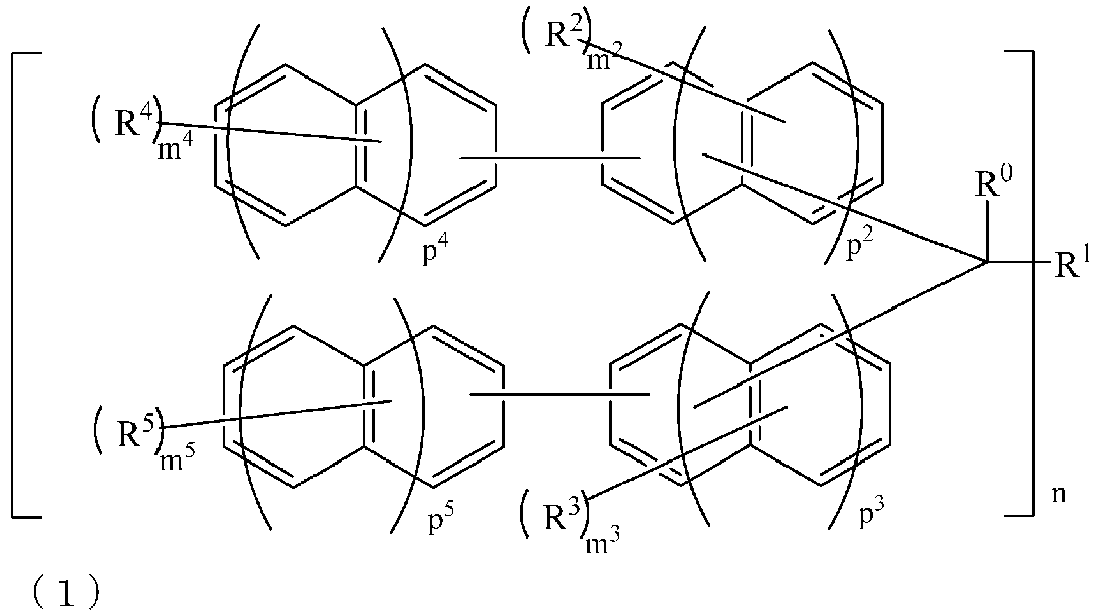
- R0 is as defined in the above RY;
- R1 is as defined in the above RZ;
- R2 to R5 are each independently a linear alkyl group having 1 to 30 carbon atoms optionally having a substituent, a branched alkyl group having 3 to 30 carbon atoms optionally having a substituent, a cyclic alkyl group having 3 to 30 carbon atoms optionally having a substituent, an aryl group having 6 to 30 carbon atoms optionally having a substituent, an alkenyl group having 2 to 30 carbon atoms optionally having a substituent, an alkoxy group having 1 to 30 carbon atoms optionally having a substituent, a halogen atom, a nitro group, an amino group, a carboxyl group, a thiol group, a hydroxy group or a group in which a hydrogen atom of a hydroxy group is replaced with an acid dissociation group, wherein the alkyl group, the aryl group, the alkenyl group, and the alkoxy group each optionally have an ether bond, a ketone bond or an ester bond, wherein
- at least one of R2 to R5 is a hydroxy group or a group in which a hydrogen atom of a hydroxy group is replaced with an acid dissociation group;
- m2 and m3 are each independently an integer of 0 to 8;
- m4 and m5 are each independently an integer of 0 to 9,
- provided that m2, m3, m4 and m5 are not 0 at the same time;
- n is as defined in the above n0, wherein when n is an integer of 2 or larger, n structural formulae within the parentheses [ ] are the same or different; and
- p2 to p5 are each independently an integer of 0 to 2.
- At least one of R0 and R1 preferably has a hydroxy group or a group in which a hydrogen atom of a hydroxy group is replaced with an acid dissociation group, from the viewpoint of solubility in a solvent and curability.
- The compound of the present embodiment is also preferably a compound represented by the following formula (1-1) from the viewpoint of solubility in a solvent and heat resistance.

- R0, R, R4, R5, n, p2 to p5, m4 and m5 are as defined above;
- R6 and R7 are each independently a linear alkyl group having 1 to 30 carbon atoms optionally having a substituent, a branched alkyl group having 3 to 30 carbon atoms optionally having a substituent, a cyclic alkyl group having 3 to 30 carbon atoms optionally having a substituent, an aryl group having 6 to 30 carbon atoms optionally having a substituent, an alkenyl group having 2 to 30 carbon atoms optionally having a substituent, a halogen atom, a nitro group, an amino group, a carboxyl group, or a thiol group;
- R10 and R11 are each independently an acid dissociation group or a hydrogen atom, wherein at least one of R10 and R11 is a hydrogen atom; and
- m6 and m7 are each independently an integer of 0 to 7.
- The compound of the present embodiment is also preferably a compound represented by the following formula (1-2) from the viewpoint of solubility in a solvent and heat resistance.

- R0, R1, R6, R7, R10, R11, n, p2 to p5, m6 and m7 are as defined above;
- R8 and R9 are as defined in the above R6 and R7;
- R12 and R13 are as defined in the above R10 and R11; and
- m8 and m9 are each independently an integer of 0 to 8.
- In the formula (1-2), preferably,
R0 is a hydrogen atom;
R1 is a phenyl group substituted at least with a substituent selected from the group consisting of a linear alkyl group of 1 to 6 carbon atoms, a branched alkyl group having 3 to 6 carbon atoms, a cyclic alkyl group having 3 to 6 carbon atoms and a hydroxy group, and optionally further substituted with a substituent selected from the group consisting of an aryl group having 6 to 10 carbon atoms and a fluorine atom (wherein the cyclic alkyl group having 3 to 6 carbon atoms and the aryl group having 6 to 10 carbon atoms are each optionally substituted with a substituent selected from the group consisting of a linear alkyl group having 1 to 6 carbon atoms, a branched alkyl group having 3 to 6 carbon atoms, a cyclic alkyl group having 3 to 6 carbon atoms, and an aryl group having 6 to 10 carbon atoms);
each of R10 to R13 is a hydrogen atom;
n is 1;
each of p2 to p5 is 0; and
each of m6 to m9 is 0. - In the formula (1-2), preferably,
R0 is a hydrogen atom;
R1 is a phenyl group substituted with a substituent selected from the group consisting of a linear alkyl group having 1 to 6 carbon atoms, a branched alkyl group having 3 to 6 carbon atoms, a cyclic alkyl group having 3 to 6 carbon atoms and a hydroxy group;
each of R10 to R13 is a hydrogen atom;
n is 1;
each of p2 to p5 is 0; and
each of m6 to m9 is 0. - In the present embodiment, specific examples of the compound represented by the above formula (1-2) include, but not limited to, those described below, from the viewpoint of heat resistance and solubility in an organic solvent. A compound selected from the group consisting of compounds represented by the following formulae (2-1) to (2-19) and the formulae (2-21) to (2-24) is preferable.
- A compound selected from the group consisting of compounds represented by the following formula (2-12) and the formula (2-22) to the formula (2-24) is preferable from the viewpoint of curability.


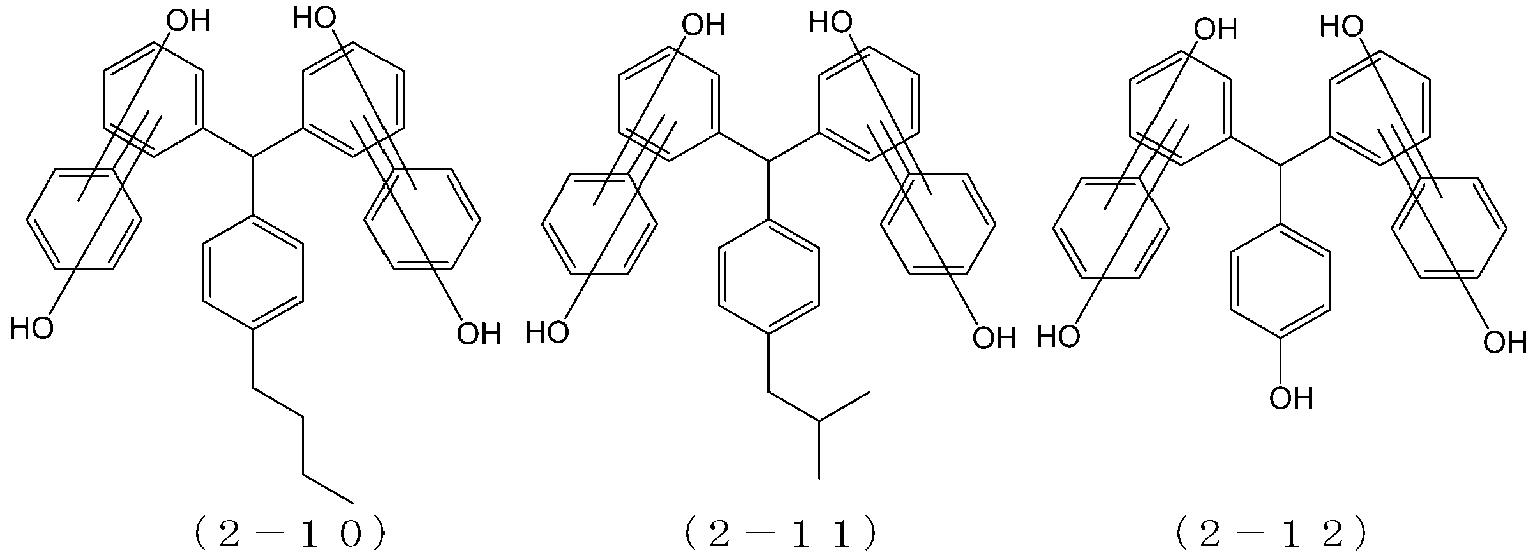


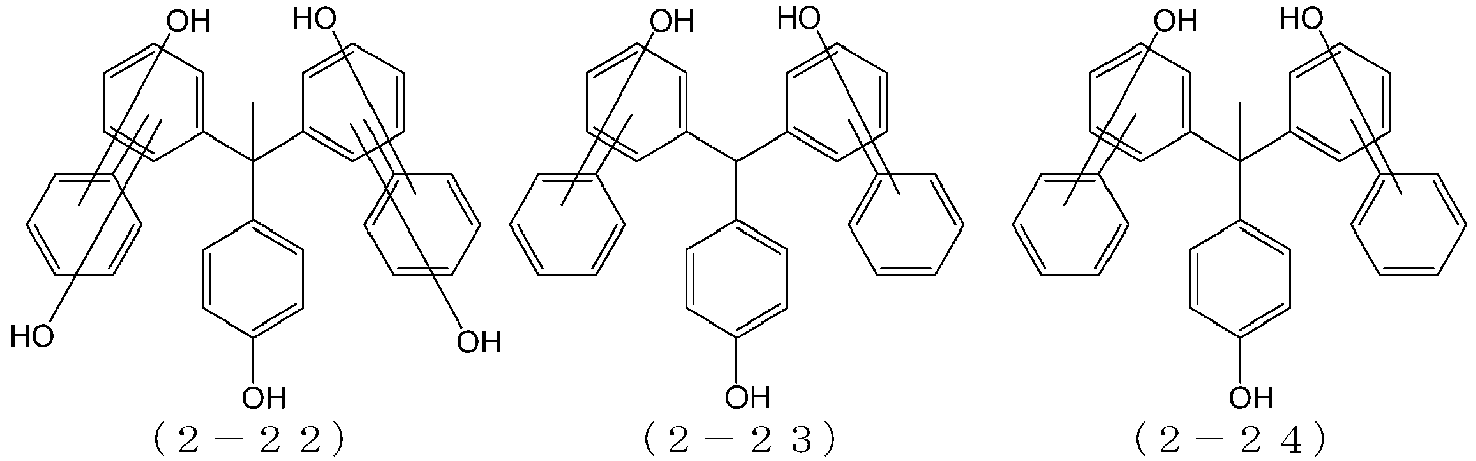


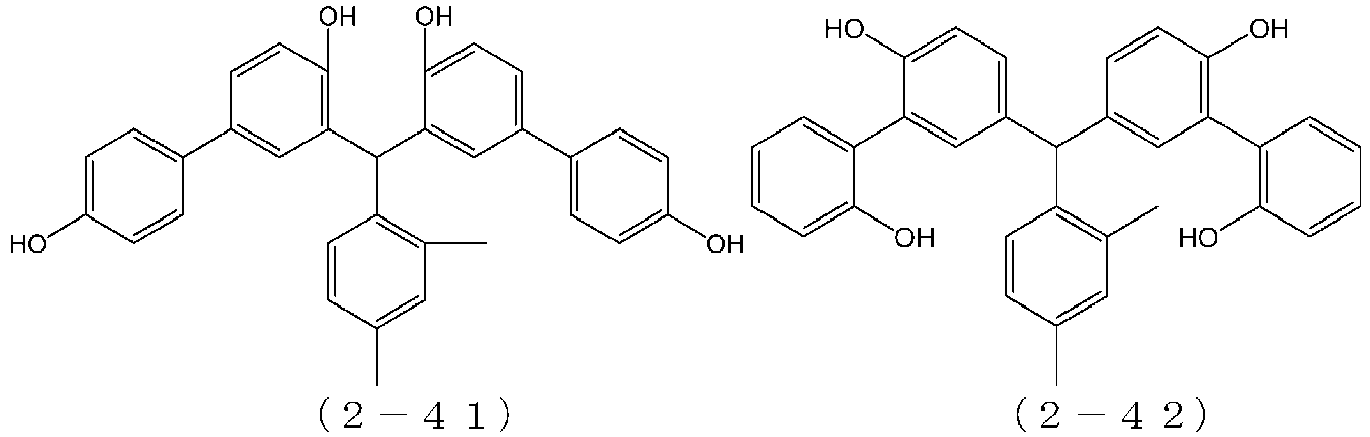


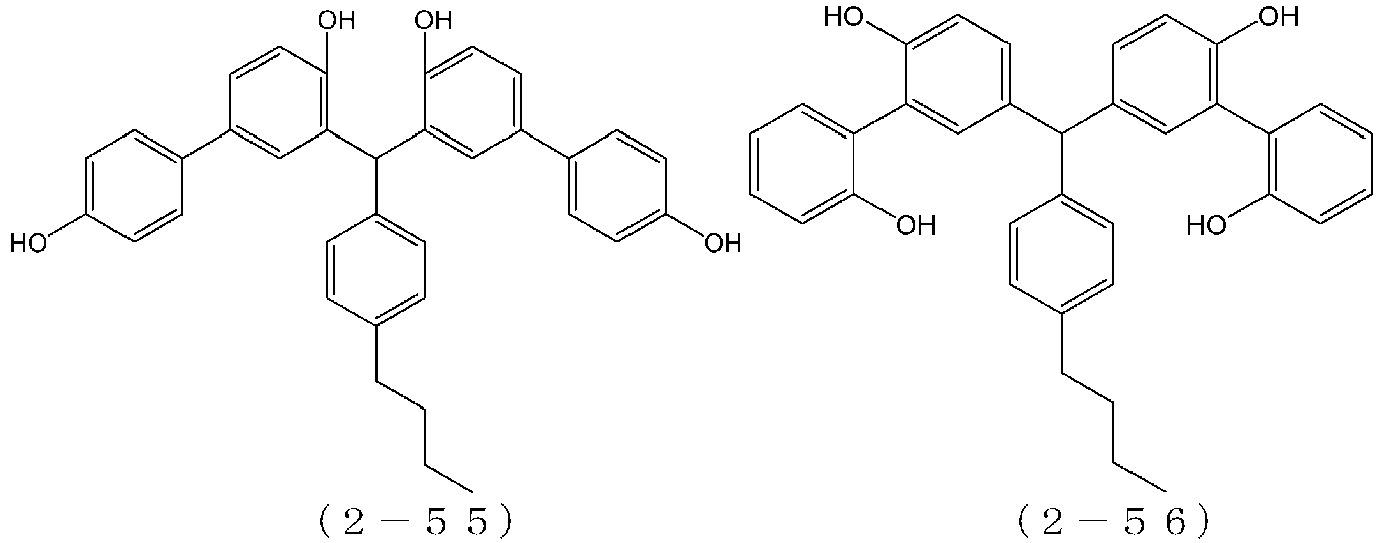


- The compound represented by the formula (A) of the present embodiment can be arbitrarily synthesized by the application of a publicly known approach, and the synthesis approach is not particularly limited. The compound represented by the general formula (A) can be obtained, for example, by subjecting a biphenol and an aldehyde or a ketone corresponding to the structure of the desired compound to polycondensation reaction in the presence of an acid catalyst at normal pressure. If necessary, this reaction can also be carried out under increased pressure. Furthermore, the target compound can also be obtained by introducing a publicly known protective group to a phenolic hydroxy group, and reacting the phenolic hydroxy group, followed by deprotection. An acetal or ketal form of a carbonyl compound can also be used as a raw material.
- Examples of the biphenol include, but not particularly limited to, biphenol, thiodiphenol, oxydiphenol, methylbiphenol, methoxybinaphthol, binaphthol, thiodinaphthol, oxydinaphthol, methylbinaphthol, methoxybinaphthol, bianthracenol, thiodianthracenol, oxydianthracenol, methylbianthracenol, and methoxybianthracenol. The position of a hydroxy group is arbitrary. These biphenols can be used alone as one kind or can be used in combination of two or more kinds. Among them, 4,4'-biphenol is more preferably used from the viewpoint of heat resistance. Also, 2,2'-biphenol is more preferably used from the viewpoint of easy production.
- Examples of the aldehyde include, but not particularly limited to, methylbenzaldehyde, dimethylbenzaldehyde, trimethylbenzaldehyde, ethylbenzaldehyde, propylbenzaldehyde, butylbenzaldehyde, pentabenzaldehyde, butylmethylbenzaldehyde, hydroxybenzaldehyde, dihydroxybenzaldehyde, fluoromethylbenzaldehyde, cyclopropylaldehyde, cyclobutylaldehyde, cyclohexylaldehyde, cyclodecylaldehyde, cycloundecylaldehyde, cyclopropylbenzaldehyde, cyclobutylbenzaldehyde, cyclohexylbenzaldehyde, cyclodecylbenzaldehyde, and cycloundecylbenzaldehyde. These aldehydes can be used alone as one kind or can be used in combination of two or more kinds. Among them, methylbenzaldehyde, dimethylbenzaldehyde, trimethylbenzaldehyde, ethylbenzaldehyde, propylbenzaldehyde, butylbenzaldehyde, pentabenzaldehyde, butylmethylbenzaldehyde, cyclohexylbenzaldehyde, cyclodecylbenzaldehyde, cycloundecylbenzaldehyde, or the like is preferably used from the viewpoint of imparting high heat resistance.
- Examples of the ketone include, but not particularly limited to, acetylmethylbenzene, acetyldimethylbenzene, acetyltrimethylbenzene, acetylethylbenzene, acetylpropylbenzene, acetylbutylbenzene, acetylpentabenzene, acetylbutylmethylbenzene, acetylhydroxybenzene, acetyldihydroxybenzene, and acetylfluoromethylbenzene. These ketones can be used alone as one kind or can be used in combination of two or more kinds. Among them, acetylmethylbenzene, acetyldimethylbenzene, acetyltrimethylbenzene, acetylethylbenzene, acetylpropylbenzene, acetylbutylbenzene, acetylpentabenzene, or acetylbutylmethylbenzene is preferably used from the viewpoint of imparting high heat resistance.
- The acid catalyst used in the reaction can be arbitrarily selected and used from publicly known catalysts and is not particularly limited. Inorganic acids, organic acids, Lewis acids, solid acids, and the like are widely known as such acid catalysts. Specific examples of the above acid catalyst include, but not particularly limited to, inorganic acids such as hydrochloric acid, sulfuric acid, phosphoric acid, hydrobromic acid, and hydrofluoric acid; organic acids such as oxalic acid, malonic acid, succinic acid, adipic acid, sebacic acid, citric acid, fumaric acid, maleic acid, formic acid, p-toluenesulfonic acid, methanesulfonic acid, trifluoroacetic acid, dichloroacetic acid, trichloroacetic acid, trifluoromethanesulfonic acid, benzenesulfonic acid, naphthalenesulfonic acid, and naphthalenedisulfonic acid; Lewis acids such as zinc chloride, aluminum chloride, iron chloride, and boron trifluoride; and solid acids such as tungstosilicic acid, tungstophosphoric acid, silicomolybdic acid, and phosphomolybdic acid. Among them, organic acids and solid acids are preferable from the viewpoint of production, and hydrochloric acid or sulfuric acid is preferably used from the viewpoint of production such as easy availability and handleability. The acid catalysts can be used alone as one kind or can be used in combination of two or more kinds. Also, the amount of the acid catalyst used can be arbitrarily set according to, for example, the kind of the raw materials used and the catalyst used and moreover the reaction conditions and is not particularly limited, but is preferably 0.01 to 100 parts by mass based on 100 parts by mass of the reaction raw materials.
- Upon the reaction, a reaction solvent may be used. The reaction solvent is not particularly limited as long as the reaction of the aldehyde or the ketone used with the phenol proceeds, and can be arbitrarily selected and used from publicly known solvents. Examples include water, methanol, ethanol, propanol, butanol, tetrahydrofuran, dioxane, ethylene glycol dimethyl ether, ethylene glycol diethyl ether, and a mixed solvent thereof. The solvents can be used alone as one kind or can be used in combination of two or more kinds. Also, the amount of these solvents used can be arbitrarily set according to, for example, the kind of the raw materials used and the acid catalyst used and moreover the reaction conditions. The amount of the above solvent used is not particularly limited, but is preferably in the range of 0 to 2000 parts by mass based on 100 parts by mass of the reaction raw materials. Furthermore, the reaction temperature in the above reaction can be arbitrarily selected according to the reactivity of the reaction raw materials. The above reaction temperature is not particularly limited, but is usually preferably within the range of 10 to 200°C. In order to form the xanthene structure or the thioxanthene structure of the compound having the structure represented by the general formula (A) of the present embodiment, a higher reaction temperature is more preferable. Specifically, the range of 60 to 200°C is preferable. The reaction method can be arbitrarily selected and used from publicly known approaches and is not particularly limited, and there are a method of charging the phenol, the aldehyde or the ketone, and the acid catalyst in one portion, and a method of dropping the phenol and the aldehyde or the ketone in the presence of the acid catalyst. After the polycondensation reaction terminates, isolation of the obtained compound can be carried out according to a conventional method, and is not particularly limited. For example, by adopting a commonly used approach in which the temperature of the reaction vessel is elevated to 130 to 230°C in order to remove unreacted raw materials, catalyst, etc. present in the system, and volatile portions are removed at about 1 to 50 mmHg, the compound which is the target compound can be obtained.
- As preferable reaction conditions, the reaction proceeds by using 1 mol to an excess of the phenol and 0.001 to 1 mol of the acid catalyst based on 1 mol of the aldehyde or the ketone, and reacting them at 50 to 200°C at normal pressure for about 20 minutes to 100 hours.
- The target compound can be isolated by a publicly known method after the reaction terminates. The compound having the structure represented by the above general formula (A) which is the target compound can be obtained, for example, by concentrating the reaction solution, precipitating the reaction product by the addition of pure water, cooling the reaction solution to room temperature, then separating the precipitates by filtration, drying the solid matter obtained by filtration, then separating and purifying the solid matter from by-products by column chromatography, and distilling off the solvent, followed by filtration and drying.
- The molecular weight of the compound having the structure represented by the above general formula (A) is not particularly limited, and the weight average molecular weight (Mw) in terms of polystyrene is preferably 350 to 30,000 and more preferably 500 to 20,000. The compound having the structure represented by the above general formula (A) preferably has dispersibility (weight average molecular weight Mw/number average molecular weight Mn) within the range of 1.1 to 7 from the viewpoint of enhancing crosslinking efficiency while suppressing volatile components during baking. The above Mw and Mn can be measured by a method described in Examples mentioned later.
- The compound having the structure represented by the above general formula (A) preferably has high solubility in a solvent from the viewpoint of easier application to a wet process, etc. More specifically, in the case of using 1-methoxy-2-propanol (PGME) and/or propylene glycol monomethyl ether acetate (PGMEA) as a solvent, the compound and/or a resin preferably has a solubility of 10% by mass or more in the solvent.
Herein, the solubility in PGME and/or PGMEA is defined as "mass of the resin / (mass of the resin + mass of the solvent) × 100 (% by mass)". For example, 10 g of the compound represented by the above general formula (A) is evaluated as being dissolved in 90 g of PGMEA when the solubility of the compound represented by the general formula (A) in PGMEA is "10% by mass or more"; 10 g of the compound is evaluated as being not dissolved in 90 g of PGMEA when the solubility is "less than 10% by mass". - When the underlayer film forming material for lithography of the present embodiment comprises an organic solvent which is an optional component mentioned later, the content of the compound having the structure represented by the above general formula (A) is not particularly limited, but is preferably 1 to 33 parts by mass based on 100 parts by mass in total including the organic solvent, more preferably 2 to 25 parts by mass, and further preferably 3 to 20 parts by mass.
- The resin of the present embodiment is a resin having a constituent unit derived from the compound represented by the above formula (A) (hereinafter, also referred to as "compound of the present embodiment"). The compound represented by the above formula (A) can be used directly as a film forming composition for lithography or the like. The resin having a constituent unit derived from the compound represented by the above formula (A) can also be used as a film forming composition for lithography or the like. The resin having a structural unit derived from the compound represented by the formula (A) includes a resin having a constituent unit derived from the compound represented by the formula (1), a resin having a constituent unit derived from the compound represented by the formula (1-1), and a resin having a constituent unit derived from the compound represented by the formula (1-2). Hereinafter, the "compound represented by the formula (A)" can be used interchangeably with the "compound represented by the formula (1)", the "compound represented by the formula (1-1)", or the "compound represented by the formula (1-2)".
- The resin of the present embodiment is obtained by, for example, reacting the compound represented by the above formula (A) with a crosslinking compound.
- As the crosslinking compound, a publicly known monomer can be used without particular limitations as long as it can oligomerize or polymerize the compound represented by the above formula (A). Specific examples thereof include, but not particularly limited to, aldehydes, ketones, carboxylic acids, carboxylic acid halides, halogen-containing compounds, amino compounds, imino compounds, isocyanates, and unsaturated hydrocarbon group-containing compounds.
- Specific examples of the resin according to the present embodiment include resins that are made novolac by, for example, a condensation reaction between the compound represented by the above formula (A) with an aldehyde that is a crosslinking compound.
- Herein, examples of the aldehyde used when making the compound represented by the above formula (A) novolac include, but not particularly limited to, formaldehyde, trioxane, paraformaldehyde, benzaldehyde, acetaldehyde, propylaldehyde, phenylacetaldehyde, phenylpropylaldehyde, hydroxybenzaldehyde, chlorobenzaldehyde, nitrobenzaldehyde, methylbenzaldehyde, ethylbenzaldehyde, butylbenzaldehyde, biphenylaldehyde, naphthaldehyde, anthracenecarboaldehyde, phenanthrenecarboaldehyde, pyrenecarboaldehyde, and furfural. Among these, formaldehyde is more preferable. These aldehydes can be used alone as one kind or may be used in combination of two or more kinds. The amount of the above aldehydes used is not particularly limited, but is preferably 0.2 to 5 mol and more preferably 0.5 to 2 mol based on 1 mol of the compound represented by the above formula (A).
- An acid catalyst can also be used in the condensation reaction between the compound represented by the above formula (A) and the aldehyde. The acid catalyst used herein can be arbitrarily selected and used from publicly known catalysts and is not particularly limited. Inorganic acids, organic acids, Lewis acids, and solid acids are widely known as such acid catalysts, and examples include, but not particularly limited to, inorganic acids such as hydrochloric acid, sulfuric acid, phosphoric acid, hydrobromic acid, and hydrofluoric acid; organic acids such as oxalic acid, malonic acid, succinic acid, adipic acid, sebacic acid, citric acid, fumaric acid, maleic acid, formic acid, p-toluenesulfonic acid, methanesulfonic acid, trifluoroacetic acid, dichloroacetic acid, trichloroacetic acid, trifluoromethanesulfonic acid, benzenesulfonic acid, naphthalenesulfonic acid, and naphthalenedisulfonic acid; Lewis acids such as zinc chloride, aluminum chloride, iron chloride, and boron trifluoride; and solid acids such as tungstosilicic acid, tungstophosphoric acid, silicomolybdic acid, and phosphomolybdic acid. Among them, organic acids and solid acids are preferable from the viewpoint of production, and hydrochloric acid or sulfuric acid is preferable from the viewpoint of production such as easy availability and handleability. The acid catalysts can be used alone as one kind, or can be used in combination of two or more kinds.
- Also, the amount of the acid catalyst used can be arbitrarily set according to, for example, the kind of the raw materials used and the catalyst used and moreover the reaction conditions and is not particularly limited, but is preferably 0.01 to 100 parts by mass based on 100 parts by mass of the reaction raw materials.
- The aldehyde is not necessarily needed in the case of a copolymerization reaction with a compound having a non-conjugated double bond, such as indene, hydroxyindene, benzofuran, hydroxyanthracene, acenaphthylene, biphenyl, bisphenol, trisphenol, dicyclopentadiene, tetrahydroindene, 4-vinylcyclohexene, norbornadiene, 5-vinylnorborn-2-ene, α-pinene, β-pinene, and limonene, as the crosslinking compound.
- A reaction solvent can also be used in the condensation reaction between the compound represented by the above formula (A) and the aldehyde. The reaction solvent in the polycondensation can be arbitrarily selected and used from publicly known solvents and is not particularly limited, and examples include water, methanol, ethanol, propanol, butanol, tetrahydrofuran, dioxane, or a mixed solvent thereof. The reaction solvents can be used alone as one kind, or can be used in combination of two or more kinds.
- Also, the amount of these reaction solvents used can be arbitrarily set according to, for example, the kind of the raw materials used and the catalyst used and moreover the reaction conditions and is not particularly limited, but is preferably in the range of 0 to 2000 parts by mass based on 100 parts by mass of the reaction raw materials. Furthermore, the reaction temperature can be arbitrarily selected according to the reactivity of the reaction raw materials and is not particularly limited, but is usually within the range of 10 to 200°C. The reaction method can be arbitrarily selected and used from publicly known approaches and is not particularly limited, and there are a method of charging the compound represented by the above formula (A), the aldehyde, and the catalyst in one portion, and a method of dropping the compound represented by the above formula (A) and the aldehyde in the presence of the catalyst.
- After the polycondensation reaction terminates, isolation of the obtained resin can be carried out according to a conventional method, and is not particularly limited. For example, by adopting a commonly used approach in which the temperature of the reaction vessel is elevated to 130 to 230°C in order to remove unreacted raw materials, catalyst, etc. present in the system, and volatile portions are removed at about 1 to 50 mmHg, a novolac resin that is the target compound can be obtained.
- Herein, the resin according to the present embodiment may be a homopolymer of a compound represented by the above formula (A), or may be a copolymer with a further phenol. Herein, examples of the copolymerizable phenol include, but not particularly limited to, phenol, cresol, dimethylphenol, trimethylphenol, butylphenol, phenylphenol, diphenylphenol, naphthylphenol, resorcinol, methylresorcinol, catechol, butylcatechol, methoxyphenol, methoxyphenol, propylphenol, pyrogallol, and thymol.
- The resin according to the present embodiment may be a copolymer with a polymerizable monomer other than the above-described further phenols. Examples of such a copolymerization monomer include, but not particularly limited to, naphthol, methylnaphthol, methoxynaphthol, dihydroxynaphthalene, indene, hydroxyindene, benzofuran, hydroxyanthracene, acenaphthylene, biphenyl, bisphenol, trisphenol, dicyclopentadiene, tetrahydroindene, 4-vinylcyclohexene, norbornadiene, vinylnorbornene, pinene, and limonene. The resin according to the present embodiment may be a copolymer of two or more components (for example, a binary to quaternary system) composed of the compound represented by the above formula (A) and the above-described phenol, may be a copolymer of two or more components (for example, a binary to quaternary system) composed of the compound represented by the above formula (A) and the above-described copolymerization monomer, or may be a copolymer of three or more components (for example, a tertiary to quaternary system) composed of the compound represented by the above formula (A), the above-described phenol, and the above-described copolymerization monomer.
- The molecular weight of the resin according to the present embodiment is not particularly limited, and the weight average molecular weight (Mw) in terms of polystyrene is preferably 500 to 30,000 and more preferably 750 to 20,000. The resin according to the present embodiment preferably has dispersibility (weight average molecular weight Mw/number average molecular weight Mn) within the range of 1.2 to 7 from the viewpoint of enhancing crosslinking efficiency while suppressing volatile components during baking. The above Mw and Mn can be measured by a method described in Examples mentioned later.
- The composition of the present embodiment comprises one or more substances selected from the group consisting of the compound represented by the above formula (A) and the resin having a constituent unit derived from the compound. Also, the composition of the present embodiment may comprise both of the compound of the present embodiment and the resin of the present embodiment. Hereinafter, the "one or more selected from the group consisting of the compound represented by the above formula (A) and the resin having a constituent unit derived from the compound" is also referred to as "compound and/or resin of the present embodiment" or "component (A)".
- The composition for forming a optical component of the present embodiment comprises one or more substances selected from the group consisting of the compound represented by the above formula (A) and the resin having a constituent unit derived from the compound. Also, the composition for forming a optical component of the present embodiment may comprise both of the compound of the present embodiment and the resin of the present embodiment. Herein, the "optical component" refers to a component in the form of a film or a sheet as well as a plastic lens (a prism lens, a lenticular lens, a microlens, a Fresnel lens, a viewing angle control lens, a contrast improving lens, etc.), a phase difference film, a film for electromagnetic wave shielding, a prism, an optical fiber, a solder resist for flexible printed wiring, a plating resist, an interlayer insulating film for multilayer printed circuit boards, or a photosensitive optical waveguide. The compound and the resin of the present embodiment are useful for forming these optical components.
- The film forming composition for lithography of the present embodiment comprises one or more substances selected from the group consisting of the compound represented by the above formula (A) and the resin having a constituent unit derived from the compound. Also, the film forming composition for lithography of the present embodiment may comprise both of the compound of the present embodiment and the resin of the present embodiment.
- The resist composition of the present embodiment comprises one or more substances selected from the group consisting of the compound represented by the above formula (A) and the resin having a constituent unit derived from the compound. Also, the resist composition of the present embodiment may comprise both of the compound of the present embodiment and the resin of the present embodiment.
- It is preferable that the resist composition of the present embodiment should comprise a solvent. Examples of the solvent can include, but not particularly limited to, ethylene glycol monoalkyl ether acetates such as ethylene glycol monomethyl ether acetate, ethylene glycol monoethyl ether acetate, ethylene glycol mono-n-propyl ether acetate, and ethylene glycol mono-n-butyl ether acetate; ethylene glycol monoalkyl ethers such as ethylene glycol monomethyl ether and ethylene glycol monoethyl ether; propylene glycol monoalkyl ether acetates such as propylene glycol monomethyl ether acetate (PGMEA), propylene glycol monoethyl ether acetate, propylene glycol mono-n-propyl ether acetate, and propylene glycol mono-n-butyl ether acetate; propylene glycol monoalkyl ethers such as propylene glycol monomethyl ether (PGME) and propylene glycol monoethyl ether; ester lactates such as methyl lactate, ethyl lactate, n-propyl lactate, n-butyl lactate, and n-amyl lactate; aliphatic carboxylic acid esters such as methyl acetate, ethyl acetate, n-propyl acetate, n-butyl acetate, n-amyl acetate, n-hexyl acetate, methyl propionate, and ethyl propionate; other esters such as methyl 3-methoxypropionate, ethyl 3-methoxypropionate, methyl 3-ethoxypropionate, ethyl 3-ethoxypropionate, methyl 3-methoxy-2-methylpropionate, 3-methoxybutylacetate, 3-methyl-3-methoxybutylacetate, butyl 3-methoxy-3-methylpropionate, butyl 3-methoxy-3-methylbutyrate, methyl acetoacetate, methyl pyruvate, and ethyl pyruvate; aromatic hydrocarbons such as toluene and xylene; ketones such as 2-heptanone, 3-heptanone, 4-heptanone, cyclopentanone (CPN), and cyclohexanone (CHN); amides such as N,N-dimethylformamide, N-methylacetamide, N,N-dimethylacetamide, and N-methylpyrrolidone; and lactones such as γ-lactone. These solvents can be used alone or in combination of two or more kinds.
- The solvent used in the present embodiment is preferably a safe solvent, more preferably at least one selected from PGMEA, PGME, CHN, CPN, 2-heptanone, anisole, butyl acetate, ethyl propionate, and ethyl lactate, and still more preferably at least one selected from PGMEA, PGME, and CHN.
- In the present embodiment, the amount of the solid component and the amount of the solvent are not particularly limited, but preferably the solid component is 1 to 80% by mass and the solvent is 20 to 99% by mass, more preferably the solid component is 1 to 50% by mass and the solvent is 50 to 99% by mass, still more preferably the solid component is 2 to 40% by mass and the solvent is 60 to 98% by mass, and particularly preferably the solid component is 2 to 10% by mass and the solvent is 90 to 98% by mass, based on 100% by mass of the total mass of the amount of the solid component and the solvent.
- The resist composition of the present embodiment may contain other components such as a crosslinking agent, an acid generating agent, and an acid diffusion controlling agent, in addition to the compound and/or the resin of the present embodiment, if required. Hereinafter, these optional components will be described.
- The resist composition of the present embodiment preferably comprises one or more acid generating agents (C) generating an acid directly or indirectly by irradiation of any radiation selected from visible light, ultraviolet, excimer laser, electron beam, extreme ultraviolet (EUV), X-ray, and ion beam. The acid generating agent (C) is not particularly limited, and, for example, an acid generating agent described in International Publication No.
WO2013/024778 can be used. The acid generating agent (C) can be used alone or in combination of two or more kinds. - The amount of the acid generating agent (C) used is preferably 0.001 to 49% by mass of the total weight of the solid components, more preferably 1 to 40% by mass, still more preferably 3 to 30% by mass, and particularly preferably 10 to 25% by mass. By using the acid generating agent (C) within the above range, a pattern profile with high sensitivity and low edge roughness is obtained. In the present embodiment, the acid generation method is not limited as long as an acid is generated in the system. By using excimer laser instead of ultraviolet such as g-ray and i-ray, finer processing is possible, and also by using electron beam, extreme ultraviolet, X-ray or ion beam as a high energy ray, further finer processing is possible.
- The resist composition of the present embodiment preferably comprises one or more acid crosslinking agents (G). The acid crosslinking agent (G) is a compound capable of intramolecular or intermolecular crosslinking the component (A) in the presence of the acid generated from the acid generating agent (C). Examples of such an acid crosslinking agent (G) can include a compound having one or more groups (hereinafter, referred to as "crosslinkable group") capable of crosslinking the component (A).
- Examples of such a crosslinkable group can include (i) a hydroxyalkyl group such as a hydroxy (C1-C6 alkyl group), a C1-C6 alkoxy (C1-C6 alkyl group), and an acetoxy (C1-C6 alkyl group), or a group derived therefrom; (ii) a carbonyl group such as a formyl group and a carboxy (C1-C6 alkyl group), or a group derived therefrom; (iii) a nitrogenous group-containing group such as a dimethylaminomethyl group, a diethylaminomethyl group, a dimethylolaminomethyl group, a diethylolaminomethyl group, and a morpholinomethyl group; (iv) a glycidyl group-containing group such as a glycidyl ether group, a glycidyl ester group, and a glycidylamino group; (v) a group derived from an aromatic group such as a C1-C6 allyloxy (C1-C6 alkyl group) and a C1-C6 aralkyloxy (C1-C6 alkyl group) such as a benzyloxymethyl group and a benzoyloxymethyl group; and (vi) a polymerizable multiple bond-containing group such as a vinyl group and an isopropenyl group. As the crosslinkable group of the acid crosslinking agent (G) according to the present embodiment, a hydroxyalkyl group and an alkoxyalkyl group or the like are preferable, and an alkoxymethyl group is particularly preferable.
- The acid crosslinking agent (G) having the above crosslinkable group is not particularly limited, and, for example, an acid crosslinking agent described in International Publication No.
WO2013/024778 can be used. The acid crosslinking agent (G) can be used alone or in combination of two or more kinds. - In the present embodiment, the amount of the acid crosslinking agent (G) used is preferably 0.5 to 49% by mass of the total weight of the solid components, more preferably 0.5 to 40% by mass, still more preferably 1 to 30% by mass, and particularly preferably 2 to 20% by mass. When the content ratio of the above acid crosslinking agent (G) is 0.5% by mass or more, the inhibiting effect of the solubility of a resist film in an alkaline developing solution is improved, and a decrease in the film remaining rate, and occurrence of swelling and meandering of a pattern can be inhibited. On the other hand, when the content is 50% by mass or less, a decrease in heat resistance as a resist can be inhibited.
- In the present embodiment, the resist composition may comprise an acid diffusion controlling agent (E) having a function of controlling diffusion of an acid generated from an acid generating agent by radiation irradiation in a resist film to inhibit any unpreferable chemical reaction in an unexposed region or the like. By using such an acid diffusion controlling agent (E), the storage stability of a resist composition is improved. Also, along with the improvement of the resolution, the line width change of a resist pattern due to variation in the post exposure delay time before radiation irradiation and the post exposure delay time after radiation irradiation can be inhibited, and the composition has extremely excellent process stability. Such an acid diffusion controlling agent (E) is not particularly limited, and examples include a radiation degradable basic compound such as a nitrogen atom-containing basic compound, a basic sulfonium compound, and a basic iodonium compound.
- The above acid diffusion controlling agent (E) is not particularly limited, and, for example, an acid diffusion controlling agent described in International Publication No.
WO2013/024778 can be used. The acid diffusion controlling agent (E) can be used alone or in combination of two or more kinds. - The content of the acid diffusion controlling agent (E) is preferably 0.001 to 49% by mass of the total weight of the solid component, more preferably 0.01 to 10% by mass, still more preferably 0.01 to 5% by mass, and particularly preferably 0.01 to 3% by mass. Within the above range, a decrease in resolution, and deterioration of the pattern shape and the dimension fidelity or the like can be prevented. Moreover, even though the post exposure delay time from electron beam irradiation to heating after radiation irradiation becomes longer, the shape of the pattern upper layer portion does not deteriorate. When the content is 10% by mass or less, a decrease in sensitivity, and developability of the unexposed portion or the like can be prevented. By using such an acid diffusion controlling agent, the storage stability of a resist composition improves, also along with improvement of the resolution, the line width change of a resist pattern due to variation in the post exposure delay time before radiation irradiation and the post exposure delay time after radiation irradiation can be inhibited, and the composition is extremely excellent process stability.
- To the resist composition of the present embodiment, if required, as the further component (F), one kind or two kinds or more of various additive agents such as a dissolution promoting agent, a dissolution controlling agent, a sensitizing agent, a surfactant, and an organic carboxylic acid or an oxo acid of phosphor or derivative thereof can be added.
- A low molecular weight dissolution promoting agent is a component having a function of increasing the solubility of a compound represented by the formula (A) in a developing solution to moderately increase the dissolution rate of the compound upon developing, when the solubility of the compound is too low. The low molecular weight dissolution promoting agent can be used, if required. Examples of the above dissolution promoting agent can include low molecular weight phenolic compounds, such as bisphenols and tris(hydroxyphenyl)methane. These dissolution promoting agents can be used alone or in mixture of two or more kinds.
- The content of the dissolution promoting agent, which is arbitrarily adjusted according to the kind of the compound to be used, is preferably 0 to 49% by mass of the total weight of the solid component, more preferably 0 to 5% by mass, still more preferably 0 to 1% by mass, and particularly preferably 0% by mass.
- The dissolution controlling agent is a component having a function of controlling the solubility of the compound represented by the formula (A) in a developing solution to moderately decrease the dissolution rate upon developing, when the solubility of the compound is too high. As such a dissolution controlling agent, the one which does not chemically change in steps such as calcination of resist coating, radiation irradiation, and development is preferable.
- The dissolution controlling agent is not particularly limited, and examples can include aromatic hydrocarbons such as phenanthrene, anthracene, and acenaphthene; ketones such as acetophenone, benzophenone, and phenyl naphthyl ketone; and sulfones such as methyl phenyl sulfone, diphenyl sulfone, and dinaphthyl sulfone. These dissolution controlling agents can be used alone or in combination of two or more kinds.
- The content of the dissolution controlling agent, which is arbitrarily adjusted according to the kind of the compound to be used, is preferably 0 to 49% by mass of the total weight of the solid component, more preferably 0 to 5% by mass, still more preferably 0 to 1% by mass, and particularly preferably 0% by mass.
- The sensitizing agent is a component having a function of absorbing irradiated radiation energy, transmitting the energy to the acid generating agent (C), and thereby increasing the acid production amount, and improving the apparent sensitivity of a resist. Such a sensitizing agent is not particularly limited, and examples can include benzophenones, biacetyls, pyrenes, phenothiazines, and fluorenes. These sensitizing agents can be used alone or in combination of two or more kinds.
- The content of the sensitizing agent, which is arbitrarily adjusted according to the kind of the compound to be used, is preferably 0 to 49% by mass of the total weight of the solid component, more preferably 0 to 5% by mass, still more preferably 0 to 1% by mass, and particularly preferably 0% by mass.
- The surfactant is a component having a function of improving coatability and striation of the resist composition of the present embodiment, and developability of a resist or the like. Such a surfactant may be any of anionic, cationic, nonionic, and amphoteric surfactants. A preferable surfactant is a nonionic surfactant. The nonionic surfactant has a good affinity with a solvent used in production of resist compositions and more effects. Examples of the nonionic surfactant include, but not particularly limited to, a polyoxyethylene higher alkyl ethers, polyoxyethylene higher alkyl phenyl ethers, and higher fatty acid diesters of polyethylene glycol. Examples of commercially available products include, hereinafter by trade name, EFTOP (manufactured by Jemco Inc.), MEGAFAC (manufactured by DIC Corporation), Fluorad (manufactured by Sumitomo 3M Limited), AsahiGuard, Surflon (hereinbefore, manufactured by Asahi Glass Co., Ltd.), Pepole (manufactured by Toho Chemical Industry Co., Ltd.), KP (manufactured by Shin-Etsu Chemical Co., Ltd.), and Polyflow (manufactured by Kyoeisha Chemical Co., Ltd.).
- The content of the surfactant, which is arbitrarily adjusted according to the kind of the compound to be used, is preferably 0 to 49% by mass of the total weight of the solid component, more preferably 0 to 5% by mass, still more preferably 0 to 1% by mass, and particularly preferably 0% by mass.
- For the purpose of prevention of sensitivity deterioration or improvement of a resist pattern shape and post exposure delay stability or the like, and as an additional optional component, the resist composition of the present embodiment can contain an organic carboxylic acid or an oxo acid of phosphor or derivative thereof. The organic carboxylic acid or the oxo acid of phosphor or derivative thereof can be used in combination with the acid diffusion controlling agent, or may be used alone. The organic carboxylic acid is, for example, suitably malonic acid, citric acid, malic acid, succinic acid, benzoic acid, salicylic acid, or the like. Examples of the oxo acid of phosphor or derivative thereof include phosphoric acid or derivative thereof such as ester including phosphoric acid, di-n-butyl ester phosphate, and diphenyl ester phosphate; phosphonic acid or derivative thereof such as ester including phosphonic acid, dimethyl ester phosphonate, di-n-butyl ester phosphonate, phenylphosphonic acid, diphenyl ester phosphonate, and dibenzyl ester phosphonate; and phosphinic acid and derivative thereof such as ester including phosphinic acid and phenylphosphinic acid. Among these, phosphonic acid is particularly preferable.
- The organic carboxylic acid or the oxo acid of phosphor or derivative thereof can be used alone or in combination of two or more kinds. The content of the organic carboxylic acid or the oxo acid of phosphor or derivative thereof, which is arbitrarily adjusted according to the kind of the compound to be used, is preferably 0 to 49% by mass of the total weight of the solid component, more preferably 0 to 5% by mass, still more preferably 0 to 1% by mass, and particularly preferably 0% by mass.
- Furthermore, the resist composition of the present embodiment can contain one kind or two kinds or more of additive agents other than the above dissolution promoting agent, dissolution controlling agent, sensitizing agent, surfactant, and organic carboxylic acid or oxo acid of phosphor or derivative thereof if required. Examples of such an additive agent include a dye, a pigment, and an adhesion aid. For example, the composition contains the dye or the pigment, and thereby a latent image of the exposed portion is visualized and influence of halation upon exposure can be alleviated, which is preferable. The composition contains the adhesion aid, and thereby adhesiveness to a supporting material can be improved, which is preferable. Furthermore, examples of other additive agent can include a halation preventing agent, a storage stabilizing agent, a defoaming agent, and a shape improving agent. Specific examples thereof can include 4-hydroxy-4'-methylchalkone.
- In the resist composition of the present embodiment, the total content of the optional component (F) is preferably 0 to 99% by mass of the total weight of the solid component, more preferably 0 to 49% by mass, still more preferably 0 to 10% by mass, further preferably 0 to 5% by mass, still further preferably 0 to 1% by mass, and particularly preferably 0% by mass.
- In the resist composition of the present embodiment, the content of the compound and/or the resin of the present embodiment is not particularly limited, but is preferably 50 to 99.4% by mass of the total mass of the solid components (summation of solid components including the compound represented by the formula (A), the resin having the compound represented by the formula (A) as a constituent, and optionally used components such as acid generating agent (C), acid crosslinking agent (G), acid diffusion controlling agent (E), and further component (F) (also referred to as "optional component (F)"), hereinafter the same), more preferably 55 to 90% by mass, still more preferably 60 to 80% by mass, and particularly preferably 60 to 70% by mass. In the case of the above content, resolution is further improved, and line edge roughness (LER) is further decreased. When both the compound and the resin of the present embodiment are contained, the above content refers to the total amount of the compound and the resin of the present embodiment.
- In the resist composition of the present embodiment, the content ratio of the compound and/or the resin of the present embodiment (component (A)), the acid generating agent (C), the acid crosslinking agent (G), the acid diffusion controlling agent (E), and the optional component (F) (the component (A)/the acid generating agent (C)/the acid crosslinking agent (G)/the acid diffusion controlling agent (E)/the optional component (F)) is preferably 50 to 99.4% by mass/0.001 to 49% by mass/0.5 to 49% by mass/0.001 to 49% by mass/0 to 49% by mass based on 100% by mass of the solid components of the resist composition, more preferably 55 to 90% by mass/1 to 40% by mass/0.5 to 40% by mass/0.01 to 10% by mass/0 to 5% by mass, still more preferably 60 to 80% by mass/3 to 30% by mass/1 to 30% by mass/0.01 to 5% by mass/0 to 1% by mass, and particularly preferably 60 to 70% by mass/10 to 25% by mass/2 to 20% by mass/0.01 to 3% by mass/0% by mass. The content ratio of each component is selected from each range so that the summation thereof is 100% by mass. By the above content ratio, performance such as sensitivity, resolution, and developability is excellent. The "solid components" refer to components except for the solvent. "100% by mass of the solid components" refer to 100% by mass of the components except for the solvent.
- The resist composition of the present embodiment is generally prepared by dissolving each component in a solvent upon use into a homogeneous solution, and then if required, filtering through a filter or the like with a pore diameter of about 0.2 µm, for example.
- The resist composition of the present embodiment can comprise an additional resin other than the resin of the present embodiment, if required. Examples of the resin include, but not particularly limited to, a novolac resin, polyvinyl phenols, polyacrylic acid, polyvinyl alcohol, a styrene-maleic anhydride resin, and polymers containing an acrylic acid, vinyl alcohol or vinylphenol as a monomeric unit, and derivatives thereof. The content of the above resin is not particularly limited and is arbitrarily adjusted according to the kind of the component (A) to be used, and is preferably 30 parts by mass or less per 100 parts by mass of the component (A), more preferably 10 parts by mass or less, still more preferably 5 parts by mass or less, and particularly preferably 0 parts by mass.
- The resist composition of the present embodiment can form an amorphous film by spin coating. Also, the resist composition of the present embodiment can be applied to a general semiconductor production process. Any of positive type and negative type resist patterns can be individually prepared depending on the kind of a developing solution to be used.
- In the case of a positive type resist pattern, the dissolution rate of the amorphous film formed by spin coating with the resist composition of the present embodiment in a developing solution at 23°C is preferably 5 angstrom/sec or less, more preferably 0.0005 to 5 angstrom/sec, and still more preferably 0.05 to 5 angstrom/sec. When the dissolution rate is 5 angstrom/sec or less, the above portion is insoluble in a developing solution, and thus the amorphous film can form a resist. When the amorphous film has a dissolution rate of 0.0005 angstrom/sec or more, the resolution may improve. It is presumed that this is because due to the change in the solubility before and after exposure of the component (A), contrast at the interface between the exposed portion being dissolved in a developing solution and the unexposed portion not being dissolved in a developing solution is increased. Also, there are effects of reducing LER and defects.
- In the case of a negative type resist pattern, the dissolution rate of the amorphous film formed by spin coating with the resist composition of the present embodiment in a developing solution at 23°C is preferably 10 angstrom/sec or more. When the dissolution rate is 10 angstrom/sec or more, the amorphous film more easily dissolves in a developing solution, and is more suitable for a resist. When the amorphous film has a dissolution rate of 10 angstrom/sec or more, the resolution may improve. It is presumed that this is because the micro surface portion of the component (A) dissolves, and LER is reduced. Also, there are effects of reducing defects.
- The dissolution rate can be determined by immersing the amorphous film in a developing solution for a predetermined period of time at 23°C and then measuring the film thickness before and after immersion by a publicly known method such as visual, ellipsometric, or QCM method.
- In the case of a positive type resist pattern, the dissolution rate of the portion exposed by radiation such as KrF excimer laser, extreme ultraviolet, electron beam or X-ray, of the amorphous film formed by spin coating with the resist composition of the present embodiment, in a developing solution at 23°C is preferably 10 angstrom/sec or more. When the dissolution rate is 10 angstrom/sec or more, the amorphous film more easily dissolves in a developing solution, and is more suitable for a resist. When the amorphous film has a dissolution rate of 10 angstrom/sec or more, the resolution may improve. It is presumed that this is because the micro surface portion of the component (A) dissolves, and LER is reduced. Also, there are effects of reducing defects.
- In the case of a negative type resist pattern, the dissolution rate of the portion exposed by radiation such as KrF excimer laser, extreme ultraviolet, electron beam or X-ray, of the amorphous film formed by spin coating with the resist composition of the present embodiment, in a developing solution at 23°C is preferably 5 angstrom/sec or less, more preferably 0.0005 to 5 angstrom/sec, and still more preferably 0.05 to 5 angstrom/sec. When the dissolution rate is 5 angstrom/sec or less, the above portion is insoluble in a developing solution, and thus the amorphous film can form a resist. When the amorphous film has a dissolution rate of 0.0005 angstrom/sec or more, the resolution may improve. It is presumed that this is because due to the change in the solubility before and after exposure of the component (A), contrast at the interface between the unexposed portion being dissolved in a developing solution and the exposed portion not being dissolved in a developing solution is increased. Also, there are effects of reducing LER and defects.
- The radiation-sensitive composition of the present embodiment is preferably a radiation-sensitive composition comprising the compound of the present embodiment and/or the resin of the present embodiment (A), an optically active diazonaphthoquinone compound (B), and a solvent, wherein the content of the solvent is 20 to 99% by mass based on 100% by mass in total of the radiation-sensitive composition; and the content of components except for the solvent is 1 to 80% by mass based on 100% by mass in total of the radiation-sensitive composition.
- The component (A) to be contained in the radiation-sensitive composition of the present embodiment is used in combination with the optically active diazonaphthoquinone compound (B) mentioned later and is useful as a base material for positive type resists that becomes a compound easily soluble in a developing solution by irradiation with g-ray, h-ray, i-ray, KrF excimer laser, ArF excimer laser, extreme ultraviolet, electron beam, or X-ray. Although the properties of the component (A) are not largely altered by g-ray, h-ray, i-ray, KrF excimer laser, ArF excimer laser, extreme ultraviolet, electron beam, or X-ray, the optically active diazonaphthoquinone compound (B) poorly soluble in a developing solution is converted to an easily soluble compound so that a resist pattern can be formed in a development step.
- Since the component (A) to be contained in the radiation-sensitive composition of the present embodiment is a relatively low molecular weight compound as shown in the above formula (A), the obtained resist pattern has very small roughness.
- The glass transition temperature of the component (A) to be contained in the radiation-sensitive composition of the present embodiment is preferably 100°C or higher, more preferably 120°C or higher, still more preferably 140°C or higher, and particularly preferably 150°C or higher. The upper limit of the glass transition temperature of the component (A) is not particularly limited and is, for example, 400°C. When the glass transition temperature of the component (A) falls within the above range, the resulting radiation-sensitive composition has heat resistance capable of maintaining a pattern shape in a semiconductor lithography process, and improves performance such as high resolution.
- The heat of crystallization determined by the differential scanning calorimetry of the glass transition temperature of the component (A) to be contained in the radiation-sensitive composition of the present embodiment is preferably less than 20 J/g. (Crystallization temperature) - (Glass transition temperature) is preferably 70°C or more, more preferably 80°C or more, still more preferably 100°C or more, and particularly preferably 130°C or more. When the heat of crystallization is less than 20 J/g or (Crystallization temperature) - (Glass transition temperature) falls within the above range, the radiation-sensitive composition easily forms an amorphous film by spin coating, can maintain film formability necessary for a resist over a long period, and can improve resolution.
- In the present embodiment, the above heat of crystallization, crystallization temperature, and glass transition temperature can be determined by differential scanning calorimetry using "DSC/TA-50WS" manufactured by Shimadzu Corp. For example, about 10 mg of a sample is placed in an unsealed container made of aluminum, and the temperature is raised to the melting point or more at a temperature increase rate of 20°C/min in a nitrogen gas stream (50 mL/min). After quenching, again the temperature is raised to the melting point or more at a temperature increase rate of 20°C/min in a nitrogen gas stream (30 mL/min). After further quenching, again the temperature is raised to 400°C at a temperature increase rate of 20°C/min in a nitrogen gas stream (30 mL/min). The temperature at the middle point (where the specific heat is changed into the half) of steps in the baseline shifted in a step-like pattern is defined as the glass transition temperature (Tg). The temperature of the subsequently appearing exothermic peak is defined as the crystallization temperature. The heat is determined from the area of a region surrounded by the exothermic peak and the baseline and defined as the heat of crystallization.
- The component (A) to be contained in the radiation-sensitive composition of the present embodiment is preferably low sublimable at 100°C or lower, preferably 120°C or lower, more preferably 130°C or lower, still more preferably 140°C or lower, and particularly preferably 150°C or lower at normal pressure. The low sublimability means that in thermogravimetry, weight reduction when the resist base material is kept at a predetermined temperature for 10 minutes is 10% or less, preferably 5% or less, more preferably 3% or less, still more preferably 1% or less, and particularly preferably 0.1% or less. The low sublimability can prevent an exposure apparatus from being contaminated by outgassing upon exposure. In addition, a good pattern shape with low roughness can be obtained.
- The component (A) to be contained in the radiation-sensitive composition of the present embodiment dissolves at preferably 1% by mass or more, more preferably 5% by mass or more, and still more preferably 10% by mass or more at 23°C in a solvent that is selected from propylene glycol monomethyl ether acetate (PGMEA), propylene glycol monomethyl ether (PGME), cyclohexanone (CHN), cyclopentanone (CPN), 2-heptanone, anisole, butyl acetate, ethyl propionate, and ethyl lactate and exhibits the highest ability to dissolve the component (A). Particularly preferably, the component (A) dissolves at 20% by mass or more at 23°C in a solvent that is selected from PGMEA, PGME, and CHN and exhibits the highest ability to dissolve the resist base material (A). Particularly preferably, the component (A) dissolves at 20% by mass or more at 23°C in PGMEA. When the above conditions are met, the radiation-sensitive composition is easily used in a semiconductor production process at a full production scale.
- The optically active diazonaphthoquinone compound (B) to be contained in the radiation-sensitive composition of the present embodiment is a diazonaphthoquinone substance including a polymer or non-polymer optically active diazonaphthoquinone compound and is not particularly limited as long as it is generally used as a photosensitive component (sensitizing agent) in positive type resist compositions. One kind or two or more kinds can be optionally selected and used.
- Such a sensitizing agent is preferably a compound obtained by reacting naphthoquinonediazide sulfonic acid chloride, benzoquinonediazide sulfonic acid chloride, or the like with a low molecular weight compound or a high molecular weight compound having a functional group condensable with these acid chlorides. Herein, examples of the above functional group condensable with the acid chlorides include, but not particularly limited to, a hydroxyl group and an amino group. Particularly, a hydroxyl group is preferable. Examples of the compound containing a hydroxyl group condensable with the acid chlorides can include, but not particularly limited to, hydroquinone, resorcin, hydroxybenzophenones such as 2,4-dihydroxybenzophenone, 2,3,4-trihydroxybenzophenone, 2,4,6-trihydroxybenzophenone, 2,4,4'-trihydroxybenzophenone, 2,3,4,4'-tetrahydroxybenzophenone, 2,2',4,4'-tetrahydroxybenzophenone, and 2,2',3,4,6'-pentahydroxybenzophenone, hydroxyphenylalkanes such as bis(2,4-dihydroxyphenyl)methane, bis(2,3,4-trihydroxyphenyl)methane, and bis(2,4-dihydroxyphenyl)propane, and hydroxytriphenylmethanes such as 4,4',3",4"-tetrahydroxy-3,5,3',5'-tetramethyltriphenylmethane and 4,4',2",3",4"-pentahydroxy-3,5,3',5'-tetramethyltriphenylmethane.
- Preferable examples of the acid chloride such as naphthoquinonediazide sulfonic acid chloride or benzoquinonediazide sulfonic acid chloride include 1,2-naphthoquinonediazide-5-sulfonyl chloride and 1,2-naphthoquinonediazide-4-sulfonyl chloride.
- The radiation-sensitive composition of the present embodiment is preferably prepared by, for example, dissolving each component in a solvent upon use into a homogeneous solution, and then if required, filtering through a filter or the like with a pore diameter of about 0.2 µm, for example.
- Examples of the solvent that can be used in the radiation-sensitive composition of the present embodiment include, but not particularly limited to, propylene glycol monomethyl ether acetate, propylene glycol monomethyl ether, cyclohexanone, cyclopentanone, 2-heptanone, anisole, butyl acetate, ethyl propionate, and ethyl lactate. Among them, propylene glycol monomethyl ether acetate, propylene glycol monomethyl ether, or cyclohexanone is preferable. The solvent may be used alone as one kind or may be used in combination of two or more kinds.
- The content of the solvent is, for example, 20 to 99% by mass based on 100% by mass in total of the radiation-sensitive composition, preferably 50 to 99% by mass, more preferably 60 to 98% by mass, and particularly preferably 90 to 98% by mass.
- The content of components except for the solvent (solid components) is, for example, 1 to 80% by mass based on 100% by mass in total of the radiation-sensitive composition, preferably 1 to 50% by mass, more preferably 2 to 40% by mass, particularly preferably 2 to 10% by mass.
- The radiation-sensitive composition of the present embodiment can form an amorphous film by spin coating. Also, the radiation-sensitive composition of the present embodiment can be applied to a general semiconductor production process. Any of positive type and negative type resist patterns can be individually prepared depending on the kind of a developing solution to be used.
- In the case of a positive type resist pattern, the dissolution rate of the amorphous film formed by spin coating with the radiation-sensitive composition of the present embodiment in a developing solution at 23°C is preferably 5 angstrom/sec or less, more preferably 0.05 to 5 angstrom/sec, and still more preferably 0.0005 to 5 angstrom/sec. When the dissolution rate is 5 angstrom/sec or less, the above portion is insoluble in a developing solution, and thus the amorphous film can form a resist. When the amorphous film has a dissolution rate of 0.0005 angstrom/sec or more, the resolution may improve. It is presumed that this is because due to the change in the solubility before and after exposure of the component (A), contrast at the interface between the exposed portion being dissolved in a developing solution and the unexposed portion not being dissolved in a developing solution is increased. Also, there are effects of reducing LER and defects.
- In the case of a negative type resist pattern, the dissolution rate of the amorphous film formed by spin coating with the radiation-sensitive composition of the present embodiment in a developing solution at 23°C is preferably 10 angstrom/sec or more. When the dissolution rate is 10 angstrom/sec or more, the amorphous film more easily dissolves in a developing solution, and is more suitable for a resist. When the amorphous film has a dissolution rate of 10 angstrom/sec or more, the resolution may improve. It is presumed that this is because the micro surface portion of the component (A) dissolves, and LER is reduced. Also, there are effects of reducing defects.
- The dissolution rate can be determined by immersing the amorphous film in a developing solution for a predetermined period of time at 23°C and then measuring the film thickness before and after immersion by a publicly known method such as visual, ellipsometric, or QCM method.
- In the case of a positive type resist pattern, the dissolution rate of the exposed portion after irradiation with radiation such as KrF excimer laser, extreme ultraviolet, electron beam or X-ray, or after heating at 20 to 500°C, of the amorphous film formed by spin coating with the radiation-sensitive composition of the present embodiment, in a developing solution at 23°C is preferably 10 angstrom/sec or more, more preferably 10 to 10000 angstrom/sec, and still more preferably 100 to 1000 angstrom/sec. When the dissolution rate is 10 angstrom/sec or more, the amorphous film more easily dissolves in a developing solution, and is more suitable for a resist. When the amorphous film has a dissolution rate of 10000 angstrom/sec or less, the resolution may improve. It is presumed that this is because the micro surface portion of the component (A) dissolves, and LER is reduced. Also, there are effects of reducing defects.
- In the case of a negative type resist pattern, the dissolution rate of the exposed portion after irradiation with radiation such as KrF excimer laser, extreme ultraviolet, electron beam or X-ray, or after heating at 20 to 500°C, of the amorphous film formed by spin coating with the radiation-sensitive composition of the present embodiment, in a developing solution at 23°C is preferably 5 angstrom/sec or less, more preferably 0.05 to 5 angstrom/sec, and still more preferably 0.0005 to 5 angstrom/sec. When the dissolution rate is 5 angstrom/sec or less, the above portion is insoluble in a developing solution, and thus the amorphous film can form a resist. When the amorphous film has a dissolution rate of 0.0005 angstrom/sec or more, the resolution may improve. It is presumed that this is because due to the change in the solubility before and after exposure of the component (A), contrast at the interface between the unexposed portion being dissolved in a developing solution and the exposed portion not being dissolved in a developing solution is increased. Also, there are effects of reducing LER and defects.
- In the radiation-sensitive composition of the present embodiment, the content of the component (A) is preferably 1 to 99% by mass of the total weight of the solid components (summation of the component (A), the optically active diazonaphthoquinone compound (B), and optionally used solid components such as further component (D), hereinafter the same), more preferably 5 to 95% by mass, still more preferably 10 to 90% by mass, and particularly preferably 25 to 75% by mass. When the content of the component (A) falls within the above range, the radiation-sensitive composition of the present embodiment can produce a pattern with high sensitivity and low roughness.
- In the radiation-sensitive composition of the present embodiment, the content of the optically active diazonaphthoquinone compound (B) is preferably 1 to 99% by mass of the total weight of the solid components (summation of the component (A), the optically active diazonaphthoquinone compound (B), and optionally used solid components such as further component (D), hereinafter the same), more preferably 5 to 95% by mass, still more preferably 10 to 90% by mass, and particularly preferably 25 to 75% by mass. When the content of the optically active diazonaphthoquinone compound (B) falls within the above range, the radiation-sensitive composition of the present embodiment can produce a pattern with high sensitivity and low roughness.
- To the radiation-sensitive composition of the present embodiment, if required, as a component other than the component (A) and the optically active diazonaphthoquinone compound (B), one kind or two kinds or more of various additive agents such as the above acid generating agent, acid crosslinking agent, acid diffusion controlling agent, dissolution promoting agent, dissolution controlling agent, sensitizing agent, surfactant, and organic carboxylic acid or oxo acid of phosphor or derivative thereof can be added. In the present specification, the further component (D) is also referred to as an optional component (D).
- The content ratio of the component (A), the optically active diazonaphthoquinone compound (B), and the further optional component (D) that may be optionally contained in the radiation-sensitive composition ((A)/(B)/(D)) is preferably 1 to 99% by mass/99 to 1% by mass/0 to 98% by mass based on 100% by mass of the solid components of the radiation-sensitive composition, more preferably 5 to 95% by mass/95 to 5% by mass/0 to 49% by mass, still more preferably 10 to 90% by mass/90 to 10% by mass/0 to 10% by mass, particularly preferably 20 to 80% by mass/80 to 20% by mass/0 to 5% by mass, and most preferably 25 to 75% by mass/75 to 25% by mass/0% by mass.
- The content ratio of each component is selected from each range so that the summation thereof is 100% by mass. When the content ratio of each component falls within the above range, the radiation-sensitive composition of the present embodiment is excellent in performance such as sensitivity and resolution, in addition to roughness.
- The radiation-sensitive composition of the present embodiment may comprise a further resin in addition to the compound and/or the resin of the present embodiment. Examples of such a resin include a novolac resin, polyvinyl phenols, polyacrylic acid, polyvinyl alcohol, a styrene-maleic anhydride resin, and polymers containing an acrylic acid, vinyl alcohol or vinylphenol as a monomeric unit, and derivatives thereof. The content of these resins, which is arbitrarily adjusted according to the kind of the component (A) to be used, is preferably 30 parts by mass or less per 100 parts by mass of the component (A), more preferably 10 parts by mass or less, still more preferably 5 parts by mass or less, and particularly preferably 0 parts by mass.
- The method for producing an amorphous film according to the present embodiment comprises the step of forming an amorphous film on a supporting material using the above radiation-sensitive composition.
- A resist pattern formation method using the radiation-sensitive composition of the present embodiment includes the steps of: forming a resist film on a supporting material using the above radiation-sensitive composition; exposing at least a portion of the formed resist film; and developing the exposed resist film, thereby forming a resist pattern. Specifically, the same operation as in the following resist pattern formation method using the resist composition can be performed.
- A resist pattern formation method using the resist composition of the present embodiment includes the steps of: forming a resist film on a supporting material using the above resist composition of the present embodiment; exposing at least a portion of the formed resist film; and developing the exposed resist film, thereby forming a resist pattern. The resist pattern according to the present embodiment can also be formed as an upper layer resist in a multilayer process.
- Examples of the resist pattern formation method include, but not particularly limited to, the following methods. A resist film is formed by coating a conventionally publicly known supporting material with the above resist composition of the present embodiment using a coating means such as spin coating, flow casting coating, and roll coating. The conventionally publicly known supporting material is not particularly limited. For example, a supporting material for electronic components, and the one having a predetermined wiring pattern formed thereon, or the like can be exemplified. More specific examples include a supporting material made of a metal such as a silicon wafer, copper, chromium, iron and aluminum, and a glass supporting material. Examples of a wiring pattern material include copper, aluminum, nickel, and gold. Also if required, the supporting material may be a supporting material having an inorganic and/or organic film provided thereon. Examples of the inorganic film include an inorganic antireflection film (inorganic BARC). Examples of the organic film include an organic antireflection film (organic BARC). Surface treatment with hexamethylene disilazane or the like may be conducted.
- Next, the coated supporting material is heated if required. The heating conditions vary according to the compounding composition of the resist composition, or the like, but are preferably 20 to 250°C, and more preferably 20 to 150°C. By heating, the adhesiveness of a resist to a supporting material may improve, which is preferable. Then, the resist film is exposed to a desired pattern by any radiation selected from the group consisting of visible light, ultraviolet, excimer laser, electron beam, extreme ultraviolet (EUV), X-ray, and ion beam. The exposure conditions or the like are arbitrarily selected according to the compounding composition of the resist composition, or the like. In the present embodiment, in order to stably form a fine pattern with a high degree of accuracy in exposure, the resist film is preferably heated after radiation irradiation.
- Next, by developing the exposed resist film in a developing solution, a predetermined resist pattern is formed. As the developing solution, a solvent having a solubility parameter (SP value) close to that of the component (A) to be used is preferably selected. For example, a polar solvent such as a ketone-based solvent, an ester-based solvent, an alcohol-based solvent, an amide-based solvent, and an ether-based solvent described in International Publication No.
WO2013/024778 ; and a hydrocarbon-based solvent, or an alkaline aqueous solution can be used. - A plurality of above solvents may be mixed, or the solvent may be used by mixing the solvent with a solvent other than those described above or water within the range having performance. In order to sufficiently exhibit the effect of the present invention, the water content ratio as the whole developing solution is preferably less than 70% by mass and less than 50% by mass, more preferably less than 30% by mass, and further preferably less than 10% by mass. Particularly preferably, the developing solution is substantially moisture free. That is, the content of the organic solvent in the developing solution is not particularly limited, and is preferably 30% by mass or more and 100% by mass or less based on the total amount of the developing solution, preferably 50% by mass or more and 100% by mass or less, more preferably 70% by mass or more and 100% by mass or less, still more preferably 90% by mass or more and 100% by mass or less, and particularly preferably 95% by mass or more and 100% by mass or less.
- Particularly, the developing solution containing at least one kind of solvent selected from a ketone-based solvent, an ester-based solvent, an alcohol-based solvent, an amide-based solvent, and an ether-based solvent improves resist performance such as resolution and roughness of the resist pattern, which is preferable.
- The vapor pressure of the developing solution is preferably 5 kPa or less at 20°C, more preferably 3 kPa or less, and particularly preferably 2 kPa or less. The evaporation of the developing solution on the supporting material or in a developing cup is inhibited by setting the vapor pressure of the developing solution to 5 kPa or less, to improve temperature uniformity within a wafer surface, thereby resulting in improvement in size uniformity within the wafer surface.
- Examples of the developing solution having a vapor pressure of 5 kPa or less include those described in International Publication NO.
WO2013/024778 . - Examples of the developing solution having a vapor pressure of 2 kPa or less which is a particularly preferable range include those described in International Publication NO.
WO2013/024778 . - To the developing solution, a surfactant can be added in an appropriate amount, if required. The surfactant is not particularly limited but, for example, an ionic or nonionic fluorine-based and/or silicon-based surfactant can be used. Examples of the fluorine-based and/or silicon-based surfactant can include the surfactants described in Japanese Patent Application Laid-Open Nos.
62-36663 61-226746 61-226745 62-170950 63-34540 7-230165 8-62834 9-54432 9-5988 U.S. Pat. Nos. 5,405,720 ,5,360,692 ,5,529,881 ,5,296,330 ,5,436,098 ,5,576,143 ,5,294,511 , and5,824,451 . The surfactant is preferably a nonionic surfactant. The nonionic surfactant is not particularly limited, but a fluorine-based surfactant or a silicon-based surfactant is further preferably used. - The amount of the surfactant used is usually 0.001 to 5% by mass based on the total amount of the developing solution, preferably 0.005 to 2% by mass, and further preferably 0.01 to 0.5% by mass.
- The development method is, for example, a method for dipping a supporting material in a bath filled with a developing solution for a fixed time (dipping method), a method for raising a developing solution on a supporting material surface by the effect of a surface tension and keeping it still for a fixed time, thereby conducting the development (puddle method), a method for spraying a developing solution on a supporting material surface (spraying method), and a method for continuously ejecting a developing solution on a supporting material rotating at a constant speed while scanning a developing solution ejecting nozzle at a constant rate (dynamic dispense method), or the like may be applied. The time for conducting the pattern development is not particularly limited, but is preferably 10 seconds to 90 seconds.
- After the step of conducting development, a step of stopping the development by the replacement with another solvent may be practiced.
- A step of rinsing the resist film with a rinsing solution containing an organic solvent is preferably provided after the development.
- The rinsing solution used in the rinsing step after development is not particularly limited as long as the rinsing solution does not dissolve the resist pattern cured by crosslinking. A solution containing a general organic solvent or water may be used as the rinsing solution. As the rinsing solution, a rinsing solution containing at least one kind of organic solvent selected from a hydrocarbon-based solvent, a ketone-based solvent, an ester-based solvent, an alcohol-based solvent, an amide-based solvent, and an ether-based solvent is preferably used. More preferably, after development, a step of rinsing the film by using a rinsing solution containing at least one kind of organic solvent selected from the group consisting of a ketone-based solvent, an ester-based solvent, an alcohol-based solvent and an amide-based solvent is conducted. Still more preferably, after development, a step of rinsing the film by using a rinsing solution containing an alcohol-based solvent or an ester-based solvent is conducted. Still more preferably, after development, a step of rinsing the film by using a rinsing solution containing a monohydric alcohol is conducted. Particularly preferably, after development, a step of rinsing the film by using a rinsing solution containing a monohydric alcohol having 5 or more carbon atoms is conducted. The time for rinsing the pattern is not particularly limited, but is preferably 10 seconds to 90 seconds.
- Herein, as the monohydric alcohol used in the rinsing step after development, for example, a monohydric alcohol described in International Publication No.
WO2013/024778 can be used. As a particularly preferable monohydric alcohol of 5 or more carbon atoms, 1-hexanol, 2-hexanol, 4-methyl-2-pentanol, 1-pentanol, 3-methyl-1-butanol or the like can be used. - A plurality of these components may be mixed, or the component may be used by mixing the component with an organic solvent other than those described above.
- The water content ratio in the rinsing solution is preferably 10% by mass or less, more preferably 5% by mass or less, and particularly preferably 3% by mass or less. By setting the water content ratio to 10% by mass or less, better development characteristics can be obtained.
- The vapor pressure at 20°C of the rinsing solution used after development is preferably 0.05 kPa or more and 5 kPa or less, more preferably 0.1 kPa or more and 5 kPa or less, and most preferably 0.12 kPa or more and 3 kPa or less. By setting the vapor pressure of the rinsing solution to 0.05 kPa or more and 5 kPa or less, the temperature uniformity in the wafer surface is enhanced and moreover, swelling due to permeation of the rinsing solution is further inhibited. As a result, the dimensional uniformity in the wafer surface is further improved.
- The rinsing solution may also be used after adding an appropriate amount of a surfactant to the rinsing solution.
- In the rinsing step, the wafer after development is rinsed using the organic solvent-containing rinsing solution. The method for rinsing treatment is not particularly limited. However, for example, a method for continuously ejecting a rinsing solution on a supporting material spinning at a constant speed (spin coating method), a method for dipping a supporting material in a bath filled with a rinsing solution for a fixed time (dipping method), and a method for spraying a rinsing solution on a supporting material surface (spraying method), or the like can be applied. Above all, it is preferable to conduct the rinsing treatment by the spin coating method and after the rinsing, spin the supporting material at a rotational speed of 2,000 rpm to 4,000 rpm, to remove the rinsing solution from the supporting material surface.
- After forming the resist pattern, a pattern wiring supporting material is obtained by etching. Examples of the etching method include publicly known methods such as dry etching using plasma gas, and wet etching with an alkaline solution, a cupric chloride solution, and a ferric chloride solution or the like.
- After forming the resist pattern, plating can also be conducted. Examples of the above plating method include copper plating, solder plating, nickel plating, and gold plating.
- The remaining resist pattern after etching can be peeled by an organic solvent. Examples of the above organic solvent include PGMEA (propylene glycol monomethyl ether acetate), PGME (propylene glycol monomethyl ether), and EL (ethyl lactate). Examples of the above peeling method include a dipping method and a spraying method. A wiring supporting material having a resist pattern formed thereon may be a multilayer wiring supporting material, and may have a small diameter through hole.
- In the present embodiment, the wiring supporting material can also be formed by a method for forming a resist pattern, then depositing a metal in vacuum, and subsequently dissolving the resist pattern in a solution, i.e., a liftoff method.
- The underlayer film forming material for lithography of the present embodiment comprises the compound of the present embodiment and/or the resin of the present embodiment. The content of the compound of the present embodiment and/or the resin of the present embodiment in the underlayer film forming material for lithography is preferably 1 to 100% by mass, more preferably 10 to 100% by mass, still more preferably 50 to 100% by mass, particularly preferably 100% by mass, from the viewpoint of coatability and quality stability.
- The underlayer film forming material for lithography of the present embodiment is applicable to a wet process and is excellent in heat resistance and etching resistance. Furthermore, the underlayer film forming material for lithography of the present embodiment employs the above substances and can therefore form an underlayer film that is prevented from deteriorating during high temperature baking and is also excellent in etching resistance against oxygen plasma etching or the like. Moreover, the underlayer film forming material for lithography of the present embodiment is also excellent in adhesiveness to a resist layer and can therefore produce an excellent resist pattern. The underlayer film forming material for lithography of the present embodiment may contain an already known underlayer film forming material for lithography or the like, within the range not deteriorating the effect of the present invention.
- The composition for forming an underlayer film for lithography of the present embodiment comprises the above underlayer film forming material for lithography and a solvent.
- A publicly known solvent can be arbitrarily used as the solvent in the composition for forming an underlayer film for lithography of the present embodiment as long as at least the above component (A) dissolves.
- Specific examples of the solvent include, but not particularly limited to: ketone-based solvents such as acetone, methyl ethyl ketone, methyl isobutyl ketone, and cyclohexanone; cellosolve-based solvents such as propylene glycol monomethyl ether and propylene glycol monomethyl ether acetate; ester-based solvents such as ethyl lactate, methyl acetate, ethyl acetate, butyl acetate, isoamyl acetate, ethyl lactate, methyl methoxypropionate, and methyl hydroxyisobutyrate; alcohol-based solvents such as methanol, ethanol, isopropanol, and 1-ethoxy-2-propanol; and aromatic hydrocarbons such as toluene, xylene, and anisole. These solvents can be used alone as one kind or used in combination of two or more kinds.
- Among the above solvents, cyclohexanone, propylene glycol monomethyl ether, propylene glycol monomethyl ether acetate, ethyl lactate, methyl hydroxyisobutyrate, or anisole is particularly preferable from the viewpoint of safety.
- The content of the solvent is not particularly limited and is preferably 100 to 10,000 parts by mass per 100 parts by mass of the above underlayer film forming material, more preferably 200 to 5,000 parts by mass, and still more preferably 200 to 1,000 parts by mass, from the viewpoint of solubility and film formation.
- The composition for forming an underlayer film for lithography of the present embodiment may contain a crosslinking agent, if required, from the viewpoint of, for example, suppressing intermixing. The crosslinking agent that may be used in the present embodiment is not particularly limited, but a crosslinking agent described in, for example, International Publication No.
WO 2013/024779 can be used. In the present embodiment, the crosslinking agent can be used alone or in combination of two or more kinds. - Specific examples of the crosslinking agent that may be used in the present embodiment include, but not particularly limited to, phenol compounds, epoxy compounds, cyanate compounds, amino compounds, benzoxazine compounds, acrylate compounds, melamine compounds, guanamine compounds, glycoluril compounds, urea compounds, isocyanate compounds, and azide compounds. These crosslinking agents can be used alone as one kind or can be used in combination of two or more kinds. Among them, a benzoxazine compound, an epoxy compound or a cyanate compound is preferable, and a benzoxazine compound is more preferable from the viewpoint of improvement in etching resistance.
- As the above phenol compound, a publicly known compound can be used. Examples of phenols include phenol as well as alkylphenols such as cresols and xylenols, polyhydric phenols such as hydroquinone, polycyclic phenols such as naphthols and naphthalenediols, bisphenols such as bisphenol A and bisphenol F, and polyfunctional phenol compounds such as phenol novolac and phenol aralkyl resins. Among them, an aralkyl-based phenol resin is preferred from the viewpoint of heat resistance and solubility.
- As the above epoxy compound, a publicly known compound can be used and is selected from among compounds having two or more epoxy groups in one molecule. Examples thereof include, but not particularly limited to, epoxidation products of dihydric phenols such as bisphenol A, bisphenol F, 3,3',5,5'-tetramethyl-bisphenol F, bisphenol S, fluorene bisphenol, 2,2'-biphenol, 3,3',5,5'-tetramethyl-4,4'-dihydroxybiphenol, resorcin, and naphthalenediols, epoxidation products of trihydric or higher phenols such as tris-(4-hydroxyphenyl)methane, 1,1,2,2-tetrakis(4-hydroxyphenyl)ethane, tris(2,3-epoxypropyl) isocyanurate, trimethylolmethane triglycidyl ether, trimethylolpropane triglycidyl ether, triethylolethane triglycidyl ether, phenol novolac, and o-cresol novolac, epoxidation products of co-condensed resins of dicyclopentadiene and phenols, epoxidation products of phenol aralkyl resins synthesized from phenols and paraxylylene dichloride, epoxidation products of biphenyl aralkyl-based phenol resins synthesized from phenols and bischloromethylbiphenyl, and epoxidation products of naphthol aralkyl resins synthesized from naphthols and paraxylylene dichloride. These epoxy resins may be used alone or in combination of two or more kinds. An epoxy resin that is in a solid state at normal temperature, such as an epoxy resin obtained from a phenol aralkyl resin or a biphenyl aralkyl resin is preferable from the viewpoint of heat resistance and solubility.
- The above cyanate compound is not particularly limited as long as the compound has two or more cyanate groups in one molecule, and a publicly known compound can be used. In the present embodiment, preferable examples of the cyanate compound include cyanate compounds having a structure where hydroxy groups of a compound having two or more hydroxy groups in one molecule are replaced with cyanate groups. Also, the cyanate compound preferably has an aromatic group, and a structure where a cyanate group is directly bonded to an aromatic group can be preferably used. Examples of such a cyanate compound include cyanate compounds having a structure where hydroxy groups of bisphenol A, bisphenol F, bisphenol M, bisphenol P, bisphenol E, a phenol novolac resin, a cresol novolac resin, a dicyclopentadiene novolac resin, tetramethylbisphenol F, a bisphenol A novolac resin, brominated bisphenol A, a brominated phenol novolac resin, trifunctional phenol, tetrafunctional phenol, naphthalene-based phenol, biphenyl-based phenol, a phenol aralkyl resin, a biphenyl aralkyl resin, a naphthol aralkyl resin, a dicyclopentadiene aralkyl resin, alicyclic phenol, phosphorus-containing phenol, or the like are replaced with cyanate groups. These cyanate compounds may be used alone or in arbitrary combination of two or more kinds. Also, the above cyanate compound may be in any form of a monomer, an oligomer and a resin.
- Examples of the above amino compound include m-phenylenediamine, p-phenylenediamine, 4,4'-diaminodiphenylmethane, 4,4'-diaminodiphenylpropane, 4,4'-diaminodiphenyl ether, 3,4'-diaminodiphenyl ether, 3,3'-diaminodiphenyl ether, 4,4'-diaminodiphenylsulfone, 3,4'-diaminodiphenylsulfone, 3,3'-diaminodiphenylsulfone, 4,4'-diaminodiphenyl sulfide, 3,4'-diaminodiphenyl sulfide, 3,3'-diaminodiphenyl sulfide, 1,4-bis(4-aminophenoxy)benzene, 1,3-bis(4-aminophenoxy)benzene, 1,4-bis(3-aminophenoxy)benzene, 1,3-bis(3-aminophenoxy)benzene, bis[4-(4-aminophenoxy)phenyl]sulfone, 2,2-bis[4-(4-aminophenoxy)phenyl]propane, 2,2-bis[4-(3-aminophenoxy)phenyl]propane, 4,4'-bis(4-aminophenoxy)biphenyl, 4,4'-bis(3-aminophenoxy)biphenyl, bis[4-(4-aminophenoxy)phenyl] ether, bis[4-(3-aminophenoxy)phenyl] ether, 9,9-bis(4-aminophenyl)fluorene, 9,9-bis(4-amino-3-chlorophenyl)fluorene, 9,9-bis(4-amino-3-fluorophenyl)fluorene, O-tolidine, m-tolidine, 4,4'-diaminobenzanilide, 2,2'-bis(trifluoromethyl)-4,4'-diaminobiphenyl, 4-aminophenyl-4-aminobenzoate, and 2-(4-aminophenyl)-6-aminobenzoxazole. Further examples thereof include aromatic amines such as 4,4'-diaminodiphenylmethane, 4,4'-diaminodiphenylpropane, 4,4'-diaminodiphenyl ether, 3,4'-diaminodiphenyl ether, 3,3'-diaminodiphenyl ether, 4,4'-diaminodiphenylsulfone, 3,3'-diaminodiphenylsulfone, 1,4-bis(4-aminophenoxy)benzene, 1,3-bis(4-aminophenoxy)benzene, 1,4-bis(3-aminophenoxy)benzene, 1,3-bis(3-aminophenoxy)benzene, bis[4-(4-aminophenoxy)phenyl]sulfone, 2,2-bis[4-(4-aminophenoxy)phenyl]propane, 2,2-bis[4-(3-aminophenoxy)phenyl]propane, 4,4'-bis(4-aminophenoxy)biphenyl, 4,4'-bis(3-aminophenoxy)biphenyl, bis[4-(4-aminophenoxy)phenyl] ether, and bis[4-(3-aminophenoxy)phenyl] ether, alicyclic amines such as diaminocyclohexane, diaminodicyclohexylmethane, dimethyl-diaminodicyclohexylmethane, tetramethyl-diaminodicyclohexylmethane, diaminodicyclohexylpropane, diaminobicyclo[2.2.1]heptane, bis(aminomethyl)-bicyclo[2.2.1]heptane, 3(4),8(9)-bis(aminomethyl)tricyclo[5.2.1.02,6]decane, 1,3-bisaminomethylcyclohexane, and isophoronediamine, and aliphatic amines such as ethylenediamine, hexamethylenediamine, octamethylenediamine, decamethylenediamine, diethylenetriamine, and triethylenetetramine.
- Examples of the above benzoxazine compound include P-d-based benzoxazines obtained from difunctional diamines and monofunctional phenols, and F-a-based benzoxazines obtained from monofunctional diamines and difunctional phenols.
- Specific examples of the melamine compounds include hexamethylolmelamine, hexamethoxymethylmelamine, a compound in which 1 to 6 methylol groups of hexamethylolmelamine are methoxymethylated or a mixture thereof, hexamethoxyethylmelamine, hexaacyloxymethylmelamine, and a compound in which 1 to 6 methylol groups of hexamethylolmelamine are acyloxymethylated or a mixture thereof.
- Specific examples of the guanamine compounds include tetramethylolguanamine, tetramethoxymethylguanamine, a compound in which 1 to 4 methylol groups of tetramethylolguanamine are methoxymethylated or a mixture thereof, tetramethoxyethylguanamine, tetraacyloxyguanamine, and a compound in which 1 to 4 methylol groups of tetramethylolguanamine are acyloxymethylated or a mixture thereof.
- Specific examples of the glycoluril compounds include tetramethylolglycoluril, tetramethoxyglycoluril, tetramethoxymethylglycoluril, a compound in which 1 to 4 methylol groups of tetramethylolglycoluril are methoxymethylated or a mixture thereof, and a compound in which 1 to 4 methylol groups of tetramethylolglycoluril are acyloxymethylated or a mixture thereof.
- Specific examples of the urea compounds include tetramethylolurea, tetramethoxymethylurea, a compound in which 1 to 4 methylol groups of tetramethylolurea are methoxymethylated or a mixture thereof, and tetramethoxyethylurea.
- In the present embodiment, a crosslinking agent having at least one allyl group may be used from the viewpoint of improvement in crosslinkability. Specific examples of the crosslinking agent having at least one allyl group include, but not limited to, allylphenols such as 2,2-bis(3-allyl-4-hydroxyphenyl)propane, 1,1,1,3,3,3-hexafluoro-2,2-bis(3-allyl-4-hydroxyphenyl)propane, bis(3-allyl-4-hydroxyphenyl)sulfone, bis(3-allyl-4-hydroxyphenyl) sulfide, and bis(3-allyl-4-hydroxyphenyl) ether, allyl cyanates such as 2,2-bis(3-allyl-4-cyanatophenyl)propane, 1,1,1,3,3,3-hexafluoro-2,2-bis(3-allyl-4-cyanatophenyl)propane, bis(3-allyl-4-cyanatophenyl)sulfone, bis(3-allyl-4-cyanatophenyl) sulfide, and bis(3-allyl-4-cyanatophenyl) ether, diallyl phthalate, diallyl isophthalate, diallyl terephthalate, triallyl isocyanurate, trimethylolpropane diallyl ether, and pentaerythritol allyl ether. These crosslinking agents may be alone, or may be a mixture of two or more kinds. Among them, an allylphenol such as 2,2-bis(3-allyl-4-hydroxyphenyl)propane, 1,1,1,3,3,3-hexafluoro-2,2-bis(3-allyl-4-hydroxyphenyl)propane, bis(3-allyl-4-hydroxyphenyl)sulfone, bis(3-allyl-4-hydroxyphenyl) sulfide, or bis(3-allyl-4-hydroxyphenyl) ether is preferable.
- In the composition for forming an underlayer film for lithography of the present embodiment, the content of the crosslinking agent is not particularly limited and is preferably 5 to 50 parts by mass per 100 parts by mass of the underlayer film forming material, and more preferably 10 to 40 parts by mass. By the above preferable range, a mixing event with a resist layer tends to be prevented. Also, an antireflection effect is enhanced, and film formability after crosslinking tends to be enhanced.
- In the underlayer film forming material of the present embodiment, if required, a crosslinking promoting agent for accelerating crosslinking and curing reaction can be used.
- The crosslinking promoting agent is not particularly limited as long as the crosslinking promoting agent accelerates crosslinking or curing reaction, and examples thereof include amines, imidazoles, organic phosphines, and Lewis acids. These crosslinking promoting agents can be used alone as one kind or can be used in combination of two or more kinds. Among them, an imidazole or an organic phosphine is preferable, and an imidazole is more preferable from the viewpoint of decrease in crosslinking temperature.
- Examples of the crosslinking promoting agent include, but not limited to, tertiary amines such as 1,8-diazabicyclo(5,4,0)undecene-7, triethylenediamine, benzyldimethylamine, triethanolamine, dimethylaminoethanol, and tris(dimethylaminomethyl)phenol; imidazoles such as 2-methylimidazole, 2-phenylimidazole, 2-ethyl-4-methylimidazole, 2-phenyl-4-methylimidazole, 2-heptadecylimidazole, and 2,4,5-triphenylimidazole; organic phosphines such as tributylphosphine, methyldiphenylphosphine, triphenylphosphine, diphenylphosphine, and phenylphosphine; tetra substituted phosphonium-tetra substituted borates such as tetraphenylphosphonium-tetraphenyl borate, tetraphenylphosphonium-ethyltriphenyl borate, and tetrabutylphosphonium-tetrabutyl borate; and tetraphenylboron salts such as 2-ethyl-4-methylimidazole-tetraphenyl borate and N-methylmorpholine-tetraphenyl borate.
- The content of the crosslinking promoting agent is usually preferably 0.1 to 10 parts by mass based on 100 parts by mass of the total mass of the composition, and is more preferably 0.1 to 5 parts by mass, and still more preferably 0.1 to 3 parts by mass, from the viewpoint of easy control and cost efficiency.
- The underlayer film forming material of the present embodiment can comprise, if required, a radical polymerization initiator. The radical polymerization initiator may be a photopolymerization initiator that initiates radical polymerization by light, or may be a thermal polymerization initiator that initiates radical polymerization by heat. The radical polymerization initiator can be at least one selected from the group consisting of a ketone-based photopolymerization initiator, an organic peroxide-based polymerization initiator and an azo-based polymerization initiator.
- Such a radical polymerization initiator is not particularly limited, and a radical polymerization initiator conventionally used can be arbitrarily adopted. Examples thereof include ketone-based photopolymerization initiators such as 1-hydroxy cyclohexyl phenyl ketone, benzyl dimethyl ketal, 2-hydroxy-2-methyl-1-phenylpropan-1-one, 1-[4-(2-hydroxyethoxy)-phenyl]-2-hydroxy-2-methyl-1-propan-1-one, 2-hydroxy-1-{4-[4-(2-hydroxy-2-methylpropionyl)-benzyl]phenyl}-2-methylpropan-1-one, 2,4,6-trimethylbenzoyl-diphenyl-phosphine oxide, and bis(2,4,6-trimethylbenzoyl)-phenylphosphine oxide, and organic peroxide-based polymerization initiators such as methyl ethyl ketone peroxide, cyclohexanone peroxide, methylcyclohexanone peroxide, methyl acetoacetate peroxide, acetyl acetate peroxide, 1,1-bis(t-hexylperoxy)-3,3,5-trimethylcyclohexane, 1,1-bis(t-hexylperoxy)-cyclohexane, 1,1-bis(t-butylperoxy)-3,3,5-trimethylcyclohexane, 1,1-bis(t-butylperoxy)-2-methylcyclohexane, 1,1-bis(t-butylperoxy)-cyclohexane, 1,1-bis(t-butylperoxy)cyclododecane, 1,1-bis(t-butylperoxy)butane, 2,2-bis(4,4-di-t-butylperoxycyclohexyl)propane, p-menthane hydroperoxide, diisopropylbenzene hydroperoxide, 1,1,3,3-tetramethylbutyl hydroperoxide, cumene hydroperoxide, t-hexyl hydroperoxide, t-butyl hydroperoxide, α,α'-bis(t-butylperoxy)diisopropylbenzene, dicumyl peroxide, 2,5-dimethyl-2,5-bis(t-butylperoxy)hexane, t-butylcumyl peroxide, di-t-butyl peroxide, 2,5-dimethyl-2,5-bis(t-butylperoxy)hexyne-3, isobutyryl peroxide, 3,5,5-trimethylhexanoyl peroxide, octanoyl peroxide, lauroyl peroxide, stearoyl peroxide, succinic acid peroxide, m-toluoyl benzoyl peroxide, benzoyl peroxide, di-n-propyl peroxydicarbonate, diisopropyl peroxydicarbonate, bis(4-t-butylcyclohexyl) peroxydicarbonate, di-2-ethoxyethyl peroxydicarbonate, di-2-ethoxyhexyl peroxydicarbonate, di-3-methoxybutyl peroxydicarbonate, di-s-butyl peroxydicarbonate, di(3-methyl-3-methoxybutyl) peroxydicarbonate, α,α'-bis(neodecanoylperoxy)diisopropylbenzene, cumyl peroxyneodecanoate, 1,1,3,3-tetramethylbutyl peroxyneodecanoate, 1-cyclohexyl-1-methylethyl peroxyneodecanoate, t-hexyl peroxyneodecanoate, t-butyl peroxyneodecanoate, t-hexyl peroxypivalate, t-butyl peroxypivalate, 1,1,3,3-tetramethylbutyl peroxy-2-ethylhexanoate, 2,5-dimethyl-2,5-bis(2-ethylhexanoylperoxy)hexanoate, 1-cyclohexyl-1-methylethyl peroxy-2-ethylhexanoate, t-hexyl peroxy-2-ethylhexanoate, t-butyl peroxy-2-ethylhexanoate, t-hexyl peroxyisopropylmonocarbonate, t-butyl peroxyisobutyrate, t-butyl peroxymalate, t-butyl peroxy-3,5,5-trimethylhexanoate, t-butyl peroxylaurate, t-butyl peroxyisopropylmonocarbonate, t-butyl peroxy-2-ethylhexylmonocarbonate, t-butyl peroxyacetate, t-butyl peroxy-m-toluylbenzoate, t-butyl peroxybenzoate, bis(t-butylperoxy) isophthalate, 2,5-dimethyl-2,5-bis(m-toluylperoxy)hexane, t-hexyl peroxybenzoate, 2,5-dimethyl-2,5-bis(benzoylperoxy)hexane, t-butyl peroxyallylmonocarbonate, t-butyltrimethylsilyl peroxide, 3,3',4,4'-tetra(t-butylperoxycarbonyl)benzophenone, and 2,3-dimethyl-2,3-diphenylbutane.
- Further examples of the radical polymerization initiator include azo-based polymerization initiators such as 2-phenylazo-4-methoxy-2,4-dimethylvaleronitrile, 1-[(1-cyano-1-methylethyl)azo]formamide, 1,1'-azobis(cyclohexane-1-carbonitrile), 2,2'-azobis(2-methylbutyronitrile), 2,2'-azobisisobutyronitrile, 2,2'-azobis(2,4-dimethylvaleronitrile), 2,2'-azobis(2-methylpropionamidine) dihydrochloride, 2,2'-azobis(2-methyl-N-phenylpropionamidine) dihydrochloride, 2,2'-azobis[N-(4-chlorophenyl)-2-methylpropionamidine]dihydride chloride, 2,2'-azobis[N-(4-hydrophenyl)-2-methylpropionamidine] dihydrochloride, 2,2'-azobis[2-methyl-N-(phenylmethyl)propionamidine] dihydrochloride, 2,2'-azobis[2-methyl-N-(2-propenyl)propionamidine] dihydrochloride, 2,2'-azobis[N-(2-hydroxyethyl)-2-methylpropionamidine] dihydrochloride, 2,2'-azobis[2-(5-methyl-2-imidazolin-2-yl)propane] dihydrochloride, 2,2'-azobis[2-(2-imidazolin-2-yl)propane] dihydrochloride, 2,2'-azobis[2-(4,5,6,7-tetrahydro-1H-1,3-diazepin-2-yl)propane] dihydrochloride, 2,2'-azobis[2-(3,4,5,6-tetrahydropyrimidin-2-yl)propane] dihydrochloride, 2,2'-azobis[2-(5-hydroxy-3,4,5,6-tetrahydropyrimidin-2-yl)propane] dihydrochloride, 2,2'-azobis[2-[1-(2-hydroxyethyl)-2-imidazolin-2-yl]propane] dihydrochloride, 2,2'-azobis[2-(2-imidazolin-2-yl)propane], 2,2'-azobis[2-methyl-N-[1,1-bis(hydroxymethyl)-2-hydroxyethyl]propionamide], 2,2'-azobis[2-methyl-N-[1,1-bis(hydroxymethyl)ethyl]propionamide], 2,2'-azobis[2-methyl-N-(2-hydroxyethyl)propionamide], 2,2'-azobis(2-methylpropionamide), 2,2'-azobis(2,4,4-trimethylpentane), 2,2'-azobis(2-methylpropane), dimethyl-2,2-azobis(2-methylpropionate), 4,4'-azobis(4-cyanopentanoic acid), and 2,2'-azobis[2-(hydroxymethyl)propionitrile]. As the radical polymerization initiator of the present embodiment, one kind thereof may be used alone, or two or more kinds may be used in combination. Alternatively, the radical polymerization initiator of the present embodiment may be used in further combination with an additional publicly known polymerization initiator.
- The content of the radical polymerization initiator can be a stoichiometrically necessary amount and is preferably 0.05 to 25 parts by mass, and more preferably 0.1 to 10 parts by mass, based on 100 parts by mass of the total mass of the composition containing the above compound or resin. When the content of the radical polymerization initiator is 0.05% parts by mass or more, there is a tendency that curing can be prevented from being insufficient. On the other hand, when the content of the radical polymerization initiator is 25% parts by mass or less, there is a tendency that the long term storage stability of the underlayer film forming material at room temperature can be prevented from being impaired.
- The composition for forming an underlayer film for lithography of the present embodiment may contain an acid generating agent, if required, from the viewpoint of, for example, further accelerating crosslinking reaction by heat. An acid generating agent that generates an acid by thermal decomposition, an acid generating agent that generates an acid by light irradiation, and the like are known, any of which can be used.
- The acid generating agent is not particularly limited, and, for example, an acid generating agent described in International Publication No.
WO2013/024779 can be used. In the present embodiment, the acid generating agent can be used alone or in combination of two or more kinds. - In the composition for forming an underlayer film for lithography of the present embodiment, the content of the acid generating agent is not particularly limited and is preferably 0.1 to 50 parts by mass per 100 parts by mass of the underlayer film forming material, and more preferably 0.5 to 40 parts by mass. By the above preferable range, crosslinking reaction tends to be enhanced by an increased amount of an acid generated. Also, a mixing event with a resist layer tends to be prevented.
- The composition for forming an underlayer film for lithography of the present embodiment may further comprise a basic compound from the viewpoint of, for example, improving storage stability.
- The basic compound plays a role as a quencher against acids in order to prevent crosslinking reaction from proceeding due to a trace amount of an acid generated by the acid generating agent. Examples of such a basic compound include, but not particularly limited to, primary, secondary or tertiary aliphatic amines, amine blends, aromatic amines, heterocyclic amines, nitrogen-containing compounds having a carboxy group, nitrogen-containing compounds having a sulfonyl group, nitrogen-containing compounds having a hydroxy group, nitrogen-containing compounds having a hydroxyphenyl group, alcoholic nitrogen-containing compounds, amide derivatives, and imide derivatives.
- The basic compound used in the present embodiment is not particularly limited, and, for example, a basic compound described in International Publication No.
WO2013/024779 can be used. In the present embodiment, the basic compound can be used alone or in combination of two or more kinds. - In the composition for forming an underlayer film for lithography of the present embodiment, the content of the basic compound is not particularly limited and is preferably 0.001 to 2 parts by mass per 100 parts by mass of the underlayer film forming material, and more preferably 0.01 to 1 parts by mass. By the above preferable range, storage stability tends to be enhanced without excessively deteriorating crosslinking reaction.
- The composition for forming an underlayer film for lithography of the present embodiment may also comprises an additional resin and/or compound for the purpose of conferring thermosetting properties or controlling absorbance. Examples of such an additional resin and/or compound include, but not particularly limited to, naphthol resin, xylene resin naphthol-modified resin, phenol-modified resin of naphthalene resin, polyhydroxystyrene, dicyclopentadiene resin, resins containing (meth)acrylate, dimethacrylate, trimethacrylate, tetramethacrylate, a naphthalene ring such as vinylnaphthalene or polyacenaphthylene, a biphenyl ring such as phenanthrenequinone or fluorene, or a heterocyclic ring having a heteroatom such as thiophene or indene, and resins containing no aromatic ring; and resins or compounds containing an alicyclic structure, such as rosin-based resin, cyclodextrin, adamantine(poly)ol, tricyclodecane(poly)ol, and derivatives thereof. The composition for forming an underlayer film for lithography of the present embodiment may further contain a publicly known additive agent. Examples of the above publicly known additive agent include, but not limited to, ultraviolet absorbers, surfactants, colorants, and nonionic surfactants.
- The method for forming an underlayer film for lithography according to the present embodiment includes the step of forming an underlayer film on a supporting material using the composition for forming an underlayer film for lithography of the present embodiment.
- A resist pattern formation method using the composition for forming an underlayer film for lithography of the present embodiment has the steps of: forming an underlayer film on a supporting material using the composition for forming an underlayer film for lithography of the present embodiment (step (A-1)); forming at least one photoresist layer on the underlayer film (step (A-2)); and irradiating a predetermined region of the photoresist layer with radiation for development, thereby forming a resist pattern (step (A-3)).
- A circuit pattern formation method using the composition for forming an underlayer film for lithography of the present embodiment has the steps of: forming an underlayer film on a supporting material using the composition for forming an underlayer film for lithography of the present embodiment (step (B-1)); forming an intermediate layer film on the underlayer film using a resist intermediate layer film material containing a silicon atom (step (B-2)); forming at least one photoresist layer on the intermediate layer film (step (B-3)); after the step (B-3), irradiating a predetermined region of the photoresist layer with radiation for development, thereby forming a resist pattern (step (B-4)); after the step (B-4), etching the intermediate layer film with the resist pattern as a mask, thereby forming an intermediate layer film pattern (step (B-5)); etching the underlayer film with the obtained intermediate layer film pattern as an etching mask, thereby forming an underlayer film pattern (step (B-6)); and etching the supporting material with the obtained underlayer film pattern as an etching mask, thereby forming a pattern on the supporting material (step (B-7)).
- The underlayer film for lithography of the present embodiment is not particularly limited by its formation method as long as it is formed from the composition for forming an underlayer film for lithography of the present embodiment. A publicly known approach can be applied thereto. The underlayer film can be formed by, for example, applying the composition for forming an underlayer film for lithography of the present embodiment onto a supporting material by a publicly known coating method or printing method such as spin coating or screen printing, and then removing an organic solvent by volatilization or the like.
- It is preferable to perform baking in the formation of the underlayer film, for preventing a mixing event with an upper layer resist while accelerating crosslinking reaction. In this case, the baking temperature is not particularly limited and is preferably in the range of 80 to 450°C, and more preferably 200 to 400°C. The baking time is not particularly limited and is preferably in the range of 10 to 300 seconds. The thickness of the underlayer film can be arbitrarily selected according to required performance and is not particularly limited, but is preferably 30 to 20,000 nm, and more preferably 50 to 15,000 nm.
- After preparing the underlayer film on the supporting material, a silicon-containing resist layer or a usual single-layer resist made of hydrocarbon thereon can be prepared on the underlayer film in the case of a two-layer process. In the case of a three-layer process, a silicon-containing intermediate layer can be prepared on the underlayer film, and a silicon-free single-layer resist layer can be further prepared on the silicon-containing intermediate layer. In these cases, a publicly known photoresist material can be arbitrarily selected and used for forming the resist layer, without particular limitations.
- For the silicon-containing resist material for a two-layer process, a silicon atom-containing polymer such as a polysilsesquioxane derivative or a vinylsilane derivative is used as a base polymer, and a positive type photoresist material further containing an organic solvent, an acid generating agent, and if required, a basic compound or the like is preferably used, from the viewpoint of oxygen gas etching resistance. Herein, a publicly known polymer that is used in this kind of resist material can be used as the silicon atom-containing polymer.
- A polysilsesquioxane-based intermediate layer is preferably used as the silicon-containing intermediate layer for a three-layer process. By imparting effects as an antireflection film to the intermediate layer, there is a tendency that reflection can be effectively suppressed. For example, use of a material containing a large amount of an aromatic group and having high supporting material etching resistance as the underlayer film in a process for exposure at 193 nm tends to increase a k value and enhance supporting material reflection. However, the intermediate layer suppresses the reflection so that the supporting material reflection can be 0.5% or less. The intermediate layer having such an antireflection effect is not limited, and polysilsesquioxane that crosslinks by an acid or heat in which a light absorbing group having a phenyl group or a silicon-silicon bond is introduced is preferably used for exposure at 193 nm.
- Alternatively, an intermediate layer formed by chemical vapour deposition (CVD) may be used. The intermediate layer highly effective as an antireflection film prepared by CVD is not limited, and, for example, a SiON film is known. In general, the formation of an intermediate layer by a wet process such as spin coating or screen printing is more convenient and more advantageous in cost, as compared with CVD. The upper layer resist for a three-layer process may be positive type or negative type, and the same as a single-layer resist generally used can be used.
- The underlayer film according to the present embodiment can also be used as an antireflection film for usual single-layer resists or an underlying material for suppression of pattern collapse. The underlayer film of the present embodiment is excellent in etching resistance for an underlying process and can be expected to also function as a hard mask for an underlying process.
- In the case of forming a resist layer from the above photoresist material, a wet process such as spin coating or screen printing is preferably used, as in the case of forming the above underlayer film. After coating with the resist material by spin coating or the like, prebaking is generally performed. This prebaking is preferably performed at 80 to 180°C in the range of 10 to 300 seconds. Then, exposure, post-exposure baking (PEB), and development can be performed according to a conventional method to obtain a resist pattern. The thickness of the resist film is not particularly limited and is preferably 30 to 500 nm, and more preferably 50 to 400 nm.
- The exposure light can be arbitrarily selected and used according to the photoresist material to be used. General examples thereof can include a high energy ray having a wavelength of 300 nm or less, specifically, excimer laser of 248 nm, 193 nm, or 157 nm, soft x-ray of 3 to 20 nm, electron beam, and X-ray.
- In a resist pattern formed by the above method, pattern collapse is suppressed by the underlayer film according to the present embodiment. Therefore, use of the underlayer film according to the present embodiment can produce a finer pattern and can reduce an exposure amount necessary for obtaining the resist pattern.
- Next, etching is performed with the obtained resist pattern as a mask. Gas etching is preferably used as the etching of the underlayer film in a two-layer process. The gas etching is preferably etching using oxygen gas. In addition to oxygen gas, an inert gas such as He or Ar, or CO, CO2, NH3, SO2, N2, NO2, or H2 gas may be added. Alternatively, the gas etching may be performed with CO, CO2, NH3, N2, NO2, or H2 gas without the use of oxygen gas. Particularly, the latter gas is preferably used for side wall protection in order to prevent the undercut of pattern side walls.
- On the other hand, gas etching is also preferably used as the etching of the intermediate layer in a three-layer process. The same gas etching as described in the above two-layer process is applicable. Particularly, it is preferable to process the intermediate layer in a three-layer process by using chlorofluorocarbon-based gas and using the resist pattern as a mask. Then, as mentioned above, for example, the underlayer film can be processed by oxygen gas etching with the intermediate layer pattern as a mask.
- Herein, in the case of forming an inorganic hard mask intermediate layer film as the intermediate layer, a silicon oxide film, a silicon nitride film, or a silicon oxynitride film (SiON film) is formed by CVD, ALD, or the like. A method for forming the nitride film is not limited, and, for example, a method described in Japanese Patent Laid-Open No.
2002-334869 WO2004/066377 can be used. Although a photoresist film can be formed directly on such an intermediate layer film, an organic antireflection film (BARC) may be formed on the intermediate layer film by spin coating and a photoresist film may be formed thereon. - A polysilsesquioxane-based intermediate layer is preferably used as the intermediate layer. By imparting effects as an antireflection film to the resist intermediate layer film, there is a tendency that reflection can be effectively suppressed. A specific material for the polysilsesquioxane-based intermediate layer is not limited, and, for example, a material described in Japanese Patent Laid-Open No.
2007-226170 2007-226204 - The subsequent etching of the supporting material can also be performed by a conventional method. For example, the supporting material made of SiO2 or SiN can be etched mainly using chlorofluorocarbon-based gas, and the supporting material made of p-Si, Al, or W can be etched mainly using chlorine- or bromine-based gas. In the case of etching the supporting material with chlorofluorocarbon-based gas, the silicon-containing resist of the two-layer resist process or the silicon-containing intermediate layer of the three-layer process is peeled at the same time with supporting material processing. On the other hand, in the case of etching the supporting material with chlorine- or bromine-based gas, the silicon-containing resist layer or the silicon-containing intermediate layer is separately peeled and in general, peeled by dry etching using chlorofluorocarbon-based gas after supporting material processing.
- A feature of the underlayer film according to the present embodiment is that it is excellent in etching resistance of these supporting materials. The supporting material can be arbitrarily selected from publicly known ones and used and is not particularly limited. Examples thereof include Si, α-Si, p-Si, SiO2, SiN, SiON, W, TiN, and Al. The supporting material may be a laminate having a film to be processed (supporting material to be processed) on a base material (support). Examples of such a film to be processed include various low-k films such as Si, SiO2, SiON, SiN, p-Si, α-Si, W, W-Si, Al, Cu, and Al-Si, and stopper films thereof. A material different from that for the base material (support) is generally used. The thickness of the supporting material to be processed or the film to be processed is not particularly limited and is preferably 50 to 1,000,000 nm, and more preferably 75 to 500,000 nm.
- The above composition can also be used to prepare a resist permanent film. The resist permanent film prepared by coating with the above composition is suitable as a permanent film that also remains in a final product, if required, after formation of a resist pattern. Specific examples of the permanent film include in relation to semiconductor devices, solder resists, package materials, underfill materials, package adhesive layers for circuit elements and the like, and adhesive layers between integrated circuit elements and circuit supporting materials, and in relation to thin displays, thin film transistor protecting films, liquid crystal color filter protecting films, black matrixes, and spacers. Particularly, the permanent film made of the above composition is excellent in heat resistance and humidity resistance and furthermore, also has the excellent advantage that contamination by sublimable components is reduced. Particularly, for a display material, a material that achieves all of high sensitivity, high heat resistance, and hygroscopic reliability with reduced deterioration in image quality due to significant contamination can be obtained.
- In the case of using the above composition for resist permanent film purposes, a curing agent as well as, if required, various additive agents such as other resins, a surfactant, a dye, a filler, a crosslinking agent, and a dissolution promoting agent can be added and dissolved in an organic solvent to prepare a composition for resist permanent films.
- The above film forming composition for lithography or composition for resist permanent films can be prepared by adding each of the above components and mixing them using a stirrer or the like. When the above composition for resist underlayer films or composition for resist permanent films contains a filler or a pigment, it can be prepared by dispersion or mixing using a dispersion apparatus such as a dissolver, a homogenizer, and a three-roll mill.
- The method for purifying the compound and/or the resin of the present embodiment comprises the steps of: obtaining a solution (S) by dissolving the compound of the present embodiment and/or the resin of the present embodiment in a solvent; and extracting impurities in the compound and/or the resin by bringing the obtained solution (S) into contact with an acidic aqueous solution (a first extraction step), wherein the solvent used in the step of obtaining the solution (S) contains an organic solvent that does not mix with water.
- In the first extraction step, the resin is preferably a resin obtained by a reaction between the compound represented by the above formula (A) and a crosslinking compound. According to the purification method of the present embodiment, the contents of various metals that may be contained as impurities in the compound or the resin having a specific structure described above can be reduced.
- More specifically, in the purification method of the present embodiment, the compound and/or the resin is dissolved in an organic solvent that does not mix with water to obtain the solution (S), and further, extraction treatment can be carried out by bringing the solution (S) into contact with an acidic aqueous solution. Thereby, metals contained in the solution (S) containing the compound and/or the resin of the present embodiment are transferred to the aqueous phase, then the organic phase and the aqueous phase are separated, and thus the compound and/or the resin of the present embodiment having a reduced metal content can be obtained.
- The compound and/or the resin of the present embodiment used in the purification method of the present embodiment may be alone, or may be a mixture of two or more kinds. Also, the compound and/or the resin of the present embodiment may contain various surfactants, various crosslinking agents, various acid generating agents, various stabilizers, and the like.
- The solvent that does not mix with water used in the present embodiment is not particularly limited, but is preferably an organic solvent that is safely applicable to semiconductor manufacturing processes, and specifically it is an organic solvent having a solubility in water at room temperature of less than 30%, and more preferably is an organic solvent having a solubility of less than 20% and particularly preferably less than 10%. The amount of the organic solvent used is preferably 1 to 100 times the mass of the compound and/or the resin of the present embodiment to be used.
- Specific examples of the solvent that does not mix with water include, but not limited to, those described in International Publication No.
WO2015/080240 . Among these, toluene, 2-heptanone, cyclohexanone, cyclopentanone, methyl isobutyl ketone, propylene glycol monomethyl ether acetate, ethyl acetate, and the like are preferable, methyl isobutyl ketone, ethyl acetate, cyclohexanone, and propylene glycol monomethyl ether acetate are more preferable, and methyl isobutyl ketone and ethyl acetate are still more preferable. Methyl isobutyl ketone, ethyl acetate, and the like have relatively high saturation solubility for the compound and the resin of the present embodiment and a relatively low boiling point, and it is thus possible to reduce the load in the case of industrially distilling off the solvent and in the step of removing the solvent by drying. These solvents can be each used alone, and can be used as a mixture of two or more kinds. - Examples of the acidic aqueous solution used in the purification method of the present embodiment include, but not particularly limited to, those described in International Publication No.
WO2015/080240 . These acidic aqueous solutions can be each used alone, and can be also used as a combination of two or more kinds. Among these acidic aqueous solutions, aqueous solutions of one or more mineral acids selected from the group consisting of hydrochloric acid, sulfuric acid, nitric acid, and phosphoric acid, or aqueous solutions of one or more organic acids selected from the group consisting of acetic acid, propionic acid, oxalic acid, malonic acid, succinic acid, fumaric acid, maleic acid, tartaric acid, citric acid, methanesulfonic acid, phenolsulfonic acid, p-toluenesulfonic acid, and trifluoroacetic acid are preferable, aqueous solutions of sulfuric acid, nitric acid, and carboxylic acids such as acetic acid, oxalic acid, tartaric acid, and citric acid are more preferable, aqueous solutions of sulfuric acid, oxalic acid, tartaric acid, and citric acid are still more preferable, and an aqueous solution of oxalic acid is further preferable. It is considered that polyvalent carboxylic acids such as oxalic acid, tartaric acid, and citric acid coordinate with metal ions and provide a chelating effect, and thus tend to be capable of more effectively removing metals. As for water used herein, it is preferable to use water, the metal content of which is small, such as ion exchanged water, according to the purpose of the purification method of the present embodiment. - The pH of the acidic aqueous solution used in the purification method of the present embodiment is not particularly limited, but it is preferable to regulate the acidity of the aqueous solution in consideration of an influence on the compound and/or the resin of the present embodiment. Normally, the pH range is about 0 to 5, and is preferably about pH 0 to 3.
- The amount of the acidic aqueous solution used in the purification method of the present embodiment is not particularly limited, but it is preferable to regulate the amount from the viewpoint of reducing the number of extraction operations for removing metals and from the viewpoint of ensuring operability in consideration of the overall amount of fluid. From the above viewpoints, the amount of the acidic aqueous solution used is preferably 10 to 200 parts by mass, and more preferably 20 to 100 parts by mass, based on 100 parts by mass of the solution (S) .
- In the purification method of the present embodiment, by bringing an acidic aqueous solution as described above into contact with the solution (S) containing the compound and/or the resin of the present embodiment and the solvent that does not mix with water, metals can be extracted from the compound or the resin in the solution (S).
- In the purification method of the present embodiment, it is preferable that the solution (S) further contains an organic solvent that inadvertently mixes with water. When an organic solvent that mixes with water is contained, there is a tendency that the amount of the compound and/or the resin of the present embodiment charged can be increased, also the fluid separability is improved, and purification can be carried out at a high reaction vessel efficiency. The method for adding the organic solvent that mixes with water is not particularly limited. For example, any of a method involving adding it to the organic solvent-containing solution in advance, a method involving adding it to water or the acidic aqueous solution in advance, and a method involving adding it after bringing the organic solvent-containing solution into contact with water or the acidic aqueous solution. Among these, the method involving adding it to the organic solvent-containing solution in advance is preferable in terms of the workability of operations and the ease of managing the amount.
- The organic solvent that mixes with water used in the purification method of the present embodiment is not particularly limited, but is preferably an organic solvent that is safely applicable to semiconductor manufacturing processes. The amount of the organic solvent used that mixes with water is not particularly limited as long as the solution phase and the aqueous phase separate, but is preferably 0.1 to 100 times, more preferably 0.1 to 50 times, and further preferably 0.1 to 20 times the mass of the compound and/or the resin of the present embodiment.
- Specific examples of the organic solvent used in the purification method of the present embodiment that mixes with water include those described in International Publication No.
WO2015/080240 . Among these, N-methylpyrrolidone, propylene glycol monomethyl ether, and the like are preferable, and N-methylpyrrolidone and propylene glycol monomethyl ether are more preferable. These solvents can be each used alone, and can be used as a mixture of two or more kinds. - The temperature when extraction treatment is carried out is generally in the range of 20 to 90°C, and preferably 30 to 80°C. The extraction operation is carried out, for example, by thoroughly mixing the solution (S) and the acidic aqueous solution by stirring or the like and then leaving the obtained mixed solution to stand still. Thereby, metals contained in the solution containing the compound and/or the resin of the present embodiment and the organic solvents are transferred to the aqueous phase. Also, by this operation, the acidity of the solution is lowered, and the degradation of the compound and/or the resin of the present embodiment can be suppressed.
- By being left to stand still, the mixed solution is separated into an aqueous phase and a solution phase containing the compound and/or the resin of the present embodiment and the solvents, and thus the solution phase containing the compound and/or the resin of the present embodiment and the solvents is recovered by decantation. The time for leaving the mixed solution to stand still is not particularly limited, but it is preferable to regulate the time for leaving the mixed solution to stand still from the viewpoint of attaining good separation of the solution phase containing the solvents and the aqueous phase. Normally, the time for leaving the mixed solution to stand still is 1 minute or longer, preferably 10 minutes or longer, and more preferably 30 minutes or longer. While the extraction treatment may be carried out once, it is effective to repeat mixing, leaving-to-stand-still, and separating operations multiple times.
- It is preferable that the purification method of the present embodiment includes the step of extracting impurities in the compound or the resin by further bringing the solution phase containing the compound or the resin into contact with water after the first extraction step (the second extraction step). Specifically, for example, it is preferable that after the above extraction treatment is carried out using an acidic aqueous solution, the solution phase that is extracted and recovered from the aqueous solution and that contains the compound and/or the resin of the present embodiment and the solvents is further subjected to extraction treatment with water. The above extraction treatment with water is not particularly limited, and can be carried out, for example, by thoroughly mixing the solution phase and water by stirring or the like and then leaving the obtained mixed solution to stand still. The mixed solution after being left to stand still is separated into an aqueous phase and a solution phase containing the compound and/or the resin of the present embodiment and the solvents, and thus the solution phase containing the compound and/or the resin of the present embodiment and the solvents can be recovered by decantation.
- Water used herein is preferably water, the metal content of which is small, such as ion exchanged water, according to the purpose of the present embodiment. While the extraction treatment may be carried out once, it is effective to repeat mixing, leaving-to-stand-still, and separating operations multiple times. The proportions of both used in the extraction treatment and temperature, time, and other conditions are not particularly limited, and may be the same as those of the previous contact treatment with the acidic aqueous solution.
- Water that is possibly present in the thus-obtained solution containing the compound and/or the resin of the present embodiment and the solvents can be easily removed by performing vacuum distillation or a like operation. Also, if required, the concentration of the compound and/or the resin of the present embodiment can be regulated to be any concentration by adding a solvent to the above solution.
- The method for isolating the compound and/or the resin of the present embodiment from the obtained solution containing the compound and/or the resin of the present embodiment and the solvents is not particularly limited, and publicly known methods can be carried out, such as reduced-pressure removal, separation by reprecipitation, and a combination thereof. Publicly known treatments such as concentration operation, filtration operation, centrifugation operation, and drying operation can be carried out if required.
- The embodiment of the present invention will be more specifically described with reference to examples below. However, the present embodiment is not particularly limited to these examples.
- Methods for analyzing and evaluating a compound are as follows.
- The molecular weight of the compound was measured by LC-MS analysis using Acquity UPLC/MALDI-Synapt HDMS manufactured by Waters Corp.
- EXSTAR 6000 DSC apparatus manufactured by SII NanoTechnology Inc. was used. About 5 mg of a sample was placed in an unsealed container made of aluminum, and the temperature was raised to 500°C at a temperature increase rate of 10°C/min in a nitrogen gas stream (30 ml/min). The temperature at which a decrease in baseline appeared was defined as the thermal decomposition temperature.
- EXSTAR 6000 DSC apparatus manufactured by SII NanoTechnology Inc. was used. About 5 mg of a sample was placed in an unsealed container made of aluminum, and the temperature was raised to 500°C at a temperature increase rate of 10°C/min in a nitrogen gas stream (30 ml/min). The temperature at which a decrease in baseline appeared was defined as the thermal decomposition temperature (Tg). The heat resistance was evaluated according to the following criteria.
- Evaluation A: The thermal decomposition temperature was ≥ 150°C
- Evaluation C: The thermal decomposition temperature was < 150°C
- The compound was added to a 50 ml screw bottle and stirred at 23°C for 1 hour using a magnetic stirrer. Then, the amount of the compound dissolved in propylene glycol monomethyl ether (PGME) was evaluated according to the following criteria.
- Evaluation A: 10 wt% or more
- Evaluation C: Less than 10 wt%
- A container (internal capacity: 100 ml) equipped with a stirrer, a condenser tube, and a burette was prepared. To this container, 1.52 g (8.1 mmol) of 4,4'-biphenol (a reagent manufactured by Sigma-Aldrich), 0.56 g (4.7 mmol) of 4-methylbenzaldehyde (manufactured by Mitsubishi Gas Chemical Company Inc.), and 30 ml of 1,4-dioxane were added, and 0.4 g (2.3 mmol) of p-toluenesulfonic acid was added to prepare a reaction solution. The reaction solution was stirred at 90°C for 3.5 hours and reacted. Next, the reaction solution was cooled to 40°C, and 10 ml of hexane was dropped thereto. The reaction product was precipitated by cooling to 10°C, filtered, then washed with hexane, and then separated and purified by column chromatography to obtain 0.5 g of the objective compound (BisP-1) represented by the following formula.
- The following peaks were found by 400 MHz-1H-NMR, and the compound was confirmed to have a chemical structure of the following formula.
1H-NMR: (d-DMSO, internal standard TMS)
δ (ppm) 9.67 (4H, O-H), 6.8-7.6 (18H, Ph-H), 5.48 (1H, C-H), 2.2 (3H, Ph-CH3) - As a result of measuring the molecular weight of the obtained compound by the above method, it was 474.
- The objective compounds BisP-2 to BisP-18 were obtained in the same way as in Synthesis Working Example 1 except that the raw materials 4,4'-biphenol and 4-methylbenzaldehyde were changed as shown in Table 1.
- Each compound was identified using 1H-NMR and a molecular weight.
-
Table 1 Synthesis Working Example Raw material 1 Raw material 2 1 4,4'-Biphenol 4-Methylbenzaldehyde 2 2,2'-Biphenol 4-Methylbenzaldehyde 3 4,4'-Biphenol 3,4-Dimethylbenzaldehyde 4 2,2'-Biphenol 3,4-Dimethylbenzaldehyde 5 4,4'-Biphenol 4-Isopropylbenzaldehyde 6 2,2'-Biphenol 4-Isopropylbenzaldehyde 7 4,4'-Biphenol 4-n-Propylbenzaldehyde 8 2,2'-Biphenol 4-n-Propylbenzaldehyde 9 4,4'-Biphenol 4-Isobutylbenzaldehyde 10 2,2'-Biphenol 4-Isobutylbenzaldehyde 11 4,4'-Biphenol 4-Hydroxybenzaldehyde 12 2,2'-Biphenol 4-Hydroxybenzaldehyde 13 4,4'-Biphenol 4-Cyclohexylbenzaldehyde 14 2,2'-Biphenol 4-Cyclohexylbenzaldehyde 15 4,4'-Biphenol 4'-Hydroxyacetophenone 16 2,2'-Biphenol 4'-Hydroxyacetophenone 17 2-Phenylphenol 4-Hydroxybenzaldehyde 18 2-Phenylphenol 4'-Hydroxyacetophenone -
Table 2 Synthesis Working Example Compound name 1H-NMR (d-DMSO, internal standard TMS) δ(ppm) Molecular weight 1 BisP-1 9.67(4H,O-H), 6.8∼7.6(18H,Ph-H), 5.48(1 H,C-H)2.2(3H,Ph-CH3) 474 2 BisP-2 8.98(4H,O-H), 7.0∼7.8(18H,Ph-H), 5.4(1H,C-H)2.2(3H,Ph-CH3) 474 3 BisP-3 9.67(4H,O-H), 6.8∼7.6(18H,Ph-H), 5.48(1H,C-H)2.23,2.29(6H,Ph-CH3) 488 4 BisP-4 8.98(4H,O-H), 7.0∼7.8(18H,Ph-H), 5.4(1H,C-H)2.23,2.29(6H,Ph-CH3) 488 5 BisP-5 9.67(4H,O-H), 6.8∼7.6(18H,Ph-H), 5.48(1 H,C-H), 2.86(1 H,Ph-CH(CH3)2), 1.2(6H,-CH(CH3)2) 502 6 BisP-6 8.98(4H,O-H), 7.0∼7.8(18H,Ph-H), 5.4(1 H,C-H), 2.86(1 H,Ph-CH(CH3)2), 1.2(6H,-CH(CH3)2) 502 7 BisP-7 9.67(4H,O-H), 7.0∼7.6(18H,Ph-H), 5.48(1 H,C-H), 2.6(2H,Ph-CH2), 1.6(2H,Ph-CH2-CH2), 0.9(3H ,Ph-CH2-CH2-CH3) 502 8 BisP-8 8.98(4H,O-H), 7.0∼7.6(18H,Ph-H), 5.4(1 H,C-H), 2.6(2H,Ph-CH2), 1.6(2H,Ph-CH2-CH2), 0.9(3H ,Ph-CH2-CH2-CH3) 502 9 BisP-9 9.67(4H,O-H), 6.8∼7.6(18H,Ph-H), 5.48(1 H,C-H), 2.4(2H,Ph-CH2), 1.8(1 H,Ph-CH2-CH(CH3)2), 0.8(6H,-CH(CH3)2) 516 10 BisP-10 8.98(4H,O-H), 7.0∼7.8(18H,Ph-H), 5.4(1 H,C-H), 2.4(2H,Ph-CH2), 1.8(1 H,Ph-CH2-CH(CH3)2), 0.8(6H,-CH(CH3)2) 516 11 BisP-11 9.0∼9.68(5H,O-H), 6.6∼7.6(18H,Ph-H), 5.48(1 H,C-H) 476 12 BisP-12 8.98∼9.06(5H,O-H), 6.6∼7.8(18H,Ph-H), 5.4(1 H,C-H) 476 13 BisP-13 9.67(4H,O-H), 6.8∼7.6(18H,Ph-H), 1.4∼2.7(11 H,Ch-H), 5.48(1 H,C-H) 542 14 BisP-14 8.98(4H,O-H), 7.0∼7.8(18H,Ph-H), 1.4∼2.7(11 H,Ch-H), 5.4(1 H,C-H) 542 15 BisP-15 9.0∼9.7(5H,O-H), 7.0∼7.7(18H,Ph-H), 1.4∼2.7(11 H,Ch-H), 2.3(3H,C-Me) 490 16 BisP-16 9.0∼9.1(5H,O-H), 6.6∼7.8(18H,Ph-H), 2.3(3H,C- 490 17 BisP-17 9.0∼9.1(3H,O-H), 6.6∼7.6(20H,Ph-H), 5.4(1 H,C- 444 18 BisP-18 9.0∼9.1H) (3H,OH), 6.6∼7.6(20H,Ph-H), 2.3(1H,C- 458 


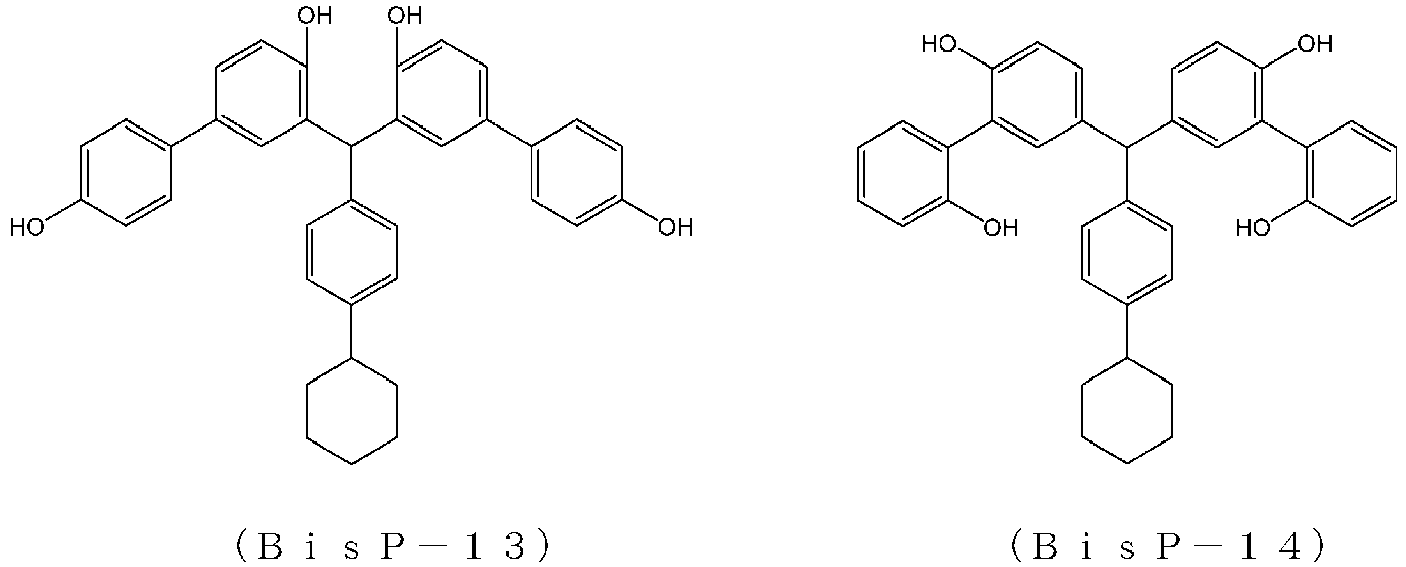

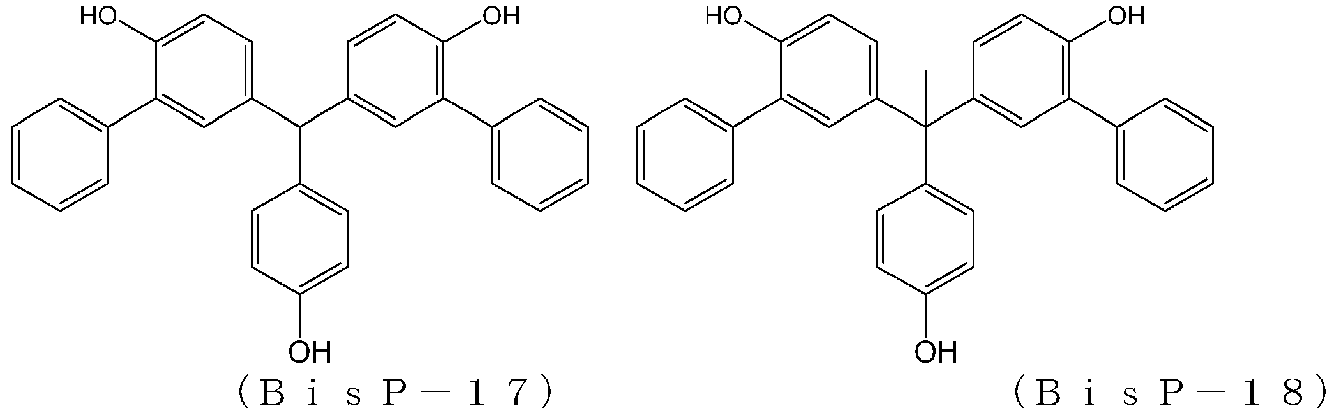
- A four necked flask (internal capacity: 1 L) equipped with a Dimroth condenser tube, a thermometer, and a stirring blade and having a detachable bottom was prepared. To this four necked flask, 37.7 g (70 mmol, manufactured by Mitsubishi Gas Chemical Company, Inc.) of the compound (BisP-1) obtained in Synthesis Example 1, 21.0 g (280 mmol as formaldehyde) of 40% by mass of an aqueous formalin solution (manufactured by Mitsubishi Gas Chemical Company, Inc.), and 0.97 mL of 98% by mass of sulfuric acid (manufactured by Kanto Chemical Co., Inc.) were added in a nitrogen stream, and the mixture was reacted for 7 hours while refluxed at 100°C at normal pressure. Subsequently, 180.0 g of o-xylene (special grade reagent manufactured by Wako Pure Chemical Industries, Ltd.) was added as a diluting solvent to the reaction solution, and the mixture was left to stand still, followed by removal of an aqueous phase as a lower phase. Neutralization and washing with water were further performed, and o-xylene was distilled off under reduced pressure to obtain 32.3 g of a brown solid resin (R1-BisP-1) .
- The obtained resin (R1-BisP-1) had Mn: 2012, Mw: 3510, and Mw/Mn: 1.74.
- A four necked flask (internal capacity: 1 L) equipped with a Dimroth condenser tube, a thermometer, and a stirring blade and having a detachable bottom was prepared. To this four necked flask, 37.7 g (70 mmol, manufactured by Mitsubishi Gas Chemical Company, Inc.) of compound (BisP-1) obtained in Synthesis Example 1, 50.9 g (280 mmol) of 4-biphenylaldehyde (manufactured by Mitsubishi Gas Chemical Company, Inc.), 100 mL of anisole (manufactured by Kanto Chemical Co., Inc.), and 10 mL of oxalic acid dihydrate (manufactured by Kanto Chemical Co., Inc.) were added in a nitrogen stream, and the mixture was reacted for 7 hours while refluxed at 100°C at normal pressure. Subsequently, 180.0 g of o-xylene (special grade reagent manufactured by Wako Pure Chemical Industries, Ltd.) was added as a diluting solvent to the reaction solution, and the mixture was left to stand still, followed by removal of an aqueous phase as a lower phase. Neutralization and washing with water were further performed, and the solvents and unreacted 4-biphenylaldehyde in the organic phase were distilled off under reduced pressure to obtain 38.5 g of a brown solid resin (R2-BisP-1).
- The obtained resin (R2-BisP-1) had Mn: 1630, Mw: 2665, and Mw/Mn: 1.63.
- A four necked flask (internal capacity: 10 L) equipped with a Dimroth condenser tube, a thermometer, and a stirring blade and having a detachable bottom was prepared. To this four necked flask, 1.09 kg (7 mol) of 1,5-dimethylnaphthalene (manufactured by Mitsubishi Gas Chemical Company, Inc.), 2.1 kg (28 mol as formaldehyde) of 40% by mass of an aqueous formalin solution (manufactured by Mitsubishi Gas Chemical Company, Inc.), and 0.97 mL of 98% by mass of sulfuric acid (manufactured by Kanto Chemical Co., Inc.) were added in a nitrogen stream, and the mixture was reacted for 7 hours while refluxed at 100°C at normal pressure. Subsequently, 1.8 kg of ethylbenzene (special grade reagent manufactured by Wako Pure Chemical Industries, Ltd.) was added as a diluting solvent to the reaction solution, and the mixture was left to stand still, followed by removal of an aqueous phase as a lower phase. Neutralization and washing with water were further performed, and ethylbenzene and unreacted 1,5-dimethylnaphthalene were distilled off under reduced pressure to obtain 1.25 kg of a light brown solid dimethylnaphthalene formaldehyde resin.
- Subsequently, a four necked flask (internal capacity: 0.5 L) equipped with a Dimroth condenser tube, a thermometer, and a stirring blade was prepared. To this four necked flask, 100 g (0.51 mol) of the dimethylnaphthalene formaldehyde resin thus obtained, and 0.05 g of p-toluenesulfonic acid were added in a nitrogen stream, and the temperature was raised to 190°C at which the mixture was then heated for 2 hours, followed by stirring. Subsequently, 52.0 g (0.36 mol) of 1-naphthol was added thereto, and the temperature was further raised to 220°C at which the mixture was reacted for 2 hours. After solvent dilution, neutralization and washing with water were performed, and the solvent was removed under reduced pressure to obtain 126.1 g of a black-brown solid modified resin (CR-1).
- Results of evaluating solubility in propylene glycol monomethyl ether (PGME) using BisP-1 to BisP-18, R1-BisP-1, and R2-BisP-2 are shown in Table 3.
-
Table 3 Compound Solubility evaluation results Example 1 BisP-1 A Example 2 BisP-2 A Example 3 BisP-3 A Example 4 BisP-4 A Example 5 BisP-5 A Example 6 BisP-6 A Example 7 BisP-7 A Example 8 BisP-8 A Example 9 BisP-9 A Example 10 BisP-10 A Example 11 BisP-11 A Example 12 BisP-12 A Example 13 BisP-13 A Example 14 BisP-14 A Example 15 BisP-15 A Example 16 BisP-16 A Example 17 BisP-17 A Example 18 BisP-18 A Example 19 R1-BisP-1 A Example 20 R2-BisP-1 A - As is evident from Table 3, all the compounds used in Example 1 to Example 20 were able to be confirmed to be excellent in solubility in a solvent.
- Results of carrying out a heat resistance test and resist performance evaluation using BisP-1 to BisP-18 and CR-1 are shown in Table 4.
- A resist composition was prepared according to the recipe shown in Table 4 using each compound synthesized as described above. Among the components of the resist composition in Table 4, the following acid generating agent (C), acid diffusion controlling agent (E), and solvent were used.
Acid generating agent(C) - P-1: triphenylbenzenesulfonium trifluoromethanesulfonate (Midori Kagaku Co., Ltd.) Acid diffusion controlling agent(E)
- Q-1: trioctylamine (Tokyo Kasei Kogyo Co., Ltd.) Solvent
- S-1: propylene glycol monomethyl ether (Tokyo Kasei Kogyo Co., Ltd.)
- A clean silicon wafer was spin coated with the homogeneous resist composition, and then prebaked (PB) before exposure in an oven of 110°C to form a resist film with a thickness of 60 nm. The obtained resist film was irradiated with electron beams of 1:1 line and space setting with a 50 nm interval using an electron beam lithography system (ELS-7500 manufactured by ELIONIX INC.). After irradiation, the resist film was heated at each predetermined temperature for 90 seconds, and immersed in 2.38% by mass TMAH alkaline developing solution for 60 seconds for development. Subsequently, the resist film was washed with ultrapure water for 30 seconds, and dried to form a positive type resist pattern. Concerning the formed resist pattern, the line and space were observed by a scanning electron microscope (S-4800 manufactured by Hitachi High-Technologies Corporation) to evaluate the reactivity by electron beam irradiation of the resist composition.
-
Table 4 Compound Heat resistance evaluation Resist composition Resist performance evaluation Compound [g] P-1 [g] Q-1 [g] S-1 [g] Example 21 BisP-1 A 1.0 0.3 0.03 50.0 Good Example 22 BisP-2 A 1.0 0.3 0.03 50.0 Good Example 23 BisP-3 A 1.0 0.3 0.03 50.0 Good Example 24 BisP-4 A 1.0 0.3 0.03 50.0 Good Example 25 BisP-5 A 1.0 0.3 0.03 50.0 Good Example 26 BisP-6 A 1.0 0.3 0.03 50.0 Good Example 27 BisP-7 A 1.0 0.3 0.03 50.0 Good Example 28 BisP-8 A 1.0 0.3 0.03 50.0 Good Example 29 BisP-9 A 1.0 0.3 0.03 50.0 Good Example 30 BisP-10 A 1.0 0.3 0.03 50.0 Good Example 31 BisP-11 A 1.0 0.3 0.03 50.0 Good Example 32 BisP-12 A 1.0 0.3 0.03 50.0 Good Example 33 BisP-13 A 1.0 0.3 0.03 50.0 Good Example 34 BisP-14 A 1.0 0.3 0.03 50.0 Good Example 35 BisP-15 A 1.0 0.3 0.03 50.0 Good Example 36 BisP-16 A 1.0 0.3 0.03 50.0 Good Example 37 BisP-17 A 1.0 0.3 0.03 50.0 Good Example 38 BisP-18 A 1.0 0.3 0.03 50.0 Good Comparative Example 1 CR-1 C 1.0 0.3 0.03 50.0 Poor - As is evident from Table 4, it was able to be confirmed that the compounds used in Examples 21 to 38 have good heat resistance whereas the compound used in Comparative Example 1 is inferior in heat resistance.
- In resist pattern evaluation, a good resist pattern was obtained by irradiation with electron beams of 1:1 line and space setting with a 50 nm interval in Examples 21 to 38. On the other hand, no good resist pattern was able to be obtained in Comparative Example 1.
- Thus, the compound that satisfies the requirements of the present invention has high heat resistance and can impart a good shape to a resist pattern, as compared with the comparative compound (CR-1). As long as the above requirements of the present invention are met, compounds other than those described in Examples also exhibit the same effects.
- The components set forth in Table 5 were prepared and formed into homogeneous solutions, and the obtained homogeneous solutions were filtered through a Teflon (R) membrane filter with a pore diameter of 0.1 µm to prepare radiation-sensitive compositions. Each prepared radiation-sensitive composition was evaluated as described below.
-
Table 5 Composition Component (A) [g] Optically active compound (B) [g] Solvent [g] Example 39 BisP-1 B-1 S-1 0.5 1.5 30.0 Example 40 BisP-2 B-1 S-1 0.5 1.5 30.0 Example 41 BisP-3 B-1 S-1 0.5 1.5 30.0 Example 42 BisP-4 B-1 S-1 0.5 1.5 30.0 Example 43 BisP-5 B-1 S-1 0.5 1.5 30.0 Example 44 BisP-6 B-1 S-1 0.5 1.5 30.0 Example 45 BisP-7 B-1 S-1 0.5 1.5 30.0 Example 46 BisP-8 B-1 S-1 0.5 1.5 30.0 Example 47 BisP-9 B-1 S-1 0.5 1.5 30.0 Example 48 BisP-10 B-1 S-1 0.5 1.5 30.0 Example 49 BisP-11 B-1 S-1 0.5 1.5 30.0 Example 50 BisP-12 B-1 S-1 0.5 1.5 30.0 Example 51 BisP-13 B-1 S-1 0.5 1.5 30.0 Example 52 BisP-14 B-1 S-1 0.5 1.5 30.0 Example 53 BisP-15 B-1 S-1 0.5 1.5 30.0 Example 54 BisP-16 B-1 S-1 0.5 1.5 30.0 Example 55 BisP-17 B-1 S-1 0.5 1.5 30.0 Example 56 BisP-18 B-1 S-1 0.5 1.5 30.0 Comparative Example 2 PHS-1 B-1 S-1 0.5 1.5 30.0 - The following resist base material was used in Comparative Example 2.
PHS-1: polyhydroxystyrene Mw = 8000 (Sigma-Aldrich) - The following optically active compound (B) was used.
B-1: naphthoquinonediazide-based sensitizing agent of the chemical structural formula (G) (4NT-300, Toyo Gosei Co., Ltd.) - The following solvent was used.
S-1: propylene glycol monomethyl ether (Tokyo Kasei Kogyo Co., Ltd.)

- A clean silicon wafer was spin coated with the radiation-sensitive composition obtained as described above, and then prebaked (PB) before exposure in an oven of 110°C to form a resist film with a thickness of 200 nm. The resist film was exposed to ultraviolet using an ultraviolet exposure apparatus (mask aligner MA-10 manufactured by Mikasa Co., Ltd.). The ultraviolet lamp used was a super high pressure mercury lamp (relative intensity ratio: g-ray:h-ray:i-ray:j-ray = 100:80:90:60). After irradiation, the resist film was heated at 110°C for 90 seconds, and immersed in 2.38% by mass TMAH alkaline developing solution for 60 seconds for development. Subsequently, the resist film was washed with ultrapure water for 30 seconds, and dried to form a 5 µm positive type resist pattern.
- The obtained line and space were observed in the formed resist pattern by a scanning electron microscope (S-4800 manufactured by Hitachi High-Technologies Corporation). As for the line edge roughness, a pattern having asperities of less than 50 nm was evaluated as goodness.
- In the case of using the radiation-sensitive compositions of Examples 39 to 56 a good resist pattern with a resolution of 5 µm was able to be obtained. The roughness of the pattern was also small and good.
- On the other hand, in the case of using the radiation-sensitive composition of Comparative Example 2, a good resist pattern with a resolution of 5 µm was able to be obtained. However, the roughness of the pattern was large and poor.
- As described above, it was found that a resist pattern that has small roughness and a good shape can be formed in the case of Examples 39 to 56 as compared with Comparative Example 2. As long as the above requirements of the present invention are met, radiation-sensitive compositions other than those described in Examples also exhibit the same effects.
- The compounds obtained in Synthesis Working Examples 1 to 18 have a relatively low molecular weight and a low viscosity. The embedding properties and film surface flatness of underlayer film forming materials for lithography containing these compounds can be relatively advantageously enhanced. Furthermore, all of their thermal decomposition temperatures are 150°C or higher (evaluation A), and high heat resistance is retained. Therefore, the materials can be used even under high temperature baking conditions.
- Compositions for forming an underlayer film for lithography were prepared according to the composition shown in Table 6. Next, a silicon supporting material was spin coated with each of these compositions for forming an underlayer film for lithography, and then baked at 240°C for 60 seconds and further at 400°C for 120 seconds to prepare each underlayer film with a film thickness of 200 nm. The following acid generating agent, crosslinking agent, and organic solvent were used.
- Acid generating agent: di-tertiary butyl diphenyliodonium nonafluoromethanesulfonate (DTDPI) manufactured by Midori Kagaku Co., Ltd.
- Crosslinking agent: NIKALAC MX270 (NIKALAC) (Sanwa Chemical Co., Ltd.)
- Organic solvent: propylene glycol monomethyl ether acetate (PGMEA)
- Next, etching test was conducted under conditions shown below to evaluate etching resistance. The evaluation results are shown in Table 6.
-
- Etching apparatus: RIE-10NR manufactured by Samco International, Inc.
- Output: 50 W
- Pressure: 20 Pa
- Time: 2 min
- Etching gas
Ar gas flow rate:CF4 gas flow rate:O2 gas flow rate = 50:5:5 (sccm) - The evaluation of etching resistance was conducted by the following procedures. First, an underlayer film of novolac was prepared under the above conditions except that novolac (PSM4357 manufactured by Gunei Chemical Industry Co., Ltd.) was used. Then, this underlayer film of novolac was subjected to the above etching test, and the etching rate was measured.
- Next, underlayer films of Examples 57-1 to 76-2 and Comparative Example 3 were subjected to the above etching test in the same way as above, and the etching rate was measured.
- Then, the etching resistance was evaluated according to the following evaluation criteria on the basis of the etching rate of the underlayer film of novolac.
-
- A: The etching rate was less than -10% as compared with the underlayer film of novolac.
- B: The etching rate was -10% to +5% as compared with the underlayer film of novolac.
- C: The etching rate was more than +5% as compared with the underlayer film of novolac.
-
Table 6 Underlayer film forming material (parts by mass) Solvent (parts by mass) Acid generating agent (parts by mass) Crosslinking agent (parts by mass) Etching resistance Example 57-1 BisP-1 PGMEA DTDPI NIKALAC A (10) (90) (0.5) (0.5) Example 57-2 BisP-1 PGMEA - - A (10) (90) Example 58-1 BisP-2 PGMEA DTDPI NIKALAC A (10) (90) (0.5) (0.5) Example 58-2 BisP-2 PGMEA - - A (10) (90) Example 59-1 BisP-3 PGMEA DTDPI NIKALAC A (10) (90) (0.5) (0.5) Example 59-2 BisP-3 PGMEA - - A (10) (90) Example 60-1 BisP-4 PGMEA DTDPI NIKALAC A (10) (90) (0.5) (0.5) Example 60-2 BisP-4 PGMEA - - A (10) (90) Example 61-1 BisP-5 PGMEA DTDPI NIKALAC A (10) (90) (0.5) (0.5) Example 61-2 BisP-5 PGMEA - - A (10) (90) Example 62-1 BisP-6 PGMEA DTDPI NIKALAC A (10) (90) (0.5) (0.5) Example 62-2 BisP-6 PGMEA - - A (10) (90) Example 63-1 BisP-7 PGMEA DTDPI NIKALAC A (10) (90) (0.5) (0.5) Example 63-2 BisP-7 PGMEA - - A (10) (90) Example 64-1 BisP-8 PGMEA DTDPI NIKALAC A (10) (90) (0.5) (0.5) Example 64-2 BisP-8 PGMEA - - A (10) (90) Example 65-1 BisP-9 PGMEA DTDPI NIKALAC A (10) (90) (0.5) (0.5) Example 65-2 BisP-9 PGMEA - - A (10) (90) Example 66-1 BisP-10 PGMEA DTDPI NIKALAC A (10) (90) (0.5) (0.5) Example 66-2 BisP-10 PGMEA - - A (10) (90) Example 67-1 BisP-11 PGMEA DTDPI NIKALAC A (10) (90) (0.5) (0.5) Example 67-2 BisP-11 PGMEA - - A (10) (90) Example 68-1 BisP-12 PGMEA DTDPI NIKALAC A (10) (90) (0.5) (0.5) Example 68-2 BisP-12 PGMEA - - A (10) (90) Example 69-1 BisP-13 PGMEA DTDPI NIKALAC A (10) (90) (0.5) (0.5) Example 69-2 BisP-13 PGMEA - - A (10) (90) Example 70-1 BisP-14 PGMEA DTDPI NIKALAC A (10) (90) (0.5) (0.5) Example 70-2 BisP-14 PGMEA - - A (10) (90) Example 71-1 BisP-15 PGMEA DTDPI NIKALAC A (10) (90) (0.5) (0.5) Example 71-2 BisP-15 PGMEA - - A (10) (90) Example 72-1 BisP-16 PGMEA DTDPI NIKALAC A (10) (90) (0.5) (0.5) Example 72-2 BisP-16 PGMEA - - A (10) (90) Example 73-1 BisP-17 PGMEA DTDPI NIKALAC A (10) (90) (0.5) (0.5) Example 73-2 BisP-17 PGMEA - - A (10) (90) Example 74-1 BisP-18 PGMEA DTDPI NIKALAC A (10) (90) (0.5) (0.5) Example 74-2 BisP-18 PGMEA - - A (10) (90) Example 75-1 R1-BisP-1 PGMEA DTDPI NIKALAC A (10) (90) (0.5) (0.5) Example 75-2 R1-BisP-1 PGMEA - - A (10) (90) Example 76-1 R2-BisP-1 PGMEA DTDPI NIKALAC A (10) (90) (0.5) (0.5) Example 76-2 R2-BisP-1 PGMEA - - A (10) (90) Comparative Example 3 CR-1 PGMEA DTDPI NIKALAC C (10) (90) (0.5) (0.5) - It was found that an excellent etching rate is exerted in Examples 57-1 to 76-2 as compared with the underlayer film of novolac. On the other hand, it was found that an etching rate is poor in Comparative Example 3 as compared with the underlayer film of novolac.
- Next, a SiO2 supporting material having a film thickness of 80 nm and a line and space pattern of 60 nm was coated with each of the compositions for forming an underlayer film for lithography used in Example 57-1 to Example 76-2, and baked at 240°C for 60 seconds to form a 90 nm underlayer film.
- The embedding properties were evaluated by the following procedures. The cross section of the film obtained under the above conditions was cut out and observed under an electron microscope to evaluate the embedding properties.
-
- S: The underlayer film was embedded without defects in the asperities of the SiO2 supporting material having a line and space pattern of 60 nm, and the height difference of the underlayer film in the asperities was less than 20 nm.
- A: The underlayer film was embedded without defects in the asperities of the SiO2 supporting material having a line and space pattern of 60 nm.
- C: The asperities of the SiO2 supporting material having a line and space pattern of 60 nm had defects which hindered the embedding of the underlayer film.
-
Table 7 Underlayer film forming material (parts by mass) Embedding properties Example 77-1 BisP-1 A (10) Example 77-2 BisP-1 S (10) Example 78-1 BisP-2 A (10) Example 78-2 BisP-2 S (10) Example 79-1 BisP-3 A (10) Example 79-2 BisP-3 S (10) Example 80-1 BisP-4 A (10) Example 80-2 BisP-4 S (10) Example 81-1 BisP-5 A (10) Example 81-2 BisP-5 S (10) Example 82-1 BisP-6 A (10) Example 82-2 BisP-6 S (10) Example 83-1 BisP-7 A (10) Example 83-2 BisP-7 S (10) Example 84-1 BisP-8 A (10) Example 84-2 BisP-8 S (10) Example 85-1 BisP-9 A (10) Example 85-2 BisP-9 S (10) Example 86-1 BisP-10 A (10) Example 86-2 BisP-10 S (10) Example 87-1 BisP-11 A (10) Example 87-2 BisP-11 S (10) Example 88-1 BisP-12 A (10) Example 88-2 BisP-12 S (10) Example 89-1 BisP-13 A (10) Example 89-2 BisP-13 S (10) Example 90-1 BisP-14 A (10) Example 90-2 BisP-14 S (10) Example 91-1 BisP-15 A (10) Example 91-2 BisP-15 S (10) Example 92-1 BisP-16 A (10) Example 92-2 BisP-16 S (10) Example 93-1 BisP-17 A (10) Example 93-2 BisP-17 S (10) Example 94-1 BisP-18 A (10) Example 94-2 BisP-18 S (10) Example 95-1 R1-BisP-1 A (10) Example 95-2 R1-BisP-1 S (10) Example 96-1 R2-BisP-1 A (10) Example 96-2 R2-BisP-1 C (10) Comparative Example 4 CR-1 C (10) - It was found that embedding properties are good in Examples 77-1 to 96-2. On the other hand, it was found that defects are seen in the asperities of the SiO2 supporting material and embedding properties are poor in Comparative Example 4.
- Next, a SiO2 supporting material having a film thickness of 300 nm was coated with the composition for forming an underlayer film for lithography used in Example 57-1, and baked at 240°C for 60 seconds and further at 400°C for 120 seconds to form an underlayer film having a film thickness of 85 nm. This underlayer film was coated with a resist solution for ArF and baked at 130°C for 60 seconds to form a photoresist layer with a film thickness of 140 nm.
- The ArF resist solution used was prepared by containing 5 parts by mass of a compound of the formula (16) given below, 1 part by mass of triphenylsulfonium nonafluoromethanesulfonate, 2 parts by mass of tributylamine, and 92 parts by mass of PGMEA.
- The compound of the formula (16) was prepared as follows. 4.15 g of 2-methyl-2-methacryloyloxyadamantane, 3.00 g of methacryloyloxy-γ-butyrolactone, 2.08 g of 3-hydroxy-1-adamantyl methacrylate, and 0.38 g of azobisisobutyronitrile were dissolved in 80 mL of tetrahydrofuran to prepare a reaction solution. This reaction solution was polymerized for 22 hours with the reaction temperature kept at 63°C in a nitrogen atmosphere. Then, the reaction solution was added dropwise into 400 mL of n-hexane. The product resin thus obtained was solidified and purified, and the resulting white powder was filtered and dried overnight at 40°C under reduced pressure to obtain a compound represented by the following formula.
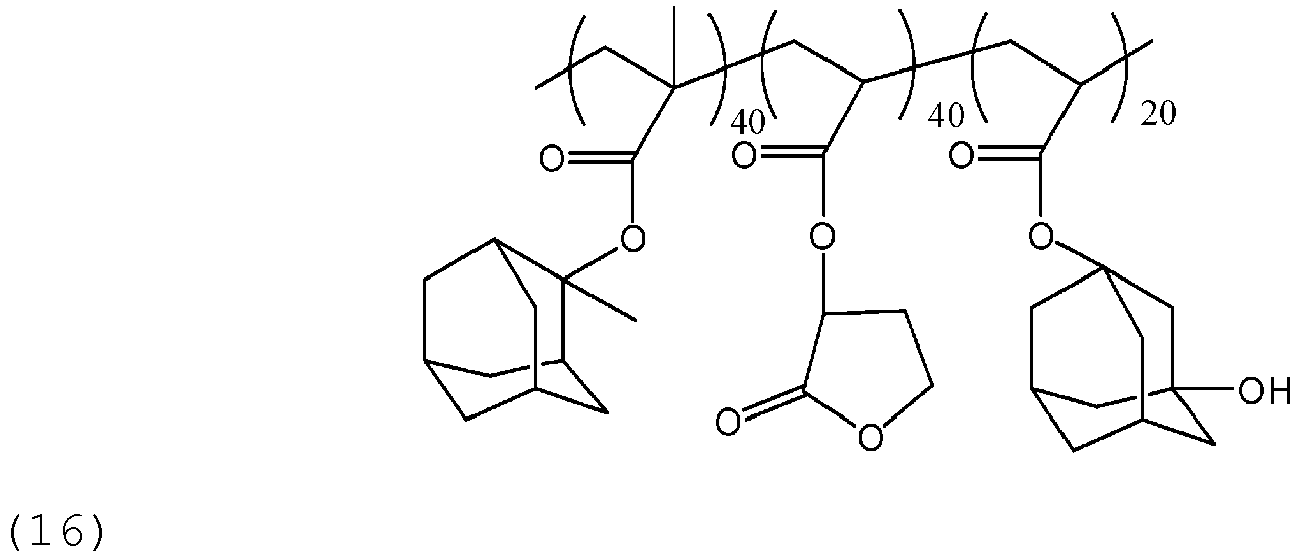
- Subsequently, the photoresist layer was exposed using an electron beam lithography system (manufactured by ELIONIX INC.; ELS-7500, 50 keV), baked (PEB) at 115°C for 90 seconds, and developed for 60 seconds in 2.38% by mass tetramethylammonium hydroxide (TMAH) aqueous solution to obtain a positive type resist pattern.
- The same operations as in Example 97 were performed except that no underlayer film was formed so that a photoresist layer was formed directly on a SiO2 supporting material to obtain a positive type resist pattern.
- Concerning each of Example 97 and Comparative Example 5, the shapes of the obtained 45 nm L/S (1:1) and 80 nm L/S (1:1) resist patterns were observed under an electron microscope manufactured by Hitachi, Ltd. (S-4800). The shapes of the resist patterns after development were evaluated as goodness when having good rectangularity without pattern collapse, and as poorness if this was not the case. The smallest line width having good rectangularity without pattern collapse as a result of this observation was used as an index for resolution evaluation. The smallest electron beam energy quantity capable of lithographing good pattern shapes was used as an index for sensitivity evaluation. The results are shown in Table 8.
-
Table 8 Underlayer film forming material Resolution (nmL/S) Sensitivity (µC/cm2) Resist pattern shape after development Example 97 Material described in Example 57-1 47 12 Good Comparative Example 5 None 81 25 Poor - As is evident from Table 8, the underlayer film of Example 97 was confirmed to be significantly superior in both resolution and sensitivity to Comparative Example 5. Also, the resist pattern shapes after development were confirmed to have good rectangularity without pattern collapse. The difference in the resist pattern shapes after development indicated that the underlayer film forming material for lithography of Example 97 has good adhesiveness to a resist material.
- A SiO2 supporting material with a film thickness of 300 nm was coated with the composition for forming an underlayer film for lithography used in Example 57-1, and baked at 240°C for 60 seconds and further at 400°C for 120 seconds to form an underlayer film with a film thickness of 90 nm. This underlayer film was coated with a silicon-containing intermediate layer material and baked at 200°C for 60 seconds to form an intermediate layer film with a film thickness of 35 nm. This intermediate layer film was further coated with the above resist solution for ArF and baked at 130°C for 60 seconds to form a photoresist layer with a film thickness of 150 nm. The silicon-containing intermediate layer material used was the silicon atom-containing polymer described in <Synthesis Example 1> of Japanese Patent Laid-Open No.
2007-226170 - Subsequently, the photoresist layer was mask exposed using an electron beam lithography system (manufactured by ELIONIX INC.; ELS-7500, 50 keV), baked (PEB) at 115°C for 90 seconds, and developed for 60 seconds in 2.38% by mass tetramethylammonium hydroxide (TMAH) aqueous solution to obtain a 45 nm L/S (1:1) positive type resist pattern.
- Then, the silicon-containing intermediate layer film (SOG) was dry etched with the obtained resist pattern as a mask using RIE-10NR manufactured by Samco International, Inc. Subsequently, dry etching of the underlayer film with the obtained silicon-containing intermediate layer film pattern as a mask and dry etching of the SiO2 film with the obtained underlayer film pattern as a mask were performed in order.
- Respective etching conditions are as shown below.
- Conditions for etching of resist intermediate layer film with resist pattern
- Output: 50 W
- Pressure: 20 Pa
- Time: 1 min
- Etching gas
Ar gas flow rate:CF4 gas flow rate:O2 gas flow rate = 50:8:2 (sccm) - Conditions for etching of resist underlayer film with resist intermediate film pattern
- Output: 50 W
- Pressure: 20 Pa
- Time: 2 min
- Etching gas
Ar gas flow rate:CF4 gas flow rate:O2 gas flow rate = 50:5:5 (sccm) - Conditions for etching of SiO2 film with resist underlayer film pattern
- Output: 50 W
- Pressure: 20 Pa
- Time: 2 min
- Etching gas
Ar gas flow rate:C5F12 gas flow rate:C2F6 gas flow rate:O2 gas flow rate = 50:4:3:1 (sccm) - The pattern cross section (the shape of the SiO2 film after etching) of Example 98 obtained as described above was observed under an electron microscope manufactured by Hitachi, Ltd. (S-4800). As a result, it was confirmed that the shape of the SiO2 film after etching in a multilayer resist process is a rectangular shape in Examples using the underlayer film of the present invention and is good without defects.
- The present invention has industrial applicability as a compound that can be used in photoresist components, resin raw materials for materials for electric or electronic components, raw materials for curable resins such as photocurable resins, resin raw materials for structural materials, or resin curing agents, etc.
Claims (32)
- A compound represented by the following formula (A):
 RY is a hydrogen atom, a linear alkyl group having 1 to 30 carbon atoms optionally having a substituent, a branched alkyl group having 3 to 30 carbon atoms optionally having a substituent, a cyclic alkyl group having 3 to 30 carbon atoms optionally having a substituent or an aryl group having 6 to 30 carbon atoms optionally having a substituent;RZ is a no-valent group having 6 to 60 carbon atoms containing an aryl group having 6 to 30 carbon atoms, wherein the aryl group is substituted at least with a substituent selected from the group consisting of a linear alkyl group having 1 to 30 carbon atoms optionally having a substituent, a branched alkyl group having 3 to 30 carbon atoms optionally having a substituent, a cyclic alkyl group having 3 to 30 carbon atoms optionally having a substituent, a hydroxy group and a group in which a hydrogen atom of a hydroxy group is replaced with an acid dissociation group;each RT is independently a linear alkyl group having 1 to 30 carbon atoms optionally having a substituent, a branched alkyl group having 3 to 30 carbon atoms optionally having a substituent, a cyclic alkyl group having 3 to 30 carbon atoms optionally having a substituent, an aryl group having 6 to 30 carbon atoms optionally having a substituent, an alkenyl group having 2 to 30 carbon atoms optionally having a substituent, an alkoxy group having 1 to 30 carbon atoms optionally having a substituent, a halogen atom, a nitro group, an amino group, a carboxyl group, a thiol group, a hydroxy group or a group in which a hydrogen atom of a hydroxy group is replaced with an acid dissociation group, wherein the alkyl group, the aryl group, the alkenyl group, and the alkoxy group each optionally have an ether bond, a ketone bond or an ester bond, wherein at least one RT is a hydroxy group or a group in which a hydrogen atom of a hydroxy group is replaced with an acid dissociation group;each m is independently an integer of 0 to 9, wherein at least one m is an integer of 1 to 9;n0 is an integer of 1 to 4, wherein when n0 is an integer of 2 or larger, n0 structural formulae within the parentheses [ ] are the same or different; andeach k is independently an integer of 0 to 2.
- The compound according to claim 1, wherein at least one of RY and RZ has a hydroxy group or a group in which a hydrogen atom of a hydroxy group is replaced with an acid dissociation group.
- The compound according to claim 1 or 2, wherein the compound represented by the above formula (A) is a compound represented by the following formula (1):
 R0 is as defined in the above RY;R1 is as defined in the above RZ;R2 to R5 are each independently a linear alkyl group having 1 to 30 carbon atoms optionally having a substituent, a branched alkyl group having 3 to 30 carbon atoms optionally having a substituent, a cyclic alkyl group having 3 to 30 carbon atoms optionally having a substituent, an aryl group having 6 to 30 carbon atoms optionally having a substituent, an alkenyl group having 2 to 30 carbon atoms optionally having a substituent, an alkoxy group having 1 to 30 carbon atoms optionally having a substituent, a halogen atom, a nitro group, an amino group, a carboxyl group, a thiol group, a hydroxy group or a group in which a hydrogen atom of a hydroxy group is replaced with an acid dissociation group, wherein the alkyl group, the aryl group, the alkenyl group, and the alkoxy group each optionally have an ether bond, a ketone bond or an ester bond, whereinat least one of R2 to R5 is a hydroxy group or a group in which a hydrogen atom of a hydroxy group is replaced with an acid dissociation group;m2 and m3 are each independently an integer of 0 to 8;m4 and m5 are each independently an integer of 0 to 9,provided that m2, m3, m4 and m5 are not 0 at the same time;n is as defined in the above n0, wherein when n is an integer of 2 or larger, n structural formulae within the parentheses [ ] are the same or different; andp2 to p5 are each independently an integer of 0 to 2.
- The compound according to claim 3, wherein at least one of R0 and R1 has a hydroxy group or a group in which a hydrogen atom of a hydroxy group is replaced with an acid dissociation group.
- The compound according to claim 3 or 4, wherein the compound represented by the above formula (1) is a compound represented by the following formula (1-1):
 R0, R1, R4, R5, n, p2 to p5, m4 and m5 are as defined above;R6 and R7 are each independently a linear alkyl group having 1 to 30 carbon atoms optionally having a substituent, a branched alkyl group having 3 to 30 carbon atoms optionally having a substituent, a cyclic alkyl group having 3 to 30 carbon atoms optionally having a substituent, an aryl group having 6 to 30 carbon atoms optionally having a substituent, an alkenyl group having 2 to 30 carbon atoms optionally having a substituent, a halogen atom, a nitro group, an amino group, a carboxyl group, or a thiol group;R10 and R11 are each independently an acid dissociation group or a hydrogen atom, wherein at least one of R10 and R11 is a hydrogen atom; andm6 and m7 are each independently an integer of 0 to 7.
- The compound according to claim 5, wherein the compound represented by the above formula (1-1) is a compound represented by the following formula (1-2):
 R0, R1, R6, R7, R10, R11, n, p2 to p5, m6 and m7 are as defined above;R8 and R9 are as defined in the above R6 and R7;R12 and R13 are as defined in the above R10 and R11; andm8 and m9 are each independently an integer of 0 to 8.
- The compound according to claim 6, wherein the compound represented by the above formula (1-2) is a compound selected from the group consisting of compounds represented by the following formulae:


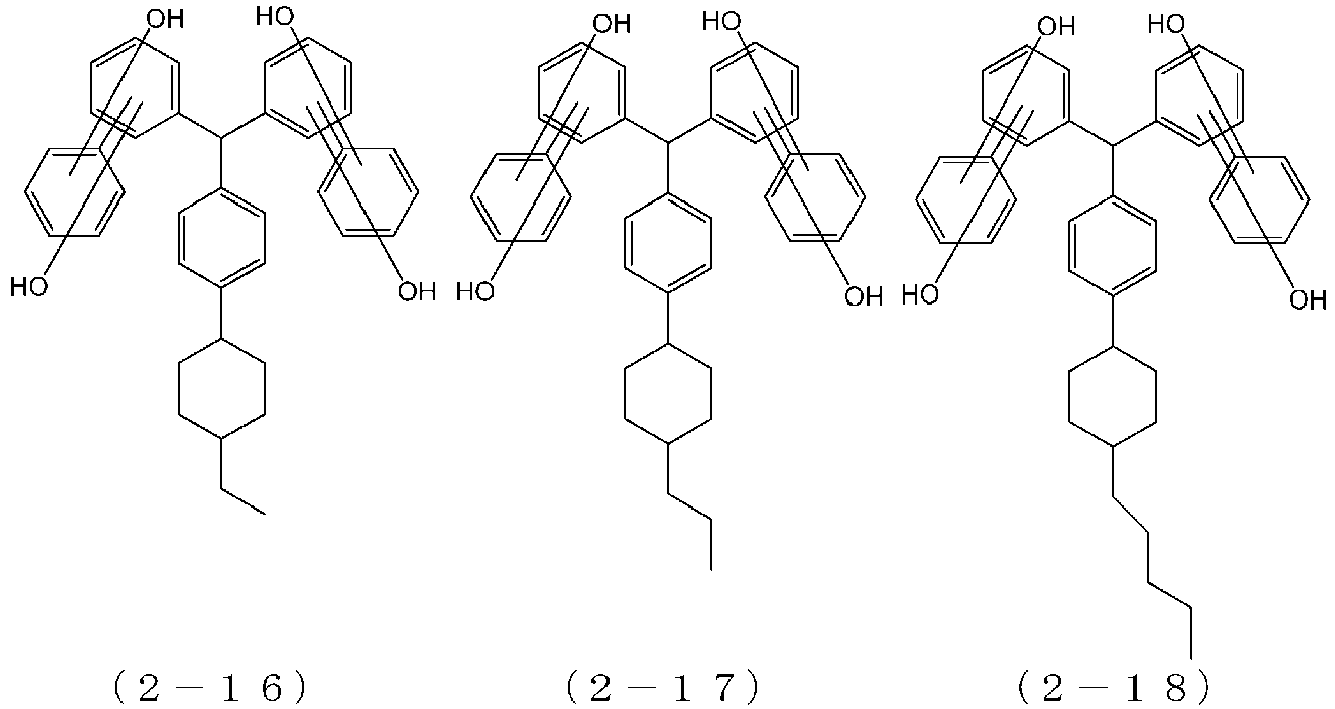


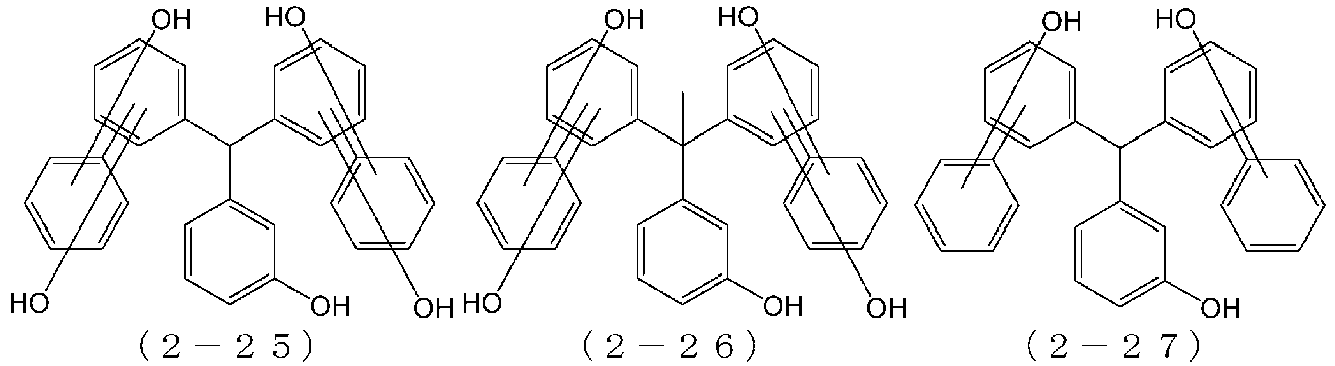
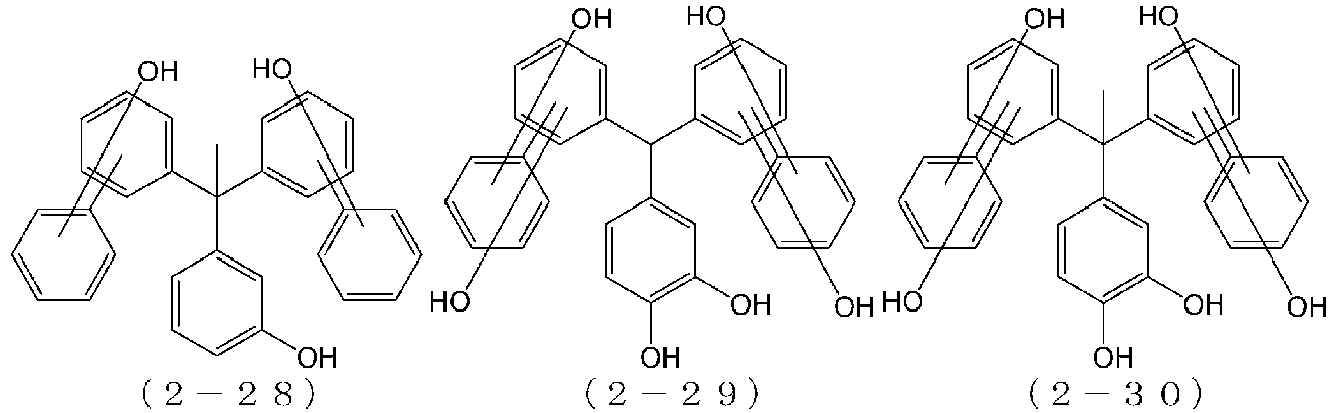
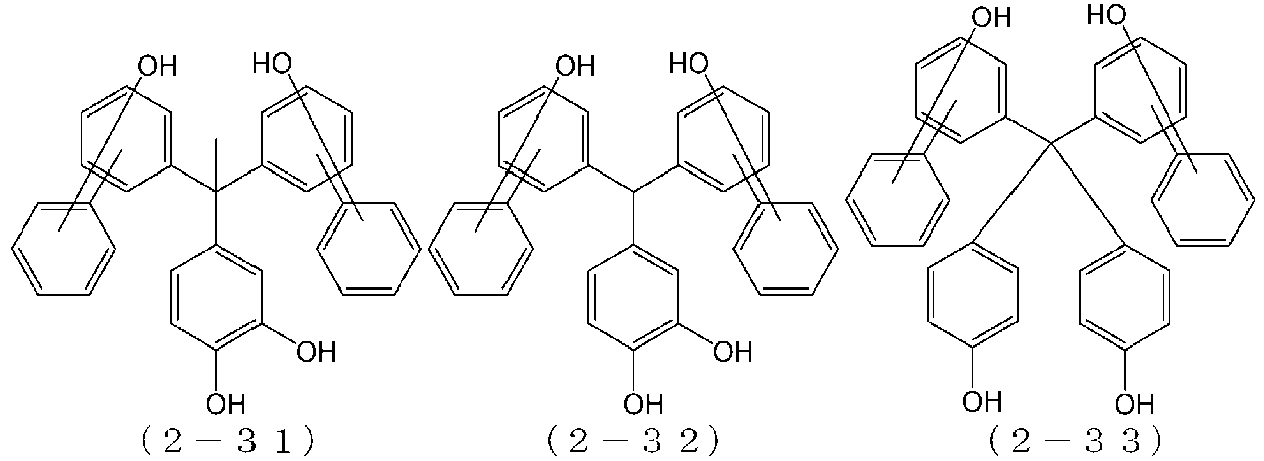

- A resin having a constituent unit derived from the compound according to any one of claims 1 to 7.
- A composition comprising one or more selected from the group consisting of the compound according to any one of claims 1 to 7 and the resin according to claim 8.
- A composition for forming an optical component comprising one or more selected from the group consisting of the compound according to any one of claims 1 to 7 and the resin according to claim 8.
- A film forming composition for lithography comprising one or more selected from the group consisting of the compound according to any one of claims 1 to 7 and the resin according to claim 8.
- A resist composition comprising one or more selected from the group consisting of the compound according to any one of claims 1 to 7 and the resin according to claim 8.
- The resist composition according to claim 12, further comprising a solvent.
- The resist composition according to claim 12 or 13, further comprising an acid generating agent.
- The resist composition according to any one of claims 12 to 14, further comprising an acid diffusion controlling agent.
- A method for forming a resist pattern, comprising the steps of:forming a resist film on a supporting material using the resist composition according to any one of claims 12 to 15;exposing at least a portion of the formed resist film; anddeveloping the exposed resist film, thereby forming a resist pattern.
- A radiation-sensitive composition comprising
a component (A) which is one or more selected from the group consisting of the compound according to any one of claims 1 to 7 and the resin according to claim 8,
an optically active diazonaphthoquinone compound (B), and
a solvent, wherein
the content of the solvent is 20 to 99% by mass based on 100% by mass in total of the radiation-sensitive composition, and
the content of components except for the solvent is 1 to 80% by mass based on 100% by mass in total of the radiation-sensitive composition. - The radiation-sensitive composition according to claim 17, wherein the content ratio among the component (A), the optically active diazonaphthoquinone compound (B), and a further optional component (D) optionally comprised in the radiation-sensitive composition ((A)/(B)/(D)) is 1 to 99% by mass/99 to 1% by mass/0 to 98% by mass based on 100% by mass of solid components of the radiation-sensitive composition.
- The radiation-sensitive composition according to claim 17 or 18, wherein the radiation-sensitive composition is capable of forming an amorphous film by spin coating.
- A method for producing an amorphous film, comprising the step of forming an amorphous film on a supporting material using the radiation-sensitive composition according to any one of claims 17 to 19.
- A method for forming a resist pattern, comprising the steps of:forming a resist film on a supporting material using the radiation-sensitive composition according to any one of claims 17 to 19;exposing at least a portion of the formed resist film; anddeveloping the exposed resist film, thereby forming a resist pattern.
- An underlayer film forming material for lithography comprising one or more selected from the group consisting of the compound according to any one of claims 1 to 7 and the resin according to claim 8.
- A composition for forming an underlayer film for lithography comprising
the underlayer film forming material for lithography according to claim 22, and a solvent. - The composition for forming an underlayer film for lithography according to claim 23, further comprising an acid generating agent.
- The composition for forming an underlayer film for lithography according to claim 23 or 24, further comprising a crosslinking agent.
- A method for producing an underlayer film for lithography, comprising the step of forming an underlayer film on a supporting material using the composition for forming an underlayer film for lithography according to any one of claims 23 to 25.
- A method for forming a resist pattern, comprising the steps of:forming an underlayer film on a supporting material using the composition for forming an underlayer film for lithography according to any one of claims 23 to 25;forming at least one photoresist layer on the underlayer film; andirradiating a predetermined region of the photoresist layer with radiation for development, thereby forming a resist pattern.
- A method for forming a circuit pattern, comprising the steps of:forming an underlayer film on a supporting material using the composition for forming an underlayer film for lithography according to any one of claims 23 to 25;forming an intermediate layer film on the underlayer film using a resist intermediate layer film material comprising a silicon atom;forming at least one photoresist layer on the intermediate layer film;irradiating a predetermined region of the photoresist layer with radiation for development, thereby forming a resist pattern;etching the intermediate layer film with the resist pattern as a mask, thereby forming an intermediate layer film pattern;etching the underlayer film with the intermediate layer film pattern as an etching mask, thereby forming an underlayer film pattern; andetching the supporting material with the underlayer film pattern as an etching mask, thereby forming a pattern on the supporting material.
- A purification method comprising the steps of:obtaining a solution (S) by dissolving one or more selected from the group consisting of the compound according to any one of claims 1 to 7 and the resin according to claim 8 in a solvent; andextracting impurities in the compound and/or the resin by bringing the obtained solution (S) into contact with an acidic aqueous solution (a first extraction step), whereinthe solvent used in the step of obtaining the solution (S) comprises a solvent that is incompatible with water.
- The purification method according to claim 29, wherein
the acidic aqueous solution is an aqueous mineral acid solution or an aqueous organic acid solution;
the aqueous mineral acid solution is an aqueous mineral acid solution in which one or more selected from the group consisting of hydrochloric acid, sulfuric acid, nitric acid, and phosphoric acid is dissolved in water; and
the aqueous organic acid solution is an aqueous organic acid solution in which one or more selected from the group consisting of acetic acid, propionic acid, oxalic acid, malonic acid, succinic acid, fumaric acid, maleic acid, tartaric acid, citric acid, methanesulfonic acid, phenolsulfonic acid, p-toluenesulfonic acid, and trifluoroacetic acid is dissolved in water. - The purification method according to claim 29 or 30, wherein the solvent that is incompatible with water is one or more solvents selected from the group consisting of toluene, 2-heptanone, cyclohexanone, cyclopentanone, methyl isobutyl ketone, propylene glycol monomethyl ether acetate, and ethyl acetate.
- The purification method according to any one of claims 29 to 31, comprising the step of extracting impurities in the compound and/or the resin by further bringing a solution phase comprising the compound and/or the resin into contact with water after the first extraction step (a second extraction step).
Applications Claiming Priority (2)
| Application Number | Priority Date | Filing Date | Title |
|---|---|---|---|
| JP2017032249 | 2017-02-23 | ||
| PCT/JP2018/006239 WO2018155495A1 (en) | 2017-02-23 | 2018-02-21 | Compound, resin, composition, pattern forming method and purification method |
Publications (2)
| Publication Number | Publication Date |
|---|---|
| EP3587385A1 true EP3587385A1 (en) | 2020-01-01 |
| EP3587385A4 EP3587385A4 (en) | 2021-02-24 |
Family
ID=63254403
Family Applications (1)
| Application Number | Title | Priority Date | Filing Date |
|---|---|---|---|
| EP18758063.4A Withdrawn EP3587385A4 (en) | 2017-02-23 | 2018-02-21 | Compound, resin, composition, pattern forming method and purification method |
Country Status (7)
| Country | Link |
|---|---|
| US (1) | US20200247739A1 (en) |
| EP (1) | EP3587385A4 (en) |
| JP (1) | JP7216897B2 (en) |
| KR (1) | KR20190123732A (en) |
| CN (1) | CN110325501A (en) |
| TW (1) | TW201841874A (en) |
| WO (1) | WO2018155495A1 (en) |
Families Citing this family (4)
| Publication number | Priority date | Publication date | Assignee | Title |
|---|---|---|---|---|
| CN116234791A (en) * | 2020-10-07 | 2023-06-06 | 本州化学工业株式会社 | Method for producing tetraphenol compound having biphenyl skeleton |
| JP7862777B2 (en) * | 2021-02-16 | 2026-05-20 | 三菱瓦斯化学株式会社 | Resin, composition, method for forming a resist pattern, method for forming a circuit pattern, and method for purifying a resin |
| CN114167684B (en) * | 2021-12-07 | 2025-02-07 | 潍坊星泰克微电子材料有限公司 | Photoresist composition, preparation method and application thereof, and method for forming photoresist pattern |
| TW202540245A (en) * | 2024-02-02 | 2025-10-16 | 日商日產化學股份有限公司 | Composition for forming a photoresist underlayer film, photoresist underlayer film, method for forming a photoresist pattern, and method for manufacturing a semiconductor device |
Family Cites Families (52)
| Publication number | Priority date | Publication date | Assignee | Title |
|---|---|---|---|---|
| GB1088455A (en) * | 1963-10-21 | 1967-10-25 | Ethyl Corp | Method and composition for reducing plasma lipid levels |
| US3582486A (en) * | 1970-02-03 | 1971-06-01 | Gen Electric | Photochemical reaction of fuchsones and phenols to produce bisphenols |
| JPS61226745A (en) | 1985-03-30 | 1986-10-08 | Japan Synthetic Rubber Co Ltd | Radiation sensitive composition |
| JPS61226746A (en) | 1985-03-30 | 1986-10-08 | Japan Synthetic Rubber Co Ltd | Radiation sensitive composition |
| JPS62123444A (en) | 1985-08-07 | 1987-06-04 | Japan Synthetic Rubber Co Ltd | Radiation sensitive resinous composition |
| JPH0616174B2 (en) | 1985-08-12 | 1994-03-02 | 三菱化成株式会社 | Naphthoquinonediazide compound and positive photoresist composition containing the compound |
| JPH083630B2 (en) | 1986-01-23 | 1996-01-17 | 富士写真フイルム株式会社 | Photosensitive composition |
| JP2529230B2 (en) * | 1986-06-09 | 1996-08-28 | 出光興産株式会社 | 1,1-bis (3-phenyl-4-hydroxyphenyl) methane derivative |
| JPS6334540A (en) | 1986-07-30 | 1988-02-15 | Mitsubishi Chem Ind Ltd | Positive type photoresist composition |
| JPH03120088A (en) * | 1989-10-03 | 1991-05-22 | Idemitsu Kosan Co Ltd | Thermal recording material |
| JP2717602B2 (en) | 1990-01-16 | 1998-02-18 | 富士写真フイルム株式会社 | Photosensitive composition |
| US5296330A (en) | 1991-08-30 | 1994-03-22 | Ciba-Geigy Corp. | Positive photoresists containing quinone diazide photosensitizer, alkali-soluble resin and tetra(hydroxyphenyl) alkane additive |
| US5576143A (en) | 1991-12-03 | 1996-11-19 | Fuji Photo Film Co., Ltd. | Light-sensitive composition |
| JP2753921B2 (en) | 1992-06-04 | 1998-05-20 | 富士写真フイルム株式会社 | Positive photoresist composition |
| JP3199077B2 (en) * | 1992-07-03 | 2001-08-13 | シップレーカンパニー エル エル シー | Positive photosensitive composition |
| JP3112229B2 (en) | 1993-06-30 | 2000-11-27 | 東京応化工業株式会社 | Positive photoresist composition |
| JP3224115B2 (en) | 1994-03-17 | 2001-10-29 | 富士写真フイルム株式会社 | Positive photoresist composition |
| DE69525883T2 (en) | 1994-07-04 | 2002-10-31 | Fuji Photo Film Co., Ltd. | Positive photoresist composition |
| JPH0862834A (en) | 1994-08-22 | 1996-03-08 | Mitsubishi Chem Corp | Photoresist composition |
| JPH095988A (en) | 1995-06-21 | 1997-01-10 | Mitsubishi Chem Corp | Radiation-sensitive coating composition |
| JP3562599B2 (en) | 1995-08-18 | 2004-09-08 | 大日本インキ化学工業株式会社 | Photoresist composition |
| US5948923A (en) * | 1997-04-29 | 1999-09-07 | Industrial Technology Research Institute | Phenolepoxy resins prepared from an aqueous-phase-free process |
| US5844062A (en) * | 1997-04-29 | 1998-12-01 | Industrial Technology Research Institute | Process for preparing phenolepoxy resins in the absence of an aqueous phase |
| JP4187934B2 (en) * | 2000-02-18 | 2008-11-26 | 富士フイルム株式会社 | Positive resist composition |
| JP3774668B2 (en) | 2001-02-07 | 2006-05-17 | 東京エレクトロン株式会社 | Cleaning pretreatment method for silicon nitride film forming apparatus |
| JP3685253B2 (en) * | 2001-02-23 | 2005-08-17 | 信越化学工業株式会社 | Resin composition containing silicone-modified epoxy resin or silicone-modified phenol resin, and semiconductor device using the same |
| JP3914493B2 (en) | 2002-11-27 | 2007-05-16 | 東京応化工業株式会社 | Underlayer film forming material for multilayer resist process and wiring forming method using the same |
| KR100771800B1 (en) | 2003-01-24 | 2007-10-30 | 도쿄 엘렉트론 가부시키가이샤 | Method of cvd for forming silicon nitride film on substrate |
| JP3981030B2 (en) | 2003-03-07 | 2007-09-26 | 信越化学工業株式会社 | Resist underlayer film material and pattern forming method |
| CN1853141A (en) * | 2003-09-18 | 2006-10-25 | 三菱瓦斯化学株式会社 | Compound for resist and radiation-sensitive composition |
| JP2005187335A (en) * | 2003-12-24 | 2005-07-14 | Midori Kagaku Kenkyusho:Kk | New cyanate ester and method for producing the same |
| JP4388429B2 (en) | 2004-02-04 | 2009-12-24 | 信越化学工業株式会社 | Resist underlayer film material and pattern forming method |
| TWI495632B (en) | 2004-12-24 | 2015-08-11 | Mitsubishi Gas Chemical Co | Resist compound |
| JP4781280B2 (en) | 2006-01-25 | 2011-09-28 | 信越化学工業株式会社 | Antireflection film material, substrate, and pattern forming method |
| JP4638380B2 (en) | 2006-01-27 | 2011-02-23 | 信越化学工業株式会社 | Antireflection film material, substrate having antireflection film, and pattern forming method |
| TW200745010A (en) * | 2006-02-17 | 2007-12-16 | Jsr Corp | Compound having acid dissociable group and radiation sensitive composition containing the same |
| JP2010138393A (en) | 2008-11-13 | 2010-06-24 | Nippon Kayaku Co Ltd | Energy ray-curable resin composition for optical lens sheet, and cured product thereof |
| CN102596873B (en) * | 2009-09-09 | 2014-11-12 | 本州化学工业株式会社 | Novel trisphenol compound |
| KR101453769B1 (en) * | 2010-12-24 | 2014-10-22 | 제일모직 주식회사 | Photosensitive resin composition and color filter using the same |
| US9316913B2 (en) | 2011-08-12 | 2016-04-19 | Mitsubishi Gas Chemical Company, Inc. | Underlayer film-forming material for lithography, underlayer film for lithography, and pattern formation method |
| KR102082839B1 (en) * | 2011-08-12 | 2020-02-28 | 미쯔비시 가스 케미칼 컴파니, 인코포레이티드 | Resist composition, resist pattern formation method, polyphenol compound used therein, and alcohol compound capable of being derived therefrom |
| CN102778814B (en) * | 2012-07-05 | 2014-04-23 | 常州强力先端电子材料有限公司 | Photo-sensitive composition containing ketoximes ester type photoinitiator and application thereof |
| JP5900318B2 (en) * | 2012-12-21 | 2016-04-06 | 信越化学工業株式会社 | Diallyl group-containing hydroxyphenyl derivative, silicone skeleton-containing polymer compound, negative resist material, photocurable dry film, pattern forming method, and film for protecting electrical and electronic parts |
| WO2014123005A1 (en) | 2013-02-08 | 2014-08-14 | 三菱瓦斯化学株式会社 | Novel aryl compound and method for producing same |
| KR20150126365A (en) * | 2013-03-13 | 2015-11-11 | 빈터샬 홀딩 게엠베하 | Process for the preparation of substituted tris(2-hydroxyphenyl)methane |
| KR20160091342A (en) | 2013-11-29 | 2016-08-02 | 미쯔비시 가스 케미칼 컴파니, 인코포레이티드 | Purification method for compound or resin |
| CN106133604B (en) * | 2014-03-13 | 2019-09-06 | 三菱瓦斯化学株式会社 | Protective agent composition and protective agent pattern forming method |
| JP2015174877A (en) | 2014-03-13 | 2015-10-05 | 日産化学工業株式会社 | Resin composition containing specified hardening acceleration catalyst |
| CN106103396B (en) * | 2014-03-13 | 2021-11-30 | 三菱瓦斯化学株式会社 | Compound, resin, material for forming underlayer film for lithography, pattern formation method, and method for purifying compound or resin |
| US10747112B2 (en) * | 2015-03-30 | 2020-08-18 | Mitsubishi Gas Chemical Company, Inc. | Compound, resin, and purification method thereof, material for forming underlayer film for lithography, composition for forming underlayer film, and underlayer film, as well as resist pattern forming method and circuit pattern forming method |
| JP6156711B2 (en) * | 2015-03-30 | 2017-07-05 | 三菱瓦斯化学株式会社 | Resist substrate, resist composition, and resist pattern forming method |
| CN107850848B (en) * | 2015-07-23 | 2021-06-04 | 三菱瓦斯化学株式会社 | Compound and method for producing same |
-
2018
- 2018-02-21 EP EP18758063.4A patent/EP3587385A4/en not_active Withdrawn
- 2018-02-21 WO PCT/JP2018/006239 patent/WO2018155495A1/en not_active Ceased
- 2018-02-21 US US16/488,185 patent/US20200247739A1/en not_active Abandoned
- 2018-02-21 CN CN201880012865.6A patent/CN110325501A/en not_active Withdrawn
- 2018-02-21 KR KR1020197024708A patent/KR20190123732A/en not_active Withdrawn
- 2018-02-21 JP JP2019501377A patent/JP7216897B2/en active Active
- 2018-02-23 TW TW107106098A patent/TW201841874A/en unknown
Also Published As
| Publication number | Publication date |
|---|---|
| JPWO2018155495A1 (en) | 2019-12-19 |
| JP7216897B2 (en) | 2023-02-02 |
| EP3587385A4 (en) | 2021-02-24 |
| TW201841874A (en) | 2018-12-01 |
| US20200247739A1 (en) | 2020-08-06 |
| WO2018155495A1 (en) | 2018-08-30 |
| CN110325501A (en) | 2019-10-11 |
| KR20190123732A (en) | 2019-11-01 |
Similar Documents
| Publication | Publication Date | Title |
|---|---|---|
| US11067889B2 (en) | Compound, composition, and method for producing same, underlayer film forming material for lithography, composition for underlayer film formation for lithography, and purification method | |
| US11130724B2 (en) | Compound, resin, composition, resist pattern formation method, and circuit pattern formation method | |
| US10550068B2 (en) | Compound and method for producing same | |
| US10723690B2 (en) | (Meth)acryloyl compound and method for producing same | |
| JPWO2018016640A1 (en) | Compound, resin, composition, resist pattern forming method and circuit pattern forming method | |
| JP7069530B2 (en) | Compounds, resins, compositions and pattern forming methods | |
| TW201817722A (en) | Compound, resin, composition and pattern forming method | |
| KR20190034149A (en) | COMPOSITIONS, RESINS AND COMPOSITIONS, AND RESIST PATTERN FORMING METHOD | |
| EP3715949A1 (en) | Composition for forming film for lithography, film for lithography, resist pattern forming method, and circuit pattern forming method | |
| EP3744710A1 (en) | Compound, resin, composition, and pattern forming method | |
| TW201827418A (en) | Compound, resin, composition, method for forming resist pattern, and method for forming circuit pattern | |
| JP7216897B2 (en) | Compound, resin, composition, pattern forming method and purification method | |
| JP7205715B2 (en) | Compound, resin, composition, resist pattern forming method and circuit pattern forming method | |
| JP7205716B2 (en) | Compound, resin, composition, resist pattern forming method and circuit pattern forming method | |
| JP7061271B2 (en) | Compounds, resins, compositions, resist pattern forming methods and circuit pattern forming methods | |
| EP3647869A1 (en) | Film-forming material, lithographic film-forming composition, optical component-forming material, resist composition, resist pattern formation method, resist permanent film, radiation-sensitive composition, amorphous film production method, lithographic underlayer film-forming material, lithographic underlayer film-forming composition, lithographic underlayer film production method, and circuit pattern formation method | |
| US20190367658A1 (en) | Compound, resin, composition, resist pattern formation method and pattern formation method | |
| US12134596B2 (en) | Compound, resin, composition, resist pattern formation method, circuit pattern formation method and method for purifying resin | |
| TW201833096A (en) | Compound, resin, composition, pattern formation method and purification method | |
| US20210070727A1 (en) | Compound, resin, composition and pattern formation method | |
| JP7145415B2 (en) | Compound, resin, composition, pattern forming method and purification method |
Legal Events
| Date | Code | Title | Description |
|---|---|---|---|
| STAA | Information on the status of an ep patent application or granted ep patent |
Free format text: STATUS: THE INTERNATIONAL PUBLICATION HAS BEEN MADE |
|
| PUAI | Public reference made under article 153(3) epc to a published international application that has entered the european phase |
Free format text: ORIGINAL CODE: 0009012 |
|
| STAA | Information on the status of an ep patent application or granted ep patent |
Free format text: STATUS: REQUEST FOR EXAMINATION WAS MADE |
|
| 17P | Request for examination filed |
Effective date: 20190905 |
|
| AK | Designated contracting states |
Kind code of ref document: A1 Designated state(s): AL AT BE BG CH CY CZ DE DK EE ES FI FR GB GR HR HU IE IS IT LI LT LU LV MC MK MT NL NO PL PT RO RS SE SI SK SM TR |
|
| AX | Request for extension of the european patent |
Extension state: BA ME |
|
| DAV | Request for validation of the european patent (deleted) | ||
| DAX | Request for extension of the european patent (deleted) | ||
| A4 | Supplementary search report drawn up and despatched |
Effective date: 20210122 |
|
| RIC1 | Information provided on ipc code assigned before grant |
Ipc: C09B 11/06 20060101ALI20210118BHEP Ipc: C07C 39/15 20060101AFI20210118BHEP Ipc: G03F 7/023 20060101ALI20210118BHEP Ipc: G03F 7/20 20060101ALI20210118BHEP Ipc: C07C 39/17 20060101ALI20210118BHEP Ipc: G03F 7/039 20060101ALI20210118BHEP Ipc: G03F 7/11 20060101ALI20210118BHEP Ipc: G03F 7/26 20060101ALI20210118BHEP |
|
| STAA | Information on the status of an ep patent application or granted ep patent |
Free format text: STATUS: THE APPLICATION IS DEEMED TO BE WITHDRAWN |
|
| 18D | Application deemed to be withdrawn |
Effective date: 20210820 |