EP3584396B1 - Lagerung für einen flügel an einem rahmen - Google Patents
Lagerung für einen flügel an einem rahmen Download PDFInfo
- Publication number
- EP3584396B1 EP3584396B1 EP19178269.7A EP19178269A EP3584396B1 EP 3584396 B1 EP3584396 B1 EP 3584396B1 EP 19178269 A EP19178269 A EP 19178269A EP 3584396 B1 EP3584396 B1 EP 3584396B1
- Authority
- EP
- European Patent Office
- Prior art keywords
- bearing
- adjusting screw
- projection
- sleeve
- shell
- Prior art date
- Legal status (The legal status is an assumption and is not a legal conclusion. Google has not performed a legal analysis and makes no representation as to the accuracy of the status listed.)
- Active
Links
Images


Classifications
-
- E—FIXED CONSTRUCTIONS
- E05—LOCKS; KEYS; WINDOW OR DOOR FITTINGS; SAFES
- E05D—HINGES OR SUSPENSION DEVICES FOR DOORS, WINDOWS OR WINGS
- E05D7/00—Hinges or pivots of special construction
- E05D7/0009—Adjustable hinges
- E05D7/0018—Adjustable hinges at the hinge axis
- E05D7/0027—Adjustable hinges at the hinge axis in an axial direction
-
- E—FIXED CONSTRUCTIONS
- E05—LOCKS; KEYS; WINDOW OR DOOR FITTINGS; SAFES
- E05D—HINGES OR SUSPENSION DEVICES FOR DOORS, WINDOWS OR WINGS
- E05D15/00—Suspension arrangements for wings
- E05D15/48—Suspension arrangements for wings allowing alternative movements
- E05D15/52—Suspension arrangements for wings allowing alternative movements for opening about a vertical as well as a horizontal axis
- E05D15/5214—Corner supports
-
- E—FIXED CONSTRUCTIONS
- E05—LOCKS; KEYS; WINDOW OR DOOR FITTINGS; SAFES
- E05D—HINGES OR SUSPENSION DEVICES FOR DOORS, WINDOWS OR WINGS
- E05D5/00—Construction of single parts, e.g. the parts for attachment
- E05D5/10—Pins, sockets or sleeves; Removable pins
- E05D5/14—Construction of sockets or sleeves
-
- E—FIXED CONSTRUCTIONS
- E05—LOCKS; KEYS; WINDOW OR DOOR FITTINGS; SAFES
- E05Y—INDEXING SCHEME ASSOCIATED WITH SUBCLASSES E05D AND E05F, RELATING TO CONSTRUCTION ELEMENTS, ELECTRIC CONTROL, POWER SUPPLY, POWER SIGNAL OR TRANSMISSION, USER INTERFACES, MOUNTING OR COUPLING, DETAILS, ACCESSORIES, AUXILIARY OPERATIONS NOT OTHERWISE PROVIDED FOR, APPLICATION THEREOF
- E05Y2600/00—Mounting or coupling arrangements for elements provided for in this subclass
- E05Y2600/10—Adjustable
- E05Y2600/14—Adjustable with position retaining means
-
- E—FIXED CONSTRUCTIONS
- E05—LOCKS; KEYS; WINDOW OR DOOR FITTINGS; SAFES
- E05Y—INDEXING SCHEME ASSOCIATED WITH SUBCLASSES E05D AND E05F, RELATING TO CONSTRUCTION ELEMENTS, ELECTRIC CONTROL, POWER SUPPLY, POWER SIGNAL OR TRANSMISSION, USER INTERFACES, MOUNTING OR COUPLING, DETAILS, ACCESSORIES, AUXILIARY OPERATIONS NOT OTHERWISE PROVIDED FOR, APPLICATION THEREOF
- E05Y2600/00—Mounting or coupling arrangements for elements provided for in this subclass
- E05Y2600/10—Adjustable
- E05Y2600/30—Adjustment motion
- E05Y2600/31—Linear motion
- E05Y2600/314—Vertical motion
Definitions
- the invention relates to a bearing for a sash on a frame of a window, a French window or the like, comprising a bearing bolt, a bearing shell, a bearing sleeve inserted in the bearing shell for supporting the bearing bolt, an adjusting screw screwed into the bearing shell and supporting a free end of the bearing bolt, and a holding device for preventing rotation of the adjusting screw.
- Such bearings allow the sash position relative to the frame to be adjusted using the adjusting screw.
- the sash is raised or lowered by turning the adjusting screw, which rests on the free ends of the bearing pin.
- the bearing of a door has a leaf-side and a frame-side fitting part, which are referred to as hinge plates and hinge pins, respectively, and which are connected to one another by a hinge pin.
- the bearing shown is characterized by the fact that it can be readjusted even after pre-assembly in order to ensure optimal support of the door leaf on the door frame.
- the bearing assembly comprises a sleeve which is arranged between the hinge plate and hinge pin and radially encloses the hinge pin to increase the protection of the assembly against tampering and contamination.
- a chamfered edge of the sleeve which interacts with a chamfered transition area of the hinge pin, holds the sleeve securely in position so that it reliably covers the transition area between the hinge plate and hinge pin.
- a threaded bolt provided for adjusting the hinge pin is held in its set position by a fixing screw.
- the FR 2 713 270 A1 Describes an adjustable sash hinge, comprising a frame-side and a sash-side fitting, as well as a hinge pin, which can be adjusted in three directions.
- the sash-side fitting has an adjusting screw, which allows for height adjustment of the sash.
- the adjusting screw is fixed in the set position by a fixing screw aligned perpendicular to it.
- a bearing for a sash mounted on a frame which has two frame-side fittings that serve as the upper and lower ends of the bearing, as well as a sash-side fitting that, in the installed position, is arranged between the two frame-side fittings.
- the invention comprises two bearing bolts, each of which connects a frame-side fitting to the sash-side fitting.
- the bearing bolts can be rotated in their guide and thus serve to regulate the distance between the respective frame-side fitting and the sash-side fitting.
- the frame-side fittings each have a ring nut, which can be tightened after the bearing bolts have been set to the desired position, thus preventing undesired adjustment of the sash bearing after installation.
- the holding device is connected to a circumferential surface of the adjusting screw and holds the adjusting screw in a force-fitting manner.
- the holding device has a sleeve that encloses the circumferential surface of the adjusting screw.
- the adjusting screw can be turned after the force-fitting connection has been overcome by the sleeve and is then held in its position.
- the bearing pin is turned relative to the adjusting screw.
- the holding device must exert very high holding forces on the adjusting screw.
- the sleeve also requires an additional and cost-intensive component to be installed.
- the invention is based on the problem of developing a bearing of the type mentioned at the outset in such a way that it can be produced particularly cost-effectively and avoids independent adjustment of the adjusting screw.
- the holding device is arranged on the bearing sleeve and in that the holding device has a web which is held non-rotatably in the bearing shell and when the web projects into a threaded section of the adjusting screw.
- the arrangement of the holding device on the bearing sleeve has the advantage of a particularly small number of bearing components.
- the bearing arrangement is therefore particularly cost-effective to manufacture. Since the bearing pin and the bearing sleeve already have a friction pair, the arrangement of the holding device on the bearing sleeve provides direct support for the adjusting screw. This reliably prevents the adjusting screw from becoming self-adjusting.
- the design according to the invention means that the thread of the adjusting screw presses into the web, which is held non-rotatably. The adjusting screw is thus reliably held by the web in a force-fitting manner.
- an internal thread of the bearing sleeve is prefabricated, and the web is raised in such a way that the adjusting screw plastically forms the threaded section into the web when screwed into the bearing sleeve.
- the shape of the web can be varied.
- the assembly of the bearing sleeve with the web is particularly simple if the web is arranged parallel to the rotation axis of the adjusting screw. This allows the bearing sleeve with the web to be easily inserted into the bearing shell.
- the invention contributes to a further reduction of the manufacturing costs of the bearing if the web is manufactured in one piece with the bearing sleeve.
- the web is made of plastic to further reduce the manufacturing costs of the bearing.
- the plastic is plastically deformed when the adjusting screw is screwed in and then secures the adjusting screw with a force fit against rotation.
- a reliable and non-rotatable mounting of the web in the bearing shell can be easily ensured if the web is arranged in a recess of the bearing shell.
- bearing shells designed as bearing strips the positioning of the web in the recess can be particularly easily ensured if the web is supported behind the end of the bearing strip.
- a recess is already present behind the end of the bearing strip, which can be used to prevent twisting.
- rotation of the bearing sleeve in the bearing shell can be avoided if the bearing sleeve has a projection on its outer side and if the projection penetrates a recess in the bearing shell.
- Such rotation of the bearing sleeve in the bearing shell is usually undesirable if the intended friction pairing is arranged between the bearing pin and the bearing sleeve.
- the bearing sleeve is structurally particularly simple if the bearing sleeve has a tubular section for supporting the bearing pin and if the web protrudes from the tubular section.
- the bearing can be manufactured particularly cost-effectively if the bearing sleeve is manufactured as a single piece with the web.
- This single-piece construction is preferably made of plastic.
- Figure 1 shows a corner area of a window with a sash 2 that can be pivoted and tilted against a frame 1.
- the sash 2 is hinged to the frame 1 via a bearing 3.
- Figure 1 a horizontal axis 4 and a vertical axis 5 are drawn around which the wing 2 can be tilted or pivoted.
- Figure 2 shows a longitudinal section through the bearing 3 from Figure 1
- the bearing 3 has a frame-side fitting 6 and a sash-side fitting 7.
- the frame-side fitting 6 has a base 8 with a horizontal bearing axis 9 for a vertical bearing pin 10.
- the sash-side fitting 7 has a bearing shell 12 with a bearing hinge 11 and an adjusting screw 13 screwed into it.
- a bearing sleeve 14 for the pivotal mounting of the bearing pin 10 is arranged within the bearing shell 12.
- a plug 15 closes the open end of the bearing shell 12.
- the bearing shell 12 has an internal thread 16 for a threaded portion 17 of the adjusting screw 13.
- a support portion 18 of the adjusting screw 13 protrudes into the bearing sleeve 14 and rests against the free end of the bearing pin 10. By screwing the adjusting screw 13 in or out, the relative positions of the fitting parts 6, 7 and thus the sash position can be adjusted.
- the support portion 18 of the adjusting screw 13 has a smaller diameter than the threaded portion 17.
- a holding device 19 is provided with a web 20 projecting into the threaded portion 17.
- the web 20 is held non-rotatably in the bearing shell 12 and is plastically deformed when the adjusting screw 13 is screwed in.
- Figure 3 shows the bearing 3 from Figure 2 in a sectional view along line III-III. It can be seen that the web 20 of the holding device 19 is held in a rotationally fixed manner in a recess 21 created by the bearing strip 11. Furthermore, the web 20 has dimensions that ensure a frictional connection when the adjusting screw 13 is screwed in.
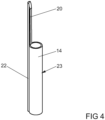
- Figure 4 shows in perspective a one-piece unit consisting of web 20 and bearing sleeve 14.
- the contour of the web 20 extends as an elongated projection 22 over the outer contour of the bearing sleeve 14, so that the bearing sleeve 14, as to Figure 3 described, is also held in the bearing shell 12 in a rotationally fixed manner by the recess 21 created by the bearing strip 11.
- the one-piece unit comprising web 20 and a tubular section 23 of the bearing sleeve 14 can preferably be manufactured from plastic by injection molding.
- the inner side of the web 20 terminates seamlessly with the inner side of the tubular section 23 of the bearing sleeve 14.
Landscapes
- Engineering & Computer Science (AREA)
- Mechanical Engineering (AREA)
- Hinges (AREA)
Description
- Die Erfindung betrifft eine Lagerung für einen Flügel an einem Rahmen eines Fensters, einer Fenstertür oder dergleichen mit einem Lagerbolzen, mit einer Lagerschale, mit einer in der Lagerschale eingesetzten Lagerhülse zur Lagerung des Lagerbolzens, mit einer in die Lagerschale eingedrehten und ein freies Ende des Lagerbolzens abstützenden Stellschraube und mit einer Halteeinrichtung zur Verdrehsicherung der Stellschraube.
- Solche Lagerungen ermöglichen die Einstellung der Flügellage gegenüber dem Rahmen über die Stellschraube. Durch Verdrehung der sich an dem freien Enden des Lagerbolzens abstützenden Stellschraube wird der Flügel gehoben oder gesenkt.
- In der
EP 1 405 975 A1 wird eine einstellbare Türbandanordnung beschrieben. Das Lager einer Tür weist hierbei ein flügelseitiges und ein rahmenseitiges Beschlagteil auf, welche als Bandlappen beziehungsweise Bandkloben bezeichnet werden und die durch einen Scharnierbolzen miteinander verbunden werden. Das dargestellte Lager zeichnet sich dadurch aus, dass es auch nach der Vormontage nachjustiert werden kann, um so eine optimale Lagerung des Türblattes am Türrahmen zu gewährleisten. Die Lageranordnung umfasst eine Hülse, welche zwischen Bandlappen und Bandkloben angeordnet ist und den Scharnierbolzen radial umschließt, um den Schutz der Anordnung vor Manipulation und Verschmutzung zu erhöhen. Durch eine angefaste Kante der Hülse, welche mit einem angefasten Übergangsbereich des Scharnierbolzens zusammenwirkt, wird die Hülse sicher in ihrer Position gehalten, sodass sie zuverlässig den Übergangsbereich zwischen Bandlappen und Bandkloben abdeckt. Ein zur Einstellung des Scharnierbolzens vorgesehene Gewindebolzen wird durch eine Fixierschraube in seiner eingestellten Position gehalten. - Die
FR 2 713 270 A1 - In der
EP 1 835 101 A2 wird ein Lager für ein an einem Rahmen gelagerten Flügel beschrieben, welches über zwei rahmenseitige Beschlagteile verfügt, welche als oberes und unteres Endstück des Lagers dienen sowie über ein flügelseitiges Beschlagteil, welches in montierter Stellung zwischen den beiden rahmenseitigen Beschlagteilen angeordnet ist. Die Erfindung umfasst zwei Lagerbolzen, die jeweils ein rahmenseitiges Beschlagteil mit dem flügelseitigen Beschlagteil verbinden. Die Lagerbolzen lassen sich in ihrer Führung verdrehen und dienen somit zur Regulierung des Abstandes des jeweiligen rahmenseitigen Beschlagteils zum flügelseitigen Beschlagteil. Zur Fixierung der verdrehbaren Lagerbolzen weisen die rahmenseitigen Beschlagteile jeweils eine Ringmutter auf, welcher nach der Einstellung der gewünschten Position der Lagerbolzen festgezogen werden können, um so eine unerwünschte Verstellung der Lagerung des Flügels nach der Montage zu vermeiden. - Aus der
EP 2 256 276 A2 ist ein Ecklager bekannt geworden, bei dem die Halteeinrichtung mit einer Mantelfläche der Stellschraube in Verbindung steht und die Stellschraube kraftschlüssig haltert. Hierzu hat die Halteeinrichtung eine die Mantelfläche der Stellschraube umschließende Hülse. Zur Verstellung der Flügellage lässt sich die Stellschraube nach Überwindung des Kraftschlusses durch die Hülse verdrehen und ist anschließend in ihrer Lage gehalten. Beim Öffnen oder Schließen des Flügels wird der Lagerbolzen gegenüber der Stellschraube verdreht. Um ein Mitnehmen der Stellschraube und damit auch eine Verstellung der Flügellage zu vermeiden, muss die Halteeinrichtung jedoch sehr hohe Haltekräfte auf die Stellschraube ausüben. Die Hülse erfordert zudem ein zusätzlich zu montierendes und kostenintensives Bauteil. - Aus der
DE 33 42 842 A1 ist ein Ecklager bekannt geworden, bei dem zwischen einer Verstellschraube und einem Scharnierzapfen ein Schieber angeordnet ist. Damit werden Verstellschraube und Scharnierzapfen entkoppelt. Jedoch führt die Anordnung des Schiebers zu sehr großen baulichen Abmessungen der Lagerung. Der Schieber erfordert zudem ein zusätzlich zu montierendes und kostenintensives Bauteil. - Der Erfindung liegt das Problem zugrunde, eine Lagerung der eingangs genannten Art so weiter zu bilden, dass sie besonders kostengünstig herstellbar ist und eine selbständige Verstellung der Stellschraube vermeidet.
- Dieses Problem wird erfindungsgemäß dadurch gelöst, dass die Halteeinrichtung an der Lagerhülse angeordnet ist und dass die Halteeinrichtung einen unverdrehbar in der Lagerschale gehaltenen Steg hat und wenn der Steg in einen Gewindeabschnitt der Stellschraube hineinragt.
- Durch diese Gestaltung wird ein zusätzlich zu montierendes Bauteil vermieden, da die Lagerhülse ohnehin in die Lagerung eingesetzt ist. Die Anordnung der Halteeinrichtung an der Lagerhülse hat damit den Vorteil der besonders geringen Anzahl an Bauteilen der Lagerung. Die Lagerung ist daher besonders kostengünstig herstellbar. Da der Lagerbolzen und die Lagerhülse ohnehin eine Reibpaarung aufweisen, führt die Anordnung der Halteeinrichtung an der Lagerhülse zu einer unmittelbaren Abstützung der Stellschraube. Damit wird eine selbständige Verstellung der Stellschraube zuverlässig vermieden. Durch die erfindungsgemäße Gestaltung drückt das Gewinde der Stellschraube in den drehfest gehaltenen Steg. Damit ist die Stellschraube zuverlässig kraftschlüssig von dem Steg gehalten. Vorzugsweise ist ein Innengewinde der Lagerhülse vorgefertigt und der Steg derart erhaben, dass die Stellschraube beim Eindrehen in die Lagerhülse den Gewindeabschnitt in den Steg plastisch einformt. Die Form des Steges kann vielseitig ausgebildet sein.
- Die Montage der Lagerhülse mit dem Steg gestaltet sich gemäß einer anderen vorteilhaften Weiterbildung der Erfindung besonders einfach, wenn der Steg parallel zur Drehachse der Stellschraube angeordnet ist. Damit lässt sich die Lagerhülse mit dem Steg einfach in die Lagerschale einschieben.
- Zur weiteren Verringerung der Fertigungskosten der Lagerung trägt es gemäß einer anderen vorteilhaften Weiterbildung der Erfindung bei, wenn der Steg einstückig mit der Lagerhülse gefertigt ist.
- Zur weiteren Verringerung der Fertigungskosten der Lagerung trägt es gemäß einer anderen vorteilhaften Weiterbildung der Erfindung bei, wenn der Steg aus Kunststoff gefertigt ist. Vorzugsweise wird der Kunststoff beim Eindrehen der Stellschraube plastisch verformt und sichert anschließend die Stellschraube kraftschlüssig gegen ein Verdrehen. Durch eine geeignete Wahl des Kunststoffs lassen sich die Haltekräfte der Halteeinrichtung und die plastische Verformung des Steges einfach anpassen.
- Eine zuverlässige und unverdrehbare Halterung des Steges in der Lagerschale lässt sich gemäß einer anderen vorteilhaften Weiterbildung der Erfindung einfach sicherstellen, wenn der Steg in einer Ausnehmung der Lagerschale angeordnet ist.
- Bei als Lagerband ausgebildeten Lagerschalen lässt sich die Anordnung des Steges in der Ausnehmung besonders einfach sicherstellen, wenn der Steg bei einer als Lagerband ausgebildeten Lagerschale hinter dem Ende des Lagerbandes abgestützt ist. Bei solchen Lagerschalen ist ohnehin eine Ausnehmung hinter dem Ende des Lagerbandes vorhanden, welche sich als Sicherung gegen ein Verdrehen nutzen lässt.
- Eine Verdrehung der Lagerhülse in der Lagerschale lässt sich gemäß einer anderen vorteilhaften Weiterbildung der Erfindung vermeiden, wenn die Lagerhülse an ihrer Außenseite einen Vorsprung hat und wenn der Vorsprung in eine Ausnehmung der Lagerschale eindringt. Eine solche Verdrehung der Lagerhülse in der Lagerschale ist meist unerwünscht, wenn die vorgesehene Reibpaarung zwischen dem Lagerbolzen und der Lagerhülse angeordnet ist.
- Die Lagerhülse gestaltet sich gemäß einer anderen vorteilhaften Weiterbildung der Erfindung konstruktiv besonders einfach, wenn die Lagerhülse einen rohrförmigen Abschnitt zur Lagerung des Lagerbolzens hat und wenn der Steg von dem rohrförmigen Abschnitt absteht.
- Die Lagerung lässt sich gemäß einer anderen vorteilhaften Weiterbildung der Erfindung besonders kostengünstig fertigen, wenn die Lagerhülse mit dem Steg einstückig gefertigt ist. Die einstückige Fertigung erfolgt vorzugsweise aus Kunststoff.
- Die Erfindung lässt zahlreiche Ausführungsformen zu. Zur weiteren Verdeutlichung ihres Grundprinzips ist eine davon in der Zeichnung dargestellt und wird nachfolgend beschrieben. Diese zeigt in
- Fig. 1
- einen Teilbereich eines Fensters mit einer Lagerung,
- Fig. 2
- vergrößert einen Längsschnitt durch die Lagerung aus
Figur 1 , - Fig. 3
- eine Schnittdarstellung entlang der Linie III - III durch die Lagerung aus
Figur 2 , - Fig. 4
- perspektivisch eine Lagerhülse mit einer Halteeinrichtung der Lagerung.
-
Figur 1 zeigt einen Eckbereich eines Fensters mit einem gegen einen Rahmen 1 schwenk- und kippbaren Flügel 2. Der Flügel 2 ist über eine Lagerung 3 an dem Rahmen 1 angelenkt. Zur Verdeutlichung sind inFigur 1 eine horizontale Achse 4 und eine vertikale Achse 5 eingezeichnet um die sich der Flügel 2 kippen oder schwenken lässt. -
Figur 2 zeigt einen Längsschnitt durch die Lagerung 3 ausFigur 1 . Die Lagerung 3 hat ein rahmenseitiges Beschlagteil 6 und ein flügelseitiges Beschlagteil 7. Das rahmenseitige Beschlagteil 6 hat einen Sockel 8 mit einer horizontalen Lagerachse 9 für einen vertikalen Lagerbolzen 10. Das flügelseitige Beschlagteil 7 hat eine ein Lagerband 11 aufweisende Lagerschale 12 mit einer darin eingedrehten Stellschraube 13. Weiterhin ist innerhalb der Lagerschale 12 eine Lagerhülse 14 zur Drehlagerung des Lagerbolzens 10 angeordnet. Ein Stopfen 15 verschließt das offene Ende der Lagerschale 12. - Die Lagerschale 12 hat ein Innengewinde 16 für einen Gewindeabschnitt 17 der Stellschraube 13. Ein Stützabschnitt 18 der Stellschraube 13 ragt in die Lagerhülse 14 hinein und stützt sich an dem freien Ende des Lagerbolzens 10 ab. Durch ein Ein- oder Ausdrehen der Stellschraube 13 lassen sich die Positionen der Beschlagteile 6, 7 zueinander und damit die Flügellage verstellen. Der Stützabschnitt 18 der Stellschraube 13 hat einen kleineren Durchmesser als der Gewindeabschnitt 17.
- Um ein selbständiges Verdrehen der Stellschraube 13 zu vermeiden, ist eine Halteeinrichtung 19 mit einem in den Gewindeabschnitt 17 hineinragenden Steg 20 vorgesehen. Der Steg 20 ist unverdrehbar in der Lagerschale 12 gehalten und wird beim Eindrehen der Stellschraube 13 plastisch verformt.
-
Figur 3 zeigt die Lagerung 3 ausFigur 2 in einer Schnittdarstellung entlang der Linie III - III. Hierbei ist zu erkennen, dass der Steg 20 der Halteeinrichtung 19 drehfest in einer von dem Lagerband 11 erzeugten Ausnehmung 21 gehalten ist. Weiterhin hat der Steg 20 Abmessungen, mit dem ein Kraftschluss beim Eindrehen der Stellschraube 13 sichergestellt ist. -
Figur 4 zeigt perspektivisch eine einstückige Einheit aus Steg 20 und Lagerhülse 14. Die Kontur des Steges 20 erstreckt sich als lang gestreckter Vorsprung 22 über die Außenkontur der Lagerhülse 14, so dass die Lagerhülse 14, wie zuFigur 3 beschrieben, ebenfalls von der von dem Lagerband 11 erzeugten Ausnehmung 21 drehfest in der Lagerschale 12 gehalten ist. Die einstückige Einheit aus Steg 20 und einem rohrförmigen Abschnitt 23 der Lagerhülse 14 lässt sich vorzugsweise aus Kunststoff im Spritzgussverfahren fertigen. Die Innenseite des Steges 20 schließt absatzfrei mit der Innenseite des rohrförmigen Abschnitts 23 der Lagerhülse 14 ab.
Claims (9)
- Lagerung (3) für einen Flügel (2) an einem Rahmen (1) eines Fensters, einer Fenstertür oder dergleichen mit einem Lagerbolzen (10), mit einer Lagerschale (12), mit einer in der Lagerschale (12) eingesetzten Lagerhülse (14) zur Lagerung des Lagerbolzens (10), mit einer in die Lagerschale (12) eingedrehten und ein freies Ende des Lagerbolzens (10) abstützenden Stellschraube (13) und mit einer Halteeinrichtung (19) zur Verdrehsicherung der Stellschraube (13), dadurch gekennzeichnet, dass die Halteeinrichtung (19) an der Lagerhülse (14) angeordnet ist und dass die Halteeinrichtung (19) einen unverdrehbar in der Lagerschale (12) gehaltenen Steg (20) hat und dass der Steg (20) in ein Gewindeabschnitt (17) der Stellschraube (13) hineinragt.
- Lagerung nach Anspruch 1, dadurch gekennzeichnet, dass der Steg (20) parallel zur Drehachse der Stellschraube (13) angeordnet ist.
- Lagerung nach Anspruch 2, dadurch gekennzeichnet, dass der Steg (20) einstückig mit der Lagerhülse (14) gefertigt ist.
- Lagerung nach zumindest einem der Ansprüche 1 bis 3, dadurch gekennzeichnet, dass der Steg (20) aus Kunststoff gefertigt ist.
- Lagerung nach zumindest einem der Ansprüche 1 bis 4, dadurch gekennzeichnet, dass der Steg (20) in einer Ausnehmung (21) der Lagerschale (12) angeordnet ist.
- Lagerung nach zumindest einem der Ansprüche 1 bis 5, dadurch gekennzeichnet, dass der Steg (20) bei einer als Lagerband (11) ausgebildeten Lagerschale (12) hinter dem Ende des Lagerbandes (11) abgestützt ist.
- Lagerung nach zumindest einem der Ansprüche 1 bis 6, dadurch gekennzeichnet, dass die Lagerhülse (14) an ihrer Außenseite einen Vorsprung (22) hat und dass der Vorsprung (22) in eine Ausnehmung (21) der Lagerschale (12) eindringt.
- Lagerung nach zumindest einem der Ansprüche 1 bis 7, dadurch gekennzeichnet, dass die Lagerhülse (14) einen rohrförmigen Abschnitt (23) zur Lagerung des Lagerbolzens (10) hat und dass der Steg (20) von dem rohrförmigen Abschnitt (23) absteht.
- Lagerung nach zumindest einem der Ansprüche 1 bis 8, dadurch gekennzeichnet, dass die Lagerhülse (14) mit dem Steg (230) einstückig gefertigt ist.
Applications Claiming Priority (1)
| Application Number | Priority Date | Filing Date | Title |
|---|---|---|---|
| DE102018209872.7A DE102018209872A1 (de) | 2018-06-19 | 2018-06-19 | Lagerung für einen Flügel an einem Rahmen |
Publications (2)
| Publication Number | Publication Date |
|---|---|
| EP3584396A1 EP3584396A1 (de) | 2019-12-25 |
| EP3584396B1 true EP3584396B1 (de) | 2025-03-26 |
Family
ID=66770261
Family Applications (1)
| Application Number | Title | Priority Date | Filing Date |
|---|---|---|---|
| EP19178269.7A Active EP3584396B1 (de) | 2018-06-19 | 2019-06-04 | Lagerung für einen flügel an einem rahmen |
Country Status (4)
| Country | Link |
|---|---|
| EP (1) | EP3584396B1 (de) |
| DE (1) | DE102018209872A1 (de) |
| ES (1) | ES3029639T3 (de) |
| PL (1) | PL3584396T3 (de) |
Families Citing this family (1)
| Publication number | Priority date | Publication date | Assignee | Title |
|---|---|---|---|---|
| EP4098832B1 (de) | 2021-06-02 | 2023-05-17 | Gretsch-Unitas GmbH Baubeschläge | Baugruppe zur anordnung an einer bandseite eines flügels eines fensters oder einer tür |
Family Cites Families (5)
| Publication number | Priority date | Publication date | Assignee | Title |
|---|---|---|---|---|
| DE3342842C2 (de) | 1983-11-26 | 1987-03-12 | Carl Fuhr Gmbh & Co, 5628 Heiligenhaus | Ecklager |
| FR2713270B1 (fr) * | 1993-12-01 | 1996-06-28 | Blocfer | Paumelle de vantail réglable. |
| EP1405975A1 (de) * | 2002-10-04 | 2004-04-07 | Steinbach & Vollmann GmbH & Co. KG | Einstellbare Türbandanordnung |
| ITUD20060059A1 (it) * | 2006-03-14 | 2007-09-15 | Otlav Spa | Cerniera per un serramento |
| DE102009026584A1 (de) | 2009-05-29 | 2010-12-16 | Aug. Winkhaus Gmbh & Co. Kg | Ecklager für einen gegen einen Rahmen schwenkbaren Flügel |
-
2018
- 2018-06-19 DE DE102018209872.7A patent/DE102018209872A1/de not_active Withdrawn
-
2019
- 2019-06-04 PL PL19178269.7T patent/PL3584396T3/pl unknown
- 2019-06-04 EP EP19178269.7A patent/EP3584396B1/de active Active
- 2019-06-04 ES ES19178269T patent/ES3029639T3/es active Active
Also Published As
| Publication number | Publication date |
|---|---|
| DE102018209872A1 (de) | 2019-12-19 |
| PL3584396T3 (pl) | 2025-06-09 |
| EP3584396A1 (de) | 2019-12-25 |
| ES3029639T3 (en) | 2025-06-24 |
Similar Documents
| Publication | Publication Date | Title |
|---|---|---|
| DE102007044637A1 (de) | Einstellbares Kofferraumdeckelscharnier | |
| EP1606485B1 (de) | Beschlag | |
| EP1707717A2 (de) | Vorreiberverschluss mit Selbstmontage | |
| EP2245252B1 (de) | Einstellbares ecklager für einen flügel eines fensters, einer tür oder dergleichen | |
| DE102010047774B4 (de) | Türscharnier | |
| EP3584396B1 (de) | Lagerung für einen flügel an einem rahmen | |
| DE19960432C2 (de) | Scharnier für eine Fahrzeugtür | |
| EP1881142B1 (de) | Scharnier | |
| EP4105416B1 (de) | Feststellvorrichtung für beidseitig angeschlagene tür | |
| EP2149664A2 (de) | Scharnierband mit einer Unterkonstruktion zur Befestigung an einem Türblatt | |
| DE102015013598A1 (de) | Toleranzausgleichselement und zugehörige Kraftfahrzeugkarosserie | |
| EP2148031B1 (de) | Türband sowie Tür | |
| EP1617025B1 (de) | Scharnier für stumpf einschlagende Türen | |
| WO1999046465A1 (de) | Höhenverstellbares gelenkband | |
| EP2740872B1 (de) | Zur verdeckten anordnung vorgesehenes ecklager | |
| EP2341206A2 (de) | Ecklager eines gegen einen Rahmen schwenkbaren Flügels eines Fensters und Fenster mit einem solchen Ecklager | |
| EP3278693B1 (de) | Beschlag für eine schiebetüre | |
| EP4108877B1 (de) | Scharnier für eine türe, ein fenster oder ein ähnliches bauteil | |
| EP2175096B1 (de) | Scharnier einer Verschlusseinrichtung, beispielsweise eines Fensters, einer Tür oder dergleichen, sowie Verschlusseinrichtung mit einem solchen Scharnier | |
| DE102006030783B4 (de) | Rahmenlose Trennwand, mit einem Oberlicht und mit einem justierbaren Montageprofil zur Montage an einer ortsfesten Zarge | |
| DE20105545U1 (de) | Band für Türen, Fenster o.dgl. | |
| EP1922467B1 (de) | Band für türen, fenster oder dergleichen | |
| EP1215356B1 (de) | Bandanordnung für Türen, Fenster und dergleichen | |
| DE29804967U1 (de) | Tür- oder Fensterband | |
| DE202007016708U1 (de) | Band für Türen, Fenster o.dgl. |
Legal Events
| Date | Code | Title | Description |
|---|---|---|---|
| PUAI | Public reference made under article 153(3) epc to a published international application that has entered the european phase |
Free format text: ORIGINAL CODE: 0009012 |
|
| STAA | Information on the status of an ep patent application or granted ep patent |
Free format text: STATUS: THE APPLICATION HAS BEEN PUBLISHED |
|
| AK | Designated contracting states |
Kind code of ref document: A1 Designated state(s): AL AT BE BG CH CY CZ DE DK EE ES FI FR GB GR HR HU IE IS IT LI LT LU LV MC MK MT NL NO PL PT RO RS SE SI SK SM TR |
|
| AX | Request for extension of the european patent |
Extension state: BA ME |
|
| STAA | Information on the status of an ep patent application or granted ep patent |
Free format text: STATUS: REQUEST FOR EXAMINATION WAS MADE |
|
| 17P | Request for examination filed |
Effective date: 20200526 |
|
| RBV | Designated contracting states (corrected) |
Designated state(s): AL AT BE BG CH CY CZ DE DK EE ES FI FR GB GR HR HU IE IS IT LI LT LU LV MC MK MT NL NO PL PT RO RS SE SI SK SM TR |
|
| P01 | Opt-out of the competence of the unified patent court (upc) registered |
Effective date: 20230517 |
|
| P03 | Opt-out of the competence of the unified patent court (upc) deleted | ||
| GRAP | Despatch of communication of intention to grant a patent |
Free format text: ORIGINAL CODE: EPIDOSNIGR1 |
|
| STAA | Information on the status of an ep patent application or granted ep patent |
Free format text: STATUS: GRANT OF PATENT IS INTENDED |
|
| RAP3 | Party data changed (applicant data changed or rights of an application transferred) |
Owner name: AUG. WINKHAUS SE & CO. KG |
|
| INTG | Intention to grant announced |
Effective date: 20241119 |
|
| GRAS | Grant fee paid |
Free format text: ORIGINAL CODE: EPIDOSNIGR3 |
|
| GRAA | (expected) grant |
Free format text: ORIGINAL CODE: 0009210 |
|
| STAA | Information on the status of an ep patent application or granted ep patent |
Free format text: STATUS: THE PATENT HAS BEEN GRANTED |
|
| AK | Designated contracting states |
Kind code of ref document: B1 Designated state(s): AL AT BE BG CH CY CZ DE DK EE ES FI FR GB GR HR HU IE IS IT LI LT LU LV MC MK MT NL NO PL PT RO RS SE SI SK SM TR |
|
| REG | Reference to a national code |
Ref country code: GB Ref legal event code: FG4D Free format text: NOT ENGLISH |
|
| REG | Reference to a national code |
Ref country code: CH Ref legal event code: EP |
|
| REG | Reference to a national code |
Ref country code: DE Ref legal event code: R096 Ref document number: 502019013096 Country of ref document: DE |
|
| REG | Reference to a national code |
Ref country code: IE Ref legal event code: FG4D Free format text: LANGUAGE OF EP DOCUMENT: GERMAN |
|
| REG | Reference to a national code |
Ref country code: NL Ref legal event code: FP |
|
| REG | Reference to a national code |
Ref country code: ES Ref legal event code: FG2A Ref document number: 3029639 Country of ref document: ES Kind code of ref document: T3 Effective date: 20250624 |
|
| PG25 | Lapsed in a contracting state [announced via postgrant information from national office to epo] |
Ref country code: RS Free format text: LAPSE BECAUSE OF FAILURE TO SUBMIT A TRANSLATION OF THE DESCRIPTION OR TO PAY THE FEE WITHIN THE PRESCRIBED TIME-LIMIT Effective date: 20250626 |
|
| PG25 | Lapsed in a contracting state [announced via postgrant information from national office to epo] |
Ref country code: FI Free format text: LAPSE BECAUSE OF FAILURE TO SUBMIT A TRANSLATION OF THE DESCRIPTION OR TO PAY THE FEE WITHIN THE PRESCRIBED TIME-LIMIT Effective date: 20250326 |
|
| PGFP | Annual fee paid to national office [announced via postgrant information from national office to epo] |
Ref country code: PL Payment date: 20250529 Year of fee payment: 7 Ref country code: DE Payment date: 20250618 Year of fee payment: 7 |
|
| REG | Reference to a national code |
Ref country code: LT Ref legal event code: MG9D |
|
| PG25 | Lapsed in a contracting state [announced via postgrant information from national office to epo] |
Ref country code: NO Free format text: LAPSE BECAUSE OF FAILURE TO SUBMIT A TRANSLATION OF THE DESCRIPTION OR TO PAY THE FEE WITHIN THE PRESCRIBED TIME-LIMIT Effective date: 20250626 |
|
| PGFP | Annual fee paid to national office [announced via postgrant information from national office to epo] |
Ref country code: NL Payment date: 20250618 Year of fee payment: 7 Ref country code: BE Payment date: 20250617 Year of fee payment: 7 |
|
| PG25 | Lapsed in a contracting state [announced via postgrant information from national office to epo] |
Ref country code: HR Free format text: LAPSE BECAUSE OF FAILURE TO SUBMIT A TRANSLATION OF THE DESCRIPTION OR TO PAY THE FEE WITHIN THE PRESCRIBED TIME-LIMIT Effective date: 20250326 |
|
| PG25 | Lapsed in a contracting state [announced via postgrant information from national office to epo] |
Ref country code: LV Free format text: LAPSE BECAUSE OF FAILURE TO SUBMIT A TRANSLATION OF THE DESCRIPTION OR TO PAY THE FEE WITHIN THE PRESCRIBED TIME-LIMIT Effective date: 20250326 |
|
| PGFP | Annual fee paid to national office [announced via postgrant information from national office to epo] |
Ref country code: FR Payment date: 20250618 Year of fee payment: 7 |
|
| PG25 | Lapsed in a contracting state [announced via postgrant information from national office to epo] |
Ref country code: GR Free format text: LAPSE BECAUSE OF FAILURE TO SUBMIT A TRANSLATION OF THE DESCRIPTION OR TO PAY THE FEE WITHIN THE PRESCRIBED TIME-LIMIT Effective date: 20250627 Ref country code: BG Free format text: LAPSE BECAUSE OF FAILURE TO SUBMIT A TRANSLATION OF THE DESCRIPTION OR TO PAY THE FEE WITHIN THE PRESCRIBED TIME-LIMIT Effective date: 20250326 |
|
| PGFP | Annual fee paid to national office [announced via postgrant information from national office to epo] |
Ref country code: AT Payment date: 20250616 Year of fee payment: 7 |
|
| PGFP | Annual fee paid to national office [announced via postgrant information from national office to epo] |
Ref country code: TR Payment date: 20250613 Year of fee payment: 7 |
|
| REG | Reference to a national code |
Ref country code: DE Ref legal event code: R081 Ref document number: 502019013096 Country of ref document: DE Owner name: AUG. WINKHAUS SE, DE Free format text: FORMER OWNER: AUG. WINKHAUS SE & CO. KG, 48291 TELGTE, DE |
|
| PG25 | Lapsed in a contracting state [announced via postgrant information from national office to epo] |
Ref country code: SE Free format text: LAPSE BECAUSE OF FAILURE TO SUBMIT A TRANSLATION OF THE DESCRIPTION OR TO PAY THE FEE WITHIN THE PRESCRIBED TIME-LIMIT Effective date: 20250326 |
|
| PG25 | Lapsed in a contracting state [announced via postgrant information from national office to epo] |
Ref country code: SM Free format text: LAPSE BECAUSE OF FAILURE TO SUBMIT A TRANSLATION OF THE DESCRIPTION OR TO PAY THE FEE WITHIN THE PRESCRIBED TIME-LIMIT Effective date: 20250326 |
|
| RAP2 | Party data changed (patent owner data changed or rights of a patent transferred) |
Owner name: AUG. WINKHAUS SE |
|
| PG25 | Lapsed in a contracting state [announced via postgrant information from national office to epo] |
Ref country code: PT Free format text: LAPSE BECAUSE OF FAILURE TO SUBMIT A TRANSLATION OF THE DESCRIPTION OR TO PAY THE FEE WITHIN THE PRESCRIBED TIME-LIMIT Effective date: 20250728 |
|
| PGFP | Annual fee paid to national office [announced via postgrant information from national office to epo] |
Ref country code: ES Payment date: 20250718 Year of fee payment: 7 |
|
| PGFP | Annual fee paid to national office [announced via postgrant information from national office to epo] |
Ref country code: IT Payment date: 20250702 Year of fee payment: 7 |
|
| PG25 | Lapsed in a contracting state [announced via postgrant information from national office to epo] |
Ref country code: EE Free format text: LAPSE BECAUSE OF FAILURE TO SUBMIT A TRANSLATION OF THE DESCRIPTION OR TO PAY THE FEE WITHIN THE PRESCRIBED TIME-LIMIT Effective date: 20250326 |
|
| PG25 | Lapsed in a contracting state [announced via postgrant information from national office to epo] |
Ref country code: RO Free format text: LAPSE BECAUSE OF FAILURE TO SUBMIT A TRANSLATION OF THE DESCRIPTION OR TO PAY THE FEE WITHIN THE PRESCRIBED TIME-LIMIT Effective date: 20250326 |
|
| PG25 | Lapsed in a contracting state [announced via postgrant information from national office to epo] |
Ref country code: SK Free format text: LAPSE BECAUSE OF FAILURE TO SUBMIT A TRANSLATION OF THE DESCRIPTION OR TO PAY THE FEE WITHIN THE PRESCRIBED TIME-LIMIT Effective date: 20250326 |
|
| PG25 | Lapsed in a contracting state [announced via postgrant information from national office to epo] |
Ref country code: IS Free format text: LAPSE BECAUSE OF FAILURE TO SUBMIT A TRANSLATION OF THE DESCRIPTION OR TO PAY THE FEE WITHIN THE PRESCRIBED TIME-LIMIT Effective date: 20250726 |
|
| PG25 | Lapsed in a contracting state [announced via postgrant information from national office to epo] |
Ref country code: DK Free format text: LAPSE BECAUSE OF FAILURE TO SUBMIT A TRANSLATION OF THE DESCRIPTION OR TO PAY THE FEE WITHIN THE PRESCRIBED TIME-LIMIT Effective date: 20250326 |
|
| PG25 | Lapsed in a contracting state [announced via postgrant information from national office to epo] |
Ref country code: CZ Free format text: LAPSE BECAUSE OF FAILURE TO SUBMIT A TRANSLATION OF THE DESCRIPTION OR TO PAY THE FEE WITHIN THE PRESCRIBED TIME-LIMIT Effective date: 20250326 |
|
| REG | Reference to a national code |
Ref country code: CH Ref legal event code: H13 Free format text: ST27 STATUS EVENT CODE: U-0-0-H10-H13 (AS PROVIDED BY THE NATIONAL OFFICE) Effective date: 20260127 |
|
| PG25 | Lapsed in a contracting state [announced via postgrant information from national office to epo] |
Ref country code: MC Free format text: LAPSE BECAUSE OF FAILURE TO SUBMIT A TRANSLATION OF THE DESCRIPTION OR TO PAY THE FEE WITHIN THE PRESCRIBED TIME-LIMIT Effective date: 20250326 |
|
| PLBE | No opposition filed within time limit |
Free format text: ORIGINAL CODE: 0009261 |
|
| STAA | Information on the status of an ep patent application or granted ep patent |
Free format text: STATUS: NO OPPOSITION FILED WITHIN TIME LIMIT |
|
| REG | Reference to a national code |
Ref country code: CH Ref legal event code: L10 Free format text: ST27 STATUS EVENT CODE: U-0-0-L10-L00 (AS PROVIDED BY THE NATIONAL OFFICE) Effective date: 20260211 |