EP3564252B1 - Modified nucleotide linkers - Google Patents
Modified nucleotide linkers Download PDFInfo
- Publication number
- EP3564252B1 EP3564252B1 EP19178987.4A EP19178987A EP3564252B1 EP 3564252 B1 EP3564252 B1 EP 3564252B1 EP 19178987 A EP19178987 A EP 19178987A EP 3564252 B1 EP3564252 B1 EP 3564252B1
- Authority
- EP
- European Patent Office
- Prior art keywords
- nucleotide
- nucleoside
- alkyl
- linker
- optionally substituted
- Prior art date
- Legal status (The legal status is an assumption and is not a legal conclusion. Google has not performed a legal analysis and makes no representation as to the accuracy of the status listed.)
- Active
Links
- 0 CC(C)(C(*)=O)OCCCNC Chemical compound CC(C)(C(*)=O)OCCCNC 0.000 description 4
- RKMSXVAOQGYWEI-UHFFFAOYSA-N CC(C)(C(C)=O)OCCCNC Chemical compound CC(C)(C(C)=O)OCCCNC RKMSXVAOQGYWEI-UHFFFAOYSA-N 0.000 description 1
- MBXLOQKAUYYAOR-UHFFFAOYSA-N CC(C)(C)OC(NC(CCCCNC)C(C)=O)=O Chemical compound CC(C)(C)OC(NC(CCCCNC)C(C)=O)=O MBXLOQKAUYYAOR-UHFFFAOYSA-N 0.000 description 1
- IFTRQJLVEBNKJK-UHFFFAOYSA-N CCC1CCCC1 Chemical compound CCC1CCCC1 IFTRQJLVEBNKJK-UHFFFAOYSA-N 0.000 description 1
Images







Classifications
-
- C—CHEMISTRY; METALLURGY
- C07—ORGANIC CHEMISTRY
- C07H—SUGARS; DERIVATIVES THEREOF; NUCLEOSIDES; NUCLEOTIDES; NUCLEIC ACIDS
- C07H19/00—Compounds containing a hetero ring sharing one ring hetero atom with a saccharide radical; Nucleosides; Mononucleotides; Anhydro-derivatives thereof
- C07H19/02—Compounds containing a hetero ring sharing one ring hetero atom with a saccharide radical; Nucleosides; Mononucleotides; Anhydro-derivatives thereof sharing nitrogen
- C07H19/04—Heterocyclic radicals containing only nitrogen atoms as ring hetero atom
- C07H19/14—Pyrrolo-pyrimidine radicals
-
- C—CHEMISTRY; METALLURGY
- C07—ORGANIC CHEMISTRY
- C07H—SUGARS; DERIVATIVES THEREOF; NUCLEOSIDES; NUCLEOTIDES; NUCLEIC ACIDS
- C07H1/00—Processes for the preparation of sugar derivatives
-
- C—CHEMISTRY; METALLURGY
- C12—BIOCHEMISTRY; BEER; SPIRITS; WINE; VINEGAR; MICROBIOLOGY; ENZYMOLOGY; MUTATION OR GENETIC ENGINEERING
- C12Q—MEASURING OR TESTING PROCESSES INVOLVING ENZYMES, NUCLEIC ACIDS OR MICROORGANISMS; COMPOSITIONS OR TEST PAPERS THEREFOR; PROCESSES OF PREPARING SUCH COMPOSITIONS; CONDITION-RESPONSIVE CONTROL IN MICROBIOLOGICAL OR ENZYMOLOGICAL PROCESSES
- C12Q1/00—Measuring or testing processes involving enzymes, nucleic acids or microorganisms; Compositions therefor; Processes of preparing such compositions
- C12Q1/68—Measuring or testing processes involving enzymes, nucleic acids or microorganisms; Compositions therefor; Processes of preparing such compositions involving nucleic acids
- C12Q1/6869—Methods for sequencing
-
- G—PHYSICS
- G01—MEASURING; TESTING
- G01N—INVESTIGATING OR ANALYSING MATERIALS BY DETERMINING THEIR CHEMICAL OR PHYSICAL PROPERTIES
- G01N21/00—Investigating or analysing materials by the use of optical means, i.e. using sub-millimetre waves, infrared, visible or ultraviolet light
- G01N21/62—Systems in which the material investigated is excited whereby it emits light or causes a change in wavelength of the incident light
- G01N21/63—Systems in which the material investigated is excited whereby it emits light or causes a change in wavelength of the incident light optically excited
- G01N21/64—Fluorescence; Phosphorescence
Definitions
- Some embodiments of the present application relate to novel nucleoside or nucleotide linkers for increasing incorporation of nucleotides in DNA sequencing and other diagnostic applications, for example, sequencing by synthesis.
- nucleic acids An example of the technologies that have improved the study of nucleic acids is the development of fabricated arrays of immobilized nucleic acids. These arrays typically have a high-density matrix of polynucleotides immobilized onto a solid support material. See, e.g., Fodor et al., Trends Biotech. 12: 19-26, 1994 , which describes ways of assembling different nucleic acids using a chemically sensitized glass surface protected by a mask, but exposed at defined areas to allow attachment of suitably modified nucleotide phosphoramidites.
- Fabricated arrays can also be manufactured by the technique of "spotting" known polynucleotides onto a solid support at predetermined positions (e.g., Stimpson et al., Proc. Natl. Acad. Sci. 92: 6379-6383, 1995 ).
- SBS Sequence sequencing by synthesis
- This technique for determining the nucleotide sequence of DNA ideally requires the controlled (i.e., one at a time) incorporation of the correct complementary nucleotide opposite the nucleic acid being sequenced. This allows for accurate sequencing by adding nucleotides in multiple cycles as each nucleotide residue is sequenced one at a time, thus preventing the incorporation of an uncontrolled series of nucleotides. Each incorporated nucleotide is read using an appropriate label attached thereto before removal of the label moiety and the subsequent next round of sequencing.
- WO 02/088381 discloses nucleosides or nucleotides covalently attached to a fluorophore via a linker.
- Some embodiments disclosed herein relate to a nucleoside or nucleotide covalently attached to a fluorophore through a linker, wherein said linker comprises a structure of formula (II):
- kits comprising a labeled nucleoside or nucleotide comprising a linker between the fluorophore and the nucleoside or nucleotide, wherein the linker comprises a structure of any one of formula (I), (II) or (III), or combinations thereof.
- Some embodiments disclosed herein relate to reagents for modifying a nucleoside or a nucleotide comprising a fluorophore and a linker, wherein the linker comprises a structure of formula (II).
- Some embodiments disclosed herein relate to methods for detecting a nucleoside that has been incorporated into a polynucleotide, comprising: (a) incorporating a labeled nucleoside or nucleotide comprising a linker into a polynucleotide; and (b) detecting a fluorescent signal from said labeled nucleoside or nucleotide that was incorporated in step (a), wherein the linker comprises a structure of formula (II).
- the method further comprises: providing a template nucleic acid strand and a partially hybridized nucleic acid strand, wherein step (a) incorporates into the hybridized strand at least one nucleoside or nucleotide that is complementary to a nucleoside or nucleotide at the corresponding position of the template strand, and wherein step (b) identifies the base of the incorporated nucleoside or nucleotide, thereby indicating the identity of the complementary nucleoside or nucleotide of the template strand.
- Some embodiments disclosed herein relate to methods of sequencing a template nucleic acid molecule, comprising: incorporating one or more labeled nucleotides into a strand of nucleic acid complementary to the template nucleic acid; determining the identity of the base present in one or more incorporated labeled nucleotides in order to determine the sequence of the template nucleic acid molecule; wherein the identity of the base present in the one or more labeled nucleotides is determined by detecting a fluorescent signal produced by said labeled nucleotides; and wherein at least one incorporated labeled nucleotide comprising a linker as described above, wherein the linker comprises a structure of formula (II).
- the identity of the base present in the one or more nucleotides is determined after each nucleotide incorporation step.
- Some embodiments disclosed herein relate to a nucleoside or nucleotide covalently attached to a fluorophore through a linker, wherein the linker comprises a structure of formula (II) below wherein the definitions of the variables are defined above.
- X is methylene, which can be optionally substituted.
- X is oxygen (O).
- X is sulfur (S).
- p is 1. In some other embodiments, p is 2.
- the structure of formula (II) can also be represented by formula (IIa), (IIb), (IIc), (IId), (IIe) or (IIf):
- formula (IIa) is referred to as "ACA”
- formula (IIb) is referred to as “AcLys”
- formula (IIc) is referred to as “BocLys”
- formula (IId) is referred to as “dMeO”
- formula (IIe) is referred to as “dMeS”
- formula (IIf) is referred to as "DMP.”
- nucleoside or nucleotide can be attached to the left side of the linker, either directly, or through additional linking moiety.
- the terms “comprise(s)” and “comprising” are to be interpreted as having an open-ended meaning. That is, the above terms are to be interpreted synonymously with the phrases “having at least” or “including at least.”
- the term “comprising” means that the process includes at least the recited steps, but may include additional steps.
- the term “comprising” means that the compound, composition, or device includes at least the recited features or components, but may also include additional features or components.
- array refers to a population of different probe molecules that are attached to one or more substrates such that the different probe molecules can be differentiated from each other according to relative location.
- An array can include different probe molecules that are each located at a different addressable location on a substrate.
- an array can include separate substrates each bearing a different probe molecule, wherein the different probe molecules can be identified according to the locations of the substrates on a surface to which the substrates are attached or according to the locations of the substrates in a liquid.
- Exemplary arrays in which separate substrates are located on a surface include, without limitation, those including beads in wells as described, for example, in U.S. Patent No. 6,355,431 B1 , US 2002/0102578 and PCT Publication No. WO 00/63437 .
- Exemplary formats that can be used in the invention to distinguish beads in a liquid array for example, using a microfluidic device, such as a fluorescent activated cell sorter (FACS), are described, for example, in US Pat. No. 6,524,793 .
- FACS fluorescent activated cell sorter
- arrays that can be used in the invention include, without limitation, those described in U.S. Pat Nos. 5,429,807 ; 5,436,327 ; 5,561,071 ; 5,583,211 ; 5,658,734 ; 5,837,858 ; 5,874,219 ; 5,919,523 ; 6,136,269 ; 6,287,768 ; 6,287,776 ; 6,288,220 ; 6,297,006 ; 6,291,193 ; 6,346,413 ; 6,416,949 ; 6,482,591 ; 6,514,751 and 6,610,482 ; and WO 93/17126 ; WO 95/11995 ; WO 95/35505 ; EP 742 287 ; and EP 799 897 .
- covalently attached refers to the forming of a chemical bonding that is characterized by the sharing of pairs of electrons between atoms.
- a covalently attached polymer coating refers to a polymer coating that forms chemical bonds with a functionalized surface of a substrate, as compared to attachment to the surface via other means, for example, adhesion or electrostatic interaction. It will be appreciated that polymers that are attached covalently to a surface can also be bonded via means in addition to covalent attachment.
- C a to C b “ or “C a-b “ in which "a” and “b” are integers refer to the number of carbon atoms in the specified group. That is, the group can contain from “a” to “b", inclusive, carbon atoms.
- a “C 1 to C 4 alkyl” or “C 1-4 alkyl” group refers to all alkyl groups having from 1 to 4 carbons, that is, CH 3 -, CH 3 CH 2 -, CH 3 CH 2 CH 2 -, (CH 3 ) 2 CH-, CH 3 CH 2 CH 2 CH 2 -, CH 3 CH 2 CH(CH 3 )- and (CH 3 ) 3 C-.
- halogen or "halo,” as used herein, means any one of the radio-stable atoms of column 7 of the Periodic Table of the Elements, e.g., fluorine, chlorine, bromine, or iodine, with fluorine and chlorine being preferred.
- alkyl refers to a straight or branched hydrocarbon chain that is fully saturated (i.e., contains no double or triple bonds).
- the alkyl group may have 1 to 20 carbon atoms (whenever it appears herein, a numerical range such as “1 to 20” refers to each integer in the given range; e.g., "1 to 20 carbon atoms” means that the alkyl group may consist of 1 carbon atom, 2 carbon atoms, 3 carbon atoms, etc., up to and including 20 carbon atoms, although the present definition also covers the occurrence of the term "alkyl” where no numerical range is designated).
- the alkyl group may also be a medium size alkyl having 1 to 9 carbon atoms.
- the alkyl group could also be a lower alkyl having 1 to 4 carbon atoms.
- the alkyl group may be designated as "C 1-4 alkyl” or similar designations.
- “C 1-4 alkyl” indicates that there are one to four carbon atoms in the alkyl chain, i.e., the alkyl chain is selected from the group consisting of methyl, ethyl, propyl, iso-propyl, n-butyl, iso-butyl, sec-butyl, and t-butyl.
- Typical alkyl groups include, but are in no way limited to, methyl, ethyl, propyl, isopropyl, butyl, isobutyl, tertiary butyl, pentyl, hexyl, and the like.
- the alkyl group may be substituted or unsubstituted.
- alkoxy refers to the formula -OR wherein R is an alkyl as is defined above, such as “C 1-9 alkoxy”, including but not limited to methoxy, ethoxy, n-propoxy, 1-methylethoxy (isopropoxy), n-butoxy, iso-butoxy, sec-butoxy, and tert-butoxy, and the like.
- heteroalkyl refers to a straight or branched hydrocarbon chain containing one or more heteroatoms, that is, an element other than carbon, including but not limited to, nitrogen, oxygen and sulfur, in the chain backbone.
- the heteroalkyl group may have 1 to 20 carbon atom, although the present definition also covers the occurrence of the term “heteroalkyl” where no numerical range is designated.
- the heteroalkyl group may also be a medium size heteroalkyl having 1 to 9 carbon atoms.
- the heteroalkyl group could also be a lower heteroalkyl having 1 to 4 carbon atoms.
- the heteroalkyl group may be designated as "C 1-4 heteroalkyl” or similar designations.
- the heteroalkyl group may contain one or more heteroatoms. By way of example only, "C 1-4 heteroalkyl” indicates that there are one to four carbon atoms in the heteroalkyl chain and additionally one or more heteroatoms in the backbone of the chain.
- alkylene means a branched, or straight chain fully saturated di-radical chemical group containing only carbon and hydrogen that is attached to the rest of the molecule via two points of attachment (i.e., an alkanediyl).
- the alkylene group may have 1 to 20 carbon atoms, although the present definition also covers the occurrence of the term alkylene where no numerical range is designated.
- the alkylene group may also be a medium size alkylene having 1 to 9 carbon atoms.
- the alkylene group could also be a lower alkylene having 1 to 4 carbon atoms.
- the alkylene group may be designated as "C 1-4 alkylene" or similar designations.
- C 1-4 alkylene indicates that there are one to four carbon atoms in the alkylene chain, i.e., the alkylene chain is selected from the group consisting of methylene, ethylene, ethan-1,1-diyl, propylene, propan-1,1-diyl, propan-2,2-diyl, 1-methyl-ethylene, butylene, butan-1,1-diyl, butan-2,2-diyl, 2-methyl-propan-1,1-diyl, 1-methyl-propylene, 2-methyl-propylene, 1,1-dimethyl-ethylene, 1,2-dimethyl-ethylene, and 1-ethyl-ethylene.
- an alkylene when interrupted by an aromatic group, it refers to the insertion of an aromatic group between one carbon-carbon bond of the alkylene chain via two point of attachment or the attachment of an aromatic group to one terminal of the alkylene chain via one point of attachment.
- exemplary structures include
- heteroalkylene refers to an alkylene chain in which one or more skeletal atoms of the alkylene are selected from an atom other than carbon, e.g., oxygen, nitrogen, sulfur, phosphorus or combinations thereof.
- the heteroalkylene chain can have a length of 2 to 20,000.
- heteroalkylenes include, but are not limited to, -OCH 2 -, - OCH(CH 3 )-, -OC(CH 3 ) 2 -, -OCH 2 CH 2 -, -CH(CH 3 )O-, -CH 2 OCH 2 -, -CH 2 OCH 2 CH 2 -, -SCH 2 -, -SCH(CH 3 )-, -SC(CH 3 ) 2 -, -SCH 2 CH 2 -, -CH 2 SCH 2 CH 2 -, -NHCH 2 -, - NHCH(CH 3 )-, -NHC(CH 3 ) 2 -, -NHCH 2 CH 2 -, - -CH 2 NHCH 2 CH 2 -, and the like.
- heteroalkylene when interrupted by an aromatic group, it refers to the insertion of an aromatic group between one carbon-carbon bond or carbon-heteroatom bond of the heteroalkylene chain via two point of attachment or the attachment of an aromatic group to one terminal of the heteroalkylene chain via one point of attachment.
- exemplary structures include or
- alkenyl refers to an alkyl group that contains in the straight or branched hydrocarbon chain one or more double bonds.
- An alkenyl group may be unsubstituted or substituted.
- alkynyl refers to an alkyl group that contains in the straight or branched hydrocarbon chain one or more triple bonds.
- An alkynyl group may be unsubstituted or substituted.
- cycloalkyl refers to a completely saturated (no double or triple bonds) mono- or multi- cyclic hydrocarbon ring system. When composed of two or more rings, the rings may be joined together in a fused fashion. Cycloalkyl groups can contain 3 to 10 atoms in the ring(s).
- cycloalkyl groups can contain 3 to 8 atoms in the ring(s).
- a cycloalkyl group may be unsubstituted or substituted.
- Typical cycloalkyl groups include, but are in no way limited to, cyclopropyl, cyclobutyl, cyclopentyl, cyclohexyl, cycloheptyl, and cyclooctyl.
- aromatic refers to a ring or ring system having a conjugated pi electron system and includes both carbocyclic aromatic (e.g., phenyl) and heterocyclic aromatic groups (e.g., pyridine).
- carbocyclic aromatic e.g., phenyl
- heterocyclic aromatic groups e.g., pyridine
- the term includes monocyclic or fused-ring polycyclic (i.e., rings which share adjacent pairs of atoms) groups provided that the entire ring system is aromatic.
- aryl refers to an aromatic ring or ring system (i.e., two or more fused rings that share two adjacent carbon atoms) containing only carbon in the ring backbone.
- aryl is a ring system, every ring in the system is aromatic.
- the aryl group may have 6 to 18 carbon atoms, although the present definition also covers the occurrence of the term "aryl” where no numerical range is designated. In some embodiments, the aryl group has 6 to 10 carbon atoms.
- the aryl group may be designated as "C 6-10 aryl,” “C 6 or C 10 aryl,” or similar designations. Examples of aryl groups include, but are not limited to, phenyl, naphthyl, azulenyl, and anthracenyl.
- an “aralkyl” or “arylalkyl” is an aryl group connected, as a substituent, via an alkylene group, such as "C 7-14 aralkyl” and the like, including but not limited to benzyl, 2-phenylethyl, 3-phenylpropyl, and naphthylalkyl.
- the alkylene group is a lower alkylene group (i.e., a C 1-4 alkylene group).
- heteroaryl refers to an aromatic ring or ring system (i.e., two or more fused rings that share two adjacent atoms) that contain(s) one or more heteroatoms, that is, an element other than carbon, including but not limited to, nitrogen, oxygen and sulfur, in the ring backbone.
- heteroaryl is a ring system, every ring in the system is aromatic.
- the heteroaryl group may have 5-18 ring members (i.e., the number of atoms making up the ring backbone, including carbon atoms and heteroatoms), although the present definition also covers the occurrence of the term "heteroaryl” where no numerical range is designated.
- the heteroaryl group has 5 to 10 ring members or 5 to 7 ring members.
- the heteroaryl group may be designated as "5-7 membered heteroaryl,” "5-10 membered heteroaryl,” or similar designations.
- heteroaryl rings include, but are not limited to, furyl, thienyl, phthalazinyl, pyrrolyl, oxazolyl, thiazolyl, imidazolyl, pyrazolyl, isoxazolyl, isothiazolyl, triazolyl, thiadiazolyl, pyridinyl, pyridazinyl, pyrimidinyl, pyrazinyl, triazinyl, quinolinyl, isoquinlinyl, benzimidazolyl, benzoxazolyl, benzothiazolyl, indolyl, isoindolyl, and benzothienyl.
- heteroarylkyl or “heteroarylalkyl” is heteroaryl group connected, as a substituent, via an alkylene group. Examples include but are not limited to 2-thienylmethyl, 3-thienylmethyl, furylmethyl, thienylethyl, pyrrolylalkyl, pyridylalkyl, isoxazollylalkyl, and imidazolylalkyl.
- the alkylene group is a lower alkylene group (i.e., a C 1-4 alkylene group).
- cycloalkyl means a fully saturated carbocyclyl ring or ring system. Examples include cyclopropyl, cyclobutyl, cyclopentyl, and cyclohexyl.
- R is selected from hydrogen, C 1-6 alkyl, C 2-6 alkenyl, C 2-6 alkynyl, C 3-7 carbocyclyl, C 6-10 aryl, 5-10 membered heteroaryl, and 5-10 membered heterocyclyl, as defined herein.
- a “cyano” group refers to a "-CN” group.
- a “azido” group refers to a "-N 3 " group.
- amino group refers to a "-NR A R B " group in which R A and R B are each independently selected from hydrogen, C 1-6 alkyl, C 2-6 alkenyl, C 2-6 alkynyl, C 3-7 carbocyclyl, C 6-10 aryl, 5-10 membered heteroaryl, and 5-10 membered heterocyclyl, as defined herein.
- R A and R B are each independently selected from hydrogen, C 1-6 alkyl, C 2-6 alkenyl, C 2-6 alkynyl, C 3-7 carbocyclyl, C 6-10 aryl, 5-10 membered heteroaryl, and 5-10 membered heterocyclyl, as defined herein.
- a non-limiting example includes free amino (i.e., - NH 2 ).
- Trolox refers to 6-hydroxy-2,5,7,8-tetramethylchroman-2-carboxylic acid.
- ascorbate refers to the salt of ascorbic acid.
- gallic acid refers to 3,4,5-trihydroxybenzoic acid.
- a substituted group is derived from the unsubstituted parent group in which there has been an exchange of one or more hydrogen atoms for another atom or group.
- substituents independently selected from C 1 -C 6 alkyl, C 1 -C 6 alkenyl, C 1 -C 6 alkynyl, C 1 -C 6 heteroalkyl, C 3 -C 7 carbocyclyl (optionally substituted with halo, C 1 -C 6 alkyl, C 1 -C 6 alkoxy, C 1 -C 6 haloalkyl, and C 1 -C 6 haloalkoxy), C 3 -C 7 -carbocyclyl-C 1 -C 6 -alkyl (optionally substituted with halo, C 1 -C 6 alkyl, C 1 -C 6 alkoxy, C 1
- radical naming conventions can include either a mono-radical or a di-radical, depending on the context.
- a substituent requires two points of attachment to the rest of the molecule, it is understood that the substituent is a di-radical.
- a substituent identified as alkyl that requires two points of attachment includes di-radicals such as -CH 2 -, - CH 2 CH 2 -, -CH 2 CH(CH 3 )CH 2 -, and the like.
- a group identified as amino that requires two points of attachment includes di-radicals such as -NH-, -N(CH 3 )-, and the like.
- Other radical naming conventions clearly indicate that the radical is a di-radical such as "alkylene” or "alkenylene.”
- a substituent is depicted as a di-radical (i.e., has two points of attachment to the rest of the molecule), it is to be understood that the substituent can be attached in any directional configuration unless otherwise indicated.
- the compounds disclosed herein may exist as individual enantiomers and diastereomers or as mixtures of such isomers, including racemates. Separation of the individual isomers or selective synthesis of the individual isomers is accomplished by application of various methods which are well known to practitioners in the art. Unless otherwise indicated, all such isomers and mixtures thereof are included in the scope of the compounds disclosed herein.
- a "nucleotide” includes a nitrogen containing heterocyclic base, a sugar, and one or more phosphate groups. They are monomeric units of a nucleic acid sequence.
- the sugar is a ribose
- a deoxyribose i.e. a sugar lacking a hydroxyl group that is present in ribose.
- the nitrogen containing heterocyclic base can be purine or pyrimidine base.
- Purine bases include adenine (A) and guanine (G), and modified derivatives or analogs thereof.
- Pyrimidine bases include cytosine (C), thymine (T), and uracil (U), and modified derivatives or analogs thereof.
- the C-1 atom of deoxyribose is bonded to N-1 of a pyrimidine or N-9 of a purine.
- nucleoside is structurally similar to a nucleotide, but is missing the phosphate moieties.
- An example of a nucleoside analogue would be one in which the label is linked to the base and there is no phosphate group attached to the sugar molecule.
- nucleoside is used herein in its ordinary sense as understood by those skilled in the art. Examples include, but are not limited to, a ribonucleoside comprising a ribose moiety and a deoxyribonucleoside comprising a deoxyribose moiety.
- a modified pentose moiety is a pentose moiety in which an oxygen atom has been replaced with a carbon and/or a carbon has been replaced with a sulfur or an oxygen atom.
- a "nucleoside” is a monomer that can have a substituted base and/or sugar moiety. Additionally, a nucleoside can be incorporated into larger DNA and/or RNA polymers and oligomers.
- polynucleotide refers to nucleic acids in general, including DNA (e.g. genomic DNA cDNA), RNA (e.g. mRNA), synthetic oligonucleotides and synthetic nucleic acid analogs.
- Polynucleotides may include natural or non-natural bases, or combinations thereof and natural or non-natural backbone linkages, e.g. phosphorothioates, PNA or 2'-O-methyl-RNA, or combinations thereof.
- the term "phasing” refers to phenomena in SBS that is caused by incomplete removal of the 3' terminators and fluorophores, and failure to complete the incorporation of a portion of DNA strands within clusters by polymerases at a given sequencing cycle. Pre-phasing is caused by the incorporation of nucleotides without effective 3' terminators and the incorporation event goes 1 cycle ahead. Phasing and pre-phasing cause the extracted intensities for a specific cycle to consist of the signal of the current cycle as well as noise from the preceding and following cycles. As the number of cycles increases, the fraction of sequences per cluster affected by phasing increases, hampering the identification of the correct base.
- Pre-phasing can be caused by the presence of a trace amount of unprotected or unblocked 3'-OH nucleotides during sequencing by synthesis (SBS).
- SBS sequencing by synthesis
- the unprotected 3'-OH nucleotides could be generated during the manufacturing processes or possibly during the storage and reagent handling processes. Accordingly, the modifications of nucleotide analogues or the linking groups that result in faster SBS cycle time, lower phasing and pre-phasing values, and longer sequencing read length provide greater advantages in SBS applications.
- protecting moiety includes, but not limited to molecules that can protect against DNA damages (e.g., photo damage or other chemical damages). Some specific examples include antioxidants, such as vitamin C, vitamin E derivatives, phenolic acid, polyphenols, and derivatives and analogs thereof. It is to be understood that in certain contexts where the term “protecting moiety” is defined, it refers to the moiety resulted from the reaction between one or more functional groups of the protecting moiety with the corresponding functional group of the linker as described herein. For example, when the protecting moiety is "gallic acid,” it may refer to the amides and esters of the gallic acid rather than gallic acid itself with the free carboxyl group.
- Detection can be carried out by any suitable method, including fluorescence spectroscopy or by other optical means.
- the preferred label is a fluorophore, which, after absorption of energy, emits radiation at a defined wavelength.
- Many suitable fluorescent labels are known. For example, Welch et al. (Chem. Eur. J. 5(3):951-960, 1999 ) discloses dansyl-functionalised fluorescent moieties that can be used in the present invention. Zhu et al. (Cytometry 28:206-211, 1997 ) describes the use of the fluorescent labels Cy3 and Cy5, which can also be used in the present invention. Labels suitable for use are also disclosed in Prober et al.
- fluorescent labels include, but are not limited to, fluorescein, rhodamine (including TMR, texas red and Rox), alexa, bodipy, acridine, coumarin, pyrene, benzanthracene and the cyanins.
- Multi-fluor dendrimeric systems J. Am. Chem. Soc. 123:8101-8108, 2001
- fluorescent labels are preferred, other forms of detectable labels will be apparent as useful to those of ordinary skill in the art.
- microparticles including quantum dots ( Empodocles et al., Nature 399:126-130, 1999 ), gold nanoparticles ( Reichert et al., Anal. Chem. 72:6025-6029, 2000 ) and microbeads ( Lacoste et al., Proc. Natl. Acad. Sci USA 97(17):9461-9466, 2000 ) can all be used.
- Multi-component labels can also be used in the present application.
- a multi-component label is one which is dependent on the interaction with a further compound for detection.
- the most common multi-component label used in biology is the biotin-streptavidin system. Biotin is used as the label attached to the nucleotide base. Streptavidin is then added separately to enable detection to occur.
- Other multi-component systems are available. For example, dinitrophenol has a commercially available fluorescent antibody that can be used for detection.
- nucleotides are also intended to be applicable to nucleosides.
- the present application will also be further described with reference to DNA, although the description will also be applicable to RNA, PNA, and other nucleic acids, unless otherwise indicated.
- nucleosides or nucleotides described herein can be used in conjunction with a variety of sequencing techniques.
- the process to determine the nucleotide sequence of a target nucleic acid can be an automated process.
- the nucleotide analogues presented herein can be used in a sequencing procedure, such as a sequencing-by-synthesis (SBS) technique.
- SBS can be initiated by contacting the target nucleic acids with one or more labeled nucleotides, DNA polymerase, etc.
- Those features where a primer is extended using the target nucleic acid as template will incorporate a labeled nucleotide that can be detected.
- the labeled nucleotides can further include a reversible termination property that terminates further primer extension once a nucleotide has been added to a primer.
- a nucleotide analog having a reversible terminator moiety can be added to a primer such that subsequent extension cannot occur until a deblocking agent is delivered to remove the moiety.
- a deblocking reagent can be delivered to the flow cell (before or after detection occurs). Washes can be carried out between the various delivery steps. The cycle can then be repeated n times to extend the primer by n nucleotides, thereby detecting a sequence of length n.
- Pyrosequencing detects the release of inorganic pyrophosphate (PPi) as particular nucleotides are incorporated into a nascent nucleic acid strand ( Ronaghi, et al., Analytical Biochemistry 242(1), 84-9 (1996 ); Ronaghi, Genome Res. 11(1), 3-11 (2001 ); Ronaghi et al. Science 281(5375), 363 (1998 ); US Pat. Nos. 6,210,891 ; 6,258,568 and 6,274,320 ).
- PPi inorganic pyrophosphate
- pyrosequencing In pyrosequencing, released PPi can be detected by being converted to adenosine triphosphate (ATP) by ATP sulfurylase, and the resulting ATP can be detected via luciferase-produced photons.
- the sequencing reaction can be monitored via a luminescence detection system.
- Excitation radiation sources used for fluorescence based detection systems are not necessary for pyrosequencing procedures.
- Useful fluidic systems, detectors and procedures that can be used for application of pyrosequencing to arrays of the present disclosure are described, for example, in WIPO Pat. App. Ser. No. PCT/US11/57111 , US Pat. App. Pub. No. 2005/0191698 A1 , US Pat. No. 7,595,883 , and US Pat. No. 7,244,559 .
- Sequencing-by-ligation reactions are also useful including, for example, those described in Shendure et al. Science 309:1728-1732 (2005 ); US Pat. No. 5,599,675 ; and US Pat. No. 5,750,341 .
- Some embodiments can include sequencing-by-hybridization procedures as described, for example, in Bains et al., Journal of Theoretical Biology 135(3), 303-7 (1988 ); Drmanac et al., Nature Biotechnology 16, 54-58 (1998 ); Fodor et al., Science 251(4995), 767-773 (1995 ); and WO 1989/10977 .
- nucleic acids that are present in gel-containing wells are subjected to repeated cycles of oligonucleotide delivery and detection.
- Fluidic systems for SBS methods as set forth herein, or in references cited herein can be readily adapted for delivery of reagents for sequencing-by-ligation or sequencing-by-hybridization procedures.
- the oligonucleotides are fluorescently labeled and can be detected using fluorescence detectors similar to those described with regard to SBS procedures herein or in references cited herein.
- Some embodiments can utilize methods involving the real-time monitoring of DNA polymerase activity.
- nucleotide incorporations can be detected through fluorescence resonance energy transfer (FRET) interactions between a fluorophore-bearing polymerase and ⁇ -phosphate-labeled nucleotides, or with zeromode waveguides.
- FRET fluorescence resonance energy transfer
- Techniques and reagents for FRET-based sequencing are described, for example, in Levene et al. Science 299, 682-686 (2003 ); Lundquist et al. Opt. Lett. 33, 1026-1028 (2008 ); Korlach et al. Proc. Natl. Acad. Sci. USA 105, 1176-1181 (2008 ).
- Some SBS embodiments include detection of a proton released upon incorporation of a nucleotide into an extension product.
- sequencing based on detection of released protons can use an electrical detector and associated techniques that are commercially available from Ion Torrent (Guilford, CT, a Life Technologies subsidiary) or sequencing methods and systems described in US Pat. App. Pub. Nos. 2009/0026082 A1 ; 2009/0127589 A1 ; 2010/0137143 A1 ; or 2010/0282617 A1 .
- FIG. 1A illustrates a partial structural formula of a labeled nucleotide 100.
- Labeled nucleotide 100 includes a fully functionalized adenosine nucleotide (ffA) 110, a standard linker moiety 115, and a fluorescent dye 120.
- Standard linker moiety 115 may be a linker moiety typically used in the synthesis of labeled nucleotides for sequencing by synthesis (SBS).
- fluorescent dye 120 is NR550S0.
- labeled nucleotide 100 may be described as "ffA-NR550S0".
- fluorescent dye 120 is SO7181 and the labeled nucleotide 100 may be described as "ffA-SO7181".
- FIG. 1B illustrates labeled nucleotide 100 of FIG. 1A with two possible structural modifications to standard linker moiety 115.
- the modified labeled nucleotide may be described as "ffA-AEDI-NR550S0".
- standard linker moiety 115 includes an SS insert 130 (not according to the invention) and the modified labeled nucleotide may be designated "ffA-SS-NR550S0".
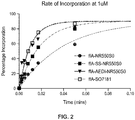
- FIG. 2 shows a plot of the nucleotide incorporation rate using labeled nucleotide 100 of FIG. 1A and modified labeled nucleotides 100 of FIG. 1B .
- the assay was carried out at 55°C, in 40mM ethanolamine (pH 9.8), 9 mM MgCl, 40mM NaCl, 1 mM EDTA, 0.2 % CHAPS with 20nM primer:template DNA and 30ug/ml Polymerase 812 (MiSeq Kit V2), 1 mM nucleotide.
- the enzyme is bound to DNA and then rapidly mixed with nucleotide in a quench flow machine for a short time (up to 10s) before quenching with 500mM EDTA.
- the incorporation rate for a labeled nucleotide comprising an AEDI insert 125 was about 4 times faster compared to the incorporation rate of ffa-NR550S0.
- the data also show that the incorporation rate for a labeled nucleotide comprising standard linker 115 and the fluorescent dye SO7181 (ffA-SO7181) was about 4 times faster compared to the incorporation rate of ffa-NR550S0.
- Table 1 The incorporation rate for a labeled nucleotide comprising an AEDI insert 125
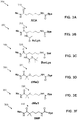
- FIGs. 3A-3F illustrate the structural formulae of additional inserts 310, 315, 320, 325, 330 and 335 for standard linker moiety 115 of FIG. 1A .
- S-S sulfur-sulfur
- the sulfur-sulfur bond is not necessary for SBS (e.g., 2-dye or 4-dye SBS).
- inserts including a dimethyl substitution pattern were found to have an increased rate of nucleotide incorporation during SBS.
- the length of the carbon chains in the inserts may also be varied.
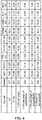
- FIG. 4 shows a data table of a two dye sequencing run used to evaluate the effect of AEDI insert 125 of FIG. 1B and AcLys insert 315 of FIG. 3B on sequencing quality.
- the sequencing was run on a Miseq hybrid platform with Human 550bp template and 2 times 150 cycles.
- the new set of dyes, V10/cyan-peg4 A-AEDI550S0, V10/cyan-peg4 A-AcLys550S0, and VIO/cyan A-AcLys 550S0 were compared to the standard commercial dye set V4 and an improved dye set of Nova platform V5.75.
- the phasing value (Ph R1) was lower than the phasing values of samples without the AEDI or AcLys inserts. Therefore, labeled nucleotides comprising additional inserts 125 and 315 demonstrated improvements in sequencing quality.
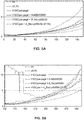
- FIG. 5A and 5B show a plot of error rates for read 1 and a plot of error rates for read 2 of the sequencing run of FIG. 4 respectively.
- the error rates of V10/cyan-peg4 A-AEDI550S0 and V10/cyan-peg4 A-AcLys550S0 were lower than the same set of dye V10/Cyan-peg4 without the insert.
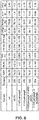
- FIG. 6 shows a data table of a sequencing run used to evaluate the effect of AEDI insert 125 and ACA insert 310 on sequencing quality.
- the sequencing was run on a Miseq hybrid platform with Human 550bp template and 2 times 150 cycles.
- the new set of dyes, V10/cyan-peg4 A-AEDI550S0, V10/cyan-peg4 A-ACALys550S0, were compared to the standard commercial dye set V4 and an improved dye set of Nova platform V5.75.
- each of V10/cyan-peg4 A-AEDI550S0 and V10/cyan-peg4 A-ACA550S0 samples has a lower phasing value (Ph R1) compared to samples without the AEDI or ACA inserts and thus showed improvement in sequencing quality.
- FIG. 7A and 7B show a plot of error rates for read 1 and a plot of error rates for read 2 of the sequencing run of FIG. 6 respectively.
- the error rates for read 1 for the set comprising the new insert AEDI (V10/cyan-peg4 A-AEDI550S0), was lower than the same set of dye without the insert, V10/Cyan-peg4.
- the insert ACA (V10/Cyan-peg4 ACA550S0) gave a similar error rate plot in both read to the standard V10/Cyan-peg4.
- AEDI showed again to improve the quality of sequencing. Those data showed also the structure of insert itself is having an influence on the improvement of the sequencing quality.
- FIG. 8A shows the structural formula of a standard LN 3 linker 800.
- LN 3 linker 800 includes a first substituted amido functional moiety 810, a second azido-substituted PEG functional moiety 815, and a third ester functional moiety 820 that may be desired in a linker structure for linking a dye molecule 825 to a nucleotide 830.
- First functional moiety 810 may, for example, be used to attach dye molecule 825 to LN 3 linker 800.
- Second functional moiety 815 may, for example, be a cleavable functional group that may be used to cleave dye molecule 825 from LN 3 linker 800.
- Third functional moiety 820 may, for example, be used to attach nucleotide 830 to LN 3 linker 800.
- FIG. 8B illustrates some modification to the standard LN 3 linker where the phenoxy moiety 850 is substituted with one to four substituents selected from -NO 2 , -CN, halo or -SO 3 H.
- the ester moiety 820 is replaced with an amido moiety 855.
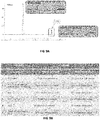
- Figure 9A is a graph showing the appearance of an impurity in an ffA with SS-linker.
- impurity appeared overnight in a slightly basic condition (pH8-9). R.t. overnight in 0.1M TEAB/CH3CN.
- Figure 9B compares the stability of ffAs with SS-linker and AEDI-linker, with the AEDI-linker showing significantly improved stability compared to SS linkers.
- ffA-LN3-NR550S0 was used as internal reference.
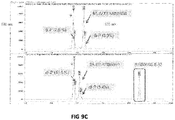
- Figure 9C shows a comparison of SS-linker and AEDI-linker ffAs in IMX 60° for 22 hours, again showing an impurity with the SS linker.
- the internal control is ffA-LN3-NR550S0.
- Di-P diphosphate.
- Figures 10A, 10B and 10C show the unexpected increase of nucleotide incorporation speed in solution with linker changes.
- Fig 10A shows the rate of incorporation at 1uM. The results show that the dye and linker had a significant effect on incorporation kinetics with table 10B clearly showing the benefit of the AEDI linker in incorporation kinetics.
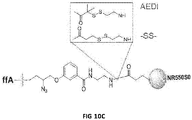
- Figure 10C diagrammatically shows the AEDI and SS linkers with NR550S0.
- Figure 11A shows scatter plots for V10 combinations with different A-550S0 (same concentration). Scatter plots are for tile 1 cycle 2.
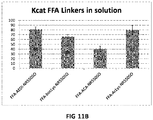
- Figure 11B shows Kcat FFA Linkers in solution. It can be seen that on surface in terms of incorporation rate the AEDI linker is faster than no linker: 'A'-cloud (on the scatter plot) slightly moving towards center. AcLys linker is slower than AEDI and no linker: 'A'-cloud moving towards x axis. BocLys linker looks similar to no linker and not far from the AEDI linker. In solution it can be seen that the ACA-linker was slowest, whilst AEDI and ACLys have similar Kcat, followed by BocLys.
- Figure 12A and 12B show sequencing metrics on Mill, Human550, 2x151 cycles. Use ffNs in combination with different A-550S0 (same concentration). It can be seen that both AEDI and BocLys linker gave similar good sequencing results. Although the solution Kcat of AEDI and AcLys are similar, the sequencing result of AEDI is slightly better.
- LN 3 linker 800 includes an optional phenoxy moiety 835 that may be removed from LN 3 linker 800 as shown in FIG. 8C .
- LN 3 linker 800 also includes an optional amido moiety 840 and an optional ether moiety 845, both of which may be removed from LN 3 linker 800 as shown FIG. 8D .
- the purpose to remove certain functional groups like amido moiety 810, phenoxy moiety 835 is to test if they have negative interactions with the enzyme during the nucleotide incorporation, which might reduce the incorporation efficiency.
- FIG. 8E illustrates the insertion or addition of a protecting moiety 860 into the linker.
- Protecting moiety 860 is inserted between functional moiety 810 (or can be attached to the phenoxy moiety 835 or 850 in FIG. 8A-8C ) and dye molecule 825.
- Protecting moiety 860 may, for example, be a molecule that protects against DNA damage. DNA damage including photo damage or other chemical damages is one of the cumulative effects (i.e., cycle by cycle) of SBS. Substantially reducing or eliminating DNA damage may provide for more efficient SBS and longer sequencing reads.
- protecting moiety 860 can be selected from a triplet state quencher such as Trolox, gallic acid, 2-mercaptoethanol (BME), etc.
- protecting moiety 860 can be selected from quenching or protective reagent such as 4-nitrobenzyl alcohol or a salt of ascorbic acid, such as sodium ascorbate.
- a protecting agent can be physically mixed into the buffer rather than forming covalent bonding with the labeled nucleoside or nucleotide.
- this approach may require higher concentration of the protecting agent and may be less efficient.
- protecting moiety covalently attached to the nucleosides or nucleotides may provide better protection against DNA damage.
- the ester moiety 820 can also be replaced with the amido moiety 855 and the phenoxy moiety 835 be further substituted.
- AEDI insert 125 and SS insert 130 of FIG. 1B and inserts 300 of FIGs. 3A-3F may, for example, be inserted between first functional moiety 810 and dye molecule 825 of linker 800.
- AEDI-OH (68 mg, 352 ⁇ mol, 2 equivalents) in 0.1 M TEAB was added to the reaction mixture and stirred at rt for 3 h.
- the analytic HPLC also indicated complete consumption of the activated ester and formation of the product.
- the reaction was quenched with TEAB buffer (0.1M, 10 ml) and the volatile solvent was removed by by reduced pressure evaporation (HV) and purified on Axia column to obtain NR550S0-AEDI-OH. Yield: 60%.
- the present invention relates to a nucleoside or nucleotide covalently attached to a fluorophore through a linker, wherein said linker comprises a structure of formula (II): wherein
- formula (II) may also be represented by formula (IIa), (IIb), (IIc), (IId), (IIe) or (IIf):
- the present invention may relate to a nucleoside or nucleotide covalently attached to a fluorophore through a linker, wherein said linker comprises a structure of formula (II),: wherein
- formula (I) is also represented by formula (Ia): Further, the structure of formula (II) is also represented by formula (IIb), (IIc), (IId), (IIe) or (IIf):
Landscapes
- Chemical & Material Sciences (AREA)
- Organic Chemistry (AREA)
- Life Sciences & Earth Sciences (AREA)
- Health & Medical Sciences (AREA)
- Engineering & Computer Science (AREA)
- General Health & Medical Sciences (AREA)
- Biochemistry (AREA)
- Proteomics, Peptides & Aminoacids (AREA)
- Molecular Biology (AREA)
- Genetics & Genomics (AREA)
- Biotechnology (AREA)
- Zoology (AREA)
- Wood Science & Technology (AREA)
- Physics & Mathematics (AREA)
- Analytical Chemistry (AREA)
- Immunology (AREA)
- Bioinformatics & Cheminformatics (AREA)
- General Engineering & Computer Science (AREA)
- Microbiology (AREA)
- Biophysics (AREA)
- Nuclear Medicine, Radiotherapy & Molecular Imaging (AREA)
- General Physics & Mathematics (AREA)
- Pathology (AREA)
- Measuring Or Testing Involving Enzymes Or Micro-Organisms (AREA)
- Saccharide Compounds (AREA)
- Preparation Of Compounds By Using Micro-Organisms (AREA)
- Investigating Or Analysing Biological Materials (AREA)
Applications Claiming Priority (3)
| Application Number | Priority Date | Filing Date | Title |
|---|---|---|---|
| GBGB1414098.2A GB201414098D0 (en) | 2014-08-08 | 2014-08-08 | Modified nucleotide linkers |
| EP15750100.8A EP3177634B1 (en) | 2014-08-08 | 2015-08-06 | Modified nucleotide linkers |
| PCT/GB2015/052282 WO2016020691A1 (en) | 2014-08-08 | 2015-08-06 | Modified nucleotide linkers |
Related Parent Applications (2)
| Application Number | Title | Priority Date | Filing Date |
|---|---|---|---|
| EP15750100.8A Division EP3177634B1 (en) | 2014-08-08 | 2015-08-06 | Modified nucleotide linkers |
| EP15750100.8A Division-Into EP3177634B1 (en) | 2014-08-08 | 2015-08-06 | Modified nucleotide linkers |
Publications (2)
| Publication Number | Publication Date |
|---|---|
| EP3564252A1 EP3564252A1 (en) | 2019-11-06 |
| EP3564252B1 true EP3564252B1 (en) | 2021-03-17 |
Family
ID=51629525
Family Applications (2)
| Application Number | Title | Priority Date | Filing Date |
|---|---|---|---|
| EP19178987.4A Active EP3564252B1 (en) | 2014-08-08 | 2015-08-06 | Modified nucleotide linkers |
| EP15750100.8A Active EP3177634B1 (en) | 2014-08-08 | 2015-08-06 | Modified nucleotide linkers |
Family Applications After (1)
| Application Number | Title | Priority Date | Filing Date |
|---|---|---|---|
| EP15750100.8A Active EP3177634B1 (en) | 2014-08-08 | 2015-08-06 | Modified nucleotide linkers |
Country Status (19)
| Country | Link |
|---|---|
| US (3) | US10190157B2 (enExample) |
| EP (2) | EP3564252B1 (enExample) |
| JP (3) | JP6563482B2 (enExample) |
| KR (2) | KR102491869B1 (enExample) |
| CN (2) | CN106604926B (enExample) |
| AU (2) | AU2015298469B2 (enExample) |
| BR (2) | BR122020018717B1 (enExample) |
| CA (1) | CA2957382C (enExample) |
| DK (2) | DK3177634T3 (enExample) |
| ES (2) | ES2875557T3 (enExample) |
| GB (1) | GB201414098D0 (enExample) |
| IL (1) | IL250498B (enExample) |
| MX (2) | MX377448B (enExample) |
| MY (1) | MY195167A (enExample) |
| NZ (1) | NZ728810A (enExample) |
| RU (1) | RU2699993C2 (enExample) |
| SG (3) | SG11201700880RA (enExample) |
| WO (1) | WO2016020691A1 (enExample) |
| ZA (1) | ZA201700838B (enExample) |
Families Citing this family (52)
| Publication number | Priority date | Publication date | Assignee | Title |
|---|---|---|---|---|
| GB201414098D0 (en) * | 2014-08-08 | 2014-09-24 | Illumina Cambridge Ltd | Modified nucleotide linkers |
| CN106117288B (zh) * | 2015-05-08 | 2019-10-15 | 生捷科技控股公司 | 二硫键连接的可逆终止子 |
| US11085076B2 (en) | 2015-09-28 | 2021-08-10 | The Trustees Of Columbia University In The City Of New York | Synthesis of novel disulfide linker based nucleotides as reversible terminators for DNA sequencing by synthesis |
| EP3463381A4 (en) | 2016-05-23 | 2020-01-01 | The Trustees of Columbia University in the City of New York | NUCLEOTIDE DERIVATIVES AND METHOD FOR USE THEREOF |
| RU2765075C2 (ru) | 2016-12-22 | 2022-01-25 | Иллюмина, Инк. | Биочип, включающий праймер секвенирования и несеквенирующую единицу |
| US11591647B2 (en) | 2017-03-06 | 2023-02-28 | Singular Genomics Systems, Inc. | Nucleic acid sequencing-by-synthesis (SBS) methods that combine SBS cycle steps |
| CN110709089B (zh) | 2017-03-28 | 2024-12-06 | 哥伦比亚大学董事会 | 用于连接荧光标记与用于dna合成测序的碱基的具有不同可裂解连接子的3’-o-改性的核苷酸类似物 |
| WO2019071474A1 (zh) * | 2017-10-11 | 2019-04-18 | 深圳华大智造科技有限公司 | 修饰的核苷或核苷酸 |
| US12215124B2 (en) | 2018-02-21 | 2025-02-04 | Singular Genomics Systems, Inc. | Fluorinated nucleotides and uses thereof |
| WO2019178393A1 (en) | 2018-03-15 | 2019-09-19 | The Trustees Of Columbia University In The City Of New York | Nucleotide analogues and use thereof for nucleic acid sequencing and analysis |
| WO2020086834A1 (en) | 2018-10-25 | 2020-04-30 | Singular Genomics Systems, Inc. | Nucleotide analogues |
| WO2020120179A1 (en) | 2018-12-14 | 2020-06-18 | Illumina Cambridge Limited | Decreasing phasing with unlabeled nucleotides during sequencing |
| US11293061B2 (en) | 2018-12-26 | 2022-04-05 | Illumina Cambridge Limited | Sequencing methods using nucleotides with 3′ AOM blocking group |
| CN113453692A (zh) | 2019-01-08 | 2021-09-28 | 奇异基因组学系统公司 | 核苷酸可裂解接头和其用途 |
| KR102865446B1 (ko) | 2019-03-01 | 2025-09-29 | 일루미나 케임브리지 리미티드 | 삼차 아민 치환된 쿠마린 화합물 및 형광 표지로서의 이의 용도 |
| MY209343A (en) | 2019-03-01 | 2025-07-03 | Illumina Cambridge Ltd | Exocyclic amine substituted coumarin compounds and uses as fluorescent labels |
| NL2023327B1 (en) | 2019-03-01 | 2020-09-17 | Illumina Inc | Multiplexed fluorescent detection of analytes |
| WO2020178231A1 (en) | 2019-03-01 | 2020-09-10 | Illumina, Inc. | Multiplexed fluorescent detection of analytes |
| US11421271B2 (en) | 2019-03-28 | 2022-08-23 | Illumina Cambridge Limited | Methods and compositions for nucleic acid sequencing using photoswitchable labels |
| JP2023510454A (ja) | 2019-11-27 | 2023-03-14 | イルミナ ケンブリッジ リミテッド | シクロオクタテトラエンを含有する色素及び組成物 |
| JP7287299B2 (ja) | 2020-01-31 | 2023-06-06 | トヨタ自動車株式会社 | 車両および車両制御インターフェース |
| WO2021259881A1 (en) | 2020-06-22 | 2021-12-30 | Illumina Cambridge Limited | Nucleosides and nucleotides with 3' acetal blocking group |
| US11981964B2 (en) | 2020-07-28 | 2024-05-14 | Illumina Cambridge Limited | Substituted coumarin dyes and uses as fluorescent labels |
| US20220195516A1 (en) | 2020-12-17 | 2022-06-23 | Illumina Cambridge Limited | Methods, systems and compositions for nucleic acid sequencing |
| US20220195517A1 (en) | 2020-12-17 | 2022-06-23 | Illumina Cambridge Limited | Long stokes shift chromenoquinoline dyes and uses in sequencing applications |
| US20220195196A1 (en) | 2020-12-17 | 2022-06-23 | Illumina Cambridge Limited | Alkylpyridinium coumarin dyes and uses in sequencing applications |
| US20220195518A1 (en) | 2020-12-22 | 2022-06-23 | Illumina Cambridge Limited | Methods and compositions for nucleic acid sequencing |
| JP2024516191A (ja) | 2021-05-05 | 2024-04-12 | イルミナ ケンブリッジ リミテッド | ビス-ホウ素縮合複素環を含有する蛍光色素及び配列決定における使用 |
| CN117916390A (zh) | 2021-05-20 | 2024-04-19 | 伊鲁米纳公司 | 用于边合成边测序的组合物和方法 |
| JP2024520279A (ja) * | 2021-05-26 | 2024-05-24 | イルミナ インコーポレイテッド | 3’-ブロック化ヌクレオチドの精製及び重合 |
| EP4499862A1 (en) | 2022-03-28 | 2025-02-05 | Illumina, Inc. | Labeled avidin and methods for sequencing |
| AU2023246772A1 (en) | 2022-03-29 | 2024-01-18 | Illumina Inc. | Chromenoquinoline dyes and uses in sequencing |
| AU2023244351A1 (en) | 2022-03-31 | 2024-01-18 | Illumina, Inc. | Nucleosides and nucleotides with 3' vinyl blocking group useful in sequencing by synthesis |
| EP4499870A1 (en) | 2022-03-31 | 2025-02-05 | Illumina, Inc. | Compositions and methods for improving sequencing signals |
| AU2023281871A1 (en) | 2022-05-31 | 2024-11-14 | Illumina, Inc | Compositions and methods for nucleic acid sequencing |
| CA3259955A1 (en) | 2022-06-28 | 2024-01-04 | Illumina, Inc. | FLUORESCENT DYES CONTAINING A FUSIONED BIS-TETRACYCLIC BORON HETEROCYCLE AND THEIR USES IN SEQUENCED |
| CN119213083A (zh) | 2022-09-30 | 2024-12-27 | 伊路米纳有限公司 | 用于减少测序期间的光损伤的组合物和方法 |
| AU2023409219A1 (en) | 2022-12-22 | 2024-10-03 | Illumina, Inc. | Palladium catalyst compositions and methods for sequencing by synthesis |
| CA3246536A1 (en) | 2022-12-22 | 2024-06-27 | Illumina, Inc. | TRANSITION METAL CATALYST COMPOSITIONS AND SYNTHETIC SEQUENCE PROCESSES |
| CN119095984A (zh) | 2022-12-27 | 2024-12-06 | 伊路米纳有限公司 | 使用3'烯丙基封端的核苷酸的测序方法 |
| AU2024247164A1 (en) | 2023-03-29 | 2024-12-12 | Illumina, Inc. | Naphthalimide dyes and uses in nucleic acid sequencing |
| EP4689181A1 (en) | 2023-03-30 | 2026-02-11 | Illumina, Inc. | Compositions and methods for nucleic acid sequencing |
| US20250075269A1 (en) | 2023-08-31 | 2025-03-06 | Illumina, Inc. | Compositions and methods for nucleic acid sequencing |
| WO2025090596A1 (en) | 2023-10-26 | 2025-05-01 | Illumina, Inc. | 4,5-substituted naphthalimide dyes and uses in nucleic acid sequencing |
| US20250163505A1 (en) | 2023-11-17 | 2025-05-22 | Illumina, Inc. | Conjugated polymers or polymer dots as fluorescent labels |
| WO2025136890A1 (en) | 2023-12-18 | 2025-06-26 | Illumina, Inc. | Hydrogel nanoparticles as labeling scaffold in sequencing |
| US20250215493A1 (en) | 2023-12-28 | 2025-07-03 | Illumina, Inc. | Nucleotides with enzymatically cleavable 3'-o-glycoside blocking groups for sequencing |
| WO2025144711A1 (en) | 2023-12-29 | 2025-07-03 | Illumina, Inc. | Tricyclic polymethine dyes for nucleic acid sequencing |
| WO2025184226A1 (en) | 2024-02-28 | 2025-09-04 | Illumina, Inc. | Nucleotides with terminal phosphate capping |
| WO2025188906A1 (en) | 2024-03-08 | 2025-09-12 | Illumina, Inc. | Modified adenosine nucleotides |
| WO2025221895A1 (en) | 2024-04-19 | 2025-10-23 | Illumina, Inc. | Water soluble polymer scaffolds for dye labeling |
| WO2026035914A1 (en) | 2024-08-09 | 2026-02-12 | Illumina, Inc. | Nucleotides having 3'-hydroxy blocking groups |
Family Cites Families (89)
| Publication number | Priority date | Publication date | Assignee | Title |
|---|---|---|---|---|
| GB8810400D0 (en) | 1988-05-03 | 1988-06-08 | Southern E | Analysing polynucleotide sequences |
| GB8822228D0 (en) | 1988-09-21 | 1988-10-26 | Southern E M | Support-bound oligonucleotides |
| US5800992A (en) | 1989-06-07 | 1998-09-01 | Fodor; Stephen P.A. | Method of detecting nucleic acids |
| US6346413B1 (en) | 1989-06-07 | 2002-02-12 | Affymetrix, Inc. | Polymer arrays |
| DE3924454A1 (de) | 1989-07-24 | 1991-02-07 | Cornelis P Prof Dr Hollenberg | Die anwendung von dna und dna-technologie fuer die konstruktion von netzwerken zur verwendung in der chip-konstruktion und chip-produktion (dna chips) |
| EP0450060A1 (en) | 1989-10-26 | 1991-10-09 | Sri International | Dna sequencing |
| DK0604552T3 (da) | 1991-09-18 | 1997-08-04 | Affymax Tech Nv | Fremgangsmåde til syntese af forskellige samlinger af oligomerer |
| US5677195A (en) | 1991-11-22 | 1997-10-14 | Affymax Technologies N.V. | Combinatorial strategies for polymer synthesis |
| AU3728093A (en) | 1992-02-19 | 1993-09-13 | Public Health Research Institute Of The City Of New York, Inc., The | Novel oligonucleotide arrays and their use for sorting, isolating, sequencing, and manipulating nucleic acids |
| US5583211A (en) | 1992-10-29 | 1996-12-10 | Beckman Instruments, Inc. | Surface activated organic polymers useful for location - specific attachment of nucleic acids, peptides, proteins and oligosaccharides |
| US5472672A (en) | 1993-10-22 | 1995-12-05 | The Board Of Trustees Of The Leland Stanford Junior University | Apparatus and method for polymer synthesis using arrays |
| DE69433180T2 (de) | 1993-10-26 | 2004-06-24 | Affymetrix, Inc., Santa Clara | Felder von nukleinsaeuresonden auf biologischen chips |
| US6156501A (en) | 1993-10-26 | 2000-12-05 | Affymetrix, Inc. | Arrays of modified nucleic acid probes and methods of use |
| US5429807A (en) | 1993-10-28 | 1995-07-04 | Beckman Instruments, Inc. | Method and apparatus for creating biopolymer arrays on a solid support surface |
| US5552278A (en) | 1994-04-04 | 1996-09-03 | Spectragen, Inc. | DNA sequencing by stepwise ligation and cleavage |
| US5807522A (en) | 1994-06-17 | 1998-09-15 | The Board Of Trustees Of The Leland Stanford Junior University | Methods for fabricating microarrays of biological samples |
| US5556752A (en) | 1994-10-24 | 1996-09-17 | Affymetrix, Inc. | Surface-bound, unimolecular, double-stranded DNA |
| US5750341A (en) | 1995-04-17 | 1998-05-12 | Lynx Therapeutics, Inc. | DNA sequencing by parallel oligonucleotide extensions |
| US5624711A (en) | 1995-04-27 | 1997-04-29 | Affymax Technologies, N.V. | Derivatization of solid supports and methods for oligomer synthesis |
| US5545531A (en) | 1995-06-07 | 1996-08-13 | Affymax Technologies N.V. | Methods for making a device for concurrently processing multiple biological chip assays |
| WO1997014028A2 (en) | 1995-10-11 | 1997-04-17 | Luminex Corporation | Multiplexed analysis of clinical specimens apparatus and method |
| US5658734A (en) | 1995-10-17 | 1997-08-19 | International Business Machines Corporation | Process for synthesizing chemical compounds |
| US6458530B1 (en) | 1996-04-04 | 2002-10-01 | Affymetrix Inc. | Selecting tag nucleic acids |
| GB9620209D0 (en) | 1996-09-27 | 1996-11-13 | Cemu Bioteknik Ab | Method of sequencing DNA |
| GB9626815D0 (en) | 1996-12-23 | 1997-02-12 | Cemu Bioteknik Ab | Method of sequencing DNA |
| US6297006B1 (en) | 1997-01-16 | 2001-10-02 | Hyseq, Inc. | Methods for sequencing repetitive sequences and for determining the order of sequence subfragments |
| US6087102A (en) | 1998-01-07 | 2000-07-11 | Clontech Laboratories, Inc. | Polymeric arrays and methods for their use in binding assays |
| US6287776B1 (en) | 1998-02-02 | 2001-09-11 | Signature Bioscience, Inc. | Method for detecting and classifying nucleic acid hybridization |
| JP3944996B2 (ja) | 1998-03-05 | 2007-07-18 | 株式会社日立製作所 | Dnaプローブアレー |
| US6031078A (en) | 1998-06-16 | 2000-02-29 | Millennium Pharmaceuticals, Inc. | MTbx protein and nucleic acid molecules and uses therefor |
| US6277628B1 (en) | 1998-10-02 | 2001-08-21 | Incyte Genomics, Inc. | Linear microarrays |
| JP4638043B2 (ja) * | 1998-12-14 | 2011-02-23 | パシフィック バイオサイエンシーズ オブ カリフォルニア, インコーポレイテッド | ポリメラーゼ合成による、単一分子の核酸の配列決定のためのシステムおよび方法 |
| US6379698B1 (en) * | 1999-04-06 | 2002-04-30 | Isis Pharmaceuticals, Inc. | Fusogenic lipids and vesicles |
| CA2370976C (en) | 1999-04-20 | 2009-10-20 | Illumina, Inc. | Detection of nucleic acid reactions on bead arrays |
| US20050191698A1 (en) | 1999-04-20 | 2005-09-01 | Illumina, Inc. | Nucleic acid sequencing using microsphere arrays |
| US6355431B1 (en) | 1999-04-20 | 2002-03-12 | Illumina, Inc. | Detection of nucleic acid amplification reactions using bead arrays |
| US7244559B2 (en) | 1999-09-16 | 2007-07-17 | 454 Life Sciences Corporation | Method of sequencing a nucleic acid |
| US6274320B1 (en) | 1999-09-16 | 2001-08-14 | Curagen Corporation | Method of sequencing a nucleic acid |
| US6770441B2 (en) | 2000-02-10 | 2004-08-03 | Illumina, Inc. | Array compositions and methods of making same |
| US6936702B2 (en) | 2000-06-07 | 2005-08-30 | Li-Cor, Inc. | Charge-switch nucleotides |
| AU2001268291A1 (en) | 2000-06-07 | 2001-12-17 | Li-Cor, Inc. | Charge-switch nucleotides |
| ATE377093T1 (de) | 2000-07-07 | 2007-11-15 | Visigen Biotechnologies Inc | Sequenzbestimmung in echtzeit |
| US7211414B2 (en) | 2000-12-01 | 2007-05-01 | Visigen Biotechnologies, Inc. | Enzymatic nucleic acid synthesis: compositions and methods for altering monomer incorporation fidelity |
| AU2002258997A1 (en) * | 2001-04-24 | 2002-11-05 | Li-Cor, Inc. | Polymerases with charge-switch activity and methods of generating such polymerases |
| DE10120797B4 (de) | 2001-04-27 | 2005-12-22 | Genovoxx Gmbh | Verfahren zur Analyse von Nukleinsäureketten |
| DE10120798B4 (de) * | 2001-04-27 | 2005-12-29 | Genovoxx Gmbh | Verfahren zur Bestimmung der Genexpression |
| US7057026B2 (en) | 2001-12-04 | 2006-06-06 | Solexa Limited | Labelled nucleotides |
| US7414116B2 (en) * | 2002-08-23 | 2008-08-19 | Illumina Cambridge Limited | Labelled nucleotides |
| AU2003259352A1 (en) | 2002-08-23 | 2004-03-11 | Solexa Limited | Labelled nucleotides |
| EP2607369B1 (en) | 2002-08-23 | 2015-09-23 | Illumina Cambridge Limited | Modified nucleotides for polynucleotide sequencing |
| US7595883B1 (en) | 2002-09-16 | 2009-09-29 | The Board Of Trustees Of The Leland Stanford Junior University | Biological analysis arrangement and approach therefor |
| US7365178B2 (en) * | 2003-04-01 | 2008-04-29 | Activx Biosciences, Inc. | Acyl-nucleotide probes and methods of their synthesis and use in proteomic analysis |
| WO2005044836A2 (de) * | 2003-11-05 | 2005-05-19 | Genovoxx Gmbh | Makromolekulare nukleotidverbindungen und methoden zu deren anwendung |
| US20070117104A1 (en) * | 2005-11-22 | 2007-05-24 | Buzby Philip R | Nucleotide analogs |
| US20060062531A1 (en) | 2004-09-17 | 2006-03-23 | Stephen Turner | Fabrication of optical confinements |
| WO2006097320A2 (de) * | 2005-03-17 | 2006-09-21 | Genovoxx Gmbh | Makromolekulare nukleotidverbindungen und methoden zu deren anwendung |
| US8212020B2 (en) | 2005-03-11 | 2012-07-03 | Steven Albert Benner | Reagents for reversibly terminating primer extension |
| GB0517097D0 (en) | 2005-08-19 | 2005-09-28 | Solexa Ltd | Modified nucleosides and nucleotides and uses thereof |
| US7405281B2 (en) | 2005-09-29 | 2008-07-29 | Pacific Biosciences Of California, Inc. | Fluorescent nucleotide analogs and uses therefor |
| WO2007123744A2 (en) | 2006-03-31 | 2007-11-01 | Solexa, Inc. | Systems and devices for sequence by synthesis analysis |
| WO2007135368A2 (en) | 2006-05-18 | 2007-11-29 | Solexa Limited | Dye compounds and the use of their labelled conjugates |
| US8110559B2 (en) | 2006-09-15 | 2012-02-07 | Enzon Pharmaceuticals, Inc. | Hindered ester-based biodegradable linkers for oligonucleotide delivery |
| MX2009002859A (es) * | 2006-09-15 | 2009-03-30 | Enzon Pharmaceuticals Inc | Enlazadores biodegradables a base de ester impedido para suministro de oligonucleotidos. |
| KR20090057235A (ko) * | 2006-09-15 | 2009-06-04 | 엔존 파마슈티컬즈, 인코포레이티드 | 리신계 폴리머 링커 |
| EP2073820A4 (en) | 2006-09-15 | 2014-07-16 | Belrose Pharma Inc | TARGETED POLYMER PRODRUGS WITH MULTIFUNCTIONAL CONNECTORS |
| JP2010503705A (ja) * | 2006-09-15 | 2010-02-04 | エンゾン ファーマスーティカルズ インコーポレイテッド | ヒンダードエステル系の生分解性リンカーを有するポリアルキレンオキサイド |
| US8399188B2 (en) * | 2006-09-28 | 2013-03-19 | Illumina, Inc. | Compositions and methods for nucleotide sequencing |
| US8343746B2 (en) | 2006-10-23 | 2013-01-01 | Pacific Biosciences Of California, Inc. | Polymerase enzymes and reagents for enhanced nucleic acid sequencing |
| CN102443030B (zh) | 2006-12-05 | 2015-12-16 | 激光基因公司 | 光可断裂的标记核苷酸和核苷与标记的核苷酸和核苷以及其在dna测序中的使用方法 |
| US8262900B2 (en) | 2006-12-14 | 2012-09-11 | Life Technologies Corporation | Methods and apparatus for measuring analytes using large scale FET arrays |
| US8349167B2 (en) | 2006-12-14 | 2013-01-08 | Life Technologies Corporation | Methods and apparatus for detecting molecular interactions using FET arrays |
| EP2639578B1 (en) | 2006-12-14 | 2016-09-14 | Life Technologies Corporation | Apparatus for measuring analytes using large scale fet arrays |
| US7678894B2 (en) * | 2007-05-18 | 2010-03-16 | Helicos Biosciences Corporation | Nucleotide analogs |
| US9163053B2 (en) * | 2007-05-18 | 2015-10-20 | Fluidigm Corporation | Nucleotide analogs |
| EP4310194A3 (en) * | 2007-10-19 | 2024-10-16 | The Trustees of Columbia University in the City of New York | Design and synthesis of cleavable fluorescent nucleotides as reversible terminators for dna sequencing by synthesis |
| US9115163B2 (en) * | 2007-10-19 | 2015-08-25 | The Trustees Of Columbia University In The City Of New York | DNA sequence with non-fluorescent nucleotide reversible terminators and cleavable label modified nucleotide terminators |
| US20100137143A1 (en) | 2008-10-22 | 2010-06-03 | Ion Torrent Systems Incorporated | Methods and apparatus for measuring analytes |
| US9206216B2 (en) * | 2010-04-21 | 2015-12-08 | Pierce Biotechnology, Inc. | Modified nucleotides methods and kits |
| WO2012159072A2 (en) * | 2011-05-18 | 2012-11-22 | Cayman Chemical Company, Incorporated | Fluorescent molecular probes for use in assays that measure test compound competitive binding with sam-utilizing proteins |
| EP3623481B1 (en) | 2011-09-23 | 2021-08-25 | Illumina, Inc. | Compositions for nucleic acid sequencing |
| HK1198810A1 (en) * | 2011-11-17 | 2015-06-12 | Indiana University Research And Technology Corporation | Glucagon superfamily peptides exhibiting glucocorticoid receptor activity |
| WO2013101690A1 (en) * | 2011-12-29 | 2013-07-04 | modeRNA Therapeutics | Modified mrnas encoding cell-penetrating polypeptides |
| CN103087131B (zh) * | 2013-01-15 | 2015-07-08 | 上海交通大学 | 可逆终端及其合成和在dna合成测序中的用途 |
| WO2014135223A1 (en) | 2013-03-08 | 2014-09-12 | Illumina Cambridge Ltd | Rhodamine compounds and their use as fluorescent labels |
| EP2964612B1 (en) | 2013-03-08 | 2017-02-01 | Illumina Cambridge Limited | Polymethine compounds and their use as fluorescent labels |
| CN103484106B (zh) | 2013-09-05 | 2015-08-19 | 上海交通大学 | 四色荧光标记可逆终端及其在dna测序中的用途 |
| CN103866010B (zh) | 2014-02-28 | 2016-04-20 | 郭诚 | 一种基因测序的方法 |
| GB201408077D0 (en) | 2014-05-07 | 2014-06-18 | Illumina Cambridge Ltd | Polymethine compounds and their use as fluorescent labels |
| GB201414098D0 (en) * | 2014-08-08 | 2014-09-24 | Illumina Cambridge Ltd | Modified nucleotide linkers |
-
2014
- 2014-08-08 GB GBGB1414098.2A patent/GB201414098D0/en not_active Ceased
-
2015
- 2015-08-06 CA CA2957382A patent/CA2957382C/en active Active
- 2015-08-06 SG SG11201700880RA patent/SG11201700880RA/en unknown
- 2015-08-06 RU RU2017103539A patent/RU2699993C2/ru active
- 2015-08-06 KR KR1020217024527A patent/KR102491869B1/ko active Active
- 2015-08-06 MX MX2017001694A patent/MX377448B/es active IP Right Grant
- 2015-08-06 BR BR122020018717-4A patent/BR122020018717B1/pt active IP Right Grant
- 2015-08-06 WO PCT/GB2015/052282 patent/WO2016020691A1/en not_active Ceased
- 2015-08-06 EP EP19178987.4A patent/EP3564252B1/en active Active
- 2015-08-06 AU AU2015298469A patent/AU2015298469B2/en active Active
- 2015-08-06 CN CN201580048113.1A patent/CN106604926B/zh active Active
- 2015-08-06 CN CN202010305079.4A patent/CN111704643A/zh active Pending
- 2015-08-06 DK DK15750100.8T patent/DK3177634T3/da active
- 2015-08-06 NZ NZ728810A patent/NZ728810A/en unknown
- 2015-08-06 BR BR112017002251-6A patent/BR112017002251B1/pt active IP Right Grant
- 2015-08-06 SG SG10202000850XA patent/SG10202000850XA/en unknown
- 2015-08-06 MX MX2020009401A patent/MX385213B/es unknown
- 2015-08-06 JP JP2017506886A patent/JP6563482B2/ja active Active
- 2015-08-06 SG SG10201900948PA patent/SG10201900948PA/en unknown
- 2015-08-06 MY MYPI2020004681A patent/MY195167A/en unknown
- 2015-08-06 ES ES19178987T patent/ES2875557T3/es active Active
- 2015-08-06 DK DK19178987.4T patent/DK3564252T3/da active
- 2015-08-06 KR KR1020177006407A patent/KR102287718B1/ko active Active
- 2015-08-06 ES ES15750100T patent/ES2773438T3/es active Active
- 2015-08-06 EP EP15750100.8A patent/EP3177634B1/en active Active
- 2015-08-07 US US14/821,251 patent/US10190157B2/en active Active
-
2017
- 2017-02-02 ZA ZA2017/00838A patent/ZA201700838B/en unknown
- 2017-02-07 IL IL250498A patent/IL250498B/en active IP Right Grant
-
2018
- 2018-12-11 AU AU2018278843A patent/AU2018278843B2/en active Active
-
2019
- 2019-01-25 US US16/258,401 patent/US11230734B2/en active Active
- 2019-07-24 JP JP2019136261A patent/JP2020015722A/ja active Pending
-
2021
- 2021-09-13 JP JP2021148730A patent/JP7726707B2/ja active Active
- 2021-12-27 US US17/562,510 patent/US11773438B2/en active Active
Non-Patent Citations (1)
| Title |
|---|
| None * |
Also Published As
Similar Documents
| Publication | Publication Date | Title |
|---|---|---|
| US11773438B2 (en) | Modified nucleotide linkers | |
| EP1926829B2 (en) | Labelled modified guanine-containing nucleosides and nucleotides comprising a fluorophore attached to the base through a linking group comprising a polyethylene glycol spacing group and methods for their use | |
| US20160002721A1 (en) | Modified nucleosides or nucleotides | |
| HK40009716A (en) | Modified nucleotide linkers | |
| HK40009716B (en) | Modified nucleotide linkers | |
| HK1233269B (en) | Modified nucleotide linkers | |
| HK1233269A1 (en) | Modified nucleotide linkers | |
| US20230304086A1 (en) | Labeled avidin and methods for sequencing | |
| WO2026035914A1 (en) | Nucleotides having 3'-hydroxy blocking groups |
Legal Events
| Date | Code | Title | Description |
|---|---|---|---|
| PUAI | Public reference made under article 153(3) epc to a published international application that has entered the european phase |
Free format text: ORIGINAL CODE: 0009012 |
|
| STAA | Information on the status of an ep patent application or granted ep patent |
Free format text: STATUS: THE APPLICATION HAS BEEN PUBLISHED |
|
| AC | Divisional application: reference to earlier application |
Ref document number: 3177634 Country of ref document: EP Kind code of ref document: P |
|
| AK | Designated contracting states |
Kind code of ref document: A1 Designated state(s): AL AT BE BG CH CY CZ DE DK EE ES FI FR GB GR HR HU IE IS IT LI LT LU LV MC MK MT NL NO PL PT RO RS SE SI SK SM TR |
|
| STAA | Information on the status of an ep patent application or granted ep patent |
Free format text: STATUS: REQUEST FOR EXAMINATION WAS MADE |
|
| 17P | Request for examination filed |
Effective date: 20200504 |
|
| RBV | Designated contracting states (corrected) |
Designated state(s): AL AT BE BG CH CY CZ DE DK EE ES FI FR GB GR HR HU IE IS IT LI LT LU LV MC MK MT NL NO PL PT RO RS SE SI SK SM TR |
|
| REG | Reference to a national code |
Ref country code: HK Ref legal event code: DE Ref document number: 40009716 Country of ref document: HK |
|
| STAA | Information on the status of an ep patent application or granted ep patent |
Free format text: STATUS: EXAMINATION IS IN PROGRESS |
|
| 17Q | First examination report despatched |
Effective date: 20200724 |
|
| GRAP | Despatch of communication of intention to grant a patent |
Free format text: ORIGINAL CODE: EPIDOSNIGR1 |
|
| STAA | Information on the status of an ep patent application or granted ep patent |
Free format text: STATUS: GRANT OF PATENT IS INTENDED |
|
| INTG | Intention to grant announced |
Effective date: 20201020 |
|
| GRAS | Grant fee paid |
Free format text: ORIGINAL CODE: EPIDOSNIGR3 |
|
| GRAA | (expected) grant |
Free format text: ORIGINAL CODE: 0009210 |
|
| STAA | Information on the status of an ep patent application or granted ep patent |
Free format text: STATUS: THE PATENT HAS BEEN GRANTED |
|
| AC | Divisional application: reference to earlier application |
Ref document number: 3177634 Country of ref document: EP Kind code of ref document: P |
|
| AK | Designated contracting states |
Kind code of ref document: B1 Designated state(s): AL AT BE BG CH CY CZ DE DK EE ES FI FR GB GR HR HU IE IS IT LI LT LU LV MC MK MT NL NO PL PT RO RS SE SI SK SM TR |
|
| REG | Reference to a national code |
Ref country code: GB Ref legal event code: FG4D |
|
| REG | Reference to a national code |
Ref country code: CH Ref legal event code: EP |
|
| REG | Reference to a national code |
Ref country code: DE Ref legal event code: R096 Ref document number: 602015067134 Country of ref document: DE |
|
| REG | Reference to a national code |
Ref country code: IE Ref legal event code: FG4D |
|
| REG | Reference to a national code |
Ref country code: AT Ref legal event code: REF Ref document number: 1372162 Country of ref document: AT Kind code of ref document: T Effective date: 20210415 |
|
| REG | Reference to a national code |
Ref country code: FI Ref legal event code: FGE |
|
| REG | Reference to a national code |
Ref country code: DK Ref legal event code: T3 Effective date: 20210521 |
|
| REG | Reference to a national code |
Ref country code: NL Ref legal event code: FP |
|
| REG | Reference to a national code |
Ref country code: SE Ref legal event code: TRGR |
|
| REG | Reference to a national code |
Ref country code: NO Ref legal event code: T2 Effective date: 20210317 Ref country code: LT Ref legal event code: MG9D |
|
| PG25 | Lapsed in a contracting state [announced via postgrant information from national office to epo] |
Ref country code: GR Free format text: LAPSE BECAUSE OF FAILURE TO SUBMIT A TRANSLATION OF THE DESCRIPTION OR TO PAY THE FEE WITHIN THE PRESCRIBED TIME-LIMIT Effective date: 20210618 Ref country code: HR Free format text: LAPSE BECAUSE OF FAILURE TO SUBMIT A TRANSLATION OF THE DESCRIPTION OR TO PAY THE FEE WITHIN THE PRESCRIBED TIME-LIMIT Effective date: 20210317 Ref country code: BG Free format text: LAPSE BECAUSE OF FAILURE TO SUBMIT A TRANSLATION OF THE DESCRIPTION OR TO PAY THE FEE WITHIN THE PRESCRIBED TIME-LIMIT Effective date: 20210617 |
|
| PG25 | Lapsed in a contracting state [announced via postgrant information from national office to epo] |
Ref country code: RS Free format text: LAPSE BECAUSE OF FAILURE TO SUBMIT A TRANSLATION OF THE DESCRIPTION OR TO PAY THE FEE WITHIN THE PRESCRIBED TIME-LIMIT Effective date: 20210317 |
|
| PG25 | Lapsed in a contracting state [announced via postgrant information from national office to epo] |
Ref country code: SM Free format text: LAPSE BECAUSE OF FAILURE TO SUBMIT A TRANSLATION OF THE DESCRIPTION OR TO PAY THE FEE WITHIN THE PRESCRIBED TIME-LIMIT Effective date: 20210317 Ref country code: EE Free format text: LAPSE BECAUSE OF FAILURE TO SUBMIT A TRANSLATION OF THE DESCRIPTION OR TO PAY THE FEE WITHIN THE PRESCRIBED TIME-LIMIT Effective date: 20210317 Ref country code: CZ Free format text: LAPSE BECAUSE OF FAILURE TO SUBMIT A TRANSLATION OF THE DESCRIPTION OR TO PAY THE FEE WITHIN THE PRESCRIBED TIME-LIMIT Effective date: 20210317 Ref country code: LT Free format text: LAPSE BECAUSE OF FAILURE TO SUBMIT A TRANSLATION OF THE DESCRIPTION OR TO PAY THE FEE WITHIN THE PRESCRIBED TIME-LIMIT Effective date: 20210317 |
|
| REG | Reference to a national code |
Ref country code: ES Ref legal event code: FG2A Ref document number: 2875557 Country of ref document: ES Kind code of ref document: T3 Effective date: 20211110 |
|
| PG25 | Lapsed in a contracting state [announced via postgrant information from national office to epo] |
Ref country code: SK Free format text: LAPSE BECAUSE OF FAILURE TO SUBMIT A TRANSLATION OF THE DESCRIPTION OR TO PAY THE FEE WITHIN THE PRESCRIBED TIME-LIMIT Effective date: 20210317 Ref country code: PL Free format text: LAPSE BECAUSE OF FAILURE TO SUBMIT A TRANSLATION OF THE DESCRIPTION OR TO PAY THE FEE WITHIN THE PRESCRIBED TIME-LIMIT Effective date: 20210317 Ref country code: PT Free format text: LAPSE BECAUSE OF FAILURE TO SUBMIT A TRANSLATION OF THE DESCRIPTION OR TO PAY THE FEE WITHIN THE PRESCRIBED TIME-LIMIT Effective date: 20210719 Ref country code: RO Free format text: LAPSE BECAUSE OF FAILURE TO SUBMIT A TRANSLATION OF THE DESCRIPTION OR TO PAY THE FEE WITHIN THE PRESCRIBED TIME-LIMIT Effective date: 20210317 |
|
| REG | Reference to a national code |
Ref country code: DE Ref legal event code: R097 Ref document number: 602015067134 Country of ref document: DE |
|
| PLBE | No opposition filed within time limit |
Free format text: ORIGINAL CODE: 0009261 |
|
| STAA | Information on the status of an ep patent application or granted ep patent |
Free format text: STATUS: NO OPPOSITION FILED WITHIN TIME LIMIT |
|
| PG25 | Lapsed in a contracting state [announced via postgrant information from national office to epo] |
Ref country code: AL Free format text: LAPSE BECAUSE OF FAILURE TO SUBMIT A TRANSLATION OF THE DESCRIPTION OR TO PAY THE FEE WITHIN THE PRESCRIBED TIME-LIMIT Effective date: 20210317 |
|
| 26N | No opposition filed |
Effective date: 20211220 |
|
| PG25 | Lapsed in a contracting state [announced via postgrant information from national office to epo] |
Ref country code: SI Free format text: LAPSE BECAUSE OF FAILURE TO SUBMIT A TRANSLATION OF THE DESCRIPTION OR TO PAY THE FEE WITHIN THE PRESCRIBED TIME-LIMIT Effective date: 20210317 |
|
| PG25 | Lapsed in a contracting state [announced via postgrant information from national office to epo] |
Ref country code: MC Free format text: LAPSE BECAUSE OF FAILURE TO SUBMIT A TRANSLATION OF THE DESCRIPTION OR TO PAY THE FEE WITHIN THE PRESCRIBED TIME-LIMIT Effective date: 20210317 |
|
| REG | Reference to a national code |
Ref country code: AT Ref legal event code: UEP Ref document number: 1372162 Country of ref document: AT Kind code of ref document: T Effective date: 20210317 |
|
| P01 | Opt-out of the competence of the unified patent court (upc) registered |
Effective date: 20230510 |
|
| PG25 | Lapsed in a contracting state [announced via postgrant information from national office to epo] |
Ref country code: CY Free format text: LAPSE BECAUSE OF FAILURE TO SUBMIT A TRANSLATION OF THE DESCRIPTION OR TO PAY THE FEE WITHIN THE PRESCRIBED TIME-LIMIT Effective date: 20210317 |
|
| PG25 | Lapsed in a contracting state [announced via postgrant information from national office to epo] |
Ref country code: HU Free format text: LAPSE BECAUSE OF FAILURE TO SUBMIT A TRANSLATION OF THE DESCRIPTION OR TO PAY THE FEE WITHIN THE PRESCRIBED TIME-LIMIT; INVALID AB INITIO Effective date: 20150806 |
|
| PGFP | Annual fee paid to national office [announced via postgrant information from national office to epo] |
Ref country code: LV Payment date: 20230621 Year of fee payment: 9 Ref country code: LU Payment date: 20230726 Year of fee payment: 9 |
|
| PG25 | Lapsed in a contracting state [announced via postgrant information from national office to epo] |
Ref country code: MK Free format text: LAPSE BECAUSE OF FAILURE TO SUBMIT A TRANSLATION OF THE DESCRIPTION OR TO PAY THE FEE WITHIN THE PRESCRIBED TIME-LIMIT Effective date: 20210317 |
|
| PG25 | Lapsed in a contracting state [announced via postgrant information from national office to epo] |
Ref country code: TR Free format text: LAPSE BECAUSE OF FAILURE TO SUBMIT A TRANSLATION OF THE DESCRIPTION OR TO PAY THE FEE WITHIN THE PRESCRIBED TIME-LIMIT Effective date: 20210317 |
|
| PG25 | Lapsed in a contracting state [announced via postgrant information from national office to epo] |
Ref country code: MT Free format text: LAPSE BECAUSE OF FAILURE TO SUBMIT A TRANSLATION OF THE DESCRIPTION OR TO PAY THE FEE WITHIN THE PRESCRIBED TIME-LIMIT Effective date: 20210317 |
|
| PG25 | Lapsed in a contracting state [announced via postgrant information from national office to epo] |
Ref country code: LU Free format text: LAPSE BECAUSE OF NON-PAYMENT OF DUE FEES Effective date: 20240806 |
|
| PG25 | Lapsed in a contracting state [announced via postgrant information from national office to epo] |
Ref country code: LV Free format text: LAPSE BECAUSE OF NON-PAYMENT OF DUE FEES Effective date: 20240806 |
|
| PGFP | Annual fee paid to national office [announced via postgrant information from national office to epo] |
Ref country code: NL Payment date: 20250821 Year of fee payment: 11 |
|
| PGFP | Annual fee paid to national office [announced via postgrant information from national office to epo] |
Ref country code: FI Payment date: 20250820 Year of fee payment: 11 Ref country code: ES Payment date: 20250917 Year of fee payment: 11 |
|
| PGFP | Annual fee paid to national office [announced via postgrant information from national office to epo] |
Ref country code: DK Payment date: 20250821 Year of fee payment: 11 Ref country code: DE Payment date: 20250819 Year of fee payment: 11 |
|
| PGFP | Annual fee paid to national office [announced via postgrant information from national office to epo] |
Ref country code: NO Payment date: 20250820 Year of fee payment: 11 |
|
| PGFP | Annual fee paid to national office [announced via postgrant information from national office to epo] |
Ref country code: IT Payment date: 20250829 Year of fee payment: 11 |
|
| PGFP | Annual fee paid to national office [announced via postgrant information from national office to epo] |
Ref country code: BE Payment date: 20250820 Year of fee payment: 11 Ref country code: GB Payment date: 20250822 Year of fee payment: 11 |
|
| PGFP | Annual fee paid to national office [announced via postgrant information from national office to epo] |
Ref country code: AT Payment date: 20250819 Year of fee payment: 11 Ref country code: FR Payment date: 20250821 Year of fee payment: 11 |
|
| PGFP | Annual fee paid to national office [announced via postgrant information from national office to epo] |
Ref country code: CH Payment date: 20250901 Year of fee payment: 11 Ref country code: SE Payment date: 20250821 Year of fee payment: 11 |
|
| PGFP | Annual fee paid to national office [announced via postgrant information from national office to epo] |
Ref country code: IE Payment date: 20250821 Year of fee payment: 11 |
|
| PGFP | Annual fee paid to national office [announced via postgrant information from national office to epo] |
Ref country code: IS Payment date: 20250805 Year of fee payment: 11 |