EP3556713A1 - Fernbedienungsendgerät und arbeitsfahrzeug mit einem fernbedienungsendgerät - Google Patents
Fernbedienungsendgerät und arbeitsfahrzeug mit einem fernbedienungsendgerät Download PDFInfo
- Publication number
- EP3556713A1 EP3556713A1 EP17880553.7A EP17880553A EP3556713A1 EP 3556713 A1 EP3556713 A1 EP 3556713A1 EP 17880553 A EP17880553 A EP 17880553A EP 3556713 A1 EP3556713 A1 EP 3556713A1
- Authority
- EP
- European Patent Office
- Prior art keywords
- terminal
- section
- remote operation
- work
- image
- Prior art date
- Legal status (The legal status is an assumption and is not a legal conclusion. Google has not performed a legal analysis and makes no representation as to the accuracy of the status listed.)
- Pending
Links
Images





Classifications
-
- B—PERFORMING OPERATIONS; TRANSPORTING
- B66—HOISTING; LIFTING; HAULING
- B66C—CRANES; LOAD-ENGAGING ELEMENTS OR DEVICES FOR CRANES, CAPSTANS, WINCHES, OR TACKLES
- B66C13/00—Other constructional features or details
- B66C13/18—Control systems or devices
- B66C13/40—Applications of devices for transmitting control pulses; Applications of remote control devices
-
- B—PERFORMING OPERATIONS; TRANSPORTING
- B66—HOISTING; LIFTING; HAULING
- B66C—CRANES; LOAD-ENGAGING ELEMENTS OR DEVICES FOR CRANES, CAPSTANS, WINCHES, OR TACKLES
- B66C13/00—Other constructional features or details
-
- B—PERFORMING OPERATIONS; TRANSPORTING
- B66—HOISTING; LIFTING; HAULING
- B66C—CRANES; LOAD-ENGAGING ELEMENTS OR DEVICES FOR CRANES, CAPSTANS, WINCHES, OR TACKLES
- B66C13/00—Other constructional features or details
- B66C13/18—Control systems or devices
- B66C13/46—Position indicators for suspended loads or for crane elements
-
- H—ELECTRICITY
- H04—ELECTRIC COMMUNICATION TECHNIQUE
- H04N—PICTORIAL COMMUNICATION, e.g. TELEVISION
- H04N23/00—Cameras or camera modules comprising electronic image sensors; Control thereof
- H04N23/60—Control of cameras or camera modules
Definitions
- the present invention relates to a remote operation terminal and a work vehicle provided with a remote operation terminal.
- a relative positional relationship between the work apparatus and the remote operation terminal varies depending on an operation state.
- an operation direction of the work apparatus for an operation direction of an operation tool of the remote operation terminal is fixed, the operation direction of the operation tool of the remote operation terminal and the operation direction of the work apparatus operated by the remote operation terminal do not coincide with each other in the work vehicle in some cases. For this reason, the operator who operates the work apparatus by using the remote operation terminal needs to operate the operation tool of the remote operation terminal while always considering a relative positional relationship between the work apparatus and the remote operation terminal.
- a remote operation terminal which allows the operation of the work apparatus to be easily and simply performed by causing the operation direction of the operation tool of the remote operation terminal and the operation direction of the work apparatus to coincide with each other, regardless of the relative positional relationship between the work apparatus and the remote operation terminal.
- PTL 1 describes the same.
- a remote operation apparatus (remote operation terminal) described in PTL 1 has a signal transmission section that transmits a laser beam having high linearity, as a reference signal.
- a control apparatus on a work machine (work apparatus) side has a reception section for the reference signal.
- the remote operation apparatus is configured such that a reference coordinate system of the operation tool and a transmitting direction of the reference signal coincide with each other.
- the control apparatus on the work machine side identifies a direction of the remote operation apparatus by receiving the reference signal from the remote operation apparatus with the reception section, and causes the coordinate system of the work machine and the coordinate system of the remote operation apparatus to coincide with each other. In this manner, the operation direction of the operation tool of the remote operation apparatus and the operation direction of the work machine coincide with each other. Accordingly, regardless of the relative positional relationship between the work machine and the remote operation apparatus, the work machine can be easily and simply operated using the remote operation apparatus.
- the work machine described in PTL 1 utilizes directivity of the reference signal received by the control apparatus to identify a relative direction of the remote operation apparatus with respect to the work machine, and causes the reference coordinate system of the operation tool and the coordinate system of the work machine to coincide with each other. Consequently, the coordinate system cannot be set in consideration of a work site state or a work state, or the coordinate system cannot be set in accordance with the operator's preference. In addition, in a case where a reception state of the reference signal is poor, there arises a problem in that the reference coordinate system of the operation tool and the coordinate system of the work machine cannot coincide with each other.
- a remote operation terminal for remotely operating an actuator.
- the operator can carry out the work while checking a movement state of a suspended load, at a position close to the suspended load away from a vehicle body or at a target position of the suspended load.
- PTL 2 discloses the following technique: an imaging apparatus is movably mounted on the work vehicle, and a captured image thereof is transmitted to the operator. In this manner, the operator can be accurately informed of a surrounding status of the suspended load.
- the remote operation terminal is operated at a position away from the work vehicle. Accordingly, the relative positional relationship constantly varies between the work vehicle and the remote operation terminal. In this case, the operator himself or herself operates the remote operation terminal while carefully considering a movement direction of the suspended load based on the work vehicle in his or her head.
- An object of the present invention is thus to provide a remote operation terminal and a work vehicle provided with a remote operation terminal which can easily and simply perform a remote operation on a work apparatus in accordance with a work condition.
- the present invention provides a remote operation terminal for a work vehicle including a work apparatus and a control apparatus, the remote operation terminal including: a control section configured to be capable of communicating with the control apparatus and to control an operation of the remote operation terminal; a first operation section that remotely operates the work apparatus; and a second operation section that sets a reference for the first operation section with respect to a reference for the work vehicle, in which the control section calculates an operation direction of the work apparatus with respect to an operation of the first operation section, based on a set value of the second operation section, and transmits the operation direction of the work apparatus to the control apparatus.
- the present invention provides the remote operation terminal in which the second operation section sets an angle from the reference for the work vehicle to the reference for the first operation section.
- the present invention provides the remote operation terminal in which the second operation section sets the reference for the work vehicle and the reference for the first operation section based on an azimuth or terrain information.
- the present invention provides the remote operation terminal further including: a display section that displays an image indicating the reference for the work vehicle, in which the control section causes the display section to display the image indicating the reference for the work vehicle in conjunction with an operation of the second operation section.
- the present invention provides a work vehicle provided with a remotely operated work apparatus, the work vehicle including: a remote operation terminal including a first operation section that remotely operates the work apparatus, and a second operation section that sets a reference for the first operation section with respect to a reference for the work vehicle; and a control apparatus configured to be capable of communicating with a control section of the remote operation terminal and to control an operation of the work apparatus, in which the control apparatus or the control section calculates an operation direction of the work apparatus with respect to an operation of the first operation section, based on a set value of the second operation section, and the control apparatus causes the work apparatus to operate in the calculated operation direction.
- the present invention provides a remote operation terminal that remotely operates an operation of a work vehicle including a work apparatus, a control apparatus, and a detection apparatus, the remote operation terminal including: a control section configured to be capable of communicating with the control apparatus and to control an operation of the remote operation terminal; a display section for displaying an image generated based on detection information of the detection apparatus; a first operation section for remotely operating the work apparatus; and a second operation section for rotationally operating the image displayed on the display section.
- the present invention brings about the following advantageous effects.
- the reference for the first operation section for the reference for the work vehicle is optionally set by the second operation section without recognizing the relative position of the remote operation terminal with respect to the work apparatus. In this manner, it is possible to easily and simply perform a remote operation on the work apparatus in accordance with a work condition.
- the reference for the first operation section is optionally set using the relative angle with respect to the reference for the work vehicle. Accordingly, it is easy to recognize a movement direction of a suspended load. In this manner, it is possible to easily and simply perform the remote operation on the work apparatus in accordance with the work condition.
- the reference for the first operation section and the reference for the work vehicle are optionally set, based on the azimuth or the terrain information. Accordingly, it is easy to objectively recognize the movement direction of the suspended load. In this manner, it is possible to easily and simply perform the remote operation on the work apparatus in accordance with the work condition.
- the reference for the first operation section with respect to the reference for the work vehicle is displayed in the remote operation apparatus. Accordingly, it is easy to recognize a relationship between the reference for the work vehicle and the reference for the first operation section. In this manner, it is possible to easily and simply perform the remote operation on the work apparatus in accordance with the work condition.
- the remote operation terminal includes the second operation section for rotationally operating the image displayed on the display section.
- the operator recognizes that the actually viewed movement direction of the suspended load and the operation direction of the remote operation terminal coincide with each other. In this manner, it is possible to easily and simply perform the remote operation on the work apparatus in accordance with the work condition.
- crane 1 which is a mobile crane (terrain crane) serving as work vehicle 2 according to Embodiment 1 of the present invention will be described with reference to FIGS. 1 and 2 .
- crane 1 (terrain crane) will be described as work vehicle 2.
- the crane 1 may be an all-terrain crane, a truck crane, a loading truck crane, or a high lift work vehicle.
- crane 1 is the mobile crane which is movable in an unspecified place.
- Crane 1 has vehicle 2, crane apparatus 6 serving as a work apparatus, and remote operation terminal 32 (see FIG. 2 ) which can remotely operate crane apparatus 6.
- Vehicle 2 transports crane apparatus 6.
- Vehicle 2 has a plurality of vehicle wheels 3, and travels using engine 4 as a power source.
- Vehicle 2 has outrigger 5.
- Outrigger 5 is configured to include a hydraulically extendable projecting beam on both sides in a width direction of vehicle 2, and a hydraulic jack cylinder extendable in a direction perpendicular to a ground surface.
- Vehicle 2 can broaden a working range of crane 1 by causing outrigger 5 to extend in the width direction of vehicle 2 and by connecting the jack cylinder to the ground.
- Crane apparatus 6 hoists load W by using a wire rope.
- Crane apparatus 6 includes swivel base 7, boom 9, jib 9a, main hook block 10, sub hook block 11, luffing hydraulic cylinder 12, main winch 13, main wire rope 14, sub winch 15, sub wire rope 16, and cabin 17.
- Swivel base 7 is configured so that crane apparatus 6 can swivel.
- Swivel base 7 is disposed on a frame of vehicle 2 via an annular bearing.
- Swivel base 7 is configured to be rotatable around a center of the annular bearing.
- Swivel base 7 has hydraulic swivel hydraulic motor 8 serving as an actuator.
- Swivel base 7 is configured to be capable of swiveling in one direction and the other direction by using swivel hydraulic motor 8.
- Swivel hydraulic motor 8 serving as the actuator is rotationally operated by swivel valve 23 (see FIG. 2 ) serving as an electrosurgical proportional control valve.
- Swivel valve 23 can control a flow rate of hydraulic oil to be supplied to swivel hydraulic motor 8 to any desired flow rate. That is, swivel base 7 is configured to be capable of controlling a swivel speed to any desired swivel speed via swivel hydraulic motor 8 rotationally operated by swivel valve 23.
- Swivel base 7 has swivel sensor 27 (see FIG. 2 ) which detects a swivel position (angle) and the swivel speed of swivel base 7.
- Boom 9 serving as the boom supports the wire rope in a state in which load W can be hoisted.
- Boom 9 is configured to include a plurality of boom members.
- Boom 9 is configured to be extensible and retractable in an axial direction by causing a extending and retracting hydraulic cylinder (not illustrated) serving as the actuator to move the respective boom members.
- a base end of a base boom member is swingably disposed at a substantially center of swivel base 7.
- a extending and retracting hydraulic cylinder (not illustrated) serving as the actuator extends and retracts by extending and retracting valve 24 (see FIG. 2 ) serving as an electromagnetic proportional control valve.
- Extending and retracting valve 24 can control a flow rate of the hydraulic oil to be supplied to the extending and retracting hydraulic cylinder to reach any desired flow rate. That is, boom 9 is configured to be controllable to have any desired boom length by extending and retracting valve 24.
- Boom 9 has extending and retracting sensor 28 for detecting a length of boom 9 and weight sensor 29 (see FIG. 2 ) for detecting a weight of load W.
- Jib 9a broadens a lifting or working radius of crane apparatus 6.
- Jib 9a is held in a posture extending along a base boom member by a jib support portion disposed in the base boom member of boom 9.
- a base end of jib 9a is configured to be connectable to a jib support portion of a top boom member.
- Camera 9b serving as a detection apparatus images load W and features around load W.
- Camera 9b is disposed in a distal end portion of boom 9.
- Camera 9b is configured to be capable of imaging load W and features or terrains around the crane vertically from above load W.
- a position for attaching the detection apparatus is located above main hook block 10 in the vertical direction.
- the position of the suspended load suspended by main hook block 10 coincides with the position of the detection apparatus. Accordingly, the operator is likely to recognize a relative positional relationship between the position of the suspended load displayed on terminal-side display apparatus 40 and the position of remote operation terminal 32.
- the image may be displayed so that main hook block 10 (that is, the suspended load) is located at the center position of the display region of terminal-side display apparatus 40.
- Main hook block 10 and sub hook block 11 hoist load W.
- Main hook block 10 has a plurality of hook sheaves around which main wire rope 14 is wound, and a main hook which hoists load W.
- Sub hook block 11 has a sub hook for suspended load W.
- Luffing hydraulic cylinder 12 serving as the actuator raises and lowers boom 9, and holds a posture of boom 9.
- Luffing hydraulic cylinder 12 is configured to include a cylinder portion and a rod portion. In luffing hydraulic cylinder 12, an end portion of the cylinder portion is swingably connected to swivel base 7, and an end portion of the rod portion is swingably connected to the base boom member of boom 9.
- Luffing hydraulic cylinder 12 extends and retracts by luffing valve 25 (see FIG. 2 ) serving as the electromagnetic proportional control valve.
- Luffing valve 25 can control the flow rate of the hydraulic oil to be supplied to luffing hydraulic cylinder 12 to reach any desired flow rate. That is, boom 9 is configured to be controllable to have any desired luffing speed by luffing valve 25.
- Boom 9 has luffing sensor 30 (see FIG. 2 ) for detecting a luffing angle of boom 9.
- Main winch 13 and sub winch 15 fastens (winds) and unfastens (unwinds) main wire rope 14 and sub wire rope 16.
- Main winch 13 is configured so that a main drum around which main wire rope 14 is wound is rotated by a main hydraulic motor (not illustrated) serving as the actuator.
- Sub winch 15 is configured so that a sub drum around which sub wire rope 16 is wound is rotated by a sub hydraulic motor (not illustrated) serving as the actuator.
- the main hydraulic motor is rotationally operated by main valve 26m (see FIG. 2 ) serving as the electromagnetic proportional control valve.
- Main valve 26m can control the flow rate of the hydraulic oil to be supplied to the main hydraulic motor to reach any desired flow rate. That is, main winch 13 controls the main hydraulic motor by using main valve 26m, and is configured to be operable at any desired fastening and unfastening speed.
- sub winch 15 controls the sub hydraulic motor by using sub valve 26s (see FIG. 2 ) serving as the electromagnetic proportional control valve, and is configured to be operable at any desired fastening and unfastening speed.
- Cabin 17 covers an operator's seat. Cabin 17 is mounted on swivel base 7.
- the operator's seat (not illustrated) is disposed therein.
- the operator's seat has an operation tool for operating vehicle 2 to travel, swivel operation tool 18 for operating crane apparatus 6, luffing operation tool 19, extending and retracting operation tool 20, main drum operation tool 21m, and sub drum operation tool 21s (see FIG. 2 ).
- Swivel operation tool 18 can control swivel hydraulic motor 8 by operating swivel valve 23 (see FIG. 2 ).
- Luffing operation tool 19 can control luffing hydraulic cylinder 12 by operating luffing valve 25 (see FIG. 2 ).
- Extending and retracting operation tool 20 can control the extending and retracting hydraulic cylinder by operating extending and retracting valve 24 (see FIG. 2 ).
- Main drum operation tool 21m can control the main hydraulic motor by operating main valve 26m (see FIG. 2 ).
- Sub drum operation tool 21s can control the sub hydraulic motor by operating sub valve 26s (see FIG. 2 ).
- Communication apparatus 22 receives a control signal from remote operation terminal 32, and transmits control information from crane apparatus 6.
- Communication apparatus 22 is disposed in cabin 17.
- communication apparatus 22 receives the control signal from remote operation terminal 32, communication apparatus 22 is configured to transmit the control signal to control apparatus 31 via a communication line (not illustrated).
- Communication apparatus 22 is configured to transmit the control information from control apparatus 31 or the image from camera 9b to remote operation terminal 32 via a communication line (not illustrated).
- control apparatus 31 controls the actuators of crane 1 via the respective operating valves.
- Control apparatus 31 is disposed inside cabin 17.
- Control apparatus 31 may be configured so that a CPU, a ROM, a RAM, and an HDD are substantially connected to each other by using a bus, or may be configured to include one chip of an LSI.
- Control apparatus 31 stores various programs or data for controlling the operations of the respective actuators, switching valves, and sensors.
- Control apparatus 31 is connected to camera 9b, swivel operation tool 18, luffing operation tool 19, extending and retracting operation tool 20, main drum operation tool 21m, and sub drum operation tool 21s, and acquires the image of camera 9b. In this manner, control apparatus 31 can acquire each operation amount of swivel operation tool 18, luffing operation tool 19, main drum operation tool 21m, and sub drum operation tool 21s.
- Control apparatus 31 is connected to swivel valve 23, extending and retracting valve 24, luffing valve 25, main valve 26m, and sub valve 26s, and can transmit the control signal to swivel valve 23, luffing valve 25, main valve 26m, and sub valve 26s.
- Control apparatus 31 is connected to swivel sensor 27, extending and retracting sensor 28, weight sensor 29, and luffing sensor 30, and can acquire a swivel position of swivel base 7, a boom length, a luffing angle, and a weight of load W.
- Control apparatus 31 generates the control signal corresponding to the respective operation tools, based on each operation amount of swivel operation tool 18, luffing operation tool 19, main drum operation tool 21m, and sub drum operation tool 21s.
- Crane 1 configured in this way can move crane apparatus 6 to any desired position by causing vehicle 2 to travel.
- crane 1 operates luffing operation tool 19 to raise boom 9 at any desired luffing angle by using luffing hydraulic cylinder 12, and causes extending and retracting operation tool 20 to operate boom 9 so that boom 9 extends to have any desired length.
- crane 1 can broaden a lifting or working radius of crane apparatus 6.
- crane 1 can hoist load W by using sub drum operation tool 21s, and can transport load W by causing swivel base 7 to swivel so as to operate swivel operation tool 18.
- remote operation terminal 32 will be described with reference to FIGS. 3 to 5 .
- remote operation terminal 32 As remote operation terminal 32 according to the present embodiment, an example will be described which adopts a radio control transmitter type. However, the present invention is also applicable to a wired operation terminal in addition to a portable terminal such as a smart phone or a wireless operation terminal such as a tablet terminal. Furthermore, as remote operation terminal 32 according to the present embodiment, without being limited to the portable type, a stationary type may be adopted. For example, remote operation terminal 32 may be installed in another room separated from a room having the work vehicle, for example, such as an operation room.
- remote operation terminal 32 is used when crane 1 is remotely operated.
- Remote operation terminal 32 includes housing 33, suspended load movement operation tool 35 serving as a first operation section, reference change operation tool 34 serving as a second operation section, terminal-side swivel operation tool 36, terminal- side extending and retracting operation tool 37, terminal-side main drum operation tool 38m, terminal-side sub drum operation tool 38s, terminal-side luffing operation tool 39, terminal-side display apparatus 40, terminal-side communication apparatus 41, and terminal-side control apparatus 42 (see FIGS. 2 and 4 ).
- the remote operation terminal 32 sets an operation direction reference Bo by using reference change operation tool 34, and transmits the control signal to crane apparatus 6 in order to operate each operation valve of the actuators moving load W by operating suspended load movement operation tool 35 or various operation tools.
- Operation direction reference Bo of remote operation terminal 32 is a reference for setting a movement direction of load W with respect to vehicle 2, which is moved by a tilting operation of suspended load movement operation tool 35 in any desired direction.
- operation direction reference Bo is a reference for setting correction angle ⁇ 1 for correcting the movement direction of load W (operation direction of crane apparatus 6) which is moved by the tilting operation of suspended load movement operation tool 35 in any desired direction, with respect to vehicle direction reference Bv serving as the reference for vehicle 2.
- vehicle direction reference Bv is set to a forward direction which is a forward movement direction of vehicle 2 (see a one-dotted chain line arrow)
- operation direction reference Bo of remote operation terminal 32 is set to an operation direction upward to the operation surface of housing 33 (see a broken line arrow).
- Housing 33 is a main configuration member of remote operation terminal 32. Housing 33 is configured to have such a size that can be held by the operator with his or her hand.
- the operation surface of housing 33 has suspended load movement operation tool 35, reference change operation tool 34, terminal-side swivel operation tool 36, terminal-side extending and retracting operation tool 37, terminal-side main drum operation tool 38m, terminal-side sub drum operation tool 38s, terminal-side luffing operation tool 39, terminal-side display apparatus 40, and terminal-side communication apparatus 41 (see FIGS. 2 and 4 ).
- Reference change operation tool 34 serving as the second operation section receives an instruction input for changing operation direction reference Bo of remote operation terminal 32 in suspended load movement operation tool 35.
- Reference change operation tool 34 is configured to include a rotation knob protruding from the operation surface of housing 33 and a sensor (not illustrated) for detecting the movement of the rotation knob.
- Reference change operation tool 34 is configured so that the rotation knob can be rotationally operated in any desired direction.
- Reference change operation tool 34 is configured to transmit the following signal to terminal-side control apparatus 42. The signal relates to correction angle ⁇ 1 (see FIG. 5A ) which is an angle formed vehicle direction reference Bv representing a rotation direction and a rotation amount indicating a rotation position of the rotation knob detected by the sensor to operation direction reference Bo.
- Suspended load movement operation tool 35 serving as the first operation section receives an instruction input for moving load W at any desired speed in any desired direction in any desired horizontal plane.
- Suspended load movement operation tool 35 is configured to include a sensor (not illustrated) for detecting the operation tool raised substantially vertically from the operation surface of housing 33 and the movement of the operation tool.
- Suspended load movement operation tool 35 is configured so that the operation tool can perform the tilting operation in any desired direction.
- Suspended load movement operation tool 35 is configured to transmit the following signal to terminal-side control apparatus 42.
- the signal relates to tilting angle ⁇ 2 (see FIG. 5B ) formed from a tilting direction of the operation tool detected by the sensor to operation direction reference Bo, and a tilting amount thereof.
- suspended load movement operation tool 35 displays arrow Aa indicating the upward direction toward the operation surface of housing 33, arrow Ab indicating the rightward direction toward the operation surface, arrow Ac indicating the downward direction toward the operation surface, and arrow Ad indicating the leftward direction toward the operation surface.
- Terminal-side swivel operation tool 36 receives an instruction input for causing crane apparatus 6 to swivel in any desired movement direction at any desired movement speed.
- Terminal-side swivel operation tool 36 is configured to include a sensor (not illustrated) for detecting the operation tool raised substantially vertically from the operation surface of housing 33 and the movement of the operation tool.
- Terminal-side swivel operation tool 36 is configured to be tiltable in both the leftward swivel instructed direction and the rightward swivel instructed direction.
- Terminal-side swivel operation tool 36 is configured to transmit the tilting direction and the tilting amount of the operation tool detected by the sensor to terminal-side control apparatus 42.
- Terminal-side extending and retracting operation tool 37 receives an instruction input for causing boom 9 to extend and retract at any desired speed.
- Terminal-side extending and retracting operation tool 37 is configured to include a sensor (not illustrated) for detecting the operation tool raised from the operation surface of housing 33 and the movement of the operation tool.
- Terminal-side extending and retracting operation tool 37 is configured to be tiltable in both the extending instructed direction and the contracting instructed direction.
- Terminal-side extending and retracting operation tool 37 is configured to transmit the tilting direction and the tilting amount of the operation tool detected by the sensor to terminal-side control apparatus 42.
- Terminal-side main drum operation tool 38m receives an instruction input for rotating main winch 13 in any desired direction at any desired speed.
- Terminal-side main drum operation tool 38m is configured to include a sensor (not illustrated) for detecting the operation tool raised from the operation surface of housing 33 and the movement of the operation tool.
- Terminal-side main drum operation tool 38m is configured to be tiltable in both the winding instructed direction and the unwinding instructed direction of main wire rope 14.
- Terminal-side main drum operation tool 38m is configured to transmit the tilting direction and the tilting amount of the operation tool detected by the sensor to terminal-side control apparatus 42.
- Terminal-side sub drum operation tool 38s is configured in the same manner.
- Terminal-side luffing operation tool 39 receives an instruction input for causing boom 9 to perform luffing at any desired speed.
- Terminal-side luffing operation tool 39 is configured to include a sensor (not illustrated) for detecting the operation tool raised from the operation surface of housing 33 and the movement of the operation tool.
- Terminal-side luffing operation tool 39 is configured to be tiltable in both the raising instructed direction and the lowering instructed direction.
- Terminal-side luffing operation tool 39 is configured to transmit the tilting direction and the tilting amount of the operation tool detected by the sensor to terminal-side control apparatus 42.
- Terminal-side display apparatus 40 displays various items of information such as posture information of crane 1 and information of the suspended load.
- Terminal-side display apparatus 40 is configured to include an image display apparatus such as a liquid crystal display.
- Terminal-side display apparatus 40 is disposed on the operation surface of housing 33.
- Terminal-side display apparatus 40 displays reference pattern G schematically representing vehicle 2 of crane 1, as an image representing an orientation of operation direction reference Bo of remote operation terminal 32.
- Reference pattern G is drawn so that vehicle direction reference Bv in vehicle 2 can be recognized.
- Reference pattern G is rotationally displayed in conjunction with the rotation position of reference change operation tool 34. That is, terminal-side display apparatus 40 displays a relative positional relationship between operation direction reference Bo in which the rotation direction and the rotation amount of reference change operation tool 34 are reflected and vehicle direction reference Bv.
- terminal-side display apparatus 40 displays arrow Aa indicating the upward direction toward the operation surface of housing 33, arrow Ab indicating the rightward direction toward the operation surface, arrow Ac indicating the downward direction toward the operation surface, and arrow Ad indicating the leftward direction toward the operation surface.
- terminal-side communication apparatus 41 receives the control information of crane apparatus 6, and transmits the control information received from remote operation terminal 32.
- Terminal-side communication apparatus 41 is disposed inside housing 33.
- terminal-side communication apparatus 41 receives an image from crane apparatus 6 or the control signal
- terminal-side communication apparatus 41 is configured to transmit the image or the control signal to terminal-side control apparatus 42.
- terminal-side communication apparatus 41 is configured to transmit the control information received from terminal-side control apparatus 42 to crane apparatus 6 of crane 1.
- Terminal-side control apparatus 42 serving as the control section controls remote operation terminal 32.
- Terminal-side control apparatus 42 is disposed inside housing 33 of remote operation terminal 32.
- Terminal-side control apparatus 42 may be configured so that a CPU, a ROM, a RAM, and an HDD are substantially connected to each other by using a bus, or may be configured to include one chip of an LSI.
- Terminal-side control apparatus 42 stores various programs or data for controlling each operation of suspended load movement operation tool 35, reference change operation tool 34, terminal-side swivel operation tool 36, terminal-side extending and retracting operation tool 37, terminal-side main drum operation tool 38m, terminal-side sub drum operation tool 38s, terminal-side luffing operation tool 39, terminal-side display apparatus 40, and terminal-side communication apparatus 41.
- Terminal-side control apparatus 42 is connected to suspended load movement operation tool 35, terminal-side swivel operation tool 36, terminal-side extending and retracting operation tool 37, terminal-side main drum operation tool 38m, terminal-side sub drum operation tool 38s, and terminal-side luffing operation tool 39, and can acquire the operation signal including the tilting direction and the tilting amount of the operation tool of the respective operation tools.
- terminal-side control apparatus 42 is connected to reference change operation tool 34, and can acquire the operation signal including the rotation direction and the rotation angle at the rotation position of reference change operation tool 34.
- terminal-side control apparatus 42 can generate the corresponding control signal of swivel valve 23, extending and retracting valve 24, luffing valve 25, main valve 26m, and sub valve 26s.
- terminal-side control apparatus 42 based on the operation signal for correction angle ⁇ 1 which is the angle corrected from the rotation direction and vehicle direction reference Bv at the rotation position acquired from reference change operation tool 34, terminal-side control apparatus 42 relatively rotates operation direction reference Bo with respect to vehicle direction reference Bv.
- terminal-side control apparatus 42 rotates operation direction reference Bo in the other direction (leftward direction in FIG. 5A ) serving as the correction direction by using correction angle ⁇ 1 from vehicle direction reference Bv, and corrects the direction of operation direction reference Bo.
- terminal-side control apparatus 42 calculates the movement direction and the movement speed of load W from operation direction reference Bo.
- the direction of operation direction reference Bo coincides with the direction of vehicle direction reference Bv
- suspended load movement operation tool 35 performs the tilting operation as much as tilting angle ⁇ 2 to one right and left side of operation direction reference Bo
- correction angle ⁇ 1 correction angle ⁇ 1 is 0° in FIG.
- terminal-side control apparatus 42 calculates movement angle ⁇ of load W with respect to vehicle direction reference Bv.
- Terminal-side control apparatus 42 calculates the control signal for moving load W at the movement speed corresponding to the tilting amount in the direction of movement angle ⁇ .
- terminal-side control apparatus 42 is connected to terminal-side display apparatus 40, and can cause terminal-side display apparatus 40 to display images or various items of information received from crane apparatus 6.
- terminal-side control apparatus 42 can rotatably display reference pattern G (or a reference coordinate axis) in conjunction with the rotation direction and correction angle ⁇ 1 acquired from the rotation position of the rotation knob of reference change operation tool 34.
- Terminal-side control apparatus 42 is connected to terminal-side communication apparatus 41, and can transmit and receive various items of information to and from communication apparatus 22 of crane apparatus 6 via terminal-side communication apparatus 41.
- remote operation terminal 32 is set to the operation direction (direction of arrow Aa displayed on suspended load movement operation tool 35 and terminal-side display apparatus 40) in the upward direction toward the operation surface of housing 33.
- the leftward direction from the direction of arrow Aa is set to a positive direction
- the rightward from the direction of arrow Aa is set to a negative direction. In this manner, each reference numeral is used for an increment/decrement of the angle.
- the remote operation terminal 32 calculates that correction angle ⁇ 1 serving as the angle from vehicle direction reference Bv to operation direction reference Bo is 0°. That is, since vehicle direction reference Bv and operation direction reference Bo coincide with each other, remote operation terminal 32 does not correct operation direction reference Bo by using correction angle ⁇ 1.
- the forward direction of reference pattern G schematically representing vehicle 2 of crane 1 is displayed toward arrow Aa representing the tilting direction of suspended load movement operation tool 35.
- remote operation terminal 32 Based on calculated movement angle ⁇ and tilting amount, remote operation terminal 32 generates the corresponding control signal of swivel valve 23, extending and retracting valve 24, luffing valve 25, main valve 26m, and sub valve 26s, and transmits the control signal to crane 1 by using terminal-side communication apparatus 41.
- crane 1 When crane 1 receives the control signal of the movement speed corresponding to movement angle ⁇ and the tilting amount of load W from remote operation terminal 32, crane 1 moves load W at the speed corresponding to the tilting amount in the direction of movement angle ⁇ of load W from vehicle direction reference Bv.
- crane 1 controls swivel hydraulic motor 8, extending and retracting hydraulic cylinder, luffing hydraulic cylinder 12, and main hydraulic motor in accordance with a movement locus of load W.
- remote operation terminal 32 corrects operation direction reference Bo to a position rotated as much as correction angle ⁇ 1 in the leftward direction which is the correction direction from vehicle direction reference Bv. That is, in remote operation terminal 32, operation direction reference Bo is set to a position rotated as much as correction angle ⁇ 1 in the leftward direction from vehicle direction reference Bv.
- the forward direction of reference pattern G which schematically represents vehicle 2 of crane 1 is displayed in the direction of correction angle ⁇ 1 toward the rightward direction from arrow Aa serving as operation direction reference Bo.
- remote operation terminal 32 Based on calculated movement angle ⁇ and tilting amount, remote operation terminal 32 generates the corresponding control signal of swivel valve 23, extending and retracting valve 24, luffing valve 25, main valve 26m, and sub valve 26s, and transmits the control signal to crane 1 by using terminal-side communication apparatus 41.
- crane 1 When crane 1 receives the control signal of the movement speed corresponding to movement angle ⁇ and the tilting amount of load W from remote operation terminal 32, crane 1 moves load W at the speed corresponding to the tilting amount in the direction of movement angle ⁇ of load W from forward direction of the vehicle 2 which serves as vehicle direction reference Bv.
- crane 1 controls swivel hydraulic motor 8, extending and retracting hydraulic cylinder, luffing hydraulic cylinder 12, and main hydraulic motor in accordance with the movement locus of load W.
- crane 1 moves load W in the direction of movement angle ⁇ in the rightward direction (negative direction) of the forward direction of vehicle 2 which serves as vehicle direction reference Bv.
- terminal-side control apparatus 42 acquires an operation signal for tilting angle ⁇ 2 formed from operation direction reference Bo to the tilting direction toward the leftward direction (positive direction) of the operation tool and the tilting amount, from a sensor (not illustrated) of suspended load movement operation tool 35.
- crane 1 When crane 1 receives the control signal of the movement speed corresponding to movement angle ⁇ and the tilting amount of load W from remote operation terminal 32, crane 1 moves load W at the speed corresponding to the tilting amount in the direction of movement angle ⁇ of load W from the forward direction of vehicle 2 which serves as vehicle direction reference Bv.
- crane 1 controls swivel hydraulic motor 8, extending and retracting hydraulic cylinder, luffing hydraulic cylinder 12, and main hydraulic motor in accordance with the movement locus of load W.
- Crane 1 causes reference change operation tool 34 to set operation direction reference Bo of suspended load movement operation tool 35 to any desired value as the relative angle with respect to vehicle direction reference Bv of work vehicle 2.
- operation direction reference Bo with respect to vehicle direction reference Bv is displayed on terminal-side display apparatus 40 of the remote operation apparatus. Accordingly, the operator is likely to visually recognize the relationship between vehicle direction reference Bv and operation direction reference Bo. In this manner, the operator can easily and simply perform the remote operation on crane apparatus 6 in accordance with the work condition by using remote operation terminal 32.
- crane 43 which is Embodiment 2 of the crane according to the present invention will be described with reference to FIGS. 2 , 4 , 9 , and 10 .
- Crane 43 according to the following respective embodiments is applied to crane 1 illustrated in FIGS. 1 to 10 instead of crane 1.
- the names, drawing numbers, and reference numerals which are used in the above description will be used so as to indicate the same configuration elements.
- specific description of points which are the same as those in the above-described embodiment will be omitted, and different points will be mainly described.
- vehicle-side azimuth sensor 44 is disposed in vehicle 2 of crane 43, and terminal-side azimuth sensor 45 is disposed in remote operation terminal 32.
- Vehicle-side azimuth sensor 44 and terminal-side azimuth sensor 45 are configured to include a three axis-type azimuth sensor.
- Vehicle-side azimuth sensor 44 and terminal-side azimuth sensor 45 detect geomagnetism so as to calculate an absolute azimuth.
- Vehicle-side azimuth sensor 44 is configured to calculate an azimuth based on the forward direction of vehicle 2.
- Terminal-side azimuth sensor 45 is configured to calculate an azimuth based on the upward direction toward the operation surface of housing 33 of remote operation terminal 32.
- Control apparatus 31 is connected to vehicle-side azimuth sensor 44, and can acquire the azimuth in the forward direction of vehicle 2.
- terminal-side control apparatus 42 is connected to terminal-side azimuth sensor 45, and can acquire the azimuth in the upward direction toward the operation surface of housing 33 of remote operation terminal 32.
- terminal-side control apparatus 42 can acquire the azimuth in the forward direction of vehicle 2 via terminal-side communication apparatus 41.
- remote operation terminal 32 is used when crane 43 is remotely operated.
- Remote operation terminal 32 includes housing 33, suspended load movement operation tool 35 serving as the first operation section, reference change operation tool 34 serving as the second operation section, terminal-side swivel operation tool 36, terminal- side extending and retracting operation tool 37, terminal-side main operation tool 38m, terminal-side sub drum operation tool 38s, terminal-side luffing operation tool 39, terminal-side display apparatus 40, terminal-side communication apparatus 41, and terminal-side control apparatus 42.
- terminal-side display apparatus 40 displays various items of information.
- Terminal-side display apparatus 40 displays an image representing the azimuth of remote operation terminal 32, based on to the upward direction toward the operation surface of housing 33.
- the image representing the azimuth is rotationally displayed in conjunction with the rotation position of reference change operation tool 34. That is, terminal-side display apparatus 40 displays the azimuth of operation direction reference Bo in a state where the correction is reflected using the rotation position of reference change operation tool 34.
- terminal-side display apparatus 40 displays reference pattern G schematically representing vehicle 2 of crane 43, based on the azimuth of vehicle 2. That is, reference pattern G is displayed so that the azimuth in the forward direction of vehicle 2 and the azimuth displayed on terminal-side display apparatus 40 coincide with each other. That is, terminal-side control apparatus 42 causes terminal-side display apparatus 40 to display reference pattern G in conjunction with the azimuth in the forward direction of vehicle 2 which is acquired via terminal-side communication apparatus 41. Reference pattern G is rotationally displayed in conjunction with the rotation position of reference change operation tool 34. In this manner, terminal-side display apparatus 40 displays a relative positional relationship between operation direction reference Bo where the correction is reflected using the rotation position of reference change operation tool 34 and vehicle direction reference Bv displayed based on the corrected azimuth.
- terminal-side display apparatus 40 displays "N” indicating the north, "E” indicating the east, “S” indicating the south, and "W” indicating the west around reference pattern G.
- Reference pattern G is displayed in a state where the forward direction is directed to the direction of "E".
- terminal-side control apparatus 42 corrects operation direction reference Bo from the north direction to the northeast direction which is the azimuth rotated as much as 45° toward the east side serving as the correction direction. That is, in remote operation terminal 32, operation direction reference Bo is set to the northeast direction rotated as much as the correction angle ⁇ 3 to the north side from vehicle direction reference Bv.
- terminal-side display apparatus 40 of remote operation terminal 32 displays "NE” indicating the northeast at a position upward to the operation surface of housing 33 serving as operation direction reference Bo, and displays "SE” indicating the southeast, “SW” indicating the southwest, and “NW” indicating the northwest at the respectively corresponding positions.
- the forward direction of reference pattern G is displayed on the east side of operation direction reference Bo so as to face the east (direction of "E” in FIG. 9B ) which is the direction of correction angle ⁇ 3.
- remote operation terminal 32 calculates that the tilting operation is performed toward the east which is the azimuth of 45° toward the east from the northeast. Then, in remote operation terminal 32, the azimuth of the calculated tilting operation coincides with the east which is the azimuth of vehicle direction reference Bv. Accordingly, remote operation terminal 32 calculates movement angle ⁇ of load W with respect to vehicle 2, as the forward direction of vehicle 2.
- Remote operation terminal 32 calculates the control signal for moving load W at the movement speed corresponding to movement angle ⁇ and the tilting amount.
- Remote operation terminal 32 generates the control signal of swivel valve 23, extending and retracting valve 24, luffing valve 25, main valve 26m, and sub valve 26s, and transmits the control signal to crane 43 by using terminal-side communication apparatus 41.
- crane 43 When crane 43 receives the control signal of the movement speed corresponding to movement angle ⁇ and the tilting amount of load W from remote operation terminal 32, crane 43 moves load W at the speed corresponding to the tilting amount in the forward direction of vehicle 2 which serves as vehicle direction reference Bv.
- suspended load movement operation tool 35 is tilted as much as a predetermined tilting amount in the direction of 45° to the east side from the northeast. Accordingly, load W is moved at the transportation speed corresponding to the tilting amount of suspended load movement operation tool 35 to the east which serves as the direction of vehicle direction reference Bv.
- operation direction reference Bo of suspended load movement operation tool 35 and vehicle direction reference Bv of vehicle 2 are set to any desired value, based on the azimuth or the terrain information. Therefore, it is possible to objectively recognize the movement direction of load W without recognizing the relative positional relationship of remote operation terminal 32 with respect to crane apparatus 6 from remote operation terminal 32. In this manner, the operator can easily and simply perform the remote operation on crane apparatus 6 in accordance with the work condition by using remote operation terminal 32.
- the relative positional relationship between vehicle direction reference Bv and operation direction reference Bo is calculated, based on the azimuth indicated using geomagnetism. However, based on the position information from the GNSS satellite, and the terrain information or the feature information acquired by camera 9b instead of the azimuth, the relative positional relationship between vehicle direction reference Bv and operation direction reference Bo may be calculated.
- crane 1 calculates the control signal for moving load W, based on the rotation direction and the rotation amount of reference change operation tool 34 and the tilting operation of suspended load movement operation tool 35.
- the control signal may be calculated in control apparatus 31 of crane 1.
- Crane 1 acquires the operation signal of reference change operation tool 34 and suspended load movement operation tool 35 from remote operation terminal 32.
- Crane 1 calculates the control signal for moving load W, based on the operation signal of reference change operation tool 34 and suspended load movement operation tool 35 in control apparatus 31.
- crane 1 calculates the control signal by using control apparatus 31 which shows higher performance than terminal-side control apparatus 42. In this manner, it is possible to improve operability.
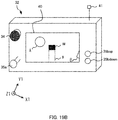
- Remote operation terminal 32 has the operation surface.
- Suspended load movement operation tool 35 (illustrated as 35a, 35bup, and 35bdown in FIG. 11 ) serving as the first operation section
- terminal-side display apparatus 40 serving as the display section
- reference change operation tool 34 serving as the second operation section
- remote operation terminal 32 has terminal-side communication apparatus 41 serving as the communication section for communication connection with crane 1.
- Suspended load movement operation tool 35 is an interface for performing the remote operation for a specific operation of crane 1.
- a configuration will be described which includes operation stick 35a and an operation button.
- a configuration having another interface may be adopted.
- As another interface it is conceivable to adopt a configuration using a touch panel.
- terminal-side display apparatus 40 may be provided with a touch sensor. In this manner, it is conceivable that crane 1 is remotely operated via the operation using the touch sensor.
- one remote operation terminal 32 does not necessarily need two or more suspended load movement operation tools 35.
- a configuration may be adopted which has only operation stick 35a serving as the operation section.
- operation stick 35a is located on the left side of the operation surface in the example illustrated in FIG. 11 .
- the operator pulls down operation stick 35a in a predetermined direction.
- the operator can horizontally drive main hook block 10 including the hook in the direction corresponding to the predetermined direction at the speed corresponding to the operation amount. That is, when operation stick 35a is greatly pulled down, main hook block 10 is driven fast.
- operation stick 35a is slightly pulled down, main hook block 10 is driven slowly.
- the operation button is located on the right side of the operation surface in the example illustrated in FIG. 11 .
- the operation button includes raising button 35bup for raising the hook and lowering button 35bdown for lowering the hook.
- a configuration has been described where main hook block 10 is moved upward and downward by using the operation button.
- lever A for moving main hook block 10 upward and downward may be provided, and lever B for moving the distal end of boom 14 upward and downward may be provided. In this manner, a configuration may be adopted in which button 42b and lever A and/or lever B are operated so as to move main hook block 10 upward and downward.
- terminal-side display apparatus 40 is located at the center portion of the operation surface, and an image generated based on the detection information of the detection apparatus is displayed on terminal-side display apparatus 40.
- terminal-side display apparatus 40 is configured to include a liquid crystal display, an organic electro luminescence (EL) display, and an inorganic EL display.
- terminal-side display apparatus 40 may be configured to include a touch sensor (not illustrated).
- Terminal-side display apparatus 40 need not be integrated with another interface, such as suspended load movement operation tool 35, and for example, may be a head-mounted type head-mounted display (HMD).
- the HMD has an optical unit corresponding to right and/or left eyes of a wearer, and is configured to be capable of controlling at least vision (may be configured to be capable of controlling hearing other than vision, for example).
- the wearer can visually recognize an operation image (video) presented through the HMD, and can intuitively perform the operation while viewing the operation image presented by the HMD without confirming the input operation surface.
- the operation image presented to the wearer may be a virtual reality image (video) generated based on the detection information of the detection apparatus.
- the HMD can also project different images to the right and left eyes of the wearer, and can present a 3D image when images with parallax are displayed on the right and left eyes.
- remote operation terminal 32 has reference change operation tool 34 for rotationally operating the image displayed on terminal-side display apparatus 40.
- reference change operation tool 34 for rotationally operating the image displayed on terminal-side display apparatus 40.
- an image rotation knob type is used as the operation interface of reference change operation tool 34.
- other interfaces may be used.
- reference change operation tool 34 is located above operation stick 35a, and is configured to be rotatable about the axis.
- the image rotation knob When the operator rotates the image rotation knob, the image displayed on terminal-side display apparatus 40 is rotated in a predetermined rotation direction, as much as a predetermined rotation amount, and at a predetermined rotation speed in accordance with the rotation direction, the rotation amount, and the input speed.
- remote operation terminal 32 has a display direction fixing section (not illustrated) that fixes the display direction of the image to be displayed on terminal-side display apparatus 40.
- a specific example includes the following example.
- reference change operation tool 34 is operated to be pressed against the operation surface side. In this manner, reference change operation tool 34 is fitted into a fitting hole (not illustrated), thereby bringing reference change operation tool 34 into a locked state (state where the rotational operation cannot be performed).
- a method of fixing the display direction by using software control may be adopted.
- terminal-side display apparatus 40 may be configured to include a touch sensor so as to rotate the image via the operation using the touch sensor.
- the method is not limited as long as information relating to the rotation of the image (for example, the rotation direction, the rotation amount, and the rotation speed) can be uniquely determined by the contents of the operation.
- the following configuration may be adopted.
- the operator detects the rotation direction, the rotation amount, and the rotation speed by rotating one finger and the other finger on terminal-side display apparatus 40.
- the image displayed on terminal-side display apparatus 40 is rotated in a predetermined rotation direction, as much as a predetermined rotation amount, and at a predetermined rotation speed.
- Terminal-side control apparatus 42 serving as the control section of remote operation terminal 32 comprehensively controls remote operation terminal 32 while performing various arithmetic processes.
- terminal-side control apparatus 42 is configured to be capable of receiving the operation information from suspended load movement operation tool 35 or reference change operation tool 34.
- terminal-side control apparatus 42 is configured to be capable of transmitting and receiving the control information and/or the image to and from terminal-side communication apparatus 41.
- terminal-side control apparatus 42 is configured to be capable of transmitting and receiving the image to and from terminal-side display apparatus 40.
- the terminal-side control apparatus 42 is configured to include a central processing unit (CPU), a read only memory (ROM), and a random access Memory (RAM), as an arithmetic section (not illustrated). Respective configuration elements are connected to each other via a bus.
- the CPU performs various arithmetic processes by accessing the RAM, when necessary.
- the ROM is a non-volatile memory which stores firmware such as an operating system (OS), a program, and various parameters to be executed by the CPU.
- the RAM is used as a CPU work region, and temporarily holds the OS, applications under execution, and data under processing.
- remote operation terminal 32 has terminal-side communication apparatus (communication section) 41, terminal-side display apparatus 40, suspended load movement operation tool 35, and reference change operation tool 34.
- Terminal-side communication apparatus 41 is a module for communication connection with crane 1, and terminal-side display apparatus 40 is a display apparatus. Terminal-side communication apparatus 41 is configured to be capable of transmitting and receiving the control information and/or the image to and from communication apparatus 22 serving as the communication section of crane 1.
- Suspended load movement operation tool 35 is an input apparatus such as the operation stick and operation button, and is an interface for performing the remote operation for the concrete operation of crane 1.
- Terminal-side display apparatus 40 is an interface for displaying the image generated based on the detection information of the detection apparatus, and is configured to be capable of transmitting (receiving) the image to (from) terminal-side control apparatus 42.
- reference change operation tool 34 has the operation interface such as the image rotation knob for the operator to input the rotational operation.
- reference change operation tool 34 includes operation (rotation) direction detection section 34a, operation (rotation) speed detection section 34b, and operation (rotation) amount detection section 34c, which respectively correspond to the operation direction (corresponding to the rotation direction), the operation speed (corresponding to the rotation speed), and the operation amount (corresponding to the rotation amount) of the operation interface.
- Each operation command signal detected by detection sections 34a, 34b, and 34c is transmitted to terminal-side control apparatus 42, and terminal-side control apparatus 42 rotates the image, based on the operation command signal. The rotated image is displayed (again) on terminal-side display apparatus 40.
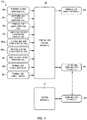
- FIG. 13 A control system of crane 1 according to the present embodiment will be described with reference to FIG. 13 .
- a broken line in FIG. 13 schematically illustrates an external configuration of crane 1.
- Crane 1 according to the present embodiment has at least actuator 50, control apparatus 31, communication apparatus 22, operation section 71, and camera 9b serving as the detection apparatus.
- Actuator 50 corresponds to the "work apparatus" in the appended claims, and has one or a plurality of cylinders and motors. In addition, actuator 50 is configured to be capable of receiving the control information from control apparatus 31.
- Control apparatus 31 has at least a bus, an arithmetic apparatus, and a storage apparatus. Control apparatus 31 is configured to be capable of transmitting and receiving the control information to and from communication apparatus 22, and is configured to be capable of receiving the detection information from camera 9b.
- control apparatus 31 is configured to be capable of transmitting the control information to actuator 50.
- FIG. 13 illustrates a configuration in which control valve 60 can transmit the control information to actuator 50.
- control valve 60 and control apparatus 31 correspond to the "control apparatus" in the appended claims.
- Communication apparatus 22 is configured to be capable of transmitting and receiving the control information and/or the image to and from remote operation terminal 32.
- communication apparatus 22 is configured to be capable of transmitting and receiving the control information and/or the image to and from control apparatus 31.
- Camera 9b is configured to be capable of transmitting the detection information to communication apparatus 22.
- Camera 9b normally includes an image generation section (not illustrated) that generates an image, based on the detection information.
- an image generation section not illustrated
- a configuration may be adopted in which camera 9b and the image generation section are separately arranged.
- crane 1 normally has operation section 71, and the operation of crane 1 can be controlled, based on the operation information of operation section 71.
- operation section 71 is configured to be capable of transmitting the control information to control apparatus 31, based on the operation.
- operation section 71 includes swivel operation tool 18 serving as a swivel lever, luffing operation tool 19 serving as a luffing lever, extending and retracting operation tool 20 serving as a extending and retracting lever, and main drum operation tool 21m serving as a main winch lever.
- remote operation terminal 32 An actual operation of remote operation terminal 32 according to the present embodiment will be described with reference to FIG. 14 .
- terminal-side control apparatus 42 acquires an ambient image of crane 1 (Step S1). At this time, terminal-side control apparatus 42 acquires the ambient image as follows. The ambient image is generated, based on the detection information of camera 9b, and is transmitted from crane 1 to remote operation terminal 32 via communication apparatus 22. Then, in remote operation terminal 32, the ambient image is received via terminal-side communication apparatus 41, and is transmitted to terminal-side control apparatus 42. In this manner, terminal-side control apparatus 42 acquires the ambient image of crane 1. Normally, terminal-side control apparatus 42 also acquires the information of the reference coordinate system of the image when acquiring the ambient image. Then, either terminal-side control apparatus 42 or control apparatus 31 sets the reference coordinate system for associating the direction in the image, the operation direction of suspended load movement operation tool 35, and the movement direction of main hook block 10 with each other.
- terminal-side control apparatus 42 controls terminal-side display apparatus 40 to display the acquired image in accordance with the reference coordinate system (Step S2).
- terminal-side control apparatus 42 determines whether or not the input operation is detected in operation (rotation) direction detection section 34a, operation (rotation) speed detection section 34b, and operation (rotation) amount detection section 34c of reference change operation tool 34 (Step S3). At this time, terminal-side control apparatus 42 detects and determines the input operation, based on the input information (input signal) transmitted from respective detection sections 34a, 34b, and 34c, for example.
- terminal-side control apparatus 42 determines that the input operation is not detected (Step S3: No)
- terminal-side control apparatus 42 determines that reference change operation tool 34 is not operated, and does not perform processes in Steps S4 to Step S6. In this manner, an image rotation operation process is completed without rotating the image. After the process is completed, crane 1 is brought into a remotely operable state by operating remote operation terminal 32.
- terminal-side control apparatus 42 determines that the input operation is detected (Step S3: Yes)
- terminal-side control apparatus 42 acquires the control information (operation command signal) based on the input operation from reference change operation tool 34, and resets the reference coordinate system, based on the detection information (the rotation direction, the rotation speed, and the rotation amount) (Step S4).
- the control information includes the control information relating to a process for rotating the image displayed on terminal-side display apparatus 40 and a reference coordinate system resetting process for associating the direction of the image corresponding to the rotation of the image, the operation direction of the suspended load movement operation tool 35, and the movement direction of main hook block 10 with each other.
- Terminal-side control apparatus 42 rotates and resets the reference coordinate system in accordance with the operation direction (rotation direction) and the operation amount (rotation amount) which are included in the control information. More specifically, in a case where the operation direction is the "rightward direction” and the operation amount is "90°", terminal-side control apparatus 42 rotates the reference coordinate system as much as 90° in the rightward direction, and resets the reference coordinate system.
- terminal-side control apparatus 42 performs the rotation process on the image, based on the acquired control information (Step S5).
- Terminal-side control apparatus 42 rotates the image in accordance with the operation direction (rotation direction) and the operation amount (rotation amount) which are included in the control information. More specifically, in a case where the operation direction is the "rightward direction” and the operation amount is "90°", the terminal-side control apparatus 42 rotates the image as much as 90° in the rightward direction.
- the rotation angle of the image and the reference coordinate system can set to any desired value by operating reference change operation tool 34 as long as the rotation angle falls within a range of 0° to 360°.
- terminal-side control apparatus 42 controls on terminal-side display apparatus 40 to display the image subjected to the rotation process (Step S6). Thereafter, the image rotation operation process is completed. After the process is completed, crane 1 is brought into a remotely operable state by operating the remote operation terminal 32.
- FIGS. 15A and 16A for example, a case will be described where operator P moves load W to an upper surface of target B at a work site having obstacle A.
- operator P performs work at working position W1 in FIG. 15A
- W2 in FIG. 16A the image displayed on terminal-side display apparatus 40 of remote operation terminal 32 is an example of the image captured from above in the vertical direction by camera 9b serving as the detection apparatus.
- the movement of load W in the vertical direction is not considered in the description.
- the reference coordinate system is set in the image detected by camera 9b, and the reference coordinate system corresponds to the reference coordinate system of the operation system of remote operation terminal 32. Therefore, in a case where load W is moved to the upper surface of target B at the work site illustrated in FIG. 15A , after load W is moved as much as a predetermined amount in a direction X1, the load W needs to be moved as much as a predetermined amount in direction Y1. As a matter of course, this order may be reversed, and after load W is moved as much as the predetermined amount in direction Y1, load W may be moved as much as the predetermined amount in direction X1. However, the configuration will be omitted in order to simplify the description.
- operation stick 35a is pulled down so as to move load W in direction X1 or in direction Y1.
- operation stick 35a may be pulled down as much as a predetermined amount in an oblique direction so that load W is linearly moved to the upper surface of target B in the oblique direction.
- operator P who directly faces terminal-side display apparatus 40 of remote operation terminal 32 moves load W as much as the predetermined amount in the rightward direction in a status illustrated in FIG. 15A . Thereafter, operator P considers that load W needs to be moved as much as the predetermined amount in the rearward direction. In this case, in the actual work, after operation stick 35a is pulled down in the rightward direction (that is, the direction XI), operation stick 35a is pulled down in the rearward direction (that is, the direction Y1), thereby completely carrying out the work.
- load W In a case where the load W is moved to the upper surface of target B (by using the shortest distance) at the work site illustrated in FIG. 16A , load W needs to be moved as much as the predetermined amount in direction Y1 after being moved as much as the predetermined amount in direction X1.
- operator P who directly faces terminal-side display apparatus 40 of remote operation terminal 32 moves load W as much as the predetermined amount in the leftward direction in a status illustrated in FIG. 16A . Thereafter, operator P considers that load W needs to be moved as much as the predetermined amount in the forward direction. However, in the actual work, after operation stick 35a is pulled down in the rightward direction (that is, direction XI), operation stick 35a is pulled down in the rearward direction (that is, direction Y1). In this manner, operator P needs to complete the work.
- remote operation terminal 32 has reference change operation tool 34 for rotationally operate the image displayed on terminal-side display apparatus 40. Then, in a case where the image is rotated in accordance with the input operation of reference change operation tool 34, terminal-side control apparatus 42 rotates the reference coordinate system in the same rotation direction and as much as the same rotation amount as the rotation direction and the rotation amount of the image.
- reference change operation tool 34 is operated in the work site illustrated in FIG. 16A .
- a display position of operator P can be moved to a lower side position of the screen of terminal-side display apparatus 40, for example. That is, the image illustrated in FIG. 16C is an image obtained in such a way that the image displayed on terminal-side display apparatus 40 illustrated in FIG. 16B is rotated as much as 180° on an XY plane. In this case, the reference coordinate system is also rotated in the XY plane.
- operator P moves load W as much as the predetermined amount in the leftward direction. Thereafter, while operator P considers that load W needs to be moved as much as the predetermined amount in the forward direction, operator P pulls down operation stick 35a in the leftward direction (that is, direction XI). Thereafter, operator P pulls down operation stick 35a in the forward direction (that is, direction Y1), thereby completely carrying out the work.
- the movement direction of load W actually viewed by operator P coincides with the operation direction of remote operation terminal 32. Accordingly, operator P can perform an accurate remote operation by easily and simply operating remote operation terminal 32.
- a setting button in the present embodiment, reference change operation tool 34 may be located in order to rotate the image displayed on terminal-side display apparatus 40 and in order to stop the rotation of the image displayed on terminal-side display apparatus 40.
- a detection apparatus including a first sensor for detecting the position information is located above load W in the vertical direction.
- a second sensor for detecting the position information is disposed in remote operation terminal 32. Then, as illustrated in FIG. 17 , in terminal-side display apparatus 40, a position of the first sensor is displayed at first reference position PI, and a position of the second sensor is displayed at second reference position P2.
- operator P tends to easily carry out the work in a case where load W is located at the center position of terminal-side display apparatus 40 and remote operation terminal 32 is located at the lower center position of terminal-side display apparatus 40. Therefore, as a preferred embodiment, operator P first rotates the image displayed on terminal-side display apparatus 40 by pressing reference change operation tool 34. As illustrated in FIG. 17 , when first reference position P1 is located at the center of the display region of terminal-side display apparatus 40 and second reference position P2 is located in the vicinity of the lower center of terminal-side display apparatus 40, it is preferable to stop the rotation of the image by pressing reference change operation tool 34 again.
- the present invention is not limited to this configuration.
- the image may be rotated while reference change operation tool 34 is pressed, and the rotation of the image may be stopped when the pressing of reference change operation tool 34 is stopped.
- a configuration may be adopted as follows.
- the image displayed on terminal-side display apparatus 40 is automatically rotated and adjusted so that the image is located at a position where operator P described above easily performs the work.
- the image may be rotated by pressing reference change operation tool 34.
- the rotation of the image may be stopped when first reference position P1 is located at the center of the display region of terminal-side display apparatus 40 and second reference position P2 is located in the vicinity of the lower center of terminal-side display apparatus 40.
- terminal-side control apparatus 42 also rotates the reference coordinate system in the same rotation direction and as much as the same rotation amount as the rotation direction and the rotation amount of the image rotated by reference change operation tool 34. In this manner, the movement direction of load W actually viewed by operator P coincides with the operation direction of remote operation terminal 32. Accordingly, operator P can perform an accurate remote operation by easily and simply operating remote operation terminal 32.
- a position for attaching camera 9b is located above main hook block 10 in the vertical direction. Therefore, it is preferable that camera 9b is attached to the distal end portion of boom 14 located above main hook block 10 in the vertical direction.
- remote operation terminal 32 has a function to correct the rotation of the image displayed on terminal-side display apparatus 40 along with the swivel operation of crane 1.
- FIGS. 18 to 19 More specific embodiments will be described with reference to FIGS. 18 to 19 .
- FIG. 18A an example will be described where obstacle A and obstacle B are present in the work site.
- camera 9b (not illustrated) is located above load W.
- obstacle A is located in the direction opposite to direction X1 with respect to load W (that is, the leftward direction in FIG. 18A ), and obstacle B is located on the side in direction X1 with respect to load W (that is, the rightward direction in FIG. 18A ).
- FIG. 18B in a case where load W is moved to obstacle A, the operator who operates remote operation terminal 32 pulls down operation stick 35a in the direction opposite to direction X1 (that is, the leftward direction in FIG. 18B ).
- load W is moved to obstacle B
- the operator who operates remote operation terminal 32 pulls down operation stick 35a in direction X1 (that is, the rightward direction in FIG. 18B ).
- FIGS. 18A and 18B are horizontally viewed, the upward direction, the downward direction, the rightward direction, and the leftward direction coincide with each other in FIGS. 18A and 18B .
- FIG. 19A in the work site illustrated in FIG. 18A , it is assumed that boom 14 is caused to swivel counterclockwise at a predetermined angle (in the example illustrated in FIG. 19A , the boom 14 is caused to swivel counterclockwise at 25 degrees).
- camera 9b is attached to boom 14. Accordingly, as boom 14 swivels, camera 9b is also rotated. Therefore, an angular deviation corresponding to the swivel angle occurs between the direction in the work site illustrated in FIG. 19A and the direction of the image displayed on terminal-side display apparatus 40 illustrated in FIG. 19B .
- direction Y1 (upward direction) illustrated in FIG. 19A is the upward direction in the example illustrated in FIG.
- direction Y1 in the example illustrated in FIG. 19B is the obliquely upward and rightward direction.
- Direction X1 (rightward direction) illustrated in FIG. 19A is the rightward direction in the example illustrated in FIG. 18B .
- direction X1 in the example illustrated in FIG. 19B is the obliquely downward and rightward direction.
- FIGS. 19A and 19B are horizontally viewed, the upward direction, the downward direction, the rightward direction, and the leftward direction do not coincide with each other in FIGS. 19A and 19B . Therefore, even in a case where the operator who operates remote operation terminal 32 is not moved, boom 14 swivels. In this manner, in some cases, the direction of load W actually viewed by the operator himself or herself in the work site may not coincide with the direction of the image displayed on remote operation terminal 32 (and the operation direction).
- terminal-side control apparatus 42 rotates the image displayed on terminal-side display apparatus 40 in the same rotation direction and as much as the rotation amount as the rotation direction and the rotation amount of the swivel operation.
- FIG. 19C the image displayed on terminal-side display apparatus 40 is rotated as illustrated in FIG. 19C .
- direction Y1 (upward direction) illustrated in FIG. 19A is direction Y1 (upward direction) illustrated in FIG. 19C
- direction X1 rightward direction
- FIG. 19A is direction X1 (rightward direction) illustrated in FIG. 19C .
- FIGS. 19A and 19C are horizontally viewed, the upward direction, the downward direction, the rightward direction, and the leftward direction coincide with each other in FIGS. 19A and 19C .
- the movement direction of load W actually viewed by operator P coincides with the operation direction of remote operation terminal 32. Accordingly, operator P can perform an accurate remote operation by easily and simply operating remote operation terminal 32.
- the present invention is applicable to a remote operation terminal and a work vehicle including the remote operation terminal.
Landscapes
- Engineering & Computer Science (AREA)
- Mechanical Engineering (AREA)
- Automation & Control Theory (AREA)
- Multimedia (AREA)
- Signal Processing (AREA)
- Control And Safety Of Cranes (AREA)
- Selective Calling Equipment (AREA)
- Studio Devices (AREA)
Applications Claiming Priority (2)
| Application Number | Priority Date | Filing Date | Title |
|---|---|---|---|
| JP2016243298A JP6743676B2 (ja) | 2016-12-15 | 2016-12-15 | 遠隔操作端末 |
| PCT/JP2017/045198 WO2018110707A1 (ja) | 2016-12-15 | 2017-12-15 | 遠隔操作端末および遠隔操作端末を備える作業車両 |
Publications (2)
| Publication Number | Publication Date |
|---|---|
| EP3556713A1 true EP3556713A1 (de) | 2019-10-23 |
| EP3556713A4 EP3556713A4 (de) | 2020-08-26 |
Family
ID=62634353
Family Applications (1)
| Application Number | Title | Priority Date | Filing Date |
|---|---|---|---|
| EP17880553.7A Pending EP3556713A4 (de) | 2016-12-15 | 2017-12-15 | Fernbedienungsendgerät und arbeitsfahrzeug mit einem fernbedienungsendgerät |
Country Status (3)
| Country | Link |
|---|---|
| EP (1) | EP3556713A4 (de) |
| JP (1) | JP6743676B2 (de) |
| CN (1) | CN110062744B (de) |
Cited By (3)
| Publication number | Priority date | Publication date | Assignee | Title |
|---|---|---|---|---|
| EP4286317A1 (de) * | 2022-06-03 | 2023-12-06 | Mitsubishi Logisnext Co., Ltd. | Fernbedienungssystem für einen gabelstapler |
| US12305364B2 (en) | 2021-12-22 | 2025-05-20 | Doosan Bobcat North America, Inc. | Control of multiple power machines |
| US12353205B2 (en) | 2021-08-11 | 2025-07-08 | Doosan Bobcat North America, Inc. | Remote control for a power machine |
Families Citing this family (9)
| Publication number | Priority date | Publication date | Assignee | Title |
|---|---|---|---|---|
| JP7091729B2 (ja) | 2018-03-09 | 2022-06-28 | 株式会社タダノ | 遠隔操作端末および遠隔操作端末を備える作業車両 |
| JP7172253B2 (ja) * | 2018-07-30 | 2022-11-16 | 株式会社タダノ | 作業車両 |
| JP7380685B2 (ja) * | 2019-05-22 | 2023-11-15 | 株式会社タダノ | 遠隔操作端末および遠隔操作端末を備える移動式クレーン |
| JP7416063B2 (ja) * | 2019-05-22 | 2024-01-17 | 株式会社タダノ | 遠隔操作端末および遠隔操作端末を備える移動式クレーン |
| US12187584B2 (en) | 2019-06-20 | 2025-01-07 | Tadano Ltd. | Image system and work vehicle provided with image system |
| US11905146B2 (en) | 2019-06-20 | 2024-02-20 | Tadano Ltd. | Movable range display system and crane equipped with movable range display system |
| CN111943060B (zh) * | 2020-08-17 | 2022-03-18 | 交通运输部公路科学研究所 | 姿态调整方法 |
| CN112479037B (zh) * | 2020-12-01 | 2023-05-09 | 徐州重型机械有限公司 | 一种穿戴式监控系统、起重机及工程机械 |
| CN121020467B (zh) * | 2025-10-29 | 2026-01-27 | 长沙斐视科技有限公司 | 基于5g网络的叉车远程操控系统及方法 |
Family Cites Families (14)
| Publication number | Priority date | Publication date | Assignee | Title |
|---|---|---|---|---|
| US5043646A (en) * | 1990-05-01 | 1991-08-27 | Smith Engineering | Remote control direction selecting system |
| JPH0971386A (ja) * | 1995-09-04 | 1997-03-18 | Tadano Ltd | 遠隔操作装置 |
| DE10207880C1 (de) * | 2002-02-21 | 2003-07-31 | Demag Cranes & Components Gmbh | Steuereinrichtung zum Steuern eines Hebezeugs |
| CN2561757Y (zh) * | 2002-07-18 | 2003-07-23 | 全小飞 | 塔式起重机空间自动定位器 |
| CN2692118Y (zh) * | 2003-11-06 | 2005-04-13 | 邯郸市格林电器有限公司 | 人性化有方向转换的起重机装置 |
| JP2007031102A (ja) * | 2005-07-28 | 2007-02-08 | Mitsubishi Heavy Ind Ltd | クレーン装置の遠隔操作装置及びクレーン装置並びにクレーン装置の遠隔操作システム |
| CN100591880C (zh) * | 2006-12-31 | 2010-02-24 | 三一重工股份有限公司 | 一种智能臂架控制装置 |
| JP5642409B2 (ja) * | 2010-03-30 | 2014-12-17 | 株式会社タダノ | クレーンの制御装置及びクレーン |
| JP5919022B2 (ja) * | 2012-02-15 | 2016-05-18 | 株式会社フジタ | 遠隔操作システム |
| JP6202670B2 (ja) * | 2013-05-13 | 2017-09-27 | 株式会社タダノ | 作業機械の遠隔操作システム |
| JP6131385B2 (ja) * | 2014-07-30 | 2017-05-17 | ヤンマー株式会社 | 遠隔操作装置 |
| US9617717B2 (en) * | 2015-06-29 | 2017-04-11 | Komatsu Ltd. | Construction machine control system and construction machine control method |
| WO2016047806A1 (ja) * | 2015-09-30 | 2016-03-31 | 株式会社小松製作所 | クローラ式作業機械の周辺監視装置 |
| DE112015000179B4 (de) * | 2015-10-30 | 2020-09-24 | Komatsu Ltd. | Arbeitsmaschine und Verfahren zum Korrigieren eines Arbeitsausrüstungs-Parameters für die Arbeitsmaschine |
-
2016
- 2016-12-15 JP JP2016243298A patent/JP6743676B2/ja active Active
-
2017
- 2017-12-15 CN CN201780075615.2A patent/CN110062744B/zh active Active
- 2017-12-15 EP EP17880553.7A patent/EP3556713A4/de active Pending
Cited By (5)
| Publication number | Priority date | Publication date | Assignee | Title |
|---|---|---|---|---|
| US12353205B2 (en) | 2021-08-11 | 2025-07-08 | Doosan Bobcat North America, Inc. | Remote control for a power machine |
| US12305364B2 (en) | 2021-12-22 | 2025-05-20 | Doosan Bobcat North America, Inc. | Control of multiple power machines |
| EP4286317A1 (de) * | 2022-06-03 | 2023-12-06 | Mitsubishi Logisnext Co., Ltd. | Fernbedienungssystem für einen gabelstapler |
| CN117221302A (zh) * | 2022-06-03 | 2023-12-12 | 三菱物捷仕株式会社 | 叉车的远程操作系统 |
| US12264053B2 (en) | 2022-06-03 | 2025-04-01 | Mitsubishi Logisnext Co., LTD. | Remote operation system of forklift |
Also Published As
| Publication number | Publication date |
|---|---|
| JP6743676B2 (ja) | 2020-08-19 |
| CN110062744A (zh) | 2019-07-26 |
| CN110062744B (zh) | 2020-07-17 |
| EP3556713A4 (de) | 2020-08-26 |
| JP2018095449A (ja) | 2018-06-21 |
Similar Documents
| Publication | Publication Date | Title |
|---|---|---|
| US11292699B2 (en) | Remote operation terminal and work vehicle provided with remote operation terminal | |
| EP3556713A1 (de) | Fernbedienungsendgerät und arbeitsfahrzeug mit einem fernbedienungsendgerät | |
| US12492103B2 (en) | Remote operation terminal and mobile crane comprising remote operation terminal | |
| JP7091729B2 (ja) | 遠隔操作端末および遠隔操作端末を備える作業車両 | |
| JP7114950B2 (ja) | 遠隔操作端末及び作業車両 | |
| US11926511B2 (en) | Remote operation terminal and mobile crane provided with remote operation terminal | |
| JP7380685B2 (ja) | 遠隔操作端末および遠隔操作端末を備える移動式クレーン | |
| JP6919548B2 (ja) | 遠隔操作端末および遠隔操作端末を備える作業車両 | |
| US20210061621A1 (en) | Work vehicle | |
| JP7047538B2 (ja) | 遠隔操作端末および遠隔操作端末を備える作業車両 | |
| JP7167464B2 (ja) | 遠隔操作端末および遠隔操作端末を備える作業車両 | |
| EP3763660B1 (de) | Fernbedienungsendgerät und arbeitsfahrzeug mit einem fernbedienungsendgerät | |
| JP7167469B2 (ja) | 遠隔操作端末および遠隔操作端末を備える作業車両 | |
| JP2022166669A (ja) | アウトリガ装置の設置位置表示システム及び作業車両 | |
| JP7059703B2 (ja) | 遠隔操作端末および遠隔操作端末を備える作業車両 | |
| JP7800195B2 (ja) | 作業車両の操縦支援システム及び操縦支援システムを有する作業車両 | |
| JP2019163122A (ja) | 作業車両及び遠隔操作端末 |
Legal Events
| Date | Code | Title | Description |
|---|---|---|---|
| STAA | Information on the status of an ep patent application or granted ep patent |
Free format text: STATUS: THE INTERNATIONAL PUBLICATION HAS BEEN MADE |
|
| PUAI | Public reference made under article 153(3) epc to a published international application that has entered the european phase |
Free format text: ORIGINAL CODE: 0009012 |
|
| STAA | Information on the status of an ep patent application or granted ep patent |
Free format text: STATUS: REQUEST FOR EXAMINATION WAS MADE |
|
| 17P | Request for examination filed |
Effective date: 20190710 |
|
| AK | Designated contracting states |
Kind code of ref document: A1 Designated state(s): AL AT BE BG CH CY CZ DE DK EE ES FI FR GB GR HR HU IE IS IT LI LT LU LV MC MK MT NL NO PL PT RO RS SE SI SK SM TR |
|
| AX | Request for extension of the european patent |
Extension state: BA ME |
|
| DAV | Request for validation of the european patent (deleted) | ||
| DAX | Request for extension of the european patent (deleted) | ||
| A4 | Supplementary search report drawn up and despatched |
Effective date: 20200724 |
|
| RIC1 | Information provided on ipc code assigned before grant |
Ipc: H04N 5/232 20060101ALI20200720BHEP Ipc: B66C 13/00 20060101ALI20200720BHEP Ipc: B66C 23/78 20060101ALI20200720BHEP Ipc: B66C 13/46 20060101ALI20200720BHEP Ipc: B66C 23/90 20060101ALI20200720BHEP Ipc: B66C 13/40 20060101AFI20200720BHEP |
|
| STAA | Information on the status of an ep patent application or granted ep patent |
Free format text: STATUS: EXAMINATION IS IN PROGRESS |
|
| 17Q | First examination report despatched |
Effective date: 20230126 |
|
| REG | Reference to a national code |
Ref country code: DE Ref legal event code: R079 Free format text: PREVIOUS MAIN CLASS: B66C0013400000 Ipc: H04N0023600000 |
|
| RIC1 | Information provided on ipc code assigned before grant |
Ipc: B66C 13/46 20060101ALI20240613BHEP Ipc: B66C 13/00 20060101ALI20240613BHEP Ipc: B66C 13/40 20060101ALI20240613BHEP Ipc: H04N 23/60 20230101AFI20240613BHEP |
|
| GRAP | Despatch of communication of intention to grant a patent |
Free format text: ORIGINAL CODE: EPIDOSNIGR1 |
|
| STAA | Information on the status of an ep patent application or granted ep patent |
Free format text: STATUS: GRANT OF PATENT IS INTENDED |
|
| INTG | Intention to grant announced |
Effective date: 20260105 |
|
| GRAS | Grant fee paid |
Free format text: ORIGINAL CODE: EPIDOSNIGR3 |
|
| GRAA | (expected) grant |
Free format text: ORIGINAL CODE: 0009210 |
|
| STAA | Information on the status of an ep patent application or granted ep patent |
Free format text: STATUS: THE PATENT HAS BEEN GRANTED |