EP3552523A1 - Sling for babies or small children - Google Patents
Sling for babies or small children Download PDFInfo
- Publication number
- EP3552523A1 EP3552523A1 EP18167317.9A EP18167317A EP3552523A1 EP 3552523 A1 EP3552523 A1 EP 3552523A1 EP 18167317 A EP18167317 A EP 18167317A EP 3552523 A1 EP3552523 A1 EP 3552523A1
- Authority
- EP
- European Patent Office
- Prior art keywords
- textile
- cushion
- shoulder
- band
- garment
- Prior art date
- Legal status (The legal status is an assumption and is not a legal conclusion. Google has not performed a legal analysis and makes no representation as to the accuracy of the status listed.)
- Granted
Links
Images




Classifications
-
- A—HUMAN NECESSITIES
- A47—FURNITURE; DOMESTIC ARTICLES OR APPLIANCES; COFFEE MILLS; SPICE MILLS; SUCTION CLEANERS IN GENERAL
- A47D—FURNITURE SPECIALLY ADAPTED FOR CHILDREN
- A47D13/00—Other nursery furniture
- A47D13/02—Baby-carriers; Carry-cots
- A47D13/025—Baby-carriers; Carry-cots for carrying children in seated position
-
- A—HUMAN NECESSITIES
- A47—FURNITURE; DOMESTIC ARTICLES OR APPLIANCES; COFFEE MILLS; SPICE MILLS; SUCTION CLEANERS IN GENERAL
- A47D—FURNITURE SPECIALLY ADAPTED FOR CHILDREN
- A47D13/00—Other nursery furniture
- A47D13/02—Baby-carriers; Carry-cots
-
- A—HUMAN NECESSITIES
- A45—HAND OR TRAVELLING ARTICLES
- A45F—TRAVELLING OR CAMP EQUIPMENT: SACKS OR PACKS CARRIED ON THE BODY
- A45F3/00—Travelling or camp articles; Sacks or packs carried on the body
- A45F3/04—Sacks or packs carried on the body by means of two straps passing over the two shoulders
- A45F2003/045—Sacks or packs carried on the body by means of two straps passing over the two shoulders and one additional strap around the waist
-
- A—HUMAN NECESSITIES
- A45—HAND OR TRAVELLING ARTICLES
- A45F—TRAVELLING OR CAMP EQUIPMENT: SACKS OR PACKS CARRIED ON THE BODY
- A45F3/00—Travelling or camp articles; Sacks or packs carried on the body
- A45F3/04—Sacks or packs carried on the body by means of two straps passing over the two shoulders
-
- A—HUMAN NECESSITIES
- A45—HAND OR TRAVELLING ARTICLES
- A45F—TRAVELLING OR CAMP EQUIPMENT: SACKS OR PACKS CARRIED ON THE BODY
- A45F3/00—Travelling or camp articles; Sacks or packs carried on the body
- A45F3/12—Shoulder-pads
Definitions
- the present invention relates to sling devices, in particular to abdominal and back support towel devices, for babies or toddlers and to a use thereof.
- Carrying device for babies or infants are well known in the art.
- the WO 2005 025 383 discloses a child carrier that can be attached to the front or the back of the trunk of a wearer without having to adjust the harness of the wearer.
- the carrier comprises a main plate which is generally rectangular in shape. The lower edge of the main panel is connected to the upper edge of a cushioned waistband, and the lower edge of a headrest panel is connected to the upper edge of the main panel. Shoulder straps are connected to the main panel and connected by a chest strap, which is slidably attached to each shoulder strap. Adjustable straps are connected to the chest strap and the headrest.
- An auxiliary girdle is provided which significantly expands the length of the waistband to allow the wearer to be worn by a woman during pregnancy.
- the AT11673 U1 discloses a carrying aid for babies and toddlers, consisting of a back of fabric, a fold-up headrest with two straps, two fully padded and sewn at a certain angle in the back shoulder straps, a sewn to the shoulder straps and closeable by buckle chest strap and a through Textile tunnel drawn waist belt, with the upper third of the back portion is waisted, whereby a favorable for the child distribution of tensile stress over the entire back area is achieved.
- the US 2015 196 133 discloses an infant carrier with a main wall support member, two padded shoulder belt elements, a waist belt, a removable toddler insert and a padded headrest convertible between a front, hip and back baby carrier.
- a baby and toddler stretcher having a back panel of fabric with two shoulder straps engaging upper corners of the back and may be connected to a hip belt which may be selectively slid into one of at least two superimposed waist belt textile tunnels.
- a sling device in particular a belly and back carrier cloth device, for babies or toddlers, comprising a back textile with a back textile inside and a back textile outside, in particular a back textile interior layer with a back textile inside and a back textile outer layer with a back textile outside, preferably wherein the back textile inner layer opposite of the Back textile outer layer is arranged and / or connected by edge seams, and at least one textile shoulder band, in particular at least two Textilschulterbs, with a Textilschulterbandinnenseite and an opposite Textilschulterbandau type, in particular a Textilschulterband inner layer with a Textilschulterbandinnenseite and a Textilschulterbandau tolage with a Textilschulterbandau duseite, preferably wherein the Textilschulterband inner layer opposite the textile shoulder and at least one padded shoulder is connected to the back textile and comprises at least one padded pocket with a pocket opening, wherein the padded pocket is designed and adapted to receive the at least one padding cushion wherein the cushion pad is insertable through and
- the two textile shoulder straps are connected to the back fabric and each comprise at least one pad pocket with a pocket opening, wherein the respective pad pocket of the two textile shoulder straps is designed and adapted to receive at least one of the two cushion pads, wherein the two cushion pillows through the respective pocket openings in the padding ashes are insertable and removable from them.
- a sling device in particular
- a cushion pad may be inserted into the cushion pocket of the at least one garter belt.
- the cushion pads cushion the weight.
- the use of the cushion pads is particularly advantageous when worn on the back.
- two states (with and without cushion pads) of the sling device can be produced, which allows an optimization of the respective requirements.
- the sling device is a stomach and back carrier towel device, i.
- the wearer can carry the baby or toddler with the baby sling device on the abdomen or back.
- Said sling device includes the back fabric for the back of the baby or toddler.
- a sling device according to the present invention is a baby carrier or infant.
- the cushion bag according to the present invention is a shoulder pad pocket for the shoulder of the wearer of the baby or toddler, in particular wherein the shoulder pad pocket is not more than 30 cm, in particular not more than 15 cm, from the connecting section objected.
- the at least one textile shoulder band is partially, in particular predominantly, or completely at least two-ply, in particular exactly two-ply, designed, wherein the Textilschulterbandinnenseite is formed by a Textilschulterbandinnenlage and the Textilschulterbandau standseite by a Textilschulterbandau standlage.
- the at least one textile shoulder strap is configured partially or completely at least in two layers, wherein the textile shoulder belt inner layer has the textile shoulder belt inner side and the textile shoulder belt outer layer the textile shoulder belt outside. It is particularly preferred if the textile shoulder belt inner layer lies opposite the textile shoulder belt outer layer and preferably contacts it at least in certain areas.
- the Textilschulterbandinnenseite and the Textilschulterbandau duseite in an alternative embodiment may also be opposite sides of a single-ply Textilschulterbandes, in particular wherein then no Textilschulterband inner layer and Textilschulterbandau tolage are provided, but only a Textilschulterbandgestitutionlage.
- the single-ply garter belt bottom layer is preferably configured as described for the garment shoulder outer layer.
- the upholstery pocket preferably comprises, in this deployment position, a pocket wall which is sewn onto the overall position of the textile shoulder band, in particular sewn on the inner surface of the garment.
- the at least one Z-shaped fold can be combined with the upholstery bag without making the introduction of a cushion pad difficult. It was to be expected that the Z-shaped folds could distort the geometry of the cushion pocket, so that the cushion pad is not insertable. However, it has surprisingly been found that this is not the case, especially when the textile described below is used.
- the at least one textile shoulder strap has a second strap section in which the textile shoulder strap has a constant and / or middle second width, preferably wherein the cushion pocket is present in this second strap section.
- the cushion pocket extends completely within the second area, i. especially not in the first or third area.
- the second band section adjoins the first and / or a third band section, in particular is present between the first and a third band section.
- the textile shoulder band has a constant second width when the width of the textile shoulder band changes only insignificantly in the second band section, in particular the remaining changes in width are only production-related or due to the inherent unevenness of the textile.
- the at least one textile shoulder band has a third band portion, in particular the third band portion described above, preferably in which the textile shoulder band tapers, in particular in the direction of the end of the textile shoulder band tapers.
- the textile shoulder strap has in the third band section particularly preferably at least at one point a third width, which is smaller and / or greater than the average and / or constant second width of the textile shoulder band in the second band section, in particular at least a first position with a smaller third width and at least a second location with a larger third width than the second range of the second band section.
- the textile shoulder band has at least one region in the third band section or represents a region in which the third band section comprises fewer layers than the second band section and / or is formed as a single layer.
- said area is wider as said mean and / or constant second width of the second band section, in particular 50 to 150%, preferably 70% to 100%, wider than the average and / or constant second width of the second band section.
- the first band portion has a first average width
- the second band portion has a second average width
- the third band portion has a third average width
- the first average width is smaller than the second and / or third average width
- the second average width of the second band portion corresponds to a constant second width of the second band portion.
- the pocket opening of the at least one garter belt has first and second opening edges, the first opening edge being formed by a folded portion of the garment outer layer or the garment inner band, and the second opening edge formed by a folded portion of the garment outer layer or garment inner band
- the first opening edge is formed by a folded-over section of the textile shoulder outer layer
- the second opening edge is formed by a folded-over section of the textile shoulder outer layer or the textile shoulder inner band.
- the pocket opening is formed by a slot having a slot length, preferably wherein the slot length is defined by, in particular terminal, slot seams, in particular wherein the slot seams orthogonal to the slot.
- a slot-shaped pocket opening allows the cushion pad to be inserted by stretching the slot.
- the slit is wholly or partly formed by a, in particular monoelastic, textile having an inherent first extensibility and / or first elasticity in a first direction and in a second direction an inherent second extensibility and / or second Having elasticity, wherein the second extensibility and / or second elasticity is less than the first extensibility and / or first elasticity, preferably wherein the slit-forming textile is oriented so that the slit has a maximum longitudinal extent in the first direction.
- a slit with monoelastic textile can be extended in one direction, but also has the necessary strength to remain self-contained. Although bielastic textile surfaces can also form slits, these have not proved equally stable in shape.
- the textile in the first direction has a maximum first extensibility and / or first elasticity and / or the first direction is orthogonal to the second direction.
- the slot does not require a closure system, such as a zipper, press or eyelet button or Velcro, to remain closed.
- the opening of the slot is opened only by stretching the opening edges, in particular no mechanical closure in the form of zipper, press or ⁇ senknopf or Velcro is present.
- the opening of the closes Slot independently, in particular preferably by contraction of, preferably monoelastic, Texils in the region of the slot.
- the slot is preferably elastically expandable, but purrs together after elimination of the force. It has surprisingly been found that this makes an accidental removal of the cushion pad difficult and at the same time is particularly reliable, without the risk of injury to the infant or baby by a mechanical closure.
- the at least one textile shoulder band has an inside shoulder band edge and an outside shoulder band edge, the textile shoulder band inside and the textile shoulder band outside extending between the inside shoulder band edge and the outside shoulder band edge, wherein the inside shoulder band edge closer in a generic use of the textile shoulder band is positioned at the neck of the wearer than the outside shoulder band edge, preferably at the inside shoulder band edge, the pocket opening is present and / or wherein the Textilschulterbandinnenseite is integrally connected to the inside shoulder band edge with the Textilschulterbandau callseite, in particular the Textilschulterband inner layer is integrally connected to the inside shoulder band edge with the Textilschulterbandau uslage. It has been shown that a pocket opening on the inside shoulder band edge less soiling is impaired.
- An integral connection between the garter belt inner layer and the garment shoulder outer layer has the advantage of better preventing the neck from rubbing against the seam, it being particularly preferred in this embodiment if the bag opening is inside the garment outer layer instead of between the garment inner garment and garment outer garment plies. If the pocket opening is present between the textile shoulder belt inner layer and the textile shoulder belt outer layer, it is particularly preferred if this is also provided on the inside shoulder band edge.
- the width of the shoulder straps or shoulder strap sections is preferably defined by the distance between the inside and outside shoulder strap edges.
- the textile shoulder strap comprises a textile strip which extends substantially parallel to the cushion pocket and has an average width, in particular fourth width, of at least 2 cm, in particular at least 3 cm, preferably 3.5 to 7 cm, in particular wherein said textile strip forms a portion of the outside shoulder band edge.
- the textile strip reduces the risk of slipping of the cushion pad from the shoulder and improves safety.
- the backrest textile in particular substantially rectangular, has an average length and / or an average width and / or a first maximum longitudinal extent, in particular wherein the average width is smaller than the average length and these are determined to be orthogonal to one another.
- the first maximum longitudinal extent can usually be determined from a corner of the back textile to a diagonally opposite corner of the back textile.
- the at least one textile shoulder strap has a second maximum longitudinal extent and / or average length of textile shoulder strap which is at least twice or at least three times as large as the first maximum longitudinal extent.
- the second maximum longitudinal extent substantially corresponds to the average length of the textile shoulder belt of the textile shoulder band.
- the second maximum longitudinal extent is at least 200%, preferably 250 to 600%, particularly preferably 270 to 400%, of the first maximum longitudinal extent.
- the mean textile shoulder band length is at least 200%, preferably 250 to 600%, particularly preferably 270 to 400%, of the first maximum longitudinal extent.
- the at least one textile shoulder strap is fastened at a first end to a connecting section of the back textile, in particular the connecting section described above, and a second end of the at least one textile shoulder strap is exposed, in particular unconnected, ends.
- the cushion pad has a substantially rectangular shape with four corners. Such cushions have proven to be particularly suitable. More preferably, the cushion pad has a pad length and a pad width, wherein the pad length is greater than the slit length of the slit. In an expedient embodiment, it is provided that the cushion pad has a pad length and a pad width, wherein the pad width is smaller than the pad length and greater than the slot length of the slot of the pocket opening, in particular wherein the pad cushion comprises the second pad seam described nach mard. This effectively prevents accidental removal of the cushion pad.
- the cushion pad and / or the pad pocket have a substantially rectangular shape with four corners, one or two of the corners being more rounded than the remaining corners, preferably one or two corners of the pocket closer to the outside shoulder band edge are arranged as on the inside shoulder band edge.
- the position of the cushion is predefined. This has the advantage that the cushion pad does not change its position in the cushion pocket, which improves the adaptation of the cushion pad to the carrier.
- the pocket opening is formed predominantly or exclusively of textile materials, preferably the textiles of textile materials described above, or exists, in particular apart from the slot seams. This reduces the risk of injury and, surprisingly, mechanical fasteners are dispensable. It is also preferred if the at least one shoulder strap and / or the pocket opening is substantially completely formed from textile and / or deformable materials, in particular wherein it does not comprise hard bodies such as zippers or buttons. It has surprisingly been found that the upholstery even without such closure means the cushion cushion securely enclose, if the present design of the cushion bags application applies. This improves the safety that babies or toddlers can injure on zippers or buttons and that they are also uncomfortable in contact.
- the pocket opening has a maximum longitudinal extent, which extends substantially parallel to the longitudinal extent of the shoulder band and / or to the inside and / or outside shoulder band edge. It has been shown that in this case the slot remains better closed when worn. The tensile forces caused by the baby or toddler thus usually act substantially parallel and not orthogonal to the slot, so that the slot is not extended. This improves the closure of the cushion bag during wear.
- the sling device comprises a hip belt.
- the back textile comprises at least one waist tunnel for the hip belt, wherein the textile tunnel is preferably a tube comprising or consisting of textile, through which the hip belt can be passed.
- the hip belt preferably comprises at least one mechanical closure element for connecting the ends.
- the textile tunnel is preferably attached to an at least one connecting portion opposite, in particular lower, end of the back textile.
- the hip belt may be partially covered with a hip pad.
- the sling device may further comprise a headrest for the toddler, which is connected to the back fabric, in particular between two connecting portions for two textile shoulder straps.
- the sling device and / or the at least one textile shoulder strap is predominantly formed from a textile which contains more than 65% by weight, in particular at least 85% by weight, preferably at least 98% by weight, of fibers, especially natural fibers, wherein the fibers are selected from a group consisting of cotton, linen, hemp, animal wool and silk, more preferably cotton and / or linen. It is also preferred if the sling device predominantly consists of a textile which has a weight per unit area of 50 to 400 g / m 2 , in particular 100 to 300 g / m 2 , preferably 150 to 250 g / m 2 . Said basis weight and material has also proved to be particularly suitable for the back textile, the at least one pocket wall and / or the at least one textile shoulder band of the sling device.
- the cushion pad comprises a padding material, in particular a padding material comprising foam, sheathing textile cover, preferably wherein the textile cover at least partially made of the same material as the at least one textile shoulder band, in particular the pocket wall, and / or the back textile is, in particular the textile shoulder strap and the pocket wall.
- the wear phenomena are particularly low when similar materials for the cushion pad and the textile shoulder band, in particular the pocket wall, are used. If one textile is finer or rougher than the other textile, it can cause increased wear. It is also preferred if the pocket wall is formed predominantly or completely from the same material as the back textile and / or the padding material and / or the remaining textile shoulder band.
- the cushion pad comprises a first cushion side and an opposite second cushion side, in particular wherein the first and second cushion side are connected to a circumferential cushion edge by a first cushioning seam and / or wherein at least one second cushioning seam the first cushion side and the second cushion side and this second cushioning seam extends from one portion or from a portion of the circumferential cushion edge to the opposite portion or towards the opposite portion of the circumferential cushion edge, in particular spaced from the substantially parallel extending cushion edges, preferably wherein the at least one second Padding seam pierces the padding material, in particular preferably in contrast to the first padding seam.
- the at least one second cushioning seam in one embodiment extends substantially parallel and spaced from two first cushioning edges and between two second cushioning edges, wherein the first cushioning edges are terminally connected to the second cushioning edges and the two first cushioning edges are each longer than the two second cushioning edges.
- An advantage of the at least one second cushioning stitch is that the cushioning pad folds more easily along said second cushioning stitching. This facilitates introduction of the cushion pad into the pocket opening, particularly preferably wherein the slot length of the pocket opening is smaller than the cushion width and / or the length of the second cushion edges.
- the cushion pad has a middle cushion width, a middle cushion length, and a middle cushion thickness, wherein the average cushion thickness is smaller than the middle cushion width and the middle cushion width is smaller than the middle cushion length.
- the cushion cushion comprises a second cushioning seam which compresses the cushion cushion, in particular the foam in the cushion cushion, at least partially, in particular generates a depression in the cushion surface, which extends along the second cushioning seam. This stabilizes the cushion pad.
- Two linear elements preferably extend "substantially parallel” in the sense of the present invention to one another if the deviation from an exactly parallel alignment of the two linear elements is less than 15 °, preferably less than 10 °, in particular less than 5 °.
- the invention further relates to the use of the sling device for transporting babies or small children, in particular on the back or stomach or on the hip of a wearer.
- carrier in the sense of the present invention stands for a male user of the sling device for carrying babies or small children.
- the invention relates to the use of the sling device for transporting babies or toddlers on the abdomen, the backseat on the back and / or buttocks of the baby or toddler and two textile shoulder straps from the direction of the chest of a wearer who the baby or toddler by means of the sling device on Belly, over the shoulder of the wearer along the back, in particular cross, is led to the abdomen of the wearer and below the buttocks of the toddler, especially there is knotted on the abdomen of the wearer and / or again, especially preferably crosswise, to the back of the Carrier out and knotted at the back of the wearer.
- the invention relates to the use of the sling device for transporting babies or toddlers on the back, the back fabric on the back and / or buttocks of the baby or toddler and two textile shoulder straps from the direction of the back of a wearer who the baby or toddler by means of the sling device on Wears back, is passed over the shoulders of the wearer is led back under the armpits of the wearer in the direction of the back and is guided below the buttocks of the toddler, there crosses and out to the abdomen of the wearer and knotted at the abdomen of the wearer or below of the toddler's buttocks is knotted on the back.
- an improved sling device which can be manually and quickly optimized for carrying both babies and infants on the abdomen, hip or back from the wearer. It has been shown that interchangeable cushions can be used for this purpose and they can be safely and reliably integrated without mechanical aids. In this case, a particularly secure wearing of the sling device is made possible in which the textile shoulder straps neither scrub nor injure the baby or toddler and at the same time slipping the textile shoulder straps is reliably prevented. This improves the comfort and safety considerably.
- FIG. 1 shows an inside view of an embodiment of the baby sling device 1, comprising a back fabric 2 with a back textile inside 9 and two garter straps 4 each having a garter belt inner side 10, the two garter straps 4 being connected to the back garment 2 and each comprising a dunnage bag 3, the dunnage bag 3 being adapted and arranged to receive a dunnage pad which is removable.
- the sling device 1 comprises a hip belt 7 which is partially underlaid with a hip pad 8.
- the back textile 2 comprises at least one connecting section 5 with which the at least one textile shoulder strap 4 is connected, in particular in the present case two connecting sections 5 which are each connected to one of the two textile shoulder straps 4.
- the cushion pocket 3 has a pocket wall which is bounded by partially circumferential pocket seams 15 which connect a textile shoulder belt inner layer and a textile shoulder strap outer layer.
- the two textile shoulder straps 4 taper in the direction of the ends 14 of the textile shoulder straps.
- the sling device 1 comprises a headrest 13 with headrest strap 6 for protection from the sun and for supporting the child's head, especially when sleeping.
- FIG. 2 shows an outside view of an embodiment of the baby sling device 1, comprising a back fabric 2 with a back textile outer side 11, and two textile shoulder straps 4 each with a garter belt outside 12, wherein the at least one textile shoulder band 4 is connected to the back fabric 2 via connecting portion 5 and a Upholstery bag 3 comprises, wherein the cushion bag 3 is designed and adapted to receive a cushion pad, wherein the cushion pad is removable.
- the cushion pocket 3 has a pocket wall which is bounded by partially circumferential pocket seams 15 which connect a textile shoulder belt inner layer and a textile shoulder strap outer layer.
- the sling device 1 comprises a hip belt 7 which is partially underlaid with a hip pad 8.
- the hip belt 7 and the hip pad 8 are guided through a textile tunnel 16 and the ends of the hip belt 7 are connected to mechanical closure means 17, 18.
- the sling device 1 comprises a headrest 13 with headrest strap 6 for supporting the child's head and Zuziehsch convinced 21 for the headrest 13.
- a Z-fold 19 is partially visible, wherein a portion is covered by the textile of the connecting portion 5.
- the two textile shoulder straps 4 each comprise a textile strip 20 which extends substantially parallel to the cushion pocket 3 and has an average width of at least 2 cm.
- the two textile shoulder straps 4 taper in the direction of the ends 14 of the textile shoulder straps.
- FIG. 3 shows a section of the schema FIG. 2 , One of the two textile shoulder straps can be seen, this having a first band section 44 in which the textile shoulder strap 4 is connected to the back textile 2, the first strap section 44 having at least one fold 19, the at least one textile shoulder strap 4 having a second strap section 45 in that the textile shoulder strap 4 has a constant second width B2, the cushion pocket 3 being present in this second strap section 45.
- the connecting portion 5 has connecting portion seams 24 which fix a portion of the folds 19.
- the second band section 45 has a length L1 which is greater than the length of the padding pocket (cf. FIG. 6 ). In the first band section, there is a minimum first width B1, which is smaller than the constant second width B2.
- the textile shoulder band 4 tapers in the direction of the ends in a third band section 50 and has a third width B4 at said end. At half the distance between said end and second band portion 45, it has a third width B3.
- the textile shoulder strap 4 comprises a textile strip 20 which extends substantially parallel to the cushion pocket 3.
- the sling device 1 comprises a headrest 13 with headrest strap 6 for protection from the sun and for supporting the child's head, especially when sleeping. It is also provided that the at least one textile shoulder band 4 has an inside shoulder band edge 42 and an outside shoulder band edge 43, the textile shoulder band inside and the textile shoulder band outside extending between the inside shoulder band edge 42 and the outside shoulder band edge 43.
- the cushion bag 3 has a substantially rectangular shape with four corners, wherein one of the corners 22 are more rounded than the remaining corners 23, 26, in particular a rounded corners 22 of the cushion bag 3, which is closer to the outside shoulder band edge 43 than the inside shoulder band edge 42 are arranged.
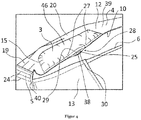
- FIG. 4 Fig. 11 shows a portion of a sling apparatus comprising a garter belt 4 having a garter belt inner side 10 and an opposite garment shoulder outer side 12 and at least one cushion pad 25 therebetween, the dunnage pad 25 being in the dunnage bag 3 and the dunnage bag being bounded by at least one bag wall 46.
- the cushion pad 25 can be removed from the pad pocket 3 via the pocket opening 28.
- the garment shoulder outer layer 39 comprises the garment shoulder outer side 12 and the garment inner band 38 the garment inner band 10.
- the pocket opening 28 has first and second opening edges 29,30, the first opening edge 29 being formed by a folded portion of the garment shoulder outer layer 39 and the second opening edge 30 being formed by a first opening edge 29 turned-over portion of the textile shoulder inner band layer 38 is formed.
- the connecting portion 5 has connecting portion seams 24 which fix a portion of the folds 19.
- the padded pouch 3 has a pocket wall 46 which is bounded by a partially circumferential pocket seam 15, which connect a textile shoulder band inner layer 38 and a textile shoulder band outer layer 39. Said pocket seam is only partially visible because the vaulted padded bag largely conceals them.
- the textile shoulder strap 4 comprises a textile strip 20 which extends substantially parallel to the cushion pocket 3.
- the pocket opening 28 is formed by a slot, the slot length being defined by slot seams 27 which are orthogonal to the slot.
- An additional edge seam 40 connects the layers of the back textile marginally.
- the sling device 1 comprises a headrest 13 with headrest strap 6 for protection from the sun and for supporting the child's head, especially when sleeping.
- the pocket opening 28 is formed between the garter belt inner side 10 and the garment shoulder outer side 12, in particular between the garment belt inner layer 38 and the garment shoulder outer layer 39.
- FIG. 5 Fig. 11 shows a portion of a sling apparatus comprising a garter belt 4 having a garter belt inner side 10 and an opposite garment shoulder outer side 12 and at least one cushion pad 25 therebetween, the dunnage pad 25 being in the dunnage bag 3 and the dunnage bag being bounded by at least one bag wall 46.
- the cushion pad 25 can be removed from the pad pocket 3 via the pocket opening 28.
- the garment shoulder outer layer comprises the garment shoulder outer side 12 and the garment inner garment inner garment inner side 10.
- the pocket opening 28 has first and second opening edges 29,30, the first opening edge 29 being formed by a folded portion of the garment shoulder outer layer and the second opening edge 30 also by a turned-over portion the textile shoulder outer layer is formed.
- the connecting portion 5 of the back textile 2 is connected to the edge seam 40.
- the padding pocket 3 has a pocket wall 46, which is bounded by a partially circumferential pocket seam 15 which connect a textile shoulder band inner layer and a textile shoulder band outer layer.
- the textile shoulder strap 4 comprises a textile strip 20 which extends substantially parallel to the cushion pocket 3.
- the pocket opening 28 is formed by a slot, the slot length L2 being defined by slot seams 27 which are orthogonal to the slot.
- slot seams 31 are also present, which run essentially parallel to the slot.
- the textile shoulder band outer layer has a separation 41, in particular a separation seam, wherein the outer garment outer layer and the inner garment belt inner layer can be unfolded here.
- the sling device 1 comprises a headrest 13 with headrest strap 6 for protection from the sun and for supporting the child's head, especially when sleeping.
- the pocket opening is formed within the outer side of the garment belt 12, more preferably in the garment shoulder outer layer. Folds 19 are also provided.
- FIG. 6 shows the cushion pad 25 with a first cushion side 32 and an opposite second cushion side 33, wherein the first and second cushion side 32, 33 are connected to a circumferential cushion edge 34 by a first cushioning seam.
- at least one second cushioning seam 35 connects the first cushioning side 32 and the second cushioning side 33, this second cushioning seam 35 extending from one section or from the direction of a portion of the circumferential cushion edge 34 to the opposite section or towards the opposite section of the circumferential cushion edge 34 in particular wherein the second cushioning seam 35 pierces the cushioning material, preferably in contrast to the first cushioning seam.
- the cushion cushion has a cushion length L3 and a cushion width B5.
- FIG. 7 shows a cross section through the connecting portion 5 along in FIG FIG. 3 shown connection section seam 24.
- the edge seam 40 connects the back textile outer layer 36 with the back textile inner layer 37.
- the connecting section seam 24 stabilizes the Z-shaped fold 19, which is arranged between the back textile inner layer and, in particular, sewn in.
- the Z-shaped fold 19 is formed by the garment shoulder outer layer 39 and the garter belt inner layer 38, which have been folded parallel to each other. In the present case, three Z-shaped folding 19 are present. Also, only two or even four and more Z-shaped folds have proven to be useful.
- FIG. 8 shows a cross section through a cushion pad 25 with a textile cover 47. It is not the cushion cushion of FIG. 6 because this has only two substantially parallel second cushioning seams 35 and in FIG. 8 three second cushioning seams 35 are provided. However, it can basically be constructed analogously. In this case, it is provided that the second cushioning seams 35 connect the first cushioning side 32 and the second cushioning side 33, the second cushioning seam 35 piercing the cushioning material 48 in contrast to the first cushioning seam 49.
Landscapes
- Purses, Travelling Bags, Baskets, Or Suitcases (AREA)
- Details Of Garments (AREA)
Abstract
Die Erfindung betrifft eine Tragetuchvorrichtung (1) für Babys oder Kleinkinder, umfassend ein Rückentextil (2) mit einer Rückentextilinnenseite (9) und einer Rückentextilaußenseite (11), und mindestens ein Textilschulterband (4) mit einer Textilschulterbandinnenseite (10) und einer gegenüberliegenden Textilschulterbandaußenseite (12) sowie mindestens ein Polsterkissen (25), wobei das mindestens eine Textilschulterband (4) mit dem Rückentextil (2) verbunden ist und eine Polstertasche (3) mit einer Taschenöffnung (28) umfasst, wobei die Polstertasche (3) ausgelegt und eingerichtet ist, das Polsterkissen (25) aufzunehmen, wobei das Polsterkissen (25) durch die Taschenöffnung (28) in die Polstertasche (3) einführbar und aus dieser entfernbar ist. Die Erfindung betrifft ferner eine Verwendung der Tragetuchvorrichtung.The invention relates to a baby sling device (1) comprising a back textile (2) with a back textile inner side (9) and a back textile outer side (11), and at least one textile shoulder band (4) with a textile shoulder band inside (10) and an opposing textile shoulder band outside (11). 12) and at least one upholstery cushion (25), wherein the at least one textile shoulder strap (4) is connected to the back textile (2) and comprises a cushion pocket (3) with a pocket opening (28), wherein the cushion pocket (3) is designed and furnished receiving the cushion pad (25), wherein the cushion pad (25) is insertable through and removable from the pocket opening (28) in the cushion bag (3). The invention further relates to a use of the sling device.
Description
Die vorliegende Erfindung betrifft Tragetuchvorrichtungen, insbesondere Bauch- und Rückentragetuchvorrichtungen, für Babys oder Kleinkinder und eine Verwendung derselben.The present invention relates to sling devices, in particular to abdominal and back support towel devices, for babies or toddlers and to a use thereof.
Tragevorrichtung für Babys oder Kleinkinder sind aus dem Stand der Technik hinreichend bekannt.Carrying device for babies or infants are well known in the art.
Die
Die
Die
Die
Die
Die
Ein Nachteil des Stands der Technik ist, dass bisherige Systeme nicht hinreichend die unterschiedlichen Erfordernisse bei Babys bzw. Säuglingen und Kleinkindern berücksichtigen. Vielmehr werden oftmals Systeme verwendet, welche sowohl für Babys als auch für Kleinkinder ausgelegt sein sollen, wobei dies in beiden Fällen nur eine teilweise Optimierung bedeutet. Kleinkinder sind jedoch im Regelfall sehr viel größer und schwerer, so dass Tragetuchvorrichtungen für Säuglinge oftmals ungeeignet für Kleinkinder sind.A disadvantage of the prior art is that previous systems do not adequately address the different needs of babies and toddlers. Rather, systems are often used, which should be designed for both babies and toddlers, which means only a partial optimization in both cases. Toddlers, however, are usually much taller and heavier, so baby slings are often unsuitable for infants.
Die
Gleichwohl hat sich gezeigt, dass auch diese Verstellbarkeit des Hüftgurts noch keine zufriedenstellende Anpassung insgesamt erlaubt.Nevertheless, it has been shown that this adjustability of the hipbelt does not yet allow a satisfactory adaptation as a whole.
Die Aufgabe der vorliegenden Erfindung war es daher, eine gegenüber dem Stand der Technik verbesserte Tragetuchvorrichtung bereitzustellen, welche für das Tragen sowohl von Babys also auch von Kleinkindern am Bauch und/oder Rücken optimal einsetzbar ist. Ferner ist es eine Aufgabe der vorliegenden Erfindung, eine Tragetuchvorrichtung mit verbesserter Tragesicherheit bereitzustellen.The object of the present invention was therefore to provide a comparison with the prior art improved sling device, which is optimally used for carrying both babies and infants on the stomach and / or back. Further, it is an object of the present invention to provide a sling device with improved wear safety.
Die Aufgabe wird gelöst durch eine Tragetuchvorrichtung, insbesondere eine Bauch- und Rückentragetuchvorrichtung, für Babys oder Kleinkinder, umfassend ein Rückentextil mit einer Rückentextilinnenseite und einer Rückentextilaußenseite, insbesondere einer Rückentextilinnenlage mit einer Rückentextilinnenseite und einer Rückentextilaußenlage mit einer Rückentextilaußenseite, vorzugsweise wobei die Rückentextilinnenlage gegenüberliegend von der Rückentextilaußenlage angeordnet ist und/oder durch Randnähte mit dieser verbunden ist, und mindestens ein Textilschulterband, insbesondere mindestens zwei Textilschulterbänder, mit einer Textilschulterbandinnenseite und einer gegenüberliegenden Textilschulterbandaußenseite, insbesondere einer Textilschulterbandinnenlage mit einer Textilschulterbandinnenseite und einer Textilschulterbandaußenlage mit einer Textilschulterbandaußenseite, vorzugsweise wobei die Textilschulterbandinnenlage gegenüberliegend von der Textilschulterbandaußenlage angeordnet ist und/oder durch Schulterbandnähte mit dieser verbunden ist, sowie mindestens ein Polsterkissen, wobei das mindestens eine Textilschulterband mit dem Rückentextil verbunden ist und mindestens eine Polstertasche mit einer Taschenöffnung umfasst, wobei die Polstertasche ausgelegt und eingerichtet ist, das mindestens eine Polsterkissen aufzunehmen, wobei das Polsterkissen durch die Taschenöffnung in die Polstertasche einführbar und aus dieser entfernbar ist.The object is achieved by a sling device, in particular a belly and back carrier cloth device, for babies or toddlers, comprising a back textile with a back textile inside and a back textile outside, in particular a back textile interior layer with a back textile inside and a back textile outer layer with a back textile outside, preferably wherein the back textile inner layer opposite of the Back textile outer layer is arranged and / or connected by edge seams, and at least one textile shoulder band, in particular at least two Textilschulterbänder, with a Textilschulterbandinnenseite and an opposite Textilschulterbandaußenseite, in particular a Textilschulterband inner layer with a Textilschulterbandinnenseite and a Textilschulterbandaußenlage with a Textilschulterbandaußenseite, preferably wherein the Textilschulterband inner layer opposite the textile shoulder and at least one padded shoulder is connected to the back textile and comprises at least one padded pocket with a pocket opening, wherein the padded pocket is designed and adapted to receive the at least one padding cushion wherein the cushion pad is insertable through and removable from the pocket opening in the cushion pocket.
Die Aufgabe wird ferner gelöst durch eine Tragetuchvorrichtung, insbesondere eine Bauch- und Rückentragetuchvorrichtung, für Babys oder Kleinkinder, umfassend ein Rückentextil mit einer Rückentextilinnenseite und einer Rückentextilaußenseite, insbesondere einer Rückentextilinnenlage mit einer Rückentextilinnenseite und einer mit einer Rückentextilaußenseite, vorzugsweise wobei die Rückentextilinnenlage gegenüberliegend von der angeordnet ist und/oder durch Randnähte mit dieser verbunden ist, und zwei Textilschulterbänder mit jeweils einer Textilschulterbandinnenseite und gegenüberliegenden Textilschulterbandaußenseite, insbesondere jeweils mit einer Textilschulterbandinnenlage mit einer Textilschulterbandinnenseite und einer Textilschulterbandaußenlage mit einer Textilschulterbandaußenseite, sowie ferner umfassend mindestens zwei Polsterkissen, wobei die beiden Textilschulterbänder mit dem Rückentextil verbunden sind und jeweils mindestens eine Polstertasche mit einer Taschenöffnung umfassen, wobei die jeweilige Polstertasche der beiden Textilschulterbänder ausgelegt und eingerichtet ist, mindestens eines der beiden Polsterkissen aufzunehmen, wobei die beiden Polsterkissen durch die jeweiligen Taschenöffnungen in die Polstertaschen einführbar und aus diesen entfernbar sind. In einer Ausgestaltung ist es vorgesehen, dass die Tragetuchvorrichtung genau zwei Polsterkissen für die beiden Textilschulterbänder umfasst.The object is further achieved by a sling device, in particular a stomach and back carrier cloth device, for babies or toddlers, comprising a back textile with a back textile inside and a back textile outside, in particular one Back textile inner layer with a back textile inside and one with a back textile outer side, preferably wherein the back textile inner layer is disposed opposite of and / or connected by edge seams, and two Textilschulterbänder each having a Textilschulterbandinnenseite and opposite Textilschulterbandaußenseite, in particular each with a Textilschulterband inner layer with a Textilschulterbandinnenseite and a A textile garment outer layer with a textile shoulder band outside, and further comprising at least two cushions, the two textile shoulder straps are connected to the back fabric and each comprise at least one pad pocket with a pocket opening, wherein the respective pad pocket of the two textile shoulder straps is designed and adapted to receive at least one of the two cushion pads, wherein the two cushion pillows through the respective pocket openings in the padding ashes are insertable and removable from them. In one embodiment, it is provided that the sling device comprises exactly two cushion cushions for the two textile shoulder straps.
Es hat sich gezeigt, dass eine solche Tragetuchvorrichtung besonders gut für das Tragen sowohl von Babys also auch von Kleinkindern geeignet ist. Wenn das Baby oder Kleinkind zu schwer wird, kann in die Polstertasche des mindestens einen Textilschulterbands ein Polsterkissen eingeführt werden. Das Polsterkissen polstert das Gewicht ab. Allerdings kann es auch sinnvoll sein, kein Polsterkissen einzusetzen, um einen besseren Halt oder um eine bessere Gewichtsverteilung beim Tragen vor dem Bauch zu gewährleisten. Die Verwendung der Polsterkissen ist insbesondere beim Tragen auf dem Rücken vorteilhaft. Beim Tragen am Bauch hat es sich hingegen als vorteilhaft erwiesen auf Polsterkissen zu verzichten. Auch beim Tragen unter der Kleidung, beispielsweise unter einer Winterjacke, kann es vorteilhaft sein, auf ein Polsterkissen zu verzichten. Somit sind zwei Zustände (mit und ohne Polsterkissen) der Tragetuchvorrichtung herstellbar, was eine Optimierung an die jeweiligen Anforderungen erlaubt.It has been found that such a sling device is particularly well suited for carrying both babies and infants. If the baby or toddler becomes too heavy, a cushion pad may be inserted into the cushion pocket of the at least one garter belt. The cushion pads cushion the weight. However, it may also be useful not to use a cushion pad to ensure a better grip or a better weight distribution when worn in front of the stomach. The use of the cushion pads is particularly advantageous when worn on the back. When wearing on the stomach, it has proved to be advantageous to dispense with cushion pillows. Even when wearing under clothing, for example, under a winter jacket, it may be advantageous to dispense with a cushion cushion. Thus, two states (with and without cushion pads) of the sling device can be produced, which allows an optimization of the respective requirements.
Vorzugsweise ist die Tragetuchvorrichtung eine Bauch- und Rückentragetuchvorrichtung, d.h. der Träger kann das Baby oder Kleinkind mit der Tragetuchvorrichtung am Bauch oder Rücken transportieren. Besagte Tragetuchvorrichtung umfasst das Rückentextil für den Rücken des Babys oder Kleinkinds. Eine Tragetuchvorrichtung im Sinne der vorliegenden Erfindung ist eine Tragehilfe für Babys oder Kleinkinder.Preferably, the sling device is a stomach and back carrier towel device, i. The wearer can carry the baby or toddler with the baby sling device on the abdomen or back. Said sling device includes the back fabric for the back of the baby or toddler. A sling device according to the present invention is a baby carrier or infant.
Vorzugsweise ist das Polsterkissen in Sinne der vorliegenden Erfindung ein Schulterpolsterkissen Schulterpolstertasche für die Schulter des Trägers des Babys oder Kleinkinds.Preferably, the cushion pad in accordance with the present invention is a shoulder pad cushion shoulder pad pocket for the shoulder of the baby or toddler's wearer.
Vorzugsweise ist die Polstertasche in Sinne der vorliegenden Erfindung ein Schulterpolstertasche für die Schulter des Trägers des Babys oder Kleinkinds, insbesondere wobei die Schulterpolstertasche nicht mehr als 30 cm, insbesondere nicht mehr als 15 cm, vom Verbindungsabschnitt beanstandet ist.Preferably, the cushion bag according to the present invention is a shoulder pad pocket for the shoulder of the wearer of the baby or toddler, in particular wherein the shoulder pad pocket is not more than 30 cm, in particular not more than 15 cm, from the connecting section objected.
Der Begriff Textil ist in einer Ausgestaltung eine Begriff für textile Rohstoffe (Naturfasern, Chemiefasern) oder Leder, die zu flächenförmigen Gebilden (Flächengebilden) verarbeitet sind und erfasst als Oberbegriff auch Gewebe und Maschwenware, insbesondere Gewirke, als Sonderformen. Der Begriff Gewebe ist in einer Ausgestaltung ein Oberbegriff für manuell oder maschinell gefertigte Erzeugnisse der Weberei wie Tuch, Samt, Velours, Plüsch, Frottee und sonstige textile Flächengebilde mit mindestens zwei rechtwinklig oder nahezu rechtwinklig verkreuzten Fadensystemen. Maschenware ist textiles Flächengebilde, bei dem eine mittels Faden gebildete Schleife in eine andere Schleife hineingeschlungen ist. Gewirk ist ein aus Fadensystemen durch Maschenbildung auf einer Wirkmaschine industriell hergestelltes Flächengebilde. Vorzugsweise umfasst das Rückentextil und/oder die Textilschulterbänder und/oder die Taschenwandung ein solches Textil, insbesondere ein solches Gewebe oder eine solche Maschenware, vorzugsweise ein solches Gewebe und/oder Gewirk.The term textile is in one embodiment a term for textile raw materials (natural fibers, man-made fibers) or leather, which are processed into sheet-like structures (fabrics) and covers as a generic term also fabric and Maschwenware, especially knitted fabrics, as special forms. The term fabric is in one embodiment, a generic term for manually or mechanically produced products of the weaving such as cloth, velvet, velor, plush, terry cloth and other fabrics with at least two perpendicular or nearly right-angled crossed thread systems. Knitwear is a textile fabric in which a loop formed by means of a thread is looped into another loop. Knitted fabric is a fabric made of thread systems by stitching on a knitting machine industrially produced. Preferably, the back textile and / or the textile shoulder straps and / or the pocket wall comprises such a textile, in particular such a fabric or knitwear, preferably such a fabric and / or knitted fabric.
Vorzugsweise ist das mindestens eine Textilschulterband teilweise, insbesondere überwiegend, oder vollständig mindestens zweilagig, insbesondere genau zweilagig, ausgestaltet, wobei die Textilschulterbandinnenseite durch eine Textilschulterbandinnenlage und die Textilschulterbandaußenseite durch eine Textilschulterbandaußenlage ausgebildet ist. Vorzugsweise ist das mindestens eine Textilschulterband teilweise oder vollständig mindestens zweilagig ausgestaltet, wobei die Textilschulterbandinnenlage die Textilschulterbandinnenseite und die Textilschulterbandaußenlage die Textilschulterbandaußenseite aufweist. Besonders bevorzugt ist es, wenn die Textilschulterbandinnenlage der Textilschulterbandaußenlage gegenüberliegt und vorzugsweise zumindest bereichsweise kontaktiert.Preferably, the at least one textile shoulder band is partially, in particular predominantly, or completely at least two-ply, in particular exactly two-ply, designed, wherein the Textilschulterbandinnenseite is formed by a Textilschulterbandinnenlage and the Textilschulterbandaußenseite by a Textilschulterbandaußenlage. Preferably, the at least one textile shoulder strap is configured partially or completely at least in two layers, wherein the textile shoulder belt inner layer has the textile shoulder belt inner side and the textile shoulder belt outer layer the textile shoulder belt outside. It is particularly preferred if the textile shoulder belt inner layer lies opposite the textile shoulder belt outer layer and preferably contacts it at least in certain areas.
Die Textilschulterbandinnenseite und die Textilschulterbandaußenseite können in einer alternativen Ausgestaltung auch gegenüberliegende Seiten eines einlagigen Textilschulterbandes sein, insbesondere wobei dann keine Textilschulterbandinnenlage und Textilschulterbandaußenlage vorgesehen sind, sondern nur eine Textilschulterbandgesamtlage. Die einlagige Textilschulterbandgesamtlage ist vorzugsweise so ausgestaltet, wie dies für die Textilschulterbandaußenlage beschrieben ist. Die Polstertasche umfasst in dieser Ausgetsaltung vorzugsweise eine Taschenwandung, welche auf die Textilschulterbandgesamtlage aufgenäht ist, insbesondere auf der Textilschulterbandinnenseite aufgenäht.The Textilschulterbandinnenseite and the Textilschulterbandaußenseite in an alternative embodiment may also be opposite sides of a single-ply Textilschulterbandes, in particular wherein then no Textilschulterband inner layer and Textilschulterbandaußenlage are provided, but only a Textilschulterbandgesamtlage. The single-ply garter belt bottom layer is preferably configured as described for the garment shoulder outer layer. The upholstery pocket preferably comprises, in this deployment position, a pocket wall which is sewn onto the overall position of the textile shoulder band, in particular sewn on the inner surface of the garment.
Vorzugsweise ist das Rückentextil mindestens zweilagig ausgebildet, wobei die Rückentextilinnenseite durch eine Rückentextilinnenlage ausgebildet ist und die Rückentextilaußenseite durch eine Rückentextilaußenlage ausgebildet ist. Besonders bevorzugt ist es, wenn die Rückentextilinnenlage der Rückentextilaußenlage gegenüberliegt und vorzugsweise zumindest bereichsweise kontaktiert, insbesondere wobei umlaufende Randnähte die Rückentextilinnenlage mit der verbinden.Preferably, the back textile is formed at least two layers, wherein the back textile inside is formed by a back textile inner layer and the back textile outside is formed by a back textile outer layer. It is particularly preferred if the back textile inner layer of the back textile outer layer is opposite and preferably at least partially contacted, in particular wherein circumferential edge seams connect the Rückentextilinnenlage with the.
In einer zweckmäßigen Ausgestaltung kann es vorgesehen sein, dass das Rückentextil mindestens einen Verbindungsabschnitt, insbesondere zwei Verbindungsabschnitte, umfasst, mit welchem das mindestens eine Textilschulterband, insbesondere die beiden Textilschulterbänder, verbunden, insbesondere vernäht, ist, wobei das mindestens eine Textilschulterband in den mindestens einen Verbindungsabschnitt hineinreicht und dort mindestens eine Z-förmige Faltung aufweist, welche zumindest teilweise zwischen der Rückentextilinnenlage und angeordnet, insbesondere eingenäht, ist. Dies hat mehrere Vorteile. Die mindestens eine Z-förmige Faltung stellt einen Bereich dar, in welchem das Textilschulterband verstärkt ist. Es hat sich ferner gezeigt, dass der mindestens eine Verbindungsabschnitt so flächenmäßig kleiner ausgebildet werden kann, was die Gefahr vermindert, dass besagter Verbindungsabschnitt am Kopf des Babys oder Kleinkinds einschneidet oder den Träger des Babys oder Kleinkinds am Hals zu drückt. Ferner wird das Sichtfeld des Babys weniger eingeschränkt. Allerdings ist gleichzeitig ein breites Schulterband vorteilhaft, um die Last gleichmäßiger zu verteilen und die Gefahr eines Abrutschens zu vermindern. Ohne Polsterung hat sich die Tragehilfe auch für eine Hüfttrageweise als besonders geeignet erwiesen.In an expedient embodiment, it can be provided that the back textile comprises at least one connecting portion, in particular two connecting portions, with which the at least one textile shoulder band, in particular the two textile shoulder straps, connected, in particular sewn, is, wherein the at least one textile shoulder band in the at least one Leads connecting portion and there has at least one Z-shaped fold, which is at least partially disposed between the Rückentextilinnenlage and, in particular, sewn. This has several advantages. The at least one Z-shaped fold represents an area in which the textile shoulder band is reinforced. It has also been found that the at least one connecting portion can be made smaller in terms of area, which reduces the risk that said connecting section cuts in the head of the baby or toddler or pushes the wearer of the baby or toddler on the neck. Furthermore, the field of view of the baby is less restricted. However, at the same time a wide shoulder band is advantageous to distribute the load more evenly and to reduce the risk of slipping. Without padding, the baby carrier has proven to be particularly suitable for a hip carry.
Auch ist es bevorzugt, wenn das mindestens eine Textilschulterband einen ersten Bandabschnitt aufweist, in welchem das Textilschulterband mit dem Rückentextil verbunden ist, wobei der erste Bandabschnitt mindestens eine Faltung, insbesondere mindestens eine Z-förmige Faltung, und/oder eine erste mittlere Breite aufweist, vorzugsweise mindestens zwei oder drei Z-förmige Faltungen. Es kann sich hierbei um dieselbe mindestens eine Z-förmige Faltung handeln, welche zumindest teilweise zwischen der Rückentextilinnenlage und angeordnet, insbesondere eingenäht, ist, wobei die mindestens eine Z-förmige Faltung vorzugsweise nicht nur zwischen der Rückentextilinnenlage und angeordnet, insbesondere eingenäht, ist, sondern sich darüber hinaus erstreckt. Der erste Bandabschnitt ist vorzugsweise teilweise zwischen Rückentextilinnenlage und angeordnet, insbesondere eingenäht, und erstreckt sich mit dem restlichen Teil über die Rückentextilinnenlage und Rückentextilaußenlage hinaus, insbesondere wobei der zweite Bandabschnitt sich an den ersten Bandabschnitt anschließt. Das Textilschulterband ist im Bereich des ersten Bandabschnitts mit der mindestens einen Z-förmigen Faltungen vorzugsweise schmaler als die mittlere zweite Breite des zweiten Bandabschnitts, so dass auch bei einem vergleichsweise kleinen Verbindungsabschnitt ein insgesamt breites Textilschulterband verwendet werden kann.It is also preferred if the at least one textile shoulder strap has a first strap section in which the textile shoulder strap is connected to the back textile, wherein the first strap section has at least one fold, in particular at least one Z-fold, and / or a first middle width, preferably at least two or three Z-shaped folds. This may be the same at least one Z-shaped fold which is at least partially disposed between the back textile inner layer and, in particular, sewn in, wherein the at least one Z-shaped fold is preferably not only arranged between the back textile inner layer and, in particular, sewn in, but extends beyond that. The first band section is preferably partially disposed between the back textile inner layer and, in particular sewn in, and extends with the remaining part over the back textile inner layer and rear textile outer layer In addition, in particular wherein the second band portion adjoins the first band portion. The textile shoulder band is preferably narrower in the region of the first band section with the at least one Z-shaped folds than the middle second width of the second band section, so that even with a comparatively small connecting portion, an overall broad textile shoulder band can be used.
Überraschenderweise kann die mindestens eine Z-förmigen Faltung mit der Polstertasche kombiniert werden, ohne die Einführung eines Polsterkissens zu erschweren. Es war zu erwarten, dass die Z-förmigen Faltungen die Geometrie der Polstertasche verzerren könnten, so dass das Polsterkissen nicht einführbar ist. Gleichwohl hat sich überraschenderweise gezeigt, dass dies nicht der Fall ist, insbesondere wenn das nachstehend beschriebene Textil eingesetzt wird.Surprisingly, the at least one Z-shaped fold can be combined with the upholstery bag without making the introduction of a cushion pad difficult. It was to be expected that the Z-shaped folds could distort the geometry of the cushion pocket, so that the cushion pad is not insertable. However, it has surprisingly been found that this is not the case, especially when the textile described below is used.
Vorzugsweise ist es vorgesehen, dass das mindestens eine Textilschulterband einen zweiten Bandabschnitt aufweist, in welchem das Textilschulterband eine konstante und/oder mittlere zweite Breite hat, vorzugsweise wobei die Polstertasche in diesem zweiten Bandabschnitt vorliegt. Vorzugsweise erstreckt sich die Polstertasche vollständig innerhalb des zweiten Bereichs, d.h. insbesondere nicht bis in den ersten oder dritten Bereich. Der zweite Bandabschnitt schließt sich in einer Ausgestaltung an den ersten und/oder an einen dritten Bandabschnitt an, insbesondere liegt zwischen dem ersten und einem dritten Bandabschnitt vor. Das Textilschulterband hat eine konstante zweite Breite, wenn die Breite des Textilschulterbands sich im zweiten Bandabschnitt nur unwesentlich verändert, insbesondere die verbleibenden Veränderungen der Breite nur produktionsbedingt sind bzw. auf die inhärenten Unebenheiten des Textils zurückzuführen sind.Preferably, it is provided that the at least one textile shoulder strap has a second strap section in which the textile shoulder strap has a constant and / or middle second width, preferably wherein the cushion pocket is present in this second strap section. Preferably, the cushion pocket extends completely within the second area, i. especially not in the first or third area. In one embodiment, the second band section adjoins the first and / or a third band section, in particular is present between the first and a third band section. The textile shoulder band has a constant second width when the width of the textile shoulder band changes only insignificantly in the second band section, in particular the remaining changes in width are only production-related or due to the inherent unevenness of the textile.
Vorzugsweise ist es vorgesehen, dass das mindestens eine Textilschulterband einen dritten Bandabschnitt, insbesondere den vorstehend beschriebenen dritten Bandabschnitt, aufweist, vorzugsweise in welchem das Textilschulterband sich verjüngt, insbesondere in Richtung des Endes des Textilschulterbandes verjüngt. Das Textilschulterband weist im dritten Bandabschnitt insbesondere bevorzugt mindestens an einer Stelle eine dritte Breite auf, welche kleiner und/oder größer als die mittlere und/oder konstante zweite Breite des Textilschulterbands im zweiten Bandabschnitt ist, insbesondere mindestens eine erste Stelle mit kleinerer dritten Breite und mindestens eine zweite Stelle mit größerer dritten Breite als die zweite Bereite des zweiten Bandabschnitts. Alternativ oder zusätzlich weist das Textilschulterband im dritten Bandabschnitt mindestens einen Bereich auf oder stellt einen Bereich dar, in welchem der dritte Bandabschnitt weniger Lagen als der zweite Bandabschnitt umfasst und/oder einlagig ausgebildet ist. Vorzugsweise ist besagter Bereich breiter als besagte mittlere und/oder konstante zweite Breite des zweiten Bandabschnitts, insbesondere 50 bis 150%, vorzugsweise 70% bis 100%, breiter als die mittlere und/oder konstante zweite Breite des zweiten Bandabschnitts. In einer Ausgestaltung weist der dritte Bandabschnitt einen Auftrennung, insbesondere Auftrennsaum, auf, in welchem die Textilschulterbandinnenlage und/oder die Textilschulterbandaußenlage, vorzugsweise im Bereich des dritten Bandabschnitts, aufgetrennt ist, insbesondere so dass eine größere mittlere dritte Breite im dritten Bandabschnitt erhalten wird als die konstante und/oder mittlere zweite Breite des zweiten Bandabschnitts. Vorzugsweise bildet der dritte Bandabschnitt jenseits des Auftrennsaums eine einlagige Textilschulterbandgesamtlage aus, welche einstückig mit der Textilschulterbandinnenlage und der Textilschulterbandaußenlage verbunden ist. Es hat sich gezeigt, dass ein solcher Bandabschnitt besser geeignet ist, unter dem Gesäß eines Babys oder Kleinkinds aufzufächern und eine optimale Gewichtsverteilung zu erreichen.Preferably, it is provided that the at least one textile shoulder band has a third band portion, in particular the third band portion described above, preferably in which the textile shoulder band tapers, in particular in the direction of the end of the textile shoulder band tapers. The textile shoulder strap has in the third band section particularly preferably at least at one point a third width, which is smaller and / or greater than the average and / or constant second width of the textile shoulder band in the second band section, in particular at least a first position with a smaller third width and at least a second location with a larger third width than the second range of the second band section. Alternatively or additionally, the textile shoulder band has at least one region in the third band section or represents a region in which the third band section comprises fewer layers than the second band section and / or is formed as a single layer. Preferably, said area is wider as said mean and / or constant second width of the second band section, in particular 50 to 150%, preferably 70% to 100%, wider than the average and / or constant second width of the second band section. In one embodiment, the third band portion on a separation, in particular Aufnahsaum on, in which the Textilschulterbandinnenlage and / or the Textilschulterbandaußenlage, preferably in the region of the third band portion is separated, in particular so that a larger average third width in the third band portion is obtained as the constant and / or average second width of the second band section. Preferably, the third band portion beyond the separation seam forms a single ply garment total band which is integrally connected to the garter belt inner layer and the garment shoulder outer layer. It has been found that such a band section is better suited to fan out under the buttocks of a baby or toddler and to achieve an optimal weight distribution.
Vorzugsweise ist es vorgesehen, dass der erste Bandabschnitt ein erste mittlere Breite hat, der zweite Bandabschnitt eine zweite mittlere Breite und der dritte Bandabschnitt eine dritte mittlere Breite, wobei die erste mittlere Breite kleiner als die zweite und/oder dritte mittlere Breite ist, insbesondere wobei die zweite mittlere Breite des zweiten Bandabschnitts eine konstanten zweiten Breite des zweiten Bandabschnitts entspricht.Preferably, it is provided that the first band portion has a first average width, the second band portion has a second average width and the third band portion has a third average width, wherein the first average width is smaller than the second and / or third average width, in particular the second average width of the second band portion corresponds to a constant second width of the second band portion.
Vorzugsweise ist es vorgesehen, dass die Textilschulterbandinnenseite durch eine Textilschulterbandinnenlage und die Textilschulterbandaußenseite durch eine Textilschulterbandaußenlage ausgebildet ist, wobei die Polstertasche mindestens eine Taschenwandung aufweist, welche durch die Textilschulterbandinnenlage und/oder die Textilschulterbandaußenlage ausgebildet ist, insbesondere wobei die Polstertasche durch - abgesehen von der Taschenöffnung - ganz oder teilweise umlaufende Taschennähte begrenzt ist, welche die Textilschulterbandinnenlage und die Textilschulterbandaußenlage verbinden. Es hat sich gezeigt, dass dies eine besonders gute Einbindung des Polsterkissens ermöglicht, insbesondere wobei das Polsterkissen keine Verletzungen der Haut des Trägers verursacht.Preferably, it is provided that the Textilschulterbandinnenseite is formed by a Textilschulterbandinnenlage and the Textilschulterbandaußenseite by a Textilschulterbandaußenlage, wherein the pad pocket has at least one pocket wall which is formed by the Textilschulterband inner layer and / or the Textilschulterbandaußenlage, in particular wherein the pad pocket by - apart from the pocket opening - Wholly or partially circumferential pocket seams is limited, which connect the Textilschulterband inner layer and the Textilschulterbandaußenlage. It has been found that this allows a particularly good integration of the cushion cushion, in particular wherein the cushion cushion does not cause injury to the skin of the wearer.
Es wird vorstehend und nachstehend das mindestens eine Textilschulterband beschrieben. Vorzugsweise handelt es sich hierbei um zwei Textilschulterbänder, welche jeweils die Eigenschaften des mindestens einen Textilschulterbands aufweisen. Auch ist es bevorzugt, wenn diese spiegelbildlich aufgebaut sind. Vorzugsweise umfasst die Tragetuchvorrichtung mindestens ein Textilschulterband in Form von genau zwei Textilschulterbändern, insbesondere wobei diese ein linkes und eines rechtes Textilschulterbands sind und über ein linken und einen rechten Verbindungsabschnitt mit dem Rückentextil, vorzugsweise wie vorstehend beschrieben, verbunden sind.It is described above and below the at least one textile shoulder band. These are preferably two textile shoulder straps, which each have the properties of the at least one textile shoulder band. It is also preferred if these are constructed in mirror image. Preferably, the sling device comprises at least one textile shoulder strap in the form of exactly two textile shoulder straps, in particular where these are a left and a right textile shoulder straps and a left and a right connecting portion are connected to the back fabric, preferably as described above.
In einigen Ausgestaltungen ist es vorgesehen, dass die Taschenöffnung des mindestens einen Textilschulterbands einen ersten und zweiten Öffnungsrand aufweist, wobei der erste Öffnungsrand durch einen umgeschlagenen Abschnitt der Textilschulterbandaußenlage oder der Textilschulterbandinnenlage ausgebildet ist und der zweite Öffnungsrand durch einen umgeschlagenen Abschnitt der Textilschulterbandaußenlage oder der Textilschulterbandinnenlage ausgebildet ist, insbesondere bevorzugt wobei der erste Öffnungsrand durch einen umgeschlagenen Abschnitt der Textilschulterbandaußenlage ausgebildet ist und der zweite Öffnungsrand durch einen umgeschlagenen Abschnitt der Textilschulterbandaußenlage oder der Textilschulterbandinnenlage ausgebildet ist.In some embodiments, it is contemplated that the pocket opening of the at least one garter belt has first and second opening edges, the first opening edge being formed by a folded portion of the garment outer layer or the garment inner band, and the second opening edge formed by a folded portion of the garment outer layer or garment inner band In particular, the first opening edge is formed by a folded-over section of the textile shoulder outer layer and the second opening edge is formed by a folded-over section of the textile shoulder outer layer or the textile shoulder inner band.
Auch ist es bevorzugt, wenn die Taschenöffnung durch einen Schlitz mit einer Schlitzlänge ausgebildet ist, vorzugsweise wobei die Schlitzlänge durch, insbesondere endständige, Schlitznähte definiert wird, insbesondere wobei die Schlitz nähte orthogonal zum Schlitz verlaufen. Eine schlitzförmige Taschenöffnung erlaubt es, das Polsterkissen durch Dehnung des Schlitzes einzuführen.It is also preferred if the pocket opening is formed by a slot having a slot length, preferably wherein the slot length is defined by, in particular terminal, slot seams, in particular wherein the slot seams orthogonal to the slot. A slot-shaped pocket opening allows the cushion pad to be inserted by stretching the slot.
Vorzugsweise ist es dabei vorgesehen, dass der Schlitz ganz oder teilweise durch ein, insbesondere monoelastisches, Textil ausgebildet ist, das in einer ersten Richtung eine inhärente erste Dehnbarkeit und/oder erste Elastizität aufweist und in einer zweiten Richtung eine inhärente zweite Dehnbarkeit und/oder zweite Elastizität aufweist, wobei die zweite Dehnbarkeit und/oder zweite Elastizität geringer als die erste Dehnbarkeit und/oder erste Elastizität ist, vorzugsweise wobei das den Schlitz ausbildende Textil so orientiert ist, dass der Schlitz eine maximale Längserstreckung in der ersten Richtung hat. Ein Schlitz mit monoelastischem Textil lässt sich in einer Richtung erweitern, weist aber auch die nötige Festigkeit auf, um selbstständig verschlossen zu bleiben. Obgleich bielastische Textilflächen auch Schlitze ausbilden können, haben sich diese nicht gleichermaßen als formstabil erwiesen. In einer Ausgestaltung hat das Textil in der ersten Richtung eine maximale erste Dehnbarkeit und/oder erste Elastizität und/oder die erste Richtung ist orthogonal zur zweiten Richtung. Es hat sich ferner gezeigt, dass der Schlitz keinen Verschlusssystem, beispielsweise Reißverschluss, Druck- oder Ösenknopf oder Klettverschluss, benötigt, um verschlossen zu bleiben. Vorzugsweise ist es in einer Ausgestaltung vorgesehen, dass die Öffnung des Schlitzes ausschließlich durch Dehnung der Öffnungsränder geöffnet wird, insbesondere kein mechanischer Verschluss in Form von Reißverschluss, Druck- oder Ösenknopf oder Klettverschluss, vorhanden ist. Insbesondere bevorzugt schließt sich die Öffnung des Schlitzes selbständig, insbesondere bevorzugt durch Zusammenziehen des, vorzugsweise monoelastischen, Texils im Bereich des Schlitzes. Der Schlitz ist vorzugsweise elastisch erweiterbar, schnurrt aber nach Wegfall der Krafteinwirkung zusammen. Es hat sich überraschenderweise gezeigt, dass dies eine versehentliche Entfernung des Polsterkissens erschwert und gleichzeitig besonders zuverlässig ist, ohne die Gefahr einer Verletzung des Kleinkindes oder Babys durch einen mechanischen Verschluss.Preferably, it is provided that the slit is wholly or partly formed by a, in particular monoelastic, textile having an inherent first extensibility and / or first elasticity in a first direction and in a second direction an inherent second extensibility and / or second Having elasticity, wherein the second extensibility and / or second elasticity is less than the first extensibility and / or first elasticity, preferably wherein the slit-forming textile is oriented so that the slit has a maximum longitudinal extent in the first direction. A slit with monoelastic textile can be extended in one direction, but also has the necessary strength to remain self-contained. Although bielastic textile surfaces can also form slits, these have not proved equally stable in shape. In one embodiment, the textile in the first direction has a maximum first extensibility and / or first elasticity and / or the first direction is orthogonal to the second direction. It has also been found that the slot does not require a closure system, such as a zipper, press or eyelet button or Velcro, to remain closed. Preferably, it is provided in one embodiment that the opening of the slot is opened only by stretching the opening edges, in particular no mechanical closure in the form of zipper, press or Ösenknopf or Velcro is present. Particularly preferably, the opening of the closes Slot independently, in particular preferably by contraction of, preferably monoelastic, Texils in the region of the slot. The slot is preferably elastically expandable, but purrs together after elimination of the force. It has surprisingly been found that this makes an accidental removal of the cushion pad difficult and at the same time is particularly reliable, without the risk of injury to the infant or baby by a mechanical closure.
Vorzugsweise ist es vorgesehen, dass die Taschenöffnung in der Textilschulterbandaußenseite oder zwischen der Textilschulterbandinnenseite und der Textilschulterbandaußenseite, insbesondere zwischen der Textilschulterbandinnenlage und der Textilschulterbandaußenlage, ausgebildet ist. Eine Taschenöffnung in der Textilschulterbandinnenseite ist denkbar, hat sich jedoch als unbequem erwiesen. Eine Taschenöffnung in der Textilschulterbandaußenseite ist hingegen in einer Ausgestaltung bevorzugt, da hier eine besonders einfache Zugänglichkeit gewährleistet wird. Ganz besonders bevorzugt ist es in einer weiteren Ausgestaltung, wenn die Taschenöffnung zwischen der Textilschulterbandaußenlage und der Textilschulterbandinnenlage ausgebildet ist, insbesondere an einem innenseitigen Schulterbandrand. Dies ermöglicht eine besonders gleichmäßige Textilschulterbandaußenseite und Textilschulterbandinnenseite. Zudem hat sich überraschenderweise gezeigt, dass der Druck des Babys oder Kleinkinds zu einem Verschluss der Taschenöffnung beiträgt, wobei die Textilschulterbandaußenlage an die Textilschulterbandinnenlage gedrückt wird und auch die Schlitzränder zusammen geführt werden. Das Polsterkissen kann dann während des Tragens nicht entfallen und die Trage muss für einen Austausch des Polsterkissens abgenommen werden.It is preferably provided that the pocket opening is formed in the textile shoulder band outside or between the textile shoulder band inside and the textile shoulder band outside, in particular between the textile shoulder band inner layer and the textile shoulder band outer layer. A pocket opening in the Textilschulterbandinnenseite is conceivable, but has proved to be uncomfortable. In contrast, a pocket opening in the textile shoulder band outside is preferred in one embodiment, since a particularly easy accessibility is ensured here. In a further embodiment, it is very particularly preferred when the pocket opening is formed between the outer surface of the textile shoulder band and the inner surface of the textile shoulder band, in particular on an inner side of the shoulder band. This allows for a particularly uniform garment shoulder outside and garment shoulder inside. In addition, it has surprisingly been found that the pressure of the baby or toddler contributes to a closure of the pocket opening, wherein the textile shoulder band outer layer is pressed against the textile shoulder inner band position and the slot edges are brought together. The cushion pad can then be omitted during wear and the stretcher must be removed for replacement of the cushion cushion.
In einer zweckmäßigen Ausgestaltung ist es vorgesehen, dass das mindestens eine Textilschulterband einen innenseitigen Schulterbandrand und einen außenseitigen Schulterbandrand aufweist, wobei die Textilschulterbandinnenseite und die Textilschulterbandaußenseite sich zwischen dem innenseitigen Schulterbandrand und dem außenseitigen Schulterbandrand erstrecken, wobei der innenseitige Schulterbandrand bei einer gattungsgemäßen Verwendung des Textilschulterbands näher am Hals des Trägers positioniert ist als der außenseitige Schulterbandrand, wobei vorzugsweise am innenseitigen Schulterbandrand die Taschenöffnung vorliegt und/oder wobei die Textilschulterbandinnenseite am innenseitigen Schulterbandrand einstückig mit der Textilschulterbandaußenseite verbunden ist, insbesondere die Textilschulterbandinnenlage einstückig am innenseitigen Schulterbandrand mit der Textilschulterbandaußenlage verbunden ist. Es hat sich gezeigt, dass eine Taschenöffnung am innenseitigen Schulterbandrand weniger mit Verschmutzungen beeinträchtigt wird. Eine einstückige Verbindung zwischen Textilschulterbandinnenlage und Textilschulterbandaußenlage hat den Vorteil, dass ein Aufreiben des Halses an der Naht besser unterbunden wird, wobei es bei dieser Ausgestaltung besonders bevorzugt ist, wenn die Taschenöffnung innerhalb Textilschulterbandaußenlage vorliegt statt zwischen Textilschulterbandinnenlage und Textilschulterbandaußenlage. Wenn die Taschenöffnung zwischen Textilschulterbandinnenlage und Textilschulterbandaußenlage vorliegt, ist es besonders bevorzugt, wenn diese auch am innenseitigen Schulterbandrand vorgesehen ist. Die Breite der Schulterbänder bzw. der Schulterbandabschnitte wird vorzugsweise durch den Abstand zwischen dem innenseitigen und außenseitigen Schulterbandrand definiert.In an expedient embodiment, it is provided that the at least one textile shoulder band has an inside shoulder band edge and an outside shoulder band edge, the textile shoulder band inside and the textile shoulder band outside extending between the inside shoulder band edge and the outside shoulder band edge, wherein the inside shoulder band edge closer in a generic use of the textile shoulder band is positioned at the neck of the wearer than the outside shoulder band edge, preferably at the inside shoulder band edge, the pocket opening is present and / or wherein the Textilschulterbandinnenseite is integrally connected to the inside shoulder band edge with the Textilschulterbandaußenseite, in particular the Textilschulterband inner layer is integrally connected to the inside shoulder band edge with the Textilschulterbandaußenlage. It has been shown that a pocket opening on the inside shoulder band edge less soiling is impaired. An integral connection between the garter belt inner layer and the garment shoulder outer layer has the advantage of better preventing the neck from rubbing against the seam, it being particularly preferred in this embodiment if the bag opening is inside the garment outer layer instead of between the garment inner garment and garment outer garment plies. If the pocket opening is present between the textile shoulder belt inner layer and the textile shoulder belt outer layer, it is particularly preferred if this is also provided on the inside shoulder band edge. The width of the shoulder straps or shoulder strap sections is preferably defined by the distance between the inside and outside shoulder strap edges.
Vorzugsweise ist die Polstertasche ausgelegt und eingerichtet, dass Polsterkissen aufzunehmen, wobei die Polstertasche das Polsterkissen auf allen Seiten anliegend umschließt und/oder die Polstertasche in einem expandierten Zustand Innendimensionen aufweist, welche den Dimensionen des Polsterkissens im Wesentlichen entsprechen. In einer geeignet Ausgestaltung weist die Polstertasche eine Grundform auf, welcher der Grundform des Polsterkissens entspricht, beispielsweise eine rechteckige Grundform. Es hat sich als zweckmäßig erwiesen, wenn die Polstertasche ausgelegt und eingerichtet ist, das Polsterkissen allseitig anliegend zu umschließen. Hierdurch wird ein Verrutschen des Polsterkissens in der Polstertasche verhindert.Preferably, the cushion bag is configured and adapted to receive cushioning cushions, the cushioning bag enclosing the cushioning cushion on all sides and / or the cushioning bag in an expanded state having internal dimensions substantially corresponding to the dimensions of the cushioning cushion. In a suitable embodiment, the upholstery bag has a basic shape which corresponds to the basic shape of the cushion cushion, for example a rectangular basic shape. It has proven to be expedient if the cushion bag is designed and set up to enclose the cushion cushion on all sides. As a result, slippage of the cushion pad is prevented in the padded bag.
Vorzugsweise ist es vorgesehen, dass das Textilschulterband einen Textilstreifen umfasst, der sich im Wesentlichen parallel zur Polstertasche erstreckt und eine mittlere Breite, insbesondere vierte Breite, von mindestens 2 cm, insbesondere mindestens 3 cm, vorzugsweise 3,5 bis 7 cm, aufweist, insbesondere wobei besagter Textilstreifen einen Abschnitt des außenseitigen Schulterbandrands ausbildet. Der Textilstreifen vermindert die Gefahr eines Abrutschens des Polsterkissens von der Schulter und verbessert die Sicherheit.It is preferably provided that the textile shoulder strap comprises a textile strip which extends substantially parallel to the cushion pocket and has an average width, in particular fourth width, of at least 2 cm, in particular at least 3 cm, preferably 3.5 to 7 cm, in particular wherein said textile strip forms a portion of the outside shoulder band edge. The textile strip reduces the risk of slipping of the cushion pad from the shoulder and improves safety.
Vorzugsweise weist das, insbesondere im Wesentlichen rechteckige, Rückentextil eine mittlere Länge und/oder eine mittlere Breite und/oder eine erste maximale Längserstreckung auf, insbesondere wobei die mittlere Breite kleiner als die mittlere Länge ist und diese orthogonal zueinander bestimmt werden. Die erste maximale Längserstreckung kann üblicherweise von einer Ecke des Rückentextils zu einer diagonal gegenüberliegenden Ecke des Rückentextils bestimmt werden. Hierbei ist es bevorzugt, wenn das mindestens eine Textilschulterband eine zweite maximale Längserstreckung und/oder mittlere Textilschulterbandlänge aufweist, welche mindestens doppelt oder mindestens dreimal so groß ist wie die erste maximale Längserstreckung. Oftmals entspricht die zweite maximale Längserstreckung der mittleren Textilschulterbandlänge des Textilschulterbands im Wesentlichen. In einer Ausgestaltung beträgt die zweite maximale Längserstreckung mindestens 200 %, vorzugsweise 250 bis 600 %, insbesondere bevorzugt 270 bis 400%, der ersten maximalen Längserstreckung. In einer Ausgestaltung beträgt die mittlere Textilschulterbandlänge mindestens 200 %, vorzugsweise 250 bis 600 %, insbesondere bevorzugt 270 bis 400%, der ersten maximalen Längserstreckung.Preferably, the backrest textile, in particular substantially rectangular, has an average length and / or an average width and / or a first maximum longitudinal extent, in particular wherein the average width is smaller than the average length and these are determined to be orthogonal to one another. The first maximum longitudinal extent can usually be determined from a corner of the back textile to a diagonally opposite corner of the back textile. In this case, it is preferred if the at least one textile shoulder strap has a second maximum longitudinal extent and / or average length of textile shoulder strap which is at least twice or at least three times as large as the first maximum longitudinal extent. Often, the second maximum longitudinal extent substantially corresponds to the average length of the textile shoulder belt of the textile shoulder band. In In one embodiment, the second maximum longitudinal extent is at least 200%, preferably 250 to 600%, particularly preferably 270 to 400%, of the first maximum longitudinal extent. In one embodiment, the mean textile shoulder band length is at least 200%, preferably 250 to 600%, particularly preferably 270 to 400%, of the first maximum longitudinal extent.
Auch ist es bevorzugt, wenn das mindestens eine Textilschulterband an einem ersten Ende mit einem Verbindungsabschnitt des Rückentextils, insbesondere dem vorstehend beschriebenen Verbindungsabschnitt, befestigt ist und ein zweites Ende des mindestens einen Textilschulterbands freiliegt, insbesondere unverbunden, endet.It is also preferred if the at least one textile shoulder strap is fastened at a first end to a connecting section of the back textile, in particular the connecting section described above, and a second end of the at least one textile shoulder strap is exposed, in particular unconnected, ends.
Auch ist es bevorzugt, wenn das Polsterkissen eine im Wesentlichen rechteckige Form mit vier Ecken aufweist. Derartige Polsterkissen haben sich als besonders geeignet erwiesen. Insbesondere bevorzugt hat das Polsterkissen eine Polsterlänge und eine Polsterbreite, wobei die Polsterlänge größer als die Schlitzlänge des Schlitzes ist. In einer zweckmäßigen Ausgestaltung ist es vorgesehen, dass das Polsterkissen eine Polsterlänge und eine Polsterbreite aufweist, wobei die Polsterbreite kleiner als die Polsterlänge und größer als die Schlitzlänge des Schlitzes der Taschenöffnung ist, insbesondere wobei das Polsterkissen die nachsehend beschriebene zweite Polsternaht umfasst. Die verhindert besonders effektiv eine versehentliche Entfernung des Polsterkissens.It is also preferable if the cushion pad has a substantially rectangular shape with four corners. Such cushions have proven to be particularly suitable. More preferably, the cushion pad has a pad length and a pad width, wherein the pad length is greater than the slit length of the slit. In an expedient embodiment, it is provided that the cushion pad has a pad length and a pad width, wherein the pad width is smaller than the pad length and greater than the slot length of the slot of the pocket opening, in particular wherein the pad cushion comprises the second pad seam described nachweisend. This effectively prevents accidental removal of the cushion pad.
Auch ist es bevorzugt, wenn das Polsterkissen und/oder die Polstertasche eine im Wesentlichen rechteckige Form mit vier Ecken aufweist, wobei eine oder zwei der Ecken stärker abgerundet sind als die verbleibenden Ecken, vorzugsweise eine oder zwei Ecken der Tasche, die näher am außenseitigen Schulterbandrand als am innenseitigen Schulterbandrand angeordnet sind. Hierbei wird die Lage der Polsterkissen vordefiniert. Dies hat den Vorteil, dass das Polsterkissen seine Lage in der Polstertasche nicht ändert, was die Anpassung des Polsterkissens an den Träger verbessert.It is also preferred that the cushion pad and / or the pad pocket have a substantially rectangular shape with four corners, one or two of the corners being more rounded than the remaining corners, preferably one or two corners of the pocket closer to the outside shoulder band edge are arranged as on the inside shoulder band edge. Here, the position of the cushion is predefined. This has the advantage that the cushion pad does not change its position in the cushion pocket, which improves the adaptation of the cushion pad to the carrier.
Vorzugsweise ist es vorgesehen, dass die Taschenöffnung überwiegend oder ausschließlich aus textilen Materialien, vorzugsweise den eingangs beschriebenen Textilien aus textilen Materialien, gebildet ist bzw. besteht, insbesondere abgesehen von den Schlitznähten. Dies verringert die Verletzungsgefahr und überraschenderweise sind mechanische Verschlussmittel entbehrlich. Auch ist es bevorzugt, wenn das mindestens eine Schulterband und/oder die Taschenöffnung im Wesentlichen vollständig aus textilen und/oder verformbaren Materialien ausgebildet ist, insbesondere wobei es keine Hartkörper wie Reißverschlüsse oder Knöpfe umfasst. Es hat sich überraschenderweise gezeigt, dass die Polstertasehen auch ohne solchen Verschlussmittel das Polsterkissen sicher einschließen, wenn die vorliegende Konstruktion der Polstertaschen Anwendung findet. Dies verbessert die Sicherheit, das Babys oder Kleinkinder sich an Reißverschlüssen oder Knöpfen verletzen können und diese auch unbequem bei Kontakt sind.Preferably, it is provided that the pocket opening is formed predominantly or exclusively of textile materials, preferably the textiles of textile materials described above, or exists, in particular apart from the slot seams. This reduces the risk of injury and, surprisingly, mechanical fasteners are dispensable. It is also preferred if the at least one shoulder strap and / or the pocket opening is substantially completely formed from textile and / or deformable materials, in particular wherein it does not comprise hard bodies such as zippers or buttons. It has surprisingly been found that the upholstery even without such closure means the cushion cushion securely enclose, if the present design of the cushion bags application applies. This improves the safety that babies or toddlers can injure on zippers or buttons and that they are also uncomfortable in contact.
Auch ist es bevorzugt, wenn die Taschenöffnung eine maximale Längserstreckung aufweist, welche sich im Wesentlichen parallel zur Längserstreckung des Schulterbandes und/oder zum innenseitigen und/oder außenseitigen Schulterbandrand erstreckt. Es hat sich gezeigt, dass hierbei der Schlitz beim Tragen besser verschlossen bleibt. Die durch das Baby oder Kleinkind verursachten Zugkräfte wirken somit zumeist im Wesentlichen parallel und nicht orthogonal zum Schlitz, so dass der Schlitz nicht erweitert wird. Dies verbessert den Verschluss der Polstertasche während des Tragens.It is also preferred if the pocket opening has a maximum longitudinal extent, which extends substantially parallel to the longitudinal extent of the shoulder band and / or to the inside and / or outside shoulder band edge. It has been shown that in this case the slot remains better closed when worn. The tensile forces caused by the baby or toddler thus usually act substantially parallel and not orthogonal to the slot, so that the slot is not extended. This improves the closure of the cushion bag during wear.
Ferner ist es vorzugsweise vorgesehen, dass die Tragetuchvorrichtung einen Hüftgurt umfasst. Insbesondere ist es bevorzugt, wenn das Rückentextil mindestens einen Textiltunnel für den Hüftgurt umfasst, wobei der Textiltunnel vorzugsweise eine Röhre umfassend oder bestehend aus Textil ist, durch welche der Hüftgurt hindurchführbar ist. Der Hüftgurt umfasst vorzugsweise mindestens ein mechanisches Verschlusselement zum Verbinden der Enden. Der Textiltunnel ist vorzugsweise an einem dem mindestens einen Verbindungsabschnitt gegenüberliegenden, insbesondere unteren, Ende des Rückentextils angebracht. Der Hüftgurt kann bereichsweise mit einem Hüftpolster hinterlegt sein.Furthermore, it is preferably provided that the sling device comprises a hip belt. In particular, it is preferred if the back textile comprises at least one waist tunnel for the hip belt, wherein the textile tunnel is preferably a tube comprising or consisting of textile, through which the hip belt can be passed. The hip belt preferably comprises at least one mechanical closure element for connecting the ends. The textile tunnel is preferably attached to an at least one connecting portion opposite, in particular lower, end of the back textile. The hip belt may be partially covered with a hip pad.
Die Tragetuchvorrichtung kann ferner einen Kopfstütze für das Kleinkind umfassen, welches mit dem Rückentextil verbunden ist, insbesondere zwischen zwei Verbindungsabschnitten für zwei Textilschulterbänder.The sling device may further comprise a headrest for the toddler, which is connected to the back fabric, in particular between two connecting portions for two textile shoulder straps.
In einer Ausgestaltung ist die Tragetuchvorrichtung und/oder das mindestens eine Textilschulterband überwiegend aus einem Textil gebildet, welches zu mehr als 65 Gew.-%, insbesondere zu mindestens 85 Gew.-%, vorzugsweise zu mindestens 98 Gew.-%, aus Fasern, insbesondere Naturfasern, besteht, wobei die Fasern ausgewählt sind aus einer Gruppe bestehend aus Baumwolle, Leinen, Hanf, Tierwolle und Seide, insbesondere bevorzugt Baumwolle und/oder Leinen. Auch ist es bevorzugt, wenn die Tragetuchvorrichtung überwiegend aus einem Textil besteht, welches ein Flächengewicht von 50 bis 400 g/m2, insbesondere 100 bis 300 g/m2, vorzugsweise 150 bis 250 g/m2, aufweist. Besagtes Flächengewicht und Material hat sich auch als besonders geeignet für das Rückentextil, die mindestens eine Taschenwandung und/oder das mindestens eine Textilschulterband der Tragetuchvorrichtung erwiesen.In one embodiment, the sling device and / or the at least one textile shoulder strap is predominantly formed from a textile which contains more than 65% by weight, in particular at least 85% by weight, preferably at least 98% by weight, of fibers, especially natural fibers, wherein the fibers are selected from a group consisting of cotton, linen, hemp, animal wool and silk, more preferably cotton and / or linen. It is also preferred if the sling device predominantly consists of a textile which has a weight per unit area of 50 to 400 g / m 2 , in particular 100 to 300 g / m 2 , preferably 150 to 250 g / m 2 . Said basis weight and material has also proved to be particularly suitable for the back textile, the at least one pocket wall and / or the at least one textile shoulder band of the sling device.
Ferner ist es in einer Ausgestaltung vorgesehen, dass das Polsterkissen eine ein Polstermaterial, insbesondere ein Polstermaterial umfassend Schaumstoff, ummantelnde Textilhülle umfasst, vorzugsweise wobei die Textilhülle zumindest abschnittsweise aus demselben Material wie das mindestens eine Textilschulterband, insbesondere die Taschenwandung, und/oder das Rückentextil gebildet ist, insbesondere das Textilschulterband und die Taschenwandung. Es hat sich gezeigt, dass die Abnutzungserscheinungen besonders gering sind, wenn gleichartige Materialien für das Polsterkissen und das Textilschulterband, insbesondere die Taschenwandung, verwendet werden. Wenn ein Textil feiner oder rauer als das andere Textil ist, kann dies eine verstärkte Abnutzung hervorrufen. Auch ist es bevorzugt, wenn die Taschenwandung überwiegend oder vollständig aus demselben Material wie das Rückentextil und/oder das Polstermaterial und/oder das restliche Textilschulterband gebildet ist.Furthermore, it is provided in one embodiment that the cushion pad comprises a padding material, in particular a padding material comprising foam, sheathing textile cover, preferably wherein the textile cover at least partially made of the same material as the at least one textile shoulder band, in particular the pocket wall, and / or the back textile is, in particular the textile shoulder strap and the pocket wall. It has been found that the wear phenomena are particularly low when similar materials for the cushion pad and the textile shoulder band, in particular the pocket wall, are used. If one textile is finer or rougher than the other textile, it can cause increased wear. It is also preferred if the pocket wall is formed predominantly or completely from the same material as the back textile and / or the padding material and / or the remaining textile shoulder band.
Ferner ist es bevorzugt, wenn das Polsterkissen eine erste Polsterseite und eine gegenüberliegende zweite Polsterseite umfasst, insbesondere wobei die erste und zweite Polsterseite an einem umlaufenden Polsterrand durch eine erste Polsternaht verbunden sind und/oder wobei mindestens eine zweite Polsternaht die erste Polsterseite und die zweite Polsterseite verbindet und diese zweite Polsternaht sich von einem Abschnitt oder aus Richtung eines Abschnitts des umlaufenden Polsterrands bis zum gegenüberliegenden Abschnitt oder in Richtung des gegenüberliegenden Abschnitts des umlaufenden Polsterrands, insbesondere beabstandet von den sich im Wesentlichen parallel erstreckenden Polsterrändern, erstreckt, vorzugsweise wobei die mindestens eine zweite Polsternaht das Polstermaterial, insbesondere bevorzugt im Gegensatz zur ersten Polsternaht, durchsticht. Die mindestens eine zweite Polsternaht erstreckt sich in einer Ausgestaltung im Wesentlichen parallel und beabstandet zu zwei ersten Polsterrändern und zwischen zwei zweiten Polsterrändern, wobei die ersten Polsterränder mit den zweiten Polsterrändern endständig verbunden sind und die beiden ersten Polsterränder jeweils länger als die beiden zweiten Polsterränder sind. Ein Vorteil der mindestens eine zweiten Polsternaht ist, dass das Polsterkissen sich leichter entlang der besagten zweiten Polsternaht falten lässt. Dies erleichtert eine Einführung des Polsterkissens in die Taschenöffnung, insbesondere bevorzugt wobei die Schlitzlänge der Taschenöffnung kleiner als die Polsterbreite ist und/oder die Länge der zweiten Polsterränder. Vorzugsweise hat das Polsterkissen eine mittlere Polsterbreite, eine mittlere Polsterlänge und eine mittlere Polsterdicke, wobei die mittlere Polsterdicke kleiner als die mittlere Polsterbreite und die mittlere Polsterbreite kleiner als die mittlere Polsterlänge ist.Furthermore, it is preferred if the cushion pad comprises a first cushion side and an opposite second cushion side, in particular wherein the first and second cushion side are connected to a circumferential cushion edge by a first cushioning seam and / or wherein at least one second cushioning seam the first cushion side and the second cushion side and this second cushioning seam extends from one portion or from a portion of the circumferential cushion edge to the opposite portion or towards the opposite portion of the circumferential cushion edge, in particular spaced from the substantially parallel extending cushion edges, preferably wherein the at least one second Padding seam pierces the padding material, in particular preferably in contrast to the first padding seam. The at least one second cushioning seam in one embodiment extends substantially parallel and spaced from two first cushioning edges and between two second cushioning edges, wherein the first cushioning edges are terminally connected to the second cushioning edges and the two first cushioning edges are each longer than the two second cushioning edges. An advantage of the at least one second cushioning stitch is that the cushioning pad folds more easily along said second cushioning stitching. This facilitates introduction of the cushion pad into the pocket opening, particularly preferably wherein the slot length of the pocket opening is smaller than the cushion width and / or the length of the second cushion edges. Preferably, the cushion pad has a middle cushion width, a middle cushion length, and a middle cushion thickness, wherein the average cushion thickness is smaller than the middle cushion width and the middle cushion width is smaller than the middle cushion length.
Vorzugsweise ist es vorgesehen, dass das Polsterkissen eine zweite Polsternaht umfasst, welche das Polsterkissen, insbesondere den Schaumstoff im Polsterkissen, zumindest bereichsweise komprimiert, insbesondere einen Vertiefung in der Polsteroberfläche erzeugt, welche sich längs der zweiten Polsternaht erstreckt. Dies stabilisiert das Polsterkissen.Preferably, it is provided that the cushion cushion comprises a second cushioning seam which compresses the cushion cushion, in particular the foam in the cushion cushion, at least partially, in particular generates a depression in the cushion surface, which extends along the second cushioning seam. This stabilizes the cushion pad.
Zwei lineare Elemente erstrecken sich vorzugsweise "im Wesentlichen parallel" im Sinne der vorliegenden Erfindung zueinander, wenn die Abweichung von einer exakt zueinander parallelen Ausrichtung der beiden linearen Elemente weniger als 15°, vorzugsweise weniger als 10°, insbesondere weniger als 5°, beträgt.Two linear elements preferably extend "substantially parallel" in the sense of the present invention to one another if the deviation from an exactly parallel alignment of the two linear elements is less than 15 °, preferably less than 10 °, in particular less than 5 °.
Die Erfindung betrifft ferner die Verwendung der Tragetuchvorrichtung zum Transportieren von Babys oder Kleinkindern, insbesondere am Rücken oder Bauch oder auf der Hüfte eines Trägers. Der Begriff "Träger" steht im Sinne der vorliegenden Erfindung für einen männlichen Nutzer oder eine weibliche Nutzerin der Tragetuchvorrichtung zum Tragen von Babys oder Kleinkindern.The invention further relates to the use of the sling device for transporting babies or small children, in particular on the back or stomach or on the hip of a wearer. The term "carrier" in the sense of the present invention stands for a male user of the sling device for carrying babies or small children.
Vorzugsweise betrifft die Erfindung die Verwendung der Tragetuchvorrichtung zum Transportieren von Babys oder Kleinkindern am Bauch, wobei das Rückentextil am Rücken und/oder Gesäß des Babys oder Kleinkinds anliegt und zwei Textilschulterbänder aus Richtung des Brustkorbs eines Trägers, der das Baby oder Kleinkinds mittels der Tragetuchvorrichtung am Bauch trägt, über die Schultern des Trägers am Rücken entlang, insbesondere über Kreuz, zum Bauch des Trägers und unterhalb des Gesäßes des Kleinkinds geführt wird, insbesondere dort am Bauch des Trägers verknotet wird und/oder nochmals, insbesondere bevorzugt über Kreuz, zum Rücken des Trägers geführt und am Rücken des Trägers verknotet wird.Preferably, the invention relates to the use of the sling device for transporting babies or toddlers on the abdomen, the backseat on the back and / or buttocks of the baby or toddler and two textile shoulder straps from the direction of the chest of a wearer who the baby or toddler by means of the sling device on Belly, over the shoulder of the wearer along the back, in particular cross, is led to the abdomen of the wearer and below the buttocks of the toddler, especially there is knotted on the abdomen of the wearer and / or again, especially preferably crosswise, to the back of the Carrier out and knotted at the back of the wearer.
Vorzugsweise betrifft die Erfindung die Verwendung der Tragetuchvorrichtung zum Transportieren von Babys oder Kleinkindern am Rücken, wobei das Rückentextil am Rücken und/oder Gesäß des Babys oder Kleinkinds anliegt und zwei Textilschulterbänder aus Richtung des Rückens eines Trägers, der das Baby oder Kleinkinds mittels der Tragetuchvorrichtung am Rücken trägt, über die Schultern des Trägers geführt wird, unter den Achseln des Trägers wieder in Richtung des Rückens zurück geführt wird und unterhalb des Gesäßes des Kleinkinds geführt wird, dort überkreuzt und zum Bauch des Trägers geführt und am Bauch des Trägers verknotet wird oder unterhalb des Gesäßes des Kleinkinds am Rücken verknotet wird.Preferably, the invention relates to the use of the sling device for transporting babies or toddlers on the back, the back fabric on the back and / or buttocks of the baby or toddler and two textile shoulder straps from the direction of the back of a wearer who the baby or toddler by means of the sling device on Wears back, is passed over the shoulders of the wearer is led back under the armpits of the wearer in the direction of the back and is guided below the buttocks of the toddler, there crosses and out to the abdomen of the wearer and knotted at the abdomen of the wearer or below of the toddler's buttocks is knotted on the back.
Mit der vorliegenden Erfindung wird eine verbesserte Tragetuchvorrichtung bereitgestellt, welche für das Tragen sowohl von Babys also auch von Kleinkindern an Bauch, Hüfte oder Rücken vom Träger manuell schnell und unkompliziert optimierbar ist. Es hat sich gezeigt, dass austauschbare Polsterkissen hierzu verwendet werden können und diese ohne mechanische Hilfsmittel sicher und zuverlässig integrierbar sind. Hierbei wird ein besonders sicheres Tragen der Tragetuchvorrichtung ermöglicht, bei dem die Textilschulterbänder weder scheuern, noch das Baby oder Kleinkind verletzen und zugleich ein Abrutschen der Textilschulterbänder zuverlässig verhindert wird. Dies verbessert den Tragekomfort und die Sicherheit erheblich.With the present invention, an improved sling device is provided which can be manually and quickly optimized for carrying both babies and infants on the abdomen, hip or back from the wearer. It has been shown that interchangeable cushions can be used for this purpose and they can be safely and reliably integrated without mechanical aids. In this case, a particularly secure wearing of the sling device is made possible in which the textile shoulder straps neither scrub nor injure the baby or toddler and at the same time slipping the textile shoulder straps is reliably prevented. This improves the comfort and safety considerably.
Weitere Merkmale und Vorteile der Erfindung ergeben sich aus der nachfolgenden Beschreibung, in der Ausführungsbeispiele der Erfindung anhand von schematischen Zeichnungen beispielhaft erläutert werden, ohne dadurch die Erfindung zu beschränken.Further features and advantages of the invention will become apparent from the following description in which embodiments of the invention are illustrated by way of example with reference to schematic drawings, without thereby limiting the invention.
Dabei zeigt:
Figur 1- eine Ausgestaltung der erfindungsgemäßen Tragetuchvorrichtung in einer perspektivischen Ansicht;
Figur 2- eine schematische Ansicht einer weiteren Ausgestaltung der erfindungsgemäßen Tragetuchvorrichtung;
Figur 3- einen Ausschnitt der schematischen Ansicht aus
Figur 2 ; Figur 4- eine mögliche Ausgestaltung einer Polstertasche samt Polsterkissen für die erfindungsgemäße Tragetuchvorrichtung in einer perspektivischen Ansicht;
Figur 5- eine mögliche alternative Ausgestaltung einer Polstertasche samt Polsterkissen für die erfindungsgemäße Tragetuchvorrichtung in einer perspektivischen Ansicht;
Figur 6- eine Ausführungsform des Polsterkissens;
Figur 7- einen Querschnitt durch den Verbindungsabschnitt längs der in
Figur 3 Figur 8- einen Querschnitt durch eine Ausführungsform des Polsterkissens.
- FIG. 1
- an embodiment of the sling device according to the invention in a perspective view;
- FIG. 2
- a schematic view of another embodiment of the sling device according to the invention;
- FIG. 3
- a section of the schematic view
FIG. 2 ; - FIG. 4
- a possible embodiment of a padded bag including cushions for the sling device according to the invention in a perspective view;
- FIG. 5
- a possible alternative embodiment of a padded bag including cushions for the sling device according to the invention in a perspective view;
- FIG. 6
- an embodiment of the cushion cushion;
- FIG. 7
- a cross section through the connecting portion along the in
FIG. 3 generatedconnection section seam 24; and - FIG. 8
- a cross section through an embodiment of the cushion cushion.
Die in der voranstehenden Beschreibung, den Ansprüchen sowie den Zeichnungen offenbarten Merkmale der Erfindung können sowohl einzeln als auch in jeder beliebigen Kombination für die Verwirklichung der Erfindung in ihren verschiedenen Ausführungsformen wesentlich sein.The features of the invention disclosed in the preceding description, the claims and the drawings may be essential both individually and in any combination for the realization of the invention in its various embodiments.
- 11
- TragetuchvorrichtungSling device
- 22
- Rückentextilbacking textile
- 33
- Polstertaschencushion pockets
- 44
- TextilschulterbandTextile shoulder belt
- 55
- Verbindungsabschnittconnecting portion
- 66
- KopfstützenriemenHeadrests belt
- 77
- Hüftgurthip belt
- 88th
- HüftgurtverstärkungHüftgurtverstärkung
- 99
- RückentextilinnenseiteBacking Textile inside
- 1010
- Textilschulterbandinnenseite, insbesondere der TextilschulterbandinnenlageTextilschulterbandinnenseite, especially the Textilschulterbandinnenlage
- 1111
- RückentextilaußenseiteBacking Textile outside
- 1212
- Textilschulterbandaußenseite, insbesondere der TextilschulterbandaußenlageTextile shoulder band outside, in particular the textile shoulder band outer layer
- 1313
- Kopfstützeheadrest
- 1414
- Enden des TextilschulterbandsEnds of the textile shoulder band
- 1515
- Taschennahtpocket seam
- 1616
- Textiltunneltextile tunnel
- 1717
- Verschlussmittelclosure means
- 1818
- Verschlussmittel-GegenstückClosure means counterpart
- 1919
- Z-FaltungZ-fold
- 2020
- Textilstreifenfabric strips
- 2121
- ZuziehschlaufenZuziehschlaufen
- 2222
- abgerundete Eckerounded corner
- 2323
- nicht abgerundete Eckennot rounded corners
- 2424
-
Verbindungsabschnittsnähte des Verbindungsabschnitts 5Connecting portion seams of the connecting
portion 5 - 2525
- Polsterkissenpillow
- 2626
- nicht abgerundete Eckenot rounded corner
- 2727
- Schlitznähte orthogonal zum SchlitzSlit seams orthogonal to the slot
- 2828
- Taschenöffnungpocket opening
- 2929
- erster Öffnungsrandfirst opening edge
- 3030
- zweiter Öffnungsrandsecond opening edge
- 3131
- Schlitznähte im Wesentlichen parallel zum SchlitzSlit seams substantially parallel to the slot
- 3232
- erste Polsterseitefirst upholstered side
- 3333
- zweite Polsterseitesecond upholstered side
- 3434
- umlaufender Polsterrandcircumferential cushion edge
- 3535
- zweite Polsternahtsecond upholstery seam
- 3636
- RückentextilaußenlageBack textile outer layer
- 3737
- RückentextilinnenlageBacking Textile inner layer
- 3838
- TextilschulterbandinnenlageTextile shoulder belt inner layer
- 3939
- TextilschulterbandaußenlageTextile shoulder belt outer layer
- 4040
- Randnahtfillet
- 4141
- Auftrennung, insbesondere Auftrennsaum,Separation, in particular separation seam,
- 4242
- innenseitiger Schulterbandrandinside shoulder band edge
- 4343
- außenseitiger Schulterbandrandoutside shoulder strap edge
- 4444
- erster Bandabschnittfirst band section
- 4545
- zweiter Bandabschnittsecond band section
- 4646
- Taschenwandungpocket wall
- 4747
- Textilhülle des PolsterkissensTextile cover of the upholstery cushion
- 4848
- Polstermaterial, insb. SchaumstoffPadding material, in particular foam
- 4949
- erste Polsternahtfirst cushioning seam
- 5050
- dritter Bandabschnittthird band section
- B1B1
- erste Breite im ersten Bandabschnittfirst width in the first band section
- B2B2
- zweite Breite im zweiten Bandabschnittsecond width in the second band section
- B3B3
- dritte Breite im dritten Bandabschnittthird width in the third band section
- B4B4
- dritte Breite am Ende des Textilschulterbandsthird width at the end of the textile shoulder band
- B5B5
- Polsterbreitepad width
- L1L1
- Länge des zweiten BandabschnittsLength of the second band section
- L2L2
- Schlitzlängeslot length
- L3L3
- Polsterlängecushion length
Claims (15)
umfassend ein Rückentextil (2) mit einer Rückentextilinnenseite (9) und einer Rückentextilaußenseite (11), und mindestens ein Textilschulterband (4) mit einer Textilschulterbandinnenseite (10) und einer gegenüberliegenden Textilschulterbandaußenseite (12) sowie mindestens ein Polsterkissen (25),
wobei das mindestens eine Textilschulterband (4) mit dem Rückentextil (2) verbunden ist und eine Polstertasche (3) mit einer Taschenöffnung (28) umfasst, wobei die Polstertasche (3) ausgelegt und eingerichtet ist, das Polsterkissen (25) aufzunehmen, wobei das Polsterkissen (25) durch die Taschenöffnung (28) in die Polstertasche (3) einführbar und aus dieser entfernbar ist.Sling device (1), in particular abdominal and back carrier cloth device, for babies or toddlers,
comprising a back textile (2) with a back textile inner side (9) and a back textile outer side (11), and at least one textile shoulder band (4) with a textile shoulder band inside (10) and an opposite textile shoulder band outside (12) and at least one cushion cushion (25),
wherein the at least one garment shoulder strap (4) is connected to the back garment (2) and comprises a dunnage bag (3) having a pocket opening (28), the dunnage bag (3) being adapted and arranged to receive the dunnage pad (25) Padding cushion (25) through the pocket opening (28) in the padded bag (3) insertable and removable from this.
die Rückentextilinnenseite (9) durch eine Rückentextilinnenlage ausgebildet ist und die Rückentextilaußenseite (11) durch eine Rückentextilaußenlage,
wobei das Rückentextil (2) mindestens einen Verbindungsabschnitt (5) umfasst, mit welchem das mindestens eine Textilschulterband (4) verbunden ist, wobei das mindestens eine Textilschulterband (4) in den mindestens einen Verbindungsabschnitt (5) des Rückentextils (2) hineinreicht und dort mindestens eine Z-förmige Faltung (19) aufweist, welche zumindest teilweise zwischen der Rückentextilinnenlage und angeordnet, insbesondere eingenäht, ist.Baby or toddler sling device (1) according to claim 1, characterized in that
the back textile side (9) is formed by a back textile interior layer and the back textile outer side (11) by a back textile outer layer,
wherein the back textile (2) comprises at least one connecting portion (5), with which the at least one textile shoulder band (4) is connected, wherein the at least one textile shoulder band (4) extends into the at least one connecting portion (5) of the back textile (2) and there at least one Z-shaped fold (19) which is at least partially disposed between the back textile inner layer and, in particular, sewn.
dadurch gekennzeichnet, dass
das mindestens eine Textilschulterband (4) einen ersten Bandabschnitt (44) aufweist, in welchem das Textilschulterband (4) mit dem Rückentextil (2) verbunden ist, wobei der erste Bandabschnitt (44) mindestens eine Faltung, insbesondere die Z-förmige Faltung (19) nach Anspruch 2, aufweist, und/oder
dass das mindestens eine Textilschulterband einen zweiten Bandabschnitt (45) aufweist, in welchem das Textilschulterband (4) eine mittlere und/oder konstante Breite (B2), insbesondere über den zweiten Bandabschnitt hinweg konstante zweite Breite, hat, wobei die Polstertasche (3) in diesem zweiten Bandabschnitt (45) vorliegt.Baby or toddler sling device (1) according to claim 1 or 2,
characterized in that
the at least one textile shoulder strap (4) has a first strap section (44) in which the textile shoulder strap (4) is connected to the back textile (2), wherein the first strap section (44) comprises at least one fold, in particular the Z-shaped fold (19 ) according to claim 2, and / or
that the at least one textile shoulder strap has a second strap section (45) in which the textile shoulder strap (4) has a median and / or constant width (B2), in particular a second width that is constant over the second strap section, the pad pocket (3) in this second band section (45) is present.
das mindestens eine Textilschulterband (4) eine Textilschulterbandinnenlage (38) und eine gegenüberliegende Textilschulterbandaußenlage (39) aufweist, wobei die Textilschulterbandinnenlage (38) die Textilschulterbandinnenseite (10) und die Textilschulterbandaußenlage (39) die Textilschulterbandaußenseite (12) umfasst, wobei die Polstertasche (3) vorzugsweise mindestens eine Taschenwandung (46) aufweist, welche durch die Textilschulterbandinnenlage (38) und/oder die Textilschulterbandaußenlage (39) ausgebildet ist, insbesondere bevorzugt wobei die Polstertasche (3) durch, abgesehen von der Taschenöffnung (28), ganz oder teilweise umlaufende Taschennähte (15) begrenzt ist, welche die Textilschulterbandinnenlage (38) und die Textilschulterbandaußenlage (39) verbinden.Baby or toddler sling device (1) according to one of the preceding claims, characterized in that
the textile shoulder belt inner layer (10) and the textile shoulder belt outer layer (39) comprise the textile shoulder belt outer side (12), the cushion pocket (3 ) preferably has at least one pocket wall (46) which is formed by the textile shoulder inner band (38) and / or the Textilschulterbandaußenlage (39), in particular preferably wherein the pad pocket (3), except for the pocket opening (28), completely or partially encircling T-shirt seams (15) connecting the textile shoulder belt inner layer (38) and the textile shoulder belt outer layer (39) is limited.
die Taschenöffnung (28) des mindestens einen Textilschulterbands (4) einen ersten und zweiten Öffnungsrand (29, 30) aufweist, wobei der erste Öffnungsrand (29) durch einen umgeschlagenen Abschnitt der Textilschulterbandaußenlage (39) oder der Textilschulterbandinnenlage (38) ausgebildet ist und der zweite Öffnungsrand (30) durch einen umgeschlagenen Abschnitt der Textilschulterbandinnenlage (38) oder der Textilschulterbandaußenlage (39) ausgebildet ist,
vorzugsweise wobei der erste Öffnungsrand (29) durch einen umgeschlagenen Abschnitt der Textilschulterbandaußenlage ausgebildet ist und der zweite Öffnungsrand (30) durch einen umgeschlagenen Abschnitt der Textilschulterbandaußenlage oder der Textilschulterbandinnenlage (38) ausgebildet ist, insbesondere der Textilschulterbandinnenlage.Sling device (1) for babies or toddlers according to claim 4, characterized in that
the pocket opening (28) of the at least one garter belt (4) has first and second opening edges (29, 30), the first opening edge (29) being formed by a folded portion of the garment outer layer (39) or garter belt inner layer (38); second opening edge (30) is formed by a folded-over section of the textile shoulder belt inner layer (38) or the textile shoulder belt outer layer (39),
preferably wherein the first opening edge (29) is formed by a folded portion of the garment shoulder outer layer and the second opening edge (30) is formed by a folded portion of the garment outer layer or inner garment inner layer (38), particularly the inner garment tape inner layer.
die Taschenöffnung (28) einen Schlitz mit einer Schlitzlänge darstellt, vorzugsweise wobei die Schlitzlänge (L2) durch Schlitznähte (27) definiert ist, insbesondere wobei besagte Schlitznähte (27) orthogonal zum Schlitz verlaufen.Baby or toddler sling device (1) according to one of the preceding claims, characterized in that
the pocket opening (28) constitutes a slot having a slot length, preferably wherein the slot length (L2) is defined by slot seams (27), in particular wherein said slot seams (27) are orthogonal to the slot.
der Schlitz ganz oder teilweise durch ein, insbesondere monoelastisches, Textil ausgebildet ist, das in einer ersten Richtung eine inhärente erste Dehnbarkeit und/oder erste Elastizität aufweist und in einer zweiten Richtung eine inhärente zweite Dehnbarkeit und/oder zweite Elastizität, wobei die zweite Dehnbarkeit und/oder zweite Elastizität geringer als die erste Dehnbarkeit und/oder erste Elastizität ist, wobei das den Schlitz ausbildende Textil so orientiert ist, dass der Schlitz eine maximale Längserstreckung in der ersten Richtung hat.Baby or toddler sling device (1) according to claim 6, characterized in that
the slit is wholly or partially formed by a, in particular monoelastic, textile which has an inherent first extensibility and / or first elasticity in a first direction and an inherent second extensibility and / or second elasticity in a second direction, the second extensibility and or second elasticity is less than the first extensibility and / or first elasticity, wherein the slit forming textile is oriented so that the slit has a maximum longitudinal extent in the first direction.
dadurch gekennzeichnet, dass
das Polsterkissen (25) eine Polsterlänge (L3) und eine Polsterbreite (B5) aufweist, wobei die Polsterbreite (B5) kleiner als die Polsterlänge (L3) und größer als die Schlitzlänge (L2) des Schlitzes der Taschenöffnung (28) ist.Baby or toddler sling device (1) according to claim 6 or 7,
characterized in that
the cushion pad (25) has a cushion length (L3) and a cushion width (B5), wherein the cushion width (B5) is smaller than the cushion length (L3) and greater than the slot length (L2) of the slot of the pocket opening (28).
die Taschenöffnung (28) in der Textilschulterbandaußenseite (12) ausgebildet ist oder zwischen der Textilschulterbandaußenseite (12) und der Textilschulterbandinnenseite (10), insbesondere zwischen der Textilschulterbandinnenlage (38) und der Textilschulterbandaußenlage (39) nach Anspruch 4, ausgebildet ist.Baby or toddler sling device (1) according to one of the preceding claims, characterized in that
the pocket opening (28) is formed in the garment shoulder outer side (12) or formed between the outer garment tape outer side (12) and the inner garment inner band (10), in particular between the inner garment belt layer (38) and the outer garment outer layer (39) of claim 4.
das mindestens eine Textilschulterband (4) einen innenseitigen Schulterbandrand (42) und einen außenseitigen Schulterbandrand (43) aufweist, wobei die Textilschulterbandinnenseite (10) und die Textilschulterbandaußenseite (12) sich zwischen dem innenseitigen Schulterbandrand (42) und dem außenseitigen Schulterbandrand (43) erstrecken,
wobei der innenseitige Schulterbandrand (42) bei einer gattungsgemäßen Verwendung des Textilschulterbands näher am Hals des Trägers positioniert ist als der außenseitige Schulterbandrand (43),
wobei am innenseitigen Schulterbandrand (42) die Taschenöffnung (28) vorliegt und/oder wobei die Textilschulterbandinnenseite (10) am innenseitigen Schulterbandrand (42) einstückig mit der Textilschulterbandaußenseite, verbunden ist, insbesondere die Textilschulterbandinnenlage (38) einstückig am innenseitigen Schulterbandrand (42) mit der Textilschulterbandaußenlage (39) verbunden ist.Baby or toddler sling device (1) according to one of the preceding claims, characterized in that
the at least one garment shoulder strap (4) has an inside shoulder strap edge (42) and an outside shoulder strap edge (43), the garment inner side (10) and garter belt outside (12) extending between the inside shoulder band edge (42) and the outside shoulder band edge (43) .
wherein the inside shoulder band edge (42) is positioned closer to the neck of the wearer than the outside shoulder band edge (43) in a generic use of the textile shoulder band,
wherein on the inside shoulder band edge (42) the pocket opening (28) is present and / or wherein the Textilschulterbandinnenseite (10) on the inside shoulder band edge (42) integral with the Textilschulterbandaußenseite, in particular the Textilschulterband inner layer (38) in one piece on the inside shoulder band edge (42) the garment shoulder outer layer (39) is connected.
das Textilschulterband (4) einen Textilstreifen (20) umfasst, der sich im Wesentlichen parallel zur Polstertasche (3) erstreckt und eine mittlere Breite von mindestens 2 cm, insbesondere von mindestens 3 cm, vorzugsweise 3,5 bis 7 cm, aufweist, vorzugsweise wobei besagter Textilstreifen (4) einen Abschnitt des außenseitigen Schulterbandrands (43) ausbildet.Baby or toddler sling device (1) according to one of the preceding claims, characterized in that
the textile shoulder strap (4) comprises a textile strip (20) which extends substantially parallel to the cushion pocket (3) and has an average width of at least 2 cm, in particular of at least 3 cm, preferably 3.5 to 7 cm, preferably said textile strip (4) forms a portion of the outside shoulder band edge (43).
die Polstertasche (3) und/oder das Polsterkissen (25) eine im Wesentlichen rechteckige Form mit vier Ecken aufweist, wobei eine oder zwei der Ecken (22) stärker abgerundet sind als die verbleibenden Ecken (23), insbesondere eine oder zwei stärker abgerundete Ecken (22) der Polstertasche (3), die näher am außenseitigen Schulterbandrand (43) als am innenseitigen Schulterbandrand (42) angeordnet sind.Baby or toddler sling device (1) according to one of the preceding claims, characterized in that
the cushion bag (3) and / or the cushion pad (25) has a substantially rectangular shape with four corners, wherein one or two of the corners (22) are more rounded than the remaining corners (23), in particular one or two more rounded corners (22) the cushion bag (3), which are arranged closer to the outside shoulder band edge (43) than on the inside shoulder band edge (42).
die Taschenöffnung (28) überwiegend oder ausschließlich aus textilen Materialien besteht und/oder eine maximale Längserstreckung aufweist, welche sich im Wesentlichen parallel zur Längserstreckung des Schulterbandes erstreckt, und/oder dass das Polsterkissen (25) eine ein Polstermaterial (48), insbesondere ein Polstermaterial umfassend Schaumstoff, ummantelnde Textilhülle (47) umfasst, vorzugsweise wobei die Textilhülle (47) zumindest abschnittsweise aus demselben Material wie die Tragetuchvorrichtung (1) gebildet ist.Baby or toddler sling device (1) according to one of the preceding claims, characterized in that
the pocket opening (28) consists predominantly or exclusively of textile materials and / or has a maximum longitudinal extension, which extends substantially parallel to the longitudinal extent of the shoulder band, and / or that the cushion pad (25) is a padding material (48), in particular a padding material comprising foam, enveloping textile cover (47), preferably wherein the textile cover (47) is at least partially formed of the same material as the sling device (1).
das Polsterkissen (25) eine erste Polsterseite (32) und eine gegenüberliegende zweite Polsterseite (33) umfasst, wobei die erste und zweite Polsterseite (32, 33) an einem umlaufenden Polsterrand (34) durch eine erste Polsternaht (49) verbunden sind,
wobei mindestens eine zweite Polsternaht (35) die erste Polsterseite (32) und die zweite Polsterseite (33) verbindet und diese zweite Polsternaht (35) sich von einem Abschnitt oder aus Richtung eines Abschnitts des umlaufenden Polsterrands (34) bis zum gegenüberliegenden Abschnitt oder in Richtung des gegenüberliegenden Abschnitts des umlaufenden Polsterrands (34) erstreckt, insbesondere wobei die zweite Polsternaht (35) das Polstermaterial (48), vorzugsweise im Gegensatz zur ersten Polsternaht (49), durchsticht.Baby or toddler sling device (1) according to one of the preceding claims, characterized in that
the cushion pad (25) comprises a first cushion side (32) and an opposite second cushion side (33), the first and second cushion sides (32, 33) being connected to a circumferential cushion edge (34) by a first cushioning seam (49),
wherein at least a second cushioning seam (35) connects the first cushion side (32) and the second cushion side (33) and this second cushioning seam (35) from a Section or from the direction of a portion of the peripheral cushion edge (34) extends to the opposite portion or towards the opposite portion of the peripheral cushion edge (34), in particular wherein the second cushioning seam (35) the cushioning material (48), preferably in contrast to the first cushioning seam (49), pierces.
vorzugsweise wobei das Rückentextil (2) am Rücken des Babys oder Kleinkinds anliegt und zwei Textilschulterbänder aus Richtung des Brustkorbs eines Trägers, der das Baby oder Kleinkinds mittels der Tragetuchvorrichtung (1) trägt, über die Schultern des Trägers am Rücken entlang, insbesondere über Kreuz, zum Bauch des Trägers und unterhalb des Gesäßes des Kleinkinds geführt wird, insbesondere dort am Bauch des Trägers verknotet wird und/oder nochmals, insbesondere bevorzugt über Kreuz, zum Rücken des Trägers geführt und am Rücken des Trägers verknotet wird.Use of the sling device (1) for transporting babies or small children,
preferably wherein the back textile (2) rests against the back of the baby or toddler and two textile shoulder straps from the direction of the thorax of a wearer carrying the baby or toddler by means of the sling device (1), over the shoulders of the wearer along the back, in particular crosswise, is guided to the abdomen of the wearer and below the buttocks of the toddler, in particular there is knotted on the abdomen of the wearer and / or again, in particular preferably crosswise, led to the back of the wearer and knotted on the back of the wearer.
Priority Applications (4)
| Application Number | Priority Date | Filing Date | Title |
|---|---|---|---|
| ES18167317T ES2829377T3 (en) | 2018-04-13 | 2018-04-13 | Sling device for babies or toddlers |
| EP18167317.9A EP3552523B1 (en) | 2018-04-13 | 2018-04-13 | Sling for babies or small children |
| US16/383,423 US11116331B2 (en) | 2018-04-13 | 2019-04-12 | Carrier cloth device for babies or young children |
| CN201910293784.4A CN110367749B (en) | 2018-04-13 | 2019-04-12 | Carrying cloth equipment for infants or young children |
Applications Claiming Priority (1)
| Application Number | Priority Date | Filing Date | Title |
|---|---|---|---|
| EP18167317.9A EP3552523B1 (en) | 2018-04-13 | 2018-04-13 | Sling for babies or small children |
Publications (2)
| Publication Number | Publication Date |
|---|---|
| EP3552523A1 true EP3552523A1 (en) | 2019-10-16 |
| EP3552523B1 EP3552523B1 (en) | 2020-08-05 |
Family
ID=62002009
Family Applications (1)
| Application Number | Title | Priority Date | Filing Date |
|---|---|---|---|
| EP18167317.9A Active EP3552523B1 (en) | 2018-04-13 | 2018-04-13 | Sling for babies or small children |
Country Status (4)
| Country | Link |
|---|---|
| US (1) | US11116331B2 (en) |
| EP (1) | EP3552523B1 (en) |
| CN (1) | CN110367749B (en) |
| ES (1) | ES2829377T3 (en) |
Cited By (3)
| Publication number | Priority date | Publication date | Assignee | Title |
|---|---|---|---|---|
| DE102023116917A1 (en) | 2022-06-29 | 2024-01-04 | Leliba GbR (vertretungsberechtigte Gesellschafterinnen: Melanie Hoffses, Fischergasse 10, 65468 Trebur, Saskia Beran, Am Weidenweg 4a, 64521 Groß-Gerau) | Baby carrier system for carrying a baby or small child on the body |
| EP4509020A1 (en) | 2023-08-16 | 2025-02-19 | Charlie Production GmbH | Baby carrier |
| DE102023121872A1 (en) | 2023-08-16 | 2025-02-20 | Charlie Production Gmbh | baby carrier |
Families Citing this family (8)
| Publication number | Priority date | Publication date | Assignee | Title |
|---|---|---|---|---|
| USD835902S1 (en) * | 2017-06-26 | 2018-12-18 | Happy Baby, LLC | Baby carrier |
| US10912394B1 (en) * | 2019-07-16 | 2021-02-09 | Mary Elizabeth Young | Baby carrier system having a selectively changeable waist strap |
| AT523397B1 (en) * | 2020-07-23 | 2021-08-15 | Leolin Trading Kg | Device for carrying babies and young children |
| JP7793190B2 (en) * | 2022-02-21 | 2026-01-05 | フミオ工業株式会社 | Baby carriers and portable baby carriers |
| USD1100485S1 (en) | 2022-08-24 | 2025-11-04 | Wildbird, Llc | Baby carrier |
| USD1069397S1 (en) * | 2023-05-31 | 2025-04-08 | Hongwei Wang | Baby carrier |
| DE202024102412U1 (en) * | 2024-05-10 | 2024-08-19 | Cybex Gmbh | Child carrier |
| USD1066903S1 (en) * | 2024-08-26 | 2025-03-18 | Haixia WEI | Baby carrier |
Citations (12)
| Publication number | Priority date | Publication date | Assignee | Title |
|---|---|---|---|---|
| US4986458A (en) | 1988-08-16 | 1991-01-22 | Linday Linda A | Infant carrier |
| US20030141333A1 (en) * | 1998-05-14 | 2003-07-31 | Ammerman Jill Greene | Shoulder carrier with inflatable lumbar support |
| WO2005025383A2 (en) | 2003-09-10 | 2005-03-24 | The Ergo Baby Carrier, Inc. | Baby carrier |
| US20070062987A1 (en) * | 2005-09-16 | 2007-03-22 | T-Rex Co., Ltd. | Baby carrier |
| DE202007006204U1 (en) | 2007-04-27 | 2008-09-04 | Schachtner, Petra | carrying device |
| JP3145902U (en) * | 2008-08-14 | 2008-10-23 | 株式会社 礒企画 | Infant carrier |
| US20100072236A1 (en) * | 2008-09-19 | 2010-03-25 | Michael A Parness | Multifunctional child carrier |
| AT11673U1 (en) | 2010-02-26 | 2011-03-15 | Fraeulein Huebsch Inh Mag Elisabeth Pohn | WEARING AID FOR BABIES AND CHILDREN |
| EP2368462A1 (en) | 2010-03-26 | 2011-09-28 | Wolfgang Blaum | Carrier for babies and small children |
| US20140263491A1 (en) | 2013-03-13 | 2014-09-18 | The Ergo Baby Carrier, Inc. | Child carrier |
| US20150196133A1 (en) | 2014-01-10 | 2015-07-16 | Gold, Inc. D/B/A Goldbug | Convertible infant carrier |
| DE202015005357U1 (en) | 2015-08-03 | 2015-09-03 | Anna Sauer | Carrying aid for babies and toddlers |
Family Cites Families (29)
| Publication number | Priority date | Publication date | Assignee | Title |
|---|---|---|---|---|
| US3783449A (en) * | 1972-05-08 | 1974-01-08 | R Davis | Bullet-proof protective armor and method of making same |
| US3871562A (en) * | 1974-01-23 | 1975-03-18 | George D Grenier | Infant carrier |
| US4139131A (en) * | 1977-05-31 | 1979-02-13 | Hathaway Sandra J | Child carrier having enveloping structure and suspension strap |
| US4487346A (en) * | 1983-06-06 | 1984-12-11 | Fischer Jr Benhardt B | Infant sling-type carrier |
| US4666207A (en) * | 1985-09-18 | 1987-05-19 | Billie Waters Quartano | Child shopping cart cushion |
| US4936495A (en) * | 1989-02-13 | 1990-06-26 | Wenoka Seastyle | Shoulder strap attachment |
| US4998311A (en) * | 1990-04-13 | 1991-03-12 | Ernst Wilbur L | Golf cart cushion |
| US5088747A (en) * | 1990-09-12 | 1992-02-18 | International Marketing And Design Seating System, Inc. | Wheelchair seating system |
| US5155869A (en) * | 1990-11-20 | 1992-10-20 | Ralli Mirianne M | Contoured shoulder pad with closeable pocket for valuables |
| US5346419A (en) * | 1993-05-14 | 1994-09-13 | International Divers Inc. | Buoyancy compensator device with backpack and adjustable harness |
| US5523581A (en) * | 1994-09-23 | 1996-06-04 | Wit, Inc. | Slipcover for radiation shields |
| US5632429A (en) * | 1995-02-28 | 1997-05-27 | American Recreation Products, Inc. | Backpack |
| US20040060951A1 (en) * | 2002-09-26 | 2004-04-01 | Charles Kelly | Cushioning shoulder strap |
| US6808099B2 (en) * | 2003-01-29 | 2004-10-26 | Cerf Bros. Bag Co. | Sternum strap attachment |
| JP2005131146A (en) * | 2003-10-31 | 2005-05-26 | Lucky Kogyo Kk | Baby carrier |
| US7069624B2 (en) * | 2004-08-06 | 2006-07-04 | Johnson David A | Attachment of a sling |
| US8225973B1 (en) * | 2006-05-03 | 2012-07-24 | Bellinson Susan G | User-supported multiple pouch device |
| JP5583441B2 (en) * | 2010-03-19 | 2014-09-03 | ラッキー工業株式会社 | Baby sling |
| US20110240693A1 (en) * | 2010-03-30 | 2011-10-06 | Parness Michael A | Baby carrier with tie straps |
| US20140084031A1 (en) * | 2012-09-27 | 2014-03-27 | Johna Nicole Bowden | Hybrid Sling Waist On A Baby Carrier |
| CN104706099A (en) * | 2013-12-12 | 2015-06-17 | 陈小英 | Child carrier |
| CN203885120U (en) * | 2014-06-10 | 2014-10-22 | 张乐军 | Child waist stool |
| CN204181320U (en) * | 2014-11-10 | 2015-03-04 | 刘杨军 | A kind of waist stool |
| EP3033956B1 (en) * | 2014-12-17 | 2017-01-25 | Honeywell International Inc. | Protective garment with pocket for a cushioning pad |
| WO2017014699A1 (en) * | 2015-07-23 | 2017-01-26 | Limastian Narong | Method of utilizing furnace off-gas for reduction of iron oxide pellets |
| CN206079849U (en) * | 2016-08-23 | 2017-04-12 | 晋江市见来成婴儿用品有限公司 | Baby's waist bench braces of function is accomodate in area |
| US11122911B2 (en) * | 2016-12-21 | 2021-09-21 | Audrey Dorfman | Modular sleep solution |
| EP3360432A1 (en) * | 2017-02-13 | 2018-08-15 | Müller, Andreas | Elastic pad for an article of footwear, footwear using the same |
| CN206836676U (en) * | 2017-09-22 | 2018-01-05 | 广东吉宝宝儿童用品有限公司 | A Portable Foldable Multifunctional Table Side Chair |
-
2018
- 2018-04-13 EP EP18167317.9A patent/EP3552523B1/en active Active
- 2018-04-13 ES ES18167317T patent/ES2829377T3/en active Active
-
2019
- 2019-04-12 US US16/383,423 patent/US11116331B2/en active Active
- 2019-04-12 CN CN201910293784.4A patent/CN110367749B/en active Active
Patent Citations (12)
| Publication number | Priority date | Publication date | Assignee | Title |
|---|---|---|---|---|
| US4986458A (en) | 1988-08-16 | 1991-01-22 | Linday Linda A | Infant carrier |
| US20030141333A1 (en) * | 1998-05-14 | 2003-07-31 | Ammerman Jill Greene | Shoulder carrier with inflatable lumbar support |
| WO2005025383A2 (en) | 2003-09-10 | 2005-03-24 | The Ergo Baby Carrier, Inc. | Baby carrier |
| US20070062987A1 (en) * | 2005-09-16 | 2007-03-22 | T-Rex Co., Ltd. | Baby carrier |
| DE202007006204U1 (en) | 2007-04-27 | 2008-09-04 | Schachtner, Petra | carrying device |
| JP3145902U (en) * | 2008-08-14 | 2008-10-23 | 株式会社 礒企画 | Infant carrier |
| US20100072236A1 (en) * | 2008-09-19 | 2010-03-25 | Michael A Parness | Multifunctional child carrier |
| AT11673U1 (en) | 2010-02-26 | 2011-03-15 | Fraeulein Huebsch Inh Mag Elisabeth Pohn | WEARING AID FOR BABIES AND CHILDREN |
| EP2368462A1 (en) | 2010-03-26 | 2011-09-28 | Wolfgang Blaum | Carrier for babies and small children |
| US20140263491A1 (en) | 2013-03-13 | 2014-09-18 | The Ergo Baby Carrier, Inc. | Child carrier |
| US20150196133A1 (en) | 2014-01-10 | 2015-07-16 | Gold, Inc. D/B/A Goldbug | Convertible infant carrier |
| DE202015005357U1 (en) | 2015-08-03 | 2015-09-03 | Anna Sauer | Carrying aid for babies and toddlers |
Cited By (4)
| Publication number | Priority date | Publication date | Assignee | Title |
|---|---|---|---|---|
| DE102023116917A1 (en) | 2022-06-29 | 2024-01-04 | Leliba GbR (vertretungsberechtigte Gesellschafterinnen: Melanie Hoffses, Fischergasse 10, 65468 Trebur, Saskia Beran, Am Weidenweg 4a, 64521 Groß-Gerau) | Baby carrier system for carrying a baby or small child on the body |
| EP4509020A1 (en) | 2023-08-16 | 2025-02-19 | Charlie Production GmbH | Baby carrier |
| DE102023121872A1 (en) | 2023-08-16 | 2025-02-20 | Charlie Production Gmbh | baby carrier |
| US12274374B2 (en) | 2023-08-16 | 2025-04-15 | Charlie Production Gmbh | Baby carrier |
Also Published As
| Publication number | Publication date |
|---|---|
| CN110367749A (en) | 2019-10-25 |
| CN110367749B (en) | 2025-02-18 |
| EP3552523B1 (en) | 2020-08-05 |
| US20190313810A1 (en) | 2019-10-17 |
| ES2829377T3 (en) | 2021-05-31 |
| US11116331B2 (en) | 2021-09-14 |
Similar Documents
| Publication | Publication Date | Title |
|---|---|---|
| EP3552523B1 (en) | Sling for babies or small children | |
| EP2148594B1 (en) | Carrying device | |
| AT508142B1 (en) | CARRYING DEVICE | |
| EP2907413B1 (en) | Carrying device for a baby or small child | |
| DE202022107069U1 (en) | baby carrier | |
| DE202010011906U1 (en) | Baby carrier | |
| EP2470050A1 (en) | Carrying device for receiving a baby or an infant | |
| DE202008013895U1 (en) | Baby carrier | |
| DE102012111052B4 (en) | Baby carrier | |
| DE202018102033U1 (en) | Sling device for babies or toddlers | |
| DE202012006709U1 (en) | Baby and child carry Smart Carrier | |
| DE102023116917A1 (en) | Baby carrier system for carrying a baby or small child on the body | |
| DE202014008621U1 (en) | Ecological baby and toddler reclining and beanbag | |
| DE202008012126U1 (en) | Baby carrier | |
| DE102017209447A1 (en) | Safety sleep system for infants | |
| DE102023121872B4 (en) | baby carrier | |
| AT523397B1 (en) | Device for carrying babies and young children | |
| AT508568A1 (en) | CARRYING DEVICE | |
| DE202019001342U1 (en) | Carrying aid for babies and toddlers | |
| DE102016107505B3 (en) | body support | |
| DE112023002973T5 (en) | baby carrier | |
| DE202016003651U1 (en) | Child carrier of the loop type | |
| DE102025135763A1 (en) | Safety belt device for a dining chair and portable chair | |
| WO2024067925A1 (en) | Carrying device for a baby | |
| CH718570A2 (en) | baby carrier. |
Legal Events
| Date | Code | Title | Description |
|---|---|---|---|
| STAA | Information on the status of an ep patent application or granted ep patent |
Free format text: STATUS: EXAMINATION IS IN PROGRESS |
|
| PUAI | Public reference made under article 153(3) epc to a published international application that has entered the european phase |
Free format text: ORIGINAL CODE: 0009012 |
|
| 17P | Request for examination filed |
Effective date: 20180927 |
|
| AK | Designated contracting states |
Kind code of ref document: A1 Designated state(s): AL AT BE BG CH CY CZ DE DK EE ES FI FR GB GR HR HU IE IS IT LI LT LU LV MC MK MT NL NO PL PT RO RS SE SI SK SM TR |
|
| AX | Request for extension of the european patent |
Extension state: BA ME |
|
| GRAP | Despatch of communication of intention to grant a patent |
Free format text: ORIGINAL CODE: EPIDOSNIGR1 |
|
| STAA | Information on the status of an ep patent application or granted ep patent |
Free format text: STATUS: GRANT OF PATENT IS INTENDED |
|
| INTG | Intention to grant announced |
Effective date: 20191126 |
|
| GRAS | Grant fee paid |
Free format text: ORIGINAL CODE: EPIDOSNIGR3 |
|
| GRAJ | Information related to disapproval of communication of intention to grant by the applicant or resumption of examination proceedings by the epo deleted |
Free format text: ORIGINAL CODE: EPIDOSDIGR1 |
|
| GRAL | Information related to payment of fee for publishing/printing deleted |
Free format text: ORIGINAL CODE: EPIDOSDIGR3 |
|
| STAA | Information on the status of an ep patent application or granted ep patent |
Free format text: STATUS: EXAMINATION IS IN PROGRESS |
|
| GRAJ | Information related to disapproval of communication of intention to grant by the applicant or resumption of examination proceedings by the epo deleted |
Free format text: ORIGINAL CODE: EPIDOSDIGR1 |
|
| STAA | Information on the status of an ep patent application or granted ep patent |
Free format text: STATUS: GRANT OF PATENT IS INTENDED |
|
| GRAP | Despatch of communication of intention to grant a patent |
Free format text: ORIGINAL CODE: EPIDOSNIGR1 |
|
| STAA | Information on the status of an ep patent application or granted ep patent |
Free format text: STATUS: EXAMINATION IS IN PROGRESS |
|
| GRAJ | Information related to disapproval of communication of intention to grant by the applicant or resumption of examination proceedings by the epo deleted |
Free format text: ORIGINAL CODE: EPIDOSDIGR1 |
|
| GRAP | Despatch of communication of intention to grant a patent |
Free format text: ORIGINAL CODE: EPIDOSNIGR1 |
|
| GRAJ | Information related to disapproval of communication of intention to grant by the applicant or resumption of examination proceedings by the epo deleted |
Free format text: ORIGINAL CODE: EPIDOSDIGR1 |
|
| GRAR | Information related to intention to grant a patent recorded |
Free format text: ORIGINAL CODE: EPIDOSNIGR71 |
|
| STAA | Information on the status of an ep patent application or granted ep patent |
Free format text: STATUS: GRANT OF PATENT IS INTENDED |
|
| INTC | Intention to grant announced (deleted) | ||
| GRAJ | Information related to disapproval of communication of intention to grant by the applicant or resumption of examination proceedings by the epo deleted |
Free format text: ORIGINAL CODE: EPIDOSDIGR1 |
|
| STAA | Information on the status of an ep patent application or granted ep patent |
Free format text: STATUS: EXAMINATION IS IN PROGRESS |
|
| GRAR | Information related to intention to grant a patent recorded |
Free format text: ORIGINAL CODE: EPIDOSNIGR71 |
|
| STAA | Information on the status of an ep patent application or granted ep patent |
Free format text: STATUS: GRANT OF PATENT IS INTENDED |
|
| INTG | Intention to grant announced |
Effective date: 20200428 |
|
| INTC | Intention to grant announced (deleted) | ||
| INTG | Intention to grant announced |
Effective date: 20200508 |
|
| GRAA | (expected) grant |
Free format text: ORIGINAL CODE: 0009210 |
|
| STAA | Information on the status of an ep patent application or granted ep patent |
Free format text: STATUS: THE PATENT HAS BEEN GRANTED |
|
| AK | Designated contracting states |
Kind code of ref document: B1 Designated state(s): AL AT BE BG CH CY CZ DE DK EE ES FI FR GB GR HR HU IE IS IT LI LT LU LV MC MK MT NL NO PL PT RO RS SE SI SK SM TR |
|
| REG | Reference to a national code |
Ref country code: GB Ref legal event code: FG4D Free format text: NOT ENGLISH |
|
| REG | Reference to a national code |
Ref country code: CH Ref legal event code: EP |
|
| REG | Reference to a national code |
Ref country code: AT Ref legal event code: REF Ref document number: 1297503 Country of ref document: AT Kind code of ref document: T Effective date: 20200815 |
|
| REG | Reference to a national code |
Ref country code: DE Ref legal event code: R096 Ref document number: 502018002061 Country of ref document: DE |
|
| REG | Reference to a national code |
Ref country code: IE Ref legal event code: FG4D Free format text: LANGUAGE OF EP DOCUMENT: GERMAN |
|
| REG | Reference to a national code |
Ref country code: CH Ref legal event code: NV Representative=s name: PATENTANWAELTE SCHAAD, BALASS, MENZL AND PARTN, CH |
|
| REG | Reference to a national code |
Ref country code: NL Ref legal event code: FP |
|
| REG | Reference to a national code |
Ref country code: LT Ref legal event code: MG4D |
|
| PG25 | Lapsed in a contracting state [announced via postgrant information from national office to epo] |
Ref country code: LT Free format text: LAPSE BECAUSE OF FAILURE TO SUBMIT A TRANSLATION OF THE DESCRIPTION OR TO PAY THE FEE WITHIN THE PRESCRIBED TIME-LIMIT Effective date: 20200805 Ref country code: SE Free format text: LAPSE BECAUSE OF FAILURE TO SUBMIT A TRANSLATION OF THE DESCRIPTION OR TO PAY THE FEE WITHIN THE PRESCRIBED TIME-LIMIT Effective date: 20200805 Ref country code: BG Free format text: LAPSE BECAUSE OF FAILURE TO SUBMIT A TRANSLATION OF THE DESCRIPTION OR TO PAY THE FEE WITHIN THE PRESCRIBED TIME-LIMIT Effective date: 20201105 Ref country code: GR Free format text: LAPSE BECAUSE OF FAILURE TO SUBMIT A TRANSLATION OF THE DESCRIPTION OR TO PAY THE FEE WITHIN THE PRESCRIBED TIME-LIMIT Effective date: 20201106 Ref country code: NO Free format text: LAPSE BECAUSE OF FAILURE TO SUBMIT A TRANSLATION OF THE DESCRIPTION OR TO PAY THE FEE WITHIN THE PRESCRIBED TIME-LIMIT Effective date: 20201105 Ref country code: FI Free format text: LAPSE BECAUSE OF FAILURE TO SUBMIT A TRANSLATION OF THE DESCRIPTION OR TO PAY THE FEE WITHIN THE PRESCRIBED TIME-LIMIT Effective date: 20200805 Ref country code: HR Free format text: LAPSE BECAUSE OF FAILURE TO SUBMIT A TRANSLATION OF THE DESCRIPTION OR TO PAY THE FEE WITHIN THE PRESCRIBED TIME-LIMIT Effective date: 20200805 Ref country code: PT Free format text: LAPSE BECAUSE OF FAILURE TO SUBMIT A TRANSLATION OF THE DESCRIPTION OR TO PAY THE FEE WITHIN THE PRESCRIBED TIME-LIMIT Effective date: 20201207 |
|
| PG25 | Lapsed in a contracting state [announced via postgrant information from national office to epo] |
Ref country code: PL Free format text: LAPSE BECAUSE OF FAILURE TO SUBMIT A TRANSLATION OF THE DESCRIPTION OR TO PAY THE FEE WITHIN THE PRESCRIBED TIME-LIMIT Effective date: 20200805 Ref country code: RS Free format text: LAPSE BECAUSE OF FAILURE TO SUBMIT A TRANSLATION OF THE DESCRIPTION OR TO PAY THE FEE WITHIN THE PRESCRIBED TIME-LIMIT Effective date: 20200805 Ref country code: LV Free format text: LAPSE BECAUSE OF FAILURE TO SUBMIT A TRANSLATION OF THE DESCRIPTION OR TO PAY THE FEE WITHIN THE PRESCRIBED TIME-LIMIT Effective date: 20200805 Ref country code: IS Free format text: LAPSE BECAUSE OF FAILURE TO SUBMIT A TRANSLATION OF THE DESCRIPTION OR TO PAY THE FEE WITHIN THE PRESCRIBED TIME-LIMIT Effective date: 20201205 |
|
| PG25 | Lapsed in a contracting state [announced via postgrant information from national office to epo] |
Ref country code: SM Free format text: LAPSE BECAUSE OF FAILURE TO SUBMIT A TRANSLATION OF THE DESCRIPTION OR TO PAY THE FEE WITHIN THE PRESCRIBED TIME-LIMIT Effective date: 20200805 Ref country code: EE Free format text: LAPSE BECAUSE OF FAILURE TO SUBMIT A TRANSLATION OF THE DESCRIPTION OR TO PAY THE FEE WITHIN THE PRESCRIBED TIME-LIMIT Effective date: 20200805 Ref country code: RO Free format text: LAPSE BECAUSE OF FAILURE TO SUBMIT A TRANSLATION OF THE DESCRIPTION OR TO PAY THE FEE WITHIN THE PRESCRIBED TIME-LIMIT Effective date: 20200805 Ref country code: DK Free format text: LAPSE BECAUSE OF FAILURE TO SUBMIT A TRANSLATION OF THE DESCRIPTION OR TO PAY THE FEE WITHIN THE PRESCRIBED TIME-LIMIT Effective date: 20200805 Ref country code: CZ Free format text: LAPSE BECAUSE OF FAILURE TO SUBMIT A TRANSLATION OF THE DESCRIPTION OR TO PAY THE FEE WITHIN THE PRESCRIBED TIME-LIMIT Effective date: 20200805 |
|
| REG | Reference to a national code |
Ref country code: DE Ref legal event code: R097 Ref document number: 502018002061 Country of ref document: DE |
|
| PG25 | Lapsed in a contracting state [announced via postgrant information from national office to epo] |
Ref country code: AL Free format text: LAPSE BECAUSE OF FAILURE TO SUBMIT A TRANSLATION OF THE DESCRIPTION OR TO PAY THE FEE WITHIN THE PRESCRIBED TIME-LIMIT Effective date: 20200805 |
|
| REG | Reference to a national code |
Ref country code: ES Ref legal event code: FG2A Ref document number: 2829377 Country of ref document: ES Kind code of ref document: T3 Effective date: 20210531 |
|
| PLBE | No opposition filed within time limit |
Free format text: ORIGINAL CODE: 0009261 |
|
| STAA | Information on the status of an ep patent application or granted ep patent |
Free format text: STATUS: NO OPPOSITION FILED WITHIN TIME LIMIT |
|
| PG25 | Lapsed in a contracting state [announced via postgrant information from national office to epo] |
Ref country code: SK Free format text: LAPSE BECAUSE OF FAILURE TO SUBMIT A TRANSLATION OF THE DESCRIPTION OR TO PAY THE FEE WITHIN THE PRESCRIBED TIME-LIMIT Effective date: 20200805 |
|
| 26N | No opposition filed |
Effective date: 20210507 |
|
| PG25 | Lapsed in a contracting state [announced via postgrant information from national office to epo] |
Ref country code: SI Free format text: LAPSE BECAUSE OF FAILURE TO SUBMIT A TRANSLATION OF THE DESCRIPTION OR TO PAY THE FEE WITHIN THE PRESCRIBED TIME-LIMIT Effective date: 20200805 |
|
| PG25 | Lapsed in a contracting state [announced via postgrant information from national office to epo] |
Ref country code: CY Free format text: LAPSE BECAUSE OF FAILURE TO SUBMIT A TRANSLATION OF THE DESCRIPTION OR TO PAY THE FEE WITHIN THE PRESCRIBED TIME-LIMIT Effective date: 20200805 |
|
| PG25 | Lapsed in a contracting state [announced via postgrant information from national office to epo] |
Ref country code: HU Free format text: LAPSE BECAUSE OF FAILURE TO SUBMIT A TRANSLATION OF THE DESCRIPTION OR TO PAY THE FEE WITHIN THE PRESCRIBED TIME-LIMIT; INVALID AB INITIO Effective date: 20180413 |
|
| PG25 | Lapsed in a contracting state [announced via postgrant information from national office to epo] |
Ref country code: MK Free format text: LAPSE BECAUSE OF FAILURE TO SUBMIT A TRANSLATION OF THE DESCRIPTION OR TO PAY THE FEE WITHIN THE PRESCRIBED TIME-LIMIT Effective date: 20200805 |
|
| PG25 | Lapsed in a contracting state [announced via postgrant information from national office to epo] |
Ref country code: MT Free format text: LAPSE BECAUSE OF FAILURE TO SUBMIT A TRANSLATION OF THE DESCRIPTION OR TO PAY THE FEE WITHIN THE PRESCRIBED TIME-LIMIT Effective date: 20200805 |
|
| PGFP | Annual fee paid to national office [announced via postgrant information from national office to epo] |
Ref country code: MC Payment date: 20250326 Year of fee payment: 8 |
|
| PGFP | Annual fee paid to national office [announced via postgrant information from national office to epo] |
Ref country code: NL Payment date: 20250320 Year of fee payment: 8 |
|
| PGFP | Annual fee paid to national office [announced via postgrant information from national office to epo] |
Ref country code: LU Payment date: 20250318 Year of fee payment: 8 |
|
| PGFP | Annual fee paid to national office [announced via postgrant information from national office to epo] |
Ref country code: IE Payment date: 20250314 Year of fee payment: 8 |
|
| PGFP | Annual fee paid to national office [announced via postgrant information from national office to epo] |
Ref country code: BE Payment date: 20250320 Year of fee payment: 8 |
|
| PGFP | Annual fee paid to national office [announced via postgrant information from national office to epo] |
Ref country code: FR Payment date: 20250318 Year of fee payment: 8 |
|
| PGFP | Annual fee paid to national office [announced via postgrant information from national office to epo] |
Ref country code: IT Payment date: 20250317 Year of fee payment: 8 Ref country code: GB Payment date: 20250318 Year of fee payment: 8 |
|
| PGFP | Annual fee paid to national office [announced via postgrant information from national office to epo] |
Ref country code: DE Payment date: 20250318 Year of fee payment: 8 |
|
| PGFP | Annual fee paid to national office [announced via postgrant information from national office to epo] |
Ref country code: ES Payment date: 20250505 Year of fee payment: 8 |
|
| PGFP | Annual fee paid to national office [announced via postgrant information from national office to epo] |
Ref country code: CH Payment date: 20250501 Year of fee payment: 8 |
|
| PGFP | Annual fee paid to national office [announced via postgrant information from national office to epo] |
Ref country code: AT Payment date: 20250318 Year of fee payment: 8 |
|
| REG | Reference to a national code |
Ref country code: DE Ref legal event code: R081 Ref document number: 502018002061 Country of ref document: DE Owner name: STOKKE GMBH, DE Free format text: FORMER OWNER: LIMAS GMBH, 65451 KELSTERBACH, DE Ref country code: DE Ref legal event code: R082 Ref document number: 502018002061 Country of ref document: DE Representative=s name: LEO SCHMIDT-HOLLBURG WITTE & FRANK RECHTSANWAE, DE Ref country code: DE Ref legal event code: R082 Ref document number: 502018002061 Country of ref document: DE Representative=s name: HEUN, THOMAS, DIPL.-ING. (UNIV.), DE |
|
| REG | Reference to a national code |
Ref country code: DE Ref legal event code: R082 Ref document number: 502018002061 Country of ref document: DE Representative=s name: HEUN, THOMAS, DIPL.-ING. (UNIV.), DE |
|
| PG25 | Lapsed in a contracting state [announced via postgrant information from national office to epo] |
Ref country code: TR Free format text: LAPSE BECAUSE OF FAILURE TO SUBMIT A TRANSLATION OF THE DESCRIPTION OR TO PAY THE FEE WITHIN THE PRESCRIBED TIME-LIMIT Effective date: 20200805 |