EP3551044B1 - Dispositif servant à l'examen d'un patient humain - Google Patents
Dispositif servant à l'examen d'un patient humain Download PDFInfo
- Publication number
- EP3551044B1 EP3551044B1 EP17821776.6A EP17821776A EP3551044B1 EP 3551044 B1 EP3551044 B1 EP 3551044B1 EP 17821776 A EP17821776 A EP 17821776A EP 3551044 B1 EP3551044 B1 EP 3551044B1
- Authority
- EP
- European Patent Office
- Prior art keywords
- patient
- measuring
- measurement data
- display device
- mental
- Prior art date
- Legal status (The legal status is an assumption and is not a legal conclusion. Google has not performed a legal analysis and makes no representation as to the accuracy of the status listed.)
- Active
Links
Images



Classifications
-
- A—HUMAN NECESSITIES
- A61—MEDICAL OR VETERINARY SCIENCE; HYGIENE
- A61B—DIAGNOSIS; SURGERY; IDENTIFICATION
- A61B5/00—Measuring for diagnostic purposes; Identification of persons
- A61B5/01—Measuring temperature of body parts ; Diagnostic temperature sensing, e.g. for malignant or inflamed tissue
-
- A—HUMAN NECESSITIES
- A61—MEDICAL OR VETERINARY SCIENCE; HYGIENE
- A61B—DIAGNOSIS; SURGERY; IDENTIFICATION
- A61B5/00—Measuring for diagnostic purposes; Identification of persons
- A61B5/68—Arrangements of detecting, measuring or recording means, e.g. sensors, in relation to patient
- A61B5/6887—Arrangements of detecting, measuring or recording means, e.g. sensors, in relation to patient mounted on external non-worn devices, e.g. non-medical devices
- A61B5/6891—Furniture
-
- A—HUMAN NECESSITIES
- A61—MEDICAL OR VETERINARY SCIENCE; HYGIENE
- A61B—DIAGNOSIS; SURGERY; IDENTIFICATION
- A61B5/00—Measuring for diagnostic purposes; Identification of persons
- A61B5/02—Detecting, measuring or recording for evaluating the cardiovascular system, e.g. pulse, heart rate, blood pressure or blood flow
- A61B5/0205—Simultaneously evaluating both cardiovascular conditions and different types of body conditions, e.g. heart and respiratory condition
- A61B5/02055—Simultaneously evaluating both cardiovascular condition and temperature
-
- A—HUMAN NECESSITIES
- A61—MEDICAL OR VETERINARY SCIENCE; HYGIENE
- A61B—DIAGNOSIS; SURGERY; IDENTIFICATION
- A61B5/00—Measuring for diagnostic purposes; Identification of persons
- A61B5/05—Detecting, measuring or recording for diagnosis by means of electric currents or magnetic fields; Measuring using microwaves or radio waves
-
- A—HUMAN NECESSITIES
- A61—MEDICAL OR VETERINARY SCIENCE; HYGIENE
- A61B—DIAGNOSIS; SURGERY; IDENTIFICATION
- A61B5/00—Measuring for diagnostic purposes; Identification of persons
- A61B5/16—Devices for psychotechnics; Testing reaction times ; Devices for evaluating the psychological state
- A61B5/165—Evaluating the state of mind, e.g. depression, anxiety
-
- A—HUMAN NECESSITIES
- A61—MEDICAL OR VETERINARY SCIENCE; HYGIENE
- A61B—DIAGNOSIS; SURGERY; IDENTIFICATION
- A61B5/00—Measuring for diagnostic purposes; Identification of persons
- A61B5/24—Detecting, measuring or recording bioelectric or biomagnetic signals of the body or parts thereof
-
- A—HUMAN NECESSITIES
- A61—MEDICAL OR VETERINARY SCIENCE; HYGIENE
- A61B—DIAGNOSIS; SURGERY; IDENTIFICATION
- A61B5/00—Measuring for diagnostic purposes; Identification of persons
- A61B5/48—Other medical applications
- A61B5/4836—Diagnosis combined with treatment in closed-loop systems or methods
-
- A—HUMAN NECESSITIES
- A61—MEDICAL OR VETERINARY SCIENCE; HYGIENE
- A61B—DIAGNOSIS; SURGERY; IDENTIFICATION
- A61B5/00—Measuring for diagnostic purposes; Identification of persons
- A61B5/68—Arrangements of detecting, measuring or recording means, e.g. sensors, in relation to patient
- A61B5/6887—Arrangements of detecting, measuring or recording means, e.g. sensors, in relation to patient mounted on external non-worn devices, e.g. non-medical devices
-
- A—HUMAN NECESSITIES
- A61—MEDICAL OR VETERINARY SCIENCE; HYGIENE
- A61B—DIAGNOSIS; SURGERY; IDENTIFICATION
- A61B5/00—Measuring for diagnostic purposes; Identification of persons
- A61B5/74—Details of notification to user or communication with user or patient; User input means
- A61B5/742—Details of notification to user or communication with user or patient; User input means using visual displays
- A61B5/7445—Display arrangements, e.g. multiple display units
-
- A—HUMAN NECESSITIES
- A61—MEDICAL OR VETERINARY SCIENCE; HYGIENE
- A61B—DIAGNOSIS; SURGERY; IDENTIFICATION
- A61B2560/00—Constructional details of operational features of apparatus; Accessories for medical measuring apparatus
- A61B2560/04—Constructional details of apparatus
-
- A—HUMAN NECESSITIES
- A61—MEDICAL OR VETERINARY SCIENCE; HYGIENE
- A61B—DIAGNOSIS; SURGERY; IDENTIFICATION
- A61B5/00—Measuring for diagnostic purposes; Identification of persons
- A61B5/01—Measuring temperature of body parts ; Diagnostic temperature sensing, e.g. for malignant or inflamed tissue
- A61B5/015—By temperature mapping of body part
-
- A—HUMAN NECESSITIES
- A61—MEDICAL OR VETERINARY SCIENCE; HYGIENE
- A61B—DIAGNOSIS; SURGERY; IDENTIFICATION
- A61B5/00—Measuring for diagnostic purposes; Identification of persons
- A61B5/16—Devices for psychotechnics; Testing reaction times ; Devices for evaluating the psychological state
- A61B5/163—Devices for psychotechnics; Testing reaction times ; Devices for evaluating the psychological state by tracking eye movement, gaze, or pupil change
Definitions
- the invention relates to a device for examining a human patient with at least two, preferably several different measuring devices that output measurement data regarding the condition of the patient.
- the object of the invention is to provide a device for examining a human patient with which it is possible to obtain a good overall picture of the patient's state of health in a short time.
- An essential feature of the invention is that it evaluates a correlation between the measurement data in addition to the actual measurement data itself. Only through this correlation of the measurement data is it often possible to arrive at an assessment of the overall health picture. This is especially true if part of the correlated measurement data is physical measurement data, while the other part is mental measurement data. This allows the patient's physical and mental states to be correlated and, depending on this correlation, a diagnosis and/or automated control of therapy devices can be carried out.
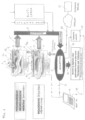
- the Figure 1 shows an embodiment of a device according to the invention for examining a human patient 1 who can sit on a carrier 2.
- the two superimposed representations of the different positions of the carrier 2 relate to one and the same facility at two different times.
- psychological, neurological, mental diagnoses are made
- biological, physical diagnoses are made
- a display device 3 designed as a screen is provided, which can be seen by the patient lying on the carrier 2 (upper position in Figure 1 ). Furthermore, a measuring device 4 for recording measurement data of the patient 1 and an evaluation device 5, which is connected to the display device 3 and the measuring device 4 via schematically shown lines 5.
- both the display device 3 and at least one sensor 4a of the measuring device 4 are movably mounted relative to the carrier 2 for the patient 1.
- the measuring device is a thermal scanner, wherein the sensor 4a is an infrared sensor.
- the measuring device in the form of the thermal scanner is mounted on a holder 6 in the form of a carriage and is guided linearly in the direction of the arrows 7 so as to be longitudinally movable.
- the holder 6 is a common holder for the thermal scanner 4 and the display device 3. To move the holder from the scanning position in the middle of the Figure 1 in the upper position in Figure 1 To bring the patient into the right position, it can be swivelled in the direction of arrows 8, allowing the patient to see the display device or screen. This can be easily constructed in Figure 1
- the solution shown can be implemented in that the holder 6 has a movable base part and a pivoting part pivotably mounted thereon, which carries the display device 3 and the measuring device 4 or its sensor 4a.
- the display device can also be assigned at least one loudspeaker (not shown). This can be arranged either on the fixed part of the device or on the movable carriage. It is also possible for the loudspeaker to be housed in a headset.
- the patient is presented with an audiovisual image or an audiovisual image sequence and Afterwards or at the same time, the patient's measurement data is recorded.
- This is reactive measurement data that provides information about the patient's psychological health. For example, you can play stressful and conflict situations for the patient and check their reaction. You can also play colors and check their reaction.
- the screen 3 is designed as a touch screen and can thus simultaneously serve as an input device.
- further mental measurement data can be recorded, for example using a camera suitable for eye tracking and/or a microphone to record the patient's sounds.
- measurement data can also be temporarily stored during consecutive examinations in order to be able to perform the correlation with other data described below.
- the display device 3 and the sensor 4a of the measuring device 4 are mounted in a motor-movable manner on a support device 9, which can be accommodated in a visually appealing housing.
- the support device 9 can also carry the carrier 2 for the patient. However, it is also possible that this carrier 2 as in Figure 1 shown, rests directly on the floor. Then the support device or the housing 9 and the support 2 for the patient are arranged above the floor of the room in a fixed spatial relationship to one another.
- an additional display device 10 can be provided, which can be swung out of the housing in the direction of arrow 11 or, when not in use, can be swung back in flush with the housing.
- a receptacle 12 in the support device 9 or in the housing thereof, which is easily accessible from the patient side. Additional sensors of other medical measuring devices can be accommodated in this receptacle 12, as can be seen from the following Figures 2 and 3 will be described in more detail.
- the support 2 for the patient 1 is designed as a multi-part seat-bed, the parts of which are motor-adjustable in their position.
- the lounger is preferably designed in three parts with a chest part, a middle part and a foot part, as the Figures 1 to 3 show clearly.
- the Figure 1 also shows that the seat can be adjusted to a sitting position (upper position in Figure 1 ) with the display device pivoted down so that the patient's head is at substantially the same height as the display device. This corresponds essentially to the normal television or screen viewing position.
- An alternative would be one in which the seat and the display device can be brought into a position in which the patient looks essentially straight ahead at the display device. This would be possible, for example, if the patient is lying flat and still needs to see something on the screen.
- the device for examining the human patient 1 has at least two, preferably several different measuring devices, each of which provides measurement data relating to the patient's condition.
- An electronic evaluation device 5 is also provided, which determines output signals depending on measurement data originating from at least two different measuring devices and their interrelation (correlation), which then, like the Figure 1 shows, for example, can be fed to a computer intended for a doctor (doctor's PC 14) via a line 13.
- the output signals can also be fed as control data for one or more therapy devices 15 via a line 16.
- the output signals can be passed on to the doctor, therapist or patient in a report in digital or printed form, if necessary together with a therapy suggestion.
- the evaluation device can also work partially decentrally, whereby an external server located at another location can also be accessed via a schematically shown line 17 and communication means not shown in more detail (for example via the Internet).
- This external server can provide computing power, but above all it can also store reference data that allow the patient's recorded measurement data to be evaluated for diagnosis.
- the doctor is always the one who can intervene in the therapy suggestion or the automatic therapy, for example via line 19.
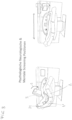
- FIG 2 The patient is lying on his back in the upper left corner.
- the blood pressure is measured using a blood pressure monitor 4' with arm cuff and measurement data processing.
- An electrocardiogram can be recorded using an ECG device 4" with electrodes 20.
- an image can be generated using the thermal scanner 4, which can be moved linearly in the direction of the double arrow 7.
- the support device 9 has a receptacle 12 (in a visually appealing elliptical shape) in which the various measuring devices or their sensors are accommodated.
- the patient can be influenced by sound or by changing the color in the room, for example, and it can be determined which reactions the recorded measurement data then show.
- Figures 2 and 3 Not all possible connections of measuring devices are shown. In principle, all devices listed above can be used partially, one after the other and mostly simultaneously.
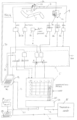
- the electronic evaluation device 5 is fed with mental measurement data, which reflect the psychological state of the patient, on the one hand, and physical measurement data, which reflect the physical state of the patient, on the other hand, whereby the electronic evaluation device 5 determines output signals from the mental measurement data and the physical measurement data and their interrelation (correlation), which can then fulfil further functions via lines 13, 16, 17, 22, as already shown in the Figure 1 has been briefly described and based on the Figures 4 and 5 will be described in more detail.
- the seat 2 can be brought into a lying position and an ECG can be created, blood pressure measured and certain parameters, such as blood sugar, can be determined in a blood laboratory using measuring devices or sensors that are not shown in detail here but are generally known. Essentially, these are physical measurement data, which are then fed to the electronic evaluation device 5.
- audiovisual images can be shown to the patient via the screen 2 and a loudspeaker (not shown). His reaction can then be recorded, for example, via a camera 22 (eye tracking).
- a speech analysis is also possible, in which the patient is asked, for example, to answer a given text or an answer to a question shown in a picture.
- the microphone 24 records the speech and can carry out a speech analysis.
- An electroencephalogram (EEG) as used, for example, in the Figure 3 shown on the left can be created.
- EEG electroencephalogram
- Figure 4 is shown using a simplified example how a correlation of a type of physical measurement data (here blood pressure B) with a set of mental measurement data (here eye tracking A) leads to defined output signals on the output lines 25 of the electronic evaluation device 5.
- a type of physical measurement data here blood pressure B
- a set of mental measurement data here eye tracking A
- each field of the correlation matrix assigning a unique value of the output signal to a value pair W, A, whereby, as shown in the present example, this can also be several values, for example three output values on the output lines 25. For example, there can be three values that control a therapy device 15 via the collecting line 16. However, the values can also be processed in the output unit 27 for output to a printer 28 or a screen 29. Processing for the doctor WC 14 and transmission of the data from the transfer line 13 is also possible.
- the doctor can then decide whether he wants to share all or part of the data with the patient and, if necessary, display it on the additional screen 10.
- the doctor can control the entire measurement data acquisition process, in particular the scanning process, via the line 30.
- the doctor's PC 14 can also communicate with other components, in particular the electronic evaluation device 5, via wired or wireless connections. It can also be connected to decentralized external servers via the Internet. The same applies to the electronic evaluation device, which can itself be supplied with reference data REF from an external source directly via the Internet. This is also possible via the Internet in particular.
- the values in the correlation matrix are determined via an external reference input REF. It is also possible that in the A function is stored in the correlation matrix which determines the corresponding matrix element or set of matrix elements from the numerically expressed measurement data and a known functional relationship and outputs it via the output lines 25.
- the matrix is only two-dimensional because only two selected measurement data were shown.
- the matrix will of course be three-dimensional (which can then no longer be represented graphically).
- physical measurement data or their associated numerical values and mental measurement data or their associated numerical values can be correlated with one another and processed into output signals.
- a measurement (here ECG) produces, among other things, several partial results, which are then available separately as numerical measurement data values.
- the position of certain sections of the ECG can be determined more easily automatically.
- this is Figure 4 Shown in the middle left, where the numerical evaluation resulted in the value 1.
- the doctor is connected via the "assessment lines 31". He then sees the ECG on the PC 14 and can assess it numerically, for example with the number 6, as shown in the example. A fully automated correlation can then be carried out again.
- the mental measurement data on the one hand and the physical measurement data on the other hand originate at least partially from different measuring devices that are specially adapted for the respective task area.
- one and the same measuring device can be used for both purposes, i.e. for determining physical measurement data and for determining mental measurement data.
- a device for non-invasive and contactless influencing of the patient is provided and at least one measuring device is designed to record the patient's reaction and to output reactive measurement data dependent thereon, which are then used as mental measurement data.
- the patient can be influenced by a sequence of images or videos and the reaction can be viewed on the ECG to obtain mental measurements.
- the same ECG can record physical measurements.
- reactive measurement data are used as mental measurement data.
- a significant advantage of the device according to the invention is that it is able to link mental and physical measurement data and provide output signals depending on this correlation. This makes it possible to obtain a comprehensive overall picture of the patient's state of health and to communicate this to the doctor, therapist and patient. It is also possible to use this data as control signals for connected therapy devices.
- FIGS. 6 and 7 show in separate illustrations the biological screening for determining physical measurement data and the psychological screening for determining mental measurement data that reflect the psychological state of the patient.
- the "Full Body Screening" system is able to convert the patient data from his biological and mental or psychological areas, which are determined and analyzed in a very short time, into a technical machine language after the correlation calculation has been carried out, which can also be carried out via a central server, and to transmit it automatically to a wide variety of therapeutic equipment.
- the connected equipment is controlled using "If Then" commands, whereby the doctor or therapist has the option to intervene in the course of therapy at any time should he or she deem it necessary.
- the various pieces of equipment send the results back to the central server or evaluation device after the therapy has been carried out.
- This result check is determined by sensors built into the equipment, such as HRV - EEG - ECG - magnetic impedance measurements - microcurrent measurements - motion sensors - blood pressure and blood oxygen measurements - frequency measurements, etc.
- the data can also be sent "just in time” to an intermediate telemedicine center and checked there by specialists and medical staff.
- a further correlation run is preferably carried out after the treatment in order to be able to compare the results of the therapy with the initial data and, if necessary, to be able to adapt the therapy.
- the screening system determines people's health status in a holistic manner never seen before.
- the screening system is able to detect not only the symptoms but also many causes and misbehaviors that lead to an illness and to provide targeted therapies.
- a further advantage of the system according to the invention is the fact that this system can compare all the parameters determined with numerous comparative data and, using a special algorithm, in particular matrix calculation, finds out what future course the determined vitality or health or illness status will take. This can simulate how the person's condition changes if they continue to live as normal or what happens if they change their lifestyle.
- the screening system can also detect food intolerances with a level of precision never seen before in this combination.
- the general intolerance is tested using a whole-body scan using photons from tissue and magnetic fields and energy density measurements.
- the intolerance is tested using blood tests and a breath test.
- a special HRV (heart rate variability) analysis deepens and confirms the test result. This results in a level of analysis and diagnosis quality that is otherwise only possible with many different examinations, usually by different specialists.
- the system is also able to detect intolerances to medications and to suggest compatible alternatives using the many comparison parameters integrated into the system.
- Incompatible medications are identified and can be replaced with compatible medications and treatment methods.
- the system is not only capable of producing excellent analyses and diagnoses, but also - and this is also unique worldwide - of treating these analyses and diagnoses using various methods directly on the device or of suggesting therapies automatically.
- the user of the system saves time and various trips to various specialists and can immediately receive comprehensive treatment based on the latest findings.
- the data and facts obtained via the system can be transmitted to a telemedicine center in real time.
- the analysis and diagnosis program of the screening facility not only presents all health and disease facts, but also suggests the best possible treatment methods.
- the reviewed report is now sent to the treating physician or to the medical staff on site who are in direct contact with the patient or guest.
- the medical staff Due to the high quality of the data and facts collected, as well as the diagnoses and treatment recommendations made by the system, as well as the overall control by the telemedicine center or a doctor on site, the medical staff receives the best possible documents to treat and care for the patient/guest.
- This information is particularly important for young and inexperienced doctors in order to prevent misdiagnoses and incorrect treatments.
- the analyses, diagnoses and treatment recommendations provided to patients via the facility are completely new, especially the fact. that all these results of the analyses, the diagnoses, the risk parameters and also the recommended treatments can be communicated in a language that is understandable to any layperson.
- the system can automatically translate all information and all medical terms into the patient/guest's native language.
- the doctor or medical staff receives all data in a familiar medical format, with the scope of the information being unique due to the information density and data quality.
- the user of the system receives all information in an understandable, partly graphic and pictorially animated manner in his or her native language and can understand and utilize this information very well.
- the doctor receives significantly more information about the patient/guest in a very short time and can therefore tailor his treatment much more specifically.
- the following screenings can essentially be carried out synchronously during the examination in a very short time and can collect comprehensive data which can then be immediately transmitted to the medical staff in the form of a treatment recommendation.
- HRV measurements photon measurements, energy density measurements and thermal sensors with imaging are used.
Landscapes
- Health & Medical Sciences (AREA)
- Life Sciences & Earth Sciences (AREA)
- Engineering & Computer Science (AREA)
- Animal Behavior & Ethology (AREA)
- Public Health (AREA)
- Veterinary Medicine (AREA)
- Biophysics (AREA)
- Pathology (AREA)
- Physics & Mathematics (AREA)
- Biomedical Technology (AREA)
- Heart & Thoracic Surgery (AREA)
- Medical Informatics (AREA)
- Molecular Biology (AREA)
- Surgery (AREA)
- General Health & Medical Sciences (AREA)
- Cardiology (AREA)
- Psychiatry (AREA)
- Physiology (AREA)
- Child & Adolescent Psychology (AREA)
- Radiology & Medical Imaging (AREA)
- Nuclear Medicine, Radiotherapy & Molecular Imaging (AREA)
- Pulmonology (AREA)
- Developmental Disabilities (AREA)
- Educational Technology (AREA)
- Hospice & Palliative Care (AREA)
- Psychology (AREA)
- Social Psychology (AREA)
- Measuring And Recording Apparatus For Diagnosis (AREA)
- Measurement And Recording Of Electrical Phenomena And Electrical Characteristics Of The Living Body (AREA)
- Measurement Of The Respiration, Hearing Ability, Form, And Blood Characteristics Of Living Organisms (AREA)
Claims (13)
- Dispositif servant à l'examen d'un patient humain (1), avec au moins deux, de préférence plusieurs dispositifs de mesure différents qui délivrent des données de mesure relatives à l'état du patient, dans lequel un dispositif d'évaluation électronique est prévu, lequel est conçu de sorte qu'il détermine en fonction de données de mesure provenant d'au moins deux dispositifs de mesure différents et leur corrélation des signaux de sortie, dans lequel au dispositif d'évaluation électronique sont fournies d'une part des données de mesure mentales qui reproduisent l'état psychique du patient, et d'autre part des données de mesure corporelles qui reproduisent l'état corporel du patient, dans lequel le dispositif d'évaluation (5) électronique est conçu de sorte qu'il détermine à partir des données de mesure mentales et des données de mesure corporelles et leur corrélation des signaux de sortie,dans lequel les données de mesure mentales d'une part et les données de mesure corporelles d'autre part proviennent au moins partiellement de dispositifs de mesure différents, dans lequel un dispositif d'intervention non invasif et sans contact du patient est prévu et au moins un dispositif de mesure est orienté de sorte qu'il détecte la réaction du patient et délivre des données de mesure réactives qui en dépendent,et les données de mesure réactives sont utilisées comme données de mesure mentales, dans lequel un dispositif de saisie utilisable par le patient, en particulier sous la forme d'un écran tactile (3), présente, dans lequel les données de mesure réactives correspondent au moins partiellement aux données de saisie saisies dans le dispositif de saisie,caractérisé en ce que les données de mesure réactives proviennent non seulement du dispositif de saisie (3) mais aussi d'au moins un des dispositifs de mesure suivants :- un dispositif d'électrocardiographie (ECG),- un dispositif de mesure de courant fin,- un dispositif de mesure de variabilité de fréquence cardiaque (VFC),- un dispositif d'analyse de fréquence d'organes,- un dispositif de mesure de photons en tissu biologique,- un dispositif de mesure magnétique et d'impédance de tissu biologique,- un dispositif d'électroencéphalographie (EEG),- un dispositif d'électroneurographie (ENG),- un dispositif de détection vidéo de la marche du patient, et en ce qu'au moins un dispositif thérapeutique (15) est prévu, l'au moins une partie des signaux de sortie est fournie au dispositif d'évaluation (5) électronique comme signaux de commande, en fonction desquels le dispositif thérapeutique est conçu afin de travailler différemment.
- Dispositif selon la revendication 1, caractérisé en ce que les dispositifs de mesure comprennent au moins deux des dispositifs de mesure suivants :- un dispositif d'électrocardiographie (ECG),- un dispositif de mesure de courant fin,- un dispositif de mesure de la saturation en oxygène dans le sang,- un dispositif de Thermoscan à infrarouge,- un dispositif de mesure de pression artérielle,- un dispositif de mesure de la variabilité de fréquence cardiaque (VFC),- un dispositif d'analyse du sang,- un dispositif d'analyse de fréquence d'organes,- un dispositif de mesure de photons de tissu biologique,- un dispositif de mesure magnétique et d'impédance de tissu biologique,- un dispositif d'examen de la peau et/ou des dents au moyen de la détection par imagerie,- un dispositif d'examen et d'analyse de l'air de respiration,- un dispositif de mesure à ultrasons,- un dispositif d'électroencéphalographie (EEG),- un dispositif d'électromyographie (EMG),- un dispositif d'électroneurographie (ENG),- un dispositif de saisie utilisable par le patient,- un dispositif de détection vidéo de la marche du patient.
- Dispositif selon la revendication 1 ou 2, caractérisé en ce que les données de mesure corporelles proviennent d'au moins un des dispositifs de mesure suivants :- un dispositif d'électrocardiographie (ECG),- un dispositif de mesure de courant fin,- un dispositif de mesure de la saturation en oxygène dans le sang,- un dispositif de Thermoscan à infrarouge,- un dispositif de mesure de pression artérielle,- un dispositif de mesure de la variabilité de fréquence cardiaque (VFC),- un dispositif d'analyse du sang,- un dispositif d'analyse de fréquence d'organes,- un dispositif de mesure de photons de tissu biologique,- un dispositif de mesure magnétique et d'impédance de tissu biologique,- un dispositif d'examen de la peau et/ou des dents au moyen de la détection par imagerie,- un dispositif d'examen et d'analyse de l'air de respiration,- un dispositif de mesure à ultrasons,- un dispositif d'électromyographie (EMG).
- Dispositif selon l'une quelconque des revendications 1 à 3, caractérisé en ce que le dispositif de manipulation du patient comprend un écran (3) et/ou un haut-parleur.
- Dispositif selon l'une quelconque des revendications 1 à 4, caractérisé en ce qu'au moins un dispositif d'affichage (14) pour le médecin, au moins un dispositif d'affichage (10) pour le patient et/ou au moins un dispositif d'impression (28) sont (est) prévus, auxquels respectivement des signaux de sortie du dispositif d'évaluation (5) électronique sont fournis pour l'affichage présenté graphiquement et/ou l'impression.
- Dispositif servant à l'examen d'un patient humain (1) avec un support (2) pour le patient (1), au moins un dispositif d'affichage (3) - réalisé en particulier comme écran - qui peut être vu par le patient (1) se trouvant sur le support (2), au moins un dispositif de mesure (4) pour la détection de données de mesure du patient (1) ainsi qu'un dispositif d'évaluation qui est en liaison avec le dispositif d'affichage (3) et le dispositif de mesure (4), selon l'une quelconque des revendications 1 à 5, caractérisé en ce qu'au moins un dispositif d'affichage et au moins un capteur (4a) d'un dispositif de mesure (4) sont logés de manière mobile par rapport au support (2) pour le patient (1).
- Dispositif selon la revendication 6, caractérisé en ce qu'au moins un dispositif d'affichage et au moins un capteur (4a) d'un dispositif de mesure (4) sont logés de manière mobile sur un support (6) commun, en particulier un chariot.
- Dispositif selon l'une quelconque des revendications 6 ou 7, caractérisé en ce que l'au moins un dispositif de mesure comprend un thermoscanner médical, une caméra - appropriée en particulier à l'oculométrie et/ou un microphone pour la prise de sons du patient.
- Dispositif selon l'une quelconque des revendications 6 à 8, caractérisé en ce que l'au moins un dispositif d'affichage (3) et l'au moins un capteur (4a) d'un dispositif de mesure (4) sont logés de manière mobile sous l'action d'un moteur au niveau d'un dispositif de support (9).
- Dispositif selon l'une quelconque des revendications 6 à 9, caractérisé par un logement (12) - réalisé en particulier comme compartiment de réception - pour au moins un autre dispositif de mesure, dans lequel le logement de préférence d'un dispositif de support (9) est réalisé, lequel porte aussi de manière mobile le dispositif d'affichage et le capteur au niveau du dispositif de mesure.
- Dispositif selon l'une quelconque des revendications 6 à 10, caractérisé en ce que le support (2) pour le patient (1) est réalisé comme lit pliable en plusieurs parties, dont les parties sont réglables dans leur position - de préférence de manière motorisée -, dans lequel le lit pliable est de préférence réalisé en trois parties avec une partie torse, une partie médiane et une partie pied.
- Dispositif selon la revendication 11, caractérisé en ce que le lit pliable peut être amené dans une position d'assise et le dispositif d'affichage peut être amené dans une position, dans laquelle la tête du patient se trouve sensiblement à la même hauteur que le dispositif d'affichage.
- Dispositif selon l'une quelconque des revendications 11 ou 12, caractérisé en ce que le lit pliable et le dispositif d'affichage sont mobiles dans une position, dans laquelle le patient regarde sensiblement tout droit sur le dispositif d'affichage.
Priority Applications (1)
| Application Number | Priority Date | Filing Date | Title |
|---|---|---|---|
| HRP20241612TT HRP20241612T1 (hr) | 2016-12-06 | 2017-12-04 | Uređaj za pregledavanje ljudskog pacijenta |
Applications Claiming Priority (2)
| Application Number | Priority Date | Filing Date | Title |
|---|---|---|---|
| ATA51109/2016A AT519424A1 (de) | 2016-12-06 | 2016-12-06 | Einrichtung zur Untersuchung eines menschlichen Patienten |
| PCT/AT2017/060320 WO2018102840A1 (fr) | 2016-12-06 | 2017-12-04 | Dispositif servant à l'examen d'un patient humain |
Publications (3)
| Publication Number | Publication Date |
|---|---|
| EP3551044A1 EP3551044A1 (fr) | 2019-10-16 |
| EP3551044C0 EP3551044C0 (fr) | 2024-10-16 |
| EP3551044B1 true EP3551044B1 (fr) | 2024-10-16 |
Family
ID=60813550
Family Applications (1)
| Application Number | Title | Priority Date | Filing Date |
|---|---|---|---|
| EP17821776.6A Active EP3551044B1 (fr) | 2016-12-06 | 2017-12-04 | Dispositif servant à l'examen d'un patient humain |
Country Status (4)
| Country | Link |
|---|---|
| EP (1) | EP3551044B1 (fr) |
| AT (2) | AT519424A1 (fr) |
| HR (1) | HRP20241612T1 (fr) |
| WO (1) | WO2018102840A1 (fr) |
Families Citing this family (1)
| Publication number | Priority date | Publication date | Assignee | Title |
|---|---|---|---|---|
| AT526119A1 (de) * | 2022-05-03 | 2023-11-15 | Skrabal Dr Falko | Diagnosesystem |
Family Cites Families (12)
| Publication number | Priority date | Publication date | Assignee | Title |
|---|---|---|---|---|
| US5441047A (en) * | 1992-03-25 | 1995-08-15 | David; Daniel | Ambulatory patient health monitoring techniques utilizing interactive visual communication |
| US5640953A (en) * | 1995-03-09 | 1997-06-24 | Siemens Medical Systems, Inc. | Portable patient monitor reconfiguration system |
| WO2002013679A2 (fr) * | 2000-08-11 | 2002-02-21 | Healthetech, Inc. | Obtention d'un etat detendu |
| TW510789B (en) * | 2001-03-01 | 2002-11-21 | Sanyo Electric Co | Massage machine and physiological quantity measuring device used in the same |
| JP4105472B2 (ja) * | 2002-04-12 | 2008-06-25 | 株式会社フィジオン | 身体組成測定装置 |
| US7410138B2 (en) * | 2003-03-14 | 2008-08-12 | Tgr Intellectual Properties, Llc | Display adjustably positionable about swivel and pivot axes |
| JP3959644B2 (ja) * | 2003-09-30 | 2007-08-15 | 英宏 藤江 | 歯科診療装置 |
| US8083676B2 (en) * | 2005-01-05 | 2011-12-27 | Halliday Thomas S | Apparatus and system for collection and storage of vital signs medical information and methods related thereto |
| US20110270050A1 (en) * | 2010-05-03 | 2011-11-03 | Morteza Naghavi | Self Administered Health Assessment Method and Apparatus |
| DE102012023528A1 (de) * | 2012-11-30 | 2014-06-05 | Horst-W. Spechtmeyer | Arbeitsplatz für psychoneurologische Behandlung |
| US10779747B2 (en) * | 2013-03-15 | 2020-09-22 | Cerora, Inc. | System and signatures for the multi-modal physiological stimulation and assessment of brain health |
| KR102471442B1 (ko) * | 2014-11-11 | 2022-11-25 | 글로벌 스트레스 인덱스 피티와이 엘티디 | 개인의 스트레스 레벨 및 스트레스 내성 레벨 정보를 생성하기 위한 시스템 및 방법 |
-
2016
- 2016-12-06 AT ATA51109/2016A patent/AT519424A1/de active IP Right Grant
- 2016-12-06 AT ATGM8040/2018U patent/AT16350U1/de unknown
-
2017
- 2017-12-04 EP EP17821776.6A patent/EP3551044B1/fr active Active
- 2017-12-04 WO PCT/AT2017/060320 patent/WO2018102840A1/fr not_active Ceased
- 2017-12-04 HR HRP20241612TT patent/HRP20241612T1/hr unknown
Also Published As
| Publication number | Publication date |
|---|---|
| EP3551044A1 (fr) | 2019-10-16 |
| WO2018102840A1 (fr) | 2018-06-14 |
| EP3551044C0 (fr) | 2024-10-16 |
| AT519424A1 (de) | 2018-06-15 |
| AT16350U1 (de) | 2019-07-15 |
| HRP20241612T1 (hr) | 2025-02-28 |
Similar Documents
| Publication | Publication Date | Title |
|---|---|---|
| DE102015226669B4 (de) | Verfahren und System zum Ausgeben einer Erweiterte-Realität-Information | |
| EP2595531B1 (fr) | Appareil de traitement par dialyse comprenant un dispositif de dialyse et un support de patient avec un dispositif de mesure de bio-impédance pour commander et/ou régler le dispositif de dialyse | |
| EP4081116B1 (fr) | Procédé et agencement pour générer un signal ecg | |
| DE102014205313B4 (de) | Verfahren zur Registrierung einer Nahinfrarotspektroskopiekarte und eines Anatomiebilddatensatzes und Röntgeneinrichtung | |
| DE102017221276A1 (de) | Medizinische Bildverarbeitungsvorrichtung, Röntgen-CT Vorrichtung und medizinisches Bildverarbeitungsverfahren | |
| Perlman et al. | Emotional face processing in pediatric bipolar disorder: evidence for functional impairments in the fusiform gyrus | |
| DE202017107196U1 (de) | Medizinische Bildverarbeitungsvorrichtung, Röntgen-CT Vorrichtung und Computerprogrammprodukt | |
| AT520485A1 (de) | Verfahren zum automatischen Erfassen einer Grundposition einer auf einer Matratze liegenden Person und zum Erzeugen einer Grafikdarstellung dieser Person | |
| DE102008037558A1 (de) | System und Verfahren zum Diagnostizieren eines medizinischen Zustands | |
| Knott | Quantitative EEG methods and measures in human psychopharmacological research | |
| EP4518750A1 (fr) | Système de diagnostic | |
| DE102008021940A1 (de) | Stimulationsanordnung zur Messung der physiologischen Signalreaktivität | |
| Mucci et al. | Hemispheric lateralization patterns and psychotic experiences in healthy subjects | |
| EP3551042B1 (fr) | Dispositif servant à l'examen d'un patient humain | |
| Wu et al. | The effects of swLORETA Z-score neurofeedback for patients comorbid with major depressive disorder and anxiety symptoms | |
| Lima et al. | Analysis of brain activation and wave frequencies during a sentence completion task: a paradigm used with EEG in aphasic participants | |
| EP3551044A1 (fr) | Dispositif servant à l'examen d'un patient humain | |
| Simis et al. | Distinct patterns of metabolic motor cortex activity for phantom and residual limb pain in people with amputations: A functional near-infrared spectroscopy study | |
| DE202016105331U1 (de) | System zur Durchführung einer körperlichen Fernuntersuchung | |
| DE102007011467A1 (de) | Auswertung eines physischen Belastungstests | |
| Corradini et al. | Replace Psychometric Inferences with Direct Brain Measurements: LORETA Reflects Traditional Cerebral Loci for Neuropsychological Tests | |
| Zich et al. | Stroke recovery beyond initial severity: The complementary roles of brain structure and brain function in acute stroke | |
| DE102018107080A1 (de) | Vorrichtung und System zum Erzeugen mindestens eines Injektionsparameters für einen Kontrastmittelinjektor für eine Computertomographieaufnahme sowie Verfahren damit | |
| Montgomery et al. | Neural and Circulatory Monitoring of Cognition | |
| Bermúdez | Neural Correlates of Motor Imagery |
Legal Events
| Date | Code | Title | Description |
|---|---|---|---|
| REG | Reference to a national code |
Ref country code: HR Ref legal event code: TUEP Ref document number: P20241612T Country of ref document: HR |
|
| STAA | Information on the status of an ep patent application or granted ep patent |
Free format text: STATUS: UNKNOWN |
|
| STAA | Information on the status of an ep patent application or granted ep patent |
Free format text: STATUS: THE INTERNATIONAL PUBLICATION HAS BEEN MADE |
|
| PUAI | Public reference made under article 153(3) epc to a published international application that has entered the european phase |
Free format text: ORIGINAL CODE: 0009012 |
|
| STAA | Information on the status of an ep patent application or granted ep patent |
Free format text: STATUS: REQUEST FOR EXAMINATION WAS MADE |
|
| 17P | Request for examination filed |
Effective date: 20190624 |
|
| AK | Designated contracting states |
Kind code of ref document: A1 Designated state(s): AL AT BE BG CH CY CZ DE DK EE ES FI FR GB GR HR HU IE IS IT LI LT LU LV MC MK MT NL NO PL PT RO RS SE SI SK SM TR |
|
| AX | Request for extension of the european patent |
Extension state: BA ME |
|
| DAV | Request for validation of the european patent (deleted) | ||
| DAX | Request for extension of the european patent (deleted) | ||
| STAA | Information on the status of an ep patent application or granted ep patent |
Free format text: STATUS: EXAMINATION IS IN PROGRESS |
|
| 17Q | First examination report despatched |
Effective date: 20220901 |
|
| GRAP | Despatch of communication of intention to grant a patent |
Free format text: ORIGINAL CODE: EPIDOSNIGR1 |
|
| STAA | Information on the status of an ep patent application or granted ep patent |
Free format text: STATUS: GRANT OF PATENT IS INTENDED |
|
| INTG | Intention to grant announced |
Effective date: 20240603 |
|
| GRAS | Grant fee paid |
Free format text: ORIGINAL CODE: EPIDOSNIGR3 |
|
| GRAA | (expected) grant |
Free format text: ORIGINAL CODE: 0009210 |
|
| STAA | Information on the status of an ep patent application or granted ep patent |
Free format text: STATUS: THE PATENT HAS BEEN GRANTED |
|
| AK | Designated contracting states |
Kind code of ref document: B1 Designated state(s): AL AT BE BG CH CY CZ DE DK EE ES FI FR GB GR HR HU IE IS IT LI LT LU LV MC MK MT NL NO PL PT RO RS SE SI SK SM TR |
|
| REG | Reference to a national code |
Ref country code: GB Ref legal event code: FG4D Free format text: NOT ENGLISH |
|
| REG | Reference to a national code |
Ref country code: DE Ref legal event code: R096 Ref document number: 502017016499 Country of ref document: DE Ref country code: CH Ref legal event code: EP |
|
| REG | Reference to a national code |
Ref country code: IE Ref legal event code: FG4D Free format text: LANGUAGE OF EP DOCUMENT: GERMAN |
|
| U01 | Request for unitary effect filed |
Effective date: 20241104 |
|
| U07 | Unitary effect registered |
Designated state(s): AT BE BG DE DK EE FI FR IT LT LU LV MT NL PT RO SE SI Effective date: 20241113 |
|
| PGFP | Annual fee paid to national office [announced via postgrant information from national office to epo] |
Ref country code: GB Payment date: 20241122 Year of fee payment: 8 |
|
| REG | Reference to a national code |
Ref country code: HR Ref legal event code: ODRP Ref document number: P20241612T Country of ref document: HR Payment date: 20241126 Year of fee payment: 8 |
|
| PGFP | Annual fee paid to national office [announced via postgrant information from national office to epo] |
Ref country code: HR Payment date: 20241126 Year of fee payment: 8 |
|
| U20 | Renewal fee for the european patent with unitary effect paid |
Year of fee payment: 8 Effective date: 20241223 |
|
| REG | Reference to a national code |
Ref country code: HR Ref legal event code: T1PR Ref document number: P20241612 Country of ref document: HR |
|
| REG | Reference to a national code |
Ref country code: HR Ref legal event code: PPPP Ref document number: P20241612 Country of ref document: HR Owner name: HEINZ SCHLETTERER, AT |
|
| RAP2 | Party data changed (patent owner data changed or rights of a patent transferred) |
Owner name: SCHLETTERER, HEINZ Owner name: SCHLETTERER CONSULT GMBH |
|
| U1H | Name or address of the proprietor changed after the registration of the unitary effect |
Owner name: SCHLETTERER, HEINZ; AT |
|
| PG25 | Lapsed in a contracting state [announced via postgrant information from national office to epo] |
Ref country code: IS Free format text: LAPSE BECAUSE OF FAILURE TO SUBMIT A TRANSLATION OF THE DESCRIPTION OR TO PAY THE FEE WITHIN THE PRESCRIBED TIME-LIMIT Effective date: 20250216 |
|
| PG25 | Lapsed in a contracting state [announced via postgrant information from national office to epo] |
Ref country code: ES Free format text: LAPSE BECAUSE OF FAILURE TO SUBMIT A TRANSLATION OF THE DESCRIPTION OR TO PAY THE FEE WITHIN THE PRESCRIBED TIME-LIMIT Effective date: 20241016 |
|
| PG25 | Lapsed in a contracting state [announced via postgrant information from national office to epo] |
Ref country code: NO Free format text: LAPSE BECAUSE OF FAILURE TO SUBMIT A TRANSLATION OF THE DESCRIPTION OR TO PAY THE FEE WITHIN THE PRESCRIBED TIME-LIMIT Effective date: 20250116 |
|
| PG25 | Lapsed in a contracting state [announced via postgrant information from national office to epo] |
Ref country code: GR Free format text: LAPSE BECAUSE OF FAILURE TO SUBMIT A TRANSLATION OF THE DESCRIPTION OR TO PAY THE FEE WITHIN THE PRESCRIBED TIME-LIMIT Effective date: 20250117 |
|
| PGFP | Annual fee paid to national office [announced via postgrant information from national office to epo] |
Ref country code: CH Payment date: 20250101 Year of fee payment: 8 |
|
| PG25 | Lapsed in a contracting state [announced via postgrant information from national office to epo] |
Ref country code: PL Free format text: LAPSE BECAUSE OF FAILURE TO SUBMIT A TRANSLATION OF THE DESCRIPTION OR TO PAY THE FEE WITHIN THE PRESCRIBED TIME-LIMIT Effective date: 20241016 |
|
| PG25 | Lapsed in a contracting state [announced via postgrant information from national office to epo] |
Ref country code: RS Free format text: LAPSE BECAUSE OF FAILURE TO SUBMIT A TRANSLATION OF THE DESCRIPTION OR TO PAY THE FEE WITHIN THE PRESCRIBED TIME-LIMIT Effective date: 20250116 |
|
| PG25 | Lapsed in a contracting state [announced via postgrant information from national office to epo] |
Ref country code: SM Free format text: LAPSE BECAUSE OF FAILURE TO SUBMIT A TRANSLATION OF THE DESCRIPTION OR TO PAY THE FEE WITHIN THE PRESCRIBED TIME-LIMIT Effective date: 20241016 |
|
| PG25 | Lapsed in a contracting state [announced via postgrant information from national office to epo] |
Ref country code: MC Free format text: LAPSE BECAUSE OF FAILURE TO SUBMIT A TRANSLATION OF THE DESCRIPTION OR TO PAY THE FEE WITHIN THE PRESCRIBED TIME-LIMIT Effective date: 20241016 |
|
| PG25 | Lapsed in a contracting state [announced via postgrant information from national office to epo] |
Ref country code: SK Free format text: LAPSE BECAUSE OF FAILURE TO SUBMIT A TRANSLATION OF THE DESCRIPTION OR TO PAY THE FEE WITHIN THE PRESCRIBED TIME-LIMIT Effective date: 20241016 |
|
| PG25 | Lapsed in a contracting state [announced via postgrant information from national office to epo] |
Ref country code: CZ Free format text: LAPSE BECAUSE OF FAILURE TO SUBMIT A TRANSLATION OF THE DESCRIPTION OR TO PAY THE FEE WITHIN THE PRESCRIBED TIME-LIMIT Effective date: 20241016 |
|
| PLBE | No opposition filed within time limit |
Free format text: ORIGINAL CODE: 0009261 |
|
| STAA | Information on the status of an ep patent application or granted ep patent |
Free format text: STATUS: NO OPPOSITION FILED WITHIN TIME LIMIT |
|
| 26N | No opposition filed |
Effective date: 20250717 |
|
| PG25 | Lapsed in a contracting state [announced via postgrant information from national office to epo] |
Ref country code: IE Free format text: LAPSE BECAUSE OF NON-PAYMENT OF DUE FEES Effective date: 20241204 |
|
| U20 | Renewal fee for the european patent with unitary effect paid |
Year of fee payment: 9 Effective date: 20251222 |
|
| PG25 | Lapsed in a contracting state [announced via postgrant information from national office to epo] |
Ref country code: CY Free format text: LAPSE BECAUSE OF FAILURE TO SUBMIT A TRANSLATION OF THE DESCRIPTION OR TO PAY THE FEE WITHIN THE PRESCRIBED TIME-LIMIT; INVALID AB INITIO Effective date: 20171204 |
|
| PG25 | Lapsed in a contracting state [announced via postgrant information from national office to epo] |
Ref country code: TR Free format text: LAPSE BECAUSE OF FAILURE TO SUBMIT A TRANSLATION OF THE DESCRIPTION OR TO PAY THE FEE WITHIN THE PRESCRIBED TIME-LIMIT Effective date: 20241016 |
|
| PG25 | Lapsed in a contracting state [announced via postgrant information from national office to epo] |
Ref country code: HU Free format text: LAPSE BECAUSE OF FAILURE TO SUBMIT A TRANSLATION OF THE DESCRIPTION OR TO PAY THE FEE WITHIN THE PRESCRIBED TIME-LIMIT; INVALID AB INITIO Effective date: 20171204 |
|
| REG | Reference to a national code |
Ref country code: HR Ref legal event code: PBON Ref document number: P20241612 Country of ref document: HR Effective date: 20251204 |
|
| REG | Reference to a national code |
Ref country code: CH Ref legal event code: H13 Free format text: ST27 STATUS EVENT CODE: U-0-0-H10-H13 (AS PROVIDED BY THE NATIONAL OFFICE) Effective date: 20260723 |