EP3546248B1 - Reifen - Google Patents
Reifen Download PDFInfo
- Publication number
- EP3546248B1 EP3546248B1 EP19165306.2A EP19165306A EP3546248B1 EP 3546248 B1 EP3546248 B1 EP 3546248B1 EP 19165306 A EP19165306 A EP 19165306A EP 3546248 B1 EP3546248 B1 EP 3546248B1
- Authority
- EP
- European Patent Office
- Prior art keywords
- tire
- rubber
- cord
- belt
- cords
- Prior art date
- Legal status (The legal status is an assumption and is not a legal conclusion. Google has not performed a legal analysis and makes no representation as to the accuracy of the status listed.)
- Active
Links
Images
Classifications
-
- B—PERFORMING OPERATIONS; TRANSPORTING
- B60—VEHICLES IN GENERAL
- B60C—VEHICLE TYRES; TYRE INFLATION; TYRE CHANGING; CONNECTING VALVES TO INFLATABLE ELASTIC BODIES IN GENERAL; DEVICES OR ARRANGEMENTS RELATED TO TYRES
- B60C1/00—Tyres characterised by the chemical composition or the physical arrangement or mixture of the composition
- B60C1/0016—Compositions of the tread
-
- B—PERFORMING OPERATIONS; TRANSPORTING
- B60—VEHICLES IN GENERAL
- B60C—VEHICLE TYRES; TYRE INFLATION; TYRE CHANGING; CONNECTING VALVES TO INFLATABLE ELASTIC BODIES IN GENERAL; DEVICES OR ARRANGEMENTS RELATED TO TYRES
- B60C1/00—Tyres characterised by the chemical composition or the physical arrangement or mixture of the composition
-
- B—PERFORMING OPERATIONS; TRANSPORTING
- B60—VEHICLES IN GENERAL
- B60C—VEHICLE TYRES; TYRE INFLATION; TYRE CHANGING; CONNECTING VALVES TO INFLATABLE ELASTIC BODIES IN GENERAL; DEVICES OR ARRANGEMENTS RELATED TO TYRES
- B60C11/00—Tyre tread bands; Tread patterns; Anti-skid inserts
- B60C11/0041—Tyre tread bands; Tread patterns; Anti-skid inserts comprising different tread rubber layers
-
- B—PERFORMING OPERATIONS; TRANSPORTING
- B60—VEHICLES IN GENERAL
- B60C—VEHICLE TYRES; TYRE INFLATION; TYRE CHANGING; CONNECTING VALVES TO INFLATABLE ELASTIC BODIES IN GENERAL; DEVICES OR ARRANGEMENTS RELATED TO TYRES
- B60C9/00—Reinforcements or ply arrangement of pneumatic tyres
- B60C9/18—Structure or arrangement of belts or breakers, crown-reinforcing or cushioning layers
- B60C9/20—Structure or arrangement of belts or breakers, crown-reinforcing or cushioning layers built-up from rubberised plies each having all cords arranged substantially parallel
- B60C9/2003—Structure or arrangement of belts or breakers, crown-reinforcing or cushioning layers built-up from rubberised plies each having all cords arranged substantially parallel characterised by the materials of the belt cords
- B60C9/2009—Structure or arrangement of belts or breakers, crown-reinforcing or cushioning layers built-up from rubberised plies each having all cords arranged substantially parallel characterised by the materials of the belt cords comprising plies of different materials
-
- B—PERFORMING OPERATIONS; TRANSPORTING
- B60—VEHICLES IN GENERAL
- B60C—VEHICLE TYRES; TYRE INFLATION; TYRE CHANGING; CONNECTING VALVES TO INFLATABLE ELASTIC BODIES IN GENERAL; DEVICES OR ARRANGEMENTS RELATED TO TYRES
- B60C9/00—Reinforcements or ply arrangement of pneumatic tyres
- B60C9/18—Structure or arrangement of belts or breakers, crown-reinforcing or cushioning layers
- B60C9/20—Structure or arrangement of belts or breakers, crown-reinforcing or cushioning layers built-up from rubberised plies each having all cords arranged substantially parallel
- B60C9/22—Structure or arrangement of belts or breakers, crown-reinforcing or cushioning layers built-up from rubberised plies each having all cords arranged substantially parallel the plies being arranged with all cords disposed along the circumference of the tyre
-
- C—CHEMISTRY; METALLURGY
- C08—ORGANIC MACROMOLECULAR COMPOUNDS; THEIR PREPARATION OR CHEMICAL WORKING-UP; COMPOSITIONS BASED THEREON
- C08L—COMPOSITIONS OF MACROMOLECULAR COMPOUNDS
- C08L7/00—Compositions of natural rubber
-
- D—TEXTILES; PAPER
- D06—TREATMENT OF TEXTILES OR THE LIKE; LAUNDERING; FLEXIBLE MATERIALS NOT OTHERWISE PROVIDED FOR
- D06M—TREATMENT, NOT PROVIDED FOR ELSEWHERE IN CLASS D06, OF FIBRES, THREADS, YARNS, FABRICS, FEATHERS OR FIBROUS GOODS MADE FROM SUCH MATERIALS
- D06M13/00—Treating fibres, threads, yarns, fabrics or fibrous goods made from such materials, with non-macromolecular organic compounds; Such treatment combined with mechanical treatment
- D06M13/10—Treating fibres, threads, yarns, fabrics or fibrous goods made from such materials, with non-macromolecular organic compounds; Such treatment combined with mechanical treatment with compounds containing oxygen
- D06M13/11—Compounds containing epoxy groups or precursors thereof
-
- D—TEXTILES; PAPER
- D06—TREATMENT OF TEXTILES OR THE LIKE; LAUNDERING; FLEXIBLE MATERIALS NOT OTHERWISE PROVIDED FOR
- D06M—TREATMENT, NOT PROVIDED FOR ELSEWHERE IN CLASS D06, OF FIBRES, THREADS, YARNS, FABRICS, FEATHERS OR FIBROUS GOODS MADE FROM SUCH MATERIALS
- D06M13/00—Treating fibres, threads, yarns, fabrics or fibrous goods made from such materials, with non-macromolecular organic compounds; Such treatment combined with mechanical treatment
- D06M13/322—Treating fibres, threads, yarns, fabrics or fibrous goods made from such materials, with non-macromolecular organic compounds; Such treatment combined with mechanical treatment with compounds containing nitrogen
-
- D—TEXTILES; PAPER
- D06—TREATMENT OF TEXTILES OR THE LIKE; LAUNDERING; FLEXIBLE MATERIALS NOT OTHERWISE PROVIDED FOR
- D06M—TREATMENT, NOT PROVIDED FOR ELSEWHERE IN CLASS D06, OF FIBRES, THREADS, YARNS, FABRICS, FEATHERS OR FIBROUS GOODS MADE FROM SUCH MATERIALS
- D06M15/00—Treating fibres, threads, yarns, fabrics, or fibrous goods made from such materials, with macromolecular compounds; Such treatment combined with mechanical treatment
- D06M15/19—Treating fibres, threads, yarns, fabrics, or fibrous goods made from such materials, with macromolecular compounds; Such treatment combined with mechanical treatment with synthetic macromolecular compounds
- D06M15/21—Macromolecular compounds obtained by reactions only involving carbon-to-carbon unsaturated bonds
- D06M15/356—Macromolecular compounds obtained by reactions only involving carbon-to-carbon unsaturated bonds of other unsaturated compounds containing nitrogen, sulfur, silicon or phosphorus atoms
- D06M15/3562—Macromolecular compounds obtained by reactions only involving carbon-to-carbon unsaturated bonds of other unsaturated compounds containing nitrogen, sulfur, silicon or phosphorus atoms containing nitrogen
-
- D—TEXTILES; PAPER
- D06—TREATMENT OF TEXTILES OR THE LIKE; LAUNDERING; FLEXIBLE MATERIALS NOT OTHERWISE PROVIDED FOR
- D06M—TREATMENT, NOT PROVIDED FOR ELSEWHERE IN CLASS D06, OF FIBRES, THREADS, YARNS, FABRICS, FEATHERS OR FIBROUS GOODS MADE FROM SUCH MATERIALS
- D06M15/00—Treating fibres, threads, yarns, fabrics, or fibrous goods made from such materials, with macromolecular compounds; Such treatment combined with mechanical treatment
- D06M15/19—Treating fibres, threads, yarns, fabrics, or fibrous goods made from such materials, with macromolecular compounds; Such treatment combined with mechanical treatment with synthetic macromolecular compounds
- D06M15/37—Macromolecular compounds obtained otherwise than by reactions only involving carbon-to-carbon unsaturated bonds
- D06M15/39—Aldehyde resins; Ketone resins; Polyacetals
- D06M15/41—Phenol-aldehyde or phenol-ketone resins
-
- B—PERFORMING OPERATIONS; TRANSPORTING
- B60—VEHICLES IN GENERAL
- B60C—VEHICLE TYRES; TYRE INFLATION; TYRE CHANGING; CONNECTING VALVES TO INFLATABLE ELASTIC BODIES IN GENERAL; DEVICES OR ARRANGEMENTS RELATED TO TYRES
- B60C1/00—Tyres characterised by the chemical composition or the physical arrangement or mixture of the composition
- B60C2001/0066—Compositions of the belt layers
-
- B—PERFORMING OPERATIONS; TRANSPORTING
- B60—VEHICLES IN GENERAL
- B60C—VEHICLE TYRES; TYRE INFLATION; TYRE CHANGING; CONNECTING VALVES TO INFLATABLE ELASTIC BODIES IN GENERAL; DEVICES OR ARRANGEMENTS RELATED TO TYRES
- B60C1/00—Tyres characterised by the chemical composition or the physical arrangement or mixture of the composition
- B60C2001/0083—Compositions of the cap ply layers
-
- B—PERFORMING OPERATIONS; TRANSPORTING
- B60—VEHICLES IN GENERAL
- B60C—VEHICLE TYRES; TYRE INFLATION; TYRE CHANGING; CONNECTING VALVES TO INFLATABLE ELASTIC BODIES IN GENERAL; DEVICES OR ARRANGEMENTS RELATED TO TYRES
- B60C9/00—Reinforcements or ply arrangement of pneumatic tyres
- B60C9/18—Structure or arrangement of belts or breakers, crown-reinforcing or cushioning layers
- B60C9/20—Structure or arrangement of belts or breakers, crown-reinforcing or cushioning layers built-up from rubberised plies each having all cords arranged substantially parallel
- B60C2009/2012—Structure or arrangement of belts or breakers, crown-reinforcing or cushioning layers built-up from rubberised plies each having all cords arranged substantially parallel with particular configuration of the belt cords in the respective belt layers
- B60C2009/2016—Structure or arrangement of belts or breakers, crown-reinforcing or cushioning layers built-up from rubberised plies each having all cords arranged substantially parallel with particular configuration of the belt cords in the respective belt layers comprising cords at an angle of 10 to 30 degrees to the circumferential direction
-
- B—PERFORMING OPERATIONS; TRANSPORTING
- B60—VEHICLES IN GENERAL
- B60C—VEHICLE TYRES; TYRE INFLATION; TYRE CHANGING; CONNECTING VALVES TO INFLATABLE ELASTIC BODIES IN GENERAL; DEVICES OR ARRANGEMENTS RELATED TO TYRES
- B60C9/00—Reinforcements or ply arrangement of pneumatic tyres
- B60C9/18—Structure or arrangement of belts or breakers, crown-reinforcing or cushioning layers
- B60C9/20—Structure or arrangement of belts or breakers, crown-reinforcing or cushioning layers built-up from rubberised plies each having all cords arranged substantially parallel
- B60C2009/2061—Physical properties or dimensions of the belt coating rubber
- B60C2009/2067—Thickness
-
- B—PERFORMING OPERATIONS; TRANSPORTING
- B60—VEHICLES IN GENERAL
- B60C—VEHICLE TYRES; TYRE INFLATION; TYRE CHANGING; CONNECTING VALVES TO INFLATABLE ELASTIC BODIES IN GENERAL; DEVICES OR ARRANGEMENTS RELATED TO TYRES
- B60C9/00—Reinforcements or ply arrangement of pneumatic tyres
- B60C9/18—Structure or arrangement of belts or breakers, crown-reinforcing or cushioning layers
- B60C9/20—Structure or arrangement of belts or breakers, crown-reinforcing or cushioning layers built-up from rubberised plies each having all cords arranged substantially parallel
- B60C9/22—Structure or arrangement of belts or breakers, crown-reinforcing or cushioning layers built-up from rubberised plies each having all cords arranged substantially parallel the plies being arranged with all cords disposed along the circumference of the tyre
- B60C2009/2214—Structure or arrangement of belts or breakers, crown-reinforcing or cushioning layers built-up from rubberised plies each having all cords arranged substantially parallel the plies being arranged with all cords disposed along the circumference of the tyre characterised by the materials of the zero degree ply cords
-
- B—PERFORMING OPERATIONS; TRANSPORTING
- B60—VEHICLES IN GENERAL
- B60C—VEHICLE TYRES; TYRE INFLATION; TYRE CHANGING; CONNECTING VALVES TO INFLATABLE ELASTIC BODIES IN GENERAL; DEVICES OR ARRANGEMENTS RELATED TO TYRES
- B60C9/00—Reinforcements or ply arrangement of pneumatic tyres
- B60C9/18—Structure or arrangement of belts or breakers, crown-reinforcing or cushioning layers
- B60C9/20—Structure or arrangement of belts or breakers, crown-reinforcing or cushioning layers built-up from rubberised plies each having all cords arranged substantially parallel
- B60C9/22—Structure or arrangement of belts or breakers, crown-reinforcing or cushioning layers built-up from rubberised plies each having all cords arranged substantially parallel the plies being arranged with all cords disposed along the circumference of the tyre
- B60C2009/2238—Physical properties or dimensions of the ply coating rubber
- B60C2009/2247—Thickness
-
- B—PERFORMING OPERATIONS; TRANSPORTING
- B60—VEHICLES IN GENERAL
- B60C—VEHICLE TYRES; TYRE INFLATION; TYRE CHANGING; CONNECTING VALVES TO INFLATABLE ELASTIC BODIES IN GENERAL; DEVICES OR ARRANGEMENTS RELATED TO TYRES
- B60C9/00—Reinforcements or ply arrangement of pneumatic tyres
- B60C9/18—Structure or arrangement of belts or breakers, crown-reinforcing or cushioning layers
- B60C9/20—Structure or arrangement of belts or breakers, crown-reinforcing or cushioning layers built-up from rubberised plies each having all cords arranged substantially parallel
- B60C9/22—Structure or arrangement of belts or breakers, crown-reinforcing or cushioning layers built-up from rubberised plies each having all cords arranged substantially parallel the plies being arranged with all cords disposed along the circumference of the tyre
- B60C2009/2252—Physical properties or dimension of the zero degree ply cords
- B60C2009/2257—Diameters of the cords; Linear density thereof
-
- C—CHEMISTRY; METALLURGY
- C08—ORGANIC MACROMOLECULAR COMPOUNDS; THEIR PREPARATION OR CHEMICAL WORKING-UP; COMPOSITIONS BASED THEREON
- C08K—Use of inorganic or non-macromolecular organic substances as compounding ingredients
- C08K3/00—Use of inorganic substances as compounding ingredients
- C08K3/18—Oxygen-containing compounds, e.g. metal carbonyls
- C08K3/20—Oxides; Hydroxides
- C08K3/22—Oxides; Hydroxides of metals
- C08K2003/2296—Oxides; Hydroxides of metals of zinc
-
- C—CHEMISTRY; METALLURGY
- C08—ORGANIC MACROMOLECULAR COMPOUNDS; THEIR PREPARATION OR CHEMICAL WORKING-UP; COMPOSITIONS BASED THEREON
- C08L—COMPOSITIONS OF MACROMOLECULAR COMPOUNDS
- C08L2205/00—Polymer mixtures characterised by other features
- C08L2205/03—Polymer mixtures characterised by other features containing three or more polymers in a blend
- C08L2205/035—Polymer mixtures characterised by other features containing three or more polymers in a blend containing four or more polymers in a blend
-
- C—CHEMISTRY; METALLURGY
- C08—ORGANIC MACROMOLECULAR COMPOUNDS; THEIR PREPARATION OR CHEMICAL WORKING-UP; COMPOSITIONS BASED THEREON
- C08L—COMPOSITIONS OF MACROMOLECULAR COMPOUNDS
- C08L2205/00—Polymer mixtures characterised by other features
- C08L2205/14—Polymer mixtures characterised by other features containing polymeric additives characterised by shape
- C08L2205/16—Fibres; Fibrils
-
- D—TEXTILES; PAPER
- D06—TREATMENT OF TEXTILES OR THE LIKE; LAUNDERING; FLEXIBLE MATERIALS NOT OTHERWISE PROVIDED FOR
- D06M—TREATMENT, NOT PROVIDED FOR ELSEWHERE IN CLASS D06, OF FIBRES, THREADS, YARNS, FABRICS, FEATHERS OR FIBROUS GOODS MADE FROM SUCH MATERIALS
- D06M2101/00—Chemical constitution of the fibres, threads, yarns, fabrics or fibrous goods made from such materials, to be treated
- D06M2101/16—Synthetic fibres, other than mineral fibres
- D06M2101/30—Synthetic polymers consisting of macromolecular compounds obtained otherwise than by reactions only involving carbon-to-carbon unsaturated bonds
- D06M2101/32—Polyesters
Definitions
- the present invention relates to tires.
- a tire comes into contact with a road surface at a tread thereof.
- sound generated by vibration from the road surface that is, road noise
- road noise is transmitted through a tire and a suspension to a vehicle body. From the viewpoint of silence of the vehicle, reduction of the road noise is desired.
- a radial tire for a passenger car includes, at the outer side of a belt, a band in which a band cord is helically wound.
- the band cord serves to hold the belt and inhibit lifting of the belt caused by centrifugal force during running at a high speed.
- JP2003-237309A discloses a tire in which a polyethylene-2,6-naphthalate fiber cord for which a cord thickness, the number of twists, an initial modulus, a rate of change in the initial modulus in a temperature range of 25°C to 70°C, etc., are specified is used as a band cord, whereby the tire more effectively exhibits a road noise reduction effect while ensuring desired durability.
- US 2015/0007922 A1 , US 2018/0022159 A1 and EP 1 167 082 A2 disclose laminates of three superimposed, reinforced rubber layers arranged between the tread and the carcass of a tire, the radially outermost layer consisting of a rubber material combined with twisted polyester fiber assemblies, while the radially inner layers consist of rubber materials combined with steel monofilaments.
- US 2018/0022160 A1 discloses a laminate of three superimposed, reinforced rubber layers arranged between the tread and the carcass of a tire, the radially inner layers consisting of rubber materials combined with steel cords, and the radially outermost layer consisting of a rubber material combined with textile monofilaments.
- EP 1 876 203 A2 discloses a rubber composition comprising 40 to 80% by weight of a natural rubber and/or isoprene rubber and 10 to 30% by weight of a modified butadiene rubber, wherein the rubber composition is coated on fiber cords used to form belts for tires. Attention is also drawn to the disclosure of the document JP 2008279841 A .
- an object of the present invention is to provide a tire having an excellent road noise reduction effect and excellent low fuel consumption performance.
- the present invention is directed to a tire including a band and a belt, wherein the band is layered outward of the belt in a radial direction of the tire, the belt includes two or more layers layered in the radial direction of the tire, the band includes a rubber composition and a polyester cord, each of the two or more layers of the belt includes a rubber composition and a cord, and a gauge between the cords of two adjacent layers is not greater than 0.40 mm.
- the rubber composition of the band may contain a rubber component, and an amount of a polyisoprene-based rubber in 100% by weight of the rubber component may be 30 to 100% by weight.
- the rubber composition of the belt may contain a rubber component, and an amount of a polyisoprene-based rubber in 100% by weight of the rubber component may be 30 to 100% by weight.
- the tire according to the present invention is a tire, as defined in claim 1, including a band and a belt, wherein the band is layered outward of the belt in a radial direction of the tire, the belt includes two or more layers layered in the radial direction of the tire, the band includes a rubber composition and a polyester cord formed by twisting a plurality of filament yarns, each of the two or more layers of the belt includes a rubber composition and a cord, and a gauge between the cords of two adjacent layers is 0.20 mm or greater and not greater than 0.40 mm.
- the tire according to the present invention includes a band and a belt.
- the band is a member that is provided outward of the belt in the radial direction of the tire in order to inhibit lifting of the belt from a carcass due to centrifugal force generated by rotation of the tire during running of a vehicle.
- the band may be layered at the outer side in the radial direction of the tire.
- the band may be a jointless band having a so-called jointless structure.
- the belt is a member that is disposed within a tread of the tire and outward of the carcass in the radial direction.
- the belt includes two or more layers layered in the radial direction, may include three or more layers, and may include, for example, two, three, or four layers.
- the carcass or a carcass ply is a member that is disposed within the tread of the tire and outward of an inner liner in the radial direction.
- a member composed of one carcass ply or two or more carcass plies is referred to as a carcass.
- the inner liner is a member that is formed so as to form a tire inner surface. Owing to this member, an amount of air permeation can be reduced, and the internal pressure of the tire can be maintained.
- the band included in the tire according to the present invention is layered outward of the belt in the radial direction of the tire and includes a rubber composition and a polyester cord.
- the band may be a polyester cord-rubber composition complex obtained by combining a rubber composition and a polyester cord.
- the rubber composition of the band included in the tire according to the present invention is not particularly limited as long as the rubber composition contains a rubber component.
- the rubber component examples include: conjugated diene polymers such as polyisoprene-based rubbers, butadiene rubber (BR), styrene-butadiene rubber (SBR), styreneisoprene-butadiene rubber (SIBR), chloroprene rubber (CR), acrylonitrile-butadiene rubber (NBR), and the like; and non-diene polymers such as ethylene-propylene rubber (EPDM), isobutylene-isoprene rubber (IIR), halogenated isobutylene-isoprene rubber (X-IIR), and the like.
- Various rubber components may be individually used, or two or more of these rubber components may be used in combination. Among them, SBR or BR is preferably contained since they have excellent reversion resistance, heat resistance, and crack growth resistance, and SBR is more preferably contained since it has particularly excellent processability.
- polyisoprene-based rubbers examples include isoprene rubber (IR), natural rubber (NR), reformed natural rubber, and the like.
- examples of NR include deproteinized natural rubber (DPNR) and high pure natural rubber (HPNR), and examples of reformed natural rubber include epoxidized natural rubber (ENR), hydrogenated natural rubber (HNR), grafted natural rubber, and the like.
- NR NRs that are generally used in the tire industry, such as SIR20, RSS#3, TSR20, and the like, can be used. Among them, NR and IR are preferable, and NR is more preferable since it has excellent elongation at break and breaking strength.
- Butadiene rubber is not particularly limited.
- BR BRs that are generally used in the tire industry, including BR having a high cis content such as BR1220 manufactured by Zeon Corporation and BR150B manufactured by Ube Industries, Ltd. and the like, BR containing 1,2-syndiotactic polybutadiene crystal (SPB) such as VCR412 and VCR617 manufactured by Ube Industries, Ltd. and the like, and BR synthesized by using an Nd catalyst such as BUNA CB 25 and BUNA CB 24 manufactured by LANXESS, and the like, can be used.
- SPB 1,2-syndiotactic polybutadiene crystal
- Nd catalyst such as BUNA CB 25 and BUNA CB 24 manufactured by LANXESS, and the like
- tin-modified butadiene rubber (tin-modified BR) modified with a tin compound may also be used.
- Styrene-butadiene rubber is not particularly limited, and examples thereof include emulsion-polymerized styrene-butadiene rubber (E-SBR), solution-polymerized styrene-butadiene rubber (S-SBR), and modified SBR modified with 3-aminopropyldimethylmethoxysilane and the like, and the like.
- E-SBR emulsion-polymerized styrene-butadiene rubber
- S-SBR solution-polymerized styrene-butadiene rubber
- modified SBR modified with 3-aminopropyldimethylmethoxysilane and the like and the like.
- E-SBR is preferable for the reason that it contains a large amount of a high-molecular-weight polymer component and has excellent elongation at break.
- the amount of a polyisoprene-based rubber in 100% by weight of the rubber component is preferably not less than 30% by weight and more preferably not less than 50% by weight. This is because, when the amount is within these ranges, adhesiveness to the polyester cord and breaking strength can be enhanced. In addition, the amount of the polyisoprene-based rubber may be 100% by weight or less, 90% by weight or less, and 70% by weight or less.
- a conjugated diene polymer is preferably contained, but the amount of the conjugated diene polymer in 100% by weight of the rubber component is not particularly limited.
- the amount of the polyisoprene-based rubber in 100% by weight of the rubber component is preferably 30 to 100% by weight. The purpose for this is to ensure desired adhesiveness to the polyester cord.
- the amount of the silica per 100 parts by weight of the rubber component is preferably not less than 5 parts by weight and more preferably not less than 7 parts by weight. If the amount of the silica is less than 5 parts by weight, the elongation at break is decreased, so that the durability tends to be decreased. In addition, the low fuel consumption performance also tends to be deteriorated.
- the amount of the silica is preferably not greater than 17 parts by weight, more preferably not greater than 15 parts by weight, and further preferably not greater than 13 parts by weight. If the amount of the silica exceeds 17 parts by weight, the dispersibility of the silica is decreased, so that a complex elastic modulus E* tends to be decreased. In addition, during heating at the time of rolling or during storage after rolling, the silica re-aggregates, so that the processability tends to be decreased.
- the amount of a conjugated diene polymer in 100% by weight of the rubber component is preferably not less than 10% by weight, more preferably not less than 30% by weight, much more preferably not less than 50% by weight, and further preferably not less than 80% by weight, and the upper limit of the amount is not particularly limited. This is because, when the amount is within this range, favorable adhesion to the belt cord is achieved.
- the amount of a polyisoprene-based rubber in 100% by weight of the rubber component is preferably not less than 30% by weight and more preferably not less than 50% by weight. This is because, when the amount is within this range, the adhesiveness to the polyester cord and the breaking strength can be enhanced.
- the amount of the polyisoprene-based rubber may be 100% by weight or less, 90% by weight or less, and 70% by weight or less.
- a conjugated diene polymer is preferably contained, but the amount of the conjugated diene polymer in 100% by weight of the rubber component is not particularly limited.
- the amount of the polyisoprene-based rubber in 100% by weight of the rubber component is preferably 30 to 100% by weight. This is because mechanical strength, reversion resistance, heat resistance, and crack growth resistance are excellent.
- Examples of types of the cords included in the belt include a steel cord and a cord formed from an organic fiber.
- the steel cord is preferably a cord the surface of which is plated with brass, Zn, or the like in order to improve the adhesiveness to the rubber composition.
- Examples of the cord formed from an organic fiber include: polyester cords such as a polyethylene terephthalate (PET) cord, a polyethylene naphthalate (PEN) cord, and the like; a nylon cord; a rayon cord; a vinylon cord; an aramid cord; a polyurethane cord; and the like.
- polyester cords such as a polyethylene terephthalate (PET) cord, a polyethylene naphthalate (PEN) cord, and the like
- PET polyethylene terephthalate
- PEN polyethylene naphthalate
- the gauge between the cords of two adjacent layers in the belt of the tire according to the present invention is not greater than 0.40 mm.
- the gauge is preferably not greater than 0.38 mm, more preferably not greater than 0.35 mm, and further preferably not greater than 0.30 mm. This is because a rolling resistance can be further reduced and low fuel consumption performance can be further improved.
- the gauge is 0.20 mm or greater. If the gauge is less than 0.20 mm, there is a possibility that, during running of the vehicle, the cords of two adjacent layers come into contact with each other, resulting in a reduction in durability of the tire.
- the gauge between the cords of two adjacent layers among the two or more layers of the belt can be measured as follows.
- a sample having an arbitrary length in the circumferential direction of the tire (longitudinal direction) and an arbitrary length in a direction perpendicular to the circumferential direction is cut out from the tire.
- a tangent line A is drawn as a straight line connecting outer end portions of the respective cords aligned within a layer at the inner side in the radial direction of the tire in the belt
- a tangent line B is drawn as a straight line connecting inner end portions of the respective cords aligned within a layer at the outer side in the radial direction of the tire in the belt.
- the distance between the tangent line A and the tangent line B is regarded as the gauge between the cords of the two adjacent layers among the two or more layers of the belt.
- the tire according to the present invention can be produced by an ordinary method using the above rubber composition and other materials.
- the rubber composition is extruded in an uncrosslinked state and molded in accordance with the shapes of members such as a band, a belt, and the like.
- members requiring cords such as the band, the belt, and the like
- a predetermined cord is interposed in the molded uncrosslinked rubber composition for each member to obtain each member in which the rubber composition is in an uncrosslinked state.
- the respective members are attached together to form an uncrosslinked tire.
- the uncrosslinked tire is heated and pressed, whereby a tire can be produced.
- a step of interposing the predetermined cords in the molded uncrosslinked rubber composition for each member will be described.
- a polyester cord is treated with an adhesive in advance and then adhered to the rubber composition.
- an adhesive to be used for adhesion between the polyester cord and the rubber composition for example, an epoxy compound such as EX-313 (glycerin polyglycidyl ether, manufactured by Nagase ChemteX Corporation), RFL (resorcinol-formalin-latex), and the like can be used.
- EX-313 glycol polyglycidyl ether, manufactured by Nagase ChemteX Corporation
- RFL resorcinol-formalin-latex
- cords in particular, steel cords, are treated with an adhesive in advance and then adhered to the rubber composition.
- the adhesive to be used for adhesion between the steel cords and the rubber composition for example, a mixed plating of copper and zinc, or the like can be used.
- an epoxy compound such as EX-313 (glycerin polyglycidyl ether, manufactured by Nagase ChemteX Corporation), RFL (resorcinol-formalin-latex), and the like can be used as an adhesive.
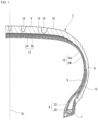
- the tread 4 has a shape projecting outward in the radial direction.
- the tread 4 forms a tread surface 16 that is brought into contact with a road surface.
- Grooves 18 are formed on the tread 4.
- the tread pattern is formed by the grooves 18.
- the tread 4 is formed from a crosslinked rubber that has excellent wear resistance and grip performance.
- Each sidewall 6 extends from the edge of the tread 4 substantially inward in the radial direction.
- the radially outer edge of the sidewall 6 is joined to the tread 4.
- the sidewall 6 is formed from a crosslinked rubber that has excellent cut resistance and weather resistance.
- Each bead 8 is located inward of the sidewall 6 in the axial direction.
- the bead 8 has a core 20 and an apex 22 extending from the core 20 outward in the radial direction.
- the core 20 has a ring shape and includes a wound non-stretchable wire. A typical material of the wire is steel.
- the apex 22 is tapered outward in the radial direction.
- the apex 22 is formed from a highly hard crosslinked rubber.
- the carcass 10 includes two plies, that is, the carcass ply 10a and the carcass ply 10b.
- the carcass ply 10a and the carcass ply 10b extend on and between the beads 8 at both sides along the tread 4 and the sidewalls 6.
- the carcass ply 10a and the carcass ply 10b are turned up around each core 20 from the inner side toward the outer side in the axial direction.
- Each of the carcass ply 10a and the carcass ply 10b includes multiple cords aligned with each other in the circumferential direction, and a topping rubber.
- the absolute value of the angle of each cord relative to the equator plane CL is 75° to 90°.
- the carcass ply 10a and the carcass ply 10b each have a radial structure.
- the carcass 10 may be formed from one carcass ply or three or more carcass plies other than two carcass plies.
- the form of an organic fiber used for the carcass ply 10a and the carcass ply 10b is a cord.
- the carcass ply 10a and the carcass ply 10b are each formed by treating cords with an adhesive and adhering the cords to a rubber composition.
- Examples of preferable organic fibers include: polyester fibers such as polyethylene terephthalate (PET) fibers, polyethylene naphthalate (PEN) fibers, and the like; nylon fibers; rayon fibers; and aramid fibers.
- Each filler 13 is disposed at the bead portion of the tire and enhances the stiffness of the bead portion.
- Each filler includes multiple cords aligned with each other, and a topping rubber.
- the form of an organic fiber used for the filler 13 is a cord.
- the filler 13 is formed by treating cords with an adhesive for an organic fiber and adhering the cords to a rubber composition.
- Examples of preferable organic fibers include: polyester fibers such as polyethylene terephthalate (PET) fibers, polyethylene naphthalate (PEN) fibers, and the like; nylon fibers; rayon fibers; and aramid fibers.
- the jointless band 14 is located outward of the belt 12 in the radial direction. In the axial direction, the width of the jointless band 14 is larger than that of the belt 12. The jointless band 14 reinforces the belt 12.
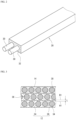
- FIG. 2 shows a ribbon 28 forming the jointless band 14.
- the ribbon 28 has two polyester cords 30 and a topping rubber 32.
- the ribbon 28 is formed by treating the polyester cords 30 with an adhesive and adhering the polyester cords 30 to the topping rubber 32.
- the jointless band 14 is formed by helically winding the ribbon 28 in the circumferential direction.
- the jointless band 14 has a so-called jointless structure.
- Each cord 30 extends substantially in the circumferential direction.
- the angle of the cord 30 relative to the circumferential direction is preferably not greater than 5° and particularly preferably not greater than 2°.
- the belt 12 is held by the polyester cords 30, and thus lifting of the belt 12 is inhibited.
- the number of polyester cords 30 in the ribbon 28 may be one or may be three or more.
- Each polyester cord 30 is formed by twisting a plurality of polyester fibers.
- the tire including the polyester cord 30 has excellent heat resistance and durability.
- Examples of preferable polyester fibers for forming the polyester cord 30 include polyethylene terephthalate (PET) fibers, polyethylene naphthalate (PEN) fibers, and the like.
- FIG. 3 is a diagram showing an example of a cross-section of a sample cut out with an arbitrary length in the circumferential direction of the pneumatic tire 2 shown in FIG. 1 (longitudinal direction) and an arbitrary length in a direction perpendicular to the circumferential direction, and shows the jointless band 14 and the inner layer 24 and the outer layer 26 of the belt 12.
- the inner layer 24 and the outer layer 26 of the belt 12 include steel cords 34 and steel cords 36, respectively.
- FIG. 3 also shows a gauge L between the steel cords 34 of the inner layer 24 and the steel cords 36 of the outer layer 26 in the belt 12.
- a tangent line A1 is a straight line connecting radially outer end portions of the respective steel cords 34 aligned in the inner layer 24 in the belt 12.
- a tangent line B1 is a straight line connecting radially inner end portions of the respective steel cords 36 aligned in the outer layer 26 in the belt 12.
- the distance between the tangent line A1 and the tangent line B1 is the gauge L between the steel cords 34 and the steel cords 36 of the belt 12.
- a polyester (polyethylene terephthalate (PET)) cord (configuration of cord: 1100/2 (dtex), number of twists of cord: 26 (times/10 cm), cord diameter: 0.54 mm, ends: 49 cords/5 cm) was immersed as a polyester cord into the first treatment agent, then dried at 150°C for 130 seconds, and subsequently thermally treated at 240°C for 130 seconds. Next, the polyester cord was immersed into the second treatment agent, then dried at 150°C for 130 seconds, and subsequently thermally treated at 240°C for 70 seconds.
- PET polyethylene terephthalate
- the organic fiber treated through the above procedure was embedded into an uncrosslinked rubber containing natural rubber as a main component, thereby forming a band in which a rubber composition was in an uncrosslinked state.
- composition of the uncrosslinked rubber containing natural rubber as a main component is as follows.
- a belt in which a rubber composition was in an uncrosslinked state was formed through a general procedure in the tire industry.
- the thickness of a sheet was adjusted to a small thickness by narrowing the intervals between rolls for processing a rubber, which was to be attached to cords, into a sheet shape.
- the amount of the rubber to be attached to the cords and an expansion rate of a raw cover during molding and vulcanization were adjusted such that the gauge between the cords of two adjacent layers in an obtained tire was 0.38 mm.
- the band in which the rubber composition was in an uncrosslinked state and the belt in which the rubber composition was in an uncrosslinked state were attached together with other tire members to form an uncrosslinked tire.
- crosslinking reaction was caused to proceed by pressing the uncrosslinked tire against a mold heated to 170°C under a pressure of 240 kPa for 10 minutes, whereby a tire was produced.
- the obtained tire was evaluated for the gauge between the cords of two adjacent layers in the belt, road noise, and rolling resistance. The results are shown in Table 1.
- a tire was produced in the same manner as Example 1, except: a nylon 66 cord (configuration of cord: 940/2 (dtex), number of twists of cord: 31 (times/10 cm), cord diameter: 0.55 mm, ends: 45 cords/5 cm) was used instead of the polyester cord; the nylon 66 cord was treated using the RFL liquid; and the amount of a rubber to be attached to cords and an expansion rate of a raw cover during molding and vulcanization were adjusted such that the gauge between the cords of two adjacent layers in an obtained tire was 0.43 mm. The obtained tire was evaluated for the gauge between the cords of two adjacent layers in the belt, road noise, and rolling resistance. The results are shown in Table 1.
- a tire was produced in the same manner as Example 1, except the amount of a rubber to be attached to cords and an expansion rate of a raw cover during molding and vulcanization were adjusted such that the gauge between the cords of two adjacent layers in an obtained tire was 0.35 mm.
- the obtained tire was evaluated for the gauge between the cords of two adjacent layers in the belt, road noise, and rolling resistance. The results are shown in Table 1.
- a tire was produced in the same manner as Example 1, except the amount of a rubber to be attached to cords and an expansion rate of a raw cover during molding and vulcanization were adjusted such that the gauge between the cords of two adjacent layers in an obtained tire was 0.43 mm.
- the obtained tire was evaluated for the gauge between the cords of two adjacent layers in the belt, road noise, and rolling resistance. The results are shown in Table 1.
- a tire was produced in the same manner as Example 1, except a nylon 66 cord (configuration of cord: 940/2 (dtex), number of twists of cord: 31 (times/10 cm), cord diameter: 0.55 mm, ends: 45 cords/5 cm) was used instead of the polyester cord and the nylon 66 cord was treated using the RFL liquid.
- the obtained tire was evaluated for the gauge between the cords of two adjacent layers in the belt, road noise, and rolling resistance. The results are shown in Table 1. [Table 1] Ex. 1 Comp. Ex. 1 Ex. 2 Comp. Ex. 2 Comp.
- the tires in which a polyester cord is not used or the gauge between the cords of two adjacent layers in the belt exceeds 0.40 mm have a high road noise or rolling resistance value and have an inferior road noise reduction effect or low fuel consumption performance.
- the tires in which a polyester cord is used and the gauge between the cords of two adjacent layers in the belt is not greater than 0.40 mm have an excellent road noise reduction effect and excellent low fuel consumption performance.
Landscapes
- Engineering & Computer Science (AREA)
- Mechanical Engineering (AREA)
- Chemical & Material Sciences (AREA)
- Textile Engineering (AREA)
- Chemical Kinetics & Catalysis (AREA)
- Health & Medical Sciences (AREA)
- Medicinal Chemistry (AREA)
- Polymers & Plastics (AREA)
- Organic Chemistry (AREA)
- Tires In General (AREA)
- Compositions Of Macromolecular Compounds (AREA)
Claims (3)
- Reifen (2), umfassend ein Band (14) und einen Gürtel (12), wobeidas Band (14) außerhalb des Gürtels (12) in einer Radialrichtung des Reifens (2) geschichtet ist,der Gürtel (12) zwei oder mehr Schichten (24, 26) umfasst, die in der Radialrichtung des Reifens geschichtet sind,das Band (14) eine Kautschukzusammensetzung und einen Polyesterkord (30) umfasst, der durch Verzwirnen einer Mehrzahl an Filamentgarnen gebildet ist,jede der zwei oder mehr Schichten (24, 26) des Gürtels (12) eine Kautschukzusammensetzung und einen Kord (34, 36) umfasst, dadurch gekennzeichnet, dassein Maß (L) zwischen den Korden (34, 36) zweier benachbarter Schichten (24, 26) in dem Gürtel (12) 0,20 mm oder größer, und nicht größer als 0,40 mm, ist.
- Reifen (2) nach Anspruch 1, wobeidie Kautschukzusammensetzung des Bands (14) eine Kautschukkomponente enthält, undeine Menge eines Polyisopren-basierten Kautschuks in 100 Gewichts-% der Kautschukkomponente 30 bis 100 Gewichts-% beträgt.
- Reifen (2) nach Anspruch 1 oder 2, wobeidie Kautschukzusammensetzung des Gürtels (12) eine Kautschukkomponente enthält, undeine Menge eines Polyisopren-basierten Kautschuks in 100 Gewichts-% der Kautschukkomponente 30 bis 100 Gewichts-% beträgt.
Applications Claiming Priority (1)
| Application Number | Priority Date | Filing Date | Title |
|---|---|---|---|
| JP2018069806A JP2019177838A (ja) | 2018-03-30 | 2018-03-30 | タイヤ |
Publications (2)
| Publication Number | Publication Date |
|---|---|
| EP3546248A1 EP3546248A1 (de) | 2019-10-02 |
| EP3546248B1 true EP3546248B1 (de) | 2025-07-02 |
Family
ID=65991665
Family Applications (1)
| Application Number | Title | Priority Date | Filing Date |
|---|---|---|---|
| EP19165306.2A Active EP3546248B1 (de) | 2018-03-30 | 2019-03-26 | Reifen |
Country Status (4)
| Country | Link |
|---|---|
| US (1) | US20190299715A1 (de) |
| EP (1) | EP3546248B1 (de) |
| JP (1) | JP2019177838A (de) |
| CN (1) | CN110317368A (de) |
Families Citing this family (10)
| Publication number | Priority date | Publication date | Assignee | Title |
|---|---|---|---|---|
| EP3882050B1 (de) * | 2020-03-17 | 2023-02-22 | The Goodyear Tire & Rubber Company | Reifen und gummilage für einen reifen |
| JP7669746B2 (ja) * | 2021-03-23 | 2025-04-30 | 住友ゴム工業株式会社 | タイヤ |
| JP7711417B2 (ja) * | 2021-04-13 | 2025-07-23 | 住友ゴム工業株式会社 | 空気入りタイヤ |
| JP7669789B2 (ja) | 2021-05-18 | 2025-04-30 | 住友ゴム工業株式会社 | タイヤ |
| JP7806402B2 (ja) | 2021-06-22 | 2026-01-27 | 住友ゴム工業株式会社 | タイヤ |
| JP7806409B2 (ja) | 2021-07-27 | 2026-01-27 | 住友ゴム工業株式会社 | タイヤ |
| JP2023094365A (ja) | 2021-12-23 | 2023-07-05 | 住友ゴム工業株式会社 | タイヤ |
| EP4613508A3 (de) | 2024-03-05 | 2025-10-08 | Sumitomo Rubber Industries, Ltd. | Luftreifen |
| JP7831534B1 (ja) | 2024-08-30 | 2026-03-17 | 住友ゴム工業株式会社 | タイヤ |
| JP2026049351A (ja) * | 2024-09-06 | 2026-03-18 | 住友ゴム工業株式会社 | タイヤ |
Citations (2)
| Publication number | Priority date | Publication date | Assignee | Title |
|---|---|---|---|---|
| JP2008279841A (ja) * | 2007-05-09 | 2008-11-20 | Toyo Tire & Rubber Co Ltd | 空気入りラジアルタイヤ |
| US20180022160A1 (en) * | 2015-02-03 | 2018-01-25 | Compagnie Generale Des Etablissements Michelin | Radial tire having an improved belt structure |
Family Cites Families (8)
| Publication number | Priority date | Publication date | Assignee | Title |
|---|---|---|---|---|
| EP1167082B1 (de) * | 2000-05-12 | 2005-08-31 | Bridgestone Corporation | Radialer Reifen |
| JP2001322404A (ja) * | 2000-05-12 | 2001-11-20 | Bridgestone Corp | 空気入りラジアルタイヤ |
| JP4268365B2 (ja) | 2002-02-14 | 2009-05-27 | 住友ゴム工業株式会社 | 空気入りラジアルタイヤ |
| JP2006274528A (ja) * | 2005-03-03 | 2006-10-12 | Toyobo Co Ltd | ポリエステルタイヤキャッププライコードおよびその製造方法 |
| EP1876203B1 (de) * | 2006-07-06 | 2011-05-18 | Sumitomo Rubber Industries, Ltd. | Gummimischung und daraus hergestellter Reifen |
| JP2011218982A (ja) * | 2010-04-09 | 2011-11-04 | Toyo Tire & Rubber Co Ltd | 空気入りラジアルタイヤ |
| FR2986740B1 (fr) * | 2012-02-09 | 2014-03-21 | Michelin & Cie | Pneumatique a structure de ceinture allegee |
| FR3032149B1 (fr) * | 2015-02-03 | 2017-02-17 | Michelin & Cie | Pneu radial ayant une structure de ceinture tres fine |
-
2018
- 2018-03-30 JP JP2018069806A patent/JP2019177838A/ja active Pending
-
2019
- 2019-03-13 US US16/351,839 patent/US20190299715A1/en not_active Abandoned
- 2019-03-22 CN CN201910223169.6A patent/CN110317368A/zh active Pending
- 2019-03-26 EP EP19165306.2A patent/EP3546248B1/de active Active
Patent Citations (2)
| Publication number | Priority date | Publication date | Assignee | Title |
|---|---|---|---|---|
| JP2008279841A (ja) * | 2007-05-09 | 2008-11-20 | Toyo Tire & Rubber Co Ltd | 空気入りラジアルタイヤ |
| US20180022160A1 (en) * | 2015-02-03 | 2018-01-25 | Compagnie Generale Des Etablissements Michelin | Radial tire having an improved belt structure |
Also Published As
| Publication number | Publication date |
|---|---|
| JP2019177838A (ja) | 2019-10-17 |
| CN110317368A (zh) | 2019-10-11 |
| US20190299715A1 (en) | 2019-10-03 |
| EP3546248A1 (de) | 2019-10-02 |
Similar Documents
| Publication | Publication Date | Title |
|---|---|---|
| EP3546248B1 (de) | Reifen | |
| US9963000B2 (en) | Pneumatic tire | |
| EP3196048B1 (de) | Kautschukzusammensetzung für reifen, luftreifen und luftloser reifen | |
| CN118251316A (zh) | 充气轮胎 | |
| EP2752447B1 (de) | Luftreifen | |
| CN105189149B (zh) | 充气安全轮胎 | |
| EP3546244B1 (de) | Klebstoffzusammensetzung für organische fasern, verfahren zur behandlung von organischen fasern, organische fasern und reifen | |
| EP1923233A1 (de) | Reifen mit einer Seitenwandkomponente aus einer Dispersion aus klebrig beschichteter, kurzer Kohlenstofffaserverstärkung | |
| JP7553765B2 (ja) | 空気入りタイヤ | |
| CN118219711A (zh) | 轮胎 | |
| JP4481776B2 (ja) | 空気入りタイヤ | |
| JP2011218980A (ja) | 空気入りラジアルタイヤ | |
| EP3378677B1 (de) | Luftreifen | |
| JP2008279841A (ja) | 空気入りラジアルタイヤ | |
| US20250162350A1 (en) | Tire | |
| JP2024086557A (ja) | タイヤ | |
| JP7087586B2 (ja) | コード・ゴム組成物複合体、タイヤ及びコード・ゴム組成物複合体の製造方法 | |
| JP5445279B2 (ja) | 空気入りタイヤ | |
| JP7007980B2 (ja) | タイヤ | |
| JP7462801B2 (ja) | 軽量化されたゴム補強材、その製造方法およびそれを含むタイヤ | |
| CN118251317B (zh) | 充气轮胎 | |
| JP7101022B2 (ja) | 有機繊維・ゴム組成物複合体及びタイヤ | |
| JP7400240B2 (ja) | 空気入りタイヤ | |
| JP5313049B2 (ja) | 空気入りラジアルタイヤの製造方法 | |
| JP2024086532A (ja) | タイヤ |
Legal Events
| Date | Code | Title | Description |
|---|---|---|---|
| PUAI | Public reference made under article 153(3) epc to a published international application that has entered the european phase |
Free format text: ORIGINAL CODE: 0009012 |
|
| STAA | Information on the status of an ep patent application or granted ep patent |
Free format text: STATUS: THE APPLICATION HAS BEEN PUBLISHED |
|
| AK | Designated contracting states |
Kind code of ref document: A1 Designated state(s): AL AT BE BG CH CY CZ DE DK EE ES FI FR GB GR HR HU IE IS IT LI LT LU LV MC MK MT NL NO PL PT RO RS SE SI SK SM TR |
|
| AX | Request for extension of the european patent |
Extension state: BA ME |
|
| STAA | Information on the status of an ep patent application or granted ep patent |
Free format text: STATUS: REQUEST FOR EXAMINATION WAS MADE |
|
| 17P | Request for examination filed |
Effective date: 20200309 |
|
| RBV | Designated contracting states (corrected) |
Designated state(s): AL AT BE BG CH CY CZ DE DK EE ES FI FR GB GR HR HU IE IS IT LI LT LU LV MC MK MT NL NO PL PT RO RS SE SI SK SM TR |
|
| STAA | Information on the status of an ep patent application or granted ep patent |
Free format text: STATUS: EXAMINATION IS IN PROGRESS |
|
| 17Q | First examination report despatched |
Effective date: 20210125 |
|
| P01 | Opt-out of the competence of the unified patent court (upc) registered |
Effective date: 20230510 |
|
| GRAP | Despatch of communication of intention to grant a patent |
Free format text: ORIGINAL CODE: EPIDOSNIGR1 |
|
| STAA | Information on the status of an ep patent application or granted ep patent |
Free format text: STATUS: GRANT OF PATENT IS INTENDED |
|
| INTG | Intention to grant announced |
Effective date: 20250219 |
|
| GRAS | Grant fee paid |
Free format text: ORIGINAL CODE: EPIDOSNIGR3 |
|
| GRAA | (expected) grant |
Free format text: ORIGINAL CODE: 0009210 |
|
| STAA | Information on the status of an ep patent application or granted ep patent |
Free format text: STATUS: THE PATENT HAS BEEN GRANTED |
|
| AK | Designated contracting states |
Kind code of ref document: B1 Designated state(s): AL AT BE BG CH CY CZ DE DK EE ES FI FR GB GR HR HU IE IS IT LI LT LU LV MC MK MT NL NO PL PT RO RS SE SI SK SM TR |
|
| REG | Reference to a national code |
Ref country code: GB Ref legal event code: FG4D |
|
| REG | Reference to a national code |
Ref country code: CH Ref legal event code: EP |
|
| REG | Reference to a national code |
Ref country code: DE Ref legal event code: R096 Ref document number: 602019071846 Country of ref document: DE |
|
| REG | Reference to a national code |
Ref country code: IE Ref legal event code: FG4D |
|
| REG | Reference to a national code |
Ref country code: NL Ref legal event code: MP Effective date: 20250702 |
|
| PG25 | Lapsed in a contracting state [announced via postgrant information from national office to epo] |
Ref country code: PT Free format text: LAPSE BECAUSE OF FAILURE TO SUBMIT A TRANSLATION OF THE DESCRIPTION OR TO PAY THE FEE WITHIN THE PRESCRIBED TIME-LIMIT Effective date: 20251103 |
|
| PG25 | Lapsed in a contracting state [announced via postgrant information from national office to epo] |
Ref country code: NL Free format text: LAPSE BECAUSE OF FAILURE TO SUBMIT A TRANSLATION OF THE DESCRIPTION OR TO PAY THE FEE WITHIN THE PRESCRIBED TIME-LIMIT Effective date: 20250702 |
|
| REG | Reference to a national code |
Ref country code: AT Ref legal event code: MK05 Ref document number: 1808837 Country of ref document: AT Kind code of ref document: T Effective date: 20250702 |
|
| PG25 | Lapsed in a contracting state [announced via postgrant information from national office to epo] |
Ref country code: IS Free format text: LAPSE BECAUSE OF FAILURE TO SUBMIT A TRANSLATION OF THE DESCRIPTION OR TO PAY THE FEE WITHIN THE PRESCRIBED TIME-LIMIT Effective date: 20251102 |
|
| PG25 | Lapsed in a contracting state [announced via postgrant information from national office to epo] |
Ref country code: NO Free format text: LAPSE BECAUSE OF FAILURE TO SUBMIT A TRANSLATION OF THE DESCRIPTION OR TO PAY THE FEE WITHIN THE PRESCRIBED TIME-LIMIT Effective date: 20251002 |
|
| REG | Reference to a national code |
Ref country code: LT Ref legal event code: MG9D |
|
| PG25 | Lapsed in a contracting state [announced via postgrant information from national office to epo] |
Ref country code: AT Free format text: LAPSE BECAUSE OF FAILURE TO SUBMIT A TRANSLATION OF THE DESCRIPTION OR TO PAY THE FEE WITHIN THE PRESCRIBED TIME-LIMIT Effective date: 20250702 |
|
| PG25 | Lapsed in a contracting state [announced via postgrant information from national office to epo] |
Ref country code: FI Free format text: LAPSE BECAUSE OF FAILURE TO SUBMIT A TRANSLATION OF THE DESCRIPTION OR TO PAY THE FEE WITHIN THE PRESCRIBED TIME-LIMIT Effective date: 20250702 |
|
| PG25 | Lapsed in a contracting state [announced via postgrant information from national office to epo] |
Ref country code: HR Free format text: LAPSE BECAUSE OF FAILURE TO SUBMIT A TRANSLATION OF THE DESCRIPTION OR TO PAY THE FEE WITHIN THE PRESCRIBED TIME-LIMIT Effective date: 20250702 |
|
| PG25 | Lapsed in a contracting state [announced via postgrant information from national office to epo] |
Ref country code: GR Free format text: LAPSE BECAUSE OF FAILURE TO SUBMIT A TRANSLATION OF THE DESCRIPTION OR TO PAY THE FEE WITHIN THE PRESCRIBED TIME-LIMIT Effective date: 20251003 |
|
| PG25 | Lapsed in a contracting state [announced via postgrant information from national office to epo] |
Ref country code: CZ Free format text: LAPSE BECAUSE OF FAILURE TO SUBMIT A TRANSLATION OF THE DESCRIPTION OR TO PAY THE FEE WITHIN THE PRESCRIBED TIME-LIMIT Effective date: 20250702 Ref country code: SE Free format text: LAPSE BECAUSE OF FAILURE TO SUBMIT A TRANSLATION OF THE DESCRIPTION OR TO PAY THE FEE WITHIN THE PRESCRIBED TIME-LIMIT Effective date: 20250702 |
|
| PG25 | Lapsed in a contracting state [announced via postgrant information from national office to epo] |
Ref country code: LV Free format text: LAPSE BECAUSE OF FAILURE TO SUBMIT A TRANSLATION OF THE DESCRIPTION OR TO PAY THE FEE WITHIN THE PRESCRIBED TIME-LIMIT Effective date: 20250702 |
|
| PG25 | Lapsed in a contracting state [announced via postgrant information from national office to epo] |
Ref country code: BG Free format text: LAPSE BECAUSE OF FAILURE TO SUBMIT A TRANSLATION OF THE DESCRIPTION OR TO PAY THE FEE WITHIN THE PRESCRIBED TIME-LIMIT Effective date: 20250702 Ref country code: PL Free format text: LAPSE BECAUSE OF FAILURE TO SUBMIT A TRANSLATION OF THE DESCRIPTION OR TO PAY THE FEE WITHIN THE PRESCRIBED TIME-LIMIT Effective date: 20250702 |
|
| PG25 | Lapsed in a contracting state [announced via postgrant information from national office to epo] |
Ref country code: RS Free format text: LAPSE BECAUSE OF FAILURE TO SUBMIT A TRANSLATION OF THE DESCRIPTION OR TO PAY THE FEE WITHIN THE PRESCRIBED TIME-LIMIT Effective date: 20251002 |
|
| PG25 | Lapsed in a contracting state [announced via postgrant information from national office to epo] |
Ref country code: ES Free format text: LAPSE BECAUSE OF FAILURE TO SUBMIT A TRANSLATION OF THE DESCRIPTION OR TO PAY THE FEE WITHIN THE PRESCRIBED TIME-LIMIT Effective date: 20250702 |