EP3532302B1 - Renfort métallique ou métallisé dont la surface est revêtue d'une polybenzoxazine - Google Patents
Renfort métallique ou métallisé dont la surface est revêtue d'une polybenzoxazine Download PDFInfo
- Publication number
- EP3532302B1 EP3532302B1 EP17780500.9A EP17780500A EP3532302B1 EP 3532302 B1 EP3532302 B1 EP 3532302B1 EP 17780500 A EP17780500 A EP 17780500A EP 3532302 B1 EP3532302 B1 EP 3532302B1
- Authority
- EP
- European Patent Office
- Prior art keywords
- polybenzoxazine
- monomer
- reinforcement
- polymer
- synthesis
- Prior art date
- Legal status (The legal status is an assumption and is not a legal conclusion. Google has not performed a legal analysis and makes no representation as to the accuracy of the status listed.)
- Active
Links
- 0 C*(C)c(cc1CN(CN)*N(Cc(cc(cc2)-c(cc3)cc(CN(CN)*N(Cc(cc(C)cc4)c4O)CN)c3O)c2O)CN)ccc1O Chemical compound C*(C)c(cc1CN(CN)*N(Cc(cc(cc2)-c(cc3)cc(CN(CN)*N(Cc(cc(C)cc4)c4O)CN)c3O)c2O)CN)ccc1O 0.000 description 1
Images







Classifications
-
- C—CHEMISTRY; METALLURGY
- C09—DYES; PAINTS; POLISHES; NATURAL RESINS; ADHESIVES; COMPOSITIONS NOT OTHERWISE PROVIDED FOR; APPLICATIONS OF MATERIALS NOT OTHERWISE PROVIDED FOR
- C09D—COATING COMPOSITIONS, e.g. PAINTS, VARNISHES OR LACQUERS; FILLING PASTES; CHEMICAL PAINT OR INK REMOVERS; INKS; CORRECTING FLUIDS; WOODSTAINS; PASTES OR SOLIDS FOR COLOURING OR PRINTING; USE OF MATERIALS THEREFOR
- C09D179/00—Coating compositions based on macromolecular compounds obtained by reactions forming in the main chain of the macromolecule a linkage containing nitrogen, with or without oxygen, or carbon only, not provided for in groups C09D161/00 - C09D177/00
- C09D179/04—Polycondensates having nitrogen-containing heterocyclic rings in the main chain; Polyhydrazides; Polyamide acids or similar polyimide precursors
-
- B—PERFORMING OPERATIONS; TRANSPORTING
- B60—VEHICLES IN GENERAL
- B60C—VEHICLE TYRES; TYRE INFLATION; TYRE CHANGING; CONNECTING VALVES TO INFLATABLE ELASTIC BODIES IN GENERAL; DEVICES OR ARRANGEMENTS RELATED TO TYRES
- B60C1/00—Tyres characterised by the chemical composition or the physical arrangement or mixture of the composition
-
- B—PERFORMING OPERATIONS; TRANSPORTING
- B32—LAYERED PRODUCTS
- B32B—LAYERED PRODUCTS, i.e. PRODUCTS BUILT-UP OF STRATA OF FLAT OR NON-FLAT, e.g. CELLULAR OR HONEYCOMB, FORM
- B32B25/00—Layered products comprising a layer of natural or synthetic rubber
- B32B25/04—Layered products comprising a layer of natural or synthetic rubber comprising rubber as the main or only constituent of a layer, which is next to another layer of the same or of a different material
-
- B—PERFORMING OPERATIONS; TRANSPORTING
- B60—VEHICLES IN GENERAL
- B60C—VEHICLE TYRES; TYRE INFLATION; TYRE CHANGING; CONNECTING VALVES TO INFLATABLE ELASTIC BODIES IN GENERAL; DEVICES OR ARRANGEMENTS RELATED TO TYRES
- B60C9/00—Reinforcements or ply arrangement of pneumatic tyres
-
- B—PERFORMING OPERATIONS; TRANSPORTING
- B60—VEHICLES IN GENERAL
- B60C—VEHICLE TYRES; TYRE INFLATION; TYRE CHANGING; CONNECTING VALVES TO INFLATABLE ELASTIC BODIES IN GENERAL; DEVICES OR ARRANGEMENTS RELATED TO TYRES
- B60C9/00—Reinforcements or ply arrangement of pneumatic tyres
- B60C9/0007—Reinforcements made of metallic elements, e.g. cords, yarns, filaments or fibres made from metal
-
- B—PERFORMING OPERATIONS; TRANSPORTING
- B60—VEHICLES IN GENERAL
- B60C—VEHICLE TYRES; TYRE INFLATION; TYRE CHANGING; CONNECTING VALVES TO INFLATABLE ELASTIC BODIES IN GENERAL; DEVICES OR ARRANGEMENTS RELATED TO TYRES
- B60C9/00—Reinforcements or ply arrangement of pneumatic tyres
- B60C9/0042—Reinforcements made of synthetic materials
-
- C—CHEMISTRY; METALLURGY
- C08—ORGANIC MACROMOLECULAR COMPOUNDS; THEIR PREPARATION OR CHEMICAL WORKING-UP; COMPOSITIONS BASED THEREON
- C08G—MACROMOLECULAR COMPOUNDS OBTAINED OTHERWISE THAN BY REACTIONS ONLY INVOLVING UNSATURATED CARBON-TO-CARBON BONDS
- C08G14/00—Condensation polymers of aldehydes or ketones with two or more other monomers covered by at least two of the groups C08G8/00 - C08G12/00
- C08G14/02—Condensation polymers of aldehydes or ketones with two or more other monomers covered by at least two of the groups C08G8/00 - C08G12/00 of aldehydes
- C08G14/04—Condensation polymers of aldehydes or ketones with two or more other monomers covered by at least two of the groups C08G8/00 - C08G12/00 of aldehydes with phenols
- C08G14/06—Condensation polymers of aldehydes or ketones with two or more other monomers covered by at least two of the groups C08G8/00 - C08G12/00 of aldehydes with phenols and monomers containing hydrogen attached to nitrogen
-
- C—CHEMISTRY; METALLURGY
- C08—ORGANIC MACROMOLECULAR COMPOUNDS; THEIR PREPARATION OR CHEMICAL WORKING-UP; COMPOSITIONS BASED THEREON
- C08G—MACROMOLECULAR COMPOUNDS OBTAINED OTHERWISE THAN BY REACTIONS ONLY INVOLVING UNSATURATED CARBON-TO-CARBON BONDS
- C08G73/00—Macromolecular compounds obtained by reactions forming a linkage containing nitrogen with or without oxygen or carbon in the main chain of the macromolecule, not provided for in groups C08G12/00 - C08G71/00
- C08G73/02—Polyamines
- C08G73/0233—Polyamines derived from (poly)oxazolines, (poly)oxazines or having pendant acyl groups
-
- C—CHEMISTRY; METALLURGY
- C08—ORGANIC MACROMOLECULAR COMPOUNDS; THEIR PREPARATION OR CHEMICAL WORKING-UP; COMPOSITIONS BASED THEREON
- C08G—MACROMOLECULAR COMPOUNDS OBTAINED OTHERWISE THAN BY REACTIONS ONLY INVOLVING UNSATURATED CARBON-TO-CARBON BONDS
- C08G73/00—Macromolecular compounds obtained by reactions forming a linkage containing nitrogen with or without oxygen or carbon in the main chain of the macromolecule, not provided for in groups C08G12/00 - C08G71/00
- C08G73/06—Polycondensates having nitrogen-containing heterocyclic rings in the main chain of the macromolecule
-
- C—CHEMISTRY; METALLURGY
- C09—DYES; PAINTS; POLISHES; NATURAL RESINS; ADHESIVES; COMPOSITIONS NOT OTHERWISE PROVIDED FOR; APPLICATIONS OF MATERIALS NOT OTHERWISE PROVIDED FOR
- C09D—COATING COMPOSITIONS, e.g. PAINTS, VARNISHES OR LACQUERS; FILLING PASTES; CHEMICAL PAINT OR INK REMOVERS; INKS; CORRECTING FLUIDS; WOODSTAINS; PASTES OR SOLIDS FOR COLOURING OR PRINTING; USE OF MATERIALS THEREFOR
- C09D179/00—Coating compositions based on macromolecular compounds obtained by reactions forming in the main chain of the macromolecule a linkage containing nitrogen, with or without oxygen, or carbon only, not provided for in groups C09D161/00 - C09D177/00
- C09D179/02—Polyamines
-
- C—CHEMISTRY; METALLURGY
- C09—DYES; PAINTS; POLISHES; NATURAL RESINS; ADHESIVES; COMPOSITIONS NOT OTHERWISE PROVIDED FOR; APPLICATIONS OF MATERIALS NOT OTHERWISE PROVIDED FOR
- C09J—ADHESIVES; NON-MECHANICAL ASPECTS OF ADHESIVE PROCESSES IN GENERAL; ADHESIVE PROCESSES NOT PROVIDED FOR ELSEWHERE; USE OF MATERIALS AS ADHESIVES
- C09J161/00—Adhesives based on condensation polymers of aldehydes or ketones; Adhesives based on derivatives of such polymers
- C09J161/34—Condensation polymers of aldehydes or ketones with monomers covered by at least two of the groups C09J161/04, C09J161/18 and C09J161/20
-
- C—CHEMISTRY; METALLURGY
- C09—DYES; PAINTS; POLISHES; NATURAL RESINS; ADHESIVES; COMPOSITIONS NOT OTHERWISE PROVIDED FOR; APPLICATIONS OF MATERIALS NOT OTHERWISE PROVIDED FOR
- C09J—ADHESIVES; NON-MECHANICAL ASPECTS OF ADHESIVE PROCESSES IN GENERAL; ADHESIVE PROCESSES NOT PROVIDED FOR ELSEWHERE; USE OF MATERIALS AS ADHESIVES
- C09J179/00—Adhesives based on macromolecular compounds obtained by reactions forming in the main chain of the macromolecule a linkage containing nitrogen, with or without oxygen, or carbon only, not provided for in groups C09J161/00 - C09J177/00
- C09J179/02—Polyamines
-
- C—CHEMISTRY; METALLURGY
- C09—DYES; PAINTS; POLISHES; NATURAL RESINS; ADHESIVES; COMPOSITIONS NOT OTHERWISE PROVIDED FOR; APPLICATIONS OF MATERIALS NOT OTHERWISE PROVIDED FOR
- C09J—ADHESIVES; NON-MECHANICAL ASPECTS OF ADHESIVE PROCESSES IN GENERAL; ADHESIVE PROCESSES NOT PROVIDED FOR ELSEWHERE; USE OF MATERIALS AS ADHESIVES
- C09J179/00—Adhesives based on macromolecular compounds obtained by reactions forming in the main chain of the macromolecule a linkage containing nitrogen, with or without oxygen, or carbon only, not provided for in groups C09J161/00 - C09J177/00
- C09J179/04—Polycondensates having nitrogen-containing heterocyclic rings in the main chain; Polyhydrazides; Polyamide acids or similar polyimide precursors
-
- B—PERFORMING OPERATIONS; TRANSPORTING
- B32—LAYERED PRODUCTS
- B32B—LAYERED PRODUCTS, i.e. PRODUCTS BUILT-UP OF STRATA OF FLAT OR NON-FLAT, e.g. CELLULAR OR HONEYCOMB, FORM
- B32B15/00—Layered products comprising a layer of metal
-
- B—PERFORMING OPERATIONS; TRANSPORTING
- B32—LAYERED PRODUCTS
- B32B—LAYERED PRODUCTS, i.e. PRODUCTS BUILT-UP OF STRATA OF FLAT OR NON-FLAT, e.g. CELLULAR OR HONEYCOMB, FORM
- B32B15/00—Layered products comprising a layer of metal
- B32B15/04—Layered products comprising a layer of metal comprising metal as the main or only constituent of a layer, which is next to another layer of the same or of a different material
- B32B15/08—Layered products comprising a layer of metal comprising metal as the main or only constituent of a layer, which is next to another layer of the same or of a different material of synthetic resin
-
- B—PERFORMING OPERATIONS; TRANSPORTING
- B32—LAYERED PRODUCTS
- B32B—LAYERED PRODUCTS, i.e. PRODUCTS BUILT-UP OF STRATA OF FLAT OR NON-FLAT, e.g. CELLULAR OR HONEYCOMB, FORM
- B32B2255/00—Coating on the layer surface
- B32B2255/06—Coating on the layer surface on metal layer
-
- B—PERFORMING OPERATIONS; TRANSPORTING
- B32—LAYERED PRODUCTS
- B32B—LAYERED PRODUCTS, i.e. PRODUCTS BUILT-UP OF STRATA OF FLAT OR NON-FLAT, e.g. CELLULAR OR HONEYCOMB, FORM
- B32B2255/00—Coating on the layer surface
- B32B2255/26—Polymeric coating
-
- B—PERFORMING OPERATIONS; TRANSPORTING
- B32—LAYERED PRODUCTS
- B32B—LAYERED PRODUCTS, i.e. PRODUCTS BUILT-UP OF STRATA OF FLAT OR NON-FLAT, e.g. CELLULAR OR HONEYCOMB, FORM
- B32B2605/00—Vehicles
-
- B—PERFORMING OPERATIONS; TRANSPORTING
- B32—LAYERED PRODUCTS
- B32B—LAYERED PRODUCTS, i.e. PRODUCTS BUILT-UP OF STRATA OF FLAT OR NON-FLAT, e.g. CELLULAR OR HONEYCOMB, FORM
- B32B27/00—Layered products comprising a layer of synthetic resin
-
- B—PERFORMING OPERATIONS; TRANSPORTING
- B32—LAYERED PRODUCTS
- B32B—LAYERED PRODUCTS, i.e. PRODUCTS BUILT-UP OF STRATA OF FLAT OR NON-FLAT, e.g. CELLULAR OR HONEYCOMB, FORM
- B32B27/00—Layered products comprising a layer of synthetic resin
- B32B27/28—Layered products comprising a layer of synthetic resin comprising synthetic resins not wholly covered by any one of the sub-groups B32B27/30 - B32B27/42
-
- B—PERFORMING OPERATIONS; TRANSPORTING
- B32—LAYERED PRODUCTS
- B32B—LAYERED PRODUCTS, i.e. PRODUCTS BUILT-UP OF STRATA OF FLAT OR NON-FLAT, e.g. CELLULAR OR HONEYCOMB, FORM
- B32B9/00—Layered products comprising a layer of a particular substance not covered by groups B32B11/00 - B32B29/00
- B32B9/04—Layered products comprising a layer of a particular substance not covered by groups B32B11/00 - B32B29/00 comprising such particular substance as the main or only constituent of a layer, which is next to another layer of the same or of a different material
- B32B9/041—Layered products comprising a layer of a particular substance not covered by groups B32B11/00 - B32B29/00 comprising such particular substance as the main or only constituent of a layer, which is next to another layer of the same or of a different material of metal
-
- B—PERFORMING OPERATIONS; TRANSPORTING
- B60—VEHICLES IN GENERAL
- B60C—VEHICLE TYRES; TYRE INFLATION; TYRE CHANGING; CONNECTING VALVES TO INFLATABLE ELASTIC BODIES IN GENERAL; DEVICES OR ARRANGEMENTS RELATED TO TYRES
- B60C9/00—Reinforcements or ply arrangement of pneumatic tyres
- B60C9/0007—Reinforcements made of metallic elements, e.g. cords, yarns, filaments or fibres made from metal
- B60C2009/0014—Surface treatments of steel cords
-
- B—PERFORMING OPERATIONS; TRANSPORTING
- B60—VEHICLES IN GENERAL
- B60C—VEHICLE TYRES; TYRE INFLATION; TYRE CHANGING; CONNECTING VALVES TO INFLATABLE ELASTIC BODIES IN GENERAL; DEVICES OR ARRANGEMENTS RELATED TO TYRES
- B60C9/00—Reinforcements or ply arrangement of pneumatic tyres
- B60C9/0007—Reinforcements made of metallic elements, e.g. cords, yarns, filaments or fibres made from metal
- B60C2009/0021—Coating rubbers for steel cords
-
- Y—GENERAL TAGGING OF NEW TECHNOLOGICAL DEVELOPMENTS; GENERAL TAGGING OF CROSS-SECTIONAL TECHNOLOGIES SPANNING OVER SEVERAL SECTIONS OF THE IPC; TECHNICAL SUBJECTS COVERED BY FORMER USPC CROSS-REFERENCE ART COLLECTIONS [XRACs] AND DIGESTS
- Y10—TECHNICAL SUBJECTS COVERED BY FORMER USPC
- Y10T—TECHNICAL SUBJECTS COVERED BY FORMER US CLASSIFICATION
- Y10T428/00—Stock material or miscellaneous articles
- Y10T428/31504—Composite [nonstructural laminate]
- Y10T428/31678—Of metal
Definitions
- the present invention relates to thermosetting resins which can be used in particular in adhesive systems intended in particular for bonding metal to rubber.
- It relates more particularly to metallic or metallized reinforcements coated with polymers which can be used as adhesive layers in metal / rubber composites intended for the manufacture of rubber articles such as tires, pneumatic or non-pneumatic, for motor vehicles.
- Metal / rubber composites in particular for tires for motor vehicles, are well known. They most often consist of a generally diene rubber matrix, crosslinkable with sulfur, comprising metallic reinforcing elements (or “reinforcements”) such as carbon steel wires, films, tapes or cables.
- these composites must in a known manner meet a large number of technical criteria, sometimes contradictory, such as uniformity, flexibility, endurance. flexural and compressive strength, tensile strength, wear resistance and corrosion resistance, and maintain this performance at a very high level for as long as possible.
- manufacturers of metal / rubber composites in particular manufacturers of tires for motor vehicles, are looking for new adhesive solutions to make the metal reinforcements stick to the rubber compositions, while alleviating, at least in part, the aforementioned drawbacks.
- these polymers used in particular as an adhesion primer on metal in metal / rubber composites, these polymers very advantageously make it possible to bond the metal to the rubber matrices then using simple textile adhesives such as “RFL” adhesives (resorcinol-formaldehyde-latex) or other equivalent adhesive compositions, or even directly (ie without the use of such adhesives) to these rubber matrices when the latter contain, for example, suitable functionalized unsaturated elastomers such as epoxidized elastomers.
- RTL resorcinol-formaldehyde-latex
- suitable functionalized unsaturated elastomers such as epoxidized elastomers.
- thermosetting type which at room temperature has the same adhesive performance, with respect to metal and rubber, as the aforementioned polymers but which once has thermoset (crosslinked). further improved thermal and chemical stability.
- its specific microstructure very advantageously makes it possible to adjust the flexibility of the molecule according to the particular applications targeted.
- the present invention relates to a metallic or metallized reinforcement, at least the surface of which is at least partly metallic, at least said metallic portion being coated.
- a polybenzoxazine comprising at least repeating units comprising at least one unit corresponding to formulas (I) or (II): in which Z 1 and Z 2 , identical or different, represent an at least divalent aliphatic, cycloaliphatic or aromatic linking group, comprising at least one carbon atom and optionally at least one heteroatom chosen from O, S, N and P.
- the invention relates in particular to such a reinforcement in the form of a wire, film, tape or cable, at least part of the surface of which is made of steel, in particular carbon steel, said steel possibly being a light steel, it being said. that is to say uncoated, or else be coated with at least one second metal called surface metal, the latter being preferably chosen from the group consisting of aluminum, copper, zinc and the alloys of at least one of these metals with at least one other metal.
- the reinforcement of the invention is able to stick to matrices of ethylenically unsaturated polymers such as rubber, in particular without the need for the use of cobalt salts in these polymer matrices.
- the invention also relates to the use of such a reinforcement for the reinforcement of a rubber article, in particular a tire, pneumatic or non-pneumatic, for a motor vehicle.
- the invention also relates to any rubber article, in the raw (uncrosslinked) or cured (in the crosslinked state) state, in particular any tire, pneumatic or non-pneumatic, for a motor vehicle, which is reinforced by at least such a reinforcement.
- x and / or y means “x” or “y” or both (ie “x and y”). Any interval of values designated by the expression “between a and b” represents the range of values going from more than “a” to less than “b” (that is to say limits “a” and “b” excluded. ) while any interval of values designated by the expression “from a to b” signifies the range of values going from “a” to "b” (that is to say including the strict limits “a” and “B”).
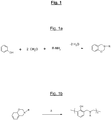
- benzoxazines are compounds of general formula:
- the appended figure lays out the general principle of synthesis of a benzoxazine, here from (condensation reaction) of a phenol molecule, two molecules of formaldehyde and an amine (R denoting the residue of the amine) , with elimination of two water molecules.
- the figure 1b recalls for its part the opening mechanism (“ ring-opening ”) of the oxazine cycle of such a compound during a thermal input (represented by the symbol ⁇ ).
- benzoxazine compounds or monomers can thus be synthesized using various phenols and amines depending on their types of substituents. These substituent groups can then provide polymerizable sites and allow the synthesis of various benzoxazine (or polybenzoxazine) polymers.
- Benzoxazines and polybenzoxazines which are derived therefrom are products which are now well known to those skilled in the art; to cite just a few examples of publication, we can mention the articles " Polybenzoxazines - New high performance thermosetting resins: synthesis and properties ”; NN Ghosh et al., Prog. Polym. Sci. 32 (2007), 1344-1391 , or " Recent Advancement on Polybenzoxazine - A newly Developed High Performance Thermoset ”, Y. Yaggi et al., J. Polym. Sci. Part A: Polym. Chem. : Flight. 47 (2009), 5565-5576 , as well as for example patents or applications for US patent 5,543,516 , WO 2013/148408 .
- polybenzoxazines have the remarkable capacity, at high temperature (for example, typically greater than 150 ° C or even at 200 ° C according to their particular microstructure), to open their oxazine rings and thus lead to structures of thermosetting polyphenolic resins.
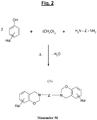
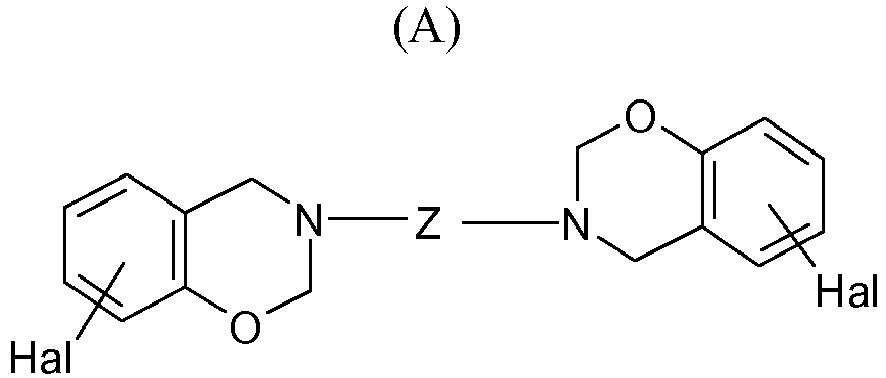
- the specific polybenzoxazine suitable for the reinforcement of the invention is derived from a benzoxazine (called “Monomer M” in the present application) of the halogenated type which corresponds to the generic formula (A) which follows, “Hal” representing one (at least one , i.e. one or more) halogen:
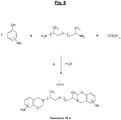
- the figure 2 gives the general synthesis scheme, under thermal input ( ⁇ ) and with elimination of water, from a halogenated phenol, p-formaldehyde and a diamine.
- Z represents a linking group (spacer or "spacer” ) at least divalent, that is to say that it could contain more two covalent bonds, for example three or four covalent bonds.
- Z is divalent, that is to say has only two covalent bonds.
- Z can be aliphatic, cycloaliphatic or aromatic.
- This group which can be ethylenically saturated or unsaturated, comprises by definition at least one (that is to say one or more) carbon atom, and optionally at least one (that is to say one or more) heteroatom selected from O (oxygen), S (sulfur), N (nitrogen) and P (phosphorus).
- Z represents an aliphatic group comprising 1 to 20, more preferably 1 to 16, in particular 1 to 12 carbon atoms, or indeed a cycloaliphatic group comprising 3 to 20, more preferably 3 to 16, in particular 3 to 12 carbon atoms. More preferably still, Z (such as Z 1 and / or Z 2 described later) represents an alkylene group comprising 1 to 20 atoms, preferably 1 to 16, in particular 1 to 12 carbon atoms.
- Z (like Z 1 and / or Z 2 described later) comprises a group chosen from - (CH 2 ) x -, -CH 2 -Ph-CH 2 -, - (CH 2 -CH 2 -X) n - and - (CH (CH 3 ) -CH 2 -X) n -, "x" and "n” being integers from 1 to 20, in particular from 1 to 16, more particularly from 1 to 12, Ph representing the benzene ring, and X representing at least one (that is to say one or more) heteroatom chosen from O (oxygen), S (sulfur), N (nitrogen) and P (phosphorus).
- Each benzene nucleus of Monomer M carries at least one (that is to say one or more) halogen.
- one or more hydrogen atoms of at least one or of each benzene nucleus can be substituted (or not) by different substituents, for example by functional groups capable of promoting l adhesion of the polymer to the metal and / or to the rubber.
- each benzene nucleus of the monomer M carries a single halogen (Hal) or at most two, more preferably one and only one halogen, the latter being more preferably located in the para position of the oxygen. of the oxazine cycle.
- Hal halogen
- Hal represents bromine
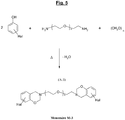
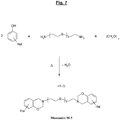
- the figure 3 illustrates a possible synthesis scheme, from a specific diamine of the aliphatic type (polyethylene diamine), of a particular halogenated benzoxazine of formula (A-1), this benzoxazine being usable as a monomer (Monomer denoted M-1) for the subsequent synthesis of a polybenzoxazine suitable for the reinforcement of the invention.
- Z represents here a methylene group - (CH 2 ) x - in which the symbol “x” represents an integer ranging preferably from 1 to 20, more preferably from 1 to 16, in particular from 1 to 12.
- a such synthesis will be exemplified later in order to obtain a specific monomer (Monomer M-10; Fig. 15 and Fig. 16 ).
- Z represents an aromatic group comprising 6 to 30, more preferably 6 to 20 carbon atoms.
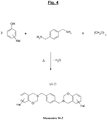
- the figure 4 illustrates another possible synthesis scheme, this time from a specific diamine of the aromatic type (p-xylylenediamine), of another example of a particular halogenated benzoxazine of formula (A-2), which can be used as a monomer (Monomer noted M-2) for the subsequent synthesis of another polybenzoxazine suitable for the reinforcement of the invention.
- the figures 5 , 6 and 7 illustrate three other possible synthesis schemes, again starting from halogenated phenol and paraformaldehyde on the one hand, and on the other hand from different specific diamines, all of the aliphatic type, other examples of particular benzoxazines of respective formulas (A- 3), (A-4) and (A-5), which can be used as monomers (Monomers respectively denoted M-3, M-4 and M-5) for the synthesis of polybenzoxazines suitable for the reinforcement of the invention.
- the repetition of the units [-CH 2 -CH 2 -O-] (polyethylene oxide) on the linking group Z is capable of leading to polybenzoxazines of high crystallinity
- the presence of methyl groups (polypropylene oxide) on Z makes it possible to reduce the reactivity of the two end amine groups and to lead to polybenzoxazines of lower crystallinity.
- the presence on the spacer Z of the atom (heteroatom) of sulfur in the recurring units [-CH 2 -CH 2 -S-] (polyethylene thioether), is likely to further improve the adhesion to the metal of the polybenzoxazine .
- the structure of the Z group (such as Z 1 and Z 2 described later) of the benzoxazine monomer can be modified widely in order to modulate the properties of the final polymer. This constitutes a major advantage of the present invention.
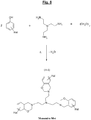
- the figure 8 illustrates another possible scheme of synthesis, starting from a halogenated phenol, paraformaldehyde and a specific aliphatic polyamine, this time consisting of a triamine (tris (3-aminopropyl) amine), of another example of compound (tri ) particular halogenated benzoxazine of formula (A-6) which can be used as a monomer (Monomer denoted M-6) for the synthesis of another polybenzoxazine suitable for the reinforcement of the invention.
- polymer "P" has the essential characteristic of comprising recurring structural units comprising at least one unit corresponding to formula (I) (before opening of the oxazine rings) or formula (II) ( after opening the cycles) below: in which Z 1 and Z 2 , identical or different, represent an at least divalent, aliphatic, cycloaliphatic or aromatic linking group (spacer), comprising at least one carbon atom and optionally at least one heteroatom chosen from O, S, N and P.
- formula (I) before opening of the oxazine rings
- formula (II) after opening the cycles
- Z 1 and Z 2 identical or different, represent an at least divalent, aliphatic, cycloaliphatic or aromatic linking group (spacer), comprising at least one carbon atom and optionally at least one heteroatom chosen from O, S, N and P.
- polymer should be understood here any homopolymer or copolymer, in particular block copolymer, with recurring structural units comprise at least one unit of formula (I) or (II) above; the polymer of the invention can of course contain both units of formula (I) and units of formula (II).
- Z 1 and Z 2 have the main definitions and the preferred definitions already detailed above for Z in the benzoxazine compound (monomer).
- Z 1 and / or Z 2 identical or different, represent an aliphatic group comprising 1 to 20, preferably 1 to 16 carbon atoms, or a cycloaliphatic group comprising 3 to 20, preferably 3 to 16 carbon atoms, and optionally at least one heteroatom chosen from O, S, N and P.
- Z 1 and / or Z 2 which may be identical or different, represent an alkylene group comprising 1 to 20, preferably 1 to 16, in particular 1 to 12 carbon atoms, and optionally at least one heteroatom chosen from O, S, N and P.
- Z 1 and / or Z 2 identical or different, represent an aromatic group comprising 6 to 30, preferably 6 to 20 carbon atoms, and optionally at least one heteroatom chosen from O, S, N and P.
- Z 1 and / or Z 2 contain at least one group chosen from - (CH 2 ) x -, -CH 2 -Ph-CH 2 -, - (CH 2 -CH 2 -X) n - and - (CH (CH 3 ) -CH 2 -X) n -, "x" and “n” being integers from 1 to 20, in particular from 1 to 16, more particularly from 1 to 12 ("x "Being denoted more precisely” x 1 "in the case of Z 1 and” x 2 "in the case of Z 2 ), Ph representing the benzene ring, and X representing at least one (that is to say one or several) heteroatom selected from O (oxygen), S (sulfur), N (nitrogen) and P (phosphorus).
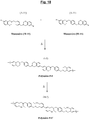
- the figure 9 represents a general diagram of the synthesis, by polycondensation, of a polybenzoxazine (Polymer P) intended for the reinforcement of the invention, from the halogenated benzoxazine of formula (A) of the Fig. 2 (Monomer M) and another monomer (Monomer M '), of generic formula denoted (A') very similar which can be distinguished in particular by the nature of its spacer (Z 2 ) and / or of its halogen (Hal) .
- Polybenzoxazine "P" from figure 9 was also represented on figure 13 , before (Polymer P) and after (Polymer P ') opening of its oxazine rings.
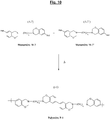
- the figure 10 represents a particular synthesis scheme of such a preferred polybenzoxazine intended for the reinforcement of the invention (polymer denoted P-1) of formula (1-1), from a particular halogenated benzoxazine (Monomer M-7) of formula (A-7) and another particular halogenated benzoxazine (Monomer M-7 ') of the very similar formula (A-7') which can be distinguished in particular by the value of the integer "x" (respectively "x 1 ”and“ x 2 ”for Z 1 and Z 2 ).
- each benzene nucleus of monomers M-7 and M-7 ' carries one and only one halogen (Hal), more preferably bromine, this halogen being more particularly located in the para position of the oxygen of the oxazine ring.
- Hal halogen
- the figure 11 represents another particular synthesis scheme of another specific polybenzoxazine (Polymer denoted P-2) intended for the reinforcement of the invention, of formula (1-2), from the previous specific halogenated benzoxazine (Monomer M-7) above and of another specific benzoxazine (Monomer M-8) of formula (A-8), of the aromatic type with regard to the spacer Z 2 .
- the figure 12 represents another particular synthesis scheme of another specific polybenzoxazine (Polymer denoted P-3) suitable for the reinforcement of the invention, of formula (1-3), from the previous specific halogenated benzoxazine (Monomer M-7) above and another specific benzoxazine of formula (A-9) (Monomer M-9) of the aliphatic type (with heteroatom O) for the spacer Z 2 .
- Polymer denoted P-3 suitable for the reinforcement of the invention, of formula (1-3), from the previous specific halogenated benzoxazine (Monomer M-7) above and another specific benzoxazine of formula (A-9) (Monomer M-9) of the aliphatic type (with heteroatom O) for the spacer Z 2 .
- each benzene nucleus of the benzoxazine monomers carries one and only one halogen (Hal), more preferably bromine, located more particularly in position para of the oxygen of the oxazine ring.
- Hal halogen
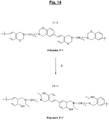
- the figures 13 and 14 also represent the polybenzoxazines suitable for the reinforcement of the invention (here respectively denoted P 'and P-1') of Fig. 9 and Fig. 10 , once their oxazine cycles open after heat input.
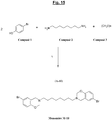
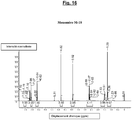
- the figures 15 and 16 represent the synthetic scheme, from brominated phenol (compound 1), p-formaldehyde (compound 3) and a specific aliphatic diamine (compound 2), of a particular brominated dibenzoxazine of formula (A-10) (Monomer denoted M-10) which can be used for the synthesis of polybenzoxazines (Polymer P-4 and P-4 'of figure 17 ) suitable for the reinforcement of the invention, as well as the 1 H NMR spectrum (500 MHz) of Monomer M-10 dissolved in CD 2 Cl 2 .
- A-10 brominated dibenzoxazine of formula (A-10)
- M-10 polybenzoxazines
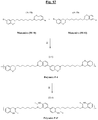
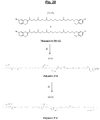
- the figures 17 and 18 represent two other possible synthesis schemes of specific polybenzoxazines (polymers denoted respectively P-4 and P-5, of respective formulas (I-4) and (I-5) intended for the reinforcement of the invention, from a single brominated benzoxazine (homopolymerization respectively of M-10 and M-11 Monomers of respective formulas (A-10) and (A-11)), under thermal input ( ⁇ ), as well as these same polymers once their oxazine rings have opened (Polymer P-4 'and P-5').
- the figure 19 represents the diagram of the synthesis, from brominated phenol (compound 1), p-formaldehyde (compound 3) and another specific aliphatic diamine (compound 4), of a particular brominated dibenzoxazine of formula (A-12) ( Monomer denoted M-12) which can be used for the synthesis of polybenzoxazines (Polymer P-6 and P-6 'of figure 20 which follows) intended to reinforce the invention.
- the figure 20 represents the diagram of synthesis of another particular polybenzoxazine (Polymer denoted P-6) suitable for the reinforcement of the invention, starting from the only particular halogenated benzoxazine of formula (A-12) (Monomer M-12), as well as the structure of this polymer once its oxazine rings are open (Polymer denoted P-6 ').
- P-6 polybenzoxazine
- the figure 22 represents another example of a synthetic scheme (copolymerization) of another particular polybenzoxazine (Polymer denoted P-7) intended for the reinforcement of the invention, from the brominated benzoxazine of formula (A-11) above (Monomer M- 11) and benzoxazine, also brominated of formula (A-12) above (Monomer M-12), as well as the structure of this polymer once its oxazine rings have been opened (Polymer denoted P-7 ').
- the polybenzoxazine of the reinforcement of the invention may contain from ten to several hundred, preferably from 50 to 300 structural units with units of formula (I) and / or (II), in particular of structural units as represented by title. of examples figures 10 to 14 , 17 and 18 , and 20 to 22 .
- polybenzoxazine described above of the invention can advantageously be used, as an adhesion primer or as a single adhesive layer, for coating the reinforcement of the invention and making the latter adhere to rubber.
- any known adhesive system for example a conventional textile adhesive of the RFL type comprising at least one diene elastomer such as natural rubber, or any equivalent adhesive known to impart adhesion.
- a conventional textile adhesive of the RFL type comprising at least one diene elastomer such as natural rubber, or any equivalent adhesive known to impart adhesion.
- suitable between rubber and conventional polymers such as polyester or polyamide, such as for example the adhesive compositions described in patent applications WO 2013/017421 , WO 2013/017422 , WO 2013/017423 , WO 2015/007641 , WO 2015/007642 .
- a physical treatment may consist, for example, of a treatment by radiation such as an electron beam, or by plasma;
- a chemical treatment could for example consist of a preliminary passage in a bath of epoxy resin and / or of isocyanate compound.
- the polybenzoxazine described above can be used most particularly on any type of metal reinforcement, typically of the filiform type such as for example a wire, a film (by convention, having a width greater than 5 cm), a tape (by convention film narrower of width at most equal to 5 cm) or a steel cable, in particular carbon steel, intended in particular to reinforce an unsaturated rubber matrix such as natural rubber.
- metal reinforcement typically of the filiform type such as for example a wire, a film (by convention, having a width greater than 5 cm), a tape (by convention film narrower of width at most equal to 5 cm) or a steel cable, in particular carbon steel, intended in particular to reinforce an unsaturated rubber matrix such as natural rubber.
- the steel in particular carbon steel, can be a clear steel, that is to say uncoated, or else coated at least in part with at least one layer (therefore intermediate layer, placed between steel and polybenzoxazine layer) of a second metal called the surface metal, this surface metal being preferably chosen from the group consisting of aluminum, copper, zinc and alloys of at least one of these metals with at least one other metal (belonging to this group or not).
- the surface metal is brass.
- the carbon steel is preferably such as is usually used in cables of the “ S teel cords ” type for tires for motor vehicles; but it is of course possible to use other steels, for example stainless steels.
- its carbon content is preferably between 0.4% and 1.2%, in particular between 0.5% and 1.1%.
- the invention applies in particular to any steel of the Steel cord type with standard resistance (called “NT” for “ Normal Tensile "), high resistance (called “HT” for "High Tensile “), very high resistance (known as “SHT” for " Super High Tensile ”) and ultra-high resistance (called “UHT” for "Ultra High Tensile” ).
- the invention also relates to any rubber article, in the raw state (that is to say not crosslinked) or cured (in the crosslinked state), in particular any pneumatic or non-pneumatic tire for a motor vehicle, comprising a reinforcement according to the invention.
- This tire of the invention can be intended for all types of motor vehicles, in particular passenger vehicles or industrial vehicles such as heavy goods vehicles, civil engineering, other utility vehicles for transport or handling.
- the figure 23 represents very schematically (without respecting a specific scale), a radial section of a tire in accordance with the invention, for example for a motor vehicle of the passenger vehicle type or for a heavy vehicle.
- This tire 1 comprises a crown 2 reinforced by a crown reinforcement or belt 6, two sidewalls 3 and two beads 4, each of these beads 4 being reinforced with a bead wire 5.
- the crown 2 is surmounted by a tread, not shown. in this schematic figure.
- a carcass reinforcement 7 is wound around the two bead wires 5 in each bead 4, the upturn 8 of this reinforcement 7 being for example disposed towards the outside of the tire 1 which is shown here mounted on its rim 9.
- the carcass reinforcement 7 is in a manner known per se constituted, for example, of at least one ply of rubber reinforced by so-called “radial” reinforcements, that is to say that these reinforcements are arranged practically parallel to each other. and extend from one bead to the other so as to form an angle of between 80 ° and 90 ° with the median circumferential plane (plane perpendicular to the axis of rotation of the tire which is located midway between the two beads 4 and goes through the middle of the crown frame 6).
- the belt 6 is for example constituted, also in a manner known per se, by at least two rubber plies called “working plies” or “triangulation plies”, superimposed and crossed, reinforced with metal reinforcements arranged substantially parallel to each other and inclined relative to the median circumferential plane, these working plies may or may not be associated with other plies and / or rubber fabrics.
- the primary function of these working plies is to give the tire a high drift rigidity.
- the belt 6 may for example comprise a rubber ply known as "hooping ply” reinforced by so-called “circumferential” reinforcing threads, that is to say that these reinforcing threads are arranged practically parallel to each other and s 'extend substantially circumferentially around the tire so as to form an angle preferably within a range of 0 to 10 ° with the median circumferential plane.
- the primary function of these circumferential reinforcing threads is to resist centrifugation of the top at high speed.
- the tire 1 of the invention has for example the essential characteristic that at least its belt (6) and / or its carcass reinforcement (7) comprises a reinforcement according to the invention. According to another possible embodiment of the invention, it is the bead zone which can be reinforced with such a reinforcement; these are for example the rods (5) which could consist, in whole or in part, of such a reinforcement according to the invention.
- the equipment used is dried under vacuum (50 mbar) at at least 100 ° C (hot air gun) for at least 5 min, then cooled to room temperature (20 ° C) and placed continuously under a stream of inert gas (nitrogen). All the products used are initially weighed and handled under an argon atmosphere in a glove box, then transferred under a stream of argon into the reaction flask.
- the synthesis is carried out according to the operating mode schematized in figure 15 , as explained in detail below, from three compounds: a halogenated phenol (compound 1; 4-bromophenol; Aldrich product “B75808”), an aliphatic diamine (compound 2; 1,8-diaminooctane; Aldrich product “D22401 ”) And a p-formaldehyde (compound 3; Aldrich product” 158127 “), in the presence of two solvents (anhydrous toluene and ethanol).
- a halogenated phenol compound 1; 4-bromophenol; Aldrich product "B75808”
- an aliphatic diamine compound 2; 1,8-diaminooctane; Aldrich product "D22401 ”
- a p-formaldehyde compound 3; Aldrich product” 158127 "
- reaction medium is heated (approximately 75 ° C.) at reflux for 72 h, then placed under a rotary evaporator, at 50 ° C. under vacuum (50 mbar), for evaporation of the solvents. An oil of lemon yellow color is thus obtained.
- This oil then undergoes a first purification on an SiO 2 column, using a diethyl ether / cyclohexane eluent, according to a volume ratio of the two solvents varying from 10:35 (initial) to 10:20 (final).
- the purified fractions containing the monomer (M-10) are combined and the solvents evaporated.
- a light yellow solid is thus obtained.
- the latter is placed in methanol (1 g per 80 ml) and the mixture is heated at reflux (65 ° C.) for 30 min. The solution is then allowed to cool to room temperature (approximately 20 ° C.) for crystallization of the monomer.
- the solid product obtained is isolated by filtration (Büchner filter). White crystals are thus obtained, which are dried in an oven under vacuum at 50 ° C., overnight, to remove all traces of solvent (reaction yield of about 60%).
- the figure 16 attached shows the 1 H NMR spectrum (500 MHz) of the M-10 Monomer thus synthesized, dissolved in CD 2 Cl 2 .
- This NMR analysis gives the following results: 1 H MMR (500 MHz) CD 2 Cl 2: 1.29 (m, 8H); 1.51 (m, 4H); 2.67 (m, 4H); 3.92 (s, 4H); 4.82 (s, 4H); 6.62 - 6.64 (d, 2H); 7.08 (s, 2H); 7.17 - 7.19 (d, 2H).
- the synthesis is carried out in a 50 ml round four-necked flask, equipped with a nitrogen inlet, a thermometer, a magnetic stirrer and a condenser and a distillation bridge (provided with a cap heating).
- the 2,2'-bipyridyl (61.08 mg or 0.391 mmol) is introduced into the flask first, then the 1,5-cyclooctadiene (27.8 mg or 0.257 mmol) and the Ni (COD) 2 catalyst (103.75 mg or 0.377 mmol). Then 15 ml of DMF are added with stirring, then 5 ml of toluene.
- Polymer P-4 of Fig. 17 was thus obtained, as attested by the ATR FTIR analysis (Attenuated Total Reflection; Fourrier Transform Infrared Spectroscopy), which revealed typical transitions at the following frequencies [in cm -1 ]: 2847.6; 1609.9; 1483.8; 1435.9; 1220.2; 1114.8; 1018.0; 926.3; 813.5; 438.7.
- ATR FTIR analysis Attenuated Total Reflection; Fourrier Transform Infrared Spectroscopy
- This Polymer P-4 in the form of a beige powder, was also analyzed by DSC (Differential Scanning Calorimetry) between -80 ° C and + 250 ° C according to a ramp of 10 ° C / min (DSC apparatus " 822-2 ”by Mettler Toledo; nitrogen atmosphere): the analysis revealed, on the first passage between -80 ° C and + 250 ° C, an exotherm (corresponding to the opening of the oxazine rings and to the crosslinking of the polymer) above 200 ° C, with a maximum at around 230 ° C.
- Tg glass transition
- the synthesis is carried out in a 50 ml round four-necked flask, equipped with a nitrogen inlet, a thermometer, a magnetic stirrer, a condenser and a distillation bridge (provided with a heating cap).
- the 2,2'-bipyridyl compound (610.8 mg or 3.91 mmol) is first introduced into the flask, then the 1,5-cyclooctadiene (278 mg or 2.57 mmol) and the Ni catalyst ( COD) 2 (1.04 g or 3.77 mmol), all of these products being transferred under a stream of argon into the reaction flask.
- 150 ml of DMF are then added with stirring, then 50 ml of toluene.
- the volatile products of the reaction mixture are then distilled at 80 ° C. (under 50 mbar); the polymer obtained is washed 3 times in 20 ml of an acetone / methanol mixture (1: 1), isolated by filtration (Büchner filter), and finally dried under vacuum at 60 ° C. overnight (approximately 12 h).
- the synthesis is carried out according to the operating mode schematized in figure 21 , as explained in detail below, from three compounds: an aromatic diphenol (compound 5; 4,4'-dihydroxybiphenyl; Aldrich product “168734"), a poly (propylene glycol) -bis (2-aminopropyl) ether (compound 4) and p-formaldehyde (compound 3; Aldrich product “158127”), in the presence of two solvents (anhydrous toluene and ethanol).
- an aromatic diphenol compound 5; 4,4'-dihydroxybiphenyl; Aldrich product "168734"
- a poly (propylene glycol) -bis (2-aminopropyl) ether compound 4
- p-formaldehyde compound 3; Aldrich product “158127”
- a 250 ml round three-necked flask is available, equipped with a thermometer, a nitrogen inlet, a magnetic stirrer and
- a part (650 mg) of the Polymer P-6 previously prepared was dissolved in 8 ml of toluene, this to form a slightly yellow transparent solution, a fraction of which (0.7 ml) was then deposited uniformly on a tape ( film) in brass dimensions 10 cm x 2.5 cm and 0.3 mm thick.
- the whole was placed in an oven at 175 ° C (air ventilation) for 5 min under vacuum (50 mbar) (change to bright yellow), then an additional 2.5 min at 230 ° C in air in order to to open at least partially (that is to say totally or partially) the oxazine cycles of the polymer, this last step being accompanied by a pronounced change in color of the polymer, from bright yellow to a brown color.
- the tape provided on the surface with its thin layer (thickness 5 to 10 ⁇ m) of polybenzoxazine thus formed was then coated with a brush with an aqueous composition of RFL adhesive (approximately 81% by weight of water ) based on resorcinol (about 2%), formalin (about 1%) and a rubber latex (about 16% rubbers NR, SBR and VP-SBR). It was dried for 30 s at 80 ° C to remove water, then baked for 2.5 min at 230 ° C.
- the specific polybenzoxazine described in detail in the present application offers the reinforcements of the invention the major advantage of being able to then be glued to rubber matrices using simple textile glues such as RFL glues, or even directly (that is to say without the use of such adhesives) to these rubber matrices, for example when the latter contain suitable functionalized unsaturated elastomers such as epoxy elastomers.
- RFL glues simple textile glues
- suitable functionalized unsaturated elastomers such as epoxy elastomers.
- metal substrates coated or not with adhesive metal layers such as brass can be used, as well as surrounding rubber matrices devoid of metal salts, in particular cobalt salts.
- the polybenzoxazines suitable for the reinforcements of the invention have the remarkable capacity, at high temperature, to open their oxazine cycles and thus lead to a thermosetting polyphenolic resin structure. This gives them better thermal stability, without visible phase transition at temperatures above 200 ° C.
- their specific microstructure makes it possible, very advantageously, to adjust the flexibility of the molecule according to the particular applications targeted.
Landscapes
- Chemical & Material Sciences (AREA)
- Organic Chemistry (AREA)
- Chemical Kinetics & Catalysis (AREA)
- Engineering & Computer Science (AREA)
- Polymers & Plastics (AREA)
- Medicinal Chemistry (AREA)
- Health & Medical Sciences (AREA)
- Mechanical Engineering (AREA)
- Life Sciences & Earth Sciences (AREA)
- Materials Engineering (AREA)
- Wood Science & Technology (AREA)
- Phenolic Resins Or Amino Resins (AREA)
- Heterocyclic Carbon Compounds Containing A Hetero Ring Having Nitrogen And Oxygen As The Only Ring Hetero Atoms (AREA)
Description
- La présente invention est relative aux résines thermodurcissables, utilisables notamment dans les systèmes adhésifs destinés en particulier au collage de métal à du caoutchouc.
- Elle est plus particulièrement relative aux renforts métalliques ou métallisés revêtus de polymères utilisables comme couches adhésives dans des composites métal / caoutchouc destinés à la fabrication d'articles en caoutchouc tels que des bandages, pneumatiques ou non pneumatiques, pour véhicules automobiles.
- Les composites métal / caoutchouc, en particulier pour bandages pour véhicules automobiles, sont bien connus. Ils sont le plus souvent constitués d'une matrice en caoutchouc généralement diénique, réticulable au soufre, comportant des éléments de renforcement (ou « renforts ») métalliques tels que des fils, films, rubans ou câbles en acier au carbone.
- Soumis à des contraintes très importantes lors du roulage des bandages, notamment à des compressions, flexions ou variations de courbure répétées, ces composites doivent de manière connue satisfaire à un grand nombre de critères techniques, parfois contradictoires, tels qu'uniformité, flexibilité, endurance en flexion et en compression, résistance à la traction, à l'usure et à la corrosion, et maintenir ces performances à un niveau très élevé aussi longtemps que possible.
- On comprend aisément que l'interphase adhésive entre caoutchouc et renforts joue un rôle prépondérant dans la pérennité de ces performances. Le procédé traditionnel pour relier les compositions de caoutchouc à de l'acier au carbone consiste à revêtir la surface de l'acier avec du laiton (alliage cuivre-zinc), la liaison entre l'acier et la matrice de caoutchouc étant assurée par sulfuration du laiton lors de la vulcanisation ou cuisson du caoutchouc. Pour améliorer l'adhésion, on utilise en outre généralement, dans ces compositions de caoutchouc, des sels organiques ou des complexes de métal tels que des sels de cobalt, en tant qu'additifs promoteurs d'adhésion.
- Or, on sait que l'adhésion entre l'acier au carbone et la matrice de caoutchouc est susceptible de s'affaiblir au cours du temps, du fait de l'évolution progressive des sulfures formés sous l'effet des différentes sollicitations rencontrées, notamment mécaniques et/ou thermiques, le processus de dégradation ci-dessus pouvant être accéléré en présence d'humidité. D'autre part, l'utilisation de sels de cobalt rend les compositions de caoutchouc plus sensibles à l'oxydation et au vieillissement, et en augmente significativement le coût, sans compter qu'il est souhaitable de supprimer à terme l'emploi de tels sels de cobalt dans les compositions de caoutchouc, en raison de l'évolution récente de la réglementation européenne sur ce type de sels métalliques.
- Pour toutes les raisons exposées ci-dessus, les fabricants de composites métal / caoutchouc, en particulier les manufacturiers de bandages pour véhicules automobiles, sont à la recherche de solutions adhésives nouvelles pour faire coller les renforts métalliques aux compositions de caoutchouc, tout en palliant, au moins en partie, les inconvénients précités.
- C'est ainsi que les demandes
WO 2014/063963 ,WO 2014/063968 ,WO 2014/173838 ,WO 2014/173839 récemment publiées, déposées par les Demanderesses, ont décrit des polymères nouveaux à unités urée, uréthane ou thiourée, ainsi que leurs monomères de départ, qui répondent aux objectifs ci-dessus. Utilisés notamment comme primaire d'adhésion sur métal dans des composites métal / caoutchouc, ces polymères permettent très avantageusement de coller le métal aux matrices de caoutchouc en utilisant ensuite de simples colles textiles telles que des colles « RFL » (résorcinol-formaldéhyde-latex) ou autres compositions adhésives équivalentes, ou encore directement (c'est-à-dire sans emploi de telles colles) à ces matrices de caoutchouc lorsque ces dernières contiennent par exemple des élastomères insaturés fonctionnalisés appropriés tels que des élastomères époxydés. Ainsi peuvent être supprimés notamment les sels de cobalt (ou autres sels métalliques) dans les compositions de caoutchouc destinées à être reliées à des renforts métalliques laitonnés. - Poursuivant leurs recherches, les Demanderesses ont trouvé un polymère nouveau, du type thermodurcissable, qui à température ambiante présente les mêmes performances adhésives, vis-à-vis du métal et du caoutchouc, que les polymères précités mais qui présente une fois thermodurci (réticulé) une stabilité thermique et chimique encore améliorée. En outre, sa microstructure spécifique permet très avantageusement d'ajuster la flexibilité de la molécule selon les applications particulières visées.
- Ainsi, la présente invention concerne un renfort métallique ou métallisé, dont au moins la surface est au moins en partie métallique, au moins ladite partie métallique étant revêtue d'une polybenzoxazine comportant au moins des unités récurrentes comportant au moins un motif répondant aux formules (I) ou (II) :


- L'invention concerne en particulier un tel renfort sous forme d'un fil, film, ruban ou câble dont au moins une partie de la surface est en acier, en particulier en acier au carbone, ledit acier pouvant être un acier clair, c'est-à-dire non revêtu, ou encore être revêtu d'au moins un second métal dit métal de surface, ce dernier étant préférentiellement choisi dans le groupe constitué par aluminium, cuivre, zinc et les alliages d'au moins un de ces métaux avec au moins un autre métal.
- Grâce à la polybenzoxazine ci-dessus, le renfort de l'invention est apte à coller à des matrices de polymères éthyléniquement insaturés tels que du caoutchouc, ceci notamment sans que soit nécessaire l'emploi de sels de cobalt dans ces matrices de polymère.
- L'invention concerne également l'utilisation d'un tel renfort pour le renforcement d'un article en caoutchouc, en particulier un bandage, pneumatique ou non pneumatique, pour véhicule automobile. L'invention concerne également tout article en en caoutchouc, à l'état cru (non réticulé) ou cuit (à l'état réticulé), en particulier tout bandage, pneumatique ou non pneumatique, pour véhicule automobile, qui est renforcé par au moins un tel renfort.
- L'invention ainsi que ses avantages seront aisément compris à la lumière de la description détaillée et des exemples de réalisation qui suivent, ainsi que des
figures 1 à 23 relatives à ces exemples qui représentent ou schématisent : - le principe général de synthèse d'un composé benzoxazine à partir de trois composés, phénol, formaldéhyde et amine (R résidu de l'amine) (Fig. la) ;
- le mécanisme d'ouverture, par apport thermique, du cycle oxazine (« ring-opening ») d'un tel composé benzoxazine (
Fig. 1b ) ; - un schéma de synthèse général, à partir d'un phénol halogéné (le symbole Hal représentant un halogène), de paraformaldéhyde et d'une diamine, d'une benzoxazine halogénée de formule (A) (Monomère noté « M ») utilisable pour la synthèse d'une polybenzoxazine convenant au renfort de l'invention (
Fig. 2 ) ; - un schéma de synthèse possible, à partir de phénol halogéné, p-formaldéhyde et d'une diamine spécifique du type aliphatique, d'une benzoxazine halogénée particulière de formule (A-1) (Monomère noté M-1) utilisable pour la synthèse d'une polybenzoxazine convenant au renfort de l'invention (
Fig. 3 ) ; - un autre schéma de synthèse possible, à partir de phénol halogéné, p-formaldéhyde et d'une autre diamine spécifique, du type aromatique, d'un autre exemple de benzoxazine halogénée particulière de formule (A-2) (Monomère noté M-2) utilisable pour la synthèse d'une autre polybenzoxazine convenant au renfort de l'invention (
Fig. 4 ) ; - trois autres schémas de synthèse possibles, à partir de phénol halogéné, p-formaldéhyde et de diamines spécifiques toutes aliphatiques, d'autres exemples de benzoxazines halogénées particulières de formules respectives (A-3), (A-4) et (A-5) (Monomères notés M-3, M-4 et M-5) utilisables pour la synthèse d'autres polybenzoxazines convenant au renfort de l'invention (
Fig. 5 ,Fig. 6 etFig. 7 ) ; - un autre schéma de synthèse possible, à partir de phénol halogéné, p-formaldéhyde et d'une triamine aliphatique spécifique, d'un autre exemple de benzoxazine halogénée particulière de formule (A-6) (Monomère noté M-6) utilisable pour la synthèse d'une autre polybenzoxazine convenant au renfort de l'invention (
Fig. 8 ) ; - un schéma de synthèse général d'un polymère polybenzoxazine (Polymère noté « P ») convenant au renfort de l'invention, à partir de la benzoxazine halogénée de formule (A) (Monomère M) de la
Fig. 2 et d'une autre benzoxazine halogénée (Monomère M') de formule générique (A') (Fig. 9 ) ; - un schéma de synthèse d'un polymère polybenzoxazine particulier (Polymère noté P-1) convenant au renfort de l'invention, à partir d'une benzoxazine halogénée particulière de formule (A-7) (Monomère M-7) et d'une autre benzoxazine halogénée (Monomère M-7') particulière de formule (A-7') (
Fig. 10 ) ; - un schéma de synthèse d'une autre polybenzoxazine (Polymère noté P-2) convenant au renfort de l'invention, à partir de la benzoxazine halogénée particulière de formule (A-7) (Monomère M-7) de la
Fig. 10 précédente et d'une autre benzoxazine halogénée particulière de formule (A-8) (Monomère M-8) (Fig. 11 ) ; - un schéma de synthèse d'une autre polybenzoxazine (Polymère noté P-3) convenant au renfort de l'invention, à partir de la benzoxazine halogénée de formule (A-7) (Monomère M-7) et d'une autre benzoxazine halogénée particulière de formule (A-9) (Monomère M-9) (
Fig. 12 ) ; - la polybenzoxazine (Polymère noté ici P') de la
Fig. 9 une fois ses cycles oxazine ouverts après traitement thermique du Polymère P (Fig. 13 ) ; - la polybenzoxazine particulière (Polymère noté P-1') de la
Fig. 10 , une fois ses cycles oxazine ouverts après traitement thermique du Polymère P-1 (Fig. 14 ) ; - le schéma de synthèse, à partir de phénol bromé (composé 1), p-formaldéhyde (composé 3) et d'une diamine spécifique aliphatique (composé 2), d'une dibenzoxazine bromée particulière de formule (A-10) (Monomère noté M-10) utilisable pour la synthèse de polybenzoxazines (Polymère P-4 et P-4' de la
figure 17 ) convenant au renfort de l'invention (Fig. 15 ) ; - le spectre RMN 1H (500 MHz) du Monomère M-10 dissous dans CD2Cl2 (
Fig. 16 ) ; - le schéma de synthèse d'une polybenzoxazine (homopolymère) particulière (Polymère noté P-4) convenant au renfort de l'invention, à partir de la seule benzoxazine halogénée particulière de formule (A-10) (Monomère M-10) de la
Fig. 15 précédente, ainsi que la structure de ce polymère une fois ses cycles oxazine ouverts (Polymère noté P-4') (Fig. 17 ) ; - le schéma de synthèse d'une polybenzoxazine (homopolymère) particulière (Polymère noté P-5) convenant au renfort de l'invention, à partir de la seule benzoxazine halogénée particulière de formule (A-11) (Monomère M-11), ainsi que la structure de ce polymère une fois ses cycles oxazine ouverts (Polymère noté P-5') (
Fig. 18 ) ; - le schéma de synthèse, à partir de phénol bromé (composé 1), p-formaldéhyde (composé 3) et d'une autre diamine spécifique aliphatique (composé 4), d'une dibenzoxazine bromée particulière de formule (A-12) (Monomère noté M-12) utilisable pour la synthèse de polybenzoxazines (Polymère P-6 et P-6' de la
figure 20 ) convenant au renfort de l'invention (Fig. 19 ) ; - le schéma de synthèse d'une polybenzoxazine (homopolymère) particulière (Polymère noté P-6) convenant au renfort de l'invention, à partir de la seule benzoxazine halogénée particulière de formule (A-12) (Monomère M-12), ainsi que la structure de ce polymère une fois ses cycles oxazine ouverts (Polymère noté P-6') (
Fig. 20 ) ; - un autre schéma possible d'obtention du Polymère P-6 précédent, par synthèse directe (à partir des composés 3, 4 et 5) c'est-à-dire sans passer par le Monomère M-12 précédent (
Fig. 21 ) ; - le schéma de synthèse d'une polybenzoxazine particulière (Polymère noté P-7) convenant au renfort de l'invention, à partir de la benzoxazine halogénée particulière de formule (A-11) précédente (Monomère M-11) et du monomère particulier de formule (A-12) précédente (Monomère M-12), ainsi que la structure de ce polymère une fois ses cycles oxazine ouverts (Polymère noté P-7') (
Fig. 22 ) ; - en coupe radiale, un exemple de bandage selon l'invention, incorporant un renfort conforme à l'invention (
Fig. 23 ). - Dans la présente demande, sauf indication expresse différente, tous les pourcentages (%) indiqués sont des pourcentages en masse (ou en poids, de manière équivalente).
- L'expression « x et/ou y » signifie « x » ou « y » ou les deux (c'est-à-dire « x et y »). Tout intervalle de valeurs désigné par l'expression « entre a et b » représente le domaine de valeurs allant de plus de « a » à moins de « b » (c'est-à-dire bornes « a » et « b » exclues) tandis que tout intervalle de valeurs désigné par l'expression « de a à b » signifie le domaine de valeurs allant de « a » jusqu'à « b » (c'est-à-dire incluant les bornes strictes « a » et « b »).
- On rappellera tout d'abord que les benzoxazines sont des composés de formule générale :

- La figure la annexée rappelle le principe général de synthèse d'une benzoxazine, ici à partir (réaction de condensation) d'une molécule de phénol, de deux molécules de formaldéhyde et d'une amine (R désignant le résidu de l'amine), avec élimination de deux molécules d'eau.
- La
figure 1b rappelle quant à elle le mécanisme d'ouverture (« ring-opening ») du cycle oxazine d'un tel composé lors d'un apport thermique (représenté par le symbole Δ). - De nombreux composés ou monomères benzoxazines peuvent être ainsi synthétisés en utilisant divers phénols et amines selon leurs types de substituants. Ces groupes substituants peuvent fournir ensuite des sites polymérisables et permettre la synthèse de divers polymères benzoxazine (ou polybenzoxazines).
- Benzoxazines et polybenzoxazines qui en sont issues sont des produits aujourd'hui bien connus de l'homme du métier ; pour ne citer que quelques exemples de publication, on peut mentionner les articles « Polybenzoxazines - New high performance thermosetting resins : synthesis and properties » ; N.N. Ghosh et al., Prog. Polym. Sci. 32 (2007), 1344-1391, ou « Recent Advancement on Polybenzoxazine - A newly Developed High Performance Thermoset », Y. Yaggi et al., J. Polym. Sci. Part A: Polym. Chem. : Vol. 47 (2009), 5565-5576, ainsi que par exemple les brevets ou demandes de
brevet US 5 543 516 ,WO 2013/148408 . - Comme expliqué en détail dans les documents ci-dessus, les polybenzoxazines ont la capacité remarquable, à haute température (par exemple, typiquement supérieure à 150°C voire à 200°C selon leur microstructure particulière), d'ouvrir leur cycles oxazine et de conduire ainsi à des structures de résines polyphénoliques thermodurcissables.
- La polybenzoxazine spécifique convenant au renfort de l'invention dérive d'une benzoxazine (dénommée « Monomère M » dans la présente demande) du type halogénée qui répond à la formule générique (A) qui suit, « Hal » représentant un (au moins un, c'est-à-dire un ou plusieurs) halogène :
- La
figure 2 en donne le schéma de synthèse général, sous apport thermique (Δ) et avec élimination d'eau, à partir d'un phénol halogéné, de p-formaldéhyde et d'une diamine. - Dans la formule (A) ci-dessus, Z (comme Z1 et Z2 décrits plus loin) représente un groupement de liaison (espaceur ou « spacer ») au moins divalent c'est-à-dire qu'il pourrait comporter plus de deux liaisons covalentes, par exemple trois ou quatre liaisons covalentes. De préférence, Z (comme Z1 et Z2 décrits plus loin) est divalent, c'est-à-dire ne comporte que deux liaisons covalentes.
- Z (comme Z1 et Z2 décrits plus loin) peut être aliphatique, cycloaliphatique ou aromatique. Ce groupement, pouvant être éthyléniquement saturé ou insaturé, comporte par définition au moins un (c'est-à-dire un ou plusieurs) atome de carbone, et optionnellement au moins un (c'est-à-dire un ou plusieurs) hétéroatome choisi parmi O (oxygène), S (soufre), N (azote) et P (phosphore).
- Selon un mode de réalisation préférentiel de l'invention, Z (comme Z1 et/ou Z2 décrits plus loin) représente un groupement aliphatique comportant 1 à 20, plus préférentiellement 1 à 16, en particulier 1 à 12 atomes de carbone, ou bien un groupement cycloaliphatique comportant 3 à 20, plus préférentiellement 3 à 16, en particulier 3 à 12 atomes de carbone. Plus préférentiellement encore, Z (comme Z1 et/ou Z2 décrits plus loin) représente un groupement alkylène comportant 1 à 20 atomes, de préférence 1 à 16, en particulier 1 à 12 atomes de carbone.
- Plus préférentiellement, Z (comme Z1 et/ou Z2 décrits plus loin) comporte un groupement choisi parmi -(CH2)x-, -CH2-Ph-CH2-, -(CH2-CH2-X)n- et -(CH(CH3)-CH2-X)n-, « x » et « n » étant des entiers de 1 à 20, en particulier de 1 à 16, plus particulièrement de 1 à 12, Ph représentant le noyau benzénique, et X représentant au moins un (c'est-à-dire un ou plusieurs) hétéroatome choisi parmi O (oxygène), S (soufre), N (azote) et P (phosphore).
- Chaque noyau benzénique du Monomère M est porteur d'au moins un (c'est-à-dire un ou plusieurs) halogène. En outre, dans ce monomère de formule (A), un ou plusieurs atomes d'hydrogène d'au moins un ou de chaque noyau benzénique peuvent être substitués (ou non) par différents substituants, par exemple par des groupes fonctionnels susceptibles de favoriser l'adhésion du polymère au métal et/ou au caoutchouc.
- De préférence, chaque noyau benzénique du monomère M est porteur d'un seul halogène (Hal) ou au maximum de deux, plus préférentiellement d'un et d'un seul halogène, ce dernier étant plus préférentiellement situé en position para de l'oxygène du cycle oxazine.
- Selon un mode de réalisation particulièrement préférentiel, combinable à chacun des autres modes de réalisation de l'invention, Hal représente le brome.
- La
figure 3 illustre un schéma de synthèse possible, à partir d'une diamine spécifique du type aliphatique (polyéthylène diamine), d'une benzoxazine halogénée particulière de formule (A-1), cette benzoxazine étant utilisable comme monomère (Monomère noté M-1) pour la synthèse ultérieure d'une polybenzoxazine convenant au renfort de l'invention. On note que Z représente ici un groupement méthylène -(CH2)x- dans lequel le symbole « x » représente un nombre entier variant de préférence de 1 à 20, plus préférentiellement de 1 à 16, en particulier de 1 à 12. Une telle synthèse sera exemplifiée plus tard pour l'obtention d'un monomère spécifique (Monomère M-10 ;Fig. 15 etFig. 16 ). - Selon un autre mode de réalisation préférentiel, Z (comme Z1 et/ou Z2 décrits plus loin) représente un groupement aromatique comportant 6 à 30, plus préférentiellement 6 à 20 atomes de carbone. Ainsi, la
figure 4 illustre un autre schéma de synthèse possible, cette fois à partir d'une diamine spécifique du type aromatique (p-xylylène diamine), d'un autre exemple de benzoxazine halogénée particulière de formule (A-2), utilisable comme monomère (Monomère noté M-2) pour la synthèse ultérieure d'une autre polybenzoxazine convenant au renfort de l'invention. - Les
figures 5 ,6 et7 illustrent trois autres schémas de synthèse possibles, toujours à partir de phénol halogéné et de paraformaldéhyde d'une part, et d'autre part de différentes diamines spécifiques, toutes du type aliphatiques, d'autres exemples de benzoxazines particulières de formules respectives (A-3), (A-4) et (A-5), utilisables comme monomères (Monomères respectivement notés M-3, M-4 et M-5) pour la synthèse de polybenzoxazines convenant au renfort de l'invention. - A la
figure 5 , la répétition des motifs [-CH2-CH2-O-] (polyéthylène oxyde) sur le groupement de liaison Z est susceptible de conduire à des polybenzoxazines de haute cristallinité, tandis qu'à lafigure 6 , la présence des groupes méthyle (polypropylène oxyde) sur Z permet de diminuer la réactivité des deux groupements terminaux amine et de conduire à des polybenzoxazines de moindre cristallinité. A lafigure 7 , la présence sur le spacer Z de l'atome (hétéroatome) de soufre dans les motifs récurrents [-CH2-CH2-S-] (polyéthylène thioéther), est susceptible d'améliorer encore l'adhésion au métal de la polybenzoxazine. Ainsi, on peut voir que la structure du groupement Z (comme Z1 et Z2 décrits plus loin) du monomère benzoxazine peut être modifiée largement dans le but de moduler les propriétés du polymère final. Ceci constitue un avantage majeur de la présente invention. - La
figure 8 illustre un autre schéma de synthèse possible, à partir d'un phénol halogéné, de paraformaldéhyde et d'une polyamine aliphatique spécifique consistant cette fois en une triamine (tris (3-aminopropyl) amine), d'un autre exemple de composé (tri)benzoxazine halogénée particulière de formule (A-6) utilisable comme monomère (Monomère noté M-6) pour la synthèse d'une autre polybenzoxazine convenant au renfort de l'invention. - La polybenzoxazine convenant au renfort de l'invention (Polymère « P ») a donc pour caractéristique essentielle de comporter des unités structurelles récurrentes comportent au moins un motif répondant aux formule (I) (avant ouverture des cycles oxazine) ou formule (II) (après ouverture des cycles) ci-dessous :


- Par polymère doit être entendu ici tout homopolymère ou copolymère, notamment copolymère à blocs, avec des unités structurelles récurrentes comportent au moins un motif de formule (I) ou (II) ci-dessus ; le polymère de l'invention peut bien entendu comporter à la fois des motifs de formule (I) et des motifs de formule (II).
- Dans la formule (II) ci-dessus, l'homme du métier comprendra immédiatement que les symboles « * » (identiques ou différents) représentent un rattachement quelconque du motif à un atome de carbone ou à un hétéroatome (choisi de préférence parmi O, S, N et P), rattachement ou liaison résultant de l'ouverture des cycles oxazine.
- On comprendra bien entendu que Z1 et Z2 ont les définitions principales et les définitions préférentielles déjà détaillées précédemment pour Z dans le composé (monomère) benzoxazine.
- Ainsi, selon un mode de réalisation préférentiel, Z1 et/ou Z2, identiques ou différents, représentent un groupement aliphatique comportant 1 à 20, de préférence 1 à 16 atomes de carbone, ou un groupement cycloaliphatique comportant 3 à 20, de préférence 3 à 16 atomes de carbone, et optionnellement au moins un hétéroatome choisi parmi O, S, N et P.
- Plus préférentiellement, Z1 et/ou Z2, identiques ou différents, représentent un groupement alkylène comportant 1 à 20, de préférence 1 à 16, en particulier de 1 à 12 atomes de carbone, et optionnellement au moins un hétéroatome choisi parmi O, S, N et P.
- Selon un autre mode de réalisation préférentiel, Z1 et/ou Z2, identiques ou différents, représentent un groupement aromatique comportant 6 à 30, de préférence 6 à 20 atomes de carbone, et optionnellement au moins un hétéroatome choisi parmi O, S, N et P.
- Selon un autre mode de réalisation préférentiel, Z1 et/ou Z2 comportent au moins un groupement choisi parmi -(CH2)x-, -CH2-Ph-CH2-, -(CH2-CH2-X)n- et -(CH(CH3)-CH2-X)n-, « x » et « n » étant des entiers de 1 à 20, en particulier de 1 à 16, plus particulièrement de 1 à 12 (« x » étant noté plus précisément « x1 » dans le cas de Z1 et « x2 » dans le cas de Z2), Ph représentant le noyau benzénique, et X représentant au moins un (c'est-à-dire un ou plusieurs) hétéroatome choisi parmi O (oxygène), S (soufre), N (azote) et P (phosphore).
- La
figure 9 représente un schéma général de synthèse, par polycondensation, d'une polybenzoxazine (Polymère P) destinée au renfort de l'invention, à partir de la benzoxazine halogénée de formule (A) de laFig. 2 (Monomère M) et d'un autre monomère (Monomère M'), de formule générique notée (A') très voisine qui peut se distinguer notamment par la nature de son spacer (Z2) et/ou de son halogène (Hal). - La polybenzoxazine « P » de la
figure 9 , plus exactement au moins une partie de ses unités récurrentes, a été également représentée à lafigure 13 , avant (Polymère P) et après (Polymère P') ouverture de ses cycles oxazine. - La
figure 10 représente un schéma de synthèse particulier d'une telle polybenzoxazine préférentielle destinée au renfort de l'invention (Polymère noté P-1) de formule (1-1), à partir d'une benzoxazine halogénée particulière (Monomère M-7) de formule (A-7) et d'une autre benzoxazine halogénée particulière (Monomère M-7') de la formule (A-7') très voisine qui peut se distinguer notamment par la valeur de l'entier « x » (respectivement « x1 » et « x2 » pour Z1 et Z2) . - Dans cet exemple, on note en particulier que, selon un mode de réalisation préférentiel de l'invention déjà décrit, chaque noyau benzénique des monomères M-7 et M-7' est porteur d'un et un seul halogène (Hal), plus préférentiellement du brome, cet halogène étant plus particulièrement situé en position para de l'oxygène du cycle oxazine.
- Cette polybenzoxazine de la
figure 10 , ou plus exactement au moins une partie de ses unités récurrentes, a également été représentée à lafigure 14 , avant (Polymère P-1) et après (Polymère P-1') ouverture de ses cycles oxazine suite à un apport thermique suffisant. - La
figure 11 représente un autre schéma de synthèse particulière d'une autre polybenzoxazine spécifique (Polymère noté P-2) destinée au renfort de l'invention, de formule (1-2), à partir de la benzoxazine halogénée spécifique (Monomère M-7) précédente et d'une autre benzoxazine spécifique (Monomère M-8) de formule (A-8), du type aromatique pour ce qui concerne le spacer Z2. - La
figure 12 représente un autre schéma de synthèse particulière d'une autre polybenzoxazine spécifique (Polymère noté P-3) convenant au renfort de l'invention, de formule (1-3), à partir de la benzoxazine halogénée spécifique (Monomère M-7) précédente et d'une autre benzoxazine spécifique de formule (A-9) (Monomère M-9) du type aliphatique (avec hétéroatome O) pour ce qui concerne le spacer Z2. - Dans ces exemples des
figures 11 et12 , comme pour lafigure 10 précédente, on note en particulier que, selon un mode de réalisation préférentiel de l'invention déjà indiqué, chaque noyau benzénique des monomères benzoxazine est porteur d'un et un seul halogène (Hal), plus préférentiellement du brome, situé plus particulièrement en position para de l'oxygène du cycle oxazine. - Comme déjà indiqué, les
figures 13 et14 représentent également les polybenzoxazines convenant au renfort de l'invention (ici respectivement notées P' et P-1') desFig. 9 etFig. 10 , une fois leurs cycles oxazine ouverts après apport thermique. - Les
figures 15 et16 représentent le schéma de synthèse, à partir de phénol bromé (composé 1), p-formaldéhyde (composé 3) et d'une diamine spécifique aliphatique (composé 2), d'une dibenzoxazine bromée particulière de formule (A-10) (Monomère noté M-10) utilisable pour la synthèse de polybenzoxazines (Polymère P-4 et P-4' de lafigure 17 ) convenant au renfort de l'invention, ainsi que le spectre RMN 1H (500 MHz) du Monomère M-10 dissous dans CD2Cl2. Ces figures seront commentées en détail ultérieurement. - Les
figures 17 et18 représentent deux autres schémas de synthèse possibles de polybenzoxazines spécifiques (Polymères notés respectivement P-4 et P-5, de formules respectives (I-4) et (I-5) destinées au renfort de l'invention, à partir d'une seule benzoxazine bromée (homopolymérisation respectivement des Monomères M-10 et M-11 de formules respectives (A-10) et (A-11)), sous apport thermique (Δ), ainsi que ces mêmes polymères une fois leurs cycles oxazine ouverts (Polymère P-4' et P-5'). - La
figure 19 représente le schéma de synthèse, à partir de phénol bromé (composé 1), p-formaldéhyde (composé 3) et d'une autre diamine spécifique aliphatique (composé 4), d'une dibenzoxazine bromée particulière de formule (A-12) (Monomère noté M-12) utilisable pour la synthèse de polybenzoxazines (Polymère P-6 et P-6' de lafigure 20 qui suit) destinées au renfort de l'invention. - La
figure 20 représente le schéma de synthèse d'une autre polybenzoxazine particulière (Polymère noté P-6) convenant au renfort de l'invention, à partir de la seule benzoxazine halogénée particulière de formule (A-12) (Monomère M-12), ainsi que la structure de ce polymère une fois ses cycles oxazine ouverts (Polymère noté P-6'). - Un autre schéma d'obtention du Polymère P-6 ci-dessus est représenté à la
figure 21 , cette fois par synthèse directe (à partir des composés 3, 4 et 5) c'est-à-dire sans passer par le Monomère M-12 précédent (Fig. 21 ) ; cette figure sera commentée en détail ultérieurement. - La
figure 22 représente un autre exemple de schéma de synthèse (copolymérisation) d'une autre polybenzoxazine particulière (Polymère noté P-7) destinée au renfort de l'invention, à partir de la benzoxazine bromée de formule (A-11) précédente (Monomère M-11) et de la benzoxazine elle aussi bromée de formule (A-12) précédente (Monomère M-12), ainsi que la structure de ce polymère une fois ses cycles oxazine ouverts (Polymère noté P-7'). - Typiquement, la polybenzoxazine du renfort de l'invention peut comporter de dix à plusieurs centaines, préférentiellement de 50 à 300 unités structurelles à motifs de formule (I) et/ou (II), en particulier d'unités structurelles telles que représentées à titre d'exemples aux
figures 10 à 14 ,17 et18 , et20 à 22 . - La polybenzoxazine précédemment décrite de l'invention est avantageusement utilisable, à titre de primaire d'adhésion ou comme couche adhésive unique, pour revêtir le renfort de l'invention et faire adhérer ce dernier à du caoutchouc.
- Pour faire adhérer le caoutchouc à la couche de polybenzoxazine, on pourra aussi utiliser tout système adhésif connu, par exemple une colle textile conventionnelle du type RFL comportant au moins un élastomère diénique tel que du caoutchouc naturel, ou toute colle équivalente connue pour conférer une adhésion satisfaisante entre du caoutchouc et des polymères conventionnels tels que polyester ou en polyamide, comme par exemple les compositions adhésives décrites dans les demandes de brevet
WO 2013/017421 ,WO 2013/017422 ,WO 2013/017423 ,WO 2015/007641 ,WO 2015/007642 . - Avant l'encollage ci-dessus, il pourra être avantageux d'activer la surface de couche de polybenzoxazine, par exemple par voie physique et/ou chimique, pour améliorer sa prise de colle et/ou son adhésion finale au caoutchouc. Un traitement physique pourra consister par exemple en un traitement par un rayonnement tel qu'un faisceau d'électrons, ou par plasma ; un traitement chimique pourra par exemple consister en un passage préalable dans un bain de résine époxy et/ou de composé isocyanate.
- L'homme du métier comprendra aisément que la connexion entre le renfort métallique pourvu de sa couche de polybenzoxazine et la couche de caoutchouc avec laquelle il est au contact, sera assurée définitivement lors de la cuisson (réticulation) finale de l'article en caoutchouc concerné.
- La polybenzoxazine précédemment décrite est utilisable tout particulièrement sur tout type de renfort métallique, typiquement du type filiforme tel que par exemple un fil, un film (par convention, ayant une largeur supérieure à 5 cm), un ruban (par convention film plus étroit de largeur au plus égale à 5 cm) ou un câble en acier, notamment en acier au carbone, destiné en particulier à renforcer une matrice de caoutchouc insaturé tel que du caoutchouc naturel.
- L'acier, notamment acier au carbone, peut être un acier clair, c'est-à-dire non revêtu, ou bien revêtu au moins en partie d'au moins une couche (donc couche intermédiaire, disposée entre acier et couche polybenzoxazine) d'un second métal dit métal de surface, ce métal de surface étant préférentiellement choisi dans le groupe constitué par aluminium, cuivre, zinc et les alliages d'au moins un de ces métaux avec au moins un autre métal (appartenant à ce groupe ou pas). A titre d'exemple plus préférentiel, le métal de surface est du laiton.
- L'acier au carbone est préférentiellement tel qu'utilisé habituellement dans les câbles type "Steel cords" pour bandages pour véhicules automobiles ; mais il est bien entendu possible d'utiliser d'autres aciers, par exemple des aciers inoxydables. Lorsqu'un acier au carbone est utilisé, sa teneur en carbone est de préférence comprise entre 0,4% et 1,2%, notamment entre 0,5% et 1,1%. L'invention s'applique en particulier à tout acier du type Steel cord à résistance standard (dit "NT" pour "Normal Tensile"), à haute résistance (dit "HT" pour "High Tensile"), à très haute résistance (dit "SHT" pour "Super High Tensile") comme à ultra-haute résistance (dit "UHT" pour "Ultra High Tensile").
- L'invention concerne également tout article en caoutchouc, à l'état cru (c'est-à-dire non réticulé) ou cuit (à l'état réticulé), en particulier tout bandage pneumatique ou non pneumatique pour véhicule automobile, comportant un renfort selon l'invention. Ce bandage de l'invention peut être destiné à tous types de véhicules automobiles, en particulier de véhicules tourisme ou véhicules industriels tels que Poids-lourd, Génie civil, autres véhicules utilitaires de transport ou de manutention.
- A titre d'exemple, la
figure 23 représente de manière très schématique (sans respect d'une échelle spécifique), une coupe radiale d'un bandage conforme à l'invention, par exemple pour véhicule automobile du type tourisme ou pour véhicule Poids-lourd. - Ce bandage 1 comporte un sommet 2 renforcé par une armature de sommet ou ceinture 6, deux flancs 3 et deux bourrelets 4, chacun de ces bourrelets 4 étant renforcé avec une tringle 5. Le sommet 2 est surmonté d'une bande de roulement non représentée sur cette figure schématique. Une armature de carcasse 7 est enroulée autour des deux tringles 5 dans chaque bourrelet 4, le retournement 8 de cette armature 7 étant par exemple disposé vers l'extérieur du bandage 1 qui est ici représenté monté sur sa jante 9.
- L'armature de carcasse 7 est de manière connue en soi constituée par exemple d'au moins une nappe de caoutchouc renforcée par des renforts dits "radiaux", c'est-à-dire que ces renforts sont disposés pratiquement parallèles les uns aux autres et s'étendent d'un bourrelet à l'autre de manière à former un angle compris entre 80° et 90° avec le plan circonférentiel médian (plan perpendiculaire à l'axe de rotation du pneumatique qui est situé à mi-distance des deux bourrelets 4 et passe par le milieu de l'armature de sommet 6).
- La ceinture 6 est par exemple constituée, également de manière connue en soi, par au moins deux nappes de caoutchouc dites "nappes de travail" ou "nappes de triangulation", superposées et croisées, renforcées de renforts métalliques disposés sensiblement parallèlement les uns par rapport aux autres et inclinés par rapport au plan circonférentiel médian, ces nappes de travail pouvant être associées ou non à d'autres nappes et/ou tissus de caoutchouc. Ces nappes de travail ont pour fonction première de donner au bandage pneumatique une rigidité de dérive élevée. La ceinture 6 peut comporter par exemple une nappe de caoutchouc dite "nappe de frettage" renforcée par des fils de renforcement dits "circonférentiels", c'est-à-dire que ces fils de renforcement sont disposés pratiquement parallèles les uns aux autres et s'étendent sensiblement circonférentiellement autour du bandage pneumatique de manière à former un angle préférentiellement compris dans un domaine de 0 à 10° avec le plan circonférentiel médian. Ces fils de renforcement circonférentiels ont pour fonction première, on le rappelle, de résister à la centrifugation du sommet à haute vitesse.
- Le bandage 1 de l'invention a par exemple pour caractéristique essentielle qu'au moins sa ceinture (6) et/ou son armature de carcasse (7) comporte un renfort conforme à l'invention. Selon un autre exemple de réalisation possible de l'invention, c'est la zone bourrelet qui peut être renforcée d'un tel renfort ; ce sont par exemple les tringles (5) qui pourraient être constituées, en tout ou partie, d'un tel renfort selon l'invention.
- Les essais qui suivent décrivent en détail des exemples de synthèse de composés benzoxazine (Monomères M-10 et M-12) et de polybenzoxazines (Polymères P-4 et P-6) destinées au renfort selon l'invention. Enfin, des tests d'adhésion sont conduits pour illustrer l'excellente performance adhésive des renforts selon l'invention.
- De manière générale, avant toute synthèse (monomère ou polymère), l'appareillage utilisé est séché sous vide (50 mbar) à au moins 100°C (pistolet à air chaud) pendant au moins 5 min, puis refroidi à température ambiante (20°C) et mis en continu sous courant de gaz inerte (azote). Tous les produits utilisés sont initialement pesés et manipulés sous atmosphère d'argon dans une boîte à gants, puis transférés sous courant d'argon dans le ballon de réaction.
- La synthèse est réalisée selon le mode opératoire schématisé à la
figure 15 , comme expliqué en détail ci-après, à partir de trois composés : un phénol halogéné (composé 1 ; 4-bromophénol ; produit Aldrich « B75808 »), une diamine aliphatique (composé 2; 1,8-diaminooctane ; produit Aldrich « D22401 ») et un p-formaldéhyde (composé 3 ; produit Aldrich « 158127 »), en présence de deux solvants (toluène et éthanol anhydres). - On dispose pour cette synthèse d'un ballon rond à trois cols de 250 ml, équipé d'un thermomètre, d'une entrée d'azote, d'un agitateur magnétique et d'un réfrigérant. On verse dans le ballon le composé 1 (2 eq ; 10,38 g soit 60 mmol) puis de l'éthanol (51 ml). La présence d'éthanol est ici importante, empêchant la formation de produit intermédiaire du type triazine, instable. Sous agitation, on introduit ensuite le composé 2 (1 eq ; 4,32 g soit 30 mmol), le composé 3 (4 eq ; 3,60 g soit 120 mmol) et enfin le toluène (102 ml). Le milieu réactionnel est chauffé (environ 75°C) à reflux pendant 72 h, puis placé sous évaporateur rotatif, à 50°C sous vide (50 mbar), pour évaporation des solvants. On obtient ainsi une huile de couleur jaune citron.
- Cette huile subit ensuite une première purification sur une colonne SiO2, à l'aide d'un éluant diéthyléther/cyclohexane, selon un rapport volumique des deux solvants variant de 10:35 (initial) à 10:20 (final). Les fractions purifiées contenant le monomère (M-10) sont réunies et les solvants évaporés. On obtient ainsi un solide jaune clair. Ce dernier est placé dans du méthanol (1 g pour 80 ml) et on chauffe à reflux (65°C) pendant 30 min. Puis on laisse la solution refroidir à température ambiante (environ 20°C) pour cristallisation du monomère. Le produit solide obtenu est isolé par filtration (filtre Büchner). On obtient ainsi des cristaux de couleur blanche, qui sont séchés à l'étuve sous vide à 50°C, durant toute une nuit, pour élimination de toute trace de solvant (rendement de réaction d'environ 60%).
- La
figure 16 annexée reproduit le spectre RMN 1H (500 MHz) du Monomère M-10 ainsi synthétisé, dissous dans CD2Cl2. Cette analyse RMN donne les résultats suivants :
1H MMR (500 MHz) CD2Cl2 : 1.29 (m, 8H); 1.51 (m, 4H); 2.67 (m, 4H); 3.92 (s, 4H); 4.82 (s, 4 H); 6.62 - 6.64 (d, 2H); 7.08 (s, 2H); 7.17 - 7.19 (d, 2H). - Cette synthèse est réalisée selon le mode opératoire schématisé à la
figure 17 , comme décrit en détail ci-après, à partir du seul monomère benzoxazine obtenu à l'étape précédente (Monomère M-10) ; ceci en présence de 2,2'-bipyridyl (produit Sigma Aldrich «D216305 »); 1,5-cyclooctadiène (Sigma Aldrich « 246050 »); bis(1,5-cyclooctadiene nickel(0), Ni(COD)2 (Sigma Aldrich « 244988 »); solvants anhydres : toluène (Sigma Aldrich « 179418 » ) et N,N-diméthylformamide (DMF, produit Acros ref. « 348431000 »). Le monomère M-10 a été préalablement séché sous vide à 40°C, toute la nuit. - La synthèse est conduite dans un ballon rond à quatre cols de 50 ml, équipé d'une entrée d'azote, d'un thermomètre, d'un agitateur magnétique et un réfrigérant et d'un pont de distillation (pourvu d'une calotte chauffante). On introduit dans le ballon tout d'abord le 2,2'-bipyridyl (61,08 mg soit 0,391 mmol), puis le 1,5-cyclooctadiene (27,8 mg soit 0,257 mmol) et le catalyseur Ni(COD)2 (103,75 mg soit 0,377 mmol). On ajoute ensuite 15 ml de DMF sous agitation, puis 5 ml de toluène. Le tout est purgé sous N2 pendant 5 min et le milieu réactionnel est chauffé à 80°C pendant 30 min. Finalement, on ajoute le Monomère M-10 (0,2 g soit 0,377 mmol) de formule (A-10) sous agitation. On laisse le tout réagir à 80°C pendant 72 h. Les produits volatils du mélange réactionnel sont ensuite distillés à 80°C (sous 50 mbar) ; le polymère obtenu est lavé 3 fois dans 20 ml de mélange acétone/méthanol (1:1), isolé par filtration (filtre Büchner), lavé de nouveau avec 20 ml d'eau distillée, enfin séché sous vide à 80°C pendant toute une nuit (environ 12 h).
- Le Polymère P-4 de la
Fig. 17 a été ainsi obtenu, comme attesté par l'analyse ATR FTIR (Attenuated Total Reflection ; Fourrier Transform Infrared Spectroscopy), qui a révélé des transitions typiques aux fréquences suivantes [en cm-1] :
2847.6; 1609.9; 1483.8; 1435.9; 1220.2; 1114.8; 1018.0; 926.3; 813.5; 438.7. - Pour être complet, on a observé qu'une telle polymérisation du Monomère M-10 en Polymère P-4 s'accompagnait de la disparition complète, par rapport au spectre correspondant du Monomère M-10, des pics initialement présents aux fréquences (en cm-1) de 608.6 ; 740.8 ; 850.5 et 1170.1, tandis que les pics à 915.5 and 1475.3 étaient déplacés respectivement à 926.3 et 1483.8.
- Ce Polymère P-4, sous forme d'une poudre de couleur beige, a été également analysé par DSC (Differential Scanning Calorimetry) entre -80°C et +250°C selon une rampe de 10°C/min (appareil DSC « 822-2 » de Mettler Toledo ; atmosphère azote) : l'analyse a révélé, au premier passage entre -80°C et +250°C, une exothermie (correspondant à l'ouverture des cycles oxazine et à la réticulation du polymère) au-delà de 200°C, avec un maximum à environ 230°C. Au cours des deuxième et troisième passages de DSC, toujours conduits entre -80°C et +250°C, aucune transition vitreuse (Tg) n'a été visible, ce qui atteste de la très grande stabilité thermique du polymère destiné au renfort de l'invention.
- La synthèse est réalisée selon le mode opératoire schématisé à la
figure 19 comme expliqué en détail ci-après, à partir de trois composés : un phénol halogéné (composé 1; 4-bromophénol ; produit Aldrich « B75808 »), une diamine polyéther aliphatique (composé 4 ; un poly(propylène glycol)bis(2-aminopropyl) éther (Mn égale à 400; produit Aldrich « 406678 ») et un p-formaldéhyde (composé 3 ; produit Aldrich « 158127 »), en présence de deux solvants (toluène et éthanol anhydres). - Comme précédemment, on dispose pour cette synthèse d'un ballon rond à trois cols de 250 ml, équipé d'un thermomètre, d'une entrée d'azote, d'un agitateur magnétique et d'un réfrigérant. On verse dans le ballon le composé 1 (2 eq ; 10,49 g soit 60 mmol) puis de l'éthanol (51 ml). Sous agitation, on introduit ensuite le composé 4 (1 eq ; 12,62 g soit 30 mmol), le composé 3 (4 eq ; 3,79 g soit 120 mmol) et enfin le toluène (102 ml). Le milieu réactionnel est chauffé à reflux (environ 75°C) pendant 48 h, puis placé sous vide (1 mbar) à 110°C pendant 30 min pour assurer l'évaporation des produits volatils. On obtient ainsi un liquide visqueux de couleur orange. Aucune trace de composé bromophénol libre n'a été détectée par spectroscopie FTIR dans le produit de réaction.
- Le spectre RMN 1H (500 MHz) du Monomère M-12 ainsi synthétisé, dissous dans CD2Cl2, a confirmé sa structure chimique, cette analyse RMN donnant les résultats suivants :
1H MMR (500 MHz) CD2Cl2 : 1.12 (s, 24H); 3.10 (s, 2H); 3.31-3.56 (m, 24H); 4.04 (s, 4H); 4.93 (s, 4 H); 6.61 - 6.63 (d, 2H); 7.08 (s, 2H); 7.17 - 7.18 (d, 2H). - Cette synthèse est réalisée selon le mode opératoire schématisé à la
figure 20 , comme décrit en détail ci-après, à partir du seul monomère benzoxazine (Monomère M-12) obtenu à l'étape précédente, ceci en présence de 2,2'- bipyridyl (produit Sigma Aldrich « D216305 ») ; 1,5-cyclooctadiène (Sigma Aldrich « 246050 »); bis(1,5-cyclooctadiène nickel(0), Ni(COD)2 (Sigma Aldrich « 244988 ») ; solvants anhydres toluène (Sigma Aldrich « 179418 ») etN,N-Diméthylformamide (DMF, produit Acros Organics « 348431000 »). Le monomère M-12 avait été préalablement séché sous vide à 60°C durant toute la nuit (environ 12 h). - La synthèse est conduite dans un ballon rond à quatre cols de 50 ml, équipé d'une entrée d'azote, d'un thermomètre, d'un agitateur magnétique, d'un réfrigérant et d'un pont de distillation (pourvu d'une calotte chauffante). On introduit dans le ballon tout d'abord le composé 2,2'-bipyridyl (610,8 mg soit 3,91 mmol), puis le 1,5-cyclooctadiène (278 mg soit 2,57 mmol) et le catalyseur Ni(COD)2 (1,04 g soit 3,77 mmol), tous ces produits étant transférés sous courant d'argon dans le ballon de réaction. On ajoute ensuite 150 ml de DMF sous agitation, puis 50 ml de toluène. Le tout est purgé sous N2 pendant 5 min et le milieu réactionnel chauffé à 80°C (30 min). Finalement, on ajoute le Monomère M-12 (3,07 g soit 3,77 mmol) de formule (A-12) sous agitation. On laisse le tout réagir à cette température pendant 72 h.
- Les produits volatils du mélange réactionnel sont ensuite distillés à 80°C (sous 50 mbar) ; le polymère obtenu est lavé 3 fois dans 20 ml de mélange acétone/méthanol (1:1), isolé par filtration (filtre Büchner), enfin séché sous vide à 60°C pendant toute une nuit (environ 12 h).
- Le spectre RMN 1H (500 MHz) du Polymère P-6 ainsi synthétisé, dissous dans CD2Cl2, a confirmé sa structure chimique, cette analyse RMN donnant les résultats suivants :
1H MMR (500 MHz) CD2Cl2 : 1.08 (m, 18H); 3.36 (s, 2H); 3.41-3.56 (m, 24H); 4.09 (s, 4H); 4.95 (s, 4 H); 6.74 - 6.76 (d, 2H); 7.12 (s, 2H); 7.23 - 7.24 (d, 2H). - Lors d'un essai complémentaire, le polymère P-6 précédent a été obtenu par un procédé de synthèse directe, sans passer cette fois par le Monomère M-12.
- La synthèse est réalisée selon le mode opératoire schématisé à la
figure 21 , comme expliqué en détail ci-après, à partir de trois composés : un diphénol aromatique (composé 5 ; 4,4'-dihydroxybiphényl ; produit Aldrich « 168734 »), un poly(propylène glycol)-bis(2-aminopropyl)éther (composé 4) et le p-formaldéhyde (composé 3; produit Aldrich « 158127 »), en présence de deux solvants (toluène et éthanol anhydres). On dispose pour cette synthèse d'un ballon rond à trois cols de 250 ml, équipé d'un thermomètre, d'une entrée d'azote, d'un agitateur magnétique et d'un réfrigérant. On verse dans le ballon le composé 5 (1 eq ; 3,84 g soit 20 mmol) puis de l'éthanol (34 ml). Sous agitation, on introduit ensuite le composé 4 (1 eq ; 8,41 g soit 20 mmol), le composé 3 (4 eq ; 2,40 g soit 80 mmol) et enfin le toluène (68 ml). Le milieu réactionnel est chauffé (environ 75°C) à reflux pendant 24 h, puis placé sous évaporateur rotatif, à 50°C sous vide (50 mbar), pour évaporation des solvants. On obtient ainsi une huile visqueuse de couleur jaune citron. - Le spectre RMN 1H (500 MHz) du Polymère P-6 ainsi synthétisé, dissous dans CD2Cl2, a confirmé sa structure chimique, cette analyse RMN donnant les résultats suivants :
1H MMR (500 MHz) CD2Cl2 : 1.09 (m, 18H); 3.36 (s, 2H); 3.41-3.56 (m, 24H); 4.09 (s, 4H); 4.94 (s, 4 H); 6.74 - 6.75 (d, 2H); 7.12 (s, 2H); 7.23 - 7.24 (d, 2H). - Une partie (650 mg) du Polymère P-6 précédemment préparé a été dissoute dans 8 ml de toluène, ceci pour former une solution transparente légèrement jaune dont une fraction (0,7 ml) a été ensuite déposée de manière uniforme sur un ruban (film) en laiton de dimensions 10 cm x 2,5 cm et d'épaisseur 0,3 mm. L'ensemble a été placé à l'étuve à 175°C (ventilation à l'air) durant 5 min sous vide (50 mbar) (passage au jaune vif), puis 2,5 min supplémentaires à 230°C sous air afin d'ouvrir au moins en partie (c'est-à-dire totalement ou partiellement) les cycles oxazine du polymère, cette dernière étape s'accompagnant d'un changement prononcé de couleur du polymère, passant du jaune vif à une couleur marron. Après refroidissement à température ambiante, le ruban pourvu en surface de sa fine couche (épaisseur 5 à 10 µm) de polybenzoxazine ainsi formée, a été ensuite revêtu au pinceau d'une composition aqueuse de colle RFL (environ 81% en poids d'eau) à base de résorcinol (environ 2%), formol (environ 1%) et d'un latex de caoutchouc (environ 16% de caoutchoucs NR, SBR et VP-SBR). Il a été séché 30 s à 80°C pour éliminer l'eau, puis traité au four pendant 2,5 min à 230°C.
- Le ruban en laiton ainsi revêtu du film de polybenzoxazine puis encollé, a été ensuite placé entre deux couches de composition de caoutchouc conventionnelle pour armature de ceinture de bandage pour véhicule tourisme, composition à base de caoutchouc naturel, de noir de carbone et silice à titre de charge, et d'un système de vulcanisation (soufre et accélérateur sulfénamide) ; cette composition étant dépourvue de sel de cobalt. Puis l'éprouvette de composite métal / caoutchouc ainsi préparée a été placée sous presse et le tout cuit (vulcanisé) à 165°C pendant 15 min sous une pression de 20 bar. Après vulcanisation du caoutchouc, on a obtenu un excellent collage entre la matrice de caoutchouc et le ruban métallique malgré l'absence de sel de cobalt dans la matrice de caoutchouc : lors de tests de pelage (à 20°C), on a constaté en effet que la rupture se produisait systématiquement dans la matrice de caoutchouc elle-même et non à l'interphase entre métal et caoutchouc. D'autres essais de collage ont été conduits sur un ruban en acier clair (non revêtu) ; ils ont révélé eux aussi une excellente adhésion au caoutchouc (rupture systématique dans la matrice de caoutchouc).
- En conclusion, la polybenzoxazine spécifique décrite en détail dans la présente demande offre aux renforts de l'invention l'avantage majeur de pouvoir ensuite être collés à des matrices de caoutchouc en utilisant de simples colles textiles telles que des colles RFL, ou encore directement (c'est-à-dire sans emploi de telles colles) à ces matrices de caoutchouc, par exemple lorsque ces dernières contiennent des élastomères insaturés fonctionnalisés appropriés tels que des élastomères époxydés. Ainsi, peuvent être utilisés des substrats métalliques revêtus ou non de couches métalliques adhésives telles que du laiton, ainsi que des matrices de caoutchouc environnantes dépourvues de sels métalliques, en particulier de sels de cobalt.
- En outre, ceci constituant un avantage notable comparativement aux autres polymères connus décrits en introduction du présent mémoire, les polybenzoxazines convenant aux renforts de l'invention ont la capacité remarquable, à haute température, d'ouvrir leurs cycles oxazine et de conduire ainsi à une structure de résine polyphénolique thermodurcissable. Ceci leur confère une meilleure stabilité thermique, sans transition de phase visible à des températures supérieures à 200°C. Leur microstructure spécifique permet enfin, très avantageusement, d'ajuster la flexibilité de la molécule selon les applications particulières visées.
Claims (13)
- Renfort métallique ou métallisé, dont au moins la surface est au moins en partie métallique, au moins ladite partie métallique étant revêtue d'une polybenzoxazine dont les unités récurrentes comportent au moins un motif répondant aux formules (I) ou (II) :


- Renfort selon la revendication 1, dans lequel Z1 et/ou Z2, identiques ou différents, représentent un groupement aliphatique comportant 1 à 20, de préférence 1 à 16 atomes de carbone, ou un groupement cycloaliphatique comportant 3 à 20, de préférence 3 à 16 atomes de carbone, et optionnellement au moins un hétéroatome choisi parmi O, S, N et P.
- Renfort selon la revendication 2, dans lequel Z1 et/ou Z2, identiques ou différents, représentent un groupement alkylène comportant 1 à 20, de préférence 1 à 16 atomes de carbone, et optionnellement au moins un hétéroatome choisi parmi O, S, N et P.
- Renfort selon la revendication 1, dans lequel Z1 et/ou Z2, identiques ou différents, représentent un groupement aromatique comportant 6 à 30, de préférence 6 à 20 atomes de carbone, et optionnellement au moins un hétéroatome choisi parmi O, S, N et P.
- Renfort selon la revendication 1, dans lequel Z1 et/ou Z2, identiques ou différents, comportent un groupement choisi parmi -(CH2)x-, -CH2-Ph-CH2-, -(CH2-CH2-X)n- et -(CH(CH3)-CH2-X)n-, « x » et « n » étant des entiers de 1 à 20, de préférence de 1 à 16, Ph représentant le noyau benzénique, et X représentant au moins un hétéroatome choisi parmi oxygène, soufre, azote et phosphore.
- Renfort selon l'une quelconque des revendications 1 à 5, sous la forme d'un fil, film, ruban ou câble en acier au carbone.
- Renfort selon la revendication 6, l'acier au carbone étant un acier clair.
- Renfort selon la revendication 6, l'acier au carbone étant revêtu au moins en partie d'un second métal dit métal de surface, ce dernier étant préférentiellement choisi dans le groupe constitué par aluminium, cuivre, zinc et les alliages d'au moins un de ces métaux avec au moins un autre métal.
- Renfort selon la revendication 8, le métal de surface étant du laiton.
- Utilisation d'un renfort selon l'une quelconque des revendications 1 à 9 pour le renforcement d'un article en caoutchouc.
- Utilisation selon la revendication 10, l'article en caoutchouc étant un bandage, pneumatique ou non pneumatique, pour véhicule automobile.
- Article en caoutchouc renforcé par au moins un renfort selon l'une quelconque des revendications 1 à 9.
- Bandage pour véhicule automobile, renforcé par au moins un renfort selon l'une quelconque des revendications 1 à 9.
Applications Claiming Priority (2)
| Application Number | Priority Date | Filing Date | Title |
|---|---|---|---|
| FR1660377A FR3057802A1 (fr) | 2016-10-26 | 2016-10-26 | Renfort metallique ou metallise dont la surface est revetue d'une polybenzoxazine |
| PCT/FR2017/052566 WO2018078228A1 (fr) | 2016-10-26 | 2017-09-25 | Renfort métallique ou métallisé dont la surface est revêtue d'une polybenzoxazine |
Publications (2)
| Publication Number | Publication Date |
|---|---|
| EP3532302A1 EP3532302A1 (fr) | 2019-09-04 |
| EP3532302B1 true EP3532302B1 (fr) | 2020-08-26 |
Family
ID=57906782
Family Applications (1)
| Application Number | Title | Priority Date | Filing Date |
|---|---|---|---|
| EP17780500.9A Active EP3532302B1 (fr) | 2016-10-26 | 2017-09-25 | Renfort métallique ou métallisé dont la surface est revêtue d'une polybenzoxazine |
Country Status (5)
| Country | Link |
|---|---|
| US (1) | US11370935B2 (fr) |
| EP (1) | EP3532302B1 (fr) |
| CN (1) | CN109890628B (fr) |
| FR (1) | FR3057802A1 (fr) |
| WO (1) | WO2018078228A1 (fr) |
Families Citing this family (13)
| Publication number | Priority date | Publication date | Assignee | Title |
|---|---|---|---|---|
| FR3057872A1 (fr) | 2016-10-26 | 2018-04-27 | Compagnie Generale Des Etablissements Michelin | Polybenzoxazine utilisable pour le revetement de metal et son collage a du caoutchouc |
| CN110691778B (zh) | 2017-05-24 | 2023-06-30 | 米其林集团总公司 | 用于合成聚苯并噁嗪的卤代苯并噁嗪 |
| US10975044B2 (en) | 2017-05-24 | 2021-04-13 | Compagnie Generale Des Etablissements Michelin | Halogenated benzoxazine for use in the synthesis of polybenzoxazine |
| FR3067713A1 (fr) | 2017-06-14 | 2018-12-21 | Compagnie Generale Des Etablissements Michelin | Benzoxazine sulfuree utilisable pour la synthese d'une polybenzoxazine |
| FR3067646A1 (fr) | 2017-06-14 | 2018-12-21 | Compagnie Generale Des Etablissements Michelin | Renfort metallique ou metallise dont la surface est revetue d'une polybenzoxazine sulfuree |
| FR3067714A1 (fr) | 2017-06-14 | 2018-12-21 | Compagnie Generale Des Etablissements Michelin | Polybenzoxazine sulfuree utilisable pour le revetement de metal et son collage a du caoutchouc |
| WO2020109723A1 (fr) | 2018-11-30 | 2020-06-04 | Compagnie Generale Des Etablissements Michelin | Collage d'un monobrin en composite verre-résine à une matrice thermoplastique |
| FR3089228A3 (fr) | 2018-11-30 | 2020-06-05 | Michelin & Cie | Collage d’un monobrin en composite verre-résine à une matrice thermoplastique |
| WO2020109722A1 (fr) | 2018-11-30 | 2020-06-04 | Compagnie Generale Des Etablissements Michelin | Matériau multi-composite à base de composite verre-résine |
| WO2020109721A1 (fr) | 2018-11-30 | 2020-06-04 | Compagnie Generale Des Etablissements Michelin | Matériau multi-composite à base de composite verre-résine |
| FR3089218A3 (fr) | 2018-11-30 | 2020-06-05 | Michelin & Cie | Matériau multi-composite à base de composite verre-résine |
| FR3089217A3 (fr) | 2018-11-30 | 2020-06-05 | Michelin & Cie | Matériau multi-composite à base de composite verre-résine |
| CN114571629B (zh) * | 2022-02-16 | 2024-03-26 | 广东紫泉包装有限公司 | 一种醋饮料用防锈耐腐蚀瓶盖及其加工工艺 |
Family Cites Families (34)
| Publication number | Priority date | Publication date | Assignee | Title |
|---|---|---|---|---|
| US5543516A (en) | 1994-05-18 | 1996-08-06 | Edison Polymer Innovation Corporation | Process for preparation of benzoxazine compounds in solventless systems |
| US20030023007A1 (en) | 2001-07-27 | 2003-01-30 | Hycomp, Inc. | Enhancement of thermal properties of benzoxazine polymers by use of aromatic polyamines to incorporate internal benzoxazine groups within the monomer |
| CN1284776C (zh) * | 2003-07-11 | 2006-11-15 | 北京化工大学 | 含n-烯丙基的苯并噁嗪中间体和组合物及其制备方法 |
| US7649060B2 (en) * | 2005-12-02 | 2010-01-19 | Henkel Corporation | Curable compositions |
| KR100950398B1 (ko) | 2005-09-29 | 2010-03-29 | 세키스이가가쿠 고교가부시키가이샤 | 열경화성 수지, 그것을 포함하는 열경화성 조성물, 및그로부터 얻어지는 성형체 |
| US8227390B2 (en) * | 2007-11-28 | 2012-07-24 | Akebono Brake Industry Co., Ltd. | Binder resin for friction material, binder resin composition for friction material, composite material for friction material containing the same, friction material and production method thereof |
| JP2009242529A (ja) * | 2008-03-31 | 2009-10-22 | Akebono Brake Ind Co Ltd | 熱硬化性樹脂複合材料、その製造方法および摩擦材 |
| JP2011016787A (ja) | 2009-06-08 | 2011-01-27 | Toyohashi Univ Of Technology | 液晶性ベンゾオキサジン系化合物及び液晶性ベンゾオキサジン系重合組成物 |
| JP2010265480A (ja) | 2010-08-04 | 2010-11-25 | Hitachi Chem Co Ltd | 新規な熱硬化性ベンゾオキサジン樹脂、その製造法及び硬化物 |
| FR2978770B1 (fr) | 2011-08-04 | 2013-09-27 | Michelin Soc Tech | Composition adhesive aqueuse a base de polyaldehyde et phloroglucinol |
| FR2978769B1 (fr) | 2011-08-04 | 2013-09-27 | Michelin Soc Tech | Composition adhesive aqueuse a base de polyaldehyde et de polyphenol |
| FR2978771B1 (fr) | 2011-08-04 | 2013-09-27 | Michelin Soc Tech | Composition adhesive aqueuse a base de polyaldehyde et 2,2', 4,4'-tetrahydroxydiphenyl sulfide |
| JP2013043950A (ja) | 2011-08-25 | 2013-03-04 | Gun Ei Chem Ind Co Ltd | 低誘電材料用熱硬化性樹脂 |
| JP2014528025A (ja) * | 2011-09-28 | 2014-10-23 | スリーエム イノベイティブ プロパティズ カンパニー | ベンゾオキサジンのアミン/チオール硬化 |
| GB201205574D0 (en) | 2012-03-29 | 2012-05-16 | Cytec Tech Corp | Benzoxazines and compositions containing the same |
| CN103387791B (zh) * | 2012-05-11 | 2016-08-03 | 华东理工大学 | 聚苯并噁嗪类热固性树脂的用途 |
| WO2014052255A1 (fr) * | 2012-09-28 | 2014-04-03 | 3M Innovative Properties Company | Composition de polybenzoxazine |
| KR102103396B1 (ko) | 2012-10-24 | 2020-04-22 | 꽁빠니 제네날 드 에따블리세망 미쉘린 | 금속을 고무에 접착시키기 위한 접착 프라이머로서 특히 유용한 폴리우레아 |
| FR2997079B1 (fr) | 2012-10-24 | 2015-01-23 | Michelin & Cie | Polyamine polyaromatique soufree utilisable pour la synthese de polyuree |
| FR3005050A1 (fr) | 2013-04-26 | 2014-10-31 | Michelin & Cie | Compose polyol soufre utilisable comme monomere pour la synthese de polyurethane |
| FR3005054B1 (fr) | 2013-04-26 | 2016-07-01 | Michelin & Cie | Polymere utilisable notamment comme primaire d'adhesion pour le collage de metal a du caoutchouc |
| FR3008707B1 (fr) | 2013-07-16 | 2017-11-10 | Michelin & Cie | Composition adhesive aqueuse a base d'aldehyde biosource et de polyphenol |
| US9169393B2 (en) * | 2013-07-25 | 2015-10-27 | 3M Innovative Properties Company | Anticorrosion coatings |
| KR101677736B1 (ko) * | 2013-09-30 | 2016-11-18 | 주식회사 엘지화학 | 반도체 패키지용 열경화성 수지 조성물과 이를 이용한 프리프레그 및 금속박 적층판 |
| US20170327973A1 (en) | 2014-12-03 | 2017-11-16 | National Institute Of Advanced Industrial Science And Technology | Carbon-Fiber Precursor Fiber, Carbon Fiber, and Method for Producing Carbon Fiber |
| FR3045457B1 (fr) | 2015-12-16 | 2017-12-15 | Michelin & Cie | Renfort metallique ou metallise dont la surface est revetue d’une polybenzoxazine |
| FR3045619B1 (fr) | 2015-12-16 | 2017-12-15 | Michelin & Cie | Polybenzoxazine utilisable pour le revetement de metal et son collage a du caoutchouc |
| FR3057872A1 (fr) | 2016-10-26 | 2018-04-27 | Compagnie Generale Des Etablissements Michelin | Polybenzoxazine utilisable pour le revetement de metal et son collage a du caoutchouc |
| US10975044B2 (en) | 2017-05-24 | 2021-04-13 | Compagnie Generale Des Etablissements Michelin | Halogenated benzoxazine for use in the synthesis of polybenzoxazine |
| CN110691778B (zh) | 2017-05-24 | 2023-06-30 | 米其林集团总公司 | 用于合成聚苯并噁嗪的卤代苯并噁嗪 |
| FR3067029A1 (fr) | 2017-05-31 | 2018-12-07 | Compagnie Generale Des Etablissements Michelin | Benzoxazine boree utilisable pour la synthese de polybenzoxazine |
| FR3067646A1 (fr) | 2017-06-14 | 2018-12-21 | Compagnie Generale Des Etablissements Michelin | Renfort metallique ou metallise dont la surface est revetue d'une polybenzoxazine sulfuree |
| FR3067714A1 (fr) | 2017-06-14 | 2018-12-21 | Compagnie Generale Des Etablissements Michelin | Polybenzoxazine sulfuree utilisable pour le revetement de metal et son collage a du caoutchouc |
| FR3067713A1 (fr) | 2017-06-14 | 2018-12-21 | Compagnie Generale Des Etablissements Michelin | Benzoxazine sulfuree utilisable pour la synthese d'une polybenzoxazine |
-
2016
- 2016-10-26 FR FR1660377A patent/FR3057802A1/fr active Pending
-
2017
- 2017-09-25 CN CN201780066869.8A patent/CN109890628B/zh active Active
- 2017-09-25 US US16/345,304 patent/US11370935B2/en active Active
- 2017-09-25 WO PCT/FR2017/052566 patent/WO2018078228A1/fr not_active Ceased
- 2017-09-25 EP EP17780500.9A patent/EP3532302B1/fr active Active
Non-Patent Citations (1)
| Title |
|---|
| None * |
Also Published As
| Publication number | Publication date |
|---|---|
| US20200208010A1 (en) | 2020-07-02 |
| FR3057802A1 (fr) | 2018-04-27 |
| WO2018078228A1 (fr) | 2018-05-03 |
| CN109890628B (zh) | 2020-11-20 |
| US11370935B2 (en) | 2022-06-28 |
| EP3532302A1 (fr) | 2019-09-04 |
| CN109890628A (zh) | 2019-06-14 |
Similar Documents
| Publication | Publication Date | Title |
|---|---|---|
| EP3532302B1 (fr) | Renfort métallique ou métallisé dont la surface est revêtue d'une polybenzoxazine | |
| EP3532521B1 (fr) | Polybenzoxazine utilisable pour le revêtement de métal et son collage à du caoutchouc | |
| EP3390567B1 (fr) | Renfort métallique ou métallisé dont la surface est revêtue d'une polybenzoxazine | |
| EP3390566B1 (fr) | Polybenzoxazine utilisable pour le revêtement de métal et son collage à du caoutchouc | |
| EP3630737B1 (fr) | Benzoxazine borée utilisable pour la synthèse de polybenzoxazine | |
| EP3630736B1 (fr) | Benzoxazine halogénée utilisable pour la synthèse de polybenzoxazine | |
| EP3638745B1 (fr) | Renfort metallique ou metallise dont la surface est revetue d'une polybenzoxazine sulfuree | |
| EP3638652B1 (fr) | Benzoxazine sulfuree utilisable pour la synthese d'une polybenzoxazine | |
| EP3638715B1 (fr) | Polybenzoxazine sulfuree utilisable pour le revetement de metal et son collage a du caoutchouc | |
| WO2018215700A1 (fr) | Benzoxazine halogénée utilisable pour la synthèse de polybenzoxazine | |
| FR3045605A1 (fr) | Benzoxazine halogenee utilisable pour la synthese de polybenzoxazine |
Legal Events
| Date | Code | Title | Description |
|---|---|---|---|
| STAA | Information on the status of an ep patent application or granted ep patent |
Free format text: STATUS: UNKNOWN |
|
| STAA | Information on the status of an ep patent application or granted ep patent |
Free format text: STATUS: THE INTERNATIONAL PUBLICATION HAS BEEN MADE |
|
| PUAI | Public reference made under article 153(3) epc to a published international application that has entered the european phase |
Free format text: ORIGINAL CODE: 0009012 |
|
| STAA | Information on the status of an ep patent application or granted ep patent |
Free format text: STATUS: REQUEST FOR EXAMINATION WAS MADE |
|
| 17P | Request for examination filed |
Effective date: 20190527 |
|
| AK | Designated contracting states |
Kind code of ref document: A1 Designated state(s): AL AT BE BG CH CY CZ DE DK EE ES FI FR GB GR HR HU IE IS IT LI LT LU LV MC MK MT NL NO PL PT RO RS SE SI SK SM TR |
|
| AX | Request for extension of the european patent |
Extension state: BA ME |
|
| DAV | Request for validation of the european patent (deleted) | ||
| DAX | Request for extension of the european patent (deleted) | ||
| GRAP | Despatch of communication of intention to grant a patent |
Free format text: ORIGINAL CODE: EPIDOSNIGR1 |
|
| RIC1 | Information provided on ipc code assigned before grant |
Ipc: C09J 179/04 20060101ALI20200306BHEP Ipc: C09J 161/34 20060101ALI20200306BHEP Ipc: C09J 179/02 20060101ALI20200306BHEP Ipc: C08G 73/06 20060101ALI20200306BHEP Ipc: B60C 9/00 20060101ALI20200306BHEP Ipc: C08G 73/02 20060101ALI20200306BHEP Ipc: B60C 1/00 20060101AFI20200306BHEP Ipc: C08G 14/06 20060101ALI20200306BHEP |
|
| STAA | Information on the status of an ep patent application or granted ep patent |
Free format text: STATUS: GRANT OF PATENT IS INTENDED |
|
| INTG | Intention to grant announced |
Effective date: 20200416 |
|
| GRAS | Grant fee paid |
Free format text: ORIGINAL CODE: EPIDOSNIGR3 |
|
| GRAA | (expected) grant |
Free format text: ORIGINAL CODE: 0009210 |
|
| STAA | Information on the status of an ep patent application or granted ep patent |
Free format text: STATUS: THE PATENT HAS BEEN GRANTED |
|
| AK | Designated contracting states |
Kind code of ref document: B1 Designated state(s): AL AT BE BG CH CY CZ DE DK EE ES FI FR GB GR HR HU IE IS IT LI LT LU LV MC MK MT NL NO PL PT RO RS SE SI SK SM TR |
|
| REG | Reference to a national code |
Ref country code: GB Ref legal event code: FG4D Free format text: NOT ENGLISH |
|
| REG | Reference to a national code |
Ref country code: CH Ref legal event code: EP |
|
| REG | Reference to a national code |
Ref country code: AT Ref legal event code: REF Ref document number: 1306025 Country of ref document: AT Kind code of ref document: T Effective date: 20200915 |
|
| REG | Reference to a national code |
Ref country code: IE Ref legal event code: FG4D Free format text: LANGUAGE OF EP DOCUMENT: FRENCH |
|
| REG | Reference to a national code |
Ref country code: DE Ref legal event code: R096 Ref document number: 602017022458 Country of ref document: DE |
|
| REG | Reference to a national code |
Ref country code: LT Ref legal event code: MG4D |
|
| PG25 | Lapsed in a contracting state [announced via postgrant information from national office to epo] |
Ref country code: GR Free format text: LAPSE BECAUSE OF FAILURE TO SUBMIT A TRANSLATION OF THE DESCRIPTION OR TO PAY THE FEE WITHIN THE PRESCRIBED TIME-LIMIT Effective date: 20201127 Ref country code: BG Free format text: LAPSE BECAUSE OF FAILURE TO SUBMIT A TRANSLATION OF THE DESCRIPTION OR TO PAY THE FEE WITHIN THE PRESCRIBED TIME-LIMIT Effective date: 20201126 Ref country code: SE Free format text: LAPSE BECAUSE OF FAILURE TO SUBMIT A TRANSLATION OF THE DESCRIPTION OR TO PAY THE FEE WITHIN THE PRESCRIBED TIME-LIMIT Effective date: 20200826 Ref country code: NO Free format text: LAPSE BECAUSE OF FAILURE TO SUBMIT A TRANSLATION OF THE DESCRIPTION OR TO PAY THE FEE WITHIN THE PRESCRIBED TIME-LIMIT Effective date: 20201126 Ref country code: FI Free format text: LAPSE BECAUSE OF FAILURE TO SUBMIT A TRANSLATION OF THE DESCRIPTION OR TO PAY THE FEE WITHIN THE PRESCRIBED TIME-LIMIT Effective date: 20200826 Ref country code: HR Free format text: LAPSE BECAUSE OF FAILURE TO SUBMIT A TRANSLATION OF THE DESCRIPTION OR TO PAY THE FEE WITHIN THE PRESCRIBED TIME-LIMIT Effective date: 20200826 Ref country code: LT Free format text: LAPSE BECAUSE OF FAILURE TO SUBMIT A TRANSLATION OF THE DESCRIPTION OR TO PAY THE FEE WITHIN THE PRESCRIBED TIME-LIMIT Effective date: 20200826 Ref country code: PT Free format text: LAPSE BECAUSE OF FAILURE TO SUBMIT A TRANSLATION OF THE DESCRIPTION OR TO PAY THE FEE WITHIN THE PRESCRIBED TIME-LIMIT Effective date: 20201228 |
|
| REG | Reference to a national code |
Ref country code: NL Ref legal event code: MP Effective date: 20200826 |
|
| REG | Reference to a national code |
Ref country code: AT Ref legal event code: MK05 Ref document number: 1306025 Country of ref document: AT Kind code of ref document: T Effective date: 20200826 |
|
| PG25 | Lapsed in a contracting state [announced via postgrant information from national office to epo] |
Ref country code: PL Free format text: LAPSE BECAUSE OF FAILURE TO SUBMIT A TRANSLATION OF THE DESCRIPTION OR TO PAY THE FEE WITHIN THE PRESCRIBED TIME-LIMIT Effective date: 20200826 Ref country code: LV Free format text: LAPSE BECAUSE OF FAILURE TO SUBMIT A TRANSLATION OF THE DESCRIPTION OR TO PAY THE FEE WITHIN THE PRESCRIBED TIME-LIMIT Effective date: 20200826 Ref country code: NL Free format text: LAPSE BECAUSE OF FAILURE TO SUBMIT A TRANSLATION OF THE DESCRIPTION OR TO PAY THE FEE WITHIN THE PRESCRIBED TIME-LIMIT Effective date: 20200826 Ref country code: RS Free format text: LAPSE BECAUSE OF FAILURE TO SUBMIT A TRANSLATION OF THE DESCRIPTION OR TO PAY THE FEE WITHIN THE PRESCRIBED TIME-LIMIT Effective date: 20200826 Ref country code: IS Free format text: LAPSE BECAUSE OF FAILURE TO SUBMIT A TRANSLATION OF THE DESCRIPTION OR TO PAY THE FEE WITHIN THE PRESCRIBED TIME-LIMIT Effective date: 20201226 |
|
| PG25 | Lapsed in a contracting state [announced via postgrant information from national office to epo] |
Ref country code: SM Free format text: LAPSE BECAUSE OF FAILURE TO SUBMIT A TRANSLATION OF THE DESCRIPTION OR TO PAY THE FEE WITHIN THE PRESCRIBED TIME-LIMIT Effective date: 20200826 Ref country code: EE Free format text: LAPSE BECAUSE OF FAILURE TO SUBMIT A TRANSLATION OF THE DESCRIPTION OR TO PAY THE FEE WITHIN THE PRESCRIBED TIME-LIMIT Effective date: 20200826 Ref country code: RO Free format text: LAPSE BECAUSE OF FAILURE TO SUBMIT A TRANSLATION OF THE DESCRIPTION OR TO PAY THE FEE WITHIN THE PRESCRIBED TIME-LIMIT Effective date: 20200826 Ref country code: DK Free format text: LAPSE BECAUSE OF FAILURE TO SUBMIT A TRANSLATION OF THE DESCRIPTION OR TO PAY THE FEE WITHIN THE PRESCRIBED TIME-LIMIT Effective date: 20200826 Ref country code: CZ Free format text: LAPSE BECAUSE OF FAILURE TO SUBMIT A TRANSLATION OF THE DESCRIPTION OR TO PAY THE FEE WITHIN THE PRESCRIBED TIME-LIMIT Effective date: 20200826 |
|
| REG | Reference to a national code |
Ref country code: CH Ref legal event code: PL |
|
| REG | Reference to a national code |
Ref country code: DE Ref legal event code: R097 Ref document number: 602017022458 Country of ref document: DE |
|
| PG25 | Lapsed in a contracting state [announced via postgrant information from national office to epo] |
Ref country code: MC Free format text: LAPSE BECAUSE OF FAILURE TO SUBMIT A TRANSLATION OF THE DESCRIPTION OR TO PAY THE FEE WITHIN THE PRESCRIBED TIME-LIMIT Effective date: 20200826 Ref country code: ES Free format text: LAPSE BECAUSE OF FAILURE TO SUBMIT A TRANSLATION OF THE DESCRIPTION OR TO PAY THE FEE WITHIN THE PRESCRIBED TIME-LIMIT Effective date: 20200826 Ref country code: AL Free format text: LAPSE BECAUSE OF FAILURE TO SUBMIT A TRANSLATION OF THE DESCRIPTION OR TO PAY THE FEE WITHIN THE PRESCRIBED TIME-LIMIT Effective date: 20200826 Ref country code: AT Free format text: LAPSE BECAUSE OF FAILURE TO SUBMIT A TRANSLATION OF THE DESCRIPTION OR TO PAY THE FEE WITHIN THE PRESCRIBED TIME-LIMIT Effective date: 20200826 |
|
| REG | Reference to a national code |
Ref country code: BE Ref legal event code: MM Effective date: 20200930 |
|
| PG25 | Lapsed in a contracting state [announced via postgrant information from national office to epo] |
Ref country code: SK Free format text: LAPSE BECAUSE OF FAILURE TO SUBMIT A TRANSLATION OF THE DESCRIPTION OR TO PAY THE FEE WITHIN THE PRESCRIBED TIME-LIMIT Effective date: 20200826 Ref country code: LU Free format text: LAPSE BECAUSE OF NON-PAYMENT OF DUE FEES Effective date: 20200925 |
|
| PLBE | No opposition filed within time limit |
Free format text: ORIGINAL CODE: 0009261 |
|
| STAA | Information on the status of an ep patent application or granted ep patent |
Free format text: STATUS: NO OPPOSITION FILED WITHIN TIME LIMIT |
|
| PG25 | Lapsed in a contracting state [announced via postgrant information from national office to epo] |
Ref country code: IT Free format text: LAPSE BECAUSE OF FAILURE TO SUBMIT A TRANSLATION OF THE DESCRIPTION OR TO PAY THE FEE WITHIN THE PRESCRIBED TIME-LIMIT Effective date: 20200826 |
|
| 26N | No opposition filed |
Effective date: 20210527 |
|
| PG25 | Lapsed in a contracting state [announced via postgrant information from national office to epo] |
Ref country code: BE Free format text: LAPSE BECAUSE OF NON-PAYMENT OF DUE FEES Effective date: 20200930 Ref country code: CH Free format text: LAPSE BECAUSE OF NON-PAYMENT OF DUE FEES Effective date: 20200930 Ref country code: SI Free format text: LAPSE BECAUSE OF FAILURE TO SUBMIT A TRANSLATION OF THE DESCRIPTION OR TO PAY THE FEE WITHIN THE PRESCRIBED TIME-LIMIT Effective date: 20200826 Ref country code: LI Free format text: LAPSE BECAUSE OF NON-PAYMENT OF DUE FEES Effective date: 20200930 Ref country code: IE Free format text: LAPSE BECAUSE OF NON-PAYMENT OF DUE FEES Effective date: 20200925 |
|
| GBPC | Gb: european patent ceased through non-payment of renewal fee |
Effective date: 20210925 |
|
| PG25 | Lapsed in a contracting state [announced via postgrant information from national office to epo] |
Ref country code: TR Free format text: LAPSE BECAUSE OF FAILURE TO SUBMIT A TRANSLATION OF THE DESCRIPTION OR TO PAY THE FEE WITHIN THE PRESCRIBED TIME-LIMIT Effective date: 20200826 Ref country code: MT Free format text: LAPSE BECAUSE OF FAILURE TO SUBMIT A TRANSLATION OF THE DESCRIPTION OR TO PAY THE FEE WITHIN THE PRESCRIBED TIME-LIMIT Effective date: 20200826 Ref country code: CY Free format text: LAPSE BECAUSE OF FAILURE TO SUBMIT A TRANSLATION OF THE DESCRIPTION OR TO PAY THE FEE WITHIN THE PRESCRIBED TIME-LIMIT Effective date: 20200826 |
|
| PG25 | Lapsed in a contracting state [announced via postgrant information from national office to epo] |
Ref country code: MK Free format text: LAPSE BECAUSE OF FAILURE TO SUBMIT A TRANSLATION OF THE DESCRIPTION OR TO PAY THE FEE WITHIN THE PRESCRIBED TIME-LIMIT Effective date: 20200826 |
|
| PG25 | Lapsed in a contracting state [announced via postgrant information from national office to epo] |
Ref country code: GB Free format text: LAPSE BECAUSE OF NON-PAYMENT OF DUE FEES Effective date: 20210925 |
|
| PGFP | Annual fee paid to national office [announced via postgrant information from national office to epo] |
Ref country code: DE Payment date: 20250919 Year of fee payment: 9 |
|
| PGFP | Annual fee paid to national office [announced via postgrant information from national office to epo] |
Ref country code: FR Payment date: 20250922 Year of fee payment: 9 |