EP3532197B1 - Zyklische geträgerte katalysatoren - Google Patents
Zyklische geträgerte katalysatoren Download PDFInfo
- Publication number
- EP3532197B1 EP3532197B1 EP17797409.4A EP17797409A EP3532197B1 EP 3532197 B1 EP3532197 B1 EP 3532197B1 EP 17797409 A EP17797409 A EP 17797409A EP 3532197 B1 EP3532197 B1 EP 3532197B1
- Authority
- EP
- European Patent Office
- Prior art keywords
- formula
- group
- compound
- metal
- ligands
- Prior art date
- Legal status (The legal status is an assumption and is not a legal conclusion. Google has not performed a legal analysis and makes no representation as to the accuracy of the status listed.)
- Active
Links
Classifications
-
- B—PERFORMING OPERATIONS; TRANSPORTING
- B01—PHYSICAL OR CHEMICAL PROCESSES OR APPARATUS IN GENERAL
- B01J—CHEMICAL OR PHYSICAL PROCESSES, e.g. CATALYSIS OR COLLOID CHEMISTRY; THEIR RELEVANT APPARATUS
- B01J31/00—Catalysts comprising hydrides, coordination complexes or organic compounds
- B01J31/16—Catalysts comprising hydrides, coordination complexes or organic compounds containing coordination complexes
- B01J31/22—Organic complexes
- B01J31/2265—Carbenes or carbynes, i.e.(image)
- B01J31/2269—Heterocyclic carbenes
- B01J31/2273—Heterocyclic carbenes with only nitrogen as heteroatomic ring members, e.g. 1,3-diarylimidazoline-2-ylidenes
-
- B—PERFORMING OPERATIONS; TRANSPORTING
- B01—PHYSICAL OR CHEMICAL PROCESSES OR APPARATUS IN GENERAL
- B01J—CHEMICAL OR PHYSICAL PROCESSES, e.g. CATALYSIS OR COLLOID CHEMISTRY; THEIR RELEVANT APPARATUS
- B01J31/00—Catalysts comprising hydrides, coordination complexes or organic compounds
- B01J31/02—Catalysts comprising hydrides, coordination complexes or organic compounds containing organic compounds or metal hydrides
- B01J31/0234—Nitrogen-, phosphorus-, arsenic- or antimony-containing compounds
- B01J31/0235—Nitrogen containing compounds
- B01J31/0244—Nitrogen containing compounds with nitrogen contained as ring member in aromatic compounds or moieties, e.g. pyridine
-
- B—PERFORMING OPERATIONS; TRANSPORTING
- B01—PHYSICAL OR CHEMICAL PROCESSES OR APPARATUS IN GENERAL
- B01J—CHEMICAL OR PHYSICAL PROCESSES, e.g. CATALYSIS OR COLLOID CHEMISTRY; THEIR RELEVANT APPARATUS
- B01J31/00—Catalysts comprising hydrides, coordination complexes or organic compounds
- B01J31/02—Catalysts comprising hydrides, coordination complexes or organic compounds containing organic compounds or metal hydrides
- B01J31/06—Catalysts comprising hydrides, coordination complexes or organic compounds containing organic compounds or metal hydrides containing polymers
- B01J31/063—Polymers comprising a characteristic microstructure
- B01J31/066—Calixarenes and hetero-analogues, e.g. thiacalixarenes
-
- B—PERFORMING OPERATIONS; TRANSPORTING
- B01—PHYSICAL OR CHEMICAL PROCESSES OR APPARATUS IN GENERAL
- B01J—CHEMICAL OR PHYSICAL PROCESSES, e.g. CATALYSIS OR COLLOID CHEMISTRY; THEIR RELEVANT APPARATUS
- B01J31/00—Catalysts comprising hydrides, coordination complexes or organic compounds
- B01J31/16—Catalysts comprising hydrides, coordination complexes or organic compounds containing coordination complexes
- B01J31/18—Catalysts comprising hydrides, coordination complexes or organic compounds containing coordination complexes containing nitrogen, phosphorus, arsenic or antimony as complexing atoms, e.g. in pyridine ligands, or in resonance therewith, e.g. in isocyanide ligands C=N-R or as complexed central atoms
- B01J31/1805—Catalysts comprising hydrides, coordination complexes or organic compounds containing coordination complexes containing nitrogen, phosphorus, arsenic or antimony as complexing atoms, e.g. in pyridine ligands, or in resonance therewith, e.g. in isocyanide ligands C=N-R or as complexed central atoms the ligands containing nitrogen
- B01J31/181—Cyclic ligands, including e.g. non-condensed polycyclic ligands, comprising at least one complexing nitrogen atom as ring member, e.g. pyridine
-
- B—PERFORMING OPERATIONS; TRANSPORTING
- B01—PHYSICAL OR CHEMICAL PROCESSES OR APPARATUS IN GENERAL
- B01J—CHEMICAL OR PHYSICAL PROCESSES, e.g. CATALYSIS OR COLLOID CHEMISTRY; THEIR RELEVANT APPARATUS
- B01J31/00—Catalysts comprising hydrides, coordination complexes or organic compounds
- B01J31/16—Catalysts comprising hydrides, coordination complexes or organic compounds containing coordination complexes
- B01J31/22—Organic complexes
- B01J31/2204—Organic complexes the ligands containing oxygen or sulfur as complexing atoms
- B01J31/2208—Oxygen, e.g. acetylacetonates
- B01J31/2213—At least two complexing oxygen atoms present in an at least bidentate or bridging ligand
-
- B—PERFORMING OPERATIONS; TRANSPORTING
- B01—PHYSICAL OR CHEMICAL PROCESSES OR APPARATUS IN GENERAL
- B01J—CHEMICAL OR PHYSICAL PROCESSES, e.g. CATALYSIS OR COLLOID CHEMISTRY; THEIR RELEVANT APPARATUS
- B01J31/00—Catalysts comprising hydrides, coordination complexes or organic compounds
- B01J31/16—Catalysts comprising hydrides, coordination complexes or organic compounds containing coordination complexes
- B01J31/22—Organic complexes
- B01J31/2204—Organic complexes the ligands containing oxygen or sulfur as complexing atoms
- B01J31/2208—Oxygen, e.g. acetylacetonates
- B01J31/2226—Anionic ligands, i.e. the overall ligand carries at least one formal negative charge
- B01J31/223—At least two oxygen atoms present in one at least bidentate or bridging ligand
-
- B—PERFORMING OPERATIONS; TRANSPORTING
- B01—PHYSICAL OR CHEMICAL PROCESSES OR APPARATUS IN GENERAL
- B01J—CHEMICAL OR PHYSICAL PROCESSES, e.g. CATALYSIS OR COLLOID CHEMISTRY; THEIR RELEVANT APPARATUS
- B01J31/00—Catalysts comprising hydrides, coordination complexes or organic compounds
- B01J31/16—Catalysts comprising hydrides, coordination complexes or organic compounds containing coordination complexes
- B01J31/22—Organic complexes
- B01J31/2204—Organic complexes the ligands containing oxygen or sulfur as complexing atoms
- B01J31/2208—Oxygen, e.g. acetylacetonates
- B01J31/2226—Anionic ligands, i.e. the overall ligand carries at least one formal negative charge
- B01J31/2252—Sulfonate ligands
-
- B—PERFORMING OPERATIONS; TRANSPORTING
- B01—PHYSICAL OR CHEMICAL PROCESSES OR APPARATUS IN GENERAL
- B01J—CHEMICAL OR PHYSICAL PROCESSES, e.g. CATALYSIS OR COLLOID CHEMISTRY; THEIR RELEVANT APPARATUS
- B01J31/00—Catalysts comprising hydrides, coordination complexes or organic compounds
- B01J31/16—Catalysts comprising hydrides, coordination complexes or organic compounds containing coordination complexes
- B01J31/22—Organic complexes
- B01J31/2204—Organic complexes the ligands containing oxygen or sulfur as complexing atoms
- B01J31/226—Sulfur, e.g. thiocarbamates
-
- B—PERFORMING OPERATIONS; TRANSPORTING
- B01—PHYSICAL OR CHEMICAL PROCESSES OR APPARATUS IN GENERAL
- B01J—CHEMICAL OR PHYSICAL PROCESSES, e.g. CATALYSIS OR COLLOID CHEMISTRY; THEIR RELEVANT APPARATUS
- B01J31/00—Catalysts comprising hydrides, coordination complexes or organic compounds
- B01J31/16—Catalysts comprising hydrides, coordination complexes or organic compounds containing coordination complexes
- B01J31/22—Organic complexes
- B01J31/2282—Unsaturated compounds used as ligands
- B01J31/2295—Cyclic compounds, e.g. cyclopentadienyls
-
- B—PERFORMING OPERATIONS; TRANSPORTING
- B01—PHYSICAL OR CHEMICAL PROCESSES OR APPARATUS IN GENERAL
- B01J—CHEMICAL OR PHYSICAL PROCESSES, e.g. CATALYSIS OR COLLOID CHEMISTRY; THEIR RELEVANT APPARATUS
- B01J31/00—Catalysts comprising hydrides, coordination complexes or organic compounds
- B01J31/16—Catalysts comprising hydrides, coordination complexes or organic compounds containing coordination complexes
- B01J31/24—Phosphines, i.e. phosphorus bonded to only carbon atoms, or to both carbon and hydrogen atoms, including e.g. sp2-hybridised phosphorus compounds such as phosphabenzene, phosphole or anionic phospholide ligands
-
- B—PERFORMING OPERATIONS; TRANSPORTING
- B01—PHYSICAL OR CHEMICAL PROCESSES OR APPARATUS IN GENERAL
- B01J—CHEMICAL OR PHYSICAL PROCESSES, e.g. CATALYSIS OR COLLOID CHEMISTRY; THEIR RELEVANT APPARATUS
- B01J31/00—Catalysts comprising hydrides, coordination complexes or organic compounds
- B01J31/16—Catalysts comprising hydrides, coordination complexes or organic compounds containing coordination complexes
- B01J31/24—Phosphines, i.e. phosphorus bonded to only carbon atoms, or to both carbon and hydrogen atoms, including e.g. sp2-hybridised phosphorus compounds such as phosphabenzene, phosphole or anionic phospholide ligands
- B01J31/2404—Cyclic ligands, including e.g. non-condensed polycyclic ligands, the phosphine-P atom being a ring member or a substituent on the ring
-
- C—CHEMISTRY; METALLURGY
- C07—ORGANIC CHEMISTRY
- C07F—ACYCLIC, CARBOCYCLIC OR HETEROCYCLIC COMPOUNDS CONTAINING ELEMENTS OTHER THAN CARBON, HYDROGEN, HALOGEN, OXYGEN, NITROGEN, SULFUR, SELENIUM OR TELLURIUM
- C07F15/00—Compounds containing elements of Groups 8, 9, 10 or 18 of the Periodic Table
- C07F15/0006—Compounds containing elements of Groups 8, 9, 10 or 18 of the Periodic Table compounds of the platinum group
- C07F15/006—Palladium compounds
-
- C—CHEMISTRY; METALLURGY
- C07—ORGANIC CHEMISTRY
- C07F—ACYCLIC, CARBOCYCLIC OR HETEROCYCLIC COMPOUNDS CONTAINING ELEMENTS OTHER THAN CARBON, HYDROGEN, HALOGEN, OXYGEN, NITROGEN, SULFUR, SELENIUM OR TELLURIUM
- C07F15/00—Compounds containing elements of Groups 8, 9, 10 or 18 of the Periodic Table
- C07F15/06—Cobalt compounds
- C07F15/065—Cobalt compounds without a metal-carbon linkage
-
- B—PERFORMING OPERATIONS; TRANSPORTING
- B01—PHYSICAL OR CHEMICAL PROCESSES OR APPARATUS IN GENERAL
- B01J—CHEMICAL OR PHYSICAL PROCESSES, e.g. CATALYSIS OR COLLOID CHEMISTRY; THEIR RELEVANT APPARATUS
- B01J2231/00—Catalytic reactions performed with catalysts classified in B01J31/00
- B01J2231/40—Substitution reactions at carbon centres, e.g. C-C or C-X, i.e. carbon-hetero atom, cross-coupling, C-H activation or ring-opening reactions
- B01J2231/42—Catalytic cross-coupling, i.e. connection of previously not connected C-atoms or C- and X-atoms without rearrangement
- B01J2231/4205—C-C cross-coupling, e.g. metal catalyzed or Friedel-Crafts type
- B01J2231/4211—Suzuki-type, i.e. RY + R'B(OR)2, in which R, R' are optionally substituted alkyl, alkenyl, aryl, acyl and Y is the leaving group
-
- B—PERFORMING OPERATIONS; TRANSPORTING
- B01—PHYSICAL OR CHEMICAL PROCESSES OR APPARATUS IN GENERAL
- B01J—CHEMICAL OR PHYSICAL PROCESSES, e.g. CATALYSIS OR COLLOID CHEMISTRY; THEIR RELEVANT APPARATUS
- B01J2231/00—Catalytic reactions performed with catalysts classified in B01J31/00
- B01J2231/40—Substitution reactions at carbon centres, e.g. C-C or C-X, i.e. carbon-hetero atom, cross-coupling, C-H activation or ring-opening reactions
- B01J2231/42—Catalytic cross-coupling, i.e. connection of previously not connected C-atoms or C- and X-atoms without rearrangement
- B01J2231/4205—C-C cross-coupling, e.g. metal catalyzed or Friedel-Crafts type
- B01J2231/4211—Suzuki-type, i.e. RY + R'B(OR)2, in which R, R' are optionally substituted alkyl, alkenyl, aryl, acyl and Y is the leaving group
- B01J2231/4227—Suzuki-type, i.e. RY + R'B(OR)2, in which R, R' are optionally substituted alkyl, alkenyl, aryl, acyl and Y is the leaving group with Y= Cl
-
- B—PERFORMING OPERATIONS; TRANSPORTING
- B01—PHYSICAL OR CHEMICAL PROCESSES OR APPARATUS IN GENERAL
- B01J—CHEMICAL OR PHYSICAL PROCESSES, e.g. CATALYSIS OR COLLOID CHEMISTRY; THEIR RELEVANT APPARATUS
- B01J2231/00—Catalytic reactions performed with catalysts classified in B01J31/00
- B01J2231/40—Substitution reactions at carbon centres, e.g. C-C or C-X, i.e. carbon-hetero atom, cross-coupling, C-H activation or ring-opening reactions
- B01J2231/42—Catalytic cross-coupling, i.e. connection of previously not connected C-atoms or C- and X-atoms without rearrangement
- B01J2231/4205—C-C cross-coupling, e.g. metal catalyzed or Friedel-Crafts type
- B01J2231/4261—Heck-type, i.e. RY + C=C, in which R is aryl
-
- B—PERFORMING OPERATIONS; TRANSPORTING
- B01—PHYSICAL OR CHEMICAL PROCESSES OR APPARATUS IN GENERAL
- B01J—CHEMICAL OR PHYSICAL PROCESSES, e.g. CATALYSIS OR COLLOID CHEMISTRY; THEIR RELEVANT APPARATUS
- B01J2231/00—Catalytic reactions performed with catalysts classified in B01J31/00
- B01J2231/40—Substitution reactions at carbon centres, e.g. C-C or C-X, i.e. carbon-hetero atom, cross-coupling, C-H activation or ring-opening reactions
- B01J2231/48—Ring-opening reactions
-
- B—PERFORMING OPERATIONS; TRANSPORTING
- B01—PHYSICAL OR CHEMICAL PROCESSES OR APPARATUS IN GENERAL
- B01J—CHEMICAL OR PHYSICAL PROCESSES, e.g. CATALYSIS OR COLLOID CHEMISTRY; THEIR RELEVANT APPARATUS
- B01J2231/00—Catalytic reactions performed with catalysts classified in B01J31/00
- B01J2231/60—Reduction reactions, e.g. hydrogenation
- B01J2231/64—Reductions in general of organic substrates, e.g. hydride reductions or hydrogenations
- B01J2231/641—Hydrogenation of organic substrates, i.e. H2 or H-transfer hydrogenations, e.g. Fischer-Tropsch processes
- B01J2231/643—Hydrogenation of organic substrates, i.e. H2 or H-transfer hydrogenations, e.g. Fischer-Tropsch processes of R2C=O or R2C=NR (R= C, H)
-
- B—PERFORMING OPERATIONS; TRANSPORTING
- B01—PHYSICAL OR CHEMICAL PROCESSES OR APPARATUS IN GENERAL
- B01J—CHEMICAL OR PHYSICAL PROCESSES, e.g. CATALYSIS OR COLLOID CHEMISTRY; THEIR RELEVANT APPARATUS
- B01J2231/00—Catalytic reactions performed with catalysts classified in B01J31/00
- B01J2231/60—Reduction reactions, e.g. hydrogenation
- B01J2231/64—Reductions in general of organic substrates, e.g. hydride reductions or hydrogenations
- B01J2231/641—Hydrogenation of organic substrates, i.e. H2 or H-transfer hydrogenations, e.g. Fischer-Tropsch processes
- B01J2231/645—Hydrogenation of organic substrates, i.e. H2 or H-transfer hydrogenations, e.g. Fischer-Tropsch processes of C=C or C-C triple bonds
-
- B—PERFORMING OPERATIONS; TRANSPORTING
- B01—PHYSICAL OR CHEMICAL PROCESSES OR APPARATUS IN GENERAL
- B01J—CHEMICAL OR PHYSICAL PROCESSES, e.g. CATALYSIS OR COLLOID CHEMISTRY; THEIR RELEVANT APPARATUS
- B01J2531/00—Additional information regarding catalytic systems classified in B01J31/00
- B01J2531/80—Complexes comprising metals of Group VIII as the central metal
- B01J2531/82—Metals of the platinum group
- B01J2531/822—Rhodium
-
- B—PERFORMING OPERATIONS; TRANSPORTING
- B01—PHYSICAL OR CHEMICAL PROCESSES OR APPARATUS IN GENERAL
- B01J—CHEMICAL OR PHYSICAL PROCESSES, e.g. CATALYSIS OR COLLOID CHEMISTRY; THEIR RELEVANT APPARATUS
- B01J2531/00—Additional information regarding catalytic systems classified in B01J31/00
- B01J2531/80—Complexes comprising metals of Group VIII as the central metal
- B01J2531/82—Metals of the platinum group
- B01J2531/824—Palladium
-
- B—PERFORMING OPERATIONS; TRANSPORTING
- B01—PHYSICAL OR CHEMICAL PROCESSES OR APPARATUS IN GENERAL
- B01J—CHEMICAL OR PHYSICAL PROCESSES, e.g. CATALYSIS OR COLLOID CHEMISTRY; THEIR RELEVANT APPARATUS
- B01J2531/00—Additional information regarding catalytic systems classified in B01J31/00
- B01J2531/80—Complexes comprising metals of Group VIII as the central metal
- B01J2531/84—Metals of the iron group
- B01J2531/845—Cobalt
Definitions
- the present invention relates to metal complexes comprising ligands based on calixarenes and their use as homogeneous or heterogeneous catalysts.
- calixarene compounds as catalysts is known ( WO2011/050300 , JP 2005 255564 , WO 2008/124468 ).
- small calixarenes are used, for example a calix[4]arene as catalyst is disclosed in Tillmann Fahlbusch et al. (Organometallics, vol 28, no 21, 2009, p6183-6193 ) And Markus Frank et al. (Eur. J. Org. Chem., Vol 2004, no 3, 2004, p 607-613 ).
- Calixarenes including phosphines and phosphine oxides have been described. They are disclosed as being able to be used to bind to metals, particularly lanthanides, for extraction or purification purposes as in F. Arnaud-Neu et al (Chemistry A European Journal, vol 5, no 1, 1999, p 175-186 ; Book “Calixarenes for Separation” American Chemical Society, chap 12, 2000, vol 757, page 150-164 ), Lada N. Puntus et al. (Eur. J. Chem. 2007, 2315-2326 ) And John F. Malone et al. (J. Chem. Soc, Chem. Commun, no 20, 1995, p 2151 ).
- the residual level of class 1A and 1B transition metals must be less than 10 ppm for oral administration and less than 1 ppm for parenteral administration.
- heterogeneous catalysis represents a path of primary importance.
- the disadvantage of heterogeneous catalysts lies in their lower performance compared to similar homogeneous catalysts.
- the use of homogeneous catalysts capable of being separated from the finished product by simple filtration at the end of the reaction in which they were involved is an alternative. which was explored.
- the common point between these two pathways lies in the leaching of the metal in the solution due to the decomplexation of the ligand, and therefore its presence in the final product.
- An object of the present invention is a catalyst having high catalytic activity compared to existing catalysts.
- Another object of the invention is a catalyst capable of being used in the form of a homogeneous catalyst or in the form of a heterogeneous catalyst easily separable from the product.
- Yet another object of the present invention is a catalyst capable of greatly reducing the leaching of the metal during the reaction in which it is engaged and obtaining finished products containing a very small quantity of metal, in particular less than 100 ppm, or even less than 10 or 5 ppm.
- linear or branched alkyl comprising 1 to 10 carbon atoms means an acyclic, saturated, linear or branched carbon chain comprising 1 to 10 carbon atoms. These are methyl, ethyl, propyl, butyl, pentyl, hexyl, heptyl, octyl, nonyl and decyl groups.
- propyl, butyl, pentyl, hexyl, heptyl, octyl, nonyl and decyl includes all possible isomers.
- butyl includes n-butyl, iso-butyl, sec-butyl and ter-butyl.
- One or more hydrogen atoms can be replaced in the alkyl chain by a fluorine atom or by a CF 3 group.
- ethylene glycol unit means a group of formula -CH 2 -CH 2 -O.
- a polyethylene glycol having 1 to 5 ethylene glycol units is therefore a chain of formula -(CH 2 -CH 2 -O) n -CH 3 where n is 1 to 5.
- aryl means an aromatic monocycle comprising 5 to 6 carbon atoms, which can itself be fused with a second saturated, unsaturated or aromatic cycle.
- aryl includes, without limitation, phenyl and its derivatives in which one or more hydrogen atoms have been replaced by a group independently selected from alkyl, halogen, alkyl-halogen, hydroxyl, alkoxy, amino, amido, nitro. , cyano, trifluoromethyl, carboxylic acid or carboxylic ester and naphthyl.
- substituted aryls include, without limitation, 2-, 3- or 4-(N,N-dimethylamino)-phenyl, 2-, 3- or 4-cyanophenyl, 2-, 3- or 4-nitrophenyl , 2-, 3- or 4-fluoro-, chloro-, bromo- or iodo-phenyl, 2-, 3- or 4-methoxyphenyl.
- linear or branched alkyl comprising 1 to 10 carbon atoms means a group comprising an acyclic carbon chain, saturated, linear or branched, comprising 1 to 10 carbon atoms as defined above linked to an aryl.
- linear or branched alkyl comprising from 1 to 10 carbon atoms)-aryl are in particular benzyl and homobenzyl groups.
- M m+ represents a metal atom in the oxidation state 0, 1, 2, 3, 4 or 5, in particular 0, 1, 2 or 3.
- Said metal atom is linked to as many of ligands as necessary to obtain a stable and neutral species.
- the metal when it is palladium in oxidation state 2, it can be linked to two chloride ions, to the group Q of the compounds according to the present invention and to another ligand L, such as a pyridine or 'one of its derivatives.
- the nature of the ligands to which the metal M is bound varies depending on the metal precursor and the conditions used for the preparation of the metal complex.
- the metal M can also be part of a metallic aggregate or cluster. As an example of such aggregates, mention may be made of carbonyl metal aggregates, in particular triruthenium dodecacarbonyl Ru 3 (CO) 12 .
- N-heterocyclic carbenes are well known to those skilled in the art and have been the subject of journal articles and books. We can in particular cite as a reference on N-heterocyclic carbenes the work N-Heterocyclic Carbenes: Effective Tools for Organometallic Synthesis (Steven P. Nolan Editor; ISBN: 978-3-527-33490-2 ).
- the phosphine is chosen from the group consisting of dicyclohexylphosphine, diphenylphosphine and di-tert-butylphosphine.
- phosphonite means a compound of formula P(OR) 2 , in which R is as defined for the phosphines above.
- phosphinite means a compound of formula PR a (OR), in which R a and R, independently of one another, are as defined for the phosphines above.
- the carbons carrying the R 4 groups can be racemic, enantioenriched or enantiopure.
- the calix[n]arenes according to the present invention contain from 7 to 20 phenolic units. These calixarenes can be isolated pure or in the form of mixtures comprising calixarenes of different sizes.
- the calixarenes are in pure form.
- the calixarenes according to the present invention are calix[8]arenes or calix[16]arenes.
- the calixarenes contain more than 20 phenolic units, including 21 to 220 phenolic units.
- These so-called “large” or “giant” calixarenes are prepared in particular according to the method described in international applications.
- WO 2014/033407 And WO 2014/033406 They are isolated as a mixture of calixarenes and the number n therefore indicates an average number of phenolic units.
- the calixarenes according to the present invention in which n is greater than 20 contain from 21 to 35, 35 to 50, 51 to 199 or 100 to 220 phenolic units. More advantageously, the average number of phenolic units in these calixarenes is approximately 35.
- the group said linear alkyl chain comprises 3 to 6 carbon atoms.
- the group X is a linear alkyl comprising 3 or 4 carbon atoms, in particular 4 carbon atoms.
- the present invention therefore relates to a compound of formula (IC) as defined above, in which X is a linear alkyl comprising from 2 to 8 or from 3 to 8 carbon atoms, in particular from 2 to 6 or from 3 to 6 carbon atoms, preferably 3 or 4 carbon atoms.
- the group R 1 is advantageously chosen from n-octyl, t -butyl, O-benzyl and O-alkyl, in particular O-methyl, O-ethyl, O-propyl and On-octyl, of preferably t-butyl and O-benzyl.
- R 1 is O-benzyl.
- the compounds are in the form of a mixture of at least two compounds of formula (IA), of at least two compounds of formula (IB) or of a mixture of at least two compounds according to the invention of formula (IC).
- ligands based on a calix[n]arene motif said ligands having the following general formula (IA): in which : n, X, R 1 are as defined previously.
- the group Q is chosen from the group of phosphorus ligands such as phosphonites, and phosphinites, with the exception of phosphines and phosphine oxides, and N-heterocyclic carbenes such as 1,3-imidazolylidenes, 1,3-imidazolinylidenes, 1,2,4-triazolylidenes, 1,3-benzimidazolylidenes, 1,2,4-triazolylidenes and 1,3-thiazolylidenes.
- phosphorus ligands such as phosphonites, and phosphinites
- N-heterocyclic carbenes such as 1,3-imidazolylidenes, 1,3-imidazolinylidenes, 1,2,4-triazolylidenes, 1,3-benzimidazolylidenes, 1,2,4-triazolylidenes and 1,3-thiazolylidenes.
- the compounds are therefore capable of binding to a metal M.
- the Q' group is a precursor of a Q group, chosen from the group consisting of azoliums such as 1,3-imidazolium, 1,3-imidazolinium, 1,3- benzimidazolium, 1,2,4-triazolium, 1,3-thiazolium, precursors of phosphorus ligands with the exception of phosphines and phosphine oxides or chalcogenides, in particular sulphides, of phosphine.
- azoliums such as 1,3-imidazolium, 1,3-imidazolinium, 1,3- benzimidazolium, 1,2,4-triazolium, 1,3-thiazolium
- precursors of phosphorus ligands with the exception of phosphines and phosphine oxides or chalcogenides, in particular sulphides, of phosphine.
- the Q' group is capable of leading to the Q group prior to its bond with the metal or concomitantly with its bond with the metal.
- the compound of formula (IB) in which Q' is an imidazolium can lead to the formation of the compound of formula (IA) in which Q is an imidazolylidene by reaction with a base such as an alkoxide, in particular t - potassium or sodium butoxide.
- Phosphine oxides represent an example of phosphine precursors. They are particularly useful in the case of phosphines that are highly sensitive to humidity and/or to oxygen such as dialkylphosphines such as dicyclohexylphosphine or di-t-butylphosphine.
- Q' is an azolium chosen from the group consisting of 1,3-imidazolium, 1,3-imidazolinium, 1,2,4-triazolium, 1,3-benzimidazolium and 1,3-thiazolium.
- This is in particular an aryl-imidazolium, the aryl being in particular 1,3,5-mesityl or 2,6-diisopropyl-phenyl.
- Another object of the present invention is a metal complex comprising a ligand of formula (IA) as defined above.
- metal complex means a compound comprising a compound of formula (IA) in which at least one of the Q groups is linked to a metal atom M, preferably having the oxidation state 0, 1, 2, 3, 4 or 5, especially 0, 1, 2 or 3.
- the number of metal atoms M obviously depends on the nature of the ligand, the metal and the stoichiometry (i.e. the M/Q ratio). For example, in the case where the metal is rhodium and Q represents a phosphine and in the case where the metal is palladium and Q represents an imidazolylidene, metal complexes containing 8 metal atoms have been obtained with calix[8]arene. .
- the Q group is in particular a 1,3-imidazolylidene, in particular an aryl-imidazolylidene in which the aryl is in particular 1,3,5-mesityl or 2,6-diisopropyl-phenyl.
- the metal complexes according to the present invention in particular of formula (IC), contain at least one transition metal belonging to group IB, IIB, IIIB, IVB, VB, VIB, VIIB or VIIIB.
- the metal is chosen from metals known to possess catalytic activity.
- This is in particular a metal chosen from the group consisting of Mn, Cr, Fe, Co, Ni, Pd, Ru, Rh, Au, Pt, Cu, Ag, Bi, Re, Mo, Ir, V, Cd and Zn, in particular a metal chosen from the group consisting of Ni, Pd, Ru, Rh, Cu, Co or Pt.
- the metal is chosen from the group consisting of Pd 0 , Pd 2+ , Rh 0 , Rh 1+ , Rh 3+ , Co 2+ , Co 3+ , Ru 0 and Ru 2+ .
- the metal can also belong to a metallic aggregate, such as Ru 3 (CO) 12 .
- the M m+ L group in the complex may in particular be Ru 3 (CO) 12 , (Norbornadiene)RhCI, (cyclooctadiene)RhCl, RhCl 3 , PdCl 2 , complexes obtained from Pd(dba) 2 .
- Ru 3 (CO) 12 (Norbornadiene)RhCI, (cyclooctadiene)RhCl, RhCl 3 , PdCl 2 , complexes obtained from Pd(dba) 2 .
- Other complexes of transition metals with phosphines or carbenes are known and can be prepared by those skilled in the art by implementing the teaching of the present application.
- the present invention also relates to a compound of formula (IC) chosen from the compounds of the following formula:
- Said compound of formula (IC) may be in the form of a solution in a solvent chosen in particular from the group consisting of DMF, DMSO, THF, NMP, dioxane, toluene, chloroform and dichloromethane.
- Said compound of formula (IC) can also be in the form of a suspension in a solvent in particular chosen from the group consisting of alcohols, such as methanol, ethanol, isopropanol and butanol, water or a mixture of these solvents.
- a solvent in particular chosen from the group consisting of alcohols, such as methanol, ethanol, isopropanol and butanol, water or a mixture of these solvents.
- the compound of formula (IC) can also be in the form of a dry solid.
- Another object of the present invention relates to the use of a compound of formula (IC) as defined above as a catalyst in an organic chemistry reaction.
- the compounds according to the present invention due to their particular solubility, can be used either as homogeneous catalysts or as heterogeneous catalysts.
- the compounds of formula (IC) can therefore be used as homogeneous catalysts in a solvent in which they are soluble. Mention may be made, as an example of solvents which can be used for homogeneous catalysis, of DMF, DMSO, THF, dioxane, NMP, toluene, chloroform and dichloromethane.
- the compounds of formula (IC) can be separated from the final product by filtration by adding to the reaction medium a solvent in which they are not soluble and in which the chemical reaction product organic is soluble.
- solvents are alcohols, water or a mixture of these solvents.
- the compound of formula (IC) can also be separated from the reaction product by washing said reaction product with a solvent in which the compound of formula (IC) is soluble and the reaction product is not.
- the compounds of formula (IC) can be used as a heterogeneous catalyst in a solvent in which they are insoluble.
- solvents are alcohols such as methanol, ethanol, isopropanol and butanol, water or a mixture of these solvents.
- the compound of formula (IC) may be in the form of a suspension in the reaction medium.
- the compound of formula (IC) can be deposited on the walls of a reactor in which the organic chemistry reaction is carried out, for example by evaporation of a solution containing the compound of formula ( IC), introduced into a cartridge intended for a continuous flow reactor or dispersed in an organic or inorganic material.
- the present invention relates to the use of a compound of formula (IC) as defined above as a catalyst in a reaction chosen from the group consisting of reduction reactions, in particular in the presence of H 2 , such as the hydrogenation of carbonyls, alkenes, alkynes or arenes, oxidation reactions, particularly in the presence of O 2 , reactions for the formation of carbon-carbon bonds such as the Suzuki reaction , Heck, Stille, Kumada and Sonogashira, carbon-heteroatom bond formation reactions, in particular carbon-nitrogen, carbon-oxygen, carbon-phosphorus and carbon-sulfur bond formation, carbonylation reactions in the presence of CO, such as the Fischer-Tropsch reaction, carboxylation reactions in the gas phase in the presence of CO 2 , and asymmetric catalysis reactions such as epoxide opening reactions or asymmetric catalysis reactions allowing the formation of CC or CX connection.
- H 2 such as the hydrogenation of carbonyls, alkenes, alkynes or arenes
- the present invention therefore relates to the use of a compound of formula (IC) as defined above as a catalyst in an organic chemistry reaction, in particular chosen from the group consisting of reduction reactions, in particular in the presence of H 2 , such as the hydrogenation of carbonyls, alkenes, alkynes or arenes, oxidation reactions, particularly in the presence of O 2 , reactions forming carbon-carbon bonds such as the reaction Suzuki, Heck, Stille, Kumada and Sonogashira, carbon-heteroatom bond formation reactions, in particular carbon-nitrogen, carbon-oxygen, carbon-phosphorus and carbon-sulfur bond formation, carbonylation reactions in the presence of CO, such as the Fischer-Tropsch reaction, carboxylation reactions in gas phase in the presence of CO 2 , and asymmetric catalysis reactions such as epoxide opening reactions or asymmetric catalysis reactions allowing the formation of CC or CX bonds.
- H 2 such as the hydrogenation of carbonyls, alkenes, alkynes or arenes
- the present invention relates to the use of a compound of formula (IC) as defined above in which M is palladium in a carbon-carbon bond formation reaction, in particular in the reaction by Heck or Suzuki's reaction.
- a compound is used in which the Q group is an N-heterocyclic carbene, in particular an imidazolylidene.
- the compound of formula (IC) is a compound of formula (IC1), (IC2) or (IC3), in particular in which Q is an N-heterocyclic carbene, in particular an imidazolylidene.
- the present invention relates to the use of a compound of formula (IC) as defined above, in which M is rhodium in a hydrogenation reaction, in particular hydrogenation of a double bond and/or an aromatic ring, in particular an alkene.
- M is rhodium in a hydrogenation reaction, in particular hydrogenation of a double bond and/or an aromatic ring, in particular an alkene.
- the selectivity of the rhodium complexes according to the present invention with respect to the aromatic ring or the double bond can be controlled by modifying the reaction temperature.
- a compound is used in which the Q group is a phosphorus ligand, in particular a phosphine.
- the compound of formula (IC) is a compound of formula (IC1), (IC2) or (IC3), in particular in which Q is a phosphorus ligand, in particular a phosphine.
- the present invention relates to the use of a compound of formula (IC) as defined above, in which M is cobalt in an enantioselective epoxide opening reaction.
- a compound is used in which the Q group is a salen ligand, in particular in particular enantiopure salen ligands, in particular derived from cyclohexyldiamine and diphenylethylenediamine, and derivatives of the above-mentioned salen ligands.
- the compounds of formula (IC) can be used as a catalyst in which the metal leaching rate of this catalyst is less than 10%, in particular less than 5%, of the total weight of the metal contained in this catalyst.
- the Q group is introduced by a nucleophilic substitution reaction.
- X represents a (linear or branched alkyl comprising from 1 to 10 carbon atoms)-aryl
- the Q group can be introduced onto the aryl using a suitable metal catalyst.
- the compound of formula (IA) can be prepared by reacting calix[n]arene having a free phenol OH group with a compound of formula QXW in which W represents a leaving group, in particular chosen from the group consisting of halogens such as CI, Br and I and sulfonates such as OSO 2 Me, OSO 2 (C 7 H 7 ) and OSO 2 CF 3 .
- the compound of formula (IB) can be prepared by reacting calix[n]arene having a free phenol OH group with a compound of formula QXW in which W represents a leaving group, in particular chosen from the group consisting of halogens such as CI , Br and I and sulfonates such as OSO 2 Me, OSO 2 (C 7 H 7 ) and OSO 2 CF 3 .
- the compound of formula (IB) can be prepared by reacting calix[n]arene having a free phenol OH group with a compound of formula Q'-XW in which W represents a leaving group, in particular chosen from the group consisting of halogens such as CI, Br and I and sulfonates such as OSO 2 Me, OSO 2 (C 7 H 7 ) and OSO 2 CF 3 .
- the present invention relates to a process for preparing a metal complex as defined above, in particular a compound of formula (IC).
- the metal precursors which can be used for the preparation of metal complexes, in particular of formula (IC), are for example, in the case of rhodium, alkene complexes of rhodium such as [(Norbornadiene)RhCl] 2 , [(cyclooctadiene)RhCl] 2 or salts such as RhCl 3 , in the case of palladium PdCl 2 , (cyclooctadiene)PdCl 2 , complexes of palladium and dibenzylidenacetone such as Pd(dba) 2 and Pd 2 (dba) 3 , Pd(CH 3 CN) 2 Cl 2 or in the case of Cobalt CoCl 2 or Co(OAc) 2 .
- alkene complexes of rhodium such as [(Norbornadiene)RhCl] 2 , [(cyclooctadiene)RhCl] 2 or salts such as RhC
- metal precursors which can be used for the preparation of the compounds of formula (IC) are well known to those skilled in the art who will be able to select the precursor and the appropriate reaction conditions to obtain the desired complexes.
- the compounds of formula (IC) in which Q represents an azolylidene can be prepared according to different methodologies known to those skilled in the art.
- the metal precursor does not contain a ligand capable of leading to the formation of the N-heterocyclic carbene (such as a basic ligand)
- the N-heterocyclic carbene can be prepared beforehand or a complex can be prepared which can be used in a transmetallation reaction. (for example a complex with money).
- the complex can also be prepared by generation of the carbene in situ, that is to say by reaction with a metal precursor containing a ligand capable of generating the carbene or in the presence of a base.
- said compound of formula (IV) is isolated by at least one trituration step in an alcohol, advantageously methanol or ethanol, in the absence of another solvent.
- the compound of formula (V) is isolated by a first trituration with methanol and a second trituration with ethanol.
- the product of formula (IV) is obtained in an almost pure manner, that is to say a degree of purity greater than 95%, without a chromatography step.
- Calixarene 14 (1.21g, 0.49mmol) and alkyne A (0.894g, 4.42mmol) are introduced into a reactor under an argon atmosphere, then dichloromethane (15mL).
- An aqueous solution (15mL) of copper sulfate penta-hydrate CuSO 4 .5H 2 O (0.11g, 0.442mmol) and sodium ascorbate (0.167g, 0.88mmol) is added to the reactor.
- the two-phase solution is left stirring at room temperature and under an argon atmosphere for 24 hours.
- Dichloromethane (20mL) is added and the two-phase solution is washed with a saturated solution of sodium hydrogen carbonate NaHCOs (35mL).
- Calixarene 5 (3g, 0.79 mmol), potassium carbonate (3g, 21.7mmol, dried hot under vacuum for 30min) and palladium chloride (1.5g, 8.5mmol) are introduced into a reactor. . Dry for 30 min under vacuum then introduce 25 mL of 3-chloropyridine under argon. 3 vacuum/argon cycles are carried out, then heated with stirring at 100°C for 48 hours. The solution is diluted with 60 mL of dichloromethane then centrifuged, the solid by-products are separated by filtration, the dichloromethane and part of the chloropyridine are evaporated, then the complex is precipitated with diethyl ether.
- Calixarene 5 (0.5g, 0.13mmol), potassium carbonate (0.72g, 5.2mmol, dried hot under vacuum for 30min), potassium iodide (0.863g, 5.2mmol), are introduced into a reactor. .2mmol, dried hot under vacuum for 30min) and palladium iodide (0.443g, 1.23mmol). Dry for 30 min under vacuum then introduce 5 mL of pyridine under argon. 3 vacuum/argon cycles are carried out, then heated with stirring at 100°C for 48 hours. The solution is diluted with 20 mL of dichloromethane then centrifuged, the solid by-products are separated by filtration and the dichloromethane and pyridine are evaporated.
- Calixarene 5 (0.5 g, 0.13 mmol), potassium carbonate (0.72 g, 5.2 mmol, dried hot under vacuum for 30 min), potassium bromide (0.619 g, 5.2 mmol), is introduced into a reactor. 2mmol, dried hot under vacuum for 30min) and palladium bromide (0.33g, 1.23mmol). Dry for 30 min under vacuum then introduce 5 mL of pyridine under argon. 3 vacuum/argon cycles are carried out, then heated with stirring at 100°C for 48 hours. The solution is diluted with 20 mL of dichloromethane then centrifuged, the solid by-products are separated by filtration and the dichloromethane and pyridine are evaporated.
- Potassium carbonate (586 mg, 4.24 mmol) is introduced into a reactor and the product is dried under vacuum while heating. At room temperature, palladium chloride (261 mg, 1.47 mmol), calixarene 12 (500 mg, 0.14 mmol) and then 3-chloropyridine (3 mL) are introduced. We carry out 3 vacuum-argon cycles and heat for 36 hours at 100°C. The medium is diluted in dichloromethane (10 mL) then centrifuged and filtered. The solvents are evaporated and the product is dissolved in a minimum of dichloromethane. The product is precipitated with a diethyl ether/pentane mixture and filtered. After drying, 469 mg of product is obtained (60% yield).
- calixarene 16 0.5 g, 0.075 mmol
- dichloromethane 10 mL
- a solution of Co(OAc) 2 .3H 2 O (0.187g, 0.75mmol) in anhydrous methanol (6mL) is added to the solution of calixarene 16 under argon.
- the reaction is left stirring for 4 hours at room temperature.
- the mixture is cooled to 0°C and then paratoluenesulfonic acid (0.143g, 0.75mmol) and an additional 5mL of dichloromethane are added.
- the reaction is placed under 1 atm of pure oxygen and stirred at room temperature for 16 hours.
- Standard protocol Catalyst 8 (7.4 mg, 1.10 -5 mol, 1 mol%), phenylboronic acid (182.9 mg, 1.5.10 -3 mol, 1.5 eq) and potassium phosphate are introduced into a reactor. tribasic (424.5 mg, 2.10 -3 mol, 2 eq). Dry under vacuum for 10 min then bromotoluene (171 mg, 1.10 -3 mol, 1eq) is introduced. The medium is placed under an argon atmosphere, anhydrous ethanol (2 mL) is introduced and 3 vacuum/argon cycles are carried out, then the medium is heated to 40° C. for 2 h with stirring. The reaction is monitored by gas chromatography.
- Example 6.2 Suzuki coupling between various brominated substrates and various boronic acids
- Example 6.4 Studies of the residual palladium content in products resulting from Suzuki coupling
- the residue is mineralized in a flask topped with a condenser by adding 4 mL of concentrated nitric acid which is refluxed for 1 hour with stirring until a clear and homogeneous solution is obtained.
- the solution is then analyzed by ICP-MS. We obtain a metal content expressed in milligrams of palladium per kilogram of product from the Suzuki coupling.
- Example 7.1 Use of the rhodium catalyst in a hydrogenation reaction
- Calixarene 7 (3.36 mg, 5.5.10 -7 mol, 0.3 mol%), benzylideneacetone (214.3 mg, 1.467.10 -3 mol) and isopropanol (10 mL) are introduced into an autoclave.
- the reactor is placed under a dihydrogen atmosphere by carrying out two compression (10 bar) / decompression cycles, then 30 bar is injected.
- the medium is stirred at room temperature and its composition is analyzed using gas chromatography coupled with ESI mass spectrometry.
- Catalyst 17 (32mg, 0.034mmol, 2mol%), epibromohydrin (0.141ml, 1.7mmol), chlorobenzene (0.05ml, 0.5mmol) and 0.197ml of THF are introduced into a reactor. Water (0.044ml, 2.5mmol) is added with stirring. The reaction is left stirring for 24 hours at room temperature. 5ml of dichloromethane, Amberlyst 15 (16mg) and 2,2-dimethoxypropane (0.418ml, 3.4mmol) are added. Leave to stir for 18 hours at room temperature.
- reaction is monitored by gas chromatography: the use of an achiral column allows access to the conversion and that of a chiral column to the excess enantiomeric (ee).
- catalyst 17 is precipitated with diethyl ether then filtered and re-engaged in a new catalytic reaction with a new batch of products and solvents. Catalyst 17 was thus evaluated through 3 catalytic cycles.
- Catalyst 17 (17mg, 0.020mmol, 2mol%), cyclohexene oxide (0.100ml, 0.99mmol), chlorobenzene (0.025ml, 0.25mmol) and 0.210ml of toluene are introduced into a reactor. Water (0.021ml, 1.18mmol) is added with stirring. The reaction is left stirring for 6 days at room temperature. The reaction is monitored by gas chromatography: the use of an achiral column allows access to the conversion and that of a chiral column to the enantiomeric excess. We obtain 100% conversion after 6 days with an enantiomeric excess of 76%.
- Example 7.4 Residual cobalt content in the product resulting from the opening of epibromohydrin
- the dichloromethane solution is evaporated and the product is extracted with ether.
- the suspension is filtered on filter paper then the filtrate is evaporated under reduced pressure.
- the residue obtained is evaporated under vacuum at 200° C. for 1 hour. 4 mL of concentrated nitric acid are added and refluxed for 1 hour with stirring until a clear and homogeneous solution is obtained.
- the solution is then analyzed by ICP-MS. We obtain a metal content expressed in milligrams of cobalt per kilogram of product resulting from the opening of the epibromohydrin.
- reaction medium is left for 30 min at room temperature, filtered then a mineralization and analysis protocol identical to that described in Example 5.4 is used.
Landscapes
- Chemical & Material Sciences (AREA)
- Organic Chemistry (AREA)
- Engineering & Computer Science (AREA)
- Materials Engineering (AREA)
- Chemical Kinetics & Catalysis (AREA)
- Inorganic Chemistry (AREA)
- Crystallography & Structural Chemistry (AREA)
- Catalysts (AREA)
Claims (17)
- Zyklische Verbindung der folgenden allgemeinen Formel (IC)
 n für eine ganze Zahl von 7 bis 220 steht,X für:- ein lineares oder verzweigtes Alkyl, umfassend 1 bis 10 Kohlenstoffatome, oder- ein Polyethylenglykol, umfassend 1 bis 5 Ethylenglykoleinheiten oder- (lineares oder verzweigtes Alkyl, umfassend 0 bis 10 Kohlenstoffatomen)-Aryl steht, wobei das Aryl vorzugsweise ausgewählt ist aus Phenyl und Naphthyl,R1 für:- ein lineares oder verzweigtes Alkyl, umfassend 1 bis 8 Kohlenstoffatome, oder- -O-lineares oder verzweigtes Alkyl, umfassend 1 bis 8 Kohlenstoffatome, oder- -O-(lineares oder verzweigtes Alkyl, umfassend 0 bis 3 Kohlenstoffatome)-Aryl, steht,Mm+ für ein Metall im Oxidationszustand m oder ein Metallaggregat steht, umfassend eine Gesamtheit von Metallen im Oxidationszustand m, wobei m 0, 1, 2, 3, 4 oder 5, vorzugsweise 0, 1, 2 oder 3 ist,L aus einem oder mehreren neutralen oder negativ geladenen Liganden besteht, die an das Metall gebunden sind, undQ für eine Gruppierung steht, ausgewählt aus der Gruppe bestehend aus Phosphor-Liganden und N-heterocyclischen Carbenen oder Salen-Liganden.
 - Verbindung nach Anspruch 1 mit der folgenden Formel (IC) :
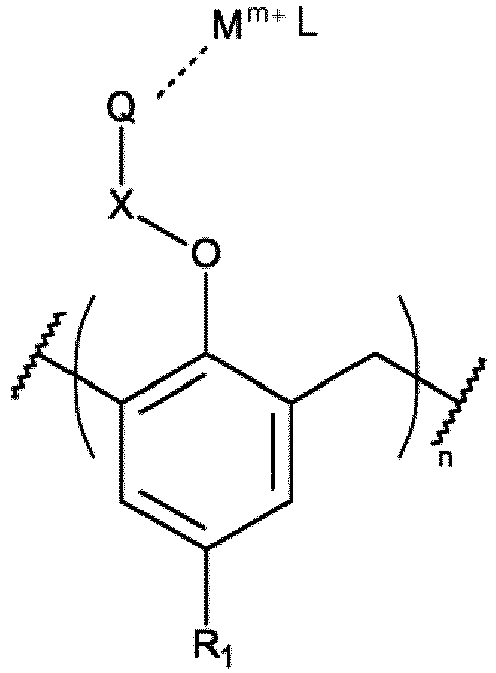 n, X, Mm+, R1 und L so sind, wie in Anspruch 1 definiert,Q ausgewählt ist aus der Gruppe bestehend aus Phosphor-Liganden und N-heterocyclischen Carbenen.
 - Verbindung der Formel (IC) nach einem der Ansprüche 1 bis 2, wobei X ein lineares Alkyl ist, umfassend 2 bis 8 oder 3 bis 8 Kohlenstoffatome.
- Verbindung der Formel (IC) nach einem der Ansprüche 1 bis 3, wobei R1 ausgewählt ist aus n-Octyl, t-Butyl, O-Benzyl und O-Alkyl, vorzugsweise t-Butyl und O-Benzyl.
- Verbindung der Formel (IC) nach einem der Ansprüche 1 bis 4, wobei: n für eine ganze Zahl von 7 bis 20 steht,X ein lineares Alkyl ist, umfassend 3 bis 6 Kohlenstoffatome,Q für eine Gruppierung steht, ausgewählt aus der Gruppe bestehend aus Phosphor-Liganden und N-heterocyclischen Carbenen,R1 für n-Octyl, t-Butyl, 0-Benzyl, O-Methyl, O-Ethyl und O-Propyl, vorzugsweise t-Butyl und O-Benzyl steht,Mm+ für ein Metall im Oxidationszustand m oder ein Metallaggregat steht, umfassend eine Gesamtheit von Metallen im Oxidationszustand m, wobei m 0, 1, 2, 3, 4 oder 5, vorzugsweise 0, 1, 2 oder 3 ist,L aus einem oder mehreren neutralen oder negativ geladenen Liganden besteht, die an das Metall gebunden sind.
- Verbindung der Formel (IC) nach Anspruch 2:
 n, X, R1 so sind, wie in einem der Ansprüche 1 bis 5 definiert,Q ausgewählt ist aus der Gruppe bestehend aus Phosphor-Liganden und N-heterocyclischen Carbenen,Mm+ für ein Metall im Oxidationszustand m oder ein Metallaggregat steht, umfassend eine Gesamtheit von Metallen im Oxidationszustand m, wobei m 0, 1, 2, 3, 4 oder 5 ist, undM ein Übergangsmetall der Gruppe IB, IIB, IIIB, IVB, VB, VIB, VIIB oder VIIIB ist,L aus einem oder mehreren neutralen oder negativ geladenen Liganden besteht, die an das Metall gebunden sind.
 - Verbindung der Formel (IC) nach Anspruch 6, wobei:Mm+ für ein Metall im Oxidationszustand m oder ein Metallaggregat steht, umfassend eine Gesamtheit von Metallen im Oxidationszustand m, undM ausgewählt ist aus der Gruppe bestehend aus Ni, Pd, Ru, Rh, Cu, Co oder Pt.
- Verbindung der Formel (IC) nach Anspruch 1:
 n, X, Mm+, R1 und L so sind, wie in Anspruch 1 definiert,Q für eine Gruppierung steht, die ausgewählt ist aus der Gruppe bestehend aus Salen-Liganden.
 - Verbindung der Formel (IC) nach Anspruch 1:

Q für eine Gruppierung steht, ausgewählt aus der Gruppe bestehend aus Phosphinen, Phosphoniten, Phosphiniten und 1,3-Imidazolylidenen, 1,3-Imidazolinylidenen, 1,2,4-Triazolylidenen, 1,3-Benzimidazolylidenen, 1,2,4-Triazolylidenen und 1,3-Thiazolylidenen, oder enantiopuren Salen-Liganden. - Verbindung der Formel (IC) nach Anspruch 1, ausgewählt aus:


- Verwendung einer Verbindung der Formel (IC) nach einem der Ansprüche 1 bis 10 als Katalysator in einer organisch-chemischen Reaktion.
- Verwendung einer Verbindung der Formel (IC) nach Anspruch 11 als Katalysator in einer organisch-chemischen Reaktion, ausgewählt aus der Gruppe bestehend aus Reduktionsreaktionen, Oxidationsreaktionen, Reaktionen zur Bildung von Kohlenstoff-Kohlenstoff-Bindungen, Reaktionen zur Bildung von Kohlenstoff-Heteroatom-Bindungen, Carbonylierungsreaktionen in Gegenwart von CO, Carboxylierungsreaktionen in Gegenwart von CO2 und asymmetrischen Katalysereaktionen.
- Verwendung einer Verbindung der Formel (IC) nach einem der Ansprüche 11 bis 12 als Katalysator in einer organisch-chemischen Reaktion, ausgewählt aus der Gruppe bestehend aus Hydrierungsreaktionen von Carbonylen, Alkenen, Alkinen oder Arenen, Reaktionen zur Bildung von Kohlenstoff-Kohlenstoff-Bindungen wie Suzuki-, Heck-, Stille-, Kumada- und Sonogashira-Kupplungen, Reaktionen zur Bildung von Kohlenstoff-Stickstoff-, Kohlenstoff-Sauerstoff-, Kohlenstoff-Phosphor- und Kohlenstoff-Schwefel-Bindungen, Fischer-Tropsch-Reaktionen und Epoxid-Öffnungsreaktionen.
- Verfahren zur Herstellung einer Verbindung der Formel (IC) :
 n, X, L, Mm+ und R1 so sind, wie in Anspruch 1 definiert,Q für eine Gruppierung steht, ausgewählt aus der Gruppe bestehend aus Phosphinen, Phosphoniten, Phosphiniten und N-heterocyclischen Carbenen,umfassend einen Schritt zum Inkontaktbringen einer Verbindung der Formel (IA),wobei Z für eine Gruppierung Q steht, ausgewählt aus der Gruppe bestehend aus Phosphor-Liganden und N-heterocyclischen Carbenen,
 mit einem Metallkomplex der Formel (L')Mm+, wobei Mm+ für ein Metall im Oxidationszustand m oder ein Metallaggregat steht, umfassen eine Gesamtheit von Metallen im Oxidationszustand m, wobei m 0, 1, 2, 3, 4 oder 5, vorzugsweise 0, 1, 2 oder 3 ist, und L' aus 0, einem oder Mehr Eren neutralen oder negativ geladenen Liganden besteht, die an das Metall gebunden sind,
 - Verfahren nach Anspruch 14 zur Herstellung einer Verbindung der Formel (IC):
 n, X, L, Mm+ und R1 so sind, wie in Anspruch 1 definiert,Q für eine Gruppierung steht, ausgewählt aus der Gruppe bestehend aus Phosphinen, Phosphoniten, Phosphiniten und 1,3-Imidazolylidenen, 1,3-Imidazolinylidenen, 1,2,4-Triazolylidenen, 1,3-Benzimidazolylidenen, 1,2,4-Triazolylidenen und 1,3-Thiazolylidenen,umfassend einen Schritt zum Inkontaktbringen einer Verbindung der Formel (IA),wobei Z für eine Gruppierung Q steht, ausgewählt aus der Gruppe bestehend aus Phosphinen, Phosphoniten, Phosphiniten, 1,3-Imidazolylidenen, 1,3-Imidazolinylidenen, 1,2,4-Triazolylidenen, 1,3-Benzimidazolylidenen, 1,2,4-Triazolylidenen und 1,3-Thiazolylidenen,
 mit einem Metallkomplex der Formel (L')Mm+, wobei Mm+ für ein Metall im Oxidationszustand m oder ein Metallaggregat steht, umfassend eine Gesamtheit von Metallen im Oxidationszustand m, wobei m 0, 1, 2, 3, 4 oder 5, vorzugsweise 0, 1, 2 oder 3 ist, und L' aus 0, einem oder mehreren neutralen oder negativ geladenen Liganden besteht, die an das Metall gebunden sind.
 - Verfahren zur Herstellung einer Verbindung der Formel (IC) :
 n, X, L, Mm+ und R1 so sind, wie in Anspruch 1 definiert,Q für eine Gruppierung steht, ausgewählt aus der Gruppe bestehend aus Salen-Liganden,umfassend einen Schritt zum Inkontaktbringen einer Verbindung der Formel (II):
 V für eine Abgangsgruppe steht, ausgewählt aus der Gruppe bestehend aus Halogenen wie Cl, Br und I und Sulfonaten wie OSO2Me, OSO2(C7H7) und OSO2CF3,mit Natriumazid als Vorläufer einer Gruppe zum Pfropfen einer Q'-Gruppierung,wobei Q' 3-(tert-Butyl)-5-ethynyl-2-hydroxybenzaldehyd ist,um eine Verbindung der Formel (VIII) zu erhalten,
 G für eine Gruppe N3 steht,dann umfassend einen Schritt zum Inkontaktbringen der Verbindung der Formel (VIII) mit der oben genannten Gruppierung Q',um eine Verbindung der Formel (IB) zu erhalten,
 dann umfassend einen Schritt zum Inkontaktbringen der Verbindung der Formel (IB),mit der Verbindung der Formel (VII),
 um eine Verbindung der Formel (IA) zu erhalten,
 dann umfassend einen Schritt zum Inkontaktbringen der Verbindung der Formel (IA),mit einem Metallkomplex der Formel LMm+, wobei M, L und m so sind, wie in Anspruch 1 definiert,gegebenenfalls in Gegenwart einer Base, und insbesondere mit Kobaltacetat und Paratoluolsulfonsäure,um die Verbindung der Formel (IC) zu erhalten.
 - Verwendung nach einem der Ansprüche 11 bis 13, wobei die Verbindung der Formel (IC) als heterogener Katalysator verwendet wird und wobei die Auslaugrate des Metalls aus dem Katalysator weniger als 10 %, insbesondere weniger als 5 %, des Gesamtgewichts des in dem Katalysator enthaltenen Metalls beträgt.
Applications Claiming Priority (2)
| Application Number | Priority Date | Filing Date | Title |
|---|---|---|---|
| FR1660471A FR3058140A1 (fr) | 2016-10-27 | 2016-10-27 | Catalyseurs supportes cycliques |
| PCT/FR2017/052980 WO2018078304A1 (fr) | 2016-10-27 | 2017-10-27 | Catalyseurs supportes cycliques |
Publications (2)
| Publication Number | Publication Date |
|---|---|
| EP3532197A1 EP3532197A1 (de) | 2019-09-04 |
| EP3532197B1 true EP3532197B1 (de) | 2024-01-10 |
Family
ID=58162742
Family Applications (1)
| Application Number | Title | Priority Date | Filing Date |
|---|---|---|---|
| EP17797409.4A Active EP3532197B1 (de) | 2016-10-27 | 2017-10-27 | Zyklische geträgerte katalysatoren |
Country Status (6)
| Country | Link |
|---|---|
| US (1) | US20190344254A1 (de) |
| EP (1) | EP3532197B1 (de) |
| JP (1) | JP7569618B2 (de) |
| CN (1) | CN110494219B (de) |
| FR (1) | FR3058140A1 (de) |
| WO (1) | WO2018078304A1 (de) |
Families Citing this family (4)
| Publication number | Priority date | Publication date | Assignee | Title |
|---|---|---|---|---|
| CN113072674B (zh) * | 2020-01-03 | 2022-07-12 | 万华化学集团股份有限公司 | 一种热敏性叔胺催化剂、其季铵化衍生物及制备和应用 |
| CN114057649B (zh) * | 2021-11-16 | 2023-05-23 | 大赛璐(中国)投资有限公司 | 一种可聚合配体化合物、聚合物配体及其金属配合物 |
| CN117069770B (zh) * | 2023-07-21 | 2025-07-22 | 石河子大学 | 利用氢键合成氮杂环卡宾配合物的方法 |
| CN118755468B (zh) * | 2024-09-02 | 2025-01-10 | 延长油田股份有限公司 | 一种油气井压裂用酸化缓蚀剂及其制备方法 |
Family Cites Families (9)
| Publication number | Priority date | Publication date | Assignee | Title |
|---|---|---|---|---|
| JP2740240B2 (ja) * | 1989-02-28 | 1998-04-15 | 鐘紡株式会社 | カリックスアレーン誘導体 |
| FR2778916B1 (fr) * | 1998-05-20 | 2000-06-30 | Rhone Poulenc Fibres | Nouveaux complexes organometalliques comprenant des carbenes heterocycliques cationiques et leur procede de preparation |
| JP4402482B2 (ja) * | 2004-03-10 | 2010-01-20 | 独立行政法人科学技術振興機構 | カリックスアレーン化合物の遷移金属錯体、及びそれからなる吸着材料 |
| CN101652341B (zh) * | 2007-04-05 | 2013-03-20 | 陶氏环球技术公司 | 用于加氢甲酰基化方法中的杯芳烃二亚磷酸酯配体 |
| CA2768744A1 (en) * | 2009-07-31 | 2011-02-03 | Basf Se | Phosphine borane compounds comprising imidazol groups and method for producing phosphine borane compounds comprising imidazol groups |
| CA2777764A1 (en) * | 2009-10-22 | 2011-04-28 | The Regents Of The University Of California | Calixarene-bound iridium-containing metal colloids |
| CN102276481B (zh) * | 2011-04-29 | 2014-05-14 | 苏州大学 | 一种杯芳烃衍生物及其金属配合物以及它们的制备方法和应用 |
| FR2994970B1 (fr) | 2012-08-28 | 2015-12-18 | Univ Paris Sud Xi | Procede de preparation a hauts rendements de p-(r-oxy)calix[9-20] arenes |
| FR2994971B1 (fr) | 2012-08-28 | 2016-01-08 | Univ Paris Sud Xi | Procede de preparation a hauts rendements de p-(r)calixarenes geants |
-
2016
- 2016-10-27 FR FR1660471A patent/FR3058140A1/fr active Pending
-
2017
- 2017-10-27 EP EP17797409.4A patent/EP3532197B1/de active Active
- 2017-10-27 WO PCT/FR2017/052980 patent/WO2018078304A1/fr not_active Ceased
- 2017-10-27 JP JP2019546086A patent/JP7569618B2/ja active Active
- 2017-10-27 US US16/345,581 patent/US20190344254A1/en not_active Abandoned
- 2017-10-27 CN CN201780081295.1A patent/CN110494219B/zh active Active
Also Published As
| Publication number | Publication date |
|---|---|
| US20190344254A1 (en) | 2019-11-14 |
| FR3058140A1 (fr) | 2018-05-04 |
| JP7569618B2 (ja) | 2024-10-18 |
| WO2018078304A1 (fr) | 2018-05-03 |
| JP2019535817A (ja) | 2019-12-12 |
| CN110494219A (zh) | 2019-11-22 |
| CN110494219B (zh) | 2022-10-28 |
| EP3532197A1 (de) | 2019-09-04 |
Similar Documents
| Publication | Publication Date | Title |
|---|---|---|
| Sato et al. | Asymmetric synthesis of an organic compound with high enantiomeric excess induced by inorganic ionic sodium chlorate | |
| EP2476688B1 (de) | Katalytische Komplexe auf Rutheniumbasis und die Anwendung solcher Komplexe in der Olefinmetathese | |
| CN102834175B (zh) | 带有螯合亚烷基配体的钌基卡宾催化剂的制备方法 | |
| WO2018078304A1 (fr) | Catalyseurs supportes cycliques | |
| EP3538508B1 (de) | Rutheniumkomplexe zur katalysierung von metathesereaktionen | |
| CN116075494A (zh) | 碱土金属甲酸盐的制造方法 | |
| JP5214609B2 (ja) | イソプレゴールの製造中におけるビス(ジアリールフェノール)配位子の回収 | |
| EP2203487B1 (de) | Verfahren zur herstellung von mit metallelementen dotierten polymermaterialien und resultierende materialien | |
| EP0389359A1 (de) | Verfahren zur Herstellung von cyclischen Einfunktionalisierten Tetraminen | |
| EP2491047B1 (de) | Neues organisch-anorganisches hybridmaterial ihm-2 und herstellungsverfahren dafür | |
| CN102964390B (zh) | 一种平面手性二茂铁化合物、合成方法及用途 | |
| CN109503645A (zh) | 一种含有四个硅氢键的手性偕二硅基烷烃化合物及其合成方法和应用 | |
| FR2887253A1 (fr) | Nouvelles arylphosphines p chirales ortho-fonctionnalisees et derives: leur preparation et utilisation en catalyse asymetrique | |
| Bechu et al. | Heterometallic coordination polymers based on homo-and heteroleptic Au (III) dithiolene complexes | |
| EP2588486B1 (de) | Geträgerte liganden mit hoher lokaler dichte an koordinierenden atomen | |
| Isozaki et al. | Synthesis and Applications of (ONO Pincer) Ruthenium‐Complex‐Bound Norvalines | |
| EP4399025B1 (de) | Neues verfahren zur katalytischen herstellung von oxalat- und oxamidverbindungen | |
| EP0968220A1 (de) | 6, 6'-bis-(1-phosphanorbornadien)-diphosphine | |
| CN101124234B (zh) | 不对称合成用催化剂、其中使用的配体以及通过使用该催化剂和配体的不对称合成反应来制造光学活性化合物的方法 | |
| Kitanosono et al. | Water-driven solid self-assembled catalysis | |
| FR2717480A1 (fr) | Procédé de préparation de bis(oxydes de phosphane) et bis(phosphanes) macrocycliques. | |
| EP1633477A1 (de) | Diphosphine, deren herstellung und verwendung | |
| WO2010040939A1 (fr) | Nouveau procede de metathese d'olefines ou d'enynes | |
| CN120987824A (zh) | 一种基于极性反转策略合成烷基吲哚衍生物的方法 | |
| WO2001007449A1 (fr) | Complexes de phosphine/palladium catalyseurs pour l'arylation d'olefines |
Legal Events
| Date | Code | Title | Description |
|---|---|---|---|
| STAA | Information on the status of an ep patent application or granted ep patent |
Free format text: STATUS: UNKNOWN |
|
| STAA | Information on the status of an ep patent application or granted ep patent |
Free format text: STATUS: THE INTERNATIONAL PUBLICATION HAS BEEN MADE |
|
| PUAI | Public reference made under article 153(3) epc to a published international application that has entered the european phase |
Free format text: ORIGINAL CODE: 0009012 |
|
| STAA | Information on the status of an ep patent application or granted ep patent |
Free format text: STATUS: REQUEST FOR EXAMINATION WAS MADE |
|
| 17P | Request for examination filed |
Effective date: 20190520 |
|
| AK | Designated contracting states |
Kind code of ref document: A1 Designated state(s): AL AT BE BG CH CY CZ DE DK EE ES FI FR GB GR HR HU IE IS IT LI LT LU LV MC MK MT NL NO PL PT RO RS SE SI SK SM TR |
|
| AX | Request for extension of the european patent |
Extension state: BA ME |
|
| RIN1 | Information on inventor provided before grant (corrected) |
Inventor name: SCHULZ, EMMANUELLE Inventor name: ABDELLAH, IBRAHIM Inventor name: MARTINI, CYRIL, AUGUST, ROGER Inventor name: HUC, VINCENT, GERMAIN |
|
| DAV | Request for validation of the european patent (deleted) | ||
| DAX | Request for extension of the european patent (deleted) | ||
| STAA | Information on the status of an ep patent application or granted ep patent |
Free format text: STATUS: EXAMINATION IS IN PROGRESS |
|
| RAP1 | Party data changed (applicant data changed or rights of an application transferred) |
Owner name: CENTRE NATIONAL DE LA RECHERCHE SCIENTIFIQUE Owner name: UNIVERSITE PARIS-SACLAY |
|
| 17Q | First examination report despatched |
Effective date: 20200326 |
|
| REG | Reference to a national code |
Ref country code: DE Ref legal event code: R079 Free format text: PREVIOUS MAIN CLASS: B01J0031060000 Ipc: B01J0031020000 Ref document number: 602017078374 Country of ref document: DE |
|
| GRAP | Despatch of communication of intention to grant a patent |
Free format text: ORIGINAL CODE: EPIDOSNIGR1 |
|
| STAA | Information on the status of an ep patent application or granted ep patent |
Free format text: STATUS: GRANT OF PATENT IS INTENDED |
|
| RIC1 | Information provided on ipc code assigned before grant |
Ipc: B01J 31/24 20060101ALI20230710BHEP Ipc: B01J 31/22 20060101ALI20230710BHEP Ipc: B01J 31/18 20060101ALI20230710BHEP Ipc: B01J 31/06 20060101ALI20230710BHEP Ipc: B01J 31/02 20060101AFI20230710BHEP |
|
| INTG | Intention to grant announced |
Effective date: 20230802 |
|
| GRAS | Grant fee paid |
Free format text: ORIGINAL CODE: EPIDOSNIGR3 |
|
| GRAA | (expected) grant |
Free format text: ORIGINAL CODE: 0009210 |
|
| STAA | Information on the status of an ep patent application or granted ep patent |
Free format text: STATUS: THE PATENT HAS BEEN GRANTED |
|
| AK | Designated contracting states |
Kind code of ref document: B1 Designated state(s): AL AT BE BG CH CY CZ DE DK EE ES FI FR GB GR HR HU IE IS IT LI LT LU LV MC MK MT NL NO PL PT RO RS SE SI SK SM TR |
|
| REG | Reference to a national code |
Ref country code: GB Ref legal event code: FG4D Free format text: NOT ENGLISH |
|
| REG | Reference to a national code |
Ref country code: CH Ref legal event code: EP |
|
| REG | Reference to a national code |
Ref country code: DE Ref legal event code: R096 Ref document number: 602017078374 Country of ref document: DE |
|
| REG | Reference to a national code |
Ref country code: IE Ref legal event code: FG4D Free format text: LANGUAGE OF EP DOCUMENT: FRENCH |
|
| REG | Reference to a national code |
Ref country code: LT Ref legal event code: MG9D |
|
| REG | Reference to a national code |
Ref country code: NL Ref legal event code: MP Effective date: 20240110 |
|
| REG | Reference to a national code |
Ref country code: AT Ref legal event code: MK05 Ref document number: 1648489 Country of ref document: AT Kind code of ref document: T Effective date: 20240110 |
|
| RAP4 | Party data changed (patent owner data changed or rights of a patent transferred) |
Owner name: CENTRE NATIONAL DE LA RECHERCHE SCIENTIFIQUE Owner name: UNIVERSITE PARIS-SACLAY |
|
| PG25 | Lapsed in a contracting state [announced via postgrant information from national office to epo] |
Ref country code: NL Free format text: LAPSE BECAUSE OF FAILURE TO SUBMIT A TRANSLATION OF THE DESCRIPTION OR TO PAY THE FEE WITHIN THE PRESCRIBED TIME-LIMIT Effective date: 20240110 |
|
| PG25 | Lapsed in a contracting state [announced via postgrant information from national office to epo] |
Ref country code: NL Free format text: LAPSE BECAUSE OF FAILURE TO SUBMIT A TRANSLATION OF THE DESCRIPTION OR TO PAY THE FEE WITHIN THE PRESCRIBED TIME-LIMIT Effective date: 20240110 |
|
| PG25 | Lapsed in a contracting state [announced via postgrant information from national office to epo] |
Ref country code: IS Free format text: LAPSE BECAUSE OF FAILURE TO SUBMIT A TRANSLATION OF THE DESCRIPTION OR TO PAY THE FEE WITHIN THE PRESCRIBED TIME-LIMIT Effective date: 20240510 |
|
| PG25 | Lapsed in a contracting state [announced via postgrant information from national office to epo] |
Ref country code: LT Free format text: LAPSE BECAUSE OF FAILURE TO SUBMIT A TRANSLATION OF THE DESCRIPTION OR TO PAY THE FEE WITHIN THE PRESCRIBED TIME-LIMIT Effective date: 20240110 |
|
| PG25 | Lapsed in a contracting state [announced via postgrant information from national office to epo] |
Ref country code: GR Free format text: LAPSE BECAUSE OF FAILURE TO SUBMIT A TRANSLATION OF THE DESCRIPTION OR TO PAY THE FEE WITHIN THE PRESCRIBED TIME-LIMIT Effective date: 20240411 |
|
| PG25 | Lapsed in a contracting state [announced via postgrant information from national office to epo] |
Ref country code: RS Free format text: LAPSE BECAUSE OF FAILURE TO SUBMIT A TRANSLATION OF THE DESCRIPTION OR TO PAY THE FEE WITHIN THE PRESCRIBED TIME-LIMIT Effective date: 20240410 Ref country code: HR Free format text: LAPSE BECAUSE OF FAILURE TO SUBMIT A TRANSLATION OF THE DESCRIPTION OR TO PAY THE FEE WITHIN THE PRESCRIBED TIME-LIMIT Effective date: 20240110 |
|
| PG25 | Lapsed in a contracting state [announced via postgrant information from national office to epo] |
Ref country code: ES Free format text: LAPSE BECAUSE OF FAILURE TO SUBMIT A TRANSLATION OF THE DESCRIPTION OR TO PAY THE FEE WITHIN THE PRESCRIBED TIME-LIMIT Effective date: 20240110 |
|
| PG25 | Lapsed in a contracting state [announced via postgrant information from national office to epo] |
Ref country code: AT Free format text: LAPSE BECAUSE OF FAILURE TO SUBMIT A TRANSLATION OF THE DESCRIPTION OR TO PAY THE FEE WITHIN THE PRESCRIBED TIME-LIMIT Effective date: 20240110 |
|
| PG25 | Lapsed in a contracting state [announced via postgrant information from national office to epo] |
Ref country code: RS Free format text: LAPSE BECAUSE OF FAILURE TO SUBMIT A TRANSLATION OF THE DESCRIPTION OR TO PAY THE FEE WITHIN THE PRESCRIBED TIME-LIMIT Effective date: 20240410 Ref country code: NO Free format text: LAPSE BECAUSE OF FAILURE TO SUBMIT A TRANSLATION OF THE DESCRIPTION OR TO PAY THE FEE WITHIN THE PRESCRIBED TIME-LIMIT Effective date: 20240410 Ref country code: LT Free format text: LAPSE BECAUSE OF FAILURE TO SUBMIT A TRANSLATION OF THE DESCRIPTION OR TO PAY THE FEE WITHIN THE PRESCRIBED TIME-LIMIT Effective date: 20240110 Ref country code: IS Free format text: LAPSE BECAUSE OF FAILURE TO SUBMIT A TRANSLATION OF THE DESCRIPTION OR TO PAY THE FEE WITHIN THE PRESCRIBED TIME-LIMIT Effective date: 20240510 Ref country code: HR Free format text: LAPSE BECAUSE OF FAILURE TO SUBMIT A TRANSLATION OF THE DESCRIPTION OR TO PAY THE FEE WITHIN THE PRESCRIBED TIME-LIMIT Effective date: 20240110 Ref country code: GR Free format text: LAPSE BECAUSE OF FAILURE TO SUBMIT A TRANSLATION OF THE DESCRIPTION OR TO PAY THE FEE WITHIN THE PRESCRIBED TIME-LIMIT Effective date: 20240411 Ref country code: ES Free format text: LAPSE BECAUSE OF FAILURE TO SUBMIT A TRANSLATION OF THE DESCRIPTION OR TO PAY THE FEE WITHIN THE PRESCRIBED TIME-LIMIT Effective date: 20240110 Ref country code: BG Free format text: LAPSE BECAUSE OF FAILURE TO SUBMIT A TRANSLATION OF THE DESCRIPTION OR TO PAY THE FEE WITHIN THE PRESCRIBED TIME-LIMIT Effective date: 20240110 Ref country code: AT Free format text: LAPSE BECAUSE OF FAILURE TO SUBMIT A TRANSLATION OF THE DESCRIPTION OR TO PAY THE FEE WITHIN THE PRESCRIBED TIME-LIMIT Effective date: 20240110 |
|
| PG25 | Lapsed in a contracting state [announced via postgrant information from national office to epo] |
Ref country code: PL Free format text: LAPSE BECAUSE OF FAILURE TO SUBMIT A TRANSLATION OF THE DESCRIPTION OR TO PAY THE FEE WITHIN THE PRESCRIBED TIME-LIMIT Effective date: 20240110 Ref country code: PT Free format text: LAPSE BECAUSE OF FAILURE TO SUBMIT A TRANSLATION OF THE DESCRIPTION OR TO PAY THE FEE WITHIN THE PRESCRIBED TIME-LIMIT Effective date: 20240510 |
|
| PG25 | Lapsed in a contracting state [announced via postgrant information from national office to epo] |
Ref country code: SE Free format text: LAPSE BECAUSE OF FAILURE TO SUBMIT A TRANSLATION OF THE DESCRIPTION OR TO PAY THE FEE WITHIN THE PRESCRIBED TIME-LIMIT Effective date: 20240110 Ref country code: PT Free format text: LAPSE BECAUSE OF FAILURE TO SUBMIT A TRANSLATION OF THE DESCRIPTION OR TO PAY THE FEE WITHIN THE PRESCRIBED TIME-LIMIT Effective date: 20240510 Ref country code: PL Free format text: LAPSE BECAUSE OF FAILURE TO SUBMIT A TRANSLATION OF THE DESCRIPTION OR TO PAY THE FEE WITHIN THE PRESCRIBED TIME-LIMIT Effective date: 20240110 Ref country code: LV Free format text: LAPSE BECAUSE OF FAILURE TO SUBMIT A TRANSLATION OF THE DESCRIPTION OR TO PAY THE FEE WITHIN THE PRESCRIBED TIME-LIMIT Effective date: 20240110 |
|
| PG25 | Lapsed in a contracting state [announced via postgrant information from national office to epo] |
Ref country code: DK Free format text: LAPSE BECAUSE OF FAILURE TO SUBMIT A TRANSLATION OF THE DESCRIPTION OR TO PAY THE FEE WITHIN THE PRESCRIBED TIME-LIMIT Effective date: 20240110 |
|
| REG | Reference to a national code |
Ref country code: DE Ref legal event code: R097 Ref document number: 602017078374 Country of ref document: DE |
|
| PG25 | Lapsed in a contracting state [announced via postgrant information from national office to epo] |
Ref country code: SM Free format text: LAPSE BECAUSE OF FAILURE TO SUBMIT A TRANSLATION OF THE DESCRIPTION OR TO PAY THE FEE WITHIN THE PRESCRIBED TIME-LIMIT Effective date: 20240110 |
|
| PG25 | Lapsed in a contracting state [announced via postgrant information from national office to epo] |
Ref country code: CZ Free format text: LAPSE BECAUSE OF FAILURE TO SUBMIT A TRANSLATION OF THE DESCRIPTION OR TO PAY THE FEE WITHIN THE PRESCRIBED TIME-LIMIT Effective date: 20240110 Ref country code: EE Free format text: LAPSE BECAUSE OF FAILURE TO SUBMIT A TRANSLATION OF THE DESCRIPTION OR TO PAY THE FEE WITHIN THE PRESCRIBED TIME-LIMIT Effective date: 20240110 |
|
| PG25 | Lapsed in a contracting state [announced via postgrant information from national office to epo] |
Ref country code: SK Free format text: LAPSE BECAUSE OF FAILURE TO SUBMIT A TRANSLATION OF THE DESCRIPTION OR TO PAY THE FEE WITHIN THE PRESCRIBED TIME-LIMIT Effective date: 20240110 |
|
| PG25 | Lapsed in a contracting state [announced via postgrant information from national office to epo] |
Ref country code: SM Free format text: LAPSE BECAUSE OF FAILURE TO SUBMIT A TRANSLATION OF THE DESCRIPTION OR TO PAY THE FEE WITHIN THE PRESCRIBED TIME-LIMIT Effective date: 20240110 Ref country code: SK Free format text: LAPSE BECAUSE OF FAILURE TO SUBMIT A TRANSLATION OF THE DESCRIPTION OR TO PAY THE FEE WITHIN THE PRESCRIBED TIME-LIMIT Effective date: 20240110 Ref country code: RO Free format text: LAPSE BECAUSE OF FAILURE TO SUBMIT A TRANSLATION OF THE DESCRIPTION OR TO PAY THE FEE WITHIN THE PRESCRIBED TIME-LIMIT Effective date: 20240110 Ref country code: EE Free format text: LAPSE BECAUSE OF FAILURE TO SUBMIT A TRANSLATION OF THE DESCRIPTION OR TO PAY THE FEE WITHIN THE PRESCRIBED TIME-LIMIT Effective date: 20240110 Ref country code: DK Free format text: LAPSE BECAUSE OF FAILURE TO SUBMIT A TRANSLATION OF THE DESCRIPTION OR TO PAY THE FEE WITHIN THE PRESCRIBED TIME-LIMIT Effective date: 20240110 Ref country code: CZ Free format text: LAPSE BECAUSE OF FAILURE TO SUBMIT A TRANSLATION OF THE DESCRIPTION OR TO PAY THE FEE WITHIN THE PRESCRIBED TIME-LIMIT Effective date: 20240110 |
|
| PLBE | No opposition filed within time limit |
Free format text: ORIGINAL CODE: 0009261 |
|
| STAA | Information on the status of an ep patent application or granted ep patent |
Free format text: STATUS: NO OPPOSITION FILED WITHIN TIME LIMIT |
|
| PG25 | Lapsed in a contracting state [announced via postgrant information from national office to epo] |
Ref country code: IT Free format text: LAPSE BECAUSE OF FAILURE TO SUBMIT A TRANSLATION OF THE DESCRIPTION OR TO PAY THE FEE WITHIN THE PRESCRIBED TIME-LIMIT Effective date: 20240110 |
|
| 26N | No opposition filed |
Effective date: 20241011 |
|
| PG25 | Lapsed in a contracting state [announced via postgrant information from national office to epo] |
Ref country code: IT Free format text: LAPSE BECAUSE OF FAILURE TO SUBMIT A TRANSLATION OF THE DESCRIPTION OR TO PAY THE FEE WITHIN THE PRESCRIBED TIME-LIMIT Effective date: 20240110 |
|
| PG25 | Lapsed in a contracting state [announced via postgrant information from national office to epo] |
Ref country code: SI Free format text: LAPSE BECAUSE OF FAILURE TO SUBMIT A TRANSLATION OF THE DESCRIPTION OR TO PAY THE FEE WITHIN THE PRESCRIBED TIME-LIMIT Effective date: 20240110 |
|
| PG25 | Lapsed in a contracting state [announced via postgrant information from national office to epo] |
Ref country code: MC Free format text: LAPSE BECAUSE OF FAILURE TO SUBMIT A TRANSLATION OF THE DESCRIPTION OR TO PAY THE FEE WITHIN THE PRESCRIBED TIME-LIMIT Effective date: 20240110 |
|
| PG25 | Lapsed in a contracting state [announced via postgrant information from national office to epo] |
Ref country code: LU Free format text: LAPSE BECAUSE OF NON-PAYMENT OF DUE FEES Effective date: 20241027 |
|
| PG25 | Lapsed in a contracting state [announced via postgrant information from national office to epo] |
Ref country code: FI Free format text: LAPSE BECAUSE OF FAILURE TO SUBMIT A TRANSLATION OF THE DESCRIPTION OR TO PAY THE FEE WITHIN THE PRESCRIBED TIME-LIMIT Effective date: 20240110 |
|
| PG25 | Lapsed in a contracting state [announced via postgrant information from national office to epo] |
Ref country code: IE Free format text: LAPSE BECAUSE OF NON-PAYMENT OF DUE FEES Effective date: 20241027 |
|
| REG | Reference to a national code |
Ref country code: CH Ref legal event code: U11 Free format text: ST27 STATUS EVENT CODE: U-0-0-U10-U11 (AS PROVIDED BY THE NATIONAL OFFICE) Effective date: 20251101 |
|
| PGFP | Annual fee paid to national office [announced via postgrant information from national office to epo] |
Ref country code: DE Payment date: 20250930 Year of fee payment: 9 |
|
| PGFP | Annual fee paid to national office [announced via postgrant information from national office to epo] |
Ref country code: GB Payment date: 20251030 Year of fee payment: 9 |
|
| PGFP | Annual fee paid to national office [announced via postgrant information from national office to epo] |
Ref country code: FR Payment date: 20251022 Year of fee payment: 9 |
|
| PGFP | Annual fee paid to national office [announced via postgrant information from national office to epo] |
Ref country code: BE Payment date: 20251021 Year of fee payment: 9 |
|
| PGFP | Annual fee paid to national office [announced via postgrant information from national office to epo] |
Ref country code: CH Payment date: 20251101 Year of fee payment: 9 |
|
| PG25 | Lapsed in a contracting state [announced via postgrant information from national office to epo] |
Ref country code: CY Free format text: LAPSE BECAUSE OF FAILURE TO SUBMIT A TRANSLATION OF THE DESCRIPTION OR TO PAY THE FEE WITHIN THE PRESCRIBED TIME-LIMIT; INVALID AB INITIO Effective date: 20171027 |
|
| PG25 | Lapsed in a contracting state [announced via postgrant information from national office to epo] |
Ref country code: HU Free format text: LAPSE BECAUSE OF FAILURE TO SUBMIT A TRANSLATION OF THE DESCRIPTION OR TO PAY THE FEE WITHIN THE PRESCRIBED TIME-LIMIT; INVALID AB INITIO Effective date: 20171027 |