EP3496478B1 - Verfahren und vorrichtung zur ressourcenauswahl - Google Patents
Verfahren und vorrichtung zur ressourcenauswahl Download PDFInfo
- Publication number
- EP3496478B1 EP3496478B1 EP16917426.5A EP16917426A EP3496478B1 EP 3496478 B1 EP3496478 B1 EP 3496478B1 EP 16917426 A EP16917426 A EP 16917426A EP 3496478 B1 EP3496478 B1 EP 3496478B1
- Authority
- EP
- European Patent Office
- Prior art keywords
- terminal
- threshold
- resource
- type
- parameter information
- Prior art date
- Legal status (The legal status is an assumption and is not a legal conclusion. Google has not performed a legal analysis and makes no representation as to the accuracy of the status listed.)
- Active
Links
Images

Classifications
-
- H—ELECTRICITY
- H04—ELECTRIC COMMUNICATION TECHNIQUE
- H04W—WIRELESS COMMUNICATION NETWORKS
- H04W72/00—Local resource management
- H04W72/02—Selection of wireless resources by user or terminal
-
- H—ELECTRICITY
- H04—ELECTRIC COMMUNICATION TECHNIQUE
- H04W—WIRELESS COMMUNICATION NETWORKS
- H04W72/00—Local resource management
- H04W72/50—Allocation or scheduling criteria for wireless resources
- H04W72/51—Allocation or scheduling criteria for wireless resources based on terminal or device properties
-
- H—ELECTRICITY
- H04—ELECTRIC COMMUNICATION TECHNIQUE
- H04W—WIRELESS COMMUNICATION NETWORKS
- H04W4/00—Services specially adapted for wireless communication networks; Facilities therefor
- H04W4/30—Services specially adapted for particular environments, situations or purposes
- H04W4/40—Services specially adapted for particular environments, situations or purposes for vehicles, e.g. vehicle-to-pedestrians [V2P]
-
- H—ELECTRICITY
- H04—ELECTRIC COMMUNICATION TECHNIQUE
- H04W—WIRELESS COMMUNICATION NETWORKS
- H04W72/00—Local resource management
- H04W72/50—Allocation or scheduling criteria for wireless resources
- H04W72/54—Allocation or scheduling criteria for wireless resources based on quality criteria
- H04W72/541—Allocation or scheduling criteria for wireless resources based on quality criteria using the level of interference
-
- H—ELECTRICITY
- H04—ELECTRIC COMMUNICATION TECHNIQUE
- H04W—WIRELESS COMMUNICATION NETWORKS
- H04W72/00—Local resource management
- H04W72/50—Allocation or scheduling criteria for wireless resources
- H04W72/56—Allocation or scheduling criteria for wireless resources based on priority criteria
-
- H—ELECTRICITY
- H04—ELECTRIC COMMUNICATION TECHNIQUE
- H04W—WIRELESS COMMUNICATION NETWORKS
- H04W76/00—Connection management
- H04W76/10—Connection setup
- H04W76/14—Direct-mode setup
-
- H—ELECTRICITY
- H04—ELECTRIC COMMUNICATION TECHNIQUE
- H04W—WIRELESS COMMUNICATION NETWORKS
- H04W92/00—Interfaces specially adapted for wireless communication networks
- H04W92/16—Interfaces between hierarchically similar devices
- H04W92/18—Interfaces between hierarchically similar devices between terminal devices
Definitions
- the present invention relates to the field of wireless network technologies, and in particular, to a resource selection method and apparatus.
- Cellular network-based D2D (Device-to-Device) communication is a technology allowing, under control of a system, direct communication between terminals by multiplexing a cell resource.
- Such a technology can increase a spectrum efficiency of a cellular communications system and reduce a transmit power for a terminal, thereby resolving, to some extent, a problem of a lack of spectrum resources in a wireless communications system.
- a V2X (Vehicle to Everything, Internet of Vehicles) technology allows one vehicle to continuously communicate with all other nearby vehicles and road infrastructure, for example, allows the vehicle to communicate with infrastructure such as traffic lights, school regions and railway crossings.
- a communications device may be a mobile device such as an in-vehicle embedded remote information processing system or a smartphone.
- the V2X technology achieves communication between vehicles, communication between a vehicle and a base station, and communication between base stations, to obtain transportation information such as a real-time road condition, road information and pedestrian information, thereby increasing driving safety, alleviating congestion, improving a transportation efficiency, providing in-vehicle entertainment information, and the like.
- the V2X communication can be implemented based on the D2D technology, so that each in-vehicle unit can directly communicate with an in-vehicle unit of another nearby vehicle. Because in the V2X communication, forwarding performed by a base station or a roadside unit is not required, a delay of communication between vehicles can be significantly reduced and a transmission rate can be increased.
- data sent by UEs User Equipment
- SA Service Traffic of the UEs is periodic.
- a shortest period of a CAM Cooperative Awareness Message
- a longest period is Is.
- the UEs are capable of predicting periods of traffic of the UEs. Therefore, a UE resource reservation solution is added to the V2X communication.
- UE may inform another UE of a future resource reserved by the UE.
- the UE needs to consider a resource reserved by the another UE, to avoid, as much as possible, multiplexing the resource already reserved by the another UE.
- V2V defines a solution in which UE performs monitoring and semi-static reservation transmission in an autonomous resource selection mode.
- the autonomous resource selection mode of the UE when resource selection or resource reselection is triggered, if to-be-sent data arrives at a time point m, the UE monitors a resource use condition at least during a time period [m-1000, m-1). The UE needs to first exclude a resource meeting a specific condition, and then select a resource from remaining resources for sending data.
- the condition for excluding a resource is: SA received by the UE has reserved the resource, and an RSRP (Reference Signal Receiving Power) of a PSSCH (Physical Sidelink Shared Channel), of the UE, on the resource associated with the SA, is greater than a threshold.
- the threshold is used to determine whether the resource can be multiplexed. If the PSSCH-RSRP is less than the threshold, the UE may select the resource to send data, that is, multiplex the resource reserved by another UE. If the PSSCH-RSRP is not less than the threshold, the UE and the another UE may be mutually interfered if the UE and the another UE use the resource at the same time, and therefore the UE cannot multiplex the resource.
- UE usually uses, in various scenarios, a same threshold to determine a PSSCH-RSRP. Disadvantages of the prior art are described below by way of example.
- a transmit power of the UE dynamically changes.
- the transmit power of the UE is related to a link loss between the UE and a base station.
- a smaller link loss between the UE and the base station indicates a smaller transmit power.
- the open-loop power control mechanism is also used in the V2X communication.
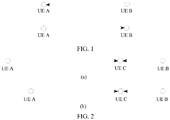
- the UE A finds, through monitoring, that a resource is indicated or reserved by the UE B, and a received PSSCH-RSRP is less than a threshold, the resource is not excluded and is likely to be selected by the UE A for sending data. It is assumed that the UE A selects the resource to send data.
- UE C receives a signal from the UE B on the resource, but receives interference from the UE A at the same time. Assuming that a transmit power or an antenna gain of the UE B in FIG. (a) is greater than a transmit power or an antenna gain of the UE B in FIG.
- the UE A can still multiplex the resource reserved by the UE B when a distance from the UE A to the UE B in FIG. (b) is shorter than a distance from the UE A to the UE B in FIG. (a).
- a power received by the UE C from the UE B in FIG. (b) is less than a power received by the UE C from the UE B in FIG. (a)
- a power received by the UE C from the UE A in FIG. (b) is greater than a power received by the UE C from the UE A in FIG. (a)
- a usable signal from the UE B is weakened and interference from the UE A is strengthened. This leads to a reduced signal-to-interference ratio, an increased error rate and a decreased demodulation performance of the UE C.
- the UE A finds, through monitoring, that a resource is indicated or reserved by the UE B, and a received PSSCH-RSRP is less than a threshold, the resource is not excluded and is likely to be selected by the UE A for sending data. It is assumed that the UE A selects the resource to send data.
- UE C receives a signal from the UE A on the resource, but receives interference from the UE B at the same time. Assuming that an antenna gain of the UE A in FIG. (a) is greater than an antenna gain of the UE A in FIG.
- the UE A can still multiplex the resource reserved by the UE B when a distance from the UE B to the UE A in FIG. (b) is shorter than a distance from the UE B to the UE A in FIG. (a).
- a power received by the UE C from the UE A in FIG. (b) is less than a power received by the UE C from the UE A in FIG. (a)
- a power received by the UE C from the UE B in FIG. (b) is greater than a power received by the UE C from the UE B in FIG. (a)
- a usable signal from the UE A is weakened and interference from the UE B is strengthened. This leads to a reduced signal-to-interference ratio, an increased error rate and a decreased demodulation performance of the UE C.
- the UE A finds, through monitoring, that a resource is indicated or reserved by the UE B, and a received PSSCH-RSRP is less than a threshold, the resource is not excluded and is likely to be selected by the UE A for sending data. It is assumed that the UE A selects the resource to send data.
- UE C receives a signal from the UE A on the resource, but receives interference from the UE B at the same time. Assuming that a transmit power of the UE A in FIG. (a) is greater than a transmit power of the UE A in FIG.
- a power received by the UE C from the UE A in FIG. (b) is less than a power received by the UE C from the UE A in FIG. (a), that is, a usable signal from the UE A is weakened and interference from the UE B is unchanged. This leads to a reduced signal-to-interference ratio, an increased error rate and a decreased demodulation performance of the UE C.
- WO 2015/115872 A1 describes a device-to-device (D2D) operation method and device which are performed by a terminal in a wireless communication system.
- the method comprises: receiving D2D configuration information indicating a plurality of resources which can be used for a D2D operation from a network; selecting a specific resource from among the plurality of resources, and performing the D2D operation with another terminal using the selected specific resource, wherein the specific resource is selected on the basis of a reference signal received power (RSRP) which the terminal has received from the network.
- RSRP reference signal received power
- WO 2015/178851 A1 describes a method performed by a first device, for sending data in a Device-to-Device, D2D, and transmission to a second device.
- the first device After the first device has identified a priority level of the D2D transmission, it maps the identified priority level to a resource pool index.
- the resource pool index identifies a resource pool among a plurality of resource pools associated with different priority levels.
- the first device then sends the data in the DZD transmission to the second device, using the resources in the resource pool identified by the resource pool index.
- WO 2015/194916 A1 describes a method for determining a resource for device-to-device communication with the steps of receiving, from an eNodeB (eNB), configuration information related to a resource pool configured for each level, selecting the resource pool of the de-vice-to-device communication on the basis of the configuration information, and selecting a resource for the device-to-device communication in the resource pool.
- eNB eNodeB
- KR 2016 0016489 A describes a method for controlling transmission power and a terminal, wherein controlling transmission power of a terminal for performing device to device (D2D) communications comprises the following steps of: selecting a random resource in a search period for D2D resource selection; determining whether the selected resource satisfies a predetermined transmission power control condition; and transmitting information for the D2D communications through the selected resource with power determined according to the determination results.
- D2D device to device
- the present invention provides a resource selection method and apparatus, to resolve a technical problem in the prior art that a signal-to-interference ratio is reduced, an error rate is increased, and a demodulation performance is decreased because a same threshold is used.
- the invention is defined by the appended independent claims, wherein preferred embodiments are defined in the dependent claims.
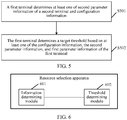
- FIG. 5 is a schematic flowchart of a resource selection method according to an embodiment of the present invention. As shown in the figure, the method in this embodiment of the present invention includes the following steps.
- a first terminal determines second parameter information of a second terminal and configuration information.
- the second parameter information is used to determine at least terminal type.
- the second parameter information may further be used to determine at least one of a power value, location information, an antenna gain, and a link loss of the second 2. terminal.
- the first parameter information includes at least a terminal type.
- the first parameter information may further include at least one of a power value, location information, an antenna gain, and a link loss of the first terminal.
- the first terminal is UE selecting a resource, and the second terminal is UE reserving a resource.
- the second terminal needs to inform another terminal that the second terminal reserves a future resource and sends the second parameter information to the another terminal.
- the first terminal when selecting a resource, receives the second parameter information sent by the second terminal, so that the second parameter information of the second terminal is obtained.
- the configuration information is configured, preconfigured, or predefined by a network side device, and the configuration information includes at least one threshold.
- the first terminal determines a target threshold based on the configuration information, the second parameter information, and the first parameter information of the first terminal, where the target threshold is used by the first terminal to perform resource selection.
- thresholds correspond to at least a terminal type
- the second parameter information is used to determine a terminal type of the second terminal
- the first parameter information includes a terminal type of the first terminal.
- a threshold corresponding to a target terminal type combination is used as the target threshold, where the target terminal type combination includes the terminal type of the first terminal and the terminal type of the second terminal.
- the transmit power and the antenna gain of each UE are fixed, and the network configures different thresholds for different terminal type combinations.
- the UE selecting a resource selects a corresponding threshold based on a type of the UE and a type of the UE reserving a resource.
- a corresponding threshold is T1.
- the UE selecting a resource is V-UE and the UE reserving a resource is P-UE, a corresponding threshold is T2.
- V-UE is vehicle (vehicle)-type UE
- P-UE is pedestrian (pedestrian)-type UE.
- the at least one threshold corresponds to a terminal type
- the second parameter information is used to determine a terminal type of the second terminal
- the first parameter information includes a terminal type of the first terminal.
- the target threshold may be determined based on a threshold in the at least one threshold, a power value corresponding to the threshold, and the power value of the first terminal; or the target threshold may be determined based on a threshold in the at least one threshold, a power value corresponding to the threshold, and the power value of the second terminal; or the target threshold may be determined based on a threshold in the at least one threshold, a power value corresponding to the threshold, and a target power value combination, where the target power value combination includes the power value of the first terminal and the power value of the second terminal.
- the configuration information includes a threshold T1, and a combination corresponding to the threshold T1 is that the UE selecting a resource is V-UE and the UE reserving a resource is V-UE, or that the UE selecting a resource is V-UE and the UE reserving a resource is P-UE, or another type of combination.
- the configuration information does not include a corresponding threshold, but the network configures a relationship between a threshold corresponding to another terminal type and the threshold T1.
- the threshold corresponding to the another terminal type may be calculated based on the threshold T1 and the relationship between the threshold corresponding to the another terminal type and the threshold T1.
- the threshold T1 is the threshold corresponding to the target terminal type combination, and Tn is a to-be-determined threshold corresponding to the another terminal type.
- Tn ⁇ n ⁇ T1+( ⁇ n ⁇ Ptx1+ ⁇ n ⁇ Ptx2+ ⁇ ⁇ Ptx3+ ⁇ n ⁇ Ptx4)+ Pn[dbm], where Ptx1 is a transmit power of the type 1 UE, Ptx2 is a transmit power of the type 2 UE, Ptx3 is a transmit power of the UE selecting a resource, Ptx4 is a transmit power of the UE reserving a resource, and Pn, ⁇ n, ⁇ n, ⁇ n, and ⁇ n are parameters configured, preconfigured, or predefined by the network side.
- the threshold T1 corresponds to that the UE selecting a resource is type 1 UE and the UE reserving a resource is type 2 UE.
- Tn ⁇ n ⁇ T1+( ⁇ n ⁇ G1+ ⁇ n ⁇ G2+ ⁇ n ⁇ G3+ ⁇ n ⁇ G4)+ Pn[dbm], where G1 is an antenna gain of the type 1 UE, G2 is an antenna gain of the type 2 UE, G3 is an antenna gain of the UE selecting a resource, G4 is an antenna gain of the UE reserving a resource, and Pn, ⁇ n, ⁇ n, ⁇ n, and ⁇ n are parameters configured, preconfigured, or predefined by the network side.
- the examples referring to at least one threshold corresponding to a power value are presented, which are not part of the claimed invention, and are here present for illustration purposes only.
- the at least one threshold corresponds to a power value
- the second parameter information is used to determine a power value of the second terminal
- the first parameter information includes a power value of the first terminal.
- a threshold corresponding to the power value of the first terminal may be used as the target threshold; or a threshold corresponding to the power value of the second terminal may be used as the target threshold; or a threshold corresponding to a target power value combination may be used as the target threshold, where the target power value combination includes the power value of the first terminal and the power value of the second terminal.
- the power value is the transmit power, or a product of the antenna gain and the transmit power, or a sum of the antenna gain and the transmit power.
- the power value is the sum of the transmit power and the antenna gain.
- a corresponding threshold is T1; when the power value of the UE selecting a resource is Pb, a corresponding threshold is T2, and the rest can be deduced by analogy.
- the power value of the UE reserving a resource is Pa, a corresponding threshold is T1; when the power value of the UE reserving a resource is Pb, a corresponding threshold is T2, and the rest can be deduced by analogy.
- a corresponding threshold is T1; when the power value of the UE selecting a resource is Pa and the power value of the UE reserving a resource is Pb, a corresponding threshold is T2; when the power value of the UE selecting a resource is Pb and the power value of the UE reserving a resource is Pb, a corresponding threshold is T3, and the rest can be deduced by analogy.
- the at least one threshold corresponds to a power value
- the second parameter information is used to determine a power value of the second terminal
- the first parameter information includes a power value of the first terminal.
- the target threshold is determined based on a threshold in the at least one threshold, a power value corresponding to the threshold, and the power value of the first terminal; or the target threshold is determined based on a threshold in the at least one threshold, a power value corresponding to the threshold, and the power value of the second terminal; or the target threshold is determined based on a threshold in the at least one threshold, a power value corresponding to the threshold, and a target power value combination, where the target power value combination includes the power value of the first terminal and the power value of the second terminal.
- the first terminal may determine the target threshold based on the terminal type of the first terminal and at least one of the power value, the antenna gain of the first terminal and the terminal type of the second terminal and at least one of the power value, the antenna gain of the second terminal. Therefore, when the second parameter information does not include the power value of the second terminal but includes a link loss or location information, the power value of the second terminal may be determined based on the link loss or the location information, thereby determining the target threshold. For example, when the second terminal uses open-loop power control, the transmit power of the second terminal is related to a link loss between the second terminal and a base station.
- the link loss of the second terminal is related to location information between the second terminal and the base station. Therefore, the UE may not directly indicate the transmit power of the UE, but includes the location information in the second parameter information sent by the UE.
- the link loss of the second terminal is first determined based on the location information and a preconfigured first network configuration parameter, and then the transmit power of the second terminal is determined based on the link loss and a preconfigured second network configuration parameter.
- the location information may include a distance between the second terminal and the base station or positioning information of a GPS (Global Positioning System) of the second terminal.
- GPS Global Positioning System
- the examples referring to the target threshold determined based on attribute of a detected resource are presented, which are not part of the claimed invention, and are here present for illustration purposes only.
- the target threshold may be determined based on an attribute of a resource detected by the first terminal and the at least one threshold. Further, the at least one threshold corresponds to a resource attribute.
- a threshold corresponding to the attribute of the resource detected by the first terminal is used as the target threshold; or the target threshold is determined based on a threshold in the at least one threshold, a resource attribute corresponding to the threshold, and the attribute of the resource detected by the first terminal.
- the network may configure a resource used by a type of terminal, and resources used by different types of terminals for transmission may be the same.
- the first terminal performs resource selection and finds, through monitoring, that a resource is reserved by the second terminal, if the resource is a resource used by both the first terminal type and the second terminal type, a threshold T1 is used.
- a threshold T2 is used.
- a network configuration resource is a resource that can be used by all of type 1 UE, type 2 UE and type 3 UE for transmission, the type 1 UE uses a threshold T1.
- the type 1 UE uses a threshold T2.
- the network side device configures a threshold for each configured resource pool, so that the first terminal uses a corresponding threshold based on a resource pool to which the detected resource belongs. For example, it is configured that a threshold corresponding to a resource pool 1 is T1, and a threshold corresponding to a resource pool 2 is T2.
- the threshold T1 is used.
- the threshold T2 is used.
- the examples referring to the target threshold determined based on a congestion degree of a channel or a carrier are presented, which are not part of the claimed invention, and are here present for illustration purposes only.
- the target threshold is determined based on a congestion degree of a channel or a carrier and the at least one threshold. Further, the at least one threshold corresponds to a congestion degree; and a threshold corresponding to the congestion degree of the channel or the carrier may be used as the target threshold; or the target threshold may be determined based on a threshold in the at least one threshold, a congestion degree corresponding to the threshold, and the congestion degree of the channel or the carrier.
- Congestion control may be used in the V2X communication.
- the UE reduces a transmit power when congestion occurs, and a threshold used by the first terminal to determine whether a reserved resource should be excluded is also changed with the change of the transmit power.
- the network configures a threshold T1 and a threshold T2 that respectively correspond to a congestion degree LI and a congestion degree L2, and the UE selects a corresponding threshold based on a congestion degree of a current channel or carrier.
- the congestion degree is L1
- the threshold used by the first terminal is T1.
- the threshold used by the UE is T2.
- the network configures that the threshold corresponding to the congestion degree L1 is T1 [dbm], and that when the congestion degree is Ln, the corresponding threshold is T1+Xn[dbm].
- the UE can determine the corresponding threshold based on the congestion degree of the current channel or carrier and T1.
- the target threshold may be determined based on a priority of a data transport block. Specifically, data transport blocks are distinguished by priorities, and a data transport block having a higher priority may preferentially use a resource. Priority information of a data transport block may be indicated in SA. Therefore, in addition to determining the target threshold based on the factors in the foregoing embodiments, the first terminal may further determine the target threshold by also referring to a priority of a data transport block.
- the network configures that when the UE selecting a resource is V-UE and the UE reserving a resource is V-UE, corresponding thresholds are T11, T12, T13 and T14; when the UE selecting a resource is V-UE and the UE reserving a resource is P-UE, corresponding thresholds are T21, T22, T23 and T24; when the UE selecting a resource is P-UE and the UE reserving a resource is P-UE, corresponding thresholds are T31, T32, T33 and T34, and the rest can be deduced by analogy.
- the corresponding thresholds T21, T22, T23 and T24 are determined first, and then a corresponding threshold is selected from the thresholds T21, T22, T23 and T24 based on a priority of a data transport block. Another method of determining the target threshold is similar to this method.
- the UE may select the resource to send data, that is, multiplex the resource reserved by the second terminal; when the receive power of the reference signal of the physical sidelink shared channel is not less than the receive power threshold, because the first terminal and the second terminal may be mutually interfered if using the same resource at the same time, the UE cannot multiplex the resource.
- the first terminal first determines second parameter information of the second terminal and configuration information; and then determines the target threshold based on the configuration information, the second parameter information, and first parameter information of the first terminal, and finally performs the resource selection based on the target threshold.
- a resource is selected by changing the target threshold based on different parameters. In this way, a signal-to-interference ratio is increased, an error rate is reduced, and a demodulation performance is improved.
- FIG. 6 is a schematic structural diagram of a resource selection apparatus according to an embodiment of the present invention. As shown in the figure, the apparatus in this embodiment of the present invention includes an information determining module 601 and a threshold determining module 602.
- the information determining module 601 is configured to determine second parameter information of a second terminal and configuration information.
- the second parameter information is used to determine at least a terminal type.
- the second parameter information may further be used to determine at least one of a power value, location information, an antenna gain, and a link loss of the second terminal.
- the first parameter information includes at least terminal type.
- the first parameter information may further include at least one of a power value, location information, an antenna gain, and a link loss of the first terminal.
- the first terminal is UE selecting a resource, and the second terminal is UE reserving a resource.
- the second terminal needs to inform another terminal that the second terminal reserves a future resource and sends the second parameter information to the another terminal.
- the first terminal when selecting a resource, receives the second parameter information sent by the second terminal, so that the second parameter information of the second terminal is obtained.
- the configuration information is configured, preconfigured, or predefined by a network side device, and the configuration information includes at least one threshold.
- the threshold determining module 602 is configured to determine a target threshold based on at least one of the configuration information, the second parameter information, and the first parameter information of the first terminal, where the target threshold is used by the first terminal to perform resource selection.
- thresholds correspond to at least a terminal type
- the second parameter information is used to determine a terminal type of the second terminal
- the first parameter information includes a terminal type of the first terminal.
- a threshold corresponding to a target terminal type combination is used as the target threshold, where the target terminal type combination includes the terminal type of the first terminal and the terminal type of the second terminal.
- the transmit power and the antenna gain of each UE are fixed, and the network configures different thresholds for different terminal type combinations.
- the UE selecting a resource selects a corresponding threshold based on a type of the UE 2. and a type of the UE reserving a resource.
- a corresponding threshold is T1.
- the UE selecting a resource is V-UE, and the UE reserving a resource is P-UE, a corresponding threshold is T2.
- V-UE is vehicle (vehicle)-type UE
- P-UE is pedestrian (pedestrian)-type UE.
- the at least one threshold corresponds to a terminal type
- the second parameter information is used to determine a terminal type of the second terminal
- the first parameter information includes a terminal type of the first terminal.
- the target threshold may be determined based on a threshold in the at least one threshold, a power value corresponding to the threshold, and a power value of the first terminal; or the target threshold may be determined based on a threshold in the at least one threshold, a power value corresponding to the threshold, and a power value of the second terminal; or the target threshold may be determined based on a threshold in the at least one threshold, a power value corresponding to the threshold, and a target power value combination, where the target power value combination includes the power value of the first terminal and the power value of the second terminal.
- the configuration information includes a threshold T1, and a combination corresponding to the threshold T1 is that the UE selecting a resource is V-UE and the UE reserving a resource is V-UE, or that the UE selecting a resource is V-UE and the UE reserving a resource is P-UE, or another type of combination.
- the configuration information does not include a corresponding threshold, but the network configures a relationship between a threshold corresponding to another terminal type and the threshold T1.
- the threshold corresponding to the another terminal type may be calculated based on the threshold T1 and the relationship between the threshold corresponding to the another terminal type and the threshold T1.
- the threshold T1 is the threshold corresponding to the target terminal type combination, and Tn is a to-be-determined threshold corresponding to the another terminal type.
- Tn ⁇ n ⁇ T1+( ⁇ n ⁇ Ptx1+ ⁇ n ⁇ Ptx2+ ⁇ n ⁇ Ptx3+ ⁇ n ⁇ Ptx4)+ Pn[dbm], where Ptx1 is a transmit power of the type 1 UE, Ptx2 is a transmit power of the type 2 UE, Ptx3 is a transmit power of the UE selecting a resource, Ptx4 is a transmit power of the UE reserving a resource, and Pn, ⁇ n, ⁇ n, ⁇ n, and ⁇ n are parameters configured, preconfigured, or predefined by the network side.
- the threshold T1 corresponds to that the UE selecting a resource is type 1 UE and the UE reserving a resource is type 2 UE.
- Tn ⁇ n ⁇ T1+( ⁇ n ⁇ G1+ ⁇ n ⁇ G2+ ⁇ n ⁇ G3+ ⁇ n ⁇ G4)+ Pn[dbm], where G1 is an antenna gain of the type 1 UE, G2 is an antenna gain of the type 2 UE, G3 is an antenna gain of the UE selecting a resource, G4 is an antenna gain of the UE reserving a resource, and Pn, ⁇ n, ⁇ n, ⁇ n, and ⁇ n are parameters configured, preconfigured, or predefined by the network side.
- the examples referring to at least one threshold corresponding to a power value are presented, which are not part of the claimed invention, and are here present for illustration purposes only.
- the at least one threshold corresponds to a power value
- the second parameter information is used to determine a power value of the second terminal
- the first parameter information includes a power value of the first terminal.
- a threshold corresponding to the power value of the first terminal may be used as the target threshold; or a threshold corresponding to the power value of the second terminal may be used as the target threshold; or a threshold corresponding to a target power value combination may be used as the target threshold, where the target power value combination includes the power value of the first terminal and the power value of the second terminal.
- the power value is the transmit power, or a product of the antenna gain and the transmit power, or a sum of the antenna gain and the transmit power.
- the power value is the sum of the transmit power and the antenna gain.
- a corresponding threshold is T1; when the power value of the UE selecting a resource is Pb, a corresponding threshold is T2, and the rest can be deduced by analogy.
- the power value of the UE reserving a resource is Pa, a corresponding threshold is T1; when the power value of the UE reserving a resource is Pb, a corresponding threshold is T2, and the rest can be deduced by analogy.
- a corresponding threshold is T1; when the power value of the UE selecting a resource is Pa and the power value of the UE reserving a resource is Pb, a corresponding threshold is T2; when the power value of the UE selecting a resource is Pb and the power value of the UE reserving a resource is Pb, a corresponding threshold is T3, and the rest can be deduced by analogy.
- the at least one threshold corresponds to a power value
- the second parameter information is used to determine a power value of the second terminal
- the first parameter information includes a power value of the first terminal.
- the target threshold is determined based on a threshold in the at least one threshold, a power value corresponding to the threshold, and the power value of the first terminal; or the target threshold is determined based on a threshold in the at least one threshold, a power value corresponding to the threshold, and the power value of the second terminal; or the target threshold is determined based on a threshold in the at least one threshold, a power value corresponding to the threshold, and a target power value combination, where the target power value combination includes the power value of the first terminal and the power value of the second terminal.
- the first terminal may determine the target threshold based on the terminal type of the first terminal and at least one of the power value, the antenna gain of the first terminal and the terminal type of the second terminal and at least one of the power value, the antenna gain of the second terminal. Therefore, when the second parameter information does not include the power value of the second terminal but includes the link loss or the location information, the power value of the second terminal may be determined based on a link loss or location information, thereby determining the target threshold. For example, when the second terminal uses open-loop power control, the transmit power of the second terminal is related to a link loss between the second terminal and a base station.
- the link loss of the second terminal is related to location information between the second terminal and the base station. Therefore, the UE may not directly indicate the transmit power of the UE, but includes the location information in the second parameter information sent by the UE.
- the link loss of the second terminal is first determined based on the location information and a preconfigured first network configuration parameter, and then the transmit power of the second terminal is determined based on the link loss and a preconfigured second network configuration parameter.
- the location information may include a distance between the second terminal and the base station or positioning information of a GPS (Global Positioning System) of the second terminal.
- GPS Global Positioning System
- the target threshold may be determined based on an attribute of a resource detected by the first terminal and the at least one threshold. Further, the at least one threshold corresponds to a resource attribute. A threshold corresponding to the attribute of the resource detected by the first terminal may be used as the target threshold; or the target threshold may be determined based on a threshold in the at least one threshold, a resource attribute corresponding to the threshold, and the attribute of the resource detected by the first terminal.
- the network may configure a resource used by a type of terminal, and resources used by different types of terminals for transmission may be the same.
- the first terminal performs resource selection and finds, through monitoring, that a resource is reserved by the second terminal, if the resource is a resource used by both the first terminal type and the second terminal type, a threshold T1 is used.
- a threshold T2 is used.
- a network configuration resource is a resource that can be used by all of type 1 UE, type 2 UE and type 3 UE for transmission, the type 1 UE uses a threshold T1.
- the type 1 UE uses a threshold T2.
- the network side device configures a threshold for each configured resource pool, so that the first terminal uses a corresponding threshold based on a resource pool to which the detected resource belongs. For example, it is configured that a threshold corresponding to a resource pool 1 is T1, and a threshold corresponding to a resource pool 2 is T2.
- the threshold T1 is used.
- the threshold T2 is used.
- the examples referring to the target threshold determined based on a congestion degree of a channel or a carrier are presented, which are not part of the claimed invention, and are here present for illustration purposes only.
- the target threshold is determined based on a congestion degree of a channel or a carrier and the at least one threshold. Further, the at least one threshold corresponds to a congestion degree; and a threshold corresponding to the congestion degree of the channel or the carrier may be used as the target threshold; or the target threshold may be determined based on a threshold in the at least one threshold, a congestion degree corresponding to the threshold, and the congestion degree of the channel or the carrier.
- Congestion control may be used in the V2X communication.
- the UE reduces a transmit power when congestion occurs, and a threshold used by the first terminal to determine whether a reserved resource should be excluded is also changed with the change of the transmit power.
- the network configures a threshold T1 and a threshold T2 that respectively correspond to a congestion degree LI and a congestion degree L2, and the UE selects a corresponding threshold based on a congestion degree of a current channel or carrier.
- the congestion degree is L1
- the threshold used by the first terminal is T1.
- the threshold used by the UE is T2.
- the network configures that the threshold corresponding to the congestion degree L1 is T1 [dbm], and that when the congestion degree is Ln, the corresponding threshold is T1+Xn[dbm].
- the UE can determine the corresponding threshold based on the congestion degree of the current channel or carrier and T1.
- the examples referring to the target threshold determined based a priority of a data transport block are presented, which are not part of the claimed invention, and are here present for illustration purposes only.
- the target threshold may be determined based on a priority of a data transport block.
- data transport blocks are distinguished by priorities, and a data transport block having a higher priority may preferentially use a resource.
- Priority information of a data transport block may be indicated in SA. Therefore, in addition to determining the target threshold based on the factors in the foregoing embodiments, the first terminal may further determine the target threshold by also referring to a priority of a data transport block.
- the network configures that when the UE selecting a resource is V-UE and the UE reserving a resource is V-UE, corresponding thresholds are T11, T12, T13 and T14; when the UE selecting a resource is V-UE and the UE reserving a resource is P-UE, corresponding thresholds are T21, T22, T23 and T24; when the UE selecting a resource is P-UE and the UE reserving a resource is P-UE, corresponding thresholds are T31, T32, T33 and T34, and the rest can be deduced by analogy.
- the corresponding thresholds T21, T22, T23 and T24 are determined first, and then a corresponding threshold is selected from the thresholds T21, T22, T23 and T24 based on a priority of a data transport block. Another method of determining the target threshold is similar to this method.
- the UE may select the resource to send data, that is, multiplex the resource reserved by the second terminal; when the receive power of the reference signal of the physical sidelink shared channel is not less than the receive power threshold, because the first terminal and the second terminal may be mutually interfered if using the same resource at the same time, the UE cannot multiplex the resource.
- the first terminal first determines the second parameter information of the second terminal and the configuration information; and then determines the target threshold based on the configuration information, the second parameter information, and the first parameter information of the first terminal, and finally performs the resource selection based on the target threshold.
- a resource is selected by changing a target threshold based on different parameters. In this way, a signal-to-interference ratio is increased, an error rate is reduced, and a demodulation performance is improved.
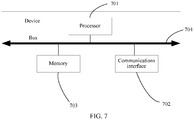
- FIG. 7 is a schematic structural diagram of a resource multiplexing device according to the present invention.
- the device may include: at least one processor 701, for example, a CPU, at least one communications interface 702, at least one memory 703, and at least one communications bus 704.
- the communications bus 704 is configured to implement connection and communication between the components.
- the communications interface 702 in the device of this embodiment of the present invention is configured to perform signaling or data communication with another node device.
- the memory 703 may be a high-speed RAM memory, or may be a non-volatile memory (non-volatile memory), for example, at least one magnetic disk memory.
- the memory 703 may further be at least one storage apparatus that is located far away from the processor 701.
- the memory 703 stores a group of program code, and the processor 701 performs programs stored in the memory 703 to perform the method performed by the foregoing resource multiplexing apparatus or implement the function implemented by the foregoing resource multiplexing apparatus.
- the program may be stored in a computer readable storage medium.
- the storage medium may include a flash memory, a read-only memory (Read-Only Memory, ROM), a random access memory (Random Access Memory, RAM), a magnetic disk, or an optical disk.
Landscapes
- Engineering & Computer Science (AREA)
- Computer Networks & Wireless Communication (AREA)
- Signal Processing (AREA)
- Quality & Reliability (AREA)
- Mobile Radio Communication Systems (AREA)
Claims (4)
- Ressourcenauswahlvorrichtung eines ersten Endgeräts, wobei die Vorrichtung Folgendes umfasst:ein Informationsbestimmungsmodul (601), das konfiguriert ist, um zweite Parameterinformationen eines zweiten Endgeräts, das eine Ressource reserviert, wobei die zweiten Parameterinformationen durch das zweite Endgerät gesendet und durch das erste Endgerät empfangen werden, und Konfigurationsinformationen zu bestimmen; undein Schwellenbestimmungsmodul (602), das konfiguriert ist, um eine Zielschwelle basierend auf den Konfigurationsinformationen, den zweiten Parameterinformationen und ersten Parameterinformationen des ersten Endgeräts zu bestimmen, wobei die Zielschwelle durch das erste Endgerät verwendet wird, um eine Ressourcenauswahl durchzuführen;wobei die Konfigurationsinformationen durch eine Netzseiteneinheit konfiguriert, vorkonfiguriert oder vorgegeben werden;wobei die Konfigurationsinformationen eine Schwelle T1, eine Schwelle T2, eine Schwelle T3 und eine Schwelle T4 beinhalten;wobei die zweiten Parameterinformationen verwendet werden, um wenigstens eine Endgerätart des zweiten Endgeräts zu bestimmen, und die ersten Parameterinformationen wenigstens eine Endgerätart des ersten Endgeräts umfassen, undwenn die zweiten Parameterinformationen verwendet werden, um die Endgerätart des zweiten Endgeräts zu bestimmen, und die ersten Parameterinformationen die Endgerätart des ersten Endgeräts beinhalten, das Schwellenbestimmungsmodul (602) für Folgendes konfiguriert ist:wenn die Endgerätart des ersten Endgeräts eine Benutzereinrichtung eines Fahrzeugs (vehicle-type user equipment - V-UE) ist und die Endgerätart des zweiten Endgeräts eine V-UE ist, Auswählen der Schwelle T1;wenn die Endgerätart des ersten Endgeräts eine V-UE ist und die Endgerätart des zweiten Endgeräts eine UE eines Fußgängers (pedestrian-type UE - P-UE) ist, Auswählen der Schwelle T2;wenn die Endgerätart des ersten Endgeräts P-UE ist und die Endgerätart des zweiten Endgeräts V-UE ist, Auswählen der Schwelle T3;wenn die Endgerätart des ersten Endgeräts P-UE ist und die Endgerätart des zweiten Endgeräts P-UE ist, Auswählen der Schwelle T4.
- Vorrichtung nach Anspruch 1, wobei die zweiten Parameterinformationen ferner verwendet werden, um einen Leistungswert, Standortinformationen, einen Antennengewinn und/oder einen Verbindungsverlust des zweiten Endgeräts zu bestimmen, und die ersten Parameterinformationen einen Leistungswert, Standortinformationen, einen Antennengewinn und/oder einen Verbindungsverlust des ersten Endgeräts umfassen.
- Ressourcenauswahlverfahren, wobei das Verfahren Folgendes umfasst:Bestimmen (S501), durch ein erstes Endgerät, von zweiten Parameterinformationen eines zweiten Endgeräts, das eine Ressource reserviert, wobei die zweiten Parameterinformationen durch das zweite Endgerät gesendet und durch das erste Endgerät empfangen werden, und Konfigurationsinformationen; undBestimmen (S502), durch das erste Endgerät, einer Zielschwelle basierend auf den Konfigurationsinformationen, den zweiten Parameterinformationen und den ersten Parameterinformationen des ersten Endgeräts, wobei die Zielschwelle durch das erste Endgerät verwendet wird, um die Ressourcenauswahl durchzuführen;wobei die Konfigurationsinformationen durch eine Netzseiteneinheit konfiguriert, vorkonfiguriert oder vorgegeben werden;wobei die Konfigurationsinformationen eine Schwelle T1, eine Schwelle T2, eine Schwelle T3 und eine Schwelle T4 beinhalten;wobei die zweiten Parameterinformationen verwendet werden, um wenigstens eine Endgerätart des zweiten Endgeräts zu bestimmen, und die ersten Parameterinformationen wenigstens eine Endgerätart des ersten Endgeräts umfassen, undwenn die zweiten Parameterinformationen verwendet werden, um die Endgerätart des zweiten Endgeräts zu bestimmen, und die ersten Parameterinformationen die Endgerätart des ersten Endgeräts beinhalten undwenn die Endgerätart des ersten Endgeräts eine Benutzereinrichtung eines Fahrzeugs (V-UE) ist und die Endgerätart des zweiten Endgeräts eine V-UE ist, die Schwelle T1 ausgewählt wird;wenn die Endgerätart des ersten Endgeräts eine V-UE ist und die Endgerätart des zweiten Endgeräts eine UE eines Fußgängers (P-UE) ist, die Schwelle T2 ausgewählt wird;wenn die Endgerätart des ersten Endgeräts P-UE ist und die Endgerätart des zweiten Terminals V-UE ist, die Schwelle T3 ausgewählt wird;wenn die Endgerätart des ersten Endgeräts P-UE ist und die Endgerätart des zweiten Endgeräts P-UE ist, die Schwelle T4 ausgewählt wird.
- Verfahren nach Anspruch 3, wobei die zweiten Parameterinformationen ferner verwendet werden, um einen Leistungswert, Standortinformationen, einen Antennengewinn und/oder einen Verbindungsverlust des zweiten Endgeräts zu bestimmen, und die ersten Parameterinformationen einen Leistungswert, Standortinformationen, einen Antennengewinn und/oder einen Verbindungsverlust des ersten Endgeräts umfassen.
Priority Applications (1)
| Application Number | Priority Date | Filing Date | Title |
|---|---|---|---|
| EP21192217.4A EP4002930A1 (de) | 2016-09-30 | 2016-09-30 | Ressourcenauswahlverfahren und -vorrichtung |
Applications Claiming Priority (1)
| Application Number | Priority Date | Filing Date | Title |
|---|---|---|---|
| PCT/CN2016/101380 WO2018058676A1 (zh) | 2016-09-30 | 2016-09-30 | 一种资源选择方法和装置 |
Related Child Applications (2)
| Application Number | Title | Priority Date | Filing Date |
|---|---|---|---|
| EP21192217.4A Division EP4002930A1 (de) | 2016-09-30 | 2016-09-30 | Ressourcenauswahlverfahren und -vorrichtung |
| EP21192217.4A Division-Into EP4002930A1 (de) | 2016-09-30 | 2016-09-30 | Ressourcenauswahlverfahren und -vorrichtung |
Publications (3)
| Publication Number | Publication Date |
|---|---|
| EP3496478A1 EP3496478A1 (de) | 2019-06-12 |
| EP3496478A4 EP3496478A4 (de) | 2019-07-17 |
| EP3496478B1 true EP3496478B1 (de) | 2021-11-10 |
Family
ID=61762446
Family Applications (2)
| Application Number | Title | Priority Date | Filing Date |
|---|---|---|---|
| EP16917426.5A Active EP3496478B1 (de) | 2016-09-30 | 2016-09-30 | Verfahren und vorrichtung zur ressourcenauswahl |
| EP21192217.4A Pending EP4002930A1 (de) | 2016-09-30 | 2016-09-30 | Ressourcenauswahlverfahren und -vorrichtung |
Family Applications After (1)
| Application Number | Title | Priority Date | Filing Date |
|---|---|---|---|
| EP21192217.4A Pending EP4002930A1 (de) | 2016-09-30 | 2016-09-30 | Ressourcenauswahlverfahren und -vorrichtung |
Country Status (4)
| Country | Link |
|---|---|
| US (1) | US11297600B2 (de) |
| EP (2) | EP3496478B1 (de) |
| CN (2) | CN109219979B (de) |
| WO (1) | WO2018058676A1 (de) |
Families Citing this family (5)
| Publication number | Priority date | Publication date | Assignee | Title |
|---|---|---|---|---|
| WO2020027548A1 (ko) * | 2018-07-30 | 2020-02-06 | 엘지전자 주식회사 | Nr v2x에서 자원을 점유하는 방법 및 장치 |
| CN111417207B (zh) * | 2019-01-07 | 2023-05-09 | 中国移动通信有限公司研究院 | 一种资源配置方法及装置、设备、存储介质 |
| CN112020148B (zh) | 2019-05-29 | 2022-08-26 | 华为技术有限公司 | 一种通信方法及装置 |
| CN110536455B (zh) * | 2019-10-16 | 2025-08-12 | 中兴通讯股份有限公司 | 一种资源选择方法、装置及存储介质 |
| US12193044B2 (en) * | 2022-02-25 | 2025-01-07 | Toyota Motor Engineering & Manufacturing North America, Inc. | Resource selection for 5G NR V2X communications |
Family Cites Families (16)
| Publication number | Priority date | Publication date | Assignee | Title |
|---|---|---|---|---|
| US9204428B2 (en) * | 2005-10-26 | 2015-12-01 | Qualcomm Incorporated | Interference management using resource utilization masks sent at constant PSD |
| WO2014070321A1 (en) * | 2012-11-01 | 2014-05-08 | Maruti Gupta | Signaling qos requirements and ue power preference in lte-a networks |
| CN104105185B (zh) * | 2013-04-03 | 2018-11-27 | 电信科学技术研究院 | 设备到设备通信中的发射功率控制方法、装置及系统 |
| US9907081B2 (en) * | 2013-06-27 | 2018-02-27 | Telefonaktiebolaget L M Ericsson (Publ) | Managing resources for device-to-device D2D discovery in an ad-hoc radio communication network |
| WO2015020448A1 (en) | 2013-08-07 | 2015-02-12 | Samsung Electronics Co., Ltd. | Method and apparatus for transmitting and receiving resource allocation information in a wireless communication system |
| CN105934986A (zh) * | 2014-01-26 | 2016-09-07 | Lg电子株式会社 | 在无线通信系统中用于设备对设备直接通信的资源分配方法和设备 |
| EP3100573B1 (de) * | 2014-01-29 | 2019-03-13 | Interdigital Patent Holdings, Inc. | Ressourcenauswahl zur entdeckung von vorrichtung zu vorrichtung oder kommunikation |
| CN105940744B (zh) | 2014-01-31 | 2019-09-27 | Lg电子株式会社 | 在无线通信系统中由终端执行的d2d操作方法及使用该方法的终端 |
| EP3146776B1 (de) * | 2014-05-23 | 2017-11-15 | Telefonaktiebolaget LM Ericsson (publ) | System und verfahren zur d2d-übertragung |
| EP3160201B1 (de) * | 2014-06-20 | 2019-03-27 | LG Electronics Inc. | Verfahren zur bestimmung einer ressource für kommunikation zwischen zwei vorrichtungen in einem drahtloskommunikationssystem und vorrichtung dafür |
| WO2016018009A1 (ko) * | 2014-08-01 | 2016-02-04 | 삼성전자 주식회사 | D2d 통신에서 단말의 송신 전력 제어 방법 및 장치 |
| KR102280577B1 (ko) * | 2014-08-01 | 2021-07-23 | 삼성전자 주식회사 | D2d 통신에서 단말의 송신 전력 제어 방법 및 장치 |
| KR101620205B1 (ko) * | 2014-10-16 | 2016-05-12 | 주식회사 만도 | V2x 통신 장치 및 그의 전송파워 제어방법 |
| CN105592478A (zh) | 2014-11-07 | 2016-05-18 | 中兴通讯股份有限公司 | 信号的检测处理方法及装置 |
| CN107211291B (zh) * | 2014-11-27 | 2020-12-01 | 缪国往 | 在移动网络中实现邻近服务的方法和装置 |
| US10285180B2 (en) * | 2015-03-14 | 2019-05-07 | Qualcomm Incorporated | Reserved resource pool assisted access resource selection for small data transmission |
-
2016
- 2016-09-30 EP EP16917426.5A patent/EP3496478B1/de active Active
- 2016-09-30 US US16/334,685 patent/US11297600B2/en active Active
- 2016-09-30 CN CN201680086396.3A patent/CN109219979B/zh active Active
- 2016-09-30 CN CN202110947735.5A patent/CN113709878B/zh active Active
- 2016-09-30 WO PCT/CN2016/101380 patent/WO2018058676A1/zh not_active Ceased
- 2016-09-30 EP EP21192217.4A patent/EP4002930A1/de active Pending
Non-Patent Citations (1)
| Title |
|---|
| None * |
Also Published As
| Publication number | Publication date |
|---|---|
| CN113709878A (zh) | 2021-11-26 |
| EP4002930A1 (de) | 2022-05-25 |
| CN113709878B (zh) | 2023-12-08 |
| EP3496478A1 (de) | 2019-06-12 |
| CN109219979B (zh) | 2021-09-07 |
| EP3496478A4 (de) | 2019-07-17 |
| US20200329457A1 (en) | 2020-10-15 |
| CN109219979A (zh) | 2019-01-15 |
| WO2018058676A1 (zh) | 2018-04-05 |
| US11297600B2 (en) | 2022-04-05 |
Similar Documents
| Publication | Publication Date | Title |
|---|---|---|
| CN110178389B (zh) | 直连通信的参数确定方法、装置、终端及可读存储介质 | |
| EP3516911B1 (de) | Kommunikationsknoten und verfahren zur implementierung eines positionsbezogenen signalisierungsaustausches | |
| EP3496478B1 (de) | Verfahren und vorrichtung zur ressourcenauswahl | |
| US12207237B2 (en) | Devices and methods for device to device (D2D) communication | |
| US20210314830A1 (en) | Wireless network communications method, base station, terminal, and communications apparatus | |
| EP3022863B1 (de) | Steuersignalisierung zur ermöglichung von zweisprung-orthogonalisierung für d2d-rundfunk | |
| US10021571B2 (en) | Nomadic node attachment procedure | |
| US12262244B2 (en) | Method and apparatus for QoS monitoring and feedback | |
| RU2695094C1 (ru) | Зависящий от скорости формат передачи для транспортного средства | |
| WO2020167395A1 (en) | Sidelink radio frame timing synchronization | |
| US10440687B2 (en) | Method and user equipment for resource allocation of vehicle network | |
| US20230156790A1 (en) | Resource selection based on latency requirements | |
| US9596689B2 (en) | Radio resource allocation for D2D communications | |
| KR102888611B1 (ko) | 사이드링크를 지원하는 무선통신시스템에서 vru가 안전 메시지를 전송하는 방법 및 이를 위한 장치 | |
| US11778642B2 (en) | Facilitating device-to-device communications | |
| Cecchini et al. | MAP-RP: Map-based resource reselection procedure for autonomous LTE-V2V | |
| JP2022522124A (ja) | サイドリンク通信のためのスケジューリング方法、端末装置及びネットワーク装置 | |
| CN111083645A (zh) | 业务的发送方法、装置及终端 | |
| WO2019233563A1 (en) | Progressive multi-criteria based sidelink resource allocation | |
| WO2021064425A1 (en) | Routing vehicle-to-everything communications | |
| WO2017166982A1 (zh) | 上行功率的控制方法、装置及存储介质 | |
| JP2021106302A (ja) | 通信装置 |
Legal Events
| Date | Code | Title | Description |
|---|---|---|---|
| STAA | Information on the status of an ep patent application or granted ep patent |
Free format text: STATUS: THE INTERNATIONAL PUBLICATION HAS BEEN MADE |
|
| PUAI | Public reference made under article 153(3) epc to a published international application that has entered the european phase |
Free format text: ORIGINAL CODE: 0009012 |
|
| STAA | Information on the status of an ep patent application or granted ep patent |
Free format text: STATUS: REQUEST FOR EXAMINATION WAS MADE |
|
| 17P | Request for examination filed |
Effective date: 20190308 |
|
| AK | Designated contracting states |
Kind code of ref document: A1 Designated state(s): AL AT BE BG CH CY CZ DE DK EE ES FI FR GB GR HR HU IE IS IT LI LT LU LV MC MK MT NL NO PL PT RO RS SE SI SK SM TR |
|
| AX | Request for extension of the european patent |
Extension state: BA ME |
|
| A4 | Supplementary search report drawn up and despatched |
Effective date: 20190618 |
|
| RIC1 | Information provided on ipc code assigned before grant |
Ipc: H04W 72/02 20090101AFI20190612BHEP Ipc: H04W 76/14 20180101ALN20190612BHEP |
|
| DAV | Request for validation of the european patent (deleted) | ||
| DAX | Request for extension of the european patent (deleted) | ||
| STAA | Information on the status of an ep patent application or granted ep patent |
Free format text: STATUS: EXAMINATION IS IN PROGRESS |
|
| 17Q | First examination report despatched |
Effective date: 20201006 |
|
| GRAP | Despatch of communication of intention to grant a patent |
Free format text: ORIGINAL CODE: EPIDOSNIGR1 |
|
| STAA | Information on the status of an ep patent application or granted ep patent |
Free format text: STATUS: GRANT OF PATENT IS INTENDED |
|
| RIC1 | Information provided on ipc code assigned before grant |
Ipc: H04W 72/02 20090101AFI20210430BHEP Ipc: H04W 76/14 20180101ALN20210430BHEP |
|
| INTG | Intention to grant announced |
Effective date: 20210518 |
|
| GRAS | Grant fee paid |
Free format text: ORIGINAL CODE: EPIDOSNIGR3 |
|
| GRAA | (expected) grant |
Free format text: ORIGINAL CODE: 0009210 |
|
| STAA | Information on the status of an ep patent application or granted ep patent |
Free format text: STATUS: THE PATENT HAS BEEN GRANTED |
|
| AK | Designated contracting states |
Kind code of ref document: B1 Designated state(s): AL AT BE BG CH CY CZ DE DK EE ES FI FR GB GR HR HU IE IS IT LI LT LU LV MC MK MT NL NO PL PT RO RS SE SI SK SM TR |
|
| REG | Reference to a national code |
Ref country code: GB Ref legal event code: FG4D |
|
| REG | Reference to a national code |
Ref country code: AT Ref legal event code: REF Ref document number: 1447237 Country of ref document: AT Kind code of ref document: T Effective date: 20211115 Ref country code: CH Ref legal event code: EP |
|
| REG | Reference to a national code |
Ref country code: DE Ref legal event code: R096 Ref document number: 602016066203 Country of ref document: DE |
|
| REG | Reference to a national code |
Ref country code: IE Ref legal event code: FG4D |
|
| REG | Reference to a national code |
Ref country code: LT Ref legal event code: MG9D |
|
| REG | Reference to a national code |
Ref country code: NL Ref legal event code: MP Effective date: 20211110 |
|
| REG | Reference to a national code |
Ref country code: AT Ref legal event code: MK05 Ref document number: 1447237 Country of ref document: AT Kind code of ref document: T Effective date: 20211110 |
|
| PG25 | Lapsed in a contracting state [announced via postgrant information from national office to epo] |
Ref country code: RS Free format text: LAPSE BECAUSE OF FAILURE TO SUBMIT A TRANSLATION OF THE DESCRIPTION OR TO PAY THE FEE WITHIN THE PRESCRIBED TIME-LIMIT Effective date: 20211110 Ref country code: LT Free format text: LAPSE BECAUSE OF FAILURE TO SUBMIT A TRANSLATION OF THE DESCRIPTION OR TO PAY THE FEE WITHIN THE PRESCRIBED TIME-LIMIT Effective date: 20211110 Ref country code: FI Free format text: LAPSE BECAUSE OF FAILURE TO SUBMIT A TRANSLATION OF THE DESCRIPTION OR TO PAY THE FEE WITHIN THE PRESCRIBED TIME-LIMIT Effective date: 20211110 Ref country code: BG Free format text: LAPSE BECAUSE OF FAILURE TO SUBMIT A TRANSLATION OF THE DESCRIPTION OR TO PAY THE FEE WITHIN THE PRESCRIBED TIME-LIMIT Effective date: 20220210 Ref country code: AT Free format text: LAPSE BECAUSE OF FAILURE TO SUBMIT A TRANSLATION OF THE DESCRIPTION OR TO PAY THE FEE WITHIN THE PRESCRIBED TIME-LIMIT Effective date: 20211110 |
|
| PG25 | Lapsed in a contracting state [announced via postgrant information from national office to epo] |
Ref country code: IS Free format text: LAPSE BECAUSE OF FAILURE TO SUBMIT A TRANSLATION OF THE DESCRIPTION OR TO PAY THE FEE WITHIN THE PRESCRIBED TIME-LIMIT Effective date: 20220310 Ref country code: SE Free format text: LAPSE BECAUSE OF FAILURE TO SUBMIT A TRANSLATION OF THE DESCRIPTION OR TO PAY THE FEE WITHIN THE PRESCRIBED TIME-LIMIT Effective date: 20211110 Ref country code: PT Free format text: LAPSE BECAUSE OF FAILURE TO SUBMIT A TRANSLATION OF THE DESCRIPTION OR TO PAY THE FEE WITHIN THE PRESCRIBED TIME-LIMIT Effective date: 20220310 Ref country code: PL Free format text: LAPSE BECAUSE OF FAILURE TO SUBMIT A TRANSLATION OF THE DESCRIPTION OR TO PAY THE FEE WITHIN THE PRESCRIBED TIME-LIMIT Effective date: 20211110 Ref country code: NO Free format text: LAPSE BECAUSE OF FAILURE TO SUBMIT A TRANSLATION OF THE DESCRIPTION OR TO PAY THE FEE WITHIN THE PRESCRIBED TIME-LIMIT Effective date: 20220210 Ref country code: NL Free format text: LAPSE BECAUSE OF FAILURE TO SUBMIT A TRANSLATION OF THE DESCRIPTION OR TO PAY THE FEE WITHIN THE PRESCRIBED TIME-LIMIT Effective date: 20211110 Ref country code: LV Free format text: LAPSE BECAUSE OF FAILURE TO SUBMIT A TRANSLATION OF THE DESCRIPTION OR TO PAY THE FEE WITHIN THE PRESCRIBED TIME-LIMIT Effective date: 20211110 Ref country code: HR Free format text: LAPSE BECAUSE OF FAILURE TO SUBMIT A TRANSLATION OF THE DESCRIPTION OR TO PAY THE FEE WITHIN THE PRESCRIBED TIME-LIMIT Effective date: 20211110 Ref country code: GR Free format text: LAPSE BECAUSE OF FAILURE TO SUBMIT A TRANSLATION OF THE DESCRIPTION OR TO PAY THE FEE WITHIN THE PRESCRIBED TIME-LIMIT Effective date: 20220211 Ref country code: ES Free format text: LAPSE BECAUSE OF FAILURE TO SUBMIT A TRANSLATION OF THE DESCRIPTION OR TO PAY THE FEE WITHIN THE PRESCRIBED TIME-LIMIT Effective date: 20211110 |
|
| PG25 | Lapsed in a contracting state [announced via postgrant information from national office to epo] |
Ref country code: SM Free format text: LAPSE BECAUSE OF FAILURE TO SUBMIT A TRANSLATION OF THE DESCRIPTION OR TO PAY THE FEE WITHIN THE PRESCRIBED TIME-LIMIT Effective date: 20211110 Ref country code: SK Free format text: LAPSE BECAUSE OF FAILURE TO SUBMIT A TRANSLATION OF THE DESCRIPTION OR TO PAY THE FEE WITHIN THE PRESCRIBED TIME-LIMIT Effective date: 20211110 Ref country code: RO Free format text: LAPSE BECAUSE OF FAILURE TO SUBMIT A TRANSLATION OF THE DESCRIPTION OR TO PAY THE FEE WITHIN THE PRESCRIBED TIME-LIMIT Effective date: 20211110 Ref country code: EE Free format text: LAPSE BECAUSE OF FAILURE TO SUBMIT A TRANSLATION OF THE DESCRIPTION OR TO PAY THE FEE WITHIN THE PRESCRIBED TIME-LIMIT Effective date: 20211110 Ref country code: DK Free format text: LAPSE BECAUSE OF FAILURE TO SUBMIT A TRANSLATION OF THE DESCRIPTION OR TO PAY THE FEE WITHIN THE PRESCRIBED TIME-LIMIT Effective date: 20211110 Ref country code: CZ Free format text: LAPSE BECAUSE OF FAILURE TO SUBMIT A TRANSLATION OF THE DESCRIPTION OR TO PAY THE FEE WITHIN THE PRESCRIBED TIME-LIMIT Effective date: 20211110 |
|
| REG | Reference to a national code |
Ref country code: DE Ref legal event code: R097 Ref document number: 602016066203 Country of ref document: DE |
|
| PLBE | No opposition filed within time limit |
Free format text: ORIGINAL CODE: 0009261 |
|
| STAA | Information on the status of an ep patent application or granted ep patent |
Free format text: STATUS: NO OPPOSITION FILED WITHIN TIME LIMIT |
|
| 26N | No opposition filed |
Effective date: 20220811 |
|
| PG25 | Lapsed in a contracting state [announced via postgrant information from national office to epo] |
Ref country code: AL Free format text: LAPSE BECAUSE OF FAILURE TO SUBMIT A TRANSLATION OF THE DESCRIPTION OR TO PAY THE FEE WITHIN THE PRESCRIBED TIME-LIMIT Effective date: 20211110 |
|
| PG25 | Lapsed in a contracting state [announced via postgrant information from national office to epo] |
Ref country code: SI Free format text: LAPSE BECAUSE OF FAILURE TO SUBMIT A TRANSLATION OF THE DESCRIPTION OR TO PAY THE FEE WITHIN THE PRESCRIBED TIME-LIMIT Effective date: 20211110 |
|
| PG25 | Lapsed in a contracting state [announced via postgrant information from national office to epo] |
Ref country code: MC Free format text: LAPSE BECAUSE OF FAILURE TO SUBMIT A TRANSLATION OF THE DESCRIPTION OR TO PAY THE FEE WITHIN THE PRESCRIBED TIME-LIMIT Effective date: 20211110 |
|
| REG | Reference to a national code |
Ref country code: CH Ref legal event code: PL |
|
| REG | Reference to a national code |
Ref country code: BE Ref legal event code: MM Effective date: 20220930 |
|
| PG25 | Lapsed in a contracting state [announced via postgrant information from national office to epo] |
Ref country code: IT Free format text: LAPSE BECAUSE OF FAILURE TO SUBMIT A TRANSLATION OF THE DESCRIPTION OR TO PAY THE FEE WITHIN THE PRESCRIBED TIME-LIMIT Effective date: 20211110 |
|
| PG25 | Lapsed in a contracting state [announced via postgrant information from national office to epo] |
Ref country code: LU Free format text: LAPSE BECAUSE OF NON-PAYMENT OF DUE FEES Effective date: 20220930 |
|
| PG25 | Lapsed in a contracting state [announced via postgrant information from national office to epo] |
Ref country code: LI Free format text: LAPSE BECAUSE OF NON-PAYMENT OF DUE FEES Effective date: 20220930 Ref country code: IE Free format text: LAPSE BECAUSE OF NON-PAYMENT OF DUE FEES Effective date: 20220930 Ref country code: FR Free format text: LAPSE BECAUSE OF NON-PAYMENT OF DUE FEES Effective date: 20220930 Ref country code: CH Free format text: LAPSE BECAUSE OF NON-PAYMENT OF DUE FEES Effective date: 20220930 |
|
| PG25 | Lapsed in a contracting state [announced via postgrant information from national office to epo] |
Ref country code: BE Free format text: LAPSE BECAUSE OF NON-PAYMENT OF DUE FEES Effective date: 20220930 |
|
| PG25 | Lapsed in a contracting state [announced via postgrant information from national office to epo] |
Ref country code: HU Free format text: LAPSE BECAUSE OF FAILURE TO SUBMIT A TRANSLATION OF THE DESCRIPTION OR TO PAY THE FEE WITHIN THE PRESCRIBED TIME-LIMIT; INVALID AB INITIO Effective date: 20160930 |
|
| PG25 | Lapsed in a contracting state [announced via postgrant information from national office to epo] |
Ref country code: CY Free format text: LAPSE BECAUSE OF FAILURE TO SUBMIT A TRANSLATION OF THE DESCRIPTION OR TO PAY THE FEE WITHIN THE PRESCRIBED TIME-LIMIT Effective date: 20211110 |
|
| PG25 | Lapsed in a contracting state [announced via postgrant information from national office to epo] |
Ref country code: MK Free format text: LAPSE BECAUSE OF FAILURE TO SUBMIT A TRANSLATION OF THE DESCRIPTION OR TO PAY THE FEE WITHIN THE PRESCRIBED TIME-LIMIT Effective date: 20211110 |
|
| PG25 | Lapsed in a contracting state [announced via postgrant information from national office to epo] |
Ref country code: TR Free format text: LAPSE BECAUSE OF FAILURE TO SUBMIT A TRANSLATION OF THE DESCRIPTION OR TO PAY THE FEE WITHIN THE PRESCRIBED TIME-LIMIT Effective date: 20211110 |
|
| PG25 | Lapsed in a contracting state [announced via postgrant information from national office to epo] |
Ref country code: MT Free format text: LAPSE BECAUSE OF FAILURE TO SUBMIT A TRANSLATION OF THE DESCRIPTION OR TO PAY THE FEE WITHIN THE PRESCRIBED TIME-LIMIT Effective date: 20211110 |
|
| PGFP | Annual fee paid to national office [announced via postgrant information from national office to epo] |
Ref country code: DE Payment date: 20250805 Year of fee payment: 10 |
|
| PGFP | Annual fee paid to national office [announced via postgrant information from national office to epo] |
Ref country code: GB Payment date: 20250807 Year of fee payment: 10 |