EP3494589B1 - System and method for switching high voltages - Google Patents
System and method for switching high voltages Download PDFInfo
- Publication number
- EP3494589B1 EP3494589B1 EP17764543.9A EP17764543A EP3494589B1 EP 3494589 B1 EP3494589 B1 EP 3494589B1 EP 17764543 A EP17764543 A EP 17764543A EP 3494589 B1 EP3494589 B1 EP 3494589B1
- Authority
- EP
- European Patent Office
- Prior art keywords
- switching
- units
- elements
- coupling element
- drive
- Prior art date
- Legal status (The legal status is an assumption and is not a legal conclusion. Google has not performed a legal analysis and makes no representation as to the accuracy of the status listed.)
- Revoked
Links
- 238000000034 method Methods 0.000 title claims description 20
- 230000008878 coupling Effects 0.000 claims description 70
- 238000010168 coupling process Methods 0.000 claims description 70
- 238000005859 coupling reaction Methods 0.000 claims description 70
- 230000010355 oscillation Effects 0.000 claims description 22
- 239000012212 insulator Substances 0.000 claims description 15
- 229910052751 metal Inorganic materials 0.000 claims description 14
- 239000002184 metal Substances 0.000 claims description 14
- 230000008569 process Effects 0.000 claims description 9
- IJGRMHOSHXDMSA-UHFFFAOYSA-N Atomic nitrogen Chemical compound N#N IJGRMHOSHXDMSA-UHFFFAOYSA-N 0.000 claims description 8
- CURLTUGMZLYLDI-UHFFFAOYSA-N Carbon dioxide Chemical compound O=C=O CURLTUGMZLYLDI-UHFFFAOYSA-N 0.000 claims description 8
- 239000003990 capacitor Substances 0.000 claims description 6
- 229910000831 Steel Inorganic materials 0.000 claims description 4
- 229910052782 aluminium Inorganic materials 0.000 claims description 4
- XAGFODPZIPBFFR-UHFFFAOYSA-N aluminium Chemical compound [Al] XAGFODPZIPBFFR-UHFFFAOYSA-N 0.000 claims description 4
- 229910002092 carbon dioxide Inorganic materials 0.000 claims description 4
- 239000001569 carbon dioxide Substances 0.000 claims description 4
- 239000012530 fluid Substances 0.000 claims description 4
- IYRWEQXVUNLMAY-UHFFFAOYSA-N fluoroketone group Chemical group FC(=O)F IYRWEQXVUNLMAY-UHFFFAOYSA-N 0.000 claims description 4
- 239000007789 gas Substances 0.000 claims description 4
- 239000007788 liquid Substances 0.000 claims description 4
- 229910052757 nitrogen Inorganic materials 0.000 claims description 4
- 239000010959 steel Substances 0.000 claims description 4
- 230000005540 biological transmission Effects 0.000 claims description 3
- 239000000919 ceramic Substances 0.000 claims description 3
- 229920001296 polysiloxane Polymers 0.000 claims description 3
- 239000002131 composite material Substances 0.000 claims description 2
- 238000010276 construction Methods 0.000 claims 2
- 230000001360 synchronised effect Effects 0.000 description 10
- 238000004146 energy storage Methods 0.000 description 2
- 238000004519 manufacturing process Methods 0.000 description 2
- 230000006641 stabilisation Effects 0.000 description 2
- 238000011105 stabilization Methods 0.000 description 2
- 238000004026 adhesive bonding Methods 0.000 description 1
- 230000008859 change Effects 0.000 description 1
- 230000001419 dependent effect Effects 0.000 description 1
- 230000007613 environmental effect Effects 0.000 description 1
- 238000009434 installation Methods 0.000 description 1
- 239000011810 insulating material Substances 0.000 description 1
- 230000007257 malfunction Effects 0.000 description 1
- 230000007246 mechanism Effects 0.000 description 1
- 230000005405 multipole Effects 0.000 description 1
- 230000001105 regulatory effect Effects 0.000 description 1
- 230000001960 triggered effect Effects 0.000 description 1
- 238000003466 welding Methods 0.000 description 1
Images
Classifications
-
- H—ELECTRICITY
- H01—ELECTRIC ELEMENTS
- H01H—ELECTRIC SWITCHES; RELAYS; SELECTORS; EMERGENCY PROTECTIVE DEVICES
- H01H33/00—High-tension or heavy-current switches with arc-extinguishing or arc-preventing means
- H01H33/02—Details
- H01H33/04—Means for extinguishing or preventing arc between current-carrying parts
- H01H33/14—Multiple main contacts for the purpose of dividing the current through, or potential drop along, the arc
-
- H—ELECTRICITY
- H01—ELECTRIC ELEMENTS
- H01H—ELECTRIC SWITCHES; RELAYS; SELECTORS; EMERGENCY PROTECTIVE DEVICES
- H01H33/00—High-tension or heavy-current switches with arc-extinguishing or arc-preventing means
- H01H33/008—Pedestal mounted switch gear combinations
-
- H—ELECTRICITY
- H01—ELECTRIC ELEMENTS
- H01H—ELECTRIC SWITCHES; RELAYS; SELECTORS; EMERGENCY PROTECTIVE DEVICES
- H01H33/00—High-tension or heavy-current switches with arc-extinguishing or arc-preventing means
- H01H33/02—Details
- H01H33/28—Power arrangements internal to the switch for operating the driving mechanism
-
- H—ELECTRICITY
- H01—ELECTRIC ELEMENTS
- H01H—ELECTRIC SWITCHES; RELAYS; SELECTORS; EMERGENCY PROTECTIVE DEVICES
- H01H33/00—High-tension or heavy-current switches with arc-extinguishing or arc-preventing means
- H01H33/02—Details
- H01H33/46—Interlocking mechanisms
- H01H33/52—Interlocking mechanisms for interlocking two or more switches
Definitions
- the invention relates to an arrangement and a method for switching high voltages with a contact gap which comprises at least two switching units connected in series.
- Each switching unit comprises at least one support element and elements of a kinematic chain for transmitting a switching movement from at least one drive.
- circuit breakers for switching high voltages such. B. from the DE 12 11 703 B known, in particular for switching voltages in the range from 70 kV to 1200 kV.
- circuit breakers These have contacts with fixed and/or movable contact pieces, in particular rated current and arcing contact pieces, with arcing occurring and being able to be extinguished when switching.
- the interrupter units ie circuit breakers, close or disconnect at least one current path, in particular one current path per pole.
- a three-pole arrangement with at least three circuit breakers, in particular at least one circuit breaker per pole is z. B. designed to switch three current paths individually, together in succession or simultaneously, ie to separate or close.
- Switching is regulated or controlled, e.g. B. depending on measured variables of the arrangement and / or according to the energy demand.
- Appropriate facilities such as B. current-voltage measuring devices, sensors for temperature, air pressure or malfunctions can be included in the arrangements for switching high voltages, z. B. to decentralized or to control switching centrally, in particular from a control room.
- a switching arrangement can comprise a plurality of interrupter units per pole, in particular electrically connected in series one behind the other.
- a quadruple-break arrangement may comprise four breaker units connected in series, whereby e.g. B. a switching voltage of 1200 V is reduced to a voltage of 300 V per interrupter unit.
- the modular structure with several interrupter units enables the arrangement to be adapted inexpensively to the required maximum switching capacity, the use of interrupter units that are technically simple and inexpensive to implement, with a lower maximum switching capacity or voltage, and a compact structure.
- the interrupter units connected in series must be synchronous when switching, i. H. switch essentially simultaneously.
- a drive provides the kinetic energy required for the shifting process.
- a drive z. B a spring-loaded drive with at least one energy storage spring and / or an electric motor can be used. Hand cranks and/or a motor can be used to supply the energy to an energy storage spring, which stores it until the time of shifting.
- Multi-pole switches can have at least one drive per pole, or a common drive for several poles.
- a stored energy mechanism comprises at least one closing spring and at least one opening spring, or a common spring for the closing and opening movement.
- Elements of the kinematic chain transfer the kinetic energy from the drive to the moving contact pieces electrical contacts when switching.
- Transmission elements such. B. shafts and levers can be included to change the direction of movement and force, which z. B. be transferred to the movable contacts via a switching rod.
- Fast switching especially in the millisecond range, requires large forces and fast movements.
- Synchronous switching requires synchronism, ie simultaneous switching of all interrupter units connected in series.
- Standards require a maximum time deviation, ie synchronization during a switch-on process, which is within one-sixth of an oscillation cycle of the voltage oscillation applied to the arrangement. During a turn-off operation, the standards require all interrupter units to be synchronized to within one eighth of a cycle of the voltage swing applied to the assembly.
- the interrupter units are arranged on supports or supporting elements.
- Supporting elements include z. B. insulators made of ceramic and / or silicone, which in particular on metal supports such. B. made of steel or aluminum, are arranged on a foundation.
- the supporting elements can be in the form of a column and arranged perpendicularly to the plane of the foundation will.
- two interrupter units can be combined into a switching unit or switching head and arranged symmetrically on a carrier.
- the interrupter units can be arranged one behind the other along their longitudinal axis, electrically connected in series, and attached to the upper end, ie the end facing away from the foundation, of a support element in a mechanically stable manner.
- a carrier with the switching unit arranged thereon forms z.
- B. a T-shape wherein the longitudinal axis of the switching unit runs in particular substantially parallel to the foundation.
- a pole of a quadruple-breaking arrangement comprises e.g. B. two supporting elements, each with a switch head located thereon.
- the switching heads are arranged relative to one another in such a way that their longitudinal axes lie on a common longitudinal axis, and all four interrupter units are connected to one another in series.
- Each support element with switching head has a drive and elements of a kinematic chain for transmitting the switching movement from the drive to the respective switching head.
- Synchronous switching requires electrical synchronization of the two drives in particular, which should compensate for differences in the drives, kinematic chains and interrupter units in order to ensure synchronization when switching. Adjusting the electrical synchronization is complex, time-consuming and costly.
- the object of the present invention is to avoid or reduce the problems described above.
- it is an object to specify an arrangement and a method for switching high voltages, which allow simple and inexpensive synchronization of interrupter units when switching.
- An arrangement according to the invention for switching high voltages comprises a switching path which has at least two switching units connected in series, each switching unit comprising at least one support element and elements of a kinematic chain for transmitting a switching movement from at least one drive.
- the supporting elements of the at least two switching units are mechanically connected to one another via at least one coupling element.
- the drive of the at least two switching units is designed as a common drive. Differences in height in the foundation are compensated for by supporting elements of different lengths.
- the at least one coupling element is arranged on the support elements in such a way that the distance from the drive to the switching units via elements of the kinematic chain is the same length, with height differences in the foundation with the same distances between the switching units and attachment points of the at least one coupling element on the support elements.
- the coupling element enables a mechanical connection of the at least two switching units connected in series.
- a mechanical adjustment of synchronization or synchronism of the switching units is thereby possible, in particular by changing the distance between the at least one drive and at least one switching unit via elements of the kinematic chain, which are arranged on or in the coupling element and/or support element.
- the coupling element also leads to a mechanical stabilization of the support elements in that they support each other via the at least one support element. Especially when there is a risk of earthquakes and/or other weather conditions, such as e.g. B. storm, a high mechanical stability is necessary.
- Each switching unit can have at least two interrupter units in the manner of a circuit breaker, in particular with electrical resistance and/or capacitor units.
- a quadruple-breaking arrangement is easy to produce by using two switching units, each arranged on a support element, each with two interrupter units and in particular other electrical units such.
- the two support elements are mechanically coupled to one another via the coupling element, and the switching units assigned to the support elements can be synchronized in terms of switching with the aid of the coupling element. In this case, a high voltage can be switched simply and inexpensively by means of the four circuit breakers, resistor units and/or capacitor units in particular, with circuit breakers connected in series.
- the at least one coupling element can have at least one carrier, in particular a transverse carrier, which connects the carrier elements of the at least two switching units to one another.
- a cross member can easily and inexpensively compensate for differences in height, e.g. B. the support elements of the switching units, so that the distance of the at least one drive to the switching units or interrupter units is the same to ensure a certain minimum synchronization.
- the supporting elements of the at least two switching units can be arranged perpendicularly to a foundation, in particular parallel to one another, with the switching units each arranged on the supporting elements at one end of the supporting elements on the side facing away from the foundation.
- the at least one coupling element can be arranged in a lower area of the support elements, in particular parallel to the foundation. This arrangement is mechanically stable due to the stiffening via the coupling element. As described above, by arranging the coupling element parallel to the foundation, height differences e.g. B. the supporting elements of the switching units are compensated.
- the drive of the at least two switching units can be designed as a common drive, in particular arranged on at least one coupling element.
- the drive can be arranged centrally between the at least two switching units and/or center axes of the support elements. Due to the central arrangement between the two switching units on the coupling element, the distance between the drive and the switching units is the same, i. H. a good mechanical synchronization of the switching of the two switching units is possible.
- the arrangement may be mirror symmetrical, with a mirror axis running perpendicularly through the central drive. Identical elements of the kinematic chain for both switching units enable high synchronism, i. H. Simultaneous switching of the switching units with a small maximum difference in the switching time.
- the drive can B. be a spring-loaded drive, especially with closing and opening. As a result, an arrangement for switching with a high degree of synchronism can be implemented inexpensively using simple means.
- the at least two switching units can be arranged one behind the other along a common longitudinal axis, in particular with at least four interrupter units arranged one behind the other along the common longitudinal axis and in particular electrically connected in series.
- the longitudinal axis can be essentially parallel to the foundation.
- the supporting element of a respective switching unit can be arranged in the middle of the switching unit, in particular with the same number of interrupter units on both sides of the supporting element of the respective switching unit.
- the described structure of the arrangement according to the invention results in two T-shaped switching units with a respective support element, which result in the switching units being arranged along an axis and enable simple connection in series. Differences in height in the foundation can e.g. B.
- the coupling element z. B. at right angles to the support elements.
- the support elements can be of the same length, with a high level of synchronism being achieved by arranging the coupling element parallel to the plane of the foundation.
- the coupling element stabilizes the support elements mechanically and enables a drive, in particular a centrally arranged drive, to be arranged at the same distance from the two switching units.
- multiple drives, z. B. two can be used, which are attached to the coupling element in such a way that there is an equal distance between the drives and the two switching units via elements of the kinematic chain.
- Differences in the elements of the kinematic chains of both drives can also be compensated for by offsetting the drives to form an arrangement with the drives at the same distance from the two switching units. Synchronization can be achieved by moving one drive or both drives against each other along the coupling element. Synchronization can also be achieved by tilting the coupling element relative to the support elements, as a result of which running differences in the kinematic chains can be compensated for.
- the arrangement can be a quadruple-breaking arrangement in the manner of a circuit breaker, with four interrupter units connected in series, in particular arranged along a common longitudinal axis, with two interrupter units each being arranged on a support element and the support elements via at least one coupling element, in particular essentially with the longitudinal axis of the coupling element are arranged parallel to the common longitudinal axis of the interrupter units, are mechanically connected to one another in the manner of a web.
- a particular common drive of the interrupter units can be connected to the coupling element, e.g. B. can be arranged centrally on the coupling element.
- the structure described allows switching high voltages, especially up to 1200 V, e.g. B.
- Synchronization is achieved mechanically through the use of the coupling element, e.g. B. by changing the position of the drive on the coupling element and thus the distance between elements of the kinematic chain between the drive and the interrupter units.
- Elements of the kinematic chain can be included in the arrangement according to the invention for transmitting the switching movement from the at least one drive to the interrupter units of the at least two switching units.
- the elements of the kinematic chain can be arranged on or in the coupling element and/or on or in the support elements, and transmit the movement generated by the drive to the interrupter units as a switching movement.
- the path or the length of the path via elements of the kinematic chain on or in the support elements and/or on or in the coupling element is also determined and/or or set, whereby a high synchronization of the switching movement and the switching time can be achieved.
- the supporting elements of the at least two switching units can include insulators, in particular insulators made of silicone, composite materials and/or ceramics.
- the support elements of the at least two switching units can include metal supports, in particular made of aluminum and/or steel.
- the support elements can be composed of insulator elements and/or metal support elements.
- a supporting element can be constructed in the form of a column, with an upper area made of insulating material, in particular a ribbed cylindrical insulator, and a lower area made of a metal support, in particular a cylindrical and/or T-shaped metal support.
- the metal support can also be designed as a metal frame, and / or z. B.
- the insulators as support elements can stand up vertically, in particular as insulator columns be arranged on the metal frame.
- the switching units can be arranged on the insulator columns and elements of the kinematic chain can be movably arranged on or in the coupling element, the insulator columns and/or the metal frame.
- a drive can be arranged on the coupling element, it being possible for the coupling element to be part of the metal frame.
- An electrically insulating fluid can be included, in particular a liquid and/or a gas, in particular SF 6 , nitrogen, dry air, carbon dioxide, a fluoroketone and/or a fluoronitrile.
- the at least one insulator and/or the interrupter units can be filled with the electrically insulating fluid, in particular a liquid and/or a gas, in particular SF 6 , nitrogen, dry air, carbon dioxide, a fluoroketone and/or a fluoronitrile.
- the distance across the elements of the kinematic chain from the drive to at least two, in particular all, interrupter units can be the same, in particular with the same number and identically designed elements of the kinematic chain from the drive to each interrupter unit, in particular with a common drive for all interrupter units in the middle between the at least two switching units and arranged on the coupling element.
- support elements have different lengths, in particular to compensate for differences in height of the foundation, and the at least one coupling element is arranged on the support elements in such a way that the distance from the drive to the switching units via elements of the kinematic chain is the same length, especially in the case of height differences in the foundation with equal distances between the switching units and attachment points of the at least one coupling element on the switching units.
- a high level of synchronism is also achieved mechanically using simple, cost-effective means accessible. Synchronization can be achieved and easily readjusted via the position of the coupling element and the drive in relation to the switching units. It is possible to use a common drive for the at least two, in particular all, switching units, which reduces costs and effort.
- a method according to the invention for shifting an arrangement described above comprises that when a shifting process is triggered, kinetic energy is provided by the common drive, in particular a stored-energy spring drive, and the kinetic energy is transmitted via elements of the kinematic chain to at least two switching units, in particular four interrupter units, in particular in the manner of one Circuit breaker is transferred.
- the two switching units and/or four breaker units are electrically connected in series and each switching unit is supported on a support member.
- the at least two support elements are connected via a common coupling element, and the kinetic energy is transmitted via elements of the kinematic chain arranged in or on the support elements and/or the coupling element.
- all interrupter units can run synchronously within a sixth of an oscillation cycle of the voltage oscillation applied to the arrangement, in particular in the case of a periodically recurring oscillation, in particular a sinusoidal oscillation, with a period of 50 or 60 Hz.
- the synchronism of all interrupter units can be within an eighth of an oscillation cycle of the voltage oscillation applied to the arrangement, in particular in the case of a periodically recurring oscillation, in particular a sinusoidal oscillation, with a period of 50 or 60 Hz.
- FIGS figures 1 and 2 arrangements for switching high voltages according to the prior art and an exemplary embodiment of the invention are shown schematically in FIGS figures 1 and 2 shown and described in more detail below.
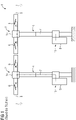
- FIG 1 shows a schematic side view of a quadruple-breaking arrangement 1 for switching high voltages according to the prior art.
- the arrangement 1 has a contact gap which comprises two switching units 2, 3 connected in series, each with two interrupter units 6 connected in series.
- the switching units 2, 3 with the interrupter units 6 are each designed in the form of a switching head which is arranged on a support element 4, 5 in each case.
- the two interrupter units 6 of a switching unit 2, 3, which are designed in the manner of a circuit breaker, are arranged spatially one behind the other along their longitudinal axis on a common axis 12 and are connected to one another via a connecting flange 14. In the area of the connecting flange 14 or over the connecting flange 14, the interrupter units 6 are attached to the respective support element 4, 5 of the switching unit 3, 4.
- the two supporting elements 4, 5 of the two switching units 2, 3 are each in the form of a column.
- the pillar is made up of different areas, e.g. B. from an insulator, which is attached to the respective connecting flange 14 of the switching unit 2, 3, and which is arranged on a metal support.
- the metal support is arranged in the lower region 11 of the column or of the supporting element 4, 5 and z. B. formed in a columnar shape and / or T-beam shape.
- the supporting elements 4, 5 are on z. B. arranged a foundation and in particular with this over z. B. screws or fixed by setting in concrete.
- the supporting elements 4, 5 are in particular essentially perpendicular to the plane of the foundation.
- the supporting elements 4, 5 each form a T-shape with the associated switching unit 2, 3, with an interrupter unit 6 of the respective switching head 2, 3 being arranged to the right and left of the supporting element 4, 5.
- the foundation is flat and horizontal, with the supporting elements 4, 5 having the same height.
- the interrupter units 6 of the two switching units 2, 3 are arranged one behind the other with their respective longitudinal axis on a common longitudinal axis 12 and are electrically connected in series.
- the arrangement 1 has electrical connections 9 in order to connect the arrangement z. B. to be electrically connected to the power grids to be switched, power generators and / or power consumers.
- a drive 8 is arranged on each support element 4 , 5 , in particular in the lower region 11 on the support element 4 , 5 .
- the drive 8 is z. B. in the form of a spring-loaded drive with a switch-on and a switch-off spring and/or a electric motor formed. When switching, the drive 8 provides the kinetic energy that is required to move the movable contact pieces of the interrupter units 6 .
- Elements of a kinematic chain 7, z. B. in the form of shafts, rods and / or gear parts are arranged on or in the support element 4, 5, for transmitting the kinetic energy from the drive 8 to the movable contacts of the interrupter units 6, ie for transmitting the switching movement when switching.
- the elements of the kinematic chain 7 are indicated schematically in the figures by dashed lines.
- the two drives 8 of the two switching units 2, 3 are electrically connected to one another and electrically synchronized in order to achieve synchronization of the interrupter units 6 of the two switching units 2, 3 when switching. Deviations or tolerances in production and installation can lead to different running times of the movement via the two kinematic chains 7 of the two switching units 2, 3 with the respective support elements 4, 5.
- standards require all interrupter units 6 to run in synchronism with a deviation in the switching times of the interrupter units 6 which is within one-sixth of an oscillation cycle of the voltage oscillation applied to the arrangement 1.
- synchronization is required, in which all interrupter units 6 switch with a deviation in the switching times of the interrupter units 6 which is within one eighth of an oscillation cycle of the voltage oscillation applied to the arrangement 1.
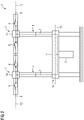
- FIG 2 is a schematic side view of a quadruple-breaking arrangements 1 according to the invention for switching high voltages.
- the arrangement 1 is analogous to the arrangement 1 of figure 1 , but with a coupling element 10 and a common drive 8 for all four interrupter units 6.
- the coupling element 10 is in the form of a web and in particular is arranged with its ends on a support element 4, 5 of the two switching units 2, 3.
- An attachment of the coupling element 10 to the support elements 4, 5 can, for. Example by screwing, welding, gluing or other connection techniques.
- the common drive 8 is arranged in the middle, ie at the same distance from the two support elements 4 and 5 and is fastened to the coupling element 10 .
- Differences in the kinematic chains 7 of the first and second switching unit 2, 3 can be compensated for by changing the position of the drive 8 on the coupling element 10 and/or the coupling element relative to the respective switching unit 2, 3, whereby the distance between the drive 8 and the two switching units 2, 3 is determined via elements of the kinematic chain 7 .
- the coupling element 10, as in figure 2 is shown, be arranged parallel to the foundation, or if there are differences between the elements of the kinematic chain 7 of the first shifting unit 2 and elements of the kinematic chain 7 of the second shifting unit 3, the differences can be compensated for by a tilted coupling element 10, ie not arranged parallel to the ground .
- the coupling element 10 is arranged on the support elements 4, 5 in such a way that transmission paths of equal length via the kinematic chain 7 from the drive 8 to the first and to the second switching unit 2, 3 are created.
- each interrupter unit 6 includes electrical resistors, capacitors and / or shields. Elongated resistors and / or capacitors can be spatially parallel to the interrupter units 6, which z. B. are in the form of a circuit breaker, are arranged.
- the coupling element 10 can be made in one piece, z. B. steel or aluminum, and / or arranged as a T-beam with elements of the kinematic chain 7 on the carrier, or as a hollow body, z. B. with a square or round cross-section, arranged with elements of the kinematic chain 7 in the carrier, be formed.
- the arrangement 1 can include more than two switching units 2, 3, each with a support element 10, connected to at least two support elements 10, in particular all support elements 10, via the coupling element 10. There can also be several Supporting elements 10 be included.
- a switching unit 2, 3 can include one, two or more interrupter units 10. So per switching unit 2, 3, as shown in the figures, two interrupter units can be arranged linearly to each other, or z. B. three interrupter units can be arranged in a Y-shape per switching unit 2, 3.
Landscapes
- Driving Mechanisms And Operating Circuits Of Arc-Extinguishing High-Tension Switches (AREA)
- Gas-Insulated Switchgears (AREA)
- Electronic Switches (AREA)
Description
Die Erfindung betrifft eine Anordnung und ein Verfahren zum Schalten von Hochspannungen mit einer Schaltstrecke, welche wenigstens zwei in Reihe geschaltete Schalteinheiten umfasst. Jede Schalteinheit umfasst jeweils wenigstens ein Tragelement und Elemente einer kinematischen Kette zur Übertragung einer Schaltbewegung von wenigstens einem Antrieb.The invention relates to an arrangement and a method for switching high voltages with a contact gap which comprises at least two switching units connected in series. Each switching unit comprises at least one support element and elements of a kinematic chain for transmitting a switching movement from at least one drive.
Anordnungen zum Schalten von Hochspannungen, wie z. B. aus der
Dies kann insbesondere beim Auftreten von Fehlerströmen in Stromnetzen, Gerätestörungen oder beim Zu- oder Abschalten von Energieerzeugern und/oder Energieverbrauchern notwendig sein. Ein Schalten erfolgt geregelt oder gesteuert, z. B. abhängig von Messgrößen der Anordnung und/oder entsprechend dem Energiebedarf. Geeignete Einrichtungen, wie z. B. Strom-Spannungs-Messeinrichtungen, Sensoren für Temperatur, Luftdruck oder Fehlfunktionen können von der Anordnungen zum Schalten von Hochspannungen umfasst sein, z. B. um dezentral oder zentral, insbesondere von einer Schaltwarte aus, ein Schalten zu steuern.This can be necessary in particular when fault currents occur in power grids, device faults or when power generators and/or power consumers are switched on or off. Switching is regulated or controlled, e.g. B. depending on measured variables of the arrangement and / or according to the energy demand. Appropriate facilities such as B. current-voltage measuring devices, sensors for temperature, air pressure or malfunctions can be included in the arrangements for switching high voltages, z. B. to decentralized or to control switching centrally, in particular from a control room.
Um große Spannungen zu schalten kann eine Anordnung zum Schalten mehrere Unterbrechereinheiten pro Pol umfassen, insbesondere in Reihe hintereinander elektrisch verschaltet. Z. B. kann eine vierfach unterbrechende Anordnung vier hintereinander in Reihe geschaltete Unterbrechereinheiten umfassen, wodurch z. B. eine Schaltspannung von 1200 V auf eine Spannung von 300 V pro Unterbrechereinheit herabgesetzt wird. Der modulare Aufbau mit mehreren Unterbrechereinheiten ermöglicht eine kostengünstige Anpassung der Anordnung an die benötigte maximale Schaltleistung, eine Verwendung von technisch einfach und kostengünstig zu realisierenden Unterbrechereinheiten, mit geringerer maximaler Schaltleistung bzw. Spannung, sowie einen kompakten Aufbau. Die in Reihe geschalteten Unterbrechereinheiten müssen bei einem Schalten synchron, d. h. im Wesentlichen gleichzeitig schalten.In order to switch high voltages, a switching arrangement can comprise a plurality of interrupter units per pole, in particular electrically connected in series one behind the other. For example, a quadruple-break arrangement may comprise four breaker units connected in series, whereby e.g. B. a switching voltage of 1200 V is reduced to a voltage of 300 V per interrupter unit. The modular structure with several interrupter units enables the arrangement to be adapted inexpensively to the required maximum switching capacity, the use of interrupter units that are technically simple and inexpensive to implement, with a lower maximum switching capacity or voltage, and a compact structure. The interrupter units connected in series must be synchronous when switching, i. H. switch essentially simultaneously.
Beim Schalten werden die beweglichen Kontaktstücke eines Kontakts über Elemente einer kinematischen Kette bewegt, wobei die Kontakte geöffnet oder geschlossen werden. Ein Antrieb stellt die kinetische Energie bereit, welche für den Schaltvorgang benötigt wird. Als Antrieb können z. B. ein Federspeicherantrieb mit wenigstens einer Energie-Speicherfeder und/oder ein Elektromotor verwendet werden. Handkurbeln und/oder ein Motor können verwendet werden, um die Energie einer Energie-Speicherfeder zuzuführen, welche sie bis zum Schaltzeitpunkt speichert. Mehrpolige-Schalter können wenigstens einen Antrieb pro Pol aufweisen, oder einen gemeinsamen Antrieb für mehrere Pole. Ein Federspeicherantrieb umfasst wenigstens eine Einschaltfeder und wenigstens eine Ausschaltfeder, oder eine gemeinsame Feder für die Ein- und Ausschaltbewegung.When switching, the moving contact pieces of a contact are moved via elements of a kinematic chain, whereby the contacts are opened or closed. A drive provides the kinetic energy required for the shifting process. As a drive z. B. a spring-loaded drive with at least one energy storage spring and / or an electric motor can be used. Hand cranks and/or a motor can be used to supply the energy to an energy storage spring, which stores it until the time of shifting. Multi-pole switches can have at least one drive per pole, or a common drive for several poles. A stored energy mechanism comprises at least one closing spring and at least one opening spring, or a common spring for the closing and opening movement.
Elemente der kinematischen Kette übertragen die Bewegungsenergie vom Antrieb auf die beweglichen Kontaktstücke der elektrischen Kontakte beim Schalten. Getriebeelemente, wie z. B. Wellen und Hebel, können umfasst sein, um die Bewegungsrichtung und Kraft zu ändern, welche z. B. über eine Schaltstange auf die beweglichen Kontaktstücke übertragen werden. Für ein schnelles Schalten, insbesondere im Bereich von Millisekunden, sind große Kräfte und schnelle Bewegungen notwendig. Ein synchrones Schalten erfordert einen Gleichlauf, d. h. ein gleichzeitiges Schalten jeweils aller in Reihe geschalteter Unterbrechereinheiten. Normen erfordern eine maximale zeitliche Abweichung, d. h. einen Gleichlauf bei einem Einschaltvorgang, welcher innerhalb eines Sechstels eines Schwingungszykluses der an die Anordnung angelegten Spannungsschwingung liegt. Bei einem Ausschaltvorgang erfordern die Normen einen Gleichlauf aller Unterbrechereinheiten, welcher innerhalb eines Achtels eines Schwingungszykluses der an die Anordnung angelegten Spannungsschwingung liegt.Elements of the kinematic chain transfer the kinetic energy from the drive to the moving contact pieces electrical contacts when switching. Transmission elements such. B. shafts and levers can be included to change the direction of movement and force, which z. B. be transferred to the movable contacts via a switching rod. Fast switching, especially in the millisecond range, requires large forces and fast movements. Synchronous switching requires synchronism, ie simultaneous switching of all interrupter units connected in series. Standards require a maximum time deviation, ie synchronization during a switch-on process, which is within one-sixth of an oscillation cycle of the voltage oscillation applied to the arrangement. During a turn-off operation, the standards require all interrupter units to be synchronized to within one eighth of a cycle of the voltage swing applied to the assembly.
Bei einer periodisch wiederkehrenden Schwingung, insbesondere Sinusschwingung, mit einer Periode von 50 oder 60 Hz, hat somit das Einschalten aller in Reihe geschalteter Unterbrechereinheiten innerhalb einer Dreihundertstel Sekunde bei 50 Hz bzw. Dreihundertsechzigstel Sekunde bei 60 Hz, und das Ausschalten aller in Reihe geschalteter Unterbrechereinheiten innerhalb einer Vierhundertstel Sekunde bei 50 Hz bzw. Vierhundertachtzigstel Sekunde bei 60 Hz zu erfolgen. Um dies zu erreichen werden bei Verwendung von mehreren Antrieben, insbesondere einem Antrieb pro Unterbrechereinheit oder pro Paar an Unterbrechereinheiten, z. B. bei vier in Reihe geschalteten Unterbrechereinheiten, die Antriebe elektrisch synchronisiert.In the case of a periodically recurring oscillation, in particular a sinusoidal oscillation, with a period of 50 or 60 Hz, all interrupter units connected in series must therefore be switched on within three hundredths of a second at 50 Hz or three hundred and sixtieths of a second at 60 Hz, and all interrupter units connected in series must be switched off within one four hundredth of a second at 50 Hz or four hundred and eightieth of a second at 60 Hz. In order to achieve this, when using several drives, in particular one drive per interrupter unit or per pair of interrupter units, e.g. B. with four interrupter units connected in series, the drives are electrically synchronized.
Die Unterbrechereinheiten sind auf Trägern bzw. Tragelementen angeordnet. Tragelemente umfassen z. B. Isolatoren aus Keramik und/oder Silikon, welche insbesondere auf Metallträgern, z. B. aus Stahl oder Aluminium, auf einem Fundament angeordnet sind. Die Tragelemente können in Form einer Säule ausgebildet sein und senkrecht zur Ebene des Fundaments angeordnet werden. Aus Stabilitätsgründen können jeweils zwei Unterbrechereinheiten zu einer Schalteinheit bzw. einem Schaltkopf zusammengefasst, auf einem Träger symmetrisch angeordnet sein. Die Unterbrechereinheiten können entlang ihrer Längsachse hintereinander, elektrisch in Reihe geschaltet angeordnet sein, und auf dem oberen, d. h. dem Fundament abgewandten Ende eines Tragelements mechanisch stabil befestigt sein. Dabei bildet ein Träger mit der darauf angeordneten Schalteinheit z. B. eine T-Form, wobei die Längsachse der Schalteinheit insbesondere im Wesentlichen parallel zum Fundament verläuft.The interrupter units are arranged on supports or supporting elements. Supporting elements include z. B. insulators made of ceramic and / or silicone, which in particular on metal supports such. B. made of steel or aluminum, are arranged on a foundation. The supporting elements can be in the form of a column and arranged perpendicularly to the plane of the foundation will. For reasons of stability, two interrupter units can be combined into a switching unit or switching head and arranged symmetrically on a carrier. The interrupter units can be arranged one behind the other along their longitudinal axis, electrically connected in series, and attached to the upper end, ie the end facing away from the foundation, of a support element in a mechanically stable manner. In this case, a carrier with the switching unit arranged thereon forms z. B. a T-shape, wherein the longitudinal axis of the switching unit runs in particular substantially parallel to the foundation.
Ein Pol einer vierfach unterbrechenden Anordnung umfasst z. B. zwei Tragelemente, jeweils mit einem darauf befindlichem Schaltkopf. Die Schaltköpfe sind derart zueinander angeordnet, dass ihre Längsachsen auf einer gemeinsamen Längsachse liegen, und alle vier Unterbrechereinheiten sind in Reihe miteinander verschaltet. Jedes Tragelement mit Schaltkopf weist einen Antrieb und Elemente einer kinematischen Kette auf, zur Übertragung der Schaltbewegung vom Antrieb auf den jeweiligen Schaltkopf. Ein synchrones Schalten erfordert eine elektrische Synchronisation der insbesondere zwei Antriebe, welche Unterschiede in den Antrieben, kinematischen Ketten und Unterbrechereinheiten ausgleichen sollte, um einen Gleichlauf beim Schalten zu gewährleisten. Die Einstellung der elektrischen Synchronisation ist aufwendig, zeit- und kostenintensiv.A pole of a quadruple-breaking arrangement comprises e.g. B. two supporting elements, each with a switch head located thereon. The switching heads are arranged relative to one another in such a way that their longitudinal axes lie on a common longitudinal axis, and all four interrupter units are connected to one another in series. Each support element with switching head has a drive and elements of a kinematic chain for transmitting the switching movement from the drive to the respective switching head. Synchronous switching requires electrical synchronization of the two drives in particular, which should compensate for differences in the drives, kinematic chains and interrupter units in order to ensure synchronization when switching. Adjusting the electrical synchronization is complex, time-consuming and costly.
Aufgabe der vorliegenden Erfindung ist die Vermeidung bzw. Reduzierung der zuvor beschriebenen Probleme. Insbesondere ist es Aufgabe eine Anordnung und ein Verfahren zum Schalten von Hochspannungen anzugeben, welche einfach und kostengünstig einen Gleichlauf bzw. eine Synchronisation von Unterbrechereinheiten beim Schalten ermöglichen.The object of the present invention is to avoid or reduce the problems described above. In particular, it is an object to specify an arrangement and a method for switching high voltages, which allow simple and inexpensive synchronization of interrupter units when switching.
Die angegebene Aufgabe wird erfindungsgemäß durch eine Anordnung zum Schalten von Hochspannungen mit den Merkmalen gemäß Patentanspruch 1 und/oder durch ein Verfahren zum Schalten der zuvor beschriebenen Anordnung gemäß Patentanspruch 12 gelöst. Vorteilhafte Ausgestaltungen der erfindungsgemäßen Anordnung zum Schalten von Hochspannungen und/oder des Verfahrens zum Schalten der zuvor beschriebenen Anordnung sind in den Unteransprüchen angegeben. Dabei sind Gegenstände der Hauptansprüche untereinander und mit Merkmalen von Unteransprüchen sowie Merkmale der Unteransprüche untereinander kombinierbar.The stated object is achieved according to the invention by an arrangement for switching high voltages with the features according to Patent claim 1 and / or solved by a method for switching the arrangement described above according to
Eine erfindungsgemäße Anordnung zum Schalten von Hochspannungen umfasst eine Schaltstrecke, welche wenigstens zwei in Reihe geschaltete Schalteinheiten aufweist, wobei jede Schalteinheit jeweils wenigstens ein Tragelement und Elemente einer kinematischen Kette zur Übertragung einer Schaltbewegung von wenigstens einem Antrieb umfasst. Die Tragelemente der wenigstens zwei Schalteinheiten sind mechanisch über wenigstens ein Koppelelement miteinander verbunden. Der Antrieb der wenigstens zwei Schalteinheiten ist als ein gemeinsamer Antrieb ausgebildet. Höhenunterschieden im Fundament werden durch Tragelemente mit unterschiedlichen Längen ausgeglichen. Das wenigstens eine Koppelelement ist derart an den Tragelementen angeordnet, dass der Abstand vom Antrieb zu den Schalteinheiten über Elemente der kinematischen Kette gleich lang ist, bei Höhenunterschieden im Fundament mit gleich langen Abständen der Schalteinheiten zu Befestigungspunkten des wenigstens einen Koppelelements an den Tragelementen.An arrangement according to the invention for switching high voltages comprises a switching path which has at least two switching units connected in series, each switching unit comprising at least one support element and elements of a kinematic chain for transmitting a switching movement from at least one drive. The supporting elements of the at least two switching units are mechanically connected to one another via at least one coupling element. The drive of the at least two switching units is designed as a common drive. Differences in height in the foundation are compensated for by supporting elements of different lengths. The at least one coupling element is arranged on the support elements in such a way that the distance from the drive to the switching units via elements of the kinematic chain is the same length, with height differences in the foundation with the same distances between the switching units and attachment points of the at least one coupling element on the support elements.
Das Koppelelement ermöglicht eine mechanische Verbindung der wenigstens zwei in Reihe geschalteten Schalteinheiten. Eine mechanische Einstellung einer Synchronisation bzw. eines Gleichlaufs der Schalteinheiten wird dadurch möglich, insbesondere durch Veränderung des Abstands zwischen dem wenigstens einen Antrieb und wenigstens einer Schalteinheit über Elemente der kinematischen Kette, welche am oder im Koppelelement und/oder Tragelement angeordnet sind. Dies spart gegenüber einer elektrischen Synchronisation Kosten, Aufwand und Zeit. Das Koppelelement führt weiterhin zu einer mechanischen Stabilisation der Tragelemente, indem diese sich gegenseitig abstützen über das wenigstens eine Tragelement. Insbesondere bei Erdbebengefahr und/oder anderen Wettereinflüssen, wie z. B. Sturm, ist eine hohe mechanische Stabilität notwendig.The coupling element enables a mechanical connection of the at least two switching units connected in series. A mechanical adjustment of synchronization or synchronism of the switching units is thereby possible, in particular by changing the distance between the at least one drive and at least one switching unit via elements of the kinematic chain, which are arranged on or in the coupling element and/or support element. Compared to electrical synchronization, this saves costs, effort and time. The coupling element also leads to a mechanical stabilization of the support elements in that they support each other via the at least one support element. Especially when there is a risk of earthquakes and/or other weather conditions, such as e.g. B. storm, a high mechanical stability is necessary.
Jede Schalteinheit kann wenigstens zwei Unterbrechereinheiten nach Art eines Leistungsschalters aufweisen, insbesondere mit elektrischen Widerstands- und/oder Kondensatoreinheiten. Eine vierfach unterbrechende Anordnung ist dadurch einfach herzustellen, durch Verwendung von zwei Schalteinheiten, jeweils auf einem Tragelement angeordnet, mit jeweils zwei Unterbrechereinheiten und insbesondere weiteren elektrischen Einheiten, wie z. B. Widerstands- und/oder Kondensatoreinheiten. Die zwei Tragelemente sind über das Koppelelement miteinander mechanisch gekoppelt und die den Tragelementen zugeordneten Schalteinheiten können mit Hilfe des Koppelelements schalttechnisch synchronisiert werden. Dabei kann, durch die insbesondere vier Leistungsschalter, Widerstands- und/oder Kondensatoreinheiten, mit in Reihe geschalteten Leistungsschaltern eine hohe Spannung einfach und kostengünstig geschaltet werden.Each switching unit can have at least two interrupter units in the manner of a circuit breaker, in particular with electrical resistance and/or capacitor units. A quadruple-breaking arrangement is easy to produce by using two switching units, each arranged on a support element, each with two interrupter units and in particular other electrical units such. B. resistor and / or capacitor units. The two support elements are mechanically coupled to one another via the coupling element, and the switching units assigned to the support elements can be synchronized in terms of switching with the aid of the coupling element. In this case, a high voltage can be switched simply and inexpensively by means of the four circuit breakers, resistor units and/or capacitor units in particular, with circuit breakers connected in series.
Das wenigstens eine Koppelelement kann wenigstens einen Träger, insbesondere einen Querträger aufweisen, welcher die Tragelemente der wenigstens zwei Schalteinheiten miteinander verbindet. Ein Querträger kann durch seine Ausrichtung einfach und kostengünstig Höhenunterschiede z. B. der Tragelemente der Schalteinheiten ausgleichen, damit der Abstand des wenigstens einen Antriebs zu den Schalteinheiten bzw. Unterbrechereinheiten gleich ist, um einen bestimmten Mindest-Gleichlauf zu gewährleisten.The at least one coupling element can have at least one carrier, in particular a transverse carrier, which connects the carrier elements of the at least two switching units to one another. A cross member can easily and inexpensively compensate for differences in height, e.g. B. the support elements of the switching units, so that the distance of the at least one drive to the switching units or interrupter units is the same to ensure a certain minimum synchronization.
Die Tragelemente der wenigstens zwei Schalteinheiten können senkrecht zu einem Fundament angeordnet sein, insbesondere parallel zueinander, mit den Schalteinheiten jeweils auf den Tragelementen an einem Ende der Tragelemente auf der dem Fundament abgewandten Seite angeordnet. In einem unteren Bereich der Tragelemente kann das wenigstens eine Koppelelement angeordnet sein, insbesondere parallel zum Fundament. Diese Anordnung ist mechanisch stabil, durch die Versteifung über das Koppelelement. Wie zuvor beschrieben können durch Anordnung des Koppelelements parallel zum Fundament Höhenunterschiede z. B. der Tragelemente der Schalteinheiten ausgleichen werden.The supporting elements of the at least two switching units can be arranged perpendicularly to a foundation, in particular parallel to one another, with the switching units each arranged on the supporting elements at one end of the supporting elements on the side facing away from the foundation. The at least one coupling element can be arranged in a lower area of the support elements, in particular parallel to the foundation. This arrangement is mechanically stable due to the stiffening via the coupling element. As described above, by arranging the coupling element parallel to the foundation, height differences e.g. B. the supporting elements of the switching units are compensated.
Der Antrieb der wenigstens zwei Schalteinheiten kann als ein gemeinsamer Antrieb ausgebildet sein, insbesondere am wenigstens einen Koppelelement angeordnet. Der Antrieb kann mittig zwischen den wenigstens zwei Schalteinheiten und/oder Mittelachsen der Tragelemente angeordnet sein. Durch die mittige Anordnung zwischen den zwei Schalteinheiten am Koppelelement, ist der Abstand zwischen dem Antrieb und den Schalteinheiten gleich, d. h. eine gute mechanische Synchronisation des Schaltens der zwei Schalteinheiten ist möglich. Die Anordnung kann spiegelsymmetrisch sein, mit einer Spiegelachse senkrecht durch den mittigen Antrieb verlaufend. Gleichartige Elemente der kinematischen Kette zu beiden Schalteinheiten ermöglichen einen hohen Gleichlauf, d. h. gleichzeitiges Schalten der Schalteinheiten mit geringem maximalem Unterschied des Schaltzeitpunkts. Der Antrieb kann z. B. ein Federspeicherantrieb sein, insbesondere mit Einschalt- und Ausschaltfeder. Dadurch ist mit einfachen Mitteln, kostengünstig eine Anordnung zum Schalten mit hohem Gleichlauf zu realisieren.The drive of the at least two switching units can be designed as a common drive, in particular arranged on at least one coupling element. The drive can be arranged centrally between the at least two switching units and/or center axes of the support elements. Due to the central arrangement between the two switching units on the coupling element, the distance between the drive and the switching units is the same, i. H. a good mechanical synchronization of the switching of the two switching units is possible. The arrangement may be mirror symmetrical, with a mirror axis running perpendicularly through the central drive. Identical elements of the kinematic chain for both switching units enable high synchronism, i. H. Simultaneous switching of the switching units with a small maximum difference in the switching time. The drive can B. be a spring-loaded drive, especially with closing and opening. As a result, an arrangement for switching with a high degree of synchronism can be implemented inexpensively using simple means.
Die wenigstens zwei Schalteinheiten können entlang einer gemeinsamen Längsachse hintereinander angeordnet sein, insbesondere mit wenigstens vier Unterbrechereinheiten entlang der gemeinsamen Längsachse hintereinander angeordnet und insbesondere elektrisch in Reihe geschaltet. Die Längsachse kann insbesondere im Wesentlichen parallel zum Fundament sein. Das Tragelement einer jeweiligen Schalteinheit kann mittig der Schalteinheit angeordnet sein, insbesondere mit der gleichen Anzahl an Unterbrechereinheiten auf beiden Seiten des Tragelements der jeweiligen Schalteinheit. Durch den beschriebenen Aufbau der erfindungsgemäßen Anordnung sind zwei T-förmige Schalteinheiten mit jeweiligem Tragelement gegeben, welche die Schalteinheiten entlang einer Achse angeordnet ergeben und ein Einfaches in Reihe verschalten ermöglichen. Höhenunterschiede im Fundament können z. B. durch unterschiedlich lange Tragelemente ausgeglichen werden und ein Gleichlauf kann über die Anordnung des Koppelelements gewährleistet werden, z. B. im rechten Winkel zu den Tragelementen. Alternativ können die Tragelemente gleich lang sein, wobei ein hoher Gleichlauf erreicht wird durch Anordnung des Koppelelements parallel zur Ebene des Fundaments. Das Koppelelement stabilisiert die Tragelemente mechanisch und ermöglicht eine Anordnung eines, insbesondere mittig angeordneten Antriebs mit gleichem Abstand zu beiden Schalteinheiten. Alternativ können mehrere Antriebe, z. B. zwei verwendet werden, welche am Koppelelement derart befestigt werden, dass ein gleicher Abstand der Antriebe zu beiden Schalteinheiten über Elemente der kinematischen Kette besteht. Unterschiede in Elementen der kinematischen Ketten beider Antriebe können auch ausgeglichen werden, durch Versatz der Antriebe zu einer Anordnung mit gleichem Abstand der Antriebe zu beiden Schalteinheiten. Ein Gleichlauf kann durch verschieben eines Antriebs oder beider Antriebe gegeneinander entlang des Koppelelements erreicht werden. Ein Gleichlauf kann auch durch Verkippen des Koppelelements gegenüber den Tragelementen erreicht werden, wodurch Laufunterschiede der kinematischen Ketten ausgeglichen werden können.The at least two switching units can be arranged one behind the other along a common longitudinal axis, in particular with at least four interrupter units arranged one behind the other along the common longitudinal axis and in particular electrically connected in series. In particular, the longitudinal axis can be essentially parallel to the foundation. The supporting element of a respective switching unit can be arranged in the middle of the switching unit, in particular with the same number of interrupter units on both sides of the supporting element of the respective switching unit. The described structure of the arrangement according to the invention results in two T-shaped switching units with a respective support element, which result in the switching units being arranged along an axis and enable simple connection in series. Differences in height in the foundation can e.g. B. be compensated for by different lengths of support elements and synchronization can be ensured by the arrangement of the coupling element, z. B. at right angles to the support elements. Alternatively, the support elements can be of the same length, with a high level of synchronism being achieved by arranging the coupling element parallel to the plane of the foundation. The coupling element stabilizes the support elements mechanically and enables a drive, in particular a centrally arranged drive, to be arranged at the same distance from the two switching units. Alternatively, multiple drives, z. B. two can be used, which are attached to the coupling element in such a way that there is an equal distance between the drives and the two switching units via elements of the kinematic chain. Differences in the elements of the kinematic chains of both drives can also be compensated for by offsetting the drives to form an arrangement with the drives at the same distance from the two switching units. Synchronization can be achieved by moving one drive or both drives against each other along the coupling element. Synchronization can also be achieved by tilting the coupling element relative to the support elements, as a result of which running differences in the kinematic chains can be compensated for.
Die Anordnung kann eine vierfach unterbrechende Anordnung nach Art eines Leistungsschalters sein, mit vier in Reihe geschalteten, insbesondere entlang einer gemeinsamen Längsachse angeordneten Unterbrechereinheiten, wobei jeweils zwei Unterbrechereinheiten auf einem Tragelement angeordnet sind und die Tragelemente über wenigstens ein Koppelelement, insbesondere im Wesentlichen mit der Längsachse des Koppelelements parallel zur gemeinsamen Längsachse der Unterbrechereinheiten angeordnet, nach Art eines Stegs ausgebildet miteinander mechanisch verbunden sind. Ein insbesondere gemeinsamer Antrieb der Unterbrechereinheiten kann am Koppelelement, z. B. mittig am Koppelement angeordnet sein. Der beschriebene Aufbau erlaubt das Schalten hoher Spannungen, insbesondere bis hin zu 1200 V, z. B. mit Standardleistungsschaltern für niedrigere Spannungen, bei geringen Kosten und einem hohen Gleichlauf. Der Gleichlauf wird mechanisch über die Verwendung des Koppelelements erreicht, z. B. durch Änderung der Position des Antriebs am Koppelelement und damit dem Abstand über Elemente der kinematischen Kette zwischen dem Antrieb und den Unterbrechereinheiten.The arrangement can be a quadruple-breaking arrangement in the manner of a circuit breaker, with four interrupter units connected in series, in particular arranged along a common longitudinal axis, with two interrupter units each being arranged on a support element and the support elements via at least one coupling element, in particular essentially with the longitudinal axis of the coupling element are arranged parallel to the common longitudinal axis of the interrupter units, are mechanically connected to one another in the manner of a web. A particular common drive of the interrupter units can be connected to the coupling element, e.g. B. can be arranged centrally on the coupling element. The structure described allows switching high voltages, especially up to 1200 V, e.g. B. with standard circuit breakers for lower voltages, at low cost and high synchronization. Synchronization is achieved mechanically through the use of the coupling element, e.g. B. by changing the position of the drive on the coupling element and thus the distance between elements of the kinematic chain between the drive and the interrupter units.
Elemente der kinematischen Kette können umfasst sein von der erfindungsgemäßen Anordnung, zum Übertragen der Schaltbewegung vom wenigstens einen Antrieb auf die Unterbrechereinheiten der wenigstens zwei Schalteinheiten. Die Elemente der kinematischen Kette können am oder im Koppelelement und/oder am oder in den Tragelementen angeordnet sein, und die vom Antrieb erzeugte Bewegung als Schaltbewegung auf die Unterbrechereinheiten übertragen. Durch Änderung der Lage und/oder Form des Koppelelements, relativ zu den Tragelementen und/oder zum Antrieb, wird der Weg bzw. die Länge des Wegs über Elemente der kinematischen Kette am oder in den Tragelementen und/oder am oder im Koppelelement mitbestimmt und/oder eingestellt, wodurch ein hoher Gleichlauf der Schaltbewegung und des Schaltzeitpunkts erreichbar ist.Elements of the kinematic chain can be included in the arrangement according to the invention for transmitting the switching movement from the at least one drive to the interrupter units of the at least two switching units. The elements of the kinematic chain can be arranged on or in the coupling element and/or on or in the support elements, and transmit the movement generated by the drive to the interrupter units as a switching movement. By changing the position and/or shape of the coupling element relative to the support elements and/or to the drive, the path or the length of the path via elements of the kinematic chain on or in the support elements and/or on or in the coupling element is also determined and/or or set, whereby a high synchronization of the switching movement and the switching time can be achieved.
Die Tragelemente der wenigstens zwei Schalteinheiten können Isolatoren umfassen, insbesondere Isolatoren aus Silikon, Verbundstoffen und/oder Keramik. Die Tragelemente der wenigstens zwei Schalteinheiten können Metallträger umfassen, insbesondere aus Aluminium und/oder Stahl. Die Tragelemente können zusammengesetzt sein aus Isolator-Elementen und/oder Metallträger-Elementen. Z. B. kann ein Tragelement säulenförmig aufgebaut sein, mit einem oberen Bereich aus Isolatormaterial, insbesondere einem gerippten zylinderförmigen Isolator, und einem unteren Bereich aus einem Metallträger, insbesondere einem zylinderförmigen und/oder T-trägerförmigen Metallträger. Der Metallträger kann auch als ein Metallgestell ausgebildet sein, und/oder z. B. die Isolatoren als Tragelemente können insbesondere als Isolatorsäulen senkrecht stehend auf dem Metallgestell angeordnet sein. Die Schalteinheiten können auf den Isolatorsäulen angeordnet sein und Elemente der kinematischen Kette können am oder im Koppelelement, den Isolatorsäulen und/oder dem Metallgestell beweglich angeordnet sein. Ein Antrieb kann am Koppelelement angeordnet sein, wobei das Koppelelement Teil des Metallgestells sein kann.The supporting elements of the at least two switching units can include insulators, in particular insulators made of silicone, composite materials and/or ceramics. The support elements of the at least two switching units can include metal supports, in particular made of aluminum and/or steel. The support elements can be composed of insulator elements and/or metal support elements. For example, a supporting element can be constructed in the form of a column, with an upper area made of insulating material, in particular a ribbed cylindrical insulator, and a lower area made of a metal support, in particular a cylindrical and/or T-shaped metal support. The metal support can also be designed as a metal frame, and / or z. B. the insulators as support elements can stand up vertically, in particular as insulator columns be arranged on the metal frame. The switching units can be arranged on the insulator columns and elements of the kinematic chain can be movably arranged on or in the coupling element, the insulator columns and/or the metal frame. A drive can be arranged on the coupling element, it being possible for the coupling element to be part of the metal frame.
Ein elektrisch isolierendes Fluid kann umfasst sein, insbesondere eine Flüssigkeit und/oder ein Gas, insbesondere SF6, Stickstoff, trockene Luft, Kohlendioxid, ein Fluorketon, und/oder ein Fluornitril. Der wenigstens eine Isolator und/oder die Unterbrechereinheiten können mit dem elektrisch isolierenden Fluid, insbesondere einer Flüssigkeit und/oder einem Gas, insbesondere SF6, Stickstoff, trockene Luft, Kohlendioxid, ein Fluorketon, und/oder ein Fluornitril, befüllt sein.An electrically insulating fluid can be included, in particular a liquid and/or a gas, in particular SF 6 , nitrogen, dry air, carbon dioxide, a fluoroketone and/or a fluoronitrile. The at least one insulator and/or the interrupter units can be filled with the electrically insulating fluid, in particular a liquid and/or a gas, in particular SF 6 , nitrogen, dry air, carbon dioxide, a fluoroketone and/or a fluoronitrile.
Der Abstand über die Elemente der kinematischen Kette vom Antrieb zu zumindest zwei, insbesondere allen Unterbrechereinheiten kann gleich sein, insbesondere mit jeweils gleicher Anzahl und gleich ausgebildeten Elementen der kinematischen Kette vom Antrieb zu jeder Unterbrechereinheit, insbesondere mit einem gemeinsamen Antrieb für alle Unterbrechereinheiten mittig zwischen den wenigstens zwei Schalteinheiten und am Koppelelement angeordnet. Dadurch ist mit einfachen Mitteln, kostengünstig ein hoher Gleichlauf mechanisch erreichbar.The distance across the elements of the kinematic chain from the drive to at least two, in particular all, interrupter units can be the same, in particular with the same number and identically designed elements of the kinematic chain from the drive to each interrupter unit, in particular with a common drive for all interrupter units in the middle between the at least two switching units and arranged on the coupling element. As a result, high synchronous operation can be mechanically achieved with simple means and at low cost.
Tragelemente weisen wie zuvor beschrieben eine unterschiedliche Länge auf, insbesondere zum Ausgleich von Höhenunterschieden des Fundaments, und das wenigstens eine Koppelelement ist derart an den Tragelementen angeordnet, dass der Abstand vom Antrieb zu den Schalteinheiten über Elemente der kinematischen Kette gleich lang ist, insbesondere bei Höhenunterschieden im Fundament mit gleich langen Abständen der Schalteinheiten zu Befestigungspunkten des wenigstens einen Koppelelements an den Schalteinheiten. Dadurch ist ebenfalls mit einfachen Mitteln, kostengünstig ein hoher Gleichlauf mechanisch erreichbar. Über die Lage des Koppelelements und des Antriebs zu den Schalteinheiten kann ein Gleichlauf erreicht und einfach nachjustiert werden. Die Verwendung von einem gemeinsamen Antrieb für die wenigstens zwei, insbesondere alle Schalteinheiten wird möglich, was Kosten und Aufwand reduziert.As described above, support elements have different lengths, in particular to compensate for differences in height of the foundation, and the at least one coupling element is arranged on the support elements in such a way that the distance from the drive to the switching units via elements of the kinematic chain is the same length, especially in the case of height differences in the foundation with equal distances between the switching units and attachment points of the at least one coupling element on the switching units. As a result, a high level of synchronism is also achieved mechanically using simple, cost-effective means accessible. Synchronization can be achieved and easily readjusted via the position of the coupling element and the drive in relation to the switching units. It is possible to use a common drive for the at least two, in particular all, switching units, which reduces costs and effort.
Ein erfindungsgemäßes Verfahren zum Schalten einer zuvor beschriebenen Anordnung umfasst, dass beim Auslösen eines Schaltvorgangs Bewegungsenergie von dem gemeinsamen Antrieb, insbesondere einem Federspeicherantrieb, bereitgestellt wird, und die Bewegungsenergie über Elemente der kinematischen Kette auf wenigstens zwei Schalteinheiten, insbesondere vier Unterbrechereinheiten, insbesondere nach Art eines Leistungsschalters, übertragen wird. Die zwei Schalteinheiten und/oder vier Unterbrechereinheiten werden elektrisch in Reihe geschaltet, und jede Schalteinheit wird auf einem Tragelement gelagert. Die wenigstens zwei Tragelemente werden über ein gemeinsames Koppelelement verbunden, und die Bewegungsenergie wird über Elemente der kinematischen Kette, angeordnet in oder an den Tragelementen und/oder dem Koppelelement, übertragen.A method according to the invention for shifting an arrangement described above comprises that when a shifting process is triggered, kinetic energy is provided by the common drive, in particular a stored-energy spring drive, and the kinetic energy is transmitted via elements of the kinematic chain to at least two switching units, in particular four interrupter units, in particular in the manner of one Circuit breaker is transferred. The two switching units and/or four breaker units are electrically connected in series and each switching unit is supported on a support member. The at least two support elements are connected via a common coupling element, and the kinetic energy is transmitted via elements of the kinematic chain arranged in or on the support elements and/or the coupling element.
Bei einem Einschaltvorgang kann ein Gleichlauf aller Unterbrechereinheiten innerhalb eines Sechstels eines Schwingungszykluses der an die Anordnung angelegten Spannungsschwingung liegen, insbesondere bei einer periodisch wiederkehrenden Schwingung, insbesondere Sinusschwingung, mit einer Periode von 50 oder 60 Hz.During a switch-on process, all interrupter units can run synchronously within a sixth of an oscillation cycle of the voltage oscillation applied to the arrangement, in particular in the case of a periodically recurring oscillation, in particular a sinusoidal oscillation, with a period of 50 or 60 Hz.
Bei einem Ausschaltvorgang kann der Gleichlauf aller Unterbrechereinheiten innerhalb eines Achtels eines Schwingungszykluses der an die Anordnung angelegten Spannungsschwingung liegen, insbesondere bei einer periodisch wiederkehrenden Schwingung, insbesondere Sinusschwingung, mit einer Periode von 50 oder 60 Hz.During a switch-off process, the synchronism of all interrupter units can be within an eighth of an oscillation cycle of the voltage oscillation applied to the arrangement, in particular in the case of a periodically recurring oscillation, in particular a sinusoidal oscillation, with a period of 50 or 60 Hz.
Die Vorteile des erfindungsgemäßen Verfahren zum Schalten einer zuvor beschriebenen Anordnung nach Anspruch 13 sind analog den zuvor beschriebenen Vorteilen der Anordnung zum Schalten von Hochspannungen nach Anspruch 1 und umgekehrt.The advantages of the method according to the invention for switching a previously described arrangement according to claim 13 are analogous to the previously described advantages of the arrangement for switching high voltages according to claim 1 and vice versa.
Im Folgenden werden Anordnungen zum Schalten von Hochspannungen nach dem Stand der Technik und ein Ausführungsbeispiel der Erfindung schematisch in den
Dabei zeigen die
- Figur 1
- schematisch in Seitenansicht eine vierfach unterbrechende Anordnungen 1 zum Schalten von Hochspannungen nach dem Stand der Technik mit zwei separaten, elektrisch synchronisierten Antrieben 8, und
Figur 2- schematisch in Seitenansicht eine erfindungsgemäße vierfach unterbrechende Anordnungen 1 zum Schalten von Hochspannungen mit einem gemeinsamen, an
einem Koppelelement 10 angeordneten Antrieb 8.
- figure 1
- a schematic side view of a quadruple-breaking arrangement 1 for switching high voltages according to the prior art with two separate, electrically synchronized drives 8, and
- figure 2
- Schematic side view of a quadruple-breaking arrangement 1 according to the invention for switching high voltages with a common drive 8 arranged on a
coupling element 10.
In
Die zwei Tragelemente 4, 5 der zwei Schalteinheiten 2, 3 sind jeweils in Form einer Säule ausgebildet. Im Ausführungsbeispiel der
Die Tragelemente 4, 5 bilden jeweils mit der dazugehörigen Schalteinheit 2, 3 eine T-Form aus, wobei rechts und links vom Tragelement 4, 5 aus gesehen eine Unterbrechereinheit 6 des jeweiligen Schaltkopfes 2, 3 angeordnet ist. Im Ausführungsbeispiel der
An jedem Tragelement 4, 5 ist ein Antrieb 8 angeordnet, insbesondere im unteren Bereich 11 am Tragelement 4, 5 befestigt. Der Antrieb 8 ist z. B. in Form eines Federspeicherantriebs mit einer Ein- und einer Ausschaltfeder und/oder einem elektrischen Motor ausgebildet. Beim Schalten stellt der Antrieb 8 die Bewegungsenergie bereit, welche zum Bewegen der beweglichen Kontaktstücke der Unterbrechereinheiten 6 benötigt wird. Elemente einer kinematischen Kette 7, z. B. in Form von Wellen, Stangen und/oder Getriebeteilen, sind am oder im Tragelement 4, 5 angeordnet, zum Übertragen der Bewegungsenergie vom Antrieb 8 zu den beweglichen Kontaktstücken der Unterbrechereinheiten 6, d. h. zum Übertragen der Schaltbewegung beim Schalten. Die Elemente der kinematischen Kette 7 sind in den Figuren schematisch durch gestrichelte Linie angedeutet.A drive 8 is arranged on each support element 4 , 5 , in particular in the
Die zwei Antriebe 8 der zwei Schalteinheiten 2, 3 sind elektrisch miteinander verbunden und elektrisch synchronisiert, um einen Gleichlauf der Unterbrechereinheiten 6 der zwei Schalteinheiten 2, 3 beim Schalten zu erreichen. Abweichungen bzw. Toleranzen in der Produktion und bei der Aufstellung können zu unterschiedlichen Laufzeiten der Bewegung über die zwei kinematischen Ketten 7 der zwei Schalteinheiten 2, 3 mit jeweiligen Tragelementen 4, 5 führen. Normen erfordern bei einem Einschaltvorgang einen Gleichlauf aller Unterbrechereinheiten 6 mit einer Abweichung der Schaltzeitpunkte der Unterbrechereinheiten 6, welche innerhalb eines Sechstels eines Schwingungszykluses der an die Anordnung 1 angelegten Spannungsschwingung liegt. Bei einem Ausschaltvorgang wird ein Gleichlauf erfordert, bei welchem alle Unterbrechereinheiten 6 mit einer Abweichung der Schaltzeitpunkte der Unterbrechereinheiten 6 schalten, welche innerhalb eines Achtels eines Schwingungszykluses der an die Anordnung 1 angelegten Spannungsschwingung liegt.The two drives 8 of the two switching
Insbesondere bei einer periodisch wiederkehrenden Schwingung, z. B. einer Sinusschwingung mit einer Periode von 50 oder 60 Hz, liegt die maximal erlaubte Abweichung der Schaltzeitpunkte der Unterbrechereinheiten 6, d. h. der Gleichlauf im Bereich von Millisekunden. Eine elektrische Synchronisation beider Antriebe 8, welche Unterschiede in den kinematischen Ketten 7 z. B. auf Grund von Produktionstoleranzen mit berücksichtigt, und welche zu einem erforderlichen Gleichlauf führt, ist aufwendig und kostspielig. Z. B. aufwendige Testreihen für jede Anordnung 1 können notwendig sein.In particular, in the case of a periodically recurring vibration, e.g. B. a sine wave with a period of 50 or 60 Hz, is the maximum permissible deviation of the switching times of the
In
Durch Verwendung eines Antriebs 8 für alle vier Unterbrechereinheiten 6 werden Kosten gegenüber dem Ausführungsbeispiel der
In den Figuren der Einfachheit halber nicht dargestellt, können z. B. die Schalteinheiten 2, 3, insbesondere jede Unterbrechereinheit 6 elektrische Widerstände, Kondensatoren und/oder Abschirmungen umfassen. Länglich ausgebildete Widerstände und/oder Kondensatoren können räumlich parallel zu den Unterbrechereinheiten 6, welche z. B. in Form eines Leistungsschalters ausgebildet sind, angeordnet werden. Das Koppelelement 10 kann aus einem Stück gefertigt sein, z. B. aus Stahl oder Aluminium, und/oder als T-Träger mit Elementen der kinematischen Kette 7 am Träger angeordnet, oder als Hohlkörper, z. B. mit quadratischem oder rundem Querschnitt, mit Elementen der kinematischen Kette 7 im Träger angeordnet, ausgebildet sein. Durch die Verbindung der Tragelemente 4, 5 über das Koppelelement 10 kann eine mechanische Stabilisierung der Anordnung 1 erfolgen, welche im Falle von z. B. Umwelteinflüssen wie Wind oder Erdbeben zu einer höheren Zuverlässigkeit der Anordnung 1 führt.Not shown in the figures for the sake of simplicity, z. B. the
Es können von der Anordnung 1 mehr als zwei Schalteinheiten 2, 3 jeweils mit Tragelement 10 umfasst sein, mit wenigstens zwei Tragelementen 10, insbesondere allen Tragelementen 10 über das Koppelelement 10 verbunden. Es können auch mehrere Tragelemente 10 umfasst sein. Eine Schalteinheit 2, 3 kann ein, zwei oder mehr Unterbrechereinheiten 10 umfassen. So können pro Schalteinheit 2, 3, wie in den Figuren dargestellt ist, zwei Unterbrechereinheiten linear zueinander angeordnet sein, oder z. B. drei Unterbrechereinheiten können pro Schalteinheit 2, 3 Y-förmig angeordnet sein.The arrangement 1 can include more than two switching
- 11
- Anordnung zum Schalten von HochspannungenArrangement for switching high voltages
- 22
- erste Schalteinheitfirst switching unit
- 33
- zweite Schalteinheitsecond switching unit
- 44
- Tragelement der ersten SchalteinheitSupporting element of the first switching unit
- 55
- Tragelement der zweiten SchalteinheitSupporting element of the second switching unit
- 66
- Unterbrechereinheitbreaker unit
- 77
- Elemente der kinematischen KetteElements of the kinematic chain
- 88th
- Antriebdrive
- 99
- elektrische Anschlüsseelectrical connections
- 1010
- Koppelelementcoupling element
- 1111
- unterer Bereich der Tragelementelower area of the supporting elements
- 1212
- gemeinsame Längsachse der Unterbrechereinheitencommon longitudinal axis of the interrupter units
- 1313
- Längsachse des KoppelelementsLongitudinal axis of the coupling element
- 1414
- Verbindungsflanschconnecting flange
Claims (14)
- System (1) for switching high voltages with a switching path which comprises at least two series-connected switching units (2, 3), wherein each switching unit (2, 3) comprises at least one support element (4, 5) and elements of a kinematic chain (7) for transferring a switching movement from at least one drive (8), wherein the support elements (4, 5) of the at least two switching units (2, 3) are mechanically interconnected by means of at least one coupling element (10) and the drive (8) of the at least two switching units (2, 3) is configured as a common drive (8),
characterized in that
support elements (4, 5) are of different lengths, for the compensation of variations in the height of the foundation, and in that the at least one coupling element (10) is arranged on the support elements (4, 5) such that the distance from the drive (8) to the switching units (2, 3), via elements of the kinematic chain (7), is of equal length, in the event of differences in the height of the foundation, with distances of equal length from the switching units (2, 3) to fixing points of the at least one coupling element (10) on the support elements (4, 5). - System (1) according to Claim 1, characterized in that each switching unit (2, 3) comprises at least two interrupter units (6) in the form of a power switch, having electrical resistance and/or capacitor units.
- System (1) according to one of the preceding claims, characterized in that the at least one coupling element (10) comprises at least one transverse support which interconnects the support elements (4, 5) of the at least two switching units (2, 3).
- System (1) according to one of the preceding claims, characterized in that the support elements (4, 5) of the at least two switching units (2, 3) are arranged perpendicularly to a foundation, specifically in a mutually parallel arrangement, with the switching units (2, 3) respectively arranged on the support elements (4, 5), at one end of said support elements (4, 5), on the side thereof which is averted from the foundation, and in that, in a lower region (11) of the support elements (4, 5), the at least one coupling element (10) is arranged, specifically parallel to the foundation.
- System (1) according to one of the preceding claims, characterized in that the drive (8) of the at least two switching units (2, 3) is configured as a common drive (8), which is arranged on the at least one coupling element (10), and is arranged centrally between the at least two switching units (2, 3) and/or the center axes of the support elements (4, 5) and/or in that the drive (8) is a stored-energy spring drive.
- System (1) according to one of the preceding claims, characterized in that the at least two switching units (2, 3) are arranged one after another along a common longitudinal axis (12), where at least four interrupter units (6) are arranged one after another along the common longitudinal axis (12), and are electrically connected in series, wherein the longitudinal axis (12) is essentially parallel to the foundation, and in that the support element (4, 5) of a respective switching unit (2, 3) is arranged centrally to the switching unit (2, 3), with an equal number of interrupter units (6) to either side of the support element (4, 5) of the respective switching unit (2, 3).
- System (1) according to one of the preceding claims, characterized in that the system (1) is a quadruple interrupter system, in the form of a power switch, having four series-connected interrupter units (6), arranged along a common longitudinal axis (12), wherein two interrupter units (6) are respectively arranged on a support element (4, 5), and the support elements (4, 5), by means of at least one coupling element (10), where the longitudinal axis (13) of the coupling element (10) is essentially arranged parallel to the common longitudinal axis (12) of the interrupter units (6), are mechanically interconnected, in the manner of a web, and a common drive (8) of the interrupter units (6) is arranged on the coupling element (10), centrally on the coupling element (10) .
- System (1) according to Claim 2, characterized in that elements of the kinematic chain (7) are incorporated for the transmission of the switching movement of the at least one drive (8) to the interrupter units (6) of the at least two switching units (2, 3), via elements of the kinematic chain (7) arranged on or in the coupling element (10) and via elements of the kinematic chain (7) arranged on or in the support elements (4, 5).
- System (1) according to one of the preceding claims, characterized in that the support elements (4, 5) of the at least two switching units (2, 3) comprise insulators, specifically insulators of silicone, composite material and/or ceramic construction, and/or in that the support elements (4, 5) of the at least two switching units (2, 3) comprise metal supports, specifically of aluminum and/or steel construction, and/or in that the support elements (4, 5) are comprised of insulator elements and/or metal support elements.
- System (1) according to one of the preceding claims, characterized in that an electrically-insulating fluid is incorporated, specifically a liquid and/or a gas, specifically SF6, nitrogen, dry air, carbon dioxide, a fluoroketone, and/or a fluoronitrile, and/or in that the at least one insulator (10) and/or the interrupter units (6) are filled with the electrically-insulating fluid, specifically a liquid and/or a gas, specifically SF6, nitrogen, dry air, carbon dioxide, a fluoroketone, and/or a fluoronitrile.
- System (1) according to Claim 2, characterized in that the distance via the elements of the kinematic chain (8) from the drive (8) to all the interrupter units (6) is equal, with a respectively equal number of identically-configured elements in the kinematic chain (7) from the drive (8) to each interrupter unit (6), with a common drive (8) for all the interrupter units (6) arranged centrally between the at least two switching units (2, 3) and arranged on the coupling element (10).
- Method for switching a system (1) according to one of the preceding claims, characterized in that, upon the tripping of a switching process, kinetic energy is delivered by the common drive (8), and the kinetic energy is transmitted via elements of the kinematic chain (7) to at least two switching units (2, 3), and wherein the two switching units (2, 3) are electrically connected in series, and wherein each switching unit (2, 3) is mounted on a support element (4, 5), and wherein the at least two support elements (4, 5) are connected by means of a common coupling element (10), and wherein the kinetic energy is transmitted via elements of the kinematic chain (7), arranged in or on the support elements (4, 5) and the coupling element (10).
- Method according to Claim 12, characterized in that, in a closing process, synchronism on all the interrupter units (6) is achieved within one sixth of an oscillation cycle of the oscillating voltage applied to the system (1), specifically in the case of a periodically recurring oscillation, specifically a sinusoidal oscillation, at a frequency of 50 or 60 Hz.
- Method according to one of Claims 12 or 13, characterized in that, in an opening process, synchronism on all the interrupter units (6) is achieved within one eighth of an oscillation cycle of the oscillating voltage applied to the system (1), specifically in the case of a periodically recurring oscillation, specifically a sinusoidal oscillation, at a frequency of 50 or 60 Hz.
Applications Claiming Priority (2)
| Application Number | Priority Date | Filing Date | Title |
|---|---|---|---|
| DE102016218683.3A DE102016218683B4 (en) | 2016-09-28 | 2016-09-28 | Arrangement and method for switching high voltages |
| PCT/EP2017/072191 WO2018059884A1 (en) | 2016-09-28 | 2017-09-05 | System and method for switching high voltages |
Publications (2)
| Publication Number | Publication Date |
|---|---|
| EP3494589A1 EP3494589A1 (en) | 2019-06-12 |
| EP3494589B1 true EP3494589B1 (en) | 2022-05-04 |
Family
ID=59829352
Family Applications (1)
| Application Number | Title | Priority Date | Filing Date |
|---|---|---|---|
| EP17764543.9A Revoked EP3494589B1 (en) | 2016-09-28 | 2017-09-05 | System and method for switching high voltages |
Country Status (6)
| Country | Link |
|---|---|
| EP (1) | EP3494589B1 (en) |
| CN (1) | CN109791857B (en) |
| CA (1) | CA3036421C (en) |
| DE (1) | DE102016218683B4 (en) |
| RU (1) | RU2713928C1 (en) |
| WO (1) | WO2018059884A1 (en) |
Families Citing this family (3)
| Publication number | Priority date | Publication date | Assignee | Title |
|---|---|---|---|---|
| DE102018214806A1 (en) | 2018-08-31 | 2020-03-05 | Siemens Aktiengesellschaft | High or medium voltage switchgear |
| DE102020202640A1 (en) * | 2020-03-02 | 2021-09-02 | Siemens Aktiengesellschaft | Drive unit for driving switching contacts of a high-voltage circuit breaker |
| CN111463062B (en) * | 2020-04-27 | 2022-06-14 | 郑州大学 | Environment-friendly tank type multi-fracture vacuum circuit breaker |
Citations (3)
| Publication number | Priority date | Publication date | Assignee | Title |
|---|---|---|---|---|
| DE1211703B (en) | 1964-02-27 | 1966-03-03 | Siemens Ag | Electric circuit breaker |
| CH460909A (en) | 1965-04-22 | 1968-08-15 | Ass Elect Ind | Electric circuit breaker |
| DE102005050694A1 (en) | 2005-10-18 | 2007-04-19 | Siemens Ag | Electrical switching device arrangement |
Family Cites Families (7)
| Publication number | Priority date | Publication date | Assignee | Title |
|---|---|---|---|---|
| GB862759A (en) * | 1958-10-08 | 1961-03-15 | English Electric Co Ltd | Improvements in and relating to electric circuit breakers |
| SU1422256A1 (en) * | 1986-03-20 | 1988-09-07 | А.Я.Зотов | High-voltage circuit-breaker |
| IT1298973B1 (en) * | 1998-03-30 | 2000-02-07 | Abb Adda S P A | MAST FOR HIGH VOLTAGE ELECTRIC LINES |
| RU48100U1 (en) * | 2004-12-14 | 2005-09-10 | Открытое Акционерное Общество "ВЭЛАН" | EXPLOSION-PROTECTED SWITCH (OPTIONS) |
| RU98629U1 (en) * | 2010-05-21 | 2010-10-20 | Федеральное государственное унитарное предприятие "Всероссийский Электротехнический институт им. В.И. Ленина" (ФГУП ВЭИ) | CONTROLLED SWITCH DEVICE |
| EP2469561B1 (en) * | 2010-12-23 | 2017-04-05 | ABB Schweiz AG | Vacuum interrupter arrangement for a circuit breaker |
| DE102015216172A1 (en) * | 2015-08-25 | 2017-03-02 | Siemens Aktiengesellschaft | Device and method for electrical switching with a magnetic motion damper |
-
2016
- 2016-09-28 DE DE102016218683.3A patent/DE102016218683B4/en not_active Withdrawn - After Issue
-
2017
- 2017-09-05 RU RU2019108834A patent/RU2713928C1/en active
- 2017-09-05 CA CA3036421A patent/CA3036421C/en active Active
- 2017-09-05 EP EP17764543.9A patent/EP3494589B1/en not_active Revoked
- 2017-09-05 CN CN201780059345.6A patent/CN109791857B/en active Active
- 2017-09-05 WO PCT/EP2017/072191 patent/WO2018059884A1/en not_active Ceased
Patent Citations (3)
| Publication number | Priority date | Publication date | Assignee | Title |
|---|---|---|---|---|
| DE1211703B (en) | 1964-02-27 | 1966-03-03 | Siemens Ag | Electric circuit breaker |
| CH460909A (en) | 1965-04-22 | 1968-08-15 | Ass Elect Ind | Electric circuit breaker |
| DE102005050694A1 (en) | 2005-10-18 | 2007-04-19 | Siemens Ag | Electrical switching device arrangement |
Non-Patent Citations (8)
| Title |
|---|
| "ASEA High-Voltage Apparatus", 1 January 1982, ASEA, article ANONYMOUS: "Erection Manuel, OIL MINIMUM CIRCUIT-BREAKER TYPE HLR 84-420/250X-E", pages: 1 - 31, XP093022612 |
| "Produkthandbuch „LTB-362-800 (T) E4"", 26 November 2009, ABB, article ANONYMOUS: "Product Manuel, 1HSB439954-5en ", pages: 1 - 6, XP093022608 |
| ANONYMOUS: "GE POWER/VAC® Vacuum Circuit Breaker - Type PVDB1 – 15.5 kV – Instruction Number GEK-90211C", GE CONSUMER & INDUSTRIAL, EHF, 1 January 2006 (2006-01-01), pages 1 - 48, XP093022619, [retrieved on 20230209] |
| ANONYMOUS: "High Voltage Circuit Breakers, No perpetuum mobile", ABB, PRODUKTINFORMATION, 1 January 2021 (2021-01-01), pages 1 - 4, XP093022634 |
| ANONYMOUS: "IEC 62271-100", IEC, INTERNATIONAL STANDARD EDITION 2.0, 1 April 2008 (2008-04-01), pages 1 - 2, XP093022637 |
| ANONYMOUS: "Live Tank Circuit Breaker LTB E 72.5-800kV", PRODUKTBLATT, ABB, 1 January 2014 (2014-01-01), pages 1 - 2, XP093022626 |
| ANONYMOUS: "Live Tank Circuit Breakers — Buyer´s Guide", PRODUKTBROSCHÜRE, ABB, 1 January 2008 (2008-01-01), pages 1 - 128, XP093022624 |
| ANONYMOUS: "Outdoor oil-minimum circucit breakers", ASEA JOURNAL, ASEA, 1 April 1975 (1975-04-01), pages 3 - 18, XP093022632 |
Also Published As
| Publication number | Publication date |
|---|---|
| CN109791857A (en) | 2019-05-21 |
| CN109791857B (en) | 2021-01-12 |
| DE102016218683B4 (en) | 2018-04-05 |
| RU2713928C1 (en) | 2020-02-11 |
| CA3036421C (en) | 2021-07-06 |
| EP3494589A1 (en) | 2019-06-12 |
| BR112019005207A2 (en) | 2019-06-11 |
| WO2018059884A1 (en) | 2018-04-05 |
| DE102016218683A1 (en) | 2018-03-29 |
| CA3036421A1 (en) | 2018-04-05 |
Similar Documents
| Publication | Publication Date | Title |
|---|---|---|
| EP1719225B1 (en) | Encapsulated, gas-insulated switching installation | |
| DE3715053A1 (en) | METAL-ENCLOSED, MULTI-PHASE HIGH VOLTAGE SWITCHGEAR FILLED WITH PRESSURE GAS | |
| EP3494589B1 (en) | System and method for switching high voltages | |
| DE102016214372B4 (en) | Contact arm for single column disconnector and its use | |
| WO2018050390A1 (en) | Apparatus and method for switching medium and high voltages | |
| EP0012708B1 (en) | Polyphase metal-encapsulated compressed-gas insulated switching device for high tension switch gear | |
| EP3655981B1 (en) | High-voltage power circuit breaker for a pole and use of the high-voltage power circuit breaker | |
| EP3698387B1 (en) | Arrangement and method for switching high voltages having a switching device and precisely one resistor stack | |
| EP3655980B1 (en) | Outdoor switching device, and method for switching high voltages of multiple phases | |
| WO2012123304A1 (en) | Switch disconnector arrangement | |
| DE202007015269U1 (en) | Cable suspension for a flexible high-voltage cable in conjunction with a temporary high-voltage switch panel | |
| EP3469611B1 (en) | Contact assembly for a high-voltage switchgear, and use and production thereof | |
| DE19606213A1 (en) | Multipole, metal-encapsulated HV switch bay switchgear installation | |
| DE102016214377B4 (en) | Contact arm arrangement for a high-voltage switching device and its use | |
| EP3586347B1 (en) | Arrangement and method for parallel switching of high currents in high-voltage technology | |
| DE2931459A1 (en) | DISCONNECTOR ARRANGEMENT | |
| EP3590123B1 (en) | Arrangement and method for switching high currents in high-voltage engineering | |
| AT331347B (en) | HIGH VOLTAGE SWITCHGEAR ACCORDING TO THE RING RAIL SYSTEM | |
| DE1790189A1 (en) | Space-saving switch cell with pull-out switch unit | |
| DE10200956A1 (en) | High-voltage circuit breakers | |
| DE102017216274A1 (en) | Switching device for high voltages and method for switching high voltages | |
| DE7402002U (en) | Medium-voltage switch-disconnectors for systems and compact stations in small construction | |
| DE102017216277A1 (en) | Ultra-high voltage circuit breaker and its use | |
| DE102017204303A1 (en) | Circuit breaker with several breaker units |
Legal Events
| Date | Code | Title | Description |
|---|---|---|---|
| STAA | Information on the status of an ep patent application or granted ep patent |
Free format text: STATUS: UNKNOWN |
|
| STAA | Information on the status of an ep patent application or granted ep patent |
Free format text: STATUS: THE INTERNATIONAL PUBLICATION HAS BEEN MADE |
|
| PUAI | Public reference made under article 153(3) epc to a published international application that has entered the european phase |
Free format text: ORIGINAL CODE: 0009012 |
|
| STAA | Information on the status of an ep patent application or granted ep patent |
Free format text: STATUS: REQUEST FOR EXAMINATION WAS MADE |
|
| 17P | Request for examination filed |
Effective date: 20190308 |
|
| AK | Designated contracting states |
Kind code of ref document: A1 Designated state(s): AL AT BE BG CH CY CZ DE DK EE ES FI FR GB GR HR HU IE IS IT LI LT LU LV MC MK MT NL NO PL PT RO RS SE SI SK SM TR |
|
| AX | Request for extension of the european patent |
Extension state: BA ME |
|
| DAV | Request for validation of the european patent (deleted) | ||
| DAX | Request for extension of the european patent (deleted) | ||
| RAP1 | Party data changed (applicant data changed or rights of an application transferred) |
Owner name: SIEMENS ENERGY GLOBAL GMBH & CO. KG |
|
| GRAP | Despatch of communication of intention to grant a patent |
Free format text: ORIGINAL CODE: EPIDOSNIGR1 |
|
| STAA | Information on the status of an ep patent application or granted ep patent |
Free format text: STATUS: GRANT OF PATENT IS INTENDED |
|
| INTG | Intention to grant announced |
Effective date: 20211123 |
|
| GRAS | Grant fee paid |
Free format text: ORIGINAL CODE: EPIDOSNIGR3 |
|
| GRAA | (expected) grant |
Free format text: ORIGINAL CODE: 0009210 |
|
| STAA | Information on the status of an ep patent application or granted ep patent |
Free format text: STATUS: THE PATENT HAS BEEN GRANTED |
|
| AK | Designated contracting states |
Kind code of ref document: B1 Designated state(s): AL AT BE BG CH CY CZ DE DK EE ES FI FR GB GR HR HU IE IS IT LI LT LU LV MC MK MT NL NO PL PT RO RS SE SI SK SM TR |
|
| REG | Reference to a national code |
Ref country code: GB Ref legal event code: FG4D Free format text: NOT ENGLISH |
|
| REG | Reference to a national code |
Ref country code: CH Ref legal event code: EP |
|
| REG | Reference to a national code |
Ref country code: AT Ref legal event code: REF Ref document number: 1490014 Country of ref document: AT Kind code of ref document: T Effective date: 20220515 |
|
| REG | Reference to a national code |
Ref country code: DE Ref legal event code: R096 Ref document number: 502017013144 Country of ref document: DE |
|
| REG | Reference to a national code |
Ref country code: IE Ref legal event code: FG4D Free format text: LANGUAGE OF EP DOCUMENT: GERMAN |
|
| REG | Reference to a national code |
Ref country code: SE Ref legal event code: TRGR |
|
| REG | Reference to a national code |
Ref country code: LT Ref legal event code: MG9D |
|
| REG | Reference to a national code |
Ref country code: NL Ref legal event code: MP Effective date: 20220504 |
|
| PG25 | Lapsed in a contracting state [announced via postgrant information from national office to epo] |
Ref country code: PT Free format text: LAPSE BECAUSE OF FAILURE TO SUBMIT A TRANSLATION OF THE DESCRIPTION OR TO PAY THE FEE WITHIN THE PRESCRIBED TIME-LIMIT Effective date: 20220905 Ref country code: NO Free format text: LAPSE BECAUSE OF FAILURE TO SUBMIT A TRANSLATION OF THE DESCRIPTION OR TO PAY THE FEE WITHIN THE PRESCRIBED TIME-LIMIT Effective date: 20220804 Ref country code: NL Free format text: LAPSE BECAUSE OF FAILURE TO SUBMIT A TRANSLATION OF THE DESCRIPTION OR TO PAY THE FEE WITHIN THE PRESCRIBED TIME-LIMIT Effective date: 20220504 Ref country code: LT Free format text: LAPSE BECAUSE OF FAILURE TO SUBMIT A TRANSLATION OF THE DESCRIPTION OR TO PAY THE FEE WITHIN THE PRESCRIBED TIME-LIMIT Effective date: 20220504 Ref country code: HR Free format text: LAPSE BECAUSE OF FAILURE TO SUBMIT A TRANSLATION OF THE DESCRIPTION OR TO PAY THE FEE WITHIN THE PRESCRIBED TIME-LIMIT Effective date: 20220504 Ref country code: GR Free format text: LAPSE BECAUSE OF FAILURE TO SUBMIT A TRANSLATION OF THE DESCRIPTION OR TO PAY THE FEE WITHIN THE PRESCRIBED TIME-LIMIT Effective date: 20220805 Ref country code: FI Free format text: LAPSE BECAUSE OF FAILURE TO SUBMIT A TRANSLATION OF THE DESCRIPTION OR TO PAY THE FEE WITHIN THE PRESCRIBED TIME-LIMIT Effective date: 20220504 Ref country code: ES Free format text: LAPSE BECAUSE OF FAILURE TO SUBMIT A TRANSLATION OF THE DESCRIPTION OR TO PAY THE FEE WITHIN THE PRESCRIBED TIME-LIMIT Effective date: 20220504 Ref country code: BG Free format text: LAPSE BECAUSE OF FAILURE TO SUBMIT A TRANSLATION OF THE DESCRIPTION OR TO PAY THE FEE WITHIN THE PRESCRIBED TIME-LIMIT Effective date: 20220804 |
|
| PG25 | Lapsed in a contracting state [announced via postgrant information from national office to epo] |
Ref country code: RS Free format text: LAPSE BECAUSE OF FAILURE TO SUBMIT A TRANSLATION OF THE DESCRIPTION OR TO PAY THE FEE WITHIN THE PRESCRIBED TIME-LIMIT Effective date: 20220504 Ref country code: PL Free format text: LAPSE BECAUSE OF FAILURE TO SUBMIT A TRANSLATION OF THE DESCRIPTION OR TO PAY THE FEE WITHIN THE PRESCRIBED TIME-LIMIT Effective date: 20220504 Ref country code: LV Free format text: LAPSE BECAUSE OF FAILURE TO SUBMIT A TRANSLATION OF THE DESCRIPTION OR TO PAY THE FEE WITHIN THE PRESCRIBED TIME-LIMIT Effective date: 20220504 Ref country code: IS Free format text: LAPSE BECAUSE OF FAILURE TO SUBMIT A TRANSLATION OF THE DESCRIPTION OR TO PAY THE FEE WITHIN THE PRESCRIBED TIME-LIMIT Effective date: 20220904 |
|
| PG25 | Lapsed in a contracting state [announced via postgrant information from national office to epo] |
Ref country code: SM Free format text: LAPSE BECAUSE OF FAILURE TO SUBMIT A TRANSLATION OF THE DESCRIPTION OR TO PAY THE FEE WITHIN THE PRESCRIBED TIME-LIMIT Effective date: 20220504 Ref country code: SK Free format text: LAPSE BECAUSE OF FAILURE TO SUBMIT A TRANSLATION OF THE DESCRIPTION OR TO PAY THE FEE WITHIN THE PRESCRIBED TIME-LIMIT Effective date: 20220504 Ref country code: RO Free format text: LAPSE BECAUSE OF FAILURE TO SUBMIT A TRANSLATION OF THE DESCRIPTION OR TO PAY THE FEE WITHIN THE PRESCRIBED TIME-LIMIT Effective date: 20220504 Ref country code: EE Free format text: LAPSE BECAUSE OF FAILURE TO SUBMIT A TRANSLATION OF THE DESCRIPTION OR TO PAY THE FEE WITHIN THE PRESCRIBED TIME-LIMIT Effective date: 20220504 Ref country code: DK Free format text: LAPSE BECAUSE OF FAILURE TO SUBMIT A TRANSLATION OF THE DESCRIPTION OR TO PAY THE FEE WITHIN THE PRESCRIBED TIME-LIMIT Effective date: 20220504 Ref country code: CZ Free format text: LAPSE BECAUSE OF FAILURE TO SUBMIT A TRANSLATION OF THE DESCRIPTION OR TO PAY THE FEE WITHIN THE PRESCRIBED TIME-LIMIT Effective date: 20220504 |
|
| REG | Reference to a national code |
Ref country code: DE Ref legal event code: R026 Ref document number: 502017013144 Country of ref document: DE |
|
| PLBI | Opposition filed |
Free format text: ORIGINAL CODE: 0009260 |
|
| PLAX | Notice of opposition and request to file observation + time limit sent |
Free format text: ORIGINAL CODE: EPIDOSNOBS2 |
|
| 26 | Opposition filed |
Opponent name: HITACHI ENERGY SWITERLAND AG Effective date: 20230201 |
|
| PG25 | Lapsed in a contracting state [announced via postgrant information from national office to epo] |
Ref country code: AL Free format text: LAPSE BECAUSE OF FAILURE TO SUBMIT A TRANSLATION OF THE DESCRIPTION OR TO PAY THE FEE WITHIN THE PRESCRIBED TIME-LIMIT Effective date: 20220504 |
|
| PG25 | Lapsed in a contracting state [announced via postgrant information from national office to epo] |
Ref country code: MC Free format text: LAPSE BECAUSE OF FAILURE TO SUBMIT A TRANSLATION OF THE DESCRIPTION OR TO PAY THE FEE WITHIN THE PRESCRIBED TIME-LIMIT Effective date: 20220504 |
|
| GBPC | Gb: european patent ceased through non-payment of renewal fee |
Effective date: 20220905 |
|
| REG | Reference to a national code |
Ref country code: BE Ref legal event code: MM Effective date: 20220930 |
|
| PG25 | Lapsed in a contracting state [announced via postgrant information from national office to epo] |
Ref country code: SI Free format text: LAPSE BECAUSE OF FAILURE TO SUBMIT A TRANSLATION OF THE DESCRIPTION OR TO PAY THE FEE WITHIN THE PRESCRIBED TIME-LIMIT Effective date: 20220504 |
|
| PG25 | Lapsed in a contracting state [announced via postgrant information from national office to epo] |
Ref country code: LU Free format text: LAPSE BECAUSE OF NON-PAYMENT OF DUE FEES Effective date: 20220905 |
|
| PG25 | Lapsed in a contracting state [announced via postgrant information from national office to epo] |
Ref country code: IE Free format text: LAPSE BECAUSE OF NON-PAYMENT OF DUE FEES Effective date: 20220905 |
|
| PG25 | Lapsed in a contracting state [announced via postgrant information from national office to epo] |
Ref country code: BE Free format text: LAPSE BECAUSE OF NON-PAYMENT OF DUE FEES Effective date: 20220930 |
|
| PG25 | Lapsed in a contracting state [announced via postgrant information from national office to epo] |
Ref country code: GB Free format text: LAPSE BECAUSE OF NON-PAYMENT OF DUE FEES Effective date: 20220905 |
|
| REG | Reference to a national code |
Ref country code: AT Ref legal event code: MM01 Ref document number: 1490014 Country of ref document: AT Kind code of ref document: T Effective date: 20220905 |
|
| PGFP | Annual fee paid to national office [announced via postgrant information from national office to epo] |
Ref country code: SE Payment date: 20230926 Year of fee payment: 7 Ref country code: FR Payment date: 20230926 Year of fee payment: 7 Ref country code: DE Payment date: 20230928 Year of fee payment: 7 |
|
| P01 | Opt-out of the competence of the unified patent court (upc) registered |
Effective date: 20231222 |
|
| PG25 | Lapsed in a contracting state [announced via postgrant information from national office to epo] |
Ref country code: IT Free format text: LAPSE BECAUSE OF FAILURE TO SUBMIT A TRANSLATION OF THE DESCRIPTION OR TO PAY THE FEE WITHIN THE PRESCRIBED TIME-LIMIT Effective date: 20220504 Ref country code: AT Free format text: LAPSE BECAUSE OF NON-PAYMENT OF DUE FEES Effective date: 20220905 |
|
| PGFP | Annual fee paid to national office [announced via postgrant information from national office to epo] |
Ref country code: CH Payment date: 20231001 Year of fee payment: 7 |
|
| PG25 | Lapsed in a contracting state [announced via postgrant information from national office to epo] |
Ref country code: HU Free format text: LAPSE BECAUSE OF FAILURE TO SUBMIT A TRANSLATION OF THE DESCRIPTION OR TO PAY THE FEE WITHIN THE PRESCRIBED TIME-LIMIT; INVALID AB INITIO Effective date: 20170905 |
|
| PG25 | Lapsed in a contracting state [announced via postgrant information from national office to epo] |
Ref country code: CY Free format text: LAPSE BECAUSE OF FAILURE TO SUBMIT A TRANSLATION OF THE DESCRIPTION OR TO PAY THE FEE WITHIN THE PRESCRIBED TIME-LIMIT Effective date: 20220504 |
|
| PLAB | Opposition data, opponent's data or that of the opponent's representative modified |
Free format text: ORIGINAL CODE: 0009299OPPO |
|
| RDAF | Communication despatched that patent is revoked |
Free format text: ORIGINAL CODE: EPIDOSNREV1 |
|
| REG | Reference to a national code |
Ref country code: DE Ref legal event code: R103 Ref document number: 502017013144 Country of ref document: DE Ref country code: DE Ref legal event code: R064 Ref document number: 502017013144 Country of ref document: DE |
|
| PG25 | Lapsed in a contracting state [announced via postgrant information from national office to epo] |
Ref country code: MK Free format text: LAPSE BECAUSE OF FAILURE TO SUBMIT A TRANSLATION OF THE DESCRIPTION OR TO PAY THE FEE WITHIN THE PRESCRIBED TIME-LIMIT Effective date: 20220504 |
|
| R26 | Opposition filed (corrected) |
Opponent name: HITACHI ENERGY LTD Effective date: 20230201 |
|
| PG25 | Lapsed in a contracting state [announced via postgrant information from national office to epo] |
Ref country code: TR Free format text: LAPSE BECAUSE OF FAILURE TO SUBMIT A TRANSLATION OF THE DESCRIPTION OR TO PAY THE FEE WITHIN THE PRESCRIBED TIME-LIMIT Effective date: 20220504 |
|
| RDAG | Patent revoked |
Free format text: ORIGINAL CODE: 0009271 |
|
| STAA | Information on the status of an ep patent application or granted ep patent |
Free format text: STATUS: PATENT REVOKED |
|
| REG | Reference to a national code |
Ref country code: CH Ref legal event code: PL |
|
| 27W | Patent revoked |
Effective date: 20240528 |
|
| PG25 | Lapsed in a contracting state [announced via postgrant information from national office to epo] |
Ref country code: BG Free format text: LAPSE BECAUSE OF FAILURE TO SUBMIT A TRANSLATION OF THE DESCRIPTION OR TO PAY THE FEE WITHIN THE PRESCRIBED TIME-LIMIT Effective date: 20220504 |
|
| PG25 | Lapsed in a contracting state [announced via postgrant information from national office to epo] |
Ref country code: BG Free format text: LAPSE BECAUSE OF FAILURE TO SUBMIT A TRANSLATION OF THE DESCRIPTION OR TO PAY THE FEE WITHIN THE PRESCRIBED TIME-LIMIT Effective date: 20220504 |
|
| REG | Reference to a national code |
Ref country code: AT Ref legal event code: MA03 Ref document number: 1490014 Country of ref document: AT Kind code of ref document: T Effective date: 20240528 |
|
| REG | Reference to a national code |
Ref country code: SE Ref legal event code: ECNC |