EP3494099B1 - Siegelschichten zur vermeidung von siliciumverlust bei der wiederschmelzinfiltration von si-haltigen verbundwerkstoffen - Google Patents
Siegelschichten zur vermeidung von siliciumverlust bei der wiederschmelzinfiltration von si-haltigen verbundwerkstoffen Download PDFInfo
- Publication number
- EP3494099B1 EP3494099B1 EP17755319.5A EP17755319A EP3494099B1 EP 3494099 B1 EP3494099 B1 EP 3494099B1 EP 17755319 A EP17755319 A EP 17755319A EP 3494099 B1 EP3494099 B1 EP 3494099B1
- Authority
- EP
- European Patent Office
- Prior art keywords
- silicon
- silicon carbide
- cmc
- component
- sealing
- Prior art date
- Legal status (The legal status is an assumption and is not a legal conclusion. Google has not performed a legal analysis and makes no representation as to the accuracy of the status listed.)
- Active
Links
Images
Classifications
-
- C—CHEMISTRY; METALLURGY
- C04—CEMENTS; CONCRETE; ARTIFICIAL STONE; CERAMICS; REFRACTORIES
- C04B—LIME, MAGNESIA; SLAG; CEMENTS; COMPOSITIONS THEREOF, e.g. MORTARS, CONCRETE OR LIKE BUILDING MATERIALS; ARTIFICIAL STONE; CERAMICS; REFRACTORIES; TREATMENT OF NATURAL STONE
- C04B37/00—Joining burned ceramic articles with other burned ceramic articles or other articles by heating
- C04B37/003—Joining burned ceramic articles with other burned ceramic articles or other articles by heating by means of an interlayer consisting of a combination of materials selected from glass, or ceramic material with metals, metal oxides or metal salts
- C04B37/005—Joining burned ceramic articles with other burned ceramic articles or other articles by heating by means of an interlayer consisting of a combination of materials selected from glass, or ceramic material with metals, metal oxides or metal salts consisting of glass or ceramic material
-
- B—PERFORMING OPERATIONS; TRANSPORTING
- B32—LAYERED PRODUCTS
- B32B—LAYERED PRODUCTS, i.e. PRODUCTS BUILT-UP OF STRATA OF FLAT OR NON-FLAT, e.g. CELLULAR OR HONEYCOMB, FORM
- B32B18/00—Layered products essentially comprising ceramics, e.g. refractory products
-
- C—CHEMISTRY; METALLURGY
- C04—CEMENTS; CONCRETE; ARTIFICIAL STONE; CERAMICS; REFRACTORIES
- C04B—LIME, MAGNESIA; SLAG; CEMENTS; COMPOSITIONS THEREOF, e.g. MORTARS, CONCRETE OR LIKE BUILDING MATERIALS; ARTIFICIAL STONE; CERAMICS; REFRACTORIES; TREATMENT OF NATURAL STONE
- C04B35/00—Shaped ceramic products characterised by their composition; Ceramics compositions; Processing powders of inorganic compounds preparatory to the manufacturing of ceramic products
- C04B35/515—Shaped ceramic products characterised by their composition; Ceramics compositions; Processing powders of inorganic compounds preparatory to the manufacturing of ceramic products based on non-oxide ceramics
- C04B35/56—Shaped ceramic products characterised by their composition; Ceramics compositions; Processing powders of inorganic compounds preparatory to the manufacturing of ceramic products based on non-oxide ceramics based on carbides or oxycarbides
- C04B35/565—Shaped ceramic products characterised by their composition; Ceramics compositions; Processing powders of inorganic compounds preparatory to the manufacturing of ceramic products based on non-oxide ceramics based on carbides or oxycarbides based on silicon carbide
- C04B35/573—Shaped ceramic products characterised by their composition; Ceramics compositions; Processing powders of inorganic compounds preparatory to the manufacturing of ceramic products based on non-oxide ceramics based on carbides or oxycarbides based on silicon carbide obtained by reaction sintering or recrystallisation
-
- C—CHEMISTRY; METALLURGY
- C04—CEMENTS; CONCRETE; ARTIFICIAL STONE; CERAMICS; REFRACTORIES
- C04B—LIME, MAGNESIA; SLAG; CEMENTS; COMPOSITIONS THEREOF, e.g. MORTARS, CONCRETE OR LIKE BUILDING MATERIALS; ARTIFICIAL STONE; CERAMICS; REFRACTORIES; TREATMENT OF NATURAL STONE
- C04B35/00—Shaped ceramic products characterised by their composition; Ceramics compositions; Processing powders of inorganic compounds preparatory to the manufacturing of ceramic products
- C04B35/622—Forming processes; Processing powders of inorganic compounds preparatory to the manufacturing of ceramic products
- C04B35/626—Preparing or treating the powders individually or as batches ; preparing or treating macroscopic reinforcing agents for ceramic products, e.g. fibres; mechanical aspects section B
- C04B35/63—Preparing or treating the powders individually or as batches ; preparing or treating macroscopic reinforcing agents for ceramic products, e.g. fibres; mechanical aspects section B using additives specially adapted for forming the products, e.g.. binder binders
- C04B35/6303—Inorganic additives
- C04B35/6316—Binders based on silicon compounds
-
- C—CHEMISTRY; METALLURGY
- C04—CEMENTS; CONCRETE; ARTIFICIAL STONE; CERAMICS; REFRACTORIES
- C04B—LIME, MAGNESIA; SLAG; CEMENTS; COMPOSITIONS THEREOF, e.g. MORTARS, CONCRETE OR LIKE BUILDING MATERIALS; ARTIFICIAL STONE; CERAMICS; REFRACTORIES; TREATMENT OF NATURAL STONE
- C04B35/00—Shaped ceramic products characterised by their composition; Ceramics compositions; Processing powders of inorganic compounds preparatory to the manufacturing of ceramic products
- C04B35/71—Ceramic products containing macroscopic reinforcing agents
- C04B35/78—Ceramic products containing macroscopic reinforcing agents containing non-metallic materials
- C04B35/80—Fibres, filaments, whiskers, platelets, or the like
-
- C—CHEMISTRY; METALLURGY
- C04—CEMENTS; CONCRETE; ARTIFICIAL STONE; CERAMICS; REFRACTORIES
- C04B—LIME, MAGNESIA; SLAG; CEMENTS; COMPOSITIONS THEREOF, e.g. MORTARS, CONCRETE OR LIKE BUILDING MATERIALS; ARTIFICIAL STONE; CERAMICS; REFRACTORIES; TREATMENT OF NATURAL STONE
- C04B37/00—Joining burned ceramic articles with other burned ceramic articles or other articles by heating
- C04B37/001—Joining burned ceramic articles with other burned ceramic articles or other articles by heating directly with other burned ceramic articles
-
- C—CHEMISTRY; METALLURGY
- C23—COATING METALLIC MATERIAL; COATING MATERIAL WITH METALLIC MATERIAL; CHEMICAL SURFACE TREATMENT; DIFFUSION TREATMENT OF METALLIC MATERIAL; COATING BY VACUUM EVAPORATION, BY SPUTTERING, BY ION IMPLANTATION OR BY CHEMICAL VAPOUR DEPOSITION, IN GENERAL; INHIBITING CORROSION OF METALLIC MATERIAL OR INCRUSTATION IN GENERAL
- C23C—COATING METALLIC MATERIAL; COATING MATERIAL WITH METALLIC MATERIAL; SURFACE TREATMENT OF METALLIC MATERIAL BY DIFFUSION INTO THE SURFACE, BY CHEMICAL CONVERSION OR SUBSTITUTION; COATING BY VACUUM EVAPORATION, BY SPUTTERING, BY ION IMPLANTATION OR BY CHEMICAL VAPOUR DEPOSITION, IN GENERAL
- C23C16/00—Chemical coating by decomposition of gaseous compounds, without leaving reaction products of surface material in the coating, i.e. chemical vapour deposition [CVD] processes
- C23C16/22—Chemical coating by decomposition of gaseous compounds, without leaving reaction products of surface material in the coating, i.e. chemical vapour deposition [CVD] processes characterised by the deposition of inorganic material, other than metallic material
- C23C16/30—Deposition of compounds, mixtures or solid solutions, e.g. borides, carbides, nitrides
- C23C16/32—Carbides
- C23C16/325—Silicon carbide
-
- F—MECHANICAL ENGINEERING; LIGHTING; HEATING; WEAPONS; BLASTING
- F01—MACHINES OR ENGINES IN GENERAL; ENGINE PLANTS IN GENERAL; STEAM ENGINES
- F01D—NON-POSITIVE DISPLACEMENT MACHINES OR ENGINES, e.g. STEAM TURBINES
- F01D25/00—Component parts, details, or accessories, not provided for in, or of interest apart from, other groups
- F01D25/16—Arrangement of bearings; Supporting or mounting bearings in casings
- F01D25/162—Bearing supports
-
- F—MECHANICAL ENGINEERING; LIGHTING; HEATING; WEAPONS; BLASTING
- F01—MACHINES OR ENGINES IN GENERAL; ENGINE PLANTS IN GENERAL; STEAM ENGINES
- F01D—NON-POSITIVE DISPLACEMENT MACHINES OR ENGINES, e.g. STEAM TURBINES
- F01D5/00—Blades; Blade-carrying members; Heating, heat-insulating, cooling or antivibration means on the blades or the members
- F01D5/005—Repairing methods or devices
-
- F—MECHANICAL ENGINEERING; LIGHTING; HEATING; WEAPONS; BLASTING
- F01—MACHINES OR ENGINES IN GENERAL; ENGINE PLANTS IN GENERAL; STEAM ENGINES
- F01D—NON-POSITIVE DISPLACEMENT MACHINES OR ENGINES, e.g. STEAM TURBINES
- F01D5/00—Blades; Blade-carrying members; Heating, heat-insulating, cooling or antivibration means on the blades or the members
- F01D5/12—Blades
- F01D5/28—Selecting particular materials; Particular measures relating thereto; Measures against erosion or corrosion
- F01D5/282—Selecting composite materials, e.g. blades with reinforcing filaments
-
- F—MECHANICAL ENGINEERING; LIGHTING; HEATING; WEAPONS; BLASTING
- F01—MACHINES OR ENGINES IN GENERAL; ENGINE PLANTS IN GENERAL; STEAM ENGINES
- F01D—NON-POSITIVE DISPLACEMENT MACHINES OR ENGINES, e.g. STEAM TURBINES
- F01D5/00—Blades; Blade-carrying members; Heating, heat-insulating, cooling or antivibration means on the blades or the members
- F01D5/12—Blades
- F01D5/28—Selecting particular materials; Particular measures relating thereto; Measures against erosion or corrosion
- F01D5/284—Selection of ceramic materials
-
- F—MECHANICAL ENGINEERING; LIGHTING; HEATING; WEAPONS; BLASTING
- F01—MACHINES OR ENGINES IN GENERAL; ENGINE PLANTS IN GENERAL; STEAM ENGINES
- F01D—NON-POSITIVE DISPLACEMENT MACHINES OR ENGINES, e.g. STEAM TURBINES
- F01D5/00—Blades; Blade-carrying members; Heating, heat-insulating, cooling or antivibration means on the blades or the members
- F01D5/12—Blades
- F01D5/28—Selecting particular materials; Particular measures relating thereto; Measures against erosion or corrosion
- F01D5/288—Protective coatings for blades
-
- F—MECHANICAL ENGINEERING; LIGHTING; HEATING; WEAPONS; BLASTING
- F01—MACHINES OR ENGINES IN GENERAL; ENGINE PLANTS IN GENERAL; STEAM ENGINES
- F01D—NON-POSITIVE DISPLACEMENT MACHINES OR ENGINES, e.g. STEAM TURBINES
- F01D9/00—Stators
- F01D9/02—Nozzles; Nozzle boxes; Stator blades; Guide conduits, e.g. individual nozzles
- F01D9/04—Nozzles; Nozzle boxes; Stator blades; Guide conduits, e.g. individual nozzles forming ring or sector
- F01D9/041—Nozzles; Nozzle boxes; Stator blades; Guide conduits, e.g. individual nozzles forming ring or sector using blades
-
- F—MECHANICAL ENGINEERING; LIGHTING; HEATING; WEAPONS; BLASTING
- F02—COMBUSTION ENGINES; HOT-GAS OR COMBUSTION-PRODUCT ENGINE PLANTS
- F02K—JET-PROPULSION PLANTS
- F02K1/00—Plants characterised by the form or arrangement of the jet pipe or nozzle; Jet pipes or nozzles peculiar thereto
- F02K1/78—Other construction of jet pipes
- F02K1/82—Jet pipe walls, e.g. liners
-
- F—MECHANICAL ENGINEERING; LIGHTING; HEATING; WEAPONS; BLASTING
- F02—COMBUSTION ENGINES; HOT-GAS OR COMBUSTION-PRODUCT ENGINE PLANTS
- F02K—JET-PROPULSION PLANTS
- F02K9/00—Rocket-engine plants, i.e. plants carrying both fuel and oxidant therefor; Control thereof
- F02K9/97—Rocket nozzles
-
- F—MECHANICAL ENGINEERING; LIGHTING; HEATING; WEAPONS; BLASTING
- F23—COMBUSTION APPARATUS; COMBUSTION PROCESSES
- F23R—GENERATING COMBUSTION PRODUCTS OF HIGH PRESSURE OR HIGH VELOCITY, e.g. GAS-TURBINE COMBUSTION CHAMBERS
- F23R3/00—Continuous combustion chambers using liquid or gaseous fuel
- F23R3/007—Continuous combustion chambers using liquid or gaseous fuel constructed mainly of ceramic components
-
- C—CHEMISTRY; METALLURGY
- C04—CEMENTS; CONCRETE; ARTIFICIAL STONE; CERAMICS; REFRACTORIES
- C04B—LIME, MAGNESIA; SLAG; CEMENTS; COMPOSITIONS THEREOF, e.g. MORTARS, CONCRETE OR LIKE BUILDING MATERIALS; ARTIFICIAL STONE; CERAMICS; REFRACTORIES; TREATMENT OF NATURAL STONE
- C04B2235/00—Aspects relating to ceramic starting mixtures or sintered ceramic products
- C04B2235/02—Composition of constituents of the starting material or of secondary phases of the final product
- C04B2235/30—Constituents and secondary phases not being of a fibrous nature
- C04B2235/42—Non metallic elements added as constituents or additives, e.g. sulfur, phosphor, selenium or tellurium
- C04B2235/428—Silicon
-
- C—CHEMISTRY; METALLURGY
- C04—CEMENTS; CONCRETE; ARTIFICIAL STONE; CERAMICS; REFRACTORIES
- C04B—LIME, MAGNESIA; SLAG; CEMENTS; COMPOSITIONS THEREOF, e.g. MORTARS, CONCRETE OR LIKE BUILDING MATERIALS; ARTIFICIAL STONE; CERAMICS; REFRACTORIES; TREATMENT OF NATURAL STONE
- C04B2235/00—Aspects relating to ceramic starting mixtures or sintered ceramic products
- C04B2235/02—Composition of constituents of the starting material or of secondary phases of the final product
- C04B2235/50—Constituents or additives of the starting mixture chosen for their shape or used because of their shape or their physical appearance
- C04B2235/52—Constituents or additives characterised by their shapes
- C04B2235/5208—Fibers
- C04B2235/5216—Inorganic
- C04B2235/524—Non-oxidic, e.g. borides, carbides, silicides or nitrides
- C04B2235/5244—Silicon carbide
-
- C—CHEMISTRY; METALLURGY
- C04—CEMENTS; CONCRETE; ARTIFICIAL STONE; CERAMICS; REFRACTORIES
- C04B—LIME, MAGNESIA; SLAG; CEMENTS; COMPOSITIONS THEREOF, e.g. MORTARS, CONCRETE OR LIKE BUILDING MATERIALS; ARTIFICIAL STONE; CERAMICS; REFRACTORIES; TREATMENT OF NATURAL STONE
- C04B2235/00—Aspects relating to ceramic starting mixtures or sintered ceramic products
- C04B2235/60—Aspects relating to the preparation, properties or mechanical treatment of green bodies or pre-forms
- C04B2235/616—Liquid infiltration of green bodies or pre-forms
-
- C—CHEMISTRY; METALLURGY
- C04—CEMENTS; CONCRETE; ARTIFICIAL STONE; CERAMICS; REFRACTORIES
- C04B—LIME, MAGNESIA; SLAG; CEMENTS; COMPOSITIONS THEREOF, e.g. MORTARS, CONCRETE OR LIKE BUILDING MATERIALS; ARTIFICIAL STONE; CERAMICS; REFRACTORIES; TREATMENT OF NATURAL STONE
- C04B2237/00—Aspects relating to ceramic laminates or to joining of ceramic articles with other articles by heating
- C04B2237/02—Aspects relating to interlayers, e.g. used to join ceramic articles with other articles by heating
- C04B2237/04—Ceramic interlayers
- C04B2237/08—Non-oxidic interlayers
- C04B2237/083—Carbide interlayers, e.g. silicon carbide interlayers
-
- C—CHEMISTRY; METALLURGY
- C04—CEMENTS; CONCRETE; ARTIFICIAL STONE; CERAMICS; REFRACTORIES
- C04B—LIME, MAGNESIA; SLAG; CEMENTS; COMPOSITIONS THEREOF, e.g. MORTARS, CONCRETE OR LIKE BUILDING MATERIALS; ARTIFICIAL STONE; CERAMICS; REFRACTORIES; TREATMENT OF NATURAL STONE
- C04B2237/00—Aspects relating to ceramic laminates or to joining of ceramic articles with other articles by heating
- C04B2237/30—Composition of layers of ceramic laminates or of ceramic or metallic articles to be joined by heating, e.g. Si substrates
- C04B2237/32—Ceramic
- C04B2237/36—Non-oxidic
- C04B2237/365—Silicon carbide
-
- C—CHEMISTRY; METALLURGY
- C04—CEMENTS; CONCRETE; ARTIFICIAL STONE; CERAMICS; REFRACTORIES
- C04B—LIME, MAGNESIA; SLAG; CEMENTS; COMPOSITIONS THEREOF, e.g. MORTARS, CONCRETE OR LIKE BUILDING MATERIALS; ARTIFICIAL STONE; CERAMICS; REFRACTORIES; TREATMENT OF NATURAL STONE
- C04B2237/00—Aspects relating to ceramic laminates or to joining of ceramic articles with other articles by heating
- C04B2237/30—Composition of layers of ceramic laminates or of ceramic or metallic articles to be joined by heating, e.g. Si substrates
- C04B2237/32—Ceramic
- C04B2237/38—Fiber or whisker reinforced
-
- F—MECHANICAL ENGINEERING; LIGHTING; HEATING; WEAPONS; BLASTING
- F05—INDEXING SCHEMES RELATING TO ENGINES OR PUMPS IN VARIOUS SUBCLASSES OF CLASSES F01-F04
- F05D—INDEXING SCHEME FOR ASPECTS RELATING TO NON-POSITIVE-DISPLACEMENT MACHINES OR ENGINES, GAS-TURBINES OR JET-PROPULSION PLANTS
- F05D2220/00—Application
- F05D2220/30—Application in turbines
- F05D2220/32—Application in turbines in gas turbines
-
- F—MECHANICAL ENGINEERING; LIGHTING; HEATING; WEAPONS; BLASTING
- F05—INDEXING SCHEMES RELATING TO ENGINES OR PUMPS IN VARIOUS SUBCLASSES OF CLASSES F01-F04
- F05D—INDEXING SCHEME FOR ASPECTS RELATING TO NON-POSITIVE-DISPLACEMENT MACHINES OR ENGINES, GAS-TURBINES OR JET-PROPULSION PLANTS
- F05D2230/00—Manufacture
- F05D2230/80—Repairing, retrofitting or upgrading methods
-
- F—MECHANICAL ENGINEERING; LIGHTING; HEATING; WEAPONS; BLASTING
- F05—INDEXING SCHEMES RELATING TO ENGINES OR PUMPS IN VARIOUS SUBCLASSES OF CLASSES F01-F04
- F05D—INDEXING SCHEME FOR ASPECTS RELATING TO NON-POSITIVE-DISPLACEMENT MACHINES OR ENGINES, GAS-TURBINES OR JET-PROPULSION PLANTS
- F05D2240/00—Components
- F05D2240/10—Stators
- F05D2240/11—Shroud seal segments
-
- F—MECHANICAL ENGINEERING; LIGHTING; HEATING; WEAPONS; BLASTING
- F05—INDEXING SCHEMES RELATING TO ENGINES OR PUMPS IN VARIOUS SUBCLASSES OF CLASSES F01-F04
- F05D—INDEXING SCHEME FOR ASPECTS RELATING TO NON-POSITIVE-DISPLACEMENT MACHINES OR ENGINES, GAS-TURBINES OR JET-PROPULSION PLANTS
- F05D2300/00—Materials; Properties thereof
- F05D2300/20—Oxide or non-oxide ceramics
- F05D2300/22—Non-oxide ceramics
- F05D2300/226—Carbides
- F05D2300/2261—Carbides of silicon
-
- F—MECHANICAL ENGINEERING; LIGHTING; HEATING; WEAPONS; BLASTING
- F05—INDEXING SCHEMES RELATING TO ENGINES OR PUMPS IN VARIOUS SUBCLASSES OF CLASSES F01-F04
- F05D—INDEXING SCHEME FOR ASPECTS RELATING TO NON-POSITIVE-DISPLACEMENT MACHINES OR ENGINES, GAS-TURBINES OR JET-PROPULSION PLANTS
- F05D2300/00—Materials; Properties thereof
- F05D2300/60—Properties or characteristics given to material by treatment or manufacturing
- F05D2300/603—Composites; e.g. fibre-reinforced
- F05D2300/6033—Ceramic matrix composites [CMC]
Definitions
- the invention relates generally to a method of sealing a ceramic matrix composite (CMC) part to prevent loss of silicon from the part during subsequent formation of another CMC segment upon it.
- CMC ceramic matrix composite
- Ceramic matrix composites including CMCs that are reinforced with fibers, were developed to alleviate damage tolerance issues of monolithic ceramics such as SiC ceramics and have become attractive for high temperature structural applications, such as in gas turbine engines.
- One type of fiber-reinforced CMCs that is particularly attractive for high temperature structural applications is reactive melt infiltrated fiber-reinforced CMCs (hereinafter "MI-CMCs").
- MI-CMCs a preform of fibers and matrix constituents is infiltrated with a metal which produces a ceramic matrix when reacting with the matrix constituents.
- SiC-based MI-CMCs wherein the infiltrating metal is silicon or a silicon alloy and the matrix constituents are such that the resulting matrix is substantially SiC (e.g., SiC and/or C particulates), are particularly attractive for high temperature structural applications because of their high thermal conductivity, excellent thermal shock resistance, creep resistance, and oxidation resistance compared to other CMCs.
- MI-CMC components are often subjected to loads above the matrix cracking stress of the components.
- the resulting cracks in the matrix portion of the components from such stresses act to decrease the stiffness and oxidation resistance of the MI-CMC composite, and can lead to premature failure of the MI-CMC component.
- temporary overstress conditions such as from dropped parts or tools, can occur during MI-CMC component fabrication, transportation and/or installation and also can result in matrix cracks.
- General wear may also shorten the lifespan of MI-CMC components. Effective methods of repair are therefore needed, so that MI-CMC components that exhibit cracks or other damage can be returned to a suitable state for use rather than needing to be replaced.
- One option for repairing MI-CMC components is to fill cracks or refurbish other worn or damaged aspects by performing a MI process on the damaged MI-CMC component.
- an undesirable consequence of such a repair process may be that material such as Si gets lost from original portions of the MI-CMC component, such as by volatization during an MI process or seepage of silicon into capillaries of an additional MI-CMC segment added to the component being reworked.
- US 2003/196305 A1 relates to a method of repairing an article made of a fiber-reinforced CMC comprising attaching sections of a fiber-reinforced tape to the damaged area then infiltrating the sections with the ceramic matrix or a ceramic matrix precursor material.
- EP1561737 A1 relates to silicon carbide matrix composite material comprising silicon carbide matrix as a host.
- a gas turbine component has a first segment including a CMC, with a first matrix portion including a first silicon carbide and a first silicon phase dispersed within the first silicon carbide, a silicon carbide sealing layer enclosing the first segment and with an external surface, and a second segment of the external surface of the sealing layer with melt-infiltrated CMC having a second matrix portion with a second silicon carbide and a second silicon phase dispersed within the second silicon carbide.
- Nonlimiting examples of a gas turbine component include a blade, a vane, a nozzle, a shroud, a combustor liner, and a center frame.
- a gas turbine may include such a gas turbine component, in accordance with the present disclosure.
- Deposition of a sealing coating layer includes reacting a surface of the CMC component with a compound or chemical. Silicon present at or near surfaces of the CMC component is available for chemical; reactivity with other compounds, presented under suitable conditions. Upon exposure to such compounds under such conditions, such surface-available silicon reacts with such compounds or substances to result in the formation of a sealing coating layer at and around the surface of the CMC component, thereby separating silicon on the interior of the CMC component from the ambient environment to prevent subsequent silicon loss due to volatization.
- Methods well known to skilled artisans for carburizing or nitriding surfaces by exposing a CMC component to carbon or nitrogen under conditions of high heat, are used to react surface silicon in the CMC component with carbon or nitrogen to form a carburized or nitrided surface.
- subsequent heat treatment may also be applied. Reacting surface silicon in the CMC component with carbon or nitrogen results in the formation of a sealing coating to prevent loss of interior silicon due to vaporization.
- a further segment may be an MI-CMC component.
- Formation of such additional MI-CMC component may be achieved by any of a variety of methods known to skilled artisans. Nonlimiting examples include processes known as a "prepreg process” and another known as a "slurry cast” process. Processes may differ in how a green composite preform is formed, but in different embodiments a final densification step may involve a silicon melt infiltration step into the green composite preforms for the added MI-CMC segment.
- a green body composite preform containing the fibers and matrix constituents is formed, it is heated while in contact with a source of silicon metal or alloy which produces a ceramic matrix when reacting with the matrix constituents.
- the molten infiltrating silicon phase readily wets the matrix constituents (e.g., SiC and/or carbon matrix constituents) of the green body composite preform, and therefore is easily pulled into a portion of the porosity of the preform by capillary action.
- No external driving force is typically needed for the infiltration of silicon into the matrix constituents and there is typically no dimensional change of the composite preform as a result of the infiltration (as the porosity of the preform is filled with silicon).
- performing such steps may result in loss of silicon phase from the original CMC component body.
- sealing the original CMC component with a sealing layer prevents such loss and resultant formation of faults within the original CMC component segment.
- silicon may be added during densification of the newly formed CMC component during an MI step by adding exogenous silicon, not by siphoning silicon off of the original CMC component, which retains its silicon phase.
- the silicon Upon infiltration of molten silicon, such as via capillary action during the silicon infiltration processes discussed above, the silicon is drawn into some of the porosity of the matrix constituents of the newly formed CMC and may react with carbon thereof to form a SiC-based MI-CMC component with a matrix portion including a substantially SiC crystalline structure about the fibers (e.g., SiC fibers).
- the silicon infiltration process fills at least some of the remaining porosity of the matrix portion with silicon metal or alloy that does not react with carbon of the constituents. In this way, interconnected pockets of "free" or un-reacted silicon phase may be formed within the matrix portion.
- a matrix portion of some exemplary SiC-based, newly added MI-CMC segments may be a substantially Si-SiC matrix portion.
- infiltrated "free" silicon phase in such matrix portion i.e., Si that does not form SiC
- Si that does not form SiC may be about 2 vol% to about 50 vol% of a matrix portion, and more preferably about 5 vol % to about 35 vol% of a matrix portion, and even more preferably about 7 vol% to about 20 vol% of a matrix portion.
- Silicon may be disposed on the matrix portion of a newly added MI-CMC component, which itself is formed on a sealed coated original CMC component, then exposed to a temperature above the melting point of silicon, forming molten silicon. Molten silicon is then allowed to disperse into the matrix portion of the added MI-CMC segment.
- silicon may be contacted to a wick then exposed to a temperature above the melting point of silicon to form molten silicon, which, by capillary action, may be drawn into the matrix portion of the newly added MI-CMC component segment, itself formed upon the sealed coated original CMC component segment.
- Molten silicon may be formed by exposing silicon on the newly formed matrix portion, MI-CMC segment, or wick contacting the silicon to such segment, to a temperature of between 1300° C and 1600° C. For example, a temperature of between 1380° C and 1500° C may be attained. Temperatures outside these ranges may also be used. When it is no longer desirable or needed for silicon to remain in a molten form, the temperature may be lowered to a temperature below the melting point of silicon to permit it to solidify, such as distributed among and within matrix components of the newly formed MI.
- densifying the newly formed MI-CMC may include controlling the atmosphere about such component while it is heated.
- controlling the atmosphere about the component while the component is heated may include heating the component in a vacuum furnace.
- the vacuum furnace may be configured to heat the component in a non-oxidizing atmosphere (i.e. the residual gases within the furnace have no significantly deleterious effect on the infiltrating silicon).
- the furnace may be configured to heat the component in an inert gas atmosphere.
- the furnace may be configured to heat the component in a vacuum to substantially remove gas that is trapped or formed within the newly formed MI-CMC component.
- the furnace may be configured to heat the component in a vacuum within the range of about 1.33 Pa (0.01 torr) to about 267 Pa (2 torr), and preferably within the range of about 13 Pa (0.1 torr) to about 133 Pa (1 torr).
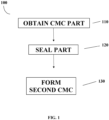
- FIG. 1 An embodiment of a process is illustrated in FIG. 1 . Shown is a process 100 involving addition of a second CMC segment to an original CMC part or component after the original CMC part has been coated with a sealing portion or layer.
- a CMC part or component is obtained 110.
- the part or component may be in need of repair or refurbishment. It may have been damaged during use, such as by the wearing away or breakage of a portion or portions or by formation of cracks or fissures. Some repairs may be effectuated by incorporating additional silicon phase within the part, such as by an MI process, before additional structure is added to the CMC component, in accordance with known methods.
- a surface of the original CMC component is sealed by application of a coating layer 120.
- a coating layer may be selected to possess a coefficient of thermal expansion substantially similar to that of the original CMC component.
- a sealing coating may comprise silicon carbide, silicon nitride, or boron carbide, or another material. The sealing surface is formed by carburization or nitriding of the surface of the CMC component. The sealing coating may be totally nonporous so as to form a complete barrier between silicon of the silicon phase of the original CMC component.
- a sealing coating layer may be formed on only a portion of the CMC component, such as to form a barrier between the silicon of the silicon phase of the original CMC and an MI-CMC formed on the other side of the sealing coating layer from the original CMC component which does not otherwise contact the original CMC component or layer thereupon. In this manner, wicking of silicon phase from the original CMC component into a newly formed MI-CMC component segment may be prevented, without requiring total sealing of the original CMC component.
- a sealing coating layer may be substantially total or complete around all surfaces of the original CMC component, yet possess some porosity, while still retaining the ability to prevent, minimize, or reduce loss of silicon phase from the original CMC component due to volatization during subsequent heating steps, such as during MI processing.
- a further CMC component is formed 130 as described above.
- the coefficient of thermal expansion of the sealing coating layer may be substantially similar to that of the CMC component segment added during this step.
- the added CMC component segment is formed on a surface of the sealing coating layer opposite from that which contacts the original CMC component. In this way, the added CMC component may be considered to be external to the original CMC component, as opposed to matrix or silicon phase of the original CMC component, which may be considered to be internal to the original CMC component.
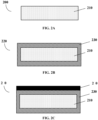
- FIG. 2A An embodiment of a component formed during such processing is illustrated in FIG. 2A, FIG. 2B, and FIG. 2C .
- Shown in FIG. 2A is a CMC component 210 in an initial state 200 such as if it is in need of repair, refurbishment, or reworking.
- FIG. 2B shown is a CMC component 210 upon which a sealing coating layer 230 has been deposited, representing a state of the component part-way through the process 220.
- FIG. 2C shown is the addition of a second, newly formed CMC component, such as by an MI process, as repair, refurbishment, or remodeling of the component continues.
- Different portions, segments, or layers are shown for exemplary illustrative purposes and are not to scale.
- Any CMC component may be represented by the forms illustrated in FIGs. 2A-2C , including a gas turbine component such as a blade, a vane, a nozzle, a shroud, a combustor liner, and a center frame, or another component. Any of the foregoing components may be assembled into and rendered part of a gas turbine in accordance with the present disclosure.
- a gas turbine component such as a blade, a vane, a nozzle, a shroud, a combustor liner, and a center frame, or another component.
Landscapes
- Engineering & Computer Science (AREA)
- Chemical & Material Sciences (AREA)
- Ceramic Engineering (AREA)
- Mechanical Engineering (AREA)
- Materials Engineering (AREA)
- General Engineering & Computer Science (AREA)
- Organic Chemistry (AREA)
- Structural Engineering (AREA)
- Manufacturing & Machinery (AREA)
- Combustion & Propulsion (AREA)
- Inorganic Chemistry (AREA)
- Chemical Kinetics & Catalysis (AREA)
- Composite Materials (AREA)
- General Chemical & Material Sciences (AREA)
- Metallurgy (AREA)
- Turbine Rotor Nozzle Sealing (AREA)
Claims (12)
- Verfahren, umfassend:Versiegeln eines Teils, wobei das Teil einen ersten Keramikmatrixverbundwerkstoff (CMC), einschließlich eines ersten Matrixabschnitts, umfasst, wobei der erste Matrixabschnitt ein erstes Siliciumcarbid und eine erste Siliciumphase, die innerhalb des ersten Siliciumcarbids dispergiert ist, umfasst und das Versiegeln ein Anordnen einer Versiegelungsbeschichtung an einer Oberfläche des Teils umfasst, um ein versiegeltes Teil auszubilden, undAusbilden, an dem versiegelten Teil, eines Segments, umfassend einen zweiten CMC,wobei das Anordnen einer Versiegelungsbeschichtung an der Oberfläche des Teils durch Umsetzen von Oberflächensilicium in dem ersten CMC mit Kohlenstoff oder Stickstoff erreicht wird, um eine aufgekohlte oder nitrierte Oberfläche auszubilden, sodass die Versiegelungsbeschichtung an der Oberfläche des Teils Silicium innerhalb des ersten CMC von einer Außenumgebung und dem zweiten CMC derart trennt, dass ein Siliciumverlust von dem ersten CMC verhindert wird.
- Verfahren nach Anspruch 1, wobei das Anordnen der Versiegelungsbeschichtung ein Durchführen einer chemischen Gasphasenabscheidung umfasst, wobei die Versiegelungsbeschichtung optional Siliciumcarbid umfasst.
- Verfahren nach Anspruch 1, wobei die Versiegelungsbeschichtung Siliciumcarbid umfasst.
- Verfahren nach Anspruch 1, wobei das Segment, umfassend einen zweiten CMC, einen zweiten Matrixabschnitt umfasst, wobei der zweite Matrixabschnitt ein zweites Siliciumcarbid und eine zweite Siliciumphase, die innerhalb des zweiten Siliciumcarbids dispergiert ist, umfasst.
- Verfahren nach Anspruch 1, wobei das Teil ein Gasturbinenteil ist.
- Verfahren nach Anspruch 1, wobei das Teil eine reparaturbedürftige Komponente ist und das Versiegeln und Ausbilden ein Reparieren der Komponente umfasst.
- Verfahren nach Anspruch 1, wobei das Ausbilden das Durchführen einer Schmelzinfiltration umfasst.
- Verfahren nach Anspruch 4, wobei das Ausbilden ein Schmelzinfiltrieren des zweiten Siliciumcarbids mit der zweiten Siliciumphase umfasst und das Schmelzinfiltrieren umfasst: Anordnen von Silicium an dem zweiten Siliciumcarbid, Erhitzen des Siliciums, das an dem zweiten Siliciumcarbid angeordnet ist, auf eine erste Temperatur, die gleich oder höher als ein Schmelzpunkt des Siliciums ist, das an dem zweiten Siliciumcarbid angeordnet ist, um geschmolzenes Silicium, das an dem zweiten Siliciumcarbid angeordnet ist, auszubilden, Steuern der Atmosphäre um das Teil herum während des Erhitzens des Siliciums, das an dem zweiten Siliciumcarbid angeordnet ist, auf die erste Temperatur, Ermöglichen, dass das geschmolzene Silicium, das an dem zweiten Siliciumcarbid angeordnet ist, das zweite Siliciumcarbid infiltriert, und Abkühlen des Teils auf eine zweite Temperatur, die unterhalb des Schmelzpunkts des Siliciums liegt, das das zweite Siliciumcarbid infiltriert hat, um die zweite Siliciumphase auszubilden.
- Verfahren nach Anspruch 4, wobei das Ausbilden das Schmelzinfiltrieren des zweiten Siliciumcarbids mit der zweiten Siliciumphase umfasst und das Schmelzinfiltrieren umfasst: Inberührungbringen des zweiten Siliciumcarbids mit einem Docht, Benetzen des Dochts mit geschmolzenem Silicium bei einer ersten Temperatur, die gleich oder höher als ein Schmelzpunkt von Silicium ist, Steuern der Atmosphäre um das Teil herum während des Inberührungbringens des zweiten Siliciumcarbids mit dem Docht, Infiltrieren des zweiten Siliciumcarbids mit dem geschmolzenen Silicium, wobei das Infiltrieren ein Saugen des geschmolzenen Siliciums von dem Docht umfasst, und Abkühlen des Teils auf eine zweite Temperatur, die unterhalb des Schmelzpunkts des Siliciums liegt, das das zweite Siliciumcarbid infiltriert hat, um die zweite Siliciumphase auszubilden, wobei die erste Temperatur optional zwischen 1380° C und 1500° C liegt.
- Verfahren nach Anspruch 8, wobei die erste Temperatur zwischen 1300° C und 1600° C liegt; wobei die erste Temperatur optional zwischen 1380° C und 1500° C liegt.
- Verfahren nach Anspruch 1,wobei das Anordnen der Versiegelungsbeschichtung das Durchführen der chemischen Gasphasenabscheidung umfasst und die Versiegelungsbeschichtung Siliciumcarbid umfasst;wobei der zweite CMC einen zweiten Matrixabschnitt aufweist, wobei der zweite Matrixabschnitt ein zweites Siliciumcarbid und eine zweite Siliciumphase, die innerhalb des zweiten Siliciumcarbids dispergiert ist, umfasst; undwobei das Ausbilden das Durchführen der Schmelzinfiltration umfasst.
- Verfahren nach einem der Ansprüche 5, 7 oder 11, wobei das Teil ein Gasturbinenteil ist, das aus der Gruppe ausgewählt ist, bestehend aus einer Schaufel, einer Leitschaufel, einer Düse, einem Deckband, einer Brennkammerauskleidung und einem Mittelrahmen.
Applications Claiming Priority (2)
| Application Number | Priority Date | Filing Date | Title |
|---|---|---|---|
| US15/228,693 US10597335B2 (en) | 2016-08-04 | 2016-08-04 | Seal coats to prevent silicon loss during re-melt infiltration of Si containing composites |
| PCT/US2017/043783 WO2018026579A1 (en) | 2016-08-04 | 2017-07-25 | Seal coats to prevent silicon loss during re-melt infiltration of si containing composites |
Publications (2)
| Publication Number | Publication Date |
|---|---|
| EP3494099A1 EP3494099A1 (de) | 2019-06-12 |
| EP3494099B1 true EP3494099B1 (de) | 2025-05-07 |
Family
ID=59684029
Family Applications (1)
| Application Number | Title | Priority Date | Filing Date |
|---|---|---|---|
| EP17755319.5A Active EP3494099B1 (de) | 2016-08-04 | 2017-07-25 | Siegelschichten zur vermeidung von siliciumverlust bei der wiederschmelzinfiltration von si-haltigen verbundwerkstoffen |
Country Status (6)
| Country | Link |
|---|---|
| US (2) | US10597335B2 (de) |
| EP (1) | EP3494099B1 (de) |
| JP (1) | JP2019529301A (de) |
| CN (1) | CN109563003B (de) |
| CA (1) | CA3032045C (de) |
| WO (1) | WO2018026579A1 (de) |
Families Citing this family (5)
| Publication number | Priority date | Publication date | Assignee | Title |
|---|---|---|---|---|
| US12152500B2 (en) | 2018-06-08 | 2024-11-26 | General Electric Company | Composite component modifications |
| US20220041519A1 (en) * | 2020-08-05 | 2022-02-10 | General Electric Company | Method for repairing composite components using filler material |
| US12384727B2 (en) | 2022-06-28 | 2025-08-12 | General Electric Company | Composite components and methods for preventing flow from infiltrated component during re-infiltration |
| US12606497B2 (en) | 2024-04-17 | 2026-04-21 | General Electric Company | Systems and methods for limiting void formation in ceramic matrix composite components |
| CN120650743B (zh) * | 2025-06-16 | 2026-02-27 | 中国航发燃气轮机有限公司 | 一种燃气轮机、喷嘴以及喷嘴的生产方法 |
Family Cites Families (23)
| Publication number | Priority date | Publication date | Assignee | Title |
|---|---|---|---|---|
| US3205043A (en) | 1962-04-04 | 1965-09-07 | Carborundum Co | Cold molded dense silicon carbide articles and method of making the same |
| US4425407A (en) * | 1982-06-24 | 1984-01-10 | United Technologies Corporation | CVD SiC pretreatment for carbon-carbon composites |
| US5296311A (en) | 1992-03-17 | 1994-03-22 | The Carborundum Company | Silicon carbide reinforced reaction bonded silicon carbide composite |
| US5580834A (en) | 1993-02-10 | 1996-12-03 | The Morgan Crucible Company Plc | Self-sintered silicon carbide/carbon graphite composite material having interconnected pores which may be impregnated and raw batch and process for producing same |
| USD368068S (en) | 1994-03-04 | 1996-03-19 | At&T Corp. | Plug-in power conversion unit housing |
| DE19834571C2 (de) | 1998-07-31 | 2001-07-26 | Daimler Chrysler Ag | Verfahren zur Herstellung von Körpern aus faserverstärkten Verbundwerkstoffen und Verwendung des Verfahrens |
| JP3683100B2 (ja) * | 1998-08-31 | 2005-08-17 | 東芝セラミックス株式会社 | シリコン含浸炭化珪素部材の製造方法 |
| JP2001048667A (ja) | 1999-08-13 | 2001-02-20 | Asahi Glass Co Ltd | セラミックス部品の接合方法 |
| JP2002097091A (ja) * | 2000-09-22 | 2002-04-02 | Toshiba Ceramics Co Ltd | CVD−SiC膜被覆部材およびその製造方法 |
| US6503441B2 (en) | 2001-05-30 | 2003-01-07 | General Electric Company | Method for producing melt-infiltrated ceramic composites using formed supports |
| US6820334B2 (en) * | 2002-04-19 | 2004-11-23 | General Electric Company | Method for repairing articles of ceramic composites |
| JP4261130B2 (ja) | 2002-06-18 | 2009-04-30 | 株式会社東芝 | シリコン/炭化ケイ素複合材料 |
| FR2872072B1 (fr) * | 2004-06-24 | 2006-09-29 | Snecma Propulsion Solide Sa | Procede de brasage de pieces en materiau composite thermostructural siliciure |
| US7686990B2 (en) | 2004-12-31 | 2010-03-30 | General Electric Company | Method of producing a ceramic matrix composite article |
| US20070054103A1 (en) * | 2005-09-07 | 2007-03-08 | General Electric Company | Methods and apparatus for forming a composite protection layer |
| JP2010173922A (ja) * | 2009-01-30 | 2010-08-12 | Taiheiyo Cement Corp | 炭化珪素接合体及びその製造方法 |
| US8939728B2 (en) * | 2011-06-30 | 2015-01-27 | United Technologies Corporation | Hybrid part made from monolithic ceramic skin and CMC core |
| US20150115849A1 (en) | 2013-10-24 | 2015-04-30 | Regal Beloit America, Inc. | System and method for pausing and resuming an operation of a motor |
| US9701072B2 (en) * | 2013-10-30 | 2017-07-11 | General Electric Company | Methods of repairing matrix cracks in melt infiltrated ceramic matrix composites |
| US9512505B2 (en) | 2014-10-23 | 2016-12-06 | General Electric Company | Methods and compositions for repair of composite materials |
| US10329205B2 (en) * | 2014-11-24 | 2019-06-25 | Rolls-Royce Corporation | Bond layer for silicon-containing substrates |
| US20160230570A1 (en) * | 2015-02-11 | 2016-08-11 | Rolls-Royce High Temperature Composites Inc. | Modified atmosphere melt infiltration |
| CN105384467B (zh) * | 2015-12-14 | 2017-08-25 | 中国航空工业集团公司北京航空制造工程研究所 | 一种用于陶瓷基复合材料基体的环境障碍涂层及制备方法 |
-
2016
- 2016-08-04 US US15/228,693 patent/US10597335B2/en active Active
-
2017
- 2017-07-25 EP EP17755319.5A patent/EP3494099B1/de active Active
- 2017-07-25 CA CA3032045A patent/CA3032045C/en active Active
- 2017-07-25 JP JP2019505475A patent/JP2019529301A/ja active Pending
- 2017-07-25 WO PCT/US2017/043783 patent/WO2018026579A1/en not_active Ceased
- 2017-07-25 CN CN201780048525.4A patent/CN109563003B/zh active Active
-
2020
- 2020-03-03 US US16/807,864 patent/US12017962B2/en active Active
Also Published As
| Publication number | Publication date |
|---|---|
| JP2019529301A (ja) | 2019-10-17 |
| US20180037513A1 (en) | 2018-02-08 |
| CA3032045A1 (en) | 2018-02-08 |
| WO2018026579A1 (en) | 2018-02-08 |
| US12017962B2 (en) | 2024-06-25 |
| EP3494099A1 (de) | 2019-06-12 |
| US10597335B2 (en) | 2020-03-24 |
| US20200199028A1 (en) | 2020-06-25 |
| CN109563003B (zh) | 2022-08-16 |
| CA3032045C (en) | 2021-05-18 |
| CN109563003A (zh) | 2019-04-02 |
Similar Documents
| Publication | Publication Date | Title |
|---|---|---|
| US12017962B2 (en) | Seal coats to prevent silicon loss during re-melt infiltration of Si containing composites | |
| EP3063108B1 (de) | Verfahren zum reparieren von matrixrissen bei schmelzeinfiltrierten keramikmatrixverbundstoffen | |
| CN106045575A (zh) | 用于陶瓷基质复合材料的具有可磨耗涂层的环境阻挡涂层 | |
| JP6412024B2 (ja) | 高温耐性セラミックマトリックス複合材及び耐環境保護コーティング | |
| US7323247B2 (en) | Oxidation barrier coatings for silicon based ceramics | |
| CA3017088A1 (en) | Environmental resistant coating member | |
| JP2018114754A (ja) | セラミック又はセラミックマトリックス複合材のための結合層 | |
| US20160160374A1 (en) | Methods of forming an article using electrophoretic deposition, and related article | |
| US10752556B2 (en) | Method of processing a ceramic matrix composite (CMC) component | |
| KR102334321B1 (ko) | 내환경 배리어층의 조성물 및 내환경 배리어층을 포함하는 구조체 | |
| US11760699B2 (en) | Method of altering a surface of a ceramic matrix composite to aid in nodule removal | |
| US20210292882A1 (en) | Coating for refractory alloy part | |
| US12091368B2 (en) | Reaction barrier layer for environmental barrier coating | |
| US12421174B2 (en) | Part made of composite material, having controlled creep |
Legal Events
| Date | Code | Title | Description |
|---|---|---|---|
| STAA | Information on the status of an ep patent application or granted ep patent |
Free format text: STATUS: UNKNOWN |
|
| STAA | Information on the status of an ep patent application or granted ep patent |
Free format text: STATUS: THE INTERNATIONAL PUBLICATION HAS BEEN MADE |
|
| PUAI | Public reference made under article 153(3) epc to a published international application that has entered the european phase |
Free format text: ORIGINAL CODE: 0009012 |
|
| STAA | Information on the status of an ep patent application or granted ep patent |
Free format text: STATUS: REQUEST FOR EXAMINATION WAS MADE |
|
| 17P | Request for examination filed |
Effective date: 20190304 |
|
| AK | Designated contracting states |
Kind code of ref document: A1 Designated state(s): AL AT BE BG CH CY CZ DE DK EE ES FI FR GB GR HR HU IE IS IT LI LT LU LV MC MK MT NL NO PL PT RO RS SE SI SK SM TR |
|
| AX | Request for extension of the european patent |
Extension state: BA ME |
|
| DAV | Request for validation of the european patent (deleted) | ||
| DAX | Request for extension of the european patent (deleted) | ||
| STAA | Information on the status of an ep patent application or granted ep patent |
Free format text: STATUS: EXAMINATION IS IN PROGRESS |
|
| 17Q | First examination report despatched |
Effective date: 20210519 |
|
| GRAP | Despatch of communication of intention to grant a patent |
Free format text: ORIGINAL CODE: EPIDOSNIGR1 |
|
| STAA | Information on the status of an ep patent application or granted ep patent |
Free format text: STATUS: GRANT OF PATENT IS INTENDED |
|
| INTG | Intention to grant announced |
Effective date: 20240304 |
|
| GRAJ | Information related to disapproval of communication of intention to grant by the applicant or resumption of examination proceedings by the epo deleted |
Free format text: ORIGINAL CODE: EPIDOSDIGR1 |
|
| STAA | Information on the status of an ep patent application or granted ep patent |
Free format text: STATUS: EXAMINATION IS IN PROGRESS |
|
| INTC | Intention to grant announced (deleted) | ||
| GRAP | Despatch of communication of intention to grant a patent |
Free format text: ORIGINAL CODE: EPIDOSNIGR1 |
|
| STAA | Information on the status of an ep patent application or granted ep patent |
Free format text: STATUS: GRANT OF PATENT IS INTENDED |
|
| INTG | Intention to grant announced |
Effective date: 20240627 |
|
| GRAJ | Information related to disapproval of communication of intention to grant by the applicant or resumption of examination proceedings by the epo deleted |
Free format text: ORIGINAL CODE: EPIDOSDIGR1 |
|
| STAA | Information on the status of an ep patent application or granted ep patent |
Free format text: STATUS: EXAMINATION IS IN PROGRESS |
|
| GRAJ | Information related to disapproval of communication of intention to grant by the applicant or resumption of examination proceedings by the epo deleted |
Free format text: ORIGINAL CODE: EPIDOSDIGR1 |
|
| GRAP | Despatch of communication of intention to grant a patent |
Free format text: ORIGINAL CODE: EPIDOSNIGR1 |
|
| INTC | Intention to grant announced (deleted) | ||
| GRAP | Despatch of communication of intention to grant a patent |
Free format text: ORIGINAL CODE: EPIDOSNIGR1 |
|
| STAA | Information on the status of an ep patent application or granted ep patent |
Free format text: STATUS: GRANT OF PATENT IS INTENDED |
|
| INTG | Intention to grant announced |
Effective date: 20241212 |
|
| GRAS | Grant fee paid |
Free format text: ORIGINAL CODE: EPIDOSNIGR3 |
|
| GRAA | (expected) grant |
Free format text: ORIGINAL CODE: 0009210 |
|
| STAA | Information on the status of an ep patent application or granted ep patent |
Free format text: STATUS: THE PATENT HAS BEEN GRANTED |
|
| AK | Designated contracting states |
Kind code of ref document: B1 Designated state(s): AL AT BE BG CH CY CZ DE DK EE ES FI FR GB GR HR HU IE IS IT LI LT LU LV MC MK MT NL NO PL PT RO RS SE SI SK SM TR |
|
| RAP3 | Party data changed (applicant data changed or rights of an application transferred) |
Owner name: GENERAL ELECTRIC COMPANY |
|
| REG | Reference to a national code |
Ref country code: GB Ref legal event code: FG4D |
|
| REG | Reference to a national code |
Ref country code: CH Ref legal event code: EP |
|
| P01 | Opt-out of the competence of the unified patent court (upc) registered |
Free format text: CASE NUMBER: APP_19115/2025 Effective date: 20250422 |
|
| REG | Reference to a national code |
Ref country code: DE Ref legal event code: R096 Ref document number: 602017089336 Country of ref document: DE |
|
| REG | Reference to a national code |
Ref country code: IE Ref legal event code: FG4D |
|
| PGFP | Annual fee paid to national office [announced via postgrant information from national office to epo] |
Ref country code: GB Payment date: 20250619 Year of fee payment: 9 |
|
| PGFP | Annual fee paid to national office [announced via postgrant information from national office to epo] |
Ref country code: FR Payment date: 20250620 Year of fee payment: 9 |
|
| REG | Reference to a national code |
Ref country code: NL Ref legal event code: MP Effective date: 20250507 |
|
| PG25 | Lapsed in a contracting state [announced via postgrant information from national office to epo] |
Ref country code: PT Free format text: LAPSE BECAUSE OF FAILURE TO SUBMIT A TRANSLATION OF THE DESCRIPTION OR TO PAY THE FEE WITHIN THE PRESCRIBED TIME-LIMIT Effective date: 20250908 Ref country code: FI Free format text: LAPSE BECAUSE OF FAILURE TO SUBMIT A TRANSLATION OF THE DESCRIPTION OR TO PAY THE FEE WITHIN THE PRESCRIBED TIME-LIMIT Effective date: 20250507 Ref country code: ES Free format text: LAPSE BECAUSE OF FAILURE TO SUBMIT A TRANSLATION OF THE DESCRIPTION OR TO PAY THE FEE WITHIN THE PRESCRIBED TIME-LIMIT Effective date: 20250507 |
|
| PGFP | Annual fee paid to national office [announced via postgrant information from national office to epo] |
Ref country code: DE Payment date: 20250620 Year of fee payment: 9 |
|
| REG | Reference to a national code |
Ref country code: LT Ref legal event code: MG9D |
|
| PG25 | Lapsed in a contracting state [announced via postgrant information from national office to epo] |
Ref country code: GR Free format text: LAPSE BECAUSE OF FAILURE TO SUBMIT A TRANSLATION OF THE DESCRIPTION OR TO PAY THE FEE WITHIN THE PRESCRIBED TIME-LIMIT Effective date: 20250808 Ref country code: NO Free format text: LAPSE BECAUSE OF FAILURE TO SUBMIT A TRANSLATION OF THE DESCRIPTION OR TO PAY THE FEE WITHIN THE PRESCRIBED TIME-LIMIT Effective date: 20250807 |
|
| PG25 | Lapsed in a contracting state [announced via postgrant information from national office to epo] |
Ref country code: NL Free format text: LAPSE BECAUSE OF FAILURE TO SUBMIT A TRANSLATION OF THE DESCRIPTION OR TO PAY THE FEE WITHIN THE PRESCRIBED TIME-LIMIT Effective date: 20250507 Ref country code: PL Free format text: LAPSE BECAUSE OF FAILURE TO SUBMIT A TRANSLATION OF THE DESCRIPTION OR TO PAY THE FEE WITHIN THE PRESCRIBED TIME-LIMIT Effective date: 20250507 |
|
| REG | Reference to a national code |
Ref country code: AT Ref legal event code: MK05 Ref document number: 1792365 Country of ref document: AT Kind code of ref document: T Effective date: 20250507 |
|
| PG25 | Lapsed in a contracting state [announced via postgrant information from national office to epo] |
Ref country code: BG Free format text: LAPSE BECAUSE OF FAILURE TO SUBMIT A TRANSLATION OF THE DESCRIPTION OR TO PAY THE FEE WITHIN THE PRESCRIBED TIME-LIMIT Effective date: 20250507 |
|
| PG25 | Lapsed in a contracting state [announced via postgrant information from national office to epo] |
Ref country code: HR Free format text: LAPSE BECAUSE OF FAILURE TO SUBMIT A TRANSLATION OF THE DESCRIPTION OR TO PAY THE FEE WITHIN THE PRESCRIBED TIME-LIMIT Effective date: 20250507 |
|
| PG25 | Lapsed in a contracting state [announced via postgrant information from national office to epo] |
Ref country code: AT Free format text: LAPSE BECAUSE OF FAILURE TO SUBMIT A TRANSLATION OF THE DESCRIPTION OR TO PAY THE FEE WITHIN THE PRESCRIBED TIME-LIMIT Effective date: 20250507 |
|
| PG25 | Lapsed in a contracting state [announced via postgrant information from national office to epo] |
Ref country code: RS Free format text: LAPSE BECAUSE OF FAILURE TO SUBMIT A TRANSLATION OF THE DESCRIPTION OR TO PAY THE FEE WITHIN THE PRESCRIBED TIME-LIMIT Effective date: 20250807 |
|
| PG25 | Lapsed in a contracting state [announced via postgrant information from national office to epo] |
Ref country code: IS Free format text: LAPSE BECAUSE OF FAILURE TO SUBMIT A TRANSLATION OF THE DESCRIPTION OR TO PAY THE FEE WITHIN THE PRESCRIBED TIME-LIMIT Effective date: 20250907 |
|
| PG25 | Lapsed in a contracting state [announced via postgrant information from national office to epo] |
Ref country code: LV Free format text: LAPSE BECAUSE OF FAILURE TO SUBMIT A TRANSLATION OF THE DESCRIPTION OR TO PAY THE FEE WITHIN THE PRESCRIBED TIME-LIMIT Effective date: 20250507 |
|
| PG25 | Lapsed in a contracting state [announced via postgrant information from national office to epo] |
Ref country code: SM Free format text: LAPSE BECAUSE OF FAILURE TO SUBMIT A TRANSLATION OF THE DESCRIPTION OR TO PAY THE FEE WITHIN THE PRESCRIBED TIME-LIMIT Effective date: 20250507 Ref country code: DK Free format text: LAPSE BECAUSE OF FAILURE TO SUBMIT A TRANSLATION OF THE DESCRIPTION OR TO PAY THE FEE WITHIN THE PRESCRIBED TIME-LIMIT Effective date: 20250507 |
|
| PG25 | Lapsed in a contracting state [announced via postgrant information from national office to epo] |
Ref country code: CZ Free format text: LAPSE BECAUSE OF FAILURE TO SUBMIT A TRANSLATION OF THE DESCRIPTION OR TO PAY THE FEE WITHIN THE PRESCRIBED TIME-LIMIT Effective date: 20250507 |
|
| PG25 | Lapsed in a contracting state [announced via postgrant information from national office to epo] |
Ref country code: EE Free format text: LAPSE BECAUSE OF FAILURE TO SUBMIT A TRANSLATION OF THE DESCRIPTION OR TO PAY THE FEE WITHIN THE PRESCRIBED TIME-LIMIT Effective date: 20250507 |
|
| PG25 | Lapsed in a contracting state [announced via postgrant information from national office to epo] |
Ref country code: SK Free format text: LAPSE BECAUSE OF FAILURE TO SUBMIT A TRANSLATION OF THE DESCRIPTION OR TO PAY THE FEE WITHIN THE PRESCRIBED TIME-LIMIT Effective date: 20250507 Ref country code: RO Free format text: LAPSE BECAUSE OF FAILURE TO SUBMIT A TRANSLATION OF THE DESCRIPTION OR TO PAY THE FEE WITHIN THE PRESCRIBED TIME-LIMIT Effective date: 20250507 |
|
| PG25 | Lapsed in a contracting state [announced via postgrant information from national office to epo] |
Ref country code: IT Free format text: LAPSE BECAUSE OF FAILURE TO SUBMIT A TRANSLATION OF THE DESCRIPTION OR TO PAY THE FEE WITHIN THE PRESCRIBED TIME-LIMIT Effective date: 20250507 |
|
| REG | Reference to a national code |
Ref country code: DE Ref legal event code: R097 Ref document number: 602017089336 Country of ref document: DE |
|
| REG | Reference to a national code |
Ref country code: CH Ref legal event code: H13 Free format text: ST27 STATUS EVENT CODE: U-0-0-H10-H13 (AS PROVIDED BY THE NATIONAL OFFICE) Effective date: 20260224 |
|
| PLBE | No opposition filed within time limit |
Free format text: ORIGINAL CODE: 0009261 |
|
| STAA | Information on the status of an ep patent application or granted ep patent |
Free format text: STATUS: NO OPPOSITION FILED WITHIN TIME LIMIT |
|
| PG25 | Lapsed in a contracting state [announced via postgrant information from national office to epo] |
Ref country code: LU Free format text: LAPSE BECAUSE OF NON-PAYMENT OF DUE FEES Effective date: 20250725 |
|
| REG | Reference to a national code |
Ref country code: CH Ref legal event code: L10 Free format text: ST27 STATUS EVENT CODE: U-0-0-L10-L00 (AS PROVIDED BY THE NATIONAL OFFICE) Effective date: 20260318 |
|
| REG | Reference to a national code |
Ref country code: BE Ref legal event code: MM Effective date: 20250731 |
|
| 26N | No opposition filed |
Effective date: 20260210 |
|
| PG25 | Lapsed in a contracting state [announced via postgrant information from national office to epo] |
Ref country code: BE Free format text: LAPSE BECAUSE OF NON-PAYMENT OF DUE FEES Effective date: 20250731 |
|
| PG25 | Lapsed in a contracting state [announced via postgrant information from national office to epo] |
Ref country code: CH Free format text: LAPSE BECAUSE OF NON-PAYMENT OF DUE FEES Effective date: 20250731 |