EP3487846B1 - Verfahren zur aufreinigung von propylenoxid - Google Patents
Verfahren zur aufreinigung von propylenoxid Download PDFInfo
- Publication number
- EP3487846B1 EP3487846B1 EP17751644.0A EP17751644A EP3487846B1 EP 3487846 B1 EP3487846 B1 EP 3487846B1 EP 17751644 A EP17751644 A EP 17751644A EP 3487846 B1 EP3487846 B1 EP 3487846B1
- Authority
- EP
- European Patent Office
- Prior art keywords
- stream
- organic compound
- propylene oxide
- distillation
- distillation unit
- Prior art date
- Legal status (The legal status is an assumption and is not a legal conclusion. Google has not performed a legal analysis and makes no representation as to the accuracy of the status listed.)
- Active
Links
Images


Classifications
-
- B—PERFORMING OPERATIONS; TRANSPORTING
- B01—PHYSICAL OR CHEMICAL PROCESSES OR APPARATUS IN GENERAL
- B01D—SEPARATION
- B01D3/00—Distillation or related exchange processes in which liquids are contacted with gaseous media, e.g. stripping
- B01D3/14—Fractional distillation or use of a fractionation or rectification column
- B01D3/143—Fractional distillation or use of a fractionation or rectification column by two or more of a fractionation, separation or rectification step
-
- C—CHEMISTRY; METALLURGY
- C07—ORGANIC CHEMISTRY
- C07D—HETEROCYCLIC COMPOUNDS
- C07D301/00—Preparation of oxiranes
- C07D301/32—Separation; Purification
-
- C—CHEMISTRY; METALLURGY
- C07—ORGANIC CHEMISTRY
- C07D—HETEROCYCLIC COMPOUNDS
- C07D303/00—Compounds containing three-membered rings having one oxygen atom as the only ring hetero atom
- C07D303/02—Compounds containing oxirane rings
- C07D303/04—Compounds containing oxirane rings containing only hydrogen and carbon atoms in addition to the ring oxygen atoms
-
- Y—GENERAL TAGGING OF NEW TECHNOLOGICAL DEVELOPMENTS; GENERAL TAGGING OF CROSS-SECTIONAL TECHNOLOGIES SPANNING OVER SEVERAL SECTIONS OF THE IPC; TECHNICAL SUBJECTS COVERED BY FORMER USPC CROSS-REFERENCE ART COLLECTIONS [XRACs] AND DIGESTS
- Y02—TECHNOLOGIES OR APPLICATIONS FOR MITIGATION OR ADAPTATION AGAINST CLIMATE CHANGE
- Y02P—CLIMATE CHANGE MITIGATION TECHNOLOGIES IN THE PRODUCTION OR PROCESSING OF GOODS
- Y02P20/00—Technologies relating to chemical industry
- Y02P20/50—Improvements relating to the production of bulk chemicals
- Y02P20/582—Recycling of unreacted starting or intermediate materials
Definitions
- Propylene oxide is an important intermediate in the chemical industry.
- a suitable process for the preparation of propylene oxide starts from propene and makes use of hydrogen peroxide as oxidizing agent, acetonitrile as solvent and an epoxidation catalyst comprising a titanium zeolite. Due to its importance for industrial-scale processes, it is desired to carry out the epoxidation reaction as efficiently as possible and to purify the propylene oxide to a high degree.
- EP 0 004 019 A2 describes the separation of propylene oxide from a mixture containing up to 2 weight-% of a carbonyl compound which has 1 to 5 carbon atoms.
- the propylene epoxide is introduced into the middle section of a distillation unit. Above the feed point, a compound having one or more NH 2 -groups is added to the same distillation unit. The propylene oxide depleted of the carbonyl compounds is then taken off at the head of the distillation unit.
- the preferred compound having one or more NH 2 -groups is hydrazine, which is applied pure or in aqueous solution.
- the compound having one or more NH 2 -groups reacts with the carbonyl group of the carbonyl compound wherein azines and hydrazones having high boiling points are formed, which can afterwards easily be separated from the propylene oxide.
- WO 2011/123541 A1 discloses the removal of ppm-amounts of aldehyde compounds from propylene oxide by ion exchange resins containing amino groups. Said method however has the disadvantage that the ion exchange resin which has to be used in stoichiometric amounts has a low amount of NH 2 -groups thus resulting in a high consume of expensive ion exchange resin.
- the present invention relates to a process for purifying propylene oxide, comprising
- the carbonyl compound comprised in the side stream S1b is reacted with an organic compound comprising an amino group -NH 2 , wherein a reaction product of the organic compound comprising a carbonyl group and the organic compound comprising an amino group is obtained.
- the process of the present invention comprises
- the process of the present invention comprises
- acetaldehyde in addition to one or more of acetone and propionaldehyde, one or more of acetaldehyde, formaldehyde, butyraldehyde, isobutyraldehyde, 2-butanon, 1-pentanal, 2-pentanon, 3-pentanon, 2-methylpentanone, preferably one ore more of acetaldehyde, formaldehyde, butyraldehyde, isobutyraldehyde, more preferably at least acetaldehyde.
- composition of the stream S0 provided in (i) is not subject to any specific restrictions.
- at least 95 weight-%, preferably at least 98 weight-%, more preferably at least 99 weight-% of the stream S0 consist of propylene oxide, acetonitrile, water, and the organic compound comprising a carbonyl group.
- the stream S0 comprises the propylene oxide in amount of from 8 to 18 weight-%, more preferably from 9 to 14 weight-%, based on the total weight of the stream S0; the acetonitrile in an amount of from 60 to 75 weight-%, more preferably from 65 to 70 weight-%, based on the total weight of the stream S0; the water in amount of from 10 to 25 weight-%, more preferably from 17 to 21 weight-%, based on the total weight of the stream S0; propionaldehyde in an amount of from 10 to 1000 weight-ppm, more preferably from 30 to 500 weight-ppm, based on the total weight of the stream S0; acetone in an amount of from 50 to 400 weight-ppm, more preferably from 60 to 120 weight-ppm, based on the total weight of the stream S0; and acetaldehyde in an amount of from 80 to 300 weight-ppm, more preferably from 100 to 200 weight-ppm, based on the total weight of the stream S0.
- the stream S0 is subjected to distillation conditions in a first distillation unit D, wherein a gaseous top stream S1c which is enriched in propylene oxide compared to the stream S0, a liquid bottoms stream S1a which is enriched in acetonitrile and water compared to the stream S0, and a side stream S1b comprising propylene oxide which is enriched in the carbonyl compound compared to the stream S0, are obtained.
- a gaseous top stream S1c which is enriched in propylene oxide compared to the stream S0
- a liquid bottoms stream S1a which is enriched in acetonitrile and water compared to the stream S0
- a side stream S1b comprising propylene oxide which is enriched in the carbonyl compound compared to the stream S0
- the first distillation unit D employed in (ii.1) is at least one distillation tower, more preferably one distillation tower, wherein the distillation tower has preferably from 40 to 200, more preferably from 45 to 100, more preferably from 50 to 90, theoretical trays.
- the rectifying section of the first distillation unit D employed in (ii.1) consists of from 40 to 60 % of the theoretical trays and the stripping section of the distillation unit D consists of from 60 to 40 % of the theoretical trays.
- This first distillation unit D is preferably operated at conditions allowing for obtaining a side stream S1b comprising propylene oxide which is enriched in the carbonyl compound compared to the stream S0.
- the first distillation unit D employed in (ii.1) is operated at a top pressure of from 0.01 to 0.20 MPa (0.1 to 2.0 bar), more preferably of from 0.02 to 0.10 MPa (0.2 to 1.0 bar), more preferably of from 0.03 to 0.08 MPa (0.3 to 0.8 bar).
- the first distillation unit D employed in (ii.1) is operated at a top temperature in the range of from 50 to 70 °C, more preferably of from 52 to 68 °C, more preferably of from 54 to 64 °C.
- the first distillation unit D employed in (ii.1) is operated at an internal reflux ratio in the range of from 1 to 10, more preferably from 2 to 8, more preferably from 3 to 6.
- a side stream S1b comprising propylene oxide, which is enriched in the carbonyl compound compared to the stream S0 is obtained.
- the side stream S1b is removed from the first distillation unit as long as it comprises propylene oxide and is enriched in the carbonyl compound compared to the stream S0.
- the side stream S1b obtained in (ii.1) is removed from the rectifying section of the first distillation unit.
- the side stream S1b obtained in (ii.1) is removed from the rectifying section of the first distillation unit at a position which is at least 1 theoretical tray above the stripping section of the first distillation unit, more preferably from the rectifying section of the first distillation unit at a position which is from 1 to 15, preferably from 1 to 12, more preferably from 1 to 10, theoretical tray above the stripping section of the first distillation unit.
- the composition of the side stream S1b provided that it comprises propylene oxide and is enriched in the carbonyl compound compared to the stream S0.
- side stream S1b comprises propylene oxide and is enriched in the carbonyl compound, which comprises one or more of acetone and propionaldehyde.
- the organic compound comprising a carbonyl group -C( O)-comprises further, i.e.
- the stream S1b is further enriched, i.e. in addition to being enriched in one or more of acetone and propionaldehyde in one or more further aldehydes, one or more further ketones, or a mixture of one or more further aldehydes and one or more further ketones.
- the side stream S1b obtained in (ii.1) comprising propylene oxide and being enriched in the carbonyl compound compared to the stream S0 is further enriched, i.e.
- acetaldehyde in addition to being enriched in one or more of acetone and propionaldehyde, in one or more of acetaldehyde, formaldehyde, butyraldehyde, isobutyraldehyde, 2-butanon, 1-pentanal, 2-pentanon, 3-pentanon, 2-methylpentanone, preferably one ore more of acetaldehyde, formaldehyde, butyraldehyde, isobutyraldehyde, more preferably at least in acetaldehyde.
- At least 95 weight-%, preferably at least 98 weight-%, more preferably at least 99 weight-% of the stream S1b consist of propylene oxide, acetonitrile, water, and the organic compound comprising a carbonyl group.
- the stream S1b comprises the propylene oxide in an amount of from 68 to 96 weight-%, preferably from 70 to 95 weight-%, based on the total weight of the stream S1b; the acetonitrile in an amount of from 2 to 25 weight-%, preferably from 3.5 to 22 weight-%, based on the total weight of the stream S1b; the organic compound comprising a carbonyl group in an amount of from 0.05 to 4 weight-%, preferably from 0.1 to 2.6 weight-%; based on the total weight of the stream S1b; wherein the organic compound comprising a carbonyl group preferably comprises propionaldehyde in an amount of from 0.03 to 3 weight-%, preferably from 0.05 to 2.0 weight-%, based on the total weight of the stream S1b, and acetone in an amount of from 0.01 to 1.0 weight-%, preferably from 0.02 to 0.6 weight-%, based on the total weight of the stream S1b, and acealdehyde in an
- organic compound comprising an amino group -NH 2
- the carbonyl compound comprised in the side stream S1b is reacted with an organic compound comprising an amino group -NH 2 wherein a reaction product of the organic compound comprising a carbonyl group and the organic compound comprising an amino group is obtained.
- an organic compound comprising an amino group -NH 2 provided that a reaction with the carbonyl compound occurs.
- the organic compound comprising an amino group -NH 2 comprises one or more of R-NH 2 , wherein R is a substituted or unsubstituted, branched or unbranched C1-C5-alkyl, preferably selected from the group consisting of ethyl amine, n -propyl amine, iso -propyl amine, n -butyl amine, iso -butyl amine, ethanol amine; R1-NH 2 , wherein R1 is a C6-C10-aryl group with at least one further substituent R2 selected from the group consisting of hydrogen, -CH 3 , -NO 2 positioned at the aryl group, preferably selected from the group consisting of aniline, toluidine, ortho -nitroaniline, alpha -naphthylamine, beta -naphthylamine; NH 2 -R3-NH 2 , wherein R3 is selected from the group consisting of
- the organic compound comprising an amino group -NH 2 is used solid or dissolved, more preferably dissolved in a solvent comprising water, more preferably dissolvent in water.
- the organic compound comprising an amino group -NH 2 there are no specific restrictions what amount of the organic compound comprising an amino group -NH 2 is used provided that it is suitable for reacting with the carbonyl compound.
- the molar ratio of the molar amount of amino groups -NH 2 comprised in the organic compound comprising an amino group -NH 2 used or admixed in (ii.2) to the molar amount of carbonyl groups comprised in the organic compound comprising a carbonyl group is in the range of from 0.5:1 to 100:1, preferably from 0.75:1 to 25:1, more preferably from 1:1 to 10:1.
- the carbonyl compound comprised in the side stream S1b is reacted in (ii.2) with an organic compound comprising an amino group -NH 2 obtaining a reaction product of the organic compound comprising a carbonyl group and the organic compound comprising an amino group.
- the reacting of the organic compound comprising a carbonyl group with the organic compound comprising an amino group in (ii.2) is done in one or more reactors, preferably in one reactor.
- the reactor is a continuous reactor, more preferably the reactors is a continuous flow stirred-tank reactor (CSTR), stirred tank battery, tube reactor or a combination of two or more of these reactors, more preferably a tube reactor.
- CSTR continuous flow stirred-tank reactor
- the side stream S1b and a stream comprising the organic compound comprising an amino group -NH 2 are passed into the reactor.
- the admixing of the streams there are no specific restrictions regarding the admixing of the streams, provided that it is suitable for carrying out the reaction of the carbonyl compound with the organic compound comprising an amino group -NH 2 .
- the organic compound comprising an amino group -NH 2 is used dissolved, preferably dissolved in a solvent comprising water, more preferably dissolvent in water, the admixing of the stream comprising the organic compound comprising an amino group -NH 2 and the side stream S1b comprising the carbonyl compound is done so that only one liquid phase is formed.
- the residence time in the reactor is at least 0.1 h, more preferably from 0.3 to 2.0 h.
- reaction temperature there are no specific restrictions regarding the reaction temperature, provided that is suitable for carrying out the reaction of the carbonyl compound with the organic compound comprising an amino group -NH 2 .
- the organic compound comprising a carbonyl group is reacted with the organic compound comprising an amino group in (ii.2) at a temperature in the range of from 10 to 80 °C, preferably from 20 to 60 °C.
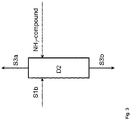
- propylene oxide is separated from the reaction product of the organic compound comprising a carbonyl group and the organic compound comprising an amino group in a second distillation unit D2, obtaining a gaseous top stream S3a which is enriched in propylene oxide and a liquid bottoms stream S3b which is enriched in the reaction product of the organic compound comprising a carbonyl group and the organic compound comprising an amino group.
- the second distillation unit employed in (ii.3) is at least one distillation tower, more preferably one distillation tower, wherein the distillation tower has preferably at least 5, more preferably from 5 to 25, more preferably from 8 to 20, theoretical trays.
- the rectifying section of the second distillation unit employed in (ii.3) consists of from 90 to 100 %, preferably from 95 to 100 %, more preferably from 99 to 100 %, of the theoretical trays.
- the second distillation unit D2 is operated at a top pressure of from 0.01 to 0.20 MPa (0.1 to 2.0 bar), more preferably of from 0.02 to 0.10 MPa (0.2 to 1.0 bar), more preferably of from 0.03 to 0.08 MPa (0.3 to 0.8 bar).
- the first distillation unit employed in (ii.1) is operated at a bottoms temperature in the range of from 30 to 50 °C, more preferably of from 32 to 45 °C, more preferably of from 36 to 40 °C.
- Liquid bottoms stream S3b which is enriched in the reaction product of the organic compound comprising a carbonyl group and the organic compound comprising an amino group can be sent to the flare for disposal or can be passed to an acetonitrile recovery unit.
- Gaseous top stream S3a is enriched in propylene oxide and depleted of the organic compound comprising a carbonyl group compared to side stream S1b.
- the top stream S3a obtained from the second distillation unit D2, which is enriched in propylene oxide, is introduced into the first distillation unit.
- the gaseous top stream S3a obtained in (ii.3) is introduced into the first distillation unit in (ii.4) in the rectifying section of the first distillation unit at a position which is at least 1 theoretical tray above the stripping section of the first distillation unit, more preferably at a position which is from 1 to 15, preferably from 1 to 12, more preferably from 1 to 10, theoretical tray above the stripping section of the first distillation unit.
- the gaseous top stream S3a obtained in (ii.3) is introduced into the first distillation unit in (ii.4) in the rectifying section of the first distillation unit at a position which is 0 to 3 theoretical trays, more preferably 0 theoretical trays above the theoretical tray where the side stream S1b obtained in (ii.1) is removed from the rectifying section of the first distillation unit.
- a liquid bottoms stream S1a is obtained from the first distillation unit, which is enriched in acetonitrile and water compared to the stream S0.
- at least 95 weight-% of S1a consist of acetonitrile and water, wherein preferably, the weight ratio of acetonitrile relative to water in the stream S1a is greater than 1:1.
- S1a obtained as bottoms stream contains at most 100 weight-ppm, preferably at most 50 weight-ppm, more preferably at most 10 weight-ppm of the propylene oxide, based on the total weight of S1a.
- the stream S1a as described above can be used as acetonitrile recycle stream which can be used for providing the liquid feed stream in (a) (described herein later below). Further, it is possible that the stream S1a is subjected to further work-up steps before it is used as acetonitrile recycle stream which is used for providing the liquid feed stream in (a).
- a part of S1a is introduced to the distillation unit employed for the separation in (d) (described herein later below) as extracting agent, preferably in the upper part of the distillation unit.
- a gaseous top stream S1c is obtained from the first distillation unit, which is enriched in propylene oxide compared to the stream S0.
- the top stream S1c obtained in (ii.1) contains at least 99.00 weight-%, more preferably at least 99.50 weight-%, more preferably at least 99.80 weight-%, propylene oxide based on the total weight of S1c.
- the top stream S1c obtained in (ii.1) contains at the outmost 0.2 weight-%, more preferably at the outmost 0.18 weight-%, more preferably at the outmost 0.15 weight-% of the organic compound comprising a carbonyl group based on the total weight of S1c, more preferably at the outmost 15 weight-ppm propionaldehyde and at the outmost 5 weight-ppm acetone based on the total weight of S1c.
- the top stream S1c obtained in (ii.1) contains at the outmost 100 weight-ppm, preferably at the outmost 75 weight-ppm, more preferably at the outmost 50 weight-ppm water based on the total weight of S1c.
- the process for purifying propylene oxide according to the present invention is a continuous process.
- the stream S0 is obtainable or obtained by a, preferably continuous, process comprising
- providing the stream S0 according to (i) comprises
- the effluent stream removed according to (c) further comprises oxygen
- (d) comprises separating oxygen, propene and preferably propane from the effluent stream by distillation, comprising subjecting the effluent stream to distillation conditions in a distillation unit, obtaining a gaseous stream which is enriched in oxygen, propene and preferably propane compared to the effluent stream subjected to distillation conditions, and a liquid bottoms stream which is enriched in propylene oxide, water and acetonitrile compared to the effluent stream subjected to distillation conditions.
- the effluent stream removed according to (c) is depressurized prior to (d), preferably to a pressure of from 0.5 to 2.8 bar, more preferably of from 0.6 to 2.5 bar, more preferably of from 0.8 to 1.5 bar.
- a gaseous stream and a liquid stream are obtained from depressurizing the effluent stream, wherein more preferably the gaseous and liquid streams are passed separately to the distillation unit, preferably the distillation tower, employed according to (d), more preferably to different theoretical trays of the distillation tower employed according to (d).
- the stream comprising propene and preferably propane, hydrogen peroxide, water, and acetonitrile can be provided in (a) according to any conceivable method.
- the stream is provided in (a) by combining at least three individual streams wherein a first stream comprises hydrogen peroxide, a second stream comprises propene and preferably propane and a third stream comprises acetonitrile and optionally water.
- the stream comprising propene additionally comprises propane wherein preferably at least 98 weight-%, more preferably at least 99 weight-%, more preferably at least 99.5 weight-%, more preferably at least 99.9 weight-% of the stream consist of propene and propane.
- the weight ratio of propene relative to propane in the stream is at least 7:3.
- commercially available propene can be employed which may be either a polymer grade propene or a chemical grade propene.
- polymer grade propene has a propene content in the range of from 99 to 99.8 weight-% and a propane content in the range of from 0.2 to 1 weight-%.
- Chemical grade propene typically has a propene content in the range of from 92 to 98 weight-% and a propane content in the range of from 2 to 8 weight-%.
- a stream is employed having a propene content in the range of from 99 to 99.8 weight-% and a propane content in the range of from 0.2 to 1 weight-%.
- the stream comprising hydrogen peroxide can be prepared according to every conceivable method. It is conceivable to obtain the stream comprising hydrogen peroxide by converting sulphuric acid into peroxodisulphuric acid by anodic oxidation with simultaneous evolution of hydrogen at the cathode. Hydrolysis of the peroxodisulphuric acid then leads via peroxomonosulphuric acid to hydrogen peroxide and sulphuric acid which is thus obtained back.
- the preparation of hydrogen peroxide from the elements is also conceivable.
- the stream comprising hydrogen peroxide can be, for example, an aqueous or an aqueous/methanolic hydrogen peroxide stream, preferably an aqueous hydrogen peroxide stream.
- the content of the stream with respect to hydrogen peroxide is usually in the range of from 3 to 85 weight-%, preferably from 25 to 75 weight-%, more preferably from 30 to 50 weight-%, such as from 30 to 40 weight-% or from 35 to 45 weight-% of from 40 to 50 weight-%.
- at least 25 weight-%, more preferably at least 30 weight-%, more preferably at least 35 weight-% of the stream comprising hydrogen peroxide consist of water and hydrogen peroxide.
- Preferred ranges are from 30 to 80 weight% or from 35 to 75 weight-% or from 40 to 70 weight-%.
- a stream comprising hydrogen peroxide which is obtained as crude hydrogen peroxide solution by extraction of a mixture which results from a process known as anthraquinone process by means of which virtually the entire world production of hydrogen peroxide is produced (see, e.g., Ullmann's Encyclopedia of Industrial Chemistry, 5th edition, volume A 13 (1989) pages 443-466 ) wherein a solution of an anthraquinone is used containing an alkyl group preferably having of from 2 to 10 carbon atoms, more preferably at least 5 carbon atoms such as 5 carbon atoms or 6 carbon atoms and where the solvent used usually consists of a mixture of two different solvents, wherein preferably none of the solvents is a nitrogen containing substance .
- This solution of the anthraquinone is usually referred to as the working solution.
- the hydrogen peroxide formed in the course of the anthraquinone process is generally separated by extraction from the respective working solution after a hydrogenation/re-oxidation cycle. Said extraction can be performed preferably with essentially pure water, and the crude aqueous hydrogen peroxide solution is obtained. While it is generally possible to further purify the thus obtained crude aqueous hydrogen peroxide solution by distillation, it is preferred, according to the present invention, to use such crude aqueous hydrogen peroxide solution which has not been subjected to purification by distillation.
- the crude aqueous hydrogen peroxide solution is subjected to a further extraction stage wherein a suitable extracting agent, preferably an organic solvent is used. More preferably, the organic solvent used for this further extraction stage is the same solvent which is used in the anthraquinone process.
- the extraction is performed using just one of the solvents in the working solution and most preferably using just the most nonpolar solvent of the working solution.
- a so-called crude washed hydrogen peroxide solution is obtained.
- the crude washed hydrogen peroxide solution is used as hydrogen peroxide feed.
- the hydrogen peroxide is prepared in situ in the epoxidation zone from hydrogen and oxygen, preferably in the presence of a suitable noble metal catalyst comprised in the epoxidation zone according to (b).
- a suitable noble metal catalyst preferably comprises one or more of palladium, platinum, silver, gold, rhodium, iridium, ruthenium and osmium.
- the noble metal catalyst comprises palladium.
- the noble metal catalyst is preferably supported on a carrier, wherein the carrier preferably comprises one or more of SiO 2 , Al 2 O 3 , B 2 O 3 , GeO 2 , Ga 2 O 3 , ZrO 2 , TiO 2 , MgO, carbon and one or more zeolites, preferably one or more titanium zeolites. More preferably, the carrier comprises the epoxidation catalyst comprising a titanium zeolite. If hydrogen peroxide is prepared in the epoxidation zone according to (b) in situ from hydrogen and oxygen, the stream provided in (a) comprises propene and preferably propane, hydrogen, oxygen, water, and acetonitrile.
- the liquid feed stream provided in (a) is passed into an epoxidation zone.
- the epoxidation zone according to (b) comprises one or more epoxidation subzone wherein a given epoxidation subzone preferably consist of one or more epoxidation reactors wherein, with regard to the design of the one or more epoxidation reactors, no specific restrictions exist provided that the reactors are suitable for carrying out a, preferably continuous, epoxidation reaction.
- the epoxidation zone according to (b) comprises a first epoxidation subzone consisting of one or more epoxidation reactors A.
- first epoxidation subzone as used in this context of the present invention relates to the epoxidation subzone into which the liquid feed stream provided in (a) is passed, wherein the epoxidation zone of (b) may comprise further epoxidation subzones which are arranged downstream of the first epoxidation subzone. If the first epoxidation subzone consisting of two or more epoxidation reactors A, it is preferred that the two or more epoxidation reactors A are arranged in parallel.
- the liquid feed stream provided in (a) is passed into at least one of the epoxidation reactors A. It is possible, for example, that, while the liquid feed stream provided in (a) is passed into at least one of the epoxidation reactors A, at least one of the reactors A is taken out of operation, for example for maintenance purposes and/or for regenerating the catalyst comprised in the at least one of the reactors A. If the first epoxidation subzone comprises two or more epoxidation reactors A, the reactors in operation are operated essentially identically so that in every epoxidation reactor A in operation, a given epoxidation condition is in the same range in every reactor.
- the epoxidation conditions according to (b) comprise an epoxidation temperature T N , wherein T N is the temperature of a heat transfer medium used for adjusting the temperature of the reaction mixture in the first epoxidation reaction subzone according to (b) wherein it is preferred that said temperature is adjusted by passing the heat transfer medium through a jacket of the one or more epoxidation reactors A, wherein T N is preferably the temperature of the heat transfer medium prior to adjusting the temperature of the reaction mixture, preferably the temperature of the heat transfer medium at the entrance of the jacket of the one or more epoxidation reactors A.
- the epoxidation temperature T N relates to the epoxidation temperature T N of a given reactor A in operation of first epoxidation subzone.
- the epoxidation conditions according to (b) comprise a first epoxidation reaction pressure in the range of from 1.4 to 10 MPa (14 to 100 bar), more preferably in the range of from 1.5 to 3.2 MPa (15 to 32 bar), more preferably in the range of from 1.5 to 2.5 MPa (15 to 25 bar).
- the first epoxidation reaction pressure is defined as the absolute pressure at the exit of the first epoxidation subzone. If the first epoxidation subzone comprises two or more epoxidation reactors A, the first epoxidation reaction pressure relates to the absolute pressures at the exit of a given reactor A in operation of first epoxidation subzone.
- the epoxidation zone according to (b) consists the first epoxidation subzone.
- the epoxidation zone according to (b) additionally comprises a second epoxidation subzone consisting of one or more epoxidation reactors B wherein, if the second epoxidation subzone comprises two or more epoxidation reactors B, the two or more epoxidation reactors B are arranged in parallel, wherein the second epoxidation subzone is arranged downstream of the first epoxidation subzone.
- the effluent stream obtained from the first epoxidation subzone optionally after a suitable intermediate treatment, is passed into at least one of the epoxidation reactors B.
- the effluent stream obtained from the first epoxidation subzone is passed into at least one of the epoxidation reactors B, at least one of the reactors B is taken out of operation, for example for maintenance purposes and/or for regenerating the catalyst comprised in the at least one of the reactors B.
- the second epoxidation subzone comprises two or more epoxidation reactors B, the reactors in operation are operated essentially identically so that in every epoxidation reactor B in operation, a given epoxidation condition is in the same range in every reactor.
- the epoxidation zone according to (b) comprises at least one further epoxidation subzone arranged downstream of the second epoxidation subzone.
- the epoxidation zone according to (b) consists of the first epoxidation subzone and the second epoxidation subzone.
- the epoxidation conditions according to (b) comprise a second epoxidation reaction pressure in the range of from 1.4 to 10 MPa (14 to 100 bar), preferably in the range of from 1.45 to 3.2 MPa (14.5 to 32 bar), more preferably in the range of from 1.5 to 2.5 MPa (15 to 25 bar).
- the second epoxidation reaction pressure is defined as the absolute pressure at the exit of the second epoxidation subzone. If the second epoxidation subzone comprises two or more epoxidation reactors B, the second epoxidation reaction pressure relates to the absolute pressures at the exit of a given reactor B in operation of second epoxidation subzone.
- the epoxidation conditions according to (b) comprise an epoxidation catalyst loading in the second epoxidation subzone in the range of from 0.001 to 0.5 h -1 , more preferably in the range of from 0.005 to 0.3 h -1 , more preferably in the range of from 0.01 to 0.2 h -1 , wherein the epoxidation catalyst loading is defined as the ratio of the mass flow rate in kg/h of of hydrogen peroxide contained in the feed stream passed into the second epoxidation subzone relative to the amount in kg of epoxidation catalyst comprising a titanium zeolite comprised in the second epoxidation subzone according to (b).
- the temperature of the reaction mixture in the second epoxidation reaction subzone is not adjusted by passing a heat transfer medium through a jacket of the one or more epoxidation reactors B.
- the second epoxidation subzone is an essentially adiabatic epoxidation subzone. More preferably, the second epoxidation subzone is an adiabatic epoxidation subzone.
- the liquid feed stream provided in (a) is passed into an epoxidation zone comprising an epoxidation catalyst comprising a titanium zeolite.
- the titanium zeolite comprised in the epoxidation catalyst is a titanium zeolite having ABW, ACO, AEI, AEL, AEN, AET, AFG, AFI, AFN, AFO, AFR, AFS, AFT, AFX, AFY, AHT, ANA, APC, APD, AST, ASV, ATN, ATO, ATS, ATT, ATV, AWO, AWW, BCT, BEA, BEC, BIK, BOG, BPH, BRE, CAN, CAS, CDO, CFI, CGF, CGS, CHA, CHI, CLO, CON, CZP, DAC, DDR, DFO, DFT, DOH, DON, EAB, EDI, EMT, EPI, ERI, ESV, ETR
- the titanium zeolite preferably the titanium zeolite having an MWW framework structure, comprises at least one of Al, B, Zr, V, Nb, Ta, Cr, Mo, W, Mn, Fe, Co, Ni, Zn, Ga, Ge, In, Sn, Pb, Pd, Pt, Au, preferably at least one of B, Zr, V, Nb, Ta, Cr, Mo, W, Mn, Fe, Co, Ni, Zn, Ga, Ge, In, Sn, Pb, Pd, Pt, Au, more preferably Zn.
- the titanium zeolite is an aluminum-free zeolitic material of MWW framework structure, containing titanium, preferably in an amount of from 0.5 to 5 weight-%, more preferably from 1 to 2 weight-%, calculated as elemental titanium and based on the total weight of the titanium containing zeolite, and containing zinc, preferably in an amount of from 0.5 to 5 weight-%, preferably from 1 to 2 weight-%, calculated as elemental zinc and based on the total weight of the titanium containing zeolite.
- aluminum-free in the context of the present invention refers to an embodiment according to which the aluminum content of the zeolitic material is 0.05 weight-ppm at most, preferably 0.03 weight-ppm at most, more preferably 0.02 weight-ppm at most, based on the total weight of the fresh, i.e. unused, zeolitic material.
- the weight-%-values refer to an embodiment according to which the zeolitic material is in dry state, preferably after drying for at least ten hours at 80 °C at a pressure of less than 1013.25 hPa.
- the epoxidation catalyst comprising a titanium zeolite can be employed in every conceivable, including a powder, a micropowder, preferably a spray-powder, as a molding comprising a powder, or as a molding comprising a micropowder, preferably a spray-powder.
- the catalyst comprising the titanium zeolite is employed as a molding comprising a powder or a micropowder, preferably a spray-powder, more preferably as a molding comprising a micropowder, preferably a spray-powder.
- the catalyst comprising the titanium zeolite is present in the epoxidation zone as a molding, preferably as fluidized-bed catalyst or a fixed-bed catalyst, more preferably as a fixed-bed catalyst.
- the process is preferably a continuous process.
- the present invention is further illustrated by the following set of embodiments and combinations of embodiments resulting from the given dependencies and back-references.
- the present invention is further illustrated by the following reference examples, comparative examples, and examples.
- a 2 m 3 stirred tank reactor was first loaded with 470.4 kg of deionized water. After starting the stirrer at 70 rpm, boric acid (162.5 kg) was added and the suspension was stirred for 3 h. Subsequently, piperidine (272.5 kg) was added at once causing the temperature to rise from 28 °C to 46 °C. To this solution colloidal silica (Ludox® AS040, 392.0 kg) was added. The reactor was then slowly heated to 170 °C within 5 hours and then kept at this temperature under stirring for 120 hours. The maximum pressure during the reaction was 0.93 MPa (9.3 bar). Afterwards the reactor was cooled down to 50 °C.
- the gel obtained had a pH of 11.3 and a viscosity of 15 mPa•s at 20 °C.
- the gel was then filtered and the filter cake washed with deionized water until the conductivity of the washings was below 500 microSiemens/cm.
- the filter cake was then suspended in deionized water and the suspension was spray-dried at 235 °C using nitrogen as the carrier gas.
- the white powder obtained (174.3 kg) contained 3.5 weight-% water. This white powder was then calcined at 650 °C in a rotary kiln to give 138.2 kg of boron containing zeolite of structure type MWW (BMWW) as a white powder.
- BMWW structure type MWW
- a 5 m 3 stirred tank reactor was loaded with 125 kg of the BMWW obtained according to the previous step 1.1 and 3750 kg of deionized water. The reactor was then slowly heated to 100 °C within 1 hour under stirring at 70 rpm, and then kept at this temperature for 20 hours and finally cooled to a temperature below 50 °C before it was filtered. The filter cake was then washed with deionized water until the washings had conductivity below 15 microSiemens/cm. The filter cake was then dried for 6 hours under a nitrogen stream. The filter cake was then removed and suspended in 850 kg of deionized water. This suspension was then spray-dried at 235 °C using nitrogen as the carrier gas. The spray dried material weighed 118.5 kg and contained 42.5 weight-% Si, 0.06 weight-% B and 0.23 weight-% C (total organic carbon, TOC).
- TOC total organic carbon
- TiMWW titanium containing zeolite of structure type MWW
- a 2 m 3 stirred tank reactor was first loaded with 111.2 kg of the spray-dried material from the previous step 1.2.
- a separate 2 m 3 stirred tank reactor were placed 400 kg of deionized water.
- piperidine 244.0 kg was added.
- tetrabutyl orthotitanate (22.4 kg) was added.
- the pipe through which the titanate was added was then flushed with 40 kg of deionized water.
- the mixture was then stirred for 1 hour before being added to the first stirred tank reactor containing the spray-dried powder under stirring (50 rpm).
- the reactor was then heated to 170 °C and kept at this temperature for 120 h before being cooled to 50 °C.
- the maximum pressure during the reaction was 1.06 MPa (10.6 bar).
- the cooled suspension was then filtered and the filter cake was washed with deionized water until the washings had conductivity below 1300 microSiemens/cm and an approximately neutral pH value.
- the filter cake was then dried under a nitrogen stream for 6 hours.
- the filter cake containing about 80 weight-% of water was used directly for the next step.
- the filter cake from the previous step and 1000 kg of deionized water were filled in a 2 m 3 stirred tank reactor. Then 1900 kg of nitric acid (53 weight-% in water) were added under stirring at 70 rpm.
- the reactor was then heated to 100 °C and kept at this temperature for 20 hours before being cooled to 50 °C.
- the suspension obtained was then filtered and the filter cake was washed with deionized water until the conductivity was below 10 microSiemens/cm and the washings were approximately neutral. Subsequently the filter cake was dried under a stream of nitrogen for 6 hours.
- This filter cake was then suspended in water and spray-dried at 235 °C using nitrogen as the carrier gas. 96 kg of a spray-dried powder were obtained. This material was then calcined in a rotary kiln at 650 °C.
- TiMWW titanium zeolite of structure type MWW
- the mixture in the vessel was heated to 100 °C within 1 h and kept under reflux for 2h at a stirring rate of 70 r.p.m. Then, the mixture was cooled within 2 h to a temperature of less than 50 °C.
- the cooled suspension was subjected to filtration, and the mother liquor was transferred to waste water discharge.
- the filter cake was washed five times with deionized water under a nitrogen pressure of 0.25 MPa (2.5 bar). After the last washing step, the filter cake was dried in a nitrogen stream for 10 h. In total 297 kg of nitrogen dried filter cake were obtained.
- the thus dried Zn-impregnated TiMWW material (ZnTiMWW), had a Si content of 42 weight-%, a Ti content of 1.8 weight-%, a Zn content of 1.3 weight-.%.
- the spray tower was comprised of a vertically arranged cylinder having a length of 2,650 mm, a diameter of 1,200 mm, which cylinder was conically narrowed at the bottom. The length of the conus was 600 mm.
- the atomizing means a two-component nozzle
- the spray-dried material was separated from the drying gas in a filter downstream of the spray tower, and the drying gas was then passed through a scrubber.
- the suspension was passed through the inner opening of the nozzle, and the nozzle gas was passed through the ring-shaped slit encircling the opening.
- the spray-dried material thus obtained had a Zn content of 1.4 weight-%, a Ti content of 1.7 weight-%, a Si content of 41 weight-%, and a TOC content of ⁇ 0.5 weight-%.
- the spray-dried product was then subjected to calcination for 2 h at 650 °C under air in a rotary furnace, yielding 43.8 kg of calcined spray-dried ZnTiMWW.
- the calcined spray-dried material thus obtained had a Zn content of 1.3 weight-%, a Ti content of 1.8 weight-%, a Si content of 42.5 weight-%, and a C content of ⁇ 0.1 weight-%.
- the bulk density of the calcined spray-dried ZnTiMWW was 90 g/l (gram/liter).
- the mesopores of the micropowder had an average pore diameter (4V/A) of 20.2 nm as determined by Hg porosimetry according to DIN 66133.
- the macropores of the micropowder had an average pore diameter (4V/A) of 67.6 nm as determined by Hg porosimetry according to DIN 66133.
- the micropores of the ZnTiMWW contained in the micropowder had an average pore diameter of 1.06 nm as determined by nitrogen adsorption according to DIN 66134 (Horward-Kawazoe method).
- the Dv10 value of the particles of the micropowder was 4.10 micrometers.
- the Dv50 value of the particles of the micropowder was 8.19 micrometers.
- the Dv90 value of the particles of the micropowder was 14.05 micrometers.
- the degree of crystallization determined via XRD was (77 +/- 10) %, the average crystallite size 35.0 nm +/- 10 %. It was found that the crystalline phase exhibits a pure MWW structure. No other crystalline titania phases such as anatase, rutile or brookite, or crystalline zinc silicate (Zn 2 SiO 4 ) such as willemite could be detected.
- a molding was prepared, dried, and calcined. Therefor, 12 batches were prepared, each starting from 3.5 kg of the calcined spray-dried ZnTiMWW material obtained above, 0.226 kg WalocelTM (Walocel MW 15000 GB, Wolff Cellulosics GmbH & Co. KG, Germany), 2.188 kg Ludox® AS-40 and 6.6 l deionized water, as follows: 3.5 kg ZnTiMWW and 0.226 kg Walocel were subjected to kneading in an edge mill for 5 min. Then, during further kneading, 2.188 kg Ludox were added continuously.
- the strands thus obtained were dried for 16 h at 120 °C in a drying chamber under air.
- 56 kg white strands with a diameter of 1.7 mm were obtained.
- 56 kg of the dried strands were subjected to calcination in a rotary furnace at 550 °C for 1 h under air, yielding 52 kg calcined strands. Thereafter, the strands were sieved (mesh size 1.5 mm), and the yield, after sieving, was 50.0 kg.
- the thus obtained moldings exhibited a bulk density of 322 g/l (gram per liter) and had a Zn content of 1.1 weight-%, a Ti content of 1.4 weight-%, a Si content of 43 weight-%, and a C content of ⁇ 0.1 weight-%.
- the mesopores of the micropowder had an average pore diameter (4V/A) of 20.9 nm as determined by Hg porosimetry according to DIN 66133.
- the macropores of the micropowder had an average pore diameter (4V/A) of 50.0 nm as determined by Hg porosimetry according to DIN 66133.
- the degree of crystallization determined via XRD was (70 +/-10) %, the average crystallite size 32.5 nm +/- 10%.
- the crush strength of the moldings as determined according to the method using a crush strength test machine Z2.5/TS01S was 4.4 N (standard deviation: 0.5 N). The minimum value found when testing the 10 samples was 3.5 N, the maximum value 5.1 N. In the 29 Si MAS NMR, after the curve had been deconvolved by the proper Gaussian-Lorentzian line shapes, six peaks were clearly observed. The Q 3 / Q 4 ratio was found to be 2.2. The total amount of adsorbed water as determined according to Reference Example 6 of the molding was 6.9 weight-%.
- the Langmuir surface are determined via nitrogen adsorption at 77 K according to DIN 66133 was 518 m 2 /g, the mulitpoint BET specific surface area determined via nitrogen adsorption at 77 K according to DIN 66133 was 373 m 2 /g.
- the total intrusion volume determined according to Hg porosimetry according to DIN 66133 was 1.3 ml/g (milliliter/gram), the respective total pore area 100.2 m 2 /g. It was found that the crystalline phase of the moldings exhibits a pure MWW structure. No other crystalline titania phases such as anatase, rutile or brookite, or crystalline zinc silicate (Zn 2 SiO 4 ) such as willemite could be detected via XRD.
- a post-treatment stage was performed as follows: 1,000 kg deioinized water were filled in a vessel. Then, 50 kg of the calcined moldings were added. The vessel was closed (pressure-tight), and the obtained mixture was heated to a temperature of 145 °C within 1.5 h and kept at this temperature under autogenous pressure (about 3 bar) for 8 h. Then, the mixture was cooled for 2 h. The water-treated strands were subjected to filtration and washed with deionized water. The obtained strands were heated in a drying chamber under air within 1 h to a temperature of 120 °C and kept at this temperature for 16 h.
- the thus obtained water-treated moldings exhibited a bulk density of 332 g/l (gram per liter) and had a Zn content of 1.1 weight-%, a Ti content of 1.4 weight-%, a Si content of 42 weight-%, and a C content of ⁇ 0.10 weight-%.
- the mesopores of the micropowder had an average pore diameter (4V/A) of 22.1 nm as determined by Hg porosimetry according to DIN 66133.
- the macropores of the micropowder had an average pore diameter (4V/A) of 52.0 nm as determined by Hg porosimetry according to DIN 66133.
- the degree of crystallization determined via XRD was (69 +/- 10) %, the average crystallite size 30.5 nm +/- 10%.
- the crush strength of the moldings as determined according to the method using a crush strength test machine Z2.5/TS01S was 13.7 N (standard deviation: 2.5 N). The minimum value found when testing the 10 samples was 10.2 N, the maximum value 17.6 N.
- 29 Si MAS NMR after the curve had been deconvolved by the proper Gaussian-Lorentzian line shapes, six peaks were clearly observed.
- the Q 3 / Q 4 ratio was found to be 1.39.
- the total amount of adsorbed water of the molding was 6.9 weight-%.
- the intensity ratio of the infrared band in the region of (3746 +/- 20) cm -1 attributed to the free silanol groups, relative to the infrared band in the region of 3688 +/- 20 cm -1 attributed to vicinal silanol groups was smaller than 1.4.
- the Langmuir surface are determined via nitrogen adsorption at 77 K according to DIN 66133 was 421 m 2 /g
- the multipoint BET specific surface area determined via nitrogen adsorption at 77 K according t DIN 66133 was 303 m 2 /g.
- the total intrusion volume determined according to Hg porosimetry according to DIN 66133 was 1.3 ml/g (milliliter/gram), the respective total pore area 98.7 m 2 /g. It was found that the crystalline phase of the moldings exhibits a pure MWW structure. No other crystalline titania phases such as anatase, rutile or brookite, or crystalline zinc silicate (Zn 2 SiO 4 ) such as willemite could be detected via XRD.
- micropowder 1.0 g of the micropowder is suspended in 100 g deionized water and stirred for 1 min.
- the sample was subjected to the measurement in an apparatus using the following parameters: Mastersizer S long bed version 2.15, ser. No. 33544-325; supplier: Malvern Instruments GmbH, Berlinberg, Germany: focal width 300RF mm; beam length 10.00 mm; module MS017; shadowing 16.9 %; dispersion model 3$$D; analysis model polydisperse correction none.
- the 29 Si MAS NMR experiments were carried out at room temperature on a VARIAN Infinityplus-400 spectrometer using 5.0 mm ZrO 2 rotors.
- the 29 Si MAS NMR spectra were collected at 79.5 MHz using a 1.9 ⁇ s ⁇ /4 (microsecond pi/4) pulse with 10 s recycle delay and 4000 scans. All 29 Si spectra were recorded on samples spun at 6 kHz, and chemical shifts were referenced to 4,4-dimethyl-4-silapentane sulfonate sodium (DSS).
- silanol group concentration For the determination of the silanol group concentration, a given 29 Si MAS NMR spectrum is deconvolved by the proper Gaussian-Lorentzian line shapes. The concentration of the silanol groups with respect to the total number of Si atoms is obtained by integrating the deconvolved 29 Si MAS NMR spectra.
- the crush strength as referred to in the context of the present invention is to be understood as determined via a crush strength test machine Z2.5/TS01S, supplier Zwick GmbH & Co., D-89079 Ulm, Germany.
- a crush strength test machine Z2.5/TS01S supplier Zwick GmbH & Co., D-89079 Ulm, Germany.
- Register 1 Carbonan effet /buthandbuch für die Material-Prüfmaschine Z2.5/TS01S
- version 1.5 December 2001 by Zwick GmbH & Co. Technische disturb, August-Nagel-Strasse 11, D-89079 Ulm, Germany .
- a plunger having a diameter of 3 mm until the strand is crushed.
- the force at which the strand crushes is referred to as the crushing strength of the strand.
- the machine is equipped with a fixed horizontal table on which the strand is positioned.
- a plunger which is freely movable in vertical direction actuates the strand against the fixed table.
- the apparatus was operated with a preliminary force of 0.5 N, a shear rate under preliminary force of 10 mm/min and a subsequent testing rate of 1.6 mm/min.
- the vertically movable plunger was connected to a load cell for force pick-up and, during the measurement, moved toward the fixed turntable on which the molding (strand) to be investigated is positioned, thus actuating the strand against the table.
- the plunger was applied to the stands perpendicularly to their longitudinal axis. Controlling the experiment was carried out by means of a computer which registered and evaluated the results of the measurements. The values obtained are the mean value of the measurements for 10 strands in each case.
- the fitted peak areas were further used normalized as done by DMFit.
- a decrease of signal intensity at the left hand side of the spectrum was observed, a region that includes Q 3 silanol structures (here especially: around and above -104 ppm, i.e. "left” of -104 ppm).
- an increase of signal at the right hand side of the spectrum was observed, which region comprises Q 4 structures exclusively.
- a ratio was calculated that reflects changes in the peak areas "left hand" and "right hand", as follows.
- the water adsorption/desorption isotherms measurements were performed on a VTI SA instrument from TA Instruments following a step-isotherm program. The experiment consisted of a run or a series of runs performed on a sample material that has been placed on the microbalance pan inside of the instrument. Before the measurement were started, the residual moisture of the sample was removed by heating the sample to 100 °C (heating ramp of 5 °C/min) and holding it for 6 h under a N 2 flow. After the drying program, the temperature in the cell was decreased to 25 °C and kept isothermal during the measurements. The microbalance was calibrated, and the weight of the dried sample was balanced (maximum mass deviation 0.01 weight-%).
- Water uptake by the sample was measured as the increase in weight over that of the dry sample.
- an adsorption curve was measured by increasing the relative humidity (RH) (expressed as weight-% water in the atmosphere inside of the cell) to which the samples was exposed and measuring the water uptake by the sample at equilibrium.
- the RH was increased with a step of 10 weight-% from 5 to 85 % and at each step the system controlled the RH and monitored the sample weight until reaching the equilibrium conditions and recording the weight uptake.
- the total adsorbed water amount by the sample was taken after the sample was exposed to the 85 weight-% RH.
- the RH was decreased from 85 weight-% to 5 weight-% with a step of 10 % and the change in the weight of the sample (water uptake) was monitored and recorded.
- the FT-IR (Fourier-Transformed-Infrared) measurements were performed on a Nicolet 6700 spectrometer.
- the molding was powdered and then pressed into a self-supporting pellet without the use of any additives.
- the pellet was introduced into a high vacuum (HV) cell placed into the FT-IR instrument. Prior to the measurement the sample was pretreated in high vacuum (10 -5 mbar) for 3 h at 300 °C.
- the spectra were collected after cooling the cell to 50 °C.
- the spectra were recorded in the range of 4000 to 800 cm -1 at a resolution of 2 cm -1 .
- the obtained spectra are represented in a plot having on the x axis the wavenumber (cm -1 ) and on the y axis the absorbance (arbitrary units, a.u.).
- a baseline correction was carried out for the quantitative determination of the peak heights and the ratio between these peaks. Changes in the 3000 - 3900 cm -1 region were analyzed and for comparing multiple samples, as reference the band at 1880 ⁇ 5 cm -1 was taken.
- the crystallinity of the zeolitic materials according to the present invention were determined by XRD analysis.
- the data were collected using a standard Bragg-Brentano diffractometer with a Cu-X-ray source and an energy dispersive point detector.
- the angular range of 2 ° to 70 ° (2 theta) was scanned with a step size of 0.02 °, while the variable divergence slit was set to a constant illuminated sample length of 20 mm.
- a main reactor A was a vertically mounted tube-bundle reactor with 5 tubes (length of the tubes: 12 m, internal tube diameter: 38 mm), each tube being equipped with an axially placed multipoint thermocouple with 10 equally spaced measuring points encased in a suitable thermowell with a diameter of 18 mm.
- Each tube was charged with 17.5 kg of the ZnTiMWW catalyst moldings as prepared according to Reference Example 1 (post-treated moldings). Free space eventually remaining was filled with steatite spheres (diameter of 3 mm). The heat of reaction was removed by circulating a thermostatized heat transfer medium (water/glycol mixture) on the shell side in co-current to the feed.
- the flow rate of the heat transfer medium was adjusted so that the temperature difference between entrance and exit did not exceed 1 °C.
- the reaction temperature referred to hereinbelow, also referred to as T R was defined as the temperature of the heat transfer medium entering the reactor shell.
- the pressure was controlled by a pressure regulator and kept constant at 2.0 MPa (20 bar (abs.)).
- the output stream (5) leaving the epoxidation unit A was sampled every 20 minutes in order to determine the hydrogen peroxide concentration using the titanyl sulfate method and to calculate the hydrogen peroxide conversion.
- the hydrogen peroxide conversion was defined as 100 x (1-m out /m in ) wherein m in is the molar flow rate of H 2 O 2 in the reactor feed and m out is the molar flow rate of H 2 O 2 in the reactor outlet.
- the inlet temperature of the heat transfer medium was adjusted in order to keep the hydrogen peroxide conversion essentially constant in the range of from 90 to 92 %.
- the inlet temperature of the heat transfer medium was set at 30 °C at the start of a given run with a fresh batch of the epoxidation catalyst and was increased, if necessary, to maintain the hydrogen peroxide conversion in the mentioned range.
- the required temperature increase was usually less than 1 K/d.
- the output stream (5) leaving the epoxidation unit A was passed through a heat exchanging unit.
- the stream leaving the heat exchanging unit (stream S) was fed to Epoxidation Unit B.
- Epoxidation in a Finishing Reactor (Epoxidation Unit B):
- the finishing reactor B was a fixed bed reactor operated adiabatically.
- adiabatic refers to an operation mode according to which no active cooling is carried out and according to which the finishing reactor is suitably insulated in order to minimize heat losses.
- the finishing reactor B had a length of 4 m and a diameter of 100 mm.
- the reactor was filled with 9 kg of the same epoxidation catalyst which was used in the main epoxidation reactor A. Spare space was filled with steatite spheres (diameter of 3 mm).
- the operating pressure of the finishing reactor B was 1.0 MPa (10 bar) which was kept constant by a suitable pressure regulator at the reactor exit.
- the output of the finishing reactor B was sampled every 20 min in order to determine the hydrogen peroxide concentration using the titanyl sulfate method.
- the effluent of the finishing reactor B, stream (6), was preferably depressurized into a flash drum, and both the liquid and the gas from this drum were fed to a light boiler separation column (distillation unit C).
- the main reactor A was fed from below with a liquid monophasic stream (1).
- Stream (1) was prepared by mixing five streams (2), (2a), (3), (4) and (5).
- the temperature of stream (1) was in the range from 20 to 40 °C.
- the streams were premixed at an absolute pressure of 2.3 MPa (23 bar).
- the liquid feed stream (1) consisted of one single liquid phase:
- the epoxidation was performed in a continuous manner.
- Effluent stream (6) comprised 66.5 weight-% acetonitrile, 17.4 weight-% water, 11.6 weight-% propylene oxide, 3.8 weight-%propylene, 0.13 weight-% propylene glycol, 0.5 weight-% propane, 0.03 weight-% oxygen, 0.02 weight-% acetaldehyde, 0.01 weight-% propionaldehyde.
- Stream (6) was sent to a light boiler separation column (distillation unit C) operated at 1.1 bar.
- the distillation column had a length of 8.5 m, a diameter of 170 mm, and was equipped with 40 bubble trays, an evaporator at the bottom and a condenser at the top.
- the column was operated as a mixed washing/distillation tower.
- As a washing agent part of the bottoms stream of distillation unit D (stream 11, about 20-30 kg/h) was taken off, cooled to 10 °C and introduced at the top of the column. Liquid and gaseous inlet streams were introduced to the column at different points.
- the feed point of the liquid portion of stream (6) was above bubble tray 37; the gaseous portion of stream (6) was introduced into the column above bubble tray 28 (counted from the top).
- This top stream was sent to the flare for disposal.
- Stream (8) (that is stream S0) was taken off of the light boiler separation column as bottoms stream.
- Example 1 Separation of propylene oxide from stream S0 to obtain a top stream S1c enriched in propylene oxide and a bottoms stream S1a depleted of carbonyl compounds
- Stream S0 comprised acetonitrile (70.7 weight-%), water (18.9 weight-%), propylene oxide (10.1 weight-%), propionaldehyde (196 weight-ppm), acetaldehyde (145 weight-ppm), acetone (102 weight-ppm) and propylene glycol (0.21 weight-%) and was introduced into a first distillation column (distillation unit D) with 3.0 kg/h at a temperature of 40 °C and a pressure of 1 bar The column had a height of 8.1 m and a diameter of 5 mm and was equipped with a high-performance packing (Sulzer CY) with a packing of 3.6 m below the S0 feed point, 0.9 m packing between feed and side take-off and 3.6 m packing above the side take-off (counted from the bottom).
- a high-performance packing Sulzer CY
- the column was operated in continuous mode at a top pressure of 0.05 MPa (500 mbar) and at a top temperature of 16°C.
- the overhead stream of the column was condensed and partly returned to the column as reflux (1200 g/h, reflux ratio approximately 4:1).
- a Stream S1b was taken off from the distillation unit D with 60 g/h via the side-take off by a dosing pump.
- the amount of fed stream S0, the amount of stream S1b and the amount of the reflux were kept constant by flow controller.
- the amount of top stream S1c was taken off from the distillate container under level control.
- the average value of two temperature measuring points positioned between feed and side take off was taken as guidance value and was kept constant at 39 °C in that the temperature of the oil used for heating the sump boiler was adjusted.
- Stream S1b contained propylene oxide (94 weight-%), propionaldehyde (1.0 weight-%), acetonitrile (4.5 weight-%), acetone (0.4 weight-%). The acetaldehyde content was less than 0.01 weight-%. The water content of S1b was not determined.
- Stream S1b was taken off from distillation unit D with 60 g/h via the side-take off by a dosing pump and mixed with a stream containing an aqueous hydrazine solution (3 weight-%, 10 g/h) in a static mixer.
- the resulting mixed stream had a molar ratio hydrazine : carbonyl compound of 0.6:1 and was conveyed to a tubular reactor.
- the reactor had a length of 0.28 m and a diameter of 10 mm.
- the temperature in the tubular reactor was adjusted to 60 °C by a double jacket with a circulating heat transfer medium therein. The temperature was controlled by thermostat.
- Second distillation unit D2 was a glass column with 30 mm diameter, equipped with a high-performance packing (Sulzer CY) with a packing height of 1.0 m (10 theoretical trays). Second column D2 was operated in continuous mode at a top pressure of 0.075 MPa (750 bar) and at a bottoms temperature of 38 °C.
- the amount of bottoms stream was taken off from the sump of D2 under level control.
- the temperature in the sump was taken as guiding value and kept constant at 38 °C in order to regulate the energy input in the sump.
- the temperature of the oil for the sump boiler was taken as controllable variable.
- the gaseous top stream S3a from second column D2 was recycled to the first distillation column D via a feed positioned above the same theoretical tray as the side take-off.
- the bottoms stream S3b from second column D2 had a red color and was discarded. No propylene oxide could be detected in S3b.
- the top stream S1c was taken as overhead product from the first distillation unit D with 300 g/h and consisted of propylene oxide (99.8 weight-%) acetaldehyde (0.15 weight-%), water (50 weight-ppm), propionaldehyde (11 weight-ppm), acetonitrile (13 weight-ppm) and acetone (4 weight-ppm).
- the hydrazine content was ⁇ 10 weight-ppm.
- S1a had an acetonitrile content of about 80 weight-% and a water content of about 20 weight-%.
- Table 1 showed the compositions of streams S0, S1a, S1b and S1c.
- Table 1 compositions of streams S0, S1a and S1c in Example 1.
- Example 2 Separation of propylene oxide from stream S1b to obtain a top stream S3a enriched in propylene oxide and a bottoms stream S3b depleted of carbonyl compounds
- Stream S1b was fed to the head of a second column (second distillation unit D2, second column D2).
- Stream S1b contained acetaldehyde (420 weight-ppm), propylene oxide (78.1 weight-%), propionaldehyde (590 weight-ppm), acetonitrile (21.7 weight-%), acetone (390 ppm-%).
- a hydrazine stream was added at the top of the second column D2.
- the second distillation unit D2 was a glass column with an inner diameter of 50 mm equipped with a high-performance packing made of stainless steel (Sulzer DX) with a packing height of 1.045 m (about 20 theoretical trays).
- Second column D2 was operated in a semi-continuous mode at a top pressure of 0.054 MPa (540 mbar) and at a bottoms temperature of 59 °C.
- the bottom stream S3b was collected in the bottom pot of the glass column.
- the pot was heated electrically with a heating jacket providing constant energy input.
- the gaseous top stream S3a from second column D2 was collected in glass flasks and analyzed.
- distillation was kept running until a stationary temperature profile was observed, which was achieved after approximately 20 min. Thereafter, the distillate stream S3a was collected in a fresh flask for about 20 min to do the mass balancing.
- Table 2 shows the compositions, Table 3 the flow rates of streams S1b, S3a, S3b as well as of the stream comprising the NH 2 compound.
- Table 2 compositions of the streams in Example 2 component S1b [weight-%] S3a [weight-%] S3b [weight-%] NH 2 compound [weight-%] acetaldehyde 0.042 0.01 0 0 propylene oxide 78.1 95.0 2.8 0 propionaldehyde 0.06 0.01 0 0 acetone 0.04 0.02 0.09 0 acetonitril 21.76 3.56 83.1 0 acetaldehyde-azin 0 0 0.14 0 propionaldehyde-azin 0 0 0.23 0 acetone azin 0 0 0.02 0 propylene glycol 0 0 0 0 0 hydrazine 0 0 0.21 1.8 water 0 1.4 13.4 98.2 Total 100 100 100 100 100 100 Table 3 : flow
Landscapes
- Chemical & Material Sciences (AREA)
- Organic Chemistry (AREA)
- Chemical Kinetics & Catalysis (AREA)
- Epoxy Compounds (AREA)
- Organic Low-Molecular-Weight Compounds And Preparation Thereof (AREA)
Claims (15)
- Verfahren zur Reinigung von Propylenoxid, bei dem man(i) einen Strom S0, der Propylenoxid, Acetonitril, Wasser und eine eine Carbonylgruppe -C(=O)- umfassende organische Verbindung umfasst, bereitstellt, wobei die eine Carbonylgruppe -C(=O)- umfassende organische Verbindung Aceton und/oder Propionaldehyd umfasst;(ii) Propylenoxid vom Strom S0 durch Destillation trennt, wobei man(ii.1) den Strom S0 in einer ersten Destillationseinheit Destillationsbedingungen unterwirft, wodurch man einen im Vergleich zum Strom S0 mit Propylenoxid angereicherten gasförmigen Kopfstrom S1c, einen im Vergleich zum Strom S0 mit Acetonitril und Wasser angereicherten flüssigen Sumpfstrom S1a und einen im Vergleich zum Strom S0 mit der Carbonylverbindung angereicherten Propylenoxid umfassenden Seitenstrom S1b erhält;(ii.2) die im Seitenstrom S1b enthaltene Carbonylverbindung mit einer eine Aminogruppe -NH2 umfassenden organischen Verbindung umsetzt, wodurch man ein Reaktionsprodukt der eine Carbonylgruppe umfassenden organischen Verbindung und der eine Aminogruppe umfassenden organischen Verbindung erhält;(ii.3) Propylenoxid vom Reaktionsprodukt der eine Carbonylgruppe umfassenden organischen Verbindung und der eine Aminogruppe umfassenden organischen Verbindung in einer zweiten Destillationseinheit trennt, wodurch man einen mit Propylenoxid angereicherten gasförmigen Kopfstrom S3a und einen mit dem Reaktionsprodukt der eine Carbonylgruppe umfassenden organischen Verbindung und der eine Aminogruppe umfassenden organischen Verbindung angereicherten flüssigen Sumpfstrom S3b erhält;(ii.4) den mit Propylenoxid angereicherten Kopfstrom S3a in die erste Destillationseinheit einbringt.
- Verfahren nach Anspruch 1, bei dem man(i) einen Strom S0, der Propylenoxid, Acetonitril, Wasser und eine eine Carbonylgruppe -C(=O)- umfassende organische Verbindung umfasst, bereitstellt, wobei die eine Carbonylgruppe -C(=O)- umfassende organische Verbindung Aceton und/oder Propionaldehyd umfasst;(ii) Propylenoxid vom Strom S0 durch Destillation trennt, wobei man(ii.1) den Strom S0 in einer ersten Destillationseinheit Destillationsbedingungen unterwirft, wodurch man einen im Vergleich zum Strom S0 mit Propylenoxid angereicherten gasförmigen Kopfstrom S1c, einen im Vergleich zum Strom S0 mit Acetonitril und Wasser angereicherten flüssigen Sumpfstrom S1a und einen im Vergleich zum Strom S0 mit der Carbonylverbindung angereicherten Propylenoxid umfassenden Seitenstrom S1b erhält;(ii.2) den Seitenstrom S1b mit einer eine Aminogruppe -NH2 umfassenden organischen Verbindung vermischt und die eine Carbonylgruppe umfassende organische Verbindung mit der eine Aminogruppe umfassenden organischen Verbindung umsetzt, wodurch man einen Propylenoxid umfassenden Strom S2 und ein Reaktionsprodukt der eine Carbonylgruppe umfassenden organischen Verbindung und der eine Aminogruppe umfassenden organischen Verbindung erhält;(ii.3) den Strom S2 in einer zweiten Destillationseinheit Destillationsbedingungen unterwirft, wodurch man einen im Vergleich zum Strom S2 mit Propylenoxid angereicherten gasförmigen Kopfstrom S3a und einen im Vergleich zum Strom S2 mit dem Reaktionsprodukt der eine Carbonylgruppe umfassenden organischen Verbindung und der eine Aminogruppe umfassenden organischen Verbindung angereicherten flüssigen Sumpfstrom S3b erhält;(ii.4) den Strom S3a in die erste Destillationseinheit einbringt.
- Verfahren nach Anspruch 1, bei dem man(i) einen Strom S0, der Propylenoxid, Acetonitril, Wasser und eine eine Carbonylgruppe -C(=O)- umfassende organische Verbindung umfasst, bereitstellt, wobei die eine Carbonylgruppe -C(=O)- umfassende organische Verbindung Aceton und/oder Propionaldehyd umfasst;(ii) Propylenoxid vom Strom S0 durch Destillation trennt, wobei man(ii.1) den Strom S0 in einer ersten Destillationseinheit Destillationsbedingungen unterwirft, wodurch man einen im Vergleich zum Strom S0 mit Propylenoxid angereicherten gasförmigen Kopfstrom S1c, einen im Vergleich zum Strom S0 mit Acetonitril und Wasser angereicherten flüssigen Sumpfstrom S1a und einen im Vergleich zum Strom S0 mit der Carbonylverbindung angereicherten Propylenoxid umfassenden Seitenstrom S1b erhält;(ii.2) den Seitenstrom S1b in einer zweiten Destillationseinheit Destillationsbedingungen unterwirft und zu der zweiten Destillationseinheit, vorzugsweise am Kopf der zweiten Destillationseinheit, eine eine Aminogruppe -NH2 umfassende organische Verbindung zugibt und die eine Carbonylgruppe umfassende organische Verbindung mit der eine Aminogruppe umfassenden organischen Verbindung umsetzt, wodurch man ein Reaktionsprodukt der eine Carbonylgruppe umfassenden organischen Verbindung und der eine Aminogruppe umfassenden organischen Verbindung erhält und wodurch man einen im Vergleich zum Strom S1b mit Propylenoxid angereicherten gasförmigen Kopfstrom S3a und einen im Vergleich zum Strom S1b mit dem Reaktionsprodukt der eine Carbonylgruppe umfassenden organischen Verbindung und der eine Aminogruppe umfassenden organischen Verbindung angereicherten flüssigen Sumpfstrom S3b erhält;(ii.3) den Strom S3a in die erste Destillationseinheit einbringt.
- Verfahren nach einem der Ansprüche 1 bis 3, wobei die in dem Strom S0 enthaltene eine Carbonylgruppe -C(=O)-umfassende organische Verbindung ferner Acetaldehyd, Formaldehyd, Butyraldehyd, Isobutyraldehyd, 2-Butanon, 1-Pentanal, 2-Pentanon, 3-Pentanon und/oder 2-Methylpentanon, vorzugsweise Acetaldehyd, Formaldehyd, Butyraldehyd und/oder Isobutyraldehyd, weiter bevorzugt mindestens Acetaldehyd umfasst und wobei der in (ii.1) erhaltene Propylenoxid umfassende und im Vergleich zum Strom S0 mit der Carbonylverbindung angereicherte Seitenstrom S1b ferner mit Acetaldehyd, Formaldehyd, Butyraldehyd, Isobutyraldehyd, 2-Butanon, 1-Pentanal, 2-Pentanon, 3-Pentanon und/oder 2-Methylpentanon, weiter bevorzugt mit Acetaldehyd, Formaldehyd, Butyraldehyd und/oder Isobutyraldehyd, weiter bevorzugt mindestens mit Acetaldehyd angereichert ist.
- Verfahren nach einem der Ansprüche 1 bis 4, wobei der Strom S0 durch ein Verfahren erhältlich ist oder erhalten wird, bei dem man(a) einen Strom, der Propen und vorzugsweise Propan, Wasserstoffperoxid, Wasser und Acetonitril umfasst, bereitstellt;(b) den in (a) bereitgestellten flüssigen Zulaufstrom in eine Epoxidationszone, die einen einen Titanzeolithen umfassenden Epoxidationskatalysator umfasst, leitet und den flüssigen Zulaufstrom in der Epoxidationszone Epoxidationsreaktionsbedingungen unterwirft, wodurch man eine Reaktionsmischung, die Propen und vorzugsweise Propan, Propylenoxid, Wasser, Acetonitril und die eine Carbonylgruppe umfassende organische Verbindung umfasst, erhält;(c) einen Austragsstrom aus der Epoxidationszone entfernt, wobei der Austragsstrom Propylenoxid, Wasser, Acetonitril, Propen und vorzugsweise Propan und die eine Carbonylgruppe umfassende organische Verbindung umfasst;(d) Propen und vorzugsweise Propan vom Austragsstrom durch Destillation trennt, wobei man den Austragsstrom in einer Destillationseinheit Destillationsbedingungen unterwirft, wodurch man einen im Vergleich zum Destillationsbedingungen unterworfenen Austragsstrom mit Propen und vorzugsweise Propan angereicherten gasförmigen Strom und einen im Vergleich zum Destillationsbedingungen unterworfenen Austragsstrom mit Propylenoxid, Wasser, Acetonitril und der eine Carbonylgruppe umfassenden organischen Verbindung angereicherten flüssigen Sumpfstrom erhält;wobei es sich bei dem flüssigen Sumpfstrom gemäß (d) um den Strom S0 handelt.
- Verfahren nach einem der Ansprüche 1 bis 5, wobei es sich bei der in (ii.1) eingesetzten ersten Destillationseinheit um mindestens eine Destillationskolonne, vorzugsweise eine Destillationskolonne, handelt, wobei die Destillationskolonne vorzugsweise 40 bis 200, weiter bevorzugt 45 bis 100, weiter bevorzugt 50 bis 90, theoretische Böden aufweist.
- Verfahren nach einem der Ansprüche 1 bis 6, wobei das Verstärkungsteil der in (ii.1) eingesetzten ersten Destillationseinheit aus 40 bis 60 % der theoretischen Böden besteht und der Abtriebsteil der Destillationseinheit aus 60 bis 40 % der theoretischen Böden besteht.
- Verfahren nach einem der Ansprüche 1 bis 7, bei dem man die in (ii.1) eingesetzte erste Destillationseinheit bei einem Kopfdruck von 0,01 bis 0,20 MPa (0,1 bis 2,0 bar), vorzugsweise von 0,02 bis 0,10 MPa (0,2 bis 1,0 bar), weiter bevorzugt von 0,03 bis 0,08 MPa (0,3 bis 0,8 bar), betreibt und/oder bei dem man die in (ii.1) eingesetzte erste Destillationseinheit bei einer Kopftemperatur im Bereich von 50 bis 70 °C, vorzugsweise von 52 bis 68 °C, weiter bevorzugt von 54 bis 64 °C, betreibt und/oder bei dem man die in (ii.1) eingesetzte erste Destillationseinheit bei einem inneren Rücklaufverhältnis im Bereich von 1 bis 10, vorzugsweise 2 bis 8, weiter bevorzugt 3 bis 6, betreibt.
- Verfahren nach einem der Ansprüche 1 bis 8, bei dem man den in (ii.1) erhaltenen Seitenstrom S1b vom Verstärkungsteil der ersten Destillationseinheit entfernt, vorzugsweise vom Verstärkungsteil der ersten Destillationseinheit an einer sich mindestens 1 theoretischen Boden oberhalb des Abtriebsteils der ersten Destillationseinheit befindlichen Position entfernt, bevorzugter vom Verstärkungsteil der ersten Destillationseinheit an einer sich 1 bis 15, vorzugsweise 1 bis 12, weiter bevorzugt 1 bis 10, theoretische Böden oberhalb des Abtriebsteils der ersten Destillationseinheit befindlichen Position entfernt.
- Verfahren nach einem der Ansprüche 1 bis 9, wobei die eine Aminogruppe -NH2 umfassende organische Verbindung ein oder mehrere aus R-NH2, wobei R für substituiertes oder unsubstituiertes, verzweigtes oder unverzweigtes C1-C5-Alkyl steht, vorzugsweise aus der Gruppe bestehend aus Ethylamin, n-Propylamin, iso-Propylamin, n-Butylamin, iso-Butylamin, Ethanolamin ausgewählt; R1-NH2, wobei R1 für eine C6-C10-Arylgruppe mit mindestens einem weiteren aus der Gruppe bestehend aus Wasserstoff, -CH3, -NO2 ausgewählten, an der Arylgruppe positionierten Substituenten R2 steht, vorzugsweise aus der Gruppe bestehend aus Anilin, Toluidin ortho-Nitroanilin, alpha-Naphthylamin, beta-Naphthylamin ausgewählt; NH2-R3-NH2, wobei R3 aus der Gruppe bestehend aus C2-C3-Alkylengruppen oder Phenyl ausgewählt ist, vorzugsweise aus der Gruppe bestehend aus 1,2-Diaminoethan, 1,2-Diaminopropan, 1,3-Diaminopropan, 1,2-Diaminobenzol, 1,3-Diaminobenzol, 1,4-Diaminobenzol ausgewählt; N-C1-C6-Aminalen; Kohlensäureamiden, vorzugsweise aus der Gruppe bestehend aus Acetamid, Propanamid, iso-Butyramid, Benzolsulfonamid, para-Toluolsulfonamid ausgewählt; Amiden des Monomethylesters von Methylphosphonsäure; Amiden von Kohlensäuren, vorzugsweise aus der Gruppe bestehend aus Harnstoff, N-C1-C6-Alkylharnstoff, N,N'-C1-C6-Dialkylharnstoff ausgewählt; Aminosäuren, vorzugsweise aus der Gruppe bestehend aus Glycin, Alanin, Norvalin, Methionin, Valin, Lysin ausgewählt; Anthranilsäure; Nitrilen von alpha-Aminokohlensäuren, vorzugsweise alpha-Aminopropionitril; Cyanamid; Hydroxylamin; O-Methylhydroxylamin; Hydroxylamin-O-sufonsäure; Hydrazin; Hydrazinmonohydrat; Mono-C1-C4-alkylhydrazine, vorzugsweise aus der Gruppe bestehend aus Methylhydrazin, Ethylhydrazin, Propylhydrazin, Butylhydrazin iso-Propylhydrazin ausgewählt; Arylhydrazinen, vorzugsweise aus der Gruppe bestehend aus Phenylhydrazin, 2,4-Dinitrophenylhydrazin ausgewählt; Dialkylhydrazinen, vorzugsweise N,N-Dimethylhydrazin; Hydrazide, vorzugsweise aus der Gruppe bestehend aus Semicarbazid, Acethydrazid, Benzoesäurehydrazid iso-Butansäurehydrazid ausgewählt; und Hydraziden von Thiokohlensäuren der Formel R4(S=O)2-NH-NH2, wobei R4 aus der Gruppe bestehend aus C6-C10-Aryl und C1-C6-Alkyl ausgewählt ist, umfasst; wobei die eine Aminogruppe -NH2 umfassende organische Verbindung vorzugsweise Hydrazin, weiter bevorzugt Hydrazin, umfasst.
- Verfahren nach einem der Ansprüche 1 bis 2 oder 4 bis 10, wobei das Umsetzen der eine Carbonylgruppe umfassenden organischen Verbindung mit der eine Aminogruppe umfassenden organischen Verbindung in (ii.2) in einem oder mehreren Reaktoren, vorzugsweise in einem Reaktor, weiter bevorzugt in einem Rohrreaktor, erfolgt.
- Verfahren nach einem der Ansprüche 1 bis 11, wobei es sich bei der in (ii.3) eingesetzten zweiten Destillationseinheit um mindestens eine Destillationskolonne, vorzugsweise eine Destillationskolonne, handelt, wobei die Destillationskolonne vorzugsweise mindestens 5, weiter bevorzugt 5 bis 25, weiter bevorzugt 8 bis 20, theoretische Böden aufweist.
- Verfahren nach einem der Ansprüche 1 bis 12, bei dem man den in (ii.3) erhaltenen gasförmigen Kopfstrom S3a in (ii.4) in die erste Destillationseinheit in das Verstärkungsteil der ersten Destillationseinheit an einer sich mindestens 1 theoretischen Boden oberhalb des Abtriebsteils der ersten Destillationseinheit befindlichen Position, vorzugsweise an einer sich 1 bis 15, vorzugsweise 1 bis 12, weiter bevorzugt 1 bis 10, theoretische Böden oberhalb des Abtriebsteils der ersten Destillationseinheit befindlichen Position, einbringt.
- Verfahren nach einem der Ansprüche 1 bis 13, bei dem man den in (ii.3) erhaltenen gasförmigen Kopfstrom S3a in (ii.4) in die erste Destillationseinheit in das Verstärkungsteil der ersten Destillationseinheit an einer sich 0 bis 3 theoretische Böden, vorzugsweise 0 theoretische Böden, oberhalb des theoretische Bodens, bei dem man den in (ii.1) erhaltenen Seitenstrom S1b von dem Verstärkungsteil der ersten Destillation entfernt, befindlichen Position einbringt.
- Verfahren nach einem der Ansprüche 1 bis 14, wobei es sich um einen kontinuierliches Verfahren handelt.
Priority Applications (1)
| Application Number | Priority Date | Filing Date | Title |
|---|---|---|---|
| PL17751644T PL3487846T3 (pl) | 2016-07-20 | 2017-07-19 | Sposób oczyszczania tlenku propylenu |
Applications Claiming Priority (2)
| Application Number | Priority Date | Filing Date | Title |
|---|---|---|---|
| EP16180305 | 2016-07-20 | ||
| PCT/EP2017/068227 WO2018015434A1 (en) | 2016-07-20 | 2017-07-19 | A process for purifying propylene oxide |
Publications (2)
| Publication Number | Publication Date |
|---|---|
| EP3487846A1 EP3487846A1 (de) | 2019-05-29 |
| EP3487846B1 true EP3487846B1 (de) | 2020-09-09 |
Family
ID=56507422
Family Applications (1)
| Application Number | Title | Priority Date | Filing Date |
|---|---|---|---|
| EP17751644.0A Active EP3487846B1 (de) | 2016-07-20 | 2017-07-19 | Verfahren zur aufreinigung von propylenoxid |
Country Status (12)
| Country | Link |
|---|---|
| US (1) | US10676451B2 (de) |
| EP (1) | EP3487846B1 (de) |
| KR (1) | KR102451361B1 (de) |
| CN (1) | CN109476619B (de) |
| BR (1) | BR112018076286B1 (de) |
| ES (1) | ES2835250T3 (de) |
| HU (1) | HUE052517T2 (de) |
| PL (1) | PL3487846T3 (de) |
| RU (1) | RU2740188C1 (de) |
| SG (1) | SG11201811040TA (de) |
| WO (1) | WO2018015434A1 (de) |
| ZA (1) | ZA201900922B (de) |
Families Citing this family (9)
| Publication number | Priority date | Publication date | Assignee | Title |
|---|---|---|---|---|
| JP7039498B2 (ja) | 2016-06-29 | 2022-03-22 | ビーエーエスエフ ソシエタス・ヨーロピア | 液相の存在下でのアルコールの酸化によるアルファ,ベータ不飽和アルデヒドの製造方法 |
| US11104637B2 (en) | 2016-11-30 | 2021-08-31 | Basf Se | Process for the conversion of monoethanolamine to ethylenediamine employing a copper-modified zeolite of the MOR framework structure |
| US10968152B2 (en) * | 2017-03-13 | 2021-04-06 | Basf Se | Simplified process for isolating pure 1,3-butadiene |
| CA3056168A1 (en) | 2017-03-21 | 2018-09-27 | Basf Se | Process for preparing an anticorrosion component for an antifreeze |
| JP2020518558A (ja) | 2017-05-03 | 2020-06-25 | ビーエーエスエフ ソシエタス・ヨーロピアBasf Se | ゼオライトを用いた、エチレンオキシドのモノエタノールアミンおよびエチレンジアミンへの変換方法 |
| CN107686469A (zh) * | 2017-09-28 | 2018-02-13 | 万华化学集团股份有限公司 | 一种通过反应精馏精制环氧丙烷的方法 |
| CN111056975A (zh) * | 2019-11-29 | 2020-04-24 | 南通醋酸化工股份有限公司 | 一种产品乙腈中去除丙酮的方法 |
| CN111205248A (zh) * | 2019-12-02 | 2020-05-29 | 万华化学集团股份有限公司 | 一种环氧丙烷精制过程脱酸的方法 |
| CN115177964A (zh) * | 2022-06-10 | 2022-10-14 | 武汉北湖云峰环保科技有限公司 | 一种废有机溶剂乙腈的再生装置及其工艺 |
Family Cites Families (10)
| Publication number | Priority date | Publication date | Assignee | Title |
|---|---|---|---|---|
| DE681866C (de) * | 1935-12-05 | 1939-10-03 | I G Farbenindustrie Akt Ges | Verfahren zur Reinigung von aldehydhaltigen Alkylenoyden |
| US3149131A (en) * | 1960-07-15 | 1964-09-15 | Pittsburgh Plate Glass Co | Purification of oxiranes by reduction of carbonyl impurittes with trivalent nitrogencompounds |
| DE2810662C3 (de) * | 1978-03-11 | 1982-03-25 | Bayer Ag, 5090 Leverkusen | Verfahren zur Reinigung eines Epoxids oder eines solches enthaltenden Gemisches |
| JP3301245B2 (ja) * | 1994-03-24 | 2002-07-15 | 住友化学工業株式会社 | プロピレンオキシドの回収方法 |
| EP1122249A1 (de) | 2000-02-02 | 2001-08-08 | SOLVAY (Société Anonyme) | Verfahren zur Herstellung von Oxyranen |
| EP1424332A1 (de) * | 2002-11-26 | 2004-06-02 | Degussa AG | Verfahren zur Reinigung rohen Propenoxids |
| RU2278849C1 (ru) * | 2005-03-23 | 2006-06-27 | Открытое акционерное общество "Нижнекамскнефтехим" | Способ разделения высококипящей фракции эпоксидата процесса совместного получения оксида пропилена и стирола |
| MX2012000556A (es) | 2009-07-16 | 2012-04-11 | Basf Se | Metodo para la separacion de acetonitrilo a partir de agua. |
| US8080678B2 (en) | 2010-04-01 | 2011-12-20 | Lyondell Chemical Technology, L.P. | Purification of propylene oxide |
| US10099924B2 (en) | 2013-10-02 | 2018-10-16 | Solvay Sa | Process for manufacturing a purified aqueous hydrogen peroxide solution |
-
2017
- 2017-07-19 US US16/315,345 patent/US10676451B2/en active Active
- 2017-07-19 BR BR112018076286-5A patent/BR112018076286B1/pt active IP Right Grant
- 2017-07-19 ES ES17751644T patent/ES2835250T3/es active Active
- 2017-07-19 HU HUE17751644A patent/HUE052517T2/hu unknown
- 2017-07-19 EP EP17751644.0A patent/EP3487846B1/de active Active
- 2017-07-19 KR KR1020197004759A patent/KR102451361B1/ko active Active
- 2017-07-19 CN CN201780043440.7A patent/CN109476619B/zh active Active
- 2017-07-19 PL PL17751644T patent/PL3487846T3/pl unknown
- 2017-07-19 WO PCT/EP2017/068227 patent/WO2018015434A1/en not_active Ceased
- 2017-07-19 RU RU2019104558A patent/RU2740188C1/ru active
- 2017-07-19 SG SG11201811040TA patent/SG11201811040TA/en unknown
-
2019
- 2019-02-13 ZA ZA2019/00922A patent/ZA201900922B/en unknown
Non-Patent Citations (1)
| Title |
|---|
| None * |
Also Published As
| Publication number | Publication date |
|---|---|
| CN109476619A (zh) | 2019-03-15 |
| HUE052517T2 (hu) | 2021-05-28 |
| KR102451361B1 (ko) | 2022-10-05 |
| US20190322634A1 (en) | 2019-10-24 |
| US10676451B2 (en) | 2020-06-09 |
| BR112018076286B1 (pt) | 2022-11-22 |
| KR20190031287A (ko) | 2019-03-25 |
| PL3487846T3 (pl) | 2021-03-08 |
| RU2740188C1 (ru) | 2021-01-12 |
| BR112018076286A2 (pt) | 2019-03-26 |
| ZA201900922B (en) | 2021-08-25 |
| ES2835250T3 (es) | 2021-06-22 |
| CN109476619B (zh) | 2023-05-12 |
| WO2018015434A1 (en) | 2018-01-25 |
| SG11201811040TA (en) | 2019-02-27 |
| EP3487846A1 (de) | 2019-05-29 |
Similar Documents
| Publication | Publication Date | Title |
|---|---|---|
| US10676451B2 (en) | Process for purifying propylene oxide | |
| EP3487845B1 (de) | Verfahren zur aufreinigung von propylenoxid | |
| EP3487844B1 (de) | Verfahren zur herstellung von propylenoxid | |
| EP3256252B1 (de) | Verfahren zur regenerierung eines titan-zeolith katalysators für die epoxideriung von propylen | |
| US9943838B2 (en) | Regeneration of a titanium containing zeolite | |
| EP3416954B1 (de) | Verfahren zur herstellung von propylenoxid | |
| EP3212627B1 (de) | Teilstromdestillation | |
| EP3066051A1 (de) | Zinnhaltiges zeolithmaterial mit einer bea-rahmenstruktur | |
| EP4446006A2 (de) | Zeolithisches material, das eine rahmenstruktur aus si, o und ti aufweist | |
| EP3615519B1 (de) | Propen gewinnung durch schrubben mit einer lösungsmittel/wasser mischung | |
| BR112019021920B1 (pt) | Processo para a preparação de óxido de propileno |
Legal Events
| Date | Code | Title | Description |
|---|---|---|---|
| STAA | Information on the status of an ep patent application or granted ep patent |
Free format text: STATUS: UNKNOWN |
|
| STAA | Information on the status of an ep patent application or granted ep patent |
Free format text: STATUS: THE INTERNATIONAL PUBLICATION HAS BEEN MADE |
|
| PUAI | Public reference made under article 153(3) epc to a published international application that has entered the european phase |
Free format text: ORIGINAL CODE: 0009012 |
|
| STAA | Information on the status of an ep patent application or granted ep patent |
Free format text: STATUS: REQUEST FOR EXAMINATION WAS MADE |
|
| 17P | Request for examination filed |
Effective date: 20190220 |
|
| AK | Designated contracting states |
Kind code of ref document: A1 Designated state(s): AL AT BE BG CH CY CZ DE DK EE ES FI FR GB GR HR HU IE IS IT LI LT LU LV MC MK MT NL NO PL PT RO RS SE SI SK SM TR |
|
| AX | Request for extension of the european patent |
Extension state: BA ME |
|
| DAV | Request for validation of the european patent (deleted) | ||
| DAX | Request for extension of the european patent (deleted) | ||
| GRAP | Despatch of communication of intention to grant a patent |
Free format text: ORIGINAL CODE: EPIDOSNIGR1 |
|
| STAA | Information on the status of an ep patent application or granted ep patent |
Free format text: STATUS: GRANT OF PATENT IS INTENDED |
|
| INTG | Intention to grant announced |
Effective date: 20200214 |
|
| RAP1 | Party data changed (applicant data changed or rights of an application transferred) |
Owner name: DOW GLOBAL TECHNOLOGIES LLC Owner name: BASF SE |
|
| GRAS | Grant fee paid |
Free format text: ORIGINAL CODE: EPIDOSNIGR3 |
|
| GRAA | (expected) grant |
Free format text: ORIGINAL CODE: 0009210 |
|
| STAA | Information on the status of an ep patent application or granted ep patent |
Free format text: STATUS: THE PATENT HAS BEEN GRANTED |
|
| AK | Designated contracting states |
Kind code of ref document: B1 Designated state(s): AL AT BE BG CH CY CZ DE DK EE ES FI FR GB GR HR HU IE IS IT LI LT LU LV MC MK MT NL NO PL PT RO RS SE SI SK SM TR |
|
| REG | Reference to a national code |
Ref country code: GB Ref legal event code: FG4D |
|
| REG | Reference to a national code |
Ref country code: AT Ref legal event code: REF Ref document number: 1311409 Country of ref document: AT Kind code of ref document: T Effective date: 20200915 Ref country code: CH Ref legal event code: EP |
|
| REG | Reference to a national code |
Ref country code: IE Ref legal event code: FG4D |
|
| REG | Reference to a national code |
Ref country code: DE Ref legal event code: R096 Ref document number: 602017023366 Country of ref document: DE |
|
| REG | Reference to a national code |
Ref country code: NL Ref legal event code: FP |
|
| REG | Reference to a national code |
Ref country code: LT Ref legal event code: MG4D |
|
| PG25 | Lapsed in a contracting state [announced via postgrant information from national office to epo] |
Ref country code: LT Free format text: LAPSE BECAUSE OF FAILURE TO SUBMIT A TRANSLATION OF THE DESCRIPTION OR TO PAY THE FEE WITHIN THE PRESCRIBED TIME-LIMIT Effective date: 20200909 Ref country code: HR Free format text: LAPSE BECAUSE OF FAILURE TO SUBMIT A TRANSLATION OF THE DESCRIPTION OR TO PAY THE FEE WITHIN THE PRESCRIBED TIME-LIMIT Effective date: 20200909 Ref country code: FI Free format text: LAPSE BECAUSE OF FAILURE TO SUBMIT A TRANSLATION OF THE DESCRIPTION OR TO PAY THE FEE WITHIN THE PRESCRIBED TIME-LIMIT Effective date: 20200909 Ref country code: GR Free format text: LAPSE BECAUSE OF FAILURE TO SUBMIT A TRANSLATION OF THE DESCRIPTION OR TO PAY THE FEE WITHIN THE PRESCRIBED TIME-LIMIT Effective date: 20201210 Ref country code: NO Free format text: LAPSE BECAUSE OF FAILURE TO SUBMIT A TRANSLATION OF THE DESCRIPTION OR TO PAY THE FEE WITHIN THE PRESCRIBED TIME-LIMIT Effective date: 20201209 Ref country code: BG Free format text: LAPSE BECAUSE OF FAILURE TO SUBMIT A TRANSLATION OF THE DESCRIPTION OR TO PAY THE FEE WITHIN THE PRESCRIBED TIME-LIMIT Effective date: 20201209 Ref country code: SE Free format text: LAPSE BECAUSE OF FAILURE TO SUBMIT A TRANSLATION OF THE DESCRIPTION OR TO PAY THE FEE WITHIN THE PRESCRIBED TIME-LIMIT Effective date: 20200909 |
|
| REG | Reference to a national code |
Ref country code: AT Ref legal event code: MK05 Ref document number: 1311409 Country of ref document: AT Kind code of ref document: T Effective date: 20200909 |
|
| PG25 | Lapsed in a contracting state [announced via postgrant information from national office to epo] |
Ref country code: RS Free format text: LAPSE BECAUSE OF FAILURE TO SUBMIT A TRANSLATION OF THE DESCRIPTION OR TO PAY THE FEE WITHIN THE PRESCRIBED TIME-LIMIT Effective date: 20200909 Ref country code: LV Free format text: LAPSE BECAUSE OF FAILURE TO SUBMIT A TRANSLATION OF THE DESCRIPTION OR TO PAY THE FEE WITHIN THE PRESCRIBED TIME-LIMIT Effective date: 20200909 |
|
| PG25 | Lapsed in a contracting state [announced via postgrant information from national office to epo] |
Ref country code: RO Free format text: LAPSE BECAUSE OF FAILURE TO SUBMIT A TRANSLATION OF THE DESCRIPTION OR TO PAY THE FEE WITHIN THE PRESCRIBED TIME-LIMIT Effective date: 20200909 Ref country code: PT Free format text: LAPSE BECAUSE OF FAILURE TO SUBMIT A TRANSLATION OF THE DESCRIPTION OR TO PAY THE FEE WITHIN THE PRESCRIBED TIME-LIMIT Effective date: 20210111 Ref country code: CZ Free format text: LAPSE BECAUSE OF FAILURE TO SUBMIT A TRANSLATION OF THE DESCRIPTION OR TO PAY THE FEE WITHIN THE PRESCRIBED TIME-LIMIT Effective date: 20200909 Ref country code: SM Free format text: LAPSE BECAUSE OF FAILURE TO SUBMIT A TRANSLATION OF THE DESCRIPTION OR TO PAY THE FEE WITHIN THE PRESCRIBED TIME-LIMIT Effective date: 20200909 Ref country code: EE Free format text: LAPSE BECAUSE OF FAILURE TO SUBMIT A TRANSLATION OF THE DESCRIPTION OR TO PAY THE FEE WITHIN THE PRESCRIBED TIME-LIMIT Effective date: 20200909 |
|
| REG | Reference to a national code |
Ref country code: HU Ref legal event code: AG4A Ref document number: E052517 Country of ref document: HU |
|
| PG25 | Lapsed in a contracting state [announced via postgrant information from national office to epo] |
Ref country code: IS Free format text: LAPSE BECAUSE OF FAILURE TO SUBMIT A TRANSLATION OF THE DESCRIPTION OR TO PAY THE FEE WITHIN THE PRESCRIBED TIME-LIMIT Effective date: 20210109 Ref country code: AL Free format text: LAPSE BECAUSE OF FAILURE TO SUBMIT A TRANSLATION OF THE DESCRIPTION OR TO PAY THE FEE WITHIN THE PRESCRIBED TIME-LIMIT Effective date: 20200909 Ref country code: AT Free format text: LAPSE BECAUSE OF FAILURE TO SUBMIT A TRANSLATION OF THE DESCRIPTION OR TO PAY THE FEE WITHIN THE PRESCRIBED TIME-LIMIT Effective date: 20200909 |
|
| REG | Reference to a national code |
Ref country code: DE Ref legal event code: R097 Ref document number: 602017023366 Country of ref document: DE |
|
| REG | Reference to a national code |
Ref country code: ES Ref legal event code: FG2A Ref document number: 2835250 Country of ref document: ES Kind code of ref document: T3 Effective date: 20210622 |
|
| PG25 | Lapsed in a contracting state [announced via postgrant information from national office to epo] |
Ref country code: SK Free format text: LAPSE BECAUSE OF FAILURE TO SUBMIT A TRANSLATION OF THE DESCRIPTION OR TO PAY THE FEE WITHIN THE PRESCRIBED TIME-LIMIT Effective date: 20200909 |
|
| PLBE | No opposition filed within time limit |
Free format text: ORIGINAL CODE: 0009261 |
|
| STAA | Information on the status of an ep patent application or granted ep patent |
Free format text: STATUS: NO OPPOSITION FILED WITHIN TIME LIMIT |
|
| 26N | No opposition filed |
Effective date: 20210610 |
|
| PG25 | Lapsed in a contracting state [announced via postgrant information from national office to epo] |
Ref country code: SI Free format text: LAPSE BECAUSE OF FAILURE TO SUBMIT A TRANSLATION OF THE DESCRIPTION OR TO PAY THE FEE WITHIN THE PRESCRIBED TIME-LIMIT Effective date: 20200909 Ref country code: DK Free format text: LAPSE BECAUSE OF FAILURE TO SUBMIT A TRANSLATION OF THE DESCRIPTION OR TO PAY THE FEE WITHIN THE PRESCRIBED TIME-LIMIT Effective date: 20200909 |
|
| PG25 | Lapsed in a contracting state [announced via postgrant information from national office to epo] |
Ref country code: IT Free format text: LAPSE BECAUSE OF FAILURE TO SUBMIT A TRANSLATION OF THE DESCRIPTION OR TO PAY THE FEE WITHIN THE PRESCRIBED TIME-LIMIT Effective date: 20200909 |
|
| REG | Reference to a national code |
Ref country code: CH Ref legal event code: PL |
|
| GBPC | Gb: european patent ceased through non-payment of renewal fee |
Effective date: 20210719 |
|
| PG25 | Lapsed in a contracting state [announced via postgrant information from national office to epo] |
Ref country code: MC Free format text: LAPSE BECAUSE OF FAILURE TO SUBMIT A TRANSLATION OF THE DESCRIPTION OR TO PAY THE FEE WITHIN THE PRESCRIBED TIME-LIMIT Effective date: 20200909 |
|
| PG25 | Lapsed in a contracting state [announced via postgrant information from national office to epo] |
Ref country code: LI Free format text: LAPSE BECAUSE OF NON-PAYMENT OF DUE FEES Effective date: 20210731 Ref country code: GB Free format text: LAPSE BECAUSE OF NON-PAYMENT OF DUE FEES Effective date: 20210719 Ref country code: CH Free format text: LAPSE BECAUSE OF NON-PAYMENT OF DUE FEES Effective date: 20210731 |
|
| PG25 | Lapsed in a contracting state [announced via postgrant information from national office to epo] |
Ref country code: LU Free format text: LAPSE BECAUSE OF NON-PAYMENT OF DUE FEES Effective date: 20210719 |
|
| PG25 | Lapsed in a contracting state [announced via postgrant information from national office to epo] |
Ref country code: IE Free format text: LAPSE BECAUSE OF NON-PAYMENT OF DUE FEES Effective date: 20210719 |
|
| P01 | Opt-out of the competence of the unified patent court (upc) registered |
Effective date: 20230519 |
|
| PG25 | Lapsed in a contracting state [announced via postgrant information from national office to epo] |
Ref country code: CY Free format text: LAPSE BECAUSE OF FAILURE TO SUBMIT A TRANSLATION OF THE DESCRIPTION OR TO PAY THE FEE WITHIN THE PRESCRIBED TIME-LIMIT Effective date: 20200909 |
|
| PG25 | Lapsed in a contracting state [announced via postgrant information from national office to epo] |
Ref country code: MK Free format text: LAPSE BECAUSE OF FAILURE TO SUBMIT A TRANSLATION OF THE DESCRIPTION OR TO PAY THE FEE WITHIN THE PRESCRIBED TIME-LIMIT Effective date: 20200909 |
|
| PG25 | Lapsed in a contracting state [announced via postgrant information from national office to epo] |
Ref country code: TR Free format text: LAPSE BECAUSE OF FAILURE TO SUBMIT A TRANSLATION OF THE DESCRIPTION OR TO PAY THE FEE WITHIN THE PRESCRIBED TIME-LIMIT Effective date: 20200909 |
|
| PG25 | Lapsed in a contracting state [announced via postgrant information from national office to epo] |
Ref country code: MT Free format text: LAPSE BECAUSE OF FAILURE TO SUBMIT A TRANSLATION OF THE DESCRIPTION OR TO PAY THE FEE WITHIN THE PRESCRIBED TIME-LIMIT Effective date: 20200909 |
|
| PGFP | Annual fee paid to national office [announced via postgrant information from national office to epo] |
Ref country code: PL Payment date: 20250626 Year of fee payment: 9 |
|
| PGFP | Annual fee paid to national office [announced via postgrant information from national office to epo] |
Ref country code: HU Payment date: 20250709 Year of fee payment: 9 |
|
| PGFP | Annual fee paid to national office [announced via postgrant information from national office to epo] |
Ref country code: NL Payment date: 20250724 Year of fee payment: 9 |
|
| PGFP | Annual fee paid to national office [announced via postgrant information from national office to epo] |
Ref country code: ES Payment date: 20250811 Year of fee payment: 9 |
|
| PGFP | Annual fee paid to national office [announced via postgrant information from national office to epo] |
Ref country code: DE Payment date: 20250728 Year of fee payment: 9 |
|
| PGFP | Annual fee paid to national office [announced via postgrant information from national office to epo] |
Ref country code: BE Payment date: 20250724 Year of fee payment: 9 |
|
| PGFP | Annual fee paid to national office [announced via postgrant information from national office to epo] |
Ref country code: FR Payment date: 20250725 Year of fee payment: 9 |