EP3478865B1 - Thermoelektrischer gegenstand und verbundmaterial für eine thermoelektrische umwandlungsvorrichtung sowie verfahren zum herstellen eines thermoelektrischen gegenstands - Google Patents
Thermoelektrischer gegenstand und verbundmaterial für eine thermoelektrische umwandlungsvorrichtung sowie verfahren zum herstellen eines thermoelektrischen gegenstands Download PDFInfo
- Publication number
- EP3478865B1 EP3478865B1 EP17749366.5A EP17749366A EP3478865B1 EP 3478865 B1 EP3478865 B1 EP 3478865B1 EP 17749366 A EP17749366 A EP 17749366A EP 3478865 B1 EP3478865 B1 EP 3478865B1
- Authority
- EP
- European Patent Office
- Prior art keywords
- atomic
- thermoelectric
- atom
- powder
- group
- Prior art date
- Legal status (The legal status is an assumption and is not a legal conclusion. Google has not performed a legal analysis and makes no representation as to the accuracy of the status listed.)
- Active
Links
Images



Classifications
-
- H—ELECTRICITY
- H10—SEMICONDUCTOR DEVICES; ELECTRIC SOLID-STATE DEVICES NOT OTHERWISE PROVIDED FOR
- H10N—ELECTRIC SOLID-STATE DEVICES NOT OTHERWISE PROVIDED FOR
- H10N10/00—Thermoelectric devices comprising a junction of dissimilar materials, i.e. devices exhibiting Seebeck or Peltier effects
- H10N10/80—Constructional details
- H10N10/85—Thermoelectric active materials
- H10N10/851—Thermoelectric active materials comprising inorganic compositions
- H10N10/853—Thermoelectric active materials comprising inorganic compositions comprising arsenic, antimony or bismuth
-
- C—CHEMISTRY; METALLURGY
- C22—METALLURGY; FERROUS OR NON-FERROUS ALLOYS; TREATMENT OF ALLOYS OR NON-FERROUS METALS
- C22C—ALLOYS
- C22C13/00—Alloys based on tin
-
- C—CHEMISTRY; METALLURGY
- C22—METALLURGY; FERROUS OR NON-FERROUS ALLOYS; TREATMENT OF ALLOYS OR NON-FERROUS METALS
- C22C—ALLOYS
- C22C19/00—Alloys based on nickel or cobalt
-
- C—CHEMISTRY; METALLURGY
- C22—METALLURGY; FERROUS OR NON-FERROUS ALLOYS; TREATMENT OF ALLOYS OR NON-FERROUS METALS
- C22C—ALLOYS
- C22C19/00—Alloys based on nickel or cobalt
- C22C19/03—Alloys based on nickel or cobalt based on nickel
-
- C—CHEMISTRY; METALLURGY
- C22—METALLURGY; FERROUS OR NON-FERROUS ALLOYS; TREATMENT OF ALLOYS OR NON-FERROUS METALS
- C22C—ALLOYS
- C22C30/00—Alloys containing less than 50% by weight of each constituent
- C22C30/04—Alloys containing less than 50% by weight of each constituent containing tin or lead
-
- C—CHEMISTRY; METALLURGY
- C22—METALLURGY; FERROUS OR NON-FERROUS ALLOYS; TREATMENT OF ALLOYS OR NON-FERROUS METALS
- C22F—CHANGING THE PHYSICAL STRUCTURE OF NON-FERROUS METALS AND NON-FERROUS ALLOYS
- C22F1/00—Changing the physical structure of non-ferrous metals or alloys by heat treatment or by hot or cold working
-
- H—ELECTRICITY
- H10—SEMICONDUCTOR DEVICES; ELECTRIC SOLID-STATE DEVICES NOT OTHERWISE PROVIDED FOR
- H10N—ELECTRIC SOLID-STATE DEVICES NOT OTHERWISE PROVIDED FOR
- H10N10/00—Thermoelectric devices comprising a junction of dissimilar materials, i.e. devices exhibiting Seebeck or Peltier effects
- H10N10/01—Manufacture or treatment
-
- H—ELECTRICITY
- H10—SEMICONDUCTOR DEVICES; ELECTRIC SOLID-STATE DEVICES NOT OTHERWISE PROVIDED FOR
- H10N—ELECTRIC SOLID-STATE DEVICES NOT OTHERWISE PROVIDED FOR
- H10N10/00—Thermoelectric devices comprising a junction of dissimilar materials, i.e. devices exhibiting Seebeck or Peltier effects
- H10N10/80—Constructional details
- H10N10/85—Thermoelectric active materials
- H10N10/851—Thermoelectric active materials comprising inorganic compositions
- H10N10/854—Thermoelectric active materials comprising inorganic compositions comprising only metals
-
- B—PERFORMING OPERATIONS; TRANSPORTING
- B22—CASTING; POWDER METALLURGY
- B22F—WORKING METALLIC POWDER; MANUFACTURE OF ARTICLES FROM METALLIC POWDER; MAKING METALLIC POWDER; APPARATUS OR DEVICES SPECIALLY ADAPTED FOR METALLIC POWDER
- B22F9/00—Making metallic powder or suspensions thereof
- B22F9/02—Making metallic powder or suspensions thereof using physical processes
- B22F9/04—Making metallic powder or suspensions thereof using physical processes starting from solid material, e.g. by crushing, grinding or milling
- B22F2009/043—Making metallic powder or suspensions thereof using physical processes starting from solid material, e.g. by crushing, grinding or milling by ball milling
-
- B—PERFORMING OPERATIONS; TRANSPORTING
- B22—CASTING; POWDER METALLURGY
- B22F—WORKING METALLIC POWDER; MANUFACTURE OF ARTICLES FROM METALLIC POWDER; MAKING METALLIC POWDER; APPARATUS OR DEVICES SPECIALLY ADAPTED FOR METALLIC POWDER
- B22F9/00—Making metallic powder or suspensions thereof
- B22F9/02—Making metallic powder or suspensions thereof using physical processes
- B22F9/04—Making metallic powder or suspensions thereof using physical processes starting from solid material, e.g. by crushing, grinding or milling
- B22F2009/044—Making metallic powder or suspensions thereof using physical processes starting from solid material, e.g. by crushing, grinding or milling by jet milling
-
- B—PERFORMING OPERATIONS; TRANSPORTING
- B22—CASTING; POWDER METALLURGY
- B22F—WORKING METALLIC POWDER; MANUFACTURE OF ARTICLES FROM METALLIC POWDER; MAKING METALLIC POWDER; APPARATUS OR DEVICES SPECIALLY ADAPTED FOR METALLIC POWDER
- B22F2301/00—Metallic composition of the powder or its coating
- B22F2301/15—Nickel or cobalt
-
- B—PERFORMING OPERATIONS; TRANSPORTING
- B22—CASTING; POWDER METALLURGY
- B22F—WORKING METALLIC POWDER; MANUFACTURE OF ARTICLES FROM METALLIC POWDER; MAKING METALLIC POWDER; APPARATUS OR DEVICES SPECIALLY ADAPTED FOR METALLIC POWDER
- B22F3/00—Manufacture of workpieces or articles from metallic powder characterised by the manner of compacting or sintering; Apparatus specially adapted therefor ; Presses and furnaces
- B22F3/10—Sintering only
-
- B—PERFORMING OPERATIONS; TRANSPORTING
- B22—CASTING; POWDER METALLURGY
- B22F—WORKING METALLIC POWDER; MANUFACTURE OF ARTICLES FROM METALLIC POWDER; MAKING METALLIC POWDER; APPARATUS OR DEVICES SPECIALLY ADAPTED FOR METALLIC POWDER
- B22F9/00—Making metallic powder or suspensions thereof
- B22F9/02—Making metallic powder or suspensions thereof using physical processes
- B22F9/04—Making metallic powder or suspensions thereof using physical processes starting from solid material, e.g. by crushing, grinding or milling
-
- C—CHEMISTRY; METALLURGY
- C22—METALLURGY; FERROUS OR NON-FERROUS ALLOYS; TREATMENT OF ALLOYS OR NON-FERROUS METALS
- C22F—CHANGING THE PHYSICAL STRUCTURE OF NON-FERROUS METALS AND NON-FERROUS ALLOYS
- C22F1/00—Changing the physical structure of non-ferrous metals or alloys by heat treatment or by hot or cold working
- C22F1/02—Changing the physical structure of non-ferrous metals or alloys by heat treatment or by hot or cold working in inert or controlled atmosphere or vacuum
Definitions
- the invention relates to a thermoelectric object for a thermoelectric conversion device, a composite material for a thermoelectric conversion device and a method for producing a thermoelectric object for a thermoelectric conversion device.
- the invention relates to thermoelectric materials based on the half-Heusler connections.
- Thermoelectric effects allow the direct conversion of thermal energy into electrical energy and vice versa. Depending on the application, a distinction is made between the Seebeck effect and the Peltier effect.
- the Peltier effect describes that an electrical current in a material is connected to a heat flow.
- the ratio of heat flow to electrical current is called the Peltier coefficient.
- the heat balance at the contacts is not balanced and one contact heats up while the other contact is cooled.
- the Seebeck effect states that a temperature difference between two ends of a material leads to the formation of an electrical voltage proportional to the temperature difference.
- the ratio of voltage to temperature difference is referred to as the Seebeck coefficient S.
- thermoelectric effects are used technically, for example, in thermocouples for temperature measurement, thermoelectric modules (TE modules) for cooling or heating and in thermoelectric modules for generating electrical current.
- Thermoelectric modules for cooling or heating are also referred to as Peltier modules, while modules for power generation are also referred to as thermoelectric generators (TEGs).
- Half-Heusler compounds are intermetallic compounds of the general formula ⁇ , which have an ordered cubic C1 b crystal structure.
- a transition metal ⁇ , a Transition metal ⁇ and a main group metal ⁇ each occupy one of three nested, face-centered (lattice) cubic sub-lattices.
- a fourth motor vehicle sub-grid is unoccupied. If the sum of the valence electrons in this structure is 18, the compounds show a semiconducting behavior with an energy gap of 0 to 1 eV. They are therefore particularly suitable as efficient thermoelectric materials for a medium temperature range from approximately 400 ° C to 600 ° C.
- thermoelectric figure of merit ZT TS 2 ⁇ / ⁇ .
- T is the absolute temperature
- S the Seebeck coefficient
- ⁇ - the electrical conductivity
- ⁇ the thermal conductivity.
- a disadvantage of the compounds based on ⁇ NiSn is that a high proportion of hafnium on the ⁇ lattice site is necessary in order to achieve a high ZT value. Since hafnium is currently very expensive as a raw material, it would be desirable to reduce the Hf content.
- A is one or more of the p-doping acceptor elements Sc, Y, La; B one or more of the n-doping donor elements V, Nb, Ta; ⁇ Ti, Zr or Hf and ⁇ one or both of the elements Sn or Sb.
- the object of the invention is therefore to provide an n-type thermoelectric material in which the proportion of hafnium is reduced and which at the same time has a high ZT value.
- a semi-Heusler compound which has both Ti and Zr, in particular it should have at least 6 atomic% of Ti and 6 atomic% of Zr.
- One or both of the elements Ti and Zr of the half-Heusler phase can be partially replaced with Hf, the total amount of Hf (Ti + Zr + Hf) on the ⁇ lattice site being ⁇ 5 atomic%.
- This overall composition has one low Hf content of less than 1.7 atomic percent, so that the reduced Hf content reduces the raw material costs for the thermoelectric material, which enables the materials to be used economically for thermoelectric conversion.
- the thermoelectric object has good thermoelectric properties such as a high ZT value.
- the hafnium content can be provided entirely or in part by the presence of Hf in the zirconium source.
- the zirconium can have between 0.5 atom% and 3 atom% Hf as an accompanying element.
- the overall composition is not Hf-free, although Hf is not deliberately added to the composition. If the amount of Hf in the zirconium source is too low, the hafnium content can be increased by using another separate hafnium source.
- the hafnium can be arranged at the lattice site instead of zirconium or titanium.
- thermoelectric object can also be described by the formula A x B y Ti a1 Zr a2 Hf a3 NiSn c Sb b , where 0 ⁇ x ⁇ 0.2, 0 ⁇ y ⁇ 0.2, 0.005 ⁇ (x + y ) ⁇ 0.2, 0.2 ⁇ a1 ⁇ 0.8, 0.2 ⁇ a2 ⁇ 0.8, 0 ⁇ a3 0.05, 0.9 ⁇ (a1 + a2 + a3) ⁇ 1.1, 0 ⁇ b ⁇ 0.1 and 0.9 ⁇ (b + c) ⁇ 1.1.
- Impurities are elements that are not specifically added to the overall composition or that are caused by the manufacturing process.
- the impurities can have one or more elements from the group consisting of O, C, N, Al, Fe.
- the maximum content of the individual elements can be O ⁇ 4 atom%, C ⁇ 1 atom%, N ⁇ 0.5 atom%, Al ⁇ 2 atom% and Fe ⁇ 2 atom%, with the maximum total content of impurities can be up to 5 atomic%.
- thermoelectric object with the overall composition according to the invention has very good thermoelectric properties.
- the thermoelectric object has a maximum of the thermoelectric figure of merit ZT max of ⁇ 0.8, preferably ⁇ 0.9, where 400 ° C. ⁇ T max ⁇ 700 ° C., and / or a Seebeck coefficient S, where - 350 ( ⁇ V / K) ⁇ S ⁇ - 80 ( ⁇ V / K), and / or a maximum of the power factor PF max of> 3.5 (mW m -1 K- 2 ).
- the thermoelectric object can have several phases, so that the composition of the individual phases deviates from the overall composition.
- the thermoelectric object can have at least 90% by volume of at least one phase with a semi-Heusler structure.
- This half-Heusler compound can have at least 6 atomic% Ti and 6 atomic% Zr.
- the remaining portion of the thermoelectric object can be formed from A-rich and B-rich phases.
- the one or more A-rich phases cannot have a half-Heusler structure and the one or more B-rich phases cannot have a half-Heusler structure.
- These A-rich phases and B-rich phases can take the form of inclusions or precipitates that are present in a matrix with a semi-Heusler structure. Despite these further A-rich and B-rich phases without a half-Heusler structure, good thermoelectric properties are provided.
- the thermoelectric object can have at least one phase with a half-Heusler structure.
- the thermoelectric object has at least two phases with a semi-Heusler structure, which have different compositions.
- the phase or phases with the half-Heusler structure can each have less than 0.2 atomic% of one or both of the elements A and B, so that these elements are mainly present in the form of A-rich and / or B-rich precipitates are.
- 0.2 atom% is the detection limit of methods such as energy-dispersive X-ray spectroscopy.
- composition of the phases with the semi-Heusler structure can be given by the empirical formula Ti a Zr 1-a NiSnr 1 - b Sb b , where 0 ⁇ a ⁇ 1 and 0 ⁇ b ⁇ 0.1. In some embodiments, 0.2 ⁇ a ⁇ 0.8.
- a composite material for a thermoelectric conversion device which has a matrix with at least one phase with a semi-Heusler structure based on ⁇ Ni ⁇ , where ⁇ is at least one of the elements of the group consisting of Ti and Zr and optionally Hf and ⁇ at least one of the elements of the group consisting of Sn and Sb, the proportion of Hf in Ti + Zr + Hf being less than 5 atomic%, inclusions from an A-rich phase, where A is one or more of the elements selected from the group Group consisting of Sc, Y and La, and / or inclusions from a B-rich phase, where B is one or more of the elements selected from the group consisting of V, Nb and Ta, and a maximum of the thermoelectric figure of merit ZT max of ⁇ 0.8, preferably ⁇ 0.9.
- the composite material has a Overall composition consisting essentially of 6 atom% ⁇ Ti ⁇ 27 atom%, 6 atom% ⁇ Zr ⁇ 27 atom%, 0 atom% ⁇ Hf ⁇ 1.7 atom%, where 28 atom% ⁇ ( Ti + Zr + Hf) ⁇ 38 atom%, 28 atom% ⁇ Sn ⁇ 38 atom%, 0 atom% ⁇ Sb ⁇ 3 atom%, where 28 atom% ⁇ (Sn + Sb) ⁇ 38 Atom% is, 0 atom% ⁇ A ⁇ 7 atom%, 0 atom% ⁇ B ⁇ 7 atom%, where A is one or more of the elements selected from the group consisting of Sc, Y and La, B one or more of the elements selected from the group consisting of V, Nb and Ta, and 0.15 atom% ⁇ A + B ⁇ 7, balance Ni and up to 5 atom% impurities.
- This composite material thus has good thermoelectric properties despite the inclusion of additional phases in addition to the half-Heusler connection or connections.
- composition of the phases with the semi-Heusler structure can be given by the empirical formula Ti a Zr 1- a NiSn1 - b Sb b , where 0 a a 1 1 and 0 b b 0,1 0.1 and in one embodiment 0.2 ⁇ a ⁇ 0.8.
- the matrix has less than 0.2 atomic percent of one or more of the elements A and B.
- the inclusions from an A-rich phase and the inclusions from a B-rich phase do not have a half-Heusler structure.
- the composite material can have up to 10% by volume of the A-rich phase and the B-rich phase. The composite material thus has a semi-Heusler structure with no or very low substitutions of elements A and B and good thermoelectric properties.
- One or both of the elements Ti and Zr of the half-Heusler phase can be partially replaced with Hf, the proportion of Hf in total (Ti + Zr + Hf) ⁇ 5 atomic%, i.e. the proportion of Hf on the ⁇ lattice site of the half-Heusler phase is less than 5 atomic%.
- the impurities can have one or more elements from the group consisting of O, C, N, Al, Fe.
- the maximum content of the individual elements can be O ⁇ 4 atom%, C ⁇ 1 atom%, N ⁇ 0.5 atom%, Al ⁇ 2 atom% and Fe ⁇ 2 atom%, with the maximum total content of impurities can be up to 5 atomic%.
- thermoelectric module with at least one thermoelectric element made of a composite material according to one of the exemplary embodiments described above is also specified.
- thermoelectric object for a thermoelectric conversion device has the following.
- a starting material consisting of 6 atom% ⁇ Ti ⁇ 27 atom%, 6 atom% ⁇ Zr ⁇ 27 atom%, 0 atom% ⁇ Hf ⁇ 1.7 atom%, where 28 atom% ⁇ ( Ti + Zr + Hf) ⁇ 38 atom%, 28 atom% ⁇ Sn ⁇ 38 atom%, 0 atom% ⁇ Sb ⁇ 3 atom%, where 28 atom% ⁇ (Sn + Sb) ⁇ 38 Atom% is, 0 atom% ⁇ A ⁇ 7 atom%, 0 atom% ⁇ B ⁇ 7 atom%, where A is one or more of the elements selected from the group consisting of Sc, Y and La, B one or more of the elements selected from the group consisting of V, Nb and Ta, and 0.15 atom% ⁇ A + B ⁇ 7 atom%, rest Ni and up to 5 atom%
- the block is heat-treated or homogenized at a temperature of 900 ° C to 1200 ° C for a period of time, where 0.5 h ⁇ t ⁇ 100 h, to produce a homogenized block.
- the homogenized block is crushed and ground to form a powder.
- the powder is cold pressed, forming a green body.
- the green body is sintered under a pressure of at most 1 MPa at a temperature of 1000 ° C. to 1500 ° C. for 0.5 h to 24 h, a thermoelectric object being produced.
- the impurities can have one or more elements from the group consisting of O, C, N, Al, Fe.
- the maximum content of the individual elements can be O ⁇ 4 atom%, C ⁇ 1 atom%, N ⁇ 0.5 atom%, Al ⁇ 2 atom% and Fe ⁇ 2 atom%, with the maximum total content of impurities can be up to 5 atomic%.
- thermoelectric object one or both of the elements Ti and Zr of the half-Heusler phase can be partially replaced with Hf, the proportion of Hf on the ⁇ lattice site of the half-Heusler phase and in total (Ti + Zr + Hf) ⁇ Is 5 atomic%.
- the melted starting material can be poured into a block.
- the block or cast block can be comminuted by means of a jaw crusher and / or by means of a disk mill or roller mill.
- the block can be processed into a powder in several steps. For example, the block can be crushed to a coarse powder and the coarse powder can be ground to a fine powder by a further grinding process the cold powder is cold pressed to form the green body.
- the further grinding process can be carried out using a planetary ball mill or a jet mill.
- the starting material can be melted using vacuum induction melting (VIM).
- VIM vacuum induction melting
- Vacuum induction melting is particularly advantageous for the production of large quantities of material.
- the block can be homogenized under argon or in a vacuum.
- the heat treatment conditions for the homogenization are defined in more detail, so that the block is homogenized at a temperature of 1050 ° C. to 1180 ° C. for a period of time t, where 16 h t t 36 36 h.
- the proportion of impurities can increase due to the manufacturing process, so that the proportion of impurities in the finished article is up to 5 atomic percent.
- the starting material which is melted and processed into a powder, has the desired content of the elements Ti, Zr, Hf, A, B, Sn, Sb and Ni.
- the overall composition is provided from two or more powders of different compositions.
- a method of manufacturing a thermoelectric article wherein at least one powder containing elements A and / or B is mixed with a powder having none of these elements or less than the desired proportion of these elements.
- the method can include the following.
- a first powder consisting of 6 atom% ⁇ Ti ⁇ 27 atom%, 6 atom% ⁇ Zr ⁇ 27 atom%, 0 atom% ⁇ Hf ⁇ 1.7 atom%, where 28 atom% ⁇ (Ti + Zr + Hf) ⁇ 38 atom%, 28 atom% ⁇ Sn ⁇ 38 atom%, 0 atom% ⁇ Sb ⁇ 3 atom%, where 28 atom% ⁇ (Sn + Sb) ⁇ 38 atomic%, the remainder being Ni and up to 5 atomic% of impurities, the proportion of elements of groups A and B being less than 0.2 atomic% is provided.
- At least one second powder which has 0 atom% ⁇ A 7 7 atom% and / or 0 atom% B B ⁇ 7 atom%, where A is one or more of the elements selected from the group consisting of Sc, Y and La is and B is one or more of the elements selected from the group consisting of V, Nb and Ta, and 0.5 atom% A A + B 7 7 atom% is provided.
- the first powder and the second powder are mixed together, thereby producing a starting powder.
- This starting powder is cold-pressed to form a green body and the green body is sintered under a pressure of 1 MPa or less at a temperature of 1000 ° C. to 1500 ° C. for 0.5 h to 24 h, a thermoelectric object being produced.
- the second powder can also contain 6 atom% ⁇ Ti ⁇ 27 atom%, 6 atom% ⁇ Zr ⁇ 27 atom%, 0 atom% ⁇ Hf ⁇ 1.7 atom% , with 28 atom% ⁇ (Ti + Zr + Hf) ⁇ 38 atom%, 28 atom% ⁇ Sn ⁇ 38 atom%, 0 atom% ⁇ Sb ⁇ 3 atom%, with 28 atom% ⁇ (Sn + Sb) ⁇ 38 atom%, rest Ni and up to 5 atom% impurities.
- the second powder can thus have one or more phases with a semi-Heusler structure.
- the green body can be sintered under protective gas or under a vacuum.
- the sintered thermoelectric object can also be further processed to produce at least one working component that is suitable for use in a thermoelectric module.
- the sintered object can be processed into several working components by means of sawing and / or grinding processes.
- the sintered thermoelectric article which is produced by both methods, can have a matrix of at least one phase with a half-Heusler structure with less than 0.2 atomic% of the elements A and B and inclusions or precipitates from A-rich and / or have B-rich phases.
- the sintered thermoelectric object can have up to 10 vol% of these A-rich and B-rich phases and still have thermoelectric properties of a maximum of the thermoelectric figure of merit ZT max of ⁇ 0.8, preferably ⁇ 0.9, at 400 ° C.
- ⁇ T max ⁇ 700 ° C, and / or a Seebeck coefficient S, where - 350 ( ⁇ V / K) ⁇ S ⁇ - 80 ( ⁇ V / K), and / or a maximum of the power factor PF max of> 3.5 (mW m -1 K -2 ).
- thermoelectric object with a total composition consisting essentially of 6 atom% ⁇ Ti ⁇ 27 atom%, 6 atom% ⁇ Zr ⁇ 27 atom%, where 28 atom% ⁇ (Ti + Zr) ⁇ 38 atom% 0 atomic% ⁇ Hf ⁇ 1.7 atomic%, whereby one or both of the elements Ti and Zr of the half-Heusler phase can be partially replaced with Hf so that 28 atomic% ⁇ (Ti + Zr + Hf) ⁇ 38 atomic%, the proportion of Hf in total (Ti + Zr + Hf) ⁇ 5 atomic%, 28 atomic% ⁇ Sn ⁇ 38 atomic%, 0 atomic% ⁇ Sb ⁇ 3 atom%, where 28 atom% ⁇ (Sn + Sb) ⁇ 38 atom%, 0 atom% ⁇ A ⁇ 7 atom%, 0 atom% ⁇ B ⁇ 7 atom%, where A is one or more of the elements selected from the group consisting of Sc
- thermoelectric object has a sintered multi-phase composite structure with a matrix of at least one phase with a half-Heusler structure with less than 0.2 atomic% of the elements A and B and inclusions or precipitates from A-rich and / or B- rich phases that are embedded in the matrix.
- the overall composition has the two elements Ti c Zr 1- c in the ratio 0.2 ⁇ c 0,8 0.8, with only a small proportion of hafnium.
- the compositional areas of the ⁇ -lattice site investigated with regard to the A and B substitution are shown by the hatched area in Figure 1 shown.
- the state of the art in the publications US2005 / 0172994 A1 and US2010 / 0147352 A1 compositions examined for the A and B substitution are shown with dots.
- thermoelectric properties with high ZT values were measured on these half-Heusler connections with built-in A and B-rich foreign phases, so that the appearance of foreign phases cannot be avoided in order to obtain good thermoelectric materials.
- Table 1 Composition of the materials according to Example 1 and their Seebeck coefficient at room temperature. Composition in atomic% S ( ⁇ V / K) @ RT Example 1.1 4.2% La - 4.2% Ta - 16.7% Ti - 8.3% Zr - 33.3% Sn - rest Ni -38 Example 1.2 4.2% Y - 4.2% Ta - 16.7% Ti - 8.3% Zr - 33.3% Sn - rest Ni -56 Example 1.3 4.2% La - 4.2% Nb - 16.7% Ti - 8.3% Zr - 33.3% Sn - balance Ni -22 Example 1.4 4.2% Y - 4.2% Nb - 16.7% Ti - 8.3% Zr - 33.3% Sn - rest Ni -41
- FIG. 1 shows a scanning electron micrograph of the microstructure of the material from Example 1.1.
- a main phase in the materials in the composition of a half-Heusler phase phase c in the Figure 2
- two different secondary phases occur, each of which has a high concentration of one of the added elements of groups A and B (phases a and b in the Figure 2 ).
- Example 1 thus clearly shows that the expected solubility of the element groups A and B in the system ⁇ NiSn is not achieved for the mixed occupation of the ⁇ lattice site with Ti and Zr.
- a powder was made of a material without elements of the groups A and B as in Example 1.
- the composition corresponds to that of a half-Heusler phase and is shown in Table 2. Due to the content of 2.7% by mass of Hf as an accompanying element in the Zr used, 0.7 atomic% of the Zr and Ti are replaced with Hf.
- microstructure of the materials was examined by SEM.
- An example is in the Figure 3 the microstructure of the material from example 2.4 is shown.
- main phases occur in the form of half-Heusler phases (phases c1 and c2 in the Figure 3 ) as well as A and B rich Secondary phases on (phases a and b in the Figure 3 ).
- pores due to incomplete sintering (d) or inclusions of a Ni-Sn phase (e) can also be observed in the microstructure.
- Example 3 the effect of the A and B-rich foreign phases for half-Heusler compounds with a further compositional range of the ⁇ -lattice site is examined.
- Example 2 Due to the content of 2.7% by mass of Hf as an accompanying element in the Zr used, a total of 1%, 0.8% and 0.4% of the Zr and Ti are replaced with Hf in the compounds.
- the compounds were processed into powder and then mixed in different ratios with the powders of the materials from Example 1. Dense test specimens with the compositions listed in Table 4 were produced by sintering. Table 4: Composition of the materials according to Example 3.
- Rods measuring 3 mm ⁇ 3 mm ⁇ 13 mm were again sawn from the materials to measure the Seebeck coefficient and the electrical conductivity.
- samples measuring 10 mm ⁇ 10 mm ⁇ 1 mm for measuring thermal conductivity were produced using the laser flash method.
- the temperature-dependent thermoelectric properties measured for the materials are in Figure 4 shown.
- Figure 4a shows a graph of the Seebeck coefficients as a function of temperature.
- Figure 4b shows a graph of electrical conductivity as a function of temperature.
- Figure 4c shows a graph of the power factor as a function of temperature.
- Figure 4d shows a graph of thermal conductivity as a function of temperature.
- Figure 4e shows a graph of the figure of merit ZT as a function of temperature.
- Example 3 shows a high Seebeck coefficient. Together with the measured electrical conductivity, there are also high power factors comparable to the materials from Example 2.
- Example 3 thus shows that the A and B-rich foreign phases also have an advantageous effect on the expanded composition range of the ⁇ -lattice site possess thermoelectric properties.
- Example 4 demonstrates that even if only one element from one of groups A or B is added, there is no solubility of this element in the half-Heusler phase.
- Table 5 Composition of the materials according to Example 4. Composition in atomic% Example 4.1 0.8% La - 16.7% Ti - 15.8% Zr - 33.3% Sn - rest Ni Example 4.2 0.8% Ta - 16.7% Ti - 15.8% Zr - 33.3% Sn - rest Ni
- the materials thus produced were analyzed by SEM.
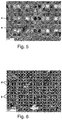
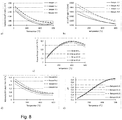
- the microstructures of the materials from Example 4 are shown in 5 and 6 shown.
- the main component of the structure is a half-Heusler phase (phase c in Figures 5 and 6 ) of the composition 16% Ti - 18% Zr - 34% Sn - rest Ni.
- the elements La or Ta cannot be detected using EDX.
- La-rich secondary phases phase a in Figure 5
- Ta-rich secondary phases phase b in Figure 6
- pores (d) and inclusions of Sn-rich phases (e) can be observed.
- the results of the SEM investigation therefore demonstrate that even if only one element from groups A and B is present, these will not be solved in the half-Heusler phase.
- Example 5 the thermoelectric properties of materials with Ta-rich secondary phases are compared with the thermoelectric properties of conventional half-Heusler compounds in which antimony doping was implemented on the tin lattice site.
- the compositions listed in Table 6 were melted by means of vacuum induction melting and processed as described in Example 1.
- Table 6 Composition of the materials according to Example 5.
- Rods measuring 2.5 mm ⁇ 2.5 mm ⁇ 13 mm for measuring the Seebeck coefficient and electrical conductivity were sawn from the materials, and samples measuring 10 mm ⁇ 10 mm ⁇ 1 mm for measuring thermal conductivity by means of lasers Flash method.
- the temperature-dependent thermoelectric properties measured for the materials are in Figure 7 shown.
- Figure 7a shows a graph of the Seebeck coefficients as a function of temperature.
- Figure 7b shows a graph of electrical conductivity as a function of temperature.
- Figure 7c shows a graph of the power factor as a function of temperature.
- Figure 7d shows a graph of thermal conductivity as a function of temperature.
- Figure 7e shows a graph of the figure of merit ZT as a function of temperature.
- Example 6 examines the thermoelectric properties of materials that have A- and / or B-rich secondary phases in combination with a semi-Heusler compound doped with antimony. For this purpose, the compositions listed in Table 7 were melted, processed as in Example 1 and then annealed for 48 hours at 930 ° C. under protective gas (argon). Table 7: Composition of the materials according to Example 6.
- thermoelectric characterization The measurement samples prepared from the materials for thermoelectric characterization were produced as in Example 5. The measured thermoelectric properties are in Figure 8 shown.
- Figure 8a shows a graph of the Seebeck coefficients as a function of temperature.
- Figure 8b shows a graph of electrical conductivity as a function of temperature.
- Figure 8c shows a graph of the power factor as a function of temperature.
- Figure 8d shows a graph of thermal conductivity as a function of temperature.
- Figure 8e shows a graph of the figure of merit ZT as a function of temperature.
- Example 6 The materials from Example 6 all achieve very good thermoelectric properties, with high power factors and a maximum ZT value in the temperature range between 500 ° C and 600 ° C of 0.9 ⁇ ZT max ⁇ 1.0. In particular, higher power factors and ZT values are achieved than in Comparative Examples 5.3 and 5.4, which represent half-Heusler compounds doped with antimony without secondary phases rich in A and / or B.
- the present invention can thus be used to produce more powerful, low-RF thermoelectric materials based on the semi-Heusler compounds ⁇ NiSn.
- These materials have a multi-phase composite structure in which inclusions of A-rich and / or B phases are embedded in a matrix with one or more phases with a half-Heusler structure, the phases with the half-Heusler structure at least 6 atomic% of Ti and 6 atomic% of Zr.
Landscapes
- Chemical & Material Sciences (AREA)
- Engineering & Computer Science (AREA)
- Materials Engineering (AREA)
- Mechanical Engineering (AREA)
- Metallurgy (AREA)
- Organic Chemistry (AREA)
- Inorganic Chemistry (AREA)
- Physics & Mathematics (AREA)
- Thermal Sciences (AREA)
- Crystallography & Structural Chemistry (AREA)
- Manufacturing & Machinery (AREA)
- Powder Metallurgy (AREA)
Description
- Die Erfindung betrifft einen thermoelektrischen Gegenstand für eine thermoelektrische Umwandlungsvorrichtung, ein Verbundmaterial für eine thermoelektrische Umwandlungsvorrichtung sowie ein Verfahren zum Herstellen eines thermoelektrischen Gegenstands für eine thermoelektrische Umwandlungsvorrichtung. Insbesondere betrifft die Erfindung thermoelektrische Materialien auf Basis der Halb-Heusler-Verbindungen.
- Thermoelektrische Effekte erlauben die direkte Umwandlung von thermischer Energie in elektrische Energie und umgekehrt. Je nach Anwendung unterscheidet man dabei zwischen dem Seebeck-Effekt und dem Peltier-Effekt.
- Der Peltier-Effekt beschreibt, dass ein elektrischer Strom in einem Material mit einem Wärmestrom verbunden ist. Das Verhältnis von Wärmestrom zu elektrischem Strom wird als Peltier-Koeffizient bezeichnet. In einem geschlossenen Stromkreis aus zwei Leitern mit unterschiedlichen Peltier-Koeffizienten ist die Wärmebilanz an den Kontakten nicht ausgeglichen und es kommt zum Aufheizen eines Kontaktes, während der andere Kontakt gekühlt wird.
- Der Seebeck-Effekt hingegen besagt, dass eine Temperaturdifferenz zwischen zwei Enden eines Materials zum Ausbilden einer zur Temperaturdifferenz proportionalen elektrischen Spannung führt. Das Verhältnis von Spannung zu Temperaturdifferenz wird als Seebeck-Koeffizient S bezeichnet.
- Technische Anwendung finden die thermoelektrischen Effekte beispielsweise in Thermoelementen zur Temperaturmessung, thermoelektrischen Modulen (TE-Modulen) zum Kühlen bzw. Heizen und in thermoelektrischen Modulen zur Erzeugung elektrischen Stroms. Thermoelektrische Module zum Kühlen bzw. Heizen werden auch als Peltier-Module bezeichnet, während Module zur Stromerzeugung auch als thermoelektrische Generatoren (TEGs) bezeichnet werden.
- Halb-Heusler-Verbindungen sind intermetallische Verbindungen der allgemeinen Formel αβχ, die eine geordnete kubische C1b Kristallstruktur aufweisen. Ein Übergangsmetall α, ein Übergangsmetall β und ein Hauptgruppen-Metall χ besetzen jeweils eines von drei ineinander geschachtelten kubisch flächenzentrierten (kfz) Untergittern. Ein viertes kfz Untergitter ist unbesetzt. Beträgt die Summe der Valenzelektronen in dieser Struktur 18, so zeigen die Verbindungen ein halbleitendes Verhalten mit einer Energielücke von 0 bis 1 eV. Somit sind sie als effiziente thermoelektrische Materialien für einen mittleren Temperaturbereich von ungefähr 400 °C bis 600 °C besonders geeignet.
- Die Effizienz der Materialien wird durch die thermoelektrische Gütezahl ZT beschrieben, welche durch ZT = TS 2 σ/κ definiert ist. Dabei ist T die absolute Temperatur, S der Seebeck-Koeffizient, σ-die elektrische Leitfähigkeit und κ die Wärmeleitfähigkeit. Neben dem ZT-Wert wird zum Vergleich verschiedener thermoelektrischer Materialien auch oft der Power-Faktor PF verwendet, welcher sich aus PF = S2σ berechnet.
- Gute n-typ thermoelektrische Halb-Heusler-Verbindungen sind im System αNiSn (α = Zr, Hf, Ti) bekannt. Durch Substitutionen auf den verschiedenen Untergittern konnten hier thermoelektrische Materialien mit hohen ZT-Werten entwickelt werden. Isoelektronische Substitution auf dem α-Gitterplatz mittels Ti, Zr und Hf zur Verringerung der Wärmeleitfähigkeit und die Dotierung auf dem Sn-Gitterplatz mittels des Donators Sb zur Erhöhung der elektrischen Leitfähigkeit sind beispielsweise in der
US 2010/0147352 A1 undUS2005/0172994 A1 offenbart. - Ein Nachteil der Verbindungen auf Basis von αNiSn ist, dass zur Erlangung eines hohen ZT-Werts ein hoher Anteil von Hafnium auf dem α-Gitterplatz notwendig ist. Da derzeit Hafnium als Rohstoff sehr teuer ist, wäre es wünschenswert, den Hf-Gehalt zu reduzieren.
- Die
US 2010/0147352 A1 und dieUS 2005/0172994 A1 offenbaren neben der isoelektronischen Substitution auch die Substitution des α-Gitterplatzes mittels Akzeptor- oder Donatorelementen aus den Nebengruppen 3 (Sc, Y, La) und 5 (V, Nb, Ta) zur Verbesserung der thermoelektrischen Eigenschaften des Systems αNiSn. Die Bildung von Fremdphasen durch einen zu hohen Anteil dieser Elemente ist dabei zu vermeiden. Allgemein können diese Verbindungen mit der Summenformel A x B y α1-x-y Niχ beschrieben werden. Dabei sind A eines oder mehrere der p-dotierenden Akzeptor-Elemente Sc, Y, La; B eines oder mehrere der n-dotierenden Donator-Elemente V, Nb, Ta; α Ti, Zr oder Hf und χ eines oder beide der Elemente Sn oder Sb. - In
US 2005/0172994 A1 werden Beispiele für die Substitution der Akzeptor- und Donator-Elemente ohne die Bildung von Fremdphasen in Halb-Heusler Verbindungen mit α=Ti0,3Zr0,35Hf0,35 und α=Ti0,5Zr0,25Hf0,25 demonstriert. DieUS 2010/0147352 A1 behandelt dagegen Hf-reduzierte Halb-Heusler Phasen, bei denen der Anteil von Hf auf dem α-Gitterplatz auf kleiner 1% beschränkt wird. Die Substitution der Akzeptor- und Donator-Elemente ohne die Bildung von Fremdphasen wird in Halb-Heusler Verbindungen mit α=Ti und α=Zr demonstriert. In diesen Hf-reduzierten Halb-Heusler Verbindungen wurden ZT-Werte bis maximal 0,7 erreicht. - Eine Halb-Heusler-Verbindung ist auch im Artikel Chai Yaw Wang et al "The effect of an isoelectronic Ti-Zr substitution on Heusler nanopreceipitation and the thermoelectric properties of a (Ti0.2, Zr0.8)Ni1.1Sn half-heusler Alloy", J. Alloys and Compounds, 662, Seiten 566-577, 2015 offenbart.
- Aufgabe der Erfindung ist es daher, ein n-Typ thermoelektrisches Material bereitzustellen, bei dem der Anteil an Hafnium reduziert ist und das gleichzeitig einen hohen ZT-Wert besitzt.
- Erfindungsgemäß wird ein thermoelektrischer Gegenstand für eine thermoelektrische Umwandlungsvorrichtung mit einer Gesamtzusammensetzung bestehend aus
- 6 Atom-% ≤ Ti ≤ 27 Atom-%,
- 6 Atom-% ≤ Zr ≤ 27 Atom-%,
- 0 Atom-% ≤ Hf ≤ 1,7 Atom-%, wobei 28 Atom-% ≤ (Ti + Zr + Hf) ≤ 38 Atom-% ist,
- 28 Atom-% ≤ Sn ≤ 38 Atom-%,
- 0 Atom-% ≤ Sb ≤ 3 Atom-%, wobei 28 Atom-% ≤ (Sn + Sb) ≤ 38 Atom-% ist,
- 0 Atom-% ≤ A ≤ 7 Atom-%,
- 0 Atom-% ≤ B ≤ 7 Atom-%, wobei A eines oder mehrere der Elemente ausgewählt aus der Gruppe bestehend aus Sc, Y und La ist, B eines oder mehrere der Elemente ausgewählt aus der Gruppe bestehend aus V, Nb und Ta ist, und 0,15 Atom-% ≤ A+B ≤ 7 Atom-% ist,
- Rest Ni sowie bis zu 5 Atom-% Verunreinigungen,
- Mit dieser Gesamtzusammensetzung wird eine Halb-Heusler-Verbindung erstrebt, die sowohl Ti als auch Zr aufweist, insbesondere sollte sie zumindest 6 Atom-% Ti und 6 Atom-% Zr aufweisen. Eines oder beide der Elemente Ti und Zr der Halb-Heusler Phase kann teilweise mit Hf ersetzt werden kann, wobei der Anteil an Hf in der Summe (Ti+Zr+Hf) auf dem α Gitterplatz ≤ 5 Atom-% beträgt. Diese Gesamtzusammensetzung weist einen niedrigen Hf-Gehalt von weniger als 1,7 Atom-% auf, sodass durch den reduzierten Hf-Gehalt die Rohstoffkosten für das thermoelektrische Material verringert werden, was einen ökonomischen Einsatz der Materialien zur thermoelektrischen Umwandlung ermöglicht. Gleichzeitig weist der thermoelektrische Gegenstand gute thermoelektrische Eigenschaften wie einen hohen ZT-Wert auf.
- Der Hafnium-Gehalt kann ausschließlich oder teilweise durch einen vorhandenen Anteil an Hf in der Zirkoniumquelle bereitgestellt werden. Zum Beispiel kann das Zirkonium zwischen 0,5 Atom-% und 3 Atom-% Hf als Begleitelement aufweisen. Folglich ist die Gesamtzusammensetzung nicht Hf-frei, obwohl Hf nicht gezielt in der Zusammensetzung zugefügt wird. Falls der Anteil an Hf in der Zirkoniumquelle zu niedrig ist, kann der Hafniumgehalt durch die Verwendung einer weiteren getrennten Hafniumquelle erhöht werden. Im hergestellten thermoelektrischen Gegenstand kann das Hafnium am Gitterplatz anstelle von Zirkonium oder Titan angeordnet sein.
- Die Gesamtzusammensetzung des thermoelektrischen Gegenstands kann auch durch die Formel AxByTia1Zra2Hfa3NiSncSbb beschrieben werden, wobei 0 ≤ x ≤ 0,2, 0 ≤ y ≤ 0,2, 0,005 ≤ (x+y) ≤ 0,2, 0,2 ≤ a1 ≤ 0,8, 0,2 ≤ a2 ≤ 0,8, 0 ≤ a3 ≤ 0,05, 0,9 ≤ (a1 +a2+a3) ≤ 1,1, 0 ≤ b ≤ 0,1 und 0,9 ≤(b+c) ≤ 1,1 ist. Der Gehalt an den Elementen A und B kann gleich sein, sodass x = y in der oben genannten Schreibweise ist, oder unterschiedlich, sodass x ≠ y.
- Unter Verunreinigungen werden Elemente bezeichnet, die nicht gezielt in der Gesamtzusammensetzung zugefügt werden, oder die durch das Herstellungsverfahren bedingt sind. Die Verunreinigungen können eines oder mehrere Elemente der Gruppe bestehend aus O, C, N, Al, Fe aufweisen. Der maximale Gehalt an den einzelnen Elementen kann O ≤ 4 Atom-%, C ≤ 1 Atom-%, N ≤ 0,5 Atom-%, Al ≤ 2 Atom-% und Fe ≤ 2 Atom-% sein, wobei der maximale Gesamtgehalt an Verunreinigungen bis zu 5 Atom.-% sein kann.
- Ein thermoelektrischer Gegenstand mit der erfindungsgemäßen Gesamtzusammensetzung weist sehr gute thermoelektrische Eigenschaften auf. In einem Ausführungsbeispiel weist der thermoelektrische Gegenstand ein Maximum der thermoelektrischen Gütezahl ZTmax von ≥ 0,8 vorzugsweise ≥ 0,9 auf, wobei 400°C ≤ Tmax ≤ 700°C sein kann, und/oder einen Seebeck-Koeffizienten S, wobei - 350 (µV/K) ≤ S ≤- 80 (µV/K) ist, und/oder ein Maximum des Power-Faktors PFmax von >3,5 (mW m-1 K-2) auf.
- Der thermoelektrische Gegenstand kann mehrere Phasen aufweisen, sodass die Zusammensetzung der einzelnen Phasen von der Gesamtzusammensetzung abweicht. Insbesondere kann der thermoelektrische Gegenstand mindestens 90 Vol-% zumindest einer Phase mit einer Halb-Heusler-Struktur aufweisen. Diese Halb-Heusler-Verbindung kann zumindest 6 Atom-% Ti und 6 Atom-% Zr aufweisen. Der restliche Anteil des thermoelektrischen Gegenstands kann aus A-reichen und B-reichen Phasen gebildet sein. Die eine oder mehreren A-reichen-Phasen können keine Halb-Heusler-Struktur und die eine oder mehreren B-reichen Phasen keine Halb-Heusler-Struktur aufweisen. Diese A-reichen Phasen und B-reichen-Phasen können die Form von Einschlüssen oder Ausscheidungen aufweisen, die in einer Matrix mit einer Halb-Heusler-Struktur vorhanden sind. Trotz dieser weiteren A-reichen und B-reichen Phasen ohne eine Halb-Heusler-Struktur werden gute thermoelektrische Eigenschaften bereitgestellt.
- Der thermoelektrische Gegenstand kann zumindest eine Phase mit einer Halb-Heusler-Struktur aufweisen. In manchen Ausführungsbeispielen weist der thermoelektrische Gegenstand zumindest zwei Phasen mit einer Halb-Heusler-Struktur auf, die unterschiedliche Zusammensetzungen aufweisen. Die Phase oder Phasen mit der Halb-Heusler-Struktur können jeweils weniger als 0,2 Atom-% an einem oder beiden der Elemente A und B aufweisen, sodass diese Elemente hauptsächlich in Form von A-reichen und/oder B-reichen Ausscheidungen vorhanden sind. 0,2 Atom-% ist zum Beispiel die Nachweisgrenze von Methoden wie energiedispersiver Röntgenspektroskopie.
- Die Zusammensetzung der Phasen mit der Halb-Heusler-Struktur kann durch die Summenformel TiaZr1-aNiSnr 1-b Sb b gegeben werden, wobei 0 ≤ a ≤ 1 und 0 ≤ b ≤ 0,1 ist. In manchen Ausführungsbeispielen beträgt 0,2 ≤ a ≤ 0,8.
- Erfindungsgemäß wird auch ein Verbundmaterial für eine thermoelektrische Umwandlungsvorrichtung angegeben, das eine Matrix mit zumindest einer Phase mit einer Halb-Heusler-Struktur auf αNiβ - Basis aufweist, wobei α zumindest eines der Elemente der Gruppe bestehend aus Ti und Zr und optional Hf ist und β zumindest eines der Elemente der Gruppe bestehend aus Sn und Sb ist, wobei der Anteil an Hf in Ti+Zr+Hf weniger als 5 Atom-% ist, Einschlüsse aus einer A-reichen Phase, wobei A eines oder mehrere der Elemente ausgewählt aus der Gruppe bestehend aus Sc, Y und La ist, und/oder Einschlüsse aus einer B-reichen Phase, wobei B eines oder mehrere der Elemente ausgewählt aus der Gruppe bestehend aus V, Nb und Ta ist, und ein Maximum der thermoelektrischen Gütezahl ZTmax von ≥ 0,8, vorzugsweise ≥ 0,9 aufweist. Das Verbundmaterial weist eine Gesamtzusammensetzung bestehend im Wesentlichen aus 6 Atom-% ≤ Ti ≤ 27 Atom-%, 6 Atom-% ≤ Zr ≤ 27 Atom-%, 0 Atom-% ≤ Hf ≤ 1,7 Atom-%, wobei 28 Atom-% ≤ (Ti + Zr + Hf) ≤ 38 Atom-% ist, 28 Atom-% ≤ Sn ≤ 38 Atom-%, 0 Atom-% ≤ Sb ≤ 3 Atom-%, wobei 28 Atom-% ≤ (Sn + Sb) ≤ 38 Atom-% ist, 0 Atom-% ≤ A ≤ 7 Atom-%, 0 Atom-% ≤ B ≤ 7 Atom-%, wobei A eines oder mehrere der Elemente ausgewählt aus der Gruppe bestehend aus Sc, Y und La ist, B eines oder mehrere der Elemente ausgewählt aus der Gruppe bestehend aus V, Nb und Ta ist, und 0,15 Atom-% ≤ A+B ≤ 7 ist, Rest Ni sowie bis zu 5 Atom-% Verunreinigungen auf.
- Dieses Verbundmaterial weist somit gute thermoelektrische Eigenschaften trotz der Einschlüsse von zusätzlichen Phasen neben der Halb-Heusler-Verbindung oder Verbindungen auf.
- Die Zusammensetzung der Phasen mit der Halb-Heusler-Struktur kann durch die Summenformel Ti a Zr1-a NiSn1-b Sb b gegeben werden, wobei 0≤ a ≤1 und 0 ≤ b ≤ 0,1 und in einem Ausführungsbeispiel 0,2 ≤ a ≤ 0,8 ist.
- In einem Ausführungsbeispiel weist die Matrix weniger als jeweils 0,2 Atom-% an einem oder mehreren der Elemente A und B auf. Die Einschlüsse aus einer A-reichen Phase und die Einschlüsse aus einer B-reichen Phase weisen in manchen Ausführungsbeispielen im Gegensatz zu der Matrix keine Halb-Heusler-Struktur auf. Das Verbundmaterial kann bis zu 10 Vol-% der A-reichen Phase und der B-reichen Phase aufweisen. Das Verbundmaterial weist somit eine Halb-Heusler-Struktur mit keinen oder sehr niedrigen Substitutionen der Elemente A und B und gute thermoelektrische Eigenschaften auf.
- Eines oder beide der Elemente Ti und Zr der Halb-Heusler Phase kann teilweise mit Hf ersetzt werden, wobei der Anteil an Hf in der Summe (Ti+Zr+Hf) ≤ 5 Atom-% beträgt, d.h. der Anteil an Hf auf dem α Gitterplatz der Halb-Heusler Phase weniger als 5 Atom% ist.
- Die Verunreinigungen können eines oder mehrere Elemente der Gruppe bestehend aus O, C, N, Al, Fe aufweisen. Der maximale Gehalt an den einzelnen Elementen kann O ≤ 4 Atom-%, C ≤ 1 Atom-%, N ≤ 0,5 Atom-%, Al ≤ 2 Atom-% und Fe ≤ 2 Atom-% sein, wobei der maximale Gesamtgehalt an Verunreinigungen bis zu 5 Atom.-% sein kann.
- Ein thermoelektrisches Modul mit zumindest einem thermoelektrischen Element aus einem Verbundmaterial nach einem der oben beschriebenen Ausführungsbeispiele wird auch angegeben.
- Erfindungsgemäß weist ein Verfahren zum Herstellen eines thermoelektrischen Gegenstands für eine thermoelektrische Umwandlungsvorrichtung Folgendes auf. Ein Ausgangsmaterial, das aus 6 Atom-% ≤ Ti ≤ 27 Atom-%, 6 Atom-% ≤ Zr ≤ 27 Atom-%, 0 Atom-% ≤ Hf ≤ 1,7 Atom-%, wobei 28 Atom-% ≤ (Ti + Zr + Hf) ≤ 38 Atom-% ist, 28 Atom-% ≤ Sn ≤ 38 Atom-%, 0 Atom-% ≤ Sb ≤ 3 Atom-%, wobei 28 Atom-% ≤ (Sn + Sb) ≤ 38 Atom-% ist, 0 Atom-% ≤ A ≤ 7 Atom-%, 0 Atom-% ≤ B ≤ 7 Atom-%, wobei A eines oder mehrere der Elemente ausgewählt aus der Gruppe bestehenden aus Sc, Y und La ist, B eines oder mehrere der Elemente ausgewählt aus der Gruppe bestehend aus V, Nb und Ta ist, und 0,15Atom-% ≤ A+B ≤ 7 Atom-% ist, Rest Ni sowie bis zu 5 Atom-% Verunreinigungen besteht, wird bereitgestellt, erschmolzen und anschließend erstarrt, um mindestens einen Block zu formen. Der Block wird bei einer Temperatur von 900°C bis 1200°C für eine Zeitdauer t, wobei 0,5 h ≤ t ≤ 100 h, wärmebehandelt bzw. homogenisiert, um einen homogenisierten Block herzustellen. Der homogenisierte Block wird zerkleinert und gemahlen, wobei ein Pulver geformt wird. Das Pulver wird kaltgepresst, wobei ein Grünkörper geformt wird. Der Grünkörper wird unter einem Druck vom maximal 1 MPa bei einer Temperatur von 1000°C bis 1500°C für 0,5 h bis 24h gesintert, wobei ein thermoelektrischer Gegenstand hergestellt wird.
- Die Verunreinigungen können eines oder mehrere Elemente der Gruppe bestehend aus O, C, N, Al, Fe aufweisen. Der maximale Gehalt an den einzelnen Elementen kann O ≤ 4 Atom-%, C ≤ 1 Atom-%, N ≤ 0,5 Atom-%, Al ≤ 2 Atom-% und Fe ≤ 2 Atom-% sein, wobei der maximale Gesamtgehalt an Verunreinigungen bis zu 5 Atom.-% sein kann.
- Im thermoelektrischen Gegenstand können eines oder beide der Elemente Ti und Zr der Halb-Heusler Phase teilweise mit Hf ersetzt werden, wobei der Anteil an Hf auf dem α Gitterplatz der Halb-Heusler-Phase und in der Summe (Ti+Zr+Hf) ≤ 5 Atom-% beträgt.
- Das erschmolzene Ausgangsmaterial kann zu einem Block gegossen werden. Der Block bzw. Gussblock kann mittels eines Backenbrechers und/oder mittels einer Scheibenmühle oder Walzenmühle zerkleinert werden. Der Block kann in mehreren Schritten zu einem Pulver verarbeitet werden. Zum Beispiel kann der Block zu einem groben Pulver zerkleinert und das grobe Pulver mit einem weiteren Mahlverfahren zu einem feinen Pulver gemahlen werden, wobei das feine Pulver kaltgepresst wird, um den Grünkörper zu formen. Das weitere Mahlverfahren kann mittels einer Planetenkugelmühle oder einer Jet-Mühle durchgeführt werden.
- Das Ausgangsmaterial kann mittels Vakuum-Induktions-Schmelzen (VIM) erschmolzen werden. Vakuum-Induktions-Schmelzen ist insbesondere zum Herstellen von großtechnischen Mengen an Material vorteilhaft.
- Der Block kann unter Argon oder in einem Vakuum homogenisiert wird. In einem Ausführungsbeispiel sind die Wärmbehandlungsbedingungen für die Homogenisierung näher definiert, sodass der Block bei einer Temperatur von 1050°C bis 1180°C für eine Zeitdauer t, wobei 16 h ≤ t ≤ 36h beträgt, homogenisiert wird.
- Der Anteil an Verunreinigungen kann sich aufgrund des Herstellungsverfahrens erhöhen, sodass der Anteil an Verunreinigungen im fertigen Gegenstand bis zu 5 Atom-% beträgt.
- In den oben beschriebenen Ausführungsbeispielen weist das Ausgangsmaterial, das erschmolzen und zu einem Pulver verarbeitet wird, den gewünschte Gehalt an den Elementen Ti, Zr, Hf, A, B, Sn, Sb und Ni auf. In weiteren Ausführungsbeispielen wird die Gesamtzusammensetzung aus zwei oder mehreren Pulvern unterschiedlicher Zusammensetzungen bereitgestellt.
- Ein Verfahren zum Herstellen eines thermoelektrischen Gegenstands wird bereitgestellt, wobei zumindest ein Pulver, das die Elemente A und/oder B enthält, mit einem Pulver gemischt wird, das keine dieser Elemente oder weniger als den gewünschten Anteil an diesen Elementen aufweist. Das Verfahren kann Folgendes aufweisen. Ein erstes Pulver, das aus 6 Atom-% ≤ Ti ≤ 27 Atom-%, 6 Atom-% ≤ Zr ≤ 27 Atom-%, 0 Atom-% ≤ Hf ≤ 1,7 Atom-%, wobei 28 Atom-% ≤ (Ti + Zr + Hf) ≤ 38 Atom-% ist, 28 Atom-% ≤ Sn ≤ 38 Atom-%, 0 Atom-% ≤ Sb ≤ 3 Atom-%, wobei 28 Atom-% ≤ (Sn + Sb) ≤ 38 Atom-% ist, Rest Ni sowie bis zu 5 Atom% Verunreinigungen besteht, wobei der Anteil an Elementen der Gruppen A und B weniger als 0,2 Atom-% beträgt, wird bereitgestellt. Zumindest ein zweites Pulver, das 0 Atom-% ≤ A ≤ 7 Atom-% und/oder 0 Atom-% ≤ B ≤ 7 Atom-% aufweist, wobei A eines oder mehrere der Elemente ausgewählt aus der Gruppe bestehenden aus Sc, Y und La ist und B eines oder mehrere der Elemente ausgewählt aus der Gruppe bestehend aus V, Nb und Ta ist, und 0,5 Atom-% ≤ A+B ≤ 7 Atom-% ist, wird bereitgestellt. Das erste Pulver und das zweite Pulver werden miteinander gemischt, wodurch ein Ausgangspulver erzeugt wird.
- Dieses Ausgangspulver wird kaltgepresst, um einen Grünkörper zu formen und der Grünkörper unter einem Druck vom maximal 1 MPa bei einer Temperatur von 1000°C bis 1500°C für 0,5 h bis 24h gesintert, wobei ein thermoelektrischer Gegenstand hergestellt wird.
- Das zweite Pulver kann neben die Elemente A und/oder B ferner 6 Atom-% ≤ Ti ≤ 27 Atom-%, 6 Atom-% ≤ Zr ≤ 27 Atom-%, 0 Atom-% ≤ Hf ≤ 1,7 Atom-%, wobei 28 Atom-% ≤ (Ti + Zr + Hf) ≤ 38 Atom-% ist, 28 Atom-% ≤ Sn ≤ 38 Atom-%, 0 Atom-% ≤ Sb ≤ 3 Atom-%, wobei 28 Atom-% ≤ (Sn + Sb) ≤ 38 Atom-%, Rest Ni sowie bis zu 5 Atom% Verunreinigungen aufweisen. Das zweite Pulver kann somit eine oder mehrere Phasen mit einer Halb-Heusler-Struktur aufweisen.
- Für beide Herstellungsmethoden kann der Grünkörper unter Schutzgas oder einem Vakuum gesintert werden. Der gesinterte thermoelektrische Gegenstand kann auch weiter bearbeitet werden, um zumindest eine Arbeitskomponente herzustellen, die geeignet zur Anwendung in einem thermoelektrischen Modul ist. Zum Beispiel kann der gesinterte Gegenstand mittels Säge- und/oder Schleifverfahren zu mehreren Arbeitskomponenten verarbeitet werden.
- Der gesinterte thermoelektrische Gegenstand, der mit beiden Verfahren hergestellt wird, kann eine Matrix aus zumindest einer Phase mit einer Halb-Heusler-Struktur mit weniger als 0,2 Atom-% der Elemente A und B sowie Einschlüsse bzw. Ausscheidungen aus A-reichen und/oder B-reichen Phasen aufweisen. Der gesinterte thermoelektrische Gegenstand kann bis zu 10 Vol-% an diesen A-reichen und B-reichen Phasen aufweisen und trotzdem thermoelektrische Eigenschaften von einem Maximum der thermoelektrischen Gütezahl ZTmax von ≥ 0,8 vorzugsweise ≥ 0,9 aufweisen, wobei 400°C ≤ Tmax ≤ 700°C sein kann, und/oder einem Seebeck-Koeffizienten S, wobei - 350 (µV/K) ≤ S ≤- 80 (µV/K) ist, und/oder ein Maximum des Power-Faktors PFmax von >3,5 (mW m-1 K-2) aufweisen.
- Die Erfindung wird nun anhand der Zeichnungen und Beispiele näher erläutert.
- Figur 1
- zeigt ein Diagramm der Zusammensetzung des α-Gitterplatzes in der Verbindung αNiSn (α= Ti, Zr, Hf), wobei der schattierte Bereich den untersuchten Bereich für α darstellt.
- Figur 2
- zeigt eine rasterelektronenmikroskopische Aufnahme der Mikrostruktur von Beispiel 1.1.
- Figur 3
- zeigt eine rasterelektronenmikroskopische Aufnahme der Mikrostruktur des Materials aus Beispiel 2.4.
- Figur 4
- zeigt Graphen der thermoelektrischen Eigenschaften der Materialien aus Beispiel 3.
- Figur 5
- zeigt eine rasterelektronenmikroskopische Aufnahme der Mikrostruktur des Materials aus Beispiel 4.1
- Figur 6
- zeigt eine rasterelektronenmikroskopische Aufnahme der Mikrostruktur des Materials aus Beispiel 4.2
- Figur 7
- zeigt Graphen der thermoelektrischen Eigenschaften der Materialien aus Beispiel 5.
- Figur 8
- zeigt Graphen der thermoelektrischen Eigenschaften der Materialien aus Beispiel 6.
- Ein thermoelektrischer Gegenstand mit einer Gesamtzusammensetzung bestehend im Wesentlichen aus 6 Atom-% ≤ Ti ≤ 27 Atom-%, 6 Atom-% ≤ Zr ≤ 27 Atom-%, wobei 28 Atom-% ≤ (Ti + Zr) ≤ 38 Atom-% ist, 0 Atom-% ≤ Hf ≤ 1,7 Atom-%, wobei eines oder beide der Elemente Ti und Zr der Halb-Heusler-Phase teilweise mit Hf ersetzt werden kann so dass wobei 28 Atom-% ≤ (Ti + Zr + Hf) ≤ 38 Atom-% ist, wobei der Anteil an Hf in der Summe (Ti+Zr+Hf) ≤ 5 Atom-% beträgt, 28 Atom-% ≤ Sn ≤ 38 Atom-%, 0 Atom-% ≤ Sb ≤ 3 Atom-%, wobei 28 Atom-% ≤ (Sn + Sb) ≤ 38 Atom-% ist, 0 Atom-% ≤ A ≤ 7 Atom-%, 0 Atom-% ≤ B ≤ 7 Atom-%, wobei A eines oder mehrere der Elemente ausgewählt aus der Gruppe bestehenden aus Sc, Y und La ist, B eines oder mehrere der Elemente ausgewählt aus der Gruppe bestehend aus V, Nb und Ta ist, und 0,15 Atom-% ≤ A+B ≤ 7 Atom-% ist, Rest Ni sowie bis zu 5 Atom-% Verunreinigungen, wird bereitgestellt. Der thermoelektrische Gegenstand hat eine gesinterte mehrphasige Verbundstruktur mit einer Matrix aus zumindest einer Phase mit einer Halb-Heusler-Struktur mit weniger als 0,2 Atom-% der Elemente A und B sowie Einschlüsse bzw. Ausscheidungen aus A-reichen und/oder B-reichen Phasen, die in der Matrix eingebettet sind.
- In den vorliegenden Beispielen weist die Gesamtzusammensetzung die beiden Elemente Ti c Zr1-c im Verhältnis 0,2 ≤ c ≤ 0,8 auf, mit nur einem geringen Anteil an Hafnium. Die bezüglich der A- und B-Substitution in dieser Arbeit untersuchten Zusammensetzungsbereiche des α-Gitterplatzes sind zur Verdeutlichung durch den schraffierten Bereich in
Figur 1 dargestellt. Die im Stand der Technik in den DruckschriftenUS2005/0172994 A1 undUS2010/0147352 A1 bezüglich der A- und B-Substitution untersuchten Zusammensetzungen sind mit Punkten dargestellt. - Es wurde eine Versuchsserie durchgeführt, mit der der Einfluss der Substitution mit A- und B-Atomen im System A x B y Ti c Zr1-c )1-x-y NiSn untersucht wird. Dabei wurden x und y zwischen 0,005 ≤ x,y ≤ 0,13 variiert. Der Zielbereich für die Zusammensetzung auf dem α-Gitterplatz wurde mit c zwischen 0,2 ≤ c ≤ 0,8 festgelegt. Die Elemente Ti und Zr wurden dabei teilweise mit geringen Mengen an Hf ersetzt, wobei der Anteil an Hf in Ti+Zr+Hf kleiner als 5 Atom-% betrug.
- In den Versuchen wurde festgestellt, dass überraschenderweise keine reinen Halb-Heusler-Verbindungen erhalten werden. Die Atome aus den Gruppen A und B konnten nicht in der Halb-Heusler-Phase gelöst nachgewiesen werden, wobei die Nachweisgrenze bei der verwendeten Analysemethode der energiedispersiven Röntgenspektroskopie bei ca. 0,2% liegt. Stattdessen bildeten sich selbst bei geringer Menge an Substitutionsatomen (x,y=0,005) A- und B-reiche Fremdphasen.
- Ebenfalls überraschend wurden an diesen Halb-Heusler-Verbindungen mit eingebauten A- und B-reichen Fremdphasen gute thermoelektrische Eigenschaften mit hohen ZT-Werten gemessen, so dass zum Erhalt guter thermoelektrischer Materialien das Auftreten von Fremdphasen nicht zu vermeiden ist.
- Die Löslichkeit der A- und B-Atome scheint in den hierin beschriebenen Halb-Heusler-Verbindungen Ti c Zr1-c NiSn mit 0,2 ≤ c ≤ 0,8 stark herabgesetzt zu sein, wodurch es zu den beobachteten Fremdphasen kommt. Diese fehlende Löslichkeit in der Halb-Heusler-Phase ist überraschend. Ebenfalls überraschend ist, dass diese Fremdphasen einen vorteilhaften Einfluss auf die thermoelektrischen Eigenschaften besitzen.
- Es wurden Materialien mit der in Tabelle 1 gezeigten Zusammensetzung hergestellt. Dazu wurden die Materialien in der gegebenen Zusammensetzung zunächst mittels Vakuum-Induktionsschmelzen erschmolzen. Aufgrund des Gehaltes von 2,7 Masse-% Hf als Begleitelement im eingesetzten Zr ist in den so erschmolzenen Materialien 0,4 Atom-% des Zr und Ti mit Hf ersetzt. Der Gussblock wurde weiterverarbeitet, indem er zunächst bei 1000 °C für 24 Stunden unter Argon als Schutzgas homogenisiert und anschließend zu einem feinen Pulver mit Median der Korngröße kleiner als 10 µm gemahlen wurde. Das Pulver wurde in einer Werkzeugpresse bei einem Druck von 2 t/cm2 zu Grünkörpern gepresst und schließlich bei 1100 °C bis 1300 °C für 4 Stunden unter Vakuum zu einem dichten Körper gesintert.
Tabelle 1: Zusammensetzung der Materialien nach Beispiel 1 und deren Seebeck-Koeffizient bei Raumtemperatur. Zusammensetzung in Atom-% S (µV/K) @ RT Beispiel 1.1 4,2% La - 4,2% Ta - 16,7% Ti - 8,3% Zr - 33,3% Sn - Rest Ni -38 Beispiel 1.2 4,2% Y - 4,2% Ta - 16,7% Ti - 8,3% Zr - 33,3% Sn - Rest Ni -56 Beispiel 1.3 4,2% La - 4,2% Nb - 16,7% Ti - 8,3% Zr - 33,3% Sn - Rest Ni -22 Beispiel 1.4 4,2% Y - 4,2% Nb - 16,7% Ti - 8,3% Zr - 33,3% Sn - Rest Ni -41 - Die Mikrostruktur der so hergestellten Materialien wurde mittels Rasterelektronenmikroskopie (REM) untersucht.
Figur 2 zeigt eine rasterelektronenmikroskopische Aufnahme der Mikrostruktur des Materials aus Beispiel 1.1. In allen Beispielen liegt in den Materialien eine Hauptphase in der Zusammensetzung einer Halb-Heusler-Phase vor (Phase c in derFigur 2 ) der Zusammensetzung 16,4% Ti - 16,9% Zr - 33,3% Sn - Rest Ni, bzw. ∼Ti0,5Zr0,5NiSn). Neben der Hauptphase treten zwei unterschiedliche Nebenphasen auf, die eine hohe Konzentration an jeweils einem der zugesetzten Elemente der Gruppen A und B aufweisen (Phasen a und b in derFigur 2 ). In der Hauptphase sind die zugesetzten Elemente der Gruppen A und B dagegen mittels energiedispersiver Röntgenspektroskopie (EDX) nicht nachweisbar, wobei die Nachweisgrenze bei ca. 0,2 Atom-% liegt. Beispiel 1 zeigt somit deutlich, dass die erwartete Löslichkeit der Elementgruppen A und B im System αNiSn nicht für die gemischte Besetzung des α-Gitterplatzes mit Ti und Zr erreicht wird. - Aus den Materialien wurden Stäbchen der Abmessung 3 mm × 3 mm × 13 mm gesägt. An diesen Proben wurde der Seebeck-Koeffizient bei Raumtemperatur bestimmt, welcher ebenfalls in Tabelle 1 gelistet ist. Im Maximum beträgt dieser -56 µV/K für Beispiel 1.2. Damit besitzen die Materialien aus Beispiel 1 einen zu geringen Seebeck-Koeffizienten, um für die praktische thermoelektrische Energiewandlung nützlich zu sein. Allerdings ist der Anteil der A- und B-reichen Nebenphasen in Beispiel 1 sehr hoch. Mit der Versuchsreihe im folgenden Beispiel 2 sollte daher der Einfluss eines geringeren Anteils an diesen Fremdphasen auf die thermoelektrischen Eigenschaften untersucht werden.
- Zunächst wurde als vergleichendes Beispiel ein Pulver aus einem Material ohne Elemente der Gruppen A und B wie in Beispiel 1 hergestellt. Die Zusammensetzung entspricht der einer Halb-Heusler-Phase und ist in Tabelle 2 wiedergegeben. Aufgrund des Gehaltes von 2,7 Masse-% Hf als Begleitelement im eingesetzten Zr ist in Summe 0,7 Atom-% des Zr und Ti mit Hf ersetzt. Durch Mischen der Pulver aus Beispiel 1 mit dem Pulver aus Beispiel 2.1 in verschiedenen Verhältnissen und durch anschließendes Pressen und Sintern der Pulvermischungen wie in Beispiel 1 wurden weitere Materialien hergestellt, deren Zusammensetzungen ebenfalls in Tabelle 2 wiedergegeben sind. Die Materialien aus Beispiel 2 enthalten geringere Anteile an Elementen der Gruppen A und B als in Beispiel 1.
Tabelle 2: Zusammensetzung der Materialien nach Beispiel 2. Zusammensetzung in Atom-% Vgl. Beispiel 2.1 16,7% Ti - 16,7% Zr - 33,3% Sn - Rest Ni Beispiel 2.2 0,17% La - 0,17% Ta - 16,7% Ti - 16,3% Zr - 33,3% Sn - Rest Ni Beispiel 2.3 0,5% La - 0,5% Ta - 16,7% Ti - 15,7% Zr - 33,3% Sn - Rest Ni Beispiel 2.4 0,8% La - 0,8% Ta - 16,7% Ti - 15,0% Zr - 33,3% Sn - Rest Ni Beispiel 2.5 1,7% La - 1,7% Ta - 16,7% Ti - 13,3% Zr - 33,3% Sn - Rest Ni Beispiel 2.6 0,5% Y - 0,5% Ta - 16,7% Ti - 15,7% Zr - 33,3% Sn - Rest Ni Beispiel 2.7 0,8% Y - 0,8% Ta - 16,7% Ti - 15,0% Zr - 33,3% Sn - Rest Ni Beispiel 2.8 0,5% La - 0,5% Nb - 16,7% Ti - 15,7% Zr - 33,3% Sn - Rest Ni Beispiel 2.9 0,8% La - 0,8% Nb - 16,7% Ti - 15,0% Zr - 33,3% Sn - Rest Ni Beispiel 2.10 0,5% Y - 0,5% Nb - 16,7% Ti - 15,7% Zr - 33,3% Sn - Rest Ni Beispiel 2.11 0,8% Y - 0,8% Nb - 16,7% Ti - 15,0% Zr - 33,3% Sn - Rest Ni - Die Mikrostruktur der Materialien wurde mittels REM untersucht. Beispielhaft ist in der
Figur 3 die Mikrostruktur des Materials aus Beispiel 2.4 gezeigt. In allen Fällen treten Hauptphasen in Form von Halb-Heusler-Phasen (Phasen c1 und c2 in derFigur 3 ) sowie A- und B-reiche Nebenphasen auf (Phasen a und b in derFigur 3 ). In einigen Fällen können in der Mikrostruktur auch Poren durch eine nicht vollständige Sinterung (d) oder Einschlüsse einer Ni-Sn-Phase (e) beobachtet werden. - Die EDX-Analyse der Halb-Heusler-Phasen in der
Figur 3 ergab zwei unterschiedliche Zusammensetzungen 12,9% Ti - 21,4% Zr - 34,0% Sn - Rest Ni (c1) und 20,3% Ti - 13,1% Zr - 34,6% Sn - Rest Ni (c2). Auch in den Beispielen 2.2 bis 2.11 wurde keine Löslichkeit der Elemente aus den Gruppen A und B oberhalb der Nachweisgrenze von 0,2 % in der Halb-Heusler-Phase festgestellt. - Aus den Materialien wurden Stäbchen der Abmessung 3 mm × 3 mm × 13 mm gesägt. An diesen Proben wurden der Seebeck-Koeffizient und die elektrische Leitfähigkeit gemessen. Die Ergebnisse sowie der daraus berechnete Power-Faktor sind in Tabelle 3 gelistet. Wie aus der Tabelle ersichtlich, besitzen die Materialien aus Beispiel 2 einen deutlich höheren Seebeck-Koeffizienten als die Materialien aus Beispiel 1. Darüber hinaus ist der Power-Faktor in allen Beispielen 2.2 bis 2.11, welche einen Anteil an A- und B-reichen Fremdphasen besitzen, deutlich höher als im Vergleichsbeispiel 2.1, welches aus einer Halb-Heusler-Phase ohne A- und B-reichen Fremdphasen besteht. In Beispiel 2 wird daher demonstriert, dass wider Erwarten das Vorhandensein A- und B-reicher Fremdphasen die thermoelektrischen Eigenschaften nicht verschlechtert, sondern verbessert.
Tabelle 3: Thermoelektrische Eigenschaften der Materialien aus Beispiel 2 bei Raumtemperatur und 400°C. RT 400 °C S (µV/K) σ (S/cm) PF (mWm-1K-2) S (µV/K) σ (S/cm) PF (mWm-1K-2) Vgl. Beispiel 2.1 -248 198 1,2 -241 478 2,8 Beispiel 2.2 -199 482 1,9 -226 643 3,3 Beispiel 2.3 -144 1061 2,2 -203 890 3,7 Beispiel 2.4 -123 1474 2,2 -185 1140 3,9 Beispiel 2.5 -85 2637 1,9 -141 1866 3,7 Beispiel 2.6 -143 1142 2,3 -200 967 3,9 Beispiel 2.7 -137 1211 2,3 -196 1020 3,9 Beispiel 2.8 -131 1196 2,1 -185 1035 3,6 Beispiel 2.9 -97 1954 1,8 -154 1466 3,5 Beispiel 2.10 -138 1111 2,1 -192 976 3,6 Beispiel 2.11 -112 1544 1,9 -169 1203 3,4 - In Beispiel 3 wird der Effekt der A- und B-reichen Fremdphasen für Halb-Heusler-Verbindungen mit einem weiteren Zusammensetzungsbereich des α-Gitterplatzes untersucht. Dazu wurden zunächst A- und B-freie Halb-Heusler-Verbindungen mit Zusammensetzung 10,0% Ti - 23,3% Zr - 33,3% Sn - Rest Ni (Ti0,3Zr0,7NiSn), 13,3% Ti - 20,0% Zr - 33,3% Sn - Rest Ni (Ti0,4Zr0,6NiSn) und 23,3% Ti - 10,0% Zr - 33,3% Sn - Rest Ni (Ti0,7Zr0,3NiSn) wie in Beispiel 1 erschmolzen. Aufgrund des Gehaltes von 2,7 Masse-% Hf als Begleitelement im eingesetzten Zr sind in den Verbindungen in Summe 1 %, 0,8 % bzw. 0,4 % des Zr und Ti mit Hf ersetzt. Wie in Beispiel 2 wurden die Verbindungen zu Pulver verarbeitet und anschließend in verschiedenen Verhältnissen mit den Pulvern der Materialien aus Beispiel 1 gemischt. Durch Sintern wurden daraus dichte Probekörper mit den in Tabelle 4 gelisteten Zusammensetzungen hergestellt.
Tabelle 4: Zusammensetzung der Materialien nach Beispiel 3. Zusammensetzung in Atom-% Beispiel 3.1 0,3% La - 0,3% Ta - 10,5% Ti - 22,1% Zr - 33,3% Sn - Rest Ni Beispiel 3.2 0,8% La - 0,8% Ta - 11,3% Ti - 20,3% Zr - 33,3% Sn - Rest Ni Beispiel 3.3 0,3% La - 0,3% Ta - 13,6% Ti - 19,1% Zr - 33,3% Sn - Rest Ni Beispiel 3.4 0,8% La - 0,8% Ta - 14,0% Ti - 17,7% Zr - 33,3% Sn - Rest Ni Beispiel 3.5 0,8% Y - 0,8% Ta - 11,3% Ti - 20,3% Zr - 33,3% Sn - Rest Ni Beispiel 3.6 0,8% Y - 0,8% Ta - 22,0% Ti - 10,0% Zr - 33,3% Sn - Rest Ni - Aus den Materialien wurden wieder Stäbchen der Abmessung 3 mm × 3 mm × 13 mm zur Messung des Seebeck-Koeffizienten und der elektrische Leitfähigkeit gesägt. Zusätzlich wurden Proben der Abmessung 10 mm × 10 mm × 1 mm zur Messung der Wärmeleitfähigkeit mittels der Laser-Flash-Methode hergestellt. Die für die Materialien damit gemessenen temperaturabhängigen thermoelektrischen Eigenschaften sind in
Figur 4 gezeigt. -
Figur 4a zeigt einen Graph der Seebeck-Koeffizienten in Abhängigkeit der Temperatur.Figur 4b zeigt einen Graph der elektrischen Leitfähigkeit in Abhängigkeit der Temperatur.Figur 4c zeigt einen Graph des Power-Faktors in Abhängigkeit der Temperatur.Figur 4d zeigt einen Graph der Wärmeleitfähigkeit in Abhängigkeit der Temperatur.Figur 4e zeigt einen Graph der Gütezahl ZT in Abhängigkeit der Temperatur. - Alle Materialien aus Beispiel 3 zeigen einen hohen Seebeck-Koeffizienten. Zusammen mit der gemessenen elektrischen Leitfähigkeit ergeben sich ebenfalls hohe Power-Faktoren vergleichbar mit den Materialien aus Beispiel 2. Das Beispiel 3 zeigt somit, dass die A- und B-reichen Fremdphasen auch in dem erweiterten Zusammensetzungsbereich des α-Gitterplatzes einen vorteilhaften Effekt auf die thermoelektrischen Eigenschaften besitzen.
- Dies wird auch durch die Messung der Wärmeleitfähigkeit bestätigt. Wie in
Figur 4e ) gezeigt, ergibt die Kombination der gemessenen Eigenschaften in allen Fällen einen hohen ZT-Wert, dessen Maximum im Temperaturbereich zwischen 500 °C und 600 °C auftritt und zwischen 0,8 ≤ ZT max ≤ 0,9 liegt. - Die Materialien der vorherigen Beispiele enthielten jeweils Elemente aus den beiden Gruppen A und B zusammen. Dabei wurde keine Löslichkeit dieser Elemente in der Halb-Heusler Phase beobachtet. In Beispiel 4 wird demonstriert, dass auch bei Zugabe nur eines Elementes aus einer der Gruppen A oder B keine Löslichkeit dieses Elementes in der Halb-Heusler Phase vorliegt. Dazu wurden die in Tabelle 5 gelisteten Zusammensetzungen mittels Vakuum-Induktionsschmelzen erschmolzen und wie in Beispiel 1 beschrieben verarbeitet.
Tabelle 5: Zusammensetzung der Materialien nach Beispiel 4. Zusammensetzung in Atom-% Beispiel 4.1 0,8% La - 16,7% Ti - 15,8% Zr - 33,3% Sn - Rest Ni Beispiel 4.2 0,8% Ta - 16,7% Ti - 15,8% Zr - 33,3% Sn - Rest Ni - Die so hergestellten Materialien wurden mittels REM analysiert. Die Mikrostrukturen der Materialien aus Beispiel 4 sind in
Fig. 5 und Fig. 6 gezeigt. Den Hauptbestandteil des Gefüges bildet in beiden Fällen eine Halb-Heusler-Phase (Phase c inFigur 5 und 6 ) der Zusammensetzung 16% Ti - 18% Zr - 34% Sn - Rest Ni. In dieser Phase sind die Elemente La oder Ta mittels EDX nicht nachweisbar. Im Gefüge treten dagegen La-reiche Nebenphasen (Phase a inFigur 5 ) oder Ta-reiche Nebenphasen auf (Phase b inFigur 6 ) auf. Zusätzlich können Poren (d) und Einschlüsse Sn-reicher Phasen (e) beobachtet werden. Die Ergebnisse der REM Untersuchung demonstrieren daher, dass auch bei Vorhandensein nur eines Elementes aus den Gruppen A und B diese nicht in der Halb-Heusler Phase gelöst werden. - In Beispiel 5 werden die thermoelektrischen Eigenschaften von Materialien mit Ta-reichen Nebenphasen mit den thermoelektrischen Eigenschaften herkömmlicher Halb-Heusler Verbindungen verglichen, bei denen eine Dotierung durch Antimon auf dem Zinn-Gitterplatz realisiert wurde. Dazu wurden die in Tabelle 6 gelisteten Zusammensetzungen mittels Vakuum-Induktionsschmelzen erschmolzen und wie in Beispiel 1 beschrieben verarbeitet. Zusätzlich zu der Verarbeitung wie in Beispiel 1 wurden die Materialien vor der Charakterisierung für 48 Stunden bei 930 °C unter Schutzgas (Argon) geglüht.
Tabelle 6: Zusammensetzung der Materialien nach Beispiel 5. Zusammensetzung in Atom-% Beispiel 5.1 0,3% Ta - 16,7% Ti - 16,3% Zr - 33,3% Sn - Rest Ni Beispiel 5.2 0,8% Ta - 16,7% Ti - 15,8% Zr - 33,3% Sn - Rest Ni Vgl. Beispiel 5.3 16,7% Ti - 16,7% Zr - 33,0% Sn - 0,3% Sb - Rest Ni Vgl. Beispiel 5.4 16,7% Ti - 16,7% Zr - 32,7% Sn - 0,7% Sb - Rest Ni - Aus den Materialien wurden Stäbchen der Abmessung 2,5 mm × 2,5 mm × 13 mm zur Messung des Seebeck-Koeffizienten und der elektrische Leitfähigkeit gesägt, sowie Proben der Abmessung 10 mm × 10 mm × 1 mm zur Messung der Wärmeleitfähigkeit mittels der Laser-Flash-Methode. Die für die Materialien damit gemessenen temperaturabhängigen thermoelektrischen Eigenschaften sind in
Figur 7 gezeigt. -
Figur 7a zeigt einen Graph der Seebeck-Koeffizienten in Abhängigkeit der Temperatur.Figur 7b zeigt einen Graph der elektrischen Leitfähigkeit in Abhängigkeit der Temperatur.Figur 7c zeigt einen Graph des Power-Faktors in Abhängigkeit der Temperatur.Figur 7d zeigt einen Graph der Wärmeleitfähigkeit in Abhängigkeit der Temperatur.Figur 7e zeigt einen Graph der Gütezahl ZT in Abhängigkeit der Temperatur. - Ein Vergleich der Daten zeigt, dass die Materialien aus den Beispielen 5.1 und 5.2 jeweils ähnliche Bereiche für den Seebeck-Koeffizienten und die elektrische Leitfähigkeit abdecken wie die Materialien der vergleichenden Beispiele 5.3 und 5.4. Der Power-Faktor und der ZT-Wert liegen jedoch deutlich höher bei den Materialien aus den Beispielen 5.1 und 5.2. Diese Materialien, die der vorliegenden Erfindung entsprechen und Ta-reiche Nebenphasen enthalten, erzielen maximale ZT-Werte zwischen 0,9 ≤ ZT max ≤ 1,0 im Temperaturbereich von 500 °C bis 600 °C. Die Materialien aus herkömmlich dotierten Halb-Heusler Verbindungen ohne Ta-reiche Fremdphasen erreichen dagegen im gleichen Temperaturbereich nur maximale ZT-Werte kleiner als 0,9.
- In Beispiel 6 werden die thermoelektrischen Eigenschaften von Materialien untersucht, die A- und/oder B-reiche Nebenphasen in Kombination mit einer durch Antimon dotierten Halb-Heusler Verbindung besitzen. Dazu wurden die in Tabelle 7 gelisteten Zusammensetzungen erschmolzen, wie in Beispiel 1 verarbeitet und anschließend für 48 Stunden bei 930 °C unter Schutzgas (Argon) geglüht.
Tabelle 7: Zusammensetzung der Materialien nach Beispiel 6. Zusammensetzung in Atom-% Beispiel 6.1 0,4% Ta - 16,7% Ti - 16,3% Zr - 33,2% Sn - 0,2% Sb - Rest Ni Beispiel 6.2 0,4% Ta - 16,7% Ti - 16,3% Zr - 33,0% Sn - 0,3% Sb - Rest Ni Beispiel 6.3 0,4% La - 0,4% Ta - 16,7% Ti - 15,8% Zr - 33,0% Sn - 0,3% Sb - Rest Ni Beispiel 6.4 0,6% Ta - 16,7% Ti - 15,8% Zr - 1,5% Hf - 33,2% Sn - 0,2% Sb - Rest Ni - Die aus den Materialien zur thermoelektrischen Charakterisierung präparierten Messproben wurden wie in Beispiel 5 hergestellt. Die gemessenen thermoelektrischen Eigenschaften sind in
Figur 8 gezeigt. -
Figur 8a zeigt einen Graph der Seebeck-Koeffizienten in Abhängigkeit der Temperatur.Figur 8b zeigt einen Graph der elektrischen Leitfähigkeit in Abhängigkeit der Temperatur.Figur 8c zeigt einen Graph des Power-Faktors in Abhängigkeit der Temperatur.Figur 8d zeigt einen Graph der Wärmeleitfähigkeit in Abhängigkeit der Temperatur.Figur 8e zeigt einen Graph der Gütezahl ZT in Abhängigkeit der Temperatur. - Die Materialien aus Beispiel 6 erzielen alle sehr gute thermoelektrische Eigenschaften, mit hohen Power-Faktoren und einem Maximum des ZT-Wertes im Temperaturbereich zwischen 500 °C und 600 °C von 0,9 ≤ ZT max ≤ 1,0. Insbesondere werden höhere Power-Faktoren und ZT-Werte erreicht als in den vergleichenden Beispielen 5.3 und 5.4, welche mit Antimon dotierte Halb-Heusler Verbindungen ohne A- und/oder B-reiche Nebenphasen darstellen.
- Mit der vorliegenden Erfindung können somit leistungsfähigere, Hf-arme thermoelektrische Materialien auf Basis der Halb-Heusler-Verbindungen αNiSn hergestellt werden. Diese Materialien weisen eine mehrphasige Verbundstruktur auf, bei der Einschlüsse aus A-reichen und/oder B-Phasen in einer Matrix mit einer oder mehreren Phasen mit einer Halb-Heusler-Struktur eingebettet sind, wobei die Phasen mit der Halb-Heusler-Struktur zumindest 6 Atom-% Ti und 6 Atom-% Zr aufweisen.
Claims (15)
- Thermoelektrischer Gegenstand für eine thermoelektrische Umwandlungsvorrichtung mit einer Gesamtzusammensetzung bestehend aus
6 Atom-% ≤ Ti ≤ 27 Atom-%,
6 Atom-% ≤ Zr ≤ 27 Atom-%,
0 Atom-% ≤ Hf ≤ 1,7 Atom-%,
wobei 28 Atom-% ≤ (Ti + Zr + Hf) ≤ 38 Atom-% ist,
28 Atom-% ≤ Sn ≤ 38 Atom-%,
0 Atom-% ≤ Sb ≤ 3 Atom-%,
wobei 28 Atom-% ≤ (Sn + Sb) ≤ 38 Atom-%,
0 Atom-% ≤ A ≤ 7 Atom-%,
0 Atom-% ≤ B ≤ 7 Atom-%, wobei A eines oder mehrere der Elemente ausgewählt aus der Gruppe bestehend aus Sc, Y und La ist, B eines oder mehrere der Elemente ausgewählt aus der Gruppe bestehend aus V, Nb und Ta ist, und 0,15 Atom-% ≤ A+B ≤ 7 Atom-% ist,
Rest Ni sowie bis zu 5 Atom-% Verunreinigungen. - Thermoelektrischer Gegenstand nach Anspruch 1, wobei der thermoelektrische Gegenstand zumindest eine Phase mit einer Halb-Heusler-Struktur aufweist.
- Thermoelektrischer Gegenstand nach Anspruch 2, wobei die Phase mit der Halb-Heusler-Struktur jeweils weniger als 0,2 Atom-% an einem oder beiden der Elemente A und B aufweist.
- Thermoelektrischer Gegenstand nach Anspruch 2 oder Anspruch 3, wobei die Zusammensetzung der Phasen mit der Halb-Heusler-Struktur durch die Summenformel Ti a Zr1-a NiSnr 1-b Sb b gegeben ist, wobei 0 < a ≤ 1 und 0 ≤ b ≤ 0,1.
- Verbundmaterial für eine thermoelektrische Umwandlungsvorrichtung aufweisend:eine Matrix mit zumindest einer Phase mit einer Halb-Heusler-Struktur auf αNiβ - Basis, wobei α Ti und Zr und optional Hf ist, und β zumindest eines der Elemente der Gruppe bestehend aus Sn und Sb ist, wobei der Anteil an Hf weniger als 1,7 Atom-% ist,Einschlüsse aus einer A- reichen Phase, wobei A eines oder mehrere der Elemente ausgewählt aus der Gruppe bestehend aus Sc, Y und La ist, und/oderEinschlüsse aus einer B-reichen Phase, wobei B eines oder mehrere der Elemente ausgewählt aus der Gruppe bestehend aus V, Nb und Ta ist, undein Maximum der thermoelektrischen Gütezahl ZTmax von ≥ 0,8,eine Gesamtzusammensetzung bestehend aus
6 Atom-% ≤ Ti ≤ 27 Atom-%,
6 Atom-% ≤ Zr ≤ 27 Atom-%,
0 Atom-% ≤ Hf ≤ 1,7 Atom-%,
wobei 28 Atom-% ≤ (Ti + Zr + Hf) ≤ 38 Atom-% ist,
28 Atom-% ≤ Sn ≤ 38 Atom-%,
0 Atom-% ≤ Sb ≤ 3 Atom-%,
wobei 28 Atom-% ≤ (Sn + Sb) ≤ 38 Atom-% ist,
0 Atom-% ≤ A ≤ 7 Atom-%,
0 Atom-% ≤ B ≤ 7 Atom-%, wobei A eines oder mehrere der Elemente ausgewählt aus der Gruppe bestehenden aus Sc, Y und La ist, B eines oder mehrere der Elemente ausgewählt aus der Gruppe bestehend aus V, Nb und Ta ist, und 0,15 Atom-% ≤ A+B ≤ 7 Atom-% ist,
Rest Ni sowie bis zu 5 Atom-% Verunreinigungen. - Verbundmaterial nach Anspruch 5, wobei die Zusammensetzung der Phasen mit der Halb-Heusler-Struktur durch die Summenformel Ti a Zr1-a NiSn1-b Sb b gegeben ist, wobei 0 < a ≤1 und 0 ≤ b ≤ 0,1.
- Verbundmaterial nach Anspruch 5 oder Anspruch 6, wobei die Matrix weniger als jeweils 0,2 Atom-% an einem oder mehreren der Elemente A und B aufweist.
- Verbundmaterial nach einem der Ansprüche 5 bis 7, wobei die Einschlüsse aus einer A-reichen Phase und die Einschlüsse aus einer B-reichen Phase keine Halb-Heusler-Struktur aufweisen und/oder das Verbundmaterial bis zu 10 Vol% der A-reichen Phase und der B-reichen Phase aufweist.
- Verfahren zum Herstellen eines thermoelektrischen Gegenstands für eine thermoelektrische Umwandlungsvorrichtung, umfassend:Bereitstellen eines Ausgangsmaterials, das aus
6 Atom-% ≤ Ti ≤ 27 Atom-%,
6 Atom-% ≤ Zr ≤ 27 Atom-%,
0 Atom-% ≤ Hf ≤ 1,7 Atom-%, wobei 28 Atom-% ≤ (Ti + Zr + Hf) ≤ 38 Atom-% ist,
28 Atom-% ≤ Sn ≤ 38 Atom-%,
0 Atom-% ≤ Sb ≤ 3 Atom-%, wobei 28 Atom-% ≤ (Sn + Sb) ≤ 38 Atom-% ist,
0 Atom-% ≤ A ≤ 7 Atom-%,
0 Atom-% ≤ B ≤ 7 Atom-%, wobei A eines oder mehrere der Elemente ausgewählt aus der Gruppe bestehend aus Sc, Y und La ist, B eines oder mehrere der Elemente ausgewählt aus der Gruppe bestehend aus V, Nb und Ta ist, und 0,15 Atom-% ≤ A+B ≤ 7 Atom-% ist,
Rest Ni sowie bis zu 5 Atom-% Verunreinigungen besteht,Erschmelzen des Ausgangsmaterials und anschließendes Erstarren, um mindestens einen Block zu formen,Homogenisieren des Blocks bei einer Temperatur von 900°C bis 1200°C für eine Zeitdauer t, wobei 0,5 h ≤ t ≤ 100 h, um einen homogenisierten Block herzustellen,Zerkleinern des homogenisierten Blocks,Mahlen des zerkleinerten Blocks, wobei ein Pulver geformt wird,Kaltpressen des Pulvers, wobei ein Grünkörper geformt wird,Sintern des Grünkörpers unter einem Druck vom maximal 1 MPa bei einer Temperatur von 1000°C bis 1500°C für 0,5 h bis 24h, wobei ein thermoelektrischer Gegenstand hergestellt wird. - Verfahren nach Anspruch 9, wobei der Block zu einem groben Pulver zerkleinert, das grobe Pulver mit einem weiteren Mahlverfahren zu einem feinen Pulver gemahlen und das feine Pulver kaltgepresst wird.
- Verfahren nach Anspruch 9 oder Anspruch 10, wobei das Ausgangsmaterial mittels Vakuum-Induktions-Schmelzen erschmolzen wird.
- Verfahren nach einem der Ansprüche 9 bis 11, wobei der Block bei einer Temperatur von 1050°C bis 1180°C für eine Zeitdauer t, wobei 16 h ≤ t ≤ 36h, homogenisiert wird.
- Verfahren zum Herstellen eines thermoelektrischen Gegenstands, das Folgendes aufweist:Bereitstellen eines ersten Pulvers, das 6 Atom-% ≤ Ti ≤ 27 Atom-%, 6 Atom-% ≤ Zr ≤ 27 Atom-%, 0 Atom-% ≤ Hf ≤ 1,7 Atom-%, wobei 28 Atom-% ≤ (Ti + Zr + Hf) ≤ 38 Atom-% ist, 28 Atom-% ≤ Sn ≤ 38 Atom-%, 0 Atom-% ≤ Sb ≤ 3 Atom-%, 28 Atom-% ≤ (Sn + Sb) ≤ 38 Atom-%, Rest Ni sowie bis zu 5 Atom% Verunreinigungen besteht, wobei der Anteil an Elemente der Gruppen A und B weniger als 0,2 Atom-% beträgt,Bereitstellen eines zweiten Pulvers, das 0 Atom-% ≤ A ≤ 7 Atom-% und/oder 0 Atom-% ≤ B ≤ 7 Atom-% aufweist, wobei A eines oder mehrere der Elemente ausgewählt aus der Gruppe bestehend aus Sc, Y und La ist, B eines oder mehrere der Elemente ausgewählt aus der Gruppe bestehend aus V, Nb und Ta ist, und 0,5 Atom-% ≤ A+B ≤ 7 Atom-% ist,Mischen des ersten Pulvers und des zweiten Pulvers, wodurch ein Ausgangspulver erzeugt wird,Kaltpressen des Ausgangspulvers, wobei ein Grünkörper geformt wird,Sintern des Grünkörpers unter einem Druck vom maximal 1 MPa bei einer Temperatur von 1000°C bis 1500°C für 0,5 h bis 24h, wobei ein thermoelektrischer Gegenstand hergestellt wird.
- Verfahren nach einem der Ansprüche 9 bis 13, wobei der thermoelektrische Gegenstand mittels Säge- und/oder Schleifverfahren zu mehreren Arbeitskomponenten verarbeitet wird.
- Verfahren nach Anspruch 13 oder Anspruch 14, wobei das zweite Pulver ferner 6 Atom-% ≤ Ti ≤ 27 Atom-%, 6 Atom-% ≤ Zr ≤ 27 Atom-%, 0 Atom-% ≤ Hf ≤ 1,7 Atom-%, wobei 28 Atom-% ≤ (Ti + Zr + Hf) ≤ 38 Atom-% ist, 28 Atom-% ≤ Sn ≤ 38 Atom-%, 0 Atom-% ≤ Sb ≤ 3 Atom-%, wobei 28 Atom-% ≤ (Sn + Sb) ≤ 38 Atom-% ist, Rest Ni sowie bis zu 5 Atom% Verunreinigungen aufweist.
Applications Claiming Priority (2)
| Application Number | Priority Date | Filing Date | Title |
|---|---|---|---|
| DE102016211877.3A DE102016211877A1 (de) | 2016-06-30 | 2016-06-30 | Thermoelektrischer Gegenstand und Verbundmaterial für eine thermoelektrische Umwandlungsvorrichtung sowie Verfahren zum Herstellen eines thermoelektrischen Gegenstands |
| PCT/EP2017/025190 WO2018001574A1 (de) | 2016-06-30 | 2017-06-30 | Thermoelektrischer gegenstand und verbundmaterial für eine thermoelektrische umwandlungsvorrichtung sowie verfahren zum herstellen eines thermoelektrischen gegenstands |
Publications (2)
| Publication Number | Publication Date |
|---|---|
| EP3478865A1 EP3478865A1 (de) | 2019-05-08 |
| EP3478865B1 true EP3478865B1 (de) | 2020-06-24 |
Family
ID=59564128
Family Applications (1)
| Application Number | Title | Priority Date | Filing Date |
|---|---|---|---|
| EP17749366.5A Active EP3478865B1 (de) | 2016-06-30 | 2017-06-30 | Thermoelektrischer gegenstand und verbundmaterial für eine thermoelektrische umwandlungsvorrichtung sowie verfahren zum herstellen eines thermoelektrischen gegenstands |
Country Status (4)
| Country | Link |
|---|---|
| US (1) | US20190207073A1 (de) |
| EP (1) | EP3478865B1 (de) |
| DE (1) | DE102016211877A1 (de) |
| WO (1) | WO2018001574A1 (de) |
Family Cites Families (12)
| Publication number | Priority date | Publication date | Assignee | Title |
|---|---|---|---|---|
| JP2004356607A (ja) | 2002-11-12 | 2004-12-16 | Toshiba Corp | 熱電変換材料および熱電変換素子 |
| JP2005019713A (ja) * | 2003-06-26 | 2005-01-20 | Rikogaku Shinkokai | M1−xAx・Ni1−yBy・Snz−1Czハーフホイスラー型の高温用熱電材料及び製造方法 |
| EP2662466A3 (de) * | 2004-04-21 | 2014-08-06 | Showa Denko K.K. | Verfahren zur Herstellung von thermoelektrischer Halbleiterlegierung, thermoelektrisches Umwandlungsmodul, Vorrichtung zur Erzeugung von thermoelektrischer Energie, Seltenerdlegierung, Verfahren zu deren Herstellung, thermoelektrisches Umwandlungsmaterial, und thermoelektrisches Umwandlungssystem unter Verwendung von gefüllter Legierung auf Skutteruditbasis |
| US20070125416A1 (en) * | 2005-12-07 | 2007-06-07 | Kabushiki Kaisha Toshiba | Thermoelectric material and thermoelectric conversion device using same |
| JP5333001B2 (ja) | 2008-12-15 | 2013-11-06 | 株式会社豊田中央研究所 | 熱電材料及びその製造方法 |
| US20100163091A1 (en) * | 2008-12-30 | 2010-07-01 | Industrial Technology Research Institute | Composite material of complex alloy and generation method thereof, thermoelectric device and thermoelectric module |
| CN103314458A (zh) * | 2010-12-20 | 2013-09-18 | 波士顿学院理事会 | 具有提高的品质因数的半赫斯勒合金及其制造方法 |
| JP6058668B2 (ja) * | 2012-07-17 | 2017-01-11 | 株式会社東芝 | 熱電変換材料およびそれを用いた熱電変換モジュール並びに熱電変換材料の製造方法 |
| JP5563024B2 (ja) * | 2012-07-23 | 2014-07-30 | 株式会社東芝 | 熱電変換材料とそれを用いた熱電変換モジュール |
| DE102012220306A1 (de) * | 2012-11-08 | 2014-05-08 | Robert Bosch Gmbh | Werkstoff mit einer Halb-Heusler-Legierung und Verfahren zum Herstellen eines solchen |
| DE102013103896B4 (de) * | 2013-04-17 | 2015-05-28 | Vacuumschmelze Gmbh & Co. Kg | Verfahren zum Herstellen eines thermoelektrischen Gegenstands für eine thermoelektrische Umwandlungsvorrichtung |
| DE102014114830A1 (de) * | 2014-10-13 | 2016-04-28 | Vacuumschmelze Gmbh & Co. Kg | Verfahren zum Herstellen eines thermoelektischen Gegenstands für eine thermoelektrische Umwandlungsvorrichtung |
-
2016
- 2016-06-30 DE DE102016211877.3A patent/DE102016211877A1/de not_active Ceased
-
2017
- 2017-06-30 EP EP17749366.5A patent/EP3478865B1/de active Active
- 2017-06-30 WO PCT/EP2017/025190 patent/WO2018001574A1/de not_active Ceased
- 2017-06-30 US US16/314,383 patent/US20190207073A1/en not_active Abandoned
Non-Patent Citations (1)
| Title |
|---|
| None * |
Also Published As
| Publication number | Publication date |
|---|---|
| WO2018001574A1 (de) | 2018-01-04 |
| US20190207073A1 (en) | 2019-07-04 |
| EP3478865A1 (de) | 2019-05-08 |
| DE102016211877A1 (de) | 2018-01-04 |
Similar Documents
| Publication | Publication Date | Title |
|---|---|---|
| DE102013103896B4 (de) | Verfahren zum Herstellen eines thermoelektrischen Gegenstands für eine thermoelektrische Umwandlungsvorrichtung | |
| DE102011052614B4 (de) | Verfahren zum Herstellen einer Arbeitskomponente für den magnetischen Wärmeaustausch | |
| EP2386663B1 (de) | Verfahren zur Herstellung eines Bauteiles und Bauteile aus einer Titan-Aluminium-Basislegierung | |
| DE102014114830A1 (de) | Verfahren zum Herstellen eines thermoelektischen Gegenstands für eine thermoelektrische Umwandlungsvorrichtung | |
| DE102011085828A1 (de) | THERMOELEKTRISCHES MATERIAL AUS EINER VERBINDUNG AUF Mg2Si-BASIS UND HERSTELLUNGSVERFAHREN DAFÜR | |
| EP3069802A1 (de) | Verfahren zur herstellung eines bauteils aus einem verbund-werkstoff mit einer metall-matrix und eingelagerten intermetallischen phasen | |
| DE112012003472T5 (de) | Verfahren zur Herstellung von Seltenerdmagneten und Seltenerdmagnete | |
| DE112018008152T5 (de) | Seltenerdmagnet, Seltenerd-Sputtermagnet, Seltenerddiffusionsmagnet und Verfahren zur Herstellung | |
| DE102013007274B4 (de) | Konstruktionsteil aus einer Kupfergusslegierung | |
| DE102006057750B4 (de) | Thermoelektrisches Material und thermoelektrische Umwandlungsvorrichtung unter Verwendung desselben | |
| WO2019120347A1 (de) | Partikelverstärkter hochtemperaturwerkstoff | |
| DE102017110313B4 (de) | Thermoelektrische Umwandlungsvorrichtungen | |
| DE69707038T2 (de) | Ein thermoelektrisches Umwandlungsmaterial und ein Herstellungsverfahren desselben | |
| DE102015201022B4 (de) | Thermoelektrisches Element und thermoelektrisches Modul auf Grundlage von gefülltem Skutterudit | |
| DE69017556T2 (de) | Thermoelektrisches Fe-Silizid-Konversionsmaterial vom P-Typ. | |
| DE102016206156B4 (de) | Thermoelektrisches nanokomposit, verfahren zu seiner herstellung und fahrzeug umfassend desselben | |
| DE112011104153B4 (de) | Thermoelektrisches Wandlermaterial vom n-Typ umfassend ein Metallmaterial oder einen Sinterkörper daraus | |
| DE3853607T2 (de) | Supraleitender Draht und Verfahren zu seiner Herstellung. | |
| DE102018117553B4 (de) | Legierung, gesinterter Gegenstand, thermoelektrisches Modul und Verfahren zum Herstellen eines gesinterten Gegenstands | |
| DE112021005972T5 (de) | Verfahren zur herstellung von sphärischen pulvern aus neuartigen formgedächtnislegierungen auf mehrkomponentenbasis und nach diesem verfahren hergestellte legierungen | |
| DE69218109T2 (de) | Verdichtete und verfestigte Wirkstoffe aus Aluminium-Legierung | |
| EP0679727A2 (de) | Verfahren zur Herstellung einer Kupfer-Nickel-Silizium-Legierung und deren Verwendung | |
| WO2018001574A1 (de) | Thermoelektrischer gegenstand und verbundmaterial für eine thermoelektrische umwandlungsvorrichtung sowie verfahren zum herstellen eines thermoelektrischen gegenstands | |
| EP3650568A1 (de) | Niob-zinn legierung und verfahren zur ihrer herstellung | |
| DE102008057615B3 (de) | Thermoelektrisches Material und Verfahren zur Herstellung eines thermoelektrischen Materials |
Legal Events
| Date | Code | Title | Description |
|---|---|---|---|
| STAA | Information on the status of an ep patent application or granted ep patent |
Free format text: STATUS: UNKNOWN |
|
| STAA | Information on the status of an ep patent application or granted ep patent |
Free format text: STATUS: THE INTERNATIONAL PUBLICATION HAS BEEN MADE |
|
| PUAI | Public reference made under article 153(3) epc to a published international application that has entered the european phase |
Free format text: ORIGINAL CODE: 0009012 |
|
| STAA | Information on the status of an ep patent application or granted ep patent |
Free format text: STATUS: REQUEST FOR EXAMINATION WAS MADE |
|
| 17P | Request for examination filed |
Effective date: 20190130 |
|
| AK | Designated contracting states |
Kind code of ref document: A1 Designated state(s): AL AT BE BG CH CY CZ DE DK EE ES FI FR GB GR HR HU IE IS IT LI LT LU LV MC MK MT NL NO PL PT RO RS SE SI SK SM TR |
|
| AX | Request for extension of the european patent |
Extension state: BA ME |
|
| DAV | Request for validation of the european patent (deleted) | ||
| DAX | Request for extension of the european patent (deleted) | ||
| GRAP | Despatch of communication of intention to grant a patent |
Free format text: ORIGINAL CODE: EPIDOSNIGR1 |
|
| STAA | Information on the status of an ep patent application or granted ep patent |
Free format text: STATUS: GRANT OF PATENT IS INTENDED |
|
| INTG | Intention to grant announced |
Effective date: 20200110 |
|
| GRAS | Grant fee paid |
Free format text: ORIGINAL CODE: EPIDOSNIGR3 |
|
| GRAA | (expected) grant |
Free format text: ORIGINAL CODE: 0009210 |
|
| STAA | Information on the status of an ep patent application or granted ep patent |
Free format text: STATUS: THE PATENT HAS BEEN GRANTED |
|
| RIN1 | Information on inventor provided before grant (corrected) |
Inventor name: MUELLER, MICHAEL Inventor name: BRACCHI, ALBERTO |
|
| AK | Designated contracting states |
Kind code of ref document: B1 Designated state(s): AL AT BE BG CH CY CZ DE DK EE ES FI FR GB GR HR HU IE IS IT LI LT LU LV MC MK MT NL NO PL PT RO RS SE SI SK SM TR |
|
| REG | Reference to a national code |
Ref country code: GB Ref legal event code: FG4D Free format text: NOT ENGLISH |
|
| REG | Reference to a national code |
Ref country code: CH Ref legal event code: EP |
|
| REG | Reference to a national code |
Ref country code: DE Ref legal event code: R096 Ref document number: 502017005892 Country of ref document: DE |
|
| REG | Reference to a national code |
Ref country code: AT Ref legal event code: REF Ref document number: 1283970 Country of ref document: AT Kind code of ref document: T Effective date: 20200715 |
|
| REG | Reference to a national code |
Ref country code: IE Ref legal event code: FG4D Free format text: LANGUAGE OF EP DOCUMENT: GERMAN |
|
| PG25 | Lapsed in a contracting state [announced via postgrant information from national office to epo] |
Ref country code: FI Free format text: LAPSE BECAUSE OF FAILURE TO SUBMIT A TRANSLATION OF THE DESCRIPTION OR TO PAY THE FEE WITHIN THE PRESCRIBED TIME-LIMIT Effective date: 20200624 Ref country code: NO Free format text: LAPSE BECAUSE OF FAILURE TO SUBMIT A TRANSLATION OF THE DESCRIPTION OR TO PAY THE FEE WITHIN THE PRESCRIBED TIME-LIMIT Effective date: 20200924 Ref country code: GR Free format text: LAPSE BECAUSE OF FAILURE TO SUBMIT A TRANSLATION OF THE DESCRIPTION OR TO PAY THE FEE WITHIN THE PRESCRIBED TIME-LIMIT Effective date: 20200925 Ref country code: SE Free format text: LAPSE BECAUSE OF FAILURE TO SUBMIT A TRANSLATION OF THE DESCRIPTION OR TO PAY THE FEE WITHIN THE PRESCRIBED TIME-LIMIT Effective date: 20200624 Ref country code: LT Free format text: LAPSE BECAUSE OF FAILURE TO SUBMIT A TRANSLATION OF THE DESCRIPTION OR TO PAY THE FEE WITHIN THE PRESCRIBED TIME-LIMIT Effective date: 20200624 |
|
| REG | Reference to a national code |
Ref country code: LT Ref legal event code: MG4D |
|
| PG25 | Lapsed in a contracting state [announced via postgrant information from national office to epo] |
Ref country code: BG Free format text: LAPSE BECAUSE OF FAILURE TO SUBMIT A TRANSLATION OF THE DESCRIPTION OR TO PAY THE FEE WITHIN THE PRESCRIBED TIME-LIMIT Effective date: 20200924 Ref country code: LV Free format text: LAPSE BECAUSE OF FAILURE TO SUBMIT A TRANSLATION OF THE DESCRIPTION OR TO PAY THE FEE WITHIN THE PRESCRIBED TIME-LIMIT Effective date: 20200624 Ref country code: RS Free format text: LAPSE BECAUSE OF FAILURE TO SUBMIT A TRANSLATION OF THE DESCRIPTION OR TO PAY THE FEE WITHIN THE PRESCRIBED TIME-LIMIT Effective date: 20200624 Ref country code: HR Free format text: LAPSE BECAUSE OF FAILURE TO SUBMIT A TRANSLATION OF THE DESCRIPTION OR TO PAY THE FEE WITHIN THE PRESCRIBED TIME-LIMIT Effective date: 20200624 |
|
| REG | Reference to a national code |
Ref country code: NL Ref legal event code: MP Effective date: 20200624 |
|
| PG25 | Lapsed in a contracting state [announced via postgrant information from national office to epo] |
Ref country code: NL Free format text: LAPSE BECAUSE OF FAILURE TO SUBMIT A TRANSLATION OF THE DESCRIPTION OR TO PAY THE FEE WITHIN THE PRESCRIBED TIME-LIMIT Effective date: 20200624 Ref country code: AL Free format text: LAPSE BECAUSE OF FAILURE TO SUBMIT A TRANSLATION OF THE DESCRIPTION OR TO PAY THE FEE WITHIN THE PRESCRIBED TIME-LIMIT Effective date: 20200624 |
|
| PG25 | Lapsed in a contracting state [announced via postgrant information from national office to epo] |
Ref country code: SM Free format text: LAPSE BECAUSE OF FAILURE TO SUBMIT A TRANSLATION OF THE DESCRIPTION OR TO PAY THE FEE WITHIN THE PRESCRIBED TIME-LIMIT Effective date: 20200624 Ref country code: EE Free format text: LAPSE BECAUSE OF FAILURE TO SUBMIT A TRANSLATION OF THE DESCRIPTION OR TO PAY THE FEE WITHIN THE PRESCRIBED TIME-LIMIT Effective date: 20200624 Ref country code: IT Free format text: LAPSE BECAUSE OF FAILURE TO SUBMIT A TRANSLATION OF THE DESCRIPTION OR TO PAY THE FEE WITHIN THE PRESCRIBED TIME-LIMIT Effective date: 20200624 Ref country code: PT Free format text: LAPSE BECAUSE OF FAILURE TO SUBMIT A TRANSLATION OF THE DESCRIPTION OR TO PAY THE FEE WITHIN THE PRESCRIBED TIME-LIMIT Effective date: 20201026 Ref country code: ES Free format text: LAPSE BECAUSE OF FAILURE TO SUBMIT A TRANSLATION OF THE DESCRIPTION OR TO PAY THE FEE WITHIN THE PRESCRIBED TIME-LIMIT Effective date: 20200624 Ref country code: RO Free format text: LAPSE BECAUSE OF FAILURE TO SUBMIT A TRANSLATION OF THE DESCRIPTION OR TO PAY THE FEE WITHIN THE PRESCRIBED TIME-LIMIT Effective date: 20200624 Ref country code: CZ Free format text: LAPSE BECAUSE OF FAILURE TO SUBMIT A TRANSLATION OF THE DESCRIPTION OR TO PAY THE FEE WITHIN THE PRESCRIBED TIME-LIMIT Effective date: 20200624 |
|
| REG | Reference to a national code |
Ref country code: CH Ref legal event code: PL |
|
| PG25 | Lapsed in a contracting state [announced via postgrant information from national office to epo] |
Ref country code: PL Free format text: LAPSE BECAUSE OF FAILURE TO SUBMIT A TRANSLATION OF THE DESCRIPTION OR TO PAY THE FEE WITHIN THE PRESCRIBED TIME-LIMIT Effective date: 20200624 Ref country code: SK Free format text: LAPSE BECAUSE OF FAILURE TO SUBMIT A TRANSLATION OF THE DESCRIPTION OR TO PAY THE FEE WITHIN THE PRESCRIBED TIME-LIMIT Effective date: 20200624 Ref country code: IS Free format text: LAPSE BECAUSE OF FAILURE TO SUBMIT A TRANSLATION OF THE DESCRIPTION OR TO PAY THE FEE WITHIN THE PRESCRIBED TIME-LIMIT Effective date: 20201024 |
|
| REG | Reference to a national code |
Ref country code: DE Ref legal event code: R097 Ref document number: 502017005892 Country of ref document: DE |
|
| PG25 | Lapsed in a contracting state [announced via postgrant information from national office to epo] |
Ref country code: MC Free format text: LAPSE BECAUSE OF FAILURE TO SUBMIT A TRANSLATION OF THE DESCRIPTION OR TO PAY THE FEE WITHIN THE PRESCRIBED TIME-LIMIT Effective date: 20200624 Ref country code: LU Free format text: LAPSE BECAUSE OF NON-PAYMENT OF DUE FEES Effective date: 20200630 |
|
| REG | Reference to a national code |
Ref country code: BE Ref legal event code: MM Effective date: 20200630 |
|
| PG25 | Lapsed in a contracting state [announced via postgrant information from national office to epo] |
Ref country code: CH Free format text: LAPSE BECAUSE OF NON-PAYMENT OF DUE FEES Effective date: 20200630 Ref country code: DK Free format text: LAPSE BECAUSE OF FAILURE TO SUBMIT A TRANSLATION OF THE DESCRIPTION OR TO PAY THE FEE WITHIN THE PRESCRIBED TIME-LIMIT Effective date: 20200624 Ref country code: LI Free format text: LAPSE BECAUSE OF NON-PAYMENT OF DUE FEES Effective date: 20200630 Ref country code: IE Free format text: LAPSE BECAUSE OF NON-PAYMENT OF DUE FEES Effective date: 20200630 |
|
| PLBE | No opposition filed within time limit |
Free format text: ORIGINAL CODE: 0009261 |
|
| STAA | Information on the status of an ep patent application or granted ep patent |
Free format text: STATUS: NO OPPOSITION FILED WITHIN TIME LIMIT |
|
| PG25 | Lapsed in a contracting state [announced via postgrant information from national office to epo] |
Ref country code: BE Free format text: LAPSE BECAUSE OF NON-PAYMENT OF DUE FEES Effective date: 20200630 |
|
| 26N | No opposition filed |
Effective date: 20210325 |
|
| PG25 | Lapsed in a contracting state [announced via postgrant information from national office to epo] |
Ref country code: FR Free format text: LAPSE BECAUSE OF NON-PAYMENT OF DUE FEES Effective date: 20200824 |
|
| PG25 | Lapsed in a contracting state [announced via postgrant information from national office to epo] |
Ref country code: SI Free format text: LAPSE BECAUSE OF FAILURE TO SUBMIT A TRANSLATION OF THE DESCRIPTION OR TO PAY THE FEE WITHIN THE PRESCRIBED TIME-LIMIT Effective date: 20200624 |
|
| GBPC | Gb: european patent ceased through non-payment of renewal fee |
Effective date: 20210630 |
|
| PG25 | Lapsed in a contracting state [announced via postgrant information from national office to epo] |
Ref country code: GB Free format text: LAPSE BECAUSE OF NON-PAYMENT OF DUE FEES Effective date: 20210630 |
|
| PG25 | Lapsed in a contracting state [announced via postgrant information from national office to epo] |
Ref country code: TR Free format text: LAPSE BECAUSE OF FAILURE TO SUBMIT A TRANSLATION OF THE DESCRIPTION OR TO PAY THE FEE WITHIN THE PRESCRIBED TIME-LIMIT Effective date: 20200624 Ref country code: MT Free format text: LAPSE BECAUSE OF FAILURE TO SUBMIT A TRANSLATION OF THE DESCRIPTION OR TO PAY THE FEE WITHIN THE PRESCRIBED TIME-LIMIT Effective date: 20200624 Ref country code: CY Free format text: LAPSE BECAUSE OF FAILURE TO SUBMIT A TRANSLATION OF THE DESCRIPTION OR TO PAY THE FEE WITHIN THE PRESCRIBED TIME-LIMIT Effective date: 20200624 |
|
| PG25 | Lapsed in a contracting state [announced via postgrant information from national office to epo] |
Ref country code: MK Free format text: LAPSE BECAUSE OF FAILURE TO SUBMIT A TRANSLATION OF THE DESCRIPTION OR TO PAY THE FEE WITHIN THE PRESCRIBED TIME-LIMIT Effective date: 20200624 |
|
| REG | Reference to a national code |
Ref country code: AT Ref legal event code: MM01 Ref document number: 1283970 Country of ref document: AT Kind code of ref document: T Effective date: 20220630 |
|
| PG25 | Lapsed in a contracting state [announced via postgrant information from national office to epo] |
Ref country code: AT Free format text: LAPSE BECAUSE OF NON-PAYMENT OF DUE FEES Effective date: 20220630 |
|
| PGFP | Annual fee paid to national office [announced via postgrant information from national office to epo] |
Ref country code: DE Payment date: 20250626 Year of fee payment: 9 |