EP3470293A1 - Fahrzeugklimatisierungsvorrichtung und anomaliedetektionssystem für fahrzeugklimatisierungsvorrichtung - Google Patents
Fahrzeugklimatisierungsvorrichtung und anomaliedetektionssystem für fahrzeugklimatisierungsvorrichtung Download PDFInfo
- Publication number
- EP3470293A1 EP3470293A1 EP16904665.3A EP16904665A EP3470293A1 EP 3470293 A1 EP3470293 A1 EP 3470293A1 EP 16904665 A EP16904665 A EP 16904665A EP 3470293 A1 EP3470293 A1 EP 3470293A1
- Authority
- EP
- European Patent Office
- Prior art keywords
- vehicle
- vehicle air
- conditioning apparatus
- state data
- refrigerant circuit
- Prior art date
- Legal status (The legal status is an assumption and is not a legal conclusion. Google has not performed a legal analysis and makes no representation as to the accuracy of the status listed.)
- Granted
Links
Images




Classifications
-
- B—PERFORMING OPERATIONS; TRANSPORTING
- B60—VEHICLES IN GENERAL
- B60H—ARRANGEMENTS OF HEATING, COOLING, VENTILATING OR OTHER AIR-TREATING DEVICES SPECIALLY ADAPTED FOR PASSENGER OR GOODS SPACES OF VEHICLES
- B60H1/00—Heating, cooling or ventilating [HVAC] devices
- B60H1/00357—Air-conditioning arrangements specially adapted for particular vehicles
- B60H1/00371—Air-conditioning arrangements specially adapted for particular vehicles for vehicles carrying large numbers of passengers, e.g. buses
-
- B—PERFORMING OPERATIONS; TRANSPORTING
- B60—VEHICLES IN GENERAL
- B60H—ARRANGEMENTS OF HEATING, COOLING, VENTILATING OR OTHER AIR-TREATING DEVICES SPECIALLY ADAPTED FOR PASSENGER OR GOODS SPACES OF VEHICLES
- B60H1/00—Heating, cooling or ventilating [HVAC] devices
-
- B—PERFORMING OPERATIONS; TRANSPORTING
- B60—VEHICLES IN GENERAL
- B60H—ARRANGEMENTS OF HEATING, COOLING, VENTILATING OR OTHER AIR-TREATING DEVICES SPECIALLY ADAPTED FOR PASSENGER OR GOODS SPACES OF VEHICLES
- B60H1/00—Heating, cooling or ventilating [HVAC] devices
- B60H1/00642—Control systems or circuits; Control members or indication devices for heating, cooling or ventilating devices
- B60H1/00735—Control systems or circuits characterised by their input, i.e. by the detection, measurement or calculation of particular conditions, e.g. signal treatment, dynamic models
- B60H1/00764—Control systems or circuits characterised by their input, i.e. by the detection, measurement or calculation of particular conditions, e.g. signal treatment, dynamic models the input being a vehicle driving condition, e.g. speed
- B60H1/00778—Control systems or circuits characterised by their input, i.e. by the detection, measurement or calculation of particular conditions, e.g. signal treatment, dynamic models the input being a vehicle driving condition, e.g. speed the input being a stationary vehicle position, e.g. parking or stopping
-
- B—PERFORMING OPERATIONS; TRANSPORTING
- B60—VEHICLES IN GENERAL
- B60H—ARRANGEMENTS OF HEATING, COOLING, VENTILATING OR OTHER AIR-TREATING DEVICES SPECIALLY ADAPTED FOR PASSENGER OR GOODS SPACES OF VEHICLES
- B60H1/00—Heating, cooling or ventilating [HVAC] devices
- B60H1/00642—Control systems or circuits; Control members or indication devices for heating, cooling or ventilating devices
- B60H1/00978—Control systems or circuits characterised by failure of detection or safety means; Diagnostic methods
-
- B—PERFORMING OPERATIONS; TRANSPORTING
- B60—VEHICLES IN GENERAL
- B60H—ARRANGEMENTS OF HEATING, COOLING, VENTILATING OR OTHER AIR-TREATING DEVICES SPECIALLY ADAPTED FOR PASSENGER OR GOODS SPACES OF VEHICLES
- B60H1/00—Heating, cooling or ventilating [HVAC] devices
- B60H1/32—Cooling devices
- B60H1/3204—Cooling devices using compression
- B60H1/3225—Cooling devices using compression characterised by safety arrangements, e.g. compressor anti-seizure means or by signalling devices
-
- B—PERFORMING OPERATIONS; TRANSPORTING
- B61—RAILWAYS
- B61D—BODY DETAILS OR KINDS OF RAILWAY VEHICLES
- B61D27/00—Heating, cooling, ventilating, or air-conditioning
-
- F—MECHANICAL ENGINEERING; LIGHTING; HEATING; WEAPONS; BLASTING
- F25—REFRIGERATION OR COOLING; COMBINED HEATING AND REFRIGERATION SYSTEMS; HEAT PUMP SYSTEMS; MANUFACTURE OR STORAGE OF ICE; LIQUEFACTION SOLIDIFICATION OF GASES
- F25B—REFRIGERATION MACHINES, PLANTS OR SYSTEMS; COMBINED HEATING AND REFRIGERATION SYSTEMS; HEAT PUMP SYSTEMS
- F25B49/00—Arrangement or mounting of control or safety devices
- F25B49/02—Arrangement or mounting of control or safety devices for compression type machines, plants or systems
Definitions
- the present invention relates to a vehicle air-conditioning apparatus to be mounted on a vehicle, and an abnormality detection system for the vehicle air-conditioning apparatus.
- Patent Literature 1 discloses a refrigeration cycle apparatus.
- a calculation refrigerant amount is calculated based on an operation-state amount of a refrigerant circuit, a value obtained by correcting the calculation refrigerant amount is compared with an appropriate refrigerant amount, and it is determined whether a refrigerant amount is excess or deficient based on the result of the comparison. This determination is made at regular intervals.
- Patent Literature 1 Japanese Patent No. 4975052
- a refrigeration cycle apparatus includes a stationary air-conditioning apparatus and a non-stationary air-conditioning apparatus such as a vehicle air-conditioning apparatus.
- a stationary air-conditioning apparatus it is determined at regular intervals whether abnormality such as excess or deficiency of the amount of refrigerant occurs or not, and the abnormality can thus be detected early if it occurs.
- the operation conditions greatly vary in accordance with the traveling state of a vehicle.
- the traveling state of a vehicle there is a case where it is hard to detect abnormality under a traveling state. Therefore, in the vehicle air-conditioning apparatus, even if it is determined at regular intervals whether abnormality occurs or not, there is a case where the abnormality cannot be detected early.
- the present invention has been made to solve the above problem, and an object of the present invention is to provide a vehicle air-conditioning apparatus and an abnormality detection system for the vehicle air-conditioning apparatus, which can detect abnormality early if it occurs.
- a vehicle air-conditioning apparatus includes a refrigerant circuit and a control unit which controls the refrigerant circuit, and is mounted on a vehicle.
- the control unit determines whether or not the vehicle is stationary based on position information or speed information on the vehicle, causes the refrigerant circuit to operate when the vehicle is stationary, acquires state data on the refrigerant circuit at the time when the vehicle is stationary, and detects whether abnormality occurs in the refrigerant circuit based on the state data.
- An abnormality detection system for a vehicle air-conditioning apparatus mounted on a vehicle includes: the vehicle air-conditioning apparatus which includes a refrigerant circuit and a control unit which controls the refrigerant circuit; and a ground system connected to the control unit via a communication network.
- the control unit determines whether or not the vehicle is stationary based on position information or speed information on the vehicle, causes the refrigerant circuit to operate when the vehicle is stationary, acquires state data on the refrigerant circuit at the time when the vehicle is stationary, and transmits the state data to the ground system.
- the ground system detects whether abnormality occurs in the refrigerant circuit based on the state data.
- Fig. 1 is a schematic side view illustrating a configuration of a railway vehicle 100 on which a vehicle air-conditioning apparatus 1 according to embodiment 1 is mounted. It should be noted that in the following figures including Fig. 1 , the relationship in dimension between components and the shapes thereof may be different from those of actual components.
- the vehicle air-conditioning apparatus 1 is mounted on a roof of the railway vehicle 100.
- An air duct 102 is provided in a ceiling of a compartment 101 in the railway vehicle 100. From the vehicle air-conditioning apparatus 1, air for air-conditioning is made to blow into the compartment 101 through the air duct 102. Then, air in the compartment 101 is sucked into the vehicle air-conditioning apparatus 1 through a return air duct (not illustrated).
- the vehicle air-conditioning apparatus 1 of the present embodiment is mounted on the roof of the railway vehicle 100, but it may be mounted under a floor of the railway vehicle 100.
- the railway vehicle 100 forms part or the whole of a single train.
- a single train is made up of at least one railway vehicle 100.
- one or more vehicle air-conditioning apparatuses 1 are mounted.
- Fig. 2 is a schematic refrigerant circuit diagram illustrating a configuration of the vehicle air-conditioning apparatus 1.
- the vehicle air-conditioning apparatus 1 includes, for example, two refrigerant circuits 10a and 10b.
- the vehicle air-conditioning apparatus 1 includes an outdoor chamber 20, and indoor chambers 21a and 21b which are respectively provided on right and left sides of the outdoor chamber 20 in the longitudinal direction of the railway vehicle 100, with the outdoor chamber 20 interposed between the indoor chambers 21a and 21b.
- a compressor 11a In a configuration of the refrigerant circuit 10a, a compressor 11a, a four-way valve 12a, an indoor heat exchanger 13a, a pressure-reducing device 14a (for example, a linear electronic expansion valve) and an outdoor heat exchanger 15a are connected by refrigerant pipes.
- the compressor 11a, the indoor heat exchanger 13a, the pressure-reducing device 14a and the outdoor heat exchanger 15a are connected in this order.
- the indoor heat exchanger 13a functions as a condenser
- the outdoor heat exchanger 15a functions as an evaporator.
- a refrigerant flow path is switched by the four-way valve 12a, and the compressor 11a, the outdoor heat exchanger 15a, the pressure-reducing device 14a and the indoor heat exchanger 13a are connected in this order.
- the indoor heat exchanger 13a functions as an evaporator
- the outdoor heat exchanger 15a functions as a condenser.
- the compressor 11a, the four-way valve 12a, the pressure-reducing device 14a and the outdoor heat exchanger 15a are provided in the outdoor chamber 20.
- the indoor heat exchanger 13a is provided in the indoor chamber 21a.
- a compressor 11b, a four-way valve 12b, an indoor heat exchanger 13b, a pressure-reducing device 14b (for example, a linear electronic expansion valve) and an outdoor heat exchanger 15b are connected by refrigerant pipes.
- the compressor 11b, the four-way valve 12b, the pressure-reducing device 14b and the outdoor heat exchanger 15b are provided in the outdoor chamber 20.
- the indoor heat exchanger 13b is provided in the indoor chamber 21b.
- an outdoor fan 16 which sends outdoor air to the outdoor heat exchangers 15a and 15b is provided.
- an indoor fan 17a which sends indoor air to the indoor heat exchanger 13a is provided. Indoor air which has passed through the indoor heat exchanger 13a and exchanged heat with the refrigerant is supplied to, for example, a front portion of the vehicle which is located in the compartment 101.
- an indoor fan 17b which sends indoor air to the indoor heat exchanger 13b is provided. Indoor air which has passed through the indoor heat exchanger 13b and exchanged heat with refrigerant is supplied to, for example, a rear portion of the vehicle which is located in the compartment 101.
- the vehicle air-conditioning apparatus 1 includes a terminal 30 as a controller.
- the terminal 30 includes a microcomputer provided with a CPU, a ROM, a RAM, an I/O port, etc.
- the terminal 30 controls the operations of the entire refrigerant circuits 10a and 10b which include the compressors 11a and 11b, the outdoor fan 16, and the indoor fans 17a and 17b based on, for example, detection signals output from various sensors.
- the terminal 30 functions as a controller of the vehicle air-conditioning apparatus 1, and forms part of an abnormality detection system 2, which will be described later.
- air-conditioning apparatuses 1 include respective terminals 30, but the refrigerant circuits 10a and 10b may include respective terminals 30.
- Fig. 3 is a schematic block diagram illustrating a configuration of the clogging detection system 2 for the vehicle air-conditioning apparatus 1, according to the present embodiment.
- the abnormality detection system 2 includes at least one vehicle-mounted system 40, and a ground system 50 which is connected to the vehicle-mounted system 40 via a communication network 60.
- the communication network 60 is a communication network using a wireless communication such as a mobile phone, a wireless LAN, WiMAX (registered trademark) or a millimeter wave.
- the vehicle-mounted system 40 is mounted on a train of railway vehicles 100.
- One vehicle-mounted system 40 is typically mounted on one train.
- the vehicle-mounted system 40 includes a vehicle-mounted communication device 41 which communicates with the ground system 50 via the communication network 60, central devices 42 and 43 which are provided at respective ones of the railway vehicles 100, which are located at front and rear ends of the train, and a plurality of terminals 30 provided, for example, in respective vehicle air-conditioning apparatuses 1.
- the vehicle-mounted communication device 41, the central devices 42 and 43 and the terminals 30 function as controllers which control the vehicle air-conditioning apparatuses 1 mounted on the train.
- the ground system 50 includes a ground communication device 51 which communicates with the vehicle-mounted system 40 via the communication network 60, a database 52 which stores data received from the vehicle-mounted system 40, and a controller (not illustrated) which controls the ground communication device 51 and the database 52.
- the ground system 50 transmits and receives data to and from at least one vehicle-mounted system 40 via the communication network 60 to remotely monitor each of the vehicle air-conditioning apparatuses 1.
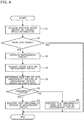
- Fig. 4 is a flowchart illustrating an example of the flow of abnormality detection processing to be executed by the terminal 30 in the vehicle air-conditioning apparatus 1 according to the present embodiment.
- the abnormality detection processing as indicated in Fig. 4 is repeatedly executed at regular intervals.
- step S1 the terminal 30 acquires position information or vehicle speed information on the train including the railway vehicle 100, from any of the vehicle-mounted communication device 41 and the central devices 42 and 43.
- vehicle speed information is also referred to as speed information.
- the position information on the train may be two-dimensional or three-dimensional position information received from a GPS, or kilometrage information on the distance from a station to the train.
- step S2 the terminal 30 determines whether or not the train is stationary based on the acquired position information or vehicle speed information.
- the "stationary" in this case means that the train is temporarily stopped during train service.
- the terminal 30 acquires position information on the train, if this acquired position information coincides with previously acquired position information, the terminal 30 can determine that the train is stationary.
- the terminal 30 acquires vehicle speed information of the train, if the vehicle speed is zero, the terminal 30 can determine that the train is stationary.
- the terminal 30 may be configured to determine that the train is stationary only when the train is stationary at any of the stations, and determine that the train is not stationary when the train is stationary at a location other than the stations.
- the terminal 30 may be configured to determine that the train is stationary whenever the train is stationary, regardless of where the train is stationary. In step S2, when the terminal 30 determines that the train is stationary, the process to be performed proceeds to step S3, and when the terminal 30 determines that the train is not stationary, the process ends.
- step S3 the terminal 30 forcibly causes the refrigerant circuits 10a and 10b to operate.
- the terminal 30 causes the refrigerant circuits 10a and 10b to start to operate, and when the refrigerant circuits 10a and 10b have already operated, the terminal 30 causes the refrigerant circuits 10a and 10b to continue to operate.
- step S4 the terminal 30 acquires state data on the refrigerant circuits 10a and 10b at the time when the train is stationary.
- the state data of the refrigerant circuits 10a and 10b includes data related to, for example, temperature, pressure, current and electric power.
- the state data on the refrigerant circuits 10a and 10b should be acquired under the same operation condition as state data on these circuits was previously acquired (for example, when the train was stationary at a previous station).
- the state data on the refrigerant circuits 10a and 10b should be acquired, with a refrigeration cycle stabilized, after the elapse of predetermined time from the start of the operation of the refrigerant circuits 10a and 10b.
- the operation of the refrigerant circuits 10a and 10b may be stopped after acquiring the state data on the refrigerant circuits 10a and 10b.
- the terminal 30 may be configured not to acquire the state data when it is detected that the train which has been stationary is started before the state data on the refrigerant circuits 10a and 10b is acquired.
- step S5 the terminal 30 determines whether or not abnormality occurs in the refrigerant circuits 10a and 10b based on the acquired state data. For example, the terminal 30 compares currently acquired state data with previously acquired state data (for example, state data acquired when the train was stationary at a previous station) acquired state data, and determines whether or not abnormality occurs in the refrigerant circuits 10a and 10b based on the result of the comparison. For example, in the case where the degree of superheat at the outlet of the evaporator and the pressures of the low-pressure sides of the refrigerant circuits decrease, as compared with those indicated in the previously acquired state data, it can be determined that clogging occurs in an expansion valve.
- previously acquired state data for example, state data acquired when the train was stationary at a previous station
- the terminal 30 may be configured to compare the acquired state data with state data acquired from a vehicle air-conditioning apparatus mounted on another vehicle in the train including the railway vehicle 100, and determine whether or not abnormality occurs in the refrigerant circuits 10a and 10b based on the result of the comparison.
- the state data on the vehicle air-conditioning apparatus mounted on the other vehicle can be, for example, acquired from any of the terminal 30, the central devices 42 and 43 and the vehicle-mounted communication device 41 of the vehicle air-conditioning apparatus mounted on the other vehicle.
- step S6 When the terminal 30 determines that abnormality occurs in the refrigerant circuits 10a and 10b (Yes in step S6), the process proceeds to step S7, and when the terminal 30 determines that abnormality does not occur (No in step S6), the process proceeds to step S8.
- the terminal 30 indicates that abnormality occurs in the refrigerant circuits 10a and 10b.
- the terminal 30 transmits information indicating what abnormality occurs in the refrigerant circuits 10a and 10b to the central devices 42 and 43.
- the central devices 42 and 43 causes respective display units provided thereat to display information indicating what abnormality occurs and in which of the vehicle air-conditioning apparatuses 1 the abnormality occurs.
- the terminal 30 may transmit the information indicating what abnormality occurs in the refrigerant circuits 10a and 10b to the ground system 50 via the vehicle-mounted communication device 41.
- the ground system 50 may cause a display unit provided thereat to display information indicating which of the trains is a train including a vehicle air-conditioning apparatus 1 that the abnormality occurs, which of the vehicle air-conditioning apparatuses 1 is the vehicle air-conditioning apparatus 1 that the abnormality occurs, and what the abnormality is.
- step S8 the terminal 30 indicates that abnormality does not occur in the refrigerant circuit 10a or the refrigerant circuit 10b.
- the terminal 30 transmits information indicating that abnormality does not occur in the refrigerant circuit 10a or the refrigerant circuit 10b to the central devices 42 and 43.
- the central devices 42 and 43 cause the display units provided thereat to display information indicating which of the vehicle air-conditioning apparatuses 1 has no abnormality.
- the terminal 30 may transmit the information indicating that abnormality does not occur in the refrigerant circuit 10a or the refrigerant circuit 10b to the ground system 50 via the vehicle-mounted communication device 41.
- the ground system 50 may be configured to cause the display unit provided thereat to display the information indicating which of the trains is a train including a vehicle air-conditioning apparatus 1 that abnormality does not occur, and which of the vehicle air-conditioning apparatuses 1 is the vehicle air-conditioning apparatus 1 that abnormality does not occur.
- the vehicle air-conditioning apparatus 1 includes the refrigerant circuits 10a and 10b, and the control unit (the terminal 30 in the present embodiment) which controls the refrigerant circuits 10a and 10b.
- the vehicle air-conditioning apparatus 1 is also mounted on the railway vehicle 100.
- the control unit determines whether or not the railway vehicle 100 is stationary based on the position information or speed information on the railway vehicle 100, causes the refrigerant circuits 10a and 10b to operate when the railway vehicle 100 is stationary, acquires state data on the refrigerant circuits 10a and 10b at the time when the railway vehicle 100 is stationary, and detects whether abnormality occurs in the refrigerant circuits 10a and 10b based on the state data.
- Vibration of the traveling railway vehicle 100 is transmitted to the vehicle air-conditioning apparatus 1. Therefore, there is a case where while the railway vehicle 100 is traveling, deterioration of each of components of the vehicle air-conditioning apparatus 1 is promoted or abnormality easily occurs in the vehicle air-conditioning apparatus 1, even when the vehicle air-conditioning apparatus 1 itself is not operated. For example, if the vibration is transmitted to the compressors 11a and 11b, there is a possibility that a rotor and a stator will collide with each other and be damaged. If the vibration is transmitted to the refrigerant pipe, there is a possibility that a joint of a refrigerant pipe will be damaged, and refrigerant will leak therefrom.
- the control unit can detect the abnormality of the refrigerant circuits 10a and 10b at an early stage. Therefore, a defective condition of the vehicle air-conditioning apparatus 1 which results from the abnormality can be corrected at an early stage.
- the operation conditions of the refrigerant circuits 10a and 10b easily vary since they are affected by wind and vibration made while the railway vehicle 100 is traveling.
- state data on the refrigerant circuits 10a and 10b which is acquired by the control unit while the railway vehicle 100 is traveling is not stable, and it is therefore hard to detect whether or not abnormality occur in the refrigerant circuits 10a and 10b.
- the vehicle air-conditioning apparatus 1 is not affected by wind or vibration which would be made while the railway vehicle 100 is traveling, and the state of the vehicle air-conditioning apparatus 1 is thus close to that of a stationary air-conditioning apparatus.
- the operation conditions of the refrigerant circuits 10a and 10b at the timing when the state data is acquired can be easily made to be the same as each other. Therefore, it is possible to improve the accuracy of detection of whether or not abnormality occurs in the refrigerant circuits 10a and 10b at least to the same level as that of the stationary type of air-conditioning apparatus, thereby preventing erroneous detection.
- control unit may be configured to compare acquired state data with previously acquired state data, and detect whether or not abnormality occurs in the refrigerant circuits 10a and 10b based on the result of the comparison. Also, the control unit may be configured to compare the acquired state data with state data acquired from a vehicle air-conditioning apparatus mounted on a vehicle other than the railway vehicle 100 (for example, another vehicle which is included in the same train as the railway vehicle 100), and detect whether or not abnormality occurs in the refrigerant circuits 10a and 10b based on the result of the comparison.
- an abnormality detection system for a vehicle air-conditioning apparatus will be described.
- abnormality in the refrigerant circuits 10a and 10b is detected by the terminal 30 of each of the vehicle air-conditioning apparatuses 1.
- abnormality in the refrigerant circuits 10a and 10b is detected by the ground system 50.
- a schematic configuration of an abnormality detection system 2 is the same as that as illustrated in Fig. 3 .
- Fig. 5 is a flowchart illustrating an example of the flow of state data acquisition processing to be executed by the terminal 30 in the abnormality detection system 2 for the vehicle air-conditioning apparatus 1 according to embodiment 2. Steps S11 to S14 as indicated in Fig. 5 are the same as steps S1 to S4 as indicated in Fig. 4 , and their descriptions will thus be omitted.
- step S15 the terminal 30 transmits state data on the refrigerant circuits 10a and 10b to the ground system 50 via the vehicle-mounted communication device 41 and the communication network 60.
- Fig. 6 is a flowchart illustrating an example of the flow of abnormality detection processing to be executed by the ground system 50 in the abnormality detection system 2 for the vehicle air-conditioning apparatus 1 according to embodiment 2.
- the ground system 50 receives state data on the refrigerant circuits 10a and 10b from a vehicle-mounted system 40 of a given train.
- the ground system 50 stores the received state data in a database 52.
- the database 52 stores state data items which are transmitted from respective vehicle-mounted systems 40a.
- step S22 the ground system 50 compares the state data received from the vehicle-mounted system 40 of the train with state data received from an vehicle-mounted system of another train (e.g., a train which travels ahead of or behind the above train), and determines whether or not abnormality occurs in the refrigerant circuits 10a and 10b based on the result of the comparison. For example, when the degree of superheat at the outlet of the evaporator and the pressures of the low-pressure sides of the refrigerant circuits lower as compared with those indicated in the state data received from the vehicle-mounted system of the other train, it can be determined that clogging occurs in in the expansion valve.
- step S23 When it is determined that abnormality occurs in the refrigerant circuits 10a and 10b (Yes in step S23), the process proceeds to step S24, and when it is determined that abnormality does not occur in the refrigerant circuit 10a or the refrigerant circuit 10b (No in step S23), the process proceeds to step S25.
- the ground system 50 indicates that abnormality occurs in the refrigerant circuits 10a and 10b.
- the ground system 50 causes the display unit provided thereat to display the information indicating which of the trains is a train including a vehicle air-conditioning apparatus 1 that abnormality occurs, which of the vehicle air-conditioning apparatuses 1 is the vehicle air-conditioning apparatus 1 that abnormality occurs, and what the abnormality is.
- the ground system 50 may transmit information indicating which of the vehicle air-conditioning apparatuses 1 is the vehicle air-conditioning apparatus 1 that abnormality occurs and what the abnormality is to the vehicle-mounted system 40 of the train on which the vehicle air-conditioning apparatus 1 that abnormality occurs is mounted.
- the vehicle-mounted system 40 upon reception of the above information, causes the display unit provided at each of the central devices 42 and 43 to display the information indicating which of the vehicle air-conditioning apparatuses 1 is the vehicle air-conditioning apparatus 1 that abnormality occurs, and what the abnormality is.
- the ground system 50 indicates that abnormality does not occur in the refrigerant circuit 10a or the refrigerant circuit 10b.
- the ground system 50 causes the display unit provided thereat to display information indicating which of the trains is a train including a vehicle air-conditioning apparatus 1 that abnormality does not occur, and which of the vehicle air-conditioning apparatuses 1 is the vehicle air-conditioning apparatus 1 that abnormality does not occur.
- the ground system 50 may transmit information indicating which of the vehicle air-conditioning apparatuses 1 is the vehicle air-conditioning apparatus 1 that abnormality does not occur to the vehicle-mounted system 40 of the train on which the vehicle air-conditioning apparatus 1 that abnormality does not occur is mounted.
- the vehicle-mounted system 40 upon reception of the above information, causes, for example, the display unit provided at each of the central devices 42 and 43 to display the information indicating which of the vehicle air-conditioning apparatuses 1 is the vehicle air-conditioning apparatus 1 that abnormality does not occur.
- the abnormality detection system 2 for the vehicle air-conditioning apparatus 1 includes: the vehicle air-conditioning apparatus 1 which includes the refrigerant circuits 10a and 10b and the control units (for example, the vehicle-mounted communication device 41, the central devices 42 and 43, and the terminal 30) which controls the refrigerant circuits 10a and 10b; and the ground system 50 connected to the control unit via the communication network 60.
- the vehicle air-conditioning apparatus 1 is mounted on the railway vehicle 100.
- the control unit of the vehicle air-conditioning apparatus 1 determines whether or not the railway vehicle 100 is stationary based on the position information or speed information on the railway vehicle 100, causes the refrigerant circuits 10a and 10b to operate when the railway vehicle 100 is stationary, acquires the state data on the refrigerant circuits 10a and 10b at the time when the railway vehicle 100 is stationary, and transmits the state data to the ground system 50.
- the ground system 50 detects whether abnormality occurs in the refrigerant circuits 10a and 10b based on the state data.
- the ground system 50 may be configured to compare the state data with state data acquired from a vehicle air-conditioning apparatus mounted on a vehicle included in a train other than the train including the railway vehicle 100, and detect whether abnormality occurs in the refrigerant circuits 10a and 10b based on the result of the comparison.
- vehicle air-conditioning apparatus abnormality detection system 10a, 10b refrigerant circuit 11a, 11b compressor 12a, 12b four-way valve 13a, 13b indoor heat exchanger 14a, 14b pressure-reducing device 15a, 15b outdoor heat exchanger 16 outdoor fan 17a, 17b indoor fan 20 outdoor chamber 21a, 21b indoor chamber 30 terminal 40 vehicle-mounted system 41 vehicle-mounted communication device 42, 43 central device 50 ground system 51 ground communication device 52 database 60 communication network 100 railway vehicle 101 compartment 102 air duct
Landscapes
- Engineering & Computer Science (AREA)
- Mechanical Engineering (AREA)
- Physics & Mathematics (AREA)
- Thermal Sciences (AREA)
- General Engineering & Computer Science (AREA)
- Air-Conditioning For Vehicles (AREA)
- Air Conditioning Control Device (AREA)
- Electric Propulsion And Braking For Vehicles (AREA)
Applications Claiming Priority (1)
| Application Number | Priority Date | Filing Date | Title |
|---|---|---|---|
| PCT/JP2016/067342 WO2017212631A1 (ja) | 2016-06-10 | 2016-06-10 | 車両用空調装置及び車両用空調装置の異常検知システム |
Publications (3)
| Publication Number | Publication Date |
|---|---|
| EP3470293A1 true EP3470293A1 (de) | 2019-04-17 |
| EP3470293A4 EP3470293A4 (de) | 2019-06-19 |
| EP3470293B1 EP3470293B1 (de) | 2021-09-08 |
Family
ID=60579009
Family Applications (1)
| Application Number | Title | Priority Date | Filing Date |
|---|---|---|---|
| EP16904665.3A Active EP3470293B1 (de) | 2016-06-10 | 2016-06-10 | Fahrzeug-klimaanlagengerät |
Country Status (5)
| Country | Link |
|---|---|
| US (1) | US10913326B2 (de) |
| EP (1) | EP3470293B1 (de) |
| JP (1) | JP6567184B2 (de) |
| CN (1) | CN109219552B (de) |
| WO (1) | WO2017212631A1 (de) |
Families Citing this family (3)
| Publication number | Priority date | Publication date | Assignee | Title |
|---|---|---|---|---|
| WO2017212630A1 (ja) * | 2016-06-10 | 2017-12-14 | 三菱電機株式会社 | 車両用空調装置及び車両用空調装置の目詰まり検知システム |
| JP7109671B2 (ja) | 2019-06-20 | 2022-07-29 | 三菱電機株式会社 | 車両用空調装置 |
| EP4183657B1 (de) | 2020-07-14 | 2025-03-12 | Hitachi, Ltd. | Eisenbahnwagen |
Family Cites Families (26)
| Publication number | Priority date | Publication date | Assignee | Title |
|---|---|---|---|---|
| US5623426A (en) * | 1994-02-23 | 1997-04-22 | Sanyo Electric Co., Ltd. | Failure diagnosing system for absorption chillers |
| FR2772310B1 (fr) | 1997-12-17 | 2000-02-11 | Chausson Service | Procede et dispositif de diagnostic d'une boucle de climatisation de vehicule automobile |
| JPH11245807A (ja) * | 1998-03-02 | 1999-09-14 | Mitsubishi Electric Corp | 車両用空調システム |
| JP2000006802A (ja) * | 1998-06-19 | 2000-01-11 | Hitachi Ltd | 鉄道車両用空調装置の故障診断方法 |
| DE19935269C1 (de) * | 1999-07-27 | 2001-01-25 | Daimler Chrysler Ag | Verfahren zur Überwachung des Kältemittelfüllstandes in einer Kälteanlage |
| US20040083744A1 (en) | 2002-11-04 | 2004-05-06 | Visteon Global Technologies, Inc. | Low-charge leak detection strategy for dual automatic temperature control system |
| JP2006010176A (ja) * | 2004-06-24 | 2006-01-12 | Mitsubishi Heavy Ind Ltd | 車両用空調装置の冷媒漏れ検知制御 |
| CN101274636A (zh) * | 2007-03-26 | 2008-10-01 | 林贵生 | 车载式轨道交通车辆运行状态智能监控和预警装置 |
| WO2009150724A1 (ja) * | 2008-06-11 | 2009-12-17 | 三菱電機株式会社 | 車両用空調装置、車両空調管理システム及び車両空調管理方法 |
| JP5040887B2 (ja) * | 2008-10-17 | 2012-10-03 | 三菱電機株式会社 | 車両空調管理システム |
| DE102008037485B4 (de) | 2008-10-27 | 2010-09-02 | Webasto Ag | Verfahren zum Auswerten betriebsbezogener Daten von einer Mehrzahl von gleichartigen Fahrzeugzusatzeinrichtungen |
| US20100174412A1 (en) * | 2009-01-06 | 2010-07-08 | Lg Electronics Inc. | Air conditioner and method for detecting malfunction thereof |
| JP4975052B2 (ja) | 2009-03-30 | 2012-07-11 | 三菱電機株式会社 | 冷凍サイクル装置 |
| US8892277B2 (en) * | 2009-07-22 | 2014-11-18 | Mitsubishi Electric Corporation | Vehicle air-conditioning control method |
| US9714781B2 (en) * | 2011-07-29 | 2017-07-25 | Daikin Industries, Ltd. | Transport refrigeration apparatus |
| US20150184880A1 (en) * | 2012-10-25 | 2015-07-02 | Mitsubishi Electric Corporation | Monitoring system |
| JP6073651B2 (ja) * | 2012-11-09 | 2017-02-01 | サンデンホールディングス株式会社 | 車両用空気調和装置 |
| US9829230B2 (en) * | 2013-02-28 | 2017-11-28 | Mitsubishi Electric Corporation | Air conditioning apparatus |
| JP6012542B2 (ja) * | 2013-05-21 | 2016-10-25 | 三菱電機株式会社 | 車上システム、列車通信システムおよび列車通信方法 |
| US10486499B2 (en) * | 2013-07-18 | 2019-11-26 | Hangzhou Sanhua Research Institute Co., Ltd. | Method for controlling vehicle air-conditioning system, and vehicle air-conditioning system |
| WO2015006952A1 (zh) * | 2013-07-18 | 2015-01-22 | 杭州三花研究院有限公司 | 车辆空调系统过热度控制方法及车辆空调系统 |
| JP6297817B2 (ja) * | 2013-11-08 | 2018-03-20 | 東日本旅客鉄道株式会社 | 車両用空気調和機のメンテナンス時期判定方法 |
| KR101497048B1 (ko) * | 2013-12-11 | 2015-02-27 | 서울메트로 | 철도차량 냉난방제어기용 시뮬레이션 시스템 |
| US9302565B2 (en) * | 2014-06-09 | 2016-04-05 | Ford Global Technologies, Llc | Circulation for pressure loss event |
| CN104385875A (zh) * | 2014-11-11 | 2015-03-04 | 无锡悟莘科技有限公司 | 一种车载空调智能辅助控制系统 |
| CN105946504A (zh) * | 2016-05-05 | 2016-09-21 | 上汽通用汽车有限公司 | 一种控制车载空调的运转模式的方法和装置 |
-
2016
- 2016-06-10 WO PCT/JP2016/067342 patent/WO2017212631A1/ja not_active Ceased
- 2016-06-10 CN CN201680086423.7A patent/CN109219552B/zh active Active
- 2016-06-10 US US16/306,416 patent/US10913326B2/en active Active
- 2016-06-10 JP JP2018522275A patent/JP6567184B2/ja active Active
- 2016-06-10 EP EP16904665.3A patent/EP3470293B1/de active Active
Also Published As
| Publication number | Publication date |
|---|---|
| WO2017212631A1 (ja) | 2017-12-14 |
| US10913326B2 (en) | 2021-02-09 |
| CN109219552B (zh) | 2021-04-13 |
| EP3470293B1 (de) | 2021-09-08 |
| JP6567184B2 (ja) | 2019-08-28 |
| CN109219552A (zh) | 2019-01-15 |
| EP3470293A4 (de) | 2019-06-19 |
| JPWO2017212631A1 (ja) | 2018-12-13 |
| US20200189358A1 (en) | 2020-06-18 |
Similar Documents
| Publication | Publication Date | Title |
|---|---|---|
| US10996007B2 (en) | Vehicle air-conditioning apparatus and clogging detection system for vehicle air-conditioning apparatus | |
| EP3658831B1 (de) | Kühlsystem für kühlelektronik | |
| US10654494B2 (en) | Vehicle air-conditioning device and train communication system | |
| US11260728B2 (en) | Distributed hazard detection system for a transport refrigeration system | |
| KR101496599B1 (ko) | 열원 장치 | |
| US9121624B2 (en) | Information transfer system for refrigeration air-conditioning apparatus | |
| CN107560085B (zh) | 空调压缩机最小运行频率控制方法及控制装置 | |
| EP3470293B1 (de) | Fahrzeug-klimaanlagengerät | |
| JP7040420B2 (ja) | 故障解析システム、故障解析装置 | |
| RU2014137805A (ru) | Система пожаротушения для системы обогрева, вентиляции и кондиционирования транспортного средства | |
| JP6180094B2 (ja) | 車上モニタ装置、地上設備、及び車両用空調システム | |
| HK40000490B (en) | Vehicle air-conditioning device and abnormality detection system for vehicle air-conditioning device | |
| HK40000490A (en) | Vehicle air-conditioning device and abnormality detection system for vehicle air-conditioning device | |
| EP3932705A2 (de) | Systeme und verfahren für management und isolierung von transportklimasteuerschaltungen | |
| EP3591317A3 (de) | Schmiermittelqualitätsmanagement für einen kompressor | |
| HK40001526A (en) | Vehicle air-conditioning device and obstruction detection system for vehicle air-conditioning device | |
| HK40001526B (zh) | 车辆用空调装置及车辆用空调装置的堵塞检测系统 | |
| HK40001524B (en) | Vehicle air-conditioning device and railroad-car communication system | |
| HK40001524A (en) | Vehicle air-conditioning device and railroad-car communication system | |
| JP2016169904A (ja) | 運転条件管理装置 |
Legal Events
| Date | Code | Title | Description |
|---|---|---|---|
| STAA | Information on the status of an ep patent application or granted ep patent |
Free format text: STATUS: THE INTERNATIONAL PUBLICATION HAS BEEN MADE |
|
| PUAI | Public reference made under article 153(3) epc to a published international application that has entered the european phase |
Free format text: ORIGINAL CODE: 0009012 |
|
| STAA | Information on the status of an ep patent application or granted ep patent |
Free format text: STATUS: REQUEST FOR EXAMINATION WAS MADE |
|
| 17P | Request for examination filed |
Effective date: 20181127 |
|
| AK | Designated contracting states |
Kind code of ref document: A1 Designated state(s): AL AT BE BG CH CY CZ DE DK EE ES FI FR GB GR HR HU IE IS IT LI LT LU LV MC MK MT NL NO PL PT RO RS SE SI SK SM TR |
|
| AX | Request for extension of the european patent |
Extension state: BA ME |
|
| A4 | Supplementary search report drawn up and despatched |
Effective date: 20190517 |
|
| RIC1 | Information provided on ipc code assigned before grant |
Ipc: B61D 27/00 20060101AFI20190513BHEP Ipc: B60H 1/32 20060101ALI20190513BHEP Ipc: F25B 49/02 20060101ALI20190513BHEP Ipc: B60H 1/00 20060101ALI20190513BHEP |
|
| DAV | Request for validation of the european patent (deleted) | ||
| DAX | Request for extension of the european patent (deleted) | ||
| STAA | Information on the status of an ep patent application or granted ep patent |
Free format text: STATUS: EXAMINATION IS IN PROGRESS |
|
| 17Q | First examination report despatched |
Effective date: 20200124 |
|
| GRAP | Despatch of communication of intention to grant a patent |
Free format text: ORIGINAL CODE: EPIDOSNIGR1 |
|
| STAA | Information on the status of an ep patent application or granted ep patent |
Free format text: STATUS: GRANT OF PATENT IS INTENDED |
|
| INTG | Intention to grant announced |
Effective date: 20210330 |
|
| GRAS | Grant fee paid |
Free format text: ORIGINAL CODE: EPIDOSNIGR3 |
|
| GRAA | (expected) grant |
Free format text: ORIGINAL CODE: 0009210 |
|
| STAA | Information on the status of an ep patent application or granted ep patent |
Free format text: STATUS: THE PATENT HAS BEEN GRANTED |
|
| AK | Designated contracting states |
Kind code of ref document: B1 Designated state(s): AL AT BE BG CH CY CZ DE DK EE ES FI FR GB GR HR HU IE IS IT LI LT LU LV MC MK MT NL NO PL PT RO RS SE SI SK SM TR |
|
| REG | Reference to a national code |
Ref country code: GB Ref legal event code: FG4D |
|
| REG | Reference to a national code |
Ref country code: CH Ref legal event code: EP Ref country code: AT Ref legal event code: REF Ref document number: 1428342 Country of ref document: AT Kind code of ref document: T Effective date: 20210915 |
|
| REG | Reference to a national code |
Ref country code: DE Ref legal event code: R096 Ref document number: 602016063604 Country of ref document: DE |
|
| REG | Reference to a national code |
Ref country code: IE Ref legal event code: FG4D |
|
| REG | Reference to a national code |
Ref country code: LT Ref legal event code: MG9D |
|
| REG | Reference to a national code |
Ref country code: NL Ref legal event code: MP Effective date: 20210908 |
|
| PG25 | Lapsed in a contracting state [announced via postgrant information from national office to epo] |
Ref country code: LT Free format text: LAPSE BECAUSE OF FAILURE TO SUBMIT A TRANSLATION OF THE DESCRIPTION OR TO PAY THE FEE WITHIN THE PRESCRIBED TIME-LIMIT Effective date: 20210908 Ref country code: BG Free format text: LAPSE BECAUSE OF FAILURE TO SUBMIT A TRANSLATION OF THE DESCRIPTION OR TO PAY THE FEE WITHIN THE PRESCRIBED TIME-LIMIT Effective date: 20211208 Ref country code: NO Free format text: LAPSE BECAUSE OF FAILURE TO SUBMIT A TRANSLATION OF THE DESCRIPTION OR TO PAY THE FEE WITHIN THE PRESCRIBED TIME-LIMIT Effective date: 20211208 Ref country code: ES Free format text: LAPSE BECAUSE OF FAILURE TO SUBMIT A TRANSLATION OF THE DESCRIPTION OR TO PAY THE FEE WITHIN THE PRESCRIBED TIME-LIMIT Effective date: 20210908 Ref country code: FI Free format text: LAPSE BECAUSE OF FAILURE TO SUBMIT A TRANSLATION OF THE DESCRIPTION OR TO PAY THE FEE WITHIN THE PRESCRIBED TIME-LIMIT Effective date: 20210908 Ref country code: HR Free format text: LAPSE BECAUSE OF FAILURE TO SUBMIT A TRANSLATION OF THE DESCRIPTION OR TO PAY THE FEE WITHIN THE PRESCRIBED TIME-LIMIT Effective date: 20210908 Ref country code: SE Free format text: LAPSE BECAUSE OF FAILURE TO SUBMIT A TRANSLATION OF THE DESCRIPTION OR TO PAY THE FEE WITHIN THE PRESCRIBED TIME-LIMIT Effective date: 20210908 Ref country code: RS Free format text: LAPSE BECAUSE OF FAILURE TO SUBMIT A TRANSLATION OF THE DESCRIPTION OR TO PAY THE FEE WITHIN THE PRESCRIBED TIME-LIMIT Effective date: 20210908 |
|
| REG | Reference to a national code |
Ref country code: AT Ref legal event code: MK05 Ref document number: 1428342 Country of ref document: AT Kind code of ref document: T Effective date: 20210908 |
|
| PG25 | Lapsed in a contracting state [announced via postgrant information from national office to epo] |
Ref country code: LV Free format text: LAPSE BECAUSE OF FAILURE TO SUBMIT A TRANSLATION OF THE DESCRIPTION OR TO PAY THE FEE WITHIN THE PRESCRIBED TIME-LIMIT Effective date: 20210908 Ref country code: GR Free format text: LAPSE BECAUSE OF FAILURE TO SUBMIT A TRANSLATION OF THE DESCRIPTION OR TO PAY THE FEE WITHIN THE PRESCRIBED TIME-LIMIT Effective date: 20211209 |
|
| PG25 | Lapsed in a contracting state [announced via postgrant information from national office to epo] |
Ref country code: AT Free format text: LAPSE BECAUSE OF FAILURE TO SUBMIT A TRANSLATION OF THE DESCRIPTION OR TO PAY THE FEE WITHIN THE PRESCRIBED TIME-LIMIT Effective date: 20210908 |
|
| PG25 | Lapsed in a contracting state [announced via postgrant information from national office to epo] |
Ref country code: IS Free format text: LAPSE BECAUSE OF FAILURE TO SUBMIT A TRANSLATION OF THE DESCRIPTION OR TO PAY THE FEE WITHIN THE PRESCRIBED TIME-LIMIT Effective date: 20220108 Ref country code: SM Free format text: LAPSE BECAUSE OF FAILURE TO SUBMIT A TRANSLATION OF THE DESCRIPTION OR TO PAY THE FEE WITHIN THE PRESCRIBED TIME-LIMIT Effective date: 20210908 Ref country code: SK Free format text: LAPSE BECAUSE OF FAILURE TO SUBMIT A TRANSLATION OF THE DESCRIPTION OR TO PAY THE FEE WITHIN THE PRESCRIBED TIME-LIMIT Effective date: 20210908 Ref country code: RO Free format text: LAPSE BECAUSE OF FAILURE TO SUBMIT A TRANSLATION OF THE DESCRIPTION OR TO PAY THE FEE WITHIN THE PRESCRIBED TIME-LIMIT Effective date: 20210908 Ref country code: PT Free format text: LAPSE BECAUSE OF FAILURE TO SUBMIT A TRANSLATION OF THE DESCRIPTION OR TO PAY THE FEE WITHIN THE PRESCRIBED TIME-LIMIT Effective date: 20220110 Ref country code: PL Free format text: LAPSE BECAUSE OF FAILURE TO SUBMIT A TRANSLATION OF THE DESCRIPTION OR TO PAY THE FEE WITHIN THE PRESCRIBED TIME-LIMIT Effective date: 20210908 Ref country code: NL Free format text: LAPSE BECAUSE OF FAILURE TO SUBMIT A TRANSLATION OF THE DESCRIPTION OR TO PAY THE FEE WITHIN THE PRESCRIBED TIME-LIMIT Effective date: 20210908 Ref country code: EE Free format text: LAPSE BECAUSE OF FAILURE TO SUBMIT A TRANSLATION OF THE DESCRIPTION OR TO PAY THE FEE WITHIN THE PRESCRIBED TIME-LIMIT Effective date: 20210908 Ref country code: CZ Free format text: LAPSE BECAUSE OF FAILURE TO SUBMIT A TRANSLATION OF THE DESCRIPTION OR TO PAY THE FEE WITHIN THE PRESCRIBED TIME-LIMIT Effective date: 20210908 Ref country code: AL Free format text: LAPSE BECAUSE OF FAILURE TO SUBMIT A TRANSLATION OF THE DESCRIPTION OR TO PAY THE FEE WITHIN THE PRESCRIBED TIME-LIMIT Effective date: 20210908 |
|
| REG | Reference to a national code |
Ref country code: DE Ref legal event code: R097 Ref document number: 602016063604 Country of ref document: DE |
|
| PLBE | No opposition filed within time limit |
Free format text: ORIGINAL CODE: 0009261 |
|
| STAA | Information on the status of an ep patent application or granted ep patent |
Free format text: STATUS: NO OPPOSITION FILED WITHIN TIME LIMIT |
|
| PG25 | Lapsed in a contracting state [announced via postgrant information from national office to epo] |
Ref country code: DK Free format text: LAPSE BECAUSE OF FAILURE TO SUBMIT A TRANSLATION OF THE DESCRIPTION OR TO PAY THE FEE WITHIN THE PRESCRIBED TIME-LIMIT Effective date: 20210908 |
|
| 26N | No opposition filed |
Effective date: 20220609 |
|
| PG25 | Lapsed in a contracting state [announced via postgrant information from national office to epo] |
Ref country code: SI Free format text: LAPSE BECAUSE OF FAILURE TO SUBMIT A TRANSLATION OF THE DESCRIPTION OR TO PAY THE FEE WITHIN THE PRESCRIBED TIME-LIMIT Effective date: 20210908 |
|
| PG25 | Lapsed in a contracting state [announced via postgrant information from national office to epo] |
Ref country code: MC Free format text: LAPSE BECAUSE OF FAILURE TO SUBMIT A TRANSLATION OF THE DESCRIPTION OR TO PAY THE FEE WITHIN THE PRESCRIBED TIME-LIMIT Effective date: 20210908 |
|
| REG | Reference to a national code |
Ref country code: CH Ref legal event code: PL |
|
| REG | Reference to a national code |
Ref country code: BE Ref legal event code: MM Effective date: 20220630 |
|
| PG25 | Lapsed in a contracting state [announced via postgrant information from national office to epo] |
Ref country code: LU Free format text: LAPSE BECAUSE OF NON-PAYMENT OF DUE FEES Effective date: 20220610 Ref country code: LI Free format text: LAPSE BECAUSE OF NON-PAYMENT OF DUE FEES Effective date: 20220630 Ref country code: IE Free format text: LAPSE BECAUSE OF NON-PAYMENT OF DUE FEES Effective date: 20220610 Ref country code: CH Free format text: LAPSE BECAUSE OF NON-PAYMENT OF DUE FEES Effective date: 20220630 |
|
| PG25 | Lapsed in a contracting state [announced via postgrant information from national office to epo] |
Ref country code: BE Free format text: LAPSE BECAUSE OF NON-PAYMENT OF DUE FEES Effective date: 20220630 |
|
| P01 | Opt-out of the competence of the unified patent court (upc) registered |
Effective date: 20230512 |
|
| REG | Reference to a national code |
Ref country code: DE Ref legal event code: R084 Ref document number: 602016063604 Country of ref document: DE |
|
| PG25 | Lapsed in a contracting state [announced via postgrant information from national office to epo] |
Ref country code: HU Free format text: LAPSE BECAUSE OF FAILURE TO SUBMIT A TRANSLATION OF THE DESCRIPTION OR TO PAY THE FEE WITHIN THE PRESCRIBED TIME-LIMIT; INVALID AB INITIO Effective date: 20160610 |
|
| PG25 | Lapsed in a contracting state [announced via postgrant information from national office to epo] |
Ref country code: MK Free format text: LAPSE BECAUSE OF FAILURE TO SUBMIT A TRANSLATION OF THE DESCRIPTION OR TO PAY THE FEE WITHIN THE PRESCRIBED TIME-LIMIT Effective date: 20210908 Ref country code: CY Free format text: LAPSE BECAUSE OF FAILURE TO SUBMIT A TRANSLATION OF THE DESCRIPTION OR TO PAY THE FEE WITHIN THE PRESCRIBED TIME-LIMIT Effective date: 20210908 |
|
| PG25 | Lapsed in a contracting state [announced via postgrant information from national office to epo] |
Ref country code: TR Free format text: LAPSE BECAUSE OF FAILURE TO SUBMIT A TRANSLATION OF THE DESCRIPTION OR TO PAY THE FEE WITHIN THE PRESCRIBED TIME-LIMIT Effective date: 20210908 |
|
| PG25 | Lapsed in a contracting state [announced via postgrant information from national office to epo] |
Ref country code: MT Free format text: LAPSE BECAUSE OF FAILURE TO SUBMIT A TRANSLATION OF THE DESCRIPTION OR TO PAY THE FEE WITHIN THE PRESCRIBED TIME-LIMIT Effective date: 20210908 |
|
| PGFP | Annual fee paid to national office [announced via postgrant information from national office to epo] |
Ref country code: DE Payment date: 20250429 Year of fee payment: 10 |
|
| PGFP | Annual fee paid to national office [announced via postgrant information from national office to epo] |
Ref country code: GB Payment date: 20250501 Year of fee payment: 10 |
|
| PGFP | Annual fee paid to national office [announced via postgrant information from national office to epo] |
Ref country code: IT Payment date: 20250522 Year of fee payment: 10 |
|
| PGFP | Annual fee paid to national office [announced via postgrant information from national office to epo] |
Ref country code: FR Payment date: 20250508 Year of fee payment: 10 |