EP3461750B9 - Behältnis zur aufnahme von verpackungsmaterial - Google Patents
Behältnis zur aufnahme von verpackungsmaterial Download PDFInfo
- Publication number
- EP3461750B9 EP3461750B9 EP18206828.8A EP18206828A EP3461750B9 EP 3461750 B9 EP3461750 B9 EP 3461750B9 EP 18206828 A EP18206828 A EP 18206828A EP 3461750 B9 EP3461750 B9 EP 3461750B9
- Authority
- EP
- European Patent Office
- Prior art keywords
- container
- packaging
- treatment agent
- cut edges
- open cut
- Prior art date
- Legal status (The legal status is an assumption and is not a legal conclusion. Google has not performed a legal analysis and makes no representation as to the accuracy of the status listed.)
- Active
Links
Images



Classifications
-
- A—HUMAN NECESSITIES
- A61—MEDICAL OR VETERINARY SCIENCE; HYGIENE
- A61L—METHODS OR APPARATUS FOR STERILISING MATERIALS OR OBJECTS IN GENERAL; DISINFECTION, STERILISATION OR DEODORISATION OF AIR; CHEMICAL ASPECTS OF BANDAGES, DRESSINGS, ABSORBENT PADS OR SURGICAL ARTICLES; MATERIALS FOR BANDAGES, DRESSINGS, ABSORBENT PADS OR SURGICAL ARTICLES
- A61L2/00—Methods or apparatus for disinfecting or sterilising materials or objects other than foodstuffs or contact lenses; Accessories therefor
- A61L2/16—Methods or apparatus for disinfecting or sterilising materials or objects other than foodstuffs or contact lenses; Accessories therefor using chemical substances
- A61L2/18—Liquid substances or solutions comprising solids or dissolved gases
- A61L2/186—Peroxide solutions
-
- B—PERFORMING OPERATIONS; TRANSPORTING
- B65—CONVEYING; PACKING; STORING; HANDLING THIN OR FILAMENTARY MATERIAL
- B65B—MACHINES, APPARATUS OR DEVICES FOR, OR METHODS OF, PACKAGING ARTICLES OR MATERIALS; UNPACKING
- B65B31/00—Packaging articles or materials under special atmospheric or gaseous conditions; Adding propellants to aerosol containers
- B65B31/04—Evacuating, pressurising or gasifying filled containers or wrappers by means of nozzles through which air or other gas, e.g. an inert gas, is withdrawn or supplied
- B65B31/041—Evacuating, pressurising or gasifying filled containers or wrappers by means of nozzles through which air or other gas, e.g. an inert gas, is withdrawn or supplied the nozzles acting from above on containers or wrappers open at their top
- B65B31/042—Evacuating, pressurising or gasifying filled containers or wrappers by means of nozzles through which air or other gas, e.g. an inert gas, is withdrawn or supplied the nozzles acting from above on containers or wrappers open at their top the nozzles being arranged for insertion into, and withdrawal from, the container or wrapper
-
- B—PERFORMING OPERATIONS; TRANSPORTING
- B65—CONVEYING; PACKING; STORING; HANDLING THIN OR FILAMENTARY MATERIAL
- B65B—MACHINES, APPARATUS OR DEVICES FOR, OR METHODS OF, PACKAGING ARTICLES OR MATERIALS; UNPACKING
- B65B31/00—Packaging articles or materials under special atmospheric or gaseous conditions; Adding propellants to aerosol containers
- B65B31/04—Evacuating, pressurising or gasifying filled containers or wrappers by means of nozzles through which air or other gas, e.g. an inert gas, is withdrawn or supplied
- B65B31/08—Evacuating, pressurising or gasifying filled containers or wrappers by means of nozzles through which air or other gas, e.g. an inert gas, is withdrawn or supplied the nozzle being adapted to pierce the container or wrapper
-
- B—PERFORMING OPERATIONS; TRANSPORTING
- B65—CONVEYING; PACKING; STORING; HANDLING THIN OR FILAMENTARY MATERIAL
- B65B—MACHINES, APPARATUS OR DEVICES FOR, OR METHODS OF, PACKAGING ARTICLES OR MATERIALS; UNPACKING
- B65B55/00—Preserving, protecting or purifying packages or package contents in association with packaging
- B65B55/02—Sterilising, e.g. of complete packages
- B65B55/04—Sterilising wrappers or receptacles prior to, or during, packaging
-
- B—PERFORMING OPERATIONS; TRANSPORTING
- B65—CONVEYING; PACKING; STORING; HANDLING THIN OR FILAMENTARY MATERIAL
- B65B—MACHINES, APPARATUS OR DEVICES FOR, OR METHODS OF, PACKAGING ARTICLES OR MATERIALS; UNPACKING
- B65B55/00—Preserving, protecting or purifying packages or package contents in association with packaging
- B65B55/02—Sterilising, e.g. of complete packages
- B65B55/04—Sterilising wrappers or receptacles prior to, or during, packaging
- B65B55/10—Sterilising wrappers or receptacles prior to, or during, packaging by liquids or gases
-
- B—PERFORMING OPERATIONS; TRANSPORTING
- B65—CONVEYING; PACKING; STORING; HANDLING THIN OR FILAMENTARY MATERIAL
- B65D—CONTAINERS FOR STORAGE OR TRANSPORT OF ARTICLES OR MATERIALS, e.g. BAGS, BARRELS, BOTTLES, BOXES, CANS, CARTONS, CRATES, DRUMS, JARS, TANKS, HOPPERS, FORWARDING CONTAINERS; ACCESSORIES, CLOSURES, OR FITTINGS THEREFOR; PACKAGING ELEMENTS; PACKAGES
- B65D65/00—Wrappers or flexible covers; Packaging materials of special type or form
- B65D65/38—Packaging materials of special type or form
- B65D65/42—Applications of coated or impregnated materials
-
- B—PERFORMING OPERATIONS; TRANSPORTING
- B65—CONVEYING; PACKING; STORING; HANDLING THIN OR FILAMENTARY MATERIAL
- B65D—CONTAINERS FOR STORAGE OR TRANSPORT OF ARTICLES OR MATERIALS, e.g. BAGS, BARRELS, BOTTLES, BOXES, CANS, CARTONS, CRATES, DRUMS, JARS, TANKS, HOPPERS, FORWARDING CONTAINERS; ACCESSORIES, CLOSURES, OR FITTINGS THEREFOR; PACKAGING ELEMENTS; PACKAGES
- B65D75/00—Packages comprising articles or materials partially or wholly enclosed in strips, sheets, blanks, tubes or webs of flexible sheet material, e.g. in folded wrappers
- B65D75/002—Packages comprising articles or materials partially or wholly enclosed in strips, sheets, blanks, tubes or webs of flexible sheet material, e.g. in folded wrappers in shrink films
-
- B—PERFORMING OPERATIONS; TRANSPORTING
- B65—CONVEYING; PACKING; STORING; HANDLING THIN OR FILAMENTARY MATERIAL
- B65D—CONTAINERS FOR STORAGE OR TRANSPORT OF ARTICLES OR MATERIALS, e.g. BAGS, BARRELS, BOTTLES, BOXES, CANS, CARTONS, CRATES, DRUMS, JARS, TANKS, HOPPERS, FORWARDING CONTAINERS; ACCESSORIES, CLOSURES, OR FITTINGS THEREFOR; PACKAGING ELEMENTS; PACKAGES
- B65D81/00—Containers, packaging elements, or packages, for contents presenting particular transport or storage problems, or adapted to be used for non-packaging purposes after removal of contents
- B65D81/24—Adaptations for preventing deterioration or decay of contents; Applications to the container or packaging material of food preservatives, fungicides, pesticides or animal repellants
-
- B—PERFORMING OPERATIONS; TRANSPORTING
- B65—CONVEYING; PACKING; STORING; HANDLING THIN OR FILAMENTARY MATERIAL
- B65D—CONTAINERS FOR STORAGE OR TRANSPORT OF ARTICLES OR MATERIALS, e.g. BAGS, BARRELS, BOTTLES, BOXES, CANS, CARTONS, CRATES, DRUMS, JARS, TANKS, HOPPERS, FORWARDING CONTAINERS; ACCESSORIES, CLOSURES, OR FITTINGS THEREFOR; PACKAGING ELEMENTS; PACKAGES
- B65D85/00—Containers, packaging elements or packages, specially adapted for particular articles or materials
- B65D85/62—Containers, packaging elements or packages, specially adapted for particular articles or materials for stacks of articles; for special arrangements of groups of articles
-
- D—TEXTILES; PAPER
- D21—PAPER-MAKING; PRODUCTION OF CELLULOSE
- D21H—PULP COMPOSITIONS; PREPARATION THEREOF NOT COVERED BY SUBCLASSES D21C OR D21D; IMPREGNATING OR COATING OF PAPER; TREATMENT OF FINISHED PAPER NOT COVERED BY CLASS B31 OR SUBCLASS D21G; PAPER NOT OTHERWISE PROVIDED FOR
- D21H27/00—Special paper not otherwise provided for, e.g. made by multi-step processes
- D21H27/10—Packing paper
-
- A—HUMAN NECESSITIES
- A61—MEDICAL OR VETERINARY SCIENCE; HYGIENE
- A61L—METHODS OR APPARATUS FOR STERILISING MATERIALS OR OBJECTS IN GENERAL; DISINFECTION, STERILISATION OR DEODORISATION OF AIR; CHEMICAL ASPECTS OF BANDAGES, DRESSINGS, ABSORBENT PADS OR SURGICAL ARTICLES; MATERIALS FOR BANDAGES, DRESSINGS, ABSORBENT PADS OR SURGICAL ARTICLES
- A61L2/00—Methods or apparatus for disinfecting or sterilising materials or objects other than foodstuffs or contact lenses; Accessories therefor
- A61L2/16—Methods or apparatus for disinfecting or sterilising materials or objects other than foodstuffs or contact lenses; Accessories therefor using chemical substances
- A61L2/22—Phase substances, e.g. smokes, aerosols or sprayed or atomised substances
-
- A—HUMAN NECESSITIES
- A61—MEDICAL OR VETERINARY SCIENCE; HYGIENE
- A61L—METHODS OR APPARATUS FOR STERILISING MATERIALS OR OBJECTS IN GENERAL; DISINFECTION, STERILISATION OR DEODORISATION OF AIR; CHEMICAL ASPECTS OF BANDAGES, DRESSINGS, ABSORBENT PADS OR SURGICAL ARTICLES; MATERIALS FOR BANDAGES, DRESSINGS, ABSORBENT PADS OR SURGICAL ARTICLES
- A61L2202/00—Aspects relating to methods or apparatus for disinfecting or sterilising materials or objects
- A61L2202/20—Targets to be treated
- A61L2202/23—Containers, e.g. vials, bottles, syringes, mail
Definitions
- the invention relates to containers for receiving packaging material, wherein at least parts of the inside of the container are wetted or provided with a treatment agent and/or loading carriers provided with a treatment agent are provided in the interior of the container and that the treatment agent contains an H 2 O 2 solution as a disinfectant.
- a generic container which is suitable for holding a number of flat-folded packaging sleeves, blanks or web material rolled up into a roll.
- a treatment agent is used there which contains a H 2 O 2 solution ("peroxide") as a disinfectant in order to disinfect the objects packed in the container.
- a treatment agent that consists of a combination of ethanol and a preservative. The treatment agents described there are used to increase the shelf life of fruit, vegetables, flowers or the like. The disinfection of packaging material is not described there.
- Cardboard/plastic composite packaging is manufactured either using a so-called "tube forming process” from a roll or from individual cuts of paper/plastic laminate material.
- individual cuts are first obtained from a roll of composite material and then provided with a tight longitudinal seam, which is generally created by folding and sealing the composite material and, if necessary, by additionally sticking a sealing strip over it.
- the treatment of open cut edges of a packaging sleeve, blank or a web of packaging material rolled up into a roll, in particular cardboard/plastic composite material, is carried out by applying or introducing a treatment agent containing a disinfectant onto or into the outer area of the cut edges.
- 'open cut edges' we do not only mean the cut edges that border a blank or a packaging sleeve formed from it, but all 'open' pulp areas that are accessible to the surrounding atmosphere, so that we also mean cut edges inside perforations in particular, such as those found in drinks packaging in the area of pouring elements or other opening aids.
- the open cut edges form pulp areas that are accessible to the surrounding atmosphere.
- packaging sleeves produced in this way i.e. the one-sided sealing on the top or bottom of the subsequent packaging, the sterilization, the filling and the re-sealing, usually takes place directly in the filling machine.
- cup forming, cleaning and, if necessary, disinfection take place before the filling material is filled in and the composite packaging is sealed and finally formed.
- Disinfection and filling take place in the aseptic zone of a filling machine when producing a so-called aseptic composite packaging. If the cup forming takes place before disinfection or sterilization, the cup forming can also take place outside the aseptic zone.
- Such processes are used, among other things, in the EN 32 35 476 A1 and the EN 10 2009 029 706 A1 described.
- the packaging is usually closed by pressing and sealing the edges of the packaging material, for example by ultrasound using a sonotrode and an anvil.
- Other Methods for closing the package are known, for example electromagnetic induction or the application of hot air in combination with mechanical pressing.
- Aseptic packaging is packaging into which a filling product, in particular a foodstuff, is filled under aseptic conditions.
- Filling machines used for this purpose comprise an aseptic zone, a type of clean room in which sterile, i.e. germ-free conditions prevail, to maintain which the room is usually closed or largely closed except for a few openings.
- the clean room atmosphere created there is also under overpressure by the introduction of sterile air, so that no germs can penetrate from the outside.
- the packaging material is then transported continuously or discontinuously through the aseptic zone, where it is sterilized in successive steps, dried, filled in one or more steps and sealed.
- today's state-of-the-art machines such as a machine from the applicant's 24 series, allow a processing time of a single sterilization or filling station of around 0.6 seconds to around 0.85 seconds, depending on the packaging format.
- edges of packaging sleeves are open cut edges of a laminate material that is otherwise waterproof and may also have an oxygen barrier. Therefore, the risk of germs (microorganisms and spores) being exchanged primarily in the area of the edges, which can increase the germ load of the material and ultimately contamination of the product when the packaging is subsequently filled or closed to form the finished package cannot be ruled out.
- Closing a filled container made of composite material that is open on one side carries the risk that dust from the packaging material can be thrown out of the open cut edges, particularly when sealing with ultrasound, and this can contaminate both the aseptic area of the filling machine and the open packaging itself.
- Vegetative microorganisms are understood to be single-celled organisms capable of reproducing by cell division, which are capable of multiplying in the contents ('product') of a package and thereby changing the properties of the contents.
- the term also includes the persistence forms of the single-celled organisms capable of reproducing, such as their spores.
- spores are usually very resistant to changes in the environmental conditions around them. If microorganisms do not find an environment for metabolism and/or reproduction, some microorganisms have the opportunity to transition into a spore stage.
- microorganisms within the meaning of the present application should be understood to mean eukaryotes and prokaryotes, with eukaryotes having a true cell wall and comprising algae, protozoa, fungi and slime molds, while prokaryotes cover the group of bacteria (cf. 'Bergey's Manual of Determinative Bacteriology', 8th edition, Baltimore: Williams & Wilkins, 1974 ).
- colony forming unit per gram is known to those skilled in the art as a measure of the number or amount of microorganisms contained in a quantity of material (for example in the cardboard raw product mentioned).
- the number of colony forming units is determined by the targeted multiplication of the microorganisms present that are capable of dividing under suitable cultivation conditions. In general, this is done up to a colony size that can be counted with the naked eye. This takes advantage of the fact that exactly one colony is formed from each individual microorganism that is capable of dividing under previously defined conditions. Individual cases in which two cfu are so close together that only one visible colony is formed from them are then regularly neglected.
- a reduction in cfu/g is therefore used by experts as a measure of the effectiveness of a process for reducing germs and is often referred to as the disinfection rate.
- the sterility rate is derived from this and is calculated based on the number of packages produced.
- the treatment agent can have an unintentional effect on the print image on the outside of the packaging sleeve and damage it. It can also happen that two packaging sleeves stick together after being removed from the outer carton and can lead to production disruptions during their further processing in the filling machine.
- At least part of the treatment agent is not applied directly to the cut edges, but rather a treatment carrier is loaded which receives the treatment agent, so that an actively sterilizing atmosphere subsequently acts on the open cut edges of the packaging sleeve, blank or web material and carries out the desired sterilization.
- the "sufficient depth” is determined by the respective used manufacturing process. If the seam is formed using ultrasound, sterilization must be carried out to a depth of about 2 to 3 mm in order to reliably prevent contaminated dust from being thrown out of the open edge during the sealing process. If the seam is to be closed using microwave technology, a depth of a few tenths of a millimeter is sufficient.
- the invention is based on the object of providing a container for receiving a plurality of flat-folded packaging sleeves, blanks or web material rolled up into a roll, in which the aforementioned packaging material is stored or transported with sterilized open cut edges.
- a container for accommodating packaging material with the features of the preamble of patent claim 1 in that the packaging material consists of a composite material with at least one layer of cardboard which contains pulp, that the container contains packaging material in the form of a plurality of flat-folded packaging sleeves, blanks or web material rolled up into a roll, each with open cut edges, the open cut edges forming pulp areas accessible to the surrounding atmosphere, and that the treatment agent contains ethanol.
- the transfer of the treatment agent occurs indirectly through evaporation and subsequent absorption in the open cut edge(s) of the packaging material.
- the outer surfaces of the container can preferably be sealed at least in the perforated area in order to reliably prevent migration of the treatment agent to the environment.
- PE containers are explained in more detail below using the exemplary embodiments.
- cardboard in particular corrugated cardboard, is used as the material for the container, so that an outer box with closable flaps is created.
- the container is a corrugated cardboard box
- this offers the advantage that the absorption of the sterilizing agent from the loaded outer carton flaps takes place through the upper or lower open cardboard edges of the packed sleeves in the outer carton.
- the outer carton is treated with the treatment agent outside of the direct production line, for example in an adjacent room.
- the outer carton which is itself a folding box, is loaded before or during the unfolding of the outer carton.
- plastic can also be used as the material for the container.
- the container can have a plastic container and a plastic lid as well as at least one loading carrier.
- the container it is also possible for the container to be a shrink film with a loading carrier.
- An "inoculation" of the atmosphere enclosed by the container, preferably the outer carton, after the carton has been closed is possible, for example, with a needle, whereby the outer carton must be pierced once or several times at suitable points, for example in the free head space.
- a loading carrier for example a felt strip, is applied to the inside of the outer carton before closing and is penetrated with a needle after the outer carton has been closed so that the needle can inject the treatment agent into the loading carrier. In this way, the environment is practically not polluted by the active ingredients contained in the treatment agent.
- the container can also include a valve. Using a valve effectively prevents the treatment agent from escaping from the container or from diffusing excessively.
- the valve can be designed as a mechanical one-way valve or as a pierceable and self-closing membrane. Providing a mechanical valve can be particularly advantageous for reusable containers, while a self-closing membrane can also be easily glued to the outside or inside of the container and offers sufficient protection for at least one-time use.
- the treatment agent is preferably colored with a suitable dye. This makes it easy to visually identify the application area. This can be used for control purposes. If a dye is also used which is absorbed by the open cut edges of the packaging material together with the disinfectant from the actively sterilizing atmosphere, treatment can also be verified on the packaging material itself by a simple visual inspection. The depth of penetration of the treatment agent into the edge area can then also be determined. It is therefore preferred that the dye causes a discoloration of the treated edges.
- a treatment agent containing a disinfectant such as a peroxide solution
- a treatment agent containing a disinfectant can be applied to an outer packaging at a suitable location, for example the inside of the flaps of an outer carton, by spraying, dripping and then spreading, painting, rolling, dabbing, spatulating, printing (for example using an "inkjet” process), dipping or steaming.
- the loading can also be carried out - as already mentioned - by injection.
- edges of the packaging materials to be transported in a container can also be exposed to disinfectant by attaching a strip, insert sheet or other carrier material loaded with a sterilizing agent.
- the load carrier is designed as an accumulator and can be refilled with liquid treatment agent in order to then release the treatment agent back into the environment.
- Porous or cellular storage materials are particularly suitable for this.
- the flat-folded packaging materials packed in a container, especially an outer box, are usually transported over a period of several days. During this time, the open cardboard edges and the container or outer packaging are reduced in germs or sterilized by the absorbed sterilizing agent. Surprisingly, it has been found that, despite very low concentrations of the disinfectant, excellent disinfection rates are achieved. It is now assumed that the low concentrations of the disinfectant can use the long residence time in the container as an effective exposure time. The resulting actively sterilizing atmosphere can therefore be maintained within an effective framework over a long period of several hours or even days. This results in a long exposure time at a low concentration.
- the disinfectant penetrates - depending on the amount used - up to 2 mm or 3 mm or even deeper into the Edge area or perforation area of the cardboard. This is important because the fibers located there in the pulp/cardboard layer cannot be described as stationary and therefore the germs located on the fibers are not bound but can escape from the pulp/cardboard layer as dust with the fibers.
- the exposure time in each case related to a specific cardboard type and grammage, depends on the treatment agent used or the additives contained, the dosage, the expected disinfection rate and the ambient temperature.
- the cardboard used for the packaging to be produced is hydrophilic and generally has a relative humidity of around 5.5% - 8.5% as a finished product, i.e. the humidity of the cardboard is well below the saturation limit, which results from the prevailing environmental conditions and is generally identical to the equilibrium humidity of the environment.
- a polar organic solvent which has a lower vapor pressure than the active agent, in this case the disinfectant, acts as an accelerator.
- ethanol to the peroxide solution promotes the absorption effect of the cut edge and increases the penetration of the peroxide into the cardboard. This allows the disinfectant to penetrate deeper into the cut edges, so that with the right ratio of disinfectant to ethanol, an edge area of the packaging material to be treated can be sterilized up to several millimeters deep after just a few hours.
- Ethanol belongs to the group of polar organic solvents, which generally act as accelerators if their vapor pressure is lower than that of the active medium. If the vapor pressure of the added polar organic solvent is higher than that of the active agent, the solvent acts as a retarder.
- An example of a solvent with a higher vapor pressure is DOWANOL ® , a branded product of the DOW Chemical Company.
- DOWANOL ® a branded product of the DOW Chemical Company.
- low molecular weight polar organic solvents have a low vapor pressure and higher molecular weight organic solvents have a high vapor pressure.
- the European standard method ISO 8784-1:2005 and the references cited in this test specification are chosen as the basis for determining the colony forming units per gram (cfu/g).
- the test specifications are used here to examine the cfu/g load of packaging or composite materials made of cardboard, plastic and, in some cases, aluminum. Should deviations from the test specifications cited be necessary in carrying out the sampling and determination of the cfu/g of the packaging material, they are explained below.
- the packaging material samples taken must not be touched with hands. They are stored in sterile sampling containers, preferably sterile plastic bags. The areas to be examined are cut into pieces using sterile scissors.
- a maximum of 3 g of packaging material is used for the first sub-areas.
- a maximum of 3 g of packaging material is also used for the second sub-area. If sufficient material is not obtained from one sample piece, the second sub-areas are made up of a maximum of 5 identical sample pieces.
- packaging material samples are contaminated on the surface before sampling in addition to the presence of germs inside.
- An error in determining the cfu/g of the packaging material can be prevented by determining the surface germ count separately and subtracting the surface germ count from the number of colony forming units per gram determined under 1.1.
- a contact Petri dish has an area of 24 cm 2 . Therefore, 10 contact dishes must be prepared per sample to examine the above area.
- Enough culture medium is added to the sterile Petri dishes so that the agar protrudes over the edge of the Petri dish (curvature), but does not run over the edge.
- the prepared, cooled contact dishes are pressed onto the surface of the packaging material, closed and incubated under the specified conditions.
- the Petri dishes are placed in the incubator with the lid facing down to avoid condensation.
- Culture medium Plate count agar is used for the surface bacterial count.
- the solution can be processed in a mixture with water or alcohol (ethanol) and is completely volatilizable or leaves no toxic residues.
- Table 1 lists 12 application examples. The following basic conditions apply to these examples: The evaluation of the cfu/g was carried out according to the standards and procedures described in the methods.
- the treated packaging material has a cardboard layer from Stora Enso Natura Board with a grammage of 230 g/m 2 . Unless otherwise stated, 350 packaging sleeves were stored in one container.
- a blank B made from a composite laminate is shown, which has three zones 1, 2, 3 at the top, bottom and on its right-hand side for the subsequent seam production and is also provided with a large number of creasing and folding lines 4, which facilitate the subsequent unfolding of the finished beverage carton and of which only some are shown in Fig. 1A are provided with the reference number 4.
- a round perforation P can be seen as a weakening zone for a pouring element to be applied (not shown).
- Fig. 1B is a blank made from a cut B according to Fig. 1A manufactured packaging sleeve S is shown, whereby the blank B was connected in its seam area 3 to form a sleeve by sealing a longitudinal seam 6 and folded flat to form a packaging sleeve S.
- the flat folding takes place for a simple reason, since the production of the packaging sleeves S usually takes place at a different location than the subsequent processing into drinks packages, which takes place in bottling plants at different locations.
- a large number of flat-folded packaging sleeves S are packed upright in so-called 'outer cartons' 7 and transported to the respective plant.
- the residence time of the packaging sleeves S in the outer cartons 7 until it is opened immediately in front of the filling machine is usually significantly more than three days.
- the invention has now recognized that the open packaging edges on the bottom or top of the packaging sleeves S, which are problematic with regard to contamination, are no longer directly exposed to a disinfectant, but rather in such a way that at least part of the treatment agent containing the disinfectant is applied to a carrier element is applied so that the resulting actively sterilizing atmosphere then acts on the open cut edges and carries out the desired sterilization of the edge areas 5 of the edges or the ring areas 5' of the packaging sleeves S.
- a corrugated cardboard outer box 7 can preferably be used as the carrier element, in which the upper and lower flaps 8A and 8B, 8A' and 8B' on the inside of the box are wetted with a treatment agent in the area of the arrows (not shown in more detail) in Fig.2 .
- an actively sterilizing atmosphere is created in the closed outer carton 7, in which the treatment agent can penetrate into the open cut edges of the packaging sleeves S, or in which the cardboard material located in the edge area or a perforation on the open cut edges is stimulated to absorb the treatment agent.
- the disinfectant penetrates so far (a few millimeters) into the cardboard material that sufficient sterilization is achieved.
- the treatment agent is not applied directly to the surface of the outer carton 7, but is introduced there with the help of a carrier element or loading carrier.
- strips 9, as in Fig.3 shown consist of adhesive tape, felt or other suitable materials, which are glued to the inside of the outer box 7 or can simply be inserted in the lower area of the outer box 7. It has been shown that full-surface wetting is not absolutely necessary in order to achieve sufficient saturation of the atmosphere with disinfectant.
- Fig.4 now shows that it is also possible to insert an insert sheet 10 into the outer box 7 (bottom and/or top), wherein the insert sheet 10 has been wetted over its entire surface or only partially with the necessary amount of treatment agent.
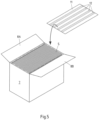
- Fig.5 It is shown that it is also possible to provide an insert sheet 11 with strip-shaped loading carriers 12, which can then is placed upside down on the upper open cut edges of the packaging sleeves S before the outer carton 7 is closed. It is of course also possible to place a suitably prepared insert sheet on the bottom of the outer carton 7 before placing the packaging sleeves S in the outer carton 7 in order to also disinfect the lower open cut edges of the packaging sleeves S.
- Fig.6 it can be seen that the upright, flat-folded packaging sleeves S can also be transported in an "outer packaging" made of a plastic material.
- a plastic container 13 can be clearly seen in vertical section, onto which a corresponding lid 14 is placed.
- a prepared insert sheet 11' serving as a load carrier is inserted into the head space of this outer packaging 7' in order to achieve the necessary sterile atmosphere.
- the "open" transitions between container 13 and lid 14 can also be closed with adhesive tape.
- Fig.7 it is shown that it is also possible to treat a roll R of a packaging composite material wound on a sleeve T at its open edges using the method according to the invention.
- This is particularly advantageous when the roll width corresponds exactly to the pack height, because then both circular surfaces of the roll consist almost entirely of open cut edges.
- the roll R in the illustrated and thus preferred embodiment is surrounded by a two-part shrink cap consisting of a smaller cap part 15 and a larger cap part 16 adapted to it.
- insert sheets 11" are present in the area of the open cut edges in order to create the desired sterile atmosphere.
- packing roll material it is possible to pack it in shrink film after fitting it with 11" load carriers, as described above.
- Fig.8 is now shown in the example of the upper left corner of the container Fig.6 shown that it is also possible to insert a somewhat more voluminous strip 17 made of felt material or the like as a loading carrier, in which case the strip 17 can be loaded with treatment agent even after the container has been closed.
- a wall of the container is pierced by a needle and in this way the inner strip 17 is soaked with the necessary amount of treatment agent in order to sufficiently sterilize the already packaged, flat-folded packaging sleeves S at their open cut edges.
- the container can have an opening 18 prepared for a channel. It is also possible, if necessary, for further strips 17' to be provided as loading carriers in the head space of the container.
Landscapes
- Engineering & Computer Science (AREA)
- Mechanical Engineering (AREA)
- Chemical & Material Sciences (AREA)
- Dispersion Chemistry (AREA)
- Health & Medical Sciences (AREA)
- Food Science & Technology (AREA)
- Epidemiology (AREA)
- General Health & Medical Sciences (AREA)
- Public Health (AREA)
- Veterinary Medicine (AREA)
- Animal Behavior & Ethology (AREA)
- Life Sciences & Earth Sciences (AREA)
- General Chemical & Material Sciences (AREA)
- Chemical Kinetics & Catalysis (AREA)
- Packages (AREA)
- Wrappers (AREA)
- Cartons (AREA)
- Apparatus For Disinfection Or Sterilisation (AREA)
Applications Claiming Priority (4)
| Application Number | Priority Date | Filing Date | Title |
|---|---|---|---|
| DE102014100203.2A DE102014100203A1 (de) | 2014-01-09 | 2014-01-09 | Verfahren zur Behandlung der offenen Schnittkanten von Verpackungsmaterial für die Fertigung von Karton/Kunststoffverbundpackungen sowie ein Verpackungsmaterial, eine daraus hergestellte Verbundpackung und ein Behältnis zur Aufnahme von Verpackungsmaterial |
| PCT/EP2015/050028 WO2015104234A1 (de) | 2014-01-09 | 2015-01-05 | Verfahren zur behandlung der offenen schnittkanten von verpackungsmaterial für die fertigung von karton/kunststoffverbundpackungen sowie ein verpackungsmaterial, eine daraus hergestellte verbundpackung und ein behältnis zur aufnahme von verpackungsmaterial |
| EP15700018.3A EP3092175B1 (de) | 2014-01-09 | 2015-01-05 | Verfahren zur behandlung der offenen schnittkanten von verpackungsmaterial für die fertigung von karton/kunststoffverbundpackungen sowie von verpackungsmaterial |
| EP17176407.9A EP3251958B9 (de) | 2014-01-09 | 2015-01-05 | Verpackungsmaterial, eine daraus hergestellte verbundpackung und ein behältnis zur aufnahme von verpackungsmaterial |
Related Parent Applications (3)
| Application Number | Title | Priority Date | Filing Date |
|---|---|---|---|
| EP17176407.9A Division EP3251958B9 (de) | 2014-01-09 | 2015-01-05 | Verpackungsmaterial, eine daraus hergestellte verbundpackung und ein behältnis zur aufnahme von verpackungsmaterial |
| EP17176407.9A Division-Into EP3251958B9 (de) | 2014-01-09 | 2015-01-05 | Verpackungsmaterial, eine daraus hergestellte verbundpackung und ein behältnis zur aufnahme von verpackungsmaterial |
| EP15700018.3A Division EP3092175B1 (de) | 2014-01-09 | 2015-01-05 | Verfahren zur behandlung der offenen schnittkanten von verpackungsmaterial für die fertigung von karton/kunststoffverbundpackungen sowie von verpackungsmaterial |
Publications (4)
| Publication Number | Publication Date |
|---|---|
| EP3461750A1 EP3461750A1 (de) | 2019-04-03 |
| EP3461750B1 EP3461750B1 (de) | 2024-03-06 |
| EP3461750C0 EP3461750C0 (de) | 2024-03-06 |
| EP3461750B9 true EP3461750B9 (de) | 2024-06-26 |
Family
ID=52292940
Family Applications (3)
| Application Number | Title | Priority Date | Filing Date |
|---|---|---|---|
| EP15700018.3A Active EP3092175B1 (de) | 2014-01-09 | 2015-01-05 | Verfahren zur behandlung der offenen schnittkanten von verpackungsmaterial für die fertigung von karton/kunststoffverbundpackungen sowie von verpackungsmaterial |
| EP18206828.8A Active EP3461750B9 (de) | 2014-01-09 | 2015-01-05 | Behältnis zur aufnahme von verpackungsmaterial |
| EP17176407.9A Active EP3251958B9 (de) | 2014-01-09 | 2015-01-05 | Verpackungsmaterial, eine daraus hergestellte verbundpackung und ein behältnis zur aufnahme von verpackungsmaterial |
Family Applications Before (1)
| Application Number | Title | Priority Date | Filing Date |
|---|---|---|---|
| EP15700018.3A Active EP3092175B1 (de) | 2014-01-09 | 2015-01-05 | Verfahren zur behandlung der offenen schnittkanten von verpackungsmaterial für die fertigung von karton/kunststoffverbundpackungen sowie von verpackungsmaterial |
Family Applications After (1)
| Application Number | Title | Priority Date | Filing Date |
|---|---|---|---|
| EP17176407.9A Active EP3251958B9 (de) | 2014-01-09 | 2015-01-05 | Verpackungsmaterial, eine daraus hergestellte verbundpackung und ein behältnis zur aufnahme von verpackungsmaterial |
Country Status (12)
| Country | Link |
|---|---|
| US (4) | US10207852B2 (enExample) |
| EP (3) | EP3092175B1 (enExample) |
| JP (1) | JP6563403B2 (enExample) |
| CN (2) | CN105939935B (enExample) |
| AU (1) | AU2015205693A1 (enExample) |
| BR (1) | BR112016015915B1 (enExample) |
| DE (1) | DE102014100203A1 (enExample) |
| ES (3) | ES2772757T3 (enExample) |
| MX (2) | MX2016008564A (enExample) |
| PL (3) | PL3461750T3 (enExample) |
| RU (1) | RU2016132624A (enExample) |
| WO (1) | WO2015104234A1 (enExample) |
Families Citing this family (12)
| Publication number | Priority date | Publication date | Assignee | Title |
|---|---|---|---|---|
| GB201205243D0 (en) | 2012-03-26 | 2012-05-09 | Kraft Foods R & D Inc | Packaging and method of opening |
| GB2511560B (en) | 2013-03-07 | 2018-11-14 | Mondelez Uk R&D Ltd | Improved Packaging and Method of Forming Packaging |
| GB2511559B (en) | 2013-03-07 | 2018-11-14 | Mondelez Uk R&D Ltd | Improved Packaging and Method of Forming Packaging |
| DE102016209236A1 (de) * | 2016-05-27 | 2017-11-30 | Sig Technology Ag | Verfahren zum Herstellen einer Verpackung umhüllend Behältervorläufer, insbesondere jeweils für einen einzelnen formstabilen Nahrungsmittelbehälter, mit Umfalten des Behältervorläufers |
| DE102017131262A1 (de) * | 2017-12-22 | 2019-07-11 | Sig Technology Ag | Gebinde aus Packungsmänteln und einer Umverpackung |
| JP6583467B1 (ja) * | 2018-03-29 | 2019-10-02 | 大日本印刷株式会社 | 無菌充填機用紙容器の殺菌方法 |
| DE102019110620A1 (de) | 2019-04-24 | 2020-10-29 | Sig Technology Ag | System zum Verpacken mehrerer Gebinde auf einer Platte |
| WO2021035326A2 (en) * | 2019-08-28 | 2021-03-04 | Shandong Bihai Packaging Materials Co. Ltd. | Processes and equipment to manufacture aseptic carton packages provided with longitudinal joining and sealing side regions and process to manufacture multilayer laminated packaging material used to produce said aseptic carton packages provided with longitudinal joining and sealing side regions |
| US11731415B2 (en) * | 2020-04-30 | 2023-08-22 | Sergio Ribeiro Romeiro | Process to manufacture multilayer laminated packaging material |
| FR3121387B1 (fr) | 2021-03-31 | 2023-02-24 | Michelin & Cie | Procédé de détermination de l’état d’usure d’un flanc de pneumatique pour bus urbain |
| FR3121388B1 (fr) | 2021-03-31 | 2023-07-21 | Michelin & Cie | Pneumatique pour bus urbain comprenant un indicateur d’usure de flanc à visibilité améliorée |
| CN114084433A (zh) * | 2021-11-29 | 2022-02-25 | 江西欧丽仕智能科技有限公司 | 一种香肠包装线用袋装机构 |
Family Cites Families (18)
| Publication number | Priority date | Publication date | Assignee | Title |
|---|---|---|---|---|
| US4061785A (en) * | 1969-04-26 | 1977-12-06 | Tetsuya Nishino | Method and device for preserving vegetables |
| US3715860A (en) * | 1971-07-23 | 1973-02-13 | J Esty | Method of preserving perishable products |
| DE3235476C2 (de) | 1981-11-14 | 1986-09-11 | Jagenberg AG, 4000 Düsseldorf | Verfahren und Einrichtung zum Entkeimen von Verpackungsmaterial, insbesondere von Verpackungsbehältern |
| BE894957A (fr) | 1981-11-14 | 1983-03-01 | Jagenberg Ag | Procede et dispositif pour la sterilisation d'un materiel, d'emballage, en particulier, de recipients d'emballage |
| DE3207426C2 (de) * | 1982-03-02 | 1985-04-04 | Hassia Verpackungsmaschinen GmbH, 6479 Ranstadt | Vorrichtung zur Herstellung von Behältern aus thermoplatischen Folienbändern |
| JPS6080456A (ja) | 1983-10-12 | 1985-05-08 | 土倉 満 | 梱包及び段ボ−ル被包内に具備する消臭滅菌剤 |
| JPH0356222A (ja) * | 1989-07-26 | 1991-03-11 | Toyo Seikan Kaisha Ltd | 無菌充填用容器の乾式殺菌方法 |
| JP2775535B2 (ja) | 1991-06-07 | 1998-07-16 | 秩父小野田株式会社 | 流動性水硬性組成物 |
| AU1357097A (en) | 1996-02-27 | 1997-09-16 | Tetra Laval Holdings & Finance Sa | Process for sanitizing post-consumer paper fibers and product formed therefrom |
| SE511348C2 (sv) * | 1996-11-01 | 1999-09-13 | Tetra Laval Holdings & Finance | Samlingsförpackning med förpackningsbehållarämnen |
| JP4334670B2 (ja) * | 1999-05-20 | 2009-09-30 | 大日本印刷株式会社 | 容器の殺菌方法 |
| AU2001276696B2 (en) * | 2000-07-31 | 2005-09-15 | Tetra Laval Holdings & Finance S.A. | Method of manufacturing paper packaging container and paper packaging container |
| WO2005046743A1 (en) * | 2003-11-05 | 2005-05-26 | The Regents Of The University Of California | Disinfestation and disinfection of food, perishables and other commodities |
| CN101014318A (zh) * | 2004-05-03 | 2007-08-08 | 威尼特·尚塔拉特 | 用于皮肤和头发的清洗和漂洗溶液以及使用方法 |
| NZ543085A (en) * | 2005-10-20 | 2008-03-28 | Mercer Technologies Ltd | Method and apparatus for sterilization and vacuum packing in a hospital, laboratory or food processing environment |
| DE102009029706A1 (de) * | 2009-06-08 | 2010-12-09 | Sig Technology Ag | Verfahren und Vorrichtung zum Entkeimen von Verpackungen |
| DE102011111523B8 (de) | 2011-08-31 | 2013-03-28 | Sig Technology Ag | Verfahren und Vorrichtung zur Kantenentkeimung von Verpackungsmaterial |
| US9078435B2 (en) * | 2011-09-08 | 2015-07-14 | Joseph Dunn | Methods for disinfecting or sterilizing articles |
-
2014
- 2014-01-09 DE DE102014100203.2A patent/DE102014100203A1/de active Pending
-
2015
- 2015-01-05 BR BR112016015915-2A patent/BR112016015915B1/pt active IP Right Grant
- 2015-01-05 AU AU2015205693A patent/AU2015205693A1/en not_active Abandoned
- 2015-01-05 PL PL18206828.8T patent/PL3461750T3/pl unknown
- 2015-01-05 MX MX2016008564A patent/MX2016008564A/es unknown
- 2015-01-05 JP JP2016545979A patent/JP6563403B2/ja active Active
- 2015-01-05 EP EP15700018.3A patent/EP3092175B1/de active Active
- 2015-01-05 ES ES17176407T patent/ES2772757T3/es active Active
- 2015-01-05 RU RU2016132624A patent/RU2016132624A/ru not_active Application Discontinuation
- 2015-01-05 ES ES15700018.3T patent/ES2658296T3/es active Active
- 2015-01-05 US US15/110,444 patent/US10207852B2/en active Active
- 2015-01-05 CN CN201580004283.XA patent/CN105939935B/zh active Active
- 2015-01-05 CN CN202010096698.7A patent/CN111498174B/zh active Active
- 2015-01-05 ES ES18206828T patent/ES2977269T3/es active Active
- 2015-01-05 EP EP18206828.8A patent/EP3461750B9/de active Active
- 2015-01-05 PL PL15700018T patent/PL3092175T3/pl unknown
- 2015-01-05 PL PL17176407T patent/PL3251958T3/pl unknown
- 2015-01-05 EP EP17176407.9A patent/EP3251958B9/de active Active
- 2015-01-05 WO PCT/EP2015/050028 patent/WO2015104234A1/de not_active Ceased
-
2016
- 2016-06-27 MX MX2022010451A patent/MX2022010451A/es unknown
-
2019
- 2019-01-07 US US16/241,623 patent/US10696465B2/en active Active
-
2020
- 2020-04-29 US US16/861,674 patent/US11358777B2/en active Active
-
2022
- 2022-04-01 US US17/711,312 patent/US11673732B2/en active Active
Also Published As
Similar Documents
| Publication | Publication Date | Title |
|---|---|---|
| EP3461750B9 (de) | Behältnis zur aufnahme von verpackungsmaterial | |
| EP3121125B1 (de) | Packungsmantel zur herstellung einer verpackung für nahrungsmittel | |
| DE69712207T2 (de) | Verfahren und Vorrichtung zum Sterilisieren von Packstoffbahnen | |
| CH656363A5 (de) | Verfahren zum entkeimen von verpackungsmaterial mittels dampf. | |
| EP3325355B1 (de) | Verfahren zum sterilisieren von verpackten oder teilverpackten bzw. teilweise verschlossenen gebrauchsgütern sowie dazu verwendbare sammelbehälter und umverpackungen | |
| DE202013101109U1 (de) | Lebensmittelverpackungsfolie | |
| DE102023105388B3 (de) | Herstellen einer Verpackung aus einer photodynamischen Materialbahn | |
| DE102006035963A1 (de) | Verfahren und Vorrichtung zum Befüllen von Folienbeuteln | |
| DE10109635A1 (de) | Verfahren und Vorrichtung zur Herstellung steriler Verpackungen | |
| DE1104658B (de) | Verfahren und Vorrichtung zum sterilen Verpacken von sterilem Verbrauchsgut |
Legal Events
| Date | Code | Title | Description |
|---|---|---|---|
| PUAI | Public reference made under article 153(3) epc to a published international application that has entered the european phase |
Free format text: ORIGINAL CODE: 0009012 |
|
| STAA | Information on the status of an ep patent application or granted ep patent |
Free format text: STATUS: THE APPLICATION HAS BEEN PUBLISHED |
|
| AC | Divisional application: reference to earlier application |
Ref document number: 3092175 Country of ref document: EP Kind code of ref document: P Ref document number: 3251958 Country of ref document: EP Kind code of ref document: P |
|
| AK | Designated contracting states |
Kind code of ref document: A1 Designated state(s): AL AT BE BG CH CY CZ DE DK EE ES FI FR GB GR HR HU IE IS IT LI LT LU LV MC MK MT NL NO PL PT RO RS SE SI SK SM TR |
|
| STAA | Information on the status of an ep patent application or granted ep patent |
Free format text: STATUS: REQUEST FOR EXAMINATION WAS MADE |
|
| 17P | Request for examination filed |
Effective date: 20191002 |
|
| RBV | Designated contracting states (corrected) |
Designated state(s): AL AT BE BG CH CY CZ DE DK EE ES FI FR GB GR HR HU IE IS IT LI LT LU LV MC MK MT NL NO PL PT RO RS SE SI SK SM TR |
|
| STAA | Information on the status of an ep patent application or granted ep patent |
Free format text: STATUS: EXAMINATION IS IN PROGRESS |
|
| 17Q | First examination report despatched |
Effective date: 20200417 |
|
| RAP1 | Party data changed (applicant data changed or rights of an application transferred) |
Owner name: SIG COMBIBLOC SERVICES AG |
|
| GRAP | Despatch of communication of intention to grant a patent |
Free format text: ORIGINAL CODE: EPIDOSNIGR1 |
|
| STAA | Information on the status of an ep patent application or granted ep patent |
Free format text: STATUS: GRANT OF PATENT IS INTENDED |
|
| INTG | Intention to grant announced |
Effective date: 20230719 |
|
| RAP3 | Party data changed (applicant data changed or rights of an application transferred) |
Owner name: SIG SERVICES AG |
|
| GRAS | Grant fee paid |
Free format text: ORIGINAL CODE: EPIDOSNIGR3 |
|
| GRAA | (expected) grant |
Free format text: ORIGINAL CODE: 0009210 |
|
| STAA | Information on the status of an ep patent application or granted ep patent |
Free format text: STATUS: THE PATENT HAS BEEN GRANTED |
|
| AC | Divisional application: reference to earlier application |
Ref document number: 3092175 Country of ref document: EP Kind code of ref document: P Ref document number: 3251958 Country of ref document: EP Kind code of ref document: P |
|
| AK | Designated contracting states |
Kind code of ref document: B1 Designated state(s): AL AT BE BG CH CY CZ DE DK EE ES FI FR GB GR HR HU IE IS IT LI LT LU LV MC MK MT NL NO PL PT RO RS SE SI SK SM TR |
|
| REG | Reference to a national code |
Ref country code: GB Ref legal event code: FG4D Free format text: NOT ENGLISH |
|
| REG | Reference to a national code |
Ref country code: CH Ref legal event code: EP |
|
| REG | Reference to a national code |
Ref country code: IE Ref legal event code: FG4D Free format text: LANGUAGE OF EP DOCUMENT: GERMAN |
|
| REG | Reference to a national code |
Ref country code: DE Ref legal event code: R096 Ref document number: 502015016779 Country of ref document: DE |
|
| U01 | Request for unitary effect filed |
Effective date: 20240327 |
|
| U07 | Unitary effect registered |
Designated state(s): AT BE BG DE DK EE FI FR IT LT LU LV MT NL PT SE SI Effective date: 20240409 |
|
| REG | Reference to a national code |
Ref country code: CH Ref legal event code: PK Free format text: BERICHTIGUNG B9 |
|
| PG25 | Lapsed in a contracting state [announced via postgrant information from national office to epo] |
Ref country code: GR Free format text: LAPSE BECAUSE OF FAILURE TO SUBMIT A TRANSLATION OF THE DESCRIPTION OR TO PAY THE FEE WITHIN THE PRESCRIBED TIME-LIMIT Effective date: 20240607 |
|
| PG25 | Lapsed in a contracting state [announced via postgrant information from national office to epo] |
Ref country code: RS Free format text: LAPSE BECAUSE OF FAILURE TO SUBMIT A TRANSLATION OF THE DESCRIPTION OR TO PAY THE FEE WITHIN THE PRESCRIBED TIME-LIMIT Effective date: 20240606 Ref country code: HR Free format text: LAPSE BECAUSE OF FAILURE TO SUBMIT A TRANSLATION OF THE DESCRIPTION OR TO PAY THE FEE WITHIN THE PRESCRIBED TIME-LIMIT Effective date: 20240306 |
|
| PG25 | Lapsed in a contracting state [announced via postgrant information from national office to epo] |
Ref country code: RS Free format text: LAPSE BECAUSE OF FAILURE TO SUBMIT A TRANSLATION OF THE DESCRIPTION OR TO PAY THE FEE WITHIN THE PRESCRIBED TIME-LIMIT Effective date: 20240606 Ref country code: NO Free format text: LAPSE BECAUSE OF FAILURE TO SUBMIT A TRANSLATION OF THE DESCRIPTION OR TO PAY THE FEE WITHIN THE PRESCRIBED TIME-LIMIT Effective date: 20240606 Ref country code: HR Free format text: LAPSE BECAUSE OF FAILURE TO SUBMIT A TRANSLATION OF THE DESCRIPTION OR TO PAY THE FEE WITHIN THE PRESCRIBED TIME-LIMIT Effective date: 20240306 Ref country code: GR Free format text: LAPSE BECAUSE OF FAILURE TO SUBMIT A TRANSLATION OF THE DESCRIPTION OR TO PAY THE FEE WITHIN THE PRESCRIBED TIME-LIMIT Effective date: 20240607 |
|
| REG | Reference to a national code |
Ref country code: ES Ref legal event code: FG2A Ref document number: 2977269 Country of ref document: ES Kind code of ref document: T3 Effective date: 20240821 |
|
| PG25 | Lapsed in a contracting state [announced via postgrant information from national office to epo] |
Ref country code: IS Free format text: LAPSE BECAUSE OF FAILURE TO SUBMIT A TRANSLATION OF THE DESCRIPTION OR TO PAY THE FEE WITHIN THE PRESCRIBED TIME-LIMIT Effective date: 20240706 |
|
| PG25 | Lapsed in a contracting state [announced via postgrant information from national office to epo] |
Ref country code: SM Free format text: LAPSE BECAUSE OF FAILURE TO SUBMIT A TRANSLATION OF THE DESCRIPTION OR TO PAY THE FEE WITHIN THE PRESCRIBED TIME-LIMIT Effective date: 20240306 |
|
| PG25 | Lapsed in a contracting state [announced via postgrant information from national office to epo] |
Ref country code: CZ Free format text: LAPSE BECAUSE OF FAILURE TO SUBMIT A TRANSLATION OF THE DESCRIPTION OR TO PAY THE FEE WITHIN THE PRESCRIBED TIME-LIMIT Effective date: 20240306 |
|
| PG25 | Lapsed in a contracting state [announced via postgrant information from national office to epo] |
Ref country code: SK Free format text: LAPSE BECAUSE OF FAILURE TO SUBMIT A TRANSLATION OF THE DESCRIPTION OR TO PAY THE FEE WITHIN THE PRESCRIBED TIME-LIMIT Effective date: 20240306 |
|
| PG25 | Lapsed in a contracting state [announced via postgrant information from national office to epo] |
Ref country code: SM Free format text: LAPSE BECAUSE OF FAILURE TO SUBMIT A TRANSLATION OF THE DESCRIPTION OR TO PAY THE FEE WITHIN THE PRESCRIBED TIME-LIMIT Effective date: 20240306 Ref country code: SK Free format text: LAPSE BECAUSE OF FAILURE TO SUBMIT A TRANSLATION OF THE DESCRIPTION OR TO PAY THE FEE WITHIN THE PRESCRIBED TIME-LIMIT Effective date: 20240306 Ref country code: RO Free format text: LAPSE BECAUSE OF FAILURE TO SUBMIT A TRANSLATION OF THE DESCRIPTION OR TO PAY THE FEE WITHIN THE PRESCRIBED TIME-LIMIT Effective date: 20240306 Ref country code: IS Free format text: LAPSE BECAUSE OF FAILURE TO SUBMIT A TRANSLATION OF THE DESCRIPTION OR TO PAY THE FEE WITHIN THE PRESCRIBED TIME-LIMIT Effective date: 20240706 Ref country code: CZ Free format text: LAPSE BECAUSE OF FAILURE TO SUBMIT A TRANSLATION OF THE DESCRIPTION OR TO PAY THE FEE WITHIN THE PRESCRIBED TIME-LIMIT Effective date: 20240306 |
|
| REG | Reference to a national code |
Ref country code: DE Ref legal event code: R097 Ref document number: 502015016779 Country of ref document: DE |
|
| PLBE | No opposition filed within time limit |
Free format text: ORIGINAL CODE: 0009261 |
|
| STAA | Information on the status of an ep patent application or granted ep patent |
Free format text: STATUS: NO OPPOSITION FILED WITHIN TIME LIMIT |
|
| PGFP | Annual fee paid to national office [announced via postgrant information from national office to epo] |
Ref country code: PL Payment date: 20241231 Year of fee payment: 11 |
|
| 26N | No opposition filed |
Effective date: 20241209 |
|
| U20 | Renewal fee for the european patent with unitary effect paid |
Year of fee payment: 11 Effective date: 20250127 |
|
| PGFP | Annual fee paid to national office [announced via postgrant information from national office to epo] |
Ref country code: ES Payment date: 20250214 Year of fee payment: 11 |
|
| PGFP | Annual fee paid to national office [announced via postgrant information from national office to epo] |
Ref country code: GB Payment date: 20250123 Year of fee payment: 11 |
|
| PGFP | Annual fee paid to national office [announced via postgrant information from national office to epo] |
Ref country code: TR Payment date: 20250102 Year of fee payment: 11 |
|
| REG | Reference to a national code |
Ref country code: CH Ref legal event code: PL |
|
| PG25 | Lapsed in a contracting state [announced via postgrant information from national office to epo] |
Ref country code: MC Free format text: LAPSE BECAUSE OF FAILURE TO SUBMIT A TRANSLATION OF THE DESCRIPTION OR TO PAY THE FEE WITHIN THE PRESCRIBED TIME-LIMIT Effective date: 20240306 |
|
| PG25 | Lapsed in a contracting state [announced via postgrant information from national office to epo] |
Ref country code: CH Free format text: LAPSE BECAUSE OF NON-PAYMENT OF DUE FEES Effective date: 20250131 |