EP3452602B1 - Method for the production of a potato (solanum tuberosum) wherein said method involves homology-directed mutagenesis using a crispr/cas9 technique - Google Patents
Method for the production of a potato (solanum tuberosum) wherein said method involves homology-directed mutagenesis using a crispr/cas9 technique Download PDFInfo
- Publication number
- EP3452602B1 EP3452602B1 EP17792956.9A EP17792956A EP3452602B1 EP 3452602 B1 EP3452602 B1 EP 3452602B1 EP 17792956 A EP17792956 A EP 17792956A EP 3452602 B1 EP3452602 B1 EP 3452602B1
- Authority
- EP
- European Patent Office
- Prior art keywords
- starch
- potato
- seq
- amylopectin
- gbssi
- Prior art date
- Legal status (The legal status is an assumption and is not a legal conclusion. Google has not performed a legal analysis and makes no representation as to the accuracy of the status listed.)
- Active
Links
Images





Classifications
-
- C—CHEMISTRY; METALLURGY
- C08—ORGANIC MACROMOLECULAR COMPOUNDS; THEIR PREPARATION OR CHEMICAL WORKING-UP; COMPOSITIONS BASED THEREON
- C08B—POLYSACCHARIDES; DERIVATIVES THEREOF
- C08B30/00—Preparation of starch, degraded or non-chemically modified starch, amylose, or amylopectin
- C08B30/12—Degraded, destructured or non-chemically modified starch, e.g. mechanically, enzymatically or by irradiation; Bleaching of starch
-
- C—CHEMISTRY; METALLURGY
- C08—ORGANIC MACROMOLECULAR COMPOUNDS; THEIR PREPARATION OR CHEMICAL WORKING-UP; COMPOSITIONS BASED THEREON
- C08B—POLYSACCHARIDES; DERIVATIVES THEREOF
- C08B30/00—Preparation of starch, degraded or non-chemically modified starch, amylose, or amylopectin
- C08B30/20—Amylose or amylopectin
-
- C—CHEMISTRY; METALLURGY
- C08—ORGANIC MACROMOLECULAR COMPOUNDS; THEIR PREPARATION OR CHEMICAL WORKING-UP; COMPOSITIONS BASED THEREON
- C08L—COMPOSITIONS OF MACROMOLECULAR COMPOUNDS
- C08L3/00—Compositions of starch, amylose or amylopectin or of their derivatives or degradation products
- C08L3/02—Starch; Degradation products thereof, e.g. dextrin
-
- C—CHEMISTRY; METALLURGY
- C08—ORGANIC MACROMOLECULAR COMPOUNDS; THEIR PREPARATION OR CHEMICAL WORKING-UP; COMPOSITIONS BASED THEREON
- C08L—COMPOSITIONS OF MACROMOLECULAR COMPOUNDS
- C08L3/00—Compositions of starch, amylose or amylopectin or of their derivatives or degradation products
- C08L3/12—Amylose; Amylopectin; Degradation products thereof
-
- C—CHEMISTRY; METALLURGY
- C12—BIOCHEMISTRY; BEER; SPIRITS; WINE; VINEGAR; MICROBIOLOGY; ENZYMOLOGY; MUTATION OR GENETIC ENGINEERING
- C12N—MICROORGANISMS OR ENZYMES; COMPOSITIONS THEREOF; PROPAGATING, PRESERVING, OR MAINTAINING MICROORGANISMS; MUTATION OR GENETIC ENGINEERING; CULTURE MEDIA
- C12N15/00—Mutation or genetic engineering; DNA or RNA concerning genetic engineering, vectors, e.g. plasmids, or their isolation, preparation or purification; Use of hosts therefor
- C12N15/09—Recombinant DNA-technology
- C12N15/63—Introduction of foreign genetic material using vectors; Vectors; Use of hosts therefor; Regulation of expression
- C12N15/79—Vectors or expression systems specially adapted for eukaryotic hosts
- C12N15/82—Vectors or expression systems specially adapted for eukaryotic hosts for plant cells, e.g. plant artificial chromosomes (PACs)
- C12N15/8201—Methods for introducing genetic material into plant cells, e.g. DNA, RNA, stable or transient incorporation, tissue culture methods adapted for transformation
- C12N15/8213—Targeted insertion of genes into the plant genome by homologous recombination
-
- C—CHEMISTRY; METALLURGY
- C12—BIOCHEMISTRY; BEER; SPIRITS; WINE; VINEGAR; MICROBIOLOGY; ENZYMOLOGY; MUTATION OR GENETIC ENGINEERING
- C12N—MICROORGANISMS OR ENZYMES; COMPOSITIONS THEREOF; PROPAGATING, PRESERVING, OR MAINTAINING MICROORGANISMS; MUTATION OR GENETIC ENGINEERING; CULTURE MEDIA
- C12N15/00—Mutation or genetic engineering; DNA or RNA concerning genetic engineering, vectors, e.g. plasmids, or their isolation, preparation or purification; Use of hosts therefor
- C12N15/09—Recombinant DNA-technology
- C12N15/63—Introduction of foreign genetic material using vectors; Vectors; Use of hosts therefor; Regulation of expression
- C12N15/79—Vectors or expression systems specially adapted for eukaryotic hosts
- C12N15/82—Vectors or expression systems specially adapted for eukaryotic hosts for plant cells, e.g. plant artificial chromosomes (PACs)
- C12N15/8241—Phenotypically and genetically modified plants via recombinant DNA technology
- C12N15/8242—Phenotypically and genetically modified plants via recombinant DNA technology with non-agronomic quality (output) traits, e.g. for industrial processing; Value added, non-agronomic traits
- C12N15/8243—Phenotypically and genetically modified plants via recombinant DNA technology with non-agronomic quality (output) traits, e.g. for industrial processing; Value added, non-agronomic traits involving biosynthetic or metabolic pathways, i.e. metabolic engineering, e.g. nicotine, caffeine
- C12N15/8245—Phenotypically and genetically modified plants via recombinant DNA technology with non-agronomic quality (output) traits, e.g. for industrial processing; Value added, non-agronomic traits involving biosynthetic or metabolic pathways, i.e. metabolic engineering, e.g. nicotine, caffeine involving modified carbohydrate or sugar alcohol metabolism, e.g. starch biosynthesis
-
- C—CHEMISTRY; METALLURGY
- C12—BIOCHEMISTRY; BEER; SPIRITS; WINE; VINEGAR; MICROBIOLOGY; ENZYMOLOGY; MUTATION OR GENETIC ENGINEERING
- C12N—MICROORGANISMS OR ENZYMES; COMPOSITIONS THEREOF; PROPAGATING, PRESERVING, OR MAINTAINING MICROORGANISMS; MUTATION OR GENETIC ENGINEERING; CULTURE MEDIA
- C12N15/00—Mutation or genetic engineering; DNA or RNA concerning genetic engineering, vectors, e.g. plasmids, or their isolation, preparation or purification; Use of hosts therefor
- C12N15/09—Recombinant DNA-technology
- C12N15/87—Introduction of foreign genetic material using processes not otherwise provided for, e.g. co-transformation
- C12N15/90—Stable introduction of foreign DNA into chromosome
-
- A—HUMAN NECESSITIES
- A01—AGRICULTURE; FORESTRY; ANIMAL HUSBANDRY; HUNTING; TRAPPING; FISHING
- A01H—NEW PLANTS OR NON-TRANSGENIC PROCESSES FOR OBTAINING THEM; PLANT REPRODUCTION BY TISSUE CULTURE TECHNIQUES
- A01H6/00—Angiosperms, i.e. flowering plants, characterised by their botanic taxonomy
- A01H6/80—Saxifragaceae, e.g. Heuchera
Definitions
- the present invention refers to a method for the production of a potato using a CRISPR/Cas9 technique, to a method for the production of an amylopectin potato starch, and to uses of said amylopectin potato starch.
- Starch is one of the most used food ingredients in the world. It is primarily used as a thickening agent and thus impart viscosity and texture to food products like soups, sauces, dairy products, fruit preparation etc. It is also used for fat replacement in a large variety of food applications and for many other purposes, e.g. coating of nuts, deep fried foods and as a gelatin replacer in confectionary products, as a stabilizer of oil in water emulsions for liquid emulsions and spray dried functional oils. Starch is found in a large variety of food products in its native state or in a modified form to give the requested performance. Starch is extracted from different botanical sources, e.g. maize, potato, tapioca, wheat, barley, rice etc.
- the polysaccharide starch is a polymer made from a chemically uniform monomer, the glucose molecule. However, it is a very complex mixture of different forms of molecules which differ with respect to their degree of polymerization and the occurrence of branching of the glucose chains. Starch is therefore not a uniform raw material. A differentiation is made in particular between amylose starch, an essentially unbranched polymer of ⁇ -1,4-glycosidically linked glucose molecules, and amylopectin starch, which for its part is a complex mixture of differently branched glucose chains. In typical plants used for starch production, such as maize, potato, wheat, barley, rice, and tapioca, the synthesized starch consists of about 20%-30% of amylose starch and 70%-80% of amylopectin starch.
- amylose was regarded as a linear polymer, consisting of ⁇ -1,4-glycosidically linked ⁇ -D-glucose monomers.
- stubs ⁇ -1,6-glycosidic branching points with short chains, called stubs, at the branching points.
- the chain length of the stubs is defined to be less than 20 DP ( STARCH Metabolism and Structure, Nakamura Yasunori, Springer 2015 ) but other research is also indicating slightly longer stubs ( Curá et al, Amylose is not Strictly Linear, Biosynthesis, Nutrition and Biomedical, Vol 47, 1995, 207-209 ).
- Amylopectin consists of a complex mixture of variably branched glucose chains that can be differentiated into A-chains, B-chains with different lengths and C-chain. Unlike amylose, amylopectin is more highly branched. Side chains are linked to the primary chain (the C-chain, consisting of ⁇ -1,4-glycosidically linked ⁇ -D-glucose monomers) via an ⁇ -1,6-glycosidic bond. According to textbook information ( Voet and Voet, Biochemistry, John Wiley & Sons, 1990 ), the ⁇ -1,6 branches occur on average every 24 to 30 glucose units. This corresponds to a degree of branching of approx. 3%-4%.
- amylose has a molecular weight (Mw) of approximately 3 ⁇ 10 4 -10 6 Da, and in the case of amylopectin it is between 10 8 and 10 9 Da.
- Mw molecular weight
- the functional characteristics of the starch are strongly influenced by the molecular weight, the side chain distribution pattern and the length of the side chain, the ion content, the lipid and protein content as well as the average starch granular size and its distribution profile.
- important functional characteristics are the solubility, the gelatinization behavior, the granule swelling behavior, the water binding capability, the viscosity and texture properties, the retrogradation property, the film forming properties, and the freeze/thaw stability etc.
- a water system where the starch has been gelatinized undergoes a process which in general terms is called retrogradation.
- retrogradation the starch-water system is reorganized and the process leads to syneresis.
- the starch molecules reform into new crystalline complexes and the water bound to the starch is released.
- syneresis the reduced water binding capacity leads to the water being released from the starch-water system, a process called syneresis.
- syneresis At low concentrations this phenomenon will lead to a precipitation of the starch crystalline complexes, and at higher concentrations it leads to gel formation. This behavior is seen in the common starches on the market from maize, potato, tapioca, wheat, barley etc.
- amylose content is 20-30% whereas in the so-called waxy types the quantity is lower and normally defined as less than 10%.
- amylose in the starch it strongly influences the stability after gelatinization, a lower amount of amylose will have a high impact on the retrogradation behavior.
- the starch retrogradation process is one of the most important factors when differentiating starches and their use in food applications but also in other applications as non-food.
- Most native starches must undergo some kind of chemical modification to inhibit the retrogradation process, and this inhibition can be achieved by chemical modification of the starch by coupling functional groups to the starch molecule via covalent bonding.
- the most common chemical modifications used in the starch industry are esterification and etherification. These chemical modifications prevent the retrogradation process of the starch.
- Etherification has the highest impact in food usage as the substituent is more bulky in size and can be made to higher substitution levels and still be classified as a food grade modified starch. It is therefore used to render the starch to become freeze/thaw-stable in water pastes.
- beta-amylase If beta-amylase is allowed to totally degrade the amylose molecule and partly the amylopectin molecule, forming a beta-limit dextrin, the resulting starch solution will be extremely stable against retrogradation.
- the reason for the extreme improvement in the stability after degradation with beta-amylase is that the remaining amylopectin molecule will have a reduced chain length size, and this has proven to increase the retrogradation stability, as well as the freeze/thaw stability.
- enzymatic stabilization can only be achieved on non-granular starch and this kind of stabilization is therefore not possible to use for the granular starches.
- the starch texture is built up by hydrated and swollen but still intact granules, generally termed as gelatinized but dispersed starch granules, and is the common way starch is used in food applications.
- the enzymatic stabilization is also time consuming and means extra production costs making the starch products more expensive.
- pyrodextrinization and alkaline roasting can be partly used to prevent the retrogradation phenomenon as well as complexing the amylose molecule with mono-diglycerides.
- starches with a smaller amount of amylose generally known as waxy starches with an amylose content of less than 10% or even as low as less than 2%, can be found in nature, and these starches have a natural robustness against the retrogradation process but only to a limited level.
- the retrogradation will for this kind of starches be delayed compared to starches with higher amylose contents.
- starch with an extremely low content of amylose and a short chain structure of the amylopectin which can be found on a commercial basis is the waxy barley starch, crossbred from the 0-amylose mutant line of barley, for example the varieties Cinnamon, Lisen and HB 340.
- a starch with improved stability in starch pastes, after partly being gelatinized or after total gelatinization into a starch solution, is also of high interest in non-food applications as it opens up new possibilities of large varieties of products, e.g. as a functional component in production of adhesives, as a functional ingredient in paper industry, both as a wet-end starch but also for surface sizing and coating of paper, as a functional ingredient in emulsions for paper- and paint industry, as a functional ingredient in construction products, and as a functional ingredient in pharmaceutical production.
- Starch retrogradation can be determined by a broad range of analytical methods including analyzing the properties of starch gels at both the macroscopic and molecular level. Many analytical methods are summarized in Karim A. et al; Food chemistry 71, (2000), 9-36 .
- An easy method for determining the stability of starch is to partly gelatinize the starch, consequently remained in a granular condition as a starch suspension of gelatinized and swollen granules, or totally disrupted into a starch solution in which there are no intact starch granules remaining in the system.
- the viscosity and texture properties of the starch suspension or solution are analyzed continuously after storage under different conditions which influences the retrogradation behavior.
- the starch paste or solution is frozen and thawed and then centrifuged to rapidly press out liberated liquid.
- the released water which is a result of syneresis due to forced retrogradation of the starch molecules, is siphoned off and weighed. The procedure is repeated systematically and the total amount of accumulated water release after each freeze/thaw cycle is measured and corresponds to the starch stability property and thus equals to its robustness against retrogradation.
- the behavior of gelatinized starches upon cooling and storage is of great interest to food scientists and technologists since it strongly affects the quality, acceptability and shelf-life of starch-containing foods.
- Starch molecules in food pastes or gels are known to associate upon aging, leading to retrogradation which results in effects such as precipitation, gelation, and undesirable changes in texture due to the retrogradation of the starch.
- retrogradation of starch pastes and its importance in food industry, it is of highest interest to develop starches which are more stable against the retrogradation phenomenon.
- plants can be genetically modified in such a way that they produce starches that can be differentiated from the starch in the corresponding non-genetically modified plant from which they have been manufactured on the basis of physicochemical parameters.
- a review of various plant species that exhibit a reduction in enzymes involved in starch biosynthesis has been described by Kossmann and Lloyd [1, 2] (2000, Critical Reviews in Plant Sciences 19(3), 171-126 ), and later by Zeeman et al. (2010, Annual Review of Plant Biology 61, 209-234 )).
- Potato plants have previously been disclosed in which the activity of the starch granule-bound starch synthase I (GBSSI; "Granule-Bound Starch Synthase I”) is reduced ( Hovenkamp-Hermelink et al., 1987, Theoretical and Applied Genetics 75, 217-221 ; Visser et al., 1991, Mol. Gen. Genet. 225, 289-296 ; Hergersberg, 1988, Dissertation, (2015) GmbH ; WO 92/11376 ).
- the GBBSI is involved in the formation of amylose. Inhibition of GBSSI activity leads to synthesis of starch that almost exclusively is comprised of amylopectin.
- waxy starches e.g. waxy corn/maize, waxy potato, waxy wheat, waxy tapioca, waxy barley, waxy rice etc.
- starch from such plants exhibits a shift from longer chains to shorter ones in the side chains of the amylopectin ( Lloyd et al., 1999, Biochemical Journal 338, 515-521 ), no change in the amylose content ( Abel et al., 1996, The Plant Journal 10(6), 9891-9991 ) and a reduced end viscosity via a RVA (Rapid-Visco-Analyzer) analysis ( Abel, 1995, Dissertation, Freie (2015) Berl in).
- RVA Root-Visco-Analyzer
- a combined reduction of SSIII and SSII in potato has much greater effect on the starch structure and behavior than was predicted by the reduction of the individual enzyme isoforms ( WO 99/66050 , Edwards et al, Plant Journal 17, 251-261, 1999 ).
- WO 01/19975 discloses plants in which both the GBSSI and the SSII and/or SSIII activity is reduced.
- Starch from genetically modified potato plants with reduced GBSSI, SSII and SSIII activity exhibits a lower amylose content, changed gelatinization and swelling properties of the starch granule, and an improved freeze/thaw stability in comparison to the starch from the wild type potato plant.
- the genetic modification technology used in the invention disclosed in WO 01/19975 is dependent on the stable introduction of one or several genetic devices for a continuous suppression to a larger or lesser degree of gene function. This will most often not lead to a complete suppression of the enzymatic activity of GBSSI, SSIII and SSII and therefore the achieved starch properties will still to some extent be influenced by these starch synthesizing enzymes.
- WO 2015/193858 discloses a starch product from a Solanum plant comprising a mutation in each GBSS allele endogenous to said plant.
- US 6,600,093 (B1 ) discloses genetically engineered potato plants producing essentially amylose-free starch and no detectable GBSS activity.
- An object of the present invention is to fulfill the above-mentioned need. This object is reached with the claimed method for the production of a potato containing amylopectin starch having the desired properties, and with the claimed method for the production of said amylopectin potato starch by extraction from said potato.
- amylopectin potato starch produced with the inventive method for this has improved stability against retrogradation and improved freeze and thaw stability, wherein it contains more than 99 % amylopectin, preferably 100 % amylopectin.
- the present invention refers to a method for the production of a potato (Solanum tuberosum), wherein said method involves homology-directed mutagenesis using CRISPR/Cas9 technique, and wherein the target nucleotide sequence of the CRISPR/Cas9 complex consists of 20 bp, and comprises the following steps:
- the present invention refers to a method for the production of amylopectin potato starch by extraction from the potato produced according to the inventive method for the production of said potato.
- the present invention refers to different uses of said amylopectin potato starch.
- the present invention relates to a method of changing the starch biosynthetic process in potato species by using a homology-directed mutagenesis for the continuous suppression of the gene function, wherein no integrated residual exogenous material is maintained in the genome of the derived potato plants.
- the potato starch synthetic process is changed in the potato plant cell which leads to the synthesis of an amylopectin starch with no previously known properties, i.e. a novel structure, composition, and branching pattern. This is achieved by disrupting the physical gene context of genes which encode the enzymes that are involved in the synthesis of amylose and of the side chains in the amylopectin molecule.
- GBSSI is to be understood to mean any enzyme that belongs to the class of starch Granule-Bound Starch Synthases of the isoform I. Consequently the term “GBSSI gene” is to be understood to mean a nucleic acid molecule or polynucleotide (DNA, cDNA) that codes for GBSSI.
- SSIII and SSII are to be understood to mean a class of Soluble Starch Synthases. Soluble Starch Synthases catalyze a glycosylation reaction in which glucose moieties of the ADP-glucose substrate are transferred to an ⁇ -1,4-linked glucan chain with formation of new ⁇ -1,4-linkages, wherein the different classes synthesize chains of different lengths.
- Soluble Starch Synthases catalyze a glycosylation reaction in which glucose moieties of the ADP-glucose substrate are transferred to an ⁇ -1,4-linked glucan chain with formation of new ⁇ -1,4-linkages, wherein the different classes synthesize chains of different lengths.
- SSIIIs are described by Marshall et al. (1996, The Plant Cell 8, 1121-1135 ), Li et al. (2000, Plant Physiology 123, 613-624 ), Abel et al. (1996, The Plant Journal 10(6), 981
- SSIII gene and "SSII gene” are to be understood to mean a nucleic acid molecule or polynucleotide (DNA, cDNA) that codes for SSIII and SSII respectively.
- Polynucleotides coding for Soluble Starch Synthases have been described for various plant species. For potato it is disclosed by Abel et al (1996, The Plant Journal 10(6), 981-991 ).
- SSIII gene preferably means a nucleic acid molecule or polynucleotide (cDNA, DNA) that codes for SSIII in potato plants
- SSII gene preferably means a nucleic acid molecule or polynucleotide (cDNA, DNA) that codes for SSII in potato plants.
- the expression "homology-directed mutagenesis” is to be understood to mean that the target sequence to be mutated in the genome is found and marked for mutagenesis by a ribonucleic acid sequence.
- potato is understood to mean any potato plant belonging to the species Solanum tuberosum.
- potato tissue is understood to mean any part of the potato plant during any stage of its development that contains potato plant cells susceptible to the inventive method.
- Examples of a potato tissue are a tuber, a shoot, a leaf, a stem, and a flower.
- protoplast is understood to mean cells from any potato tissue.
- CRISPR/nuclease technology means that several variants of nucleases may be used together with CRISPR for the production of amylopectin potato starch.
- nucleases are Cas, such as Cas9, and Cpf1.
- Cas9 is used in the embodiments disclosed below.
- target nucleotide sequence is understood to mean the specific nucleotide sequence located in the DNA of the potato genome to be identified with the inventive method.
- the target nucleotide sequence consists of 20 bp immediately upstream of a 5'-NGG-3' protospacer adjacent motif (PAM) in the cell genome.
- PAM protospacer adjacent motif
- targeting ribonucleotide sequence is understood to mean a RNA sequence which is fully or essentially homologous to a sequence (the so called target nucleotide sequence) in the gene which is to be mutated by the method according to the invention. If type II Cas9 is used, the targeting ribonucleotide sequence preferably is 20 bp.
- the targeting ribonucleotide sequence is fully or essentially homologous to the target sequence, which is to be understood as being more than 75% homologous, preferably more than 85% homologous, more preferably more than 95% homologous to the target sequence.
- the targeting ribonucleotide sequence is able to hybridize with the complementary strand of the target sequence and in this way locate the Cas to introduce a double strand break (DSB) in the DNA strand.
- DSB double strand break
- essentially homologous is to be understood to mean that said targeting ribonucleotide sequence may differ from the fully homologous one as to sequence length and base identity but only in such a way that the desired mutation still is obtained.
- amylose used to define the "amylopectin potato starch” is understood to mean that no amylose at all has been produced in the potato plant due to the complete abolishment of the GBSSI enzyme activity.
- amylopectin and "0 % amylose” is understood to mean the same. However, as trace amounts of amylose at least theoretically can happen to be included in an amylopectin potato starch, e.g. due to contamination from the surroundings, the expressions “more than 99 % amylopectin” and “more than 99.5 % amylopectin” is presented with a view to covering such a situation. Nevertheless, amylopectin potato starch containing 99 % or more of amylopectin is not known before.
- the inventive method for achieving the obstruction of the desired ones among the enzymes GBSSI, SSIII, and SSII uses a method for targeted homology-directed mutagenesis.
- the method according to the present invention provides targeted editing of the plant genome without leaving any residual exogenous genetic material in the resulting plant.
- This technology is more precisely directed to disrupting the gene context where earlier methods have been dependent on the physical insertion of a genetic device intended for the modulation of the gene expression or translation, respectively.
- homology-directed mutagenesis is meant that the target region to be mutated is found and marked for mutagenesis in the cell nucleus by a targeting ribonucleotide sequence which identifies the complementary strand of the target nucleotide sequence.
- the obstruction of the starch synthesis enzymes in question is made by the action of a sequence-specific RNA/- nuclease protein complex which is translocated to the nucleus and which acts to precisely cut the DNA at a predetermined locus of a chromosome in a potato plant cell.
- Error-prone repair of the cut permits the introduction of mutations and a loss of function of the gene, and thus a mutation is achieved without introducing any exogenous genetic material.
- the disclosed technology can be used to modify plant cell material without having any residual exogenous material integrated or left in the cell.
- genetic material, by a sequence-specific RNA/nuclease protein complex is obtained by using the technology CRISPR/Cas9 (clustered regularly interspaced short palindromic repeats / CRISPR associated protein 9).
- CRISPR/Cas9 clustered regularly interspaced short palindromic repeats / CRISPR associated protein 9.
- the most widely used CRISPR/Cas originates from Streptococcus pyogenes [3], where it plays a role as a part of the adaptive immune system of this bacterium taking care of invading viruses or other nucleic acids.
- CRISPR consists of an array of sequence repeats separated by protospacers from the target genome.
- the resulting rather long transcript is then processed into short non-coding RNAs which can form a complex with a type II Cas9 protein.
- the complex binds to the corresponding region which is complementary to the protospacer region in the invading nucleic acid and makes a double strand digestion in the target region, thus inactivating the invading RNA or DNA
- the adapted method for directed gene mutations uses a short single guide RNA (sgRNA), containing a 20 bp guide sequence, i.e.
- the targeting ribonucleotide sequence used in the inventive method a promoter and an sgRNA scaffold, which in combination with a Cas9 [3] can induce mutations in more or less any target of choice.
- the target sequence in the gene is 20 bp for the type II Cas9 and must be located immediately upstream a 5'-NGG-3' protospacer adjacent motif (PAM) in the cell genome.
- PAM protospacer adjacent motif
- the genes which are targeted according to the present invention contain several PAMs, located both in introns and in exons. Thus, several different targeting ribonucleotide sequences may be anticipated by the disclosed invention.
- the present invention is not limited to the targeting ribonucleotide sequence being 20 bp. In some cases the targeting ribonucleotide sequence may be shorter or longer than 20 bp, depending on i.a. the specific target sequence. Also, if another type of Cas is used, the targeting ribonucleotide sequence may be shorter or longer than 20 bp.
- the resulting double strand break (DSB) is repaired by the cells own repair mechanism, either through non-homologous end joining (NHEJ) or homologous recombination (HR).
- NHEJ non-homologous end joining
- HR homologous recombination
- the repair mechanisms are error prone and often lead to inserts or deletions (indels), which may cause a gene knockout by introducing a stop codon into the gene, leading to the production of a truncated non-functional enzyme.
- the indels are random in size, even though small indels seem to be most common.
- the repair mechanisms may also lead to a frame shift, which may lead to the production of a truncated enzyme or a defect enzyme having a decreased or abolished enzyme activity.
- the repair mechanism may also lead to a changed number of codons, which may lead to a defect enzyme having a decreased or abolished enzyme activity. According to the present invention, no active or functional enzyme is produced in the resulting potato.
- base shifts or insertions can be tailor made by introduction of a repair template [4, 5], increasing the applications from only generating gene knockouts to also involve gene enhancement.
- the Streptococcus pyogenes Cas9 coding sequence can be used as such or may be codon adapted for plants or codon adapted to other organism classes or species [6] [7].
- the method according to the present invention in which the CRISPR/Cas 9 is used in one embodiment including a specific targeting ribonucleotide sequence as the guide sequence, will lead to 100% elimination, or inhibition, of the targeted enzyme activity in question.
- the consequence will be that the targeted biosynthetic process is totally blocked.
- the starch composition will be constituted by at least 99 % amylopectin, preferably 100%, in view of the definition above.
- amylose is substantial in view of such properties as stability and improved freeze and thaw stability. Furthermore, the impact of eliminating also the soluble starch synthase activities SSIII and SSII will also lead to a so far unknown amylopectin starch with unique properties. The consequence of reducing the SSIII and SSII enzyme activities is known to lead to shorter chains of the amylopectin molecule.
- GT1 5'-GATATTAGAATCACATAGGG-3' SEQ. ID. NO. 1
- GT2 5'-TGTTGACAAGGGTGTTGAAT- 3' SEQ. ID. NO. 2
- GT3 5'-GCTACCATTGTTTGTGGAAA-3' SEQ. ID. NO. 3
- GT4 5'-GACAAGAAGATCCCTTTGAT-3' SEQ. ID. NO. 4
- S2T1 5'-GTGCTAAAAGGGGTAAGTTG-3' SEQ. ID. NO.
- S2T2 5'-GGGGTGCCCTTTCATCGGCC-3' SEQ. ID. NO. 6
- S2T3 5'-GCTCCAGTAGAGAGCAAATG-3' SEQ. ID. NO. 7
- S3T1 5'-GAACATCTGAACCAAATTTC-3' SEQ. ID. NO. 8
- S3T2 5'-GAGGTGGCAATGGACCCAGG-3' SEQ. ID. NO. 9
- S3T3 5'-GGAAACTAATGCCAGTAGCA-3' SEQ. ID. NO. 10
- the production of the GBSSI enzyme is abolished, or inhibited, which leads to a potato which produces more than 99 %, preferably 100%, amylopectin starch.
- the enzyme activity of GBSSI and SSIII are eliminated, which leads to a potato that produces, more than 99%, preferably 100%, amylopectin starch, wherein the structure of such an amylopectin molecule is not known before.
- the enzyme activity of all of GBSSI, SSIII, and SSII is eliminated, which leads to a potato which produces more than 99 %, preferably 100%, amylopectin starch and in which the amylopectin structure in several aspects is totally different from the potato amylopectin structure that can be found in conventional cropped potatoes. More precisely, the structure of such an amylopectin chain can be defined as a short-chained, highly branched amylopectin, and these characteristics are known from other crops than potato to give improved stability and robustness against retrogradation.
- the corresponding gene In order to fully abolish the production of an active enzyme in a potato, the corresponding gene must be mutated in all alleles in such a way that no protein with enzyme activity is produced, that a truncated enzyme having no enzyme activity is produced or that a mutated enzyme having no enzyme activity is produced.
- the mutation may or may not be the same in all alleles.
- different parts of the gene may be mutated in different alleles.
- the same part of the gene may also be mutated in different ways in different alleles.
- Potato genotypes having 2 or more alleles, most commonly 4 alleles, are known.
- starch qualities may be synthesized, namely "gbssI-potato starch”, “gbssI/ssIII-potato starch”, “gbssI/ssII-potato starch” and “gbssl/ssll/sslll-potato starch", the latter with the method according to the present invention, all with individual characteristics as to the composition of amylose and amylopectin ratio and as to the amylopectin structure. As a consequence thereof, its function in food and non-food applications is correlated to the solution stability from the altered starch composition.
- a potato is obtained having an amylopectin potato starch which in one embodiment contains at least 99 % amylopectin, preferably 100 % amylopectin, and which in another embodiment additionally is provided with shorter chains and a higher degree of branching in the amylopectin molecule compared to native potato amylopectin.
- amylopectin chains in said amylopectin potato starch in average are shorter than the chains of potato amylopectin means that said amylopectin chains in the amylopectin potato starch in average automatically also have a higher degree of branching than the chains in native potato amylopectin. More precisely, the degree of branching is more than 5%, preferably more than 6%.
- amylopectin potato starch in the potato obtained with the inventive method may in its most preferred embodiment (all three enzymes eliminated) be defined and differentiated compared to conventional amylopectin potato starches by a freeze/thaw stability test (in which less than 30 % syneresis is obtained after 2-4, preferably 2, repeated freeze/thaw cycles, alternatively less than 15 % syneresis after 4 repeated freeze/thaw cycles.
- This test is presented in a poster at the V International Oat Conference & VII International Barley Genetics Symposium July 30 - August 6, 1996 at the University of Saskatchewan, Saskatoon, Canada, by ⁇ . St ⁇ hl, G. Persson, L- ⁇ Johansson, and H. Johansson with the poster "Breeding barley for functional food-starch ".
- the starch biosynthetic process in a potato plant is changed in the inventive method by targeted mutagenesis using the CRISPR/Cas9 method, which introduces mutations in the gene loci encoding the GBSSI, SSIII and SSII enzymes.
- the achieved mutation/mutations lead(s) to a complete disruption of the activity of the GBSSI, SSIII, and SSII enzymes in the potato plant cell, which leads to a new potato genotype which synthesizes a starch consisting of, more than 99 %, preferably 100%, amylopectin type molecules with unique properties compared to the parental potato it is derived from.
- the transcription unit for sgRNA and encoding Cas9 can reside on the same or separate physical DNAs.
- the gene constructs are not limited to the sgRNA and the Cas9 disclosed above.
- the target nucleotide sequence may be shorter or longer than 20 bp.
- gene constructs encoding sgRNA and Cas9 nuclease may be transfected to potato protoplasts.
- the DNA encoding sgRNA and Cas9 is transiently expressed in the cell and is not transferred to later generations, thus not leaving any residual exogenous DNA in the resulting potato.
- sgRNA and Cas9 protein are produced outside the potato cell and are introduced by e.g. microinjection. According to this embodiment, no exogenous DNA is introduced into the cell, and thus there will be no residual exogenous DNA in the resulting potato.
- T-DNAs encoding sgRNA and Cas9 may be stably introduced by particle bombardment or Agrobacterium mediated transformation, using Agrobacterium tumefaciens.
- Agrobacterium introduction of T-DNA can be performed by well-known transformation methods in the art, e.g. leaf disc or stem transformation or by agroinfiltration.
- DNA encoding sgRNA and Cas9 nuclease is in a preferred embodiment transiently operating in the potato cell or is stably introduced in the potato genome.
- Stably introduced DNA can subsequently be separated from introduced mutations by crossing, leading to a potato having no residual exogenous DNA.
- the introduced mutation is stably transferred across the generations, thus giving rise to a new potato in which GBSSI and SSII and/or SSIII do not show any enzyme activity.
- the cultivated potatoes are normally tetraploid and such potatoes are preferably used for the introduction of mutations.
- the methods and means disclosed here are also applicable for potato genotypes of higher or lower ploidy level, e.g. for diploid genotypes. There are several methods well known in the art to change the ploidy level of potato cells.
- sgRNAs i.e. the targeting ribonucleotide sequences, targeting one or several locations in the same gene as well as sgRNAs targeting several different genes and optionally different locations of these genes can be applied in one and the same introduction of mutational constructs or assemblies.
- one or more locations in the same gene can be targeted in the same step and/ one or more genes can be targeted in the same step.
- Identifications of mutations can preferably be performed by PCR and fragment analysis for identification of indels via high resolution capillary electrophoresis.
- the methods disclosed can be applied in multiple rounds of application to introduce mutations in all alleles of a gene or to introduce mutations in more than one gene or to introduce additional mutations in additional genes where application of targeting several genes has occurred. More specifically, already mutated genotypes can be stably transformed or agroinfiltrated, or used for production of protoplasts and transfected or microinjected for introduction of additional mutations.
- At least one allele of one gene is mutated in one application of the CRISPR/Cas9 complex.
- mutations are introduced into several alleles of one or several genes in one application of the CRISPR/Cas9 complex.
- all alleles of a gene or several genes are mutated in one application of mutation method.
- to reach mutations in all alleles of a gene additionally rounds of application of the CRISPR/Cas9 complex are needed.
- Starch from the potato in which the enzyme activities of GBSSI and/or SSIII, and/or SSII have been eliminated according to the above description, is extracted and purified by washing the potato with water at room temperature in a rotating washing drum.
- the potatoes are grinded/rasped with cell disintegrators to liberate the starch granules from the cells.
- the potato mash obtained containing granular starch, fibers, and proteins is further screened using mesh sizes in the area from 60-160 ⁇ m of the screen so that the fiber material is separated from the starch granules and the solubilized protein fraction.
- the starch suspension is further processed using screening equipment in which the potato fruit juice, consisting of solubilized potato protein and other nutritional components, is separated from the starch.
- the starch is mixed with fresh water and washed clean using hydrocyclone equipment, decanter or washing centrifuge in which the water is changed and the starch is thereby washed until the protein level in the refined starch is less than 0.2% measured by the Kjeldahl nitrogen content method, with a conversion factor of 6.25.
- the starch slurry is dewatered on a rotating vacuum filter to a dry matter (DM) of 55-65%.
- the starch suspension is dried in a flash drier to approx. 78-82% w/w DM.
- the purified starch is collected and stored at room temperature.
- the disclosed invention is not limited to the described extraction and purification method although it is considered to be basic knowledge and for a skilled man in the art how starch from potato tubers are produced.
- the starch Before drying, the starch can be separated into different granular sizes giving one fraction with small granules of less than 25 ⁇ m, one fraction with large granules, i.e. 25-60 ⁇ m, or very large granules of more than 60 ⁇ m. Alternatively, it can be fractionated dry into different granular sizes.
- the present invention uses the extraction processing of the starch from the potato.
- the purified starch produced may be inhibited by alkaline roasting or bleaching reaction with oxidizing agents. It may also be pre-gelatinized and further dried with spray drying or drum drying to a dry content of more than 80% w/w DM, preferably more than 85% w/w DM, even more preferably more than 90% w/w DM. It may also be degraded to a molecular weight of 100 000 - 1 000 000 Da, preferably 300 000 - 800 000 Da, even more preferably 500 000 - 700 000 Da, with enzymatic modification or acid treating or pyrodextrinization or oxidation degradation, or combinations thereof.
- the achieved starch based on the obstruction of the production of the GBSSI and SSIII, and SSII enzymes is freeze/thaw stable and has an extremely enhanced stability, i.e. robustness against retrogradation, after being partly or totally gelatinized in a liquid suspension and preferably, but not exclusively, in the use for food applications.
- amylopectin potato starch obtained from the potato produced with the inventive method may be used in several different applications.
- the purified novel amylopectin potato starch may be used in food applications in its native state.
- the starch may alternatively be used in a modified state, wherein the starch has been modified by anyone of the modification methods known by a skilled man in the art.
- the most common modification methods are cross-linking, phosphorylation, acetylation, hydroxypropylation, 2-octenylsuccinylation with both the sodium and the aluminium salt forms, succinylation, cationization, oxidation, enzymatic modification, acid treatment of starch, pyro-dextrinization and alkaline roasting of starches as well as combinations thereof.
- the present invention is not limited to the modification methods disclosed, as chemical or non-chemical modifications are considered as basic know-how. Thus, all kinds of modifications described in literature and publications can be applied on the inventive amylopectin potato starch products.
- the applications in which the purified inventive amylopectin potato starch can be used are common food applications in which starch and modified starches normally are used and can be found in literature.
- the common applications are, but not limited to: fruit preparations, soups and sauces, confectionary, dairy products like yoghurt, crème fraiche, processed cheese, as a stabilizer of oil in water (O/W) emulsions as well as water in oil (W/O) emulsions in liquid products and spreads and/or emulsions which are spray dried into a powder, e.g. spray dried functional oils like DHA, ARA, vitamin E etc.
- the product can be used in coating applications like batters and breading's for deep fried potatoes, vegetables, chicken, beef etc.
- the purified amylopectin starch may be used in the following food applications:
- the purified amylopectin starch may also be used in paper applications, preferably for surface sizing and coating of paper, or as a wet-end starch in paper production.
- a product containing said amylopectin potato starch is also contemplated here, wherein the nature of said product is related to any one of the above mentioned uses.
- Fig. 1 Information about the GBSSI, SSII, and SSIII genes are shown in Fig. 1 , wherein A represents the Solanum tuberosum GBSSI gene (GenBank accession No. A23741.1), in which 13 exons are marked with arrows. Sequencing primers covering 508 bp of exon 8 and splice regions are marked with StGBSSExf and StGBSSExr. Target regions are marked with GT1, GT2, GT3, and GT4.
- Fig 1B represents the Solanum tuberosum SSII gene (GenBank accession No. NW_006238930.1), in which 8 exons are marked with arrows.
- Sequencing primers covering 1352 bp of exon 1 and splice regions are marked StSSExon f and StSS2Exon r. Target regions are marked with S2T1, S2T2 and S2T3.
- Fig 1C represents the Solanum tuberosum SSIII gene (GenBank accession No. NW_006239023.1), in which 15 exons are marked with arrows.
- Sequencing primers covering 966 bp of exon 3 and splice regions are marked StSS3Exf and StSS3Exr. Target regions are marked with S3T1, S3T2 and S3T3.
- Genomic DNA from the potato variety Kuras was used to amplify a 508 bp fragment of the GBSS gene, covering exon 8 as well as adjacent introns (StGBSSExf and StGbSSExr, see Fig. 1A ).
- Genomic DNA from leaf tissue of Kuras was extracted using a Gene Jet Plant Genomic DNA Purification Mini Kit (Thermo Fisher Scientific, Waltham USA). 250 ng DNA was used as template in a PCR reaction with 0.5 ⁇ mol of primers StGBSSExf and StGBSSExr (Sigma- Aldrich, Saint Louis, USA), Phusion HF polymerase, dNTP, and HF buffer (Thermo Fisher Scientific, Waltman, USA) according to the suppliers instructions.
- StGBSSExf 5'-CCTCTTCTCAATCTTCCTGATGAATTCAG-3' SEQ. ID. NO. 11
- StGBSSExr 5'-AGAGCCTCCTTTAGTAAAGGTTTTGCGTC-3' SEQ. ID. NO. 12
- the amplification was performed with the following cycling conditions:
- PCR products were ligated to pJET1.2/blunt using a CloneJET PCR Cloning Kit (Thermo Fisher Scientific, Waltham, USA) following transformation to One Shot ® TOP10 Chemically Competent E. coli (Invitrogen, Carlsbad, USA). After 1 night incubation at 37°C on LB plates containing 100 ⁇ g/mL ampicillin, randomly picked colonies were subjected to DNA isolation and sequenced by Sanger sequencing (GATC Biotech, Konstanz, Germany).
- Genomic DNA from the potato variety Kuras was used to amplify a 1352 bp fragment of the SSII gene, covering exon 1 as well as adjacent introns (StSS2Exon f and StSS2Exon r). Genomic DNA from leaf tissue of Kuras was extracted using Gene Jet Plant Genomic DNA Purification Mini Kit (Thermo Fisher Scientific, Waltham USA). 250 ng DNA is used as template in a PCR reaction with 0.5 ⁇ mol of primers (Sigma-Aldrich, Saint Louis, USA), Phusion HF polymerase, dNTP, and HF buffer (Thermo Fisher Scientific, Waltman, USA) according to the suppliers instructions.
- StSS2Exon f 5'-TGCTTCACAATCCCTAATTCTC-3' SEQ. ID. NO. 13
- StSS2Exon r 5'-ATCCAAAAGTGTCTCTTGACTG-3' SEQ. ID. NO. 14
- the PCR product was ligated to pJET1.2/blunt using a CloneJET PCR Cloning Kit (Thermo Fisher Scientific, Waltham, USA) following transformation to One Shot ® TOP10 Chemically Competent E. coli (Invitrogen, Carlsbad, USA). After 1 night incubation at 37°C on LB plates containing 100 ⁇ g/mL ampicillin, randomly picked colonies were subjected to DNA isolation and sequenced (GATC Biotech, Konstanz, Germany). The sequenced alleles of exon 1 (marked StS2_exon1- StS2_exon4) in the SSII gene were compared to each other.
- Genomic DNA from leaf tissue of Kuras was extracted using a Gene Jet Plant Genomic DNA Purification Mini Kit (Thermo Fisher Scientific, Waltham USA). 250 ng DNA was used to isolate a 966 bp gene fragment covering exon 3 as well as adjacent introns of SSII (StSS3Exf and StSS3Exr, see Fig. 1 C) .
- a PCR reaction was performed with 0.5 ⁇ mol of primers StSSExf and StSSExr (Sigma Aldrich, Saint Louis, USA), Phusion HF polymerase, dNTP, and HF buffer (Thermo Fisher Scientific, Waltman, USA) according to the supplier's instructions.
- StSS3Exf 5'-GCTTAGAGAAGCGGCTATGCGTG-3' SEQ. ID. NO. 15
- StSS3Exr 5'-TCCATCATATATGCATCCAATGGAACC-3' SEQ. ID. NO. 16
- the PCR product was ligated to pJET1.2/blunt using a CloneJET PCR Cloning Kit (Thermo Fisher Scientific, Waltham, USA) following transformation to One Shot ® TOP10 Chemically Competent E. coli (Invitrogen, Carlsbad, USA). After 1 night incubation at 37°C on LB plates containing 100 ⁇ g/mL ampicillin, randomly picked colonies were subjected to DNA isolation and sequenced (GATC Biotech, Konstanz, Germany).
- sequenced SSIII alleles of exon 3 were compared to each other. Two of the four sequenced SSIII alleles were found having base shift variations ( Figure 2C ) in exon 3 with an adenine (A) ⁇ guanine (G) shift in one allele and cytosine (C) ⁇ thymine (T) in two of the alleles (marked with boxes in Figure 2C showing 271 bp of the 966 bp fragment).
- Example 2 Constructs targeting the GBSSI, SSII, and SSIII genes
- Fig. 1 The different target regions in the GBSSI, SSII, and SSIII genes are shown in Fig. 1 .
- Fig. 3 is a schematic drawing of a construct designed for CRISPR/Cas9 mediated induction of mutations in the GBSS, SSII, and SSIII genes. From left to right; terminator (poly-T), sgRNA scaffold, target regions (either of GT1, GT2, GT3, GT4, S2T1, S2T2, S2T3, S3T1, S3T2, or S3T3), U6 promoter of either Arabidopsis thaliana or Solanum tuberosum origin, 35S promotor of cauliflower mosaic virus origin (CaMV), nuclear localization sequence (NLS), plant codon optimized Cas9(Cas9) gene, NLS and terminator (NOS).
- terminator poly-T
- target regions either of GT1, GT2, GT3, GT4, S2T1, S2T2, S2T3, S3T1, S3T2, or S3T3
- U6 promoter of either Arabidopsis thaliana or Solanum tuberosum origin
- GT1, GT2, GT3 and GT4 Four target regions for inducing mutations in the GBSS gene were selected and named GT1, GT2, GT3 and GT4 (see Fig. 1A ), each target region consisting of 20 bp located directly upstream a 5'-NGG-3' PAM site and with, except for GT2, the nucleotide G in the 5' end.
- the target regions were identified and selected using a CRISPR-design web based tool (http://crispr.mit.edu/).
- GT1 and GT2 are located within exon 8, with GT1 spanning a region with an allelic variation, while GT3 is located in exon 1 and GT4 is located in exon 9 (GenBank accession no. A23741.1).
- the four target sequences are all located on the positive strand in the GBSS gene.
- GT1 5'-GATATTAGAATCACATAGGG-3' SEQ. ID. NO. 1
- GT2 5'-TGTTGACAAGGGTGTTGAAT-3' SEQ. ID. NO. 2
- GT3 5'-GCTACCATTGTTTGTGGAAA-3' SEQ. ID. NO. 3
- GT4 5'-GACAAGAAGATCCCTTTGAT-3' SEQ. ID. NO. 4
- a fragment containing a promoter, a guide sequence, i.e. the targeting ribonucleotide sequence homologous to the target sequence, and a sgRNA scaffold were synthetically produced for each of the four guide RNAs and were received cloned in a pEx-A2 vector (Eurofins Genomics, Ebersberg, Germany).
- a U6 promoter of Arabidopsis thaliana (GenBank accession no. X52527.1 or Solanum tuberosum origin (GenBank accession No. Z17290.1) was chosen for driving the expression of the guide sequence and the sgRNA scaffold (see Fig. 3 ).
- the fragments had an additional Xhol site synthesized at the 5" end of the fragment.
- S2T1, S2T2 and S2T3 Three target regions for SSII were selected and named S2T1, S2T2 and S2T3 (See Fig. 1B ), both located directly upstream a 5'-NGG-3' PAM site and with the nucleotide G in the 5' end of a 20 bp fragment adjacent the PAM site.
- the target regions were identified using the CRISPR-design web based tool (http://crispr.mit.edu/).
- S2T1 is located on the negative strand and S2T3 on the positive strand within exon 1
- S2T2 is located on the negative strand in exon 2 (GenBank accession no. NW_006238930.1.
- S2T1 5'-GTGCTAAAAGGGGTAAGTTG-3' SEQ. ID. NO. 5
- S2T2 5'-GGGGTGCCCTTTCATCGGCC-3' SEQ. ID. NO. 6
- S2T3 5'-GCTCCAGTAGAGAGCAAATG-3' SEQ. ID. NO. 7
- a fragment containing a promoter, a guide sequence, i.e. the targeting ribonucleotide sequence homologous to the target sequence, and a sgRNA scaffold were synthetically produced for the three guide RNAs (Eurofins Genomics, Ebersberg, Germany).
- a U6 promotor of Arabidopsis thaliana (X52527.1) origin was used for driving the expression of the guide sequence and the sgRNA (see Fig. 3 ).
- the fragments had an additional Xhol site synthesized at the 5' end.
- the synthesized fragments were cloned together with a Cas9 gene driven by a 35S promoter in the standard Gateway ® entry vector pENTR11 (Invitrogen, Carlsbad, USA) using 3-fragment cloning ( Figure 3 ). All constructs were transformed to One Shot ® TOP10 Chemically Competent E. coli (Invitrogen, Carlsbad, USA).
- S3T1, S3T2 and S3T3 Three target regions for SSIII were selected and named S3T1, S3T2 and S3T3 (see Fig. 1C ), each located directly upstream a 5'-NGG-3' PAM site and with the nucleotide G in the 5' end of a 20 bp fragment adjacent the PAM site.
- the target regions were identified using the CRISPR-design web based tool (http://crispr.mit.edu/).
- S3T1 is located on the negative strand and S3T2 is located on the positive strand within exon 4 and S3T3 is located on the positive strand in exon 1 (GenBank accession no. NW_006239023.1).
- S3T1 5'-GAACATCTGAACCAAATTTC-3' SEQ. ID. NO. 8
- S3T2 5'-GAGGTGGCAATGGACCCAGG-3' SEQ. ID. NO. 9
- S3T3 5'-GGAAACTAATGCCAGTAGCA-3' SEQ. ID. NO. 10
- a fragment containing a promoter, a guide sequence, i.e. the targeting ribonucleotide sequence homologous to the target sequence, and a sgRNA scaffold were synthetically produced for each of the guide RNAs (Eurofins Genomics, Ebersberg, Germany).
- a U6 promotor of Arabidopsis thaliana (X525origin was used for driving the expression of the guide sequence and the sgRNA (see Fig. 3 ).
- the fragments had an additional Xhol site synthesized at the 5'.
- the synthesized fragments were cloned together with a Cas9 gene driven by a 35S promoter in the standard Gateway ® entry vector pENTR11 (Invitrogen, Carlsbad, USA) using 3-fragment cloning (see Fig. 3 ). All constructs were transformed to One Shot ® TOP10 Chemically Competent E. coli (Invitrogen, Carlsbad, USA).
- the respective gRNAs were composed of a U6 promoter, a guide sequence and a RNA scaffold/tracer RNA. Respective gRNA was incubated with GeneArt TM Platinum TM Cas9 Nuclease (Thermo Fisher Scientific, Waltham, USA) for 10 minutes at room temperature before transfected to purified protoplast.
- GeneArt TM Platinum TM Cas9 Nuclease Thermo Fisher Scientific, Waltham, USA
- Table 1 below shows results of a protoplast transfection experimental setup.
- the experiments are numbered P1000 - P21000.
- Targeting nucleotide sequences, PEG (%), DNA ( ⁇ g), transfection time (min), and the number of protoplasts used was varied and defined for each experiment.
- the mutation frequency (%) is calculated for each experiment based on mutated lines detected, using high resolution fragment analysis, of the total number of regenerated lines analyzed.
- the frequency of lines with more than 1 allele mutated (%) is calculated based on multiple mutated alleles detected, using high resolution fragment analysis and Sanger sequencing, of all mutated lines found in experiment.
- the potato cultivar Kuras was propagated in 1 x Murashige and Skoog (MS) medium including vitamins (pH 5.8) including 3% sucrose, 8 ⁇ M silver thiosulphate (STS), and 0.7% phytoagar (Duchefa, Haarlem, The Netherlands) in a controlled environmental chamber at 24°C for 16h in light and 20°C for 8h in dark.
- MS Murashige and Skoog
- vitamins pH 5.8
- STS silver thiosulphate
- phytoagar Duchefa, Haarlem, The Netherlands
- GBSSI +SSII + SSIII Homology-directed induction of mutations was made in, 1) GBSSI, 2) GBSSI + SSIII, 3) GBSSI + SSII, and 4) GBSSI +SSII + SSIII, by transfection of one, two or three of the above described constructs or RNPs in protoplasts isolated from top leaf tissue of five to six weeks old potato plantlets. Transient expression was preferred over traditional transformation to avoid stable integration of DNA in the genome. However, stable transformation following crossings and segregation of inserted genetic material is also used with the aim to induce targeted mutations in said genes. Transfection quality DNA, isolated from above described constructs, were purified with a Qiagen Plasmid Mini Kit (Qiagen, Hilden, Germany) according to manufacturer's instructions.
- the protoplast isolation and transfection method was based on a method described by Nicolia et al 2014 [12], adapted for the CRISPR/Cas9 method.
- the transfection was performed at room temperature using 1.0 x 10 5 or 1.6 x 10 5 protoplasts in 100 ⁇ l, 12.5, 25 or 40% PEG4000 (Sigma-Aldrich, Saint Louis, USA) and 5, 10 or 15 ⁇ g of purified DNA during an incubation time of 3 or 30 min (Table 1).
- the protoplasts were embedded in alginate (Sigma-Aldrich, Saint Louis, USA) and were incubated at 25°C in dark until the first cell division took place.
- each callus was released and incubated in liquid media for additionally two to four weeks for further callus development and shoot induction. The enlarged calli were then transferred to solid medium for shoot development.
- Regeneration i.e development of shoots from the enlarged calli, was found in all of the different experimental setups used (see Table 1 in Example 5 below). The first shoot emerged approximately 3 months after transfection and up to 25% of all calli had developed a shoot after 6 months.
- DNA was extracted from 200 ⁇ l cleared lysate in a Qiacube HT extraction robot using a QIAamp 96 DNA QIAcube HT Kit utilising the standard DNA extraction protocol provided by the supplier (Qiagen, Hilden, Germany) with addition of RNAse A to a final concentration of 0.1 mg/ml in the elution buffer.
- PCR amplification was made on 0.5 ⁇ l isolated DNA using Phusion HF polymerase (Invitrogen, Carlsbad, USA) according to the manufacturer's instructions.
- the forward primers were labelled at the 5' end with the fluorescent dyes FAM, NED or PET (Thermo Fisher Scientific, Waltham USA) depending on the target gene.
- StGBSSexon1f FAM-5'-ACTGGATGAAGGCTGGGATA-3' SEQ. ID. NO. 17
- StGBSSexon1f VIC-5'-ACTGGATGAAGGCTGGGATA-3' SEQ. ID. NO. 17
- StGBSSexon1r 5'-ATTTGTCAGTCGCTGGGTTC-3' SEQ. ID. NO. 18
- StGBSS(GT3)f FAM-5'-AGGAACCATACTCTGACTCAC-3' SEQ. ID. NO. 19
- StGBSS(GT3)f VIC-5'-AGGAACCATACTCTGACTCAC-3' SEQ. ID. NO. 19
- StGBSS(GT3)f 5'-TTTTGCTCCAAGGACCAAC-3' SEQ. ID. NO. 20
- StGBSS(GT4)f FAM-5'-TCTCTATACAGGTCATGGACG-3' SEQ. ID. NO. 21 StGBSS(GT4)f: VIC-5'-TCTCTATACAGGTCATGGACG-3' SEQ. ID. NO. 21 StGBSS(GT4)f: 5'-GCAGCAACAAGAATATCTGAAC-3' SEQ. ID. NO. 22
- StSS2(S2T1)f PET-5'-TGGAAATCAGTTCCACCCC-3' SEQ. ID. NO. 23
- StSS2(S2T1)f VIC-5'-TGGAAATCAGTTCCACCCC-3' SEQ. ID. NO. 23
- StSS2(S2T1)r 5'-CATGGCTAAAACCTTTTTGCTC-3' SEQ. ID. NO. 24
- StSS2(S2T1)f PET-5'-CGATAAAAATACACCGCCTGC-3' SEQ. ID. NO. 25 StSS2(S2T1)f: VIC-5'-CGATAAAAATACACCGCCTGC-3' SEQ. ID. NO. 25 StSS2(S2T1)r: 5'-TCTGGAGGGACATTCAACG-3' SEQ. ID. NO. 26
- StSS3(S3T1,S3T2)f NED-5'-ATCCAAGCTGGAAGCAGTGT-3' SEQ. ID. NO. 27
- StSS3(S3T1,S3T2)f VIC-5'-ATCCAAGCTGGAAGCAGTGT-3' SEQ. ID. NO. 27
- StSS3(S3T1,S3T2)r 5'-GACATGGGTGCCATTTTCAG-3' SEQ. ID. NO. 28
- StSS3(S3T3)f NED-5'-TGATGACAAGGATGCTGTAAAG-3' SEQ. ID. NO. 29
- StSS3(S3T3)f VIC-5'-TGATGACAAGGATGCTGTAAAG-3' SEQ. ID. NO. 29
- StSS3(S3T3)r -5'-TCAACATCCACCTGCAATATC-3' SEQ. ID. NO. 30
- the amplification was performed with the following cycling conditions;
- Fig. 4 shows the results of a high resolution fragment analysis of CRISPR/Cas9 mediated mutations of the GBSSI gene, exemplified by lines mutated in the GT1 target region.
- A represents Line P1003 with 1 mutated allele detected
- B represents Line P1004 with 2 mutated alleles detected
- C represents Line P10084 with 4 mutated alleles detected verified by lack of wild type allele
- D represents the wild type GBSS gene fragment.
- results show that mutations were induced using all transfection conditions used. The results also show that mutations are induced using any of the target regions described (see Table 1 below). Inserts and deletions (indels) down to 1 bp were detected with the described method. Multiple alleles with induced indels differing in size were distinguished by visible multiple peaks (see Fig. 4 ).
- Table 2 shows the results of a high resolution fragment analysis of RNP CRISPR/Cas9 mediated mutations of the GBSSI gene, SSII gene, and SSIII gene on a pool of calluses.
- Table 2 RPN No of calli Indels detected GT4 4 -4,-2,0 GT4 3 -9,-6,-4,0,1 S3T2 3 -4,-2,-1 GT4 10 -5,-4,-2,0 S3T2 10 -2,0 GT4 10 -15,-6,-5,-3,-2,0 S3T2 10 -6,-3,-2,0,1
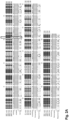
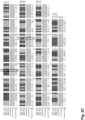
- Fig. 5 shows the results of genotyping of individual alleles with induced mutations in GT1, GT2, GT3, GT4, StT1, S2T2, S3T1, and S3T3 target regions.
- P1000-P21000 are individual lines. Deleted nucleotides are shown with hyphens, and inserted nucleotides are shown in bold. The PAM site is underlined in each wild type (WT) fragment.
- Lines of mutations identified with the high resolution fragment analysis method were subjected to genotyping to determine the exact size and location of the mutation.
- PCR amplification covering the respective target region in the individual lines were cloned and analyzed by DNA sequencing (Eurofins Genomics, Ebersberg, Germany). Fragments spanning the predicted Cas9-cut site was amplified using 0.5 ⁇ l isolated DNA (described under Example 4), 0.25 ⁇ M of each forward and reverse primer and with Phusion polymerase (Invitrogen, Carlsbad, USA) according to the manufacturer's instructions.
- StGBSSexon1f 5'-ACTGGATGAAGGCTGGGATA-3' SEQ. ID. NO. 17
- StGBSSexon1r 5'-ATTTGTCAGTCGCTGGGTTC-3' SEQ. ID. NO. 18
- StGBSS(GT3)f 5'-AGGAACCATACTCTGACTCAC-3' SEQ. ID. NO. 19
- StGBSS(GT3)f 5'-TTTTGCTCCAAGGACCAAC-3' SEQ. ID. NO. 20
- StGBSS(GT4)f 5'-TCTCTATACAGGTCATGGACG-3' SEQ. ID. NO. 21
- StGBSS(GT4)f 5'-GCAGCAACAAGAATATCTGAAC-3' SEQ. ID. NO. 22
- StSS2(S2T1)f 5'-TGGAAATCAGTTCCACCCC-3' SEQ. ID. NO. 23
- StSS2(S2T1)r 5' - CATGGCTAAAACCTTTTTGCTC-3' SEQ. ID. NO. 24
- StSS2(S2T1)f 5'-CGATAAAAATACACCGCCTGC-3' SEQ. ID. NO. 25
- StSS2(S2T1)r 5'-TCTGGAGGGACATTCAACG-3' SEQ. ID. NO. 26
- StSS3(S3T1,S3T2)f 5'-ATCCAAGCTGGAAGCAGTGT-3' SEQ. ID. NO. 27
- StSS3(S3T1,S3T2)r 5' -GACATGGGTGCCATTTTCAG-3' SEQ. ID. NO. 28
- StSS3(S3T3)f 5'-TGATGACAAGGATGCTGTAAAG-3' SEQ. ID. NO. 29
- StSS3(S3T3)r -5'-TCAACATCCACCTGCAATATC-3' SEQ. ID. NO. 30
- the amplification was performed with the following cycling conditions;
- PCR products were ligated to pJET1.2/blunt using a CloneJET PCR Cloning Kit (Thermo Fisher Scientific, Waltham, USA) following transformation to One Shot ® TOP10 Chemically Competent E. coli (Invitrogen, Carlsbad, USA). After 1 night incubation at 37°C on LB plates containing 100 ⁇ g/mL ampicillin, randomly picked colonies were sequenced (GATC Biotech, Konstanz, Germany).
- mutations are induced in one or multiple alleles, independent of the experimental conditions and the targeting nucleotide sequence used, with the exception of GT1 flanking an allelic variation (Table 1).
- the mutation frequencies were found to be up to 37%, depending on the experimental setup.
- the frequency of multiple alleles mutated was found to be generally very high, and in a few experimental setups as high as 100% of detected mutated lines (see Table 1).
- Microtubers are crushed and stained with Lugol's solution (6.7 g/L KI + 3.3 g/L I 2 ) mixed with glycerol (1:1). The starch composition is visualized under light microscope where microtubers having > 92% amylopectin content are stained red-brown in color while starch containing > 9% amylose is stained blue.
- Starch is extracted by grinding microtubers in 2 ml 70% EtOH, followed by filtration through a nylon filter with a small mesh size. 8 ml 70% ethanol is added to the samples, followed by centrifugation at 1000 x g for 10 min. The ethanol is removed and the starch is left to air-dry in room temperature overnight. The isolated starch is further used for analysis as described under Examples 8-10.
- Mutated lines are grown in soil in a greenhouse at 16 hours, 18/15°C day/night temperature, supplementary light intensity of approximately 200 ⁇ mol s -1 m 2 photons and 60% relative humidity. Each line is planted as in-vivo cuttings in biological replicates in 7.5 L pots.
- Starch is isolated from developed minitubers by homogenization in a fruit juicer. Tris-HCl (pH 7.5, 50 mM), Na-dithionite (30 mM), and EDTA (10 mM) is added to the liquid fraction. Starch granules are allowed to sediment. The granules are washed four times with the same buffer and three times with acetone before drying overnight at room temperature. The isolated starch is further used for analysis as described under Examples 9-11.
- a 3 % w/w water suspension of starch is prepared by mixing 15 g DM of the purified gbssl-PS (potato starch), gbssI/ssIII-PS and gbssI/ssII-PS, and gbssI/ssIII/ssII-PS starch, respectively, with 500 g water.
- the starch suspensions are heated in a water bath to 95°C and kept at 95°C for 30 minutes during continuous agitation.
- the starch solutions are put in a refrigerator for cooling down to 20 °C and consequently kept at room temperature.
- the viscosity of the solution is measured at room temperature with a Brookfield LV directly after the solution has reached 20°C and methodically once per day for 7 days.
- similar procedures were performed with commercialized available amylopectin starches, i.e. waxy maize starch with less than 1% amylose (WMS), commercialized waxy potato starch with less than 2% amylose (WPS), commercialized available waxy rice starch with less than 4% amylose (WRS) and commercially available waxy barley starch with less than 0.5% amylose (WBS).
- a 5 % (w/w) water suspension of starch is prepared by mixing 22.5 g DM of the purified gbssl-PS, gbssI/ssII-PS, gbssI/ssIII-PS, and gbssI/ssIII/ssII-PSstarch, respectively, with distilled water to a total weight of 450 g.
- the starch suspension is put into a Brabender Amyloviscograph model E, using a 700 cmg torsion spring. In the Brabender Amyloviscograph the starch suspension is heated to 95°C and is after the holding time of 15 min cooled to 25°C. The viscosity is continuously measured and printed during the cooling phase.
- the starch pastes are stored at room temperature and are further measured with a Stable Micro System Texture Analyzer for 7 days.
- similar procedures were performed with commercially available amylopectin starches, i.e. waxy maize starch with less than 1% amylose (WMS), commercially available waxy potato starch with less than 2% amylose (WPS), commercially available waxy rice starch with less than 4% amylose (WRS), and commercially available waxy barley starch with less than 0.5% amylose (WBS).
- the starch solutions prepared in example 10 are, after cooling to room temperature, put into 50 ml centrifuge tubes and are further centrifuged at 1500 x g for 10 minutes. Thereafter, the water in the centrifuge tubes is siphoned off and weighed. The remaining concentrated starch in the tubes is frozen in a freezer at -18 °C for approximately 24 h. The starch paste is thawed and the solutions are further centrifuged at 1500 x g for 10 minutes. The procedure is repeated and the siphoned water, which is defined as syneresis, after each freeze/thaw cycle is calculated as the accumulated water loss. By dividing the amount of accumulated water loss after each freeze/thaw cycle with the starting weight of water in the solution, the percentage of syneresis can be defined for each starch product.
- waxy maize starch exhibits 30% syneresis after one freeze/thaw cycle
- waxy potato starch exhibit 55% syneresis after one freeze/thaw cycle
- waxy rice starch exhibits 0% syneresis after one freeze/thaw cycle but 14 % after two freeze/thaw cycles
- waxy barley starch exhibits 0% after the three first freeze/thaw cycles and 7% after the fourth freeze/thaw cycle.
- the starches obtained with the method performs better than gbssl-PS, which performs better than WPS, but less than WRS and WMS, gbssI/ssIII-PS performs better than WRS, but less than WBS, and gbssIII/ssII-PS performs better than WRS and comparable to WBS. It is clear that the freeze/thaw stability of the starches obtained with the method according to the present invention, is significantly improved compared to the commercially available waxy potato starch.
- Example 12 Starch composition in mutated lines
- the High Performance Size Exclusion Chromatography (HPSEC) system consists of the following parts: A high pressure pump, an autosampler with a 500 ⁇ l loop, a RI (refractive index) detector, a column oven heated to 70°C, a magnetic stirrer and a chromatography data system. Three PL-gel 10 ⁇ m Mixed-B 300 x 7.5 mm polystyrene divinyl benzene analytical columns and one PL-gel 10 10 ⁇ m Mixed-B 100 x 7.5 mm guard column is used for the separation.
- the eluent is 50 mM lithium bromide in 100 % DMSO, and the flow rate is 0.5 ml/min.
- amylose fraction Since the starch is debranched the amylose fraction has the highest molecular weight and elutes fastest through the SEC columns, while the amylopectin has been degraded into single chains and elutes after the amylose.
- the chromatogram is split at the retention time corresponding to DP 200 (Mw ⁇ 34 000 g/mol) which is the transition of amylose to amylopectin in debranched potato starch.
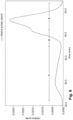
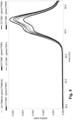
- amylopectin and amylose in the starch are carried out on a High Performance Size Exclusion Chromatography system. Before the sample is injected into the separation system it is solublized in NaOH and debranched with isoamylase. After the digestion of the amylopectin the amylose fraction has the biggest molecules and is eluted first through the separation system. The retention times for amylose and amylopectin are all based on the chromatogram ( Fig. 6 ) of debranched native potato starch (full scale produced at Lyckeby Starch AB, Sweden). The material eluted in the first peak (1. in Fig.
- amylose is considered amylose, and the material eluted later in the chromatogram is then amylopectin (2+3. in Fig. 6 ).
- the amylopectin fraction is split between long chained amylopectin (2. in Fig. 6 ) and short chained amylopectin (3. in Fig. 6 ).
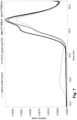
- Starch was extracted from potato tubers from a number of individual mutated lines exemplified by lines 23178 (gbssI-PS), 18039 (gbssI/ssIII-PS), and 27031 (gbssI/ssIII-PS). In all cases, the bulked starch displayed more than 99% or 99.5% amylopectin. The result is shown in Table 3 and Fig. 7 for lines 27031 (gbssI/ssIII-PS) and 23178 (gbssI-PS) and in Fig. 8 for line 18039 (gbssI/ssIII-PS) together with traditional native potato starch.
- Short Amylopectin chains (%) Native potato starch (Lyckeby) 21 32 68
- Commercial available waxy potato starch ⁇ 1 32 68 Waxy Maize starch ⁇ 1 22 79 BAP (Barley amylopectin starch) ⁇ 1 18 83 23178 #1 (gbssI-PS#1) ⁇ 1 38 62 23178 #2 (gbssI-PS#2) ⁇ 1 34 66 23178 #3 (gbssI-PS#3) ⁇ 1 33 67 23178 #4 (gbssI-PS#4) ⁇ 1 32 68 23178 #5 (gbssI-PS#5) ⁇ 1 35 65 23178#Bulk (gbssI-PS#bulk) ⁇ 1 35 65 18039 (gbssI+ssIII-PS) ⁇ 1 29 71 27031 (gbssI+ssIII-PS) ⁇ 1 27 74
Landscapes
- Health & Medical Sciences (AREA)
- Life Sciences & Earth Sciences (AREA)
- Genetics & Genomics (AREA)
- Chemical & Material Sciences (AREA)
- Engineering & Computer Science (AREA)
- Organic Chemistry (AREA)
- Biotechnology (AREA)
- Biomedical Technology (AREA)
- Molecular Biology (AREA)
- Wood Science & Technology (AREA)
- Zoology (AREA)
- General Engineering & Computer Science (AREA)
- Bioinformatics & Cheminformatics (AREA)
- Biochemistry (AREA)
- Chemical Kinetics & Catalysis (AREA)
- Medicinal Chemistry (AREA)
- Polymers & Plastics (AREA)
- General Health & Medical Sciences (AREA)
- Biophysics (AREA)
- Plant Pathology (AREA)
- Microbiology (AREA)
- Physics & Mathematics (AREA)
- Nutrition Science (AREA)
- Cell Biology (AREA)
- Materials Engineering (AREA)
- Mycology (AREA)
- Crystallography & Structural Chemistry (AREA)
- Polysaccharides And Polysaccharide Derivatives (AREA)
- Breeding Of Plants And Reproduction By Means Of Culturing (AREA)
- Preparation Of Fruits And Vegetables (AREA)
Applications Claiming Priority (2)
| Application Number | Priority Date | Filing Date | Title |
|---|---|---|---|
| SE1650598A SE1650598A1 (en) | 2016-05-03 | 2016-05-03 | Amylopectin potato starch with improved stability against retrogradation and improved freeze and thaw stability |
| PCT/SE2017/050429 WO2017192095A1 (en) | 2016-05-03 | 2017-05-03 | Amylopectin potato starch with improved stability against retrogradation and improved freeze and thaw stability |
Publications (3)
| Publication Number | Publication Date |
|---|---|
| EP3452602A1 EP3452602A1 (en) | 2019-03-13 |
| EP3452602A4 EP3452602A4 (en) | 2020-03-25 |
| EP3452602B1 true EP3452602B1 (en) | 2025-04-02 |
Family
ID=60203128
Family Applications (1)
| Application Number | Title | Priority Date | Filing Date |
|---|---|---|---|
| EP17792956.9A Active EP3452602B1 (en) | 2016-05-03 | 2017-05-03 | Method for the production of a potato (solanum tuberosum) wherein said method involves homology-directed mutagenesis using a crispr/cas9 technique |
Country Status (8)
| Country | Link |
|---|---|
| US (1) | US11905343B2 (da) |
| EP (1) | EP3452602B1 (da) |
| CN (1) | CN109312358A (da) |
| DK (1) | DK3452602T3 (da) |
| FI (1) | FI3452602T3 (da) |
| PL (1) | PL3452602T3 (da) |
| SE (1) | SE1650598A1 (da) |
| WO (1) | WO2017192095A1 (da) |
Families Citing this family (10)
| Publication number | Priority date | Publication date | Assignee | Title |
|---|---|---|---|---|
| SE1650598A1 (en) | 2016-05-03 | 2017-11-04 | Lyckeby Starch Ab | Amylopectin potato starch with improved stability against retrogradation and improved freeze and thaw stability |
| WO2019145544A1 (en) | 2018-01-26 | 2019-08-01 | Böhm-Nordkartoffel Agrarproduktion Gmbh & Co. Ohg | Altered starch producing plants |
| CN109852635A (zh) * | 2019-03-01 | 2019-06-07 | 安徽华明太合生物工程有限公司 | 一种快速检测基因编辑有效性的方法 |
| WO2022250540A1 (en) * | 2021-05-28 | 2022-12-01 | Coöperatie Koninklijke Avebe U.A. | Amylopectin starch for binding of meat products |
| CN113447626A (zh) * | 2021-06-10 | 2021-09-28 | 浙江大学 | 一种评价山药糯性的方法 |
| CN113999850B (zh) * | 2021-11-23 | 2023-06-23 | 云南农业大学 | 马铃薯u6 rna聚合酶iii型启动子及其克隆与应用 |
| CN114836564A (zh) * | 2022-05-09 | 2022-08-02 | 山西农业大学 | 一种针对糜子gbssi基因开发的功能标记 |
| CN116200518B (zh) * | 2022-09-20 | 2023-10-27 | 宁夏农林科学院农业生物技术研究中心(宁夏农业生物技术重点实验室) | 一种与马铃薯淀粉含量相关的kasp标记的开发及应用 |
| CN118109448B (zh) * | 2024-03-18 | 2024-12-06 | 武汉新华扬生物股份有限公司 | 一种提高核酸酶稳定性的助剂及其制备方法和应用 |
| CN118325860B (zh) * | 2024-05-21 | 2024-11-01 | 内蒙古工业大学 | 一种马铃薯淀粉合成酶 |
Citations (1)
| Publication number | Priority date | Publication date | Assignee | Title |
|---|---|---|---|---|
| WO2014194190A1 (en) * | 2013-05-30 | 2014-12-04 | The Penn State Research Foundation | Gene targeting and genetic modification of plants via rna-guided genome editing |
Family Cites Families (17)
| Publication number | Priority date | Publication date | Assignee | Title |
|---|---|---|---|---|
| SE467358B (sv) * | 1990-12-21 | 1992-07-06 | Amylogene Hb | Genteknisk foeraendring av potatis foer bildning av staerkelse av amylopektintyp |
| US6600093B1 (en) | 1992-02-14 | 2003-07-29 | Cooperatieve Verkoop-En Productievereniging Van Aardappelmeel En Derivaten Avebe B.A. | Potato plant producing essentially amylose-free starch |
| DE4441408A1 (de) | 1994-11-10 | 1996-05-15 | Inst Genbiologische Forschung | DNA-Sequenzen aus Solanum tuberosum kodierend Enzyme, die an der Stärkesynthese beteiligt sind, Plasmide, Bakterien, Pflanzenzellen und transgene Pflanzen enhaltend diese Sequenzen |
| GB9525353D0 (en) | 1995-12-12 | 1996-02-14 | Nat Starch Chem Invest | Potato soluble starch synthase |
| DE69940734D1 (de) | 1998-06-15 | 2009-05-28 | Brunob Ii Bv | Verbesserung von pflanzen und deren produkten |
| DE69913165D1 (de) * | 1998-07-22 | 2004-01-08 | Avebe Coop Verkoop Prod | Enthaarungsmittel enthaltend verdicker |
| DE19836098A1 (de) | 1998-07-31 | 2000-02-03 | Hoechst Schering Agrevo Gmbh | Pflanzen, die eine modifizierte Stärke synthetisieren, Verfahren zur Herstellung der Pflanzen, ihre Verwendung sowie die modifizierte Stärke |
| AUPQ005299A0 (en) | 1999-04-29 | 1999-05-27 | Commonwealth Scientific And Industrial Research Organisation | Novel genes encoding wheat starch synthases and uses therefor |
| DE19937643A1 (de) | 1999-08-12 | 2001-02-22 | Aventis Cropscience Gmbh | Transgene Zellen und Pflanzen mit veränderter Aktivität des GBSSI- und des BE-Proteins |
| GB9921830D0 (en) | 1999-09-15 | 1999-11-17 | Nat Starch Chem Invest | Plants having reduced activity in two or more starch-modifying enzymes |
| JP2005508166A (ja) * | 2001-10-17 | 2005-03-31 | ビーエーエスエフ プラント サイエンス, ゲーエムベーハー | デンプン |
| DE102004029763A1 (de) | 2004-06-21 | 2006-01-05 | Bayer Cropscience Gmbh | Pflanzen, die Amylopektin-Stärke mit neuen Eigenschaften herstellen |
| EP1707632A1 (de) * | 2005-04-01 | 2006-10-04 | Bayer CropScience GmbH | Phosphorylierte waxy-Kartoffelstärke |
| EP1950303A1 (de) * | 2007-01-26 | 2008-07-30 | Bayer CropScience AG | Genetisch modifizierte Pflanzen, die eine Stärke mit geringem Amylosegehalt und erhöhtem Quellvermögen synthetisieren |
| EP2319872A1 (en) | 2009-11-04 | 2011-05-11 | BASF Plant Science GmbH | Amylopectin type starch with enhanced retrogradation stability |
| EP3158072B1 (en) | 2014-06-20 | 2021-01-13 | Cellectis | Potatoes with reduced granule-bound starch synthase |
| SE1650598A1 (en) | 2016-05-03 | 2017-11-04 | Lyckeby Starch Ab | Amylopectin potato starch with improved stability against retrogradation and improved freeze and thaw stability |
-
2016
- 2016-05-03 SE SE1650598A patent/SE1650598A1/en not_active Application Discontinuation
-
2017
- 2017-05-03 FI FIEP17792956.9T patent/FI3452602T3/fi active
- 2017-05-03 WO PCT/SE2017/050429 patent/WO2017192095A1/en not_active Ceased
- 2017-05-03 EP EP17792956.9A patent/EP3452602B1/en active Active
- 2017-05-03 CN CN201780036789.8A patent/CN109312358A/zh active Pending
- 2017-05-03 PL PL17792956.9T patent/PL3452602T3/pl unknown
- 2017-05-03 DK DK17792956.9T patent/DK3452602T3/da active
- 2017-05-03 US US16/098,584 patent/US11905343B2/en active Active
Patent Citations (1)
| Publication number | Priority date | Publication date | Assignee | Title |
|---|---|---|---|---|
| WO2014194190A1 (en) * | 2013-05-30 | 2014-12-04 | The Penn State Research Foundation | Gene targeting and genetic modification of plants via rna-guided genome editing |
Non-Patent Citations (4)
| Title |
|---|
| ANONYMOUS: "Verbundvorhaben: Züchterische Optimierung von Spezialstärken; Teilvorhaben 1: Züchtung Teilvorhaben 2: Erbgut-AnalytikTeilvorhaben 3: Stärkeanalytik", BMELV - SCHLUSSBERICHT, 1 January 2013 (2013-01-01), pages 1 - 6, XP055890976, Retrieved from the Internet <URL:https://www.tib.eu/de/suchen?tx_tibsearch_search%5Baction%5D=download&tx_tibsearch_search%5Bcontroller%5D=Download&tx_tibsearch_search%5Bdocid%5D=TIBKAT%3A832680079&cHash=ada582b24992ba24a9604d5f163bdc1a#download-mark> [retrieved on 20220214], DOI: 10.2314/GBV:832680079 * |
| EDWARDS, ANNE ET AL.: "A combined reduction in activity of starch synthases II and III of potato has novel effects on the starch of tubers", THE PLANT JOURNAL, vol. 17, no. 3, 28 January 1999 (1999-01-28), pages 251 - 261, XP002115084, DOI: 10.1046/j.1365-313X.1999.00371.x * |
| SARGEANT J.G ET AL: "Determination of amylose: amylopectin ratios of starches", STARCH/STARKE, vol. 34, no. 3, 1 January 1982 (1982-01-01), DE, pages 89 - 92, XP093119520, ISSN: 0038-9056, DOI: 10.1002/star.19820340306 * |
| WANG SHAOHUI ET AL: "Efficient targeted mutagenesis in potato by the CRISPR/Cas9 system", PLANT CELL REPORTS, vol. 34, no. 9, 17 June 2015 (2015-06-17), Berlin/Heidelberg, pages 1473 - 1476, XP093026954, ISSN: 0721-7714, Retrieved from the Internet <URL:http://link.springer.com/article/10.1007/s00299-015-1816-7/fulltext.html> DOI: 10.1007/s00299-015-1816-7 * |
Also Published As
| Publication number | Publication date |
|---|---|
| EP3452602A1 (en) | 2019-03-13 |
| DK3452602T3 (da) | 2025-07-07 |
| US11905343B2 (en) | 2024-02-20 |
| CN109312358A (zh) | 2019-02-05 |
| WO2017192095A1 (en) | 2017-11-09 |
| PL3452602T3 (pl) | 2025-09-22 |
| SE1650598A1 (en) | 2017-11-04 |
| US20190135946A1 (en) | 2019-05-09 |
| EP3452602A4 (en) | 2020-03-25 |
| FI3452602T3 (fi) | 2025-06-25 |
Similar Documents
| Publication | Publication Date | Title |
|---|---|---|
| EP3452602B1 (en) | Method for the production of a potato (solanum tuberosum) wherein said method involves homology-directed mutagenesis using a crispr/cas9 technique | |
| Voiniciuc et al. | Identification of key enzymes for pectin synthesis in seed mucilage | |
| CA2530874C (en) | Wheat with altered branching enzyme activity and starch and starch containing products derived therefrom | |
| CA2338002C (en) | Plants synthesizing a modified starch, process for the generation of the plants, their use, and the modified starch | |
| KR100210352B1 (ko) | 아밀로펙틴형 전분을 생성하기 위한 감자의 유전공학적 변성 | |
| CA2603919C (en) | High-phosphate starch | |
| CN100516227C (zh) | 改变了淀粉分支酶活性的大麦及增加了直链淀粉含量的淀粉和含淀粉产品 | |
| PL169859B1 (pl) | Sposób hamowania tworzenia sie w ziemniakach skrobi typu amylopektyny PL | |
| US20250092411A1 (en) | Methods for altering starch granule profile | |
| Lu et al. | Molecular genetic analysis of glucan branching enzymes from plants and bacteria in Arabidopsis reveals marked differences in their functions and capacity to mediate starch granule formation | |
| WO2009000557A1 (en) | Starches with high amylose content and improved processing properties | |
| US5856467A (en) | Genetically engineered modification of potato to form amylose-type starch | |
| US7244839B2 (en) | Maize starch containing elevated amounts of actual amylose | |
| ZA200510474B (en) | Wheat with altered branching enzyme activity and starch and starch containing products derived therefrom | |
| EP2319872A1 (en) | Amylopectin type starch with enhanced retrogradation stability | |
| US10233457B2 (en) | Inhibition of a xylosyltransferase to improve saccharification efficiency | |
| US20160312237A1 (en) | Transgenic Plant | |
| AU2007278208B2 (en) | Plants defective for Soluble Starch Synthase IV (SSIV) activity, methods for obtaining the same, ans uses thereof | |
| Hofvander | Production of amylopectin and high-amylose starch in separate potato genotypes | |
| Zhang et al. | THE Zea mays GENE sugary 2 CODES FOR STARCH SYNTHASE ISOFORM SSIIa | |
| EP2880165A1 (en) | Polysaccharide synthases (x) | |
| MXPA01001148A (en) | Plants which synthesize a modified starch, methods for producing the plants, their use, and the modified starch |
Legal Events
| Date | Code | Title | Description |
|---|---|---|---|
| STAA | Information on the status of an ep patent application or granted ep patent |
Free format text: STATUS: THE INTERNATIONAL PUBLICATION HAS BEEN MADE |
|
| PUAI | Public reference made under article 153(3) epc to a published international application that has entered the european phase |
Free format text: ORIGINAL CODE: 0009012 |
|
| STAA | Information on the status of an ep patent application or granted ep patent |
Free format text: STATUS: REQUEST FOR EXAMINATION WAS MADE |
|
| 17P | Request for examination filed |
Effective date: 20181128 |
|
| AK | Designated contracting states |
Kind code of ref document: A1 Designated state(s): AL AT BE BG CH CY CZ DE DK EE ES FI FR GB GR HR HU IE IS IT LI LT LU LV MC MK MT NL NO PL PT RO RS SE SI SK SM TR |
|
| AX | Request for extension of the european patent |
Extension state: BA ME |
|
| DAV | Request for validation of the european patent (deleted) | ||
| DAX | Request for extension of the european patent (deleted) | ||
| RIC1 | Information provided on ipc code assigned before grant |
Ipc: A01H 5/06 20180101ALI20191126BHEP Ipc: C08B 30/20 20060101ALI20191126BHEP Ipc: C12N 15/82 20060101AFI20191126BHEP |
|
| RAP1 | Party data changed (applicant data changed or rights of an application transferred) |
Owner name: SVERIGES STAERKELSEPRODUCENTER, FOERENING U.P.A. |
|
| A4 | Supplementary search report drawn up and despatched |
Effective date: 20200221 |
|
| RIC1 | Information provided on ipc code assigned before grant |
Ipc: A01H 5/06 20180101ALI20200217BHEP Ipc: C12N 15/82 20060101AFI20200217BHEP Ipc: C08B 30/20 20060101ALI20200217BHEP |
|
| STAA | Information on the status of an ep patent application or granted ep patent |
Free format text: STATUS: EXAMINATION IS IN PROGRESS |
|
| 17Q | First examination report despatched |
Effective date: 20201211 |
|
| TPAC | Observations filed by third parties |
Free format text: ORIGINAL CODE: EPIDOSNTIPA |
|
| TPAC | Observations filed by third parties |
Free format text: ORIGINAL CODE: EPIDOSNTIPA |
|
| GRAP | Despatch of communication of intention to grant a patent |
Free format text: ORIGINAL CODE: EPIDOSNIGR1 |
|
| STAA | Information on the status of an ep patent application or granted ep patent |
Free format text: STATUS: GRANT OF PATENT IS INTENDED |
|
| INTG | Intention to grant announced |
Effective date: 20241029 |
|
| GRAS | Grant fee paid |
Free format text: ORIGINAL CODE: EPIDOSNIGR3 |
|
| GRAA | (expected) grant |
Free format text: ORIGINAL CODE: 0009210 |
|
| STAA | Information on the status of an ep patent application or granted ep patent |
Free format text: STATUS: THE PATENT HAS BEEN GRANTED |
|
| P01 | Opt-out of the competence of the unified patent court (upc) registered |
Free format text: CASE NUMBER: APP_7469/2025 Effective date: 20250213 |
|
| AK | Designated contracting states |
Kind code of ref document: B1 Designated state(s): AL AT BE BG CH CY CZ DE DK EE ES FI FR GB GR HR HU IE IS IT LI LT LU LV MC MK MT NL NO PL PT RO RS SE SI SK SM TR |
|
| REG | Reference to a national code |
Ref country code: GB Ref legal event code: FG4D |
|
| REG | Reference to a national code |
Ref country code: CH Ref legal event code: EP |
|
| REG | Reference to a national code |
Ref country code: IE Ref legal event code: FG4D |
|
| REG | Reference to a national code |
Ref country code: DE Ref legal event code: R096 Ref document number: 602017088710 Country of ref document: DE |
|
| REG | Reference to a national code |
Ref country code: FI Ref legal event code: FGE |
|
| REG | Reference to a national code |
Ref country code: DK Ref legal event code: T3 Effective date: 20250702 |
|
| PGFP | Annual fee paid to national office [announced via postgrant information from national office to epo] |
Ref country code: FI Payment date: 20250613 Year of fee payment: 9 |
|
| PGFP | Annual fee paid to national office [announced via postgrant information from national office to epo] |
Ref country code: DE Payment date: 20250617 Year of fee payment: 9 |
|
| REG | Reference to a national code |
Ref country code: NL Ref legal event code: FP |
|
| PGFP | Annual fee paid to national office [announced via postgrant information from national office to epo] |
Ref country code: GB Payment date: 20250604 Year of fee payment: 9 |
|
| PGFP | Annual fee paid to national office [announced via postgrant information from national office to epo] |
Ref country code: NL Payment date: 20250602 Year of fee payment: 9 Ref country code: BE Payment date: 20250602 Year of fee payment: 9 |
|
| REG | Reference to a national code |
Ref country code: SE Ref legal event code: TRGR |
|
| PGFP | Annual fee paid to national office [announced via postgrant information from national office to epo] |
Ref country code: FR Payment date: 20250602 Year of fee payment: 9 |
|
| PGFP | Annual fee paid to national office [announced via postgrant information from national office to epo] |
Ref country code: AT Payment date: 20250617 Year of fee payment: 9 |
|
| PGFP | Annual fee paid to national office [announced via postgrant information from national office to epo] |
Ref country code: IE Payment date: 20250602 Year of fee payment: 9 |
|
| PGFP | Annual fee paid to national office [announced via postgrant information from national office to epo] |
Ref country code: SE Payment date: 20250613 Year of fee payment: 9 |
|
| PG25 | Lapsed in a contracting state [announced via postgrant information from national office to epo] |
Ref country code: ES Free format text: LAPSE BECAUSE OF FAILURE TO SUBMIT A TRANSLATION OF THE DESCRIPTION OR TO PAY THE FEE WITHIN THE PRESCRIBED TIME-LIMIT Effective date: 20250402 Ref country code: PT Free format text: LAPSE BECAUSE OF FAILURE TO SUBMIT A TRANSLATION OF THE DESCRIPTION OR TO PAY THE FEE WITHIN THE PRESCRIBED TIME-LIMIT Effective date: 20250804 |
|
| PGFP | Annual fee paid to national office [announced via postgrant information from national office to epo] |
Ref country code: DK Payment date: 20250711 Year of fee payment: 9 |
|
| REG | Reference to a national code |
Ref country code: LT Ref legal event code: MG9D |
|
| PG25 | Lapsed in a contracting state [announced via postgrant information from national office to epo] |
Ref country code: NO Free format text: LAPSE BECAUSE OF FAILURE TO SUBMIT A TRANSLATION OF THE DESCRIPTION OR TO PAY THE FEE WITHIN THE PRESCRIBED TIME-LIMIT Effective date: 20250702 Ref country code: GR Free format text: LAPSE BECAUSE OF FAILURE TO SUBMIT A TRANSLATION OF THE DESCRIPTION OR TO PAY THE FEE WITHIN THE PRESCRIBED TIME-LIMIT Effective date: 20250703 |
|
| PGFP | Annual fee paid to national office [announced via postgrant information from national office to epo] |
Ref country code: PL Payment date: 20250530 Year of fee payment: 9 |
|
| PG25 | Lapsed in a contracting state [announced via postgrant information from national office to epo] |
Ref country code: BG Free format text: LAPSE BECAUSE OF FAILURE TO SUBMIT A TRANSLATION OF THE DESCRIPTION OR TO PAY THE FEE WITHIN THE PRESCRIBED TIME-LIMIT Effective date: 20250402 |
|
| PG25 | Lapsed in a contracting state [announced via postgrant information from national office to epo] |
Ref country code: HR Free format text: LAPSE BECAUSE OF FAILURE TO SUBMIT A TRANSLATION OF THE DESCRIPTION OR TO PAY THE FEE WITHIN THE PRESCRIBED TIME-LIMIT Effective date: 20250402 |
|
| PG25 | Lapsed in a contracting state [announced via postgrant information from national office to epo] |
Ref country code: RS Free format text: LAPSE BECAUSE OF FAILURE TO SUBMIT A TRANSLATION OF THE DESCRIPTION OR TO PAY THE FEE WITHIN THE PRESCRIBED TIME-LIMIT Effective date: 20250702 |
|
| PGFP | Annual fee paid to national office [announced via postgrant information from national office to epo] |
Ref country code: CZ Payment date: 20250602 Year of fee payment: 9 |
|
| PG25 | Lapsed in a contracting state [announced via postgrant information from national office to epo] |
Ref country code: IS Free format text: LAPSE BECAUSE OF FAILURE TO SUBMIT A TRANSLATION OF THE DESCRIPTION OR TO PAY THE FEE WITHIN THE PRESCRIBED TIME-LIMIT Effective date: 20250802 |
|
| PG25 | Lapsed in a contracting state [announced via postgrant information from national office to epo] |
Ref country code: LV Free format text: LAPSE BECAUSE OF FAILURE TO SUBMIT A TRANSLATION OF THE DESCRIPTION OR TO PAY THE FEE WITHIN THE PRESCRIBED TIME-LIMIT Effective date: 20250402 |