EP3441274A1 - Dispositif de commande de déplacement, véhicule et procédé de commande de déplacement - Google Patents
Dispositif de commande de déplacement, véhicule et procédé de commande de déplacement Download PDFInfo
- Publication number
- EP3441274A1 EP3441274A1 EP18187332.4A EP18187332A EP3441274A1 EP 3441274 A1 EP3441274 A1 EP 3441274A1 EP 18187332 A EP18187332 A EP 18187332A EP 3441274 A1 EP3441274 A1 EP 3441274A1
- Authority
- EP
- European Patent Office
- Prior art keywords
- traveling
- vehicle
- driven
- inertia
- traveling control
- Prior art date
- Legal status (The legal status is an assumption and is not a legal conclusion. Google has not performed a legal analysis and makes no representation as to the accuracy of the status listed.)
- Withdrawn
Links
Images


Classifications
-
- B—PERFORMING OPERATIONS; TRANSPORTING
- B60—VEHICLES IN GENERAL
- B60W—CONJOINT CONTROL OF VEHICLE SUB-UNITS OF DIFFERENT TYPE OR DIFFERENT FUNCTION; CONTROL SYSTEMS SPECIALLY ADAPTED FOR HYBRID VEHICLES; ROAD VEHICLE DRIVE CONTROL SYSTEMS FOR PURPOSES NOT RELATED TO THE CONTROL OF A PARTICULAR SUB-UNIT
- B60W30/00—Purposes of road vehicle drive control systems not related to the control of a particular sub-unit, e.g. of systems using conjoint control of vehicle sub-units
- B60W30/14—Adaptive cruise control
-
- B—PERFORMING OPERATIONS; TRANSPORTING
- B60—VEHICLES IN GENERAL
- B60W—CONJOINT CONTROL OF VEHICLE SUB-UNITS OF DIFFERENT TYPE OR DIFFERENT FUNCTION; CONTROL SYSTEMS SPECIALLY ADAPTED FOR HYBRID VEHICLES; ROAD VEHICLE DRIVE CONTROL SYSTEMS FOR PURPOSES NOT RELATED TO THE CONTROL OF A PARTICULAR SUB-UNIT
- B60W30/00—Purposes of road vehicle drive control systems not related to the control of a particular sub-unit, e.g. of systems using conjoint control of vehicle sub-units
- B60W30/18—Propelling the vehicle
- B60W30/18009—Propelling the vehicle related to particular drive situations
- B60W30/18072—Coasting
-
- B—PERFORMING OPERATIONS; TRANSPORTING
- B60—VEHICLES IN GENERAL
- B60W—CONJOINT CONTROL OF VEHICLE SUB-UNITS OF DIFFERENT TYPE OR DIFFERENT FUNCTION; CONTROL SYSTEMS SPECIALLY ADAPTED FOR HYBRID VEHICLES; ROAD VEHICLE DRIVE CONTROL SYSTEMS FOR PURPOSES NOT RELATED TO THE CONTROL OF A PARTICULAR SUB-UNIT
- B60W30/00—Purposes of road vehicle drive control systems not related to the control of a particular sub-unit, e.g. of systems using conjoint control of vehicle sub-units
- B60W30/14—Adaptive cruise control
- B60W30/16—Control of distance between vehicles, e.g. keeping a distance to preceding vehicle
-
- B—PERFORMING OPERATIONS; TRANSPORTING
- B60—VEHICLES IN GENERAL
- B60K—ARRANGEMENT OR MOUNTING OF PROPULSION UNITS OR OF TRANSMISSIONS IN VEHICLES; ARRANGEMENT OR MOUNTING OF PLURAL DIVERSE PRIME-MOVERS IN VEHICLES; AUXILIARY DRIVES FOR VEHICLES; INSTRUMENTATION OR DASHBOARDS FOR VEHICLES; ARRANGEMENTS IN CONNECTION WITH COOLING, AIR INTAKE, GAS EXHAUST OR FUEL SUPPLY OF PROPULSION UNITS IN VEHICLES
- B60K31/00—Vehicle fittings, acting on a single sub-unit only, for automatically controlling vehicle speed, i.e. preventing speed from exceeding an arbitrarily established velocity or maintaining speed at a particular velocity, as selected by the vehicle operator
-
- B—PERFORMING OPERATIONS; TRANSPORTING
- B60—VEHICLES IN GENERAL
- B60W—CONJOINT CONTROL OF VEHICLE SUB-UNITS OF DIFFERENT TYPE OR DIFFERENT FUNCTION; CONTROL SYSTEMS SPECIALLY ADAPTED FOR HYBRID VEHICLES; ROAD VEHICLE DRIVE CONTROL SYSTEMS FOR PURPOSES NOT RELATED TO THE CONTROL OF A PARTICULAR SUB-UNIT
- B60W2520/00—Input parameters relating to overall vehicle dynamics
- B60W2520/10—Longitudinal speed
-
- B—PERFORMING OPERATIONS; TRANSPORTING
- B60—VEHICLES IN GENERAL
- B60W—CONJOINT CONTROL OF VEHICLE SUB-UNITS OF DIFFERENT TYPE OR DIFFERENT FUNCTION; CONTROL SYSTEMS SPECIALLY ADAPTED FOR HYBRID VEHICLES; ROAD VEHICLE DRIVE CONTROL SYSTEMS FOR PURPOSES NOT RELATED TO THE CONTROL OF A PARTICULAR SUB-UNIT
- B60W2540/00—Input parameters relating to occupants
- B60W2540/10—Accelerator pedal position
-
- B—PERFORMING OPERATIONS; TRANSPORTING
- B60—VEHICLES IN GENERAL
- B60W—CONJOINT CONTROL OF VEHICLE SUB-UNITS OF DIFFERENT TYPE OR DIFFERENT FUNCTION; CONTROL SYSTEMS SPECIALLY ADAPTED FOR HYBRID VEHICLES; ROAD VEHICLE DRIVE CONTROL SYSTEMS FOR PURPOSES NOT RELATED TO THE CONTROL OF A PARTICULAR SUB-UNIT
- B60W2540/00—Input parameters relating to occupants
- B60W2540/12—Brake pedal position
-
- B—PERFORMING OPERATIONS; TRANSPORTING
- B60—VEHICLES IN GENERAL
- B60W—CONJOINT CONTROL OF VEHICLE SUB-UNITS OF DIFFERENT TYPE OR DIFFERENT FUNCTION; CONTROL SYSTEMS SPECIALLY ADAPTED FOR HYBRID VEHICLES; ROAD VEHICLE DRIVE CONTROL SYSTEMS FOR PURPOSES NOT RELATED TO THE CONTROL OF A PARTICULAR SUB-UNIT
- B60W2554/00—Input parameters relating to objects
- B60W2554/80—Spatial relation or speed relative to objects
-
- B—PERFORMING OPERATIONS; TRANSPORTING
- B60—VEHICLES IN GENERAL
- B60W—CONJOINT CONTROL OF VEHICLE SUB-UNITS OF DIFFERENT TYPE OR DIFFERENT FUNCTION; CONTROL SYSTEMS SPECIALLY ADAPTED FOR HYBRID VEHICLES; ROAD VEHICLE DRIVE CONTROL SYSTEMS FOR PURPOSES NOT RELATED TO THE CONTROL OF A PARTICULAR SUB-UNIT
- B60W2554/00—Input parameters relating to objects
- B60W2554/80—Spatial relation or speed relative to objects
- B60W2554/801—Lateral distance
-
- B—PERFORMING OPERATIONS; TRANSPORTING
- B60—VEHICLES IN GENERAL
- B60W—CONJOINT CONTROL OF VEHICLE SUB-UNITS OF DIFFERENT TYPE OR DIFFERENT FUNCTION; CONTROL SYSTEMS SPECIALLY ADAPTED FOR HYBRID VEHICLES; ROAD VEHICLE DRIVE CONTROL SYSTEMS FOR PURPOSES NOT RELATED TO THE CONTROL OF A PARTICULAR SUB-UNIT
- B60W2554/00—Input parameters relating to objects
- B60W2554/80—Spatial relation or speed relative to objects
- B60W2554/802—Longitudinal distance
-
- B—PERFORMING OPERATIONS; TRANSPORTING
- B60—VEHICLES IN GENERAL
- B60W—CONJOINT CONTROL OF VEHICLE SUB-UNITS OF DIFFERENT TYPE OR DIFFERENT FUNCTION; CONTROL SYSTEMS SPECIALLY ADAPTED FOR HYBRID VEHICLES; ROAD VEHICLE DRIVE CONTROL SYSTEMS FOR PURPOSES NOT RELATED TO THE CONTROL OF A PARTICULAR SUB-UNIT
- B60W2555/00—Input parameters relating to exterior conditions, not covered by groups B60W2552/00, B60W2554/00
- B60W2555/60—Traffic rules, e.g. speed limits or right of way
-
- Y—GENERAL TAGGING OF NEW TECHNOLOGICAL DEVELOPMENTS; GENERAL TAGGING OF CROSS-SECTIONAL TECHNOLOGIES SPANNING OVER SEVERAL SECTIONS OF THE IPC; TECHNICAL SUBJECTS COVERED BY FORMER USPC CROSS-REFERENCE ART COLLECTIONS [XRACs] AND DIGESTS
- Y02—TECHNOLOGIES OR APPLICATIONS FOR MITIGATION OR ADAPTATION AGAINST CLIMATE CHANGE
- Y02T—CLIMATE CHANGE MITIGATION TECHNOLOGIES RELATED TO TRANSPORTATION
- Y02T10/00—Road transport of goods or passengers
- Y02T10/60—Other road transportation technologies with climate change mitigation effect
Definitions
- the present disclosure relates to a traveling control device, a vehicle, and a traveling control method.
- the driven traveling includes the Adaptive Cruise Control (ACC) that allows a vehicle to travel at a constant speed while following a preceding vehicle with a constant distance being kept between these vehicles.
- ACC Adaptive Cruise Control
- the driven traveling when a relative speed of the vehicle to the preceding vehicle is greater than or equal to a predetermined speed, the necessity of stopping the vehicle is high.
- the necessity of stopping the vehicle is also high when a traffic light in the vehicle-traveling direction is red.
- the vehicle In a case where the necessity of stopping the vehicle in driven traveling is high, the vehicle is decelerated by controlling the driven traveling for greater safety.
- An object of the present disclosure is to provide a traveling control device, vehicle, and traveling control method which make it possible to reduce wasteful energy consumption.
- a traveling control device includes: a traveling-condition determining section configured to determine whether or not necessity of decelerating a vehicle is high, based on a traveling condition; and a traveling control section configured to switch traveling of the vehicle from driven traveling to inertia traveling, when the traveling of the vehicle is the driven traveling and when the traveling-condition determining section determines that the necessity of stopping the vehicle is high.
- a vehicle according to the present disclosure includes the aforementioned traveling control device.
- a traveling control method includes: determining whether or not necessity of stopping a vehicle is high, based on a traveling condition; and switching traveling of the vehicle from driven traveling to inertia traveling, when the traveling of the vehicle is the driven traveling and when it is determined that the necessity of stopping the vehicle is high.
- wasteful energy consumption can be reduced.
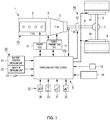
- FIG. 1 is a block diagram illustrating an exemplary configuration of the vehicle including traveling control device 100 according to the embodiment of the present disclosure. Note here that, the illustration and description are given with focuses on parts relevant to traveling control device 100.
- Vehicle 1 illustrated in FIG. 1 is, for example, a large vehicle such as a truck, in which a straight-six diesel engine is mounted.
- vehicle 1 includes engine 3, clutch 4, gearbox (transmission) 5, thrust shaft (propeller shaft) 6, differential device (differential gear) 7, driving shaft (drive shaft) 8, and wheels 9, as components of a driving system allowing the vehicle to travel.
- the power of engine 3 is transmitted to gearbox 5 via clutch 4, and the power transmitted to gearbox 5 is further transmitted to wheels 9 via thrust shaft 6, differential device 7, and driving shaft 8. In this way, the power of engine 3 is transmitted to wheels 9, so that vehicle 1 travels.
- Vehicle 1 also includes braking device 40 as a component of a braking system for stopping the vehicle.
- Braking device 40 includes footbrakes 41 for applying the resistance to wheels 9, retarder 42 for applying the resistance to thrust shaft 6, and auxiliary brake 43, such as an exhaust brake for applying a load to engine 3.
- Vehicle 1 further includes automatic traveling device 2 as a component of a control system for controlling the traveling of vehicle 1.
- Automatic traveling device 2 is a device allowing vehicle 1 to automatically travel, by controlling the output of engine 3, connection or disconnection of clutch 4, and gear shift of gearbox 5, and automatic traveling device 2 includes multiple control units.
- automatic traveling device 2 includes engine ECU (engine control unit) 10, power-transmitting ECU (power-transmitting control unit) 11, target-vehicle-speed setting unit 13, increase-value/decrease-value setting unit 14, traveling-condition obtaining unit 20, vehicle-information obtaining unit 30, and traveling control device 100.
- engine ECU 10, power-transmitting ECU 11, and traveling control device 100 are connected to one another by an in-vehicle network, so that they can transmit and receive required data and control signals to and from one another.
- Engine ECU 10 controls the output of engine 3.
- Power-transmitting ECU 11 controls the connection or disconnection of clutch 4 and the gear shift of gearbox 5.
- Target-vehicle-speed setting unit 13 sets, in traveling control device 100, the target speed of vehicle 1 during driven traveling.
- Increase-value/decrease-value setting unit 14 sets, in traveling control device 100, a speed decrease value and a speed increase value of vehicle 1 during driven traveling.
- the target speed, speed decrease value, and speed increase value are parameters used for the automatic traveling of vehicle 1.
- Target-vehicle-speed setting unit 13 and increase-value/decrease-value setting unit 14 include an information input interface, such as a display having a touch panel and being disposed, for example, to the dashboard (not illustrated) of a driver's seat, and target-vehicle-speed setting unit 13 and increase-value/decrease-value setting unit 14 receive setting of the aforementioned parameters input by a driver.
- the target speed, speed decrease value, and speed increase value may appropriately be referred to as "setting information.”
- Traveling-condition obtaining unit 20 obtains the traveling condition indicating the road conditions and the current position of vehicle 1, and outputs them to traveling control device 100.
- traveling-condition obtaining unit 20 includes current-position obtaining unit 21 that is a receiver of the Global Positioning System (GPS), weather obtaining unit 22 that obtains the weather during traveling, and surroundings sensor 23 that detects distances and/or vehicle-speed differences between vehicle 1 and surrounding vehicles (e.g., a preceding vehicle, parallel traveling vehicle and/or the like).
- GPS Global Positioning System
- weather obtaining unit 22 that obtains the weather during traveling
- surroundings sensor 23 that detects distances and/or vehicle-speed differences between vehicle 1 and surrounding vehicles (e.g., a preceding vehicle, parallel traveling vehicle and/or the like).
- Vehicle-information obtaining unit 30 obtains vehicle information indicating driver-handling information and/or the state of vehicle 1, and outputs the vehicle information to traveling control device 100.
- vehicle-information obtaining unit 30 includes accelerator sensor 31 that detects the depressed amount of an accelerator pedal, brake switch 32 that detects whether or not a brake pedal is stepped on, shift lever 33, turn signal switch 34, and vehicle-speed sensor 35 that detects the speed of vehicle 1.
- Traveling control device 100 generates a traveling schedule including the driven traveling (autocruise traveling) and inertia traveling, based on the aforementioned setting information, traveling condition, and vehicle information. Then, traveling control device 100 controls each part of vehicle 1 so that vehicle 1 travels in accordance with the generated traveling schedule.
- the inertia traveling includes engine-braking traveling and neutral inertia traveling (which may, hereinafter, also be referred to as "N coasting").
- engine-braking traveling a vehicle travels in which the continuity of the power transmission path between engine 3 and wheels 9 is left and engine braking thus comes into effect by the retarding forces of engine 3.
- neutral inertia traveling the vehicle travels in which the power transmission path between engine 3 and wheels 9 is cut off.
- fuel injections in engine 3 are suspended during the engine-braking traveling and N coasting.
- a throttle valve (not illustrated) is controlled such that the degree of opening of the throttle valve corresponding to the fuel injection quantity is the lowest.
- the inertial traveling is to denote the engine-braking traveling.
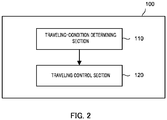
- FIG. 2 is a block diagram illustrating an example of the configuration of traveling control device 100.
- traveling control device 100 includes traveling-condition determining section 110 and traveling control section 120.
- Traveling-condition determining section 110 determines whether or not the necessity of stopping vehicle 1 is high, based on the traveling condition, and outputs the determination result to traveling control section 120.
- the traveling condition includes information indicating the behavior of the preceding vehicle and traffic-light information on a traffic light in the traveling direction of vehicle 1.
- the information indicating the behavior of the preceding vehicle is the speed (relative speed of vehicle 1 to the preceding vehicle) at which vehicle 1 relatively approaches the preceding vehicle as a result of deceleration of preceding vehicle 1A (see FIG. 3 ), in a case where the ground speed of vehicle 1 is constant. Traveling-condition determining section 110 determines that the necessity of stopping vehicle 1 is high, when the relative speed is 30 km/h or greater.
- the traffic-light information on a traffic light in the traveling direction of vehicle 1 is, for example, traffic-light information obtained from the traffic light in the traveling direction of vehicle 1 by road-to-vehicle communication. Traveling-condition determining section 110 determines that the necessity of stopping vehicle 1 is high, when the traffic-light information indicates "red light.”
- the traffic-light information on a traffic light in the traveling direction of vehicle 1 may also be information on the color of the traffic light in the traveling direction to be recognized using an in-vehicle-camera image of vehicle 1.
- Traveling control section 120 generates the traveling schedule including the driven traveling and the inertia traveling (engine-braking traveling), and causes vehicle 1 to travel in accordance with the generated traveling schedule.
- traveling control section 120 implements traveling at a speed in accordance with the traveling schedule by controlling the fuel injection quantity of engine 3 and/or the like via engine ECU 10 during driven traveling.
- traveling control section 120 controls the throttle valve (not illustrated) such that the degree of opening of the throttle valve is the lowest.
- traveling control section 120 appropriately controls each part of braking device 40 to stop vehicle 1. The details of the traveling schedule are described below.
- traveling control section 120 controls to switch the traveling of vehicle 1 from one of the driven traveling and inertia traveling to the other one.
- traveling control section 120 switches the traveling of vehicle 1 from the driven traveling to the inertia traveling.
- traveling control section 120 ends the inertia traveling, and controls each part of braking device 40 to decelerate vehicle 1.
- traveling control section 120 switches the traveling of vehicle 1 from the inertia traveling to the driven traveling when there is a relatively greater distance between the vehicle in inertia traveling and preceding vehicle 1A.
- FIG. 3 illustrates an example of a traditional traveling schedule on the upper side of the figure and an example of the traveling schedule generated by traveling control section 120 on the lower side of the figure.
- FIG. 3 shows vehicle 1 (vehicle according to the present disclosure) and preceding vehicle 1A on the uppermost side of the figure.
- traveling control section 120 ends the driven traveling and decelerates vehicle 1 when the traveling of vehicle 1 is the driven traveling and when the distance between vehicle 1 and preceding vehicle 1A is equal to or less than a predetermined distance. With this traveling schedule, traveling control section 120 continues the driven traveling when the distance between vehicle 1 and preceding vehicle 1A is greater than the predetermined distance. When the driven traveling is continued, the fuel injections in engine 3 are continued, so that there is wasteful fuel consumption in the section in which the driven traveling is continued (section A illustrated in FIG. 3 ).
- traveling control section 120 switches the traveling of vehicle 1 from the driven traveling to the inertia traveling (engine-braking traveling) in the embodiment according to the present disclosure. Because the fuel injections in engine 3 are not continued by switching the traveling of vehicle 1 to the inertia traveling, the wasteful fuel consumption can be reduced.
- vehicle 1 is decelerated by engine braking until vehicle 1 is decelerated by each part of braking device 40 controlled by traveling control section 120 in the embodiment of the present disclosure.
- a braking distance for stopping vehicle 1 is shorter in a case where the vehicle speed is reduced by engine braking than in a case where the vehicle speed is not reduced by engine braking. In this way, the engine-braking traveling can be continued longer by a distance corresponding to the reduction in the braking distance. For this reason, the fuel efficiency can be improved.
- FIG. 4 is a flowchart illustrating an example of traveling control operation in traveling control section 120. Processing in FIG. 4 is performed when vehicle 1 is traveling.
- traveling control section 120 determines whether or not the traveling of vehicle 1 is the driven traveling (step S100).
- step S100: NO When the determination result indicates that the traveling of vehicle 1 is not the driven traveling (step S100: NO), the processing returns before step S100. On the other hand, when the traveling of vehicle 1 is the driven traveling (step S100: YES), the processing proceeds to step S110.
- traveling control section 120 determines whether or not traveling-condition determining section 110 has determined that the necessity of stopping vehicle 1 is high.
- step S110: NO When the determination result indicates that the necessity of stopping vehicle 1 is not determined to be high (step S110: NO), the processing returns before step S100. On the other hand, when the necessity of stopping vehicle 1 is determined to be high (step S110: YES), traveling control section 120 switches the traveling of vehicle 1 from the driven traveling to the inertia traveling (step S120). Then, the present control is ended.
- traveling control device 100 includes: traveling-condition determining section 110 configured to determine whether or not necessity of stopping vehicle 1 is high, based on a traveling condition; and traveling control section 120 configured to switch traveling of vehicle 1 from driven traveling to inertia traveling, when the traveling of vehicle 1 is the driven traveling and when traveling-condition determining section 110 determines that the necessity of stopping vehicle 1 is high. Since the fuel injections in engine 3 are not continued by switching the traveling of vehicle 1 from the driven traveling to the inertia traveling, the wasteful fuel consumption can be reduced.
- traveling control section 120 ends the inertia traveling and decelerates to stop the vehicle.
- traveling control section 120 ends the inertia traveling and decelerates to stop the vehicle.
- traveling control device 100 when there is a relatively greater distance between vehicle 1 in inertia traveling and preceding vehicle 1A, the traveling of vehicle 1 is switched from the inertia traveling to the driven traveling (ACC). This allows vehicle 1 to travel while the distance between vehicle 1 and preceding vehicle 1A is kept.
- the inertia traveling is the engine-braking traveling in the aforementioned embodiment, the present disclosure is not limited to this embodiment, and the inertia traveling may also be the N coasting, for example.
- traveling control section 120 switches the traveling of vehicle 1 from the driven traveling to the N coasting, so that the fuel injections in engine 3 are not continued and, thus, the wasteful fuel consumption can be reduced.
- a single relative speed of vehicle 1 to the preceding vehicle is defined in the aforementioned embodiment, the present disclosure is not limited to this embodiment, and a configuration in which a relative speed is switched to another relative speed depending on whether vehicle 1 is on a local road or freeway may also be possible.
- the relative speed on the local road is set to 20 km/h.
- the relative speed on the freeway is set to 30 km/h. This can further improve the safety.
- vehicle 1 is provided with engine 3 as its power source in the aforementioned embodiment
- vehicle 1 may also be provided with engine 3 and an electric motor (motor) as its power source, for example.
- the electricity is not supplied to the electric motor in inertia traveling.
- traveling control section 120 switches the traveling of vehicle 1 from the driven traveling to the inertia traveling, so that the electric power supply to the electric motor is not continued and, thus, the wasteful energy consumption can be reduced.
- the traveling control device according to the present disclosure is useful for a vehicle which requires reduction of wasteful energy consumption.
Landscapes
- Engineering & Computer Science (AREA)
- Automation & Control Theory (AREA)
- Transportation (AREA)
- Mechanical Engineering (AREA)
- Control Of Driving Devices And Active Controlling Of Vehicle (AREA)
- Control Of Vehicle Engines Or Engines For Specific Uses (AREA)
- Controls For Constant Speed Travelling (AREA)
- Hydraulic Clutches, Magnetic Clutches, Fluid Clutches, And Fluid Joints (AREA)
Applications Claiming Priority (1)
| Application Number | Priority Date | Filing Date | Title |
|---|---|---|---|
| JP2017152519A JP2019031153A (ja) | 2017-08-07 | 2017-08-07 | 走行制御装置、車両および走行制御方法 |
Publications (1)
| Publication Number | Publication Date |
|---|---|
| EP3441274A1 true EP3441274A1 (fr) | 2019-02-13 |
Family
ID=63449170
Family Applications (1)
| Application Number | Title | Priority Date | Filing Date |
|---|---|---|---|
| EP18187332.4A Withdrawn EP3441274A1 (fr) | 2017-08-07 | 2018-08-03 | Dispositif de commande de déplacement, véhicule et procédé de commande de déplacement |
Country Status (4)
| Country | Link |
|---|---|
| US (1) | US20190039619A1 (fr) |
| EP (1) | EP3441274A1 (fr) |
| JP (1) | JP2019031153A (fr) |
| CN (1) | CN109383504A (fr) |
Families Citing this family (2)
| Publication number | Priority date | Publication date | Assignee | Title |
|---|---|---|---|---|
| KR20210127858A (ko) * | 2020-04-14 | 2021-10-25 | 현대모비스 주식회사 | 주행 가이드 시스템 및 그 방법 |
| IT202400012817A1 (it) * | 2024-06-05 | 2025-12-05 | Stellantis Europe Spa | "sistema di ausilio alla guida di un veicolo, veicolo e procedimento corrispondenti" |
Citations (6)
| Publication number | Priority date | Publication date | Assignee | Title |
|---|---|---|---|---|
| JP2007291919A (ja) * | 2006-04-24 | 2007-11-08 | Toyota Motor Corp | 車両用走行制御装置 |
| DE102009057393A1 (de) * | 2009-12-08 | 2011-06-09 | Daimler Ag | Verfahren zum Steuern des Betriebs eines Fahrzeugs |
| DE102011109039A1 (de) * | 2011-07-30 | 2012-01-05 | Daimler Ag | Verfahren zum Betrieb eines Fahrzeuges |
| JP2012219986A (ja) | 2011-04-13 | 2012-11-12 | Mitsubishi Fuso Truck & Bus Corp | 車両の走行制御装置 |
| DE102011084606A1 (de) * | 2011-10-17 | 2013-04-18 | Robert Bosch Gmbh | Bestimmung einer Fahrstrategie für ein Fahrzeug |
| DE102013104533A1 (de) * | 2012-05-04 | 2013-11-07 | Ford Global Technologies, Llc | Verfahren zur verwendung von stoppschild- und verkehrsampeldetektionen, um die kraftstoffsparsamkeit und sicherheit zu verbessern |
Family Cites Families (18)
| Publication number | Priority date | Publication date | Assignee | Title |
|---|---|---|---|---|
| JPH07259592A (ja) * | 1994-03-24 | 1995-10-09 | Fujitsu Ten Ltd | 車両制御装置 |
| JP4807107B2 (ja) * | 2006-03-02 | 2011-11-02 | 日産自動車株式会社 | 車両用走行制御装置 |
| JP5100362B2 (ja) * | 2007-12-25 | 2012-12-19 | Udトラックス株式会社 | シフトダウン制御装置 |
| JP2009189217A (ja) * | 2008-02-08 | 2009-08-20 | Toyota Motor Corp | 自動車およびその制御方法 |
| WO2010050344A1 (fr) * | 2008-10-28 | 2010-05-06 | 株式会社アドヴィックス | Dispositif de régulation du mouvement d’un véhicule |
| JP2010120503A (ja) * | 2008-11-19 | 2010-06-03 | Masahiro Watanabe | 車両走行制御方法 |
| DE112010005563B4 (de) * | 2010-05-13 | 2016-09-15 | Toyota Jidosha Kabushiki Kaisha | Fahrzeugsteuerungsvorrichtung und Fahrzeugsteuerungssystem |
| JP5985142B2 (ja) * | 2010-07-30 | 2016-09-06 | いすゞ自動車株式会社 | 惰行制御装置 |
| DE102011081707A1 (de) * | 2011-08-29 | 2013-02-28 | Robert Bosch Gmbh | Verfahren zur Unterstützung eines Fahrers eines Kraftfahrzeugs |
| CA2859069C (fr) * | 2011-12-15 | 2020-02-25 | Voyomotive, Llc | Dispositif permettant de plus grandes economies de carburant |
| EP2810840B1 (fr) * | 2012-02-03 | 2019-08-07 | Toyota Jidosha Kabushiki Kaisha | Dispositif d'évaluation de facteurs de décélération |
| US20150298698A1 (en) * | 2012-10-31 | 2015-10-22 | Toyota Jidosha Kabushiki Kaisha | Vehicle travel control device |
| DE112012007072B4 (de) * | 2012-10-31 | 2021-07-15 | Toyota Jidosha Kabushiki Kaisha | Fahrzeugfahrsteuergerät |
| CN103640570B (zh) * | 2013-12-05 | 2016-06-22 | 广西科技大学 | 一种双离合器自动变速器保护装置 |
| EP3081832A4 (fr) * | 2013-12-11 | 2017-11-08 | Jatco Ltd | Dispositif de commande pour transmission à variation continue |
| US9827955B2 (en) * | 2015-03-06 | 2017-11-28 | Ford Global Technologies, Llc | Systems and methods to improve fuel economy using adaptive cruise in a hybrid electric vehicle when approaching traffic lights |
| JP6418172B2 (ja) * | 2016-01-20 | 2018-11-07 | トヨタ自動車株式会社 | 車両用動力伝達装置の制御装置 |
| JP6460580B2 (ja) * | 2017-03-17 | 2019-01-30 | マツダ株式会社 | 運転支援制御装置 |
-
2017
- 2017-08-07 JP JP2017152519A patent/JP2019031153A/ja active Pending
-
2018
- 2018-08-03 EP EP18187332.4A patent/EP3441274A1/fr not_active Withdrawn
- 2018-08-06 CN CN201810884737.2A patent/CN109383504A/zh active Pending
- 2018-08-07 US US16/056,579 patent/US20190039619A1/en not_active Abandoned
Patent Citations (6)
| Publication number | Priority date | Publication date | Assignee | Title |
|---|---|---|---|---|
| JP2007291919A (ja) * | 2006-04-24 | 2007-11-08 | Toyota Motor Corp | 車両用走行制御装置 |
| DE102009057393A1 (de) * | 2009-12-08 | 2011-06-09 | Daimler Ag | Verfahren zum Steuern des Betriebs eines Fahrzeugs |
| JP2012219986A (ja) | 2011-04-13 | 2012-11-12 | Mitsubishi Fuso Truck & Bus Corp | 車両の走行制御装置 |
| DE102011109039A1 (de) * | 2011-07-30 | 2012-01-05 | Daimler Ag | Verfahren zum Betrieb eines Fahrzeuges |
| DE102011084606A1 (de) * | 2011-10-17 | 2013-04-18 | Robert Bosch Gmbh | Bestimmung einer Fahrstrategie für ein Fahrzeug |
| DE102013104533A1 (de) * | 2012-05-04 | 2013-11-07 | Ford Global Technologies, Llc | Verfahren zur verwendung von stoppschild- und verkehrsampeldetektionen, um die kraftstoffsparsamkeit und sicherheit zu verbessern |
Also Published As
| Publication number | Publication date |
|---|---|
| JP2019031153A (ja) | 2019-02-28 |
| US20190039619A1 (en) | 2019-02-07 |
| CN109383504A (zh) | 2019-02-26 |
Similar Documents
| Publication | Publication Date | Title |
|---|---|---|
| US10239536B2 (en) | Vehicle control device | |
| EP3521594A1 (fr) | Dispositif de commande de véhicule | |
| US11220276B2 (en) | Travel control device, vehicle, and travel control method | |
| JP6776968B2 (ja) | 走行制御装置、車両および走行制御方法 | |
| US10428937B2 (en) | Cruise control device and cruise control method | |
| US20180118207A1 (en) | Cruise control device and cruise control method | |
| EP4056437A1 (fr) | Appareil de commande d'entraînement pour véhicule | |
| EP3276222A1 (fr) | Dispositif de commande de déplacement et procédé de commande de déplacement | |
| JP2016211385A (ja) | 車両の制御装置 | |
| US20230141314A1 (en) | Driving force control device | |
| US12227182B2 (en) | Vehicle | |
| US20230347893A1 (en) | Platoon traveling system | |
| US20190039619A1 (en) | Traveling control device, vehicle, and traveling control method | |
| JP2021079746A (ja) | 車両の制御装置 | |
| CN110446643B (zh) | 行驶控制装置、车辆及行驶控制方法 | |
| JP2018122818A (ja) | 走行制御装置および走行制御方法 | |
| JP7517309B2 (ja) | 駆動力制御装置 | |
| JP2018127095A (ja) | 走行制御装置、車両および走行制御方法 | |
| JP6958082B2 (ja) | 走行制御装置、車両および走行制御方法 | |
| JP7806675B2 (ja) | ハイブリッド車両の制御装置 | |
| US11400902B2 (en) | Vehicle | |
| JP2018127096A (ja) | 走行制御装置、車両および走行制御方法 | |
| JP2019031189A (ja) | 走行制御装置、車両および走行制御方法 | |
| JP2018127138A (ja) | 走行制御装置、車両および走行制御方法 | |
| JP2019098957A (ja) | 車両の制御装置 |
Legal Events
| Date | Code | Title | Description |
|---|---|---|---|
| PUAI | Public reference made under article 153(3) epc to a published international application that has entered the european phase |
Free format text: ORIGINAL CODE: 0009012 |
|
| STAA | Information on the status of an ep patent application or granted ep patent |
Free format text: STATUS: REQUEST FOR EXAMINATION WAS MADE |
|
| 17P | Request for examination filed |
Effective date: 20180803 |
|
| AK | Designated contracting states |
Kind code of ref document: A1 Designated state(s): AL AT BE BG CH CY CZ DE DK EE ES FI FR GB GR HR HU IE IS IT LI LT LU LV MC MK MT NL NO PL PT RO RS SE SI SK SM TR |
|
| AX | Request for extension of the european patent |
Extension state: BA ME |
|
| STAA | Information on the status of an ep patent application or granted ep patent |
Free format text: STATUS: THE APPLICATION IS DEEMED TO BE WITHDRAWN |
|
| 18D | Application deemed to be withdrawn |
Effective date: 20190814 |