EP3431539A1 - Zusammensetzungen enthaltend polymeres carbodiimid, epoxid und polyesterbasierte polymere, deren herstellung und verwendung - Google Patents
Zusammensetzungen enthaltend polymeres carbodiimid, epoxid und polyesterbasierte polymere, deren herstellung und verwendung Download PDFInfo
- Publication number
- EP3431539A1 EP3431539A1 EP18178041.2A EP18178041A EP3431539A1 EP 3431539 A1 EP3431539 A1 EP 3431539A1 EP 18178041 A EP18178041 A EP 18178041A EP 3431539 A1 EP3431539 A1 EP 3431539A1
- Authority
- EP
- European Patent Office
- Prior art keywords
- alkyl
- epoxide
- weight
- composition according
- radical
- Prior art date
- Legal status (The legal status is an assumption and is not a legal conclusion. Google has not performed a legal analysis and makes no representation as to the accuracy of the status listed.)
- Granted
Links
Classifications
-
- C—CHEMISTRY; METALLURGY
- C08—ORGANIC MACROMOLECULAR COMPOUNDS; THEIR PREPARATION OR CHEMICAL WORKING-UP; COMPOSITIONS BASED THEREON
- C08G—MACROMOLECULAR COMPOUNDS OBTAINED OTHERWISE THAN BY REACTIONS ONLY INVOLVING UNSATURATED CARBON-TO-CARBON BONDS
- C08G18/00—Polymeric products of isocyanates or isothiocyanates
- C08G18/02—Polymeric products of isocyanates or isothiocyanates of isocyanates or isothiocyanates only
- C08G18/025—Polymeric products of isocyanates or isothiocyanates of isocyanates or isothiocyanates only the polymeric products containing carbodiimide groups
-
- C—CHEMISTRY; METALLURGY
- C08—ORGANIC MACROMOLECULAR COMPOUNDS; THEIR PREPARATION OR CHEMICAL WORKING-UP; COMPOSITIONS BASED THEREON
- C08L—COMPOSITIONS OF MACROMOLECULAR COMPOUNDS
- C08L79/00—Compositions of macromolecular compounds obtained by reactions forming in the main chain of the macromolecule a linkage containing nitrogen with or without oxygen or carbon only, not provided for in groups C08L61/00 - C08L77/00
-
- C—CHEMISTRY; METALLURGY
- C08—ORGANIC MACROMOLECULAR COMPOUNDS; THEIR PREPARATION OR CHEMICAL WORKING-UP; COMPOSITIONS BASED THEREON
- C08G—MACROMOLECULAR COMPOUNDS OBTAINED OTHERWISE THAN BY REACTIONS ONLY INVOLVING UNSATURATED CARBON-TO-CARBON BONDS
- C08G63/00—Macromolecular compounds obtained by reactions forming a carboxylic ester link in the main chain of the macromolecule
- C08G63/02—Polyesters derived from hydroxycarboxylic acids or from polycarboxylic acids and polyhydroxy compounds
- C08G63/06—Polyesters derived from hydroxycarboxylic acids or from polycarboxylic acids and polyhydroxy compounds derived from hydroxycarboxylic acids
- C08G63/08—Lactones or lactides
-
- C—CHEMISTRY; METALLURGY
- C08—ORGANIC MACROMOLECULAR COMPOUNDS; THEIR PREPARATION OR CHEMICAL WORKING-UP; COMPOSITIONS BASED THEREON
- C08F—MACROMOLECULAR COMPOUNDS OBTAINED BY REACTIONS ONLY INVOLVING CARBON-TO-CARBON UNSATURATED BONDS
- C08F212/00—Copolymers of compounds having one or more unsaturated aliphatic radicals, each having only one carbon-to-carbon double bond, and at least one being terminated by an aromatic carbocyclic ring
- C08F212/02—Monomers containing only one unsaturated aliphatic radical
- C08F212/04—Monomers containing only one unsaturated aliphatic radical containing one ring
- C08F212/06—Hydrocarbons
- C08F212/12—Monomers containing a branched unsaturated aliphatic radical or a ring substituted by an alkyl radical
-
- C—CHEMISTRY; METALLURGY
- C08—ORGANIC MACROMOLECULAR COMPOUNDS; THEIR PREPARATION OR CHEMICAL WORKING-UP; COMPOSITIONS BASED THEREON
- C08F—MACROMOLECULAR COMPOUNDS OBTAINED BY REACTIONS ONLY INVOLVING CARBON-TO-CARBON UNSATURATED BONDS
- C08F220/00—Copolymers of compounds having one or more unsaturated aliphatic radicals, each having only one carbon-to-carbon double bond, and only one being terminated by only one carboxyl radical or a salt, anhydride ester, amide, imide or nitrile thereof
- C08F220/02—Monocarboxylic acids having less than ten carbon atoms; Derivatives thereof
- C08F220/10—Esters
- C08F220/12—Esters of monohydric alcohols or phenols
- C08F220/16—Esters of monohydric alcohols or phenols of phenols or of alcohols containing two or more carbon atoms
- C08F220/18—Esters of monohydric alcohols or phenols of phenols or of alcohols containing two or more carbon atoms with acrylic or methacrylic acids
-
- C—CHEMISTRY; METALLURGY
- C08—ORGANIC MACROMOLECULAR COMPOUNDS; THEIR PREPARATION OR CHEMICAL WORKING-UP; COMPOSITIONS BASED THEREON
- C08F—MACROMOLECULAR COMPOUNDS OBTAINED BY REACTIONS ONLY INVOLVING CARBON-TO-CARBON UNSATURATED BONDS
- C08F220/00—Copolymers of compounds having one or more unsaturated aliphatic radicals, each having only one carbon-to-carbon double bond, and only one being terminated by only one carboxyl radical or a salt, anhydride ester, amide, imide or nitrile thereof
- C08F220/02—Monocarboxylic acids having less than ten carbon atoms; Derivatives thereof
- C08F220/10—Esters
- C08F220/26—Esters containing oxygen in addition to the carboxy oxygen
- C08F220/32—Esters containing oxygen in addition to the carboxy oxygen containing epoxy radicals
-
- C—CHEMISTRY; METALLURGY
- C08—ORGANIC MACROMOLECULAR COMPOUNDS; THEIR PREPARATION OR CHEMICAL WORKING-UP; COMPOSITIONS BASED THEREON
- C08G—MACROMOLECULAR COMPOUNDS OBTAINED OTHERWISE THAN BY REACTIONS ONLY INVOLVING UNSATURATED CARBON-TO-CARBON BONDS
- C08G59/00—Polycondensates containing more than one epoxy group per molecule; Macromolecules obtained by polymerising compounds containing more than one epoxy group per molecule using curing agents or catalysts which react with the epoxy groups
- C08G59/02—Polycondensates containing more than one epoxy group per molecule
- C08G59/04—Polycondensates containing more than one epoxy group per molecule of polyhydroxy compounds with epihalohydrins or precursors thereof
-
- C—CHEMISTRY; METALLURGY
- C08—ORGANIC MACROMOLECULAR COMPOUNDS; THEIR PREPARATION OR CHEMICAL WORKING-UP; COMPOSITIONS BASED THEREON
- C08G—MACROMOLECULAR COMPOUNDS OBTAINED OTHERWISE THAN BY REACTIONS ONLY INVOLVING UNSATURATED CARBON-TO-CARBON BONDS
- C08G59/00—Polycondensates containing more than one epoxy group per molecule; Macromolecules obtained by polymerising compounds containing more than one epoxy group per molecule using curing agents or catalysts which react with the epoxy groups
- C08G59/02—Polycondensates containing more than one epoxy group per molecule
- C08G59/04—Polycondensates containing more than one epoxy group per molecule of polyhydroxy compounds with epihalohydrins or precursors thereof
- C08G59/06—Polycondensates containing more than one epoxy group per molecule of polyhydroxy compounds with epihalohydrins or precursors thereof of polyhydric phenols
- C08G59/063—Polycondensates containing more than one epoxy group per molecule of polyhydroxy compounds with epihalohydrins or precursors thereof of polyhydric phenols with epihalohydrins
-
- C—CHEMISTRY; METALLURGY
- C08—ORGANIC MACROMOLECULAR COMPOUNDS; THEIR PREPARATION OR CHEMICAL WORKING-UP; COMPOSITIONS BASED THEREON
- C08G—MACROMOLECULAR COMPOUNDS OBTAINED OTHERWISE THAN BY REACTIONS ONLY INVOLVING UNSATURATED CARBON-TO-CARBON BONDS
- C08G59/00—Polycondensates containing more than one epoxy group per molecule; Macromolecules obtained by polymerising compounds containing more than one epoxy group per molecule using curing agents or catalysts which react with the epoxy groups
- C08G59/18—Macromolecules obtained by polymerising compounds containing more than one epoxy group per molecule using curing agents or catalysts which react with the epoxy groups ; e.g. general methods of curing
- C08G59/20—Macromolecules obtained by polymerising compounds containing more than one epoxy group per molecule using curing agents or catalysts which react with the epoxy groups ; e.g. general methods of curing characterised by the epoxy compounds used
- C08G59/22—Di-epoxy compounds
- C08G59/24—Di-epoxy compounds carbocyclic
- C08G59/245—Di-epoxy compounds carbocyclic aromatic
-
- C—CHEMISTRY; METALLURGY
- C08—ORGANIC MACROMOLECULAR COMPOUNDS; THEIR PREPARATION OR CHEMICAL WORKING-UP; COMPOSITIONS BASED THEREON
- C08G—MACROMOLECULAR COMPOUNDS OBTAINED OTHERWISE THAN BY REACTIONS ONLY INVOLVING UNSATURATED CARBON-TO-CARBON BONDS
- C08G59/00—Polycondensates containing more than one epoxy group per molecule; Macromolecules obtained by polymerising compounds containing more than one epoxy group per molecule using curing agents or catalysts which react with the epoxy groups
- C08G59/18—Macromolecules obtained by polymerising compounds containing more than one epoxy group per molecule using curing agents or catalysts which react with the epoxy groups ; e.g. general methods of curing
- C08G59/40—Macromolecules obtained by polymerising compounds containing more than one epoxy group per molecule using curing agents or catalysts which react with the epoxy groups ; e.g. general methods of curing characterised by the curing agents used
- C08G59/4007—Curing agents not provided for by the groups C08G59/42 - C08G59/66
- C08G59/4014—Nitrogen containing compounds
- C08G59/4042—Imines; Imides
-
- C—CHEMISTRY; METALLURGY
- C08—ORGANIC MACROMOLECULAR COMPOUNDS; THEIR PREPARATION OR CHEMICAL WORKING-UP; COMPOSITIONS BASED THEREON
- C08G—MACROMOLECULAR COMPOUNDS OBTAINED OTHERWISE THAN BY REACTIONS ONLY INVOLVING UNSATURATED CARBON-TO-CARBON BONDS
- C08G63/00—Macromolecular compounds obtained by reactions forming a carboxylic ester link in the main chain of the macromolecule
- C08G63/02—Polyesters derived from hydroxycarboxylic acids or from polycarboxylic acids and polyhydroxy compounds
- C08G63/12—Polyesters derived from hydroxycarboxylic acids or from polycarboxylic acids and polyhydroxy compounds derived from polycarboxylic acids and polyhydroxy compounds
- C08G63/16—Dicarboxylic acids and dihydroxy compounds
- C08G63/18—Dicarboxylic acids and dihydroxy compounds the acids or hydroxy compounds containing carbocyclic rings
- C08G63/181—Acids containing aromatic rings
- C08G63/183—Terephthalic acids
-
- C—CHEMISTRY; METALLURGY
- C08—ORGANIC MACROMOLECULAR COMPOUNDS; THEIR PREPARATION OR CHEMICAL WORKING-UP; COMPOSITIONS BASED THEREON
- C08G—MACROMOLECULAR COMPOUNDS OBTAINED OTHERWISE THAN BY REACTIONS ONLY INVOLVING UNSATURATED CARBON-TO-CARBON BONDS
- C08G73/00—Macromolecular compounds obtained by reactions forming a linkage containing nitrogen with or without oxygen or carbon in the main chain of the macromolecule, not provided for in groups C08G12/00 - C08G71/00
-
- C—CHEMISTRY; METALLURGY
- C08—ORGANIC MACROMOLECULAR COMPOUNDS; THEIR PREPARATION OR CHEMICAL WORKING-UP; COMPOSITIONS BASED THEREON
- C08K—Use of inorganic or non-macromolecular organic substances as compounding ingredients
- C08K5/00—Use of organic ingredients
- C08K5/04—Oxygen-containing compounds
- C08K5/15—Heterocyclic compounds having oxygen in the ring
- C08K5/151—Heterocyclic compounds having oxygen in the ring having one oxygen atom in the ring
- C08K5/1515—Three-membered rings
-
- C—CHEMISTRY; METALLURGY
- C08—ORGANIC MACROMOLECULAR COMPOUNDS; THEIR PREPARATION OR CHEMICAL WORKING-UP; COMPOSITIONS BASED THEREON
- C08K—Use of inorganic or non-macromolecular organic substances as compounding ingredients
- C08K5/00—Use of organic ingredients
- C08K5/16—Nitrogen-containing compounds
- C08K5/29—Compounds containing one or more carbon-to-nitrogen double bonds
-
- C—CHEMISTRY; METALLURGY
- C08—ORGANIC MACROMOLECULAR COMPOUNDS; THEIR PREPARATION OR CHEMICAL WORKING-UP; COMPOSITIONS BASED THEREON
- C08L—COMPOSITIONS OF MACROMOLECULAR COMPOUNDS
- C08L33/00—Compositions of homopolymers or copolymers of compounds having one or more unsaturated aliphatic radicals, each having only one carbon-to-carbon double bond, and only one being terminated by only one carboxyl radical, or of salts, anhydrides, esters, amides, imides or nitriles thereof; Compositions of derivatives of such polymers
- C08L33/04—Homopolymers or copolymers of esters
- C08L33/06—Homopolymers or copolymers of esters of esters containing only carbon, hydrogen and oxygen, which oxygen atoms are present only as part of the carboxyl radical
- C08L33/062—Copolymers with monomers not covered by C08L33/06
- C08L33/068—Copolymers with monomers not covered by C08L33/06 containing glycidyl groups
-
- C—CHEMISTRY; METALLURGY
- C08—ORGANIC MACROMOLECULAR COMPOUNDS; THEIR PREPARATION OR CHEMICAL WORKING-UP; COMPOSITIONS BASED THEREON
- C08L—COMPOSITIONS OF MACROMOLECULAR COMPOUNDS
- C08L63/00—Compositions of epoxy resins; Compositions of derivatives of epoxy resins
-
- C—CHEMISTRY; METALLURGY
- C08—ORGANIC MACROMOLECULAR COMPOUNDS; THEIR PREPARATION OR CHEMICAL WORKING-UP; COMPOSITIONS BASED THEREON
- C08L—COMPOSITIONS OF MACROMOLECULAR COMPOUNDS
- C08L67/00—Compositions of polyesters obtained by reactions forming a carboxylic ester link in the main chain; Compositions of derivatives of such polymers
- C08L67/02—Polyesters derived from dicarboxylic acids and dihydroxy compounds
-
- C—CHEMISTRY; METALLURGY
- C08—ORGANIC MACROMOLECULAR COMPOUNDS; THEIR PREPARATION OR CHEMICAL WORKING-UP; COMPOSITIONS BASED THEREON
- C08L—COMPOSITIONS OF MACROMOLECULAR COMPOUNDS
- C08L67/00—Compositions of polyesters obtained by reactions forming a carboxylic ester link in the main chain; Compositions of derivatives of such polymers
- C08L67/04—Polyesters derived from hydroxycarboxylic acids, e.g. lactones
-
- C—CHEMISTRY; METALLURGY
- C08—ORGANIC MACROMOLECULAR COMPOUNDS; THEIR PREPARATION OR CHEMICAL WORKING-UP; COMPOSITIONS BASED THEREON
- C08G—MACROMOLECULAR COMPOUNDS OBTAINED OTHERWISE THAN BY REACTIONS ONLY INVOLVING UNSATURATED CARBON-TO-CARBON BONDS
- C08G2120/00—Compositions for reaction injection moulding processes
-
- C—CHEMISTRY; METALLURGY
- C08—ORGANIC MACROMOLECULAR COMPOUNDS; THEIR PREPARATION OR CHEMICAL WORKING-UP; COMPOSITIONS BASED THEREON
- C08L—COMPOSITIONS OF MACROMOLECULAR COMPOUNDS
- C08L2203/00—Applications
- C08L2203/16—Applications used for films
-
- C—CHEMISTRY; METALLURGY
- C08—ORGANIC MACROMOLECULAR COMPOUNDS; THEIR PREPARATION OR CHEMICAL WORKING-UP; COMPOSITIONS BASED THEREON
- C08L—COMPOSITIONS OF MACROMOLECULAR COMPOUNDS
- C08L2205/00—Polymer mixtures characterised by other features
- C08L2205/03—Polymer mixtures characterised by other features containing three or more polymers in a blend
Definitions
- the present invention relates to compositions containing polymeric carbodiimide, epoxy and polyester-based polymers, their preparation and use for hydrolysis protection.
- Epoxides are cheaper to manufacture, but have the disadvantage that they do not reach the hydrolysis stabilizing effect of carbodiimides even in very high concentrations. They only act as acid scavengers and lead insufficiently to a long-term stabilization at higher temperatures. Especially in very demanding applications under conditions such as high humidity and temperature, these fail in their effect as hydrolysis protection agents, as the ester-based plastics are usually processed at temperatures above 200 ° C.
- DE 10349168 A1 describes a hydrolysis of epoxidized fatty acid esters and glycerides, and a mixture of these with a monomeric carbodiimide.
- the stabilizers described herein act as acid scavengers in oils. However, these show under the conditions mentioned above in the processing of ester-based thermoplastics no or only an insufficient effect in the long-term stability against hydrolysis. Furthermore, the use of monomeric carbodiimides leads to an increased emission of toxic gases.
- the object of the present invention was therefore to provide new cost-effective compositions which are resistant to hydrolysis, can be produced inexpensively and show reduced emission.
- arylene includes in particular phenylene, naphthylene, anthrylene and / or phenanthrylene radicals, preferably phenylene radicals.
- the carbodiimide content (NCN content, measured by titration with oxalic acid) of the carbodiimides of the formula (II) used according to the invention is preferably from 2 to 14% by weight, preferably from 4 to 13% by weight, more preferably from 6 to 12% by weight .%.
- the carbodiimides of the formula (II) used according to the invention moreover preferably have average molecular weights (M w) of 1000-5000 g / mol, preferably 1500-4000 g / mol, more preferably 2000- 3000 g / mol, determined by GPC viscometry.
- M w average molecular weights
- the carbodiimides are preferably commercially available compounds such as, for example, the polymeric carbodiimides with the name Stabaxol® from Lanxess GmbH. But you can also, for example, after the in the EP14191710.4 be prepared described methods.
- component b) has a total of at least two epoxide groups per molecule, wherein preferably at least one epoxide group is terminal.
- epoxidized compounds are polyglycidyl or poly (beta-methylglycidyl) ethers, preferably obtainable by reacting a compound having at least two free alcoholic or phenolic hydroxyl groups and / or by reacting phenolic hydroxy groups with a substituted epichlorohydrin.
- Preferred polyglycidyl or poly (beta-methylglycidyl) ethers are derived from acyclic alcohols, in particular ethylene glycol, diethylene glycol and higher poly (oxyethylene) glycols, propane-1,2-diol or poly (oxypropylene) glycols, Propane-1,3-diol, butane-1,4-diol, poly (oxytetramethylene) -glycols, pentane-1,5-diol, hexane-1,6-diol, hexane-2,4,6-triol, Glycerol, 1,1,1-trimethylpropane, bistrimethylolpropane, pentaerythritol, sorbitol and polyepichlorohydrins.
- acyclic alcohols in particular ethylene glycol, diethylene glycol and higher poly (oxyethylene) glycols, propane-1,2-diol or poly (oxypropylene)
- polyglycidyl or poly (beta-methylglycidyl) ethers derived from cycloaliphatic alcohols, in particular 1,3- or 1,4-dihydroxycyclohexane, bis (4-hydroxycyclohexyl) methane, 2,2-bis ( 4-hydroxycyclohexyl) propane or 1,1-bis (hydroxymethyl) cyclohex-3-ene, or they have aromatic nuclei based on N, N-bis-8,2-hydroxyethyl) -aniline or p, p'- bis (2-hydroxyethyl-amino) diphenylmethane.
- Preferred epoxidized compounds are also based on mononuclear phenols, on polynuclear phenols.
- Preferred mononuclear phenols are resorcinol or hydroquinone.
- Preferred polynuclear phenols are bis (4-hydroxyphenyl) methane, 2,2-bis (4-hydroxyphenyl) propane, 2,2-bis (3,5-dibromo-4-hydroxyphenyl) -propane or 4,4 '. dihydroxydiphenyl.
- Preferred condensation products of phenols with formaldehyde are phenol novolacs.
- Preferred aromatic epoxide compounds have 2 terminal epoxide functions.
- Preferred aromatic epoxide compound having 2 terminal epoxide functions is an oligomeric reaction product of bisphenol A with epichlorohydrin having an average molecular weight in the range of 900 to 1200 g / mol and an epoxy index (according to ISO 3001) in the region of 450 according to EN ISO 10927 to 600 grams per equivalent.
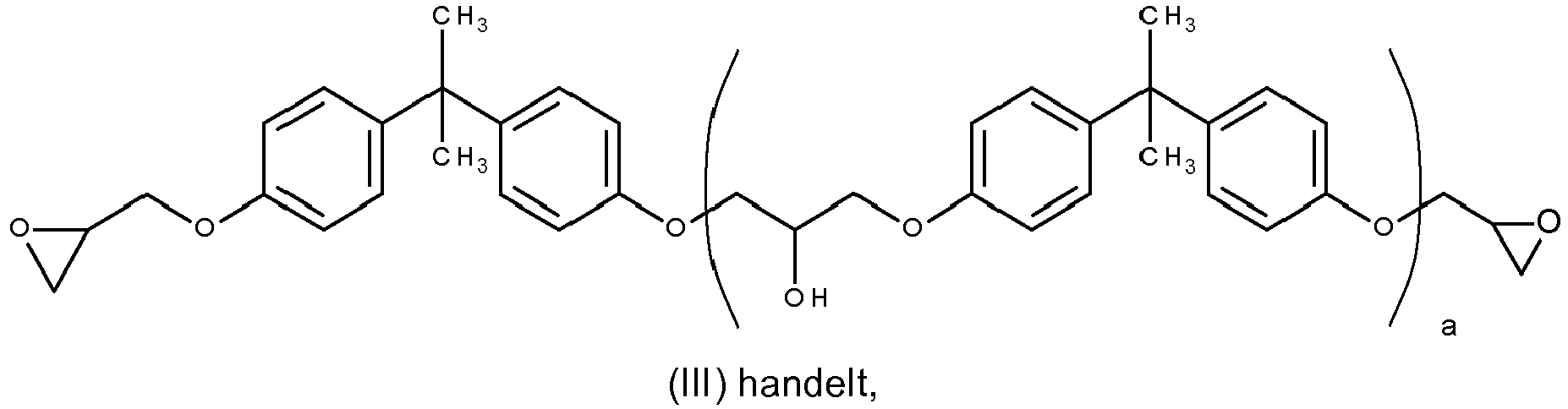
- Component c) is particularly preferably an oligomeric reaction product of bisphenol A with epichlorohydrin of the formula (III), with a from 0 to 10, preferably with a from 1 to 8, particularly preferably with a from 1 to 6, particularly preferably in the range from 2 to 3, where a corresponds to the average number.
- the components c) according to a method according to US2002 / 0128428A1 and then according to EN ISO 10927 have an average molecular weight in the range of 900 to 1200 g / mol (corresponds to an a in the range of 2 to 3 in the formula (III) and an epoxy index (to ISO 3001) in the region of 450 up to 600 grams per equivalent.
- An epoxy compound to be used according to the invention preferably has a softening point according to Mettler according to DIN 51920 in the range from 0 to 150.degree. C., particularly preferably 50.degree. C. to 120.degree. C., very particularly preferably in the range from 60.degree. C. to 110.degree Range from 75 ° C to 95 ° C.
- the Mettler softening point is the temperature at which the sample flows out of a cylindrical nipple with a 6.35 mm diameter orifice, breaking a 19 mm lower photocell. For this purpose, the sample is heated in air under constant conditions
- Preferred epoxy compounds have an average epoxide equivalent weight (EEW, grams of resin containing one mole of epoxide-bonded oxygen) via titration according to DIN 16945 in the range of 160 to 2000 g / eq, preferably in the range of 250 to 1200 g / eq , more preferably in the range of 350 to 1000 g / eq and particularly preferably in the range of 450 to 800 g / eq.
- EW average epoxide equivalent weight
- component b) is a poly (bisphenol A-co-epichlorohydrin) [ CAS No. 25068-38-6 ], preferably with a number-average molecular weight to be determined by MALDI-TOF mass spectrometry by matrix-assisted laser desorption / ionization time-of-flight mass spectrometry according to EN ISO 10927 (M n ) in the range of 600 to 1800 g / mol, for example, as Epilox® by Leuna Harze GmbH, Leuna.
- poly (bisphenol A-co-epichlorohydrin) [ CAS No. 25068-38-6 ]
- M n matrix-assisted laser desorption / ionization time-of-flight mass spectrometry according to EN ISO 10927 (M n ) in the range of 600 to 1800 g / mol, for example, as Epilox® by Leuna Harze GmbH, Leuna.
- Further preferred epoxy compound having at least 2 epoxide functions are compounds from the series of epoxides, commercially available under the name Joncryl® Fa. BASF AG such.
- Joncryl® 4368 may contain the following units in any combination and
- R 11 independently of one another C 1 -C 8 -alkyl
- the epoxide of the formula (IV) preferably corresponds to
- R 11 independently of one another C 1 -C 8 -alkyl
- thermoplastic polyester-based polymers c) are preferably poly-C 1 -C 8 -alkyl terephthalates, particularly preferably polyethylene terephthalate (PET), polytrimethylene terephthalate (PTT), and also copolyesters, thermoplastic polyester elastomers (TPE E), ethylene vinyl acetate (EVA), polylactic acid (PLA) and / or PLA derivatives, polybutylene succinates (PBS), polyhydroxyalkanoates (PHA), as well as various blends thereof.
- PET polyethylene terephthalate
- PTT polytrimethylene terephthalate
- TPE E thermoplastic polyester elastomers
- EVA ethylene vinyl acetate
- PLA polylactic acid
- PBS polybutylene succinates
- PHA polyhydroxyalkanoates
- PLA polylactides
- compositions in addition to components a), b) and c) in the compositions in addition to components a), b) and c), no further components are present, the sum of the proportions of a), b) and c) being 100% by weight.
- the present invention additionally provides a process for the preparation of the composition, according to which components a) and b) are mixed into at least one thermoplastic polyester-based polymer c).
- components a) and b) are mixed into at least one thermoplastic polyester-based polymer c).
- Preferred are here Extruder or kneader, more preferably extruder. These are commercially available stirring and mixing units.
- the mixing of the components a), b) and c) takes place at temperatures of 150 to 300 ° C.
- nucleating agents preferably nucleating agents, reinforcing fibers, impact modifiers, flow improvers and / or UV stabilizers are mixed into the mixture of components a), b) and c).
- the present invention further relates to a process for the preparation of hydrolysis-stable products by processing compositions containing the components a), b) and c) in at least one mixing unit, preferably a compounder, into molding compositions and these further processing, preferably an injection molding process or an extrusion for the manufacture of products.
- Processes according to the invention for the production of products by extrusion or injection molding are particularly advantageous at melting temperatures in the range from 160 to 330 ° C., preferably in the range from 190 to 300 ° C. and optionally additionally at pressures of not more than 2500 bar, preferably at pressures of not more than 2000 bar preferably at pressures of not more than 1500 bar and very particularly preferably at pressures of not more than 750 bar.
- Extrusion is preferably distinguished by profile extrusion and sequential coextrusion.
- sequential coextrusion two different materials are ejected in succession in succession.
- a preform with sections of different material composition in the extrusion direction.
- Certain article sections may be provided with specific required properties by appropriate material selection, for example for soft-end and hard-centered article or integrated soft-bellows regions ( Thielen, Hartwig, Gust, "Blow molding of hollow plastic bodies", Carl Hanser Verlag, Kunststoff 2006, pages 127-129 ).
- the method of injection molding is characterized in that the raw material, preferably in granular form, is melted (plasticized) in a heated cylindrical cavity and injected as a spray mass under pressure into a tempered cavity.
- the raw material compositions of the invention are used, preferably by compounding already to a molding material and these in turn preferably to a granulate was processed.
- After cooling (solidification) of injected into the tempered cavity molding compound the injection molded part is removed from the mold.
- Extrusion plants preferably consist of extruder, tool, downstream device, extrusion blow molding.
- Extrusion systems for producing profiles preferably consist of: extruder, profile tool, calibration, cooling section, caterpillar and roller removal, separating device and tilting channel.
- Extrusion lines for the production of films consist of: extruder, cooling section, stretch and roller take-off.
- Products obtainable according to the invention are preferably materials which are exposed to aqueous media, atmospheric moisture or sprayed water.
- compositions according to the invention for the preparation of hydrolysis-stable films z. B. for packaging or solar cells.
- the present invention furthermore relates to the use of the composition according to the invention for the production of products by extrusion, preferably for packaging or solar cells.
- the stabilizers used according to the example were dispersed in PET at about 280 ° C. before the measurement described below in PET using a laboratory twin-screw extruder ZSK 25 from Werner & Pfleiderer. From the granules obtained, the F3 standard specimens used for measuring the tensile strength were then produced on an injection molding machine of the type Arburg Allrounder 320 S 150-500.
- the stabilizers (bar B and C) used depending on the example were dispersed in PLA at about 200 ° C. using a ZSK 25 laboratory twin-screw extruder from Werner & Pfleiderer prior to the measurement described below. From the granules obtained, the F3 standard specimens used for measuring the tensile strength were then produced on an injection molding machine of the type Arburg Allrounder 320 S 150-500.
Landscapes
- Chemical & Material Sciences (AREA)
- Health & Medical Sciences (AREA)
- Chemical Kinetics & Catalysis (AREA)
- Medicinal Chemistry (AREA)
- Polymers & Plastics (AREA)
- Organic Chemistry (AREA)
- Compositions Of Macromolecular Compounds (AREA)
- Polyesters Or Polycarbonates (AREA)
- Manufacture Of Macromolecular Shaped Articles (AREA)
- Injection Moulding Of Plastics Or The Like (AREA)
- Pharmaceuticals Containing Other Organic And Inorganic Compounds (AREA)
Abstract
Description
- Die vorliegende Erfindung betrifft Zusammensetzungen enthaltend polymeres Carbodiimid, Epoxid und Polyester-basierte Polymere, deren Herstellung und Verwendung zum Hydrolyseschutz.
- Diverse Carbodiimide haben sich in vielen Anwendungen bewährt, z.B. als Hydrolyseschutzmittel für thermoplastische Kunststoffe, Ester-basierte Polyole, Polyurethane, Triglyceride und Schmierstofföle etc. Sie haben allerdings den Nachteil der Emission von gesundheitsbedenklichen Gasen und sind teuer und aufwändig in der Herstellung.
- Epoxide sind preiswerter in der Herstellung, haben jedoch den Nachteil, dass diese auch in sehr hohen Konzentrationen nicht die hydrolysestabilisierende Wirkung der Carbodiimide erreichen. Sie wirken lediglich als Säurefänger und führen nur ungenügend zu einer Langzeitstabilisierung bei höheren Temperaturen. Besonders in sehr anspruchsvollen Anwendungen unter Bedingungen, wie hoher Luftfeuchtigkeit und Temperatur versagen diese in Ihrer Wirkung als Hydrolyseschutzmittel, da in der Regel die esterbasierten Kunststoffe bei Temperaturen oberhalb von 200 °C verarbeitet werden. In
DE 10349168 A1 wird ein Hydrolyseschutzmittel aus epoxidierten Fettsäureestern und -glyceriden, sowie einer Mischung aus diesen mit einem monomeren Carbodiimid beschrieben. Die hier beschriebenen Stabilisatoren wirken als Säurefänger in Ölen. Diese zeigen jedoch unter den oben genannten Bedingungen bei der Bearbeitung von Ester-basierten thermoplastischen Kunstoffen keine oder nur eine ungenügende Wirkung in der Langzeitstabilität gegen Hydrolyse. Weiterhin führt der Einsatz von monomeren Carbodiimiden zu einer verstärkten Emission giftiger Gasen. - Aufgabe der vorliegenden Erfindung war es daher, neue kostengünstige Zusammensetzungen bereitzustellen, die hydrolyse-beständig sind, kostengünstig herstellbar sind und eine reduzierte Emission zeigen.
- Überraschenderweise wurde nun gefunden, dass die vorgenannte Aufgabe dann erfüllt werden kann, wenn eine Kombination aus mindestens einem polymeren aromatischen Carbodiimid, mindestens einem Epoxid mit mindestens 2 Epoxidgruppen und mindestens einem Polyester-basierten Polymer, insbesondere einem Polyalkylenterephthalat oder Polylactid, eingesetzt wird.
- Gegenstand der vorliegenden Erfindung sind daher Zusammensetzungen, enthaltend
- (a) mindestens ein polymeres aromatisches Carbodiimid, der Formel (I)
R1-R2-(-N=C=N-R2-)m-R1 (I),
in dem- m
- einer ganzen Zahl von 2 bis 500, bevorzugt 3 bis 20, ganz besonders bevorzugt 4 bis 10 entspricht,
- R2
- für C1-C12-Alkyl-substituierte Arylene, C7-C18-Alkylaryl-substituierte Arylene sowie gegebenenfalls für C1-C12-Alkyl- substituierte über C1-C8-Alkylengruppen verbrückte Arylene, die in Summe 7 bis 30 Kohlenstoffatome aufweisen, sowie Arylen steht, vorzugsweise

- R6, R7 und R8
- jeweils unabhängig für Methyl- oder Ethyl steht, wobei jeder Benzolring nur eine Methyl-Gruppe aufweist und n = 1 bis 10
- R1
- -NCO, -NCNR3-NHCONHR3, -NHCONR3R4 oder -NHCOOR5 ist,
- (b) mindestens ein Epoxid, vorzugsweise mit mindestens 2 Epoxidgruppen und
- (c) mindestens ein thermoplastisches Polyester-basiertes Polymer.
- Der Begriff Arylen umfasst dabei insbesondere Phenylen-, Naphthylen- Anthrylen- und/oder Phenanthrylen-Reste, vorzugsweise Phenylenreste.
- Bei den polymeren aromatischen Carbodiimiden a) handelt es sich vorzugsweise um Verbindungen der Formel (II),

- bei denen R1 ausgewählt ist aus der Gruppe -NCO, -NHCONHR3, -NHCONR3R4 oder -NHCOOR5,
- wobei R3 und R4 gleich oder verschieden sind und einen C1-C12-Alkyl-, C6-C12-Cycloalkyl-, C7-C18-Aralkylrest- oder Arylrest darstellen,
- R5 einem C1-C22-Alkyl-, C6-C12-Cycloalkyl-, C6-C18-Aryl oder C7-C18-Aralkylrest, sowie einem ungesättigten Alkylrest mit 2 - 22 Kohlenstoffatomen, bevorzugt 12 - 20, besonders bevorzugt 16 - 18 Kohlenstoffatomen, oder einem Alkoxypolyoxyalkylenrest entspricht, und
- R6, R7 und R8 jeweils unabhängig für Methyl- oder Ethyl steht, wobei jeder Benzolring nur eine Methyl-Gruppe aufweist und n = 1 bis 10 bedeutet.
- Der Carbodiimid-Gehalt (NCN-Gehalt, gemessen durch Titration mit Oxalsäure) der erfindungsgemäß eingesetzten Carbodiimide der Formel (II) liegt vorzugsweise bei 2 - 14 Gew.%, bevorzugt bei 4 - 13 Gew.%, besonders bevorzugt bei 6 - 12 Gew.%.
- Die erfindungsgemäß eingesetzten Carbodiimide der Formel (II) weisen darüber hinaus vorzugsweise mittlere Molmassen (Mw) von 1000 - 5000 g/mol, bevorzugt 1500 - 4000 g/mol, besonders bevorzugt 2000 - 3000 g/mol auf, bestimmt mittels GPC-Viskometrie.
- Weiterhin sind Carbodiimide der Formel (II) bevorzugt, die eine Polydispersität D = Mw/Mn von 1,2 - 2,2, besonders bevorzugt von 1,4 - 1,8 aufweisen.
- Bei den Carbodiimiden handelt vorzugsweise es sich um kommerziell verfügbare Verbindungen wie z.B. die polymeren Carbodiimiden mit dem Namen Stabaxol® der Fa. Lanxess Deutschland GmbH. Sie können aber auch beispielsweise nach den in der
EP14191710.4 - Bevorzugt weist die Komponente b) insgesamt mindestens zwei Epoxid-Gruppen pro Molekül auf, wobei vorzugsweise wenigstens eine Epoxid-Gruppe endständig ist.
- Die Herstellung epoxidierter Verbindungen ist dem Fachmann ebenfalls bekannt. Bevorzugte epoxidierte Verbindungen sind Polyglycidyl- oder Poly-(beta-methylglycidyl)-ether, vorzugsweise erhältlich durch Umsetzung einer Verbindung mit mindestens zwei freien alkoholischen oder phenolischen Hydroxygruppen und / oder durch Umsetzung von phenolischen Hydroxygruppen mit einem substituierten Epichlorhydrin.
- Bevorzugte Polyglycidyl- oder Poly-(beta-methylglycidyl)-ether leiten sich ab von acyclischen Alkoholen, insbesondere Ethylenglykol, Diethylenglykol und höheren Poly-(oxyethylen)-glykolen, Propan-1,2-diol oder Poly-(oxypropylen)-glykolen, Propan-1,3-diol, Butan-1,4-diol, Poly-(oxytetramethylen)-glykolen, Pentan-1,5-diol, Hexan-1,6-diol, Hexan-2,4,6-triol, Glycerin, 1,1,1-Trimetylpropan, Bistrimethylolpropan, Pentaerythrit, Sorbit sowie von Polyepichlorhydrinen.
- Alternativ bevorzugte Polyglycidyl- oder Poly-(beta-methylglycidyl)-ether leiten sich ab von cycloaliphatischen Alkoholen, insbesondere 1,3- oder 1,4-Dihydroxycyclohexan, Bis-(4-hydroxycyclohexyl)-methan, 2,2-Bis-(4-hydroxycyclohexyl)-propan oder 1,1-Bis-(hydroxymethyl)-cyclohex-3-en, oder sie besitzen aromatische Kerne basierend auf N,N-Bis-8,2-hydroxyethyl)-anilin oder p,p'-Bis-(2-hydroxyethyl-amino)-diphenylmethan.
- Bevorzugte epoxidierte Verbindungen basieren zudem auf einkernigen Phenolen, auf mehrkernigen Phenolen.
- Bevorzugte einkernige Phenole sind Resorcin oder Hydrochinon.
- Bevorzugte mehrkernige Phenole sind Bis-(4hydroxyphenyl)-methan, 2,2-Bis-(4-hydroxyphenyl)-propan, 2,2-Bis-(3,5-dibrom-4-hydroxyphenyl)-propan oder 4,4'-Dihydroxydiphenylsulfon.
- Bevorzugte Kondensationsprodukte von Phenolen mit Formaldehyd sind Phenol-Novolake.
- Bevorzugte aromatische Epoxid-Verbindungen weisen 2 endständige Epoxid-Funktionen auf.
- Bevorzugte aromatische Epoxid-Verbindung mit 2 endständigen Epoxid-Funktionen ist ein oligomeres Reaktionsprodukt aus Bisphenol A mit Epichlorhydrin mit einem gemäß EN ISO 10927 mittleren Molekulargewicht im Bereich von 900 bis 1200 g/mol und einem Epoxy Index (nach ISO 3001) im Bereich von 450 bis 600 Gramm pro Äquivalent.
- Besonders bevorzugt handelt es sich bei Komponente c) um ein oligomeres Reaktionsprodukt aus Bisphenol A mit Epichlorhydrin der Formel (III),

- Vorzugsweise werden die Komponenten c) nach einem Verfahren gemäß
US2002/0128428A1 hergestellt und weisen dann gemäß EN ISO 10927 ein mittleres Molekulargewicht im Bereich von 900 bis 1200 g/mol (entspricht in der Formel (III) einem a im Bereich von 2 bis 3) und einem Epoxy Index (nach ISO 3001) im Bereich von 450 bis 600 Gramm pro Äquivalent auf. - Bevorzugt besitzt eine erfindungsgemäß einzusetzende Epoxid-Verbindung einen Erweichungspunkt nach Mettler gemäß DIN 51920 im Bereich von 0 bis 150°C, besonders bevorzugt 50°C bis 120°C, ganz besonders bevorzugt im Bereich von 60°C bis 110°C und insbesondere im Bereich von 75°C bis 95°C. Der Erweichungspunkt nach Mettler ist die Temperatur, bei der die Probe aus einem zylindrischen Nippel mit einer Ausflussöffnung von 6,35 mm Durchmesser ausfließt, wobei sie eine 19 mm tiefer liegende Lichtschranke unterbricht. Zu diesem Zweck wird die Probe an Luft unter konstanten Bedingungen aufgeheizt
- Vorzugsweise einzusetzende Epoxid-Verbindungen weisen ein mittleres Epoxidäquivalent-Gewicht (EEW, Gramm Harz die ein Mol epoxidisch gebundenen Sauerstoff enthalten) via Titration gemäß DIN 16945 im Bereich von 160 bis 2000 g/eq auf, bevorzugt im Bereich von 250 bis 1200 g/eq, besonders bevorzugt im Bereich von 350 bis 1000 g/eq und insbesondere bevorzugt im Bereich von 450 bis 800 g/eq.
- Insbesondere bevorzugt wird als Komponente b) ein Poly(Bisphenol A-co-Epichlorhydrin) [CAS Nr. 25068-38-6] eingesetzt, vorzugsweise mit einem durch MALDI-TOF-Massenspektrometrie durch matrixunterstützte Laser-Desorptions/lonisations-Flugzeit-Massenspektrometrie gemäß EN ISO 10927 zu bestimmenden zahlenmittleren Molekulargewicht (Mn) im Bereich von 600 bis 1800 g/mol, beispielsweise zu beziehen als Epilox® von Leuna Harze GmbH, Leuna.
- Weitere bevorzugte Epoxid-Verbindung mit mindestens 2 Epoxid-Funktionen sind Verbindungen aus der Reihe der Epoxide, kommerziell verfügbar unter den Namen Joncryl® der Fa. BASF AG wie z. B. das Joncryl® 4368 die folgende Einheiten in beliebiger Kombination enthalten
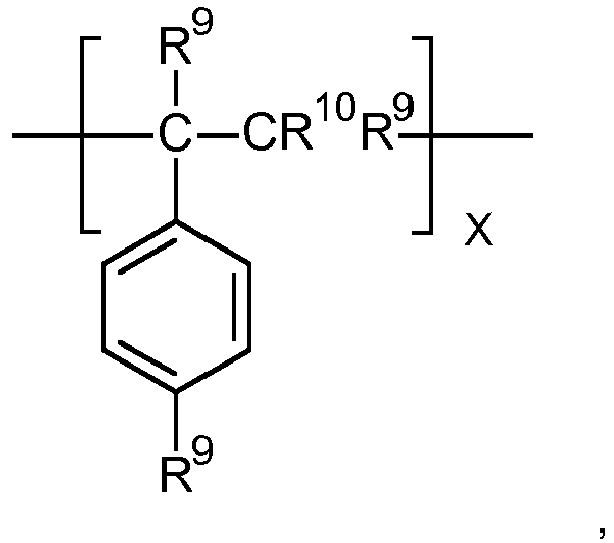


- Mit R9, R10 = unabhängig voneinander H, C1-C8 -Alkyl, R11 = unabhängig voneinander C1-C8 -Alkyl, x, y = 1 - 20, z = 2 - 20 , wobei Endgruppen R* für H, C1-C8 -Alkyl stehen.
- Bevorzugt entspricht das Epoxid der Formel (IV)

- Mit R9, R10 = unabhängig voneinander H, C1-C8 -Alkyl, R11 = unabhängig voneinander C1-C8 -Alkyl, x, y = 1 - 20, z = 2 - 20 , wobei als Endgruppen R* mit H, C1-C8 -Alkyl stehen .
- Bei den thermoplastischen Polyester-basierten Polymeren c) handelt es sich vorzugsweise um Poly-C1-C8 -alkylterephthalate, besonders bevorzugt um Polyethylenterephthalat (PET), Polytrimethylenterephthalat (PTT), sowie Copolyester, thermoplastische Polyester-Elastomere (TPE E), Ethylenvinylacetat (EVA), Polymilchsäure (PLA) und/oder PLA-Derivate, Polybutylensuccinate (PBS), Polyhydroxyalkanoate (PHA), sowie verschiedene Blends daraus.
- Ganz besonders bevorzugt sind Polylactide (PLA).
- In einer bevorzugten Ausführungsform der vorliegenden Erfindung enthält die erfindungsgemäße Zusammensetzung
- a) 0,2 bis 2 Gew.-%, bevorzugt 0,4 bis 1,5 Gew.-%, besonders bevorzugt 0,5 bis 1,0 Gew.-%;
- b) 0,05 bis 4 Gew.-%, bevorzugt 0,1 bis 2 Gew.-%, besonders bevorzugt 0,5 bis 1,5 Gew.-%;
- c) 94 bis 99,75 Gew.-%, bevorzugt 96,5 bis 99,5 Gew.-%, besonders bevorzugt 97,5 bis 99,0 Gew.-%.
- In einer weiteren bevorzugten Ausführungsform der vorliegenden Erfindung sind in den Zusammensetzungen neben den Komponenten a), b) und c) keine weiteren Komponenten enthalten, wobei die Summe der Anteile an a), b) und c) 100 Gew.% beträgt.
- Gegenstand der vorliegenden Erfindung ist zudem ein Verfahren zur Herstellung der Zusammensetzung, wonach die Komponenten a) und b) in mindestens ein thermoplastisches Polyester-basiertes Polymer c) eingemischt werden. Bevorzugt sind hier Extruder oder Kneter, besonders bevorzugt Extruder. Dabei handelt es sich um handelsübliche Rühr- und Mischaggregate.
- In einer bevorzugten Ausführungsform der vorliegenden Erfindung erfolgt die Einmischung der Komponenten a), b) und c) bei Temperaturen von 150 bis 300°C.
- In einer weiteren Ausführungsform des erfindungsgemäßen Verfahrens werden weitere Additive, vorzugsweise Nukleierungsmittel, Fasern zur Verstärkung, Schlagzähigkeitsmodifikatoren, Fließverbesserer und/oder UV-Stabilisatoren in die Mischung aus den Komponenten a), b) und c) eingemischt.
- Die vorliegende Erfindung betrifft weiterhin ein Verfahren zur Herstellung von hydrolysestabilen Erzeugnissen, indem man Zusammensetzungen enthaltend die Komponenten a), b) und c) in wenigstens einem Mischaggregat, vorzugsweise einem Compounder, zu Formmassen verarbeitet und diese einer Weiterverarbeitung, vorzugsweise einem Spritzgussverfahren oder einer Extrusion zur Herstellung von Erzeugnissen unterzieht.
- Erfindungsgemäße Verfahren zur Herstellung von Erzeugnissen durch Extrusion oder Spritzguss werden bei Schmelztemperaturen im Bereich von 160 bis 330°C, bevorzugt im Bereich von 190 bis 300°C sowie gegebenenfalls zusätzlich bei Drücken von maximal 2500 bar, bevorzugt bei Drücken von maximal 2000 bar, besonders bevorzugt bei Drücken von maximal 1500 bar und ganz besonders bevorzugt bei Drücken von maximal 750 bar, durchgeführt.
- Bei der Extrusion unterscheidet man vorzugsweise in Profilextrusion und sequentielle Coextrusion. Bei der sequentiellen Coextrusion werden zwei unterschiedliche Materialien in alternierender Folge hintereinander ausgestoßen. Auf diese Weise entsteht ein Vorformling mit in Extrusionsrichtung abschnittsweise unterschiedlicher Materialzusammensetzung. Es können bestimmte Artikelabschnitte durch entsprechende Materialauswahl mit spezifisch erforderlichen Eigenschaften ausgestattet werden, beispielsweise für Artikel mit weichen Enden und hartem Mittelteil oder integrierten weichen Faltenbalg-Bereichen (Thielen, Hartwig, Gust, "Blasformen von Kunststoffhohlkörpern", Carl Hanser Verlag, München 2006, Seite 127-129).
- Das Verfahren des Spritzgusses zeichnet sich dadurch aus, dass der Rohstoff, bevorzugt in Granulatform, in einem beheizten zylindrischen Hohlraum aufgeschmolzen (plastifiziert) und als Spritzmasse unter Druck in einen temperierten Hohlraum gespritzt wird. Als Rohstoff werden erfindungsgemäße Zusammensetzungen eingesetzt, die vorzugsweise durch Compoundieren bereits zu einer Formmasse und diese wiederum vorzugsweise zu einem Granulat verarbeitet wurde. Nach dem Abkühlen (Erstarren) der in den temperierten Hohlraum eingespritzten Formmasse wird das Spritzgussteil entformt.
- Im Gegensatz zum Spritzguss wird bei der Extrusion ein endlos geformter Kunststoffstrang, hier aus einer erfindungsgemäßen Formmasse, im Extruder eingesetzt, wobei der Extruder eine Maschine zur Herstellung thermoplastischer Formstücke/Erzeugnisse ist. Einsetzbar sind
- Einschneckenextruder und Doppelschneckenextruder sowie die jeweiligen Untergruppen
- konventioneller Einschneckenextruder, förderwirksamer Einschneckenextruder,
- gegenläufiger Doppelschneckenextruder und gleichläufiger Doppelschneckenextruder.
- Extrusionsanlagen bestehen vorzugsweise aus Extruder, Werkzeug, Nachfolgeeinrichtung, Extrusionsblasformen. Extrusionsanlagen zum Herstellen von Profilen bestehen vorzugsweise aus: Extruder, Profil-Werkzeug, Kalibrierung, Kühlstrecke, Raupen- und Rollenabzug, Trennvorrichtung und Kipprinne. Extrusionsanlagen zum Herstellen Folien bestehen aus: Extruder, Kühlstrecke, Streckung und Rollenabzug.
- Erfindungsgemäß erhältliche Erzeugnisse sind vorzugsweise Materialien die wässrigen Medien, Luftfeuchtigkeit oder Spritzwasser ausgesetzt sind.
- Derartig hydrolysestabilisierte Erzeugnisse finden sich insbesondere in Kraftfahrzeugen, in der Elektronik-, Telekommunikations-, Informationstechnologie, oder in der Computerindustrie, sowie im Haushalt, Sport, in der Medizin oder in der Unterhaltungsindustrie. In einer bevorzugten Variante werden die erfindungsgemäßen Zusammensetzungen zur Herstellung von hydrolysestabilen Folien z. B. für Verpackungen oder Solarzellen.
- Gegenstand der vorliegenden Erfindung ist zudem die Verwendung der erfindungsgemäßen Zusammensetzung zur Herstellung von Erzeugnissen durch Extrusion, vorzugsweise für Verpackungen oder Solarzellen.
- Der Rahmen der Erfindung erfasst alle oben stehenden und im Folgenden aufgeführten allgemeinen oder in Vorzugsbereichen genannten Restedefinitionen, Indizes, Parameter und Erläuterungen untereinander, also auch zwischen den jeweiligen Bereichen und Vorzugsbereichen in beliebiger Kombination.
- Die nachfolgenden Beispiele dienen der Erläuterung der Erfindung, ohne dabei limitierend zu wirken.
-
- 1) Stab A: ein monomeres Carbodiimid mit einem NCN-Gehalt von ca. 10,8 Gew.% auf Basis von 2,6-Diisopropylphenylisocyanat, erhältlich bei der Lanxess Deutschland GmbH unter dem Namen Stabaxol® I.
- 2) Stab B: ein polymeres Carbodiimid mit einem NCN-Gehalt von ca. 11,8 Gew.% , D = ca. 1,8 und Mw = 2300 g/mol der Formel (II) mit n = ca. 3 - 4, R6, R7, R8 jeweils unabhängig für Methyl- oder Ethyl steht, wobei jeder Benzolring nur eine Methyl-Gruppe aufweist und R1 = - NHCOOR5 und R5 = Cyclohexyl,.
- 3) Stab C: Ein Epoxid der Formel (III) mit n = im Bereich von 2 - 3 mit einem Epoxidäquivalent-Gewicht (DIN 16945) von 500 bis 700 g/eq und einem Erweichungspunkt (Mettler, DIN 51920) zwischen 75 und 90°C. [CAS Nr. 25068-38-6].
- 4) Polyethylenterephthalat (PET) erhältlich bei der Firma Novapet.
- 5) Polymilchsäure (PLA) erhältlich bei der Fa. NatureWorks
- Zur Bewertung der Hydrolyseschutzwirkung in PET wurden die je nach Beispiel eingesetzten Stabilisatoren (Stab A, B sowie C) mittels eines Labordoppelschneckenextruders ZSK 25 der Firma Werner & Pfleiderer vor der unten beschriebenen Messung in PET bei ca. 280 °C eindispergiert. Aus den gewonnenen Granulaten wurden dann die für die Messung der Reißfestigkeit verwendeten F3-Normprüfkörper an einer Spritzgießmaschine des Typs Arburg Allrounder 320 S 150 - 500 hergestellt.
- Für den Hydrolysetest wurden diese F3-Normprüfkörper in Wasserdampf bei einer Temperatur von 110°C gelagert und deren Reißfestigkeit in MPa gemessen.
- Zur Bewertung der Hydrolyseschutzwirkung in PLA wurden die je nach Beispiel eingesetzten Stabilisatoren (Stab B sowie C) mittels eines Labordoppelschneckenextruders ZSK 25 der Firma Werner & Pfleiderer vor der unten beschriebenen Messung in PLA bei ca. 200 °C eindispergiert. Aus den gewonnenen Granulaten wurden dann die für die Messung der Reißfestigkeit verwendeten F3-Normprüfkörper an einer Spritzgießmaschine des Typs Arburg Allrounder 320 S 150 - 500 hergestellt.
- Für den Hydrolysetest wurden diese F3-Normprüfkörper in Wasser bei einer Temperatur von 65°C gelagert und deren Reißfestigkeit in MPa gemessen.
- Die Einsatzmengen der Mischungsbestandteile und deren Ergebnisse sind in der Tabelle 1 und 2 aufgelistet:
Tabelle 1: Relative Reiß-festigkeit (%) Bsp. 1 (vgl.) PET Bsp. 2 (vgl.) PET, 1 % Stab A Bsp. 3 (vgl.) PET, 2 % Stab C Bsp. 4 (vgl.) PET, 4% Stab C Bsp. 5 (vgl.) PET, 1% Stab A, 1,5 % Stab C 0 Tage 100 100 100 100 100 1 Tag 75 86 61 63 86 2 Tage 40 80 33 40 81 3 Tage 0 64 0 0 65 4 Tage 44 47 5 Tage 30 38 vgl. = Vergleichsbeispiel aus DE 10349168 , erf.= erfindungsgemäßTabelle 2: Relative Reißfestigkeit (%) Bsp. 1 (vgl.) PET Bsp. 6 (vgl.) PET, 1 % Stab. B Bsp. 7 (erf.) PET, 1 % Stab B, 1,5 % Stab. C 0 Tage 100 100 100 1 Tag 75 86 89 2 Tage 40 83 89 3 Tage 0 76 87 4 Tage 60 82 5 Tage 40 64 6 Tage 18 54 7 Tage 0 40 vgl. =Vergleichsbeispiel, erf.= erfindungsgemäß Tabelle 3: Relative Reißfestigkeit (%) Bsp. 8 (vgl.) PLA Bsp. 9 (vgl.) PLA, 4 % Stab C Bsp. 10 (vgl.) PLA, 0,5 % Stab B Bsp. 11 (erf.) PLA, 0,5% Stab B, 1,5% Stab C 0 Tage 100 100 100 100 1 Tag 94 96 98 98 2 Tage 62 79 96 97 3 Tage 22 57 71 97 4 Tage 0 0 44 97 5 Tage 0 97 6 Tag 97 7 Tage 97 8 Tage 97 9 Tage 97 10 Tage 97 11 Tag 94 12 Tage 88 13 Tage 67 14 Tage 53 15 Tage 28 16 Tage 0 vgl. = Vergleichsbeispiel aus DE 10349168 , erf.= erfindungsgemäß - Die Prozentangaben in den Tabellen 1 und 2 entsprechen den Gew.%-Anteilen an den entsprechenden Stabilisatoren.
- Die Ergebnisse der Hydrolyseschutz-Tests beweisen, dass die Epoxide alleine keinen oder kaum einen stabilisierenden Effekt, überraschenderweise jedoch zusammen mit den erfindungsgemäßen polymeren Carbodiimiden (z. B. Stab. B) einen deutlichen positiven synergistischen Effekt auf die Hydrolysestabilität zeigen. Dagegen führt die Kombination von monomeren Carbodiimiden mit den Epoxiden zu keinem solchen synergistischen Effekt.
Claims (12)
- Zusammensetzung enthaltend(a) mindestens ein polymeres aromatisches Carbodiimid, der Formel (I)
R1-R2-(-N=C=N-R2-)m-R1 (I),
in demm einer ganzen Zahl von 2 bis 500, bevorzugt 3 bis 20, ganz besonders bevorzugt 4 bis 10 entspricht,R2 = C1-C12-Alkyl- substituierte Arylene, C7-C18-Alkylaryl-substituierte Arylene sowie gegebenenfalls C1-C12-Alkyl- substituierte über Alkylengruppen verbrückte Arylene, die in Summe 7 bis 30 Kohlenstoffatome aufweisen, sowie Arylen,
undR1 = -NCO, -NCNR3, -NHCONHR3, -NHCONR3R4 oder -NHCOOR5 ist,wobei R3 und R4 gleich oder verschieden sind und einen C1-C12-Alkyl-, C6-C12-Cycloalkyl-, C7-C18-Aralkyl- oder Arylrest darstellen und R5 einem C1-C22-Alkyl-, C6-C12-Cycloalkyl-, C6-C18-Aryl oder C7-C18-Aralkylrest, sowie einem ungesättigten Alkylrest mit 2 - 22 Kohlenstoffatomen oder ein Alkoxypolyoxy-alkylenrest entspricht,(b) mindestens ein Epoxid, vorzugsweise mit mindestens 2 Epoxidgruppen und(c) mindestens ein thermoplastisches Polyester-basiertes Polymer ausgewählt aus der Gruppe Polyethylenterephthalat (PET), Polytrimethylenterephthalat (PTT), , thermoplastische Polyester-Elastomere (TPE E), Ethylenvinylacetat (EVA), Polymilchsäure (PLA) und/oder PLA-Derivate, Polybutylensuccinate (PBS), Polyhydroxyalkanoate (PHA), sowie verschiedene Blends, thermoplastische Polyurethane, Polyurethan-Elastomere, PU-Klebstoffe sowie PU-Gießharze - Zusammensetzung nach Anspruch 1 , dadurch gekennzeichnet, dass es sich bei den polymeren aromatischen Carbodiimiden um Verbindungen der Formel (II) handelt,
 bei denen R1 ausgewählt ist aus der Gruppe -NCO, -NHCONHR3, -NHCONR3R4 oder -NHCOOR5,wobei R3 und R4 gleich oder verschieden sind und einen C1-C12-Alkyl-, C6-C12-Cycloalkyl-, C7-C18-Aralkylrest- oder Arylrest darstellen,R5 einem C1-C22-Alkyl-, C6-C12-Cycloalkyl-, C6-C18-Aryl oder C7-C18-Aralkylrest, sowie einem ungesättigten Alkylrest mit 2 - 22 Kohlenstoffatomen, bevorzugt 12 - 20, besonders bevorzugt 16 - 18 Kohlenstoffatomen, oder einem Alkoxy-polyoxyalkylenrest entspricht, undR6, R7 und R8 jeweils unabhängig für Methyl- oder Ethyl steht, wobei jeder Benzolring nur eine Methyl-Gruppe aufweist und n = 1 bis 10 bedeutet.
 - Zusammensetzung nach Anspruch 1 oder 2, dadurch gekennzeichnet, dass es sich bei dem Epoxid um ein Epoxid mit mindestens 2 Epoxidgruppen handelt.
- Zusammensetzung nach Anspruch 3, dadurch gekennzeichnet, dass es sich bei dem Epoxid um ein oligomeres Reaktionsprodukt aus Bisphenol A mit Epichlorhydrin mit einem gemäß EN ISO 10927 mittleren Molekulargewicht im Bereich von 900 bis 1200 g/mol und einem Epoxy Index (nach ISO 3001) im Bereich von 450 bis 600 Gramm pro Äquivalent handelt.
- Zusammensetzung nach Anspruch 3, dadurch gekennzeichnet, dass es sich bei dem Epoxid um ein oligomeres Reaktionsprodukt aus Bisphenol A mit Epichlorhydrin der Formel (III),
- Zusammensetzung nach Anspruch 3, dadurch gekennzeichnet, dass es sich bei dem Epoxid um eine Verbindung enthaltend die Einheiten


- Zusammensetzung nach Anspruch 3, dadurch gekennzeichnet, dass es sich bei dem Epoxid um eine Verbindung der Formel (III)

und R* = H, C1-C8 -Alkyl
handelt. - Zusammensetzung nach einem der Ansprüche 1 bis 7, dadurch gekennzeichnet, dass diese a), b) und c) in folgenden Anteilen enthält:a) 0,2 - 2 Gew. %, bevorzugt 0,4 - 1,5 Gew. % besonders bevorzugt 0,5 - 1,0 Gew.%;b) 0,05 - 4 Gew. %, bevorzugt 0,1 - 2 Gew. % besonders bevorzugt 0,5 - 1,5 Gew.%;c) 94 - 99,75 Gew. %, bevorzugt 96,5 - 99,5 Gew. % besonders bevorzugt 97,5 - 99,0 Gew. % .
- Verfahren zur Herstellung einer Zusammensetzung nach einem der Ansprüche 1 bis 7, dadurch gekennzeichnet, dass die Komponenten a), b) in mindestens ein thermoplastisches Polyester-basiertes Polymer c) eingemischt werden.
- Verfahren zur Herstellung einer Zusammensetzung nach Anspruch 9, dadurch gekennzeichnet, dass die Komponenten a), b) in mindestens ein thermoplastisches Polyester-basiertes Polymer c) bei Temperarturen von 160 - 330 °C eingemischt werden.
- Erzeugnisse, vorzugsweise hydrolysestabile Erzeugnisse, erhältlich durch Einmischen der Zusammensetzungen nach einem der Ansprüche 1 bis7, in wenigstens einem Mischaggregat, vorzugsweise einem Compounder, und der Weiterverarbeitung zu Formmassen in Spritzgussverfahren oder mittels Extrusion.
- Verwendung der Zusammensetzung nach einem der Ansprüche 1 bis 7 zur Herstellung von Erzeugnissen durch Extrusion, vorzugsweise für Verpackungen oder Solarzellen.
Applications Claiming Priority (1)
| Application Number | Priority Date | Filing Date | Title |
|---|---|---|---|
| EP17181680.4A EP3431538A1 (de) | 2017-07-17 | 2017-07-17 | Zusammensetzungen enthaltend polymeres carbodiimid, epoxid und polyester-basierte polymere, deren herstellung und verwendung |
Publications (3)
| Publication Number | Publication Date |
|---|---|
| EP3431539A1 true EP3431539A1 (de) | 2019-01-23 |
| EP3431539B1 EP3431539B1 (de) | 2025-05-21 |
| EP3431539C0 EP3431539C0 (de) | 2025-05-21 |
Family
ID=59383411
Family Applications (3)
| Application Number | Title | Priority Date | Filing Date |
|---|---|---|---|
| EP17181680.4A Withdrawn EP3431538A1 (de) | 2017-07-17 | 2017-07-17 | Zusammensetzungen enthaltend polymeres carbodiimid, epoxid und polyester-basierte polymere, deren herstellung und verwendung |
| EP18178041.2A Active EP3431539B1 (de) | 2017-07-17 | 2018-06-15 | Zusammensetzungen enthaltend polymeres carbodiimid, epoxid und polyesterbasierte polymere, deren herstellung und verwendung |
| EP18737647.0A Withdrawn EP3655479A1 (de) | 2017-07-17 | 2018-07-16 | Zusammensetzungen enthaltend polymeres carbodiimid, epoxid und polyester-basierte polymere, deren herstellung und verwendung |
Family Applications Before (1)
| Application Number | Title | Priority Date | Filing Date |
|---|---|---|---|
| EP17181680.4A Withdrawn EP3431538A1 (de) | 2017-07-17 | 2017-07-17 | Zusammensetzungen enthaltend polymeres carbodiimid, epoxid und polyester-basierte polymere, deren herstellung und verwendung |
Family Applications After (1)
| Application Number | Title | Priority Date | Filing Date |
|---|---|---|---|
| EP18737647.0A Withdrawn EP3655479A1 (de) | 2017-07-17 | 2018-07-16 | Zusammensetzungen enthaltend polymeres carbodiimid, epoxid und polyester-basierte polymere, deren herstellung und verwendung |
Country Status (17)
| Country | Link |
|---|---|
| US (2) | US20190016853A1 (de) |
| EP (3) | EP3431538A1 (de) |
| JP (2) | JP6708703B2 (de) |
| KR (2) | KR102624356B1 (de) |
| CN (2) | CN110809601A (de) |
| BR (1) | BR102018014532B1 (de) |
| CA (1) | CA3011457C (de) |
| DE (1) | DE202018006716U1 (de) |
| ES (1) | ES3031039T3 (de) |
| MX (1) | MX2018008776A (de) |
| PH (1) | PH12018000199B1 (de) |
| PL (1) | PL3431539T3 (de) |
| SG (1) | SG10201806051XA (de) |
| TW (1) | TWI780177B (de) |
| UA (1) | UA125434C2 (de) |
| WO (1) | WO2019016143A1 (de) |
| ZA (1) | ZA201804729B (de) |
Families Citing this family (3)
| Publication number | Priority date | Publication date | Assignee | Title |
|---|---|---|---|---|
| EP3431538A1 (de) * | 2017-07-17 | 2019-01-23 | LANXESS Deutschland GmbH | Zusammensetzungen enthaltend polymeres carbodiimid, epoxid und polyester-basierte polymere, deren herstellung und verwendung |
| US12305020B2 (en) | 2020-06-17 | 2025-05-20 | Lanxess Corporation | Flame retardant and stabilizer combined for use with thermoplastics |
| US20250313683A1 (en) | 2024-04-04 | 2025-10-09 | Galata Chemicals, Llc | Carbodiimide additives for improving performance of pvc compounds |
Citations (5)
| Publication number | Priority date | Publication date | Assignee | Title |
|---|---|---|---|---|
| US20020128428A1 (en) | 2000-12-14 | 2002-09-12 | Joseph Gan | Epoxy resins and process for making the same |
| DE10349168A1 (de) | 2003-10-22 | 2005-06-16 | Schäfer, Volker, Dr. | Verwendung und Herstellung von neuen Hydrolyseschutzmitteln |
| EP1591486A1 (de) * | 2003-02-06 | 2005-11-02 | DAICEL CHEMICAL INDUSTRIES, Ltd. | Thermoplastisches polyesterharz enthaltende zusammensetzung und formkörper |
| EP1710277A1 (de) * | 2004-01-29 | 2006-10-11 | Daicel Chemical Industries, Ltd. | Polyesterelastomerzusammensetzung |
| US20140058015A1 (en) * | 2011-04-26 | 2014-02-27 | Win Tech Polymer Ltd. | Insert molded article |
Family Cites Families (25)
| Publication number | Priority date | Publication date | Assignee | Title |
|---|---|---|---|---|
| US3644574A (en) | 1969-07-17 | 1972-02-22 | Eastman Kodak Co | Shaped articles of blends of polyesters and polyvinyls |
| US4013613A (en) | 1971-10-01 | 1977-03-22 | General Electric Company | Reinforced intercrystalline thermoplastic polyester compositions |
| JPS56161452A (en) * | 1980-05-16 | 1981-12-11 | Toray Ind Inc | Polyester resin composition |
| DE3631540A1 (de) | 1986-09-17 | 1988-03-24 | Bayer Ag | Thermoplastische formmassen mit hoher alterungsbestaendigkeit und guter tieftemperaturzaehigkeit |
| DE3631539A1 (de) | 1986-09-17 | 1988-03-24 | Bayer Ag | Alterungsbestaendige thermoplastische formmassen mit guter zaehigkeit |
| DE3704655A1 (de) | 1987-02-14 | 1988-08-25 | Bayer Ag | Teilchenfoermige mehrphasenpolymerisate |
| DE3704657A1 (de) | 1987-02-14 | 1988-08-25 | Bayer Ag | Teilchenfoermige mehrphasenpolymerisate |
| DE3738143A1 (de) | 1987-11-10 | 1989-05-18 | Bayer Ag | Verwendung von redoxpfropfpolymerisaten zur verbesserung der benzinbestaendigkeit von thermoplastischen, aromatischen polycarbonat- und/oder polyestercarbonat-formmassen |
| EP0728811B1 (de) | 1995-02-27 | 2003-09-17 | Mitsubishi Chemical Corporation | Hammhemmende thermoplastische Harzzusammensetzung |
| DE19615230A1 (de) | 1996-04-18 | 1997-10-23 | Basf Ag | Flammgeschützte thermoplastische Formmassen |
| US6048626A (en) * | 1997-09-25 | 2000-04-11 | Toray Industries, Inc. | Polyester composition and film made therefrom |
| TW585880B (en) * | 1999-08-05 | 2004-05-01 | Daicel Chem | Process for producing polyester block copolymer |
| DE10316615A1 (de) | 2003-04-11 | 2004-10-28 | Polymer Latex Gmbh & Co. Kg | Restmonomerreduzierung in der Emulsionpolymerisation von Acrylaten und Styrolacrylaten |
| JP2006104363A (ja) * | 2004-10-07 | 2006-04-20 | Wintech Polymer Ltd | ポリブチレンテレフタレート樹脂組成物 |
| JP2006265459A (ja) * | 2005-03-25 | 2006-10-05 | Tosoh Corp | 芳香族アミドブロック共重合体樹脂組成物 |
| US8030382B2 (en) * | 2007-02-23 | 2011-10-04 | Teijin Limited | Polylactic acid composition |
| CN102165012A (zh) * | 2008-08-01 | 2011-08-24 | 巴斯夫欧洲公司 | 提高生物降解聚酯耐水解性的方法 |
| JP5694092B2 (ja) * | 2011-08-31 | 2015-04-01 | 富士フイルム株式会社 | ポリエステルフィルムとその製造方法、太陽電池用バックシートおよび太陽電池モジュール |
| KR101467721B1 (ko) * | 2011-10-13 | 2014-12-01 | 미쓰이 가가쿠 가부시키가이샤 | 고분자 압전 재료 및 그의 제조방법 |
| EP2803660A1 (de) * | 2013-05-13 | 2014-11-19 | Rhein Chemie Rheinau GmbH | Neue Carbodiimide mit endständigen Harnstoff- und/oder Urethangruppen, Verfahren zu deren Herstellung und deren Verwendung |
| CN103556294B (zh) * | 2013-10-14 | 2016-05-11 | 江苏恒力化纤股份有限公司 | 一种抗蠕变抗水解聚酯及其制备方法 |
| DE102013223504A1 (de) * | 2013-11-18 | 2015-05-21 | Tesa Se | Flammbeständige, temperaturbeständige und hydrolysebeständige Träger sowie deren Verwendung in Haftklebebändern für Automobilanwendungen |
| JP2015203057A (ja) * | 2014-04-13 | 2015-11-16 | 三菱樹脂株式会社 | ポリエステル樹脂組成物 |
| HUE040703T2 (hu) | 2014-11-04 | 2019-03-28 | Lanxess Deutschland Gmbh | Új karbodiimidek, eljárás ezek elõállítására és ezek alkalmazása |
| EP3431538A1 (de) * | 2017-07-17 | 2019-01-23 | LANXESS Deutschland GmbH | Zusammensetzungen enthaltend polymeres carbodiimid, epoxid und polyester-basierte polymere, deren herstellung und verwendung |
-
2017
- 2017-07-17 EP EP17181680.4A patent/EP3431538A1/de not_active Withdrawn
-
2018
- 2018-06-15 PL PL18178041.2T patent/PL3431539T3/pl unknown
- 2018-06-15 ES ES18178041T patent/ES3031039T3/es active Active
- 2018-06-15 EP EP18178041.2A patent/EP3431539B1/de active Active
- 2018-07-05 US US16/027,695 patent/US20190016853A1/en not_active Abandoned
- 2018-07-13 JP JP2018133098A patent/JP6708703B2/ja active Active
- 2018-07-13 TW TW107124216A patent/TWI780177B/zh active
- 2018-07-13 CA CA3011457A patent/CA3011457C/en active Active
- 2018-07-16 EP EP18737647.0A patent/EP3655479A1/de not_active Withdrawn
- 2018-07-16 US US16/631,583 patent/US20200165442A1/en not_active Abandoned
- 2018-07-16 ZA ZA2018/04729A patent/ZA201804729B/en unknown
- 2018-07-16 KR KR1020180082562A patent/KR102624356B1/ko active Active
- 2018-07-16 KR KR1020207001149A patent/KR20200030057A/ko not_active Withdrawn
- 2018-07-16 JP JP2020502144A patent/JP2020528092A/ja active Pending
- 2018-07-16 WO PCT/EP2018/069279 patent/WO2019016143A1/de not_active Ceased
- 2018-07-16 UA UAA201807880A patent/UA125434C2/uk unknown
- 2018-07-16 SG SG10201806051XA patent/SG10201806051XA/en unknown
- 2018-07-16 PH PH12018000199A patent/PH12018000199B1/en unknown
- 2018-07-16 DE DE202018006716.4U patent/DE202018006716U1/de not_active Expired - Lifetime
- 2018-07-16 CN CN201880043156.4A patent/CN110809601A/zh active Pending
- 2018-07-17 MX MX2018008776A patent/MX2018008776A/es unknown
- 2018-07-17 BR BR102018014532-0A patent/BR102018014532B1/pt active IP Right Grant
- 2018-07-17 CN CN201810787583.5A patent/CN109265994B/zh active Active
Patent Citations (5)
| Publication number | Priority date | Publication date | Assignee | Title |
|---|---|---|---|---|
| US20020128428A1 (en) | 2000-12-14 | 2002-09-12 | Joseph Gan | Epoxy resins and process for making the same |
| EP1591486A1 (de) * | 2003-02-06 | 2005-11-02 | DAICEL CHEMICAL INDUSTRIES, Ltd. | Thermoplastisches polyesterharz enthaltende zusammensetzung und formkörper |
| DE10349168A1 (de) | 2003-10-22 | 2005-06-16 | Schäfer, Volker, Dr. | Verwendung und Herstellung von neuen Hydrolyseschutzmitteln |
| EP1710277A1 (de) * | 2004-01-29 | 2006-10-11 | Daicel Chemical Industries, Ltd. | Polyesterelastomerzusammensetzung |
| US20140058015A1 (en) * | 2011-04-26 | 2014-02-27 | Win Tech Polymer Ltd. | Insert molded article |
Non-Patent Citations (1)
| Title |
|---|
| THIELEN; HARTWIG; GUST: "Blasformen von Kunststoffhohlkörpern", 2006, CARL HANSER VERLAG, pages: 127 - 129 |
Also Published As
Similar Documents
| Publication | Publication Date | Title |
|---|---|---|
| EP3713987B1 (de) | Kontinuierliches verfahren zur herstellung eines aliphatischen polyesters | |
| EP3431539B1 (de) | Zusammensetzungen enthaltend polymeres carbodiimid, epoxid und polyesterbasierte polymere, deren herstellung und verwendung | |
| EP0004973A1 (de) | Thermoplastische Formmassen auf Basis von Polyoxymethylenen | |
| WO2019096920A1 (de) | Verfahren zur reinigung eines aliphatischen polyesters | |
| EP3287494A1 (de) | Polyester zusammensetzungen | |
| EP1757655A2 (de) | Thermoplastische Polyurethane | |
| DE2400097A1 (de) | Verfahren zur steigerung der schmelzelastizitaet von hochmolekularen linearen polyesterharzen | |
| EP2726549B1 (de) | Durch spritzguss hergestellter artikel | |
| DE69233420T2 (de) | Stabilisierung von mit mineralischen Materialien verstärkten Polyestern mittels Epoxyverbindungen | |
| DE602004002193T2 (de) | Thermoplastisches polyesterharz enthaltende zusammensetzung und formkörper | |
| DE60308500T2 (de) | Hydrolyse-beständige polyesterzusammensetzungen, derartige gegenstände und verfahren | |
| DE102009047667A1 (de) | Aliphatisches Polyestercopolymer, Verfahren zu dessen Herstellung und Polylactid-Harzzusammensetzung unter dessen Verwendung | |
| EP3891208B1 (de) | Verfahren zur herstellung eines (co)polyesters | |
| EP0135848A2 (de) | Kerbschlagzähe, In der Schmelze leichtfliessende Polyamidformmassen | |
| WO2018046244A1 (de) | Polyalkylenterephthalat zusammensetzungen | |
| EP2975083B1 (de) | Verfahren zur Stabilisierung von biobasiertem Kunststoff auf Basis von Polyesterharz | |
| HK40008657B (en) | Compositions containing polymeric carbodiimide, epoxide and polyester-based polymers, their preparation and use | |
| RU2798167C2 (ru) | Композиции, содержащие полимеры на основе карбодиимидов, эпоксидов и сложных полиэфиров, их получение и применение | |
| HK40008657A (en) | Compositions containing polymeric carbodiimide, epoxide and polyester-based polymers, their preparation and use | |
| DE102015119956B4 (de) | Gegen ionisierende Strahlung beständige Polycarbonatharzzusammensetzung und Formteil, das diese enthält | |
| CH645658A5 (en) | Thermoplastic, polyester-containing moulding compositions which contain macromolecular, highly fluorinated hydrocarbon | |
| EP2888322B1 (de) | Verwendung von polymermischungen zur herstellung von kartuschen, pipetten, cuvetten oder pipettenhalter | |
| DE102022203654A1 (de) | Verfahren zur Stabilisierung von Übergangsmetall enthaltenden Kunststoffen, stabilisierte, übergangsmetallhaltige Kunststoffzusammensetzungen, Formmasse oder Formteil sowie Verwendung einer Stabilisatorzusammensetzung zur Stabilisierung von Übergangsmetall enthaltenden Kunststoffen | |
| DE102016112050A1 (de) | Gegen ionisierende Strahlung beständige Polycarbonatharzzusammensetzung und Formteil, das diese enthält | |
| DE3236521A1 (de) | Thermoplastische formmassen |
Legal Events
| Date | Code | Title | Description |
|---|---|---|---|
| PUAI | Public reference made under article 153(3) epc to a published international application that has entered the european phase |
Free format text: ORIGINAL CODE: 0009012 |
|
| STAA | Information on the status of an ep patent application or granted ep patent |
Free format text: STATUS: THE APPLICATION HAS BEEN PUBLISHED |
|
| AK | Designated contracting states |
Kind code of ref document: A1 Designated state(s): AL AT BE BG CH CY CZ DE DK EE ES FI FR GB GR HR HU IE IS IT LI LT LU LV MC MK MT NL NO PL PT RO RS SE SI SK SM TR |
|
| AX | Request for extension of the european patent |
Extension state: BA ME |
|
| STAA | Information on the status of an ep patent application or granted ep patent |
Free format text: STATUS: REQUEST FOR EXAMINATION WAS MADE |
|
| 17P | Request for examination filed |
Effective date: 20190723 |
|
| RBV | Designated contracting states (corrected) |
Designated state(s): AL AT BE BG CH CY CZ DE DK EE ES FI FR GB GR HR HU IE IS IT LI LT LU LV MC MK MT NL NO PL PT RO RS SE SI SK SM TR |
|
| REG | Reference to a national code |
Ref country code: HK Ref legal event code: DE Ref document number: 40008657 Country of ref document: HK |
|
| STAA | Information on the status of an ep patent application or granted ep patent |
Free format text: STATUS: EXAMINATION IS IN PROGRESS |
|
| 17Q | First examination report despatched |
Effective date: 20200928 |
|
| RAP1 | Party data changed (applicant data changed or rights of an application transferred) |
Owner name: LANXESS DEUTSCHLAND GMBH |
|
| GRAP | Despatch of communication of intention to grant a patent |
Free format text: ORIGINAL CODE: EPIDOSNIGR1 |
|
| STAA | Information on the status of an ep patent application or granted ep patent |
Free format text: STATUS: GRANT OF PATENT IS INTENDED |
|
| INTG | Intention to grant announced |
Effective date: 20250220 |
|
| GRAS | Grant fee paid |
Free format text: ORIGINAL CODE: EPIDOSNIGR3 |
|
| GRAA | (expected) grant |
Free format text: ORIGINAL CODE: 0009210 |
|
| STAA | Information on the status of an ep patent application or granted ep patent |
Free format text: STATUS: THE PATENT HAS BEEN GRANTED |
|
| AK | Designated contracting states |
Kind code of ref document: B1 Designated state(s): AL AT BE BG CH CY CZ DE DK EE ES FI FR GB GR HR HU IE IS IT LI LT LU LV MC MK MT NL NO PL PT RO RS SE SI SK SM TR |
|
| REG | Reference to a national code |
Ref country code: GB Ref legal event code: FG4D Free format text: NOT ENGLISH |
|
| REG | Reference to a national code |
Ref country code: CH Ref legal event code: EP |
|
| REG | Reference to a national code |
Ref country code: DE Ref legal event code: R096 Ref document number: 502018015824 Country of ref document: DE |
|
| REG | Reference to a national code |
Ref country code: IE Ref legal event code: FG4D Free format text: LANGUAGE OF EP DOCUMENT: GERMAN |
|
| REG | Reference to a national code |
Ref country code: ES Ref legal event code: FG2A Ref document number: 3031039 Country of ref document: ES Kind code of ref document: T3 Effective date: 20250703 |
|
| U01 | Request for unitary effect filed |
Effective date: 20250618 |
|
| U07 | Unitary effect registered |
Designated state(s): AT BE BG DE DK EE FI FR IT LT LU LV MT NL PT RO SE SI Effective date: 20250627 |
|
| PGFP | Annual fee paid to national office [announced via postgrant information from national office to epo] |
Ref country code: ES Payment date: 20250729 Year of fee payment: 8 |
|
| PG25 | Lapsed in a contracting state [announced via postgrant information from national office to epo] |
Ref country code: NO Free format text: LAPSE BECAUSE OF FAILURE TO SUBMIT A TRANSLATION OF THE DESCRIPTION OR TO PAY THE FEE WITHIN THE PRESCRIBED TIME-LIMIT Effective date: 20250821 Ref country code: GR Free format text: LAPSE BECAUSE OF FAILURE TO SUBMIT A TRANSLATION OF THE DESCRIPTION OR TO PAY THE FEE WITHIN THE PRESCRIBED TIME-LIMIT Effective date: 20250822 |
|
| PG25 | Lapsed in a contracting state [announced via postgrant information from national office to epo] |
Ref country code: HR Free format text: LAPSE BECAUSE OF FAILURE TO SUBMIT A TRANSLATION OF THE DESCRIPTION OR TO PAY THE FEE WITHIN THE PRESCRIBED TIME-LIMIT Effective date: 20250521 |
|
| PGFP | Annual fee paid to national office [announced via postgrant information from national office to epo] |
Ref country code: CH Payment date: 20250718 Year of fee payment: 8 |
|
| PG25 | Lapsed in a contracting state [announced via postgrant information from national office to epo] |
Ref country code: RS Free format text: LAPSE BECAUSE OF FAILURE TO SUBMIT A TRANSLATION OF THE DESCRIPTION OR TO PAY THE FEE WITHIN THE PRESCRIBED TIME-LIMIT Effective date: 20250821 |
|
| PG25 | Lapsed in a contracting state [announced via postgrant information from national office to epo] |
Ref country code: IS Free format text: LAPSE BECAUSE OF FAILURE TO SUBMIT A TRANSLATION OF THE DESCRIPTION OR TO PAY THE FEE WITHIN THE PRESCRIBED TIME-LIMIT Effective date: 20250921 |
|
| U20 | Renewal fee for the european patent with unitary effect paid |
Year of fee payment: 8 Effective date: 20250929 |
|
| PG25 | Lapsed in a contracting state [announced via postgrant information from national office to epo] |
Ref country code: SM Free format text: LAPSE BECAUSE OF FAILURE TO SUBMIT A TRANSLATION OF THE DESCRIPTION OR TO PAY THE FEE WITHIN THE PRESCRIBED TIME-LIMIT Effective date: 20250521 |
|
| PG25 | Lapsed in a contracting state [announced via postgrant information from national office to epo] |
Ref country code: CZ Free format text: LAPSE BECAUSE OF FAILURE TO SUBMIT A TRANSLATION OF THE DESCRIPTION OR TO PAY THE FEE WITHIN THE PRESCRIBED TIME-LIMIT Effective date: 20250521 |
|
| PG25 | Lapsed in a contracting state [announced via postgrant information from national office to epo] |
Ref country code: SK Free format text: LAPSE BECAUSE OF FAILURE TO SUBMIT A TRANSLATION OF THE DESCRIPTION OR TO PAY THE FEE WITHIN THE PRESCRIBED TIME-LIMIT Effective date: 20250521 |
|
| PG25 | Lapsed in a contracting state [announced via postgrant information from national office to epo] |
Ref country code: MC Free format text: LAPSE BECAUSE OF FAILURE TO SUBMIT A TRANSLATION OF THE DESCRIPTION OR TO PAY THE FEE WITHIN THE PRESCRIBED TIME-LIMIT Effective date: 20250521 |
|
| PLBE | No opposition filed within time limit |
Free format text: ORIGINAL CODE: 0009261 |
|
| STAA | Information on the status of an ep patent application or granted ep patent |
Free format text: STATUS: NO OPPOSITION FILED WITHIN TIME LIMIT |
|
| REG | Reference to a national code |
Ref country code: CH Ref legal event code: L10 Free format text: ST27 STATUS EVENT CODE: U-0-0-L10-L00 (AS PROVIDED BY THE NATIONAL OFFICE) Effective date: 20260402 |
|
| PG25 | Lapsed in a contracting state [announced via postgrant information from national office to epo] |
Ref country code: IE Free format text: LAPSE BECAUSE OF NON-PAYMENT OF DUE FEES Effective date: 20250615 |
|
| PGFP | Annual fee paid to national office [announced via postgrant information from national office to epo] |
Ref country code: PL Payment date: 20260327 Year of fee payment: 9 |
|
| 26N | No opposition filed |
Effective date: 20260224 |
|
| REG | Reference to a national code |
Ref country code: CH Ref legal event code: U11 Free format text: ST27 STATUS EVENT CODE: U-0-0-U10-U11 (AS PROVIDED BY THE NATIONAL OFFICE) Effective date: 20260701 |
|
| PGFP | Annual fee paid to national office [announced via postgrant information from national office to epo] |
Ref country code: GB Payment date: 20260408 Year of fee payment: 9 |
|
| PGFP | Annual fee paid to national office [announced via postgrant information from national office to epo] |
Ref country code: TR Payment date: 20260611 Year of fee payment: 9 |
|
| U20 | Renewal fee for the european patent with unitary effect paid |
Year of fee payment: 9 Effective date: 20260630 |
|
| PG25 | Lapsed in a contracting state [announced via postgrant information from national office to epo] |
Ref country code: CY Free format text: LAPSE BECAUSE OF FAILURE TO SUBMIT A TRANSLATION OF THE DESCRIPTION OR TO PAY THE FEE WITHIN THE PRESCRIBED TIME-LIMIT Effective date: 20250521 |