EP3429842B1 - Surface protection film and related methods - Google Patents
Surface protection film and related methods Download PDFInfo
- Publication number
- EP3429842B1 EP3429842B1 EP17713531.6A EP17713531A EP3429842B1 EP 3429842 B1 EP3429842 B1 EP 3429842B1 EP 17713531 A EP17713531 A EP 17713531A EP 3429842 B1 EP3429842 B1 EP 3429842B1
- Authority
- EP
- European Patent Office
- Prior art keywords
- protection film
- surface protection
- micrometers
- film
- adhesive
- Prior art date
- Legal status (The legal status is an assumption and is not a legal conclusion. Google has not performed a legal analysis and makes no representation as to the accuracy of the status listed.)
- Active
Links
Images
Classifications
-
- B—PERFORMING OPERATIONS; TRANSPORTING
- B32—LAYERED PRODUCTS
- B32B—LAYERED PRODUCTS, i.e. PRODUCTS BUILT-UP OF STRATA OF FLAT OR NON-FLAT, e.g. CELLULAR OR HONEYCOMB, FORM
- B32B3/00—Layered products comprising a layer with external or internal discontinuities or unevennesses, or a layer of non-planar shape; Layered products comprising a layer having particular features of form
- B32B3/26—Layered products comprising a layer with external or internal discontinuities or unevennesses, or a layer of non-planar shape; Layered products comprising a layer having particular features of form characterised by a particular shape of the outline of the cross-section of a continuous layer; characterised by a layer with cavities or internal voids ; characterised by an apertured layer
- B32B3/266—Layered products comprising a layer with external or internal discontinuities or unevennesses, or a layer of non-planar shape; Layered products comprising a layer having particular features of form characterised by a particular shape of the outline of the cross-section of a continuous layer; characterised by a layer with cavities or internal voids ; characterised by an apertured layer characterised by an apertured layer, the apertures going through the whole thickness of the layer, e.g. expanded metal, perforated layer, slit layer regular cells B32B3/12
-
- B—PERFORMING OPERATIONS; TRANSPORTING
- B32—LAYERED PRODUCTS
- B32B—LAYERED PRODUCTS, i.e. PRODUCTS BUILT-UP OF STRATA OF FLAT OR NON-FLAT, e.g. CELLULAR OR HONEYCOMB, FORM
- B32B25/00—Layered products comprising a layer of natural or synthetic rubber
- B32B25/04—Layered products comprising a layer of natural or synthetic rubber comprising rubber as the main or only constituent of a layer, which is next to another layer of the same or of a different material
- B32B25/045—Layered products comprising a layer of natural or synthetic rubber comprising rubber as the main or only constituent of a layer, which is next to another layer of the same or of a different material of foam
-
- B—PERFORMING OPERATIONS; TRANSPORTING
- B32—LAYERED PRODUCTS
- B32B—LAYERED PRODUCTS, i.e. PRODUCTS BUILT-UP OF STRATA OF FLAT OR NON-FLAT, e.g. CELLULAR OR HONEYCOMB, FORM
- B32B27/00—Layered products comprising a layer of synthetic resin
- B32B27/06—Layered products comprising a layer of synthetic resin as the main or only constituent of a layer, which is next to another layer of the same or of a different material
- B32B27/065—Layered products comprising a layer of synthetic resin as the main or only constituent of a layer, which is next to another layer of the same or of a different material of foam
-
- B—PERFORMING OPERATIONS; TRANSPORTING
- B32—LAYERED PRODUCTS
- B32B—LAYERED PRODUCTS, i.e. PRODUCTS BUILT-UP OF STRATA OF FLAT OR NON-FLAT, e.g. CELLULAR OR HONEYCOMB, FORM
- B32B27/00—Layered products comprising a layer of synthetic resin
- B32B27/06—Layered products comprising a layer of synthetic resin as the main or only constituent of a layer, which is next to another layer of the same or of a different material
- B32B27/08—Layered products comprising a layer of synthetic resin as the main or only constituent of a layer, which is next to another layer of the same or of a different material of synthetic resin
-
- B—PERFORMING OPERATIONS; TRANSPORTING
- B32—LAYERED PRODUCTS
- B32B—LAYERED PRODUCTS, i.e. PRODUCTS BUILT-UP OF STRATA OF FLAT OR NON-FLAT, e.g. CELLULAR OR HONEYCOMB, FORM
- B32B27/00—Layered products comprising a layer of synthetic resin
- B32B27/18—Layered products comprising a layer of synthetic resin characterised by the use of special additives
- B32B27/20—Layered products comprising a layer of synthetic resin characterised by the use of special additives using fillers, pigments, thixotroping agents
- B32B27/205—Layered products comprising a layer of synthetic resin characterised by the use of special additives using fillers, pigments, thixotroping agents the fillers creating voids or cavities, e.g. by stretching
-
- B—PERFORMING OPERATIONS; TRANSPORTING
- B32—LAYERED PRODUCTS
- B32B—LAYERED PRODUCTS, i.e. PRODUCTS BUILT-UP OF STRATA OF FLAT OR NON-FLAT, e.g. CELLULAR OR HONEYCOMB, FORM
- B32B27/00—Layered products comprising a layer of synthetic resin
- B32B27/30—Layered products comprising a layer of synthetic resin comprising vinyl (co)polymers; comprising acrylic (co)polymers
- B32B27/308—Layered products comprising a layer of synthetic resin comprising vinyl (co)polymers; comprising acrylic (co)polymers comprising acrylic (co)polymers
-
- B—PERFORMING OPERATIONS; TRANSPORTING
- B32—LAYERED PRODUCTS
- B32B—LAYERED PRODUCTS, i.e. PRODUCTS BUILT-UP OF STRATA OF FLAT OR NON-FLAT, e.g. CELLULAR OR HONEYCOMB, FORM
- B32B27/00—Layered products comprising a layer of synthetic resin
- B32B27/40—Layered products comprising a layer of synthetic resin comprising polyurethanes
-
- B—PERFORMING OPERATIONS; TRANSPORTING
- B32—LAYERED PRODUCTS
- B32B—LAYERED PRODUCTS, i.e. PRODUCTS BUILT-UP OF STRATA OF FLAT OR NON-FLAT, e.g. CELLULAR OR HONEYCOMB, FORM
- B32B5/00—Layered products characterised by the non- homogeneity or physical structure, i.e. comprising a fibrous, filamentary, particulate or foam layer; Layered products characterised by having a layer differing constitutionally or physically in different parts
- B32B5/18—Layered products characterised by the non- homogeneity or physical structure, i.e. comprising a fibrous, filamentary, particulate or foam layer; Layered products characterised by having a layer differing constitutionally or physically in different parts characterised by features of a layer of foamed material
-
- B—PERFORMING OPERATIONS; TRANSPORTING
- B32—LAYERED PRODUCTS
- B32B—LAYERED PRODUCTS, i.e. PRODUCTS BUILT-UP OF STRATA OF FLAT OR NON-FLAT, e.g. CELLULAR OR HONEYCOMB, FORM
- B32B7/00—Layered products characterised by the relation between layers; Layered products characterised by the relative orientation of features between layers, or by the relative values of a measurable parameter between layers, i.e. products comprising layers having different physical, chemical or physicochemical properties; Layered products characterised by the interconnection of layers
- B32B7/04—Interconnection of layers
- B32B7/12—Interconnection of layers using interposed adhesives or interposed materials with bonding properties
-
- B—PERFORMING OPERATIONS; TRANSPORTING
- B32—LAYERED PRODUCTS
- B32B—LAYERED PRODUCTS, i.e. PRODUCTS BUILT-UP OF STRATA OF FLAT OR NON-FLAT, e.g. CELLULAR OR HONEYCOMB, FORM
- B32B2250/00—Layers arrangement
- B32B2250/04—4 layers
-
- B—PERFORMING OPERATIONS; TRANSPORTING
- B32—LAYERED PRODUCTS
- B32B—LAYERED PRODUCTS, i.e. PRODUCTS BUILT-UP OF STRATA OF FLAT OR NON-FLAT, e.g. CELLULAR OR HONEYCOMB, FORM
- B32B2250/00—Layers arrangement
- B32B2250/24—All layers being polymeric
-
- B—PERFORMING OPERATIONS; TRANSPORTING
- B32—LAYERED PRODUCTS
- B32B—LAYERED PRODUCTS, i.e. PRODUCTS BUILT-UP OF STRATA OF FLAT OR NON-FLAT, e.g. CELLULAR OR HONEYCOMB, FORM
- B32B2264/00—Composition or properties of particles which form a particulate layer or are present as additives
- B32B2264/10—Inorganic particles
- B32B2264/101—Glass
-
- B—PERFORMING OPERATIONS; TRANSPORTING
- B32—LAYERED PRODUCTS
- B32B—LAYERED PRODUCTS, i.e. PRODUCTS BUILT-UP OF STRATA OF FLAT OR NON-FLAT, e.g. CELLULAR OR HONEYCOMB, FORM
- B32B2266/00—Composition of foam
- B32B2266/02—Organic
- B32B2266/0214—Materials belonging to B32B27/00
- B32B2266/0242—Acrylic resin
-
- B—PERFORMING OPERATIONS; TRANSPORTING
- B32—LAYERED PRODUCTS
- B32B—LAYERED PRODUCTS, i.e. PRODUCTS BUILT-UP OF STRATA OF FLAT OR NON-FLAT, e.g. CELLULAR OR HONEYCOMB, FORM
- B32B2274/00—Thermoplastic elastomer material
-
- B—PERFORMING OPERATIONS; TRANSPORTING
- B32—LAYERED PRODUCTS
- B32B—LAYERED PRODUCTS, i.e. PRODUCTS BUILT-UP OF STRATA OF FLAT OR NON-FLAT, e.g. CELLULAR OR HONEYCOMB, FORM
- B32B2307/00—Properties of the layers or laminate
- B32B2307/50—Properties of the layers or laminate having particular mechanical properties
- B32B2307/51—Elastic
-
- B—PERFORMING OPERATIONS; TRANSPORTING
- B32—LAYERED PRODUCTS
- B32B—LAYERED PRODUCTS, i.e. PRODUCTS BUILT-UP OF STRATA OF FLAT OR NON-FLAT, e.g. CELLULAR OR HONEYCOMB, FORM
- B32B2307/00—Properties of the layers or laminate
- B32B2307/50—Properties of the layers or laminate having particular mechanical properties
- B32B2307/584—Scratch resistance
-
- B—PERFORMING OPERATIONS; TRANSPORTING
- B32—LAYERED PRODUCTS
- B32B—LAYERED PRODUCTS, i.e. PRODUCTS BUILT-UP OF STRATA OF FLAT OR NON-FLAT, e.g. CELLULAR OR HONEYCOMB, FORM
- B32B2307/00—Properties of the layers or laminate
- B32B2307/70—Other properties
- B32B2307/732—Dimensional properties
-
- B—PERFORMING OPERATIONS; TRANSPORTING
- B32—LAYERED PRODUCTS
- B32B—LAYERED PRODUCTS, i.e. PRODUCTS BUILT-UP OF STRATA OF FLAT OR NON-FLAT, e.g. CELLULAR OR HONEYCOMB, FORM
- B32B2307/00—Properties of the layers or laminate
- B32B2307/70—Other properties
- B32B2307/748—Releasability
-
- B—PERFORMING OPERATIONS; TRANSPORTING
- B32—LAYERED PRODUCTS
- B32B—LAYERED PRODUCTS, i.e. PRODUCTS BUILT-UP OF STRATA OF FLAT OR NON-FLAT, e.g. CELLULAR OR HONEYCOMB, FORM
- B32B2405/00—Adhesive articles, e.g. adhesive tapes
-
- B—PERFORMING OPERATIONS; TRANSPORTING
- B32—LAYERED PRODUCTS
- B32B—LAYERED PRODUCTS, i.e. PRODUCTS BUILT-UP OF STRATA OF FLAT OR NON-FLAT, e.g. CELLULAR OR HONEYCOMB, FORM
- B32B2605/00—Vehicles
- B32B2605/18—Aircraft
Definitions
- adhesive-backed articles and methods thereof for protecting the surface of a substrate More particularly, the provided adhesive-backed articles can be useful in protecting the surface of pressurized vehicles, such as commercial and military aircraft.
- Aircraft surfaces are susceptible to damage caused by impacts with foreign objects at high speeds. Foreign object damage is especially prevalent on the underside of the aircraft and landing gear components and doors, which are located near the ground and commonly encounter rocks and debris during takeoff and landing. Military cargo aircraft can be especially vulnerable to this type of damage. Impacts on the external surfaces of aircraft are not so limited, however, and can occur at any time during a flight.
- WO 2014/184499 A1 discloses a surface protection film formed of a support coated with a pressure-sensitive adhesive, the support comprising a plurality of layers, wherein the central layer of the support is a foamed polyolefin layer.
- the support consists of a central foamed polyethylene layer co-extruded between two outer polyethylene layers.
- WO2014/055820 A1 discloses a film, comprising a first layer of a first elastomeric polymer material, a second layer of a second elastomeric polymer material, and an adhesive layer, wherein the first elastomeric polymer material is a first polyurethane and the second elastomeric polymer material is a second polyurethane and the first and second polyurethanes are different.
- Metal panels can be very effective, but add significant additional weight and need to be frequently replaced as they incur damage over time.
- Sprayable coatings offer some degree of protection, but their effectiveness tends to be limited since substantial thicknesses are usually required to provide adequate impact protection.
- Foam-based protective tapes of sufficient thickness can provide a high level of impact protection and offer a reasonable combination of performance and convenience.
- the provided adhesive-backed protective films offer a solution to this problem.
- a foamed adhesive core layer is confined between a pair of elastomeric film layers and a pressure-sensitive adhesive layer laminated to the outward-facing surface of one of the elastomeric film layers.
- the result is a protective film that withstands foreign object impacts and harsh outdoor conditions, and can be easily applied and removed while eliminating or minimizing the need for personal protective equipment and volatile organic compounds.
- a surface protection film comprises a plurality of layers, in the following order: a first polymeric film, comprising a polyurethane elastomer, that is exposed at a major surface of the surface protection film; a foamed adhesive; a second polymeric film; and a pressure-sensitive adhesive.
- a method for protecting a vehicular substrate comprising: applying the aforementioned surface protection film to an outward-facing surface of the vehicular substrate during such time that protection is needed; and when protection is no longer needed, removing the surface protection film from the vehicular substrate by peeling the surface protection film away from the outward-facing surface at an angle of at least 35 degrees relative to the tangential plane of the outward-facing surface.
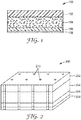
- a surface protection film according to one exemplary embodiment is shown in cross-section in FIG. 1 and herein designated by the numeral 100.
- the protection film 100 is comprised of a plurality of layers, including but not limited to, a first polymeric film 102, a foamed adhesive 104, a second polymeric film 106, and a pressure-sensitive adhesive 108.
- each of the aforementioned constituent layers is monolithic and continuous, with a generally uniform thickness.
- the first polymeric film 102 has a major surface exposed along one of the major surfaces of the overall protection film 100. Further, in this preferred construction, the first polymeric film 102 extends across and directly contacts the foamed adhesive 104, which extends across and directly contacts the second polymeric film 106, which in turn extends across and directly contacts the pressure-sensitive adhesive 108.
- the first polymeric film 102 can have an average thickness of at least 150 micrometers, at least 200 micrometers, or at least 250 micrometers.
- the same film can have an average thickness of up to 600 micrometers, up to 500 micrometers, or up to 400 micrometers.
- the second polymeric film 106 is optionally thinner than the first polymeric film 102 and can have an average thickness of at least 50 micrometers, at least 70 micrometers, or at least 90 micrometers.
- the second polymeric film 106 can have an average thickness of up to 300 micrometers, up to 200 micrometers, or up to 150 micrometers.
- the foamed adhesive 104 can have an average thickness of at least 250 micrometers, at least 350 micrometers, or at least 450 micrometers.
- the foamed adhesive 104 can have an average thickness of up to 2500 micrometers, up to 1500 micrometers, or up to 1000 micrometers.
- the foamed adhesive 104 When used in combination with the first and second polymeric films 102, 106, the foamed adhesive 104 provides a high degree of foreign object impact protection by absorbing high speed impact energy.
- the foamed adhesive serves the secondary function of providing bond adhesion to the substrate (e.g., an exterior aircraft panel).
- the additional polymeric film 106 and pressure-sensitive adhesive 108 enables these performance criteria-bond strength and impact protection-to be effectively decoupled from each other.
- the provided protection film 100 can display both high impact performance and convenient removability.
- the foamed adhesive 104 retains a strong adhesive bond with its neighboring layers while the three layers stretch in a manner that concentrates stress at the adhesive-substrate interface and facilitates a clean "peel-type" stretch release of the protection film 100 from the substrate.
- removal can be actuated by peeling the protection film 100 at an angle of greater than 35 degrees, greater than 40 degrees, or greater than 45 degrees, relative to a plane tangential to the outward-facing surface of the substrate. Peel release of these materials was observed to leave behind minimal or no substantial adhesive residue.
- protection film 100 is not limited to the layers specifically mentioned and may include one or more additional optional layers interposed between any two layers described above, so long as such inclusion does not significantly impair the overall function or performance of the protection film 100.
- Such layers may be continuous or discontinuous, and may include for example pigmented layers, tie layers, primer layers, adhesive layers, and coextruded skin layers.
- one or more layers may also be disposed on one or both major surfaces of the protection film 100.
- a sacrificial release liner (not shown) may be disposed on the pressure-sensitive adhesive 108 to facilitate handling and storage of the protection film 100.
- release liners need not be particularly restricted.
- FIG. 2 provides a three-dimensional view of a protection film 200 according to another embodiment.
- the protection film 200 has a configuration similar to that shown in FIG. 1 and further displays an additional optional feature-a plurality of perforations 210 distributed throughout the protection film 200.
- the perforations 210 extend from one major surface of the protection film 200 to the other, thereby enabling fluid communication between opposing sides of the surface protection film.
- the perforations 210 are evenly spread across the major surfaces of the protection film 200 and have a generally circular cross-section.
- non-uniform distributions of perforations are also possible.
- the perforations can be made using a laser cutting process, allowing for perforations with non-circular cross-sections.
- the perforations 210 have an average diameter of at least 100 micrometers, at least 150 micrometers, at least 200 micrometers, at least 300 micrometers, or at least 350 micrometers. In some embodiments, the perforations have an average diameter of up to 3200 micrometers, up to 2500 micrometers, up to 2000 micrometers, up to 1500 micrometers, or up to 1000 micrometers.
- the perforations can have an areal density of at least 6000 per square meter, at least 7000 per square meter, at least 8000 per square meter, at least 9000 per square meter, or at least 10,000 per square meter. In some embodiments, the perforations have an average diameter of up to 100,000 per square meter, up to 85,000 per square meter, up to 70,000 per square meter, up to 50,000 per square meter, or up to 40,000 per square meter.
- the perforations 210 allow the protection film 200 to "breathe,” which is beneficial in at least two respects.
- the perforations 210 allow gases to escape from beneath the protection film after installation. This can be especially important when applied to the walls of pressurized vessels, such as airplanes, which can have significant pressure differences between the inside and outside of the walls.
- the perforation serve to provide air-bleedability, or egress of fluids such as air from the interface between the pressure-sensitive adhesive and the surface of the substrate. In both cases, the perforations 210 improve wet out and help prevent bubbles from forming beneath the protection film 200 after application.
- protection film 200 Other options and features associated with the protection film 200 are analogous to those already described with respect to the protection film 100 and shall not be repeated here.
- the first polymeric film 102 has at least some range of elongation to facilitate peel removal of the protection film 100 from the underlying substrate on demand.
- the first polymeric film 102 has a lengthwise elongation at break of at least about 100 percent, at least about 200 percent, or at least about 300 percent.
- the tensile strength at break of the first polymeric film 102 is sufficiently high so that the first polymeric film 102 will not rupture prior to or during removal of the pressure-sensitive adhesive 108 of the protection film 100 from the surface to which it has been adhered.
- Examples of materials particularly suitable for the first polymeric film 102 of the protection film 100 include any material capable of being formed into a thin film layer and exhibiting elastomeric properties at ambient conditions.
- Elastomeric means that the material will substantially resume its original shape after being stretched.
- the elastomer can be both pure elastomers and blends with an elastomeric phase or content that will still exhibit substantial elastomeric properties at room temperature.
- the elastomeric compositions include polyurethane elastomers, made from either thermoplastic or thermoset polyurethanes. Blends of these elastomers with each other or with modifying non-elastomers are also possible.
- polymers such as poly(alpha-methyl)styrene, polyesters, epoxies, polyolefins, e.g., polyethylene or certain ethylene/vinyl acetates, preferably those of higher molecular weight, or coumarone-indene resin.
- the first polymeric film 102 preferably has a composition that is compatible with the adhesive or adhesives used in the construction.
- an adhesive disposed thereon should form a strong bond with the surface of the first polymeric film 102, thereby avoiding undesirable adhesive transfer during stretch removal of the protection film 100 from a substrate.
- Another consideration is the problem of cross-contamination which could occur when the first polymeric film 102 is placed in contact with certain adhesives.
- the first polymeric film 102 includes a sandwich construction where a protective polyolefin skin layer is disposed on each major surface of an elastomeric core layer. Protective layers can prevent tackifiers in an adhesive from migrating into the elastic film and causing the adhesive to lose tack over time.
- the first polymeric film 102 can be made by any method of film forming presently known in the art, such as extrusion, co-extrusion, solvent casting, foaming, and the like. Use of a non-woven technology to form the first polymeric film 102 is also possible.
- the first polymeric film 102 can have any thickness so long as it possesses sufficient integrity to be easily processed and handled. Preferably, the first polymeric film 102 has a thickness ranging from about 10 micrometers to 250 micrometers. In the preferred range, thinner first polymeric films can sometimes provide easier removal than thicker ones.
- the foamed adhesive 104, 204 is d, preferably a foam derived from an acrylic polymer or silicone polymer adhesive.
- Acrylic and silicone polymers are useful because of their ultraviolet light stability, conformability, and ability to distribute stress.
- Useful acrylic polymers include, for example, acrylic acid esters of non-tertiary alcohols having from 1 to 20 carbon atoms.
- the acrylic acid ester includes a carbon-to-carbon chain having 4 to 12 carbon atoms and terminates at the hydroxyl oxygen atom, the chain containing at least half of the total number of carbon atoms in the molecule.
- acrylic acid esters are polymerizable to a tacky, stretchable, and elastic adhesive.
- acrylic acid esters of nontertiary alcohols include but are not limited to 2-methylbutyl acrylate, isooctyl acrylate, lauryl acrylate, 4-methyl-2-pentyl acrylate, isoamyl acrylate, sec-butyl acrylate, n-butyl acrylate, n-hexyl acrylate, 2-ethylhexyl acrylate, n-octyl acrylate, n-decyl acrylate, isodecyl acrylate, isodecyl methacrylate, and isononyl acrylate.
- Suitable acrylic acid esters of nontertiary alcohols include, for example, 2-ethylhexyl acrylate and isooctylacrylate.
- the acrylic acid ester may be copolymerized with one or more monoethylenically unsaturated monomers that have highly polar groups.
- monoethylenically unsaturated monomer such as acrylic acid, methacrylic acid, itaconic acid, acrylamide, methacrylamide, N- substituted acrylamides (for example, N,N-dimethyl acrylamide), acrylonitrile, methacrylonitrile, hydroxyalkyl acrylates, cyanoethyl acrylate, N-vinylpyrrolidone, N-vinylcaprolactam, and maleic anhydride.
- these copolymerizable monomers are used in amounts of less than 20% by weight of the adhesive matrix such that the adhesive is tacky at ordinary room temperatures. In some cases, tackiness can be preserved at up to 50% by weight of N-vinylpyrrolidone.
- acrylate copolymers comprising at least 6% by weight acrylic acid, and in other embodiments, at least 8% by weight, or at least 10% by weight acrylic acid, each based on the total weight of the monomers in the acrylate copolymer.
- the adhesive may also include small amounts of other useful copolymerizable monoethylenically unsaturated monomers such as alkyl vinyl ethers, vinylidene chloride, styrene, and vinyltoluene.
- Enhancement of the cohesive strength of the foam may also be achieved through the use of a crosslinking agent such as 1,6-hexanediol diacrylate, with a photoactive triazine crosslinking agent such as taught in U.S. Patent Nos. 4,330,590 (Vesley ) and 4,329,384 (Vesley et al. ), or with a heat-activatable crosslinking agent such as a lower-alkoxylated amino formaldehyde condensate having C 1-4 alkyl groups-for example, hexamethoxymethyl melamine or tetramethoxymethyl urea or tetrabutoxymethyl urea.
- Crosslinking may be achieved by irradiating the composition with electron beam (or "e-beam") radiation, gamma radiation, or x-ray radiation.
- Bisamide crosslinkers may be used with acrylic adhesives in solution.
- the polymer used in the foam can be prepared by any suitable polymerization method. Suitable polymerization methods include, but are not limited to, photopolymerization, thermal polymerization, or ionizing radiation polymerization. These methods can be carried out in solution, emulsion, or bulk without solvent. Bulk polymerization methods are described in U.S. Patent No. 5,804,610 (Hamer et al. ).
- photopolymerizable monomers may be partially polymerized to a viscosity of from 1000 to 40,000 cps to facilitate coating. Alternatively, partial polymerization can be effected by heat. If desired, viscosity can also be adjusted by mixing monomers with a thixotropic agent such as fumed silica.
- the weight average molecular weight of the polymer in the foam before crosslinking can be at least 600,000 g/mol, at least 800,000 g/mol, or at least 1,000,000 g/mol.
- the foam enables the surface protection film to display high adhesion performance over a wide range of temperatures (e.g., from -51°C to 82°C), such as that encountered by exterior-facing aircraft components.
- Photopolymerization can take place in an inert atmosphere such as under a blanket of nitrogen or argon gas.
- an inert environment can be achieved by temporarily covering the photopolymerizable coating with a plastic film transparent to ultraviolet radiation, and irradiating the coating through the film. If the polymerizable coating is not covered during photopolymerization, the permissible oxygen content of the inert atmosphere can be increased by mixing into the photopolymerizable composition an oxidizable tin compound such as disclosed in U.S. Patent No. 4,303,485 (Levens ), which can enable relatively thicker coatings to be polymerized in air.
- the foam contains one or more additives.
- additives can include, for example, fillers, antioxidants, viscosity modifiers, pigments, tackifying resins, fibers, flame retardants, antistatic and slip agents, thermally conductive particles, electrically conductive particles, continuous microfibers, filaments, and mixtures thereof.
- the polymer used to make the foam may be initially coated onto and polymerized against a flexible backing sheet (for example, a release liner) that has a low-adhesion surface from which the polymerized layer is readily removable and almost always is self-sustaining. If the opposite face of the backing sheet also has a low-adhesion surface, the backing sheet with its polymerized layer may be wound up in roll form for storage prior to assembly of the finished adhesive article.
- a flexible backing sheet for example, a release liner
- the backing sheet with its polymerized layer may be wound up in roll form for storage prior to assembly of the finished adhesive article.
- the foam is based on a silicone polymer that behaves as a pressure-sensitive adhesive.
- Suitable silicone polymers can include, for example, an MQ resin containing a resinous core and nonresinous polyorganosiloxane group terminated with a silicon-bonded hydroxyl group; a treated MQ resin, and a polydiorganosiloxane terminated with a condensation reactable group.
- the foam used in the foamed adhesive may be an open cell foam, a closed cell foam, or a combination thereof.
- the foam is a syntactic foam containing hollow microspheres, for example, hollow glass microspheres.
- Useful hollow glass microspheres include those having a density of less than 0.4 g/cm and having a diameter of from 5 to 200 micrometers.
- the microspheres may be clear, coated, stained, or a combination thereof.
- the microspheres typically comprise from 5 to 65 volume percent of the foam composition. Examples of useful acrylic foams thus made are disclosed in U.S. Patent Nos. 4,415,615 (Esmay et al. ) and 6,103,152 (Gehlsen et al. ).
- foams may be formed by blending expanded polymeric microspheres into a polymerizable composition. In some embodiments, foams may be formed by blending expandable polymeric microspheres into a composition and expanding the microspheres.
- An expandable polymeric microsphere includes a polymer shell and a core material in the form of a gas, liquid, or combination thereof. Upon heating to a temperature at or below the melt or flow temperature of the polymeric shell, the polymer shell expands to form the microsphere.
- Suitable core materials include propane, butane, pentane, isobutane, neopentane, isopentane, and combinations thereof.
- thermoplastic resin used for the polymer microsphere shell can influence the mechanical properties of the foam, and the properties of the foam may be adjusted by the choice of microsphere, or by using mixtures of different types of microspheres.
- examples of commercially available expandable microspheres include those available under the trade designation ExpancelTM, from Akzo Nobel Pulp and Performance Chemicals AB, Sundsvall, Sweden. Methods of making foams containing expandable polymeric microspheres and particulars of these microspheres are described in U.S. Patent No. 6,103,152 (Gehlsen et al. ).
- the foamed adhesive is made in situ using a continuous extrusion process.
- expandable polymeric microspheres in the foam can remain unexpanded or, up to, partially expanded to enable the polymer foam to be used in a foam-in-place application. That is, the extruded foam can still be further expanded to a substantial degree at some later time in the application.
- the expandable microspheres in the extruded foam may retain most, if not all, of their expandability.
- the reaction product of such an extrusion process can be comprised of thermoplastic expandable polymeric microspheres homogeneously distributed in the foamed adhesive, the thermoplastic expandable polymeric microspheres comprising unexpanded expandable polymeric microspheres, at least partially expanded expandable polymeric microspheres, or both.
- Non-syntactic foams are also possible, and may be prepared by forming gas voids in a composition using a variety of mechanisms including, for example, mechanical mechanisms, chemical mechanisms, and combinations thereof.
- Useful mechanical foaming mechanisms include, for example, agitating (for example, shaking, stirring, or whipping the composition, and combinations thereof), injecting gas into the composition (for example, inserting a nozzle beneath the surface of the composition and blowing gas into the composition), and combinations thereof.
- Methods of making the foams with voids formed via a foaming agent are described in U.S. Patent No. 6,586,483 (Kolb et al. ).
- the foamed adhesive is based on a foam having a foam density of from 320 kg/m 3 to 800 kg/m 3 , from 400 kg/m 3 to 720 kg/m 3 , or from 400 kg/m 3 to 641 kg/m 3 .
- any known pressure-sensitive adhesive may be used so long as the overall protection film is provided with adequate bond strength and clean removability.
- Adhesives are typically selected based upon the type of substrate that they are to be adhered to. Classes of pressure-sensitive adhesives include acrylics, tackified rubber, tackified synthetic rubber, ethylene vinyl acetate, silicone polymers, and the like. Suitable acrylic and silicone adhesives are disclosed, for example, in U.S. Patent Nos. 3,239,478 (Harlan ), 3,935,338 (Robertson ), 5,169,727 (Boardman ), RE24,906 (Ulrich ), 4,952,650 (Young et al. ), 4,181,752 (Martens et al. ), and 8,298,367 (Beger et al. ).
- Polymers useful for the acrylic pressure-sensitive adhesive layer includes acrylate and methacrylate polymers and copolymers. Such polymers can be made by polymerizing one or more monomeric acrylic or methacrylic esters of non-tertiary alkyl alcohols, with the alkyl groups having from 1 to 20 carbon atoms (for example, from 3 to 18 carbon atoms).
- Suitable acrylate monomers include, for example, methyl acrylate, ethyl acrylate, n-butyl acrylate, lauryl acrylate, 2-ethylhexyl acrylate, cyclohexyl acrylate, iso-octyl acrylate, octadecyl acrylate, nonyl acrylate, decyl acrylate, and dodecyl acrylate.
- the corresponding methacrylates can be used as well.
- aromatic acrylates and methacrylates for example, benzyl acrylate and cyclobenzyl acrylate.
- one or more monoethylenically unsaturated co-monomers may be polymerized with the acrylate or methacrylate monomers. The particular type and amount of co-monomer is selected based upon the desired properties of the polymer.
- One group of useful co-monomers includes those having a homopolymer glass transition temperature greater than the glass transition temperature of the (meth)acrylate (i.e., acrylate or methacrylate) homopolymer.
- suitable co-monomers falling within this group include acrylic acid, acrylamides, methacrylamides, substituted acrylamides (such as N,N-dimethyl acrylamide), itaconic acid, methacrylic acid, acrylonitrile, methacrylonitrile, vinyl acetate, N-vinyl pyrrolidone, isobornyl acrylate, cyano ethyl acrylate, N- vinylcaprolactam, maleic anhydride, hydroxyalkyl (meth)-acrylates, N,N-dimethyl aminoethyl (meth)acrylate, N,N-diethylacrylamide, beta-carboxyethyl acrylate, vinyl esters of neodecanoic, neononanoic,
- a second group of monoethylenically unsaturated co-monomers that may be polymerized with the acrylate or methacrylate monomers includes those having a homopolymer glass transition temperature (T g ) less than the glass transition temperature of the acrylate homopolymer.
- the adhesive polymer can be dispersed in solvent or water and coated onto the release liner and dried, and optionally crosslinked. If a solvent-borne or water-borne pressure-sensitive adhesive composition is employed, then the adhesive layer generally undergoes a drying step to remove all or a majority of the carrier liquid. Additional coating steps may be necessary to achieve a smooth surface.
- the adhesives may also be hot melt coated onto the liner or microstructured backing. Additionally, monomeric pre-adhesive compositions can be coated onto the liner and polymerized with an energy source such as heat, UV radiation, or electron beam radiation.
- the pressure-sensitive adhesive can optionally include one or more additives.
- additives may include initiators, fillers, plasticizers, tackifiers, chain transfer agents, fibrous reinforcing agents, woven and non-woven fabrics, foaming agents, antioxidants, stabilizers, fire retardants, viscosity enhancing agents, coloring agents, and mixtures thereof.
- the rheology of the adhesive can be characterized by its Tangent Delta value, or the ratio of the loss shear modulus (G") over the storage shear modulus (G') of the adhesive material.
- the adhesive displays a Tangent Delta value of up to 0.5, up to 0.48, up to 0.45, up to 0.42, up to 0.4, or up to 0.35, as measured by uniaxial dynamic mechanical analysis according to known methods at a frequency of 1 Hz under ambient conditions.
- VHB 5925 An acrylic foam tape, obtained under the trade designation "VHB 5925” from 3M Company, St Paul, Minnesota.
- a perforated protective polyurethane tape obtained under the trade designation "POLYURETHANE PROTECTIVE TAPE 8641, PERFORATED" from 3M Company.
- 8681 A 12 mil (304.8 ⁇ m) thick polyurethane film without adhesive, corresponding to precursor film obtained under the trade designation "8681HS POLYURETHANE PROTECTIVE TAPE" from 3M Company.
- 8664HS A 6 mil (152.4 ⁇ m) thick polyurethane tape, obtained under the trade designation "8664HS POLYURETHANE PROTECTIVE TAPE" from 3M Company.
- Tape samples were adhered to 24 mil (0.610 mm) thick bare aluminum panels and allowed to dwell at 21°C for 7 days. The samples were then evaluated according to ASTM D3170 using 24 pints (11.36 L) of 1 ⁇ 2-inch (12.72 mm) river rock and a pressure of 70 psi (482.6 KPa) at an incident angle of 90°.
- 5925 film was laminated between the non-adhesive surfaces of 8681 and 8664HS films, by means of a laminator operating at 5 ft/min (1.52 m/min) and a pressure of 60 psi (413.7 KPa) at 21°C. The material was then perforated with a laser to produce 10 mil (254.0 ⁇ m) holes spaced 0.25 inches (6.35 cm) apart.
- Example and a Comparative (8641 film) were tested for peel adhesion as described above under the following conditions: (i) at 23°C and 50% relative humidity after one day, (ii) at 71°C dry heat after 7 days, and (iii) at 49°C and 95% relative humidity after 7 days. Results are listed in Table 1.
- Example and Comparative 8641 film were subjected to the Gravelometer Test. Both 8641 and EX-1 were rated as a 10A as called out in ASTM D3170, neither showing any chips or damage to the tape.
- Example and Comparative 8641 film were subjected to the Drop Impact Test. Both 8641 and EX-1 showed no evidence of shattering, cracking, or chipping.
Landscapes
- Adhesive Tapes (AREA)
- Adhesives Or Adhesive Processes (AREA)
- Laminated Bodies (AREA)
Applications Claiming Priority (2)
| Application Number | Priority Date | Filing Date | Title |
|---|---|---|---|
| US201662307972P | 2016-03-14 | 2016-03-14 | |
| PCT/US2017/021713 WO2017160609A1 (en) | 2016-03-14 | 2017-03-10 | Surface protection film and related methods |
Publications (2)
| Publication Number | Publication Date |
|---|---|
| EP3429842A1 EP3429842A1 (en) | 2019-01-23 |
| EP3429842B1 true EP3429842B1 (en) | 2021-05-05 |
Family
ID=58410466
Family Applications (1)
| Application Number | Title | Priority Date | Filing Date |
|---|---|---|---|
| EP17713531.6A Active EP3429842B1 (en) | 2016-03-14 | 2017-03-10 | Surface protection film and related methods |
Country Status (9)
| Country | Link |
|---|---|
| US (1) | US10780668B2 (cg-RX-API-DMAC7.html) |
| EP (1) | EP3429842B1 (cg-RX-API-DMAC7.html) |
| JP (2) | JP7141949B2 (cg-RX-API-DMAC7.html) |
| KR (1) | KR20180122417A (cg-RX-API-DMAC7.html) |
| CN (1) | CN108778712A (cg-RX-API-DMAC7.html) |
| BR (1) | BR112018068664A2 (cg-RX-API-DMAC7.html) |
| CA (1) | CA3017497A1 (cg-RX-API-DMAC7.html) |
| MX (1) | MX2018011049A (cg-RX-API-DMAC7.html) |
| WO (1) | WO2017160609A1 (cg-RX-API-DMAC7.html) |
Families Citing this family (3)
| Publication number | Priority date | Publication date | Assignee | Title |
|---|---|---|---|---|
| CN111295759A (zh) * | 2018-09-21 | 2020-06-16 | 中芯集成电路(宁波)有限公司上海分公司 | 图像传感器模组及其形成方法 |
| DE102020214417B4 (de) * | 2020-10-09 | 2025-07-31 | Tesa Se | Schichtaufbau zum Aufwickeln eines Klebebandes zu einer Spule, Spule und Verfahren zur Herstellung einer Spule |
| KR102781276B1 (ko) * | 2024-08-22 | 2025-03-12 | 김병찬 | 알루미늄제품 부식방지 필름 접합체 |
Family Cites Families (33)
| Publication number | Priority date | Publication date | Assignee | Title |
|---|---|---|---|---|
| IT610737A (cg-RX-API-DMAC7.html) | 1955-11-18 | 1900-01-01 | ||
| US3239478A (en) | 1963-06-26 | 1966-03-08 | Shell Oil Co | Block copolymer adhesive compositions and articles prepared therefrom |
| US3459832A (en) | 1965-09-24 | 1969-08-05 | Monsanto Co | Crystalline polystyrene having activity as a polymerization catalyst |
| US3700633A (en) | 1971-05-05 | 1972-10-24 | Shell Oil Co | Selectively hydrogenated block copolymers |
| US3935338A (en) | 1973-04-23 | 1976-01-27 | Shell Oil Company | Process for the preparation of pressure-sensitive adhesive articles |
| US4181752A (en) | 1974-09-03 | 1980-01-01 | Minnesota Mining And Manufacturing Company | Acrylic-type pressure sensitive adhesives by means of ultraviolet radiation curing |
| GB1575507A (en) | 1976-02-10 | 1980-09-24 | Shell Int Research | Hydrogenated star-shaped polymers and oil compositions thereof |
| US4156673A (en) | 1976-02-10 | 1979-05-29 | Shell Oil Company | Hydrogenated star-shaped polymer |
| US4303485A (en) | 1979-08-20 | 1981-12-01 | Minnesota Mining And Manufacturing Company | Ultraviolet polymerization of acrylate monomers using oxidizable tin compounds |
| US4329384A (en) | 1980-02-14 | 1982-05-11 | Minnesota Mining And Manufacturing Company | Pressure-sensitive adhesive tape produced from photoactive mixture of acrylic monomers and polynuclear-chromophore-substituted halomethyl-2-triazine |
| US4330590A (en) | 1980-02-14 | 1982-05-18 | Minnesota Mining And Manufacturing Company | Photoactive mixture of acrylic monomers and chromophore-substituted halomethyl-2-triazine |
| US4415615A (en) | 1982-01-15 | 1983-11-15 | Minnesota Mining And Manufacturing Co. | Cellular pressure-sensitive adhesive product and method of making |
| US4952650A (en) | 1987-07-27 | 1990-08-28 | Minnesota Mining And Manufacturing Company | Suspension polymerization |
| US5169727A (en) | 1988-08-04 | 1992-12-08 | Minnesota Mining And Manufacturing Company | Silicone-based pressure-sensitive adhesives having high solids content |
| US5376430A (en) | 1992-06-19 | 1994-12-27 | Minnesota Mining And Manufacturing Company | Elastic film laminate |
| US5804610A (en) | 1994-09-09 | 1998-09-08 | Minnesota Mining And Manufacturing Company | Methods of making packaged viscoelastic compositions |
| JP3487313B2 (ja) * | 1995-01-05 | 2004-01-19 | 日東電工株式会社 | 剥離ライナーならびに両面粘着テープまたはシート |
| JPH08270089A (ja) * | 1995-03-29 | 1996-10-15 | Asahi Corp | 防水シート |
| JPH09207260A (ja) * | 1996-02-01 | 1997-08-12 | Nitto Denko Corp | 表面保護粘着シート |
| US6436529B1 (en) | 1997-01-21 | 2002-08-20 | 3M Innovative Properties Company | Elatomeric laminates and composites |
| US6103152A (en) | 1998-07-31 | 2000-08-15 | 3M Innovative Properties Co. | Articles that include a polymer foam and method for preparing same |
| US6630531B1 (en) | 2000-02-02 | 2003-10-07 | 3M Innovative Properties Company | Adhesive for bonding to low surface energy surfaces |
| US6586483B2 (en) | 2001-01-08 | 2003-07-01 | 3M Innovative Properties Company | Foam including surface-modified nanoparticles |
| WO2004061031A1 (ja) * | 2002-12-27 | 2004-07-22 | Lintec Corporation | 粘着シートおよびその製造方法 |
| EP1692240A2 (en) * | 2003-12-12 | 2006-08-23 | 3M Innovative Properties Company | Pressure sensitive adhesive composition and article |
| JP5026666B2 (ja) * | 2003-12-12 | 2012-09-12 | スリーエム イノベイティブ プロパティズ カンパニー | 粘着剤組成物 |
| KR101285144B1 (ko) | 2005-07-19 | 2013-07-15 | 다우 코닝 코포레이션 | 감압 접착제 및 이의 제조방법 |
| JP5074701B2 (ja) * | 2006-03-30 | 2012-11-14 | リンテック株式会社 | 塗膜保護シート |
| JP5038770B2 (ja) * | 2007-05-01 | 2012-10-03 | 日東電工株式会社 | 車両用塗膜面に対する粘着シートの接着方法 |
| JP5095279B2 (ja) * | 2007-07-06 | 2012-12-12 | 日東電工株式会社 | 車両用塗膜面接着用粘着シート |
| FR3005661B1 (fr) * | 2013-05-16 | 2016-06-10 | Novacel Sa | Film adhesif sensible a la pression et son utilisation pour la protection de surfaces |
| FR3015983B1 (fr) * | 2013-12-30 | 2016-02-05 | Bostik Sa | Article auto-adhesif supporte sur mousse |
| CN105980501A (zh) * | 2014-02-11 | 2016-09-28 | 罗杰斯公司 | 双面胶粘带、制造方法、使用方法以及由其组装的制品 |
-
2017
- 2017-03-10 WO PCT/US2017/021713 patent/WO2017160609A1/en not_active Ceased
- 2017-03-10 BR BR112018068664A patent/BR112018068664A2/pt not_active Application Discontinuation
- 2017-03-10 EP EP17713531.6A patent/EP3429842B1/en active Active
- 2017-03-10 KR KR1020187029441A patent/KR20180122417A/ko not_active Withdrawn
- 2017-03-10 JP JP2018548404A patent/JP7141949B2/ja active Active
- 2017-03-10 CA CA3017497A patent/CA3017497A1/en not_active Abandoned
- 2017-03-10 CN CN201780016904.5A patent/CN108778712A/zh not_active Withdrawn
- 2017-03-10 US US16/083,721 patent/US10780668B2/en active Active
- 2017-03-10 MX MX2018011049A patent/MX2018011049A/es unknown
-
2022
- 2022-06-07 JP JP2022091957A patent/JP2022130412A/ja active Pending
Also Published As
| Publication number | Publication date |
|---|---|
| JP7141949B2 (ja) | 2022-09-26 |
| US20190126584A1 (en) | 2019-05-02 |
| CA3017497A1 (en) | 2017-09-21 |
| EP3429842A1 (en) | 2019-01-23 |
| MX2018011049A (es) | 2018-11-29 |
| CN108778712A (zh) | 2018-11-09 |
| JP2022130412A (ja) | 2022-09-06 |
| US10780668B2 (en) | 2020-09-22 |
| KR20180122417A (ko) | 2018-11-12 |
| JP2019513096A (ja) | 2019-05-23 |
| BR112018068664A2 (pt) | 2019-02-05 |
| WO2017160609A1 (en) | 2017-09-21 |
Similar Documents
| Publication | Publication Date | Title |
|---|---|---|
| US20220126548A1 (en) | Adhesive article | |
| US4894259A (en) | Process of making a unified pressure-sensitive adhesive tape | |
| EP2463347A2 (en) | Pressure-sensitive adhesive tape or sheet | |
| JP5483835B2 (ja) | 加熱発泡型再剥離性アクリル系粘着テープ又はシート | |
| JPWO2010122943A1 (ja) | 加熱膨張型再剥離性アクリル系粘着テープ又はシート | |
| US20050081993A1 (en) | Method of bonding glass | |
| US20130081764A1 (en) | Heat-expandable removable pressure-sensitive adhesive tape or sheet, and method of removing the same | |
| EP2078741A1 (en) | Thermally strippable double faced adhesive sheet and method of working work piece | |
| US20120034407A1 (en) | Heat expandable removable acrylic pressure-sensitive adhesive tape or sheet, and method of removing the same | |
| CN107001871A (zh) | 粘合片 | |
| JP2022130412A (ja) | 表面保護フィルム及び関連方法 | |
| JP2008120903A (ja) | 加熱発泡型再剥離性アクリル系粘着テープ又はシート | |
| JPH0247182A (ja) | 感圧接着剤 | |
| JP2007521362A (ja) | ライナレス両面感圧接着剤フォームテープ | |
| EP2653516B1 (en) | Pressure-sensitive adhesive sheet and pressure-sensitive adhesive composition | |
| CN102140315A (zh) | 粘合带和粘合带的使用方法 | |
| JP2505255B2 (ja) | 感圧接着テ―プの製造方法 | |
| EP2796285A1 (en) | Heat-foamable, removable pressure-sensitive adhesive sheet | |
| JP2015034265A (ja) | 易解体型両面粘着シート、及びその貼付方法 | |
| JPH04198382A (ja) | 両面感圧接着型テープもしくはシート |
Legal Events
| Date | Code | Title | Description |
|---|---|---|---|
| STAA | Information on the status of an ep patent application or granted ep patent |
Free format text: STATUS: UNKNOWN |
|
| STAA | Information on the status of an ep patent application or granted ep patent |
Free format text: STATUS: THE INTERNATIONAL PUBLICATION HAS BEEN MADE |
|
| PUAI | Public reference made under article 153(3) epc to a published international application that has entered the european phase |
Free format text: ORIGINAL CODE: 0009012 |
|
| STAA | Information on the status of an ep patent application or granted ep patent |
Free format text: STATUS: REQUEST FOR EXAMINATION WAS MADE |
|
| 17P | Request for examination filed |
Effective date: 20180924 |
|
| AK | Designated contracting states |
Kind code of ref document: A1 Designated state(s): AL AT BE BG CH CY CZ DE DK EE ES FI FR GB GR HR HU IE IS IT LI LT LU LV MC MK MT NL NO PL PT RO RS SE SI SK SM TR |
|
| AX | Request for extension of the european patent |
Extension state: BA ME |
|
| DAV | Request for validation of the european patent (deleted) | ||
| DAX | Request for extension of the european patent (deleted) | ||
| GRAP | Despatch of communication of intention to grant a patent |
Free format text: ORIGINAL CODE: EPIDOSNIGR1 |
|
| STAA | Information on the status of an ep patent application or granted ep patent |
Free format text: STATUS: GRANT OF PATENT IS INTENDED |
|
| INTG | Intention to grant announced |
Effective date: 20201125 |
|
| GRAS | Grant fee paid |
Free format text: ORIGINAL CODE: EPIDOSNIGR3 |
|
| GRAA | (expected) grant |
Free format text: ORIGINAL CODE: 0009210 |
|
| STAA | Information on the status of an ep patent application or granted ep patent |
Free format text: STATUS: THE PATENT HAS BEEN GRANTED |
|
| AK | Designated contracting states |
Kind code of ref document: B1 Designated state(s): AL AT BE BG CH CY CZ DE DK EE ES FI FR GB GR HR HU IE IS IT LI LT LU LV MC MK MT NL NO PL PT RO RS SE SI SK SM TR |
|
| REG | Reference to a national code |
Ref country code: GB Ref legal event code: FG4D |
|
| REG | Reference to a national code |
Ref country code: CH Ref legal event code: EP |
|
| REG | Reference to a national code |
Ref country code: AT Ref legal event code: REF Ref document number: 1389303 Country of ref document: AT Kind code of ref document: T Effective date: 20210515 |
|
| REG | Reference to a national code |
Ref country code: IE Ref legal event code: FG4D |
|
| REG | Reference to a national code |
Ref country code: DE Ref legal event code: R096 Ref document number: 602017038042 Country of ref document: DE |
|
| REG | Reference to a national code |
Ref country code: LT Ref legal event code: MG9D |
|
| REG | Reference to a national code |
Ref country code: AT Ref legal event code: MK05 Ref document number: 1389303 Country of ref document: AT Kind code of ref document: T Effective date: 20210505 |
|
| PG25 | Lapsed in a contracting state [announced via postgrant information from national office to epo] |
Ref country code: FI Free format text: LAPSE BECAUSE OF FAILURE TO SUBMIT A TRANSLATION OF THE DESCRIPTION OR TO PAY THE FEE WITHIN THE PRESCRIBED TIME-LIMIT Effective date: 20210505 Ref country code: LT Free format text: LAPSE BECAUSE OF FAILURE TO SUBMIT A TRANSLATION OF THE DESCRIPTION OR TO PAY THE FEE WITHIN THE PRESCRIBED TIME-LIMIT Effective date: 20210505 Ref country code: HR Free format text: LAPSE BECAUSE OF FAILURE TO SUBMIT A TRANSLATION OF THE DESCRIPTION OR TO PAY THE FEE WITHIN THE PRESCRIBED TIME-LIMIT Effective date: 20210505 Ref country code: BG Free format text: LAPSE BECAUSE OF FAILURE TO SUBMIT A TRANSLATION OF THE DESCRIPTION OR TO PAY THE FEE WITHIN THE PRESCRIBED TIME-LIMIT Effective date: 20210805 Ref country code: AT Free format text: LAPSE BECAUSE OF FAILURE TO SUBMIT A TRANSLATION OF THE DESCRIPTION OR TO PAY THE FEE WITHIN THE PRESCRIBED TIME-LIMIT Effective date: 20210505 |
|
| PG25 | Lapsed in a contracting state [announced via postgrant information from national office to epo] |
Ref country code: IS Free format text: LAPSE BECAUSE OF FAILURE TO SUBMIT A TRANSLATION OF THE DESCRIPTION OR TO PAY THE FEE WITHIN THE PRESCRIBED TIME-LIMIT Effective date: 20210905 Ref country code: LV Free format text: LAPSE BECAUSE OF FAILURE TO SUBMIT A TRANSLATION OF THE DESCRIPTION OR TO PAY THE FEE WITHIN THE PRESCRIBED TIME-LIMIT Effective date: 20210505 Ref country code: GR Free format text: LAPSE BECAUSE OF FAILURE TO SUBMIT A TRANSLATION OF THE DESCRIPTION OR TO PAY THE FEE WITHIN THE PRESCRIBED TIME-LIMIT Effective date: 20210806 Ref country code: PL Free format text: LAPSE BECAUSE OF FAILURE TO SUBMIT A TRANSLATION OF THE DESCRIPTION OR TO PAY THE FEE WITHIN THE PRESCRIBED TIME-LIMIT Effective date: 20210505 Ref country code: NO Free format text: LAPSE BECAUSE OF FAILURE TO SUBMIT A TRANSLATION OF THE DESCRIPTION OR TO PAY THE FEE WITHIN THE PRESCRIBED TIME-LIMIT Effective date: 20210805 Ref country code: PT Free format text: LAPSE BECAUSE OF FAILURE TO SUBMIT A TRANSLATION OF THE DESCRIPTION OR TO PAY THE FEE WITHIN THE PRESCRIBED TIME-LIMIT Effective date: 20210906 Ref country code: RS Free format text: LAPSE BECAUSE OF FAILURE TO SUBMIT A TRANSLATION OF THE DESCRIPTION OR TO PAY THE FEE WITHIN THE PRESCRIBED TIME-LIMIT Effective date: 20210505 Ref country code: SE Free format text: LAPSE BECAUSE OF FAILURE TO SUBMIT A TRANSLATION OF THE DESCRIPTION OR TO PAY THE FEE WITHIN THE PRESCRIBED TIME-LIMIT Effective date: 20210505 |
|
| REG | Reference to a national code |
Ref country code: NL Ref legal event code: MP Effective date: 20210505 |
|
| PG25 | Lapsed in a contracting state [announced via postgrant information from national office to epo] |
Ref country code: NL Free format text: LAPSE BECAUSE OF FAILURE TO SUBMIT A TRANSLATION OF THE DESCRIPTION OR TO PAY THE FEE WITHIN THE PRESCRIBED TIME-LIMIT Effective date: 20210505 |
|
| PG25 | Lapsed in a contracting state [announced via postgrant information from national office to epo] |
Ref country code: EE Free format text: LAPSE BECAUSE OF FAILURE TO SUBMIT A TRANSLATION OF THE DESCRIPTION OR TO PAY THE FEE WITHIN THE PRESCRIBED TIME-LIMIT Effective date: 20210505 Ref country code: CZ Free format text: LAPSE BECAUSE OF FAILURE TO SUBMIT A TRANSLATION OF THE DESCRIPTION OR TO PAY THE FEE WITHIN THE PRESCRIBED TIME-LIMIT Effective date: 20210505 Ref country code: DK Free format text: LAPSE BECAUSE OF FAILURE TO SUBMIT A TRANSLATION OF THE DESCRIPTION OR TO PAY THE FEE WITHIN THE PRESCRIBED TIME-LIMIT Effective date: 20210505 Ref country code: RO Free format text: LAPSE BECAUSE OF FAILURE TO SUBMIT A TRANSLATION OF THE DESCRIPTION OR TO PAY THE FEE WITHIN THE PRESCRIBED TIME-LIMIT Effective date: 20210505 Ref country code: ES Free format text: LAPSE BECAUSE OF FAILURE TO SUBMIT A TRANSLATION OF THE DESCRIPTION OR TO PAY THE FEE WITHIN THE PRESCRIBED TIME-LIMIT Effective date: 20210505 Ref country code: SM Free format text: LAPSE BECAUSE OF FAILURE TO SUBMIT A TRANSLATION OF THE DESCRIPTION OR TO PAY THE FEE WITHIN THE PRESCRIBED TIME-LIMIT Effective date: 20210505 Ref country code: SK Free format text: LAPSE BECAUSE OF FAILURE TO SUBMIT A TRANSLATION OF THE DESCRIPTION OR TO PAY THE FEE WITHIN THE PRESCRIBED TIME-LIMIT Effective date: 20210505 |
|
| REG | Reference to a national code |
Ref country code: DE Ref legal event code: R097 Ref document number: 602017038042 Country of ref document: DE |
|
| PLBE | No opposition filed within time limit |
Free format text: ORIGINAL CODE: 0009261 |
|
| STAA | Information on the status of an ep patent application or granted ep patent |
Free format text: STATUS: NO OPPOSITION FILED WITHIN TIME LIMIT |
|
| 26N | No opposition filed |
Effective date: 20220208 |
|
| PG25 | Lapsed in a contracting state [announced via postgrant information from national office to epo] |
Ref country code: IS Free format text: LAPSE BECAUSE OF FAILURE TO SUBMIT A TRANSLATION OF THE DESCRIPTION OR TO PAY THE FEE WITHIN THE PRESCRIBED TIME-LIMIT Effective date: 20210905 Ref country code: AL Free format text: LAPSE BECAUSE OF FAILURE TO SUBMIT A TRANSLATION OF THE DESCRIPTION OR TO PAY THE FEE WITHIN THE PRESCRIBED TIME-LIMIT Effective date: 20210505 |
|
| PGFP | Annual fee paid to national office [announced via postgrant information from national office to epo] |
Ref country code: FR Payment date: 20220221 Year of fee payment: 6 |
|
| PG25 | Lapsed in a contracting state [announced via postgrant information from national office to epo] |
Ref country code: IT Free format text: LAPSE BECAUSE OF FAILURE TO SUBMIT A TRANSLATION OF THE DESCRIPTION OR TO PAY THE FEE WITHIN THE PRESCRIBED TIME-LIMIT Effective date: 20210505 |
|
| PG25 | Lapsed in a contracting state [announced via postgrant information from national office to epo] |
Ref country code: MC Free format text: LAPSE BECAUSE OF FAILURE TO SUBMIT A TRANSLATION OF THE DESCRIPTION OR TO PAY THE FEE WITHIN THE PRESCRIBED TIME-LIMIT Effective date: 20210505 |
|
| REG | Reference to a national code |
Ref country code: CH Ref legal event code: PL |
|
| GBPC | Gb: european patent ceased through non-payment of renewal fee |
Effective date: 20220310 |
|
| REG | Reference to a national code |
Ref country code: BE Ref legal event code: MM Effective date: 20220331 |
|
| PG25 | Lapsed in a contracting state [announced via postgrant information from national office to epo] |
Ref country code: LU Free format text: LAPSE BECAUSE OF NON-PAYMENT OF DUE FEES Effective date: 20220310 Ref country code: LI Free format text: LAPSE BECAUSE OF NON-PAYMENT OF DUE FEES Effective date: 20220331 Ref country code: IE Free format text: LAPSE BECAUSE OF NON-PAYMENT OF DUE FEES Effective date: 20220310 Ref country code: GB Free format text: LAPSE BECAUSE OF NON-PAYMENT OF DUE FEES Effective date: 20220310 Ref country code: CH Free format text: LAPSE BECAUSE OF NON-PAYMENT OF DUE FEES Effective date: 20220331 |
|
| PG25 | Lapsed in a contracting state [announced via postgrant information from national office to epo] |
Ref country code: BE Free format text: LAPSE BECAUSE OF NON-PAYMENT OF DUE FEES Effective date: 20220331 |
|
| P01 | Opt-out of the competence of the unified patent court (upc) registered |
Effective date: 20230530 |
|
| PG25 | Lapsed in a contracting state [announced via postgrant information from national office to epo] |
Ref country code: FR Free format text: LAPSE BECAUSE OF NON-PAYMENT OF DUE FEES Effective date: 20230331 |
|
| PG25 | Lapsed in a contracting state [announced via postgrant information from national office to epo] |
Ref country code: HU Free format text: LAPSE BECAUSE OF FAILURE TO SUBMIT A TRANSLATION OF THE DESCRIPTION OR TO PAY THE FEE WITHIN THE PRESCRIBED TIME-LIMIT; INVALID AB INITIO Effective date: 20170310 |
|
| PG25 | Lapsed in a contracting state [announced via postgrant information from national office to epo] |
Ref country code: MK Free format text: LAPSE BECAUSE OF FAILURE TO SUBMIT A TRANSLATION OF THE DESCRIPTION OR TO PAY THE FEE WITHIN THE PRESCRIBED TIME-LIMIT Effective date: 20210505 Ref country code: CY Free format text: LAPSE BECAUSE OF FAILURE TO SUBMIT A TRANSLATION OF THE DESCRIPTION OR TO PAY THE FEE WITHIN THE PRESCRIBED TIME-LIMIT Effective date: 20210505 |
|
| PG25 | Lapsed in a contracting state [announced via postgrant information from national office to epo] |
Ref country code: MT Free format text: LAPSE BECAUSE OF FAILURE TO SUBMIT A TRANSLATION OF THE DESCRIPTION OR TO PAY THE FEE WITHIN THE PRESCRIBED TIME-LIMIT Effective date: 20210505 |
|
| PGFP | Annual fee paid to national office [announced via postgrant information from national office to epo] |
Ref country code: DE Payment date: 20250218 Year of fee payment: 9 |
|
| PG25 | Lapsed in a contracting state [announced via postgrant information from national office to epo] |
Ref country code: TR Free format text: LAPSE BECAUSE OF FAILURE TO SUBMIT A TRANSLATION OF THE DESCRIPTION OR TO PAY THE FEE WITHIN THE PRESCRIBED TIME-LIMIT Effective date: 20210505 |