EP3413770B1 - High quality non-aerosol hand sanitizing foam - Google Patents
High quality non-aerosol hand sanitizing foam Download PDFInfo
- Publication number
- EP3413770B1 EP3413770B1 EP17706652.9A EP17706652A EP3413770B1 EP 3413770 B1 EP3413770 B1 EP 3413770B1 EP 17706652 A EP17706652 A EP 17706652A EP 3413770 B1 EP3413770 B1 EP 3413770B1
- Authority
- EP
- European Patent Office
- Prior art keywords
- foam
- pump
- air
- liquid
- sponges
- Prior art date
- Legal status (The legal status is an assumption and is not a legal conclusion. Google has not performed a legal analysis and makes no representation as to the accuracy of the status listed.)
- Active
Links
Images






Classifications
-
- A—HUMAN NECESSITIES
- A47—FURNITURE; DOMESTIC ARTICLES OR APPLIANCES; COFFEE MILLS; SPICE MILLS; SUCTION CLEANERS IN GENERAL
- A47K—SANITARY EQUIPMENT; ACCESSORIES THEREFOR, e.g. TOILET ACCESSORIES
- A47K5/00—Holders or dispensers for soap, toothpaste or the like
- A47K5/14—Foam or lather making devices
- A47K5/16—Foam or lather making devices with mechanical drive
-
- A—HUMAN NECESSITIES
- A61—MEDICAL OR VETERINARY SCIENCE; HYGIENE
- A61K—PREPARATIONS FOR MEDICAL, DENTAL OR TOILETRY PURPOSES
- A61K8/00—Cosmetics or similar toiletry preparations
- A61K8/02—Cosmetics or similar toiletry preparations characterised by special physical form
- A61K8/04—Dispersions; Emulsions
- A61K8/046—Aerosols; Foams
-
- A—HUMAN NECESSITIES
- A61—MEDICAL OR VETERINARY SCIENCE; HYGIENE
- A61K—PREPARATIONS FOR MEDICAL, DENTAL OR TOILETRY PURPOSES
- A61K8/00—Cosmetics or similar toiletry preparations
- A61K8/18—Cosmetics or similar toiletry preparations characterised by the composition
- A61K8/30—Cosmetics or similar toiletry preparations characterised by the composition containing organic compounds
- A61K8/33—Cosmetics or similar toiletry preparations characterised by the composition containing organic compounds containing oxygen
- A61K8/34—Alcohols
-
- A—HUMAN NECESSITIES
- A61—MEDICAL OR VETERINARY SCIENCE; HYGIENE
- A61K—PREPARATIONS FOR MEDICAL, DENTAL OR TOILETRY PURPOSES
- A61K8/00—Cosmetics or similar toiletry preparations
- A61K8/18—Cosmetics or similar toiletry preparations characterised by the composition
- A61K8/30—Cosmetics or similar toiletry preparations characterised by the composition containing organic compounds
- A61K8/33—Cosmetics or similar toiletry preparations characterised by the composition containing organic compounds containing oxygen
- A61K8/36—Carboxylic acids; Salts or anhydrides thereof
- A61K8/368—Carboxylic acids; Salts or anhydrides thereof with carboxyl groups directly bound to carbon atoms of aromatic rings
-
- A—HUMAN NECESSITIES
- A61—MEDICAL OR VETERINARY SCIENCE; HYGIENE
- A61K—PREPARATIONS FOR MEDICAL, DENTAL OR TOILETRY PURPOSES
- A61K8/00—Cosmetics or similar toiletry preparations
- A61K8/18—Cosmetics or similar toiletry preparations characterised by the composition
- A61K8/72—Cosmetics or similar toiletry preparations characterised by the composition containing organic macromolecular compounds
- A61K8/84—Cosmetics or similar toiletry preparations characterised by the composition containing organic macromolecular compounds obtained by reactions otherwise than those involving only carbon-carbon unsaturated bonds
- A61K8/89—Polysiloxanes
- A61K8/891—Polysiloxanes saturated, e.g. dimethicone, phenyl trimethicone, C24-C28 methicone or stearyl dimethicone
- A61K8/894—Polysiloxanes saturated, e.g. dimethicone, phenyl trimethicone, C24-C28 methicone or stearyl dimethicone modified by a polyoxyalkylene group, e.g. cetyl dimethicone copolyol
-
- A—HUMAN NECESSITIES
- A61—MEDICAL OR VETERINARY SCIENCE; HYGIENE
- A61P—SPECIFIC THERAPEUTIC ACTIVITY OF CHEMICAL COMPOUNDS OR MEDICINAL PREPARATIONS
- A61P31/00—Antiinfectives, i.e. antibiotics, antiseptics, chemotherapeutics
- A61P31/04—Antibacterial agents
-
- A—HUMAN NECESSITIES
- A61—MEDICAL OR VETERINARY SCIENCE; HYGIENE
- A61Q—SPECIFIC USE OF COSMETICS OR SIMILAR TOILETRY PREPARATIONS
- A61Q17/00—Barrier preparations; Preparations brought into direct contact with the skin for affording protection against external influences, e.g. sunlight, X-rays or other harmful rays, corrosive materials, bacteria or insect stings
- A61Q17/005—Antimicrobial preparations
-
- A—HUMAN NECESSITIES
- A61—MEDICAL OR VETERINARY SCIENCE; HYGIENE
- A61Q—SPECIFIC USE OF COSMETICS OR SIMILAR TOILETRY PREPARATIONS
- A61Q19/00—Preparations for care of the skin
- A61Q19/10—Washing or bathing preparations
-
- B—PERFORMING OPERATIONS; TRANSPORTING
- B05—SPRAYING OR ATOMISING IN GENERAL; APPLYING FLUENT MATERIALS TO SURFACES, IN GENERAL
- B05B—SPRAYING APPARATUS; ATOMISING APPARATUS; NOZZLES
- B05B7/00—Spraying apparatus for discharge of liquids or other fluent materials from two or more sources, e.g. of liquid and air, of powder and gas
- B05B7/0018—Spraying apparatus for discharge of liquids or other fluent materials from two or more sources, e.g. of liquid and air, of powder and gas with devices for making foam
- B05B7/0025—Spraying apparatus for discharge of liquids or other fluent materials from two or more sources, e.g. of liquid and air, of powder and gas with devices for making foam with a compressed gas supply
- B05B7/0031—Spraying apparatus for discharge of liquids or other fluent materials from two or more sources, e.g. of liquid and air, of powder and gas with devices for making foam with a compressed gas supply with disturbing means promoting mixing, e.g. balls, crowns
- B05B7/0037—Spraying apparatus for discharge of liquids or other fluent materials from two or more sources, e.g. of liquid and air, of powder and gas with devices for making foam with a compressed gas supply with disturbing means promoting mixing, e.g. balls, crowns including sieves, porous members or the like
-
- F—MECHANICAL ENGINEERING; LIGHTING; HEATING; WEAPONS; BLASTING
- F04—POSITIVE - DISPLACEMENT MACHINES FOR LIQUIDS; PUMPS FOR LIQUIDS OR ELASTIC FLUIDS
- F04B—POSITIVE-DISPLACEMENT MACHINES FOR LIQUIDS; PUMPS
- F04B13/00—Pumps specially modified to deliver fixed or variable measured quantities
- F04B13/02—Pumps specially modified to deliver fixed or variable measured quantities of two or more fluids at the same time
-
- F—MECHANICAL ENGINEERING; LIGHTING; HEATING; WEAPONS; BLASTING
- F04—POSITIVE - DISPLACEMENT MACHINES FOR LIQUIDS; PUMPS FOR LIQUIDS OR ELASTIC FLUIDS
- F04B—POSITIVE-DISPLACEMENT MACHINES FOR LIQUIDS; PUMPS
- F04B23/00—Pumping installations or systems
- F04B23/02—Pumping installations or systems having reservoirs
-
- F—MECHANICAL ENGINEERING; LIGHTING; HEATING; WEAPONS; BLASTING
- F04—POSITIVE - DISPLACEMENT MACHINES FOR LIQUIDS; PUMPS FOR LIQUIDS OR ELASTIC FLUIDS
- F04B—POSITIVE-DISPLACEMENT MACHINES FOR LIQUIDS; PUMPS
- F04B23/00—Pumping installations or systems
- F04B23/04—Combinations of two or more pumps
- F04B23/06—Combinations of two or more pumps the pumps being all of reciprocating positive-displacement type
-
- F—MECHANICAL ENGINEERING; LIGHTING; HEATING; WEAPONS; BLASTING
- F04—POSITIVE - DISPLACEMENT MACHINES FOR LIQUIDS; PUMPS FOR LIQUIDS OR ELASTIC FLUIDS
- F04B—POSITIVE-DISPLACEMENT MACHINES FOR LIQUIDS; PUMPS
- F04B43/00—Machines, pumps, or pumping installations having flexible working members
- F04B43/02—Machines, pumps, or pumping installations having flexible working members having plate-like flexible members, e.g. diaphragms
- F04B43/025—Machines, pumps, or pumping installations having flexible working members having plate-like flexible members, e.g. diaphragms two or more plate-like pumping members in parallel
- F04B43/026—Machines, pumps, or pumping installations having flexible working members having plate-like flexible members, e.g. diaphragms two or more plate-like pumping members in parallel each plate-like pumping flexible member working in its own pumping chamber
-
- F—MECHANICAL ENGINEERING; LIGHTING; HEATING; WEAPONS; BLASTING
- F04—POSITIVE - DISPLACEMENT MACHINES FOR LIQUIDS; PUMPS FOR LIQUIDS OR ELASTIC FLUIDS
- F04B—POSITIVE-DISPLACEMENT MACHINES FOR LIQUIDS; PUMPS
- F04B43/00—Machines, pumps, or pumping installations having flexible working members
- F04B43/02—Machines, pumps, or pumping installations having flexible working members having plate-like flexible members, e.g. diaphragms
- F04B43/04—Pumps having electric drive
-
- F—MECHANICAL ENGINEERING; LIGHTING; HEATING; WEAPONS; BLASTING
- F04—POSITIVE - DISPLACEMENT MACHINES FOR LIQUIDS; PUMPS FOR LIQUIDS OR ELASTIC FLUIDS
- F04B—POSITIVE-DISPLACEMENT MACHINES FOR LIQUIDS; PUMPS
- F04B45/00—Pumps or pumping installations having flexible working members and specially adapted for elastic fluids
- F04B45/04—Pumps or pumping installations having flexible working members and specially adapted for elastic fluids having plate-like flexible members, e.g. diaphragms
- F04B45/043—Pumps or pumping installations having flexible working members and specially adapted for elastic fluids having plate-like flexible members, e.g. diaphragms two or more plate-like pumping flexible members in parallel
-
- F—MECHANICAL ENGINEERING; LIGHTING; HEATING; WEAPONS; BLASTING
- F04—POSITIVE - DISPLACEMENT MACHINES FOR LIQUIDS; PUMPS FOR LIQUIDS OR ELASTIC FLUIDS
- F04B—POSITIVE-DISPLACEMENT MACHINES FOR LIQUIDS; PUMPS
- F04B45/00—Pumps or pumping installations having flexible working members and specially adapted for elastic fluids
- F04B45/04—Pumps or pumping installations having flexible working members and specially adapted for elastic fluids having plate-like flexible members, e.g. diaphragms
- F04B45/047—Pumps having electric drive
-
- F—MECHANICAL ENGINEERING; LIGHTING; HEATING; WEAPONS; BLASTING
- F04—POSITIVE - DISPLACEMENT MACHINES FOR LIQUIDS; PUMPS FOR LIQUIDS OR ELASTIC FLUIDS
- F04B—POSITIVE-DISPLACEMENT MACHINES FOR LIQUIDS; PUMPS
- F04B49/00—Control, e.g. of pump delivery, or pump pressure of, or safety measures for, machines, pumps, or pumping installations, not otherwise provided for, or of interest apart from, groups F04B1/00 - F04B47/00
- F04B49/06—Control using electricity
-
- A—HUMAN NECESSITIES
- A61—MEDICAL OR VETERINARY SCIENCE; HYGIENE
- A61K—PREPARATIONS FOR MEDICAL, DENTAL OR TOILETRY PURPOSES
- A61K2800/00—Properties of cosmetic compositions or active ingredients thereof or formulation aids used therein and process related aspects
- A61K2800/80—Process related aspects concerning the preparation of the cosmetic composition or the storage or application thereof
- A61K2800/87—Application Devices; Containers; Packaging
Definitions
- the present invention relates to a non-aerosol foam pump for producing high quality foam sanitizer and to a method of producing a high quality non-aerosol foam sanitizer.
- Liquid dispenser systems such as liquid soap and sanitizer dispensers, provide a user with a predetermined amount of liquid upon actuation of the dispenser.
- it is sometimes desirable to dispense the liquid in the form of foam by, for example, injecting air into the liquid to create a foamy mixture of liquid and air bubbles.
- Some liquids, such as, for example, alcohol-based liquids are difficult to foam because alcohol is a defoaming agent. Accordingly, obtaining a high quality alcohol based foam is difficult and requires enhance mixing.
- Prior art foam sanitizers are either aerosol based and non-aerosol based. Aerosol-based foam utilizes a pressurized propellant to mix with the liquid and dispense the foam.
- Non-aerosol based hand sanitizers require a pump.
- Conventional non-aerosol pumps for generating foam form the foam by pumping a liquid and air mixture through a foam cartridge.
- Conventional foam pumps and foam cartridges are manufactured by Albéa Beauty Holdings S.A. formally manufactured by Rexam Airspray ("Albea”), and Ophardt Hygiene Technologies Inc (“Ophardt”). While these foam pumps foam certain alcohol formulations containing surfactants, such as silane, the quality of the foamed alcohol is not as high as the quality of foam produced using foam soap.
- Document WO 2012/154642 A1 discloses dispensing systems and refill units for dispensing systems.
- One exemplary refill unit for a dispensing system includes a liquid reservoir and a rotary liquid pump having a liquid inlet in fluid communication with the liquid reservoir.
- a mixing chamber having a liquid inlet and an air inlet is also provided.
- the liquid pump outlet is in fluid communication with the mixing chamber liquid inlet and the air inlet is in fluid communication with an air pump, wherein the air pump can be a multi diaphragm pump.
- the present invention provides a non-aerosol foam pump for producing high quality foam sanitizer according to claim 1 and a method of producing a high quality non-aerosol foam sanitizer according to claim 7.
- An exemplary embodiment of high quality non-aerosol foam sanitizer includes a liquid mixture that includes an alcohol, water and a surfactant mixed with and entrapping ambient air to form a plurality of foam bubbles. More than about 50 percent of the foam bubbles in the high quality foam have a size of between about 50 ⁇ m and about 250 ⁇ m.
- a high quality non-aerosol foam sanitizer includes a liquid mixture that includes an alcohol, water and a surfactant mixed with and entrapping air to form a plurality of foam bubbles.
- the liquid mixture is passed through an non-aerosol foam pump to generate foam and the average diameter of the foam bubbles are less than about 190 ⁇ m.
- Another high quality non-aerosol foam sanitizer includes a liquid mixture that includes an alcohol, water and a surfactant mixed with and entrapping air to form a plurality of foam bubbles, wherein the maximum diameter of the foam bubbles are less than about 580 ⁇ m.
- Another high quality non-aerosol foam sanitizer includes a liquid mixture that includes an alcohol, water and a surfactant mixed with and entrapping air to form a plurality of foam bubbles, wherein the mean bubble diameter is between about 100 ⁇ m and about 200 ⁇ m.
- Another high quality non-aerosol foam sanitizer includes a liquid mixture that includes an alcohol, water and a surfactant mixed with and entrapping air to form a plurality of foam bubbles, wherein the average bubble size diameter is less than about 200 ⁇ m and the standard deviation of bubble diameters is less than about 100 ⁇ m.
- An exemplary non-aerosol foam pump for producing high quality foam sanitizer includes a liquid pump portion for pumping a foamable sanitizer containing alcohol, water and a surfactant, two or more air pump portions and a mixing chamber for mixing the foamable sanitizer with the air to form a foam having foam bubbles. More than about 50 percent of the foam bubbles have a size of less than about 250 ⁇ m.
- Another exemplary non-aerosol foam sanitizer includes a mixture of alcohol, water, a surfactant and atmospheric air. The mixture is mixed together to form a foam containing a plurality of bubbles.
- the plurality of bubbles have an average bubble size of less than about 200 ⁇ m and the foam has a foam density of greater than 0.095 g/ml.
- An exemplary process for preparing a non-aerosol hand sanitizing foam includes providing a foamable hand sanitizing composition that includes water, alcohol and a surfactant.
- the non-aerosol foam pump includes a mixing chamber for mixing the foamable hand sanitizing composition with atmospheric air.
- the non-aerosol foam pump pumps liquid and atmospheric air into the mixing chamber to mix together to form a foam.
- the foam is made of bubbles wherein the average bubble size is less than about 200 ⁇ m.
- the process further includes a foam outlet for dispensing the foam.
- the present application discloses exemplary embodiments of high quality foam sanitizer that is an improvement over presently available foam sanitizers.
- Exemplary embodiments of the improved foam sanitizer exhibits reduced bubble size, more consistent bubble sizes, and is a more stable sanitizing foam.
- the present application discloses exemplary embodiments of sequentially activated multi-diaphragm foam pumps for use with the improved foaming cartridges as exemplary embodiments of foam pumps that are configured to provide high quality foam.
- Other foam pumps may be created that produce high quality foam that is disclosed and claimed herein. Without limiting effects, it is believed that some of the exemplary pumps disclosed herein are able to produce the high quality foam shown and described herein because they continually mix small amounts of liquid with small amounts of air. In addition, the pumps may force the air and liquid to mix and pass through the foaming cartridge at higher pressures. In addition, without limiting effect it is believed that the structure and configuration of the improved foaming cartridges may contribute to the high quality foam shown, described, and claimed herein.
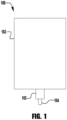
- FIG. 1 illustrates a refill unit 100 for a foam dispenser for creating a high quality foam.
- the refill unit 100 includes a collapsible container 102.
- Collapsible container 102 includes a neck 103 and a drip-free quick connector 104.
- Exemplary drip-free quick connectors are disclosed in U.S. Patent No. 6,871,679 titled Bag and Dispensing System Comprising Such A Bag, and U.S. Pat. No. 7,647,954 titled Connector Apparatus And Method For Connecting The Same For Controlling Fluid Dispensing.
- Disposable refill units contain a supply of a foamable liquid.
- the contained foamable liquid could be for example a soap, a sanitizer, a cleanser, a disinfectant, a lotion or the like.
- the container is a collapsible container and can be made of thin plastic or a flexible bag-like material.
- the container may be a non-collapsing container formed by a rigid housing member, or any other suitable configuration for containing the foamable liquid without leaking.
- a vent system may be included. Exemplary venting systems are disclosed in U.S. Patent Applications Publication No.
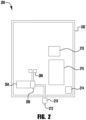
- the touch-free foam dispenser 200 is activated when sensor 214 detects the presence of a user or object. Upon detection of an object or user, the sensor 214 provides a signal to the processor (not shown) in the electronic control board 216. The electronic control board 216 provides an output signal that causes the motor 204 to rotate an eccentric wobble plate actuator drive mechanism 301. The sensor 214 and the electronic control board 216 receive power from a power source 218. In some embodiments, the motor 204 receives power from the power source 218, and, in other embodiments, the refill unit includes a power source (not shown) that provides power to a rechargeable power source (not shown). Exemplary embodiments of refill units with power supplies that provide power to the wobble plate actuator drive mechanism 301 are shown and described in U.S.
- the refill unit 100 and the foam dispenser 200 illustrated in FIGs. 1 and 2 are drawn generically because a variety of different components may be used for many of the refill unit 100 and the foam dispenser 200.
- foam pump 206 is illustrated generically above, it is described in detail below.
- Some exemplary dispenser components that may be used in accordance with the present invention are shown and described in U.S. Patent No, 8,960,498 titled Touch-Free Dispenser With Single Cell Operation And Battery Banking; U.S. Pat. Pub. No. 2014/00543.22 titled Off-Axis Inverted Foam Dispensers And Refill Units and Pub. No. 2014/0234140 titled Power Systems For Touch Free Dispensers And Refill Units Containing A Power Source.
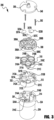
- FIG. 3 is an exploded view of an exemplary embodiment of foam pump 206 that is configured to provide a high quality foam sanitizer.
- Foam pump 206 is driven by motor 204.
- Foam pump 206 includes a pump base 324, a wobble plate 314, a diaphragm assembly seat 312, a diaphragm assembly 310, a valve seat 308, outlet valves 323A, 323B, 323C, screws 302, and a cover 348.
- the valve seat 308, diaphragm assembly seat 312, and pump base 324 are secured together by screws 302 in screw holes 308A, 312A, 324A.
- the cover 348 is attached to the valve seat 308.
- Outlet valves 323A, 323B 323C are secured to and seated in the valve seat 308.
- the diaphragm assembly 310 includes three pump diaphragms 310A, 310B, 310C, and each pump diaphragm 310A, 310B, 310C has a connector 311A, 311B, 311C.
- the diaphragm assembly 310 is located in the diaphragm assembly seat 312.
- liquid such as for example, foamable soap or sanitizer enters the foam pump 206 through liquid inlet 352.
- FIG. 4 is another exploded view of the exemplary foam pump 206 from a different perspective.
- the diaphragm assembly 310 includes three pump diaphragms 310A, 310B, 310C.
- Each pump diaphragm 310A, 310B, 310C has a corresponding inlet valve 316A, 316B, 316C (better seen in FIGs. 5 and 6 ).
- FIG. 4 also provides a view of the bottom of the valve seat 308.
- the bottom of valve seat 308 has three areas that correspond to the three pump diaphragms 310A, 310B, 310C.
- Each area has three fluid outlet apertures 309A, 309B, 309C that extend through valve seat 308, a valve stem retention aperture 329A, 329B, 329C ( FIG. 7 ), and a fluid inlet groove 319A, 319B, 319C.
- the fluid inlet grooves 319A, 319B, 319C do not extend through valve seat 308.
- FIGs. 5 and 6 illustrate a top view and a bottom view, respectively, of the exemplary diaphragm assembly 310 for foam pump 206.
- the diaphragm assembly is made of natural rubber, EPDM, Silicone, Silicone rubber TPE, TPU, TPV, vinyl, or the like.
- the diaphragm assembly 310 includes three molded pump diaphragms 310A, 310B, 310C and three corresponding inlet valves 316A, 316B, 316C.
- the top of the diaphragm assembly 310 acts as a sealing gasket.
- the top of the diaphragm assembly 310 has a flat section 310F, and each pump diaphragm 310A, 310B, 310C has gasket walls 327A, 327B, 327C that surround the respective valves 316A, 316B, 316C and pump diaphragms 310A, 310B, 310C.
- the gasket walls 327A, 327B, 327C seal against the bottom of the valve seat 308 ( FIG. 4 and FIG. 8 ) to prevent fluid, such as, air and liquid soap or sanitizer from leaking out of the foam pump 206 at a location other than the pump outlet 350 ( FIG. 3 ).
- One-way inlet valves 316A, 316B, 316C allow ambient air, liquid soap, or sanitizer to enter the pump diaphragms 310A, 310B, 310C when the pump diaphragms 310A, 310B, 310C have a negative pressure (i.e., when the pump diaphragms 310A, 310B, 310C are expanding), and seal against inlet apertures 321A, 321B, 321C when the pump diaphragms 310A, 310B, 310C have a positive pressure (e.g. when the pump diaphragms 310A, 310B, 310C are compressing).
- the one-way inlet valves 316A, 316B, 316C are formed by flexible tabs and are made of the same material as the diaphragm assembly 310.
- FIG. 7 is a top view of an exemplary valve seat 308 for the foam pump 206.
- One-way liquid outlet valve 323A is shown transparently to more clearly illustrate the flow of liquid 331A through liquid outlet apertures 309A and into mixing chamber 325.
- One-way liquid outlet valve 323A includes a valve stem 357A ( FIG. 3 ) that is inserted into aperture 329A to secure one-way liquid outlet valve 323A to valve seat 308.
- One-way liquid outlet valve 323A is normally closed and prevents air or liquid from flowing from the mixing chamber 325, back through air outlet apertures 309A, and into liquid pump diaphragm 310A.
- One-way liquid outlet valve 323 opens when liquid pump diaphragm 310A is being compressed to pump fluid.
- one-way air outlet valves 323B, 323C are shown transparently to more clearly illustrate the flow of air 331B, 331C through air outlet apertures 309B, 309C and into mixing chamber 325.
- One-way air outlet valves 323B, 323C each include a valve stem 357B, 357C ( FIG. 3 ) that are inserted into corresponding apertures 329B, 329C to secure the one-way air outlet valves to valve seat 308.
- One-way air outlet valves 323B, 323C are normally closed and prevent air or liquid from flowing from the mixing chamber 325, back through air outlet apertures 323B, 323C, and into air pump diaphragms 310B, 310C.
- One-way air outlet valves 323B, 323C open when corresponding air pump diaphragms 310B, 310C are being compressed to pump air.
- the valve seat 308 also includes flow directional control walls 308E.
- the flow directional control walls 308E provide flow paths that aid in the mixing of liquid and air.
- the flow directional control walls 308E are curved and cause the liquid and air to intersect in a tangential relationship.
- flow directional control walls 308E are designed and arranged to cause the liquid an air to intersect at a desired angle, such as, for example, each flow path may intersect at a 120 degree angle.
- the flow directional control walls 308E are arranged so that the two air paths intersect the liquid flow path at about 180 degrees.
- the design of the flow path intersection may be different for different types of liquids, for example, a higher quality of foam may be obtained by causing the liquid soap to be intersected head on (180 degrees) by the two air flow paths, while a higher quality foam may be obtained for foamable sanitizer by having the air paths tangentially intersect with the liquid path.
- FIG. 8 is a bottom view of the exemplary valve seat 308 for the foam pump 206.
- the valve seat 308 includes three liquid outlet apertures 309A that pass through valve seat 308 and a liquid outlet valve aperture 329A for retaining one-way liquid outlet valve 323A.
- Valve seat 308 also includes a liquid inlet groove 319A that extends partially into valve seat 308 to provide a liquid path from one-way liquid inlet valve 316A to the interior of liquid pump diaphragm 310A.
- the valve seat 308 includes a first set of three air outlet apertures 309B that pass through valve seat 308, and a second set of three air outlet apertures 309C that pass through valve seat 308.
- valve seat 308 includes air outlet valve apertures 329B, 329C for retaining one-way air outlet valves 323B, 323C, and air inlet grooves 319B, 319C that extend partially into valve seat 308 to provide an air path from one-way air inlet valves 316B, 316C to the interior of air pump diaphragms 310B, 310C.
- FIG. 9 is a top view of an exemplary diaphragm assembly seat 312 for the exemplary embodiment of a foam pump 206.
- the diaphragm assembly seat 312 includes three receiving holes 313A, 313B, 313C and three inlet apertures 321A, 321B, 321C.
- inlet aperture 321A In fluid communication with inlet aperture 321A is fluid inlet 352 which may be coupled to the liquid outlet of container 102.
- Each receiving hole 313A, 313B, 313C is sized to receive a diaphragm 310A, 310B, 310C.
- Each inlet aperture 321A, 321B, 321C extends through diaphragm assembly seat 312 and allows either ambient air, liquid soap, or sanitizer to enter one of the diaphragms 310A, 310B, 310C.
- FIG. 10A is a cross-sectional view taken along the lines A-A of FIGs. 5-9 showing the liquid pump portion of foam pump 206.
- liquid pump diaphragm 310A is moved downward, as shown by reference number 350B, to expand pump chamber 1002, which causes liquid inlet valve 316A to open allowing liquid to be drawn into pump chamber 1002 through liquid inlet 352, inlet aperture 321A, and liquid inlet groove 319A.
- the pump chamber 1002 is expanded it is primed with liquid, such as, for example, liquid soap or sanitizer.
- liquid pump diaphragm 310A is compressed (i.e.
- liquid pump diaphragm 310A moves in the direction shown by reference number 350A), the liquid is pumped in the direction shown by reference number 340A.
- the liquid travels through liquid outlet apertures 309A, past one-way liquid outlet valve 323A and into mixing chamber 325.
- One-way liquid outlet valve 323A is normally closed, but one-way liquid outlet valve 323A opens due to pressure caused by compressing liquid pump chamber 1002.
- One-way liquid outlet valve 323A prevents air or liquid from flowing back through liquid outlet apertures 309A and into liquid pump diaphragm 310A.
- a operating cycle of foam pump 206 includes one pump of liquid from liquid pump diaphragm 310A through liquid outlet apertures 309A, past liquid outlet valve 323A, and into mixing chamber 325 ( FIG. 7 ) (followed by two pumps of air as described below).
- FIGs. 10B and 10C are a cross-sectional view taken along the lines B-B and C-C, respectively, of FIGs. 5-9 showing the air pump portions of foam pump 206.
- air pump diaphragms 310B, 310C are moved downward, as shown by reference number 350B, to expand air pump chambers 1004, 1006, which causes air inlet valves 316B, 316C to open allowing ambient air to be drawn into pump chambers 1004, 1006 through air inlet apertures 321B, 321C and air inlet grooves 319B, 319C.
- the air pump diaphragms 310B, 310C may be compressed (moved in the direction shown by reference number 350A). Compression of air pump diaphragms 310B, 310C pump the air in the direction shown by reference number 340A. The air travels through air outlet apertures 309B, 309C, past one-way air outlet valves 323B, 323C, and into mixing chamber 325 to mix with the foamable liquid.
- One-way air outlet valves 323B, 323C are normally closed, but one-way air outlet valves 323B, 323C open due to pressure caused by compressing air pump chambers 1004, 1006.
- One-way air inlet valves 323B, 323C prevent air or liquid from flowing back through air outlet apertures 309B, 309C and into air pump diaphragms 310B, 310C. Subsequently, the air pump diaphragms 310B, 310C begin to expand, which starts the process again by causing air inlet valves 316B, 316C to open, and ambient air is drawn into air pump chambers 1004, 1006 through air inlet apertures 321B, 321C and air inlet grooves 319B, 319C.
- An operating cycle of foam pump 206 includes one pump of liquid (as described above) followed by one pump of air from air pump diaphragm 310B through air outlet apertures 309B, past air outlet valve 323B, and into mixing chamber 325 ( FIG. 7 ).
- an operating cycle of foam pump 206 includes one pump of ambient air from air pump diaphragm 310C through air outlet apertures 309C, past air outlet valve 323C, and into mixing chamber 325 ( FIG. 7 ).
- the diaphragms 310A, 310B, 310C operate sequentially, in which one sequence of operation includes one pump of liquid, such as, for example, soap or sanitizer, or ambient air by each of the three pump diaphragms 310A, 310B, 310C.
- the order of operation of the pump diaphragms 310A, 310B, 310C is dependent upon the configuration of the wobble plate 314 ( FIG. 3 ). As shown in FIG.
- each pump diaphragm 310A, 310B, 310C has a connector 311A, 311B, 311C, and the three pump diaphragms 310A, 310B, 310C connect to the wobble plate 314 by inserting the three connectors 311A, 311B, 311C in the three wobble plate links 314A, 314B, 314C.
- Wobble plate 314 connects to an eccentric wobble plate actuator that causes the wobble plate 314 to undulate. As the wobble plate 314 undulates, the wobble plate links 314A, 314B, 314C move in upward and downward motions.
- the upward motion causes the pump diaphragms 310A, 310B, 310C to compress, and the downward motion causes the pump diaphragms 310A, 310B, 310C to expand.
- the configuration of the wobble plate 314 causes one pump diaphragm 310A, 310B, 310C to compress at a time, which causes the pump diaphragms 310A, 310B, 310C to pump sequentially.
- the configuration of the wobble plate 314 also causes one pump diaphragm 310A, 310B, 310C to expand at a time, which causes the pump diaphragms 310A, 310B, 310C to prime sequentially.
- the liquid pump diaphragm 310A pumps a shot of fluid, followed by air pump diaphragm 310B pumping a shot of air, and the sequence of operation ends with air pump diaphragm 310C pumping a second shot of air.
- the sequence may be repeated any number of times depending on the desired output dose of foam.
- the air from the air pump diaphragms 310B, 310C mixes with either the liquid or sanitizer from the liquid pump diaphragm 310A in the mixing chamber 325 ( FIG. 7 ), which creates a foam mixture.
- the foam mixture exits the foam pump 206 through the pump outlet 350.
- FIG. 4 illustrates the flow path of the liquid soap or sanitizer through the exploded view.
- liquid pump diaphragm 310A expands, liquid enters the foam pump 206 through liquid inlet 352, which is shown by reference number 330A.
- the liquid travels through aperture 321A in the diaphragm assembly seat 312, and past liquid one-way inlet valve 316A, as shown by reference number 330B.
- Inlet valve 316A opens, the liquid travels through groove 319A and into liquid pump diaphragm 310A, which is shown by reference numbers 330D and 330E.
- the liquid pump diaphragm 310A compresses and pumps the liquid through liquid outlet aperture 309A, past one-way liquid outlet valve 323A, and into the mixing chamber 325 ( FIG. 7 ), which is shown by reference number 340A.
- Air follows a similar path for air pump diaphragms 310B, 310C.
- air pump diaphragms 310B, 310C expand, air is drawn into air inlet 424B, travels through apertures 321B, 321C ( FIG. 9 ) in diaphragm seat assembly 312, travels through one-way air inlet valves 316B, 316C ( FIGs.
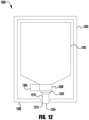
- FIG. 11 is a cross-sectional view of another exemplary embodiment of a sequentially activated multi-diaphragm foam pump 1100 that is configured to provide a high quality foam sanitizer.
- the sequentially activated multi-diaphragm foam pump 1100 includes a motor 1112, a motor shaft 1113, a wobble plate 1110, a wobble plate pin 1127 an eccentric wobble plate drive 1120, a liquid pump diaphragm 1106, two air pump diaphragms 1108 (only one is shown), mixing chamber 1130, and pump outlet 1114.
- the motor 1112 drives the motor shaft 1113, which causes the motor shaft 1113 to rotate.
- wobble plate 314 includes a ball 1128 that rides in a socket (not shown) on the pump housing and wobble plate pin 127 extends outward and connects to an eccentric wobble plate actuator 1120 that causes the pin to move along a circular path which causes the wobble plate 1110 to undulate.
- wobble plate 1110 undulates, the ends connected to the three pump diaphragms 1106, 1108 move in upward and downward motions, and the three pump diaphragms 1106, 1108 are compressed sequentially.
- One sequence of operation of the mixing pump 1100 includes one pump by each of the three pump diaphragms 1106, 1108.
- the liquid pump diaphragm 1106 operates first in the cycle of operation, followed by sequential distributions by the two air pump diaphragms 1108.
- the liquid pump diaphragm 1106 expands and contracts to pump liquid
- the air pump diaphragms 1108 expand and contract to pump air.
- the expansion of the liquid pump diaphragm 1106 opens the liquid inlet valve 1105 and allows liquid, such as, for example, soap or sanitizer to enter liquid pump chamber 1124 through liquid inlet 1102.
- the expansion of the air pump diaphragms 1108 opens the air inlet valves 1107 (only one is shown) and allows air to enter air pump chambers 1126 (only one is shown) through air inlets 1104. Circular movement of the wobble plate pin 1127 causes the ends of the wobble plate 1110 to sequentially undulate.
- the undulation causes liquid pump diaphragm to compress, which causes liquid outlet valve 1116 to open, and liquid to flow into the mixing chamber 1130 through liquid outlet apertures 1122.
- one of the air pump diaphragms 1108 is compressed by the undulating wobble plate 1110, which causes air outlet valve 1118 to open, and air to flow the mixing chamber 1130 through air outlet apertures 1123.
- the other air pump diaphragm (not shown) will compress and pump air into mixing chamber 1130.
- the air and liquid soap or sanitizer mix in the mixing chamber 1130 to create a foam mixture.
- the foam mixture exits the mixing pump 1100 through pump outlet 1114.
- the collapsible container 1203 contains a foamable liquid, such as a soap, a sanitizer, a lotion, a cleanser, a disinfectant or the like.
- the actuator 1204 includes one or more parts that cause the foam dispenser 1200 to move liquid, air and/or foam.
- Actuator 1204 is generically illustrated because there are many different kinds of pump actuators 1204 which may be employed in dispenser 200.
- actuator 1204 may be a manual lever, a manual pull bar, a manual push bar, a manual rotatable crank, an electrically activated actuator or any other means for actuating foam pump 1206.
- An electronic actuators may include a sensor (not shown) an electronic control board (not shown), a power source (not shown) and a motor 1204 such, as, for example, those shown in FIG. 2 and described above, to provide for a hands-free dispenser system with touch-less operation.
- Exemplary embodiments of sequentially activated multi-diaphragm foam pumps may be used in foam dispenser 100 or 1200.
- the foam pump 1206 is in fluid communication with the container 1203 and an air inlet (not shown).
- the foam pump 1206 may be secured to the container 1203 by any means, such as, for example, a threaded connection, a welded connection, a quarter turn connection, a snap fit connection, a clamp connection, a flange and fastener connection, or the like.
- the foam pump 1206 is activated by actuator 1204, and the foam pump 1206 pumps liquid and air through mixing chamber 1225 and foam cartridge 1210.
- the foam cartridge 1210 is in fluid communication with the mixing chamber 1225.
- Foaming media are retained within the foam cartridge 1210.
- the foaming media generate foam from foamable liquid and air mixture.
- the foaming media contains at least two sponges, an upstream sponge 1301A ( Fig. 13 ) and a downstream sponge 1301B ( Fig. 13 )
- the upstream sponge 1301A has a higher porosity than the downstream sponge 1301B.
- FIG. 13 is a cross-section of an exemplary foam cartridge 1210 for a foam dispenser 1200 that is capable of providing a high quality foam sanitizer.
- the foam cartridge 1210 includes a housing 1320 and a foaming stage 1312 with four foaming members.
- Housing 1320 has a first cross-sectional shape having a first diameter around the upstream sponge 1301A and a second cross-sectional shape having a second diameter around the downstream sponge 1301B.
- the second diameter is larger than the first diameter.
- the larger diameter of the housing 1320 and downstream sponge 1301B allow the foam/air mixture passing through the upstream sponge 1301A to expand into a larger area creating additional mixing of the air and liquid.
- Two of the four foaming members are sponges 1301A, 1301B.
- the first foaming member is an inlet screen 1302.
- the second foaming member is upstream sponge 1301A.
- the third foaming member is downstream sponge 1301B.
- the fourth foaming member is outlet screen 1303.
- a mixture of air and liquid enters the foam cartridge 210 at inlet 1304 and is dispensed as rich foam from outlet 1305.
- the mixture of air and liquid travels through the inlet screen 1302, which starts to enhance the foam.
- the mixture of air and liquid travels through upstream sponge 1301A.
- the mixture of air and liquid travels through downstream sponge 1301B.
- the mixture of air and liquid travels through outlet screen 1303 before exiting the foaming cartridge 1210 through outlet 1305 as rich foam.
- Foam cartridge 1210 may include a single foaming stage 1312 or several foaming stages. Also, the foaming cartridge 1210 may include several foaming members, with several different characteristics and configurations, disposed in the one or more foaming stages 1312.
- the configuration of the foaming members in the foam cartridge 1210 may vary in different embodiments.
- the upstream sponge 1301A may be adjacent to the downstream sponge 1301B.
- a space may exist between the upstream sponge 1301A and the downstream sponge 1301B.
- a foaming member may be disposed between the upstream sponge 1301A and the downstream sponge 1301B.
- the foaming members include screens and sponges.
- Foaming members may include screens (1302, 1303), sponges 1301A, 1301B, other porous members (not shown), baffles (not shown), or the like.
- some embodiments include the upstream and downstream sponges 1301A, 1301B.
- sponges 1301A, 1301B may be made of polyurethane reticulated foam. However, in other embodiments the sponges 401 may be made of reticulated polyester, reticulated polyether or polyether open pore foam.
- the upstream sponge 1301A and downstream sponge 1301B may have the same porosities. In some embodiments, the upstream sponge 1301A and the downstream sponge 1301B may have different porosities. In some embodiments, the upstream sponge 1301A has a higher porosity than the downstream sponge 1301B. In some embodiments, the upstream sponge 1301A has a lower porosity than the downstream sponge 1301B.
- the porosity of sponges 1301A, 1301B may be defined as a function of the pores per cm (pores per inch) of the sponges 1301A, 1301B and the amount of compression of the sponges 1301A, 1301B.
- the sponges 1301A, 1301B have the same amount of pores per cm (pores per inch) and the porosity of the sponges 1301A, 1301B may be a function of the amount of compression of the sponges 1301A, 1301B.
- the sponges 1301A, 1301B have between about 19.7 pores per cm (about 50 pores per inch) and about 35.4 pores per cm (about 90 pores per inch).
- the upstream sponge 1301A is compressed to between about 30 percent and about 50 percent of its uncompressed or relaxed state, and the downstream sponge 1301B is compressed to between about 60 percent and about 80 percent of its uncompressed or relaxed state.
- the upstream sponge 1301A has a higher porosity than the downstream sponge 1301B because the upstream sponge 1301A is less compressed than the downstream sponge 1301B.
- Sponges 1301A, 1301B may have the same amount of pores per cm (pores per inch) or different amounts of pores per cm (pores per inch), and sponges 1301A, 1301B may have the same amount of compression or a different amount compression.
- sponges 1301A, 1301B may have the same firmness or different firmness.
- Other materials that may be suitable for replacement of the sponges may include fabric felts, metal fibers, wax dipped paper filters etc.
- sponges 1301A, 1301B may be defined by firmness.
- Firmness is measure in kPa (pounds per square inch) to cause a 25% deflection in the foam from its normal thickness.
- the firmness is in the range of about 6.89 to 13.8 kPa (about 0.1 to about 2 pounds per square inch) to achieve 25% deflection.
- the sponges have a density of less than about 64.1 kg/m 3 (about 4 pounds/cubic foot), including less than about 56.1 kg/m 3 (about 3.5 pounds/cubic foot), including less than about 48.1 kg/m 3 (about 3 pounds/cubic foot), including less than about 40.0 kg/m 3 (about 2.5 pounds/cubic foot).
- the characteristics of the screens may vary.
- the inlet screen 1302 has less threads per inch than outlet screen 1303, or vice versa.
- the inlet screen 1302 has about 100 threads per inch
- the outlet screen 1303 has between about 150 threads per inch and about 200 threads per inch.
- screens 1302, 1303 may have the same number threads per inch.
- a foaming cartridge 1210 may have several screens 1302, 1303 in different locations throughout the foaming cartridge 210, and screens 1302, 1303 may have many variations in the amount of threads per inch.
- the screens 1302, 1303 and sponges 1301A, 1301B may be configured with spaces between the foaming members, with open spaces between two or more foaming members.
- the foaming members may be arranged as shown with a screen 1302 followed by sponges 1301A and 1301B followed by screen 1303, or arranged in various different orders.
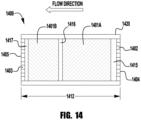
- FIG. 14 is a cross-section of another exemplary foam cartridge 1400 for a foam dispenser 1200, which may be used in lieu of, or in combination with, foam cartridge 1210 and that is capable of providing a high quality foam sanitizer.
- foam cartridge 1400 may be used with any of the pumps described herein.
- the foam cartridge 1400 includes a housing 1420 and a foaming stage 1412 with four foaming members. Two of the four foaming members are sponges 1401A, 1401B. In this exemplary embodiment, all of the foaming members have about the same diameter and housing 1420 has a cylindrical shape with a constant diameter.
- the first foaming member is an inlet screen 1402.
- the second foaming member is upstream sponge 1401A.
- the third foaming member is downstream sponge 1401B.
- the fourth foaming member is outlet screen 1403. A mixture of air and liquid enters the foam cartridge 1400 at inlet 1404 and is dispensed as rich foam from outlet 1405.
- Foam cartridge 1400 may include a single foaming stage 1412 or several foaming stages. Also, the foaming cartridge 1400 may include several foaming members, with several different characteristics and configurations, disposed in the one or more foaming stages 1412.
- the configuration of the foaming members in the foam cartridge 1400 may vary in different embodiments.
- the upstream sponge 1401A may be adjacent to the downstream sponge 1401B.
- a space may exist between the upstream sponge 1401A and the downstream sponge 1401B.
- other foaming members may be disposed between the upstream sponge 1401A and the downstream sponge 1401B.
- the foaming members include screens and sponges.
- foaming members may include screens (1402, 1403), sponges 1401A, 1401B, other porous members (not shown), baffles (not shown), or the like.
- some embodiments include the upstream and downstream sponges 1401A, 1401B.
- the sponges 1401A, 1401B have the same amount of pores per cm (pores per inch) and the porosity of the sponges 1401A, 1401B may be a function of the amount of compression of the sponges 1401A, 1401B.
- the sponges 1401A, 1401B have between about 19.7 pores per cm (about 50 pores per inch) and about 35.4 pores per cm (about 90 pores per inch).
- the upstream sponge 1401A is compressed to between about 30 percent and about 50 percent of its uncompressed or relaxed state, and the downstream sponge 1401B is compressed to between about 60 percent and about 80 percent of its uncompressed or relaxed state.
- the upstream sponge 1401A has a higher porosity than the downstream sponge 1401B because the upstream sponge 1401A is less compressed than the downstream sponge 1401B.
- Sponges 1401A, 1401B may have the same amount of pores per cm (pores per inch) or different amounts of pores per cm (pores per inch), and sponges 1401A, 1401B may have the same amount of compression or a different amount compression.
- sponges 1401A, 1401B may have the same firmness or different firmness.
- Other materials that may be suitable for replacement of the sponges may include fabric felts, metal fibers, wax dipped paper filters etc.
- sponges 1401A, 1401B may be defined by firmness.
- Firmness is measure in kPa (pounds per square inch) to cause a 25% deflection in the foam from its normal thickness.
- the firmness is in the range of about 6.89 to 13.8 kPa (about 0.1 to about 2 pounds per square inch).
- the sponges have a density of less than about 64.1 kg/m 3 (about 4 pounds/cubic foot), including less than about 56.1 kg/m 3 (about 3.5 pounds/cubic foot), including less than about 48.1 kg/m 3 (about 3 pounds/cubic foot), including less than about 40.0 kg/m 3 (about 2.5 pounds/cubic foot).
- the upstream sponge 1401A and downstream sponge 1401B may have the same firmness. In some embodiments, the upstream sponge 1401A and the downstream sponge 1401B may have different firmness. In some embodiments, the upstream sponge 1401A has a higher firmness than the downstream sponge 1401B. In some embodiments, the upstream sponge 1401A has a lower firmness than the downstream sponge 1401B.
- foaming cartridges 1210, 1400 with two sponges having different firmness when used with foamable alcohol compositions and the foam wobble pump described above provide a superior foam output over conventional foam pumps.
- the exemplary foaming cartridges improve the quality of foam in alcohol foam products when used with mini-foam pumps that have air and liquid pistons. It has also been found that the sequentially operated multi-diaphragm foam pumps disclosed provide improved quality of foam in alcohol foam products.
- the hand sanitizing foams contain water, alcohol and a surfactant.
- Suitable alcohols may include lower alcohols, such as, for example, a c1-c8 alcohol, c1-c4 alcohol, or c2-c3 alcohol.
- Other alcohols may include, for example, ethanol, methanol, isopropanol, mixtures thereof, and the like.
- Suitable surfactants may include surfactants, such as, for example, compounds containing silicone. Suitable surfactants may contain silicon or silane moiety or mixtures thereof. Dimethicons may be also be used as a surfactant, such as, for example, PEG-10 dimethicone, PEG-12 Dimethicone, mixtures thereof, and the like.
- foam hand sanitizer formulations that may be used to generate the high quality foam shown and described herein.
- the below exemplary formulas are mixed with air to form foam.
- compositions having alcohol in the range of 15 to 85%, water, and a surfactant are contemplated herein.
- many foaming alcohol compositions may be used to generate the high quality foam disclosed and claimed herein.
- Exemplary formulations that may provide suitable results, may be found in, for example, compositions shown and described in: US Pat. Pub. 2007/0,148,101 , titled Foamable Alcoholic Composition; U.S. Pat. No. 8,530,52 titled Foaming Alcohol Compositions with Selected Dimethicone Surfactants; U.S. Pat. No. 7,1990,090 titled High Alcohol Content Gel-Like And Foaming Compositions Comprising An Alcohol And Fluorosurfactant; U.S. Pat. Pub. No.
- the first pump was a conventional pump manufactured by Albea, model number F2-L11 which may be purchased at http://www.albea-group.com/en/products/product-catalog/f2.html.
- An exemplary embodiment of the Albea foam pump is shown and described in U.S. Pat. No. 6,053,364 . This pump may be referred to herein as the "Air Spray" pump.
- FIG. 15 is an image of an alcohol based foam 1500 foamed with the conventional pump manufactured by Albea under low lighting and low magnification. Bubbles 1502 are visible under the low magnification in the denser foam mixture 1505 (the hatching of foam mixture 1505 indicates areas of foam where the bubbles were not individually identifiable).
- FIG. 15 is an image of an alcohol based foam 1500 foamed with the conventional pump manufactured by Albea under low lighting and low magnification. Bubbles 1502 are visible under the low magnification in the denser foam mixture 1505 (the hatching of foam mixture 1505 indicates areas of foam where the bubble
- FIG. 16 is an image of an alcohol based foam 1500 foamed with the conventional pump manufactured by Albea under transmitted light at a higher magnification. The image was taken on the edge of the foam 1500, described in more detail below. As described below, the centers 1601 of the bubbles 1602 appeared light in the images and are denoted by the dashed lines. The bubbles 1602 are the same bubbles as bubbles 1502 but are denoted differently because they are under different magnifications.
- the foam mixture 1605 indicates areas of foam where the bubbles were not individually identifiable.
- the second pump was a conventional pump manufactured by Ophardt, model number SD.
- An exemplary embodiment of the Ophardt foam pump is shown and described in U.S. Pat. No. 8,360,286 and 8,272,539 .
- FIG. 17 is an image of an alcohol based foam 1700 foamed with the conventional pump manufactured by Ophardt under low lighting and low magnification. Bubbles 1702 are visible under the low magnification in the denser foam mixture 1705. The foam mixture 1705 indicates areas of foam where the bubbles were not individually identifiable.
- FIG. 18 is an image of an alcohol based foam 1700 foamed with the conventional pump manufactured by Ophardt under transmitted light at a higher magnification. The image was taken on the edge of the foam 1700, described in more detail below.
- the bubbles 1802 are the same bubbles as bubbles 1702 but are denoted differently because they are under different magnifications.
- the foam mixture 1805 indicates areas of foam where the bubbles were not individually identifiable.
- the third pump is the sequentially activated diaphragm foam pump described herein, which may be referred to as "wobble pump".
- FIG. 19 is an image of an alcohol based foam 1500 foamed with the wobble pump and the foam cartridge under low lighting and low magnification. Bubbles 1902 are visible under the low magnification in the denser foam mixture 1905. The foam mixture 1905 indicates areas of foam where the bubbles were not individually identifiable.
- FIG. 20 is an image of an alcohol based foam 1900 foamed with the wobble pump and the foam cartridge under transmitted light at a higher magnification. The image was taken on the edge of the foam 1900, described in more detail below. As described below, the centers 2001 of the bubbles 2002 appeared light in the images and are denoted by the dashed lines. The bubbles 2002 are the same bubbles as bubbles 1902 but are denoted differently because they are under different magnifications.
- the foam mixture 2005 indicates areas of foam where the bubbles were not individually identifiable.
- foam bubble size foam was floated on liquid, shaken slightly to disperse the foam and images were collected. The images were subsequently processed using standard image analysis techniques to identify and measure the bubble diameters. Due to the wide range of bubble sizes, two methods were developed to measure the bubble sizes; a low magnification method for measurement of large bubbles (diameters greater than 500 ⁇ m) and a higher magnification method to measure the smaller bubbles (diameters less than 500 ⁇ m).
- the following amounts of foam were dispensed to have about the same volume of foam: Albea pump - 2 pump strokes; Ophardt pump - 50% of a pump stroke; sequentially activated diaphragm foam pump (wobble pump) - 1 sec.
- the pumps were operated in a manner that resulted in the same volume of foam output.
- Half stroking the Ophardt pump did not make a difference in the foam quality.
- the petri dish was then gently shaken to disperse the foam on the liquid surface (without creating new bubbles). A clear glass cover placed on top of the dish, without contacting the bubbles, in order to reduce evaporation.
- the lower magnification images were collected with the Q-Color Digital Camera, C-mounted to Canon FD lens adaptor, a 50 mm Canon lens (F1.8, infinity focus), and a +10 macro lens filter, mounted on a focusing stand.
- the lower magnification images were calibrated with a mm-scale ruler.
- the Q-Color Digital camera was controlled by Q Color Pro software (version 5.1.1.14) running on a personal computer with Windows XP operating system. All images were collected in 8-bit gray-scale mode and stored as TIFF files. Images were imported into Adobe Photoshop (version 7.0.1) and Fovea Pro plug-ins (version 4.0 by Reindeer Graphics) for analysis. Measurement results were exported to Microsoft Excel for statistical calculations.
- the low magnification images were processed by blurring the image using a Gaussian blur filter with a 15 pixel radius, thresholding the blurred images to select the dark areas, and the measuring the identified bubble sizes. Overhead room lighting was used to illuminate the samples, resulting in reflections from the overhead lights in the larger bubbles; therefore the circumscribed radius was measured and used to calculate the corresponding bubble diameter in order to avoid this interference.
- the high magnification images were processed by thresholding the images to select the bright areas, eliminating the small areas of less than 120 - 140 pixels caused by reflections between bubbles, removing a 1 pixel wide band around the border of the image, and measuring the resulting areas. Since selecting the bright areas selected a center portion from each bubble as well as areas between bubbles, areas with a roundness value greater than 0.6 - 0.75 were identified as bubble centers. Bubble diameters were calculated as the diameter of the identified bubble center plus twice the minimum separation between the bubble center and closest bright area, which was expected to be the areas between bubbles. Also, since collecting images from the edges of the foam result in large areas of the image without bubbles, images were cropped to 1900 x 1200 or 1200 x 1900 pixels to examine consistent areas.
- FIGS. 21-22 Size distributions from the high magnification images are shown in FIGS. 21-22.
- Figure 21 has the bubble size along the x-axis and the frequency of the bubble size along the y-axis.
- a large portion of the frequency of bubbles produced with the sequentially activated foam pump (identified with a "W") had a diameter of between about 50 ⁇ m and about 250 ⁇ m.
- a large portion of the frequency of bubbles produced with the Albea pump identified by "AS”
- a large portion of the frequency of bubbles produced with the Ophardt pump identified by "SD” had a diameter of between about 100 ⁇ m to 350 ⁇ m.
- Figure 22 illustrates that the sequentially activated foam diaphragm pump (identified with a "W") produced foam bubbles that exhibit smaller bubble sizes and the majority of the bubbles were less than about 250 ⁇ m.
- the Ophardt SD pump had a wider distribution of bubble sizes and a high percentage that were over 250 ⁇ m.
- the Albea AS pump had a wider distribution of bubble sizes and about half or more were over 250 ⁇ m.
- the high quantity of smaller bubbles provides a higher quality foam. It is also believed that the high number of small bubbles provides a better feel when rubbed on the skin. In addition it is believed that the smaller bubbles provide a more appealing visual image and a perception of a higher quality foam to a user. It further believed that the high quantity of small bubbles gives a user the perception of superior coverage.
- the foam density was measured.
- a graduated cylinder was used to capture the volume and a scale was used to capture the mass.
- the average foam density produced by the Albea pump was 0.090 g/ml
- the Ophardt SD pump produced 0.095 g/ml
- the sequentially activated diaphragm foam pump produced foam with a foam density of 0.109 g/ml.
- the sequentially activated diaphragm foam pump produced a higher density foam.
- the higher density foam has a better feel and a higher perceived quality.
- the Q-Color Digital camera was controlled by Q Color Pro software (version 5.1.1.14) running on a personal computer with Windows XP operating system. All images were collected in 8-bit gray-scale mode and stored as TIFF files. Images were imported into Adobe Photoshop (version 7.0.1) and Fovea Pro plug-ins (version 4.0 by Reindeer Graphics) for analysis. Measurement results were exported to Microsoft Excel for statistical calculations.
- the images were processed by thresholding the images to select the bright areas, eliminating the small areas of less than 40 pixels caused by reflections between bubbles, removing a 1 pixel wide band around the border of the image, and measuring the resulting areas. Since selecting the bright areas selected a center portion from each bubble as well as areas between bubbles, areas with a roundness value greater than 0.75 were identified as bubble centers. Bubble diameters were calculated as the diameter of the identified bubble center plus twice the minimum separation between the bubble center and closest bright area, which was expected to be the areas between bubbles. Also, since collecting images from the edges of the foam result in large areas of the image without bubbles, images were cropped to 1900 x 1200 or 1200 x 1900 pixels to examine consistent areas.
- the average bubble diameter for aerosol foam samples was between about 121 - 135 ⁇ m with an overall average diameter of 127 ⁇ m. These sizes were slightly smaller than the 147 ⁇ m average diameter observed for the sequentially operated diaphragm foam pump . However, the average diameter of the bubble for the sequentially operated diaphragm foam pump (147 ⁇ m) were much closer to the average diameter bubble size of the aerosol then the conventional non-aerosol foam pumps (278 ⁇ m) (234 ⁇ m). Accordingly, the novel embodiments of the sequentially operated foam pump disclosed herein provide a non-aerosol foam quality that compares with the foam quality of the aerosol without the need for hydrocarbon propellants.
- the novel foams claimed herein are formed using ambient air and are substantially free of hydrocarbons, do not require hydrocarbon based propellants and are more environmentally friendly.
Landscapes
- Engineering & Computer Science (AREA)
- Health & Medical Sciences (AREA)
- Mechanical Engineering (AREA)
- General Engineering & Computer Science (AREA)
- Life Sciences & Earth Sciences (AREA)
- Public Health (AREA)
- Veterinary Medicine (AREA)
- Animal Behavior & Ethology (AREA)
- General Health & Medical Sciences (AREA)
- Birds (AREA)
- Epidemiology (AREA)
- Dermatology (AREA)
- Chemical & Material Sciences (AREA)
- Emergency Medicine (AREA)
- Nuclear Medicine, Radiotherapy & Molecular Imaging (AREA)
- Organic Chemistry (AREA)
- Oncology (AREA)
- Chemical Kinetics & Catalysis (AREA)
- General Chemical & Material Sciences (AREA)
- Medicinal Chemistry (AREA)
- Dispersion Chemistry (AREA)
- Communicable Diseases (AREA)
- Pharmacology & Pharmacy (AREA)
- Containers And Packaging Bodies Having A Special Means To Remove Contents (AREA)
- Agricultural Chemicals And Associated Chemicals (AREA)
- Detergent Compositions (AREA)
- Medicinal Preparation (AREA)
- Cosmetics (AREA)
Applications Claiming Priority (7)
| Application Number | Priority Date | Filing Date | Title |
|---|---|---|---|
| US201662293931P | 2016-02-11 | 2016-02-11 | |
| US201662319061P | 2016-04-06 | 2016-04-06 | |
| US15/350,190 US10065199B2 (en) | 2015-11-13 | 2016-11-14 | Foaming cartridge |
| US15/355,112 US10080466B2 (en) | 2015-11-18 | 2016-11-18 | Sequentially activated multi-diaphragm foam pumps, refill units and dispenser systems |
| US15/356,795 US10080467B2 (en) | 2015-11-20 | 2016-11-21 | Foam dispensing systems, pumps and refill units having high air to liquid ratios |
| US15/369,007 US10080468B2 (en) | 2015-12-04 | 2016-12-05 | Sequentially activated multi-diaphragm foam pumps, refill units and dispenser systems |
| PCT/US2017/017595 WO2017139727A1 (en) | 2016-02-11 | 2017-02-13 | High quality non-aerosol hand sanitizing foam |
Publications (2)
| Publication Number | Publication Date |
|---|---|
| EP3413770A1 EP3413770A1 (en) | 2018-12-19 |
| EP3413770B1 true EP3413770B1 (en) | 2024-10-09 |
Family
ID=59563607
Family Applications (1)
| Application Number | Title | Priority Date | Filing Date |
|---|---|---|---|
| EP17706652.9A Active EP3413770B1 (en) | 2016-02-11 | 2017-02-13 | High quality non-aerosol hand sanitizing foam |
Country Status (4)
| Country | Link |
|---|---|
| EP (1) | EP3413770B1 (https=) |
| JP (1) | JP7114474B2 (https=) |
| AU (1) | AU2017217986B2 (https=) |
| WO (1) | WO2017139727A1 (https=) |
Families Citing this family (5)
| Publication number | Priority date | Publication date | Assignee | Title |
|---|---|---|---|---|
| US12433827B2 (en) * | 2017-02-23 | 2025-10-07 | Deb Ip Limited | Foamable cleansing compositions |
| GB201912057D0 (en) | 2019-08-22 | 2019-10-09 | Ge Healthcare Bio Sciences Ab | A diaphragm pump |
| JP7551294B2 (ja) * | 2019-12-26 | 2024-09-17 | 大和製罐株式会社 | 泡吐出容器 |
| DK4100649T3 (da) | 2020-02-04 | 2025-01-20 | Alphinity Usa Inc | Pumpe/blanderanordning |
| JP7345886B2 (ja) * | 2020-05-25 | 2023-09-19 | 株式会社東洋新薬 | アルコール含有組成物 |
Citations (3)
| Publication number | Priority date | Publication date | Assignee | Title |
|---|---|---|---|---|
| US5129550A (en) * | 1989-01-23 | 1992-07-14 | Battelle Memorial Institute | Spray bottle apparatus with force multiply pistons |
| JP2004301300A (ja) * | 2003-04-01 | 2004-10-28 | Oken Ltd | 逆止め弁およびその組付方法 |
| US20140272106A1 (en) * | 2013-03-15 | 2014-09-18 | Gojo Industries, Inc. | Alcoholic compositions with improved properties and methods for evaluating interaction of the compositions with surfaces |
Family Cites Families (33)
| Publication number | Priority date | Publication date | Assignee | Title |
|---|---|---|---|---|
| US5635469A (en) * | 1993-06-10 | 1997-06-03 | The Procter & Gamble Company | Foaming cleansing products |
| NL1001366C2 (nl) | 1995-10-06 | 1997-04-08 | Airspray Int Bv | Inrichting voor het afgeven van een luchtvloeistofmengsel, in het bijzonder schuim en daarvoor bestemde bedieningseenheid. |
| US6348206B1 (en) * | 1999-09-27 | 2002-02-19 | Devtech Marketting, Inc. | Composition and method for producing lubricating, germicide foam |
| NL1016292C2 (nl) | 2000-09-28 | 2002-04-02 | Itsac Nv | Zak alsmede een afgiftesysteem omvattende een dergelijke zak en werkwijzen voor de vervaardiging en het vullen van een dergelijke zak. |
| CA2447666A1 (en) | 2001-05-21 | 2002-11-28 | Colder Products Company | Connector apparatus and method for connecting the same for controlling fluid dispensing |
| JP2003033292A (ja) * | 2001-07-19 | 2003-02-04 | Matsushita Electric Works Ltd | 泡発生器 |
| JP2004107655A (ja) * | 2002-08-30 | 2004-04-08 | Kao Corp | 起泡性の向上方法及び泡状洗浄剤組成物 |
| US20040229763A1 (en) * | 2003-02-28 | 2004-11-18 | The Procter & Gamble Company | Cleaning kit and/or a dishwashing kit containing a foam-generating dispenser and a cleaning and/or dishwashing composition |
| PL1668105T3 (pl) | 2003-09-29 | 2019-03-29 | Deb Ip Limited | Kompozycje żelopodobne i pieniące o dużej zawartości alkoholu |
| BRPI0608347A2 (pt) | 2005-03-07 | 2009-12-08 | Deb Worldwide Healthcare Inc | composição alcoólica espumável, concentrado de composição, composição alcoólica desinfetante espumável, métodos para formar, produzir e dispensar uma espuma, dispensador não pressurizado, e, métodos para usar uma composição alcoólica de espuma para desinfecção pessoal e para produzir e aplicar a uma pele de indivìduo uma composição alcoólica de espuma desinfetante de pele |
| US7651990B2 (en) * | 2005-06-13 | 2010-01-26 | 3M Innovative Properties Company | Foamable alcohol compositions comprising alcohol and a silicone surfactant, systems and methods of use |
| US20070148101A1 (en) | 2005-12-28 | 2007-06-28 | Marcia Snyder | Foamable alcoholic composition |
| US8544698B2 (en) | 2007-03-26 | 2013-10-01 | Gojo Industries, Inc. | Foam soap dispenser with stationary dispensing tube |
| US8333954B2 (en) * | 2007-04-30 | 2012-12-18 | Kimberly-Clark Worldwide, Inc. | Foamable sanitizing compositions |
| CA2875087C (en) | 2007-12-07 | 2016-06-07 | Op-Hygiene Ip Gmbh | Angled slot foam dispenser |
| MX2010007867A (es) * | 2008-01-18 | 2010-08-09 | Procter & Gamble | Composiciones de limpieza personal concentradas. |
| AT506712B1 (de) * | 2008-05-06 | 2011-06-15 | Hagleitner Hans Georg | Spender für schaumseife |
| US7842725B2 (en) | 2008-07-24 | 2010-11-30 | Ecolab USA, Inc. | Foaming alcohol compositions with selected dimethicone surfactants |
| CA2672057C (en) | 2009-07-14 | 2017-07-11 | Gotohti.Com Inc. | Draw back push pump |
| US20120309660A1 (en) * | 2009-12-08 | 2012-12-06 | Shiseido Company, Ltd. | Cleansing composition, method of generating foam, foam, and method of cleansing hair |
| JP2011121896A (ja) * | 2009-12-10 | 2011-06-23 | Shiseido Co Ltd | 洗浄用の泡及びその生成方法及び洗髪方法 |
| WO2012154642A1 (en) * | 2011-05-10 | 2012-11-15 | Gojo Industries, Inc. | Foam pump |
| US8960498B2 (en) | 2011-07-01 | 2015-02-24 | Gojo Industries, Inc. | Touch-free dispenser with single cell operation and battery banking |
| US20130165530A1 (en) | 2011-12-23 | 2013-06-27 | Gojo Industries, Inc. | Foamable alcoholic compositions with skin benefits |
| JP5905250B2 (ja) * | 2011-12-26 | 2016-04-20 | 応研精工株式会社 | ローリングポンプ |
| WO2013126696A2 (en) * | 2012-02-24 | 2013-08-29 | Gojo Industries, Inc. | Antimicrobial and foamable alcoholic compositions |
| US9172266B2 (en) | 2013-02-19 | 2015-10-27 | Gojo Industries, Inc. | Power systems for touch free dispensers and refill units containing a power source |
| US9204765B2 (en) | 2012-08-23 | 2015-12-08 | Gojo Industries, Inc. | Off-axis inverted foam dispensers and refill units |
| US9038862B2 (en) | 2013-01-23 | 2015-05-26 | Gojo Industries, Inc. | Pumps with container vents |
| US8820585B1 (en) * | 2013-03-15 | 2014-09-02 | Pibed Limited | Foam dispenser with a porous foaming element |
| US20140367419A1 (en) | 2013-06-14 | 2014-12-18 | Gojo Industries, Inc. | Foam cartridges, pumps, refill units and foam dispensers utilizing the same |
| US9850059B2 (en) | 2014-03-20 | 2017-12-26 | Gojo Industries, Inc | Closed system for venting a dispenser reservoir |
| CA2922625A1 (en) * | 2015-03-06 | 2016-09-06 | Simplehuman, Llc | Foaming soap dispensers |
-
2017
- 2017-02-13 EP EP17706652.9A patent/EP3413770B1/en active Active
- 2017-02-13 WO PCT/US2017/017595 patent/WO2017139727A1/en not_active Ceased
- 2017-02-13 AU AU2017217986A patent/AU2017217986B2/en active Active
- 2017-02-13 JP JP2018541206A patent/JP7114474B2/ja active Active
Patent Citations (3)
| Publication number | Priority date | Publication date | Assignee | Title |
|---|---|---|---|---|
| US5129550A (en) * | 1989-01-23 | 1992-07-14 | Battelle Memorial Institute | Spray bottle apparatus with force multiply pistons |
| JP2004301300A (ja) * | 2003-04-01 | 2004-10-28 | Oken Ltd | 逆止め弁およびその組付方法 |
| US20140272106A1 (en) * | 2013-03-15 | 2014-09-18 | Gojo Industries, Inc. | Alcoholic compositions with improved properties and methods for evaluating interaction of the compositions with surfaces |
Also Published As
| Publication number | Publication date |
|---|---|
| EP3413770A1 (en) | 2018-12-19 |
| AU2017217986A1 (en) | 2018-08-23 |
| JP2019512281A (ja) | 2019-05-16 |
| JP7114474B2 (ja) | 2022-08-08 |
| AU2017217986B2 (en) | 2022-03-17 |
| CA3013786A1 (en) | 2017-08-17 |
| WO2017139727A1 (en) | 2017-08-17 |
Similar Documents
| Publication | Publication Date | Title |
|---|---|---|
| US11000161B2 (en) | High quality non-aerosol hand sanitizing foam | |
| EP3413770B1 (en) | High quality non-aerosol hand sanitizing foam | |
| US10065199B2 (en) | Foaming cartridge | |
| CA3003178C (en) | Sequentially activated multi-diaphragm foam pump | |
| US20170143172A1 (en) | Foam dispensing systems, pumps and refill units having high air to liquid ratios | |
| US12440072B2 (en) | Sequentially activated multi-diaphragm foam pumps, refill units and dispenser systems | |
| EP2545833A2 (en) | Foamed cleanser with suspended particles, a method of producing same and a dispenser thereof | |
| US20170156550A1 (en) | Sequentially activated multi-diaphragm foam pumps, refill units and dispenser systems | |
| WO2017087741A1 (en) | A refill unit for a foam dispenser | |
| CA3013786C (en) | High quality non-aerosol hand sanitizing foam | |
| CA3019173C (en) | Sequentially activated multi-diaphragm foam pumps, refill units and dispenser systems | |
| CA3005480A1 (en) | Foam dispensing systems, pumps and refill units having high air to liquid ratios | |
| EP4281667B1 (en) | Sequentially activated multi-diaphragm foam pumps, refill units and dispenser systems having a non-uniform wobble plate | |
| JP2024505230A5 (https=) | ||
| JP2021501649A (ja) | ポンプ効率向上のための二重入口バルブ | |
| EP3758567B1 (en) | Outlet valve arrangements for enhanced pump efficiency | |
| AU2017246462B2 (en) | Sequentially activated multi-diaphragm foam pumps, refill units and dispenser systems | |
| WO2020218156A1 (ja) | 泡吐出ディスペンサー及び泡吐出容器 | |
| CA3006456A1 (en) | Sequentially activated multi-diaphragm foam pumps, refill units and dispenser systems |
Legal Events
| Date | Code | Title | Description |
|---|---|---|---|
| STAA | Information on the status of an ep patent application or granted ep patent |
Free format text: STATUS: UNKNOWN |
|
| STAA | Information on the status of an ep patent application or granted ep patent |
Free format text: STATUS: THE INTERNATIONAL PUBLICATION HAS BEEN MADE |
|
| PUAI | Public reference made under article 153(3) epc to a published international application that has entered the european phase |
Free format text: ORIGINAL CODE: 0009012 |
|
| STAA | Information on the status of an ep patent application or granted ep patent |
Free format text: STATUS: REQUEST FOR EXAMINATION WAS MADE |
|
| 17P | Request for examination filed |
Effective date: 20180712 |
|
| AK | Designated contracting states |
Kind code of ref document: A1 Designated state(s): AL AT BE BG CH CY CZ DE DK EE ES FI FR GB GR HR HU IE IS IT LI LT LU LV MC MK MT NL NO PL PT RO RS SE SI SK SM TR |
|
| AX | Request for extension of the european patent |
Extension state: BA ME |
|
| DAV | Request for validation of the european patent (deleted) | ||
| DAX | Request for extension of the european patent (deleted) | ||
| STAA | Information on the status of an ep patent application or granted ep patent |
Free format text: STATUS: EXAMINATION IS IN PROGRESS |
|
| 17Q | First examination report despatched |
Effective date: 20200121 |
|
| P01 | Opt-out of the competence of the unified patent court (upc) registered |
Effective date: 20230512 |
|
| GRAP | Despatch of communication of intention to grant a patent |
Free format text: ORIGINAL CODE: EPIDOSNIGR1 |
|
| STAA | Information on the status of an ep patent application or granted ep patent |
Free format text: STATUS: GRANT OF PATENT IS INTENDED |
|
| INTG | Intention to grant announced |
Effective date: 20240527 |
|
| GRAS | Grant fee paid |
Free format text: ORIGINAL CODE: EPIDOSNIGR3 |
|
| GRAA | (expected) grant |
Free format text: ORIGINAL CODE: 0009210 |
|
| STAA | Information on the status of an ep patent application or granted ep patent |
Free format text: STATUS: THE PATENT HAS BEEN GRANTED |
|
| AK | Designated contracting states |
Kind code of ref document: B1 Designated state(s): AL AT BE BG CH CY CZ DE DK EE ES FI FR GB GR HR HU IE IS IT LI LT LU LV MC MK MT NL NO PL PT RO RS SE SI SK SM TR |
|
| REG | Reference to a national code |
Ref country code: CH Ref legal event code: EP |
|
| REG | Reference to a national code |
Ref country code: DE Ref legal event code: R096 Ref document number: 602017085335 Country of ref document: DE |
|
| REG | Reference to a national code |
Ref country code: IE Ref legal event code: FG4D |
|
| REG | Reference to a national code |
Ref country code: LT Ref legal event code: MG9D |
|
| REG | Reference to a national code |
Ref country code: NL Ref legal event code: MP Effective date: 20241009 |
|
| REG | Reference to a national code |
Ref country code: AT Ref legal event code: MK05 Ref document number: 1729605 Country of ref document: AT Kind code of ref document: T Effective date: 20241009 |
|
| PG25 | Lapsed in a contracting state [announced via postgrant information from national office to epo] |
Ref country code: NL Free format text: LAPSE BECAUSE OF FAILURE TO SUBMIT A TRANSLATION OF THE DESCRIPTION OR TO PAY THE FEE WITHIN THE PRESCRIBED TIME-LIMIT Effective date: 20241009 |
|
| PG25 | Lapsed in a contracting state [announced via postgrant information from national office to epo] |
Ref country code: NL Free format text: LAPSE BECAUSE OF FAILURE TO SUBMIT A TRANSLATION OF THE DESCRIPTION OR TO PAY THE FEE WITHIN THE PRESCRIBED TIME-LIMIT Effective date: 20241009 |
|
| PG25 | Lapsed in a contracting state [announced via postgrant information from national office to epo] |
Ref country code: HR Free format text: LAPSE BECAUSE OF FAILURE TO SUBMIT A TRANSLATION OF THE DESCRIPTION OR TO PAY THE FEE WITHIN THE PRESCRIBED TIME-LIMIT Effective date: 20241009 Ref country code: IS Free format text: LAPSE BECAUSE OF FAILURE TO SUBMIT A TRANSLATION OF THE DESCRIPTION OR TO PAY THE FEE WITHIN THE PRESCRIBED TIME-LIMIT Effective date: 20250209 Ref country code: PT Free format text: LAPSE BECAUSE OF FAILURE TO SUBMIT A TRANSLATION OF THE DESCRIPTION OR TO PAY THE FEE WITHIN THE PRESCRIBED TIME-LIMIT Effective date: 20250210 |
|
| PG25 | Lapsed in a contracting state [announced via postgrant information from national office to epo] |
Ref country code: FI Free format text: LAPSE BECAUSE OF FAILURE TO SUBMIT A TRANSLATION OF THE DESCRIPTION OR TO PAY THE FEE WITHIN THE PRESCRIBED TIME-LIMIT Effective date: 20241009 |
|
| PG25 | Lapsed in a contracting state [announced via postgrant information from national office to epo] |
Ref country code: BG Free format text: LAPSE BECAUSE OF FAILURE TO SUBMIT A TRANSLATION OF THE DESCRIPTION OR TO PAY THE FEE WITHIN THE PRESCRIBED TIME-LIMIT Effective date: 20241009 |
|
| PG25 | Lapsed in a contracting state [announced via postgrant information from national office to epo] |
Ref country code: ES Free format text: LAPSE BECAUSE OF FAILURE TO SUBMIT A TRANSLATION OF THE DESCRIPTION OR TO PAY THE FEE WITHIN THE PRESCRIBED TIME-LIMIT Effective date: 20241009 |
|
| PG25 | Lapsed in a contracting state [announced via postgrant information from national office to epo] |
Ref country code: NO Free format text: LAPSE BECAUSE OF FAILURE TO SUBMIT A TRANSLATION OF THE DESCRIPTION OR TO PAY THE FEE WITHIN THE PRESCRIBED TIME-LIMIT Effective date: 20250109 |
|
| PG25 | Lapsed in a contracting state [announced via postgrant information from national office to epo] |
Ref country code: GR Free format text: LAPSE BECAUSE OF FAILURE TO SUBMIT A TRANSLATION OF THE DESCRIPTION OR TO PAY THE FEE WITHIN THE PRESCRIBED TIME-LIMIT Effective date: 20250110 Ref country code: AT Free format text: LAPSE BECAUSE OF FAILURE TO SUBMIT A TRANSLATION OF THE DESCRIPTION OR TO PAY THE FEE WITHIN THE PRESCRIBED TIME-LIMIT Effective date: 20241009 Ref country code: LV Free format text: LAPSE BECAUSE OF FAILURE TO SUBMIT A TRANSLATION OF THE DESCRIPTION OR TO PAY THE FEE WITHIN THE PRESCRIBED TIME-LIMIT Effective date: 20241009 |
|
| PG25 | Lapsed in a contracting state [announced via postgrant information from national office to epo] |
Ref country code: PL Free format text: LAPSE BECAUSE OF FAILURE TO SUBMIT A TRANSLATION OF THE DESCRIPTION OR TO PAY THE FEE WITHIN THE PRESCRIBED TIME-LIMIT Effective date: 20241009 |
|
| PG25 | Lapsed in a contracting state [announced via postgrant information from national office to epo] |
Ref country code: RS Free format text: LAPSE BECAUSE OF FAILURE TO SUBMIT A TRANSLATION OF THE DESCRIPTION OR TO PAY THE FEE WITHIN THE PRESCRIBED TIME-LIMIT Effective date: 20250109 |
|
| PG25 | Lapsed in a contracting state [announced via postgrant information from national office to epo] |
Ref country code: SM Free format text: LAPSE BECAUSE OF FAILURE TO SUBMIT A TRANSLATION OF THE DESCRIPTION OR TO PAY THE FEE WITHIN THE PRESCRIBED TIME-LIMIT Effective date: 20241009 |
|
| PG25 | Lapsed in a contracting state [announced via postgrant information from national office to epo] |
Ref country code: DK Free format text: LAPSE BECAUSE OF FAILURE TO SUBMIT A TRANSLATION OF THE DESCRIPTION OR TO PAY THE FEE WITHIN THE PRESCRIBED TIME-LIMIT Effective date: 20241009 |
|
| REG | Reference to a national code |
Ref country code: DE Ref legal event code: R097 Ref document number: 602017085335 Country of ref document: DE |
|
| PG25 | Lapsed in a contracting state [announced via postgrant information from national office to epo] |
Ref country code: EE Free format text: LAPSE BECAUSE OF FAILURE TO SUBMIT A TRANSLATION OF THE DESCRIPTION OR TO PAY THE FEE WITHIN THE PRESCRIBED TIME-LIMIT Effective date: 20241009 |
|
| PG25 | Lapsed in a contracting state [announced via postgrant information from national office to epo] |
Ref country code: RO Free format text: LAPSE BECAUSE OF FAILURE TO SUBMIT A TRANSLATION OF THE DESCRIPTION OR TO PAY THE FEE WITHIN THE PRESCRIBED TIME-LIMIT Effective date: 20241009 |
|
| PG25 | Lapsed in a contracting state [announced via postgrant information from national office to epo] |
Ref country code: SK Free format text: LAPSE BECAUSE OF FAILURE TO SUBMIT A TRANSLATION OF THE DESCRIPTION OR TO PAY THE FEE WITHIN THE PRESCRIBED TIME-LIMIT Effective date: 20241009 |
|
| PG25 | Lapsed in a contracting state [announced via postgrant information from national office to epo] |
Ref country code: CZ Free format text: LAPSE BECAUSE OF FAILURE TO SUBMIT A TRANSLATION OF THE DESCRIPTION OR TO PAY THE FEE WITHIN THE PRESCRIBED TIME-LIMIT Effective date: 20241009 |
|
| PG25 | Lapsed in a contracting state [announced via postgrant information from national office to epo] |
Ref country code: IT Free format text: LAPSE BECAUSE OF FAILURE TO SUBMIT A TRANSLATION OF THE DESCRIPTION OR TO PAY THE FEE WITHIN THE PRESCRIBED TIME-LIMIT Effective date: 20241009 |
|
| PLBE | No opposition filed within time limit |
Free format text: ORIGINAL CODE: 0009261 |
|
| STAA | Information on the status of an ep patent application or granted ep patent |
Free format text: STATUS: NO OPPOSITION FILED WITHIN TIME LIMIT |
|
| PG25 | Lapsed in a contracting state [announced via postgrant information from national office to epo] |
Ref country code: SE Free format text: LAPSE BECAUSE OF FAILURE TO SUBMIT A TRANSLATION OF THE DESCRIPTION OR TO PAY THE FEE WITHIN THE PRESCRIBED TIME-LIMIT Effective date: 20241009 |
|
| PG25 | Lapsed in a contracting state [announced via postgrant information from national office to epo] |
Ref country code: MC Free format text: LAPSE BECAUSE OF FAILURE TO SUBMIT A TRANSLATION OF THE DESCRIPTION OR TO PAY THE FEE WITHIN THE PRESCRIBED TIME-LIMIT Effective date: 20241009 |
|
| 26N | No opposition filed |
Effective date: 20250710 |
|
| REG | Reference to a national code |
Ref country code: CH Ref legal event code: PL |
|
| PG25 | Lapsed in a contracting state [announced via postgrant information from national office to epo] |
Ref country code: LU Free format text: LAPSE BECAUSE OF NON-PAYMENT OF DUE FEES Effective date: 20250213 |
|
| PG25 | Lapsed in a contracting state [announced via postgrant information from national office to epo] |
Ref country code: CH Free format text: LAPSE BECAUSE OF NON-PAYMENT OF DUE FEES Effective date: 20250228 |
|
| REG | Reference to a national code |
Ref country code: BE Ref legal event code: MM Effective date: 20250228 |
|
| PG25 | Lapsed in a contracting state [announced via postgrant information from national office to epo] |
Ref country code: FR Free format text: LAPSE BECAUSE OF NON-PAYMENT OF DUE FEES Effective date: 20250228 |
|
| PG25 | Lapsed in a contracting state [announced via postgrant information from national office to epo] |
Ref country code: BE Free format text: LAPSE BECAUSE OF NON-PAYMENT OF DUE FEES Effective date: 20250228 |
|
| PG25 | Lapsed in a contracting state [announced via postgrant information from national office to epo] |
Ref country code: IE Free format text: LAPSE BECAUSE OF NON-PAYMENT OF DUE FEES Effective date: 20250213 |
|
| PGFP | Annual fee paid to national office [announced via postgrant information from national office to epo] |
Ref country code: GB Payment date: 20260227 Year of fee payment: 10 |
|
| PGFP | Annual fee paid to national office [announced via postgrant information from national office to epo] |
Ref country code: DE Payment date: 20260227 Year of fee payment: 10 |