EP3397221B1 - Kompressionsstrumpf - Google Patents
Kompressionsstrumpf Download PDFInfo
- Publication number
- EP3397221B1 EP3397221B1 EP16815911.9A EP16815911A EP3397221B1 EP 3397221 B1 EP3397221 B1 EP 3397221B1 EP 16815911 A EP16815911 A EP 16815911A EP 3397221 B1 EP3397221 B1 EP 3397221B1
- Authority
- EP
- European Patent Office
- Prior art keywords
- leg
- compression stocking
- overlap portion
- overlap
- stocking
- Prior art date
- Legal status (The legal status is an assumption and is not a legal conclusion. Google has not performed a legal analysis and makes no representation as to the accuracy of the status listed.)
- Active
Links
Images



Classifications
-
- A—HUMAN NECESSITIES
- A61—MEDICAL OR VETERINARY SCIENCE; HYGIENE
- A61F—FILTERS IMPLANTABLE INTO BLOOD VESSELS; PROSTHESES; DEVICES PROVIDING PATENCY TO, OR PREVENTING COLLAPSING OF, TUBULAR STRUCTURES OF THE BODY, e.g. STENTS; ORTHOPAEDIC, NURSING OR CONTRACEPTIVE DEVICES; FOMENTATION; TREATMENT OR PROTECTION OF EYES OR EARS; BANDAGES, DRESSINGS OR ABSORBENT PADS; FIRST-AID KITS
- A61F13/00—Bandages or dressings; Absorbent pads
- A61F13/06—Bandages or dressings; Absorbent pads specially adapted for feet or legs; Corn-pads; Corn-rings
- A61F13/08—Elastic stockings; for contracting aneurisms
-
- A—HUMAN NECESSITIES
- A41—WEARING APPAREL
- A41B—SHIRTS; UNDERWEAR; BABY LINEN; HANDKERCHIEFS
- A41B11/00—Hosiery; Panti-hose
- A41B11/06—Hosiery; Panti-hose with interchangeable foot parts
-
- A—HUMAN NECESSITIES
- A41—WEARING APPAREL
- A41B—SHIRTS; UNDERWEAR; BABY LINEN; HANDKERCHIEFS
- A41B11/00—Hosiery; Panti-hose
- A41B11/14—Panti-hose; Body-stockings
- A41B11/143—Panti-hose made of two separated stockings
-
- A—HUMAN NECESSITIES
- A41—WEARING APPAREL
- A41B—SHIRTS; UNDERWEAR; BABY LINEN; HANDKERCHIEFS
- A41B2400/00—Functions or special features of shirts, underwear, baby linen or handkerchiefs not provided for in other groups of this subclass
- A41B2400/32—Therapeutic use
-
- A—HUMAN NECESSITIES
- A41—WEARING APPAREL
- A41B—SHIRTS; UNDERWEAR; BABY LINEN; HANDKERCHIEFS
- A41B2400/00—Functions or special features of shirts, underwear, baby linen or handkerchiefs not provided for in other groups of this subclass
- A41B2400/38—Shaping the contour of the body or adjusting the figure
Definitions
- the present invention relates to compression stockings, and in particular to compression stockings formed from more than one part.
- compression stocking or sometimes “elastic compression stocking” refers to a garment worn around the leg which is elastically stretched by the leg when put onto it and which thus applies compression (pressure) to the leg in use.
- Compression stockings are typically used for a therapeutic purpose. They are typically stiffer elastically than conventional dress socks or stockings, to create greater pressure on the limb. Compression stockings can be categorised according to the pressure they exert in use.
- Class 1 or light compression stockings generate 1.9 to 2.3 kPa (14 to 17mmHg); Class 2 or medium compression stockings generate 2.4 to 3.2 kPa (18 to 24 mmHg) and Class 3 or high compression stockings generate 3.3 to 4.7 kPa (25 to 35mmHg). Pressures of 6.7 kPa (50mmHg) and above are used in some cases. The pressure generated depends upon the size of the stocking and the size of the leg, and compression stockings need to be suitably sized for the individual, but in quoting pressures here and elsewhere in this document it is to be assumed that the stocking is correctly sized for the user.
- leg is used herein in the colloquial sense to refer to the entire lower limb.
- lower leg is used to refer to the region of the leg from the ankle to the knee.
- Venous insufficiency is a common condition. It is exacerbated by obesity, and so is becoming increasingly problematic in view of increasing obesity levels in the UK and other developed countries. It is the leading cause of varicose eczema and of leg ulceration.
- a particular problem is that users of compression stockings may suffer from skin lesions, especially ulcers. Dragging a stocking over an ulcer is potentially painful and injurious.
- EP1337211 (Gloria Maglieria Elastica S.R.L) discloses an elastic stocking which is said to be easier to put on and which is formed in two tubular parts.
- One of these (we will refer to it as the "foot part") is shown to be in the form of an open-toed sock worn on the foot and extending mid-way up the calf.
- the other part (we will refer to it as the "leg part”) is shown as extending from the ankle to just below the knee, and in a long region of overlap between these parts the compressive force of each individual part is approximately halved, so that in the overlap region the "integrity" of the stocking is maintained.
- the document does not address the question of how the stocking is to be put onto the leg.
- At least one commercially available product uses a relatively low compression inner stocking and a higher compression outer stocking, each of them being shaped to cover the foot and lower leg.
- This product provides higher compression used to promote healing of established ulcers, rather than being used for the treatment of venous insufficiency.
- the inner stocking in one commercially available product of this type contributes compression of 1.3kPa (10mmHg) and the outer stocking contributes 4kPa (30 mmHg).
- the inner stocking is to be put on first and has a slippery outer surface to reduce friction. But both stockings remain in place in use, and this is not optimal from the point of view of comfort.
- the two layers are also bulky to wear and less cosmetically acceptable than a single layer stocking.
- WO91/05498 discloses a more elaborate arrangement in which an inner socklet used to facilitate donning of a compression stocking is to be pulled out of an open toe of the stocking once it is in place.
- This system is only valid for use with open toe stockings. Many patients find that open toe stockings are uncomfortable. Also this system offers no easy facility for removing the stocking once on the leg.
- a compression stocking comprising a first part comprising:
- the present invention can be used to provide a compression stocking that is both easier to put on and take off, and highly capable of resisting slippage.
- the first part can cover the region of the ankle in which the ulcer is found, and serves to cover and protect the ulcer as the second part is then drawn into position.
- the coefficient of friction between the second part and the first part may be lower than that between the second part and the foot/ankle itself, meaning that the force needed to draw the second part into position is reduced, which is highly desirable for users with limited strength.
- there is no need for trial and error in positioning the second part upon the leg because when it is put on, the first part is already in position to serve as a guide in this respect.
- a method of putting on a compression stocking comprising forming the compression stocking in at least two parts, a first part of the compression stocking comprising
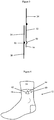
- Compression stocking 10 illustrated in Figures 1 and 2 is formed in two separate parts, in order to facilitate putting it on and taking it off.
- a first part 12 is shaped and sized in the manner of a sock to be worn upon the foot of a user and to extend above the malleolus, whose profile is indicated at 14.
- the first part 12 has a foot portion 16 and an ankle portion 18.
- the foot portion 16 incorporates a closed toe region 20. It is also shaped to provide a bulbous heel region 22.
- the ankle portion is tubular and leads continuously to a tubular first overlap portion 24.
- a second part 30 of the compression stocking is separately formed from the first and is of tubular form, having at its lower end (terms such as “upper”, “lower” and “vertical” are to be understood, throughout this description and the appended claims, to be used with reference to the orientation of the compression stocking when it is worn by a standing user) a second overlap portion 32, above which is a leg portion 34.
- the leg portion is to surround the shin and calf, extending to a level just below the user's knee. At its upper edge it carries a high friction welt 36 to resist any tendency for the compression stocking to move down the leg during physical activity.
- the first overlap portion 24 is within the second overlap portion 32.
- the illustrated compression stocking 10 is a graduated stocking.
- the pressure it exerts decreases in a direction up the leg, in order to urge blood upwardly and assist venous return flow. Discontinuities in the pressure profile are undesirable since they may impair this function.
- the pressures they each contribute due to their elasticity are added, so that if these regions of the stocking parts had the same elastic properties as the remainder of the compression stocking 10 then pressure in this overlap region could be excessive.
- one or both of the overlap portions 24 and 32 contribute a reduced pressure in comparison to the adjacent regions of the compression stocking 10, so that the total pressure exerted by the overlap portions 24 and 32 together is approximately equal to the pressures exerted by those adjacent regions.
- This pressure reduction may be because the material of the overlap region(s) is less stiff than the neighbouring material and/or because the overlap regions are, when unstressed, larger in circumference than the neighbouring regions, so that they are stretched less when on the leg.
- the first overlap portion is elastically less stiff, in the circumferential direction, than the neighbouring portion of the ankle region 18 of the first part 12 of the stocking.
- the second overlap portion 32 is elastically less stiff, in the circumferential direction, than the neighbouring portion of the calf region 18 of the second part 30 of the stocking.
- each of the overlap portions 24, 32 contributes approximately half of the total pressure in the overlap region. This proportion may be different in other embodiments.
- the pressure exerted by the overlap portion 24 of the first part 12 is larger than the overlap portion 32 of the second part 30, in order to increase friction between the overlap portion 24 and the skin beneath.
- the illustrated stocking is manufactured by knitting and the knitted fabric is thinner and less stiff in the overlap regions 24, 32. This is advantageous in that the two layers together in the overlap region are not excessively thick or bulky, but instead are comparable in thickness to the adjacent regions of the stocking above and below.
- the compression stocking 10 is intended and adapted to be put on in the following manner.
- the first part 12 is put on before the second part 30.
- Drawing the first part 12 onto the foot and ankle is a relatively straightforward process because it extends a limited distance above the ankle, so the length of the material being drawn over the foot is small compared to a one-piece stocking. It is not desirable to place excessive tension on the overlap portion 24, which is of relatively light material, but the positioning of the overlap 24/32 ensures that there is ample material below this portion, and above the ankle, by which the first part 12 can be grasped.
- the wearer then flexes the ankle joint a few times (i.e. carries out dorsiflexion and plantar extension) which helps to settle the first part 12 in a stable position on the foot and ankle.
- the second part 30 is put on. This involves drawing the second part 30 over the first part 12. During this process the foot and ankle are protected from rubbing by the first part 12.
- the first part 12 helps the second part 30 to slide over the foot and ankle and into position higher up the leg.
- the second part 30 slips easily over the first part 12, due to the properties of the fabrics from which they are formed.
- the first part 12 covers the toes, toenails and other irregularities of the foot, providing a smooth shape for the second part 30 to slip over and preventing catching of the second part 30 on such irregularities.
- the first part 12 therefore serves two functions. It is not only an inherent part of the compression stocking, but it also serves to facilitate the application of the second part 30.
- the second part 30 When removing the compression stocking 10, the second part 30 is removed before the first part 12.
- the first part 12 again helps the second part 30 to slide over the foot and ankle, protecting the skin.
- the second portion rather than sliding over the lower calf and shin, is rolled down over itself, so that by the stage at which it is drawn off the ankle and foot it has been turned inside out.
- the parts 12, 30 of the compression stocking 10 are formed in such a manner that the coefficient of friction between surfaces of the stocking as it is put on and taken off is low.
- the inner surface of the second part 30 slips easily over the outer surface of the first part 12.
- the second part 30 is typically turned back upon itself, and in this process the outer surface of the second part 30 is drawn over itself and over the outer surface of the first part 12, these surfaces again being formed in a manner which enables them easily to slip without need of excessive manual force.
- the relevant coefficient of friction between the surfaces of the stocking may be characterised in that it is low enough to enable the second part 30 to be drawn over the first part 12 and into its required position with only moderate manual force.
- the friction may be characterised in that it is not sufficient to cause the first part 12 to be drawn along the leg as the second part 30 is pulled over it.
- the surfaces of the parts 12, 30 of the compression stocking 10 may be shiny. They may be silky. They may be smooth. They may be low friction surfaces. They may be gloss, as opposed to matt, surfaces.
- the material of the parts 12, 30 of the compression stocking 10 may be manufactured by known tubular knitting techniques. Suitable elastic materials include fibres of natural rubber, spandex, nylon and cotton, and elastane, which may be used in combination. Knitted elastic materials are used in the present embodiment.
- the position of the overlap region 24/32 is considered to have a bearing on the stability of the overlap 24, 32.
- the greatest vertical movement is experienced around the area of the Achilles tendon, at the level of the ankle, so if the overlap is too close to the ankle its stability may be impaired, tending to pull the overlap apart.
- Vertical movement of the compression stocking 10 in this area is found in practice to diminish in a direction upward from the ankle, so that an overlap region high up the lower leg can be expected to be more stable. But if it is too high up the leg then the difficulty of putting on the first part 12 may be increased due to the extra length of this part. Also an overlap high up the lower leg may be regarded as cosmetically unacceptable.
- the lower edge of the first overlap portion 24 is sited approximately 6 to 8 centimetres above the summit of the medial malleolus 14. This dimension is indicated by arrow 44 in Figure 1 . It results in a first portion of small enough length to be easily put on, and provides stability of the overlap. Also the ankle portion 18 and the first overlap portion 24 are together deep enough to be easily grasped to pull the first part 12 onto the foot.
- the most critical area for compression in treatment of venous ulcers is the portion of the ankle just above the malleoli, as this is where most venous ulcers occur.
- the suggested positioning of the overlap region provides a run of continuous material in this region, to ensure good functional compression, the overlap region 24, 32 being above this critical area of the ankle.
- the dimension 44 may be varied in other embodiments.
- the depth of the overlap zone (arrow 46 in Figure 1 ) is approximately 5 centimetres in the present embodiment, but could be varied in other embodiments.
- Figure 3 shows a detail of the overlap in a form which is somewhat stylised. The material forming the overlap is depicted in section and it can be seen that at a transition between the first overlap portion 24 and the ankle portion 18, a ridge 50 is present. In the present embodiment this is a result of the knitting process used to form the compression stocking 10, although it could take other forms. It somewhat deforms the material of the second overlap portion 32 in a region indicated at 52, and tends to resist slippage in the overlap region.
- the second overlap portion 32 is slightly larger in depth than the first overlap portion 24, providing a band 54 (see Figure 3 ) of the second overlap portion 32 which extends onto the ankle portion 18. This helps to ensure, in the event that the overlap should be pulled apart slightly, that there is not a local loss of pressure which could impair the function of the compression stocking 10.
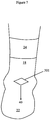
- Figure 7 represents an optional development of the compression stocking 10 according to an embodiment of the invention.
- This includes an area 301 of fabric which is elastically less stiff than the fabric around it.
- the area 301 is disposed at the rear of the lower leg in use, and more specifically in the present example it is in the region of the mid aspect of the Achilles tendon.
- the area 301 is able to stretch more easily (i.e. with less tension) than surrounding material along the direction of arrow 40 in response to dorsiflexion, and due to its low stiffness it serves to reduce any resultant tension referred to the first overlap zone 24 tending to move that zone of the stocking 10 along the leg. In this way the area 301 helps to prevent movement of the first overlap zone 24 and stabilise the overlap.
- the area 301 can be formed by local variation of the weave of the stocking. In Figure 7 the area 301 is depicted as a narrow diamond shape, but other shapes could be used.
- the first part 12 may be provided on its outer surface with a marking which is revealed as the second part 30 is drawn up the leg, providing a visual indication when the required position has been reached.
- This marking may be positioned below the desired level of the lower edge of the second part 30, so that it begins to be revealed somewhat before the desired position is achieved. It can vary over its vertical extent in a manner which enables the user to judge how much further the second part 30 needs to be drawn up the leg to achieve the required position.
- the marking 60 takes the form of a triangle having sides 62, 64 which converge upwardly and which meet just below the lower edge of the first overlap portion 24. When the apex of this triangle is visible, the user knows that the second part 30 is properly positioned.
- the marking could take a variety of other forms.
- the marking 60 is in this embodiment disposed on the medial aspect of the leg, which is advantageous both in that (a) it is easily viewed by the wearer as the stocking is put on and (b) being directed toward the other leg, it is visually inconspicuous in use.
- the formation of the foot portion 16 with a closed toe 20 is advantageous in that the toes are covered while the second part 30 of the stocking is pulled over them. In this way it is ensured that the toes do not catch on the second part, which facilitates the donning of part 30 and which could additionally or alternatively cause damage to the stocking. Nonetheless the present invention may be implemented with an open toe form of stocking.
- a light, low compression, low friction foot sock may be provided in addition to the first and second parts 12, 30.
- This foot sock would be put on before the first part 12, typically extending just above the malleolus.
- the first part 12 is the put on over the ankle sock, which thus serves to reduce the effort needed to pull on the first part 12 and to prevent catching on the toenails etc.
- This embodiment may be especially easy for users to put on, and suited to those who struggle most to put on a conventional compression stocking.
- This embodiment is also well suited to the use of an open-toed first part 12.
- the compression stocking 10 illustrated in Figures 1 and 2 terminates below the knee, but the present invention may be embodied in a compression stocking which extends to the thigh.
- Such an embodiment 100 is illustrated in Figure 5 , this version being once more formed in two parts - a first part 112 and a second part 130, with the overlap between them being a short distance above the ankle.
- Figure 6 shows an embodiment in which, to further facilitate putting compression stocking 200 onto the leg, it is broken into first, second and third parts 212, 230, 270.
- the sequence for putting on the compression stocking 200 involves putting the first part 212 onto the foot and ankle, then putting the second part 230 onto the lower leg, then putting on the third part 270 which extends to the thigh region.
- the second and third parts 230, 270 overlap in a region 272.
- the material forming the first and second overlap regions 24, 30 is the same as the material of the compression stocking 10, save for the knit pattern that provides a reduced modulus of elasticity in these regions.
- the overlap regions 24, 30 may be formed in a manner which increases friction between the overlap regions. This may be achieved by a coating on one or both of the facing surfaces at the overlap, or through changes in the weave of the fabric or its material in these areas.
- the compression provided by the first part 12 to the foot of the wearer may be relatively low, with greater compression being applied by the second part 30 to the wearer's leg.
- Compression stockings require laundering, and over time this reduces their elasticity and functionality.
- An advantage of the illustrated embodiments is that the parts of the compression stocking 10, 100, 200 can be washed separately.
- the first part 12, 112, 212 is expected to require more frequent laundering because it encases the foot, but it is of less importance in terms of providing limb compression than the second part 30, 130, 230, which can be laundered much less often. This can increase the functional life of the compression stocking.
- the compression stocking 10 will typically provide a pressure which, at its greatest, is more than 1.9kPa.
- the compression stocking 10 may be in any of the compression classes mentioned above with reference to the prior art. That is, it may be:-
Landscapes
- Engineering & Computer Science (AREA)
- Health & Medical Sciences (AREA)
- Textile Engineering (AREA)
- Biomedical Technology (AREA)
- Heart & Thoracic Surgery (AREA)
- Vascular Medicine (AREA)
- Life Sciences & Earth Sciences (AREA)
- Animal Behavior & Ethology (AREA)
- General Health & Medical Sciences (AREA)
- Public Health (AREA)
- Veterinary Medicine (AREA)
- Socks And Pantyhose (AREA)
Claims (14)
- Kompressionsstrumpf (10), umfassend einen ersten Teil (12), der Folgendes umfasst:einen Fußabschnitt (16), der konfiguriert ist, um an dem Fuß getragen zu werden;einen Knöchelabschnitt (18), der konfiguriert ist, um sich in Verwendung über dem Fußknöchel zu erstrecken; undeinen ersten Überlappungsabschnitt (24) über dem Knöchelabschnitt (18), wobei der erste Überlappungsabschnitt (24) ausgebildet ist, um in Verwendung einen Druck auszuüben, der im Vergleich zu einem durch den Knöchelabschnitt (18) ausgeübten Druck reduziert ist,und einen zweiten Teil (30), der röhrenförmig ist und Folgendes umfasst:einen zweiten Überlappungsabschnitt (32) undeinen Beinabschnitt (34), der sich in Verwendung aus dem Überlappungsabschnitt an dem Bein hinauf erstreckt, um wenigstens einen Teil des Unterschenkels zu umgeben,wobei der Kompressionsstrumpf dadurch gekennzeichnet ist, dass der zweite Überlappungsabschnitt (32) um den ersten Überlappungsabschnitt (24) herum angebracht werden kann, wobei der Kompressionsstrumpf ein abgestuftes Druckprofil bereitstellt, dadurch, dass eine Außenoberfläche des ersten Teils (12) und eine Innenoberfläche des zweiten Teils (30) in einer Weise ausgebildet sind, die eine niedrige Reibungskoeffiziente zwischen ihnen bereitstellt, wodurch ein Anziehen des Kompressionsstrumpfes durch Anziehen des ersten Teils (12) zuerst und anschließendes Ziehen des zweiten Teils (30) über den ersten Teil (12) und ein Hochziehen an dem Bein hinauf ermöglicht wird, um den zweiten Überlappungsabschnitt (32) um den ersten Überlappungsabschnitt (34) herum in Position zu bringen, so dass ein Durchgang des zweiten Teils über dem Fuß und dem Knöchel durch den ersten Teil vereinfacht wird,
und dadurch, dass der erste Teil (12) mit einer sichtbaren äußeren Markierung (60) versehen ist, deren Freilegen anzeigt, wenn der zweite Teil in seine erforderliche Position gezogen wurde. - Kompressionsstrumpf nach Anspruch 1, der mit einer Reihe von Anweisungen an den Benutzer versehen ist, die den Benutzer leiten, den Strumpf durch Anziehen des ersten Teils (12) zuerst und anschließendes Ziehen des zweiten Teils (30) über den ersten Teil (12) anzuziehen.
- Kompressionsstrumpf nach einem der vorhergehenden Ansprüche, wobei die Markierung (60) unter dem ersten Überlappungsabschnitt (24) angeordnet ist und eine gewisse vertikale Erstreckung aufweist, wobei sich die Markierung (60) über diese vertikale Erstreckung zunehmend verändert, so dass der freiliegende Teil der Markierung beim Ziehen des zweiten Teils (30) an dem Bein hinauf eine Basis zum Beurteilen gibt, wie viel weiter der zweite Teil (30) gezogen werden muss, um seine erforderliche Position zu erreichen.
- Kompressionsstrumpf nach Anspruch 3, wobei die Markierung (60) ein Paar von Linien oder Rändern (62, 64) umfasst, die nach oben zusammenlaufen und die sich in der Höhe treffen, die durch einen unteren Rand des zweiten Teils erreicht werden soll.
- Kompressionsstrumpf nach einem der vorhergehenden Ansprüche, wobei der erste Teil aus einer geschlossenen Zehenform besteht.
- Kompressionsstrumpf nach einem der vorhergehenden Ansprüche, wobei der erste Überlappungsabschnitt (24) einen unteren Rand aufweist, der in Verwendung über dem Fußknöchel liegt.
- Kompressionsstrumpf nach Anspruch 6, wobei der untere Rand des ersten Überlappungsabschnitts (24) in Verwendung zwischen 5 und 10 Zentimeter über dem Spitzenpunkt des Innenfußknöchels liegt.
- Kompressionsstrumpf nach einem der vorhergehenden Ansprüche, wobei der untere Rand des ersten Überlappungsabschnitts (24) in Verwendung zwischen 6 und 8 Zentimeter über dem Spitzenpunkt des Innenfußknöchels liegt.
- Kompressionsstrumpf nach einem der vorhergehenden Ansprüche, wobei, in Verwendung, der erste und der zweite Überlappungsabschnitt (24, 32) im Wesentlichen gleiche Drücke beitragen.
- Kompressionsstrumpf nach einem der vorhergehenden Ansprüche, wobei der zweite Überlappungsabschnitt (32) in einer Richtung, die sich in Verwendung entlang des Beins erstreckt, tiefer als der erste Überlappungsabschnitt (24) ist.
- Kompressionsstrumpf nach Anspruch 10, wobei der zweite Überlappungsabschnitt (32) zwischen 0,5 Zentimeter und 1,5 Zentimeter tiefer als der erste Überlappungsabschnitt (24) ist.
- Kompressionsstrumpf nach einem der vorhergehenden Ansprüche, wobei ein Bereich des Fußabschnitts (16) in der Nähe der Achillesferse in Verwendung ausgebildet ist, um eine geringere elastische Steifigkeit als das ihn umgebende Material aufzuweisen und sich so während einer Dorsalflexion bevorzugt zu dehnen.
- Verfahren zum Anziehen eines Kompressionsstrumpfes (10), umfassend das Ausbilden des Kompressionsstrumpfes in wenigstens zwei Teile, wobei ein erster Teil (12) des Kompressionsstrumpfes Folgendes umfasst:einen Fußabschnitt (16), der konfiguriert ist, um an dem Fuß getragen zu werden;einen Knöchelabschnitt (18), der konfiguriert ist, um sich in Verwendung über dem Fußknöchel zu erstrecken;einen ersten Überlappungsabschnitt (24) über dem Knöchelabschnitt, wobei der erste Überlappungsabschnitt (24) ausgebildet ist, um in Verwendung einen Druck auszuüben, der im Vergleich zu einem durch den Knöchelabschnitt (18) ausgeübten Druck reduziert ist; undeine sichtbare äußere Markierung;und wobei ein zweiter Teil (30) des Kompressionsstrumpfes röhrenförmig ist und Folgendes umfasst:einen zweiten Überlappungsabschnitt (32) undeinen Beinabschnitt (34), der sich in Verwendung aus dem Überlappungsabschnitt an dem Bein hinauf erstreckt, um wenigstens einen Teil des Unterschenkels zu umgeben,wobei das Verfahren dadurch gekennzeichnet ist, dass es das Anziehen des ersten Teils (12) zuerst und anschließendes Ziehen des zweiten Teils (30) über den ersten Teil und das Hochziehen an dem Bein hinauf umfasst, um den zweiten Überlappungsabschnitt (32) um den ersten Überlappungsabschnitt (24) herum in Position zu bringen, so dass der Durchgang des zweiten Teils (30) über dem Fuß und dem Knöchel durch den ersten Teil vereinfacht wird,
und dadurch, dass die sichtbare äußere Markierung derart gelegen ist, dass sie aufgedeckt wird, wenn der zweite Teil weit genug an dem Bein hinauf hochgezogen wurde, um den ersten und den zweiten Überlappungsabschnitt in ihre vorgesehene Position zueinander zu bringen. - Verfahren nach Anspruch 12, ferner umfassend das Ausbilden des ersten und des zweiten Teils (12, 30) in einer derartigen Weise, dass die Reibung zwischen ihnen beim Ziehen des zweiten Teils (30) über den ersten Teil gering genug ist, um das Ziehen des zweiten Teils (30) über den ersten Teil (12) zu ermöglichen, ohne dass der erste Teil (12) entlang des Schenkels gezogen wird.
Applications Claiming Priority (3)
| Application Number | Priority Date | Filing Date | Title |
|---|---|---|---|
| GBGB1600044.0A GB201600044D0 (en) | 2016-01-02 | 2016-01-02 | Graduated compression stocking system to facilitate application and removal |
| GB1614561.7A GB2538458B (en) | 2016-01-02 | 2016-08-26 | Compression stocking |
| PCT/GB2016/053845 WO2017115067A1 (en) | 2016-01-02 | 2016-12-07 | Compression stocking |
Publications (2)
| Publication Number | Publication Date |
|---|---|
| EP3397221A1 EP3397221A1 (de) | 2018-11-07 |
| EP3397221B1 true EP3397221B1 (de) | 2020-06-24 |
Family
ID=55406633
Family Applications (1)
| Application Number | Title | Priority Date | Filing Date |
|---|---|---|---|
| EP16815911.9A Active EP3397221B1 (de) | 2016-01-02 | 2016-12-07 | Kompressionsstrumpf |
Country Status (5)
| Country | Link |
|---|---|
| US (1) | US20190000678A1 (de) |
| EP (1) | EP3397221B1 (de) |
| ES (1) | ES2808930T3 (de) |
| GB (2) | GB201600044D0 (de) |
| WO (1) | WO2017115067A1 (de) |
Families Citing this family (8)
| Publication number | Priority date | Publication date | Assignee | Title |
|---|---|---|---|---|
| EP3473760B1 (de) * | 2017-10-23 | 2024-07-10 | medi GmbH & Co. KG | Gestrickteil |
| CN107928878B (zh) * | 2017-12-20 | 2023-05-02 | 苏州大学 | 一种压缩袜及其编织方法 |
| FR3079739A1 (fr) * | 2018-04-06 | 2019-10-11 | Alain Rodier | Systeme ergonomique du traitement de l'ivc |
| US20200178617A1 (en) * | 2018-12-11 | 2020-06-11 | Mary Hardin | Garment cuff attachment |
| US11684124B2 (en) * | 2020-09-24 | 2023-06-27 | Charles H. Brown, III | Accessory wearable around a boot shaft |
| US20220354705A1 (en) * | 2021-05-07 | 2022-11-10 | Thomas Christopher Wells | No slip compression knee sleeve |
| USD1076402S1 (en) | 2024-11-12 | 2025-05-27 | Ralph L. Leonard | Loop for compression stocking |
| USD1088485S1 (en) | 2025-01-08 | 2025-08-19 | Ralph L. Leonard | Tab for compression garment |
Family Cites Families (10)
| Publication number | Priority date | Publication date | Assignee | Title |
|---|---|---|---|---|
| US5005567A (en) * | 1989-08-24 | 1991-04-09 | The Kendall Company | Method for treating leg wounds |
| NL8902619A (nl) * | 1989-10-23 | 1991-05-16 | Stichting Medische Technologie | Hulpmiddel voor het aantrekken van therapeutische elastische kousen. |
| US5586341A (en) * | 1995-09-29 | 1996-12-24 | Hill, Jr.; Bruce U. | Stockings and methods therefore |
| US5617745A (en) * | 1996-01-04 | 1997-04-08 | Della Corte; Michael P. | Support sock |
| FR2755006B1 (fr) * | 1996-10-25 | 1998-12-18 | Couzan Serge | Bas de contention pour la pratique du sport |
| IT1292522B1 (it) * | 1997-06-13 | 1999-02-08 | S S I Sport Socks Internationa | Calza terapeutica con parti di maglia differenti per filato ed elasticita' |
| CA2376026C (en) * | 1999-06-25 | 2006-07-25 | Carolon Company | Multilayer compression stocking system and method |
| IT1319230B1 (it) * | 2000-10-20 | 2003-09-26 | Gloria Maglieria Elastica S R | Calza elastica compressiva composita a collocazione facilitata. |
| WO2011143489A2 (en) * | 2010-05-13 | 2011-11-17 | Vazales Brad E | Variable compression stockings |
| DE202013002992U1 (de) * | 2013-03-28 | 2013-05-07 | Erhard Flügel | Kompressions - oder Stützstrumpf |
-
2016
- 2016-01-02 GB GBGB1600044.0A patent/GB201600044D0/en not_active Ceased
- 2016-08-26 GB GB1614561.7A patent/GB2538458B/en active Active
- 2016-12-07 EP EP16815911.9A patent/EP3397221B1/de active Active
- 2016-12-07 ES ES16815911T patent/ES2808930T3/es active Active
- 2016-12-07 US US16/067,674 patent/US20190000678A1/en not_active Abandoned
- 2016-12-07 WO PCT/GB2016/053845 patent/WO2017115067A1/en not_active Ceased
Non-Patent Citations (1)
| Title |
|---|
| None * |
Also Published As
| Publication number | Publication date |
|---|---|
| WO2017115067A1 (en) | 2017-07-06 |
| US20190000678A1 (en) | 2019-01-03 |
| ES2808930T3 (es) | 2021-03-02 |
| EP3397221A1 (de) | 2018-11-07 |
| GB201614561D0 (en) | 2016-10-12 |
| GB2538458B (en) | 2017-05-17 |
| GB201600044D0 (en) | 2016-02-17 |
| GB2538458A (en) | 2016-11-16 |
Similar Documents
| Publication | Publication Date | Title |
|---|---|---|
| EP3397221B1 (de) | Kompressionsstrumpf | |
| US4149274A (en) | Anti-slip hosiery article and method | |
| US5603232A (en) | Foot protector for use in combination with hosiery and method of making and using same | |
| US20030213269A1 (en) | Anti-slip garment | |
| KR101488914B1 (ko) | 착용이 용이한 탄성 정맥 압박 보조기 | |
| US20060085894A1 (en) | Compression garment with integral donning aid | |
| CA1049802A (en) | Therapeutic garment and method | |
| AU2010255525B2 (en) | Orthotic sock | |
| WO2019231540A1 (en) | Grip-enhancing film for cuff edges | |
| JP4105231B2 (ja) | 弾性ストッキング型又は弾性タイツ型圧縮性補装具 | |
| JP3165090U (ja) | 靴下又は筒状の下肢用サポーター | |
| JP2020084372A (ja) | 下肢用被服及びその製造方法 | |
| JP2000290806A (ja) | 脚部を有する衣類 | |
| JP3145106U (ja) | スポーツ用弾性ストッキング | |
| JP3044071U (ja) | タイツ類 | |
| JP7655525B2 (ja) | 下肢装着用製品 | |
| JP7627486B2 (ja) | 弾性ストッキング | |
| KR100461985B1 (ko) | 스타킹 또는 타이츠의 압박지지용구 | |
| JP3132173U (ja) | くつ下 | |
| JP3042180U (ja) | 靴 下 | |
| JP2001011702A (ja) | 靴下および靴下カバー | |
| KR20160002700U (ko) | 골반지지부가 구비된 기능성 레깅스 | |
| JP2020105637A (ja) | 美容用具 | |
| JP2020133046A (ja) | 下半身用衣類 | |
| JP2008025069A (ja) | ストッキングサポーター |
Legal Events
| Date | Code | Title | Description |
|---|---|---|---|
| STAA | Information on the status of an ep patent application or granted ep patent |
Free format text: STATUS: UNKNOWN |
|
| STAA | Information on the status of an ep patent application or granted ep patent |
Free format text: STATUS: THE INTERNATIONAL PUBLICATION HAS BEEN MADE |
|
| PUAI | Public reference made under article 153(3) epc to a published international application that has entered the european phase |
Free format text: ORIGINAL CODE: 0009012 |
|
| STAA | Information on the status of an ep patent application or granted ep patent |
Free format text: STATUS: REQUEST FOR EXAMINATION WAS MADE |
|
| 17P | Request for examination filed |
Effective date: 20180618 |
|
| AK | Designated contracting states |
Kind code of ref document: A1 Designated state(s): AL AT BE BG CH CY CZ DE DK EE ES FI FR GB GR HR HU IE IS IT LI LT LU LV MC MK MT NL NO PL PT RO RS SE SI SK SM TR |
|
| AX | Request for extension of the european patent |
Extension state: BA ME |
|
| DAV | Request for validation of the european patent (deleted) | ||
| DAX | Request for extension of the european patent (deleted) | ||
| STAA | Information on the status of an ep patent application or granted ep patent |
Free format text: STATUS: EXAMINATION IS IN PROGRESS |
|
| 17Q | First examination report despatched |
Effective date: 20190425 |
|
| GRAP | Despatch of communication of intention to grant a patent |
Free format text: ORIGINAL CODE: EPIDOSNIGR1 |
|
| STAA | Information on the status of an ep patent application or granted ep patent |
Free format text: STATUS: GRANT OF PATENT IS INTENDED |
|
| INTG | Intention to grant announced |
Effective date: 20200227 |
|
| GRAS | Grant fee paid |
Free format text: ORIGINAL CODE: EPIDOSNIGR3 |
|
| GRAA | (expected) grant |
Free format text: ORIGINAL CODE: 0009210 |
|
| STAA | Information on the status of an ep patent application or granted ep patent |
Free format text: STATUS: THE PATENT HAS BEEN GRANTED |
|
| AK | Designated contracting states |
Kind code of ref document: B1 Designated state(s): AL AT BE BG CH CY CZ DE DK EE ES FI FR GB GR HR HU IE IS IT LI LT LU LV MC MK MT NL NO PL PT RO RS SE SI SK SM TR |
|
| REG | Reference to a national code |
Ref country code: GB Ref legal event code: FG4D |
|
| REG | Reference to a national code |
Ref country code: CH Ref legal event code: EP |
|
| REG | Reference to a national code |
Ref country code: AT Ref legal event code: REF Ref document number: 1283169 Country of ref document: AT Kind code of ref document: T Effective date: 20200715 Ref country code: CH Ref legal event code: NV Representative=s name: NOVAGRAAF INTERNATIONAL SA, CH |
|
| REG | Reference to a national code |
Ref country code: DE Ref legal event code: R096 Ref document number: 602016038839 Country of ref document: DE |
|
| REG | Reference to a national code |
Ref country code: IE Ref legal event code: FG4D |
|
| PG25 | Lapsed in a contracting state [announced via postgrant information from national office to epo] |
Ref country code: LT Free format text: LAPSE BECAUSE OF FAILURE TO SUBMIT A TRANSLATION OF THE DESCRIPTION OR TO PAY THE FEE WITHIN THE PRESCRIBED TIME-LIMIT Effective date: 20200624 Ref country code: NO Free format text: LAPSE BECAUSE OF FAILURE TO SUBMIT A TRANSLATION OF THE DESCRIPTION OR TO PAY THE FEE WITHIN THE PRESCRIBED TIME-LIMIT Effective date: 20200924 Ref country code: GR Free format text: LAPSE BECAUSE OF FAILURE TO SUBMIT A TRANSLATION OF THE DESCRIPTION OR TO PAY THE FEE WITHIN THE PRESCRIBED TIME-LIMIT Effective date: 20200925 Ref country code: FI Free format text: LAPSE BECAUSE OF FAILURE TO SUBMIT A TRANSLATION OF THE DESCRIPTION OR TO PAY THE FEE WITHIN THE PRESCRIBED TIME-LIMIT Effective date: 20200624 Ref country code: SE Free format text: LAPSE BECAUSE OF FAILURE TO SUBMIT A TRANSLATION OF THE DESCRIPTION OR TO PAY THE FEE WITHIN THE PRESCRIBED TIME-LIMIT Effective date: 20200624 |
|
| REG | Reference to a national code |
Ref country code: LT Ref legal event code: MG4D |
|
| PG25 | Lapsed in a contracting state [announced via postgrant information from national office to epo] |
Ref country code: LV Free format text: LAPSE BECAUSE OF FAILURE TO SUBMIT A TRANSLATION OF THE DESCRIPTION OR TO PAY THE FEE WITHIN THE PRESCRIBED TIME-LIMIT Effective date: 20200624 Ref country code: HR Free format text: LAPSE BECAUSE OF FAILURE TO SUBMIT A TRANSLATION OF THE DESCRIPTION OR TO PAY THE FEE WITHIN THE PRESCRIBED TIME-LIMIT Effective date: 20200624 Ref country code: RS Free format text: LAPSE BECAUSE OF FAILURE TO SUBMIT A TRANSLATION OF THE DESCRIPTION OR TO PAY THE FEE WITHIN THE PRESCRIBED TIME-LIMIT Effective date: 20200624 Ref country code: BG Free format text: LAPSE BECAUSE OF FAILURE TO SUBMIT A TRANSLATION OF THE DESCRIPTION OR TO PAY THE FEE WITHIN THE PRESCRIBED TIME-LIMIT Effective date: 20200924 |
|
| REG | Reference to a national code |
Ref country code: NL Ref legal event code: MP Effective date: 20200624 |
|
| REG | Reference to a national code |
Ref country code: AT Ref legal event code: MK05 Ref document number: 1283169 Country of ref document: AT Kind code of ref document: T Effective date: 20200624 |
|
| PG25 | Lapsed in a contracting state [announced via postgrant information from national office to epo] |
Ref country code: NL Free format text: LAPSE BECAUSE OF FAILURE TO SUBMIT A TRANSLATION OF THE DESCRIPTION OR TO PAY THE FEE WITHIN THE PRESCRIBED TIME-LIMIT Effective date: 20200624 Ref country code: AL Free format text: LAPSE BECAUSE OF FAILURE TO SUBMIT A TRANSLATION OF THE DESCRIPTION OR TO PAY THE FEE WITHIN THE PRESCRIBED TIME-LIMIT Effective date: 20200624 |
|
| PG25 | Lapsed in a contracting state [announced via postgrant information from national office to epo] |
Ref country code: PT Free format text: LAPSE BECAUSE OF FAILURE TO SUBMIT A TRANSLATION OF THE DESCRIPTION OR TO PAY THE FEE WITHIN THE PRESCRIBED TIME-LIMIT Effective date: 20201026 Ref country code: RO Free format text: LAPSE BECAUSE OF FAILURE TO SUBMIT A TRANSLATION OF THE DESCRIPTION OR TO PAY THE FEE WITHIN THE PRESCRIBED TIME-LIMIT Effective date: 20200624 Ref country code: AT Free format text: LAPSE BECAUSE OF FAILURE TO SUBMIT A TRANSLATION OF THE DESCRIPTION OR TO PAY THE FEE WITHIN THE PRESCRIBED TIME-LIMIT Effective date: 20200624 Ref country code: SM Free format text: LAPSE BECAUSE OF FAILURE TO SUBMIT A TRANSLATION OF THE DESCRIPTION OR TO PAY THE FEE WITHIN THE PRESCRIBED TIME-LIMIT Effective date: 20200624 Ref country code: EE Free format text: LAPSE BECAUSE OF FAILURE TO SUBMIT A TRANSLATION OF THE DESCRIPTION OR TO PAY THE FEE WITHIN THE PRESCRIBED TIME-LIMIT Effective date: 20200624 |
|
| PG25 | Lapsed in a contracting state [announced via postgrant information from national office to epo] |
Ref country code: IS Free format text: LAPSE BECAUSE OF FAILURE TO SUBMIT A TRANSLATION OF THE DESCRIPTION OR TO PAY THE FEE WITHIN THE PRESCRIBED TIME-LIMIT Effective date: 20201024 Ref country code: PL Free format text: LAPSE BECAUSE OF FAILURE TO SUBMIT A TRANSLATION OF THE DESCRIPTION OR TO PAY THE FEE WITHIN THE PRESCRIBED TIME-LIMIT Effective date: 20200624 Ref country code: SK Free format text: LAPSE BECAUSE OF FAILURE TO SUBMIT A TRANSLATION OF THE DESCRIPTION OR TO PAY THE FEE WITHIN THE PRESCRIBED TIME-LIMIT Effective date: 20200624 |
|
| REG | Reference to a national code |
Ref country code: ES Ref legal event code: FG2A Ref document number: 2808930 Country of ref document: ES Kind code of ref document: T3 Effective date: 20210302 |
|
| REG | Reference to a national code |
Ref country code: DE Ref legal event code: R097 Ref document number: 602016038839 Country of ref document: DE |
|
| PG25 | Lapsed in a contracting state [announced via postgrant information from national office to epo] |
Ref country code: DK Free format text: LAPSE BECAUSE OF FAILURE TO SUBMIT A TRANSLATION OF THE DESCRIPTION OR TO PAY THE FEE WITHIN THE PRESCRIBED TIME-LIMIT Effective date: 20200624 |
|
| PLBE | No opposition filed within time limit |
Free format text: ORIGINAL CODE: 0009261 |
|
| STAA | Information on the status of an ep patent application or granted ep patent |
Free format text: STATUS: NO OPPOSITION FILED WITHIN TIME LIMIT |
|
| 26N | No opposition filed |
Effective date: 20210325 |
|
| GBPC | Gb: european patent ceased through non-payment of renewal fee |
Effective date: 20201207 |
|
| PG25 | Lapsed in a contracting state [announced via postgrant information from national office to epo] |
Ref country code: MC Free format text: LAPSE BECAUSE OF FAILURE TO SUBMIT A TRANSLATION OF THE DESCRIPTION OR TO PAY THE FEE WITHIN THE PRESCRIBED TIME-LIMIT Effective date: 20200624 Ref country code: SI Free format text: LAPSE BECAUSE OF FAILURE TO SUBMIT A TRANSLATION OF THE DESCRIPTION OR TO PAY THE FEE WITHIN THE PRESCRIBED TIME-LIMIT Effective date: 20200624 |
|
| REG | Reference to a national code |
Ref country code: BE Ref legal event code: MM Effective date: 20201231 |
|
| PG25 | Lapsed in a contracting state [announced via postgrant information from national office to epo] |
Ref country code: LU Free format text: LAPSE BECAUSE OF NON-PAYMENT OF DUE FEES Effective date: 20201207 |
|
| PG25 | Lapsed in a contracting state [announced via postgrant information from national office to epo] |
Ref country code: GB Free format text: LAPSE BECAUSE OF NON-PAYMENT OF DUE FEES Effective date: 20201207 |
|
| PG25 | Lapsed in a contracting state [announced via postgrant information from national office to epo] |
Ref country code: IS Free format text: LAPSE BECAUSE OF FAILURE TO SUBMIT A TRANSLATION OF THE DESCRIPTION OR TO PAY THE FEE WITHIN THE PRESCRIBED TIME-LIMIT Effective date: 20201024 Ref country code: TR Free format text: LAPSE BECAUSE OF FAILURE TO SUBMIT A TRANSLATION OF THE DESCRIPTION OR TO PAY THE FEE WITHIN THE PRESCRIBED TIME-LIMIT Effective date: 20200624 Ref country code: MT Free format text: LAPSE BECAUSE OF FAILURE TO SUBMIT A TRANSLATION OF THE DESCRIPTION OR TO PAY THE FEE WITHIN THE PRESCRIBED TIME-LIMIT Effective date: 20200624 Ref country code: CY Free format text: LAPSE BECAUSE OF FAILURE TO SUBMIT A TRANSLATION OF THE DESCRIPTION OR TO PAY THE FEE WITHIN THE PRESCRIBED TIME-LIMIT Effective date: 20200624 |
|
| PG25 | Lapsed in a contracting state [announced via postgrant information from national office to epo] |
Ref country code: MK Free format text: LAPSE BECAUSE OF FAILURE TO SUBMIT A TRANSLATION OF THE DESCRIPTION OR TO PAY THE FEE WITHIN THE PRESCRIBED TIME-LIMIT Effective date: 20200624 |
|
| PG25 | Lapsed in a contracting state [announced via postgrant information from national office to epo] |
Ref country code: BE Free format text: LAPSE BECAUSE OF NON-PAYMENT OF DUE FEES Effective date: 20201231 |
|
| P01 | Opt-out of the competence of the unified patent court (upc) registered |
Effective date: 20230515 |
|
| PGFP | Annual fee paid to national office [announced via postgrant information from national office to epo] |
Ref country code: DE Payment date: 20241210 Year of fee payment: 9 |
|
| PGFP | Annual fee paid to national office [announced via postgrant information from national office to epo] |
Ref country code: ES Payment date: 20250109 Year of fee payment: 9 |
|
| PGFP | Annual fee paid to national office [announced via postgrant information from national office to epo] |
Ref country code: CH Payment date: 20250101 Year of fee payment: 9 |
|
| REG | Reference to a national code |
Ref country code: CH Ref legal event code: U11 Free format text: ST27 STATUS EVENT CODE: U-0-0-U10-U11 (AS PROVIDED BY THE NATIONAL OFFICE) Effective date: 20260101 |
|
| PGFP | Annual fee paid to national office [announced via postgrant information from national office to epo] |
Ref country code: IT Payment date: 20251218 Year of fee payment: 10 |
|
| PGFP | Annual fee paid to national office [announced via postgrant information from national office to epo] |
Ref country code: FR Payment date: 20251223 Year of fee payment: 10 |
|
| PGFP | Annual fee paid to national office [announced via postgrant information from national office to epo] |
Ref country code: CZ Payment date: 20251124 Year of fee payment: 10 Ref country code: IE Payment date: 20251218 Year of fee payment: 10 |