EP3379962B1 - Zwischensohle oder einlegesohle, insbesondere für schuhe - Google Patents
Zwischensohle oder einlegesohle, insbesondere für schuhe Download PDFInfo
- Publication number
- EP3379962B1 EP3379962B1 EP16802018.8A EP16802018A EP3379962B1 EP 3379962 B1 EP3379962 B1 EP 3379962B1 EP 16802018 A EP16802018 A EP 16802018A EP 3379962 B1 EP3379962 B1 EP 3379962B1
- Authority
- EP
- European Patent Office
- Prior art keywords
- mid
- protrusions
- pluralities
- sole
- holes
- Prior art date
- Legal status (The legal status is an assumption and is not a legal conclusion. Google has not performed a legal analysis and makes no representation as to the accuracy of the status listed.)
- Active
Links
Images


Classifications
-
- A—HUMAN NECESSITIES
- A43—FOOTWEAR
- A43B—CHARACTERISTIC FEATURES OF FOOTWEAR; PARTS OF FOOTWEAR
- A43B7/00—Footwear with health or hygienic arrangements
- A43B7/14—Footwear with health or hygienic arrangements with foot-supporting parts
- A43B7/1405—Footwear with health or hygienic arrangements with foot-supporting parts with pads or holes on one or more locations, or having an anatomical or curved form
- A43B7/1475—Footwear with health or hygienic arrangements with foot-supporting parts with pads or holes on one or more locations, or having an anatomical or curved form characterised by the type of support
- A43B7/1485—Recesses or holes, traversing partially or completely the thickness of the pad
-
- A—HUMAN NECESSITIES
- A43—FOOTWEAR
- A43B—CHARACTERISTIC FEATURES OF FOOTWEAR; PARTS OF FOOTWEAR
- A43B5/00—Footwear for sporting purposes
- A43B5/02—Football boots or shoes, i.e. for soccer, football or rugby
-
- A—HUMAN NECESSITIES
- A43—FOOTWEAR
- A43B—CHARACTERISTIC FEATURES OF FOOTWEAR; PARTS OF FOOTWEAR
- A43B5/00—Footwear for sporting purposes
- A43B5/06—Running shoes; Track shoes
-
- A—HUMAN NECESSITIES
- A43—FOOTWEAR
- A43B—CHARACTERISTIC FEATURES OF FOOTWEAR; PARTS OF FOOTWEAR
- A43B5/00—Footwear for sporting purposes
- A43B5/10—Tennis shoes
Definitions
- the present invention relates to a mid-sole, or insole, particularly for shoes, such as for example sports shoes for running, tennis and football, and leisure shoes as disclosed in WO20197136685 and US 4521079 .
- the mid-sole in fact, must be capable of adequately decreasing the excessive load in the impact area of the foot with respect to the ground, and elastically return part of the energy received during the normal heel-toe stride, while simultaneously decreasing muscular stress and loads to the detriment of the muscular-skeletal apparatus.
- mid-soles are used whose principal functions are, therefore, the absorption of impact during the normal heel-toe stride, elastic yield for transferring loads from the heel to the toes, and flexibility for the thrust phase.
- mid-sole for shoes which is made of expanded polyurethane (EP) or of ethylene vinyl acetate (EVA), which constitute up about 90% of the mid-sole and are characterized by a single rigidity level over the entire length of the mid-sole, from the heel to the toe.
- EP expanded polyurethane
- EVA ethylene vinyl acetate
- a drawback that is found in the cited known art consists in that the mid-sole made of EVA or of EP adapts slowly to the shape of the sole of the foot of the user, and therefore it is not capable of ensuring an adequate anatomical adaptation during use, making the shoe rather uncomfortable.
- Pronation is a normal part of running that consists of the natural tendency of the foot to rotate inward during walking or running, in order to absorb shocks; some people have an excessive rotation (overpronation), which continues after the impact of the foot on the ground, or an insufficient rotation of the foot (excessive supination), both of which influence the manner of running and can increase the risk of injury and generate tendinitis both in the foot and in the knees, plantar fasciitis and other muscular inflammations.
- rigid supporting elements for example in the form of vertical walls of greater or lesser thickness, in the medial wall of the mid-sole, at the plantar arch.
- Such rigid elements are uncomfortable and inconvenient because they do not adapt to the shape of the sole of the foot, since they are not three-dimensionally and anatomically shaped to fit the foot.
- mid-soles are often reinforced in the waist area by way of the use of added materials the function of which is to lighten and cushion the mid-sole; the use is known of pads, arranged in the heel region, which contain air or gel or similar materials, which increase impact absorption and are adapted to deform, elastically absorbing the energy of impact with the ground.
- the aim of the present invention is to provide a mid-sole, or insole, particularly for shoes, that is capable of adapting rapidly to movements and to the shape of the foot of the user and which has good characteristics for cushioning and thrust.
- an object of the present invention is to provide a mid-sole, or insole, that ensures that the cushioning and thrust capacities are maintained over time.
- Another object of the invention is to provide a mid-sole, or insole, that ensures that an adequate level of anatomical adaptation is reached also for persons with problems of overpronation or of excessive supination.
- Another object of the invention is to provide a mid-sole, or insole, that is structurally simple and low cost and can be made with the usual conventional plants.
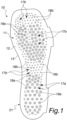
- the reference numeral 10 generally designates a mid-sole, particularly for shoes, which is constituted by a body 11, contoured to contain the sole of the foot, so as to thus define an upper surface 12 that has a plantar-like perimetric shape surrounded by a first outer perimetric edge 13.
- the thickness of the body 11 is substantially constant.
- the mid-sole 10 is provided in a single piece or in multiple elements; if produced in a single piece, it is provided using a material that has elastic characteristics, in order to facilitate its return to its original shape during the use of the shoe, and which has a density preferably comprised between (0.15-1.20) g/cm 3 and a hardness preferably comprised between (15-60) Shore A, such as for example SBS (styrene-butadiene-styrene) rubber, N.R. rubber (natural rubber), rubber and EVA (ethylene vinyl acetate), TPU (thermoplastic polyurethane) and two-component (polyol-isocyanate) expanded polyurethane EP.
- SBS styrene-butadiene-styrene
- N.R. rubber natural rubber
- EVA ethylene vinyl acetate
- TPU thermoplastic polyurethane
- two-component (polyol-isocyanate) expanded polyurethane EP two-component (pol
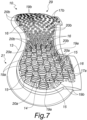
- First pluralities of protrusions 15 and second pluralities of protrusions 16 protrude downward from the lower surface 14 of the body 11 of the mid-sole 10.
- the first pluralities of protrusions 15 and the second pluralities of protrusions 16 affect the entire lower surface 14 of the body 11 and have a substantially frustum-like or pyramid-like and/or cylindrical shape.
- the first and the second pluralities of protrusions 15, 16 are elastically compressible and each one has, respectively, a first axial cavity 17a and a second axial cavity 17b.
- Respectively first holes 18a, 18b are present at the upper surface 12 of the mid-sole 10, at each one of the first pluralities of protrusions 15 and of the second pluralities of protrusions 16.
- Each one of the first holes 18a of the first pluralities of protrusions 15 is connected to the respective first axial cavity 17a which ends, at the first apex 19 of each one of the first pluralities of protrusions 15, in second holes 20a.
- Each one of the first holes 18b of the second pluralities of protrusions 16 is connected to the respective first axial cavity 17b which ends, at the second apex 19b of each one of the second pluralities of protrusions 16, in second holes 20b.
- the plurality of first holes 18a, 18b and of second holes 20a, 20b has a desired diameter; advantageously the first holes 18a have a larger diameter than the diameter of the second holes 20a.
- Each one of the first holes 18a, 18b has a variable diameter, preferably comprised between 1 and 10 mm as a function of the desired area of the mid-sole 10 in which the corresponding first protrusion 15 or second protrusion 16 is positioned; advantageously the first protrusions 15, which have the first hole 18a of larger diameter and a greater protrusion with respect to the lower surface 14, are arranged at the central area of the heel 21 in the central area of the forefoot 29; advantageously therefore the first and the second apices 19a, 19b of the first and second protrusions 15, 16 lie on ideal, anatomically-contoured curved surfaces.
- each one of the second holes 20a, 20b has substantially the same diameter, preferably of approximately 2 mm.
- each one of the first pluralities of protrusions 15 there is a series of concentric annular grooves that increase in diameter in the direction of the upper surface 12 of the mid-sole 10 and which give the first pluralities of protrusions 15 the shape of a stepped pyramid.
- first and second axial cavities 17a, 17b contributes to lightening the mid-sole 10.
- the arrangement on the desired area of the lower surface 14 of the mid-sole 10 and the size of each one of the first and second pluralities of protrusions 15, 16 and their concentration are defined as a function of the desired cushioning function, elastic yield and propulsion correlated with the anatomical shape structure of the foot of the user and of the type of activity performed by the user.
- each one of the second pluralities of protrusions 16 is constituted by a single cylindrical element.
- each one of the first and second pluralities of protrusions 15, 16 is open at one end and closed at the other end.
- each one of the first holes 20a of the first pluralities of protrusions is connected to the respective first axial blind cavity 17a.
- each one of the second holes 20b of the second pluralities of protrusions 16 is connected to the respective first axial blind cavity 17b.
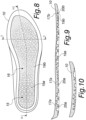
- the thickness of the body 10 varies as a function of the position with respect to the foot, assuming an anatomical configuration.
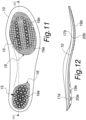
- first plurality of protrusions 15 and the second plurality of protrusions 16 partially affect the lower surface 14 of the body 11, and specifically they are restricted to the heel region 21 and to the forefoot region 29.
- each one of the first and second pluralities of protrusions 15, 16 is open at one end and closed at the other end.
- each one of the first holes 20a is connected to the respective first axial blind cavity 17a.
- the thickness of the body 10 is substantially constant.
- the apices 19a, 19b of the protrusions 15, 16 lie on ideal, anatomically-contoured curved surfaces.
- Each one of the second holes 20b of the second pluralities of protrusions 16 is connected to the respective first axial cavity 17b.
- the invention fully achieves the intended aim and objects, a mid-sole, or insole, having being obtained that is capable of adapting rapidly to the movements and to the shape structure of the foot of the user, while at the same time having good cushioning and thrust characteristics.
- the mid-sole according to the invention ensures that the cushioning and thrust capacities are maintained over time and that an adequate level of anatomical adaptation is achieved even for users with problems of overpronation or of excessive supination.
- the cavities of the protrusions can be open only in an upper region or in a lower region and closed at the opposite end, according to the implementation parameters.
Landscapes
- Health & Medical Sciences (AREA)
- Epidemiology (AREA)
- General Health & Medical Sciences (AREA)
- Public Health (AREA)
- Footwear And Its Accessory, Manufacturing Method And Apparatuses (AREA)
- Acyclic And Carbocyclic Compounds In Medicinal Compositions (AREA)
Claims (13)
- Eine Zwischensohle (10) oder Einlegesohle, insbesondere für Schuhe, die aus einem Körper (11) mit einer oberen Oberfläche (12) besteht, die eine sohlenähnliche Umfangsform hat, wobei von der unteren Oberfläche (14) des Körpers (11) eine erste Vielzahl und eine zweite Vielzahl elastisch komprimierbarer Vorsprünge (15, 16) nach unten ragen, die jeweils einen axialen Hohlraum (17a, 17b) haben, wobei sich an der Seitenfläche jeder der ersten Vielzahlen von Vorsprüngen (15) eine Reihe konzentrischer Ringnuten befindet, deren Durchmesser in Richtung der oberen Oberfläche (12) der Zwischensohle (10) zunimmt und die den ersten Vielzahlen von Vorsprüngen (15) die Form einer Stufenpyramide verleihen; dadurch gekennzeichnet, dass die ersten Vielzahlen von Vorsprüngen (15) kegelstumpfförmig sind und die zweiten Vielzahlen von Vorsprüngen (16) eine zylindrische Form haben.
- Die Zwischensohle gemäß Anspruch 1, dadurch gekennzeichnet, dass sie einteilig oder aus mehreren Elementen hergestellt ist, wobei der Körper (11) elastische Eigenschaften hat, ausgebildet, um seine Rückkehr zu seiner ursprünglichen Form während des Gebrauchs des Schuhs zu erleichtern, und eine Dichte zwischen (0,15 - 1,20) g/cm3 und eine Härte zwischen (15-60) Shore A hat.
- Die Zwischensohle gemäß Anspruch 1, dadurch gekennzeichnet, dass die ersten Vielzahlen von Vorsprüngen (15) und die zweiten Vielzahlen von Vorsprüngen (16) die gesamte untere Oberfläche (14) des Körpers (11) betreffen.
- Die Zwischensohle gemäß einem oder mehreren der obigen Ansprüche, dadurch gekennzeichnet, dass die ersten und zweiten Vielzahlen von Vorsprüngen (15, 16) elastisch komprimierbar sind und jede einen ersten axialen Hohlraum (17a) und einen zweiten axialen Hohlraum (17b) hat, die beide die gesamte Höhe oder Dicke der Zwischensohle (10) betreffen.
- Die Zwischensohle gemäß einem oder mehreren der obigen Ansprüche, dadurch gekennzeichnet, dass entsprechend erste Löcher (18a, 18b) an der oberen Oberfläche (12) der Zwischensohle (10), an jeder der ersten Vielzahlen von Vorsprüngen (15) und der zweiten Vielzahlen von Vorsprüngen (16), vorhanden sind.
- Die Zwischensohle gemäß Anspruch 5, dadurch gekennzeichnet, dass die ersten Löcher (18a) der ersten Vielzahlen von Vorsprüngen (15) mit dem entsprechenden ersten axialen Durchgangshohlraum (17a) verbunden sind, welcher am ersten Scheitelpunkt (19a) jeder der ersten Vielzahlen von Vorsprüngen (15) in zweiten Löchern (20a) endet, wobei die Vielzahl erster Löcher (18a) einen größeren Durchmesser hat als die zweiten Löcher (20a).
- Die Zwischensohle gemäß Anspruch 5 oder 6, dadurch gekennzeichnet, dass jedes der ersten Löcher (18b) der zweiten Vielzahlen von Vorsprüngen (16) mit dem ersten axialen Durchgangshohlraum (17b) verbunden ist, welcher am zweiten Scheitelpunkt (19b) jeder der zweiten Vielzahlen von Vorsprüngen (16) in zweiten Löchern (20b) endet, wobei jedes der ersten Löcher (18a, 18b) einen Durchmesser zwischen 1 mm und 10 mm hat und sich im gewünschten Bereich der Zwischensohle (10) befindet, in dem der entsprechende erste Vorsprung (15) oder zweite Vorsprung (16) angeordnet ist, wobei jedes der zweiten Löcher (20a, 20b) einen Durchmesser von im Wesentlichen 2 mm hat.
- Die Zwischensohle gemäß Anspruch 5, 6 oder 7, dadurch gekennzeichnet, dass die ersten Vorsprünge (15), die das erste Loch (18a) mit größerem Durchmesser und einen größeren Vorsprung von der unteren Oberfläche (14) haben, im Fersenbereich (21) und im Vorfußbereich (29) angeordnet sind, wobei die ersten und zweiten Scheitelpunkte (19a, 19b) der ersten und zweiten Vorsprünge (15, 16) auf idealen gekrümmten Oberflächen liegen.
- Die Zwischensohle gemäß einem oder mehreren der obigen Ansprüche, dadurch gekennzeichnet, dass jede der ersten und zweiten Vielzahlen von Vorsprüngen (15, 16) an einem Ende offen und am anderen Ende geschlossen ist.
- Die Zwischensohle gemäß einem oder mehreren der obigen Ansprüche, dadurch gekennzeichnet, dass die Scheitelpunkte der Vorsprünge (15, 16) auf anatomisch geformten gekrümmten Oberflächen liegen.
- Die Zwischensohle gemäß einem oder mehreren der Ansprüche 1 bis 10, dadurch gekennzeichnet, dass die Vielzahl erster und zweiter Vorsprünge (19a, 19b) alle auf einer im Wesentlichen flachen Oberfläche liegen.
- Die Zwischensohle gemäß einem oder mehreren der obigen Ansprüche, dadurch gekennzeichnet, dass die Dicke des Körpers (10) im Wesentlichen konstant ist.
- Die Zwischensohle gemäß einem oder mehreren der obigen Ansprüche, dadurch gekennzeichnet, dass die Dicke des Körpers (10) anatomisch variabel ist.
Applications Claiming Priority (2)
| Application Number | Priority Date | Filing Date | Title |
|---|---|---|---|
| ITUB2015A005843A ITUB20155843A1 (it) | 2015-11-24 | 2015-11-24 | Intersuola, o soletta, particolarmente per calzature |
| PCT/EP2016/078579 WO2017089414A1 (en) | 2015-11-24 | 2016-11-23 | Mid-sole, or insole, particularly for shoes |
Publications (3)
| Publication Number | Publication Date |
|---|---|
| EP3379962A1 EP3379962A1 (de) | 2018-10-03 |
| EP3379962C0 EP3379962C0 (de) | 2025-05-14 |
| EP3379962B1 true EP3379962B1 (de) | 2025-05-14 |
Family
ID=55538383
Family Applications (1)
| Application Number | Title | Priority Date | Filing Date |
|---|---|---|---|
| EP16802018.8A Active EP3379962B1 (de) | 2015-11-24 | 2016-11-23 | Zwischensohle oder einlegesohle, insbesondere für schuhe |
Country Status (9)
| Country | Link |
|---|---|
| US (1) | US11805851B2 (de) |
| EP (1) | EP3379962B1 (de) |
| JP (1) | JP6884777B2 (de) |
| CN (1) | CN108289524B (de) |
| ES (1) | ES3035971T3 (de) |
| IT (1) | ITUB20155843A1 (de) |
| MA (1) | MA43299A (de) |
| PL (1) | PL3379962T3 (de) |
| WO (1) | WO2017089414A1 (de) |
Families Citing this family (6)
| Publication number | Priority date | Publication date | Assignee | Title |
|---|---|---|---|---|
| CN107398068B (zh) * | 2017-08-15 | 2019-06-18 | 上海海事大学 | 一种可按摩的电动鞋 |
| USD988657S1 (en) * | 2021-07-02 | 2023-06-13 | Nike, Inc. | Shoe |
| USD984113S1 (en) * | 2021-07-02 | 2023-04-25 | Nike, Inc. | Shoe |
| USD984114S1 (en) * | 2021-07-02 | 2023-04-25 | Nike, Inc. | Shoe |
| USD989458S1 (en) * | 2021-07-02 | 2023-06-20 | Nike, Inc. | Shoe |
| WO2026017579A1 (en) | 2024-07-19 | 2026-01-22 | Diadora S.P.A | Midsole/insole for shoes |
Citations (3)
| Publication number | Priority date | Publication date | Assignee | Title |
|---|---|---|---|---|
| US4267648A (en) * | 1979-09-19 | 1981-05-19 | Weisz Vera C | Shoe sole with low profile integral spring system |
| US20080184600A1 (en) * | 2007-02-07 | 2008-08-07 | Hee Woon Yang | Air-circulating shock absorbing shoes |
| EP3039979A1 (de) * | 2014-12-30 | 2016-07-06 | Hoi Ming Michael Ho | Fußbett mit Funktionen von Akupunkturpunktmassage und Druckabbau |
Family Cites Families (28)
| Publication number | Priority date | Publication date | Assignee | Title |
|---|---|---|---|---|
| US4345387A (en) * | 1980-03-31 | 1982-08-24 | Daswick Alexander C | Resilient inner sole for a shoe |
| US4521979A (en) * | 1984-03-01 | 1985-06-11 | Blaser Anton J | Shock absorbing shoe sole |
| JPH029105U (de) * | 1988-07-01 | 1990-01-22 | ||
| JPH0217003A (ja) * | 1988-07-02 | 1990-01-22 | Tatsuo Fukuoka | 靴底 |
| BR8806281A (pt) * | 1988-11-25 | 1990-07-24 | Sao Paulo Alpargatas | Sistema de amortecimento de impactos aplicavel em sapatos esportivos |
| CN1053884A (zh) * | 1990-02-09 | 1991-08-21 | 海·克雷默 | 带有改进中底的鞋类物品 |
| JP2569012Y2 (ja) * | 1993-09-13 | 1998-04-22 | 広島化成株式会社 | カップインソール |
| JP2002501393A (ja) * | 1996-05-30 | 2002-01-15 | ヘルムート メイヤー | 靴、その製造方法及び使用 |
| JP3341660B2 (ja) | 1997-11-21 | 2002-11-05 | アキレス株式会社 | 合成樹脂製靴底およびその製造方法 |
| US6434859B1 (en) * | 1999-09-30 | 2002-08-20 | Joo Tae Kim | Insole for shoes designed to increase a therapeutic effect based on reflex zone therapy |
| DE10038216C2 (de) * | 2000-08-04 | 2002-11-14 | Head Sport Ag | Schuhinnensohle, sowie Verfahren zu ihrer Herstellung |
| US6751890B1 (en) * | 2003-01-22 | 2004-06-22 | Mao-Cheng Tsai | Structure of ventilated shoe bottom |
| US20050193589A1 (en) * | 2004-01-23 | 2005-09-08 | Kevin Bann | Sole for a shoe, boot or sandal |
| US7383648B1 (en) * | 2004-02-23 | 2008-06-10 | Reebok International Ltd. | Inflatable support system for an article of footwear |
| US20060070170A1 (en) * | 2004-10-06 | 2006-04-06 | Paradox Design Services Inc. | Shock absorbing and cooling structure |
| FI117541B (fi) * | 2005-07-01 | 2006-11-30 | Karhu Sporting Goods Oy | Urheilujalkineen pohjarakenne |
| CN2896958Y (zh) | 2006-05-18 | 2007-05-09 | 孙志飞 | 弹力鞋底 |
| US7721466B2 (en) * | 2007-04-02 | 2010-05-25 | Cing-Yang Guo | Shoe sole and insole structure |
| KR20090004464A (ko) * | 2008-05-09 | 2009-01-12 | 임성조 | 중공쿠션돌기가 한 금형 속에서 아웃솔과 일체로 성형된신발창과 이 신발창의 제조 금형 그리고 이 신발창의 제조방법 |
| KR100881769B1 (ko) * | 2008-05-09 | 2009-02-04 | 정용희 | 신발깔창 |
| US8732982B2 (en) * | 2011-01-18 | 2014-05-27 | Saucony IP Holdings, LLC | Footwear |
| KR101178266B1 (ko) * | 2011-08-25 | 2012-08-29 | 서우승 | 다단계 완충칼럼을 갖는 맞춤형 신발 솔 |
| US9155355B2 (en) * | 2012-04-27 | 2015-10-13 | Nike, Inc. | Insole with inferiorly extending projections |
| WO2014201423A1 (en) * | 2013-06-14 | 2014-12-18 | Dan Wakeland | Contoured insoles for footwear |
| ITPD20130358A1 (it) | 2013-12-23 | 2015-06-24 | Diadora Sport S R L | Struttura di suola, particolarmente per calzature sportive |
| CN103704936B (zh) * | 2013-12-23 | 2015-09-09 | 韩思源 | 集成功能鞋 |
| USD731769S1 (en) * | 2014-10-23 | 2015-06-16 | Skechers U.S.A., Inc. Ii | Shoe outsole periphery and bottom |
| US10537151B2 (en) * | 2015-05-27 | 2020-01-21 | Nike, Inc. | Article of footwear comprising a sole member with aperture patterns |
-
2015
- 2015-11-24 IT ITUB2015A005843A patent/ITUB20155843A1/it unknown
-
2016
- 2016-11-23 CN CN201680068635.2A patent/CN108289524B/zh active Active
- 2016-11-23 PL PL16802018.8T patent/PL3379962T3/pl unknown
- 2016-11-23 WO PCT/EP2016/078579 patent/WO2017089414A1/en not_active Ceased
- 2016-11-23 ES ES16802018T patent/ES3035971T3/es active Active
- 2016-11-23 US US15/778,922 patent/US11805851B2/en active Active
- 2016-11-23 MA MA043299A patent/MA43299A/fr unknown
- 2016-11-23 JP JP2018526811A patent/JP6884777B2/ja active Active
- 2016-11-23 EP EP16802018.8A patent/EP3379962B1/de active Active
Patent Citations (3)
| Publication number | Priority date | Publication date | Assignee | Title |
|---|---|---|---|---|
| US4267648A (en) * | 1979-09-19 | 1981-05-19 | Weisz Vera C | Shoe sole with low profile integral spring system |
| US20080184600A1 (en) * | 2007-02-07 | 2008-08-07 | Hee Woon Yang | Air-circulating shock absorbing shoes |
| EP3039979A1 (de) * | 2014-12-30 | 2016-07-06 | Hoi Ming Michael Ho | Fußbett mit Funktionen von Akupunkturpunktmassage und Druckabbau |
Also Published As
| Publication number | Publication date |
|---|---|
| JP6884777B2 (ja) | 2021-06-09 |
| US11805851B2 (en) | 2023-11-07 |
| EP3379962C0 (de) | 2025-05-14 |
| MA43299A (fr) | 2018-10-03 |
| CN108289524B (zh) | 2024-02-09 |
| CN108289524A (zh) | 2018-07-17 |
| PL3379962T3 (pl) | 2025-10-20 |
| EP3379962A1 (de) | 2018-10-03 |
| JP2019500088A (ja) | 2019-01-10 |
| WO2017089414A1 (en) | 2017-06-01 |
| US20180343967A1 (en) | 2018-12-06 |
| ES3035971T3 (en) | 2025-09-11 |
| ITUB20155843A1 (it) | 2017-05-24 |
Similar Documents
| Publication | Publication Date | Title |
|---|---|---|
| EP3379963B1 (de) | Sohle, insbesondere für schuhe | |
| EP3484320B1 (de) | Zwischensohle für schuhe | |
| EP3379962B1 (de) | Zwischensohle oder einlegesohle, insbesondere für schuhe | |
| KR20230014609A (ko) | 가변 반사 신발류 기술 | |
| CN105722421A (zh) | 三项全能运动鞋内底 | |
| WO2011133686A1 (en) | System and method for toning footwear | |
| WO2009048788A1 (en) | Footwear with a foot stabilizer | |
| US20170273400A1 (en) | Heelless athletic shoe | |
| EP2454959A1 (de) | Mehrkomponenten-Sohlenstützanordnung für Sportschuhe | |
| US5218773A (en) | Torsionally stabilized athletic shoe | |
| WO2015056958A1 (ko) | 중족과 중족골의 압력을 분산시키는 중창과 이를 구비한 신발 | |
| JP2021053376A (ja) | ソール要素 | |
| EP2741630A1 (de) | Sohlenanordnung und schuhwerk mit einer sohlenanordnung | |
| KR102013672B1 (ko) | 족저근막염 통증완화 및 치료용 신발 | |
| CN202364952U (zh) | 一种矫正鞋垫及使用该鞋垫的残障人矫正鞋 | |
| KR200427366Y1 (ko) | 아치형 지지부를 갖는 충격완충용 샌들 | |
| WO2026017579A1 (en) | Midsole/insole for shoes | |
| WO2026017531A1 (en) | Sole for shoes | |
| ITUB20151297A1 (it) | Suola per calzature sportive |
Legal Events
| Date | Code | Title | Description |
|---|---|---|---|
| STAA | Information on the status of an ep patent application or granted ep patent |
Free format text: STATUS: UNKNOWN |
|
| STAA | Information on the status of an ep patent application or granted ep patent |
Free format text: STATUS: THE INTERNATIONAL PUBLICATION HAS BEEN MADE |
|
| PUAI | Public reference made under article 153(3) epc to a published international application that has entered the european phase |
Free format text: ORIGINAL CODE: 0009012 |
|
| STAA | Information on the status of an ep patent application or granted ep patent |
Free format text: STATUS: REQUEST FOR EXAMINATION WAS MADE |
|
| 17P | Request for examination filed |
Effective date: 20180622 |
|
| AK | Designated contracting states |
Kind code of ref document: A1 Designated state(s): AL AT BE BG CH CY CZ DE DK EE ES FI FR GB GR HR HU IE IS IT LI LT LU LV MC MK MT NL NO PL PT RO RS SE SI SK SM TR |
|
| AX | Request for extension of the european patent |
Extension state: BA ME |
|
| RAP1 | Party data changed (applicant data changed or rights of an application transferred) |
Owner name: DIADORA S.P.A. |
|
| STAA | Information on the status of an ep patent application or granted ep patent |
Free format text: STATUS: EXAMINATION IS IN PROGRESS |
|
| 17Q | First examination report despatched |
Effective date: 20210122 |
|
| P01 | Opt-out of the competence of the unified patent court (upc) registered |
Effective date: 20231110 |
|
| REG | Reference to a national code |
Ref country code: DE Ref legal event code: R079 Free format text: PREVIOUS MAIN CLASS: A43B0007140000 Ipc: A43B0007148500 Ref country code: DE Ref legal event code: R079 Ref document number: 602016092246 Country of ref document: DE Free format text: PREVIOUS MAIN CLASS: A43B0007140000 Ipc: A43B0007148500 |
|
| GRAP | Despatch of communication of intention to grant a patent |
Free format text: ORIGINAL CODE: EPIDOSNIGR1 |
|
| STAA | Information on the status of an ep patent application or granted ep patent |
Free format text: STATUS: GRANT OF PATENT IS INTENDED |
|
| RIC1 | Information provided on ipc code assigned before grant |
Ipc: A43B 7/1485 20220101AFI20241104BHEP |
|
| INTG | Intention to grant announced |
Effective date: 20241205 |
|
| GRAS | Grant fee paid |
Free format text: ORIGINAL CODE: EPIDOSNIGR3 |
|
| GRAA | (expected) grant |
Free format text: ORIGINAL CODE: 0009210 |
|
| STAA | Information on the status of an ep patent application or granted ep patent |
Free format text: STATUS: THE PATENT HAS BEEN GRANTED |
|
| AK | Designated contracting states |
Kind code of ref document: B1 Designated state(s): AL AT BE BG CH CY CZ DE DK EE ES FI FR GB GR HR HU IE IS IT LI LT LU LV MC MK MT NL NO PL PT RO RS SE SI SK SM TR |
|
| REG | Reference to a national code |
Ref country code: GB Ref legal event code: FG4D |
|
| REG | Reference to a national code |
Ref country code: CH Ref legal event code: EP |
|
| REG | Reference to a national code |
Ref country code: DE Ref legal event code: R096 Ref document number: 602016092246 Country of ref document: DE |
|
| REG | Reference to a national code |
Ref country code: IE Ref legal event code: FG4D |
|
| U01 | Request for unitary effect filed |
Effective date: 20250612 |
|
| P04 | Withdrawal of opt-out of the competence of the unified patent court (upc) registered |
Free format text: CASE NUMBER: APP_28970/2025 Effective date: 20250618 |
|
| U07 | Unitary effect registered |
Designated state(s): AT BE BG DE DK EE FI FR IT LT LU LV MT NL PT RO SE SI Effective date: 20250623 |
|
| REG | Reference to a national code |
Ref country code: ES Ref legal event code: FG2A Ref document number: 3035971 Country of ref document: ES Kind code of ref document: T3 Effective date: 20250911 |
|
| PG25 | Lapsed in a contracting state [announced via postgrant information from national office to epo] |
Ref country code: NO Free format text: LAPSE BECAUSE OF FAILURE TO SUBMIT A TRANSLATION OF THE DESCRIPTION OR TO PAY THE FEE WITHIN THE PRESCRIBED TIME-LIMIT Effective date: 20250814 |
|
| PG25 | Lapsed in a contracting state [announced via postgrant information from national office to epo] |
Ref country code: HR Free format text: LAPSE BECAUSE OF FAILURE TO SUBMIT A TRANSLATION OF THE DESCRIPTION OR TO PAY THE FEE WITHIN THE PRESCRIBED TIME-LIMIT Effective date: 20250514 |
|
| PG25 | Lapsed in a contracting state [announced via postgrant information from national office to epo] |
Ref country code: RS Free format text: LAPSE BECAUSE OF FAILURE TO SUBMIT A TRANSLATION OF THE DESCRIPTION OR TO PAY THE FEE WITHIN THE PRESCRIBED TIME-LIMIT Effective date: 20250814 |
|
| PG25 | Lapsed in a contracting state [announced via postgrant information from national office to epo] |
Ref country code: IS Free format text: LAPSE BECAUSE OF FAILURE TO SUBMIT A TRANSLATION OF THE DESCRIPTION OR TO PAY THE FEE WITHIN THE PRESCRIBED TIME-LIMIT Effective date: 20250914 |
|
| REG | Reference to a national code |
Ref country code: GR Ref legal event code: EP Ref document number: 20250401607 Country of ref document: GR Effective date: 20251009 |
|
| U20 | Renewal fee for the european patent with unitary effect paid |
Year of fee payment: 10 Effective date: 20251120 |
|
| PGFP | Annual fee paid to national office [announced via postgrant information from national office to epo] |
Ref country code: GB Payment date: 20251119 Year of fee payment: 10 |
|
| PG25 | Lapsed in a contracting state [announced via postgrant information from national office to epo] |
Ref country code: SM Free format text: LAPSE BECAUSE OF FAILURE TO SUBMIT A TRANSLATION OF THE DESCRIPTION OR TO PAY THE FEE WITHIN THE PRESCRIBED TIME-LIMIT Effective date: 20250514 |
|
| VS25 | Lapsed in a validation state [announced via postgrant information from nat. office to epo] |
Ref country code: MD Free format text: LAPSE BECAUSE OF FAILURE TO SUBMIT A TRANSLATION OF THE DESCRIPTION OR TO PAY THE FEE WITHIN THE PRESCRIBED TIME-LIMIT Effective date: 20250514 |
|
| PGFP | Annual fee paid to national office [announced via postgrant information from national office to epo] |
Ref country code: TR Payment date: 20251118 Year of fee payment: 10 Ref country code: GR Payment date: 20251118 Year of fee payment: 10 |
|
| PG25 | Lapsed in a contracting state [announced via postgrant information from national office to epo] |
Ref country code: CZ Free format text: LAPSE BECAUSE OF FAILURE TO SUBMIT A TRANSLATION OF THE DESCRIPTION OR TO PAY THE FEE WITHIN THE PRESCRIBED TIME-LIMIT Effective date: 20250514 |
|
| PGFP | Annual fee paid to national office [announced via postgrant information from national office to epo] |
Ref country code: PL Payment date: 20251114 Year of fee payment: 10 |
|
| PG25 | Lapsed in a contracting state [announced via postgrant information from national office to epo] |
Ref country code: SK Free format text: LAPSE BECAUSE OF FAILURE TO SUBMIT A TRANSLATION OF THE DESCRIPTION OR TO PAY THE FEE WITHIN THE PRESCRIBED TIME-LIMIT Effective date: 20250514 |
|
| PGFP | Annual fee paid to national office [announced via postgrant information from national office to epo] |
Ref country code: ES Payment date: 20251212 Year of fee payment: 10 |
|
| VS25 | Lapsed in a validation state [announced via postgrant information from nat. office to epo] |
Ref country code: MA Free format text: FAILURE TO ELECT DOMICILE IN THE NATIONAL COUNTRY Effective date: 20250815 |
|
| PLBE | No opposition filed within time limit |
Free format text: ORIGINAL CODE: 0009261 |
|
| STAA | Information on the status of an ep patent application or granted ep patent |
Free format text: STATUS: NO OPPOSITION FILED WITHIN TIME LIMIT |
|
| REG | Reference to a national code |
Ref country code: CH Ref legal event code: L10 Free format text: ST27 STATUS EVENT CODE: U-0-0-L10-L00 (AS PROVIDED BY THE NATIONAL OFFICE) Effective date: 20260325 |
|
| VS25 | Lapsed in a validation state [announced via postgrant information from nat. office to epo] |
Ref country code: MA Free format text: LAPSE BECAUSE OF FAILURE TO SUBMIT A TRANSLATION OF THE DESCRIPTION OR TO PAY THE FEE WITHIN THE PRESCRIBED TIME-LIMIT Effective date: 20250514 |
|
| 26N | No opposition filed |
Effective date: 20260217 |