EP3374425B1 - Schmelzpolymerisiertes modifiziertes hochtransparentes polycarbonate mit guter schlagzähigkeit - Google Patents
Schmelzpolymerisiertes modifiziertes hochtransparentes polycarbonate mit guter schlagzähigkeit Download PDFInfo
- Publication number
- EP3374425B1 EP3374425B1 EP16802141.8A EP16802141A EP3374425B1 EP 3374425 B1 EP3374425 B1 EP 3374425B1 EP 16802141 A EP16802141 A EP 16802141A EP 3374425 B1 EP3374425 B1 EP 3374425B1
- Authority
- EP
- European Patent Office
- Prior art keywords
- composition
- polycarbonate
- melt
- article
- polycarbonate resin
- Prior art date
- Legal status (The legal status is an assumption and is not a legal conclusion. Google has not performed a legal analysis and makes no representation as to the accuracy of the status listed.)
- Active
Links
Images

Classifications
-
- C—CHEMISTRY; METALLURGY
- C08—ORGANIC MACROMOLECULAR COMPOUNDS; THEIR PREPARATION OR CHEMICAL WORKING-UP; COMPOSITIONS BASED THEREON
- C08L—COMPOSITIONS OF MACROMOLECULAR COMPOUNDS
- C08L69/00—Compositions of polycarbonates; Compositions of derivatives of polycarbonates
-
- C—CHEMISTRY; METALLURGY
- C08—ORGANIC MACROMOLECULAR COMPOUNDS; THEIR PREPARATION OR CHEMICAL WORKING-UP; COMPOSITIONS BASED THEREON
- C08K—Use of inorganic or non-macromolecular organic substances as compounding ingredients
- C08K5/00—Use of organic ingredients
- C08K5/04—Oxygen-containing compounds
- C08K5/10—Esters; Ether-esters
- C08K5/101—Esters; Ether-esters of monocarboxylic acids
- C08K5/103—Esters; Ether-esters of monocarboxylic acids with polyalcohols
-
- C—CHEMISTRY; METALLURGY
- C08—ORGANIC MACROMOLECULAR COMPOUNDS; THEIR PREPARATION OR CHEMICAL WORKING-UP; COMPOSITIONS BASED THEREON
- C08G—MACROMOLECULAR COMPOUNDS OBTAINED OTHERWISE THAN BY REACTIONS ONLY INVOLVING UNSATURATED CARBON-TO-CARBON BONDS
- C08G64/00—Macromolecular compounds obtained by reactions forming a carbonic ester link in the main chain of the macromolecule
- C08G64/04—Aromatic polycarbonates
-
- C—CHEMISTRY; METALLURGY
- C08—ORGANIC MACROMOLECULAR COMPOUNDS; THEIR PREPARATION OR CHEMICAL WORKING-UP; COMPOSITIONS BASED THEREON
- C08G—MACROMOLECULAR COMPOUNDS OBTAINED OTHERWISE THAN BY REACTIONS ONLY INVOLVING UNSATURATED CARBON-TO-CARBON BONDS
- C08G64/00—Macromolecular compounds obtained by reactions forming a carbonic ester link in the main chain of the macromolecule
- C08G64/20—General preparatory processes
- C08G64/30—General preparatory processes using carbonates
-
- C—CHEMISTRY; METALLURGY
- C08—ORGANIC MACROMOLECULAR COMPOUNDS; THEIR PREPARATION OR CHEMICAL WORKING-UP; COMPOSITIONS BASED THEREON
- C08K—Use of inorganic or non-macromolecular organic substances as compounding ingredients
- C08K5/00—Use of organic ingredients
- C08K5/04—Oxygen-containing compounds
- C08K5/13—Phenols; Phenolates
- C08K5/134—Phenols containing ester groups
- C08K5/1345—Carboxylic esters of phenolcarboxylic acids
-
- C—CHEMISTRY; METALLURGY
- C08—ORGANIC MACROMOLECULAR COMPOUNDS; THEIR PREPARATION OR CHEMICAL WORKING-UP; COMPOSITIONS BASED THEREON
- C08K—Use of inorganic or non-macromolecular organic substances as compounding ingredients
- C08K5/00—Use of organic ingredients
- C08K5/16—Nitrogen-containing compounds
- C08K5/34—Heterocyclic compounds having nitrogen in the ring
- C08K5/3467—Heterocyclic compounds having nitrogen in the ring having more than two nitrogen atoms in the ring
- C08K5/3472—Five-membered rings
- C08K5/3475—Five-membered rings condensed with carbocyclic rings
-
- C—CHEMISTRY; METALLURGY
- C08—ORGANIC MACROMOLECULAR COMPOUNDS; THEIR PREPARATION OR CHEMICAL WORKING-UP; COMPOSITIONS BASED THEREON
- C08K—Use of inorganic or non-macromolecular organic substances as compounding ingredients
- C08K5/00—Use of organic ingredients
- C08K5/36—Sulfur-, selenium-, or tellurium-containing compounds
- C08K5/41—Compounds containing sulfur bound to oxygen
- C08K5/42—Sulfonic acids; Derivatives thereof
-
- C—CHEMISTRY; METALLURGY
- C08—ORGANIC MACROMOLECULAR COMPOUNDS; THEIR PREPARATION OR CHEMICAL WORKING-UP; COMPOSITIONS BASED THEREON
- C08K—Use of inorganic or non-macromolecular organic substances as compounding ingredients
- C08K5/00—Use of organic ingredients
- C08K5/49—Phosphorus-containing compounds
- C08K5/50—Phosphorus bound to carbon only
-
- C—CHEMISTRY; METALLURGY
- C08—ORGANIC MACROMOLECULAR COMPOUNDS; THEIR PREPARATION OR CHEMICAL WORKING-UP; COMPOSITIONS BASED THEREON
- C08K—Use of inorganic or non-macromolecular organic substances as compounding ingredients
- C08K5/00—Use of organic ingredients
- C08K5/49—Phosphorus-containing compounds
- C08K5/51—Phosphorus bound to oxygen
- C08K5/52—Phosphorus bound to oxygen only
- C08K5/524—Esters of phosphorous acids, e.g. of H3PO3
- C08K5/526—Esters of phosphorous acids, e.g. of H3PO3 with hydroxyaryl compounds
-
- F—MECHANICAL ENGINEERING; LIGHTING; HEATING; WEAPONS; BLASTING
- F21—LIGHTING
- F21V—FUNCTIONAL FEATURES OR DETAILS OF LIGHTING DEVICES OR SYSTEMS THEREOF; STRUCTURAL COMBINATIONS OF LIGHTING DEVICES WITH OTHER ARTICLES, NOT OTHERWISE PROVIDED FOR
- F21V3/00—Globes; Bowls; Cover glasses
- F21V3/04—Globes; Bowls; Cover glasses characterised by materials, surface treatments or coatings
- F21V3/06—Globes; Bowls; Cover glasses characterised by materials, surface treatments or coatings characterised by the material
- F21V3/062—Globes; Bowls; Cover glasses characterised by materials, surface treatments or coatings characterised by the material the material being plastics
- F21V3/0625—Globes; Bowls; Cover glasses characterised by materials, surface treatments or coatings characterised by the material the material being plastics the material diffusing light, e.g. translucent plastics
-
- F—MECHANICAL ENGINEERING; LIGHTING; HEATING; WEAPONS; BLASTING
- F21—LIGHTING
- F21V—FUNCTIONAL FEATURES OR DETAILS OF LIGHTING DEVICES OR SYSTEMS THEREOF; STRUCTURAL COMBINATIONS OF LIGHTING DEVICES WITH OTHER ARTICLES, NOT OTHERWISE PROVIDED FOR
- F21V5/00—Refractors for light sources
-
- G—PHYSICS
- G02—OPTICS
- G02B—OPTICAL ELEMENTS, SYSTEMS OR APPARATUS
- G02B1/00—Optical elements characterised by the material of which they are made; Optical coatings for optical elements
- G02B1/04—Optical elements characterised by the material of which they are made; Optical coatings for optical elements made of organic materials, e.g. plastics
- G02B1/041—Lenses
Definitions
- the disclosure concerns methods for producing polycarbonate according to melt polymerization processes.
- Polycarbonates are used in a number of industries for a variety of applications owing to their versatility and desirable properties. Polycarbonates provide high transparency and are esteemed for high impact and high heat resistance. Polycarbonates are generally produced according to one of two commercial production methods: a two-phase interfacial process and a melt transesterification process.
- the interfacial method comprises the reaction of at least one dihydroxy compound, generally a dihydroxyaromatic compound, with phosgene in a solvent, in the presence of a basic reagent as acid acceptor and an amine as catalyst.
- Melt transesterification processes are well known in the art for producing polycarbonate by reacting a diaryl carbonate and a dihydroxy compound in the optional presence of transesterification catalysts. Other potentially useful methods tend to be direct variations on, or simple combinations of, these two primary proceses.
- EP 2 937 371 A1 discloses a process for melt polymerization of polycarbonate (PC)with diphenylcarbonate (DPC).
- PC polycarbonate
- DPC diphenylcarbonate
- the obtained PC should have a lower amount of Fries rearrangement (less than 800 ppm).
- the polymerization process and molding conditions used to produce the polycarbonate may determine the characteristics of the resultant polycarbonate. Melt polymerization processes may suffer from a Fries rearrangement product, or natural intercrossing of the melt polycarbonate, which may reduce mechanical properties of the resultant polycarbonate composition. Thus, it would be advantageous to provide a melt polymerization process yielding a transparent material, having good impact performance at a low temperature and comparable to the polycarbonate achieved according to an interfacial polymerization process.
- aspects of the present disclosure relate to an article formed from a composition
- a composition comprising: a melt polycarbonate resin derived from diphenyl carbonate; and glycerol tristearate mixed with the melt polycarbonate resin, wherein the composition exhibits a melt volume rate of between about 18 cubic centimeters per 10 minutes (cm 3 /10 min.) and about 22 cm 3 /10 min., wherein the composition exhibits a fries concentration below about 800 parts per million (ppm), wherein the article formed from the composition exhibits an Izod impact performance between about 9.5 kilojoules per square meter (KJ/m 2 ) and about 13 KJ/m 2 based on ISO 180 at 4 millimeter (mm) thickness, and wherein the article formed from the composition exhibits transparency.
- KJ/m 2 kilojoules per square meter
- mm millimeter
- the present disclosure relates to a method comprising: forming a polycarbonate resin via melt transesterification; mixing glycerol tristearate with the polycarbonate resin to form a composition; forming an article from the composition, wherein the composition exhibits a melt volume rate of between about 18 cm 3 /10 min. and about 22 cm 3 /10 min., wherein the composition exhibits a fries concentration below about 800 ppm, and wherein the article formed from the composition exhibits an Izod impact performance between about 9.5 KJ/m 2 and about 13 KJ/m 2 based on ISO 180 at 4mm thickness at room temperature.
- the articles formed according to the methods herein may comprise polycarbonate compositions prepared by a melt polymerization, or melt transesterification process.
- the melt process obviates the need for phosgene during polymerization or a solvent such as methylene chloride.
- the melt process typically also requires higher temperatures and relatively long reaction times.
- a melt polymerization process may also involve the use of complex processing equipment capable of operation at high temperature and low pressure capable of efficient agitation of the highly viscous polymer melt during the relatively long reaction times required to achieve a desired molecular weight.
- a given melt polymerization process may also feature increased Fries natural intercrossing which may increase rigidity of the resultant polycarbonate and ultimately reduce impact performance.
- high volume end cappers may be used to improve the impact properties of the polycarbonate without a negative impact on transparency
- these high volume end cappers are primarily used in interfacial polymerization processes.
- siloxane additives may be used in an interfacial polymerization process to provide transparent polycarbonate with good impact performance at low temperatures
- siloxanes may add an undue cost and are not easily applied in melt polycarbonate polymerization processes (lower reactivity of the carbonate source, diphenyl carbonate). Accordingly, a melt polycarbonate resin exhibiting properties comparable to an interfacial polycarbonate resin would be desirable.
- the melt polycarbonate resins of the present disclosure exhibit properties comparable to interfacial polycarbonate resin where the melt polycarbonate is derived from diphenyl carbonate and mixed with glycerol tristearate to provide a polycarbonate resin exhibiting a melt volume rate of between about 18 cm 3 / 10 min. and 22 cm 3 / 10 min., a fries concentration below about 800 ppm.
- the melt polycarbonate resins disclosed herein may also form transparent articles exhibiting an Izod impact performance of from about 9.5 KJ/m 2 and about 13 KJ/m 2 based on ISO 180 at 4 mm thickness at room temperature.
- the articles of the present disclosure may be formed from a melt transesterification polycarbonate which has been derived from diphenyl carbonate and combined with an addition of glycerol tristearate (GTS) to the formed melt polycarbonate.
- GTS glycerol tristearate
- polycarbonates may be prepared by co-reacting, in a molten state, a dihydroxy compound (s) and a carbonate source, such as diphenyl carbonate, or more specifically in an aspect, an activated carbonate such as bis(methyl salicyl)carbonate, in the presence of a transesterification catalyst.
- the reaction mixture may comprise a melt transesterification catalyst, a dihydroxy compound, a carbonate source and a phenolic byproduct.
- the polycarbonate may be produced by the melt transesterification reaction of a dihydroxy compound and diphenyl carbonate in the presence of the melt transesterification catalyst. As the reaction proceeds, the diphenyl carbonate may be consumed while the phenolic byproduct is generated.
- the melt polymerization reaction mixture may comprise a melt transesterification catalyst.
- Melt transesterification catalysts are well-known in the art and are not limited to the examples disclosed herein. Exemplary melt transesterification catalysts are disclosed in U.S. Patent Nos. 7,365,149 , 7,547,799 , 7,619,053 , and 7,671, 165 .
- the melt transesterification catalyst may include at least one alpha and/or beta transesterification catalyst.
- the alpha catalyst, or the first catalyst may typically be more thermally stable and less volatile than the beta, or second, catalyst.
- an alpha catalyst may be more useful to the melt polymerization reaction if used in later high-temperature polymerization stages.
- the alpha catalyst may comprise metal or ions (cations or anions).
- the alpha catalyst may comprise a metal cation and an anion.
- the cation may be an alkali or alkaline earth metal comprising Li, Na, K, Cs, Rb, Mg, Ca, Ba, Sr, or a combination comprising at least one of the foregoing.
- the anion may be a hydroxide (OH - ), superoxide (O 2- ), thiolate (HS - ), sulfide (S 2- ), a C 1-20 alkoxide, a C 6-20 aryloxide, a C 1-20 carboxylate, a phosphate including biphosphate, a C 1-20 phosphonate, a sulfate including bisulfate, sulfites including bisulfites and metabisulfites, a C 1-20 sulfonate, a carbonate including bicarbonate, or a combination comprising at least one of the foregoing.
- salts of an organic acid comprising both alkaline earth metal ions and alkali metal ions may also be used.
- Salts of organic acids useful as catalysts are illustrated by alkali metal and alkaline earth metal salts of formic acid, acetic acid, stearic acid and ethyelenediaminetetraacetic acid.
- the catalyst may also comprise the salt of a non-volatile inorganic acid.
- nonvolatile it is meant that the referenced compounds have no appreciable vapor pressure at ambient temperature and pressure. In particular, these compounds are not volatile at temperatures at which melt polymerizations of polycarbonate are typically conducted.
- the salts of nonvolatile acids are alkali metal salts of phosphites; alkaline earth metal salts of phosphites; alkali metal salts of phosphates; and alkaline earth metal salts of phosphates.
- Exemplary alpha transesterification catalysts include, lithium hydroxide, sodium hydroxide, potassium hydroxide, cesium hydroxide, magnesium hydroxide, calcium hydroxide, barium hydroxide, lithium formate, sodium formate, potassium formate, cesium formate, lithium acetate, sodium acetate, potassium acetate, lithium carbonate, sodium carbonate, potassium carbonate, lithium methoxide, sodium methoxide, potassium methoxide, lithium ethoxide, sodium ethoxide, potassium ethoxide, lithium phenoxide, sodium phenoxide, potassium phenoxide, sodium sulfate, potassium sulfate, NaH 2 PO 3 , NaH 2 PO 4 , Na 2 H 2 PO 3 , KH 2 PO 4 , CsH 2 PO 4 , Cs 2 H 2 PO 4 , Na 2 SO 3 , Na 2 S 2 O 5 , sodium mesylate, potassium mesylate, sodium tosylate, potassium tosylate, magnesium disodium ethylene
- the alpha transesterification catalyst is an alpha catalyst comprising an alkali or alkaline earth salt.
- the transesterification catalyst may comprise sodium hydroxide, potassium hydroxide, sodium carbonate, potassium carbonate, sodium methoxide, potassium methoxide, NaH 2 PO 4 , or a combination comprising at least one of the foregoing.
- the amount of alpha catalyst may vary widely according to the conditions of the melt polymerization, and may be about 0.001 micromole ( ⁇ mol) to about 500 ⁇ mol. In further aspects, the amount of beta catalust used may be based upon the total number of moles of dihydroxy compound used in the melt polymerization reaction.
- the beta catalyst i.e., a second transesterification catalyst
- a beta catalyst may include a quaternary ammonium compound, a quaternary phosphonium compound, or a combination comprising at least one of the foregoing.
- Exemplary transesterification catalysts may further include a combination of a phase transfer catalyst of formula (R 3 ) 4 Q + X above, wherein each R 3 is the same or different, and is a C 1-10 alkyl group; Q is a nitrogen or phosphorus atom; and X is a halogen atom or a C 1-8 alkoxy group or C 6-18 aryloxy group.
- phase transfer catalyst salts include, for example, [CH 3 (CH 2 ) 3 ] 4 NX, [CH 3 (CH 2 ) 3 ] 4 PX, [CH 3 (CH 2 ) 5 ] 4 NX, [CH 3 (CH 2 ) 6 ] 4 NX, [CH 3 (CH 2 ) 4 ] 4 NX, CH 3 [CH 3 (CH 2 ) 3 ] 3 NX, and CH 3 [CH 3 (CH 2 ) 2 ] 3 NX, wherein X is Cl - , Br - , a C 1-8 alkoxy group or a C 6-18 aryloxy group.
- beta transesterification catalysts examples include tetrabutylammonium hydroxide, methyltributylammonium hydroxide, tetrabutylammonium acetate, tetrabutylphosphonium hydroxide, tetrabutylphosphonium acetate, tetrabutylphosphonium phenolate, or a combination comprising at least one of the foregoing.
- Other melt transesterification catalysts include alkaline earth metal salts or alkali metal salts.
- the beta catalyst may be present in a molar ratio, relative to the alpha catalyst, of less than or equal to 10, specifically less than or equal to 5, more specifically less than or equal to 1, and still more specifically less than or equal to 0.5.
- the melt polymerization reaction disclosed herein uses only an alpha catalyst as described hereinabove, and is substantially free of any beta catalyst. As defined herein, "substantially free of' may mean where the beta catalyst has been excluded from the melt polymerization reaction.
- the beta catalyst is present in an amount of less than about 10 ppm, specifically less than 1 ppm, more specifically less than about 0.1 ppm, more specifically less than or equal to about 0.01 ppm, and more specifically less than or equal to about 0.001 ppm, based on the total weight of all components used in the melt polymerization reaction.
- the melt polymerization process disclosed herein may comprise a dihydroxy compound.
- Dihydroxy compounds of the present disclosure may have the formula HO-R 1 -OH, which includes dihydroxy compounds of formula (1): HO-A 1 -Y 1 -A 2 -OH (1), wherein Y 1 , A 1 and A 2 are as described above.
- bisphenol compounds of general formula (2) wherein R a and R b each represent a halogen atom or a monovalent hydrocarbon group and may be the same or different; p and q are each independently integers from 0 to 4; and X a represents one of the groups of formula (3): wherein R c and R d each independently represent a hydrogen atom or a monovalent linear or cyclic hydrocarbon group and R e is a divalent hydrocarbon group.
- suitable dihydroxy compounds include the dihydroxy-substituted hydrocarbons disclosed by name or formula (generic or specific) in U.S. Pat. No. 4,217,438 .
- a nonexclusive list of specific examples of suitable dihydroxy compounds includes the following: resorcinol, 4-bromoresorcinol, hydroquinone, 4,4'-dihydroxybiphenyl, 1,6-dihydroxynaphthalene, 2,6-dihydroxynaphthalene, bis(4-hydroxyphenyl)methane, bis(4-hydroxyphenyl)diphenylmethane, bis(4-hydroxyphenyl)-1-naphthylmethane, 1,2-bis(4-hydroxyphenyl)ethane, 1,1-bis(4-hydroxyphenyl)-1-phenylethane, 2-(4-hydroxyphenyl)-2-(3-hydroxyphenyl)propane, bis(4-hydroxyphenyl)phenylmethane, 2,2-bis(
- examples of the types of bisphenol compounds that may be represented by formula (3) includes 1,1-bis(4-hydroxyphenyl)methane, 1,1-bis(4-hydroxyphenyl)ethane, 2,2-bis(4-hydroxyphenyl)propane (hereinafter "bisphenol A” or "BPA"), 2,2-bis(4-hydroxyphenyl)butane, 2,2-bis(4-hydroxyphenyl)octane, 1,1-bis(4-hydroxyphenyl)propane, 1,1-bis(4-hydroxyphenyl)n-butane, 2,2-bis(4-hydroxy-1-methylphenyl)propane, and 1,1-bis(4-hydroxy-t-butylphenyl)propane.
- bisphenol A 2,2-bis(4-hydroxyphenyl)propane
- BPA 2,2-bis(4-hydroxyphenyl)propane
- BPA 2,2-bis(4-hydroxyphenyl)butane
- BPA 2,2-bis(4-hydroxyphenyl)
- Combinations including at least one of the foregoing dihydroxy compounds may also be used.
- bisphenols containing substituted or unsubstituted cyclohexane units may be used, for example bisphenols of formula (4): wherein each R f is independently hydrogen, C 1-12 alkyl, or halogen; and each R g is independently hydrogen or C 1-12 alkyl.
- the substituents may be aliphatic or aromatic, straight chain, cyclic, bicyclic, branched, saturated, or unsaturated.
- Such cyclohexane-containing bisphenols for example the reaction product of two moles of a phenol with one mole of a hydrogenated isophorone, are useful for making polycarbonate polymers with high glass transition temperatures and high heat distortion temperatures.
- Cyclohexyl bisphenol containing polycarbonates, or a combination comprising at least one of the foregoing with other bisphenol polycarbonates, are supplied by Bayer Co. under the APEC® trade name.
- additional useful dihydroxy compounds are those compounds having the formula HO-R 1 -OH include aromatic dihydroxy compounds of formula (4): wherein each R h is independently a halogen atom, a C 1-10 hydrocarbyl such as a C 1-10 alkyl group, a halogen substituted C 1-10 hydrocarbyl such as a halogen-substituted C 1-10 alkyl group, and n is 0 to 4.
- the halogen is usually bromine.
- the branching agents include polyfunctional organic compounds containing at least three functional groups selected from hydroxyl, carboxyl, carboxylic anhydride, haloformyl, and mixtures thereof.
- specific examples include trimellitic acid, trimellitic anhydride, trimellitic trichloride, tris-p-hydroxy phenyl ethane, isatin-bis-phenol, tris-phenol TC (1,3,5-tris((p-hydroxyphenyl)isopropyl)benzene), tris-phenol PA (4(4(1,1-bis(p-hydroxyphenyl)-ethyl)alpha, alpha-dimethyl benzyl)phenol), 4-chloroformyl phthalic anhydride, trimesic acid, and benzophenone tetracarboxylic acid.
- the branching agents may be added at a level of from 0.05-2.0 weight percent. Branching agents and procedures for making branched polycarbonates are described in U.S. Pat. Nos. 3,635,895 and 4,001,184 . All types of polycarbonate end groups are contemplated as being useful in the thermoplastic composition.
- the melt polymerization process disclosed herein may include a carbonate source.
- a diaryl carbonate may be used as the carbonate source in melt polymerization processes.
- Exemplary diaryl carbonates that may be used according to the present disclosure are disclosed in U.S. Patent No.s 7,365,149 , 7547,799 , 7,619,053 , and 7,671,165 .
- non-ester -substituted diaryl carbonates that may be used may include for example diphenyl carbonate, ditolylcarbonate, bis(chlorophenyl) carbonate, m-cresyl carbonate, and dinapthyl carbonate.
- non-activated carbonates are bis(o-methylphenyl)carbonate, bis(p-cumylphenyl)carbonate, bis(p-(1,1,3,3-tetramethyl)butylphenyl)carbonate and bis(o-cyanophenyl)carbonate. Unsymmetrical combinations of these structures may also be used as non-activated carbonates.
- a melt polymerization process may employ an activated carbonate.
- activated carbonate is defined as a diarylcarbonate that is more reactive than diphenylcarbonate in transesterification reactions. Activated, or ester-substituted diaryl carbonates may increase transesterification reaction rates allowing the melt polymerization reaction to occur in few pieces of equipment, at reduced temperature, and/or in minimal residence times.
- activated carbonates include bis(o-methoxycarbonylphenyl)carbonate, bis(o-chlorophenyl)carbonate, bis(o-nitrophenyl)carbonate, bis(o-acetylphenyl)carbonate, bis(o-phenylketonephenyl)carbonate, bis(o-formylphenyl)carbonate.
- ester-substituted diarylcarbonates include, but are not limited to, bis(methylsalicyl)carbonate ( CAS Registry No.
- bis(methylsalicyl)carbonate is used as the activated carbonate in melt polycarbonate synthesis due to its lower molecular weight and higher vapor pressure.
- Some non-limiting examples of non-activating groups which, when present in an ortho position, would not be expected to result in activated carbonates are alkyl, cycloalkyl or cyano groups.
- the melt polycarbonate resin may be derived from a diarylcarbonate source.
- the melt polycarbonate resin may be derived from diphenyl carbonate.
- an end-capping agent (also referred to as a chain-stopper) may optionally be used to limit molecular weight growth rate, and so control molecular weight in the polycarbonate.
- exemplary chain-stoppers include certain monophenolic compounds (i.e., phenyl compounds having a single free hydroxy group), monocarboxylic acid chlorides, and/or monochloroformates.
- Phenolic chain-stoppers are exemplified by phenol and C 1 -C 22 alkyl-substituted phenols such as p-cumyl-phenol, resorcinol monobenzoate, and p- and tertiary-butyl phenol, cresol, and monoethers of diphenols, such as p-methoxyphenol.
- Alkyl-substituted phenols with branched chain alkyl substituents having 8 to 9 carbon atoms may be specifically mentioned.
- Certain monophenolic UV absorbers may also be used as a capping agent, for example 4-substituted-2-hydroxybenzophenones and their derivatives, aryl salicylates, monoesters of diphenols such as resorcinol monobenzoate, 2-(2-hydroxyaryl)-benzotriazoles and their derivatives, 2-(2-hydroxyaryl)-1,3,5-triazines and their derivatives, and the like.
- end groups may be derived from the carbonyl source (i.e., the diphenyl carbonate), from selection of monomer ratios, incomplete polymerization, chain scission, and the like, as well as any added end-capping groups, and may include derivatizable functional groups such as hydroxy groups, carboxylic acid groups, or the like.
- the endgroup of a polycarbonate, including a polycarbonate resin as defined herein may comprise a structural unit derived from a diaryl carbonate, for example the diphenyl carbonate, where the structural unit may be an endgroup.
- the endgroup is derived from an activated carbonate.
- Such endgroups may be derived from the transesterification reaction of the alkyl ester of an appropriately substituted activated carbonate, with a hydroxy group at the end of a polycarbonate polymer chain, under conditions in which the hydroxy group reacts with the ester carbonyl from the activated carbonate, instead of with the carbonate carbonyl of the activated carbonate.
- structural units derived from ester containing compounds or substructures derived from the activated carbonate and present in the melt polymerization reaction may form ester endgroups.
- the melt polymerization polycarbonate composition may have a Fries content of less than about 800 ppm.
- Polycarbonates prepared according to a melt polymerization process or activated carbonate melt process such as those presented in US Patent Nos. 5,151,491 and 5,142,018 typically contain a significant concentration of Fries product when compared to an interfacial polycarbonate polymerization product.
- a low level of Fries product may be tolerated in the melt process polycarbonate product, the presence of higher levels of Fries product may negatively impact performance characteristics of the polycarbonate, such as moldability and impact strength.
- the melt polymerization process may be performed to achieve a resultant polycarbonate composition with a particular Fries concentration.
- the Fries product arises as a side reaction occurring during the melt polymerization polycarbonate process.
- the term "Fries product” is defined as a structural unit of the product polycarbonate which upon hydrolysis of the product polycarbonate affords a carboxy- substituted dihydroxy aromatic compound bearing a carboxy group adjacent to one or both of the hydroxy groups of said carboxy-substituted dihydroxy aromatic compound.
- the resultant "Fries product” may serve as a site for branching of the polycarbonate chains thereby affecting flow and other properties of the polycarbonate.
- the Fries rearrangement denotes the presence of a repeating unit in a polycarbonate having the following formula (7):
- R a , R b , p, q, and X a are defined as above.
- R c may be a hydroxyl group or a carbonate or ether.
- a polymer chain may form via the carbonate or ether group.
- the R d may be hydrogen or a substituted aryl group.
- a polymer chain may form via the substituted aryl group. For example, the following rearrangements (linear Fries, branched/ether Fries, and acid Fries) may occur:
- the total amount of branched Fries rearrangement may be adjusted during melt polymerization by modifying the temperatures and/or reaction times.
- melt polymerization reagents may also be changed.
- alkali metal hydroxides such as sodium hydroxide
- Alkali metal hydroxides although effective catalysts in terms of rates of conversion of starting materials to product polycarbonate, tend to produce relatively high levels of Fries rearrangement product. This may occur because by-products formed at high temperature include Fries rearrangement of carbonate units along the growing polymer chains.
- the Fries rearrangement of carbonate units along the growing polymer chains may also be measured to ensure that the process adjustments provide the desired amount of Fries rearrangement.
- the content of the various Fries components in polycarbonates may be determined by nuclear magnetic resonance (NMR) analysis. NMR peaks corresponding to branched Fries structure, linear Fries structure, and acid Fries structure may be integrated to obtain the total Fries content. Quantification of Fries rearrangement content and the polycarbonate aryl hydroxy end-group content may be obtained based on the integral of the proton 1H NMR signal of the Fries components to the integral of the eight polycarbonate protons, as specifically described in the examples.
- the Fries content may be measured by KOH methanolysis of a resin and may be reported as parts per million (ppm).
- the melt polymerization process may be performed in a series of reactors within which operating conditions such as temperature and pressure may be controlled.
- a melt polymerization reactor system comprises an oligomer forming section and polymer molecular weight building section.
- the types of equipment used in each these sections are not particularly limited and may include for example mixing devices, stirred or unstirred vessels or reactors, kneaders, extruders, compounders, heat exchangers, flash tanks, transfer pipes, and the like. Examples of melt polymerization reaction systems and operating conditions are also disclosed in US Patent Nos. 7,365,149 , 7,547,799 , 7,619,053 , and 7,671,165 .
- melt polymerization conditions sufficient to produce polycarbonate include temperatures of 100 °C to 400 °C (e.g. 125 °C to 350 °C, for example 150 °C to 325 °C).
- control over the reactor system may allow for the removal of the phenolic byproduct from the reaction system.
- the melt transesterification reaction may be driven by equilibrium displacement.
- the reaction may be driven toward building the molecular weight of the polycarbonate. The structure of the phenolic byproduct would depend upon the diaryl carbonate used as the carbonate source.
- volatile monohydric phenol may be removed from the molten reactants by distillation and the polymer is isolated as a molten residue.
- a useful melt process for making polycarbonates utilizes a diaryl carbonate ester having electron-withdrawing substituents on the aryls.
- diaryl carbonate esters with electron withdrawing substituents include bis(4-nitrophenyl)carbonate, bis(2-chlorophenyl)carbonate, bis(4-chlorophenyl)carbonate, bis(methyl salicyl)carbonate, bis(4-methylcarboxylphenyl)carbonate, bis(2-acetylphenyl)carboxylate, bis(4-acetylphenyl)carboxylate, or a combination comprising at least one of the foregoing.
- the reactants for the polymerization reaction using a diphenyl carbonate may be charged into a reactor either in the solid form or in the molten form.
- Initial charging of reactants into a reactor and subsequent mixing of these materials under reactive conditions for polymerization may be conducted in an inert gas atmosphere such as a nitrogen atmosphere.
- the charging of one or more reactants may also be done at a later stage of the polymerization reaction.
- Mixing of the reaction mixture may be accomplished by any methods known in the art, such as by stirring.
- Reactive conditions include time, temperature, pressure and other factors that affect polymerization of the reactants.
- the activated aromatic carbonate such as diphenyl carbonate may be added at a mole ratio of 0.8 to 1.3, and more preferably 0.9 to 1.3, and all subranges there between, relative to the total moles of monomer unit compounds (i.e., aromatic dihydroxy compound, and aliphatic diacid or diol).
- the molar ratio of diphenyl carbonate to monomer unit compounds is 1.013 to 1.29, specifically 1.015 to 1.028.
- the melt polymerization reaction may be conducted by subjecting the reaction mixture to a series of temperature-pressure-time protocols. In some aspects, this involves gradually raising the reaction temperature in stages while gradually lowering the pressure in stages. In a further aspect, the pressure may be reduced from about atmospheric pressure at the start of the reaction to about 1 millibar (100 Pa) or lower, or in another aspect to 0.1 millibar (10 Pa) or lower in several steps as the reaction approaches completion.
- the temperature may be varied in a stepwise fashion beginning at a temperature of about the melting temperature of the reaction mixture and subsequently increased to final temperature.
- the reaction mixture is heated from room temperature to about 150 °C. In such an aspect, the polymerization reaction starts at a temperature of about 150 °C to about 220 °C.
- the polymerization temperature may be up to about 220 °C.
- the polymerization reaction may then be increased to about 250 °C and then optionally further increased to a temperature of about 320 °C, and all subranges there between.
- the total reaction time may be from about 30 minutes to about 200 minutes and all subranges there between. This procedure will generally ensure that the reactants react to give polycarbonates with the desired molecular weight, glass transition temperature and physical properties.
- the reaction proceeds to build the polycarbonate chain with production of ester-substituted alcohol by-product such as methyl salicylate.
- efficient removal of the by-product may be achieved by different techniques such as reducing the pressure. Generally the pressure starts relatively high in the beginning of the reaction and is lowered progressively throughout the reaction and temperature is raised throughout the reaction.
- the progress of the reaction may be monitored by measuring the melt viscosity or the weight average molecular weight of the reaction mixture using techniques known in the art such as gel permeation chromatography. These properties may be measured by taking discrete samples or may be measured on-line.
- the final polycarbonate product may be isolated from the reactor in a solid or molten form. It will be appreciated by a person skilled in the art, that the method of making polycarbonate as described in the preceding sections may be made in a batch or a continuous process and the process disclosed herein is preferably carried out in a solvent free mode which characterizes a melt polymerization process. Reactors chosen should ideally be self-cleaning and should minimize any "hot spots.” However, vented extruders similar to those that are commercially available may be used.
- the polycarbonate compositions from which the disclosed articles are formed may comprise a balance amount of one or more additive materials ordinarily incorporated in polycarbonate resin compositions of this type, with the proviso that the additives are selected so as to not significantly adversely affect the desired properties of the polycarbonate composition.
- the melt polycarbonate resin may comprise one or more suitable additives with the proviso that the additives are selected so as to not significantly adversely affect the desired properties such as transparency, impact strength, heat stability, and/or weathering resistance of the melt polycarbonate.
- the reaction mixture may optionally be blended with any conventional additives used in thermoplastics applications, such as preparing molded articles.
- additives include, without limitation, UV stabilizers/absorbers, antioxidants, heat stabilizers, mold release agents, coloring agents, antistatic agents, slip agents, antiblocking agents, lubricants, anticlouding agents, coloring agents, natural oils, synthetic oils, waxes, organic fillers, inorganic fillers, branching agents and mixtures thereof. Combinations of additives can be used. Such additives may be mixed at a suitable time during the mixing of the components for forming the composition.
- the disclosed articles herein formed from polycarbonate prepared according to a melt polymerization process may include glycerol tristearate (GTS) as an additive.
- GTS glycerol tristearate
- the additive such as glycerol tristearate
- the additive may be prepared as a masterbatch with the melt resin polycarbonate composition via extrusion.
- the GTS may be added in a molten state directly into the extruder for addition to the melt polycarbonate.
- a blend of the melt polycarbonate resin composition and additives may be formed which aids in processing the blend to form the desired molded article, such as an optical article (disk or lens), automobile lamp components or the like.
- the blend may optionally contain about 0.0001 to about 10 percent by weight of the desired additives. In an aspect, the blend contains about 0.0001 to about 1.0% by weight of the desired additives.
- the composition may further include an anti-static additive.
- An exemplary anti-static additive may comprise a halogenated carbon sulfonic acid salt of a polysubstituted phosphonium compound.
- the composition may include tetrabutyl phosphonium per fluoro-butylsulfonate.
- Exemplary ultraviolet (UV) absorbers or UV protection agents may include, but are not limited to, salicylic acid UV absorbers, benzophenone UV absorbers, benzotriazole UV absorbers, cyanoacrylate UV absorbers and mixtures thereof.
- An exemplary UV protection agent/absorber may include 2-(2 hydroxy-5-t-octylphenyl) benzotriazole or phenol, 2,2'-methylene-bis(6-(2H-benzotriazol-2-yl)-4-(1,1,3,3-tetramethylbutyl)).
- heat-resistant stabilizers include, but are not limited to, phenol stabilizers, organic thioether stabilizers, organic phosphite stabilizers, hindered amine stabilizers, epoxy stabilizers and mixtures thereof.
- the heat-resistant stabilizer may be added in the form of a solid or liquid.
- mold-release agents include, but are not limited to natural and synthetic paraffins, polyethylene waxes, fluorocarbons, and other hydrocarbon mold-release agents; stearic acid, hydroxystearic acid, and other higher fatty acids, hydroxyfatty acids, and other fatty acid mold-release agents; stearic acid amide, ethylenebisstearamide, and other fatty acid amides, alkylene bisfatty acid amides, and other fatty acid amide mold-release agents; stearyl alcohol, cetyl alcohol, and other aliphatic alcohols, polyhydric alcohols, polyglycols, polyglycerols and other alcoholic mold release agents; butyl stearate, pentaerythritol tetrastearate, and other lower alcohol esters of fatty acids, polyhydric alcohol esters of fatty acids, polyglycol esters of fatty acids, and other fatty acid ester mold release agents; silicone oil and other silicone mold release agents, and mixtures of any of the mold-release
- the coloring agent may be either pigments or dyes.
- Inorganic coloring agents and organic coloring agents may be used separately or in combination.
- branching agents include, without limitation, THPE, 9-carboxyoctadecandioic acid, or 1,3,5-trihydroxybenzene.
- Additives such as plasticizers, lubricants, and/or mold release agents additive are generally used in amounts of about 0.01 weight percent (wt. %) to about 20 wt. %, optionally about 0.5 wt. % to about 10 wt. % the polycarbonate blend composition.
- the mold release agent is glycerol tristearate
- the disclosed blended thermoplastic compositions may further comprise a primary antioxidant or "stabilizer” (e.g., a hindered phenol) and, optionally, a secondary antioxidant (e.g., a phosphate and/or thioester).
- a primary antioxidant or "stabilizer” e.g., a hindered phenol
- a secondary antioxidant e.g., a phosphate and/or thioester
- the antioxidant is a primary antioxidant, a secondary antioxidant, or combinations thereof.
- the primary antioxidant is selected from a hindered phenol and secondary aryl amine, or a combination thereof.
- An exemplary antioxidant may include octadecyl 3-(3,5-di-tert-butyl-4-hydroxyphenyl)propionate as a sterically hindered phenolic antioxidant.
- Antioxidants may generally be used in amounts of about 0.01 wt. % to about 3 wt. %, optionally about 0.05 wt. % to about 2.0 wt. % of the blended thermoplastic composition.
- hydrolytic and thermal stabilizers may be used with the melt polycarbonate resin.
- Thermal stabilizers are generally used in amounts of about 0.01 wt. % to about 5 wt. %, optionally about 0.05 wt. % to about 2.0 wt. % of the polycarbonate blend composition.
- anti-drip agents may also be present.
- the anti-drip agent is a styrene-acrylonitrile copolymer encapsulated polytetrafluoroethylene.
- Exemplary anti-drip agents may include a fibril forming or non-fibril forming fluoropolymer such as polytetrafluoroethylene (PTFE) or PTFE encapsulated in SAN known as TSAN.
- PTFE polytetrafluoroethylene
- TSAN PTFE encapsulated in SAN known as TSAN.
- the anti-drip agent may be present in an amount from about 0.01 wt. % to about 3 wt. %.
- the present disclosure relates to articles comprising the melt polycarbonate resin composition exhibiting properties disclosed herein.
- a melt polycarbonate resin composition having a melt volume rate of between about 18 cm 3 / 10 min. and about 22 cm 3 / 10 min., a fries concentration below about 800 ppm, and including a glycerol tristearate additive may be used to form an article exhibiting an Izod impact performance between about 9.5 KJ/m 2 and about 13 KJ/m 2 based on ISO 180 at 4 mm thickness at room temperature.
- the melt polycarbonate resin compositions disclosed herein may exhibit comparable advanced weathering performance when evaluated in accordance with ISO 4892 - Daylight.
- the melt polycarbonate resin composition disclosed herein and prepared with glycerol tristearate may exhibit improved flow properties.
- the melt polycarbonate resin as disclosed herein may be useful as an alternative to polycarbonate resins prepared according to an interfacial polymerization process.
- the properties of the melt polycarbonate resin as disclosed herein may be particularly useful in applications where articles formed therefrom are subjected to prolonged weathering, wear, or use. Accordingly, the melt polycarbonate resin may be used to form articles typically formed from interfacial polymerization polycarbonate resins. The transparency, flow, and impact performance of the articles may be comparable to the qualities achieved according to interfacial polymerization process.
- the disclosed melt polycarbonate resin may be used to manufacture articles for use in electronic, automotive, imaging, or optical devices.
- Devices and applications may include: anti-fog windows; lenses and/or transparent covers for lighting applications such as automotive lighting, street lighting, outdoor lighting, and high efficiency lighting such as light emitting diode LED applications, organic LED applications, fluorescent lighting applications, vapor gas discharge lighting application, and neon light application, which may produce less heat as a byproduct, compared to conventional light sources; optical lenses including camera and viewing lenses, e.g., for mobile telephone cameras, and for digital still photography cameras, mirrors, telescopic lenses, binoculars, automotive camera lenses, and ophthalmic items such as eyewear including sunglasses, protective goggles, face shields, and prescription lenses.
- Electro-optical devices may also include cathode ray tubes, fluorescent lighting, vapor gas discharge light sources, and neon light, as well as light emitting diodes, organic light emitting diodes, plasma, and liquid crystal screens.
- Articles formed from the compositions and methods of the present disclosure may be particularly useful for the following applications: mobile phones, mobile computing devices, cameras, video recorders, projectors, corrective lenses, diffusers, or copiers.
- the polycarbonate resins may be useful to form articles for use in devices such as lenses for use in portable electronics applications including cell phones, cameras, personal digital assistants, DVD players and recording devices, and the like.
- articles and products made from the disclosed compositions may be also be used in a variety of applications including thin-wall articles, where transparency, precision as defined by a high degree of reproducibility, retention of mechanical properties including impact strength, and precise optical properties are required.
- the optically transparent, melt polycarbonate articles may be weatherable, or resistant to outdoor weathering conditions of higher heat and full sun conditions.
- the articles may be used to protect optoelectronic devices, such as solar cells, situated in outdoor working environments for extended periods of time while maintaining impact strength.
- the present disclosure pertains to shaped, formed, or molded articles comprising polycarbonate compositions prepared according to the melt polymerization process disclosed herein.
- the polycarbonate compositions may be molded into useful shaped articles by a variety of means such as injection molding, extrusion, rotational molding, blow molding and thermoforming to form articles.
- the polycarbonate compositions described herein may also be made into film and sheet as well as components of laminate systems.
- the articles comprising the disclosed polycarbonate compositions may be, but are not limited to, computer and business machine housings such as housings for high end laptop personal computers, monitors, hand held electronic device housings such as housings for smart phones, tablets, music devices electrical connectors, and components of lighting fixtures, ornaments, home appliances, and the like.
- the molded articles may be used to manufacture devices in the automotive field.
- non-limiting examples of such devices in the automotive field which may use the disclosed blended thermoplastic compositions in the vehicle's interior include adaptive cruise control, headlight sensors, windshield wiper sensors, and door/window switches
- Various combinations of elements of this disclosure are encompassed by this disclosure, e.g. combinations of elements from dependent claims that depend upon the same independent claim.
- the melt polymerization reaction may be carried out in typical polymerization equipment, such as one or more continuously stirred reactors (CSTRs), plug flow reactors, wire wetting fall polymerizers, free fall polymerizers, wiped film polymerizers, BANBURY® mixers, single or twin screw extruders, or combinations of the foregoing.
- CSTRs continuously stirred reactors
- plug flow reactors plug flow reactors
- wire wetting fall polymerizers free fall polymerizers
- free fall polymerizers free fall polymerizers
- wiped film polymerizers e.g., BANBURY® mixers, single or twin screw extruders, or combinations of the foregoing.
- volatile monohydric phenol generated in situ may be removed from the molten reactants by distillation and the polymer is isolated as a molten residue.
- melt polycarbonate resin compositions of the present disclosure may be blended with the aforementioned ingredients by a variety of methods involving intimate admixing of the materials with any additional additives desired in the formulation. Because of the availability of melt blending equipment in commercial polymer processing facilities, melt processing methods are generally preferred. Illustrative examples of equipment used in such melt processing methods include: co-rotating and counter-rotating extruders, single screw extruders, co-kneaders, disc-pack processors and various other types of extrusion equipment. The temperature of the melt in the present process is preferably minimized in order to avoid excessive degradation of the resins.
- melt processed composition exits processing equipment such as an extruder through small exit holes in a die.
- processing equipment such as an extruder through small exit holes in a die.
- the resulting strands of molten resin are cooled by passing the strands through a water bath.
- the cooled strands may be chopped into small pellets for packaging and further handling.
- compositions may be manufactured by various methods, including batch or continuous techniques that employ kneaders, extruders, mixers, and the like.
- the composition may be formed as a melt blend employing a twin-screw extruder.
- at least some of the components are added sequentially.
- the sequential addition of the components may be accomplished through multiple extrusions.
- a composition may be made by preextrusion of selected components.
- a second extrusion may then be employed to combine the preextruded components with the remaining components.
- the present disclosure relates to a method of making a polycarbonate composition from a melt polycarbonate polymerization process.
- the composition of the present disclosure may be formed using any known method of combining multiple components to form a polymer resin.
- the components are first blended in a high-speed mixer. Other low shear processes including but not limited to hand mixing may also accomplish this blending.
- the blend is then fed into the throat of a twin-screw extruder via a hopper.
- one or more of the components may be incorporated into the composition by feeding directly into the extruder at the throat and/or downstream through a sidestuffer.
- the extruder is generally operated at a temperature higher than that necessary to cause the composition to flow.
- the extrudate is immediately quenched in a water batch and pelletized.
- the pellets so prepared when cutting the extrudate may be one-fourth inch long or less as desired. Such pellets may be used for subsequent molding, shaping, or forming.
- the blend composition is formed by extrusion blending.
- alkyl group as used herein is a branched or unbranched saturated hydrocarbon group of 1 to 24 carbon atoms, such as methyl, ethyl, n-propyl, isopropyl, n-butyl, isobutyl, t-butyl, pentyl, hexyl, heptyl, octyl, decyl, tetradecyl, hexadecyl, eicosyl, tetracosyl and the like.
- a "lower alkyl” group is an alkyl group containing from one to six carbon atoms.
- alkoxy as used herein is an alkyl group bound through a single, terminal ether linkage; that is, an "alkoxy” group may be defined as -OR where R is alkyl as defined above.
- a "lower alkoxy” group is an alkoxy group containing from one to six carbon atoms.
- alkenyl group as used herein is a hydrocarbon group of from 2 to 24 carbon atoms and structural formula containing at least one carbon-carbon double bond.
- alkynyl group as used herein is a hydrocarbon group of 2 to 24 carbon atoms and a structural formula containing at least one carbon-carbon triple bond.
- aryl group as used herein is any carbon-based aromatic group including, but not limited to, benzene, naphthalene, etc.
- aromatic also includes “heteroaryl group,” which is defined as an aromatic group that has at least one heteroatom incorporated within the ring of the aromatic group. Examples of heteroatoms include, but are not limited to, nitrogen, oxygen, sulfur, and phosphorus.
- the aryl group may be substituted or unsubstituted.
- the aryl group may be substituted with one or more groups including, but not limited to, alkyl, alkynyl, alkenyl, aryl, halide, nitro, amino, ester, ketone, aldehyde, hydroxy, carboxylic acid, or alkoxy.
- cycloalkyl group is a non-aromatic carbon-based ring composed of at least three carbon atoms.
- examples of cycloalkyl groups include, but are not limited to, cyclopropyl, cyclobutyl, cyclopentyl, cyclohexyl, etc.
- heterocycloalkyl group is a cycloalkyl group as defined above where at least one of the carbon atoms of the ring is substituted with a heteroatom such as, but not limited to, nitrogen, oxygen, sulfur, or phosphorus.
- aralkyl as used herein is an aryl group having an alkyl, alkynyl, or alkenyl group as defined above attached to the aromatic group.
- An example of an aralkyl group is a benzyl group.
- hydroxyalkyl group as used herein is an alkyl, alkenyl, alkynyl, aryl, aralkyl, cycloalkyl, halogenated alkyl, or heterocycloalkyl group described above that has at least one hydrogen atom substituted with a hydroxyl group.
- alkoxyalkyl group is defined as an alkyl, alkenyl, alkynyl, aryl, aralkyl, cycloalkyl, halogenated alkyl, or heterocycloalkyl group described above that has at least one hydrogen atom substituted with an alkoxy group described above.
- esters as used herein is represented by the formula -C(O)OA, where A may be an alkyl, halogenated alkyl, alkenyl, alkynyl, aryl, heteroaryl, cycloalkyl, cycloalkenyl, heterocycloalkyl, or heterocycloalkenyl group described above.
- carbonate group as used herein is represented by the formula -OC(O)OR, where R may be hydrogen, an alkyl, alkenyl, alkynyl, aryl, aralkyl, cycloalkyl, halogenated alkyl, or heterocycloalkyl group described above.
- carboxylic acid as used herein is represented by the formula -C(O)OH.
- aldehyde as used herein is represented by the formula -C(O)H.
- keto group as used herein is represented by the formula -C(O)R, where R is an alkyl, alkenyl, alkynyl, aryl, aralkyl, cycloalkyl, halogenated alkyl, or heterocycloalkyl group described above.
- ether as used herein is represented by the formula AOA 1 , where A and A 1 may be, independently, an alkyl, halogenated alkyl, alkenyl, alkynyl, aryl, heteroaryl, cycloalkyl, cycloalkenyl, heterocycloalkyl, or heterocycloalkenyl group described above.
- Fries rearrangement refers to a branched structural unit of the product polycarbonate ate bearing a aryl carbonyl group adjacent to a hydroxyl, a carbonate, or an ether unit on the same aryl ring.
- the term “Fries product” refers to polymers having Fries rearranged units.
- the terms “Fries reaction” and “Fries rearrangement” are used interchangeably herein.
- Fries concentration or level or content, or variants thereof, refers to the amount of the Fries rearrangement product present in the composition.
- melt polycarbonate refers to a polycarbonate made by the transesterification of a diaryl carbonate with a dihydroxy aromatic compound.
- sulfo-oxo group as used herein is represented by the formulas -S(O) 2 R, -OS(O) 2 R, or, -OS(O) 2 OR, where R may be hydrogen, an alkyl, alkenyl, alkynyl, aryl, aralkyl, cycloalkyl, halogenated alkyl, or heterocycloalkyl group described above.
- Comparable may refer to similarity between given resin compositions described herein. Comparable may be used to express that properties, or the quantified values of given properties, are similar to or commensurate with the properties of another.
- substantially identical reference composition refers to a composition that is substantially identical to the inventive composition by consisting essentially of substantially the same proportions and components but in the absence of a single component.
- the term "transparency" as used herein may refer to a level of transmittance for a resin composition that is greater than 50 %, including exemplary transmittance values of at least 60 %, 70 %, 80 %, 85 %, 90 %, and 95 %, or any range of transmittance values derived from the above exemplified values.
- the resin composition may exhibit a transmittance value of greater than 85 %. Transmittance may be measured for a disclosed resin composition according to ASTM method D1003.
- Mn number average molecular weight
- Mn can be determined for polymers, such as polycarbonate polymers or polycarbonate-PMMA copolymers, by methods well known to a person having ordinary skill in the art. It is to be understood that as used herein, Mn is measured gel permeation chromatography and as calibrated with polycarbonate standards. For example, gel permeation chromatography can be carried out using a crosslinked styrene-divinyl benzene column, at a sample concentration of 1 milligram per milliliter with appropriate mobile phase solvents.
- Mw weight average molecular weight
- Mw ⁇ N i M i 2 ⁇ N i M i
- M i the molecular weight of a chain
- N i the number of chains of that molecular weight.
- Mw takes into account the molecular weight of a given chain in determining contributions to the molecular weight average.
- Mw is measured gel permeation chromatography. In some cases, Mw is measured by gel permeation chromatography and calibrated with polycarbonate standards.
- Mw is measured by gel permeation chromatography and calibrated with polystyrene standards.
- Gel permeation chromatography can be carried out using a crosslinked styrene-divinyl benzene column, at a sample concentration of about 1 milligram per milliliter with appropriate mobile phase solvents.
- polydispersity index Mw Mn .
- the PDI has a value equal to or greater than 1, but as the polymer chains approach uniform chain length, the PDI approaches unity.
- BisA or "bisphenol A,” which can be used interchangeably, as used herein refers to a compound having a structure represented by the formula: BisA can also be referred to by the name 4,4'-(propane-2,2-diyl)diphenol; p,p'- isopropylidenebisphenol; or 2,2-bis(4-hydroxyphenyl)propane. BisA has the CAS # 80-05-7 .
- polycarbonate refers to an oligomer or polymer comprising residues of one or more dihydroxy compounds, e.g. dihydroxy aromatic compounds, joined by carbonate linkages; it also encompasses homopolycarbonates, copolycarbonates, and (co)polyester carbonates.
- a polycarbonate can comprise any polycarbonate material or mixture of materials, for example, as recited in U.S. Patent No. 7,786,246 , which is hereby incorporated in its entirety for the specific purpose of disclosing various polycarbonate compositions and methods.
- polycarbonate can be further defined as compositions have repeating structural units of the formula (8): in which at least 60 percent of the total number of R 1 groups are aromatic organic radicals and the balance thereof are aliphatic, alicyclic, or aromatic radicals.
- each R 1 is an aromatic organic radical and, more preferably, a radical of the formula (9): -A 1 -Y 1 -A 2 - (9), wherein each of A 1 and A 2 is a monocyclic divalent aryl radical and Y 1 is a bridging radical having one or two atoms that separate A 1 from A 2 .
- one atom separates A 1 from A 2 .
- radicals of this type include, but are not limited to, radicals such as -O-, -S-, -S(O)-, -S(O 2 )-, -C(O)-, methylene, cyclohexyl-methylene, 2-[2.2.1]-bicycloheptylidene, ethylidene, isopropylidene, neopentylidene, cyclohexylidene, cyclopentadecylidene, cyclododecylidene, and adamantylidene.
- the bridging radical Y 1 is preferably a hydrocarbon group or a saturated hydrocarbon group such as methylene, cyclohexylidene, or isopropylidene.
- the present disclosure pertains to and includes at least the following aspects.
- Notched Izod testing was performed according to ASTM 180 at 23 °C, 10 °C, 5 °C, 0 °C, -5 °C, -10 °C, and -20 °C.
- AO2 Irgafos 168 tris(2,4-di tertbutylphenyl) phosphite, CAS # 31570-04-4 FC-1 Tetrabutyl phosphonium per fluoro-butylsulfonate, CAS # 220689-12-3 QU n-butyl p-toluenesulfonate ( CAS #778-28-9
- samples were prepared comprising a different release agent.
- Comparative sample (CS1) a commercial grade polycarbonate prepared according an interfacial polymerization process was used.
- Comparative sample (CS1) is a polycarbonate prepared according to an interfacial polymerization process having a melt volume rate of from about 18 cm 3 /10 minutes to about 22 cm 3 /10 minutes at 300 °C/1.2 kg when tested in accordance with ISO 1133 and having a flexural modulus of between about 2200 and 2400 MPa when tested in accordance with ISO 178.
- the CS1 may be LEXAN LS1 as provided by SABIC.
- the CS1 may be Makrolon AL2447 available from Bayer ®.
- melt volume rate was determined according to ISO 1133 at 1.2 (kilogram) kg/300 °C.
- the molecular weight was determined according to polystyrene standards.
- Fries content or concentration was measured by the potassium hydroxide (KOH) methanolysis of the polycarbonate composition and is reported as parts per million by weight (ppm).
- the Fries content for each of the melt polycarbonates was determined as follows. First, 0.30 grams of polycarbonate was dissolved in 5.0 ml of tetrahydrofuran (THF) (containing p-terphenyl as internal standard). Next, 2.6 ml of 10% KOH in methanol was added to this solution. The resulting mixture was stirred for two hours at ambient temperature. Next, 1.0 ml of acetic acid was added and the mixture was stirred for 5 minutes. Potassium acetate by-product was allowed to crystalline over one hour. The solid was filtered off and the resulting filtrate was analyzed by liquid chromatography using p-terphenyl as the internal standard.
- KOH potassium hydroxide
- GTS melt polymerization compositions
- the phenolic group content (OH) was determined by measuring the ultraviolet (UV) absorption of the OH group present in the polycarbonate composition using the Beer-Lambert law and referring to calibration standards.
- the end cap level (EC%) was determined by the measurement of the OH groups concentration and the polycarbonate resin molecular weight. The ratio of the OH group content referred to the total end groups of the polycarbonate provides the EC%. A higher EC% value indicates a lower concentration of OH endgroups.
- Pellets of the polycarbonate polymers were formed via extrusion and were dried at about 110 °C for at least four hours prior to molding the pellets into test samples.
- the injection molding conditions were carried out at a nozzle temperature of 295 °C and a mold temperature of 100 °C.
- Comparative Sample 1 provides a polycarbonate composition prepared according to interfacial polymerization methods.
- Sample set 1A provides a polycarbonate composition prepared according to the melt transesterification processes described herein and including GTS at 400 ppm as mold release agent.
- Sample set 1B provides a polycarbonate composition prepared according the melt transesterification processes described herein and including PETS at 3000 ppm as the mold release agent.
- Sample sets 1A and 1B both further include a fries content of 1000 ppm and the UV absorber additive UV5411 at 2700 ppm.
- the MVR for CS1, 1A, and 1B was 19 cm 3 / 10 min, 21, and 21, respectively.
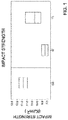
- Table 3 shows the impact of the additives on the polycarbonate compositions prepared according to melt polymerization methods and including either PETS or GTS as the mold release agent test at complete rupture (type C).
- Table 3 Impact performance of interfacial polycarbonates and melt polycarbonates with differeing mold release agent.
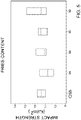
- FIG. 1 provides a graphical interpretation of the impact performance data obtained and presented in Table 3.
- Samples 1A prepared with GTS as the release agent exhibited better impact strength behavior when compared with Samples 1B having PETS. Furthermore, the Samples 1A exhibited strength values comparable to those of the interfacial polycarbonate compositions samples CS1.
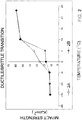
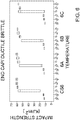
- FIG. 2 provides a diagram of the ductile/brittle transition data of samples having the same concentration of release agent. As shown, the values are comparable, but sample 2A (GTS) exhibited higher values at from -5 °C to 10 °C. Ductile/brittle transition was measured according to ISO 180 at 3 mm.
- Spiral Flow performance of the compositions was also evaluated according to a standard "spiral flow procedure" at varying injection pressures.
- the test was performed on an injection moulding machine under the conditions specified in Table 4 using a mold having an open-ended cavity cut into one half. This is a method of evaluating the molding flow of a resin to injection or transfer molding in which the melt is injected into a spiral runner of constant trapezoidal cross section with numbered and subdivided centimeters (or inches) marked along the runner. The mold is filled from a sprue at the center of the spiral and pressure is maintained until flow stops, the number just aft of the molded-spiral tip giving the flow distance.
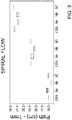
- Example 3 A comparative sample prepared according to interfacial polymerization (comparative sample 3, CS3) and melt polymerization samples at 3000 ppm PETS (sample 3A), 1300 ppm GTS (sample 3B), and at 300 ppm GTS (sample 3C) were evaluated for flow at varying injection pressures.
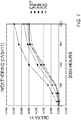
- FIG. 3 presents that GTS melt polymerization polycarbonate compositions achieved the flow behavior of interfacial polycarbonate compositions.
- samples 3A - 3C exhibited a spiral flow comparable to that of CS3. Table 4.
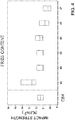
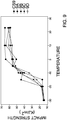
- FIG. 4 presents the impact performance behavior of samples having varying levels of fries concentration (800 ppm and 1100 ppm) of the polycarbonate composition viscosity range provided herein (18 cm 3 /10 min. to 22 cm 3 /10 min.). All samples 4A through 4F included GTS at 400 ppm and UV absorber Tin360 at 1700 ppm. Samples 4A, 4B, and 4C corresponded to melt polymerization polycarbonate compositions having a fries concentration of 800 ppm and viscosities of 18 cm 3 /10 min., 20 cm 3 /10 min., and 22 cm 3 /10 min., respectively.
- Samples 4D, 4E, and 4F corresponded to melt polymerization PC compositions having a fries concentration of 1100 ppm and viscosities of 18, 20, and 22, respectively.
- samples 4A, 4B, and 4C at a lower fries concentration level (800 ppm) exhibited an improvement in impact strength when compared to samples prepared according to an interfacial polymerization method, comparative sample CS4, and 20 cm 3 /10 min. viscosity.
- the impact strength values for the GTS melt polymerization samples were comparable to those of the interfacial polymerization samples, but did not improve upon the impact strength performance.
- FIG. 5 presents impact performance behavior of GTS (400 ppm) melt polymerization samples at a range of fries concentrations from 250 ppm to 1100 ppm.
- the melt polymerization samples 5A through 5D had a flow rate of 20 cm 3 /10 min. and the comparative interfacial polymerization samples CS5 had a flow rate of 19 cm 3 /10 min.
- Samples 5A, 5B, 5C, and 5D had fries concentrations at 1100 ppm, 800 ppm, 350 ppm, and 250 ppm, respectively.
- the GTS melt polymerization samples 5A having a fries concentration at 1100 ppm appear to have a slightly lower range for impact strength behavior with values at from about 10 KJ/m 2 to about 11.5 KJ/m 2
- the p-cumylphenol (PCP) to phenol ratio may be very high. Higher amounts of BPA or PCP in the polycarbonate compositions may improve impact performance because of the increase of free volume in the polycarbonate composition.
- a GTS melt polymerization polycarbonate having an EC% at less than 81% phenol (samples 6A and 6B) exhibited comparable impact behavior to an interfacial polymerization polycarbonate composition (CS6) when observing ductile/transition behavior from -30 °C to ambient temperatures (about 23 °C).
- Outdoor weathering resistance of the melt polycarbonate compositions was also evaluated at varying type and concentrations of ultraviolet additives.
- An accelerated outdoor weathering test according to ISO 4892 was performed on comparative samples of interfacial polymerization (CS7) polycarbonate samples of melt polymerization polycarbonate compositions at varying levels of UV5411; sample 7A at 400 ppm UV5411; sample 7B, 1500 ppm UV5411; sample 7C, 2000 ppm UV5411; and 7D, 2700 ppm UV5411. Samples were mounted in the weathering apparatus and subjected to a cycle of exposure to intense ultraviolet radiation followed by moisture exposure according to the procedure ISO 4892 - Day Light Test.
- CS7 interfacial polymerization
- melt polymerization samples 7B to 7D exhibited accelerated weathering behavior comparable to that exhibited by CS7.
- melt polymerization compositions having a UV5411 concentration greater than about 2000 ppm may exhibit comparable weathering behavior to a similar polycarbonate prepared according to an interfacial polymerization method.
- Table 5 provides the weathering test parameters for the two phases (with and without rain) observed. Table 5. Accelerated outdoor weathering test parameters according to ISO 4892.
- FIG. 8 provides accelerated weathering test for a comparative interfacial polymerization sample (CS8) and for melt polymerization polycarbonate samples at varying levels Tin360 (a UV5411 dimer); sample 8A at 0 ppm Tin360; sample 8B, 400 ppm Tin360; sample 8C, 800 ppm Tin360; and sample 8D, 1500 ppm Tin360. Of samples 8A through 8D, sample 8D exhibited an accelerated weathering profile closest to that of CS8.
- Tin360 a UV5411 dimer
- melt polymerization samples 9A to 9D were formulated at varying fries concentrations and having GTS at 400 ppm and UV5411 at 2000 ppm and the ductile/brittle transition temperature under the ISO 180 norm (norm accounts for the energy used to heat the sample) at 3 mm and compared to the current interfacial polymerization polycarbonate composition (CS9). No significant differences were observed between the melt samples 9A to 9D and CS9.
- melt polymerization polycarbonate compositions having similar performance profiles to an interfacial polymerization polycarbonate composition were achieved where PETS was replaced with GTS, the fries concentration level was maintained below 800 ppm, and the EC% held below 81% for the viscosity range 18 cm 3 /10 min. to 22 cm 3 /10 min.
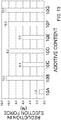
- FIG. 10 provides a diagram showing the reduction of ejection force as a measure of the equivalents of a given additive component (PETS or GTS).
- Sample 10A having only 0.1 equivalents PETS exhibited the lowest reduction in ejection force at 1.5 Newton (N).
- samples containing GTS (10C, 10D, 10E, and 10F) showed significantly higher values for the reduction in ejection force.
Landscapes
- Chemical & Material Sciences (AREA)
- Health & Medical Sciences (AREA)
- Chemical Kinetics & Catalysis (AREA)
- Medicinal Chemistry (AREA)
- Polymers & Plastics (AREA)
- Organic Chemistry (AREA)
- Engineering & Computer Science (AREA)
- General Engineering & Computer Science (AREA)
- Compositions Of Macromolecular Compounds (AREA)
- Polyesters Or Polycarbonates (AREA)
Claims (15)
- Ein Artikel, gebildet aus einer Zusammensetzung, die Folgendes umfasst:ein von Diphenylcarbonat abgeleitetes Schmelzpolycarbonatharz; undGlycerintristearat, das mit dem Schmelzpolycarbonatharz gemischt ist,wobei die Zusammensetzung eine Schmelzvolumenrate gemäß ISO 1133 bei 1,2 kg/300 °C von 18 cm3 /10 Minuten bis 22 cm3 /10 Minuten aufweist,wobei die Zusammensetzung eine Fries-Konzentration, gemessen mittels der KOH-Methanolyse der Polycarbonat-Zusammensetzung, von weniger als 800 ppm aufweist,wobei der aus der Zusammensetzung geformte Artikel eine Izod-Schlagzähigkeit nach ISO 180 bei Raumtemperatur und einer Dicke von 4 mm von 9,5 KJ/m bis 13 KJ/m aufweist undwobei der aus der Zusammensetzung gebildete Artikel bei der Prüfung gemäß ISO 4892 Bewitterungswerte von weniger als 12 Delta Vergilbungsindex für eine Expositionszeit von 2000 Stunden aufweist.
- Artikel nach Anspruch 1, wobei der Artikel eine selbstbewegende Beleuchtungslinse umfasst.
- Artikel nach einem der Ansprüche 1 oder 2, wobei die Zusammensetzung ferner ein UV-Schutzadditiv umfasst, das 2-(2-Hydroxy-5-t-octylphenyl)benzotriazol umfasst.
- Artikel nach einem der Ansprüche 1-3, wobei die Zusammensetzung ferner Tris(2,4-di-tert-butylphenyl)phospit umfasst.
- Artikel nach einem der Ansprüche 1-4, wobei die Zusammensetzung ferner Octadecyl-3-(3,5-di-tert-butyl-4-hydroxyphenyl)propionat umfasst.
- Artikel nach einem der Ansprüche 1-5, wobei die Zusammensetzung ferner Tetrabutylphosphomium-perfluorbutylsulfonat umfasst.
- Artikel nach einem der Ansprüche 1-6, wobei die Zusammensetzung ferner ein Abschreckmittel umfasst, das n-Butyl-p-toluolsulfonat umfasst.
- Verfahren, umfassend:Bilden eines Polycarbonatharzes mittels eines Schmelzumesterungsprozesses;Mischen von Glycerintristearat mit dem Polycarbonatharz, um eine Zusammensetzung zu bilden;und Bilden eines Artikels aus der Zusammensetzung,wobei die Zusammensetzung eine Schmelzvolumenrate gemäß ISO 1133 bei 1,2 kg/300 °C von 18 cm3 /10 Minuten bis 22 cm3 /10 Minuten aufweist,wobei die Zusammensetzung eine Fries-Konzentration, gemessen mittels der KOH-Methanolyse der Polycarbonat-Zusammensetzung, von weniger als 800 ppm aufweist,wobei der aus der Zusammensetzung geformte Artikel eine Izod-Schlagzähigkeit nach ISO 180 bei Raumtemperatur und einer Dicke von 4 mm von 9,5 KJ/m bis 13 KJ/m aufweist undwobei der aus der Zusammensetzung gebildete Artikel bei der Prüfung gemäß ISO 4892 Bewitterungswerte von weniger als 12 Delta Vergilbungsindex für eine Expositionszeit von 2000 Stunden aufweist.
- Verfahren nach Anspruch 8, wobei der Artikel eine selbstbewegende Beleuchtungslinse umfasst.
- Verfahren nach einem der Ansprüche 8-9, das ferner das Mischen eines UV-Schutzadditivs mit mindestens dem Polycarbonatharz umfasst, um die Zusammensetzung bilden, wobei das UV-Schutzadditiv 2-(2 Hydroxy-5-t-octylphenyl)benzotriazol umfasst.
- Verfahren nach einem der Ansprüche 8-10, das ferner das Mischen von Tris(2,4-di-tertbutylphenyl)phosphit mit mindestens dem Polycarbonatharz umfasst, um die Zusammensetzung bilden.
- Verfahren nach einem der Ansprüche 8-11, das ferner das Mischen von Octacedyl-3-(3,5-di-tert-butyl-4-hydroxyphenyl)propionat mit mindestens dem Polycarbonatharz umfasst, um die Zusammensetzung zu bilden.
- Verfahren nach einem der Ansprüche 8-12, das ferner das Mischen von Tetrabutylphosphonium-perfluorbutylsulfonat mit mindestens dem Polycarbonatharz umfasst, um die Zusammensetzung zu bilden.
- Verfahren nach einem der Ansprüche 8-13, das ferner das Mischen von einem Abschreckmittel mit mindestens dem Polycarbonatharz umfasst, um die Zusammensetzung zu bilden.
- Verfahren nach Anspruch 14, wobei das Abschreckmittel n-Butyl-p-toluolsulfonat umfasst.
Applications Claiming Priority (2)
| Application Number | Priority Date | Filing Date | Title |
|---|---|---|---|
| EP15382564 | 2015-11-13 | ||
| PCT/IB2016/056783 WO2017081640A1 (en) | 2015-11-13 | 2016-11-10 | Impact performance modified high transparent melt polymerized polycarbonate |
Publications (2)
| Publication Number | Publication Date |
|---|---|
| EP3374425A1 EP3374425A1 (de) | 2018-09-19 |
| EP3374425B1 true EP3374425B1 (de) | 2019-12-25 |
Family
ID=54754573
Family Applications (1)
| Application Number | Title | Priority Date | Filing Date |
|---|---|---|---|
| EP16802141.8A Active EP3374425B1 (de) | 2015-11-13 | 2016-11-10 | Schmelzpolymerisiertes modifiziertes hochtransparentes polycarbonate mit guter schlagzähigkeit |
Country Status (5)
| Country | Link |
|---|---|
| US (1) | US10336886B2 (de) |
| EP (1) | EP3374425B1 (de) |
| KR (1) | KR101937742B1 (de) |
| CN (1) | CN108368296B (de) |
| WO (1) | WO2017081640A1 (de) |
Families Citing this family (3)
| Publication number | Priority date | Publication date | Assignee | Title |
|---|---|---|---|---|
| WO2023233041A1 (en) * | 2022-06-03 | 2023-12-07 | Sabic Global Technologies B.V. | Method for the manufacture of polycarbonate |
| EP4780578A1 (de) | 2023-09-18 | 2026-07-29 | EPC Engineering & Technologies GmbH | Reaktoren und deren spezialdesign für eine hochflexible und robuste polycarbonatanlage, insbesondere mittels vorumesterungstechnologie |
| US20260193411A1 (en) | 2023-09-18 | 2026-07-09 | EPC Engineering & Technologies GmbH | Process and apparatus for increasing the flexibility and robustness of a polycarbonate plant by means of a pre-transesterificationreaction technology |
Family Cites Families (20)
| Publication number | Priority date | Publication date | Assignee | Title |
|---|---|---|---|---|
| US3635895A (en) | 1965-09-01 | 1972-01-18 | Gen Electric | Process for preparing thermoplastic polycarbonates |
| US4001184A (en) | 1975-03-31 | 1977-01-04 | General Electric Company | Process for preparing a branched polycarbonate |
| US4217438A (en) | 1978-12-15 | 1980-08-12 | General Electric Company | Polycarbonate transesterification process |
| ES2107999T3 (es) | 1988-07-11 | 1997-12-16 | Gen Electric | Procedimiento para preparar policarbonatos. |
| US5959065A (en) | 1988-08-05 | 1999-09-28 | General Electric Co. | Composition and article |
| EP0360578B1 (de) | 1988-09-22 | 1998-08-05 | Ge Plastics Japan Ltd. | Verfahren zur Herstellung von Polycarbonaten |
| US5504177A (en) | 1995-03-02 | 1996-04-02 | General Electric Company | Method for preparation of block copolysiloxanecarbonates |
| US6066700A (en) | 1997-03-12 | 2000-05-23 | Bayer Aktiengesellschaft | Process for the production of polysiloxane/polycarbonate block co-condensation products |
| US6893147B2 (en) | 2002-04-05 | 2005-05-17 | General Electric Company | Lamp lens or bezel with visual effect |
| US7365149B2 (en) | 2005-12-12 | 2008-04-29 | Hans-Peter Brack | Equipment cleaning in the manufacture of polycarbonates |
| US7619053B2 (en) | 2007-09-28 | 2009-11-17 | Sabic Innovative Plastics Ip B.V. | Monomer solution for producing polycarbonate |
| US7666972B2 (en) | 2007-10-18 | 2010-02-23 | SABIC Innovative Plastics IP B., V. | Isosorbide-based polycarbonates, method of making, and articles formed therefrom |
| US7671165B2 (en) | 2008-05-16 | 2010-03-02 | Sabic Innovative Plastics Ip B.V. | Method of forming polycarbonate |
| US7547799B1 (en) | 2008-06-20 | 2009-06-16 | Sabic Innovative Plastics Ip B.V. | Method for producing phenolic compound |
| CN104684983B (zh) * | 2012-09-28 | 2017-02-22 | 沙特基础全球技术有限公司 | 改善的脱模聚碳酸酯组合物 |
| US20140094545A1 (en) * | 2012-09-28 | 2014-04-03 | Sabic Innovative Plastics Ip B.V. | Enhanced polycarbonate extrusion grades |
| WO2014049571A1 (en) | 2012-09-28 | 2014-04-03 | Sabic Innovative Plastics Ip B.V. | Polycarbonate composition to produce optical quality products with high quality and good processability |
| EP2937371A1 (de) * | 2014-04-25 | 2015-10-28 | SABIC Global Technologies B.V. | Verfahren zur Schmelzpolymerisation von Polycarbonat und daraus abgeleitete Polycarbonate |
| CN105873981A (zh) * | 2013-10-28 | 2016-08-17 | 沙特基础工业全球技术有限公司 | 在熔融聚合过程中添加催化剂的方法及由其聚合的聚碳酸酯 |
| WO2015132740A1 (en) * | 2014-03-06 | 2015-09-11 | Sabic Global Technologies B.V. | Enhanced polycarbonate extrusion grades |
-
2016
- 2016-11-10 EP EP16802141.8A patent/EP3374425B1/de active Active
- 2016-11-10 KR KR1020187016485A patent/KR101937742B1/ko active Active
- 2016-11-10 US US15/775,233 patent/US10336886B2/en active Active
- 2016-11-10 WO PCT/IB2016/056783 patent/WO2017081640A1/en not_active Ceased
- 2016-11-10 CN CN201680072390.0A patent/CN108368296B/zh active Active
Non-Patent Citations (1)
| Title |
|---|
| None * |
Also Published As
| Publication number | Publication date |
|---|---|
| CN108368296B (zh) | 2020-07-03 |
| WO2017081640A1 (en) | 2017-05-18 |
| US10336886B2 (en) | 2019-07-02 |
| EP3374425A1 (de) | 2018-09-19 |
| CN108368296A (zh) | 2018-08-03 |
| KR20180075672A (ko) | 2018-07-04 |
| KR101937742B1 (ko) | 2019-04-11 |
| US20180371208A1 (en) | 2018-12-27 |
Similar Documents
| Publication | Publication Date | Title |
|---|---|---|
| KR101950532B1 (ko) | 고유동성 폴리카보네이트 공중합체, 고분자량화된 방향족 폴리카보네이트 수지의 제조 방법, 및 방향족 폴리카보네이트 화합물 | |
| CN101641392A (zh) | 聚碳酸酯及其制备方法 | |
| EP2554598A1 (de) | Polycarbonatharzzusammensetzung und formartikel | |
| EP3420030B1 (de) | Schlagzähmodifiziertes schmelzpolycarbonat | |
| KR20140024282A (ko) | 원하는 분기화도를 갖는 분기화 방향족 폴리카보네이트 수지의 제조 방법 | |
| CN104603643A (zh) | 制备方法及包含耐黄变聚碳酸酯组合物的制品 | |
| EP2921515A1 (de) | Herstellungsverfahren für aromatisches polycarbonatharz mit erhöhtem molekulargewicht | |
| WO2015011994A1 (ja) | 薄肉光学部品用ポリカーボネート樹脂組成物および薄肉光学部品 | |
| US10336886B2 (en) | Impact performance modified high transparent melt polymerized polycarbonate | |
| EP2921517B1 (de) | Herstellungsverfahren für aromatisches polycarbonatharz mit erhöhtem molekulargewicht | |
| JP6131961B2 (ja) | 芳香族ポリカーボネート樹脂組成物 | |
| EP2027178B1 (de) | Verfahren zur herstellung eines polycarbonats in anwesenheit von oxalsäure | |
| US20180355124A1 (en) | Flame retardant melt polycarbonate grades on line compounding | |
| JPH10219090A (ja) | ポリカーボネート樹脂組成物 |
Legal Events
| Date | Code | Title | Description |
|---|---|---|---|
| STAA | Information on the status of an ep patent application or granted ep patent |
Free format text: STATUS: UNKNOWN |
|
| STAA | Information on the status of an ep patent application or granted ep patent |
Free format text: STATUS: THE INTERNATIONAL PUBLICATION HAS BEEN MADE |
|
| PUAI | Public reference made under article 153(3) epc to a published international application that has entered the european phase |
Free format text: ORIGINAL CODE: 0009012 |
|
| STAA | Information on the status of an ep patent application or granted ep patent |
Free format text: STATUS: REQUEST FOR EXAMINATION WAS MADE |
|
| 17P | Request for examination filed |
Effective date: 20180524 |
|
| AK | Designated contracting states |
Kind code of ref document: A1 Designated state(s): AL AT BE BG CH CY CZ DE DK EE ES FI FR GB GR HR HU IE IS IT LI LT LU LV MC MK MT NL NO PL PT RO RS SE SI SK SM TR |
|
| AX | Request for extension of the european patent |
Extension state: BA ME |
|
| DAV | Request for validation of the european patent (deleted) | ||
| DAX | Request for extension of the european patent (deleted) | ||
| REG | Reference to a national code |
Ref country code: DE Ref legal event code: R079 Ref document number: 602016027013 Country of ref document: DE Free format text: PREVIOUS MAIN CLASS: C08K0005103000 Ipc: C08G0064040000 |
|
| RIC1 | Information provided on ipc code assigned before grant |
Ipc: G02B 1/04 20060101ALI20190509BHEP Ipc: C08K 5/526 20060101ALI20190509BHEP Ipc: F21V 3/06 20180101ALI20190509BHEP Ipc: C08K 5/42 20060101ALI20190509BHEP Ipc: C08K 5/103 20060101ALI20190509BHEP Ipc: C08G 64/04 20060101AFI20190509BHEP Ipc: C08K 5/50 20060101ALI20190509BHEP Ipc: C08K 5/3475 20060101ALI20190509BHEP Ipc: C08K 5/134 20060101ALI20190509BHEP Ipc: F21V 5/00 20180101ALI20190509BHEP |
|
| GRAP | Despatch of communication of intention to grant a patent |
Free format text: ORIGINAL CODE: EPIDOSNIGR1 |
|
| STAA | Information on the status of an ep patent application or granted ep patent |
Free format text: STATUS: GRANT OF PATENT IS INTENDED |
|
| INTG | Intention to grant announced |
Effective date: 20190705 |
|
| GRAS | Grant fee paid |
Free format text: ORIGINAL CODE: EPIDOSNIGR3 |
|
| GRAA | (expected) grant |
Free format text: ORIGINAL CODE: 0009210 |
|
| STAA | Information on the status of an ep patent application or granted ep patent |
Free format text: STATUS: THE PATENT HAS BEEN GRANTED |
|
| AK | Designated contracting states |
Kind code of ref document: B1 Designated state(s): AL AT BE BG CH CY CZ DE DK EE ES FI FR GB GR HR HU IE IS IT LI LT LU LV MC MK MT NL NO PL PT RO RS SE SI SK SM TR |
|
| REG | Reference to a national code |
Ref country code: GB Ref legal event code: FG4D |
|
| REG | Reference to a national code |
Ref country code: CH Ref legal event code: EP |
|
| REG | Reference to a national code |
Ref country code: AT Ref legal event code: REF Ref document number: 1217056 Country of ref document: AT Kind code of ref document: T Effective date: 20200115 |
|
| REG | Reference to a national code |
Ref country code: DE Ref legal event code: R096 Ref document number: 602016027013 Country of ref document: DE |
|
| REG | Reference to a national code |
Ref country code: IE Ref legal event code: FG4D |
|
| REG | Reference to a national code |
Ref country code: NL Ref legal event code: MP Effective date: 20191225 |
|
| PG25 | Lapsed in a contracting state [announced via postgrant information from national office to epo] |
Ref country code: FI Free format text: LAPSE BECAUSE OF FAILURE TO SUBMIT A TRANSLATION OF THE DESCRIPTION OR TO PAY THE FEE WITHIN THE PRESCRIBED TIME-LIMIT Effective date: 20191225 Ref country code: BG Free format text: LAPSE BECAUSE OF FAILURE TO SUBMIT A TRANSLATION OF THE DESCRIPTION OR TO PAY THE FEE WITHIN THE PRESCRIBED TIME-LIMIT Effective date: 20200325 Ref country code: LT Free format text: LAPSE BECAUSE OF FAILURE TO SUBMIT A TRANSLATION OF THE DESCRIPTION OR TO PAY THE FEE WITHIN THE PRESCRIBED TIME-LIMIT Effective date: 20191225 Ref country code: NO Free format text: LAPSE BECAUSE OF FAILURE TO SUBMIT A TRANSLATION OF THE DESCRIPTION OR TO PAY THE FEE WITHIN THE PRESCRIBED TIME-LIMIT Effective date: 20200325 Ref country code: GR Free format text: LAPSE BECAUSE OF FAILURE TO SUBMIT A TRANSLATION OF THE DESCRIPTION OR TO PAY THE FEE WITHIN THE PRESCRIBED TIME-LIMIT Effective date: 20200326 Ref country code: LV Free format text: LAPSE BECAUSE OF FAILURE TO SUBMIT A TRANSLATION OF THE DESCRIPTION OR TO PAY THE FEE WITHIN THE PRESCRIBED TIME-LIMIT Effective date: 20191225 Ref country code: SE Free format text: LAPSE BECAUSE OF FAILURE TO SUBMIT A TRANSLATION OF THE DESCRIPTION OR TO PAY THE FEE WITHIN THE PRESCRIBED TIME-LIMIT Effective date: 20191225 |
|
| REG | Reference to a national code |
Ref country code: LT Ref legal event code: MG4D |
|
| PG25 | Lapsed in a contracting state [announced via postgrant information from national office to epo] |
Ref country code: RS Free format text: LAPSE BECAUSE OF FAILURE TO SUBMIT A TRANSLATION OF THE DESCRIPTION OR TO PAY THE FEE WITHIN THE PRESCRIBED TIME-LIMIT Effective date: 20191225 Ref country code: HR Free format text: LAPSE BECAUSE OF FAILURE TO SUBMIT A TRANSLATION OF THE DESCRIPTION OR TO PAY THE FEE WITHIN THE PRESCRIBED TIME-LIMIT Effective date: 20191225 |
|
| PG25 | Lapsed in a contracting state [announced via postgrant information from national office to epo] |
Ref country code: AL Free format text: LAPSE BECAUSE OF FAILURE TO SUBMIT A TRANSLATION OF THE DESCRIPTION OR TO PAY THE FEE WITHIN THE PRESCRIBED TIME-LIMIT Effective date: 20191225 |
|
| PG25 | Lapsed in a contracting state [announced via postgrant information from national office to epo] |
Ref country code: EE Free format text: LAPSE BECAUSE OF FAILURE TO SUBMIT A TRANSLATION OF THE DESCRIPTION OR TO PAY THE FEE WITHIN THE PRESCRIBED TIME-LIMIT Effective date: 20191225 Ref country code: RO Free format text: LAPSE BECAUSE OF FAILURE TO SUBMIT A TRANSLATION OF THE DESCRIPTION OR TO PAY THE FEE WITHIN THE PRESCRIBED TIME-LIMIT Effective date: 20191225 Ref country code: CZ Free format text: LAPSE BECAUSE OF FAILURE TO SUBMIT A TRANSLATION OF THE DESCRIPTION OR TO PAY THE FEE WITHIN THE PRESCRIBED TIME-LIMIT Effective date: 20191225 Ref country code: PT Free format text: LAPSE BECAUSE OF FAILURE TO SUBMIT A TRANSLATION OF THE DESCRIPTION OR TO PAY THE FEE WITHIN THE PRESCRIBED TIME-LIMIT Effective date: 20200520 Ref country code: NL Free format text: LAPSE BECAUSE OF FAILURE TO SUBMIT A TRANSLATION OF THE DESCRIPTION OR TO PAY THE FEE WITHIN THE PRESCRIBED TIME-LIMIT Effective date: 20191225 |
|
| PG25 | Lapsed in a contracting state [announced via postgrant information from national office to epo] |
Ref country code: SM Free format text: LAPSE BECAUSE OF FAILURE TO SUBMIT A TRANSLATION OF THE DESCRIPTION OR TO PAY THE FEE WITHIN THE PRESCRIBED TIME-LIMIT Effective date: 20191225 Ref country code: IS Free format text: LAPSE BECAUSE OF FAILURE TO SUBMIT A TRANSLATION OF THE DESCRIPTION OR TO PAY THE FEE WITHIN THE PRESCRIBED TIME-LIMIT Effective date: 20200425 Ref country code: SK Free format text: LAPSE BECAUSE OF FAILURE TO SUBMIT A TRANSLATION OF THE DESCRIPTION OR TO PAY THE FEE WITHIN THE PRESCRIBED TIME-LIMIT Effective date: 20191225 |
|
| REG | Reference to a national code |
Ref country code: DE Ref legal event code: R097 Ref document number: 602016027013 Country of ref document: DE |
|
| PG25 | Lapsed in a contracting state [announced via postgrant information from national office to epo] |
Ref country code: DK Free format text: LAPSE BECAUSE OF FAILURE TO SUBMIT A TRANSLATION OF THE DESCRIPTION OR TO PAY THE FEE WITHIN THE PRESCRIBED TIME-LIMIT Effective date: 20191225 Ref country code: ES Free format text: LAPSE BECAUSE OF FAILURE TO SUBMIT A TRANSLATION OF THE DESCRIPTION OR TO PAY THE FEE WITHIN THE PRESCRIBED TIME-LIMIT Effective date: 20191225 |
|
| PLBE | No opposition filed within time limit |
Free format text: ORIGINAL CODE: 0009261 |
|
| STAA | Information on the status of an ep patent application or granted ep patent |
Free format text: STATUS: NO OPPOSITION FILED WITHIN TIME LIMIT |
|
| REG | Reference to a national code |
Ref country code: AT Ref legal event code: MK05 Ref document number: 1217056 Country of ref document: AT Kind code of ref document: T Effective date: 20191225 |
|
| PG25 | Lapsed in a contracting state [announced via postgrant information from national office to epo] |
Ref country code: SI Free format text: LAPSE BECAUSE OF FAILURE TO SUBMIT A TRANSLATION OF THE DESCRIPTION OR TO PAY THE FEE WITHIN THE PRESCRIBED TIME-LIMIT Effective date: 20191225 |
|
| 26N | No opposition filed |
Effective date: 20200928 |
|
| PG25 | Lapsed in a contracting state [announced via postgrant information from national office to epo] |
Ref country code: IT Free format text: LAPSE BECAUSE OF FAILURE TO SUBMIT A TRANSLATION OF THE DESCRIPTION OR TO PAY THE FEE WITHIN THE PRESCRIBED TIME-LIMIT Effective date: 20191225 Ref country code: AT Free format text: LAPSE BECAUSE OF FAILURE TO SUBMIT A TRANSLATION OF THE DESCRIPTION OR TO PAY THE FEE WITHIN THE PRESCRIBED TIME-LIMIT Effective date: 20191225 |
|
| PG25 | Lapsed in a contracting state [announced via postgrant information from national office to epo] |
Ref country code: PL Free format text: LAPSE BECAUSE OF FAILURE TO SUBMIT A TRANSLATION OF THE DESCRIPTION OR TO PAY THE FEE WITHIN THE PRESCRIBED TIME-LIMIT Effective date: 20191225 |
|
| PG25 | Lapsed in a contracting state [announced via postgrant information from national office to epo] |
Ref country code: MC Free format text: LAPSE BECAUSE OF FAILURE TO SUBMIT A TRANSLATION OF THE DESCRIPTION OR TO PAY THE FEE WITHIN THE PRESCRIBED TIME-LIMIT Effective date: 20191225 |
|
| REG | Reference to a national code |
Ref country code: CH Ref legal event code: PL |
|
| PG25 | Lapsed in a contracting state [announced via postgrant information from national office to epo] |
Ref country code: LU Free format text: LAPSE BECAUSE OF NON-PAYMENT OF DUE FEES Effective date: 20201110 |
|
| REG | Reference to a national code |
Ref country code: BE Ref legal event code: MM Effective date: 20201130 |
|
| PG25 | Lapsed in a contracting state [announced via postgrant information from national office to epo] |
Ref country code: LI Free format text: LAPSE BECAUSE OF NON-PAYMENT OF DUE FEES Effective date: 20201130 Ref country code: CH Free format text: LAPSE BECAUSE OF NON-PAYMENT OF DUE FEES Effective date: 20201130 |
|
| PG25 | Lapsed in a contracting state [announced via postgrant information from national office to epo] |
Ref country code: IE Free format text: LAPSE BECAUSE OF NON-PAYMENT OF DUE FEES Effective date: 20201110 |
|
| PG25 | Lapsed in a contracting state [announced via postgrant information from national office to epo] |
Ref country code: TR Free format text: LAPSE BECAUSE OF FAILURE TO SUBMIT A TRANSLATION OF THE DESCRIPTION OR TO PAY THE FEE WITHIN THE PRESCRIBED TIME-LIMIT Effective date: 20191225 Ref country code: MT Free format text: LAPSE BECAUSE OF FAILURE TO SUBMIT A TRANSLATION OF THE DESCRIPTION OR TO PAY THE FEE WITHIN THE PRESCRIBED TIME-LIMIT Effective date: 20191225 Ref country code: CY Free format text: LAPSE BECAUSE OF FAILURE TO SUBMIT A TRANSLATION OF THE DESCRIPTION OR TO PAY THE FEE WITHIN THE PRESCRIBED TIME-LIMIT Effective date: 20191225 |
|
| PG25 | Lapsed in a contracting state [announced via postgrant information from national office to epo] |
Ref country code: MK Free format text: LAPSE BECAUSE OF FAILURE TO SUBMIT A TRANSLATION OF THE DESCRIPTION OR TO PAY THE FEE WITHIN THE PRESCRIBED TIME-LIMIT Effective date: 20191225 |
|
| PG25 | Lapsed in a contracting state [announced via postgrant information from national office to epo] |
Ref country code: BE Free format text: LAPSE BECAUSE OF NON-PAYMENT OF DUE FEES Effective date: 20201130 |
|
| P01 | Opt-out of the competence of the unified patent court (upc) registered |
Effective date: 20230529 |
|
| PGFP | Annual fee paid to national office [announced via postgrant information from national office to epo] |
Ref country code: DE Payment date: 20251128 Year of fee payment: 10 |
|
| PGFP | Annual fee paid to national office [announced via postgrant information from national office to epo] |
Ref country code: GB Payment date: 20251127 Year of fee payment: 10 |
|
| PGFP | Annual fee paid to national office [announced via postgrant information from national office to epo] |
Ref country code: FR Payment date: 20251125 Year of fee payment: 10 |