EP3374324B1 - Procede de traitement de materiaux vitreux par voie de polarisation thermique - Google Patents
Procede de traitement de materiaux vitreux par voie de polarisation thermique Download PDFInfo
- Publication number
- EP3374324B1 EP3374324B1 EP16806259.4A EP16806259A EP3374324B1 EP 3374324 B1 EP3374324 B1 EP 3374324B1 EP 16806259 A EP16806259 A EP 16806259A EP 3374324 B1 EP3374324 B1 EP 3374324B1
- Authority
- EP
- European Patent Office
- Prior art keywords
- glass
- nitrogen
- atmosphere
- treatment
- mass
- Prior art date
- Legal status (The legal status is an assumption and is not a legal conclusion. Google has not performed a legal analysis and makes no representation as to the accuracy of the status listed.)
- Active
Links
- 238000000034 method Methods 0.000 title claims description 58
- 239000000463 material Substances 0.000 title claims description 55
- 239000011521 glass Substances 0.000 claims description 133
- IJGRMHOSHXDMSA-UHFFFAOYSA-N Atomic nitrogen Chemical compound N#N IJGRMHOSHXDMSA-UHFFFAOYSA-N 0.000 claims description 83
- 238000011282 treatment Methods 0.000 claims description 71
- 229910052757 nitrogen Inorganic materials 0.000 claims description 34
- 239000012298 atmosphere Substances 0.000 claims description 27
- 239000000203 mixture Substances 0.000 claims description 23
- VYPSYNLAJGMNEJ-UHFFFAOYSA-N Silicium dioxide Chemical compound O=[Si]=O VYPSYNLAJGMNEJ-UHFFFAOYSA-N 0.000 claims description 22
- 239000007789 gas Substances 0.000 claims description 20
- 238000004320 controlled atmosphere Methods 0.000 claims description 18
- 229910052786 argon Inorganic materials 0.000 claims description 13
- BPQQTUXANYXVAA-UHFFFAOYSA-N Orthosilicate Chemical compound [O-][Si]([O-])([O-])[O-] BPQQTUXANYXVAA-UHFFFAOYSA-N 0.000 claims description 11
- 239000000377 silicon dioxide Substances 0.000 claims description 11
- 230000005684 electric field Effects 0.000 claims description 9
- GWEVSGVZZGPLCZ-UHFFFAOYSA-N Titan oxide Chemical compound O=[Ti]=O GWEVSGVZZGPLCZ-UHFFFAOYSA-N 0.000 claims description 8
- MCMNRKCIXSYSNV-UHFFFAOYSA-N Zirconium dioxide Chemical compound O=[Zr]=O MCMNRKCIXSYSNV-UHFFFAOYSA-N 0.000 claims description 8
- 229910000287 alkaline earth metal oxide Inorganic materials 0.000 claims description 8
- PNEYBMLMFCGWSK-UHFFFAOYSA-N aluminium oxide Inorganic materials [O-2].[O-2].[O-2].[Al+3].[Al+3] PNEYBMLMFCGWSK-UHFFFAOYSA-N 0.000 claims description 8
- 229910052593 corundum Inorganic materials 0.000 claims description 8
- 229910001845 yogo sapphire Inorganic materials 0.000 claims description 8
- 239000003513 alkali Substances 0.000 claims description 7
- KKCBUQHMOMHUOY-UHFFFAOYSA-N Na2O Inorganic materials [O-2].[Na+].[Na+] KKCBUQHMOMHUOY-UHFFFAOYSA-N 0.000 claims description 6
- 238000005299 abrasion Methods 0.000 claims description 6
- 229910052681 coesite Inorganic materials 0.000 claims description 6
- 229910052906 cristobalite Inorganic materials 0.000 claims description 6
- 229910052682 stishovite Inorganic materials 0.000 claims description 6
- 229910052905 tridymite Inorganic materials 0.000 claims description 6
- 238000010348 incorporation Methods 0.000 claims description 5
- 238000004519 manufacturing process Methods 0.000 claims description 5
- FUJCRWPEOMXPAD-UHFFFAOYSA-N Li2O Inorganic materials [Li+].[Li+].[O-2] FUJCRWPEOMXPAD-UHFFFAOYSA-N 0.000 claims description 4
- BERDEBHAJNAUOM-UHFFFAOYSA-N copper(I) oxide Inorganic materials [Cu]O[Cu] BERDEBHAJNAUOM-UHFFFAOYSA-N 0.000 claims description 4
- KRFJLUBVMFXRPN-UHFFFAOYSA-N cuprous oxide Chemical compound [O-2].[Cu+].[Cu+] KRFJLUBVMFXRPN-UHFFFAOYSA-N 0.000 claims description 4
- XUCJHNOBJLKZNU-UHFFFAOYSA-M dilithium;hydroxide Chemical compound [Li+].[Li+].[OH-] XUCJHNOBJLKZNU-UHFFFAOYSA-M 0.000 claims description 4
- DDYSHSNGZNCTKB-UHFFFAOYSA-N gold(III) oxide Inorganic materials [O-2].[O-2].[O-2].[Au+3].[Au+3] DDYSHSNGZNCTKB-UHFFFAOYSA-N 0.000 claims description 4
- 239000011261 inert gas Substances 0.000 claims description 4
- KQXXODKTLDKCAM-UHFFFAOYSA-N oxo(oxoauriooxy)gold Chemical compound O=[Au]O[Au]=O KQXXODKTLDKCAM-UHFFFAOYSA-N 0.000 claims description 4
- 229910000108 silver(I,III) oxide Inorganic materials 0.000 claims description 4
- 239000011152 fibreglass Substances 0.000 claims description 2
- 229910044991 metal oxide Inorganic materials 0.000 claims description 2
- 150000004706 metal oxides Chemical class 0.000 claims description 2
- 238000007669 thermal treatment Methods 0.000 claims 1
- 230000010287 polarization Effects 0.000 description 51
- 230000008569 process Effects 0.000 description 28
- 241001639412 Verres Species 0.000 description 27
- 238000010438 heat treatment Methods 0.000 description 26
- 239000005361 soda-lime glass Substances 0.000 description 24
- 229910004298 SiO 2 Inorganic materials 0.000 description 20
- 239000011734 sodium Substances 0.000 description 19
- 241000894007 species Species 0.000 description 15
- 229910018072 Al 2 O 3 Inorganic materials 0.000 description 12
- 230000032683 aging Effects 0.000 description 12
- 239000012299 nitrogen atmosphere Substances 0.000 description 12
- 238000012360 testing method Methods 0.000 description 12
- 239000000126 substance Substances 0.000 description 11
- XKRFYHLGVUSROY-UHFFFAOYSA-N Argon Chemical compound [Ar] XKRFYHLGVUSROY-UHFFFAOYSA-N 0.000 description 10
- 238000002834 transmittance Methods 0.000 description 10
- 238000004458 analytical method Methods 0.000 description 9
- HUAUNKAZQWMVFY-UHFFFAOYSA-M sodium;oxocalcium;hydroxide Chemical compound [OH-].[Na+].[Ca]=O HUAUNKAZQWMVFY-UHFFFAOYSA-M 0.000 description 9
- 229910052708 sodium Inorganic materials 0.000 description 8
- 230000000052 comparative effect Effects 0.000 description 7
- 229910018068 Li 2 O Inorganic materials 0.000 description 6
- 229910010413 TiO 2 Inorganic materials 0.000 description 6
- 229910052784 alkaline earth metal Inorganic materials 0.000 description 6
- 239000011575 calcium Substances 0.000 description 6
- 238000007373 indentation Methods 0.000 description 6
- 239000010410 layer Substances 0.000 description 6
- 239000000523 sample Substances 0.000 description 6
- FAPWRFPIFSIZLT-UHFFFAOYSA-M Sodium chloride Chemical compound [Na+].[Cl-] FAPWRFPIFSIZLT-UHFFFAOYSA-M 0.000 description 5
- 238000000137 annealing Methods 0.000 description 5
- 230000003416 augmentation Effects 0.000 description 5
- 229910052791 calcium Inorganic materials 0.000 description 5
- 230000000694 effects Effects 0.000 description 5
- 238000011156 evaluation Methods 0.000 description 5
- 230000006872 improvement Effects 0.000 description 5
- 229910052700 potassium Inorganic materials 0.000 description 5
- 239000007858 starting material Substances 0.000 description 5
- XLYOFNOQVPJJNP-UHFFFAOYSA-N water Chemical compound O XLYOFNOQVPJJNP-UHFFFAOYSA-N 0.000 description 5
- 229910001026 inconel Inorganic materials 0.000 description 4
- 150000002500 ions Chemical class 0.000 description 4
- 239000011777 magnesium Substances 0.000 description 4
- 238000005259 measurement Methods 0.000 description 4
- 230000007246 mechanism Effects 0.000 description 4
- 229910052751 metal Inorganic materials 0.000 description 4
- 239000002184 metal Substances 0.000 description 4
- 150000002739 metals Chemical class 0.000 description 4
- 238000013508 migration Methods 0.000 description 4
- 230000005012 migration Effects 0.000 description 4
- 230000003287 optical effect Effects 0.000 description 4
- 229910052760 oxygen Inorganic materials 0.000 description 4
- -1 soda-lime silicates Chemical class 0.000 description 4
- OYPRJOBELJOOCE-UHFFFAOYSA-N Calcium Chemical compound [Ca] OYPRJOBELJOOCE-UHFFFAOYSA-N 0.000 description 3
- 150000001342 alkaline earth metals Chemical class 0.000 description 3
- QVGXLLKOCUKJST-UHFFFAOYSA-N atomic oxygen Chemical compound [O] QVGXLLKOCUKJST-UHFFFAOYSA-N 0.000 description 3
- 230000005540 biological transmission Effects 0.000 description 3
- 229910052802 copper Inorganic materials 0.000 description 3
- 230000009477 glass transition Effects 0.000 description 3
- 229910052737 gold Inorganic materials 0.000 description 3
- 229910052749 magnesium Inorganic materials 0.000 description 3
- 125000004433 nitrogen atom Chemical group N* 0.000 description 3
- 239000013307 optical fiber Substances 0.000 description 3
- 239000001301 oxygen Substances 0.000 description 3
- 239000011591 potassium Substances 0.000 description 3
- DGAQECJNVWCQMB-PUAWFVPOSA-M Ilexoside XXIX Chemical compound C[C@@H]1CC[C@@]2(CC[C@@]3(C(=CC[C@H]4[C@]3(CC[C@@H]5[C@@]4(CC[C@@H](C5(C)C)OS(=O)(=O)[O-])C)C)[C@@H]2[C@]1(C)O)C)C(=O)O[C@H]6[C@@H]([C@H]([C@@H]([C@H](O6)CO)O)O)O.[Na+] DGAQECJNVWCQMB-PUAWFVPOSA-M 0.000 description 2
- FYYHWMGAXLPEAU-UHFFFAOYSA-N Magnesium Chemical compound [Mg] FYYHWMGAXLPEAU-UHFFFAOYSA-N 0.000 description 2
- ZLMJMSJWJFRBEC-UHFFFAOYSA-N Potassium Chemical compound [K] ZLMJMSJWJFRBEC-UHFFFAOYSA-N 0.000 description 2
- 230000015556 catabolic process Effects 0.000 description 2
- 238000010168 coupling process Methods 0.000 description 2
- 238000006731 degradation reaction Methods 0.000 description 2
- 230000001747 exhibiting effect Effects 0.000 description 2
- 238000002474 experimental method Methods 0.000 description 2
- 229910052744 lithium Inorganic materials 0.000 description 2
- 238000007544 microindentation test Methods 0.000 description 2
- 230000037230 mobility Effects 0.000 description 2
- 150000004767 nitrides Chemical class 0.000 description 2
- 230000006798 recombination Effects 0.000 description 2
- 238000005215 recombination Methods 0.000 description 2
- 229910052709 silver Inorganic materials 0.000 description 2
- 125000004436 sodium atom Chemical group 0.000 description 2
- 239000011780 sodium chloride Substances 0.000 description 2
- 230000035882 stress Effects 0.000 description 2
- 229910052712 strontium Inorganic materials 0.000 description 2
- 230000002195 synergetic effect Effects 0.000 description 2
- 229910018509 Al—N Inorganic materials 0.000 description 1
- 238000001069 Raman spectroscopy Methods 0.000 description 1
- 229910007991 Si-N Inorganic materials 0.000 description 1
- XUIMIQQOPSSXEZ-UHFFFAOYSA-N Silicon Chemical group [Si] XUIMIQQOPSSXEZ-UHFFFAOYSA-N 0.000 description 1
- 229910002808 Si–O–Si Inorganic materials 0.000 description 1
- 229910006294 Si—N Inorganic materials 0.000 description 1
- 239000003570 air Substances 0.000 description 1
- 125000004429 atom Chemical group 0.000 description 1
- 238000001636 atomic emission spectroscopy Methods 0.000 description 1
- 229910052788 barium Inorganic materials 0.000 description 1
- 230000000903 blocking effect Effects 0.000 description 1
- 150000001768 cations Chemical class 0.000 description 1
- 239000000919 ceramic Substances 0.000 description 1
- 238000012512 characterization method Methods 0.000 description 1
- 238000000576 coating method Methods 0.000 description 1
- 230000002301 combined effect Effects 0.000 description 1
- 230000008878 coupling Effects 0.000 description 1
- 238000005859 coupling reaction Methods 0.000 description 1
- 238000009792 diffusion process Methods 0.000 description 1
- KZHJGOXRZJKJNY-UHFFFAOYSA-N dioxosilane;oxo(oxoalumanyloxy)alumane Chemical compound O=[Si]=O.O=[Si]=O.O=[Al]O[Al]=O.O=[Al]O[Al]=O.O=[Al]O[Al]=O KZHJGOXRZJKJNY-UHFFFAOYSA-N 0.000 description 1
- 238000005530 etching Methods 0.000 description 1
- 239000000835 fiber Substances 0.000 description 1
- 238000001336 glow discharge atomic emission spectroscopy Methods 0.000 description 1
- 125000004435 hydrogen atom Chemical group [H]* 0.000 description 1
- 238000010849 ion bombardment Methods 0.000 description 1
- 238000005342 ion exchange Methods 0.000 description 1
- 230000002045 lasting effect Effects 0.000 description 1
- 230000004807 localization Effects 0.000 description 1
- 238000012423 maintenance Methods 0.000 description 1
- 239000011159 matrix material Substances 0.000 description 1
- 229910052863 mullite Inorganic materials 0.000 description 1
- 239000002086 nanomaterial Substances 0.000 description 1
- 150000002829 nitrogen Chemical class 0.000 description 1
- 238000000879 optical micrograph Methods 0.000 description 1
- 238000000399 optical microscopy Methods 0.000 description 1
- 238000004321 preservation Methods 0.000 description 1
- 238000012545 processing Methods 0.000 description 1
- 238000011160 research Methods 0.000 description 1
- 229910052594 sapphire Inorganic materials 0.000 description 1
- 239000010980 sapphire Substances 0.000 description 1
- 238000000682 scanning probe acoustic microscopy Methods 0.000 description 1
- 238000007789 sealing Methods 0.000 description 1
- 230000035939 shock Effects 0.000 description 1
- 238000004611 spectroscopical analysis Methods 0.000 description 1
- 238000001228 spectrum Methods 0.000 description 1
- 238000005507 spraying Methods 0.000 description 1
- 238000005728 strengthening Methods 0.000 description 1
- 238000005211 surface analysis Methods 0.000 description 1
- 239000002344 surface layer Substances 0.000 description 1
- 238000003878 thermal aging Methods 0.000 description 1
Images


Classifications
-
- C—CHEMISTRY; METALLURGY
- C03—GLASS; MINERAL OR SLAG WOOL
- C03C—CHEMICAL COMPOSITION OF GLASSES, GLAZES OR VITREOUS ENAMELS; SURFACE TREATMENT OF GLASS; SURFACE TREATMENT OF FIBRES OR FILAMENTS MADE FROM GLASS, MINERALS OR SLAGS; JOINING GLASS TO GLASS OR OTHER MATERIALS
- C03C23/00—Other surface treatment of glass not in the form of fibres or filaments
- C03C23/009—Poling glass
-
- C—CHEMISTRY; METALLURGY
- C03—GLASS; MINERAL OR SLAG WOOL
- C03C—CHEMICAL COMPOSITION OF GLASSES, GLAZES OR VITREOUS ENAMELS; SURFACE TREATMENT OF GLASS; SURFACE TREATMENT OF FIBRES OR FILAMENTS MADE FROM GLASS, MINERALS OR SLAGS; JOINING GLASS TO GLASS OR OTHER MATERIALS
- C03C21/00—Treatment of glass, not in the form of fibres or filaments, by diffusing ions or metals in the surface
- C03C21/007—Treatment of glass, not in the form of fibres or filaments, by diffusing ions or metals in the surface in gaseous phase
-
- C—CHEMISTRY; METALLURGY
- C03—GLASS; MINERAL OR SLAG WOOL
- C03C—CHEMICAL COMPOSITION OF GLASSES, GLAZES OR VITREOUS ENAMELS; SURFACE TREATMENT OF GLASS; SURFACE TREATMENT OF FIBRES OR FILAMENTS MADE FROM GLASS, MINERALS OR SLAGS; JOINING GLASS TO GLASS OR OTHER MATERIALS
- C03C3/00—Glass compositions
- C03C3/04—Glass compositions containing silica
- C03C3/076—Glass compositions containing silica with 40% to 90% silica, by weight
- C03C3/083—Glass compositions containing silica with 40% to 90% silica, by weight containing aluminium oxide or an iron compound
- C03C3/085—Glass compositions containing silica with 40% to 90% silica, by weight containing aluminium oxide or an iron compound containing an oxide of a divalent metal
- C03C3/087—Glass compositions containing silica with 40% to 90% silica, by weight containing aluminium oxide or an iron compound containing an oxide of a divalent metal containing calcium oxide, e.g. common sheet or container glass
-
- C—CHEMISTRY; METALLURGY
- C03—GLASS; MINERAL OR SLAG WOOL
- C03C—CHEMICAL COMPOSITION OF GLASSES, GLAZES OR VITREOUS ENAMELS; SURFACE TREATMENT OF GLASS; SURFACE TREATMENT OF FIBRES OR FILAMENTS MADE FROM GLASS, MINERALS OR SLAGS; JOINING GLASS TO GLASS OR OTHER MATERIALS
- C03C3/00—Glass compositions
- C03C3/04—Glass compositions containing silica
- C03C3/076—Glass compositions containing silica with 40% to 90% silica, by weight
- C03C3/11—Glass compositions containing silica with 40% to 90% silica, by weight containing halogen or nitrogen
- C03C3/111—Glass compositions containing silica with 40% to 90% silica, by weight containing halogen or nitrogen containing nitrogen
Definitions
- the present invention relates to a process for treating vitreous materials by thermal polarization with a view to improving the mechanical properties of the materials treated, in particular glasses of the soda-lime silicate type.
- the invention also relates to the materials obtained by this process.
- Soda-lime silicate type glasses are widely used for the manufacture of active glazing in buildings or solar mirrors in the context of concentrated solar plants. These glasses can be subjected to difficult atmospheric conditions and must therefore be resistant to the mechanical stresses of the external environment and guarantee the durability over time of their properties.
- soda-lime silicate type glasses used in the various applications mentioned above are generally subjected to high mechanical stresses or climatic. It then appears necessary to improve the mechanical surface properties (hardness, abrasion resistance, scratches) of these glassy materials. In particular, the materials obtained by the methods of the prior art do not make it possible to ensure sufficient mechanical strength and durability for solar-type applications.
- the object of the invention is to overcome the difficulties mentioned above, and to provide glassy materials, in particular to provide glasses of soda-lime silicate type, exhibiting improved mechanical resistance compared to the glasses of the prior art, in in particular, improved hardness and impact resistance, while preserving the optical properties of the starting material, in particular the transmission of light.
- step (a) consists of a heat treatment of the glass at a temperature greater than or equal to 150 ° C. in a controlled nitrogen atmosphere.
- step (a) consists of a heat treatment of the glass in a controlled nitrogen atmosphere, and in step (a) the temperature is from 200 ° C to 500 ° C.
- step (a) consists of a heat treatment of the glass under a controlled nitrogen atmosphere, and in step (a) the atmosphere is composed essentially of a gas chosen from: N 2 , NH 3 , optionally Ar, He, a mixture of these gases comprising at least N 2 or NH 3 .
- the atmosphere is composed essentially of nitrogen N 2 , or of a mixture of nitrogen and an inert gas chosen from Ar and He.
- step (b) the material is maintained at a temperature ranging from 150 to 500 ° C and exposed to an electric field characterized by a voltage ranging from 0.1 to 10 kV.
- the controlled atmosphere is composed essentially of a gas chosen from: dry air, O 2 , N 2 , Ar, He, a mixture of two or more of these gases.
- step (b) the controlled atmosphere is composed essentially of nitrogen N 2 .
- step (b) the material is maintained at a temperature ranging from 200 to 300 ° C.
- the glass used has the following composition by mass: 0 to 40% Al 2 O 3 ; 50 to 97% SiO 2 ; 0 to 15% B 2 O 3 ; 0 to 25% ZnO; 0 to 5% ZrO 2 ; 0 to 10% TiO 2 ; 0 to 40% Na 2 O; 0 to 40% Li 2 O; 0 to 40% K 2 O; 0 to 40% MgO; 0 to 50% CaO; 0 to 40% SrO; 0 to 40% BaO; 0 to 15% Ag 2 O; 0 to 15% Au 2 O 3 , Au 2 O; 0 to 15% Cu 2 O, and at least 95% by mass of the components, relative to the total mass of the glass, are chosen from: Al 2 O 3 ; SiO 2 ; B 2 O 3 ; ZnO; ZrO 2 ; TiO 2 ; Na 2 O; Li 2 O; K 2 O; MgO; CaO; SrO; BaO; Ag 2 O; Au 2 O 3 ; At 2 O; Cu
- the glass used is a glass of the following composition, defined in% by mass: from 60 to 74% of SiO 2 , from 8.2 to 16.4% of Na 2 O, from 3.2 to 7.40% of CaO , from 2.8 to 4.30% of MgO, from 0.3 to 1.20% of Al 2 O 3 , from 0.3 to 1.20% of K 2 O and from 0.1 to 0.30% of SO 3 .
- the invention also relates to a material capable of being obtained by the process defined above, which is a transparent polarized glass and comprising a nitrogen mass content greater than or equal to 0.1%.
- the composition of the glass obtained is as follows, in% by mass from 60 to 74% of SiO 2 , from 8.2 to 16.4% of Na 2 O, from 3.2 to 7.40% of CaO, from 2.8 to 4.30 % of MgO, from 0.3 to 1.20% of Al 2 O 3 , from 0.3 to 1.20% of K 2 O from 0.1 to 0.30% of SO 3 and from 0.1% to 5% of nitrogen.
- the invention makes it possible to precisely control the surface chemistry and the mechanical properties of vitreous materials, in particular of materials of the soda-lime silicate type. It makes it possible to improve the mechanical performance of glasses, in particular of soda-lime silicate type glasses, which are known for their use in a wide spectrum of applications.
- the invention makes it possible to modify the surface chemistry of glasses, in particular of soda-lime silicate type glasses, to reinforce their mechanical surface performance, in particular to improve their hardness as well as impact resistance while preserving the effects thereof. optical properties, in particular the transmission of light, which are evaluated by measuring the transmittance. This process is applicable to glasses of all sizes.
- the process of the invention gives the treated glasses better resistance to aging.
- Tests evaluating the hardness of the glasses have shown that it was maintained after a climatic / chemical aging treatment, while the glasses of the prior art, subjected to the same aging test, exhibit a very significant degradation of their mechanical properties. .
- the invention relates to the field of materials for optics as well as to the fields of application of products from the glass industry.
- these glasses have applications in the fields of glazing in the building industry, in the manufacture of mirrors for solar energy, screens for electronic devices (tablets, laptop screens, etc.), optical fibers.
- the glasses used are of the silicate type. They advantageously comprise oxides of alkali and alkaline earth metals or oxides of d 10 and IIIA metals, such as for example oxides of Na, Li, K, Mg, Ca, Sr, Ba, Al.
- the invention relates to soda-lime silicates.
- At least 95% by mass of the components, relative to the total mass of the glass are chosen from: Al 2 O 3 ; SiO 2 ; B 2 O 3 ; ZnO; ZrO 2 ; TiO 2 ; Na 2 O; Li 2 O; K 2 O; MgO; CaO; SrO; BaO; Ag 2 O; Au 2 O 3 ; At 2 O; Cu 2 O.
- the glasses of the invention comprise from 50 to 97% by mass of SiO 2 and from 3 to 50% by mass of components chosen from alkali and alkaline earth metal oxides and oxides of d 10 and IIIA metals.
- the glasses of the invention comprise from 55 to 80% of SiO 2 , and from 20 to 45% by mass of components chosen from metal oxides.
- alkaline and alkaline-earth it being understood that other species can represent up to 5% by mass relative to the total mass of the glass.
- composition is advantageously defined in% by mass: from 60 to 74% of SiO 2 , from 8.2 to 16.4% of Na 2 O, from 3.2 to 7.40% of CaO, from 2.8 to 4.30% of MgO, from 0.3 to 1.20% of Al2O3, from 0.3 to 1.20% of K 2 O and from 0.1 to 0.30% of SO 3 , it being understood that other species not mentioned in this list can represent up to 5% by mass relative to the total mass of the glass.
- compositions are defined in% by mass: from 60 to 74% of SiO 2 , from 8.2 to 16.4% of Na 2 O, from 3.2 to 7.40% of CaO, from 2.8 to 4.30% of MgO, from 0.3 to 1.20% of Al 2 O 3 , from 0.3 to 1.20% of K 2 O and from 0.1 to 0.30% of SO 3 , and at least 98%, even better, at least 99%, by mass of the components, relative to the total mass of glass, are part of the group consisting of: SiO 2 , Na 2 O, CaO, MgO, Al 2 O 3 , K 2 O and SO 3 .
- the starting material is of substantially homogeneous composition.
- the invention consists of a process comprising at least two steps which are applied to the starting material described above.
- Step (a) consists of the incorporation of nitrogen on the surface, or on the surface, of the glass.
- An introduction of nitrogen at the surface means, according to the invention, that after treatment, the nitrogen is essentially present within 100 nm to 1 ⁇ m of thickness at the surface of the glass.
- the nitrogen atoms are introduced into the glass, on the surface, by one of the following means:
- the surface of the glass can be bombarded with a beam of nitrogen ions. For this one can for example use an ion bombardment.
- step (a) consists of a heat treatment of the glass in a controlled nitrogen atmosphere.
- a first heat treatment is carried out at temperatures greater than or equal to 150 ° C. but less than the glass transition temperature of the glass, ie 575 ° C.
- the heat treatment is carried out at temperatures greater than or equal to 200 ° C and less than or equal to 550 ° C. Even more preferably, the treatment is carried out at a temperature ranging from 250 to 450 ° C.
- nitrogen-controlled atmosphere is meant an atmosphere composed of gases chosen from: N 2 , NH 3 , and optionally chemically inert gases, preferably an atmosphere composed essentially of a gas chosen from: N 2 , NH 3 , and optionally Ar, He, or a mixture of these gases comprising at least N 2 or NH 3 .
- the atmosphere comprises less than 1% of reactive gases such as water vapor (H 2 O) or oxygen (O 2 ).
- reactive gases such as water vapor (H 2 O) or oxygen (O 2 ).
- it comprises less than 500 ppm of reactive gases such as water vapor or oxygen, even better less than 200 ppm and preferably less than 100 ppm.
- the heat treatment is carried out under an atmosphere composed essentially of nitrogen (N 2 ) or of a mixture of nitrogen and an inert gas such as Ar or He.
- the heat treatment is carried out in a closed chamber so as to allow control of the atmosphere.
- This closed enclosure can be an oven or an oven. It may be a thermally insulated enclosure fitted with a heating plate. Alternatively, the heat treatment can be carried out by means of a laser beam.
- the duration of the heat treatment in a controlled atmosphere must be sufficient to allow the incorporation of nitrogen atoms into the surface of the glass. It is adapted according to the means implemented to cause an increase in the temperature of the glass. For example, if a laser is used to heat the glass, the target temperature is reached almost instantly and the treatment can be of the order of a minute. If a heating chamber of the oven type is used for example, the treatment must last long enough for the surface of the glass to have reached the target temperature, in this case, the duration of the treatment may be of the order of l hour, for example it is at least one hour, preferably 5 to 50 hours, advantageously 10 to 40 hours.
- the heat treatment can be applied to all of the material or to only part of the material, by means of a laser in particular which makes it possible to create a rise in temperature over a defined area.
- the material After treatment, the material is brought to room temperature, still under a controlled atmosphere.
- step (a) the material obtained can be stored, without special precautions, in particular in the open air, before it is used in step (b).
- Nitrided glasses are known in the prior art, comprising nitrogen distributed substantially uniformly in the mass of the glass, but these are iridescent, non-transparent, which does not allow their implementation in the targeted applications (in particular solar panels and reflectors, screens of electronic devices).
- a heat treatment assisted by an electric field is then applied to the material obtained at the end of step (a).
- the second thermal polarization treatment is carried out at temperatures greater than or equal to 100 ° C. but less than the glass transition temperature of the glass, ie 575 ° C.
- the thermal polarization treatment is carried out at temperatures greater than or equal to 150 ° C and less than or equal to 500 ° C.
- the treatment is carried out at a temperature ranging from 200 to 300 ° C.
- controlled atmosphere is meant an atmosphere chemically inert under thermal polarization conditions, preferably an atmosphere composed essentially of a gas chosen from: dry air, O 2 , N 2 , Ar, a mixture of two or more of these gases.
- the atmosphere comprises less than 1% of water vapor (H 2 O).
- it comprises less than 500 ppm of water vapor, even better less than 200 ppm and preferably less than 100 ppm.
- the thermal polarization treatment is carried out under a nitrogen atmosphere (N 2 ).
- N 2 nitrogen atmosphere
- the thermal polarization treatment must also be carried out under a controlled atmosphere in a perfectly hermetic enclosure.
- the control of this atmosphere is one of the parameters which plays a primordial role in the quality of the thermal polarization treatment.
- the glass is exposed to an electric field characterized by a voltage ranging from 0.1 to 10 kV, better still from 0.2 to 7kV, preferably from 0.5 to 5kV.
- the material is placed between two electrodes.
- the thermal polarization process takes place in a non-reactive atmosphere, or closed electrode (“blocking electrode” in English).
- the electrodes can be in direct contact with the glass. It is possible to carry out the same treatment without direct contact with the anode.
- the distance between the anode and the glass must be controlled and preferably less than or equal to 300 ⁇ m.
- the Thermal polarization treatment can also be performed through two electrodes moving contactlessly across the surface of the glass.
- the duration of the thermal polarization treatment is from 1 minute to 5 hours, preferably from 5 minutes to 2 hours, advantageously from 20 minutes to 60 minutes.
- step (a) the duration of the treatment in step (b) depends on the means implemented to cause the temperature rise. Those skilled in the art know how to adapt this duration as a function of the speed of access to the chosen treatment temperature.
- the glass is then brought back to room temperature while maintaining the electric field, and still under a controlled atmosphere. Once the system has reached room temperature, the voltage is lowered to 0V. The thermal polarization treatment is then completed.
- the heat treatment can be applied to all of the material or to only part of the material, by means of a laser in particular which makes it possible to create a rise in temperature over a defined area.
- This thermal polarization process changes the surface chemistry of the material.
- the positively charged sodium atoms migrate to the center of the material.
- the material will naturally, under a controlled atmosphere, reform Si-O-Si bonds.
- a layer of doped silica is created.
- This treatment makes it possible to increase the mechanical performance on the surface, in particular in micro-indentation and in nano-indentation.
- the various parameters of the system make it possible to control the thickness and the chemistry of the silica layer on the surface. The process is stable over time and reproducible.
- the thermal polarization process glass is subjected to two chemical events.
- the heat treatment provides energy to the atoms, thus giving them a greater capacity to move within the crystallographic structure of the glass.
- the alkaline species such as: Na + , Li + , Ca 2+ , Mg 2+ and K + .
- the higher the polarization temperature the greater the mobility of these ions.
- the polarization induced by the electric field causes the alkaline species to migrate within the material.
- the migration of these positively charged alkaline species leads to the creation of an extreme surface layer (a few hundred nanometers to a few micrometers), poor in alkaline species. This layer is called the depletion zone. Maintaining the potential difference during the drop in temperature makes it possible to maintain the depletion zone.
- the glass matrix made up of a network of chemical bonds between the oxygen and silicon atoms, can rearrange, restructure and thus form a layer of silica SiO 2 on the extreme surface. This recombination mechanism occurs during treatment in a reactive atmosphere and in a non-reactive atmosphere.
- the compensation of the positive alkaline species can be done by injecting into the glass other positively charged species, present in the atmosphere, which come to take the place of the alkaline species in the crystallographic mesh and thus compensate for their departures.
- the H + hydrogen atoms present in the air are injected directly into the glass during the treatment and compensate for the migration of alkaline species. This phenomenon cannot take place in the case of the invention where the polarization is carried out under an inert atmosphere such as argon or nitrogen because these H + species are not present.
- the polarization treatment being carried out in the absence of H + ions, the restructuring of the network results in the creation of a layer of silica SiO 2 of several hundred nanometers at the extreme surface.
- This experimental configuration of the thermal polarization treatment is responsible for the notable improvement in the mechanical properties of the glass.
- the pretreatment under nitrogen of the surface of the glass allows a notable improvement in the mechanical properties.
- the materials obtained by the process of the invention are distinguished by the presence of nitrogen at the surface of the material.
- the invention also relates to the materials that can be obtained by the process of the invention, which are characterized by their particular composition: These are silicate-type materials. They advantageously comprise oxides of alkali and alkaline earth metals or oxides of d 10 or IIIA metals, such as, for example, oxides of Na, Li, K, Mg, Ca, Sr, Ba, A1.
- the invention relates to glasses of the soda-lime silicate type polarized and comprising a nitrogen content greater than or equal to 0.1% by mass.
- This nitrogen is essentially present in the 100 nm to 1 ⁇ m thickness at the surface of the glass.
- Nitrogen can be present in the material in the form of nitride or oxynitride.
- the materials of the invention are advantageously transparent glasses, in the visible, UV and IR.
- the term “transparent” is understood to mean a transmission greater than 80% between 350 nm and 2500 nm.
- At least 95% by mass of the components, relative to the total mass of the glass are chosen from: Al 2 O 3 ; SiO 2 ; B 2 O 3 ; ZnO; ZrO 2 ; TiO 2 ; Na 2 O; Li 2 O; K 2 O; MgO; CaO; SrO; BaO; Ag 2 O; Au 2 O 3 ; At 2 O; Cu 2 O; nitrogen.
- the glasses of the invention comprise from 50 to 97% by mass of SiO 2 , from 3 to 50% by mass of components chosen from alkali and alkaline earth metal oxides, 0.1% to 5% by mass of nitrogen.
- the glasses of the invention comprise, in% by mass, from 55 to 80% of SiO 2 , from 20 to 45% of components chosen from oxides alkali and alkaline earth metals, and 0.1% to 5% nitrogen, it being understood that other species can represent up to 5% by mass relative to the total mass of the glass.
- Nitrogen may in particular be present in the form of nitride, for example with the creation of Si-N, Al-N bonds, or of oxynitride, for example with the creation of Si-ON, Al-ON bonds, these examples not being limiting.
- composition of the material of the invention is advantageously defined, in% by mass: from 60 to 74% of SiO 2 , from 8.2 to 16.4% of Na 2 O, from 3.2 to 7.40% of CaO, from 2.8 to 4.30% of MgO , from 0.3 to 1.20% of Al 2 O 3 , from 0.3 to 1.20% of K 2 O and from 0.1 to 0.30% of SO 3 and from 0.1% to 5% of nitrogen, it being understood that other species not mentioned in this list may represent up to 5% by mass relative to the total mass of the glass.
- the polarization of the glass can be controlled: The most suitable measure is the control of the zone of depletion of mobile ions. This measurement can be done by chemical surface analysis in particular by Castaing microprobe, Auger spectroscopy or by GDOES (for: “Glow Discharge Optical Emission Spectroscopy” or optical emission spectroscopy of luminescent discharge). It can be accompanied by a second harmonic generation measurement which makes it possible to highlight the buried electric field which is a direct consequence of the polarization processing. The analysis of second harmonic generation is described for example in Dussauze M., Rodriguez V. et al. "How does thermal poling affect the structure of soda-lime glass?" » J. Phys. Chem. C 2010, 114, 12754-12759 .
- the process of the invention is particularly advantageous in the field of materials for optics and more generally in all fields of application of the glass industry.
- the invention also relates to the use of a glass as defined above, as glazing in the building, as a solar panel mirror, as a screen for electronic devices (tablets, laptop screens, etc.), as an optical fiber. .
- the invention also relates to a method of manufacturing a glazing in the building, a solar panel mirror, a screen for electronic devices. (tablets, laptop screens, etc.), or an optical fiber, this method comprising the treatment of a glass according to the steps of the method which has been described above.
- Figure 1 schematic representation of a thermal polarization assembly
- Figure 2 graph illustrating the second step of the process of the invention
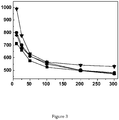
- Figure 3 Graphic representation of the evolution of the Knoop hardness (ordinate) as a function of the load (abscissa in grams force gf) for a reference soda-lime glass ( ⁇ ), a soda-lime glass annealed under N 2 ( ⁇ ) , a soda-lime glass thermally polarized under N 2 ( ⁇ ) and a soda-lime glass annealed under N 2 then thermally polarized under N 2 ( ⁇ ).
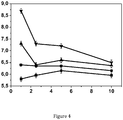
- Figure 4 Evolution of the Berkovich nanohardness (ordinate in GPa) as a function of the charge (abscissa in mN) for a reference soda-lime glass ( ⁇ ), a soda-lime glass annealed under N 2 ( ⁇ ), a soda-lime glass calcium thermally polarized under N 2 ( ⁇ ) and a soda-lime glass annealed under N 2 then thermally polarized under N 2 ( ⁇ ).
- Figures 5a and 5b Optical microscopy images of surface conditions after climatic tests Plan of the pictures of the figure 5a : A1 B1 A2 B2 Plan of the pictures of the figure 5b : A3 B3 A4 B4 A1: reference glass, B1: reference glass after climatic treatment; A2: reference glass annealed under N 2 then thermally polarized under N 2 , B2: glass A2 after climatic treatment; A3: reference lens thermally polarized in air, B3: A3 lens after climatic treatment; A4: reference glass thermally polarized under N 2 , B4: A4 glass after climatic treatment.
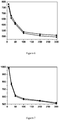
- Figure 6 Evolution of the Knoop hardness (ordinate) as a function of the load (abscissa, in gf) of a soda-lime glass: reference glass thermally polarized under N 2 ( ⁇ ), reference glass thermally polarized under N 2 then subjected to a cycle of climatic aging ( ⁇ )
- Figure 7 Evolution of the Knoop hardness (ordinate) as a function of the load (abscissa, in gf) of a soda-lime glass: reference glass annealed under N 2 then thermally polarized under N 2 ( ⁇ ); Reference glass annealed under N 2 then thermally polarized under N 2 after climatic tests ( ⁇ ).
- the glass which was used (reference soda-lime glass) is a glass available commercially from the company Menzel-Gläser. Its mass composition is as follows: 72.2% SiO 2 , 14.3% Na 2 O, 6.4 CaO, 4.3% MgO, 1.2% Al2O3, 1.2% K2O and 0.3% SO 3 , the% being percentages by mass.
- a 1 mm thick sample was used (dimension of the order of 1 cm 2 ).
- the treatment was carried out in an enclosure described below.
- the microscope is equipped with a motorized stage (x, y, z) which makes it possible to carry out 3D analyzes with a spatial resolution of the order of a micron.
- the polarized incident beam is focused on the surface of the sample by a near infrared objective (50x or 100x).
- the backscattered light is captured by this same objective and redirected to the analyzer.
- This analyzer allows you to select the analysis polarization.
- the beam thus polarized is directed on a network then on the CCD camera which makes it possible to select the intensity of the second harmonic.
- This method makes it possible to access the localization of the electric field within the material by identifying the zone exhibiting the phenomenon of second harmonic (ref V. Rodriguez, D. Talaga, F. Adamietz, JL Bruneel, M. Couzi, Chem. Phys. Lett. 2006, 431, 190 ).
- Analyzes were carried out in a climatic chamber in order to simulate different atmospheres, to evaluate the chemical durability and to accelerate the aging of the coatings.
- the method used makes it possible to evaluate the performance of the process in real conditions of outdoor use.
- a complete cycle consists of repeating six cycles for a total duration of 6 weeks.
- a cycle lasts 7 days and is composed of the following sequence A-B-A-C-A-B-B.
- the treatment carried out comprises two stages: the first stage is a heat treatment of the glass under a nitrogen atmosphere.
- the second step is a thermal polarization treatment in a controlled atmosphere, chemically inert.
- the treatment was carried out in a mullite tube at a temperature in the region of 400 ° C. under a controlled atmosphere under nitrogen (N 2 ) for 24 hours.
- the treatment is carried out at a temperature close to the glass transition temperature of the soda-lime glass in order to make the surface of the glass reactive to the atmosphere of the enclosure.
- the treatments carried out at 300 ° C, 350 ° C and 400 ° C gave the same results.
- the temperature rise and fall ramps are of the order of 15 ° C / minute.
- the glass partially nitrided on the surface then undergoes the thermal polarization treatment.
- thermal polarization treatment (called “thermal poling” in English) is a controlled heat treatment process, assisted by an electric field.
- the experiment takes place in a closed chamber under a controlled atmosphere, under a closed electrode, under argon or under N 2 . Failure to check this atmosphere (leak, sealing problems, flow meters) can lead to unwanted chemical mechanisms that alter the mechanical properties of the glass.
- the thermal polarization treatment was carried out by raising the temperature of the sample placed between two electrodes and applying a potential difference as illustrated in the figure.
- figure 1 The glass sample 1 is placed between the anode 2 and the cathode 3, the assembly being placed on a heating plate 4. The whole is placed in a closed chamber (not shown). The two electrodes are connected to a voltage generator 5.
- the temperature is gradually raised to the thermal polarization temperature in a range of 200 to 300 ° C. Once the temperature is reached, a voltage in a range of 1.0 to 3.0 kV is applied. The thermal polarization treatment lasts 20 to 60 minutes. The temperature is then brought back to room temperature while the voltage is still maintained at the thermal bias voltage of the experiment. Once the system reaches room temperature, the voltage is lowered to 0 V. The thermal polarization treatment is then complete.
- the figure 2 graphically illustrates the second step of the method of the invention: the temperature (ordinate) is raised progressively (the time scale is represented diagrammatically on the abscissa) up to the desired threshold, then a voltage is applied, this step being represented by the hatched zone, finally the temperature is reduced to ambient and the electrical voltage is brought back to 0V.
- the figures 5a and 5b illustrate the surface condition of the glasses before (series a) and after (series b) aging in a climatic chamber.
- Photographs A1 and B1 illustrate the effect of thermal aging on untreated glass, ie a degradation of the optical qualities of the glass.
- the A3 / B3 and A4 / B4 images make it possible to validate the role of atmospheric control in maintaining the optical qualities of the glass surface.
- the images A2 and B2 show the combined effect of annealing under N 2 and thermal polarization under N 2 (according to the invention). It is observed that the surface observed by optical microscopy remains unchanged. These pictures explain the effect of the invention on the chemical durability after climatic tests against a reference soda-lime glass. The surface condition makes it possible to validate the process.
Landscapes
- Chemical & Material Sciences (AREA)
- Life Sciences & Earth Sciences (AREA)
- Engineering & Computer Science (AREA)
- Chemical Kinetics & Catalysis (AREA)
- General Chemical & Material Sciences (AREA)
- Geochemistry & Mineralogy (AREA)
- Materials Engineering (AREA)
- Organic Chemistry (AREA)
- Glass Compositions (AREA)
- Surface Treatment Of Glass (AREA)
Priority Applications (1)
| Application Number | Priority Date | Filing Date | Title |
|---|---|---|---|
| PL16806259T PL3374324T3 (pl) | 2015-11-10 | 2016-11-08 | Sposób obróbki materiałów szklistych poprzez polaryzację termiczną |
Applications Claiming Priority (2)
| Application Number | Priority Date | Filing Date | Title |
|---|---|---|---|
| FR1560733A FR3043400B1 (fr) | 2015-11-10 | 2015-11-10 | Procede de traitement de materiaux vitreux par voie de polarisation thermique |
| PCT/FR2016/052884 WO2017081396A1 (fr) | 2015-11-10 | 2016-11-08 | Procede de traitement de materiaux vitreux par voie de polarisation thermique |
Publications (2)
| Publication Number | Publication Date |
|---|---|
| EP3374324A1 EP3374324A1 (fr) | 2018-09-19 |
| EP3374324B1 true EP3374324B1 (fr) | 2021-05-05 |
Family
ID=54979839
Family Applications (1)
| Application Number | Title | Priority Date | Filing Date |
|---|---|---|---|
| EP16806259.4A Active EP3374324B1 (fr) | 2015-11-10 | 2016-11-08 | Procede de traitement de materiaux vitreux par voie de polarisation thermique |
Country Status (8)
| Country | Link |
|---|---|
| US (1) | US11078114B2 (pl) |
| EP (1) | EP3374324B1 (pl) |
| JP (1) | JP6985266B2 (pl) |
| CA (1) | CA3004817C (pl) |
| ES (1) | ES2884045T3 (pl) |
| FR (1) | FR3043400B1 (pl) |
| PL (1) | PL3374324T3 (pl) |
| WO (1) | WO2017081396A1 (pl) |
Families Citing this family (3)
| Publication number | Priority date | Publication date | Assignee | Title |
|---|---|---|---|---|
| CN112955412A (zh) | 2018-10-31 | 2021-06-11 | 康宁股份有限公司 | 韧性玻璃复合物和方法 |
| CN113165945B (zh) | 2018-11-30 | 2023-09-29 | 康宁股份有限公司 | 玻璃与玻璃陶瓷复合物及方法 |
| WO2021154698A1 (en) * | 2020-01-31 | 2021-08-05 | Corning Incorporated | High throughput electro-thermal poling |
Family Cites Families (8)
| Publication number | Priority date | Publication date | Assignee | Title |
|---|---|---|---|---|
| US3811855A (en) | 1972-10-10 | 1974-05-21 | Rca Corp | Method of treating a glass body to provide an ion-depleted region therein |
| FR2595685B1 (fr) | 1986-03-11 | 1992-02-14 | Saint Gobain Vitrage | Desionisation du verre par decharge couronne |
| US5045508A (en) * | 1990-04-30 | 1991-09-03 | The United States Of America As Represented By The United States Department Of Energy | Ammonia-treated phosphate glasses useful for sealing to metals metals |
| EP2881375A4 (en) | 2012-06-22 | 2016-11-02 | Asahi Glass Co Ltd | METHOD FOR THE SURFACE TREATMENT OF A GLASS SUBSTRATE AND GLASS SUBSTRATE |
| WO2015093284A1 (ja) * | 2013-12-19 | 2015-06-25 | 旭硝子株式会社 | 強化ガラス基板の製造方法 |
| US9695081B2 (en) | 2014-05-15 | 2017-07-04 | Corning Incorporated | Surface nitrided alkali-free glasses |
| US10472271B2 (en) * | 2015-05-19 | 2019-11-12 | Corning Incorporated | Glass with modified surface layer |
| EP3369716A4 (en) * | 2015-10-28 | 2019-06-26 | AGC Inc. | soda-lime glass |
-
2015
- 2015-11-10 FR FR1560733A patent/FR3043400B1/fr active Active
-
2016
- 2016-11-08 PL PL16806259T patent/PL3374324T3/pl unknown
- 2016-11-08 JP JP2018523778A patent/JP6985266B2/ja active Active
- 2016-11-08 CA CA3004817A patent/CA3004817C/fr active Active
- 2016-11-08 WO PCT/FR2016/052884 patent/WO2017081396A1/fr not_active Ceased
- 2016-11-08 ES ES16806259T patent/ES2884045T3/es active Active
- 2016-11-08 EP EP16806259.4A patent/EP3374324B1/fr active Active
- 2016-11-08 US US15/774,814 patent/US11078114B2/en not_active Expired - Fee Related
Also Published As
| Publication number | Publication date |
|---|---|
| CA3004817C (fr) | 2023-08-22 |
| JP2018535180A (ja) | 2018-11-29 |
| US20180327306A1 (en) | 2018-11-15 |
| WO2017081396A1 (fr) | 2017-05-18 |
| PL3374324T3 (pl) | 2021-11-29 |
| US11078114B2 (en) | 2021-08-03 |
| CA3004817A1 (fr) | 2017-05-18 |
| JP6985266B2 (ja) | 2021-12-22 |
| EP3374324A1 (fr) | 2018-09-19 |
| ES2884045T3 (es) | 2021-12-10 |
| FR3043400A1 (fr) | 2017-05-12 |
| FR3043400B1 (fr) | 2021-04-02 |
Similar Documents
| Publication | Publication Date | Title |
|---|---|---|
| EP2268587B1 (fr) | Procede de dépôt de couche mince | |
| CA2674085C (fr) | Procede de depot de couche mince et produit obtenu | |
| EP2956423B1 (fr) | Procede de traitement par un faisceau d'ions pour produire des matériaux en verre antireflet durable | |
| EP3374324B1 (fr) | Procede de traitement de materiaux vitreux par voie de polarisation thermique | |
| CA2762312A1 (fr) | Procede de depot de couche mince et produit obtenu | |
| EP0601928A1 (fr) | Procédé de traitement de couches minces à base d'oxyde ou de nitrure métallique | |
| FR2939563A1 (fr) | Substrat de face avant de panneau photovoltaique, panneau photovoltaique et utilisation d'un substrat pour une face avant de panneau photovoltaique | |
| Chazot et al. | Enhancement of mechanical properties and chemical durability of Soda‐lime silicate glasses treated by DC gas discharges | |
| FR2865420A1 (fr) | Procede de nettoyage d'un substrat | |
| BE1019826A3 (fr) | Substrat verrier transparent conducteur pour cellule photovoltaique. | |
| WO1984003481A1 (fr) | Perfectionnements apportes aux revetements aptes a resister a des contraintes thermiques elevees et notamment aux revetements pour satellites et vaisseaux spatiaux et aux procedes de production de ces revetements. | |
| Sekimoto et al. | Energy level diagram of HC (NH 2) 2 PbI 3 single crystal evaluated by electrical and optical analyses | |
| FR3029352A1 (fr) | Procede d'assemblage de deux substrats | |
| EP2545012A1 (fr) | Vitrage a reflexion elevee | |
| WO2003084890A1 (fr) | Espaceurs possedant une conductivite electronique, procede de fabrication et applications notamment pour les ecrans de visualisation | |
| EP2545011B1 (fr) | Vitrage a reflexion elevee | |
| FR3020179A1 (fr) | Electrode supportee transparente pour oled | |
| FR3057705A1 (fr) | Procede de dissolution d'un oxyde enterre dans une plaquette de silicium sur isolant | |
| EP4078281A1 (fr) | Trempe thermique d'une electrode travail | |
| García-Hernansanz et al. | Limitations of high pressure sputtering for amorphous silicon deposition | |
| FR2991980A1 (fr) | Procede de depot de couches minces avec etape de traitement sous vide et produit obtenu | |
| EP3148950A1 (fr) | Procédé d'obtention d'un matériau comprenant une couche fonctionnelle à base d'argent résistant à un traitement à température élevée | |
| RO125404A0 (ro) | Strat antireflex dur din carbon cu legături tip diamantifer () obţinut prin metoda arcului termoionic în vid () | |
| Matthews et al. | Correlation of UV damage threshold with post-annealing in CVD-grown SiO [sub] 2 [/sub] overlayers on etched fused silica substrates | |
| Zawadzka et al. | Nonlinear Optical Properties of Oxide Thin Films |
Legal Events
| Date | Code | Title | Description |
|---|---|---|---|
| STAA | Information on the status of an ep patent application or granted ep patent |
Free format text: STATUS: UNKNOWN |
|
| STAA | Information on the status of an ep patent application or granted ep patent |
Free format text: STATUS: THE INTERNATIONAL PUBLICATION HAS BEEN MADE |
|
| PUAI | Public reference made under article 153(3) epc to a published international application that has entered the european phase |
Free format text: ORIGINAL CODE: 0009012 |
|
| STAA | Information on the status of an ep patent application or granted ep patent |
Free format text: STATUS: REQUEST FOR EXAMINATION WAS MADE |
|
| 17P | Request for examination filed |
Effective date: 20180604 |
|
| AK | Designated contracting states |
Kind code of ref document: A1 Designated state(s): AL AT BE BG CH CY CZ DE DK EE ES FI FR GB GR HR HU IE IS IT LI LT LU LV MC MK MT NL NO PL PT RO RS SE SI SK SM TR |
|
| AX | Request for extension of the european patent |
Extension state: BA ME |
|
| DAV | Request for validation of the european patent (deleted) | ||
| DAX | Request for extension of the european patent (deleted) | ||
| GRAP | Despatch of communication of intention to grant a patent |
Free format text: ORIGINAL CODE: EPIDOSNIGR1 |
|
| STAA | Information on the status of an ep patent application or granted ep patent |
Free format text: STATUS: GRANT OF PATENT IS INTENDED |
|
| INTG | Intention to grant announced |
Effective date: 20201217 |
|
| GRAS | Grant fee paid |
Free format text: ORIGINAL CODE: EPIDOSNIGR3 |
|
| GRAA | (expected) grant |
Free format text: ORIGINAL CODE: 0009210 |
|
| STAA | Information on the status of an ep patent application or granted ep patent |
Free format text: STATUS: THE PATENT HAS BEEN GRANTED |
|
| AK | Designated contracting states |
Kind code of ref document: B1 Designated state(s): AL AT BE BG CH CY CZ DE DK EE ES FI FR GB GR HR HU IE IS IT LI LT LU LV MC MK MT NL NO PL PT RO RS SE SI SK SM TR |
|
| REG | Reference to a national code |
Ref country code: GB Ref legal event code: FG4D Free format text: NOT ENGLISH |
|
| REG | Reference to a national code |
Ref country code: CH Ref legal event code: EP |
|
| REG | Reference to a national code |
Ref country code: AT Ref legal event code: REF Ref document number: 1389633 Country of ref document: AT Kind code of ref document: T Effective date: 20210515 |
|
| REG | Reference to a national code |
Ref country code: IE Ref legal event code: FG4D Free format text: LANGUAGE OF EP DOCUMENT: FRENCH |
|
| REG | Reference to a national code |
Ref country code: DE Ref legal event code: R096 Ref document number: 602016057486 Country of ref document: DE |
|
| REG | Reference to a national code |
Ref country code: NL Ref legal event code: FP |
|
| REG | Reference to a national code |
Ref country code: LT Ref legal event code: MG9D |
|
| REG | Reference to a national code |
Ref country code: AT Ref legal event code: MK05 Ref document number: 1389633 Country of ref document: AT Kind code of ref document: T Effective date: 20210505 |
|
| PG25 | Lapsed in a contracting state [announced via postgrant information from national office to epo] |
Ref country code: BG Free format text: LAPSE BECAUSE OF FAILURE TO SUBMIT A TRANSLATION OF THE DESCRIPTION OR TO PAY THE FEE WITHIN THE PRESCRIBED TIME-LIMIT Effective date: 20210805 Ref country code: AT Free format text: LAPSE BECAUSE OF FAILURE TO SUBMIT A TRANSLATION OF THE DESCRIPTION OR TO PAY THE FEE WITHIN THE PRESCRIBED TIME-LIMIT Effective date: 20210505 Ref country code: HR Free format text: LAPSE BECAUSE OF FAILURE TO SUBMIT A TRANSLATION OF THE DESCRIPTION OR TO PAY THE FEE WITHIN THE PRESCRIBED TIME-LIMIT Effective date: 20210505 Ref country code: LT Free format text: LAPSE BECAUSE OF FAILURE TO SUBMIT A TRANSLATION OF THE DESCRIPTION OR TO PAY THE FEE WITHIN THE PRESCRIBED TIME-LIMIT Effective date: 20210505 Ref country code: FI Free format text: LAPSE BECAUSE OF FAILURE TO SUBMIT A TRANSLATION OF THE DESCRIPTION OR TO PAY THE FEE WITHIN THE PRESCRIBED TIME-LIMIT Effective date: 20210505 |
|
| PG25 | Lapsed in a contracting state [announced via postgrant information from national office to epo] |
Ref country code: SE Free format text: LAPSE BECAUSE OF FAILURE TO SUBMIT A TRANSLATION OF THE DESCRIPTION OR TO PAY THE FEE WITHIN THE PRESCRIBED TIME-LIMIT Effective date: 20210505 Ref country code: RS Free format text: LAPSE BECAUSE OF FAILURE TO SUBMIT A TRANSLATION OF THE DESCRIPTION OR TO PAY THE FEE WITHIN THE PRESCRIBED TIME-LIMIT Effective date: 20210505 Ref country code: NO Free format text: LAPSE BECAUSE OF FAILURE TO SUBMIT A TRANSLATION OF THE DESCRIPTION OR TO PAY THE FEE WITHIN THE PRESCRIBED TIME-LIMIT Effective date: 20210805 Ref country code: PT Free format text: LAPSE BECAUSE OF FAILURE TO SUBMIT A TRANSLATION OF THE DESCRIPTION OR TO PAY THE FEE WITHIN THE PRESCRIBED TIME-LIMIT Effective date: 20210906 Ref country code: GR Free format text: LAPSE BECAUSE OF FAILURE TO SUBMIT A TRANSLATION OF THE DESCRIPTION OR TO PAY THE FEE WITHIN THE PRESCRIBED TIME-LIMIT Effective date: 20210806 Ref country code: IS Free format text: LAPSE BECAUSE OF FAILURE TO SUBMIT A TRANSLATION OF THE DESCRIPTION OR TO PAY THE FEE WITHIN THE PRESCRIBED TIME-LIMIT Effective date: 20210905 Ref country code: LV Free format text: LAPSE BECAUSE OF FAILURE TO SUBMIT A TRANSLATION OF THE DESCRIPTION OR TO PAY THE FEE WITHIN THE PRESCRIBED TIME-LIMIT Effective date: 20210505 |
|
| REG | Reference to a national code |
Ref country code: ES Ref legal event code: FG2A Ref document number: 2884045 Country of ref document: ES Kind code of ref document: T3 Effective date: 20211210 |
|
| PG25 | Lapsed in a contracting state [announced via postgrant information from national office to epo] |
Ref country code: CZ Free format text: LAPSE BECAUSE OF FAILURE TO SUBMIT A TRANSLATION OF THE DESCRIPTION OR TO PAY THE FEE WITHIN THE PRESCRIBED TIME-LIMIT Effective date: 20210505 Ref country code: DK Free format text: LAPSE BECAUSE OF FAILURE TO SUBMIT A TRANSLATION OF THE DESCRIPTION OR TO PAY THE FEE WITHIN THE PRESCRIBED TIME-LIMIT Effective date: 20210505 Ref country code: EE Free format text: LAPSE BECAUSE OF FAILURE TO SUBMIT A TRANSLATION OF THE DESCRIPTION OR TO PAY THE FEE WITHIN THE PRESCRIBED TIME-LIMIT Effective date: 20210505 Ref country code: RO Free format text: LAPSE BECAUSE OF FAILURE TO SUBMIT A TRANSLATION OF THE DESCRIPTION OR TO PAY THE FEE WITHIN THE PRESCRIBED TIME-LIMIT Effective date: 20210505 Ref country code: SK Free format text: LAPSE BECAUSE OF FAILURE TO SUBMIT A TRANSLATION OF THE DESCRIPTION OR TO PAY THE FEE WITHIN THE PRESCRIBED TIME-LIMIT Effective date: 20210505 Ref country code: SM Free format text: LAPSE BECAUSE OF FAILURE TO SUBMIT A TRANSLATION OF THE DESCRIPTION OR TO PAY THE FEE WITHIN THE PRESCRIBED TIME-LIMIT Effective date: 20210505 |
|
| REG | Reference to a national code |
Ref country code: DE Ref legal event code: R097 Ref document number: 602016057486 Country of ref document: DE |
|
| PLBE | No opposition filed within time limit |
Free format text: ORIGINAL CODE: 0009261 |
|
| STAA | Information on the status of an ep patent application or granted ep patent |
Free format text: STATUS: NO OPPOSITION FILED WITHIN TIME LIMIT |
|
| 26N | No opposition filed |
Effective date: 20220208 |
|
| PG25 | Lapsed in a contracting state [announced via postgrant information from national office to epo] |
Ref country code: IS Free format text: LAPSE BECAUSE OF FAILURE TO SUBMIT A TRANSLATION OF THE DESCRIPTION OR TO PAY THE FEE WITHIN THE PRESCRIBED TIME-LIMIT Effective date: 20210905 Ref country code: AL Free format text: LAPSE BECAUSE OF FAILURE TO SUBMIT A TRANSLATION OF THE DESCRIPTION OR TO PAY THE FEE WITHIN THE PRESCRIBED TIME-LIMIT Effective date: 20210505 |
|
| PG25 | Lapsed in a contracting state [announced via postgrant information from national office to epo] |
Ref country code: MC Free format text: LAPSE BECAUSE OF FAILURE TO SUBMIT A TRANSLATION OF THE DESCRIPTION OR TO PAY THE FEE WITHIN THE PRESCRIBED TIME-LIMIT Effective date: 20210505 |
|
| REG | Reference to a national code |
Ref country code: CH Ref legal event code: PL |
|
| PG25 | Lapsed in a contracting state [announced via postgrant information from national office to epo] |
Ref country code: LU Free format text: LAPSE BECAUSE OF NON-PAYMENT OF DUE FEES Effective date: 20211108 |
|
| PG25 | Lapsed in a contracting state [announced via postgrant information from national office to epo] |
Ref country code: LI Free format text: LAPSE BECAUSE OF NON-PAYMENT OF DUE FEES Effective date: 20211130 Ref country code: CH Free format text: LAPSE BECAUSE OF NON-PAYMENT OF DUE FEES Effective date: 20211130 |
|
| PG25 | Lapsed in a contracting state [announced via postgrant information from national office to epo] |
Ref country code: IE Free format text: LAPSE BECAUSE OF NON-PAYMENT OF DUE FEES Effective date: 20211108 |
|
| PG25 | Lapsed in a contracting state [announced via postgrant information from national office to epo] |
Ref country code: HU Free format text: LAPSE BECAUSE OF FAILURE TO SUBMIT A TRANSLATION OF THE DESCRIPTION OR TO PAY THE FEE WITHIN THE PRESCRIBED TIME-LIMIT; INVALID AB INITIO Effective date: 20161108 |
|
| PG25 | Lapsed in a contracting state [announced via postgrant information from national office to epo] |
Ref country code: CY Free format text: LAPSE BECAUSE OF FAILURE TO SUBMIT A TRANSLATION OF THE DESCRIPTION OR TO PAY THE FEE WITHIN THE PRESCRIBED TIME-LIMIT Effective date: 20210505 |
|
| PG25 | Lapsed in a contracting state [announced via postgrant information from national office to epo] |
Ref country code: MK Free format text: LAPSE BECAUSE OF FAILURE TO SUBMIT A TRANSLATION OF THE DESCRIPTION OR TO PAY THE FEE WITHIN THE PRESCRIBED TIME-LIMIT Effective date: 20210505 |
|
| PG25 | Lapsed in a contracting state [announced via postgrant information from national office to epo] |
Ref country code: MT Free format text: LAPSE BECAUSE OF FAILURE TO SUBMIT A TRANSLATION OF THE DESCRIPTION OR TO PAY THE FEE WITHIN THE PRESCRIBED TIME-LIMIT Effective date: 20210505 |
|
| PGFP | Annual fee paid to national office [announced via postgrant information from national office to epo] |
Ref country code: NL Payment date: 20241120 Year of fee payment: 9 |
|
| PGFP | Annual fee paid to national office [announced via postgrant information from national office to epo] |
Ref country code: DE Payment date: 20241119 Year of fee payment: 9 |
|
| PGFP | Annual fee paid to national office [announced via postgrant information from national office to epo] |
Ref country code: BE Payment date: 20241120 Year of fee payment: 9 Ref country code: PL Payment date: 20241105 Year of fee payment: 9 |
|
| PGFP | Annual fee paid to national office [announced via postgrant information from national office to epo] |
Ref country code: GB Payment date: 20241120 Year of fee payment: 9 |
|
| PGFP | Annual fee paid to national office [announced via postgrant information from national office to epo] |
Ref country code: FR Payment date: 20241121 Year of fee payment: 9 |
|
| PGFP | Annual fee paid to national office [announced via postgrant information from national office to epo] |
Ref country code: IT Payment date: 20241129 Year of fee payment: 9 Ref country code: ES Payment date: 20241213 Year of fee payment: 9 |
|
| PGFP | Annual fee paid to national office [announced via postgrant information from national office to epo] |
Ref country code: TR Payment date: 20241101 Year of fee payment: 9 |