EP3370369A1 - Drahtloskommunikationssystem, kommunikationsverfahren und informationsverarbeitungsvorrichtung - Google Patents
Drahtloskommunikationssystem, kommunikationsverfahren und informationsverarbeitungsvorrichtung Download PDFInfo
- Publication number
- EP3370369A1 EP3370369A1 EP17188286.3A EP17188286A EP3370369A1 EP 3370369 A1 EP3370369 A1 EP 3370369A1 EP 17188286 A EP17188286 A EP 17188286A EP 3370369 A1 EP3370369 A1 EP 3370369A1
- Authority
- EP
- European Patent Office
- Prior art keywords
- information processing
- processing apparatus
- slave
- master
- management table
- Prior art date
- Legal status (The legal status is an assumption and is not a legal conclusion. Google has not performed a legal analysis and makes no representation as to the accuracy of the status listed.)
- Granted
Links
Images









Classifications
-
- H—ELECTRICITY
- H04—ELECTRIC COMMUNICATION TECHNIQUE
- H04L—TRANSMISSION OF DIGITAL INFORMATION, e.g. TELEGRAPHIC COMMUNICATION
- H04L61/00—Network arrangements, protocols or services for addressing or naming
-
- H—ELECTRICITY
- H04—ELECTRIC COMMUNICATION TECHNIQUE
- H04L—TRANSMISSION OF DIGITAL INFORMATION, e.g. TELEGRAPHIC COMMUNICATION
- H04L61/00—Network arrangements, protocols or services for addressing or naming
- H04L61/09—Mapping addresses
- H04L61/10—Mapping addresses of different types
- H04L61/103—Mapping addresses of different types across network layers, e.g. resolution of network layer into physical layer addresses or address resolution protocol [ARP]
-
- H—ELECTRICITY
- H04—ELECTRIC COMMUNICATION TECHNIQUE
- H04L—TRANSMISSION OF DIGITAL INFORMATION, e.g. TELEGRAPHIC COMMUNICATION
- H04L61/00—Network arrangements, protocols or services for addressing or naming
- H04L61/09—Mapping addresses
- H04L61/10—Mapping addresses of different types
-
- H—ELECTRICITY
- H04—ELECTRIC COMMUNICATION TECHNIQUE
- H04L—TRANSMISSION OF DIGITAL INFORMATION, e.g. TELEGRAPHIC COMMUNICATION
- H04L61/00—Network arrangements, protocols or services for addressing or naming
- H04L61/58—Caching of addresses or names
-
- H—ELECTRICITY
- H04—ELECTRIC COMMUNICATION TECHNIQUE
- H04L—TRANSMISSION OF DIGITAL INFORMATION, e.g. TELEGRAPHIC COMMUNICATION
- H04L2101/00—Indexing scheme associated with group H04L61/00
- H04L2101/60—Types of network addresses
- H04L2101/618—Details of network addresses
- H04L2101/622—Layer-2 addresses, e.g. medium access control [MAC] addresses
Definitions
- the present invention relates to wireless communication systems, communication methods, and information processing apparatuses.
- an apparatus configured to detect nodes stores therein a table in which IP addresses and MAC addresses of nodes existing on the network are associated with each other, and specifies a MAC address corresponding to an IP address with reference to the table (for example, refer to Japanese Laid-Open Patent Publication No. 2013-26993 ).
- an object of the present invention is to provide a wireless communication system etc. capable of reducing a time required until communication is started among apparatuses participating in a network.
- An example of the present invention is a wireless communication system including a plurality of information processing apparatuses each having a wireless communication function.
- the wireless communication system includes a first information processing apparatus and a second information processing apparatus.
- the second information processing apparatus includes physical address transmitting means for wirelessly transmitting, to the first information processing apparatus, a second physical address unique to hardware of the second information processing apparatus.
- the first information processing apparatus includes: physical address receiving means for wirelessly receiving the second physical address from the second information processing apparatus; logical address generating means for generating a variable first logical address that is not unique to hardware of the first information processing apparatus, and a variable second logical address that is not unique to the hardware of the second information processing apparatus; first logical address setting means for setting, in the first information processing apparatus, the first logical address generated by the logical address generating means; management table generating means for generating a management table in which a first physical address unique to the hardware of the first information processing apparatus is associated with the first logical address, and the second physical address is associated with the second logical address; and management table transmitting means for wirelessly transmitting the management table to the second information processing apparatus.
- the second information processing apparatus further includes: management table receiving means for wirelessly receiving the management table from the first information processing apparatus; and management table storing means for storing the management table received by the management table receiving means, on a memory of the second information processing apparatus.
- the time until start of communication between the first information processing apparatus and the second information processing apparatus can be shortened.
- the second information processing apparatus may include second logical address setting means for setting the second logical address in the second information processing apparatus, based on the management table received from the first information processing apparatus.
- the second information processing apparatus can set the second logical address generated by the first information processing apparatus, and the first information processing apparatus can collectively set the logical addresses of other apparatuses in the network.
- the second information processing apparatus may refer to the management table, and transmit data to the first information processing apparatus by using the first physical address included in the management table.
- the second information processing apparatus can refer to the management table received from the first information processing apparatus, and transmit the data with the first physical address being designated.
- the second information processing apparatus can transmit the data to the first information processing apparatus without inquiring of the network about the first physical address of the first information processing apparatus, thereby avoiding delay in transmitting data.
- the wireless communication system may include a third information processing apparatus.
- the management table generating means may generate a management table in which the first physical address is associated with the first logical address, the second physical address is associated with the second logical address, and a third physical address unique to hardware of the third information processing apparatus is associated with a variable third logical address that is not unique to the hardware of the third information processing apparatus.
- the second information processing apparatus may refer to the management table, and may transmit the data, with the third physical address included in the management table being designated.
- the second information processing apparatus when transmitting data to the third information processing apparatus, can transmit the data to the third information processing apparatus with reference to the management table received from the first information processing apparatus.
- the second information processing apparatus when transmitting data to the third information processing apparatus, may refer to the management table, and may transmit the data to the first information processing apparatus, with the third physical address included in the management table being designated.
- the second information processing apparatus transmits data to the third information processing apparatus via the first information processing apparatus. Therefore, for example, even when the communication status between the second information processing apparatus and the third information processing apparatus is bad, the data can be transmitted to the third information processing apparatus.
- the first information processing apparatus may transmit, to the third information processing apparatus, the data which has been transmitted from the second information processing apparatus with the third physical address being designated.
- the first information processing apparatus can transfer the data from the second information processing apparatus, to the third information processing apparatus.
- the second information processing apparatus when transmitting data to the first information processing apparatus, may refer to the management table, and may transmit the data to the first information processing apparatus, with the first physical address included in the management table being designated.
- the second information processing apparatus can transmit the data to the first information processing apparatus with reference to the management table received from the first information processing apparatus.
- the first information processing apparatus when transmitting data to the second information processing apparatus, may refer to the management table, and may transmit the data to the second information processing apparatus, with the second physical address included in the management table being designated.
- the first information processing apparatus can transmit the data to the second information processing apparatus with reference to the generated management table.
- the logical address generating process may generate the respective logical addresses so that the logical addresses of the plurality of information processing apparatuses are not duplicated among the plurality of information processing apparatuses.
- the first information processing apparatus can assign the logical addresses of the plurality of information processing apparatuses in the network so as not to be duplicate.
- each logical address may have a network portion for identifying a network and a host portion for identifying an apparatus.
- the logical address generating means may select, from a predetermined range, the network portion that is common among the plurality of information processing apparatuses.
- the first information processing apparatus can generate the logical address having the network portion and the host portion.
- the wireless communication system may include a third information processing apparatus.
- the third information processing apparatus may wirelessly transmit, to the first information processing apparatus, a third physical address unique to hardware of the third information processing apparatus.
- the first information processing apparatus may wirelessly receive the third physical address from the third information processing apparatus, may generate a variable third logical address that is not unique to the hardware of the third information processing apparatus, may generate a management table in which the first physical address is associated with the first logical address, the second physical address is associated with the second logical address, and the third physical address is associated with the third logical address, and may wirelessly transmit the management table also to the third information processing apparatus.
- the third information processing apparatus may receive the management table from the first information processing apparatus, and store the received management table on a memory of the third information processing apparatus.
- the first information processing apparatus can transmit the management table to the third information processing apparatus as well as to the second information processing apparatus, whereby the same management table can be shared among the three apparatuses.
- the third information processing apparatus when the third information processing apparatus transmits data to the second information processing apparatus, the third information processing apparatus can transmit the data with reference to the management table.
- the second information processing apparatus when transmitting data to the third information processing apparatus, may be able to refer to the management table, and transmit the data to the first information processing apparatus, with the third physical address included in the management table being designated.
- the second information processing apparatus may be able to broadcast the data.
- the second information processing apparatus can transmit the data by unicast to the third information processing apparatus via the first information processing apparatus, and can broadcast the data to the plurality of information processing apparatuses.
- the first information processing apparatus and the second information processing apparatus each may include application executing means for executing the same application program.
- the first information processing apparatus and the second information processing apparatus can execute the same application program.
- the first information processing apparatus and the second information processing apparatus may be apparatuses of the same type.
- the network can be constructed by the apparatuses of the same type.
- the first information processing apparatus may be connectable to the Internet by using the first logical address.
- the first information processing apparatus since the first information processing apparatus is assigned the first logical address, the first information processing apparatus can be connected not only to the network constructed by the first information processing apparatus and the second information processing apparatus but also to the Internet.
- the first information processing apparatus may be, by using the first logical address, communicable with another apparatus that is connected to a network different from the network constructed by the plurality of information processing apparatuses.
- the first information processing apparatus since the first information processing apparatus is assigned the first logical address, the first information processing apparatus can be connected not only to the network constructed by the first information processing apparatus and the second information processing apparatus but also to another network.
- the first information processing apparatus may repeatedly broadcast the management table.
- the first information processing apparatus since the first information processing apparatus repeatedly broadcasts the management table, it is possible to transmit, for example, a latest management table to the surrounding apparatuses at the same time.
- the first information processing apparatus and the second information processing apparatus each may include input means for accepting an input performed by a user.
- the first information processing apparatus performs information processing based on an input to the input means of the first information processing apparatus, and transmits data according to the input to the second information processing apparatus.
- the second information processing apparatus performs information processing based on an input to the input means of the second information processing apparatus, and transmits data according to the input to the first information processing apparatus.
- the first information processing apparatus performs the information processing based on the data received from the second information processing apparatus.
- the second information processing apparatus performs the information processing based on the data received from the first information processing apparatus.
- the first information processing apparatus and the second information processing apparatus can transmit/receive data according to the operations performed in the respective apparatuses, whereby the operation performed in one of the apparatuses can be reflected in the other apparatus.
- the first information processing apparatus and the second information processing apparatus can execute a common communication game application.
- Another embodiment may be a method executed in the wireless communication system described above. Still another embodiment may be a first information processing apparatus or a second information processing apparatus included in the wireless communication system described above. Yet another embodiment may be an information processing program executed by the first information processing apparatus or the second information processing apparatus, or may be an information processing program executed by the second information processing apparatus.
- Another example of the present invention is an information processing apparatus having a communication function, and including management table generating means and a transmitting means.
- the management table generating means repeatedly generates a management table in which a variable first logical address that is not unique to hardware of the information processing apparatus is associated with a first physical address unique to the hardware of the information process apparatus, and a variable second logical address that is not unique to hardware of another information processing apparatus is associated with a second physical address unique to the hardware of the other information processing apparatus.
- the transmitting means repeatedly broadcasts the management table.
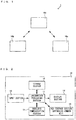
- FIG. 1 is a diagram illustrating an example of a wireless communication system 1 according to the embodiment.
- the example of the wireless communication system 1 includes a plurality of information processing apparatuses 10a to 10c.
- the information processing apparatuses 10a to 10c may be generally referred to as an information processing apparatus 10.
- the information processing apparatus 10 is an information processing apparatus capable of performing wireless communication, and is capable of performing communication based on a wireless LAN standard such as IEEE 802.11n, for example.
- the information processing apparatus 10 is communicable with another information processing apparatus 10 via a network shown in FIG. 1 .
- the information processing apparatus 10 is connectable to the Internet or another network via another wireless LAN access point, for example.
- the respective information processing apparatuses 10 are used by different users.
- Examples of the information processing apparatus 10 may include: a hand-held game apparatus; a stationary game apparatus; a personal computer; a tablet terminal; a smartphone; etc.
- the information processing apparatus 10 is capable of executing any application.
- the plurality of information processing apparatuses 10 may be of the same model, or of different models.
- one information processing apparatus 10 serves as a master apparatus, and the other one or plurality of information processing apparatuses 10 serve as slave apparatuses.
- one network is established by one master apparatus and at least one slave apparatus.
- the information processing apparatus 10a serves as a master apparatus, and the information processing apparatuses 10b and 10c serve as slave apparatuses.
- a master apparatus and a slave apparatus are capable of performing wireless communication with each other, and a slave apparatus is capable of performing wireless communication with another slave apparatus via the master apparatus (or not via the master apparatus).
- FIG. 1 merely shows an example.
- the number of apparatuses included in the wireless communication system 1 may be three or more, or may be two.
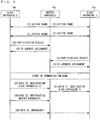
- FIG. 2 is a block diagram illustrating an example of a functional structure of the information processing apparatus 10.
- the information processing apparatus 10 includes an information processing section 11, a storage section 12, an input section 13, a display section 14, a wireless communication section 15, and a key storage section 16.
- the information processing section 11 includes a CPU (Central Processing Unit), a DRAM, a GPU (Graphics Processing Unit), etc.
- the information processing section 11 is capable of executing, for example, an information processing program (game application program, another application program, or the like) stored in the storage section 12. Further, the information processing section 11 is capable of executing an information processing program obtained via the network, and an information processing program stored in another external storage medium.
- the storage section 12 is, for example, a non-volatile memory or a hard disk, and stores therein a predetermined information processing program.
- the input section 13 receives an input performed by a user. Examples of the input section 13 may include: buttons; direction indication keys; a touch panel; a sensor (e.g., inertial sensor) for detecting an orientation and/or a motion of the information processing apparatus 10; etc.
- the display section 14 is a display unit for displaying characters and/or images. Examples of the display section 14 may include: a liquid crystal display unit; and an organic EL display unit.
- the wireless communication section 15 performs wireless communication with an external apparatus via the network.
- the wireless communication section 15 performs communication with the outside in accordance with a method based on a wireless LAN standard such as 802.11n or the like.
- the key storage section 16 is hardware that provides a secure storage area for an apparatus common key.
- the apparatus common key is a key used for encryption and decryption, and common to the plurality of information processing apparatuses 10.
- the information processing section 11 can obtain the key by giving a parameter to the key storage section 16, but cannot read the apparatus common key itself. That is, the apparatus common key is written in hardware so as not to be easily extracted by software.
- the plurality of information processing apparatus 10 are connected to the network shown in FIG. 1 , and are capable of executing a predetermined communication application (e.g., communication game application). Any application other than game applications may be executed among the plurality of information processing apparatuses 10.
- a description will be given of a case where the plurality of information processing apparatuses 10 communicate with each other to execute a communication game application.
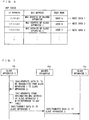
- FIG. 3 is a diagram illustrating an outline of communication when the communication game application is executed among the information processing apparatuses 10a to 10c.
- the information processing apparatus 10a is set as a master apparatus, and the information processing apparatuses 10b and 10c are set as slave apparatuses. Initially, no wireless connection is established among the information processing apparatuses 10a to 10c. After wireless connection is established among the information processing apparatuses 10a to 10c, a communication game is started among these information processing apparatuses 10a to 10c.
- the information processing apparatus 10a serving as a master apparatus transmits, by broadcast, an action frame at predetermined time intervals (S1). For example, the information processing apparatus 10a transmits the action frame every 100 msec.
- the action frame is a kind of a management frame in a wireless LAN.
- the action frame is a frame for transmitting, to the surrounding apparatuses, information for establishing wireless connection (in other words, information for participation in the communication game performed among the plurality of devices).
- the action frame also has a function to notify the slave apparatuses participating in the communication game of information of slave apparatuses currently participating in the communication game.
- the action frame includes: information of the master apparatus (IP address, MAC address, etc.); identification information of the communication game application; information of the slave apparatuses participating in the communication game; etc.
- the action frame is also used for transmitting other pieces of information to peripheral apparatuses at the same time.
- the action frame, when being transmitted may include information specific to an application (e.g., IDs of items and images used for the application, information regarding the execution state of the application, etc.).
- the information processing apparatus 10b (slave apparatus 1) transmits a request for participation in the communication game to the master apparatus (S2).
- the master apparatus Upon receiving the participation request from the slave apparatus 1, the master apparatus gives an IP address to the slave apparatus 1 (S3). At this point in time, wireless connection is established between the master apparatus and the slave apparatus 1 (the slave apparatus 1 participates in the network of the communication game).
- the information processing apparatus 10c (slave apparatus 2) transmits a request for participation in the communication game to the master apparatus (S4).
- the master apparatus Upon receiving the participation request from the slave apparatus 2, the master apparatus gives an IP address to the slave apparatus 2 (S5).
- the slave apparatus 1 and the slave apparatus 2 can obtain information of the master apparatus and information of the slave apparatuses, whereby communication is allowed among the information processing apparatuses 10a to 10c, and the communication game is started.
- the slave apparatus 1 transmits predetermined data D1 to the slave apparatus 2
- the slave apparatus 1 designates the slave apparatus 2 as a destination of the data D1, and transmits the data D1 to the master apparatus (S6).
- the master apparatus transfers the data D1 to the slave apparatus 2 (S7).
- the slave apparatus 1 transmits data to another slave apparatus, i.e., the slave apparatus 2, by unicast, the slave apparatus 1 transmits the data via the master apparatus to the slave apparatus 2.
- the slave apparatus 1 When the slave apparatus 1 transmits predetermined data D2 to the master apparatus, the slave apparatus 1 designates the master apparatus as a destination of the data D2, and transmits the data D2 to the master apparatus (S8). Thus, when the slave apparatus transmits data to the master apparatus, the slave apparatus transmits the data to the master apparatus by unicast.
- the slave apparatus 1 transmits data D3 to all the information processing apparatuses 10 (specifically, the master apparatus and the slave apparatus 2) in the network, the slave apparatus 1 transmits the data D3 by broadcast (S9).
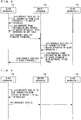
- FIG. 4 is diagram illustrating a flow of processing until establishment of wireless connection between the master apparatus and the slave apparatus 1.
- the information processing apparatus 10a is set as a master apparatus according to selection of the user (S20). For example, when an instruction to execute the communication game application is made in the information processing apparatus 10a, an image that allows the user to select whether or not the information processing apparatus 10a is to be a master apparatus is displayed on a screen of the display section 14 of the information processing apparatus 10a.
- the information processing apparatus 10a sets itself as a master apparatus, and sets an IP address thereof. At this time, the master apparatus sets the IP address thereof without transmitting a frame (Gratuitous ARP) for confirming duplication of the IP address.
- the information processing apparatus 10a randomly sets a network portion of the IP address, and sets a host portion of the IP address to "1". For example, the information processing apparatus 10a sets "111.111.0.1" as the IP address.
- the first to third octets (“111.111.0") correspond to the network portion
- the fourth octet (“1") corresponds to the host portion.
- the first and second octets (“111.111") are fixed, and the third octet is randomly determined.
- the information processing apparatus 10a When the information processing apparatus 10a is set as a master apparatus, the information processing apparatus 10a transmits an action frame by broadcast (S1).
- the master apparatus repeatedly transmits the action frame at predetermined time intervals. Specifically, the master apparatus repeatedly transmits the action frame at predetermined time intervals even while the master apparatus is accepting participation of slave apparatuses in the communication game, and even after the master apparatus has stopped accepting participation in the communication game and started the communication game.
- the information processing apparatus 10b which has not been set as a master apparatus, operates as a slave apparatus 1.
- the slave apparatus 1 Upon receiving the action frame from the master apparatus, the slave apparatus 1 displays information of the master apparatus on the display section 14 thereof (S21).
- the slave apparatus 1 extracts, for example, the MAC address, the user name (host name), and the IP address of the master apparatus, and information regarding the game application, which are included in the action frame. Then, the slave apparatus 1 displays these pieces of information on the display section 14 as master apparatus information.
- the slave apparatus 1 displays master apparatus information for each of the plurality of master apparatuses.
- the slave apparatus 1 transmits a participation request to the selected master apparatus (S22).
- This participation request includes the MAC address of the slave apparatus 1.
- the master apparatus Upon receiving the participation request from the slave apparatus 1, the master apparatus generates an IP address of the slave apparatus 1, and generates an ARP table (S23). Specifically, the master apparatus assigns IP addresses to slave apparatuses in the order in which the slave apparatuses have transmitted the participation requests, thereby preventing duplication of the IP addresses among the plurality of apparatuses. The master apparatus generates the IP address of the slave apparatus 1 without transmitting a frame (Gratuitous ARP) for confirming duplication of the IP address. For example, the master apparatus assigns "111.111.0.2" as an IP address to the slave apparatus 1 that has transmitted the participation request first.
- the ARP table is a table in which IP addresses are associated with MAC addresses.
- an ARP table is generated in which the IP address of the master apparatus is associated with the MAC address thereof, and the IP address of the slave apparatus 1 is associated with the MAC address thereof.
- An example of the ARP table will be described later with reference to FIG. 6 .
- the master apparatus includes the generated ARP table in the action frame, and transmits the action frame by broadcast (S24).
- the slave apparatus 1 sets the IP address thereof on the basis of the ARP table included in the action frame (S25).
- the slave apparatus 1 sets the IP address thereof without transmitting a frame (Gratuitous ARP) for confirming duplication of the IP address.
- the slave apparatus 1 stores the ARP table included in the action frame, in a storage unit thereof (e.g., a memory in the wireless communication section 15, a DRAM in the information processing section 11, or the storage section 12).
- a storage unit thereof e.g., a memory in the wireless communication section 15, a DRAM in the information processing section 11, or the storage section 12.
- authentication may be performed between the master apparatus and the slave apparatus 1 in response to that the participation request has been transmitted from the slave apparatus 1. For example, authentication based on a pass phrase determined in advance may be performed between the master apparatus and the slave apparatus 1. Alternatively, open authentication may be performed between the master apparatus and the slave apparatus 1.
- the master apparatus may generate an IP address of the slave apparatus 1.
- the master apparatus may generate an ARP table (a table in which the IP address of the master apparatus is associated with the MAC address thereof, and the IP address of the slave apparatus 1 is associated with the MAC address thereof).
- FIG. 5 is a diagram illustrating the flow of processing until the communication game is performed among the three apparatuses after establishment of wireless connection between the master apparatus and the slave apparatus 2.
- application data communication is performed between the master apparatus and the slave apparatus 1, and the communication game application is executed on the basis of data exchanged in the application data communication (S26).
- the communication game has been started between the master apparatus and the slave apparatus 1
- data according to inputs to the input sections 13 of the master apparatus and the slave apparatus 1 are exchanged through the application data communication.
- the game application is executed in the master apparatus and the slave apparatus 1.
- predetermined data is exchanged between the master apparatus and the slave apparatus 1 until the communication game is started, and the application is executed on the basis of the data.
- a message may be transmitted from the master apparatus to the slave apparatus 1 (or from the slave apparatus 1 to the master apparatus), or items may be exchanged between the master apparatus and the slave apparatus 1.
- the master apparatus transmits the action frame at predetermined time intervals (S1).
- the information processing apparatus 10c (slave apparatus 2) displays the master apparatus information on the display section 14 thereof, and accepts selection of a master apparatus by the user (S27). Since the action frame from the master apparatus includes the ARP table described above, the slave apparatus 2 can obtain, in addition to the master apparatus information, information of the slave apparatus 1 which is connected to the master apparatus (which participates in the communication game). Therefore, in S27, the slave apparatus 2 may display, in addition to the master apparatus information, the information of the slave apparatus 1 currently participating in the communication game.
- the slave apparatus 2 transmits a participation request to the master apparatus (S28).
- This participation request includes the MAC address of the slave apparatus 2.
- the master apparatus Upon receiving the participation request from the slave apparatus 2, the master apparatus generates an IP address of the slave apparatus 2, and generates an ARP table (S29).
- the master apparatus generates the IP address of the slave apparatus 2 without transmitting a frame (Gratuitous ARP) for confirming duplication of the IP address. For example, the master apparatus assigns "111.111.0.3" as an IP address to the slave apparatus 2 that has transmitted the participation request second. Further, the master apparatus generates an ARP table in which the IP address of the master apparatus is associated with the MAC address thereof, the IP address of the slave apparatus 1 is associated with the MAC address thereof, and the IP address of the slave apparatus 2 associated with the MAC address thereof.
- the master apparatus includes the generated ARP table in the action frame, and transmits the action frame by broadcast (S30).
- the slave apparatus 2 sets the IP address thereof on the basis of the ARP table included in the action frame, and stores the ARP table in the storage unit thereof (S31).
- the slave apparatus 1 also receives the action frame, and stores the ARP table included in the action frame, in the storage unit thereof (S32). Thus, a network is established among the three apparatuses 10a to 10c, thereby enabling application data communication. Thus, the ARP table that has been stored in the slave apparatus 1 connected to the master apparatus is updated in accordance with participation of the slave apparatus 2.
- FIG. 6 is a diagram illustrating an example of the ARP table included in the action frame transmitted from the master apparatus.
- the ARP table when the master apparatus, the slave apparatus 1, and the slave apparatus 2 exist in the network, the ARP table includes node data 1 in which the IP address of the master apparatus, the MAC address of the master apparatus, and the user name (host name) of the master apparatus are associated with each other.
- the ARP table further includes node data 2 in which the IP address of the slave apparatus 1, the MAC address of the slave apparatus 1, and the user name (host name) of the slave apparatus 1 are associated with each other.
- the ARP table further includes node data 3 in which the IP address of the slave apparatus 2, the MAC address of the slave apparatus 2, and the user name (host name) of the slave apparatus 2 are associated with each other.
- FIG. 6 shows an example of the ARP table in the case where two slave apparatuses are connected to the master apparatus.
- an ARP table including node data 4 in addition to the node data 1 to 3 is generated and broadcast by the master apparatus.
- the upper limit number of connectable slave apparatuses may be a predetermined number (e.g., "8"), or may be a number that varies depending on the type of the communication game application to be executed. Alternatively, the upper limit number of connectable slave apparatuses may be determined depending on the communication status.
- the upper limit number of connectable slave apparatuses may be determined according to the number of other peripheral apparatuses connected to the master apparatus.
- wireless controllers may be wirelessly connected to the master apparatus
- the upper limit number of connectable slave apparatuses may be determined according to the number of the wireless controllers connected to the master apparatus.
- the wireless communication standard between the master apparatus and the peripheral apparatuses may be different from or the same as the wireless communication standard between the master apparatus and the slave apparatuses.
- wireless communication between the master apparatus and the peripheral apparatuses may be performed based on the standard of Bluetooth (registered trademark).
- the master apparatus When any one of the plurality of slave apparatuses participating in the communication game withdraws from the game, the master apparatus deletes the node data corresponding to the slave apparatus that has withdrawn, to update the ARP table.
- the master apparatus includes the updated ARP table in an action frame to be transmitted next, and transmits the action frame.
- the slave apparatuses participating in the communication game can recognize the slave apparatus that has withdrawn from the game.
- FIG. 7 is a diagram illustrating a flow of processing in the case where data D1 is transmitted by unicast from the slave apparatus 1 to the slave apparatus 2.
- the slave apparatus 1 generates the data D1 to be transmitted to the slave apparatus 2 (S40).
- S40 transmitting data by unicast from the slave apparatus 1 to the slave apparatus 2
- the user B of the slave apparatus 1 transmits a predetermined message only to user C of the slave apparatus 2 while the communication game is being executed
- the user B creates the message addressed to the user C by using the input section 13 of his/her own information processing apparatus 10b.
- the game application of the slave apparatus 1 creates the data D1 corresponding to the created message.
- the game application of the slave apparatus 1 designates the IP address of the slave apparatus 2 as an address of the slave apparatus 2.
- the (information processing section 11 of) slave apparatus obtains the MAC address of the slave apparatus 2 corresponding to the IP address designated by the game application. Then, the information processing section 11 of the slave apparatus 1 instructs the wireless communication section 15 to transmit the data D1 with the obtained MAC address of the slave apparatus 2 being designated. In response to this instruction, the wireless communication section 15 generates a frame including the data D1 (S41).
- the wireless communication section 15 of the slave apparatus 1 transmits, to the master apparatus, the data frame including the data D1 to be transmitted to the slave apparatus 2 (S42). Specifically, the wireless communication section 15 of the slave apparatus 1 wirelessly transmits the frame, with the MAC address of the slave apparatus 1 being designated as a source address, the MAC address of the slave apparatus 2 being designated as a destination address, the MAC address of the master apparatus being designated as a receiver, and the MAC address of the slave apparatus 1 being designated as a transmitter.
- the master apparatus Upon receiving the frame, the master apparatus transfers the frame to the slave apparatus 2 (S43). Specifically, the wireless communication section 15 of the master apparatus wirelessly transmits the data frame, with the MAC address of the slave apparatus 1 being designated as a source address, the MAC address of the slave apparatus 2 being designated as a destination address, the MAC address of the slave apparatus 2 being designated as a receiver, and the MAC address of the master apparatus being designated as a transmitter.
- the slave apparatus 2 Upon receiving the data frame from the master apparatus, the slave apparatus 2 determines, from the destination address, that the data is addressed to the slave apparatus 2, and extracts the data D1 included in the frame. Then, the slave apparatus 2 executes the game application on the basis of the data D 1. For example, the slave apparatus 2 displays the message according to the data D1 on the display section 14.
- the slave apparatus 1 when individually transmitting data from the slave apparatus 1 to the slave apparatus 2, the slave apparatus 1 transmits the data via the master apparatus to the slave apparatus 2.
- the slave apparatus 1 designates the MAC address of the slave apparatus 2 with reference to the ARP table that has been transmitted from the master apparatus and stored in the slave apparatus 1. Since the ARP table transmitted from the master apparatus in advance is stored in the slave apparatus 1, the slave apparatus 1 can know the MAC address of the slave apparatus 2 even if the slave apparatus 1 does not transmit, to the network, an ARP (Address Resolution Protocol) for obtaining the MAC address of the slave apparatus 2 from the IP address of the slave apparatus 2. Thus, the slave apparatus 1 can transmit the data to the slave apparatus 2 without performing extra communication, and delay can be reduced.
- ARP Address Resolution Protocol
- the application of the slave apparatus 1 designates the IP address of the slave apparatus 2.
- communication with another apparatus can be performed by using the IP address, without being conscious of the MAC address of the other apparatus. Therefore, for example, by interposing a router that routes two networks, a communication application can be executed between two apparatuses connected to different IP networks. For example, assuming that there are network A (111.111.0.0) constructed by master apparatus A, slave apparatus A1, and slave apparatus A2 and network B (111.111.1.0) constructed by master apparatus B and slave apparatus B1, such a router enables communication between the slave apparatus A1 in the network A and the slave apparatus B1 in the network B. In this case, routing may be performed by a router apparatus different from the information processing apparatus 10, or the information processing apparatus 10 (e.g., the master apparatus) may have a routing function.
- the slave apparatus 1 when the slave apparatus 1 transmits the data to the slave apparatus 2 by unicast, the slave apparatus 1 transmits the data via the master apparatus. That is, the master apparatus and the plurality of slave apparatuses in the network are configured to operate in the infrastructure mode. In another embodiment, when the slave apparatus 1 transmits data to the slave apparatus 2 by unicast, the slave apparatus 1 may directly transmit the data to the slave apparatus 2. That is, the master apparatus and the plurality of slave apparatuses in the network may be configured to operate in the ad hoc mode. Specifically, the slave apparatus 1 specifies the MAC address of the slave apparatus 2 corresponding to the IP address of the slave apparatus 2, with reference to the ARP table. The slave apparatus 1 designates the specified MAC address of the slave apparatus 2, and directly transmits the data to the slave apparatus 2.
- FIG. 8 is a diagram illustrating a flow of processing in the case where data is transmitted by unicast between the slave apparatus 1 and the master apparatus.
- the slave apparatus 1 generates data D21 to be transmitted to the master apparatus (S44).
- the master apparatus As an exemplary case of transmitting data by unicast from the slave apparatus 1 to the master apparatus, there is a case of individually transmitting a message from the user of the slave apparatus 1 to the user of the master apparatus as described above.
- the game application of the slave apparatus 1 generates the data D21 addressed to the master apparatus, and designates the IP address of the master apparatus.
- the information processing section 11 of the slave apparatus specifies the MAC address of the master apparatus corresponding to the IP address designated by the game application, and instructs the wireless communication section 15 to transmit the data D21 with the specified MAC address of the master apparatus being designated. Then, the wireless communication section 15 of the slave apparatus 1 generates a data frame including the data D21 (S45).
- the wireless communication section 15 of the slave apparatus 1 transmits, to the master apparatus, the frame including the data D21 addressed to the master apparatus (S46). Specifically, the wireless communication section 15 of the slave apparatus 1 wirelessly transmits the data frame, with the MAC address of the slave apparatus 1 being designates as a source address, the MAC address of the master apparatus being designates as a destination address, the MAC address of the master apparatus being designates as a receiver, and the MAC address of the slave apparatus 1 being designated as a transmitter.
- the master apparatus Upon receiving the frame from the slave apparatus 1, the master apparatus determines, from the destination address, that the data is addressed to the master apparatus, and extracts the data D21 included in the frame. Then, the master apparatus executes the game application on the basis of the data D21.
- the processing flow in the case where the master apparatus individually transmits data D22 to the slave apparatus 1 is similar to that described above.
- the master apparatus generates the data D22 addressed to the slave apparatus 1 (S47).
- the game application of the master apparatus designates the IP address of the slave apparatus 1.
- the information processing section 11 of the master apparatus specifies the MAC address of the slave apparatus 1 corresponding to the IP address designated by the game application, and instructs the wireless communication section 15 to transmit the data D22 with the specified MAC address of the slave apparatus 1 being designated. Then, the wireless communication section 15 of the master apparatus generates a data frame including the data D22 (S48).
- the wireless communication section 15 of the master apparatus transmits, to the slave apparatus 1, the frame including the data D22 addressed to the slave apparatus 1 (S49). Specifically, the wireless communication section 15 of the master apparatus wirelessly transmits the data frame, with the MAC address of the master apparatus being designated as a source address, the MAC address of the slave apparatus 1 being designated as a destination address, the MAC address of the slave apparatus 1 being designated as a receiver, and the MAC address of the master apparatus being designated as a transmitter.
- the slave apparatus 1 Upon receiving the frame from the master apparatus, the slave apparatus 1 determines, from the destination address, that the data is addressed to the slave apparatus 1, and extracts the data D22 included in the frame. Then, the master apparatus executes the game application on the basis of the data D22.
- FIG. 9 is a diagram illustrating a flow of processing in the case where the slave apparatus 1 transmits data D3 by broadcast to other apparatuses.
- the slave apparatus 1 generates data D3 (S50). For example, positional information of characters corresponding to the respective information processing apparatuses need to be shared among all the apparatuses. For example, when a character corresponding to a certain apparatus performs a predetermined action, this action needs to be shared among all the apparatuses. Such data can be transmitted more efficiently by broadcast than by individual transmission to each apparatus.
- the slave apparatus 1 calculates the position of the character corresponding to the slave apparatus 1 in accordance with an input performed to the input section 13 thereof, and generates data D3 according to the calculated position. Then, the slave apparatus 1 transmits a data frame including the data D3 by broadcast (S51).
- the frame transmitted by broadcast is received by the master apparatus and the slave apparatus 2.
- the master apparatus and the slave apparatus 2 execute the game application on the basis of the data D3 included in the received frame.
- the position of the character corresponding to the slave apparatus 1 is shared among the master apparatus, the slave apparatus 1, and the slave apparatus 2.
- the predetermined action performed by the character corresponding to the slave apparatus 1 is also reflected in the master apparatus and the slave apparatus 2.
- the slave apparatus 1 may broadcast the data via the master apparatus.
- the slave apparatus 1 transmits a frame, with a broadcast address being designated as a destination address, and the MAC address of the master apparatus being designated as a receiver.
- the slave apparatus may select whether to broadcast the data via the master apparatus or directly.
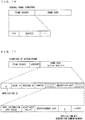
- FIG. 10 is a diagram illustrating the structure of a common frame.
- the common frame includes a frame header, and a frame body.
- the frame header includes a frame type and an address.
- the frame type is roughly classified into a management frame, a control frame, and a data frame.
- the management frame is further classified into a beacon, a probe request, a probe response, an authentication, an association request, an association response, an action frame, etc.
- the information processing apparatus 10 when serving as a master apparatus, transmits an action frame at predetermined time intervals. Besides the action frame, the master apparatus also transmits the beacon described above at predetermined time intervals.
- a plurality of addresses are stored in the "address".
- the "address” is used for setting a receiver, a transmitter, a destination address, a source address, etc., and for designating the MAC address of a master apparatus or a slave apparatus.
- FIG. 11 is a diagram illustrating the structure of an action frame transmitted by the master apparatus according to the present embodiment.
- the action frame is defined by IEEE802.11, and only a part thereof peculiar to the present embodiment will be described with reference to FIG. 11 .
- the action frame includes a frame header, a category, and a frame body (action details).
- a value indicating "vendor specific” is stored in the “category”.
- a value indicating "action frame” is stored in "frame type" in the frame header.
- the frame body in the action frame of the present embodiment includes "application ID”, "scene ID”, “session ID”, and "counter”. These are transmitted in plain texts without being encrypted.
- the application ID is an ID unique to a communication application.
- the application ID varies among different types of communication applications to be executed, and is assigned in advance by an application manufacturer. Even different types of applications may be assigned the same application ID as long as these applications are in the same series and can be executed by performing mutual communication therebetween.
- the application ID is used for generating a frame encryption key.
- the "frame encryption key” is a key used for encryption and decryption of an encryption part shown in FIG. 11 . A method for generating the frame encryption key will be described later.
- the scene ID is an ID for identifying different scenes in the same application, and is assigned in advance by the application manufacturer. For example, when there are a fighting scene and an item exchange scene in the same application, these scenes are assigned different scene IDs.
- the scene ID is used for generating a frame encryption key.
- the session ID is identification information which is used for performing communication with another information processing apparatus and is unique to the communication.
- the session ID is randomly generated when communication with another information processing apparatus is started. Specifically, the session ID is generated when a master apparatus is set.
- the session ID is used for generating a frame encryption key.
- the counter is used for generating different cipher texts even when the content of the plain text in the encryption part shown in FIG. 11 is the same.
- the counter is randomly generated at an initial stage. When the content of the encryption part in the last action frame and the content of the encryption part in the current action frame are completely the same, the counters in these frames have the same value. On the other hand, when the content of the encryption part in the last action frame and the content of the encryption part in the current action frame are at least partially different from each other, the counter is incremented by "1".
- the counter is used as an IV (Initialization Vector) when the action frame is encrypted.
- the frame body of the action frame includes the "encryption part".
- the "encryption part” is encrypted on the basis of an apparatus common key (key common to the plurality of information processing apparatuses 10) stored in the key storage section 16. Specifically, the encryption part is encrypted by using the frame encryption key and the counter as the IV.
- the frame encryption key is generated by encrypting, using the apparatus common key, values obtained by converting the application ID, the scene ID, and the session ID in a predetermined procedure.
- the "encryption part” includes "node information”, “acceptance policy”, “advertisement data”, “application key generation random number”, and "digest”.
- the node information is information in which the IP addresses of the respective apparatuses are associated with the MAC addresses thereof, and corresponds to the ARP table described above.
- the node information includes information of one or a plurality of nodes (the master apparatus and the plurality of slave apparatuses) currently participating in the network.
- the node information includes information of 8 nodes at maximum, for example.
- the acceptance policy is information indicating whether or not the master apparatus is accepting participation of slave apparatuses, and whether or not the master apparatus is conditionally accepting participation of slave apparatuses.
- the acceptance policy will be described later in detail.
- the advertisement data is optional data regarding an application that the master apparatus transmits to slave apparatuses. While executing a communication application with another information processing apparatus 10, the master apparatus is allowed to broadcast optional data regarding the communication application, as the advertisement data to the surrounding apparatuses.
- the application key generation random number is a random number used for generating an application key when a communication application is started.
- Application data to be transmitted/received during execution of a communication application is encrypted or decrypted by using the application key.
- the application key is generated in each information processing apparatus 10 on the basis of the application key generation random number, and a pass phrase unique to the application.
- the pass phrase unique to the application is set by the developer of the application, and is included in the application program.
- An application key is generated every time a communication application is started among the plurality of information processing apparatuses 10.
- a first communication application is executed among the master apparatus, the slave apparatus 1, and the slave apparatus 2 at a certain timing
- an application key is generated on the basis of the application key generation random number and the pass phrase unique to the first communication application.
- This application key is shared among the master apparatus, the slave apparatus 1, and the slave apparatus 2 during execution of the first communication application.
- an application key generation random number is newly generated, and a new application key is generated.
- the first communication application is executed among the master apparatus, the slave apparatus 1, and the slave apparatus 2 at a certain timing and, at the same time, a second communication application is executed between the master apparatus and a slave apparatus 3, an application key for the first communication application and an application key for the second communication application are respectively generated.
- the “digest” is a message digest (signature) of the entire frame body before being encrypted.
- the digest is a hash value of a portion from the "application ID” to the "application key generation random number” shown in FIG. 11 , which is calculated by using a predetermined hash function.
- the master apparatus operates in any one of a plurality of operation modes.
- FIG. 12A is a diagram illustrating examples of operation modes of the master apparatus.
- operation modes of the master apparatus there are “permission”, “rejection”, “white list”, and “black list” as operation modes of the master apparatus.
- the operation of the master apparatus varies depending on these operation modes.
- the operation modes of the master apparatus are not limited to the four modes described above, and there may be other modes.
- the master apparatus When the master apparatus is operating in the operation mode of "permission", the master apparatus accepts participation of all the slave apparatuses. That is, when the master apparatus is operating in the operation mode of "permission", the master apparatus always accept connections from all the slave apparatuses that have transmitted participation requests. For example, in the case where the master apparatus invites participation in a communication game before start of the communication game, the master apparatus sets the operation mode to "permission”. When the master apparatus is operating in the operation mode of "permission”, the master apparatus sets the value of the acceptance policy in the action frame to a value (e.g., "0") indicating "permission", and transmits the action frame.
- a value e.g., "0
- the master apparatus When the master apparatus is operating in the operation mode of "rejection", the master apparatus does not accept any participation of slave apparatuses. That is, when the master apparatus is operating in the operation mode of "rejection", the master apparatus always rejects connections from all the slave apparatuses that have transmitted participation requests. For example, after members participating in a communication game have been decided and the communication game is started, the master apparatus sets the operation mode to "rejection". Even before the master apparatus starts the communication game, if the number of currently participating slave apparatuses has reached the upper limit, the master apparatus sets the operation mode to "rejection". When the master apparatus is operating in the operation mode of "rejection", the master apparatus sets the value of the acceptance policy in the action frame to a value (e.g., "1 ”) indicating "rejection", and transmits the action frame.
- a value e.g., "1
- the master apparatus When the master apparatus is operating in the operation mode of "white list", the master apparatus does not accept participation of slave apparatuses as in the operation mode of "rejection”, but accepts reconnection of a slave apparatus that has previously been connected to the master apparatus and suddenly disconnected. For example, in the state where the master apparatus and the slave apparatus 2 are connected to each other, if a period during which the master apparatus cannot detect presence of the slave apparatus 2 due to the communication status or the like exceeds a predetermined threshold, the master apparatus and the slave apparatus 2 are disconnected from each other. In such a case, the master apparatus sets the operation mode of "white list” in order to accept reconnection of the slave apparatus 2.
- the master apparatus stores, in the storage unit thereof, the "white list” in which slave apparatuses, reconnections of which are to be accepted, are listed.
- the master apparatus permits reconnection of the slave apparatus.
- the master apparatus rejects connection of the slave apparatus.
- the master apparatus sets the value of the acceptance policy in the action frame to a value (e.g., "2") indicating the "white list", and transmits the action frame.
- the master apparatus When the master apparatus is operating in the operation mode of "black list", the master apparatus accepts participation of slave apparatuses as in the operation mode of "permission”, but rejects connection of a slave apparatus that has previously been connected to the master apparatus and intentionally disconnected. For example, in the state where the master apparatus and the slave apparatus 2 are connected with each other, if the master apparatus transmits, to the slave apparatus 2, a disconnection request indicating that the master apparatus intentionally disconnects the slave apparatus 2 (e.g., if the user of the master apparatus indicates his/her intention to reject participation of the user of the slave apparatus 2 in the communication application), the master apparatus and the slave apparatus 2 are disconnected from each other. In such a case, the master apparatus sets the operation mode of "black list" in order to reject reconnection of the slave apparatus 2.
- the master apparatus stores, in the storage unit thereof, the "black list” in which slave apparatuses, reconnections of which are to be rejected, are listed.
- the master apparatus rejects reconnection of this slave apparatus.
- the master apparatus permits connection of this slave apparatus.
- the master apparatus sets the value of the acceptance policy in the action frame to a value (e.g., "3") indicating "black list", and transmits the action frame.
- the master apparatus transmits a disconnection request to a slave apparatus not only when the user of the master apparatus intentionally rejects other users but also in other cases.
- the disconnection request transmitted by the master apparatus includes the reason for disconnection.
- the master apparatus determines whether or not to include the slave apparatus into the black list, depending on the reason for disconnection when the master apparatus transmits the disconnection request to the slave apparatus.
- the master apparatus transmits, to the slave apparatus, a disconnection request including the reason for disconnection, and includes the slave apparatus into the black list.
- the disconnection request that is transmitted when the user of the master apparatus intentionally rejects the user of the slave apparatus is also referred to as "first disconnection request".
- the master apparatus When the master apparatus shifts to a sleep mode due to an operation by the user or the master apparatus shifts to a sleep mode because a non-input state continues for a predetermined period regardless of an operation by the user, or when the master apparatus shifts to a flight mode (an operation mode in which a wireless communication function is OFF) due to an operation by the user, the master apparatus transmits, to a slave apparatus, a disconnection request including the reason for disconnection. In this case, the master apparatus does not include the slave apparatus into the black list. Such a disconnection request is also referred to as "second disconnection request".
- the master apparatus When the master apparatus has shifted to the sleep mode or the flight mode, there is no master apparatus in the network. In this case, a slave apparatus in the network becomes a master apparatus to maintain connection, whereby execution of the communication application can be continued. In this case, the new master apparatus inherits the session ID.
- FIG. 12B is a diagram showing an example of an operation of a slave apparatus that has received an action frame.
- a slave apparatus that has received an action frame in which the acceptance policy is "permission” knows that the master apparatus that has transmitted this action frame is operating in the operation mode of "permission". Therefore, the slave apparatus that has received the action frame displays information of the master apparatus that has transmitted the action frame, as a connection destination candidate.
- a slave apparatus that has received an action frame in which the acceptance policy is "rejection” knows that the master apparatus that has transmitted this action frame is operating in the operation mode of "rejection". Therefore, the slave apparatus that has received the action frame does not display information of the master apparatus that has transmitted the action frame, as a connection destination candidate.
- a slave apparatus that has received an action frame in which the acceptance policy is "white list” knows that the master apparatus is operating in the operation mode of "white list", and that the master apparatus permits reconnection of only slave apparatuses that have previously been connected to the master apparatus. Therefore, if the slave apparatus has previously been connected to the master apparatus, the slave apparatus displays information of the master apparatus that has transmitted this action frame, as a connection destination candidate.
- the slave apparatus may display, on the display section 14, a screen indicating that reconnection to the master apparatus is allowed. Alternatively, the slave apparatus may automatically transmit a participation request to the master apparatus that has transmitted the action frame.
- a slave apparatus that has received an action frame in which the acceptance policy is "black list” knows that the master apparatus is operating in the operation mode of "black list” and that the master apparatus rejects reconnection of slave apparatuses that have been connected to the master apparatus but intentionally disconnected. Therefore, if the slave apparatus has previously received a first disconnection request from the master apparatus, the slave apparatus does not display information of the master apparatus that has transmitted the action frame, as a connection destination candidate. Alternatively, the slave apparatus does not automatically transmit a reconnection request to the master apparatus that has transmitted the action frame.
- the slave apparatus may display, on the display section 14, a screen indicating that reconnection to the master apparatus is not allowed.
- the master apparatus when transmitting an action frame, sets any value of 0 to 3 as the "acceptance policy" in the action frame, but does not include, in the action frame, the "white list” itself which is stored therein and lists the apparatuses, reconnections of which are to be accepted, and the "black list” itself which is stored therein and lists the apparatuses, reconnections of which are to be rejected.
- the master apparatus when transmitting an action frame, may include, in the action frame, the "white list” itself which is stored therein, and the "black list” itself which is stored therein.
- the slave apparatus determines whether or not to display the master apparatus as a connection destination candidate, that is, whether or not to transmit a participation request for reconnection to the master apparatus, on the basis of the value stored in the "acceptance policy" in the action frame received from the master apparatus, and the disconnection request previously received from the master apparatus.
- the slave apparatus determines whether or not to reconnect to the master apparatus (whether or not to display the master apparatus as a connection destination candidate) also on the basis of the "session ID" in the action frame, in addition to the value of the "acceptance policy” in the action frame and the disconnection request previously received from the master apparatus.
- the slave apparatus stores the session ID therein. This session ID is stored in the slave apparatus for a predetermined period even when the slave apparatus is disconnected from the master apparatus. For example, when communication with the master apparatus is not performed for a predetermined period, the slave apparatus disconnects from the master apparatus, and stores therein the session ID of the connection, for reconnection with the master apparatus.
- the slave apparatus In the case where the slave apparatus receives an action frame after having been disconnected from the master apparatus, if the session ID included in the action frame matches the session ID used for the connection with the master apparatus before the disconnection, the slave apparatus knows that the slave apparatus has been connected to the master apparatus just before the disconnection. In this case, for example, the slave apparatus displays, on the display section 14, a screen that allows the user to select whether or not to reconnect the slave apparatus to the master apparatus. When reconnection is selected by the user, the slave apparatus transmits a participation request for reconnection to the master apparatus that has transmitted the action frame.
- the slave apparatus determines that the master apparatus that has transmitted the action frame is different from the master apparatus to which the slave apparatus has been connected just before the disconnection. In this case, for example, the slave apparatus displays, on the display section 14, a screen that allows the user to select whether or not to newly connect the slave apparatus to the master apparatus. When the user selects to newly connect the slave apparatus to the master apparatus, the slave apparatus transmits a participation request for new connection to the master apparatus that has transmitted the action frame.
- the slave apparatus in the case where the slave apparatus has received a first disconnection request transmitted from a master apparatus A to which the slave apparatus was just connected, if the slave apparatus receives an action frame from another master apparatus B, the slave apparatus transmits a participation request to the master apparatus B even if the value of the acceptance policy in this action frame indicates "black list".
- the slave apparatus can determine, on the basis of the session ID and/or the MAC address, whether the action frame is from the master apparatus A that has transmitted the first disconnection request or from the master apparatus B different from the master apparatus A.
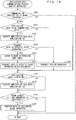
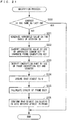
- FIG. 13 is a flowchart illustrating, in detail, processing for setting an information processing apparatus 10 as a master apparatus or a slave apparatus.
- each information processing apparatus 10 is set as a master apparatus or a slave apparatus.
- the processing shown in FIG 13 is performed by the information processing section 11 (specifically, a CPU) of the information processing apparatus 10 performing a predetermined program.
- the information processing apparatus 10 displays, on the display section 14, a selection screen that allows a user to select whether or not to set the information processing apparatus 10 as a master apparatus (step S101).
- step S102 When it is selected, through the selection screen, to set the information processing apparatus 10 as a master apparatus (step S102: YES), the information processing apparatus 10 sets itself as a master apparatus (step S103). On the other hand, when it is selected, through the selection screen, not to set the information processing apparatus 10 as a master apparatus (step S102: NO), the information processing apparatus 10 sets itself as a slave apparatus (step S104).
- step S103 When the process in step S103 has been executed, the information processing apparatus 10 thereafter operates as a master apparatus, and executes master apparatus processing shown in FIG. 15 .
- step S104 When the process in step S104 has been executed, the information processing apparatus 10 thereafter operates as a slave apparatus, and executes slave apparatus processing shown in FIG. 20 .
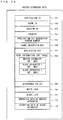
- FIG. 14 is a diagram illustrating examples of data stored in the master apparatus.
- storage regions 101 to 113 are provided in the master apparatus. Specifically, an application ID, a scene ID, a session ID, a counter, and an application key generation random number as described above are stored in the storage regions 101 to 105, respectively. A frame encryption key and an application key are stored in the storage regions 106 and 107, respectively.
- Node information is stored in the storage region 108.
- the node information includes: data in which the IP address and the MAC address of the master apparatus are associated with each other; and data in which the IP address and the MAC address of each of slave apparatuses connected to the master apparatus are associated with each other.
- a value representing an acceptance policy (operation mode) is stored in the storage region 109,.
- a white list is stored in the storage region 110.
- the white list includes information of slave apparatuses (IP address, MAC address, etc.).
- a black list is stored in the storage region 111.
- the black list includes information of slave apparatuses (IP address, MAC address, etc.).
- Operation data according to an input performed to the input section 13 of the master apparatus is stored in the storage region 112.
- Operation data received from each slave apparatus is stored in the storage region 113.
- the various types of data shown in FIG. 14 are stored in a storage unit of the master apparatus (any one of the DRAM in the information processing section 11, the storage section 12, and the memory in the wireless communication section 15), and are readable from the information processing section 11 of the master apparatus.
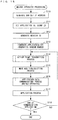
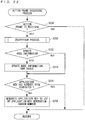
- FIG. 15 is a flowchart illustrating, in detail, master apparatus processing when the information processing apparatus 10a is operating as a master apparatus.
- the information processing apparatus 10a (master apparatus) generates an IP address thereof, and sets the generated IP address therein (step S110). Subsequently, the master apparatus sets an application ID and a scene ID in the storage region 101 and the storage region 102, respectively (step S111). As described above, the application ID and the scene ID are predetermined IDs, and the master apparatus sets the application ID and the scene ID in accordance with the type of a communication application to be executed and a scene in the application, respectively.
- the master apparatus randomly generates a session ID, and stores the session ID in the storage region 103 (step S112).
- the master apparatus randomly generates an application key generation random number, and stores the random number in the storage region 105 (step S113).
- the master apparatus generates an application key by using the generated application key generation random number, and a pass phrase, unique to the application, stored in an application program, and stores the application key in the storage region 107.
- the master apparatus by using the application key, performs encryption and decryption of application data transmitted/received during execution of the communication application. Also in each slave apparatus, the same application key is generated by using the application key generation random number transmitted from the master apparatus.
- an information processing apparatus 10a becomes a master apparatus to execute the communication application with a plurality of information processing apparatuses 10
- the information processing apparatus 10a executes the processes in steps S110 to S113 only once.
- the master apparatus After executing the process in step S113, the master apparatus repeatedly executes the processes in steps S114 to S118.
- the master apparatus executes an action frame transmitting process (step S114).
- the action frame transmitting process is a process for transmitting the action frame described above, and is repeatedly executed at predetermined time intervals (e.g., every 100 msec). The action frame transmitting process will be described later in detail.
- the node addition/deletion process is a process for causing a slave apparatus to participate in or withdraw from a communication application.
- the node addition/deletion process will be described later in detail.
- step S 116 the master apparatus executes an application data communicating process (master apparatus) (step S 116).
- master apparatus stops accepting participation of slave apparatuses (e.g., when the number of participating slave apparatuses has reached the upper limit in the process of step S115, or when an instruction is made by the user of the master apparatus)
- the master apparatus starts execution of the communication application.
- the application data communicating process (master apparatus) is a process for transmitting application data during execution of the communication application between the master apparatus and the slave apparatus.
- the application data communicating process (master apparatus) in step S116 will be described later in detail.
- step S117 the master apparatus executes an application process (step S117). Specifically, the master apparatus executes the application process on the basis of the data received in step S116.
- the master apparatus receives, in step S116, operation data according to an input performed to the input section 13 of a slave apparatus, and stores the received operation data in the storage region 113.
- the master apparatus executes the application process on the basis of the operation data, of the slave apparatus, stored in the storage region 113.
- the master apparatus stores, in the storage region 112, operation data according to an input performed to the input section 13 thereof.
- the master apparatus executes the application process on the basis of the operation data, of the master apparatus, stored in the storage region 112.
- step S 116 when a fighting game is performed as the communication application among a plurality of users, operation data according to an input performed by each user is received in step S 116.
- the master apparatus causes a character corresponding to each user to act or move in a game space. Then, the master apparatus causes the display section 14 to display an image according to the application process.
- step S118 determines whether or not to end the communication application. For example, when an instruction to end the communication application is made by the user of the master apparatus or when a predetermined period has elapsed from the start of the communication application, the master apparatus determines to end the communication application. Upon determining not to end the communication application (step S 118: NO), the master apparatus again executes the process in step S114.
- FIG. 16 is a flowchart illustrating, in detail, the action frame transmitting process in step S 114 shown in FIG. 15 .
- the master apparatus determines whether or not the data to be transmitted is the same as the data in the action frame transmitted last time (step S120). Specifically, when the node information is not changed, the acceptance policy (operation mode) is not changed, and the advertisement data is not changed, the master apparatus determines as YES in step S120. On the other hand, when any of these data is changed, the master apparatus determines as NO in step S120. When the master apparatus firstly executes the process in step S120, the master apparatus always determines as NO.
- the master apparatus Upon determining that the data to be transmitted is different from the last data (step S120: NO), the master apparatus generates a counter and sets the counter in the storage region 104 (step S121). Specifically, when the master apparatus firstly executes the process in step S 121, the master apparatus randomly generates the counter. On the other hand, when executing the process in step S121 on and after the second time, the master apparatus adds "1" to the value of the counter stored in the storage region 104, and stores the value of the counter after the addition, in the storage region 104.
- the master apparatus generates converted values on the basis of the session ID set in the storage region 103 (step S122). Specifically, the master apparatus converts the application ID and the scene ID set in step S111 and the session ID generated in step S 112 by using a predetermined function, thereby generating converted values.
- the master apparatus encrypts the converted values generated in step S122 by using the apparatus common key, thereby generating a frame encryption key (step S123).
- the master apparatus stores the generated frame encryption key in the storage region 106.
- the master apparatus assumes that the value of "digest" is a fixed value (step S 124).
- the master apparatus calculates a message digest of the frame body shown in FIG. 11 in the case where the value of the "digest" is the fixed value (step S125). Specifically, the master apparatus arranges the frame body (action details) shown in FIG. 11 (specifically, the application ID, the scene ID, the session ID, the counter, the node information, the acceptance policy, the advertisement data, the application key generation random number, and the digest assumed to be a fixed value) in order as shown in FIG. 11 , and a hash value of the data in this portion is calculated by using a predetermined hash function, thereby calculating the "digest".
- action details specifically, the application ID, the scene ID, the session ID, the counter, the node information, the acceptance policy, the advertisement data, the application key generation random number, and the digest assumed to be a fixed value
- the “node information” and the “acceptance policy” are generated and changed when the node addition/deletion process described later is performed.
- the “advertisement data” is set at an appropriate time in response to, for example, a request from the communication application. For example, when the communication application broadcasts predetermined data used for the application process to the surroundings by using the action frame, the communication application sets the advertisement data.
- the master apparatus encrypts the encryption part (the node information, the acceptance policy, the advertisement data, the application key generation random number, and the digest) of the frame body shown in FIG 11 by using the frame encryption key generated in step S123 and the counter (step S126). That is, in step S126, the master apparatus encrypts the encryption part (plain text) of the frame body by using the frame encryption key and the counter as an IV.
- the plain text is encrypted in different cipher texts if the counter as an IV differs even when the same frame encryption key is used. Since the counter is changed every time at least a portion of the plain text in the encryption part is changed, even if a portion of the plain text in the encryption part is the same as that in the last encryption, the same cipher text as in the last encryption is not obtained.
- the master apparatus generates an action frame (step S127). Specifically, the master apparatus arranges the application ID, the scene ID, the session ID, the counter, and the encryption part encrypted in step S 126 in this order to generate the frame body shown in FIG. 11 . Then, the master apparatus adds the frame header in front of the frame body to generate the action frame shown in FIG. 11 .
- step S120 the master apparatus generates the same action frame as the last action frame (step S128).
- the master apparatus When having executed the process in step S 127 or the process in step S128, the master apparatus transmits the generated action frame (step S129). Thus, the action frame is broadcast.
- the "frame encryption key” is generated on the basis of the apparatus common key and the session ID.
- the session ID is generated when the information processing apparatus 10 is set as a master apparatus. Therefore, the frame encryption key is generated every time the master apparatus is set.
- the action frame is encrypted by using the frame encryption key and the counter.
- the apparatus common key is a key common to the respective information processing apparatuses 10 and is a fixed key, but the value of the counter is changed every time the data of the encryption part in the action frame is changed. Therefore, even when the action frame which is encrypted by using the "frame encryption key” and the counter is repeatedly transmitted, the encryption part in the action frame is changed in every transmission. Therefore, another apparatus that does not have the frame encryption key cannot easily derive the frame encryption key even when the apparatus repeatedly receives the action frame, and therefore cannot easily decrypt the encryption part in the action frame.
- FIG. 17 is a flowchart illustrating, in detail, the node addition/deletion process in step S 115 shown in FIG. 16 .
- the master apparatus determines whether or not a participation request in the communication application is received from a slave apparatus (step S131).
- the participation request from the slave apparatus includes the MAC address of the slave apparatus.
- the master apparatus determines whether or not to permit participation of the slave apparatus that has transmitted the participation request, on the basis of the value of the operation mode (acceptance policy) set in the storage region 109 (step S132). Specifically, in the case where the value indicating the operation mode of "white list" is set in the storage region 109, the master apparatus determines whether or not the slave apparatus that has transmitted the participation request is included in the white list stored in the storage region 110, thereby determining whether or not to permit participation of the slave apparatus that has transmitted the participation request. When the slave apparatus that has transmitted the participation request is included in the white list, the master apparatus permits participation of the slave apparatus. When the slave apparatus that has transmitted the participation request is not included in the white list, the master apparatus rejects participation of the slave apparatus.
- the master apparatus determines whether or not the slave apparatus that has transmitted the participation request is included in the black list stored in the storage region 111, thereby determining whether or not to permit participation of the slave apparatus that has transmitted the participation request.
- the master apparatus rejects participation of the slave apparatus.
- the master apparatus permits participation of the slave apparatus.
- the master apparatus permits participation of the slave apparatus that has transmitted the participation request, without referring to the black list or the white list.
- the master apparatus rejects participation of the slave apparatus that has transmitted the participation request, without referring to the black list or the white list.
- the master apparatus may execute the process in step S 134 without executing the processes in steps S 132 and S 133.
- the master apparatus may execute the process in step S136 without executing the processes in steps S132 to S135.
- the master apparatus determines whether or not the slave apparatus that has transmitted the participation request is a new slave apparatus (step S133). From when the master apparatus has set itself as a master apparatus in step S103 and started the processing shown in FIG. 15 , the master apparatus stores, in the storage unit, information (including IP addresses and MAC addresses) of slave apparatuses that have participated in the communication application. For example, in the case where, after the processing shown in FIG.
- the slave apparatus 1 participates in the communication application and thereafter communication with the slave apparatus 1 is disconnected due to, for example, deteriorated communication status
- the master apparatus deletes the slave apparatus 1 from the node information (ARP table), and stores information of the slave apparatus 1 in the white list. Then, upon determining that the slave apparatus that has transmitted the participation request this time is the slave apparatus 1 stored in the white list, the master apparatus determines that the slave apparatus that has transmitted the participation request is a slave apparatus that has previously been connected to the master apparatus, and determines as NO in step S133. On the other hand, upon determining that the slave apparatus that has transmitted the participation request this time is not a slave apparatus that has previously connected to the master apparatus, the master apparatus determines as YES in step S133.
- the master apparatus Upon determining that the slave apparatus that has transmitted the participation request is a new slave apparatus (step S133: YES), the master apparatus generates an IP address of the slave apparatus that has transmitted the participation request. Specifically, the master apparatus assigns IP addresses to slave apparatuses according to the order of participation requests transmitted therefrom.
- the master apparatus When having executed the process in step S 134 or when having determined as NO in step S133, the master apparatus updates the node information (ARP table) (step S135). Specifically, when executing the process in step S135 subsequently to the process in step S134, the master apparatus associates the IP address generated in step S 134 with the MAC address of the slave apparatus that has transmitted the participation request, thereby updating the node information in the storage region 108.
- ARP table node information
- the master apparatus When executing the process in step S135 subsequently to the process in step S133, the master apparatus, for example, on the basis of the information stored in the white list, assigns the same IP address as the last one to the slave apparatus that has transmitted the participation request, and associates this IP address with the MAC address of the slave apparatus, thereby updating the node information in the storage region 108.
- the master apparatus determines whether or not withdrawal of a slave apparatus is detected (step S 136). For example, the master apparatus periodically receives frames from the slave apparatuses being connected thereto, and determines whether or not connection with each slave apparatus is maintained. Specifically, the master apparatus periodically transmits a frame to each slave apparatus and receives, from each slave apparatus, a response frame to the transmitted frame, thereby determining whether or not connection with each slave apparatus is maintained. Further, when a slave apparatus is instructed to withdraw from the communication application by the user of the slave apparatus, the slave apparatus transmits, to the master apparatus, a message indicating that the slave apparatus withdraws from the communication application. The master apparatus determines that withdrawal of a slave apparatus is detected (step S136: YES) when the master apparatus does not receive a response frame from the slave apparatus within a predetermined period, or receives a message indicating withdrawal from the slave apparatus.
- the master apparatus Upon detecting withdrawal of a slave apparatus (step S136: YES), the master apparatus deletes the slave apparatus from the node information (ARP table) to update the node information (step S137). At this time, the master apparatus adds information (IP address, MAC address, user name, etc.) of the deleted slave apparatus to the white list so as to be stored in the storage region 110.
- ARP table node information
- the master apparatus adds information (IP address, MAC address, user name, etc.) of the deleted slave apparatus to the white list so as to be stored in the storage region 110.
- the master apparatus determines whether or not to disconnect the slave apparatus (step S138). For example, when the user of the master apparatus instructs to intentionally reject the slave apparatus, the master apparatus determines as YES in step S138. For example, when the master apparatus shifts to the sleep mode, the master apparatus determines as YES in step S138.
- the master apparatus Upon determining to disconnect the slave apparatus (step S138: YES), the master apparatus transmits a disconnection request to the slave apparatus (step S139). For example, when the user of the master apparatus intentionally rejects the slave apparatus, the master apparatus transmits a first disconnection request to the slave apparatus.
- the master apparatus deletes, from the node information, the slave apparatus determined to be disconnected, thereby updating the node information (step S140).
- the master apparatus adds information (IP address, MAC address, user name, etc.) of the slave apparatus to the black list so as to be stored in the storage region 111.
- the master apparatus determines whether or not to change the value of the acceptance policy (operation mode) stored in the storage region 109 (step S141). Upon determining to change the value of the acceptance policy (step S 141: YES), the master apparatus changes the value of the acceptance policy and stores the value in the storage region 109 (step S142). For example, when the number of the participating slave apparatuses has reached the upper-limit number due to the addition of the slave apparatus in the process of step S135, the master apparatus changes the value of the acceptance policy stored in the storage region 109 from the value indicating "permission" to the value indicating "rejection".
- the master apparatus When the master apparatus, which is inviting slave apparatuses to participate in the communication game, stops inviting slave apparatuses and starts the communication game, the master apparatus changes the value of the acceptance policy stored in the storage region 109 from the value indicating "permission” or “rejection” to the value indicating "white list", for example.
- the master apparatus When having transmitted the first disconnection request in step S 139, the master apparatus changes the value of the acceptance policy stored in the storage region 109 from the value indicating "permission” or “rejection” to the value indicating "black list", for example.
- the master apparatus before transmission of the first disconnection request, has transmitted the action frame including the value indicating, for example, "permission” as the acceptance policy
- the master apparatus after transmission of the first disconnection request, transmits the action frame including the value indicating "black list" as the acceptance policy.
- step S 142 When having executed the process in step S 142 or when having determined as NO in step S141, the master apparatus ends the processing shown in FIG. 17 .
- FIG. 18 is a flowchart illustrating, in detail, the application data communicating process (master apparatus) in step S116 shown in FIG. 16 .
- the master apparatus determines whether or not a communication application is being executed (step S150). For example, when acceptance of participation of slave apparatuses is ended and execution of the communication application (communication game) is started among a plurality of apparatuses, the master apparatus determines as YES in step S150. On the other hand, when the master apparatus is accepting participation of slave apparatuses, the master apparatus determines as NO in step S150, and the processing shown in FIG. 18 is ended.
- the master apparatus determines whether or not there is application data to be transmitted from the master apparatus to slave apparatus (step S151). For example, when there is a request for transmission of application data (e.g., operation data) from the application being executed in the master apparatus, the master apparatus determines that there is application data to be transmitted.
- application data e.g., operation data
- the master apparatus Upon determining that there is application data to be transmitted (step S151: YES), the master apparatus encrypts the application data transferred from the application, by using the application key stored in the storage region 107 (step S 152). As described above, the application key is generated in step S 113 on the basis of the application key generation random number and stored in the storage region 107. The application key may be generated on the basis of the application key generation random number when acceptance of participation of slave apparatuses is ended and the communication application is started.
- step S 152 the master apparatus determines whether or not to transmit the data to a specific slave apparatus (step S 153). Whether the application data is to be transmitted to a specific slave apparatus by unicast or to be transmitted to all the slave apparatuses by broadcast is determined by the application. At this time, the application designates the IP address of the specific slave apparatus to which the data is transmitted.
- the master apparatus Upon determining to transmit the data to the specific slave apparatus (step S 153: YES), the master apparatus refers to the node information (ARP table) stored in the storage region 108 (step S 154). Then, the master apparatus generates a data frame in which the MAC address corresponding to the IP address designated by the application is designated, and transmits the data encrypted in step S 152 to the specific slave apparatus by unicast (step S155).
- ARP table node information
- the master apparatus transmits the data encrypted in step S 152 by broadcast (step S 156). Specifically, the master apparatus generates a data frame in which a broadcast address is designated as a destination address, and transmits the data encrypted in step S 152 by broadcast.
- the master apparatus determines whether or not application data from a slave apparatus is received (step S 157). Upon determining that application data is received (step S 157: YES), the master apparatus decrypts the received data by using the application key stored in the storage region 107 (step S158).
- the master apparatus determines whether or not a data frame directed from a certain slave apparatus to another slave apparatus is received (step S159). Upon determining that a data frame from a certain slave apparatus to another slave apparatus is received (step S 159: YES), the master apparatus transfers the received frame to the slave apparatus designated by a destination address (step S160).
- FIG. 19 is a diagram illustrating examples of data stored in the slave apparatus.
- storage regions 201 to 211 are provided in the slave apparatus. Specifically, an application ID, a scene ID, a session ID, a counter, and an application key generation random number, which are included in an action frame received from the master apparatus, are stored in the storage regions 201 to 205, respectively. A frame encryption key and an application key are stored in the storage region 206 and the storage region 207, respectively.
- Node information (ARP table) included in the action frame received from the master apparatus is stored in the storage region 208.
- the node information (ARP table) includes: data in which the IP address and the MAC address of the master apparatus are associated with each other; and data in which the IP address and the MAC address of each of slave apparatuses participating in the communication application are associated with each other.
- a disconnection request received from the master apparatus is stored in the storage region 209. For example, if the master apparatus transmits a disconnection request to the slave apparatus 1 in step S139, the slave apparatus 1 stores this disconnection request in the storage region 209. Information (e.g., MAC address, IP address, etc.) of the master apparatus that has transmitted the disconnection request is also stored in the storage region 209.
- Information e.g., MAC address, IP address, etc.
- Operation data according to an input performed to the input section 13 of the slave apparatus is stored in the storage region 210. Operation data according to inputs performed to the input sections 13 of other apparatuses (master apparatus and another slave apparatus) are stored in the storage region 211.
- the various types of data shown in FIG. 19 are stored in a storage unit (any one of the DRAM in the information processing section 11, the storage section 12, and the memory in the wireless communication section 15) of the slave apparatus, and are readable from the information processing section 11 of the slave apparatus.
- FIG. 20 is a flowchart illustrating, in detail, the slave apparatus processing when the information processing apparatus 10b is operating as a slave apparatus.
- the information processing apparatus 10b determines whether or not an action frame from a master apparatus existing around the information processing apparatus 10b is received (step S200).
- the slave apparatus since the slave apparatus is not yet connected to a master apparatus, the slave apparatus receives action frames from all master apparatuses existing around the slave apparatus.
- the slave apparatus Upon receiving an action frame (step S200: YES), the slave apparatus stores, in the storage regions 201 to 204, an application ID, a scene ID, a session ID, and a counter included in the action frame, respectively, and performs a decryption process (step S201).
- the slave apparatus generates the same frame encryption key as that of the master apparatus on the basis of the session ID included in the received action frame, and the apparatus common key, and stores the frame encryption key in the storage region 206, and then decrypts the encryption part in the action frame by using the frame encryption key.
- the decryption process will be described later in detail.
- the slave apparatus When receiving action frames from a plurality of master apparatuses, the slave apparatus stores, for each master apparatus, an application ID, a scene ID, a session ID, a counter, and a frame encryption key in the corresponding storage regions, and performs the decryption process.
- the slave apparatus determines whether or not it is possible to participate in the network (communication application) of the master apparatus that has transmitted the action frame (step S202). Specifically, the slave apparatus determines whether or not it is possible to participate in the network of the master apparatus that has transmitted the action frame, on the basis of the "acceptance policy" in the received action frame, and the "disconnection request" stored in the storage region 209 thereof. The slave apparatus determines whether or not participation is possible also on the basis of the "session ID" in the action frame. The slave apparatus may determine whether or not participation is possible also on the basis of the "game ID" or the "scene ID” in the action frame.
- the slave apparatus determines that participation is possible, without referring to the disconnection request stored in the storage region 209.
- the acceptance policy in the received action frame is the value indicating "rejection”
- the slave apparatus determines that participation is not possible, without referring to the disconnection request stored in the storage region 209.
- the slave apparatus determines whether or not the master apparatus that has transmitted the action frame is a master apparatus that has previously been connected to the slave apparatus. For example, when a slave apparatus is connected to a master apparatus, the slave apparatus stores therein information regarding the connection (IP address, MAC address, session ID, etc. of the master apparatus), and holds the information for a predetermined period even after the slave apparatus is disconnected from the master apparatus. The slave apparatus determines, on the basis of the held information, whether or not the master apparatus that has transmitted the action frame is a master apparatus that has previously been connected to the slave apparatus.
- the slave apparatus determines that reconnection is possible (participation is possible).
- the master apparatus that has transmitted the action frame is not a master apparatus that has previously been connected to the slave apparatus, the slave apparatus determines that participation is not possible.
- the slave apparatus determines whether or not it is possible to participate in the network of the master apparatus that has transmitted the action frame, with reference to the disconnection request stored in the storage region 209. Specifically, in the case where the disconnection request stored in the storage region 209 is the first disconnection request, if the master apparatus that has transmitted the action frame matches the master apparatus that has transmitted the first disconnection request, the slave apparatus determines that the slave apparatus has previously been intentionally disconnected from the master apparatus and therefore cannot participate in the network of the master apparatus.
- the slave apparatus Upon determining that it is possible to participate in the network of the master apparatus that has transmitted the action frame (step S202: YES), the slave apparatus displays the master apparatus that has transmitted the action frame, as a connection destination candidate (step S203). For example, on the display section 14, the slave apparatus displays: the IP address, the MAC address, and the user name of the master apparatus; the communication application name and the scene name executed by the master apparatus; information of other participating slave apparatuses; and the like. Further, when the slave apparatus receives action frames from a plurality of master apparatuses and determines that it is possible to participate in the networks of the master apparatuses that have transmitted the action frames (step S202: YES), the slave apparatus displays the plurality of master apparatuses as connection destination candidates.
- the user of the slave apparatus selects one master apparatus from the list of the connection destination candidates displayed.
- the slave apparatus may display a screen that allows the user to select whether or not to reconnect the slave apparatus to the master apparatus.
- the slave apparatus may execute the process in step S205 and automatically transmit a participation request, without displaying the screen that allows the user to select whether or not to reconnect the slave apparatus to the master apparatus.
- the slave apparatus determines whether or not any master apparatus is selected from the list of the connection destination candidates displayed in step S203 (step S204). Upon determining that no master apparatus is selected (step S204: NO), the slave apparatus again executes the process in step S200.
- step S204 Upon determining that a master apparatus is selected (step S204: YES), the slave apparatus transmits a participation request to the selected master apparatus (step S205). Subsequently, the slave apparatus receives an action frame from the master apparatus to which the participation request has been transmitted (step S206). Upon receiving the action frame, the slave apparatus decrypts the encryption part in the action frame by using the frame encryption key stored in the storage region 206 and the counter included in the action frame.
- the slave apparatus extracts the IP address corresponding to the MAC address thereof from the node information included in the received action frame, and sets the IP address therein (step S207).
- the slave apparatus stores, in the storage region 208, the node information (ARP table) included in the received action frame (step S208).
- the slave apparatus becomes able to participate in the network of the master apparatus and execute the communication application.
- the processes in steps S209 to S212 are processes to be performed after the slave apparatus is connected to the master apparatus, and the slave apparatus repeatedly executes the processes in steps S209 to S212 at predetermined time intervals.
- step S208 the slave apparatus performs an action frame receiving process (step S209).
- step S209 the slave apparatus receives the action frame that is transmitted at predetermined time intervals from the master apparatus to which the slave apparatus is connected.
- the action frame receiving process in step S209 will be described later in detail.
- step S210 the slave apparatus performs an application data communicating process (slave apparatus) (step S210).
- the application data communicating process (slave apparatus) is a process of transmitting and receiving application data while the communication application is being executed between the master apparatus and the slave apparatus.
- the application data communicating process (slave apparatus) in step S210 will be described later in detail.
- step S211 the slave apparatus executes an application process (step S211).
- step S211 as in step S117 shown in FIG. 15 , the slave apparatus executes the application process on the basis of the application data received in step S210.
- the slave apparatus receives operation data according to an input performed to the input section 13 of another apparatus, and stores the received operation data in the storage region 211.
- the slave apparatus executes the application process on the basis of the operation data, of the other apparatus, stored in the storage region 211.
- the slave apparatus stores, in the storage region 210, operation data according to an input performed to the input section 13 thereof, and executes the application process on the basis of the operation data.
- the slave apparatus causes the display section 14 to display an image according to the result of the application process.
- the slave apparatus determines whether or not a disconnection request from the master apparatus is received (step S212). Upon determining that a disconnection request from the master apparatus is received (step S212: YES), the slave apparatus stores the disconnection request in the storage region 209, and ends the processing shown in FIG. 20 . On the other hand, upon determining that no disconnection request is received from the master apparatus (step S212: NO), the slave apparatus again executes the process in step S209.
- the slave apparatus ends the processing shown in FIG. 20 when the master apparatus notifies the slave apparatus that the communication application is ended, or when the user of the slave apparatus instructs to withdraw from the communication application. Further, the slave apparatus ends the processing shown in FIG. 20 when communication with the master apparatus is not performed for a predetermined period.
- FIG. 21 is a flowchart illustrating, in detail, the decryption process in step S201 in FIG. 20 .
- the slave apparatus determines whether or not the counter in the currently received action frame is the same as the counter in the action frame received last time (step S220).
- the slave apparatus When the slave apparatus firstly executes the process in step S220, the slave apparatus always determines as NO in step S220.
- the slave apparatus Upon determining that the current counter is the same as the last counter (step S220: YES), the slave apparatus ends the process in FIG. 21 .
- the slave apparatus Upon determining that the current counter is different from the last counter (step S220: NO), the slave apparatus generates converted values on the basis of the session ID included in the received action frame (step S221). Specifically, the slave apparatus converts the application ID, the scene ID, and the session ID included in the action frame, by using a predetermined function, thereby generating converted values.
- the slave apparatus encrypts the converted values generated in step S221 by using the apparatus common key, thereby generating a frame encryption key (step S222).
- the slave apparatus stores the generated frame encryption key in the storage region 206.
- the generated frame encryption key is the same as the frame encryption key generated in the master apparatus.
- step S222 the slave apparatus decrypts the encryption part in the received action frame, by using the frame encryption key generated in step S222 and the counter included in the action frame (step S223). Subsequently, the slave apparatus assumes that the value of the "digest" is a fixed value (step S224).
- the slave apparatus calculates the message digest of the frame body shown in FIG. 11 which has been decrypted (step S225). Specifically, the slave apparatus calculates a hash value of the frame body by using a predetermined hash function, thereby calculating the digest.
- the slave apparatus confirms that the digest calculated in step S225 matches the digest included in the received action frame (step S226). If the two digest values do not match, there is a possibility that the data has been altered. Therefore, the slave apparatus discards the received action frame.
- FIG. 22 is a flowchart illustrating, in detail, the action frame receiving process in step S209 shown in FIG. 20 .
- the slave apparatus determines whether or not an action frame is received from the master apparatus to which the slave apparatus is connected (step S230). When the slave apparatus receives an action frame from a master apparatus to which the slave apparatus is not connected, the slave apparatus discards the action frame.
- step S230 Upon determining that the slave apparatus receives an action frame from the master apparatus to which the slave apparatus is connected (step S230: YES), the slave apparatus performs a decryption process for the action frame (step S231). This process is the same as the decryption process shown in FIG. 21 .
- the slave apparatus compares the node information stored in the storage region 208 with the node information included in the action frame, thereby determining whether or not the node information is updated (step S232). Upon determining that the node information is updated (step S232: YES), the slave apparatus stores, in the storage region 208, the node information included in the received action frame, thereby updating the node information (ARP table) (step S233).
- step S233 When having executed the process in step S233 or when having determined as "NO” in step S232, the slave apparatus determines whether or not an application key has already been generated (step S234). Upon determining that an application key has already been generated (step S234: YES), the slave apparatus ends the processing shown in FIG. 22 .
- step S234 Upon determining that an application key has not yet been generated (step S234: NO), the slave apparatus generates an application key by using the application key generation random number included in the received action frame and the pass phrase in the application program (step S235).
- the application key generated in step S235 is the same as the application key generated in the master apparatus in step S 113 described above.
- the slave apparatus stores the generated application key in the storage region 207. This is the end of the processing shown in FIG. 22 .
- FIG. 23 is a flowchart illustrating, in detail, the application data communicating process (slave apparatus) in step S210 shown in FIG. 20 .
- a slave apparatus determines whether or not there is application data to be transmitted from the slave apparatus to another apparatus (another slave apparatus or a master apparatus) (step S240). For example, when there is a transmission request for application data (e.g., operation data) from an application being executed in the slave apparatus, the slave apparatus determines that there is application data to be transmitted.
- application data e.g., operation data
- the slave apparatus Upon determining that there is application data to be transmitted (step S240: YES), the slave apparatus encrypts the application data transferred from the application, by using the application key stored in the storage region 207 (step S241). As described above, the application key has been generated on the basis of the application key generation random number in step S235 and stored in the storage region 207.
- the slave apparatus determines whether or not to transmit the data to a specific apparatus (another slave apparatus or a master apparatus) (step S242). Whether the application data is to be transmitted to a specific apparatus by unicast or to be transmitted to all the apparatuses by broadcast is determined by the application. At this time, the application designates the IP address of the specific apparatus to which the data is transmitted.
- the slave apparatus Upon determining to transmit the data to the specific apparatus (step S242: YES), the slave apparatus refers to the node information (ARP table) stored in the storage region 208 (step S243). Then, the slave apparatus designates the MAC address corresponding to the IP address designated by the application, and transmits the data encrypted in step S241 to the specific apparatus (step S244). Specifically, the slave apparatus transmits a data frame, with the MAC address of the specific apparatus being designated as a destination address, and the MAC address of the master apparatus being designated as a receiver.
- ARP table node information
- the slave apparatus transmits the data encrypted in step S241 by broadcast (step S245). Specifically, the slave apparatus transmits the data frame, with the broadcast address being designated as a destination address.
- the slave apparatus determines whether or not application data from another apparatus is received (step S246). Upon determining that the application data is received (step S246: YES), the slave apparatus decrypts the received data by using the application key stored in the storage region 207 (step S247). Then, the slave apparatus stores the decrypted application data in the storage unit. This is the end of the processing shown in FIG. 23 .
- one information processing apparatus (10a) serves as a master apparatus while the other information processing apparatuses (10b and 10c) serve as slave apparatuses, and a communication application is executed among the plurality of information processing apparatuses.
- the master apparatus assigns an IP address to the slave apparatus (step S134), and transmits the node information (ARP table) to the slave apparatus (step S135, step S130).
- the node information (ARP table) for each of all the apparatuses connected to the network, the IP address and the MAC address are associated with each other.
- the ARP table (management table) in which the IP address of the master apparatus is associated with the MAC address of the master apparatus, the IP address of the slave apparatus 1 is associated with the MAC address of the slave apparatus 1, and the IP address of the slave apparatus 2 is associated with the MAC address of the slave apparatus 2, is transmitted from the master apparatus to the slave apparatus 1 and the slave apparatus 2 (step S233).
- the slave apparatus transmits data to a certain apparatus
- the slave apparatus refers to the ARP table received from the master apparatus (step S243) to specify the MAC address of the certain apparatus, and transmits the data (step S244).
- the slave apparatus when a slave apparatus transmits data to another slave apparatus, the slave apparatus can transmit data to the other slave apparatus without inquiring of surrounding apparatuses about the MAC address (physical address; also referred to as hardware address) corresponding to the IP address (logical address; also referred to as software address). Therefore, the slave apparatus can transmit a frame to the designated apparatus, without transmitting an extra frame to the space, thereby avoiding congestion of electric waves. In addition, delay in transmitting data can be avoided.
- the MAC address physical address; also referred to as hardware address
- IP address logical address
- a master apparatus upon receiving a participation request from a slave apparatus, a master apparatus generates an IP address of the slave apparatus, and transmits, to the slave apparatus, the ARP table in which the MAC address and the IP address of the slave apparatus are associated with each other.
- the slave apparatus refers to the ARP table transmitted from the master apparatus, and sets, as its own IP address, the IP address associated with the MAC address of the slave apparatus.
- the master apparatus generates the IP address of the slave apparatus without transmitting a frame for confirming no duplication of the IP address, and the slave apparatus sets its own IP address without transmitting a frame for confirming no duplication of the IP address. Therefore, a network is readily constructed among the plurality of apparatuses, and the communication application can be readily started among the plurality of apparatuses.
- the slave apparatus when a slave apparatus is connected to a master apparatus, the table in which, for each apparatus, the IP address and the MAC address are associated with each other is transmitted from the master apparatus to the slave apparatus. Therefore, the slave apparatus can hold the table in which the IP address and the MAC address of an apparatus, with which the slave apparatus has never communicated before, are associated with each other.
- the slave apparatus 1 can hold the IP address and the MAC address of the slave apparatus 2 and the slave apparatus 2 can hold the IP address and the MAC address of the slave apparatus 1 although the slave apparatus 1 and the slave apparatus 2 have never communicated with each other before.
- This table is always included in the action frame and transmitted at the predetermined time intervals. Therefore, all the apparatuses (master apparatus and slave apparatuses) connected to the network can always hold the latest table.
- a session ID identification information
- a frame encryption key is generated by using an apparatus common key and the session ID (step S124).
- the frame encryption key is generated by using the identification information unique to communication between the master apparatus and the slave apparatus, and therefore, is changed for each communication between the master apparatus and the slave apparatus.
- the frame encryption key is prevented from being decrypted.
- another frame encryption key is generated when communication between the master apparatus and the slave apparatus, which has been started at a certain timing, is ended and communication between the master apparatus and the slave apparatus is started at another timing. Therefore, data can be safely transmitted in the communication started at the other timing.
- the apparatus common key is a common key stored in the master apparatus and each slave apparatus in advance, and is a secure key written in hardware of the master apparatus and hardware of each slave apparatus. Therefore, the apparatus common key is less likely to be read by malicious parties, and can be safely used for generating the frame encryption key.
- the encryption part in the action frame which is broadcast from the master apparatus at predetermined time intervals is encrypted by using the frame encryption key, and the encryption part includes the application key generation random number for generating the application key common to applications.
- a slave apparatus can receive an action frame from a master apparatus even when it is not connected to the master apparatus, and therefore can know existence of a master apparatus around the slave apparatus and what communication application the master apparatus executes.
- application data for a communication application is encrypted by using an application key
- the slave apparatus cannot know the content of an application executed between the master apparatus and another slave apparatus. Therefore, a slave apparatus that is not participating in the communication application is prevented from transmitting wrong data to a plurality of apparatuses executing the communication application.
- the application key generation random number for generating an application key is encrypted by using the frame encryption key, another apparatus having no apparatus common key cannot decrypt the application key. Therefore, the plurality of information processing apparatuses 10 can safely execute the communication application.
- the acceptance policy is included in the action frame.
- the acceptance policy includes: "permission” indicating that a master apparatus always permits connection of a slave apparatus; and “rejection” indicating that a master apparatus always rejects connection of a slave apparatus.
- the acceptance policy includes: "white list” indicating that a master apparatus basically rejects connection of a slave apparatus but conditionally permits connection of a slave apparatus; and "black list” indicating that a master apparatus basically permits connection of a slave apparatus but conditionally rejects connection of a slave apparatus.
- the acceptance policy of "white list” indicates that, when a slave apparatus, which has once been connected to a master apparatus, is disconnected due to deteriorated communication status or the like, the master apparatus permits reconnection of the slave apparatus.
- a slave apparatus that receives an action frame including such an acceptance policy can attempt reconnection to the master apparatus, and can again participate in the communication application in which the slave apparatus has once participated.
- the acceptance policy of "black list” indicates that, when a slave apparatus that has once been connected to a master apparatus is intentionally rejected by the master apparatus and disconnected from the master apparatus, the master apparatus rejects reconnection of the slave apparatus. Since the slave apparatus that has received the action frame including such an acceptance policy never attempts reconnection to the master apparatus, useless communications can be inhibited.
- a master apparatus can transmit, to slave apparatuses, various disconnection requests according to different reasons of disconnection. For example, when the user of the master apparatus intentionally disconnect a slave apparatus, a first disconnection request including the reason for the intentional disconnection is transmitted from the master apparatus to the slave apparatus. On the other hand, when the master apparatus shifts to the sleep mode or the like, a second disconnection request including the reason for disconnection is transmitted from the master apparatus to the slave apparatus.
- the slave apparatus can determine whether or not to transmit a participation request to the master apparatus, on the basis of the disconnection request received from the master apparatus, and the acceptance policy included in the action frame from the master apparatus.
- the slave apparatus determines whether or not to transmit a participation request on the basis of the reason for disconnection, the slave apparatus can be precisely controlled on the basis of the reason for disconnection, thereby preventing transmission of useless frames, and reducing the processing load on the master apparatus side. Further, the master apparatus can control the operation of the slave apparatus without transmitting, to the slave apparatus, the black list and the white list themselves which are stored in the master apparatus, thereby preventing an increase in traffic.
- the data described above are included in an action frame when the action frame is transmitted.
- a beacon including the data described above may be transmitted.
- a frame encryption key is generated on the basis of the apparatus common key and the session ID, and the data encrypted by using the frame encryption key is transmitted by the beacon.
- the data described above may be transmitted by using an action frame and a beacon.
- an action frame for connection is broadcast from the master apparatus at predetermined time intervals, and the master apparatus and a slave apparatus are connected to each other upon reception of the action frame by the slave apparatus.
- a slave apparatus may broadcast a probe request, and a master apparatus and the slave apparatus may be connected to each other upon reception of the probe request by the master apparatus.
- an ARP table in which a variable IP address set in an apparatus is associated with a MAC address unique to the apparatus, is generated and transmitted from a master apparatus to a slave apparatus.
- a table in which a variable user name (host name) set in an apparatus is associated with an MAC address of the apparatus, may be generated and transmitted from a master apparatus to a slave apparatus. That is, a table, in which a variable logical address set in an apparatus is associated with a physical address unique to the apparatus, may be generated and transmitted from a master apparatus to a slave apparatus.
- an application of each apparatus designates the logical address (user name, host name, IP address, or the like) set in the apparatus, and the wireless communication section 15 of each apparatus obtains, with reference to the table, the physical address corresponding to the logical address designated by the application, and transmits the data, with the physical address being designated.
- a game application is performed as an example of a communication application.
- the communication application is not limited to the game application, and any application may be executed among a plurality of apparatuses.
Landscapes
- Engineering & Computer Science (AREA)
- Computer Networks & Wireless Communication (AREA)
- Signal Processing (AREA)
- Mobile Radio Communication Systems (AREA)
- Small-Scale Networks (AREA)
Applications Claiming Priority (1)
| Application Number | Priority Date | Filing Date | Title |
|---|---|---|---|
| JP2017039239A JP6979740B2 (ja) | 2017-03-02 | 2017-03-02 | 無線通信システム、通信方法、情報処理装置、および、情報処理プログラム |
Publications (2)
| Publication Number | Publication Date |
|---|---|
| EP3370369A1 true EP3370369A1 (de) | 2018-09-05 |
| EP3370369B1 EP3370369B1 (de) | 2020-12-02 |
Family
ID=59799222
Family Applications (1)
| Application Number | Title | Priority Date | Filing Date |
|---|---|---|---|
| EP17188286.3A Active EP3370369B1 (de) | 2017-03-02 | 2017-08-29 | Drahtloskommunikationssystem und kommunikationsverfahren |
Country Status (3)
| Country | Link |
|---|---|
| US (1) | US10630532B2 (de) |
| EP (1) | EP3370369B1 (de) |
| JP (1) | JP6979740B2 (de) |
Families Citing this family (4)
| Publication number | Priority date | Publication date | Assignee | Title |
|---|---|---|---|---|
| EP3494720A4 (de) * | 2016-08-05 | 2020-01-08 | Nokia Technologies Oy | Die privatsphäre schützende authetifizierung und schlüsselvereinbarungsprotokoll für vorrichtung-zu-vorrichtung-kommunikation |
| CN110505176B9 (zh) * | 2018-05-16 | 2023-04-11 | 中兴通讯股份有限公司 | 报文优先级的确定、发送方法及装置、路由系统 |
| CN111541993B (zh) * | 2020-04-30 | 2022-11-01 | 深圳市银河风云网络系统股份有限公司 | 空间区域划分方法及网络关联方法 |
| JP2025112657A (ja) | 2024-01-19 | 2025-08-01 | 任天堂株式会社 | 情報処理方法、情報処理プログラム、情報処理装置、および、情報処理システム |
Citations (3)
| Publication number | Priority date | Publication date | Assignee | Title |
|---|---|---|---|---|
| US20110231508A1 (en) * | 2008-12-03 | 2011-09-22 | Takashi Torii | Cluster control system, cluster control method, and program |
| US20120215874A1 (en) * | 2011-02-23 | 2012-08-23 | Sensormatic Electronics, LLC | System and method for automatic configuration of master/slave devices on a network |
| JP2013026993A (ja) | 2011-07-26 | 2013-02-04 | Pfu Ltd | ノード検出装置、ノード検出方法、及びプログラム |
Family Cites Families (26)
| Publication number | Priority date | Publication date | Assignee | Title |
|---|---|---|---|---|
| US5603081A (en) | 1993-11-01 | 1997-02-11 | Telefonaktiebolaget Lm Ericsson | Method for communicating in a wireless communication system |
| US7031473B2 (en) | 2001-11-13 | 2006-04-18 | Microsoft Corporation | Network architecture for secure communications between two console-based gaming systems |
| US20030149874A1 (en) | 2002-02-06 | 2003-08-07 | Xerox Corporation | Systems and methods for authenticating communications in a network medium |
| US7263596B1 (en) * | 2002-12-17 | 2007-08-28 | Advanced Digital Information Corporation | Logical library architecture for data storage applications and methods of use |
| US20050195975A1 (en) | 2003-01-21 | 2005-09-08 | Kevin Kawakita | Digital media distribution cryptography using media ticket smart cards |
| US7769837B2 (en) | 2003-12-12 | 2010-08-03 | Brother Kogyo Kabushiki Kaisha | Wireless LAN setting system and communication terminal |
| JP2005277937A (ja) * | 2004-03-25 | 2005-10-06 | Canon Inc | 通信方法及び通信装置 |
| US11049349B2 (en) | 2004-06-01 | 2021-06-29 | Daniel William Onischuk | Computerized voting system |
| US7502354B1 (en) * | 2005-04-15 | 2009-03-10 | Nvidia Corporation | Mesh networking using point coordination function |
| US8904456B2 (en) | 2006-02-13 | 2014-12-02 | Tvu Networks Corporation | Methods, apparatus, and systems for providing media content over a communications network |
| JP5285843B2 (ja) | 2006-06-28 | 2013-09-11 | 任天堂株式会社 | 無線通信システム |
| JP4847246B2 (ja) | 2006-07-31 | 2011-12-28 | キヤノン株式会社 | 通信装置、通信装置の制御方法、及び当該制御方法をコンピュータに実行させるためのコンピュータプログラム |
| JP2008211744A (ja) * | 2007-02-28 | 2008-09-11 | Advanced Telecommunication Research Institute International | 無線装置およびそれを備えた無線ネットワーク |
| US9955332B2 (en) | 2009-01-28 | 2018-04-24 | Headwater Research Llc | Method for child wireless device activation to subscriber account of a master wireless device |
| US9557889B2 (en) | 2009-01-28 | 2017-01-31 | Headwater Partners I Llc | Service plan design, user interfaces, application programming interfaces, and device management |
| JP5558733B2 (ja) * | 2009-03-27 | 2014-07-23 | 株式会社バンダイナムコゲームス | プログラム、情報記憶媒体、及びゲームシステム |
| AU2010242140B2 (en) | 2009-04-30 | 2014-01-16 | Samsung Electronics Co., Ltd. | Method and system for managing a body area network using a coordinator device |
| JP5499661B2 (ja) | 2009-11-30 | 2014-05-21 | ソニー株式会社 | 無線通信装置およびプログラム |
| JP5777464B2 (ja) * | 2011-09-16 | 2015-09-09 | 三菱電機株式会社 | 通信装置、通信システム、通信方法、およびプログラム |
| US9351098B2 (en) | 2014-05-19 | 2016-05-24 | Lenovo (Singapore) Pte. Ltd. | Providing access to and enabling functionality of first device based on communication with second device |
| US10721206B2 (en) * | 2015-02-27 | 2020-07-21 | Arista Networks, Inc. | System and method of persistent address resolution synchronization |
| US10007710B2 (en) | 2015-09-21 | 2018-06-26 | Splunk Inc. | Adaptive control of data collection requests sent to external data sources |
| JP6682862B2 (ja) * | 2016-01-13 | 2020-04-15 | セイコーエプソン株式会社 | 無線通信端末、無線通信システムおよび無線通信プログラム |
| JP6719913B2 (ja) | 2016-01-26 | 2020-07-08 | キヤノン株式会社 | 通信装置、通信方法、プログラム |
| JP6690321B2 (ja) | 2016-03-11 | 2020-04-28 | ブラザー工業株式会社 | 通信機器と、通信機器のためのコンピュータプログラム |
| US10164858B2 (en) | 2016-06-15 | 2018-12-25 | Time Warner Cable Enterprises Llc | Apparatus and methods for monitoring and diagnosing a wireless network |
-
2017
- 2017-03-02 JP JP2017039239A patent/JP6979740B2/ja active Active
- 2017-08-29 EP EP17188286.3A patent/EP3370369B1/de active Active
- 2017-09-07 US US15/697,833 patent/US10630532B2/en active Active
Patent Citations (3)
| Publication number | Priority date | Publication date | Assignee | Title |
|---|---|---|---|---|
| US20110231508A1 (en) * | 2008-12-03 | 2011-09-22 | Takashi Torii | Cluster control system, cluster control method, and program |
| US20120215874A1 (en) * | 2011-02-23 | 2012-08-23 | Sensormatic Electronics, LLC | System and method for automatic configuration of master/slave devices on a network |
| JP2013026993A (ja) | 2011-07-26 | 2013-02-04 | Pfu Ltd | ノード検出装置、ノード検出方法、及びプログラム |
Also Published As
| Publication number | Publication date |
|---|---|
| US10630532B2 (en) | 2020-04-21 |
| JP2018148301A (ja) | 2018-09-20 |
| US20180254941A1 (en) | 2018-09-06 |
| EP3370369B1 (de) | 2020-12-02 |
| JP6979740B2 (ja) | 2021-12-15 |
Similar Documents
| Publication | Publication Date | Title |
|---|---|---|
| US10567353B2 (en) | Information processing apparatus, wireless communication system, and communication method | |
| JP5994261B2 (ja) | 通信装置 | |
| US9277500B1 (en) | Power efficient wireless connectivity | |
| EP2919527B1 (de) | Vorrichtungszuordnungsverfahren und systeme | |
| EP3370369B1 (de) | Drahtloskommunikationssystem und kommunikationsverfahren | |
| CN107567017B (zh) | 无线连接系统、装置及方法 | |
| JP2017200136A (ja) | 通信装置、通信方法及びプログラム | |
| CN105636166A (zh) | 设备之间发现的方法及装置 | |
| US10491478B2 (en) | Wireless communication system, communication method, information processing apparatus, and storage medium having stored therein information processing program | |
| US11729052B1 (en) | Conflict resolution in a mesh network | |
| US11750500B1 (en) | Upgrading meshnet connections in a mesh network | |
| JP5587034B2 (ja) | サービス公開装置、方法、及び、プログラム | |
| JP6269752B2 (ja) | 通信装置 | |
| US12418469B2 (en) | Accessing local network devices via mesh network devices | |
| JP6545224B2 (ja) | 通信装置、制御方法、及びプログラム | |
| JP5915314B2 (ja) | 通信装置 | |
| JP5040949B2 (ja) | 通信装置とアクセスポイントとアドレス提供システム。 | |
| JP2024162790A (ja) | 情報処理装置、制御方法、プログラム | |
| JP2024162789A (ja) | 情報処理装置、方法、プログラム | |
| KR20110056083A (ko) | 애드혹 무선 인스턴트 메신저 시스템 및 서비스 보안 방법 | |
| US12155726B1 (en) | Enabling partial access to a local area network via a meshnet device | |
| JP2019046078A (ja) | 中継装置、サーバ、データ通信システム、及びデータ通信方法 | |
| JP2014130588A (ja) | ネットワークサービスの範囲の管理 | |
| JP2018050350A (ja) | 通信装置 |
Legal Events
| Date | Code | Title | Description |
|---|---|---|---|
| PUAI | Public reference made under article 153(3) epc to a published international application that has entered the european phase |
Free format text: ORIGINAL CODE: 0009012 |
|
| STAA | Information on the status of an ep patent application or granted ep patent |
Free format text: STATUS: THE APPLICATION HAS BEEN PUBLISHED |
|
| STAA | Information on the status of an ep patent application or granted ep patent |
Free format text: STATUS: REQUEST FOR EXAMINATION WAS MADE |
|
| STAA | Information on the status of an ep patent application or granted ep patent |
Free format text: STATUS: EXAMINATION IS IN PROGRESS |
|
| AK | Designated contracting states |
Kind code of ref document: A1 Designated state(s): AL AT BE BG CH CY CZ DE DK EE ES FI FR GB GR HR HU IE IS IT LI LT LU LV MC MK MT NL NO PL PT RO RS SE SI SK SM TR |
|
| AX | Request for extension of the european patent |
Extension state: BA ME |
|
| 17P | Request for examination filed |
Effective date: 20180803 |
|
| RBV | Designated contracting states (corrected) |
Designated state(s): AL AT BE BG CH CY CZ DE DK EE ES FI FR GB GR HR HU IE IS IT LI LT LU LV MC MK MT NL NO PL PT RO RS SE SI SK SM TR |
|
| 17Q | First examination report despatched |
Effective date: 20180831 |
|
| GRAP | Despatch of communication of intention to grant a patent |
Free format text: ORIGINAL CODE: EPIDOSNIGR1 |
|
| STAA | Information on the status of an ep patent application or granted ep patent |
Free format text: STATUS: GRANT OF PATENT IS INTENDED |
|
| INTG | Intention to grant announced |
Effective date: 20200512 |
|
| GRAJ | Information related to disapproval of communication of intention to grant by the applicant or resumption of examination proceedings by the epo deleted |
Free format text: ORIGINAL CODE: EPIDOSDIGR1 |
|
| STAA | Information on the status of an ep patent application or granted ep patent |
Free format text: STATUS: EXAMINATION IS IN PROGRESS |
|
| GRAR | Information related to intention to grant a patent recorded |
Free format text: ORIGINAL CODE: EPIDOSNIGR71 |
|
| GRAS | Grant fee paid |
Free format text: ORIGINAL CODE: EPIDOSNIGR3 |
|
| STAA | Information on the status of an ep patent application or granted ep patent |
Free format text: STATUS: GRANT OF PATENT IS INTENDED |
|
| INTC | Intention to grant announced (deleted) | ||
| GRAA | (expected) grant |
Free format text: ORIGINAL CODE: 0009210 |
|
| STAA | Information on the status of an ep patent application or granted ep patent |
Free format text: STATUS: THE PATENT HAS BEEN GRANTED |
|
| INTG | Intention to grant announced |
Effective date: 20201022 |
|
| AK | Designated contracting states |
Kind code of ref document: B1 Designated state(s): AL AT BE BG CH CY CZ DE DK EE ES FI FR GB GR HR HU IE IS IT LI LT LU LV MC MK MT NL NO PL PT RO RS SE SI SK SM TR |
|
| REG | Reference to a national code |
Ref country code: GB Ref legal event code: FG4D |
|
| REG | Reference to a national code |
Ref country code: AT Ref legal event code: REF Ref document number: 1342129 Country of ref document: AT Kind code of ref document: T Effective date: 20201215 Ref country code: CH Ref legal event code: EP |
|
| REG | Reference to a national code |
Ref country code: IE Ref legal event code: FG4D |
|
| REG | Reference to a national code |
Ref country code: DE Ref legal event code: R096 Ref document number: 602017028662 Country of ref document: DE |
|
| PG25 | Lapsed in a contracting state [announced via postgrant information from national office to epo] |
Ref country code: FI Free format text: LAPSE BECAUSE OF FAILURE TO SUBMIT A TRANSLATION OF THE DESCRIPTION OR TO PAY THE FEE WITHIN THE PRESCRIBED TIME-LIMIT Effective date: 20201202 Ref country code: GR Free format text: LAPSE BECAUSE OF FAILURE TO SUBMIT A TRANSLATION OF THE DESCRIPTION OR TO PAY THE FEE WITHIN THE PRESCRIBED TIME-LIMIT Effective date: 20210303 Ref country code: NO Free format text: LAPSE BECAUSE OF FAILURE TO SUBMIT A TRANSLATION OF THE DESCRIPTION OR TO PAY THE FEE WITHIN THE PRESCRIBED TIME-LIMIT Effective date: 20210302 Ref country code: RS Free format text: LAPSE BECAUSE OF FAILURE TO SUBMIT A TRANSLATION OF THE DESCRIPTION OR TO PAY THE FEE WITHIN THE PRESCRIBED TIME-LIMIT Effective date: 20201202 |
|
| REG | Reference to a national code |
Ref country code: NL Ref legal event code: MP Effective date: 20201202 |
|
| REG | Reference to a national code |
Ref country code: AT Ref legal event code: MK05 Ref document number: 1342129 Country of ref document: AT Kind code of ref document: T Effective date: 20201202 |
|
| PG25 | Lapsed in a contracting state [announced via postgrant information from national office to epo] |
Ref country code: BG Free format text: LAPSE BECAUSE OF FAILURE TO SUBMIT A TRANSLATION OF THE DESCRIPTION OR TO PAY THE FEE WITHIN THE PRESCRIBED TIME-LIMIT Effective date: 20210302 Ref country code: PL Free format text: LAPSE BECAUSE OF FAILURE TO SUBMIT A TRANSLATION OF THE DESCRIPTION OR TO PAY THE FEE WITHIN THE PRESCRIBED TIME-LIMIT Effective date: 20201202 Ref country code: LV Free format text: LAPSE BECAUSE OF FAILURE TO SUBMIT A TRANSLATION OF THE DESCRIPTION OR TO PAY THE FEE WITHIN THE PRESCRIBED TIME-LIMIT Effective date: 20201202 Ref country code: SE Free format text: LAPSE BECAUSE OF FAILURE TO SUBMIT A TRANSLATION OF THE DESCRIPTION OR TO PAY THE FEE WITHIN THE PRESCRIBED TIME-LIMIT Effective date: 20201202 |
|
| PG25 | Lapsed in a contracting state [announced via postgrant information from national office to epo] |
Ref country code: NL Free format text: LAPSE BECAUSE OF FAILURE TO SUBMIT A TRANSLATION OF THE DESCRIPTION OR TO PAY THE FEE WITHIN THE PRESCRIBED TIME-LIMIT Effective date: 20201202 Ref country code: HR Free format text: LAPSE BECAUSE OF FAILURE TO SUBMIT A TRANSLATION OF THE DESCRIPTION OR TO PAY THE FEE WITHIN THE PRESCRIBED TIME-LIMIT Effective date: 20201202 |
|
| REG | Reference to a national code |
Ref country code: LT Ref legal event code: MG9D |
|
| PG25 | Lapsed in a contracting state [announced via postgrant information from national office to epo] |
Ref country code: SM Free format text: LAPSE BECAUSE OF FAILURE TO SUBMIT A TRANSLATION OF THE DESCRIPTION OR TO PAY THE FEE WITHIN THE PRESCRIBED TIME-LIMIT Effective date: 20201202 Ref country code: LT Free format text: LAPSE BECAUSE OF FAILURE TO SUBMIT A TRANSLATION OF THE DESCRIPTION OR TO PAY THE FEE WITHIN THE PRESCRIBED TIME-LIMIT Effective date: 20201202 Ref country code: EE Free format text: LAPSE BECAUSE OF FAILURE TO SUBMIT A TRANSLATION OF THE DESCRIPTION OR TO PAY THE FEE WITHIN THE PRESCRIBED TIME-LIMIT Effective date: 20201202 Ref country code: CZ Free format text: LAPSE BECAUSE OF FAILURE TO SUBMIT A TRANSLATION OF THE DESCRIPTION OR TO PAY THE FEE WITHIN THE PRESCRIBED TIME-LIMIT Effective date: 20201202 Ref country code: RO Free format text: LAPSE BECAUSE OF FAILURE TO SUBMIT A TRANSLATION OF THE DESCRIPTION OR TO PAY THE FEE WITHIN THE PRESCRIBED TIME-LIMIT Effective date: 20201202 Ref country code: PT Free format text: LAPSE BECAUSE OF FAILURE TO SUBMIT A TRANSLATION OF THE DESCRIPTION OR TO PAY THE FEE WITHIN THE PRESCRIBED TIME-LIMIT Effective date: 20210405 Ref country code: SK Free format text: LAPSE BECAUSE OF FAILURE TO SUBMIT A TRANSLATION OF THE DESCRIPTION OR TO PAY THE FEE WITHIN THE PRESCRIBED TIME-LIMIT Effective date: 20201202 |
|
| PG25 | Lapsed in a contracting state [announced via postgrant information from national office to epo] |
Ref country code: AT Free format text: LAPSE BECAUSE OF FAILURE TO SUBMIT A TRANSLATION OF THE DESCRIPTION OR TO PAY THE FEE WITHIN THE PRESCRIBED TIME-LIMIT Effective date: 20201202 |
|
| REG | Reference to a national code |
Ref country code: DE Ref legal event code: R097 Ref document number: 602017028662 Country of ref document: DE |
|
| PG25 | Lapsed in a contracting state [announced via postgrant information from national office to epo] |
Ref country code: IS Free format text: LAPSE BECAUSE OF FAILURE TO SUBMIT A TRANSLATION OF THE DESCRIPTION OR TO PAY THE FEE WITHIN THE PRESCRIBED TIME-LIMIT Effective date: 20210402 |
|
| PLBE | No opposition filed within time limit |
Free format text: ORIGINAL CODE: 0009261 |
|
| STAA | Information on the status of an ep patent application or granted ep patent |
Free format text: STATUS: NO OPPOSITION FILED WITHIN TIME LIMIT |
|
| PG25 | Lapsed in a contracting state [announced via postgrant information from national office to epo] |
Ref country code: AL Free format text: LAPSE BECAUSE OF FAILURE TO SUBMIT A TRANSLATION OF THE DESCRIPTION OR TO PAY THE FEE WITHIN THE PRESCRIBED TIME-LIMIT Effective date: 20201202 Ref country code: IT Free format text: LAPSE BECAUSE OF FAILURE TO SUBMIT A TRANSLATION OF THE DESCRIPTION OR TO PAY THE FEE WITHIN THE PRESCRIBED TIME-LIMIT Effective date: 20201202 |
|
| 26N | No opposition filed |
Effective date: 20210903 |
|
| REG | Reference to a national code |
Ref country code: DE Ref legal event code: R079 Ref document number: 602017028662 Country of ref document: DE Free format text: PREVIOUS MAIN CLASS: H04L0012240000 Ipc: H04L0041000000 |
|
| PG25 | Lapsed in a contracting state [announced via postgrant information from national office to epo] |
Ref country code: DK Free format text: LAPSE BECAUSE OF FAILURE TO SUBMIT A TRANSLATION OF THE DESCRIPTION OR TO PAY THE FEE WITHIN THE PRESCRIBED TIME-LIMIT Effective date: 20201202 Ref country code: SI Free format text: LAPSE BECAUSE OF FAILURE TO SUBMIT A TRANSLATION OF THE DESCRIPTION OR TO PAY THE FEE WITHIN THE PRESCRIBED TIME-LIMIT Effective date: 20201202 |
|
| PG25 | Lapsed in a contracting state [announced via postgrant information from national office to epo] |
Ref country code: ES Free format text: LAPSE BECAUSE OF FAILURE TO SUBMIT A TRANSLATION OF THE DESCRIPTION OR TO PAY THE FEE WITHIN THE PRESCRIBED TIME-LIMIT Effective date: 20201202 |
|
| REG | Reference to a national code |
Ref country code: CH Ref legal event code: PL |
|
| PG25 | Lapsed in a contracting state [announced via postgrant information from national office to epo] |
Ref country code: MC Free format text: LAPSE BECAUSE OF FAILURE TO SUBMIT A TRANSLATION OF THE DESCRIPTION OR TO PAY THE FEE WITHIN THE PRESCRIBED TIME-LIMIT Effective date: 20201202 |
|
| REG | Reference to a national code |
Ref country code: BE Ref legal event code: MM Effective date: 20210831 |
|
| PG25 | Lapsed in a contracting state [announced via postgrant information from national office to epo] |
Ref country code: LI Free format text: LAPSE BECAUSE OF NON-PAYMENT OF DUE FEES Effective date: 20210831 Ref country code: CH Free format text: LAPSE BECAUSE OF NON-PAYMENT OF DUE FEES Effective date: 20210831 |
|
| PG25 | Lapsed in a contracting state [announced via postgrant information from national office to epo] |
Ref country code: IS Free format text: LAPSE BECAUSE OF FAILURE TO SUBMIT A TRANSLATION OF THE DESCRIPTION OR TO PAY THE FEE WITHIN THE PRESCRIBED TIME-LIMIT Effective date: 20210402 Ref country code: LU Free format text: LAPSE BECAUSE OF NON-PAYMENT OF DUE FEES Effective date: 20210829 |
|
| PG25 | Lapsed in a contracting state [announced via postgrant information from national office to epo] |
Ref country code: IE Free format text: LAPSE BECAUSE OF NON-PAYMENT OF DUE FEES Effective date: 20210829 Ref country code: BE Free format text: LAPSE BECAUSE OF NON-PAYMENT OF DUE FEES Effective date: 20210831 |
|
| P01 | Opt-out of the competence of the unified patent court (upc) registered |
Effective date: 20230428 |
|
| PG25 | Lapsed in a contracting state [announced via postgrant information from national office to epo] |
Ref country code: CY Free format text: LAPSE BECAUSE OF FAILURE TO SUBMIT A TRANSLATION OF THE DESCRIPTION OR TO PAY THE FEE WITHIN THE PRESCRIBED TIME-LIMIT Effective date: 20201202 |
|
| PG25 | Lapsed in a contracting state [announced via postgrant information from national office to epo] |
Ref country code: HU Free format text: LAPSE BECAUSE OF FAILURE TO SUBMIT A TRANSLATION OF THE DESCRIPTION OR TO PAY THE FEE WITHIN THE PRESCRIBED TIME-LIMIT; INVALID AB INITIO Effective date: 20170829 |
|
| PG25 | Lapsed in a contracting state [announced via postgrant information from national office to epo] |
Ref country code: MK Free format text: LAPSE BECAUSE OF FAILURE TO SUBMIT A TRANSLATION OF THE DESCRIPTION OR TO PAY THE FEE WITHIN THE PRESCRIBED TIME-LIMIT Effective date: 20201202 |
|
| PG25 | Lapsed in a contracting state [announced via postgrant information from national office to epo] |
Ref country code: TR Free format text: LAPSE BECAUSE OF FAILURE TO SUBMIT A TRANSLATION OF THE DESCRIPTION OR TO PAY THE FEE WITHIN THE PRESCRIBED TIME-LIMIT Effective date: 20201202 |
|
| PG25 | Lapsed in a contracting state [announced via postgrant information from national office to epo] |
Ref country code: MT Free format text: LAPSE BECAUSE OF FAILURE TO SUBMIT A TRANSLATION OF THE DESCRIPTION OR TO PAY THE FEE WITHIN THE PRESCRIBED TIME-LIMIT Effective date: 20201202 |
|
| PGFP | Annual fee paid to national office [announced via postgrant information from national office to epo] |
Ref country code: DE Payment date: 20250702 Year of fee payment: 9 |
|
| PGFP | Annual fee paid to national office [announced via postgrant information from national office to epo] |
Ref country code: GB Payment date: 20250703 Year of fee payment: 9 |
|
| PGFP | Annual fee paid to national office [announced via postgrant information from national office to epo] |
Ref country code: FR Payment date: 20250703 Year of fee payment: 9 |