EP3369999B1 - Gargerät mit kühlfunktion - Google Patents
Gargerät mit kühlfunktion Download PDFInfo
- Publication number
- EP3369999B1 EP3369999B1 EP18155127.6A EP18155127A EP3369999B1 EP 3369999 B1 EP3369999 B1 EP 3369999B1 EP 18155127 A EP18155127 A EP 18155127A EP 3369999 B1 EP3369999 B1 EP 3369999B1
- Authority
- EP
- European Patent Office
- Prior art keywords
- cooking
- cooking appliance
- cooling
- cooling element
- food
- Prior art date
- Legal status (The legal status is an assumption and is not a legal conclusion. Google has not performed a legal analysis and makes no representation as to the accuracy of the status listed.)
- Active
Links
Images
Classifications
-
- F—MECHANICAL ENGINEERING; LIGHTING; HEATING; WEAPONS; BLASTING
- F24—HEATING; RANGES; VENTILATING
- F24C—DOMESTIC STOVES OR RANGES ; DETAILS OF DOMESTIC STOVES OR RANGES, OF GENERAL APPLICATION
- F24C15/00—Details
-
- F—MECHANICAL ENGINEERING; LIGHTING; HEATING; WEAPONS; BLASTING
- F24—HEATING; RANGES; VENTILATING
- F24C—DOMESTIC STOVES OR RANGES ; DETAILS OF DOMESTIC STOVES OR RANGES, OF GENERAL APPLICATION
- F24C15/00—Details
- F24C15/34—Elements and arrangements for heat storage or insulation
Definitions
- the invention relates to a cooking appliance with a cooking chamber for cooking food and a method for preparing food in a cooking appliance.
- the DE 10 2010 030 407 A1 a domestic appliance for preparing food, with a cooking space that is delimited by the walls of a muffle and in which steam is present when the domestic appliance is in operation, which can be discharged from the cooking space, wherein an energy return device is designed, with which energy stored in the steam can be extracted from the steam and the thermal energy can be returned at least partially to the cooking chamber.
- the document EP 2 466 219 A1 also discloses a cooking appliance with at least one cooking chamber that can be heated by at least one heat source, and with at least one the cooking chamber closing door, wherein at least one with the at least one cooking chamber in flow communication is provided latent heat accumulator through which air from the cooking chamber can flow in order to store heat from the cooking chamber or to release stored heat to the air again.
- the object of the present invention is to improve known cooking devices in such a way that they sufficiently cool the food to be cooked in the cooking chamber for a period of time before the cooking process.
- the invention is based on a cooking appliance, in particular an oven, with a cooking chamber for cooking food.
- a cooking appliance is to be understood in particular as an oven, a microwave oven, or a steamer which is suitable for cooking food, e.g. B. to cook fried chicken for consumption.
- the cooking appliance has a removable cooling element for cooling the cooking chamber.
- a cooling element is to be understood in particular as a device which generates or emits cold, i.e. a state below the ambient temperature. If a component of the cooking appliance is brought into contact with the cooling element, heat is withdrawn from this component. Likewise, the thermal energy is partially withdrawn from the air surrounding the cooling element, so that the cooled air is in turn able to absorb thermal energy from other components.
- a cooling element designed to be removable is to be understood to mean a cooling element which is arranged reversibly in the cooking appliance in such a way that it can be removed from the cooking appliance in a non-destructive manner and preferably without tools.
- a cooking appliance designed in this way is able, by means of the cooling element, to cool the food to be cooked sufficiently well for a certain period of time before the cooking process.
- the cooking appliance is so flexible that it is only inserted into the cooking appliance when the cooking appliance is required to cool. The additional energy consumption of the mass of the cooling element to be heated is eliminated for the remaining processes without the cooling element in the cooking appliance.
- the cooling element is a cold pack.
- a cold pack is to be understood in particular as an element that has a container, preferably made of plastic, in which there is a liquid with a high heat storage coefficient as content, which performs a phase change when it cools down or heats up.
- phase change materials are preferably used as the liquid, in particular salt water or a special gel, whose latent heat of fusion, heat of solution or heat of absorption is significantly greater than the heat that they can store due to their normal specific heat capacity.
- the battery which has been cooled to working temperature, preferably ⁇ 18° C., in a refrigeration unit, preferably a freezer, is placed in the cooking appliance. By absorbing thermal energy, the battery cools adjacent components and the air surrounding the cold pack until it has reached the ambient temperature itself. Before being used again in the cooking appliance, the cooling element is regenerated to working temperature in the freezer and preferably stored there.
- a cooking chamber is to be understood in particular as the treatment chamber of the cooking appliance provided for the food to be cooked, which is delimited by the side walls, rear wall, floor and ceiling of the oven and has a loading opening at the front which can be closed by a door.
- the cooking appliance has a cooling system, having the cooling element and a conveying device for transporting the cold emitted by the cooling element into the cooking chamber.
- a cooling system is to be understood in particular as a system consisting of several elements for cooling the food to be cooked in the cooking chamber.
- the conveying device is preferably designed as a hose or shaft, which attaches to the receiving space and opens out at the cooking space.
- the cooling element is arranged in a receiving space separated from the cooking space, preferably above the cooking space.
- a receiving space is to be understood in particular as an area which is designed to house elements such as the cooling element.
- the receiving space is spatially separated from the cooking space, e.g. by means of the ceiling of the cooking space.
- the receiving space preferably has a loading opening which can be closed by a closure element.
- the closure element can be rotated, folded, pushed or pivoted on the loading opening. When the closure element is open, the cooling element can be removed from the receiving space.
- the control panel of the cooking appliance is preferably located on the closure element of the receiving space.
- the receiving space is preferably designed in such a way that it is optionally suitable for receiving the cooling element or a water tank.
- a water tank is to be understood in particular as a container designed to hold a liquid medium, preferably water, which supplies an evaporator or spray unit assigned to the cooking chamber with fluid. Such a water tank supplies e.g. cooking appliances with a steam cooking function with water.
- a particularly functional and space-saving configuration of the receiving space is created when the cooling element and water tank, preferably with the same geometric design, fit into the same receptacle.
- the mechanical interfaces such as guide elements, locking elements or connection elements are designed to be compatible for both elements.
- the cooling system preferably has a fan, in particular for sucking in or sucking out the cold air.
- a fan is to be understood in particular as a driven fan wheel which is designed to conduct the cooled air through the conveying device from the receiving space into the cooking space.
- the fan is preferably designed as an axial or radial fan. According to a further development, a fan of the heating elements on the cooking chamber side can be used as a cooling fan.
- the cooking appliance is preferably designed in such a way that time-delayed operation and/or remote start operation can be carried out.
- a Control of the cooking device can be understood, which gives the user the opportunity to determine a period of time, for example 30 minutes or a time, for example 15:00, after or at which the cooking device starts operating automatically.
- the settings for this can be made by the user on the controls of the cooking appliance or via a device connected to the cooking appliance.
- Remote start operation is to be understood as meaning remote control of the cooking appliance (smart home), preferably via an app on a smartphone, with communication taking place via WLAN or mobile communications, for example.
- the cooking appliance has a corresponding data transmission device.
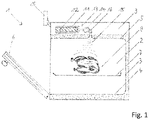
- FIG. 1 shows a sectional view of a cooking appliance 1 for preparing food, which is an oven in the exemplary embodiment.
- the cooking appliance 1 includes a cooking chamber 2, which is delimited by side walls 3 and the floor 4 and ceiling 5 of the oven.
- the cooking chamber 2 has a loading opening at the front, which can be closed by a door 6 .
- Above the cooking chamber 2 is a receiving chamber 9 that is separated from the cooking chamber 2 and can be closed by a closure element 10 .
- a receptacle 11 is provided in the receptacle space 9 and is designed to receive a cold pack 12 .
- a cooling system 13 is connected to the receptacle 11, which, by means of a fan 14, conveys the cold 15 given off by the cold pack 12, or the cooled ambient air of the cold pack 12, through a duct 16 from the receptacle 9 into the cooking chamber 2, so that the food 8 is sufficiently chilled.
- a fan 14 conveys the cold 15 given off by the cold pack 12, or the cooled ambient air of the cold pack 12, through a duct 16 from the receptacle 9 into the cooking chamber 2, so that the food 8 is sufficiently chilled.
- solutions are also conceivable that do not require a fan, with the cold moving downwards independently due to the higher density.
- the user of the cooking appliance decides that he would like to eat a fried chicken 8 in the evening, he programs the desired time at which the cooking process should start on the cooking appliance 1 and places the raw fried chicken 8 in the cooking chamber 2 before leaving the house He also inserts a pre-cooled cold pack 12 into the receptacle 11 of the receptacle space 9 .
- the cooking appliance 1 begins to cool the food 8 by means of the cooling system 13 in order to prevent or slow down the process of spoilage, which would occur at normal ambient temperature in the cooking appliance.
- the cooling capacity of the cold pack 12 is adapted to the typical dwell time of the food 8 in the cooking chamber 2 during an average working day.
- the cooking process starts automatically with the parameters entered, such as the type of heating, temperature and cooking time.
- the start of the cooking process can also be programmed via an app on the smartphone.
- the cooking process can be changed or monitored via the mobile device. Perhaps Remaining residual cold in the cold pack 12 is compensated for by the heat introduced, in particular by the high-energy heating-up phase.
Landscapes
- Engineering & Computer Science (AREA)
- Chemical & Material Sciences (AREA)
- Combustion & Propulsion (AREA)
- Mechanical Engineering (AREA)
- General Engineering & Computer Science (AREA)
- Baking, Grill, Roasting (AREA)
- Electric Stoves And Ranges (AREA)
- Cookers (AREA)
Description
- Die Erfindung betrifft ein Gargerät mit einem Garraum zum Garen von Gargut sowie ein Verfahren zum Zubereiten von Lebensmitteln in einem Gargerät.
- Aus dem Stand der Technik sind herkömmliche Backöfen bekannt, welche mittels zeitversetzten Betrieb oder Fernstart, selbständig den Garvorgang starten können. Dies erfordert jedoch, dass das Gargut frühzeitig in den Garraum gegeben werden muss. So liegt Beispielsweise ein Brathähnchen viele Stunden bei Raumtemperatur im Garraum, wenn der Nutzer am Morgen das Haus verlässt und auf dem Heimweg über eine App am Smartphone den Garvorgang startet. Bei normalen Umgebungstemperaturen von 20°C setzten Prozesse ein, welche das Verderben des Garguts bewirken.
- Abhilfe schaffen Kombinationsgeräte, wie z.B. aus der
DE198806530U1 bekannt, welche mittels eines im Garraum vorgesehenen Kühlaggregats das Gargut kühlen. Derartige Geräte weisen jedoch den Nachteil auf, dass bei jedem Garvorgang die Masse des Kühlaggregats mit erwärmt werden muss, was zu einem unerwünscht hohen Energieaufwand führt. - Zudem ergib sich aus der
EP 1 302 144 A2 ein weiteres Kombinationsgerät, das mit einem unterhalb des Garraums angeordneten und entnehmbar ausgebildeten Kühlaggregat ausgestattet ist. - Des Weiteren offenbart die
DE 10 2010 030 407 A1 ein Hausgerät zum Zubereiten von Lebensmitteln, mit einem Garraum, der durch Wände einer Muffel begrenzt ist, und in dem im Betrieb des Hausgeräts Dampf vorhanden ist, welcher aus dem Garraum ausführbar ist, wobei eine Energierückführvorrichtung ausgebildet ist, mit welcher in dem Dampf gespeicherte Energie dem Dampf entziehbar ist und die Wärmeenergie zumindest anteilig in den Garraum rückführbar ist. - Das Dokument
EP 2 466 219 A1 offenbart zudem ein Gargerät mit wenigstens einem Garraum, der über wenigstens eine Heizquelle beheizbar ist, und mit wenigstens einer den Garraum verschließenden Tür, wobei wenigstens ein mit dem wenigstens einen Garraum in Strömungsverbindung stehender Latentwärmespeicher vorgesehen ist, der mit Luft aus dem Garraum durchströmbar ist, um Wärme aus dem Garraum zu speichern oder gespeicherte Wärme an die Luft wieder abzugeben. - Aufgabe der vorliegenden Erfindung ist es, bekannte Gargeräte derart zu verbessern, dass diese das im Garraum befindliche Gargut über einen Zeitraum vor dem Garvorgang ausreichend kühlen.
- Die Erfindung geht aus von einem Gargerät, insbesondere einem Backofen, mit einem Garraum zum Garen von Gargut. Unter einem Gargerät soll insbesondere ein Backofen, ein Mikrowellengerät, oder ein Dampfgarer verstanden werden, welcher geeignet ist, Gargut, z. B. Brathähnchen für den Verzehr zu garen.
- Das Gargerät weist ein entnehmbares Kühlelement zum Kühlen des Garraums auf. Unter einem Kühlelement soll insbesondere eine Vorrichtung verstanden werden, welche Kälte, d.h. einen Zustand unterhalb der Umgebungstemperatur, erzeugt bzw. abgibt. Wird ein Bauteil des Gargeräts mit dem Kühlelement in Kontakt gebracht, wird diesem Bauteil Wärme entzogen. Ebenso wird der Luft, welche das Kühlelement umgibt, die Wärmeenergie teilweise entzogen, so dass die gekühlte Luft wiederum in der Lage ist, Wärmeenergie von weiteren Bauteilen aufzunehmen. Unter einem entnehmbar ausgebildeten Kühlelement soll ein Kühlelement verstanden werden, dass derart reversibel im Gargerät angeordnet ist, dass es zerstörungsfrei und vorzugsweise werkzeuglos aus dem Gargerät entnommen werden kann. Ein derart ausgebildetes Gargerät ist mittels des Kühlelements in der Lage, das Gargut über einen gewissen Zeitraum vor dem Garvorgang ausreichend gut zu kühlen. Zudem ist das Gargerät durch das entnehmbar ausgebildete Kühlelement so flexibel, dass es nur dann in das Gargerät eingesetzt wird, wenn die Anforderung des Kühlens an das Gargerät gestellt wird. Der zusätzliche Energieaufwand der aufzuwärmenden Masse des Kühlelements entfällt für die verbleibenden Vorgänge ohne das Kühlelement im Gargerät.
- Erfindungsgemäß ist das Kühlelement ein ein Kühlakku. Unter einem Kühlakku soll insbesondere ein Element verstanden werden, dass einen Behälter, vorzugsweise aus Kunststoff aufweist, in dem sich eine Flüssigkeit mit hohem Wärmespeicherkoeffizienten als Inhalt befindet, die bei Abkühlung bzw. Erwärmung einen Phasenwechsel ausführt. Als Flüssigkeit nutzt man vorzugsweise sogenannte Phasenwechselmaterialien, insbesondere Salzwasser oder ein spezielles Gel, deren latente Schmelzwärme, Lösungswärme oder Absorptionswärme wesentlich größer ist als die Wärme, die sie aufgrund ihrer normalen spezifischen Wärmekapazität speichern können. Der in einem Kühlaggregat, vorzugsweise einem Gefrierschrank auf Arbeitstemperatur, vorzugsweise - 18 °C abgekühlte Akku wird in das Gargerät gegeben. Durch Aufnahme von Wärmeenergie kühlt der Akku angrenzende Bauteile sowie die den Kühlakku umgebende Luft solange ab, bis er selbst Umgebungstemperatur angenommen hat. Vor dem erneuten Einsatz im Gargerät wird das Kühlelement im Gefrierschrank auf Arbeitstemperatur regeneriert und vorzugsweise dort aufbewahrt.
- Unter einem Garraum soll insbesondere der für das Gargut vorgesehene Behandlungsraum des Gargeräts verstanden werden, der durch Seitenwände, Rückwand, Boden und Decke des Backrohrs begrenzt ist und frontseitig eine Beschickungsöffnung aufweist, die durch eine Tür verschließbar ist.
- Erfindungsgemäß weist das Gargerät ein Kühlsystem, aufweisend das Kühlelement und eine Fördereinrichtung, zum Transport der vom Kühlelement abgegebenen Kälte in den Garraum auf. Unter einem Kühlsystem soll insbesondere ein aus mehreren Elementen bestehendes System zur Kühlung des im Garraum befindlichen Garguts verstanden werden. Dieses umfasst neben dem Kühlelement eine Fördereinrichtung, welche dazu ausgebildet ist die Kälte des Kühlelements zum Bestimmungsort, vorzugsweise zum Gargut in den Garraum zu transportieren. Die Fördereinrichtung ist vorzugsweise als Schlauch oder Schacht ausgebildet, welcher am Aufnahmeraum ansetzt und am Garraum mündet.
- Erfindungsgemäß ist das Kühlelement in einem zum Garraum abgetrennten Aufnahmeraum, vorzugsweise oberhalb des Garraums angeordnet. Unter einem Aufnahmeraum soll insbesondere ein Bereich verstanden werden, der dazu ausgebildet ist Elemente, wie z.B. das Kühlelement zu behausen. Der Aufnahmeraum ist räumlich, z.B. mittels der Decke des Garraums vom Garraum getrennt. Der Aufnahmeraum weist vorzugsweise eine Beschickungsöffnung auf, welche durch ein Verschlusselement verschließbar ist. Das Verschlusselement ist drehbar, klappbar, schiebbar oder schwenkbar an der Beschickungsöffnung angeordnet. Bei geöffnetem Verschlusselement ist das Kühlelement aus dem Aufnahmeraum entnehmbar. Vorzugsweise befindet sich auf dem Verschlusselement des Aufnahmeraums die Bedienblende des Gargeräts.
- Vorzugsweise ist der Aufnahmeraum derart ausgebildet, dass er wahlweise zur Aufnahme des Kühlelements oder eines Wassertanks geeignet ist. Unter einem Wassertank soll insbesondere ein zur Aufnahme von flüssigem Medium, vorzugsweise Wasser ausgebildeten Behältnis verstanden werden, welches eine dem Garraum zugeordnete Verdampfer- oder Sprüheinheit mit Fluid versorgt. Ein derartiger Wassertank versorgt z.B. Gargeräte mit Dampfgarfunktion mit Wasser. Eine besonders funktionale und platzsparende Ausgestaltung des Aufnahmeraums entsteht, wenn Kühlelement und Wassertank, vorzugsweise bei gleicher geometrischer Bauform, in dieselbe Aufnahme passen. Dazu sind die mechanischen Schnittstellen, wie z.B. Führungselemente, Verriegelungselemente oder Anschlusselemente kompatibel für beide Elemente ausgebildet.
- Vorzugsweise weist das Kühlsystem einen Ventilator, insbesondere zum An- oder Abzusaugen der kalten Luft, auf. Unter einem Ventilator soll insbesondere ein angetriebenes Lüfterrad verstanden werden, welches dazu ausgebildet ist die gekühlte Luft durch die Fördereinrichtung aus dem Aufnahmeraum in den Garraum zu leiten. Vorzugsweise ist der Ventilator als Axial-oder Radialventilator ausgebildet. Gemäß einer Weiterbildung kann ein Ventilator der garraumseitigen Heizelemente als Kühllüfter verwendet werden.
- Vorzugsweise ist das Gargerät derart ausgeführt, dass ein zeitversetzter Betrieb und/oder ein Fernstartbetrieb durchführbar ist. Unter einem zeitversetzten Betrieb soll eine Steuerung des Gargeräts verstanden werden, welche dem Nutzer die Möglichkeit gibt einen Zeitraum, z.B. 30 Minuten oder einen Zeitpunkt, z.B. 15:00 Uhr zu bestimmen, nach dem oder zu dem das Gargerät seinen Betrieb selbsttätig aufnimmt. Die Einstellungen hierzu können vom Nutzer an den Bedienelementen des Gargeräts oder über ein mit dem Gargerät verbundenen Gerät erfolgen. Unter einem Fernstartbetrieb soll eine Steuerung des Gargeräts aus der Ferne (Smart Home), vorzugsweise über eine App auf einem Smartphone verstanden werden, wobei die Kommunikation beispielsweise über WLAN oder Mobilfunk erfolgt. Hierzu weist das Gargerät eine entsprechende Datenübertragungseinrichtung auf.
- Zudem ist ein Verfahren zum Zubereiten von Lebensmitteln in einem derartig beschriebenen Gargerät aufweisend die folgenden Verfahrensschritte von der Erfindung umfasst, wobei die Reihenfolge der einzelnen Prozessschritte veränderlich ist.
- Einbringen von Gargut in einen Garraum und Schließen der Tür.
- Starten des Kühlprozesses durch einbringen des Kühlelements in das oben beanspruchte Gargerät bis zum Start des Garprozesses.
- Starten des Garprozesses, vorzugsweise mittels zeitversetztem Betrieb oder Fernstartbetrieb und erwärmen des Garguts mittels Heizelementen des Gargeräts.
- Vorzugsweise weist dieses Verfahren die weiteren Verfahrensschritte auf:
- Kühlen des Kühlelements in einem Kältegerät.
- Einsetzen des Kühlelements in das Gargerät.
- Weitere Merkmale der Erfindung ergeben sich aus den Figuren und der Figurenbeschreibung. Dabei zeigt:
- Fig. 1
- Eine schematische Schnittdarstellung einer Seitenansicht eines Gargeräts mit einem Kühlelement in der bevorzugten Einbaulage.
- In
Fig. 1 ist in einer Schnittdarstellung ein Gargerät 1 zum Zubereiten von Lebensmitteln gezeigt, welches im Ausführungsbeispiel ein Backofen ist. Das Gargerät 1 umfasst einen Garraum 2, der durch Seitenwände 3 sowie Boden 4 und Decke 5 des Backrohrs begrenzt ist. Frontseitig weist der Garraum 2 eine Beschickungsöffnung auf, die durch eine Tür 6 verschließbar ist. Im Garraum 2 befindet sich ein Gargutträger 7, wie z. B. ein Rost oder ein Backblech, auf dem das Gargut 8 aufliegt. Oberhalb des Garraums 2 befindet sich ein vom Garraum 2 abgetrennter Aufnahmeraum 9, der durch ein Verschlusselement 10 verschließbar ist. Im Aufnahmeraum 9 ist eine Aufnahme 11 vorgesehen, welche zur Aufnahme eines Kühlakkus 12 ausgebildet ist. An die Aufnahme 11 schließt sich ein Kühlsystem 13 an, welches mittels einem Ventilator 14 die vom Kühlakku 12 abgegebene Kälte 15, bzw. die erkaltete Umgebungsluft des Kühlakkus 12 durch einen Kanal 16 aus dem Aufnahmeraum 9 in den Garraum 2 fördert, sodass das Gargut 8 ausreichend gut gekühlt ist. Darüber hinaus sind auch Lösungen denkbar, die ohne Ventilator auskommen, wobei sich die Kälte aufgrund höherer Dichte eigenständig nach unten bewegt. - Anwendungsbeispiel: Beschließt der Nutzer des Gargeräts, dass er am Abend ein Backhähnchen 8 essen möchte, so programmiert er am Gargerät 1 die gewünschte Zeit ein, zu der der Garvorgang gestartet werden soll und legt das rohe Backhähnchen 8 vor Verlassen des Hauses in den Garraum 2. Zudem führt er einen vorgekühlten Kühlakku 12 in die Aufnahme 11 des Aufnahmeraums 9 ein. Nach dem Schließen der Tür 6 und des Verschlusselements 10 beginnt das Gargeräts 1 mittels des Kühlsystems 13 das Gargut 8 zu kühlen, um den Prozess des Verderbens, welcher bei gewöhnlicher Umgebungstemperatur im Gargerät einsetzen würde, zu unterbinden bzw. zu verlangsamen. Die Kühlleistung des Kühlakkus 12 ist auf die typische Verweilzeit des Garguts 8 im Garraum 2 während eines durchschnittlichen Arbeitstages angepasst. Ist die gewünschte Uhrzeit erreicht, so startet der Garvorgang mit den eingegebenen Parametern, wie Heizart, Temperatur und Garzeit selbsttätig. Das Starten des Garvorgangs kann ebenfalls über eine App am Smartphone programmiert werden. Zudem kann über das mobile Gerät der Garvorgang verändert oder überwacht werden. Eventuell verbleibende Restkälte im Kühlakku 12 wird mittels der eingeleiteten Wärme, insbesondere durch die energiereiche Aufheizphase kompensiert.
- Für den Fachmann ist erkennbar, dass die Erfindung nicht auf das dargestellte Ausführungsbeispiel beschränkt ist, sondern dass eine Vielzahl von Varianten und Abwandlungen ebenfalls davon umfasst sind.
-
- 1
- Gargerät
- 2
- Garraum
- 3
- Seitenwand
- 4
- Boden
- 5
- Decke
- 6
- Tür
- 7
- Gargutträger
- 8
- Gargut
- 9
- Aufnahmeraum
- 10
- Verschlusselement
- 11
- Aufnahme
- 12
- Kühlelement/Kühlakku
- 13
- Kühlsystem
- 14
- Ventilator
- 15
- Kälte (symbolisch)
- 16
- Fördereinrichtung/Kanal
Claims (7)
- Gargerät (1), insbesondere Backofen, mit einem Garraum (2) zum Garen von Gargut (8), wobei das Gargerät (1) ein entnehmbares Kühlelement (12) zum Kühlen des Garraums (2) aufweist, wobei das Gargerät (1) einem zum Garraum (2) abgetrennten Aufnahmeraum (9) umfasst, in welchem das Kühlelement (12) angeordnet ist, dadurch gekennzeichnet, dass- das Gargerät (1) ein Kühlsystem (13), aufweisend das Kühlelement (12) und eine Fördereinrichtung (16), zum Transport der vom Kühlelement (12) abgegebenen Kälte (15) in den Garraum (2), aufweist und- das Kühlelement (12) ein Kühlakku ist.
- Gargerät (1) nach Anspruch 1, dadurch gekennzeichnet, dass der Aufnahmeraum (9) oberhalb des Garraums (2) angeordnet ist.
- Gargerät (1) nach Anspruch 2, dadurch gekennzeichnet, dass der Aufnahmeraum (9) derart ausgebildet ist, dass er wahlweise zur Aufnahme des Kühlelements (12) oder eines Wassertanks geeignet ist.
- Gargerät (1) nach einem der vorangegangenen Ansprüche, dadurch gekennzeichnet, dass das Kühlsystem (13) einen Ventilator (14), insbesondere zum An- und/oder Absaugen der kalten Luft (15), aufweist.
- Gargerät (1) nach einem der vorangegangenen Ansprüche, dadurch gekennzeichnet, dass das Gargerät (1) derart ausgeführt ist, dass ein zeitversetzter Betrieb und/oder ein Fernstartbetrieb durchführbar ist.
- Verfahren zum Zubereiten von Lebensmitteln in einem Gargerät (1) nach Anspruch 1 aufweisend folgende Verfahrensschritte:- einbringen von Gargut (8) in einen Garraum (2);- kühlen des Garguts (8) mittels eines in das Gargerät (1) eingebrachten Kühlelements (12);- erwärmen des Garguts (8) mittels Heizelementen des Gargeräts (1).
- Verfahren nach Anspruch 6, aufweisend die zusätzlichen Verfahrensschritte:- kühlen des Kühlelements (12) in einem Kältegerät;- einsetzen des Kühlelements (12) in das Gargerät (1).
Applications Claiming Priority (1)
| Application Number | Priority Date | Filing Date | Title |
|---|---|---|---|
| DE102017203373.8A DE102017203373A1 (de) | 2017-03-02 | 2017-03-02 | Gargerät mit Kühlfunktion |
Publications (2)
| Publication Number | Publication Date |
|---|---|
| EP3369999A1 EP3369999A1 (de) | 2018-09-05 |
| EP3369999B1 true EP3369999B1 (de) | 2022-07-20 |
Family
ID=61163579
Family Applications (1)
| Application Number | Title | Priority Date | Filing Date |
|---|---|---|---|
| EP18155127.6A Active EP3369999B1 (de) | 2017-03-02 | 2018-02-05 | Gargerät mit kühlfunktion |
Country Status (4)
| Country | Link |
|---|---|
| EP (1) | EP3369999B1 (de) |
| DE (1) | DE102017203373A1 (de) |
| ES (1) | ES2925505T3 (de) |
| PL (1) | PL3369999T3 (de) |
Families Citing this family (1)
| Publication number | Priority date | Publication date | Assignee | Title |
|---|---|---|---|---|
| CN112273989B (zh) * | 2020-09-30 | 2022-02-08 | 宁波方太厨具有限公司 | 一种蒸箱的工作方法及应用该方法的蒸箱 |
Citations (1)
| Publication number | Priority date | Publication date | Assignee | Title |
|---|---|---|---|---|
| EP2466219A1 (de) * | 2010-12-17 | 2012-06-20 | Miele & Cie. KG | Gargerät und Verfahren zum Betreiben eines Gargerätes |
Family Cites Families (3)
| Publication number | Priority date | Publication date | Assignee | Title |
|---|---|---|---|---|
| DE8806530U1 (de) | 1988-05-18 | 1988-08-04 | Patzner GmbH + Co, 6990 Bad Mergentheim | Gerät zum Aufbewahren von Nahrungsmitteln |
| US7823626B2 (en) * | 2001-10-15 | 2010-11-02 | Whirlpool Corporation | Refrigerated oven |
| DE102010030407A1 (de) * | 2010-06-23 | 2011-12-29 | BSH Bosch und Siemens Hausgeräte GmbH | Hausgerät zum Zubereiten von Lebensmitteln sowie Verfahren zum Betreiben eines derartigen Hausgeräts |
-
2017
- 2017-03-02 DE DE102017203373.8A patent/DE102017203373A1/de not_active Withdrawn
-
2018
- 2018-02-05 ES ES18155127T patent/ES2925505T3/es active Active
- 2018-02-05 EP EP18155127.6A patent/EP3369999B1/de active Active
- 2018-02-05 PL PL18155127.6T patent/PL3369999T3/pl unknown
Patent Citations (1)
| Publication number | Priority date | Publication date | Assignee | Title |
|---|---|---|---|---|
| EP2466219A1 (de) * | 2010-12-17 | 2012-06-20 | Miele & Cie. KG | Gargerät und Verfahren zum Betreiben eines Gargerätes |
Also Published As
| Publication number | Publication date |
|---|---|
| EP3369999A1 (de) | 2018-09-05 |
| DE102017203373A1 (de) | 2018-09-06 |
| PL3369999T3 (pl) | 2022-11-07 |
| ES2925505T3 (es) | 2022-10-18 |
Similar Documents
| Publication | Publication Date | Title |
|---|---|---|
| EP0981278B1 (de) | Backvorrichtung und -verfahren | |
| DE69008358T2 (de) | Vorrichtung mit auswählbaren sektoren zur erwärmung von nahrungsmitteln. | |
| EP2310749B1 (de) | Verfahren zum anzeigen einer gargut- oder garprogrammauswahl und gargerät hierfür | |
| EP2085700A2 (de) | Gargerät zur intelligenten rollierenden Beschickung und Verfahren hierzu | |
| EP2999928B1 (de) | Garverfahren sowie gargerät | |
| DE2757059C2 (de) | Backofen mit Umluftgebläse und Stahlungsheizkörpern | |
| EP2537418A1 (de) | Verfahren zum Garen eines Garguts mittels Dampf | |
| DE102010061339A1 (de) | Gargerät und Verfahren zum Betreiben eines Gargerätes | |
| DE102014211095A1 (de) | Kältegerät | |
| EP1043934B1 (de) | Backvorrichtung und -verfahren | |
| DE102014220954A1 (de) | Verfahren zum Betreiben eines Nahrungsmitteldruckers, sowie zugehöriger Nahrungsmitteldrucker und zugehöriges Haushaltsgerät | |
| EP2154457A2 (de) | Kühlgerät mit Temperierfunktion | |
| DE102007046923A1 (de) | Verfahren zur vereinfachten Programmierung von Programmen eines Gargerätes und Gargerät zum Durchführen solch eines Verfahrens | |
| DE102012105340A1 (de) | Verfahren zum Betreiben eines Hausgeräts und Hausgerät | |
| EP3369999A1 (de) | Gargerät mit kühlfunktion | |
| DE102015116266A1 (de) | Umwandelbares System zum Einfrieren und Auftauen von Nahrungsmittelprodukten in einem elektrischen Haushaltsgerät | |
| DE102006007379A1 (de) | Gargerät mit Combi-Dämpfer, Pizzaofen und Energiespeicher | |
| DE102005030483B4 (de) | Ladenbackofen | |
| DE102010030407A1 (de) | Hausgerät zum Zubereiten von Lebensmitteln sowie Verfahren zum Betreiben eines derartigen Hausgeräts | |
| DE102015117850A1 (de) | Kühleinrichtung und Verfahren zum Betreiben einer Kühleinrichtung | |
| DE2659865A1 (de) | Vorrichtung zur waermebehandlung von nahrungsmitteln mit heissluft und wasserdampf | |
| DE102011017020A1 (de) | Grillvorrichtung für Lebensmittel | |
| DE102010018962B4 (de) | Vorrichtung und Verfahren zur Wärmebehandlung von Lebensmitteln | |
| DE102011000029A1 (de) | Verfahren zum Betreiben eines Gargeräts und Gargerätzum Durchführen desselben | |
| DE102010044215B4 (de) | Verfahren zum Betreiben eines Hausgeräts zum Zubereiten von Lebensmitteln sowie ein derartiges Hausgerät |
Legal Events
| Date | Code | Title | Description |
|---|---|---|---|
| PUAI | Public reference made under article 153(3) epc to a published international application that has entered the european phase |
Free format text: ORIGINAL CODE: 0009012 |
|
| STAA | Information on the status of an ep patent application or granted ep patent |
Free format text: STATUS: THE APPLICATION HAS BEEN PUBLISHED |
|
| AK | Designated contracting states |
Kind code of ref document: A1 Designated state(s): AL AT BE BG CH CY CZ DE DK EE ES FI FR GB GR HR HU IE IS IT LI LT LU LV MC MK MT NL NO PL PT RO RS SE SI SK SM TR |
|
| AX | Request for extension of the european patent |
Extension state: BA ME |
|
| STAA | Information on the status of an ep patent application or granted ep patent |
Free format text: STATUS: REQUEST FOR EXAMINATION WAS MADE |
|
| 17P | Request for examination filed |
Effective date: 20190305 |
|
| RBV | Designated contracting states (corrected) |
Designated state(s): AL AT BE BG CH CY CZ DE DK EE ES FI FR GB GR HR HU IE IS IT LI LT LU LV MC MK MT NL NO PL PT RO RS SE SI SK SM TR |
|
| STAA | Information on the status of an ep patent application or granted ep patent |
Free format text: STATUS: EXAMINATION IS IN PROGRESS |
|
| 17Q | First examination report despatched |
Effective date: 20201005 |
|
| GRAP | Despatch of communication of intention to grant a patent |
Free format text: ORIGINAL CODE: EPIDOSNIGR1 |
|
| STAA | Information on the status of an ep patent application or granted ep patent |
Free format text: STATUS: GRANT OF PATENT IS INTENDED |
|
| INTG | Intention to grant announced |
Effective date: 20220307 |
|
| GRAS | Grant fee paid |
Free format text: ORIGINAL CODE: EPIDOSNIGR3 |
|
| GRAA | (expected) grant |
Free format text: ORIGINAL CODE: 0009210 |
|
| STAA | Information on the status of an ep patent application or granted ep patent |
Free format text: STATUS: THE PATENT HAS BEEN GRANTED |
|
| AK | Designated contracting states |
Kind code of ref document: B1 Designated state(s): AL AT BE BG CH CY CZ DE DK EE ES FI FR GB GR HR HU IE IS IT LI LT LU LV MC MK MT NL NO PL PT RO RS SE SI SK SM TR |
|
| REG | Reference to a national code |
Ref country code: CH Ref legal event code: EP |
|
| REG | Reference to a national code |
Ref country code: DE Ref legal event code: R096 Ref document number: 502018010164 Country of ref document: DE |
|
| REG | Reference to a national code |
Ref country code: AT Ref legal event code: REF Ref document number: 1505744 Country of ref document: AT Kind code of ref document: T Effective date: 20220815 |
|
| REG | Reference to a national code |
Ref country code: IE Ref legal event code: FG4D Free format text: LANGUAGE OF EP DOCUMENT: GERMAN |
|
| REG | Reference to a national code |
Ref country code: ES Ref legal event code: FG2A Ref document number: 2925505 Country of ref document: ES Kind code of ref document: T3 Effective date: 20221018 |
|
| REG | Reference to a national code |
Ref country code: LT Ref legal event code: MG9D |
|
| REG | Reference to a national code |
Ref country code: NL Ref legal event code: MP Effective date: 20220720 |
|
| PG25 | Lapsed in a contracting state [announced via postgrant information from national office to epo] |
Ref country code: SE Free format text: LAPSE BECAUSE OF FAILURE TO SUBMIT A TRANSLATION OF THE DESCRIPTION OR TO PAY THE FEE WITHIN THE PRESCRIBED TIME-LIMIT Effective date: 20220720 Ref country code: RS Free format text: LAPSE BECAUSE OF FAILURE TO SUBMIT A TRANSLATION OF THE DESCRIPTION OR TO PAY THE FEE WITHIN THE PRESCRIBED TIME-LIMIT Effective date: 20220720 Ref country code: PT Free format text: LAPSE BECAUSE OF FAILURE TO SUBMIT A TRANSLATION OF THE DESCRIPTION OR TO PAY THE FEE WITHIN THE PRESCRIBED TIME-LIMIT Effective date: 20221121 Ref country code: NO Free format text: LAPSE BECAUSE OF FAILURE TO SUBMIT A TRANSLATION OF THE DESCRIPTION OR TO PAY THE FEE WITHIN THE PRESCRIBED TIME-LIMIT Effective date: 20221020 Ref country code: NL Free format text: LAPSE BECAUSE OF FAILURE TO SUBMIT A TRANSLATION OF THE DESCRIPTION OR TO PAY THE FEE WITHIN THE PRESCRIBED TIME-LIMIT Effective date: 20220720 Ref country code: LV Free format text: LAPSE BECAUSE OF FAILURE TO SUBMIT A TRANSLATION OF THE DESCRIPTION OR TO PAY THE FEE WITHIN THE PRESCRIBED TIME-LIMIT Effective date: 20220720 Ref country code: LT Free format text: LAPSE BECAUSE OF FAILURE TO SUBMIT A TRANSLATION OF THE DESCRIPTION OR TO PAY THE FEE WITHIN THE PRESCRIBED TIME-LIMIT Effective date: 20220720 Ref country code: FI Free format text: LAPSE BECAUSE OF FAILURE TO SUBMIT A TRANSLATION OF THE DESCRIPTION OR TO PAY THE FEE WITHIN THE PRESCRIBED TIME-LIMIT Effective date: 20220720 |
|
| PG25 | Lapsed in a contracting state [announced via postgrant information from national office to epo] |
Ref country code: IS Free format text: LAPSE BECAUSE OF FAILURE TO SUBMIT A TRANSLATION OF THE DESCRIPTION OR TO PAY THE FEE WITHIN THE PRESCRIBED TIME-LIMIT Effective date: 20221120 Ref country code: HR Free format text: LAPSE BECAUSE OF FAILURE TO SUBMIT A TRANSLATION OF THE DESCRIPTION OR TO PAY THE FEE WITHIN THE PRESCRIBED TIME-LIMIT Effective date: 20220720 Ref country code: GR Free format text: LAPSE BECAUSE OF FAILURE TO SUBMIT A TRANSLATION OF THE DESCRIPTION OR TO PAY THE FEE WITHIN THE PRESCRIBED TIME-LIMIT Effective date: 20221021 |
|
| REG | Reference to a national code |
Ref country code: DE Ref legal event code: R097 Ref document number: 502018010164 Country of ref document: DE |
|
| PG25 | Lapsed in a contracting state [announced via postgrant information from national office to epo] |
Ref country code: SM Free format text: LAPSE BECAUSE OF FAILURE TO SUBMIT A TRANSLATION OF THE DESCRIPTION OR TO PAY THE FEE WITHIN THE PRESCRIBED TIME-LIMIT Effective date: 20220720 Ref country code: RO Free format text: LAPSE BECAUSE OF FAILURE TO SUBMIT A TRANSLATION OF THE DESCRIPTION OR TO PAY THE FEE WITHIN THE PRESCRIBED TIME-LIMIT Effective date: 20220720 Ref country code: DK Free format text: LAPSE BECAUSE OF FAILURE TO SUBMIT A TRANSLATION OF THE DESCRIPTION OR TO PAY THE FEE WITHIN THE PRESCRIBED TIME-LIMIT Effective date: 20220720 Ref country code: CZ Free format text: LAPSE BECAUSE OF FAILURE TO SUBMIT A TRANSLATION OF THE DESCRIPTION OR TO PAY THE FEE WITHIN THE PRESCRIBED TIME-LIMIT Effective date: 20220720 |
|
| PLBE | No opposition filed within time limit |
Free format text: ORIGINAL CODE: 0009261 |
|
| STAA | Information on the status of an ep patent application or granted ep patent |
Free format text: STATUS: NO OPPOSITION FILED WITHIN TIME LIMIT |
|
| PG25 | Lapsed in a contracting state [announced via postgrant information from national office to epo] |
Ref country code: SK Free format text: LAPSE BECAUSE OF FAILURE TO SUBMIT A TRANSLATION OF THE DESCRIPTION OR TO PAY THE FEE WITHIN THE PRESCRIBED TIME-LIMIT Effective date: 20220720 Ref country code: EE Free format text: LAPSE BECAUSE OF FAILURE TO SUBMIT A TRANSLATION OF THE DESCRIPTION OR TO PAY THE FEE WITHIN THE PRESCRIBED TIME-LIMIT Effective date: 20220720 |
|
| 26N | No opposition filed |
Effective date: 20230421 |
|
| PG25 | Lapsed in a contracting state [announced via postgrant information from national office to epo] |
Ref country code: AL Free format text: LAPSE BECAUSE OF FAILURE TO SUBMIT A TRANSLATION OF THE DESCRIPTION OR TO PAY THE FEE WITHIN THE PRESCRIBED TIME-LIMIT Effective date: 20220720 |
|
| PG25 | Lapsed in a contracting state [announced via postgrant information from national office to epo] |
Ref country code: SI Free format text: LAPSE BECAUSE OF FAILURE TO SUBMIT A TRANSLATION OF THE DESCRIPTION OR TO PAY THE FEE WITHIN THE PRESCRIBED TIME-LIMIT Effective date: 20220720 |
|
| PG25 | Lapsed in a contracting state [announced via postgrant information from national office to epo] |
Ref country code: MC Free format text: LAPSE BECAUSE OF FAILURE TO SUBMIT A TRANSLATION OF THE DESCRIPTION OR TO PAY THE FEE WITHIN THE PRESCRIBED TIME-LIMIT Effective date: 20220720 |
|
| REG | Reference to a national code |
Ref country code: CH Ref legal event code: PL |
|
| REG | Reference to a national code |
Ref country code: BE Ref legal event code: MM Effective date: 20230228 |
|
| PG25 | Lapsed in a contracting state [announced via postgrant information from national office to epo] |
Ref country code: LU Free format text: LAPSE BECAUSE OF NON-PAYMENT OF DUE FEES Effective date: 20230205 Ref country code: LI Free format text: LAPSE BECAUSE OF NON-PAYMENT OF DUE FEES Effective date: 20230228 Ref country code: CH Free format text: LAPSE BECAUSE OF NON-PAYMENT OF DUE FEES Effective date: 20230228 |
|
| REG | Reference to a national code |
Ref country code: IE Ref legal event code: MM4A |
|
| PG25 | Lapsed in a contracting state [announced via postgrant information from national office to epo] |
Ref country code: IE Free format text: LAPSE BECAUSE OF NON-PAYMENT OF DUE FEES Effective date: 20230205 |
|
| PG25 | Lapsed in a contracting state [announced via postgrant information from national office to epo] |
Ref country code: BE Free format text: LAPSE BECAUSE OF NON-PAYMENT OF DUE FEES Effective date: 20230228 |
|
| REG | Reference to a national code |
Ref country code: AT Ref legal event code: MM01 Ref document number: 1505744 Country of ref document: AT Kind code of ref document: T Effective date: 20230205 |
|
| PG25 | Lapsed in a contracting state [announced via postgrant information from national office to epo] |
Ref country code: AT Free format text: LAPSE BECAUSE OF NON-PAYMENT OF DUE FEES Effective date: 20230205 |
|
| PG25 | Lapsed in a contracting state [announced via postgrant information from national office to epo] |
Ref country code: AT Free format text: LAPSE BECAUSE OF NON-PAYMENT OF DUE FEES Effective date: 20230205 |
|
| PG25 | Lapsed in a contracting state [announced via postgrant information from national office to epo] |
Ref country code: IT Free format text: LAPSE BECAUSE OF FAILURE TO SUBMIT A TRANSLATION OF THE DESCRIPTION OR TO PAY THE FEE WITHIN THE PRESCRIBED TIME-LIMIT Effective date: 20220720 |
|
| PG25 | Lapsed in a contracting state [announced via postgrant information from national office to epo] |
Ref country code: BG Free format text: LAPSE BECAUSE OF FAILURE TO SUBMIT A TRANSLATION OF THE DESCRIPTION OR TO PAY THE FEE WITHIN THE PRESCRIBED TIME-LIMIT Effective date: 20220720 |
|
| PG25 | Lapsed in a contracting state [announced via postgrant information from national office to epo] |
Ref country code: BG Free format text: LAPSE BECAUSE OF FAILURE TO SUBMIT A TRANSLATION OF THE DESCRIPTION OR TO PAY THE FEE WITHIN THE PRESCRIBED TIME-LIMIT Effective date: 20220720 |
|
| PG25 | Lapsed in a contracting state [announced via postgrant information from national office to epo] |
Ref country code: CY Free format text: LAPSE BECAUSE OF FAILURE TO SUBMIT A TRANSLATION OF THE DESCRIPTION OR TO PAY THE FEE WITHIN THE PRESCRIBED TIME-LIMIT; INVALID AB INITIO Effective date: 20180205 |
|
| PG25 | Lapsed in a contracting state [announced via postgrant information from national office to epo] |
Ref country code: HU Free format text: LAPSE BECAUSE OF FAILURE TO SUBMIT A TRANSLATION OF THE DESCRIPTION OR TO PAY THE FEE WITHIN THE PRESCRIBED TIME-LIMIT; INVALID AB INITIO Effective date: 20180205 |
|
| PGFP | Annual fee paid to national office [announced via postgrant information from national office to epo] |
Ref country code: GB Payment date: 20260219 Year of fee payment: 9 |
|
| PGFP | Annual fee paid to national office [announced via postgrant information from national office to epo] |
Ref country code: ES Payment date: 20260319 Year of fee payment: 9 |
|
| PGFP | Annual fee paid to national office [announced via postgrant information from national office to epo] |
Ref country code: DE Payment date: 20260228 Year of fee payment: 9 |
|
| PGFP | Annual fee paid to national office [announced via postgrant information from national office to epo] |
Ref country code: FR Payment date: 20260223 Year of fee payment: 9 |
|
| PGFP | Annual fee paid to national office [announced via postgrant information from national office to epo] |
Ref country code: TR Payment date: 20260204 Year of fee payment: 9 |
|
| PGFP | Annual fee paid to national office [announced via postgrant information from national office to epo] |
Ref country code: PL Payment date: 20260129 Year of fee payment: 9 |