EP1302144A2 - A refrigerated oven - Google Patents
A refrigerated oven Download PDFInfo
- Publication number
- EP1302144A2 EP1302144A2 EP02022260A EP02022260A EP1302144A2 EP 1302144 A2 EP1302144 A2 EP 1302144A2 EP 02022260 A EP02022260 A EP 02022260A EP 02022260 A EP02022260 A EP 02022260A EP 1302144 A2 EP1302144 A2 EP 1302144A2
- Authority
- EP
- European Patent Office
- Prior art keywords
- evaporator
- base
- cooking chamber
- chamber
- cycle
- Prior art date
- Legal status (The legal status is an assumption and is not a legal conclusion. Google has not performed a legal analysis and makes no representation as to the accuracy of the status listed.)
- Withdrawn
Links
- 238000005057 refrigeration Methods 0.000 claims abstract description 136
- 238000010411 cooking Methods 0.000 claims abstract description 129
- 235000013305 food Nutrition 0.000 claims abstract description 68
- 238000009413 insulation Methods 0.000 claims description 30
- 238000009833 condensation Methods 0.000 claims description 24
- 230000005494 condensation Effects 0.000 claims description 24
- 238000001704 evaporation Methods 0.000 claims description 18
- 230000002093 peripheral effect Effects 0.000 claims description 18
- 230000008020 evaporation Effects 0.000 claims description 15
- 238000004891 communication Methods 0.000 claims description 10
- 238000001816 cooling Methods 0.000 claims description 9
- 238000007664 blowing Methods 0.000 claims description 3
- 239000012811 non-conductive material Substances 0.000 claims description 3
- 238000003780 insertion Methods 0.000 claims description 2
- 230000037431 insertion Effects 0.000 claims description 2
- 238000012546 transfer Methods 0.000 claims description 2
- 238000010438 heat treatment Methods 0.000 abstract description 23
- 230000006870 function Effects 0.000 description 11
- 125000006850 spacer group Chemical group 0.000 description 11
- 230000000977 initiatory effect Effects 0.000 description 9
- 239000007788 liquid Substances 0.000 description 9
- 230000003466 anti-cipated effect Effects 0.000 description 4
- 229910000078 germane Inorganic materials 0.000 description 4
- 238000012423 maintenance Methods 0.000 description 4
- 238000000034 method Methods 0.000 description 4
- 230000001351 cycling effect Effects 0.000 description 3
- 239000012530 fluid Substances 0.000 description 3
- 230000003116 impacting effect Effects 0.000 description 3
- 238000012544 monitoring process Methods 0.000 description 3
- 230000004044 response Effects 0.000 description 3
- 238000005452 bending Methods 0.000 description 2
- 230000008901 benefit Effects 0.000 description 2
- 238000004140 cleaning Methods 0.000 description 2
- 239000004020 conductor Substances 0.000 description 2
- 229910052751 metal Inorganic materials 0.000 description 2
- 239000002184 metal Substances 0.000 description 2
- XLYOFNOQVPJJNP-UHFFFAOYSA-N water Substances O XLYOFNOQVPJJNP-UHFFFAOYSA-N 0.000 description 2
- 239000004677 Nylon Substances 0.000 description 1
- 239000004793 Polystyrene Substances 0.000 description 1
- 230000002411 adverse Effects 0.000 description 1
- 229910052782 aluminium Inorganic materials 0.000 description 1
- 230000015556 catabolic process Effects 0.000 description 1
- 230000000295 complement effect Effects 0.000 description 1
- 238000006731 degradation reaction Methods 0.000 description 1
- 230000003111 delayed effect Effects 0.000 description 1
- 230000001419 dependent effect Effects 0.000 description 1
- 230000000994 depressogenic effect Effects 0.000 description 1
- 238000001035 drying Methods 0.000 description 1
- 230000000694 effects Effects 0.000 description 1
- 239000006260 foam Substances 0.000 description 1
- 230000001771 impaired effect Effects 0.000 description 1
- 238000009434 installation Methods 0.000 description 1
- 238000002955 isolation Methods 0.000 description 1
- 239000000463 material Substances 0.000 description 1
- 235000013372 meat Nutrition 0.000 description 1
- 238000012986 modification Methods 0.000 description 1
- 230000004048 modification Effects 0.000 description 1
- 229920001778 nylon Polymers 0.000 description 1
- 230000000704 physical effect Effects 0.000 description 1
- 229920002223 polystyrene Polymers 0.000 description 1
- 230000008569 process Effects 0.000 description 1
- 239000003507 refrigerant Substances 0.000 description 1
- 230000006903 response to temperature Effects 0.000 description 1
- 229910001220 stainless steel Inorganic materials 0.000 description 1
- 239000010935 stainless steel Substances 0.000 description 1
- 238000011144 upstream manufacturing Methods 0.000 description 1
- 238000010792 warming Methods 0.000 description 1
Images








Classifications
-
- F—MECHANICAL ENGINEERING; LIGHTING; HEATING; WEAPONS; BLASTING
- F25—REFRIGERATION OR COOLING; COMBINED HEATING AND REFRIGERATION SYSTEMS; HEAT PUMP SYSTEMS; MANUFACTURE OR STORAGE OF ICE; LIQUEFACTION SOLIDIFICATION OF GASES
- F25D—REFRIGERATORS; COLD ROOMS; ICE-BOXES; COOLING OR FREEZING APPARATUS NOT OTHERWISE PROVIDED FOR
- F25D23/00—General constructional features
- F25D23/12—Arrangements of compartments additional to cooling compartments; Combinations of refrigerators with other equipment, e.g. stove
-
- F—MECHANICAL ENGINEERING; LIGHTING; HEATING; WEAPONS; BLASTING
- F25—REFRIGERATION OR COOLING; COMBINED HEATING AND REFRIGERATION SYSTEMS; HEAT PUMP SYSTEMS; MANUFACTURE OR STORAGE OF ICE; LIQUEFACTION SOLIDIFICATION OF GASES
- F25D—REFRIGERATORS; COLD ROOMS; ICE-BOXES; COOLING OR FREEZING APPARATUS NOT OTHERWISE PROVIDED FOR
- F25D19/00—Arrangement or mounting of refrigeration units with respect to devices or objects to be refrigerated, e.g. infrared detectors
-
- F—MECHANICAL ENGINEERING; LIGHTING; HEATING; WEAPONS; BLASTING
- F25—REFRIGERATION OR COOLING; COMBINED HEATING AND REFRIGERATION SYSTEMS; HEAT PUMP SYSTEMS; MANUFACTURE OR STORAGE OF ICE; LIQUEFACTION SOLIDIFICATION OF GASES
- F25D—REFRIGERATORS; COLD ROOMS; ICE-BOXES; COOLING OR FREEZING APPARATUS NOT OTHERWISE PROVIDED FOR
- F25D31/00—Other cooling or freezing apparatus
- F25D31/005—Combined cooling and heating devices
-
- Y—GENERAL TAGGING OF NEW TECHNOLOGICAL DEVELOPMENTS; GENERAL TAGGING OF CROSS-SECTIONAL TECHNOLOGIES SPANNING OVER SEVERAL SECTIONS OF THE IPC; TECHNICAL SUBJECTS COVERED BY FORMER USPC CROSS-REFERENCE ART COLLECTIONS [XRACs] AND DIGESTS
- Y10—TECHNICAL SUBJECTS COVERED BY FORMER USPC
- Y10S—TECHNICAL SUBJECTS COVERED BY FORMER USPC CROSS-REFERENCE ART COLLECTIONS [XRACs] AND DIGESTS
- Y10S165/00—Heat exchange
- Y10S165/918—Heated and cooled food cabinets and/or trays
Definitions
- the invention relates to an oven having a cooking chamber in which food is received for cooking, and more particularly, to an oven in combination with a refrigeration unit for cooling the cooking chamber to permit the refrigerated storage of food within the cooking chamber until it is desired to begin the cooking of the food.
- Ovens for cooking or baking foods are ubiquitous. While various ovens may have a variety of different features and cooking cycles, almost every contemporary oven includes a cooking chamber for receiving the food to be cooked and a heat source for heating the cooking chamber to a user-selected cooking temperature for a user-selected time-period.
- the heat source is normally one or more electric or gas heating elements positioned within the cooking chamber. Some ovens use a magnetron to generate microwaves as the heat source.
- a variety of controllers including user input devices and displays, enable the user to input the preferred cooking temperature and cooking time.
- a common cooking cycle is a Time-Bake cycle where the user can control the start time and stop time of the cooking cycle.
- a common application for the Time-Bake cycle is for cooking food while the user is away from the home, such as at work, and the cooking of the food will be completed at the anticipated arrival of the user at home, such as when the user returns home from work.
- the advantage of a Time-Bake cycle is that the user can cook the food without being present and have the food ready upon the user's anticipated time of arrival.
- a disadvantage of the use of a Time-Bake cycle with an oven lies in that the cooking time for most food is substantially less than the amount of time the user is away, necessitating that the food be placed in the cooking chamber several hours before the start time of the cooking cycle. For example, most foods are cooked within 2-3 hours while most users work a traditional 8-hour day, excluding commute time, which requires that the food be placed in the cooking chamber at least five hours prior to the start time of the Time-Bake cycle. Not all food can be placed in the oven for long time periods without spoiling. Many types of food suitable for cooking in the oven require continuous refrigeration prior to cooking. These foods can spoil prior to the initiation of the start time of the Time-Bake cycle.
- prior refrigerated ovens have structural shortcomings related to the inherent difficulties of combining a traditional refrigeration system with a traditional oven, which have antithetical functions: one heats and one cools.
- These problems can vary and most notably include: the difficulty of transferring the chilled air from the refrigeration unit into the cooking chamber, finding sufficient space in the standard-size oven for the refrigeration unit, and providing easy access to the refrigeration unit for maintenance.
- An especially difficult problem related to incorporating a refrigeration unit with an oven is protecting the refrigeration system and its components from the high heat generated by the oven. This problem is exacerbated by the high temperatures attained during an oven cleaning cycle; these temperatures are approximately 850 °F. Such heat creates an environment capable of damaging or negatively impacting the performance of a traditional refrigeration unit.
- the temperature surrounding the refrigeration unit can be sufficiently great enough to negatively impact a traditional refrigeration system, which greatly reduces the life of the refrigeration unit or may cause the system to prematurely fail.
- the refrigeration unit must be capable of functioning properly when placed in close proximity to the self-cleaning oven.
- the invention relates to a combination appliance for cooling and cooking a food item.
- the combination appliance comprises a frame having a cooking chamber and a refrigeration module chamber.
- the cooking chamber has a first access opening through which access to the cooking chamber is provided.
- a door is movably mounted to the frame for movement between an open position, where the first access opening is uncovered, and a closed position, where the first access opening is covered.
- a heating element is disposed within the cooking chamber and is selectively operable to provide heat to the cooking chamber.
- the cooking chamber and the refrigeration module chamber are fluidly connected by an inlet duct and a return duct.
- the inlet duct has an inlet in communication with the refrigeration module chamber and an outlet in communication with the cooking chamber.
- the return duct has an inlet in communication with the cooking chamber and outlet in communication with refrigeration module.
- a refrigeration module is formed by a compressor, condenser, and evaporator all of which are mounted to a supporting base.
- An insulated housing overlies the evaporator to thermally isolate the evaporator from the condenser.
- the insulated housing has an inlet and an outlet, which align with the outlet of the return duct and the inlet of the inlet duct when the refrigeration module is mounted within the refrigeration module chamber to thereby form a refrigerated air path between the evaporator and the cooking chamber.
- the frame further comprises a second interior access opening through which access to the refrigeration module chamber is provided and which is sized to receive the refrigeration module.
- a cover is provided to close the second access opening.
- the cooking chamber preferably comprises a top wall, bottom wall, and a peripheral wall connecting the top and bottom walls.
- the outlet of the inlet duct and the inlet of the return duct extend through the peripheral wall.
- the outlet of the inlet duct is positioned above the inlet of the return duct within the cooking chamber. In a preferred position, the outlet of the inlet duct is located in an upper portion of the cooking chamber near the top wall and the inlet of the return duct is located in a lower portion of the cooking chamber near the lower wall.
- the inlet and outlet ducts are preferably located exteriorly of the cooking chamber.
- the combination appliance can further comprise an exterior cabinet mounted to the frame and defines a gap with respect to the cooking chamber, with the inlet duct and the outlet duct being positioned within the gap.
- the base is preferably thermally conductive and the condenser is conductively mounted to the base to transfer the heat from the condenser to the base to aid in the dissipation of the heat from the condenser.
- a thermally conductive mount is used to conductively connect the condenser to the base.
- the evaporator is preferably thermally isolated from the base to retard the conduction of heat from the base to the evaporator.
- a portion of the base can be made of thermally non-conductive material and the evaporator is mounted to the thermally non-conductive portion of the base to thermally isolate the evaporator from the base.
- a thermally non-conductive mount can be used to connect the evaporator to the base.
- the thermally non-conductive mount forms a catch pan including a channel having an outlet disposed above the base to collect and drain the condensation from the evaporator onto the base.
- the thermally non-conductive mount can be made of a layer of insulation, in which the catch pan and channel are formed, positioned between the base in combination with thermally non-conductive blocks connecting the evaporator to the base.
- a condenser fan can be provided for drawing or blowing air along an air-flow path through the condenser and between the non-conductive insulation pad and evaporator pan on the base to enhance evaporation of the condensation on the base.
- the base can include in evaporator pan for collecting the condensation from the channel whereby the heat conducted to the base from the condenser enhances the evaporation of the condensation in the evaporator pan.
- the invention in another embodiment, relates to a modular refrigeration unit comprising a base having at least a portion of which is thermally conductive.
- the modular refrigeration unit further comprises a compressor and a condenser mounted to the base.
- the condenser is mounted on the base such that the heat generated by the condenser is conducted to the thermally conductive portion of the base.
- An evaporator is provided, which is fluidly coupled to the condenser and the compressor.
- the evaporator is mounted on the base such that any condensation forming on the evaporator will collect on the thermally conductive portion of the base.
- the heat conducted to the base from the condenser enhances the evaporation of the condensation collected on the base.
- At least one thermally-conductive mount connects the condenser to the thermally-conductive portion of the base, whereby the heat from the condenser is conducted to the base through the at least one thermally-conductive mount.
- the evaporator is preferably thermally isolated from the base to retard the conduction heat from the base to the evaporator.
- a thermally non-conductive mount can be used to connect the evaporator to the base.
- the thermally non-conductive mount forms a catch pan including a channel having an outlet disposed above the base to collect and drain the condensation from the evaporator onto the base.
- the thermally non-conductive mount can be made of a layer of insulation, preferably made from polystyrene, in which the catch pan and channel are formed, positioned between the base and the evaporator in combination with thermally non-conductive blocks connecting the evaporator to the base.
- a condenser fan can be provided for drawing or blowing air along an air-flow path through the condenser and between the insulation pad and evaporator pan to enhance evaporation of the condensation.
- An insulated housing overlies the evaporator and thermally isolates the evaporator from the condenser.
- the invention in yet another embodiment, relates to a refrigerated oven for cooling and cooking a food item.
- the refrigerated oven comprises a frame having a cooking chamber and a refrigeration chamber.
- the cooking chamber has a first access opening through which access to the interior the cooking chamber is provided.
- the doors movably mounted to the frame for movement between an opened and a closed position.
- a heating element is disposed within the cooking chamber and is selectively operable to provide heat to the cooking chamber when desired.
- the cooking chamber and the refrigeration chamber are fluidly connected by an inlet duct and a return duct.
- An evaporator is provided within a refrigeration chamber and has one side in fluid communication with an inlet of the inlet duct and another side in fluid communication with an outlet of the return duct to form a cold air circulation path between the refrigeration chamber and the cooking chamber.
- An evaporator fan is positioned within the cold air circulation path to circulate air along the path through the evaporator.
- a thermally conductive evaporator pan is disposed beneath the evaporator for collecting condensation from the evaporator.
- the condenser is positioned within the refrigeration chamber and is fluidly connect to the evaporator.
- the condenser is thermally conductively coupled to the evaporator pan to enhance evaporation of condensation collected therein.
- a condenser fan is provided and forces or draws air through the condenser along an air flow path within the refrigeration chamber such that the air passes over the evaporator pan to enhance evaporation of the condensation therein.
- the condenser is preferably connected to the evaporator pan by a thermally conductive mount whereby the heat from the condenser is conducted to the base.
- a thermally non-conductive mount connects the evaporator to the evaporator pan to thermally isolate the evaporator from the evaporator pan.
- the non-conductive mount includes a channel to direct any condensation from the evaporator onto the evaporator pan. The air drawn by the condenser is carried between the insulation pad and evaporator pan to enhance evaporation of the condensation on the evaporator pan.
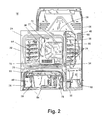
- Figs. 1-3 illustrate the refrigerated oven 10 according to the invention and comprising a chassis or frame 12 that defines a cooking chamber 14 and a refrigeration unit chamber 16, which are arranged in a stacked configuration with the refrigeration unit chamber 16 positioned below the cooking chamber 14.
- An external skin or cabinet 18 is mounted to the frame 12 and forms a decorative exterior for the refrigerated oven 10.
- a modular refrigeration unit 20 is slidably received within the refrigeration unit chamber 16.
- the frame 12 functionally comprises a front 24, rear 26, top 28, bottom 30, and opposing sides 32, 34.
- the cooking chamber 14 and the refrigeration unit chamber 16 both have open faces 38, 40, respectively, which open onto the front 24 of the frame 12.
- the cabinet 18 preferably comprises decorative side panels 42, 44 and top panel 46, which overlay the corresponding sides 32, 34 and top 28 of the frame 12, respectively.
- the rear 26 and bottom 30 of the frame 12 are not typically covered by a decorative panel.
- a rear panel 48 typically overlies and covers the rear 26 of the frame 12.
- a series of burners 50 are disposed on the top 28 of the frame 12 and extend through corresponding openings in the top panel 46. The burners collectively form a cooktop.
- An oven door 56 (shown in phantom in an open position) is hingedly mounted to the front 24 the frame 12 and is movable between an open and a closed position. In the open position, the door 56 is removed from the open face 38 of the cooking chamber 14 and provides access to the interior of the cooking chamber 14. In the closed position, the door 56 overlies the open face 38 and blocks access to the interior of the cooking chamber 14.
- a door position sensor 58 illustrated as a spring-biased, push-button switch, is provided on the front 24 of the frame. When the door is in the closed position, the push-button switch is depressed to indicate the door is closed.
- a cover 60 for the refrigeration unit chamber 16 is removably mounted to the front 24 of the frame 12 and closes the open face 40 of the refrigeration unit chamber when mounted to the frame 12.
- the cover 60 can be removed to gain access to the modular refrigeration unit contained within the interior of the refrigeration unit chamber 16.
- the cooking chamber 14 comprises opposing side walls 64, 66 that are connected along their upper and lower edges by an upper wall 68 and lower wall 70, respectively.
- a rear wall 72 closes the rear of the cooking chamber 14 opposite the open face 38.
- a series of shelf supports 74 are formed in each of the side walls 64, 66 and are used in pairs to support one or more shelves (not shown) mounted within the cooking chamber 14.
- a heating element 75 illustrated as gas heating element, is positioned within the cooking chamber 38 adjacent the bottom wall 70.
- the type of heating element is not germane to the invention. Any type of heating element can be used, including electric or gas heating elements, for example.
- a temperature sensor 77 (Figs. 2 and 10) is also positioned within the cooking chamber 38 for monitoring the temperature therein.
- the refrigeration unit chamber 16 functionally has the same configuration as the cooking chamber 14 in that the frame functionally defines side walls 76, 78, whose upper edges are connected by a top wall 80, and whose rear edges are connected by a rear wall 82 to thereby form a chamber with an open face 40 and an open bottom 84.
- the top wall 80 of the refrigeration unit chamber 16 is spaced from the lower wall 70 of the cooking chamber 14 and the heating element 75 is disposed therebetween.
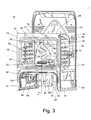
- the cooking chamber 14 and refrigeration unit chamber 16 are fluidly connected by a cold air duct 90 and a return duct 92.
- An inlet 94 for the cold air duct 90 is located on the side wall 76.
- An outlet 96 for the cold air duct 90 is located on the side wall 64 of the cooking chamber 14 at an upper portion thereof and at the junction of the side wall 64 with both the rear wall 72 and the top wall 68.
- An inlet 98 for the return duct 92 is located at a lower portion of the rear wall 72 for the cooking chamber 14 at the junction of the rear wall 72 with the side wall 64 and the bottom wall 70.
- An outlet 100 for the return air duct 92 is located in the rear wall 82 of the refrigeration unit chamber 16.
- the location of the cold air duct 90 and the return duct 92 and their corresponding inlets and outlets result in an air flow circulation path identified by the flow lines A.
- the air flow circulation path A will proceed (in a clockwise motion as viewed in Fig. 3) through the cold air duct 90 and enter the cooking chamber 14 through the cold air duct outlet 96 where it is directed toward the opposing side wall 66.
- the cold air entering the cooking chamber 14 through the cold air duct outlet 96 will enter the inlet 98 to the return air duct 92 and exit the return air duct outlet 100, where the air is once again chilled by the modular refrigeration unit 20 and re-circulated.
- the location of the cold air duct outlet 96 and the return duct inlet 98 enhances the circulation of the cold air around the cooking chamber 14.
- the force of the cold air exiting the cold air outlet 96 will inherently direct the cold air toward the opposing side wall 66 where, upon contact with the side wall 66, the cold air will be deflected back towards the side walls 64 and the return air duct inlet 98.
- the cold air exiting the cold air duct outlet 96 is typically colder and more dense than the air in the cooking chamber 14, the denser cold air will inherently fall towards the bottom wall 70 of the cooking chamber 14.
- the modular refrigeration unit 20 forms a relatively low pressure in the return duct 92, which naturally draws the already redirected and falling cold air toward and into the return duct inlet 98.
- the return duct outlet 100 has a generally rectangular shape and faces the open face 40 of the refrigeration unit chamber 16.
- the cold air inlet 94 is generally orthogonal to the open face 40.
- a side portion 108 of the cold air duct 90 is movably mounted to the remainder of the duct.
- the side portion 108 is preferably hingedly mounted to the cold air duct 90 by any suitable method.
- the side portion 108 could be a separate piece of material having an upper end that is taped to the cold air duct.
- the cold air duct is preferably made from thin metal such as sheet metal
- the side portion 108 could be an elongated tab cut from cold air duct 90 and the hinge is formed by bending the tab relative to the rest of the duct.
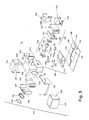
- the modular refrigeration unit 20 comprises a base 120 on which are mounted a compressor 122, condenser assembly 124, an evaporator assembly 126, and a dual-blade fan 128, which is shared by the condenser assembly 124 and evaporator assembly 126. Since all of the components for the modular refrigeration unit 20 are mounted on the base 120, the modular refrigeration unit 20 is easily slid into and out of the refrigeration unit chamber 16 to simplify the installation and maintenance of the modular refrigeration unit 20.
- the dual-blade fan 128 includes a motor 129 with a shaft 133.
- a thermally non-conductive spacer 135 separates the motor 129 from the evaporator assembly 126 to thermally isolate the evaporator assembly from the fan motor 129.
- the evaporator blade 132 is received within the evaporator assembly 126 when assembled.
- the base 120 is preferably made from a thermally conductive material, such as stainless steel, for example.
- An evaporator pan 134 is formed in the base 120.
- the evaporator pan 134 is preferably a depression formed in the base 120, such as by a press.
- the evaporator pan 134 could be a separate piece mounted to the base 120, including mounted to a corresponding opening in the base 120.
- Compressor mounting fingers 136 extend upwardly from the base 120 and cooperate with the compressor 122 to mount the compressor to the base 120.
- the compressor mounting fingers 136 are formed by cutting and bending portions of the base. Is also contemplated that separate fingers 136 can be affixed to the base if and when it is not desirable to have openings in the base, such as when it is desired to use the entire base as the evaporator pan 134.
- the outer edges of the base 120 turn upwardly to form a peripheral rim about the base 120 to aid in retaining any liquid overflow from the evaporator pan 134.
- the compressor 122 is a traditional compressor and any suitable compressor can be used for the invention.
- a suitable compressor is a hermetic reciprocating compressor manufactured by Embraco, model EM65.
- the compressor sets on a mounting bracket 138 that has openings for receiving the compressor mounting fingers 136 to thereby secure the compressor 122 to the base 120.
- the condenser assembly 124 comprises a condenser 142 and fan shield 144, which includes a fan opening 148 through which passes the condenser fan blade 130.
- Both of the condenser 142 and fan shield 144 are mounted to the base 120 by heat conductive spacers, such as aluminum spacers 146, which conduct the heat from the condenser 142 to the base 120. Since the condenser 142 rejects a substantial amount of heat during the refrigeration cycle, the heat is immediately conducted to the base 120, including the evaporator pan 134, to aid in the evaporation of any water in the evaporator pan 134. The use of the conducted condenser heat to evaporate the liquid in the evaporator pan 134 is enhanced by the evaporator pan being made from a thermally conductive material.
- the evaporator assembly 126 comprises an evaporator 150 and a fan shield 152, which includes a fan opening 154 through which the fan blade 132 is received.
- a mount 158 thermally isolates and connects the evaporator 150 and the fan shield 152 to the base 120.
- a housing 160 comprising opposing side portions 162, 164 and top wall 166, overlies the evaporator 150 and the fan shield 152 and rests on the mount 158 to enclose the evaporator 150 and fan shield 152.
- An insulation box 168 overlies the housing 160 and comprises complementary halves 170, 172, which are slidably coupled to encase the housing 160.
- the mount 158 is preferably thermally non-conductive to prevent the heat of the base 120 from being conducted to the evaporator 150.
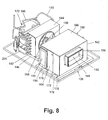
- the mount 158 preferably comprises an insulation pad 176 and spacers 178, which are received within openings or recesses in the insulation pad 176.
- the spacers 178 are arranged in two triangular sets. The innermost spacers of each set connect the evaporator 150 to the base and the remaining spacers connect the side portions 162, 164 to the base the 20.
- the spacers are preferably made from Nylon and the insulation pad 176 is preferably made from expandable foam.
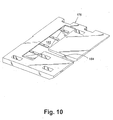
- the insulation pad 176 comprises several topographical features that perform important functions for the invention.
- a recess forming a catch pan 182 is formed in the upper surface of the insulation pad 176 at a location below where coils for the evaporator 150 will be located when the evaporator 150 is mounted. Thus, any condensation dripping from the coils of the evaporator will fall into the catch pan 182.
- An open-top channel 184 extends from the catch pan 182 through a peripheral edge of the insulation pad 176. The channel 184 slopes downwardly from the catch pan 182 to the peripheral edge and carries away any liquid collecting in the catch pan 182 and directs it to the evaporator pan 134.
- the insulation pad 176 is mounted to the base 120 such that the channel 184 extends between the fan blades 130, 132.
- the airflow generated by the fan blades 130 passes below the insulation pad and aids in evaporating any liquid in the evaporator pan sump 134 .
- the condenser fan blade 130 is especially helpful in evaporating water in the evaporator pan 134 since the condenser fan blade 130 draws the warm air from the condenser across the evaporator pan 134.
- the side portions 162, 164 of the housing 160 each include an opening 188, 190, through which is inserted a peripheral flange 192, 194, respectively.
- a peripheral seal 196 and peripheral gasket 198 encircle the flanges 192, 194, respectively.
- the peripheral flanges 192, 194 are adapted to mate with the cold air duct inlet 94 and the return outlet 100, respectively, to fluidly couple the interior of the housing 160 with the cold air duct 90 and return duct 92.
- the seal 196 and gasket 198 are located on the flanges 192, 194 such that they fluidly seal the evaporator housing 160 with respect to the cold air duct 90 and return duct 92 upon the sliding insertion of the modular refrigeration unit 20 within the refrigeration unit chamber 16.
- the peripheral flange 194 is received within the outlet 100 of the return air duct 92 and the gasket 198 is compressed between the housing side wall 164 and the duct 92 to form a fluid seal therebetween.
- the seal 196 is slidably received within the open side edge of the cold air duct 90 formed by the hinged movement of the side portion 108 to an open position.
- the seal 196 abuts the inner edge of the inlet 94.
- the side portion 108 is then hinged to a closed position where it overlies the seal 196 and the side portion 108 is then secured to the return duct 192, preferably by a suitable fastener such as a pop in rivet or a screw.
- the side portion 164 includes a fan shaft opening 195 that is sized to receive the shaft 133 from the fan 128.
- a thermally non-conductive spacer 135 is positioned between the side portion 164 and the fan 128 to minimize the fan 128 from conducting heat to the side portion 164 and thereby prevent the heat from negatively impacting the performance of the evaporator 150.
- the peripheral flange 194 and its corresponding opening 190 are positioned within the side portion 164 such that they are downstream of the airflow generated by the evaporator fan blade 132.
- the flange 192 and its corresponding opening 188 are positioned in the side portion 162 such that they are upstream of the airflow generated by the evaporator fan blade 132. Therefore, the evaporator assembly 126 in combination with the cold air duct 90, return duct 92, and cooking chamber 14 define a chilled airflow path along previously described flow lines.
- the air flow generated by the evaporator fan blade 132 that passes through the evaporator 150,the cold air duct 90, the cooking chamber 14, the return duct 92, and back to the evaporator assembly 126.
- the output-side of the condenser 130 is connected to the input-side of the evaporator 150 through a capillary tube 197 to permit the build up of pressure in the condenser 130 so that the condenser 130 can convert the refrigerant gas into a liquid.
- the output-side of the evaporator 150 is connected by a conduit 199 to the input-side of the compressor 122.
- the output-side of the compressor is connected to the input-side of the condenser through a conduit 200.
- the opposing halves 170, 172 of the insulation box 168 are preferably shaped to conform to the shape of the housing 160 while having appropriate openings to permit the passage of the various connectors for the compressor 122, condenser 130, and evaporator 150.
- the insulation half 170 comprises a partial cold air duct opening 201 and partial fan opening 202.
- the insulation half 172 comprises corresponding partial cold air duct opening 204 and partial fan opening 206, along with return duct opening 208.
- the partial cold air duct openings 200, 202 cooperate to encircle the peripheral flange 192 associated with the cold air duct 90
- the openings 202, 206 cooperate to encircle the fan 128, and the return duct opening 208 encircles the peripheral flange 194 associated with the return duct 92.
- An advantage of the two-half insulation box 168 is that it is easily assembled over the housing 160 and can be unassembled as needed for maintenance. This is not really true.
- the modular refrigeration unit 20 has a variety of features whose function enables the useful operation of the modular refrigeration unit 20 in the high temperature environment associated with the refrigerated oven 10.
- One general category of features relate to the thermal isolation of the evaporator assembly 126 from the other components of the modular refrigeration unit 20 and from the rest of the refrigerated oven 10.
- the features include the thermally non-conductive mount 176 that physically separates and thermally isolates the evaporator assembly 126 generally and the evaporator 150 specifically from the base 120, which is advantageously used as a heat exchanger to dissipate heat from the condenser.
- the fan spacer 135 also functions to thermally isolate the evaporator assembly 126 from any heat that could be conducted through the fan 128 if it were to contact of the side portion 164 of the housing 160. Additionally, the insulation box 168 thermally isolates all but the bottom of the evaporator assembly 126 from the rest of the refrigerated oven 10, including the modular refrigeration unit 20. The collective thermally-isolating effect of all of these structural features permit the useful operation of the modular refrigeration unit 20 and the high temperature environment of an oven. Without the thermally-isolating features, the performance of the evaporator 150 could be substantially impaired in the high temperature environment.
- the invention also addresses the higher than normal condensation that can exist when a refrigeration unit is used in a high temperature environment. Even though the evaporator 130 is insulated from the surrounding heat, the insulation cannot stop all heat reaching the evaporator. The generally higher ambient temperature surrounding the evaporator will increase the amount of condensation that must be removed. To handle the increased condensation, the catch pan 182 and channel 184 of the insulation pan 176 direct the liquid condensate from the evaporator directly onto the base 120 for evaporation.
- the additional heat carried by the base 120 in performing the heat-exchanging function also advantageously increases the rate of evaporation for the liquid condensate carried on the evaporation pan 134 of the base 120.
- the location of the condenser fan blade 130 with respect to the insulation pan 176 and base 120 also aids in evaporating the liquid condensate on the base 120 and the air flow created by the condenser fan 130 is drawn below the evaporator pan 134 from the condenser 130. This particular air flow path will result in an increased rate of evaporation for the liquid condensate in or the evaporator pan 134.
- the modular refrigeration unit 20 also includes several special features that relate to the dissipation of heat.
- the condenser 130 is directly connected to the thermally-conductive base 120 by thermally-conductive spacers 146 to aid in distributing the heat from the condenser to the base 120, which functions as a heat exchanger.
- the thermally conductive spacers 146 improve the rate of conduction from the condenser to the base.
- the size of the base improves the dissipation of the conducted heat.
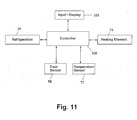
- Fig. 11 illustrates one possible controller 220 for controlling the operation of the refrigerated oven 10 in accordance with a preferred cycle.
- the controller 220 preferably is a microprocessor-based controller that has programmable read-only memory in addition to the programmable memory of the microprocessor.
- the controller 220 typically will include an oscillator or other device that can be used as a clock to monitor the time of any aspect of the operation of the refrigerated oven 10.
- An input/display device 222 is provided and functions as a user interface for the user to input operational parameters for the refrigerated oven 10 as needed.
- the input/display device 222 also contains a display whereby the controller 220 can display to the user information or data necessary to operate the refrigerated oven 10 and all of the parameters needed to perform a particular cycle or function.
- the input/display device 222 can be any suitable such device.
- One of ordinary skill in the oven art is aware of many mechanical, electrical, or electro-mechanical input/display devices that can be used for the invention.
- Such input/display devices can range from simple manually-operated knobs or dials having information, such as time or temperature imprinted thereon, and which are set relative to a reference point to a catch-panel input device in combination with an LCD or other type of display.
- controller 220 and input/display device 222 are not germane to the invention and therefore will not be described in greater detail.
- the controller 220 is operably connected to the heating element 75 contained in the cooking chamber 14 of the modular refrigeration unit 20.
- the controller is also connected to the temperature sensor 77 and the door sensor 58.
- the controller 220 selectively cycles the heating elements and the modular refrigeration unit in response to the selected operating cycle as defined by the operational parameters stored in the memory of the controller or input and by the user through the input/display device 222 and further in response to the temperature sensed by the temperature sensor.
- Figs. 11-19 illustrate a preferred operating cycle 300 for use with the previously described refrigerated oven 10.
- the preferred operating cycle is in the genre of Time-Bake cycles.
- all of the operating parameters, whether stored in the memory of the controller or entered by the user, are generically referred to as predetermined, indicating a value is set or has been set for the parameter, even if the value is variable or dynamic.
- the major steps or cycles of the preferred Time-Bake cycle for the refrigerated oven 10 begin with a Data_Input step 302 in which any necessary user-defined data is input to the controller 220.
- the Data_Input step 302 is followed by the Cool_Cycle 304 where the modular refrigeration unit 20 is cycled to maintain the cooking chamber 14 at a temperature sufficient to prevent any food placed therein from spoiling before the initiation of the Bake_Cycle 306, which follows the Cool_Cycle 304.
- the Bake_Cycle 306 can be any type of Bake_Cycle.
- a preferred Bake_Cycle 306 is disclosed in U.S. patent application serial number 09/838,447, the disclosure of which is incorporated by reference.
- the Bake_Cycle 306 is followed by a Warm_Cycle 308 that maintains the cooked food at a temperature suitable for serving upon removal from the cooking chamber 14.
- An optional Cool_Cycle 310 preferably substantially similar to the Cool_Cycle 304, can follow the Warm_Cycle 308.
- the preferred operating cycle 300 is in the form of a Time_Bake cycle where the food is placed in the cooking chamber 14 well before it is desired to begin the cooking of the food.
- the preferred operating cycle 300 includes a delay from the time the food is placed in the cooking chamber 14 until the desired time for the cooking cycle to begin. The delay can be caused by many different reasons. A typical example of such a situation is when the user desires to have food prepared and ready for dinner upon arrival at home after work but must place the food in the cooking chamber 14 in the morning before leaving for work. This example will be used to describe the operation of the preferred cycle 300. Referring to Fig.
- the Data_Input step 302 begins at step 320 by requesting the user to enter the user-defined operating parameters for the preferred cycle 300.
- the particular user-defined parameters will vary depending on the manner in which the preferred operating cycle 300 is implemented. However, under most implementations, a user will enter the time at which the cooking of the food is to be completed (the "End Time”), the length of time needed to cook the food (the “Cook Time”), and a temperature at which the food should the cooked (the "Bake Temp").
- the user-defined data is then stored in the memory of the microprocessor.
- the controller 220 at step 322 uses the user-defined End Time and the Cook Time to calculate the time at which the Bake_Cycle 306 should be started (the "Bake Start Time") to complete the cooking of the food by the End Time.
- the calculation of the Bake Start Time is easily accomplished with the microprocessor of the controller 220, which then stores the calculated Bake Start Time to initiate the cooking of the food for the Bake_Cycle 306.
- Program control is then returned at step 324 to the preferred cycle 300, which automatically advances to start the Cool_Cycle 304.
- the operating parameters of the preferred cycle 306 does not rely on or need any particular method. For example, instead of requiring the user to enter the End Time and Bake Time, the user could have been asked to enter the Bake Start Time and End Time, effectively making the user, instead of the controller 220, to perform the math to determine the Bake Start Time based on a given Cook Time. Also, the Cool_Cycle 304 does not have to automatically start at the completion of the Data_Input step 302, which is based on the logic that the user will put the food in the cooking chamber 14 just before or shortly after initiating the preferred cycle. The preferred cycle 306 can require that the user input a start time for the Cool_Cycle 304 based on the logic that the user might initiate the preferred cycle well before the food is placed in the cooking chamber 14.
- the Data_Input step 302 could prompt for information related to the food (type of food: cake, meat, etc.; physical characteristics: weight, frozen, thawed, etc.; cooking preference: well done, medium, rare) and determine the Cook Time therefrom. Many of the physical properties can be determined by sensors as it is well know in the art to do so.
- Absolute times can be used in combination with a reference time, say, for example, the End Time is 8 hours from the initiation of the preferred cycle 300.
- the parameters for the preferred cycle 300 Since there are many ways to implement the parameters for the preferred cycle 300, the exact method is not germane to the invention. What is relevant to the invention is that the parameters provided enable the preferred cycle to know when to start and stop each of the cycles used: Cool_Cycle 304, Bake_Cycle 306, Warm_Cycle 308, and, if used, the optional Cool_Cycle 310.
- Fig. 14 illustrates the sub-steps and cycles for the Cool_Cycle 304.
- the Cool_Cycle 304 begins at step 330 by checking the initial temperature of the cooking chamber 14 to determine if the cooking chamber 14 temperature (CCT) is less than a initiation temperature threshold (ITT), which is a temperature sufficiently low enough to begin operation of the modular refrigeration unit 20 without damaging the various components of the modular refrigeration unit 20 or substantially negatively impacting its operating performance.
- CCT cooking chamber 14 temperature
- ITT initiation temperature threshold
- the modular refrigeration unit 20 Upon confirming that the CCT is below the ITT, the modular refrigeration unit 20 is checked at step 332 to make sure that it is functioning properly, preferably by monitoring the CCT to determine if it drops below a threshold cooling temperature (TCT) for at least a predetermined time period, with both the TCT and the time period preferably set by the controller.
- TCT threshold cooling temperature
- the Cool_Cycle 304 advances to a Cooling_Cycle 334 that maintains the CCT at a temperature (Warm Temp.) sufficient to keep the food placed in the cooking chamber 14 from spoiling.
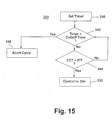
- Fig. 15 illustrates the details of the initial temperature check step 330, which first begins by setting a timer 340. The timer 340 is then compared against a predetermined initial temperature Cutoff Time 342, which is preferably set by the controller. If the Cutoff Time 342 is not exceeded, the CCT is compared against the ITT 344. If the CCT is less than the ITT, the modular refrigeration unit 20 can be safely started without damage or undue performance degradation and the Cool_Cycle 304 then advances to the check of the refrigeration system step 332.
- the initial temperature check 330 continues to monitor the CCT until either the CCT drops below the ITT or the Cutoff Time 342 is exceeded. If the Cutoff Time 342 is exceeded, it is assumed that the heating element of the refrigerated is still turned on or some other factor is adversely affecting the temperature of the cooking chamber 14, and the cycle is aborted at step 346.
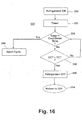
- the modular refrigeration unit 20 is turned on at step 350 and a Timer 352 for the check refrigeration system step 332 is started.
- the Timer 352 is then compared against a predetermined Cool Down Time 354, which is preferably a parameter set by the controller 220. If the Cool Down Time 354 is not exceeded, the temperature of the cooking chamber 14 is compared against the threshold cooling temperature (TCT) 356, which is preferably a parameter set by the controller 220 and indicative of a temperature that is sufficiently low enough to prevent the food in the cooking chamber 14 from spoiling. If the CCT is less than the TCT 356, then it is assumed that the modular refrigeration unit 20 is functioning properly and the refrigerator is turned off at 358 and control is then returned to the Cooling_Cycle 334.
- TCT threshold cooling temperature
- the check refrigeration system step 332 continues to monitor the CCT until either the CCT is less than the TCT 356 or the Cool Down Time 354 is exceeded. If the Cool Down Time 354 is exceeded, it is assumed that the modular refrigeration unit 20 is not functioning properly and the cycle is aborted at step 346.
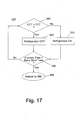
- control passes to the Cooling_Cycle 334 shown in Fig. 17.
- the Cooling_Cycle 334 monitors the CCT at step 360 and turns the modular refrigeration unit 20 off at 362 if the CCT is less than the TCT or turns the modular refrigeration unit 20 on at step 364 if the CCT is greater than the TCT.
- the cycling on/off of the modular refrigeration unit 20 is continued as long as the Current Time (time of day) does not exceed the Bake Start Time, which is tested at step 366. If the Current Time does exceed the Bake Start Time, then the Cool_Cycle 304 is completed and control passes back to the Bake_Cycle 306.
- the check refrigeration system step 332 and the Cooling_Cycle 334 could easily be combined. Since the Cooling_Cycle 334 and the check refrigeration system step 332 compare the CCT against the TCT, the check of the refrigeration system at step 332 could be easily accomplished by performing the time monitoring function of the check refrigeration step 332 during the Cooling_Cycle 334. It is also within the scope of the invention that the value of the TCT may not be the same for the refrigeration system check 332 and the Cooling_Cycle 334.
- Cooling_Cycle 334 may be terminated before the Bake Start Time to permit the CCT to rise naturally based on the ambient room temperature.
- the termination of the Cooling_Cycle 334 prior to the Bake Start Time will reduce the amount of time needed to preheat the cooking chamber to the Bake Temp as part of the Bake_Cycle 306. If such an early termination of the Cooling_Cycle 334 is used, it is contemplated that the corresponding time period will be a controller 220 selected parameter but could be user defined.
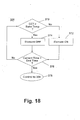
- the Bake Cycle 306 illustrated in Fig. 18 is initiated. It should be noted that the Bake_Cycle 306 is a generic Bake_Cycle and that any suitable Bake_Cycle can be used.
- the Bake_Cycle 306 begins by comparing the CCT against the Bake Temp at step 370 and turning on the heating element at 372 if the CCT is less than the Bake Temp or turning off the heating element at 374 if the CCT is greater than the Bake Temp.
- the cycling on/off of the heating element is continued as long as the Current Time does not exceed the End Time, which is tested at step 376. If the Current Time does exceed the End Time, then the Bake_Cycle 304 is completed and control passes back to the Warm_Cycle 308 at 308.
- the Warm_Cycle 308 maintains the CCT at a temperature (the Warm Temp) so that the cooked food is maintained at a temperature suitable for serving for a predetermined time (the Warm Time).
- the Warm_Cycle 306 begins by starting a timer 380.
- the CCT is then compared against a Warm Temp at step 382 and the heating element is turned on at 384 if the CCT is less than the Warm Temp or turned off if the CCT is greater than the Warm Temp.
- the cycling on/off of the heating element is continued as long as the timer 380 does not exceed the Warm Time, which is tested at step 386. If the Warm Time does exceed the time 380, then the Warm_Cycle 304 is completed and control passes back to the optional Cool_Cycle 310.
- the Warm Temp and the Warm Time are preferably controller-selected parameters that are stored in the read-only memory of the controller 220. It is within the scope of the invention for the user to set the Warm Temp and the Warm Time. The user can enter the Warm Temp and the Warm Time during the Data_Input step 302 of the preferred cycle 300. If desirable, the Data_Input step 302 can even include an option for the user to set the Warm Temp and/or Warm Time or the controller 220 can set them.. It is preferred that the Warm Temp and Warm Time parameters be limited in such a manner to prevent the cooked food from becoming dried out to the extent that it is not edible.
- the Warm Time and Warm Temp are preferably selected to be suitable for most baked foods to simplify the process.
- the Warm Time and Warm Temp it is within the scope of the invention for the Warm Time and Warm Temp to be variable and even food or environment dependent.
- moisture sensors in ovens that are controlled by the controller. If the rate or absolute amount of moisture is at a level indicative of the food drying out beyond an edible limit, the Warm Time can automatically terminate, resulting in a dynamic time.
- the user can be prompted to enter the type of food during the Data_Input cycle, say for example, Cake, Casserole, Snufflé, etc., and a predetermined Warm Time and even a predetermined Warm Temp can be stored in the controller memory for each food type. The food type can even be used in combination with the moisture sensor if desired.
- the function of the Warm_Cycle 308 is to maintain the cooked food at a temperature suitable for serving for a predetermined period of time. In that way, a user who does not make it home at the end of the Bake_Cycle 306 will still have cooked food that is immediately ready for serving upon their arrival.
- the Warm_Cycle 308 is a great convenience for the user and if for any reason the user is late, the food will still be maintained at a temperature suitable for serving for a predetermined period of time. Since the Warm_Cycle 308 is thought to be a great convenience for the user, it is preferred that the Warm_Cycle 308 automatically start at the end of the Bake_Cycle 306. However, it is within the scope of the invention for the Warm_Cycle to the selected by the user as part of the Data_Input step 302.
- Warm_Cycle 308 One option for the Warm_Cycle 308 is that it can be terminated prior to the running of the Warm Time upon the opening of the oven door 58, which would activate the oven door sensor coupled to the controller 220. Under most circumstances, it is anticipated that the user will arrive home prior to the termination of the Bake_Cycle 306. Thus, where the Warm_Cycle 308 is automatically initiated after the completion of the Bake_Cycle 306, the opening of the oven door 58 by the user will indicate that the user is now present and the food is ready to be served, resulting in the termination of the Warm_Cycle 308.
- the option of terminating the Warm_Cycle 308 in response to the opening of the oven door 58 can easily be implemented by checking the status of the oven door flag in the memory of the controller 220 before, during, or after the check of the warm time at step 388.
- the opening of the of the door 58 not result in the termination of the Warm_Cycle 308 since it is presumed that the user selection of the Warm_Cycle 308 is indicative of the user's desire for the Warm_Cycle 308 to run its entire course. If the user selects the Warm_Cycle 308 and desires for it to be terminated prior to the expiration of the Warm Time, then the user can manually stop the cycle.
- the optional Cool_Cycle 310 is substantially identical to the Cool_Cycle 304 and will not be described in detail. It is preferred that the optional Cool_Cycle 310 automatically initiate at the end of the Warm_Cycle 308. However, unlike the
- Cool_Cycle 304 it is preferred that the Cool_Cycle 310 will preferably run until manually terminated by the user since it is anticipated that the circumstances under which the Cool_Cycle 310 is initiated are when the user cannot arrive home a substantial amount of time after the end of the Bake_Cycle.
- the optional Cool_Cycle 310 should not be permitted to run beyond a certain predetermined time, preferably 24 hours. Under such circumstances, the controller 220 can be programmed with a predetermined time for terminating the optional Cool_Cycle 310.
- Cool_Cycle 310 Another option for terminating the optional Cool_Cycle 310 is the opening of the oven door 58 in a manner similar to the previously described termination of the Warm_Cycle 308. If the oven door 58 is opened during a Cool_Cycle 310 that was automatically initiated by the controller 220, then it is contemplated that the user has arrived home and is removing the food from the cooking chamber 14, making it now appropriate to terminate the Cool_Cycle 310.
- Cool_Cycle 310 when the Cool_Cycle 310 is selected by the user during the Data_Input step 302, it is assumed that the user desires to have the Cool_Cycle 310 terminate naturally and the opening of the oven door 58 will not serve to terminate the Cool_Cycle 310.
- the preferred Time_Bake_Cycle with warming and optional cooling provides the user with a very convenient means for cooking food while away from home, the cooked food being ready to eat at the desired time, and with the cooked food being maintained at a temperature ready to eat if the user is late in arriving.
- the maintenance of the cooked food at a temperature suitable for serving upon removal from the cooking chamber 14 provides the user with a great deal of flexibility in their schedule.
- the optional Cool_Cycle 310 further enhances the flexibility of the user in that if for some unknown reason the user must arrive home at a time much later than ever contemplated the food will not be warmed until inedible.
Landscapes
- Engineering & Computer Science (AREA)
- Chemical & Material Sciences (AREA)
- Combustion & Propulsion (AREA)
- Physics & Mathematics (AREA)
- Mechanical Engineering (AREA)
- Thermal Sciences (AREA)
- General Engineering & Computer Science (AREA)
- Devices That Are Associated With Refrigeration Equipment (AREA)
- Electric Stoves And Ranges (AREA)
Abstract
Description
- The invention relates to an oven having a cooking chamber in which food is received for cooking, and more particularly, to an oven in combination with a refrigeration unit for cooling the cooking chamber to permit the refrigerated storage of food within the cooking chamber until it is desired to begin the cooking of the food.
- Ovens for cooking or baking foods are ubiquitous. While various ovens may have a variety of different features and cooking cycles, almost every contemporary oven includes a cooking chamber for receiving the food to be cooked and a heat source for heating the cooking chamber to a user-selected cooking temperature for a user-selected time-period. The heat source is normally one or more electric or gas heating elements positioned within the cooking chamber. Some ovens use a magnetron to generate microwaves as the heat source. A variety of controllers, including user input devices and displays, enable the user to input the preferred cooking temperature and cooking time.
- A common cooking cycle is a Time-Bake cycle where the user can control the start time and stop time of the cooking cycle. A common application for the Time-Bake cycle is for cooking food while the user is away from the home, such as at work, and the cooking of the food will be completed at the anticipated arrival of the user at home, such as when the user returns home from work. The advantage of a Time-Bake cycle is that the user can cook the food without being present and have the food ready upon the user's anticipated time of arrival.
- A disadvantage of the use of a Time-Bake cycle with an oven lies in that the cooking time for most food is substantially less than the amount of time the user is away, necessitating that the food be placed in the cooking chamber several hours before the start time of the cooking cycle. For example, most foods are cooked within 2-3 hours while most users work a traditional 8-hour day, excluding commute time, which requires that the food be placed in the cooking chamber at least five hours prior to the start time of the Time-Bake cycle. Not all food can be placed in the oven for long time periods without spoiling. Many types of food suitable for cooking in the oven require continuous refrigeration prior to cooking. These foods can spoil prior to the initiation of the start time of the Time-Bake cycle.
- An attempt to solve the problem of food spoiling while placed in the cooking chamber during the delay prior to the start of the Time-Bake cycle included the addition of a refrigeration unit with the oven to cool the cooking chamber prior to the initiation of the bake cycle. Such a combination refrigerator oven is disclosed in U.S. Patent No. 4,884,626 to Filipowski.
- While previous refrigerated ovens attempt to address the problem of preventing the food from spoiling before the initiation of the bake cycle, they do not address the problem of maintaining the cooked food at a temperature suitable for serving after the completion of the Time-Bake cycle, which can result in the need to warm the cooked food if the user does not remove and serve the food immediately at the completion of the bake cycle, such as when the user unexpectedly had to work late or was delayed in arriving home. The Filipowski patent addresses the spoilage of the cooked food after the completion of the time-bake by starting a cooling cycle to refrigerate the cooked food upon the passing of a predetermined time from the completion of the time-bake as long as the oven door was not opened. However, the Filipowski patent does not address maintaining the cooked food at a temperature suitable for serving upon completion of the bake cycle.
- There is an unfilled need for a refrigerated oven that not only protects the food from spoiling, both before and after the bake cycle, but also maintains the cooked food at a temperature suitable for serving after the completion of the bake cycle.
- In addition to the shortcomings associated with the various cooking cycles, prior refrigerated ovens have structural shortcomings related to the inherent difficulties of combining a traditional refrigeration system with a traditional oven, which have antithetical functions: one heats and one cools. These problems can vary and most notably include: the difficulty of transferring the chilled air from the refrigeration unit into the cooking chamber, finding sufficient space in the standard-size oven for the refrigeration unit, and providing easy access to the refrigeration unit for maintenance. An especially difficult problem related to incorporating a refrigeration unit with an oven is protecting the refrigeration system and its components from the high heat generated by the oven. This problem is exacerbated by the high temperatures attained during an oven cleaning cycle; these temperatures are approximately 850 °F. Such heat creates an environment capable of damaging or negatively impacting the performance of a traditional refrigeration unit. For example, the temperature surrounding the refrigeration unit can be sufficiently great enough to negatively impact a traditional refrigeration system, which greatly reduces the life of the refrigeration unit or may cause the system to prematurely fail. Thus, the refrigeration unit must be capable of functioning properly when placed in close proximity to the self-cleaning oven.
- The invention relates to a combination appliance for cooling and cooking a food item. The combination appliance comprises a frame having a cooking chamber and a refrigeration module chamber. The cooking chamber has a first access opening through which access to the cooking chamber is provided. A door is movably mounted to the frame for movement between an open position, where the first access opening is uncovered, and a closed position, where the first access opening is covered. A heating element is disposed within the cooking chamber and is selectively operable to provide heat to the cooking chamber. The cooking chamber and the refrigeration module chamber are fluidly connected by an inlet duct and a return duct. The inlet duct has an inlet in communication with the refrigeration module chamber and an outlet in communication with the cooking chamber. The return duct has an inlet in communication with the cooking chamber and outlet in communication with refrigeration module. A refrigeration module is formed by a compressor, condenser, and evaporator all of which are mounted to a supporting base. An insulated housing overlies the evaporator to thermally isolate the evaporator from the condenser. The insulated housing has an inlet and an outlet, which align with the outlet of the return duct and the inlet of the inlet duct when the refrigeration module is mounted within the refrigeration module chamber to thereby form a refrigerated air path between the evaporator and the cooking chamber.
- The frame further comprises a second interior access opening through which access to the refrigeration module chamber is provided and which is sized to receive the refrigeration module. A cover is provided to close the second access opening.
- The cooking chamber preferably comprises a top wall, bottom wall, and a peripheral wall connecting the top and bottom walls. The outlet of the inlet duct and the inlet of the return duct extend through the peripheral wall. Preferably, the outlet of the inlet duct is positioned above the inlet of the return duct within the cooking chamber. In a preferred position, the outlet of the inlet duct is located in an upper portion of the cooking chamber near the top wall and the inlet of the return duct is located in a lower portion of the cooking chamber near the lower wall.
- The inlet and outlet ducts are preferably located exteriorly of the cooking chamber. The combination appliance can further comprise an exterior cabinet mounted to the frame and defines a gap with respect to the cooking chamber, with the inlet duct and the outlet duct being positioned within the gap.
- The base is preferably thermally conductive and the condenser is conductively mounted to the base to transfer the heat from the condenser to the base to aid in the dissipation of the heat from the condenser. A thermally conductive mount is used to conductively connect the condenser to the base.
- In contrast, the evaporator is preferably thermally isolated from the base to retard the conduction of heat from the base to the evaporator. A portion of the base can be made of thermally non-conductive material and the evaporator is mounted to the thermally non-conductive portion of the base to thermally isolate the evaporator from the base. A thermally non-conductive mount can be used to connect the evaporator to the base. Preferably, the thermally non-conductive mount forms a catch pan including a channel having an outlet disposed above the base to collect and drain the condensation from the evaporator onto the base. The thermally non-conductive mount can be made of a layer of insulation, in which the catch pan and channel are formed, positioned between the base in combination with thermally non-conductive blocks connecting the evaporator to the base.
- A condenser fan can be provided for drawing or blowing air along an air-flow path through the condenser and between the non-conductive insulation pad and evaporator pan on the base to enhance evaporation of the condensation on the base.
- The base can include in evaporator pan for collecting the condensation from the channel whereby the heat conducted to the base from the condenser enhances the evaporation of the condensation in the evaporator pan.
- In another embodiment, the invention relates to a modular refrigeration unit comprising a base having at least a portion of which is thermally conductive. The modular refrigeration unit further comprises a compressor and a condenser mounted to the base. The condenser is mounted on the base such that the heat generated by the condenser is conducted to the thermally conductive portion of the base. An evaporator is provided, which is fluidly coupled to the condenser and the compressor.
- The evaporator is mounted on the base such that any condensation forming on the evaporator will collect on the thermally conductive portion of the base. The heat conducted to the base from the condenser enhances the evaporation of the condensation collected on the base.
- Preferably, at least one thermally-conductive mount connects the condenser to the thermally-conductive portion of the base, whereby the heat from the condenser is conducted to the base through the at least one thermally-conductive mount. The evaporator is preferably thermally isolated from the base to retard the conduction heat from the base to the evaporator.
- A thermally non-conductive mount can be used to connect the evaporator to the base. Preferably, the thermally non-conductive mount forms a catch pan including a channel having an outlet disposed above the base to collect and drain the condensation from the evaporator onto the base. The thermally non-conductive mount can be made of a layer of insulation, preferably made from polystyrene, in which the catch pan and channel are formed, positioned between the base and the evaporator in combination with thermally non-conductive blocks connecting the evaporator to the base.
- A condenser fan can be provided for drawing or blowing air along an air-flow path through the condenser and between the insulation pad and evaporator pan to enhance evaporation of the condensation.
- An insulated housing overlies the evaporator and thermally isolates the evaporator from the condenser.
- In yet another embodiment, the invention relates to a refrigerated oven for cooling and cooking a food item. The refrigerated oven comprises a frame having a cooking chamber and a refrigeration chamber. The cooking chamber has a first access opening through which access to the interior the cooking chamber is provided. The doors movably mounted to the frame for movement between an opened and a closed position. A heating element is disposed within the cooking chamber and is selectively operable to provide heat to the cooking chamber when desired. The cooking chamber and the refrigeration chamber are fluidly connected by an inlet duct and a return duct. An evaporator is provided within a refrigeration chamber and has one side in fluid communication with an inlet of the inlet duct and another side in fluid communication with an outlet of the return duct to form a cold air circulation path between the refrigeration chamber and the cooking chamber. An evaporator fan is positioned within the cold air circulation path to circulate air along the path through the evaporator. A thermally conductive evaporator pan is disposed beneath the evaporator for collecting condensation from the evaporator. The condenser is positioned within the refrigeration chamber and is fluidly connect to the evaporator. The condenser is thermally conductively coupled to the evaporator pan to enhance evaporation of condensation collected therein. A condenser fan is provided and forces or draws air through the condenser along an air flow path within the refrigeration chamber such that the air passes over the evaporator pan to enhance evaporation of the condensation therein.
- The condenser is preferably connected to the evaporator pan by a thermally conductive mount whereby the heat from the condenser is conducted to the base. A thermally non-conductive mount connects the evaporator to the evaporator pan to thermally isolate the evaporator from the evaporator pan. The non-conductive mount includes a channel to direct any condensation from the evaporator onto the evaporator pan. The air drawn by the condenser is carried between the insulation pad and evaporator pan to enhance evaporation of the condensation on the evaporator pan.
-
- Fig. 1 is an exploded perspective view of the refrigerated oven according to the invention and illustrates the chassis or frame of the oven in which are formed a cooking chamber and a refrigeration unit chamber, with a door (shown in phantom) for closing the cooking chamber shown in an open position, a modular refrigeration unit partially inserted within the refrigeration unit chamber, and a cover for the refrigeration unit chamber.
- Fig. 2 is a perspective view of the chassis with the modular refrigeration unit inserted within the refrigeration unit chamber.
- Fig. 3 is a perspective view identical to Fig. 2 except the modular refrigeration unit is not show to better illustrate cold air and return ducts fluidly connecting the cooking chamber and the refrigeration unit chamber.
- Fig. 4 is a sectional view taken along line 4-4 of Fig. 3 illustrating the cold air and return ducts.
- Fig. 5 is an exploded view of the modular refrigeration unit shown in Fig. 1 and illustrating the components of the modular refrigeration unit mounted to a base.
- Fig. 6 is a right-front perspective view of the assembled modular refrigeration unit with an insulation cover placed over an evaporator assembly.
- Fig. 7 is a left-rear perspective view of the assembled modular refrigeration unit and illustrates the cold air and return air openings in the insulation cover.
- Fig. 8 is identical to Fig. 6, except that the insulation cover is removed to illustrate the evaporator assembly, including an insulation pad.
- Fig. 9 is a perspective view of the base of the modular refrigeration unit with an integrally formed evaporator pan.
- Fig. 10 is a perspective view of the insulation pad for insulating an evaporator from a base of the modular refrigeration unit, with the insulation pad forming a condensation catch pan and a drain channel.
- Fig. 11 is a schematic of a generic controller for controlling the operation of the oven heating element and refrigeration unit in response to temperature sensor input and user-selected input received by the controller from an input/display device.
- Fig. 12 is a schematic of a preferred main cycle of operation for the refrigerated oven comprising the cycles or steps of Data_Input, Cool_Cycle, Bake_Cycle, and then Warm_Cycle, followed by an optional Cool_Cycle.
- Fig. 13 is a schematic of a Data_Input step for setting the parameters of the preferred Time_Bake_Cycle.
- Fig. 14 is a schematic of the steps or cycles for the Cool_Cycle, which includes a Cooking Chamber Temp. Check, a Refrigeration System Check, and a Cooling_Cycle.
- Fig. 15 is a schematic of Cooking Chamber Temp. Check for determining whether the temperature of the cooking chamber is within the operational range prior to the initiation of the modular refrigeration unit.
- Fig. 16 is a schematic of Refrigeration System Check for determining if the refrigeration unit is functioning properly during the initiation of the Cooling_Cycle.
- Fig. 17 is a schematic of the Cooling_Cycle for maintaining the temperature of the cooking chamber at a predetermined cooling temperature.
- Fig. 18 is a schematic of the Bake_Cycle for baking food placed in the cooking chamber.
- Fig. 19 is a schematic of a Warm_Cycle for maintaining cooked food at a temperature suitable for serving for a predetermined time after the completion of the Bake_Cycle.
-
- Figs. 1-3 illustrate the
refrigerated oven 10 according to the invention and comprising a chassis orframe 12 that defines acooking chamber 14 and arefrigeration unit chamber 16, which are arranged in a stacked configuration with therefrigeration unit chamber 16 positioned below thecooking chamber 14. An external skin orcabinet 18 is mounted to theframe 12 and forms a decorative exterior for therefrigerated oven 10. Amodular refrigeration unit 20 is slidably received within therefrigeration unit chamber 16. - The
frame 12 functionally comprises a front 24, rear 26, top 28, bottom 30, and opposingsides cooking chamber 14 and therefrigeration unit chamber 16 both haveopen faces front 24 of theframe 12. - The
cabinet 18 preferably comprisesdecorative side panels top panel 46, which overlay the correspondingsides frame 12, respectively. The rear 26 and bottom 30 of theframe 12 are not typically covered by a decorative panel. Arear panel 48 typically overlies and covers the rear 26 of theframe 12. While not germane to the invention, a series ofburners 50 are disposed on the top 28 of theframe 12 and extend through corresponding openings in thetop panel 46. The burners collectively form a cooktop. - An oven door 56 (shown in phantom in an open position) is hingedly mounted to the front 24 the
frame 12 and is movable between an open and a closed position. In the open position, thedoor 56 is removed from theopen face 38 of thecooking chamber 14 and provides access to the interior of thecooking chamber 14. In the closed position, thedoor 56 overlies theopen face 38 and blocks access to the interior of thecooking chamber 14. Adoor position sensor 58, illustrated as a spring-biased, push-button switch, is provided on thefront 24 of the frame. When the door is in the closed position, the push-button switch is depressed to indicate the door is closed. - A
cover 60 for therefrigeration unit chamber 16 is removably mounted to thefront 24 of theframe 12 and closes theopen face 40 of the refrigeration unit chamber when mounted to theframe 12. Thecover 60 can be removed to gain access to the modular refrigeration unit contained within the interior of therefrigeration unit chamber 16. Thecooking chamber 14 comprises opposingside walls upper wall 68 andlower wall 70, respectively. Arear wall 72 closes the rear of thecooking chamber 14 opposite theopen face 38. A series of shelf supports 74 are formed in each of theside walls cooking chamber 14. - A
heating element 75, illustrated as gas heating element, is positioned within thecooking chamber 38 adjacent thebottom wall 70. The type of heating element is not germane to the invention. Any type of heating element can be used, including electric or gas heating elements, for example. There can also be multiple heating elements positioned within thecooking chamber 38. If multiple heating elements are used, traditionally, one is placed adjacent thelower wall 70 and the other is place adjacent theupper wall 68. A temperature sensor 77 (Figs. 2 and 10) is also positioned within thecooking chamber 38 for monitoring the temperature therein. - The
refrigeration unit chamber 16 functionally has the same configuration as thecooking chamber 14 in that the frame functionally definesside walls top wall 80, and whose rear edges are connected by arear wall 82 to thereby form a chamber with anopen face 40 and anopen bottom 84. Typically, thetop wall 80 of therefrigeration unit chamber 16 is spaced from thelower wall 70 of thecooking chamber 14 and theheating element 75 is disposed therebetween. - Referring to Figs. 3 and 4, the
cooking chamber 14 andrefrigeration unit chamber 16 are fluidly connected by acold air duct 90 and areturn duct 92. Aninlet 94 for thecold air duct 90 is located on theside wall 76. Anoutlet 96 for thecold air duct 90 is located on theside wall 64 of thecooking chamber 14 at an upper portion thereof and at the junction of theside wall 64 with both therear wall 72 and thetop wall 68. Aninlet 98 for thereturn duct 92 is located at a lower portion of therear wall 72 for thecooking chamber 14 at the junction of therear wall 72 with theside wall 64 and thebottom wall 70. Anoutlet 100 for thereturn air duct 92 is located in therear wall 82 of therefrigeration unit chamber 16. - The location of the
cold air duct 90 and thereturn duct 92 and their corresponding inlets and outlets result in an air flow circulation path identified by the flow lines A. Assuming the air flow began at the inlet to thecold air duct 90, the air flow circulation path A will proceed (in a clockwise motion as viewed in Fig. 3) through thecold air duct 90 and enter thecooking chamber 14 through the coldair duct outlet 96 where it is directed toward the opposingside wall 66. Ultimately, the cold air entering thecooking chamber 14 through the coldair duct outlet 96 will enter theinlet 98 to thereturn air duct 92 and exit the returnair duct outlet 100, where the air is once again chilled by themodular refrigeration unit 20 and re-circulated. - The location of the cold
air duct outlet 96 and thereturn duct inlet 98 enhances the circulation of the cold air around thecooking chamber 14. First, the force of the cold air exiting thecold air outlet 96 will inherently direct the cold air toward the opposingside wall 66 where, upon contact with theside wall 66, the cold air will be deflected back towards theside walls 64 and the returnair duct inlet 98. Second, the cold air exiting the coldair duct outlet 96 is typically colder and more dense than the air in thecooking chamber 14, the denser cold air will inherently fall towards thebottom wall 70 of thecooking chamber 14. Since the coldair duct outlet 96 is located at the top of thecooking chamber 14, the naturally denser cold air exiting the coldair duct outlet 96 will automatically generate circulation from the top toward the bottom of thecooking chamber 14. Third, themodular refrigeration unit 20 forms a relatively low pressure in thereturn duct 92, which naturally draws the already redirected and falling cold air toward and into thereturn duct inlet 98. - The
return duct outlet 100 has a generally rectangular shape and faces theopen face 40 of therefrigeration unit chamber 16. Thecold air inlet 94 is generally orthogonal to theopen face 40. Aside portion 108 of thecold air duct 90 is movably mounted to the remainder of the duct. Theside portion 108 is preferably hingedly mounted to thecold air duct 90 by any suitable method. For example, theside portion 108 could be a separate piece of material having an upper end that is taped to the cold air duct. Alternatively, since the cold air duct is preferably made from thin metal such as sheet metal, theside portion 108 could be an elongated tab cut fromcold air duct 90 and the hinge is formed by bending the tab relative to the rest of the duct. - Referring to Figs. 5-8, the
modular refrigeration unit 20 comprises a base 120 on which are mounted acompressor 122,condenser assembly 124, anevaporator assembly 126, and a dual-blade fan 128, which is shared by thecondenser assembly 124 andevaporator assembly 126. Since all of the components for themodular refrigeration unit 20 are mounted on thebase 120, themodular refrigeration unit 20 is easily slid into and out of therefrigeration unit chamber 16 to simplify the installation and maintenance of themodular refrigeration unit 20. - The dual-
blade fan 128 includes amotor 129 with ashaft 133. Acompressor blade 130 and anevaporator blade 132, each mount on theshaft 133. A thermallynon-conductive spacer 135 separates themotor 129 from theevaporator assembly 126 to thermally isolate the evaporator assembly from thefan motor 129. Although not shown as such in Fig. 5, theevaporator blade 132 is received within theevaporator assembly 126 when assembled. - Referring to Fig. 9 specifically and to Figs. 5-8 generally, the
base 120 is preferably made from a thermally conductive material, such as stainless steel, for example. Anevaporator pan 134 is formed in thebase 120. Theevaporator pan 134 is preferably a depression formed in thebase 120, such as by a press. However, theevaporator pan 134 could be a separate piece mounted to thebase 120, including mounted to a corresponding opening in thebase 120.Compressor mounting fingers 136 extend upwardly from thebase 120 and cooperate with thecompressor 122 to mount the compressor to thebase 120. - As illustrated, the
compressor mounting fingers 136 are formed by cutting and bending portions of the base. Is also contemplated thatseparate fingers 136 can be affixed to the base if and when it is not desirable to have openings in the base, such as when it is desired to use the entire base as theevaporator pan 134. The outer edges of the base 120 turn upwardly to form a peripheral rim about the base 120 to aid in retaining any liquid overflow from theevaporator pan 134. - Referring to Figs. 5-8, the
compressor 122 is a traditional compressor and any suitable compressor can be used for the invention. A suitable compressor is a hermetic reciprocating compressor manufactured by Embraco, model EM65. The compressor sets on a mountingbracket 138 that has openings for receiving thecompressor mounting fingers 136 to thereby secure thecompressor 122 to thebase 120. - The
condenser assembly 124 comprises acondenser 142 andfan shield 144, which includes afan opening 148 through which passes thecondenser fan blade 130. Both of thecondenser 142 andfan shield 144 are mounted to thebase 120 by heat conductive spacers, such asaluminum spacers 146, which conduct the heat from thecondenser 142 to thebase 120. Since thecondenser 142 rejects a substantial amount of heat during the refrigeration cycle, the heat is immediately conducted to thebase 120, including theevaporator pan 134, to aid in the evaporation of any water in theevaporator pan 134. The use of the conducted condenser heat to evaporate the liquid in theevaporator pan 134 is enhanced by the evaporator pan being made from a thermally conductive material. - The
evaporator assembly 126 comprises anevaporator 150 and afan shield 152, which includes afan opening 154 through which thefan blade 132 is received. Amount 158 thermally isolates and connects theevaporator 150 and thefan shield 152 to thebase 120. Ahousing 160, comprising opposingside portions top wall 166, overlies theevaporator 150 and thefan shield 152 and rests on themount 158 to enclose theevaporator 150 andfan shield 152. Aninsulation box 168 overlies thehousing 160 and comprisescomplementary halves housing 160. - The
mount 158 is preferably thermally non-conductive to prevent the heat of the base 120 from being conducted to theevaporator 150. Themount 158 preferably comprises aninsulation pad 176 andspacers 178, which are received within openings or recesses in theinsulation pad 176. Thespacers 178 are arranged in two triangular sets. The innermost spacers of each set connect theevaporator 150 to the base and the remaining spacers connect theside portions insulation pad 176 is preferably made from expandable foam. - Referring specifically to Fig. 10 and generally to Figs. 5-8, the
insulation pad 176 comprises several topographical features that perform important functions for the invention. A recess forming acatch pan 182 is formed in the upper surface of theinsulation pad 176 at a location below where coils for theevaporator 150 will be located when theevaporator 150 is mounted. Thus, any condensation dripping from the coils of the evaporator will fall into thecatch pan 182. An open-top channel 184 extends from thecatch pan 182 through a peripheral edge of theinsulation pad 176. Thechannel 184 slopes downwardly from thecatch pan 182 to the peripheral edge and carries away any liquid collecting in thecatch pan 182 and directs it to theevaporator pan 134. - Advantageously, the
insulation pad 176 is mounted to the base 120 such that thechannel 184 extends between thefan blades fan blades 130 passes below the insulation pad and aids in evaporating any liquid in theevaporator pan sump 134 . Thecondenser fan blade 130 is especially helpful in evaporating water in theevaporator pan 134 since thecondenser fan blade 130 draws the warm air from the condenser across theevaporator pan 134. - The
side portions housing 160 each include anopening peripheral flange peripheral seal 196 andperipheral gasket 198 encircle theflanges peripheral flanges air duct inlet 94 and thereturn outlet 100, respectively, to fluidly couple the interior of thehousing 160 with thecold air duct 90 and returnduct 92. - The
seal 196 andgasket 198 are located on theflanges evaporator housing 160 with respect to thecold air duct 90 and returnduct 92 upon the sliding insertion of themodular refrigeration unit 20 within therefrigeration unit chamber 16. Specifically, theperipheral flange 194 is received within theoutlet 100 of thereturn air duct 92 and thegasket 198 is compressed between thehousing side wall 164 and theduct 92 to form a fluid seal therebetween. Theseal 196 is slidably received within the open side edge of thecold air duct 90 formed by the hinged movement of theside portion 108 to an open position. When the modular refrigeration unit is completely received within therefrigeration unit chamber 16, theseal 196 abuts the inner edge of theinlet 94. Theside portion 108 is then hinged to a closed position where it overlies theseal 196 and theside portion 108 is then secured to thereturn duct 192, preferably by a suitable fastener such as a pop in rivet or a screw. - The
side portion 164 includes afan shaft opening 195 that is sized to receive theshaft 133 from thefan 128. A thermallynon-conductive spacer 135 is positioned between theside portion 164 and thefan 128 to minimize thefan 128 from conducting heat to theside portion 164 and thereby prevent the heat from negatively impacting the performance of theevaporator 150. - The
peripheral flange 194 and itscorresponding opening 190 are positioned within theside portion 164 such that they are downstream of the airflow generated by theevaporator fan blade 132. Correspondingly, theflange 192 and itscorresponding opening 188 are positioned in theside portion 162 such that they are upstream of the airflow generated by theevaporator fan blade 132. Therefore, theevaporator assembly 126 in combination with thecold air duct 90, returnduct 92, andcooking chamber 14 define a chilled airflow path along previously described flow lines. Thus, the air flow generated by theevaporator fan blade 132 that passes through theevaporator 150,thecold air duct 90, thecooking chamber 14, thereturn duct 92, and back to theevaporator assembly 126. - In a traditional manner, the output-side of the
condenser 130 is connected to the input-side of theevaporator 150 through acapillary tube 197 to permit the build up of pressure in thecondenser 130 so that thecondenser 130 can convert the refrigerant gas into a liquid. Also, the output-side of theevaporator 150 is connected by aconduit 199 to the input-side of thecompressor 122. The output-side of the compressor is connected to the input-side of the condenser through aconduit 200. The connection and operation of thecompressor 122,condenser 130, andevaporator 150 of themodular refrigeration unit 20 are traditional and well-known, they will not be described in further detail. - The opposing
halves insulation box 168 are preferably shaped to conform to the shape of thehousing 160 while having appropriate openings to permit the passage of the various connectors for thecompressor 122,condenser 130, andevaporator 150. Theinsulation half 170 comprises a partial coldair duct opening 201 andpartial fan opening 202. Similarly, theinsulation half 172 comprises corresponding partial coldair duct opening 204 andpartial fan opening 206, along withreturn duct opening 208. When the insulation halves 170, 172 are assembled over thehousing 160, the partial coldair duct openings peripheral flange 192 associated with thecold air duct 90, theopenings fan 128, and thereturn duct opening 208 encircles theperipheral flange 194 associated with thereturn duct 92. - An advantage of the two-
half insulation box 168 is that it is easily assembled over thehousing 160 and can be unassembled as needed for maintenance. This is not really true. - The
modular refrigeration unit 20 has a variety of features whose function enables the useful operation of themodular refrigeration unit 20 in the high temperature environment associated with therefrigerated oven 10. One general category of features relate to the thermal isolation of theevaporator assembly 126 from the other components of themodular refrigeration unit 20 and from the rest of therefrigerated oven 10. The features include the thermallynon-conductive mount 176 that physically separates and thermally isolates theevaporator assembly 126 generally and theevaporator 150 specifically from thebase 120, which is advantageously used as a heat exchanger to dissipate heat from the condenser. Thefan spacer 135 also functions to thermally isolate theevaporator assembly 126 from any heat that could be conducted through thefan 128 if it were to contact of theside portion 164 of thehousing 160. Additionally, theinsulation box 168 thermally isolates all but the bottom of theevaporator assembly 126 from the rest of therefrigerated oven 10, including themodular refrigeration unit 20. The collective thermally-isolating effect of all of these structural features permit the useful operation of themodular refrigeration unit 20 and the high temperature environment of an oven. Without the thermally-isolating features, the performance of theevaporator 150 could be substantially impaired in the high temperature environment. - In addition to the thermally isolating features, the invention also addresses the higher than normal condensation that can exist when a refrigeration unit is used in a high temperature environment. Even though the
evaporator 130 is insulated from the surrounding heat, the insulation cannot stop all heat reaching the evaporator. The generally higher ambient temperature surrounding the evaporator will increase the amount of condensation that must be removed. To handle the increased condensation, thecatch pan 182 andchannel 184 of theinsulation pan 176 direct the liquid condensate from the evaporator directly onto thebase 120 for evaporation. Since the base 120 functions as a heat exchanger, the additional heat carried by the base 120 in performing the heat-exchanging function also advantageously increases the rate of evaporation for the liquid condensate carried on theevaporation pan 134 of thebase 120. The location of thecondenser fan blade 130 with respect to theinsulation pan 176 andbase 120 also aids in evaporating the liquid condensate on thebase 120 and the air flow created by thecondenser fan 130 is drawn below theevaporator pan 134 from thecondenser 130. This particular air flow path will result in an increased rate of evaporation for the liquid condensate in or theevaporator pan 134. - To the extent the additional heat can be reduced, the resulting consequences described above will be minimized. Thus, the
modular refrigeration unit 20 also includes several special features that relate to the dissipation of heat. Thecondenser 130 is directly connected to the thermally-conductive base 120 by thermally-conductive spacers 146 to aid in distributing the heat from the condenser to thebase 120, which functions as a heat exchanger. The thermallyconductive spacers 146 improve the rate of conduction from the condenser to the base. And, the size of the base improves the dissipation of the conducted heat. Collectively, these features dissipate the heat from the condenser relatively quickly to reduce the heat convected to the surrounding air. The many structures of themodular refrigeration unit 20 that permit it to thermally isolate the evaporator from the surrounding high temperature environment, to remove the generated condensation, and to dissipate the condenser heat, make themodular refrigeration unit 20 uniquely suited for the environment found in a refrigerated oven. - Fig. 11 illustrates one
possible controller 220 for controlling the operation of therefrigerated oven 10 in accordance with a preferred cycle. Thecontroller 220 preferably is a microprocessor-based controller that has programmable read-only memory in addition to the programmable memory of the microprocessor. Thecontroller 220 typically will include an oscillator or other device that can be used as a clock to monitor the time of any aspect of the operation of therefrigerated oven 10. An input/display device 222 is provided and functions as a user interface for the user to input operational parameters for therefrigerated oven 10 as needed. The input/display device 222 also contains a display whereby thecontroller 220 can display to the user information or data necessary to operate therefrigerated oven 10 and all of the parameters needed to perform a particular cycle or function. The input/display device 222 can be any suitable such device. One of ordinary skill in the oven art is aware of many mechanical, electrical, or electro-mechanical input/display devices that can be used for the invention. Such input/display devices can range from simple manually-operated knobs or dials having information, such as time or temperature imprinted thereon, and which are set relative to a reference point to a catch-panel input device in combination with an LCD or other type of display. - The particular structure or type of
controller 220 and input/display device 222 are not germane to the invention and therefore will not be described in greater detail. - The
controller 220 is operably connected to theheating element 75 contained in thecooking chamber 14 of themodular refrigeration unit 20. The controller is also connected to thetemperature sensor 77 and thedoor sensor 58. Thecontroller 220 selectively cycles the heating elements and the modular refrigeration unit in response to the selected operating cycle as defined by the operational parameters stored in the memory of the controller or input and by the user through the input/display device 222 and further in response to the temperature sensed by the temperature sensor. - Figs. 11-19 illustrate a
preferred operating cycle 300 for use with the previously describedrefrigerated oven 10. For purposes of this description the preferred operating cycle is in the genre of Time-Bake cycles. Also for purposes of this description, all of the operating parameters, whether stored in the memory of the controller or entered by the user, are generically referred to as predetermined, indicating a value is set or has been set for the parameter, even if the value is variable or dynamic. - The major steps or cycles of the preferred Time-Bake cycle for the
refrigerated oven 10 begin with aData_Input step 302 in which any necessary user-defined data is input to thecontroller 220. TheData_Input step 302 is followed by theCool_Cycle 304 where themodular refrigeration unit 20 is cycled to maintain thecooking chamber 14 at a temperature sufficient to prevent any food placed therein from spoiling before the initiation of theBake_Cycle 306, which follows theCool_Cycle 304. TheBake_Cycle 306 can be any type of Bake_Cycle. Apreferred Bake_Cycle 306 is disclosed in U.S. patent application serial number 09/838,447, the disclosure of which is incorporated by reference. TheBake_Cycle 306 is followed by aWarm_Cycle 308 that maintains the cooked food at a temperature suitable for serving upon removal from thecooking chamber 14. Anoptional Cool_Cycle 310, preferably substantially similar to theCool_Cycle 304, can follow theWarm_Cycle 308. - Referring to Fig. 12, the
preferred operating cycle 300 is in the form of a Time_Bake cycle where the food is placed in thecooking chamber 14 well before it is desired to begin the cooking of the food. In other words, thepreferred operating cycle 300 includes a delay from the time the food is placed in thecooking chamber 14 until the desired time for the cooking cycle to begin. The delay can be caused by many different reasons. A typical example of such a situation is when the user desires to have food prepared and ready for dinner upon arrival at home after work but must place the food in thecooking chamber 14 in the morning before leaving for work. This example will be used to describe the operation of thepreferred cycle 300. Referring to Fig. 13, theData_Input step 302 begins atstep 320 by requesting the user to enter the user-defined operating parameters for thepreferred cycle 300. The particular user-defined parameters will vary depending on the manner in which thepreferred operating cycle 300 is implemented. However, under most implementations, a user will enter the time at which the cooking of the food is to be completed (the "End Time"), the length of time needed to cook the food (the "Cook Time"), and a temperature at which the food should the cooked (the "Bake Temp"). The user-defined data is then stored in the memory of the microprocessor. - The
controller 220 atstep 322 uses the user-defined End Time and the Cook Time to calculate the time at which theBake_Cycle 306 should be started (the "Bake Start Time") to complete the cooking of the food by the End Time. The calculation of the Bake Start Time is easily accomplished with the microprocessor of thecontroller 220, which then stores the calculated Bake Start Time to initiate the cooking of the food for theBake_Cycle 306. Program control is then returned atstep 324 to thepreferred cycle 300, which automatically advances to start theCool_Cycle 304. - It is worth noting that there are many ways to implement the operating parameters of the
preferred cycle 306 and the invention does not rely on or need any particular method. For example, instead of requiring the user to enter the End Time and Bake Time, the user could have been asked to enter the Bake Start Time and End Time, effectively making the user, instead of thecontroller 220, to perform the math to determine the Bake Start Time based on a given Cook Time. Also, theCool_Cycle 304 does not have to automatically start at the completion of theData_Input step 302, which is based on the logic that the user will put the food in thecooking chamber 14 just before or shortly after initiating the preferred cycle. Thepreferred cycle 306 can require that the user input a start time for theCool_Cycle 304 based on the logic that the user might initiate the preferred cycle well before the food is placed in thecooking chamber 14. - In some cases, it may not even be necessary to have the user input the Bake Time.
- The
Data_Input step 302 could prompt for information related to the food (type of food: cake, meat, etc.; physical characteristics: weight, frozen, thawed, etc.; cooking preference: well done, medium, rare) and determine the Cook Time therefrom. Many of the physical properties can be determined by sensors as it is well know in the art to do so. - It is also not even necessary to use times of the day in setting the operation parameters. Absolute times can be used in combination with a reference time, say, for example, the End Time is 8 hours from the initiation of the
preferred cycle 300. - Since there are many ways to implement the parameters for the
preferred cycle 300, the exact method is not germane to the invention. What is relevant to the invention is that the parameters provided enable the preferred cycle to know when to start and stop each of the cycles used:Cool_Cycle 304,Bake_Cycle 306,Warm_Cycle 308, and, if used, theoptional Cool_Cycle 310. - Returning now to the
Cool_Cycle 304, Fig. 14 illustrates the sub-steps and cycles for theCool_Cycle 304. TheCool_Cycle 304 begins atstep 330 by checking the initial temperature of thecooking chamber 14 to determine if thecooking chamber 14 temperature (CCT) is less than a initiation temperature threshold (ITT), which is a temperature sufficiently low enough to begin operation of themodular refrigeration unit 20 without damaging the various components of themodular refrigeration unit 20 or substantially negatively impacting its operating performance. Upon confirming that the CCT is below the ITT, themodular refrigeration unit 20 is checked atstep 332 to make sure that it is functioning properly, preferably by monitoring the CCT to determine if it drops below a threshold cooling temperature (TCT) for at least a predetermined time period, with both the TCT and the time period preferably set by the controller. After it is determined that themodular refrigeration unit 20 is working properly, theCool_Cycle 304 advances to aCooling_Cycle 334 that maintains the CCT at a temperature (Warm Temp.) sufficient to keep the food placed in thecooking chamber 14 from spoiling. - Looking at the sub-steps and cycles for the
Cool_Cycle 304 greater detail, Fig. 15 illustrates the details of the initialtemperature check step 330, which first begins by setting atimer 340. Thetimer 340 is then compared against a predetermined initialtemperature Cutoff Time 342, which is preferably set by the controller. If theCutoff Time 342 is not exceeded, the CCT is compared against theITT 344. If the CCT is less than the ITT, themodular refrigeration unit 20 can be safely started without damage or undue performance degradation and theCool_Cycle 304 then advances to the check of therefrigeration system step 332. However, if the CTT exceeds the ITT, then theinitial temperature check 330 continues to monitor the CCT until either the CCT drops below the ITT or theCutoff Time 342 is exceeded. If theCutoff Time 342 is exceeded, it is assumed that the heating element of the refrigerated is still turned on or some other factor is adversely affecting the temperature of thecooking chamber 14, and the cycle is aborted atstep 346. - If the CCT is below the
ITT 344 within theCutoff Time 342, then control is passed to thecheck refrigeration system 332, which is shown in detail in Fig. 16. Upon entry into the check of therefrigeration system step 332, themodular refrigeration unit 20 is turned on atstep 350 and aTimer 352 for the checkrefrigeration system step 332 is started. TheTimer 352 is then compared against a predeterminedCool Down Time 354, which is preferably a parameter set by thecontroller 220. If theCool Down Time 354 is not exceeded, the temperature of thecooking chamber 14 is compared against the threshold cooling temperature (TCT) 356, which is preferably a parameter set by thecontroller 220 and indicative of a temperature that is sufficiently low enough to prevent the food in thecooking chamber 14 from spoiling. If the CCT is less than theTCT 356, then it is assumed that themodular refrigeration unit 20 is functioning properly and the refrigerator is turned off at 358 and control is then returned to theCooling_Cycle 334. - However, if the CCT is not less than the
TCT 356, the checkrefrigeration system step 332 continues to monitor the CCT until either the CCT is less than theTCT 356 or theCool Down Time 354 is exceeded. If theCool Down Time 354 is exceeded, it is assumed that themodular refrigeration unit 20 is not functioning properly and the cycle is aborted atstep 346. - Upon the successful completion of the
check refrigeration step 332, control then passes to theCooling_Cycle 334 shown in Fig. 17. TheCooling_Cycle 334 monitors the CCT atstep 360 and turns themodular refrigeration unit 20 off at 362 if the CCT is less than the TCT or turns themodular refrigeration unit 20 on atstep 364 if the CCT is greater than the TCT. The cycling on/off of themodular refrigeration unit 20 is continued as long as the Current Time (time of day) does not exceed the Bake Start Time, which is tested atstep 366. If the Current Time does exceed the Bake Start Time, then theCool_Cycle 304 is completed and control passes back to theBake_Cycle 306. - It is worthy of a brief comment to note that the check
refrigeration system step 332 and theCooling_Cycle 334 could easily be combined. Since theCooling_Cycle 334 and the checkrefrigeration system step 332 compare the CCT against the TCT, the check of the refrigeration system atstep 332 could be easily accomplished by performing the time monitoring function of thecheck refrigeration step 332 during theCooling_Cycle 334. It is also within the scope of the invention that the value of the TCT may not be the same for the refrigeration system check 332 and theCooling_Cycle 334. - Although not illustrated in Fig. 17, under certain circumstances it will be desirable for the
Cooling_Cycle 334 to be terminated before the Bake Start Time to permit the CCT to rise naturally based on the ambient room temperature. The termination of theCooling_Cycle 334 prior to the Bake Start Time will reduce the amount of time needed to preheat the cooking chamber to the Bake Temp as part of theBake_Cycle 306. If such an early termination of theCooling_Cycle 334 is used, it is contemplated that the corresponding time period will be acontroller 220 selected parameter but could be user defined. - Upon the successful completion of the
Cooling_Cycle 304, theBake Cycle 306 illustrated in Fig. 18 is initiated. It should be noted that theBake_Cycle 306 is a generic Bake_Cycle and that any suitable Bake_Cycle can be used. TheBake_Cycle 306 begins by comparing the CCT against the Bake Temp atstep 370 and turning on the heating element at 372 if the CCT is less than the Bake Temp or turning off the heating element at 374 if the CCT is greater than the Bake Temp. The cycling on/off of the heating element is continued as long as the Current Time does not exceed the End Time, which is tested atstep 376. If the Current Time does exceed the End Time, then theBake_Cycle 304 is completed and control passes back to theWarm_Cycle 308 at 308. - Referring to Fig. 19, the
Warm_Cycle 308 maintains the CCT at a temperature (the Warm Temp) so that the cooked food is maintained at a temperature suitable for serving for a predetermined time (the Warm Time). TheWarm_Cycle 306 begins by starting atimer 380. The CCT is then compared against a Warm Temp atstep 382 and the heating element is turned on at 384 if the CCT is less than the Warm Temp or turned off if the CCT is greater than the Warm Temp. The cycling on/off of the heating element is continued as long as thetimer 380 does not exceed the Warm Time, which is tested atstep 386. If the Warm Time does exceed thetime 380, then theWarm_Cycle 304 is completed and control passes back to theoptional Cool_Cycle 310. - The Warm Temp and the Warm Time are preferably controller-selected parameters that are stored in the read-only memory of the
controller 220. It is within the scope of the invention for the user to set the Warm Temp and the Warm Time. The user can enter the Warm Temp and the Warm Time during theData_Input step 302 of thepreferred cycle 300. If desirable, theData_Input step 302 can even include an option for the user to set the Warm Temp and/or Warm Time or thecontroller 220 can set them.. It is preferred that the Warm Temp and Warm Time parameters be limited in such a manner to prevent the cooked food from becoming dried out to the extent that it is not edible. - The Warm Time and Warm Temp are preferably selected to be suitable for most baked foods to simplify the process. However, it is within the scope of the invention for the Warm Time and Warm Temp to be variable and even food or environment dependent. For example, it is known to use moisture sensors in ovens that are controlled by the controller. If the rate or absolute amount of moisture is at a level indicative of the food drying out beyond an edible limit, the Warm Time can automatically terminate, resulting in a dynamic time. Also, the user can be prompted to enter the type of food during the Data_Input cycle, say for example, Cake, Casserole, Snufflé, etc., and a predetermined Warm Time and even a predetermined Warm Temp can be stored in the controller memory for each food type. The food type can even be used in combination with the moisture sensor if desired.
- The function of the
Warm_Cycle 308 is to maintain the cooked food at a temperature suitable for serving for a predetermined period of time. In that way, a user who does not make it home at the end of theBake_Cycle 306 will still have cooked food that is immediately ready for serving upon their arrival. TheWarm_Cycle 308 is a great convenience for the user and if for any reason the user is late, the food will still be maintained at a temperature suitable for serving for a predetermined period of time. Since theWarm_Cycle 308 is thought to be a great convenience for the user, it is preferred that theWarm_Cycle 308 automatically start at the end of theBake_Cycle 306. However, it is within the scope of the invention for the Warm_Cycle to the selected by the user as part of theData_Input step 302. - One option for the
Warm_Cycle 308 is that it can be terminated prior to the running of the Warm Time upon the opening of theoven door 58, which would activate the oven door sensor coupled to thecontroller 220. Under most circumstances, it is anticipated that the user will arrive home prior to the termination of theBake_Cycle 306. Thus, where theWarm_Cycle 308 is automatically initiated after the completion of theBake_Cycle 306, the opening of theoven door 58 by the user will indicate that the user is now present and the food is ready to be served, resulting in the termination of theWarm_Cycle 308. The option of terminating theWarm_Cycle 308 in response to the opening of theoven door 58 can easily be implemented by checking the status of the oven door flag in the memory of thecontroller 220 before, during, or after the check of the warm time atstep 388. - In the circumstance where the user selects the
Warm_Cycle 308 during theData_Input step 302, it is preferred that the opening of the of thedoor 58 not result in the termination of theWarm_Cycle 308 since it is presumed that the user selection of theWarm_Cycle 308 is indicative of the user's desire for theWarm_Cycle 308 to run its entire course. If the user selects theWarm_Cycle 308 and desires for it to be terminated prior to the expiration of the Warm Time, then the user can manually stop the cycle. - The
optional Cool_Cycle 310 is substantially identical to theCool_Cycle 304 and will not be described in detail. It is preferred that theoptional Cool_Cycle 310 automatically initiate at the end of theWarm_Cycle 308. However, unlike the -
Cool_Cycle 304, it is preferred that theCool_Cycle 310 will preferably run until manually terminated by the user since it is anticipated that the circumstances under which theCool_Cycle 310 is initiated are when the user cannot arrive home a substantial amount of time after the end of the Bake_Cycle. - It is contemplated, however, that the
optional Cool_Cycle 310 should not be permitted to run beyond a certain predetermined time, preferably 24 hours. Under such circumstances, thecontroller 220 can be programmed with a predetermined time for terminating theoptional Cool_Cycle 310. - Another option for terminating the
optional Cool_Cycle 310 is the opening of theoven door 58 in a manner similar to the previously described termination of theWarm_Cycle 308. If theoven door 58 is opened during aCool_Cycle 310 that was automatically initiated by thecontroller 220, then it is contemplated that the user has arrived home and is removing the food from thecooking chamber 14, making it now appropriate to terminate theCool_Cycle 310. - As with the
Warm_Cycle 308, when theCool_Cycle 310 is selected by the user during theData_Input step 302, it is assumed that the user desires to have theCool_Cycle 310 terminate naturally and the opening of theoven door 58 will not serve to terminate theCool_Cycle 310. - The preferred Time_Bake_Cycle with warming and optional cooling according to the invention provides the user with a very convenient means for cooking food while away from home, the cooked food being ready to eat at the desired time, and with the cooked food being maintained at a temperature ready to eat if the user is late in arriving. The maintenance of the cooked food at a temperature suitable for serving upon removal from the
cooking chamber 14 provides the user with a great deal of flexibility in their schedule. Theoptional Cool_Cycle 310 further enhances the flexibility of the user in that if for some unknown reason the user must arrive home at a time much later than ever contemplated the food will not be warmed until inedible. From the above, it is apparent that many modifications and variations of the present invention are possible in light of the above teachings. It is, therefore, to be understood that, within the scope of the appended claims, the invention may be practiced otherwise than as specifically described.
Claims (13)
- A combination appliance for cooling and cooking a food item, comprising:a frame comprising a cooking chamber and a refrigeration module chamber, and the cooking chamber having a first access opening through which access to the interior of the cooking chamber is provided;a door moveably mounted to the frame for movement between an open position where the first access opening is uncovered and a closed position where the first access opening is covered;a heat element disposed within the cooking chamber to selectively provide heat to the cooking chamber;an inlet duct extending between the refrigeration module chamber and the cooking chamber, the inlet duct having an inlet in communication with the refrigeration module chamber and an outlet in communication with the cooking chamber;a return duct extending between the refrigeration module chamber and the cooking chamber, the return duct having an inlet in communication with the cooking chamber and an outlet in communication with the refrigeration module chamber;a refrigeration module comprising a compressor, condenser, evaporator, and base on which the compressor, condenser, and evaporator are mounted to form a module, and an insulated housing overlying the evaporator to thermally isolate the evaporator from the condenser, the insulated housing having an inlet and an outlet, which align with the outlet of the return duct and the inlet of the inlet duct, respectively, when the refrigeration module is mounted within the refrigeration module chamber, to thereby form a refrigerated air path between the evaporator and the cooking chamber.
- The combination appliance according to claim 1 wherein the frame further comprises a second access opening through which access to the interior of the refrigeration module chamber is provided and the second access opening is sized to receive the refrigeration module.
- The combination appliance according to claim 2 wherein the refrigeration module chamber comprises a peripheral side wall and the second access opening is located in the peripheral side wall permitting the sliding insertion and removal of the refrigeration module from the refrigeration module chamber through the second access opening.
- The combination appliance according to claim 1 wherein the cooking chamber comprises a top wall, bottom wall, and a peripheral wall connecting the top and bottom walls, and the outlet of the inlet duct and the inlet of the return duct extend through the peripheral wall and wherein the outlet of the inlet duct is located in an upper portion of the cooking chamber near the top wall above the inlet of the return duct which is located in a lower portion of the cooking chamber near the bottom wall.
- The combination appliance according to claim 4 wherein the inlet duct and the outlet duct are positioned exteriorly of the cooking chamber.
- The combination appliance according to claim 5 wherein the refrigeration chamber comprises a top wall from which depends a peripheral wall, and the top wall of the refrigeration chamber is positioned beneath the bottom wall of the cooking chamber and wherein the top wall of the refrigeration chamber is spaced from the bottom wall of the cooking chamber to form a gap and further comprising insulation disposed within the gap.
- The combination appliance according to claim 1 wherein at least a portion of the base is thermally conductive and the condenser is conductively mounted to the base to transfer the heat from the condenser to the thermally conductive portion of the base to dissipate the heat from the condenser.
- The combination appliance according to claim 7 wherein the evaporator is thermally isolated from the base to retard the conduction of heat from the base to the evaporator.
- The combination appliance according to claim 8 wherein at least a portion of the base is made of thermally non-conductive material and the evaporator is mounted to the thermally non-conductive material to thermally isolate the evaporator from the base.
- The combination appliance according to claim 9 and further comprising a thermally non-conductive mount connecting the evaporator to the base to thermally isolate the evaporator from the base, wherein the thermally non-conductive mount forms a catch pan and includes a sloped channel having an outlet disposed above the base to collect and drain condensation from the evaporator onto the base.
- The combination appliance according to claim 10 and further comprising a condenser fan for drawing or blowing air along an air-flow path through the condenser and over the channel to enhance the evaporation of the condensation as it moves down the channel and onto the base.
- The combination appliance according to claim 10 wherein base forms an evaporator pan for collecting the condensation from the channel and the heat conducted to the base from the condenser enhances the evaporation of the condensation in the evaporator pan.
- The combination appliance according to claim 12 wherein the condenser fan is positioned on the base such that the condenser air-flow path passes over the evaporator pan to enhance the evaporation of the condensation.
Applications Claiming Priority (2)
| Application Number | Priority Date | Filing Date | Title |
|---|---|---|---|
| US09/977,775 US7823626B2 (en) | 2001-10-15 | 2001-10-15 | Refrigerated oven |
| US977775 | 2001-10-15 |
Publications (2)
| Publication Number | Publication Date |
|---|---|
| EP1302144A2 true EP1302144A2 (en) | 2003-04-16 |
| EP1302144A3 EP1302144A3 (en) | 2003-06-11 |
Family
ID=25525498
Family Applications (1)
| Application Number | Title | Priority Date | Filing Date |
|---|---|---|---|
| EP02022260A Withdrawn EP1302144A3 (en) | 2001-10-15 | 2002-10-04 | A refrigerated oven |
Country Status (3)
| Country | Link |
|---|---|
| US (1) | US7823626B2 (en) |
| EP (1) | EP1302144A3 (en) |
| BR (1) | BR0204199A (en) |
Cited By (7)
| Publication number | Priority date | Publication date | Assignee | Title |
|---|---|---|---|---|
| EP1371922A3 (en) * | 2002-06-12 | 2004-09-22 | Tecumseh Products Company | Modular refrigeration system for refrigeration appliance |
| FR2893391A1 (en) * | 2005-11-16 | 2007-05-18 | Const Isothrmiques Bontami C I | Oven device, for use in e.g. restaurant, has insulation panel with outer and inner plates made of stainless steel with specific thickness and fixed to each other at their ends, and synthetic material disposed between plates |
| CN103661457A (en) * | 2012-09-13 | 2014-03-26 | 阿尔斯通运输股份有限公司 | Air conditioning device, in particular for a rail vehicle |
| WO2018041616A1 (en) * | 2016-09-02 | 2018-03-08 | Arcelik Anonim Sirketi | An oven comprising a cooling unit |
| EP3369999A1 (en) * | 2017-03-02 | 2018-09-05 | BSH Hausgeräte GmbH | Cooking device with cooling function |
| WO2024082249A1 (en) * | 2022-10-20 | 2024-04-25 | 深圳市虎一科技有限公司 | Cold and hot isolation device and isolation valve assembly for food ingredient cooking apparatus |
| WO2024082247A1 (en) * | 2022-10-20 | 2024-04-25 | 深圳市虎一科技有限公司 | Food material cooking device and refrigeration assembly thereof |
Families Citing this family (35)
| Publication number | Priority date | Publication date | Assignee | Title |
|---|---|---|---|---|
| US7401472B2 (en) * | 2003-01-17 | 2008-07-22 | Tecumseh Products Company | Modular heating or cooling system |
| US7174720B2 (en) * | 2003-07-07 | 2007-02-13 | Kennedy Brian C | Cooker utilizing a peltier device |
| KR20050026605A (en) * | 2003-09-09 | 2005-03-15 | 삼성전자주식회사 | A vacuum cooking apparatus and cooking method thereof |
| US20050103466A1 (en) * | 2003-11-19 | 2005-05-19 | Landry Kenneth D. | Refrigerator-oven |
| US7064296B1 (en) * | 2005-03-15 | 2006-06-20 | Culinary Logic, Llc | Oven with an articulating and retractable door |
| US7721797B2 (en) * | 2005-04-25 | 2010-05-25 | Be Intellectual Property, Inc. | Refrigerator-oven combination for an aircraft galley food service system |
| US20070267402A1 (en) * | 2006-05-17 | 2007-11-22 | Harned Gary V | Oven With An Articulating And Retractable Door |
| US8419434B2 (en) * | 2008-04-15 | 2013-04-16 | International Business Machines Corporation | Interactive recipe preparation using interactive cooking device to communicate with kitchen appliances |
| US8419433B2 (en) * | 2008-04-15 | 2013-04-16 | International Business Machines Corporation | Monitoring recipe preparation using interactive cooking device |
| US8323026B2 (en) * | 2008-04-15 | 2012-12-04 | International Business Machines Corporation | Interactive recipe preparation using instructive device with integrated actuators to provide tactile feedback |
| US8342847B2 (en) * | 2008-04-15 | 2013-01-01 | International Business Machines Corporation | Interactive recipe preparation instruction delivery to disabled indiviuals |
| US8992225B2 (en) | 2008-04-15 | 2015-03-31 | International Business Machines Corporation | Monitoring recipe preparation using instructive device and generating an alert to provide feedback |
| IT1392061B1 (en) * | 2008-10-10 | 2012-02-09 | Whirlpool Co | OPENING OVEN FOR AIR INTAKE IN ITS CAVITY |
| US20100139302A1 (en) * | 2008-12-05 | 2010-06-10 | Kao Hsung Tsung | Outdoor refrigerator |
| US20130313248A1 (en) * | 2012-05-28 | 2013-11-28 | Lashonda Steele Allen | Food heating or cooling device |
| WO2014114744A2 (en) * | 2013-01-25 | 2014-07-31 | Bühler Barth Gmbh | Method and device for drying and/or roasting a food |
| US11330929B2 (en) * | 2016-11-14 | 2022-05-17 | Zhengxu He | Automated kitchen system |
| CN104121162A (en) * | 2013-04-26 | 2014-10-29 | 珠海格力电器股份有限公司 | Compressor pipeline assembly and air conditioner |
| EP2999999A4 (en) | 2013-05-23 | 2017-03-29 | Duke Manufacturing Co. | Food preparation apparatus and methods |
| US10918112B2 (en) | 2013-05-23 | 2021-02-16 | Duke Manufacturing Co. | Dough preparation apparatus and methods |
| US9273880B2 (en) * | 2013-08-14 | 2016-03-01 | Elwha Llc | Heating device with condensing counter-flow heat exchanger |
| EP3120719A1 (en) * | 2015-07-20 | 2017-01-25 | Imperiali Industries SA | Container system with a controlled environment |
| DE102016202568A1 (en) | 2016-02-19 | 2017-08-24 | BSH Hausgeräte GmbH | Refrigerating appliance with heatable storage chamber |
| US11104502B2 (en) * | 2016-03-01 | 2021-08-31 | Jeffrey S. Melcher | Multi-function compact appliance and methods for a food or item in a container with a container storage technology |
| US10655864B2 (en) * | 2017-05-12 | 2020-05-19 | Electrolux Home Products, Inc. | Deep-embossed sump and heating element for an oven |
| TR201712730A2 (en) * | 2017-08-25 | 2019-03-21 | Arcelik As | AN OVEN WITH A COOLING UNIT |
| CN107660011A (en) * | 2017-10-30 | 2018-02-02 | 广东美的厨房电器制造有限公司 | Cooling component and microwave heating equipment for microwave heating equipment |
| US10747968B2 (en) | 2017-11-22 | 2020-08-18 | Jeffrey S. Melcher | Wireless device and selective user control and management of a wireless device and data |
| US10890372B2 (en) * | 2019-04-07 | 2021-01-12 | Jeffrey L. Hanning | Refrigerated oven and system for cooking food items |
| IT202100000890A1 (en) * | 2021-01-19 | 2022-07-19 | Ali Group S R L | VERSATILE BLAST CHILLER WITH REVERSIBLE CYCLE, HIGHLY EFFICIENT |
| WO2022262501A1 (en) * | 2021-06-18 | 2022-12-22 | 佛山市顺德区美的电热电器制造有限公司 | Cooking base of cooking utensil, and cooking utensil |
| BR102021013274A2 (en) * | 2021-07-05 | 2023-01-17 | Nidec Global Appliance Brasil Ltda | REFRIGERATION CASSETTE |
| CN114812094B (en) * | 2022-05-09 | 2024-01-19 | 安徽铜鼎轻金属新材料科技有限公司 | Production cooling equipment for magnesium-manganese intermediate alloy |
| CN115654161A (en) * | 2022-10-20 | 2023-01-31 | 深圳市虎一科技有限公司 | Cold and hot isolating device and isolating valve component of food cooking equipment |
| WO2024082248A1 (en) * | 2022-10-20 | 2024-04-25 | 深圳市虎一科技有限公司 | Food cooking device and refrigeration assembly thereof |
Citations (2)
| Publication number | Priority date | Publication date | Assignee | Title |
|---|---|---|---|---|
| US4884626A (en) | 1986-04-01 | 1989-12-05 | Filipowski Merle M | Combination refrigerator oven |
| EP0737423B1 (en) | 1995-04-15 | 2000-12-06 | Küchengeräte GmbH HFB | Method and apparatus for the automated processing of food and bakery products |
Family Cites Families (38)
| Publication number | Priority date | Publication date | Assignee | Title |
|---|---|---|---|---|
| US2091292A (en) | 1934-11-16 | 1937-08-31 | Lewis H Scurlock | Refrigerator |
| US2366284A (en) | 1940-12-19 | 1945-01-02 | Gibson Refrigerator Co | Refrigerator cabinet and method of making same |
| US2401460A (en) * | 1944-02-25 | 1946-06-04 | Philco Corp | Refrigeration |
| US2504794A (en) | 1945-12-18 | 1950-04-18 | Hyman E Berman | Combined refrigerator and cooker |
| US2462115A (en) | 1946-06-10 | 1949-02-22 | Harry F Luecke | Freezing cabinet with refrigerating removable unit |
| US2619269A (en) | 1950-05-08 | 1952-11-25 | Arelous T Crossland | Garment hanger |
| US2823902A (en) | 1952-11-04 | 1958-02-18 | Reynolds William | Portable thermocabinet |
| US2810266A (en) * | 1954-11-12 | 1957-10-22 | Gen Motors Corp | Refrigerator cabinet structure |
| US3206943A (en) | 1962-02-09 | 1965-09-21 | Borg Warner | Refrigerator having a movable refrigeration unit therein |
| US3353476A (en) | 1966-01-11 | 1967-11-21 | Goodman | Gastronomic machine |
| US3516485A (en) | 1968-05-15 | 1970-06-23 | Lincoln Mfg Co | Food container |
| US3608627A (en) | 1968-12-04 | 1971-09-28 | Minnesota Mining & Mfg | Device and method for cooking foodstuffs in a frozen environment |
| US3797563A (en) | 1971-11-18 | 1974-03-19 | Carter Hoffmann Corp | Portable food service equipment |
| US3712078A (en) | 1971-11-22 | 1973-01-23 | Krispin Eng Ltd | Refrigeration unit |
| US3965969A (en) | 1973-06-11 | 1976-06-29 | Williamson Joseph R | Convertible food service cart |
| US4019339A (en) | 1975-08-20 | 1977-04-26 | Anderson William G | System and cold cabinet server |
| FR2413900A1 (en) | 1978-01-10 | 1979-08-03 | Pruines Iseco De | PREPARED MEAL STORAGE CABINET WITH COLD KEEPING AND HYPERFREQUENCY REHEATING |
| US4250955A (en) | 1978-07-07 | 1981-02-17 | Bastian Blessing Co. Inc. | Self-service replenishable food cabinet |
| JPS5843703Y2 (en) | 1979-05-01 | 1983-10-03 | リンナイ株式会社 | composite cooker |
| US4355521A (en) | 1980-09-19 | 1982-10-26 | Tsai Yun Ting | Refrigerator-oven complex |
| US4457140A (en) | 1982-05-21 | 1984-07-03 | Leitner Corporation | Modular refrigeration unit and cabinet systems therewith |
| CA1220529A (en) | 1984-02-07 | 1987-04-14 | Matsushita Electric Industrial Co., Ltd. | Automatic high-frequency heating apparatus |
| JPS62227282A (en) | 1986-03-28 | 1987-10-06 | Victor Co Of Japan Ltd | Frame photographing recorder for composite video signal |
| US5086627A (en) | 1990-11-19 | 1992-02-11 | Margaret Platt Borgen | Removable cooling unit for display case and method for using same |
| US5154158A (en) | 1991-06-19 | 1992-10-13 | Lindsey Don R | Cooler and grill combination |
| US5347827A (en) | 1992-07-01 | 1994-09-20 | The Coca-Cola Company | Modular refrigeration apparatus |
| US5503300A (en) | 1994-04-21 | 1996-04-02 | Krh Thermal Systems | Vending machine including refrigeration and oven compartments |
| US5678421A (en) | 1995-12-26 | 1997-10-21 | Habco Beverage Systems Inc. | Refrigeration unit for cold space merchandiser |
| DE19630732A1 (en) | 1996-07-30 | 1998-02-05 | Juno Groskuechen Gmbh | Kitchen appliance esp. for processing food such as baking or roasting with chamber |
| US5875645A (en) | 1997-04-10 | 1999-03-02 | Gross-Given Manufacturing Company | Self-sealing vending machine refrigeration apparatus |
| US6166353A (en) | 1997-08-22 | 2000-12-26 | White Consolidated Industries, Inc. | Free-standing warmer drawer |
| DE19745825A1 (en) * | 1997-10-16 | 1999-04-22 | Bosch Siemens Hausgeraete | Thermally insulated cavity-walled case for e.g. Refrigerator |
| US5953929A (en) | 1998-05-11 | 1999-09-21 | Bauman; Jeffrey E. | Modular refrigeration unit |
| US6121593A (en) | 1998-08-19 | 2000-09-19 | Duck Creek Energy, Inc. | Home appliances provided with control systems which may be actuated from a remote location |
| US6014868A (en) | 1998-10-20 | 2000-01-18 | Hoshizaki Denki Co., Ltd. | Refrigerator with improved cold air supply structure |
| DE20004048U1 (en) | 2000-01-26 | 2000-08-10 | HFB Küchengeräte GmbH, 04179 Leipzig | Device for electronically controlled low-temperature cooking with integrated rapid cooling |
| US6497276B2 (en) * | 2001-03-31 | 2002-12-24 | Ron D. Clark | Combined refrigerator-oven apparatus |
| US20050103466A1 (en) * | 2003-11-19 | 2005-05-19 | Landry Kenneth D. | Refrigerator-oven |
-
2001
- 2001-10-15 US US09/977,775 patent/US7823626B2/en not_active Expired - Fee Related
-
2002
- 2002-10-04 EP EP02022260A patent/EP1302144A3/en not_active Withdrawn
- 2002-10-14 BR BR0204199-5A patent/BR0204199A/en not_active Application Discontinuation
Patent Citations (2)
| Publication number | Priority date | Publication date | Assignee | Title |
|---|---|---|---|---|
| US4884626A (en) | 1986-04-01 | 1989-12-05 | Filipowski Merle M | Combination refrigerator oven |
| EP0737423B1 (en) | 1995-04-15 | 2000-12-06 | Küchengeräte GmbH HFB | Method and apparatus for the automated processing of food and bakery products |
Cited By (9)
| Publication number | Priority date | Publication date | Assignee | Title |
|---|---|---|---|---|
| EP1371922A3 (en) * | 2002-06-12 | 2004-09-22 | Tecumseh Products Company | Modular refrigeration system for refrigeration appliance |
| EP2282146A1 (en) * | 2002-06-12 | 2011-02-09 | Tecumseh Products Company | Modular refrigeration system for refrigeration appliance |
| FR2893391A1 (en) * | 2005-11-16 | 2007-05-18 | Const Isothrmiques Bontami C I | Oven device, for use in e.g. restaurant, has insulation panel with outer and inner plates made of stainless steel with specific thickness and fixed to each other at their ends, and synthetic material disposed between plates |
| EP1793175A1 (en) * | 2005-11-16 | 2007-06-06 | Constructions Isothermiques Bontami - C.I.B. | Oven device |
| CN103661457A (en) * | 2012-09-13 | 2014-03-26 | 阿尔斯通运输股份有限公司 | Air conditioning device, in particular for a rail vehicle |
| WO2018041616A1 (en) * | 2016-09-02 | 2018-03-08 | Arcelik Anonim Sirketi | An oven comprising a cooling unit |
| EP3369999A1 (en) * | 2017-03-02 | 2018-09-05 | BSH Hausgeräte GmbH | Cooking device with cooling function |
| WO2024082249A1 (en) * | 2022-10-20 | 2024-04-25 | 深圳市虎一科技有限公司 | Cold and hot isolation device and isolation valve assembly for food ingredient cooking apparatus |
| WO2024082247A1 (en) * | 2022-10-20 | 2024-04-25 | 深圳市虎一科技有限公司 | Food material cooking device and refrigeration assembly thereof |
Also Published As
| Publication number | Publication date |
|---|---|
| BR0204199A (en) | 2003-09-16 |
| US7823626B2 (en) | 2010-11-02 |
| US20030070789A1 (en) | 2003-04-17 |
| EP1302144A3 (en) | 2003-06-11 |
Similar Documents
| Publication | Publication Date | Title |
|---|---|---|
| US7823626B2 (en) | Refrigerated oven | |
| EP1302143B1 (en) | A time-bake cooking cycle for a refrigerated oven | |
| US7665326B2 (en) | Drawer appliance | |
| JP7464964B2 (en) | Meat maturation modules and refrigerators | |
| US20080104973A1 (en) | Frost management system for a refrigerated cabinet | |
| US5551250A (en) | Freezer evaporator defrost system | |
| US20180028012A1 (en) | Slow cooker appliance and method of operation | |
| US4326390A (en) | Apparatus and method for thawing frozen food | |
| EP3338603B1 (en) | Food warmer with refrigerator function | |
| RU2479804C2 (en) | Refrigerating device | |
| EP1074802B1 (en) | Refrigerator with compartment for the quick cooling of food | |
| EP3673207A1 (en) | An oven comprising a cooling unit | |
| US7216493B2 (en) | Refrigerator methods and apparatus | |
| CN215983540U (en) | Thermostatic device | |
| US11768031B1 (en) | Refrigerator appliance and methods for responding to ambient humidity levels | |
| CN111609666A (en) | Method and device for controlling temperature change of refrigerator and refrigerator | |
| JP2500344Y2 (en) | Greenhouse structure in catering car | |
| CN219141254U (en) | Refrigerator with a refrigerator body | |
| KR20060115331A (en) | How to keep cooked food in a steam oven | |
| JP3201658B2 (en) | Refrigerator with thawing function | |
| JP2005114311A (en) | Cooking device | |
| JPH058366U (en) | Refrigerator temperature controller | |
| JPH1176071A (en) | Toaster oven | |
| CN1573268A (en) | Warm keeping chamber in refrigeratory | |
| JP2004159870A (en) | Table with refrigeration function |
Legal Events
| Date | Code | Title | Description |
|---|---|---|---|
| PUAI | Public reference made under article 153(3) epc to a published international application that has entered the european phase |
Free format text: ORIGINAL CODE: 0009012 |
|
| AK | Designated contracting states |
Designated state(s): AT BE BG CH CY CZ DE DK EE ES FI FR GB GR IE IT LI LU MC NL PT SE SK TR |
|
| AX | Request for extension of the european patent |
Extension state: AL LT LV MK RO SI |
|
| PUAL | Search report despatched |
Free format text: ORIGINAL CODE: 0009013 |
|
| AK | Designated contracting states |
Designated state(s): AT BE BG CH CY CZ DE DK EE ES FI FR GB GR IE IT LI LU MC NL PT SE SK TR |
|
| AX | Request for extension of the european patent |
Extension state: AL LT LV MK RO SI |
|
| RIC1 | Information provided on ipc code assigned before grant |
Ipc: 7F 25D 19/00 B Ipc: 7F 25D 23/12 A |
|
| 17P | Request for examination filed |
Effective date: 20031204 |
|
| AKX | Designation fees paid |
Designated state(s): DE FR GB IT |
|
| TPAC | Observations by third parties |
Free format text: ORIGINAL CODE: EPIDOSNTIPA |
|
| 17Q | First examination report despatched |
Effective date: 20090427 |
|
| STAA | Information on the status of an ep patent application or granted ep patent |
Free format text: STATUS: THE APPLICATION IS DEEMED TO BE WITHDRAWN |
|
| 18D | Application deemed to be withdrawn |
Effective date: 20091110 |