EP3369752A1 - Multimodales polyolefinharz und daraus hergestellter formkörper - Google Patents
Multimodales polyolefinharz und daraus hergestellter formkörper Download PDFInfo
- Publication number
- EP3369752A1 EP3369752A1 EP16860260.5A EP16860260A EP3369752A1 EP 3369752 A1 EP3369752 A1 EP 3369752A1 EP 16860260 A EP16860260 A EP 16860260A EP 3369752 A1 EP3369752 A1 EP 3369752A1
- Authority
- EP
- European Patent Office
- Prior art keywords
- molecular weight
- average molecular
- polymer
- polyolefin resin
- pipe
- Prior art date
- Legal status (The legal status is an assumption and is not a legal conclusion. Google has not performed a legal analysis and makes no representation as to the accuracy of the status listed.)
- Pending
Links
Images
Classifications
-
- C—CHEMISTRY; METALLURGY
- C08—ORGANIC MACROMOLECULAR COMPOUNDS; THEIR PREPARATION OR CHEMICAL WORKING-UP; COMPOSITIONS BASED THEREON
- C08F—MACROMOLECULAR COMPOUNDS OBTAINED BY REACTIONS ONLY INVOLVING CARBON-TO-CARBON UNSATURATED BONDS
- C08F210/00—Copolymers of unsaturated aliphatic hydrocarbons having only one carbon-to-carbon double bond
- C08F210/16—Copolymers of ethene with alpha-alkenes, e.g. EP rubbers
-
- C—CHEMISTRY; METALLURGY
- C08—ORGANIC MACROMOLECULAR COMPOUNDS; THEIR PREPARATION OR CHEMICAL WORKING-UP; COMPOSITIONS BASED THEREON
- C08J—WORKING-UP; GENERAL PROCESSES OF COMPOUNDING; AFTER-TREATMENT NOT COVERED BY SUBCLASSES C08B, C08C, C08F, C08G or C08H
- C08J5/00—Manufacture of articles or shaped materials containing macromolecular substances
-
- C—CHEMISTRY; METALLURGY
- C08—ORGANIC MACROMOLECULAR COMPOUNDS; THEIR PREPARATION OR CHEMICAL WORKING-UP; COMPOSITIONS BASED THEREON
- C08F—MACROMOLECULAR COMPOUNDS OBTAINED BY REACTIONS ONLY INVOLVING CARBON-TO-CARBON UNSATURATED BONDS
- C08F2800/00—Copolymer characterised by the proportions of the comonomers expressed
- C08F2800/10—Copolymer characterised by the proportions of the comonomers expressed as molar percentages
-
- C—CHEMISTRY; METALLURGY
- C08—ORGANIC MACROMOLECULAR COMPOUNDS; THEIR PREPARATION OR CHEMICAL WORKING-UP; COMPOSITIONS BASED THEREON
- C08F—MACROMOLECULAR COMPOUNDS OBTAINED BY REACTIONS ONLY INVOLVING CARBON-TO-CARBON UNSATURATED BONDS
- C08F2800/00—Copolymer characterised by the proportions of the comonomers expressed
- C08F2800/20—Copolymer characterised by the proportions of the comonomers expressed as weight or mass percentages
-
- C—CHEMISTRY; METALLURGY
- C08—ORGANIC MACROMOLECULAR COMPOUNDS; THEIR PREPARATION OR CHEMICAL WORKING-UP; COMPOSITIONS BASED THEREON
- C08F—MACROMOLECULAR COMPOUNDS OBTAINED BY REACTIONS ONLY INVOLVING CARBON-TO-CARBON UNSATURATED BONDS
- C08F4/00—Polymerisation catalysts
- C08F4/42—Metals; Metal hydrides; Metallo-organic compounds; Use thereof as catalyst precursors
- C08F4/44—Metals; Metal hydrides; Metallo-organic compounds; Use thereof as catalyst precursors selected from light metals, zinc, cadmium, mercury, copper, silver, gold, boron, gallium, indium, thallium, rare earths or actinides
- C08F4/60—Metals; Metal hydrides; Metallo-organic compounds; Use thereof as catalyst precursors selected from light metals, zinc, cadmium, mercury, copper, silver, gold, boron, gallium, indium, thallium, rare earths or actinides together with refractory metals, iron group metals, platinum group metals, manganese, rhenium technetium or compounds thereof
- C08F4/62—Refractory metals or compounds thereof
- C08F4/64—Titanium, zirconium, hafnium or compounds thereof
- C08F4/659—Component covered by group C08F4/64 containing a transition metal-carbon bond
- C08F4/65912—Component covered by group C08F4/64 containing a transition metal-carbon bond in combination with an organoaluminium compound
-
- C—CHEMISTRY; METALLURGY
- C08—ORGANIC MACROMOLECULAR COMPOUNDS; THEIR PREPARATION OR CHEMICAL WORKING-UP; COMPOSITIONS BASED THEREON
- C08F—MACROMOLECULAR COMPOUNDS OBTAINED BY REACTIONS ONLY INVOLVING CARBON-TO-CARBON UNSATURATED BONDS
- C08F4/00—Polymerisation catalysts
- C08F4/42—Metals; Metal hydrides; Metallo-organic compounds; Use thereof as catalyst precursors
- C08F4/44—Metals; Metal hydrides; Metallo-organic compounds; Use thereof as catalyst precursors selected from light metals, zinc, cadmium, mercury, copper, silver, gold, boron, gallium, indium, thallium, rare earths or actinides
- C08F4/60—Metals; Metal hydrides; Metallo-organic compounds; Use thereof as catalyst precursors selected from light metals, zinc, cadmium, mercury, copper, silver, gold, boron, gallium, indium, thallium, rare earths or actinides together with refractory metals, iron group metals, platinum group metals, manganese, rhenium technetium or compounds thereof
- C08F4/62—Refractory metals or compounds thereof
- C08F4/64—Titanium, zirconium, hafnium or compounds thereof
- C08F4/659—Component covered by group C08F4/64 containing a transition metal-carbon bond
- C08F4/65916—Component covered by group C08F4/64 containing a transition metal-carbon bond supported on a carrier, e.g. silica, MgCl2, polymer
-
- C—CHEMISTRY; METALLURGY
- C08—ORGANIC MACROMOLECULAR COMPOUNDS; THEIR PREPARATION OR CHEMICAL WORKING-UP; COMPOSITIONS BASED THEREON
- C08J—WORKING-UP; GENERAL PROCESSES OF COMPOUNDING; AFTER-TREATMENT NOT COVERED BY SUBCLASSES C08B, C08C, C08F, C08G or C08H
- C08J2323/00—Characterised by the use of homopolymers or copolymers of unsaturated aliphatic hydrocarbons having only one carbon-to-carbon double bond; Derivatives of such polymers
- C08J2323/02—Characterised by the use of homopolymers or copolymers of unsaturated aliphatic hydrocarbons having only one carbon-to-carbon double bond; Derivatives of such polymers not modified by chemical after treatment
- C08J2323/04—Homopolymers or copolymers of ethene
- C08J2323/08—Copolymers of ethene
Definitions
- This invention relates to a multimodal polyolefin resin and a molded product prepared with the same, and more particularly, to a multimodal polyolefin resin having high melt strength and excellent moldability, mechanical strength, processability and external appearance and a molded product article prepared with the same.
- the polyolefin resin should have superior toughness, strength, environmental stress and crack resistance etc. Such characteristics can be easily improved by increasing molecular weight of the polyolefin resin, however, this disadvantageously deteriorates the moldability of the polyolefin resin. Because of the disadvantages of such polyolefin resins, it is preferable to use a polyolefin resin having a single physical property alone while adjusting the structure of the polymer or using a suitable processing aid, rather than using polyolefin resins having different physical properties.
- the polyethylene resin prepared with Ziegler-Natta and metallocene catalyst has narrow molecular weight distribution, thus if used alone, various problems may occur.
- the moldability of the polyolefin resin can be improved with maintaining characteristics of toughness, strength, environmental stress, crack resistance and melt strength etc., thereby solving the disadvantage of the polyolefin resin having narrow molecular weight distribution.
- the polyolefin having multimodal molecular weight distribution is a polyolefin containing at least two components each having different molecular weight, and for example, includes a high molecular weight component and a low molecular weight component in relatively proper proportions.
- Many studies have been conducted for the preparation of a polyolefin having broad molecular weight distribution or multimodal molecular weight distribution.
- One method among them is a post-reactor process or a melting blending process in which polyolefins having at least two different molecular weights are blended before or during the processing of the polyolefin.
- US Patent No. 4,461,873 discloses a blending method of physically bending two different kinds of polymers for preparing a bimodal polymer blend.
- Another method for preparing polyolefin having multimodal molecular weight distribution is to use a multistage reactor.
- the multistage reactor which includes two or more reactors, a first polymer component having one molecular weight distribution among two different molecular weight distribution of the bimodal polymer, is prepared in a certain condition at a first reactor, the first polymer component prepared is transferred to a second reactor, and then a second polymer component having different molecular weight distribution from that of the first polymer component, is prepared in a different condition from that of the first reactor, at the second reactor.
- the above-mentioned method solves the problems relating to the gel component, but it uses the multistage reactor, so the production efficiency may be decreased or the production cost may be increased.
- the high molecular weight components are prepared in the first reactor, the low molecular weight components are not prepared in the second reactor and thus the finally manufactured polyolefin particles may be made only by the high molecular weight components.
- Still another method for preparing polyolefin having broad molecular weight distribution or multimodal molecular weight distribution is to polymerize the polyolefin by using a mixture of catalysts in a single reactor.
- the various attempts have been made for producing polyolefin having broad molecular weight distribution or multimodal molecular weight distribution, by using two or more different catalysts in a single reactor.
- the resin particles are uniformly mixed in a level of sub-particles, thus the resin components each having different molecular weight distribution exists in a single phase.
- 4,530,914 and 4,935,474 disclose a method for producing a polyolefin having a broad molecular weight distribution by polymerizing ethylene or higher alpha-olefins in the presence of a catalyst system comprising two or more metallocenes and aluminoxanes having different reaction development and termination rate constants.
- US Patent Nos. 6,841,631 and 6,894,128 disclose a method for preparing polyethylene having bimodal or multimodal molecular weight distribution by using a metallocene-type catalyst comprising at least two metal compounds and the usage of the polyethylene for manufacturing films, pipes, hollow molded articles and so on.
- Polyethylene produced in this way has a good processability, but the dispersed state of the polyethylene component per the molecular weight in unit particle is not uniform, so there are disadvantages of rough appearance and unstable physical properties even in relatively good processing conditions.
- US Patent No. 4,937,299 discloses a method for preparing polyolefin by using a catalyst system comprising at least two kinds of metallocenes each having different reactivity ratio with respect to monomer to be polymerized.
- US Patent No.4,808,561 discloses a method for preparing olefin polymerization supported catalyst by reacting metallocene with alumoxane in the presence of a carrier. The metallocene is supported in the carrier to form solid power catalyst.
- inorganic oxide materials such as silica, alumina, silica-alumina, magnesia, titania, zirconia and the mixture thereof, and resinous materials such as polyolefin (for example, finely divided polyethylene) can be employed, and the metallocenes and alumoxanes are deposited on the dehydrated carrier material.
- resinous materials such as polyolefin (for example, finely divided polyethylene)
- the polymer prepared with Ziegler-Natta catalyst alone or metallocene catalyst system has a narrow molecular weight distribution, it is not made to prepare the satisfactory polyolefin which has a multimodal molecular weight distribution or broad molecular weight distribution. Accordingly, in the related art, a method has been known for preparing a bimodal resin by using a mixture catalyst system containing Ziegler-Natta catalyst and metallocene catalyst components.
- the mixture catalyst system typically includes a combination of heterogeneous Ziegler-Natta catalysts and homogeneous metallocene catalyst.
- the mixture catalyst system is used for preparing the polyolefin having a broad molecular weight distribution or bimodal molecular weight distribution, to adjust the molecular weight distribution and polydispersity of the polyolefin.
- US Patent No. 5,539,076 discloses a mixture catalyst system of metallocene /non-metallocene for preparing a specific bimodal high-density copolymer.
- the catalyst system is supported by an inorganic carrier.
- the mixture catalyst of Ziegler-Natta and metallocene supported has relatively low activity than single uniform catalyst, so it is difficult to prepare polyolefin having properties suitable for a specific use.
- polyolefin since polyolefin is prepared in a single reactor, the gel which is generated in the blending method may be produced, it is difficult to insert comonomer to high molecular weight components part, the form of polymer produced may be poor and further two polymer components may not be uniformly mixed, so the quality control of the produced polyolefin may be difficult.
- Korean Patent No. 1437509 discloses a catalyst composition and a polymerization method for producing multimodal polyolefin resins having a low extrusion load and much extrusion amount during the molding to have excellent productivity.
- the resin is a mixture of two or more different kinds of polymers, so it exhibits excellent processability despite a high molecular weight and a low melt flow index.
- this resin has a rough surface when machining large diameter pipes.
- Journal of POLYMER ENGINEERING AND SCIENCE, JULY 2004, Vol.44, No.7 1283-1294 discloses that in the extrusion molding, when the molten resin undergoes high stress, there is a difference in elastic energy according to the position inside the extruder, and the polymer chains move to be energy equilibrium.
- bimodal or multimodal polyolefin the difference in the molecular weight of each polymer chain is larger than that of general monodomain polyolefin, therefore, the elastic energy difference is high, and the movement of the polymer chains is easier. For this reason, it is difficult to evenly distribute the molecules, which may cause problems such as surface roughness.
- conventional bimodal products have a great difference in elastic energy between polymer chains, and when the polymer undergoes high stress at the time of processing, the polymer chains having relatively low molecular weight and low elastic energy move toward the wall surface of the extruder having high stress and polymer chains with high molecular weight and high elastic energy move into the center having relatively low stress.
- the polymer chains having low molecular weight are distributed in the outer surface of a molded product (for example, a pipe), and problems of surface roughness and melt fracture (phenomenon that the surface is not smooth and ruggedly broken during polymer processing) are issued.
- Another object of the present invention is to provide a multimodal polyolefin resin having a molecular weight, a molecular weight distribution, and a melt flow index ratio (SR) of an appropriate range so as to mold for pipes and films etc.
- SR melt flow index ratio
- It is another object of the present invention is to provide a multimodal polyolefin resin which has a low extrusion load in molding process, a low stress applied to a molten resin, a minimal difference in elastic energy between polymer chains and an excellent productivity. It is another object of the present invention is to provide a polyolefin resin molded article having excellent appearance characteristics and mechanical strength.
- a polyolefin resin satisfying all the following requirements (1) to (7) and also according to another aspect, there is provided a polyolefin resin satisfying all the following requirements (1), (2), (8) and (9): (1) a density(d) is 0.930 to 0.960 g/cm 2 ; (2) a melt flow index (MIP, 190 °C, 5.0 kg load condition) is 0.01 to 10.0 g/10 minutes; (3) a ratio (Mw/Mn, molecular weight distribution(MWD)) of weight average molecular weight (Mw) to number average molecular weight (Mn) is in the range from 10 to 60 as measured by gel permeation chromatography (GPC); (4) two or more peaks of molecular weight appear when measured by gel permeation chromatography (GPC); (5) in a molded pipe a weight average molecular weight (Mw) of the polymer taken at position B of Definition 1 below is 0.1% greater than a weight average
- id means an inner diameter
- od means an outside diameter
- en means a wall thickness
- the multimodal polyolefin resin according to the present invention has a high melt strength for the distribution of the polymer chains throughout the formed article to be uniform and, also has small extrusion load during the molding, minimized elastic energy difference between the polymer chains, so the productivity is excellent.
- the multimodal polyolefin resin molded product according to the present invention is excellent in appearance characteristics and mechanical strength.
- the polyolefin resin is called just as polymer or polyolefin or also as ethylene-based polymer, polymer, high molecule, or olefin polymer.
- the multimodal polyolefin resin of the present invention has a broad molecular weight distribution, for example, bimodal or multimodal molecular weight distribution. It is excellent in moldability, particularly suited to blow molding, extrusion molding and film molding, and it has excellent properties in appearance characteristics and mechanical strength of molded product.
- the polyolefin resin of the present invention satisfies all the following requirements (1) to (7) or the requirements (1), (2), (8) and (9), to secure good moldability.
- id means an inner diameter
- od means an outside diameter
- en means a wall thickness
- the weight average molecular weight (Mw) of the polymer located on the outer surface of the finished pipe is more than 150,000 at least, preferably more than 200,000.
- the ratio of the energy storage modulus (G') at a shear rate of 100 rad/s and 0.1 rad/s should be 200 or less, more preferably 150 or less.
- the melt flow index ratio (SR: high load melt flow index/melt flow index) is of 10 to 300, preferably 10 to 100, more preferably 20 to 50, the melt tension measured at 230 ° C is of 3.0 to 10, preferably 4 to 8 gf, and the melt strength measured at 230 °C is of 1 cN or greater, preferably 2 to 10, more preferably 3 to 8cN, and the relaxation time is of 400 seconds or less, preferably 0.1 to 200 seconds.
- the modulus ratio index (MRI) is of 20 to 200, preferably 50 to 180, and the long chain branch/1,OOOC is 1/1,000C or less, preferably 0.05 to 0.5/1,000 C or less, and a shear thinning index (STI) is of 20 to 100, preferably 20 to 80, and more preferably 20 to 50. If the conditions of the polyolefin resin according to the present invention are out of the above ranges, there may be problems such as sagging or surface roughness of the pipe when the pipe is formed.
- linear aliphatic olefins having 2 to 12 carbon atoms, preferably 2 to 10 carbon atoms, cyclic olefins having 3 to 24 carbon atoms, preferably 3 to 18 carbon atoms, dienes, trienes, styrenes, and the like can be used.
- linear aliphatic olefin examples include ethylene, propylene, butene-1, pentene-1, 3-methylbutene-1, hexene-1, 4-methylpentene-1, 3-methylpentene-1, heptene-1, octene-1, decene-1, 4,4-dimethyl-1-pentene, 4,4-diethyl-1-hexene, 3,4-dimethyl-1-hexene and the mixture thereof.
- cyclic olefin examples include cyclopentene, cyclobutene, cyclohexene, 3-methylcyclohexene, cyclooctene, tetracyclodecene, octacyclodecene, dicyclopentadiene, norbornene, 5-methyl-2-norbornene, 5-ethyl-2-norbornene, 5-isobutyl-2-norbornene, 5,6-dimethyl-2-norbornene, 5,5,6-trimethyl-2-norbornene, ethylene norbornene and mixture thereof.
- a polyene having 4 to 26 carbon atoms and having two or three double bonds is preferable, and specifically 1,3-butadiene, 1,4-pentadiene, 1,4-hexadiene, 1,5-hexadiene, 1,9-decadiene, 2-methyl-1,3-butadiene and mixture thereof can be exemplified.
- the styrene include styrene or styrene substituted with an alkyl group having 1 to 10 carbon atoms, an alkoxy group having 1 to 10 carbon atoms, a halogen group, an amine group, a silyl group, a halogenated alkyl group and the mixture thereof.
- the olefin monomers may be homopolymerized or alternating, random, or block copolymerized.
- the polyolefin resin according to the present invention is a homopolymer or a copolymer of an olefin monomer selected from the group consisting of ethylene, propylene, 1-butene, 1-pentene, 4-methyl-1-pentene, 1-hexene, 1-heptene, 1-octene, 1-decene, 1-undecene, 1-dodecene, 1-tetradecene, 1-hexadecene, 1-itocene, norbornene, norbornadiene, ethylidene norbornene, phenyl norbornene, vinyl norbornene, dicyclopentadiene, 1,4-butadiene, 1,5-butadiene, 1,5-pentadiene, 1,6-hexadiene, styrene, ⁇ -methylstyrene, divinylbenzene, 3-chloromethylstyrene and mixture thereof.
- the main component is selected from the group consisting of ethylene, propylene, and mixtures thereof and as the remaining auxiliary component, 0.01 to 3.0% by weight of constituent unit derived from ⁇ -olefin having 4 to 10 carbon atoms, for example 6 to 8 carbon atoms, is contained.
- the content of the comonomer (a-olefin) can be measured by 13C-NMR.
- the polyolefin resin according to the present invention can be used not only for the production of various molded articles such as blow molded articles, inflated molded articles, cast molded articles, extruded laminated molded articles, extrusion molded articles such as pipe or mold release, foamed molded articles, injection molded articles, sheets, films etc., but also for the production of fibers, monofilaments, nonwoven fabrics and the like.
- the polyolefin resin of the present invention is useful for producing a blow molded article, an extrusion molded article such as a pipe or its variant, or a film-formed article.
- the polyolefin resin according to the present invention can be crosslinked in the molding process.
- the molded product can be a molded composite (laminate) whose one part is made of the polyolefin according to the present invention and whose another part is made of different resin. Conventional additives, modifiers and the like can be further included in order to improve physical properties of the molded articles.
- the molded pipe further satisfies the following conditions (10) and (11).
- the molecular weight of the polymer located at the outer surface of the finished molded article is higher than the molecular weight of the polymer located at the central portion of the molded article, so that the outer surface of the molded article is excellent.
- the polyolefin resin according to the present invention comprises a polymer which is relatively high relative to low molecular weight polymers and is relatively low relative to high molecular weight polymers. Therefore, when the polyolefin resin is molded, the chain transfer phenomenon caused by the difference in friction energy depending on the position is alleviated, and the outer surface of the molded article can be excellently manufactured. That is, in the chain transfer phenomenon, the medium-length chain serves to prevent the polymer having a long chain from migrating to the inside (center).
- the polyolefin resin according to the present invention can be prepared by appropriately combining the respective components of the catalyst composition.
- the catalyst composition include at least one first organo-transition metal compound represented by the following formula 1, which is a catalyst system for expressing a relatively low molecular weight polymer, at least one second organo-transition metal compound represented by the following formula 2, which is a catalyst system for expressing a polymer having a relatively low molecular weight, at least one third organo-transition metal compound represented by the following formula 3, which is a catalyst system for expressing a relatively high molecular weight polymer, and aluminoxane.
- M 1 , M 2 and M 3 each is independently titanium (Ti), zirconium (Zr), or hafnium (Hf)
- L 1 , L 2 , L 3 , L 4 , L 5 and L 6 each is independently a cyclic hydrocarbyl group having 5 to 30 carbon atoms and having at least two conjugated double bonds
- X 1 , X 2 , X 3 , X 4 , X 5 and X 6 each is independently a halogen atom or a hydrocarbyl group.
- Q 1 and Q 2 each is independently a silane group or a hydrocarbyl group having a substituent
- n is an integer of 1 to 5.
- M 1 in the formula 1 is titanium (Ti), zirconium (Zr), or hafnium (Hf).
- L 1 and L 2 each is independently a substituted or unsubstituted cyclic hydrocarbyl group having 5 to 30 carbon atoms and having at least two conjugated double bonds, wherein the conjugated double bond is preferably 2 to 6, more preferably 2 to 5, and the number of carbon atoms of the cyclic hydrocarbyl group is preferably 5 to 15, more preferably 5 to 13.
- L 1 and L 2 examples include a cyclopentadienyl group, a substituted cyclopentadienyl group, an indenyl group, a substituted indenyl group, a fluorenyl group, a substituted fluorenyl group, a pentalene group, a substituted pentalene group and so on.
- the L 1 and L 2 may be partially substituted with 1 to 6 substituents, and the substituent may be hydrogen, an alkyl group having 1 to 20 carbon atoms, an alkenyl group having 1 to 20 carbon atoms, a cycloalkyl group having 3 to 20 carbon atoms, an aryl group having 4 to 20 carbon atoms, an alkylaryl group having 6 to 20 carbon atoms, a substituted or unsubstituted cyclopentadienyl group having 5 to 20 carbon atoms, a haloalkyl group having 1 to 20 carbon atoms, an alkoxy group having 1 to 20 carbon atoms, a haloaryl group having 6 to 20 carbon atoms, and a mixture thereof.
- substituent may be hydrogen, an alkyl group having 1 to 20 carbon atoms, an alkenyl group having 1 to 20 carbon atoms, a cycloalkyl group having 3 to 20 carbon atoms, an aryl group having 4 to 20 carbon
- the X 1 and X 2 each is an independently halogen atom or hydrocarbyl group
- the halogen atom includes chlorine(CI), fluorine(F), bromine(Br) and iodine(I)
- the hydrocarbyl group is an alkyl group, a cycloalkyl group or an aryl group having 1 to 24 carbon atoms, preferably 1 to 12 carbon atoms, specifically an alkyl group such as methyl, ethyl, propyl, butyl or isobutyl, a cycloalkyl group such as cyclopentyl or cyclohexyl, or an aryl group such as phenyl.
- Non-limiting examples of the first organo-transition metal compound represented by the above formula 1 include bis(cyclopentadienyl) zirconium difluoride, bis(methylcyclopentadienyl) zirconium difluoride, bis(n-propylcyclopentadienyl) zirconium difluoride, bis(n-butylcyclopentadienyl) zirconium difluoride, bis(cyclopentylcyclopentadienyl) zirconium difluoride, bis(cyclohexylcyclopentadienyl) zirconium difluoride, bis(1,3-dimethylcyclopentadienyl) zirconium difluoride, bis(isobutylcyclopentadienyl) zirconium difuloride, bis(indenyl) zirconium difluoride, bis(fluorenyl) zirconium difluoride, bis(4,5,6,7-
- M 2 and M 3 each in Formulas 2 and 3 is independently the same as the definition of M 1 in Formula 1
- L 3 , L 4 , L 5 and L 6 each is independently the same as the definitions of L 1 and L 2
- X 3 , X 4 , X 5 and X 6 each is independently the same as the definitions of X 1 and X 2 .
- Q 1 and Q 2 each connects L 3 with L 4 and L 5 with L 6 , and independently a silane group and a hydrocarbyl group, preferably an alkenyl group having 1 to 20 carbon atoms, an alkylsilane group having 1 to 20 carbon atoms, an arylsilyl group having 6 to 20 carbon atoms, an arylalkenyl group having 6 to 20 carbon atoms, an alkane having 1 to 20 carbon atoms and mixture thereof, and specific examples thereof include alkenyl groups such as methylidene, ethylene and isopropylidene, alkylsilane groups such as dimethylsilane, arylsilane groups such as diphenylsilane, arylalkenyl groups such as diphenylmethylidene, an arylsilyl group such as diphenylsilyl, an alkane such as ethane and so on.
- alkenyl groups such as methylidene, ethylene and iso
- the second organo-transition metal compound represented by Formula 2 is a catalyst component capable of forming a polymer having a relatively medium molecular weight (for example, a weight average molecular weight of 50,000 to 200,000), and the third organo-transition metal compound represented by Formula 3 is also a catalyst component capable of forming a polymer having a relatively high molecular weight (for example, a weight average molecular weight of 200,000 to 1,000,000). Both compounds can stably express polymerization even at a high temperature (about 80 °C or higher) and has superior comonomer insertion ability to the catalyst component (first organo-transition metal compound) that expresses the low molecular weight polymer.
- the second and the third organo-transition metal compounds include rigidly-bridged ansa-metallocenes in which one or two aryl groups, specifically one or two phenyl groups are bonded to a bridging atom linking ligands, but not limited by the above.
- Non-limiting examples of the second organo-transition metal compound of Formula 2 and the third organo-transition metal compound of Formula 3 include rac-ethylene bis(1-indenyl) zirconium dichloride, rac-ethylene bis(1-tetrahydroindenyl) zirconium dichloride, rac-dimethylsilanediylbis (2-methyl-tetrahydrobenzindenyl) zirconium dichloride, rac- dimethylsilanediylbis (2-methyl-4,5- tetrahydrobenzindenyl) zirconium dichloride, rac-diphenylsilanediylbis(2-methyl-5,6-cyclopentadienylindenyl) zirconium dichloride, rac-dimethylsilylbis(2-methyl-4-phenylindenyl) zirconium dichloride, rac-diphenyl silylbis(2-methyl-4-phenylindenyl) zirconium dich
- the aluminoxane serves as an activator and for removing impurities.
- aluminoxane represented by the following formula 4 can be used, and may have a linear, cyclic or network structure.
- the linear aluminoxane may be represented by the following formula 5
- the cyclic aluminoxane may be represented by the following formula 6.
- R' is a hydrocarbyl group, preferably a linear or branched alkyl group having 1 to 10 carbon atoms, and most preferably R' is a methyl group
- x is an integer of 1 to 70, preferably an integer of 1 to 50, more preferably an integer of 10 to 40
- y is an integer of 3 to 50, preferably an integer of 10 to 40.
- alkyl aluminoxanes can be used.
- the alkyl aluminoxane include methylaluminoxane, ethylaluminoxane, butylaluminoxane, isobutylaluminoxane, hexylaluminoxane, octylaluminoxane, decylaluminoxane, and the like.
- the aluminoxane is commercially available in the form of various types of hydrocarbon solutions. Among them, aluminoxane of aromatic hydrocarbon solution is preferably used, and aluminoxane solution dissolved in toluene is more preferably used.
- the aluminoxane used in the present invention can be used alone or in combination of two or more.
- the alkylaluminoxane may be prepared in a conventional manner by adding an appropriate amount of water to the trialkylaluminum or by reacting a hydrocarbon compound or an inorganic hydrate containing water with trialkylaluminum. Generally, a mixture of linear and cyclic aluminoxane is obtained.
- the amount of the second organo-transition metal compound represented by Formula 2 is preferably 0.01 to 100 moles, preferably 0.1 to 20 moles, more preferably 0.5 to 10 moles
- the amount of the third organo-transition metal compound represented by Formula 3 is preferably 0.01 to 100 moles, preferably 0.1 to 20 moles, more preferably 0.5 to 10 moles. If the amount of the first organo-transition metal compound represented by the formula 1 is too small, a polymer having a high molecular weight may be predominantly produced. If the amount of the first organo-transition metal compound is too high, a polymer having a low molecular weight may be predominantly produced.
- the amount of aluminoxane is used such that the amount of aluminum in aluminoxane is 1 to 100,000 moles, preferably 1 to 5,000 moles, more preferably 1 to 2,500 moles, with respect to 1 mole of sum of the first organo-transition metal compound represented by the formula 1, the second organo-transition metal compound represented by the formula 2, the third organo-transition metal compound represented by the formula 3.
- the first, second and third organo-transition metal compounds and aluminoxane are mixed so that 1 to 100,000 moles, preferably 1 to 5,000 moles, of aluminum is used per mole of the total organometallic compounds of transition metals, then the catalyst for olefin polymerization of the present invention is produced.
- the catalyst components can be mixed without specific limitations.
- the organometallic compounds, the first, the second and the third organo-transition metal compounds and aluminoxane are mixed simultaneously for 5 minutes to 24 hours, preferably 15 minutes to 16 hours.
- the organometallic compound and the aluminoxane are first mixed for 5 minutes to 10 hours, preferably for 15 minutes to 4 hours, and the mixture is added to a mixture of the first organo-transition metal compound and the aluminoxane for 5 minutes to 24 hours, preferably 15 minutes to 16 hours.
- the second organo-transition metal compounds and the aluminoxane are mixed for 5 minutes to 10 hours, preferably for 15 minutes to 4 hours.
- the latter mixture is mixed with the former mixture for 5 minutes to 24 hours, preferably for 15 minutes to 16 hours. It is desirable that the compounds should be mixed under an inert atmosphere of nitrogen or argon, without a solvent, or in the presence of an inert hydrocarbon solvent such as heptane, hexane, benzene, toluene, xylene and so on.
- the temperature of the mixing process is 0 to 150°C, preferably 10 to 100°C.
- the catalyst solution in which the catalyst is uniformly dissolved in the hydrocarbon solvent can be used as it stands, or the catalyst in a solid powder state after the solvent has been removed can be used.
- the catalyst in a solid powder state can be prepared by carrying out a precipitation reaction of the catalyst solution and solidifying the precipitate from the reaction.
- the olefin polymerization catalyst composition according to the present invention may further comprise an organic or inorganic carrier which supports mixture of the organometallic compound, the first to third organo-transition metal compounds, and the aluminoxane. Therefore, the catalyst composition of the present invention can exist in a form supported by an organic or inorganic carrier or a form of an insoluble particle of the carrier (silica, alumina, silica-alumina mixture, etc.), as well as a form of a solid powder or a homogeneous solution.
- the method for contacting the catalyst composition of the present invention with the carrier will be explained, but the present invention is not limited to the following methods.
- a solution state catalyst which is prepared by mixing the organometallic compound, the first to third organo-transition metal compounds and the aluminoxane, is contacted with a porous carrier (for example, a silica carrier having pore sizes of 50 to 500 ⁇ and a pore volume of 0.1 to 5.0 cm 3 /g) to form a slurry.
- a porous carrier for example, a silica carrier having pore sizes of 50 to 500 ⁇ and a pore volume of 0.1 to 5.0 cm 3 /g
- the catalyst of the slurry state is treated with an acoustic wave or oscillating wave having the frequency of 1 to 10.000kHz, preferably 20 to 500 kHz at 0°C to 120°C, preferably 0°C to 80°C for 0.1 to 6 hours, preferably 0.5 to 3 hours, to uniformly deeply infiltrate the catalyst components into the pores of the carrier.
- the acoustic wave or oscillating wave is preferably ultrasonic waves.
- the step of supporting the catalyst on a carrier may also include the step of washing the supported catalyst with a hydrocarbon selected from the group consisting of pentane, hexane, heptane, isoparaffin, toluene, xylene and mixtures thereof, after applying the acoustic wave or the oscillating wave to the catalyst.
- porous inorganic compounds porous inorganic compounds, inorganic salts, and organic compounds with micro pores and a large surface area can be used without restrictions.
- the shape of the inorganic carrier is not limited if the shape can be maintained during the preparation process of the supported catalysts, and may be in any shape such as powder, particle, flake, foil, fiber, and so on. Regardless of the shape of the inorganic carrier, the maximum length of the inorganic carrier is generally from 5 to 200 ⁇ m, preferably from 10 to 100 ⁇ m, the preferable surface area of the inorganic carrier is 50 to 1,000 m 2 /g and the preferable pore volume is 0.05 to 5 cm 3 /g.
- the inorganic carrier should be treated to remove water or hydroxyl group therefrom before the use.
- the treatment can be carried out by calcining the carrier at 200°C to 900°C under an inert atmosphere such as air, nitrogen, argon, or so on.
- Non-limiting examples of the inorganic salt carrier or the inorganic carrier include silica, alumina, bauxite, zeolite, magnesium chloride(MgCl 2 ), calcium chloride(CaCl 2 ), magnesium oxide(MgO), zirconium dioxide(ZrO 2 ), titanium dioxide(TiO 2 ), boron trioxide(B 2 O 3 ), calcium oxide(CaO), zinc oxide(ZnO), barium oxide(BaO), thorium oxide(ThO 2 ) and mixtures thereof such as silica-magnesium oxide(SiO 2 -MgO), silica-alumina(SiO 2 -Al 2 O 3 ), silica-titanium dioxide(SiO 2 -TiO 2 ), silica-vanadium pentoxide(SiO 2 -V 2 O 5 ), silica-chromium trioxide(SiO 2 -CrO 3 ), silica-titan
- Non-limiting examples of the organic carrier include starch, cyclodextrin, synthetic polymer or so on.
- the solvent which is used for bringing the catalyst of the present invention into contact with the carrier, include an aliphatic hydrocarbon solvent such as pentane, hexane, heptane, octane, nonane, decane, undecane, dodecane and so on, an aromatic hydrocarbon solvent such as benzene, monochlorobenzene, dichlorobenzene, trichlorobenzene, toluene and so on, a halogenated aliphatic hydrocarbon solvent such as dichloromethane, trichloromethane, dichloroethane, trichloroethane, and so on.
- each components of the olefin polymerization catalyst composition is the same in the solution or solid state.
- the carrier amount of aluminum in the olefin polymerization catalyst composition is 5 to 30 weight part, preferably 7 to 20 weight part with respect to 100 weight part of the carrier, and the carrier amount of the transition metal compound in the olefin polymerization catalyst composition is 0.01 to 2 weight part, preferably 0.05 to 1.5 weight part with respect to 100 weight part of the carrier.
- the olefin polymerization catalyst composition of the present invention can exist in a form supported by an inorganic or organic carrier or a form of an insoluble particle of the carrier, as well as a form of a homogeneous solution.
- the olefin polymerization catalyst composition can be used for a solution phase, a slurry phase, a bulk phase or a gas phase polymerization reaction.
- the conditions for the polymerization reactions can be varied according to the state of the catalyst (homogeneous or heterogeneous phase (supported phase)), the polymerization method (solution polymerization, slurry polymerization, gas phase polymerization), target polymer properties or the polymer shape.
- a solvent or olefin itself may work as a reaction medium.
- the solvent include propane, butane, pentane, hexane, octane, decane, dodecane, cyclopentane, methylcyclopentane, cyclohexane, benzene, toluene, xylene, dichloromethane, chloroethane, 1,2-dichloroethane, chlorobenzene, and so on, and, if necessary, mixtures of the solvents can be used.
- the amount of the first to third organo-transition metal compounds used is not limited especially.
- the concentration of the central metal of the first to third organo-transition metal compounds is preferably 10 -8 to 10 mol/l, and more preferably 10 -7 to 10 -2 mol/l in a polymerization reaction system.
- the polymerization temperature is generally 70 to 110 °C, which is not especially limited because it can be varied according to reactants, reaction conditions, and so on.
- the polymerization temperature is generally 0 to 250 °C, and more preferably 10 to 200 °C in a solution polymerization, and generally 0 to 120 °C, and more preferably 20 to 110 °C in a slurry or a gas phase polymerization.
- the polymerization pressure is generally atmospheric pressure to 500 kgf/cm 2 , preferably atmospheric pressure to 60 kgf/cm 2 , more preferably 10 to 60 kgf/cm 2 .
- the polymerization reaction can be carried out in a batch type, a semi-continuous type, or a continuous type reaction.
- the polymerization can be carried out by two or more steps of different reaction conditions.
- the molecular weight and molecular weight distribution of the resulting polymer can be controlled by changing the polymerization temperature, or by injecting hydrogen into a reactor.
- the polyolefin resin polymerization of the present invention can be carried out by using a conventional single loop reactor, gas phase reactor, ICFB (internally circulating fluidized-bed) reactor (Referring to Korean Patent Nos. 10-981612 , 10-999543 and 10-999551 etc.).
- the olefin polymerization catalyst composition of the present invention can be used not only in a main polymerization of olefin monomers but also in a prepolymerization of olefin monomers.
- the olefin polymer or copolymer is produced in the amount of 0.05 to 500 g, preferably 0.1 to 300 g, and more preferably 0.2 to 100 g with respect to 1g of the catalyst.
- olefin suitable for the prepolymerization examples include ⁇ -olefin of 2 to 20 carbon atoms, such as ethylene, propylene, 1-butene, 1-pentene, 4-methyl-1-pentene, 1-hexene, 1-octene, 1-decene, 1-dodecene, 1-tetradecene, 3-methyl-1-butene, 3-methyl-1-pentene, and so on. And it is preferable that olefin for the prepolymerization is the same one for the main polymerization.
- the olefin polymerization catalyst was produced with Schlenk method in which air and moisture were completely blocked and purified and dried nitrogen was used as an inert gas. Solvent was dried with sodium metal under inert nitrogen atmosphere.
- the measurement method of each property is as follows.
- the solution was mixed with silica (SiO 2 ) which is heat-treated at 250 °C, subjected to ultrasound for one hour and then the supernatant was removed. The remaining solid was washed with hexane twice and dried out in vacuum to obtain a supported catalyst in the form of a freely flowing solid powder.
- silica SiO 2
- the solution was mixed with silica (SiO 2 ) which is heat-treated at 250° C, subjected to ultrasound for one hour and then the supernatant was removed. The remaining solid was washed with hexane twice and dried out in vacuum to obtain a supported catalyst in the form of a freely flowing solid powder.
- silica SiO 2
- a pipe having a nominal diameter of 50 mm, an outer diameter of 60 mm, a thickness of 5.5 mm and an approximate inner diameter of 49 mm was formed by using the polymers of Example 2 and Comparative Examples 1 and 4 through a pipe extruder.
- the copolymerization method was applied according to the polymerization method of the continuous single-loop process well known to those skilled in the art.
- the hybrid supported metallocene catalyst obtained in the Preparation Example 1 was continuously added at a rate of 1.5 g/h in the single-loop slurry polymerization process, and 1-hexene was used as a comonomer to prepare polyethylene.
- the polymerization conditions of polyethylene were described in detail. First 53L of a single loop reactor was charged with isobutane, and then ethylene, hexene-1 and the catalyst were continuously injected to continuously obtain polyethylene. Polymerization conditions were shown in Table 1 below.
- Example 1 Example 2
- Example 3 Comparative Example1 Catalyst preparation method Preparation Example 2
- Preparation Example 2 Preparation Example 1
- Polymerization temp. (°C) 89 89 89 89 89 Ethylene content (mol%) 12 12 12 12 1-hexene content (wt%) 1.2 1.2 1.2 1.2 Hydrogen (mg/kgC2) 200 150 100 200 Catalytic activity (gPE/gCat-hr) 3,500 3,400 3,200 3,500
- Comparative Examples 2 to 4 were compared with those of the polyethylene of Examples 1 to 3 and Comparative Example 1.
- Comparative Example 2 is a product of 8,000 M high density polyethylene produced by Lotte Chemical Co., Ltd
- Comparative Example 3 is a product of HIDEN P600 high density polyethylene produced by Korea Petrochemical Ind. Co., Ltd
- Comparative Example 4 is a product of Yuzex 6100 high density polyethylene produced by SK Chemical Co., Ltd.
- the raw materials of Comparative Examples 2 to 4 which are commercially available, were compared with the raw material properties of Examples 1 to 3 and Comparative Example 1, and the results are shown in Table 2 below.
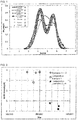
- FIG. 1 is GPC data of the polyethylene polymers obtained in Examples 1 to 3 and Comparative Examples 1 to 4 of the present invention. As shown in FIG. 1 , GPC analysis of the polyethylene polymers obtained in Examples 1 to 3 and Comparative Example 1 all show a bimodal form, and GPC analysis of the polyethylene of Comparative Example 2 which is commercially available shows a monomodal form, and the GPC of the polyethylene of Comparative Examples 3 to 4 shows a bimodal form.
- the weight average molecular weights (Mw) of polyethylene in Examples 1 to 3 and Comparative Example 1 are much lower than the weight average molecular weights of commercially available polyethylene in Comparative Examples 2 to 4.
- polyethylene having a high weight average molecular weight is known to have excellent physical properties of impact strength and long-term properties as compared to polyethylene having a relatively low weight average molecular weight. For this reason, to increase the physical properties of the product, the weight average molecular weight thereof is increased to the extent that the processability of the product is not reduced.
- the polyethylene of Examples 1 to 3 of the present invention has a relatively low weight average molecular weight but exhibits better impact strength and long-term properties.
- the melt flow index and the melt flow index ratio of Example 3 show a very low value as compared with Comparative Examples 1 to 4. This means that the viscosity in the molten state during the molding process is high and the viscosity is high even under the processing conditions with high strain.
- a lower melt pressure and motor ampere are shown during pipe forming in the extruder. This is because the weight average molecular weight in Example 3 is relatively low compared with Comparative Examples 2 to 4 is, and thus the viscosity is lower in the high strain region.
- polymers in Examples 1 to 3 can show high melt tension and high melt strength since the long chain branching group for reducing long-term physical properties therein is small and the combination of polymer chains is different from that of the polymer chains in Comparative Examples 1 to 4.
- Polymers used for pipes generally exhibit high weight average molecular weights in order to increase long term properties. Such high molecular weight and high melt viscosity may cause surface roughness during molding. This is because of the phenomenon that is caused by the fact that polymers having relatively low molecular weights move from the inside of the pipe into the outer surface of the pipe due to chain migration in the extruder during molding, which is explained in the literature " POLYMER ENGINEERING AND SCIENCE, JULY 2004, Vol. 44, No. 7 ".
- the term "inside of the pipe” means, for example, a central portion of the thickness of the pipe.
- the outer surface of the pipe means a surface that abuts an empty space in the inside of a pipe and a surface exposed to the outside. In order to prevent this, it is necessary to suppress the movement of polymer chains having a relatively low molecular weight inside the extruder in the outer direction.
- the introduction of a third polymer having a relatively high molecular weight as compared to the low molecular weight polymer and a relatively low molecular weight as compared with the high molecular weight polymer was carried out in the bimodal polymer in Comparative Example 1 of the present invention. This was achieved through the third organo-transition metal compound described in Preparation Example 2.
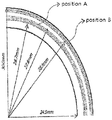
- the pipe was molded as in Preparation Example 3, and a sample was taken at the position described in FIG. 4 , and gel permeation chromatography (GPC) and DSC analysis were carried to check the weight average molecular weight and the melting temperature (Tm) depending the taken position.
- the difference in the molecular weight and the melting temperature depending on each sampling position means that the polymer chains having relatively short length move into the wall having a relatively high stress (friction energy) in the extruder, which means that the polymer chains having a relatively long length and a high modulus of elasticity (G ') move into the center having relatively low energy in the extruder, for energy equilibrium.
- a weight-average molecular weight, a Z-average molecular weight and a Z + 1 average molecular weight of the sample taken from the outside position (B) in Example 2 had increased by 2% or more, 5% or more and 15% or more, respectively, in comparison with the sample collected at the center position (A).
- This allows chains with relatively high molecular weight and high modulus of elasticity to retain high frictional energy generated from the wall of the extruder without releasing it, when discharged outside the extruder, while being present on the outer surface of the sample.
- the third polymer suppresses the chain movement of the first polymer and the second polymer so that the surface roughness (melt fracture) does not occur.
- Example 3 of the present invention showed the best Izod impact strength at low temperature and at room temperature Izod impact strength.
- the polymer of Example 3 has the lowest melt flow index, but the highest extrusion amount even though having low the resin melt pressure and motor ampere by 10% or more with respect to the polymers of Comparative Examples 1 to 3, so that it had excellent moldability. Through this, high moldability could be obtained by using low energy. Notwithstanding such high formability, the result of water pressure resistance test on the pipe showed that Examples 1 to 3 were equal to or better than Comparative Examples 1 to 4. Therefore, the polyethylene of the present invention has superior moldability and appearance while realizing the product having same physical properties as those of conventional polyethylene, and thus the polyethylene of the present invention has the advantage of increasing the productivity of molded products with the same energy consumption.
- FIG. 2 is a graph showing the relationship between the molecular weight and the melt strength of the polyethylene obtained in Examples 1 to 3 and Comparative Examples 1 to 4 of the present invention.
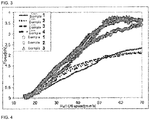
- FIG. 3 is a graph showing the relationship between the pull-off speed and the melt strength of the polyethylene obtained in Examples 1 to 3 and Comparative Examples 1 to 4 of the present invention. As shown in Figs.
- the polyethylene obtained in Examples 1 to 3 exhibits relatively excellent melt strength as compared with the polyethylene obtained in Comparative Examples 1 to 4, and shows melt strength similar to that of Comparative Examples 1 to 4 when the pull-off speed was low, and the required force increases as the pull-off speed increases so that melt strength is excellent.
- FIG. 4 is a view showing a sampling position of a pipe formed with polyethylene obtained in Example 2, Comparative Example 1, and Comparative Example 4. As shown in FIG. 4 , a sample was taken according to FIG. 4 and the following definition 1 for molecular weight analysis depending on the position of the formed pipe.
- id is the inner diameter
- od is the outside diameter
- en is the wall thickness
Landscapes
- Chemical & Material Sciences (AREA)
- Health & Medical Sciences (AREA)
- Chemical Kinetics & Catalysis (AREA)
- Medicinal Chemistry (AREA)
- Polymers & Plastics (AREA)
- Organic Chemistry (AREA)
- Engineering & Computer Science (AREA)
- Materials Engineering (AREA)
- Manufacturing & Machinery (AREA)
- Addition Polymer Or Copolymer, Post-Treatments, Or Chemical Modifications (AREA)
- Crystallography & Structural Chemistry (AREA)
- Transition And Organic Metals Composition Catalysts For Addition Polymerization (AREA)
Applications Claiming Priority (2)
| Application Number | Priority Date | Filing Date | Title |
|---|---|---|---|
| KR1020150150471A KR20170049272A (ko) | 2015-10-28 | 2015-10-28 | 멀티모달 폴리올레핀 수지 및 이로부터 제조되는 성형체 |
| PCT/KR2016/012197 WO2017074077A1 (ko) | 2015-10-28 | 2016-10-27 | 멀티모달 폴리올레핀 수지 및 이로부터 제조되는 성형체 |
Publications (2)
| Publication Number | Publication Date |
|---|---|
| EP3369752A1 true EP3369752A1 (de) | 2018-09-05 |
| EP3369752A4 EP3369752A4 (de) | 2019-10-09 |
Family
ID=58631755
Family Applications (1)
| Application Number | Title | Priority Date | Filing Date |
|---|---|---|---|
| EP16860260.5A Pending EP3369752A4 (de) | 2015-10-28 | 2016-10-27 | Multimodales polyolefinharz und daraus hergestellter formkörper |
Country Status (5)
| Country | Link |
|---|---|
| US (1) | US10604604B2 (de) |
| EP (1) | EP3369752A4 (de) |
| KR (1) | KR20170049272A (de) |
| CN (1) | CN108350113B (de) |
| WO (1) | WO2017074077A1 (de) |
Cited By (4)
| Publication number | Priority date | Publication date | Assignee | Title |
|---|---|---|---|---|
| WO2021253032A1 (en) * | 2020-06-11 | 2021-12-16 | Chevron Phillips Chemical Company Lp | Dual catalyst system for producing polyethylene with long chain branching for blow molding applications |
| EP3872102A4 (de) * | 2019-09-30 | 2022-01-26 | LG Chem, Ltd. | Ethylen/1-hexen-copolymer mit hervorragenden langzeiteigenschaften und verarbeitbarkeit |
| EP4063451A4 (de) * | 2020-08-19 | 2023-11-22 | Lg Chem, Ltd. | Pelletartige polyethylenharzzusammensetzung und verfahren zu ihrer herstellung |
| US11851505B2 (en) | 2019-05-16 | 2023-12-26 | Chevron Phillips Chemical Company Lp | Dual catalyst system for producing high density polyethylenes with long chain branching |
Families Citing this family (12)
| Publication number | Priority date | Publication date | Assignee | Title |
|---|---|---|---|---|
| KR102651363B1 (ko) | 2018-11-29 | 2024-03-26 | 롯데케미칼 주식회사 | 내환경응력균열저항 특성이 우수한 폴리에틸렌 제조방법 |
| JP7777079B2 (ja) * | 2020-03-27 | 2025-11-27 | ダウ グローバル テクノロジーズ エルエルシー | 長鎖分岐エチレン系ポリマー |
| US11339279B2 (en) | 2020-04-01 | 2022-05-24 | Chevron Phillips Chemical Company Lp | Dual catalyst system for producing LLDPE and MDPE copolymers with long chain branching for film applications |
| JP7362192B2 (ja) | 2020-09-29 | 2023-10-17 | エルジー・ケム・リミテッド | 施工性および加工性に優れたエチレン/1-ヘキセン共重合体 |
| KR102613125B1 (ko) * | 2020-12-23 | 2023-12-14 | 한화솔루션 주식회사 | 혼성 촉매 조성물, 이를 포함하는 촉매 및 이를 이용한 올레핀계 중합체의 제조방법 |
| CN118369359A (zh) * | 2021-12-07 | 2024-07-19 | 韩华思路信株式会社 | 包含混杂催化剂组合物的烯烃聚合用催化剂及利用其而制造的烯烃系聚合物 |
| US12122857B2 (en) | 2021-12-16 | 2024-10-22 | Chevron Phillips Chemical Company Lp | Controlling long-chain branch content with dual activator-supports |
| KR20240087968A (ko) * | 2022-12-13 | 2024-06-20 | 한화솔루션 주식회사 | 올레핀계 중합체의 제조방법 및 그에 의해 제조되고 가공성이 우수한 올레핀계 중합체 |
| KR20250022921A (ko) * | 2023-08-07 | 2025-02-18 | 한화솔루션 주식회사 | 혼성 담지 촉매를 이용한 고밀도 에틸렌계 중합체 및 그의 제조방법 |
| KR20250022920A (ko) * | 2023-08-07 | 2025-02-18 | 한화솔루션 주식회사 | 혼성 담지 촉매를 이용한 고밀도 에틸렌계 중합체 및 그의 제조방법 |
| KR20260032713A (ko) * | 2024-08-29 | 2026-03-10 | 한화솔루션 주식회사 | 강도특성이 우수한 고밀도 폴리에틸렌 이축연신필름 및 이의 제조방법 |
| KR20260032889A (ko) * | 2024-08-29 | 2026-03-10 | 한화솔루션 주식회사 | 광학특성이 우수한 고밀도 폴리에틸렌 이축연신필름 및 이의 제조방법 |
Family Cites Families (11)
| Publication number | Priority date | Publication date | Assignee | Title |
|---|---|---|---|---|
| US6403181B1 (en) | 1995-07-03 | 2002-06-11 | Mobil Oil Corporation | Premium pipe resins |
| EP1041113A1 (de) * | 1999-03-30 | 2000-10-04 | Fina Research S.A. | Polyolefine und ihre Verwendung |
| CN1982361B (zh) | 2001-08-17 | 2011-11-16 | 陶氏环球技术有限责任公司 | 双峰聚乙烯组合物及其制品 |
| PL203162B1 (pl) * | 2001-08-31 | 2009-08-31 | Dow Global Technologies Inc | Żywica polietylenowa o wielomodalnym rozkładzie ciężaru cząsteczkowego, kompozycja polimeryczna zawierająca tę żywicę i zastosowanie wielomodalnej żywicy polietylenowej |
| US7288596B2 (en) * | 2003-12-22 | 2007-10-30 | Univation Technologies, Llc | Polyethylene compositions having improved tear properties |
| KR100947714B1 (ko) * | 2004-03-26 | 2010-03-16 | 보레알리스 테크놀로지 오와이. | 고분자 조성물 |
| US7619047B2 (en) | 2006-02-22 | 2009-11-17 | Chevron Phillips Chemical Company, Lp | Dual metallocene catalysts for polymerization of bimodal polymers |
| EP2152802A4 (de) * | 2007-05-09 | 2010-07-07 | Dow Global Technologies Inc | Auf ethylen basierende polymere enthaltende zusammensetzungen, herstellungsverfahren dafür und gegenstände daraus |
| EP2599828A1 (de) | 2011-12-01 | 2013-06-05 | Borealis AG | Multimodale Polyethylenzusammensetzung zur Herstellung von Rohren mit verbesserter Beständigkeit gegen langsames Risswachstum |
| KR101331556B1 (ko) * | 2012-03-30 | 2013-11-20 | 대림산업 주식회사 | 멀티모달 폴리올레핀 수지 및 이로부터 제조되는 성형체 |
| EP2818509A1 (de) * | 2013-06-25 | 2014-12-31 | Basell Polyolefine GmbH | Polyethylenzusammensetzung zum Blasformen mit hoher Spannungsrissbeständigkeit |
-
2015
- 2015-10-28 KR KR1020150150471A patent/KR20170049272A/ko not_active Ceased
-
2016
- 2016-10-27 US US15/771,211 patent/US10604604B2/en active Active
- 2016-10-27 CN CN201680063407.6A patent/CN108350113B/zh active Active
- 2016-10-27 EP EP16860260.5A patent/EP3369752A4/de active Pending
- 2016-10-27 WO PCT/KR2016/012197 patent/WO2017074077A1/ko not_active Ceased
Cited By (8)
| Publication number | Priority date | Publication date | Assignee | Title |
|---|---|---|---|---|
| US11851505B2 (en) | 2019-05-16 | 2023-12-26 | Chevron Phillips Chemical Company Lp | Dual catalyst system for producing high density polyethylenes with long chain branching |
| EP3872102A4 (de) * | 2019-09-30 | 2022-01-26 | LG Chem, Ltd. | Ethylen/1-hexen-copolymer mit hervorragenden langzeiteigenschaften und verarbeitbarkeit |
| US12091477B2 (en) | 2019-09-30 | 2024-09-17 | Lg Chem, Ltd. | Ethylene/1-hexene copolymer having excellent long-term physical properties and processability |
| WO2021253032A1 (en) * | 2020-06-11 | 2021-12-16 | Chevron Phillips Chemical Company Lp | Dual catalyst system for producing polyethylene with long chain branching for blow molding applications |
| US11267919B2 (en) | 2020-06-11 | 2022-03-08 | Chevron Phillips Chemical Company Lp | Dual catalyst system for producing polyethylene with long chain branching for blow molding applications |
| EP4165095A1 (de) * | 2020-06-11 | 2023-04-19 | Chevron Phillips Chemical Company LP | Doppelkatalysatorsystem zur herstellung von polyethylen mit langkettiger verzweigung für blasformanwendungen |
| US11859024B2 (en) | 2020-06-11 | 2024-01-02 | Chevron Phillips Chemical Company Lp | Dual catalyst system for producing polyethylene with long chain branching for blow molding applications |
| EP4063451A4 (de) * | 2020-08-19 | 2023-11-22 | Lg Chem, Ltd. | Pelletartige polyethylenharzzusammensetzung und verfahren zu ihrer herstellung |
Also Published As
| Publication number | Publication date |
|---|---|
| WO2017074077A1 (ko) | 2017-05-04 |
| CN108350113A (zh) | 2018-07-31 |
| EP3369752A4 (de) | 2019-10-09 |
| CN108350113B (zh) | 2021-05-25 |
| KR20170049272A (ko) | 2017-05-10 |
| US10604604B2 (en) | 2020-03-31 |
| US20180305481A1 (en) | 2018-10-25 |
Similar Documents
| Publication | Publication Date | Title |
|---|---|---|
| US10604604B2 (en) | Multimodal polyolefin resin, and molded body manufactured therefrom | |
| EP2832753B1 (de) | Multimodales polyolefinharz und daraus hergestelltes formprodukt | |
| EP2927245B1 (de) | Katalysatorzusammensetzung zur herstellung eines multimodalen polyolefinharzes mit bemerkenswerter formbarkeit und mechanischen eigenschaften sowie polymerisationsverfahren damit | |
| EP3239196B1 (de) | Multimodales polyolefinharz mit hoher schmelzfestigkeit und damit hergestelltes formprodukt | |
| KR101132180B1 (ko) | 멀티모달 폴리올레핀 제조를 위한 촉매 및 이를 이용한 올레핀의 중합방법 | |
| EP3492498A1 (de) | Hochdichtes ethylen-basiertes polymer auf ethylenbasis mit guter verarbeitbarkeit unter verwendung eines hybridgeträgerten metallocen-katalysators und herstellungsverfahren dafür | |
| EP3450469A1 (de) | Hochdichtes ethylen-basiertes polymer mit geträgertem metallocen-hybridkatalysator und herstellungsverfahren | |
| RU2754179C1 (ru) | Получение мультимодального полиолефина многоэтапным способом непрерывной полимеризации | |
| EP3653653A1 (de) | Polymer auf ethylenbasis mit hoher dichte mit einem hybriden geträgerten metallocenkatalysator und rohr damit | |
| KR102060669B1 (ko) | 용융강도가 높은 멀티모달 폴리올레핀 수지 제조를 위한 촉매 조성물 및 이를 이용한 멀티모달 폴리올레핀 공중합체 | |
| KR101904496B1 (ko) | 멀티모달 폴리올레핀 수지 및 이로부터 제조되는 성형체 | |
| CN116568714A (zh) | 烯烃系聚合物及其制造方法 | |
| US7335710B2 (en) | Polymerization process |
Legal Events
| Date | Code | Title | Description |
|---|---|---|---|
| STAA | Information on the status of an ep patent application or granted ep patent |
Free format text: STATUS: THE INTERNATIONAL PUBLICATION HAS BEEN MADE |
|
| PUAI | Public reference made under article 153(3) epc to a published international application that has entered the european phase |
Free format text: ORIGINAL CODE: 0009012 |
|
| STAA | Information on the status of an ep patent application or granted ep patent |
Free format text: STATUS: REQUEST FOR EXAMINATION WAS MADE |
|
| 17P | Request for examination filed |
Effective date: 20180515 |
|
| AK | Designated contracting states |
Kind code of ref document: A1 Designated state(s): AL AT BE BG CH CY CZ DE DK EE ES FI FR GB GR HR HU IE IS IT LI LT LU LV MC MK MT NL NO PL PT RO RS SE SI SK SM TR |
|
| AX | Request for extension of the european patent |
Extension state: BA ME |
|
| DAV | Request for validation of the european patent (deleted) | ||
| DAX | Request for extension of the european patent (deleted) | ||
| REG | Reference to a national code |
Ref country code: DE Ref legal event code: R079 Free format text: PREVIOUS MAIN CLASS: C08F0010020000 Ipc: C08F0210160000 |
|
| A4 | Supplementary search report drawn up and despatched |
Effective date: 20190910 |
|
| RIC1 | Information provided on ipc code assigned before grant |
Ipc: C08F 210/16 20060101AFI20190904BHEP Ipc: C08F 4/6592 20060101ALI20190904BHEP |
|
| RAP1 | Party data changed (applicant data changed or rights of an application transferred) |
Owner name: DL CHEMICAL CO., LTD |
|
| STAA | Information on the status of an ep patent application or granted ep patent |
Free format text: STATUS: EXAMINATION IS IN PROGRESS |
|
| 17Q | First examination report despatched |
Effective date: 20230622 |