EP3369596B2 - Fahrzeugfensterglas und verfahren zur herstellung eines fahrzeugfensterglases - Google Patents
Fahrzeugfensterglas und verfahren zur herstellung eines fahrzeugfensterglases Download PDFInfo
- Publication number
- EP3369596B2 EP3369596B2 EP16886441.1A EP16886441A EP3369596B2 EP 3369596 B2 EP3369596 B2 EP 3369596B2 EP 16886441 A EP16886441 A EP 16886441A EP 3369596 B2 EP3369596 B2 EP 3369596B2
- Authority
- EP
- European Patent Office
- Prior art keywords
- electrically conductive
- conductive layer
- glass plate
- layer
- vehicle window
- Prior art date
- Legal status (The legal status is an assumption and is not a legal conclusion. Google has not performed a legal analysis and makes no representation as to the accuracy of the status listed.)
- Active
Links
Images

Classifications
-
- C—CHEMISTRY; METALLURGY
- C03—GLASS; MINERAL OR SLAG WOOL
- C03C—CHEMICAL COMPOSITION OF GLASSES, GLAZES OR VITREOUS ENAMELS; SURFACE TREATMENT OF GLASS; SURFACE TREATMENT OF FIBRES OR FILAMENTS MADE FROM GLASS, MINERALS OR SLAGS; JOINING GLASS TO GLASS OR OTHER MATERIALS
- C03C17/00—Surface treatment of glass, not in the form of fibres or filaments, by coating
- C03C17/006—Surface treatment of glass, not in the form of fibres or filaments, by coating with materials of composite character
- C03C17/007—Surface treatment of glass, not in the form of fibres or filaments, by coating with materials of composite character containing a dispersed phase, e.g. particles, fibres or flakes, in a continuous phase
-
- H—ELECTRICITY
- H05—ELECTRIC TECHNIQUES NOT OTHERWISE PROVIDED FOR
- H05B—ELECTRIC HEATING; ELECTRIC LIGHT SOURCES NOT OTHERWISE PROVIDED FOR; CIRCUIT ARRANGEMENTS FOR ELECTRIC LIGHT SOURCES, IN GENERAL
- H05B3/00—Ohmic-resistance heating
- H05B3/84—Heating arrangements specially adapted for transparent or reflecting areas, e.g. for demisting or de-icing windows, mirrors or vehicle windshields
-
- B—PERFORMING OPERATIONS; TRANSPORTING
- B60—VEHICLES IN GENERAL
- B60J—WINDOWS, WINDSCREENS, NON-FIXED ROOFS, DOORS, OR SIMILAR DEVICES FOR VEHICLES; REMOVABLE EXTERNAL PROTECTIVE COVERINGS SPECIALLY ADAPTED FOR VEHICLES
- B60J1/00—Windows; Windscreens; Accessories therefor
-
- B—PERFORMING OPERATIONS; TRANSPORTING
- B60—VEHICLES IN GENERAL
- B60S—SERVICING, CLEANING, REPAIRING, SUPPORTING, LIFTING, OR MANOEUVRING OF VEHICLES, NOT OTHERWISE PROVIDED FOR
- B60S1/00—Cleaning of vehicles
- B60S1/02—Cleaning windscreens, windows or optical devices
-
- B—PERFORMING OPERATIONS; TRANSPORTING
- B60—VEHICLES IN GENERAL
- B60S—SERVICING, CLEANING, REPAIRING, SUPPORTING, LIFTING, OR MANOEUVRING OF VEHICLES, NOT OTHERWISE PROVIDED FOR
- B60S1/00—Cleaning of vehicles
- B60S1/02—Cleaning windscreens, windows or optical devices
- B60S1/56—Cleaning windscreens, windows or optical devices specially adapted for cleaning other parts or devices than front windows or windscreens
- B60S1/58—Cleaning windscreens, windows or optical devices specially adapted for cleaning other parts or devices than front windows or windscreens for rear windows
-
- C—CHEMISTRY; METALLURGY
- C03—GLASS; MINERAL OR SLAG WOOL
- C03C—CHEMICAL COMPOSITION OF GLASSES, GLAZES OR VITREOUS ENAMELS; SURFACE TREATMENT OF GLASS; SURFACE TREATMENT OF FIBRES OR FILAMENTS MADE FROM GLASS, MINERALS OR SLAGS; JOINING GLASS TO GLASS OR OTHER MATERIALS
- C03C17/00—Surface treatment of glass, not in the form of fibres or filaments, by coating
- C03C17/02—Surface treatment of glass, not in the form of fibres or filaments, by coating with glass
- C03C17/04—Surface treatment of glass, not in the form of fibres or filaments, by coating with glass by fritting glass powder
-
- C—CHEMISTRY; METALLURGY
- C03—GLASS; MINERAL OR SLAG WOOL
- C03C—CHEMICAL COMPOSITION OF GLASSES, GLAZES OR VITREOUS ENAMELS; SURFACE TREATMENT OF GLASS; SURFACE TREATMENT OF FIBRES OR FILAMENTS MADE FROM GLASS, MINERALS OR SLAGS; JOINING GLASS TO GLASS OR OTHER MATERIALS
- C03C17/00—Surface treatment of glass, not in the form of fibres or filaments, by coating
- C03C17/06—Surface treatment of glass, not in the form of fibres or filaments, by coating with metals
-
- H—ELECTRICITY
- H05—ELECTRIC TECHNIQUES NOT OTHERWISE PROVIDED FOR
- H05B—ELECTRIC HEATING; ELECTRIC LIGHT SOURCES NOT OTHERWISE PROVIDED FOR; CIRCUIT ARRANGEMENTS FOR ELECTRIC LIGHT SOURCES, IN GENERAL
- H05B3/00—Ohmic-resistance heating
- H05B3/84—Heating arrangements specially adapted for transparent or reflecting areas, e.g. for demisting or de-icing windows, mirrors or vehicle windshields
- H05B3/86—Heating arrangements specially adapted for transparent or reflecting areas, e.g. for demisting or de-icing windows, mirrors or vehicle windshields the heating conductors being embedded in the transparent or reflecting material
-
- C—CHEMISTRY; METALLURGY
- C03—GLASS; MINERAL OR SLAG WOOL
- C03C—CHEMICAL COMPOSITION OF GLASSES, GLAZES OR VITREOUS ENAMELS; SURFACE TREATMENT OF GLASS; SURFACE TREATMENT OF FIBRES OR FILAMENTS MADE FROM GLASS, MINERALS OR SLAGS; JOINING GLASS TO GLASS OR OTHER MATERIALS
- C03C2217/00—Coatings on glass
- C03C2217/40—Coatings comprising at least one inhomogeneous layer
- C03C2217/43—Coatings comprising at least one inhomogeneous layer consisting of a dispersed phase in a continuous phase
- C03C2217/44—Coatings comprising at least one inhomogeneous layer consisting of a dispersed phase in a continuous phase characterized by the composition of the continuous phase
- C03C2217/45—Inorganic continuous phases
- C03C2217/452—Glass
-
- C—CHEMISTRY; METALLURGY
- C03—GLASS; MINERAL OR SLAG WOOL
- C03C—CHEMICAL COMPOSITION OF GLASSES, GLAZES OR VITREOUS ENAMELS; SURFACE TREATMENT OF GLASS; SURFACE TREATMENT OF FIBRES OR FILAMENTS MADE FROM GLASS, MINERALS OR SLAGS; JOINING GLASS TO GLASS OR OTHER MATERIALS
- C03C2217/00—Coatings on glass
- C03C2217/40—Coatings comprising at least one inhomogeneous layer
- C03C2217/43—Coatings comprising at least one inhomogeneous layer consisting of a dispersed phase in a continuous phase
- C03C2217/46—Coatings comprising at least one inhomogeneous layer consisting of a dispersed phase in a continuous phase characterized by the dispersed phase
- C03C2217/47—Coatings comprising at least one inhomogeneous layer consisting of a dispersed phase in a continuous phase characterized by the dispersed phase consisting of a specific material
- C03C2217/475—Inorganic materials
- C03C2217/479—Metals
-
- H—ELECTRICITY
- H05—ELECTRIC TECHNIQUES NOT OTHERWISE PROVIDED FOR
- H05B—ELECTRIC HEATING; ELECTRIC LIGHT SOURCES NOT OTHERWISE PROVIDED FOR; CIRCUIT ARRANGEMENTS FOR ELECTRIC LIGHT SOURCES, IN GENERAL
- H05B2203/00—Aspects relating to Ohmic resistive heating covered by group H05B3/00
- H05B2203/013—Heaters using resistive films or coatings
-
- H—ELECTRICITY
- H05—ELECTRIC TECHNIQUES NOT OTHERWISE PROVIDED FOR
- H05B—ELECTRIC HEATING; ELECTRIC LIGHT SOURCES NOT OTHERWISE PROVIDED FOR; CIRCUIT ARRANGEMENTS FOR ELECTRIC LIGHT SOURCES, IN GENERAL
- H05B2203/00—Aspects relating to Ohmic resistive heating covered by group H05B3/00
- H05B2203/016—Heaters using particular connecting means
Definitions
- the present invention relates to a vehicle window glass and a method for manufacturing a vehicle window glass.
- solder solder alloy
- solder containing lead has been conventionally used.
- the influence of lead on the environment and the like have been raised as an issue, and thus transition to the use of lead-free solder is under way.
- WO2012/096373 EP-A-2664503 which describes a vehicle window glass including a glass sheet, a conductor layer formed on the glass sheet (optionally with a black ceramic frame layer between), and a terminal soldered onto a connection part of the conductor layer with lead-free solder.
- Lead-free solder has higher Young's modulus and high rigidity compared to leaded solder containing lead. Therefore, when a mechanical stress or a stress caused by the difference in the thermal expansion coefficient is applied, there is a possibility that cracks and the like may be generated in the glass plate, or the solder may be peeled off. In WO2012/096373 ( EP-A-2664503 ) cracking is to be reduced by selecting the solder and conductor layer compositions and forming thin parts of the conductor layer with a narrow width.
- US2015/296569A describes panes such as vehicle window glasses in which a steel alloy compensator plate, of thermal expansion approximated to that of the glass, is laminated between a copper connection element and the lead-free solder layer connecting it to the conductive structure.
- the conductive structure may lie on a masking screenprint layer.
- An object of the present invention is to provide a vehicle window glass that does not easily have cracks generated therein, and a method for manufacturing a vehicle window glass.
- the present invention solves the above-described problems by the following solutions.
- the invention provides a vehicle window glass as set out in the appended claim 1, and a method of manufacturing such a vehicle window glass as set out in the appended claim 7.
- the configuration described above may be improved as appropriate, or at least a portion of the configuration may be replaced with other configurations.
- a vehicle window glass that does not easily have cracks generated therein, and a method for manufacturing a vehicle window glass.
- Fig. 1 is a cross-sectional view of vehicle window glass 1 of an embodiment of the present invention.
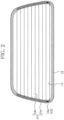
- Fig. 2 is a plan view of the vehicle window glass 1 of the embodiment.
- the vehicle window glass 1 of the present embodiment is used as, for example, a rear window; however, the use of the window glass is not limited to this.
- the lower side of Fig. 1 is towards the outer side of the vehicle, and the upper side is towards the inner side of the vehicle.
- the vehicle window glass 1 includes a glass plate 11, a color ceramic layer (sintered ceramic layer) 12, an electrically conductive layer 13, a lead-free solder 14 and a power supply terminal 15.
- the glass plate 11 has a curved shape acquired by bending processing.
- the glass plate 11 may be produced to have an approximately trapezoidal curved shape.
- the glass plate 11 may also be a tempered glass plate having a compressive stress layer (external pressure application force) formed on the surface by thermally tempering by air jets or a chemically tempering method, or a laminated glass plate obtained by bonding two sheets of glass plates using a resin film.
- a compressive stress layer external pressure application force
- the soda lime silicate glass defined in ISO 16293-1 as well as materials having known glass compositions can be used. Furthermore, as the material for the glass plate 11, a material in which coloring components such as iron and cobalt are appropriately adjusted as components of the glass composition so that the glass plate exhibits color tones such as grey, green, and blue may also be used.
- the color ceramic layer 12 is formed for the purpose of preventing deterioration of a urethane-based adhesive caused by solar radiation from the outside when the vehicle window glass 1 is adhered to the window frame, and for hiding the wiring or the like of the electrically conductive layer 13 formed on the vehicle interior side surface of the vehicle window glass 1 from being seen from the outside.
- a black-colored color ceramic layer is used.
- the color ceramic layer 12 is a color ceramic composition including a heat-resistant pigment (metal oxide) as an inorganic component, and a glass material having a softening point lower than the softening point of the glass plate 11.
- a heat-resistant pigment metal oxide
- a glass material having a softening point lower than the softening point of the glass plate 11.
- composition a composition formed by applying a ceramic paste formed by kneading a powder of a heat-resistant pigment (metal oxide) as an inorganic component and a powder of glass frit as a glass material together with a vehicle, on the surface of the glass plate 11 by screen printing, and calcining the applied ceramic paste, can be used.
- a ceramic paste formed by kneading a powder of a heat-resistant pigment (metal oxide) as an inorganic component and a powder of glass frit as a glass material together with a vehicle, on the surface of the glass plate 11 by screen printing, and calcining the applied ceramic paste.
- a heat-resistant pigment is incorporated in order to impart an intended color to the ceramic color.
- the particle size of the pigment is determined as appropriate in consideration the dispersibility in the ceramic paste or color developability, and a heat-resistant pigment having a 50% particle size of 0.1 to 10 ⁇ m, and preferably about 0.2 to 5 ⁇ m, can be used.
- a conventionally used heat-resistant pigment can be used.
- a pigment for displaying black color examples include a copper-chromium composite oxide, an iron-manganese composite oxide, a copper-chromium-manganese composite oxide, a cobalt-iron-chromium composite oxide, and magnetite.
- a pigment for displaying brown color examples include a zinc-iron composite oxide and a zinc-iron-chromium composite oxide.
- examples of a blue-colored pigment include cobalt blue
- examples of a green-colored pigment include chrome green, a cobalt-zinc-nickel-titanium composite oxide, and a cobalt-aluminum-chromium composite oxide.
- white-colored pigments titanium white, zinc oxide, and the like
- red-colored pigments red iron oxide, and the like
- yellow-colored pigments titanium yellow, a titanium-barium-nickel composite oxide, a titanium-antimony-nickel composite oxide, a titanium-antimony-chromium composite oxide, and the like
- the glass frit is intended for forming the color ceramic layer 12 by binding the color ceramic to the glass plate.
- any glass frit that is conventionally used for color ceramics can be used. Examples of such glass frit include borosilicate-based glass, zinc borosilicate-based glass and bismuth-based glass. These glass frits can be used singly or in combination of two or more kinds thereof.
- the softening point temperature of the glass frit is preferably lower than the bending processing temperature of the glass plate 11, for example, 600°C to 750°C, and a glass frit having a softening point temperature of about 380°C to 600°C, preferably 400°C to 580°C, and more preferably 410°C to 550°C, can also be used.
- the particle size of the glass frit is determined as appropriate in consideration of the coatability of the ceramic paste at the time of screen printing, and for example, a glass frit having a 50% particle size of about 0.1 to 10 ⁇ m, preferably 0.5 to 5 ⁇ m, and more preferably 1 to 4 ⁇ m, can be used.
- the content of the glass material can be adjusted to 50% to 95% by mass, and preferably 60% to 80% by mass. This content can be appropriately adjusted in consideration of the binding property of the color ceramic layer 12 to the glass plate 11 and the color tone of the color ceramic layer 12.
- the color ceramic layer 12 is a calcination product of the glass material and the heat-resistant pigment, and the color ceramic layer 12 becomes a porous body containing pores. It is speculated that since the color ceramic layer 12 becomes a material that is more flexible than the glass 11, stress relief occurs in the color ceramic layer 12 having a predetermined thickness.
- the vehicle is a material incorporated in order to produce a powder of a heat-resistant pigment (metal oxide) as an inorganic component and a powder of glass frit as a glass material into a paste, and to apply the paste in a coating process such as screen printing, and the vehicle includes a dispersing medium and a binder.
- the vehicle is incorporated in an appropriate amount in consideration of printability (coatability), and for example, the vehicle can be incorporated in an amount of 10% to 50% by mass, and preferably 15% to 45% by mass with respect to the total amount of the color ceramic paste.
- the dispersing medium is preferably a medium which has low volatility at normal temperature and has a boiling point such that the dispersing medium volatilizes at a temperature lower than the temperature at which the glass frit is softened.
- a dispersing medium having a boiling point of about 50°C to 250°C can be used.
- the dispersing medium examples include aliphatic alcohols (for example, saturated or unsaturated C6-3 such as 2-ethyl-1-hexanol, octanol, and decanol, and the like, or aliphatic alcohols), cellosolves (C1-4 alkyl cellosolves such as methyl cellosolve, ethyl cellosolve, and butyl cellosolve, and the like), cellosolve acetates (C1-4 alkyl cellosolve acetates such as ethyl cellosolve acetate and butyl cellosolve acetate), carbitols (C1-4 alkyl carbitols such as methyl carbitol, ethyl carbitol, propyl carbitol, and butyl carbitol, and the like), carbitol acetates (C1-4 alkyl cellosolve acetates such as ethyl carbitol acetate and
- any binder capable of imparting adequate viscosity to the color ceramic paste and capable of being decomposed at about 200°C to 550°C, and preferably 220°C to 400°C, may be used.
- thermoplastic resin an olefin-based resin, a vinyl-based resin, an acrylic resin, a styrene-based resin, a polyester-based resin, a polyamide-based resin, a cellulose derivative, and the like
- thermosetting resin a thermosetting acrylic resin, an epoxy resin, a phenolic resin, an unsaturated polyester-based resin, a polyurethane-based resin, and the like
- An acrylic resin is preferred.
- the proportion of the vehicle with respect to the total amount may be 5% to 80% by mass, preferably 10% to 50% by mass, and more preferably 15% to 40% by mass.
- the electrically conductive layer 13 has, as illustrated in Fig. 2 , busbars 13a respectively formed on the color ceramic layer 12 on both lateral edges of the glass plate 11; and wire filaments 13b arranged in parallel at a predetermined distance and connecting the both busbars 13a.
- the electrically conductive layer 13 is a conductor composition including silver metal (silver or a silver alloy), and a glass material having a softening point temperature lower than the softening point temperature of the glass plate 11.
- the composition is formed such that a silver paste containing silver as a main component is applied on the color ceramic layer 12 by screen printing with a predetermined pattern, and the applied material is sintered.
- the electrically conductive layer 13 is, for example, a hot wire print of a defogger or a defroster; however, the electrically conductive layer may also be an antenna print for broadcast reception.
- the color ceramic layer 12 and the electrically conductive layer 13 are sintered together after being screen printed and dried, as described above.
- the silver paste includes a silver powder containing silver or a silver alloy, glass frit that becomes a glass material in the conductor composition, a vehicle and other additives as necessary.
- the content of the silver metal in the conductor composition, and the particle size of the silver powder in the silver paste are determined as appropriate in consideration of the specific resistance of the electrically conductive layer 13.
- the content of silver metal in the conductor composition can be adjusted to, for example, 85% to 99% by mass, and preferably 88% to 98% by mass.
- the other component is substantially formed from a glass material having a softening point lower than the softening point of the glass plate 11, and this glass component can be formed by calcining glass frit.
- a silver powder having a 50% particle size of about 0.1 to 10 ⁇ m, and preferably 0.2 to 7 ⁇ m can be used.
- the glass frit and the vehicle used in the silver paste can be similar to the glass frit and vehicle mentioned in the section for the color ceramic paste, and regarding the mixing proportion of the vehicle, the vehicle can be incorporated at a proportion of 10% to 50% by mass, and preferably 15% to 45% by mass, with respect to the total amount of the paste.
- the conductor composition since it is necessary to secure electrical conductivity of the composition, the percentage content of silver metal needs to be increased, and the conductor composition has a lower percentage content of the glass material compared to the color ceramic layer.
- the object of the present invention may be potentially achievable by producing the electrically conductive layer 13 into a thick film; however, in order to produce the electrically conductive layer 13 into a thick film, it is necessary to apply an ample amount of the silver paste on the glass plate 11.
- Application of the silver paste on the glass plate 11 can be carried out by screen printing; however, for the purpose of increasing the production efficiency, it is preferable that the number of times of printing is set to one time. Therefore, the discharge amount of the silver paste onto the glass plate may be increased by stacking at least two sheets of the screen.
- the lead-free solder 14 joins a defogger hot wire or an antenna wire, formed of the electrically conductive layer 13, with a power supply terminal 15.
- the lead-free solder 14 may be, for example, a Sn-Ag-based lead-free solder or a Sn-Ag-Cu-based lead-free solder, and the examples are not limited to these.
- the lead-free solder 14 contains Ag.
- a lead-free solder containing Sn at a content of 95% by mass or more is used, and the content is adjusted to preferably 95% to 99% by mass, and more preferably 96% to 98% by mass.
- the content of Ag is adjusted to 5% by mass or less, preferably 1.5% to 5% by mass, and more preferably 2% to 4% by mass.
- the lead-free solder contains Cu, the content of Cu can be adjusted to 1.5% by mass or less, and preferably 1% to 0.1% by mass.
- the power supply terminal 15 is connected to a power supply mounted in the automotive vehicle (not shown in the diagram) and is provided in order to supply an electric current to the electrically conductive layer 13.
- a power supply mounted in the automotive vehicle not shown in the diagram
- an electrically conductive material is satisfactory, and a material that can be easily processed by mechanical processing is preferred. For example, copper and brass can be used.
- a structural example of the power supply terminal 15 may be a terminal having a pair of terminal washers 15a that are joined by the lead-free solder 14; a leg 15b that connects these washers; and a site for connecting to an electric cable (not shown in the diagram).
- a vehicle window glass 1 in which a glass plate 11, a color ceramic layer 12, an electrically conductive layer 13, a lead-free solder 14, and a power supply terminal 15 are laminated, is produced.
- the defogger wiring or antenna wiring formed by the electrically conductive layer 13 an electric current is caused to flow through or is cut off via the power supply terminal 15. Thereby, the glass plate 11 is repeatedly heated and cooled. Furthermore, heating and cooling is repeated by the influence of the atmospheric environment.
- the lead-free solder 14 Since the lead-free solder 14 has high elastic modulus and high rigidity compared to conventional leaded solders, it is difficult for the lead-free solder to conform flexibly to the expansion and contraction of the glass plate 11. Therefore, when the thermal expansion coefficient of the lead-free solder is different from the thermal expansion coefficient of the glass plate 11, stress is applied to the glass plate 11 and cracks (fissures, breakage, cracking or the like) are likely to be generated.
- the inventors of the present invention found that even when the lead-free solder 14 is used, in a case in which the layer thicknesses of the color ceramic layer 12 and the electrically conductive layer 13 and the like satisfy predetermined conditions, the glass plate 11 does not easily undergo cracking even if heating and cooling of the glass plate 11 is repeated. In the following description, the experimental results will be explained.
- a color (black) ceramic paste was applied by screen printing on the peripheral edge of a glass plate 11 (flat glass plate measuring 300 mm on each side (thickness 3.5 mm)), and the ceramic paste was dried for 20 minutes at 120°C.
- a precursor coating film of the color ceramic layer 13 was formed into a frame form on the peripheral edge of the glass plate 11.
- a silver paste was applied on the coating film of the precursor of the color ceramic layer 12 and on the glass plate 11 by screen printing, and the silver paste was dried for 10 minutes at 120°C.
- a precursor coating film of the electrically conductive layer 13 was formed.
- the glass plate 11 having various precursor coating films formed thereon was subjected to bending processing and thermal tempering by air jets in a known air-jet tempering furnace, and thus a glass plate 11 having a color ceramic layer 12 and an electrically conductive layer 13 formed thereon was obtained.
- the electrically conductive layer 13 connects busbars 13a, which are formed on the color ceramic layer 12 on both lateral edges of the glass plate 11 and have a width of 18 mm and a length of 250 mm, and wire filaments 13b having a wire width of 0.5 m which connect the two busbars 13a and are arranged in parallel at a distance of 40 mm.
- the thickness of the color ceramic layer 12, the thickness of the electrically conductive layer 13, the surface roughness (Ra) of the electrically conductive layer, and the conditions for screen printing of various Examples and Comparative Examples are as shown in Table 1.
- the quality of the joining part was evaluated by subjecting the vehicle window glass 1 to a cooling-heating cycle resistance test. Specifically, a treatment of 20°C ⁇ - 40°C (90 minutes) ⁇ 20°C ⁇ 105°C (120 minutes) ⁇ 20°C was designated as one cycle, and an observation was made on the presence or absence of crack generation in the glass plate 11 after repeatedly performing 60 cycles.
- the power supply terminal 15 was pulled with a force of 80 N using a push-pull gauge, in a direction perpendicular to the joined surface between the electrically conductive layer 13 and the terminal washer 15a, and thereby the bonding strength of the joined body was measured. A sample in which there was no crack generation in the glass plate 11 and detachment did not occur at the joining part, was determined as a satisfactory product.
- Absent 20 #180 was used twice 13 (Ra:1.3 ⁇ m) (Rz:8.3 ⁇ m) #200+#110, Two kinds of screens were overlapped, and silver paste was applied.
- Absent 18 #110 was used once 7 ⁇ 8 #200 was used once Absent 18 #110 was used once 10 ⁇ 12 #200+#135, Two kinds of screens were overlapped, and silver paste was applied.
- Present 18 #110 was used once 16 ⁇ 17 #200+#110, Two kinds of screens were overlapped, and silver paste was applied.
- Present 10 #180 was used once 7 ⁇ 8 #200 was used once Present 10 #180 was used once 10 ⁇ 12 #200+#135, Two kinds of screens were overlapped, and silver paste was applied.
- Present 10 #180 was used once 16 ⁇ 17 #200+#110, Two kinds of screens were overlapped, and silver paste was applied.
- the number of times of printing is adjusted to one time, and a screen having a mesh opening size of 140 to 180 ⁇ m (preferably 150 to 170 ⁇ m) and a numerical aperture of 40% to 60% (preferably 45% to 55%) is used.
- a screen having a mesh opening of 53 Lo 93 ⁇ m (preferably 63 to 83 ⁇ m) and a numerical aperture of 24% to 39% (preferably 28% to 36%) is used.
- the thickness of the color ceramic layer 12 is larger than 18 mm.
- the thickness of the color ceramic layer 12 is larger than 25 ⁇ m, there is a problem that the production efficiency is decreased.
- the thickness of the color ceramic layer 12 of the present embodiment is more than 18 mm and less than or equal to 25 mm, and more preferably from 18 mm to 22 mm.
- the thickness of the color ceramic layer 12 is 10 ⁇ m and 20 ⁇ m, since the influence of the thickness of the color ceramic layer 12 is strong, the presence or absence of cracks in the glass plate 11 is determined irrespective of the thickness of the electrically conductive layer 13.
- the thickness of the color ceramic layer 12 is 10 ⁇ m
- the stress occurring due to the difference in the thermal expansion between the lead-free solder 14 and the glass plate 11 cannot be buffered, and cracks are generated in the glass plate 11.
- the thickness of the color ceramic layer 12 is 20 ⁇ m, since the color ceramic layer 12 is thick, the stress occurring due to the difference in the thermal expansion between the lead-free solder 14 and the glass plate 11 is buffered, and cracks are not generated in the glass plate 11.
- the thickness of the color ceramic layer 12 is 18 ⁇ m, it may be considered that the influence exerted by the thickness of the color ceramic layer 12 on the presence or absence of cracks in the glass is fluid.
- the state of the electrically conductive layer 13 also affects the presence or absence of cracks in the glass.
- the electrically conductive layer 13 has a thickness of 7 to 8 ⁇ m as a result of performing screen printing once, cracks are not generated in the glass plate 11, and in a case in which the electrically conductive layer has a thickness of 10 ⁇ m or more as a result of performing screen printing twice, cracks are generated in the glass plate 11.
- the electrically conductive layer 13 is such that when the electrically conductive layer 13 is formed by performing coating with two sheets of screens, the surface of the electrically conductive layer 13 becomes rough compared to a case in which the electrically conductive layer 13 is formed by performing coating with one sheet of screen. As the surface becomes rougher, the adhesion between the electrically conductive layer 13 and the lead-free solder 14 becomes strong due to the anchor effect. If the adhesive force becomes too strong, a large amount of stress is exerted on the glass plate 11 due to the difference between the expansion coefficient of the glass plate 11 and the thermal expansion coefficient of the lead-free solder 14, and cracks are likely to be generated.
- the electrically conductive layer 13 when the electrically conductive layer 13 is formed by performing coating with one sheet of screen, the surface of the electrically conductive layer 13 is smooth compared to a case in which the electrically conductive layer 13 is formed by performing coating with two sheets of screens. Therefore, in a case in which the electrically conductive layer is formed by performing coating with one sheet of screen, the adhesive force between the electrically conductive layer 13 and the lead-free solder 14 is weak, compared to a case in which the electrically conductive layer 13 is formed by performing coating with two sheets of screens. Therefore, the stress occurring due to the difference between the expansion coefficient of the glass plate 11 and the thermal expansion coefficient of the lead-free solder 14 is relieved, and cracks are not easily generated in the glass plate 11. Meanwhile, even in this case, the electrically conductive layer 13 and the lead-free solder 14 did not undergo detachment.
- the adhesive force between the electrically conductive layer 13 and the lead-free solder 14 was not so weak as to cause detachment; however, since the adhesive force was weak to the extent that the difference in the thermal expansion between the lead-free solder 14 and the glass plate 11 was just buffered, it is considered that cracks were not generated in the glass plate 11.
- the electrically conductive layer 13 of the embodiment may be considered to have been formed by performing coating with one sheet of screen, in a case in which the thickness of the color ceramic layer 12 is 18 ⁇ m.
- the mesh opening is preferably #200, that is, the numerical aperture is preferably 32%, so that the formation can be achieved with one sheet of screen.
Landscapes
- Chemical & Material Sciences (AREA)
- Engineering & Computer Science (AREA)
- Mechanical Engineering (AREA)
- Geochemistry & Mineralogy (AREA)
- Chemical Kinetics & Catalysis (AREA)
- General Chemical & Material Sciences (AREA)
- Life Sciences & Earth Sciences (AREA)
- Materials Engineering (AREA)
- Organic Chemistry (AREA)
- Dispersion Chemistry (AREA)
- Composite Materials (AREA)
- Surface Treatment Of Glass (AREA)
- Fittings On The Vehicle Exterior For Carrying Loads, And Devices For Holding Or Mounting Articles (AREA)
Claims (8)
- Fahrzeugfensterglas, in dem Folgendes laminiert ist:eine Glasplatte (11);eine Farbkeramikschicht (12), die auf der Oberfläche der Glasplatte (11) ausgebildet ist;eine elektrisch leitfähige Schicht (13), die auf der Oberfläche der Farbkeramikschicht (12) ausgebildet ist und Silber als Hauptkomponente enthält, undein Anschluss (15), durch den Strom geleitet wird, der mit der elektrisch leitfähigen Schicht (13) durch ein bleifreies Lötmittel (14) verbunden ist;dadurch gekennzeichnet, dassdie Farbkeramikschicht (12) eine Schichtdicke von 18 µm oder mehr und kleiner als oder gleich 25 µm aufweist und wobeidie elektrisch leitfähige Schicht (13) eine Schichtdicke von 7 µm oder mehr und weniger als oder gleich 8 µm aufweist.
- Fahrzeugfensterglas nach Anspruch 1, wobei die Farbkeramikschicht (12) eine schwarz gefärbte Farbkeramikschicht (12) ist.
- Fahrzeugfensterglas nach einem der vorangegangenen Ansprüche,
wobei die elektrisch leitfähige Schicht (13) durch das Durchführen des Beschichtens mit einer Bahn eines Siebs ausgebildet ist. - Fahrzeugfensterglas nach einem der vorangegangenen Ansprüche,
wobei die elektrisch leitfähige Schicht (13) Stromschienen (13a), die jeweils auf der Farbkeramikschicht (12) an beiden Seitenkanten der Glasplatte (11) ausgebildet sind, und Drahtfilamente (13b), die parallel in einem vorbestimmten Abstand angeordnet sind und die Stromschienen (13a) verbinden, aufweist. - Fahrzeugfensterglas nach einem der vorangegangenen Ansprüche,
wobei das bleifreie Lötmittel (14) ein bleifreies Lötmittel auf Sn-Ag-Basis oder ein bleifreies Lötmittel auf Sn-Ag-Cu-Basis ist. - Fahrzeugfensterglas nach einem der vorangegangenen Ansprüche,
wobei der Anschluss (15) aus Kupfer oder Messing besteht. - Verfahren zur Herstellung eines Fahrzeugfensterglases nach einem der Ansprüche 1 bis 6, wobei das Verfahren Folgendes umfasst:einen Schritt des Aufdruckens von Keramikpaste auf die Glasplatte mit einem Sieb, das eine numerische Apertur aufweist, die größer als 38 % und kleiner als 60 % ist, wodurch ein Beschichtungsfilm eines Vorläufers der Farbkeramikschicht (12) ausgebildet wird, undeinen Schritt des Aufdruckens einer Silberpaste auf den Beschichtungsfilm des Vorläufers der Farbkeramikschicht mit einer Bahn eines Siebs.
- Verfahren nach Anspruch 7, wobei die Anzahl, wie oft die Keramikpaste aufgedruckt wird, um den Beschichtungsfilm auszubilden, ein Mal ist.
Applications Claiming Priority (2)
| Application Number | Priority Date | Filing Date | Title |
|---|---|---|---|
| JP2016010348A JP6613920B2 (ja) | 2016-01-22 | 2016-01-22 | 車両用窓ガラス及び車両用窓ガラスの製造方法 |
| PCT/JP2016/083669 WO2017126202A1 (ja) | 2016-01-22 | 2016-11-14 | 車両用窓ガラス及び車両用窓ガラスの製造方法 |
Publications (4)
| Publication Number | Publication Date |
|---|---|
| EP3369596A1 EP3369596A1 (de) | 2018-09-05 |
| EP3369596A4 EP3369596A4 (de) | 2018-12-12 |
| EP3369596B1 EP3369596B1 (de) | 2021-04-14 |
| EP3369596B2 true EP3369596B2 (de) | 2024-02-28 |
Family
ID=59361580
Family Applications (1)
| Application Number | Title | Priority Date | Filing Date |
|---|---|---|---|
| EP16886441.1A Active EP3369596B2 (de) | 2016-01-22 | 2016-11-14 | Fahrzeugfensterglas und verfahren zur herstellung eines fahrzeugfensterglases |
Country Status (5)
| Country | Link |
|---|---|
| US (1) | US10696582B2 (de) |
| EP (1) | EP3369596B2 (de) |
| JP (1) | JP6613920B2 (de) |
| CN (1) | CN108367657B (de) |
| WO (1) | WO2017126202A1 (de) |
Families Citing this family (7)
| Publication number | Priority date | Publication date | Assignee | Title |
|---|---|---|---|---|
| US11697167B2 (en) * | 2018-07-20 | 2023-07-11 | Saint-Gobain Glass France | Device and method for soldering contact elements with induction heat |
| CN112159082A (zh) * | 2020-09-21 | 2021-01-01 | 福耀玻璃工业集团股份有限公司 | 一种汽车挡风玻璃及其制造方法 |
| CN112208310A (zh) * | 2020-09-28 | 2021-01-12 | 福耀玻璃工业集团股份有限公司 | 一种安装有摄像头的夹层玻璃 |
| JP7784056B2 (ja) * | 2020-12-01 | 2025-12-11 | Agc株式会社 | 金属端子付き車両用窓ガラス |
| WO2022176814A1 (ja) * | 2021-02-19 | 2022-08-25 | Agc株式会社 | 車両用ガラス |
| CN117529459A (zh) * | 2021-05-18 | 2024-02-06 | 康宁公司 | 具有高表面能量接合接口的载具内部元件及形成此元件的方法 |
| JP2024033936A (ja) * | 2022-08-31 | 2024-03-13 | Agc株式会社 | 車両用フロントガラスとその製造方法 |
Family Cites Families (17)
| Publication number | Priority date | Publication date | Assignee | Title |
|---|---|---|---|---|
| JPS61111939A (ja) * | 1984-11-02 | 1986-05-30 | Nippon Sheet Glass Co Ltd | 板ガラス |
| US4623389A (en) * | 1985-04-22 | 1986-11-18 | Ppg Industries, Inc. | Electroconductive silver composition |
| US5817586A (en) * | 1996-04-12 | 1998-10-06 | Asahi Glass Company Ltd. | Colored ceramic composition |
| CN100500360C (zh) * | 2004-08-10 | 2009-06-17 | 旭硝子株式会社 | 车辆用窗玻璃 |
| US7223940B2 (en) * | 2005-02-22 | 2007-05-29 | Ppg Industries Ohio, Inc. | Heatable windshield |
| US20090053534A1 (en) * | 2007-08-21 | 2009-02-26 | Robert Prunchak | Coating compositions |
| JP4976508B2 (ja) * | 2008-02-13 | 2012-07-18 | 日本板硝子株式会社 | 導電性セラミックス焼結体付き窓ガラス |
| JPWO2010131595A1 (ja) * | 2009-05-14 | 2012-11-01 | 日本板硝子株式会社 | 車両用ガラス及びその製造方法 |
| JP2012091216A (ja) * | 2010-10-28 | 2012-05-17 | Asahi Glass Co Ltd | 無鉛はんだ合金、およびこれを用いたガラス物品 |
| JP5830033B2 (ja) * | 2010-12-28 | 2015-12-09 | 日本板硝子株式会社 | パターン付きガラス基板及びその製造方法 |
| WO2012096373A1 (ja) * | 2011-01-14 | 2012-07-19 | 旭硝子株式会社 | 車両用窓ガラスおよびその製造方法 |
| US9610656B2 (en) | 2011-03-02 | 2017-04-04 | Central Glass Company, Limited | Lead-free solder alloy for vehicle glass |
| JP2014096198A (ja) * | 2011-03-02 | 2014-05-22 | Central Glass Co Ltd | 自動車用窓ガラスと給電端子の接合方法 |
| US20130115435A1 (en) * | 2011-11-04 | 2013-05-09 | GM Global Technology Operations LLC | Laminated windshield glass |
| MX344768B (es) | 2012-11-21 | 2017-01-06 | Saint Gobain | Cristal con elemento de conexion electrica y placas compensadoras. |
| AR097558A1 (es) * | 2013-10-29 | 2016-03-23 | Saint Gobain | Entrepaño con -al menos- dos elementos de conexión eléctrica y un conductor de conexión |
| WO2015165632A1 (de) * | 2014-04-29 | 2015-11-05 | Saint-Gobain Glass France | Elektrisches anschlusselement zur kontaktierung einer elektrisch leitfähigen struktur auf einem substrat |
-
2016
- 2016-01-22 JP JP2016010348A patent/JP6613920B2/ja active Active
- 2016-11-14 EP EP16886441.1A patent/EP3369596B2/de active Active
- 2016-11-14 WO PCT/JP2016/083669 patent/WO2017126202A1/ja not_active Ceased
- 2016-11-14 CN CN201680073953.8A patent/CN108367657B/zh active Active
- 2016-11-14 US US16/062,506 patent/US10696582B2/en active Active
Also Published As
| Publication number | Publication date |
|---|---|
| JP6613920B2 (ja) | 2019-12-04 |
| CN108367657A (zh) | 2018-08-03 |
| EP3369596A4 (de) | 2018-12-12 |
| US20190002338A1 (en) | 2019-01-03 |
| US10696582B2 (en) | 2020-06-30 |
| WO2017126202A1 (ja) | 2017-07-27 |
| EP3369596B1 (de) | 2021-04-14 |
| EP3369596A1 (de) | 2018-09-05 |
| JP2017128287A (ja) | 2017-07-27 |
| CN108367657B (zh) | 2021-10-01 |
Similar Documents
| Publication | Publication Date | Title |
|---|---|---|
| EP3369596B1 (de) | Fahrzeugfensterglas und verfahren zur herstellung eines fahrzeugfensterglases | |
| EP2664503B1 (de) | Verfahren zur herstellung von einer fensterscheibe für fahrzeuge | |
| JP3541070B2 (ja) | 自動車ガラスの厚膜導電体ペースト | |
| EP2832704B1 (de) | Keramikfarbpaste, keramikfarbe, glas mit keramikfarbe | |
| CN101443960B (zh) | 电连接器 | |
| JP7037047B2 (ja) | 車両用窓ガラス | |
| US20090098350A1 (en) | Conductor composition v | |
| JP2020061277A (ja) | 端子付き車両用窓ガラス | |
| JP5827318B2 (ja) | 薄いガラスシートにおけるはんだ付け | |
| CN111886108A (zh) | 车辆玻璃组件的生产方法 | |
| US5352479A (en) | Method for forming an electrode | |
| JP2024515695A (ja) | エナメルペースト組成物、エナメルコーティング製品、およびその製造方法 | |
| JP2020037404A (ja) | 車両用窓ガラス | |
| JP5600458B2 (ja) | 焼成用転写型フィルム及び焼成体を備えるガラス板の製造方法 | |
| WO2022172785A1 (ja) | はんだ接合構造、車両用窓ガラス、はんだ接合構造の製造方法、ガラス物品の製造方法及びガラス物品 | |
| JPWO2006132319A1 (ja) | 導電性被膜の形成されたガラス物品及びその製造方法 | |
| CN1906716B (zh) | 陶瓷电子元件及其制造方法 | |
| WO2019073637A1 (ja) | 導電性ペースト、ガラス物品、及びガラス物品の製造方法 | |
| CN111902239A (zh) | 车辆玻璃组件的生产方法 | |
| CN220730582U (zh) | 一种电致变色器件 | |
| KR20120007231A (ko) | 차량 유리용 은 페이스트 및 이를 이용하여 제조된 차량용 유리 | |
| WO2019064738A1 (ja) | 導電性ペースト、ガラス物品、及びガラス物品の製造方法 | |
| DE102024117215A1 (de) | Windschutzscheibe für ein Fahrzeug und Verfahren zu deren Herstellung | |
| WO2022081453A1 (en) | Method of attaching a connector to a glass substrate and a glass product | |
| JP5111012B2 (ja) | プラズマディスプレイ装置 |
Legal Events
| Date | Code | Title | Description |
|---|---|---|---|
| STAA | Information on the status of an ep patent application or granted ep patent |
Free format text: STATUS: THE INTERNATIONAL PUBLICATION HAS BEEN MADE |
|
| PUAI | Public reference made under article 153(3) epc to a published international application that has entered the european phase |
Free format text: ORIGINAL CODE: 0009012 |
|
| STAA | Information on the status of an ep patent application or granted ep patent |
Free format text: STATUS: REQUEST FOR EXAMINATION WAS MADE |
|
| 17P | Request for examination filed |
Effective date: 20180601 |
|
| AK | Designated contracting states |
Kind code of ref document: A1 Designated state(s): AL AT BE BG CH CY CZ DE DK EE ES FI FR GB GR HR HU IE IS IT LI LT LU LV MC MK MT NL NO PL PT RO RS SE SI SK SM TR |
|
| AX | Request for extension of the european patent |
Extension state: BA ME |
|
| REG | Reference to a national code |
Ref country code: DE Ref legal event code: R079 Ref document number: 602016056283 Country of ref document: DE Free format text: PREVIOUS MAIN CLASS: B60J0001000000 Ipc: H05B0003840000 |
|
| STAA | Information on the status of an ep patent application or granted ep patent |
Free format text: STATUS: EXAMINATION IS IN PROGRESS |
|
| A4 | Supplementary search report drawn up and despatched |
Effective date: 20181112 |
|
| RIC1 | Information provided on ipc code assigned before grant |
Ipc: C03C 17/06 20060101ALI20181106BHEP Ipc: B60J 1/00 20060101ALI20181106BHEP Ipc: C03C 17/04 20060101ALI20181106BHEP Ipc: H05B 3/84 20060101AFI20181106BHEP Ipc: B60S 1/02 20060101ALI20181106BHEP Ipc: B60S 1/58 20060101ALI20181106BHEP |
|
| 17Q | First examination report despatched |
Effective date: 20181123 |
|
| DAV | Request for validation of the european patent (deleted) | ||
| DAX | Request for extension of the european patent (deleted) | ||
| GRAP | Despatch of communication of intention to grant a patent |
Free format text: ORIGINAL CODE: EPIDOSNIGR1 |
|
| STAA | Information on the status of an ep patent application or granted ep patent |
Free format text: STATUS: GRANT OF PATENT IS INTENDED |
|
| INTG | Intention to grant announced |
Effective date: 20201113 |
|
| GRAS | Grant fee paid |
Free format text: ORIGINAL CODE: EPIDOSNIGR3 |
|
| GRAA | (expected) grant |
Free format text: ORIGINAL CODE: 0009210 |
|
| STAA | Information on the status of an ep patent application or granted ep patent |
Free format text: STATUS: THE PATENT HAS BEEN GRANTED |
|
| AK | Designated contracting states |
Kind code of ref document: B1 Designated state(s): AL AT BE BG CH CY CZ DE DK EE ES FI FR GB GR HR HU IE IS IT LI LT LU LV MC MK MT NL NO PL PT RO RS SE SI SK SM TR |
|
| REG | Reference to a national code |
Ref country code: GB Ref legal event code: FG4D |
|
| REG | Reference to a national code |
Ref country code: CH Ref legal event code: EP |
|
| REG | Reference to a national code |
Ref country code: DE Ref legal event code: R096 Ref document number: 602016056283 Country of ref document: DE |
|
| REG | Reference to a national code |
Ref country code: IE Ref legal event code: FG4D |
|
| REG | Reference to a national code |
Ref country code: AT Ref legal event code: REF Ref document number: 1383618 Country of ref document: AT Kind code of ref document: T Effective date: 20210515 |
|
| REG | Reference to a national code |
Ref country code: LT Ref legal event code: MG9D |
|
| REG | Reference to a national code |
Ref country code: AT Ref legal event code: MK05 Ref document number: 1383618 Country of ref document: AT Kind code of ref document: T Effective date: 20210414 |
|
| REG | Reference to a national code |
Ref country code: NL Ref legal event code: MP Effective date: 20210414 |
|
| PG25 | Lapsed in a contracting state [announced via postgrant information from national office to epo] |
Ref country code: FI Free format text: LAPSE BECAUSE OF FAILURE TO SUBMIT A TRANSLATION OF THE DESCRIPTION OR TO PAY THE FEE WITHIN THE PRESCRIBED TIME-LIMIT Effective date: 20210414 Ref country code: LT Free format text: LAPSE BECAUSE OF FAILURE TO SUBMIT A TRANSLATION OF THE DESCRIPTION OR TO PAY THE FEE WITHIN THE PRESCRIBED TIME-LIMIT Effective date: 20210414 Ref country code: NL Free format text: LAPSE BECAUSE OF FAILURE TO SUBMIT A TRANSLATION OF THE DESCRIPTION OR TO PAY THE FEE WITHIN THE PRESCRIBED TIME-LIMIT Effective date: 20210414 Ref country code: AT Free format text: LAPSE BECAUSE OF FAILURE TO SUBMIT A TRANSLATION OF THE DESCRIPTION OR TO PAY THE FEE WITHIN THE PRESCRIBED TIME-LIMIT Effective date: 20210414 Ref country code: BG Free format text: LAPSE BECAUSE OF FAILURE TO SUBMIT A TRANSLATION OF THE DESCRIPTION OR TO PAY THE FEE WITHIN THE PRESCRIBED TIME-LIMIT Effective date: 20210714 Ref country code: HR Free format text: LAPSE BECAUSE OF FAILURE TO SUBMIT A TRANSLATION OF THE DESCRIPTION OR TO PAY THE FEE WITHIN THE PRESCRIBED TIME-LIMIT Effective date: 20210414 |
|
| PG25 | Lapsed in a contracting state [announced via postgrant information from national office to epo] |
Ref country code: SE Free format text: LAPSE BECAUSE OF FAILURE TO SUBMIT A TRANSLATION OF THE DESCRIPTION OR TO PAY THE FEE WITHIN THE PRESCRIBED TIME-LIMIT Effective date: 20210414 Ref country code: RS Free format text: LAPSE BECAUSE OF FAILURE TO SUBMIT A TRANSLATION OF THE DESCRIPTION OR TO PAY THE FEE WITHIN THE PRESCRIBED TIME-LIMIT Effective date: 20210414 Ref country code: PT Free format text: LAPSE BECAUSE OF FAILURE TO SUBMIT A TRANSLATION OF THE DESCRIPTION OR TO PAY THE FEE WITHIN THE PRESCRIBED TIME-LIMIT Effective date: 20210816 Ref country code: PL Free format text: LAPSE BECAUSE OF FAILURE TO SUBMIT A TRANSLATION OF THE DESCRIPTION OR TO PAY THE FEE WITHIN THE PRESCRIBED TIME-LIMIT Effective date: 20210414 Ref country code: NO Free format text: LAPSE BECAUSE OF FAILURE TO SUBMIT A TRANSLATION OF THE DESCRIPTION OR TO PAY THE FEE WITHIN THE PRESCRIBED TIME-LIMIT Effective date: 20210714 Ref country code: GR Free format text: LAPSE BECAUSE OF FAILURE TO SUBMIT A TRANSLATION OF THE DESCRIPTION OR TO PAY THE FEE WITHIN THE PRESCRIBED TIME-LIMIT Effective date: 20210715 Ref country code: IS Free format text: LAPSE BECAUSE OF FAILURE TO SUBMIT A TRANSLATION OF THE DESCRIPTION OR TO PAY THE FEE WITHIN THE PRESCRIBED TIME-LIMIT Effective date: 20210814 Ref country code: LV Free format text: LAPSE BECAUSE OF FAILURE TO SUBMIT A TRANSLATION OF THE DESCRIPTION OR TO PAY THE FEE WITHIN THE PRESCRIBED TIME-LIMIT Effective date: 20210414 |
|
| REG | Reference to a national code |
Ref country code: DE Ref legal event code: R026 Ref document number: 602016056283 Country of ref document: DE |
|
| PLBI | Opposition filed |
Free format text: ORIGINAL CODE: 0009260 |
|
| PLAB | Opposition data, opponent's data or that of the opponent's representative modified |
Free format text: ORIGINAL CODE: 0009299OPPO |
|
| PLAX | Notice of opposition and request to file observation + time limit sent |
Free format text: ORIGINAL CODE: EPIDOSNOBS2 |
|
| PG25 | Lapsed in a contracting state [announced via postgrant information from national office to epo] |
Ref country code: CZ Free format text: LAPSE BECAUSE OF FAILURE TO SUBMIT A TRANSLATION OF THE DESCRIPTION OR TO PAY THE FEE WITHIN THE PRESCRIBED TIME-LIMIT Effective date: 20210414 Ref country code: DK Free format text: LAPSE BECAUSE OF FAILURE TO SUBMIT A TRANSLATION OF THE DESCRIPTION OR TO PAY THE FEE WITHIN THE PRESCRIBED TIME-LIMIT Effective date: 20210414 Ref country code: EE Free format text: LAPSE BECAUSE OF FAILURE TO SUBMIT A TRANSLATION OF THE DESCRIPTION OR TO PAY THE FEE WITHIN THE PRESCRIBED TIME-LIMIT Effective date: 20210414 Ref country code: ES Free format text: LAPSE BECAUSE OF FAILURE TO SUBMIT A TRANSLATION OF THE DESCRIPTION OR TO PAY THE FEE WITHIN THE PRESCRIBED TIME-LIMIT Effective date: 20210414 Ref country code: RO Free format text: LAPSE BECAUSE OF FAILURE TO SUBMIT A TRANSLATION OF THE DESCRIPTION OR TO PAY THE FEE WITHIN THE PRESCRIBED TIME-LIMIT Effective date: 20210414 Ref country code: SK Free format text: LAPSE BECAUSE OF FAILURE TO SUBMIT A TRANSLATION OF THE DESCRIPTION OR TO PAY THE FEE WITHIN THE PRESCRIBED TIME-LIMIT Effective date: 20210414 Ref country code: SM Free format text: LAPSE BECAUSE OF FAILURE TO SUBMIT A TRANSLATION OF THE DESCRIPTION OR TO PAY THE FEE WITHIN THE PRESCRIBED TIME-LIMIT Effective date: 20210414 |
|
| 26 | Opposition filed |
Opponent name: SAINT-GOBAIN GLASS FRANCE Effective date: 20220113 |
|
| R26 | Opposition filed (corrected) |
Opponent name: SAINT-GOBAIN GLASS FRANCE Effective date: 20220113 |
|
| PG25 | Lapsed in a contracting state [announced via postgrant information from national office to epo] |
Ref country code: IS Free format text: LAPSE BECAUSE OF FAILURE TO SUBMIT A TRANSLATION OF THE DESCRIPTION OR TO PAY THE FEE WITHIN THE PRESCRIBED TIME-LIMIT Effective date: 20210814 Ref country code: AL Free format text: LAPSE BECAUSE OF FAILURE TO SUBMIT A TRANSLATION OF THE DESCRIPTION OR TO PAY THE FEE WITHIN THE PRESCRIBED TIME-LIMIT Effective date: 20210414 |
|
| PLBB | Reply of patent proprietor to notice(s) of opposition received |
Free format text: ORIGINAL CODE: EPIDOSNOBS3 |
|
| PG25 | Lapsed in a contracting state [announced via postgrant information from national office to epo] |
Ref country code: MC Free format text: LAPSE BECAUSE OF FAILURE TO SUBMIT A TRANSLATION OF THE DESCRIPTION OR TO PAY THE FEE WITHIN THE PRESCRIBED TIME-LIMIT Effective date: 20210414 |
|
| REG | Reference to a national code |
Ref country code: CH Ref legal event code: PL |
|
| PG25 | Lapsed in a contracting state [announced via postgrant information from national office to epo] |
Ref country code: LU Free format text: LAPSE BECAUSE OF NON-PAYMENT OF DUE FEES Effective date: 20211114 Ref country code: IT Free format text: LAPSE BECAUSE OF FAILURE TO SUBMIT A TRANSLATION OF THE DESCRIPTION OR TO PAY THE FEE WITHIN THE PRESCRIBED TIME-LIMIT Effective date: 20210414 Ref country code: BE Free format text: LAPSE BECAUSE OF NON-PAYMENT OF DUE FEES Effective date: 20211130 |
|
| REG | Reference to a national code |
Ref country code: BE Ref legal event code: MM Effective date: 20211130 |
|
| PG25 | Lapsed in a contracting state [announced via postgrant information from national office to epo] |
Ref country code: IE Free format text: LAPSE BECAUSE OF NON-PAYMENT OF DUE FEES Effective date: 20211114 |
|
| PG25 | Lapsed in a contracting state [announced via postgrant information from national office to epo] |
Ref country code: HU Free format text: LAPSE BECAUSE OF FAILURE TO SUBMIT A TRANSLATION OF THE DESCRIPTION OR TO PAY THE FEE WITHIN THE PRESCRIBED TIME-LIMIT; INVALID AB INITIO Effective date: 20161114 |
|
| P01 | Opt-out of the competence of the unified patent court (upc) registered |
Effective date: 20230410 |
|
| PG25 | Lapsed in a contracting state [announced via postgrant information from national office to epo] |
Ref country code: CY Free format text: LAPSE BECAUSE OF FAILURE TO SUBMIT A TRANSLATION OF THE DESCRIPTION OR TO PAY THE FEE WITHIN THE PRESCRIBED TIME-LIMIT Effective date: 20210414 |
|
| PG25 | Lapsed in a contracting state [announced via postgrant information from national office to epo] |
Ref country code: LI Free format text: LAPSE BECAUSE OF NON-PAYMENT OF DUE FEES Effective date: 20220701 Ref country code: CH Free format text: LAPSE BECAUSE OF NON-PAYMENT OF DUE FEES Effective date: 20220701 |
|
| APBM | Appeal reference recorded |
Free format text: ORIGINAL CODE: EPIDOSNREFNO |
|
| APBP | Date of receipt of notice of appeal recorded |
Free format text: ORIGINAL CODE: EPIDOSNNOA2O |
|
| APAH | Appeal reference modified |
Free format text: ORIGINAL CODE: EPIDOSCREFNO |
|
| APBU | Appeal procedure closed |
Free format text: ORIGINAL CODE: EPIDOSNNOA9O |
|
| PUAH | Patent maintained in amended form |
Free format text: ORIGINAL CODE: 0009272 |
|
| STAA | Information on the status of an ep patent application or granted ep patent |
Free format text: STATUS: PATENT MAINTAINED AS AMENDED |
|
| 27A | Patent maintained in amended form |
Effective date: 20240228 |
|
| AK | Designated contracting states |
Kind code of ref document: B2 Designated state(s): AL AT BE BG CH CY CZ DE DK EE ES FI FR GB GR HR HU IE IS IT LI LT LU LV MC MK MT NL NO PL PT RO RS SE SI SK SM TR |
|
| REG | Reference to a national code |
Ref country code: DE Ref legal event code: R102 Ref document number: 602016056283 Country of ref document: DE |
|
| PG25 | Lapsed in a contracting state [announced via postgrant information from national office to epo] |
Ref country code: MK Free format text: LAPSE BECAUSE OF FAILURE TO SUBMIT A TRANSLATION OF THE DESCRIPTION OR TO PAY THE FEE WITHIN THE PRESCRIBED TIME-LIMIT Effective date: 20210414 |
|
| PG25 | Lapsed in a contracting state [announced via postgrant information from national office to epo] |
Ref country code: TR Free format text: LAPSE BECAUSE OF FAILURE TO SUBMIT A TRANSLATION OF THE DESCRIPTION OR TO PAY THE FEE WITHIN THE PRESCRIBED TIME-LIMIT Effective date: 20210414 |
|
| PG25 | Lapsed in a contracting state [announced via postgrant information from national office to epo] |
Ref country code: MT Free format text: LAPSE BECAUSE OF FAILURE TO SUBMIT A TRANSLATION OF THE DESCRIPTION OR TO PAY THE FEE WITHIN THE PRESCRIBED TIME-LIMIT Effective date: 20210414 |
|
| PGFP | Annual fee paid to national office [announced via postgrant information from national office to epo] |
Ref country code: DE Payment date: 20251119 Year of fee payment: 10 |
|
| PGFP | Annual fee paid to national office [announced via postgrant information from national office to epo] |
Ref country code: GB Payment date: 20251121 Year of fee payment: 10 |
|
| PGFP | Annual fee paid to national office [announced via postgrant information from national office to epo] |
Ref country code: FR Payment date: 20251126 Year of fee payment: 10 |