EP3367989B1 - Hot melt elastic attachment adhesive for low temperature applications - Google Patents
Hot melt elastic attachment adhesive for low temperature applications Download PDFInfo
- Publication number
- EP3367989B1 EP3367989B1 EP16860946.9A EP16860946A EP3367989B1 EP 3367989 B1 EP3367989 B1 EP 3367989B1 EP 16860946 A EP16860946 A EP 16860946A EP 3367989 B1 EP3367989 B1 EP 3367989B1
- Authority
- EP
- European Patent Office
- Prior art keywords
- block
- molecular weight
- blocks
- adhesive composition
- mol
- Prior art date
- Legal status (The legal status is an assumption and is not a legal conclusion. Google has not performed a legal analysis and makes no representation as to the accuracy of the status listed.)
- Active
Links
Images

Classifications
-
- C—CHEMISTRY; METALLURGY
- C09—DYES; PAINTS; POLISHES; NATURAL RESINS; ADHESIVES; COMPOSITIONS NOT OTHERWISE PROVIDED FOR; APPLICATIONS OF MATERIALS NOT OTHERWISE PROVIDED FOR
- C09J—ADHESIVES; NON-MECHANICAL ASPECTS OF ADHESIVE PROCESSES IN GENERAL; ADHESIVE PROCESSES NOT PROVIDED FOR ELSEWHERE; USE OF MATERIALS AS ADHESIVES
- C09J153/00—Adhesives based on block copolymers containing at least one sequence of a polymer obtained by reactions only involving carbon-to-carbon unsaturated bonds; Adhesives based on derivatives of such polymers
- C09J153/02—Vinyl aromatic monomers and conjugated dienes
-
- A—HUMAN NECESSITIES
- A61—MEDICAL OR VETERINARY SCIENCE; HYGIENE
- A61F—FILTERS IMPLANTABLE INTO BLOOD VESSELS; PROSTHESES; DEVICES PROVIDING PATENCY TO, OR PREVENTING COLLAPSING OF, TUBULAR STRUCTURES OF THE BODY, e.g. STENTS; ORTHOPAEDIC, NURSING OR CONTRACEPTIVE DEVICES; FOMENTATION; TREATMENT OR PROTECTION OF EYES OR EARS; BANDAGES, DRESSINGS OR ABSORBENT PADS; FIRST-AID KITS
- A61F13/00—Bandages or dressings; Absorbent pads
- A61F13/15—Absorbent pads, e.g. sanitary towels, swabs or tampons for external or internal application to the body; Supporting or fastening means therefor; Tampon applicators
- A61F13/45—Absorbent pads, e.g. sanitary towels, swabs or tampons for external or internal application to the body; Supporting or fastening means therefor; Tampon applicators characterised by the shape
- A61F13/49—Absorbent pads, e.g. sanitary towels, swabs or tampons for external or internal application to the body; Supporting or fastening means therefor; Tampon applicators characterised by the shape specially adapted to be worn around the waist, e.g. diapers, nappies
- A61F13/49007—Form-fitting, self-adjusting disposable diapers
- A61F13/49009—Form-fitting, self-adjusting disposable diapers with elastic means
-
- A—HUMAN NECESSITIES
- A61—MEDICAL OR VETERINARY SCIENCE; HYGIENE
- A61F—FILTERS IMPLANTABLE INTO BLOOD VESSELS; PROSTHESES; DEVICES PROVIDING PATENCY TO, OR PREVENTING COLLAPSING OF, TUBULAR STRUCTURES OF THE BODY, e.g. STENTS; ORTHOPAEDIC, NURSING OR CONTRACEPTIVE DEVICES; FOMENTATION; TREATMENT OR PROTECTION OF EYES OR EARS; BANDAGES, DRESSINGS OR ABSORBENT PADS; FIRST-AID KITS
- A61F13/00—Bandages or dressings; Absorbent pads
- A61F13/15—Absorbent pads, e.g. sanitary towels, swabs or tampons for external or internal application to the body; Supporting or fastening means therefor; Tampon applicators
- A61F13/45—Absorbent pads, e.g. sanitary towels, swabs or tampons for external or internal application to the body; Supporting or fastening means therefor; Tampon applicators characterised by the shape
- A61F13/49—Absorbent pads, e.g. sanitary towels, swabs or tampons for external or internal application to the body; Supporting or fastening means therefor; Tampon applicators characterised by the shape specially adapted to be worn around the waist, e.g. diapers, nappies
- A61F13/49007—Form-fitting, self-adjusting disposable diapers
- A61F13/49009—Form-fitting, self-adjusting disposable diapers with elastic means
- A61F13/49011—Form-fitting, self-adjusting disposable diapers with elastic means the elastic means is located at the waist region
-
- A—HUMAN NECESSITIES
- A61—MEDICAL OR VETERINARY SCIENCE; HYGIENE
- A61F—FILTERS IMPLANTABLE INTO BLOOD VESSELS; PROSTHESES; DEVICES PROVIDING PATENCY TO, OR PREVENTING COLLAPSING OF, TUBULAR STRUCTURES OF THE BODY, e.g. STENTS; ORTHOPAEDIC, NURSING OR CONTRACEPTIVE DEVICES; FOMENTATION; TREATMENT OR PROTECTION OF EYES OR EARS; BANDAGES, DRESSINGS OR ABSORBENT PADS; FIRST-AID KITS
- A61F13/00—Bandages or dressings; Absorbent pads
- A61F13/15—Absorbent pads, e.g. sanitary towels, swabs or tampons for external or internal application to the body; Supporting or fastening means therefor; Tampon applicators
- A61F13/45—Absorbent pads, e.g. sanitary towels, swabs or tampons for external or internal application to the body; Supporting or fastening means therefor; Tampon applicators characterised by the shape
- A61F13/49—Absorbent pads, e.g. sanitary towels, swabs or tampons for external or internal application to the body; Supporting or fastening means therefor; Tampon applicators characterised by the shape specially adapted to be worn around the waist, e.g. diapers, nappies
- A61F13/49007—Form-fitting, self-adjusting disposable diapers
- A61F13/49009—Form-fitting, self-adjusting disposable diapers with elastic means
- A61F13/4902—Form-fitting, self-adjusting disposable diapers with elastic means characterised by the elastic material
-
- A—HUMAN NECESSITIES
- A61—MEDICAL OR VETERINARY SCIENCE; HYGIENE
- A61L—METHODS OR APPARATUS FOR STERILISING MATERIALS OR OBJECTS IN GENERAL; DISINFECTION, STERILISATION OR DEODORISATION OF AIR; CHEMICAL ASPECTS OF BANDAGES, DRESSINGS, ABSORBENT PADS OR SURGICAL ARTICLES; MATERIALS FOR BANDAGES, DRESSINGS, ABSORBENT PADS OR SURGICAL ARTICLES
- A61L15/00—Chemical aspects of, or use of materials for, bandages, dressings or absorbent pads
- A61L15/16—Bandages, dressings or absorbent pads for physiological fluids such as urine or blood, e.g. sanitary towels, tampons
- A61L15/22—Bandages, dressings or absorbent pads for physiological fluids such as urine or blood, e.g. sanitary towels, tampons containing macromolecular materials
- A61L15/26—Macromolecular compounds obtained otherwise than by reactions only involving carbon-to-carbon unsaturated bonds; Derivatives thereof
-
- A—HUMAN NECESSITIES
- A61—MEDICAL OR VETERINARY SCIENCE; HYGIENE
- A61L—METHODS OR APPARATUS FOR STERILISING MATERIALS OR OBJECTS IN GENERAL; DISINFECTION, STERILISATION OR DEODORISATION OF AIR; CHEMICAL ASPECTS OF BANDAGES, DRESSINGS, ABSORBENT PADS OR SURGICAL ARTICLES; MATERIALS FOR BANDAGES, DRESSINGS, ABSORBENT PADS OR SURGICAL ARTICLES
- A61L15/00—Chemical aspects of, or use of materials for, bandages, dressings or absorbent pads
- A61L15/16—Bandages, dressings or absorbent pads for physiological fluids such as urine or blood, e.g. sanitary towels, tampons
- A61L15/42—Use of materials characterised by their function or physical properties
- A61L15/58—Adhesives
-
- A—HUMAN NECESSITIES
- A61—MEDICAL OR VETERINARY SCIENCE; HYGIENE
- A61L—METHODS OR APPARATUS FOR STERILISING MATERIALS OR OBJECTS IN GENERAL; DISINFECTION, STERILISATION OR DEODORISATION OF AIR; CHEMICAL ASPECTS OF BANDAGES, DRESSINGS, ABSORBENT PADS OR SURGICAL ARTICLES; MATERIALS FOR BANDAGES, DRESSINGS, ABSORBENT PADS OR SURGICAL ARTICLES
- A61L15/00—Chemical aspects of, or use of materials for, bandages, dressings or absorbent pads
- A61L15/16—Bandages, dressings or absorbent pads for physiological fluids such as urine or blood, e.g. sanitary towels, tampons
- A61L15/42—Use of materials characterised by their function or physical properties
- A61L15/58—Adhesives
- A61L15/585—Mixtures of macromolecular compounds
-
- C—CHEMISTRY; METALLURGY
- C08—ORGANIC MACROMOLECULAR COMPOUNDS; THEIR PREPARATION OR CHEMICAL WORKING-UP; COMPOSITIONS BASED THEREON
- C08L—COMPOSITIONS OF MACROMOLECULAR COMPOUNDS
- C08L91/00—Compositions of oils, fats or waxes; Compositions of derivatives thereof
-
- C—CHEMISTRY; METALLURGY
- C09—DYES; PAINTS; POLISHES; NATURAL RESINS; ADHESIVES; COMPOSITIONS NOT OTHERWISE PROVIDED FOR; APPLICATIONS OF MATERIALS NOT OTHERWISE PROVIDED FOR
- C09J—ADHESIVES; NON-MECHANICAL ASPECTS OF ADHESIVE PROCESSES IN GENERAL; ADHESIVE PROCESSES NOT PROVIDED FOR ELSEWHERE; USE OF MATERIALS AS ADHESIVES
- C09J11/00—Features of adhesives not provided for in group C09J9/00, e.g. additives
-
- C—CHEMISTRY; METALLURGY
- C09—DYES; PAINTS; POLISHES; NATURAL RESINS; ADHESIVES; COMPOSITIONS NOT OTHERWISE PROVIDED FOR; APPLICATIONS OF MATERIALS NOT OTHERWISE PROVIDED FOR
- C09J—ADHESIVES; NON-MECHANICAL ASPECTS OF ADHESIVE PROCESSES IN GENERAL; ADHESIVE PROCESSES NOT PROVIDED FOR ELSEWHERE; USE OF MATERIALS AS ADHESIVES
- C09J5/00—Adhesive processes in general; Adhesive processes not provided for elsewhere, e.g. relating to primers
-
- A—HUMAN NECESSITIES
- A61—MEDICAL OR VETERINARY SCIENCE; HYGIENE
- A61F—FILTERS IMPLANTABLE INTO BLOOD VESSELS; PROSTHESES; DEVICES PROVIDING PATENCY TO, OR PREVENTING COLLAPSING OF, TUBULAR STRUCTURES OF THE BODY, e.g. STENTS; ORTHOPAEDIC, NURSING OR CONTRACEPTIVE DEVICES; FOMENTATION; TREATMENT OR PROTECTION OF EYES OR EARS; BANDAGES, DRESSINGS OR ABSORBENT PADS; FIRST-AID KITS
- A61F13/00—Bandages or dressings; Absorbent pads
- A61F13/15—Absorbent pads, e.g. sanitary towels, swabs or tampons for external or internal application to the body; Supporting or fastening means therefor; Tampon applicators
- A61F13/15577—Apparatus or processes for manufacturing
- A61F2013/15821—Apparatus or processes for manufacturing characterized by the apparatus for manufacturing
- A61F2013/15861—Apparatus or processes for manufacturing characterized by the apparatus for manufacturing for bonding
- A61F2013/1591—Apparatus or processes for manufacturing characterized by the apparatus for manufacturing for bonding via adhesive
-
- A—HUMAN NECESSITIES
- A61—MEDICAL OR VETERINARY SCIENCE; HYGIENE
- A61F—FILTERS IMPLANTABLE INTO BLOOD VESSELS; PROSTHESES; DEVICES PROVIDING PATENCY TO, OR PREVENTING COLLAPSING OF, TUBULAR STRUCTURES OF THE BODY, e.g. STENTS; ORTHOPAEDIC, NURSING OR CONTRACEPTIVE DEVICES; FOMENTATION; TREATMENT OR PROTECTION OF EYES OR EARS; BANDAGES, DRESSINGS OR ABSORBENT PADS; FIRST-AID KITS
- A61F13/00—Bandages or dressings; Absorbent pads
- A61F13/15—Absorbent pads, e.g. sanitary towels, swabs or tampons for external or internal application to the body; Supporting or fastening means therefor; Tampon applicators
- A61F13/45—Absorbent pads, e.g. sanitary towels, swabs or tampons for external or internal application to the body; Supporting or fastening means therefor; Tampon applicators characterised by the shape
- A61F13/49—Absorbent pads, e.g. sanitary towels, swabs or tampons for external or internal application to the body; Supporting or fastening means therefor; Tampon applicators characterised by the shape specially adapted to be worn around the waist, e.g. diapers, nappies
- A61F2013/49088—Absorbent pads, e.g. sanitary towels, swabs or tampons for external or internal application to the body; Supporting or fastening means therefor; Tampon applicators characterised by the shape specially adapted to be worn around the waist, e.g. diapers, nappies characterized by the leg opening
- A61F2013/49092—Absorbent pads, e.g. sanitary towels, swabs or tampons for external or internal application to the body; Supporting or fastening means therefor; Tampon applicators characterised by the shape specially adapted to be worn around the waist, e.g. diapers, nappies characterized by the leg opening comprising leg cuffs
-
- C—CHEMISTRY; METALLURGY
- C09—DYES; PAINTS; POLISHES; NATURAL RESINS; ADHESIVES; COMPOSITIONS NOT OTHERWISE PROVIDED FOR; APPLICATIONS OF MATERIALS NOT OTHERWISE PROVIDED FOR
- C09J—ADHESIVES; NON-MECHANICAL ASPECTS OF ADHESIVE PROCESSES IN GENERAL; ADHESIVE PROCESSES NOT PROVIDED FOR ELSEWHERE; USE OF MATERIALS AS ADHESIVES
- C09J2203/00—Applications of adhesives in processes or use of adhesives in the form of films or foils
-
- C—CHEMISTRY; METALLURGY
- C09—DYES; PAINTS; POLISHES; NATURAL RESINS; ADHESIVES; COMPOSITIONS NOT OTHERWISE PROVIDED FOR; APPLICATIONS OF MATERIALS NOT OTHERWISE PROVIDED FOR
- C09J—ADHESIVES; NON-MECHANICAL ASPECTS OF ADHESIVE PROCESSES IN GENERAL; ADHESIVE PROCESSES NOT PROVIDED FOR ELSEWHERE; USE OF MATERIALS AS ADHESIVES
- C09J2301/00—Additional features of adhesives in the form of films or foils
- C09J2301/30—Additional features of adhesives in the form of films or foils characterized by the chemical, physicochemical or physical properties of the adhesive or the carrier
- C09J2301/304—Additional features of adhesives in the form of films or foils characterized by the chemical, physicochemical or physical properties of the adhesive or the carrier the adhesive being heat-activatable, i.e. not tacky at temperatures inferior to 30°C
-
- C—CHEMISTRY; METALLURGY
- C09—DYES; PAINTS; POLISHES; NATURAL RESINS; ADHESIVES; COMPOSITIONS NOT OTHERWISE PROVIDED FOR; APPLICATIONS OF MATERIALS NOT OTHERWISE PROVIDED FOR
- C09J—ADHESIVES; NON-MECHANICAL ASPECTS OF ADHESIVE PROCESSES IN GENERAL; ADHESIVE PROCESSES NOT PROVIDED FOR ELSEWHERE; USE OF MATERIALS AS ADHESIVES
- C09J2453/00—Presence of block copolymer
Definitions
- the present disclosure relates to a hot-melt adhesive for elastic attachment with utility in the production of diaper or hygiene products.
- Hot melt adhesives of the present disclosure can be applied by spraying at significantly lower temperatures to reduce cost, minimize adhesive degradation and allow application of the adhesive to thin substrates. Typical application temperatures are about 160°C.
- the present adhesive disclosure can be sprayed at temperatures as low as 125°C (257°F).
- Block copolymers comprising terminal poly(styrene) blocks and one or more central poly(isoprene) blocks, more particularly triblock copolymers, are used in hot-melt adhesive compositions for the manufacture of disposable articles. More specifically triblock copolymers having a poly(styrene) content of from 25 weight percent (wt.%) to 35 wt.% and having a total apparent molecular weight of from 100,000 Daltons (Da or grams/mole (g/mol)) to 300,000 Da are generally used in hot-melt adhesive compositions in the diaper industry in two manners:
- Suitable adhesives are characteristically clear or lightly colored, low in odor, sprayable as a hot-melt adhesive, show good adhesion to poly(olefin) films and do not strike through the non-woven back sheet. These adhesives also typically display a melt viscosity that allows spray application typically in the temperature range of 160°C to 180°C. Also another desirable quality of these adhesives is that they are relatively inexpensive.
- Elastic attachment adhesive is used to adhere elastic threads to polyethylene and non-woven films in order to form an elastic waist or leg band for diaper or hygiene products.
- Multiple strands of elastic threads are elongated, commonly 300%, and coated with adhesive composition at a temperature of about 160 °C to 180°C just prior to being pinched inside of the poly(olefin) and non-woven films.
- adhesive composition at a temperature of about 160 °C to 180°C just prior to being pinched inside of the poly(olefin) and non-woven films.
- they are usually sprayed in a variety of patterns such as spiral or wrap-around patterns.
- block copolymers Although specifically designed block copolymers show an acceptable hot-melt viscosity/temperature profile and have a sufficiently low viscosity at the usually applied hot-melt temperatures of up to 180°C thereby enabling efficient processing, there is still an economic need for block copolymers which demonstrate processing efficiency, in combination with other attractive properties noted hereinbefore.
- US 2006/151901 A1 discloses a packaging tape adhesive composition for cardboard box sealing tapes, comprising: a. a linear tetrablock copolymer S-I-S-I', obtainable by full sequential polymerization of predominantly styrene and of predominantly isoprene respectively, having an apparent molecular weight in the range of from 205,000 to 225,000, and wherein both predominantly poly(styrene) blocks have an apparent molecular weight of from 10,000 to 12,000, wherein the intermediate S-I diblock copolymer has an apparent molecular weight in the range of from 130,000 to 185,000, wherein the intermediate S-I-S triblock copolymer has an apparent molecular weight in the range of from 145,000 to 195,000, and wherein the poly(styrene) content is in the range of from 14 to 16 wt %; and b. at least one tackifying resin in an amount of from 50 to 150 parts by weight per 100 parts by weight of block copolymers.
- US 2006/205877 A1 relates to an adhesive composition
- an adhesive composition comprising i. at least one block copolymer (i)(a) of the formula A-I-A (1) or (A-I)nX (2), and at least one block copolymer (i)(b) of the formula A-(I/B)-A (3) or [A-(I/B)]n-X (4), wherein each A is independently a polymer block of an aromatic vinyl compound, each I is a poly(isoprene) polymer block, each (I/B) is a mixed random polymer block of isoprene and butadiene in a weight ratio of I:B of from 20:80 to 80:20, n is an integer equal to or greater than 2 and X is the residue of a coupling agent, and wherein the weight ratio between said block copolymers (i)(a) and (i)(b) is such that the overall butadiene content in component (i) is less than 20 wt %,
- compositions are disclosed in US 5,024,667 , US 2005/137312 A1 , US 2004/250952 A1 and US 2005/182183 A1 .
- the present disclosure provides improved adhesive compositions which show a reasonable viscosity at temperatures in the range of from about 125°C to about 140°C in order to avoid the hereinbefore mentioned problems while allowing sprayability at higher production speeds.
- an adhesive composition comprising: one or more block copolymers and one or more tackifying resins, wherein said one or more block copolymers comprise (i) one or more blocks of polymerized alkenyl arene monomer (A block), (ii) one or more blocks of polymerized conjugated diene monomer (B block), and at least one low molecular weight (compared to B block) block of polymerized conjugated diene (C block), where the A, B, and C blocks can vary independent of each other with regard to composition and molecular weight, wherein the block copolymer has a structure selected from the group A-B-A-C, C-A-B-A-C, (C-A-B) n X, (A-B) n X(C) m , and (C-A-B) n X(C) m where n and/or m is from 2 to 20, X is a coupling agent and the sum of n + m cannot be
- a diaper having leg and waist holes for humans comprising elastic attachments around the leg and waist holes of the diaper, the elastic attachment being secured to the diaper by means of an adhesive composition
- the adhesive composition comprising one or more block copolymers wherein said one or more block copolymers comprise (i) one or more blocks of polymerized alkenyl arene monomer (A block), (ii) one or more blocks of polymerized conjugated diene monomer (B block), and at least one low molecular weight (compared to B block) block of polymerized conjugated diene (C block), where the A, B, and C blocks can vary independent of each other with regard to composition and molecular weight, wherein the block copolymer has a structure selected from the group A-B-A-C, C-A-B-A-C, (C-A-B) n X, (A-B) n X(C) m , and (C-A-B) n X(C) m where n and/
- the main components used in the adhesive compositions of the present disclosure are a block copolymer (component 1), one or more tackifying resins (or combination of resins) (component 2), a plasticizer (component 3) and antioxidants (component 4).
- a composition of the present disclosure further comprises an optional alkenyl arene homo- or copolymer (component 5). It is noted that the block copolymer itself has an alkenyl arene polymer block. This is not to be confused with optional component 5 that contains no other component of the block copolymer (component 1).
- each of the A, B and C blocks can vary independent of the other A, B and C blocks with regard to composition and molecular weight.
- the (A) blocks of the polymerized alkenyl arene monomer can be styrene, alphamethylstyrene, para-methylstyrene, vinyl toluene, vinyl naphthalene, para-butyl styrene or combinations thereof.
- the A block is formed from the polymerization of styrene.
- the A blocks have a peak molecular weight from 4,000 g/mol to 30,000 g/mol, preferably from 5,000 g/mol to 15,000 g/mol.
- the (B) blocks of the conjugated diene can be 1,3-butadiene and substituted butadiene such as isoprene, piperylene, 2,3-dimethyl-1,3-butadiene, and 1-phenyl-1,3-butadiene, or combinations thereof.
- the B block of polymerized conjugated diene comprises polymerized isoprene.
- the B blocks have a peak molecular weight from 40,000 g/mol to 120,000 g/mol.
- the C block(s) of polymerized conjugated diene can be 1,3-butadiene and substituted butadiene such as isoprene, piperylene, 2,3-dimethyl-1,3-butadiene, and 1-phenyl-1,3-butadiene, or combinations thereof.
- the (C) block(s) of polymerized conjugated diene comprise butadiene.
- the C block can have a peak molecular weight of about 2000 g/mol to about 30,000 g/mol, or alternatively from about 2000 g/mol to about 10,000 g/mol.
- the molecular weight of the B block is greater than the molecular weight of the C block.
- a coupling agent there will be a triblock of the type C-A-B or a diblock of the type A-B.
- the triblock or diblock may be present in the block copolymer (component 1) in an amount of from between about 5wt.% to about 35wt.% based on the total weight of the block copolymer.
- the melt flow range of the block copolymer (component 1) can be from about 20 g/10 min. to about 100 g/10 min. at conditions of 200 °C under a 5 kg mass. In an alternative aspect, the melt flow rate is about 30 g/10 min. to about 40 g/10 min. at the conditions of 200°C under a 5 kg mass.
- the structure of the block copolymer (component 1) is at least one internal B block in the structure and one terminal C block in the structure (e.g., A-B-A-C or C-A-B-A-C).
- structures having a terminal C block, the C block has a smaller molecular weight than any internal B block.
- the poly(styrene) content (which may include optional co-monomers) is in the range of from about 28 wt.% to about 50 wt.%, alternatively from about 28 wt.% to about 35 wt.%, or alternatively from about 29 wt.% to about 33 wt.%, based on the total weight block copolymer (i.e., component 1).
- the block copolymers to be applied in the adhesive compositions according to the present disclosure (component 1) have a number average molecular weight (M n expressed in terms of polystyrene) ranging from about 150,000 g/mol to about 500,000 g/mol, or alternatively from about 100,000 g/mol to about 230,000 g/mol, as determined by gel permeation chromatography (GPC, using the method described by RUNYON, James R. et al., Multiple detectors for molecular weight and composition analysis of copolymers gel permeation chromatography (Journal of Applied Polymer Science, 1969, vol. 13, no. 11, p. 2359-69 ).
- M n number average molecular weight expressed in terms of polystyrene
- the term "molecular weights" refers to the true molecular weight in g/mol of the polymer or block of the copolymer.
- the molecular weights referred to in this specification and claims can be measured with gel permeation chromatography (GPC) using polystyrene calibration standards, such as is done according to ASTM D5296.
- GPC is a method wherein polymers are separated according to molecular size, the largest molecule eluting first. The chromatograph is calibrated using commercially available polystyrene molecular weight standards. The molecular weight of polymers measured using GPC so calibrated are styrene equivalent molecular weights.
- the styrene equivalent molecular weight may be converted to true molecular weight when the styrene content of the polymer and the vinyl content of the diene segments are known.
- the detector used is preferably a combination ultraviolet and refractive index detector.
- the molecular weights expressed herein are measured at the peak of the GPC trace, converted to true molecular weights, and are commonly referred to as "peak molecular weights".
- the block copolymers (component 1) having terminal C block(s) have a molecular weight of the terminal C block to that that is from 1% to 20% of the molecular weight of the internal B block(s).
- the terminal block resin is a high T g , low MW styrenic resin (e.g., alphamethyl styrene resin) that increases the creep performance.
- styrenic resin e.g., alphamethyl styrene resin
- examples of commercially available resins for the terminal block resin include without limitation KRISTLEX 3085.
- the block copolymers of the present disclosure (component 1) have a melt flow index measured at 200°C under 5 kg mass in accordance with ASTM D-1238 ranging from about 18 g/10 min.to about 100 g/10 min.
- the melt flow rate within this range will generally provide the hot-melt adhesive of the present disclosure with viscosities below about 10,000 cps at about 130°C. It is observed that hot-melt adhesive viscosities below about 10,000 cps at about 130°C are sprayable at temperatures in the range of about 125 °C to about 138°C.
- the block copolymers of the present disclosure may be created sequentially or by coupling as noted in reissued U.S. Pat. No. RE 27,145 . Sequentially means that each block copolymer is prepared by anionic polymerization starting with a terminal block polymer (polymerizing the monomer into a block polymer) and then attaching that to the next monomer being polymerized into a block polymer, (thus forming a copolymer) until the desired structure is complete.
- the block copolymers according to the present disclosure are made by coupling living block copolymers with a coupling agent, various block copolymers are joined together via the coupling agent.
- the coupling agent includes any chemical species having multiple functionalities and reactive with the living anionic chain-end in an additive fashion.
- Suitable coupling agents are dihalo alkanes, silicon halides, siloxanes, multifunctional epoxides, silica compounds, esters of monohydric alcohols with carboxylic acids, and epoxidized oils.
- Other nonlimiting examples of coupling agents include divinylbenzene, tetra-alkoxysilanes, such as include tetra-ethoxysilane and tetra-methoxysilane, alkyl-trialkoxysilanes including methyl-trimethoxy silane, aliphatic diesters including dimethyl adipate and diethyl adipate, and diglycidyl aromatic epoxy compounds including diglycidyl ethers deriving from the reaction of bis-phenol A and epichlorohydrin.
- the block copolymer (component 1) is present in the composition in an amount of from about 10 wt.% to about 60 wt.%, alternatively from about 18 wt.% to about 50 wt.% based on the total weight of the adhesive formulation.
- the tackifying resins (component 2) to be used in the hot melt adhesive compositions of the present disclosure can be any resin compatible with the other components of the hot-melt adhesives.
- the resins can be selected from modified aliphatic hydrocarbon resins such as modified C 5 hydrocarbon resins (C 5 /C 9 resins), styrenated terpene resins, fully or partially hydrogenated C 9 hydrocarbon resins, hydrogenated cycloaliphatic hydrocarbon resins, hydrogenated aromatic modified cycloaliphatic hydrocarbon resins, and combinations thereof.
- tackifying resins to be used as component (2) include, but are not limited to: water white hydrocarbon resins of the ESCOREZTM resin series such as ESCOREZTM 5600, ESCOREZTM 5400, ESCOREZTM 5300 and the like commercially available from Exxon Mobil Chemical Co., or hydrocarbon resins of the REGALITETM resin series such as REGALITETM 1090, REGALITETM 7100 and REGALITETM S-5100 resins and the like, or the EASTOTACTM resin series, such as EASTOTACTM 100W and the like both of which are commercially available from Exxon Mobil Chemical Co., or the ARKONTM resin series, like ARKONTM P and M resin, commercially available from Arakawa Chemical Company.
- water white hydrocarbon resins of the ESCOREZTM resin series such as ESCOREZTM 5600, ESCOREZTM 5400, ESCOREZTM 5300 and the like commercially available from Exxon Mobil Chemical Co.
- the one or more tackifying resins are solid tackifying resins with a Ring and Ball softening point in the range of from about 90°C to about 105°C and will have an aromatic proton nuclear magnetic resonance (H-NMR) content from 0 to about 30%, or alternatively from 0 to about 12%.
- H-NMR aromatic proton nuclear magnetic resonance
- the one or more tackifying resins component (2) are present in an amount from about 35 wt.% to about 60 wt.% based on 100 wt.% of the hot-melt adhesive composition or in other words based on the total weight of the hot-melt adhesive composition. In an alternative aspect, component (2) is present in an amount of from 40 wt.% to 50 wt.% based on the total weight of the hot-melt adhesive composition.
- Suitable plasticizers include predominantly plasticizing oils that are paraffinic or naphthenic in character such as a carbon aromatic distribution less than or equal to about 5%, alternatively less than or equal to about 2%, alternatively 0% as determined according to DIN 51378 and a glass transition temperature less than about -55°C or alternatively less than about -65°C as measured by Differential Scanning Calorimetry.
- plasticizers (component 3) suitable for use in the present disclosure are commercially available from the Royal Dutch/Shell Group of companies, such as SHELLFLEXTM, CATENEXTM, and ONDINATM oils.
- oils include KAYDOLTM oil from Witco, TUFFLOTM oils from Arco, NYPLASTTM from NYNAS, or CALSOLTM 5550 or 5555 from CALUMET LUBRICANTS, or SontexTM 450 or NyflexTM 222B or Drake oil from Penreco Co.
- plasticizers may also be included in the hot-melt adhesive composition, such as olefin oligomers; low molecular weight polymers (less than or equal to 30,000 g/mol) such as liquid polybutene, liquid polyisoprene copolymers, liquid styrene/isoprene copolymers or liquid hydrogenated styrene/conjugated diene copolymers; vegetable oils and their derivatives; or paraffin and microcrystalline waxes.
- olefin oligomers low molecular weight polymers (less than or equal to 30,000 g/mol) such as liquid polybutene, liquid polyisoprene copolymers, liquid styrene/isoprene copolymers or liquid hydrogenated styrene/conjugated diene copolymers
- vegetable oils and their derivatives or paraffin and microcrystalline waxes.
- the hot-melt adhesive composition according to the present disclosure comprises a plasticizer (component 3) present in an amount of from about 10 wt.% to about 25 wt.%, based on the total weight of the hot-melt adhesive composition.
- each block copolymer of component (1) may be preblended with a small amount of plasticizer by the manufacturer of said copolymer. This small amount aids in the flowability of the block copolymer. This small amount, if present, is included in the overall calculation of the amount of plasticizer.
- the hot-melt adhesives of the present disclosure may further comprise an antioxidant (component 4). Most antioxidants fall into the category of primary or secondary antioxidants and have different functions due to different chemical structures.
- a primary antioxidant is typically a hindered phenol or arylamines. Primary antioxidants scavenge alkoxy radicals and peroxy radicals. Any primary antioxidant compatible with styrenic block copolymers may be incorporated into the compositions of the present disclosure.
- Primary antioxidants sold under the trade name, IRGANOX from BASF may be suitable for use in the present disclosure, such as 1010, 1076, and 1330.
- Secondary antioxidants may also be used along with the primary antioxidants. Secondary antioxidants are typically phosphites and thiosynergists. Secondary antioxidants scavenge hydroperoxides which are generated during the autoxidation cycle of a polymer exposed to heat and oxygen. Various compositions sold under the trade name, IRGAFOSTM, may be suitable and are likewise manufactured by BASF. IRGAFOSTM 168 and the like may be suitable for the present disclosure carbon radical scavengers. Examples of carbon radical scavengers suitable for use in the present disclosure are commercially available under the tradename SUMILIZERTM, produced by Sumitomo Chemical.
- Antioxidants can also be added to protect the adhesive from degradation induced by heat, light and processing.
- Several types of antioxidants can be used, either primary antioxidants like hindered phenols or secondary antioxidants like phosphite derivatives or blends thereof.
- antioxidants include IRGANOX® 565 from Ciba-Geigy (2.4-bis-(n-octylthio)-6-(4-hydroxy-3,5-di-tertiary-butyl anilino)-1,3,5-triazine), IRGANOXTM 1010 from Ciba-Geigy (tetrakis-ethylene-(3,5-di-tertiary-butyl-4-hydroxy-hydrocinnamate)methane) and POLYGARDTM HR from Uniroyal (tris-(2,4-di-tertiarybutyl-phenyl)phosphite).
- antioxidants developed to protect the gelling of the polybutadiene segments can also be used, such as SUMILIZERTM GS from Sumitomo (2[1-(2-hydroxy-3,5-di-ter-pentylphenyl)ethyl)]-4,6-di-tert-pentylphenylacrylate); SUMILIZERTM T-PD from Sumitomo (pentaerythrythyltetrakis(3-dodecylthiopropionate)); or combinations thereof.
- the one or more antioxidants are optionally present in an amount from about 0.01 wt.% to about 2 wt.% of antioxidants based on the total weight of the hot-melt adhesive composition.
- component (4) is present in an amount of from about 0.5 wt.% to about 1.5 wt.%, based on the total weight of the hot-melt adhesive composition.
- the alkenyl arene homo or copolymer (component 5), if present, is present in an amount of equal to or less than about 35 wt.% based on the total weight of the hot-melt adhesive composition.
- the alkenyl arene homo or copolymer (component 5), if present, is present in an amount of from about 20 wt.% to about 25 wt.%.
- Examples of commercially available alkenyl arene homo or copolymer (component 5) suitable for use in the present disclosure include ENDEXTM 155 or 160, KRISTALEXTM 3085 and the like which are commercially available from the Eastman Chemical Co. which are predominantly alpha methyl styrene.
- any process may be used to combine components 1-4 (or 1-5) of the hot-melt adhesive composition, such as a mechanically mixing process making use of rolls, a Banbury mixer or a Dalton kneader.
- Other methods for combining the components of the hot melt adhesive include a hot-melt process characterized in that heating and mixing are conducted by using a melting kettle equipped with a stirrer, such as a turbo-mixer, a high shear Z-blade mixer or a single- or twin-screw extruder, or a solvent process in which the compounding components are poured in a suitable solvent and stirred, thereby obtaining an intimate solution of the pressure sensitive adhesive composition (aka the hot melt adhesive composition).
- a stirrer such as a turbo-mixer, a high shear Z-blade mixer or a single- or twin-screw extruder
- a solvent process in which the compounding components are poured in a suitable solvent and stirred, thereby obtaining an intimate solution of the pressure sensitive adhesive composition (aka the hot melt adhesive composition).
- Hot-melt adhesive compositions according to the present disclosure are efficiently applied as assembly adhesive compositions or as attachment adhesive compositions for assembling (e.g., as described herein) sanitary articles, in particular diapers, comprising a polyethylene framework and at least one non-woven lining element.
- the first synthesis was carried out in a small scale pilot reactor and resulted in the model block copolymer called F-436. Afterwards there were two large scale samples (approximately 230 kg scale) samples made from a semi commercial reactor system, referred to as campaigns 25 and 55. This resulted in three variations; the campaign 55 material having the best balance of properties in terms of high melt flow rate and tensile strength. Comparative data is given in Table 2.
- Table 3 presents the starting point formulations used to screen the hot-melt viscosities of Campaign-55 and Comparative A. These formulations were mixed in a sigma blade mixer at 160°C.
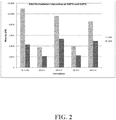
- FIG. 2 reveals the resultant hot-melt viscosity vs. temperature performance at 20% polymer content.
- campaign-55 met the criteria for low hot-melt viscosity all the way down to 120°C.
- FIG. 1 is a plot of hot-melt viscosity vs. temperature for formulations at the highest polymer content (see Table 3). From this plot it is clear that Campaign-55 has the lowest viscosity at the temperature range shown, with a 20 wt.% loading of polymer.
- the second line was 285 mm from the zero line and the third line was 300 mm from the zero line and approximately 15 mm on the opposite edge of the cardboard from the zero line.
- the first end of the construct is stapled between the zero line and the edge of the cardboard within the 15 mm.
- the construct was then stretched to full extension leaving no gathers in the laminate and then marked with a pen at the 300 mm mark.
- the construct was then relaxed until the mark was over the 285 mm line. This left the construct stretched to 95% of the full extension.
- a razor blade was then used to cut through each of the elastic threads on both ends. One set of cuts was made at the zero line and the other at the 285 mm line.
- Table 4 Ingredients Wt.% HL-1486 Commercial* Sample 1 Sample 2 Sample 3 Block Copolymer NA 20 15 15 Kristalex 3085 NA 15 25 15 Endex 160 (RBSP ⁇ 160°C) NA 5 5 Eastotac H 100 NA 45 45 50 Nyflex 222B NA 14.5 14.5 14.5 Irganox 1010 NA 0.5 0.5 0.5 *H.B. Fuller, SIS based but composition is unknown
- FIG. 2 is a plot of hot-melt viscosities for EAA formulations mixed for spray lamination trials - Formulations HL1486 (commercial control), 68-6-2 and 68-6-4 were chosen for the final lamination trials.
- Table 5 Sample No. Appl. Temp. (°C) Coat Weight (gsm CF or mg/lm/strand SW) Creep Average 32" Nip Std. Deviation 32" Nip Avg. 19.25" Nip Std.
Landscapes
- Health & Medical Sciences (AREA)
- Chemical & Material Sciences (AREA)
- Public Health (AREA)
- Epidemiology (AREA)
- Engineering & Computer Science (AREA)
- Veterinary Medicine (AREA)
- Life Sciences & Earth Sciences (AREA)
- Animal Behavior & Ethology (AREA)
- General Health & Medical Sciences (AREA)
- Organic Chemistry (AREA)
- Chemical Kinetics & Catalysis (AREA)
- Hematology (AREA)
- Materials Engineering (AREA)
- Vascular Medicine (AREA)
- Heart & Thoracic Surgery (AREA)
- Biomedical Technology (AREA)
- Oil, Petroleum & Natural Gas (AREA)
- Medicinal Chemistry (AREA)
- Polymers & Plastics (AREA)
- Adhesives Or Adhesive Processes (AREA)
- Absorbent Articles And Supports Therefor (AREA)
Applications Claiming Priority (2)
| Application Number | Priority Date | Filing Date | Title |
|---|---|---|---|
| US201562247920P | 2015-10-29 | 2015-10-29 | |
| PCT/US2016/059477 WO2017075458A1 (en) | 2015-10-29 | 2016-10-28 | Hot melt elastic attachment adhesive for low temperature applications |
Publications (3)
| Publication Number | Publication Date |
|---|---|
| EP3367989A1 EP3367989A1 (en) | 2018-09-05 |
| EP3367989A4 EP3367989A4 (en) | 2019-07-03 |
| EP3367989B1 true EP3367989B1 (en) | 2021-03-17 |
Family
ID=58631253
Family Applications (1)
| Application Number | Title | Priority Date | Filing Date |
|---|---|---|---|
| EP16860946.9A Active EP3367989B1 (en) | 2015-10-29 | 2016-10-28 | Hot melt elastic attachment adhesive for low temperature applications |
Country Status (7)
| Country | Link |
|---|---|
| US (1) | US10633567B2 (enExample) |
| EP (1) | EP3367989B1 (enExample) |
| JP (1) | JP7074668B2 (enExample) |
| KR (1) | KR102637494B1 (enExample) |
| CN (1) | CN108135754B (enExample) |
| TW (1) | TWI672350B (enExample) |
| WO (1) | WO2017075458A1 (enExample) |
Families Citing this family (3)
| Publication number | Priority date | Publication date | Assignee | Title |
|---|---|---|---|---|
| CN110951429A (zh) * | 2019-11-20 | 2020-04-03 | 广州伟一胶粘制品有限公司 | 一种防水密封胶及其制备方法和应用 |
| US11046052B1 (en) | 2020-05-22 | 2021-06-29 | Transhield, Inc. | Protective covers and methods of manufacture and use |
| US20210362465A1 (en) | 2020-05-22 | 2021-11-25 | Transhield, Inc. | Protective composite fabrics and methods of manufacture and use |
Family Cites Families (26)
| Publication number | Priority date | Publication date | Assignee | Title |
|---|---|---|---|---|
| USRE27145E (en) | 1969-05-20 | 1971-06-22 | Side-chain | |
| US4291139A (en) * | 1977-03-09 | 1981-09-22 | The Firestone Tire & Rubber Company | Process for preparation of block copolymers |
| US5024667A (en) * | 1988-11-07 | 1991-06-18 | H. B. Fuller Licensing & Financing, Inc. | Disposable article construction |
| US5149741A (en) | 1989-07-21 | 1992-09-22 | Findley Adhesives, Inc. | Hot melt construction adhesives for disposable soft goods |
| EP1035188A1 (en) | 1996-04-15 | 2000-09-13 | Hercules Incorporated | Viscosity modifier for hot-melt adhesives |
| US6531544B1 (en) * | 2000-02-03 | 2003-03-11 | H.B. Fuller Licensing & Financing, Inc. | Block copolymer based hot melt adhesive for bonding lotion coated substrates |
| EP1299496B1 (en) * | 2000-06-27 | 2005-06-15 | Exxonmobil Chemical Patents Inc. | Adhesives with improved die-cutting performance |
| CN1236001C (zh) * | 2000-11-20 | 2006-01-11 | 株式会社可乐丽 | 粘合-胶粘剂及适用于该粘合-胶粘剂的嵌段共聚物 |
| DE10242947B8 (de) * | 2002-09-16 | 2009-06-18 | Odelo Led Gmbh | Verfahren zum Herstellen von LED-Körpern mit Hilfe einer Querschnittsverengung und Vorrichtung zur Durchführung des Herstellungsverfahrens |
| EP1431364A1 (en) * | 2002-12-19 | 2004-06-23 | KRATON Polymers Research B.V. | Packaging tape adhesive composition and packaging tape comprising it |
| BRPI0417952A (pt) * | 2003-12-22 | 2007-04-17 | Kraton Polymers Res Bv | composição de copolìmero em bloco, e, composição adesiva |
| WO2005075594A1 (en) | 2004-02-06 | 2005-08-18 | Kraton Polymers Research B.V. | Pressure sensitive adhesive and compositions prepared with same |
| US20050176867A1 (en) * | 2004-02-06 | 2005-08-11 | Qiwei He | Low application temperature elastic attachment adhesive |
| US7655720B2 (en) | 2004-02-13 | 2010-02-02 | Henkel Ag & Co. Kgaa | Adhesive containing radial block copolymer |
| US7307124B2 (en) | 2004-02-19 | 2007-12-11 | Kraton Polymers U.S. Llc | Hot-melt adhesive composition for non-wovens |
| US20060205877A1 (en) | 2005-03-11 | 2006-09-14 | Kraton Polymers U.S. Llc | Adhesive compositions comprising mixtures of block copolymers |
| US20070088116A1 (en) * | 2005-10-14 | 2007-04-19 | Fabienne Abba | Low application temperature hot melt adhesive |
| US8163824B2 (en) * | 2006-10-02 | 2012-04-24 | Bostik, Inc. | High styrene SBS hot melt adhesive |
| US20080081858A1 (en) | 2006-10-02 | 2008-04-03 | Genta Okazaki | High styrene SBS hot melt adhesive |
| EP2256111A4 (en) | 2008-02-15 | 2012-12-19 | Univ Tokyo | ORGANIC SEMICONDUCTOR CONNECTION, SEMICONDUCTOR ELEMENT, SOLAR BATTERY AND METHOD FOR PRODUCING AN ORGANIC SEMICONDUCTOR CONNECTION |
| US8324309B2 (en) | 2010-04-27 | 2012-12-04 | Kraton Polymers Us Llc | High melt flow block copolymers for non-woven adhesives |
| WO2012051239A1 (en) | 2010-10-15 | 2012-04-19 | Exxonmobil Chemical Patents Inc. | Polypropylene-based adhesive compositions |
| KR101801435B1 (ko) | 2011-02-18 | 2017-11-24 | 헨켈 아이피 앤드 홀딩 게엠베하 | 높은 크리프 저항을 가지는 일회용품을 위한 저온 핫 멜트 접착제 |
| ES2621243T3 (es) | 2011-10-05 | 2017-07-03 | Bostik, Inc. | Adhesivo termofusible para etiquetar botellas que contiene petrolato |
| EP2878644B1 (en) * | 2012-07-25 | 2019-05-01 | Asahi Kasei Kabushiki Kaisha | Block copolymer composition for adhesives, and adhesive composition |
| JP6001493B2 (ja) | 2013-04-23 | 2016-10-05 | ヘンケルジャパン株式会社 | ホットメルト接着剤 |
-
2016
- 2016-10-28 WO PCT/US2016/059477 patent/WO2017075458A1/en not_active Ceased
- 2016-10-28 KR KR1020187011586A patent/KR102637494B1/ko active Active
- 2016-10-28 US US15/337,864 patent/US10633567B2/en active Active
- 2016-10-28 JP JP2018522137A patent/JP7074668B2/ja active Active
- 2016-10-28 CN CN201680061120.XA patent/CN108135754B/zh active Active
- 2016-10-28 EP EP16860946.9A patent/EP3367989B1/en active Active
- 2016-10-31 TW TW105135224A patent/TWI672350B/zh active
Non-Patent Citations (1)
| Title |
|---|
| None * |
Also Published As
| Publication number | Publication date |
|---|---|
| CN108135754A (zh) | 2018-06-08 |
| WO2017075458A1 (en) | 2017-05-04 |
| CN108135754B (zh) | 2021-03-09 |
| US20170121577A1 (en) | 2017-05-04 |
| TW201720900A (zh) | 2017-06-16 |
| JP7074668B2 (ja) | 2022-05-24 |
| EP3367989A1 (en) | 2018-09-05 |
| EP3367989A4 (en) | 2019-07-03 |
| JP2019500440A (ja) | 2019-01-10 |
| TWI672350B (zh) | 2019-09-21 |
| US10633567B2 (en) | 2020-04-28 |
| KR102637494B1 (ko) | 2024-02-15 |
| KR20180079310A (ko) | 2018-07-10 |
Similar Documents
| Publication | Publication Date | Title |
|---|---|---|
| EP2817371B1 (en) | High flow, hydrogenated styrene-butadiene-styrene block copolymer and applications | |
| EP3019651B1 (en) | High flow, hydrogenated styrene-butadiene-styrene block copolymers and applications | |
| US8324309B2 (en) | High melt flow block copolymers for non-woven adhesives | |
| US7307124B2 (en) | Hot-melt adhesive composition for non-wovens | |
| EP1699869B1 (en) | Adhesive formulations from radial (s-i/b)x polymers | |
| RU2367675C2 (ru) | Клеевые композиции, содержащие смеси блоксополимеров | |
| WO1997010310A1 (en) | Low viscosity hot melt disposables adhesive composition | |
| US20200276354A1 (en) | Adhesive compositions with amorphous polyolefins | |
| EP3367989B1 (en) | Hot melt elastic attachment adhesive for low temperature applications | |
| WO2025213374A1 (en) | Hotmelt pressure sensitive adhesive composition |
Legal Events
| Date | Code | Title | Description |
|---|---|---|---|
| STAA | Information on the status of an ep patent application or granted ep patent |
Free format text: STATUS: THE INTERNATIONAL PUBLICATION HAS BEEN MADE |
|
| PUAI | Public reference made under article 153(3) epc to a published international application that has entered the european phase |
Free format text: ORIGINAL CODE: 0009012 |
|
| STAA | Information on the status of an ep patent application or granted ep patent |
Free format text: STATUS: REQUEST FOR EXAMINATION WAS MADE |
|
| 17P | Request for examination filed |
Effective date: 20180524 |
|
| AK | Designated contracting states |
Kind code of ref document: A1 Designated state(s): AL AT BE BG CH CY CZ DE DK EE ES FI FR GB GR HR HU IE IS IT LI LT LU LV MC MK MT NL NO PL PT RO RS SE SI SK SM TR |
|
| AX | Request for extension of the european patent |
Extension state: BA ME |
|
| DAV | Request for validation of the european patent (deleted) | ||
| DAX | Request for extension of the european patent (deleted) | ||
| A4 | Supplementary search report drawn up and despatched |
Effective date: 20190603 |
|
| RIC1 | Information provided on ipc code assigned before grant |
Ipc: C08L 53/02 20060101ALI20190527BHEP Ipc: C09J 11/00 20060101ALI20190527BHEP Ipc: A61F 13/15 20060101ALI20190527BHEP Ipc: C09J 153/02 20060101ALI20190527BHEP Ipc: C09J 153/00 20060101ALI20190527BHEP Ipc: A61F 13/49 20060101AFI20190527BHEP |
|
| GRAP | Despatch of communication of intention to grant a patent |
Free format text: ORIGINAL CODE: EPIDOSNIGR1 |
|
| STAA | Information on the status of an ep patent application or granted ep patent |
Free format text: STATUS: GRANT OF PATENT IS INTENDED |
|
| RIC1 | Information provided on ipc code assigned before grant |
Ipc: C08L 53/02 20060101ALI20200914BHEP Ipc: C09J 11/00 20060101ALI20200914BHEP Ipc: A61L 15/26 20060101ALI20200914BHEP Ipc: C09J 153/00 20060101ALI20200914BHEP Ipc: A61L 15/58 20060101ALI20200914BHEP Ipc: A61F 13/15 20060101ALI20200914BHEP Ipc: C08L 91/00 20060101ALI20200914BHEP Ipc: C09J 153/02 20060101ALI20200914BHEP Ipc: A61F 13/49 20060101AFI20200914BHEP |
|
| INTG | Intention to grant announced |
Effective date: 20201002 |
|
| GRAS | Grant fee paid |
Free format text: ORIGINAL CODE: EPIDOSNIGR3 |
|
| GRAA | (expected) grant |
Free format text: ORIGINAL CODE: 0009210 |
|
| STAA | Information on the status of an ep patent application or granted ep patent |
Free format text: STATUS: THE PATENT HAS BEEN GRANTED |
|
| AK | Designated contracting states |
Kind code of ref document: B1 Designated state(s): AL AT BE BG CH CY CZ DE DK EE ES FI FR GB GR HR HU IE IS IT LI LT LU LV MC MK MT NL NO PL PT RO RS SE SI SK SM TR |
|
| REG | Reference to a national code |
Ref country code: GB Ref legal event code: FG4D |
|
| REG | Reference to a national code |
Ref country code: CH Ref legal event code: EP |
|
| REG | Reference to a national code |
Ref country code: DE Ref legal event code: R096 Ref document number: 602016054598 Country of ref document: DE |
|
| REG | Reference to a national code |
Ref country code: IE Ref legal event code: FG4D |
|
| REG | Reference to a national code |
Ref country code: AT Ref legal event code: REF Ref document number: 1371551 Country of ref document: AT Kind code of ref document: T Effective date: 20210415 |
|
| REG | Reference to a national code |
Ref country code: NL Ref legal event code: FP |
|
| REG | Reference to a national code |
Ref country code: LT Ref legal event code: MG9D |
|
| PG25 | Lapsed in a contracting state [announced via postgrant information from national office to epo] |
Ref country code: NO Free format text: LAPSE BECAUSE OF FAILURE TO SUBMIT A TRANSLATION OF THE DESCRIPTION OR TO PAY THE FEE WITHIN THE PRESCRIBED TIME-LIMIT Effective date: 20210617 Ref country code: FI Free format text: LAPSE BECAUSE OF FAILURE TO SUBMIT A TRANSLATION OF THE DESCRIPTION OR TO PAY THE FEE WITHIN THE PRESCRIBED TIME-LIMIT Effective date: 20210317 Ref country code: GR Free format text: LAPSE BECAUSE OF FAILURE TO SUBMIT A TRANSLATION OF THE DESCRIPTION OR TO PAY THE FEE WITHIN THE PRESCRIBED TIME-LIMIT Effective date: 20210618 Ref country code: HR Free format text: LAPSE BECAUSE OF FAILURE TO SUBMIT A TRANSLATION OF THE DESCRIPTION OR TO PAY THE FEE WITHIN THE PRESCRIBED TIME-LIMIT Effective date: 20210317 Ref country code: BG Free format text: LAPSE BECAUSE OF FAILURE TO SUBMIT A TRANSLATION OF THE DESCRIPTION OR TO PAY THE FEE WITHIN THE PRESCRIBED TIME-LIMIT Effective date: 20210617 |
|
| REG | Reference to a national code |
Ref country code: AT Ref legal event code: MK05 Ref document number: 1371551 Country of ref document: AT Kind code of ref document: T Effective date: 20210317 |
|
| PG25 | Lapsed in a contracting state [announced via postgrant information from national office to epo] |
Ref country code: RS Free format text: LAPSE BECAUSE OF FAILURE TO SUBMIT A TRANSLATION OF THE DESCRIPTION OR TO PAY THE FEE WITHIN THE PRESCRIBED TIME-LIMIT Effective date: 20210317 Ref country code: LV Free format text: LAPSE BECAUSE OF FAILURE TO SUBMIT A TRANSLATION OF THE DESCRIPTION OR TO PAY THE FEE WITHIN THE PRESCRIBED TIME-LIMIT Effective date: 20210317 Ref country code: SE Free format text: LAPSE BECAUSE OF FAILURE TO SUBMIT A TRANSLATION OF THE DESCRIPTION OR TO PAY THE FEE WITHIN THE PRESCRIBED TIME-LIMIT Effective date: 20210317 |
|
| PG25 | Lapsed in a contracting state [announced via postgrant information from national office to epo] |
Ref country code: LT Free format text: LAPSE BECAUSE OF FAILURE TO SUBMIT A TRANSLATION OF THE DESCRIPTION OR TO PAY THE FEE WITHIN THE PRESCRIBED TIME-LIMIT Effective date: 20210317 Ref country code: EE Free format text: LAPSE BECAUSE OF FAILURE TO SUBMIT A TRANSLATION OF THE DESCRIPTION OR TO PAY THE FEE WITHIN THE PRESCRIBED TIME-LIMIT Effective date: 20210317 Ref country code: CZ Free format text: LAPSE BECAUSE OF FAILURE TO SUBMIT A TRANSLATION OF THE DESCRIPTION OR TO PAY THE FEE WITHIN THE PRESCRIBED TIME-LIMIT Effective date: 20210317 Ref country code: SM Free format text: LAPSE BECAUSE OF FAILURE TO SUBMIT A TRANSLATION OF THE DESCRIPTION OR TO PAY THE FEE WITHIN THE PRESCRIBED TIME-LIMIT Effective date: 20210317 Ref country code: AT Free format text: LAPSE BECAUSE OF FAILURE TO SUBMIT A TRANSLATION OF THE DESCRIPTION OR TO PAY THE FEE WITHIN THE PRESCRIBED TIME-LIMIT Effective date: 20210317 |
|
| PG25 | Lapsed in a contracting state [announced via postgrant information from national office to epo] |
Ref country code: PT Free format text: LAPSE BECAUSE OF FAILURE TO SUBMIT A TRANSLATION OF THE DESCRIPTION OR TO PAY THE FEE WITHIN THE PRESCRIBED TIME-LIMIT Effective date: 20210719 Ref country code: PL Free format text: LAPSE BECAUSE OF FAILURE TO SUBMIT A TRANSLATION OF THE DESCRIPTION OR TO PAY THE FEE WITHIN THE PRESCRIBED TIME-LIMIT Effective date: 20210317 Ref country code: SK Free format text: LAPSE BECAUSE OF FAILURE TO SUBMIT A TRANSLATION OF THE DESCRIPTION OR TO PAY THE FEE WITHIN THE PRESCRIBED TIME-LIMIT Effective date: 20210317 Ref country code: RO Free format text: LAPSE BECAUSE OF FAILURE TO SUBMIT A TRANSLATION OF THE DESCRIPTION OR TO PAY THE FEE WITHIN THE PRESCRIBED TIME-LIMIT Effective date: 20210317 Ref country code: IS Free format text: LAPSE BECAUSE OF FAILURE TO SUBMIT A TRANSLATION OF THE DESCRIPTION OR TO PAY THE FEE WITHIN THE PRESCRIBED TIME-LIMIT Effective date: 20210717 |
|
| REG | Reference to a national code |
Ref country code: DE Ref legal event code: R097 Ref document number: 602016054598 Country of ref document: DE |
|
| PLBE | No opposition filed within time limit |
Free format text: ORIGINAL CODE: 0009261 |
|
| STAA | Information on the status of an ep patent application or granted ep patent |
Free format text: STATUS: NO OPPOSITION FILED WITHIN TIME LIMIT |
|
| PG25 | Lapsed in a contracting state [announced via postgrant information from national office to epo] |
Ref country code: AL Free format text: LAPSE BECAUSE OF FAILURE TO SUBMIT A TRANSLATION OF THE DESCRIPTION OR TO PAY THE FEE WITHIN THE PRESCRIBED TIME-LIMIT Effective date: 20210317 Ref country code: DK Free format text: LAPSE BECAUSE OF FAILURE TO SUBMIT A TRANSLATION OF THE DESCRIPTION OR TO PAY THE FEE WITHIN THE PRESCRIBED TIME-LIMIT Effective date: 20210317 Ref country code: ES Free format text: LAPSE BECAUSE OF FAILURE TO SUBMIT A TRANSLATION OF THE DESCRIPTION OR TO PAY THE FEE WITHIN THE PRESCRIBED TIME-LIMIT Effective date: 20210317 |
|
| 26N | No opposition filed |
Effective date: 20211220 |
|
| PG25 | Lapsed in a contracting state [announced via postgrant information from national office to epo] |
Ref country code: SI Free format text: LAPSE BECAUSE OF FAILURE TO SUBMIT A TRANSLATION OF THE DESCRIPTION OR TO PAY THE FEE WITHIN THE PRESCRIBED TIME-LIMIT Effective date: 20210317 |
|
| PG25 | Lapsed in a contracting state [announced via postgrant information from national office to epo] |
Ref country code: IT Free format text: LAPSE BECAUSE OF FAILURE TO SUBMIT A TRANSLATION OF THE DESCRIPTION OR TO PAY THE FEE WITHIN THE PRESCRIBED TIME-LIMIT Effective date: 20210317 |
|
| REG | Reference to a national code |
Ref country code: CH Ref legal event code: PL |
|
| PG25 | Lapsed in a contracting state [announced via postgrant information from national office to epo] |
Ref country code: IS Free format text: LAPSE BECAUSE OF FAILURE TO SUBMIT A TRANSLATION OF THE DESCRIPTION OR TO PAY THE FEE WITHIN THE PRESCRIBED TIME-LIMIT Effective date: 20210717 |
|
| REG | Reference to a national code |
Ref country code: BE Ref legal event code: MM Effective date: 20211031 |
|
| GBPC | Gb: european patent ceased through non-payment of renewal fee |
Effective date: 20211028 |
|
| PG25 | Lapsed in a contracting state [announced via postgrant information from national office to epo] |
Ref country code: MC Free format text: LAPSE BECAUSE OF FAILURE TO SUBMIT A TRANSLATION OF THE DESCRIPTION OR TO PAY THE FEE WITHIN THE PRESCRIBED TIME-LIMIT Effective date: 20210317 |
|
| PG25 | Lapsed in a contracting state [announced via postgrant information from national office to epo] |
Ref country code: LU Free format text: LAPSE BECAUSE OF NON-PAYMENT OF DUE FEES Effective date: 20211028 Ref country code: GB Free format text: LAPSE BECAUSE OF NON-PAYMENT OF DUE FEES Effective date: 20211028 Ref country code: BE Free format text: LAPSE BECAUSE OF NON-PAYMENT OF DUE FEES Effective date: 20211031 |
|
| PG25 | Lapsed in a contracting state [announced via postgrant information from national office to epo] |
Ref country code: LI Free format text: LAPSE BECAUSE OF NON-PAYMENT OF DUE FEES Effective date: 20211031 Ref country code: CH Free format text: LAPSE BECAUSE OF NON-PAYMENT OF DUE FEES Effective date: 20211031 |
|
| PG25 | Lapsed in a contracting state [announced via postgrant information from national office to epo] |
Ref country code: IE Free format text: LAPSE BECAUSE OF NON-PAYMENT OF DUE FEES Effective date: 20211028 |
|
| REG | Reference to a national code |
Ref country code: NL Ref legal event code: RC Free format text: DETAILS LICENCE OR PLEDGE: RIGHT OF PLEDGE, ESTABLISHED Name of requester: GOLDMAN SACHS BANK USA Effective date: 20230118 |
|
| PG25 | Lapsed in a contracting state [announced via postgrant information from national office to epo] |
Ref country code: HU Free format text: LAPSE BECAUSE OF FAILURE TO SUBMIT A TRANSLATION OF THE DESCRIPTION OR TO PAY THE FEE WITHIN THE PRESCRIBED TIME-LIMIT; INVALID AB INITIO Effective date: 20161028 |
|
| PG25 | Lapsed in a contracting state [announced via postgrant information from national office to epo] |
Ref country code: CY Free format text: LAPSE BECAUSE OF FAILURE TO SUBMIT A TRANSLATION OF THE DESCRIPTION OR TO PAY THE FEE WITHIN THE PRESCRIBED TIME-LIMIT Effective date: 20210317 |
|
| PG25 | Lapsed in a contracting state [announced via postgrant information from national office to epo] |
Ref country code: MK Free format text: LAPSE BECAUSE OF FAILURE TO SUBMIT A TRANSLATION OF THE DESCRIPTION OR TO PAY THE FEE WITHIN THE PRESCRIBED TIME-LIMIT Effective date: 20210317 |
|
| PG25 | Lapsed in a contracting state [announced via postgrant information from national office to epo] |
Ref country code: TR Free format text: LAPSE BECAUSE OF FAILURE TO SUBMIT A TRANSLATION OF THE DESCRIPTION OR TO PAY THE FEE WITHIN THE PRESCRIBED TIME-LIMIT Effective date: 20210317 |
|
| PG25 | Lapsed in a contracting state [announced via postgrant information from national office to epo] |
Ref country code: MT Free format text: LAPSE BECAUSE OF FAILURE TO SUBMIT A TRANSLATION OF THE DESCRIPTION OR TO PAY THE FEE WITHIN THE PRESCRIBED TIME-LIMIT Effective date: 20210317 |
|
| PGFP | Annual fee paid to national office [announced via postgrant information from national office to epo] |
Ref country code: DE Payment date: 20241021 Year of fee payment: 9 |
|
| PGFP | Annual fee paid to national office [announced via postgrant information from national office to epo] |
Ref country code: FR Payment date: 20241030 Year of fee payment: 9 |
|
| PGFP | Annual fee paid to national office [announced via postgrant information from national office to epo] |
Ref country code: NL Payment date: 20251021 Year of fee payment: 10 |