EP3367209A2 - Verfahren und vorrichtung zur oberflächen- und umgebungstemperaturschätzung für tragbare vorrichtungen - Google Patents
Verfahren und vorrichtung zur oberflächen- und umgebungstemperaturschätzung für tragbare vorrichtungen Download PDFInfo
- Publication number
- EP3367209A2 EP3367209A2 EP18151809.3A EP18151809A EP3367209A2 EP 3367209 A2 EP3367209 A2 EP 3367209A2 EP 18151809 A EP18151809 A EP 18151809A EP 3367209 A2 EP3367209 A2 EP 3367209A2
- Authority
- EP
- European Patent Office
- Prior art keywords
- portable device
- temperature
- ambient temperature
- circuit model
- internal
- Prior art date
- Legal status (The legal status is an assumption and is not a legal conclusion. Google has not performed a legal analysis and makes no representation as to the accuracy of the status listed.)
- Granted
Links
Images


Classifications
-
- G—PHYSICS
- G01—MEASURING; TESTING
- G01K—MEASURING TEMPERATURE; MEASURING QUANTITY OF HEAT; THERMALLY-SENSITIVE ELEMENTS NOT OTHERWISE PROVIDED FOR
- G01K13/00—Thermometers specially adapted for specific purposes
-
- G—PHYSICS
- G01—MEASURING; TESTING
- G01K—MEASURING TEMPERATURE; MEASURING QUANTITY OF HEAT; THERMALLY-SENSITIVE ELEMENTS NOT OTHERWISE PROVIDED FOR
- G01K1/00—Details of thermometers not specially adapted for particular types of thermometer
- G01K1/20—Compensating for effects of temperature changes other than those to be measured, e.g. changes in ambient temperature
-
- G—PHYSICS
- G01—MEASURING; TESTING
- G01K—MEASURING TEMPERATURE; MEASURING QUANTITY OF HEAT; THERMALLY-SENSITIVE ELEMENTS NOT OTHERWISE PROVIDED FOR
- G01K7/00—Measuring temperature based on the use of electric or magnetic elements directly sensitive to heat ; Power supply therefor, e.g. using thermoelectric elements
- G01K7/16—Measuring temperature based on the use of electric or magnetic elements directly sensitive to heat ; Power supply therefor, e.g. using thermoelectric elements using resistive elements
-
- G—PHYSICS
- G01—MEASURING; TESTING
- G01K—MEASURING TEMPERATURE; MEASURING QUANTITY OF HEAT; THERMALLY-SENSITIVE ELEMENTS NOT OTHERWISE PROVIDED FOR
- G01K7/00—Measuring temperature based on the use of electric or magnetic elements directly sensitive to heat ; Power supply therefor, e.g. using thermoelectric elements
- G01K7/42—Circuits effecting compensation of thermal inertia; Circuits for predicting the stationary value of a temperature
-
- G—PHYSICS
- G01—MEASURING; TESTING
- G01K—MEASURING TEMPERATURE; MEASURING QUANTITY OF HEAT; THERMALLY-SENSITIVE ELEMENTS NOT OTHERWISE PROVIDED FOR
- G01K7/00—Measuring temperature based on the use of electric or magnetic elements directly sensitive to heat ; Power supply therefor, e.g. using thermoelectric elements
- G01K7/42—Circuits effecting compensation of thermal inertia; Circuits for predicting the stationary value of a temperature
- G01K7/427—Temperature calculation based on spatial modeling, e.g. spatial inter- or extrapolation
-
- G—PHYSICS
- G06—COMPUTING OR CALCULATING; COUNTING
- G06F—ELECTRIC DIGITAL DATA PROCESSING
- G06F1/00—Details not covered by groups G06F3/00 - G06F13/00 and G06F21/00
- G06F1/16—Constructional details or arrangements
- G06F1/20—Cooling means
- G06F1/206—Cooling means comprising thermal management
-
- G—PHYSICS
- G06—COMPUTING OR CALCULATING; COUNTING
- G06F—ELECTRIC DIGITAL DATA PROCESSING
- G06F1/00—Details not covered by groups G06F3/00 - G06F13/00 and G06F21/00
- G06F1/16—Constructional details or arrangements
- G06F1/20—Cooling means
Definitions
- Embodiments of the invention relate to thermal management of portable devices.
- Modern portable devices such as laptops, tablets, smartphones, smart watches, gaming devices and other consumer electronics, are designed to run system and user space applications when the devices are held by or in contact with users.
- Thermal management for these devices regulates not only the internal temperature of the device to ensure safe operation, but also the surface temperature of the device such that it is comfortable for the user to touch the device.
- Thermal management prevents the device from generating excessive heat, as excess temperature can degrade the performance, life, and reliability of the device.
- One form of dynamic thermal management is thermal throttling. Thermal throttling reduces the processor performance when the processors in the device are heavily loaded, to thereby limit the internal temperature and the surface temperature to acceptable levels.
- One approach to estimating the surface temperature of a portable device is to use the internal temperature minus a fixed offset to calculate the surface temperature.
- the difference (i.e., offset) between the internal temperature and the surface temperature can vary from one device product to another, and can vary in the same device under different usage scenarios and different levels of power consumption.
- Using such an oversimplified approach often leads to inaccurate estimation of the surface temperature, and may cause performance to be throttled before the surface temperature reaches a predetermined limit.
- a temperature sensor at the device surface; e.g., the display.
- a temperature sensor detects the temperature of a limited surface area on the device.
- there may be multiple heat sources located in different parts of the device causing non-uniform temperature rise on the device surface.
- there may be different heat sources inside the device causing the surface temperature to rise on different parts of the device surface.
- a temperature sensor at a fixed surface location may be unable to detect surface temperature change across these usage scenarios.
- a method for estimating a surface temperature of a portable device.
- the method is defined in independent claim 1 and comprises: detecting an internal temperature of the portable device; and estimating the surface temperature using the internal temperature and an ambient temperature as input to a circuit model that describes thermal behaviors of the portable device.
- a portable device to estimate a surface temperature of the portable device.
- the portable device is defined in independent claim 9 and comprises: a sensor to detect an internal temperature of the portable device; and circuitry to estimate the surface temperature using the internal temperature and an ambient temperature as input to a circuit model that describes thermal behaviors of the portable device.
- the embodiments of the invention enable a portable device to estimate its surface temperature without the use of a surface temperature sensor. Estimation of the surface temperature allows the portable device to improve its dynamic thermal management such that thermal throttling may be performed when the surface temperature reaches a predetermined limit.
- the dependent claims define preferred embodiments thereof. Advantages of the embodiments will be explained in detail in the following descriptions.
- the surface temperature of a portable device is estimated according to embodiments of the invention.
- the surface temperature also referred to as the skin temperature, is estimated based on the ambient temperature and the internal temperature of the device.
- the estimation of the surface temperature may be performed using a circuit model that describes thermal behaviors of the device with a plurality of thermal capacitors and thermal resistors. The use of the circuit model enables the estimation to be made with high accuracy, thus minimizing un-utilized thermal headroom of the device and premature thermal throttling.
- the ambient temperature may be estimated based on the internal temperature or a time-series of internal temperatures (i.e., successive internal temperatures detected over a time period) of the device.
- the ambient temperature is the temperature of the environment in which the device operates. According to embodiments to be described herein, the ambient temperature may be estimated without temperature sensors embedded in or directly attached to the device surface.
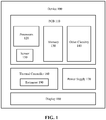
- FIG. 1 illustrates a simplified diagram of a portable device ("device 100") according to one embodiment.
- the device 100 includes a printed circuit board (PCB) 110, which further includes one or more processors 120 (e.g., central processing units (CPUs), graphic processing units (GPUs), digital signal processors (DSPs), and/or other types of special/general-purpose processors or processing circuitry), one or more memory devices 130 (e.g., volatile memory such as random access memory (RAM), and/or non-volatile memory such as read-only memory (ROM), flash memory, etc.), and other circuitry 140 such as memory controller, network adapter, clock circuitry, voltage regulator, etc. Additional components of the device 100 are not shown to simplify the description.
- processors 120 e.g., central processing units (CPUs), graphic processing units (GPUs), digital signal processors (DSPs), and/or other types of special/general-purpose processors or processing circuitry
- memory devices 130 e.g., volatile memory such as random access memory (
- the device 100 includes the PCB 110, which further includes a system-on-a-chip (SoC) 280.
- SoC system-on-a-chip
- the processors 120 and the memory devices 130, as well as some components of the other circuitry 140 may reside in the SoC 280.
- Figure 1 shows that a sensor 150 is mounted on the PCB 110 to sense or detect the internal temperature of the device 100; e.g., the temperature of the PCB 110.
- the sensor 150 may be attached to the SoC 280 (shown in Figure 2 ), the processors 120 (shown in Figure 1 ), or other circuit components. That is, the internal temperature may be the PCB 110 temperature, the SOC 280 temperature, or the temperature of any circuit component to which the sensor 150 is attached.
- the device 100 may include more than one sensors 150 for detecting the internal temperature.
- Non-limiting examples of the device 100 may include: a cellphone, a smart watch, e-reader, or any handheld or wearable electronic device whose surface is in contact with the user's skin when in use.
- the device 100 also includes a thermal controller 160, which performs dynamic thermal management on the device 100 based on at least the estimation of the surface temperature.
- the thermal controller 160 is shown as a component outside the PCB 110, alternatively the thermal controller 160 may be implemented on the PCB 110, or as part of an operating system (OS) stored in the memory 130 and containing an interface to hardware, to control the voltage supply and/or clock circuitry to thereby dynamically adjust the voltage and/or frequency of the processors 120. Adjusting the processor voltage and/or frequency at runtime, in effect, adjusts the processors' power consumption and heat output.
- the device 100 may further include a power supply 170 (e.g., battery), a display 180, and other hardware components.
- the thermal controller 160 may include or be coupled to a temperature estimator, an embodiment of which is shown in Figure 1 as an estimator 190.
- the estimator 190 estimates the surface temperature of the device 100 using the internal temperature and the ambient temperature as input to a circuit model, where the circuit model characterizes thermal behaviors of the device 100.
- the parameters used in the circuit model may vary across different device product lines, and may be identified or chosen by the manufacturer of the device 100 based on results of simulations or experiments. The parameters are chosen such that the estimated surface temperature approximates the temperature of the warmest part of the device surface, where the warmest part may be the display, the back cover, the side surface, etc., depending on the applications being executed and the hardware being utilized.
- the thermal controller 160 may determine whether or not to throttle the performance of the processors 120.
- FIG. 3A and Figure 3B illustrates the estimator 190 according to two alternative embodiments.
- the estimator 190 may be implemented by hardware (e.g., general-purpose processors or Application-Specific Integrated Circuit (ASIC)), software (containing instructions stored in the memory 130 and executable by the processors 120) or a combination of both.
- the estimator 190 is a hardware component within or coupled to the thermal controller 160.
- the estimator 190 receives the sensor 150 measurements of the internal temperature, and uses ambient temperature (Tamb) parameters 310 and internal temperature (Tint) parameters 320 to calculate an estimated surface temperature of the device 100. The result of the estimation is used by the thermal controller 160 to control the operation of the processors 120.
- Tamb ambient temperature
- Tint internal temperature
- the estimator 190 is a software program stored in the memory 130.
- the processors 120 executes the instructions of the estimator 190 software program, using the sensor 150 measurements, Tamb parameters 310 and Tint parameters 320 as input to estimate the surface temperature.
- the estimation performed by or according to the estimator 190 is described below in connection with Figure 4A and Figure 4B .
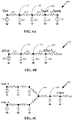
- FIG. 4A and Figure 4B illustrate thermal-equivalent circuit diagrams for estimating the surface temperature according to some embodiments.
- Each of these thermal-equivalent circuit diagrams shows a circuit model, which is an electric analog circuit describing the thermal behaviors of the device 100; e.g., heat conduction.
- Figure 4A shows a circuit model 400 including laddered RC circuit components, where the RC circuit components include thermal capacitors (401, 402, 403) and thermal resistors (411, 412, 413, 414). These thermal capacitors and thermal resistors are the thermal equivalents of their electrical counterparts.
- the circuit model 400 is an electrical description of a thermal system, and it obeys the Kirchhoff's circuit laws.
- the internal temperature (Tint) and the ambient temperature (Tamb) may be modeled as voltage sources 420 and 430, respectively.
- the surface temperature (Tsurf) may be modeled as an internal point 450 in the circuit model 400.
- the thermal capacitors (401, 402, 403) and the thermal resistors (411, 412, 413, 414) model or describe the thermal behaviors of the device 100, and are collectively referred to as the Tint parameters 320.
- the numbers of thermal capacitors and thermal resistors, and/or the number of ladders in the circuit model 400 may be different from the examples shown herein.
- the temperatures at internal points N1, N2 and Tsurf may be represented by the respective voltages at these points.
- the circuit model 400 can be used to calculate an estimated Tsurf, using Tint and Tamb as input, where Tint is measured by the sensor 150 of Figure 1 .
- Tamb may be a constant value, invariant of time and device surroundings.
- Tamb may slowly change over time (i.e., time-varying).
- a method of estimating Tamb will be described with reference to Figure 5 .
- the circuit model 400 describes the temperature gradient from Tint to Tamb, in the direction of lower temperature (i.e., from hot to cold).
- Figure 4B shows a circuit model 410 which includes the same thermal capacitors (401, 402, 403) and thermal resistors (411, 412, 413, 414) as in the circuit model 400, but the voltage source 430 representing Tamb is replaced by a ground terminal 440.
- the circuit model 410 can be used when Tamb is a known constant value.
- the delta surface temperature ( ⁇ Tsurf) corresponding to ⁇ Tint can be calculated using ⁇ Tint and the Tint parameters 320 as input.
- ⁇ Tsurf is a temperature difference caused by heat transfer from the device interior to the device surface.
- the following three equations may be formulated according to the Kirchhoff's circuit laws applied on the circuit model 410.
- the three unknown values (temperatures at N1, N2 and ⁇ Tsurf at point 450, all of which are represented by voltages) can be solved from the following three equations.
- Tsurf ⁇ Tsurf + Tamb.
- Figure 4C shows a circuit model 450 which includes two branches extending from point N1, each branch with a voltage source representing a respective internal temperature detected by a respective sensor. More specifically, in this example two sensors are used to sense the internal temperatures of the device. In alternative embodiments, more than two sensors may also be used.
- the surface temperature may be calculated by solving a set of equations formulated according to the Kirchhoff's circuit laws.
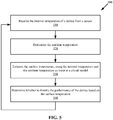
- FIG 5 is a flow diagram illustrating a method 500 of performing thermal management based on the surface temperature of a portable device (e.g., the device 100 of Figure 1 ) according to one embodiment.
- the method 500 may be performed by the device 100.
- the steps 510-540 may be repeated at a fixed time interval.
- the method 500 begins with the estimator 190 receiving the internal temperature of the device detected by the sensor 150 (step 510).
- the estimator 190 determines the ambient temperature (step 520).
- a constant value may be used as the ambient temperature.
- the ambient temperature is determined based on the state of the device 100, to be described with reference to Figure 6 .
- the surface temperature is then calculated using the internal temperature and the ambient temperature as input to a circuit model (step 530).
- the surface temperature may be used by the thermal controller 160 to determine whether to throttle the performance of the device 100; e.g., by reducing the frequency of the processors 120.
- the ambient temperature may be estimated from a time-series of internal temperatures; that is, the current internal temperature and the successive past internal temperatures. Experiments have shown that the internal temperature and its changes over time are correlated to the ambient temperature when the device 100 is in the idle state (e.g., when the processors 120 are not in active operation). When the device 100 is not idle (e.g., when at least one processor 120 is in the operating state), the internal temperature may fluctuate rapidly with processor usage, and therefore it may be difficult to discern a correlation between the internal temperature and the ambient temperature. Thus, preferably, the ambient temperature is not updated when the device 100 is in operation (i.e., not idle).
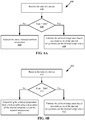
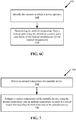
- Figure 6A is a flow diagram illustrating a method 600 for determining the ambient temperature according to one embodiment.
- Figure 6B is a flow diagram illustrating a method 602 for determining the ambient temperature according to another embodiment
- the methods 600 and 602 include further details of the step 520 of Figure 5 at which the ambient temperature is determined based on the state of the device 100.
- the methods 600 and 602 may be performed by the device 100 of Figure 1 . Although the methods 600 and 602 are described by referring to the internal temperature sensed at one internal location of the device 100, it is understood that the methods 600 and 602 apply to internal temperatures sensed at multiple locations of the device 100.
- the method 600 begins with the estimator 190 receiving (or obtaining) a state of the device 100 (e.g., the state of the processors 120) (step 610). If the state is idle (step 620), the ambient temperature may be estimated using a time-series of internal temperatures as input to an ambient temperature model (step 630).
- the ambient temperature model may be constructed prior to runtime of the device 100 based on calibrations of ambient temperatures vs. internal temperatures, and may be stored in or accessed by the device 100.
- the ambient temperature model records the correlation between the ambient temperature and the internal temperatures over time. The estimation may be made by using the currently-detected internal temperature and the successive past internal temperatures to determine the correlated ambient temperature.
- the internal temperatures detected over time is a time-series of internal temperatures which may be approximated by fitting an N-order polynomial to the time-series with N being any positive integer.
- the ambient temperature model records the correlation between the ambient temperature and a corresponding internal temperature, and the estimation may be made by using the currently-detected internal temperature to determine the correlated ambient temperature. If the state is not idle (step 620), the ambient temperature is not updated; that is, the same ambient temperature as in the previous time instant is maintained (step 640). Thus, if the device 100 transitions from the idle state to the operating state, the ambient temperature may be maintained at the same value as the most-recently estimated value in the idle state.
- the method 602 begins with the estimator 190 receiving (or obtaining) a state of the device 100 (e.g., the state of the processors 120) (step 612). If the state is idle (step 622), the ambient temperature may be estimated using a time-series of internal temperatures as input to an ambient temperature model (step 632). The ambient temperature model has been described above with reference to Figure 6B . If the state is not idle (step 622), the ambient temperature may be looked up from a table using the currently-detected internal temperature, or a time-series of internal temperatures (step 642). As mentioned before, the time-series of internal temperatures may be approximated by fitting an N-order polynomial to the time-series with N being any positive integer.
- Figure 6C is a flow diagram illustrating a method 650 for determining the ambient temperature according to another embodiment.
- the method 650 includes further details of the step 520 of Figure 5 at which the ambient temperature is determined based on the state of the device 100, and provides an alternative to the steps 630 and 640 of Figure 6A , as well as the steps 632 and 642 of Figure 6B .
- the method 650 may be performed by the device 100 of Figure 1 . Although the method 650 is described by referring to the internal temperature sensed at one internal location of the device 100, it is understood that the method 650 applies to internal temperatures sensed at multiple locations of the device 100.
- the method 650 begins with the estimator 190 identifying a scenario in which the device 100 operates (e.g., the application runs on the processors 120) (step 660).
- the device 100 may store or access a lookup table, which associates internal temperatures with corresponding ambient temperatures based on calibrations performed prior to runtime of the device 100 for each of a set of scenarios in which the device 100 may operate.
- one of the scenarios may be the idle state (i.e., no active operation).
- the ambient temperature may be looked up from a table using the currently-detected internal temperature, or a time-series of internal temperatures (step 670).
- the time-series of internal temperatures may be approximated by fitting an N-order polynomial to the time-series with N being any positive integer.
- FIG 7 is a flow diagram illustrating a method 700 of estimating surface temperature of a portable device (e.g., the device 100 of Figure 1 ) according to one embodiment.
- the method 700 begins with a sensor detecting an internal temperature of a portable device (step 710).
- a surface temperature of the portable device is estimated using the internal temperature and an ambient temperature as input to a circuit model that describes thermal behaviors of the portable device (step 720).
- circuits either dedicated circuits, or general purpose circuits, which operate under the control of one or more processors and coded instructions
- processors and coded instructions which will typically comprise transistors that are configured in such a way as to control the operation of the circuity in accordance with the functions and operations described herein.
Landscapes
- Physics & Mathematics (AREA)
- General Physics & Mathematics (AREA)
- Engineering & Computer Science (AREA)
- Theoretical Computer Science (AREA)
- Human Computer Interaction (AREA)
- General Engineering & Computer Science (AREA)
- Telephone Function (AREA)
- Measuring Temperature Or Quantity Of Heat (AREA)
- Testing Or Calibration Of Command Recording Devices (AREA)
Applications Claiming Priority (2)
| Application Number | Priority Date | Filing Date | Title |
|---|---|---|---|
| US201762463005P | 2017-02-24 | 2017-02-24 | |
| US15/859,518 US10739206B2 (en) | 2017-02-24 | 2017-12-30 | Method and apparatus for surface and ambient temperature estimation for portable devices |
Publications (3)
| Publication Number | Publication Date |
|---|---|
| EP3367209A2 true EP3367209A2 (de) | 2018-08-29 |
| EP3367209A3 EP3367209A3 (de) | 2018-11-07 |
| EP3367209B1 EP3367209B1 (de) | 2019-12-25 |
Family
ID=61007474
Family Applications (1)
| Application Number | Title | Priority Date | Filing Date |
|---|---|---|---|
| EP18151809.3A Active EP3367209B1 (de) | 2017-02-24 | 2018-01-16 | Verfahren und vorrichtung zur oberflächen- und umgebungstemperaturschätzung für tragbare vorrichtungen |
Country Status (4)
| Country | Link |
|---|---|
| US (2) | US10739206B2 (de) |
| EP (1) | EP3367209B1 (de) |
| CN (1) | CN108507699B (de) |
| TW (1) | TWI656329B (de) |
Cited By (2)
| Publication number | Priority date | Publication date | Assignee | Title |
|---|---|---|---|---|
| CN112050950A (zh) * | 2020-10-09 | 2020-12-08 | 浙江福祉科创有限公司 | 一种可穿戴式设备及用于该设备的人体体温测量方法 |
| WO2024098313A1 (en) * | 2022-11-10 | 2024-05-16 | Microsoft Technology Licensing, Llc | Ambient temperature estimation and device optimization |
Families Citing this family (16)
| Publication number | Priority date | Publication date | Assignee | Title |
|---|---|---|---|---|
| KR102737039B1 (ko) * | 2019-04-12 | 2024-12-03 | 삼성전자주식회사 | 무선 통신에서 열 관리를 위한 방법 및 장치 |
| DE102020101282A1 (de) * | 2019-04-12 | 2020-10-15 | Samsung Electronics Co., Ltd. | Verfahren und Vorrichtung für ein Wärmemanagement in einer drahtlosen Kommunikation |
| US11762439B2 (en) * | 2019-12-17 | 2023-09-19 | Mediatek Inc. | Method and apparatus of dynamic thermal management based on surface temperatures of portable device |
| WO2021130113A1 (en) * | 2019-12-27 | 2021-07-01 | Koninklijke Philips N.V. | Method, apparatus for temperature detection and wearable device |
| EP3855141A1 (de) * | 2020-01-23 | 2021-07-28 | Koninklijke Philips N.V. | Verfahren, vorrichtung zur temperaturerfassung und wearable-vorrichtung |
| CN111290553B (zh) * | 2020-01-21 | 2022-01-07 | Oppo广东移动通信有限公司 | 温度控制方法、装置、存储介质及电子设备 |
| CN111552333A (zh) * | 2020-06-16 | 2020-08-18 | Oppo广东移动通信有限公司 | 温度控制系统、温度控制方法、电子设备、存储介质 |
| CN111913127B (zh) * | 2020-06-29 | 2023-05-16 | 中铁第一勘察设计院集团有限公司 | 管型母线智能检测装置和方法 |
| CN114034400B (zh) * | 2020-07-21 | 2025-07-15 | 浙江宇视科技有限公司 | 一种人体红外测温方法、装置、介质及电子设备 |
| KR102889492B1 (ko) | 2021-01-12 | 2025-11-21 | 삼성전자주식회사 | 전자 장치 및 그 제어 방법 |
| US11426079B1 (en) * | 2021-07-20 | 2022-08-30 | Fitbit, Inc. | Methods, systems, and devices for improved skin temperature monitoring |
| US12130678B2 (en) * | 2021-09-03 | 2024-10-29 | Dell Products L.P. | System and method of configuring an information handling system based at least on an ambient temperature |
| KR102410958B1 (ko) * | 2021-11-15 | 2022-06-22 | 삼성전자주식회사 | 메모리 모듈 및 이를 포함하는 메모리 시스템 |
| CN116265878A (zh) * | 2021-12-15 | 2023-06-20 | 中国移动通信集团浙江有限公司 | 基站设备的温度监控方法、装置和计算机可读存储介质 |
| US12510419B2 (en) * | 2022-06-06 | 2025-12-30 | Apple Inc. | Internal heat-generating component noise correction techniques for temperature sensor systems |
| WO2025207334A1 (en) * | 2024-03-27 | 2025-10-02 | Nvidia Corporation | Performance, acoustics, and temperature control of a computing system |
Family Cites Families (21)
| Publication number | Priority date | Publication date | Assignee | Title |
|---|---|---|---|---|
| US7216064B1 (en) | 1993-09-21 | 2007-05-08 | Intel Corporation | Method and apparatus for programmable thermal sensor for an integrated circuit |
| US7360945B2 (en) | 2005-03-31 | 2008-04-22 | Intel Corporation | Apparatus for determining temperature of a portable computer system |
| TW200731056A (en) * | 2005-10-11 | 2007-08-16 | Fyre Storm Inc | Model predictive thermal management |
| US8762097B2 (en) | 2006-08-04 | 2014-06-24 | Apple Inc. | Method and apparatus for a thermal control system based on virtual temperature sensor |
| US7563024B2 (en) | 2006-09-28 | 2009-07-21 | Intel Corporation | Method and apparatus for measurement of electronics device skin temperature |
| US20110119018A1 (en) | 2009-11-19 | 2011-05-19 | Sony Ericsson Mobile Communications Ab | Estimation of ambient temperature |
| US20130090888A1 (en) | 2011-10-07 | 2013-04-11 | Qualcomm Incorporated | System and method for proximity based thermal management of mobile device |
| CN102539964A (zh) * | 2011-12-21 | 2012-07-04 | 武汉理工大学 | Xlpe电力电缆在线绝缘特性判断方法 |
| US9239254B1 (en) | 2012-04-19 | 2016-01-19 | Maxim Integrated Products, Inc. | Ambient temperature measurement |
| EP2728327B1 (de) * | 2012-11-02 | 2020-02-19 | Sensirion AG | Tragbare elektronische Vorrichtung |
| US20140163765A1 (en) | 2012-12-07 | 2014-06-12 | Qualcomm Incorporated | System and method for estimating ambient temperaure from a portable computing device |
| US9285278B2 (en) * | 2013-05-09 | 2016-03-15 | Apple Inc. | System and methods for thermal control using sensors on die |
| EP2808652B1 (de) * | 2013-05-31 | 2016-11-16 | Sensirion AG | Tragbare elektronische Vorrichtung mit integriertem Temperatursensor welcher durch andere Sensordaten compensiert wird. |
| US9618945B2 (en) * | 2013-09-22 | 2017-04-11 | Microsoft Technology Licensing, Llc | Monitoring surface temperature of devices |
| US9641014B2 (en) | 2014-02-12 | 2017-05-02 | Qualcomm Incorporated | Circuits and methods for controlling skin temperature of an electronic device |
| US9521246B2 (en) | 2014-06-03 | 2016-12-13 | Mediatek Inc. | Thermal control method and thermal control system |
| EP2993451B1 (de) | 2014-09-05 | 2017-10-11 | Nxp B.V. | Verfahren zur Vorhersage einer Umgebungstemperatur um eine bewegliche Vorrichtung, Computerprogrammprodukt und mobile Vorrichtung |
| US10254179B2 (en) | 2014-12-25 | 2019-04-09 | Fujitsu Limited | Enclosure surface temperature estimation method and electronic apparatus |
| CN104776938B (zh) | 2015-04-14 | 2017-06-16 | 武汉大学 | 基于电缆表面温度的电缆接头缆芯温度反演方法及系统 |
| CN106020387A (zh) * | 2016-04-30 | 2016-10-12 | 安徽朗格暖通设备有限公司 | 一种移动终端温度的控制方法及移动终端 |
| JP6703273B2 (ja) * | 2016-11-16 | 2020-06-03 | 富士通株式会社 | 電子装置、電子装置の表面温度推定方法および電子装置の表面温度推定プログラム |
-
2017
- 2017-12-30 US US15/859,518 patent/US10739206B2/en active Active
-
2018
- 2018-01-16 EP EP18151809.3A patent/EP3367209B1/de active Active
- 2018-02-07 CN CN201810124523.5A patent/CN108507699B/zh active Active
- 2018-02-22 TW TW107105887A patent/TWI656329B/zh not_active IP Right Cessation
-
2020
- 2020-07-03 US US16/920,583 patent/US10942067B2/en active Active
Non-Patent Citations (1)
| Title |
|---|
| None |
Cited By (3)
| Publication number | Priority date | Publication date | Assignee | Title |
|---|---|---|---|---|
| CN112050950A (zh) * | 2020-10-09 | 2020-12-08 | 浙江福祉科创有限公司 | 一种可穿戴式设备及用于该设备的人体体温测量方法 |
| CN112050950B (zh) * | 2020-10-09 | 2021-09-24 | 浙江福祉科创有限公司 | 一种可穿戴式设备及用于该设备的人体体温测量方法 |
| WO2024098313A1 (en) * | 2022-11-10 | 2024-05-16 | Microsoft Technology Licensing, Llc | Ambient temperature estimation and device optimization |
Also Published As
| Publication number | Publication date |
|---|---|
| US10942067B2 (en) | 2021-03-09 |
| US20180245986A1 (en) | 2018-08-30 |
| TWI656329B (zh) | 2019-04-11 |
| CN108507699B (zh) | 2020-10-27 |
| TW201831869A (zh) | 2018-09-01 |
| EP3367209A3 (de) | 2018-11-07 |
| US10739206B2 (en) | 2020-08-11 |
| US20200333193A1 (en) | 2020-10-22 |
| CN108507699A (zh) | 2018-09-07 |
| EP3367209B1 (de) | 2019-12-25 |
Similar Documents
| Publication | Publication Date | Title |
|---|---|---|
| US10942067B2 (en) | Method and apparatus for surface and ambient temperature estimation for portable devices | |
| EP2963402B1 (de) | Verfahren zum Betreiben einer mobilen Vorrichtung, Computerprogrammprodukt und mobile Vorrichtung | |
| EP2850393B1 (de) | Verfahren für den betrieb einer tragbaren elektronischen vorrichtung | |
| CN107449521B (zh) | 温度补偿的方法、终端设备及计算机可读存储介质 | |
| US9696214B2 (en) | Portable electronic device with inside temperature calibation | |
| US12123789B2 (en) | Method and device for temperature detection and thermal management based on power measurement | |
| US20110119018A1 (en) | Estimation of ambient temperature | |
| EP3324164B1 (de) | Kompensation eines sensorsignals | |
| EP2993451B1 (de) | Verfahren zur Vorhersage einer Umgebungstemperatur um eine bewegliche Vorrichtung, Computerprogrammprodukt und mobile Vorrichtung | |
| EP2314996A1 (de) | Elektronisches thermometer und betriebssteuerverfahren | |
| US9829393B2 (en) | Method for determining the ambient temperature of a mobile device | |
| CN110646738A (zh) | 一种动力电池soc获取方法、系统及相关组件 | |
| CN114325315B (zh) | 一种芯片老化补偿方法、装置、soc芯片及电子设备 | |
| US10352782B2 (en) | Thermal monitoring system in an integrated circuit die | |
| US20180283964A1 (en) | Statistical Temperature Sensor Calibration Apparatus and Methodology | |
| JP6421411B2 (ja) | 電池の充電率を推定する推定プログラム、電池の充電率を推定する推定方法、および、電池の充電率を推定する推定装置 | |
| CN110726937A (zh) | 用于确定状态噪声协方差矩阵的方法和相应设备 | |
| CN117387811A (zh) | Mems压力传感器及其温漂补偿方法和装置 | |
| WO2018081945A1 (zh) | 传感器本底噪声的检测方法及其装置 | |
| CN109379479B (zh) | 一种移动终端内置传感器性能测试方法及装置 | |
| TWI484142B (zh) | A multi-sensing element correction system, a correction method and a recording medium | |
| JP2016125988A (ja) | 携帯端末装置及びキャリブレーション方法 | |
| CN111380616A (zh) | 分离式测温模组 | |
| KR20170051065A (ko) | 배터리 연결 상태 판단 장치 및 방법 | |
| JP2023147059A (ja) | 調整装置、調整方法、及びプログラム |
Legal Events
| Date | Code | Title | Description |
|---|---|---|---|
| PUAI | Public reference made under article 153(3) epc to a published international application that has entered the european phase |
Free format text: ORIGINAL CODE: 0009012 |
|
| STAA | Information on the status of an ep patent application or granted ep patent |
Free format text: STATUS: THE APPLICATION HAS BEEN PUBLISHED |
|
| AK | Designated contracting states |
Kind code of ref document: A2 Designated state(s): AL AT BE BG CH CY CZ DE DK EE ES FI FR GB GR HR HU IE IS IT LI LT LU LV MC MK MT NL NO PL PT RO RS SE SI SK SM TR |
|
| AX | Request for extension of the european patent |
Extension state: BA ME |
|
| PUAL | Search report despatched |
Free format text: ORIGINAL CODE: 0009013 |
|
| AK | Designated contracting states |
Kind code of ref document: A3 Designated state(s): AL AT BE BG CH CY CZ DE DK EE ES FI FR GB GR HR HU IE IS IT LI LT LU LV MC MK MT NL NO PL PT RO RS SE SI SK SM TR |
|
| AX | Request for extension of the european patent |
Extension state: BA ME |
|
| RIC1 | Information provided on ipc code assigned before grant |
Ipc: G06F 1/20 20060101AFI20181002BHEP Ipc: G01K 7/42 20060101ALI20181002BHEP |
|
| STAA | Information on the status of an ep patent application or granted ep patent |
Free format text: STATUS: REQUEST FOR EXAMINATION WAS MADE |
|
| 17P | Request for examination filed |
Effective date: 20190507 |
|
| RBV | Designated contracting states (corrected) |
Designated state(s): AL AT BE BG CH CY CZ DE DK EE ES FI FR GB GR HR HU IE IS IT LI LT LU LV MC MK MT NL NO PL PT RO RS SE SI SK SM TR |
|
| GRAP | Despatch of communication of intention to grant a patent |
Free format text: ORIGINAL CODE: EPIDOSNIGR1 |
|
| STAA | Information on the status of an ep patent application or granted ep patent |
Free format text: STATUS: GRANT OF PATENT IS INTENDED |
|
| RIC1 | Information provided on ipc code assigned before grant |
Ipc: G01K 1/20 20060101ALI20190611BHEP Ipc: G06F 1/20 20060101AFI20190611BHEP Ipc: G01K 7/42 20060101ALI20190611BHEP |
|
| INTG | Intention to grant announced |
Effective date: 20190704 |
|
| GRAS | Grant fee paid |
Free format text: ORIGINAL CODE: EPIDOSNIGR3 |
|
| GRAA | (expected) grant |
Free format text: ORIGINAL CODE: 0009210 |
|
| STAA | Information on the status of an ep patent application or granted ep patent |
Free format text: STATUS: THE PATENT HAS BEEN GRANTED |
|
| AK | Designated contracting states |
Kind code of ref document: B1 Designated state(s): AL AT BE BG CH CY CZ DE DK EE ES FI FR GB GR HR HU IE IS IT LI LT LU LV MC MK MT NL NO PL PT RO RS SE SI SK SM TR |
|
| RAP1 | Party data changed (applicant data changed or rights of an application transferred) |
Owner name: MEDIATEK INC. |
|
| REG | Reference to a national code |
Ref country code: GB Ref legal event code: FG4D |
|
| REG | Reference to a national code |
Ref country code: CH Ref legal event code: EP |
|
| RAP2 | Party data changed (patent owner data changed or rights of a patent transferred) |
Owner name: MEDIATEK INC. |
|
| REG | Reference to a national code |
Ref country code: DE Ref legal event code: R096 Ref document number: 602018001694 Country of ref document: DE |
|
| REG | Reference to a national code |
Ref country code: AT Ref legal event code: REF Ref document number: 1217826 Country of ref document: AT Kind code of ref document: T Effective date: 20200115 |
|
| REG | Reference to a national code |
Ref country code: IE Ref legal event code: FG4D |
|
| REG | Reference to a national code |
Ref country code: NL Ref legal event code: MP Effective date: 20191225 |
|
| PG25 | Lapsed in a contracting state [announced via postgrant information from national office to epo] |
Ref country code: GR Free format text: LAPSE BECAUSE OF FAILURE TO SUBMIT A TRANSLATION OF THE DESCRIPTION OR TO PAY THE FEE WITHIN THE PRESCRIBED TIME-LIMIT Effective date: 20200326 Ref country code: LT Free format text: LAPSE BECAUSE OF FAILURE TO SUBMIT A TRANSLATION OF THE DESCRIPTION OR TO PAY THE FEE WITHIN THE PRESCRIBED TIME-LIMIT Effective date: 20191225 Ref country code: SE Free format text: LAPSE BECAUSE OF FAILURE TO SUBMIT A TRANSLATION OF THE DESCRIPTION OR TO PAY THE FEE WITHIN THE PRESCRIBED TIME-LIMIT Effective date: 20191225 Ref country code: LV Free format text: LAPSE BECAUSE OF FAILURE TO SUBMIT A TRANSLATION OF THE DESCRIPTION OR TO PAY THE FEE WITHIN THE PRESCRIBED TIME-LIMIT Effective date: 20191225 Ref country code: NO Free format text: LAPSE BECAUSE OF FAILURE TO SUBMIT A TRANSLATION OF THE DESCRIPTION OR TO PAY THE FEE WITHIN THE PRESCRIBED TIME-LIMIT Effective date: 20200325 Ref country code: BG Free format text: LAPSE BECAUSE OF FAILURE TO SUBMIT A TRANSLATION OF THE DESCRIPTION OR TO PAY THE FEE WITHIN THE PRESCRIBED TIME-LIMIT Effective date: 20200325 Ref country code: FI Free format text: LAPSE BECAUSE OF FAILURE TO SUBMIT A TRANSLATION OF THE DESCRIPTION OR TO PAY THE FEE WITHIN THE PRESCRIBED TIME-LIMIT Effective date: 20191225 |
|
| REG | Reference to a national code |
Ref country code: LT Ref legal event code: MG4D |
|
| PG25 | Lapsed in a contracting state [announced via postgrant information from national office to epo] |
Ref country code: RS Free format text: LAPSE BECAUSE OF FAILURE TO SUBMIT A TRANSLATION OF THE DESCRIPTION OR TO PAY THE FEE WITHIN THE PRESCRIBED TIME-LIMIT Effective date: 20191225 Ref country code: HR Free format text: LAPSE BECAUSE OF FAILURE TO SUBMIT A TRANSLATION OF THE DESCRIPTION OR TO PAY THE FEE WITHIN THE PRESCRIBED TIME-LIMIT Effective date: 20191225 |
|
| PG25 | Lapsed in a contracting state [announced via postgrant information from national office to epo] |
Ref country code: AL Free format text: LAPSE BECAUSE OF FAILURE TO SUBMIT A TRANSLATION OF THE DESCRIPTION OR TO PAY THE FEE WITHIN THE PRESCRIBED TIME-LIMIT Effective date: 20191225 |
|
| PG25 | Lapsed in a contracting state [announced via postgrant information from national office to epo] |
Ref country code: NL Free format text: LAPSE BECAUSE OF FAILURE TO SUBMIT A TRANSLATION OF THE DESCRIPTION OR TO PAY THE FEE WITHIN THE PRESCRIBED TIME-LIMIT Effective date: 20191225 Ref country code: RO Free format text: LAPSE BECAUSE OF FAILURE TO SUBMIT A TRANSLATION OF THE DESCRIPTION OR TO PAY THE FEE WITHIN THE PRESCRIBED TIME-LIMIT Effective date: 20191225 Ref country code: PT Free format text: LAPSE BECAUSE OF FAILURE TO SUBMIT A TRANSLATION OF THE DESCRIPTION OR TO PAY THE FEE WITHIN THE PRESCRIBED TIME-LIMIT Effective date: 20200520 Ref country code: EE Free format text: LAPSE BECAUSE OF FAILURE TO SUBMIT A TRANSLATION OF THE DESCRIPTION OR TO PAY THE FEE WITHIN THE PRESCRIBED TIME-LIMIT Effective date: 20191225 |
|
| PG25 | Lapsed in a contracting state [announced via postgrant information from national office to epo] |
Ref country code: SK Free format text: LAPSE BECAUSE OF FAILURE TO SUBMIT A TRANSLATION OF THE DESCRIPTION OR TO PAY THE FEE WITHIN THE PRESCRIBED TIME-LIMIT Effective date: 20191225 Ref country code: IS Free format text: LAPSE BECAUSE OF FAILURE TO SUBMIT A TRANSLATION OF THE DESCRIPTION OR TO PAY THE FEE WITHIN THE PRESCRIBED TIME-LIMIT Effective date: 20200425 Ref country code: SM Free format text: LAPSE BECAUSE OF FAILURE TO SUBMIT A TRANSLATION OF THE DESCRIPTION OR TO PAY THE FEE WITHIN THE PRESCRIBED TIME-LIMIT Effective date: 20191225 |
|
| REG | Reference to a national code |
Ref country code: DE Ref legal event code: R097 Ref document number: 602018001694 Country of ref document: DE |
|
| PG25 | Lapsed in a contracting state [announced via postgrant information from national office to epo] |
Ref country code: MC Free format text: LAPSE BECAUSE OF FAILURE TO SUBMIT A TRANSLATION OF THE DESCRIPTION OR TO PAY THE FEE WITHIN THE PRESCRIBED TIME-LIMIT Effective date: 20191225 |
|
| REG | Reference to a national code |
Ref country code: BE Ref legal event code: MM Effective date: 20200131 |
|
| PG25 | Lapsed in a contracting state [announced via postgrant information from national office to epo] |
Ref country code: CZ Free format text: LAPSE BECAUSE OF FAILURE TO SUBMIT A TRANSLATION OF THE DESCRIPTION OR TO PAY THE FEE WITHIN THE PRESCRIBED TIME-LIMIT Effective date: 20191225 Ref country code: ES Free format text: LAPSE BECAUSE OF FAILURE TO SUBMIT A TRANSLATION OF THE DESCRIPTION OR TO PAY THE FEE WITHIN THE PRESCRIBED TIME-LIMIT Effective date: 20191225 Ref country code: LU Free format text: LAPSE BECAUSE OF NON-PAYMENT OF DUE FEES Effective date: 20200116 Ref country code: DK Free format text: LAPSE BECAUSE OF FAILURE TO SUBMIT A TRANSLATION OF THE DESCRIPTION OR TO PAY THE FEE WITHIN THE PRESCRIBED TIME-LIMIT Effective date: 20191225 |
|
| PLBE | No opposition filed within time limit |
Free format text: ORIGINAL CODE: 0009261 |
|
| STAA | Information on the status of an ep patent application or granted ep patent |
Free format text: STATUS: NO OPPOSITION FILED WITHIN TIME LIMIT |
|
| REG | Reference to a national code |
Ref country code: AT Ref legal event code: MK05 Ref document number: 1217826 Country of ref document: AT Kind code of ref document: T Effective date: 20191225 |
|
| PG25 | Lapsed in a contracting state [announced via postgrant information from national office to epo] |
Ref country code: BE Free format text: LAPSE BECAUSE OF NON-PAYMENT OF DUE FEES Effective date: 20200131 Ref country code: SI Free format text: LAPSE BECAUSE OF FAILURE TO SUBMIT A TRANSLATION OF THE DESCRIPTION OR TO PAY THE FEE WITHIN THE PRESCRIBED TIME-LIMIT Effective date: 20191225 |
|
| 26N | No opposition filed |
Effective date: 20200928 |
|
| PG25 | Lapsed in a contracting state [announced via postgrant information from national office to epo] |
Ref country code: IE Free format text: LAPSE BECAUSE OF NON-PAYMENT OF DUE FEES Effective date: 20200116 Ref country code: AT Free format text: LAPSE BECAUSE OF FAILURE TO SUBMIT A TRANSLATION OF THE DESCRIPTION OR TO PAY THE FEE WITHIN THE PRESCRIBED TIME-LIMIT Effective date: 20191225 Ref country code: IT Free format text: LAPSE BECAUSE OF FAILURE TO SUBMIT A TRANSLATION OF THE DESCRIPTION OR TO PAY THE FEE WITHIN THE PRESCRIBED TIME-LIMIT Effective date: 20191225 |
|
| PG25 | Lapsed in a contracting state [announced via postgrant information from national office to epo] |
Ref country code: PL Free format text: LAPSE BECAUSE OF FAILURE TO SUBMIT A TRANSLATION OF THE DESCRIPTION OR TO PAY THE FEE WITHIN THE PRESCRIBED TIME-LIMIT Effective date: 20191225 |
|
| REG | Reference to a national code |
Ref country code: CH Ref legal event code: PL |
|
| PG25 | Lapsed in a contracting state [announced via postgrant information from national office to epo] |
Ref country code: LI Free format text: LAPSE BECAUSE OF NON-PAYMENT OF DUE FEES Effective date: 20210131 Ref country code: CH Free format text: LAPSE BECAUSE OF NON-PAYMENT OF DUE FEES Effective date: 20210131 |
|
| PG25 | Lapsed in a contracting state [announced via postgrant information from national office to epo] |
Ref country code: TR Free format text: LAPSE BECAUSE OF FAILURE TO SUBMIT A TRANSLATION OF THE DESCRIPTION OR TO PAY THE FEE WITHIN THE PRESCRIBED TIME-LIMIT Effective date: 20191225 Ref country code: MT Free format text: LAPSE BECAUSE OF FAILURE TO SUBMIT A TRANSLATION OF THE DESCRIPTION OR TO PAY THE FEE WITHIN THE PRESCRIBED TIME-LIMIT Effective date: 20191225 Ref country code: CY Free format text: LAPSE BECAUSE OF FAILURE TO SUBMIT A TRANSLATION OF THE DESCRIPTION OR TO PAY THE FEE WITHIN THE PRESCRIBED TIME-LIMIT Effective date: 20191225 |
|
| PG25 | Lapsed in a contracting state [announced via postgrant information from national office to epo] |
Ref country code: MK Free format text: LAPSE BECAUSE OF FAILURE TO SUBMIT A TRANSLATION OF THE DESCRIPTION OR TO PAY THE FEE WITHIN THE PRESCRIBED TIME-LIMIT Effective date: 20191225 |
|
| P01 | Opt-out of the competence of the unified patent court (upc) registered |
Effective date: 20230607 |
|
| PGFP | Annual fee paid to national office [announced via postgrant information from national office to epo] |
Ref country code: GB Payment date: 20251127 Year of fee payment: 9 |
|
| PGFP | Annual fee paid to national office [announced via postgrant information from national office to epo] |
Ref country code: FR Payment date: 20251110 Year of fee payment: 9 |
|
| PGFP | Annual fee paid to national office [announced via postgrant information from national office to epo] |
Ref country code: DE Payment date: 20251119 Year of fee payment: 9 |