EP3366466B1 - Antistatisches dekorlaminat - Google Patents
Antistatisches dekorlaminat Download PDFInfo
- Publication number
- EP3366466B1 EP3366466B1 EP17157876.8A EP17157876A EP3366466B1 EP 3366466 B1 EP3366466 B1 EP 3366466B1 EP 17157876 A EP17157876 A EP 17157876A EP 3366466 B1 EP3366466 B1 EP 3366466B1
- Authority
- EP
- European Patent Office
- Prior art keywords
- layer
- decorative laminate
- weight
- laminate according
- ionomer
- Prior art date
- Legal status (The legal status is an assumption and is not a legal conclusion. Google has not performed a legal analysis and makes no representation as to the accuracy of the status listed.)
- Active
Links
- 229920000554 ionomer Polymers 0.000 claims description 58
- 229920001169 thermoplastic Polymers 0.000 claims description 24
- 239000000203 mixture Substances 0.000 claims description 21
- 239000004416 thermosoftening plastic Substances 0.000 claims description 20
- 239000002216 antistatic agent Substances 0.000 claims description 19
- 238000004519 manufacturing process Methods 0.000 claims description 19
- 238000000034 method Methods 0.000 claims description 15
- -1 chalk Substances 0.000 claims description 12
- 229920003023 plastic Polymers 0.000 claims description 12
- 239000004033 plastic Substances 0.000 claims description 12
- 239000000758 substrate Substances 0.000 claims description 12
- 239000000945 filler Substances 0.000 claims description 11
- 239000004800 polyvinyl chloride Substances 0.000 claims description 10
- 239000000463 material Substances 0.000 claims description 9
- VYPSYNLAJGMNEJ-UHFFFAOYSA-N Silicium dioxide Chemical compound O=[Si]=O VYPSYNLAJGMNEJ-UHFFFAOYSA-N 0.000 claims description 6
- 239000000654 additive Substances 0.000 claims description 6
- 229920002647 polyamide Polymers 0.000 claims description 6
- 239000004952 Polyamide Substances 0.000 claims description 5
- 239000013538 functional additive Substances 0.000 claims description 5
- 239000000178 monomer Substances 0.000 claims description 5
- 239000011120 plywood Substances 0.000 claims description 5
- 229920000728 polyester Polymers 0.000 claims description 5
- 239000004743 Polypropylene Substances 0.000 claims description 4
- 239000011093 chipboard Substances 0.000 claims description 4
- 239000000123 paper Substances 0.000 claims description 4
- 229920001155 polypropylene Polymers 0.000 claims description 4
- 239000004640 Melamine resin Substances 0.000 claims description 3
- 229920000877 Melamine resin Polymers 0.000 claims description 3
- 239000004698 Polyethylene Substances 0.000 claims description 3
- 239000004793 Polystyrene Substances 0.000 claims description 3
- GWEVSGVZZGPLCZ-UHFFFAOYSA-N Titan oxide Chemical compound O=[Ti]=O GWEVSGVZZGPLCZ-UHFFFAOYSA-N 0.000 claims description 3
- 230000001617 migratory effect Effects 0.000 claims description 3
- 229920000573 polyethylene Polymers 0.000 claims description 3
- 229920002223 polystyrene Polymers 0.000 claims description 3
- BZHJMEDXRYGGRV-UHFFFAOYSA-N Vinyl chloride Chemical compound ClC=C BZHJMEDXRYGGRV-UHFFFAOYSA-N 0.000 claims description 2
- 239000006096 absorbing agent Substances 0.000 claims description 2
- 230000000845 anti-microbial effect Effects 0.000 claims description 2
- 239000011324 bead Substances 0.000 claims description 2
- 229910052593 corundum Inorganic materials 0.000 claims description 2
- 239000010431 corundum Substances 0.000 claims description 2
- 239000003063 flame retardant Substances 0.000 claims description 2
- 239000011521 glass Substances 0.000 claims description 2
- 239000000314 lubricant Substances 0.000 claims description 2
- 239000000049 pigment Substances 0.000 claims description 2
- 229920001748 polybutylene Polymers 0.000 claims description 2
- 239000004576 sand Substances 0.000 claims description 2
- 239000000377 silicon dioxide Substances 0.000 claims description 2
- 239000000454 talc Substances 0.000 claims description 2
- 229910052623 talc Inorganic materials 0.000 claims description 2
- 239000001993 wax Substances 0.000 claims description 2
- 239000004599 antimicrobial Substances 0.000 claims 1
- 239000003381 stabilizer Substances 0.000 claims 1
- OGIDPMRJRNCKJF-UHFFFAOYSA-N titanium oxide Inorganic materials [Ti]=O OGIDPMRJRNCKJF-UHFFFAOYSA-N 0.000 claims 1
- 239000010410 layer Substances 0.000 description 157
- 239000010408 film Substances 0.000 description 34
- 239000002131 composite material Substances 0.000 description 13
- 239000000853 adhesive Substances 0.000 description 9
- 230000001070 adhesive effect Effects 0.000 description 9
- 229920000642 polymer Polymers 0.000 description 8
- 229920000915 polyvinyl chloride Polymers 0.000 description 8
- 238000005299 abrasion Methods 0.000 description 7
- 230000000694 effects Effects 0.000 description 7
- 238000003475 lamination Methods 0.000 description 7
- 239000002318 adhesion promoter Substances 0.000 description 5
- 239000012790 adhesive layer Substances 0.000 description 5
- 229920000098 polyolefin Polymers 0.000 description 5
- 239000004575 stone Substances 0.000 description 5
- 239000002023 wood Substances 0.000 description 5
- 239000011248 coating agent Substances 0.000 description 4
- 238000000576 coating method Methods 0.000 description 4
- 238000004049 embossing Methods 0.000 description 4
- 239000011888 foil Substances 0.000 description 4
- 239000004922 lacquer Substances 0.000 description 4
- FPYJFEHAWHCUMM-UHFFFAOYSA-N maleic anhydride Chemical compound O=C1OC(=O)C=C1 FPYJFEHAWHCUMM-UHFFFAOYSA-N 0.000 description 4
- 239000006229 carbon black Substances 0.000 description 3
- 235000019241 carbon black Nutrition 0.000 description 3
- 229920001577 copolymer Polymers 0.000 description 3
- 239000000835 fiber Substances 0.000 description 3
- 239000000155 melt Substances 0.000 description 3
- 239000002985 plastic film Substances 0.000 description 3
- 229920002635 polyurethane Polymers 0.000 description 3
- 239000004814 polyurethane Substances 0.000 description 3
- PZWQOGNTADJZGH-SNAWJCMRSA-N (2e)-2-methylpenta-2,4-dienoic acid Chemical compound OC(=O)C(/C)=C/C=C PZWQOGNTADJZGH-SNAWJCMRSA-N 0.000 description 2
- QLZJUIZVJLSNDD-UHFFFAOYSA-N 2-(2-methylidenebutanoyloxy)ethyl 2-methylidenebutanoate Chemical compound CCC(=C)C(=O)OCCOC(=O)C(=C)CC QLZJUIZVJLSNDD-UHFFFAOYSA-N 0.000 description 2
- OKTJSMMVPCPJKN-UHFFFAOYSA-N Carbon Chemical compound [C] OKTJSMMVPCPJKN-UHFFFAOYSA-N 0.000 description 2
- 229920002614 Polyether block amide Polymers 0.000 description 2
- 229920003182 Surlyn® Polymers 0.000 description 2
- 229920001587 Wood-plastic composite Polymers 0.000 description 2
- QYMGIIIPAFAFRX-UHFFFAOYSA-N butyl prop-2-enoate;ethene Chemical compound C=C.CCCCOC(=O)C=C QYMGIIIPAFAFRX-UHFFFAOYSA-N 0.000 description 2
- 150000001732 carboxylic acid derivatives Chemical class 0.000 description 2
- 238000010924 continuous production Methods 0.000 description 2
- 229920001971 elastomer Polymers 0.000 description 2
- BFMKFCLXZSUVPI-UHFFFAOYSA-N ethyl but-3-enoate Chemical compound CCOC(=O)CC=C BFMKFCLXZSUVPI-UHFFFAOYSA-N 0.000 description 2
- 229920001038 ethylene copolymer Polymers 0.000 description 2
- 229920006226 ethylene-acrylic acid Polymers 0.000 description 2
- 229920006245 ethylene-butyl acrylate Polymers 0.000 description 2
- 229920006244 ethylene-ethyl acrylate Polymers 0.000 description 2
- 239000005042 ethylene-ethyl acrylate Substances 0.000 description 2
- 238000009408 flooring Methods 0.000 description 2
- 239000010439 graphite Substances 0.000 description 2
- 229910002804 graphite Inorganic materials 0.000 description 2
- 239000002346 layers by function Substances 0.000 description 2
- 238000002844 melting Methods 0.000 description 2
- 230000008018 melting Effects 0.000 description 2
- 239000004745 nonwoven fabric Substances 0.000 description 2
- 239000003973 paint Substances 0.000 description 2
- 229920006255 plastic film Polymers 0.000 description 2
- 239000004014 plasticizer Substances 0.000 description 2
- 229920000058 polyacrylate Polymers 0.000 description 2
- 229920000139 polyethylene terephthalate Polymers 0.000 description 2
- 239000005020 polyethylene terephthalate Substances 0.000 description 2
- 230000001681 protective effect Effects 0.000 description 2
- 229920005989 resin Polymers 0.000 description 2
- 239000011347 resin Substances 0.000 description 2
- 239000005060 rubber Substances 0.000 description 2
- 239000002904 solvent Substances 0.000 description 2
- 238000010186 staining Methods 0.000 description 2
- 239000000126 substance Substances 0.000 description 2
- 239000012815 thermoplastic material Substances 0.000 description 2
- 239000011155 wood-plastic composite Substances 0.000 description 2
- QTBSBXVTEAMEQO-UHFFFAOYSA-M Acetate Chemical compound CC([O-])=O QTBSBXVTEAMEQO-UHFFFAOYSA-M 0.000 description 1
- 238000003855 Adhesive Lamination Methods 0.000 description 1
- 102100025399 Breast cancer type 2 susceptibility protein Human genes 0.000 description 1
- 229920000049 Carbon (fiber) Polymers 0.000 description 1
- VGGSQFUCUMXWEO-UHFFFAOYSA-N Ethene Chemical compound C=C VGGSQFUCUMXWEO-UHFFFAOYSA-N 0.000 description 1
- 101000934858 Homo sapiens Breast cancer type 2 susceptibility protein Proteins 0.000 description 1
- 101000891683 Homo sapiens Fanconi anemia group D2 protein Proteins 0.000 description 1
- 239000004831 Hot glue Substances 0.000 description 1
- 239000004433 Thermoplastic polyurethane Substances 0.000 description 1
- 239000012963 UV stabilizer Substances 0.000 description 1
- 150000008065 acid anhydrides Chemical class 0.000 description 1
- 239000002313 adhesive film Substances 0.000 description 1
- 239000002280 amphoteric surfactant Substances 0.000 description 1
- 125000000129 anionic group Chemical group 0.000 description 1
- 239000003945 anionic surfactant Substances 0.000 description 1
- RHZUVFJBSILHOK-UHFFFAOYSA-N anthracen-1-ylmethanolate Chemical compound C1=CC=C2C=C3C(C[O-])=CC=CC3=CC2=C1 RHZUVFJBSILHOK-UHFFFAOYSA-N 0.000 description 1
- 239000003830 anthracite Substances 0.000 description 1
- 230000004888 barrier function Effects 0.000 description 1
- 239000007767 bonding agent Substances 0.000 description 1
- 230000000711 cancerogenic effect Effects 0.000 description 1
- 239000004917 carbon fiber Substances 0.000 description 1
- 231100000315 carcinogenic Toxicity 0.000 description 1
- 125000002091 cationic group Chemical group 0.000 description 1
- 239000003093 cationic surfactant Substances 0.000 description 1
- 238000004140 cleaning Methods 0.000 description 1
- 239000011247 coating layer Substances 0.000 description 1
- 239000011370 conductive nanoparticle Substances 0.000 description 1
- 229920001940 conductive polymer Polymers 0.000 description 1
- 239000000470 constituent Substances 0.000 description 1
- 238000010276 construction Methods 0.000 description 1
- 239000007799 cork Substances 0.000 description 1
- 239000013039 cover film Substances 0.000 description 1
- 238000004132 cross linking Methods 0.000 description 1
- 238000013016 damping Methods 0.000 description 1
- 239000000428 dust Substances 0.000 description 1
- 238000007786 electrostatic charging Methods 0.000 description 1
- 230000007613 environmental effect Effects 0.000 description 1
- 238000001125 extrusion Methods 0.000 description 1
- 239000000446 fuel Substances 0.000 description 1
- 238000010438 heat treatment Methods 0.000 description 1
- 230000001771 impaired effect Effects 0.000 description 1
- 238000005470 impregnation Methods 0.000 description 1
- 239000010954 inorganic particle Substances 0.000 description 1
- 238000010030 laminating Methods 0.000 description 1
- 229920000092 linear low density polyethylene Polymers 0.000 description 1
- 239000004707 linear low-density polyethylene Substances 0.000 description 1
- 229920001684 low density polyethylene Polymers 0.000 description 1
- 239000004702 low-density polyethylene Substances 0.000 description 1
- 239000011159 matrix material Substances 0.000 description 1
- 239000002184 metal Substances 0.000 description 1
- 229910052751 metal Inorganic materials 0.000 description 1
- 239000002923 metal particle Substances 0.000 description 1
- 150000002739 metals Chemical class 0.000 description 1
- 239000002086 nanomaterial Substances 0.000 description 1
- 230000007935 neutral effect Effects 0.000 description 1
- 239000002736 nonionic surfactant Substances 0.000 description 1
- 229920000620 organic polymer Polymers 0.000 description 1
- 239000003960 organic solvent Substances 0.000 description 1
- 238000010422 painting Methods 0.000 description 1
- 229920006112 polar polymer Polymers 0.000 description 1
- 229920003229 poly(methyl methacrylate) Polymers 0.000 description 1
- 239000004417 polycarbonate Substances 0.000 description 1
- 229920000515 polycarbonate Polymers 0.000 description 1
- 229920000867 polyelectrolyte Polymers 0.000 description 1
- 229920002959 polymer blend Polymers 0.000 description 1
- 229920003225 polyurethane elastomer Polymers 0.000 description 1
- 238000002360 preparation method Methods 0.000 description 1
- 230000001737 promoting effect Effects 0.000 description 1
- 239000011253 protective coating Substances 0.000 description 1
- 239000002994 raw material Substances 0.000 description 1
- 239000000376 reactant Substances 0.000 description 1
- 239000002344 surface layer Substances 0.000 description 1
- 230000001360 synchronised effect Effects 0.000 description 1
- 229920002803 thermoplastic polyurethane Polymers 0.000 description 1
- 239000004408 titanium dioxide Substances 0.000 description 1
- 239000002966 varnish Substances 0.000 description 1
- XLYOFNOQVPJJNP-UHFFFAOYSA-N water Substances O XLYOFNOQVPJJNP-UHFFFAOYSA-N 0.000 description 1
- 239000002983 wood substitute Substances 0.000 description 1
Images

Classifications
-
- B—PERFORMING OPERATIONS; TRANSPORTING
- B32—LAYERED PRODUCTS
- B32B—LAYERED PRODUCTS, i.e. PRODUCTS BUILT-UP OF STRATA OF FLAT OR NON-FLAT, e.g. CELLULAR OR HONEYCOMB, FORM
- B32B27/00—Layered products comprising a layer of synthetic resin
- B32B27/06—Layered products comprising a layer of synthetic resin as the main or only constituent of a layer, which is next to another layer of the same or of a different material
- B32B27/08—Layered products comprising a layer of synthetic resin as the main or only constituent of a layer, which is next to another layer of the same or of a different material of synthetic resin
-
- B—PERFORMING OPERATIONS; TRANSPORTING
- B32—LAYERED PRODUCTS
- B32B—LAYERED PRODUCTS, i.e. PRODUCTS BUILT-UP OF STRATA OF FLAT OR NON-FLAT, e.g. CELLULAR OR HONEYCOMB, FORM
- B32B27/00—Layered products comprising a layer of synthetic resin
- B32B27/06—Layered products comprising a layer of synthetic resin as the main or only constituent of a layer, which is next to another layer of the same or of a different material
- B32B27/10—Layered products comprising a layer of synthetic resin as the main or only constituent of a layer, which is next to another layer of the same or of a different material of paper or cardboard
-
- B—PERFORMING OPERATIONS; TRANSPORTING
- B32—LAYERED PRODUCTS
- B32B—LAYERED PRODUCTS, i.e. PRODUCTS BUILT-UP OF STRATA OF FLAT OR NON-FLAT, e.g. CELLULAR OR HONEYCOMB, FORM
- B32B27/00—Layered products comprising a layer of synthetic resin
- B32B27/12—Layered products comprising a layer of synthetic resin next to a fibrous or filamentary layer
-
- B—PERFORMING OPERATIONS; TRANSPORTING
- B32—LAYERED PRODUCTS
- B32B—LAYERED PRODUCTS, i.e. PRODUCTS BUILT-UP OF STRATA OF FLAT OR NON-FLAT, e.g. CELLULAR OR HONEYCOMB, FORM
- B32B27/00—Layered products comprising a layer of synthetic resin
- B32B27/18—Layered products comprising a layer of synthetic resin characterised by the use of special additives
- B32B27/20—Layered products comprising a layer of synthetic resin characterised by the use of special additives using fillers, pigments, thixotroping agents
-
- B—PERFORMING OPERATIONS; TRANSPORTING
- B32—LAYERED PRODUCTS
- B32B—LAYERED PRODUCTS, i.e. PRODUCTS BUILT-UP OF STRATA OF FLAT OR NON-FLAT, e.g. CELLULAR OR HONEYCOMB, FORM
- B32B27/00—Layered products comprising a layer of synthetic resin
- B32B27/32—Layered products comprising a layer of synthetic resin comprising polyolefins
-
- B—PERFORMING OPERATIONS; TRANSPORTING
- B32—LAYERED PRODUCTS
- B32B—LAYERED PRODUCTS, i.e. PRODUCTS BUILT-UP OF STRATA OF FLAT OR NON-FLAT, e.g. CELLULAR OR HONEYCOMB, FORM
- B32B27/00—Layered products comprising a layer of synthetic resin
- B32B27/34—Layered products comprising a layer of synthetic resin comprising polyamides
-
- B—PERFORMING OPERATIONS; TRANSPORTING
- B32—LAYERED PRODUCTS
- B32B—LAYERED PRODUCTS, i.e. PRODUCTS BUILT-UP OF STRATA OF FLAT OR NON-FLAT, e.g. CELLULAR OR HONEYCOMB, FORM
- B32B27/00—Layered products comprising a layer of synthetic resin
- B32B27/36—Layered products comprising a layer of synthetic resin comprising polyesters
-
- B—PERFORMING OPERATIONS; TRANSPORTING
- B32—LAYERED PRODUCTS
- B32B—LAYERED PRODUCTS, i.e. PRODUCTS BUILT-UP OF STRATA OF FLAT OR NON-FLAT, e.g. CELLULAR OR HONEYCOMB, FORM
- B32B29/00—Layered products comprising a layer of paper or cardboard
- B32B29/002—Layered products comprising a layer of paper or cardboard as the main or only constituent of a layer, which is next to another layer of the same or of a different material
-
- B—PERFORMING OPERATIONS; TRANSPORTING
- B32—LAYERED PRODUCTS
- B32B—LAYERED PRODUCTS, i.e. PRODUCTS BUILT-UP OF STRATA OF FLAT OR NON-FLAT, e.g. CELLULAR OR HONEYCOMB, FORM
- B32B3/00—Layered products comprising a layer with external or internal discontinuities or unevennesses, or a layer of non-planar shape; Layered products comprising a layer having particular features of form
- B32B3/26—Layered products comprising a layer with external or internal discontinuities or unevennesses, or a layer of non-planar shape; Layered products comprising a layer having particular features of form characterised by a particular shape of the outline of the cross-section of a continuous layer; characterised by a layer with cavities or internal voids ; characterised by an apertured layer
- B32B3/263—Layered products comprising a layer with external or internal discontinuities or unevennesses, or a layer of non-planar shape; Layered products comprising a layer having particular features of form characterised by a particular shape of the outline of the cross-section of a continuous layer; characterised by a layer with cavities or internal voids ; characterised by an apertured layer characterised by a layer having non-uniform thickness
-
- B—PERFORMING OPERATIONS; TRANSPORTING
- B32—LAYERED PRODUCTS
- B32B—LAYERED PRODUCTS, i.e. PRODUCTS BUILT-UP OF STRATA OF FLAT OR NON-FLAT, e.g. CELLULAR OR HONEYCOMB, FORM
- B32B7/00—Layered products characterised by the relation between layers; Layered products characterised by the relative orientation of features between layers, or by the relative values of a measurable parameter between layers, i.e. products comprising layers having different physical, chemical or physicochemical properties; Layered products characterised by the interconnection of layers
- B32B7/04—Interconnection of layers
- B32B7/12—Interconnection of layers using interposed adhesives or interposed materials with bonding properties
-
- B—PERFORMING OPERATIONS; TRANSPORTING
- B32—LAYERED PRODUCTS
- B32B—LAYERED PRODUCTS, i.e. PRODUCTS BUILT-UP OF STRATA OF FLAT OR NON-FLAT, e.g. CELLULAR OR HONEYCOMB, FORM
- B32B2264/00—Composition or properties of particles which form a particulate layer or are present as additives
- B32B2264/10—Inorganic particles
- B32B2264/101—Glass
-
- B—PERFORMING OPERATIONS; TRANSPORTING
- B32—LAYERED PRODUCTS
- B32B—LAYERED PRODUCTS, i.e. PRODUCTS BUILT-UP OF STRATA OF FLAT OR NON-FLAT, e.g. CELLULAR OR HONEYCOMB, FORM
- B32B2264/00—Composition or properties of particles which form a particulate layer or are present as additives
- B32B2264/10—Inorganic particles
- B32B2264/102—Oxide or hydroxide
-
- B—PERFORMING OPERATIONS; TRANSPORTING
- B32—LAYERED PRODUCTS
- B32B—LAYERED PRODUCTS, i.e. PRODUCTS BUILT-UP OF STRATA OF FLAT OR NON-FLAT, e.g. CELLULAR OR HONEYCOMB, FORM
- B32B2270/00—Resin or rubber layer containing a blend of at least two different polymers
-
- B—PERFORMING OPERATIONS; TRANSPORTING
- B32—LAYERED PRODUCTS
- B32B—LAYERED PRODUCTS, i.e. PRODUCTS BUILT-UP OF STRATA OF FLAT OR NON-FLAT, e.g. CELLULAR OR HONEYCOMB, FORM
- B32B2307/00—Properties of the layers or laminate
- B32B2307/20—Properties of the layers or laminate having particular electrical or magnetic properties, e.g. piezoelectric
- B32B2307/21—Anti-static
-
- B—PERFORMING OPERATIONS; TRANSPORTING
- B32—LAYERED PRODUCTS
- B32B—LAYERED PRODUCTS, i.e. PRODUCTS BUILT-UP OF STRATA OF FLAT OR NON-FLAT, e.g. CELLULAR OR HONEYCOMB, FORM
- B32B2307/00—Properties of the layers or laminate
- B32B2307/40—Properties of the layers or laminate having particular optical properties
- B32B2307/402—Coloured
- B32B2307/4023—Coloured on the layer surface, e.g. ink
-
- B—PERFORMING OPERATIONS; TRANSPORTING
- B32—LAYERED PRODUCTS
- B32B—LAYERED PRODUCTS, i.e. PRODUCTS BUILT-UP OF STRATA OF FLAT OR NON-FLAT, e.g. CELLULAR OR HONEYCOMB, FORM
- B32B2307/00—Properties of the layers or laminate
- B32B2307/40—Properties of the layers or laminate having particular optical properties
- B32B2307/412—Transparent
-
- B—PERFORMING OPERATIONS; TRANSPORTING
- B32—LAYERED PRODUCTS
- B32B—LAYERED PRODUCTS, i.e. PRODUCTS BUILT-UP OF STRATA OF FLAT OR NON-FLAT, e.g. CELLULAR OR HONEYCOMB, FORM
- B32B2451/00—Decorative or ornamental articles
-
- B—PERFORMING OPERATIONS; TRANSPORTING
- B32—LAYERED PRODUCTS
- B32B—LAYERED PRODUCTS, i.e. PRODUCTS BUILT-UP OF STRATA OF FLAT OR NON-FLAT, e.g. CELLULAR OR HONEYCOMB, FORM
- B32B2471/00—Floor coverings
-
- B—PERFORMING OPERATIONS; TRANSPORTING
- B32—LAYERED PRODUCTS
- B32B—LAYERED PRODUCTS, i.e. PRODUCTS BUILT-UP OF STRATA OF FLAT OR NON-FLAT, e.g. CELLULAR OR HONEYCOMB, FORM
- B32B2479/00—Furniture
Definitions
- WO 95/08593 A1 describes wear-resistant floor coverings as an alternative to PVC floor coverings, which has a transparent cover layer of ionomer, laminated to a decorative layer via an adhesive layer.
- DE 41 07 150 A1 describes a multilayer floor covering film in which an upper film containing polar group-containing plastic is placed on a lower film via an adhesive layer, adhesive film, reactant layer or adhesion promoter layer.
- the present invention solves at least one, preferably several to all of the problems addressed.
- the layer F represents the outermost layer
- the decorative laminate contains no lacquer layer and no coating consisting of curable or crosslinkable or crosslinked monomers and very particularly preferably consists of a single thermoplastic ionomer layer which optionally has 1 to 10 % By weight of fillers.
- a decorative laminate according to the invention can thus, for example and not in the final analysis, have a layer structure FAD or FABD or also FABCD or FA-B1-C1-B2-C2-D, wherein the layers B represent further, preferably extrudable and thermoplastic polymeric layers, which in each case can be extruded thermoplastics may contain, and the layers C may preferably contain modified thermoplastic materials, for example, for adhesion promotion.
- the decorative laminate on the visible side of the decor-carrying layer D completely or almost completely transparent preferably has a transparency (400-800 nm) of at least 85, better at least 90 or at least 95% or at least 98% according to DIN 5033-1: 2009-05, DIN 5036-3 and preferably haze of less than 2%, better still less than 1%, in particular less than 0.5% or even less than 0.1% or less than 0.01% according to ASTM D 1003- 13 on.
- Non-limiting examples of non-migrating antistatic agents include: conductive fibers or nanomaterials, graphite, carbon blacks, metals or intrinsically conductive polymers, in particular conductive organic polymers (non-migrating organic antistats). Unlike migrating antistatics, non-migrating ("permanent") antistatics do not "migrate” over time to the surface of the surrounding plastic where migratory antistats are washed away by moisture, for example, even during normal cleaning.
- layer F is free of antistatic agents. In this way, it is also ensured that the micro-surface structure of the ionomer remains as dense and regular as possible and optimal anti-staining properties are achieved even under mechanical stress.
- layer A advantageously contains from 60 to 95% by weight, preferably from 65 to 85% by weight, in particular from 70 to 80% by weight, of one or more extrudable thermoplastic ionomers.
- extrudable thermoplastic ionomers in the outermost layer F has, for example, over conventional plastics such as polyurethane the advantage of better surface properties in particular better anti-staining properties with the same or better processability, for example by coextrusion.
- extrudable thermoplastic materials of the adjacent layers F and A are chemically similar, the adhesion and thus the peeling resistance is improved.
- the ionomers for layer A can advantageously be selected independently of one another from the same polymers as for layer F.
- particularly advantageous ionomers are ionomer blends, for example blends of different ionomers with polyamide (s). or ionomers having a density (DIN EN ISO 1183-1: 2013-04) in the range of 0.8 to 1.2 g / cm 3 , in particular 0.9 to 1.0 g / cm 3 , completely especially about 0.94 to 0.96 g / cm 3 .
- Layers F and A may contain one or more identical ionomers, preferably comprising the same ionomer or ionomer mixture.
- the ionomers employed themselves i. already without added antistatic, antistatic properties or not.
- the ionomers, ionomer mixtures and ionomer blends used in the layers A and F may be partially or completely different or differ only in their respective proportions.
- an embodiment in which the same ionomer, ionomer mixture or ionomer blend is used for layer A as in layer F is particularly preferred.
- the adhesion of layers A and F is particularly high, which has an advantageous effect on peeling resistance , Particularly advantageous are the particular ionomers used identical.
- the ionomer portion of layer A may consist of an ionomer or comprise a mixture of two or more ionomers or an ionomer blend. In one embodiment, the ionomer portion of layer A consists essentially of an ionomer. In a preferred embodiment, the ionomer content of layer A is in the range of 75 to 100% by weight, more preferably 80 to 98% by weight, more preferably 90 to 97% by weight, and most preferably 94 to 96% by weight.
- the proportion of fillers and functional additives in the functional layer is thus generally between 0 and 25 wt .-%, preferably in the range of 1 to 25 wt .-%, in particular 2 to 20 wt .-%, more preferably 3 to 10 wt .-% and very particularly 4 to 6 wt .-%.
- the layer A of the decorative laminate contains a total of 5 to 40 wt .-%, preferably 15 to 35 wt .-%, particularly preferably 20 to 30 wt .-% of one or more non-migrating antistatic agents.
- layer F may contain 0 to 25% by weight, preferably 3 to 10% by weight, in particular 5% by weight, of one or more functional and / or fillers, the functional additives preferably being selected from the group consisting of UV stabilizers, UV absorbers, color pigments, waxes, lubricants, anti-slip additives, antimicrobial and dehesive additives and flame retardants and mixtures thereof and the fillers are preferably selected from the group consisting of corundum, titanium dioxide, sand, talc , Chalk, silica, glass beads and their mixtures.
- the functional additives preferably being selected from the group consisting of UV stabilizers, UV absorbers, color pigments, waxes, lubricants, anti-slip additives, antimicrobial and dehesive additives and flame retardants and mixtures thereof
- the fillers are preferably selected from the group consisting of corundum, titanium dioxide, sand, talc , Chalk, silica, glass beads and their mixtures.
- Layer A may contain one or more functional and / or fillers. However, layer A preferably contains no functional additives in addition to the non-migrating antistatic agents, particularly preferably no fillers.
- the layer structure according to the invention and the inventive method can be completely or largely dispensed with the presence of plasticizers in the plastics. Similarly, eliminates the presence of any carcinogenic residual monomers, such as occur in PVC, for example. Nevertheless, the above-mentioned high abrasion resistance, flexibility, simplicity and economy in the production, appearance and feel of the product are achieved, so that the present invention represents an at least equivalent replacement for PVC films - without having the associated disadvantages.
- the decorative laminate according to the invention is free of PVC, vinyl chloride monomers and / or melamine resin.
- the layer thickness of the layer A is not critical in the decorative laminate according to the invention. For procedural reasons, layer thicknesses in the range of 5 to 30 ⁇ m, in particular 10 to 20 ⁇ m, are preferred. However, the layer thickness of the layer F is preferably adjusted to be in the range of 10 to 100 ⁇ m, more preferably 20 to 80 ⁇ m, particularly preferably 30 to 50 microns, since below the said range, the scratch resistance can subside and above said range, the antistatic effect can be reduced. All information on layer thicknesses in embossed areas refers to arithmetic mean or layer thicknesses without embossing.
- the thickness of the layers or of the decorative laminate or layer composite is set and monitored according to the invention as the arithmetic mean value customary in the art via the throughput of the extruder.
- the core of the invention is in any case the immediate succession of the layer F as the outermost layer and subsequently the layer A as defined above.
- a primer layer can be a homogeneous layer. It may alternatively comprise several, for example two, three or more layers, each containing the same or different modified plastics for adhesion promotion. In some embodiments, a sequence of different adhesion promoting modified plastics results in better adhesion of the adjacent layers.
- Suitable materials for the primer layers include one or more maleic anhydride, alkylated maleic anhydride and / or carboxylic acid modified polymer (s).
- the modified plasticizer (s) for adhesion promotion may advantageously comprise one or more copolymer (s) or grafted (co) polymers of carboxylic acid functionality-bearing monomers, especially maleic anhydride and / or alkylated maleic anhydride with polypropylene, polyethylene (eg LDPE or LLDPE ), Ethyl vinyl acetate (EVA), ethylene-butyl acrylate (EBA), ethylene-ethyl acrylate (EEA), ethylene-acrylic acid (EAA), ethylene-methacrylic acid (EMAA), maleic acetate (MAA) and / or polyacrylate. Rubber (ACM).
- the decorative laminates according to the invention can be produced, for example, in a multilayer construction using nonpolar decor-carrying layer (s), for example, without adhesive and with minimization of the process steps in coextrusion and direct melt lamination.
- the decorative laminate according to the invention is preferably free of adhesives and / or organic solvents. In a less preferred embodiment, however, laminates laminated by means of adhesive may also be included in the decorative laminate according to the invention.
- the at least one decor carrying layer D contains an extrudable thermoplastic polymer selected from the group consisting of polyethylenes, polypropylenes and polybutylenes, polystyrene, polyamide, polyesters such as polyethylene terephthalate (PET) and mixtures thereof.
- an advantage of such plastic film-containing decor-carrying layers are their good printability, good processability, their water resistance and their chemical resistance.
- Particularly preferred decorative laminates of the present invention are characterized in that one or more patterns or structures are plastically impressed into the surface of the decorative laminate, wherein the plastic patterns or structures may be less deep, equal or deeper than the layer thickness of the outer layer F stamped. In this way, for example, wood grains or stone surfaces can be imitated realistically.
- the decorative laminates according to the invention are preferably produced in a process which comprises the coextrusion of at least layers F and A, preferably for example layers F, A and B defined above or layers F, A, B and C or more.
- one or more patterns can be plastically impressed on the visible side simultaneously during the melt lamination of the decorative laminate in the same step, wherein the temperature of the layer composite between the first and the second process step does not fall below the melting temperature of the coextruded layer composite. In this way, a structured decorative laminate according to the invention can be obtained.
- the second process step is carried out at a temperature of 150-300 ° C.
- the process according to the invention is preferably carried out continuously.
- the embossing is synchronized on the visible side with the printed decor of the decor-carrying layer.
- the coextrusion is carried out in a conventional manner under the skilled artisan conditions.
- Particularly advantageous properties of the decorative laminates according to the invention can be achieved by carrying out the process steps of melt lamination and embossing which are known per se in a preferred embodiment of the invention simultaneously and without renewed heating operation in continuous operation.
- the decorative laminate according to the present invention can be used, for example, and ideally as a floor covering or in the production of floor coverings, floor coverings, as wall or roof panels or in the production of wall or roof panels, as a furniture film, door foil, 3D film, in particular in the production of plywood - or chipboard and / or used as a graphic film, in particular printing film.
- a floor covering according to the invention may advantageously have a further substrate layer E adjoining layer D, which is connected directly to layer D, via an adhesive or adhesive layer, through lamination or through mechanical connecting elements.
- Substrate layer E is not considered part of the decorative laminate in the present disclosure.
- the layers F and A are coextruded and laminated with adhesive to the decor carrying layer D.
- the layers F, A and C are coextruded and immediately melt-laminated with the decor-carrying layer D.
- the layers F, A, B and C were co-extruded and immediately melt-laminated with the decor-carrying layer D.
- layer B uses PET BOPP (biaxially oriented polypropylene) instead of PET.
- PET BOPP biaxially oriented polypropylene
- the layers F, A, B and C are coextruded and melt-laminated directly with the decor-carrying layer D, wherein at the same time a woodgrain pattern is impressed in the same process step.
- Fig. 5 shows a cross section of another embodiment of the decorative laminate of the invention Fig. 1 , used as a floor panel with the layer construction FADE.
- Plywood layer E (1500 ⁇ m) is bonded by means of adhesive to the decorative laminate according to the invention.
- Fig. 6 shows a schematic and typical structure of the method according to the invention.
- Layer D and the layer composite FAC can be used simultaneously or immediately after the combination at temperatures, for example in the range of 150 to 300 ° C between embossing roll (5) and roll (4) melt-laminated and coined in this embodiment simultaneously on the visible side.
- a structured decorative laminate comprising a visible side and a substrate side, the visible side comprising the following immediately successive, adhesively bonded layers FA and the substrate side of the layer A or a bonding agent layer C a decor carrying polypropylene layer D, by coextrusion of the layers F, A and C at 250 ° C and immediately subsequent melt lamination with layer D still at 230 ° C and a line load of 14.5 kN / m (145 N / cm).
- Layer F was the outermost layer on the visible side and contained 75 to 100% by weight of extrudable thermoplastic ionomer; Layer A following layer F contained from 60 to 95% by weight of extrudable thermoplastic ionomer and a total of from 5 to 40% by weight of a non-migrating organic antistatic agent.
Landscapes
- Laminated Bodies (AREA)
- Floor Finish (AREA)
Description
- Die Erfindung betrifft ein antistatisches Dekorlaminat, ein Verfahren zu seiner Herstellung sowie die Verwendung des erfindungsgemäßen antistatischen Dekorlaminats als Wand- oder Dachpaneele oder in der Herstellung von Wand- oder Dachpaneelen, als Möbelfolie, als 3D-Folie und/oder als graphische Folie.
- Günstige Herstellungs- und Materialpreise, leichte Verarbeitbarkeit, chemische Beständigkeit, hohe Transparenz, gute Abriebfestigkeit und hohe Elastizität haben in der Vergangenheit Polyvinylchlorid (PVC) zum vorherrschenden künstlichen Grundstoff für Bodenbeläge, Wandverkleidungen und Möbelfolien werden lassen.
- Vielfältige Anwendung haben beispielsweise PVC-Folien in der Herstellung von preiswerten Möbeloberflächen, Wandverkleidungen oder Bodenbelägen gefunden, in denen Holz- oder Steinoberflächen imitiert werden, teilweise unter Verwendung von Holz, teilweise unter Verwendung von mit Holz- oder Steindesign bedruckten Papier- oder Folienschichten.
- Den Vorteilen stehen Nachteile in der mangelnden Gesundheits- und Umweltverträglichkeit des PVC sowie im Brandverhalten gegenüber, die die Suche nach alternativen Werkstoffen als Ersatz für das PVC befeuern.
- Als Ersatzmaterialien sind vielfach Polymere wie Polyolefine, Polyamide, Polyurethane, Polystyrol, Polyester sowie deren Copolymere und Abkömmlinge vorgeschlagen worden, die ähnlich günstig und leicht zu verarbeiten sind, allerdings in Bezug auf ihre mechanischen Eigenschaften und Abriebfestigkeit dem PVC unterlegen waren. Oftmals sind die Sichtseiten herkömmlicher Bodenbeläge, Wandverkleidungen, Möbelfolien und ähnlicher Verbünde durch Lack- oder Harzschichten, bspw. aus Melaminharz, verstärkt. Dies erhöht die Kosten der Verbundfolien durch höhere Rohstoff- und Verarbeitungskosten und verschlechtert ihre Ökobilanz. Es sind auch bereits Verbundmaterialien beschrieben worden, die versuchen, die Vorteile von preisgünstigen Polyolefinen als Substratmaterial mit den überlegenen mechanischen Eigenschaften polarer Polymere zu verbinden. Hierbei stoßen die Bemühungen bis heute auf Schwierigkeiten, einen sicheren, beständigen Verbund der Schichten, möglichst ohne Verwendung von Klebstoff und Lösungsmittel zu gewährleisten, ein effizientes, kontinuierliches Verfahren für die Herstellung des Verbundes bereitzustellen und das Herstellungsverfahren so auszugestalten, daß das Erscheinungsbild der Mehrschichtfolie höchsten ästhetischen Anforderungen genügt und als Ersatz für natürliche Werkstoffe wie beispielsweise Holz-, Stein- oder Korkoberflächen dienen kann.
WO 95/08593 A1 DE 41 07 150 A1 beschreibt eine mehrschichtige Fußbodenbelagfolie, wobei eine Oberfolie, die polare Gruppen enthaltenden Kunststoff enthält, über eine Haftschicht, Haftfolie, Reaktantschicht oder Haftvermittlerschicht auf eine Unterfolie angeordnet wird.DE 10 2012 103 016 A1 beschreibt einen Folien-Kaschierverbund mit mindestens zwei Kunststoffolien, enthaltend eine Trägerfolie und eine Nutzfolie, wobei die Nutzfolie auf einer Seite der Trägerfolie angeordnet ist und bedruckt sein kann, die Trägerfolie eine vorzugsweise pigmentierte Polyolefin-Folie ist und die Nutzfolie aus einem thermoplastischen Polyurethan besteht. Diese Kaschierverbünde werden ausdrücklich unter Vermeidung eines Dekorpapiers in Kleb- oder Heißkaschierung hergestellt und werden zur Verwendung in der Fußboden-, Möbel-, Interieur- und/oder Exterieur-Industrie empfohlen. - Zu den besonderen Anforderungen an Dekorlaminate, insbesondere an Fußbodenbeläge, gehört der Schutz vor elektrostatischer Aufladung. Das Einhalten der Norm für die Begehspannung nach DIN EN 1815:2016-12 stellt sicher, daß unangenehme Entladungen über die Haut vermieden werden oder Staubfreiheit gewährleistet werden kann. Fußböden in Räumen zur Fertigung elektronischer Bauteile setzen besondere Standards an antistatischer Wirksamkeit voraus. Auch in der Herstellung der Laminate, beispielsweise von Bodenbelags-Laminaten, können statisch aufgeladene Dekorfolien/Dekorlaminate Probleme bereiten. Um Wirkung zu entfalten, werden konventionell Antistatika in der sichtseitig obersten polymeren thermoplastischen Schicht von Bodenbelags-Laminaten und -Schichtkörpern vorgesehen. Zum Schutz gegen Abrieb werden solche antistatischen Laminate konventionell mit einem Schutzlack versehen. Das Lackieren stellt hierbei einen im Prinzip unerwünschten, apparativ aufwendigen weiteren Verfahrensschritt dar, der Mehrkosten und Lösungsmittelemissionen verursachen kann.
-
WO 2013/143903 A1 beschreibt eine PVC-freie Oberflächenfolie für Faservlies-basierte Oberflächenbeläge, die sich aufgrund Imprägnierung des Faservlieses auf Polyolefin-Basis durch besonders gute Verklebbarkeit mit der zu bedeckenden Oberfläche auszeichnen sollen. Allgemein kann dieser Druckschrift zufolge eine "Verschleißschicht" verschiedene Kunststoffe enthalten, darunter Ionomere. Eine darunterliegende "Trägerschicht" aus mit Säureanhydrid modifiziertem Polymer kann unterschiedlichste Füllstoffe und Funktionsadditive enthalten. Eine Kombination einer ionomerhaltigen "Verschleißschicht" und einer "Trägerschicht" enthaltend Antistatika wird nicht beschrieben. Im Gegenteil weist die Folie eine eventuelle dekortragende Schicht ausnahmslos zwischen "Verschleißschicht" und "Trägerschicht" auf und wird zum Schutz konkret mit einem Schutzüberzug aus Lack versehen. -
US 2002/055006 A1 offenbart Mehrschichtfolien mit einem Schichtaufbau, der in einer äußersten Schicht ein klares Ionomer enthält und in einer angrenzenden darunterliegenden Schicht beispielsweise ein Ionomer/Polyamid-Blend. - Die vorliegende Erfindung stellt sich daher die Aufgabe, möglichst normgerecht antistatische Dekorlaminate bereitzustellen, die u.a. als Fußbodenbelag oder in der Herstellung von Fußbodenbelägen dienen können, die ohne Lackierschicht auskommen und in einem Minimum an Verfahrensschritten kontinuierlich hergestellt werden können, ohne nennenswerte Abstriche bei Abriebfestigkeit, Dauerhaftigkeit der antistatischen Wirkung, und weiterer Nutzeigenschaften wie Antistaining zu machen.
- Fußbodenbeläge im Sinne der Erfindung sind vorzugsweise starre Fußbodenbeläge wie Paneelen und Fliesen, die als Holzersatzlaminate oder beispielsweise als Ersatz für Steinböden dienen können.
- Starre Dekorlaminate als Fußbodenbeläge, die optional Antistatika enthalten können, werden unter anderem in
WO 2016/088897 A1 ,WO 2016/047780 A1 oderJP 2016064628 A WO 1995/035210 A1 Bodenbeläge beschrieben, die migrierende Antistatika wie kationische, anionische, nichtionische oder amphotere oberflächenaktive Mittel in einer äußersten ionomerhaltigen Schicht aufweisen, die über eine Heißklebstoffschicht auf eine dekortragende Schicht auflaminiert sind.WO 03/037622 A1 -
US 2015/0179315 A1 beschreibt antistatische Polymerzusammensetzungen, die ein Gemisch aus einem Basisharz aus Polyolefin und Ethylencopolymer mit einem gepfropften EthylenCopolymer mit Polyetheramidsegmenten als antistatische Schicht enthalten. Ionomere als Bestandteile dieser Schicht werden nicht beschrieben.US 2015/0179315 empfiehlt die antistatische Polymerzusammensetzung als koextrudierbare Zwischenschicht "intermediate layer" einer Mehrschichtstruktur, wobei unterschiedlichste Materialien für die Oberflächenschicht vorgeschlagen werden, darunter Ionomere, Polyester, Polycarbonate, Polymethylmethacrylate etc..US 2015/0179315 erwähnt weder eine dekortragende Schicht, noch eventuelle damit zusammenhängende Herausforderungen oder Probleme von Kompatibilität und Haftung der Schichten. - Es besteht daher weiterhin ein Bedürfnis nach einem antistatischen Dekorlaminat, das eine einfache und ökonomische kontinuierliche Herstellung erlaubt, möglichst im Coextrusionsverfahren, das einen sparsamen Einsatz von Haftvermittlern und insbesondere von Klebstoffen bis hin zu deren vollständiger Vermeidung erlaubt, das bei exzellenter Adhäsion der Schichten untereinander, sehr guter Antiverschleiß- und Antistainingeigenschaften sowie ohne wesentliche Einbußen in den antistatischen Eigenschaften dennoch durch eine hervorragende Transparenz, Klarheit und Farbneutralität der darüberliegenden Schichten, den ästhetischen Eindruck und die Bedruckbarkeit der dekortragenden Schicht nicht beeinträchtigt, sondern bestens zur Geltung bringt.
- Die vorliegende Erfindung löst mindestens eins, vorzugsweise mehrere bis alle der angesprochenen Probleme.
- Erfindungsgemäß wird die Aufgabe gelöst durch ein Dekorlaminat umfassend eine Sichtseite und eine Substratseite, sichtseitig umfassend mindestens die folgenden unmittelbar aufeinanderfolgenden, miteinander haftend verbundenen Schichten F-A und substratseitig der Schicht A noch eine oder mehrere dekortragende Schicht(en) D, dadurch gekennzeichnet, dass die Schicht F sichtseitig die äußerste Schicht darstellt und 90 bis 100 Gew.-% extrudierbares thermoplastisches Ionomer enthält; die an die Schicht F anschließende Schicht A 70 bis 90 Gew.-% extrudierbares thermoplastisches Ionomer enthält; und
Schicht A insgesamt 10 bis 30 Gew.-% eines oder mehrerer nichtmigrierender Antistatika enthält. - Das Ionomer oder die Ionomere, die erfindungsgemäß in den Schichten F und A zur Anwendung kommen, müssen per se keine besondere elektrische Leitfähigkeit aufweisen. Bevorzugt werden für die Schichten F und A elektrisch per se nichtleitende Ionomere verwendet.
- Wenn erfindungsgemäß die Schicht F die äußerste Schicht darstellt, ist darunter zu verstehen,, daß das Dekorlaminat keine Lackschicht und keinen aus härtbaren bzw. vernetzbaren oder vernetzten Monomeren bestehenden Überzug enthält und ganz besonders bevorzugt aus einer einzigen thermoplastischen Ionomerschicht besteht, die gegebenenfalls 1 bis 10 Gew.-% Füllstoffe enthalten kann.
- Während nämlich konventionell eine gewünschte antistatische Funktion meist durch die Verwendung von Antistatika in der äußersten sichtseitigen thermoplastischen Schicht erzielt wird, werden Antistatika erfindungsgemäß in der Funktionsschicht A unter einer darüberliegenden thermoplastische Ionomere enthaltenden oder reinen thermoplastischen und antistatikafreien Ionomerschicht F eingesetzt. Bevorzugte Schichtdicke der sichtseitigen Schicht F ist im Bereich von 10 bis 100 µm, insbesondere 20 bis 80 µm oder noch stärker bevorzugt 30 bis 50 µm. Die Abriebsanfälligkeit konventioneller Dekorlaminate, die migrierende ANtistatika verwenden und die ohne schützende zusätzliche Lackschicht im Gebrauch bald ihren Antistatik-Effekt verlieren, kann so auch ohne den Einsatz einer Lackschicht erfindungsgemäß überraschend überwunden werden, ohne daß Abstriche bei der Wirksamkeit des antistatischen Effekts und/oder bei Antistaining-Eigenschaften oder bei der Abriebfestigkeit gemacht werden müssen.
- Ein erfindungsgemäßes Dekorlaminat kann somit beispielweise und nicht abschließend einen Schichtaufbau F-A-D oder F-A-B-D oder auch F-A-B-C-D oder F-A-B1-C1-B2-C2-D aufweisen, wobei die Schichten B weitere, vorzugsweise extrudierbare und thermoplastische polymere Schichten darstellen, die jeweils extrudierbare thermoplastische Kunststoffe enthalten können, und die Schichten C bevorzugt modifizierte thermoplastische Kunststoffe beispielsweise zur Haftvermittlung enthalten können. Besonders bevorzugt im Sinne der Erfindung ist das Dekorlaminat sichtseitig der dekortragenden Schicht D vollständig oder nahezu vollständig transparent, weist bevorzugt eine Transparenz (400-800 nm) von mindestens 85, besser mindestens 90 oder auch mindestens 95% oder mindestens 98 % nach DIN 5033-1:2009-05, DIN 5036-3 und bevorzugt eine Trübung (Haze) von weniger als 2 %, besser weniger als 1 %, insbesondere weniger als 0,5 % oder auch weniger als 0,1 % beziehungsweise weniger als 0,01 % nach ASTM D 1003-13 auf.
- Antistatika vermeiden oder eliminieren elektrostatische Ladung, die durch den triboelektrischen Effekt oder auch kontaktlos durch eine hohe elektrische Spannung erzeugt werden kann. Elektrostatische Ladung kann im Herstellungsprozeß von Kunststoffbahnen beispielsweise beim Ablauf über Rollen erzeugt werden oder ist beim Gehen über Kunststoffoberflächen unvermeidlich. Antistatika haben dabei die Aufgabe, die Oberfläche des Kunststoffs selbst leitend zu machen, so daß aufgebaute Ladung rasch abgeleitet werden kann. Als nichtmigrierende (permanente) Antistatika werden solche Antistatika bezeichnet, die an ihrer relativen Position im Polymer verbleiben und nicht wie migrierende Antistatika zur Oberfläche wandern ("migrieren"). Als nichtabschließende Beispiele für nichtmigrierende Antistatika seien angeführt: leitfähige Fasern oder Nanomaterialien, Graphit, Ruße, Metalle oder intrinsisch leitfähige Polymere, insbeondere leitfähige organische Polymere (nichtmigrierende organische Antistatika). Im Gegensatz zu migrierenden Antistatika "wandern" nichtmigrierende ("permanente") Antistatika nicht mit der Zeit zur Oberfläche des umgebenden Kunststoffs, wo migrierende Antistatika durch Feuchtigkeit, beispielsweise bereits bei normaler Reinigung abgewaschen werden.
- Unter den am meisten bevorzugten nichtmigrierenden Antistatika sind nichtvernetzende und nichtvulkanisierende organische Antistatika wie Polyester, Polyamide oder thermoplastische Copolyamide wie z.B. Polyetheramid. Diese sind farbneutral bzw. farblos und klar. Wie bereits ausgeführt wurde, enthält das erfindungsgemäße Dekorlaminat bevorzugt keine Lackierung oder Coating. Auf diese Weise kann sichergestellt werden, daß die Schichten F und A wie auch gegebenenfalls weitere Schichten wie die Schichten B und C vollständig oder nahezu vollständig transparent und farbneutral sind und so der Blick auf die dekortragende Schicht frei und ungetrübt bleibt. Dies ist beispielsweise bei der Verwendung üblicher permanenter anorganischer Antistatika wie Graphit, Anthrazit, Metallpartikeln, Rußen, Carbon Blacks, leitfähigen Nanopartikeln, oder auch leitfähiger Fasern beispielsweise Carbonfasern oder Geflechten und Verbünden daraus, die im Sinne der Erfindung unter die "anorganischen Antistatika" gezählt werden, nicht der Fall. Zudem ermöglicht die Wahl zueinander kompatibler unmittelbar aufeinanderfolgender Schichten, beispielsweise F-A-B-C, eine Coextrusion gemäß dem erfindungsgemäßen Verfahren und optimale Haftung bei minimalem Einsatz von Haftvermittlern und ohne den Einsatz von Klebstoffen mit den damit verbundenen Nachteilen. Zudem kann erfindungsgemäß darauf verzichtet werden, die dekortragende Schicht D mit antistatisch wirkenden Additiven zu versetzen. Dadurch können eine höhere Qualität des Drucks und des Bildes erzielt werden und werden gegebenenfalls auftretende Nachteile in der Haftung der dekortragenden Schicht zu den angrenzenden Schichten vermieden.
- Besonders bevorzugt ist, daß Schicht F frei von Antistatika ist. Auf diese Weise wird zudem sichergestellt, daß die Mikro-Oberflächenstruktur des Ionomers so dicht und regelmäßig wie möglich verbleibt und auch bei mechanischer Beanspruchung noch optimale Anti-Staining-Eigenschaften erzielt werden.
- Im erfindungsgemäßen Dekorlaminat enthält Schicht F vorteilhaft 75 bis 99 Gew.-%, bevorzugt 80 bis 98, insbesondere 94 bis 96 Gew.-% eines oder mehrerer extrudierbarer thermoplastischer Ionomere. Bevorzugt ist die Schicht F frei von Polyurethan.
- Im erfindungsgemäßen Dekorlaminat enthält Schicht A vorteilhaft 60 bis 95 Gew.-%, bevorzugt 65 bis 85 Gew.-%, insbesondere 70 bis 80 Gew.-% eines oder mehrerer extrudierbarer thermoplastischer Ionomere.
- Die Verwendung von extrudierbaren thermoplastischen Ionomeren in der äußersten Schicht F hat beispielsweise gegenüber herkömmlichen Kunststoffen wie Polyurethan den Vorteil besserer Oberflächeneigenschaften insbesondere bessere Anti-Staining-Eigenschaften bei gleicher oder besserer Verarbeitbarkeit, beispielsweise durch Koextrusion. Insbesondere wenn die extrudierbaren thermoplastischen Materialien der aneinander angrenzenden Schichten F und A chemisch ähnlich sind, wird die Adhäsion und damit die Peelingbeständigkeit verbessert.
- Die Ionomere für die Schicht A können vorteilhaft unabhängig voneinander aus denselben Polymeren ausgewählt werden wie für die Schicht F. Zur Verwendung in der Schicht A und in der Schicht F besonders vorteilhafte Ionomere sind Ionomer-Blends, beispielsweise Blends von verschiedenen Ionomeren mit Polyamid(en) oder Ionomere, die eine Dichte (DIN EN ISO 1183-1:2013-04) im Bereich von 0,8 bis 1,2 g/cm3, insbesondere 0,9 bis 1,0 g/cm3, ganz besonders etwa 0,94 bis 0,96 g/cm3 aufweisen. Bevorzugt werden Ionomere, die einen Schmelzindex (Melt flow index MFI, bei 190 °C und 2,16 kg nach (DIN EN ISO 1183-1:2013-04) im Bereich von 0,4 bis 7,0 g/10 min, insbesondere 0,5 bis 5,7 g/10 min, ganz besonders vorteilhaft 0,6 bis 0,9 g/10 min oder auch 5,3 bis 5,6 g/10 min. Der Schmelzpunkt (DIN EN ISO 3146:2002-06) des eingesetzten Ionomers liegt vorteilhaft im Bereich von 85 bis 98 °C, insbesondere 88 bis 97 °C, ganz besonders vorteilhaft 89 bis 92 °C, oder auch 94 bis 96 °C. Der Erweichungspunkt (vicat softening point, DIN EN ISO 306:2012-01) des eingesetzten Ionomers liegt vorteilhaft im Bereich von 60 bis 70 °C, insbesondere 62 bis 68 °C, ganz besonders vorteilhaft bei etwa 65 °C. Beispielsweise wird erfindungsgemäß ein Surlyn-Ionomer oder ein Gemisch aus Surlyn-Ionomeren eingesetzt. Von Vorteil ist, wenn das Polymer oder das Polymergemisch transparent oder halbtransparent ist. Bevorzugt im Sinne der Erfindung ist das Dekor der dekortragenden Schicht D durch die Schichten A und F hindurch sichtbar.
- Die Schichten F und A können ein oder mehrere identische Ionomere enthalten, bevorzugt dasselbe Ionomer oder Ionomergemisch umfassen. Insbesondere können die eingesetzten Ionomere selbst, d.h. bereits ohne zugesetztes Antistatikum, antistatische Eigenschaften besitzen oder nicht.
- Die verwendeten Ionomere, Ionomergemische sowie Ionomer-Blends können in den Schichten A und F voneinander teilweise oder vollständig verschieden sein oder sich nur in den jeweiligen Anteilen unterscheiden. Besonders bevorzugt ist jedoch eine Ausführungsform, in der für die Schicht A dasselbe Ionomer, Ionomergemisch oder Ionomer-Blend verwendet wird wie in der Schicht F. In diesem Fall ist die Adhäsion der Schichten A und F besonders hoch, was sich vorteilhaft auf die Peelingbeständigkeit auswirkt. Besonders vorteilhaft sind die jeweiligen eingesetzten Ionomere identisch.
- Der Ionomeranteil der Schicht A kann aus einem Ionomer bestehen oder ein Gemisch aus zwei oder mehreren Ionomeren oder ein Ionomer-Blend aufweisen. In einer Ausführungsform besteht der Ionomeranteil der Schicht A im wesentlichen aus einem Ionomer. In einer bevorzugten Ausführungsform liegt der Ionomeranteil der Schicht A im Bereich von 75 bis 100 Gew.-%, insbesondere 80 bis 98 Gew.-%, stärker bevorzugt 90 bis 97 Gew.-% und ganz besonders 94 bis 96 Gew.-%. Der Anteil an Füllstoffen und Funktionsadditiven in der Funktionsschicht liegt somit im allgemeinen zwischen 0 und 25 Gew.-%, bevorzugt im Bereich von 1 bis 25 Gew.-%, insbesondere 2 bis 20 Gew.-%, stärker bevorzugt 3 bis 10 Gew.-% und ganz besonders 4 bis 6 Gew.-%.
- Erfindungsgemäß enthält die Schicht A des Dekorlaminats insgesamt 5 bis 40 Gew.-%, bevorzugt 15 bis 35 Gew.-%, insbesondere bevorzugt 20 bis 30 Gew.-% eines oder mehrerer nichtmigrierender Antistatika.
- In den erfindungsgemäßen Dekorlaminaten kann Schicht F 0 bis 25 Gew.-%, bevorzugt 3 bis 10 Gew.-%, insbesondere 5 Gew.-% eines oder mehrerer Funktions- und/oder Füllstoffe enthält, wobei die Funktionsadditive bevorzugt ausgewählt sind aus der Gruppe bestehend aus UV-Stabilisatoren, UV-Absorber, Farbpigmenten, Wachsen, Gleitmitteln, Anti-Slip-Additiven, antimikrobiellen sowie dehäsiv wirkenden Additiven und Flammschutzmitteln sowie deren Gemischen und die Füllstoffe bevorzugt ausgewählt sind aus der Gruppe bestehend aus Korund, Titandioxid, Sand, Talkum, Kreide, Kieselsäure, Glasperlen sowie deren Gemischen.
- Schicht A kann einen oder mehrere Funktions- und/oder Füllstoffe enthalten. Bevorzugt enthält die Schicht A neben den nichtmigrierenden Antistatika jedoch keine Funktionsadditive, insbesondere bevorzugt keine Füllstoffe.
- Durch die eingesetzten Kunststoffe, den erfindungsgemäßen Schichtaufbau sowie das erfindungsgemäße Verfahren kann ganz oder weitgehend auf die Anwesenheit von Weichmachern in den Kunststoffen verzichtet werden. Ebenso entfällt die Gegenwart etwaiger krebserzeugender Restmonomere, wie sie beispielsweise im PVC auftreten. Dennoch werden die eingangs genannten hohen Abriebfestigkeiten, Flexibilität, Einfachheit und Ökonomie in der Herstellung, Optik und Haptik des Produkts erzielt, so daß die vorliegende Erfindung einen mindestens gleichwertigen Ersatz für PVC-Folien darstellt - ohne die damit verbundenen Nachteile aufzuweisen. Insbesondere ist bevorzugt, wenn das erfindungsgemäße Dekorlaminat frei von PVC, Vinylchloridmonomeren und/oder Melaminharz ist.
- Die Schichtdicke der Schicht A ist im erfindungsgemäßen Dekorlaminat unkritisch. Bevorzugt werden aus verfahrenstechnischen Gründen Schichtdicken im Bereich von 5 bis 30 µm, insbesondere 10 bis 20 µm. Die Schichtdicke der Schicht F wird jedoch bevorzugt so eingestellt, daß sie im Bereich von 10 bis 100 µm stärker bevorzugt 20 bis 80 µm, besonders bevorzugt 30 bis 50 µm liegt, da unterhalb des genannten Bereichs die Kratzfestigkeit nachlassen kann und oberhalb des genannten Bereichs sich die antistatische Wirkung verringern kann. Alle Angaben zu Schichtdicken beziehen sich in geprägten Bereichen auf arithmetische Mittel bzw. auf Schichtdicken ohne Prägung.
- Die Dicke der Schichten bzw. des Dekorlaminats oder Schichtenverbunds wird erfindungsgemäß als arithmetischer Mittelwert fachüblich über den Durchsatz der Extruder eingestellt und überwacht.
- Je nach Einsatzzweck und weiterem Schichtaufbau der erfindungsgemäßen Dekorlaminate kann es bevorzugt sein, zusätzlich gegebenenfalls eine, zwei oder mehrere weitere Schichten, die thermoplastische Polymere enthalten, sowie zusätzlich optional eine oder mehrere Haftvermittlerschicht(en) vorzusehen. Kern der Erfindung ist jedoch in jedem Fall die unmittelbare Aufeinanderfolge der Schicht F als äußerster Schicht und daran anschließend der Schicht A wie oben definiert.
- Eine Haftvermittlerschicht kann eine homogene Schicht darstellen. Sie kann alternativ mehrere, beispielsweise zwei, drei oder mehr Schichten umfassen, die jeweils gleiche oder verschiedene modifizierte Kunststoffe zur Haftvermittlung enthalten. In manchen Ausführungsformen wird durch eine Abfolge unterschiedlicher haftvermittelnder modifizierter Kunststoffe eine bessere Haftung der angrenzenden Schichten erzielt. Geeignete Materialien für die Haftvermittlerschichten umfassen ein oder mehrere mit Maleinsäureanhydrid, alkyliertem Maleinsäureanhydrid und/oder Carbonsäure modifizierte(s) Polymer(e). Der oder die modifizierte Kunststoff(e) zur Haftvermittlung kann/können vorteilhaft ein oder mehrere Copolymer(e) oder gepfropfte (Co-)Polymere von Carbonsäurefunktionalität tragenden Monomeren, insbesondere Maleinsäureanhydrid und/oder alkyliertem Maleinsäureanhydrid mit Polypropylen, Polyethylen (bspw. LDPE oder LLDPE), Ethyl-Vinylacetat (EVA), Ethylen-Butyl-Acrylat (EBA), Ethylen-Ethl-Acrylat (EEA), Ethylen-Acrylsäure (EAA), Ethylen-Methacrylsäure (EMAA), Maleinsäureacetat (MAA) und/oder Polyacrylat-Kautschuk (ACM) umfassen. Auf diese Weise lassen sich die erfindungsgemäßen Dekorlaminate selbst bei mehrschichtigem Aufbau unter Verwendung unpolarer dekortragender Schicht(en) beispielsweise klebstofffrei und unter Minimierung der Verfahrensschritte in Coextrusion und unmittelbarer Schmelzekaschierung herstellen.
- Durch die Verwendung von Haftvermittlern können Klebstofflaminierungen vermieden werden, beispielsweise zur Verbindung der Schichten B und D oder A und D. bevorzugt ist das erfindungsgemäße Dekorlaminat frei von Klebstoffen und/oder organischen Lösungsmitteln. In einer weniger bevorzugten Ausführungsform können im erfindungsgemäßen Dekorlaminat jedoch auch mittels Klebstoff laminierte Schichten umfaßt sein.
- In einer Ausführungsform der Erfindung enthält die mindestens eine dekortragende Schicht D ein extrudierbares thermoplastisches Polymer, ausgewählt aus der Gruppe bestehend aus Polyethylenen, Polypropylenen und Polybutylenen, Polystyrol, Polyamid, Polyester wie Polyethylenterephthalat (PET) sowie deren Gemischen. Ein Vorteil solcher kunststoffolienhaltiger dekortragender Schichten sind ihre gute Bedruckbarkeit, gute Prozessfähigkeit, ihre Wasserfestigkeit sowie ihre chemische Beständigkeit.
- Besonders bevorzugte Dekorlaminate der vorliegenden Erfindung sind dadurch gekennzeichnet, daß in die Oberfläche des Dekorlaminats sichtseitig ein oder mehrere Muster oder Strukturen plastisch eingeprägt sind, wobei die plastischen Muster oder Strukturen weniger tief, gleich oder tiefer als die Schichtdicke der äußeren Schicht F eingeprägt sein können. Auf diese Weise können beispielsweise Holzmaserungen oder Steinoberflächen realitätsgenau nachgeahmt werden.
- Die erfindungsgemäßen Dekorlaminate werden bevorzugt in einem Verfahren hergestellt, das die Coextrusion mindestens der Schichten F und A umfaßt, bevorzugt beispielsweise oben definierte Schichten F, A und B oder etwa Schichten F, A, B und C oder mehr. Vorteilhaft kann gleichzeitig im selben Schritt während der Schmelzekaschierung des Dekorlaminats auf der Sichtseite ein oder mehrere Muster plastisch aufgeprägt werden, wobei die Temperatur des Schichtenverbunds zwischen dem ersten und dem zweiten Verfahrensschritt nicht unter die Schmelztemperatur des coextrudierten Schichtenverbunds sinkt. Auf diese Weise kann ein erfindungsgemäßes, strukturiertes Dekorlaminat erhalten werden.
- Vorteilhafterweise wird hierbei der zweite Verfahrensschritt bei einer Temperatur von 150-300 °C ausgeführt. Das erfindungsgemäße Verfahren wird bevorzugt kontinuierlich durchgeführt. Bevorzugt wird die Prägung auf der Sichtseite mit dem bedruckten Dekor der dekortragenden Schicht synchronisiert.
- Die Coextrusion erfolgt dabei auf konventionelle Weise unter dem Fachmann geläufigen Bedingungen. Besonders vorteilhafte Eigenschaften der erfindungsgemäßen Dekorlaminate können dadurch erzielt werden, daß die für sich bekannten Verfahrensschritte des Schmelzekaschierens und Prägens in einer bevorzugten Ausführungsform der Erfindung gleichzeitig und ohne erneuten Aufheizvorgang im kontinuierlichen Betrieb durchgeführt werden.
- Das Dekorlaminat gemäß der vorliegenden Erfindung kann beispielsweise und ideal als Bodenbelag oder in der Herstellung eines Fußbodenbelags, Bodenbelags, als Wand- oder Dachpaneele oder in der Herstellung von Wand- oder Dachpaneelen, als Möbelfolie, Türfolie, 3D-Folie insbesondere in der Herstellung von Sperrholz- oder Spanplatten und/oder als graphische Folie, insbesondere Druckfolie verwendet werden.
- Die Erfindung betrifft daher auch einen Bodenbelag, Fußbodenbelag, Wand- und Dachpaneele, eine Möbelfolie, Türfolie, 3D-Folie, Sperrholz und Spanplatten und graphische Folie, insbesondere Druckfolie umfassend ein erfindungsgemäßes Dekorlaminat. Schichtkörper gemäß der vorliegenden Erfindung, umfassend ein erfindungsgemäßes Dekorlaminat, insbesondere strukturiertes Dekorlaminat, sind insbesondere ein Fußbodenbelag, Möbelfolie oder 3D-Folie.
- Ein erfindungsgemäßer Fußbodenbelag kann dabei vorteilhaft eine weitere, an Schicht D anschließende Substratschicht E aufweisen, die mit Schicht D unmittelbar, über eine Haft- oder Klebeschicht, durch Kaschierung oder durch mechanische Verbindungselemente verbunden ist. Die Substratschicht E wird im Rahmen der vorliegenden Offenbarung nicht als Bestandteil des Dekorlaminats angesehen.
- Die Substratschicht E umfasst dabei bevorzugt eine der folgenden Schichten: Rutschverhindererschicht, Wärmedämmschicht, Schall-, insbesondere Trittschalldämpfschicht, Wärmeleitschicht, Klebeschicht, Sperrholz- oder Spanplattenschicht, Wood-Plastic-Composite (WPC)-Schicht, Faserbetonschicht.
-
Fig. 1 zeigt einen Querschnitt einer Ausführungsform des Dekorlaminats der Erfindung mit dem Schichtaufbau F-A-D. Die Schichten sind in diesem Beispiel ausgeführt aus: - Schicht F (60 µm) 93 Gew.-% Surlyn-Ionomer und 7 Gew.-% Kieselsäure als Füllstoff;
- Schicht A (200 µm) 80 Gew.-% Surlyn-Ionomer und 20 Gew.-% nichtmigrierendes organisches Antistatikum;
- Schicht D (100 µm) mit Kaseinfarbe bedrucktes und mit Klebstoff (10 µm) beschichtetes Papier oder Kunststoffolie.
- Die Schichten F und A werden coextrudiert und mit Klebstoff auf die dekortragende Schicht D auflaminiert.
-
Fig. 2 zeigt einen Querschnitt einer weiteren Ausführungsform des Dekorlaminats, beispielsweise als Fußbodenbelag mit dem Schichtaufbau F-A-C-D. Die Schichten sind in diesem Beispiel ausgeführt aus: - Schicht F (60 µm) 95 Gew.-% Surlyn-Ionomer und 5 Gew.-% Kieselsäure als Füllstoff;
- Schicht A (220 µm) 85 Gew.-% Surlyn-Ionomer und 15 Gew.-% nichtmigrierendes organisches Antistatikum;
- Schicht C (20 µm) Maleinsäureanhydrid-modifiziertes Polyethylen als modifizierter Kunststoff zur Haftvermittlung;
- Schicht D (300 µm) mit Kaseinfarbe bedrucktes und mit Primer (10 µm) beschichtetes Papier oder Kunststoffolie.
- Die Schichten F, A und C werden coextrudiert und unmittelbar mit der dekortragenden Schicht D schmelzekaschiert.
-
Fig. 3 zeigt einen Querschnitt einer weiteren Ausführungsform des erfindungsgemäßen Dekorlaminats, beispielsweise als Möbelfolie mit dem Schichtaufbau F-A-B-C-D. Die Schichten sind in diesem Beispiel ausgeführt aus: - Schicht F (70 µm) 100 Gew.-% Surlyn-Ionomer;
- Schicht A (150 µm) 75 Gew.-% desselben Surlyn-Ionomers wie in Schicht F und 25 Gew.-% nichtmigrierendes organisches Antistatikum;
- Schicht B (140 µm) 91 Gew.-% desselben Ionomers wie in Schichten F und A und 9 Gew.-% Metallocen-Polyethylen
- Schicht C (5 µm) Maleinsäureanhydrid-modifiziertes Polyethylen als modifizierter Kunststoff zur Haftvermittlung;
- Schicht D (100 µm) mit Kaseinfarbe bedrucktes und mit Primer (10 µm) beschichtetes PET.
- Die Schichten F, A, B und C wurden coextrudiert und unmittelbar mit der dekortragenden Schicht D schmelzekaschiert.
- In einer Abwandlung wird in Schicht D statt PET BOPP (biaxial orientiertes Polypropylen) eingesetzt.
-
Fig. 4 zeigt einen Querschnitt einer weiteren Ausführungsform des erfindungsgemäßen Dekorlaminats, beispielsweise als Bodenbelag mit dem Schichtaufbau F-A-B-C-D. Die Schichten sind in diesem Beispiel ausgeführt aus: - Schicht F (80 µm) 90 Gew.-% Surlyn-Ionomer und 10 Gew.-% Korund;
- Schicht A (150 µm) 78 Gew.-% desselben Surlyn-Ionomers wie in Schicht F und 22 Gew.-% nichtmigrierendes organisches Antistatikum;
- Schicht B (180 µm) 90 Gew.-% desselben Ionomers wie in Schichten F und A und 10 Gew.-% Metallocen-Polyethylen
- Schicht C (5 µm) Maleinsäureanhydrid-modifiziertes Polyethylen als modifizierter Kunststoff zur Haftvermittlung;
- Schicht D (100 µm) mit Kaseinfarbe bedrucktes und mit Primer (10 µm) beschichtetes PET
- Die Schichten F, A, B und C werden coextrudiert und unmittelbar mit der dekortragenden Schicht D schmelzekaschiert, wobei im selben Verfahrensschritt gleichzeitig ein Holzmaserungsmuster aufgeprägt wird.
-
Fig. 5 zeigt einen Querschnitt einer weiteren Ausführungsform des erfindungsgemäßen Dekorlaminats ausFig. 1 , verwendet als Fußbodenpaneel mit dem Schichtaufbau F-A-D-E. Sperrholzschicht Schicht E (1500 µm) ist mittels Klebstoff mit dem erfindungsgemäßen Dekorlaminat verbunden. -
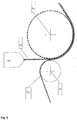
Fig. 6 zeigt einen schematischen und typischen Aufbau des erfindungsgemäßen Verfahrens. Hierbei wird in der Düse (1) ein Verbund aus einer beispielsweise aus Füllstoffe enthaltendem Ionomer bestehenden Schicht F, einer ionomerhaltigen und nichtmigrierende Antistatika enthaltenden Schicht A und einer (substratseitigen) Haftvermittlerschicht C als Schmelze (2) bei einer Temperatur von 200 bis 280 °C coextrudiert und unmittelbar darauf bei derselben Temperatur auf der Substratseite mit einer bedruckten Papierschicht D (3), die über eine Walze (4), beispielsweise eine Gummiwalze zugeführt wird, in Verbindung gebracht. Schicht D und der Schichtverbund F-A-C können gleichzeitig oder unmittelbar nach dem Zusammenbringen bei Temperaturen beispielsweise im Bereich von 150 bis 300 °C zwischen Prägewalze (5) und Walze (4) schmelzekaschiert und in dieser Ausführungsform gleichzeitig sichtseitig geprägt werden. - Ein strukturiertes Dekorlaminat umfassend eine Sichtseite und eine Substratseite, sichtseitig umfassend die folgenden unmittelbar aufeinanderfolgenden, miteinander haftend verbundenen Schichten F-A und substratseitig der Schicht A noch über eine Haftvermittlerschicht C eine dekortragende Polypropylen-Schicht D, wurde durch Coextrusion der Schichten F, A und C bei 250 °C und unmittelbar anschließende Schmelzekaschierung mit Schicht D noch bei 230 °C und einer Linienlast von 14,5 kN/m (145 N/cm) erhalten. Schicht F stellte sichtseitig die äußerste Schicht dar und enthielt 75 bis 100 Gew.-% extrudierbares thermoplastisches Ionomer; die an die Schicht F anschließende Schicht A enthielt 60 bis 95 Gew.-% extrudierbares thermoplastisches Ionomer und insgesamt 5 bis 40 Gew.-% eines nichtmigrierenden organischen Antistatikums.
- Es wurde die Norm für die Begehspannung nach DIN EN 1815:2016-12 erfüllt, und die Schichten F-A-C waren praktisch vollständig transparent und klar.
Claims (14)
- Dekorlaminat umfassend eine Sichtseite und eine Substratseite, sichtseitig umfassend mindestens die folgenden unmittelbar aufeinanderfolgenden, miteinander haftend verbundenen Schichten F-A und substratseitig der Schicht A noch eine oder mehrere dekortragende Schicht(en) D, dadurch gekennzeichnet, dass
die Schicht F sichtseitig die äußerste Schicht darstellt und 75 bis 100 Gew.-% extrudierbares thermoplastisches Ionomer enthält;
die an die Schicht F anschließende Schicht A 60 bis 95 Gew.-% extrudierbares thermoplastisches Ionomer enthält; und
Schicht A insgesamt 5 bis 40 Gew.-% eines oder mehrerer nichtmigrierender organischer Antistatika enthält. - Dekorlaminat nach Patentanspruch 1, dadurch gekennzeichnet, daß Schicht F frei von Antistatika ist.
- Dekorlaminat nach Patentanspruch 1 oder 2, dadurch gekennzeichnet, daß Schicht F 75 bis 100 Gew.-%, bevorzugt 90 bis 97, insbesondere 95 Gew.-% eines oder mehrerer extrudierbarer thermoplastischer Ionomere enthält.
- Dekorlaminat nach einem der Patentansprüche 1 bis 3, dadurch gekennzeichnet, daß Schicht A 60 bis 95 Gew.-%, bevorzugt 65 bis 85, insbesondere 70 bis 80 Gew.-% eines oder mehrerer extrudierbarer thermoplastischer Ionomere enthält.
- Dekorlaminat nach einem der Patentansprüche 1 bis 4, dadurch gekennzeichnet, daß die Schichten F und A ein oder mehrere identische Ionomere enthalten, bevorzugt dasselbe Ionomer oder Ionomergemisch umfassen.
- Dekorlaminat nach einem der Patentansprüche 1 bis 5, dadurch gekennzeichnet, daß Schicht A insgesamt 5 bis 40 Gew.-%, bevorzugt 15 bis 35, insbesondere 20 bis 30 Gew.-% eines oder mehrerer nichtmigrierender Antistatika enthält.
- Dekorlaminat nach einem der Patentansprüche 1 bis 6, dadurch gekennzeichnet, daß Schicht F 0 bis 25 Gew.-%, bevorzugt 3 bis 10 Gew.-%, insbesondere 5 Gew.-% eines oder mehrerer Funktions- und/oder Füllstoffe enthält, wobei die Funktionsadditive bevorzugt ausgewählt sind aus der Gruppe bestehend aus UV-Stabilisatoren, UV-Absorber, Farbpigmenten, Wachsen, Gleitmitteln, Anti-Slip-Additiven, antimikrobiellen sowie dehäsiv wirkenden Additiven und Flammschutzmitteln sowie deren Gemischen und die Füllstoffe bevorzugt ausgewählt sind aus der Gruppe bestehend aus Korund, Titandioxid, Sand, Talkum, Kreide, Kieselsäure, Glasperlen sowie deren Gemischen.
- Dekorlaminat nach einem der Patentansprüche 1 bis 7, dadurch gekennzeichnet, daß es frei von PVC, Vinylchloridmonomeren und/oder Melaminharz ist.
- Dekorlaminat nach einem der Patentansprüche 1 bis 8, dadurch gekennzeichnet, daß die Schichtdicke der Schicht F 10 bis 100 µm, bevorzugt 20 bis 80 µm insbesondere 30 bis 50 µm beträgt.
- Dekorlaminat nach einem der Patentansprüche 1 bis 9, dadurch gekennzeichnet, daß es zusätzlich gegebenenfalls eine, zwei oder mehrere weitere Schichten, die thermoplastische Polymere enthalten, umfaßt, zusätzlich optional eine oder mehrere Haftvermittlerschicht(en).
- Dekorlaminat nach Patentanspruch 10, dadurch gekennzeichnet, daß mindestens eine dekortragende Schicht D ein extrudierbares thermoplastisches Polymer, ausgewählt aus der Gruppe bestehend aus Polyethylenen, Polypropylenen und Polybutylenen, Polystyrol, Polyamid, Polyester, sowie deren Gemischen, und optional bedrucktes Papier, enthält.
- Dekorlaminat nach einem der Patentansprüche 1 bis 11, dadurch gekennzeichnet, daß in die Oberfläche des Dekorlaminats sichtseitig ein oder mehrere Muster oder Strukturen plastisch eingeprägt sind, wobei die plastischen Muster oder Strukturen weniger tief, gleich oder tiefer als die Schichtdicke der äußeren Schicht F eingeprägt sein können.
- Verfahren zur Herstellung eines Dekorlaminats nach einem der Patentansprüche 1 bis 12, dadurch gekennzeichnet, daß mindestens die Schichten F und A coextrudiert werden.
- Verwendung des Dekorlaminats nach einem der Patentansprüche 1 bis 12 als Bodenbelag oder in der Herstellung eines Bodenbelags, als Wand- oder Dachpaneele oder in der Herstellung von Wand- oder Dachpaneelen, als Möbelfolie, insbesondere in der Herstellung von Sperrholz- oder Spanplatten, als 3D-Folie, insbesondere in der Herstellung von Türen und Möbeln und/oder als graphische Folie, insbesondere Druckfolie.
Priority Applications (2)
| Application Number | Priority Date | Filing Date | Title |
|---|---|---|---|
| EP17157876.8A EP3366466B1 (de) | 2017-02-24 | 2017-02-24 | Antistatisches dekorlaminat |
| PCT/EP2018/054180 WO2018153874A1 (de) | 2017-02-24 | 2018-02-20 | Antistatisches dekorlaminat |
Applications Claiming Priority (1)
| Application Number | Priority Date | Filing Date | Title |
|---|---|---|---|
| EP17157876.8A EP3366466B1 (de) | 2017-02-24 | 2017-02-24 | Antistatisches dekorlaminat |
Publications (3)
| Publication Number | Publication Date |
|---|---|
| EP3366466A1 EP3366466A1 (de) | 2018-08-29 |
| EP3366466A8 EP3366466A8 (de) | 2018-10-24 |
| EP3366466B1 true EP3366466B1 (de) | 2019-06-12 |
Family
ID=58191306
Family Applications (1)
| Application Number | Title | Priority Date | Filing Date |
|---|---|---|---|
| EP17157876.8A Active EP3366466B1 (de) | 2017-02-24 | 2017-02-24 | Antistatisches dekorlaminat |
Country Status (2)
| Country | Link |
|---|---|
| EP (1) | EP3366466B1 (de) |
| WO (1) | WO2018153874A1 (de) |
Families Citing this family (1)
| Publication number | Priority date | Publication date | Assignee | Title |
|---|---|---|---|---|
| CN109437589A (zh) * | 2018-11-12 | 2019-03-08 | 浙江中港玻璃有限公司 | 一种玻璃的生产工艺 |
Family Cites Families (12)
| Publication number | Priority date | Publication date | Assignee | Title |
|---|---|---|---|---|
| DE4107150C2 (de) | 1991-03-06 | 1995-02-02 | Alkor Gmbh | Fußbodenbelagfolie |
| JP3720354B2 (ja) | 1993-09-20 | 2005-11-24 | ザ アムティコ カンパニー リミティド | 床仕上材 |
| EP0714762B1 (de) | 1994-06-22 | 2011-05-11 | Dai Nippon Printing Co., Ltd. | Deckschichtmaterial |
| MXPA02010080A (es) * | 2000-04-14 | 2003-04-25 | Du Pont | Acabado decorativo ionomerico, co-extruido de capas multiples. |
| PT1439953E (pt) | 2001-11-01 | 2005-10-31 | Ionphase Oy | Material de cobertura condutor electrico |
| ES2593842T3 (es) | 2012-03-28 | 2016-12-13 | Tarkett Gdl | Revestimiento de superficie multicapa |
| DE102012103016A1 (de) | 2012-04-05 | 2013-10-10 | Basf Se | Folien-Kaschierverbund |
| US9777181B2 (en) | 2013-12-20 | 2017-10-03 | E. I. Du Pont De Nemours And Company | Antistatic ethylene copolymer compositions |
| JP6520128B2 (ja) | 2014-01-10 | 2019-05-29 | 大日本印刷株式会社 | 化粧シート及び化粧板 |
| DE202014010984U1 (de) * | 2014-08-25 | 2017-03-02 | Profol Kunststoffe Gmbh | Geprägte und schmelzekaschierte Mehrschichtverbundfolie |
| WO2016047780A1 (ja) | 2014-09-26 | 2016-03-31 | 大日本印刷株式会社 | 化粧シート及び化粧板 |
| CN107002413A (zh) | 2014-12-05 | 2017-08-01 | 大日本印刷株式会社 | 使用了软木片的装饰材料 |
-
2017
- 2017-02-24 EP EP17157876.8A patent/EP3366466B1/de active Active
-
2018
- 2018-02-20 WO PCT/EP2018/054180 patent/WO2018153874A1/de not_active Ceased
Non-Patent Citations (1)
| Title |
|---|
| None * |
Also Published As
| Publication number | Publication date |
|---|---|
| EP3366466A1 (de) | 2018-08-29 |
| EP3366466A8 (de) | 2018-10-24 |
| WO2018153874A1 (de) | 2018-08-30 |
Similar Documents
| Publication | Publication Date | Title |
|---|---|---|
| EP2990195B1 (de) | Geprägte und schmelzekaschierte mehrschichtverbundfolie | |
| EP3210772B1 (de) | Schmelzekaschiertes dekorlaminat | |
| EP2699416B1 (de) | Fussbodenelement | |
| CN100566995C (zh) | 地板材料用装饰材料 | |
| EP0562166B1 (de) | Kantenband aus Kunststoff, Verfahren zu dessen Herstellung und Verwendung | |
| DE4121598C2 (de) | Mehrschichtige Kunststoffverbundfolie, Verfahren zu deren Herstellung und Verwendung | |
| DE202016008503U1 (de) | Schmelzekaschiertes Dekorlaminat | |
| DE102012022461B4 (de) | Abriebfestes dekoratives Beschichtungsmaterial, Verfahren zu dessen Herstellung und Verwendung des abriebfesten dekorativen Beschichtungsmaterials | |
| EP2759394A1 (de) | Trägerplatte für Dekorpaneel | |
| WO2013072349A2 (de) | Paneel mit kantenbrechung | |
| DE10214100B4 (de) | Bodenbelag aus einer mehrschichtigen Kunststoffbahn oder- platte mit dreidimensionaler Optik und Verfahren zu seiner Herstellung | |
| EP0987102B1 (de) | Mehrschichtige thermoverformbare Möbelkunststoffverbundfolie oder damit hergestellte Möbelteile sowie Verfahren zur Herstellung der Möbelkunststoffverbundfolie | |
| EP0795398B1 (de) | Folie zur Beschichtung von nachbearbeitbaren Substraten | |
| EP2788191B1 (de) | Transferverfahren zur herstellung thermoplastischer beschichtungen von fussbodenfliesen | |
| EP4225573B1 (de) | Uv schutzfolie für den aussenbereich | |
| EP2723561A1 (de) | Bedrucktes flächengebilde auf linoleum- oder korkment-basis | |
| DE202014008006U1 (de) | Koextrudierte Dreischichtfolie | |
| EP3366466A1 (de) | Antistatisches dekorlaminat | |
| JP4428191B2 (ja) | 化粧シートの製造方法 | |
| DE102022107719B4 (de) | UV Schutzfolie für den Außenbereich | |
| EP3974176B1 (de) | Verschleissschutzfolie für dekorpaneel | |
| EP4253456A1 (de) | Uv schutzfolie für den aussenbereich | |
| DE29913481U1 (de) | Mehrschichtige Fußbodenbelagfolie oder damit hergestellte Fußbodenelemente | |
| EP4509305A1 (de) | Folie zur bildung eines plattenmaterials und plattenmaterial | |
| DE20111734U1 (de) | Dekorschicht |
Legal Events
| Date | Code | Title | Description |
|---|---|---|---|
| PUAI | Public reference made under article 153(3) epc to a published international application that has entered the european phase |
Free format text: ORIGINAL CODE: 0009012 |
|
| STAA | Information on the status of an ep patent application or granted ep patent |
Free format text: STATUS: REQUEST FOR EXAMINATION WAS MADE |
|
| 17P | Request for examination filed |
Effective date: 20170224 |
|
| AK | Designated contracting states |
Kind code of ref document: A1 Designated state(s): AL AT BE BG CH CY CZ DE DK EE ES FI FR GB GR HR HU IE IS IT LI LT LU LV MC MK MT NL NO PL PT RO RS SE SI SK SM TR |
|
| AX | Request for extension of the european patent |
Extension state: BA ME |
|
| GRAP | Despatch of communication of intention to grant a patent |
Free format text: ORIGINAL CODE: EPIDOSNIGR1 |
|
| STAA | Information on the status of an ep patent application or granted ep patent |
Free format text: STATUS: GRANT OF PATENT IS INTENDED |
|
| INTG | Intention to grant announced |
Effective date: 20190124 |
|
| GRAS | Grant fee paid |
Free format text: ORIGINAL CODE: EPIDOSNIGR3 |
|
| GRAA | (expected) grant |
Free format text: ORIGINAL CODE: 0009210 |
|
| STAA | Information on the status of an ep patent application or granted ep patent |
Free format text: STATUS: THE PATENT HAS BEEN GRANTED |
|
| AK | Designated contracting states |
Kind code of ref document: B1 Designated state(s): AL AT BE BG CH CY CZ DE DK EE ES FI FR GB GR HR HU IE IS IT LI LT LU LV MC MK MT NL NO PL PT RO RS SE SI SK SM TR |
|
| REG | Reference to a national code |
Ref country code: GB Ref legal event code: FG4D Free format text: NOT ENGLISH |
|
| REG | Reference to a national code |
Ref country code: CH Ref legal event code: EP |
|
| REG | Reference to a national code |
Ref country code: AT Ref legal event code: REF Ref document number: 1142044 Country of ref document: AT Kind code of ref document: T Effective date: 20190615 |
|
| REG | Reference to a national code |
Ref country code: DE Ref legal event code: R096 Ref document number: 502017001499 Country of ref document: DE |
|
| REG | Reference to a national code |
Ref country code: IE Ref legal event code: FG4D Free format text: LANGUAGE OF EP DOCUMENT: GERMAN |
|
| REG | Reference to a national code |
Ref country code: NL Ref legal event code: MP Effective date: 20190612 |
|
| REG | Reference to a national code |
Ref country code: LT Ref legal event code: MG4D |
|
| PG25 | Lapsed in a contracting state [announced via postgrant information from national office to epo] |
Ref country code: FI Free format text: LAPSE BECAUSE OF FAILURE TO SUBMIT A TRANSLATION OF THE DESCRIPTION OR TO PAY THE FEE WITHIN THE PRESCRIBED TIME-LIMIT Effective date: 20190612 Ref country code: AL Free format text: LAPSE BECAUSE OF FAILURE TO SUBMIT A TRANSLATION OF THE DESCRIPTION OR TO PAY THE FEE WITHIN THE PRESCRIBED TIME-LIMIT Effective date: 20190612 Ref country code: NO Free format text: LAPSE BECAUSE OF FAILURE TO SUBMIT A TRANSLATION OF THE DESCRIPTION OR TO PAY THE FEE WITHIN THE PRESCRIBED TIME-LIMIT Effective date: 20190912 Ref country code: HR Free format text: LAPSE BECAUSE OF FAILURE TO SUBMIT A TRANSLATION OF THE DESCRIPTION OR TO PAY THE FEE WITHIN THE PRESCRIBED TIME-LIMIT Effective date: 20190612 Ref country code: SE Free format text: LAPSE BECAUSE OF FAILURE TO SUBMIT A TRANSLATION OF THE DESCRIPTION OR TO PAY THE FEE WITHIN THE PRESCRIBED TIME-LIMIT Effective date: 20190612 Ref country code: LT Free format text: LAPSE BECAUSE OF FAILURE TO SUBMIT A TRANSLATION OF THE DESCRIPTION OR TO PAY THE FEE WITHIN THE PRESCRIBED TIME-LIMIT Effective date: 20190612 |
|
| PG25 | Lapsed in a contracting state [announced via postgrant information from national office to epo] |
Ref country code: RS Free format text: LAPSE BECAUSE OF FAILURE TO SUBMIT A TRANSLATION OF THE DESCRIPTION OR TO PAY THE FEE WITHIN THE PRESCRIBED TIME-LIMIT Effective date: 20190612 Ref country code: LV Free format text: LAPSE BECAUSE OF FAILURE TO SUBMIT A TRANSLATION OF THE DESCRIPTION OR TO PAY THE FEE WITHIN THE PRESCRIBED TIME-LIMIT Effective date: 20190612 Ref country code: GR Free format text: LAPSE BECAUSE OF FAILURE TO SUBMIT A TRANSLATION OF THE DESCRIPTION OR TO PAY THE FEE WITHIN THE PRESCRIBED TIME-LIMIT Effective date: 20190913 Ref country code: BG Free format text: LAPSE BECAUSE OF FAILURE TO SUBMIT A TRANSLATION OF THE DESCRIPTION OR TO PAY THE FEE WITHIN THE PRESCRIBED TIME-LIMIT Effective date: 20190912 |
|
| PG25 | Lapsed in a contracting state [announced via postgrant information from national office to epo] |
Ref country code: CZ Free format text: LAPSE BECAUSE OF FAILURE TO SUBMIT A TRANSLATION OF THE DESCRIPTION OR TO PAY THE FEE WITHIN THE PRESCRIBED TIME-LIMIT Effective date: 20190612 Ref country code: PT Free format text: LAPSE BECAUSE OF FAILURE TO SUBMIT A TRANSLATION OF THE DESCRIPTION OR TO PAY THE FEE WITHIN THE PRESCRIBED TIME-LIMIT Effective date: 20191014 Ref country code: SK Free format text: LAPSE BECAUSE OF FAILURE TO SUBMIT A TRANSLATION OF THE DESCRIPTION OR TO PAY THE FEE WITHIN THE PRESCRIBED TIME-LIMIT Effective date: 20190612 Ref country code: EE Free format text: LAPSE BECAUSE OF FAILURE TO SUBMIT A TRANSLATION OF THE DESCRIPTION OR TO PAY THE FEE WITHIN THE PRESCRIBED TIME-LIMIT Effective date: 20190612 Ref country code: RO Free format text: LAPSE BECAUSE OF FAILURE TO SUBMIT A TRANSLATION OF THE DESCRIPTION OR TO PAY THE FEE WITHIN THE PRESCRIBED TIME-LIMIT Effective date: 20190612 Ref country code: NL Free format text: LAPSE BECAUSE OF FAILURE TO SUBMIT A TRANSLATION OF THE DESCRIPTION OR TO PAY THE FEE WITHIN THE PRESCRIBED TIME-LIMIT Effective date: 20190612 |
|
| PG25 | Lapsed in a contracting state [announced via postgrant information from national office to epo] |
Ref country code: ES Free format text: LAPSE BECAUSE OF FAILURE TO SUBMIT A TRANSLATION OF THE DESCRIPTION OR TO PAY THE FEE WITHIN THE PRESCRIBED TIME-LIMIT Effective date: 20190612 Ref country code: IS Free format text: LAPSE BECAUSE OF FAILURE TO SUBMIT A TRANSLATION OF THE DESCRIPTION OR TO PAY THE FEE WITHIN THE PRESCRIBED TIME-LIMIT Effective date: 20191012 Ref country code: IT Free format text: LAPSE BECAUSE OF FAILURE TO SUBMIT A TRANSLATION OF THE DESCRIPTION OR TO PAY THE FEE WITHIN THE PRESCRIBED TIME-LIMIT Effective date: 20190612 Ref country code: SM Free format text: LAPSE BECAUSE OF FAILURE TO SUBMIT A TRANSLATION OF THE DESCRIPTION OR TO PAY THE FEE WITHIN THE PRESCRIBED TIME-LIMIT Effective date: 20190612 |
|
| REG | Reference to a national code |
Ref country code: DE Ref legal event code: R097 Ref document number: 502017001499 Country of ref document: DE |
|
| PG25 | Lapsed in a contracting state [announced via postgrant information from national office to epo] |
Ref country code: TR Free format text: LAPSE BECAUSE OF FAILURE TO SUBMIT A TRANSLATION OF THE DESCRIPTION OR TO PAY THE FEE WITHIN THE PRESCRIBED TIME-LIMIT Effective date: 20190612 |
|
| PLBE | No opposition filed within time limit |
Free format text: ORIGINAL CODE: 0009261 |
|
| STAA | Information on the status of an ep patent application or granted ep patent |
Free format text: STATUS: NO OPPOSITION FILED WITHIN TIME LIMIT |
|
| PG25 | Lapsed in a contracting state [announced via postgrant information from national office to epo] |
Ref country code: PL Free format text: LAPSE BECAUSE OF FAILURE TO SUBMIT A TRANSLATION OF THE DESCRIPTION OR TO PAY THE FEE WITHIN THE PRESCRIBED TIME-LIMIT Effective date: 20190612 Ref country code: DK Free format text: LAPSE BECAUSE OF FAILURE TO SUBMIT A TRANSLATION OF THE DESCRIPTION OR TO PAY THE FEE WITHIN THE PRESCRIBED TIME-LIMIT Effective date: 20190612 |
|
| 26N | No opposition filed |
Effective date: 20200313 |
|
| PG25 | Lapsed in a contracting state [announced via postgrant information from national office to epo] |
Ref country code: IS Free format text: LAPSE BECAUSE OF FAILURE TO SUBMIT A TRANSLATION OF THE DESCRIPTION OR TO PAY THE FEE WITHIN THE PRESCRIBED TIME-LIMIT Effective date: 20200224 |
|
| PG2D | Information on lapse in contracting state deleted |
Ref country code: IS |
|
| REG | Reference to a national code |
Ref country code: CH Ref legal event code: PL |
|
| REG | Reference to a national code |
Ref country code: BE Ref legal event code: MM Effective date: 20200229 |
|
| PG25 | Lapsed in a contracting state [announced via postgrant information from national office to epo] |
Ref country code: LU Free format text: LAPSE BECAUSE OF NON-PAYMENT OF DUE FEES Effective date: 20200224 Ref country code: MC Free format text: LAPSE BECAUSE OF FAILURE TO SUBMIT A TRANSLATION OF THE DESCRIPTION OR TO PAY THE FEE WITHIN THE PRESCRIBED TIME-LIMIT Effective date: 20190612 |
|
| PG25 | Lapsed in a contracting state [announced via postgrant information from national office to epo] |
Ref country code: LI Free format text: LAPSE BECAUSE OF NON-PAYMENT OF DUE FEES Effective date: 20200229 Ref country code: CH Free format text: LAPSE BECAUSE OF NON-PAYMENT OF DUE FEES Effective date: 20200229 |
|
| PG25 | Lapsed in a contracting state [announced via postgrant information from national office to epo] |
Ref country code: IE Free format text: LAPSE BECAUSE OF NON-PAYMENT OF DUE FEES Effective date: 20200224 Ref country code: FR Free format text: LAPSE BECAUSE OF NON-PAYMENT OF DUE FEES Effective date: 20200229 |
|
| PG25 | Lapsed in a contracting state [announced via postgrant information from national office to epo] |
Ref country code: BE Free format text: LAPSE BECAUSE OF NON-PAYMENT OF DUE FEES Effective date: 20200229 |
|
| GBPC | Gb: european patent ceased through non-payment of renewal fee |
Effective date: 20210224 |
|
| PG25 | Lapsed in a contracting state [announced via postgrant information from national office to epo] |
Ref country code: GB Free format text: LAPSE BECAUSE OF NON-PAYMENT OF DUE FEES Effective date: 20210224 |
|
| PG25 | Lapsed in a contracting state [announced via postgrant information from national office to epo] |
Ref country code: MT Free format text: LAPSE BECAUSE OF FAILURE TO SUBMIT A TRANSLATION OF THE DESCRIPTION OR TO PAY THE FEE WITHIN THE PRESCRIBED TIME-LIMIT Effective date: 20190612 Ref country code: CY Free format text: LAPSE BECAUSE OF FAILURE TO SUBMIT A TRANSLATION OF THE DESCRIPTION OR TO PAY THE FEE WITHIN THE PRESCRIBED TIME-LIMIT Effective date: 20190612 |
|
| PG25 | Lapsed in a contracting state [announced via postgrant information from national office to epo] |
Ref country code: MK Free format text: LAPSE BECAUSE OF FAILURE TO SUBMIT A TRANSLATION OF THE DESCRIPTION OR TO PAY THE FEE WITHIN THE PRESCRIBED TIME-LIMIT Effective date: 20190612 |
|
| REG | Reference to a national code |
Ref country code: AT Ref legal event code: MM01 Ref document number: 1142044 Country of ref document: AT Kind code of ref document: T Effective date: 20220224 |
|
| PG25 | Lapsed in a contracting state [announced via postgrant information from national office to epo] |
Ref country code: AT Free format text: LAPSE BECAUSE OF NON-PAYMENT OF DUE FEES Effective date: 20220224 |
|
| PGFP | Annual fee paid to national office [announced via postgrant information from national office to epo] |
Ref country code: DE Payment date: 20230216 Year of fee payment: 7 |
|
| PG25 | Lapsed in a contracting state [announced via postgrant information from national office to epo] |
Ref country code: SI Free format text: LAPSE BECAUSE OF FAILURE TO SUBMIT A TRANSLATION OF THE DESCRIPTION OR TO PAY THE FEE WITHIN THE PRESCRIBED TIME-LIMIT Effective date: 20190612 |
|
| REG | Reference to a national code |
Ref country code: DE Ref legal event code: R119 Ref document number: 502017001499 Country of ref document: DE |
|
| PG25 | Lapsed in a contracting state [announced via postgrant information from national office to epo] |
Ref country code: DE Free format text: LAPSE BECAUSE OF NON-PAYMENT OF DUE FEES Effective date: 20240903 |
|
| PG25 | Lapsed in a contracting state [announced via postgrant information from national office to epo] |
Ref country code: DE Free format text: LAPSE BECAUSE OF NON-PAYMENT OF DUE FEES Effective date: 20240903 |