EP3365415B1 - Oil-in-water emulsions - Google Patents
Oil-in-water emulsions Download PDFInfo
- Publication number
- EP3365415B1 EP3365415B1 EP16801006.4A EP16801006A EP3365415B1 EP 3365415 B1 EP3365415 B1 EP 3365415B1 EP 16801006 A EP16801006 A EP 16801006A EP 3365415 B1 EP3365415 B1 EP 3365415B1
- Authority
- EP
- European Patent Office
- Prior art keywords
- oil
- water emulsion
- emulsion
- fuel
- hydrocarbon
- Prior art date
- Legal status (The legal status is an assumption and is not a legal conclusion. Google has not performed a legal analysis and makes no representation as to the accuracy of the status listed.)
- Active
Links
Images






Classifications
-
- C—CHEMISTRY; METALLURGY
- C08—ORGANIC MACROMOLECULAR COMPOUNDS; THEIR PREPARATION OR CHEMICAL WORKING-UP; COMPOSITIONS BASED THEREON
- C08L—COMPOSITIONS OF MACROMOLECULAR COMPOUNDS
- C08L95/00—Compositions of bituminous materials, e.g. asphalt, tar, pitch
-
- C—CHEMISTRY; METALLURGY
- C10—PETROLEUM, GAS OR COKE INDUSTRIES; TECHNICAL GASES CONTAINING CARBON MONOXIDE; FUELS; LUBRICANTS; PEAT
- C10L—FUELS NOT OTHERWISE PROVIDED FOR; NATURAL GAS; SYNTHETIC NATURAL GAS OBTAINED BY PROCESSES NOT COVERED BY SUBCLASSES C10G OR C10K; LIQUIFIED PETROLEUM GAS; USE OF ADDITIVES TO FUELS OR FIRES; FIRE-LIGHTERS
- C10L1/00—Liquid carbonaceous fuels
- C10L1/32—Liquid carbonaceous fuels consisting of coal-oil suspensions or aqueous emulsions or oil emulsions
- C10L1/328—Oil emulsions containing water or any other hydrophilic phase
-
- C—CHEMISTRY; METALLURGY
- C08—ORGANIC MACROMOLECULAR COMPOUNDS; THEIR PREPARATION OR CHEMICAL WORKING-UP; COMPOSITIONS BASED THEREON
- C08L—COMPOSITIONS OF MACROMOLECULAR COMPOUNDS
- C08L95/00—Compositions of bituminous materials, e.g. asphalt, tar, pitch
- C08L95/005—Aqueous compositions, e.g. emulsions
-
- C—CHEMISTRY; METALLURGY
- C09—DYES; PAINTS; POLISHES; NATURAL RESINS; ADHESIVES; COMPOSITIONS NOT OTHERWISE PROVIDED FOR; APPLICATIONS OF MATERIALS NOT OTHERWISE PROVIDED FOR
- C09K—MATERIALS FOR MISCELLANEOUS APPLICATIONS, NOT PROVIDED FOR ELSEWHERE
- C09K23/00—Use of substances as emulsifying, wetting, dispersing, or foam-producing agents
- C09K23/42—Ethers, e.g. polyglycol ethers of alcohols or phenols
- C09K23/46—Ethers of aminoalcohols
-
- C—CHEMISTRY; METALLURGY
- C09—DYES; PAINTS; POLISHES; NATURAL RESINS; ADHESIVES; COMPOSITIONS NOT OTHERWISE PROVIDED FOR; APPLICATIONS OF MATERIALS NOT OTHERWISE PROVIDED FOR
- C09K—MATERIALS FOR MISCELLANEOUS APPLICATIONS, NOT PROVIDED FOR ELSEWHERE
- C09K23/00—Use of substances as emulsifying, wetting, dispersing, or foam-producing agents
- C09K23/50—Derivatives of lignin
-
- C—CHEMISTRY; METALLURGY
- C10—PETROLEUM, GAS OR COKE INDUSTRIES; TECHNICAL GASES CONTAINING CARBON MONOXIDE; FUELS; LUBRICANTS; PEAT
- C10L—FUELS NOT OTHERWISE PROVIDED FOR; NATURAL GAS; SYNTHETIC NATURAL GAS OBTAINED BY PROCESSES NOT COVERED BY SUBCLASSES C10G OR C10K; LIQUIFIED PETROLEUM GAS; USE OF ADDITIVES TO FUELS OR FIRES; FIRE-LIGHTERS
- C10L1/00—Liquid carbonaceous fuels
- C10L1/10—Liquid carbonaceous fuels containing additives
- C10L1/14—Organic compounds
- C10L1/18—Organic compounds containing oxygen
- C10L1/192—Macromolecular compounds
- C10L1/198—Macromolecular compounds obtained otherwise than by reactions involving only carbon-to-carbon unsaturated bonds homo- or copolymers of compounds having one or more unsaturated aliphatic radicals, each having only one carbon to carbon double bond, and at least one being terminated by an acyloxy radical of a saturated carboxylic acid, of carbonic acid
-
- C—CHEMISTRY; METALLURGY
- C10—PETROLEUM, GAS OR COKE INDUSTRIES; TECHNICAL GASES CONTAINING CARBON MONOXIDE; FUELS; LUBRICANTS; PEAT
- C10L—FUELS NOT OTHERWISE PROVIDED FOR; NATURAL GAS; SYNTHETIC NATURAL GAS OBTAINED BY PROCESSES NOT COVERED BY SUBCLASSES C10G OR C10K; LIQUIFIED PETROLEUM GAS; USE OF ADDITIVES TO FUELS OR FIRES; FIRE-LIGHTERS
- C10L1/00—Liquid carbonaceous fuels
- C10L1/10—Liquid carbonaceous fuels containing additives
- C10L1/14—Organic compounds
- C10L1/22—Organic compounds containing nitrogen
- C10L1/222—Organic compounds containing nitrogen containing at least one carbon-to-nitrogen single bond
-
- C—CHEMISTRY; METALLURGY
- C10—PETROLEUM, GAS OR COKE INDUSTRIES; TECHNICAL GASES CONTAINING CARBON MONOXIDE; FUELS; LUBRICANTS; PEAT
- C10L—FUELS NOT OTHERWISE PROVIDED FOR; NATURAL GAS; SYNTHETIC NATURAL GAS OBTAINED BY PROCESSES NOT COVERED BY SUBCLASSES C10G OR C10K; LIQUIFIED PETROLEUM GAS; USE OF ADDITIVES TO FUELS OR FIRES; FIRE-LIGHTERS
- C10L1/00—Liquid carbonaceous fuels
- C10L1/10—Liquid carbonaceous fuels containing additives
- C10L1/14—Organic compounds
- C10L1/22—Organic compounds containing nitrogen
- C10L1/222—Organic compounds containing nitrogen containing at least one carbon-to-nitrogen single bond
- C10L1/2222—(cyclo)aliphatic amines; polyamines (no macromolecular substituent 30C); quaternair ammonium compounds; carbamates
-
- C—CHEMISTRY; METALLURGY
- C10—PETROLEUM, GAS OR COKE INDUSTRIES; TECHNICAL GASES CONTAINING CARBON MONOXIDE; FUELS; LUBRICANTS; PEAT
- C10L—FUELS NOT OTHERWISE PROVIDED FOR; NATURAL GAS; SYNTHETIC NATURAL GAS OBTAINED BY PROCESSES NOT COVERED BY SUBCLASSES C10G OR C10K; LIQUIFIED PETROLEUM GAS; USE OF ADDITIVES TO FUELS OR FIRES; FIRE-LIGHTERS
- C10L1/00—Liquid carbonaceous fuels
- C10L1/10—Liquid carbonaceous fuels containing additives
- C10L1/14—Organic compounds
- C10L1/22—Organic compounds containing nitrogen
- C10L1/234—Macromolecular compounds
- C10L1/238—Macromolecular compounds obtained otherwise than by reactions involving only carbon-to-carbon unsaturated bonds
-
- C—CHEMISTRY; METALLURGY
- C10—PETROLEUM, GAS OR COKE INDUSTRIES; TECHNICAL GASES CONTAINING CARBON MONOXIDE; FUELS; LUBRICANTS; PEAT
- C10L—FUELS NOT OTHERWISE PROVIDED FOR; NATURAL GAS; SYNTHETIC NATURAL GAS OBTAINED BY PROCESSES NOT COVERED BY SUBCLASSES C10G OR C10K; LIQUIFIED PETROLEUM GAS; USE OF ADDITIVES TO FUELS OR FIRES; FIRE-LIGHTERS
- C10L1/00—Liquid carbonaceous fuels
- C10L1/32—Liquid carbonaceous fuels consisting of coal-oil suspensions or aqueous emulsions or oil emulsions
-
- G—PHYSICS
- G01—MEASURING; TESTING
- G01N—INVESTIGATING OR ANALYSING MATERIALS BY DETERMINING THEIR CHEMICAL OR PHYSICAL PROPERTIES
- G01N33/00—Investigating or analysing materials by specific methods not covered by groups G01N1/00 - G01N31/00
- G01N33/18—Water
- G01N33/1826—Organic contamination in water
- G01N33/1833—Oil in water
-
- C—CHEMISTRY; METALLURGY
- C10—PETROLEUM, GAS OR COKE INDUSTRIES; TECHNICAL GASES CONTAINING CARBON MONOXIDE; FUELS; LUBRICANTS; PEAT
- C10L—FUELS NOT OTHERWISE PROVIDED FOR; NATURAL GAS; SYNTHETIC NATURAL GAS OBTAINED BY PROCESSES NOT COVERED BY SUBCLASSES C10G OR C10K; LIQUIFIED PETROLEUM GAS; USE OF ADDITIVES TO FUELS OR FIRES; FIRE-LIGHTERS
- C10L1/00—Liquid carbonaceous fuels
- C10L1/10—Liquid carbonaceous fuels containing additives
- C10L1/14—Organic compounds
- C10L1/18—Organic compounds containing oxygen
- C10L1/1817—Compounds of uncertain formula; reaction products where mixtures of compounds are obtained
-
- C—CHEMISTRY; METALLURGY
- C10—PETROLEUM, GAS OR COKE INDUSTRIES; TECHNICAL GASES CONTAINING CARBON MONOXIDE; FUELS; LUBRICANTS; PEAT
- C10L—FUELS NOT OTHERWISE PROVIDED FOR; NATURAL GAS; SYNTHETIC NATURAL GAS OBTAINED BY PROCESSES NOT COVERED BY SUBCLASSES C10G OR C10K; LIQUIFIED PETROLEUM GAS; USE OF ADDITIVES TO FUELS OR FIRES; FIRE-LIGHTERS
- C10L1/00—Liquid carbonaceous fuels
- C10L1/10—Liquid carbonaceous fuels containing additives
- C10L1/14—Organic compounds
- C10L1/18—Organic compounds containing oxygen
- C10L1/188—Carboxylic acids; metal salts thereof
-
- C—CHEMISTRY; METALLURGY
- C10—PETROLEUM, GAS OR COKE INDUSTRIES; TECHNICAL GASES CONTAINING CARBON MONOXIDE; FUELS; LUBRICANTS; PEAT
- C10L—FUELS NOT OTHERWISE PROVIDED FOR; NATURAL GAS; SYNTHETIC NATURAL GAS OBTAINED BY PROCESSES NOT COVERED BY SUBCLASSES C10G OR C10K; LIQUIFIED PETROLEUM GAS; USE OF ADDITIVES TO FUELS OR FIRES; FIRE-LIGHTERS
- C10L1/00—Liquid carbonaceous fuels
- C10L1/10—Liquid carbonaceous fuels containing additives
- C10L1/14—Organic compounds
- C10L1/22—Organic compounds containing nitrogen
- C10L1/221—Organic compounds containing nitrogen compounds of uncertain formula; reaction products where mixtures of compounds are obtained
-
- C—CHEMISTRY; METALLURGY
- C10—PETROLEUM, GAS OR COKE INDUSTRIES; TECHNICAL GASES CONTAINING CARBON MONOXIDE; FUELS; LUBRICANTS; PEAT
- C10L—FUELS NOT OTHERWISE PROVIDED FOR; NATURAL GAS; SYNTHETIC NATURAL GAS OBTAINED BY PROCESSES NOT COVERED BY SUBCLASSES C10G OR C10K; LIQUIFIED PETROLEUM GAS; USE OF ADDITIVES TO FUELS OR FIRES; FIRE-LIGHTERS
- C10L1/00—Liquid carbonaceous fuels
- C10L1/10—Liquid carbonaceous fuels containing additives
- C10L1/14—Organic compounds
- C10L1/22—Organic compounds containing nitrogen
- C10L1/222—Organic compounds containing nitrogen containing at least one carbon-to-nitrogen single bond
- C10L1/2222—(cyclo)aliphatic amines; polyamines (no macromolecular substituent 30C); quaternair ammonium compounds; carbamates
- C10L1/2225—(cyclo)aliphatic amines; polyamines (no macromolecular substituent 30C); quaternair ammonium compounds; carbamates hydroxy containing
-
- C—CHEMISTRY; METALLURGY
- C10—PETROLEUM, GAS OR COKE INDUSTRIES; TECHNICAL GASES CONTAINING CARBON MONOXIDE; FUELS; LUBRICANTS; PEAT
- C10L—FUELS NOT OTHERWISE PROVIDED FOR; NATURAL GAS; SYNTHETIC NATURAL GAS OBTAINED BY PROCESSES NOT COVERED BY SUBCLASSES C10G OR C10K; LIQUIFIED PETROLEUM GAS; USE OF ADDITIVES TO FUELS OR FIRES; FIRE-LIGHTERS
- C10L2200/00—Components of fuel compositions
- C10L2200/04—Organic compounds
- C10L2200/0407—Specifically defined hydrocarbon fractions as obtained from, e.g. a distillation column
- C10L2200/0453—Petroleum or natural waxes, e.g. paraffin waxes, asphaltenes
-
- C—CHEMISTRY; METALLURGY
- C10—PETROLEUM, GAS OR COKE INDUSTRIES; TECHNICAL GASES CONTAINING CARBON MONOXIDE; FUELS; LUBRICANTS; PEAT
- C10L—FUELS NOT OTHERWISE PROVIDED FOR; NATURAL GAS; SYNTHETIC NATURAL GAS OBTAINED BY PROCESSES NOT COVERED BY SUBCLASSES C10G OR C10K; LIQUIFIED PETROLEUM GAS; USE OF ADDITIVES TO FUELS OR FIRES; FIRE-LIGHTERS
- C10L2230/00—Function and purpose of a components of a fuel or the composition as a whole
- C10L2230/14—Function and purpose of a components of a fuel or the composition as a whole for improving storage or transport of the fuel
-
- C—CHEMISTRY; METALLURGY
- C10—PETROLEUM, GAS OR COKE INDUSTRIES; TECHNICAL GASES CONTAINING CARBON MONOXIDE; FUELS; LUBRICANTS; PEAT
- C10L—FUELS NOT OTHERWISE PROVIDED FOR; NATURAL GAS; SYNTHETIC NATURAL GAS OBTAINED BY PROCESSES NOT COVERED BY SUBCLASSES C10G OR C10K; LIQUIFIED PETROLEUM GAS; USE OF ADDITIVES TO FUELS OR FIRES; FIRE-LIGHTERS
- C10L2250/00—Structural features of fuel components or fuel compositions, either in solid, liquid or gaseous state
- C10L2250/06—Particle, bubble or droplet size
-
- C—CHEMISTRY; METALLURGY
- C10—PETROLEUM, GAS OR COKE INDUSTRIES; TECHNICAL GASES CONTAINING CARBON MONOXIDE; FUELS; LUBRICANTS; PEAT
- C10L—FUELS NOT OTHERWISE PROVIDED FOR; NATURAL GAS; SYNTHETIC NATURAL GAS OBTAINED BY PROCESSES NOT COVERED BY SUBCLASSES C10G OR C10K; LIQUIFIED PETROLEUM GAS; USE OF ADDITIVES TO FUELS OR FIRES; FIRE-LIGHTERS
- C10L2250/00—Structural features of fuel components or fuel compositions, either in solid, liquid or gaseous state
- C10L2250/08—Emulsion details
- C10L2250/082—Oil in water (o/w) emulsion
-
- C—CHEMISTRY; METALLURGY
- C10—PETROLEUM, GAS OR COKE INDUSTRIES; TECHNICAL GASES CONTAINING CARBON MONOXIDE; FUELS; LUBRICANTS; PEAT
- C10L—FUELS NOT OTHERWISE PROVIDED FOR; NATURAL GAS; SYNTHETIC NATURAL GAS OBTAINED BY PROCESSES NOT COVERED BY SUBCLASSES C10G OR C10K; LIQUIFIED PETROLEUM GAS; USE OF ADDITIVES TO FUELS OR FIRES; FIRE-LIGHTERS
- C10L2270/00—Specifically adapted fuels
- C10L2270/02—Specifically adapted fuels for internal combustion engines
- C10L2270/026—Specifically adapted fuels for internal combustion engines for diesel engines, e.g. automobiles, stationary, marine
Definitions
- This invention relates to oil-in-water (water continuous) emulsions for use as fuels, and which have high static and dynamic stability.
- the invention also relates to a process for their preparation.
- Heavy fuel oils are normally produced by blending viscous refinery residues with higher value distillate fuels to provide the lower viscosity characteristics required for acceptable fuel handling and combustion performance.
- Direct use of high viscosity refinery residues requires high-temperature storage and handling that limits and complicates their potential use, and consequently lowers their value.
- further processing e.g. coking, hydrocracking, etc.
- this strategy requires large capital investments to be made by the oil refinery, produces some lower value products, generates difficult to market by-products, results in an increase of emissions (including greenhouse and acid gases), all of which can serve to limit the economic advantage of this approach.
- an oil-in-water emulsion particularly an oil-in-water emulsion fuel, and more particularly a marine fuel, that has improved stability during storage and handling.
- the present invention is directed to an oil-in-water emulsion, for use as a fuel, and a method for its production, whereby the distillates conventionally used for blending down hydrocarbon residue viscosity are not required, and are replaced with water and a small amount of stabilising chemical additives.
- the invention can be directly applied to a wide range of heavy hydrocarbon and refinery residue streams.
- Such hydrocarbon-containing materials include: atmospheric and vacuum residues, visbroken or thermally cracked residues, vacuum flashed visbroken residues, and other heavy, viscous residues produced from refinery and/or heavy oil upgrading facilities (such as hydrocracking, de-asphalting and similar conversion processes).
- An added benefit of the invention is to provide a means of enhancing the handling and combustion characteristics by emulsification.
- the importance of the droplet size distribution characteristics of an emulsion fuel on its resulting combustion performance has been previously documented (see above), there remains a need to simultaneously control rheological properties in order to produce a fuel that can be handled in a wide range of system applications.
- the rheological properties of the fuel are important in ensuring sustainable hydraulic performance of the fuel handling and injection systems.
- the droplet size distribution of the oil-in-water emulsion is maintained within particular limits. When used as a fuel, this enables control of both the rheological characteristics during the fuel handling, and the (rapid) burn-out of the fuel to ensure acceptable (if not complete) carbon utilisation in terms of efficiency and resulting emissions.
- a first aspect of the invention provides an oil-in-water emulsion comprising an oil phase and an aqueous phase as set out in the appended claims.
- An emulsion having such characteristics can result in high static and dynamic stability, as set out above.
- the invention provides a process for preparing the oil-in-water emulsion fuel comprising the steps of:
- Values of parameters are sometimes expressed in terms of a particular value ⁇ a percentage. This means that the value of that parameter can be either the value specified, or a range of values either side of the specified value, calculated from the percentage.
- a viscosity of greater than 100 and up to 700 mPas at 50 °C ( ⁇ 10%) and 20 s -1 ( ⁇ 10%) is referred to above. This means that the viscosity is greater than 100 and up to 700 mPas, at a temperature that is either 50°C, or in the range of from 45 to 55°C, and at a shear rate that is either 20 s -1 , or in the range of from 18-22 s -1 .
- a static stability of less than 5% residue after centrifugation at 50°C ( ⁇ 10%) and 2000g ( ⁇ 10%) for 30 minutes ( ⁇ 10%) means that the static stability is such that less than 5% residue (by weight) is produced after centrifugation at a temperature that is either 50°C or in the range of from 45-55°C, at a g-force of either 2000g or in the range of from 1800-2200g, over a time period that is 30 minutes or in the range of from 27-33 minutes.
- the average droplet size distribution of the oil phase can be measured by conventional techniques, for example using light scattering techniques using commercially and readily available apparatus, such as a Malvern MastersizerTM instrument.
- the average droplet size is expressed as the Volume Moment Mean, represented as the D[4,3] mean.
- the average droplet size is in the range of from 3 to 15 ⁇ m, although is preferably in the range of 5 to 10 ⁇ m.
- Similar light scattering techniques and apparatus can be used to determine the droplet size distribution, and hence the weight%, of droplets with a size of greater than 125 ⁇ m based on the volume equivalent sphere diameter.
- the percent of particles having a size of greater than 125 ⁇ m is less than 3wt%. Preferably it is less than 2 wt%, and more preferably less than 1 wt%. In embodiments, less than 0.5wt% can be achieved.
- the viscosity can also be routinely measured using standard techniques, and equipment such as the Malvern KinexusTM, which measures viscosity at controlled temperature and shear rates.
- the value is expressed in terms of mPas (cP), and is preferably determined at a shear rate of 20 s -1 and at 50°C, although in one embodiment, the shear rate and temperature can differ by up to ⁇ 10%.
- the value is in the range of from greater than 100 and up to 700 mPas under such conditions, more preferably in the range of from 200 to 700 mPas.
- Static stability refers to the stability of the emulsion during storage. This can conveniently be measured by the centrifugation method according to the third aspect of the present invention, by determining the amount of material (wt%) that deposits from the oil-in-water emulsion.
- the method for determining the static stability of an oil-in-water emulsion comprises the steps of:
- the centrifuging is typically operated in excess of 1000g (i.e. g-force), and preferably in the range of from 1000 to 3000g, for example 1500 to 2500g.
- 2000g ⁇ 10% is employed (i.e. 2000g or in the range of from 1800 to 2200g).
- the temperature is typically in the range of from 40 to 90°C, for example 40 to 60°C, such as 50°C ⁇ 10% (i.e. 50°C, or in the range of from 45 to 55°C).
- a typical sample size is in the range of from 1 to 100 mL, for example 5 to 15 mL, e.g. 10mL ⁇ 10% (i.e. 10mL or in the range of from 9 to 11 mL).
- a suitable time for centrifugation is from 1 to 60 minutes, for example from 20 to 40 minutes, typically 30 minutes ⁇ 10% (i.e. 30 minutes or in the range of from 27 to 33 minutes).
- Typical conditions include centrifugation at 2000g for 30 minutes at 50°C, using a sample size of 10mL.
- the static stability is preferably less than 3wt% residue remaining after centrifugation.
- the static stability at 50°C is such that the residue after centrifugation of a 10mL sample is less than 5wt%. Preferably, this quantity is less than 4wt%, and more preferably less than 3wt%. In embodiments, a static stability of less than 2.5wt% can be achieved.
- Another static stability test is a sieve test for particles greater than 125 ⁇ m (120 Mesh), based for example on ASTM tests D4513-85 and D4572-89.
- An example test (described below) involves passing 100g of oil-in-water emulsion through a 125 ⁇ m sieve, washed with a 2 % solution of non-ionic surfactant, such as a nonyl phenol or alkyl ethoxylate, and dried in an oven for 2 hours prior to weighing.
- the amount of material captured and remaining on the sieve is preferably less than 3wt%, more preferably less than 1wt%, more preferably 0.5wt% or less.
- Dynamic stability is a measure of the stability of the emulsion when under motion or agitation. It can be measured using a pump test.
- a pump test involves pumping emulsion from a storage tank and through a recirculation loop over a 30 minute period, and measuring the change in droplet size distribution.
- 10kg emulsion is passed via a screw-pump from a storage tank and through a recirculation loop for 30 minutes.
- the recirculation loop has a volume of 2.4L, based on a length of 4.7m and a piping internal diameter of 25mm.
- the pump rate is 370 kg/h.
- the dynamic stability is expressed in terms of change in droplet size distribution in the above pump test.
- the change in D[4,3] average particle size at 50°C over the 30 minute period must be less than 0.3 ⁇ m.
- the 50°C temperature can vary by up to ⁇ 10%.
- the 30 minute period can vary by up to ⁇ 10%.
- An alternative test is a Shaker Table test, which employs 100mg sample, and subjects it to 24 hours of agitation at 3.3Hz/200rpm at 40°C at a stroke setting of 18mm. Stability is determined by the amount (weight) of material deposited when filtered through a 120 mesh (125 ⁇ m) sieve. This test is described in more detail below.
- US 6,194,472 describes another shaker test, in which 100g sample is shaken in a Burnell Wrist ActionTM Shaker for 24 hours, and then determining the amount of residue remaining on a 50 mesh screen.
- Mesh sizes referred to herein are based on US mesh sizes.
- the dynamic stability test according to the present invention offers a number of advantages over the prior art methods.
- the rate of change of droplet size can be measured, which provides a more robust indication of the emulsion properties can be established, leading to an improved ability to predict the long-term handling stability of the emulsion.
- avoiding the need to filter and weigh the residue is simpler and requires less manual operating steps, particularly where on-line droplet size measurements can be made.
- the oil phase of the invention comprises hydrocarbons.
- the oil is a source of heavy hydrocarbons, which may have a density slightly lower to significantly higher than water (e.g. 0.95 to 1.15 kg/m 3 or 0.95 to 1.25 kg/m 3 at 15°C).
- the heavy hydrocarbon may have an extremely high viscosity.
- the viscosity can be up to 300 000 cSt at 100°C. It can employ residues or hydrocarbon sources which have viscosities of 7 cSt or more at 25°C, or 10 cSt or more at 100°C.
- the invention can also utilise hydrocarbon sources having viscosities of 180cSt or more at 25°C, and preferably 250cSt or more at 25°C.
- the oil-phase hydrocarbons can be sourced from a number of established processes, including:
- the oil-in-water emulsion comprises an oil phase which is a hydrocarbon residue, e.g. being sourced from refinery residues with kinematic viscosities of up to 300 000 cSt at 100 °C, and preferably above 200 cSt at 100 °C, and more preferably above 1 000 cSt at 100°C.
- Examples of hydrocarbon residues that can be used in the oil-in-water emulsion of the present invention are given in Table 1. Table 1: Examples of hydrocarbon residues Residue Type CAS RN Description Asphalt 8052-42-4 Combination of high molecular weight oil derived compounds with high proportion of carbon numbers >C25. Residue (petroleum), atm.
- Tower 64741-45-3 A residue produced from the atmospheric distillation of crude oil. Combination of high molecular weight oil derived compounds with high proportion of carbon numbers >C20, and boiling at >350 °C (662 °F). Residue (petroleum), vacuum 64741-56-6 A residue produced from the vacuum distillation of residue coming from the atmospheric distillation of crude oil. Combination of high molecular weight oil derived compounds with high proportion of carbon numbers >C34, and boiling at >495 °C (923 °F). Residue (petroleum), catalytic reformer fractionator 64741-67-9 A residue produced from the distillation of product derived from a catalytic reformer process.
- Raffinates (petroleum), residual oil decarbonation 64742-07-0 Combination of hydrocarbons obtained as the solvent insoluble fraction from C5-C7 solvent decarbonisation of a residue with high proportion of carbon numbers >C34, and boiling >495 °C (923 °F).
- Residue (petroleum), hydrodesulphurised atmospheric 64742-78-5 A residue produced from treating an atmospheric tower residue with hydrogen (in the presence of a catalyst), primarily to remove sulphur.
- Residue (petroleum), hydrodesulphurised atmospheric 64742-85-4 A residue produced from treating an vacuum tower residue with hydrogen (in the presence of a catalyst), primarily to remove sulphur. Combination of high molecular weight oil derived compounds with high proportion of carbon numbers >C34, and boiling >495 °C (923 °F). Residue (petroleum), catalytic reformer fractionator residual distillation 68748-13-7 A residue produced from the distillation of catalytic reformer process residue. Combination of high molecular weight oil derived compounds with that boil >399 °C (750 °F).
- Residue (petroleum), thermally cracked vacuum 92062-05-0 Combination of hydrocarbons obtained from the vacuum distillation of the products from a thermal cracking process, with high proportion of carbon numbers >C34, and boiling >495 °C (923 °F).
- Table 2 An example hydrocarbon residue that can be used is given in Table 2.
- Table 2 Example of hydrocarbon residue Property Typical VDU, visbreaker or vacuum flashed visbreaker residue. Viscosity, cSt max. 150,000 at 100 °C Density g/ml max. 1.08 at 15 °C Sulphur, %wt. max. 3.5 Al/Si content, ppm max. 10 P-value (if applicable) min. 1.05 Filterable solids None
- Oil-in-water emulsions according to the invention can typically contain 60%wt or more of the "oil" phase, e.g. the hydrocarbon residue.
- the emulsion comprises in the range of from 60 to 80wt% of the oil phase.
- the water in the aqueous phase can come from a variety of sources.
- An example of a water specification that can be used is given in Table 3.
- Table 3 Example of water specification for oil-in-water emulsion production Parameter Value Suspended solids Less than 10 mg/l and Filtered to 35 ⁇ m Chlorides, mg/l Less than 50 Alkali metals, mg/l Less than 20 Alkaline earth metals, mg/l Less than 30 Silicon as SiO 2 , mg/l Less than 40 pH 6.5 to 8 Total hardness Max 6°dH
- the water can be pretreated, for example by filtration and/or deionization.
- the water can come from a variety of sources, and from number of processes, including;
- the water content of the oil-in-water emulsions of the present invention is typically in the range of from 20 to 40wt%.
- the oil-in-water emulsion comprises one or more chemical additives. These can include one or more of the following:
- the chemical additives are typically added to the aqueous phase before mixing with the oil phase when preparing the oil-in-water emulsion of the present invention.
- the chemical additives can be provided separately, or two or more additives can be provided in the form of a pre-prepared chemical additive package.
- the chemistry of the additives is taken into consideration to ensure they do not contribute to any detrimental performance during use, for example as a fuel, such as avoiding negative impact on health and the environment, disadvantageous corrosion both before and post-combustion, and any increased burden of undesirable combustion emissions.
- the oil-in-water emulsion of the invention comprises at least one primary surfactant, which is typically added to the aqueous phase before being mixed with the oil phase when preparing the oil-in-water emulsion.
- the primary surfactant is typically present in an amount ranging from 0.05 to 0.6%wt of the oil-in-water emulsion.
- the aim of the primary surfactant is to act as an emulsifier, to stabilise the oil phase droplets in the aqueous phase.
- a range of from 0.05 to 0.5 wt% primary surfactant can be used, for example 0.08 to 0.4 wt%.
- At least one primary surfactant, optionally all the primary surfactants, is selected from one or more of the following:
- the aliphatic groups mentioned in the formulae above, including those containing a carbonyl group, can optionally be substituted, typically with one or more, for example from 1 to 3, substituents which are independently selected from hydroxyl, C 1-3 alkyl, C 1-3 alkoxy, or C 1-3 hydroxyalkyl. Preferably, there are no substituents on the aliphatic groups.
- Each aliphatic group can be saturated, or can comprise double or triple carbon-carbon bonds, for example up to 6 double bonds, for example up to 3 double bonds.
- R 1 has a formula C 14-20 H 24-41 , or C(O)C 13-19 H 22-39 . More preferably it has a formula C 14-20 H 24-41 .
- each R 2 and R 3 is independently selected from CH 3 , H and CH 2 CH 2 OH.
- each R 4 is independently selected from CH 3 and H.
- fatty alkyl amines examples include:
- the anion A is preferably selected from those anions which bind more strongly to the quaternary amine than carbonate.
- examples include halide, particularly Cl - , and organic anions such as formate (HCOO - ), acetate (CH 3 COO - ) and methane sulfonate (CH 3 SO 3 - ).
- the group "EO” is an ethoxylate group (-CH 2 CH 2 O-).
- the ethoxylate group (or polyether group for more than one linked ethoxylate group) is typically terminated by H, i.e. -CH 2 CH 2 OH.
- the primary surfactant is selected from one or more fatty alkyl di-, tri- and tetra-amines, ethoxylated fatty alkyl mono-, di- and tri-amines, and quaternary fatty alkyl amines.
- the primary surfactant is selected from one or more fatty alkyl diamines, fatty alkyl tetra-amines, ethoxylated fatty alkyl diamines, and quaternary fatty alkyl amines.
- fatty alkyl tripropylenetetramine such as tallow tripropylenetetramine
- fatty alkyl propylene diamines oleyldiamine ethoxylate.
- Preferred fatty alkyl groups have no more than 3 double bonds. Examples of fatty alkyl groups include oleyl (C18, 1 double bond), and other groups associated with tallow, e.g.
- palmityl C16, 0 double bonds
- stearyl C18, no double bonds
- myristyl C14, no double bonds
- palmitoleyl C16, 1 double bond
- linoleyl C18, 2 double bonds
- linolenyl C18, 3 double bonds
- the oil-in-water emulsion comprises a secondary surfactant. in the range of from greater than 0.3 and up to 2.0 wt%, and preferably at least 0.4 wt%.
- Secondary surfactants serve to improve dynamic stability of the resulting oil-in water emulsion, to ensure they remain stable during handling and use. This is advantageous for fuel applications, and particularly for marine fuel applications where the fuel handling conditions are relatively severe in terms of pumping, shearing and large changes in pressure, and also where the fuel is subject to significant motion over extended periods of time.
- secondary surfactants have larger hydrophilic groups compared to the primary surfactants, and thereby impart a degree of steric stabilisation into the emulsion system.
- lignin amines are made by a Mannich reaction, for example between lignin, formaldehyde and a secondary amine, according to the formula; LR' + CH 2 O + R 2 NH ⁇ LCH 2 NR 2 + R'OH
- L represents lignin
- R' is a displaceable hydrogen or a cation such as an alkali metal (e.g. sodium) on the lignin.
- Each R on the amine can be independently selected from an optionally substituted aliphatic group having from 1 to 6 carbon atoms. Dimethylamine is an example of a secondary amine which can be used.
- formaldehyde is typically used, aldehydes other than formaldehyde can be employed, for example aldehydes with an aliphatic group having from 1 to 6 carbon atoms.
- the lignin can be used in a salt form, for example in a form where displaceable hydrogens are at least in part replaced with an alkali metal ion, such as sodium.
- One or more polymeric stabiliser can optionally be added to the aqueous phase when preparing the oil-in-water emulsion of the present invention. When present, they are preferably included in amounts of up to 0.25 wt% of the oil-in-water emulsion. In embodiments, they are present in amounts in the range of from 0.03 to 0.08 wt%.
- Polymeric stabilising and flow improvement agents are used to improve static stability in storage by compensating for the density differential between the residue and aqueous phase. They can also modify the viscosity characteristics of the emulsion.
- the polymer stabilising additive can form a weakly 'gelled' structure in the aqueous additive-containing phase, which helps to improve static stability of the oil-in-water emulsion by holding the hydrocarbon residue droplets apart, preventing sedimentation during static storage conditions.
- the weak gel structure can also impart low resistance or yield to applied stress to ensure suitable low viscosity characteristics of the emulsion, for example during pumping and handling. This behaviour can also be recoverable, for example once the oil-in-water emulsion fuel is pumped into a tank it can recover its static stability characteristics.
- the polymer additive can help to achieve this by interacting with the other additives in the formulation through entanglement and bonding mechanisms, forming a molecularly structured gel.
- polymeric stabiliser and flow improving agent there can be one or more than one polymeric stabiliser and flow improving agent. At least one, optionally all, are preferably selected from one or more alkyl hydroxyalkyl cellulose ethers (water soluble), preferably having an alkyl group with 1 to 3 carbon atoms, and an hydroxyalkyl group (e.g., hydroxy ethyl or hydroxypropyl), where;
- Examples include methyl ethyl hydroxyethyl cellulose ether (water soluble), preferably having
- DS represents the degree of substitution of the specified component
- MS represents the extent of molar substitution of the specified component
- R is H, CH 3 and/or [CH 2 CH 2 O] n H.
- polymeric stabiliser and flow improvement agent can include guar gum, starch and starch derivatives, hydroxy ethyl cellulose, and ethyl hydroxy ethyl cellulose.
- the aqueous phase preferably has a pH in the range of pH 2 to 6, and more preferably in the range 2 to 4.5 or 3 to 4.5. This also generally corresponds to the pH of the resulting oil-in-water emulsion.
- Acids can be organic or inorganic.
- Inorganic acids include hydrochloric acid (HC1), sulfuric acid (H 2 SO 4 ) and nitric acid (HNO 3 ).
- Organic acids comprise at least one C-H bond, examples of which include methanesulfonic acid, formic acid, acetic acid, citric acid, and benzoic acid. There can be one or more than one acid.
- the acid should preferably not be detrimental to the operational or environmental performance of the oil-in-water emulsion fuel, nor be incompatible with any other components of the oil-in-water emulsion, for example the other chemical additives used.
- inorganic acids are often prohibited, hence organic acids are preferred.
- organic acids are used, at least one of which (optionally all) is preferably selected from methanesulfonic acid, formic acid, acetic acid, citric acid, and benzoic acid. Preferably at least one (optionally all) of the acids are selected from formic acid and methanesulfonic acid.
- Acids that yield a divalent anion can act to block the interfacial action of ionic primary and secondary surfactants, hence acids that yield a monovalent anion are preferred.
- an oil-in-water emulsion fuel according to the invention comprises one, more than one, or all of the characteristics defined in Table 4.
- Table 4 An embodiment of an oil-in-water emulsion suitable for use as a fuel Component Typical Range (%wt) Hydrocarbon Residue 60 to 80 Water 20 to 40 Primary surfactant 0.05 to 0.2 Secondary surfactant 0 to 2 Polymeric stabiliser 0 to 0.25 Acid to achieve a pH in the range 2 to 4.5
- Oil-in-water emulsion fuels according to the invention have properties that enable them to be utilised within existing combustion engines or boilers, for example by being:
- the oil-in-water emulsion of the invention can be used as a fuel, or as a component of a fuel composition. It can be used in heating oil applications, for example in boilers, which may otherwise use fuels such as kerosene or gas oil. It can also be used in engines, typically diesel engines that use fuels such as diesel fuel or bunker fuel.
- the oil-in-water emulsion fuels of the invention are particularly suited for marine vessel applications, where high static and dynamic stabilities are required.
- the oil-in-water emulsion can be prepared by a process in which water and the one or more chemical additives are mixed to form the aqueous phase; heating a hydrocarbon-containing oil; and blending the hydrocarbon-containing oil and the aqueous phase to form an oil-in-water emulsion.
- the chemical additives form an aqueous solution when mixed with water, although a suspension or emulsion can be tolerated provided there is sufficient mixing with the hydrocarbon oil-containing phase to ensure a stable oil-in-water emulsion results.
- hydrocarbon-containing oil examples include water, mineral oil, and mineral oil. It is preferably heated to a temperature sufficient to reduce its viscosity to below 500 cSt, for example in the range of from 100 to 500 cSt or 200 to 500 cSt.
- the resulting temperature at the oil-water interface will be such that the viscosity of the oil phase is less than 10000 cSt. This will depend on the heat capacities of the aqueous phase (which incorporates the chemical additives) and the hydrocarbon-containing oil, and also their relative concentrations.
- the temperature of the oil phase (T oil ) before mixing is preferably such that the hydrocarbon-containing oil viscosity is in the range of from 200-500 cSt. Although this is dependent on the source of hydrocarbons, it is typically in a range of from 110 to 230°C.
- the temperature at the oil/water interface after mixing (T i ) is preferably such that the viscosity of the hydrocarbon-containing oil is less than 10 000 cSt.
- This temperature is preferably less than the boiling point of the aqueous phase, and also a temperature at which the thermal and phase stability of the chemical additives is preserved.
- this temperature is in the range of from 70 to 150°C, for example from 80 to 120°C.
- the temperature of the aqueous phase before mixing (T aq ) is selected according to the above requirements of the T i and T oil temperatures. Typically, it is in the range of from 30 to 95°C, for example from 50 to 90°C, or 50 to 70°C.
- the relative weight ratio of the hydrocarbon-containing oil relative to the aqueous phase are typically in a range of from 5:1 to 1:1, and preferably in a range of from 4:1 to 3:2 or from 4:1 to 2:1.
- Mixing to form the emulsion can be achieved using apparatus and technology known to a skilled person, such as high shear mixing apparatus.
- two separate and different emulsions are separately prepared and mixed to form a composite oil-in-water emulsion, which enables further control over the properties of the desired oil-in-water emulsion to be achieved.
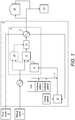
- FIG. 1 A non-limiting example schematic of a process for preparing an oil-in-water emulsion according to the invention is given in Figure 1 .
- the area designated (1) represents the source of hydrocarbon-containing oil to be utilised as the oil phase for the production of the oil-in-water emulsion.
- the area designated (2) represents the source of suitable water.
- the material from the hydrocarbon-containing oil source (1) may be cooled by a medium to a suitable temperature for storage as required and further temperature control as required, to achieve a viscosity of between 250 to 500 cSt, for direct introduction into the emulsion preparation unit (4).
- Water (2) is first heated (typically to within the range 50 to 90°C) in a heat exchanger (5) that is also utilised for cooling the final emulsion product (typically to less than 90°C) along with supplementary cooling (typically to less than 60°C) to enable easier handling.
- a polymer stabiliser can be mixed into the aqueous phase if and as required, followed by the further addition (7) of additional chemical additives (including one or more of the primary surfactant and secondary surfactant), and optionally also a suitable acid if pH adjustment is required.
- additional chemical additives including one or more of the primary surfactant and secondary surfactant
- a suitable acid if pH adjustment is required.
- the chemical additives can be varied if and as required to achieve an emulsion fuel with the required specification and performance criteria.
- the chemical additives used preferably do not contain any components or impurities that can negatively affect the use of the resulting emulsion as a fuel. Therefore, preferably, they contribute no more than 50ppm of halogenated compounds and no more than 100ppm of alkali metals in the final emulsion fuel specification.
- the aqueous phase containing the chemical additives passes through a tank/vessel (8), which provides sufficient residence time for any added acid to fully activate other chemical additives, for example the primary surfactant.
- Both the aqueous phase and the hydrocarbon-containing oil phase are then introduced into a high-shear colloidal mill (9), the speed of which is adjusted to intimately mix the components.
- One or more colloidal mills may be employed (10) within the manufacturing process, depending on the number of required emulsion component streams of differing properties (i.e., one for the manufacture of a single component emulsion fuel, or two or more required for the manufacture of a composite, multi-component emulsion fuel).
- the differing components can be passed through an in-line blender (11) or mixed downstream at the required ratios to achieve the correct properties of the final oil-in-water emulsion fuel.
- an in-line blender (11) or mixed downstream at the required ratios to achieve the correct properties of the final oil-in-water emulsion fuel.
- the characteristics of the final required droplet size distribution, hydrocarbon/water phase ratio (i.e. energy density) and viscosity/rheological characteristics can be effectively controlled.
- the emulsion fuel may be stored (12) for subsequent transport and supply for use as a fuel (13).
- the formulation of the oil-in-water emulsion can be optimised, depending on the nature of the hydrocarbon-containing oil, typically a hydrocarbon residue such as one of those listed in Table 1.
- the chemical additives and their concentrations that can be used for different hydrocarbon residues can be optimised by a skilled person, and preferably the components are chosen so as to ensure compliance with any associated operational, performance or legislative requirements.
- the formulation can be optimised by hydrocarbon analytical testing, followed by a series of laboratory and pilot scale emulsification and emulsion handling tests.
- the objectives of these tests are to:
- the target specification of the resulting oil-in-water emulsion fuel at each stage is based on correlation with established (acceptable) performance criteria of emulsion fuels during full application (i.e., behaviour during storage, supply and logistics handling, as well as during end-use engine operation).
- a typical example of an oil-in-water emulsion fuel specification is given in Table 5.
- Table 5 Parameters of an example target emulsion specification.
- oil-in-water emulsion of the invention can have the following characteristics, which is suitable for use as a marine fuel:
- test methods that can be used to measure the above properties are provided in Table 5.
- the droplet size measurements can be measured using available equipment, such as a Malvern particle size analyser (e.g. using light diffraction methods).
- the viscosity can be measured using a coaxial cylinder viscometer, and the sieve test can be carried out according to methods such as ASTM D 4513-85, D 4572-89 and ASTMD244 / ASTM D6933.
- the oil-in-water emulsion can also have the properties set out in Table 6.
- Table 6 Example oil-in-water properties before dynamic stability test Parameter Specification Suggested Test Method Water Content, %wt 33 Max IP74/92 (ASTM D95) or IP 358 (ASTM 4006-81) Sulfur, %wt 2.45 Max IP 242 Aluminium/Silicon, ppm 10 Max IP 501 /IP 470 Sodium, mg/kg (ppm) 100 Max IP 501 / IP 470 Zinc, mg/kg (ppm) 15 Max IP 501 / IP 470 Phosphorus, mg/kg (ppm) 15 Max IP 501 / IP 470 Calcium, mg/kg (ppm) 30 Max IP 501 / IP 470 Hydrogen Sulfide, ppm 2 Max IP 570 Part A Flash Point, °C 60 Min IP 303-93, ASTM D93 or ASTM D3828-81
- Static stability is a term used to describe the stability that an emulsion requires to remain integral under conditions where there is no externally applied force except for gravity (i.e., stability under static storage conditions over time).
- Dynamic stability is a term used to describe the stability an emulsion requires to ensure it can be handled as required within the application for which it is designed. This includes being stable when pumped, heated, and used within specific fuel handling components such as pressure control valves, flow meters, fuel injection equipment, etc. This differs from static stability in that it involves the external impartation of energy to the emulsion system (which includes mechanical energy such as shearing and turbulent flow forces) and heat energy (e.g., heating within heat exchangers). As such the oil-in-water emulsion fuel requires a significantly higher degree of dynamic stability than that needed under static conditions.
- the physical and chemical properties of a candidate hydrocarbon residue influence the properties of the resulting emulsions, and hence influence the action and efficiency of the chemical additives used.
- the formulation derived for each residue i.e., the chemical additives and production process parameters employed for each candidate hydrocarbon residue
- the oil-in-water emulsion fuel has the required droplet size distribution, rheological/hydraulic properties, and both static and dynamic stability. It is also preferred that the resulting oil-in-water emulsion fuel can be blended safely with other emulsion fuels according to the present invention, and/or that are made according to the process of the present invention, but which may have an alternative formulation.
- Determination of a desired formulation can be achieved by undertaking a series of matrix screening tests and subsequent optimisation defined within, whereby a sample of a candidate hydrocarbon residue feedstock is used to manufacture a series of emulsions using different process conditions, whilst varying the chemical additives and concentrations to optimise the overall emulsion fuel formulation.
- the fundamental characteristics of each emulsion batch can be analysed.
- DSD Droplet Size Distribution
- the DSD is normally represented as the percentage droplet volume population against size range, from which a number of statistical parameters can be derived.
- Two common ways of expressing the droplet size distribution include volume or mass moment mean, expressed as D[4,3], and the volume median, which is represented as D[v, 0.5] or D 50 .
- the "span" is the difference between the largest and smallest droplets/particles. For practical purposes, it is calculated from D 90 - D 10 , where D x represents the droplet size at which x% of the droplets have that size.
- the dimensionless unit, relative span is often calculated as (D 90 -D 10 )/D 50 .
- the volume median droplet size is the size mid-point of the total size distribution or span.
- the volume mean droplet size is the statistical average of the whole volume distribution, and as such is more sensitive to the presence of droplets with larger size. Accordingly, a decrease in the volume mean droplet size is normally associated with a decrease in the droplet size distribution span, whereas the droplet size distribution can vary in span and the volume median may stay the same.
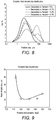
- An example of an oil-in-water emulsion fuel droplet size distribution is shown in Figure 2 .
- An analytical instrument such as a MALVERN MastersizerTM can be used to determine the DSD of an oil-in-water emulsion fuel (in the case of MALVERNTM instruments, the size range distribution is determined by standard laser diffraction techniques).
- a non-ionic surfactant e.g., a nonyl phenol or alkyl ethoxylate
- Approximately 0.5ml of the oil-in-water emulsion fuel sample is mixed with 5ml of a 2%wt solution of a stabilising agent (such as a fatty alcohol ethoxylate or fatty alkyl diamine) and dispersed under ambient conditions.
- a stabilising agent such as a fatty alcohol ethoxylate or fatty alkyl diamine
- the purpose of this pre-mixing with stabilising agent is to ensure that the emulsion particle/droplet sizes of the oil-in-water emulsion remain unaltered during the remainder of the analysis process, which involves adding drops of this dispersion to the recirculated 500ml formic acid/surfactant solution previously prepared until an acceptable obscuration value for the Micro MastersizerTM is achieved.
- a measurement cycle of 5 repeats with 2000 sweeps each is then performed to obtain the DSD analysis.
- volume mean droplet size range of from 3 to 15 ⁇ m and the proportion of droplets having a size of greater than 125 ⁇ m being less than 3wt%, helps to achieve the static and dynamic stabilities required.
- Oil-in-water emulsions according to the invention can typically contain a high (greater than 60%wt) concentration of hydrocarbon residue. Factors affecting the resulting rheology of such emulsions include;
- Such concentrated emulsions normally display non-Newtonian behaviour, whereby the viscosity of the emulsion at any given temperature will vary with the applied level of shear. It is possible to model this non-Newtonian behaviour (e.g., using the Power Law model) and hence quantify and characterise the emulsions' rheological behaviour.
- Such emulsions can also display time dependent rheological behaviour (such as thixotropy) whereby the viscosity will be influenced by how long shear is applied. This can be a fully or semi-recoverable phenomenon, whereby the viscosity will return to its initial value in part or in full over time.
- An analytical instrument such as a MALVERN KINEXUSTM or a HAAKE VT550TM Rheometer can be used to determine the rheological properties (including viscosity) of an oil-in-water emulsion fuel.
- An example of such a measurement includes the use of a parallel plate configuration (using a 40mm rotational element, set with a 1mm gap), in which a sample of temperature controlled (e.g. 50°C) oil-in-water emulsion fuel sample is subjected to shear cycles, ascending and descending between 15-150s -1 . The corresponding viscosity values, for example at 20 and 100s -1 on the descending cycle, can then be determined.
- Static stability can be measured by determining sedimentation during centrifugation.
- a 10ml emulsion fuel sample is subjected to 2000g at 50°C for 30mins, using a lab scale centrifuge (e.g., HettichTM Universal 1200).
- the sample tube is then carefully washed with a 2% solution of a non-ionic surfactant (e.g., a nonyl phenol or alkyl ethoxylate), to remove non-compacted emulsion from the sediment.
- the washed tubes are then dried in an oven at 105°C for 2 hours prior to weighing, so that the %wt. of sediment can be calculated.
- Sieve testing can provide a measure of residue droplets greater than 125 ⁇ m in the oil-in-water emulsion, thereby providing an indication of emulsion stability post production.
- the method can be based on the standard ASTM test methods D4513-85, D4572-89 and D6933, and gives a measure of the amount of free oil residue/non-emulsified material present in the sample.
- a known weight of approximately 100g is washed though a 125 ⁇ m sieve using a 2% solution of a non-ionic surfactant (e.g., a nonyl phenol or alkyl ethoxylate).
- the sieve is then dried in an oven at 105°C for 2 hours prior to weighing, so that the %wt. of retained material can be calculated.
- a method for optimising the oil-in-water emulsion formulation can include various sequential stages as follows;
- a hydrocarbon residue can be analysed for the properties indicated in Table 7.
- This initial analysis is primarily to establish if the hydrocarbon residue meets the requirements of a feedstock for oil-in-water emulsion fuel production, and to provide information on key composition parameters that may impact the chemical formulation required.
- the Simulated Distillation (SIMDIST), water and flash point determination give an indication of the general composition of the residue.
- Aluminium and silica in a fuel can act as abrasives, hence determination of their content is often a specific requirement if the resulting emulsion fuel is to be used within the marine industry, to ensure the integrity of engine operations.
- a higher pour point value can indicate that a hydrocarbon residue is more paraffinic (waxy) in composition, which influences the chemical additives to be used in producing an optimum oil-in-water emulsion fuel.
- waxy paraffinic
- Table 7 Tests for Hydrocarbon Residues Test Unit Suggested Method Relevance Density g/ml ASTM D4052 Physical Properties / Emulsification Viscosity cst Rotation Viscometry Physical Properties / Emulsification GCV MJ/kg ASTM D 240 Economic Value /Combustion NCV MJ/kg ASTM D 240 Economic Value / Combustion Sulphur %wt ASTM D2622 Compliance / Combustion Nitrogen %wt ASTMD5291m Compliance / Combustion Carbon %wt ASTMD5291m Compliance / Combustion Hydrogen %wt ASTMD5291m Compliance / Combustion Oxygen %wt Calc.
- Relatively high TAN/TBN values are an indication of an increased level of heterogeneous/ionic chemical functionality in the chemical composition of the hydrocarbon residue, which is often associated with higher asphaltenes content.
- the chemical additives used are ionic in nature, the level of indigenous ionic species present in the residue can affect the optimum combination and concentration of additive chemicals used in the oil-in-water emulsion fuel formulation.
- a high level of alkaline metals e.g., Na, Ca
- halogens e.g., Cl, which is an undesirable contaminant for fuel combustion emissions
- a high level of alkaline metals e.g., Na, Ca
- halogens e.g., Cl, which is an undesirable contaminant for fuel combustion emissions
- the presence of such salts can lead to an undesirable osmotic droplet swelling (thickening) process, resulting in a significant increase in viscosity over time. This can be corrected by balancing the ionic content of the hydrocarbon residue and aqueous phases.
- 'Matrix' formulation testing can be used to optimise the oil-in-water emulsion formulation. It is an iterative process. As all the parameters being evaluated are interdependent, optimisation of the emulsification formulation requires determination of the correct balance of all the parameters and variables involved. In this way the response of the candidate hydrocarbon residue to the different process conditions and additives used is evaluated against the target specification. A guideline to this approach to determine the optimum formulation follows, and is illustrated in Figure 3 .
- the first step in the evaluation of the potential to emulsify a refinery residue is to calculate the required temperature to yield a hydrocarbon residue viscosity of 300 to 500cSt.
- the temperature of the water/additive phase required is then calculated, which would result in a hydrocarbon residue/water interfacial temperature at which the residue viscosity is less than 10,000 cSt (after correcting for phase ratio and relevant heat capacities), while ensuring the other temperature requirements of the water (such as to avoid boiling, thermal and phase stability of the additives) are met.
- Polymeric stabiliser 0.03 to 0.08% wt pH adjustment with organic acid 4.5 to 3.0 Residue Content 66 to 70 wt% Residue temperature Corresponding to a residue viscosity of 300 to 500 cSt Water phase temperature Value which gives an interfacial temperature during emulsification ⁇ 10,000 cSt Mill Speed Mid-range, ca 8000-10000 rpm
- the volume of water to be used for the preparation of the test formulation is heated to between 50 to 70°C.
- the required amount of polymeric stabiliser is added to the hot water and mixed until completely dissolved.
- the pH of the solution is adjusted to be within the range 3 to 4.5.
- the required amount of the secondary surfactant (if included in the formulation) is added and the water phase is mixed to ensure the additives are completely dissolved.
- the aqueous phase is then transferred to a laboratory scale colloidal mill system (such as the DEMINOTECHTM SEP-0.3R Emulsion Research Plant which is capable of producing emulsions at a maximum capacity of 350 1/h, see Figure 4 ).
- a quantity of the residue feed stock for evaluation is then introduced into the system and heated to the required temperature (as indicated above).
- test emulsion can then be prepared using the following procedure;
- the mill is switched on and a suitable mid-range speed selected (e.g., 9000rpm for the SEP-0.3R system).
- the back pressure on the system is adjusted to approximately 2bar.
- the hydrocarbon residue pump is started at a low flow rate, and steadily increased until the required flow rate is achieved (e.g., to give a final hydrocarbon residue content in the emulsion).
- the backpressure of the system is adjusted to maintain a level of approximately 2bar.
- the flow rate of water to the final heat exchanger is adjusted to ensure the emulsion is flowing at the outlet of the system at a temperature less than 90°C.
- test emulsion preparations provides an indication as to the potential of a candidate hydrocarbon residue to be used as a feedstock for the production of the oil-in-water emulsion fuel by the process described using 'generic' formulation and conditions. Based on the results of these tests, further formulation matrix testing can be carried out if necessary to fine-tune and optimise the response of the residue to emulsification and subsequent stability testing, focusing on specific aspects and variables.
- surfactants can generally be described as molecules that have hydrophilic (water liking) and hydrophobic (oil liking) components.
- the role of the primary surfactant is to reduce the surface tension at the hydrocarbon residue/water interface such that the surface can be broken up to form droplets.
- the primary surfactant acts to stabilise the droplet (e.g., by charge density in the case of ionic surfactants) and prevent them from re-coalescing.
- the hydrophobic part of the primary surfactant molecule must have sufficient affinity for the hydrocarbon residue in order to be fixed (i.e., anchored) at the hydrocarbon residue/water interface. This will depend on the characteristics of the surfactant and the residue alike.
- an effective primary surfactant that has sufficient affinity and stabilising properties for the residue results in an emulsion with a smaller average droplet size and a narrower droplet size distribution range. This acts to increase the viscosity of the resulting emulsion, due to its geometrical effect on droplet packing within the emulsion system.
- the ability to have effective control over droplet size distribution during the emulsification process by influencing, for example, the concentration and pH of the primary surfactant is also a desirable property. In this way, a balance between efficiency of emulsification and required droplet size/rheological properties can be achieved with the correct choice of primary surfactant type.
- the suitability of primary surfactants is based at this stage on achieving the manufacture of an oil-in-water emulsion fuel with an average droplet size less than 25 ⁇ m (D[4,3]), a distribution that has a 90% droplet distribution less than 50 ⁇ m (D[v, 0,5]) and a relative span less than 3.5, whilst maintaining a viscosity less than 500 mPas (at 20s -1 , 50°C), using the method for measuring droplet size distributions given above. Further reduction of viscosity can be achieved by other parameters evaluated at a later stage in formulation matrix testing.
- testing of the primary surfactants is carried out with an initial concentration range of 0.10 to 0.60%wt adjusted to a pH value of 3 to 4.5, without the addition of the secondary surfactant at this stage, since the influence of this additive component is optimised in a later stage.
- Any polymeric stabiliser is included, the estimated concentration range of which is be based on the density of the hydrocarbon residue.
- the emulsification and resulting emulsion droplet size distribution can be varied to achieve the required range , for example by;
- the next parameter to be optimised is the pH of the aqueous phase during manufacture.
- a further series of formulation matrix tests is undertaken using the suitable primary surfactants, and varying both the concentration of the surfactant and the addition of acid being tested to achieve a range of pH values between pH 2 and 6.
- the analysis of the manufactured test batches can include droplet size distribution, viscosity, sedimentation, sieve test and shake table test as indicated above. Examples of the effect of pH on the resulting fuel emulsion characteristics are given in Figure 6 for a fixed amount of primary surfactant.
- the optimum pH is the value at which the lowest average droplet size and viscosity can be achieved that fall within the limits according to the invention.
- static stability must be acceptable as determined by sedimentation, sieve test and shake table results over a nominated period of time (e.g., four weeks at this stage of the evaluation).
- polymeric stabilising and flow improving agent The selection and use of a polymeric stabilising and flow improving agent is based on its interactions with the other chemical additives.
- the polymeric agent has the potential to influence droplet size distribution, improve (lower) the viscosity of the final oil-in-water emulsion and enhance the stability of the fuel. This is achieved by changing the density differential between the hydrocarbon and aqueous phases and through the formation of a low yield gel structure as indicated earlier. Examples of the effect of polymeric stabilising and flow improvement agent on the resulting fuel emulsion characteristics are given in Figures 7a and 7b .
- the role of the secondary surfactants is to provide a high degree of dynamic stability. Its inclusion in the formulation is usually required, for example, when the emulsion fuel is intended for use in engines (e.g., for propulsion in ships), where the fuel handling conditions are more severe in terms of pumping, shearing and large changes in pressure.
- secondary surfactants typically have a larger hydrophilic group, and will thereby impart a degree of steric stabilisation into the emulsion system.
- the secondary and primary surfactants compete for the interface during the emulsification process; which will be influenced by their relative concentrations (see Figure 8 ).
- Secondary surfactants are not as efficient as an emulsifier as the primary surfactant, so their interfacial displacement of the primary surfactant will result in a tendency to broaden the emulsion droplet size distribution (which will also have the effect of lowering the viscosity of the system). Again, the balance between the components of the required formulation and final emulsion fuel characteristics can be optimised.
- the optimum mixer or milling speed can be determined at this stage, since with increased speed more energy is imparted into the emulsion system during manufacture which will tend to decrease the average droplet size and distribution span, thereby increasing viscosity. Examples of the effect of mill (mixer) speed on the resulting fuel emulsion characteristics are given in Figures 10a and 10b .
- the predominant influence of the hydrocarbon residue content on an oil-in-water emulsion will be on viscosity. As the internal phase of the emulsion (i.e., the hydrocarbon residue content) is increased, the viscosity will also increase, particularly at concentrations greater than 60wt%.
- An example of the effect of residue content on the resulting oil-in-water emulsion characteristics is given in Figure 11 .
- a composite emulsion is one that is manufactured from two or more component emulsions of differing droplet size distributions. By their correct combination, it is possible to get improved packing of smaller droplets with larger ones allowing either a decrease in viscosity for a given dispersed (hydrocarbon residue) phase or an increase in the hydrocarbon residue (i.e., energy) content without significantly increasing viscosity. This can arise due from a reduced tendency for inter-droplet impaction and deformation during flow, leading to a reduction in viscosity.
- An example of the influence of composite emulsion formulation on viscosity is shown in Figure 12 . This is another factor that can be used in the formulation of emulsion fuels to obtain the best optimisation of required characteristics.
- Candidate formulations resulting from the matrix screening and static stability requirement in the specification can be subjected to further dynamic stability testing.
- Dynamic stability is important because an emulsion fuel can be subjected to heating as well as high shearing and turbulence during pumping and transportation.
- a number of devices can be used to measure dynamic stability (such as controlled speed mixers or rheometers/viscometers) that can impart controlled shear, under temperature controlled conditions, to a sample of an oil-in-water emulsion fuel.
- Such test conditions are used to make both qualitative and quantitative judgements of the change in emulsion fuel characteristics, particularly those relating to changes in droplet size distribution.
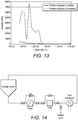
- Figure 13 shows the effect that primary surfactant type can have on dynamic (shear) stability using a rheometer test protocol.
- An analytical instrument such as a MALVERN KINEXUS or a HAAKE VT550 Rheometer can be used to determine the dynamic stability of an emulsion fuel.
- An example of such a measurement involves using a parallel plate configuration (using a 40mm rotational element, set with a 1mm gap).
- a sample of temperature controlled (50°C) emulsion fuel is subject to a shear cycle, in which the element revolves at a rate ascending from 0.5 - 1000 s -1 . If the shear/stress characteristics observed during such a test show typical shear thinning characteristics (i.e. a steady reduction in viscosity with increasing shear, with a 'n' value typically within the range 0.7 to 0.95 as determined by the Power Law model), the sample is expected to have a high potential for good dynamic stability.
- the test gives an assessment of static/dynamic stability by measuring the comparative amount of residue droplets/particles greater than 125 ⁇ m in the bulk emulsion after a 100mg sample of the emulsion is subjected to a controlled amount of agitation for 24 hours at fixed temperature (40°C), shaking frequency (3.3Hz/200rpm) and shaking stroke setting (18mm) on a shake table apparatus such as the JulaBo SW-20C.
- a pump testing method can also be used, for example using a pilot scale pump testing rig as shown in Figure 14 .
- the method comprises:
- the temperature at which the recirculation is carried out is dependent on the viscosity of the emulsion, although it is typically in the range of from 40 to 90°C, for example 40 to 60°C, and typically at 50°C ⁇ 10% (i.e. 50°C or in the range of from 45 to 55°C).
- the emulsion used is preferably recirculated in the range of 25 to 50 times per hour.
- it is preferably recirculated around the recirculation loop at a rate of 250 to 500 kg per hour.
- the range is 31 to 45 times per hour (e.g. 310 to 450 kg per hour for a 10 kg sample).
- the rate is 37 times per hour ⁇ 10%, i.e. 37 times per hour, or in the range of from 33.3 to 40.7 times per hour.
- the mass of oil-in-water emulsion sample compared to the internal volume of the recirculation loop is preferably in the range of from 2.0 to 5.0 kg/L, for example in the range of from 2.5 to 4.6 kg/L. In one example, the ratio is 4.2 kg/L ⁇ 10% (i.e. 4.2 kg/L or in the range of from 3.78 to 4.62 kg/L).
- the recirculation is carried out over a predetermined period of time, for example in the range of from 5 minutes to 8 hours, typically from 5 minutes to 180 minutes, such as in the range of from 20 to 120 minutes or in the range of from 20 to 40 minutes.
- the pre-determined period of time is 30 minutes ⁇ 10% (i.e. 30 minutes, or in the range of from 27 to 33 minutes).
- the particle size distribution of the emulsion is analysed during the recirculation before and after the predetermined period of time.
- One or more intermediate determinations can optionally be taken if required.
- the predetermined period of time for the test can be 30 minutes, with particle/droplet size distribution being determined before recirculation and at 30 minutes after recirculation commences.
- intermediate analysis can take place, for example at 10 and 20 minutes after recirculation commences.
- the dynamic stability test is preferably conducted at least 12 hours after the production of the emulsion, and at any other time during the expected lifetime of the emulsion.
- the expected storage time can be in the range of 3 to 9 months.
- the storage time is typically 1 to 3 months. Therefore, the test is conducted in the range of from 12 hours and up to 9 months after production, for example from 12 hours up to 3 months or from 12 hours up to 1 month after production.
- Recirculation can take place with a back-pressure.
- the back-pressure of the recirculation is at least 2 barg (bar-gauge), for example in the range of from 2 to 10 barg or from 5 to 10 barg, such as in the range of from 7 to 9 barg, for example 8 barg ⁇ 10%.
- Particle or droplet size distribution can be measured by routine means, for example by light scattering techniques. They can be carried out on-line, without the need for sample extraction. Alternatively, samples can be removed from the recirculation loop and analysed off-line.
- the change in average particle size (D[4,3]) after the pre-determined period of time is less than 0.3 ⁇ m.
- Typical conditions of such a test are a temperature of 50°C, a recirculation rate (on a mass basis) of 37 h -1 , a total mass of sample to recirculation volume ratio of 4.2 kg L -1 , and a back pressure of 8 barg.
- any or all of these parameters can be within ⁇ 10% of those stated.
- the sample time is 30 minutes, optionally with two intermediate samples at 10 and 20 minutes after recirculation commences.
- a suitable sample size is 10 kg.
- the filter is typically a 150 ⁇ m to 500 ⁇ m filter (100 mesh to 35 mesh), for example a 150 ⁇ m (100 mesh) or 500 ⁇ m (35 mesh) filter.
- the test conditions with filter can be the same or different, and are typically as set out above. Preferably, the test conditions with the filter are the same as the test conditions without the filter.
- the change in average particle size (D[4,3]) before and after the pre-determined time of recirculation in the presence of the filter is also preferably less than 0.3 ⁇ m.
- the emulsion is pre-conditioned by recirculating the emulsion for an initial period of time before the start of the test and under the same conditions, without passing through a filter.
- the preconditioning time is typically in the range of from 5 to 60 minutes, and is preferably in the range of from 10 to 30 minutes.
- the emulsion is then diverted through a filter, and the dynamic stability test conducted in the presence of the filter.
- one embodiment employs a system comprising a sample storage vessel large enough the hold 10kg (approximately 10 litres) of test sample.
- the pump recirculation loop is constructed from 25mm ID pipework with a total loop length of approximately 4.7m (giving a recirculation loop capacity of approximately 2.4 litres).
- the pump is a triple screw-pump rated to give a flow rate of approximately 370kg/h (i.e. 37 times the emulsion volume per hour).
- the filter unit e.g., simplex basket filter
- the filter unit is fitted with changeable filter elements typically of 150 or 500 ⁇ m size.
- the candidate emulsion is pre-heated to the required temperature (i.e., 50°C, optionally ⁇ 10%) and then transferred to the pump rig storage vessel.
- the required temperature i.e., 50°C, optionally ⁇ 10%
- the storage vessel is then opened to the pumping loop, which floods the suction of the pump.
- the pump is started and recirculation back to the storage vessel is established at the required flow rate.
- the emulsion is then pumped around the system, initially by-passing the filter unit, at a controlled flow rate while the test temperature is maintained by the use of the hot water in-line heat exchanger (a plate type heat exchanger).
- the back-pressure on the system is adjusted to 8 bar.
- Samples are taken at intervals of 10, 20 and 30 minutes for analysis (to determine droplet size characteristics and viscosity), in order to measure the impact of pumping on the heated oil-in-water emulsion fuel.
- test emulsion After the 30 minute sample is taken, the flow of test emulsion is diverted through the filter unit. Periodic samples are again taken for analysis (usually droplet size distribution and viscosity) at 10, 20 and 30 minute intervals to measure the additional impact of filtration on the oil-in-water emulsion fuel.
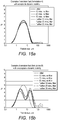
- the rate of change of average droplet size (D[4,3]) can be calculated over the period of the test, and the dynamic stability considered acceptable if the rate of change is less than 0.30 ⁇ m/min. Examples of the rate of change of average droplet size of emulsion fuel during the dynamic stability pump rig test are given on Figure 16 .
- an oil-in-water emulsion fuel for example one prepared and optimised according to the above process, in full-scale operations demonstrates that conventional equipment for the storage, pumping, heating and transportation of heavy fuel oils can be used, either with no adaption or with only minor adaptions which include; - using heating mediums such as hot water (less than 80°C) to maintain the oil-in-water emulsion fuel at a minimum temperature above freezing (e.g., 15°C) in static storage; - where possible, modifying pumps to use electrical speed control rather than pressure spill-back control, to minimise exposure of the emulsion fuel to rapid changes in pressure (e.g.
- heating mediums such as hot water (less than 80°C) to maintain the oil-in-water emulsion fuel at a minimum temperature above freezing (e.g., 15°C) in static storage
- modifying pumps to use electrical speed control rather than pressure spill-back control, to minimise exposure of the emulsion fuel to rapid changes in pressure (e.g.
- pressure differences greater than 20 barg - modifying fuel pre-heating systems to use low-pressure, saturated steam (e.g. steam at a pressure of less than 6 barg, such as less than 3 barg), and/or by limiting the heating surfaces to a maximum temperature (less than 125°C) during flow.
- saturated steam e.g. steam at a pressure of less than 6 barg, such as less than 3 barg
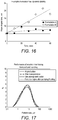
- FIG. 17 An example of the performance of an emulsion fuel during handling is given in Figure 17 .
- details of the droplet size analysis are given for a batch of oil-in-water emulsion fuel at the point of large scale manufacture, after long distance transportation by truck delivery, after period of storage at location of use, and during operation with final fuel feed system.
- the data shows the emulsion fuel has a high degree of stability, with very little change in the droplet size distribution taking place.
- a pilot scale pump testing rig can be used, as shown in Figure 18 .
- This system is in two main parts, the Injection Rig itself, and a small fuel handling and feed system designed to supply the test emulsion fuel sample at a pre-determined pressure and temperature (e.g. 5-6 bar(g) at 50°C) for operation of the injector system.
- This fuel handling system is similar in design to the pilot scale pump test rig as described above.
- the main Injection Rig is a self-contained unit and consists of a high pressure pump which is driven by a camshaft linked to an electric motor; the high pressure pump delivers fuel to the injection nozzle at variable feed rates and frequency controlled by a stroke adjustment and variable frequency electrical drive.
- the unit also includes an electric lubrication oil pump which maintains set pressures within the system.
- the candidate emulsion to be tested is pre-heated to the required temperature (normally 50°C) and then transferred to the pump rig storage vessel.
- the emulsion is then pumped around the system at a controlled flow rate (300 to 350 kg/h) while the test temperature is maintained.
- the emulsion is then fed into the full scale engine injector system (which includes the high pressure injector feed pump), and the flow rate through the injector is adjusted as required (reflecting the full operational range of the injector when operated on an engine).
- Periodic samples are taken for analysis (i.e., droplet size distribution characteristics and viscosity) to measure the impact of the engine injection system.
- the back-pressure on the injector (typically in the range 300-1500 bar) is also measured to evaluate the hydraulic characteristics of the emulsion fuel formulation being tested.
- the dynamic stability is considered acceptable if the emulsion retains a discrete droplet size distribution.
- an acceptable emulsion stability would have less than 3 wt% of droplets above 125 ⁇ m, and the distribution would have a relative span of less than 5.0.
- compositions associated with the results displayed in the figures are set out in Table 10 (concentrations in wt%).
Landscapes
- Chemical & Material Sciences (AREA)
- Engineering & Computer Science (AREA)
- Organic Chemistry (AREA)
- Oil, Petroleum & Natural Gas (AREA)
- Chemical Kinetics & Catalysis (AREA)
- Materials Engineering (AREA)
- General Chemical & Material Sciences (AREA)
- Health & Medical Sciences (AREA)
- Medicinal Chemistry (AREA)
- Life Sciences & Earth Sciences (AREA)
- Polymers & Plastics (AREA)
- Structural Engineering (AREA)
- Civil Engineering (AREA)
- Physics & Mathematics (AREA)
- Biochemistry (AREA)
- General Health & Medical Sciences (AREA)
- General Physics & Mathematics (AREA)
- Immunology (AREA)
- Pathology (AREA)
- Analytical Chemistry (AREA)
- Food Science & Technology (AREA)
- Emergency Medicine (AREA)
- Liquid Carbonaceous Fuels (AREA)
- Colloid Chemistry (AREA)
- Investigating Or Analysing Materials By Optical Means (AREA)
Applications Claiming Priority (3)
| Application Number | Priority Date | Filing Date | Title |
|---|---|---|---|
| GBGB1519615.7A GB201519615D0 (en) | 2015-11-06 | 2015-11-06 | Oil-in-water emulsions |
| GBGB1609042.5A GB201609042D0 (en) | 2016-05-23 | 2016-05-23 | Oil-in-water emulsions |
| PCT/GB2016/053413 WO2017077302A2 (en) | 2015-11-06 | 2016-11-03 | Oil-in-water emulsions |
Publications (2)
| Publication Number | Publication Date |
|---|---|
| EP3365415A2 EP3365415A2 (en) | 2018-08-29 |
| EP3365415B1 true EP3365415B1 (en) | 2019-09-04 |
Family
ID=57391997
Family Applications (1)
| Application Number | Title | Priority Date | Filing Date |
|---|---|---|---|
| EP16801006.4A Active EP3365415B1 (en) | 2015-11-06 | 2016-11-03 | Oil-in-water emulsions |
Country Status (11)
| Country | Link |
|---|---|
| US (1) | US10704003B2 (lt) |
| EP (1) | EP3365415B1 (lt) |
| JP (1) | JP6807939B2 (lt) |
| CN (1) | CN108699463B (lt) |
| CA (1) | CA3004195C (lt) |
| ES (1) | ES2775298T3 (lt) |
| LT (1) | LT3365415T (lt) |
| PT (1) | PT3365415T (lt) |
| RU (1) | RU2731091C2 (lt) |
| SG (1) | SG11201803721UA (lt) |
| WO (1) | WO2017077302A2 (lt) |
Families Citing this family (11)
| Publication number | Priority date | Publication date | Assignee | Title |
|---|---|---|---|---|
| GB201707556D0 (en) * | 2017-05-11 | 2017-06-28 | Quadrise Int Ltd | Oil-in water emulsions |
| SG11202111935SA (en) * | 2019-05-03 | 2021-11-29 | Basf Se | Emulsifier package with quaternary ammonium surfactant for fuel emulsion |
| JP7795862B2 (ja) | 2020-02-21 | 2026-01-08 | ヌーリオン ケミカルズ インターナショナル ベスローテン フェノーツハップ | 耐水性油中水サンケア配合物のための生分解性ポリエステル |
| EP3868809A1 (en) | 2020-02-21 | 2021-08-25 | Nouryon Chemicals International B.V. | Biodegradable polyesters for water-resistant water-in-oil suncare formulations |
| KR20210107541A (ko) | 2020-02-21 | 2021-09-01 | 누리온 케미칼즈 인터내셔널 비.브이. | 내수성 무수 선케어 제형을 위한 생분해성 폴리에스테르 |
| BR102021002815A2 (pt) | 2020-02-21 | 2021-09-08 | Nouryon Chemicals International B.V. | Polímero impermeabilizante, processo para preparação de um polímero impermeabilizante, composição, processo para preparação de uma composição, formulação de óleo em água, formulação de proteção solar de óleo em água, método de proteção de um usuário a ser exposto ou já exposto à luz solar dos efeitos prejudiciais da exposição à luz solar, e método para impermeabilização de uma formulação de proteção solar de óleo em água compreendendo pelo menos um agente ativo de proteção solar |
| GB202019106D0 (en) | 2020-12-03 | 2021-01-20 | Quadrise Int Ltd | Oil-in-water emulsions |
| GB2618100B (en) * | 2022-04-26 | 2024-05-29 | Quadrise International Ltd | System for producing an oil-in-water emulsion |
| GB2622054B (en) * | 2022-08-31 | 2024-12-25 | Quadrise International Ltd | Emulsion |
| US12298266B2 (en) * | 2023-03-30 | 2025-05-13 | Saudi Arabian Oil Company | Changes in resistivity of mesh-patterned polymer thin films coated with conductive traces used to detect hydrocarbon fuels hidden in paraffin-based lubrication oils |
| CN117147395B (zh) * | 2023-11-01 | 2023-12-26 | 东北石油大学三亚海洋油气研究院 | 用于测量多孔介质内乳状液液滴大小的实验装置与方法 |
Family Cites Families (31)
| Publication number | Priority date | Publication date | Assignee | Title |
|---|---|---|---|---|
| US3630953A (en) | 1968-01-02 | 1971-12-28 | Chevron Res | Tailored surfactants for use in forming oil-in-water emulsions of waxy crude oil |
| GB8404347D0 (en) | 1984-02-18 | 1984-03-21 | British Petroleum Co Plc | Preparation of emulsions |
| GB8431012D0 (en) | 1984-12-07 | 1985-01-16 | British Petroleum Co Plc | Preparation of emulsions |
| GB8521968D0 (en) | 1985-09-04 | 1985-10-09 | British Petroleum Co Plc | Preparation of emulsions |
| GB9110079D0 (en) | 1991-05-09 | 1991-07-03 | British Petroleum Co Plc | Fuel composition |
| US5354504A (en) | 1991-08-19 | 1994-10-11 | Intevep, S.A. | Method of preparation of emulsions of viscous hydrocarbon in water which inhibits aging |
| WO1993007238A1 (en) | 1991-10-01 | 1993-04-15 | Nalco Fuel Tech | Emulsification system for light fuel oil emulsions |
| US5603864A (en) | 1991-12-02 | 1997-02-18 | Intevep, S.A. | Method for the preparation of viscous hydrocarbon in aqueous buffer solution emulsions |
| JP3069673B2 (ja) | 1992-09-08 | 2000-07-24 | 花王株式会社 | 重質油エマルジョン燃料 |
| US5399293A (en) | 1992-11-19 | 1995-03-21 | Intevep, S.A. | Emulsion formation system and mixing device |
| US5863301A (en) | 1994-06-02 | 1999-01-26 | Empresa Colombiana De Petroleos ("Ecopetrol") | Method of produce low viscosity stable crude oil emulsion |
| JPH08277396A (ja) | 1995-04-05 | 1996-10-22 | Kao Corp | 重質油の燃焼方法 |
| JPH08325582A (ja) | 1995-06-01 | 1996-12-10 | Kao Corp | 超重質油エマルション燃料の製造方法 |
| CN1052748C (zh) | 1995-12-18 | 2000-05-24 | 中国科学院广州能源研究所 | 重油-水悬胶燃料及其制备 |
| CA2205294A1 (en) | 1996-05-23 | 1997-11-23 | Kao Corporation | Method for producing superheavy oil emulsion fuel and fuel produced thereby |
| US5902227A (en) * | 1997-07-17 | 1999-05-11 | Intevep, S.A. | Multiple emulsion and method for preparing same |
| JP3662733B2 (ja) * | 1997-11-17 | 2005-06-22 | 花王株式会社 | 超重質油エマルション燃料の製造方法 |
| US6113659A (en) | 1998-04-02 | 2000-09-05 | Akzo Nobel Nv | Fuel comprising a petroleum hydrocarbon in water colloidal dispersion |
| AU4228899A (en) | 1998-06-05 | 1999-12-20 | Clean Fuels Technology, Inc. | Stabile fuel emulsions and method of making |
| EP1063280A1 (en) | 1999-06-21 | 2000-12-27 | Quaker Chemical Corporation | Metal working fluids |
| JP3842168B2 (ja) | 2002-05-10 | 2006-11-08 | 株式会社小松製作所 | 水中油滴型エマルション燃料用乳化剤組成物、及びエマルション燃料 |
| DE10233701A1 (de) | 2002-07-24 | 2004-02-05 | Basf Ag | Entschäumer und/oder Entlüfter für wässrige, zur Schaumbildung neigende Medien |
| FR2869242B1 (fr) | 2004-04-23 | 2006-06-23 | Agro Ind Rech S Et Dev A R D S | Nouveaux emulsionnants et applications pour la preparation d'emulsions vaporisables |
| ITMI20060618A1 (it) | 2006-03-31 | 2007-10-01 | Enitecnologie Spa | Procedimento per la preparazione di nanoemulsioni acqua ion olio e olio in acqua |
| EP1935969A1 (en) | 2006-12-18 | 2008-06-25 | Diamond QC Technologies Inc. | Multiple polydispersed fuel emulsion |
| CN101909734A (zh) * | 2008-01-09 | 2010-12-08 | 阿克佐诺贝尔股份有限公司 | 稳定乳液及其制备方法 |
| GB0901494D0 (en) | 2009-01-29 | 2009-03-11 | Quadrise Ltd | Compositions and Methods |
| WO2010086742A1 (en) | 2009-01-29 | 2010-08-05 | Luis Pacheco | Pipelining of oil in emulsion form |
| MX2011011807A (es) | 2009-05-08 | 2012-04-30 | Quaker Chem Corp | Fluido lubricante de aceite en agua de tamaño pequeño de particula. |
| US20130118598A1 (en) | 2011-11-11 | 2013-05-16 | Intevep, S.A. | Formation and breaking of emulsion using low molecular weight amine |
| US20150184063A1 (en) | 2013-12-02 | 2015-07-02 | Intevep, S.A. | Formulation of surfactant to enhance crude oil recovery |
-
2016
- 2016-11-03 WO PCT/GB2016/053413 patent/WO2017077302A2/en not_active Ceased
- 2016-11-03 LT LTEP16801006.4T patent/LT3365415T/lt unknown
- 2016-11-03 EP EP16801006.4A patent/EP3365415B1/en active Active
- 2016-11-03 PT PT168010064T patent/PT3365415T/pt unknown
- 2016-11-03 US US15/773,351 patent/US10704003B2/en active Active
- 2016-11-03 ES ES16801006T patent/ES2775298T3/es active Active
- 2016-11-03 CA CA3004195A patent/CA3004195C/en active Active
- 2016-11-03 CN CN201680076268.0A patent/CN108699463B/zh active Active
- 2016-11-03 SG SG11201803721UA patent/SG11201803721UA/en unknown
- 2016-11-03 JP JP2018543461A patent/JP6807939B2/ja active Active
- 2016-11-03 RU RU2018120730A patent/RU2731091C2/ru active
Non-Patent Citations (1)
| Title |
|---|
| None * |
Also Published As
| Publication number | Publication date |
|---|---|
| WO2017077302A3 (en) | 2017-06-15 |
| CN108699463B (zh) | 2021-06-08 |
| SG11201803721UA (en) | 2018-06-28 |
| CA3004195A1 (en) | 2017-05-11 |
| JP6807939B2 (ja) | 2021-01-06 |
| WO2017077302A2 (en) | 2017-05-11 |
| RU2018120730A (ru) | 2019-12-10 |
| RU2731091C2 (ru) | 2020-08-28 |
| CA3004195C (en) | 2023-05-09 |
| PT3365415T (pt) | 2019-12-18 |
| US20180320096A1 (en) | 2018-11-08 |
| EP3365415A2 (en) | 2018-08-29 |
| CN108699463A (zh) | 2018-10-23 |
| JP2018536755A (ja) | 2018-12-13 |
| ES2775298T3 (es) | 2020-07-24 |
| RU2018120730A3 (lt) | 2020-03-18 |
| LT3365415T (lt) | 2020-01-27 |
| US10704003B2 (en) | 2020-07-07 |
Similar Documents
| Publication | Publication Date | Title |
|---|---|---|
| US10704003B2 (en) | Oil-in-water emulsions | |
| Angle et al. | Dilational Interfacial Rheology for Increasingly Deasphalted Bitumens and n‑C5 Asphaltenes in Toluene/NaHCO3 Solution | |
| Liu et al. | Formation of methane hydrate in oil–water emulsion governed by the hydrophilic and hydrophobic properties of non-ionic surfactants | |
| EP3635080B1 (en) | Oil-in-water emulsions | |
| US9581581B2 (en) | Methods of determining crude oil stability | |
| US20040055208A1 (en) | Integrated process for bitumen recovery, separation and emulsification for steam generation | |
| Xu | Asphaltene precipitation in paraffinic froth treatment: effects of solvent and temperature | |
| Arinina et al. | Effect of composition and interfacial tension on the rheology and morphology of heavy oil-in-water emulsions | |
| Zhang et al. | Synthesis and characterization of a novel reticulated multi-branched fluorinated polyether demulsifier for w/o emulsion demulsification | |
| Wei et al. | Synthesis and study of a new type of fluorinated polyether demulsifier for heavy oil emulsion demulsification | |
| Palermo et al. | Asphaltene aggregation: influence of composition of copolymers based on styrene-stearyl methacrylate and styrene-stearyl cinnamate containing sulfate groups | |
| Faqihi et al. | Synthesis, characterization, and application of two new ionic liquids for the dehydration of heavy crude oil emulsions | |
| Miranda-Olvera et al. | Hydrophilic–Lipophilic Balance (HLB) correlation method for the selection of ionic liquid surfactant modifiers of the viscosity and emulsion stability of heavy oils | |
| Grecco Zanotti et al. | Thixotropic behavior of oil‐in‐water emulsions stabilized with ethoxylated amines at low shear rates | |
| Adewunmi et al. | Advanced ionic liquid as a sustainable demulsifier for crude oil emulsions | |
| WO2018206904A2 (en) | Oil-in-water emulsions | |
| Abdullah et al. | One-pot synthesis of amphipathic esters for demulsification of water-in-crude oil emulsions | |
| CA3062992C (en) | Oil-in-water emulsions | |
| Azim et al. | Sugar-based ethoxylated amine surfactants as demulsifiers for crude oil emulsions: 2-demulsification of different types of crudes | |
| Rogel et al. | Effect of aging on deposit characteristics obtained by crude oil blending | |
| Naccache et al. | Production method of reference fluids intended for gravitational settlers' efficiency verification tests | |
| Ansari et al. | Analyzing the role of wax crystal morphology in wax inhibition using polymeric additive | |
| Ferreira et al. | Synthetic Water-in-Oil Emulsions: Effect of Oil Composition on Stability and Demulsifier Performance | |
| JP2024502545A (ja) | 炭化水素をアップグレードするためのシステムおよびプロセス | |
| Odofori et al. | Contemporary Advancement in Green Demulsification Technique: A Review |
Legal Events
| Date | Code | Title | Description |
|---|---|---|---|
| STAA | Information on the status of an ep patent application or granted ep patent |
Free format text: STATUS: UNKNOWN |
|
| STAA | Information on the status of an ep patent application or granted ep patent |
Free format text: STATUS: THE INTERNATIONAL PUBLICATION HAS BEEN MADE |
|
| PUAI | Public reference made under article 153(3) epc to a published international application that has entered the european phase |
Free format text: ORIGINAL CODE: 0009012 |
|
| STAA | Information on the status of an ep patent application or granted ep patent |
Free format text: STATUS: REQUEST FOR EXAMINATION WAS MADE |
|
| 17P | Request for examination filed |
Effective date: 20180524 |
|
| AK | Designated contracting states |
Kind code of ref document: A2 Designated state(s): AL AT BE BG CH CY CZ DE DK EE ES FI FR GB GR HR HU IE IS IT LI LT LU LV MC MK MT NL NO PL PT RO RS SE SI SK SM TR |
|
| AX | Request for extension of the european patent |
Extension state: BA ME |
|
| STAA | Information on the status of an ep patent application or granted ep patent |
Free format text: STATUS: EXAMINATION IS IN PROGRESS |
|
| 17Q | First examination report despatched |
Effective date: 20181016 |
|
| DAX | Request for extension of the european patent (deleted) | ||
| RAV | Requested validation state of the european patent: fee paid |
Extension state: MA Effective date: 20180524 |
|
| RIC1 | Information provided on ipc code assigned before grant |
Ipc: G01N 33/28 20060101ALI20190228BHEP Ipc: C10L 1/188 20060101ALI20190228BHEP Ipc: C10L 1/32 20060101ALI20190228BHEP Ipc: C10L 1/18 20060101ALI20190228BHEP Ipc: C10L 1/222 20060101AFI20190228BHEP Ipc: C10L 1/22 20060101ALI20190228BHEP Ipc: C08L 95/00 20060101ALI20190228BHEP Ipc: B01F 17/00 20060101ALI20190228BHEP Ipc: G01N 33/18 20060101ALI20190228BHEP |
|
| GRAP | Despatch of communication of intention to grant a patent |
Free format text: ORIGINAL CODE: EPIDOSNIGR1 |
|
| STAA | Information on the status of an ep patent application or granted ep patent |
Free format text: STATUS: GRANT OF PATENT IS INTENDED |
|
| INTG | Intention to grant announced |
Effective date: 20190405 |
|
| GRAS | Grant fee paid |
Free format text: ORIGINAL CODE: EPIDOSNIGR3 |
|
| GRAA | (expected) grant |
Free format text: ORIGINAL CODE: 0009210 |
|
| STAA | Information on the status of an ep patent application or granted ep patent |
Free format text: STATUS: THE PATENT HAS BEEN GRANTED |
|
| AK | Designated contracting states |
Kind code of ref document: B1 Designated state(s): AL AT BE BG CH CY CZ DE DK EE ES FI FR GB GR HR HU IE IS IT LI LT LU LV MC MK MT NL NO PL PT RO RS SE SI SK SM TR |
|
| REG | Reference to a national code |
Ref country code: GB Ref legal event code: FG4D |
|
| REG | Reference to a national code |
Ref country code: CH Ref legal event code: EP |
|
| REG | Reference to a national code |
Ref country code: AT Ref legal event code: REF Ref document number: 1175345 Country of ref document: AT Kind code of ref document: T Effective date: 20190915 |
|
| REG | Reference to a national code |
Ref country code: DE Ref legal event code: R096 Ref document number: 602016020111 Country of ref document: DE |
|
| REG | Reference to a national code |
Ref country code: IE Ref legal event code: FG4D |
|
| RAP2 | Party data changed (patent owner data changed or rights of a patent transferred) |
Owner name: QUADRISE INTERNATIONAL LTD Owner name: NOURYON CHEMICALS INTERNATIONAL B.V. |
|
| REG | Reference to a national code |
Ref country code: PT Ref legal event code: SC4A Ref document number: 3365415 Country of ref document: PT Date of ref document: 20191218 Kind code of ref document: T Free format text: AVAILABILITY OF NATIONAL TRANSLATION Effective date: 20191203 |
|
| REG | Reference to a national code |
Ref country code: NL Ref legal event code: FP |
|
| PG25 | Lapsed in a contracting state [announced via postgrant information from national office to epo] |
Ref country code: FI Free format text: LAPSE BECAUSE OF FAILURE TO SUBMIT A TRANSLATION OF THE DESCRIPTION OR TO PAY THE FEE WITHIN THE PRESCRIBED TIME-LIMIT Effective date: 20190904 Ref country code: HR Free format text: LAPSE BECAUSE OF FAILURE TO SUBMIT A TRANSLATION OF THE DESCRIPTION OR TO PAY THE FEE WITHIN THE PRESCRIBED TIME-LIMIT Effective date: 20190904 Ref country code: SE Free format text: LAPSE BECAUSE OF FAILURE TO SUBMIT A TRANSLATION OF THE DESCRIPTION OR TO PAY THE FEE WITHIN THE PRESCRIBED TIME-LIMIT Effective date: 20190904 Ref country code: BG Free format text: LAPSE BECAUSE OF FAILURE TO SUBMIT A TRANSLATION OF THE DESCRIPTION OR TO PAY THE FEE WITHIN THE PRESCRIBED TIME-LIMIT Effective date: 20191204 Ref country code: NO Free format text: LAPSE BECAUSE OF FAILURE TO SUBMIT A TRANSLATION OF THE DESCRIPTION OR TO PAY THE FEE WITHIN THE PRESCRIBED TIME-LIMIT Effective date: 20191204 |
|
| REG | Reference to a national code |
Ref country code: BE Ref legal event code: HC Owner name: NOURYON CHEMICALS INTERNATIONAL B.V.; NL Free format text: DETAILS ASSIGNMENT: CHANGE OF OWNER(S), CHANGEMENT DE NOM DU PROPRIETAIRE; FORMER OWNER NAME: AKZO NOBEL CHEMICALS INTERNATIONAL B.V. Effective date: 20191212 |
|
| REG | Reference to a national code |
Ref country code: NL Ref legal event code: HC Owner name: NOURYON CHEMICALS INTERNATIONAL B.V.; NL Free format text: DETAILS ASSIGNMENT: CHANGE OF OWNER(S), CHANGE OF OWNER(S) NAME; FORMER OWNER NAME: QUADRISE INTERNATIONAL LTD Effective date: 20200221 |
|
| PG25 | Lapsed in a contracting state [announced via postgrant information from national office to epo] |
Ref country code: AL Free format text: LAPSE BECAUSE OF FAILURE TO SUBMIT A TRANSLATION OF THE DESCRIPTION OR TO PAY THE FEE WITHIN THE PRESCRIBED TIME-LIMIT Effective date: 20190904 Ref country code: RS Free format text: LAPSE BECAUSE OF FAILURE TO SUBMIT A TRANSLATION OF THE DESCRIPTION OR TO PAY THE FEE WITHIN THE PRESCRIBED TIME-LIMIT Effective date: 20190904 Ref country code: LV Free format text: LAPSE BECAUSE OF FAILURE TO SUBMIT A TRANSLATION OF THE DESCRIPTION OR TO PAY THE FEE WITHIN THE PRESCRIBED TIME-LIMIT Effective date: 20190904 |
|
| REG | Reference to a national code |
Ref country code: GR Ref legal event code: EP Ref document number: 20190403743 Country of ref document: GR Effective date: 20200318 |
|
| PG25 | Lapsed in a contracting state [announced via postgrant information from national office to epo] |
Ref country code: EE Free format text: LAPSE BECAUSE OF FAILURE TO SUBMIT A TRANSLATION OF THE DESCRIPTION OR TO PAY THE FEE WITHIN THE PRESCRIBED TIME-LIMIT Effective date: 20190904 Ref country code: PL Free format text: LAPSE BECAUSE OF FAILURE TO SUBMIT A TRANSLATION OF THE DESCRIPTION OR TO PAY THE FEE WITHIN THE PRESCRIBED TIME-LIMIT Effective date: 20190904 Ref country code: RO Free format text: LAPSE BECAUSE OF FAILURE TO SUBMIT A TRANSLATION OF THE DESCRIPTION OR TO PAY THE FEE WITHIN THE PRESCRIBED TIME-LIMIT Effective date: 20190904 Ref country code: IT Free format text: LAPSE BECAUSE OF FAILURE TO SUBMIT A TRANSLATION OF THE DESCRIPTION OR TO PAY THE FEE WITHIN THE PRESCRIBED TIME-LIMIT Effective date: 20190904 |
|
| PG25 | Lapsed in a contracting state [announced via postgrant information from national office to epo] |
Ref country code: SK Free format text: LAPSE BECAUSE OF FAILURE TO SUBMIT A TRANSLATION OF THE DESCRIPTION OR TO PAY THE FEE WITHIN THE PRESCRIBED TIME-LIMIT Effective date: 20190904 Ref country code: SM Free format text: LAPSE BECAUSE OF FAILURE TO SUBMIT A TRANSLATION OF THE DESCRIPTION OR TO PAY THE FEE WITHIN THE PRESCRIBED TIME-LIMIT Effective date: 20190904 Ref country code: IS Free format text: LAPSE BECAUSE OF FAILURE TO SUBMIT A TRANSLATION OF THE DESCRIPTION OR TO PAY THE FEE WITHIN THE PRESCRIBED TIME-LIMIT Effective date: 20200224 Ref country code: CZ Free format text: LAPSE BECAUSE OF FAILURE TO SUBMIT A TRANSLATION OF THE DESCRIPTION OR TO PAY THE FEE WITHIN THE PRESCRIBED TIME-LIMIT Effective date: 20190904 |
|
| REG | Reference to a national code |
Ref country code: DE Ref legal event code: R097 Ref document number: 602016020111 Country of ref document: DE |
|
| REG | Reference to a national code |
Ref country code: CH Ref legal event code: PL |
|
| PLBE | No opposition filed within time limit |
Free format text: ORIGINAL CODE: 0009261 |
|
| STAA | Information on the status of an ep patent application or granted ep patent |
Free format text: STATUS: NO OPPOSITION FILED WITHIN TIME LIMIT |
|
| REG | Reference to a national code |
Ref country code: ES Ref legal event code: FG2A Ref document number: 2775298 Country of ref document: ES Kind code of ref document: T3 Effective date: 20200724 |
|
| PG2D | Information on lapse in contracting state deleted |
Ref country code: IS |
|
| PG25 | Lapsed in a contracting state [announced via postgrant information from national office to epo] |
Ref country code: MC Free format text: LAPSE BECAUSE OF FAILURE TO SUBMIT A TRANSLATION OF THE DESCRIPTION OR TO PAY THE FEE WITHIN THE PRESCRIBED TIME-LIMIT Effective date: 20190904 Ref country code: CH Free format text: LAPSE BECAUSE OF NON-PAYMENT OF DUE FEES Effective date: 20191130 Ref country code: LU Free format text: LAPSE BECAUSE OF NON-PAYMENT OF DUE FEES Effective date: 20191103 Ref country code: LI Free format text: LAPSE BECAUSE OF NON-PAYMENT OF DUE FEES Effective date: 20191130 Ref country code: DK Free format text: LAPSE BECAUSE OF FAILURE TO SUBMIT A TRANSLATION OF THE DESCRIPTION OR TO PAY THE FEE WITHIN THE PRESCRIBED TIME-LIMIT Effective date: 20190904 Ref country code: IS Free format text: LAPSE BECAUSE OF FAILURE TO SUBMIT A TRANSLATION OF THE DESCRIPTION OR TO PAY THE FEE WITHIN THE PRESCRIBED TIME-LIMIT Effective date: 20200105 |
|
| 26N | No opposition filed |
Effective date: 20200605 |
|
| PG25 | Lapsed in a contracting state [announced via postgrant information from national office to epo] |
Ref country code: SI Free format text: LAPSE BECAUSE OF FAILURE TO SUBMIT A TRANSLATION OF THE DESCRIPTION OR TO PAY THE FEE WITHIN THE PRESCRIBED TIME-LIMIT Effective date: 20190904 |
|
| REG | Reference to a national code |
Ref country code: AT Ref legal event code: HC Ref document number: 1175345 Country of ref document: AT Kind code of ref document: T Owner name: NOURYON CHEMICALS INTERNATIONAL B.V., NL Effective date: 20200727 Ref country code: AT Ref legal event code: HC Ref document number: 1175345 Country of ref document: AT Kind code of ref document: T Owner name: QUADRISE INTERNATIONAL LTD, GB Effective date: 20200727 |
|
| PG25 | Lapsed in a contracting state [announced via postgrant information from national office to epo] |
Ref country code: IE Free format text: LAPSE BECAUSE OF NON-PAYMENT OF DUE FEES Effective date: 20191103 |
|
| PG25 | Lapsed in a contracting state [announced via postgrant information from national office to epo] |
Ref country code: CY Free format text: LAPSE BECAUSE OF FAILURE TO SUBMIT A TRANSLATION OF THE DESCRIPTION OR TO PAY THE FEE WITHIN THE PRESCRIBED TIME-LIMIT Effective date: 20190904 |
|
| VS25 | Lapsed in a validation state [announced via postgrant information from nat. office to epo] |
Ref country code: MA Free format text: LAPSE BECAUSE OF FAILURE TO SUBMIT A TRANSLATION OF THE DESCRIPTION OR TO PAY THE FEE WITHIN THE PRESCRIBED TIME-LIMIT Effective date: 20190904 |
|
| PG25 | Lapsed in a contracting state [announced via postgrant information from national office to epo] |
Ref country code: HU Free format text: LAPSE BECAUSE OF FAILURE TO SUBMIT A TRANSLATION OF THE DESCRIPTION OR TO PAY THE FEE WITHIN THE PRESCRIBED TIME-LIMIT; INVALID AB INITIO Effective date: 20161103 Ref country code: MT Free format text: LAPSE BECAUSE OF FAILURE TO SUBMIT A TRANSLATION OF THE DESCRIPTION OR TO PAY THE FEE WITHIN THE PRESCRIBED TIME-LIMIT Effective date: 20190904 |
|
| PG25 | Lapsed in a contracting state [announced via postgrant information from national office to epo] |
Ref country code: TR Free format text: LAPSE BECAUSE OF FAILURE TO SUBMIT A TRANSLATION OF THE DESCRIPTION OR TO PAY THE FEE WITHIN THE PRESCRIBED TIME-LIMIT Effective date: 20190904 |
|
| PG25 | Lapsed in a contracting state [announced via postgrant information from national office to epo] |
Ref country code: MK Free format text: LAPSE BECAUSE OF FAILURE TO SUBMIT A TRANSLATION OF THE DESCRIPTION OR TO PAY THE FEE WITHIN THE PRESCRIBED TIME-LIMIT Effective date: 20190904 |
|
| PGFP | Annual fee paid to national office [announced via postgrant information from national office to epo] |
Ref country code: LT Payment date: 20221021 Year of fee payment: 7 Ref country code: AT Payment date: 20221121 Year of fee payment: 7 |
|
| REG | Reference to a national code |
Ref country code: AT Ref legal event code: UEP Ref document number: 1175345 Country of ref document: AT Kind code of ref document: T Effective date: 20190904 |
|
| P01 | Opt-out of the competence of the unified patent court (upc) registered |
Effective date: 20230512 |
|
| REG | Reference to a national code |
Ref country code: LT Ref legal event code: MM4D Effective date: 20231103 |
|
| PG25 | Lapsed in a contracting state [announced via postgrant information from national office to epo] |
Ref country code: LT Free format text: LAPSE BECAUSE OF NON-PAYMENT OF DUE FEES Effective date: 20231103 |
|
| REG | Reference to a national code |
Ref country code: AT Ref legal event code: MM01 Ref document number: 1175345 Country of ref document: AT Kind code of ref document: T Effective date: 20231103 |
|
| PG25 | Lapsed in a contracting state [announced via postgrant information from national office to epo] |
Ref country code: AT Free format text: LAPSE BECAUSE OF NON-PAYMENT OF DUE FEES Effective date: 20231103 |
|
| PG25 | Lapsed in a contracting state [announced via postgrant information from national office to epo] |
Ref country code: LT Free format text: LAPSE BECAUSE OF NON-PAYMENT OF DUE FEES Effective date: 20231103 Ref country code: AT Free format text: LAPSE BECAUSE OF NON-PAYMENT OF DUE FEES Effective date: 20231103 |
|
| PGFP | Annual fee paid to national office [announced via postgrant information from national office to epo] |
Ref country code: PT Payment date: 20251024 Year of fee payment: 10 |
|
| PGFP | Annual fee paid to national office [announced via postgrant information from national office to epo] |
Ref country code: NL Payment date: 20251119 Year of fee payment: 10 |
|
| PGFP | Annual fee paid to national office [announced via postgrant information from national office to epo] |
Ref country code: DE Payment date: 20251119 Year of fee payment: 10 |
|
| PGFP | Annual fee paid to national office [announced via postgrant information from national office to epo] |
Ref country code: GB Payment date: 20251117 Year of fee payment: 10 |
|
| PGFP | Annual fee paid to national office [announced via postgrant information from national office to epo] |
Ref country code: FR Payment date: 20251126 Year of fee payment: 10 |
|
| PGFP | Annual fee paid to national office [announced via postgrant information from national office to epo] |
Ref country code: BE Payment date: 20251119 Year of fee payment: 10 Ref country code: GR Payment date: 20251120 Year of fee payment: 10 |
|
| PGFP | Annual fee paid to national office [announced via postgrant information from national office to epo] |
Ref country code: ES Payment date: 20251229 Year of fee payment: 10 |