EP3365095B1 - Filtration medium sequence for biomaterial purification - Google Patents
Filtration medium sequence for biomaterial purification Download PDFInfo
- Publication number
- EP3365095B1 EP3365095B1 EP16788850.2A EP16788850A EP3365095B1 EP 3365095 B1 EP3365095 B1 EP 3365095B1 EP 16788850 A EP16788850 A EP 16788850A EP 3365095 B1 EP3365095 B1 EP 3365095B1
- Authority
- EP
- European Patent Office
- Prior art keywords
- filtration medium
- filtration
- filter
- monomer
- fluid
- Prior art date
- Legal status (The legal status is an assumption and is not a legal conclusion. Google has not performed a legal analysis and makes no representation as to the accuracy of the status listed.)
- Active
Links
Images



Classifications
-
- B—PERFORMING OPERATIONS; TRANSPORTING
- B01—PHYSICAL OR CHEMICAL PROCESSES OR APPARATUS IN GENERAL
- B01D—SEPARATION
- B01D63/00—Apparatus in general for separation processes using semi-permeable membranes
- B01D63/14—Pleat-type membrane modules
-
- B—PERFORMING OPERATIONS; TRANSPORTING
- B01—PHYSICAL OR CHEMICAL PROCESSES OR APPARATUS IN GENERAL
- B01D—SEPARATION
- B01D63/00—Apparatus in general for separation processes using semi-permeable membranes
- B01D63/10—Spiral-wound membrane modules
-
- B—PERFORMING OPERATIONS; TRANSPORTING
- B01—PHYSICAL OR CHEMICAL PROCESSES OR APPARATUS IN GENERAL
- B01D—SEPARATION
- B01D67/00—Processes specially adapted for manufacturing semi-permeable membranes for separation processes or apparatus
- B01D67/0081—After-treatment of organic or inorganic membranes
- B01D67/009—After-treatment of organic or inorganic membranes with wave-energy, particle-radiation or plasma
-
- B—PERFORMING OPERATIONS; TRANSPORTING
- B01—PHYSICAL OR CHEMICAL PROCESSES OR APPARATUS IN GENERAL
- B01D—SEPARATION
- B01D67/00—Processes specially adapted for manufacturing semi-permeable membranes for separation processes or apparatus
- B01D67/0081—After-treatment of organic or inorganic membranes
- B01D67/0093—Chemical modification
- B01D67/00931—Chemical modification by introduction of specific groups after membrane formation, e.g. by grafting
-
- B—PERFORMING OPERATIONS; TRANSPORTING
- B01—PHYSICAL OR CHEMICAL PROCESSES OR APPARATUS IN GENERAL
- B01D—SEPARATION
- B01D67/00—Processes specially adapted for manufacturing semi-permeable membranes for separation processes or apparatus
- B01D67/0081—After-treatment of organic or inorganic membranes
- B01D67/0093—Chemical modification
- B01D67/00933—Chemical modification by addition of a layer chemically bonded to the membrane
-
- B—PERFORMING OPERATIONS; TRANSPORTING
- B01—PHYSICAL OR CHEMICAL PROCESSES OR APPARATUS IN GENERAL
- B01D—SEPARATION
- B01D69/00—Semi-permeable membranes for separation processes or apparatus characterised by their form, structure or properties; Manufacturing processes specially adapted therefor
- B01D69/02—Semi-permeable membranes for separation processes or apparatus characterised by their form, structure or properties; Manufacturing processes specially adapted therefor characterised by their properties
-
- B—PERFORMING OPERATIONS; TRANSPORTING
- B01—PHYSICAL OR CHEMICAL PROCESSES OR APPARATUS IN GENERAL
- B01D—SEPARATION
- B01D69/00—Semi-permeable membranes for separation processes or apparatus characterised by their form, structure or properties; Manufacturing processes specially adapted therefor
- B01D69/10—Supported membranes; Membrane supports
- B01D69/107—Organic support material
- B01D69/1071—Woven, non-woven or net mesh
-
- B—PERFORMING OPERATIONS; TRANSPORTING
- B01—PHYSICAL OR CHEMICAL PROCESSES OR APPARATUS IN GENERAL
- B01D—SEPARATION
- B01D71/00—Semi-permeable membranes for separation processes or apparatus characterised by the material; Manufacturing processes specially adapted therefor
- B01D71/06—Organic material
- B01D71/40—Polymers of unsaturated acids or derivatives thereof, e.g. salts, amides, imides, nitriles, anhydrides, esters
- B01D71/401—Polymers based on the polymerisation of acrylic acid, e.g. polyacrylate
-
- B—PERFORMING OPERATIONS; TRANSPORTING
- B01—PHYSICAL OR CHEMICAL PROCESSES OR APPARATUS IN GENERAL
- B01D—SEPARATION
- B01D71/00—Semi-permeable membranes for separation processes or apparatus characterised by the material; Manufacturing processes specially adapted therefor
- B01D71/06—Organic material
- B01D71/76—Macromolecular material not specifically provided for in a single one of groups B01D71/08 - B01D71/74
- B01D71/78—Graft polymers
-
- C—CHEMISTRY; METALLURGY
- C07—ORGANIC CHEMISTRY
- C07K—PEPTIDES
- C07K1/00—General methods for the preparation of peptides, i.e. processes for the organic chemical preparation of peptides or proteins of any length
- C07K1/14—Extraction; Separation; Purification
- C07K1/34—Extraction; Separation; Purification by filtration, ultrafiltration or reverse osmosis
-
- B—PERFORMING OPERATIONS; TRANSPORTING
- B01—PHYSICAL OR CHEMICAL PROCESSES OR APPARATUS IN GENERAL
- B01D—SEPARATION
- B01D2323/00—Details relating to membrane preparation
- B01D2323/15—Use of additives
- B01D2323/16—Swelling agents
-
- B—PERFORMING OPERATIONS; TRANSPORTING
- B01—PHYSICAL OR CHEMICAL PROCESSES OR APPARATUS IN GENERAL
- B01D—SEPARATION
- B01D2323/00—Details relating to membrane preparation
- B01D2323/15—Use of additives
- B01D2323/218—Additive materials
- B01D2323/2182—Organic additives
- B01D2323/21827—Salts
- B01D2323/21828—Ammonium Salts
-
- B—PERFORMING OPERATIONS; TRANSPORTING
- B01—PHYSICAL OR CHEMICAL PROCESSES OR APPARATUS IN GENERAL
- B01D—SEPARATION
- B01D2323/00—Details relating to membrane preparation
- B01D2323/34—Use of radiation
- B01D2323/345—UV-treatment
-
- B—PERFORMING OPERATIONS; TRANSPORTING
- B01—PHYSICAL OR CHEMICAL PROCESSES OR APPARATUS IN GENERAL
- B01D—SEPARATION
- B01D2323/00—Details relating to membrane preparation
- B01D2323/38—Graft polymerization
-
- B—PERFORMING OPERATIONS; TRANSPORTING
- B01—PHYSICAL OR CHEMICAL PROCESSES OR APPARATUS IN GENERAL
- B01D—SEPARATION
- B01D2323/00—Details relating to membrane preparation
- B01D2323/38—Graft polymerization
- B01D2323/385—Graft polymerization involving radiation
-
- B—PERFORMING OPERATIONS; TRANSPORTING
- B01—PHYSICAL OR CHEMICAL PROCESSES OR APPARATUS IN GENERAL
- B01D—SEPARATION
- B01D2323/00—Details relating to membrane preparation
- B01D2323/42—Details of membrane preparation apparatus
-
- B—PERFORMING OPERATIONS; TRANSPORTING
- B01—PHYSICAL OR CHEMICAL PROCESSES OR APPARATUS IN GENERAL
- B01D—SEPARATION
- B01D2325/00—Details relating to properties of membranes
- B01D2325/16—Membrane materials having positively charged functional groups
-
- B—PERFORMING OPERATIONS; TRANSPORTING
- B01—PHYSICAL OR CHEMICAL PROCESSES OR APPARATUS IN GENERAL
- B01D—SEPARATION
- B01D2325/00—Details relating to properties of membranes
- B01D2325/42—Ion-exchange membranes
Definitions
- the present invention provides a filtration medium sequence comprising a first filtration medium comprising an anion exchange nonwoven substrate, and a second filtration medium comprising a functionalized microporous membrane; and a filter device comprising such a filtration medium sequence as filtration media.
- the filtration medium sequence is useful, for example, in biomaterial purification.
- Manufacturing of large scale or commercial quantities of therapeutically useful targeted biomaterials, such as proteins can be accomplished by growing cells that are engineered to produce a desired protein in bioreactors under controlled conditions.
- the technology used involves, for example, the fermentation of microorganisms which have been altered through recombinant DNA techniques or the culturing of mammalian cells which have been altered through hybridoma techniques.
- the cells are suspended in a broth which contains the salts, sugars, proteins, and various factors necessary to support the growth of particular cells.
- the desired product may be either secreted by the cells into the broth or retained within the cell body.
- the harvested broth is then processed to recover, purify, and concentrate the desired product.
- the separation, or purification, of these targeted biomaterials from a heterogeneous mixture has proven to be a daunting task for at least the following reasons: the desired product often represents a small percentage of total cell culture fluid, which comprises significant quantities of particulate and soluble contaminants, and the cell culture fluid can comprise high salt concentrations.
- downstream processing includes the many stages of processing that take place subsequent to the production of the targeted biomaterial including, for example, centrifugation, cell disruption, mechanical sieving, microfiltration, ion-exchange, crossflow filtration, affinity separation, sterilization, purification, and packaging.
- the downstream processing represents a major cost in the production of bioprocessed products.
- U.S. Pat. Publ. No. 2011/0207196 describes a depth filter layer with an inorganic double hydroxide layer for retaining contaminants such as DNA, while proteins of biotechnological processes are transmissible therethrough.
- U.S. Pat. No. 5,567,615 describes an affinity separation method involving dynamic filtration said to be particularly useful in the isolation of biologically active compounds.
- U.S. Pat. Publ. No. 2012/0252091 (Rasmussen et al. ) describes a substrate grafted with a polymer that has affinity for binding neutral or negatively charged biomaterials.
- US 2010/0155323 A1 discloses a grafted nonwoven substrate having average fiber sizes of 0.7 to 15 microns, and a void volume of 50 to 95%, and a polymer comprising cationic aminoalkyl(meth)acryloyl monomer units grafted to the surface of the nonwoven substrate.
- the article may be used as a filter element to purify or separate target materials, such as oligonucleotides or monoclonal antibodies from a fluid mixture.
- US 2015/0136698 A1 discloses guanidinyl ligand-functionalized polymers, methods of making the same, and substrates bearing a grafted coating of the ligand-functional polymers are described.
- the grafted polymer has the requisite affinity for binding neutral or negatively charged biomaterials at pHs near or below the PIs of the biomaterials.
- US 2015/0099413 A1 discloses a grafted nonwoven substrate which can be used in selectively filtering and removing biological materials, such as biocontaminates from biological samples.
- filtration media to increase the cost efficiency of isolation and/or purification of biomaterials from fluid samples.
- efficiency may be in the form of increased throughput, due to the reduction of process steps, increased throughput of a single step, and/or better removal of contaminants resulting in reduced loading of impurities onto downstream purification devices (such as chromatography columns or filters).
- the present invention provides a filtration medium sequence (10; 20A; 20B; 30; 40; 50) comprising:
- the present invention also provides a filter device (200; 300) comprising a fluid inlet (35); a fluid outlet (36); and a filtration media fluidly connecting the fluid inlet (35) and the fluid outlet (36), wherein the filtration media is above filtration medium sequence.
- the present invention provides a method of filtration of a biological fluid, the method comprising:
- Alkyl means a linear or branched, cyclic or acyclic, saturated monovalent hydrocarbon having from one to about twelve carbon atoms, e.g., methyl, ethyl, 1-propyl, 2-propyl, pentyl, and the like.
- Alkylene means a linear saturated divalent hydrocarbon having from one to about twelve carbon atoms or a branched saturated divalent hydrocarbon having from three to about twelve carbon atoms, e.g., methylene, ethylene, propylene, 2-methylpropylene, pentylene, hexylene, and the like.
- Alkenyl means a linear unsaturated monovalent hydrocarbon having from two to about twelve carbon atoms or a branched unsaturated hydrocarbon having from three to about twelve carbon atoms.
- Aryl means a monovalent aromatic, such as phenyl, naphthyl and the like.
- guanidine means a functional group selected from at least one of guanidine and biguanide.
- Heteroarylene refers to a divalent group that is aromatic and heterocyclic. That is, the heteroarylene includes at least one heteroatom in an aromatic ring having 5 or 6 members. Suitable heteroatoms are typically oxy, thio, or amino. The group can have one to five rings that are connected, fused, or a combination thereof. At least one ring is heteroaromatic and any other ring can be aromatic, non-aromatic, heterocyclic, carbocyclic, or a combination thereof. In some embodiments, the heteroarylene has up to 5 rings, up to 4 rings, up to 3 rings, up to 2 rings, or one ring. Examples of heteroarylene groups include, but are not limited to, triazine-diyl, pyridine-diyl, pyrimidine-diyl, pyridazine-diyl, and the like.
- hydrocarbyl is inclusive of aryl and alkyl; "(Hetero)hydrocarbyl” is inclusive of hydrocarbyl alkyl and aryl groups, and heterohydrocarbyl heteroalkyl and heteroaryl groups, the later comprising one or more catenary (in-chain) heteroatoms such as oxygen or nitrogen atoms. Heterohydrocarbyl may optionally contain one or more catenary (in-chain) functional groups including ester, amide, urea, urethane, and carbonate functional groups. Unless otherwise indicated, the non-polymeric (hetero)hydrocarbyl groups typically contain from 1 to 60 carbon atoms.
- heterohydrocarbyls as used herein include, but are not limited to, methoxy, ethoxy, propoxy, 4-diphenylaminobutyl, 2-(2'-phenoxyethoxy)ethyl, 3,6-dioxaheptyl, 3,6-dioxahexyl-6-phenyl, in addition to those described for "alkyl”, “heteroalkyl", “aryl”, and “heteroaryl” supra.
- a and/or B includes, (A and B) and (A or B).
- At least one includes all numbers of one and greater (e.g., at least 2, at least 4, at least 6, at least 8, at least 10, at least 25, at least 50, at least 100, etc.).
- the claimed invention provides a filtration medium sequence comprising two different substrates functionalized with different functionalized ligands.
- the filtration medium sequence comprises at least two different functionalized media in a particular order, wherein (i) a first filtration medium which comprises a nonwoven substrate functionalized with quaternary ammonium groups is located upstream of (ii) a second filtration medium which comprises a microporous membrane substrate functionalized with guanidyl groups.
- the first filtration medium (i) is an anion exchange nonwoven substrate comprising quaternary ammonium groups.
- the nonwoven substrate is a nonwoven web which may include nonwoven webs manufactured by any of the commonly known processes for producing nonwoven webs.
- nonwoven web refers to a fabric that has a structure of individual fibers or filaments which are randomly and/or unidirectionally interlaid in a mat-like fashion.
- the fibrous nonwoven web can be made by carded, air laid, wet laid, spunlaced, spunbonding, electrospinning or melt-blowing techniques, such as melt-spun or meltblown, or combinations thereof.
- Spunbonded fibers are typically small diameter fibers that are formed by extruding molten thermoplastic polymer as filaments from a plurality of fine, usually circular capillaries of a spinneret with the diameter of the extruded fibers being rapidly reduced.
- Meltblown fibers are typically formed by extruding the molten thermoplastic material through a plurality of fine, usually circular, die capillaries as molten threads or filaments into a high velocity, usually heated gas (e.g.
- meltblown fibers are carried by the high velocity gas stream and are deposited on a collecting surface to from a web of randomly disbursed meltblown fibers.
- Any of the non-woven webs may be made from a single type of fiber or two or more fibers that differ in the type of thermoplastic polymer and/or thickness.
- Staple fibers may also be present in the web.
- the presence of staple fibers generally provides a loftier, less dense web than a web of only melt blown microfibers.
- no more than about 20 weight percent staple fibers are present, more preferably no more than about 10 weight percent.
- Such webs containing staple fiber are disclosed in U.S. Pat. No. 4,118,531 (Hauser).
- the nonwoven article may optionally further comprise one or more layers of scrim.
- either or both major surfaces may each optionally further comprise a scrim layer.
- the scrim which is typically a woven or nonwoven reinforcement made from fibers, is included to provide strength to the nonwoven article. Suitable scrim materials include, but are not limited to, nylon, polyester, fiberglass, polyethylene, polypropylene, and the like.
- the average thickness of the scrim can vary. Typically, the average thickness of the scrim ranges from about 25 to about 100 micrometers, preferably about 25 to about 50 micrometers.
- the layer of the scrim may optionally be bonded to the nonwoven article. A variety of adhesive materials can be used to bond the scrim to the polymeric material. Alternatively, the scrim may be heat-bonded to the nonwoven.
- the microfibers of the nonwoven substrate typically have an effective fiber diameter of from at least 0.5, 1, 2, or even 4 micrometers and at most 15, 10, 8, or even 6 micrometers, as calculated according to the method set forth in Davies, C. N., "The Separation of Airborne Dust and Particles," Institution of Mechanical Engineers, London, Proceedings 1B, 1952 .
- the nonwoven substrate preferably has a basis weight in the range of at least 5, 10, 20, or even 50 g/m 2 ; and at most 800, 600, 400, 200, or even 100 g/m 2 .
- the minimum tensile strength of the nonwoven web is about 4.0 Newtons. It is generally recognized that the tensile strength of nonwovens is lower in the machine direction than in the cross-web direction due to better fiber bonding and entanglement in the latter.
- Nonwoven web loft is measured by solidity, a parameter that defines the solids fraction in a volume of web. Lower solidity values are indicative of greater web loft.
- Useful nonwoven substrates have a solidity of less than 20% or even less than 15%. Solidity is a unitless fraction typically represented by a:
- the nonwoven substrate may be formed from fibers or filaments made of any suitable thermoplastic polymeric material.
- suitable polymeric materials include, but are not limited to, polyolefins, poly(isoprenes), poly(butadienes), fluorinated polymers, chlorinated polymers, polyamides, polyimides, polyethers, poly(ether sulfones), poly(sulfones), poly(vinyl acetates), copolymers of vinyl acetate, such as poly(ethylene)-co-poly(vinyl alcohol), poly(phosphazenes), poly(vinyl esters), poly(vinyl ethers), poly(vinyl alcohols), and poly(carbonates).
- Suitable polyolefins include, but are not limited to, poly(ethylene), poly(propylene), poly(1-butene), copolymers of ethylene and propylene, alpha olefin copolymers (such as copolymers of ethylene or propylene with 1-butene, 1-hexene, 1-octene, and 1-decene), poly(ethylene-co-1-butene) and poly(ethylene-co-1-butene-co-1-hexene).
- Suitable fluorinated polymers include, but are not limited to, poly(vinyl fluoride), poly(vinylidene fluoride), copolymers of vinylidene fluoride (such as poly(vinylidene fluoride-co-hexafluoropropylene), and copolymers of chlorotrifluoroethylene (such as poly(ethylene-co-chlorotrifluoroethylene).
- Suitable polyamides include, but are not limited to:
- Suitable poly(ether sulfones) include, but are not limited to, poly(diphenylether sulfone) and poly(diphenylsulfone-co-diphenylene oxide sulfone).
- Suitable copolymers of vinyl acetate include, but are not limited to, poly(ethylene-co-vinyl acetate) and such copolymers in which at least some of the acetate groups have been hydrolyzed to afford various poly(vinyl alcohols) including, poly(ethylene-co-vinyl alcohol).
- the nonwoven substrate of the present disclosure is treated to comprise a quaternary ammonium functional group, i.e., -N + R 1 R 2 R 3 X - where X - is a counter ion group, often a halide (e.g., Cl - ), a sulfate, a phosphate, a nitrate, and the like.
- R 1 , R 2 , and R 3 of the ammonium functional group are all methyl.
- one of the R 1 , R 2 , or R 3 groups is methyl and the other two are an alkyl having 2 to 18, 2 to 10, 2 to 6, or 2 to 4 carbon atoms.
- two of the R 1 , R 2 , or R 3 groups are methyl and the other group is an alkyl having 2 to 18, 2 to 10, 2 to 6, or 2 to 4 carbon atoms.
- at least two of the R 1 , R 2 , and R 3 groups combine with the nitrogen atom to which they are attached to form a heterocyclic group.
- the heterocyclic group includes at least one nitrogen atom and can contain other heteroatoms such as oxygen or sulfur.
- Exemplary heterocyclic groups include, but are not limited to piperidinyl and morpholinyl.
- the heterocyclic group can be fused to an additional ring such as a benzene, cyclohexene, or cyclohexane.
- the quaternary ammonium group is covalently bonded to the nonwoven substrate using techniques known in the art. Typically, the quaternary ammonium group is grafted via a linking group directly onto the nonwoven substrate or onto a nonwoven substrate that has been treated with a primer layer.
- the nonwoven substrate is grafted using a quaternary ammonium salt of an aminoalkyl(meth)acryloyl monomer such as wherein R 1 is hydrogen or methyl, preferably methyl; L is -0- or -NH-; and Y is an alkylene (e.g., an alkylene having 2 to 10 carbon atoms, 2 to 6, or 2 to 4 carbon atoms).
- R 2 , R 3 , and R 4 are independently aryl or alkyl, preferably C 1 -C 4 alkyl; and X - is the counter anion.
- Exemplary quaternary salts of the aminoalkyl (meth)acryloyl monomers of Formula I include, but are not limited to, (meth)acrylamidoalkyltrimethylammonium salts (e.g., 3-methacrylamidopropyltrimethylammonium chloride and 3-acrylamidopropyltrimethylammonium chloride) and (meth)acryloxyalkyltrimethylammonium salts (e.g., 2-acryloxyethyltrimethylammonium chloride, 2-methacryloxyethyltrimethylammonium chloride, 3-methacryloxy-2-hydroxypropyltrimethylammonium chloride, 3-acryloxy-2-hydroxypropyltrimethylammonium chloride, and 2-acryloxyethyltrimethylammonium methyl sulfate).
- (meth)acrylamidoalkyltrimethylammonium salts e.g., 3-methacrylamidopropyltrimethylammonium chloride and 3-acrylamido
- Such monomers having a quaternary ammonium group of Formula I may be directly grafted to the surface of the nonwoven substrate or a grafting aminoalkyl (meth)acryloyl monomer, having a primary, secondary or tertiary amine group, may be grafted and subsequently converted to a quaternary ammonium group by alkylation.
- a grafting aminoalkyl (meth)acryloyl monomer having a primary, secondary or tertiary amine group
- Such manufacture of anion exchange nonwovens is described in U.S. Pat. No. 8,328,023 (Weiss et al. ).
- the grafted polymer having quaternary ammonium groups derived from the monomer of Formula I further comprises units derived from monofunctional ethylenically-unsaturated monomers having a poly(alkylene oxide) group.
- the monomer units having a poly(alkylene oxide) group is of the formula: Z-Q-(CH(R 5 )-CH 2 -O) m -R 6 , wherein Z is a polymerizable ethylenically unsaturated moiety, R 5 is a H or a C 1 to C 4 alkyl group; Q is N(R 5 ) or O; and R 6 is a H, a C 1 to C 4 alkyl group, aryl group, or combinations thereof and m is from 2 to 100, preferably 5 to 20.
- Suitable monofunctional poly(alkylene oxide) monomers include poly(ethylene oxide) (meth)acrylate, polypropylene oxide) (meth)acrylate, poly(ethylene oxide-propylene oxide) (meth)acrylate, and combinations thereof.
- Such monomers preferably include one nonreactive end group such as hydrogen, (C 1 -C 4 )alkoxy, aryloxy (e.g., phenoxy), and (C 1 -C 4 )alkaryloxy. These groups can be linear or branched.
- These monomers can be of a wide range of molecular weights and are commercially available from sources such as Sartomer Company, Exton, PA; Shinnakamura Chemical Co., Ltd., Tokyo, Japan; Aldrich, Milwaukee, WI; and Osaka Organic Chemical Ind., Ltd., Osaka, Japan.
- the grafted polymers comprising the quaternary ammonium group of Formula I are further derived from "hydrophilic monomers".
- hydrophilic monomers are those polymerizable monomers having a water miscibility (water in monomer) of at least 1 wt.%, preferably at least 5 weight % without reaching a cloud point, are exclusive of poly(alkylene oxide) monomers and contain no acidic functional groups or groups that would retard the grafting polymerization.
- hydrophilic monomers examples include 2-hydroxyethyl(meth)acrylate (HEMA), 2-hydroxypropyl(meth)acrylate, 3-hydroxypropyl(meth)acrylate, 2, 3-dihydroxypropyl (meth)acrylate, 4-hydroxybutyl(meth)acrylate, N-vinyl caprolactam, N-vinyl acetamide, N-vinyl pyrrolidone, acrylonitrile, tetrahydrofurfuryl acrylate, acrylamide, mono- or di-N-alkyl substituted acrylamide, glycerol methacrylate, and combinations thereof.
- HEMA 2-hydroxyethyl(meth)acrylate
- 2-hydroxypropyl(meth)acrylate 2-hydroxypropyl(meth)acrylate
- 3-hydroxypropyl(meth)acrylate 2, 3-dihydroxypropyl (meth)acrylate
- 4-hydroxybutyl(meth)acrylate N-vinyl caprolactam
- Preferred polar monomers include 2-hydroxyethyl(meth)acrylate (HEMA), N-vinyl pyrrolidone, N-vinyl acetamide, methylacrylamide, and mixtures thereof.
- the grafted polymers comprising the quaternary ammonium group of Formula I is a polymer derived from aminoalkyl (meth)acryloyl monomer, poly(alkylene oxide) monomer and optionally a second hydrophilic monomer.
- the grafted polymer is derived from 80 to 98 wt. % of an aminoalkyl (meth)acryloyl monomer; 2 to 20 wt.
- poly(alkylene oxide) monomer 0 to 10 wt. % of a poly(alkylene oxide) monomer.
- suitable poly(alkylene oxide) monomers include poly(ethylene oxide) (meth)acrylate, polypropylene oxide) (meth)acrylate, poly(ethylene oxide-propylene oxide) (meth)acrylate, and combinations thereof. More information regarding such a grafting may be found in U.S. Pat. No. 8,328,023 (Weiss et al. ).
- the grafted polymers comprising the quaternary ammonium group of Formula I are further derived from an amide monomer, an oxy monomer and optionally a poly(alkylene oxide) monomer.
- the grafted polymer is derived from 10 to 50 parts by weight of a quaternary ammonium group comprising monomer; 10 to 80 parts by weight of an amide monomer; 10 to 40 parts by weight of an oxy monomer; and 0 to 30 parts by weight of the poly(alkylene oxide) monomer.
- the amide monomer is a hydrophilic monomer comprising (meth)acrylamides and N-vinyl amides of the general formulas: where R 3 is -H or C 1 -C 4 alkyl; each R 8 is an H, an alkyl or an aryl group, R 9 and R 10 are alkyl groups, or may be taken together to form a 5 or 6-membered ring.
- suitable hydrophilic amide monomers include N-vinyl caprolactam, N-vinyl acetamide, N-vinyl pyrrolidone, acrylamide, mono- or di-N-alkyl substituted acrylamide, and combinations thereof.
- Preferred amide monomers include N-vinyl pyrrolidone, N-vinyl acetamide, methylacrylamide, and mixtures thereof.
- the oxy monomer includes epoxy-functional and monoether-functional (meth)acrylates and (meth)acrylamides and those of the general formula: wherein: R 3 is -H or C 1 -C 4 alkyl; X 1 is -NR 3 - or -O-; and R 1 is an epoxy-functional or ether-functional (hetero)hydrocarbyl group. More particularly the ether functional group is a lower alkyleneoxy alkyl group.
- the R 1 group is based on a straight-chain, branched, cyclic or polycyclic hydrocarbon of 2 to 30 carbons having an oxirane (epoxy) group included. More preferably, the R 8 group contains 3 to 10 carbons, such as glycidyl methacrylate (GMA). More information regarding such a grafting may be found in U.S. Pat. Publ. No. 2015/0099413 (Berrigan et al. ).
- the average thickness of the first filtration medium is preferably at least 0.1, 0.25, or even 1 mm; and at most 5, 8 or even 10 mm.
- the first filtration medium comprises at least 0.1, 0.2, 0.4, 0.8, 1, or even 5 mmol of quaternary ammonium groups per gram of the first filtration medium.
- the second filtration medium (ii) is a microporous membrane substrate functionalized with guanidyl groups, as defined in claim 1.
- the microporous membrane is a porous polymeric substrate (such as sheet or film) comprising micropores with a mean flow pore size, as characterized by ASTM Standard Test Method No. F316-03, "Standard Test Methods for Pore Size Characteristics of Membrane Filters by Bubble Point and Mean Flow Pore Test," of less than 5 micrometers.
- the microporous membrane has a mean flow pore size of at least 0.1, 0.2, 0.5, 0.8, or even 1 micrometer; and at most 5, 3, or even 2 micrometers.
- the desired pore size may vary depending on the application.
- the microporous membrane can have a symmetric or asymmetric (e.g., gradient) distribution of pore size in the direction of fluid flow.
- the microporous membrane may be formed from any suitable thermoplastic polymeric material.
- suitable polymeric materials include, but are not limited to, polyolefins, poly(isoprenes), poly(butadienes), fluorinated polymers, chlorinated polymers, polyamides, polyimides, polyethers, poly(ether sulfones), poly(sulfones), poly(vinyl acetates), polyesters such as poly(lactic acid), copolymers of vinyl acetate, such as poly(ethylene)-co-poly(vinyl alcohol), poly(phosphazenes), poly(vinyl esters), poly(vinyl ethers), poly(vinyl alcohols), and poly(carbonates).
- Suitable polyolefins include, but are not limited to, poly(ethylene), poly(propylene), poly(1-butene), copolymers of ethylene and propylene, alpha olefin copolymers (such as copolymers of ethylene or propylene with 1-butene, 1-hexene, 1-octene, and 1-decene), poly(ethylene-co-1-butene) and poly(ethylene-co-1-butene-co-1-hexene).
- Suitable fluorinated polymers include, but are not limited to, poly(vinyl fluoride), poly(vinylidene fluoride), copolymers of vinylidene fluoride (such as poly(vinylidene fluoride-co-hexafluoropropylene), and copolymers of chlorotrifluoroethylene (such as poly(ethylene-co-chlorotrifluoroethylene).
- Suitable polyamides include, but are not limited to, poly(iminoadipolyliminohexamethylene), poly(iminoadipolyliminodecamethylene), and polycaprolactam.
- Suitable polyimides include, but are not limited to, poly(pyromellitimide).
- Suitable poly(ether sulfones) include, but are not limited to, poly(diphenylether sulfone) and poly(diphenylsulfone-co-diphenylene oxide sulfone).
- Suitable copolymers of vinyl acetate include, but are not limited to, poly(ethylene-co-vinyl acetate) and such copolymers in which at least some of the acetate groups have been hydrolyzed to afford various poly(vinyl alcohols).
- the microporous membrane is a solvent-induced phase separation (SIPS) membrane.
- SIPS membranes are often made by preparing a homogeneous solution of a polymer in first solvent(s), casting the solution into desired shape, e.g. flat sheet or hollow fiber, contacting the cast solution with another second solvent that is a non-solvent for the polymer, but a solvent for the first solvent (i.e., the first solvent is miscible with the second solvent, but the polymer is not).
- Phase separation is induced by diffusion of the second solvent into the cast polymer solution and diffusion of the first solvent out of the polymer solution and into the second solvent, thus precipitating the polymer.
- SIPS is also called Phase Inversion, or Diffusion-induced Phase Separation, or Nonsolvent-induced Phase Separation, such techniques are commonly known in the art.
- Microporous SIPS membranes are further disclosed in U.S. Pat. Nos. 6,056,529 (Meyering et al. ), 6,267,916 (Meyering et al. ), 6,413,070 (Meyering et al. ), 6,776,940 (Meyering et al. ), 3,876,738 (Marinacchio et al. ), 3,928,517 (Knight et al. ), 4,707,265 (Knight et al. ), and 5,458,782 (Hou et al. ).
- the microporous membrane is a thermally-induced phase separation (TIPS) membrane.
- TIPS membranes are often prepared by forming a homogenous solution of a thermoplastic material and a second material (such as a diluent), and optionally including a nucleating agent, by mixing at elevated temperatures in plastic compounding equipment, e.g., an extruder.
- the solution can be shaped by passing through an orifice plate or extrusion die, and upon cooling, the thermoplastic material crystallizes and phase separates from the second material.
- the crystallized thermoplastic material is often stretched.
- the second material is optionally removed either before or after stretching, leaving a porous polymeric structure.
- Microporous TIPS membranes are further disclosed in U.S. Pat.
- TIPS membranes comprise poly(vinylidene fluoride) (PVDF), polyolefins such as poly(ethylene) or polypropylene), vinyl-containing polymers or copolymers such as ethylene-vinyl alcohol copolymers and butadiene-containing polymers or copolymers, and acrylate-containing polymers or copolymers.
- PVDF poly(vinylidene fluoride)
- polyolefins such as poly(ethylene) or polypropylene
- vinyl-containing polymers or copolymers such as ethylene-vinyl alcohol copolymers and butadiene-containing polymers or copolymers
- acrylate-containing polymers or copolymers are further described in U.S. Pat. No. 7,338,692 (Smith et al. ).
- the microporous membrane of the present invention is treated to comprise a guanidyl functional group.
- Such functional groups comprise guanidine groups of Formula II or biguanidine groups of Formula III: wherein R 1 , R 2 , R 3 , R 4 , R 5 , and R 6 are independently selected from H or hydrocarbyl, preferably C 1 -C 12 alkyl.
- the guanidyl functional group is covalently bonded to the porous membrane substrate using techniques known in the art. Typically, the guanidyl functional group is grafted via a linking group directly onto the porous membrane substrate or onto a membrane substrate that has been treated with a primer layer.
- a porous membrane is treated with guanidyl groups derived from ligand-functional monomer units of the Formula IVa or b: or wherein R 1 is H or C 1 -C 4 alkyl; R 2 is a (hetero)hydrocarbyl group, optionally containing an ester, amide, urethane or urea, preferably a divalent alkylene having 1 to 20 carbon atoms; each R 3 is independently H or hydrocarbyl, preferably C 1 -C 12 alkyl; R 4 is H, C 1 -C 12 alkyl or - N(R 3 ) 2 ; R 5 is H or hydrocarbyl, preferably C 1 -C 12 alkyl or aryl; X 1 is -O- or -NR 3 -, o is 0 or 1, and n is 1 or 2.
- Such guanidyl-containing monomers may be made by condensation of an alkenyl or alkenoyl compound, typically a (meth)acryloyl halide, a (meth)acryloylisocyanate, or an alkenylazlactone, with a compound of Formulas Va or Vb: or where R 1 is H or C 1 -C 4 alkyl; R 2 is a (hetero)hydrocarbyl group, optionally containing an ester, amide, urethane or urea, preferably a divalent alkylene having 1 to 20 carbon atoms; each R 3 is independently H or hydrocarbyl, preferably C 1 -C 12 alkyl; R 4 is H, C 1 -C 12 alkyl or - N(R 3 ) 2 ; and X 1 is -O- or -NR 3 -.
- R 1 is H or C 1 -C 4 alkyl
- R 2 is a (hetero)hydrocarbyl
- ligand monomers may be made by condensation of a carbonyl containing monomer, such as acrolein, vinylmethylketone, diacetone acrylamide or acetoacetoxyethylmethacrylate, optionally in the presence of a reducing agent, with a compound of Formulas Va or Vb.
- a carbonyl containing monomer such as acrolein, vinylmethylketone, diacetone acrylamide or acetoacetoxyethylmethacrylate
- U.S. Pat. Publ. No. 2012/0252091 discloses treating a porous substrate with a crosslinked polyamine polymer layer having ethyleneically unsaturated polymerizable groups, then grafting to this primer layer a polymer derived from the guanidyl-containing monomers above.
- U.S. Pat. Publ. No. 2015/0136698 (Bothof et al. ) teaches grafting a substrate with the guanidyl-containing monomers above in the presence of a Type II photoinitiator.
- a Type II photoinitiator is an initiator which, when activated by actinic radiation, forms free radicals by hydrogen abstraction from a second (H-donor) compound to generate the actual initiating free radical.
- H-donor second
- the grafted polymer layer derived from the guanidyl-containing monomer is a homopolymer of guanidyl monomer units.
- the grafted polymer layer derived from the guanidyl-containing monomer is a copolymer of guanidyl monomer units.
- the grafted polymer layer derived from the guanidyl-containing monomer may be derived from other monomers such as multifunctional (meth)acryloyl monomers, including (meth)acrylate and (meth)acrylamide monomers.
- Examples of useful multifunctional (meth)acrylates include, but are not limited to, di(meth)acrylates, tri(meth)acrylates, and tetra(meth)acrylates, such as ethyleneglycol di(meth)acrylate, 1,6-hexanediol di(meth)acrylate, poly(ethylene glycol) di(meth)acrylates, polybutadiene di(meth)acrylate, polyurethane di(meth)acrylates, and propoxylated glycerin tri(meth)acrylate, methylenebisacrylamide, ethylenebisacrylamide, hexamethylenebisacrylamide, diacryloylpiperazine, and mixtures thereof.
- di(meth)acrylates tri(meth)acrylates
- tetra(meth)acrylates such as ethyleneglycol di(meth)acrylate, 1,6-hexanediol di(meth)acrylate, poly(ethylene glycol) di(meth)acrylates, polybutad
- the polymer layer may be derived from hydrophilic monomers, which comprise at least one alkenyl group, preferably a (meth)acryloyl group, and a hydrophilic group, including poly(oxyalkylene) and ionic groups, for providing hydrophilicity to the substrate, or for providing greater selectivity to the substrate when binding biomaterials.
- the hydrophilic ionic groups may be neutral and/or have a positive charge.
- a negatively charge comonomer may be included as long as it is in small enough amounts that it doesn't interfere with the binding interaction of the guanidyl groups.
- the second filtration medium comprises at least 0.01, 0.05, 0.1, or even 0.5 mmol; and at most 1, 1.5, or even 2 mmol of guanidyl groups per gram of the functionalized microporous membrane.
- the thickness of the second filtration medium is at least 5, 10, 20, 25, or even 50 micrometers thick; and at most 800, 500, 200, or even 100 micrometers thick.
- the combination of the first and second filtration mediums are used as the filtration media.
- one or more layers of the first filtration medium may be used.
- each layer may have the same, or different effective fiber diameter, basis weight, solidity, amount of quaternary ammonium grafted, tensile strength, and surface area.
- each subsequent layer of the first filtration medium may have a smaller effective fiber diameter so that finer contaminants may be retained.
- each layer may have a symmetric or asymmetric (e.g., gradient) distribution of pore size through the direction of fluid flow, and the layers may have the same, or different mean flow pore size, porosity, amount of grafted guanidyl groups, tensile strength, and surface area.
- each subsequent layer of the second filtration medium may have a smaller effective pore size so that finer contaminants may be filtered.
- the number of layers of the first filtration medium may vary (or be optimized) based on the sample matrix, and/or the type and/or amount of contaminants in the biological fluid.
- the number of layers of the first filtration medium may vary to optimize the concentration of quaternary ammonium ions present based on the amount of cell debris and/or DNA in the sample.
- the number of layers of the second filtration medium may vary to optimize the concentration of guanidyl groups present based on the amount of host cell protein in the sample.
- the first filtration medium is placed upstream of the second filtration membrane.
- the second filtration medium is upstream of a capture chromatography step, wherein the targeted biomolecule is retained on media and then subsequently, and deliberately, released from media to purify and/or concentrate the targeted biomolecule.
- capture steps may involve a chromatography column, such as a protein A column.
- the first filtration medium and the second filtration medium are contained in separate housings wherein the first filtration medium is upstream of the second filtration medium. More preferably, the first filtration medium and the second filtration medium are contained in the same housing.
- a microporous, non-functionalized size exclusion membrane is disposed between the first filtration medium and the second filtration medium.
- a microporous membrane is defined above.
- the membrane is "non-functionalized”, meaning that the membrane is substantially devoid (i.e., less than 10, 1, or even 0.1 ⁇ mol per gram of non-functionalized size exclusion membrane) of ion exchange functional chemical groups.
- the membrane is a "size exclusion membrane", meaning that it retains particles primarily by mechanical sieving.
- the non-functionalized size exclusion membrane advantageously has a bubble point pore size, as measured according to ASTM Standard Test Method No. F316-03, "Standard Test Methods for Pore Size Characteristics of Membrane Filters by Bubble Point and Mean Flow Pore Test," smaller than that of the second filtration medium.
- the non-functionalized size exclusion membrane comprises an asymmetric pore structure. In one embodiment, the non-functionalized size exclusion membrane comprises a gradient or multizone pore morophology, with the pore size decreasing from the upstream surface toward the downstream surface, to provide a high particle loading capacity.
- Suitable microporous, non-functionalized size exclusion membrane types include those described above as suitable substrates for the second filtration medium.
- the present invention also provides a filter device as defined in the claims.
- the present disclosure provides a filter device comprising a housing which has a top wall, a bottom wall, a generally cylindrical side wall extending between the top wall and the bottom wall, a filter element disposed within the housing comprising an inlet and an outlet defining a liquid flow path through the filter element.
- the liquid flow path has an upstream portion adjacent the inlet and a downstream portion adjacent the outlet so that the fluid flows through the first filtration medium and then through the second filtration medium to the outlet.
- the first and second filtration mediums may be each individually configured as a planar or lenticular disk. In some embodiments, the first and second filtration mediums may be each individually pleated.
- the first and second filtration mediums are located in close proximity, more preferably the first filtration medium and the second filtration medium are housed within the same filter housing.
- the first and second filtration mediums are configured as a planar or lenticular disk.
- the first and second filtration mediums are pleated together.
- the second filtration medium is wrapped around a core and the first filtration medium is wrapped about the second filtration medium.
- the second filtration medium is disposed onto the first filtration medium to form a multilayered construction, wherein a single layer of the multilayered construction is wrapped around the circumference of a core and bonded together parallel to the core axis, wherein the second filtration medium is downstream from the first filtration medium. Exemplary embodiments are shown in the following figures.
- FIG. 1 depicts an exemplary filter media 10 according to the present disclosure comprising first filtration medium 1 (nonwoven with quaternary ammonium groups) and second filtration medium 2 (porous membrane with guanidyl groups).
- An optional, non-functional layer such as a particle size filter, may be disposed between the first filtration medium and the second filtration medium.
- filter media 10 comprises a plurality of pleats 4.
- pleated filter media 10 may be incorporated into a filter device. Examples of pleating configurations and filter devices comprising pleated media may be found, for example, in U.S. Pat. No. 6,521,011 (Sundet et al ).
- FIG. 2 depicts an internal cross-sectional view of an exemplary filter device 200 according to the present disclosure comprising the filter medium sequence in the form of a lenticular filter cell.
- the lenticular filter cell comprises two disc-like sections of filtration media, identified as filter medium sequence 20A and filter medium sequence 20B, between which is an inner volume 25.
- the filter medium sequence extends from outer seal 27 to inner seal 24 at central core 26.
- filter medium sequence 20A and filter medium sequence 20B are referred to as a media pack.
- the media pack may be a pocket-like extension of filter media, for example, folded upon itself, not needing an outer seal.
- filter medium sequence 20A comprises first filtration medium 21A and second filtration medium 22A while filter medium sequence 20B comprises first filtration medium 21B and second filtration medium 22B.
- An optional, non-functional layer such as a particle size filter, may be disposed between the first filtration medium and the second filtration medium.
- Central core 26 has a plurality of radial passages 28 therein which provide fluid communication, in a radial manner, between interior 25 and hub arrangement 23.
- a separator element 29, which, for example, is composed of a plurality of ribs, extends from hub arrangement 23 into interior 25 between filter medium sequences 20A and 20B.
- Separator element 29 is a non-filtering element that facilitates fluid flow from interior 25 via radial passages 28 to hub arrangement 23. Additionally, separator element 29 inhibits collapse of filter medium sequence 20A and 20B into interior 25, for example, due to pressure of filter medium sequence 20A and 20B from fluid being filtered by lenticular filter cell 200. As depicted in FIG.
- separator element 29 has an outer diameter smaller than the outer diameter of filter medium sequences 20A and 20B.
- the separator element 29 may have an outer diameter equal to, or slightly greater than, the outer diameter of filter medium sequences 20A and 20B, such that the separator element 29 is encapsulated within outer seal 27.
- Fig. 2 is described in an operation wherein the fluid flow is from the outside of the lenticular cell into the interior, the lenticular cell may also be run in the reverse direction, wherein the fluid flow is from the inside and proceeds outward.
- surface 202 would be the dirty-side or upstream side of filter medium sequence and surface 201 would be the filtered-side or downstream side of filter sequence.
- the first filtration medium would be located in the interior of the lenticular cell and the second filtration medium would be located downstream of the first filtration medium.
- lenticular filter cells examples include U.S. Pat. Nos. 6,464,084 (Pulek ); 6,939,466 (Pulek ); 7,178,676 (Pulek et al. ); and 6,712,966 (Pulek et al ); and in U.S. Pat. Publ. No. 2011/0259812 (Marks et al ).
- Lenticular filter cells may be used, for example, in conjunction with filtration systems disclosed in U.S. Pat. Publ. No. 2011/0297604 (Bryan et al ).
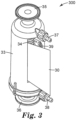
- FIG. 3 is an exemplary filter device 300 comprising filter capsule 33.
- Filter medium sequence 30 is encapsulated in filter capsule 33, which comprises fluid inlet 35 and fluid outlet 36. Vent valve 37 is used to expel air from the filter device while drain valve 38 is used to drain the filter device after use.
- the filter device comprises perforated inner core 34 that extends coaxially through filter capsule 33 fluidly connecting filter medium sequence 30 to fluid outlet 36.
- Filter medium sequence 30 is shown extending from filter capsule 33 to show the elements of the filter device, however in use, the filter medium sequence is located between perforated inner core 34 and perforated outer periphery 39, which can be seen in FIGS. 3 and 4 .
- Fluid inlet 35 is fluidly connected to perforated outer periphery 39.
- fluid enters fluid inlet 35, then sequentially travel through perforated outer periphery 39, filter medium sequence 30, perforated inner core 34, and then exits out fluid outlet 36.
- Perforated outer periphery 39 may be a netting, perforated cage, etc. used to support the filter medium sequence, especially in backflushing operations.
- the filter device may not comprise a perforated outer periphery.
- FIGS. 4 and 5 Two different media cylinders for use in filter capsule 33 are shown in FIGS. 4 and 5 .
- FIG. 4 depicts a cross-sectional view of one embodiment of a filter device, wherein the media capsule comprises a filter medium sequence comprising a plurality of pleats 44.
- Filter medium sequence 40 located between perforated outer periphery 39 and perforated inner core 34, comprises first filtration medium 41 and second filtration medium 42.
- Second filtration medium 42 is positioned downstream of first filtration medium 41, where fluid flow is from perforated outer periphery 39, travels through filter medium sequence 40 into perforated inner core 34.
- An example of a filter module comprising a media cylinder comprising a plurality of pleats may be found, for example, in U.S. Pat. No. 6,315,130 (Olsen ).
- FIG. 5 depicts a cross-sectional view of an alternative embodiment of a filter device, wherein the media capsule comprises a filter medium sequence spirally wound around inner perforated core 34.
- Filter medium sequence 50 located between perforated outer periphery 39 and perforated inner core 34, comprises second filtration medium 52 spirally wound about inner perforated core 34 and first filtration medium 51 spirally wound about second filtration medium 52.
- a drainage layer may be further provided to help facilitate fluid flow between adjacent layers of the filter medium sequence.
- the first and second filtration mediums are encapsulated with a porous web to provide support and aid in handling.
- the first and second filtration mediums may be disposed either vertically, or horizontally.
- the filtration media sequence of the present disclosure may be used in the purification and/or isolation of targeted biomaterials from a biological fluid.
- the filtration media sequence of the present disclosure may be used in the purification and/or isolation of positively charged proteins, more preferably monoclonal antibodies from a harvest fluid from a bioreactor or fermenter.
- the harvest fluid comprises, in addition to the monoclonal antibodies, whole cells and insoluble cell debris, and soluble impurities, including protein impurities, such as host cell proteins, DNA, and chromatin in a culture medium.
- Monoclonal antibodies are one of the most used therapeutic proteins in the pharmaceutical industry. Advances in cell line development and optimization of cell culture processes have enabled higher antibody titers, which increases cell culture density and lengthens culture duration. This translates into higher levels of process-related impurities such as host cell proteins and DNA, lipids, colloids and cell debris. These higher impurity levels present challenges to the recovery, purification, and/or concentration of the monoclonal antibody.
- the post-harvest processing involves primary recovery of the monoclonal antibody, followed by capture of the monoclonal antibody on a chromatography column (such as protein A or cation-exchange chromatography), followed by elution (and concentration) of the captured monoclonal antibody from the chromatography column, and polishing of the eluate.
- a chromatography column such as protein A or cation-exchange chromatography
- Protein A affinity chromatography is preferred for capture because of protein A's highly specific interaction with monoclonal antibodies. As protein A columns are relatively expensive, it is important to reduce the impurities in the harvested broth prior to exposure to the protein A column to maximize its life. Furthermore, some impurities may be retained by the protein A column and eluted with the monoclonal antibody eluate, resulting in additional, and/or more aggressive polishing of the eluate.
- Cell debris generally refers to insoluble components of lysed (broken) cells, including the cell wall lipids, organelles (e.g., mitochondria, lysosomes, vesicles, and the like), and proteinaceous aggregates.
- cell debris are larger, predominantly negatively-charged material that can clog filters.
- Turbidity is one way to measure the concentration of cell debris in a fluid, where the higher the turbidity value the more cell debris present.
- the harvest fluid or cell culture fluid has turbidity of at least 40, 60, 80 or even 100 NTU (nephelometric turbidity unit) and at most 500, 400, 200, or even 150 NTU. After passing through the filter media of the present disclosure, the turbidity of the filtrate is often less than 15, 10, 5, or even 2 NTU.
- the harvest fluid or cell culture fluid has a host cell protein concentration of at least 50,000; 100,000 or even 200,000 ng/mL and at most 2,000,000; 1,000,000; or even 500,000 ng/mL. These soluble proteins are smaller in nature and need to be separated from the monoclonal antibodies.
- DNA is a nucleotide sequence, which is the blueprint for replication of the cell.
- the harvest fluid or cell culture fluid has a concentration of DNA of at least 10 5 , 10 6 , 10 7 , 10 8 , or even 10 9 picograms/mL.
- the DNA of the filtrate can be reduced by a log reduction value of 3 or greater, many times by a log reduction of 4 or greater, even a log reduction value of 8 or greater.
- the harvest fluid or cell culture fluid has a conductivity of at least 10 milliSiemens/cm (mS/cm), or even 15 mS/cm, and at most not more than 25 mS/cm or even 35 mS/cm.
- the inlet fluid i.e., fluid to be filtered
- the inlet fluid may have a higher or lower conductivity depending on the previous processing steps.
- the inlet fluid has a conductivity of at least 1 mS/cm, or even 0.5 mS/cm, and at least not more than 40 mS/cm or even 50 mS/cm.
- the process solution is diluted to decrease the ionic concentration, because the high salt concentrations can interfere with certain techniques, such as ion exchange.
- a filtration device when a nonwoven substrate functionalized with a quaternary ammonium groups is placed upstream from a microporous membrane functionalized with ligands having guanidine or biguanide groups, a filtration device can be fashioned that has a high capacity for purification of cell debris from the fluid, a high capacity for substantial reduction of DNA from the fluid, and a high degree of host cell protein reduction, while also minimizing the number of process steps.
- the first filtration medium can serve to remove whole cells and cell debris, and soluble contaminants such as DNA and some host cell protein.
- the second filtration medium comprises guanidyl groups can bind the negatively-charged contaminants, particularly negatively charged host cell proteins, allowing positively charged materials, such as monoclonal antibodies (mAb), to pass through.
- the filtration sequence of the present disclosure can be used to effectively remove cell debris, DNA, and host cell protein, in the presence of high salt concentrations, enabling the purification and/or isolation of targeted biomacromolecules such as mAb.
- the improved throughput can come not only from the improved throughput through the filtration media, but also in removing one or more process step in the purification or isolation of a biological material, and/or more effectively reduce the contaminants to minimize exposure of contaminants to downstream processes, thereby increasing the downstream component's lifetime.
- filtration media of the instant disclosure can also serve to limit the exposure time of the target protein (e.g., mAb) to fluid contaminants (e.g., protease enzymes) that can degrade the quality of the target protein.
- cm centimeter
- g grams
- mL milliliter
- min minutes
- ⁇ L microliters
- mmol millimol
- wt weight
- pg pictograms
- kPa kilopascal
- kV kilovolt
- kGy kilgray
- °C degrees Celsius.
- Methacrylamidopropyltrimethylammonium chloride 50% wtlwt solution in water
- MBA methylenebisacrylamide
- benzophenone 50% wtlwt solution in water
- methanol methylenebisacrylamide
- S-BP 4-(3-sulfopropyloxy)benzophenone sodium salt
- N -(3-dimethylaminopropyl)methacrylamide DMAPMA
- N-vinyl pyrrolidone N-vinyl pyrrolidone
- IEM-Ag Isocyanatoethylmethacrylate agmatine sodium sulfate
- Glycidyl methacrylate was obtained from Dow Chemical Corporation, Deer Park, Texas.
- Nylon membrane substrates (#080ZN, reinforced nylon-6,6 membrane, 0.8 micrometer nominal pore size) were obtained from 3M Purification, Inc., Meriden, CT.
- Polypropylene blown microfiber (PP BMF) substrates were prepared by a meltblown process and had an Effective Fiber Diameter of 4.3 micrometers, basis weight of 90 grams per square meter, and solidity of 10%.
- the mass percent of grafted functional polymer was measured as follows. At least five 47-mm diameter discs were die cut from a dried functional nonwoven sample. The discs were dried to a constant weight on a moisture balance (Mettler-Toledo MJ33 available from Metter-Toledo, LLC, Columbus, Ohio) at 90 °C, and the constant dry weight was recorded as m f . The mass of an equal area of PP BMF substrate was recorded as m t . The mass percent of grafted polymer was then calculated as,
- the mass percent of grafted functional polymer was subsequently utilized to estimate the number of millimoles of monomer grafted to the nonwoven substrate by multiplying the mass percent of functional polymer by the total mass of a sample of known area, multiplying the result by the mass percent of ligand functional monomer in the coating solution with respect to total monomer, and dividing by the molecular weight of the ligand functional monomer. Graft density was then normalized by dividing by the original mass of the nonwoven substrate and expressed as millimoles of monomer grafted per gram of substrate (mmol/g).
- Nylon membrane substrates were equilibrated for a minimum of 18 hours in a low humidity chamber (Sanpia Dry Keeper, Sanplatec Corporation, available from VWR International) at a relative humidity (RH) of 20-25 percent (%), prior to being grafted.
- the substrates were removed from the low humidity chamber, weighed immediately, and then subjected to a free radical grafting reaction as described below for a variety of ligand functional group-containing monomers. Following a washing and drying process, the substrates were again equilibrated in the low humidity chamber for a minimum of 18 hours, were removed from the chamber, and were reweighed immediately to obtain a measurement of mass gain during the grafting reaction.
- the mass gain was subsequently utilized to estimate the number of millimoles of monomer grafted to the membrane substrate by dividing the mass gain by the molecular weight of the monomer. Graft density was then normalized by dividing by the original mass of the membrane substrate and expressed as millimoles of monomer grafted per gram of substrate (mmol/g).
- the pH and conductivity values of challenge fluids were characterized using a Beckman Coulter pHI 570 pH and Electrochemistry Meter available from Beckman Coulter, Inc., Brea, California.
- turbidities of the challenge fluids and processed fluids were measured using a turbidimeter (available under the trade designation "ORION AQUAFAST AQ4500 TURBIDEVETER from Thermofisher Scientific).
- the turbidimeter provides turbidity values in standard Nephelometric Turbidity Units (NTU).
- CHO HCP ELISA kit 3G, obtained from Cygnus Technologies, Southport, NC. Prior to analysis, samples were diluted with buffer (Sample Dilution Buffer obtained from Cygnus Technologies) to achieve a concentration within the range of the calibration curve.
- a % HCP reduction is reported, which is the HCP concentration determined by the difference of the HCP concentration in the challenge fluid (CHO centrate) minus the HCP concentration in the filtrate divided by the HCP concentration in the challenge fluid (CHO centrate) and reported as a percentage.
- Quantification of CHO DNA was performed by quantitative polymerase chain reaction (qPCR) using an assay specifically for CHO DNA (available under the trade designation “RESDNASEQ QUANTITATIVE CHO DNA KIT” from ThermoFisher Scientific, Waltham, MA). Prior to qPCR, the DNA was isolated from the samples using a preparation kit (available under the trade designation "PREPSEQ RESIDUAL DNA SAMPLE PREPARATION KIT” from ThermoFisher Scientific) to prevent interference from cell culture media components.
- qPCR quantitative polymerase chain reaction
- DNA reduction is reported as a LRV (log reduction value), wherein the DNA concentration determined in the filtrate was divided by the DNA concentration in the challenge fluid (CHO centrate) and then the base-10 logarithm of the resulting quotient was taken.
- LRV log reduction value
- a quaternary ammonium functional ("Q-functional) Membrane 1 was prepared as follows.
- Coating Solution A coating solution was prepared by mixing MAPTAC (3.532 grams of the 50% wt/wt solution in water) and S-BP (250 microliters of a 0.05 g/mL solution in deionized water), then diluting to a total of 20 grams with deionized water.
- UV-initiated grafting was conducted by irradiating the sandwich using a UV stand (Classic Manufacturing, Inc., Oakdale, MN) equipped with 18 bulbs [Sylvania RG2 40W F40/350BL/ECO, 10 above and 8 below the substrate, 1.17 meters (46 inches) long, spaced 5.1 cm (2 inches) on center], with an irradiation time of 15 minutes.
- the polyester sheets were removed, and the resulting functionalized substrate was placed in a 1000 mL polyethylene bottle.
- the bottle was filled with 0.9 percent (%) saline, sealed, and shaken for 30 minutes to wash off any residual monomer or ungrafted polymer.
- the saline was poured off, and the functionalized substrate was washed for another 30 minutes with a fresh saline solution and then washed for 30 minutes with deionized water (2 times) and allowed to dry.
- Graft density of the functional Membrane 1 was found to be 0.53 mmol/g.
- a guanidyl functional ("G-functional”) Membrane 2 was prepared as follows. Coating Solution: A coating solution was prepared by mixing IEM-Ag (3.5 grams), MBA (0.07 gram), and benzophenone (0.125 gram), then diluting to a total of 25 grams with methanol. The mixture was stirred for 30 minutes, then filtered. A nylon membrane substrate was then coated with the coating solution, irradiated, washed, and dried as described above for the Preparation of Membrane 1. Graft density of the functional Membrane 2A was found to be 0.51 mmol/g.
- a guanidyl functional ("G-functional") Membrane 2B was prepared following the procedure described in U.S. Pat. App. No. 2012/0252091 , Example 42.
- a tertiary amine functional ("T-functional") Membrane 3 was prepared as follows. Coating Solution: A coating solution was prepared by mixing DMAPMA (0.851 gram) and S-BP (250 ⁇ L, of a 0.05 g/mL solution in deionized water), then diluting to a total of 20 grams with deionized water. A nylon membrane substrate was then coated with the coating solution, irradiated, washed, and dried as described above for the Preparation of Membrane 1. Graft density of the functional Membrane 3 was found to be 0.41 mmol/g.
- Nonwoven 1 Quaternary Ammonium Functional Nonwoven
- a quaternary ammonium functional ("Q-functional") Nonwoven 1 was prepared following the procedure described in U.S. 2015/0099413 .
- Coating Solution A coating solution was prepared by mixing aqueous MAPTAC solution (50% wt/wt solution in water), NVP, GMA, and deionized water to make an aqueous solution containing 9 wt % MAPTAC monomer, 11 wt % NVP, 6 wt % GMA, and 74 wt % water. The coating solution was purged of air by repeatedly opening its cover, closing the cover, and shaking the solution under a nitrogen atmosphere inside a glove box.
- a 30-cm x 43-cm sheet of PP BMF substrate was purged of air inside the glove box and inserted into a re-sealable plastic bag which was sealed.
- the sealed bag was then removed from the glove box and irradiated to a dose level of 40 kGy by passing it through an Energy Sciences, Inc. 'Electrocurtain' CB-300 electron beam in a single-pass operation at a web speed of approximately 5.5 meters/min (18-19 feet/min) and an accelerating voltage of 300 kV.
- the sealed bag was then returned to the nitrogen atmosphere inside the glove box.
- the bag was opened and evenly saturated with 110 grams of the nitrogen-purged coating solution and the bag was resealed after expelling most of the nitrogen.
- the oxygen level within the glove box was generally maintained below 40 parts per million (ppm).
- the sample was maintained flat in the bag and saturated with coating solution for about 16 hours.
- the functionalized nonwoven was then removed, washed, and dried as described in U.S. 2015/0099413 .
- the mass percent of grafted functional polymer was found to be 62 percent (%), corresponding to a MAPTAC graft density of 0.25 mmol/g of functionalized nonwoven or 0.66 mmol/g of nonwoven substrate.
- Nonwoven 2 Guanidyl Functional Nonwoven
- a guanidyl functional ("G-functional') Nonwoven 2 was prepared as follows.
- Coating Solution A coating solution was prepared containing 9 wt % IEM-Ag, 11 wt % NVP, 6 wt % GMA, and 74 wt % deionized water.
- Preparation A PP BMF substrate was then inertly coated, irradiated, washed, and dried as described above for the Preparation of Nonwoven 1.
- the mass percent of grafted functional polymer was found to be 69 percent (%), corresponding to a IEM-Ag graft density of 0.16 mmol/g of functionalized nonwoven or 0.52 mmol/g of nonwoven substrate.
- Nonwoven 3 Tertiary Amine Functional Nonwoven
- a tertiary amine (“T-functional") Nonwoven 3 was prepared as follows.
- Coating Solution A coating solution was prepared containing 9 wt % DMAPMA, 11 wt % NVP, 6 wt % GMA, and 74 wt % deionized water.
- Preparation A PP BMF substrate was then inertly coated, irradiated, washed, and dried as described above for the Preparation of Nonwoven 1.
- the mass percent of grafted functional polymer was found to be 61 percent (%), corresponding to a DMAPMA graft density of 0.32 mmol/g of functionalized nonwoven or 0.84 mmol/g of nonwoven substrate.
- a culture of Chinese Hamster Ovary cell was done using standard cell culture techniques. The harvest fluid was collected, centrifuged, and then tested for Conductivity or pH, Turbidity, and HCP concentration by ELISA. Various cultures were used in the experiments disclosed herein and the profiles for each are described below.
- CHO Centrate 1 A CHO cell culture was harvested at a cell density of approximately 5 ⁇ 10 6 cells/mL and a viability of roughly 20%. The harvest fluid was centrifuged (Jouan GR4.22 centrifuge available from Thermofisher Scientific) for approximately 4 minutes at 4000 rpm, yielding a centrate fluid with a turbidity of 85.2 NTU, a HCP concentration of 169,596 nanograms per milliliter (ng/mL), and a conductivity of 11.8 mS/cm.
- CHO Centrate 2 A CHO cell culture was harvested at a cell density of approximately 1 ⁇ 10 8 cells/mL, a viability of roughly 60, and a mAb concentration of 0.5 mg/mL. The harvest fluid was centrifuged (Jouan GR4.22 centrifuge available from Thermofisher Scientific) for approximately 8 minutes at 4000 rpm, yielding a centrate fluid with a turbidity of 83.4 NTU, a HCP concentration of 255,688 nanograms per milliliter (ng/mL), a DNA concentration of 2.41 ⁇ 10 8 pg/mL, and a conductivity of 16.9 mS/cm.
- CHO Centrate 3 The cell culture was harvested at a cell concentration of approximately 1 ⁇ 10 7 cells/mL and a viability of roughly 20%. The fluid was centrifuged, yielding a centrate having a turbidity of 81.0 NTU, a HCP concentration of 259,840 nanograms per milliliter (ng/mL), and a pH of 6.8.
- CHO Centrate 4 The cell culture was harvested at a cell concentration of approximately 1 ⁇ 10 7 cells/mL and a viability of roughly 20%. The fluid was centrifuged, yielding a centrate having a turbidity of 87.5 NTU, a HCP concentration of 265,740 nanograms per milliliter (ng/mL), and a pH of 6.8.
- CHO cell challenge fluids were used to perform filtration tests on various nonwoven and membrane media combinations, using nominally 25-mm diameter filter acrylic housings, as follows. 25-mm diameter discs of the functional nonwoven and functional membrane media were die cut from the dried media samples described above. For each tested media combination, six discs of a particular functional membrane media were placed in the bottom of an acrylic filter housing. Four discs of a particular functional nonwoven media were then placed on top of the functional membrane media in the holder. The acrylic housing was then assembled.
- the acrylic housing was adapted to provide an edge seal about the periphery of the media by means of an o-ring, defining an effective filtration area (EFA) of 2.84 square centimeters (cm 2 ), such that the challenge fluid would flow into an inlet of the housing, then through the four layers of functional nonwoven media, then through the six layers of functional membrane media, then out an outlet of the housing.
- EFA effective filtration area
- a vent valve positioned near the fluid inlet enabled venting of the housing of air prior to the test.
- Filtration challenges were conducted using a PENDOTECH Filter Screening System available from PendoTECH, Princeton, New Jersey.
- An automated pump module provided a constant flow rate of challenge solution to the filter housing.
- the pressure drop across the filter housing was monitored using a pressure transducer positioned upstream of the housing inlet.
- the mass of fluid collected at the outlet of the filter housing was monitored using a mass balance.
- the cumulative quantity of fluid processed through the filter housing was characterized in units of liters of fluid processed per square meter of EFA (L/m 2 ).
- the filter housing was first vented and flushed at a flow rate of 3 mL/min with 250 L/m 2 of a 25 millimolar (mM) sodium chloride solution in deionized water.
- the feed fluid was then changed to the CHO challenge fluid and the filter test was commenced, also at a flow rate of 3 mL/min.
- the pressure drop increased as the membrane became loaded with particulate matter in the challenge fluid.
- the filter test was stopped when the pressure reached 172 kPa (25 psi), and the cumulative quantity of fluid processed at that time was recorded as the throughput.
- Outlet fluid samples for each filter test were collected in individual aliquots of approximately 25 milliters (88 L/m 2 ), the exact mass of each of which was measured and recorded. The turbidity of each aliquot was measured, and selected aliquots were tested for HCP and/or DNA concentration as described above. The mean outlet turbidity for each filter test was calculated as a weighted average of the turbidities of each of the aliquots, weighted by the aliquot masses.
- CHO cell challenge fluids were used to perform filtration tests on various nonwoven and membrane media combinations, using nominally 47-mm diameter filter housings, as follows.
- four filter trains were constructed, each with either a single nominally 47-mm diameter acrylic filter housing or two such filter housings arranged in series.
- 47-mm diameter discs of the media were die cut from the dried media samples described above.
- Media discs were placed inside the filter housings in particular combinations, as detailed in the examples below.
- the housings were then assembled.
- Each acrylic housing was adapted to provide an edge seal about the periphery of the media by means of an o-ring, defining an EFA of 13.85 square centimeters (cm 2 ).
- a vent valve positioned near the fluid inlet enabled venting of the housing of air prior to the test.
- the filter housing was arranged such that the challenge fluid passed into a fluid inlet of the housing, then through the filter media inside the housing, then out of a fluid outlet of the housing.
- the filter housings were arranged such that the challenge fluid passed into a fluid inlet of a first housing, then through filter media inside the first housing, then out of a fluid outlet of the first housing, then into a fluid inlet of a second housing, then through filter media inside the second housing, then out of a fluid outlet of the second housing.
- Filtration challenges were conducted using a normal flow filtration screening system (3M Purification, Inc., Meriden, CT).
- An automated pump module provided a constant flow rate of challenge solution to each filter train.
- a pressure transducer was positioned upstream of each filter housing of each filter train, such that the pressure drop across each filter housing could be monitored.
- a 3-way valve was installed between the first filter housing and the second filter housing to enable the periodic collection of samples from that position in the filter train by means of a syringe.
- the mass of fluid collected at the outlet of the last series filter housing of each filter train was monitored using a mass balance.
- the cumulative quantity of fluid processed through the filter housing was characterized in units of liters of fluid processed per square meter of EFA (L/m 2 ).
- the filter housing was first vented and flushed at a flow rate of 4 mL/min with 250 L/m 2 of a 35 millimolar (mM) sodium chloride solution in deionized water.
- the feed fluid was then changed to the CHO challenge fluid and the filter test was commenced at a flow rate of 3.7 mL/min.
- the total pressure drop across the filter train increased as the membranes became loaded with particulate matter in the challenge fluid.
- Each filter test was stopped when the total pressure (across all series holders in the filter train) reached 172 kPa (25 psi), and the cumulative quantity of fluid processed at that time was recorded as the throughput.
- the throughput data from Table 1 was consolidated and compared for Nonwoven 1, Nonwoven 2, and Nonwoven 3.
- the average throughput when Nonwoven 1 was used was 430 L/m 2 .
- the average throughput when Nonwoven 2 was used 390 L/m 2 .
- the throughput for Nonwoven 3 was 286 L/m 2 .
- Comparative Example C9 contained only one filter housing, in which were installed two conventional depth filter media grades (available under the trade designations "ZETA PLUS 60ZA” and "ZETA PLUS 90ZA” from 3M Co., St. Paul, MN composed of pre-extracted inorganic filter aid, cellulose, and cationic polymer binder).
- the filter housing contained 1 layer ZETA PLUS 60ZA upstream of 1 layer ZETA PLUS 90ZA.
- Comparative Example C10 contained two filter housings arranged in series.
- the first (upstream) filter housing contained four layers of Nonwoven 1.
- the second filter housing contained one 0.2-micron rated, asymmetric, non-functionalized nylon size-exclusion membrane which was not functionalized.
- This filter train simulated a commercially available synthetic clarification filter designed for mammalian cell culture clarification, 3M EMPHAZE AEX Hybrid Purifier, available from 3M Purification, Inc., Meriden, CT.
- Example 4 contained two filter housings arranged in series.
- the first (upstream) filter housing contained four layers of Nonwoven 1.
- the second housing contained one 0.2-micron rated, asymmetric, non-functionalized nylon size exclusion membrane upstream of 2 layers of Membrane 2B.
- Example 5 was the same configuration as Example 4 except 4 layers of Membrane 2B were used instead of 2.
- the four filter trains were simultaneously challenged with CHO Centrate 3 at a flow rate of 3.7 mL/min.
- Samples were taken from each filter train, at each of two positions, for HCP analysis.
- the first position (if two housings were used) was downstream of the outlet of housing 1, but upstream of the inlet of housing 2. This enabled calculation of the HCP reduction achieved by the media in housing 1.
- the second position was downstream of the outlet of housing 2.
- Samples were taken from each filter train at two throughput points of 145 L/m 2 and 220 L/m 2 , enabling characterization of HCP reduction achieved at an earlier part of the run and a later part of the run, respectively.
- HCP reductions at each of the positions and throughput points are shown in Table 3. Also shown in Table 3 below is the total throughput and turbidity of the accumulated filtrate for Examples 4-5 and Comparative Examples C9-10.
- Table 3 Sample % HCP Reduction Total Throughput (L/m 2 ) Turbidity (NTU) 145 L/m 2 220 L/m 2 After housing 1 After housing 2 After housing 1 After housing 2 C9 NA 26 NA 0 339 0.5 C10 33 26 28 33 422 3.0 4 34 69 31 35 397 4.5 5 26 74 30 68 365 2.8 NA means not applicable
- Comparative Example C11 contained only one filter housing, in which were installed four layers of Nonwoven 1 upstream of one 0.2-micron rated, asymmetric, non-functionalized nylon size-exclusion membrane.
- This filter train simulated a commercially available synthetic clarification filter designed for mammalian cell culture clarification, 3M EMPHAZE AEX Hybrid Purifier, available from 3M Purification, Inc., Meriden, CT.
- Examples 6-8 contained two filter housings arranged in series, the contents of the first (upstream) housing being identical the housing contents of Comparative Example C11.
- the second housing for Examples 6-8 contained three, four, and six layers, respectively of Membrane 2B.
- the four filter trains were simultaneously challenged with CHO Centrate 4 at a flow rate of 3.7 mL/min.
- the total pressure drop of each of the filter trains reached 172 kPa (25 psi)
- the cumulative quantity of fluid processed at that time was recorded as the throughput.
- the turbidity and HCP concentration of the total pool of accumulated filtrate for each filter train were measured. This enabled calculation of the HCP reduction achieved by each filter train over the entirety of the run.
- Throughput, total turbidity, and HCP reduction for each of the filter trains are shown in Table 4.
- Table 4 Sample Total Throughput (L/m 2 ) Turbidity (NTU) %HCP reduction C11 429 0.3 36 6 378 1.7 62 7 419 1.3 62 8 421 2.0 72
Landscapes
- Chemical & Material Sciences (AREA)
- Chemical Kinetics & Catalysis (AREA)
- Engineering & Computer Science (AREA)
- Inorganic Chemistry (AREA)
- Manufacturing & Machinery (AREA)
- Health & Medical Sciences (AREA)
- Organic Chemistry (AREA)
- Transplantation (AREA)
- Genetics & Genomics (AREA)
- Proteomics, Peptides & Aminoacids (AREA)
- Life Sciences & Earth Sciences (AREA)
- Biochemistry (AREA)
- Biophysics (AREA)
- General Health & Medical Sciences (AREA)
- Water Supply & Treatment (AREA)
- Medicinal Chemistry (AREA)
- Molecular Biology (AREA)
- Analytical Chemistry (AREA)
- Plasma & Fusion (AREA)
- Physics & Mathematics (AREA)
- Separation Using Semi-Permeable Membranes (AREA)
- Filtering Materials (AREA)
- Apparatus Associated With Microorganisms And Enzymes (AREA)
- Treatment Of Liquids With Adsorbents In General (AREA)
- Peptides Or Proteins (AREA)
- Investigating Or Analysing Biological Materials (AREA)
- Manufacture Of Macromolecular Shaped Articles (AREA)
- Solid-Sorbent Or Filter-Aiding Compositions (AREA)
Applications Claiming Priority (2)
| Application Number | Priority Date | Filing Date | Title |
|---|---|---|---|
| US201562245403P | 2015-10-23 | 2015-10-23 | |
| PCT/US2016/056326 WO2017069965A1 (en) | 2015-10-23 | 2016-10-11 | Filtration medium sequence for biomaterial purification |
Publications (2)
| Publication Number | Publication Date |
|---|---|
| EP3365095A1 EP3365095A1 (en) | 2018-08-29 |
| EP3365095B1 true EP3365095B1 (en) | 2024-07-24 |
Family
ID=57218993
Family Applications (1)
| Application Number | Title | Priority Date | Filing Date |
|---|---|---|---|
| EP16788850.2A Active EP3365095B1 (en) | 2015-10-23 | 2016-10-11 | Filtration medium sequence for biomaterial purification |
Country Status (7)
| Country | Link |
|---|---|
| US (1) | US10722848B2 (enExample) |
| EP (1) | EP3365095B1 (enExample) |
| JP (1) | JP6924750B2 (enExample) |
| CN (1) | CN108136338B (enExample) |
| BR (1) | BR112018008250B1 (enExample) |
| RU (1) | RU2698822C1 (enExample) |
| WO (1) | WO2017069965A1 (enExample) |
Families Citing this family (23)
| Publication number | Priority date | Publication date | Assignee | Title |
|---|---|---|---|---|
| US10022339B2 (en) | 2006-04-21 | 2018-07-17 | The Procter & Gamble Company | Compositions and methods useful for treatment of respiratory illness |
| US10704021B2 (en) | 2012-03-15 | 2020-07-07 | Flodesign Sonics, Inc. | Acoustic perfusion devices |
| CA2935960C (en) | 2014-01-08 | 2023-01-10 | Bart Lipkens | Acoustophoresis device with dual acoustophoretic chamber |
| US11377651B2 (en) | 2016-10-19 | 2022-07-05 | Flodesign Sonics, Inc. | Cell therapy processes utilizing acoustophoresis |
| US11708572B2 (en) | 2015-04-29 | 2023-07-25 | Flodesign Sonics, Inc. | Acoustic cell separation techniques and processes |
| US11214789B2 (en) | 2016-05-03 | 2022-01-04 | Flodesign Sonics, Inc. | Concentration and washing of particles with acoustics |
| TWI675696B (zh) * | 2017-06-01 | 2019-11-01 | 美商Emd密理博公司 | 用於灌注應用之切向流過濾裝置 |
| KR20220066413A (ko) | 2017-12-14 | 2022-05-24 | 프로디자인 소닉스, 인크. | 음향 트랜스듀서 구동기 및 제어기 |
| US11045773B2 (en) * | 2018-08-31 | 2021-06-29 | Pall Corporation | Salt tolerant porous medium |
| US10737259B2 (en) * | 2018-08-31 | 2020-08-11 | Pall Corporation | Salt tolerant anion exchange medium |
| JP2022510909A (ja) * | 2018-11-30 | 2022-01-28 | インテグリス・インコーポレーテッド | ペンダント親水性基を有する親水性フィルタ膜、ならびに関連する調製および使用の方法 |
| US12306152B2 (en) | 2018-12-21 | 2025-05-20 | Solventum Intellectual Properties Company | Method for testing a chromatography device used for ion exchange |
| WO2021081341A1 (en) | 2019-10-23 | 2021-04-29 | Donaldson Company, Inc. | Filtration and deaeration system |
| CN111471101A (zh) * | 2020-04-13 | 2020-07-31 | 国药集团武汉血液制品有限公司 | 一种去除人免疫球蛋白类制品中残留的IgA的方法 |
| JP2023529799A (ja) * | 2020-05-12 | 2023-07-12 | スリーエム イノベイティブ プロパティズ カンパニー | ウイルスクリアランスクロマトグラフィーデバイスの膜封止層及びスペーサリング |
| JP2023534005A (ja) * | 2020-07-14 | 2023-08-07 | ドナルドソン カンパニー,インコーポレイティド | 脱気のシステム及び方法 |
| WO2022118114A1 (en) | 2020-12-04 | 2022-06-09 | 3M Innovative Properties Company | A filtration unit and a method for biomaterial purification |
| WO2022136968A1 (en) * | 2020-12-23 | 2022-06-30 | 3M Innovative Properties Company | Method of separating a virus from a composition using copolymer-grafted nonwoven substrates |
| JP2024507942A (ja) * | 2021-02-26 | 2024-02-21 | スリーエム イノベイティブ プロパティズ カンパニー | 治療用バイオテクノロジー製造プロセスのための荷電デプスフィルタ |
| US20250065274A1 (en) | 2021-11-19 | 2025-02-27 | Solventum Intellectual Properties Company | Method for Biomaterial Purification |
| EP4573366A1 (en) * | 2022-08-15 | 2025-06-25 | Solventum Intellectual Properties Company | Functionalized porous substrates and their use for detecting analytes |
| CN220723675U (zh) * | 2023-02-17 | 2024-04-05 | 纳诺多克斯科技有限公司 | 液体过滤器 |
| WO2025133981A1 (en) * | 2023-12-21 | 2025-06-26 | Solventum Intellectual Properties Company | Chemically-functionalized spun-bond nylon nonwoven and methods of making and using the same |
Family Cites Families (40)
| Publication number | Priority date | Publication date | Assignee | Title |
|---|---|---|---|---|
| JPS4740913Y1 (enExample) | 1970-06-23 | 1972-12-11 | ||
| US3876738A (en) | 1973-07-18 | 1975-04-08 | Amf Inc | Process for producing microporous films and products |
| US3928517A (en) | 1973-12-26 | 1975-12-23 | Amf Inc | Quench bath regeneration system for microporous film production |
| CA1073648A (en) | 1976-08-02 | 1980-03-18 | Edward R. Hauser | Web of blended microfibers and crimped bulking fibers |
| DE3146913C2 (de) | 1981-11-26 | 1983-10-06 | C.A. Weidmueller Gmbh & Co, 4930 Detmold | Querverbinder |
| US4707265A (en) | 1981-12-18 | 1987-11-17 | Cuno Incorporated | Reinforced microporous membrane |
| US4726989A (en) | 1986-12-11 | 1988-02-23 | Minnesota Mining And Manufacturing | Microporous materials incorporating a nucleating agent and methods for making same |
| US4867881A (en) | 1987-09-14 | 1989-09-19 | Minnesota Minning And Manufacturing Company | Orientied microporous film |
| US5120594A (en) | 1989-11-20 | 1992-06-09 | Minnesota Mining And Manufacturing Company | Microporous polyolefin shaped articles with patterned surface areas of different porosity |
| US5260360A (en) | 1991-10-18 | 1993-11-09 | Minnesota Mining And Manufacturing Company | Oil, water and sweat repellent microporous membrane materials |
| US5522997A (en) | 1993-03-16 | 1996-06-04 | Cognis, Inc. | Process for the removal of toxic cyanide and heavy metal species from alkaline solutions |
| CA2127605A1 (en) | 1993-12-23 | 1995-06-24 | Peter J. Degen | Affinity separation method |
| US5458782A (en) | 1994-01-07 | 1995-10-17 | Cuno Incorporated | Hydrolytically stable nylon membrane |
| US5962544A (en) | 1995-12-07 | 1999-10-05 | 3M | Microporous materials of ethylene-vinyl alcohol copolymer and methods for making same |
| US6056529A (en) | 1998-02-11 | 2000-05-02 | Cuno, Inc. | Systems for producing a plurality of different microporous phase inversion membrane each having any one of a plurality of different pore sizes from a single master dope batch |
| US6413070B1 (en) | 1997-04-11 | 2002-07-02 | Cuno Incorporated | System for manufacturing reinforced three-zone microporous membrane |
| US6939466B2 (en) | 1998-08-17 | 2005-09-06 | Cuno Incorporated | Graded particle-size retention filter medium for fluid filtration unit with improved edge seal |
| WO2000009239A1 (en) | 1998-08-17 | 2000-02-24 | Cuno Incorporated | Edge seal for filter cartridge |
| US6712966B1 (en) | 1999-02-04 | 2004-03-30 | Cuno Incorporated | Graded particle-size retention filter medium for cell-type filter unit |
| EP1140319B1 (en) | 1999-01-07 | 2005-06-29 | Cuno Incorporated | Pleated filter element and method of forming a pleated filter element |
| US6780327B1 (en) | 1999-02-25 | 2004-08-24 | Pall Corporation | Positively charged membrane |
| US6521011B1 (en) | 1999-07-15 | 2003-02-18 | 3M Innovative Properties Company | Self-supporting pleated filter and method of making same |
| RU2170136C1 (ru) * | 2000-06-06 | 2001-07-10 | Государственный научный центр Российской Федерации Физико-энергетический институт им. акад. А.И. Лейпунского | Многослойный фильтрующий материал для ультра- и микрофильтрации и способ его изготовления |
| ITTO20030039A1 (it) * | 2003-01-24 | 2004-07-25 | Fresenius Hemocare Italia Srl | Filtro per separare leucociti da sangue intero e/o da preparati derivati dal sangue, procedimento per la fabbricazione del filtro, dispositivo e utilizzazione. |
| US7338692B2 (en) | 2003-09-12 | 2008-03-04 | 3M Innovative Properties Company | Microporous PVDF films |
| JP5182793B2 (ja) * | 2007-10-12 | 2013-04-17 | 独立行政法人日本原子力研究開発機構 | 液体濾過用カートリッジフィルタ |
| EP2522692B1 (en) | 2008-05-30 | 2014-06-18 | 3M Innovative Properties Company | Ligand monomers and copolymers made therewith |
| WO2009146321A1 (en) | 2008-05-30 | 2009-12-03 | 3M Innovative Properties Company | Ligand functionalized substrates |
| DE102008037678A1 (de) | 2008-08-14 | 2010-02-25 | Sartorius Stedim Biotech Gmbh | Tiefenfilterschicht mit anorganischem Schichtdoppelhydroxid |
| JP5711127B2 (ja) | 2008-09-19 | 2015-04-30 | スリーエム イノベイティブ プロパティズ カンパニー | リガンドグラフト官能化基材 |
| US9474992B2 (en) | 2008-11-04 | 2016-10-25 | 3M Innovative Properties Company | Fluid interconnect |
| WO2010053898A2 (en) | 2008-11-04 | 2010-05-14 | 3M Innovative Properties Company | Filter element and seal therefor |
| BRPI0923565A2 (pt) * | 2008-12-23 | 2016-01-26 | 3M Innovative Properties Co | artigo não tecido funcionalizado |
| US20100210160A1 (en) | 2009-02-18 | 2010-08-19 | 3M Innovative Properties Company | Hydrophilic porous substrates |
| BRPI1011747A2 (pt) * | 2009-06-23 | 2018-02-27 | 3M Innovative Properties Co | artigo não tecido funcionalizado. |
| US9272246B2 (en) | 2011-03-28 | 2016-03-01 | 3M Innovative Properties Company | Ligand functional substrates |
| US9821276B2 (en) * | 2012-04-24 | 2017-11-21 | 3M Innovative Properties Company | Nonwoven article grafted with copolymer |
| EP3326711B1 (en) * | 2012-06-05 | 2021-07-07 | 3M Innovative Properties Company | Graft copolymer functionalized article |
| EP2901158B1 (en) | 2012-09-27 | 2018-07-25 | 3M Innovative Properties Company | Ligand grafted substrates |
| AU2016243036B2 (en) * | 2015-04-03 | 2022-02-17 | Abbott Laboratories | Devices and methods for sample analysis |
-
2016
- 2016-10-11 RU RU2018112487A patent/RU2698822C1/ru active
- 2016-10-11 WO PCT/US2016/056326 patent/WO2017069965A1/en not_active Ceased
- 2016-10-11 BR BR112018008250-3A patent/BR112018008250B1/pt active IP Right Grant
- 2016-10-11 EP EP16788850.2A patent/EP3365095B1/en active Active
- 2016-10-11 JP JP2018520105A patent/JP6924750B2/ja active Active
- 2016-10-11 US US15/755,584 patent/US10722848B2/en active Active
- 2016-10-11 CN CN201680061591.0A patent/CN108136338B/zh active Active
Also Published As
| Publication number | Publication date |
|---|---|
| CN108136338B (zh) | 2021-09-03 |
| US20180257042A1 (en) | 2018-09-13 |
| BR112018008250A2 (pt) | 2018-10-23 |
| WO2017069965A1 (en) | 2017-04-27 |
| CN108136338A (zh) | 2018-06-08 |
| JP2018538127A (ja) | 2018-12-27 |
| EP3365095A1 (en) | 2018-08-29 |
| BR112018008250B1 (pt) | 2022-10-04 |
| US10722848B2 (en) | 2020-07-28 |
| RU2698822C1 (ru) | 2019-08-30 |
| JP6924750B2 (ja) | 2021-08-25 |
Similar Documents
| Publication | Publication Date | Title |
|---|---|---|
| EP3365095B1 (en) | Filtration medium sequence for biomaterial purification | |
| EP2376689B1 (en) | Functionalized nonwoven article | |
| US7721898B2 (en) | Coating material for leukocyte removal filter and the filter | |
| JP4115839B2 (ja) | 血液処理用フィルター及びその製造方法 | |
| KR102043249B1 (ko) | 공중합체로 그래프팅된 부직 물품 | |
| JP7138096B2 (ja) | 生物学的溶液中の単量体タンパク質から凝集タンパク質を分離するための方法 | |
| JP7085533B2 (ja) | 官能化コポリマー及びその使用 | |
| US7793787B2 (en) | Polymers useful as medical materials | |
| CN1589163A (zh) | 病毒及白细胞选择除去方法、除去材料与除去装置 | |
| US8136676B2 (en) | Polymers useful as medical materials | |
| US20240131450A1 (en) | Charged depth filter for therapeutic biotechnology manufacturing process | |
| CN116615434A (zh) | 用于生物材料纯化的过滤单元和方法 | |
| CN118103491A (zh) | 收获生物制剂的方法 | |
| EP4136093A1 (en) | Flow-through processes and devices for purifying a target molecule | |
| WO2022229889A1 (en) | Viral filtration media, articles, and methods |
Legal Events
| Date | Code | Title | Description |
|---|---|---|---|
| STAA | Information on the status of an ep patent application or granted ep patent |
Free format text: STATUS: UNKNOWN |
|
| STAA | Information on the status of an ep patent application or granted ep patent |
Free format text: STATUS: THE INTERNATIONAL PUBLICATION HAS BEEN MADE |
|
| PUAI | Public reference made under article 153(3) epc to a published international application that has entered the european phase |
Free format text: ORIGINAL CODE: 0009012 |
|
| STAA | Information on the status of an ep patent application or granted ep patent |
Free format text: STATUS: REQUEST FOR EXAMINATION WAS MADE |
|
| 17P | Request for examination filed |
Effective date: 20180409 |
|
| AK | Designated contracting states |
Kind code of ref document: A1 Designated state(s): AL AT BE BG CH CY CZ DE DK EE ES FI FR GB GR HR HU IE IS IT LI LT LU LV MC MK MT NL NO PL PT RO RS SE SI SK SM TR |
|
| AX | Request for extension of the european patent |
Extension state: BA ME |
|
| DAV | Request for validation of the european patent (deleted) | ||
| DAX | Request for extension of the european patent (deleted) | ||
| STAA | Information on the status of an ep patent application or granted ep patent |
Free format text: STATUS: EXAMINATION IS IN PROGRESS |
|
| 17Q | First examination report despatched |
Effective date: 20190313 |
|
| RIC1 | Information provided on ipc code assigned before grant |
Ipc: B01D 71/78 20060101ALI20240110BHEP Ipc: B01D 71/40 20060101ALI20240110BHEP Ipc: B01D 69/10 20060101ALI20240110BHEP Ipc: B01D 67/00 20060101AFI20240110BHEP |
|
| GRAP | Despatch of communication of intention to grant a patent |
Free format text: ORIGINAL CODE: EPIDOSNIGR1 |
|
| STAA | Information on the status of an ep patent application or granted ep patent |
Free format text: STATUS: GRANT OF PATENT IS INTENDED |
|
| RAP1 | Party data changed (applicant data changed or rights of an application transferred) |
Owner name: SOLVENTUM INTELLECTUAL PROPERTIES COMPANY |
|
| INTG | Intention to grant announced |
Effective date: 20240226 |
|
| GRAS | Grant fee paid |
Free format text: ORIGINAL CODE: EPIDOSNIGR3 |
|
| GRAA | (expected) grant |
Free format text: ORIGINAL CODE: 0009210 |
|
| STAA | Information on the status of an ep patent application or granted ep patent |
Free format text: STATUS: THE PATENT HAS BEEN GRANTED |
|
| AK | Designated contracting states |
Kind code of ref document: B1 Designated state(s): AL AT BE BG CH CY CZ DE DK EE ES FI FR GB GR HR HU IE IS IT LI LT LU LV MC MK MT NL NO PL PT RO RS SE SI SK SM TR |
|
| REG | Reference to a national code |
Ref country code: GB Ref legal event code: FG4D |
|
| REG | Reference to a national code |
Ref country code: CH Ref legal event code: EP |
|
| REG | Reference to a national code |
Ref country code: IE Ref legal event code: FG4D Ref country code: DE Ref legal event code: R096 Ref document number: 602016088554 Country of ref document: DE |
|
| REG | Reference to a national code |
Ref country code: LT Ref legal event code: MG9D |
|
| REG | Reference to a national code |
Ref country code: NL Ref legal event code: MP Effective date: 20240724 |
|
| PG25 | Lapsed in a contracting state [announced via postgrant information from national office to epo] |
Ref country code: PT Free format text: LAPSE BECAUSE OF FAILURE TO SUBMIT A TRANSLATION OF THE DESCRIPTION OR TO PAY THE FEE WITHIN THE PRESCRIBED TIME-LIMIT Effective date: 20241125 |
|
| REG | Reference to a national code |
Ref country code: AT Ref legal event code: MK05 Ref document number: 1705809 Country of ref document: AT Kind code of ref document: T Effective date: 20240724 |
|
| PG25 | Lapsed in a contracting state [announced via postgrant information from national office to epo] |
Ref country code: NL Free format text: LAPSE BECAUSE OF FAILURE TO SUBMIT A TRANSLATION OF THE DESCRIPTION OR TO PAY THE FEE WITHIN THE PRESCRIBED TIME-LIMIT Effective date: 20240724 |
|
| PG25 | Lapsed in a contracting state [announced via postgrant information from national office to epo] |
Ref country code: PT Free format text: LAPSE BECAUSE OF FAILURE TO SUBMIT A TRANSLATION OF THE DESCRIPTION OR TO PAY THE FEE WITHIN THE PRESCRIBED TIME-LIMIT Effective date: 20241125 Ref country code: NL Free format text: LAPSE BECAUSE OF FAILURE TO SUBMIT A TRANSLATION OF THE DESCRIPTION OR TO PAY THE FEE WITHIN THE PRESCRIBED TIME-LIMIT Effective date: 20240724 |
|
| PGFP | Annual fee paid to national office [announced via postgrant information from national office to epo] |
Ref country code: DE Payment date: 20240919 Year of fee payment: 9 |
|
| PG25 | Lapsed in a contracting state [announced via postgrant information from national office to epo] |
Ref country code: NO Free format text: LAPSE BECAUSE OF FAILURE TO SUBMIT A TRANSLATION OF THE DESCRIPTION OR TO PAY THE FEE WITHIN THE PRESCRIBED TIME-LIMIT Effective date: 20241024 |
|
| PG25 | Lapsed in a contracting state [announced via postgrant information from national office to epo] |
Ref country code: FI Free format text: LAPSE BECAUSE OF FAILURE TO SUBMIT A TRANSLATION OF THE DESCRIPTION OR TO PAY THE FEE WITHIN THE PRESCRIBED TIME-LIMIT Effective date: 20240724 Ref country code: GR Free format text: LAPSE BECAUSE OF FAILURE TO SUBMIT A TRANSLATION OF THE DESCRIPTION OR TO PAY THE FEE WITHIN THE PRESCRIBED TIME-LIMIT Effective date: 20241025 Ref country code: PL Free format text: LAPSE BECAUSE OF FAILURE TO SUBMIT A TRANSLATION OF THE DESCRIPTION OR TO PAY THE FEE WITHIN THE PRESCRIBED TIME-LIMIT Effective date: 20240724 |
|
| PG25 | Lapsed in a contracting state [announced via postgrant information from national office to epo] |
Ref country code: BG Free format text: LAPSE BECAUSE OF FAILURE TO SUBMIT A TRANSLATION OF THE DESCRIPTION OR TO PAY THE FEE WITHIN THE PRESCRIBED TIME-LIMIT Effective date: 20240724 |
|
| PG25 | Lapsed in a contracting state [announced via postgrant information from national office to epo] |
Ref country code: LV Free format text: LAPSE BECAUSE OF FAILURE TO SUBMIT A TRANSLATION OF THE DESCRIPTION OR TO PAY THE FEE WITHIN THE PRESCRIBED TIME-LIMIT Effective date: 20240724 |
|
| PG25 | Lapsed in a contracting state [announced via postgrant information from national office to epo] |
Ref country code: AT Free format text: LAPSE BECAUSE OF FAILURE TO SUBMIT A TRANSLATION OF THE DESCRIPTION OR TO PAY THE FEE WITHIN THE PRESCRIBED TIME-LIMIT Effective date: 20240724 Ref country code: IS Free format text: LAPSE BECAUSE OF FAILURE TO SUBMIT A TRANSLATION OF THE DESCRIPTION OR TO PAY THE FEE WITHIN THE PRESCRIBED TIME-LIMIT Effective date: 20241124 |
|
| PG25 | Lapsed in a contracting state [announced via postgrant information from national office to epo] |
Ref country code: HR Free format text: LAPSE BECAUSE OF FAILURE TO SUBMIT A TRANSLATION OF THE DESCRIPTION OR TO PAY THE FEE WITHIN THE PRESCRIBED TIME-LIMIT Effective date: 20240724 |
|
| PG25 | Lapsed in a contracting state [announced via postgrant information from national office to epo] |
Ref country code: ES Free format text: LAPSE BECAUSE OF FAILURE TO SUBMIT A TRANSLATION OF THE DESCRIPTION OR TO PAY THE FEE WITHIN THE PRESCRIBED TIME-LIMIT Effective date: 20240724 |
|
| PG25 | Lapsed in a contracting state [announced via postgrant information from national office to epo] |
Ref country code: PL Free format text: LAPSE BECAUSE OF FAILURE TO SUBMIT A TRANSLATION OF THE DESCRIPTION OR TO PAY THE FEE WITHIN THE PRESCRIBED TIME-LIMIT Effective date: 20240724 Ref country code: NO Free format text: LAPSE BECAUSE OF FAILURE TO SUBMIT A TRANSLATION OF THE DESCRIPTION OR TO PAY THE FEE WITHIN THE PRESCRIBED TIME-LIMIT Effective date: 20241024 Ref country code: LV Free format text: LAPSE BECAUSE OF FAILURE TO SUBMIT A TRANSLATION OF THE DESCRIPTION OR TO PAY THE FEE WITHIN THE PRESCRIBED TIME-LIMIT Effective date: 20240724 Ref country code: IS Free format text: LAPSE BECAUSE OF FAILURE TO SUBMIT A TRANSLATION OF THE DESCRIPTION OR TO PAY THE FEE WITHIN THE PRESCRIBED TIME-LIMIT Effective date: 20241124 Ref country code: HR Free format text: LAPSE BECAUSE OF FAILURE TO SUBMIT A TRANSLATION OF THE DESCRIPTION OR TO PAY THE FEE WITHIN THE PRESCRIBED TIME-LIMIT Effective date: 20240724 Ref country code: GR Free format text: LAPSE BECAUSE OF FAILURE TO SUBMIT A TRANSLATION OF THE DESCRIPTION OR TO PAY THE FEE WITHIN THE PRESCRIBED TIME-LIMIT Effective date: 20241025 Ref country code: FI Free format text: LAPSE BECAUSE OF FAILURE TO SUBMIT A TRANSLATION OF THE DESCRIPTION OR TO PAY THE FEE WITHIN THE PRESCRIBED TIME-LIMIT Effective date: 20240724 Ref country code: ES Free format text: LAPSE BECAUSE OF FAILURE TO SUBMIT A TRANSLATION OF THE DESCRIPTION OR TO PAY THE FEE WITHIN THE PRESCRIBED TIME-LIMIT Effective date: 20240724 Ref country code: BG Free format text: LAPSE BECAUSE OF FAILURE TO SUBMIT A TRANSLATION OF THE DESCRIPTION OR TO PAY THE FEE WITHIN THE PRESCRIBED TIME-LIMIT Effective date: 20240724 Ref country code: AT Free format text: LAPSE BECAUSE OF FAILURE TO SUBMIT A TRANSLATION OF THE DESCRIPTION OR TO PAY THE FEE WITHIN THE PRESCRIBED TIME-LIMIT Effective date: 20240724 |
|
| PGFP | Annual fee paid to national office [announced via postgrant information from national office to epo] |
Ref country code: CH Payment date: 20241101 Year of fee payment: 9 |
|
| PG25 | Lapsed in a contracting state [announced via postgrant information from national office to epo] |
Ref country code: SM Free format text: LAPSE BECAUSE OF FAILURE TO SUBMIT A TRANSLATION OF THE DESCRIPTION OR TO PAY THE FEE WITHIN THE PRESCRIBED TIME-LIMIT Effective date: 20240724 Ref country code: DK Free format text: LAPSE BECAUSE OF FAILURE TO SUBMIT A TRANSLATION OF THE DESCRIPTION OR TO PAY THE FEE WITHIN THE PRESCRIBED TIME-LIMIT Effective date: 20240724 Ref country code: RO Free format text: LAPSE BECAUSE OF FAILURE TO SUBMIT A TRANSLATION OF THE DESCRIPTION OR TO PAY THE FEE WITHIN THE PRESCRIBED TIME-LIMIT Effective date: 20240724 |
|
| PG25 | Lapsed in a contracting state [announced via postgrant information from national office to epo] |
Ref country code: EE Free format text: LAPSE BECAUSE OF FAILURE TO SUBMIT A TRANSLATION OF THE DESCRIPTION OR TO PAY THE FEE WITHIN THE PRESCRIBED TIME-LIMIT Effective date: 20240724 |
|
| PG25 | Lapsed in a contracting state [announced via postgrant information from national office to epo] |
Ref country code: CZ Free format text: LAPSE BECAUSE OF FAILURE TO SUBMIT A TRANSLATION OF THE DESCRIPTION OR TO PAY THE FEE WITHIN THE PRESCRIBED TIME-LIMIT Effective date: 20240724 |
|
| REG | Reference to a national code |
Ref country code: DE Ref legal event code: R097 Ref document number: 602016088554 Country of ref document: DE |
|
| PG25 | Lapsed in a contracting state [announced via postgrant information from national office to epo] |
Ref country code: IT Free format text: LAPSE BECAUSE OF FAILURE TO SUBMIT A TRANSLATION OF THE DESCRIPTION OR TO PAY THE FEE WITHIN THE PRESCRIBED TIME-LIMIT Effective date: 20240724 Ref country code: SK Free format text: LAPSE BECAUSE OF FAILURE TO SUBMIT A TRANSLATION OF THE DESCRIPTION OR TO PAY THE FEE WITHIN THE PRESCRIBED TIME-LIMIT Effective date: 20240724 |
|
| PLBE | No opposition filed within time limit |
Free format text: ORIGINAL CODE: 0009261 |
|
| STAA | Information on the status of an ep patent application or granted ep patent |
Free format text: STATUS: NO OPPOSITION FILED WITHIN TIME LIMIT |
|
| PG25 | Lapsed in a contracting state [announced via postgrant information from national office to epo] |
Ref country code: RS Free format text: LAPSE BECAUSE OF FAILURE TO SUBMIT A TRANSLATION OF THE DESCRIPTION OR TO PAY THE FEE WITHIN THE PRESCRIBED TIME-LIMIT Effective date: 20240724 |
|
| GBPC | Gb: european patent ceased through non-payment of renewal fee |
Effective date: 20241024 |
|
| 26N | No opposition filed |
Effective date: 20250425 |
|
| PG25 | Lapsed in a contracting state [announced via postgrant information from national office to epo] |
Ref country code: MC Free format text: LAPSE BECAUSE OF FAILURE TO SUBMIT A TRANSLATION OF THE DESCRIPTION OR TO PAY THE FEE WITHIN THE PRESCRIBED TIME-LIMIT Effective date: 20240724 |
|
| PG25 | Lapsed in a contracting state [announced via postgrant information from national office to epo] |
Ref country code: GB Free format text: LAPSE BECAUSE OF NON-PAYMENT OF DUE FEES Effective date: 20241024 |
|
| PG25 | Lapsed in a contracting state [announced via postgrant information from national office to epo] |
Ref country code: LU Free format text: LAPSE BECAUSE OF NON-PAYMENT OF DUE FEES Effective date: 20241011 Ref country code: BE Free format text: LAPSE BECAUSE OF NON-PAYMENT OF DUE FEES Effective date: 20241031 |
|
| REG | Reference to a national code |
Ref country code: BE Ref legal event code: MM Effective date: 20241031 |
|
| PG25 | Lapsed in a contracting state [announced via postgrant information from national office to epo] |
Ref country code: SE Free format text: LAPSE BECAUSE OF FAILURE TO SUBMIT A TRANSLATION OF THE DESCRIPTION OR TO PAY THE FEE WITHIN THE PRESCRIBED TIME-LIMIT Effective date: 20240724 |
|
| PGFP | Annual fee paid to national office [announced via postgrant information from national office to epo] |
Ref country code: FR Payment date: 20250925 Year of fee payment: 10 |
|
| PG25 | Lapsed in a contracting state [announced via postgrant information from national office to epo] |
Ref country code: IE Free format text: LAPSE BECAUSE OF NON-PAYMENT OF DUE FEES Effective date: 20241011 |
|
| REG | Reference to a national code |
Ref country code: CH Ref legal event code: U11 Free format text: ST27 STATUS EVENT CODE: U-0-0-U10-U11 (AS PROVIDED BY THE NATIONAL OFFICE) Effective date: 20251101 |