EP3355397A1 - Träger-nanopartikel-komplex, herstellungsverfahren dafür und membranelektrodenanordnung damit - Google Patents
Träger-nanopartikel-komplex, herstellungsverfahren dafür und membranelektrodenanordnung damit Download PDFInfo
- Publication number
- EP3355397A1 EP3355397A1 EP16848947.4A EP16848947A EP3355397A1 EP 3355397 A1 EP3355397 A1 EP 3355397A1 EP 16848947 A EP16848947 A EP 16848947A EP 3355397 A1 EP3355397 A1 EP 3355397A1
- Authority
- EP
- European Patent Office
- Prior art keywords
- core
- carrier
- shell nanoparticles
- less
- forming
- Prior art date
- Legal status (The legal status is an assumption and is not a legal conclusion. Google has not performed a legal analysis and makes no representation as to the accuracy of the status listed.)
- Granted
Links
Images




Classifications
-
- H—ELECTRICITY
- H01—ELECTRIC ELEMENTS
- H01M—PROCESSES OR MEANS, e.g. BATTERIES, FOR THE DIRECT CONVERSION OF CHEMICAL ENERGY INTO ELECTRICAL ENERGY
- H01M4/00—Electrodes
- H01M4/86—Inert electrodes with catalytic activity, e.g. for fuel cells
- H01M4/90—Selection of catalytic material
- H01M4/92—Metals of platinum group
- H01M4/925—Metals of platinum group supported on carriers, e.g. powder carriers
- H01M4/926—Metals of platinum group supported on carriers, e.g. powder carriers on carbon or graphite
-
- H—ELECTRICITY
- H01—ELECTRIC ELEMENTS
- H01M—PROCESSES OR MEANS, e.g. BATTERIES, FOR THE DIRECT CONVERSION OF CHEMICAL ENERGY INTO ELECTRICAL ENERGY
- H01M4/00—Electrodes
- H01M4/86—Inert electrodes with catalytic activity, e.g. for fuel cells
- H01M4/8647—Inert electrodes with catalytic activity, e.g. for fuel cells consisting of more than one material, e.g. consisting of composites
- H01M4/8657—Inert electrodes with catalytic activity, e.g. for fuel cells consisting of more than one material, e.g. consisting of composites layered
-
- H—ELECTRICITY
- H01—ELECTRIC ELEMENTS
- H01M—PROCESSES OR MEANS, e.g. BATTERIES, FOR THE DIRECT CONVERSION OF CHEMICAL ENERGY INTO ELECTRICAL ENERGY
- H01M4/00—Electrodes
- H01M4/86—Inert electrodes with catalytic activity, e.g. for fuel cells
- H01M4/90—Selection of catalytic material
- H01M4/92—Metals of platinum group
-
- H—ELECTRICITY
- H01—ELECTRIC ELEMENTS
- H01M—PROCESSES OR MEANS, e.g. BATTERIES, FOR THE DIRECT CONVERSION OF CHEMICAL ENERGY INTO ELECTRICAL ENERGY
- H01M4/00—Electrodes
- H01M4/86—Inert electrodes with catalytic activity, e.g. for fuel cells
- H01M4/90—Selection of catalytic material
- H01M4/92—Metals of platinum group
- H01M4/921—Alloys or mixtures with metallic elements
-
- H—ELECTRICITY
- H01—ELECTRIC ELEMENTS
- H01M—PROCESSES OR MEANS, e.g. BATTERIES, FOR THE DIRECT CONVERSION OF CHEMICAL ENERGY INTO ELECTRICAL ENERGY
- H01M8/00—Fuel cells; Manufacture thereof
- H01M8/10—Fuel cells with solid electrolytes
- H01M8/1004—Fuel cells with solid electrolytes characterised by membrane-electrode assemblies [MEA]
-
- H—ELECTRICITY
- H01—ELECTRIC ELEMENTS
- H01M—PROCESSES OR MEANS, e.g. BATTERIES, FOR THE DIRECT CONVERSION OF CHEMICAL ENERGY INTO ELECTRICAL ENERGY
- H01M8/00—Fuel cells; Manufacture thereof
- H01M8/10—Fuel cells with solid electrolytes
- H01M8/1016—Fuel cells with solid electrolytes characterised by the electrolyte material
- H01M8/1018—Polymeric electrolyte materials
- H01M8/102—Polymeric electrolyte materials characterised by the chemical structure of the main chain of the ion-conducting polymer
- H01M8/1023—Polymeric electrolyte materials characterised by the chemical structure of the main chain of the ion-conducting polymer having only carbon, e.g. polyarylenes, polystyrenes or polybutadiene-styrenes
-
- H—ELECTRICITY
- H01—ELECTRIC ELEMENTS
- H01M—PROCESSES OR MEANS, e.g. BATTERIES, FOR THE DIRECT CONVERSION OF CHEMICAL ENERGY INTO ELECTRICAL ENERGY
- H01M8/00—Fuel cells; Manufacture thereof
- H01M8/10—Fuel cells with solid electrolytes
- H01M8/1016—Fuel cells with solid electrolytes characterised by the electrolyte material
- H01M8/1018—Polymeric electrolyte materials
- H01M8/1039—Polymeric electrolyte materials halogenated, e.g. sulfonated polyvinylidene fluorides
-
- H—ELECTRICITY
- H01—ELECTRIC ELEMENTS
- H01M—PROCESSES OR MEANS, e.g. BATTERIES, FOR THE DIRECT CONVERSION OF CHEMICAL ENERGY INTO ELECTRICAL ENERGY
- H01M8/00—Fuel cells; Manufacture thereof
- H01M8/10—Fuel cells with solid electrolytes
- H01M2008/1095—Fuel cells with polymeric electrolytes
-
- Y—GENERAL TAGGING OF NEW TECHNOLOGICAL DEVELOPMENTS; GENERAL TAGGING OF CROSS-SECTIONAL TECHNOLOGIES SPANNING OVER SEVERAL SECTIONS OF THE IPC; TECHNICAL SUBJECTS COVERED BY FORMER USPC CROSS-REFERENCE ART COLLECTIONS [XRACs] AND DIGESTS
- Y02—TECHNOLOGIES OR APPLICATIONS FOR MITIGATION OR ADAPTATION AGAINST CLIMATE CHANGE
- Y02E—REDUCTION OF GREENHOUSE GAS [GHG] EMISSIONS, RELATED TO ENERGY GENERATION, TRANSMISSION OR DISTRIBUTION
- Y02E60/00—Enabling technologies; Technologies with a potential or indirect contribution to GHG emissions mitigation
- Y02E60/30—Hydrogen technology
- Y02E60/50—Fuel cells
Definitions
- the present specification relates to a carrier-nanoparticle complex, a preparation method therefor, and a membrane electrode assembly including the same.
- Nanoparticles are particles having nanoscale particle sizes, and show optical, electrical and magnetic properties completely different from those of bulk materials due to a large specific surface area and the quantum confinement effect, in which energy required for electron transfer changes depending on the size of material. Accordingly, due to such properties, much interest has been concentrated on the applicability of nanoparticles in the catalyst, electromagnetic, optical, medical fields, and the like. Nanoparticles may be considered as intermediates between bulks and molecules, and may be synthesized in terms of two approaches, that is, the "top-down” approach and the “bottom-up” approach.
- Examples of a method for synthesizing a metal nanoparticle include a method for reducing metal ions in a solution by using a reducing agent, a method for using gamma-rays, an electrochemical method, and the like, but in the existing methods, it is difficult to synthesize nanoparticles having a uniform size and shape, or it is difficult to economically mass-produce high-quality nanoparticles for various reasons such as problems of environmental contamination, high costs, and the like by using organic solvents.
- the present specification has been made in an effort to provide a carrier-nanoparticle complex, a preparation method therefor, and a membrane electrode assembly including the same.
- An exemplary embodiment of the present specification provides a method for preparing a carrier-nanoparticle complex in which core-shell nanoparticles are supported on a carrier, the method including: preparing a carbon carrier having a portion or all of the surface thereof coated with a polymer including a cationic functional group; forming core particles by reducing a solution including one or two or more metal precursors, the carbon carrier, and a polyol at a temperature of 120°C or more and 220°C or less to form metal core particles supported on the carbon carrier; and forming core-shell nanoparticles by reducing an aqueous solution including metal core particles supported on the carbon carrier, a Pt precursor, and water at a temperature of 20°C or more and 100°C or less to form a Pt shell on a portion or all of the metal core particle surface.
- An exemplary embodiment of the present specification provides a carrier-nanoparticle complex prepared by the preparation method.
- An exemplary embodiment of the present specification provides a membrane electrode assembly including an electrode catalyst layer which includes the carrier-nanoparticle complex and an electrolyte membrane.
- An exemplary embodiment of the present specification provides a fuel cell including the membrane electrode assembly.
- a method for preparing a carrier-nanoparticle complex according to an exemplary embodiment of the present specification does not use an organic solvent which is highly likely to cause environmental pollutions, but uses an aqueous solvent, and thus has an advantage in that there is little environmental pollution.
- a method for preparing a carrier-nanoparticle complex according to an exemplary embodiment of the present specification can prepare a carrier-nanoparticle complex at high yield through a simple process.
- the method for preparing a carrier-nanoparticle complex according to an exemplary embodiment of the present specification is carried out at a low temperature of 200°C or less, and thus has an advantage in that the carrier-nanoparticle complex may be prepared in large amounts at a low cost.
- a carrier-nanoparticle complex according to an exemplary embodiment of the present specification may implement high catalytic activity because core-shell nanoparticles with a uniform size are uniformly supported on a carrier.
- the method for preparing a carrier-nanoparticle complex does not use a surfactant, and thus has an advantage in that hazardous materials are generated in small amounts in the preparation process, and the carrier-nanoparticle complex may be easily formed at a low cost.
- An exemplary embodiment of the present specification provides a method for preparing a carrier-nanoparticle complex in which core-shell nanoparticles are supported on a carrier, the method including: preparing a carbon carrier having a portion or all of the surface thereof coated with a polymer including a cationic functional group; forming core particles by reducing a solution including one or two or more metal precursors, the carbon carrier, and a polyol at a temperature of 120°C or more and 220°C or less to form metal core particles supported on the carbon carrier; and forming core-shell nanoparticles by reducing an aqueous solution including metal core particles supported on the carbon carrier, a Pt precursor, and water at a temperature of 20°C or more and 100°C or less to form a Pt shell on a portion or all of the metal core particle surface.
- the core-shell nanoparticle may include a shell including Pt on at least a portion of a surface of a core particle including one or two or more metals.
- the core-shell nanoparticle may include a shell including Pt on at least a portion of a surface of a core particle including two metals.
- a precursor in the present specification means a salt including metal ions.
- the precursor may be dissociated in a solvent to provide metal ions, and the metal ion is reduced by a reducing agent, and thus may become a metal constituting the core-shell nanoparticle.
- the preparing of the carbon carrier may include providing a carbon carrier having a portion or all of the surface thereof coated with a polymer including a cationic functional group.
- the polymer including the cationic functional group may include one or more functional groups selected from the group consisting of an amine group, an imine group, and a phosphine group.
- the cationic functional group may be a primary, secondary, tertiary, or quaternary functional group.
- the polymer including the cationic functional group may be a polymer in which a straight or branched hydrocarbon chain is substituted with the cationic functional group.
- the skeleton of the polymer including the cationic functional group may be a straight or branched hydrocarbon chain which does not include a cyclic molecule.
- the hydrocarbon chain may be one or two or more combinations of a saturated hydrocarbon and an unsaturated hydrocarbon.
- the straight or branched hydrocarbon chain may be a straight or branched hydrocarbon chain in which carbon atoms between a saturated hydrocarbon and an unsaturated hydrocarbon are linked in the form of straight or branched chains, or a straight or branched hydrocarbon chain in which carbon atoms between a saturated hydrocarbon and a saturated hydrocarbon are linked in the form of straight or branched chains.
- the polymer including the cationic functional group may have a weight average molecular weight of 500 g/mol or more and 1,000,000 g/mol or less. Specifically, the polymer including the cationic functional group may have a weight average molecular weight of 1,000 g/mol or more and 10,000 g/mol or less.
- the carbon carrier When the weight average molecular weight of the polymer including the cationic functional group satisfies the range, the carbon carrier is easily coated, and the residual polymer after the coating is easily washed.
- the polymer including the cationic functional group may include one or more selected from the group consisting of polyallylamine hydrochloride (PAH), polyethylene imine (PEI), and an allylamine amidesulfate polymer.
- PAH polyallylamine hydrochloride
- PEI polyethylene imine
- allylamine amidesulfate polymer an allylamine amidesulfate polymer.
- the polymer may be branched.
- the core-shell nanoparticles may form a bonding structure with the cationic functional group.
- the cationic functional group may be bonded to the core-shell nanoparticles to alleviate aggregation of the core-shell nanoparticles, thereby increasing dispersibility of the core-shell nanoparticles.
- the N or P functional group of the cationic functional group and the core-shell nanoparticles may be bonded to each other to form a composite of the polymer and the core-shell nanoparticles, and the composite serves to increase the binding force of the carbon carrier and the core-shell nanoparticles, and may enhance durability of the carrier-nanoparticle complex.
- the carrier may be a carbon-based carrier.
- the carbon-based carrier may include one or more selected from the group consisting of carbon black, carbon nanotube (CNT), graphite, graphene, activated carbon, mesoporous carbon, carbon fiber, and carbon nano wire.
- An exemplary embodiment of the present specification may include forming core particles by reducing a solution including one or two or more metal precursors, the carbon carrier, and a polyol at a temperature of 120°C or more and 220°C or less to form metal core particles supported on the carbon carrier.
- the solution may include one or two metal precursors.
- the polyol means a polyhydric alcohol including two or more hydroxyl groups. Specifically, as the polyol, ethylene glycol, propylene glycol, and the like may be applied. However, the polyol is not limited thereto.
- core particles when a polyol is used as a solvent, there is an advantage in that core particles having a small particle diameter of 7 nm or less may be uniformly supported.
- the metal precursor may be ionized in a polyol.
- the metal precursor in the forming of the core particles, may be a precursor of one or more metals selected from the group consisting of Co, Ni, Fe, Pd, Ru, Cr, and Cu.
- the metal precursor may be a precursor of two or more different metals.
- the metal precursor may be a nitrate (NO 3 - ), a halide, a hydroxide (OH - ) or a sulfate (SO 4 - ) of the metal.
- the halide may be chloride (Cl - ), bromide (Br - ) , or iodide (I - ).
- the content of the metal precursor may be appropriately adjusted according to the amount of core particles to be supported on the carrier.
- the forming of the core particles may include adjusting pH of the solution to 9 or more and 11 or less.
- the pH in the process of adjusting the pH, may be adjusted by adding a base solution.
- the pH may be adjusted by adding a base solution selected from the group consisting of sodium hydroxide (NaOH), barium hydroxide (Ba(OH) 2 ), potassium hydroxide (KOH), calcium hydroxide (Ca(OH) 2 ), and lithium hydroxide (LiOH).
- the metal core particles may be bonded to the cation of the polymer including the cationic functional group.
- the preparation method according to an exemplary embodiment of the present specification has an advantage in that a process of supporting nanoparticles on a carrier is not separately needed. Specifically, since the forming of the core particles is performed by a one-pot process, a separate supporting process is not needed.
- a carrier-nanoparticle complex is prepared while together including a carrier during the process of forming nanoparticles as described above, there is an advantage in that the adhesion between the carrier and the nanoparticles and the dispersity are excellent.
- the adhesion between the carrier and the nanoparticles is excellent, there is an advantage in that the durability may be improved because the interaction between the nanoparticles and the carrier is improved. Further, when the dispersity of nanoparticles is excellent on the carrier, there is an effect in that the reactivity is improved because the number of active points which may participate in reactions is increased.
- the forming of the core particles includes performing reduction at a temperature of 120°C or more and 220°C or less.
- the forming of the core particles may not include a separate reducing agent.
- the polyol is changed into an aldehyde, and may reduce the metal precursor.
- the content of the core particles may be 10 wt% or more and 50 wt% or less, or 10 wt% or more and 40 wt% or less, based on the total mass of the carrier and the core particles.
- the content of the core particles may be 10 wt% or more and 20 wt% or less, or 10 wt% or more and 15 wt% or less, based on the total mass of the carrier and the core particles.
- An exemplary embodiment of the present specification may include forming core-shell nanoparticles by reducing an aqueous solution including metal core particles supported on the carbon carrier, a Pt precursor, and water at a temperature of 20°C or more and 100°C or less to form a Pt shell on a portion or all of the metal core particle surface.
- the forming of the core-shell nanoparticles may include adjusting pH of the aqueous solution to 8 or more and 11 or less.
- the pH in the process of adjusting the pH, may be adjusted by adding a base solution.
- the pH may be adjusted by adding a base solution selected from the group consisting of sodium hydroxide (NaOH), barium hydroxide (Ba(OH) 2 ), potassium hydroxide (KOH), calcium hydroxide (Ca(OH) 2 ), and lithium hydroxide (LiOH).
- the forming of the core-shell nanoparticles may include performing reduction at a temperature of 20°C or more and 30°C or less.
- the forming of the core-shell nanoparticles may be performed in a normal temperature range, there is an advantage in that high costs are not needed to meet the process conditions.
- the Pt precursor in the forming of the core-shell nanoparticles, may be represented by the following Chemical Formula 1. [Chemical Formula 1] PtA m B n
- A is (NH 3 ) , (CH 3 NH 2 ), or (H 2 O)
- B is a monovalent anion
- m is 2, 4, or 6
- n is any one integer of 1 to 7.
- B may be NO 3 - , NO 2 - , OH - , F - , Cl - , Br - , or I - .
- the Pt precursor may be Pt (NH 3 ) 4 (NO 3 ) 2 , Pt (NH 3 ) 4 Cl 2 , Pt (CH 3 NH 2 ) 4 (NO 3 ) 2 , Pt (CH 3 NH 2 ) 4 Cl 2 , Pt (H 2 O) 4 (NO 3 ) 2 , or Pt (H 2 O) 4 Cl 2 .
- the aqueous solution may further include a reducing agent.
- the reducing agent is not particularly limited as long as the reducing agent is each a strong reducing agent having a standard reduction potential of -0.23 V or less, and has a reducing power which may reduce the dissolved metal ions to be precipitated as metal particles.
- the reducing agent may be each at least one selected from the group consisting of NaBH 4 , NH 2 NH 2 , LiAlH 4 , and LiBEt 3 H.
- An exemplary embodiment of the present specification may further include subjecting the core particles to heat treatment at a temperature of 150°C or more and 400°C or less, or 180°C or more and 300°C or less prior to the forming of the core-shell nanoparticles.
- the subjecting of the core particles to heat treatment may contribute to improvement in durability of the core-shell nanoparticles by subjecting core particles to heat treatment prior to forming a shell portion to enhance the durability of the core particles. Furthermore, since the subjecting of the core particles to heat treatment may also serve to remove the remaining solvent in the forming of the core particles, core-shell nanoparticles having excellent performance may be prepared.
- each step may not use a surfactant.
- each step of the preparation method does not use a surfactant, and thus has an effect of reducing costs, and accordingly, the preparation method is also advantageous in being favorable for mass production, and is advantageous in terms of an eco-friendly process.
- the surfactant surrounds the surface of the particle, so that a post-process of removing the surfactant is needed because there is a problem in that the reactants are not easily accessed when the surfactant is used in a catalyst reaction. Accordingly, when the surfactant is not used, the preparation method has an effect of reducing costs, and is also favorable for mass production because the process is simplified.
- the core-shell nanoparticles may have a particle diameter of 3 nm or more and 10 nm or less. Specifically, according to an exemplary embodiment of the present specification, the core-shell nanoparticles may have a particle diameter of 3 nm or more and 7 nm or less.
- the core particles may have a particle diameter of 2 nm or more and 9 nm or less. Specifically, according to an exemplary embodiment of the present specification, the core particles may have a particle diameter of 2 nm or more and 5 nm or less.
- the Pt shell may have a thickness of 0.5 nm or more and 1.5 nm or less. Specifically, according to an exemplary embodiment of the present specification, the Pt shell may have a thickness of 0.7 nm or more and 1.2 nm or less.
- the Pt shell may have 1 or more and 4 or less Pt atomic layers. Specifically, according to an exemplary embodiment of the present specification, the Pt shell may have 2 or more and 3 or less Pt atomic layers.
- An exemplary embodiment of the present specification provides a carrier-nanoparticle complex prepared by the preparation method.
- the carrier-nanoparticle complex according to an exemplary embodiment of the present specification may be used while replacing existing nanoparticles in the field in which nanoparticles may be generally used.
- the carrier-nanoparticle complex according to an exemplary embodiment of the present specification has a much smaller size and a wider specific surface area than the nanoparticles in the related art, and thus may exhibit better activity than the nanoparticles in the related art.
- the carrier-nanoparticle complex according to an exemplary embodiment of the present specification may be used in the catalyst field.
- an exemplary embodiment of the present specification provides a membrane electrode assembly including an electrode catalyst layer which includes the carrier-nanoparticle complex and an electrolyte membrane.
- an exemplary embodiment of the present specification provides a fuel cell including the membrane electrode assembly.
- the fuel cell of the present specification includes a fuel cell generally known in the art.
- the fuel cell may include: a stack including the membrane electrode assembly and a separator interposed between the membrane electrode assemblies; a fuel supply part for supplying fuel to the stack; and an oxidizing agent supply part for supplying an oxidizing agent to the stack.
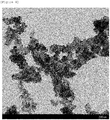
- FIG. 1 illustrates an electron microscope photograph of Pd/Co core particles supported on a carbon carrier, which are prepared according to Example 1.
- the resulting product was subjected to heat treatment at 220°C for 1 hour, and then dispersed in 45 ml of distilled water, 0.096 mmol of Pt (NH 3 ) 4 (NO 3 ) 2 was added thereto, pH was adjusted to 10, and then the resulting mixture was stirred for a predetermined time.
- NaBH 4 being a reducing agent was added thereto at room temperature, and the resulting mixture was reacted for a predetermined time, and then washed with distilled water and dried to prepare a carrier-nanoparticle complex having core-shell nanoparticles supported on a carbon carrier.
- FIG. 2 illustrates an electron microscope photograph of a carrier-nanoparticle complex in which core-shell nanoparticles are supported on the carbon carrier, which is prepared according to Example 1.
- Example 1 the Pd/Co core particles had a particle diameter of 2 nm to 5 nm, and the core-shell nanoparticles had a particle diameter of 3 nm to 6 nm.
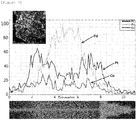
- FIG. 3 illustrates component analysis results of the core-shell nanoparticles of the carrier-nanoparticle complex, which is prepared according to Example 1, by using STEM EDS.
- PEI polyethylene imine
- FIG. 4 illustrates an electron microscope photograph of Pd/Co core particles supported on a carbon carrier, which are prepared according to Example 2.
- the resulting product was subjected to heat treatment at 220°C for 1 hour, and then dispersed in 45 ml of distilled water, 0.16 mmol of Pt(NH 3 ) 4 (NO 3 ) 2 was added thereto, pH was adjusted to 10, and then the resulting mixture was stirred for a predetermined time.
- NaBH 4 being a reducing agent was added thereto at room temperature, and the resulting mixture was reacted for a predetermined time, and then washed with distilled water and dried to prepare a carrier-nanoparticle complex having core-shell nanoparticles supported on a carbon carrier.
- FIG. 5 illustrates an electron microscope photograph of a carrier-nanoparticle complex in which core-shell nanoparticles are supported on the carbon carrier, which is prepared according to Example 2.
- Example 2 the core-shell nanoparticles had a particle diameter of 4 nm to 7 nm.
- the resulting product was subjected to heat treatment at 220°C for 1 hour, and then dispersed in 45 ml of distilled water, 0.16 mmol of K 2 PtCl 4 was added thereto, pH was adjusted to 10, and then the resulting mixture was stirred for a predetermined time.
- NaBH 4 being a reducing agent was added thereto at room temperature, and the resulting mixture was reacted for a predetermined time, and then washed with distilled water and dried to prepare a carrier-nanoparticle complex having core-shell nanoparticles supported on a carbon carrier.
- FIG. 11 illustrates component analysis results of the core-shell nanoparticles of the carrier-nanoparticle complex, which is prepared according to Comparative Example 2, by using STEM EDS.
- the synthesized particles do not have a core-shell structure. Accordingly, it can be seen that a Pt shell may be formed only when the reaction is performed under the same cationic Pt precursor and experimental conditions as in Examples 1 and 2.
- Example 2 30 mg of the carrier-nanoparticle complex prepared according to Example 1, 1.8 ml of isopropyl alcohol, and 257 mg of a 5 wt% Nafion solution were mixed and dispersed well to prepare a catalyst ink.
- a Nafion membrane (NR 211) was coated with the prepared catalyst ink by using a spray apparatus. After drying, the membrane was heated and compressed at 140°C for 2 minutes and 30 seconds to manufacture a membrane electrode assembly.
- Comparative Example 1 by using a commercially available catalyst (JM40, Johnson Matthey Co., Ltd.), a membrane electrode assembly was manufactured by the method as described above.
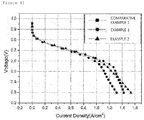
- FIG. 6 illustrates a current density-voltage graph of Comparative Example 1, Example 1, and Example 2.
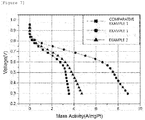
- FIG. 7 is a normalization graph based on the amount of Pt per unit area in the graph in FIG. 6 .
- the carrier-nanoparticle complex according to the Example exhibits a performance which is equivalent to that of the commercially available catalyst (Comparative Example 1), which uses 0.4 mgPt per unit area. That is, it can be seen that Pt is present only in the shell, and as a result, the Example may exhibit an equivalent performance even though Pt is used in a small amount, and exhibits high Pt activity as compared to Comparative Example 1 in which the commercially available catalyst is used.
- the evaluation of the catalyst durability was carried out in a half cell system.
- a 3-electrode system that is, a reference electrode, a counter electrode, and a working electrode were used, the reference electrode was Ag/AgCl, and as an electrolyte, a 0.5 M sulfuric acid solution or a 0.1 M perchloric acid solution was used.
- scanning was performed 1000 times from - 0.2 V to 1.0 V by using cyclic voltammetry, and the scan rate was 20 mV/s.
- a catalyst ink was prepared by mixing 2 mg of the carrier-nanoparticle complex prepared according to Example 1 or a commercially available catalyst (JM40, Johnson Matthey Co., Ltd.), 8 ⁇ l of 5% Nafion, 1.6 ml of EtOH, and 0.4 ml of H 2 O, and dispersing the resulting mixture by using an ultrasonic washing machine for 1 hour, and then the above-described electrode was coated with 20 ⁇ l of the catalyst ink, and the coating was dried. The amount of catalyst coated on the electrode was about 20 pg, and the area of the electrode was 0.196 cm 2 .
- FIG. 8 illustrates a graph of the catalyst durability evaluation performed by cyclic voltammetry in Example 1 and Comparative Example 1.
- the y-axis in FIG. 8 is an electric chemical surface area (ECSA), and means an active surface area of platinum, which is calculated by using the amount of hydrogen adsorbed onto the surface of platinum.
- ECSA electric chemical surface area
- the ECSA may be calculated by the following Equation 1.
- ECSA Q / 210 ⁇ C / cm 2 Pt ⁇ M g pt / cm 2
- Equation 1 Q means a quantity of electric charge (C/cm 2 ), and M means an amount of platinum per area of an electrode (gPt/cm 2 ).
- Table 2 exhibits the catalytic activity according to the cycle of cyclic voltammetry.
- JM 40 Example 1 0 cycle 76.97 m 2 /cm 2 73.43 m 2 /cm 2 1000 cycle 23.78 m 2 /cm 2 36.37 m 2 /cm 2 Rate in decrease 69 % 50 %
- the carrier-nanoparticle complex according to the Example has a low rate in decrease of activity according the increase in number of cycles according to the cyclic voltammetry. That is, it can be seen that the carrier-nanoparticle complex according to the Example exhibits excellent durability.
- PEI polyethylene imine
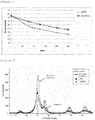
- FIG. 9 illustrates XRD results of Example 2 and Reference Example 1.
- Example 2 in which core particles were subjected to heat treatment, and then a Pt shell was synthesized coincided with the XRD peak pattern of Pt
- Reference Example 1 in which a Pt shell was synthesized, and then subjected to heat treatment coincided with the XRD peak pattern of a CoPt 3 alloy.
- the metals of the core and shell are present in the form of an alloy on the surface thereof during the heat treatment process, and the structure of the Pt shell is collapsed.
- PDDA polydiallyl dimethyl ammonium chloride
- the resulting product was subjected to heat treatment at 220°C for 1 hour, and then dispersed in 45 ml of distilled water, 0.16 mmol of Pt(NH 3 ) 4 (NO 3 ) 2 was added thereto, pH was adjusted to 10, and then the resulting mixture was stirred for a predetermined time.
- NaBH 4 being a reducing agent was added thereto at room temperature, and the resulting mixture was reacted for a predetermined time, and then washed with distilled water and dried to prepare a carrier-nanoparticle complex having core-shell nanoparticles supported on a carbon carrier.
- FIG. 10 illustrates a current density-voltage graph of Reference Example 2.
- the current density of Reference Example 2 at 0.6 V is 0.53 A/cm 2 , which is much lower than those of Examples 1 and 2.
- the case where a carrier is coated with a polymer having a skeleton including a cyclic molecule shows a lower performance than that of a polymer having a straight or branched skeleton.
Landscapes
- Chemical & Material Sciences (AREA)
- Chemical Kinetics & Catalysis (AREA)
- Electrochemistry (AREA)
- General Chemical & Material Sciences (AREA)
- Engineering & Computer Science (AREA)
- Materials Engineering (AREA)
- Life Sciences & Earth Sciences (AREA)
- Manufacturing & Machinery (AREA)
- Sustainable Development (AREA)
- Sustainable Energy (AREA)
- Crystallography & Structural Chemistry (AREA)
- Composite Materials (AREA)
- Catalysts (AREA)
- Inert Electrodes (AREA)
Applications Claiming Priority (2)
| Application Number | Priority Date | Filing Date | Title |
|---|---|---|---|
| KR20150137015 | 2015-09-25 | ||
| PCT/KR2016/010577 WO2017052222A1 (ko) | 2015-09-25 | 2016-09-22 | 담체-나노입자 복합체, 이의 제조방법, 및 이를 포함하는 막전극 접합체 |
Publications (3)
| Publication Number | Publication Date |
|---|---|
| EP3355397A1 true EP3355397A1 (de) | 2018-08-01 |
| EP3355397A4 EP3355397A4 (de) | 2018-08-01 |
| EP3355397B1 EP3355397B1 (de) | 2019-12-25 |
Family
ID=58386379
Family Applications (1)
| Application Number | Title | Priority Date | Filing Date |
|---|---|---|---|
| EP16848947.4A Active EP3355397B1 (de) | 2015-09-25 | 2016-09-22 | Träger-nanopartikel-komplex, herstellungsverfahren dafür und membranelektrodenanordnung damit |
Country Status (5)
| Country | Link |
|---|---|
| US (1) | US10868312B2 (de) |
| EP (1) | EP3355397B1 (de) |
| KR (1) | KR102046686B1 (de) |
| CN (1) | CN107851807B (de) |
| WO (1) | WO2017052222A1 (de) |
Families Citing this family (5)
| Publication number | Priority date | Publication date | Assignee | Title |
|---|---|---|---|---|
| US20180319283A1 (en) * | 2017-05-08 | 2018-11-08 | Bell Helicopter Textron Inc. | Aircraft Power System |
| US20180319288A1 (en) * | 2017-05-08 | 2018-11-08 | Bell Helicopter Textron Inc. | Ethanol-Fueled Fuel Cell Powered Aircraft |
| KR102791540B1 (ko) * | 2019-04-02 | 2025-04-03 | 현대자동차주식회사 | 다성분계 합금 촉매의 제조방법 |
| KR102893825B1 (ko) * | 2020-09-07 | 2025-12-05 | 한국에너지기술연구원 | 레이저 어블레이션 연계 일산화탄소 활용 코어-쉘 입자의 제조장치 및 방법 |
| KR20220103288A (ko) * | 2021-01-15 | 2022-07-22 | 현대자동차주식회사 | 인터메탈릭 촉매 및 이의 제조 방법 |
Family Cites Families (9)
| Publication number | Priority date | Publication date | Assignee | Title |
|---|---|---|---|---|
| KR100953545B1 (ko) * | 2004-03-23 | 2010-04-21 | 삼성에스디아이 주식회사 | 담지촉매 및 그 제조 방법 |
| KR101340984B1 (ko) | 2012-01-06 | 2013-12-12 | 부산대학교 산학협력단 | 연료전지용 백금 합금 촉매의 제조방법, 이를 이용하는 연료전지용 전극 및 이를 포함하는 연료전지 |
| KR101349265B1 (ko) | 2012-05-02 | 2014-01-22 | 성균관대학교산학협력단 | 코어/쉘 구조 나노입자, 및 이의 제조 방법 |
| US9735432B2 (en) * | 2012-05-11 | 2017-08-15 | Lg Chem, Ltd. | Method for fabricating core-shell particles supported on carrier and core-shell particles supported on carrier fabricated by the same |
| KR101926866B1 (ko) | 2012-07-17 | 2018-12-07 | 현대자동차주식회사 | 연료전지용 팔라듐-백금 코어-쉘 촉매의 제조방법 |
| KR20140065686A (ko) * | 2012-11-20 | 2014-05-30 | 우석대학교 산학협력단 | 연료전지용 탄소담지 코어-쉘 구조의 팔라듐-백금 합금 나노입자의 제조방법 및 이를 이용하는 연료전지 |
| KR20140065368A (ko) | 2012-11-21 | 2014-05-29 | 유정수 | 수평 하수관의 역류 방지장치 |
| CN103041823B (zh) * | 2012-12-07 | 2015-05-13 | 大连科诺催化有限公司 | 一种核壳型超低钯铂燃料电池催化剂及制备方法 |
| WO2014104806A1 (ko) * | 2012-12-27 | 2014-07-03 | 주식회사 엘지화학 | 담체에 담지된 중공 금속 나노입자의 제조방법 |
-
2016
- 2016-09-22 KR KR1020160121633A patent/KR102046686B1/ko active Active
- 2016-09-22 CN CN201680043109.0A patent/CN107851807B/zh active Active
- 2016-09-22 US US15/742,149 patent/US10868312B2/en active Active
- 2016-09-22 WO PCT/KR2016/010577 patent/WO2017052222A1/ko not_active Ceased
- 2016-09-22 EP EP16848947.4A patent/EP3355397B1/de active Active
Also Published As
| Publication number | Publication date |
|---|---|
| KR20170037542A (ko) | 2017-04-04 |
| US20180198135A1 (en) | 2018-07-12 |
| WO2017052222A1 (ko) | 2017-03-30 |
| EP3355397A4 (de) | 2018-08-01 |
| KR102046686B1 (ko) | 2019-11-19 |
| US10868312B2 (en) | 2020-12-15 |
| CN107851807A (zh) | 2018-03-27 |
| CN107851807B (zh) | 2020-10-09 |
| EP3355397B1 (de) | 2019-12-25 |
Similar Documents
| Publication | Publication Date | Title |
|---|---|---|
| Guerrero-Ortega et al. | Pd and Pd@ PdO core–shell nanoparticles supported on Vulcan carbon XC-72R: comparison of electroactivity for methanol electro-oxidation reaction | |
| EP3216521B1 (de) | Verfahren zur herstellung eines trägernanopartikelkomplexes | |
| Chen et al. | Platinum-based nanostructured materials: synthesis, properties, and applications | |
| Wang et al. | Aqueous solution synthesis of Pt–M (M= Fe, Co, Ni) bimetallic nanoparticles and their catalysis for the hydrolytic dehydrogenation of ammonia borane | |
| KR101443518B1 (ko) | 담체에 담지된 코어-쉘 입자의 제조방법 및 이에 의해 제조된 담체에 담지된 코어-쉘 입자 | |
| Hu et al. | Synthesis of graphene-supported hollow Pt–Ni nanocatalysts for highly active electrocatalysis toward the methanol oxidation reaction | |
| EP3355397B1 (de) | Träger-nanopartikel-komplex, herstellungsverfahren dafür und membranelektrodenanordnung damit | |
| EP3379626A1 (de) | Träger-nanopartikel-verbund, katalysator damit und verfahren zur herstellung davon | |
| Wu et al. | Ambient synthesis of pt-reactive metal alloy and high-entropy alloy nanocatalysts utilizing hydrogen cold plasma | |
| El-Khatib et al. | Core–shell structured Cu@ Pt nanoparticles as effective electrocatalyst for ethanol oxidation in alkaline medium | |
| JP5046383B2 (ja) | 燃料電池及び燃料電池の製造方法 | |
| Wang et al. | Self-standing hollow porous AuPt nanospheres and their enhanced electrocatalytic performance | |
| Bai et al. | A facile one-step preparation of a Pd–Co bimetallic hollow nanosphere electrocatalyst for ethanol oxidation | |
| Chang et al. | Pt-Ni nanourchins as electrocatalysts for oxygen reduction reaction | |
| Liu et al. | Influence of borohydride concentration on the synthesized Au/graphene nanocomposites for direct borohydride fuel cell | |
| KR101000475B1 (ko) | 무전해 도금에 의한 전이금속/탄소나노튜브 나노복합체의제조방법 | |
| Ji et al. | Palladium litchi-like nanoclusters for remarkably elevating methanol electrocatalytic activity | |
| Lai et al. | Preparation of Pt nanoparticle-loaded three-dimensional Fe3O4/carbon with high electro-oxidation activity | |
| CN108940333A (zh) | 一种双金属氧化物/碳氮/碳纳米管复合物的制备方法 | |
| Cai et al. | Synergistic Effects in Condensed DNA Framework‐Mediated Synthesis of Amorphous Nanoalloys for Enhanced Electrocatalytic Oxygen Evolution | |
| Liu et al. | Green dual-template synthesis of AgPd core–shell nanoparticles with enhanced electrocatalytic activity | |
| KR101522071B1 (ko) | 복합 금속 입자의 제조 방법 및 이에 의해 제조된 복합 금속 입자 | |
| JP7082342B2 (ja) | 燃料電池の空気側電極用触媒 | |
| Ding et al. | Preparation and characterization of hollow carbon nanospheres supported metallic catalysts by using one-step pyrolysis method | |
| Yu et al. | Chemical Scission Derived Two-Dimensional NiFe Layered Double Hydroxide Nanoswords |
Legal Events
| Date | Code | Title | Description |
|---|---|---|---|
| STAA | Information on the status of an ep patent application or granted ep patent |
Free format text: STATUS: THE INTERNATIONAL PUBLICATION HAS BEEN MADE |
|
| PUAI | Public reference made under article 153(3) epc to a published international application that has entered the european phase |
Free format text: ORIGINAL CODE: 0009012 |
|
| STAA | Information on the status of an ep patent application or granted ep patent |
Free format text: STATUS: REQUEST FOR EXAMINATION WAS MADE |
|
| 17P | Request for examination filed |
Effective date: 20180111 |
|
| A4 | Supplementary search report drawn up and despatched |
Effective date: 20180704 |
|
| AK | Designated contracting states |
Kind code of ref document: A1 Designated state(s): AL AT BE BG CH CY CZ DE DK EE ES FI FR GB GR HR HU IE IS IT LI LT LU LV MC MK MT NL NO PL PT RO RS SE SI SK SM TR |
|
| AX | Request for extension of the european patent |
Extension state: BA ME |
|
| DAV | Request for validation of the european patent (deleted) | ||
| DAX | Request for extension of the european patent (deleted) | ||
| STAA | Information on the status of an ep patent application or granted ep patent |
Free format text: STATUS: EXAMINATION IS IN PROGRESS |
|
| 17Q | First examination report despatched |
Effective date: 20190404 |
|
| GRAP | Despatch of communication of intention to grant a patent |
Free format text: ORIGINAL CODE: EPIDOSNIGR1 |
|
| STAA | Information on the status of an ep patent application or granted ep patent |
Free format text: STATUS: GRANT OF PATENT IS INTENDED |
|
| INTG | Intention to grant announced |
Effective date: 20191010 |
|
| GRAS | Grant fee paid |
Free format text: ORIGINAL CODE: EPIDOSNIGR3 |
|
| GRAA | (expected) grant |
Free format text: ORIGINAL CODE: 0009210 |
|
| STAA | Information on the status of an ep patent application or granted ep patent |
Free format text: STATUS: THE PATENT HAS BEEN GRANTED |
|
| AK | Designated contracting states |
Kind code of ref document: B1 Designated state(s): AL AT BE BG CH CY CZ DE DK EE ES FI FR GB GR HR HU IE IS IT LI LT LU LV MC MK MT NL NO PL PT RO RS SE SI SK SM TR |
|
| REG | Reference to a national code |
Ref country code: GB Ref legal event code: FG4D |
|
| REG | Reference to a national code |
Ref country code: CH Ref legal event code: EP |
|
| REG | Reference to a national code |
Ref country code: AT Ref legal event code: REF Ref document number: 1218125 Country of ref document: AT Kind code of ref document: T Effective date: 20200115 |
|
| REG | Reference to a national code |
Ref country code: DE Ref legal event code: R096 Ref document number: 602016027077 Country of ref document: DE |
|
| REG | Reference to a national code |
Ref country code: IE Ref legal event code: FG4D |
|
| REG | Reference to a national code |
Ref country code: NL Ref legal event code: MP Effective date: 20191225 |
|
| PG25 | Lapsed in a contracting state [announced via postgrant information from national office to epo] |
Ref country code: NO Free format text: LAPSE BECAUSE OF FAILURE TO SUBMIT A TRANSLATION OF THE DESCRIPTION OR TO PAY THE FEE WITHIN THE PRESCRIBED TIME-LIMIT Effective date: 20200325 Ref country code: BG Free format text: LAPSE BECAUSE OF FAILURE TO SUBMIT A TRANSLATION OF THE DESCRIPTION OR TO PAY THE FEE WITHIN THE PRESCRIBED TIME-LIMIT Effective date: 20200325 Ref country code: GR Free format text: LAPSE BECAUSE OF FAILURE TO SUBMIT A TRANSLATION OF THE DESCRIPTION OR TO PAY THE FEE WITHIN THE PRESCRIBED TIME-LIMIT Effective date: 20200326 Ref country code: SE Free format text: LAPSE BECAUSE OF FAILURE TO SUBMIT A TRANSLATION OF THE DESCRIPTION OR TO PAY THE FEE WITHIN THE PRESCRIBED TIME-LIMIT Effective date: 20191225 Ref country code: LV Free format text: LAPSE BECAUSE OF FAILURE TO SUBMIT A TRANSLATION OF THE DESCRIPTION OR TO PAY THE FEE WITHIN THE PRESCRIBED TIME-LIMIT Effective date: 20191225 Ref country code: FI Free format text: LAPSE BECAUSE OF FAILURE TO SUBMIT A TRANSLATION OF THE DESCRIPTION OR TO PAY THE FEE WITHIN THE PRESCRIBED TIME-LIMIT Effective date: 20191225 Ref country code: LT Free format text: LAPSE BECAUSE OF FAILURE TO SUBMIT A TRANSLATION OF THE DESCRIPTION OR TO PAY THE FEE WITHIN THE PRESCRIBED TIME-LIMIT Effective date: 20191225 |
|
| REG | Reference to a national code |
Ref country code: LT Ref legal event code: MG4D |
|
| PG25 | Lapsed in a contracting state [announced via postgrant information from national office to epo] |
Ref country code: HR Free format text: LAPSE BECAUSE OF FAILURE TO SUBMIT A TRANSLATION OF THE DESCRIPTION OR TO PAY THE FEE WITHIN THE PRESCRIBED TIME-LIMIT Effective date: 20191225 Ref country code: RS Free format text: LAPSE BECAUSE OF FAILURE TO SUBMIT A TRANSLATION OF THE DESCRIPTION OR TO PAY THE FEE WITHIN THE PRESCRIBED TIME-LIMIT Effective date: 20191225 |
|
| PG25 | Lapsed in a contracting state [announced via postgrant information from national office to epo] |
Ref country code: AL Free format text: LAPSE BECAUSE OF FAILURE TO SUBMIT A TRANSLATION OF THE DESCRIPTION OR TO PAY THE FEE WITHIN THE PRESCRIBED TIME-LIMIT Effective date: 20191225 |
|
| PG25 | Lapsed in a contracting state [announced via postgrant information from national office to epo] |
Ref country code: EE Free format text: LAPSE BECAUSE OF FAILURE TO SUBMIT A TRANSLATION OF THE DESCRIPTION OR TO PAY THE FEE WITHIN THE PRESCRIBED TIME-LIMIT Effective date: 20191225 Ref country code: CZ Free format text: LAPSE BECAUSE OF FAILURE TO SUBMIT A TRANSLATION OF THE DESCRIPTION OR TO PAY THE FEE WITHIN THE PRESCRIBED TIME-LIMIT Effective date: 20191225 Ref country code: PT Free format text: LAPSE BECAUSE OF FAILURE TO SUBMIT A TRANSLATION OF THE DESCRIPTION OR TO PAY THE FEE WITHIN THE PRESCRIBED TIME-LIMIT Effective date: 20200520 Ref country code: NL Free format text: LAPSE BECAUSE OF FAILURE TO SUBMIT A TRANSLATION OF THE DESCRIPTION OR TO PAY THE FEE WITHIN THE PRESCRIBED TIME-LIMIT Effective date: 20191225 Ref country code: RO Free format text: LAPSE BECAUSE OF FAILURE TO SUBMIT A TRANSLATION OF THE DESCRIPTION OR TO PAY THE FEE WITHIN THE PRESCRIBED TIME-LIMIT Effective date: 20191225 |
|
| PG25 | Lapsed in a contracting state [announced via postgrant information from national office to epo] |
Ref country code: SM Free format text: LAPSE BECAUSE OF FAILURE TO SUBMIT A TRANSLATION OF THE DESCRIPTION OR TO PAY THE FEE WITHIN THE PRESCRIBED TIME-LIMIT Effective date: 20191225 Ref country code: IS Free format text: LAPSE BECAUSE OF FAILURE TO SUBMIT A TRANSLATION OF THE DESCRIPTION OR TO PAY THE FEE WITHIN THE PRESCRIBED TIME-LIMIT Effective date: 20200425 Ref country code: SK Free format text: LAPSE BECAUSE OF FAILURE TO SUBMIT A TRANSLATION OF THE DESCRIPTION OR TO PAY THE FEE WITHIN THE PRESCRIBED TIME-LIMIT Effective date: 20191225 |
|
| REG | Reference to a national code |
Ref country code: DE Ref legal event code: R097 Ref document number: 602016027077 Country of ref document: DE |
|
| PG25 | Lapsed in a contracting state [announced via postgrant information from national office to epo] |
Ref country code: DK Free format text: LAPSE BECAUSE OF FAILURE TO SUBMIT A TRANSLATION OF THE DESCRIPTION OR TO PAY THE FEE WITHIN THE PRESCRIBED TIME-LIMIT Effective date: 20191225 Ref country code: ES Free format text: LAPSE BECAUSE OF FAILURE TO SUBMIT A TRANSLATION OF THE DESCRIPTION OR TO PAY THE FEE WITHIN THE PRESCRIBED TIME-LIMIT Effective date: 20191225 |
|
| PLBE | No opposition filed within time limit |
Free format text: ORIGINAL CODE: 0009261 |
|
| STAA | Information on the status of an ep patent application or granted ep patent |
Free format text: STATUS: NO OPPOSITION FILED WITHIN TIME LIMIT |
|
| REG | Reference to a national code |
Ref country code: AT Ref legal event code: MK05 Ref document number: 1218125 Country of ref document: AT Kind code of ref document: T Effective date: 20191225 |
|
| PG25 | Lapsed in a contracting state [announced via postgrant information from national office to epo] |
Ref country code: SI Free format text: LAPSE BECAUSE OF FAILURE TO SUBMIT A TRANSLATION OF THE DESCRIPTION OR TO PAY THE FEE WITHIN THE PRESCRIBED TIME-LIMIT Effective date: 20191225 |
|
| 26N | No opposition filed |
Effective date: 20200928 |
|
| PG25 | Lapsed in a contracting state [announced via postgrant information from national office to epo] |
Ref country code: AT Free format text: LAPSE BECAUSE OF FAILURE TO SUBMIT A TRANSLATION OF THE DESCRIPTION OR TO PAY THE FEE WITHIN THE PRESCRIBED TIME-LIMIT Effective date: 20191225 Ref country code: IT Free format text: LAPSE BECAUSE OF FAILURE TO SUBMIT A TRANSLATION OF THE DESCRIPTION OR TO PAY THE FEE WITHIN THE PRESCRIBED TIME-LIMIT Effective date: 20191225 |
|
| PG25 | Lapsed in a contracting state [announced via postgrant information from national office to epo] |
Ref country code: PL Free format text: LAPSE BECAUSE OF FAILURE TO SUBMIT A TRANSLATION OF THE DESCRIPTION OR TO PAY THE FEE WITHIN THE PRESCRIBED TIME-LIMIT Effective date: 20191225 |
|
| REG | Reference to a national code |
Ref country code: CH Ref legal event code: PL |
|
| GBPC | Gb: european patent ceased through non-payment of renewal fee |
Effective date: 20200922 |
|
| REG | Reference to a national code |
Ref country code: BE Ref legal event code: MM Effective date: 20200930 |
|
| PG25 | Lapsed in a contracting state [announced via postgrant information from national office to epo] |
Ref country code: LU Free format text: LAPSE BECAUSE OF NON-PAYMENT OF DUE FEES Effective date: 20200922 |
|
| PG25 | Lapsed in a contracting state [announced via postgrant information from national office to epo] |
Ref country code: FR Free format text: LAPSE BECAUSE OF NON-PAYMENT OF DUE FEES Effective date: 20200930 |
|
| PG25 | Lapsed in a contracting state [announced via postgrant information from national office to epo] |
Ref country code: BE Free format text: LAPSE BECAUSE OF NON-PAYMENT OF DUE FEES Effective date: 20200930 Ref country code: CH Free format text: LAPSE BECAUSE OF NON-PAYMENT OF DUE FEES Effective date: 20200930 Ref country code: IE Free format text: LAPSE BECAUSE OF NON-PAYMENT OF DUE FEES Effective date: 20200922 Ref country code: LI Free format text: LAPSE BECAUSE OF NON-PAYMENT OF DUE FEES Effective date: 20200930 Ref country code: GB Free format text: LAPSE BECAUSE OF NON-PAYMENT OF DUE FEES Effective date: 20200922 |
|
| PG25 | Lapsed in a contracting state [announced via postgrant information from national office to epo] |
Ref country code: TR Free format text: LAPSE BECAUSE OF FAILURE TO SUBMIT A TRANSLATION OF THE DESCRIPTION OR TO PAY THE FEE WITHIN THE PRESCRIBED TIME-LIMIT Effective date: 20191225 Ref country code: MT Free format text: LAPSE BECAUSE OF FAILURE TO SUBMIT A TRANSLATION OF THE DESCRIPTION OR TO PAY THE FEE WITHIN THE PRESCRIBED TIME-LIMIT Effective date: 20191225 Ref country code: CY Free format text: LAPSE BECAUSE OF FAILURE TO SUBMIT A TRANSLATION OF THE DESCRIPTION OR TO PAY THE FEE WITHIN THE PRESCRIBED TIME-LIMIT Effective date: 20191225 |
|
| PG25 | Lapsed in a contracting state [announced via postgrant information from national office to epo] |
Ref country code: MK Free format text: LAPSE BECAUSE OF FAILURE TO SUBMIT A TRANSLATION OF THE DESCRIPTION OR TO PAY THE FEE WITHIN THE PRESCRIBED TIME-LIMIT Effective date: 20191225 Ref country code: MC Free format text: LAPSE BECAUSE OF FAILURE TO SUBMIT A TRANSLATION OF THE DESCRIPTION OR TO PAY THE FEE WITHIN THE PRESCRIBED TIME-LIMIT Effective date: 20191225 |
|
| PGFP | Annual fee paid to national office [announced via postgrant information from national office to epo] |
Ref country code: DE Payment date: 20250820 Year of fee payment: 10 |