EP3352997B1 - Utilisation d'un dérivé de polyphénol aromatique silylé pour la fabrication d'une résine phénol-aldéhyde de renforcement d'une composition de caoutchouc - Google Patents
Utilisation d'un dérivé de polyphénol aromatique silylé pour la fabrication d'une résine phénol-aldéhyde de renforcement d'une composition de caoutchouc Download PDFInfo
- Publication number
- EP3352997B1 EP3352997B1 EP16777587.3A EP16777587A EP3352997B1 EP 3352997 B1 EP3352997 B1 EP 3352997B1 EP 16777587 A EP16777587 A EP 16777587A EP 3352997 B1 EP3352997 B1 EP 3352997B1
- Authority
- EP
- European Patent Office
- Prior art keywords
- aldehyde
- aromatic polyphenol
- aromatic
- polyphenol derivative
- group
- Prior art date
- Legal status (The legal status is an assumption and is not a legal conclusion. Google has not performed a legal analysis and makes no representation as to the accuracy of the status listed.)
- Active
Links
- RSIZOCDYNXIYSR-UHFFFAOYSA-N O=Nc1cc(N=O)cc(N=O)c1 Chemical compound O=Nc1cc(N=O)cc(N=O)c1 RSIZOCDYNXIYSR-UHFFFAOYSA-N 0.000 description 1
- JLNGXFCCWYKFIX-UHFFFAOYSA-N O=Nc1cccc(N=O)c1 Chemical compound O=Nc1cccc(N=O)c1 JLNGXFCCWYKFIX-UHFFFAOYSA-N 0.000 description 1
- 0 Oc1cc(N=O)c(*c(c(N=O)c2)ccc2N=O)cc1 Chemical compound Oc1cc(N=O)c(*c(c(N=O)c2)ccc2N=O)cc1 0.000 description 1
Images



Classifications
-
- C—CHEMISTRY; METALLURGY
- C08—ORGANIC MACROMOLECULAR COMPOUNDS; THEIR PREPARATION OR CHEMICAL WORKING-UP; COMPOSITIONS BASED THEREON
- C08G—MACROMOLECULAR COMPOUNDS OBTAINED OTHERWISE THAN BY REACTIONS ONLY INVOLVING UNSATURATED CARBON-TO-CARBON BONDS
- C08G8/00—Condensation polymers of aldehydes or ketones with phenols only
- C08G8/04—Condensation polymers of aldehydes or ketones with phenols only of aldehydes
-
- C—CHEMISTRY; METALLURGY
- C07—ORGANIC CHEMISTRY
- C07F—ACYCLIC, CARBOCYCLIC OR HETEROCYCLIC COMPOUNDS CONTAINING ELEMENTS OTHER THAN CARBON, HYDROGEN, HALOGEN, OXYGEN, NITROGEN, SULFUR, SELENIUM OR TELLURIUM
- C07F7/00—Compounds containing elements of Groups 4 or 14 of the Periodic Table
- C07F7/02—Silicon compounds
- C07F7/08—Compounds having one or more C—Si linkages
- C07F7/18—Compounds having one or more C—Si linkages as well as one or more C—O—Si linkages
- C07F7/1804—Compounds having Si-O-C linkages
-
- C—CHEMISTRY; METALLURGY
- C08—ORGANIC MACROMOLECULAR COMPOUNDS; THEIR PREPARATION OR CHEMICAL WORKING-UP; COMPOSITIONS BASED THEREON
- C08G—MACROMOLECULAR COMPOUNDS OBTAINED OTHERWISE THAN BY REACTIONS ONLY INVOLVING UNSATURATED CARBON-TO-CARBON BONDS
- C08G16/00—Condensation polymers of aldehydes or ketones with monomers not provided for in the groups C08G4/00 - C08G14/00
- C08G16/02—Condensation polymers of aldehydes or ketones with monomers not provided for in the groups C08G4/00 - C08G14/00 of aldehydes
- C08G16/0212—Condensation polymers of aldehydes or ketones with monomers not provided for in the groups C08G4/00 - C08G14/00 of aldehydes with acyclic or carbocyclic organic compounds
- C08G16/0218—Condensation polymers of aldehydes or ketones with monomers not provided for in the groups C08G4/00 - C08G14/00 of aldehydes with acyclic or carbocyclic organic compounds containing atoms other than carbon and hydrogen
-
- C—CHEMISTRY; METALLURGY
- C08—ORGANIC MACROMOLECULAR COMPOUNDS; THEIR PREPARATION OR CHEMICAL WORKING-UP; COMPOSITIONS BASED THEREON
- C08G—MACROMOLECULAR COMPOUNDS OBTAINED OTHERWISE THAN BY REACTIONS ONLY INVOLVING UNSATURATED CARBON-TO-CARBON BONDS
- C08G59/00—Polycondensates containing more than one epoxy group per molecule; Macromolecules obtained by polymerising compounds containing more than one epoxy group per molecule using curing agents or catalysts which react with the epoxy groups
-
- C—CHEMISTRY; METALLURGY
- C08—ORGANIC MACROMOLECULAR COMPOUNDS; THEIR PREPARATION OR CHEMICAL WORKING-UP; COMPOSITIONS BASED THEREON
- C08L—COMPOSITIONS OF MACROMOLECULAR COMPOUNDS
- C08L61/00—Compositions of condensation polymers of aldehydes or ketones; Compositions of derivatives of such polymers
Definitions
- the invention relates to the use of an aromatic polyphenol derivative for the manufacture of a phenol-aldehyde resin for reinforcing a rubber composition.
- High rigidity can be obtained by using a so-called concentrated vulcanization system, that is to say comprising in particular relatively high levels of sulfur and vulcanization accelerator.
- the storage of the raw composition containing a concentrated vulcanization system is likely to cause a decrease in the delay phase of the composition during its vulcanization, that is to say the time before the start of vulcanization.
- the composition may begin to cook prematurely in some shaping tools and the vulcanization kinetics may be varied and the vulcanization yield may be degraded.
- Such a concentrated vulcanization system also penalizes cooked aging. Indeed, there is a degradation of the mechanical properties of the cooked composition, in particular at the limits, for example of elongation at break.
- High rigidity can otherwise be achieved by increasing the rate of reinforcing filler.
- the increase in stiffness is obtained by incorporating reinforcing resins based on an acceptor / methylene donor system.
- methylene acceptor and "methylene donor” are well known to those skilled in the art and widely used to design compounds capable of reacting together to generate by condensation a three-dimensional reinforcing resin which is superimposed and interpenetrated with the reinforcing filler / elastomer network on the one hand and with the elastomer / sulfur network on the other hand ( if the crosslinking agent is sulfur).
- the methylene acceptor is associated with a curing agent, capable of crosslinking or hardening, also commonly called methylene donor. Examples of such acceptor and methylene donor are described in WO 02/10269 .
- methylene donors conventionally used in tire rubber compositions are hexamethylenetetramine (abbreviated to HMT), or hexamethoxymethylmelamine (abbreviated as HMMM or H3M), or hexaethoxymethylmelamine.
- HMT hexamethylenetetramine
- HMMM hexamethoxymethylmelamine
- H3M hexaethoxymethylmelamine
- the methylene acceptors conventionally used in tire rubber compositions are precondensed phenolic resins.
- the object of the invention is to make it possible to reinforce rubber compositions by means of compounds with a low environmental impact.
- the subject of the invention is the use of an aromatic polyphenol derivative comprising at least one aromatic ring bearing at least two -OZ groups in the meta position with respect to each other, both ortho positions of at least one of --OZ groups being unsubstituted, and wherein each -OZ group represents a group -O-Si (R 1 R 2 R 3 ) with R 1 , R 2 , R 3 representing, independently one of the other, a hydrocarbon radical or a substituted hydrocarbon radical for the manufacture of a phenol-aldehyde resin for reinforcing a rubber composition.
- the combination of the aromatic polyphenol derivative and the aldehyde makes it possible to obtain rubber compositions having a rigidity at low equivalent deformation or even greatly improved over conventional rubber compositions which comprise methylene donors HMT or H3M and with respect to rubber compositions without reinforcing resin, and therefore to strengthen the rubber composition in which the reinforcing phenol-aldehyde resin is manufactured or formed (the two terms being equivalent) during the crosslinking of the rubber composition.
- the reinforcing phenol-aldehyde resin is based on the aromatic polyphenol derivative and an aldehyde and is manufactured in-situ, by crosslinking, in the rubber composition, in particular during the crosslinking of this composition. rubber, for example by vulcanization or baking.
- the aromatic polyphenol derivatives according to the invention advantageously make it possible to avoid early crosslinking of a phenol-aldehyde resin based on this aromatic polyphenol derivative and an aldehyde.
- a problem related to the use of certain reinforcing resins, especially those based on aromatic polyphenol and aldehyde is their ability to crosslink early.
- the composition is shaped, for example by calendering, for example in the form of a sheet, a plate, or extruded, for example to form a rubber profile.
- these reinforcing resins based on the aromatic polyphenol and the corresponding aldehyde crosslink and stiffen the composition, which can hinder the shaping of the rubber composition.
- the aromatic polyphenol derivative and the aldehyde react less rapidly than the corresponding aromatic polyphenol and aldehyde.
- This reaction rate can be determined by measuring the evolution of the rheometric torque as a function of time.
- This development describes the stiffening of the composition, particularly as a result of the crosslinking of the phenol-aldehyde resin. From the comparison of the evolution of the rheometric pairs of a first composition comprising the aromatic polyphenol derivative and the aldehyde and of a second composition comprising the corresponding aromatic polyphenol and the aldehyde, it can be seen that the aromatic polyphenol derivative allows to delay the crosslinking of the phenol-aldehyde resin relative to the direct reaction between the aromatic polyphenol and the aldehyde.
- the aromatic polyphenol derivative according to the invention is a precursor of the corresponding aromatic polyphenol and that the latter makes it possible to avoid early crosslinking of the phenol-aldehyde resin due to Z radical of each -OZ group which is different from hydrogen.
- the radical Z of each -OZ group would act as a temporary protective group allowing, according to the hypothesis of the inventors, the formation of a hydroxyl function under predetermined reaction conditions and thus the formation of the corresponding aromatic polyphenol.
- the predetermined reaction conditions in which this formation is possible depend on several parameters such as the pressure, the temperature or the chemical species present in the reaction medium.
- reaction conditions are a function of the -OZ group and are easily determinable, or even known to those skilled in the art.
- reaction conditions are the heating of the rubber composition at a temperature greater than or equal to 80 ° C, preferably at 100 ° C and more preferably at 120 ° C
- the aromatic polyphenol derivative according to the invention and the aldehyde may react less rapidly than the corresponding aromatic polyphenol and aldehyde.
- This reaction rate can be determined by measuring the evolution of the rheometric torque as a function of time.
- This development describes the stiffening of the composition, particularly as a result of the crosslinking of the phenol-aldehyde resin.
- the group -O-Z is such that the reaction between the aromatic polyphenol derivative according to the invention and the aldehyde allows the crosslinking of a phenol-aldehyde resin.
- the -OZ group is such that the reaction between the aromatic polyphenol derivative according to the invention and the aldehyde allows the crosslinking of a phenol-aldehyde resin under the same reaction conditions, preferably the same reaction temperature conditions. that a phenol-aldehyde resin based on the corresponding aromatic polyphenol (having hydroxyl groups instead of -OZ groups) and the same aldehyde.
- the temperature is greater than or equal to 120 ° C., preferably greater than or equal to 140 ° C.
- the specific combination of the aldehyde and the aromatic polyphenol derivative according to the invention makes it possible to obtain excellent stiffness maintenance of the rubber composition with the increase in temperature, this maintenance being higher in most embodiments, to that of the rubber compositions lacking a reinforcing resin.
- the specific combination of the aldehyde and this aromatic polyphenol derivative also makes it possible to obtain excellent rigidity maintenance of the rubber composition with the increase in temperature, this maintenance being equivalent, or even greater, in certain embodiments. to that of conventional rubber compositions which include HMT or H3M methylene donors.
- the aromatic polyphenol derivative according to the invention (having hydroxyl groups at place -OZ groups) is a precursor of the corresponding aromatic polyphenol.
- aromatic polyphenol derivative is used because of the structural similarity existing between this compound called “aromatic polyphenol derivative” and the corresponding aromatic polyphenol. Indeed, the aromatic polyphenol derivative is a compound having a structure similar to that of the corresponding aromatic polyphenol but in which the hydrogen of at least two hydroxyl functions is replaced by the radical Z.
- aromatic polyphenol derivative according to the invention it should not be understood that it may be a pre-condensed resin which comprises hydroxyl functions allowing the reaction with the aldehyde.
- all -O-Z groups are the same. However, in other embodiments, at least two -O-Z groups are different.
- each -OZ group is preferably free of aldehyde reactive functionality.
- each radical R 1 , R 2 and R 3 is preferably free of a reactive function with respect to the aldehyde.
- each -OZ group is preferably free of reactive function towards the other constituents of the rubber composition.
- each radical R 1 , R 2 and R 3 is preferably free of reactive function vis-à-vis the other constituents of the rubber composition.
- reactive function is meant here a function that would react under reaction conditions necessary for the regeneration of the aromatic polyphenol and under reaction conditions necessary for the crosslinking of the phenol-aldehyde resin.
- the molar mass of each -OZ group is less than or equal to 1000 gmol -1 .
- the molar mass of each -OZ group is between 15 gmol -1 and 1000 gmol -1 , preferably between 15 gmol -1 and 500 gmol -1 .
- the carbonaceous products mentioned in the description may be of fossil origin or biobased. In the latter case, they can be, partially or totally, derived from biomass or obtained from renewable raw materials derived from biomass.
- the aldehyde is derived from a precursor of this aldehyde.
- a precursor of formaldehyde would be hexamethylenetetramine (HMT).
- the invention makes it possible to manufacture a rubber composition
- a rubber composition comprising at least one phenol-aldehyde resin based on at least one aromatic polyphenol derivative according to the invention and at least one aldehyde.
- the invention also makes it possible to manufacture a rubber composition comprising at least one aromatic polyphenol derivative according to the invention and at least one aldehyde.
- the invention may also make it possible to implement a method for manufacturing a rubber composition, comprising a step of mixing at least one aromatic polyphenol derivative according to the invention and at least one aldehyde.
- At least one elastomer is also mixed with the composition.
- crosslinking step by vulcanization or baking can be replaced by a crosslinking step using another crosslinking system that sulfur.
- the use of the aromatic polyphenol derivative according to the invention also makes it possible to obtain rubber compositions having greatly improved low strain stiffness compared to conventional rubber compositions.
- rubber composition is meant that the composition comprises at least one elastomer or a rubber (both terms being synonymous) and at least one other component.
- a rubber composition therefore comprises an elastomer or rubber matrix in which at least the other component is dispersed.
- a rubber composition is in a plastic state in the green (non-crosslinked) state and in a baked (crosslinked) elastic state but in no case in a liquid state.
- a rubber composition should not be confused with an elastomer latex which is a composition in a liquid state comprising a liquid solvent, usually water, and at least one elastomer or rubber dispersed in the liquid solvent so as to form an emulsion.
- the rubber composition is not an aqueous adhesive composition.
- the rubber composition therefore comprises at least one (i.e., one or more) phenol-aldehyde resin; this phenol-aldehyde resin being based on at least one (that is to say one or more) aldehyde and at least one (that is to say one or more) aromatic polyphenol derivative according to the invention components which will be described in detail below.
- any range of values designated by the expression “between a and b” represents the range of values from more than a to less than b (i.e., terminals a and b excluded) while any range of values designated by the expression “from a to b” means the range of values from the "a" terminal to the "b" terminal, that is to say including the strict "a” and "a” limits. "B”.
- the aromatic polyphenol derivative according to the invention comprises at least one aromatic ring bearing at least two -OZ groups in the meta position with respect to each other, the two ortho positions of at least one of these groups. OZ being unsubstituted.
- the aromatic polyphenol derivative is used to generate a delay phase during the crosslinking of a phenol-aldehyde resin based on the aromatic polyphenol derivative and an aldehyde, for example such that described below.
- the aromatic polyphenol derivative is used in a phenol-aldehyde resin to maintain the stiffness of a rubber composition with increasing temperature.
- the aromatic polyphenol derivative may be, in one embodiment, a single molecule of aromatic polyphenol derivative comprising one or more aromatic rings, at least one of these aromatic rings, or even each aromatic ring, carrying at least two -OZ groups in the meta position with respect to each other, the two ortho positions of at least one of these -OZ groups being unsubstituted.
- Such simple molecules do not include a repeating pattern.
- Such a pre-condensed resin based on aromatic polyphenol is in accordance with the invention and comprises, in contrast to the simple molecule described above, a repeating unit.
- the repeating unit comprises at least one aromatic ring bearing at least two -OZ groups in the meta position relative to each other, the two ortho positions of at least one of these groups -OZ being unsubstituted.
- the pre-condensed resin based on an aromatic polyphenol comprising at least one aromatic ring bearing at least two hydroxyl functional groups is formed.
- the aromatic polyphenol derivative is a mixture of a derivative of an aromatic polyphenol forming a single molecule and a pre-condensed aromatic polyphenol resin in which the hydroxyl functions of the pre-condensed resin. -condensed free at the end of the condensation of the pre-condensed resin are substituted with -OZ groups.
- aromatic nucleus (s) of the aromatic polyphenol derivative are described.
- aromatic polyphenol derivative is described in its single molecule form.
- the aromatic polyphenol at the origin of the corresponding derivatives can then be condensed and partly define the repetitive pattern.
- the characteristics of the pre-condensed resin are described in more detail below.
- each R 1 , R 2 and R 3 represents, independently of one another, a radical chosen from the group consisting of alkyl, aryl, arylalkyl, alkylaryl, cycloalkyl and alkenyl radicals.
- each R 1 , R 2 and R 3 represents, independently of one another, a radical chosen from the group consisting of methyl, ethyl and propyl radicals. phenyl, allyl, vinyl.
- each R 1 , R 2 and R 3 represents, independently of one another, a radical chosen from the group consisting of methyl, ethyl, propyl, butyl, allyl and vinyl radicals.
- the propyl radicals include radicals of the formula -C 3 H 7 . These radicals are n-propyl and isopropyl.
- the butyl radicals include radicals of the formula -C 4 H 9 . These radicals are n-butyl, isobutyl, sec-butyl and tert-butyl.
- the aryl radicals include aromatic rings from which a hydrogen atom has been removed.
- the aryl radical is the radical C 6 H 5 obtained from benzene C 6 H 6 .
- Another example of an aryl radical is the radical C 4 H 3 O obtained from furan C 4 H 4 O.
- the aromatic ring carries three -O-Z groups in the meta position relative to one another.
- each -O-Z group are unsubstituted.
- the two carbon atoms located on both sides (in the ortho position) of the carbon atom carrying the -O-Z group carry a single hydrogen atom.
- the remainder of the aromatic ring is unsubstituted.
- other carbon atoms of the rest of the aromatic ring (those other than carbon atoms bearing -O-Z groups) carry a single hydrogen atom.
- the aromatic polyphenol derivative comprises a plurality of aromatic nuclei, at least two of which are each carrying at least two -OZ groups in the meta position with respect to one another, the two positions ortho of at least one of -OZ groups of at least one aromatic ring being unsubstituted.
- At least one of the aromatic rings carries three -O-Z groups in the meta position with respect to one another.
- each -O-Z group of at least one aromatic ring is unsubstituted.
- each -O-Z group of each aromatic ring is unsubstituted.
- the or each aromatic ring is a benzene ring.
- aromatic polyphenol derivatives according to the invention comprising a single aromatic ring
- the aromatic polyphenol derivative according to the invention comprises several aromatic rings
- at least two of these aromatic nuclei which are identical or different, are chosen from those of general formulas: in which the symbols Z 1 , Z 2 , which are identical or different if they are several on the same aromatic ring, represent an atom (for example carbon, sulfur or oxygen) or a linking group by definition that is at least divalent, which links to the minus these two aromatic rings to the rest of the aromatic polyphenol derivative.
- aromatic polyphenol derivative is a derivative of 2,2 ', 4,4'-tetrahydroxydiphenyl sulfide, derivative having the following structural formula:
- aromatic polyphenol derivative is a derivative of 2,2 ', 4,4'-tetrahydroxydiphenyl benzophenone, derivative of the following structural formula:
- each aromatic polyphenol derivative IV and V is a derivative of aromatic polyphenol according to the invention comprising two aromatic rings (of formulas III-c ) each of which carries at least two (in this case two) -OZ groups in the meta position relative to each other.
- the aromatic polyphenol derivative according to the invention is chosen from the group consisting of aromatic polyphenol derivatives of formula ( I ), ( II) , ( IV ) and ( V ) described herein. above as well as the mixtures of these aromatic polyphenol derivatives.
- the aromatic polyphenol derivative according to the invention is the aromatic polyphenol derivative ( II ).
- the aromatic polyphenol derivative comprises a pre-condensed resin based on at least one aromatic polyphenol as described in any of the embodiments described in the present application, the hydroxyl functions of the resin. pre-condensed free at the end of the condensation of the pre-condensed resin being substituted with -OZ groups.
- the compound comprising at least one aldehyde functional group and reacting with said aromatic polyphenol may be an aldehyde as defined below.
- said compound comprising at least one aldehyde function is selected from the group consisting of formaldehyde, benzaldehyde, furfuraldehyde, 2,5-furanedicarboxaldehyde, 1,4-benzenedicarboxaldehyde, 1,3-benzenedicarboxaldehyde, 1, 2-benzenedicarboxaldehyde and mixtures of these compounds.
- the repeating unit comprises at least one aromatic ring bearing at least two hydroxyl functional groups in the meta position with respect to each other, at least one of the carbon of the aromatic ring, which was unsubstituted prior to condensation of the pre-condensed resin, being connected to another pattern.
- this pre-condensed resin is free of free formaldehyde. Indeed, even in the case where the pre-condensed resin is based on an aromatic polyphenol as described above and formaldehyde, formaldehyde having already reacted with the aromatic polyphenol, the pre-condensed resin is free of free formaldehyde likely to be able to react with an aldehyde according to the invention in a subsequent step.
- the aromatic polyphenol derivative may also comprise a mixture of a free molecule of aromatic polyphenol derivative and a pre-condensed resin based on aromatic polyphenol, the hydroxyl functions of the pre-condensed resin free at the end of the condensation of the pre-condensed resin being substituted with -OZ groups.
- the aromatic polyphenol derivative may also comprise a mixture of phloroglucinol derivative and a phloroglucinol-based pre-condensed resin, the hydroxyl functions of the pre-condensed resin free at the end of the condensation of the resin. pre-condensed being substituted with -OZ groups.
- an amount of aldehyde ranging from 0.1 to 25 phr will be used.
- an amount of aromatic polyphenol derivative according to the invention ranging from 0.1 to 25 phr.
- the [aldehyde]: [aromatic polyphenol derivative] molar ratio advantageously ranges from 3: 1 to 1: 1, preferably from 3: 1 to 1.5: 1.
- the rubber composition has, in the fired state, a secant modulus at 10% elongation MA10 measured according to ASTM D 412 of 1998 (test tube C) higher or equal to 10 MPa, preferably 20 MPa, preferably 30 MPa, more preferably 40 MPa and even more preferably 60 MPa.
- the rubber composition comprises a diene elastomer.
- elastomer or rubber (both terms being synonymous) of the "diene” type, is generally meant an elastomer derived at least in part (ie a homopolymer or a copolymer) from monomers dienes (monomers carrying two carbon-carbon double bonds , conjugated or not).
- the diene elastomer of the composition rubber is selected from the group consisting of polybutadienes (BR), synthetic polyisoprenes (IR), natural rubber (NR), butadiene copolymers, isoprene copolymers and mixtures of these elastomers.
- Such copolymers are more preferably selected from the group consisting of butadiene-styrene copolymers (SBR), isoprene-butadiene copolymers (BIR), isoprene-styrene copolymers (SIR), isoprene-copolymers of butadiene-styrene (SBIR) and mixtures of such copolymers.
- the rubber compositions may contain a single diene elastomer or a mixture of several diene elastomers, the diene elastomer (s) may be used in combination with any type of synthetic elastomer other than diene, or even with polymers other than elastomers, for example thermoplastic polymers.
- the rubber composition comprises a reinforcing filler.
- reinforcing filler When a reinforcing filler is used, it is possible to use any type of reinforcing filler known for its ability to reinforce a rubber composition that can be used for the manufacture of tires, for example an organic filler such as carbon black, a reinforcing inorganic filler such as than silica, or a blend of these two types of filler, including a blend of carbon black and silica.
- an organic filler such as carbon black
- a reinforcing inorganic filler such as than silica
- silica a reinforcing inorganic filler
- a blend of these two types of filler including a blend of carbon black and silica.
- carbon blacks are suitable all the carbon blacks conventionally used in tires (so-called pneumatic grade blacks). For example, mention will be made more particularly of reinforcing carbon blacks of the 100, 200 or 300 series (ASTM grades).
- the carbon blacks could for example already be incorporated into the isoprene elastomer in the form of a masterbatch (see for example applications WO 97/36724 or WO 99/16600 ).
- organic fillers other than carbon blacks
- any inorganic or mineral filler (regardless of its color and origin (natural or synthetic), also called “white” filler, “clear” filler or “non-black filler” as opposed to carbon black, capable of reinforcing on its own, without any other means than an intermediate coupling agent, a rubber composition intended for the manufacture of tires, in other words able to replace, in its reinforcing function, a conventional carbon black of pneumatic grade.
- a charge is generally characterized, in a known manner, by the presence of hydroxyl groups (-OH) on its surface.
- the physical state under which the reinforcing inorganic filler is present is indifferent, whether in the form of powder, micro-beads, granules, beads or any other suitable densified form.
- the term "reinforcing inorganic filler” also refers to mixtures of different reinforcing inorganic fillers, in particular highly dispersible siliceous and / or aluminous fillers as described below.
- Suitable reinforcing inorganic fillers are, in particular, mineral fillers of the siliceous type, in particular silica (SiO 2 ), or of the aluminous type, in particular alumina (Al 2 O 3 ).
- the silica used may be any reinforcing silica known to those skilled in the art, especially any precipitated or pyrogenated silica having a BET surface and a CTAB specific surface both less than 450 m 2 / g, preferably from 30 to 400 m 2 / g.
- HDS highly dispersible precipitated silicas
- the content of total reinforcing filler is within a range from 5 to 120 phr, more preferably from 5 to 100 phr and even more preferably from 5 to 90 phr. .
- Carbon black may advantageously be the only reinforcing filler or the majority reinforcing filler. Of course, it is possible to use a single carbon black or a blend of several carbon blacks of different ASTM grades. The carbon black may also be used in blending with other reinforcing fillers and in particular reinforcing inorganic fillers as described above, and in particular silica.
- an inorganic filler for example silica
- its content is within a range from 0 to 70 phr, preferably from 0 to 50 phr, in particular also from 5 to 70 phr, and even more preferably this proportion varies from 5 to 50 phr, particularly from 5 to 40 phr.
- the rubber composition comprises various additives.
- the rubber compositions may also comprise all or part of the usual additives usually used in elastomer compositions intended for the manufacture of tires, for example plasticizers or extension oils, whether the latter are aromatic or non-aromatic in nature.
- aromatic, pigments, protective agents such as anti-ozone waxes, chemical antiozonants, anti-oxidants, anti-fatigue agents or even adhesion promoters.
- the rubber composition comprises a crosslinking system, more preferably a vulcanization system.
- the vulcanization system comprises a sulfur donor agent, for example sulfur.
- the vulcanization system comprises vulcanization activators such as zinc oxide and stearic acid.
- the vulcanization system comprises a vulcanization accelerator and / or a vulcanization retarder.
- Sulfur or sulfur donor agent is used at a preferred level within a range of 0.5 to 10 phr, more preferably in a range of 0.5 to 8.0 phr. All accelerators, retarders and vulcanization activators are used at a preferential rate within a range of 0.5 to 15 phr. The vulcanization activator (s) is or are used at a preferential rate within a range of 0.5 and 12 phr.
- the actual crosslinking system is preferably based on sulfur and a primary vulcanization accelerator, in particular a sulfenamide type accelerator.
- a primary vulcanization accelerator in particular a sulfenamide type accelerator.
- various known secondary accelerators or vulcanization activators such as zinc oxide, stearic acid, guanidine derivatives (in particular diphenylguanidine), etc.
- accelerator any compound capable of acting as a vulcanization accelerator for diene elastomers in the presence of sulfur, especially thiazole-type accelerators and their derivatives, thiuram type accelerators, and dithiocarbamate-type accelerators. zinc.
- accelerators are more preferably selected from the group consisting of 2-mercaptobenzothiazyl disulfide (abbreviated "MBTS”), N-cyclohexyl-2-benzothiazyl sulfenamide (abbreviated “CBS”), N, N-dicyclohexyl-2-benzothiazyl sulfenamide (abbreviated “DCBS”), N-tert-butyl-2-benzothiazyl sulfenamide (abbreviated “TBBS”), N-tert-butyl-2-benzothiazyl sulfenimide (abbreviated "TBSI”), zinc dibenzyldithiocarbamate (abbreviated "ZBEC”) and mixtures of these compounds.
- MBTS 2-mercaptobenzothiazyl disulfide
- CBS N-cyclohexyl-2-benzothiazyl sulfenamide
- DCBS N-dicyclohe
- the rubber composition is in a fired, i.e., vulcanized state.
- the composition is in a green, i.e., unvulcanized state, with the crosslinked phenol-aldehyde resin subsequently added to the unvulcanized composition.
- the composition comprises a residue obtained from the -Z radical of each -O-Z group.
- each radical Z of each -OZ group can make it possible to obtain a residue generated in if you. Some residues remain definitively in the composition and, if necessary, can be used for some of their properties.
- the generated residue remains only temporarily in the composition either because it comes out spontaneously under the conditions of manufacture of the composition, for example in the form of gas, especially in the case where the residue is volatile, either because it implements an optional step of extraction of this residue in the method of manufacturing the composition.
- the phenol-aldehyde resin having not yet crosslinked, the rubber composition comprises at least one aromatic polyphenol derivative according to the invention and at least one aldehyde.
- the composition is in the green state, that is to say uncured.
- the rubber composition can be used in the tire in the form of a layer.
- layer is meant any three-dimensional element, of any shape and thickness, in particular sheet, strip or other element of any cross section, for example rectangular or triangular.
- the composition comprises one or more aldehyde (s).
- the or at least one aldehyde is an aromatic aldehyde.
- Such an aldehyde is very advantageous. Indeed, the Applicants have discovered during their research that the aromatic aldehyde makes it possible to avoid the production of formaldehyde in contrast to conventional methylene donors. Indeed, the combination of phenolic resin conventionally used as a methylene acceptor with HMT or H3M as a methylene donor in the state of the art, produces formaldehyde during vulcanization of the rubber composition. However, it is desirable to reduce or even eventually eliminate formaldehyde rubber compositions because of the environmental impact of these compounds and recent regulatory developments, including European regulations, on this type of compound.
- An aromatic aldehyde is a compound comprising at least one aromatic ring, which aromatic ring carries at least one (one or more) aldehyde function.
- the aldehyde is of general formula (A '):
- R represents -CHO.
- X represents O.
- aldehyde of general formula (A ') In a variant of the aldehyde of general formula (A '), X represents O and R represents -H.
- the aldehyde used is then furfuraldehyde and is of formula (B'a) :
- aldehyde of general formula (A ') X represents O and R represents -CHO.
- the aldehyde used is then 2,5-furanedicarboxaldehyde and is of formula (B'b):
- X comprises N.
- X represents NH.
- the aldehyde used is of formula (Ca) :
- X represents NH.
- the aldehyde used is of formula (C'a) :
- R represents -CHO in the variant of the aldehyde of formula (C'a) and the aldehyde obtained is then 2,5-1H-pyrroledicarboxaldehyde.
- X represents NR 1 'with R 1' representing a radical chosen from the group consisting of alkyl, aryl arylalkyl, alkylaryl and cycloalkyl radicals.
- R 1' representing a radical chosen from the group consisting of alkyl, aryl arylalkyl, alkylaryl and cycloalkyl radicals.
- the aldehyde used is of formula (Cb) :
- X comprises S.
- X represents S.
- the aldehyde used is of formula (Da):
- X represents S.
- the aldehyde used is of formula (D'a) :
- R represents -CHO in the aldehyde variant of formula (IV'a) and is then 2,5-thiophene dicarboxaldehyde .
- X represents SR2 'with R2' representing a radical selected from the group consisting of alkyl radicals, aryl arylalkyl, alkylaryl, cycloalkyl.
- R2' representing a radical selected from the group consisting of alkyl radicals, aryl arylalkyl, alkylaryl, cycloalkyl.
- the aldehyde used is of formula (Db) :
- X represents R3'-S-R2 'with R2', R3 'each independently of one another a radical selected from the group consisting of alkyl, aryl arylalkyl, alkylaryl, cycloalkyl radicals.
- the aldehyde used is of formula (Dc) :
- X represents NH, S or O.
- it may be, R representing -H or -CHO and preferably R representing -CHO.
- R will preferably be in the 5-position and the -CHO group in the 2-position on the aromatic ring (general formula (A ' ) ).
- the aromatic aldehyde is selected from the group consisting of 1,4-benzene dicarboxaldehyde, furfuraldehyde, 2,5-furanedicarboxaldehyde and mixtures thereof.
- the composition is free of formaldehyde.
- each aldehyde other than each aromatic aldehyde as described above is preferably different from formaldehyde.
- the composition is then also preferably free of formaldehyde.
- the or each aldehyde of the phenol-aldehyde resin is different from formaldehyde.
- formaldehyde-free it is meant that the formaldehyde mass content by weight of the aldehyde (s) is strictly less than 1%.
- the composition may comprise formaldehyde.
- the composition then comprises a mass content of formaldehyde by total weight of the aldehyde or at least 10%, preferably 5% and more preferably 2%.
- the rubber composite is reinforced with at least one reinforcement element embedded in the rubber composition comprising a phenol-aldehyde resin based on an aromatic polyphenol derivative according to the invention.
- reinforcing elements mention may be made of textile, metal or hybrid textile-metal reinforcing elements.
- textile is meant, in a manner well known to those skilled in the art, any material in matter other than metallic, whether natural or synthetic, capable of being transformed into yarn, fiber by any appropriate process of transformation.
- a polymer spinning process such as, for example, melt spinning, solution spinning or gel spinning.
- This textile material may consist of a yarn or fiber or also of a fabric made from yarn or fibers, for example a woven fabric with warp yarns and weft yarns, or a crossed fabric with crossed yarns.
- this textile material of the invention is selected from the group consisting of monofilaments (or single son), multifilament fibers, assemblies of such son or fibers, and mixtures of such materials. It is more particularly a monofilament, a multifilament fiber or a twist.
- wire or fiber generally means any elongate element of great length relative to its cross section, whatever the shape of the latter, for example circular, oblong, rectangular or square, or even flat, this wire can be straight as non-rectilinear, for example twisted, or corrugated.
- the largest dimension of its cross section is preferably less than 5 mm, more preferably less than 3 mm.
- This wire or this fiber may take any known form, it may be for example a large diameter elementary monofilament (for example and preferably equal to or greater than 50 microns), a multifilament fiber (consisting of a plurality of elementary filaments of small diameter, typically less than 30 ⁇ m), of a twisted or cabled textile formed of several textile fibers or monofilaments twisted or cabled together, or of an assembly, a group, a row of threads or fibers such as for example a strip or strip comprising several of these monofilaments, fibers, twisted or cabled grouped together, for example aligned in a main direction, rectilinear or not.
- a large diameter elementary monofilament for example and preferably equal to or greater than 50 microns
- a multifilament fiber consisting of a plurality of elementary filaments of small diameter, typically less than 30 ⁇ m
- a twisted or cabled textile formed of several textile fibers or monofilaments twisted or cabled together, or of
- the textile materials may be organic or polymeric material, such as inorganic material.
- inorganic materials mention will be made of glass and carbon.
- the invention is preferably implemented with materials of polymeric material, thermoplastic type as non-thermoplastic.
- non-thermoplastic polymeric materials include, for example, aramid (aromatic polyamide) and cellulose, both natural and artificial, such as cotton, rayon, linen, hemp.
- polyesters include, for example, PET (polyethylene terephthalate), PEN (polyethylene naphthalate), PBT (polybutylene terephthalate), PBN (polybutylene naphthalate), PPT (polypropylene terephthalate), PPN (polypropylene naphthalate).
- Metallic means by definition one or more wire elements constituted predominantly (that is to say, for more than 50% of its mass) or integrally (for 100% of its mass) of a metallic material.
- the metallic material is steel, more preferably carbonaceous perlitic (or ferrito-pearlitic) steel advantageously comprising between 0.4% and 1.2% by weight of carbon.
- the metal reinforcing element may be a monofilament, a cable comprising several metal monofilaments or a multi-strand cable comprising several cables then called strands.
- the reinforcing element comprises several monofilaments and is of the type gummed in situ, that is to say that the reinforcing element is gummed from the inside, during its manufacture even by a filling rubber.
- Such metallic wire elements are known to those skilled in the art.
- the composition of the filling rubber may or may not be identical to the rubber composition in which the reinforcing element is embedded.
- Such tires are for example those intended to equip tourism-type motor vehicles, SUV ( “Sport Utility Vehicles” ), two wheels (including bicycles, motorcycles), airplanes, such as industrial vehicles chosen from light trucks, "heavy vehicles "- that is, metros, buses, road transport vehicles (trucks, tractors, trailers), off-the-road vehicles such as agricultural or civil engineering machinery - other transport or handling vehicles.
- SUV Sport Utility Vehicles
- two wheels including bicycles, motorcycles
- airplanes such as industrial vehicles chosen from light trucks, “heavy vehicles "- that is, metros, buses, road transport vehicles (trucks, tractors, trailers), off-the-road vehicles such as agricultural or civil engineering machinery - other transport or handling vehicles.
- the figure 1 attached shows very schematically (without respecting a specific scale), a radial section of a tire according to the invention for heavy vehicle type.
- This tire 1 has a crown 2 reinforced by a crown reinforcement or belt 6, two sidewalls 3 and two beads 4, each of these beads 4 being reinforced with a rod 5.
- the crown 2 is surmounted by a tread not shown in this schematic figure.
- a carcass reinforcement 7 is wound around the two rods 5 in each bead 4, the upturn 8 of this armature 7 being for example disposed towards the outside of the tire 1 which is shown here mounted on its rim 9.
- the carcass reinforcement 7 is in known manner constituted of at least one sheet reinforced by so-called "radial” cables, for example metallic, that is to say that these cables are arranged substantially parallel to each other and extend from a bead to the other so as to form an angle of between 80 ° and 90 ° with the median circumferential plane (plane perpendicular to the axis of rotation of the tire which is located midway between the two beads 4 and passes through the middle of the crown frame 6).
- radial cables for example metallic
- This tire 1 of the invention has for example the characteristic that at least one crown reinforcement 6 and / or its carcass reinforcement 7 comprises a rubber composition comprising a phenol-aldehyde resin based on an aromatic polyphenol derivative according to the invention.
- the conditions of the reaction between the aromatic polyphenol and the compound of formula LG-Si are well known to those skilled in the art.
- the process according to the invention is carried out by firstly reacting, in an organic solvent, the aromatic polyphenol with a base, more preferably an organic base, and then introducing the compound of formula LG-Si. (R 1 R 2 R 3 ) in the reaction mixture.
- the reaction is carried out between 20 ° C and 50 ° C for a few hours, for example between 1 hour and 10 hours.
- the nucleofuge group LG represents a halogen. It is recalled that the halogens correspond to the elements F, Cl, Br and I.
- LG represents chlorine
- the manufacturing method described above and hereinafter makes it possible to manufacture the rubber composition comprising a phenol-aldehyde resin based on an aromatic polyphenol derivative according to the invention.
- the non-productive phase is carried out in a single thermomechanical step during which all the necessary basic constituents (diene elastomer) are introduced into a suitable mixer such as a conventional internal mixer. , reinforcing filler, etc.), then in a second step, for example after one to two minutes of kneading, the other additives, any additional load-collecting or processing agents, with the exception of crosslinking, the aromatic polyphenol derivative according to the invention and the aldehyde.
- the total mixing time in this non-productive phase is preferably between 1 and 15 minutes.
- the mixture thus obtained After cooling the mixture thus obtained, it is then incorporated in an external mixer such as a roll mill, maintained at low temperature (for example between 40 ° C. and 100 ° C.), the crosslinking system, the aldehyde and the derivative. of aromatic polyphenol according to the invention.
- the whole is then mixed (productive phase) for a few minutes, for example between 2 and 15 min.
- composition thus obtained in the green state can then be shaped, for example calendered, for example in the form of a sheet, a plate especially for a characterization in the laboratory, or extruded, for example to form a rubber profile used for the manufacture of a tire.
- a step of vulcanizing the composition the composite or blank during which the phenol-aldehyde resin based on the aromatic polyphenol derivative according to the invention and the aldehyde is crosslinked.
- the vulcanization step is carried out at a temperature greater than or equal to 120 ° C., preferably greater than or equal to 140 ° C.
- the composition is obtained in the cooked state.
- T0, T1 and T2 and I1 to I3 were prepared as indicated above and are summarized in Table 1 attached below.
- compositions T0 to T2 and I1 to I3 have a common part in their formulations (expressed in phr, parts by weight per hundred parts of elastomer): 100 phr of natural rubber, 75 phr of carbon black N326, 1.5 N-1,3-dimethylbutyl-N-phenyl-para-phenylenediamine, 1.5 phr of stearic acid, 5 phr of ZnO, 1 phr of N-tertiarybutyl-2-benzothiazole sulfonamide and 2.5 phr of sulfur. insoluble 20H.
- composition T0 does not include any reinforcing resin added to this common part.
- the T1 composition comprises a reinforcing resin based hexa-methylenetetramine (1.6 phr) and a pre-condensed phenolic resin (4 phr).
- the composition T1 represents a conventional composition of the state of the art having a rigidity greater than that of the composition T0.
- the composition T2 comprises a phenol-aldehyde resin based on phloroglucinol and 1,4-benzene-dicarboxaldehyde.
- the T2 composition comprises 7 phr of phloroglucinol and 14 phr of 1,4-benzene dicarboxaldehyde.
- each composition I1 to I3 comprises a phenol-aldehyde resin based on an aromatic polyphenol derivative according to the invention and an aldehyde, preferably an aromatic aldehyde, indicated in Table 1 in molar proportions 1 (aromatic polyphenol derivative according to the invention) / 2 (aldehyde), and with in each composition I1 to I3 14 phr of aldehyde.
- Each aromatic polyphenol derivative according to the invention in each composition I1 to I3 comprises at least one aromatic ring bearing at least two -OZ groups in the meta position with respect to each other, the two positions ortho to the at least one of -OZ being unsubstituted and wherein each -OZ is -O-Si (R 1 R 2 R 3 ) with R 1 , R 2 , R 3 being independently of one another , a hydrocarbon radical or a substituted hydrocarbon radical.
- Aromatic polyphenol derivatives of compositions 11 to 13 are Aromatic polyphenol derivatives of compositions 11 to 13
- Each aromatic polyphenol derivative according to the invention of the resin of each composition I1 to I3 is selected from the group consisting of aromatic polyphenol derivatives of formula (I) , (II) , (IV) and (V) described above. above and mixtures of these aromatic polyphenol derivatives.
- Each aromatic polyphenol derivative according to the invention of each composition I1 to I3 comprises a single aromatic ring, here benzene, bearing three, and only three, -O-Z groups in the meta position relative to each other.
- aromatic polyphenol derivatives according to the invention of each composition I1 to 13 the remainder of the aromatic ring is unsubstituted.
- the two ortho positions of each -OZ group are unsubstituted.
- aromatic polyphenol derivatives of general formula (II) obtained from phloroglucinol.
- Each aromatic polyphenol derivative according to the invention of each composition I1 to I3 has -OZ groups each representing a group -O-Si (R 1 R 2 R 3 ) with R 1 , R 2 , R 3 representing, independently of one of the other, a radical selected from the group consisting of alkyl, aryl, arylalkyl, alkylaryl, cycloalkyl, alkenyl.
- each R 1 , R 2 and R 3 group represents, independently of one another, a radical chosen from the group consisting of the methyl, ethyl, propyl, phenyl, allyl and vinyl radicals and even more preferably radical chosen from the group consisting of methyl, ethyl, propyl, butyl, allyl and vinyl radicals.
- phloroglucinol CAS 108-73-6
- trimethylsilyl chloride CAS 75-77-4
- the 1 H NMR spectrum of the aromatic polyphenol derivative ( 6 ) is represented on the figure 3A ( 1 H NMR (CDCl 3 , 300 MHz): 6.15-5.60 (9H, m), 5.89 (3H, s), 0.15 (18H, s)).
- the 1 H NMR spectrum of the aromatic polyphenol derivative (7) is represented on the Figure 4A ( 1 H NMR (CDCl 3 , 300 MHz): 7.70-7.30 (30H, m), 6.03 (3H, s), 0.59 (9H, s)).
- the aldehyde is selected from the group consisting of 1,4-benzene-dicarboxaldehyde, furfuraldehyde, 2,5-furanedicarboxaldehyde and mixtures of these compounds.
- the aldehyde of each composition I1 to I3 is 1,4-benzene dicarboxaldehyde.
- the reinforcing filler was incorporated in an elastomer, by thermomechanically kneading the whole, until a maximum temperature of between 110 ° C. and 190 ° C. was reached. Then the whole was cooled to a temperature below 110 ° C. Then, during a second step, the crosslinking system, the phenol, the aromatic polyphenol or the aromatic polyphenol derivative according to the invention and the aldehyde were incorporated. At the end of this second step, the mixture was heated to 150 ° C until the maximum rheometric torque was obtained in order to vulcanize the composition and crosslink the phenol-aldehyde resin. Then, a characterization of the rigidity at 23 ° C. of the composition was carried out during a tensile test.
- the measurements are carried out at 150 ° C. with an oscillating chamber rheometer, according to DIN 53529 - part 3 (June 1983).
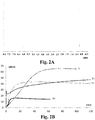
- the evolution of the rheometric torque as a function of time describes the evolution of the stiffening of the composition as a result of the vulcanization and crosslinking of the phenol-aldehyde resin.
- the presence of a delay phase is determined when the increase in the rheometric torque over 10 minutes of the tested composition is less than the increase in the rheometric torque over 10 minutes of a control composition comprising the corresponding aromatic polyphenol and the same aldehyde, here the composition T2.
- Table 1 Figures 2B to 4B each curve representing the evolution of the rheometric torque respectively of the compositions I1 to I3 as well as those representing the evolution of the rheometric torque of the compositions T0, T1 and T2.
- the results in Table 1 show that the use of an aromatic polyphenol and an aldehyde in the control composition T2 makes it possible to obtain a stiffness at 23 ° C. which is much higher than that of a composition without a composition. of reinforcing resin (T0) but also that of a composition comprising a reinforcing resin of the state of the art (T1).
- the T2 composition does not exhibit a retardation phase so that the phenol-aldehyde resin of the T2 composition cross-links early.
- each composition according to the invention I1 to I3 has a rigidity at 23 ° C equivalent to or even greater than that of the composition T1.
- each composition I1 to I3 does not produce formaldehyde during its vulcanization.
- Each composition I1 to I3 has a retardation phase and rigidity which, although lower than that of the T2 composition in some of the examples described, is sufficient to allow strengthening of the rubber composition. In addition, this stiffness can be increased by modifying other parameters such as polyphenol derivative levels. according to the invention and the aldehyde used.
- composition I1 to I3 exhibits a rigidity performance at elevated temperatures (Cmax) improved with respect to the strength of the composition T0.
- compositions I1 to I3 exhibit a stiffness performance at high temperatures (Cmax) at least equal (I2) or even significantly higher (I1 and I3) than that of the composition T1.
- the delay phase and the rigidity at 23 ° C. can be chosen according to the application by varying the -OZ group and in particular the groups R 1 , R 2 and R 3 .
- aromatic polyphenol derivatives comprising several aromatic rings, for example benzene, may be envisaged, at least two of them each carrying at least two -OZ groups in which meta position relative to each other.
- the two ortho positions of at least one of the -O-Z groups of each aromatic ring are unsubstituted.
- an aromatic polyphenol derivative comprising at least one aromatic ring bearing at least two -OZ groups in the meta position with respect to each other, the two ortho positions of at least one of the -OZ groups being unsubstituted and wherein each -OZ group represents a group -O-Si (R 1 R 2 R 3 ) with R 1 , R 2 , R 3 representing, independently of one another, a hydrocarbon radical or a radical substituted hydrocarbon using it to generate a retard phase when crosslinking a phenol-aldehyde resin based on the aromatic polyphenol derivative and an aldehyde independently of its use for the manufacture of a phenol-aldehyde resin reinforcement of a rubber composition.
- the characteristics of the aromatic polyphenol derivative and of the aldehyde described above also apply to this use to generate a delay phase during the crosslinking of the phenol-aldehyde resin.
- an aromatic polyphenol derivative comprising at least one aromatic ring bearing at least two -OZ groups in the meta position with respect to each other, the two positions ortho to the at least one of -OZ being unsubstituted and wherein each -OZ is -O-Si (R 1 R 2 R 3 ) with R 1 , R 2 , R 3 being independently of one another , a hydrocarbon radical or a substituted hydrocarbon radical by using it in a phenol-aldehyde resin to maintain the stiffness of a rubber composition with increasing temperature regardless of its use for the manufacture of a phenol-aldehyde resin reinforcing a rubber composition.
Landscapes
- Chemical & Material Sciences (AREA)
- Organic Chemistry (AREA)
- Health & Medical Sciences (AREA)
- Chemical Kinetics & Catalysis (AREA)
- Medicinal Chemistry (AREA)
- Polymers & Plastics (AREA)
- Compositions Of Macromolecular Compounds (AREA)
- Phenolic Resins Or Amino Resins (AREA)
Applications Claiming Priority (3)
| Application Number | Priority Date | Filing Date | Title |
|---|---|---|---|
| FR1559070A FR3041642A1 (fr) | 2015-09-25 | 2015-09-25 | Compose silyle pour eviter la reticulation precoce d'une resine phenol aldehyde |
| FR1559073A FR3041647B1 (fr) | 2015-09-25 | 2015-09-25 | Composition de caoutchouc a haute rigidite a base d'un derive de polyphenol aromatique |
| PCT/EP2016/072653 WO2017050953A1 (fr) | 2015-09-25 | 2016-09-23 | Utilisation d'un dérivé de polyphénol aromatique silylé pour la fabrication d'une résine phénol-aldéhyde de renforcement d'une composition de caoutchouc |
Publications (2)
| Publication Number | Publication Date |
|---|---|
| EP3352997A1 EP3352997A1 (fr) | 2018-08-01 |
| EP3352997B1 true EP3352997B1 (fr) | 2019-08-21 |
Family
ID=57083271
Family Applications (1)
| Application Number | Title | Priority Date | Filing Date |
|---|---|---|---|
| EP16777587.3A Active EP3352997B1 (fr) | 2015-09-25 | 2016-09-23 | Utilisation d'un dérivé de polyphénol aromatique silylé pour la fabrication d'une résine phénol-aldéhyde de renforcement d'une composition de caoutchouc |
Country Status (5)
| Country | Link |
|---|---|
| US (1) | US10590225B2 (enExample) |
| EP (1) | EP3352997B1 (enExample) |
| JP (1) | JP6866359B2 (enExample) |
| CN (1) | CN108136824B (enExample) |
| WO (1) | WO2017050953A1 (enExample) |
Families Citing this family (9)
| Publication number | Priority date | Publication date | Assignee | Title |
|---|---|---|---|---|
| WO2017050952A1 (fr) | 2015-09-25 | 2017-03-30 | Compagnie Generale Des Etablissements Michelin | Composition de caoutchouc à haute rigidité à base d'un dérivé de polyphénol aromatique |
| US10711132B2 (en) | 2015-09-25 | 2020-07-14 | Compagnie Generale Des Etablissements Michelin | Use of an esterified aromatic polyphenol derivative for the production of a phenol-aldehyde resin for reinforcement of a rubber composition |
| JP6840150B2 (ja) | 2015-12-14 | 2021-03-10 | コンパニー ゼネラール デ エタブリッスマン ミシュラン | 芳香族アルデヒドおよび芳香族ポリフェノールをベースとした高いレベルの流動性を有するゴム組成物 |
| FR3054226A1 (fr) | 2016-07-21 | 2018-01-26 | Compagnie Generale Des Etablissements Michelin | Composition de caoutchouc a haute rigidite |
| FR3054233A1 (fr) | 2016-07-21 | 2018-01-26 | Compagnie Generale Des Etablissements Michelin | Composition de caoutchouc a haute rigidite |
| CN111511577B (zh) | 2017-12-21 | 2023-02-17 | 米其林集团总公司 | 包含酚类化合物的无硫交联组合物 |
| US11572458B2 (en) | 2017-12-21 | 2023-02-07 | Compagnie Generale Des Etablissements Michelin | Diacid-crosslinked rubber composition comprising a phenolic compound |
| FR3086297B1 (fr) | 2018-09-21 | 2021-06-04 | Michelin & Cie | Composition de caoutchouc comprenant un compose polyphenolique |
| FR3121144B1 (fr) | 2021-03-29 | 2023-03-31 | Michelin & Cie | Composite comprenant un élément de renfort métallique et une composition élastomérique comprenant une résine promotrice d’adhésion |
Citations (1)
| Publication number | Priority date | Publication date | Assignee | Title |
|---|---|---|---|---|
| WO2002010269A2 (fr) * | 2000-07-31 | 2002-02-07 | Societe De Technologie Michelin | Bande de roulement pour pneumatique |
Family Cites Families (39)
| Publication number | Priority date | Publication date | Assignee | Title |
|---|---|---|---|---|
| GB470397A (en) | 1936-01-10 | 1937-08-10 | Du Pont | Esters of methacrylic acid and their manufacture |
| US3336349A (en) | 1964-09-17 | 1967-08-15 | Koppers Co Inc | Alkanoyl esters of the trihydroxy benzenes |
| US3462468A (en) | 1964-10-22 | 1969-08-19 | Celanese Corp | Resorcinol esters of alpha,alpha-dimethyl aliphatic acids |
| DE2109624B2 (de) | 1970-06-04 | 1977-03-03 | Director-General, Agency of Industrial Science and Technology, Tokio; Tokyo Ohka Kogyo Co., Ltd., Kawasaki, Kanagawa; (Japan) | Lichtempfindliches gemisch |
| GB2140017B (en) | 1983-03-08 | 1986-11-19 | Borden Inc | Phenolic resin binder compositions exhibiting low fume evolution in use |
| US4683241A (en) | 1984-05-21 | 1987-07-28 | G. D. Searle & Co. | Phenolic ester derivatives as elastase inhibitors |
| US4605696A (en) | 1985-09-27 | 1986-08-12 | The Goodyear Tire & Rubber Company | Enhanced adhesion of rubber to reinforcing materials through the use of phenolic esters |
| IE872653L (en) * | 1987-10-05 | 1989-04-05 | Hoffmann La Roche | Cationically curable compositions |
| US5021522A (en) | 1988-07-01 | 1991-06-04 | Indspec Chemical Corporation | Rubber compounding resin |
| US5030692A (en) | 1988-08-10 | 1991-07-09 | Indspec Chemical Corporation | Rubber compounding resorcinolic resins and process for making the same |
| US4889891A (en) * | 1988-08-30 | 1989-12-26 | Indspec Chemical Corporation | Novel rubber compounding resorcinolic resins |
| US5096983A (en) | 1990-08-02 | 1992-03-17 | Borden, Inc. | Method for making a phenolic resole resin composition having extended work life |
| US5208274A (en) | 1990-08-02 | 1993-05-04 | Borden, Inc. | Retarders for hardening phenolic resins |
| US5262495A (en) | 1990-08-02 | 1993-11-16 | Borden, Inc. | Retarders for curing phenolic resole resins containing an aggregate material |
| US5310811A (en) | 1993-09-22 | 1994-05-10 | The Goodyear Tire & Rubber Company | Free radical cured rubber employing acrylate or methacrylate esters of hydroxybenzene and hydroxynaphthalene compounds as co-curing agents |
| DE69739057D1 (de) | 1996-04-01 | 2008-12-04 | Cabot Corp | Neue elastomere verbundwerkstoffe, verfahren und vorrichtung zur herstellung derselben |
| CN100473684C (zh) | 1997-09-30 | 2009-04-01 | 卡伯特公司 | 弹性体复合共混料及其制备方法 |
| RU2004107514A (ru) | 2001-08-13 | 2005-10-10 | Сосьете Де Текноложи Мишлен (Fr) | Композиция на основе диенового каучука для пневматических шин, включающая особый диоксид кремния в качестве усиливающего наполнителя |
| SE519792C2 (sv) | 2001-08-17 | 2003-04-08 | Volvo Lastvagnar Ab | Metod för estimering av massan hos ett fordon vilket framförs på en väg med en varierande lutning samt metod för estimering av lutningen av den väg där ett fordon framförs |
| US6875807B2 (en) * | 2003-05-28 | 2005-04-05 | Indspec Chemical Corporation | Silane-modified phenolic resins and applications thereof |
| FR2880354B1 (fr) | 2004-12-31 | 2007-03-02 | Michelin Soc Tech | Composition elastomerique renforcee d'une charge de polyvinylaromatique fonctionnalise |
| FR2880349B1 (fr) | 2004-12-31 | 2009-03-06 | Michelin Soc Tech | Nanoparticules de polyvinylaromatique fonctionnalise |
| DE102005045334A1 (de) * | 2005-09-22 | 2007-03-29 | Consortium für elektrochemische Industrie GmbH | Silane für die Phenolfunktionalisierung von Polysiloxanen und Partikeln |
| CN102131858B (zh) | 2008-06-26 | 2013-06-12 | 华奇(张家港)化工有限公司 | 橡胶配合应用的改性酚醛增粘树脂 |
| RU2531308C2 (ru) | 2009-03-30 | 2014-10-20 | Бриджстоун Корпорейшн | Резиновая смесь и шина с ее использованием |
| CN101691419B (zh) | 2009-10-10 | 2011-09-28 | 中山大学 | 超支化聚合物表面接枝改性纳米无机粒子/环氧树脂减摩耐磨复合材料及其制备方法 |
| JP5665475B2 (ja) | 2010-10-25 | 2015-02-04 | 株式会社ブリヂストン | ゴム組成物及びそれを用いた空気入りタイヤ |
| US8247490B1 (en) | 2011-02-17 | 2012-08-21 | Milliken & Company | Adhesion composition and textile materials and articles treated therewith |
| DE102011102540B4 (de) | 2011-05-26 | 2013-12-12 | KLüBER LUBRICATION MüNCHEN KG | Hochtemperaturöl |
| FR2978770B1 (fr) | 2011-08-04 | 2013-09-27 | Michelin Soc Tech | Composition adhesive aqueuse a base de polyaldehyde et phloroglucinol |
| US9157027B2 (en) | 2012-04-24 | 2015-10-13 | Jnc Corporation | Compound having four polymerizable groups, liquid crystal composition and liquid crystal display device |
| US8962719B2 (en) | 2012-11-01 | 2015-02-24 | The Goodyear Tire & Rubber Company | Rubber composition with encapsulated resin and pneumatic tire |
| FR3017133B1 (fr) | 2014-02-06 | 2016-03-11 | Michelin & Cie | Composite de caoutchouc renforce d'au moins un element de renfort en acier adherise par une composition adhesive a base d'aldehyde aromatique et de polyphenol |
| JP5775945B2 (ja) | 2014-02-24 | 2015-09-09 | 株式会社ブリヂストン | ゴム組成物及びそれを用いた空気入りタイヤ |
| CN103922981B (zh) | 2014-04-21 | 2017-01-04 | 苏州大学 | 一种化合物及其应用 |
| FR3031745A1 (fr) * | 2015-01-21 | 2016-07-22 | Michelin & Cie | Composition de caoutchouc a haute rigidite |
| WO2016116468A1 (fr) * | 2015-01-21 | 2016-07-28 | Compagnie Generale Des Etablissements Michelin | Composition de caoutchouc à haute rigidité |
| FR3031746A1 (fr) * | 2015-01-21 | 2016-07-22 | Michelin & Cie | Composition de caoutchouc a haute rigidite |
| US10711132B2 (en) * | 2015-09-25 | 2020-07-14 | Compagnie Generale Des Etablissements Michelin | Use of an esterified aromatic polyphenol derivative for the production of a phenol-aldehyde resin for reinforcement of a rubber composition |
-
2016
- 2016-09-23 JP JP2018515572A patent/JP6866359B2/ja active Active
- 2016-09-23 US US15/762,733 patent/US10590225B2/en active Active
- 2016-09-23 CN CN201680055836.9A patent/CN108136824B/zh active Active
- 2016-09-23 EP EP16777587.3A patent/EP3352997B1/fr active Active
- 2016-09-23 WO PCT/EP2016/072653 patent/WO2017050953A1/fr not_active Ceased
Patent Citations (1)
| Publication number | Priority date | Publication date | Assignee | Title |
|---|---|---|---|---|
| WO2002010269A2 (fr) * | 2000-07-31 | 2002-02-07 | Societe De Technologie Michelin | Bande de roulement pour pneumatique |
Also Published As
| Publication number | Publication date |
|---|---|
| US10590225B2 (en) | 2020-03-17 |
| JP6866359B2 (ja) | 2021-04-28 |
| CN108136824B (zh) | 2020-03-17 |
| CN108136824A (zh) | 2018-06-08 |
| US20180273670A1 (en) | 2018-09-27 |
| EP3352997A1 (fr) | 2018-08-01 |
| JP2018534389A (ja) | 2018-11-22 |
| WO2017050953A1 (fr) | 2017-03-30 |
Similar Documents
| Publication | Publication Date | Title |
|---|---|---|
| EP3352998B1 (fr) | Utilisation d'un dérivé de polyphénol aromatique estérifié pour la fabrication d'une résine phénol-aldéhyde de renforcement d'une composition de caoutchouc | |
| EP3247573B1 (fr) | Composition de caoutchouc à haute rigidité | |
| EP3247748B1 (fr) | Composition de caoutchouc à haute rigidité | |
| EP3247572B1 (fr) | Composition de caoutchouc à haute rigidité | |
| EP3390536B1 (fr) | Composition de caoutchouc à haute fluidité à base d'un aldéhyde aromatique et d'un polyphénol aromatique | |
| EP3352996B1 (fr) | Composition de caoutchouc à haute rigidité à base d'un dérivé de polyphénol aromatique | |
| EP3487923B1 (fr) | Composition de caoutchouc à haute rigidité | |
| WO2017050953A1 (fr) | Utilisation d'un dérivé de polyphénol aromatique silylé pour la fabrication d'une résine phénol-aldéhyde de renforcement d'une composition de caoutchouc | |
| WO2018015678A1 (fr) | Composition de caoutchouc à haute rigidité | |
| FR3041647A1 (fr) | Composition de caoutchouc a haute rigidite a base d'un derive de polyphenol aromatique | |
| FR3054227A1 (fr) | Composition de caoutchouc a haute rigidite a base d'un derive de compose phenolique | |
| EP3487715B1 (fr) | Composition de caoutchouc à haute rigidité | |
| EP3487931B1 (fr) | Composition de caoutchouc à haute rigidité | |
| FR3041633A1 (fr) | Compose esterifie pour eviter la reticulation precoce d'une resine phenol aldehyde | |
| FR3041642A1 (fr) | Compose silyle pour eviter la reticulation precoce d'une resine phenol aldehyde | |
| WO2018015676A1 (fr) | Composition de caoutchouc à haute rigidité | |
| FR3054229A1 (fr) | Compose pour une resine renforcante pour une composition de caoutchouc | |
| FR3054230A1 (fr) | Compose pour une resine renforcante pour une composition de caoutchouc | |
| WO2018015673A1 (fr) | Composition de caoutchouc à haute rigidité | |
| FR3054232A1 (fr) | Composition de caoutchouc a haute rigidite | |
| FR3045038A1 (fr) | Compose pour augmenter la fluidite d'une composition de caoutchouc comprenant une resine phenol-aldehyde a base du compose | |
| FR3045062A1 (fr) | Composition de caoutchouc a haute fluidite a base d'un aldehyde aromatique et d'un polyphenol aromatique |
Legal Events
| Date | Code | Title | Description |
|---|---|---|---|
| STAA | Information on the status of an ep patent application or granted ep patent |
Free format text: STATUS: THE INTERNATIONAL PUBLICATION HAS BEEN MADE |
|
| PUAI | Public reference made under article 153(3) epc to a published international application that has entered the european phase |
Free format text: ORIGINAL CODE: 0009012 |
|
| STAA | Information on the status of an ep patent application or granted ep patent |
Free format text: STATUS: REQUEST FOR EXAMINATION WAS MADE |
|
| 17P | Request for examination filed |
Effective date: 20180425 |
|
| AK | Designated contracting states |
Kind code of ref document: A1 Designated state(s): AL AT BE BG CH CY CZ DE DK EE ES FI FR GB GR HR HU IE IS IT LI LT LU LV MC MK MT NL NO PL PT RO RS SE SI SK SM TR |
|
| AX | Request for extension of the european patent |
Extension state: BA ME |
|
| RAP1 | Party data changed (applicant data changed or rights of an application transferred) |
Owner name: COMPAGNIE GENERALE DES ETABLISSEMENTS MICHELIN |
|
| DAV | Request for validation of the european patent (deleted) | ||
| DAX | Request for extension of the european patent (deleted) | ||
| GRAP | Despatch of communication of intention to grant a patent |
Free format text: ORIGINAL CODE: EPIDOSNIGR1 |
|
| STAA | Information on the status of an ep patent application or granted ep patent |
Free format text: STATUS: GRANT OF PATENT IS INTENDED |
|
| INTG | Intention to grant announced |
Effective date: 20190524 |
|
| GRAS | Grant fee paid |
Free format text: ORIGINAL CODE: EPIDOSNIGR3 |
|
| GRAA | (expected) grant |
Free format text: ORIGINAL CODE: 0009210 |
|
| STAA | Information on the status of an ep patent application or granted ep patent |
Free format text: STATUS: THE PATENT HAS BEEN GRANTED |
|
| AK | Designated contracting states |
Kind code of ref document: B1 Designated state(s): AL AT BE BG CH CY CZ DE DK EE ES FI FR GB GR HR HU IE IS IT LI LT LU LV MC MK MT NL NO PL PT RO RS SE SI SK SM TR |
|
| REG | Reference to a national code |
Ref country code: GB Ref legal event code: FG4D Free format text: NOT ENGLISH |
|
| REG | Reference to a national code |
Ref country code: CH Ref legal event code: EP |
|
| REG | Reference to a national code |
Ref country code: DE Ref legal event code: R096 Ref document number: 602016019109 Country of ref document: DE |
|
| REG | Reference to a national code |
Ref country code: AT Ref legal event code: REF Ref document number: 1169291 Country of ref document: AT Kind code of ref document: T Effective date: 20190915 |
|
| REG | Reference to a national code |
Ref country code: IE Ref legal event code: FG4D Free format text: LANGUAGE OF EP DOCUMENT: FRENCH |
|
| REG | Reference to a national code |
Ref country code: LT Ref legal event code: MG4D |
|
| REG | Reference to a national code |
Ref country code: NL Ref legal event code: MP Effective date: 20190821 |
|
| PG25 | Lapsed in a contracting state [announced via postgrant information from national office to epo] |
Ref country code: HR Free format text: LAPSE BECAUSE OF FAILURE TO SUBMIT A TRANSLATION OF THE DESCRIPTION OR TO PAY THE FEE WITHIN THE PRESCRIBED TIME-LIMIT Effective date: 20190821 Ref country code: BG Free format text: LAPSE BECAUSE OF FAILURE TO SUBMIT A TRANSLATION OF THE DESCRIPTION OR TO PAY THE FEE WITHIN THE PRESCRIBED TIME-LIMIT Effective date: 20191121 Ref country code: NL Free format text: LAPSE BECAUSE OF FAILURE TO SUBMIT A TRANSLATION OF THE DESCRIPTION OR TO PAY THE FEE WITHIN THE PRESCRIBED TIME-LIMIT Effective date: 20190821 Ref country code: LT Free format text: LAPSE BECAUSE OF FAILURE TO SUBMIT A TRANSLATION OF THE DESCRIPTION OR TO PAY THE FEE WITHIN THE PRESCRIBED TIME-LIMIT Effective date: 20190821 Ref country code: NO Free format text: LAPSE BECAUSE OF FAILURE TO SUBMIT A TRANSLATION OF THE DESCRIPTION OR TO PAY THE FEE WITHIN THE PRESCRIBED TIME-LIMIT Effective date: 20191121 Ref country code: FI Free format text: LAPSE BECAUSE OF FAILURE TO SUBMIT A TRANSLATION OF THE DESCRIPTION OR TO PAY THE FEE WITHIN THE PRESCRIBED TIME-LIMIT Effective date: 20190821 Ref country code: PT Free format text: LAPSE BECAUSE OF FAILURE TO SUBMIT A TRANSLATION OF THE DESCRIPTION OR TO PAY THE FEE WITHIN THE PRESCRIBED TIME-LIMIT Effective date: 20191223 Ref country code: SE Free format text: LAPSE BECAUSE OF FAILURE TO SUBMIT A TRANSLATION OF THE DESCRIPTION OR TO PAY THE FEE WITHIN THE PRESCRIBED TIME-LIMIT Effective date: 20190821 |
|
| PG25 | Lapsed in a contracting state [announced via postgrant information from national office to epo] |
Ref country code: LV Free format text: LAPSE BECAUSE OF FAILURE TO SUBMIT A TRANSLATION OF THE DESCRIPTION OR TO PAY THE FEE WITHIN THE PRESCRIBED TIME-LIMIT Effective date: 20190821 Ref country code: AL Free format text: LAPSE BECAUSE OF FAILURE TO SUBMIT A TRANSLATION OF THE DESCRIPTION OR TO PAY THE FEE WITHIN THE PRESCRIBED TIME-LIMIT Effective date: 20190821 Ref country code: RS Free format text: LAPSE BECAUSE OF FAILURE TO SUBMIT A TRANSLATION OF THE DESCRIPTION OR TO PAY THE FEE WITHIN THE PRESCRIBED TIME-LIMIT Effective date: 20190821 Ref country code: GR Free format text: LAPSE BECAUSE OF FAILURE TO SUBMIT A TRANSLATION OF THE DESCRIPTION OR TO PAY THE FEE WITHIN THE PRESCRIBED TIME-LIMIT Effective date: 20191122 Ref country code: IS Free format text: LAPSE BECAUSE OF FAILURE TO SUBMIT A TRANSLATION OF THE DESCRIPTION OR TO PAY THE FEE WITHIN THE PRESCRIBED TIME-LIMIT Effective date: 20191221 Ref country code: ES Free format text: LAPSE BECAUSE OF FAILURE TO SUBMIT A TRANSLATION OF THE DESCRIPTION OR TO PAY THE FEE WITHIN THE PRESCRIBED TIME-LIMIT Effective date: 20190821 |
|
| REG | Reference to a national code |
Ref country code: AT Ref legal event code: MK05 Ref document number: 1169291 Country of ref document: AT Kind code of ref document: T Effective date: 20190821 |
|
| PG25 | Lapsed in a contracting state [announced via postgrant information from national office to epo] |
Ref country code: TR Free format text: LAPSE BECAUSE OF FAILURE TO SUBMIT A TRANSLATION OF THE DESCRIPTION OR TO PAY THE FEE WITHIN THE PRESCRIBED TIME-LIMIT Effective date: 20190821 |
|
| PG25 | Lapsed in a contracting state [announced via postgrant information from national office to epo] |
Ref country code: AT Free format text: LAPSE BECAUSE OF FAILURE TO SUBMIT A TRANSLATION OF THE DESCRIPTION OR TO PAY THE FEE WITHIN THE PRESCRIBED TIME-LIMIT Effective date: 20190821 Ref country code: EE Free format text: LAPSE BECAUSE OF FAILURE TO SUBMIT A TRANSLATION OF THE DESCRIPTION OR TO PAY THE FEE WITHIN THE PRESCRIBED TIME-LIMIT Effective date: 20190821 Ref country code: DK Free format text: LAPSE BECAUSE OF FAILURE TO SUBMIT A TRANSLATION OF THE DESCRIPTION OR TO PAY THE FEE WITHIN THE PRESCRIBED TIME-LIMIT Effective date: 20190821 Ref country code: RO Free format text: LAPSE BECAUSE OF FAILURE TO SUBMIT A TRANSLATION OF THE DESCRIPTION OR TO PAY THE FEE WITHIN THE PRESCRIBED TIME-LIMIT Effective date: 20190821 Ref country code: IT Free format text: LAPSE BECAUSE OF FAILURE TO SUBMIT A TRANSLATION OF THE DESCRIPTION OR TO PAY THE FEE WITHIN THE PRESCRIBED TIME-LIMIT Effective date: 20190821 Ref country code: PL Free format text: LAPSE BECAUSE OF FAILURE TO SUBMIT A TRANSLATION OF THE DESCRIPTION OR TO PAY THE FEE WITHIN THE PRESCRIBED TIME-LIMIT Effective date: 20190821 |
|
| PG25 | Lapsed in a contracting state [announced via postgrant information from national office to epo] |
Ref country code: IS Free format text: LAPSE BECAUSE OF FAILURE TO SUBMIT A TRANSLATION OF THE DESCRIPTION OR TO PAY THE FEE WITHIN THE PRESCRIBED TIME-LIMIT Effective date: 20200224 Ref country code: MC Free format text: LAPSE BECAUSE OF FAILURE TO SUBMIT A TRANSLATION OF THE DESCRIPTION OR TO PAY THE FEE WITHIN THE PRESCRIBED TIME-LIMIT Effective date: 20190821 Ref country code: CZ Free format text: LAPSE BECAUSE OF FAILURE TO SUBMIT A TRANSLATION OF THE DESCRIPTION OR TO PAY THE FEE WITHIN THE PRESCRIBED TIME-LIMIT Effective date: 20190821 Ref country code: SK Free format text: LAPSE BECAUSE OF FAILURE TO SUBMIT A TRANSLATION OF THE DESCRIPTION OR TO PAY THE FEE WITHIN THE PRESCRIBED TIME-LIMIT Effective date: 20190821 Ref country code: SM Free format text: LAPSE BECAUSE OF FAILURE TO SUBMIT A TRANSLATION OF THE DESCRIPTION OR TO PAY THE FEE WITHIN THE PRESCRIBED TIME-LIMIT Effective date: 20190821 |
|
| REG | Reference to a national code |
Ref country code: CH Ref legal event code: PL |
|
| REG | Reference to a national code |
Ref country code: DE Ref legal event code: R097 Ref document number: 602016019109 Country of ref document: DE |
|
| PLBE | No opposition filed within time limit |
Free format text: ORIGINAL CODE: 0009261 |
|
| STAA | Information on the status of an ep patent application or granted ep patent |
Free format text: STATUS: NO OPPOSITION FILED WITHIN TIME LIMIT |
|
| PG2D | Information on lapse in contracting state deleted |
Ref country code: IS |
|
| PG25 | Lapsed in a contracting state [announced via postgrant information from national office to epo] |
Ref country code: IE Free format text: LAPSE BECAUSE OF NON-PAYMENT OF DUE FEES Effective date: 20190923 Ref country code: LU Free format text: LAPSE BECAUSE OF NON-PAYMENT OF DUE FEES Effective date: 20190923 Ref country code: CH Free format text: LAPSE BECAUSE OF NON-PAYMENT OF DUE FEES Effective date: 20190930 Ref country code: LI Free format text: LAPSE BECAUSE OF NON-PAYMENT OF DUE FEES Effective date: 20190930 |
|
| REG | Reference to a national code |
Ref country code: BE Ref legal event code: MM Effective date: 20190930 |
|
| 26N | No opposition filed |
Effective date: 20200603 |
|
| PG25 | Lapsed in a contracting state [announced via postgrant information from national office to epo] |
Ref country code: SI Free format text: LAPSE BECAUSE OF FAILURE TO SUBMIT A TRANSLATION OF THE DESCRIPTION OR TO PAY THE FEE WITHIN THE PRESCRIBED TIME-LIMIT Effective date: 20190821 Ref country code: BE Free format text: LAPSE BECAUSE OF NON-PAYMENT OF DUE FEES Effective date: 20190930 |
|
| GBPC | Gb: european patent ceased through non-payment of renewal fee |
Effective date: 20200923 |
|
| PG25 | Lapsed in a contracting state [announced via postgrant information from national office to epo] |
Ref country code: CY Free format text: LAPSE BECAUSE OF FAILURE TO SUBMIT A TRANSLATION OF THE DESCRIPTION OR TO PAY THE FEE WITHIN THE PRESCRIBED TIME-LIMIT Effective date: 20190821 |
|
| PG25 | Lapsed in a contracting state [announced via postgrant information from national office to epo] |
Ref country code: MT Free format text: LAPSE BECAUSE OF FAILURE TO SUBMIT A TRANSLATION OF THE DESCRIPTION OR TO PAY THE FEE WITHIN THE PRESCRIBED TIME-LIMIT Effective date: 20190821 Ref country code: HU Free format text: LAPSE BECAUSE OF FAILURE TO SUBMIT A TRANSLATION OF THE DESCRIPTION OR TO PAY THE FEE WITHIN THE PRESCRIBED TIME-LIMIT; INVALID AB INITIO Effective date: 20160923 |
|
| PG25 | Lapsed in a contracting state [announced via postgrant information from national office to epo] |
Ref country code: GB Free format text: LAPSE BECAUSE OF NON-PAYMENT OF DUE FEES Effective date: 20200923 |
|
| PG25 | Lapsed in a contracting state [announced via postgrant information from national office to epo] |
Ref country code: MK Free format text: LAPSE BECAUSE OF FAILURE TO SUBMIT A TRANSLATION OF THE DESCRIPTION OR TO PAY THE FEE WITHIN THE PRESCRIBED TIME-LIMIT Effective date: 20190821 |
|
| PGFP | Annual fee paid to national office [announced via postgrant information from national office to epo] |
Ref country code: DE Payment date: 20250919 Year of fee payment: 10 |
|
| PGFP | Annual fee paid to national office [announced via postgrant information from national office to epo] |
Ref country code: FR Payment date: 20250922 Year of fee payment: 10 |