EP3341494B1 - Analyse von nukleinsäuresequenzen aus einzelnen zellen - Google Patents
Analyse von nukleinsäuresequenzen aus einzelnen zellen Download PDFInfo
- Publication number
- EP3341494B1 EP3341494B1 EP16760336.4A EP16760336A EP3341494B1 EP 3341494 B1 EP3341494 B1 EP 3341494B1 EP 16760336 A EP16760336 A EP 16760336A EP 3341494 B1 EP3341494 B1 EP 3341494B1
- Authority
- EP
- European Patent Office
- Prior art keywords
- primer
- droplet
- cdna
- sequence
- strand
- Prior art date
- Legal status (The legal status is an assumption and is not a legal conclusion. Google has not performed a legal analysis and makes no representation as to the accuracy of the status listed.)
- Active
Links
Images









Classifications
-
- C—CHEMISTRY; METALLURGY
- C12—BIOCHEMISTRY; BEER; SPIRITS; WINE; VINEGAR; MICROBIOLOGY; ENZYMOLOGY; MUTATION OR GENETIC ENGINEERING
- C12Q—MEASURING OR TESTING PROCESSES INVOLVING ENZYMES, NUCLEIC ACIDS OR MICROORGANISMS; COMPOSITIONS OR TEST PAPERS THEREFOR; PROCESSES OF PREPARING SUCH COMPOSITIONS; CONDITION-RESPONSIVE CONTROL IN MICROBIOLOGICAL OR ENZYMOLOGICAL PROCESSES
- C12Q1/00—Measuring or testing processes involving enzymes, nucleic acids or microorganisms; Compositions therefor; Processes of preparing such compositions
- C12Q1/68—Measuring or testing processes involving enzymes, nucleic acids or microorganisms; Compositions therefor; Processes of preparing such compositions involving nucleic acids
- C12Q1/6806—Preparing nucleic acids for analysis, e.g. for polymerase chain reaction [PCR] assay
-
- C—CHEMISTRY; METALLURGY
- C12—BIOCHEMISTRY; BEER; SPIRITS; WINE; VINEGAR; MICROBIOLOGY; ENZYMOLOGY; MUTATION OR GENETIC ENGINEERING
- C12N—MICROORGANISMS OR ENZYMES; COMPOSITIONS THEREOF; PROPAGATING, PRESERVING, OR MAINTAINING MICROORGANISMS; MUTATION OR GENETIC ENGINEERING; CULTURE MEDIA
- C12N15/00—Mutation or genetic engineering; DNA or RNA concerning genetic engineering, vectors, e.g. plasmids, or their isolation, preparation or purification; Use of hosts therefor
- C12N15/09—Recombinant DNA-technology
- C12N15/10—Processes for the isolation, preparation or purification of DNA or RNA
- C12N15/1034—Isolating an individual clone by screening libraries
- C12N15/1093—General methods of preparing gene libraries, not provided for in other subgroups
-
- C—CHEMISTRY; METALLURGY
- C12—BIOCHEMISTRY; BEER; SPIRITS; WINE; VINEGAR; MICROBIOLOGY; ENZYMOLOGY; MUTATION OR GENETIC ENGINEERING
- C12N—MICROORGANISMS OR ENZYMES; COMPOSITIONS THEREOF; PROPAGATING, PRESERVING, OR MAINTAINING MICROORGANISMS; MUTATION OR GENETIC ENGINEERING; CULTURE MEDIA
- C12N15/00—Mutation or genetic engineering; DNA or RNA concerning genetic engineering, vectors, e.g. plasmids, or their isolation, preparation or purification; Use of hosts therefor
- C12N15/09—Recombinant DNA-technology
- C12N15/10—Processes for the isolation, preparation or purification of DNA or RNA
- C12N15/1096—Processes for the isolation, preparation or purification of DNA or RNA cDNA Synthesis; Subtracted cDNA library construction, e.g. RT, RT-PCR
Definitions
- Gene expression profiling provides a method for the functional analysis of normal and diseased tissues and organs.
- Gene expression profiling is usually performed by isolating mRNA from tissue samples and subjecting this mRNA to microarray hybridization.
- microarray hybridization only allow previously known genes to be analyzed, and cannot be used to analyze alternative splicing, promoters and polyadenylation signals.
- microarrays have two major shortcomings: they are linked to known genes, and they have limited sensitivity and dynamic range.
- Macosko et al. Cell, Volume 161, Issue 5, pages 1202-1214 disclose highly parallel genome-wide expression profiling of individual cells using nanoliter droplets.
- Direct sequencing of all, or parts, of the mRNA content of a tissue is being increasingly used.
- current methods of analyzing the mRNA content of cells by direct sequencing rely on analyzing bulk mRNA obtained from tissue samples typically containing millions of cells. This means that much of the functional information present in single cells is lost or blurred when gene expression is analyzed in bulk mRNA.
- dynamic processes such as the cell cycle, cannot be observed in population averages.
- distinct cell types in a complex tissue e.g. the brain
- CMOS complementary metal-oxide-semiconductor
- UMI unique molecular barcodes
- the invention is set out in the appended set of claims.
- the method of preparing a cDNA library from a plurality of single cells comprising the steps of:
- the method further includes incorporating a template switching oligonucleotide primer (TSO primer) along with the mixture of oligo dT primer and randomer, each of oligo dT primer and randomer further comprising a first amplification primer binding site.
- TSO primer further comprises a second amplification primer binding site.
- the first strand synthesis primer is extended beyond the mRNA template and further copies the TSO primer strand.
- the second strand of cDNA is synthesized using the TSO primer.
- the second strand of cDNA is synthesized using the second amplification primer complimentary to the first strand of cDNA that is extended beyond the mRNA template to encompass the complimentary TSO strand.
- the double stranded cDNA is amplified with first and second amplification primers.
- the first, second or both first and second amplification primers are immobilized on a solid support. Exemplary solid supports include beads, flow cells, microwells.
- the double stranded cDNA is subjected to tagmentation reaction such that barcodes can be introduced into the double stranded cDNA.
- tagmentation reaction Exemplary methods of tagmentation are disclosed in U.S. patent 9,115,396 ; 9,080,211 ; 9,040,256 ; U.S. patent application publication 2014/0194324 .
- the barcodes can be used to determine the contiguity information of the sequence.
- the barcodes can be used as a source identifier.
- the first strand synthesis primer comprises a tag.
- the TSO primer comprises a tag.
- tagged cDNA from the nuclei of single cells can be pooled and optionally amplified.
- RNA microRNA
- siRNA small interfering RNA
- ribosomal RNA mitochondrial DNA from a single cell.
- the method includes releasing the cell organelles from a single cell to provide plurality of organelles.
- the organelles are spatially separated from each other such that one organelle is present at a spatial compartment.
- a first strand of DNA is synthesized from the microRNA (miRNA), small interfering RNA (siRNA), ribosomal RNA, or mitochondrial DNA with a first strand synthesis primer.
- the first strand synthesis primer is a randomer.
- the first strand synthesis primer is a randomer further comprising a primer binding site. In some disclosure, the first strand synthesis primer is a mixture of a first strand specific synthesis primer and a randomer. In some disclosures, the first strand synthesis primer is a mixture of a first strand specific synthesis primer and a randomer, each further comprising a first amplification primer binding site.
- the primer that binds to the first primer binding site is an amplification primer.
- the method further includes incorporating a template switching oligonucleotide primer (TSO primer) along with the mixture of a first strand specific synthesis primer and a randomer, each of first strand specific synthesis primer and a randomer further comprising a first primer binding site.
- TSO primer further comprises a second primer binding site.
- the primer that binds to the second primer binding site is an amplification primer.
- the first strand synthesis primer is extended beyond the microRNA (miRNA), small interfering RNA (siRNA), ribosomal RNA, or mitochondrial DNA template and further copies the TSO primer strand.
- the second strand of DNA is synthesized using the TSO primer.
- the second strand of DNA is synthesized using the second primer complimentary to the first strand of DNA that is extended beyond the template RNA or DNA to encompass the complimentary TSO strand.
- the double stranded DNA is amplified with first and second primers.
- the organelles such as nuclei, mitochondria, ribosomes are spatially separated by fluorescence activated cell sorting (FACS) and each organelle is sorted into a spatial compartment, e.g., single microwell on a Fluidigm C1 chip.
- FACS fluorescence activated cell sorting
- each organelle is spatially separated into a spatial compartment by being immobilized on a solid surface.
- the solid surface is a flow cell or a bead.
- the randomers comprise one or more quasi-random primers that are selected from the group consisting of an AT-rich set of random amplification primers; a set of random amplification primers comprising AT-rich 5' termini; a set of variable-length random amplification primers, wherein each primer comprises a random 3' portion and a degenerate 5' terminus, the degenerate 5' terminus of which can be proportional in length to the A/T content of the random 3' portion of the primer; a set of Tm-normalized random primers, wherein each primer of the set comprises one or more base analogues that can normalize the Tm of each primer to the Tm of other primers in the set of primers; a set of random primers, wherein each primer comprises a random 3' portion and a constant 5' priming portion; a set of random amplification primers, wherein each primer comprises a random 3' portion and a constant 5' priming portion, and wherein the random 3' portion comprises
- a method of preparing a cDNA library from a plurality of single cells comprising the steps of: releasing mRNA from each single cell to provide a plurality of individual mRNA samples, wherein the mRNA in each individual mRNA sample is from a single cell; synthesizing a first strand of cDNA from the mRNA in each individual mRNA sample with a first strand synthesis primer , wherein the first strand synthesis primer is a mixture of oligo dT primer and randomer primer each further comprising a first amplification primer binding site; incorporating a tag into the cDNA to provide a plurality of tagged cDNA samples, wherein the cDNA in each tagged cDNA sample is complementary to mRNA from a single cell and wherein thetag comprises a cell-specific identifier sequence and, optionally, a unique molecular identifier (UMI) sequence; pooling the tagged cDNA samples; optionally amplifying the pooled cDNA samples to
- the second strand of cDNA may be synthesized using a template switching oligonucleotide primer (TSO primer), followed by symmetric Nextera.
- TSO primer template switching oligonucleotide primer
- the method further comprises amplifying the tagged cDNA fragments to generate amplified tagged cDNA fragments.
- amplifying comprises adding additional sequence to the 5' end of the amplification products.
- the additional sequence comprises primer binding sequence for amplification on a solid support. In some aspects, the additional sequence comprises additional index sequences.
- the method further comprises amplifying the amplified tagged cDNA fragments on a solid support.
- the method further comprises sequencing the amplification products on the solid support.
- the method further comprises sequencing the tagged cDNA fragments.
- sequencing comprises 3' tag counting.
- sequencing comprises whole transcriptome analysis.
- first strand synthesis is performed using a mixture of random primers, the random primers further comprising a tag.
- the first strand synthesis primer comprises a double-stranded portion. In some embodiments, the first strand synthesis primer comprising a double-stranded portion further comprises a single stranded loop at one end. In some aspects, the first strand synthesis primer comprises a region capable of forming a hairpin.
- the first strand synthesis primer reduces concatenation byproducts compared to a single-stranded first strand synthesis primer.
- the first strand synthesis primer comprises a region of RNA.
- the first strand synthesis primer is hybridized to a complementary oligonucleotide, thereby forming a double stranded portion.
- each bead comprises a plurality of oligonucleotides, each oligonucleotide comprising: (a) a linker; (b) an amplification primer binding site; (c) optionally a Unique Molecular Identifier which differs for each oligonucleotide; (d) a bead-specific sequence that is the same on each oligonucleotide on the bead but is different on other beads; and (e) a capture sequence for capturing mRNAs and priming reverse transcription.
- the capture sequence comprises oligo-dT.
- each bead is in a separate droplet segregated from other beads.
- Some methods include the use of droplets and/or beads bearing unique barcodes such as unique molecular barcodes (UMI).
- UMI unique molecular barcodes
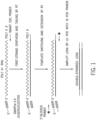
- RNA-Seq Currently the most commonly used method for single cell RNA-Seq is based on CLONTECH TM SMART-SEQ TM technology or derivatives thereof.
- an oligo(dT) primer primes the first-strand cDNA synthesis reaction.
- the reverse transcriptase SMARTSCRIBE TM
- the enzyme's terminal transferase activity adds a few additional non-template nucleotides to the 3' end of the cDNA.
- a template-switch oligo designed to base-pair with this non-template nucleotide stretch, anneals and creates an extended template to enable the RT continue replicating to the end of the oligonucleotide ( Fig. 1 ).
- the methods presented herein can include methods of generating tagged cDNA with sample-specific tags as described, for example, in the disclosure of U.S. 2012/0010091 .
- the terms single-cell tagged reverse transcription and STRT refer to methods disclosed, for example in U.S. 2012/0010091 .
- the double stranded cDNA is not degraded with DNase in the STRT method. Instead, the double stranded cDNA is tagmented with a transposase, for example, standard Nextera.
- the double stranded cDNA can then be converted into a sequencing library using for example NEXTERA TM or TRUSEQ TM (Illumina, Inc.) for whole transcriptome RNA-Seq; or through enzymatic degradation, such as DNase I or Fragmentase, followed by adaptor ligation for 5' end sequencing.
- NEXTERA TM or TRUSEQ TM Illumina, Inc.
- enzymatic degradation such as DNase I or Fragmentase
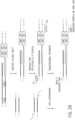
- first strand synthesis is primed with an (anchored) oligo dT primer (or potentially with a randomer or a combination of the two) that is appended with a sample barcode (BC), an amplification primer binding site, and optionally a template switch (TS) primer sequence.
- the amplification primer binding site is a transposase adapter sequence, such as, for example, the Nextera adaptor sequence V2.A14 or V2.B15.
- the barcode can be preceded or followed by a molecular barcode (unique molecular identifier, or "UMI") that would allow for the detection of PCR duplicates.
- UMI unique molecular identifier
- template switch occurs as described above and in U.S. 2012/0010091 .
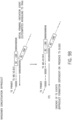
- This incorporates the complement of the TS primer sequence into the 1st strand cDNA. Because a sample barcode has been introduced into the 1st strand cDNA, different samples can at this point be pooled. The 1st strand pool will subsequently be rendered double stranded and optionally amplified in a PCR reaction with the TS primer ( Fig. 2A ). Due to the fact that both ends of the cDNA contain complementary sequences, formation of hairpin structures will result in suppression of amplification of smaller fragments such as artifacts, etc.
- 1st strand synthesis is primed with an oligo dT that has been appended with a sample barcode (BC), a copy of a transposase adaptor sequence the ("Nextera V2.A14 sequence"), optionally with a molecular barcode (UMI), and the template switch (TS) primer sequence.
- BC sample barcode
- UMI molecular barcode
- TS template switch
- the cDNAs are amplified with a TS oligo.
- This single primer PCR will suppress small amplicons such as primer dimer, etc.
- the cDNA pool can be tagmented with a transposase, for example, ("NEXTERA TM ") that only contains one adaptor sequence, rather than the typical two adapters.
- transposases are loaded with V2.B15 oligos. After tagmentation, PCR with p5-V2.A14 and p7-V2.B15 amplification primers preferentially amplifies the 3' end fragments of the cDNA.
- symmetric fragments Fragments that were generated by two tagmentation events
- amplification products generated from symmetric fragments will present P7 primer sequence at both the 5' and 3' end of the amplification product, and will not form sequenceable clusters on a standard Illumina flowcell bearing P5 and p7 amplification primers. Additionally, they will be suppressed during PCR due to their complementary ends.
- the 3' terminal fragment will bear P5 and P7 primer binding sites after amplification, and can form sequenceable clusters on an Illumina flowcell. Paired end sequencing will result in the sample BC and UMI sequence during read 1 and cDNA sequence during read 2.
- a form of a digital gene expression assay is performed that relies on 3' tag counting.
- the methods presented herein offer the ability to individually barcode cells at the first strand synthesis step. Additionally, barcoding of the 3' end of cDNA with inexpensive oligo-dT primers or randomers provides significant cost savings advantages. Furthermore, use of randomers for cDNA synthesis is advantageous because it makes the method more similar to total-RNA seq protocol in addition to 3'-tag counting assay.
- Subsequent pooling, cleanup, single primer cDNA PCR amplification, tagmentation and sequencing library prep can be performed in a single tube for 2, 3, 4, 5, 6, 7, 8, 9, 10, 20, 30, 40, 50, 60, 70, 80, 90, 91, 92, 93, 94, 95, 96, 97, 98, 99, 100 or more than cells.
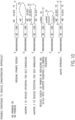
- the methods and compositions described herein are highly amenable to multiplexing. As an example, set forth in Fig.
- the methods provided herein enable multiplexing at cellular levels (e.g., 96 samples per 96-well plate), Further, the methods enable further multiplexing at the plate level using uniquely barcoded plates (e.g., tagmentation to incorporate a barcode that identifies the 96 well plate). These methods are amenable to automation and can provide signification cost and time savings.
- the sample barcode (BC) is positioned 3' to the UMI. In some embodiments, the sample barcode (BC) is positioned 5' to the UMI. In some embodiments, the sample barcode (BC) is directly contiguous with the UMI. In some embodiments, the sample barcode (BC) is separated from the UMI by 1, 2, 3, 4, 5, 6, 7, 8, 9, 10 or more than 10 nucleotides. In some embodiments, the sample barcode (BC) overlaps with the UMI by 1, 2, 3, 4, 5, 6, 7, 8, 9, 10 or more than 10 nucleotides.
- Tagmentation is performed using a transposase mixture that contains adapter sequences that are not found in the first strand synthesis primer. Doing so produces tagmentation fragments that bear different adapter sequences compared to the sequence incorporated into the first strand synthesis primer.
- the transposase mixture exclusively comprises transposomes having one type of adapter sequence. Fragments that were generated by this type of mixture are referred to herein as "symmetric fragments" and do not produce sequenceable clusters on an Illumina flowcell.
- the transposase mixture may comprise some amount of the sequence incorporated into the first strand synthesis primer, wherein the amount is low enough to still allow all or substantially all of the 3' cDNA fragments to be amplified and sequenced.
- the adapter sequences in the transposome mixture may comprise less than 0.01%, 0.1%, 1%, 2%, 3%, 4%, 5%, 6%, 7%, 8%, 9%, 10%, 11%, 12%, 13%, 14%, 15%, 16%, 17% 18%, 19%, 20%, or less than 25%, 30%, 35%, 40%, 45% or less than 50% of the sequence incorporated into the first strand synthesis primer.
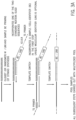
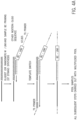
- Figs. 3A , 3B , 4A and 4B where one adapter sequence is incorporated into the first strand synthesis primer, that adapter is not used in the tagmentation mixture.
- Figs. 3A and 3B show one embodiment where adaptor V2.A14 is incorporated into the first strand synthesis primer and adapter V2.B15 is used as the transposome adapter during the tagmentation step.
- Figs. 3A and 3B show one embodiment where adaptor V2.A14 is incorporated into the first strand synthesis primer and adapter V2.B15 is used as the transposome adapter during the tagmentation step.
- FIGS. 4A and 4B show an alternative embodiment where adaptor V2.B15 is incorporated into the first strand synthesis primer and adapter V2.A14 is used as the transposome adapter during the tagmentation step.
- the resulting tagmentation fragments fall in to two categories: symmetric fragments (unable to be amplified and/or sequenced), and asymmetric fragments which can be amplified using a set of V2.A14 and V2.B15 primers.
- the number of single cells that can be multiplexed is significantly increased by incorporating indexes into the transposome adapter sequences.
- each individual cell can be identified using a cell-specific barcode and each set of cells (for example, a plate of 96 cells) can be contacted with a tagmentation mixture having a plate-specific barcode incorporated into the transposome adapter sequence.
- the cDNAs from each of the 96 cells on a plate are pooled prior to tagmentation, and then the tagmented samples are pooled for multiplexed sequencing.
- any number of cells can be pooled prior to tagmentation, and that use of a 96 well plate is simply one of a variety of embodiments.
- First strand synthesis may take place in any single or multi-well vessel, such as a multi-well plate, chip, microfluidic device, emulsion, bead mixture, or any other suitable format for multiple
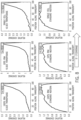
- Fig. 7 shows that when gene expression was analyzed using either symmetric tagmentation (Nextera version V2.B15) compared to asymmetric tagmentation (Nextera version V2.B15/V2.A14) a significant number of genes were detected and other metrics were obtained.
- Fig. 8 shows that transcript coverage is almost entirely biased towards the 3' end of the transcripts when performing tagmentation using only one transposase adaptor (V2.B15) versus tagmentation using two transposase adaptors (V2.A14 and V2.B15).
- sample and UMI barcoding can be performed by segregating individual cells into droplets.
- the droplets are segregated from each other in an emulsion.
- the droplets are formed and/or manipulated using a droplet actuator.
- one or more droplets comprise a different set of barcode-containing first strand synthesis primers.
- each droplet comprise multitude of first strand synthesis primers, each of these primers have identical sequence including identical barcodes and the barcodes from one droplet differ from another droplet, while the remaining portion of the first strand synthesis primer remains the same between the droplets.
- the barcodes act as identifier for the droplets as well as well as the single cell encompassed by the droplet.
- one or more droplets comprise a different set of UMI-containing first strand synthesis primers.
- each individual cell that is lysed in each droplet will be identifiable by the barcodes in each droplet.
- droplet-based barcoding can be performed by merging droplets containing single cells with other droplets that comprise unique sets of barcodes. This format allows additional multiplexing beyond that available in a multi wall format. First strand synthesis and template switching is performed within each individual droplet. In some embodiments, two or more droplets can be merged prior to PCR.
- droplets can be merged prior to tagmentation. Additionally or alternatively, in some embodiments, droplets can be merged after PCR and prior to tagmentation. For example, in some embodiments, after first strand synthesis is performed in individual droplets, the tagged cDNAs can be merged, thus pooling the cDNAs.
- sample and UMI barcoding can be performed by segregating individual cells with beads that bear a UMI and/or barcode-tagged primer for first strand synthesis.
- beads are segregated into droplets in an emulsion.
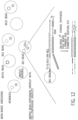
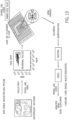
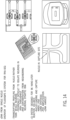
- beads are segregated and manipulated using a droplet actuator. As illustrated in Fig. 12 , bead-based barcoding can be performed by creating a set of beads, each bead bearing a unique set or sets of barcodes.
- first strand synthesis is expanded using randomers.
- random priming expands the window of sequenceable fragments to anywhere along the length of the transcript where a randomer can hybridize and prime first strand synthesis.
- the randomers can include the same combinations of sample barcodes and unique molecular identifiers in addition to other adapter and primer binding sites, such as a transposome adapter sequence and/or template switching (TS) primer.
- TS template switching
- Template switching and second strand synthesis can be performed as described above for oligo-dT primed cDNA synthesis.
- the resulting double stranded cDNAs can then be subjected to a tagmentation reaction as described above.
- the difference between use of randomers versus oligo-dT primers is that a complete, or substantially complete sequence of transcript can be obtained, rather than the 3' portion of the transcript.
- Fig. 6 100 pg RNA
- a byproduct that can occur when using randomers for priming first strand synthesis is concatenation byproducts.
- randomers may hybridize to other random primers, thus outcompeting annealing to RNA transcripts.
- the cDNA products that result may be further subjected to random priming and a cascade of template switching events can occur. This cascade can lead to formation of a byproduct of concatemers that may be dependent on the presence of the template switching oligonucleotide.
- primers can be configured to form a hairpin to prevent or minimize randomer priming to any portion of the barcode, adapter or amplification primer binding regions.
- a double-stranded portion formed in the primer itself can thus out-compete randomer hybridization.
- the double-stranded portion of the hairpin comprises the mosaic end (ME) sequence of the transposase adapter.
- the double stranded portion can comprise some or all of the transposase adapter sequence, beyond the mosaic end sequence.
- the adapter sequence can be completely replaced with a short RNA sequence, thus reducing the length of the primer and minimizing the potential for a randomer to hybridize to the primer.
- a complement of the short RNA sequence is provided at or near the 5' end of the primer, thus enabling formation of a hairpin.
- a double-stranded region is formed by annealing a complementary oligonucleotide to the adapter and/or primer portion, thus preventing or minimizing randomer priming to any portion of the barcode, adapter or amplification primer binding regions and thereby reducing or avoiding concatenation byproducts.
- randomer refers to The random primers that can exhibit fourfold degeneracy at each position.
- the randomers comprises nucleic acid primers that are any of a variety of random sequence lengths, as known in the art.
- the randomers can comprise a random sequence that is 3, 4, 5, 6, 7, 8, 10, 11, 12, 13, 14, 15, 16, 17, 18, 19, 20 or more nucleotides long.
- the plurality of random primers can comprise randomers of various lengths.
- the plurality of randomers can comprise randomers that are of equal length.
- the plurality of randomers can comprise a random sequence that is about 5 to about 18 nucleotides long.
- the plurality of randomers comprises random hexamers.
- Random primers and particularly random hexamers, are commercially available and widely used in amplification reactions such as Multiple Displacement Amplification (MDA), as exemplified by REPLI-g whole genome amplification kits (QIAGEN, Valencia, CA). It will be appreciated that any suitable length of randomers may be used in the methods and compositions presented herein.
- MDA Multiple Displacement Amplification
- REPLI-g whole genome amplification kits QIAGEN, Valencia, CA
- the term "SMART-Seq Plus” means a method of preparing cDNA from RNA using a first strand synthesis primer comprising a first amplification primer binding site, a randomer comprising a first amplification primer binding site, and an oligonucleotide switching oligonucleotide that is partially complimentary to the first strand of the cDNA and comprises a second amplification primer binding site.
- the first strand synthesis primer comprises an oligo(dT) portion.
- barcode refers to a nucleic acid tag that can be used to identify a sample or source of the nucleic acid material.
- nucleic acid samples are derived from multiple sources, the nucleic acids in each nucleic acid sample can be tagged with different nucleic acid tags such that the source of the sample can be identified.
- Barcodes also commonly referred to indexes, tags, and the like, are well known to those of skill in the art. Any suitable barcode or set of barcodes can be used, as known in the art and as exemplified by the disclosures of U.S. Pat. No. 8,053,192 and PCT Pub. WO05/068656 . Barcoding of single cells can be performed as described, for example in the disclosure of U.S. 2013/0274117 .
- Nucleic acids from more than one source can incorporate a variable tag sequence.
- This tag sequence can be up to 100 nucleotides in length (base pairs if referring to double stranded molecules), preferably 1 to 10 nucleotides in length, most preferably 4, 5 or 6 nucleotides in length and comprises combinations of nucleotides. For example, in one embodiment, if six base-pairs are chosen to form the tag and a permutation of four different nucleotides used, then a total of 4096 nucleic acid anchors (e.g. hairpins), each with a unique 6 base tag can be made.
- nucleic acid anchors e.g. hairpins
- UMI unique identifier
- unique molecular identifier refer to a unique nucleic acid sequence that is attached to each of a plurality of nucleic acid molecules.
- UMI unique molecular identifiers
- the design, incorporation and application of UMIs can take place as known in the art, as exemplified by, for example, the disclosures of WO 2012/142213 , Islam et al. Nat. Methods (2014) 11:163-166 , and Kivioja, T. et al. Nat. Methods (2012) 9: 72-74 .
- tagmentation refers to the modification of DNA by a transposome complex comprising transposase enzyme complexed with adaptors comprising transposon end sequence. Tagmentation results in the simultaneous fragmentation of the DNA and ligation of the adaptors to the 5' ends of both strands of duplex fragments. Following a purification step to remove the transposase enzyme, additional sequences can be added to the ends of the adapted fragments, for example by PCR ligation, or any other suitable methodology known to those of skill in the art.
- the method of the invention can use any transposase that can accept a transposase end sequence and fragment a target nucleic acid, attaching a transferred end, but not a non-transferred end.
- a "transposome” is comprised of at least a transposase enzyme and a transposase recognition site.
- the transposase can form a functional complex with a transposon recognition site that is capable of catalyzing a transposition reaction.
- the transposase or integrase may bind to the transposase recognition site and insert the transposase recognition site into a target nucleic acid in a process sometimes termed "tagmentation". In some such insertion events, one strand of the transposase recognition site may be transferred into the target nucleic acid.
- each template contains an adaptor at either end of the insert and often a number of steps are required to both modify the DNA or RNA and to purify the desired products of the modification reactions. These steps are performed in solution prior to the addition of the adapted fragments to a flowcell where they are coupled to the surface by a primer extension reaction that copies the hybridized fragment onto the end of a primer covalently attached to the surface. These 'seeding' templates then give rise to monoclonal clusters of copied templates through several cycles of amplification.
- transposon based technology can be utilized for fragmenting DNA, for example as exemplified in the workflow for Nextera TM DNA sample preparation kits (Illumina, Inc.) wherein genomic DNA can be fragmented by an engineered transposome that simultaneously fragments and tags input DNA (“tagmentation”) thereby creating a population of fragmented nucleic acid molecules which comprise unique adapter sequences at the ends of the fragments.
- Some embodiments can include the use of a hyperactive Tn5 transposase and a Tn5-type transposase recognition site ( Gory shin and Reznikoff, J. Biol. Chem., 273:7367 (1998 )), or MuA transposase and a Mu transposase recognition site comprising R1 and R2 end sequences ( Mizuuchi, K., Cell, 35: 785, 1983 ; Savilahti, H, et al., EMBO J., 14: 4893, 1995 ).
- An exemplary transposase recognition site that forms a complex with a hyperactive Tn5 transposase e.g., EZ-Tn5 TM Transposase, Epicentre Biotechnologies, Madison, Wis.).
- transposition systems that can be used with certain embodiments provided herein include Staphylococcus aureus Tn552 (contento et al., J. Bacteriol., 183: 2384-8, 2001 ; Kirby C et al., Mol. Microbiol., 43: 173-86, 2002 ), Ty1 ( Devine & Boeke, Nucleic Acids Res., 22: 3765-72, 1994 and International Publication WO 95/23875 ), Transposon Tn7 ( Craig, N L, Science.
- More examples include IS5, Tn10, Tn903, IS911, and engineered versions of transposase family enzymes ( Zhang et al., (2009) PLoS Genet. 5:e1000689. Epub 2009 Oct. 16 ; Wilson C. et al (2007) J. Microbiol. Methods 71:332-5 ).
- a "transposition reaction” is a reaction wherein one or more transposons are inserted into target nucleic acids at random sites or almost random sites.
- Essential components in a transposition reaction are a transposase and DNA oligonucleotides that exhibit the nucleotide sequences of a transposon, including the transferred transposon sequence and its complement (i.e., the non- transferred transposon end sequence) as well as other components needed to form a functional transposition or transposome complex.
- the DNA oligonucleotides can further comprise additional sequences (e.g., adaptor or primer sequences) as needed or desired.
- in vitro transposition can be initiated by contacting a transposome complex and a target DNA. Exemplary transposition procedures and systems that can be readily adapted for use with the transposases of the present disclosure are described, for example, in WO 10/048605 ; US 2012/0301925 ; US 2013/0143774 .
- the adapters that are added to the 5' and/or 3' end of a nucleic acid can comprise a universal sequence.
- a universal sequence is a region of nucleotide sequence that is common to, i.e., shared by, two or more nucleic acid molecules.
- the two or more nucleic acid molecules also have regions of sequence differences.
- the 5' adapters can comprise identical or universal nucleic acid sequences and the 3' adapters can comprise identical or universal sequences.
- a universal sequence that may be present in different members of a plurality of nucleic acid molecules can allow the replication or amplification of multiple different sequences using a single universal primer that is complementary to the universal sequence.
- Tn5 Mosaic End Sequence A14 Tn5MEA
- Tn5 Mosaic End Sequence B15 Tn5MEB
- NTS complementary non transferred sequence
- primers bearing sample barcodes can be in solution.
- primers bearing UMI sequences can be in solution.
- the solid support can be one or more droplets.
- a plurality of droplets can be presented, wherein each droplet in the plurality bears a unique sample barcode and/or UMI sequences, each of which are unique to a molecule.
- the barcodes are unique to a droplet and the UMI are unique to a molecule such that the UMI are repeated many times within a collection of droplets.
- individual cells are contacted with a droplet having a unique set of sample barcodes and/or UMI sequences in order to identify the individual cell.
- lysates from individual cells are contacted with a droplet having a unique set of sample barcodes and/or UMI sequences in order to identify the individual cell lysates.
- purified nucleic acid from individual cells are contacted with a droplet having a unique set of sample barcodes and/or UMI sequences in order to identify the purified nucleic acid from the individual cell.
- any suitable system for forming and manipulating droplets can be used in the embodiments presented herein where each droplet in a plurality of droplets bears a unique set of sample barcodes and/or UMI sequences.
- a droplet actuator may be used.
- Droplet Actuator means a device for manipulating droplets.
- droplet actuators see Pamula et al., U.S. Patent No. 6,911,132, entitled “Apparatus for Manipulating Droplets by Electrowetting-Based Techniques,” issued on June 28, 2005 ; Pamula et al., U.S. Patent Pub. No. 20060194331, entitled “Apparatuses and Methods for Manipulating Droplets on a Printed Circuit Board,” published on August 31, 2006 ; Pollack et al., International Patent Pub. No. WO/2007/120241, entitled “Droplet-Based Biochemistry,” published on October 25, 2007 ; Shenderov, U.S. Patent No.
- 20070023292 entitled “Small Object Moving on Printed Circuit Board,” published on February 1, 2007 ; Shah et al., U.S. Patent Pub. No. 20090283407, entitled “Method for Using Magnetic Particles in Droplet Microfluidics,” published on November 19, 2009 ; Kim et al., U.S. Patent Pub. No. 20100096266, entitled “Method and Apparatus for Real-time Feedback Control of Electrical Manipulation of Droplets on Chip,” published on April 22, 2010 ; Velev, U.S. Patent No. 7,547,380, entitled “Droplet Transportation Devices and Methods Having a Fluid Surface,” issued on June 16, 2009 ; Sterling et al., U.S. Patent No.
- Certain droplet actuators will include one or more substrates arranged with a droplet operations gap therebetween and electrodes associated with (e.g., layered on, attached to, and/or embedded in) the one or more substrates and arranged to conduct one or more droplet operations.
- certain droplet actuators will include a base (or bottom) substrate, droplet operations electrodes associated with the substrate, one or more dielectric layers atop the substrate and/or electrodes, and optionally one or more hydrophobic layers atop the substrate, dielectric layers and/or the electrodes forming a droplet operations surface.
- a top substrate may also be provided, which is separated from the droplet operations surface by a gap, commonly referred to as a droplet operations gap.
- a droplet operations gap commonly referred to as a droplet operations gap.
- a ground or reference electrode may be associated with the top substrate facing the gap, the bottom substrate facing the gap, in the gap.
- electrical contacts for coupling the electrodes to a droplet actuator instrument for controlling or monitoring the electrodes may be associated with one or both plates.
- electrodes on one substrate are electrically coupled to the other substrate so that only one substrate is in contact with the droplet actuator.
- a conductive material e.g., an epoxy, such as MASTER BOND TM Polymer System EP79, available from Master Bond, Inc., Hackensack, NJ
- a spacer may be provided between the substrates to determine the height of the gap therebetween and define on-actuator dispensing reservoirs.
- the spacer height may, for example, be at least about 5 ⁇ m, 100 ⁇ m, 200 ⁇ m, 250 ⁇ m, 275 ⁇ m or more.
- the spacer height may be at most about 600 ⁇ m, 400 ⁇ m, 350 ⁇ m, 300 ⁇ m, or less.
- the spacer may, for example, be formed of a layer of projections form the top or bottom substrates, and/or a material inserted between the top and bottom substrates.
- One or more openings may be provided in the one or more substrates for forming a fluid path through which liquid may be delivered into the droplet operations gap.
- the one or more openings may in some cases be aligned for interaction with one or more electrodes, e.g., aligned such that liquid flowed through the opening will come into sufficient proximity with one or more droplet operations electrodes to permit a droplet operation to be effected by the droplet operations electrodes using the liquid.
- the base (or bottom) and top substrates may in some cases be formed as one integral component.
- One or more reference electrodes may be provided on the base (or bottom) and/or top substrates and/or in the gap. Examples of reference electrode arrangements are provided in the above referenced patents and patent applications.
- the manipulation of droplets by a droplet actuator may be electrode mediated, e.g., electrowetting mediated or dielectrophoresis mediated or Coulombic force mediated.
- Examples of other techniques for controlling droplet operations that may be used in the droplet actuators of the present disclosure include using devices that induce hydrodynamic fluidic pressure, such as those that operate on the basis of mechanical principles (e.g.
- external syringe pumps pneumatic membrane pumps, vibrating membrane pumps, vacuum devices, centrifugal forces, piezoelectric/ultrasonic pumps and acoustic forces
- electrical or magnetic principles e.g. electroosmotic flow, electrokinetic pumps, ferrofluidic plugs, electrohydrodynamic pumps, attraction or repulsion using magnetic forces and magnetohydrodynamic pumps
- thermodynamic principles e.g. gas bubble generation/phase-change-induced volume expansion
- other kinds of surface-wetting principles e.g.
- electrowetting, and optoelectrowetting as well as chemically, thermally, structurally and radioactively induced surface-tension gradients); gravity; surface tension (e.g., capillary action); electrostatic forces (e.g., electroosmotic flow); centrifugal flow (substrate disposed on a compact disc and rotated); magnetic forces (e.g., oscillating ions causes flow); magnetohydrodynamic forces; and vacuum or pressure differential.
- combinations of two or more of the foregoing techniques may be employed to conduct a droplet operation in a droplet actuator of the present disclosure.
- Droplet operations surfaces of certain droplet actuators of the present disclosure may be made from hydrophobic materials or may be coated or treated to make them hydrophobic.
- some portion or all of the droplet operations surfaces may be derivatized with low surface-energy materials or chemistries, e.g., by deposition or using in situ synthesis using compounds such as polyor per-fluorinated compounds in solution or polymerizable monomers.
- Examples include TEFLON ® AF (available from DuPont, Wilmington, DE), members of the cytop family of materials, coatings in the FLUOROPEL ® family of hydrophobic and superhydrophobic coatings (available from Cytonix Corporation, Beltsville, MD), silane coatings, fluorosilane coatings, hydrophobic phosphonate derivatives (e.g., those sold by Aculon, Inc), and NOVEC TM electronic coatings (available from 3M Company, St. Paul, MN), other fluorinated monomers for plasma-enhanced chemical vapor deposition (PECVD), and organosiloxane (e.g., SiOC) for PECVD.
- PECVD plasma-enhanced chemical vapor deposition
- organosiloxane e.g., SiOC
- the droplet operations surface may include a hydrophobic coating having a thickness ranging from about 10 nm to about 1,000 nm.
- the top substrate of the droplet actuator includes an electrically conducting organic polymer, which is then coated with a hydrophobic coating or otherwise treated to make the droplet operations surface hydrophobic.
- the electrically conducting organic polymer that is deposited onto a plastic substrate may be poly(3,4-ethylenedioxythiophene) poly(styrenesulfonate) (PEDOT:PSS).
- PEDOT:PSS poly(3,4-ethylenedioxythiophene) poly(styrenesulfonate)
- Other examples of electrically conducting organic polymers and alternative conductive layers are described in Pollack et al., International Patent Pub. No.
- WO/2011/002957 entitled “Droplet Actuator Devices and Methods,” published on January 6, 2011 .
- One or both substrates may be fabricated using a printed circuit board (PCB), glass, indium tin oxide (ITO)-coated glass, and/or semiconductor materials as the substrate.
- the ITO coating is preferably a thickness of at least about 20 nm, 50 nm, 75 nm, 100 nm or more. Alternatively or additionally the thickness can be at most about 200 nm, 150 nm, 125 nm or less.
- the top and/or bottom substrate includes a PCB substrate that is coated with a dielectric, such as a polyimide dielectric, which may in some cases also be coated or otherwise treated to make the droplet operations surface hydrophobic.
- a dielectric such as a polyimide dielectric
- the substrate includes a PCB
- the following materials are examples of suitable materials: MITSUI TM BN-300 (available from MITSUI Chemicals America, Inc., San Jose CA); ARLON TM 11N (available from Arlon, Inc, Santa Ana, CA).; NELCO ® N4000-6 and N5000-30/32 (available from Park Electrochemical Corp., Melville, NY); ISOLA TM FR406 (available from Isola Group, Chandler, AZ), especially IS620; fluoropolymer family (suitable for fluorescence detection since it has low background fluorescence); polyimide family; polyester; polyethylene naphthalate; polycarbonate; polyetheretherketone; liquid crystal polymer; cyclo-olefin cop
- Various materials are also suitable for use as the dielectric component of the substrate. Examples include: vapor deposited dielectric, such as PARYLENE TM C (especially on glass), PARYLENE TM N, and PARYLENE TM HT (for high temperature, ⁇ 300°C) (available from Parylene Coating Services, Inc., Katy, TX); TEFLON ® AF coatings; cytop; soldermasks, such as liquid photoimageable soldermasks (e.g., on PCB) like TAIYO TM PSR4000 series, TAIYO TM PSR and AUS series (available from Taiyo America, Inc.
- vapor deposited dielectric such as PARYLENE TM C (especially on glass), PARYLENE TM N, and PARYLENE TM HT (for high temperature, ⁇ 300°C) (available from Parylene Coating Services, Inc., Katy, TX); TEFLON ® AF coatings; cytop; soldermasks
- Droplet transport voltage and frequency may be selected for performance with reagents used in specific assay protocols.
- Design parameters may be varied, e.g., number and placement of on-actuator reservoirs, number of independent electrode connections, size (volume) of different reservoirs, placement of magnets/bead washing zones, electrode size, inter-electrode pitch, and gap height (between top and bottom substrates) may be varied for use with specific reagents, protocols, droplet volumes, etc.
- a substrate of the present disclosure may be derivatized with low surface-energy materials or chemistries, e.g., using deposition or in situ synthesis using poly- or per-fluorinated compounds in solution or polymerizable monomers.
- TEFLON ® AF coatings and FLUOROPEL ® coatings for dip or spray coating
- organosiloxane e.g., SiOC
- some portion or the entire droplet operations surface may be coated with a substance for reducing background noise, such as background fluorescence from a PCB substrate.
- the noise-reducing coating may include a black matrix resin, such as the black matrix resins available from Toray industries, Inc., Japan.
- Electrodes of a droplet actuator are typically controlled by a controller or a processor, which is itself provided as part of a system, which may include processing functions as well as data and software storage and input and output capabilities.
- Reagents may be provided on the droplet actuator in the droplet operations gap or in a reservoir fluidly coupled to the droplet operations gap.
- the reagents may be in liquid form, e.g., droplets, or they may be provided in a reconstitutable form in the droplet operations gap or in a reservoir fluidly coupled to the droplet operations gap. Reconstitutable reagents may typically be combined with liquids for reconstitution.
- Activation means affecting a change in the electrical state of the one or more electrodes which, in the presence of a droplet, results in a droplet operation.
- Activation of an electrode can be accomplished using alternating current (AC) or direct current (DC). Any suitable voltage may be used.
- an electrode may be activated using a voltage which is greater than about 150 V, or greater than about 200 V, or greater than about 250 V, or from about 275 V to about 1000 V, or about 300 V.
- any suitable frequency may be employed.
- an electrode may be activated using an AC signal having a frequency from about 1 Hz to about 10 MHz, or from about 10 Hz to about 60 Hz, or from about 20 Hz to about 40 Hz, or about 30 Hz.
- Bead with respect to beads on a droplet actuator, means any bead or particle that is capable of interacting with a droplet on or in proximity with a droplet actuator.
- Beads may be any of a wide variety of shapes, such as spherical, generally spherical, egg shaped, disc shaped, cubical, amorphous and other three dimensional shapes.
- the bead may, for example, be capable of being subjected to a droplet operation in a droplet on a droplet actuator or otherwise configured with respect to a droplet actuator in a manner which permits a droplet on the droplet actuator to be brought into contact with the bead on the droplet actuator and/or off the droplet actuator.
- Beads may be provided in a droplet, in a droplet operations gap, or on a droplet operations surface. Beads may be provided in a reservoir that is external to a droplet operations gap or situated apart from a droplet operations surface, and the reservoir may be associated with a flow path that permits a droplet including the beads to be brought into a droplet operations gap or into contact with a droplet operations surface. Beads may be manufactured using a wide variety of materials, including for example, resins, and polymers. The beads may be any suitable size, including for example, microbeads, microparticles, nanobeads and nanoparticles. In some cases, beads are magnetically responsive; in other cases beads are not significantly magnetically responsive.
- the magnetically responsive material may constitute substantially all of a bead, a portion of a bead, or only one component of a bead.
- the remainder of the bead may include, among other things, polymeric material, coatings, and moieties which permit attachment of an assay reagent.
- suitable beads include flow cytometry microbeads, polystyrene microparticles and nanoparticles, functionalized polystyrene microparticles and nanoparticles, coated polystyrene microparticles and nanoparticles, silica microbeads, fluorescent microspheres and nanospheres, functionalized fluorescent microspheres and nanospheres, coated fluorescent microspheres and nanospheres, color dyed microparticles and nanoparticles, magnetic microparticles and nanoparticles, superparamagnetic microparticles and nanoparticles (e.g., DYNABEADS ® particles, available from Invitrogen Group, Carlsbad, CA), fluorescent microparticles and nanoparticles, coated magnetic microparticles and nanoparticles, ferromagnetic microparticles and nanoparticles, coated ferromagnetic microparticles and nanoparticles, and those described in Watkins et al., U.S.
- DYNABEADS ® particles available
- Beads may be pre-coupled with a biomolecule or other substance that is able to bind to and form a complex with a biomolecule. Beads may be pre-coupled with an antibody, protein or antigen, DNA/RNA probe or any other molecule with an affinity for a desired target.
- Bead characteristics may be employed in the multiplexing aspects of the present disclosure. Examples of beads having characteristics suitable for multiplexing, as well as methods of detecting and analyzing signals emitted from such beads, may be found in Whitman et al., U.S. Patent Pub. No. 20080305481, entitled “Systems and Methods for Multiplex Analysis of PCR in Real Time,” published on December 11, 2008 ; Roth, U.S. Patent Pub. No.
- Droplet means a volume of liquid on a droplet actuator.
- a droplet is at least partially bounded by a filler fluid.
- a droplet may be completely surrounded by a filler fluid or may be bounded by filler fluid and one or more surfaces of the droplet actuator.
- a droplet may be bounded by filler fluid, one or more surfaces of the droplet actuator, and/or the atmosphere.
- a droplet may be bounded by filler fluid and the atmosphere.
- Droplets may, for example, be aqueous or non-aqueous or may be mixtures or emulsions including aqueous and non-aqueous components.
- Droplets may take a wide variety of shapes; nonlimiting examples include generally disc shaped, slug shaped, truncated sphere, ellipsoid, spherical, partially compressed sphere, hemispherical, ovoid, cylindrical, combinations of such shapes, and various shapes formed during droplet operations, such as merging or splitting or formed as a result of contact of such shapes with one or more surfaces of a droplet actuator.
- droplet fluids that may be subjected to droplet operations using the approach of the present disclosure, see Eckhardt et al., International Patent Pub. No. WO/2007/120241, entitled, "Droplet-Based Biochemistry," published on October 25, 2007 .
- a droplet may include a biological sample, such as whole blood, lymphatic fluid, serum, plasma, sweat, tear, saliva, sputum, cerebrospinal fluid, amniotic fluid, seminal fluid, vaginal excretion, serous fluid, synovial fluid, pericardial fluid, peritoneal fluid, pleural fluid, transudates, exudates, cystic fluid, bile, urine, gastric fluid, intestinal fluid, fecal samples, liquids containing single or multiple cells, liquids containing organelles, fluidized tissues, fluidized organisms, liquids containing multi-celled organisms, biological swabs and biological washes.
- a biological sample such as whole blood, lymphatic fluid, serum, plasma, sweat, tear, saliva, sputum, cerebrospinal fluid, amniotic fluid, seminal fluid, vaginal excretion, serous fluid, synovial fluid, pericardial fluid, peritoneal fluid, pleural fluid, transudates, exu
- a droplet may include a reagent, such as water, deionized water, saline solutions, acidic solutions, basic solutions, detergent solutions and/or buffers.
- a droplet can include nucleic acids, such as DNA, genomic DNA, RNA, mRNA or analogs thereof; nucleotides such as deoxyribonucleotides, ribonucleotides or analogs thereof such as analogs having terminator moieties such as those described in Bentley et al., Nature 456:53-59 (2008 ); Gormley et al., International Patent Pub. No.
- WO/2013/131962 entitled, "Improved Methods of Nucleic Acid Sequencing,” published on September 12, 2013 ; Barnes et al., U.S. Patent No. 7,057,026, entitled “Labelled Nucleotides,” issued on June 6, 2006 ; Kozlov et al., International Patent Pub. No. WO/2008/042067, entitled, “Compositions and Methods for Nucleotide Sequencing,” published on April 10, 2008 ; Rigatti et al., International Patent Pub. No. WO/2013/117595, entitled, "Targeted Enrichment and Amplification of Nucleic Acids on a Support,” published on August 15, 2013 ; Hardin et al., U.S. Patent No.
- droplet contents include reagents, such as a reagent for a biochemical protocol, such as a nucleic acid amplification protocol, an affinity-based assay protocol, an enzymatic assay protocol, a sequencing protocol, and/or a protocol for analyses of biological fluids.
- reagents such as a reagent for a biochemical protocol, such as a nucleic acid amplification protocol, an affinity-based assay protocol, an enzymatic assay protocol, a sequencing protocol, and/or a protocol for analyses of biological fluids.
- a droplet may include one or more beads.
- Droplet operation means any manipulation of a droplet on a droplet actuator.
- a droplet operation may, for example, include: loading a droplet into the droplet actuator; dispensing one or more droplets from a source droplet; splitting, separating or dividing a droplet into two or more droplets; transporting a droplet from one location to another in any direction; merging or combining two or more droplets into a single droplet; diluting a droplet; mixing a droplet; agitating a droplet; deforming a droplet; retaining a droplet in position; incubating a droplet; heating a droplet; vaporizing a droplet; cooling a droplet; disposing of a droplet; transporting a droplet out of a droplet actuator; other droplet operations described herein; and/or any combination of the foregoing.
- merge “merge,” “merging,” “combine,” “combining” and the like are used to describe the creation of one droplet from two or more droplets. It should be understood that when such a term is used in reference to two or more droplets, any combination of droplet operations that are sufficient to result in the combination of the two or more droplets into one droplet may be used. For example, “merging droplet A with droplet B,” can be achieved by transporting droplet A into contact with a stationary droplet B, transporting droplet B into contact with a stationary droplet A, or transporting droplets A and B into contact with each other.
- splitting is not intended to imply any particular outcome with respect to volume of the resulting droplets (i.e., the volume of the resulting droplets can be the same or different) or number of resulting droplets (the number of resulting droplets may be 2, 3, 4, 5 or more).
- mixing refers to droplet operations which result in more homogenous distribution of one or more components within a droplet. Examples of “loading” droplet operations include microdialysis loading, pressure assisted loading, robotic loading, passive loading, and pipette loading. Droplet operations may be electrode-mediated. In some cases, droplet operations are further facilitated by the use of hydrophilic and/or hydrophobic regions on surfaces and/or by physical obstacles.
- Impedance or capacitance sensing or imaging techniques may sometimes be used to determine or confirm the outcome of a droplet operation. Examples of such techniques are described in Sturmer et al., U.S. Patent Pub. No. 20100194408, entitled “Capacitance Detection in a Droplet Actuator,” published on Aug. 5, 2010 . Generally speaking, the sensing or imaging techniques may be used to confirm the presence or absence of a droplet at a specific electrode. For example, the presence of a dispensed droplet at the destination electrode following a droplet dispensing operation confirms that the droplet dispensing operation was effective.
- Droplet transport time can be quite fast. For example, in various embodiments, transport of a droplet from one electrode to the next may exceed about 1 sec, or about 0.1 sec, or about 0.01 sec, or about 0.001 sec.
- the electrode is operated in AC mode but is switched to DC mode for imaging. It is helpful for conducting droplet operations for the footprint area of droplet to be similar to electrowetting area; in other words, 1x-, 2x-3x-droplets are usefully controlled operated using 1, 2, and 3 electrodes, respectively.
- the difference between the droplet size and the number of electrodes should typically not be greater than 1; in other words, a 2x droplet is usefully controlled using 1 electrode and a 3x droplet is usefully controlled using 2 electrodes.
- droplets include beads, it is useful for droplet size to be equal to the number of electrodes controlling the droplet, e.g., transporting the droplet.
- Filler fluid means a fluid associated with a droplet operations substrate of a droplet actuator, which fluid is sufficiently immiscible with a droplet phase to render the droplet phase subject to electrode-mediated droplet operations.
- the droplet operations gap of a droplet actuator is typically filled with a filler fluid.
- the filler fluid may, for example, be or include low-viscosity oil, such as silicone oil or hexadecane filler fluid.
- the filler fluid may be or include a halogenated oil, such as a fluorinated or perfluorinated oil.
- the filler fluid may fill the entire gap of the droplet actuator or may coat one or more surfaces of the droplet actuator. Filler fluids may be conductive or non-conductive.
- Filler fluids may be selected to improve droplet operations and/or reduce loss of reagent or target substances from droplets, improve formation of microdroplets, reduce cross contamination between droplets, reduce contamination of droplet actuator surfaces, reduce degradation of droplet actuator materials, etc.
- filler fluids may be selected for compatibility with droplet actuator materials.
- fluorinated filler fluids may be usefully employed with fluorinated surface coatings.
- Fluorinated filler fluids are useful to reduce loss of lipophilic compounds, such as umbelliferone substrates like 6-hexadecanoylamido-4-methylumbelliferone substrates (e.g., for use in Krabbe, Niemann-Pick, or other assays); other umbelliferone substrates are described in Winger et al., U.S. Patent Pub. No. 20110118132, entitled “Enzymatic Assays Using Umbelliferone Substrates with Cyclodextrins in Droplets of Oil,” published on May 19, 2011 .
- filler fluids are based on kinematic viscosity ( ⁇ 7 cSt is preferred, but not required), and on boiling point (> 150 °C is preferred, but not required, for use in DNA/RNA-based applications (PCR, etc.)).
- Filler fluids may, for example, be doped with surfactants or other additives.
- additives may be selected to improve droplet operations and/or reduce loss of reagent or target substances from droplets, formation of microdroplets, cross contamination between droplets, contamination of droplet actuator surfaces, degradation of droplet actuator materials, etc.
- Composition of the filler fluid may be selected for performance with reagents used in the specific assay protocols and effective interaction or non-interaction with droplet actuator materials.
- Examples of filler fluids and filler fluid formulations suitable for use with the methods set forth herein are provided in Srinivasan et al, International Patent Pub. No. WO/2010/027894, entitled “Droplet Actuators, Modified Fluids and Methods," published on June 3, 2010 ; Srinivasan et al, International Patent Pub. No. WO/2009/021173, entitled “Use of Additives for Enhancing Droplet Operations," published on February 12, 2009 ; Sista et al., International Patent Pub. No.
- Fluorinated oils may in some cases be doped with fluorinated surfactants, e.g., Zonyl FSO-100 (Sigma-Aldrich) and/or others.
- a filler fluid is typically a liquid. In some embodiments, a filler gas can be used instead of a liquid.
- Immobilize with respect to magnetically responsive beads, means that the beads are substantially restrained in position in a droplet or in filler fluid on a droplet actuator.
- immobilized beads are sufficiently restrained in position in a droplet to permit execution of a droplet splitting operation, yielding one droplet with substantially all of the beads and one droplet substantially lacking in the beads.
- Magnetically responsive means responsive to a magnetic field.
- Magnetically responsive beads include or are composed of magnetically responsive materials. Examples of magnetically responsive materials include paramagnetic materials, ferromagnetic materials, ferrimagnetic materials, and metamagnetic materials. Examples of suitable paramagnetic materials include iron, nickel, and cobalt, as well as metal oxides, such as Fe3O4, BaFe12O19, CoO, NiO, Mn2O3, Cr2O3, and CoMnP.
- a droplet actuator system of the present disclosure may include on-cartridge reservoirs and/or off-cartridge reservoirs.
- On-cartridge reservoirs may be (1) on-actuator reservoirs, which are reservoirs in the droplet operations gap or on the droplet operations surface; (2) off-actuator reservoirs, which are reservoirs on the droplet actuator cartridge, but outside the droplet operations gap, and not in contact with the droplet operations surface; or (3) hybrid reservoirs which have on-actuator regions and off-actuator regions.
- An example of an off-actuator reservoir is a reservoir in the top substrate.
- An off-actuator reservoir is typically in fluid communication with an opening or flow path arranged for flowing liquid from the off-actuator reservoir into the droplet operations gap, such as into an on-actuator reservoir.
- An off-cartridge reservoir may be a reservoir that is not part of the droplet actuator cartridge at all, but which flows liquid to some portion of the droplet actuator cartridge.
- an off-cartridge reservoir may be part of a system or docking station to which the droplet actuator cartridge is coupled during operation.
- an off-cartridge reservoir may be a reagent storage container or syringe which is used to force fluid into an on-cartridge reservoir or into a droplet operations gap.
- a system using an off-cartridge reservoir will typically include a fluid passage means whereby liquid may be transferred from the off-cartridge reservoir into an on-cartridge reservoir or into a droplet operations gap.
- Transporting into the magnetic field of a magnet is intended to refer to transporting into a region of a magnetic field capable of substantially attracting magnetically responsive beads in the droplet.
- transporting away from a magnet or magnetic field is intended to refer to transporting away from a region of a magnetic field capable of substantially attracting magnetically responsive beads in the droplet, whether or not the droplet or magnetically responsive beads is completely removed from the magnetic field.
- the droplet may be transported towards or away from the desired region of the magnetic field, and/or the desired region of the magnetic field may be moved towards or away from the droplet.
- Reference to an electrode, a droplet, or magnetically responsive beads being "within” or “in” a magnetic field, or the like, is intended to describe a situation in which the electrode is situated in a manner which permits the electrode to transport a droplet into and/or away from a desired region of a magnetic field, or the droplet or magnetically responsive beads is/are situated in a desired region of the magnetic field, in each case where the magnetic field in the desired region is capable of substantially attracting any magnetically responsive beads in the droplet.
- a droplet, or magnetically responsive beads being "outside of” or “away from” a magnetic field, and the like, is intended to describe a situation in which the electrode is situated in a manner which permits the electrode to transport a droplet away from a certain region of a magnetic field, or the droplet or magnetically responsive beads is/are situated away from a certain region of the magnetic field, in each case where the magnetic field in such region is not capable of substantially attracting any magnetically responsive beads in the droplet or in which any remaining attraction does not eliminate the effectiveness of droplet operations conducted in the region.
- a system, a droplet actuator, or another component of a system may include a magnet, such as one or more permanent magnets (e.g., a single cylindrical or bar magnet or an array of such magnets, such as a Halbach array) or an electromagnet or array of electromagnets, to form a magnetic field for interacting with magnetically responsive beads or other components on chip.
- a magnet such as one or more permanent magnets (e.g., a single cylindrical or bar magnet or an array of such magnets, such as a Halbach array) or an electromagnet or array of electromagnets, to form a magnetic field for interacting with magnetically responsive beads or other components on chip.
- Such interactions may, for example, include substantially immobilizing or restraining movement or flow of magnetically responsive beads during storage or in a droplet during a droplet operation or pulling magnetically responsive beads out of a droplet.
- Washing with respect to washing a bead means reducing the amount and/or concentration of one or more substances in contact with the bead or exposed to the bead from a droplet in contact with the bead.
- the reduction in the amount and/or concentration of the substance may be partial, substantially complete, or even complete.
- the substance may be any of a wide variety of substances; examples include target substances for further analysis, and unwanted substances, such as components of a sample, contaminants, and/or excess reagent.
- a washing operation begins with a starting droplet in contact with a magnetically responsive bead, where the droplet includes an initial amount and initial concentration of a substance. The washing operation may proceed using a variety of droplet operations.
- the washing operation may yield a droplet including the magnetically responsive bead, where the droplet has a total amount and/or concentration of the substance which is less than the initial amount and/or concentration of the substance.
- suitable washing techniques are described in Pamula et al., U.S. Patent No. 7,439,014, entitled “Droplet-Based Surface Modification and Washing," issued on October 21, 2008 ,
- top bottom
- over under
- under on
- the terms “top,” “bottom,” “over,” “under,” and “on” are used throughout the description with reference to the relative positions of components of the droplet actuator, such as relative positions of top and bottom substrates of the droplet actuator. It will be appreciated that the droplet actuator is functional regardless of its orientation in space.
- a liquid in any form e.g., a droplet or a continuous body, whether moving or stationary
- a liquid in any form e.g., a droplet or a continuous body, whether moving or stationary
- such liquid could be either in direct contact with the electrode/array/matrix/surface, or could be in contact with one or more layers or films that are interposed between the liquid and the electrode/array/matrix/surface.
- filler fluid can be considered as a film between such liquid and the electrode/array/matrix! surface.
- a droplet When a droplet is described as being “on” or “loaded on” a droplet actuator, it should be understood that the droplet is arranged on the droplet actuator in a manner which facilitates using the droplet actuator to conduct one or more droplet operations on the droplet, the droplet is arranged on the droplet actuator in a manner which facilitates sensing of a property of or a signal from the droplet, and/or the droplet has been subjected to a droplet operation on the droplet actuator.
- primers bearing sample barcodes can be immobilized to a solid support.
- primers bearing UMI sequences can be immobilized to a solid support.
- the solid support can be one or more beads.
- a plurality of beads can be presented, wherein each bead in the plurality bears a unique sample barcode and/or UMI sequence.
- individual cells are contacted with one or more beads having a unique set of sample barcodes and/or UMI sequences in order to identify the individual cell.
- lysates from individual cells are contacted with one or more beads having a unique set of sample barcodes and/or UMI sequences in order to identify the individual cell lysates.
- purified nucleic acid from individual cells are contacted with one or more beads having a unique set of sample barcodes and/or UMI sequences in order to identify the purified nucleic acid from the individual cell.
- the beads can be manipulated in any suitable manner as is known in the art, for example, using droplet actuators as described hereinabove.
- solid surface refers to any material that is appropriate for or can be modified to be appropriate for the attachment of the primers, barcodes and sequences described herein. As will be appreciated by those in the art, the number of possible substrates is very large.
- Possible substrates include, but are not limited to, glass and modified or functionalized glass, plastics (including acrylics, polystyrene and copolymers of styrene and other materials, polypropylene, polyethylene, polybutylene, polyurethanes, Teflon TM , etc.), polysaccharides, nylon or nitrocellulose, ceramics, resins, silica or silica-based materials including silicon and modified silicon, carbon, metals, inorganic glasses, plastics, optical fiber bundles, and a variety of other polymers.
- Particularly useful solid supports and solid surfaces for some embodiments are located within a flow cell apparatus. Exemplary flow cells are set forth in further detail below.
- the solid support comprises a patterned surface suitable for immobilization of primers, barcodes and sequences described herein in an ordered pattern.
- a "patterned surface" refers to an arrangement of different regions in or on an exposed layer of a solid support.
- one or more of the regions can be features where one or more transposome complexes are present.
- the features can be separated by interstitial regions where transposome complexes are not present.
- the pattern can be an x-y format of features that are in rows and columns.
- the pattern can be a repeating arrangement of features and/or interstitial regions.
- the pattern can be a random arrangement of features and/or interstitial regions.
- the transposome complexes are randomly distributed upon the solid support. In some embodiments, the transposome complexes are distributed on a patterned surface. Exemplary patterned surfaces that can be used in the methods set forth herein are described in US Pat. App. Publ. No. 2013/0116153 A1 or US Pat. App. Publ. No. 2012/0316086 A1 .
- the solid support comprises an array of wells or depressions in a surface.
- This may be fabricated as is generally known in the art using a variety of techniques, including, but not limited to, photolithography, stamping techniques, molding techniques and microetching techniques. As will be appreciated by those in the art, the technique used will depend on the composition and shape of the array substrate.
- the composition and geometry of the solid support can vary with its use.
- the solid support is a planar structure such as a slide, chip, microchip and/or array.
- the surface of a substrate can be in the form of a planar layer.
- the solid support comprises one or more surfaces of a flowcell.
- flowcell refers to a chamber comprising a solid surface across which one or more fluid reagents can be flowed.
- the solid support or its surface is non-planar, such as the inner or outer surface of a tube or vessel.
- the solid support comprises microspheres or beads.
- microspheres or “beads” or “particles” or grammatical equivalents herein is meant small discrete particles.
- Suitable bead compositions include, but are not limited to, plastics, ceramics, glass, polystyrene, methylstyrene, acrylic polymers, paramagnetic materials, thoria sol, carbon graphite, titanium dioxide, latex or cross-linked dextrans such as Sepharose, cellulose, nylon, cross-linked micelles and teflon, as well as any other materials outlined herein for solid supports may all be used.
- "Microsphere Detection Guide” from Bangs Laboratories, Fishers Ind. is a helpful guide.
- the microspheres are magnetic microspheres or beads.
- the beads need not be spherical; irregular particles may be used. Alternatively or additionally, the beads may be porous.
- the bead sizes range from nanometers, i.e. 100 nm, to millimeters, i.e. 1 mm, with beads from about 0.2 micron to about 200 microns being preferred, and from about 0.5 to about 5 micron being particularly preferred, although in some embodiments smaller or larger beads may be used.
Landscapes
- Life Sciences & Earth Sciences (AREA)
- Chemical & Material Sciences (AREA)
- Health & Medical Sciences (AREA)
- Genetics & Genomics (AREA)
- Engineering & Computer Science (AREA)
- Organic Chemistry (AREA)
- Zoology (AREA)
- Wood Science & Technology (AREA)
- Bioinformatics & Cheminformatics (AREA)
- Biotechnology (AREA)
- General Engineering & Computer Science (AREA)
- Biomedical Technology (AREA)
- Molecular Biology (AREA)
- General Health & Medical Sciences (AREA)
- Biophysics (AREA)
- Microbiology (AREA)
- Physics & Mathematics (AREA)
- Biochemistry (AREA)
- Crystallography & Structural Chemistry (AREA)
- Plant Pathology (AREA)
- Bioinformatics & Computational Biology (AREA)
- Analytical Chemistry (AREA)
- Proteomics, Peptides & Aminoacids (AREA)
- Chemical Kinetics & Catalysis (AREA)
- Immunology (AREA)
- Measuring Or Testing Involving Enzymes Or Micro-Organisms (AREA)
- Investigating Or Analysing Biological Materials (AREA)
Claims (13)
- Ein Verfahren zum Herstellen einer cDNA-Bibliothek von einer Vielzahl von einzelnen Zellen, wobei das Verfahren die folgenden Schritte beinhaltet:Freisetzen von mRNA aus jeder einzelnen Zelle, um eine Vielzahl von individuellen mRNA-Proben bereitzustellen, wobei die mRNA in jeder individuellen mRNA-Probe aus einer einzelnen Zelle stammt;Synthetisieren eines ersten Strangs von cDNA von der mRNA in jeder individuellen mRNA-Probe mit einem Erststrangsyntheseprimer, wobei der Erststrangsyntheseprimer eine Mischung aus einem Oligo-dT-Primer und einem Randomer-Primer ist, wobei jeder ferner eine erste Amplifikationsprimerbindungsstelle beinhaltet;Inkorporieren eines Tags in die cDNA, um eine Vielzahl von getaggten cDNA-Proben bereitzustellen, wobei die cDNA in jeder getaggten cDNA-Probe zu mRNA aus einer einzelnen Zelle komplementär ist und wobei das Tag eine zellspezifische Identifikatorsequenz und wahlweise eine eindeutige Molekülidentifikatorsequenz (UMI-Sequenz) beinhaltet;Poolen der getaggten cDNA-Proben;wahlweise Amplifizieren der gepoolten cDNA-Proben, um eine cDNA-Bibliothek zu erzeugen, die doppelsträngige cDNA beinhaltet; undDurchführen einer Tagmentierungsreaktion, um gleichzeitig jede cDNA zu spalten und einen Adapter in jeden Strang der cDNA zu inkorporieren, wodurch eine Vielzahl von getaggten cDNA-Fragmenten erzeugt wird, wobei die Tagmentierungsreaktion das In-Kontakt-Bringen der doppelsträngigen cDNA mit einer Transposasemischung beinhaltet, die eine Adaptersequenz beinhaltet, die nicht in dem Erststrangsyntheseprimer zu finden ist, und wobei die Transposasemischung im Grunde aus Transposomen besteht, die die gleiche Adaptersequenz aufweisen.
- Verfahren gemäß Anspruch 1, ferner beinhaltend das Amplifizieren der getaggten cDNA-Fragmente, um amplifizierte getaggte cDNA-Fragmente zu erzeugen.
- Verfahren gemäß Anspruch 2, wobei das Amplifizieren das Hinzufügen einer zusätzlichen Sequenz an das 5'-Ende der Amplifikationsprodukte beinhaltet.
- Verfahren gemäß Anspruch 3, wobei die zusätzliche Sequenz eine Primerbindungssequenz zur Amplifikation auf einem festen Träger beinhaltet.
- Verfahren gemäß Anspruch 4, ferner beinhaltend das Amplifizieren der amplifizierten getaggten cDNA-Fragmente auf einem festen Träger.
- Verfahren gemäß Anspruch 5, ferner beinhaltend das Sequenzieren der Amplifikationsprodukte auf dem festen Träger.
- Verfahren gemäß Anspruch 1, ferner beinhaltend das Sequenzieren der getaggten cDNA-Fragmente.
- Verfahren gemäß Anspruch 7, wobei das Sequenzieren 3'-Tag-Zählen beinhaltet.
- Verfahren gemäß Anspruch 7, wobei das Sequenzieren eine Gesamttranskriptomanalyse beinhaltet.
- Verfahren gemäß Anspruch 1, wobei der Oligo-dT-Primer oder Randomer-Primer einen doppelsträngigen Abschnitt beinhaltet.
- Verfahren gemäß Anspruch 10, wobei der Oligo-dT-Primer oder Randomer-Primer verglichen mit einem einzelsträngigen Erststrangsyntheseprimer Verkettungsnebenprodukte verringert.
- Verfahren gemäß Anspruch 10, wobei der Oligo-dT-Primer oder Randomer-Primer eine Region beinhaltet, die in der Lage ist, eine Haarnadel zu bilden, oder eine RNA-Region beinhaltet.
- Verfahren gemäß Anspruch 10, wobei der Oligo-dT-Primer oder Randomer-Primer an ein komplementäres Oligonukleotid hybridisiert wird, wodurch ein doppelsträngiger Abschnitt gebildet wird.
Priority Applications (2)
| Application Number | Priority Date | Filing Date | Title |
|---|---|---|---|
| EP22175902.0A EP4086357A1 (de) | 2015-08-28 | 2016-08-26 | Nukleinsäuresequenzanalyse aus einzelnen zellen |
| EP23216563.9A EP4368715A3 (de) | 2015-08-28 | 2016-08-26 | Nukleinsäuresequenzanalyse aus einzelzellen |
Applications Claiming Priority (3)
| Application Number | Priority Date | Filing Date | Title |
|---|---|---|---|
| US201562211597P | 2015-08-28 | 2015-08-28 | |
| US14/855,207 US10975371B2 (en) | 2014-04-29 | 2015-09-15 | Nucleic acid sequence analysis from single cells |
| PCT/US2016/049046 WO2017040306A1 (en) | 2015-08-28 | 2016-08-26 | Nucleic acid sequence analysis from single cells |
Related Child Applications (4)
| Application Number | Title | Priority Date | Filing Date |
|---|---|---|---|
| EP23216563.9A Division EP4368715A3 (de) | 2015-08-28 | 2016-08-26 | Nukleinsäuresequenzanalyse aus einzelzellen |
| EP23216563.9A Division-Into EP4368715A3 (de) | 2015-08-28 | 2016-08-26 | Nukleinsäuresequenzanalyse aus einzelzellen |
| EP22175902.0A Division EP4086357A1 (de) | 2015-08-28 | 2016-08-26 | Nukleinsäuresequenzanalyse aus einzelnen zellen |
| EP22175902.0A Division-Into EP4086357A1 (de) | 2015-08-28 | 2016-08-26 | Nukleinsäuresequenzanalyse aus einzelnen zellen |
Publications (2)
| Publication Number | Publication Date |
|---|---|
| EP3341494A1 EP3341494A1 (de) | 2018-07-04 |
| EP3341494B1 true EP3341494B1 (de) | 2024-08-07 |
Family
ID=58188042
Family Applications (3)
| Application Number | Title | Priority Date | Filing Date |
|---|---|---|---|
| EP16760336.4A Active EP3341494B1 (de) | 2015-08-28 | 2016-08-26 | Analyse von nukleinsäuresequenzen aus einzelnen zellen |
| EP22175902.0A Pending EP4086357A1 (de) | 2015-08-28 | 2016-08-26 | Nukleinsäuresequenzanalyse aus einzelnen zellen |
| EP23216563.9A Pending EP4368715A3 (de) | 2015-08-28 | 2016-08-26 | Nukleinsäuresequenzanalyse aus einzelzellen |
Family Applications After (2)
| Application Number | Title | Priority Date | Filing Date |
|---|---|---|---|
| EP22175902.0A Pending EP4086357A1 (de) | 2015-08-28 | 2016-08-26 | Nukleinsäuresequenzanalyse aus einzelnen zellen |
| EP23216563.9A Pending EP4368715A3 (de) | 2015-08-28 | 2016-08-26 | Nukleinsäuresequenzanalyse aus einzelzellen |
Country Status (9)
| Country | Link |
|---|---|
| EP (3) | EP3341494B1 (de) |
| JP (4) | JP6743150B2 (de) |
| CN (2) | CN108350497B (de) |
| AU (4) | AU2016316773B2 (de) |
| CA (3) | CA2997035A1 (de) |
| ES (1) | ES2988429T3 (de) |
| HK (1) | HK1250757A1 (de) |
| SG (1) | SG10201912283RA (de) |
| WO (1) | WO2017040306A1 (de) |
Families Citing this family (60)
| Publication number | Priority date | Publication date | Assignee | Title |
|---|---|---|---|---|
| US8835358B2 (en) | 2009-12-15 | 2014-09-16 | Cellular Research, Inc. | Digital counting of individual molecules by stochastic attachment of diverse labels |
| LT3363901T (lt) | 2012-02-17 | 2021-04-12 | Fred Hutchinson Cancer Research Center | Kompozicijos ir būdai, skirti tiksliam mutacijų nustatymui |
| EP3321378B1 (de) | 2012-02-27 | 2021-11-10 | Becton, Dickinson and Company | Zusammensetzungen für molekularen zählung |
| ES2711168T3 (es) | 2013-08-28 | 2019-04-30 | Becton Dickinson Co | Análisis masivo en paralelo de células individuales |
| ES2836802T3 (es) | 2015-02-27 | 2021-06-28 | Becton Dickinson Co | Códigos de barras moleculares espacialmente direccionables |
| ES2934982T3 (es) | 2015-03-30 | 2023-02-28 | Becton Dickinson Co | Métodos para la codificación con códigos de barras combinatorios |
| WO2016172373A1 (en) | 2015-04-23 | 2016-10-27 | Cellular Research, Inc. | Methods and compositions for whole transcriptome amplification |
| EP3347465B1 (de) | 2015-09-11 | 2019-06-26 | Cellular Research, Inc. | Verfahren und zusammensetzung zur standardisierung von nukleinsäure bibliothek |
| US10301677B2 (en) | 2016-05-25 | 2019-05-28 | Cellular Research, Inc. | Normalization of nucleic acid libraries |
| US10640763B2 (en) | 2016-05-31 | 2020-05-05 | Cellular Research, Inc. | Molecular indexing of internal sequences |
| US10202641B2 (en) | 2016-05-31 | 2019-02-12 | Cellular Research, Inc. | Error correction in amplification of samples |
| EP3516400B1 (de) | 2016-09-26 | 2023-08-16 | Becton, Dickinson and Company | Messung der proteinexpression mit reagenzien mit strichcodierten oligonukleotidsequenzen |
| US10982351B2 (en) | 2016-12-23 | 2021-04-20 | Grail, Inc. | Methods for high efficiency library preparation using double-stranded adapters |
| US11319583B2 (en) | 2017-02-01 | 2022-05-03 | Becton, Dickinson And Company | Selective amplification using blocking oligonucleotides |
| US11274344B2 (en) | 2017-03-30 | 2022-03-15 | Grail, Inc. | Enhanced ligation in sequencing library preparation |
| US11118222B2 (en) | 2017-03-31 | 2021-09-14 | Grail, Inc. | Higher target capture efficiency using probe extension |
| WO2018183942A1 (en) | 2017-03-31 | 2018-10-04 | Grail, Inc. | Improved library preparation and use thereof for sequencing-based error correction and/or variant identification |
| CA3059559A1 (en) | 2017-06-05 | 2018-12-13 | Becton, Dickinson And Company | Sample indexing for single cells |
| WO2019152108A1 (en) * | 2018-02-05 | 2019-08-08 | The Board Of Trustees Of The Leland Stanford Junior University | Systems and methods for multiplexed measurements in single and ensemble cells |
| ES2945191T3 (es) | 2018-05-03 | 2023-06-29 | Becton Dickinson Co | Análisis de muestras multiómicas de alto rendimiento |
| JP7358388B2 (ja) | 2018-05-03 | 2023-10-10 | ベクトン・ディキンソン・アンド・カンパニー | 反対側の転写物末端における分子バーコーディング |
| CN108611346A (zh) * | 2018-05-06 | 2018-10-02 | 湖南大地同年生物科技有限公司 | 一种单细胞基因表达量检测文库的构建方法 |
| US11639517B2 (en) | 2018-10-01 | 2023-05-02 | Becton, Dickinson And Company | Determining 5′ transcript sequences |
| CN112424380B (zh) | 2018-11-01 | 2025-03-04 | Illumina公司 | 用于体细胞变体检测的方法和组合物 |
| JP7618548B2 (ja) | 2018-11-08 | 2025-01-21 | ベクトン・ディキンソン・アンド・カンパニー | ランダムプライミングを使用した単一細胞の全トランスクリプトーム解析 |
| FI3887540T3 (fi) * | 2018-11-30 | 2023-09-14 | Illumina Inc | Useiden analyyttien analyysi käyttäen yhtä määritystä |
| US12545950B2 (en) | 2018-12-07 | 2026-02-10 | Qiagen Sciences, Llc | Methods for preparing CDNA samples for RNA sequencing, and CDNA samples and uses thereof |
| US11492660B2 (en) | 2018-12-13 | 2022-11-08 | Becton, Dickinson And Company | Selective extension in single cell whole transcriptome analysis |
| AU2019402067A1 (en) | 2018-12-17 | 2021-05-06 | Illumina, Inc. | Methods and means for preparing a library for sequencing |
| US11421216B2 (en) | 2018-12-21 | 2022-08-23 | Illumina, Inc. | Nuclease-based RNA depletion |
| US20220033811A1 (en) * | 2018-12-28 | 2022-02-03 | Biobloxx Ab | Method and kit for preparing complementary dna |
| CN111378728A (zh) * | 2018-12-31 | 2020-07-07 | 新格元(南京)生物科技有限公司 | 一种带分子标签引物序列的磁珠及其制备方法 |
| EP4242322B1 (de) | 2019-01-23 | 2024-08-21 | Becton, Dickinson and Company | Mit antikörpern assoziierte oligonukleotide |
| WO2020167920A1 (en) | 2019-02-14 | 2020-08-20 | Cellular Research, Inc. | Hybrid targeted and whole transcriptome amplification |
| US20230151355A1 (en) * | 2019-03-12 | 2023-05-18 | Universal Sequencing Technology Corporation | Methods for Single Cell Intracellular Capture and its Applications |
| CA3132029A1 (en) * | 2019-04-02 | 2020-10-08 | Dalia Dhingra | Methods and systems for proteomic profiling and characterization |
| SE543469C2 (en) * | 2019-06-03 | 2021-03-02 | Di Wu | Method for creating a cDNA sequencing library |
| CN114051534B (zh) | 2019-07-22 | 2025-02-21 | 贝克顿迪金森公司 | 单细胞染色质免疫沉淀测序测定 |
| KR20220080091A (ko) * | 2019-09-06 | 2022-06-14 | 체엠엠 - 포르슝스첸트룸 퓨어 몰레쿨라레 메디친 게엠베하 | Rna 올리고뉴클레오티드를 시퀀싱하기 위한 방법 |
| WO2021046462A2 (en) * | 2019-09-06 | 2021-03-11 | Honeycomb Biotechnologies, Inc. | Methods and systems for rna-seq profiling |
| JP7522189B2 (ja) | 2019-11-08 | 2024-07-24 | ベクトン・ディキンソン・アンド・カンパニー | 免疫レパートリーシーケンシングのための完全長v(d)j情報を得るためのランダムプライミングの使用 |
| CN111088250B (zh) * | 2019-12-25 | 2022-03-08 | 中国科学院苏州生物医学工程技术研究所 | 一种mRNA捕获序列、捕获载体的合成方法、高通量单细胞测序文库制备方法 |
| US11649497B2 (en) | 2020-01-13 | 2023-05-16 | Becton, Dickinson And Company | Methods and compositions for quantitation of proteins and RNA |
| CN115335520A (zh) | 2020-01-29 | 2022-11-11 | 贝克顿迪金森公司 | 用于通过测序对单细胞进行空间映射的条形码化的孔 |
| WO2021168015A1 (en) * | 2020-02-17 | 2021-08-26 | Universal Sequencing Technology Corporation | Methods of barcoding nucleic acid for detection and sequencing |
| EP4111168A1 (de) | 2020-02-25 | 2023-01-04 | Becton Dickinson and Company | Bispezifische sonden zur ermöglichung der verwendung von einzelzellenproben als einzelfarbkompensationssteuerung |
| CN113444770B (zh) * | 2020-03-27 | 2023-05-30 | 中国人民解放军陆军军医大学 | 一种单细胞转录组测序文库的构建方法及其应用 |
| CN115605614A (zh) | 2020-05-14 | 2023-01-13 | 贝克顿迪金森公司(Us) | 用于免疫组库谱分析的引物 |
| US12157913B2 (en) | 2020-06-02 | 2024-12-03 | Becton, Dickinson And Company | Oligonucleotides and beads for 5 prime gene expression assay |
| EP4163390A4 (de) * | 2020-06-03 | 2024-08-07 | Tenk Genomics, Inc. | Verfahren zur analyse einer zielnukleinsäure aus einer zelle |
| CN115968407A (zh) * | 2020-06-23 | 2023-04-14 | 路德维格癌症研究所 | 通过测序平行分析单个细胞的rna表达和靶向的酶切法片段化dna |
| US11932901B2 (en) | 2020-07-13 | 2024-03-19 | Becton, Dickinson And Company | Target enrichment using nucleic acid probes for scRNAseq |
| WO2022026909A1 (en) | 2020-07-31 | 2022-02-03 | Becton, Dickinson And Company | Single cell assay for transposase-accessible chromatin |
| JP2023543541A (ja) | 2020-08-06 | 2023-10-17 | イルミナ インコーポレイテッド | ビーズ連結トランスポソームを使用するrna及びdna配列決定ライブラリの調製 |
| WO2022067494A1 (en) * | 2020-09-29 | 2022-04-07 | Singleron (Nanjing) Biotechnologies, Ltd. | Method for detection of whole transcriptome in single cells |
| CN112309500B (zh) * | 2020-10-30 | 2024-08-30 | 广州序科码生物技术有限责任公司 | 一种基于单细胞测序数据唯一片段序列捕获方法 |
| CN116635533A (zh) | 2020-11-20 | 2023-08-22 | 贝克顿迪金森公司 | 高表达的蛋白和低表达的蛋白的谱分析 |
| CN116685850A (zh) | 2020-12-15 | 2023-09-01 | 贝克顿迪金森公司 | 单细胞分泌组分析 |
| EP4314283A1 (de) | 2021-03-31 | 2024-02-07 | Illumina, Inc. | Verfahren zur herstellung von direktionalen tagmentationssequenzierungsbibliotheken mit transposonbasierter technologie mit eindeutigen molekularen identifikatoren zur fehlerkorrektur |
| WO2023159416A1 (zh) * | 2022-02-24 | 2023-08-31 | 浙江大学 | 一种单细胞转录组测序方法及其应用 |
Citations (1)
| Publication number | Priority date | Publication date | Assignee | Title |
|---|---|---|---|---|
| WO2004021986A2 (en) * | 2002-09-03 | 2004-03-18 | Quanta Biosciences, Inc. | Improved compositions and methods for cdna synthesis |
Family Cites Families (72)
| Publication number | Priority date | Publication date | Assignee | Title |
|---|---|---|---|---|
| FR406E (fr) | 1899-06-28 | 1902-12-29 | Rey Jean Marie | Rubans en cellulose pour remplacer les tresses en paille de toute nature |
| EP0450060A1 (de) | 1989-10-26 | 1991-10-09 | Sri International | Dns-sequenzierung |
| US5677170A (en) | 1994-03-02 | 1997-10-14 | The Johns Hopkins University | In vitro transposition of artificial transposons |
| CA2227895C (en) | 1995-10-11 | 2012-07-17 | Luminex Corporation | Multiplexed analysis of clinical specimens apparatus and methods |
| EP0965044B1 (de) | 1997-11-18 | 2003-03-19 | Bio-Rad Laboratories, Inc. | Multiplex-zufluss-immunotest mit magnetischen teilchen als festphase |
| US6565727B1 (en) | 1999-01-25 | 2003-05-20 | Nanolytics, Inc. | Actuators for microfluidics without moving parts |
| US6294063B1 (en) | 1999-02-12 | 2001-09-25 | Board Of Regents, The University Of Texas System | Method and apparatus for programmable fluidic processing |
| DE60027576T2 (de) | 1999-08-17 | 2007-05-03 | Luminex Corp., Austin | Verkapselung von fluoreszierenden partikeln |
| AU6779700A (en) | 1999-08-17 | 2001-03-13 | Luminex Corporation | Microparticles with multiple fluorescent signals and methods of using same |
| AU8288101A (en) | 2000-07-07 | 2002-01-21 | Visigen Biotechnologies Inc | Real-time sequence determination |
| AU2001280796A1 (en) | 2000-07-25 | 2002-02-05 | The Regents Of The University Of California | Electrowetting-driven micropumping |
| US6773566B2 (en) | 2000-08-31 | 2004-08-10 | Nanolytics, Inc. | Electrostatic actuators for microfluidics and methods for using same |
| EP1354064A2 (de) | 2000-12-01 | 2003-10-22 | Visigen Biotechnologies, Inc. | Enzymatische nukleinsäuresynthese: zusammensetzungen und verfahren, um die zuverlässigkeit des monomereinbaus zu erhöhen |
| JP2005510347A (ja) | 2001-11-26 | 2005-04-21 | ケック グラデュエイト インスティテュート | 化学、生化学、および生物学的アッセイ等のためにエレクトロウェッティングを介してマイクロ流体制御する方法、装置、および物 |
| US7057026B2 (en) | 2001-12-04 | 2006-06-06 | Solexa Limited | Labelled nucleotides |
| FR2841063B1 (fr) | 2002-06-18 | 2004-09-17 | Commissariat Energie Atomique | Dispositif de deplacement de petits volumes de liquide le long d'un micro-catenaire par des forces electrostatiques |
| EP1530578B1 (de) | 2002-08-23 | 2013-03-13 | Illumina Cambridge Limited | Modifizierte nukleotide für polynukleotidsequencing |
| US6911132B2 (en) | 2002-09-24 | 2005-06-28 | Duke University | Apparatus for manipulating droplets by electrowetting-based techniques |
| US7547380B2 (en) | 2003-01-13 | 2009-06-16 | North Carolina State University | Droplet transportation devices and methods having a fluid surface |
| US7470397B2 (en) | 2003-10-24 | 2008-12-30 | Adhesives Research, Inc. | Disintegratable films for diagnostic devices |
| US7328979B2 (en) | 2003-11-17 | 2008-02-12 | Koninklijke Philips Electronics N.V. | System for manipulation of a body of fluid |
| GB0400584D0 (en) | 2004-01-12 | 2004-02-11 | Solexa Ltd | Nucleic acid chacterisation |
| CN101187621B (zh) | 2004-01-14 | 2012-02-15 | 卢米尼克斯股份有限公司 | 用于动态范围扩展的方法和系统 |
| FR2866493B1 (fr) | 2004-02-16 | 2010-08-20 | Commissariat Energie Atomique | Dispositif de controle du deplacement d'une goutte entre deux ou plusieurs substrats solides |
| FR2872715B1 (fr) | 2004-07-08 | 2006-11-17 | Commissariat Energie Atomique | Microreacteur goutte |
| FR2872809B1 (fr) | 2004-07-09 | 2006-09-15 | Commissariat Energie Atomique | Methode d'adressage d'electrodes |
| JP2006058031A (ja) | 2004-08-17 | 2006-03-02 | Hitachi High-Technologies Corp | 化学分析装置 |
| US7302146B2 (en) | 2004-09-17 | 2007-11-27 | Pacific Biosciences Of California, Inc. | Apparatus and method for analysis of molecules |
| EP1842211B1 (de) | 2005-01-20 | 2010-08-04 | Luminex Corporation | Mikrokugeln mit fluoreszente und magnetische eigenschaften |
| US7458661B2 (en) | 2005-01-25 | 2008-12-02 | The Regents Of The University Of California | Method and apparatus for promoting the complete transfer of liquid drops from a nozzle |
| ES2390800T3 (es) | 2005-01-28 | 2012-11-16 | Duke University | Aparatos y métodos para manipular gotitas en una placa de circuito impreso |
| US20070023292A1 (en) | 2005-07-26 | 2007-02-01 | The Regents Of The University Of California | Small object moving on printed circuit board |
| WO2007035840A2 (en) | 2005-09-21 | 2007-03-29 | Luminex Corporation | Methods and systems for image data processing |
| US7405281B2 (en) | 2005-09-29 | 2008-07-29 | Pacific Biosciences Of California, Inc. | Fluorescent nucleotide analogs and uses therefor |
| US20070207513A1 (en) | 2006-03-03 | 2007-09-06 | Luminex Corporation | Methods, Products, and Kits for Identifying an Analyte in a Sample |
| EP3373174A1 (de) | 2006-03-31 | 2018-09-12 | Illumina, Inc. | Systeme und vorrichtungen zur "sequence-by-synthesis"-analyse |
| US7439014B2 (en) | 2006-04-18 | 2008-10-21 | Advanced Liquid Logic, Inc. | Droplet-based surface modification and washing |
| WO2010027894A2 (en) | 2008-08-27 | 2010-03-11 | Advanced Liquid Logic, Inc. | Droplet actuators, modified fluids and methods |
| US7901947B2 (en) | 2006-04-18 | 2011-03-08 | Advanced Liquid Logic, Inc. | Droplet-based particle sorting |
| EP2016189B1 (de) | 2006-04-18 | 2012-01-25 | Advanced Liquid Logic, Inc. | Pyrosequenzierung auf tröpfchenbasis |
| CN101490562B (zh) | 2006-07-10 | 2012-12-19 | 株式会社日立高新技术 | 液体输送设备 |
| EP2071927A2 (de) | 2006-09-28 | 2009-06-24 | Illumina, Inc. | Zusammensetzungen und verfahren zur nukleotidsequenzierung |
| WO2008051530A2 (en) | 2006-10-23 | 2008-05-02 | Pacific Biosciences Of California, Inc. | Polymerase enzymes and reagents for enhanced nucleic acid sequencing |
| WO2008055256A2 (en) | 2006-11-02 | 2008-05-08 | The Regents Of The University Of California | Method and apparatus for real-time feedback control of electrical manipulation of droplets on chip |
| EP3118333B1 (de) | 2006-12-13 | 2019-04-03 | Luminex Corporation | Systeme und verfahren zur multiplexanalyse von pcr in echtzeit |
| WO2008093098A2 (en) | 2007-02-02 | 2008-08-07 | Illumina Cambridge Limited | Methods for indexing samples and sequencing multiple nucleotide templates |
| KR101503510B1 (ko) | 2007-02-09 | 2015-03-18 | 어드밴스드 리퀴드 로직, 아이엔씨. | 자성 비즈를 이용하는 액적 작동기 장치 및 방법 |
| EP2109774B1 (de) | 2007-02-15 | 2018-07-04 | Advanced Liquid Logic, Inc. | Kapazitätserkennung in einem tröpfchenaktuator |
| US8093062B2 (en) | 2007-03-22 | 2012-01-10 | Theodore Winger | Enzymatic assays using umbelliferone substrates with cyclodextrins in droplets in oil |
| US20100048410A1 (en) | 2007-03-22 | 2010-02-25 | Advanced Liquid Logic, Inc. | Bead Sorting on a Droplet Actuator |
| US20100130369A1 (en) | 2007-04-23 | 2010-05-27 | Advanced Liquid Logic, Inc. | Bead-Based Multiplexed Analytical Methods and Instrumentation |
| US20080283414A1 (en) | 2007-05-17 | 2008-11-20 | Monroe Charles W | Electrowetting devices |
| WO2009003184A1 (en) | 2007-06-27 | 2008-12-31 | Digital Biosystems | Digital microfluidics based apparatus for heat-exchanging chemical processes |
| US20110303542A1 (en) | 2007-08-08 | 2011-12-15 | Advanced Liquid Logic, Inc. | Use of Additives for Enhancing Droplet Operations |
| US8093064B2 (en) | 2008-05-15 | 2012-01-10 | The Regents Of The University Of California | Method for using magnetic particles in droplet microfluidics |
| SI2963709T1 (sl) | 2008-10-24 | 2017-10-30 | Epicentre Technologies Corporation | Transposonski sestavki in postopki za spreminjanje nukleinskih kislin |
| US9080211B2 (en) | 2008-10-24 | 2015-07-14 | Epicentre Technologies Corporation | Transposon end compositions and methods for modifying nucleic acids |
| DK2414548T3 (en) * | 2009-03-30 | 2015-12-21 | Illumina Inc | Gene expression in single cells |
| WO2011002957A2 (en) | 2009-07-01 | 2011-01-06 | Advanced Liquid Logic, Inc. | Droplet actuator devices and methods |
| GB2512213B (en) | 2010-10-08 | 2015-02-11 | Harvard College | High-throughput single cell barcoding |
| EP3246416B1 (de) | 2011-04-15 | 2024-06-05 | The Johns Hopkins University | Sicheres sortierungssystem |
| CA2834291A1 (en) * | 2011-04-25 | 2012-11-01 | Biorad Laboratories, Inc. | Methods and compositions for nucleic acid analysis |
| US9005935B2 (en) | 2011-05-23 | 2015-04-14 | Agilent Technologies, Inc. | Methods and compositions for DNA fragmentation and tagging by transposases |
| WO2012170936A2 (en) | 2011-06-09 | 2012-12-13 | Illumina, Inc. | Patterned flow-cells useful for nucleic acid analysis |
| WO2013085918A1 (en) | 2011-12-05 | 2013-06-13 | The Regents Of The University Of California | Methods and compostions for generating polynucleic acid fragments |
| WO2013117595A2 (en) | 2012-02-07 | 2013-08-15 | Illumina Cambridge Limited | Targeted enrichment and amplification of nucleic acids on a support |
| NO2694769T3 (de) | 2012-03-06 | 2018-03-03 | ||
| US9683230B2 (en) | 2013-01-09 | 2017-06-20 | Illumina Cambridge Limited | Sample preparation on a solid support |
| WO2014201273A1 (en) * | 2013-06-12 | 2014-12-18 | The Broad Institute, Inc. | High-throughput rna-seq |
| ES2711168T3 (es) * | 2013-08-28 | 2019-04-30 | Becton Dickinson Co | Análisis masivo en paralelo de células individuales |
| ES2912183T3 (es) * | 2013-12-30 | 2022-05-24 | Atreca Inc | Análisis de ácidos nucleicos asociados a células individuales utilizando códigos de barras de ácidos nucleicos |
| CA2947426C (en) * | 2014-04-29 | 2020-01-07 | Illumina, Inc. | Multiplexed single cell gene expression analysis using template switch and tagmentation |
-
2016
- 2016-08-26 EP EP16760336.4A patent/EP3341494B1/de active Active
- 2016-08-26 CA CA2997035A patent/CA2997035A1/en active Pending
- 2016-08-26 SG SG10201912283RA patent/SG10201912283RA/en unknown
- 2016-08-26 CA CA3172073A patent/CA3172073A1/en active Pending
- 2016-08-26 HK HK18110273.7A patent/HK1250757A1/zh unknown
- 2016-08-26 AU AU2016316773A patent/AU2016316773B2/en active Active
- 2016-08-26 ES ES16760336T patent/ES2988429T3/es active Active
- 2016-08-26 JP JP2018529518A patent/JP6743150B2/ja active Active
- 2016-08-26 EP EP22175902.0A patent/EP4086357A1/de active Pending
- 2016-08-26 CN CN201680064504.7A patent/CN108350497B/zh active Active
- 2016-08-26 CN CN202210806111.6A patent/CN115928221A/zh active Pending
- 2016-08-26 WO PCT/US2016/049046 patent/WO2017040306A1/en not_active Ceased
- 2016-08-26 CA CA3172078A patent/CA3172078A1/en active Pending
- 2016-08-26 EP EP23216563.9A patent/EP4368715A3/de active Pending
-
2020
- 2020-03-06 AU AU2020201685A patent/AU2020201685B2/en active Active
- 2020-07-29 JP JP2020128048A patent/JP7035128B2/ja active Active
-
2022
- 2022-02-02 AU AU2022200664A patent/AU2022200664B2/en active Active
- 2022-03-02 JP JP2022031630A patent/JP7351950B2/ja active Active
-
2023
- 2023-09-14 JP JP2023148993A patent/JP7716454B2/ja active Active
-
2024
- 2024-09-11 AU AU2024219589A patent/AU2024219589A1/en active Pending
Patent Citations (1)
| Publication number | Priority date | Publication date | Assignee | Title |
|---|---|---|---|---|
| WO2004021986A2 (en) * | 2002-09-03 | 2004-03-18 | Quanta Biosciences, Inc. | Improved compositions and methods for cdna synthesis |
Non-Patent Citations (2)
| Title |
|---|
| JIAN-BING FAN ET AL: "Highly Parallel Genome-Wide Expression Analysis of Single Mammalian Cells", PLOS ONE, vol. 7, no. 2, 8 February 2012 (2012-02-08), pages e30794, XP055189434, DOI: 10.1371/journal.pone.0030794 * |
| XIAOYING FAN ET AL: "Single-cell RNA-seq transcriptome analysis of linear and circular RNAs in mouse preimplantation embryos", GENOME BIOLOGY, BIOMED CENTRAL LTD, vol. 16, no. 1, 23 July 2015 (2015-07-23), pages 148, XP021228047, ISSN: 1465-6906, DOI: 10.1186/S13059-015-0706-1 * |
Also Published As
| Publication number | Publication date |
|---|---|
| EP4086357A1 (de) | 2022-11-09 |
| JP6743150B2 (ja) | 2020-08-19 |
| JP7351950B2 (ja) | 2023-09-27 |
| JP2020189846A (ja) | 2020-11-26 |
| AU2022200664B2 (en) | 2024-06-13 |
| AU2016316773B2 (en) | 2020-01-30 |
| AU2024219589A1 (en) | 2024-10-03 |
| CA3172073A1 (en) | 2017-03-09 |
| EP3341494A1 (de) | 2018-07-04 |
| ES2988429T3 (es) | 2024-11-20 |
| AU2020201685A1 (en) | 2020-03-26 |
| JP2022066349A (ja) | 2022-04-28 |
| JP7035128B2 (ja) | 2022-03-14 |
| EP4368715A3 (de) | 2024-07-24 |
| AU2016316773A1 (en) | 2018-03-22 |
| JP2023171388A (ja) | 2023-12-01 |
| HK1250757A1 (zh) | 2019-01-11 |
| AU2022200664A1 (en) | 2022-02-24 |
| CN108350497B (zh) | 2022-07-19 |
| CA2997035A1 (en) | 2017-03-09 |
| CA3172078A1 (en) | 2017-03-09 |
| SG10201912283RA (en) | 2020-02-27 |
| JP2018526026A (ja) | 2018-09-13 |
| EP4368715A2 (de) | 2024-05-15 |
| JP7716454B2 (ja) | 2025-07-31 |
| AU2020201685B2 (en) | 2021-11-04 |
| CN115928221A (zh) | 2023-04-07 |
| CN108350497A (zh) | 2018-07-31 |
| WO2017040306A1 (en) | 2017-03-09 |
Similar Documents
| Publication | Publication Date | Title |
|---|---|---|
| AU2022200664B2 (en) | Nucleic acid sequence analysis from single cells | |
| US20240392284A1 (en) | Multiplexed Single Cell Gene Expression Analysis Using Template Switch and Tagmentation | |
| US20210198659A1 (en) | Nucleic Acid Sequence Analysis from Single Cells | |
| HK40110258A (en) | Nucleic acid sequence analysis from single cells | |
| HK40083133A (en) | Nucleic acid sequence analysis from single cells | |
| HK40033267A (en) | Multiplexed single cell expression analysis using template switch and tagmentation | |
| HK1235429B (en) | Multiplexed single cell gene expression analysis using template switch and tagmentation | |
| HK1235429A1 (en) | Multiplexed single cell gene expression analysis using template switch and tagmentation |
Legal Events
| Date | Code | Title | Description |
|---|---|---|---|
| STAA | Information on the status of an ep patent application or granted ep patent |
Free format text: STATUS: THE INTERNATIONAL PUBLICATION HAS BEEN MADE |
|
| PUAI | Public reference made under article 153(3) epc to a published international application that has entered the european phase |
Free format text: ORIGINAL CODE: 0009012 |
|
| STAA | Information on the status of an ep patent application or granted ep patent |
Free format text: STATUS: REQUEST FOR EXAMINATION WAS MADE |
|
| 17P | Request for examination filed |
Effective date: 20180320 |
|
| AK | Designated contracting states |
Kind code of ref document: A1 Designated state(s): AL AT BE BG CH CY CZ DE DK EE ES FI FR GB GR HR HU IE IS IT LI LT LU LV MC MK MT NL NO PL PT RO RS SE SI SK SM TR |
|
| AX | Request for extension of the european patent |
Extension state: BA ME |
|
| DAV | Request for validation of the european patent (deleted) | ||
| DAX | Request for extension of the european patent (deleted) | ||
| REG | Reference to a national code |
Ref country code: HK Ref legal event code: DE Ref document number: 1250757 Country of ref document: HK |
|
| STAA | Information on the status of an ep patent application or granted ep patent |
Free format text: STATUS: EXAMINATION IS IN PROGRESS |
|
| 17Q | First examination report despatched |
Effective date: 20200720 |
|
| REG | Reference to a national code |
Ref country code: DE Ipc: C12Q0001680600 Ref legal event code: R079 Ref document number: 602016088778 Country of ref document: DE Free format text: PREVIOUS MAIN CLASS: C12Q0001680000 |
|
| RIC1 | Information provided on ipc code assigned before grant |
Ipc: C12N 15/10 20060101ALI20230703BHEP Ipc: C12Q 1/6806 20180101AFI20230703BHEP |
|
| GRAP | Despatch of communication of intention to grant a patent |
Free format text: ORIGINAL CODE: EPIDOSNIGR1 |
|
| STAA | Information on the status of an ep patent application or granted ep patent |
Free format text: STATUS: GRANT OF PATENT IS INTENDED |
|
| INTG | Intention to grant announced |
Effective date: 20230811 |
|
| GRAJ | Information related to disapproval of communication of intention to grant by the applicant or resumption of examination proceedings by the epo deleted |
Free format text: ORIGINAL CODE: EPIDOSDIGR1 |
|
| STAA | Information on the status of an ep patent application or granted ep patent |
Free format text: STATUS: EXAMINATION IS IN PROGRESS |
|
| GRAP | Despatch of communication of intention to grant a patent |
Free format text: ORIGINAL CODE: EPIDOSNIGR1 |
|
| STAA | Information on the status of an ep patent application or granted ep patent |
Free format text: STATUS: GRANT OF PATENT IS INTENDED |
|
| INTC | Intention to grant announced (deleted) | ||
| INTG | Intention to grant announced |
Effective date: 20240102 |
|
| GRAS | Grant fee paid |
Free format text: ORIGINAL CODE: EPIDOSNIGR3 |
|
| GRAJ | Information related to disapproval of communication of intention to grant by the applicant or resumption of examination proceedings by the epo deleted |
Free format text: ORIGINAL CODE: EPIDOSDIGR1 |
|
| GRAL | Information related to payment of fee for publishing/printing deleted |
Free format text: ORIGINAL CODE: EPIDOSDIGR3 |
|
| STAA | Information on the status of an ep patent application or granted ep patent |
Free format text: STATUS: EXAMINATION IS IN PROGRESS |
|
| GRAP | Despatch of communication of intention to grant a patent |
Free format text: ORIGINAL CODE: EPIDOSNIGR1 |
|
| STAA | Information on the status of an ep patent application or granted ep patent |
Free format text: STATUS: GRANT OF PATENT IS INTENDED |
|
| INTC | Intention to grant announced (deleted) | ||
| INTG | Intention to grant announced |
Effective date: 20240510 |
|
| GRAA | (expected) grant |
Free format text: ORIGINAL CODE: 0009210 |
|
| STAA | Information on the status of an ep patent application or granted ep patent |
Free format text: STATUS: THE PATENT HAS BEEN GRANTED |
|
| AK | Designated contracting states |
Kind code of ref document: B1 Designated state(s): AL AT BE BG CH CY CZ DE DK EE ES FI FR GB GR HR HU IE IS IT LI LT LU LV MC MK MT NL NO PL PT RO RS SE SI SK SM TR |
|
| REG | Reference to a national code |
Ref country code: GB Ref legal event code: FG4D |
|
| REG | Reference to a national code |
Ref country code: CH Ref legal event code: EP |
|
| REG | Reference to a national code |
Ref country code: DE Ref legal event code: R096 Ref document number: 602016088778 Country of ref document: DE |
|
| REG | Reference to a national code |
Ref country code: IE Ref legal event code: FG4D |
|
| REG | Reference to a national code |
Ref country code: NL Ref legal event code: FP |
|
| P01 | Opt-out of the competence of the unified patent court (upc) registered |
Free format text: CASE NUMBER: APP_45502/2024 Effective date: 20240806 |
|
| PGFP | Annual fee paid to national office [announced via postgrant information from national office to epo] |
Ref country code: NL Payment date: 20240927 Year of fee payment: 9 |
|
| REG | Reference to a national code |
Ref country code: ES Ref legal event code: FG2A Ref document number: 2988429 Country of ref document: ES Kind code of ref document: T3 Effective date: 20241120 |
|
| REG | Reference to a national code |
Ref country code: LT Ref legal event code: MG9D |
|
| PGFP | Annual fee paid to national office [announced via postgrant information from national office to epo] |
Ref country code: NO Payment date: 20241025 Year of fee payment: 9 |
|
| REG | Reference to a national code |
Ref country code: AT Ref legal event code: MK05 Ref document number: 1710987 Country of ref document: AT Kind code of ref document: T Effective date: 20240807 |
|
| PG25 | Lapsed in a contracting state [announced via postgrant information from national office to epo] |
Ref country code: FI Free format text: LAPSE BECAUSE OF FAILURE TO SUBMIT A TRANSLATION OF THE DESCRIPTION OR TO PAY THE FEE WITHIN THE PRESCRIBED TIME-LIMIT Effective date: 20240807 Ref country code: GR Free format text: LAPSE BECAUSE OF FAILURE TO SUBMIT A TRANSLATION OF THE DESCRIPTION OR TO PAY THE FEE WITHIN THE PRESCRIBED TIME-LIMIT Effective date: 20241108 Ref country code: PT Free format text: LAPSE BECAUSE OF FAILURE TO SUBMIT A TRANSLATION OF THE DESCRIPTION OR TO PAY THE FEE WITHIN THE PRESCRIBED TIME-LIMIT Effective date: 20241209 Ref country code: PL Free format text: LAPSE BECAUSE OF FAILURE TO SUBMIT A TRANSLATION OF THE DESCRIPTION OR TO PAY THE FEE WITHIN THE PRESCRIBED TIME-LIMIT Effective date: 20240807 |
|
| PG25 | Lapsed in a contracting state [announced via postgrant information from national office to epo] |
Ref country code: BG Free format text: LAPSE BECAUSE OF FAILURE TO SUBMIT A TRANSLATION OF THE DESCRIPTION OR TO PAY THE FEE WITHIN THE PRESCRIBED TIME-LIMIT Effective date: 20240807 |
|
| PG25 | Lapsed in a contracting state [announced via postgrant information from national office to epo] |
Ref country code: LV Free format text: LAPSE BECAUSE OF FAILURE TO SUBMIT A TRANSLATION OF THE DESCRIPTION OR TO PAY THE FEE WITHIN THE PRESCRIBED TIME-LIMIT Effective date: 20240807 |
|
| PG25 | Lapsed in a contracting state [announced via postgrant information from national office to epo] |
Ref country code: AT Free format text: LAPSE BECAUSE OF FAILURE TO SUBMIT A TRANSLATION OF THE DESCRIPTION OR TO PAY THE FEE WITHIN THE PRESCRIBED TIME-LIMIT Effective date: 20240807 Ref country code: IS Free format text: LAPSE BECAUSE OF FAILURE TO SUBMIT A TRANSLATION OF THE DESCRIPTION OR TO PAY THE FEE WITHIN THE PRESCRIBED TIME-LIMIT Effective date: 20241207 |
|
| PG25 | Lapsed in a contracting state [announced via postgrant information from national office to epo] |
Ref country code: HR Free format text: LAPSE BECAUSE OF FAILURE TO SUBMIT A TRANSLATION OF THE DESCRIPTION OR TO PAY THE FEE WITHIN THE PRESCRIBED TIME-LIMIT Effective date: 20240807 |
|
| PG25 | Lapsed in a contracting state [announced via postgrant information from national office to epo] |
Ref country code: RS Free format text: LAPSE BECAUSE OF FAILURE TO SUBMIT A TRANSLATION OF THE DESCRIPTION OR TO PAY THE FEE WITHIN THE PRESCRIBED TIME-LIMIT Effective date: 20241107 |
|
| PG25 | Lapsed in a contracting state [announced via postgrant information from national office to epo] |
Ref country code: RS Free format text: LAPSE BECAUSE OF FAILURE TO SUBMIT A TRANSLATION OF THE DESCRIPTION OR TO PAY THE FEE WITHIN THE PRESCRIBED TIME-LIMIT Effective date: 20241107 Ref country code: PT Free format text: LAPSE BECAUSE OF FAILURE TO SUBMIT A TRANSLATION OF THE DESCRIPTION OR TO PAY THE FEE WITHIN THE PRESCRIBED TIME-LIMIT Effective date: 20241209 Ref country code: PL Free format text: LAPSE BECAUSE OF FAILURE TO SUBMIT A TRANSLATION OF THE DESCRIPTION OR TO PAY THE FEE WITHIN THE PRESCRIBED TIME-LIMIT Effective date: 20240807 Ref country code: LV Free format text: LAPSE BECAUSE OF FAILURE TO SUBMIT A TRANSLATION OF THE DESCRIPTION OR TO PAY THE FEE WITHIN THE PRESCRIBED TIME-LIMIT Effective date: 20240807 Ref country code: IS Free format text: LAPSE BECAUSE OF FAILURE TO SUBMIT A TRANSLATION OF THE DESCRIPTION OR TO PAY THE FEE WITHIN THE PRESCRIBED TIME-LIMIT Effective date: 20241207 Ref country code: HR Free format text: LAPSE BECAUSE OF FAILURE TO SUBMIT A TRANSLATION OF THE DESCRIPTION OR TO PAY THE FEE WITHIN THE PRESCRIBED TIME-LIMIT Effective date: 20240807 Ref country code: GR Free format text: LAPSE BECAUSE OF FAILURE TO SUBMIT A TRANSLATION OF THE DESCRIPTION OR TO PAY THE FEE WITHIN THE PRESCRIBED TIME-LIMIT Effective date: 20241108 Ref country code: FI Free format text: LAPSE BECAUSE OF FAILURE TO SUBMIT A TRANSLATION OF THE DESCRIPTION OR TO PAY THE FEE WITHIN THE PRESCRIBED TIME-LIMIT Effective date: 20240807 Ref country code: BG Free format text: LAPSE BECAUSE OF FAILURE TO SUBMIT A TRANSLATION OF THE DESCRIPTION OR TO PAY THE FEE WITHIN THE PRESCRIBED TIME-LIMIT Effective date: 20240807 Ref country code: AT Free format text: LAPSE BECAUSE OF FAILURE TO SUBMIT A TRANSLATION OF THE DESCRIPTION OR TO PAY THE FEE WITHIN THE PRESCRIBED TIME-LIMIT Effective date: 20240807 |
|
| REG | Reference to a national code |
Ref country code: HK Ref legal event code: WD Ref document number: 1250757 Country of ref document: HK |
|
| REG | Reference to a national code |
Ref country code: CH Ref legal event code: PL |
|
| PG25 | Lapsed in a contracting state [announced via postgrant information from national office to epo] |
Ref country code: SM Free format text: LAPSE BECAUSE OF FAILURE TO SUBMIT A TRANSLATION OF THE DESCRIPTION OR TO PAY THE FEE WITHIN THE PRESCRIBED TIME-LIMIT Effective date: 20240807 Ref country code: DK Free format text: LAPSE BECAUSE OF FAILURE TO SUBMIT A TRANSLATION OF THE DESCRIPTION OR TO PAY THE FEE WITHIN THE PRESCRIBED TIME-LIMIT Effective date: 20240807 Ref country code: RO Free format text: LAPSE BECAUSE OF FAILURE TO SUBMIT A TRANSLATION OF THE DESCRIPTION OR TO PAY THE FEE WITHIN THE PRESCRIBED TIME-LIMIT Effective date: 20240807 |
|
| PG25 | Lapsed in a contracting state [announced via postgrant information from national office to epo] |
Ref country code: LU Free format text: LAPSE BECAUSE OF NON-PAYMENT OF DUE FEES Effective date: 20240826 |
|
| PG25 | Lapsed in a contracting state [announced via postgrant information from national office to epo] |
Ref country code: CH Free format text: LAPSE BECAUSE OF NON-PAYMENT OF DUE FEES Effective date: 20240831 Ref country code: EE Free format text: LAPSE BECAUSE OF FAILURE TO SUBMIT A TRANSLATION OF THE DESCRIPTION OR TO PAY THE FEE WITHIN THE PRESCRIBED TIME-LIMIT Effective date: 20240807 |
|
| PG25 | Lapsed in a contracting state [announced via postgrant information from national office to epo] |
Ref country code: CZ Free format text: LAPSE BECAUSE OF FAILURE TO SUBMIT A TRANSLATION OF THE DESCRIPTION OR TO PAY THE FEE WITHIN THE PRESCRIBED TIME-LIMIT Effective date: 20240807 |
|
| PG25 | Lapsed in a contracting state [announced via postgrant information from national office to epo] |
Ref country code: SK Free format text: LAPSE BECAUSE OF FAILURE TO SUBMIT A TRANSLATION OF THE DESCRIPTION OR TO PAY THE FEE WITHIN THE PRESCRIBED TIME-LIMIT Effective date: 20240807 |
|
| REG | Reference to a national code |
Ref country code: DE Ref legal event code: R097 Ref document number: 602016088778 Country of ref document: DE |
|
| PLBE | No opposition filed within time limit |
Free format text: ORIGINAL CODE: 0009261 |
|
| STAA | Information on the status of an ep patent application or granted ep patent |
Free format text: STATUS: NO OPPOSITION FILED WITHIN TIME LIMIT |
|
| REG | Reference to a national code |
Ref country code: BE Ref legal event code: MM Effective date: 20240831 |
|
| PG25 | Lapsed in a contracting state [announced via postgrant information from national office to epo] |
Ref country code: MC Free format text: LAPSE BECAUSE OF FAILURE TO SUBMIT A TRANSLATION OF THE DESCRIPTION OR TO PAY THE FEE WITHIN THE PRESCRIBED TIME-LIMIT Effective date: 20240807 |
|
| PG25 | Lapsed in a contracting state [announced via postgrant information from national office to epo] |
Ref country code: BE Free format text: LAPSE BECAUSE OF NON-PAYMENT OF DUE FEES Effective date: 20240831 |
|
| 26N | No opposition filed |
Effective date: 20250508 |
|
| PG25 | Lapsed in a contracting state [announced via postgrant information from national office to epo] |
Ref country code: IE Free format text: LAPSE BECAUSE OF NON-PAYMENT OF DUE FEES Effective date: 20240826 |
|
| PG25 | Lapsed in a contracting state [announced via postgrant information from national office to epo] |
Ref country code: SE Free format text: LAPSE BECAUSE OF FAILURE TO SUBMIT A TRANSLATION OF THE DESCRIPTION OR TO PAY THE FEE WITHIN THE PRESCRIBED TIME-LIMIT Effective date: 20240807 |
|
| PGFP | Annual fee paid to national office [announced via postgrant information from national office to epo] |
Ref country code: ES Payment date: 20250917 Year of fee payment: 10 |
|
| PGFP | Annual fee paid to national office [announced via postgrant information from national office to epo] |
Ref country code: DE Payment date: 20250819 Year of fee payment: 10 |
|
| PGFP | Annual fee paid to national office [announced via postgrant information from national office to epo] |
Ref country code: GB Payment date: 20250818 Year of fee payment: 10 |
|
| PGFP | Annual fee paid to national office [announced via postgrant information from national office to epo] |
Ref country code: FR Payment date: 20250821 Year of fee payment: 10 |
|
| PG25 | Lapsed in a contracting state [announced via postgrant information from national office to epo] |
Ref country code: IT Free format text: LAPSE BECAUSE OF NON-PAYMENT OF DUE FEES Effective date: 20240826 |
|
| PG25 | Lapsed in a contracting state [announced via postgrant information from national office to epo] |
Ref country code: CY Free format text: LAPSE BECAUSE OF FAILURE TO SUBMIT A TRANSLATION OF THE DESCRIPTION OR TO PAY THE FEE WITHIN THE PRESCRIBED TIME-LIMIT; INVALID AB INITIO Effective date: 20160826 |