EP3340368B1 - Batterie mit phasenwechselmaterial - Google Patents
Batterie mit phasenwechselmaterial Download PDFInfo
- Publication number
- EP3340368B1 EP3340368B1 EP17806864.9A EP17806864A EP3340368B1 EP 3340368 B1 EP3340368 B1 EP 3340368B1 EP 17806864 A EP17806864 A EP 17806864A EP 3340368 B1 EP3340368 B1 EP 3340368B1
- Authority
- EP
- European Patent Office
- Prior art keywords
- bent
- battery cell
- pcm
- lateral sealing
- receiving part
- Prior art date
- Legal status (The legal status is an assumption and is not a legal conclusion. Google has not performed a legal analysis and makes no representation as to the accuracy of the status listed.)
- Active
Links
Images


Classifications
-
- H—ELECTRICITY
- H01—ELECTRIC ELEMENTS
- H01M—PROCESSES OR MEANS, e.g. BATTERIES, FOR THE DIRECT CONVERSION OF CHEMICAL ENERGY INTO ELECTRICAL ENERGY
- H01M10/00—Secondary cells; Manufacture thereof
- H01M10/60—Heating or cooling; Temperature control
- H01M10/65—Means for temperature control structurally associated with the cells
- H01M10/656—Means for temperature control structurally associated with the cells characterised by the type of heat-exchange fluid
- H01M10/6569—Fluids undergoing a liquid-gas phase change or transition, e.g. evaporation or condensation
-
- H—ELECTRICITY
- H01—ELECTRIC ELEMENTS
- H01M—PROCESSES OR MEANS, e.g. BATTERIES, FOR THE DIRECT CONVERSION OF CHEMICAL ENERGY INTO ELECTRICAL ENERGY
- H01M10/00—Secondary cells; Manufacture thereof
- H01M10/60—Heating or cooling; Temperature control
- H01M10/61—Types of temperature control
- H01M10/617—Types of temperature control for achieving uniformity or desired distribution of temperature
-
- H—ELECTRICITY
- H01—ELECTRIC ELEMENTS
- H01M—PROCESSES OR MEANS, e.g. BATTERIES, FOR THE DIRECT CONVERSION OF CHEMICAL ENERGY INTO ELECTRICAL ENERGY
- H01M10/00—Secondary cells; Manufacture thereof
- H01M10/02—Details
-
- H—ELECTRICITY
- H01—ELECTRIC ELEMENTS
- H01M—PROCESSES OR MEANS, e.g. BATTERIES, FOR THE DIRECT CONVERSION OF CHEMICAL ENERGY INTO ELECTRICAL ENERGY
- H01M10/00—Secondary cells; Manufacture thereof
- H01M10/60—Heating or cooling; Temperature control
- H01M10/61—Types of temperature control
- H01M10/613—Cooling or keeping cold
-
- H—ELECTRICITY
- H01—ELECTRIC ELEMENTS
- H01M—PROCESSES OR MEANS, e.g. BATTERIES, FOR THE DIRECT CONVERSION OF CHEMICAL ENERGY INTO ELECTRICAL ENERGY
- H01M10/00—Secondary cells; Manufacture thereof
- H01M10/60—Heating or cooling; Temperature control
- H01M10/61—Types of temperature control
- H01M10/615—Heating or keeping warm
-
- H—ELECTRICITY
- H01—ELECTRIC ELEMENTS
- H01M—PROCESSES OR MEANS, e.g. BATTERIES, FOR THE DIRECT CONVERSION OF CHEMICAL ENERGY INTO ELECTRICAL ENERGY
- H01M10/00—Secondary cells; Manufacture thereof
- H01M10/60—Heating or cooling; Temperature control
- H01M10/62—Heating or cooling; Temperature control specially adapted for specific applications
- H01M10/625—Vehicles
-
- H—ELECTRICITY
- H01—ELECTRIC ELEMENTS
- H01M—PROCESSES OR MEANS, e.g. BATTERIES, FOR THE DIRECT CONVERSION OF CHEMICAL ENERGY INTO ELECTRICAL ENERGY
- H01M10/00—Secondary cells; Manufacture thereof
- H01M10/60—Heating or cooling; Temperature control
- H01M10/64—Heating or cooling; Temperature control characterised by the shape of the cells
- H01M10/647—Prismatic or flat cells, e.g. pouch cells
-
- H—ELECTRICITY
- H01—ELECTRIC ELEMENTS
- H01M—PROCESSES OR MEANS, e.g. BATTERIES, FOR THE DIRECT CONVERSION OF CHEMICAL ENERGY INTO ELECTRICAL ENERGY
- H01M10/00—Secondary cells; Manufacture thereof
- H01M10/60—Heating or cooling; Temperature control
- H01M10/65—Means for temperature control structurally associated with the cells
- H01M10/659—Means for temperature control structurally associated with the cells by heat storage or buffering, e.g. heat capacity or liquid-solid phase changes or transition
-
- H—ELECTRICITY
- H01—ELECTRIC ELEMENTS
- H01M—PROCESSES OR MEANS, e.g. BATTERIES, FOR THE DIRECT CONVERSION OF CHEMICAL ENERGY INTO ELECTRICAL ENERGY
- H01M50/00—Constructional details or processes of manufacture of the non-active parts of electrochemical cells other than fuel cells, e.g. hybrid cells
- H01M50/10—Primary casings; Jackets or wrappings
- H01M50/102—Primary casings; Jackets or wrappings characterised by their shape or physical structure
- H01M50/103—Primary casings; Jackets or wrappings characterised by their shape or physical structure prismatic or rectangular
-
- H—ELECTRICITY
- H01—ELECTRIC ELEMENTS
- H01M—PROCESSES OR MEANS, e.g. BATTERIES, FOR THE DIRECT CONVERSION OF CHEMICAL ENERGY INTO ELECTRICAL ENERGY
- H01M50/00—Constructional details or processes of manufacture of the non-active parts of electrochemical cells other than fuel cells, e.g. hybrid cells
- H01M50/20—Mountings; Secondary casings or frames; Racks, modules or packs; Suspension devices; Shock absorbers; Transport or carrying devices; Holders
-
- H—ELECTRICITY
- H01—ELECTRIC ELEMENTS
- H01M—PROCESSES OR MEANS, e.g. BATTERIES, FOR THE DIRECT CONVERSION OF CHEMICAL ENERGY INTO ELECTRICAL ENERGY
- H01M50/00—Constructional details or processes of manufacture of the non-active parts of electrochemical cells other than fuel cells, e.g. hybrid cells
- H01M50/20—Mountings; Secondary casings or frames; Racks, modules or packs; Suspension devices; Shock absorbers; Transport or carrying devices; Holders
- H01M50/233—Mountings; Secondary casings or frames; Racks, modules or packs; Suspension devices; Shock absorbers; Transport or carrying devices; Holders characterised by physical properties of casings or racks, e.g. dimensions
- H01M50/24—Mountings; Secondary casings or frames; Racks, modules or packs; Suspension devices; Shock absorbers; Transport or carrying devices; Holders characterised by physical properties of casings or racks, e.g. dimensions adapted for protecting batteries from their environment, e.g. from corrosion
-
- H—ELECTRICITY
- H01—ELECTRIC ELEMENTS
- H01M—PROCESSES OR MEANS, e.g. BATTERIES, FOR THE DIRECT CONVERSION OF CHEMICAL ENERGY INTO ELECTRICAL ENERGY
- H01M50/00—Constructional details or processes of manufacture of the non-active parts of electrochemical cells other than fuel cells, e.g. hybrid cells
- H01M50/40—Separators; Membranes; Diaphragms; Spacing elements inside cells
- H01M50/46—Separators, membranes or diaphragms characterised by their combination with electrodes
-
- H—ELECTRICITY
- H01—ELECTRIC ELEMENTS
- H01M—PROCESSES OR MEANS, e.g. BATTERIES, FOR THE DIRECT CONVERSION OF CHEMICAL ENERGY INTO ELECTRICAL ENERGY
- H01M2220/00—Batteries for particular applications
- H01M2220/20—Batteries in motive systems, e.g. vehicle, ship, plane
-
- H—ELECTRICITY
- H01—ELECTRIC ELEMENTS
- H01M—PROCESSES OR MEANS, e.g. BATTERIES, FOR THE DIRECT CONVERSION OF CHEMICAL ENERGY INTO ELECTRICAL ENERGY
- H01M50/00—Constructional details or processes of manufacture of the non-active parts of electrochemical cells other than fuel cells, e.g. hybrid cells
- H01M50/10—Primary casings; Jackets or wrappings
- H01M50/116—Primary casings; Jackets or wrappings characterised by the material
- H01M50/124—Primary casings; Jackets or wrappings characterised by the material having a layered structure
-
- Y—GENERAL TAGGING OF NEW TECHNOLOGICAL DEVELOPMENTS; GENERAL TAGGING OF CROSS-SECTIONAL TECHNOLOGIES SPANNING OVER SEVERAL SECTIONS OF THE IPC; TECHNICAL SUBJECTS COVERED BY FORMER USPC CROSS-REFERENCE ART COLLECTIONS [XRACs] AND DIGESTS
- Y02—TECHNOLOGIES OR APPLICATIONS FOR MITIGATION OR ADAPTATION AGAINST CLIMATE CHANGE
- Y02E—REDUCTION OF GREENHOUSE GAS [GHG] EMISSIONS, RELATED TO ENERGY GENERATION, TRANSMISSION OR DISTRIBUTION
- Y02E60/00—Enabling technologies; Technologies with a potential or indirect contribution to GHG emissions mitigation
- Y02E60/10—Energy storage using batteries
-
- Y—GENERAL TAGGING OF NEW TECHNOLOGICAL DEVELOPMENTS; GENERAL TAGGING OF CROSS-SECTIONAL TECHNOLOGIES SPANNING OVER SEVERAL SECTIONS OF THE IPC; TECHNICAL SUBJECTS COVERED BY FORMER USPC CROSS-REFERENCE ART COLLECTIONS [XRACs] AND DIGESTS
- Y02—TECHNOLOGIES OR APPLICATIONS FOR MITIGATION OR ADAPTATION AGAINST CLIMATE CHANGE
- Y02T—CLIMATE CHANGE MITIGATION TECHNOLOGIES RELATED TO TRANSPORTATION
- Y02T10/00—Road transport of goods or passengers
- Y02T10/60—Other road transportation technologies with climate change mitigation effect
- Y02T10/70—Energy storage systems for electromobility, e.g. batteries
Definitions
- the present invention relates to a battery cell including a phase change material.
- a technique of using a chargeable and dischargeable rechargeable battery as a power source for a vehicle has attracted attention. Accordingly, an electric vehicle (EV) capable of being operated only by a battery, a hybrid electric vehicle (HEV) using a battery and a conventional engine, and the like have been developed, and some of them have been commercially available.
- EV electric vehicle
- HEV hybrid electric vehicle
- a nickel metal hydride (Ni-MH) battery is mainly used as a rechargeable battery corresponding to a power source for the EV, the HEV, and the like, and recently, use of a lithium ion battery has also been attempted.
- a rechargeable battery of high output and large capacity is required.
- a plurality of small rechargeable batteries (unit batteries) are connected in series and/or in parallel to form a battery module, and a plurality of battery modules are connected in parallel and/or in series to form one middle- or large-sized battery pack to be used.
- the high power and large capacity rechargeable battery generates a large amount of heat during a charging or discharging process.
- heat accumulation occurs, resulting in deterioration of the unit battery.
- ignition or explosion may occur. Therefore, a cooling system is indispensable in a middle- or large-sized battery pack of high power and large capacity.
- the cooling of the middle- or large-sized battery pack is generally performed by convective heat transfer based on flow of a coolant.
- a coolant-flow cooling system in which a coolant such as air is flowed between the unit batteries of the battery pack or between the battery modules by a cooling fan, is used.
- a temperature deviation between the unit batteries is very large.
- a vehicle such the EV, the HEV, and the like often operates under harsh conditions.
- Optimum operating conditions of the unit batteries included in the battery pack may vary depending on various factors, but are generally determined within a specific temperature range. Since the vehicle operates at a low temperature in winter, it is necessary to operate the battery pack in the optimum operating temperature range as described above. In this case, in order to perform a temperature increasing operation instead of the cooling, the operation of the cooling system may be stopped, or the temperature of the coolant (e.g., air) flowing into the cooling system may be increased.
- the coolant e.g., air
- a technology of using a material having high latent heat for a specific purpose during phase change thereof is known.
- a technology that provides a more comfortable environment by applying the material having the high latent heat to a garment and a room interior to induce a gentle temperature change in spite of a sudden external temperature change is known.
- WO 03/061032 a method of putting a battery into a housing containing a material having high latent heat has been proposed in order to prevent a sudden rise in a temperature of a battery as a power source of a medical instrument for implantation to prevent adverse effects on the human body is provided.
- this method has a limitation in that a temperature difference between individual rechargeable batteries may not be effectively controlled.
- the present invention has been made to solve the above-mentioned problems of the prior art and conventional technical problems.
- the present invention has been made in an effort to provide a battery cell of a plate shape, including: an electrode assembly in which a separator is interposed between a positive electrode and a negative electrode, wherein the electrode assembly may be mounted on a receiving part; and sealing parts formed by heat fusion at an external side of the receiving part, wherein lateral sealing parts adjacent to one of the sealing parts at which an electrode terminal is positioned may closely contact an outer surface of the receiving part while being bent toward the receiving part of a battery case, and a phase change material (PCM) that is phase-changed in response to a thermal change may be added to surplus surfaces of the lateral sealing parts or to surplus spaces between the receiving parts and the bent lateral sealing parts.
- PCM phase change material
- the PCM is a material that is phase-changed at a predetermined temperature
- the PCM may be a material having high latent heat when a phase change from a solid phase to a liquid phase or from a liquid phase to a solid phase occurs.
- the predetermined temperature at which the phase change occurs is in a range of 25 °C to 120 °C, which is a range from a temperature close to an upper limit value of an optimal operating temperature range of the battery cell to a temperature that may degrade performance or cycle-life of the battery or may threaten safety thereof, and more specifically, the predetermined temperature may be in a range of 25 °C to 50 °C.
- the PCM may thermally contact the receiving part of the battery cell that is charged or discharged to absorb at least some of heat generated from the battery cell, or to discharge at least some of heat accumulated in the PCM to the battery cell.
- the lateral sealing parts include at least one bent part in which some of the sealing part is bent to closely contact the outer surface of the receiving part.
- Each of the lateral sealing parts may include a first bent part vertically upwardly bent at a position adjacent to the receiving part and a second bent part vertically downwardly bent at a position facing the first bent part while one of both surfaces of the battery cell of the plate shape is parallel to the ground, and an external end portion of the lateral sealing part may be positioned between the bent lateral sealing part and the receiving part to have a double-bent structure.
- some of the external end portion spaced apart from the receiving part of the lateral sealing part may be bent toward the receiving part to form the second bent part, and then some other of the external end portion adjacent to the receiving part of the lateral sealing part may be bent to form the first bent part.
- Such a structure may generally reduce an area and a volume of the battery cell to improve an energy density of the battery pack including the battery cell, and thus may be suitably applied to a middle- or large-sized battery pack requiring high power and large capacity.
- the PCM may be added as a structure that is coated on a surface of the lateral sealing part forming an inner bent surface by the first bent part and the second bent part, and as described above, through the structure in which the lateral sealing parts are bent to closely contact the outer surface of the receiving part, the PCM may absorb at least some of heat generated from the receiving part of the battery cell, or to discharge at least some of heat accumulated in the PCM to the receiving part of the battery cell, thereby maintaining the temperature of the battery cell to be at a constant level.
- the PCM may be coated on the surface of the lateral sealing part before the first bent part and the second bent part are formed.
- the PCM may be coated on the surface of the lateral sealing part in some of the inner bent surface excluding portions in which the first bent part and the second bent part are bent.
- a surplus space having a predetermined size is formed in the structure in which the lateral sealing parts are bent in a direction of the receiving part of the battery case to closely contact the outer surface of the receiving part.
- the PCM may be coated on the surface of the lateral sealing part, and a PCM member having a size corresponding to the bent space formed at the lateral sealing part by the double-bent structure may be inserted into the bent surplus space.
- the PCM member may be fixed to the bending surplus space, for example, using an adhesive or an adhesive tape to be stably inserted into the bending surplus space.
- the bent surplus space or PCM member may have a triangular shape in a vertical section, but is not limited thereto.
- a horizontal length of the bent surplus space or PCM member may be in a range of 0.3 mm to 1.0 mm, and a vertical length thereof may be in a range of 0.5 mm to 1.5 mm, and more specifically, the horizontal length of the bent surplus space or PCM member may be 0.3 mm, and the vertical length thereof may be 1.0 mm.
- the PCM used in the present invention is not limited to a particular material, and may be a single compound material, a mixture material, or a complex material, and further, the phase change of these materials may be physically performed at the predetermined temperature, but also, a mixture of two or more materials may be phase-changed by a reversible physical or chemical reaction at the predetermined temperature.
- the PCM may be at least one of an organic material-based PCM, an inorganic material-based PCM, and a paraffin-based PCM.
- the organic material-based PCM may be at least one of, for example, an alkane having 11 to 50 carbon atoms, pentaerythritol, polyethylene, acetamide, propylamide, naphthalene, stearic acid, polyglycol E6000, wax, 3-heptatecanone, cyanamide, d-lactic acid, glycerol, acetic acid, ethylenediamine, and polyglycol E400.
- the inorganic material-based PCM may be at least one of, for example, MgCl 2 ⁇ 6H 2 O, Al 2 (SO 4 ) 3 ⁇ 10H 2 O, NH 4 Al(SO 4 ) 2 ⁇ 12H 2 O, KAl(SO 4 ) 2 ⁇ 12H 2 O, Mg(SO 3 ) 2 ⁇ 6H 2 O, SrBr 2 ⁇ 6H 2 O, Sr(OH) 2 ⁇ 8H 2 O, Ba(OH) 2 ⁇ 8H 2 O, Al(NO 3 ) 2 ⁇ 9H 2 O, Fe(NO 3 ) 2 ⁇ 6H 2 O, NaCH 2 S 2 O 2 ⁇ 5H 2 O, Ni(NO 3 ) 2 ⁇ 6H 2 O, Na 2 S 2 O 2 ⁇ 5H 2 O, ZnSO 4 ⁇ 7H 2 O, CaBr 2 ⁇ 6H 2 O, Zn(NO 3 ) 2 ⁇ 6H 2 O, Na 2 HPO 4 ⁇ 12H 2 O, Na 2 CO 3
- the battery cell may be a lithium ion battery cell or a lithium ion polymer battery cell, and the battery cell may include a positive electrode, a negative electrode, a separator, and a non-aqueous electrolyte solution containing a lithium salt.
- the positive electrode is prepared, for example, by coating a mixture of a positive electrode active material, a conductive material, and a binder on a positive electrode current collector, and then drying the resultant.
- a filler may be further added to the mixture.
- the conductive material is usually added in an amount of 1 % to 30 % by weight based on the total weight of the mixture including the cathode active material.
- a conductive material is not particularly limited as long as it has electrical conductivity and does not cause a chemical change in the battery, and examples thereof include graphite such as natural graphite and artificial graphite; carbon compounds such as carbon black, acetylene black, Ketjen black, channel black, furnace black, lamp black, and summer black; conductive fibers such as carbon fiber and metal fiber; metal powders such as carbon fluoride, aluminum, and nickel powders; conductive whiskers such as zinc oxide and potassium titanate; conductive metal oxides such as titanium oxide; conductive materials such as polyphenylene derivatives; and the like can be used.
- the binder is a component that assists in bonding between the active material and the conductive material and bonding to the current collector, and is typically added in an amount of 1 wt% to 30 wt% based on the total weight of the mixture containing the cathode active material.
- binders examples include polyvinylidene fluoride, polyvinyl alcohol, carboxymethyl cellulose (CMC), starch, hydroxypropyl cellulose, regenerated cellulose, polyvinylpyrrolidone, tetrafluoroethylene, polyethylene, polypropylene, an ethylene-propylene-diene terpolymer (EPDM), sulfonated EPDM, styrene butylene rubber, fluorine rubber, various copolymers, and the like.
- CMC carboxymethyl cellulose
- EPDM ethylene-propylene-diene terpolymer
- EPDM ethylene-propylene-diene terpolymer
- EPDM ethylene-propylene-diene terpolymer
- EPDM ethylene-propylene-diene terpolymer
- sulfonated EPDM styrene butylene rubber
- fluorine rubber various copolymers, and the like.
- the filler is selectively used as a component for suppressing expansion of the positive electrode, and is not particularly limited as long as it is a fibrous material that does not cause a chemical change in the battery.
- the filler include olefin polymers such as polyethylene and polypropylene, fibrous materials such as glass fiber and carbon fiber, and the like.
- the negative electrode is manufactured by applying and drying a negative active material on a negative current collector, and as necessary, the above-described components may be selectively further included.
- Examples of the negative electrode active material include carbon such as hard carbon and graphite carbon; Al, B, P, Si, elements of Group 1 of the periodic table, Li x Fe 2 O 3 (0 ⁇ X ⁇ 1), Li x WO 2 (0 ⁇ X ⁇ 1), Sn x Me 1-x Me' y O z (Me: Mn, Fe, Pb, Ge, Me', Al, B, P, Si, elements of Groups 1, 2, and 3 of the periodic table, or a halogen; 0 ⁇ x ⁇ 1; 1 ⁇ y ⁇ 3; 1 ⁇ z ⁇ 8); a metal complex oxide; lithium metal; a lithium alloy; a silicon-based alloy; a tin-based alloy; a metal oxide such as SnO, SnO 2 , PbO, PbO 2 , Pb 2 O 3 , Pb 3 O 4 , Sb 2 O 3 , Sb 2 O 4 , Sb 2 O 5 , GeO, GeO 2 , Bi 2 O 3 , Bi 2 O 4 , and Bi 2 O
- the separator is interposed between the positive electrode and the negative electrode, and an insulating thin film having high ion permeability and mechanical strength is used.
- a pore diameter of the separator is about 0.01 ⁇ m to 10 ⁇ m, and the thickness is about 5 ⁇ m to 300 ⁇ m.
- the separator for example, olefinic polymers such as polypropylene, which is chemically resistant and hydrophobic, or a sheet or a nonwoven fabric made of glass fiber, polyethylene, or the like, is used.
- a solid electrolyte such as a polymer is used as an electrolyte, the solid electrolyte may also serve as a separator.
- the nonaqueous electrolytic solution containing a lithium salt is formed of a polar organic electrolytic solution and a lithium salt.
- a non-aqueous liquid electrolyte, an organic solid electrolyte, an inorganic solid electrolyte, and the like are used as the electrolytic solution.
- an aprotic organic solvent such as N-methyl-2-pyrrolidinone, propylene carbonate, ethylene carbonate, butylene carbonate, dimethyl carbonate, diethyl carbonate, gamma-butyrolactone, 1,2-dimethoxyethane, tetrahydroxyfuran, 2-methyltetrahydrofuran, dimethyl sulfoxide, 1,3-dioxolane, formamide, dimethylformamide, dioxolane, acetonitrile, nitromethane, methyl formate, methyl acetate, a phosphoric acid triester, trimethoxymethane, dioxolane derivatives, sulfolane, methyl sulfolane, 1,3-dimethyl-2-imidazolidinone, a propylene carbonate derivative, a tetrahydrofuran derivative, ether, methyl pyrophosphate, ethyl propionate,
- organic solid electrolyte for example, a polymer including a polyethylene derivative, a polyethylene oxide derivative, a polypropylene oxide derivative, a phosphate ester polymer, a polyagitation lysine, a polyester sulfide, a polyvinyl alcohol, a polyvinylidene fluoride, polymers containing ionic dissociation groups, and the like may be used.
- a polymer including a polyethylene derivative, a polyethylene oxide derivative, a polypropylene oxide derivative, a phosphate ester polymer, a polyagitation lysine, a polyester sulfide, a polyvinyl alcohol, a polyvinylidene fluoride, polymers containing ionic dissociation groups, and the like may be used.
- Li nitrides, Li halides, or Li sulfates such as Li 3 N, LiI, Li 5 NI 2 , Li 3 N-LiI-LiOH, LiSiO 4 , LiSiO 4 -LiI-LiOH, Li 2 SiS 3 , Li 4 SiO 4 , Li 4 SiO 4 -LiI-LiOH, Li 3 PO 4 -Li 2 S-SiS 2 , and the like may be used.
- the lithium salt is a substance which is soluble in the non-aqueous electrolyte, and for example, LiCI, LiBr, LiI, LiClO 4 , LiBF 4 , LiB 10 Cl 10 , LiPF 6 , LiCF 3 SO 3 , LiCF 3 CO 2 , LiAsF 6 , LiSbF 6 , LiAlCl 4 , CH 3 SO 3 Li, CF 3 SO 3 Li, (CF 3 SO 2 ) 2 NLi, lithium chloroborane, lower aliphatic carbonic acid lithium, 4 phenyl boric acid lithium, imide, and the like may be used.
- non-aqueous liquid electrolytes include, for example, pyridine, triethylphosphite, triethanolamine, cyclic ether, ethylenediamine, n-glyme, hexaphosphoric triamide, benzene derivatives, sulfur, quinone imine dyes, N-substituted oxazolidinones, N, N-substituted imidazolidines, ethylene glycol dialkyl ethers, ammonium salts, pyrrole, 2-methoxyethanol, aluminum trichloride, and the like may be added.
- a halogen-containing solvent such as carbon tetrachloride or ethylene trifluoride may be further added to impart inflammability, or carbon dioxide gas may be further added to improve high-temperature storage characteristics.
- the present invention also provides a battery pack including one or more battery cells, and provides a device using the battery pack as a power source.
- the device may be one of a laptop computer, a netbook computer, a tablet computer, a mobile phone, an MP3, a wearable electronic device, a power tool, an electric vehicle (EV), a hybrid electric vehicle (HEV), a plug-in hybrid electric vehicle (PHEV), an electric bicycle, an electric scooter, an electric golf cart, or a power storage system, but is not limited thereto.
- a laptop computer a netbook computer, a tablet computer, a mobile phone, an MP3, a wearable electronic device, a power tool, an electric vehicle (EV), a hybrid electric vehicle (HEV), a plug-in hybrid electric vehicle (PHEV), an electric bicycle, an electric scooter, an electric golf cart, or a power storage system, but is not limited thereto.
- FIG. 1 illustrates a cross-sectional view of a structure in which a lateral sealing part is bent in a battery cell according to an exemplary embodiment of the present invention
- FIG. 2 illustrates a schematic view of a process in which a PCM is added to the lateral sealing part of the battery cell of FIG. 1 .
- an electrode assembly (not shown) having a structure in which a separator is interposed between an positive electrode and a negative electrode is installed in a receiving part 120 of a battery case 110, and an external side of the receiving part 120 is provided with lateral sealing parts 131 and 132 by heat fusion.
- the lateral sealing parts 131 and 132 are formed to be in close contact with an outer surface of the receiving part 120 while being bent to the receiving part 120 of the battery case 110, and PCMs 141 and 142 that are phase-changed in response to a thermal change are coated on surfaces of the lateral sealing parts 131 and 132.
- the lateral sealing parts 131 and 132 include bent parts 151 and 152 that are bent vertically upwardly at a position adjacent to the receiving part 120 while one of both surfaces of the battery cell 100 is parallel to the ground, and as a structure in which the PCMs 141 and 142 are coated on surfaces of the lateral sealing parts 131 and 132 forming inner bent surfaces by the bent parts 151 and 152, the PCMs 141 and 142 are coated before the bent parts 151 and 152 are formed, and then the battery cell 100 is completed to have a structure in which a portion adjacent to the receiving part 120 of the lateral sealing parts 131 and 132 is upwardly bent to closely contact an outer surface of the receiving part 120 of the battery case 110.
- FIG. 3 illustrates a cross-sectional view of a structure in which a lateral sealing part is bent in a battery cell according to the present invention
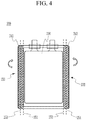
- FIG. 4 illustrates a schematic view of a process in which a PCM is added to the lateral sealing part of the battery cell of FIG. 3 .
- an electrode assembly (not shown) having a structure in which a separator is interposed between an positive electrode and a negative electrode is installed in a receiving part 220 of a battery case 210, and an external side of the receiving part 220 is provided with lateral sealing parts 231 and 232 by heat fusion.
- the lateral sealing parts 231 and 232 are formed to be in close contact with an outer surface of the receiving part 220 while being bent to the receiving part 220 of the battery case 210, and PCMs 241 and 242 that are phase-changed in response to a thermal change are coated on surfaces of the lateral sealing parts 231 and 232.
- the lateral sealing parts 231 and 232 include first bent parts 251 and 252 that are bent vertically upwardly at a position adjacent to the receiving part 220 and second bent parts 253 and 254 that are bent vertically downwardly at a position facing the first bent parts 251 and 252 while one of both surfaces of the battery cell 200 is parallel to the ground, and external end portions of the lateral sealing parts 231 and 232 are positioned between the bent lateral sealing parts 231 and 232 and the receiving part 220 to have a double-bent structure.
- the above-mentioned structure is a structure in which the PCMs 241 and 242 are coated on surfaces of the lateral sealing parts 231 and 232 forming an inner bent surface by the first bent parts 251 and 252 and the second bent parts 253 and 254, and according to the structure, the PCMs 241 and 242 are coated on surfaces of the lateral sealing parts 231 and 232 excluding bent portions of the first bent parts 251 and 252 and the second bent parts 253 and 254 before the first bent parts 251 and 252 and the second bent parts 253 and 254 are formed, and then an external end portion spaced apart from the receiving part 220 of the lateral sealing parts 231 and 232 is bent toward the receiving part 220 to form the second bent parts 253 and 254, and a portion adjacent to the receiving part 220 of the lateral sealing parts 231 and 232 is upwardly bent to form the first bent parts 251 and 252, thereby completing the battery cell 200.
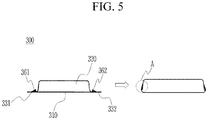
- FIG. 5 illustrates a cross-sectional view of a structure in which a lateral sealing part is bent in a battery cell according to another exemplary embodiment of the present invention
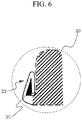
- FIG. 6 illustrates an enlarged view of a portion "A" of the battery cell of FIG. 5 .
- an electrode assembly (not shown) having a structure in which a separator is interposed between a positive electrode and a negative electrode is installed in a receiving part 320 of a battery case 310, and an external side of the receiving part 320 is provided with lateral sealing parts 331 and 332 by heat fusion.
- the lateral sealing parts 331 and 332 are formed to be in close contact with an outer surface of the receiving part 320 while being bent to the receiving part 320 of the battery case 310, and PCM members 361 and 362 are inserted between the receiving part 320 and the lateral sealing parts 331 and 332.
- an external end portion of the lateral sealing parts 331 and 332 are positioned between the bent lateral sealing parts 331 and 332 and the receiving part 320 to have a double-bent structure, a bent surplus space is formed between the lateral sealing parts 331 and 332 and the receiving part 320 by the double-bent structure, and the PCM members 361 and 362 having a size corresponding to the bent surplus space are inserted into the bent surplus space.
- a horizontal length of the bent surplus space formed by the double-bent structure may be substantially 0.3 mm to 1.0 mm depending on a size of the battery cell 300, a vertical length thereof may substantially be 0.5 mm to 1.5 mm, and horizontal and vertical lengths of each of the PCM members 361 and 362 may be substantially 0.3 mm to 1.0 mm and 0.5 mm to 1.5 mm, respectively.
- the PCM members 361 and 362, before the bent surplus space is formed, may be added to the surfaces of the lateral sealing parts 331 and 332 while being fixed by an adhesive or an adhesive tape thereto, and it may be formed in various shapes according to a shape of the bent space such as a triangular shape or the like in a vertical section after being double-bent.
- phase change material that is phase-changed in response to a thermal change to the surfaces of the sealing parts in the battery cell or to the surplus space between the receiving part and the bent sealing parts, since it is possible to effectively suppress a sudden temperature change of the battery cell due to driving of a device and it is possible to control a temperature of the battery cell to an optimum operating temperature range of the battery cell under harsh conditions, cycle-life and safety of the battery cell may be improved.
- phase change material PCM
- PCM phase change material
Landscapes
- Chemical & Material Sciences (AREA)
- Chemical Kinetics & Catalysis (AREA)
- Electrochemistry (AREA)
- General Chemical & Material Sciences (AREA)
- Engineering & Computer Science (AREA)
- Manufacturing & Machinery (AREA)
- Sealing Battery Cases Or Jackets (AREA)
- Secondary Cells (AREA)
Claims (13)
- Plattenförmige Batteriezelle (200), umfassend:eine Elektrodenanordnung, in welcher ein Separator zwischen einer positiven Elektrode und einer negativen Elektrode eingefügt ist, wobei die Elektrodenanordnung an einem Aufnahmeteil (220) montiert sein kann; undDichtungsteile, welche durch Wärmeschmelzen an einer Außenseite des Aufnahmeteils (220) gebildet sind,wobei seitliche Dichtungsteile (231, 232), welche benachbart zu einem der Dichtungsteile sind, an welchem ein Elektrodenanschluss positioniert ist, in engem Kontakt mit einer Außenfläche des Aufnahmeteils (220) stehen, während sie in Richtung des Aufnahmeteils (220) eines Batteriegehäuses (210) gebogen sind, undein Phasenänderungsmaterial (PCM, 241, 242), welches als Reaktion auf eine thermische Änderung phasenverändert wird, zu überschüssigen Oberflächen der seitlichen Dichtungsteile (231, 232) oder zu überschüssigen Zwischenräumen zwischen den Aufnahmeteilen (220) und den gebogenen seitlichen Dichtungsteilen (231, 232) hinzugefügt ist,wobei die seitlichen Dichtungsteile (231, 232) wenigstens einen gebogenen Teil (251, 252, 253, 254) umfassen, in welchem ein Teil des Dichtungsteils (231, 232) derart gebogen ist, dass er in engem Kontakt mit der Außenfläche des Aufnahmeteils (220) steht,dadurch gekennzeichnet, dassjedes der seitlichen Dichtungsteile (231, 232) einen ersten gebogenen Teil (251, 252), welcher an einer zu dem Aufnahmeteil (220) benachbarten Position vertikal nach oben gebogen ist, und einen zweiten gebogenen Teil (253, 254) umfasst, welcher an einer dem ersten gebogenen Teil (251, 252) zugewandten Position vertikal nach unten gebogen ist, während eine der beiden Oberflächen der plattenförmigen Batteriezelle (200) parallel zu dem Boden ist, und ein äußerer Endabschnitt des seitlichen Dichtungsteils (231, 232) zwischen dem gebogenen seitlichen Dichtungsteil und dem Aufnahmeteil (220) positioniert ist, um eine doppelt gebogene Struktur aufzuweisen.
- Batteriezelle (200) nach Anspruch 1, wobei
in einem Bildungsprozess der doppelt gebogenen Struktur, ein Teil des äußeren Endabschnitts, welcher von dem Aufnahmeteil (220) des seitlichen Dichtungsteils (231, 232) beabstandet ist, in Richtung des Aufnahmeteils (220) gebogen wird, um den zweiten gebogenen Teil (253, 254) zu bilden, und dann ein anderer Teil des externen Endabschnitts, welcher benachbart zu dem Aufnahmeteil (220) des seitlichen Dichtungsteils (231, 232) ist, gebogen wird, um den ersten gebogenen Teil (251, 252) zu bilden. - Batteriezelle (200) nach Anspruch 1, wobei
das PCM (241, 242) auf eine Oberfläche des seitlichen Dichtungsteils (231, 232) aufgetragen ist, welche eine innere gebogene Oberfläche durch den ersten gebogenen Teil (251, 252) und den zweiten gebogenen Teil (253, 254) bildet. - Batteriezelle (200) nach Anspruch 3, wobei
das PCM (241, 242) auf die Oberfläche des seitlichen Dichtungsteils (231, 232) aufgetragen wird, bevor der erste gebogene Teil (251, 252) und der zweite gebogene Teil (253, 254) gebildet werden. - Batteriezelle (200) nach Anspruch 3, wobei
das PCM (241, 242) auf die Oberfläche des seitlichen Dichtungsteils (231, 232) in einem Teil der inneren gebogenen Oberfläche ausgenommen Abschnitte aufgetragen ist, in welchen der erste gebogene Teil (251, 252) und der zweite gebogene Teil (253, 254) gebogen sind. - Batteriezelle (200) nach Anspruch 1, wobei
der gebogene überschüssige Zwischenraum an dem seitlichen Dichtungsteil (231, 232) durch die doppelt gebogene Struktur gebildet ist und ein PCM-Element (361, 362) mit einer dem gebogenen überschüssigen Zwischenraum entsprechenden Größe in den gebogenen überschüssigen Zwischenraum eingefügt ist. - Batteriezelle (200) nach Anspruch 6, wobei
das PCM-Element (361, 362) an dem gebogenen überschüssigen Zwischenraum durch einen Klebstoff oder ein Klebeband fixiert ist. - Batteriezelle (200) nach Anspruch 6, wobei
der gebogene überschüssige Zwischenraum oder das PCM-Element (361, 362) eine dreieckige Form an einem vertikalen Querschnitt aufweist. - Batteriezelle (200) nach Anspruch 6, wobei
eine horizontale Länge des gebogenen überschüssigen Zwischenraums oder des PCM-Elements (361, 362) in einem Bereich von 0,3 mm bis 1,0 mm und eine vertikale Länge davon in einem Bereich von 0,5 mm bis 1,5 mm liegt. - Batteriezelle (200) nach Anspruch 1, wobei
das PCM (241, 242) den Aufnahmeteil (220) der Batteriezelle (200), die geladen oder entladen wird, thermisch berührt, um wenigstens einen Teil der Wärme zu absorbieren, welche von der Batteriezelle (200) erzeugt wird, oder um wenigstens einen Teil der in dem PCM (241, 242) akkumulierten Wärme zu der Batteriezelle (200) abzuführen. - Batteriezelle (200) nach Anspruch 1, wobei
das PCM (241, 242) wenigstens eines von einem PCM auf Basis eines organischen Materials, einem PCM auf Basis eines anorganischen Materials und einem PCM auf Paraffinbasis ist. - Batteriepack, umfassend die Batteriezelle (200) nach einem der Ansprüche 1 bis 11.
- Vorrichtung, welche die Batteriezelle (200) nach Anspruch 12 als eine Energiequelle verwendet.
Priority Applications (1)
| Application Number | Priority Date | Filing Date | Title |
|---|---|---|---|
| PL17806864T PL3340368T3 (pl) | 2016-05-31 | 2017-02-06 | Bateryjne ogniwo akumulatorowe zawierające materiał zmiennofazowy |
Applications Claiming Priority (2)
| Application Number | Priority Date | Filing Date | Title |
|---|---|---|---|
| KR1020160067492A KR102132678B1 (ko) | 2016-05-31 | 2016-05-31 | 상전이 물질을 포함하는 전지셀 |
| PCT/KR2017/001275 WO2017209371A1 (ko) | 2016-05-31 | 2017-02-06 | 상전이 물질을 포함하는 전지셀 |
Publications (3)
| Publication Number | Publication Date |
|---|---|
| EP3340368A1 EP3340368A1 (de) | 2018-06-27 |
| EP3340368A4 EP3340368A4 (de) | 2018-06-27 |
| EP3340368B1 true EP3340368B1 (de) | 2018-11-28 |
Family
ID=60478812
Family Applications (1)
| Application Number | Title | Priority Date | Filing Date |
|---|---|---|---|
| EP17806864.9A Active EP3340368B1 (de) | 2016-05-31 | 2017-02-06 | Batterie mit phasenwechselmaterial |
Country Status (7)
| Country | Link |
|---|---|
| US (1) | US10547092B2 (de) |
| EP (1) | EP3340368B1 (de) |
| JP (1) | JP6633740B2 (de) |
| KR (1) | KR102132678B1 (de) |
| CN (1) | CN108028448B (de) |
| PL (1) | PL3340368T3 (de) |
| WO (1) | WO2017209371A1 (de) |
Cited By (1)
| Publication number | Priority date | Publication date | Assignee | Title |
|---|---|---|---|---|
| WO2023187803A1 (en) * | 2022-03-27 | 2023-10-05 | Tvs Motor Company Limited | A retrofittable assembly for a battery pack |
Families Citing this family (7)
| Publication number | Priority date | Publication date | Assignee | Title |
|---|---|---|---|---|
| KR102668473B1 (ko) * | 2018-10-02 | 2024-05-24 | 주식회사 엘지에너지솔루션 | 파우치형 전지셀 및 그 제조방법 |
| DE102019101281A1 (de) * | 2019-01-18 | 2020-07-23 | Vorwerk & Co. Interholding Gmbh | Akkumulator sowie Bodenbearbeitungsgerät mit einem Akkumulator |
| US11183721B2 (en) * | 2019-10-08 | 2021-11-23 | GM Global Technology Operations LLC | Thermal barrier incorporating phase change material for a power module assembly |
| FR3105881B1 (fr) | 2019-12-31 | 2024-08-23 | Altran Prototypes Automobiles | Système de gestion thermique hybride d’une batterie |
| KR102889013B1 (ko) | 2020-01-28 | 2025-11-20 | 주식회사 엘지에너지솔루션 | 난연성 복합 패드, 그 제조 방법, 이러한 복합 패드를 포함하는 이차전지 모듈과 이차전지 팩 |
| CN116075966A (zh) * | 2021-08-31 | 2023-05-05 | 株式会社Lg新能源 | 袋式单元及模制袋式单元的密封部件的方法 |
| ES3047820T3 (en) * | 2021-08-31 | 2025-12-05 | Lg Energy Solution Ltd | Pouch-type secondary battery having excellent insulation and heat dissipation properties |
Family Cites Families (31)
| Publication number | Priority date | Publication date | Assignee | Title |
|---|---|---|---|---|
| JPH08213052A (ja) * | 1994-08-04 | 1996-08-20 | Seiko Instr Inc | 非水電解質二次電池 |
| CN1224249A (zh) * | 1998-01-21 | 1999-07-28 | 三洋电机株式会社 | 薄型密封电池及其制造方法 |
| JP2000251854A (ja) * | 1999-02-25 | 2000-09-14 | Mitsubishi Chemicals Corp | 非水系二次電池 |
| JP4154633B2 (ja) * | 1999-03-12 | 2008-09-24 | ソニー株式会社 | 非水電解質電池 |
| JP2001250515A (ja) * | 2000-03-06 | 2001-09-14 | Mitsubishi Chemicals Corp | 電 池 |
| DE10106810A1 (de) * | 2001-02-14 | 2002-09-05 | Siemens Ag | Netzunabhängige Stromversorgungseinheit |
| JP2002319375A (ja) * | 2001-04-19 | 2002-10-31 | Yuasa Corp | 密閉形電池 |
| US6797427B2 (en) * | 2001-08-09 | 2004-09-28 | Motorola, Inc. | System for enhanced lithium-ion battery performance at low temperatures |
| JP4175055B2 (ja) * | 2002-08-22 | 2008-11-05 | 日産自動車株式会社 | 単電池、組電池および組電池モジュール |
| JP3922208B2 (ja) | 2002-09-27 | 2007-05-30 | ソニー株式会社 | 電池パックおよびその製造方法 |
| TWI300637B (en) * | 2002-09-27 | 2008-09-01 | Sony Corp | Battery pack and method for producing same |
| KR100918408B1 (ko) | 2002-10-22 | 2009-09-24 | 삼성에스디아이 주식회사 | 파우치형 이차전지 |
| KR20040054128A (ko) * | 2002-12-17 | 2004-06-25 | 삼성에스디아이 주식회사 | 파우치형 리튬 이차 전지 |
| KR100687217B1 (ko) | 2004-08-06 | 2007-02-26 | 주식회사 엘지화학 | 상변환 물질을 담지한 캡슐을 내부에 포함하고 있는 전지시스템 |
| KR100946580B1 (ko) | 2005-09-02 | 2010-03-09 | 주식회사 엘지화학 | 온도 제어용 흡열 시트를 포함하고 있는 전지팩 |
| KR100905392B1 (ko) * | 2006-04-03 | 2009-06-30 | 주식회사 엘지화학 | 이중 온도조절 시스템의 전지팩 |
| CN2927335Y (zh) * | 2006-04-26 | 2007-07-25 | 有量科技股份有限公司 | 具有吸热体的电池装置 |
| KR100870354B1 (ko) | 2007-05-18 | 2008-11-25 | 삼성에스디아이 주식회사 | 전지외장재 및 그를 이용한 이차전지 |
| JP5196900B2 (ja) * | 2007-07-30 | 2013-05-15 | 三洋電機株式会社 | ラミネート外装電池 |
| KR100956397B1 (ko) | 2009-11-20 | 2010-05-06 | 주식회사 이아이지 | 실링부가 열가소성 수지 또는 열경화성 수지에 난연 물질 및 내열 물질이 배합된 난연성 및 내열성 수지 조성물로 코팅되어 안전성이 향상된 파우치형 전지 및 그 제조 방법 |
| KR101216422B1 (ko) | 2010-10-15 | 2012-12-28 | 주식회사 엘지화학 | 실링부의 절연성이 향상된 이차전지 |
| US20130344372A1 (en) * | 2011-03-08 | 2013-12-26 | Steve Carkner | Stress relief body to prevent cell seal failure during assembly |
| KR20140057195A (ko) | 2011-04-12 | 2014-05-12 | 제이에스알 가부시끼가이샤 | 축전 디바이스 |
| EP2851991B1 (de) * | 2012-05-17 | 2018-11-21 | Hitachi Automotive Systems, Ltd. | Batteriemodul |
| CN102969533A (zh) * | 2012-07-10 | 2013-03-13 | 东莞新能源科技有限公司 | 一种软包锂离子电池的折边结构及其制作方法 |
| KR101640889B1 (ko) * | 2012-08-20 | 2016-07-19 | 주식회사 엘지화학 | 상변화 물질을 포함하는 리튬이온 이차전지 셀 및 모듈 |
| CN103247835B (zh) * | 2013-04-22 | 2016-05-11 | 奇瑞新能源汽车技术有限公司 | 一种锂电池包 |
| KR20140144843A (ko) * | 2013-06-12 | 2014-12-22 | 주식회사 엘지화학 | 실링부가 경화성 물질로 절연되어 있는 파우치형 전지셀의 제조방법 |
| US9893789B2 (en) * | 2014-04-10 | 2018-02-13 | Lg Electronics Inc. | Method of transmitting a reference signal in a wireless communication system and apparatus therefor |
| KR20160041402A (ko) * | 2014-10-07 | 2016-04-18 | 주식회사 엘지화학 | 파우치형 이차 전지 및 그의 제조방법 |
| KR20160059165A (ko) * | 2014-11-18 | 2016-05-26 | 주식회사 엘지화학 | 절연 및 열용융성 수지 부재를 포함하는 전지팩 |
-
2016
- 2016-05-31 KR KR1020160067492A patent/KR102132678B1/ko active Active
-
2017
- 2017-02-06 WO PCT/KR2017/001275 patent/WO2017209371A1/ko not_active Ceased
- 2017-02-06 JP JP2018510114A patent/JP6633740B2/ja active Active
- 2017-02-06 PL PL17806864T patent/PL3340368T3/pl unknown
- 2017-02-06 CN CN201780003065.3A patent/CN108028448B/zh active Active
- 2017-02-06 US US15/755,379 patent/US10547092B2/en active Active
- 2017-02-06 EP EP17806864.9A patent/EP3340368B1/de active Active
Non-Patent Citations (1)
| Title |
|---|
| None * |
Cited By (1)
| Publication number | Priority date | Publication date | Assignee | Title |
|---|---|---|---|---|
| WO2023187803A1 (en) * | 2022-03-27 | 2023-10-05 | Tvs Motor Company Limited | A retrofittable assembly for a battery pack |
Also Published As
| Publication number | Publication date |
|---|---|
| EP3340368A1 (de) | 2018-06-27 |
| US10547092B2 (en) | 2020-01-28 |
| EP3340368A4 (de) | 2018-06-27 |
| JP6633740B2 (ja) | 2020-01-22 |
| CN108028448A (zh) | 2018-05-11 |
| KR102132678B1 (ko) | 2020-07-10 |
| PL3340368T3 (pl) | 2019-05-31 |
| WO2017209371A1 (ko) | 2017-12-07 |
| US20180254533A1 (en) | 2018-09-06 |
| JP2018525797A (ja) | 2018-09-06 |
| KR20170135490A (ko) | 2017-12-08 |
| CN108028448B (zh) | 2021-03-12 |
Similar Documents
| Publication | Publication Date | Title |
|---|---|---|
| US11309583B2 (en) | Non-aqueous electrolyte solution for lithium secondary battery and lithium secondary battery including the same | |
| EP3340368B1 (de) | Batterie mit phasenwechselmaterial | |
| KR101636378B1 (ko) | 방열 구조를 가지는 단위모듈 제조용 모듈 하우징 및 이를 포함하는 전지모듈 | |
| US10686231B2 (en) | Battery pack having cooling structure with improved stability for use of liquid coolant | |
| CN107949933B (zh) | 包括具有突出延伸部和接片连接器的电极引线的电池单元 | |
| US10170796B2 (en) | Lithium secondary battery of improved rate capability with cathode containing nickel manganese complex oxide for high-voltage applications | |
| US20150086880A1 (en) | Lithium secondary battery having improved lifespan characteristics | |
| US12119450B2 (en) | Non-aqueous electrolyte and lithium secondary battery including the same | |
| US20160149194A1 (en) | Lithium secondary battery having enhanced safety | |
| KR20160108987A (ko) | 상변화 물질을 적용한 배터리 팩 | |
| US12148886B2 (en) | Non-aqueous electrolyte for lithium secondary battery and lithium secondary battery including the same | |
| EP4170773A1 (de) | Lithiumsekundärbatterie | |
| KR102814035B1 (ko) | 이차전지용 전해액 첨가제, 이를 포함하는 비수 전해액 및 리튬 이차전지 | |
| KR20220029518A (ko) | 비수 전해질용 첨가제, 이를 포함하는 비수 전해질 및 리튬 이차전지 | |
| KR20220133684A (ko) | 화합물, 이를 포함하는 비수 전해질 및 이를 포함하는 리튬 이차 전지 | |
| US20250357524A1 (en) | Cylindrical type lithium secondary battery | |
| US12401063B2 (en) | Lithium secondary battery | |
| KR20210120196A (ko) | 이차전지용 전해액 첨가제, 이를 포함하는 리튬 이차전지용 비수 전해액 및 리튬 이차전지 | |
| KR20230059754A (ko) | 비수 전해질용 첨가제, 이를 포함하는 비수 전해질 및 리튬 이차전지 | |
| US20220311052A1 (en) | Non-Aqueous Electrolyte Solution for Lithium Secondary Battery and Lithium Secondary Battery Comprising Same | |
| US20230105288A1 (en) | Non-Aqueous Electrolyte for Lithium Secondary Battery and Lithium Secondary Battery Comprising Same | |
| KR102954249B1 (ko) | 리튬 이차전지용 첨가제, 리튬 이차전지용 전해액 및 이를 포함하는 리튬 이차전지 | |
| KR20160050828A (ko) | 리드-탭 발열을 최소화한 배터리 셀 또는 배터리 팩 | |
| JP7804089B2 (ja) | 二次電池用電解液添加剤、並びにそれを含むリチウム二次電池用非水電解液およびリチウム二次電池 | |
| JP2025510856A (ja) | リチウム二次電池用非水電解液およびそれを含むリチウム二次電池 |
Legal Events
| Date | Code | Title | Description |
|---|---|---|---|
| STAA | Information on the status of an ep patent application or granted ep patent |
Free format text: STATUS: THE INTERNATIONAL PUBLICATION HAS BEEN MADE |
|
| PUAI | Public reference made under article 153(3) epc to a published international application that has entered the european phase |
Free format text: ORIGINAL CODE: 0009012 |
|
| STAA | Information on the status of an ep patent application or granted ep patent |
Free format text: STATUS: REQUEST FOR EXAMINATION WAS MADE |
|
| 17P | Request for examination filed |
Effective date: 20180301 |
|
| A4 | Supplementary search report drawn up and despatched |
Effective date: 20180514 |
|
| AK | Designated contracting states |
Kind code of ref document: A1 Designated state(s): AL AT BE BG CH CY CZ DE DK EE ES FI FR GB GR HR HU IE IS IT LI LT LU LV MC MK MT NL NO PL PT RO RS SE SI SK SM TR |
|
| AX | Request for extension of the european patent |
Extension state: BA ME |
|
| GRAP | Despatch of communication of intention to grant a patent |
Free format text: ORIGINAL CODE: EPIDOSNIGR1 |
|
| STAA | Information on the status of an ep patent application or granted ep patent |
Free format text: STATUS: GRANT OF PATENT IS INTENDED |
|
| DAX | Request for extension of the european patent (deleted) | ||
| INTG | Intention to grant announced |
Effective date: 20180906 |
|
| GRAS | Grant fee paid |
Free format text: ORIGINAL CODE: EPIDOSNIGR3 |
|
| GRAA | (expected) grant |
Free format text: ORIGINAL CODE: 0009210 |
|
| STAA | Information on the status of an ep patent application or granted ep patent |
Free format text: STATUS: THE PATENT HAS BEEN GRANTED |
|
| DAV | Request for validation of the european patent (deleted) | ||
| AK | Designated contracting states |
Kind code of ref document: B1 Designated state(s): AL AT BE BG CH CY CZ DE DK EE ES FI FR GB GR HR HU IE IS IT LI LT LU LV MC MK MT NL NO PL PT RO RS SE SI SK SM TR |
|
| REG | Reference to a national code |
Ref country code: CH Ref legal event code: EP |
|
| REG | Reference to a national code |
Ref country code: AT Ref legal event code: REF Ref document number: 1071313 Country of ref document: AT Kind code of ref document: T Effective date: 20181215 |
|
| REG | Reference to a national code |
Ref country code: DE Ref legal event code: R096 Ref document number: 602017001095 Country of ref document: DE |
|
| REG | Reference to a national code |
Ref country code: IE Ref legal event code: FG4D |
|
| REG | Reference to a national code |
Ref country code: NL Ref legal event code: MP Effective date: 20181128 |
|
| REG | Reference to a national code |
Ref country code: LT Ref legal event code: MG4D |
|
| REG | Reference to a national code |
Ref country code: AT Ref legal event code: MK05 Ref document number: 1071313 Country of ref document: AT Kind code of ref document: T Effective date: 20181128 |
|
| PG25 | Lapsed in a contracting state [announced via postgrant information from national office to epo] |
Ref country code: LV Free format text: LAPSE BECAUSE OF FAILURE TO SUBMIT A TRANSLATION OF THE DESCRIPTION OR TO PAY THE FEE WITHIN THE PRESCRIBED TIME-LIMIT Effective date: 20181128 Ref country code: AT Free format text: LAPSE BECAUSE OF FAILURE TO SUBMIT A TRANSLATION OF THE DESCRIPTION OR TO PAY THE FEE WITHIN THE PRESCRIBED TIME-LIMIT Effective date: 20181128 Ref country code: FI Free format text: LAPSE BECAUSE OF FAILURE TO SUBMIT A TRANSLATION OF THE DESCRIPTION OR TO PAY THE FEE WITHIN THE PRESCRIBED TIME-LIMIT Effective date: 20181128 Ref country code: IS Free format text: LAPSE BECAUSE OF FAILURE TO SUBMIT A TRANSLATION OF THE DESCRIPTION OR TO PAY THE FEE WITHIN THE PRESCRIBED TIME-LIMIT Effective date: 20190328 Ref country code: NO Free format text: LAPSE BECAUSE OF FAILURE TO SUBMIT A TRANSLATION OF THE DESCRIPTION OR TO PAY THE FEE WITHIN THE PRESCRIBED TIME-LIMIT Effective date: 20190228 Ref country code: LT Free format text: LAPSE BECAUSE OF FAILURE TO SUBMIT A TRANSLATION OF THE DESCRIPTION OR TO PAY THE FEE WITHIN THE PRESCRIBED TIME-LIMIT Effective date: 20181128 Ref country code: HR Free format text: LAPSE BECAUSE OF FAILURE TO SUBMIT A TRANSLATION OF THE DESCRIPTION OR TO PAY THE FEE WITHIN THE PRESCRIBED TIME-LIMIT Effective date: 20181128 Ref country code: ES Free format text: LAPSE BECAUSE OF FAILURE TO SUBMIT A TRANSLATION OF THE DESCRIPTION OR TO PAY THE FEE WITHIN THE PRESCRIBED TIME-LIMIT Effective date: 20181128 Ref country code: BG Free format text: LAPSE BECAUSE OF FAILURE TO SUBMIT A TRANSLATION OF THE DESCRIPTION OR TO PAY THE FEE WITHIN THE PRESCRIBED TIME-LIMIT Effective date: 20190228 |
|
| PG25 | Lapsed in a contracting state [announced via postgrant information from national office to epo] |
Ref country code: PT Free format text: LAPSE BECAUSE OF FAILURE TO SUBMIT A TRANSLATION OF THE DESCRIPTION OR TO PAY THE FEE WITHIN THE PRESCRIBED TIME-LIMIT Effective date: 20190328 Ref country code: AL Free format text: LAPSE BECAUSE OF FAILURE TO SUBMIT A TRANSLATION OF THE DESCRIPTION OR TO PAY THE FEE WITHIN THE PRESCRIBED TIME-LIMIT Effective date: 20181128 Ref country code: SE Free format text: LAPSE BECAUSE OF FAILURE TO SUBMIT A TRANSLATION OF THE DESCRIPTION OR TO PAY THE FEE WITHIN THE PRESCRIBED TIME-LIMIT Effective date: 20181128 Ref country code: GR Free format text: LAPSE BECAUSE OF FAILURE TO SUBMIT A TRANSLATION OF THE DESCRIPTION OR TO PAY THE FEE WITHIN THE PRESCRIBED TIME-LIMIT Effective date: 20190301 Ref country code: RS Free format text: LAPSE BECAUSE OF FAILURE TO SUBMIT A TRANSLATION OF THE DESCRIPTION OR TO PAY THE FEE WITHIN THE PRESCRIBED TIME-LIMIT Effective date: 20181128 |
|
| PG25 | Lapsed in a contracting state [announced via postgrant information from national office to epo] |
Ref country code: NL Free format text: LAPSE BECAUSE OF FAILURE TO SUBMIT A TRANSLATION OF THE DESCRIPTION OR TO PAY THE FEE WITHIN THE PRESCRIBED TIME-LIMIT Effective date: 20181128 |
|
| PG25 | Lapsed in a contracting state [announced via postgrant information from national office to epo] |
Ref country code: IT Free format text: LAPSE BECAUSE OF FAILURE TO SUBMIT A TRANSLATION OF THE DESCRIPTION OR TO PAY THE FEE WITHIN THE PRESCRIBED TIME-LIMIT Effective date: 20181128 Ref country code: CZ Free format text: LAPSE BECAUSE OF FAILURE TO SUBMIT A TRANSLATION OF THE DESCRIPTION OR TO PAY THE FEE WITHIN THE PRESCRIBED TIME-LIMIT Effective date: 20181128 Ref country code: DK Free format text: LAPSE BECAUSE OF FAILURE TO SUBMIT A TRANSLATION OF THE DESCRIPTION OR TO PAY THE FEE WITHIN THE PRESCRIBED TIME-LIMIT Effective date: 20181128 |
|
| REG | Reference to a national code |
Ref country code: DE Ref legal event code: R097 Ref document number: 602017001095 Country of ref document: DE |
|
| PG25 | Lapsed in a contracting state [announced via postgrant information from national office to epo] |
Ref country code: EE Free format text: LAPSE BECAUSE OF FAILURE TO SUBMIT A TRANSLATION OF THE DESCRIPTION OR TO PAY THE FEE WITHIN THE PRESCRIBED TIME-LIMIT Effective date: 20181128 Ref country code: SM Free format text: LAPSE BECAUSE OF FAILURE TO SUBMIT A TRANSLATION OF THE DESCRIPTION OR TO PAY THE FEE WITHIN THE PRESCRIBED TIME-LIMIT Effective date: 20181128 Ref country code: RO Free format text: LAPSE BECAUSE OF FAILURE TO SUBMIT A TRANSLATION OF THE DESCRIPTION OR TO PAY THE FEE WITHIN THE PRESCRIBED TIME-LIMIT Effective date: 20181128 Ref country code: SK Free format text: LAPSE BECAUSE OF FAILURE TO SUBMIT A TRANSLATION OF THE DESCRIPTION OR TO PAY THE FEE WITHIN THE PRESCRIBED TIME-LIMIT Effective date: 20181128 |
|
| PLBE | No opposition filed within time limit |
Free format text: ORIGINAL CODE: 0009261 |
|
| STAA | Information on the status of an ep patent application or granted ep patent |
Free format text: STATUS: NO OPPOSITION FILED WITHIN TIME LIMIT |
|
| PG25 | Lapsed in a contracting state [announced via postgrant information from national office to epo] |
Ref country code: LU Free format text: LAPSE BECAUSE OF NON-PAYMENT OF DUE FEES Effective date: 20190206 Ref country code: MC Free format text: LAPSE BECAUSE OF FAILURE TO SUBMIT A TRANSLATION OF THE DESCRIPTION OR TO PAY THE FEE WITHIN THE PRESCRIBED TIME-LIMIT Effective date: 20181128 |
|
| 26N | No opposition filed |
Effective date: 20190829 |
|
| REG | Reference to a national code |
Ref country code: BE Ref legal event code: MM Effective date: 20190228 |
|
| REG | Reference to a national code |
Ref country code: IE Ref legal event code: MM4A |
|
| PG25 | Lapsed in a contracting state [announced via postgrant information from national office to epo] |
Ref country code: IE Free format text: LAPSE BECAUSE OF NON-PAYMENT OF DUE FEES Effective date: 20190206 |
|
| PG25 | Lapsed in a contracting state [announced via postgrant information from national office to epo] |
Ref country code: BE Free format text: LAPSE BECAUSE OF NON-PAYMENT OF DUE FEES Effective date: 20190228 |
|
| PG25 | Lapsed in a contracting state [announced via postgrant information from national office to epo] |
Ref country code: TR Free format text: LAPSE BECAUSE OF FAILURE TO SUBMIT A TRANSLATION OF THE DESCRIPTION OR TO PAY THE FEE WITHIN THE PRESCRIBED TIME-LIMIT Effective date: 20181128 |
|
| PG25 | Lapsed in a contracting state [announced via postgrant information from national office to epo] |
Ref country code: MT Free format text: LAPSE BECAUSE OF NON-PAYMENT OF DUE FEES Effective date: 20190206 |
|
| REG | Reference to a national code |
Ref country code: CH Ref legal event code: PL |
|
| PG25 | Lapsed in a contracting state [announced via postgrant information from national office to epo] |
Ref country code: CH Free format text: LAPSE BECAUSE OF NON-PAYMENT OF DUE FEES Effective date: 20200229 Ref country code: LI Free format text: LAPSE BECAUSE OF NON-PAYMENT OF DUE FEES Effective date: 20200229 |
|
| PG25 | Lapsed in a contracting state [announced via postgrant information from national office to epo] |
Ref country code: CY Free format text: LAPSE BECAUSE OF FAILURE TO SUBMIT A TRANSLATION OF THE DESCRIPTION OR TO PAY THE FEE WITHIN THE PRESCRIBED TIME-LIMIT Effective date: 20181128 |
|
| PG25 | Lapsed in a contracting state [announced via postgrant information from national office to epo] |
Ref country code: HU Free format text: LAPSE BECAUSE OF FAILURE TO SUBMIT A TRANSLATION OF THE DESCRIPTION OR TO PAY THE FEE WITHIN THE PRESCRIBED TIME-LIMIT; INVALID AB INITIO Effective date: 20170206 |
|
| PG25 | Lapsed in a contracting state [announced via postgrant information from national office to epo] |
Ref country code: SI Free format text: LAPSE BECAUSE OF FAILURE TO SUBMIT A TRANSLATION OF THE DESCRIPTION OR TO PAY THE FEE WITHIN THE PRESCRIBED TIME-LIMIT Effective date: 20181128 |
|
| PG25 | Lapsed in a contracting state [announced via postgrant information from national office to epo] |
Ref country code: MK Free format text: LAPSE BECAUSE OF FAILURE TO SUBMIT A TRANSLATION OF THE DESCRIPTION OR TO PAY THE FEE WITHIN THE PRESCRIBED TIME-LIMIT Effective date: 20181128 |
|
| P01 | Opt-out of the competence of the unified patent court (upc) registered |
Effective date: 20230512 |
|
| REG | Reference to a national code |
Ref country code: DE Ref legal event code: R081 Ref document number: 602017001095 Country of ref document: DE Owner name: LG ENERGY SOLUTION, LTD., KR Free format text: FORMER OWNER: LG CHEM. LTD., SEOUL, KR |
|
| REG | Reference to a national code |
Ref country code: GB Ref legal event code: 732E Free format text: REGISTERED BETWEEN 20230824 AND 20230831 |
|
| PGFP | Annual fee paid to national office [announced via postgrant information from national office to epo] |
Ref country code: PL Payment date: 20250122 Year of fee payment: 9 |
|
| PGFP | Annual fee paid to national office [announced via postgrant information from national office to epo] |
Ref country code: GB Payment date: 20260122 Year of fee payment: 10 |
|
| PGFP | Annual fee paid to national office [announced via postgrant information from national office to epo] |
Ref country code: DE Payment date: 20260120 Year of fee payment: 10 |
|
| PGFP | Annual fee paid to national office [announced via postgrant information from national office to epo] |
Ref country code: FR Payment date: 20260121 Year of fee payment: 10 |