EP3339310A1 - Organische halbleiter, verfahren zu ihrer herstellung und ihre verwendung - Google Patents
Organische halbleiter, verfahren zu ihrer herstellung und ihre verwendung Download PDFInfo
- Publication number
- EP3339310A1 EP3339310A1 EP17210473.9A EP17210473A EP3339310A1 EP 3339310 A1 EP3339310 A1 EP 3339310A1 EP 17210473 A EP17210473 A EP 17210473A EP 3339310 A1 EP3339310 A1 EP 3339310A1
- Authority
- EP
- European Patent Office
- Prior art keywords
- organic
- general formula
- type semiconductor
- alkyl group
- type semiconductors
- Prior art date
- Legal status (The legal status is an assumption and is not a legal conclusion. Google has not performed a legal analysis and makes no representation as to the accuracy of the status listed.)
- Withdrawn
Links
- 239000004065 semiconductor Substances 0.000 title claims abstract description 65
- 238000000034 method Methods 0.000 title claims abstract description 24
- 238000002360 preparation method Methods 0.000 title claims abstract description 9
- 238000006243 chemical reaction Methods 0.000 claims description 27
- 239000012530 fluid Substances 0.000 claims description 25
- 230000001590 oxidative effect Effects 0.000 claims description 16
- 125000001424 substituent group Chemical group 0.000 claims description 15
- 238000000576 coating method Methods 0.000 claims description 14
- 238000007639 printing Methods 0.000 claims description 12
- 229930192474 thiophene Natural products 0.000 claims description 12
- 150000003577 thiophenes Chemical class 0.000 claims description 12
- 239000011248 coating agent Substances 0.000 claims description 10
- 239000000126 substance Substances 0.000 claims description 9
- 125000001309 chloro group Chemical group Cl* 0.000 claims description 8
- 239000007788 liquid Substances 0.000 claims description 8
- 239000000758 substrate Substances 0.000 claims description 8
- 229910052801 chlorine Inorganic materials 0.000 claims description 6
- 230000001939 inductive effect Effects 0.000 claims description 6
- VTLYFUHAOXGGBS-UHFFFAOYSA-N Fe3+ Chemical class [Fe+3] VTLYFUHAOXGGBS-UHFFFAOYSA-N 0.000 claims description 5
- 125000001246 bromo group Chemical group Br* 0.000 claims description 4
- 125000005843 halogen group Chemical group 0.000 claims description 4
- 125000005842 heteroatom Chemical group 0.000 claims description 4
- WKBOTKDWSSQWDR-UHFFFAOYSA-N Bromine atom Chemical compound [Br] WKBOTKDWSSQWDR-UHFFFAOYSA-N 0.000 claims description 3
- ZAMOUSCENKQFHK-UHFFFAOYSA-N Chlorine atom Chemical compound [Cl] ZAMOUSCENKQFHK-UHFFFAOYSA-N 0.000 claims description 3
- PXGOKWXKJXAPGV-UHFFFAOYSA-N Fluorine Chemical compound FF PXGOKWXKJXAPGV-UHFFFAOYSA-N 0.000 claims description 3
- 125000000217 alkyl group Chemical group 0.000 claims description 3
- GDTBXPJZTBHREO-UHFFFAOYSA-N bromine Substances BrBr GDTBXPJZTBHREO-UHFFFAOYSA-N 0.000 claims description 3
- 229910052794 bromium Inorganic materials 0.000 claims description 3
- 239000000460 chlorine Substances 0.000 claims description 3
- 239000011737 fluorine Substances 0.000 claims description 3
- 229910052731 fluorine Inorganic materials 0.000 claims description 3
- 125000001188 haloalkyl group Chemical group 0.000 claims description 3
- 125000004434 sulfur atom Chemical group 0.000 claims description 3
- 229910052736 halogen Inorganic materials 0.000 claims description 2
- 150000002367 halogens Chemical class 0.000 claims description 2
- 125000000623 heterocyclic group Chemical group 0.000 claims description 2
- 125000004430 oxygen atom Chemical group O* 0.000 claims description 2
- 125000001153 fluoro group Chemical group F* 0.000 claims 1
- 239000000203 mixture Substances 0.000 description 12
- ZMXDDKWLCZADIW-UHFFFAOYSA-N N,N-Dimethylformamide Chemical compound CN(C)C=O ZMXDDKWLCZADIW-UHFFFAOYSA-N 0.000 description 11
- 150000003254 radicals Chemical class 0.000 description 11
- -1 -O (CO) -phenyl Chemical group 0.000 description 9
- YMWUJEATGCHHMB-UHFFFAOYSA-N Dichloromethane Chemical compound ClCCl YMWUJEATGCHHMB-UHFFFAOYSA-N 0.000 description 9
- YTPLMLYBLZKORZ-UHFFFAOYSA-N Thiophene Chemical group C=1C=CSC=1 YTPLMLYBLZKORZ-UHFFFAOYSA-N 0.000 description 9
- 150000001875 compounds Chemical class 0.000 description 9
- LYCAIKOWRPUZTN-UHFFFAOYSA-N Ethylene glycol Chemical compound OCCO LYCAIKOWRPUZTN-UHFFFAOYSA-N 0.000 description 6
- OKKJLVBELUTLKV-UHFFFAOYSA-N Methanol Chemical compound OC OKKJLVBELUTLKV-UHFFFAOYSA-N 0.000 description 6
- JRNVZBWKYDBUCA-UHFFFAOYSA-N N-chlorosuccinimide Chemical compound ClN1C(=O)CCC1=O JRNVZBWKYDBUCA-UHFFFAOYSA-N 0.000 description 6
- UWHCKJMYHZGTIT-UHFFFAOYSA-N Tetraethylene glycol, Natural products OCCOCCOCCOCCO UWHCKJMYHZGTIT-UHFFFAOYSA-N 0.000 description 6
- 238000004519 manufacturing process Methods 0.000 description 6
- VLKZOEOYAKHREP-UHFFFAOYSA-N n-Hexane Chemical compound CCCCCC VLKZOEOYAKHREP-UHFFFAOYSA-N 0.000 description 6
- 239000002904 solvent Substances 0.000 description 6
- GKWLILHTTGWKLQ-UHFFFAOYSA-N 2,3-dihydrothieno[3,4-b][1,4]dioxine Chemical compound O1CCOC2=CSC=C21 GKWLILHTTGWKLQ-UHFFFAOYSA-N 0.000 description 5
- 239000006185 dispersion Substances 0.000 description 5
- 239000000463 material Substances 0.000 description 5
- 229920001223 polyethylene glycol Polymers 0.000 description 5
- 238000003756 stirring Methods 0.000 description 5
- 238000005259 measurement Methods 0.000 description 4
- 239000007800 oxidant agent Substances 0.000 description 4
- 239000011541 reaction mixture Substances 0.000 description 4
- ZQDUTJPILZYVGH-UHFFFAOYSA-N 5-(2,3-dihydrothieno[3,4-b][1,4]dioxin-5-yl)-7-(2,2,3,3,3-pentafluoropropyl)-2,3-dihydrothieno[3,4-b][1,4]dioxine Chemical compound FC(CC=1SC(=C2C=1OCCO2)C=1SC=C2OCCOC2=1)(C(F)(F)F)F ZQDUTJPILZYVGH-UHFFFAOYSA-N 0.000 description 3
- HYLMQIPXWAIICD-UHFFFAOYSA-N 5-bromo-7-(2,3-dihydrothieno[3,4-b][1,4]dioxin-5-yl)-2,3-dihydrothieno[3,4-b][1,4]dioxine Chemical compound Brc1sc(c2OCCOc12)-c1scc2OCCOc12 HYLMQIPXWAIICD-UHFFFAOYSA-N 0.000 description 3
- RTZKZFJDLAIYFH-UHFFFAOYSA-N Diethyl ether Chemical compound CCOCC RTZKZFJDLAIYFH-UHFFFAOYSA-N 0.000 description 3
- LFQSCWFLJHTTHZ-UHFFFAOYSA-N Ethanol Chemical compound CCO LFQSCWFLJHTTHZ-UHFFFAOYSA-N 0.000 description 3
- KFZMGEQAYNKOFK-UHFFFAOYSA-N Isopropanol Chemical compound CC(C)O KFZMGEQAYNKOFK-UHFFFAOYSA-N 0.000 description 3
- 229920001609 Poly(3,4-ethylenedioxythiophene) Polymers 0.000 description 3
- YXFVVABEGXRONW-UHFFFAOYSA-N Toluene Chemical compound CC1=CC=CC=C1 YXFVVABEGXRONW-UHFFFAOYSA-N 0.000 description 3
- QVGXLLKOCUKJST-UHFFFAOYSA-N atomic oxygen Chemical compound [O] QVGXLLKOCUKJST-UHFFFAOYSA-N 0.000 description 3
- 239000004020 conductor Substances 0.000 description 3
- MTHSVFCYNBDYFN-UHFFFAOYSA-N diethylene glycol Chemical compound OCCOCCO MTHSVFCYNBDYFN-UHFFFAOYSA-N 0.000 description 3
- RBTARNINKXHZNM-UHFFFAOYSA-K iron trichloride Chemical compound Cl[Fe](Cl)Cl RBTARNINKXHZNM-UHFFFAOYSA-K 0.000 description 3
- 239000001301 oxygen Substances 0.000 description 3
- 229910052760 oxygen Inorganic materials 0.000 description 3
- 238000006116 polymerization reaction Methods 0.000 description 3
- 229920000123 polythiophene Polymers 0.000 description 3
- 238000007650 screen-printing Methods 0.000 description 3
- JOXIMZWYDAKGHI-UHFFFAOYSA-N toluene-4-sulfonic acid Chemical compound CC1=CC=C(S(O)(=O)=O)C=C1 JOXIMZWYDAKGHI-UHFFFAOYSA-N 0.000 description 3
- XLYOFNOQVPJJNP-UHFFFAOYSA-N water Substances O XLYOFNOQVPJJNP-UHFFFAOYSA-N 0.000 description 3
- LOZWAPSEEHRYPG-UHFFFAOYSA-N 1,4-dithiane Chemical compound C1CSCCS1 LOZWAPSEEHRYPG-UHFFFAOYSA-N 0.000 description 2
- HPJFXFRNEJHDFR-UHFFFAOYSA-N 22291-04-9 Chemical compound C1=CC(C(N(CCN(C)C)C2=O)=O)=C3C2=CC=C2C(=O)N(CCN(C)C)C(=O)C1=C32 HPJFXFRNEJHDFR-UHFFFAOYSA-N 0.000 description 2
- XECCJSBEUDPALF-UHFFFAOYSA-N 5-(2,3-dihydrothieno[3,4-b][1,4]dioxin-5-yl)-2,3-dihydrothieno[3,4-b][1,4]dioxine Chemical compound S1C=C2OCCOC2=C1C1=C2OCCOC2=CS1 XECCJSBEUDPALF-UHFFFAOYSA-N 0.000 description 2
- RHPFZITXVSMITG-UHFFFAOYSA-N 5-chloro-7-(2,3-dihydrothieno[3,4-b][1,4]dioxin-5-yl)-2,3-dihydrothieno[3,4-b][1,4]dioxine Chemical compound ClC=1SC(=C2C=1OCCO2)C=1SC=C2OCCOC2=1 RHPFZITXVSMITG-UHFFFAOYSA-N 0.000 description 2
- OKTJSMMVPCPJKN-UHFFFAOYSA-N Carbon Chemical group [C] OKTJSMMVPCPJKN-UHFFFAOYSA-N 0.000 description 2
- HEDRZPFGACZZDS-UHFFFAOYSA-N Chloroform Chemical compound ClC(Cl)Cl HEDRZPFGACZZDS-UHFFFAOYSA-N 0.000 description 2
- IAZDPXIOMUYVGZ-UHFFFAOYSA-N Dimethylsulphoxide Chemical compound CS(C)=O IAZDPXIOMUYVGZ-UHFFFAOYSA-N 0.000 description 2
- 229910021578 Iron(III) chloride Inorganic materials 0.000 description 2
- LRHPLDYGYMQRHN-UHFFFAOYSA-N N-Butanol Chemical compound CCCCO LRHPLDYGYMQRHN-UHFFFAOYSA-N 0.000 description 2
- IMNFDUFMRHMDMM-UHFFFAOYSA-N N-Heptane Chemical compound CCCCCCC IMNFDUFMRHMDMM-UHFFFAOYSA-N 0.000 description 2
- PCLIMKBDDGJMGD-UHFFFAOYSA-N N-bromosuccinimide Chemical compound BrN1C(=O)CCC1=O PCLIMKBDDGJMGD-UHFFFAOYSA-N 0.000 description 2
- 239000004952 Polyamide Substances 0.000 description 2
- 239000004698 Polyethylene Substances 0.000 description 2
- 239000004743 Polypropylene Substances 0.000 description 2
- PMZURENOXWZQFD-UHFFFAOYSA-L Sodium Sulfate Chemical compound [Na+].[Na+].[O-]S([O-])(=O)=O PMZURENOXWZQFD-UHFFFAOYSA-L 0.000 description 2
- 238000006887 Ullmann reaction Methods 0.000 description 2
- RDOXTESZEPMUJZ-UHFFFAOYSA-N anisole Chemical compound COC1=CC=CC=C1 RDOXTESZEPMUJZ-UHFFFAOYSA-N 0.000 description 2
- 230000015572 biosynthetic process Effects 0.000 description 2
- 229910052799 carbon Inorganic materials 0.000 description 2
- MVPPADPHJFYWMZ-UHFFFAOYSA-N chlorobenzene Chemical compound ClC1=CC=CC=C1 MVPPADPHJFYWMZ-UHFFFAOYSA-N 0.000 description 2
- 238000004587 chromatography analysis Methods 0.000 description 2
- 238000001035 drying Methods 0.000 description 2
- 230000000694 effects Effects 0.000 description 2
- 238000000605 extraction Methods 0.000 description 2
- 239000011521 glass Substances 0.000 description 2
- 150000002334 glycols Chemical class 0.000 description 2
- 239000005457 ice water Substances 0.000 description 2
- 125000003010 ionic group Chemical group 0.000 description 2
- FYMCOOOLDFPFPN-UHFFFAOYSA-K iron(3+);4-methylbenzenesulfonate Chemical compound [Fe+3].CC1=CC=C(S([O-])(=O)=O)C=C1.CC1=CC=C(S([O-])(=O)=O)C=C1.CC1=CC=C(S([O-])(=O)=O)C=C1 FYMCOOOLDFPFPN-UHFFFAOYSA-K 0.000 description 2
- 239000002184 metal Substances 0.000 description 2
- 229910052751 metal Inorganic materials 0.000 description 2
- 239000011368 organic material Substances 0.000 description 2
- 239000012074 organic phase Substances 0.000 description 2
- KJOLVZJFMDVPGB-UHFFFAOYSA-N perylenediimide Chemical compound C=12C3=CC=C(C(NC4=O)=O)C2=C4C=CC=1C1=CC=C2C(=O)NC(=O)C4=CC=C3C1=C42 KJOLVZJFMDVPGB-UHFFFAOYSA-N 0.000 description 2
- 229920002647 polyamide Polymers 0.000 description 2
- 229920000515 polycarbonate Polymers 0.000 description 2
- 239000004417 polycarbonate Substances 0.000 description 2
- 229920000728 polyester Polymers 0.000 description 2
- 229920000573 polyethylene Polymers 0.000 description 2
- 229920001155 polypropylene Polymers 0.000 description 2
- 229920000915 polyvinyl chloride Polymers 0.000 description 2
- 239000004800 polyvinyl chloride Substances 0.000 description 2
- 150000003839 salts Chemical class 0.000 description 2
- 238000000926 separation method Methods 0.000 description 2
- 229910052938 sodium sulfate Inorganic materials 0.000 description 2
- 235000011152 sodium sulphate Nutrition 0.000 description 2
- 239000007787 solid Substances 0.000 description 2
- 238000003786 synthesis reaction Methods 0.000 description 2
- PFZLGKHSYILJTH-UHFFFAOYSA-N thieno[2,3-c]thiophene Chemical compound S1C=C2SC=CC2=C1 PFZLGKHSYILJTH-UHFFFAOYSA-N 0.000 description 2
- ZIBGPFATKBEMQZ-UHFFFAOYSA-N triethylene glycol Chemical compound OCCOCCOCCO ZIBGPFATKBEMQZ-UHFFFAOYSA-N 0.000 description 2
- JLGLQAWTXXGVEM-UHFFFAOYSA-N triethylene glycol monomethyl ether Chemical compound COCCOCCOCCO JLGLQAWTXXGVEM-UHFFFAOYSA-N 0.000 description 2
- 238000005406 washing Methods 0.000 description 2
- 125000006702 (C1-C18) alkyl group Chemical group 0.000 description 1
- HENALDZJQYAUBN-UHFFFAOYSA-N 1,1,1,2,2-pentafluoro-3-iodopropane Chemical compound FC(F)(F)C(F)(F)CI HENALDZJQYAUBN-UHFFFAOYSA-N 0.000 description 1
- RYHBNJHYFVUHQT-UHFFFAOYSA-N 1,4-Dioxane Chemical compound C1COCCO1 RYHBNJHYFVUHQT-UHFFFAOYSA-N 0.000 description 1
- JBYHSSAVUBIJMK-UHFFFAOYSA-N 1,4-oxathiane Chemical compound C1CSCCO1 JBYHSSAVUBIJMK-UHFFFAOYSA-N 0.000 description 1
- 238000005160 1H NMR spectroscopy Methods 0.000 description 1
- HODQZCIFYBMTHU-UHFFFAOYSA-N 2,3-dihydrothieno[3,4-b][1,4]dioxine Chemical compound O1CCOC2=CSC=C21.O1CCOC2=CSC=C21 HODQZCIFYBMTHU-UHFFFAOYSA-N 0.000 description 1
- HPGNGICCHXRMIP-UHFFFAOYSA-N 2,3-dihydrothieno[3,4-b][1,4]dithiine Chemical compound S1CCSC2=CSC=C21 HPGNGICCHXRMIP-UHFFFAOYSA-N 0.000 description 1
- BDTLSZOHEAQJGH-UHFFFAOYSA-N 2,3-dihydrothieno[3,4-b][1,4]oxathiine Chemical compound O1CCSC2=CSC=C21 BDTLSZOHEAQJGH-UHFFFAOYSA-N 0.000 description 1
- 240000003517 Elaeocarpus dentatus Species 0.000 description 1
- CTQNGGLPUBDAKN-UHFFFAOYSA-N O-Xylene Chemical compound CC1=CC=CC=C1C CTQNGGLPUBDAKN-UHFFFAOYSA-N 0.000 description 1
- 230000005678 Seebeck effect Effects 0.000 description 1
- BQCADISMDOOEFD-UHFFFAOYSA-N Silver Chemical compound [Ag] BQCADISMDOOEFD-UHFFFAOYSA-N 0.000 description 1
- 150000001298 alcohols Chemical class 0.000 description 1
- 125000000129 anionic group Chemical group 0.000 description 1
- 239000012300 argon atmosphere Substances 0.000 description 1
- 125000003118 aryl group Chemical group 0.000 description 1
- 239000012298 atmosphere Substances 0.000 description 1
- 239000006227 byproduct Substances 0.000 description 1
- 150000001721 carbon Chemical group 0.000 description 1
- 238000005119 centrifugation Methods 0.000 description 1
- 239000000919 ceramic Substances 0.000 description 1
- 239000007795 chemical reaction product Substances 0.000 description 1
- 150000008280 chlorinated hydrocarbons Chemical class 0.000 description 1
- 238000005660 chlorination reaction Methods 0.000 description 1
- 229920001940 conductive polymer Polymers 0.000 description 1
- 238000005260 corrosion Methods 0.000 description 1
- 230000007797 corrosion Effects 0.000 description 1
- 230000008025 crystallization Effects 0.000 description 1
- 125000004122 cyclic group Chemical group 0.000 description 1
- 230000007423 decrease Effects 0.000 description 1
- 239000000539 dimer Substances 0.000 description 1
- 150000002170 ethers Chemical class 0.000 description 1
- 238000001640 fractional crystallisation Methods 0.000 description 1
- 238000004508 fractional distillation Methods 0.000 description 1
- 238000005194 fractionation Methods 0.000 description 1
- 239000007789 gas Substances 0.000 description 1
- 238000007646 gravure printing Methods 0.000 description 1
- 229930195733 hydrocarbon Natural products 0.000 description 1
- 150000002430 hydrocarbons Chemical class 0.000 description 1
- 239000012442 inert solvent Substances 0.000 description 1
- 238000007641 inkjet printing Methods 0.000 description 1
- XEEYBQQBJWHFJM-UHFFFAOYSA-N iron Substances [Fe] XEEYBQQBJWHFJM-UHFFFAOYSA-N 0.000 description 1
- DLEDOFVPSDKWEF-UHFFFAOYSA-N lithium butane Chemical compound [Li+].CCC[CH2-] DLEDOFVPSDKWEF-UHFFFAOYSA-N 0.000 description 1
- 230000004807 localization Effects 0.000 description 1
- UZKWTJUDCOPSNM-UHFFFAOYSA-N methoxybenzene Substances CCCCOC=C UZKWTJUDCOPSNM-UHFFFAOYSA-N 0.000 description 1
- MZRVEZGGRBJDDB-UHFFFAOYSA-N n-Butyllithium Substances [Li]CCCC MZRVEZGGRBJDDB-UHFFFAOYSA-N 0.000 description 1
- 230000003472 neutralizing effect Effects 0.000 description 1
- 239000012299 nitrogen atmosphere Substances 0.000 description 1
- 238000000655 nuclear magnetic resonance spectrum Methods 0.000 description 1
- 238000007645 offset printing Methods 0.000 description 1
- 150000007524 organic acids Chemical class 0.000 description 1
- 235000005985 organic acids Nutrition 0.000 description 1
- 230000003647 oxidation Effects 0.000 description 1
- 238000007254 oxidation reaction Methods 0.000 description 1
- 239000004033 plastic Substances 0.000 description 1
- 229920003023 plastic Polymers 0.000 description 1
- 239000002985 plastic film Substances 0.000 description 1
- 229920006255 plastic film Polymers 0.000 description 1
- 239000000843 powder Substances 0.000 description 1
- 238000010248 power generation Methods 0.000 description 1
- 239000002244 precipitate Substances 0.000 description 1
- 239000002243 precursor Substances 0.000 description 1
- 230000001681 protective effect Effects 0.000 description 1
- 239000000376 reactant Substances 0.000 description 1
- 230000027756 respiratory electron transport chain Effects 0.000 description 1
- 229910052709 silver Inorganic materials 0.000 description 1
- 239000004332 silver Substances 0.000 description 1
- 239000011877 solvent mixture Substances 0.000 description 1
- 238000001228 spectrum Methods 0.000 description 1
- 239000007858 starting material Substances 0.000 description 1
- 238000006467 substitution reaction Methods 0.000 description 1
- 150000003462 sulfoxides Chemical class 0.000 description 1
- 229910052717 sulfur Inorganic materials 0.000 description 1
- 239000008096 xylene Substances 0.000 description 1
Classifications
-
- C—CHEMISTRY; METALLURGY
- C07—ORGANIC CHEMISTRY
- C07D—HETEROCYCLIC COMPOUNDS
- C07D495/00—Heterocyclic compounds containing in the condensed system at least one hetero ring having sulfur atoms as the only ring hetero atoms
- C07D495/02—Heterocyclic compounds containing in the condensed system at least one hetero ring having sulfur atoms as the only ring hetero atoms in which the condensed system contains two hetero rings
- C07D495/04—Ortho-condensed systems
-
- H—ELECTRICITY
- H10—SEMICONDUCTOR DEVICES; ELECTRIC SOLID-STATE DEVICES NOT OTHERWISE PROVIDED FOR
- H10N—ELECTRIC SOLID-STATE DEVICES NOT OTHERWISE PROVIDED FOR
- H10N10/00—Thermoelectric devices comprising a junction of dissimilar materials, i.e. devices exhibiting Seebeck or Peltier effects
- H10N10/80—Constructional details
- H10N10/85—Thermoelectric active materials
- H10N10/856—Thermoelectric active materials comprising organic compositions
Definitions
- the invention relates to organic n-type semiconductors, to a method for producing the semiconductors and to the use of the organic n-type semiconductors.
- Organic semiconductors are of great global interest for use in, for example, organic transistors.
- Conductive organic materials have great commercial potential due to their almost unlimited resources. Properties such as low weight, high elasticity, corrosion resistance and a very variable chemical modifiability make them particularly interesting for use in thermoelectrics.
- thermoelectric generator is for example from the DE 102012105086 B4 known. Using thermocouples made from organic n-type and p-type semiconductors, this converts a temperature difference directly into an electrical voltage by utilizing the Seebeck effect.
- the characteristic thermal voltage for the respective conductor is called the Seebeck coefficient, which is negative for n-type conductors and positive for p-type conductors.
- Organic polymeric p-type semiconductors based on p-doped polythiophenes for example polyalkylenedioxythiophenes or polyalkylenedithiathiophenes or polythienothiophenes, and derivatives thereof and processes for their preparation by chemical oxidation of the corresponding thiophenes are known from the relevant specialist literature. Exemplary is Elschner, Andreas et al .; PEDOT: Principles and Applications of an Intrinsically Conductive Polymer, ISBN 9781420069112 and L. Groenendaal, F. Jonas, D. Freitag, H. Pielartzik, JR Reynolds in Advanced Materials 2000, 12, pages 481-494 and the references cited therein.
- n-doped naphthalene diimide NDI
- PDI perylenediimide
- the structures and substituents of these two-dimensionally fused ring systems are very complex, requiring many separate synthetic steps to make them.
- the resulting high production costs are for economical use of the compounds of great disadvantage.
- Another disadvantage is the high instability of the n-type semiconductor doped with electron donors via electron transfer. These react very easily with atmospheric oxygen neutralizing the negative charges. A 100% stability of the compounds is therefore given only under a protective gas atmosphere and the applicability is limited accordingly.
- the object of the present invention is to provide stable organic n-type semiconductors and a cost-effective method with which they can be produced in a simple manner.
- the general formula (I) can be read such that n thiophene units are each flanked by terminal G-substituted thiophene units.
- the substituents G in ⁇ -position to the sulfur atom of the terminal thiophene units have an electron-withdrawing effect compared to the thiophene units and exert a negative inductive (-I) effect.
- Substituents having a negative inductive effect are known to the person skilled in the art.
- Examples of preferred G are -O-alkyl group, -OH, -NH-alkyl group, -N- (alkyl group) 2 , -NH 2 , -NH (CO) -alkyl group, -O (CO) -alkyl group, -O (CO ) aryl, -O (CO) -phenyl, halogen atoms, haloalkyl group, particularly preferred G are fluorine, chlorine, bromine or-CH 2 -CF 2 -CF. 3 Preference is given to C 1 -C 18 -alkyl groups or C 1 -C 18 -haloalkyl groups.
- the substituents G may be the same or different. Preferably they are the same.
- A is preferably 1,4-dioxane, 1,4-oxathiane, 1,4-dithiane or dehydrothiophene.
- Preferred thiophene units are 3,4-ethylenedioxythiophene (2,3-dihydrothieno [3,4-b] -1,4-dioxin), 3,4-ethyleneoxythiathiophene (2,3-dihydrothieno [3,4-b] - 1,4-oxathiin), 3,4-ethylenedithiathiophene (2,3-dihydrothieno [3,4-b] -1,4-dithiine) and thieno [3,4-b] thiophene.
- Unsymmetrical thiophene units such as 3,4-ethyleneoxathiathiophenes and thieno [3,4-b] thiophenes can be linked head-to-head, head-to-tail, tail-to-tail, tail-to-tail. Further preferred are symmetrical thiophene units such as 3,4-ethylenedioxythiophene or 3,4-ethylenedithiathiophene, as these have easier synthetic accessibility.
- A may optionally be substituted by one or more radicals, which may be the same or different.
- the radical or radicals may be bonded to any carbon ring atoms of A. Binding of up to two residues on the same carbon ring atom is possible.
- Preferred radicals are hydroxyl radicals, straight-chain or branched optionally substituted C 1 -C 20 -alkyl radicals, optionally substituted C 3 -C 12 -cycloalkyl radicals, optionally substituted C 6 -C 14 -aryl radicals, optionally substituted C 7 -C 18 -aralkyl radicals, optionally substituted C 1 -C 6 -hydroxyalkyl radicals and optionally substituted C 2 -C 20 -alkoxyalkyl radicals.
- Preferred alkoxyalkyl radicals are those having one carbon atom in the alkyl, in particular the -CH 2 -O- (CH 2 ) 13 -CH 3 or the -CH 2 -O- (CH 2 ) 15 -CH 3 radical.
- radicals of A or substituents on the radicals of A are one or more ionic groups.
- a preferred ionic group is anionic SO 3 - group.
- Preferred organic n-type semiconductors of the general formula (I) are those of the general formula (I-1), wherein G and n have the meaning given in the formula (I).
- Particularly preferred organic n-type semiconductors of the general formula (I) are those of the general formula (I-1) in which G is halogen, in particular fluorine, chlorine or bromine, or -CH 2 -CF 2 -CF 3 .
- Another object of the present invention is a process for the preparation of organic n-type semiconductors of the general formula (I).
- the organic n-type semiconductors of the general formula (I), wherein A, G and n have the abovementioned meaning, can be obtained when thiophenes of the general formula (II) wherein A and G have the meaning given in the formula (I), and m is 0, 1 or 2, preferably 0 or 1, be reacted chemically oxidatively.
- Suitable solvents are, for example, alcohols such as methanol, ethanol, 2-propanol, butanol, hydrocarbons such as hexane, heptane, toluene, xylene, chlorinated hydrocarbons such as methylene chloride, chloroform, chlorobenzene, ethers such as diethyl ether, anisole, sulfoxides such as dimethyl sulfoxide, glycols such as ethylene glycol, diethylene glycol, Triethylene glycol, tetraethylene glycol, triethylene glycol monomethyl ether. Glycols are preferred, triethylene glycol, tetraethylene glycol and triethylene glycol monomethyl ether are particularly preferred. It can also solvent mixtures and mixtures of Water with water-miscible solvents be advantageous.
- Thiophenes of the general formula (II-1) are preferred, wherein G is a chlorine atom and m is 0 or 1, chemically oxidative to organic n-type semiconductors of formula (I-1), wherein G has the meaning given in (II-1) and n is an integer between 2 and 4 stands, implemented.
- the procedure for the implementation of the thiophenes is carried out according to the known methods for the chemical oxidative polymerization of thiophenes.
- the compounds of the general formula (II) may optionally be present in a mixture with compounds of the general formula (III) preferably with compounds of the general formula (III-1), wherein A and G have the meaning described in the general formula (I) are reacted.
- n 0.
- Suitable oxidizing agents are all those customary for the chemical oxidative polymerization of thiophenes, known in the art, and, for example, in the technical literature described above oxidizing into consideration.
- Suitable oxidizing agents include inorganic metal salts and metal salts of organic acids of Fe 3+ , Ce 4+ , Cu 2+ , Au 3+ or Mn 4+ .
- Preferred oxidizing agents are iron (III) compounds such as ferric chloride and ferric tosylate. Particularly preferred is iron (III) tosylate.
- the reaction temperature may vary in a wide temperature range given the variety of reactants available.
- the optimal reaction temperature for the respective reaction partners is experimentally easy to determine.
- the reaction can be carried out, for example, at room temperature. However, it may also be useful to carry out the reaction at lower or higher temperatures, for example at temperatures from -30 ° C to 150 ° C, in particular from 10 ° C to 130 ° C.
- the substituent G is a halogen atom or contains halogen atoms
- the reaction is preferably at temperatures up to a maximum of 100 ° C, 90 ° C or 80 ° C, more preferably up to 70 C °, particularly preferably up to 65 C °, most preferably carried out at room temperature.
- the duration of the reaction may vary and depends in particular on the thiophenes used, the selected temperature and the oxidizing agents used. Preference is given to a reaction in the second or minute range to within a few hours. More preferably, the reaction is substantially complete within 10 minutes to 3 hours, more preferably within 1.5 hours. The course of the reaction can be analyzed by measures known to the person skilled in the art.
- n-type semiconductors By choosing suitable reaction conditions, it is possible to obtain n-type semiconductors by means of chemical oxidative reaction, which have a higher number of thiophene units.
- Another object of the invention are therefore also n-type semiconductor of the general formula (I), wherein n is an integer with the proviso 8 ⁇ n ⁇ 40, preferably 8 ⁇ n ⁇ 32.
- the organic n-type semiconductors obtained by the reaction can be washed to remove residues and by-products. Preferably, with the solvents of the reaction miscible, optionally aqueous, washing solutions.
- n-type semiconductors are therefore produced by the method described above.
- n-type semiconductor For the n-type semiconductor according to the invention, there is a wide range of applications in the field of electrical devices, especially when electrically insulating substrates are to be provided with electrically conductive coatings.
- a further subject is therefore the use of the inventive organic n-type semiconductor for the coating of electrically insulating substrates. It is advantageous that already known methods for applying coatings made of p-type semiconductors based on polythiophenes prepared by means of oxidative polymerization can be used for coating with the organic n-type semiconductors according to the invention.
- Suitable insulating substrates which do not or only poorly conduct, are both organic materials such as polyethylenes, polypropylenes, polyvinyl chloride, polyesters, polycarbonates and polyamides, as well as inorganic such as glass or ceramic in question.
- the organic n-type semiconductors according to the invention are particularly suitable for coating flexible substrates which are to be equipped in an electrically conductive manner.
- Especially flexible electrically insulating substrates made of organic plastics, in particular films of polyethylenes, polypropylenes, polyvinyl chloride, polyesters, polycarbonates and polyamides can be equipped with the organic n-type semiconductors. Preference is therefore given to the use of the n-type semiconductor according to the invention for coating flexible electrically insulating substrates.
- Dispersions of the n-type organic semiconductors can be obtained when prepared and / or converted into suitable solvents. It is possible to process the dispersions in liquid form. The processability in liquid form opens up a variety of applications. This includes the application of the dispersions as very fine droplets to a substrate by printing techniques. However, the use of these printing fluids should not be understood as limited to particular printing processes. Examples include screen printing, gravure printing, flexographic printing, offset printing, inkjet printing or Aerosoljet horrcci mentioned as a potential application. Another object of the invention is therefore the use of the n-type semiconductor according to the invention in liquid processable pressurized fluids.
- Liquid processable pressure fluids with a viscosity in the range from 10 7 mPas to 10 1 mPas are particularly suitable for common printing processes.
- the use of the n-type semiconductors according to the invention in liquid-processable printing fluids having a viscosity in the range from 10 6 mPas to 10 2 mPas is preferred.
- Liquid processable, shear thinning printing fluids are suitable for common screen printing processes.
- a further subject of the invention is therefore the use of the n-type semiconductors according to the invention in liquid-processable, shear-thinning printing fluids.
- Liquid processable, shear thinning pressure fluids with a viscosity in the range of 10 7 mPas at shear rates of 10 -3 1 / s and 10 1 mPas at shear rates of 10 3 1 / s are ideal for screen printing.
- a further subject of the invention is therefore the use of the n-type semiconductors according to the invention in liquid-processable, shear-thinning printing fluids having a viscosity in the range of 10 7 mPas at shear rates of 10 -3 1 / s and 10 1 mPas at shear rates of 10 3 1 / s. s.
- n-type semiconductors according to the invention in liquid-processable, shear-thinning printing fluids having a viscosity in the range of 10 6 mPas at shear rates of 10 -3 1 / s and 10 2 mPas at shear rates of 10 3 1 / s.
- thermoelectric devices such as thermoelectric generators in which n-type and p-type conductive layers Semiconductors are used for power generation.
- thermoelectric generators in which n-type and p-type conductive layers Semiconductors are used for power generation.
- thermoelectric generators in which n-type and p-type conductive layers Semiconductors are used for power generation.
- thermoelectric generators in which electrically insulating organic plastic films containing organic semiconductors containing coatings are electrically conductive
- Another object of the invention is therefore the use of the n-type semiconductor according to the invention in thermoelectric generators, in particular in organic thermoelectric generators.
- the n-type semiconductor can be represented by three very simple reaction steps.
- EDOT which is commercially used for the PEDOT (poly (3,4-ethylenedioxythiophene)) synthesis, is a very cost effective on a ton scale available starting material available.
- a first possible Ullmann coupling works with very good yields of up to 75%.
- the subsequent chlorination can be carried out simply with N-chlorosuccinimide (NCS).
- the subsequent, inventive chemical oxidative reaction of the dimer (BiEDOT) can be carried out by means of a cheap iron (III) salt, for example iron (III) chloride or iron (III) tosylate.
- solution B was added at room temperature with stirring to immediately obtain a deep violet colored fluid. The fluid was stirred for an additional 120 minutes.
- the solution D was added at 50 ° C with stirring, whereby immediately a dark violet-colored, highly viscous fluid was obtained. The fluid was stirred for an additional 60 minutes.
- the viscosity was determined using an Anton Paar Physica MCR 101 plate-cone rheometer. As a cone, a cone with the model number PP25 was used, which is suitable by its smaller geometry for highly viscous fluids. The temperature during the measurements was 25 ° C.
- the viscosity of a fluid prepared according to steps a) and b) was in the range of 10 6 mPas at shear rates of 10 -3 1 / s and 10 2 mPas at shear rates of 10 2 1 / s. in this connection decreases the initial viscosity with increasing shear rates. This behavior corresponds to a shear thinning fluid.
- the washed fluid was applied by means of a doctor blade template on glass slides and dried at about 220 ° C with hot air.
- Silver electrodes were applied and the conductivity and Seebeck coefficient of the dry coating were determined simultaneously using a multimeter.
- the layer thickness of the coating was determined using a DektakXT profilometer.
- the Seebeck coefficient was -7.2 ⁇ V / K with a conductivity of the coating of 11 S / cm.
- Bis-EDOT (1 g, 3.54 mmol, 1 eq.) was dissolved under argon atmosphere in 35 mL absolute THF and cooled to -78 ° C with stirring. To this solution was slowly added dropwise n-BuLi (3.89 mmol, 1.1 eq, 1.56 mL of a 2.5 M solution in hexane) and stirred at -78 ° C for 2 h. Subsequently, 1,1,1,2,2-pentafluoro-3-iodopropane (6 mmol, 1.56 g) was slowly added dropwise and stirred at -78 ° C for a further 50 minutes.
Landscapes
- Chemical & Material Sciences (AREA)
- Organic Chemistry (AREA)
- Heterocyclic Carbon Compounds Containing A Hetero Ring Having Oxygen Or Sulfur (AREA)
Abstract
Description
- Die Erfindung betrifft organische n-typ Halbleiter, ein Verfahren zur Herstellung der Halbleiter sowie die Verwendung der organischen n-typ Halbleiter.
- Organische Halbleiter sind von großem weltweitem Interesse zur Anwendung zum Beispiel in organischen Transistoren. Leitfähige organische Materialien besitzen aufgrund ihrer nahezu unbegrenzten Ressourcen ein großes kommerzielles Potential. Eigenschaften wie ein geringes Gewicht, hohe Elastizität, Korrosionsbeständigkeit und eine sehr variable chemische Modifizierbarkeit machen sie insbesondere für den Einsatz in der Thermoelektrik interessant.
- Ein thermoelektrischer Generator (TEG) ist beispielsweise aus der
DE 102012105086 B4 bekannt. Dieser wandelt mit Hilfe von Thermopaaren aus organischen n-typ- und p-typ-Halbleitern eine Temperaturdifferenz unter Ausnutzung des Seebeck-Effekts direkt in eine elektrische Spannung um. Die für den jeweiligen Leiter charakteristische Thermospannung wird als Seebeck-Koeffizient bezeichnet, welcher für n-typ Leiter negativ und für p-typ Leiter positiv ist. - Organische polymere p-typ Halbleiter auf der Basis von p-dotierten Polythiophenen, wie beispielsweise Polyalkylendioxythiophenen oder Polyalkylendithiathiophenen oder Polythienothiophenen sowie deren Derivate und Verfahren zu deren Herstellung durch chemische Oxidation der entsprechenden Thiophene sind aus der einschlägigen Fachliteratur bekannt. Exemplarisch wird auf Elschner, Andreas et al.; PEDOT: Principles and Applications of an Intrinsically Conductive Polymer, ISBN 9781420069112 und L. Groenendaal, F. Jonas, D. Freitag, H. Pielartzik, J. R. Reynolds in Advanced Materials 2000, 12, Seiten 481-494 sowie der darin aufgeführten Referenzliteratur verwiesen.
- Bisherige organische n-typ Halbleiter basieren meist auf n-dotiertem Naphthalendiimid (NDI) oder Perylendiimid (PDI). Die Strukturen und Substituenten dieser zweidimensional kondensierten Ringsysteme sind jedoch sehr komplex, was viele einzelne Syntheseschritte zu ihrer Herstellung erforderlich macht. Die hieraus resultierenden hohen Herstellungskosten sind dabei für einen wirtschaftlichen Einsatz der Verbindungen von großem Nachteil. Ein weiterer Nachteil ist die hohe Instabilität der mit Elektronendonoren über Elektronenübertragung n-dotierten n-typ Halbleiter. Diese reagieren sehr leicht mit Luftsauerstoff unter Neutralisation der negativen Ladungen. Eine 100%-ige Stabilität der Verbindungen ist daher nur unter Schutzgasatmosphäre gegeben und die Anwendbarkeit entsprechend beschränkt.
- Vor diesem Hintergrund liegt der vorliegenden Erfindung die Aufgabe zugrunde, stabile organische n-typ Halbleiter sowie ein kostengünstiges Verfahren, mit dem diese auf einfache Weise hergestellt werden können, bereitzustellen.
- Dies gelingt zum einen mit organischen Halbleitern gemäß den Merkmalen des Anspruchs 1.
- Organische n-typ Halbleiter der allgemeinen Formel (I),
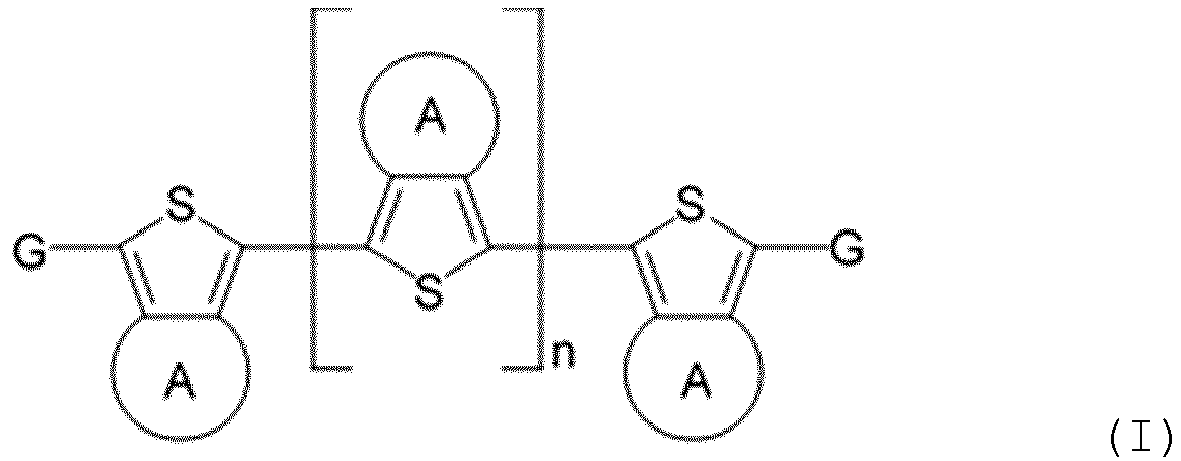
- A für einen gegebenenfalls ein oder mehrfach substituierten 5- oder 6-gliedrigen ungesättigten oder gesättigten heterocyclischen Ring mit bis zu zwei Heteroatomen steht, wobei die Heteroatome gleich oder verschieden sein können und ausgewählt sind aus der Gruppe aus Sauerstoffatomen und Schwefelatomen,
- G ein Substituent mit einem negativen induktiven Effekt bedeutet,
- und n für eine ganze Zahl von 2 bis 6 steht, bevorzugt für eine ganze Zahl von 2 bis 4 steht,
- weisen einen negativen Seebeck-Koeffizienten auf. Sie eignen sich dadurch zum Einsatz als n-typ Halbleiter in elektrischen Anordnungen. Die organischen n-typ Halbleiter gemäß der allgemeinen Formel (I) zeigen darüber hinaus bereits mit einer vergleichsweise geringen Anzahl an Thiophen-Einheiten für den Einsatz als organische Halbleiter geeignete Ladungstransporteigenschaften. Zudem erweisen sich die erhaltenen organischen n-typ Halbleiter der allgemeinen Formel (I) als stabil gegenüber Luftsauerstoff.
- Die allgemeine Formel (I) ist so zu lesen, dass n Thiophen-Einheiten von jeweils endständigen, mit G substituierten Thiophen-Einheiten flankiert werden. Die Substituenten G in α-Stellung zum Schwefelatom der endständigen Thiophen-Einheiten besitzen gegenüber den Thiophen-Einheiten eine elektronenziehende Wirkung und üben einen negativen induktiven (-I) Effekt aus.
- Auf die Darstellung von Ladungen wurde verzichtet, da die Lokalisation der Ladungen nicht eindeutig angegeben werden kann.
- Substituenten mit einem negativen induktiven Effekt sind dem Fachmann bekannt. Beispiele für bevorzugte G sind -O-Alkylgruppe, -OH, -NH-Alkylgruppe, -N-(Alkylgruppe)2, -NH2, -NH(CO)-Alkylgruppe, -O(CO)-Alkylgruppe, -O(CO)-Arylgruppe, -O(CO)-Phenylgruppe, Halogenatome, Halogenalkylgruppe, besonders bevorzugte G sind Fluor, Chlor, Brom oder-CH2-CF2-CF3. Bevorzugt sind C1-C18-Alkylgruppen bzw. C1-C18-Halogenalkylgruppen. Die Substituenten G können gleich oder verschieden sein. Bevorzugt sind sie gleich.
- In der allgemeinen Formel (I) steht A bevorzugt für 1,4-Dioxan, 1,4-Oxathian, 1,4-Dithian oder Dehydrothiophen. Bevorzugte Thiophen-Einheiten sind 3,4-Ethylendioxythiophen (2,3-Dihydrothieno[3,4-b]-1,4-Dioxin), 3,4-Ethylenoxythiathiophen (2,3-Dihydrothieno[3,4-b]-1,4-Oxathiin), 3,4-Ethylendithiathiophen (2,3-Dihydrothieno[3,4-b]-1,4-Dithiin) und Thieno[3,4-b]thiophen. Unsymmetrische Thiophen-Einheiten wie 3,4-Ethylenoxathiathiophene und Thieno[3,4-b]thiophene können Kopf-Kopf, Kopf-Schwanz, Schwanz-Kopf, Schwanz-Schwanz verknüpft sein. Weiter bevorzugt sind symmetrische Thiophen-Einheiten wie 3,4-Ethylendioxythiophene oder 3,4-Ethylendithiathiophene, da diese eine leichtere synthetische Zugänglichkeit aufweisen.
- A kann gegebenenfalls durch einen oder mehrere Reste, die gleich oder verschieden sein können, substituiert sein. Der oder die Reste können an beliebigen Kohlenstoffringatomen von A gebunden sein. Die Bindung von bis zu zwei Resten an dem selben Kohlenstoffringatom ist möglich. Bevorzugte Reste sind Hydroxylreste, geradkettige oder verzweigte gegebenenfalls substituierte C1-C20-Alkylreste, gegebenenfalls substituierte C3-C12-Cycloalkylreste, gegebenenfalls substituierte C6-C14-Arylreste, gegebenenfalls substituierte C7-C18-Aralkylreste, gegebenenfalls substituierte C1-C6-Hydroxyalkylreste und gegebenenfalls substituierte C2-C20-Alkoxyalkylreste. Bevorzugte Alkoxyalkylreste sind solche mit einem Kohlenstoffatom im Alkyl, im Speziellen der-CH2-O-(CH2)13-CH3 oder der -CH2-O-(CH2)15-CH3 Rest.
- Weitere bevorzugte Reste an A oder Substituenten an den Resten von A sind eine oder mehrere ionische Gruppen. Eine bevorzugte ionische Gruppe ist die anionische SO3 -Gruppe. Ebenfalls erfindungsgemäß sind Gemische der organischen n-typ Halbleiter der allgemeinen Formel (I), bei denen beispielsweise organische n-typ Halbleiter der allgemeinen Formel (I) mit unterschiedlicher Zahl für n, mit unterschiedlichen Resten an A, mit unterschiedlichen Substituenten an den Resten von A und/oder mit unterschiedlichen Substituenten G vermischt sind.
- Bevorzugte organische n-typ Halbleiter der allgemeinen Formel (I) sind solche der allgemeinen Formel (I-1),

- Besonders bevorzugte organische n-typ Halbleiter der allgemeinen Formel (I) sind solche der allgemeinen Formel (I-1), worin G Halogenatom, insbesondere Fluor, Chlor oder Brom, oder -CH2-CF2-CF3 bedeutet.
- Ein weiterer Gegenstand der vorliegenden Erfindung ist ein Verfahren zur Herstellung von organischen n-typ Halbleitern der allgemeinen Formel (I). Die organischen n-typ Halbleiter der allgemeinen Formel (I),


chemisch oxidativ umgesetzt werden. - Dies war unerwartet, da mittels chemisch oxidativer Umsetzung Thiophene, wie in der vorgenannten Literatur beschrieben, normalerweise in p-dotierte Polythiophene mit einem positiven Seebeck-Koeffizienten überführt werden. Wie bereits zu den erfindungsgemäßen organischen n-typ Halbleitern erläutert, weisen diese einen negativen Seebeck-Koeffizienten auf. Ein solcher findet sich üblicherweise bei n-dotierten Materialien.
- Die Umsetzung der Thiophene der allgemeinen Formel (II) findet in einem inerten Lösungsmittel statt. Geeignete Lösungsmittel sind beispielsweise Alkohole wie Methanol, Ethanol, 2-Propanol, Butanol, Kohlenwasserstoffe wie Hexan, Heptan, Toluol, Xylol, Chlorkohlenwasserstoffe wie Methylenchlorid, Chloroform, Chlorbenzol, Ether wie Diethylether, Anisol, Sulfoxide wie Dimethylsulfoxid, Glykole wie Ethylenglykol, Diethylenglykol, Triethylenglykol, Tetraethylenglykol, Triethylenglykolmonomethylether. Bevorzugt werden Glykole, besonders bevorzugt werden Triethylenglykol, Tetraethylenglykol und Triethylenglykolmonomethylether. Es können auch Lösungsmittelgemische sowie Mischungen von Wasser mit wassermischbaren Lösungsmitteln vorteilhaft sein.
- Bevorzugt werden Thiophene der allgemeinen Formel (II-1),

- Das Vorgehen zur Umsetzung der Thiophene erfolgt gemäß den bekannten Verfahren zur chemisch oxidativen Polymerisation von Thiophenen.
- Es ist dabei für den Fachmann selbstverständlich, dass Verbindungen der allgemeinen Formel (II), bevorzugt Verbindungen der allgemeinen Formel (II-1), mit gleichen oder unterschiedlichen Zahlenwerten für m und gleichen oder unterschiedlichen Substituenten G, mit gleichen oder unterschiedlichen Resten an A und/oder Substituenten an den Resten von A miteinander zu Gemischen umgesetzt werden können.
- Die Verbindungen der allgemeinen Formel (II) können gegebenenfalls in einem Gemisch mit Verbindungen der allgemeinen Formel (III),


- Es kann ebenfalls vorteilhaft sein, Verbindungen der allgemeinen Formel (III), bevorzugt der allgemeinen Formel (III-1), oder Mischungen von diesen umzusetzen. Bei den hieraus resultierenden n-typ Halbleitern der allgemeinen Formel (I) steht n für 0.
- Als Oxidationsmittel kommen alle für die chemisch oxidative Polymerisation von Thiophenen üblichen, dem Fachmann bekannten, und beispielsweise in der eingangs genannten Fachliteratur beschriebenen Oxidationsmittel in Betracht. Geeignete Oxidationsmittel sind unter anderem anorganische Metallsalze und Metallsalze organischer Säuren von Fe3+, Ce4+, Cu2+, Au3+ oder Mn4+. Bevorzugte Oxidationsmittel sind Eisen-(III)-Verbindungen wie Eisen-(III)-chlorid und Eisen-(III)-tosylat. Besonders bevorzugt ist Eisen-(III)-tosylat.
- Die Umsetzungstemperatur kann in Anbetracht der Vielzahl an zur Verfügung stehenden Reaktionspartnern in einem weiten Temperaturbereich variieren. Die für die jeweiligen Reaktionspartner optimale Umsetzungstemperatur ist experimentell leicht zu ermitteln. Die Umsetzung kann beispielsweise bei Raumtemperatur durchgeführt werden. Es kann jedoch auch nützlich sein, die Umsetzung bei tieferen oder höheren Temperaturen vorzunehmen, beispielsweise bei Temperaturen von -30°C bis 150°C, insbesondere von 10°C bis 130°C. Sofern der Substituent G ein Halogenatom ist oder Halogenatome enthält, wird die Umsetzung bevorzugt bei Temperaturen bis zu maximal 100°C, 90°C oder 80°C, besonders bevorzugt bis zu 70 C°, insbesondere bevorzugt bis zu 65 C°, am meisten bevorzugt bei Raumtemperatur durchgeführt.
- Die Dauer der Umsetzung kann variieren und hängt insbesondere von den eingesetzten Thiophenen, der gewählten Temperatur und den verwendeten Oxidationsmitteln ab. Bevorzugt wird eine Umsetzung im Sekunden- oder Minutenbereich bis im Bereich weniger Stunden. Besonders bevorzugt ist die Umsetzung innerhalb von 10 Minuten bis 3 Stunden im Wesentlichen abgeschlossen, insbesondere bevorzugt innerhalb von 1,5 Stunden. Der Verlauf der Umsetzung kann durch dem Fachmann bekannte Maßnahmen analysiert werden.
- Durch die Wahl geeigneter Reaktionsbedingungen lassen sich n-typ Halbleiter mittels chemisch oxidativer Umsetzung erhalten, die eine höhere Anzahl an Thiophen-Einheiten aufweisen. Ein weiterer Gegenstand der Erfindung sind daher auch n-typ Halbleiter der allgemeinen Formel (I), worin n eine ganze Zahl mit der Maßgabe 8<n≤40, bevorzugt 8<n≤32, ist.
- Die durch die Umsetzung erhaltenen organischen n-typ Halbleiter können zur Entfernung von Rückständen und Nebenprodukten gewaschen werden. Bevorzugt sind mit den Lösungsmitteln der Umsetzung mischbare, gegebenenfalls wässrige, Waschlösungen.
- Mit dem erfindungsgemäßen Verfahren zur Herstellung von n-typ Halbleitern steht ein effizientes Verfahren zur Verfügung. Bevorzugte n-typ Halbleiter sind daher nach dem oben beschriebenen Verfahren hergestellt.
- Für die erfindungsgemäßen n-typ Halbleiter besteht ein breites Anwendungsspektrum auf dem Gebiet der elektrischen Einrichtungen, vor allem, wenn elektrisch isolierende Substrate mit elektrisch-leitfähigen Beschichtungen versehen werden sollen.
- Ein weiterer Gegenstand ist daher die Verwendung der erfindungsgemäßen organischen n-typ Halbleiter zur Beschichtung von elektrisch isolierenden Substraten. Vorteilhaft ist, dass bereits bekannte Verfahren zum Aufbringen von Beschichtungen aus mittels oxidativer Polymerisierung hergestellten p-typ Halbleitern auf der Basis von Polythiophenen für die Beschichtung mit den erfindungsgemäßen organischen n-typ Halbleitern genutzt werden können. Als isolierende Substrate, die nicht oder nur schlecht leiten, kommen sowohl organische Materialien wie Polyethylene, Polypropylene, Polyvinylchlorid, Polyester, Polycarbonate und Polyamide, als auch anorganische wie Glas oder Keramik in Frage.
- Aufgrund ihrer elastischen Eigenschaften eignen sich die erfindungsgemäßen organischen n-typ Halbleiter insbesondere zur Beschichtung von flexiblen Substraten, die elektrischleitfähig ausgestattet werden sollen. Vor allem flexible elektrisch isolierende Substrate aus organischen Kunststoffen, insbesondere Folien aus Polyethylenen, Polypropylenen, Polyvinylchlorid, Polyestern, Polycarbonaten und Polyamiden können mit den organischen n-typ Halbleitern ausgestattet werden. Bevorzugt ist daher die Verwendung der erfindungsgemäßen n-typ Halbleiter zur Beschichtung von flexiblen elektrisch isolierenden Substraten.
- Aufgrund ihrer einfachen Handhabbarkeit hat sich der Einsatz von Dispersionen, die die organischen Halbleiter enthalten, für die Erzeugung von Beschichtungen als besonders vorteilhaft erwiesen. Dispersionen der organischen n-typ Halbleiter können erhalten werden, wenn diese in geeigneten Lösungsmitteln hergestellt und/oder in diese überführt werden. Es ist möglich, die Dispersionen in flüssiger Form weiterzuverarbeiten. Die Prozessierbarkeit in flüssiger Form eröffnet eine Vielzahl an Anwendungsmöglichkeiten. Dies schließt die Aufbringung der Dispersionen als feinste Tröpfchen auf ein Substrat durch drucktechnische Verfahren ein. Die Verwendung dieser Druckfluide soll jedoch nicht auf bestimmte Druckverfahren beschränkt verstanden werden. Beispielhaft sind Siebdruckverfahren, Tiefdruckverfahren, Flexodruckverfahren, Offsetdruckverfahren, Inkjetdruckverfahren oder Aerosoljetdruckverfahren als mögliche Anwendung genannt. Ein weiterer Gegenstand der Erfindung ist daher die Verwendung der erfindungsgemäßen n-typ Halbleiter in flüssigprozessierbaren Druckfluiden.
- Flüssigprozessierbare Druckfluide mit einer Viskosität im Bereich von 107 mPas bis 101 mPas eignen sich insbesondere für gängige Druckverfahren. Bevorzugt ist die Verwendung der erfindungsgemäßen n-Typ Halbleiter in flüssigprozessierbaren Druckfluiden mit einer Viskosität im Bereich von 106 mPas bis 102 mPas.
- Flüssigprozessierbare, scherverdünnende Druckfluide eignen sich für gängige Siebdruckverfahren. Ein weiterer Gegenstand der Erfindung ist daher die Verwendung der erfindungsgemäßen n-Typ Halbleiter in flüssigprozessierbaren, scherverdünnenden Druckfluiden.
- Flüssigprozessierbare, scherverdünnende Druckfluide mit einer Viskosität im Bereich von 107 mPas bei Scherraten von 10-3 1/s und bei 101 mPas bei Scherraten von 103 1/s, eignen sich hervorragend für Siebdruckverfahren. Ein weiterer Gegenstand der Erfindung ist daher die Verwendung der erfindungsgemäßen n-Typ Halbleiter in flüssigprozessierbaren, scherverdünnenden Druckfluiden mit einer Viskosität im Bereich von 107 mPas bei Scherraten von 10-3 1/s und bei 101 mPas bei Scherraten von 103 1/s.
- Bevorzugt ist die Verwendung der erfindungsgemäßen n-Typ Halbleiter in flüssigprozessierbaren, scherverdünnenden Druckfluiden mit einer Viskosität im Bereich von 106 mPas bei Scherraten von 10-3 1/s und bei 102 mPas bei Scherraten von 103 1/s.
- Die kostengünstig hergestellten, organischen n-typ Halbleiter sind insbesondere für die Verwendung in thermoelektrischen Vorrichtungen wie thermoelektrischen Generatoren geeignet, in denen leitfähige Schichten aus n-typ- und p-typ Halbleitern zur Stromerzeugung genutzt werden. Beispielsweise in der
DE 102012105086 B4 beschriebene organische thermoelektrische Generatoren mit Thermoelementen, in denen elektrisch isolierende organische Kunststofffolien mit organischen Halbleitern enthaltenden Beschichtungen elektrisch-leitend ausgerüstet sind, eröffnen neue Wege zu deren Herstellung und deren Einsatz. Ein weiterer Gegenstand der Erfindung ist daher die Verwendung der erfindungsgemäßen n-typ Halbleiter in thermoelektrischen Generatoren, insbesondere in organischen thermoelektrischen Generatoren. - Weitere Einzelheiten der vorliegenden Erfindung werden nachfolgend beispielhaft beschrieben, wobei die Erfindung jedoch in keiner Weise beschränkt werden soll.
-

- Der n-typ Halbleiter lässt sich über drei sehr einfache Reaktionsstufen darstellen. Mit EDOT, welches kommerziell für die PEDOT(Poly(3,4-Ethylendioxythiophen))-Synthese benutzt wird, steht ein sehr kostengünstig im Tonnenmaßstab erhältliches Ausgangsmaterial zur Verfügung. Eine als erster Schritt mögliche Ullmann-Kupplung funktioniert mit sehr guten Ausbeuten von bis zu 75%. Die darauf folgende Chlorierung lässt sich simpel mit N-Chlorsuccinimid (NCS) durchführen. Die anschließende, erfindungsgemäße chemisch oxidative Umsetzung des Dimers (BiEDOT) kann mittels eines preiswerten Eisen(III)salzes, beispielsweise Eisen(III)-Chlorid oder Eisen(III)-Tosylat, erfolgen.
- 5 ml Tetraethylenglykol wurden zu 536 mg Fe-(III)-tosylat x 6 H2O (852 µmol) zugegeben und die Mischung auf 200 °C erhitzt bis sich eine klare orangerote Lösung bildete. Die Lösung wurde anschließend auf Raumtemperatur abgekühlt.
- 5 ml Tetraethylenglykol wurden zu 120 mg BiEDOT-Cl (379 µmol) zugegeben und die Mischung auf 200 °C erhitzt bis sich eine klare grüne Lösung bildete. Die Lösung wurde anschließend auf Raumtemperatur abgekühlt.
- Zu der Lösung A wurde bei Raumtemperatur unter Rühren die Lösung B zugegeben, wobei sofort ein tief violett gefärbtes, Fluid erhalten wurde. Das Fluid wurde für weitere 120 Minuten gerührt.
- 7,2 ml Tetraethylenglykol wurden zu 669 mg Fe-(III)-tosylat x 6 H2O (1,06 mmol) zugegeben und die Mischung auf 200 °C erhitzt bis sich eine klare orangerote Lösung bildete. Die Lösung wurde anschließend auf 50 °C abgekühlt.
- 10 ml Tetraethylenglykol wurden zu 120 mg BiEDOT-Cl (379 µmol) zugegeben und die Mischung auf 200 °C erhitzt bis sich eine klare grüne Lösung bildete. Die Lösung wurde anschließend auf 50 °C abgekühlt.
- Zu der Lösung C wurde bei 50 °C unter Rühren die Lösung D zugegeben, wobei sofort ein dunkel violett gefärbtes, hochviskoses Fluid erhalten wurde. Das Fluid wurde für weitere 60 Minuten gerührt.
- Es wurden 10 ml eines 1:1 Ethylenglykol/Wasser-Gemischs als Extraktionsmittel zu dem Fluid gegeben und der Ansatz bei 1300 rpm für eine Stunde geschüttelt. Die Abtrennung des Extraktionsmittels wurde durch Dekantieren des Fluids nach einem Zentrifugationsschritt (10 Minuten bei 4200 rpm) erzielt. Der Extraktionsschritt wurde noch viermal wiederholt, wobei jeweils für 5 Minuten bei 4200 rpm zentrifugiert wurde.
- Die Bestimmung der Viskosität wurde mit einem Anton Paar Physica MCR 101 Platte-Kegel Rheometer durchgeführt. Als Kegel wurde ein Kegel mit der Modellnummer PP25 verwendet, welcher durch dessen kleinere Geometrie für hochviskose Fluide geeignet ist. Die Temperatur während den Messungen betrug 25 °C.
- Zur Messung wurden ca. 1 Gramm des Fluids auf den Teller des Rheometers aufgebracht und anschließend der Kegel durch die Apparatur automatisch abgesenkt. Während der Messung wurde der Kegel mit verschiedenen Schwerraten gedreht und die Viskosität über die Messapparatur aufgenommen. Der Messebereich der Scherrate wurde über die Software gesteuert und anschließend in Abhängigkeit zur ermittelten Viskosität grafisch aufgetragen.
- Die Viskosität eines gemäß den Schritten a) und b) hergestellten Fluids lag im Bereich von 106 mPas bei Scherraten von 10-3 1/s und 102 mPas bei Scherraten von 102 1/s. Hierbei nimmt die Anfangsviskosität bei steigenden Scherraten ab. Dieses Verhalten entspricht einem scherverdünnenden Fluid.
- Das gewaschene Fluid wurden mittels Rakelschablone auf Glasobjektträger aufgetragen und bei ca. 220 °C mit Heißluft getrocknet.
- Eine Trocknung des Fluids bei hiervon abweichenden Temperaturen, beispielsweise bei Temperaturen zwischen 150 °C und 220 °C, lieferte identische Ergebnisse. Alternativ zur Heißluft wurden auch Heizplatten zur Trocknung eingesetzt.
- Silber-Elektroden wurden aufgebracht und die Leitfähigkeit sowie der Seebeck-Koeffizient der trockenen Beschichtung mit Hilfe eines Multimeters simultan bestimmt. Die Schichtdicke der Beschichtung wurde über ein DektakXT Profilometer bestimmt.
- Der Seebeck-Koeffizient betrug -7,2 µV/K bei einer Leitfähigkeit der Beschichtung von 11 S/cm.
- Eine gemäß den Schritten a) und b) hergestellte Dispersion der organischen n-typ Halbleiter erwies sich als stabil gegenüber Luftsauerstoff und zeigte über einen Zeitraum von mehr als 12 Monaten noch die Eigenschaften, die einem n-dotierten Material entsprechen.
- 11.2 Die Schritte II.1. a) bis c) wurden mit 7-brom-2,2',3,3'-tetrahydro-5,5'-bithieno[3,4-b][1,4]dioxin (BiEDOT-Br) durchgeführt. Der Seebeck-Koeffizient betrug -7,2 µV/K bei einer Leitfähigkeit der Beschichtung von 7 S/cm.
- 11.3 Die Schritte II.1. a) bis c) wurden mit 7-(2,2,3,3,3-pentafluorpropyl)-2,2',3,3'-tetrahydro-5,5'-bithieno[3,4-b][1,4]dioxin (BiEDOT-CH2-CF2-CF3) durchgeführt. Der Seebeck-Koeffizient betrug -13,5 µV/K bei einer Leitfähigkeit der Beschichtung von 2 S/cm.
- Vorstufen für die Einführung von Substituenten mit negativem induktiven Effekt wurden nach bekannten Verfahren, beispielsweise mittels Ullmann-Kupplung wie in G. A. Sotzing, J. R. Reynolds, P.J. Steel in Advanced Materials 1997, 9, Seiten 795-798 oder G. A. Sotzing, J. R. Reynolds in Advanced Materials 1996, 8, Seiten 882-889 beschrieben, synthetisiert.
- Zur Einführung eines Substituenten mit negativem induktiven Effekt werden beispielhaft die folgenden Substitutionen von BiEDOT beschrieben:
- Unter Stickstoffatmosphäre wurden 1.129 g (4 mmol) Bi(3,4-Ethylendioxythiophen) in 40 ml Dimethylformamid (DMF, dehyd.) gelöst. Zu dieser Lösung wurden tropfenweise 20 ml einer Lösung von 587 mg (4 mmol) N-Chlorsuccinimid in DMF zugegeben und die Temperatur des Reaktionsansatzes in einem Eisbad auf bis zu 10 °C gehalten. Anschließend wurde die Reaktionslösung für 2 Stunden in einem Ölbad auf eine Temperatur von 50 bis 60 °C erhitzt. Zur Fällung des Reaktionsprodukts wurden tropfenweise 100 ml Eiswasser zugegeben. Das Präzipitat wurde unter Vakuum abfiltriert und mit Methanol gewaschen. Es wurden 1.155 g dunkelgrünes Puder (Rohausbeute: 91%) erhalten, das gemäß dünnschichtchromatographischer Analyse und NMR-Spektren eine Mischung von monochloriertem und dichloriertem BiEDOT in einem Verhältnis von 1:6 war. Für die oxidative Umsetzung gemäß II. wurde auf eine Fraktionierung des Gemischs verzichtet. Gewünschtenfalls lässt sich jedoch eine Trennung nach bekannten Verfahren der Chromatographie, der fraktionierten Destillation, Kristallisation oder Extraktion vornehmen.
1H-NMR(CDCl3)-Spektrum: 4.22-4.24 (m, 2H), 4.29-4.33 (m, 6H), 6.27 (s, 1H). -

- Bis-EDOT (1 g, 3,54 mmol, 1 eq.) wurde in 15 mL DMF gelöst und unter Rühren auf -15 °C gekühlt. Zu dieser Lösung wurde eine Lösung von N-Bromsuccinimid (630 mg, 3,54 mmol, 1 eq) in 10 mL DMF langsam zugetropft. Nach 1 h Rühren bei -15 °C wurde die Reaktionsmischung auf Raumtemperatur erwärmt und weitere 60 Minuten gerührt. Das Reaktionsgemisch wurde schließlich auf 150 g Eiswasser gegeben, mit Dichlormethan extrahiert (3 x 50 mL), und die organische Phase mit Natriumsulfat getrocknet und unter vermindertem Druck vom Lösungsmittel befreit. Es wurden 935 mg (Ausbeute: 73 %) eines bläulich-gelben Feststoffes erhalten.
-

- Bis-EDOT (1 g, 3,54 mmol, 1 eq.)wurde unter Argonatmosphäre in 35 mL absolutem THF gelöst und unter Rühren auf -78 °C gekühlt. Zu dieser Lösung wurde langsam n-BuLi (3,89 mmol, 1,1 eq. 1,56 mL einer 2,5 M Lösung in Hexan) zugetropft und es wurde 2 h bei -78 °C gerührt. Anschließend wurde langsam 1,1,1,2,2-pentafluoro-3-iodopropan (6 mmol, 1,56 g) zugetropft und weitere 50 Minuten bei -78 °C gerührt. Die Reaktionsmischung wurde schließlich auf RT erwärmt und mit Wasser und Dichlormethan verdünnt (jeweils 150 mL). Die organische Phase wurde abgetrennt, mit Natriumsulfat getrocknet, und unter vermindertem Druck vom Lösungsmittel befreit. Es wurden 1,35 g (Ausbeute: 92 %) eines gelben Feststoffes erhalten.
- Sämtliche Merkmale der Erfindung können sowohl einzeln als auch in beliebiger Kombination miteinander erfindungswesentlich sein.
Claims (15)
- Organische n-typ Halbleiter der allgemeinen Formel (I),
 A für einen gegebenenfalls ein oder mehrfach substituierten 5- oder 6-gliedrigen ungesättigten oder gesättigten heterocyclischen Ring mit bis zu zwei Heteroatomen steht, wobei die Heteroatome gleich oder verschieden sein können und ausgewählt sind aus der Gruppe aus Sauerstoffatomen und Schwefelatomen,G ein Substituent mit einem negativen induktiven Effekt bedeutet,und n für eine ganze Zahl von 2 bis 6 steht.
 - Organische n-typ Halbleiter nach Anspruch 1, dadurch gekennzeichnet, dass n für eine ganze Zahl von 2 bis 4 steht.
- Organische n-typ Halbleiter nach Anspruch 1 oder 2, dadurch gekennzeichnet, dass G ausgewählt ist aus -O-Alkylgruppe, -OH, -NH-Alkylgruppe, -N-(Alkylgruppe)2,-NH2, -NH(CO)-Alkylgruppe, -O(CO)-Alkylgruppe, -O(CO)-Arylgruppe, -O(CO)-Phenylgruppe, Halogenalkylgruppe oder Halogenatom, bevorzugt ausgewählt ist aus Fluor, Chlor, Brom oder -CH2-CF2-CF3.
- Organische n-typ Halbleiter nach einem der Ansprüche 1 bis 3, dadurch gekennzeichnet, dass es solche der allgemeinen Formel (I-1)

- Organische n-typ Halbleiter nach Anspruch 4, dadurch gekennzeichnet, dass es solche der allgemeinen Formel (I-1) sind, worin G Halogenalkylgruppe oder Halogenatom, bevorzugt Fluor, Chlor, Brom oder -CH2-CF2-CF3, bedeutet.
- Verfahren zur Herstellung von organischen n-typ Halbleitern der allgemeinen Formel (I),

durch chemisch oxidative Umsetzung von Thiophenen der allgemeinen Formel (II),
- Verfahren nach Anspruch 6, dadurch gekennzeichnet, dass organische n-typ Halbleiter der Formel (I-1), worin G ein Chloratom bedeutet und n für eine ganze Zahl zwischen 2 und 4 steht, durch chemisch oxidative Umsetzung von Thiophenen der allgemeinen Formel (II-1),

- Verfahren nach Anspruch 6 oder 7, dadurch gekennzeichnet, dass die Thiophene mit Eisen-(III)-Verbindungen chemisch oxidativ umgesetzt werden.
- Verfahren nach einem der Ansprüche 6 bis 8, dadurch gekennzeichnet, dass die chemisch oxidative Umsetzung bei Temperaturen von -30°C bis 150°C vorgenommen wird.
- Verfahren nach einem der Ansprüche 6 bis 9, dadurch gekennzeichnet, dass die chemisch oxidative Umsetzung für eine Dauer von 10 Minuten bis 3 Stunden vorgenommen wird.
- Verwendung eines organischen n-typ Halbleiters nach einem der Ansprüche 1 bis 5 zur Beschichtung von elektrisch isolierenden Substraten.
- Verwendung eines organischen n-typ Halbleiters nach einem der Ansprüche 1 bis 5 in flüssigprozessierbaren Druckfluiden.
- Verwendung eines organischen n-typ Halbleiters nach einem der Ansprüche 1 bis 5 in flüssigprozessierbaren, scherverdünnenden Druckfluiden.
- Verwendung eines organischen n-typ Halbleiters nach einem der Ansprüche 1 bis 5 in flüssigprozessierbaren, scherverdünnenden Druckfluiden mit einer Viskosität im Bereich von 107 mPas bei Scherraten von 10-3 1/s und bei 101 mPas bei Scherraten von 103 1/s.
- Verwendung eines organischen n-typ Halbleiters nach einem der Ansprüche 1 bis 5 in thermoelektrischen Generatoren, bevorzugt in organischen thermoelektrischen Generatoren.
Applications Claiming Priority (1)
| Application Number | Priority Date | Filing Date | Title |
|---|---|---|---|
| DE102016125644.7A DE102016125644A1 (de) | 2016-12-23 | 2016-12-23 | Organische Halbleiter, Verfahren zu ihrer Herstellung und ihre Verwendung |
Publications (1)
| Publication Number | Publication Date |
|---|---|
| EP3339310A1 true EP3339310A1 (de) | 2018-06-27 |
Family
ID=60957068
Family Applications (1)
| Application Number | Title | Priority Date | Filing Date |
|---|---|---|---|
| EP17210473.9A Withdrawn EP3339310A1 (de) | 2016-12-23 | 2017-12-22 | Organische halbleiter, verfahren zu ihrer herstellung und ihre verwendung |
Country Status (2)
| Country | Link |
|---|---|
| EP (1) | EP3339310A1 (de) |
| DE (1) | DE102016125644A1 (de) |
Citations (2)
| Publication number | Priority date | Publication date | Assignee | Title |
|---|---|---|---|---|
| EP1598358A1 (de) * | 2004-05-15 | 2005-11-23 | H.C. Starck GmbH | Verbindungen enthaltend 3,4-Methylendioxythiopen-Einheiten |
| JP2012038436A (ja) * | 2010-08-03 | 2012-02-23 | Fujifilm Corp | 光電変換素子及びこれを用いた光電気化学電池、光電変換素子用組成物 |
Family Cites Families (5)
| Publication number | Priority date | Publication date | Assignee | Title |
|---|---|---|---|---|
| JP2000106223A (ja) * | 1998-09-29 | 2000-04-11 | Fuji Photo Film Co Ltd | 光電変換素子 |
| CN102265453B (zh) * | 2008-10-29 | 2014-10-01 | 富士胶片株式会社 | 色素、使用其的光电转换元件、光电化学电池、及色素的制造方法 |
| WO2011108611A1 (ja) * | 2010-03-05 | 2011-09-09 | 富士フイルム株式会社 | 光電変換素子及び光電気化学電池 |
| JP2013125705A (ja) * | 2011-12-15 | 2013-06-24 | Konica Minolta Business Technologies Inc | 光電変換素子および太陽電池 |
| DE102012105086B4 (de) | 2012-06-13 | 2014-02-13 | Karlsruher Institut für Technologie | Gewickeltes und gefaltetes thermoelektrisches System und Verfahren zu dessen Herstellung |
-
2016
- 2016-12-23 DE DE102016125644.7A patent/DE102016125644A1/de not_active Ceased
-
2017
- 2017-12-22 EP EP17210473.9A patent/EP3339310A1/de not_active Withdrawn
Patent Citations (2)
| Publication number | Priority date | Publication date | Assignee | Title |
|---|---|---|---|---|
| EP1598358A1 (de) * | 2004-05-15 | 2005-11-23 | H.C. Starck GmbH | Verbindungen enthaltend 3,4-Methylendioxythiopen-Einheiten |
| JP2012038436A (ja) * | 2010-08-03 | 2012-02-23 | Fujifilm Corp | 光電変換素子及びこれを用いた光電気化学電池、光電変換素子用組成物 |
Non-Patent Citations (6)
| Title |
|---|
| APPERLOO JOKE J ET AL: "Optical and redox properties of a series of 3,4-ethylenedioxythiophene oligomers.", CHEMISTRY (WEINHEIM AN DER BERGSTRASSE, GERMANY) 17 MAY 2002, vol. 8, no. 10, 17 May 2002 (2002-05-17), pages 2384 - 2396, XP002779874, ISSN: 0947-6539 * |
| MEDINA BEGOÑA MILIÁN ET AL: "EDOT-type materials: planar but not rigid.", THE JOURNAL OF PHYSICAL CHEMISTRY. A 25 DEC 2008, vol. 112, no. 51, 25 December 2008 (2008-12-25), pages 13282 - 13286, XP002779873, ISSN: 1520-5215 * |
| NISHINAGA T [0000-0002-9081-3659] ET AL: "Stable Radical Cations and Their [pi]-Dimers Prepared from Ethylene- and Propylene-3,4-dioxythiophene Co-oligomers: Combined Experimental and Theoretical Investigations", JOURNAL OF ORGANIC CHEMISTRY 20170721 AMERICAN CHEMICAL SOCIETY USA, vol. 82, no. 14, 21 July 2017 (2017-07-21), pages 7245 - 7253, XP002779871, ISSN: 0022-3263 * |
| SCHOLDT M ET AL: "Organic semiconductors for thermoelectric applications", JOURNAL OF ELECTRONIC MATERIALS - SPECIAL ISSUE: INTERNATIONAL CONFERENCE ON THERMOELECTRICS 2009 SEPTEMBER 2010 SPRINGER NEW YORK USA, vol. 39, no. 9, September 2010 (2010-09-01), pages 1589 - 1592, XP002779872, DOI: 10.1007/S11664-010-1271-8 * |
| TURBIEZ M ET AL: "Stable and soluble oligo(3,4-ethylenedioxythiophene)s end-capped with alkyl chains", JOURNAL OF ORGANIC CHEMISTRY 20030627 US, vol. 68, no. 13, 27 June 2003 (2003-06-27), pages 5357 - 5360, XP002779869, ISSN: 0022-3263 * |
| WASSERBERG D ET AL: "High-resolution electronic spectra of ethylenedioxythiophene oligomers", JOURNAL OF THE AMERICAN CHEMICAL SOCIETY 20061227 US, vol. 128, no. 51, 27 December 2006 (2006-12-27), pages 17007 - 17017, XP002779870, ISSN: 0002-7863 * |
Also Published As
| Publication number | Publication date |
|---|---|
| DE102016125644A1 (de) | 2018-06-28 |
Similar Documents
| Publication | Publication Date | Title |
|---|---|---|
| EP1327645B1 (de) | Test | |
| EP2286416B1 (de) | Neuartige polythiophene-polyanion-komplexe in unpolaren organischen lösungsmitteln | |
| EP1375560B1 (de) | Alkylendioxythiophen-Dimere und Trimere | |
| EP1215224B1 (de) | Polythiophene | |
| DE602006000414T2 (de) | 2-Flouralkyl-thieno[3,4-b]thiophen-Derivate und daraus hergestellte Polymere | |
| DE112007000382T5 (de) | Leitfähige Polymere aus Precursorpolymeren; Verfahren zur Herstellung und ihre Verwendung | |
| EP3122789B1 (de) | 9,10-bis(1,3-dithiol-2-yliden)-9,10-dihydroanthracenpolymere und deren verwendung | |
| EP1440974A2 (de) | Alkylendioxythiophene und Poly(alkylendioxythiophene) mit mesogenen Gruppen | |
| EP0257573A1 (de) | Lösliche, elektrisch leitende Polymere, Verfahren zu ihrer Herstellung und ihre Verwendung | |
| DE10357571A1 (de) | Multifunktionelle 3,4-Alkylendioxythiophen-Derivate und diese enthaltende elektrisch leitfähige Polymere | |
| DE10257539A1 (de) | Verfahren zur Herstellung von 2,2'-Di(3,4-ethylendioxythiophen)en | |
| DE69828573T2 (de) | Transparente leitfähige Polymere | |
| DE3341378A1 (de) | Elektroaktives polymeres des p-typs | |
| DE3341377A1 (de) | Elektroaktives polymeres | |
| WO2017059845A1 (de) | Verfahren zur herstellung von polythiophenhaltigen fluiden | |
| EP1544203A1 (de) | 3,4-Dioxythiophen-derivative | |
| EP1352918B1 (de) | Alkylendioxythiophene und Poly(alkylendioxythiophen)e mit Urethangruppierungen enthaltenden Seitengruppen | |
| EP3339310A1 (de) | Organische halbleiter, verfahren zu ihrer herstellung und ihre verwendung | |
| DE2739584A1 (de) | Derivate von schwefel- und/oder selenhaltigen heterofulvalenen und verfahren zu ihrer herstellung | |
| DE3027529A1 (de) | Verfahren zur herstellung von elektrisch leitfaehigen polymeren systemen und deren verwendung in der elektrotechnik und zur antistatischen ausruestung von kunststoffen | |
| EP1275649B1 (de) | Benzodioxinothiophene, deren Herstellung und Verwendung | |
| DE3218762A1 (de) | Elektronisches polymeres | |
| EP0350451A2 (de) | Verfahren zur Herstellung von elektroaktiven Langmuir-Blodgett Schichtsystemen | |
| DE102006053644A1 (de) | Neuartiges hochleitfähiges organisches Ladungsträgertransportmaterial | |
| DE112011101194T5 (de) | Metallverbundwerkstoff und zu seiner Herstellung verwendbare Verbindung |
Legal Events
| Date | Code | Title | Description |
|---|---|---|---|
| PUAI | Public reference made under article 153(3) epc to a published international application that has entered the european phase |
Free format text: ORIGINAL CODE: 0009012 |
|
| STAA | Information on the status of an ep patent application or granted ep patent |
Free format text: STATUS: THE APPLICATION HAS BEEN PUBLISHED |
|
| AK | Designated contracting states |
Kind code of ref document: A1 Designated state(s): AL AT BE BG CH CY CZ DE DK EE ES FI FR GB GR HR HU IE IS IT LI LT LU LV MC MK MT NL NO PL PT RO RS SE SI SK SM TR |
|
| AX | Request for extension of the european patent |
Extension state: BA ME |
|
| STAA | Information on the status of an ep patent application or granted ep patent |
Free format text: STATUS: REQUEST FOR EXAMINATION WAS MADE |
|
| 17P | Request for examination filed |
Effective date: 20181220 |
|
| RBV | Designated contracting states (corrected) |
Designated state(s): AL AT BE BG CH CY CZ DE DK EE ES FI FR GB GR HR HU IE IS IT LI LT LU LV MC MK MT NL NO PL PT RO RS SE SI SK SM TR |
|
| STAA | Information on the status of an ep patent application or granted ep patent |
Free format text: STATUS: EXAMINATION IS IN PROGRESS |
|
| 17Q | First examination report despatched |
Effective date: 20190528 |
|
| STAA | Information on the status of an ep patent application or granted ep patent |
Free format text: STATUS: THE APPLICATION IS DEEMED TO BE WITHDRAWN |
|
| 18D | Application deemed to be withdrawn |
Effective date: 20191008 |