EP3328811B1 - Calciumaluminatzement mit langer bearbeitbarkeit mit durch temperaturerhöhung geförderter aushärtung und zugehörige verwendung - Google Patents
Calciumaluminatzement mit langer bearbeitbarkeit mit durch temperaturerhöhung geförderter aushärtung und zugehörige verwendung Download PDFInfo
- Publication number
- EP3328811B1 EP3328811B1 EP16757304.7A EP16757304A EP3328811B1 EP 3328811 B1 EP3328811 B1 EP 3328811B1 EP 16757304 A EP16757304 A EP 16757304A EP 3328811 B1 EP3328811 B1 EP 3328811B1
- Authority
- EP
- European Patent Office
- Prior art keywords
- cement
- calcium aluminate
- phase
- calcium
- mineralogical
- Prior art date
- Legal status (The legal status is an assumption and is not a legal conclusion. Google has not performed a legal analysis and makes no representation as to the accuracy of the status listed.)
- Active
Links
Images
Classifications
-
- C—CHEMISTRY; METALLURGY
- C04—CEMENTS; CONCRETE; ARTIFICIAL STONE; CERAMICS; REFRACTORIES
- C04B—LIME, MAGNESIA; SLAG; CEMENTS; COMPOSITIONS THEREOF, e.g. MORTARS, CONCRETE OR LIKE BUILDING MATERIALS; ARTIFICIAL STONE; CERAMICS; REFRACTORIES; TREATMENT OF NATURAL STONE
- C04B28/00—Compositions of mortars, concrete or artificial stone, containing inorganic binders or the reaction product of an inorganic and an organic binder, e.g. polycarboxylate cements
- C04B28/02—Compositions of mortars, concrete or artificial stone, containing inorganic binders or the reaction product of an inorganic and an organic binder, e.g. polycarboxylate cements containing hydraulic cements other than calcium sulfates
- C04B28/06—Aluminous cements
-
- C—CHEMISTRY; METALLURGY
- C04—CEMENTS; CONCRETE; ARTIFICIAL STONE; CERAMICS; REFRACTORIES
- C04B—LIME, MAGNESIA; SLAG; CEMENTS; COMPOSITIONS THEREOF, e.g. MORTARS, CONCRETE OR LIKE BUILDING MATERIALS; ARTIFICIAL STONE; CERAMICS; REFRACTORIES; TREATMENT OF NATURAL STONE
- C04B14/00—Use of inorganic materials as fillers, e.g. pigments, for mortars, concrete or artificial stone; Treatment of inorganic materials specially adapted to enhance their filling properties in mortars, concrete or artificial stone
- C04B14/02—Granular materials, e.g. microballoons
- C04B14/04—Silica-rich materials; Silicates
- C04B14/06—Quartz; Sand
-
- C—CHEMISTRY; METALLURGY
- C04—CEMENTS; CONCRETE; ARTIFICIAL STONE; CERAMICS; REFRACTORIES
- C04B—LIME, MAGNESIA; SLAG; CEMENTS; COMPOSITIONS THEREOF, e.g. MORTARS, CONCRETE OR LIKE BUILDING MATERIALS; ARTIFICIAL STONE; CERAMICS; REFRACTORIES; TREATMENT OF NATURAL STONE
- C04B14/00—Use of inorganic materials as fillers, e.g. pigments, for mortars, concrete or artificial stone; Treatment of inorganic materials specially adapted to enhance their filling properties in mortars, concrete or artificial stone
- C04B14/02—Granular materials, e.g. microballoons
- C04B14/04—Silica-rich materials; Silicates
- C04B14/10—Clay
- C04B14/106—Kaolin
-
- C—CHEMISTRY; METALLURGY
- C04—CEMENTS; CONCRETE; ARTIFICIAL STONE; CERAMICS; REFRACTORIES
- C04B—LIME, MAGNESIA; SLAG; CEMENTS; COMPOSITIONS THEREOF, e.g. MORTARS, CONCRETE OR LIKE BUILDING MATERIALS; ARTIFICIAL STONE; CERAMICS; REFRACTORIES; TREATMENT OF NATURAL STONE
- C04B18/00—Use of agglomerated or waste materials or refuse as fillers for mortars, concrete or artificial stone; Treatment of agglomerated or waste materials or refuse, specially adapted to enhance their filling properties in mortars, concrete or artificial stone
- C04B18/04—Waste materials; Refuse
- C04B18/06—Combustion residues, e.g. purification products of smoke, fumes or exhaust gases
- C04B18/08—Flue dust, i.e. fly ash
-
- C—CHEMISTRY; METALLURGY
- C04—CEMENTS; CONCRETE; ARTIFICIAL STONE; CERAMICS; REFRACTORIES
- C04B—LIME, MAGNESIA; SLAG; CEMENTS; COMPOSITIONS THEREOF, e.g. MORTARS, CONCRETE OR LIKE BUILDING MATERIALS; ARTIFICIAL STONE; CERAMICS; REFRACTORIES; TREATMENT OF NATURAL STONE
- C04B18/00—Use of agglomerated or waste materials or refuse as fillers for mortars, concrete or artificial stone; Treatment of agglomerated or waste materials or refuse, specially adapted to enhance their filling properties in mortars, concrete or artificial stone
- C04B18/04—Waste materials; Refuse
- C04B18/14—Waste materials; Refuse from metallurgical processes
- C04B18/141—Slags
-
- C—CHEMISTRY; METALLURGY
- C04—CEMENTS; CONCRETE; ARTIFICIAL STONE; CERAMICS; REFRACTORIES
- C04B—LIME, MAGNESIA; SLAG; CEMENTS; COMPOSITIONS THEREOF, e.g. MORTARS, CONCRETE OR LIKE BUILDING MATERIALS; ARTIFICIAL STONE; CERAMICS; REFRACTORIES; TREATMENT OF NATURAL STONE
- C04B18/00—Use of agglomerated or waste materials or refuse as fillers for mortars, concrete or artificial stone; Treatment of agglomerated or waste materials or refuse, specially adapted to enhance their filling properties in mortars, concrete or artificial stone
- C04B18/04—Waste materials; Refuse
- C04B18/14—Waste materials; Refuse from metallurgical processes
- C04B18/146—Silica fume
-
- C—CHEMISTRY; METALLURGY
- C04—CEMENTS; CONCRETE; ARTIFICIAL STONE; CERAMICS; REFRACTORIES
- C04B—LIME, MAGNESIA; SLAG; CEMENTS; COMPOSITIONS THEREOF, e.g. MORTARS, CONCRETE OR LIKE BUILDING MATERIALS; ARTIFICIAL STONE; CERAMICS; REFRACTORIES; TREATMENT OF NATURAL STONE
- C04B40/00—Processes, in general, for influencing or modifying the properties of mortars, concrete or artificial stone compositions, e.g. their setting or hardening ability
- C04B40/02—Selection of the hardening environment
- C04B40/0263—Hardening promoted by a rise in temperature
-
- C—CHEMISTRY; METALLURGY
- C04—CEMENTS; CONCRETE; ARTIFICIAL STONE; CERAMICS; REFRACTORIES
- C04B—LIME, MAGNESIA; SLAG; CEMENTS; COMPOSITIONS THEREOF, e.g. MORTARS, CONCRETE OR LIKE BUILDING MATERIALS; ARTIFICIAL STONE; CERAMICS; REFRACTORIES; TREATMENT OF NATURAL STONE
- C04B7/00—Hydraulic cements
- C04B7/32—Aluminous cements
-
- C—CHEMISTRY; METALLURGY
- C09—DYES; PAINTS; POLISHES; NATURAL RESINS; ADHESIVES; COMPOSITIONS NOT OTHERWISE PROVIDED FOR; APPLICATIONS OF MATERIALS NOT OTHERWISE PROVIDED FOR
- C09K—MATERIALS FOR MISCELLANEOUS APPLICATIONS, NOT PROVIDED FOR ELSEWHERE
- C09K8/00—Compositions for drilling of boreholes or wells; Compositions for treating boreholes or wells, e.g. for completion or for remedial operations
- C09K8/42—Compositions for cementing, e.g. for cementing casings into boreholes; Compositions for plugging, e.g. for killing wells
- C09K8/46—Compositions for cementing, e.g. for cementing casings into boreholes; Compositions for plugging, e.g. for killing wells containing inorganic binders, e.g. Portland cement
-
- C—CHEMISTRY; METALLURGY
- C04—CEMENTS; CONCRETE; ARTIFICIAL STONE; CERAMICS; REFRACTORIES
- C04B—LIME, MAGNESIA; SLAG; CEMENTS; COMPOSITIONS THEREOF, e.g. MORTARS, CONCRETE OR LIKE BUILDING MATERIALS; ARTIFICIAL STONE; CERAMICS; REFRACTORIES; TREATMENT OF NATURAL STONE
- C04B2103/00—Function or property of ingredients for mortars, concrete or artificial stone
- C04B2103/0004—Compounds chosen for the nature of their cations
- C04B2103/001—Alkaline earth metal or Mg-compounds
- C04B2103/0012—Mg
-
- C—CHEMISTRY; METALLURGY
- C04—CEMENTS; CONCRETE; ARTIFICIAL STONE; CERAMICS; REFRACTORIES
- C04B—LIME, MAGNESIA; SLAG; CEMENTS; COMPOSITIONS THEREOF, e.g. MORTARS, CONCRETE OR LIKE BUILDING MATERIALS; ARTIFICIAL STONE; CERAMICS; REFRACTORIES; TREATMENT OF NATURAL STONE
- C04B2103/00—Function or property of ingredients for mortars, concrete or artificial stone
- C04B2103/0004—Compounds chosen for the nature of their cations
- C04B2103/0013—Iron group metal compounds
- C04B2103/0014—Fe
-
- C—CHEMISTRY; METALLURGY
- C04—CEMENTS; CONCRETE; ARTIFICIAL STONE; CERAMICS; REFRACTORIES
- C04B—LIME, MAGNESIA; SLAG; CEMENTS; COMPOSITIONS THEREOF, e.g. MORTARS, CONCRETE OR LIKE BUILDING MATERIALS; ARTIFICIAL STONE; CERAMICS; REFRACTORIES; TREATMENT OF NATURAL STONE
- C04B2103/00—Function or property of ingredients for mortars, concrete or artificial stone
- C04B2103/0004—Compounds chosen for the nature of their cations
- C04B2103/0017—Refractory metal compounds
- C04B2103/0019—Ti
-
- Y—GENERAL TAGGING OF NEW TECHNOLOGICAL DEVELOPMENTS; GENERAL TAGGING OF CROSS-SECTIONAL TECHNOLOGIES SPANNING OVER SEVERAL SECTIONS OF THE IPC; TECHNICAL SUBJECTS COVERED BY FORMER USPC CROSS-REFERENCE ART COLLECTIONS [XRACs] AND DIGESTS
- Y02—TECHNOLOGIES OR APPLICATIONS FOR MITIGATION OR ADAPTATION AGAINST CLIMATE CHANGE
- Y02W—CLIMATE CHANGE MITIGATION TECHNOLOGIES RELATED TO WASTEWATER TREATMENT OR WASTE MANAGEMENT
- Y02W30/00—Technologies for solid waste management
- Y02W30/50—Reuse, recycling or recovery technologies
- Y02W30/91—Use of waste materials as fillers for mortars or concrete
Definitions
- the present invention relates generally to the field of cements whose hardening in the presence of water is favored by a rise in temperature.
- a calcium aluminate cement comprising a calcium aluminate with a first crystalline mineralogical phase of calcium dialuminate CA2 comprising a calcium oxide CaO for two aluminum oxides Al 2 O 3 and / or a second mineralogical phase C2AS dicalcium alumina silicate crystalline comprising two calcium oxides CaO for an aluminum oxide Al 2 O 3 and a silicon dioxide SiO 2 .
- a cement composition comprising such a calcium aluminate cement, mixed with water and optionally with other compounds such as fly ash, a granulated blast furnace slag, silica flour, silica smoke, metakaolin, quartz, fine limestone, sand, and adjuvants.
- the invention finds a particularly advantageous application in any application where a temperature rise is necessary or undergone, such as for example the consolidation of oil wells.
- a cement is a mineral powder suitable for being mixed with water to form a cement composition with a pasty or liquid consistency which hardens to form a final hardened material.
- calcium aluminate cements provide hardened end materials with specific chemical properties of high resistance to acid corrosion and mechanical properties of high resistance to high temperatures and pressures.
- cement with water that is to say the duration, also called "open time", during which this cement composition has a viscosity suitable for its use, namely, for example, a low viscosity to allow its injection into cracks, or a moderate viscosity to allow it to be shaped in formwork.
- These reactive properties also determine the curing kinetics of the cement composition during subsequent phases of the reaction of the cement with water. These are in particular the characteristics of the hydraulic setting of the cement composition, the hydraulic setting being an accelerated exothermic phase of the hydration reaction of cement with water, and the speed at which the final hardening of the material occurs after hydraulic setting, i.e. how long the hardened final material reaches a desired mechanical strength.
- a relatively high temperature that is to say greater than about 50 ° C., or even greater than 30 ° C., can accelerate the curing kinetics of a cement composition, and reduce significantly its workability, in particular by favoring the thickening of the cement composition and by triggering the hydraulic setting more quickly.
- cement compositions To reduce the effect of temperature on the reactivity of cement compositions, it is common to add adjuvants to cement compositions, such as setting retarders.
- retarders can be used in the same cement composition, these retarders can interact with each other and / or with the other additives of the cement composition, and it then becomes difficult to predict the hardening kinetics of this cement composition.
- the presence of retarder in the cementitious composition can lead to a lowering of the mechanical resistance of the hardened final material.
- cementitious compositions based on calcium aluminates are generally manufactured on site, that is to say that water is added to the cement directly at the place of use of the cement compositions.
- cementitious compositions based on calcium aluminate cements are prepared in the production lines. production usually used to prepare cementitious compositions based on Portland cement.
- the drilling of wells is a complex process which consists mainly in drilling the rock while introducing a tubular metallic body into it.
- the aqueous suspension then rises to the surface, in the space existing between the rock wall and the tubular body.
- the workability of the aqueous suspension must be such that this aqueous suspension can be injected to the bottom of the tubular body, and that the hydraulic setting of the aqueous suspension must occur at a controlled time after the ascent to the surface of this aqueous suspension, and this taking into account the conditions high temperatures and pressures.
- cement compositions thus formulated to reduce the effect of temperature on their workability and their curing kinetics are particularly complex. They also generate the use of many different chemical compounds, which can have a harmful effect on the environment.
- the present invention provides a new calcium aluminate cement, which has the advantageous chemical and mechanical resistance properties of this type of cement, as well as a time open naturally long without adding a retarder, and even in case of involuntary mixing with Portland cements.
- a cement is proposed according to the invention of calcium aluminates as described in the introduction, in which the mass fraction of all of said first and second mineralogical phases in said calcium aluminate is greater than or equal to 80%.
- the calcium aluminate cement according to the invention exhibits controlled hardening kinetics, without the need to add retarder thereto.
- the Applicant has found that the calcium aluminate cements comprising these mineralogical phases exhibited, at room temperature, an extremely long workability, and that the reactivity of these phases with water was favored by a rise in temperature.
- the reactivity of the calcium aluminate cement according to the invention with water is low and the kinetics of the hydration reaction are very slow.
- the workability of the cement composition based on this cement is therefore controlled without the addition of setting retarders in the form of additional chemical compounds.
- the hardening kinetics are controlled because the hydraulic setting can be triggered and / or accelerated by a rise in temperature.
- these mineralogical phases guarantee the calcium aluminate cement according to the invention reduced interactions with Portland cements, which reduces the problems linked to cross contamination between Portland cements and calcium aluminate cements.
- the calcium aluminate cement according to the invention has properties of mechanical resistance to high temperatures and high pressures, and of chemical resistance to corrosion to acids similar to those of calcium aluminate cements already known in the art. 'state of the art.
- the invention also provides a cement composition
- a cement composition comprising at least the calcium aluminate cement according to the invention mixed with water, and optionally cement additions such as fly ash and / or a granulated blast furnace slag and / or a silica flour and / or silica smoke and / or metakaolin, aggregates such as quartz and / or fine limestone and / or sand, and adjuvants.
- the cementitious composition can also comprise aggregates (for example sand) and / or adjuvants (for example retarders, accelerator or other) known to those skilled in the art.
- aggregates for example sand
- adjuvants for example retarders, accelerator or other
- the pressure is preferably chosen to be high, that is to say greater than or equal to the saturated vapor pressure, so that the water is present in liquid form or at least in the form of saturated vapor.
- step a) of the use according to the invention the cement composition is in the form of an aqueous suspension, and in step b), the cement composition is placed in a wellbore tanker.
- the present invention relates to a calcium aluminate cement suitable for being mixed with water to form a cement composition whose workability is naturally long, and whose reactivity is favored by a rise in temperature.
- cement will denote a powder suitable for being mixed with water to form a cement composition capable of hardening to form a hard final material.
- cement composition will designate the mixing of the cement with water and possibly with other additional compounds.
- the "reactivity” or the “reactive properties” of the cement characterize the ability of this cement to react with water.
- the calcium aluminate cement according to the invention comprises at least one calcium aluminate, that is to say a compound comprising both calcium oxide and aluminum oxide.
- the calcium aluminate of the cement according to the invention comprises calcium oxide commonly called lime CaO, aluminum oxide commonly called alumina Al 2 O 3 , and silicon dioxide commonly called silica SiO 2 .
- the calcium aluminate cement according to the invention comprises a crystalline part and an amorphous part.
- the crystalline and amorphous parts characterize the microscopic state of the calcium aluminate cement according to the invention: the crystalline part of this calcium aluminate cement comprises atoms and / or molecules ordered according to a particular geometry, in crystallized mineralogical phases , while the amorphous part of this calcium aluminate cement comprises atoms and / or molecules which are arranged in a disorderly manner with respect to each other, that is to say in no particular order.
- the calcium aluminate of the cement according to the invention is mainly crystalline.
- the mass fraction of said crystalline part in said calcium aluminate is greater than or equal to 80%.
- the mass of the crystalline part relative to the total mass of the calcium aluminate of the cement according to the invention is greater than or equal to 80%.
- the mass fraction of the amorphous part is less than or equal to 20%.
- the crystalline part has crystallized mineralogical phases which make it possible to more specifically describe the calcium aluminate of the cement according to the invention.
- the quantity and the nature of the crystallized mineralogical phases present in the cement according to the invention account for the chemical composition of said calcium aluminate.
- the crystallized mineralogical phases describe at the both the atomic scale structure and the chemical composition of calcium aluminate, to the extent that they involve several different compounds.
- the mineralogical phases of the calcium aluminate of the cement according to the invention involve lime C, alumina A and silica S.
- mineralogical phases are generally chosen according to the properties which they provide to calcium aluminate cement, in particular in terms of reactivity and mechanical property of the hardened final material.
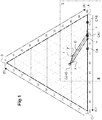
- This mass fraction of lime C is found inside the ternary diagram all along a straight line parallel to the side of the triangle opposite the vertex C.
- the calcium aluminate comprise a single pure phase, it more generally comprises several phases which coexist.
- the mass fraction of all of said first and second CA2, C2AS mineralogical phases in said calcium aluminate is greater than or equal to 80%.
- the cumulative mass of the first and second mineralogical phases CA2, C2AS represents at least 80% of the total mass of the calcium aluminate of the calcium aluminate cement according to the invention.
- the majority mineralogical phase of which is the CA phase is the CA phase
- the majority mineralogical phase or phases are the first and second CA2, C2AS mineralogical phases.
- these third and fourth mineralogical phases CA, CA6 are found in close proximity to the first and second mineralogical phases CA2, C2AS, so that, during the manufacture of the calcium aluminate from the cement according to the invention, it is very likely to form these third and fourth CA mineralogical phases, CA6.
- the mass fraction of all of the third and fourth crystallized mineralogical phases CA, CA6 in said calcium aluminate of the calcium aluminate cement according to the invention is less than or equal to 20%.
- the remaining 20% of the calcium aluminate of the cement according to the invention can also comprise the minority compounds constituting the impurities of the calcium aluminate according to the invention mentioned above: iron oxide Fe 2 O 3 (F), titanium oxide TiO 2 (T), sulfur oxide SO 3 ($), magnesium oxide MgO, or even alkaline compounds.
- the minority compounds can form mineralogical phases with at least one of the majority compounds of calcium aluminate which are alumina A, lime C and silica S.
- the remaining 20% of the calcium aluminate of the calcium aluminate cement according to the invention may comprise an additional mineralogical phase of calcium sulfoaluminate C4A3 $ comprising four calcium oxides CaO for three aluminum oxides Al 2 O 3 and a sulfur oxide SO 3 .
- the calcium aluminate cement according to the invention can thus comprise 0.5% to 15%, preferably from 0.5% to 12%, of this additional mineralogical phase of calcium sulfoaluminate C4A3 $, by mass relative to the total mass of said calcium aluminate.
- the Ye'elimite minority phase has an effect on the reactivity of the cement composition.
- the more the proportion of minority phase Ye'elimite C4A3 $ increases in the cement composition the more the viscosity, at room temperature, of this cement composition increases. This effect is even more pronounced when the temperature surrounding the cement composition increases.
- the Ye'elimite minority phase also has an effect on the reactivity of the cement composition at high temperature.
- the proportion of Ye'elimite C4A3 $ minority phase increases in the cement composition, the longer the setting time at high temperature.
- a calcium aluminate composition comprising a non-zero proportion of Ye'elimite minority phase seems particularly advantageous.
- a proportion of between 3 and 5%, for example equal to 3%, 4% or 5% of the Ye'elimite C4A3 $ phase is appropriate.
- This remaining 20% also includes the amorphous part of the calcium aluminate of the cement according to the invention, if there is one.
- the calcium aluminate of the cement according to the invention belongs to this particular straight line D, then it comprises between 100% of the first mineralogical phase CA2 and 100% of the second mineralogical phase C2AS.
- the calcium aluminate of the cement according to the invention belongs to this particular straight line D, this calcium aluminate is crystalline, and the mass fraction of all of said first and second mineralogical phases CA2, C2AS in the aluminate of calcium in the cement according to the invention is equal to 100%.
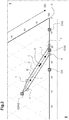
- this calcium aluminate must be located in a zone Z close to this particular straight line D .
- the surface of the ternary diagram delimited by the contour connecting the points [v - CA2 - w - x - C2AS - y - v] corresponds to the zone Z inside which the sum of the first and second phases CA2, C2AS is greater than or equal to 80%.
- composition of point Y of the ternary diagram of figures 1 and 2 is 34.4% in lime C, 48.1% in alumina A, and 17.5% in silica S.
- the ranges of chemical composition in lime C, in alumina A and in silica S of any calcium aluminate belonging to zone Z can also be determined graphically on the ternary diagram using the figure 2 .
- the first and second mineralogical phases CA2, C2AS exhibit a particular reactivity when they are in the presence of water.
- first and second mineralogical phases CA2, C2AS are not very reactive with water at room temperature. In other words, they are adapted to react very slowly with water at room temperature.
- a mineralogical phase reacts with water when it is hydrated by water, and it is possible to characterize this reactivity by a quantity called “degree of hydration” of the mineralogical phase.
- the degree of hydration reflects the capacity of a mineralogical phase to be hydrated by water, that is to say that the molecules constituting the crystal lattice of said mineralogical phase pass into solution in water in the form ion, in other words it is to assess the ability of the bonds existing between the molecules constituting the mineralogical phase to be broken by interaction with water.
- the first and second CA2, C2AS mineralogical phases are adapted to react effectively with water under the effect of a rise in temperature.
- these first and second mineralogical phases CA2, C2AS are adapted to react with water much faster than at room temperature when the curing temperature is between 50 degrees Celsius (° C) and 300 ° C, preferably between 80 ° C and 280 ° C.
- the third CA mineralogical phase is known to be very reactive at room temperature when it is in the presence of water, which is why its mass fraction in the aluminate of calcium of the cement according to the invention is maintained less than or equal to 20% so as to preserve the characteristics of long workability of the cement according to the invention.
- the fourth CA6 mineralogical phase is completely inert, whatever the temperature to which it is subjected, ambient or high. Thus, it does not hydrate even during a rise in temperature.
- the cement according to the invention comprising few of these third and fourth phases CA, CA6 reacts slowly when it is mixed with water at room temperature, without the need to add a retarder, and it is advantageous from an economic point of view.
- this composition according to the invention has both a majority of first and second crystallized mineralogical phases CA2, C2AS and a minority of crystallized mineralogical phases CA, CA6.
- the additional crystallized mineralogical phases notably include, for example, the Ye'elimite C4A3 $ phase.
- This example of calcium aluminate cement according to the invention comprises for example, by mass relative to the total mass of said calcium aluminate between 0.5 and 12% of this phase Ye'elimite C4A3 $.
- the calcium aluminate cement comprises for example 4% of this Ye'elimite phase, included in the 12% of additional crystallized mineralogical phases.
- an operator co-grinds, that is to say mixes and grinds in a single operation, bauxite and limestone until a powder is obtained. comprising particles the maximum diameter of which is less than or equal to 100 micrometers ( ⁇ m).
- the co-grinding operation can be carried out by means of a ball mill or any other mill known to those skilled in the art.
- the powder obtained at the end of this co-grinding operation is then granulated with water, that is to say that the fine powder particles are agglomerated using water to form granules with a diameter greater than that of powder.
- alumina crucible which is itself introduced into an electric oven.
- the electric oven containing the crucible is brought to a temperature of 1400 ° C according to a temperature ramp of 600 ° C per hour. When the electric oven has reached 1400 ° C, a 6 hour cooking stage is applied.
- the calcium aluminate granules are finely ground so as to form the powder forming the calcium aluminate cement according to the invention.
- the calcium aluminate cement powder according to the invention has a specific Blaine surface area measured according to standard NF-EN-196-6, between 2200 square centimeters per gram and 4500 square centimeters per gram.
- the Blaine specific surface area of the calcium aluminate cement according to the invention is between 2,900 and 3,900 square centimeters per gram.
- the cement according to the invention having such a specific Blaine surface is adapted, when it is mixed with water, to have an optimal contact surface with this water.
- the cement according to the invention having this specific Blaine surface is suitable for being homogeneously mixed with a large quantity of water, that is to say that the cement is suitable for being dispersed in a large quantity of water equivalently at any point in the mixture.
- the cement according to the invention does not reuse.
- the calcium aluminate cement according to the invention can be mixed with water to form a cement composition.
- Fly ash corresponds to the ash obtained during combustion at high pressures and temperatures of pulverized coal.
- fly ash very fine fly ash
- pulverized Fuel Ash very fine fly ash
- fly ash of larger dimensions called “Furnace Bottom Ash” in English.
- Commercial products EN4750 "N” fly ash® from Scotash, or class F bottom ash® from FlyAshDirect are examples.
- Table 1 gives the main physicochemical characteristics of these fly ash.
- Fly ash EN450 "N" fly ash Class F bottom ash Society Scotash FlyAshDirect Blaine Specific Area (cm 2 / g) 3110 2000 d50 ( ⁇ m) 14.0 23.1 Density 2.27 2.49 LAW 1000 ° C (%) 4.8 n / A
- the LOI line namely “ Loss on Ignition” in English, or Perte au fur in French, includes volatile elements here.
- Granulated blast furnace slag comes from the surface layer which is formed during the melting of iron in blast furnaces, said surface layer being separated from the molten iron and then cooled in the form of granules to form said slag.
- the commercial product Slag® from Ecocem is an example.
- Table 2 gives the main physico-chemical characteristics of this slag. Table 2 Dairy Slag Society Ecocem Blaine Specific Area (cm 2 / g) 4500 d50 ( ⁇ m) 12.7 Density 2.93
- Silica fume is a pozzolanic material comprising amorphous silica. It is generally a secondary product of the production of silicon and / or ferrosilicon alloys in electric arc furnaces. It can take different aspects: it can in particular be found in the form of a very fine powder, or hard granules a few millimeters in diameter.
- Table 3 gives the main physico-chemical characteristics of these silica fumes.
- Metakaolin is an anhydrous and weakly crystalline aluminum silicate produced by dehydroxylation of kaolin at high temperatures.
- Metasial V800® from the company Soka (Company Kaolinière Armoricaine) is an example.
- Table 4 gives the main physico-chemical characteristics of this metakaolin.
- Table 4 Metakaolin Metasial V800 Society Soka Blaine specific surface (cm 2 / g) 14100 d50 ( ⁇ m) 4.0 Density 2.75
- the cement composition can for example comprise 0%, 5%, 10%, 15%, 20%, 25%, 30%, 35%, 40%, 45% or even 50% of cement additions, by mass per relative to the dry mass of the cement composition, and / or 50%, 55%, 60%, 65%, 70%, 75%, 80%, 85%, 90%, 95% or even 100% cement calcium aluminates according to the invention, by mass relative to the dry mass of the cement composition.
- the calcium aluminate cement present reacts with water, that is to say that a chemical reaction, commonly called “hydration”, takes place between the cement.
- a chemical reaction commonly called “hydration”
- the molecules constituting the crystalline and / or amorphous parts of the cement according to the invention are hydrated by water, namely that they pass into solution in water under form of ions.
- the duration of the thickening phase can vary from one cement to another insofar as it depends a lot on the reactivity of the cement used.
- the open time generally corresponds to the duration of this thickening phase. It usually takes a few hours.
- the duration of the thickening phase can vary from a few minutes to a few hours depending on the envisaged application, the cement and any additives that may be added.
- the thickening phase In the case of an application in oil wells, the thickening phase generally lasts a few hours.
- the duration of the thickening phase also depends on external parameters such as pressure, temperature, and the relative proportion between water and cement.
- the cement composition rapidly passes from a liquid state to a solid state, these states being defined in the mechanical sense of the term, namely that the liquid state is a state in which the cement composition deforms irreversibly when it is subjected to a deformation, while the solid state is a state in which the cement composition can deform elastically when it is subjected to a deformation.
- the cement composition has reached its solid state when, subjected to the Vicat test according to the standard ASTM C91 described later in the example part, the Vicat needle is unable to pass through. entirely the cement composition.
- the cement composition is in its liquid state when, subjected to this same Vicat test, the Vicat needle passes entirely through the cement composition.
- the cementitious composition already has a hardened appearance, so that it can be considered as a hardened final material. However, it continues to harden during the final hardening phase.
- a user forms the cement composition by mixing the calcium aluminate cement with all of said other compounds possibly included in the cement composition, and with water.
- the consistency of the cement composition formed is more or less fluid depending on the mass of water it contains relative to the total mass of said cement composition.
- the amount of water added to the cement according to the invention and to said other possible compounds depends mainly on the application for which the cement composition is intended.
- a user can choose to form a cement composition in the form of a paste which is not very fluid.
- step a) the user can form an aqueous suspension of cement.
- the mass fraction of water in said aqueous suspension is between 15% and 45%.
- the mass fraction of water in this aqueous suspension amounts to a water / cement ratio of between 20% and 70%, said ratio being the ratio between the mass of water and the mass of dry cement forming the aqueous suspension.
- the mass fraction of the water in said aqueous suspension is between 20% and 60%, for example equal to 29%, 31%, 33%, 37%, 52%, or even 55%.
- the mass fraction of water in this aqueous suspension amounts to a water / dry compound ratio of between 25% and 150%, said ratio being the ratio between the mass of water and the mass dry cement composition, including cement and cement additions.
- the water / dry compound ratio of the aqueous suspension is equal to 41%, 48%, 60%, 80%, 110%, or even 120%.
- step b) as long as the cement composition is in the thickening phase, the user can set up the cement composition.
- the user can pour the cement composition into a slot.
- step b) said aqueous suspension is injected into an oil wellbore.
- This injection is made by means of one or more pumps which push the aqueous suspension in a tubular body to the bottom of the wellbore. Once at the bottom of the wellbore, this suspension can rise naturally to the surface, between the rock wall and the tubular body.
- the user can shape it so as to prefabricate objects of the type beam or slab.
- step c) the initiation of the hydraulic setting phase of the cement composition is favored by heating the cement composition to a temperature between 50 ° C and 300 ° C, preferably between 80 ° C and 280 ° C .
- this heating of the cement composition can be voluntary or undergone.
- this aqueous suspension of cement is naturally heated between 50 ° C and 300 ° C by the surrounding rock, after its ascent the surface.
- the temperature is generally between 120 ° C and 180 ° C, and the heating of the cementitious composition is then undergone.
- the aqueous suspension has a satisfactory workability at room temperature, that is to say that its viscosity at room temperature is sufficiently low to allow its injection by means of pumps, and the hardening of said aqueous suspension occurs after its injection into the well, when the surrounding temperature rises.
- the user can also choose to activate the phenomenon of hydraulic setting of the cement composition according to the invention by heating said cement composition to a temperature chosen between 50 ° C. and 300 ° C. This is then voluntary heating.
- the user can thus choose the moment at which the hydraulic setting phase is triggered, by choosing the moment at which he heats the cementitious composition.
- the thickening phase corresponding overall to the open time, ends at the time of this heating.
- the curing kinetics reflect both the rate of thickening of the cement composition, the instant from which its hydraulic setting is initiated, and the mechanical resistance reached by the final cured material obtained from the cement composition after that -this reacted with the available added water, at the desired time depending on the application.
- the characteristics of workability and hardening kinetics can be quantified in different ways, by different test methods and according to different standards. Thus, these characteristics of workability and hardening kinetics can be quantified by different measured characteristic times, for example a gel time, an initial setting time or a thickening time, as defined below.
- first and second cements are calcium aluminate cements of the prior art known under the trade names of Ciment fondu® and SECAR®71.
- the third cement (Ciment3) is a calcium aluminate cement according to the invention.
- composition presents the measured chemical composition of this third cement according to the invention Ciment3, as well as the chemical composition of the raw materials used to obtain it (Bauxite and Limestone). These compositions are given in percentage by mass (%), that is to say that they indicate the mass of compound relative to the total dry mass of cement or of raw material used.
- the LOI line namely Loss on Ignition, or Loss on Fire, groups together volatile elements such as residual humidity in the case of bauxite or carbon dioxide CO2 in the case of limestone.
- Table 5 below gives the mineralogical phases contained in these first, second and third cements (Ciment1, Ciment2, Ciment3).
- the mineralogical phases were measured by a known technique of X-ray diffraction (often abbreviated DRX).
- the notation na means that the cement does not include the corresponding mineralogical phase or that these phases are present in very small quantities which are not measured.
- the Ferrites mineralogical phase essentially comprises the mineralogical phase of tetra-calcium ferro-aluminate C4AF, hereinafter called the sixth crystallized mineralogical phase.
- the crystal lattice of this sixth crystallized mineralogical phase comprises four lime molecules C for an alumina molecule A and an iron oxide Fe 2 O 3 , abbreviated by the letter F.
- the “other” column groups together the impurities included in these cements, namely at least one of the following compounds: iron oxide Fe 2 O 3 , titanium oxide TiO 2 , sulfur oxide SO 3 , magnesium oxide MgO, and compounds alkaline.
- the “Other” column of Cement1 cement of the prior art includes the mineralogical phases CA6 and C4A3 $. More specifically, the cement Ciment1 comprises 0% of phase CA6 and approximately 0.7% of C4A3 $, by mass relative to the total mass of all the phases contained in said Ciment1.
- Cement3 cement comprises 3% of phase CA6 and 4% of phase C4A3 $, by mass relative to the total mass of all the mineralogical phases contained in said Ciment3.
- the proportion of the mineralogical phases which it comprises may vary slightly from one manufacturing campaign to another.
- Ciment3bis having the proportions of mineralogical phases described in table 6 was also obtained under conditions similar to the conditions for obtaining the third cement according to the invention Ciment3.
- Table 6 CA2 (%) * 59.2 C2AS (%) * 22.5 CT ortho. (%) 4.6 CA6 (%) 5.4 CA (%) 0.9 Spinel MA (%) 1.2 C4A3S $ (%) 4.2 C4AF (%) 0.6 Spinel iron (%) 0.7 Alu ⁇ (%) 0.5 C12A7 (%) 0.0 MgO (%) 0.2 CaO (%) 0.2
- This other calcium aluminate cement according to the invention thus comprises 72.5% of CA2 mineralogical phases and 27.5% of C2AS mineralogical phase, by mass compared with only the two CA2, C2AS mineralogical phases.
- CimentRéf A reference cement (CimentRéf) was also used in comparison with the first, second and third cements of calcium aluminates Ciment1, Ciment2, Ciment3.
- This CimentRéf reference cement is a Portland cement of class G conventionally known to those skilled in the art and often used in applications such as petroleum drilling.
- the CimentRéf reference cement has a specific Blaine surface of the order of 3010 cm 2 / g.
- a first test which made it possible to characterize the cements studied consisted in measuring the thickening time of different cement compositions obtained by mixing these cements with water.
- the thickening time is a data making it possible to assess the workability of the cement composition, in particular when it is in the form of an aqueous suspension.
- the thickening time is an estimate of the time after which the cementitious composition can no longer be pumped out. In other words, it is the time after which an aqueous suspension is too viscous to be able to be moved by means of a pump.
- the thickening time corresponds to the time that has elapsed between the time when the water and the cement were mixed to form the cement composition in the form of an aqueous suspension, and the moment when the consistency, called Bearden consistency (Bc), of the cement composition has reached a value such that this cement composition can no longer be pumped, the Bearden consistency being expressed by means of 'a grandeur without unity.
- Bearden consistency Bc
- the thickening time is measured according to ISO standard 10426-1, clause 10.3, from the document “ Petroleum and natural gas industries - Cement and materials for well cementing”, including the first part NF-EN-ISO- 10426-1 is entitled “Part 1 - Specifications” and based on ISO standard 10426-1: 2005, and the thickening time is such that the cement composition has reached a Bearden consistency of 100 Bc, at 23 ° C, under atmospheric pressure of 1 atmosphere (atm).
- this thickening time is carried out for example by means of a stirring blade adapted to rotate in the cement composition while measuring a torque.
- This measured torque makes it possible to appreciate the force that the blade must exert on the cement composition in order to be able to rotate. This couple is thus linked to the Bearden consistency of the cement composition.
- Table 7 below presents different cement compositions which have been formed from the three calcium aluminate cements Ciment1, Ciment2, Ciment3, and Portland cement CimentRéf, as well as the thickening time associated with them, at temperature. ambient (23 ° C).
- these cement compositions were formed at 23 ° C., mixing the cement with the appropriate quantity of water (indicated in table 7) for 15 seconds with stirring at 4000 revolutions per minute. Further stirring at 12,000 rpm for 35 seconds was then carried out.
- the water / cement ratio represents the mass of water which was introduced to form the cement composition, relative to the mass of dry cement.
- Table 7 Name of the cement composition Cement used Water / cement ratio Thickening time (hours: minutes) Compo1 Cement1 0.5 1:21 Compo2 Cement2 0.5 0: 48 Compo3 Cement3 0.38 10:26 CompoRef CementRef 0.44 5:38
- the CompoRéf cement composition comprising CimentRéf confirms that Portland cements have an average thickening time (around 5 hours) at room temperature (23 ° C). This is why these cements are often used in applications requiring a fairly long processing time.
- the cement composition Compo3 comprising the calcium aluminate cement according to the invention Ciment3 has a thickening time greater than 10 hours, which offers the user the possibility of using - for example transporting, pouring, d '' inject, pump, etc. - This cement composition Compo3 for a long time, without having to add a retarder.
- Ciment3 therefore has very high workability without the addition of a setting retarder. Thus, it is particularly suitable for applications requiring a very long open time, and this without chemical pollution linked to the use of setting retarders.
- the viscosity makes it possible to appreciate the hardening kinetics and the workability of these cement compositions.
- the viscosity is measured according to ISO standard 10426-2, clause 12. This standard comes from the second part of the "Petroleum and natural gas industries - Cement and materials for well cementing", the said part being entitled “Part 2 - Testing of well cements” and based on the publication API RP 10B, 22nd edition, of December 1997, addendum 1, of October 1999 .
- the viscosity test is carried out as follows: the cement is mixed with the chosen quantity of water to form the cement composition (procedure detailed above), then this cement composition is placed in a viscometer rotary brand FANN®, model 35.
- the FANN®35 rotary viscometer is called "direct indication".
- two coaxial cylinders are immersed vertically in the cement composition.
- the outer cylinder - also called a sleeve - is rotated by a motor at a speed chosen by the operator.
- the inner sleeve is linked to the frame by a torsion spring.
- the cement composition set in motion by the outer cylinder, exerts a torque on the inner sleeve, and this torque is proportional to the angle of torsion of said spring.
- the direct reading of the torsion angle of the spring (in degrees) is linked to the shear stress (in Pascal) of the cement composition, which translates the viscosity of said cement composition.
- This measurement is commonly called “FANN®35 measurement” (FANN®35 reading ).
- the outer cylinder rotates at a speed of rotation chosen by the operator with a potentiometer, ranging from 3 to 300 revolutions per minute, and a reticle makes it possible to visually measure on a graduated disc the angle of rotation of the spring linked to the inner sleeve, this angle of twist being proportional to the torque generated by the cementitious composition in motion on the sleeve interior.
- Table 8 presents the different cement compositions tested and gives values of the angle of twist of the inner sleeve representative of their respective viscosity V1 and V2 at 23 ° C
- Table 9 presents similar cement compositions and values of the torsion angle of the inner sleeve representative of their viscosity at 50 ° C.
- table 10 presents the same cement compositions as those of table 9 and values of the angle of torsion of the inner sleeve representative of their viscosities at 80 ° vs.
- the values indicated for the viscosities V1 and V2 are here the values of the measured angle of torsion.
- Table 8 Cement composition Cement used Water / cement ratio Blaine Specific Area (cm 2 .g -1 )
- Initial viscosity V1 Viscosity V2 Compo5 Cement2 0.41 4000 14 > 300 Compo6 Cement3 0.41 2200 6 21 Compo7 Cement3 0.41 3080 10 37 Compo8 Cement3 0.41 3470 13 38 Compo9 Cement3 0.41 3700 14 36 Compo10 Cement3 0.41 4100 18 58
- the cement composition Compo5 comprising the calcium aluminate cement of the prior art Ciment2 has an initial viscosity V1 acceptable to be able to be handled, that is to say for an installation, for example by pumping, but its viscosity after 10 minutes is that of a gelled cement composition. Consequently, as soon as the cement composition Compo5 is left stationary for too long, it can no longer be handled. This is particularly troublesome when it is desired to move such a cementitious composition by means of pumps, which would then risk being damaged on restarting after a temporary stop.
- cementitious compositions according to the invention Compo6 to Compo10 are particularly advantageous insofar as their initial viscosities V1 are low (less than 20), which facilitates their transport by means of a pump. Their viscosity V2 after a pause time also remains low enough for them to be pumped.
- the hardening kinetics of the cement compositions comprising the calcium aluminate cement according to the invention Ciment3 is much slower, at room temperature, than those of the cement compositions of the prior art, which is an advantage for uses requiring long handling.
- Table 8 also gives an indication of the reactivity of the calcium aluminate cement Ciment3 according to the invention as a function of the specific Blaine surface. It is observed in fact that the more the Blaine specific surface area increases, the more the initial viscosity and the viscosity after pause increase. Thus, the kinetics of hardening accelerates when the specific Blaine surface increases, which translates the fact that the finest powder grains are more easily hydrated by water because they have a larger reactive surface.
- the viscosity V2 after pause of the cement composition Compo11 is also too high for this cement composition Compo11 to be able to be used in pumps without adding a setting retarder to it.
- cementitious compositions according to the invention Compo12 to Compo14 have low initial viscosities V1 and viscosities V2 after a pause time still allowing their use as well as their transport by means of pumps.
- Table 10 shows that at 80 ° C, the cement composition Compo11 comprising the calcium aluminate cement of the prior art Ciment2 cannot be used because its viscosity is too high as soon as it is mixed with water.
- the initial viscosity V1 of the cement compositions comprising the cement according to the invention Ciment3 at 80 ° C is of the same order of magnitude as at 50 ° C.
- the rise in temperature influences the viscosity V2 after a pause time of the cement compositions Compo12 to Compo14.
- the viscosity after pause increases markedly between 50 ° C and 80 ° C, and all the more if the Blaine specific surface is large. This confirms the fact that the temperature promotes the reaction between the water and the cement according to the Ciment3 invention.
- the Anton Paar rheometer used is referenced MCR_302®. It is fitted with a CC27 cutter and a mixing propeller with 6 straight rectangular blades 16 mm (mm) high by 9 mm long, around an axis 4 mm in diameter.
- the Anton Paar viscometer makes it possible to follow the evolution of the viscosity as a function of time, at a given temperature, when the blade rotates at a chosen speed.
- the rheometer actually measures the torque applied by the cement composition to the rotating blade in said cement composition.
- the torque measured is representative of the viscosity of the cement composition.
- Table 11 shows in parallel the viscosity measured by the Fann®35 viscometer after 10 minutes of rest (V2), and the gel time of the two cement compositions according to the invention comprising the cement Ciment3bis, and of the cement composition of l prior art comprising Portland cement CimentRef.
- Table 11 Cement composition Cement used Water / Cement Ratio Blaine Specific Area (cm 2 .g -1 ) V2 viscosity (Fann®35, 23 ° C) Freezing time (minutes) (Anton Paar, 80 ° C) Compo15 Cement3bis 0.41 3070 38 48 Compo16 Cement3bis 0.48 3070 25 77 CompoRef CimentRef 0.44 3010 30 90
- cement compositions compo15 and compo16 according to the invention show a clear and rapid setting compared to the composition CompoRef. The break in slope of the experimental curve between the thickening phase and the setting phase is then very marked.
- the gel time depends on the water / cement ratio applied to the cement according to the invention.
- the penetrant measurement consists in determining the mass of water appearing on the surface of a given quantity of aqueous suspension, after immobilization of this aqueous suspension for 2 hours.
- the water appearing on the surface is given in percentage (%), by mass relative to the total mass of water added to the aqueous suspension.
- the penetrant measurement is carried out here at 23 ° C., in a cylindrical container of 250 milliliters (ml) of capacity.
- Table 12 gives the percentages of water removed from the three compositions Compo15, Compo16 and CompoRéf studied previously.
- Table 12 Cement composition Cement used Water / Cement Ratio Blaine Specific Area (cm 2 .g -1 ) Water drained (%) Compo15 Cement3bis 0.41 3070 1.0 Compo16 Cement3bis 0.48 3070 2.8 CompoRef CimentRef 0.44 3010 4.8
- the cement according to the invention rewets less than the reference cement, even at higher water / cement ratios, which is favorable for ensuring its compliance with API standards.
- the cement composition is formed by mixing the water and the cement, then the cement composition is left to stand for 24 hours, at a chosen temperature and a selected pressure, before measuring the mechanical resistance according to ISO standard 10426-1. , clause 9.2.
- Table 13 shows the mechanical strengths of the three cement compositions Compo1, Compo2 and Compo3 after 24 hours at 37 ° C and under atmospheric pressure (R1), after 24 hours at 60 ° C and under atmospheric pressure (R2), and after 24 hours at 110 ° C and under pressure of 20.7 MegaPascal (R3).
- the mechanical resistances R1, R2 and R3 are given in MegaPascal (MPa). Table 13 Cement composition Mechanical resistance R1 (MPa) Mechanical resistance R2 (MPa) Mechanical resistance R3 (MPa) Compo1 6.3 6.4 11.8 Compo2 17.4 21.5 25.2 Compo3 0 0.8 23.6
- the cement composition Compo3 comprising the cement according to the invention Ciment3 has zero mechanical resistance at 37 ° C, and almost zero at 60 ° C, which indicates that this cement is only very slightly reactive below 60 ° C.
- this confirms the fact that the reaction of the cement according to the invention with water is naturally delayed at temperatures below 60 ° C, without the need to add retarder to it.
- the cement composition Compo3 also develops a mechanical resistance of the order of twenty megaPascals.
- the reaction between the cement according to the invention and the water is favored by high temperatures.
- the calcium aluminate cement according to the invention exhibits curing kinetics which are naturally controlled by temperature, without the need to add a retarder.
- the mechanical resistance R3 developed by the cement composition Compo3 comprising the calcium aluminate cement according to the invention Ciment3 is similar to that of the calcium aluminate cements usually used and known to date ( around 20 MPa).
- the setting time is measured according to standard ASTM C91, using a Vicat needle.
- the Vicat test consists of mixing water and cement to form the cement composition, then dropping a Vicat needle into the cement composition, which is static, at regular time intervals. As long as the needle sinks to the bottom of the cement composition, it is considered that the setting time has not been reached, as soon as it sinks without being able to reach the bottom of the cement composition, has reached the set time.
- the setting time therefore corresponds to the time which has elapsed between the time when the cement and the water have been mixed to form the cement composition in a liquid state, and the moment when the cement composition has passed into a sufficiently solid state so that the Vicat needle can no longer pass through it entirely but only partially, at a temperature of 23 ° C. and under atmospheric pressure (latm).
- Table 14 below shows the setting times, in minutes, for different cement compositions comprising a certain proportion of calcium aluminate cement mixed with Portland cement.
- the Portland cement used is a class H Portland cement.
- the water / cement ratio is 0.38, that is to say that the mass of water used represents 38% of the total dry mass of cement used.
- Table 14 Calcium aluminate cement used 0% 5% 8% 15% Cement1 400 310 220 20 Cement2 400 190 45 10 Cement3 400 340 320 300
- Table 14 presents the effect on the setting time of the contamination of a Portland cement with a calcium aluminate cement.
- the calcium aluminate cements of the prior art Ciment1 and Ciment2 have a significant effect on the setting time of the Portland cement used. Indeed, while Portland cement alone, corresponding to the first column, has a relatively long setting time of 400 minutes, the setting time observed for a mixture with 15% of calcium aluminate cement Ciment1 and Ciment2 is very short (20 and 10 minutes respectively). This means that a cementitious composition containing a Portland cement and a calcium aluminate cement of the prior art reacts very quickly, preventing the use of such a cementitious composition for applications requiring long implementations. Such cementitious compositions cannot therefore be used in applications of the wellbore type for example.
- the contamination of Portland cement with the cement according to the invention Ciment3 has only little effect, at room temperature, on the setting time of the cement composition.
- the setting time of a cement composition comprising 15% Cement3 and 85% Portland cement corresponds to 75% of the setting time of a cement composition comprising 100% Portland cement.
- Ciment3 is facilitated compared to the other calcium aluminate cements since it is not necessary to thoroughly clean the installations before they can be used. installations for Portland cement.
- the curve obtained also makes it possible to determine the time elapsing between the formation of the cement composition and the moment when the torque reaches 4mN.m.
- This duration makes it possible to quantify the “setting time” of the cement composition. It is a value of this setting time which is not necessarily equal to the setting time value measured by the Vicat test.
- the cement compositions are prepared as follows: 100 g of cement are mixed with 44 g of water (i.e. a water / cement ratio of 0.44), using a Rayneri Turbotest mixer, for 15 seconds at 1000 rpm, then for 120 seconds at 3300 rpm.
- Table 15 presents the results obtained. Table 15 Cements used Times measured at 20 ° C CementRef Cement3bis Cement2 20 ° C (%) (%) (%) (%) gel (min) catch (min) 0 100 0 420 420 10 90 0 420 420 25 75 0 190 260 90 10 0 420 420 90 0 10 10 10 100 0 0 420 420
- Ciment3bis is polluted with up to 10% Portland Ciment CimentRef at 20 ° C, the gel and setting times are not affected, that is to say that they are similar to those obtained for Ciment3bis cement alone.
- Ciment3bis When the cement according to the invention Ciment3bis is polluted with 25% Portland cement CimentRef, the freezing and setting times remain satisfactory: they are respectively around 190 minutes and 260 minutes.
- the use of the calcium aluminate cement according to the invention is facilitated at room temperature compared to the cements of the prior art since it is not necessary to clean the installations after or before using these installations with Portland cement.
- This test is based on observations with a scanning electron microscope allowing an elementary chemical analysis as well as on X-ray diffraction measurements allowing a quantification of the mineralogical phases according to the Rietveld method.
- a cement composition Compo15 was formed by mixing water with the cement according to the invention Ciment3 in a water / cement ratio of 0.44, that is to say so that water represents 44 % by mass relative to the total dry mass of cement.
- a Compo16 cement composition was also formed by mixing water with the cement of the prior art Ciment2 in a water / cement ratio of 0.44.
- Hydrates are compounds formed between water (denoted H) and hydrated chemical compounds resulting from the mineralogical phases initially included in the cements studied.
- the results of the X-ray diffraction test make it possible to estimate the degree of hydration of the mineralogical phases of the cement according to the invention Ciment3 or of the cement of the prior art Ciment2, as a function of the temperature.
- free water means water which is not engaged in bonds with ions coming from the various hydrated mineralogical phases, that is to say which does not already belong to a hydrate formed. In other words, it is water still available to react with (or hydrate) the anhydrous mineralogical phases still existing.
- the "other" phase groups together any impurities (iron oxide Fe 2 O 3 , titanium oxide TiO 2 , sulfur oxide SO 3 , magnesium oxide MgO, and alkaline compounds).
- Table 16 presents the results of the X-ray diffraction test, namely the percentage of each mineralogical phase and of each hydrate present after each treatment undergone by the cement composition Compo15.
- Table 17 presents the results of the X-ray diffraction test, after each treatment undergone by the cement composition Compo16.
- Table 16 Phases D1 D2 D3 D4 CA2 39% 36% 0% 0% C2AS 20% 20% 14% 11% Other 10% 8% 8% 8% Open water 31% 26% 16% 19% CAH10 0% 6% 0% 0% C3AH6 Katoite 0% 0% 27% 22% C3AS (3-x) H4x Hibshite 0% 0% 0% 7% AH3 Gibbsite 0% 4% 14% 0% AH Boehmite 0% 0% 21% 33%
- the “other” phase also includes the CA phase.
- This CA phase is initially present during the mixing between cement3 and water (column D1), and is absent from the mixture after 24 hours of reaction (columns D2, D3 and D4) because it completely reacted with water, whatever the temperature.
- phase CA6 represents 2.3%, by mass, of all the phases included in the composition Compo15 at the time of diffraction D1, 2.6% by mass, of all the phases included in this composition at moment of diffraction D2, 2.2% by mass, of all the phases included in this composition at the time of diffraction D3 and 2% by mass of all phases included in this composition at the time of diffraction D4 .
- the first CA2 mineralogical phase reacts entirely from 120 ° C. In other words, from 120 ° C, the first CA2 mineralogical phase is fully hydrated by water.
- the second C2AS mineralogical phase reacts from 120 ° C, but it is less reactive than the first CA2 mineralogical phase.
- the reactivity of the first mineralogical phase CA2 is favored by a temperature lower than that favoring the reactivity of the second mineralogical phase C2AS.
- the cement according to the invention exhibits chemical resistance properties similar to those of the calcium aluminate cements already known.
- hardening kinetics can be adjusted as a function of the temperature and by choosing the relative proportion of first and second mineralogical phase CA2, C2AS.
- the calcium aluminate cement according to the invention has a low contaminating power on Portland cements.
- the mechanical properties of the hardened final material obtained from the calcium aluminate cement according to the invention are similar to those of the hardened final materials obtained from the known calcium aluminate cements.
- the density determines the capacity of the cement composition used in oil drilling wells to retain the gases and the oil contained in said wells.
- the density is evaluated by relating the mass of the aqueous suspension to its volume.
- the density is expressed in “pounds per gallon (ppg)”, knowing that 1 ppg is worth 0.12 kilograms per cubic decimeter (kg / dm 3 ) or 0.12 gram per cubic centimeter (g / cm 3 ).
- Table 18 below presents the specific gravity of the cement compositions comprising Ciment3bis according to the invention and Portland cement CimentRef.
- Table 18 Cement composition Cement used Water / cement ratio Blaine Specific Area (cm 2 / g) Density (ppg) Compo15 Cement3bis 0.41 3070 16.0 Compo16 Cement3bis 0.48 3070 15.3 CompoRef CementRef 0.44 3010 15.8
- the densities of the cement compositions Compo15 and Compo16 according to the invention are similar to that of the reference Portland cement and therefore suitable for applications in oil drilling.
- a fourth, fifth and sixth cement of calcium aluminates according to the invention (Ciment4, Ciment5, Ciment6) were used to form different cement compositions whose properties have been compared.
- the fourth, fifth and sixth cements Ciment4, Ciment5, Ciment6 are obtained in the laboratory from the following almost pure raw materials: the source of silica Millisil E400®, the source of alumina AL170® and the source of limestone Calcite Normapu®. The precise compositions of these raw materials are given in Table 19 below.
- the temperature ramp applied is 600 ° C per hour.
- Table 19 summarizes the operating conditions and the masses of raw materials mixed to form the cements Ciment4, Ciment5 and Ciment6.
- Table 19 Cement4 Cement5 Cement6 Alumina Al170 720.0g 500.0g 662.0g Silica E400 35.0g 150.0g 63.0g Normapur limestone 429.8g 614.0g 480.7g Cooking (Duration in hours and temperature in degrees Celsius) 12h 1550 ° C 4 p.m. 1525 ° C 4 p.m. 1525 ° C Number of revolutions during fine grinding 7500 9000 8000
- Table 20 below gives the chemical composition of the raw materials used to obtain the laboratory cements Ciment4, Ciment5, Ciment6, as well as the composition of the cements Ciment4, Ciment5 and Ciment6 actually obtained.
- Table 20 Millisil E400 silica source Al170 alumina source CaCO 3 limestone source Cement4 Cement5 Cement6 PaF (%) 0.29 0.63 43.93 n / A n / A n / A SiO 2 (%) 98.51 n / A 0.06 3.4 15.1 6.2 Al 2 O 3 (%) n / A 99.17 0.1 72.3 50.6 66.5 Fe 2 O 3 (%) 0.06 0.03 0.14 1.1 0.2 0.7 CaO (%) 0.02 0.02 55.32 24.3 34.9 27.2 MgO (%) n / A 0.01 n / A n / A n / A SO 3 (%) 0.08 0.07 0.05 0.1 0.1 0.1 K 2 O (%) n / A n / A n / A / A
- Table 21 gives the mineralogical phases contained in the fourth, fifth and sixth cements (Ciment4, Ciment5, Ciment6).
- Table 21 Cement4 Cement5 Cement6 CA (%) 0 0.1 0.4 CA6 0 0 0.4 CA2 (%) 84.8 32.6 70 C2AS (%) 15 66.9 28.8 C2S (%) 0 0 0 0 Ferrites (%) 0 0 0 C4A3 $ 0 0 0 0 Alumina (%) 0 0.3 0.1 Lime (%) 0.1 0.2 0.1 Quartz (%) 0.1 0 0.2 Others (%) 0 0 0 0
- the “alumina” and “lime” lines represent the remains of raw materials that have not formed mineralogical phases.
- the cements Ciment4, Ciment6 and Ciment5 are respectively represented on the diagram of the figure 2 at points J, K and L of the line D.
- the following table 22 gives the Blaine specific surface, the density and the diameter d50 ( ⁇ m) of the Cement4, Ciment5, Ciment6 cements obtained.
- the density corresponds to the density of the cement compared to the density of pure water.
- the density is measured with a pycnometer.
- the diameter d50 corresponds to the median diameter d50 of any set of particles. It is a quantity representative of the statistical distribution of the sizes of these particles, in other words the particle size of this set of particles.
- the median diameter d50 is a reference diameter defined as the diameter below which lies 50% of the particles studied, by volume relative to the total volume of all of said particles studied.
- the term “diameter” is understood here to mean the largest dimension of the particle, whatever its shape.
- Table 22 Blaine Specific Area (cm 2 / g) d50 ( ⁇ m) Density Cement4 3110 33 2.94 Cement5 3690 16 3.00 Cement6 3070 25 2.95
- Cement compositions were formed from the cements according to the invention Ciment4, Ciment5 and Ciment6.
- cementitious compositions were formed at 23 ° C. by mixing 346 grams of cement with 142 grams of water (ie a water / cement ratio of 0.41) for 15 seconds with stirring at 4000 rpm, then for 35 seconds under stirring at 12,000 revolutions per minute.
- the Anton Paar rheometer used is referenced MCR_302®. It is equipped with a CC27 cutter and its stirring propeller with 6 straight rectangular blades 16 mm (mm) high by 9 mm long around an axis 4 mm in diameter.
- the three cement compositions each comprising the cements Ciment4, Ciment5 and Ciment6 have relatively short gel times: 7 minutes for the compositions comprising the cements Ciment4 and Ciment6, and 9 minutes for the composition comprising the cement Ciment5. of the time generated by the cement composition comprising the cement according to the invention Ciment4 on the viscometer blade exerting a shearing speed of 500 s -1 , was plotted at 80 ° C and 23 ° C.
- the composition undergoes gelling about 30 minutes after mixing between water and Ciment4 cement. However, at this temperature, the composition does not undergo a setting phase within 8 hours of the experiment.
- the reactivity of the composition comprising the cement according to the invention Ciment4 is increased by the temperature, since the gel time is shorter and the setting faster.
- the densities of the cement compositions Compo17 to Compo19 according to the invention are similar to that of the reference Portland cement and therefore suitable for applications in oil drilling.
- This propagation time is then compared to the propagation times obtained on standard test pieces, the mechanical strength of which is evaluated by conventional rupture tests.
- compositions obtained are those given in Tables 23 and 24 above.
- the measurement of the propagation times of the ultrasound sounds through the sample is carried out according to the API RP 10B-2 Clause 8 standard, that is to say that the water and the cement are mixed, the cement composition is introduced into the measuring cell where it is placed under a temperature ramp going from 26.6 ° C to 121 ° C in 4 hours, then under a constant temperature of 121 ° C for 20 hours, and where a pressure of 3000psi is applied upon introduction into the measuring cell.
- the mechanical resistance by ultrasound is evaluated during the evolution of the material by raising of temperature and pressure.
- the mechanical strengths of the various cement compositions Compo15 and Compo17 to Compo19 are measured 12 hours after the start of the heat treatment, i.e. after the 4 hours of temperature ramp and the first 8 hours of the temperature plateau, and 24 hours after the start of the heat treatment, that is to say at the end of the heat treatment comprising the 4 hours of temperature ramps and the 20 hours of the temperature level.
- composition Compol9 comprising the Ciment6 manufactured in the laboratory has a mechanical resistance by ultrasound comparable to that of the composition Compo15 comprising the Ciment3bis manufactured industrially, because these cements have an equivalent content in phase CA2 and C2AS.
- the mechanical resistance by ultrasound of the composition Compo14 comprising the Ciment4 is much higher than the mechanical resistance of the composition Compol9 comprising the Ciment6, itself significantly superior to the mechanical resistance of the Compo18 composition comprising Ciment5.
- the cementitious compositions are produced according to the same protocol as for the Anton Paar viscometer tests.
- the cementitious compositions were introduced into a mold comprising three cylindrical cells (diameter 40 mm, height 50 mm), then placed in the autoclave regulated at 180 ° C with a pressure of 10 bar (145 PSI) generated by the vapor pressure .
- the compressive strength of the cement compositions is measured by means of a press module.
- the compression speed is 2.4 kiloNewtons per second.
- composition Compo17 comprising the cement Ciment4 has a mechanical resistance to compression of 2113 PSI (14.6 MPa), that comprising the cement Ciment5 (Compo18) of 561 PSI (3.9 MPa), and that comprising the cement Ciment6 (Compo19 ) of 2330 PSI (16.0 MPa).
- composition Compo18 comprising the cement Ciment5 according to the invention developed a mechanical resistance by ultrasound equal to 10% of that of the composition Compo17 comprising the cement Ciment4, the mechanical resistance of this same composition Compo18 comprising the Cement5 after an autoclave treatment at 180 ° C. is equal to 25% of that comprising the Cement4 (Compo17).
- the cements according to the invention are intended for different applications for which a greater or lesser resistance is sought, at a given instant.
- cements Ciment7, Ciment8, Ciment9 are obtained from the following raw materials: limestone, bauxite A, bauxite B and anhydrous calcium sulphate (abbreviated C $), the respective chemical compositions of which are indicated in Table 26 below.
- Table 25 summarizes the operating conditions and the masses of raw materials mixed to form the cements Ciment7, Ciment8 and Ciment9.
- Table 25 Cement7 Cement8 Cement9 Limestone (g) 34 34 33.4 Bauxite A (g) 58.6 58.6 58.2 Bauxite B (g) 7 6 6 6 Anhydrite C $ (g) 0.4 1.4 2.4 Cooking (Duration in hours and temperature in degrees Celsius) A 12-hour plateau at 1375 ° C, with a temperature ramp of 600 ° C per hour.
- Table 26 gives the chemical composition of the raw materials used to obtain the cements Ciment7, Ciment8, Ciment9 as well as that of the cements Ciment7, Ciment8, Ciment9 obtained.
- Table 26 Limestone Bauxite A Bauxite B Cement 7 Cement 8 Cement 9 SiO2 (%) 0.13 7.66 0.93 6.5 4.9 4.9 Al2O3 (%) 0.29 68.86 77.80 64.3 66.0 64.0 Fe2O3 (%) 0.10 2.36 0.61 0.4 0.4 0.5 CaO (%) 56.21 0.54 0.02 25.9 25.7 26.0 MgO (%) 0.11 0.27 0.08 0.2 0.4 0.4 SO3 (%) 0.05 0.12 0.07 0.2 0.6 1.1 K2O (%) 0.00 0.87 0.05 n / A n / A n / A Na2O (%) 0.05 0.09 0.19 n / A n / A TiO2 (%) 0.02 3.57 4.45 2.4 3.0 2.9 P2O5 (%) 0.
- Table 27 gives the mineralogical phases contained in the cements Ciment7, Ciment8, Ciment9.
- the mineralogical phases were measured by a known technique of X-ray diffraction (often abbreviated DRX).
- Table 27 Cement7 Cement8 Cement9 CA2 54 60 54 C2AS 30 23 22 CA6 9 7 8 CT ortho 4 5 5 C4A3 $ 1 4 8 MY 1 1 1 IT 0 0 0 Ferrite 1 0 1
- Phase MA corresponds to a phase comprising a molecule of magnesium oxide MgO (denoted M according to the rating of cement manufacturers) for an alumina molecule A.
- Each of the cements Ciment7, Ciment8, Ciment9 comprises approximately 70% of the first mineralogical phase CA2 and 30% of the second mineralogical phase C2AS, relative to the total mass of these two mineralogical phases.
- the cements Ciment7, Ciment8 and Ciment9 include various proportions of the Ye'elimite C4A3 $ minority phase, namely 1%, 4% and 8% respectively of C4A3 $ mineralogical phase, by mass ratio to the total mass of the calcium aluminate cement, Ciment7, Ciment8 and Ciment9 respectively.
- Table 28 gives the Blaine specific surface and the diameter d50 ( ⁇ m) of the Cement7, Ciment8 and Ciment9 cements obtained. Table 28 Blaine Specific Area (cm 2 / g) d50 ( ⁇ m) Cement7 2950 34 Cement8 3000 28 Cement9 3080 24
- Cement compositions were formed from the cements according to the invention Ciment7, Ciment8 and Ciment9.
- cementitious compositions were formed at 23 ° C., by mixing 346 grams of cement with 152 grams of water (i.e. a water / cement ratio of 0.44) for 15 seconds with stirring at 4000 revolutions per minute, then for 35 seconds with stirring at 12,000 revolutions per minute.
- Table 29 presents the values of the angle of twist of the retaining spring linked to the inner sleeve representative of the viscosity V1 and V2 of the cement compositions comprising the cements Ciment7, Ciment8, Ciment9, as well as those of the cement compositions comprising the cement Ciment3bis.
- Table 29 Cement composition Cement used Water / cement ratio Blaine area (cm 2 / g) Phase C4A3 $ (%) Viscosity V1 Viscosity V2 Compo15 Cement3 bis 0.41 3070 4 17 38 Compo16 Cement3 bis 0.48 3070 4 9 25 Compo20 Cement7 0.44 2950 1 13 32 Compo21 Cement8 0.44 3000 4 15 46 Compo22 Cement9 0.44 3080 8 17 58
- the viscosities V1 and V2 of the cementitious compositions 20 to 22 comprising the cements Ciment7, Ciment8, Ciment9 are satisfactory because they allow the pumping of these cementitious compositions at room temperature.
- the viscosities V1 and V2 are slightly impacted by the percentage of minority phase Ye'elimite C4A3 $: the viscosities V1 and V2 increase with the increase in phase Ye'elimite.
- the following table 30 gives the viscosity of the various cement compositions Compo16 and Compo20 at Compo22, at 23 ° C., when the outer cylinder of the rheometer rotates at 300 revolutions per minute (during the rise) then at 600 revolutions per minute.
- Table 30 Cement composition Cement used Water / cement ratio Blaine area (cm 2 / g) Phase C4A3 $ (%) Viscosity at 300 rpm Compo16 Cement3 bis 0.48 3070 4 62 Compo20 Cement7 0.44 2950 1 75 Compo21 Cement8 0.44 3000 4 100 Compo22 Cement9 0.44 3080 8 103
- the Anton Paar viscometer makes it possible to follow the evolution of the viscosity as a function of time, at a given temperature, when the blade rotates at a chosen speed.
- the propeller turns at 500s -1 , and the temperature is around 80 ° C.
- the gel times are respectively around 30 minutes for the composition Compo20 comprising 1% of phase C4A3 $, 5 hours and 20 minutes for the composition Compo21 comprising 4% of phase C4A3 $, and 6 hours and 30 minutes for the Compo22 composition comprising 8% of phase C4A3 $.
- the more the amount of Ye'elimite minority phase increases in the cement composition the greater the workability, that is to say the longer the open time, or even more the thickening phase is long.
- the shear stresses at 500 s -1 (linked to the dynamic viscosity) of the cement compositions during the thickening phase are all the greater as the cement compositions comprise more of the minority phase C4A3 $: 150 Pa for the Compo20, around 250 Pa for the Compo21, and around 500 Pa for the Compo22.
- Table 31 presents the results of this experiment.
- Table 31 Cement composition Cement used Water / cement ratio Blaine Specific Area (cm 2 / g) Water drained (%) Compo20 Cement7 0.44 2950 0.3 Compo21 Cement8 0.44 3000 1.1 Compo22 Cement9 0.44 3080 0.7
- the densities of the cement compositions Compo20 to Compo22 according to the invention are suitable for application in oil drilling.
- the cement compositions are prepared as follows: 100 g of cement are mixed with 44 g of water (i.e. a water / cement ratio of 0.44), using a Rayneri Turbotest mixer, for 15 seconds at 1000 rpm, then for 120 seconds at 3300 rpm.
- Table 33 presents the results obtained. Table 33 Cements used Phase C4A3 $ in the Ciment3bis + CSA mixture Measured times CimentRef Cement3bis THAT'S IT 20 ° C (%) (%) (%) (%) (%) (%) (%) (%) (%) (%) Gel (min) Set (min) 25 69 6 8% 240 280 25 75 0 4% 190 260
- CSA cement is a standard commercial calcium sulfoaluminate cement.
- This commercial cement comprises approximately 55% of phase C4A3 $, by mass compared to the total mass of cement.
- the mixture of Ciment3bis cement according to the invention and of CSA cement comprises approximately 8% of phase C4A3 $, by mass relative to the total mass of said cement mixture.
- This cement mixture is polluted by Portland cement at about 25%, or pollutes a Portland cement, at about 25%.
Landscapes
- Chemical & Material Sciences (AREA)
- Engineering & Computer Science (AREA)
- Ceramic Engineering (AREA)
- Organic Chemistry (AREA)
- Materials Engineering (AREA)
- Structural Engineering (AREA)
- Inorganic Chemistry (AREA)
- Life Sciences & Earth Sciences (AREA)
- General Life Sciences & Earth Sciences (AREA)
- Civil Engineering (AREA)
- Environmental & Geological Engineering (AREA)
- Chemical Kinetics & Catalysis (AREA)
- Combustion & Propulsion (AREA)
- Dispersion Chemistry (AREA)
- Health & Medical Sciences (AREA)
- Toxicology (AREA)
- Curing Cements, Concrete, And Artificial Stone (AREA)
- Silicates, Zeolites, And Molecular Sieves (AREA)
- Dental Preparations (AREA)
Claims (11)
- Caiciumaluminatzement, umfassend ein Calciumaluminat mit einer ersten kristallisierten mineralogischen Phase aus Calciumdialuminat CA2, umfassend ein Calciumoxid CaO für zwei Aluminiumoxide Al2O3 und eine zweite kristallisierte mineralogische Phase aus Dicalciumaluminatsilicat C2AS, umfassend zwei Calciumoxide CaO für ein Aluminiumoxid Al2O3 und ein Siliziumdioxid SiO2,
dadurch gekennzeichnet, dass der Massenanteil der ersten und zweiten mineralogischen Phase in dem Caiciumaluminat insgesamt größer oder gleich 80 % ist. - Calciumaluminatzement nach Anspruch 1, wobei das Calciumaluminat auch einen amorphen Teil umfasst, dessen Massenanteil in dem Calciumaluminat kleiner oder gleich 20 % ist.
- Calciumaluminatzement nach einem der Ansprüche 1 und 2, wobei das Calciumaluminat ferner eine dritte kristallisierte mineralogische Phase aus Monocalciumaluminat CA umfasst, umfassend ein Calciumoxid CaO für ein Aluminiumoxid Al2O3 und/oder eine vierte kristallisierte mineralogische Phase aus Hexacalciumaluminat CA6, umfassend ein Calciumoxid CaO für sechs Aluminiumoxide Al2O3, wobei der Massenanteil der dritten und vierten mineralogischen Phase in dem Calciumaluminat insgesamt kleiner oder gleich 20 % ist.
- Calciumaluminatzement nach einem der Ansprüche 1 bis 3, wobei das Calciumaluminat ferner eine zusätzliche mineralogische Phase aus Calciumsulfoaluminat C4A3$ umfasst, umfassend vier Calciumoxide CaO für drei Aluminiumoxide Al2O3 und ein Schwefeloxid SO3.
- Calciumaluminatzement nach einem der Ansprüche 1 bis 4, umfassend, bezogen auf die Gesamtmasse des Calciumaluminats:- 0 Gew.-% bis 5 Gew.-% eines Eisenoxids Fe2O3,- 0 Gew.-% bis 5 Gew.-% eines Titanoxids TiO2,- 0 Gew.-% bis 5 Gew.-% eines Schwefeloxids SO3,- 0 Gew.-% bis 5 Gew.-% eines Magnesiumoxids MgO,- 0 Gew.-% bis 2 Gew.-% alkalische Verbindungen.
- Calciumaluminatzement nach einem der Ansprüche 1 bis 5, der die Form eines Pulvers aufweist, das eine spezifische Oberfläche nach Blaine, gemessen gemäß der Norm NF-EN-196-6, aufweist, die zwischen 2.200 Quadratzentimetern pro Gramm und 4.500 Quadratzentimetern pro Gramm, vorzugsweise zwischen 2.900 und 3.900 Quadratzentimetern pro Gramm liegt.
- Calciumaluminatzement nach einem der Ansprüche 1 bis 6, umfassend, bezogen auf die Gesamtmasse des Calciumaluminats:- 50 Gew.-% bis 60 Gew.-% der ersten kristallisierten mineralogischen Phase CA2,- 26 Gew.-% bis 32 Gew.-% der zweiten kristallisierten mineralogischen Phase C2AS,- 2,5 Gew.-% bis 3,5 Gew.-% der dritten kristallisierten mineralogischen Phase CA,- 0,5 Gew.-% bis 1,5 Gew.-% einer fünften mineralogischen kristallisierten Phase aus Calciumaluminatferrit C4AF,- 10 Gew.-% bis 15 Gew.-% zusätzliche kristallisierte mineralogische Phasen.
- Calciumaluminatzement nach einem der Ansprüche 1 bis 7, umfassend 0,5 Gew.-% bis 15 Gew.-% zusätzliche mineralogische Phase aus Calciumsulfoaluminat C4A3$, bezogen auf das Gesamtgewicht des Calciumaluminats.
- Zementzusammensetzung, umfassend mindestens den Calciumaluminatzement nach einem der Ansprüche 1 bis 8, gemischt mit Wasser, und gegebenenfalls Zementzusätzen wie Flugasche und/oder Hüttensand und/oder ein Silikamehl und/oder Silikastaub und/oder Metakaolin, Zuschlagstoffe, wie Quarz und/oder feiner Kalkstein und/oder Sand und Hilfsstoffe.
- Verwendung des Calciumaluminatzements nach einem der Ansprüche 1 bis 8, wobei:a) eine Zementzusammensetzung hergestellt wird, indem mindestens der Calciumaluminatzement mit Wasser gemischt wird,b) die Zementzusammensetzung eingebracht wird,c) die Zementzusammensetzung auf eine Temperatur zwischen 50 °C und 300 °C, vorzugsweise zwischen 80 °C und 280 °C erhitzt wird, um das Abbinden der Zementzusammensetzung zu fördern.
- Verwendung des Calciumaluminatzements nach Anspruch 10, wobei in Schritt a) die Zementzusammensetzung in Form einer wässrigen Suspension vorliegt und wobei in Schritt b) die Zementzusammensetzung in ein Ölbohrloch eingebracht wird.
Priority Applications (1)
| Application Number | Priority Date | Filing Date | Title |
|---|---|---|---|
| HRP20200865TT HRP20200865T1 (hr) | 2015-07-27 | 2016-07-27 | Dugotrajno obradivi kalcij-aluminatni cement s očvršćivanjem potaknutim porastom temperature, te povezana upotreba |
Applications Claiming Priority (2)
| Application Number | Priority Date | Filing Date | Title |
|---|---|---|---|
| FR1557167A FR3039538B1 (fr) | 2015-07-27 | 2015-07-27 | Ciment d'aluminates de calcium a longue ouvrabilite et a durcissement favorise par une elevation de temperature, et utilisation associee |
| PCT/FR2016/051948 WO2017017376A1 (fr) | 2015-07-27 | 2016-07-27 | Ciment d'aluminates de calcium à longue ouvrabilité et à durcissement favorisé par une élévation de température, et utilisation associée |
Publications (2)
| Publication Number | Publication Date |
|---|---|
| EP3328811A1 EP3328811A1 (de) | 2018-06-06 |
| EP3328811B1 true EP3328811B1 (de) | 2020-03-11 |
Family
ID=54145920
Family Applications (1)
| Application Number | Title | Priority Date | Filing Date |
|---|---|---|---|
| EP16757304.7A Active EP3328811B1 (de) | 2015-07-27 | 2016-07-27 | Calciumaluminatzement mit langer bearbeitbarkeit mit durch temperaturerhöhung geförderter aushärtung und zugehörige verwendung |
Country Status (13)
| Country | Link |
|---|---|
| US (2) | US10647613B2 (de) |
| EP (1) | EP3328811B1 (de) |
| JP (1) | JP6803370B2 (de) |
| KR (1) | KR102597908B1 (de) |
| CN (1) | CN107848887B (de) |
| BR (1) | BR112018001711B1 (de) |
| DK (1) | DK3328811T3 (de) |
| EA (1) | EA036363B1 (de) |
| ES (1) | ES2796359T3 (de) |
| FR (1) | FR3039538B1 (de) |
| HR (1) | HRP20200865T1 (de) |
| WO (1) | WO2017017376A1 (de) |
| ZA (1) | ZA201800407B (de) |
Families Citing this family (9)
| Publication number | Priority date | Publication date | Assignee | Title |
|---|---|---|---|---|
| FR3039538B1 (fr) * | 2015-07-27 | 2017-08-25 | Kerneos | Ciment d'aluminates de calcium a longue ouvrabilite et a durcissement favorise par une elevation de temperature, et utilisation associee |
| EP3733628A1 (de) * | 2019-04-29 | 2020-11-04 | Imertech Sas | Autoklavierte zementzusammensetzungen |
| US10759697B1 (en) | 2019-06-11 | 2020-09-01 | MSB Global, Inc. | Curable formulations for structural and non-structural applications |
| CN111574214B (zh) * | 2020-04-02 | 2022-03-01 | 北京科技大学 | 一种六铝酸钙复相材料及其制备方法 |
| PL3967671T3 (pl) | 2020-09-14 | 2023-12-04 | Almatis Gmbh | Cement glinowo-wapniowy (CAC), jego zastosowanie i sposób wytwarzania |
| CN112521113B (zh) * | 2020-12-04 | 2022-06-17 | 交通运输部公路科学研究所 | 一种低温水化硬化凝胶材料及其制备方法和应用 |
| JP7181355B1 (ja) * | 2021-08-19 | 2022-11-30 | デンカ株式会社 | セメント混和材、セメント混和材の製造方法及びセメント組成物 |
| CN115144540B (zh) * | 2022-06-29 | 2023-07-04 | 安徽理工大学环境友好材料与职业健康研究院(芜湖) | 一种碱激发胶凝材料的化学成分检测装置及其使用方法 |
| CN116103025B (zh) * | 2023-02-20 | 2025-09-12 | 中国石油大学(华东) | 适用于超高温地层固井的水热合成材料 |
Family Cites Families (22)
| Publication number | Priority date | Publication date | Assignee | Title |
|---|---|---|---|---|
| DE111672C (de) * | ||||
| US111672A (en) * | 1871-02-07 | Improvement in clock-pendulum rods | ||
| US1348322A (en) * | 1914-10-22 | 1920-08-03 | Rohne Dishwasher Company | Dish-washing machine |
| US4204878A (en) * | 1976-08-20 | 1980-05-27 | Tashkentsky Nauchnoissledovatelsky I Proektny Institut Stroitelnykh Materialov "Niistromproekt" | Raw mixture for the production of refractory high-alumina cement |
| SU1348322A1 (ru) * | 1986-04-22 | 1987-10-30 | Украинский научно-исследовательский институт огнеупоров | Сырьева смесь дл изготовлени безобжиговых легковесных теплоизол ционных изделий |
| JP3558730B2 (ja) * | 1995-03-30 | 2004-08-25 | 太平洋セメント株式会社 | 結晶質高水和活性物およびこれを用いたセメント混和物、コンクリートの硬化を促進する方法 |
| JP3348813B2 (ja) * | 1995-12-18 | 2002-11-20 | 電気化学工業株式会社 | アルミナセメント物質、それを含有してなるアルミナセメント、及びそれを用いた不定形耐火物 |
| JP3392281B2 (ja) * | 1996-01-16 | 2003-03-31 | 電気化学工業株式会社 | アルミナセメント組成物及びそれを用いた不定形耐火物 |
| US5900053A (en) | 1997-08-15 | 1999-05-04 | Halliburton Energy Services, Inc. | Light weight high temperature well cement compositions and methods |
| US6796378B2 (en) | 1997-08-15 | 2004-09-28 | Halliburton Energy Services, Inc. | Methods of cementing high temperature wells and cement compositions therefor |
| JP4023916B2 (ja) * | 1998-07-02 | 2007-12-19 | 電気化学工業株式会社 | アルミナセメント、アルミナセメント組成物、その不定形耐火物、及びそれを用いた吹付施工方法 |
| JP4166109B2 (ja) * | 2003-03-31 | 2008-10-15 | 太平洋セメント株式会社 | 高耐久性コンクリート組成物 |
| JP2005067930A (ja) * | 2003-08-21 | 2005-03-17 | Denki Kagaku Kogyo Kk | アルミナセメント、アルミナセメント組成物及びそれを用いた不定形耐火物 |
| JP2005154180A (ja) * | 2003-11-25 | 2005-06-16 | Denki Kagaku Kogyo Kk | アルミナセメント組成物及び不定形耐火物 |
| FR2873366B1 (fr) * | 2004-07-20 | 2006-11-24 | Lafarge Sa | Clinker sulfoalumineux a haute teneur en belite, procede de fabrication d'un tel clinker et son utilisation pour la preparation de liants hydrauliques. |
| US8070878B2 (en) | 2007-07-05 | 2011-12-06 | United States Gypsum Company | Lightweight cementitious compositions and building products and methods for making same |
| EP2105419A1 (de) * | 2008-03-28 | 2009-09-30 | Lafarge | Zusätze für Zement |
| US7863224B2 (en) | 2009-03-17 | 2011-01-04 | Halliburton Energy Services Inc. | Wellbore servicing compositions comprising a set retarding agent and methods of making and using same |
| US8720563B2 (en) | 2012-05-09 | 2014-05-13 | Halliburton Energy Services, Inc | Calcium aluminate cement composition containing a set retarder of an organic acid and a polymeric mixture |
| US8992824B2 (en) * | 2012-12-04 | 2015-03-31 | General Electric Company | Crucible and extrinsic facecoat compositions |
| US9061350B2 (en) * | 2013-09-18 | 2015-06-23 | General Electric Company | Ceramic core compositions, methods for making cores, methods for casting hollow titanium-containing articles, and hollow titanium-containing articles |
| FR3039538B1 (fr) * | 2015-07-27 | 2017-08-25 | Kerneos | Ciment d'aluminates de calcium a longue ouvrabilite et a durcissement favorise par une elevation de temperature, et utilisation associee |
-
2015
- 2015-07-27 FR FR1557167A patent/FR3039538B1/fr active Active
-
2016
- 2016-07-27 CN CN201680044233.9A patent/CN107848887B/zh active Active
- 2016-07-27 EA EA201890385A patent/EA036363B1/ru unknown
- 2016-07-27 US US15/744,227 patent/US10647613B2/en active Active
- 2016-07-27 EP EP16757304.7A patent/EP3328811B1/de active Active
- 2016-07-27 HR HRP20200865TT patent/HRP20200865T1/hr unknown
- 2016-07-27 ES ES16757304T patent/ES2796359T3/es active Active
- 2016-07-27 BR BR112018001711-6A patent/BR112018001711B1/pt active IP Right Grant
- 2016-07-27 KR KR1020187002635A patent/KR102597908B1/ko active Active
- 2016-07-27 WO PCT/FR2016/051948 patent/WO2017017376A1/fr not_active Ceased
- 2016-07-27 JP JP2018503779A patent/JP6803370B2/ja active Active
- 2016-07-27 DK DK16757304.7T patent/DK3328811T3/da active
-
2018
- 2018-01-19 ZA ZA2018/00407A patent/ZA201800407B/en unknown
-
2020
- 2020-05-11 US US16/872,228 patent/US11208353B2/en active Active
Non-Patent Citations (1)
| Title |
|---|
| None * |
Also Published As
| Publication number | Publication date |
|---|---|
| FR3039538A1 (fr) | 2017-02-03 |
| US10647613B2 (en) | 2020-05-12 |
| BR112018001711A2 (pt) | 2018-09-18 |
| JP6803370B2 (ja) | 2020-12-23 |
| EP3328811A1 (de) | 2018-06-06 |
| EA201890385A1 (ru) | 2018-08-31 |
| DK3328811T3 (da) | 2020-06-08 |
| FR3039538B1 (fr) | 2017-08-25 |
| US20200270176A1 (en) | 2020-08-27 |
| EA036363B1 (ru) | 2020-10-30 |
| BR112018001711B1 (pt) | 2022-02-15 |
| US11208353B2 (en) | 2021-12-28 |
| HRP20200865T1 (hr) | 2020-09-04 |
| ES2796359T3 (es) | 2020-11-26 |
| KR102597908B1 (ko) | 2023-11-03 |
| KR20180034445A (ko) | 2018-04-04 |
| CN107848887A (zh) | 2018-03-27 |
| WO2017017376A1 (fr) | 2017-02-02 |
| ZA201800407B (en) | 2018-12-19 |
| US20180208510A1 (en) | 2018-07-26 |
| CN107848887B (zh) | 2023-08-18 |
| JP2018521951A (ja) | 2018-08-09 |
Similar Documents
| Publication | Publication Date | Title |
|---|---|---|
| EP3328811A1 (de) | Calciumaluminatzement mit langer bearbeitbarkeit mit durch temperaturerhöhung geförderter aushärtung und zugehörige verwendung | |
| EP3020692B1 (de) | Geosynthese-bindemittel, das einen alkali-kalk-aktivator und eine silizium-aluminium-verbindung umfasst | |
| EP1887275B1 (de) | Packungsstruktur für gasbehälter aus nadelförmigem, kristallisiertem material | |
| EP1886982A1 (de) | Einsatzstruktur mit kristalliner Phase für Gasbehälter | |
| FR2999565A1 (fr) | Materiau cimentaire durcissable a base de liants hydrauliques pour une mise en oeuvre a basses temperatures | |
| EP3142985B1 (de) | Ultraschnell abbindender zement auf basis von amorphem calciumaluminat | |
| EP3830053B1 (de) | Verwendung von ton zur herstellung eines puzzolans | |
| Allahverdi et al. | Resistance of chemically activated high phosphorous slag content cement against frost-salt attack | |
| EP2103579B1 (de) | Bindemittel für den Straßenbau auf der Basis von zerstoßenem Glas und Metakaolin | |
| EP1152992A1 (de) | Klinkerartiges hydraulisches bindemittel, verwendung und herstellung eines solchen bindemittels | |
| EP3303250B1 (de) | Zusammensetzung mit einem amorphen calciumaluminat und zugehöriges herstellungsverfahren | |
| JP2019014617A (ja) | ジオポリマー組成物及びジオポリマー硬化体 | |
| EP2643275B1 (de) | Gegenüber internen sulfatreaktionen und externen sulfatangriffen resistenter neuartiger zement | |
| EP3652126B1 (de) | Aus einem neuen puzzolanstoff hergestellter neuer baustoff | |
| EP3873683B1 (de) | Verfahren zur konditionierung eines sauren abfalls durch zementieren | |
| BE1021863B1 (fr) | Chaux vive a reactivite ralentie, son procede de fabrication et son utilisation | |
| CA3185982A1 (fr) | Coulis pour l'injection de cables de precontrainte et procede d'installation d'un cable comprenant un tel coulis | |
| FR2960537A1 (fr) | Superplastifiant a base de nanoparticules minerales a surface modifiee pour mortier et beton | |
| BE1021476B1 (fr) | Composition liante inorganique. | |
| CA3220017A1 (fr) | Amelioration du maintien d'ouvrabilite de compositions hydrauliques a faible teneur en clinker | |
| FR2779714A1 (fr) | Liant hydraulique a base de verre silicate industriel, et procede d'obtention de celui-ci | |
| CA2661135A1 (fr) | Composition a prise hydraulique | |
| FR3038601A1 (fr) | Coulis d'injection et son utilisation pour remplir des canalisations | |
| JP2001233658A (ja) | コンクリート及び耐火物製品製造用混合物並びにコンクリート及び耐火物製品の製造法。 | |
| BE381809A (de) |
Legal Events
| Date | Code | Title | Description |
|---|---|---|---|
| STAA | Information on the status of an ep patent application or granted ep patent |
Free format text: STATUS: THE INTERNATIONAL PUBLICATION HAS BEEN MADE |
|
| PUAI | Public reference made under article 153(3) epc to a published international application that has entered the european phase |
Free format text: ORIGINAL CODE: 0009012 |
|
| STAA | Information on the status of an ep patent application or granted ep patent |
Free format text: STATUS: REQUEST FOR EXAMINATION WAS MADE |
|
| 17P | Request for examination filed |
Effective date: 20180115 |
|
| AK | Designated contracting states |
Kind code of ref document: A1 Designated state(s): AL AT BE BG CH CY CZ DE DK EE ES FI FR GB GR HR HU IE IS IT LI LT LU LV MC MK MT NL NO PL PT RO RS SE SI SK SM TR |
|
| AX | Request for extension of the european patent |
Extension state: BA ME |
|
| DAV | Request for validation of the european patent (deleted) | ||
| DAX | Request for extension of the european patent (deleted) | ||
| STAA | Information on the status of an ep patent application or granted ep patent |
Free format text: STATUS: EXAMINATION IS IN PROGRESS |
|
| 17Q | First examination report despatched |
Effective date: 20181119 |
|
| GRAP | Despatch of communication of intention to grant a patent |
Free format text: ORIGINAL CODE: EPIDOSNIGR1 |
|
| STAA | Information on the status of an ep patent application or granted ep patent |
Free format text: STATUS: GRANT OF PATENT IS INTENDED |
|
| INTG | Intention to grant announced |
Effective date: 20190920 |
|
| GRAS | Grant fee paid |
Free format text: ORIGINAL CODE: EPIDOSNIGR3 |
|
| GRAA | (expected) grant |
Free format text: ORIGINAL CODE: 0009210 |
|
| STAA | Information on the status of an ep patent application or granted ep patent |
Free format text: STATUS: THE PATENT HAS BEEN GRANTED |
|
| AK | Designated contracting states |
Kind code of ref document: B1 Designated state(s): AL AT BE BG CH CY CZ DE DK EE ES FI FR GB GR HR HU IE IS IT LI LT LU LV MC MK MT NL NO PL PT RO RS SE SI SK SM TR |
|
| RAP1 | Party data changed (applicant data changed or rights of an application transferred) |
Owner name: IMERTECH SAS |
|
| REG | Reference to a national code |
Ref country code: GB Ref legal event code: FG4D Free format text: NOT ENGLISH |
|
| REG | Reference to a national code |
Ref country code: CH Ref legal event code: EP |
|
| REG | Reference to a national code |
Ref country code: AT Ref legal event code: REF Ref document number: 1242960 Country of ref document: AT Kind code of ref document: T Effective date: 20200315 |
|
| REG | Reference to a national code |
Ref country code: IE Ref legal event code: FG4D Free format text: LANGUAGE OF EP DOCUMENT: FRENCH |
|
| REG | Reference to a national code |
Ref country code: DE Ref legal event code: R096 Ref document number: 602016031566 Country of ref document: DE |
|
| REG | Reference to a national code |
Ref country code: HR Ref legal event code: TUEP Ref document number: P20200865T Country of ref document: HR |
|
| REG | Reference to a national code |
Ref country code: DK Ref legal event code: T3 Effective date: 20200602 |
|
| REG | Reference to a national code |
Ref country code: FI Ref legal event code: FGE |
|
| REG | Reference to a national code |
Ref country code: SE Ref legal event code: TRGR |
|
| PG25 | Lapsed in a contracting state [announced via postgrant information from national office to epo] |
Ref country code: RS Free format text: LAPSE BECAUSE OF FAILURE TO SUBMIT A TRANSLATION OF THE DESCRIPTION OR TO PAY THE FEE WITHIN THE PRESCRIBED TIME-LIMIT Effective date: 20200311 |
|
| REG | Reference to a national code |
Ref country code: NO Ref legal event code: T2 Effective date: 20200311 |
|
| REG | Reference to a national code |
Ref country code: HR Ref legal event code: ODRP Ref document number: P20200865T Country of ref document: HR Payment date: 20200703 Year of fee payment: 5 |
|
| REG | Reference to a national code |
Ref country code: NL Ref legal event code: MP Effective date: 20200311 |
|
| PG25 | Lapsed in a contracting state [announced via postgrant information from national office to epo] |
Ref country code: GR Free format text: LAPSE BECAUSE OF FAILURE TO SUBMIT A TRANSLATION OF THE DESCRIPTION OR TO PAY THE FEE WITHIN THE PRESCRIBED TIME-LIMIT Effective date: 20200612 Ref country code: BG Free format text: LAPSE BECAUSE OF FAILURE TO SUBMIT A TRANSLATION OF THE DESCRIPTION OR TO PAY THE FEE WITHIN THE PRESCRIBED TIME-LIMIT Effective date: 20200611 Ref country code: LV Free format text: LAPSE BECAUSE OF FAILURE TO SUBMIT A TRANSLATION OF THE DESCRIPTION OR TO PAY THE FEE WITHIN THE PRESCRIBED TIME-LIMIT Effective date: 20200311 |
|
| REG | Reference to a national code |
Ref country code: HR Ref legal event code: T1PR Ref document number: P20200865 Country of ref document: HR |
|
| REG | Reference to a national code |
Ref country code: LT Ref legal event code: MG4D |
|
| PG25 | Lapsed in a contracting state [announced via postgrant information from national office to epo] |
Ref country code: NL Free format text: LAPSE BECAUSE OF FAILURE TO SUBMIT A TRANSLATION OF THE DESCRIPTION OR TO PAY THE FEE WITHIN THE PRESCRIBED TIME-LIMIT Effective date: 20200311 |
|
| PG25 | Lapsed in a contracting state [announced via postgrant information from national office to epo] |
Ref country code: LT Free format text: LAPSE BECAUSE OF FAILURE TO SUBMIT A TRANSLATION OF THE DESCRIPTION OR TO PAY THE FEE WITHIN THE PRESCRIBED TIME-LIMIT Effective date: 20200311 Ref country code: SK Free format text: LAPSE BECAUSE OF FAILURE TO SUBMIT A TRANSLATION OF THE DESCRIPTION OR TO PAY THE FEE WITHIN THE PRESCRIBED TIME-LIMIT Effective date: 20200311 Ref country code: RO Free format text: LAPSE BECAUSE OF FAILURE TO SUBMIT A TRANSLATION OF THE DESCRIPTION OR TO PAY THE FEE WITHIN THE PRESCRIBED TIME-LIMIT Effective date: 20200311 Ref country code: EE Free format text: LAPSE BECAUSE OF FAILURE TO SUBMIT A TRANSLATION OF THE DESCRIPTION OR TO PAY THE FEE WITHIN THE PRESCRIBED TIME-LIMIT Effective date: 20200311 Ref country code: SM Free format text: LAPSE BECAUSE OF FAILURE TO SUBMIT A TRANSLATION OF THE DESCRIPTION OR TO PAY THE FEE WITHIN THE PRESCRIBED TIME-LIMIT Effective date: 20200311 Ref country code: PT Free format text: LAPSE BECAUSE OF FAILURE TO SUBMIT A TRANSLATION OF THE DESCRIPTION OR TO PAY THE FEE WITHIN THE PRESCRIBED TIME-LIMIT Effective date: 20200805 Ref country code: CZ Free format text: LAPSE BECAUSE OF FAILURE TO SUBMIT A TRANSLATION OF THE DESCRIPTION OR TO PAY THE FEE WITHIN THE PRESCRIBED TIME-LIMIT Effective date: 20200311 Ref country code: IS Free format text: LAPSE BECAUSE OF FAILURE TO SUBMIT A TRANSLATION OF THE DESCRIPTION OR TO PAY THE FEE WITHIN THE PRESCRIBED TIME-LIMIT Effective date: 20200711 |
|
| REG | Reference to a national code |
Ref country code: AT Ref legal event code: MK05 Ref document number: 1242960 Country of ref document: AT Kind code of ref document: T Effective date: 20200311 |
|
| REG | Reference to a national code |
Ref country code: ES Ref legal event code: FG2A Ref document number: 2796359 Country of ref document: ES Kind code of ref document: T3 Effective date: 20201126 |
|
| REG | Reference to a national code |
Ref country code: DE Ref legal event code: R097 Ref document number: 602016031566 Country of ref document: DE |
|
| PLBE | No opposition filed within time limit |
Free format text: ORIGINAL CODE: 0009261 |
|
| STAA | Information on the status of an ep patent application or granted ep patent |
Free format text: STATUS: NO OPPOSITION FILED WITHIN TIME LIMIT |
|
| PG25 | Lapsed in a contracting state [announced via postgrant information from national office to epo] |
Ref country code: AT Free format text: LAPSE BECAUSE OF FAILURE TO SUBMIT A TRANSLATION OF THE DESCRIPTION OR TO PAY THE FEE WITHIN THE PRESCRIBED TIME-LIMIT Effective date: 20200311 |
|
| 26N | No opposition filed |
Effective date: 20201214 |
|
| PG25 | Lapsed in a contracting state [announced via postgrant information from national office to epo] |
Ref country code: SI Free format text: LAPSE BECAUSE OF FAILURE TO SUBMIT A TRANSLATION OF THE DESCRIPTION OR TO PAY THE FEE WITHIN THE PRESCRIBED TIME-LIMIT Effective date: 20200311 Ref country code: MC Free format text: LAPSE BECAUSE OF FAILURE TO SUBMIT A TRANSLATION OF THE DESCRIPTION OR TO PAY THE FEE WITHIN THE PRESCRIBED TIME-LIMIT Effective date: 20200311 Ref country code: PL Free format text: LAPSE BECAUSE OF FAILURE TO SUBMIT A TRANSLATION OF THE DESCRIPTION OR TO PAY THE FEE WITHIN THE PRESCRIBED TIME-LIMIT Effective date: 20200311 |
|
| REG | Reference to a national code |
Ref country code: CH Ref legal event code: PL |
|
| PG25 | Lapsed in a contracting state [announced via postgrant information from national office to epo] |
Ref country code: LU Free format text: LAPSE BECAUSE OF NON-PAYMENT OF DUE FEES Effective date: 20200727 Ref country code: LI Free format text: LAPSE BECAUSE OF NON-PAYMENT OF DUE FEES Effective date: 20200731 Ref country code: CH Free format text: LAPSE BECAUSE OF NON-PAYMENT OF DUE FEES Effective date: 20200731 |
|
| REG | Reference to a national code |
Ref country code: HR Ref legal event code: ODRP Ref document number: P20200865 Country of ref document: HR Payment date: 20210705 Year of fee payment: 6 |
|
| PG25 | Lapsed in a contracting state [announced via postgrant information from national office to epo] |
Ref country code: IE Free format text: LAPSE BECAUSE OF NON-PAYMENT OF DUE FEES Effective date: 20200727 |
|
| PG25 | Lapsed in a contracting state [announced via postgrant information from national office to epo] |
Ref country code: MT Free format text: LAPSE BECAUSE OF FAILURE TO SUBMIT A TRANSLATION OF THE DESCRIPTION OR TO PAY THE FEE WITHIN THE PRESCRIBED TIME-LIMIT Effective date: 20200311 Ref country code: CY Free format text: LAPSE BECAUSE OF FAILURE TO SUBMIT A TRANSLATION OF THE DESCRIPTION OR TO PAY THE FEE WITHIN THE PRESCRIBED TIME-LIMIT Effective date: 20200311 |
|
| PG25 | Lapsed in a contracting state [announced via postgrant information from national office to epo] |
Ref country code: MK Free format text: LAPSE BECAUSE OF FAILURE TO SUBMIT A TRANSLATION OF THE DESCRIPTION OR TO PAY THE FEE WITHIN THE PRESCRIBED TIME-LIMIT Effective date: 20200311 Ref country code: AL Free format text: LAPSE BECAUSE OF FAILURE TO SUBMIT A TRANSLATION OF THE DESCRIPTION OR TO PAY THE FEE WITHIN THE PRESCRIBED TIME-LIMIT Effective date: 20200311 |
|
| REG | Reference to a national code |
Ref country code: HR Ref legal event code: ODRP Ref document number: P20200865 Country of ref document: HR Payment date: 20220711 Year of fee payment: 7 |
|
| P01 | Opt-out of the competence of the unified patent court (upc) registered |
Effective date: 20230526 |
|
| REG | Reference to a national code |
Ref country code: HR Ref legal event code: ODRP Ref document number: P20200865 Country of ref document: HR Payment date: 20230704 Year of fee payment: 8 |
|
| REG | Reference to a national code |
Ref country code: HR Ref legal event code: ODRP Ref document number: P20200865 Country of ref document: HR Payment date: 20240709 Year of fee payment: 9 |
|
| PGFP | Annual fee paid to national office [announced via postgrant information from national office to epo] |
Ref country code: SE Payment date: 20250619 Year of fee payment: 10 |
|
| REG | Reference to a national code |
Ref country code: HR Ref legal event code: ODRP Ref document number: P20200865 Country of ref document: HR Payment date: 20250710 Year of fee payment: 10 |
|
| PGFP | Annual fee paid to national office [announced via postgrant information from national office to epo] |
Ref country code: ES Payment date: 20250801 Year of fee payment: 10 |
|
| PGFP | Annual fee paid to national office [announced via postgrant information from national office to epo] |
Ref country code: DE Payment date: 20250620 Year of fee payment: 10 |
|
| PGFP | Annual fee paid to national office [announced via postgrant information from national office to epo] |
Ref country code: HR Payment date: 20250710 Year of fee payment: 10 |
|
| PGFP | Annual fee paid to national office [announced via postgrant information from national office to epo] |
Ref country code: GB Payment date: 20260618 Year of fee payment: 11 Ref country code: DK Payment date: 20260618 Year of fee payment: 11 |
|
| PGFP | Annual fee paid to national office [announced via postgrant information from national office to epo] |
Ref country code: IT Payment date: 20260618 Year of fee payment: 11 |
|
| PGFP | Annual fee paid to national office [announced via postgrant information from national office to epo] |
Ref country code: NO Payment date: 20260619 Year of fee payment: 11 |
|
| PGFP | Annual fee paid to national office [announced via postgrant information from national office to epo] |
Ref country code: FI Payment date: 20260618 Year of fee payment: 11 |
|
| PGFP | Annual fee paid to national office [announced via postgrant information from national office to epo] |
Ref country code: BE Payment date: 20260618 Year of fee payment: 11 |
|
| PGFP | Annual fee paid to national office [announced via postgrant information from national office to epo] |
Ref country code: TR Payment date: 20260625 Year of fee payment: 11 |
|
| PGFP | Annual fee paid to national office [announced via postgrant information from national office to epo] |
Ref country code: FR Payment date: 20260619 Year of fee payment: 11 |
|
| REG | Reference to a national code |
Ref country code: HR Ref legal event code: ODRP Ref document number: P20200865 Country of ref document: HR Payment date: 20260629 Year of fee payment: 11 |