EP3327260B2 - Réservoir d'huile comprenant un dispositif de contrôle du niveau d'huile - Google Patents
Réservoir d'huile comprenant un dispositif de contrôle du niveau d'huile Download PDFInfo
- Publication number
- EP3327260B2 EP3327260B2 EP17203505.7A EP17203505A EP3327260B2 EP 3327260 B2 EP3327260 B2 EP 3327260B2 EP 17203505 A EP17203505 A EP 17203505A EP 3327260 B2 EP3327260 B2 EP 3327260B2
- Authority
- EP
- European Patent Office
- Prior art keywords
- sensor
- oil
- enclosure
- tank
- float
- Prior art date
- Legal status (The legal status is an assumption and is not a legal conclusion. Google has not performed a legal analysis and makes no representation as to the accuracy of the status listed.)
- Active
Links
Images

Classifications
-
- F—MECHANICAL ENGINEERING; LIGHTING; HEATING; WEAPONS; BLASTING
- F01—MACHINES OR ENGINES IN GENERAL; ENGINE PLANTS IN GENERAL; STEAM ENGINES
- F01D—NON-POSITIVE DISPLACEMENT MACHINES OR ENGINES, e.g. STEAM TURBINES
- F01D25/00—Component parts, details, or accessories, not provided for in, or of interest apart from, other groups
- F01D25/18—Lubricating arrangements
-
- F—MECHANICAL ENGINEERING; LIGHTING; HEATING; WEAPONS; BLASTING
- F01—MACHINES OR ENGINES IN GENERAL; ENGINE PLANTS IN GENERAL; STEAM ENGINES
- F01D—NON-POSITIVE DISPLACEMENT MACHINES OR ENGINES, e.g. STEAM TURBINES
- F01D21/00—Shutting-down of machines or engines, e.g. in emergency; Regulating, controlling, or safety means not otherwise provided for
- F01D21/003—Arrangements for testing or measuring
-
- F—MECHANICAL ENGINEERING; LIGHTING; HEATING; WEAPONS; BLASTING
- F01—MACHINES OR ENGINES IN GENERAL; ENGINE PLANTS IN GENERAL; STEAM ENGINES
- F01D—NON-POSITIVE DISPLACEMENT MACHINES OR ENGINES, e.g. STEAM TURBINES
- F01D25/00—Component parts, details, or accessories, not provided for in, or of interest apart from, other groups
- F01D25/08—Cooling; Heating; Heat-insulation
- F01D25/14—Casings modified therefor
-
- F—MECHANICAL ENGINEERING; LIGHTING; HEATING; WEAPONS; BLASTING
- F01—MACHINES OR ENGINES IN GENERAL; ENGINE PLANTS IN GENERAL; STEAM ENGINES
- F01D—NON-POSITIVE DISPLACEMENT MACHINES OR ENGINES, e.g. STEAM TURBINES
- F01D25/00—Component parts, details, or accessories, not provided for in, or of interest apart from, other groups
- F01D25/18—Lubricating arrangements
- F01D25/20—Lubricating arrangements using lubrication pumps
-
- F—MECHANICAL ENGINEERING; LIGHTING; HEATING; WEAPONS; BLASTING
- F01—MACHINES OR ENGINES IN GENERAL; ENGINE PLANTS IN GENERAL; STEAM ENGINES
- F01M—LUBRICATING OF MACHINES OR ENGINES IN GENERAL; LUBRICATING INTERNAL COMBUSTION ENGINES; CRANKCASE VENTILATING
- F01M11/00—Component parts, details or accessories, not provided for in, or of interest apart from, groups F01M1/00 - F01M9/00
- F01M11/10—Indicating devices; Other safety devices
- F01M11/12—Indicating devices; Other safety devices concerning lubricant level
-
- F—MECHANICAL ENGINEERING; LIGHTING; HEATING; WEAPONS; BLASTING
- F02—COMBUSTION ENGINES; HOT-GAS OR COMBUSTION-PRODUCT ENGINE PLANTS
- F02C—GAS-TURBINE PLANTS; AIR INTAKES FOR JET-PROPULSION PLANTS; CONTROLLING FUEL SUPPLY IN AIR-BREATHING JET-PROPULSION PLANTS
- F02C7/00—Features, components parts, details or accessories, not provided for in, or of interest apart form groups F02C1/00 - F02C6/00; Air intakes for jet-propulsion plants
- F02C7/32—Arrangement, mounting, or driving, of auxiliaries
-
- F—MECHANICAL ENGINEERING; LIGHTING; HEATING; WEAPONS; BLASTING
- F16—ENGINEERING ELEMENTS AND UNITS; GENERAL MEASURES FOR PRODUCING AND MAINTAINING EFFECTIVE FUNCTIONING OF MACHINES OR INSTALLATIONS; THERMAL INSULATION IN GENERAL
- F16N—LUBRICATING
- F16N19/00—Lubricant containers for use in lubricators or lubrication systems
- F16N19/003—Indicating oil level
-
- F—MECHANICAL ENGINEERING; LIGHTING; HEATING; WEAPONS; BLASTING
- F05—INDEXING SCHEMES RELATING TO ENGINES OR PUMPS IN VARIOUS SUBCLASSES OF CLASSES F01-F04
- F05D—INDEXING SCHEME FOR ASPECTS RELATING TO NON-POSITIVE-DISPLACEMENT MACHINES OR ENGINES, GAS-TURBINES OR JET-PROPULSION PLANTS
- F05D2250/00—Geometry
- F05D2250/10—Two-dimensional
- F05D2250/14—Two-dimensional elliptical
- F05D2250/141—Two-dimensional elliptical circular
-
- F—MECHANICAL ENGINEERING; LIGHTING; HEATING; WEAPONS; BLASTING
- F05—INDEXING SCHEMES RELATING TO ENGINES OR PUMPS IN VARIOUS SUBCLASSES OF CLASSES F01-F04
- F05D—INDEXING SCHEME FOR ASPECTS RELATING TO NON-POSITIVE-DISPLACEMENT MACHINES OR ENGINES, GAS-TURBINES OR JET-PROPULSION PLANTS
- F05D2250/00—Geometry
- F05D2250/30—Arrangement of components
- F05D2250/37—Arrangement of components circumferential
-
- F—MECHANICAL ENGINEERING; LIGHTING; HEATING; WEAPONS; BLASTING
- F16—ENGINEERING ELEMENTS AND UNITS; GENERAL MEASURES FOR PRODUCING AND MAINTAINING EFFECTIVE FUNCTIONING OF MACHINES OR INSTALLATIONS; THERMAL INSULATION IN GENERAL
- F16N—LUBRICATING
- F16N2210/00—Applications
- F16N2210/02—Turbines
-
- F—MECHANICAL ENGINEERING; LIGHTING; HEATING; WEAPONS; BLASTING
- F16—ENGINEERING ELEMENTS AND UNITS; GENERAL MEASURES FOR PRODUCING AND MAINTAINING EFFECTIVE FUNCTIONING OF MACHINES OR INSTALLATIONS; THERMAL INSULATION IN GENERAL
- F16N—LUBRICATING
- F16N2250/00—Measuring
- F16N2250/18—Level
-
- Y—GENERAL TAGGING OF NEW TECHNOLOGICAL DEVELOPMENTS; GENERAL TAGGING OF CROSS-SECTIONAL TECHNOLOGIES SPANNING OVER SEVERAL SECTIONS OF THE IPC; TECHNICAL SUBJECTS COVERED BY FORMER USPC CROSS-REFERENCE ART COLLECTIONS [XRACs] AND DIGESTS
- Y02—TECHNOLOGIES OR APPLICATIONS FOR MITIGATION OR ADAPTATION AGAINST CLIMATE CHANGE
- Y02T—CLIMATE CHANGE MITIGATION TECHNOLOGIES RELATED TO TRANSPORTATION
- Y02T50/00—Aeronautics or air transport
- Y02T50/60—Efficient propulsion technologies, e.g. for aircraft
Definitions
- the present invention relates to an oil reservoir for a heat engine, for example a turbomachine.
- turbomachines Like all thermal engines, turbomachines include parts that move relative to each other. To facilitate the operation of the turbomachine and prevent the parts from deteriorating, particularly due to friction between them, the parts must be lubricated.
- Lubrication is usually carried out by means of a viscous oil which covers the parts and ensures on the one hand the sliding of one part on another and on the other hand the cooling, or at least the non-heating, of the parts.
- the oil is contained in a reservoir integrated into a closed-loop oil circuit which diffuses or sprays the oil onto the parts to be lubricated.
- too much oil in the lubrication circuit can generate excess oil pressure in the turbomachine, with the risk of damaging it.
- a lack of oil in the lubrication circuit can lead to a lack of lubrication of parts having relative movement between them and cause heating of these parts which can lead to a breakage of these parts or to welding (due to heating) of the parts together by local fusion.
- Such a control device comprises in particular a float floating on the surface of the oil and which incorporates a magnetic element.
- the float moves along a magnetic card which includes contactors which react with the magnetic element of the float, this card being connected to a system which converts the reaction of the contactors into information understandable by a mechanic or a pilot of the aircraft for example.
- the float opens or closes contactors and the pilot and/or the mechanic can know the quantity of oil in the lubrication circuit.
- the oil tanks have an increasingly smaller radius of curvature.
- turbomachines may involve moving the oil tanks to an area of the engine, for example a "core" area in which the space is reduced, in particular the radius of curvature, compared to the initial location of the oil tanks. It is then necessary to modify the oil tanks, in particular by reducing their radius of curvature.
- control devices that are generally substantially rectilinear or have a slight curvature cannot be used in the tanks of new turbomachines or in modified tanks. Indeed, their geometry does not allow their installation in the tank or their disassembly in the small space around the tank when it is mounted in a turbomachine.
- the invention aims in particular to provide a simple, effective and economical solution to this problem.
- the invention provides a turbomachine according to claim 1.
- the enclosure includes a middle portion separating the lower portion from the upper portion, and wherein the first sensor is positioned to cover the lower portion and a portion of the middle portion, and the second sensor is positioned to cover the upper portion and a portion of the middle portion.
- the enclosure includes a sealing cap allowing the introduction or removal of the first sensor.
- This sealing cap makes maintenance operations easier, since access to the first sensor is direct, while limiting oil leaks from the tank.
- the first sensor is integral of the sealing cap.
- This feature further facilitates maintenance operations since, to remove the first sensor from the tank, it is sufficient to simply remove the waterproof cap.
- the first sensor and the second sensor are rectilinear.
- the rectilinear shape of the sensors makes it easier to insert and remove them, since, unlike a curved shape which requires a clear perimeter around the sensor, the space above the sensor only needs to be clear.
- the upper portion and the lower portion each represent one third of the total curved length of the enclosure.
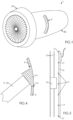
- a turbomachine 1 comprising a fan casing 2a and an internal casing 2b defining an internal space (also called “core” zone) in which the equipment of the turbomachine 1 is housed and in particular an oil reservoir 3.
- the tank 3 is housed in a space delimited externally by the internal casing 2b and internally by other elements of the turbomachine (not shown) such as for example a casing of a low pressure compressor.
- other elements of the turbomachine such as for example a casing of a low pressure compressor.
- the lower portion 6 and the upper portion 7 each represent a third of the total curved length of the enclosure 4.
- the control device 9 comprises a first sensor 10 positioned in the lower portion 6 to control the oil level there, and a second sensor 11 separate from the first sensor 10 and positioned in the upper portion 7 of the enclosure 4 to control the oil level there.
- the sensors 10, 11 are rectilinear sensors, simpler to manufacture than curved sensors, particularly in terms of manufacturing precision.
- the two sensors 10, 11 respectively have a length greater than the height of the lower portion 6 and the upper portion 7 of the tank 3.
- the first sensor 10 is positioned so as to cover the lower portion 6 and a part of the middle portion 8
- the second sensor 11 is positioned so as to cover the upper portion 7 and a part of the middle portion 8.
- the two sensors 10, 11 have a length substantially equal to half the total curved length of the enclosure 4.
- the oil level at any point in the tank 3.
- the Figures 2 and 3 are schematic and do not represent the lower, upper and middle portions 6, 7, 8 on a real scale.
- the two sensors 10, 11 respectively have a length less than the height of the lower portion 6 and the upper portion 7 of the tank 3.
- the first sensor 10 then only allows the oil level in the lower portion 6 of the tank to be monitored and the second sensor 11 then only allows the oil level in the upper portion 7 of the tank 3 to be controlled.
- the two sensors 10, 11 have a length slightly less than the height of the lower and upper portions 6, 7, that is to say slightly less than a third of the total curved length of the enclosure 4.
- the fixing of the first sensor 10 in the tank can be ensured either permanently, in which case it will not be possible to change the first sensor 10 in the event of failure (it will then be necessary to replace the entire tank 3), or removable.
- the tank comprises, on one of its walls, a sealing plug 12.
- the first sensor 10 can then be inserted and removed into or from the enclosure 4 through an opening 13 of the wall 5 which will be plugged by the sealing plug 12 once in place on wall 5.
- the first sensor 10 can be held in the enclosure 4 by stops (not shown).
- the senor can be secured to the sealing cap 12, as shown in the Figure 4 .
- the first sensor 10 When the first sensor 10 is removably attached, it is necessary to drain the reservoir (i.e. remove a certain amount of oil therefrom) to a level below the sealing plug 12 so that when the sealing plug 12 is opened, oil does not flow out of the reservoir through the opening 13.
- the fixing of the second sensor 11 in the tank 3 can be carried out in a known manner, that is to say by an access hatch (not shown) the second sensor 11 can then be removable.
- FIG. 5 schematically represents a particular type of sensor corresponding to the sensors 10, 11 used to control the oil level in the tank 3.
- This sensor comprises a float 14 which follows the oil level by being guided by rails 15 and comprises a magnetic element.
- an electromagnetic card 16 Opposite the float 14 is arranged an electromagnetic card 16 carrying contactors 17 which interact with the magnetic element of the float 14.
- the float 14 moves along the electromagnetic card 16 and the magnetic element acts with the contactors 17.
- the contactors 17 then move from an open position to a closed position, or vice versa, and an electrical signal circulates in the electromagnetic card 16 and is transmitted to an acquisition unit 18, remote from the tank 3, which transforms this electrical signal into information readable by a pilot or a mechanic.
- the transmission of the electrical signal is ensured by an electrical harness 19 associated with the first sensor 10 and an electrical harness 20 associated with the second sensor 11.
- the two electrical harnesses 19, 20 can join in a sheath 21.
- the float 14 of the second sensor 11 is in a high position and the electrical signal sent to the acquisition unit 18 is transformed into an alert signal for the pilot or the mechanic so that an intervention is carried out on the tank 3 and the excess oil is removed.
- the float 14 of the first sensor 10 When there is a lack of oil in the tank 3, the float 14 of the first sensor 10 is in a low position and the electrical signal sent to the acquisition unit 18 is transformed into an alert signal for the pilot or the mechanic so that an intervention is carried out on the tank 3 and oil is added to the tank 3.
- the float 14 of the first sensor 10 When the oil level in the tank 3 is at a correct level, the float 14 of the first sensor 10 is in a high position and the float 14 of the second sensor 11 is in an intermediate position or in a low position (in all cases, in a position away from its high position).
Landscapes
- Engineering & Computer Science (AREA)
- General Engineering & Computer Science (AREA)
- Mechanical Engineering (AREA)
- Chemical & Material Sciences (AREA)
- Combustion & Propulsion (AREA)
- Level Indicators Using A Float (AREA)
- Supply Devices, Intensifiers, Converters, And Telemotors (AREA)
Description
- La présente invention concerne un réservoir d'huile pour un moteur thermique, par exemple une turbomachine.
- Comme tous les moteurs thermiques, les turbomachines comprennent des pièces en mouvement relatif les unes par rapport aux autres. Pour faciliter le fonctionnement de la turbomachine et éviter que les pièces ne se détériorent, notamment à cause des frottements entre elles, les pièces doivent être lubrifiées.
- La lubrification est ordinairement faite au moyen d'une huile visqueuse qui recouvre les pièces et assure d'une part le glissement d'une pièce sur une autre et d'autre part le refroidissement, ou du moins le non échauffement, des pièces.
- L'huile est contenue dans un réservoir intégré à un circuit d'huile en boucle fermée qui diffuse ou projette l'huile sur les pièces à lubrifier.
- Il est important de connaître la quantité d'huile (on parle également de niveau d'huile) présente dans le réservoir et donc dans le circuit de lubrification.
- En effet, un trop plein d'huile dans le circuit de lubrification peut générer une surpression d'huile dans la turbomachine, au risque de la dégrader. De même, un manque d'huile dans le circuit de lubrification peut entraîner un manque de lubrification des pièces ayant un mouvement relatif entre elles et causer un échauffement de ces pièces pouvant conduire à une rupture de ces pièces ou à une soudure (due à réchauffement) des pièces entre elles par fusion locale.
- Pour connaître le niveau d'huile dans le réservoir, il est connu d'utiliser un dispositif de contrôle qui peut indiquer en temps réel la quantité d'huile.
- Un tel dispositif de contrôle comprend notamment un flotteur flottant à la surface de l'huile et qui intègre un élément magnétique. Le flotteur se déplace le long d'une carte magnétique qui comprend des contacteurs qui réagissent avec l'élément magnétique du flotteur, cette carte étant reliée à un système qui convertit la réaction des contacteurs en informations compréhensibles par un mécanicien ou un pilote de l'avion par exemple. Ainsi, lorsque le niveau d'huile dans le réservoir évolue, le flotteur ouvre ou ferme des contacteurs et le pilote et/ou le mécanicien peu(ven)t connaître la quantité d'huile dans le circuit de lubrification.
- Dans le cadre du développement de nouvelles turbomachines de dimensions réduites, les réservoirs d'huile présentent un rayon de courbure qui est de plus en plus faible.
- De même, certaines modifications de l'architecture des turbomachines peuvent prévoir le déplacement des réservoirs d'huile dans une zone du moteur, par exemple une zone « core » dans laquelle l'espace est réduit, notamment le rayon de courbure, par rapport à l'emplacement initial des réservoirs d'huile. Il est alors nécessaire de modifier les réservoirs d'huile, notamment en réduisant leur rayon de courbure.
- Ainsi, les dispositifs de contrôle qui sont généralement sensiblement rectilignes ou qui présentent une légère courbure ne peuvent pas être utilisés dans les réservoirs des nouvelles turbomachines ou dans les réservoirs modifiés. En effet, leur géométrie ne permet pas leur installation dans le réservoir ni leur démontage dans le faible espace autour du réservoir lorsque celui-ci est monté dans une turbomachine.
- L'adaptation d'un dispositif de contrôle connu aux formes d'un réservoir ayant un faible rayon de courbure engendrerait un coût trop important et ne résoudrait par le problème de démontage précédemment évoqué.
- L'invention a notamment pour but d'apporter une solution simple, efficace et économique à ce problème.
- A cet effet, l'invention propose une turbomachine selon la revendication 1.
- La présence de deux capteurs séparés permet, outre de pouvoir facilement les introduire tous les deux dans l'enceinte, de pouvoir ne contrôler que les portions supérieure et inférieure du réservoir dans lesquelles il existe des risques de trop plein ou, respectivement, de manque d'huile.
- Selon un aspect, l'enceinte comprend une portion milieu séparant la portion inférieure de la portion supérieure, et dans lequel le premier capteur est positionné de sorte à couvrir la portion inférieure et une partie de la portion milieu, et le second capteur est positionné de sorte à couvrir la portion supérieure et une partie de la portion milieu.
- Dans ce cas particulier, il est possible de connaître le niveau d'huile en tout point du réservoir. Ainsi, il est possible de réaliser un monitoring (expression anglaise signifiant une surveillance) de la consommation d'huile et définir si celle-ci est normale ou anormale.
- Avantageusement, l'enceinte comprend un bouchon d'étanchéité permettant l'introduction ou le retrait du premier capteur.
- Ce bouchon d'étanchéité permet notamment de faciliter les opérations de maintenance, puisque l'accès au premier capteur est direct, tout en limitant les fuites d'huile hors du réservoir.
- Selon un aspect, le premier capteur est solidaire du bouchon d'étanchéité.
- Cette particularité facilite encore les opérations de maintenance puisque, pour retirer le premier capteur du réservoir, il suffit simplement de retirer le bouchon étanche.
- De préférence, le premier capteur et le second capteur sont rectilignes.
- La forme rectiligne des capteurs permet de faciliter leur insertion et leur retrait puisque, contrairement à une forme courbée pour laquelle il faut qu'un périmètre autour du capteur soit dégagé, il suffit que l'espace au-dessus du capteur soit dégagé.
- Avantageusement, la portion supérieure et la portion inférieure représentent chacune un tiers de la longueur courbe totale de l'enceinte.
- Ces dimensions permettent d'utiliser des capteurs de petite taille notamment lorsque seuls le trop plein et le manque d'huile sont surveillés.
- L'invention sera mieux comprise et d'autres détails, caractéristiques et avantages de l'invention apparaîtront à la lecture de la description suivante faite à titre d'exemple non limitatif en référence aux dessins annexés dans lesquels :
- la
figure 1 est une vue en perspective d'une turbomachine comprenant un réservoir d'huile selon l'invention ; - la
figure 2 est une vue en coupe du réservoir de lafigure 1 selon un premier mode de réalisation ; - la
figure 3 est une vue en coupe du réservoir de lafigure 1 selon un second mode de réalisation ; - la
figure 4 est une vue de détail en coupe d'un bouchon étanche du réservoir d'huile des figures précédentes ; - la
figure 5 est une représentation schématique d'un capteur d'un dispositif de contrôle du niveau d'huile dans le réservoir des figures précédentes. - On a représenté, sur la
figure 1 , une turbomachine 1 comprenant un carter 2a fan et un carter 2b interne définissant un espace interne (également appelé zone « core ») dans lequel sont logés les équipements de la turbomachine 1 et notamment un réservoir 3 d'huile. - Le réservoir 3 est logé dans un espace délimité extérieurement par le carter 2b interne et intérieurement par d'autres éléments de la turbomachine (non représentés) comme par exemple un carter d'un compresseur basse pression. Ainsi, lorsque le réservoir 3 est installé dans la turbomachine 1, son rayon de courbure est important et son accès est restreint.
- Le réservoir 3, visible en coupe sur les
figures 2 et 3 , comprend : - une enceinte 4 close en forme d'arc de cercle, délimitée par des parois 5, dans laquelle est reçue l'huile, l'enceinte ayant une portion 6 inférieure et une portion 7 supérieure distantes l'une de l'autre et séparées par une portion 8 milieu, et
- un dispositif 9 de contrôle du niveau d'huile dans l'enceinte 4.
- Avantageusement, la portion 6 inférieure et la portion 7 supérieure représentent chacune un tiers de la longueur courbe totale de l'enceinte 4.
- Comme représenté aux
figures 2 et 3 , le dispositif 9 de contrôle comprend un premier capteur 10 positionné dans la portion 6 inférieure pour y contrôler le niveau d'huile, et un second capteur 11 séparé du premier capteur 10 et positionné dans la portion 7 supérieure de l'enceinte 4 pour y contrôler le niveau d'huile. - De préférence, les capteurs 10, 11 sont des capteurs rectilignes, plus simples de fabrication que des capteurs courbes, notamment en termes de précision de fabrication.
- Selon un premier mode de réalisation, représenté à la
figure 2 , les deux capteurs 10, 11 ont respectivement une longueur supérieure à la hauteur de la portion 6 inférieure et de la portion 7 supérieure du réservoir 3. Dans ce mode de réalisation, le premier capteur 10 est positionné de sorte à couvrir la portion 6 inférieure et une partie de la portion 8 milieu, et le second capteur 11 est positionné de sorte à couvrir la portion 7 supérieure et une partie de la portion 8 milieu. - Avantageusement, les deux capteurs 10, 11 ont une longueur sensiblement égale à la moitié de la longueur courbe totale de l'enceinte 4. Ainsi, il est possible de contrôler le niveau d'huile en tout point du réservoir 3. Nous précisons toutefois, que les
figures 2 et 3 sont schématiques et ne représentent pas les portions 6, 7, 8 inférieure, supérieure et milieu à échelle réelle. - Selon un second mode de réalisation représenté à la
figure 3 , les deux capteurs 10, 11 ont respectivement une longueur inférieure à la hauteur de la portion 6 inférieure et de la portion 7 supérieure du réservoir 3. Dans ce mode de réalisation le premier capteur 10 ne permet alors que de surveiller le niveau d'huile dans la portion 6 inférieure du réservoir et le second capteur 11 ne permet alors que de contrôler le niveau d'huile dans la portion 7 supérieure du réservoir 3. - Avantageusement, les deux capteurs 10, 11 ont une longueur légèrement inférieure à la hauteur des portions 6, 7 inférieure et supérieure, c'est-à-dire légèrement inférieure au tiers de la longueur courbe totale de l'enceinte 4.
- La fixation du premier capteur 10 dans le réservoir peut être assurée soit de manière définitive, auquel cas il ne sera pas possible de changer le premier capteur 10 en cas de défaillance (il faudra alors remplacer l'ensemble du réservoir 3), soit de manière amovible.
- Dans le cas d'une fixation amovible, le réservoir comprend, sur l'une de ses parois, un bouchon 12 d'étanchéité. Le premier capteur 10 peut alors être inséré et retiré dans ou de l'enceinte 4 par une ouverture 13 de la paroi 5 qui sera bouchée par le bouchon 12 d'étanchéité une fois en place sur la paroi 5.
- Selon une première variante, le premier capteur 10 peut être maintenu dans l'enceinte 4 par des butées (non représentées).
- Selon une seconde variante, le capteur peut être solidaire du bouchon 12 d'étanchéité, comme représenté sur la
figure 4 . - Lorsque le premier capteur 10 est fixé de manière amovible, il est nécessaire de vidanger le réservoir (c'est-à-dire d'en retirer une certaine quantité d'huile) jusqu'à un niveau situé en dessous du bouchon 12 d'étanchéité de sorte que lors de l'ouverture du bouchon 12 d'étanchéité, de l'huile ne s'écoule pas du réservoir par l'ouverture 13.
- La fixation du second capteur 11 dans le réservoir 3 peut être réalisée de manière connue, c'est-à-dire par une trappe d'accès (non représentée) le second capteur 11 pouvant alors être amovible.
- La
figure 5 représente de manière schématique un type particulier de capteur correspondant aux capteurs 10, 11 utilisés pour contrôler le niveau d'huile dans le réservoir 3. Ce capteur comprend un flotteur 14 qui suit le niveau d'huile en étant guidé par des rails 15 et comprend un élément magnétique. Face au flotteur 14 est disposée une carte 16 électromagnétique portant des contacteurs 17 qui interagissent avec l'élément magnétique du flotteur 14. - Lorsque le niveau dans le réservoir évolue, le flotteur 14 se déplace le long de la carte 16 électromagnétique et l'élément magnétique agit avec les contacteurs 17. Les contacteurs 17 passent alors d'une position ouverte à une position fermée, ou inversement, et un signal électrique circule dans la carte 16 électromagnétique et est transmis à une unité 18 d'acquisition, distante du réservoir 3, qui transforme ce signal électrique en une information lisible par un pilote ou un mécanicien.
- La transmission du signal électrique est assurée par un harnais 19 électrique associée au premier capteur 10 et un harnais 20 électrique associée au second capteur 11. Avantageusement, les deux harnais 19, 20 électriques peuvent se rejoindre dans une gaine 21.
- Ainsi, lorsqu'il y a un trop plein d'huile dans le réservoir 3, le flotteur 14 du second capteur 11 est dans une position haute et le signal électrique envoyé à l'unité 18 d'acquisition est transformé en un signal d'alerte pour le pilote ou le mécanicien pour qu'une intervention soit effectuée sur le réservoir 3 et que le trop plein d'huile soit retiré.
- Lorsqu'il y a un manque d'huile dans le réservoir 3, le flotteur 14 du premier capteur 10 est dans une position basse et le signal électrique envoyé à l'unité 18 d'acquisition est transformé en un signal d'alerte pour le pilote ou le mécanicien pour qu'une intervention soit effectuée sur le réservoir 3 et que de l'huile soit ajoutée dans le réservoir 3.
- Lorsque le niveau d'huile dans le réservoir 3 est à un niveau correct, le flotteur 14 du premier capteur 10 est dans une position haute et le flotteur 14 du second capteur 11 est dans une position intermédiaire ou dans une position basse (dans tous les cas, dans une position écartée de sa position haute).
- Le réservoir 3 qui vient d'être décrit présente certains avantages tels que :
- un gain de masse du réservoir 3, en ce que deux capteurs de petites dimensions peuvent être utilisés en remplacement d'un unique capteur de grandes dimensions ;
- une maintenance aisée, en ce que l'accès au premier capteur 10 se fait par l'ouverture 13 et le bouchon 12 d'étanchéité, ou encore
- un contrôle au plus juste de la quantité d'huile dans le réservoir 3, en ce qu'il n'est pas toujours utile de connaitre la quantité d'huile dans la portion 8 milieu du réservoir 3 puisque seuls le manque d'huile (dans la portion 6 inférieure) et le trop plein (dans la portion 7 supérieure) sont critiques.
Claims (6)
- Turbomachine comportant un réservoir (3) d'huile pour turbomachine (1) et une unité d'acquisition (18) distante du réservoir, le réservoir d'huile comprenant :- une enceinte (4) close en forme d'arc de cercle apte à recevoir l'huile, l'enceinte (4) ayant une portion (6) inférieure et une portion (7) supérieure distantes l'une de l'autre, et- un dispositif (9) de contrôle du niveau d'huile dans l'enceinte (4), caractérisé en ce que le dispositif (9) de contrôle comprend un premier capteur (10), caractérisé en ce que le premier capteur est positionné dans la portion (6) inférieure de l'enceinte (4) pour y contrôler le niveau d'huile, le dispositif comportant un second capteur (11) séparé du premier capteur (10) et positionné dans la portion (7) supérieure de l'enceinte (4) pour y contrôler le niveau d'huile,
le premier capteur (10) comprenant- un premier élément magnétique,- un premier flotteur (14) attaché au premier élément magnétique,- des premiers rails (15) configurés pour guider le premier flotteur (14),- une première carte électromagnétique (16) disposée face au premier flotteur (14) et comprenant des premiers contacteurs (17) configurés pour passer d'une position ouverte à une position fermée en fonction de la position du premier élément magnétique,- un premier harnais électrique (19) assurant la transmission du signal électrique de la première carte électromagnétique (19) à l'unité d'acquisition (18),
le second capteur (11) comprenant- un second élément magnétique,- un second flotteur (14) attaché au second élément magnétique,- des seconds rails configurés pour guider le second flotteur (14),- une deuxième carte électromagnétique (16) disposée face au second flotteur (14) et comprenant des seconds contacteurs (17) configurés pour passer d'une position ouverte à une position fermée en fonction de la position du second élément magnétique,- un second harnais électrique (20) assurant la transmission du signal électrique de la seconde carte électromagnétique (16) à l'unité d'acquisition (18). - Turbomachine selon la revendication 1, dans laquelle l'enceinte (4) comprend une portion (8) milieu séparant la portion (6) inférieure de la portion (7) supérieure, et dans laquelle le premier capteur (10) est positionné de sorte à couvrir la portion (6) inférieure et une partie de la portion (8) milieu, et le second capteur (11) est positionné de sorte à couvrir la portion (7) supérieure et une partie de la portion (8) milieu.
- Turbomachine selon l'une quelconque des revendications précédentes, dans laquelle l'enceinte (4) comprend un bouchon (12) d'étanchéité permettant l'introduction ou le retrait du premier capteur (10).
- Turbomachine selon la revendication précédente, dans laquelle le premier capteur (10) est solidaire du bouchon (12) d'étanchéité.
- Turbomachine selon l'une quelconque des revendications précédentes, dans laquelle le premier capteur (10) et le second capteur (11) sont rectilignes.
- Turbomachine selon l'une quelconque des revendications précédentes, dans laquelle la portion (7) supérieure et la portion (6) inférieure représentent chacune un tiers de la longueur courbe totale de l'enceinte (4).
Applications Claiming Priority (1)
| Application Number | Priority Date | Filing Date | Title |
|---|---|---|---|
| FR1661593A FR3059361B1 (fr) | 2016-11-28 | 2016-11-28 | Reservoir d'huile comprenant un dispositif de controle du niveau d'huile |
Publications (3)
| Publication Number | Publication Date |
|---|---|
| EP3327260A1 EP3327260A1 (fr) | 2018-05-30 |
| EP3327260B1 EP3327260B1 (fr) | 2020-07-08 |
| EP3327260B2 true EP3327260B2 (fr) | 2025-06-11 |
Family
ID=57755365
Family Applications (1)
| Application Number | Title | Priority Date | Filing Date |
|---|---|---|---|
| EP17203505.7A Active EP3327260B2 (fr) | 2016-11-28 | 2017-11-24 | Réservoir d'huile comprenant un dispositif de contrôle du niveau d'huile |
Country Status (4)
| Country | Link |
|---|---|
| US (1) | US10683774B2 (fr) |
| EP (1) | EP3327260B2 (fr) |
| CN (1) | CN108119193B (fr) |
| FR (1) | FR3059361B1 (fr) |
Families Citing this family (5)
| Publication number | Priority date | Publication date | Assignee | Title |
|---|---|---|---|---|
| FR3059361B1 (fr) * | 2016-11-28 | 2018-12-07 | Safran Aircraft Engines | Reservoir d'huile comprenant un dispositif de controle du niveau d'huile |
| BE1026218B1 (fr) * | 2018-04-19 | 2019-11-21 | Safran Aero Boosters S.A. | Dispositif de mesure de niveau pour réservoir d'huile de turbomachine |
| FR3086325B1 (fr) * | 2018-09-24 | 2020-11-20 | Safran Aircraft Engines | Reservoir auxiliaire d'huile pour une turbomachine d'aeronef |
| US12055430B2 (en) | 2022-11-21 | 2024-08-06 | Honeywell International Inc. | Fluid level sensor for a toroid-shaped tank |
| US12510002B2 (en) * | 2023-07-12 | 2025-12-30 | General Electric Company | Lubrication system for a turbine engine |
Family Cites Families (29)
| Publication number | Priority date | Publication date | Assignee | Title |
|---|---|---|---|---|
| FR96297E (fr) | 1967-11-24 | 1972-06-16 | Gen Electric | Détecteur de niveau de liquides. |
| US3741683A (en) * | 1971-07-02 | 1973-06-26 | Fmc Corp | Liquid level control system |
| DE2201910C3 (de) * | 1972-01-15 | 1974-10-03 | Daimler-Benz Ag, 7000 Stuttgart | Vorrichtung zur Niveau- und/oder Temperaturkontrolle von Flüssigkeiten |
| US4265262A (en) * | 1979-03-19 | 1981-05-05 | William Hotine | Fluent material level control system |
| US4745893A (en) * | 1986-12-03 | 1988-05-24 | Caterpillar Inc. | Digital oil level sensor |
| JP2731240B2 (ja) * | 1989-05-25 | 1998-03-25 | 富士重工業株式会社 | オイルセンサ |
| JPH05141217A (ja) * | 1991-11-14 | 1993-06-08 | Toyota Motor Corp | オイルレベルセンサ |
| CN2138289Y (zh) * | 1992-08-10 | 1993-07-14 | 张传新 | 浮磁式水位针 |
| US6584997B1 (en) * | 1998-03-30 | 2003-07-01 | Caterpillar Inc. | Overflow prevention mechanism for liquid transfer systems |
| US7216473B1 (en) * | 1999-07-09 | 2007-05-15 | Hamilton Sundstrand Corporation | Turbojet engine lubrication system |
| KR20020081624A (ko) * | 2001-04-19 | 2002-10-30 | 현대자동차주식회사 | 오일팬의 오일 보충장치 |
| US6776261B2 (en) * | 2002-05-29 | 2004-08-17 | Garlock Sealing Technologies Llc | Lubricant monitoring system |
| US6998552B1 (en) | 2005-07-27 | 2006-02-14 | Young-G Enterprise Corporation | Float-type liquid level switch assembly with light emitting elements |
| US8020665B2 (en) * | 2006-11-22 | 2011-09-20 | United Technologies Corporation | Lubrication system with extended emergency operability |
| US8215454B2 (en) * | 2006-11-22 | 2012-07-10 | United Technologies Corporation | Lubrication system with tolerance for reduced gravity |
| US8103462B2 (en) * | 2007-10-25 | 2012-01-24 | United Technologies Corporation | Oil consumption monitoring for aircraft engine |
| US8746410B1 (en) * | 2008-03-14 | 2014-06-10 | Raymond P. Lekowicz | Outdrive gear oil monitor |
| US8549911B2 (en) | 2008-05-29 | 2013-10-08 | Ilinois Tool Works Inc. | Multi-level liquid level magnetic sensor |
| US8627667B2 (en) * | 2008-12-29 | 2014-01-14 | Roll-Royce Corporation | Gas turbine engine duct having a coupled fluid volume |
| FR2941744B1 (fr) * | 2009-01-30 | 2011-09-16 | Hispano Suiza Sa | Ensemble d'un boitier de relais d'accessoires et d'un reservoir d'huile |
| EP2573338B1 (fr) * | 2011-09-20 | 2017-07-19 | Safran Aero Boosters SA | Contrôle du sur-remplissage d'un système de lubrification d'un moteur d'aéronef |
| US8985278B2 (en) * | 2012-09-07 | 2015-03-24 | United Technologies Corporation | Lubrication system having segmented anti-backflow feature |
| US20140076661A1 (en) * | 2012-09-19 | 2014-03-20 | United Technologies Corporation | Lubrication system having porous feature |
| FR3005486B1 (fr) * | 2013-05-07 | 2017-08-18 | Snecma | Lubrification dans une turbomachine |
| FR3010701B1 (fr) * | 2013-09-13 | 2015-10-09 | Snecma | Agencement d'un reservoir entre un capot de nacelle et une turbomachine |
| GB201419770D0 (en) * | 2014-11-06 | 2014-12-24 | Rolls Royce Plc | An oil distributor |
| CN205186537U (zh) * | 2015-10-23 | 2016-04-27 | 成都飞机工业(集团)有限责任公司 | 一种整体嵌入式滑油箱 |
| FR3059361B1 (fr) * | 2016-11-28 | 2018-12-07 | Safran Aircraft Engines | Reservoir d'huile comprenant un dispositif de controle du niveau d'huile |
| BE1025191B1 (fr) * | 2017-05-03 | 2018-12-06 | Safran Aero Boosters S.A. | Reservoir a sonde de niveau d’huile pour turbomachine |
-
2016
- 2016-11-28 FR FR1661593A patent/FR3059361B1/fr active Active
-
2017
- 2017-11-24 EP EP17203505.7A patent/EP3327260B2/fr active Active
- 2017-11-27 US US15/822,812 patent/US10683774B2/en active Active
- 2017-11-28 CN CN201711210836.4A patent/CN108119193B/zh active Active
Also Published As
| Publication number | Publication date |
|---|---|
| CN108119193A (zh) | 2018-06-05 |
| CN108119193B (zh) | 2022-03-18 |
| FR3059361A1 (fr) | 2018-06-01 |
| EP3327260B1 (fr) | 2020-07-08 |
| EP3327260A1 (fr) | 2018-05-30 |
| US20180156066A1 (en) | 2018-06-07 |
| FR3059361B1 (fr) | 2018-12-07 |
| US10683774B2 (en) | 2020-06-16 |
Similar Documents
| Publication | Publication Date | Title |
|---|---|---|
| EP3327260B1 (fr) | Réservoir d'huile comprenant un dispositif de contrôle du niveau d'huile | |
| EP2573338B1 (fr) | Contrôle du sur-remplissage d'un système de lubrification d'un moteur d'aéronef | |
| EP2072762B1 (fr) | Méthode de contrôle de la consommation et de détection de fuites dans un système de lubrification de turbomachine | |
| FR3010701A1 (fr) | Agencement d'un reservoir entre un capot de nacelle et une turbomachine | |
| FR3126244A1 (fr) | Capteur de détermination d’un niveau de liquide pour un réservoir d’aéronef, ensemble d’un réservoir et d’un capteur, procédé d’utilisation d’un tel capteur | |
| EP3149313B1 (fr) | Procédé et dispositif de contrôle d'une poussée d'un turboréacteur | |
| US11698025B2 (en) | Oil leakage monitoring system | |
| FR2648892A1 (fr) | Recipient de pression | |
| EP0943476A1 (fr) | Circuit de mise à l'air pour réservoir à liquide | |
| FR2829824A1 (fr) | Dispositif d'etancheite d'une cavite, notamment pour sonde de mesure d'incidence utilisee en aeronautique | |
| FR2895512A1 (fr) | Procede et dispositif de mesure automatique de la consommation en huile d'un moteur a combustion interne et de vidange dudit moteur | |
| EP1041256A1 (fr) | Dispositif thermostatique à deux régimes de régulation, à deux éléments thermostatiques | |
| EP3004700B1 (fr) | Système de régulation d'un liquide dans un circuit | |
| FR3044404A1 (fr) | Systeme de surveillance d'une quantite d'huile d'un reservoir d'un moteur d'aeronef. | |
| EP3277992B1 (fr) | Gicleur d'huile pour turbomachine | |
| EP0206845B1 (fr) | Dispositif pour l'indication de la quantité d'un liquide dans un réservoir et réservoir pourvu d'un tel dispositif | |
| EP3587896B1 (fr) | Régulateur d'alimentation en gaz | |
| US5190180A (en) | Reservoir fill tube with anti-leak valve | |
| EP3004699A1 (fr) | Système de régulation d'un liquide dans un circuit | |
| FR3129977A1 (fr) | Tronçon de ligne d’échappement | |
| EP3382399A1 (fr) | Dispositif de détection d'un passage de graisse et système de graissage associé | |
| WO2004005772A1 (fr) | Agencement d'un capteur et de ses connexions filaires dans un joint de culasse metallique, multifeuilles | |
| JPS61112712A (ja) | 潤滑油劣化検知装置 | |
| EP1143192A1 (fr) | Dispositif de sécurité de surpression d'un réservoir contenant du gaz de pétrole liquefié | |
| FR3103271A1 (fr) | Systeme de detection de pression dans une enceinte |
Legal Events
| Date | Code | Title | Description |
|---|---|---|---|
| PUAI | Public reference made under article 153(3) epc to a published international application that has entered the european phase |
Free format text: ORIGINAL CODE: 0009012 |
|
| STAA | Information on the status of an ep patent application or granted ep patent |
Free format text: STATUS: THE APPLICATION HAS BEEN PUBLISHED |
|
| AK | Designated contracting states |
Kind code of ref document: A1 Designated state(s): AL AT BE BG CH CY CZ DE DK EE ES FI FR GB GR HR HU IE IS IT LI LT LU LV MC MK MT NL NO PL PT RO RS SE SI SK SM TR |
|
| AX | Request for extension of the european patent |
Extension state: BA ME |
|
| STAA | Information on the status of an ep patent application or granted ep patent |
Free format text: STATUS: REQUEST FOR EXAMINATION WAS MADE |
|
| 17P | Request for examination filed |
Effective date: 20181119 |
|
| RBV | Designated contracting states (corrected) |
Designated state(s): AL AT BE BG CH CY CZ DE DK EE ES FI FR GB GR HR HU IE IS IT LI LT LU LV MC MK MT NL NO PL PT RO RS SE SI SK SM TR |
|
| STAA | Information on the status of an ep patent application or granted ep patent |
Free format text: STATUS: EXAMINATION IS IN PROGRESS |
|
| REG | Reference to a national code |
Ref country code: DE Ref legal event code: R079 Ref document number: 602017019304 Country of ref document: DE Free format text: PREVIOUS MAIN CLASS: F01D0025180000 Ipc: F01M0011120000 |
|
| GRAP | Despatch of communication of intention to grant a patent |
Free format text: ORIGINAL CODE: EPIDOSNIGR1 |
|
| STAA | Information on the status of an ep patent application or granted ep patent |
Free format text: STATUS: GRANT OF PATENT IS INTENDED |
|
| 17Q | First examination report despatched |
Effective date: 20200402 |
|
| RIC1 | Information provided on ipc code assigned before grant |
Ipc: F01M 11/12 20060101AFI20200409BHEP Ipc: F16N 19/00 20060101ALI20200409BHEP Ipc: F01D 25/20 20060101ALI20200409BHEP |
|
| INTG | Intention to grant announced |
Effective date: 20200506 |
|
| GRAS | Grant fee paid |
Free format text: ORIGINAL CODE: EPIDOSNIGR3 |
|
| GRAA | (expected) grant |
Free format text: ORIGINAL CODE: 0009210 |
|
| STAA | Information on the status of an ep patent application or granted ep patent |
Free format text: STATUS: THE PATENT HAS BEEN GRANTED |
|
| AK | Designated contracting states |
Kind code of ref document: B1 Designated state(s): AL AT BE BG CH CY CZ DE DK EE ES FI FR GB GR HR HU IE IS IT LI LT LU LV MC MK MT NL NO PL PT RO RS SE SI SK SM TR |
|
| REG | Reference to a national code |
Ref country code: CH Ref legal event code: EP Ref country code: AT Ref legal event code: REF Ref document number: 1288685 Country of ref document: AT Kind code of ref document: T Effective date: 20200715 |
|
| REG | Reference to a national code |
Ref country code: DE Ref legal event code: R096 Ref document number: 602017019304 Country of ref document: DE |
|
| REG | Reference to a national code |
Ref country code: IE Ref legal event code: FG4D Free format text: LANGUAGE OF EP DOCUMENT: FRENCH |
|
| REG | Reference to a national code |
Ref country code: SE Ref legal event code: TRGR |
|
| REG | Reference to a national code |
Ref country code: LT Ref legal event code: MG4D |
|
| REG | Reference to a national code |
Ref country code: AT Ref legal event code: MK05 Ref document number: 1288685 Country of ref document: AT Kind code of ref document: T Effective date: 20200708 |
|
| REG | Reference to a national code |
Ref country code: NL Ref legal event code: MP Effective date: 20200708 |
|
| PG25 | Lapsed in a contracting state [announced via postgrant information from national office to epo] |
Ref country code: ES Free format text: LAPSE BECAUSE OF FAILURE TO SUBMIT A TRANSLATION OF THE DESCRIPTION OR TO PAY THE FEE WITHIN THE PRESCRIBED TIME-LIMIT Effective date: 20200708 Ref country code: HR Free format text: LAPSE BECAUSE OF FAILURE TO SUBMIT A TRANSLATION OF THE DESCRIPTION OR TO PAY THE FEE WITHIN THE PRESCRIBED TIME-LIMIT Effective date: 20200708 Ref country code: LT Free format text: LAPSE BECAUSE OF FAILURE TO SUBMIT A TRANSLATION OF THE DESCRIPTION OR TO PAY THE FEE WITHIN THE PRESCRIBED TIME-LIMIT Effective date: 20200708 Ref country code: PT Free format text: LAPSE BECAUSE OF FAILURE TO SUBMIT A TRANSLATION OF THE DESCRIPTION OR TO PAY THE FEE WITHIN THE PRESCRIBED TIME-LIMIT Effective date: 20201109 Ref country code: FI Free format text: LAPSE BECAUSE OF FAILURE TO SUBMIT A TRANSLATION OF THE DESCRIPTION OR TO PAY THE FEE WITHIN THE PRESCRIBED TIME-LIMIT Effective date: 20200708 Ref country code: NO Free format text: LAPSE BECAUSE OF FAILURE TO SUBMIT A TRANSLATION OF THE DESCRIPTION OR TO PAY THE FEE WITHIN THE PRESCRIBED TIME-LIMIT Effective date: 20201008 Ref country code: GR Free format text: LAPSE BECAUSE OF FAILURE TO SUBMIT A TRANSLATION OF THE DESCRIPTION OR TO PAY THE FEE WITHIN THE PRESCRIBED TIME-LIMIT Effective date: 20201009 Ref country code: BG Free format text: LAPSE BECAUSE OF FAILURE TO SUBMIT A TRANSLATION OF THE DESCRIPTION OR TO PAY THE FEE WITHIN THE PRESCRIBED TIME-LIMIT Effective date: 20201008 Ref country code: AT Free format text: LAPSE BECAUSE OF FAILURE TO SUBMIT A TRANSLATION OF THE DESCRIPTION OR TO PAY THE FEE WITHIN THE PRESCRIBED TIME-LIMIT Effective date: 20200708 |
|
| PG25 | Lapsed in a contracting state [announced via postgrant information from national office to epo] |
Ref country code: RS Free format text: LAPSE BECAUSE OF FAILURE TO SUBMIT A TRANSLATION OF THE DESCRIPTION OR TO PAY THE FEE WITHIN THE PRESCRIBED TIME-LIMIT Effective date: 20200708 Ref country code: PL Free format text: LAPSE BECAUSE OF FAILURE TO SUBMIT A TRANSLATION OF THE DESCRIPTION OR TO PAY THE FEE WITHIN THE PRESCRIBED TIME-LIMIT Effective date: 20200708 Ref country code: LV Free format text: LAPSE BECAUSE OF FAILURE TO SUBMIT A TRANSLATION OF THE DESCRIPTION OR TO PAY THE FEE WITHIN THE PRESCRIBED TIME-LIMIT Effective date: 20200708 Ref country code: IS Free format text: LAPSE BECAUSE OF FAILURE TO SUBMIT A TRANSLATION OF THE DESCRIPTION OR TO PAY THE FEE WITHIN THE PRESCRIBED TIME-LIMIT Effective date: 20201108 |
|
| PG25 | Lapsed in a contracting state [announced via postgrant information from national office to epo] |
Ref country code: NL Free format text: LAPSE BECAUSE OF FAILURE TO SUBMIT A TRANSLATION OF THE DESCRIPTION OR TO PAY THE FEE WITHIN THE PRESCRIBED TIME-LIMIT Effective date: 20200708 |
|
| REG | Reference to a national code |
Ref country code: DE Ref legal event code: R026 Ref document number: 602017019304 Country of ref document: DE |
|
| PLBI | Opposition filed |
Free format text: ORIGINAL CODE: 0009260 |
|
| PLAX | Notice of opposition and request to file observation + time limit sent |
Free format text: ORIGINAL CODE: EPIDOSNOBS2 |
|
| PG25 | Lapsed in a contracting state [announced via postgrant information from national office to epo] |
Ref country code: DK Free format text: LAPSE BECAUSE OF FAILURE TO SUBMIT A TRANSLATION OF THE DESCRIPTION OR TO PAY THE FEE WITHIN THE PRESCRIBED TIME-LIMIT Effective date: 20200708 Ref country code: CZ Free format text: LAPSE BECAUSE OF FAILURE TO SUBMIT A TRANSLATION OF THE DESCRIPTION OR TO PAY THE FEE WITHIN THE PRESCRIBED TIME-LIMIT Effective date: 20200708 Ref country code: RO Free format text: LAPSE BECAUSE OF FAILURE TO SUBMIT A TRANSLATION OF THE DESCRIPTION OR TO PAY THE FEE WITHIN THE PRESCRIBED TIME-LIMIT Effective date: 20200708 Ref country code: EE Free format text: LAPSE BECAUSE OF FAILURE TO SUBMIT A TRANSLATION OF THE DESCRIPTION OR TO PAY THE FEE WITHIN THE PRESCRIBED TIME-LIMIT Effective date: 20200708 Ref country code: SM Free format text: LAPSE BECAUSE OF FAILURE TO SUBMIT A TRANSLATION OF THE DESCRIPTION OR TO PAY THE FEE WITHIN THE PRESCRIBED TIME-LIMIT Effective date: 20200708 |
|
| 26 | Opposition filed |
Opponent name: RAYTHEON TECHNOLOGIES CORPORATION Effective date: 20210408 |
|
| PG25 | Lapsed in a contracting state [announced via postgrant information from national office to epo] |
Ref country code: AL Free format text: LAPSE BECAUSE OF FAILURE TO SUBMIT A TRANSLATION OF THE DESCRIPTION OR TO PAY THE FEE WITHIN THE PRESCRIBED TIME-LIMIT Effective date: 20200708 |
|
| PG25 | Lapsed in a contracting state [announced via postgrant information from national office to epo] |
Ref country code: MC Free format text: LAPSE BECAUSE OF FAILURE TO SUBMIT A TRANSLATION OF THE DESCRIPTION OR TO PAY THE FEE WITHIN THE PRESCRIBED TIME-LIMIT Effective date: 20200708 Ref country code: SK Free format text: LAPSE BECAUSE OF FAILURE TO SUBMIT A TRANSLATION OF THE DESCRIPTION OR TO PAY THE FEE WITHIN THE PRESCRIBED TIME-LIMIT Effective date: 20200708 |
|
| REG | Reference to a national code |
Ref country code: CH Ref legal event code: PL |
|
| PG25 | Lapsed in a contracting state [announced via postgrant information from national office to epo] |
Ref country code: LU Free format text: LAPSE BECAUSE OF NON-PAYMENT OF DUE FEES Effective date: 20201124 |
|
| PLBB | Reply of patent proprietor to notice(s) of opposition received |
Free format text: ORIGINAL CODE: EPIDOSNOBS3 |
|
| REG | Reference to a national code |
Ref country code: BE Ref legal event code: MM Effective date: 20201130 |
|
| PG25 | Lapsed in a contracting state [announced via postgrant information from national office to epo] |
Ref country code: CH Free format text: LAPSE BECAUSE OF NON-PAYMENT OF DUE FEES Effective date: 20201130 Ref country code: LI Free format text: LAPSE BECAUSE OF NON-PAYMENT OF DUE FEES Effective date: 20201130 Ref country code: SI Free format text: LAPSE BECAUSE OF FAILURE TO SUBMIT A TRANSLATION OF THE DESCRIPTION OR TO PAY THE FEE WITHIN THE PRESCRIBED TIME-LIMIT Effective date: 20200708 |
|
| PG25 | Lapsed in a contracting state [announced via postgrant information from national office to epo] |
Ref country code: IE Free format text: LAPSE BECAUSE OF NON-PAYMENT OF DUE FEES Effective date: 20201124 |
|
| PG25 | Lapsed in a contracting state [announced via postgrant information from national office to epo] |
Ref country code: TR Free format text: LAPSE BECAUSE OF FAILURE TO SUBMIT A TRANSLATION OF THE DESCRIPTION OR TO PAY THE FEE WITHIN THE PRESCRIBED TIME-LIMIT Effective date: 20200708 Ref country code: MT Free format text: LAPSE BECAUSE OF FAILURE TO SUBMIT A TRANSLATION OF THE DESCRIPTION OR TO PAY THE FEE WITHIN THE PRESCRIBED TIME-LIMIT Effective date: 20200708 Ref country code: CY Free format text: LAPSE BECAUSE OF FAILURE TO SUBMIT A TRANSLATION OF THE DESCRIPTION OR TO PAY THE FEE WITHIN THE PRESCRIBED TIME-LIMIT Effective date: 20200708 |
|
| PG25 | Lapsed in a contracting state [announced via postgrant information from national office to epo] |
Ref country code: MK Free format text: LAPSE BECAUSE OF FAILURE TO SUBMIT A TRANSLATION OF THE DESCRIPTION OR TO PAY THE FEE WITHIN THE PRESCRIBED TIME-LIMIT Effective date: 20200708 |
|
| PG25 | Lapsed in a contracting state [announced via postgrant information from national office to epo] |
Ref country code: BE Free format text: LAPSE BECAUSE OF NON-PAYMENT OF DUE FEES Effective date: 20201130 |
|
| APBM | Appeal reference recorded |
Free format text: ORIGINAL CODE: EPIDOSNREFNO |
|
| APBP | Date of receipt of notice of appeal recorded |
Free format text: ORIGINAL CODE: EPIDOSNNOA2O |
|
| APAH | Appeal reference modified |
Free format text: ORIGINAL CODE: EPIDOSCREFNO |
|
| APBQ | Date of receipt of statement of grounds of appeal recorded |
Free format text: ORIGINAL CODE: EPIDOSNNOA3O |
|
| APAH | Appeal reference modified |
Free format text: ORIGINAL CODE: EPIDOSCREFNO |
|
| PLAB | Opposition data, opponent's data or that of the opponent's representative modified |
Free format text: ORIGINAL CODE: 0009299OPPO |
|
| R26 | Opposition filed (corrected) |
Opponent name: RTX CORPORATION Effective date: 20210408 |
|
| APBU | Appeal procedure closed |
Free format text: ORIGINAL CODE: EPIDOSNNOA9O |
|
| PUAH | Patent maintained in amended form |
Free format text: ORIGINAL CODE: 0009272 |
|
| STAA | Information on the status of an ep patent application or granted ep patent |
Free format text: STATUS: PATENT MAINTAINED AS AMENDED |
|
| 27A | Patent maintained in amended form |
Effective date: 20250611 |
|
| AK | Designated contracting states |
Kind code of ref document: B2 Designated state(s): AL AT BE BG CH CY CZ DE DK EE ES FI FR GB GR HR HU IE IS IT LI LT LU LV MC MK MT NL NO PL PT RO RS SE SI SK SM TR |
|
| REG | Reference to a national code |
Ref country code: DE Ref legal event code: R102 Ref document number: 602017019304 Country of ref document: DE |
|
| REG | Reference to a national code |
Ref country code: SE Ref legal event code: RPEO |
|
| PGFP | Annual fee paid to national office [announced via postgrant information from national office to epo] |
Ref country code: DE Payment date: 20251118 Year of fee payment: 9 |
|
| PGFP | Annual fee paid to national office [announced via postgrant information from national office to epo] |
Ref country code: GB Payment date: 20251125 Year of fee payment: 9 |
|
| PGFP | Annual fee paid to national office [announced via postgrant information from national office to epo] |
Ref country code: IT Payment date: 20251128 Year of fee payment: 9 |
|
| PGFP | Annual fee paid to national office [announced via postgrant information from national office to epo] |
Ref country code: FR Payment date: 20251125 Year of fee payment: 9 |
|
| PGFP | Annual fee paid to national office [announced via postgrant information from national office to epo] |
Ref country code: SE Payment date: 20251119 Year of fee payment: 9 |