EP3326558B1 - Intramedulläres befestigungssystem zur behandlung von becken- und gelenkpfannenfrakturen - Google Patents
Intramedulläres befestigungssystem zur behandlung von becken- und gelenkpfannenfrakturen Download PDFInfo
- Publication number
- EP3326558B1 EP3326558B1 EP17207050.0A EP17207050A EP3326558B1 EP 3326558 B1 EP3326558 B1 EP 3326558B1 EP 17207050 A EP17207050 A EP 17207050A EP 3326558 B1 EP3326558 B1 EP 3326558B1
- Authority
- EP
- European Patent Office
- Prior art keywords
- flexible tube
- bone
- bead
- expansion
- segments
- Prior art date
- Legal status (The legal status is an assumption and is not a legal conclusion. Google has not performed a legal analysis and makes no representation as to the accuracy of the status listed.)
- Active
Links
Images




Classifications
-
- A—HUMAN NECESSITIES
- A61—MEDICAL OR VETERINARY SCIENCE; HYGIENE
- A61B—DIAGNOSIS; SURGERY; IDENTIFICATION
- A61B17/00—Surgical instruments, devices or methods
- A61B17/16—Instruments for performing osteoclasis; Drills or chisels for bones; Trepans
- A61B17/164—Instruments for performing osteoclasis; Drills or chisels for bones; Trepans intramedullary
-
- A—HUMAN NECESSITIES
- A61—MEDICAL OR VETERINARY SCIENCE; HYGIENE
- A61B—DIAGNOSIS; SURGERY; IDENTIFICATION
- A61B17/00—Surgical instruments, devices or methods
- A61B17/56—Surgical instruments or methods for treatment of bones or joints; Devices specially adapted therefor
- A61B17/58—Surgical instruments or methods for treatment of bones or joints; Devices specially adapted therefor for osteosynthesis, e.g. bone plates, screws or setting implements
- A61B17/68—Internal fixation devices, including fasteners and spinal fixators, even if a part thereof projects from the skin
- A61B17/72—Intramedullary devices, e.g. pins or nails
- A61B17/7208—Flexible pins, e.g. ENDER pins
-
- A—HUMAN NECESSITIES
- A61—MEDICAL OR VETERINARY SCIENCE; HYGIENE
- A61B—DIAGNOSIS; SURGERY; IDENTIFICATION
- A61B17/00—Surgical instruments, devices or methods
- A61B17/16—Instruments for performing osteoclasis; Drills or chisels for bones; Trepans
- A61B2017/1602—Mills
Definitions
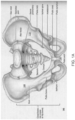
- FIG. 1A depicts a frontal view of the skeletal structure forming the pelvic ring
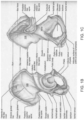
- FIGS. 1B and 1C depict cross-sectional side views of the skeletal structure forming the pelvic ring.
- the pelvic ring includes right and left ilium bones 105, 110, the sacrum 115 and their associated ligamentous connections.
- the main connections are through and around the right and left sacrociliac joints 120, 125 at the posterior of the pelvis and the pubic symphysis 130 at the anterior of the pelvis.
- the pelvic ring is a key structural element of the skeletal system because it is a weight-bearing structure interposed between the upper body and the legs.
- the pelvic ring may not heal (nonunion) or may heal in a poor position (malunion).
- Nonunion can lead to chronic pain and an inability to walk.
- Malunion can result in a short leg or one which points in the wrong direction. Because of these problems, it is necessary to reposition to normal the fragments which have become displaced during the fracturing (reduction). Once the fragments are repositioned, it is necessary to hold them in place (fixation) until the healing of the fracture is complete. This process may take approximately 6 to 8 weeks.
- the pelvic ring forms a ring structure, it cannot be disrupted in one place when a fracture occurs. Typically, a disruption, or "break,” occurs in both the posterior and anterior portions of the pelvic ring.
- the disruptions in the pelvic ring can be through one or more of the bones 105, 110, 115, through the posterior sacrociliac joints 120, 125, through the pubic symphysis 130 at the front, or any number of combinations of the above. If the acetabulum (a portion of each ilium bone 105, 110 forming the hip socket) is fractured, the smooth bearing surface of the acetabulum must be restored to as close to its original shape as possible in order to allow for proper movement at the hip. Once restored, the acetabulum must be held in the restored position until healing occurs.
- Conventional treatment of a pelvic fracture includes reduction of the fracture fragments and fixation with plates and screws along the surface of the bone.
- placing a plate on the bone requires a significant operation with resulting high blood loss.
- a straight intramedullary screw may be placed along a curved path. While the screw is less invasive, the fixation may be inadequate because the straight screw cannot be implanted very far into a curved bone. This may result in inadequate fixation.
- the screw must be relatively small in diameter to avoid extending through the bone. Surgically speaking, implanting a screw such that it extends from the bone can result in significant hazard to the patient because it may puncture or otherwise impinge upon important vascular and nervous structures.
- WO 2008/116 175 A2 discloses an intramedullary structure that is not lockable in a curved shape.
- the object is achieved by the features of the respective independent claim. Further embodiments are defined in the respective dependent claims.
- fixing refers to holding or setting something in place.
- a bone fracture may be fixed by causing a device placed across the point of fracture to become rigid, thereby stabilizing the bone on either side of the fracture.
- the device itself may become fixed by making the device become rigid as a result of actuation of an actuator.
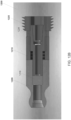
- FIG. 2A depicts an exemplary device for treating a bone according to an embodiment.
- FIG. 2B depicts interior portions of the exemplary device according to an embodiment.
- the device 200 may include a flexible tube 205, a stiffening mechanism 210 and an actuator 215.
- the flexible tube 205 may have a distal end 205a and a proximal end 205b.
- the flexible tube 205 may include a plurality of slits, such as 206, in an outer housing configured to allow the flexible tube to flex.
- the flexible tube 205 may comprise stainless steel and/or nitinol.
- the stiffening mechanism 210 may be located within the flexible tube 205 and may be configured to cause the flexible tube to become rigid.
- the stiffening mechanism 210 may include a plurality of expansion sleeves. Exemplary expansion sleeves are disclosed in FIGS. 3-5 and are discussed in further detail below.
- FIG. 3 depicts an exemplary expansion sleeve according to an embodiment.
- the expansion sleeve may include a jam nut 305 having expansion beads 310a and 310b, cladding 315 covering at least a portion of the expansion beads, a plurality of expanding segments, such as 320, and a bore 325.
- the jam nut 305 may include an expansion bead 310a having a convex end and an expansion bead 310b having a concave end.
- Each of the expansion beads 310a and 310b may taper down in diameter from the convex/concave end to the other end of the bead.
- the convex expansion bead 310a of a first expansion sleeve and the concave expansion bead 310b of a second adjacent expansion sleeve are configured to enable the adjacent expansion sleeves to abut each other when the actuator 215 is actuated.
- the cladding 315 may be made of, for example and without limitation, silicone and may provide some compliance when the expansion sleeve 305 contacts the interior surface of the flexible tube 205.
- the jam nut 305 may be actuated by causing the expansion beads 310a and 310b to be moved towards each other causing the cladding 315 to expand.
- the expanding segments 320 may be configured to be in a non-actuated state against the cladding 315 when the jam nut 305 is not actuated.
- the cladding 315 may force the expanding segments 320 to abut an interior surface of the flexible tube 205.
- the expanding segments 320 may cause the flexible tube 205 to become rigid when the jam nut 305 is in an actuated state.
- the bore 325 may be configured to receive a cannula, as discussed below.
- FIG. 4 depicts an alternate exemplary expansion sleeve according to an embodiment.
- expansion sleeve 405 may include expansion beads 410a and 410b, a retaining spring 415, a plurality of expanding segments, such as 420, and a bore 425.
- the expansion sleeves may include an expansion bead 410a having a convex end and an expansion bead 410b having a concave end.
- Each of the expansion beads 410a and 410b may taper down in diameter from the convex/concave end to the other end of the bead.
- the convex expansion bead 410a of a first expansion sleeve and the concave expansion bead 410b of a second adjacent expansion sleeve are configured to enable the adjacent expansion sleeves to abut each other when the actuator 215 is actuated.
- the retaining spring 415 may provide some compliance when the expansion sleeve 405 contacts the interior surface of the flexible tube 205.
- the expansion sleeve 405 may be actuated by causing the expansion beads 410a and 410b to be moved towards each other causing the expanding segments 420 to be pushed towards an inner surface of the flexible tube 205.
- the retaining spring 415 may be configured to restrain the expanding segments 420 when in a non-actuated state.
- the expanding segments 420 may be configured to abut an interior surface of the flexible tube 205. In this way, the expanding segments 420 may cause the flexible tube 205 to become rigid when in an actuated state.
- the bore 425 may be configured to receive a cannula, as discussed below.
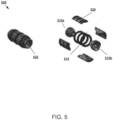
- FIG. 5 depicts an alternate exemplary expansion sleeve according to an embodiment.
- expansion sleeve 505 may include expansion beads 510a and 510b, one or more O-rings 515, a plurality of expanding segments, such as 520, and a bore 525.
- the expansion sleeves may include an expansion bead 510a having a convex end and an expansion bead 510b having a concave end.
- Each of the expansion beads 510a and 510b may taper down in diameter from the convex/concave end to the other end of the bead.
- the convex expansion bead 510a of a first expansion sleeve and the concave expansion bead 510b of a second adjacent expansion sleeve are configured to enable the adjacent expansion sleeves to abut each other when the actuator 215 is actuated.
- the one or more O-rings 515 may provide some compliance when the expansion sleeve 505 contacts the interior surface of the flexible tube 205.
- the expansion sleeve 505 may be actuated by causing the expansion beads 510a and 510b to be moved towards each other causing the expanding segments 520 to be pushed towards an inner surface of the flexible tube 205.
- the one or more O-rings 515 may be configured to restrain the expanding segments 520 when in a non-actuated state.
- the expanding segments 520 may be configured to abut an interior surface of the flexible tube 205. As such, the expanding segments 520 may cause the flexible tube 205 to become rigid when in an actuated state.
- the bore 525 may be configured to receive a cannula, as discussed below.
- expansion sleeves discussed in FIGS. 3-5 are exemplary and are not meant to be limiting. Additional and/or alternate devices for forming expansion sleeves may be used within the scope of this disclosure.
- the actuator 215 may be configured to cause the stiffening mechanism 210 to cause the flexible tube 205 to become rigid in response to the actuator being actuated.
- the actuator 215 may include, for example and without limitation, a cap 220 connected to the proximal end of the flexible tube 205.
- the cap 220 may be configured to permit the flexible tube 205 to be rotated, thereby allowing the flexible tube to be inserted into a bone.
- the cap 220 may also be configured to cause the stiffening mechanism 210 to become rigid. For example, if the stiffening mechanism 210 comprises a plurality of expansion sleeves, the cap 220, when rotated, may be configured to cause each of the plurality of expansion sleeves to abut an interior surface of the flexible tube 205.
- the actuator 215 may include a cannula 225 with a locking assembly 230.
- the cannula 225 may extend through a bore in each of a plurality of expansion sleeves, such as 305, 405 or 505.
- the cannula 225 may include a distal end connected to a distal expansion sleeve located at the distal end of the flexible tube 205 and a proximal end extending from the proximal end of the flexible tube.
- the cannula 225 when actuated, may cause the plurality of expansion sleeves 305, 405 or 505 to actuate, which may cause the flexible tube 205 to become rigid, as described above.
- the locking assembly 230 may be used to actuate the cannula 225.
- the locking assembly 230 may cause the cannula 225 to become tensioned.
- the locking assembly 230 may then be used to lock the cannula 225 in the actuated state.
- the cannula 225 may extend through a bore in each of a plurality of bead segments, such as 605 in FIG. 6 .
- Each of the bead segments 605 may further include a distal end and a proximal end.
- the distal end of a bead segment 605 may be sized and shaped to be received by, receive or otherwise engage a proximal end of an adjacent bead segment in response to the cannula 225 being actuated.
- the distal end of each bead segment 605 may be convex, and the proximal end of each bead segment may be concave.
- each bead segment 605 may be concave and convex, respectively. Additional or alternate shapes for the distal and proximal ends of bead segments 605 may be used within the scope of this disclosure.
- each of the bead segments 605 may be about 8 mm in diameter and about 12 mm in length. In an embodiment, each of the bead segments 605 may be about 2 mm to about 15 mm in diameter. In an embodiment, each of the bead segments 605 may be about 5 mm to about 25 mm in length. Alternately sized bead segments 605 may also be used within the scope of this disclosure.
- the cannula 225 may include a distal end connected to a distal bead segment located at the distal end of the flexible tube 205 and a proximal end extending from the proximal end of the flexible tube.
- the cannula 225 when actuated, may cause the plurality of bead segments 605 to actuate, which may cause the flexible tube 205 to become rigid.
- the locking assembly 230 may be used to actuate the cannula 225.
- the locking assembly 230 may cause the cannula 225 to become tensioned.
- the locking assembly 230 may then be used to lock the cannula 225 in the actuated state.
- a screw 235 may additionally be positioned at the distal end of the flexible tube 205.
- the screw 235 may be used to enable the flexible tube 205 to be inserted into a bone.
- the screw 235 may be a high helix angle screw.
- the screw 235 may move a distance into a medium, such as a bone, that is approximately equal to its diameter when rotated one revolution. In other words, a screw 235 having a diameter of 12 mm may move forward approximately 12 mm when rotated once.
- FIG. 7 depicts a flow diagram for an exemplary method of treating a bone according to an embodiment.
- a guide wire may be inserted 705 into an intramedullary space of a bone.
- the guide wire may include a bent section having a sharpened tip at a distal portion of the guide wire.
- the guide wire may be inserted 705 by rotating the guide wire to orient the bent section of the guide wire and selectively hammering the guide wire to cause the bent section to form a curved path in bone based on the orientation of the bent section.
- inserting 705 the guide wire may include using a fluoroscope to determine the orientation of the bent section of the guide wire.
- the guide wire may be attached to a hammer drill during insertion 705.
- a user may orient the bent tip so that it is positioned in the direction that the guide wire is to be inserted 705.
- the hammer drill may then be activated to cause the guide wire to be inserted into the bone in such direction.
- the sharpened tip may be used to cause the hole to be formed in the bone.
- the guide wire may be re-oriented prior to further insertion of the guide wire.
- a straight path may be approximated by inserting the guide wire in a succession of short curved paths that are substantially 180 degrees opposed to each other.
- the present method may be used to insert a guide wire into curved bone, such as at least a portion of a pelvic ring, a posterior column of an acetabulum or an anterior column of an acetabulum of a patient, the method may also be used to insert a guide wire into a substantially straight bone as well.
- the guide wire may include one or more of stainless steel and nitinol. In an embodiment, the guide wire may be about 1 mm to about 1.5 mm in diameter. It will be apparent to those of ordinary skill in the art that the guide wire may be of a different size depending upon the particular bone into which the guide wire is to be inserted and that the disclosed size range is merely exemplary.
- a tunnel may be formed 710 surrounding the guide wire in the bone.
- the tunnel may be formed 710 using a cannulated reamer with a flexible drive shaft that fits over and around the guide wire.
- the cannulated reamer may include a bore configured to receive the guide wire.
- the guide wire may guide the direction of the cannulated reamer in forming 710 the space in the bone.
- the cannulated reamer may be configured to have a diameter sufficient to allow a flexible device, such as at least one of the flexible tubes described in reference to FIGS. 2 , 6 and 8 , to be inserted 715 into the tunnel.
- the cannulated reamer may be short enough to enable the reamer to form and follow a curved hole defined by the guide wire.
- the flexible device may be caused 720 to become rigid when in the tunnel.
- the rigid flexible device may be used to treat a bone fracture.
- the flexible device may be caused 720 to become rigid by operating an actuator and, in response to operating the actuator, rigidizing the flexible device from a flexible state to a more rigid state.
- expansion sleeves, jam nuts and/or bead segments described above in reference to FIGS. 3-6 may be used to abut against an interior surface of the flexible device causing the flexible device to hold its shape when actuated.
- the expansion sleeves may include one or more of a spring, one or more jam nuts and one or more O-rings.
- a flexible device may be caused 720 to become rigid by actuating a cannula extending through each of a plurality of expansion sleeves.
- a flexible device may be caused 720 to become rigid by rotating a cap located at a proximal end of the flexible device.
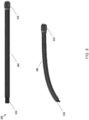
- FIG. 8 depicts an alternate exemplary device for treating a bone according to an embodiment.
- the device 800 may include a flexible tube 805, a plurality of rods 810 contained within the flexible tube, and an actuator (not shown).
- the flexible tube 805 may include a distal end and a proximal end.
- the flexible tube 805 may include a series of slits configured to allow the tube to flex.
- the flexible tube 805 may include stainless steel and/or nitinol.
- the plurality of rods 810 may be affixed to each other at the distal end of the flexible tube 805 and/or affixed to the distal end of the flexible tube.
- the plurality of rods 810 may substantially or completely fill the flexible tube 805 such that the rods cannot substantially move with respect to each other inside the flexible tube.
- the rods 810 remain parallel to each other and are constrained from deflecting in a radial direction.
- the plurality of rods 810 move axially as the flexible tube 805 is flexed. As such, a rod 810 positioned along the inside of a curve traverses a shorter distance that a rod positioned along the outside of the curve, where the relative lengths of the rods change as the curve is modified.
- the actuator may be configured to cause the plurality of rods to be fixed in place when actuated.
- the actuator may be configured to cause the plurality of rods 810 to be fixed in place by causing the plurality of rods to lock in place at the proximal end of the flexible tube 805. If the plurality of rods 810 are locked together at the proximal end of the flexible tube 805, any curve(s) in the tube may be fixed in place.
- the device 800 may further include a screw 815 positioned at the distal end of the flexible tube 805.
- the screw 815 may be used to enable the flexible tube 805 to be inserted into a bone.
- the screw 815 may be a high helix angle screw.
- the screw 815 may move a distance into a medium, such as a bone, that is approximately equal to its diameter when rotated one revolution. In other words, a screw 815 having a diameter of 12 mm may move forward approximately 12 mm when rotated once.
- the device 800 may further include a sleeve (not shown) located within the flexible tube 805.
- the sleeve may be configured to contain the plurality of rods 810.
- the actuator may be configured to cause the plurality of rods 810 to be fixed by causing the sleeve to apply a normal force towards a center of the sleeve in response to the actuator being actuated. As such, the sleeve may compress the plurality of rods 810 causing the rods to be incapable of movement, thereby causing the flexible tube 805 to become rigid.
- a device for treating a bone may include a flexible tube similar to one of the flexible tubes described above, a spring contained within the flexible tube and an actuator configured to cause the spring to exert a normal force against an inner surface of the flexible tube in response to the actuator being actuated.
- the normal force exerted by the spring may cause the flexible tube to become rigid.
- the flexible tube may include a series of slits configured to allow the tube to flex.
- the flexible tube may include stainless steel and/or nitinol.
- a screw may be positioned at the distal end of the flexible tube.
- a bone-treating device may be manufactured in the following manner or by performing similar operations.
- a flexible tube may be formed of a flexible material, such as super-elastic nitinol or spring-tempered stainless steel.
- the flexible tube may include a plurality of slits to allow the tube to be axially flexible, but stiff in torsion. Alternately, a gooseneck wound spring may be used.
- a screw may be attached to a distal end of the flexible tube, and a cap may be attached to a proximal end of the flexible tube.
- the cap may include a structure that permits the cap to be turned by a wrench.
- a stiffening system is inserted into the flexible tube such that a distal end of the stiffening system is attached to a distal end of the flexible tube.
- the stiffening system includes a cannula connected at a distal end to the distal end of the flexible tube and a plurality of bead segments or expansion sleeves threaded along the cannula.
- Each of the bead segments or expansion sleeves includes a bore permitting the cannula to pass therethrough.
- the stiffening system includes a plurality of thin rods attached at a distal end of the flexible tube.
- the thin rods may be inserted inside of a sleeve surrounding the thin rods that is configured to prevent the rods from moving when actuated.
- the stiffening system may include a lock at the proximal end of the flexible tube that is used to lock the thin rods in place.
- a bone containing a device for treating the bone may include the bone, and a device comprising a tube having a distal end and a proximal end, a stiffening mechanism configured to cause the tube to remain in a rigid state.
- the device may include a screw positioned at the distal end of the tube.
- the stiffening mechanism may include a plurality of bead segments including a distal bead segment.
- Each of the plurality of bead segments may include a distal end and a proximal end.
- the distal end of each bead segment of the plurality of bead segments, other than the distal bead segment, may receive the proximal end of an adjacent bead segment of the plurality of bead segments.
- each of the bead segments may be about 8 mm in diameter and about 12 mm in length.
- each of the bead segments may be about 2 mm to about 15 mm in diameter.
- each of the bead segments may be about 5 mm to about 25 mm in length. Alternately sized bead segments may also be used within the scope of this disclosure.
- the stiffening mechanism may include a plurality of expansion sleeves.
- An expansion sleeve may include, for example and without limitation, a spring, one or more jam nuts, and/or one or more O-rings.
- the above-described devices and methods may be used to treat a bone fracture.
- bone fragments at the point of a fracture may be repositioned into a proper alignment, and a device, such as one described above, may be inserted in order to fix the bone fracture to allow healing to complete.
- the above-described devices and methods may be used to prophylactically treat a bone in order to provide support.
- a metastatic tumor may cause a weak spot in a bone.
- a device may be inserted to provide support for such a weak spot.
- a device may be inserted to support the posterior and anterior columns of the acetabulum for the management of a complex total hip replacement procedure or a revision of a previous total hip replacement. Additional uses of the devices and methods described herein may also be performed within the scope of this disclosure.
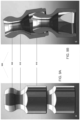
- FIGS. 9A and 9B depict an external view and a cut-away view, respectively, of exemplary bead segments according to an embodiment.
- the bead segments such as 900, may include a male surface 905 and a female (hollow) surface 910 and a bore.
- the bore of each bead segment may be configured to receive a stiffening cable or cannula as described above in reference to FIGS. 3-6 .
- the male surface 905 and the female surface 910 may have a shape that permits torque transfer from one bead segment to the next.
- the male surface 905, and the female surface 910 may have a spherical and at a proximal end and a conical cross-section at a distal end, as described further below in reference to FIGS. 10A-D .
- Alternate cross-sectional shapes may also be used for the male surface 905 and the female surface 910 within the scope of this disclosure.
- multisided shapes such as square cross-sections, pentagonal cross-sections, hexagonal cross-sections, heptagonal cross-sections, octagonal cross-sections, spherical cross-sections, conical cross-sections or the like, may be used within the scope of this disclosure.
- the shapes of the male surface 905 and the female surface 910 of adjacent bead segments may permit torque to be transmitted from one bead to the next to drive a distal screw (such as 1110 in FIG. 11 ).
- the shapes of the male surface 905 and the female surface 910 of adjacent bead segments may enable the bead segments to pivot with respect to each other allowing the chain to form curved shapes.
- the male surface 905 of each bead segment may include a narrowed neck 915 proximal to the ball to increase the bead-to-bead rotational angle.
- the narrowed neck 915 may further enable the open ends of the female surface 910 of an adjacent bead to be modified such that the male surface 905 of the bead cannot disengage.
- the female surface 915 may be modified post-assembly in order to secure the connection. For example, a circlip may be added to a groove on the inside of the cavity of the female surface 915.
- the edge of the female surface 915 may be crimped or rolled such that the inner diameter of the female surface is reduced at the edge. In this manner, a string of bead segments may be kept in an interlocked arrangement even if a central stiffening cable (not shown) is broken.
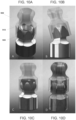
- FIGS. 10A-D depict points of contact between the exemplary bead segments of FIGS. 9A and 9B .
- the male surface 905 and the female surface 910 of adjacent bead segments 900 have shapes that are capable of transmitting torque, such as hexagons.
- FIGS. 10A-D identify details of how the male surface 905 and the female surface 910 of the adjacent bead segments 900 interact.
- the female surface 910 may be substantially straight-sided with a cross-section that is similar in nature to the male surface 905 of the adjacent bead segment 900. At the distal end of the female surface 910, a cone shape having a circular cross-section may be used.
- the corners of the male surface 905 of the adjacent bead segment 900 may make point contact with the cone-shaped portion of the female surface 910. This may cause localized points of high stress, which may lead to improved friction over line contact.
- the conical-shaped portion of the female surface 910 may permit improved friction as compared to a hexagonal prism because the hexagonal prism may not make even line contact around the male socket 905 as the adjacent bead segments 900 pivot with respect to each other.
- the described design may enable an interference fit, such as is shown in FIG. 10D , which may enable even higher friction as the point regions are distorted.
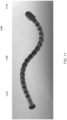
- FIG. 11 depicts a flexible device incorporating a plurality of bead segments according to an embodiment.
- the flexible device 1100 includes a plurality of bead segments, such as 1105, a distal screw 1110, a stiffening cable (not shown) inside the flexible device, and a tensioning assembly 1115.
- Each bead segment 1105 may be substantially similar to any of the bead segments identified herein or any other bead segment possessing similar characteristics to a bead segment identified within the scope of this disclosure, without limitation.
- the stiffening cable may be a multi-stranded wire that passes through the bead segments 1105.
- the stiffening cable may be anchored at the distal screw 1110 at the distal end of the flexible device 1100 and at the tensioning assembly 1115 at a proximal end of the flexible device.
- the stiffening cable may be anchored at each of the distal and proximal ends by thermal welding, soldering, gluing, welding a tapered collet in place or the like.
- stiffening cable may be soldered to an anchor so that stress is distributed along an entire hole in which the stiffening cable is anchored such that the solder may wick throughout the hole, a mechanically suitable solder may not be biocompatible.
- soldering the stiffening cable to a tapered collet may be used to avoid bioincompatibility within a patient.
- the collet may be fitted over a stiffening cable and then pressed into a conical hole, which distorts the collet into the cable.
- the collet may be welded in place at its outside edge so that the cable itself does not experience heating.
- the stiffening cable may receive substantially equal stress in each direction around the tapered collet.
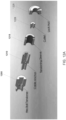
- FIGS.12A and 12B depict an exploded view and a cut-away view of an exemplary tensioning assembly 1115 according to an embodiment.
- the tensioning assembly 1115 may include a hex ball tensioner 1205, a cable anchor 1210, a tensioning sleeve 1215, a collet 1220 and a lock nut 1225.
- a stiffening cable may be located in the center of the tensioning assembly 1115, but is not shown in FIGS. 12A and 12B to enable better viewing of the remaining components of the tensioning assembly.
- the stiffening cable may be secured with the tapered collet 1220 resting in the socket of the cable anchor 1210.
- the tensioning sleeve 1215 may be threaded over the cable anchor 1210.
- the cable anchor 1210 may have a square rod which slides in the hex ball tensioner 1205.
- the cable anchor 1210 may be held in place by a user operated tool while the tensioning sleeve 1215 is threaded in. Threading in the tensioning sleeve 1215 may cause the cable anchor 1210 to be pushed out.
- a spline of the cable anchor 1210 when held by a user such as a surgeon, may prevent the entire assembly from rotating while the tensioning sleeve 1215 is rotated by a second external tool.
- the lock nut 1225 may be applied.
- the lock nut 1225 may have the same thread pitch inside and out.
- the lock nut 1225 may be threaded into the bone as it threads onto the cable anchor 1210 without drawing the cable anchor out of the bone, such as the pelvis, into which it is inserted.
- Application of the tensioning assembly 1115 may cause the flexible device to become rigid within the patient in order to assist in fixing the bone.
- EXAMPLE 1 KIT FOR MEDICAL USE
- a kit may be sold to physicians, surgeons or other medical professionals or medical institutions for use in treating a bone fracture.
- the kit includes a flexible device similar to those discussed above (e.g., device 200 or device 800 ).
- the kit may also include a hammer drill (or hammer drill attachment for a surgical drill) and a guide wire configured to be attached to the hammer drill (or hammer drill attachment).
- the guide wire includes a bent section having a sharpened tip at a distal portion of the guide wire.
- the kit may also include a cannulated reamer.
- the cannulated reamer includes a flexible drive shaft and a bore configured to receive the guide wire.
- the kit may further include instructions for using the flexible device to treat a bone fracture.
- the kit may include instructions for using the hammer drill, guide wire and/or cannulated reamer to insert the guide wire into a bone and to use the cannulated reamer to form a tunnel in the bone using the guide wire as a guide.
- the instructions for inserting the guide wire using the hammer drill may include instructions for rotating the guide wire into a particular orientation based on the direction of the hole to be formed and instructions for using the hammer drill to form the hole.
- EXAMPLE 2 MEDICAL DEVICE USING EXPANSION SLEEVES
- a flexible device for treating a bone includes a nitinol flexible tube having a plurality of slits configured to allow the flexible device to flex, a plurality of expansion sleeves contained within the flexible tube, and a cannula configured to actuate the bead segments.
- the cannula when actuated, may cause each expansion sleeve to expand and abut an inner surface of the flexible tube, thereby causing the flexible device to become rigid.
- An exemplary medical device using expansion sleeves is disclosed in FIG. 2 .
- EXAMPLE 3 EXPANSION SLEEVE WITH SILICONE CLADDING
- An expansion sleeve includes a jam nut having expansion beads, silicone cladding covering at least a portion of the expansion beads, a plurality of expanding segments and a bore configured to receive a cannula.
- Adjacent expansion beads are configured to engage each other based on the size and shape of their adjacent surfaces when actuated. For example, adjacent surfaces may be convex and concave.
- Each of the expansion beads may taper down in diameter from an exposed surface to an internal surface of the bead.
- the jam nut is actuated by causing the expansion beads to be moved towards each other, which, in turn, causes the cladding to expand.
- the expanding segments are configured to be in a non-actuated state against the cladding when the jam nut is not actuated.
- the jam nut when the jam nut is actuated, the cladding forces the expanding segments to abut an interior surface of the flexible tube. As such, the expanding segments cause the flexible tube to become rigid when the jam nut is in an actuated state
- EXAMPLE 4 EXPANSION SLEEVE WITH RETAINING SPRING
- An expansion sleeve includes expansion beads, a retaining spring, a plurality of expanding segments and a bore configured to receive a cannula.
- Adjacent expansion beads are configured to engage each other based on the size and shape of their adjacent surfaces when actuated. For example, adjacent surfaces may be convex and concave.
- the expansion sleeve is actuated by causing the expansion beads to be moved towards each other causing the expanding segments to be pushed towards an inner surface of the flexible tube.
- the retaining spring is configured to restrain the expanding segments when in a non-actuated state.
- the expanding segments are configured to abut an interior surface of the flexible tube. In this way, the expanding segments cause the flexible tube to become rigid when in an actuated state.
- EXAMPLE 5 EXPANSION SLEEVE WITH O-RINGS
- An expansion sleeve includes expansion beads, one or more O-rings, a plurality of expanding segments, and a bore configured to receive a cannula.
- Adjacent expansion beads are configured to engage each other based on the size and shape of their adjacent surfaces when actuated. For example, adjacent surfaces may be convex and concave.
- the expansion sleeve is actuated by causing the expansion beads to be moved towards each other causing the expanding segments to be pushed towards an inner surface of the flexible tube.
- the one or more O-rings are configured to restrain the expanding segments when in a non-actuated state.
- the expanding segments when the actuator is actuated, the expanding segments are configured to abut an interior surface of the flexible tube. As such, the expanding segments cause the flexible tube to become rigid when in an actuated state.
- a flexible device for treating a bone includes a stainless steel flexible tube having a plurality of slits configured to allow the flexible device to flex, a plurality of bead segments contained within the flexible tube, and a cannula configured to actuate the bead segments.
- the cannula when actuated, may cause each bead segment to engage adjacent bead segments, thereby stiffening the bead segments and causing the flexible device to become rigid.
- An exemplary medical device using bead segments is disclosed in FIG. 6 .
- a flexible device includes a flexible tube, a sleeve within the flexible tube and a plurality of rods contained within the sleeve.
- the rods are configured to be connected to a distal end of the flexible tube and to bend as the flexible tube is flexed.
- the sleeve when actuated, is configured to compress the rods together to restrict their movement in a lateral direction (i.e., in the proximal or distal directions with respect to the flexible tube).
- An exemplary medical device using rods is disclosed in FIG. 8 .
- compositions, methods, and devices are described in terms of “comprising” various components or steps (interpreted as meaning “including, but not limited to”), the compositions, methods, and devices can also “consist essentially of” or “consist of” the various components and steps, and such terminology should be interpreted as defining essentially closed-member groups. It will be further understood by those within the art that if a specific number of an introduced claim recitation is intended, such an intent will be explicitly recited in the claim, and in the absence of such recitation no such intent is present. For example, as an aid to understanding, the following appended claims may contain usage of the introductory phrases “at least one" and “one or more” to introduce claim recitations.
- a range includes each individual member.
- a group having 1-3 cells refers to groups having 1, 2, or 3 cells.
- a group having 1-5 cells refers to groups having 1, 2, 3, 4, or 5 cells, and so forth.
Landscapes
- Health & Medical Sciences (AREA)
- Orthopedic Medicine & Surgery (AREA)
- Surgery (AREA)
- Life Sciences & Earth Sciences (AREA)
- Heart & Thoracic Surgery (AREA)
- Veterinary Medicine (AREA)
- Engineering & Computer Science (AREA)
- Biomedical Technology (AREA)
- Nuclear Medicine, Radiotherapy & Molecular Imaging (AREA)
- Medical Informatics (AREA)
- Molecular Biology (AREA)
- Animal Behavior & Ethology (AREA)
- General Health & Medical Sciences (AREA)
- Public Health (AREA)
- Neurology (AREA)
- Dentistry (AREA)
- Oral & Maxillofacial Surgery (AREA)
- Surgical Instruments (AREA)
- Prostheses (AREA)
Claims (5)
- Intermedulläres Knochenfixationssystem, umfassend:eine Vorrichtung (800), umfassend einen flexiblen Schlauch (805), der in einer gekrümmten Form konfigurierbar ist, ein proximales Ende aufweist und ein distales Ende aufweist, das zum Eingreifen in einen Knochen konfiguriert ist;gekennzeichnet dadurch, dass das intermedulläre Knochenfixationssystem ferner Folgendes umfasst:eine Vielzahl von innerhalb des flexiblen Schlauchs (805) enthaltenen Stäben (810), wobei jeder Stab (810) am Verwinden in eine radiale Richtung gehindert wird, an dem distalen Ende des flexiblen Schlauchs (805) befestigt ist und dazu konfiguriert ist, sich relativ zu mindestens einem anderen der Stäbe (810) entlang einer axialen Richtung zu biegen und zu bewegen, wenn der flexible Schlauch (805) in die gekrümmte Form gebracht wird, sodass ein entlang einer Innenseite einer Krümmung positionierter Stab (810) eine kürzere Strecke zwischen dem distalen Ende und dem proximalen Ende überquert als ein entlang einer Außenseite der Krümmung positionierter Stab; undeinen Aktuatormechanismus, der an dem proximalen Ende des flexiblen Schlauchs (805) angeordnet und dazu konfigurierbar ist, die Stäbe (810) an dem proximalen Ende einzurasten und den flexiblen Schlauch (805) in der gekrümmten Form zu fixieren.
- System nach Anspruch 1, wobei die Stäbe (810) dazu konfiguriert sind, sich relativ zu mindestens einem aus einer Vielzahl von Segmenten entlang der axialen Richtung zu bewegen, wenn der flexible Schlauch (805) in die gekrümmte Form gebracht wird.
- System nach einem der Ansprüche 1 bis 2, wobei das distale Ende eine Schraube (815) zum Eingreifen in einen Knochen beinhaltet.
- System nach einem der Ansprüche 1 bis 3, wobei der Aktuatormechanismus dazu konfiguriert ist, die Stäbe (810) einzurasten, während mindestens ein Abschnitt der Vorrichtung im Inneren eines Knochens angeordnet ist.
- System nach einem der Ansprüche 1 bis 4, wobei die Stäbe (810) den flexiblen Schlauch (805) vollständig ausfüllen.
Applications Claiming Priority (3)
| Application Number | Priority Date | Filing Date | Title |
|---|---|---|---|
| US201161559609P | 2011-11-14 | 2011-11-14 | |
| PCT/CA2012/050808 WO2013071432A1 (en) | 2011-11-14 | 2012-11-14 | Intramedullary fixation system for management of pelvic and acetabular fractures |
| EP12849005.9A EP2779928B1 (de) | 2011-11-14 | 2012-11-14 | Intramedulläres befestigungssystem zur behandlung von becken- und gelenkpfannenfrakturen |
Related Parent Applications (1)
| Application Number | Title | Priority Date | Filing Date |
|---|---|---|---|
| EP12849005.9A Division EP2779928B1 (de) | 2011-11-14 | 2012-11-14 | Intramedulläres befestigungssystem zur behandlung von becken- und gelenkpfannenfrakturen |
Publications (2)
| Publication Number | Publication Date |
|---|---|
| EP3326558A1 EP3326558A1 (de) | 2018-05-30 |
| EP3326558B1 true EP3326558B1 (de) | 2025-04-30 |
Family
ID=48428897
Family Applications (2)
| Application Number | Title | Priority Date | Filing Date |
|---|---|---|---|
| EP17207050.0A Active EP3326558B1 (de) | 2011-11-14 | 2012-11-14 | Intramedulläres befestigungssystem zur behandlung von becken- und gelenkpfannenfrakturen |
| EP12849005.9A Active EP2779928B1 (de) | 2011-11-14 | 2012-11-14 | Intramedulläres befestigungssystem zur behandlung von becken- und gelenkpfannenfrakturen |
Family Applications After (1)
| Application Number | Title | Priority Date | Filing Date |
|---|---|---|---|
| EP12849005.9A Active EP2779928B1 (de) | 2011-11-14 | 2012-11-14 | Intramedulläres befestigungssystem zur behandlung von becken- und gelenkpfannenfrakturen |
Country Status (6)
| Country | Link |
|---|---|
| US (5) | US9839435B2 (de) |
| EP (2) | EP3326558B1 (de) |
| CN (1) | CN104203132B (de) |
| AU (1) | AU2012339536B2 (de) |
| CA (1) | CA2855752A1 (de) |
| WO (1) | WO2013071432A1 (de) |
Families Citing this family (42)
| Publication number | Priority date | Publication date | Assignee | Title |
|---|---|---|---|---|
| US9839435B2 (en) | 2011-11-14 | 2017-12-12 | The University Of British Columbia | Intramedullary fixation system for management of pelvic and acetabular fractures |
| US10363140B2 (en) | 2012-03-09 | 2019-07-30 | Si-Bone Inc. | Systems, device, and methods for joint fusion |
| WO2013166496A1 (en) | 2012-05-04 | 2013-11-07 | Si-Bone Inc. | Fenestrated implant |
| EP2919689B1 (de) * | 2012-11-14 | 2018-06-13 | British Columbia Cancer Agency Branch | Kanülierte bohrhammerbefestigung |
| US9936983B2 (en) | 2013-03-15 | 2018-04-10 | Si-Bone Inc. | Implants for spinal fixation or fusion |
| EP3016604B1 (de) * | 2013-07-02 | 2018-10-10 | Cmarr Enterprises | Gekrümmter tibiotalarer fusionsnagel |
| US11147688B2 (en) | 2013-10-15 | 2021-10-19 | Si-Bone Inc. | Implant placement |
| WO2015134750A1 (en) * | 2014-03-06 | 2015-09-11 | University Of British Columbia | Shape adaptable intramedullary fixation device |
| US10166033B2 (en) | 2014-09-18 | 2019-01-01 | Si-Bone Inc. | Implants for bone fixation or fusion |
| US9662157B2 (en) | 2014-09-18 | 2017-05-30 | Si-Bone Inc. | Matrix implant |
| EP4245233A3 (de) | 2014-10-14 | 2023-12-06 | The University of British Columbia | Systeme zur intramedullären knochenfixierung |
| CN104887301B (zh) * | 2015-06-26 | 2017-03-01 | 陈伟 | 一种骨盆骨折微创髓内固定装置 |
| US10499960B2 (en) | 2015-07-13 | 2019-12-10 | IntraFuse, LLC | Method of bone fixation |
| US10154863B2 (en) | 2015-07-13 | 2018-12-18 | IntraFuse, LLC | Flexible bone screw |
| US10492838B2 (en) | 2015-07-13 | 2019-12-03 | IntraFuse, LLC | Flexible bone implant |
| US10485595B2 (en) | 2015-07-13 | 2019-11-26 | IntraFuse, LLC | Flexible bone screw |
| CN105232136A (zh) * | 2015-11-13 | 2016-01-13 | 陈伟 | 一种能有效促进骨折愈合的髓内固定装置 |
| CN108778159B (zh) * | 2016-01-17 | 2022-07-08 | Tag医疗器材农业合作有限公司 | 柔性骨头工具 |
| AU2017323632B2 (en) | 2016-09-08 | 2021-11-04 | Meduloc, Llc | Implant and method for long bone fixation |
| CN117257430A (zh) | 2016-10-05 | 2023-12-22 | 不列颠哥伦比亚大学 | 带有形状锁定交接部的髓内固定装置 |
| EP3525683B1 (de) * | 2016-10-21 | 2024-01-31 | University of Louisville Research Foundation, Inc. | Systeme für intramedulläre vorbereitungen |
| US11116519B2 (en) | 2017-09-26 | 2021-09-14 | Si-Bone Inc. | Systems and methods for decorticating the sacroiliac joint |
| EP4516267A3 (de) | 2018-03-28 | 2025-05-21 | SI-Bone, Inc. | Gewindeimplantate und verfahren zur verwendung über knochensegmente hinweg |
| EP3866712A1 (de) | 2018-10-17 | 2021-08-25 | Curvafix, Inc. | Intramedulläre fixiervorrichtung |
| US11832856B2 (en) | 2018-10-17 | 2023-12-05 | The University Of British Columbia | Bone-fixation device and system |
| GB2569690B (en) * | 2018-10-26 | 2020-01-01 | pitman James | Fuel hose assembly for in-flight fuelling of aircraft |
| JP2022520101A (ja) | 2019-02-14 | 2022-03-28 | エスアイ-ボーン・インコーポレイテッド | 脊椎の固定及び、又は融合のためのインプラント |
| IL268608B (en) * | 2019-08-08 | 2021-03-01 | Konstantinovsky Yevgeny | Intraosseous fixation device |
| WO2021102429A1 (en) | 2019-11-21 | 2021-05-27 | Si-Bone Inc. | Rod coupling assemblies for bone stabilization constructs |
| US11672570B2 (en) | 2019-11-27 | 2023-06-13 | Si-Bone Inc. | Bone stabilizing implants and methods of placement across SI Joints |
| WO2021119126A1 (en) | 2019-12-09 | 2021-06-17 | Si-Bone Inc. | Sacro-iliac joint stabilizing implants and methods of implantation |
| AU2021397743A1 (en) | 2020-12-09 | 2023-06-22 | Si-Bone Inc. | Sacro-iliac joint stabilizing implants and methods of implantation |
| US20240130770A1 (en) * | 2021-06-16 | 2024-04-25 | Board Of Regents, The University Of Texas System | Morphable bone fixation device, system and method |
| EP4387545A4 (de) | 2021-08-17 | 2025-06-11 | PS Ortho LLC | Knochenfixiervorrichtungen, systeme und verfahren |
| US20230149059A1 (en) * | 2021-11-12 | 2023-05-18 | Conventus Orthopaedics, Inc. | Flexible intramedullary nail |
| EP4440505A4 (de) | 2021-12-03 | 2025-11-19 | Si Bone Inc | Fusionskäfige und verfahren zur stabilisierung des kreuzdarmgelenks |
| US12588930B2 (en) | 2022-02-04 | 2026-03-31 | Curvafix, Inc. | Devices, systems, and methods of use for delivery of materials in combination with intramedullary devices |
| USD1106457S1 (en) * | 2022-03-30 | 2025-12-16 | Lenoss Medical LLC | Flexible implant |
| USD1106456S1 (en) * | 2022-03-30 | 2025-12-16 | Lenoss Medical LLC | Flexible implant |
| WO2025038769A1 (en) | 2023-08-15 | 2025-02-20 | Si-Bone Inc. | Pelvic stabilization implants, methods of use and manufacture |
| WO2025109626A1 (en) * | 2023-11-22 | 2025-05-30 | Meril Healthcare Pvt. Ltd. | Orthopedic implant |
| US12496104B1 (en) * | 2024-07-20 | 2025-12-16 | Jared S Aelony | Intramedullary bone fixation devices, systems, and methods |
Family Cites Families (156)
| Publication number | Priority date | Publication date | Assignee | Title |
|---|---|---|---|---|
| US2328270A (en) | 1942-06-01 | 1943-08-31 | Greenberg Harry Daniel | Oscillatory hammer |
| US2724573A (en) | 1954-07-26 | 1955-11-22 | Axel E Lundquist | Percussion attachment for portable drills |
| NL147356B (nl) | 1965-03-05 | 1975-10-15 | Tech Metaalproducten Huygmetaa | Hameraanzethuis voor een boormotorhuis. |
| FR2258585B1 (de) | 1974-01-17 | 1977-06-10 | Legris France Sa | |
| IT1066884B (it) | 1976-08-09 | 1985-03-12 | Star Utensili Elett | Trapano del tipo a percussione |
| US4489792A (en) | 1981-05-28 | 1984-12-25 | Fahim Atef E F | Hammer drill adapter |
| US4441563A (en) | 1981-11-02 | 1984-04-10 | Black & Decker Inc. | Tool collet and control means |
| US4491443A (en) | 1982-10-29 | 1985-01-01 | Textron Inc. | Modified quick release adapter |
| US4605348A (en) | 1982-10-29 | 1986-08-12 | Textron Inc. | Quick release adapter |
| US4706659A (en) | 1984-12-05 | 1987-11-17 | Regents Of The University Of Michigan | Flexible connecting shaft for intramedullary reamer |
| US5108397A (en) | 1990-04-19 | 1992-04-28 | Joseph White | Method and apparatus for stabilization of pelvic fractures |
| US5234435A (en) | 1991-03-08 | 1993-08-10 | Seagrave Jr Richard A | Surgical method and apparatus |
| GB9122753D0 (en) | 1991-10-26 | 1991-12-11 | Reis Nicolas D | Internal ilio-lumbar fixator |
| USD346218S (en) | 1991-11-12 | 1994-04-19 | White Joseph B | Iliac plate for posterior pelvic fracture stabilization apparatus |
| US5167665A (en) | 1991-12-31 | 1992-12-01 | Mckinney William W | Method of attaching objects to bone |
| US5300071A (en) | 1992-11-17 | 1994-04-05 | Ace Medical Company | Pelvic stabilizer |
| US5336224A (en) | 1992-11-30 | 1994-08-09 | Ace Medical Company | Bone fixation plate |
| US5527309A (en) | 1993-04-21 | 1996-06-18 | The Trustees Of Columbia University In The City Of New York | Pelvo-femoral fixator |
| ES2081766B1 (es) | 1994-05-13 | 1996-10-01 | Bilbao Ortiz De Zarate Jose Ra | Sistema de fijacion vertebral cervical por via posterior. |
| US5527310A (en) * | 1994-07-01 | 1996-06-18 | Cole; J. Dean | Modular pelvic fixation system and method |
| DE69510516T2 (de) | 1994-10-14 | 1999-11-18 | Synthes Ag Chur, Chur | Osteosynthetisches Gerät zur Befestigung und/oder longitudinalen Ausrichtung |
| US5601550A (en) * | 1994-10-25 | 1997-02-11 | Esser; Rene D. | Pelvic pin guide system for insertion of pins into iliac bone |
| DE19802229C2 (de) | 1998-01-22 | 2000-05-04 | Impag Gmbh Medizintechnik | Plattenförmiger Riegel zur Ruhigstellung einer Fraktur des Beckens |
| US6368326B1 (en) | 1998-09-28 | 2002-04-09 | Daos Limited | Internal cord fixation device |
| US5993454A (en) | 1998-09-29 | 1999-11-30 | Stryker Corporation | Drill attachment for a surgical drill |
| US5944719A (en) * | 1998-11-10 | 1999-08-31 | Millennium Devices, L.L.C. | External fixator |
| US6209886B1 (en) | 1999-04-30 | 2001-04-03 | Medtronic, Inc. | Resecting tool with independent variable axial extension for tool implements and guide sleeves |
| US8007498B2 (en) | 1999-12-09 | 2011-08-30 | Mische Hans A | Methods and devices for treatment of bone fractures |
| US7258692B2 (en) | 2000-03-07 | 2007-08-21 | Zimmer, Inc. | Method and apparatus for reducing femoral fractures |
| JP2004500963A (ja) | 2000-06-27 | 2004-01-15 | カイフォン インコーポレイテッド | 流動可能材料を骨に注入するためのシステムおよび方法 |
| CA2423295C (en) | 2000-09-22 | 2009-05-12 | Ingersoll-Rand Company | Quick release drill bit for down-hole drills |
| US6635059B2 (en) | 2001-01-03 | 2003-10-21 | Bernard L. Randall | Cannulated locking screw system especially for transiliac implant |
| US8523919B2 (en) | 2010-09-27 | 2013-09-03 | Acumed Llc | Targeting guide with a radiopaque marker to facilitate positioning a bone plate on bone |
| US8518090B2 (en) | 2010-10-05 | 2013-08-27 | Acumed Llc | Fastener with serrated thread for attachment to a bone plate at a selectable angle |
| US8425575B2 (en) | 2010-09-27 | 2013-04-23 | Acumed Llc | Bone plate supported by a leg member and used as a lever |
| DE10129490A1 (de) | 2001-06-21 | 2003-01-02 | Helmut Mueckter | Implantierbare Schraube zur Stabilisierung einer Gelenkverbindung oder eines Knochenbruches |
| US9060809B2 (en) | 2001-10-18 | 2015-06-23 | Orthoip, Llc | Lagwire system and method for the fixation of bone fractures |
| JP4399263B2 (ja) | 2001-10-19 | 2010-01-13 | ベイラー・カレツジ・オブ・メデイシン | 骨加圧の装置及びシステム及びそれの輪郭形成及び使用の方法 |
| US20030181982A1 (en) | 2002-03-04 | 2003-09-25 | Spineology, Inc. | No-profile, lumbo-sacral fixation device and method |
| US6949101B2 (en) | 2002-03-29 | 2005-09-27 | Depuy Orthopaedics, Inc. | Medical instrument for milling a curved path in bone and procedure |
| US6780189B2 (en) | 2002-06-07 | 2004-08-24 | Medtronic, Inc. | Surgical instrument with a collet locking and indexing system |
| US7001386B2 (en) | 2002-07-23 | 2006-02-21 | Advanced Orthopaedic Solutions, Inc. | Intramedullary nail for long bone fractures |
| US7096972B2 (en) | 2002-09-17 | 2006-08-29 | Orozco Jr Efrem | Hammer drill attachment |
| KR101081269B1 (ko) | 2002-11-19 | 2011-11-08 | 어큠드 엘엘씨 | 조정가능한 본 플레이트 |
| US7604653B2 (en) | 2003-04-25 | 2009-10-20 | Kitchen Michael S | Spinal curvature correction device |
| US8419780B2 (en) | 2003-05-08 | 2013-04-16 | Simplicity Orthopedics, Inc. | Apparatus for securing an implantable object to bone |
| US7410483B2 (en) | 2003-05-23 | 2008-08-12 | Novare Surgical Systems, Inc. | Hand-actuated device for remote manipulation of a grasping tool |
| US7635365B2 (en) | 2003-08-28 | 2009-12-22 | Ellis Thomas J | Bone plates |
| US8632570B2 (en) | 2003-11-07 | 2014-01-21 | Biedermann Technologies Gmbh & Co. Kg | Stabilization device for bones comprising a spring element and manufacturing method for said spring element |
| CN2662839Y (zh) | 2003-12-10 | 2004-12-15 | 上海光电技术有限公司 | 医用空心手术电钻 |
| US20050165401A1 (en) | 2004-01-26 | 2005-07-28 | Larry Pack | Pelvic fixation plate |
| US7632277B2 (en) | 2004-03-29 | 2009-12-15 | Woll Bioorthopedics Llc | Orthopedic intramedullary fixation system |
| CN2699846Y (zh) | 2004-06-03 | 2005-05-18 | 安洪 | 纳米羟基磷灰石复合材料可降解骨螺钉 |
| US8961516B2 (en) | 2005-05-18 | 2015-02-24 | Sonoma Orthopedic Products, Inc. | Straight intramedullary fracture fixation devices and methods |
| US9060820B2 (en) | 2005-05-18 | 2015-06-23 | Sonoma Orthopedic Products, Inc. | Segmented intramedullary fracture fixation devices and methods |
| US7846162B2 (en) | 2005-05-18 | 2010-12-07 | Sonoma Orthopedic Products, Inc. | Minimally invasive actuable bone fixation devices |
| US8568413B2 (en) | 2008-12-18 | 2013-10-29 | Sonoma Orthopedic Products, Inc. | Bone fixation device, tools and methods |
| WO2007008177A1 (en) | 2005-07-12 | 2007-01-18 | Nanyang Technological University | Intramedullary fixation device for fractures |
| WO2007009123A2 (en) * | 2005-07-14 | 2007-01-18 | Stout Medical Group, L.P. | Implant systems and methods for use |
| US8454665B2 (en) | 2005-09-16 | 2013-06-04 | Christopher G. Sidebotham | Multi-purpose bone plate system |
| US20070162132A1 (en) | 2005-12-23 | 2007-07-12 | Dominique Messerli | Flexible elongated chain implant and method of supporting body tissue with same |
| US8043347B2 (en) | 2005-12-29 | 2011-10-25 | Industrial Technology Research Institute | Device and method for fixing soft tissue |
| US7785325B1 (en) | 2006-02-03 | 2010-08-31 | Milbank Miles C | Multi-articulated fracture fixation device with adjustable modulus of rigidity |
| US8372074B2 (en) * | 2006-02-03 | 2013-02-12 | Miles C. Milbank | Multi-articulated fracture fixation device with adjustable modulus of rigidity |
| DE102006018489A1 (de) * | 2006-02-15 | 2007-10-25 | Epflex Feinwerktechnik Gmbh | Gesteuert versteifbarer Schlauch |
| US8092374B2 (en) * | 2006-03-02 | 2012-01-10 | Kevin Smith | Variably flexible insertion device and method for variably flexing an insertion device |
| US7935126B2 (en) | 2006-03-20 | 2011-05-03 | Depuy Products, Inc. | Bone plate shaping system |
| US7951178B2 (en) | 2006-04-03 | 2011-05-31 | Acumed Llc | Bone plates with hybrid apertures |
| US7993303B2 (en) | 2006-04-21 | 2011-08-09 | Abbott Laboratories | Stiffening support catheter and methods for using the same |
| US8317795B2 (en) | 2006-09-21 | 2012-11-27 | Scott G. Edwards | System and method of bone compression and fixation |
| US8114080B2 (en) | 2006-09-27 | 2012-02-14 | Depuy Products, Inc. | Flexible bone fixation device |
| US8398637B2 (en) | 2006-11-06 | 2013-03-19 | Douglas Eric Parsell | Device and method for less invasive surgical stabilization of pelvic fractures |
| CA2670263A1 (en) | 2006-11-22 | 2008-05-29 | Sonoma Orthopedic Products, Inc. | Fracture fixation device, tools and methods |
| US8460297B2 (en) | 2007-01-05 | 2013-06-11 | Biomet 3I, Llc | Drill bit assembly for bone tissue including depth limiting feature |
| US9320551B2 (en) | 2007-01-26 | 2016-04-26 | Biomet Manufacturing, Llc | Lockable intramedullary fixation device |
| US20080181740A1 (en) | 2007-01-29 | 2008-07-31 | Waitszies Roland G | Drill bit extension |
| IL181211A0 (en) | 2007-02-07 | 2007-07-04 | Nmb Medical Applic Ltd | Device and methods for strengthening long bones |
| US7988691B2 (en) | 2007-02-13 | 2011-08-02 | Depuy Products, Inc. | Orthopaedic trauma bone plate kit |
| US8617185B2 (en) | 2007-02-13 | 2013-12-31 | P Tech, Llc. | Fixation device |
| US8979872B2 (en) * | 2007-03-13 | 2015-03-17 | Longevity Surgical, Inc. | Devices for engaging, approximating and fastening tissue |
| JP2010522046A (ja) * | 2007-03-22 | 2010-07-01 | ノヴァリン・オルソペディクス・インコーポレーテッド | セグメント状髄内構造体 |
| KR100841218B1 (ko) | 2007-03-30 | 2008-06-26 | 이상직 | 임플란트 장치 |
| US20080249628A1 (en) | 2007-04-09 | 2008-10-09 | Moti Altarac | Multi-component interbody device |
| US8128626B2 (en) | 2007-04-24 | 2012-03-06 | Flexfix, Llc | System and method for delivery conformation and removal of intramedullary bone fixation devices |
| US20090048672A1 (en) | 2007-06-19 | 2009-02-19 | Juventas, Inc. | Bone support devices and methods |
| CN101686846B (zh) | 2007-06-29 | 2011-09-14 | 新特斯有限责任公司 | 柔性链植入物和器械 |
| US20090024174A1 (en) | 2007-07-17 | 2009-01-22 | Stark John G | Bone screws and particular applications to sacroiliac joint fusion |
| US8206389B2 (en) | 2007-08-31 | 2012-06-26 | Huebner Randall J | Rod-based system for bone fixation |
| US8632543B2 (en) | 2007-09-28 | 2014-01-21 | Biomet C.V. | Composite intramedullary nail |
| US9066655B2 (en) * | 2007-12-07 | 2015-06-30 | Ethicon Endo-Surgery, Inc. | Selective stiffening devices and methods |
| WO2009094478A1 (en) | 2008-01-22 | 2009-07-30 | Stout Medical Group, L.P. | Expandable orthopedic device and method |
| GB2460909B (en) | 2008-01-28 | 2010-09-08 | Mark B Sommers | Bone Nail |
| KR101546924B1 (ko) | 2008-02-07 | 2015-08-24 | 신세스 게엠바하 | 골반 케이블 솔루션 |
| ITVI20080046A1 (it) | 2008-02-27 | 2009-08-28 | Delta System Srl | Dispositivo per la riduzione di una frattura ossea |
| EP2309937A2 (de) * | 2008-05-23 | 2011-04-20 | Novalign Orthopaedics, Inc. | Modulares segmentiertes intramedulläres system, gerät und relevante verfahren |
| US8496648B2 (en) * | 2008-05-27 | 2013-07-30 | Intuitive Surgical Operations, Inc. | Stiffening assembly |
| EP2299917A1 (de) | 2008-06-10 | 2011-03-30 | Sonoma Orthopedic Products, Inc. | Frakturfixationsvorrichtung, werkzeuge und verfahren |
| CH702239B1 (de) * | 2008-06-17 | 2011-05-31 | Kai-Uwe Lorenz | Vorrichtung zur externen Fixierung von Knochenbrüchen. |
| US20110014464A1 (en) * | 2008-07-22 | 2011-01-20 | Jianbing Tu | Twin adhesive tape |
| WO2010027478A1 (en) | 2008-09-08 | 2010-03-11 | Moed Berton R | Locking screw system |
| AU2009296243A1 (en) | 2008-09-26 | 2010-04-01 | Sonoma Orthopedic Products, Inc. | Bone fixation device, tools and methods |
| EP2367486B1 (de) | 2008-10-31 | 2024-07-10 | Implantica Patent Ltd. | Vorrichtung zur knochenkorrektur mit verankerungsfunktion |
| US20110319944A1 (en) | 2008-11-21 | 2011-12-29 | Borodic Gary E | Submuscular Facial Fixation (Myo-Osseous Fixation) Using Microincision Microscrew Device, Injectable Glues and Adhesives, and Method and Device for Therapy of Migraine and Related Headaches |
| WO2010075505A1 (en) | 2008-12-24 | 2010-07-01 | Synthes Usa, Llc | Spline drive for threaded post-type bone anchors |
| US20110144703A1 (en) * | 2009-02-24 | 2011-06-16 | Krause William R | Flexible Screw |
| US9482260B1 (en) | 2009-02-24 | 2016-11-01 | William R Krause | Flexible fastening device for industrial use |
| US20100249854A1 (en) | 2009-03-31 | 2010-09-30 | Thomas Jonathan D | Multizone Implants |
| US20100249832A1 (en) | 2009-03-31 | 2010-09-30 | Joshua Stopek | Multizone Implants |
| US20100249944A1 (en) | 2009-03-31 | 2010-09-30 | Thomas Jonathan D | Multizone Implants |
| US9592043B2 (en) | 2009-03-31 | 2017-03-14 | Covidien Lp | Multizone implants |
| US9095436B2 (en) | 2009-04-14 | 2015-08-04 | The Invention Science Fund I, Llc | Adjustable orthopedic implant and method for treating an orthopedic condition in a subject |
| WO2010124230A1 (en) | 2009-04-23 | 2010-10-28 | University Of Massachusetts | Bone fixture assembly |
| US20110119815A1 (en) | 2009-05-18 | 2011-05-26 | Roy Paulson | Balaclava |
| US20120065638A1 (en) | 2009-05-21 | 2012-03-15 | Sonoma Orthopedic Products, Inc. | Snap and twist segmented intramedullary system, apparatus and associated methods |
| EP2440146B1 (de) | 2009-06-11 | 2017-05-24 | Synthes GmbH | Interner kabelbefestiger |
| US8888828B2 (en) | 2009-07-16 | 2014-11-18 | Covidien Lp | Composite fixation device |
| CN101633119B (zh) | 2009-08-14 | 2011-03-30 | 广东志高空调有限公司 | 一种数控机床加工中心 |
| BR112012003783A2 (pt) | 2009-08-19 | 2016-04-19 | Illuminoss Medical Inc | dispositivos e métodos para alinhamento, estabilização e distração óssea |
| EP2298201A1 (de) | 2009-08-31 | 2011-03-23 | Ozics Oy | Anordnung für die innere Knochenstützung |
| US20110098816A1 (en) | 2009-10-28 | 2011-04-28 | Warsaw Orthopedic, Inc. | Sacro-iliac joint implant system and method |
| US20110098817A1 (en) | 2009-10-28 | 2011-04-28 | Warsaw Orthopedic, Inc. | Sacro-iliac joint implant system and method |
| US8162996B2 (en) | 2009-10-28 | 2012-04-24 | Orthopro Llc | Methods for repairing bone discontinuities |
| WO2011067668A1 (en) * | 2009-12-01 | 2011-06-09 | Dalhousie University | Steerable femoral fracture reduction device |
| US20110153454A1 (en) | 2009-12-21 | 2011-06-23 | Avery Dennison Corporation | Advertising system and method and display tag arrangement for use therewith |
| MX374668B (es) | 2010-01-13 | 2025-03-06 | Jcbd Llc | Sistema de fijacion y fusion de la articulacion sacroiliaca. |
| US20110184518A1 (en) | 2010-01-22 | 2011-07-28 | Warsaw Orthopedic, Inc. | Sacro-iliac joint implant |
| US8221428B2 (en) | 2010-01-26 | 2012-07-17 | Warsaw Orthopedic, Inc. | Sacro-iliac joint implant system, method and instrument |
| US20110184520A1 (en) | 2010-01-27 | 2011-07-28 | Warsaw Orthopedic, Inc. | Sacro-iliac joint implant, method and apparatus |
| US9579132B2 (en) | 2010-02-24 | 2017-02-28 | William R. Krause | Flexible intramedullary nail |
| US8945224B2 (en) | 2010-03-18 | 2015-02-03 | Warsaw, Orthopedic, Inc. | Sacro-iliac implant system, method and apparatus |
| US20130018425A1 (en) | 2010-03-26 | 2013-01-17 | The General Hospital Corporation | System and methods for in vivo adjustable bone plate |
| US20110238181A1 (en) | 2010-03-29 | 2011-09-29 | Warsaw Orthopedic, Inc., A Indiana Corporation | Sacro-iliac joint implant system and method |
| WO2011153454A2 (en) | 2010-06-03 | 2011-12-08 | The University Of North Carolina At Chapel Hill | Threaded elastic intramedullary nails devices and methods |
| WO2011156506A2 (en) | 2010-06-08 | 2011-12-15 | Smith & Nephew, Inc. | Implant components and methods |
| US8956393B2 (en) | 2010-07-06 | 2015-02-17 | Luis Edgardo Ramos Maza | Devices, systems, and methods for acetabulum repair |
| AT509852B1 (de) | 2010-10-08 | 2011-12-15 | Volkmar Dr Seyr | Flexibler humerusnagel |
| JP5671146B2 (ja) | 2010-10-20 | 2015-02-18 | アルファテック スパイン, インコーポレイテッド | 側方連結具がある多軸骨ねじ |
| US8425611B2 (en) | 2010-10-26 | 2013-04-23 | Warsaw Orthopedic, Inc. | Expandable orthopedic implant system and method |
| US8409257B2 (en) | 2010-11-10 | 2013-04-02 | Warsaw Othopedic, Inc. | Systems and methods for facet joint stabilization |
| EP2471477A1 (de) | 2010-12-31 | 2012-07-04 | ORTHOFIX S.r.l. | Marknagel mit Formgedächtniselementen |
| WO2012107913A2 (en) | 2011-02-13 | 2012-08-16 | Carbofix Orthopedics Ltd. | Flexible transparent bone implant |
| CN103813764B (zh) | 2011-04-06 | 2017-04-19 | 德普伊新特斯产品有限责任公司 | 植入修正髋关节假体的器械组件和使用它的整形外科手术 |
| CN102793579B (zh) | 2011-05-27 | 2015-08-12 | 练克俭 | 中空植骨式动力髋螺钉 |
| US8998925B2 (en) | 2011-06-20 | 2015-04-07 | Rdc Holdings, Llc | Fixation system for orthopedic devices |
| WO2013003087A1 (en) | 2011-06-28 | 2013-01-03 | Cook Medical Technologies Llc | Flexible biopsy needle |
| US9144506B2 (en) | 2011-08-11 | 2015-09-29 | Jeff Phelps | Interbody axis cage |
| US9839435B2 (en) | 2011-11-14 | 2017-12-12 | The University Of British Columbia | Intramedullary fixation system for management of pelvic and acetabular fractures |
| WO2014043794A1 (en) | 2012-09-23 | 2014-03-27 | Impetus Innovations, Inc. | A segmental reconstructive intramedullary nail and delivery system |
| EP2919689B1 (de) | 2012-11-14 | 2018-06-13 | British Columbia Cancer Agency Branch | Kanülierte bohrhammerbefestigung |
| WO2015134750A1 (en) | 2014-03-06 | 2015-09-11 | University Of British Columbia | Shape adaptable intramedullary fixation device |
| EP4245233A3 (de) | 2014-10-14 | 2023-12-06 | The University of British Columbia | Systeme zur intramedullären knochenfixierung |
| US10485595B2 (en) | 2015-07-13 | 2019-11-26 | IntraFuse, LLC | Flexible bone screw |
| DE102016011947A1 (de) | 2016-10-05 | 2018-04-05 | Bluewater Medical GmbH | Schraube mit einem Kopfteil, einem Gewindeteil und einem Verbindungsteil |
| CN117257430A (zh) | 2016-10-05 | 2023-12-22 | 不列颠哥伦比亚大学 | 带有形状锁定交接部的髓内固定装置 |
| EP3866712A1 (de) | 2018-10-17 | 2021-08-25 | Curvafix, Inc. | Intramedulläre fixiervorrichtung |
| US11832856B2 (en) | 2018-10-17 | 2023-12-05 | The University Of British Columbia | Bone-fixation device and system |
-
2012
- 2012-11-14 US US14/357,917 patent/US9839435B2/en active Active
- 2012-11-14 EP EP17207050.0A patent/EP3326558B1/de active Active
- 2012-11-14 CN CN201280066180.2A patent/CN104203132B/zh not_active Expired - Fee Related
- 2012-11-14 CA CA2855752A patent/CA2855752A1/en not_active Abandoned
- 2012-11-14 WO PCT/CA2012/050808 patent/WO2013071432A1/en not_active Ceased
- 2012-11-14 AU AU2012339536A patent/AU2012339536B2/en not_active Ceased
- 2012-11-14 EP EP12849005.9A patent/EP2779928B1/de active Active
-
2014
- 2014-06-10 US US14/300,752 patent/US20140358146A1/en not_active Abandoned
-
2018
- 2018-04-12 US US15/952,093 patent/US11529148B2/en active Active
-
2022
- 2022-11-16 US US18/056,210 patent/US20230157708A1/en not_active Abandoned
-
2025
- 2025-01-29 US US19/040,208 patent/US20250325281A1/en active Pending
Also Published As
| Publication number | Publication date |
|---|---|
| AU2012339536B2 (en) | 2016-02-11 |
| US11529148B2 (en) | 2022-12-20 |
| US20180296227A1 (en) | 2018-10-18 |
| EP3326558A1 (de) | 2018-05-30 |
| US20250325281A1 (en) | 2025-10-23 |
| EP2779928A1 (de) | 2014-09-24 |
| CN104203132A (zh) | 2014-12-10 |
| CN104203132B (zh) | 2017-08-01 |
| EP2779928B1 (de) | 2018-01-03 |
| US9839435B2 (en) | 2017-12-12 |
| AU2012339536A1 (en) | 2014-06-19 |
| US20230157708A1 (en) | 2023-05-25 |
| US20140309636A1 (en) | 2014-10-16 |
| US20140358146A1 (en) | 2014-12-04 |
| EP2779928A4 (de) | 2015-07-15 |
| WO2013071432A1 (en) | 2013-05-23 |
| CA2855752A1 (en) | 2013-05-23 |
Similar Documents
| Publication | Publication Date | Title |
|---|---|---|
| US20230157708A1 (en) | Intramedullary fixation system for management of pelvic and acetabular fractures | |
| US11602384B2 (en) | Methods for generating and applying compression within a body | |
| US10433883B2 (en) | Spinal screw insertion devices and methods | |
| JP5913376B2 (ja) | 骨固定のためのインプラントシステム | |
| EP2747687B1 (de) | Knochenanker | |
| US8715311B2 (en) | K-wire and method for surgical procedures | |
| JP2016202911A (ja) | 二頭筋修復装置 | |
| AU2007235543A1 (en) | Systems and methods for stabilization of bone structures | |
| US20150342656A1 (en) | Fracture reduction structure | |
| JP2016526433A (ja) | 整形外科用アンカー組立体 | |
| US12207855B2 (en) | Fixation device and method of using the same | |
| US9962190B2 (en) | MTV implantation set |
Legal Events
| Date | Code | Title | Description |
|---|---|---|---|
| PUAI | Public reference made under article 153(3) epc to a published international application that has entered the european phase |
Free format text: ORIGINAL CODE: 0009012 |
|
| STAA | Information on the status of an ep patent application or granted ep patent |
Free format text: STATUS: THE APPLICATION HAS BEEN PUBLISHED |
|
| AC | Divisional application: reference to earlier application |
Ref document number: 2779928 Country of ref document: EP Kind code of ref document: P |
|
| AK | Designated contracting states |
Kind code of ref document: A1 Designated state(s): AL AT BE BG CH CY CZ DE DK EE ES FI FR GB GR HR HU IE IS IT LI LT LU LV MC MK MT NL NO PL PT RO RS SE SI SK SM TR |
|
| RIN1 | Information on inventor provided before grant (corrected) |
Inventor name: SCHWAB, TIMOTHY Inventor name: ZHU, QINGAN Inventor name: YOUNG, SCOTT Inventor name: SLOBODAN, JARED Inventor name: MEEK, ROBERT Inventor name: COOPE, ROBIN JOHN NOEL |
|
| RIN1 | Information on inventor provided before grant (corrected) |
Inventor name: MEEK, ROBERT Inventor name: COOPE, ROBIN JOHN NOEL Inventor name: ZHU, QINGAN Inventor name: SCHWAB, TIMOTHY Inventor name: SLOBODAN, JARED Inventor name: YOUNG, SCOTT |
|
| STAA | Information on the status of an ep patent application or granted ep patent |
Free format text: STATUS: REQUEST FOR EXAMINATION WAS MADE |
|
| 17P | Request for examination filed |
Effective date: 20181130 |
|
| RBV | Designated contracting states (corrected) |
Designated state(s): AL AT BE BG CH CY CZ DE DK EE ES FI FR GB GR HR HU IE IS IT LI LT LU LV MC MK MT NL NO PL PT RO RS SE SI SK SM TR |
|
| STAA | Information on the status of an ep patent application or granted ep patent |
Free format text: STATUS: EXAMINATION IS IN PROGRESS |
|
| 17Q | First examination report despatched |
Effective date: 20190722 |
|
| GRAP | Despatch of communication of intention to grant a patent |
Free format text: ORIGINAL CODE: EPIDOSNIGR1 |
|
| STAA | Information on the status of an ep patent application or granted ep patent |
Free format text: STATUS: GRANT OF PATENT IS INTENDED |
|
| INTG | Intention to grant announced |
Effective date: 20241120 |
|
| GRAS | Grant fee paid |
Free format text: ORIGINAL CODE: EPIDOSNIGR3 |
|
| GRAA | (expected) grant |
Free format text: ORIGINAL CODE: 0009210 |
|
| STAA | Information on the status of an ep patent application or granted ep patent |
Free format text: STATUS: THE PATENT HAS BEEN GRANTED |
|
| AC | Divisional application: reference to earlier application |
Ref document number: 2779928 Country of ref document: EP Kind code of ref document: P |
|
| AK | Designated contracting states |
Kind code of ref document: B1 Designated state(s): AL AT BE BG CH CY CZ DE DK EE ES FI FR GB GR HR HU IE IS IT LI LT LU LV MC MK MT NL NO PL PT RO RS SE SI SK SM TR |
|
| REG | Reference to a national code |
Ref country code: CH Ref legal event code: EP Ref country code: GB Ref legal event code: FG4D |
|
| REG | Reference to a national code |
Ref country code: IE Ref legal event code: FG4D |
|
| REG | Reference to a national code |
Ref country code: DE Ref legal event code: R096 Ref document number: 602012081497 Country of ref document: DE |
|
| P01 | Opt-out of the competence of the unified patent court (upc) registered |
Free format text: CASE NUMBER: APP_21899/2025 Effective date: 20250508 |
|
| REG | Reference to a national code |
Ref country code: NL Ref legal event code: MP Effective date: 20250430 |
|
| REG | Reference to a national code |
Ref country code: AT Ref legal event code: MK05 Ref document number: 1789315 Country of ref document: AT Kind code of ref document: T Effective date: 20250430 |
|
| PG25 | Lapsed in a contracting state [announced via postgrant information from national office to epo] |
Ref country code: FI Free format text: LAPSE BECAUSE OF FAILURE TO SUBMIT A TRANSLATION OF THE DESCRIPTION OR TO PAY THE FEE WITHIN THE PRESCRIBED TIME-LIMIT Effective date: 20250430 Ref country code: ES Free format text: LAPSE BECAUSE OF FAILURE TO SUBMIT A TRANSLATION OF THE DESCRIPTION OR TO PAY THE FEE WITHIN THE PRESCRIBED TIME-LIMIT Effective date: 20250430 Ref country code: PT Free format text: LAPSE BECAUSE OF FAILURE TO SUBMIT A TRANSLATION OF THE DESCRIPTION OR TO PAY THE FEE WITHIN THE PRESCRIBED TIME-LIMIT Effective date: 20250901 |
|
| REG | Reference to a national code |
Ref country code: LT Ref legal event code: MG9D |
|
| PG25 | Lapsed in a contracting state [announced via postgrant information from national office to epo] |
Ref country code: NO Free format text: LAPSE BECAUSE OF FAILURE TO SUBMIT A TRANSLATION OF THE DESCRIPTION OR TO PAY THE FEE WITHIN THE PRESCRIBED TIME-LIMIT Effective date: 20250730 Ref country code: GR Free format text: LAPSE BECAUSE OF FAILURE TO SUBMIT A TRANSLATION OF THE DESCRIPTION OR TO PAY THE FEE WITHIN THE PRESCRIBED TIME-LIMIT Effective date: 20250731 |
|
| PG25 | Lapsed in a contracting state [announced via postgrant information from national office to epo] |
Ref country code: NL Free format text: LAPSE BECAUSE OF FAILURE TO SUBMIT A TRANSLATION OF THE DESCRIPTION OR TO PAY THE FEE WITHIN THE PRESCRIBED TIME-LIMIT Effective date: 20250430 Ref country code: PL Free format text: LAPSE BECAUSE OF FAILURE TO SUBMIT A TRANSLATION OF THE DESCRIPTION OR TO PAY THE FEE WITHIN THE PRESCRIBED TIME-LIMIT Effective date: 20250430 |
|
| PG25 | Lapsed in a contracting state [announced via postgrant information from national office to epo] |
Ref country code: BG Free format text: LAPSE BECAUSE OF FAILURE TO SUBMIT A TRANSLATION OF THE DESCRIPTION OR TO PAY THE FEE WITHIN THE PRESCRIBED TIME-LIMIT Effective date: 20250430 |
|
| PG25 | Lapsed in a contracting state [announced via postgrant information from national office to epo] |
Ref country code: HR Free format text: LAPSE BECAUSE OF FAILURE TO SUBMIT A TRANSLATION OF THE DESCRIPTION OR TO PAY THE FEE WITHIN THE PRESCRIBED TIME-LIMIT Effective date: 20250430 |
|
| PG25 | Lapsed in a contracting state [announced via postgrant information from national office to epo] |
Ref country code: AT Free format text: LAPSE BECAUSE OF FAILURE TO SUBMIT A TRANSLATION OF THE DESCRIPTION OR TO PAY THE FEE WITHIN THE PRESCRIBED TIME-LIMIT Effective date: 20250430 |
|
| PG25 | Lapsed in a contracting state [announced via postgrant information from national office to epo] |
Ref country code: RS Free format text: LAPSE BECAUSE OF FAILURE TO SUBMIT A TRANSLATION OF THE DESCRIPTION OR TO PAY THE FEE WITHIN THE PRESCRIBED TIME-LIMIT Effective date: 20250731 |
|
| PG25 | Lapsed in a contracting state [announced via postgrant information from national office to epo] |
Ref country code: IS Free format text: LAPSE BECAUSE OF FAILURE TO SUBMIT A TRANSLATION OF THE DESCRIPTION OR TO PAY THE FEE WITHIN THE PRESCRIBED TIME-LIMIT Effective date: 20250830 |
|
| PG25 | Lapsed in a contracting state [announced via postgrant information from national office to epo] |
Ref country code: LV Free format text: LAPSE BECAUSE OF FAILURE TO SUBMIT A TRANSLATION OF THE DESCRIPTION OR TO PAY THE FEE WITHIN THE PRESCRIBED TIME-LIMIT Effective date: 20250430 |
|
| PGFP | Annual fee paid to national office [announced via postgrant information from national office to epo] |
Ref country code: DE Payment date: 20251021 Year of fee payment: 14 |
|
| PGFP | Annual fee paid to national office [announced via postgrant information from national office to epo] |
Ref country code: GB Payment date: 20251114 Year of fee payment: 14 |
|
| PG25 | Lapsed in a contracting state [announced via postgrant information from national office to epo] |
Ref country code: DK Free format text: LAPSE BECAUSE OF FAILURE TO SUBMIT A TRANSLATION OF THE DESCRIPTION OR TO PAY THE FEE WITHIN THE PRESCRIBED TIME-LIMIT Effective date: 20250430 Ref country code: SM Free format text: LAPSE BECAUSE OF FAILURE TO SUBMIT A TRANSLATION OF THE DESCRIPTION OR TO PAY THE FEE WITHIN THE PRESCRIBED TIME-LIMIT Effective date: 20250430 |
|
| PGFP | Annual fee paid to national office [announced via postgrant information from national office to epo] |
Ref country code: FR Payment date: 20251112 Year of fee payment: 14 |
|
| PG25 | Lapsed in a contracting state [announced via postgrant information from national office to epo] |
Ref country code: CZ Free format text: LAPSE BECAUSE OF FAILURE TO SUBMIT A TRANSLATION OF THE DESCRIPTION OR TO PAY THE FEE WITHIN THE PRESCRIBED TIME-LIMIT Effective date: 20250430 |
|
| PG25 | Lapsed in a contracting state [announced via postgrant information from national office to epo] |
Ref country code: EE Free format text: LAPSE BECAUSE OF FAILURE TO SUBMIT A TRANSLATION OF THE DESCRIPTION OR TO PAY THE FEE WITHIN THE PRESCRIBED TIME-LIMIT Effective date: 20250430 |
|
| PG25 | Lapsed in a contracting state [announced via postgrant information from national office to epo] |
Ref country code: SK Free format text: LAPSE BECAUSE OF FAILURE TO SUBMIT A TRANSLATION OF THE DESCRIPTION OR TO PAY THE FEE WITHIN THE PRESCRIBED TIME-LIMIT Effective date: 20250430 Ref country code: RO Free format text: LAPSE BECAUSE OF FAILURE TO SUBMIT A TRANSLATION OF THE DESCRIPTION OR TO PAY THE FEE WITHIN THE PRESCRIBED TIME-LIMIT Effective date: 20250430 |
|
| PG25 | Lapsed in a contracting state [announced via postgrant information from national office to epo] |
Ref country code: IT Free format text: LAPSE BECAUSE OF FAILURE TO SUBMIT A TRANSLATION OF THE DESCRIPTION OR TO PAY THE FEE WITHIN THE PRESCRIBED TIME-LIMIT Effective date: 20250430 |
|
| REG | Reference to a national code |
Ref country code: DE Ref legal event code: R097 Ref document number: 602012081497 Country of ref document: DE |
|
| PLBE | No opposition filed within time limit |
Free format text: ORIGINAL CODE: 0009261 |
|
| STAA | Information on the status of an ep patent application or granted ep patent |
Free format text: STATUS: NO OPPOSITION FILED WITHIN TIME LIMIT |
|
| REG | Reference to a national code |
Ref country code: CH Ref legal event code: L10 Free format text: ST27 STATUS EVENT CODE: U-0-0-L10-L00 (AS PROVIDED BY THE NATIONAL OFFICE) Effective date: 20260311 |
|
| 26N | No opposition filed |
Effective date: 20260202 |