EP3319978B1 - Solution phase synthesis and crystallization of beta-turn peptidomimetic cyclic salts - Google Patents
Solution phase synthesis and crystallization of beta-turn peptidomimetic cyclic salts Download PDFInfo
- Publication number
- EP3319978B1 EP3319978B1 EP16739073.1A EP16739073A EP3319978B1 EP 3319978 B1 EP3319978 B1 EP 3319978B1 EP 16739073 A EP16739073 A EP 16739073A EP 3319978 B1 EP3319978 B1 EP 3319978B1
- Authority
- EP
- European Patent Office
- Prior art keywords
- formula
- compound
- salt
- crystalline form
- amino acid
- Prior art date
- Legal status (The legal status is an assumption and is not a legal conclusion. Google has not performed a legal analysis and makes no representation as to the accuracy of the status listed.)
- Active
Links
Images








Classifications
-
- C—CHEMISTRY; METALLURGY
- C07—ORGANIC CHEMISTRY
- C07K—PEPTIDES
- C07K1/00—General methods for the preparation of peptides, i.e. processes for the organic chemical preparation of peptides or proteins of any length
- C07K1/02—General methods for the preparation of peptides, i.e. processes for the organic chemical preparation of peptides or proteins of any length in solution
-
- C—CHEMISTRY; METALLURGY
- C07—ORGANIC CHEMISTRY
- C07K—PEPTIDES
- C07K1/00—General methods for the preparation of peptides, i.e. processes for the organic chemical preparation of peptides or proteins of any length
- C07K1/14—Extraction; Separation; Purification
- C07K1/30—Extraction; Separation; Purification by precipitation
- C07K1/306—Extraction; Separation; Purification by precipitation by crystallization
-
- C—CHEMISTRY; METALLURGY
- C07—ORGANIC CHEMISTRY
- C07K—PEPTIDES
- C07K5/00—Peptides containing up to four amino acids in a fully defined sequence; Derivatives thereof
- C07K5/04—Peptides containing up to four amino acids in a fully defined sequence; Derivatives thereof containing only normal peptide links
- C07K5/10—Tetrapeptides
-
- C—CHEMISTRY; METALLURGY
- C07—ORGANIC CHEMISTRY
- C07K—PEPTIDES
- C07K5/00—Peptides containing up to four amino acids in a fully defined sequence; Derivatives thereof
- C07K5/04—Peptides containing up to four amino acids in a fully defined sequence; Derivatives thereof containing only normal peptide links
- C07K5/10—Tetrapeptides
- C07K5/1021—Tetrapeptides with the first amino acid being acidic
-
- C—CHEMISTRY; METALLURGY
- C07—ORGANIC CHEMISTRY
- C07K—PEPTIDES
- C07K5/00—Peptides containing up to four amino acids in a fully defined sequence; Derivatives thereof
- C07K5/04—Peptides containing up to four amino acids in a fully defined sequence; Derivatives thereof containing only normal peptide links
- C07K5/10—Tetrapeptides
- C07K5/1027—Tetrapeptides containing heteroatoms different from O, S, or N
-
- C—CHEMISTRY; METALLURGY
- C07—ORGANIC CHEMISTRY
- C07B—GENERAL METHODS OF ORGANIC CHEMISTRY; APPARATUS THEREFOR
- C07B2200/00—Indexing scheme relating to specific properties of organic compounds
- C07B2200/13—Crystalline forms, e.g. polymorphs
-
- Y—GENERAL TAGGING OF NEW TECHNOLOGICAL DEVELOPMENTS; GENERAL TAGGING OF CROSS-SECTIONAL TECHNOLOGIES SPANNING OVER SEVERAL SECTIONS OF THE IPC; TECHNICAL SUBJECTS COVERED BY FORMER USPC CROSS-REFERENCE ART COLLECTIONS [XRACs] AND DIGESTS
- Y02—TECHNOLOGIES OR APPLICATIONS FOR MITIGATION OR ADAPTATION AGAINST CLIMATE CHANGE
- Y02P—CLIMATE CHANGE MITIGATION TECHNOLOGIES IN THE PRODUCTION OR PROCESSING OF GOODS
- Y02P20/00—Technologies relating to chemical industry
- Y02P20/50—Improvements relating to the production of bulk chemicals
- Y02P20/55—Design of synthesis routes, e.g. reducing the use of auxiliary or protecting groups
Definitions
- the disclosure relates to methods of preparing crystalline forms of ⁇ -turn cyclic peptidomimetic salts.
- Certain embodiments of the present disclosure provide a method of preparing a crystalline salt of a ⁇ -turn peptidomimetic cyclic compound of formula (1) wherein:
- the disclosure provides a crystalline HCl salt of ⁇ -turn peptidomimetic cyclic compound of formula D3 and a method of preparing thereof.
- the term "about” refers to an amount that is approximately, nearly, almost, or in the vicinity of being equal to or is equal to a stated amount.
- the term "crude” refers to a compound or a salt thereof that is less than 90% pure.
- the purity of ⁇ -turn peptidomimetic cyclic compound or salt thereof is referred to by "percent purity.”
- the measure of purity is not a measure of degree of crystallinity of the crystalline preparation.
- the purity may be measured by any means including nuclear magnetic resonance (NMR), gas chromatography/mass spectroscopy (GC/MS), liquid chromatography / mass spectroscopy (LC/MS), or high pressure liquid chromatography (HPLC).
- a “crystal” refers to one or more crystals of a ⁇ -turn peptidomimetic cyclic compound or salt thereof.
- the determination of a crystal can be determined by any means including, optical microscopy, electron microscopy, x-ray powder diffraction, solid state nuclear magnetic resonance (SSNMR) or polarizing microscopy. Microscopy can be used to determine the crystal length, diameter, width, size and shape, as well as whether the crystal exists as a single particle or is polycrystalline.
- a "crystalline” or a “crystalline form” refers to a compound that comprises crystals.
- a crystalline or a crystalline form of ⁇ -turn peptidomimetic cyclic compound or salt thereof comprises crystals of ⁇ -turn peptidomimetic cyclic compound or salt thereof.
- a crystalline ⁇ -turn peptidomimetic cyclic compound or salt thereof may comprise some amount of amorphous ⁇ -turn peptidomimetic cyclic compound or salt thereof.
- the crystalline ⁇ -turn peptidomimetic cyclic compound or salt thereof comprises more than 50% by weight of crystals of ⁇ -turn peptidomimetic cyclic compound or salt thereof.
- the crystalline ⁇ -turn peptidomimetic cyclic compound or salt thereof comprises more than 60%, 70%, 80%, 90% or 95% by weight of crystals of ⁇ -turn peptidomimetic cyclic compound or salt thereof.
- the crystalline ⁇ -turn peptidomimetic cyclic compound or salt thereof may comprise 50-60%, 60-70%, 70-80%, 80-90% or 90-95% by weight of crystals of ⁇ -turn peptidomimetic cyclic compound or salt thereof.
- the crystalline of ⁇ -turn peptidomimetic cyclic compound or salt thereof comprises more than 95% by weight of crystals of ⁇ -turn peptidomimetic cyclic compound or salt thereof, e.g., at least 96%, 97%, 98% or 99% by weight of crystals of ⁇ -turn peptidomimetic cyclic compound or salt thereof. or 100% by weight of crystals of ⁇ -turn peptidomimetic cyclic compound or salt thereof.
- an "amorphous" form of a ⁇ -turn peptidomimetic cyclic compound or salt thereof refers to a ⁇ -turn peptidomimetic cyclic compound or salt thereof preparation that comprises few or no crystals of ⁇ -turn peptidomimetic cyclic compound or salt thereof.
- an amorphous ⁇ -turn peptidomimetic cyclic compound or salt thereof comprises less than 20%, 10%, 5% or 1 % by weight of crystals of ⁇ -turn peptidomimetic cyclic compound or salt thereof.
- salts refers to ionic compounds, which may act as precipitants.
- the term "pharmaceutically acceptable salt” refers to the acid addition salt compound formed with a suitable acid selected from an inorganic acid such as hydrochloric acid, hydrobromic acid; or an organic acid such as benzene sulfonic acid, maleic acid, oxalic acid, fumaric acid, succinic acid, p-toluenesulfonic acid and malic acid.
- unnatural amino acid refers to all amino acids which are not natural amino acids as described above. Such amino acids include the D-isomers of any of the 19 optically active and glycine naturally occurring amino acids described above. Unnatural amino acids also include homoserine, homocysteine, citrulline, 2,3-diaminopropionic acid, hydroxyproline, ornithine, norleucine, and thyroxine. Additional unnatural amino acids are well known to one of ordinary skill in the art. An unnatural amino acid may be a D- or L-isomer. An unnatural amino acid may also be an alpha amino acid, a beta amino acid or a gamma amino acid.
- An unnatural amino acid may also be a post-translationally modified amino acid, such as a phosphorylated serine, threonine or tyrosine, an acylated lysine, or an alkylated lysine or arginine. Many forms of post-translationally modified amino acids are known.
- protecting group means that a particular functional moiety, e.g. , O, S, or N, is temporarily blocked so that a reaction can be carried out selectively at another reactive site in a multifunctional compound.
- protic solvent refers to a solvent that carries hydrogen attached to oxygen as in a hydroxyl group or attached to nitrogen as in an amine group. Such solvents can donate an H+ (proton). Examples of protic solvents include water, ethanol, tert-butanol, and diethylamine.
- aprotic solvent refers to a solvent that carries few or no hydrogen attached to oxygen as in a hydroxyl group or attached to nitrogen as in an amine group.
- ring means a compound whose atoms are arranged in formulas in a cyclic form.
- alkyl means a hydrocarbon group that may be linear, cyclic, branched, or a combination thereof having the number of carbon atoms designated ( i.e. , C 1 -C 6 means one to six carbon atoms).
- alkyl groups include methyl, ethyl, n-propyl, isopropyl, n-butyl, t-butyl, isobutyl, sec-butyl, pentyl, iso-amyl, hexyl, octyl, noyl and the like.
- Alkyl groups may be optionally substituted as defined herein.
- alkylene refers to a saturated aliphatic group derived from a straight or branched chain saturated hydrocarbon attached at two or more positions, such as methylene (-CH 2 -).
- aryl means a carbocyclic aromatic system containing one, two or three rings wherein such rings may be attached together in a pendent manner or may be fused.
- aryl embraces aromatic radicals such as benzyl, phenyl, naphthyl, anthracenyl, phenanthryl, indanyl, indenyl, annulenyl, azulenyl, tetrahydronaphthyl, and biphenyl.
- Aryl groups may be optionally substituted as defined herein.
- arylene designates any divalent group derived from aryl (such as above defined) by abstracting a hydrogen atom.
- the substituents may include, without limitation, one or more substituents independently selected from the following groups or a particular designated set of groups, alone or in combination: lower alkyl, lower alkenyl, lower alkynyl, lower alkanoyl, lower heteroalkyl, lower heterocycloalkyl, lower haloalkyl, lower haloalkenyl, lower haloalkynyl, lower perhaloalkyl, lower perhaloalkoxy, lower cycloalkyl, phenyl, aryl, aryloxy, lower alkoxy, lower haloalkoxy, oxo, lower acyloxy, carbonyl, carboxyl, lower alkylcarbonyl, cyano, hydrogen, halogen, hydroxy, amino, lower alkylamino, arylamino, amido, nitro, thiol, lower alkylthio, arylthio, lower alkylsulfinyl, lower alkyl
- FIG.1 shows Scheme 1, depicting general routes to prepare a crystalline form of a salt of a ⁇ -turn peptidomimetic cyclic compound of formula (I), including the steps of: (a) providing a protected linear peptidomimetic compound of formula (IV); (b) selectively deprotecting the compound of formula (IV) to form a partially protected linear peptidomimetic compound of formula (III); and (c) cyclizing the partially protected linear peptidomimetic compound of formula (III) to form a compound of formula (II) by an intramolecular aromatic nucleophilic substitution reaction; and (d) deprotecting an amino acid side chain protecting group in the compound of formula (II) to obtain the salt of the P-turn peptidomimetic cyclic compound of formula (I); and (e) crystallizing the salt of the ⁇ -turn peptidomimetic cyclic compound of formula (I) to obtain the compound of formula (I) in crystalline form by the method defined in the claims.
- the invention provides a method of preparing a crystalline ⁇ -turn peptidomimetic cyclic salt of formula (I) having a macrocyclic ring of from 14 to 16 ring atoms.
- the method provides compounds where R 1 and R 3 are amino acid side-chain substituents.
- R 1 and R 3 are independently derived from natural or unnatural amino acids.
- R 1 and R 3 can independently be derived from the twenty naturally occurring protein amino acids (natural), or modified amino acids (unnatural), in either enantiomeric configuration.
- the twenty natural amino acids are alpha-amino acids which include glycine (Gly), alanine (Ala), valine (Val), leucine (Leu), isoleucine (Ile), lysine (Lys), arginine (Arg), histidine (His), proline (Pro), serine (Ser), threonine (Thr), phenylalanine (Phe), tyrosine (Tyr), tryptophan (Trp), aspartic acid (Asp), glutamic acid (Glu), asparagine (Asn), glutamine (Gln), cysteine (Cys) and methionine (Met).
- the generic structure of an alpha-amino acid is illustrated by Formula A: H 2 NCH(R*)COOH.
- R* represents the side chain substituent of the amino acid, which refers to as either R 1 or R 3 in the present disclosure.
- An unnatural amino acid typically is any structure having Formula A wherein the R* group is any substituent other than one used in the twenty natural amino acids. See for instance, Biochemistry by L. Stryer, 31(1 ed. 1988), Freeman and Company, New York , for structures of the twenty natural amino acids. Unnatural amino acids also can be naturally occurring compounds other than the twenty alpha-amino acids above.
- An unnatural amino acid may also be a beta amino acid or a gamma amino acid having Formula B: H 2 N(CH) n (R*)COOH wherein n is equal to 2 or 3 and R* represents the side chain substituent of any of the twenty proteinogenic amino acids or any substituent other than one used in the twenty natural amino acids.
- An unnatural amino acid may also be a post-translationally modified amino acid, such as a phosphorylated serine, threonine or tyrosine, an acylated lysine, or an alkylated lysine or arginine. Many forms of post-translationally modified amino acids are known.
- the method provides compounds where R 1 and R 3 are independently a side chain substituent of two different amino acids.
- R 1 and R 3 are independently a side chain substituent of lysine, glutamic acid, tyrosine, isoleucine, asparagine, arginine or threonine.
- R 1 and R 3 are independently a side chain substituent of glutamic acid, lysine, isoleucine or arginine.
- R 1 and R 3 are independently a side chain substituent of glutamic acid or lysine.
- R 1 and R 3 are independently a side chain substituent of isoleucine or arginine.
- the amino acid side-chain substituents (R 1 and R 3 ) are protected by suitable protecting groups (R 11 and R 13 , respectively) prior to the cyclization step in the method of preparing ⁇ -turn cyclic peptidomimetic compounds of the disclosure.
- R 1 and R 3 are protected, they are represented as W 1 R 11 and W 3 R 33 respectively, where W 1 and W 3 are independently an amino acid side chain substituent of a natural or unnatural amino acid, less one hydrogen atom at the point of attachment to R 11 and R 13 , respectively.
- the one hydrogen atom is usually found in a functional group such as carboxylic acid, amine, thiol, amide, hydroxyl and guanidine of the amino acid side-chain substituents.
- alpha amino protecting groups include, but are not limited to, acyl type protecting groups (e.g., trifluoroacetyl, formyl, acetyl), aliphatic urethane protecting groups (e.g.
- t-butyloxycarbonyl (Boc), cyclohexyloxycarbonyl), aromatic urethane type protecting groups (e.g., fluorenyl-9-methoxy-carbonyl (Fmoc), benzyloxycarbonyl (Cbz), Cbz derivatives) and alkyl type protecting groups (e.g., triphenyl methyl, benzyl).
- aromatic urethane type protecting groups e.g., fluorenyl-9-methoxy-carbonyl (Fmoc), benzyloxycarbonyl (Cbz), Cbz derivatives
- alkyl type protecting groups e.g., triphenyl methyl, benzyl
- Amino acids side chain protecting groups may include tert-butyl ether for serine, threonine, and tyrosine; Boc for lysine, tryptophan, and histidine; trityl for serine, threonine asparagine, glutamine, cysteine and histidine; tert-butyl or allyl ester for aspartate and glutamate, Pbf for arginine; benzyl for threonine and serine; Cbz for tyrosine, threonine, serine, arginine, and lysine; alkyl silane for serine and threonine; and all other protecting groups known in the art.
- the method provides compounds where R 11 and R 13 are independently selected from the group consisting of trifluoroacetyl, formyl, acetyl, t-butyloxycarbonyl (BOC), cyclohexyloxycarbonyl, fluorenyl-9-methoxy-carbonyl (Fmoc), benzyloxycarbonyl (Cbz), Cbz derivatives, triphenyl, methyl, benzyl, allyloxycarbonyl, tert-butyl, alkyl silane and allyl.
- R 11 and R 13 are independently selected from the group consisting of trifluoroacetyl, formyl, acetyl, t-butyloxycarbonyl (BOC), cyclohexyloxycarbonyl, fluorenyl-9-methoxy-carbonyl (Fmoc), benzyloxycarbonyl (Cbz), Cbz derivatives, triphenyl, methyl, benzyl
- the method provides compounds where R 1 is a side chain substitutent of glutamic acid, and R 11 is allyl or tert-butyl. In certain of such embodiments, R 1 is a side chain substitutent of glutamic acid, and R 11 is tert-butyl.
- the method provides compounds where R 3 is a side chain substitutent of lysine and R 13 is benzyloxycarbonyl, allyloxycarbonyl, or tert-butyloxycarbonyl (BOC). In certain of such embodiments, R 3 is a side chain substitutent of lysine and R 13 is tert-butyloxycarbonyl (BOC).
- the protecting groups may be removed at a convenient subsequent stage using methods known in the art.
- the protecting groups of the amino acid side chains R 1 and R 3 are not removed under the same condition used to cleave the peptidomimetic compound from the solid support.
- the protecting groups of the amino acid side chains R 1 and R 3 are not removed under the same acidic condition used to cleave the peptidomimetic compound from the solid support.
- the method provides compounds where R 2 and R 4 are independently hydrogen or C 1 to C 6 alkyl.
- the method provides compounds where R 5 , R 6 and R 7 are hydrogen.
- the method provides compounds where W 1 and W 3 are independently a side chain substitutent of two different amino acids, less a hydrogen atom on the functional group.
- W 1 and W 3 are independently a side chain substitutent of lysine, glutamic acid, tyrosine, isoleucine, asparagine, arginine or threonine, less a hydrogen atom on the functional group.
- W 1 and W 3 are independently a side chain substitutent of glutamic acid or lysine.
- W 1 and W 3 are independently a side chain substitutent of isoleucine or arginine.
- W 1 is a side chain substitutent of glutamic acid, less a hydrogen atom on the functional group, and R 11 is allyl or tert-butyl.
- W 3 is a side chain substitutent of lysine and R 13 is benzyloxycarbonyl, allyloxycarbonyl, or tert-butyloxycarbonyl (BOC).
- the method provides compounds where Y is attached to the benzene ring of the formulas at the meta position relative to the point of attachment of the amide group.
- Y is -NO 2 .
- the method provides compounds where Z is attached to the benzene ring of the formulas at the ortho position relative to the point of attachment of the amide group.
- Z is F.
- the method provides compounds where n is 1.
- the terminal functional group X may be protected ( i.e. , when R 12 is a protecting group).
- R 12 when X is O and R 12 is trityl (Trt), tert-butyldimethylsilane (TBDMS), or any protecting group that can be removed under conditions that do not cause deprotection of the other protecting groups present in the formula, such as mild acidic conditions.
- X is S and R 12 is trityl.
- X is NH and R 12 is 4-methyltrityl (Mtt).
- the protecting group R 12 may be removed by treating the protected linear peptidomimetic compound of formula (IV) with a mild acidic solution, such as a solution containing from about 0.01% to about 50% (v/v), from 0.1% to 10% (v/v), from 0.5% to 5% (v/v), or from 2% to 5%(v/v) of an acid, such as, trifluoro acetic acid (TFA), or acetic acid (e.g., 50%-95%, or 60%-90% (v/v)).
- a mild acidic solution such as a solution containing from about 0.01% to about 50% (v/v), from 0.1% to 10% (v/v), from 0.5% to 5% (v/v), or from 2% to 5%(v/v) of an acid, such as, trifluoro acetic acid (TFA), or acetic acid (e.g., 50%-95%, or 60%-90% (v/v)).
- TFA trifluoro acetic acid
- acetic acid
- the removal of the protecting group R 12 may be carried out in different solvent systems.
- the solvent system is an organic solvent or a mixture of organic solvents.
- the solvent system may comprise a polar, aprotic solvent, such as, dichloromethane, acetonitrile or tetrahydrofurane and mixture thereof.
- a scavenger can be added to the mild acidic solution to prevent the alkylation of the X group by the alkyl-carbenium ion formed during the reaction.
- Suitable scavengers include, but are not limited to, triisopropylsilane (TIS), thioanisol, trialkylsilane (e.g., trimethylsilane, triethylsilane), or mixture thereof.
- the scavenger is triisopropylsilane (TIS).
- the mild acidic solution contains less than 10%, 5%, or 3% of a mixture of acid and scavenger.
- the relative ratio by volume of acidic material to scavenger in the mild acidic solution used in the removal of the protecting group R 12 can be from about 1:1 to about 1:5, from about 1:1 to about 1:3, or about 1:2.
- the removal of the protecting group R 12 is performed in a solution comprising less than 10% of a mixture of TF ⁇ and TIS in a ratio by volume of from about 1:1 to about 1:5.
- the cyclization reaction may be carried out via an aromatic nucleophilic substitution reaction by the nucleophile X.
- the cyclization reaction may be performed in polar aprotic solvents, such as, acetonitrile, tetrahydrofurane (THF), dioxanes, or mixtures thereof.
- the cyclization reaction is performed in THF.
- Significant amounts of solvents like water and methanol are to be avoided as they can act as nucleophiles and interfere with the cyclization.
- the cyclization reaction is performed in less than about 0.5% of water, or in the absence of water.
- the cyclization reaction is performed in less than about 0.5% of methanol, or in the absence of methanol.
- the cyclization reaction is performed in less than about 0.5% of water and in less than about 0.5% of methanol.
- the cyclization reaction is a base-catalyzed cyclization reaction.
- the role of the base in the cyclization reaction is to increase the nucleophilic character of the functional group X.
- bases that can be used are t-BuOK, CsCO 3 , K 2 CO 3 , or mixtures thereof.
- An important aspect of the cyclization step is to control the concentration of the partially protected linear peptidomimetic intermediate (III) during the reaction to avoid the formation of the dimeric side product.
- concentrations of the partially protected linear peptidomimetic intermediate (III) e.g., greater than 0.05 M
- the rate of intermolecular reaction increases, and thus accelerates the rate of dimeric side product formation. Consequently, to avoid the formation of dimers, the cyclization reaction may be performed at concentrations lower than 0.05 M, particularly, at concentrations lower than 0.03 M, or at concentrations lower than 0.02 M.
- Such low concentrations i.e ., high dilutions
- the cyclization reaction may be performed by slow addition of the partially protected linear peptidomimetic intermediate (III) to the reaction media, which can avoid the usage of large volumes of solvent.
- the cyclization reaction may be carried out at a temperature from -20°C to 15°C, from -10°C to 5°C, or from -8°C to -1°C.
- Reaction time at room temperature can vary from 5 minute to 5 hours according to ring size, nucleophile involved in the reaction, base and solvent.
- the cyclization reaction time at room temperature is from about 5 minutes to about 1 hour, from about 5 minutes to about 30 minutes, or from about 15 minutes to about 20 minutes.
- reaction can be monitored by analytical HPLC, LC-MS or UV as the partially protected linear peptidomimetic intermediate (III) and the ⁇ -turn peptidomimetic cyclic compound of formula (I) have different retention time, mass, and UV profiles.
- an acid solution may be added to the reaction mixture to neutralize the reaction mixture.
- Suitable acid includes HCl, KHSO 4 , AcOH.
- an aqueous acid solution may be used.
- the concentration of the acid solution may vary from about 0.1 M to about 1 M, or from about 0.05 N to about 0.2 N.
- the organic solvent may be removed, e.g., by evaporation, to obtain a crude residue slurry.
- the crude residue slurry may be filtered to collect the crude.
- the residue or filter may be washed with a solvent, e.g., , DIPE or mixture thereof.
- the crude product can be slurried in EtOAc at 40 °C for 30-40 min, cooled to 0 °C, and filtered to collect the product.
- the protected ⁇ -turn peptidomimetic cyclic compound of formula (IV) is treated with appropriate reagents according to the type of protecting groups present in the formula.
- a an acidic solution is used.
- the acidic solution includes a HCl solution with a concentration of from 10% to 60%, from 20% to 50% or from 30% to 40%.
- HCl can be dissolved in water or in organic solvents, such as acetonitrile.
- the acidic solution includes a concentrated HCl solution, (e.g., 30-40%) and acetonitrile.
- the final deprotection may be performed at a temperature of from about 5°C to about 25°C, from about 10°C to about 20°C, or from about 12°C to about 17°C.
- the protected ⁇ -turn peptidomimetic cyclic compound of formula (IV) may be suspended in an acidic solution at a temperature of from about 5°C to about 25°C, from about 10°C to about 20°C, or from about 12°C to about 17°C (e.g., at about 15 °C).
- the ⁇ -turn peptidomimetic cyclic compound of formula (I) may be crystallized or precipitated via a basification-acidification method.
- the basification-acidification method includes the steps of: contacting the compound or salt of formula (I) with a basic solution in water having a basic pH, and reducing the pH to obtain an acidic pH to precipitate or crystallize the compound or salt of formula (I).
- the compound of formula (I) may be treated with an aqueous basic solution containing an inorganic base, such as NaOH, LiOH, KOH, Mg(OH) 2 or mixtures thereof.
- the basic solution may be heated to a temperature of from about 30°C to about 70°C, or from about 40°C to about 60°C.
- the concentration of the basic solution may be from about 0.1 M to about 5 M, from about 1 M to about 3 M, or from about 1.5 M to about 2 M.
- from about 2 to about 8 equivalents, from about 3 to about 7 equivalents, or from about 3 to about 5 equivalents of the inorganic base relative to the crude final product (i.e., formula (I)) may be used.
- the basic pH may be from about 9 to about 12, from about 9 to about 11, from about 8 to about 12.
- the method may further include a step of filtering the basic solution containing the compound of formula (I) prior to reducing the pH of the basic solution.
- the purpose of the filtering is to remove any insoluble materials.
- the filtering may be performed at a temperature above room temperature, e.g., from about 40 °C to about 70°C, or from about 45 °C to about 60°C.
- the filtrate or the basic solution mixture may be acidified by admixing the basic solution with an acid to achieve an acidic pH of from about 0 to about 4, from about 0 to about 3, or from about 0 to about 2.
- An inorganic acid may be used to acidify the basic solution.
- inorganic acid include, but are not limited to HCl, HBr, nitric acid, sulfuric acid, phosphoric acid or mixtures thereof.
- from about 3 to about 9 equivalents, from about 4 to about 8 equivalents, or from about 5 to about 7 equivalents of the acid may be used relative to the crude final product of formula (I).
- the crystals of the salt of formula (I) can be formed or precipitated from the acidified solution.
- the acidic pH may promote the formation of a gel, subsequently transforming into a slurry/cloudy solution that contains crystals. Too less acid may slow down the transformation from gel to slurry.
- from about 3 to 7 equivalents, from about 4 to 6 equivalents, or about 5 equivalents of acid relative to the crude final product (i.e., formula (I)) may be used.
- a minimum of 2 equivalents excess of acid relative to base is required to promote the crystallization of the compound of formula (I) .
- the acidified solution may be agitated or stirred for a period of time and /or kept under a temperature of from about 0 °C to about 60 °C.
- samples may be taken from the acidified solution and monitored for crystal or precipitate formation by microscopic examination and the yield may be followed spectrophotometrically (e.g. , HPLC).
- a temperature profile may be used during crystallization. That is, the acidified solution may be agitated under one or more temperature ranges each for a specific period of time.
- the one or more temperature may include a first temperature, a second temperature, a third temperature and so forth, and each temperature can be chosen, independently, from any of the following temperature ranges: from about 0 °C to about 30 °C, from about 0 °C to about 20 °C, from about 0 °C to about 10 °C, from about 10 °C to about 40 °C, from about 10 °C to about 30 °C, from about 10 °C to about 20 °C, from about 20 °C to about 50 °C, from about 20 °C to about 40 °C, from about 20 °C to about 30 °C, from about 30 °C to about 60 °C, from about 30 °C to about 50 °C, from about 30 °C to about 40 °C, from about 40 °C to about 70 °C, from about 40 °C to about 60 °C, from about 40 °C to about 50 °C, from about 50 °C to about 70 °C,
- the acidified solution may be agitated for a period of time at each temperature range, and each period of time can be chosen, independently, from any of the following time ranges: for at least 5, 10, 15, or 60 minutes or for duration of 1, 2, 3 hours, and so forth, and up to 1 month.
- the agitation period of time may be from about 5 minutes to about 20 hours, from about 15 minutes to about 15 hours, from about 30 minutes to about 10 hours, from about 1 hour to about 5 hours, from about 2 hours to about 4 hours, etc.
- the method of the disclosure may produce in a yield of at least about 30 mole %, or from about 35 to about 45 mole %. These yields are based on the moles of the limiting reactant, for instance, the moles of the HSer compound.
- the disclosure provides a crystalline HCl salt of ⁇ -turn peptidomimetic cyclic compound of formula D3, also referred to herein simply as "D3" and the method of preparing thereof.
- D3 ⁇ -turn peptidomimetic cyclic compound of formula D3
- the structure of the HCl salt of D3 is shown below:
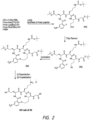
- FIG.2 shows exemplary reaction scheme (Scheme 2) which depicts a route to prepare a crystalline HCl salt of the ⁇ -turn peptidomimetic cyclic compound of formula D3.
- the present disclosure provides a method of preparing a crystalline form of a HCl salt of a ⁇ -turn peptidomimetic cyclic compound having the following structure: the method comprising steps of:
- the protected linear peptidomimetic compound of formula (4a) may be obtained from a liquid phase peptide synthesis process comprising the step of coupling Fmoc-Hser(Trt)-OH with H-Gly-OtBu.HCl thereby forming a dipeptide Fmoc -Hser(Trt)-Gly-OtBu.
- the process may further comprising the step of coupling the dipeptide H-Hser(Trt)-Gly-OtBu with Fmoc-Lys(Boc)-OH thereby forming a tripeptide Fmoc -Lys(Boc)-Hser(Trt)-Gly-OtBu.
- One of more of the coupling steps may be performed in the presence of diisopropylamine (DIPEA) and a condensation reagent, such as O-(7-azabenzotriazol-1-yl)-N,N,N',N'-tetramethyl-uronium-tetrafluoroboral- e (HATU), 1-[3-(dimethylamino)propyl]-3-ethylcarbodiimide hydrochloride (EDC.HCl), O-benzotriazol-N,N,N',N'-tetramethyl-uronium-hexafluoro-phosphate (HBTU), 1-hydroxybenzotriazole (HOBt), benzotriazol-1-yl-oxy-tris-pyrrolidino-phosphoniumhexafluoro phosphate (PyBOP), 1-hydroxy-7-azabenzo triazole, TBTU ((Benzotriazolyl) tetramethyluronium tetrafluo
- the condensation reagent is EDC.HCl/HOBt.
- the coupling step of Fmoc-Hser(Trt)-OH with H-Gly-OtBu.HCl may be performed in the presence of DIPEA and EDC.HCl /HOBt.
- the coupling step of the dipeptide H-Hser(Trt)-Gly-OtBu with Fmoc-Lys(Boc)-OH may be performed in the presence of DIPEA and EDC.HCl /HOBt.
- the coupling step of the tripeptide H-Lys(Boc)-Hser(Trt)-Gly-OtBu with Fmoc-Glu(Otbu)-OH may be performed in the presence of DIPEA and EDC.HCl /HOBt.
- the step of removing the N-terminal Fmoc protecting group of any of the peptides may be performed in the presence of BAEA to provide an N-terminal free amino group.
- the crystalline form of the disclosure comprises crystalline form IV, form V or mixtures thereof. These crystalline forms can be produced by the methods described herein and are substantially free of other crystalline forms (i.e., other than form IV or form V).
- the term "substantially free” refers to an amount of 10% or less of another form, for example 8%, 5%, 4%, 3%, 2%, 1%, 0.5%, or less of another form.
- the crystalline form of the disclosure can be characterized by X-Ray powder diffraction (XRPD), thermal data by differential scanning calorimeter (DSC) and thermal gravimetric analysis (TGA), dynamic vapor sorption (DVS), and / or gravimetric vapor sorption (GVS).
- the disclosure provides a crystalline form IV of a HCl salt of the ⁇ -turn peptidomimetic cyclic compound of formula D3. In one embodiment, the disclosure provides a crystalline form V of a HCl salt of the ⁇ -turn peptidomimetic cyclic compound of formula D3. In one embodiment, the disclosure provides a crystalline form including a mixture of form IV and form V of a HCl salt of the ⁇ -turn peptidomimetic cyclic compound of formula D3.
- the form IV is hygroscopic.
- the crystalline form IV may have a weight increase of from about 10% to about 30% at relative humidity (RH) from 60% to 100%, where the weight increase is due to the weight gain of water content.
- RH relative humidity
- the absorption or desorption of water process in the crystalline form may be reversible.
- the crystalline form IV has an irregular shape.
- the crystalline form V is in needle shaped form.
- form IV may be transformed to form V when exposed to high relative humidity, such as from 75% to 100%, from 85% to 100%, or from 95% to 100% RH.
- Form IV may be transformed to form V when treated with an acidic solution, e.g., an aqueous solution of hydrochloric acid, where the concentration of hydrochloride acid from about 0.001M to about 0.5M, from about 0.01M to about 0.2M, from about 0.05M to about 0.1M.
- Form IV may be transformed to a mixture of form V and some other forms when treated in a very dilute acidic solution, e.g., having a concentration of lower than 0.001M, or pure water (i.e., in the absence of acid or base).
- Form V may be transformed back to form IV upon drying.
- the rate of the transformation may be dependent on the concentration of the acidic solution. Generally, the rate of transformation from form V to form IV is faster when the crystalline form V is treated with a higher concentration of acidic solution.
- the crystalline salt of the ⁇ -turn peptidomimetic cyclic compound of formula D3 contains needle shaped crystals.
- the crystalline form of a salt of a ⁇ -turn peptidomimetic cyclic compound of formula D3 is obtained from a solution containing at least 60% water.
- the crystalline form of a salt of a ⁇ -turn peptidomimetic cyclic compound of formula D3 is a hydrate.
- the crystalline form of the HCl salt of D3 is characterized by an XRPD pattern with characteristic peaks at diffraction angles (°2theta) of 6.7 ⁇ 0.2 and 9.1 ⁇ 0.2. In one embodiment the crystalline form of the HCl salt of D3 is characterized by an XRPD pattern with characteristic peaks at diffraction angles (°2theta) of 6.7 ⁇ 0.2, 9.1 ⁇ 0.2, 4.4 ⁇ 0.2, 5.1 ⁇ 0.2 and 2.6 ⁇ 0.2.
- the crystalline form of the HCl salt of D3 is characterized by an XRPD pattern with having two or more, three or more, four or more, or five or more characteristic peaks at diffraction angles (°2theta) selected from 6.7 ⁇ 0.2, 9.1 + 0.2, 4.4 ⁇ 0.2, 5.1 ⁇ 0.2, 2.6 ⁇ 0.2, 11.5 ⁇ 0.2, 15.3 ⁇ 0.2, 16.6 ⁇ 0.2, 17.7 ⁇ 0.2, 18.2 ⁇ 0.2, 20.2 ⁇ 0.2, 21.6 ⁇ 0.2, 22.1 ⁇ 0.2, 22.5 ⁇ 0.2, 23.2 ⁇ 0.2, 24.1 ⁇ 0.2.
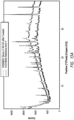
- a crystal form of which has a powder X-ray diffraction pattern essentially as set out in Figure 13b .
- FIG. 2 illustrates the synthesis of a HCl salt of D3 , which is one embodiment of ⁇ -turn peptidomimetic cyclic compound of formula (I).
- Synthesis of Compound 4a can be carried out by standard stepwise LPPS (liquid phase peptide synthesis) procedures. See for example, L.A. Carpino et al., Organic Process Research & Development 2003, 7, 28-37 )
- the organic solution containing the dipeptide was diluted with DMF (227 ml) and stirred at 5 °C. To this solution were added Fmoc-Lys(Boc)OH (30g), HOBt(10.8g), and EDC ⁇ HCl (15g) and EtOAc (45 ml). The mixture was agitated at 20°C to complete conversion (normally ⁇ 1 h). On completion, BAEA (34.5 ml) was added and the mixture was agitated for 30 min for complete removal of the Fmoc group.
- reaction mixture was washed with a mixture of NaCl (23 %, 170 ml) and water (150 ml) once, and with NaHCO3 (4.8 %, 113 ml) twice.
- the organic layer was diluted with EtOAc (30 ml), and was ready for the next coupling. It was made sure that no aqueous phase was left behind in the reactor, and that no part of the organic layer was discarded after washings.
- the organic solution containing the tripeptide was diluted with DMF (227 ml) and stirred at 5 °C. To this solution were added Fmoc-Glu(OtBu)OH (28.5g), HOBt(10.8g), and EDC ⁇ HCl (15g). The mixture was agitated at 20°C to complete conversion (normally ⁇ 2 h). On completion, BAEA (34.5 ml) was added and the mixture was agitated for 30 min for complete removal of the Fmoc group. Om completion, the reaction mixture was washed with a mixture of NaCl (23 %, 113 ml) and water (49 ml).
- the organic solution was diluted with DMF (169 ml) and EtOAc (113 ml), and then heated to 40°C.
- the solution was washed with a mixture of NaCl (23 %, 113 ml) and water (38 ml) at 40°C.
- the organic layer was washed with a mixture of NaCl (23 %, 56 ml) and water (56 ml) at 40°C.
- the pH of the aqeuous layer was adjusted to pH 5-5.5 (indicator sticks) with KHSO 4 (1 M) and the phases were separated.
- the organic solution was ready for next coupling. It was made sure that no aqueous phase was left behind in the reactor, and that no part of the organic layer was discarded after washings.
- the organic solution containing the tetrapeptide was diluted with DMF (227 ml) and stirred at 5°C. To this solution were added FNBA (14.3g), EDC ⁇ HCl (15 g) and DIPEA (13.4 ml). The mixture was agitated at 20°C to complete conversion (normally ⁇ 5 h). On completion, the reaction mixture was stirred with MeTHF (450 ml), NaCl (23 %, 113 ml) and NaHCO 3 (4.8 %, 113 ml). The layers were separated and the organic layer was heated to 40°C and subsequently washed at this temperature with NaHCO 3 (4.8 %, 226 ml), and finally with water (226 ml). It was made sure that no aqueous phase was left behind in the reactor, and that no part of the organic layer was discarded after washings.
- the pentapeptide (55.2g) was added in 5-7 portions to a mixture of acetic acid (450 ml) and water (50 ml) at 40°C. After addition, the white suspension was agitated for 7-9 h to complete conversion (>98%). On completion, the reaction mixture was cooled to 20°C and then extracted with a mixture of MTBE (552 ml), NaCl (23 %, 276 ml) and water (110 ml). The organic layer was extracted twice with KHSO 4 (1M, 276 ml) at 20°C, three times with NaHCO 3 (4.8 %, 276 ml) at 40°C , and once with water (276 ml).
- the solid crude product was collected on a filter, washed twice with water (2 ⁇ 200 ml), twice with DIPE (2 ⁇ 200ml), and dried at 45°C under vacuum for 2 h.
- the dried crude product (36.1 g) was suspended in EtOAc (788 ml). The suspension was agitated at 40°C for ca 40 min. and then cooled to 0°C and kept agitated for 2 h.
- the solid product, compound 2a was collected on a filter and washed twice with DIPE (2 ⁇ 200 ml) on the filter. After drying, 34.6g of the purified cyclic peptide was obtained, yield: 78.6% with assay correction, HPLC 96.8%.
- the purified cyclic peptide (33.3g) obtained from the cyclization step was suspended in a mixture of MeCN (330 ml) and concentrated HCl (37%, 54 ml). The suspension was agitated at 15°C for 1 h. The suspension turned to a solution and then to a slurry again. On completion, MeCN (330 ml) was added and the mixture was agitated for 1 h. The crude product, HCl salt of D3 , was collected on a filter, washed twice with MeCN (2 ⁇ 330 ml), and dried at 20°C under vacuum. Yield: 24.5g.
- the crude product (24.5g) was suspended in water (245 ml) and heated to 50°C. To this suspension (may appear as a gel) was added NaOH (2 M, 47.6 ml). The mixture was stirred at 50°C for 1 h until a solution was obtained (may be cloudy). This solution was filtered hot to remove any insoluble materials. The vessel was rinsed with water (74 ml), the rinsing liquid was passed through the filter, and filtrates were combined. The combined filtrates were transferred to another vessel, and heated to 50°C with efficient agitation. To this warm solution was added HCl (4 M, 47.6 ml). A gel was formed initially.
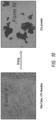
- the final product tended to from a gel at pH 2-8, but at pH>9 it formed a stable solution appropriate for clear filtration. After acidification of the clear solution with 37% HCl to pH ⁇ 0, the final product HCl salt formed a gel first and then the gel was transformed to fine needles (see, Fig. 3 ) of high purity.
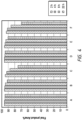
- Fig. 4 is a bar chart showing the HPLC percent area of the final product at different conditions (i.e. , at various temperature and concentration of HCl (labeled as A, B, C, D, E and Fj) at 2 hours, 4 hours, 8 hours and 22 hours during crystallization.
- the starting purity was 96.2%.
- Fig. 5 is a graph showing the formation of impurity Des-Gly during crystallization over time a period of 22 hours.
- the following conclusions can be made: (a) at 40 °C, the final product is stable in the presence of 5 and 7 equiv. of HCl for 22 hours; (b) at 50 °C, the final product is stable in the presence of 5 and 7 equiv. HCl for 4 hours; (c) at 60 °C, the final product starts to degrade after 2h.
- Fig. 6 is a graph showing the formation of an unknown impurity during crystallization over time a period of 12 hours.
- the impurity was eluted at 0.93 relative retention time (RRT0.93) measured by the HPLC.
- RRT0.93 0.93 relative retention time measured by the HPLC.
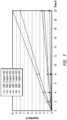
- Fig. 7 is a graph showing the formation of an unknown impurity during crystallization over time a period of 12 hours.
- the impurity was eluted at 1.11 relative retention time (RRT1.11) measured by the HPLC.
- RRT1.11 1.11 relative retention time measured by the HPLC.
- the following conclusions can be made: (a) at 40 °C, the formation of RRT1.11 is very slow regardless if 5 equiv. or 7 equiv. HC1 are added; (b) at 50 °C, the formation of RRT1.11 is slightly higher than at 40°C within 4 hours. It is accelerated after 4 h, and more of the unknown impurity is generated using 7 equiv. HC1 than using 5 equiv. HCl; (c) at 60 °C, the formation of RRT1.11 is increased rapidly.
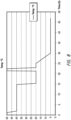
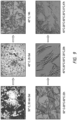
- Fig. 8 Samples were removed from the slurry at intervals and analyzed by microscopy.
- Fig. 9 shows the crystal transformation of the final product under microscope analysis.
- a gel was transformed to a crystalline (needles) slurry after 14 hours at 40 °C. These needles were not damaged during the temperature cycling for totally 47 hours, including long cooling at 5 °C. This means that this crystalline form was stable under these conditions and the transformation required a long time.
- the purity of the crude final product influences the transformation rate from gel to crystalline material. After crystallization, the purity of the crystalline product was above 97% (e.g., 97.2% - 99.1%) measured by HPLC. The crystalline product was easier to filter than the gel, although the filtration time was relatively long. After drying, the needles were transformed to an irregular solid, with some crystallinity.
- Fig. 10 shows the crystal transformation on the filter under microscope analysis.
- a crude batch of D3 sample was slurried in 0.1M HCl solution, 0.001M HCl solution to study possible transformations.
- Approximately 60 mg of crude D3 sample was slurried in 0.6 ml solution.
- the slurry was left with magnetic stirring at room temperature.
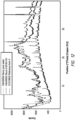
- the slurry was analyzed by XRPD on a porous plate, see Fig. 11 .
- the crystal form corresponds to form V, i.e. , a fast transformation from form IV to form V occurs.
- the slurry includes mainly form V but there are some extra peaks which may indicate the presence of other forms. It should be noticed that the crude material may have contained excess amounts of HCl which influences the pH.
- the pH in the pure water slurry was approximately 3.
- the 0.1M HCl slurry was analysed a second time after 3 weeks. See Fig. 13a . It is still corresponding to form V, i.e. , the slurry seems very stable with respect to polymorphic form.
- Fig. 14 shows microscope pictures of a dry sample of an amorphous HCl salt of D3 , which was crystallized but lost its crystallinity upon drying which was obtained prior to crystallization.
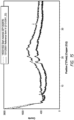
- the DSC of the amorphous HCl salt of D3 is shown in Fig. 16 .
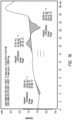
- thermogravimetric analysis (TGA) of the amorphous HCl salt of D3 is shown in Fig. 17 , which shows a weight loss of approximately 1.7% up to 100-110 °C.
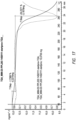
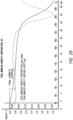
- the amorphous HCl salt of D3 sample was analyzed by dynamic vapor sorption (DVS), see Fig. 18 .
- D3 sample was analyzed by dynamic vapor sorption (DVS), see Fig. 18 .
- VFS dynamic vapor sorption
- RH relative humidity
- the change in mass is 4%, at 40% RH approximately 7%.
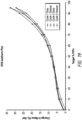
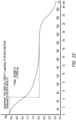
- the process seems completely reversible and there is almost no hysteresis effect, i.e. , the uptake and loss of weight is almost identical, see Fig. 19 . It is noted that both cycles are almost identical.
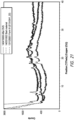
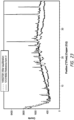
- amorphous HCl salt of D3 sample was analyzed again by XRPD, see Fig.21 , which shows that the material was still very similar to the starting material.
- the DSC analysis was made on a Mettler Toledo DSC model 822.
- TGA analysis was made on a Mettler Toledo TGA/SDTA 851.
- X-Ray powder diffraction patterns were collected on a PANalytical X'Pert PRO diffractometer using copper radiation equipped with PIXcel detector, automatic divergence and anti-scatter slits, soller slits and Ni-filter.
- the dry sample was applied to the ZBH with standard techniques for XRPD.
- the wet sample was analyzed by the use of porous Al 2 O 3 plates to eliminate some of the solvent effects.
Landscapes
- Chemical & Material Sciences (AREA)
- Organic Chemistry (AREA)
- Molecular Biology (AREA)
- Proteomics, Peptides & Aminoacids (AREA)
- Biophysics (AREA)
- General Health & Medical Sciences (AREA)
- Genetics & Genomics (AREA)
- Medicinal Chemistry (AREA)
- Health & Medical Sciences (AREA)
- Biochemistry (AREA)
- Life Sciences & Earth Sciences (AREA)
- Analytical Chemistry (AREA)
- Crystallography & Structural Chemistry (AREA)
- Peptides Or Proteins (AREA)
- Organic Low-Molecular-Weight Compounds And Preparation Thereof (AREA)
- Medicines That Contain Protein Lipid Enzymes And Other Medicines (AREA)
- Nitrogen Condensed Heterocyclic Rings (AREA)
- Pharmaceuticals Containing Other Organic And Inorganic Compounds (AREA)
Priority Applications (1)
| Application Number | Priority Date | Filing Date | Title |
|---|---|---|---|
| EP25158656.6A EP4549450A3 (en) | 2015-07-09 | 2016-07-08 | Solution phase synthesis and crystallization of beta-turn peptidomimetic cyclic salts |
Applications Claiming Priority (2)
| Application Number | Priority Date | Filing Date | Title |
|---|---|---|---|
| US201562190596P | 2015-07-09 | 2015-07-09 | |
| PCT/EP2016/066281 WO2017005902A1 (en) | 2015-07-09 | 2016-07-08 | Solution phase synthesis and crystallization of beta-turn peptidomimetic cyclic salts |
Related Child Applications (1)
| Application Number | Title | Priority Date | Filing Date |
|---|---|---|---|
| EP25158656.6A Division EP4549450A3 (en) | 2015-07-09 | 2016-07-08 | Solution phase synthesis and crystallization of beta-turn peptidomimetic cyclic salts |
Publications (3)
| Publication Number | Publication Date |
|---|---|
| EP3319978A1 EP3319978A1 (en) | 2018-05-16 |
| EP3319978C0 EP3319978C0 (en) | 2025-02-19 |
| EP3319978B1 true EP3319978B1 (en) | 2025-02-19 |
Family
ID=56413639
Family Applications (2)
| Application Number | Title | Priority Date | Filing Date |
|---|---|---|---|
| EP16739073.1A Active EP3319978B1 (en) | 2015-07-09 | 2016-07-08 | Solution phase synthesis and crystallization of beta-turn peptidomimetic cyclic salts |
| EP25158656.6A Pending EP4549450A3 (en) | 2015-07-09 | 2016-07-08 | Solution phase synthesis and crystallization of beta-turn peptidomimetic cyclic salts |
Family Applications After (1)
| Application Number | Title | Priority Date | Filing Date |
|---|---|---|---|
| EP25158656.6A Pending EP4549450A3 (en) | 2015-07-09 | 2016-07-08 | Solution phase synthesis and crystallization of beta-turn peptidomimetic cyclic salts |
Country Status (9)
| Country | Link |
|---|---|
| US (4) | US10125165B2 (OSRAM) |
| EP (2) | EP3319978B1 (OSRAM) |
| JP (1) | JP6801835B2 (OSRAM) |
| KR (1) | KR102056257B1 (OSRAM) |
| CN (2) | CN114874288A (OSRAM) |
| AU (1) | AU2016290654C1 (OSRAM) |
| CA (1) | CA2991661A1 (OSRAM) |
| TW (1) | TWI708779B (OSRAM) |
| WO (1) | WO2017005902A1 (OSRAM) |
Families Citing this family (4)
| Publication number | Priority date | Publication date | Assignee | Title |
|---|---|---|---|---|
| JP6801835B2 (ja) | 2015-07-09 | 2020-12-16 | ミメトゲン ファーマシュウティカルズ インコーポレイテッドMimetogen Pharmaceuticals, Inc. | β−ターンペプチド模倣環状塩の液相合成及び結晶化 |
| PL3464336T3 (pl) | 2016-06-01 | 2022-05-16 | Athira Pharma, Inc. | Związki |
| MX2020012629A (es) * | 2018-05-31 | 2021-01-29 | Sederma Sa | Metodo para sintesis de peptido en fase de solucion y estrategias protectoras de la misma. |
| US11427612B2 (en) * | 2018-08-21 | 2022-08-30 | Wayne State University | Epimerization-free N to C solid-phase peptide synthesis |
Family Cites Families (11)
| Publication number | Priority date | Publication date | Assignee | Title |
|---|---|---|---|---|
| AUPP254898A0 (en) * | 1998-03-24 | 1998-04-23 | University Of Queensland, The | Peptide turn mimetics |
| WO2001052843A1 (en) | 2000-01-18 | 2001-07-26 | Mcgill University | β-TURN PEPTIDOMIMETIC CYCLIC COMPOUNDS |
| BR0311558A (pt) * | 2002-06-11 | 2007-04-27 | Lilly Co Eli | composto ou sal farmaceuticamente aceitável do mesmo, processo para preparar o mesmo, métodos para afetar os receptores de glutamato metabotrópicos ligados a camp, para administrar uma quantidade eficaz de um composto e para tratar um distúrbio neurológico e psiquiátrico em um paciente, e, formulação farmacêutica |
| KR101565185B1 (ko) * | 2008-04-04 | 2015-11-02 | 미메토젠 파르마슈티칼스 인크. | 건안증을 치료하기 위한 베타-턴 펩티도미메틱 환상 화합물 |
| ES2512717T3 (es) * | 2009-02-27 | 2014-10-24 | Mimetogen Pharmaceuticals Inc. | Compuestos cíclicos peptidomiméticos para el tratamiento de la retinitis pigmentosa |
| WO2012013281A1 (de) * | 2010-07-29 | 2012-02-02 | Merck Patent Gmbh | Flüssigkristallines medium enthaltend thiophenderivate |
| JP5710436B2 (ja) * | 2011-09-26 | 2015-04-30 | 株式会社東芝 | パターン形成方法 |
| KR102061382B1 (ko) * | 2012-06-22 | 2019-12-31 | 미메토젠 파르마슈티칼스 인크. | 베타-턴 펩티도미메틱 환상 화합물의 합성 |
| JP6516974B2 (ja) * | 2013-06-14 | 2019-05-22 | 豊田合成株式会社 | ゴム組成物及びゴム製品 |
| US9200100B2 (en) * | 2013-06-20 | 2015-12-01 | Exxonmobil Chemical Patents Inc. | Long-bridged salen catalyst |
| JP6801835B2 (ja) * | 2015-07-09 | 2020-12-16 | ミメトゲン ファーマシュウティカルズ インコーポレイテッドMimetogen Pharmaceuticals, Inc. | β−ターンペプチド模倣環状塩の液相合成及び結晶化 |
-
2016
- 2016-07-08 JP JP2017567608A patent/JP6801835B2/ja active Active
- 2016-07-08 KR KR1020187003965A patent/KR102056257B1/ko active Active
- 2016-07-08 CN CN202210654769.XA patent/CN114874288A/zh active Pending
- 2016-07-08 CA CA2991661A patent/CA2991661A1/en active Pending
- 2016-07-08 CN CN201680040450.0A patent/CN107849089B/zh active Active
- 2016-07-08 EP EP16739073.1A patent/EP3319978B1/en active Active
- 2016-07-08 AU AU2016290654A patent/AU2016290654C1/en active Active
- 2016-07-08 EP EP25158656.6A patent/EP4549450A3/en active Pending
- 2016-07-08 US US15/205,909 patent/US10125165B2/en active Active
- 2016-07-08 WO PCT/EP2016/066281 patent/WO2017005902A1/en not_active Ceased
- 2016-07-11 TW TW105121814A patent/TWI708779B/zh active
-
2018
- 2018-11-08 US US16/184,485 patent/US11078234B2/en active Active
-
2021
- 2021-06-02 US US17/337,383 patent/US11753441B2/en active Active
-
2023
- 2023-07-18 US US18/354,076 patent/US12281179B2/en active Active
Also Published As
| Publication number | Publication date |
|---|---|
| US11078234B2 (en) | 2021-08-03 |
| CN107849089B (zh) | 2022-07-05 |
| CN114874288A (zh) | 2022-08-09 |
| EP3319978A1 (en) | 2018-05-16 |
| US20210300966A1 (en) | 2021-09-30 |
| TW201716425A (zh) | 2017-05-16 |
| US20170008923A1 (en) | 2017-01-12 |
| EP4549450A2 (en) | 2025-05-07 |
| WO2017005902A1 (en) | 2017-01-12 |
| AU2016290654A1 (en) | 2018-01-25 |
| EP4549450A3 (en) | 2025-07-02 |
| HK1255355A1 (en) | 2019-08-16 |
| US11753441B2 (en) | 2023-09-12 |
| US20190194251A1 (en) | 2019-06-27 |
| CA2991661A1 (en) | 2017-01-12 |
| US12281179B2 (en) | 2025-04-22 |
| KR20180036982A (ko) | 2018-04-10 |
| TWI708779B (zh) | 2020-11-01 |
| KR102056257B1 (ko) | 2019-12-16 |
| AU2016290654C1 (en) | 2021-11-11 |
| JP6801835B2 (ja) | 2020-12-16 |
| CN107849089A (zh) | 2018-03-27 |
| EP3319978C0 (en) | 2025-02-19 |
| JP2018528928A (ja) | 2018-10-04 |
| AU2016290654B2 (en) | 2021-07-08 |
| US20230357318A1 (en) | 2023-11-09 |
| US10125165B2 (en) | 2018-11-13 |
| AU2016290654A2 (en) | 2020-08-06 |
Similar Documents
| Publication | Publication Date | Title |
|---|---|---|
| US12281179B2 (en) | Solution phase synthesis of β-turn peptidomimetic cyclic salts | |
| JP7625531B2 (ja) | 立体障害の大きなアミノ酸を含むペプチド化合物の製造方法 | |
| TWI873263B (zh) | 胜肽化合物的合成法 | |
| EP4269422A1 (en) | Method for producing peptide compound containing n-substituted-amino acid residue | |
| WO2023127869A1 (ja) | N-アルキルアミノ酸、およびn-アルキルアミノ酸を含むペプチドの製造方法 | |
| CA2672369A1 (en) | Crystalline d-isoglutamyl-d-tryptophan and the mono ammonium salt of d-isoglutamyl-d-tryptophan | |
| WO2022097540A1 (ja) | ジケトピペラジン形成による欠損を抑制するペプチド合成方法 | |
| US4638046A (en) | Retro-inverso C-terminal hexapeptide analogues of substance P | |
| JPH0377178B2 (OSRAM) | ||
| EP2864347B1 (en) | Synthesis of beta-turn peptidomimetic cyclic compounds | |
| HK1255355B (en) | Solution phase synthesis and crystallization of beta-turn peptidomimetic cyclic salts | |
| HK40081202A (en) | Solution phase synthesis and crystallization of beta-turn peptidomimetic cyclic salts | |
| HU197928B (en) | Process for the production poor in racemate of peptide intermediary of hormon synthesis of gonadorelin and gonadorelin analog | |
| RU2592282C1 (ru) | Способ получения нонапептидов | |
| RU2574392C1 (ru) | СПОСОБ ПОЛУЧЕНИЯ ТРИПЕПТИДА ОБЩЕЙ ФОРМУЛЫ (I) HPyr-His-TrpOH, ИСПОЛЬЗУЕМОГО В КАЧЕСТВЕ ПРОМЕЖУТОЧНОГО СОЕДИНЕНИЯ (1-3 ФРАГМЕНТА) В СИНТЕЗЕ СИНТЕТИЧЕСКИХ АГОНИСТОВ ГОНАДОТРОПИН-РИЛИЗИНГ-ГОРМОНА (LH-RH), МЕТОДОМ ЖИДКОФАЗНОГО ПЕПТИДНОГО СИНТЕЗА БЕЗ ПОСТАНОВКИ И СНЯТИЙ ЗАЩИТНЫХ ГРУПП | |
| EP3042911A1 (en) | Method for producing dipeptide derivative containing disubstituted amino acid residue | |
| WO2024195801A1 (ja) | 環状ペプチドの共結晶の製造方法 | |
| JPH07316193A (ja) | ペプチド誘導体およびその用途 |
Legal Events
| Date | Code | Title | Description |
|---|---|---|---|
| STAA | Information on the status of an ep patent application or granted ep patent |
Free format text: STATUS: THE INTERNATIONAL PUBLICATION HAS BEEN MADE |
|
| PUAI | Public reference made under article 153(3) epc to a published international application that has entered the european phase |
Free format text: ORIGINAL CODE: 0009012 |
|
| STAA | Information on the status of an ep patent application or granted ep patent |
Free format text: STATUS: REQUEST FOR EXAMINATION WAS MADE |
|
| 17P | Request for examination filed |
Effective date: 20180209 |
|
| AK | Designated contracting states |
Kind code of ref document: A1 Designated state(s): AL AT BE BG CH CY CZ DE DK EE ES FI FR GB GR HR HU IE IS IT LI LT LU LV MC MK MT NL NO PL PT RO RS SE SI SK SM TR |
|
| AX | Request for extension of the european patent |
Extension state: BA ME |
|
| DAV | Request for validation of the european patent (deleted) | ||
| DAX | Request for extension of the european patent (deleted) | ||
| REG | Reference to a national code |
Ref country code: HK Ref legal event code: DE Ref document number: 1255355 Country of ref document: HK |
|
| STAA | Information on the status of an ep patent application or granted ep patent |
Free format text: STATUS: EXAMINATION IS IN PROGRESS |
|
| 17Q | First examination report despatched |
Effective date: 20200420 |
|
| P01 | Opt-out of the competence of the unified patent court (upc) registered |
Effective date: 20230525 |
|
| GRAP | Despatch of communication of intention to grant a patent |
Free format text: ORIGINAL CODE: EPIDOSNIGR1 |
|
| STAA | Information on the status of an ep patent application or granted ep patent |
Free format text: STATUS: GRANT OF PATENT IS INTENDED |
|
| INTG | Intention to grant announced |
Effective date: 20240403 |
|
| RAP3 | Party data changed (applicant data changed or rights of an application transferred) |
Owner name: MIMETOGEN PHARMACEUTICALS, INC. |
|
| GRAJ | Information related to disapproval of communication of intention to grant by the applicant or resumption of examination proceedings by the epo deleted |
Free format text: ORIGINAL CODE: EPIDOSDIGR1 |
|
| STAA | Information on the status of an ep patent application or granted ep patent |
Free format text: STATUS: EXAMINATION IS IN PROGRESS |
|
| INTC | Intention to grant announced (deleted) | ||
| GRAP | Despatch of communication of intention to grant a patent |
Free format text: ORIGINAL CODE: EPIDOSNIGR1 |
|
| STAA | Information on the status of an ep patent application or granted ep patent |
Free format text: STATUS: GRANT OF PATENT IS INTENDED |
|
| INTG | Intention to grant announced |
Effective date: 20240913 |
|
| GRAS | Grant fee paid |
Free format text: ORIGINAL CODE: EPIDOSNIGR3 |
|
| GRAA | (expected) grant |
Free format text: ORIGINAL CODE: 0009210 |
|
| STAA | Information on the status of an ep patent application or granted ep patent |
Free format text: STATUS: THE PATENT HAS BEEN GRANTED |
|
| AK | Designated contracting states |
Kind code of ref document: B1 Designated state(s): AL AT BE BG CH CY CZ DE DK EE ES FI FR GB GR HR HU IE IS IT LI LT LU LV MC MK MT NL NO PL PT RO RS SE SI SK SM TR |
|
| REG | Reference to a national code |
Ref country code: GB Ref legal event code: FG4D |
|
| REG | Reference to a national code |
Ref country code: CH Ref legal event code: EP |
|
| REG | Reference to a national code |
Ref country code: IE Ref legal event code: FG4D |
|
| REG | Reference to a national code |
Ref country code: DE Ref legal event code: R096 Ref document number: 602016091274 Country of ref document: DE |
|
| U01 | Request for unitary effect filed |
Effective date: 20250319 |
|
| P04 | Withdrawal of opt-out of the competence of the unified patent court (upc) registered |
Free format text: CASE NUMBER: APP_18376/2025 Effective date: 20250416 |
|
| U07 | Unitary effect registered |
Designated state(s): AT BE BG DE DK EE FI FR IT LT LU LV MT NL PT RO SE SI Effective date: 20250422 |
|
| PG25 | Lapsed in a contracting state [announced via postgrant information from national office to epo] |
Ref country code: RS Free format text: LAPSE BECAUSE OF FAILURE TO SUBMIT A TRANSLATION OF THE DESCRIPTION OR TO PAY THE FEE WITHIN THE PRESCRIBED TIME-LIMIT Effective date: 20250519 |
|
| PG25 | Lapsed in a contracting state [announced via postgrant information from national office to epo] |
Ref country code: PL Free format text: LAPSE BECAUSE OF FAILURE TO SUBMIT A TRANSLATION OF THE DESCRIPTION OR TO PAY THE FEE WITHIN THE PRESCRIBED TIME-LIMIT Effective date: 20250219 |
|
| PG25 | Lapsed in a contracting state [announced via postgrant information from national office to epo] |
Ref country code: ES Free format text: LAPSE BECAUSE OF FAILURE TO SUBMIT A TRANSLATION OF THE DESCRIPTION OR TO PAY THE FEE WITHIN THE PRESCRIBED TIME-LIMIT Effective date: 20250219 |
|
| PG25 | Lapsed in a contracting state [announced via postgrant information from national office to epo] |
Ref country code: IS Free format text: LAPSE BECAUSE OF FAILURE TO SUBMIT A TRANSLATION OF THE DESCRIPTION OR TO PAY THE FEE WITHIN THE PRESCRIBED TIME-LIMIT Effective date: 20250619 Ref country code: NO Free format text: LAPSE BECAUSE OF FAILURE TO SUBMIT A TRANSLATION OF THE DESCRIPTION OR TO PAY THE FEE WITHIN THE PRESCRIBED TIME-LIMIT Effective date: 20250519 |
|
| PG25 | Lapsed in a contracting state [announced via postgrant information from national office to epo] |
Ref country code: HR Free format text: LAPSE BECAUSE OF FAILURE TO SUBMIT A TRANSLATION OF THE DESCRIPTION OR TO PAY THE FEE WITHIN THE PRESCRIBED TIME-LIMIT Effective date: 20250219 |
|
| PG25 | Lapsed in a contracting state [announced via postgrant information from national office to epo] |
Ref country code: GR Free format text: LAPSE BECAUSE OF FAILURE TO SUBMIT A TRANSLATION OF THE DESCRIPTION OR TO PAY THE FEE WITHIN THE PRESCRIBED TIME-LIMIT Effective date: 20250520 |
|
| U20 | Renewal fee for the european patent with unitary effect paid |
Year of fee payment: 10 Effective date: 20250724 |
|
| PG25 | Lapsed in a contracting state [announced via postgrant information from national office to epo] |
Ref country code: SM Free format text: LAPSE BECAUSE OF FAILURE TO SUBMIT A TRANSLATION OF THE DESCRIPTION OR TO PAY THE FEE WITHIN THE PRESCRIBED TIME-LIMIT Effective date: 20250219 |
|
| PGFP | Annual fee paid to national office [announced via postgrant information from national office to epo] |
Ref country code: GB Payment date: 20250702 Year of fee payment: 10 |
|
| PG25 | Lapsed in a contracting state [announced via postgrant information from national office to epo] |
Ref country code: CZ Free format text: LAPSE BECAUSE OF FAILURE TO SUBMIT A TRANSLATION OF THE DESCRIPTION OR TO PAY THE FEE WITHIN THE PRESCRIBED TIME-LIMIT Effective date: 20250219 |
|
| PG25 | Lapsed in a contracting state [announced via postgrant information from national office to epo] |
Ref country code: SK Free format text: LAPSE BECAUSE OF FAILURE TO SUBMIT A TRANSLATION OF THE DESCRIPTION OR TO PAY THE FEE WITHIN THE PRESCRIBED TIME-LIMIT Effective date: 20250219 |